Cambridge IGCSE Mathematics - International 0607 — 2014 Oct/Nov Paper 4 · Variant 2
0607/42/O/N/14 · 120 marks · ≈135 min
The question paper and its mark scheme, free to read here and free to download. This is Cambridge’s own paper, exactly as it was sat.
Question paper20 pages
Mark scheme7 pages
Answers below. Sit the paper first if you are practising.
Paper as text
Question paper, page 1
This document consists of 20 printed pages. IB14 11_0607_42/2RP © UCLES 2014 [Turn over *6674351105* Cambridge International Examinations Cambridge International General Certificate of Secondary Education CAMBRIDGE INTERNATIONAL MATHEMATICS 0607/42 Paper 4 (Extended) October/November 2014 2 hours 15 minutes Candidates answer on the Question Paper. Additional Materials: Geometrical Instruments Graphics Calculator READ THESE INSTRUCTIONS FIRST Write your Centre number, candidate number and name on all the work you hand in. Write in dark blue or black pen. Do not use staples, paper clips, glue or correction fluid. You may use an HB pencil for any diagrams or graphs. DO NOT WRITE IN ANY BARCODES. Answer all the questions. Unless instructed otherwise, give your answers exactly or correct to three significant figures as appropriate. Answers in degrees should be given to one decimal place. For π, use your calculator value. You must show all the relevant working to gain full marks and you will be given marks for correct methods, including sketches, even if your answer is incorrect. The number of marks is given in brackets [ ] at the end of each question or part question. The total number of marks for this paper is 120.
Question paper, page 2
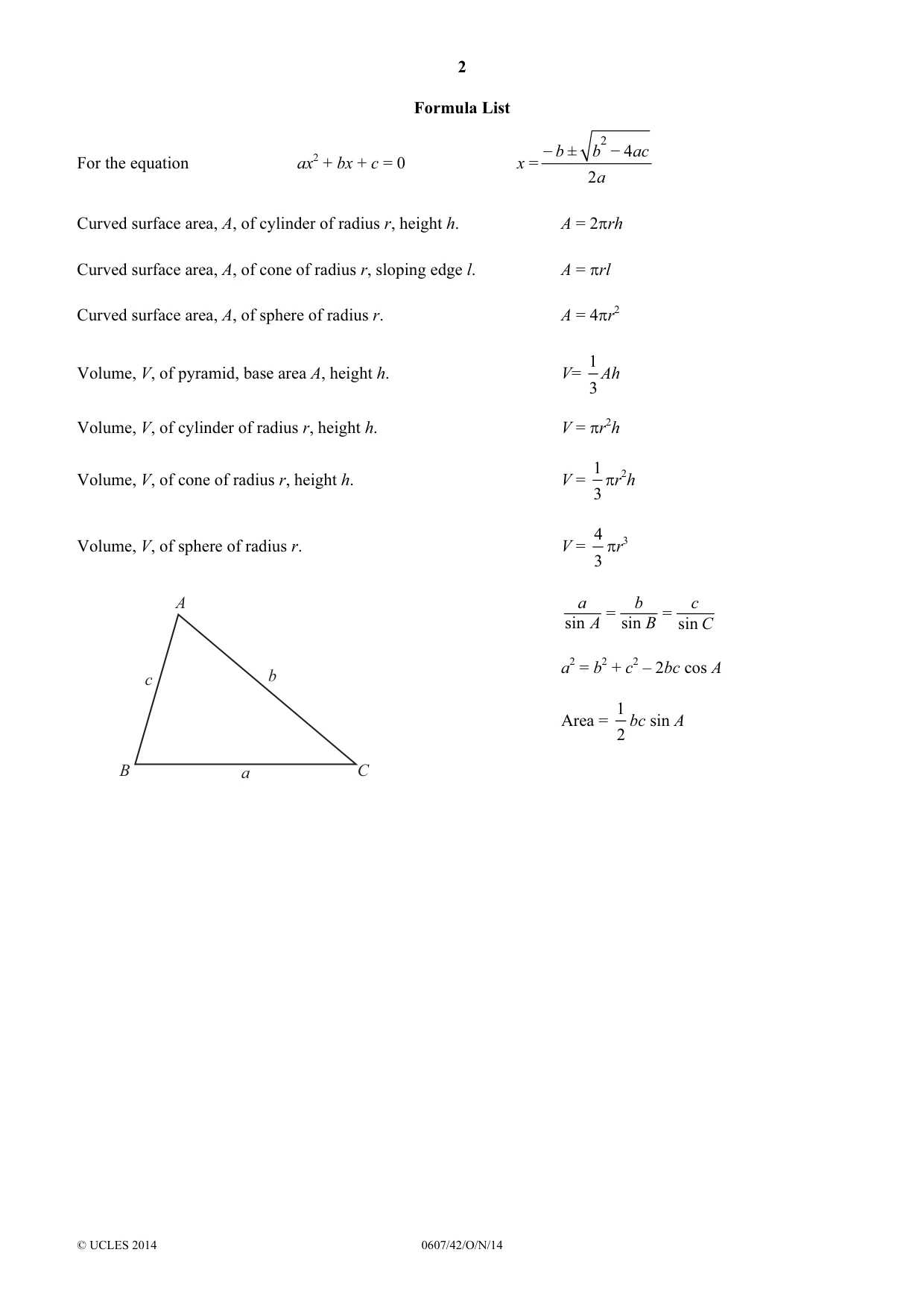
2 © UCLES 2014 0607/42/O/N/14 Formula List For the equation ax2 + bx + c = 0 x = 2 _ ± 4 2 _ b b ac a Curved surface area, A, of cylinder of radius r, height h. A = 2πrh Curved surface area, A, of cone of radius r, sloping edge l. A = πrl Curved surface area, A, of sphere of radius r. A = 4πr2 Volume, V, of pyramid, base area A, height h. V= 1 3 Ah Volume, V, of cylinder of radius r, height h. V = πr2h Volume, V, of cone of radius r, height h. V = 1 3 πr2h Volume, V, of sphere of radius r. V = 4 3 πr3 = = sin sin sin a b c A B C a2 = b2 + c2 – 2bc cos A Area = 1 2 bc sin A A a B C b c
Question paper, page 3
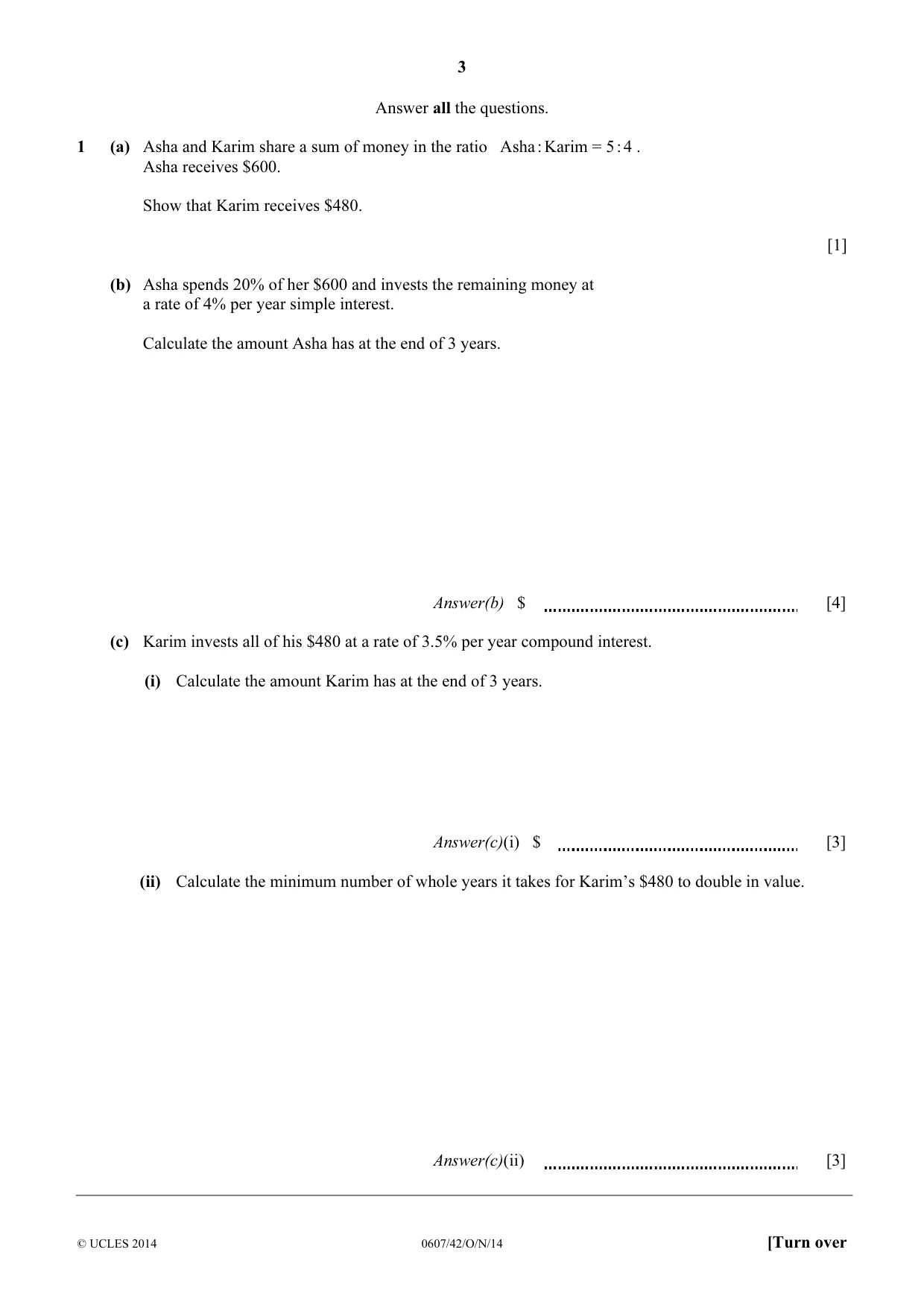
3 © UCLES 2014 0607/42/O/N/14 [Turn over Answer all the questions. 1 (a) Asha and Karim share a sum of money in the ratio Asha : Karim = 5 : 4 . Asha receives $600. Show that Karim receives $480. [1] (b) Asha spends 20% of her $600 and invests the remaining money at a rate of 4% per year simple interest. Calculate the amount Asha has at the end of 3 years. Answer(b) $ [4] (c) Karim invests all of his $480 at a rate of 3.5% per year compound interest. (i) Calculate the amount Karim has at the end of 3 years. Answer(c)(i) $ [3] (ii) Calculate the minimum number of whole years it takes for Karim’s $480 to double in value. Answer(c)(ii) [3]
Question paper, page 4
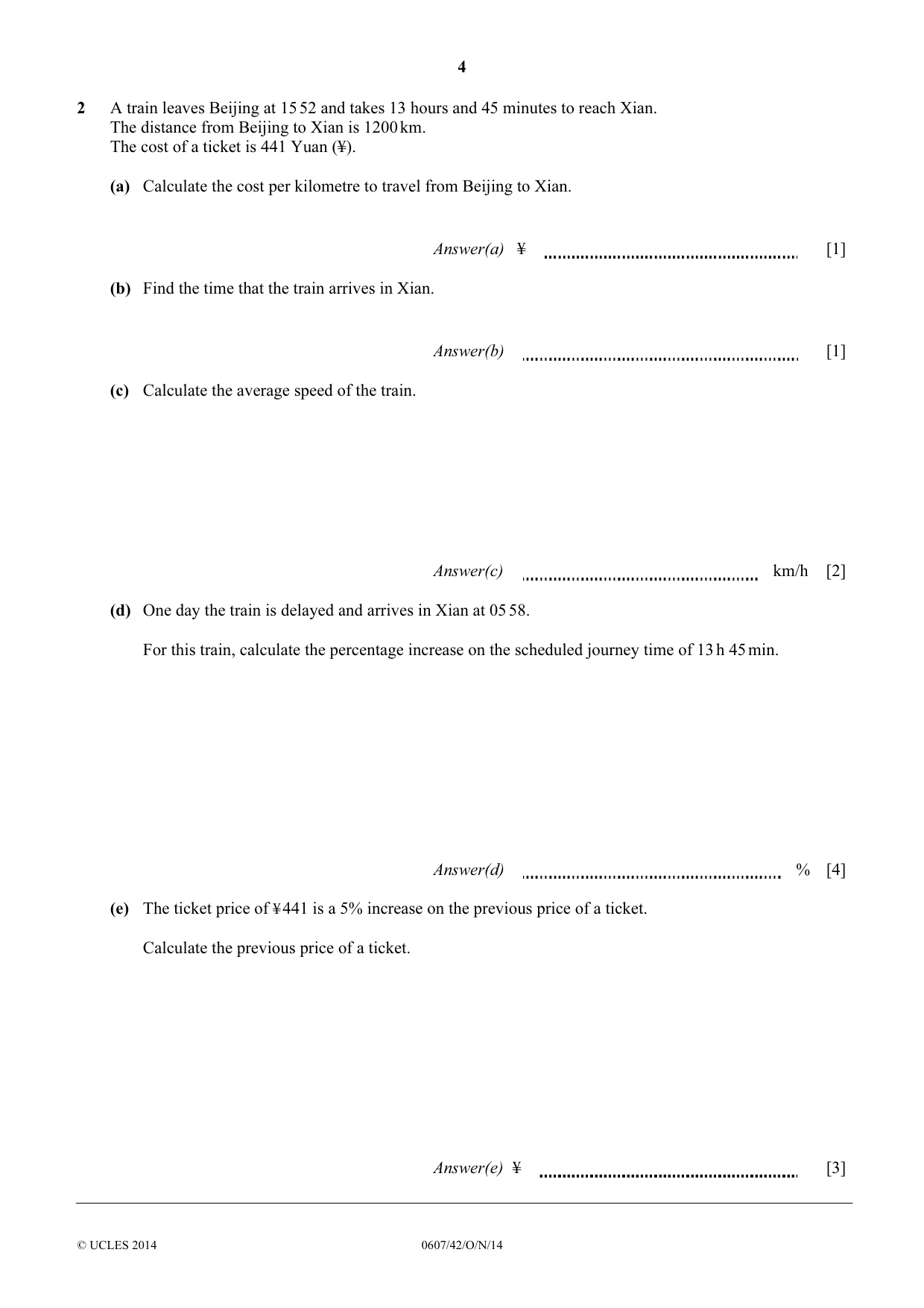
4 © UCLES 2014 0607/42/O/N/14 2 A train leaves Beijing at 15 52 and takes 13 hours and 45 minutes to reach Xian. The distance from Beijing to Xian is 1200 km. The cost of a ticket is 441 Yuan (¥). (a) Calculate the cost per kilometre to travel from Beijing to Xian. Answer(a) ¥ [1] (b) Find the time that the train arrives in Xian. Answer(b) [1] (c) Calculate the average speed of the train. Answer(c) km/h [2] (d) One day the train is delayed and arrives in Xian at 05 58. For this train, calculate the percentage increase on the scheduled journey time of 13 h 45 min. Answer(d) % [4] (e) The ticket price of ¥ 441 is a 5% increase on the previous price of a ticket. Calculate the previous price of a ticket. Answer(e) ¥ [3]
Question paper, page 5
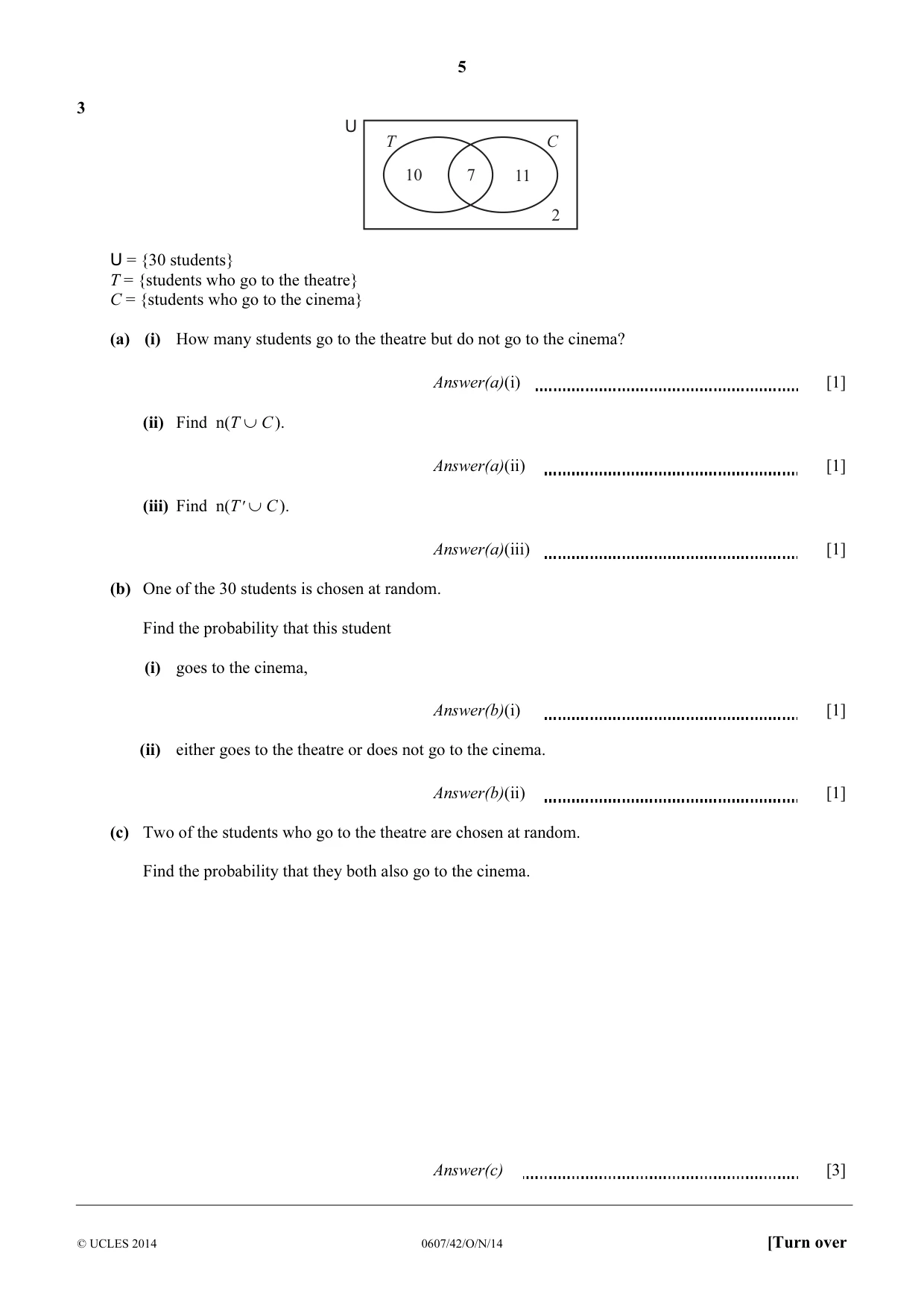
5 © UCLES 2014 0607/42/O/N/14 [Turn over 3 U T C 2 11 7 10 U = {30 students} T = {students who go to the theatre} C = {students who go to the cinema} (a) (i) How many students go to the theatre but do not go to the cinema? Answer(a)(i) [1] (ii) Find n(T ∪ C ). Answer(a)(ii) [1] (iii) Find n(T ' ∪ C ). Answer(a)(iii) [1] (b) One of the 30 students is chosen at random. Find the probability that this student (i) goes to the cinema, Answer(b)(i) [1] (ii) either goes to the theatre or does not go to the cinema. Answer(b)(ii) [1] (c) Two of the students who go to the theatre are chosen at random. Find the probability that they both also go to the cinema. Answer(c) [3]
Question paper, page 6
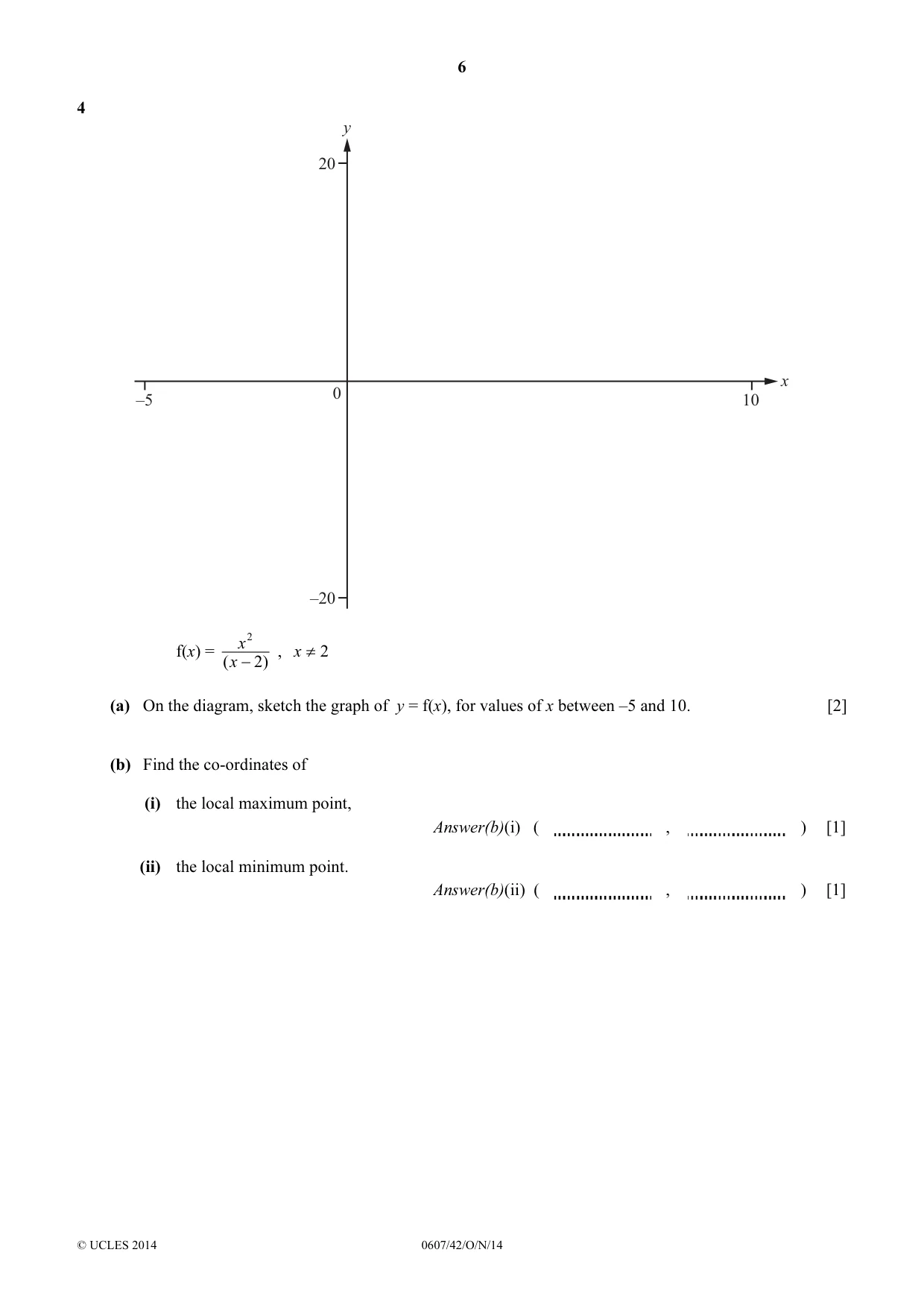
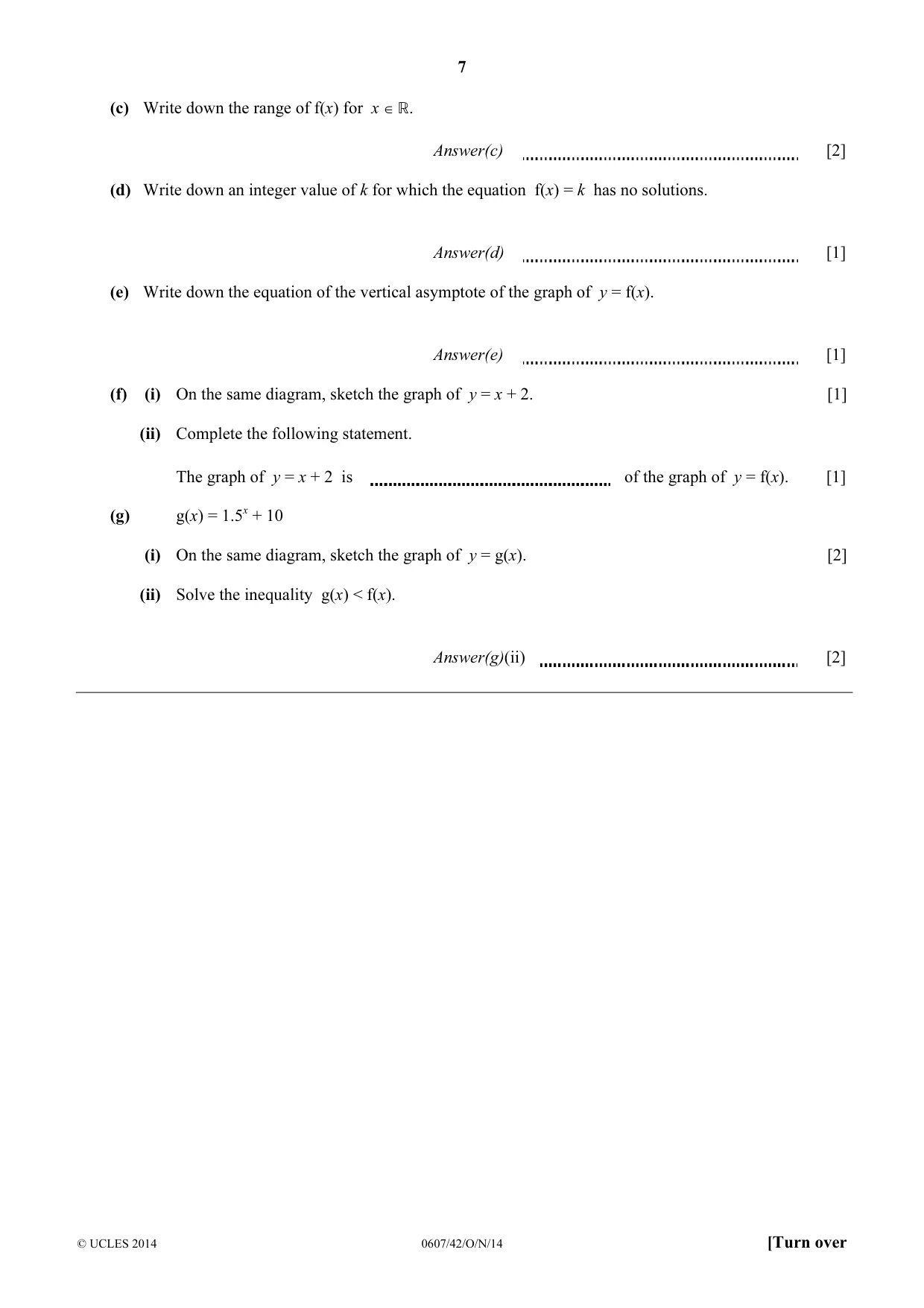
6 © UCLES 2014 0607/42/O/N/14 4 y x –5 –20 20 10 0 f(x) = ) 2 ( 2 − x x , 2 ≠ x (a) On the diagram, sketch the graph of y = f(x), for values of x between –5 and 10. [2] (b) Find the co-ordinates of (i) the local maximum point, Answer(b)(i) ( , ) [1] (ii) the local minimum point. Answer(b)(ii) ( , ) [1]
Question paper, page 7
7 © UCLES 2014 0607/42/O/N/14 [Turn over (c) Write down the range of f(x) for x ∈=o. Answer(c) [2] (d) Write down an integer value of k for which the equation f(x) = k has no solutions. Answer(d) [1] (e) Write down the equation of the vertical asymptote of the graph of y = f(x). Answer(e) [1] (f) (i) On the same diagram, sketch the graph of y = x + 2. [1] (ii) Complete the following statement. The graph of y = x + 2 is of the graph of y = f(x). [1] (g) g(x) = 1.5x + 10 (i) On the same diagram, sketch the graph of y = g(x). [2] (ii) Solve the inequality g(x) < f(x). Answer(g)(ii) [2]
Question paper, page 8
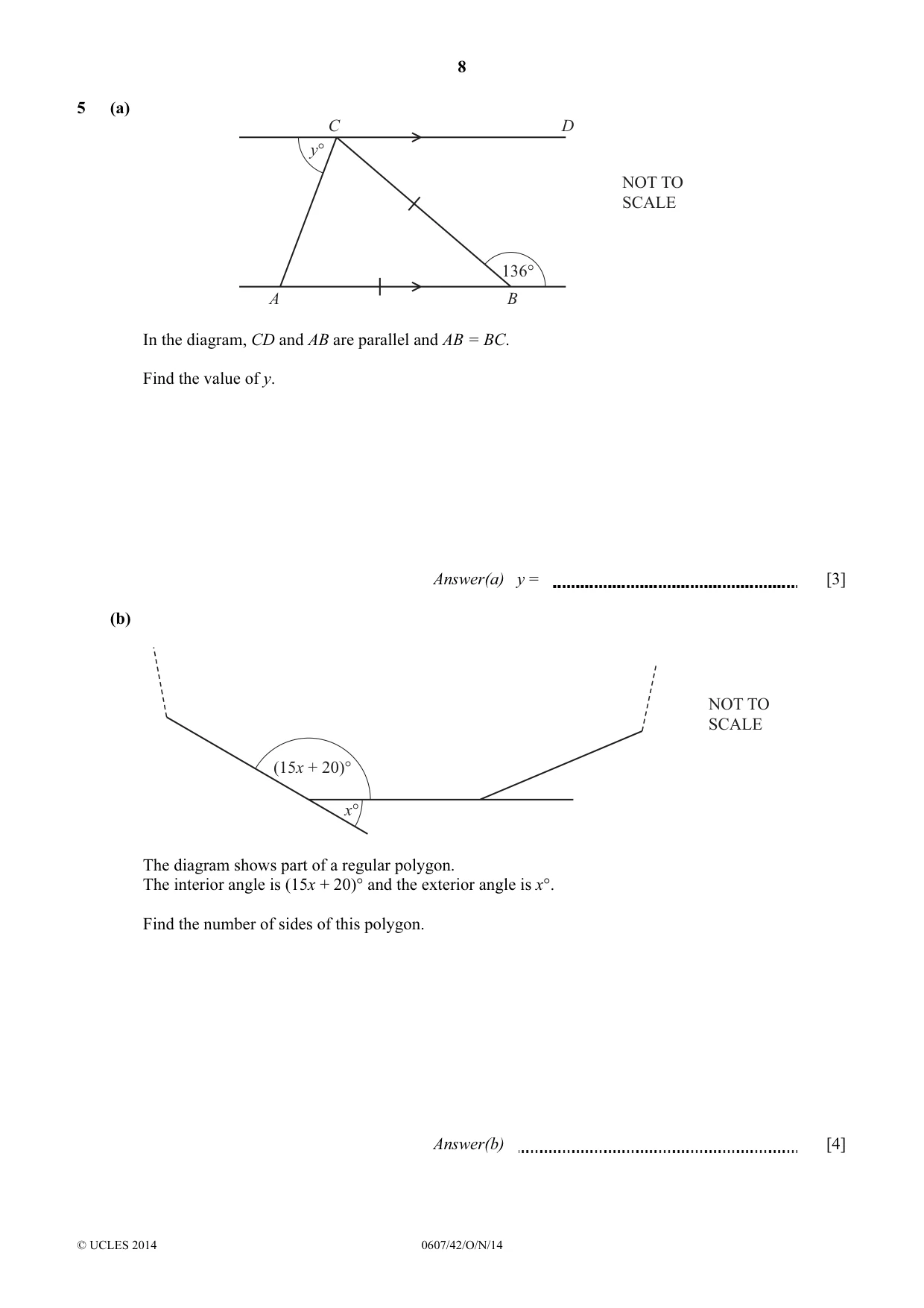
8 © UCLES 2014 0607/42/O/N/14 5 (a) 136° y° C D A B NOT TO SCALE In the diagram, CD and AB are parallel and AB = BC. Find the value of y. Answer(a) y = [3] (b) (15x + 20)° x° NOT TO SCALE The diagram shows part of a regular polygon. The interior angle is (15x + 20)° and the exterior angle is x°. Find the number of sides of this polygon. Answer(b) [4]
Question paper, page 9
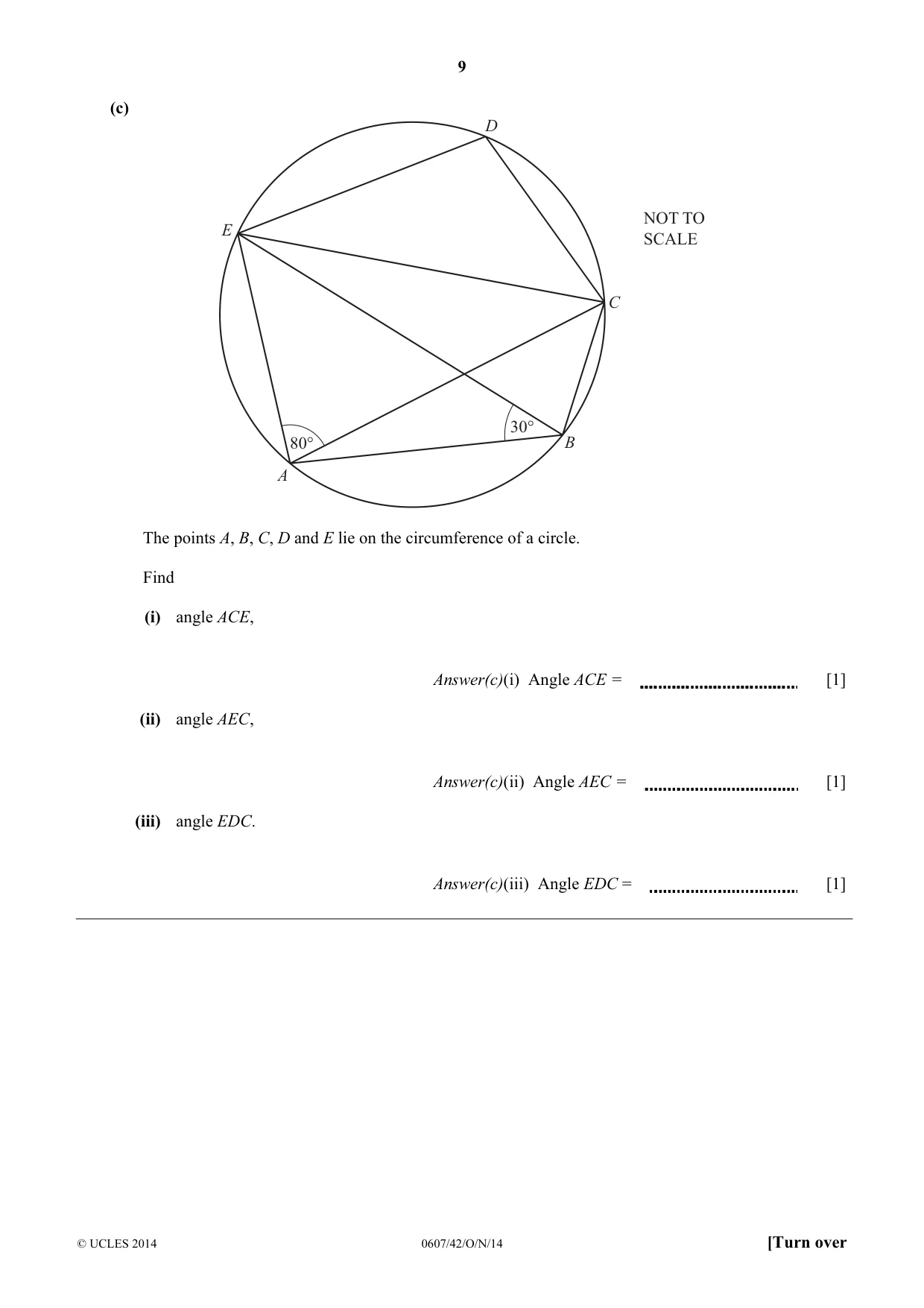
9 © UCLES 2014 0607/42/O/N/14 [Turn over (c) D E A B C NOT TO SCALE 80° 30° The points A, B, C, D and E lie on the circumference of a circle. Find (i) angle ACE, Answer(c)(i) Angle ACE = [1] (ii) angle AEC, Answer(c)(ii) Angle AEC = [1] (iii) angle EDC. Answer(c)(iii) Angle EDC = [1]
Question paper, page 10
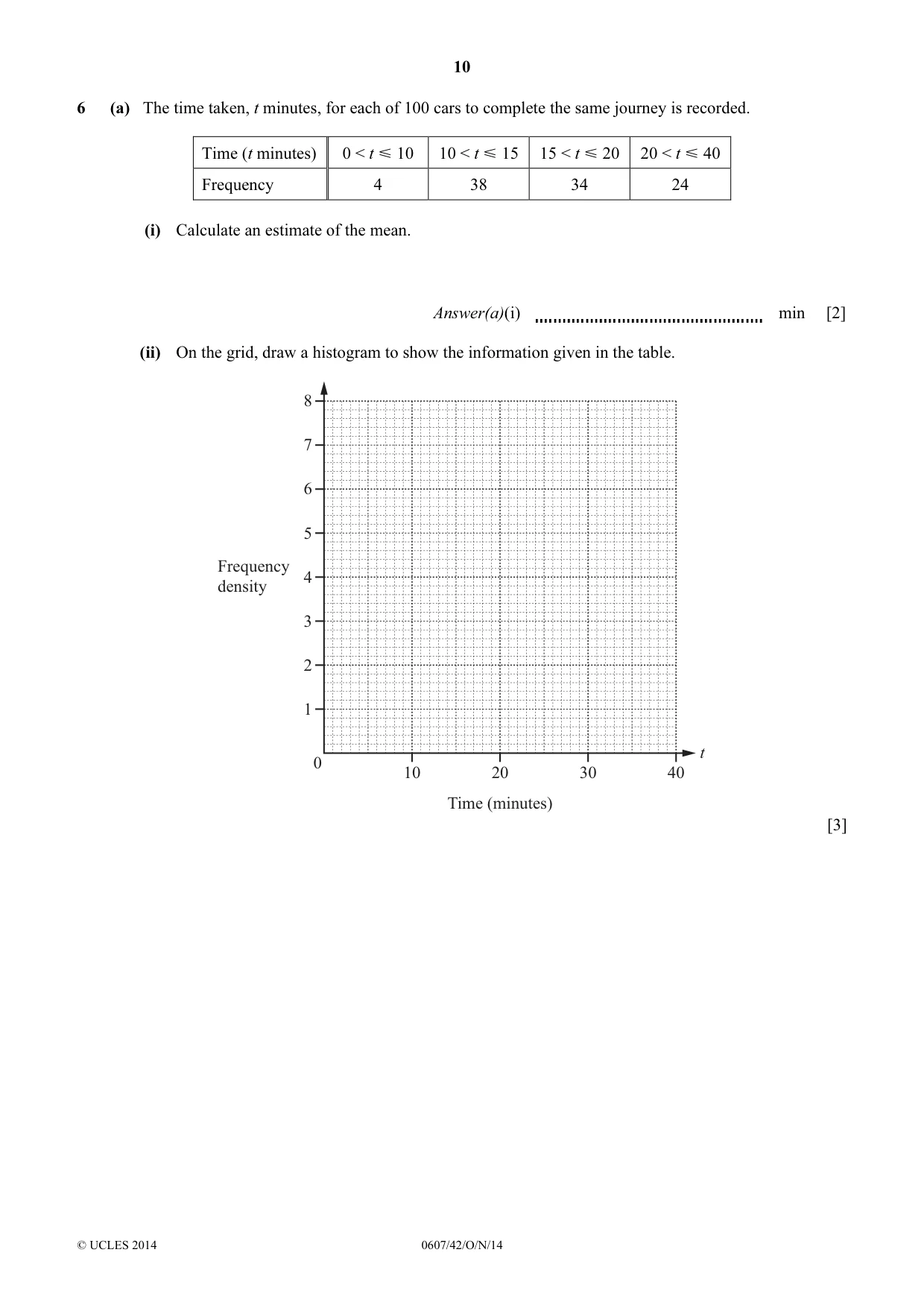
10 © UCLES 2014 0607/42/O/N/14 6 (a) The time taken, t minutes, for each of 100 cars to complete the same journey is recorded. Time (t minutes) 0 < t Y 10 10 < t Y 15 15 < t Y 20 20 < t Y 40 Frequency 4 38 34 24 (i) Calculate an estimate of the mean. Answer(a)(i) min [2] (ii) On the grid, draw a histogram to show the information given in the table. 8 7 6 5 4 3 2 1 10 20 Time (minutes) Frequency density 30 40 0 t [3]
Question paper, page 11
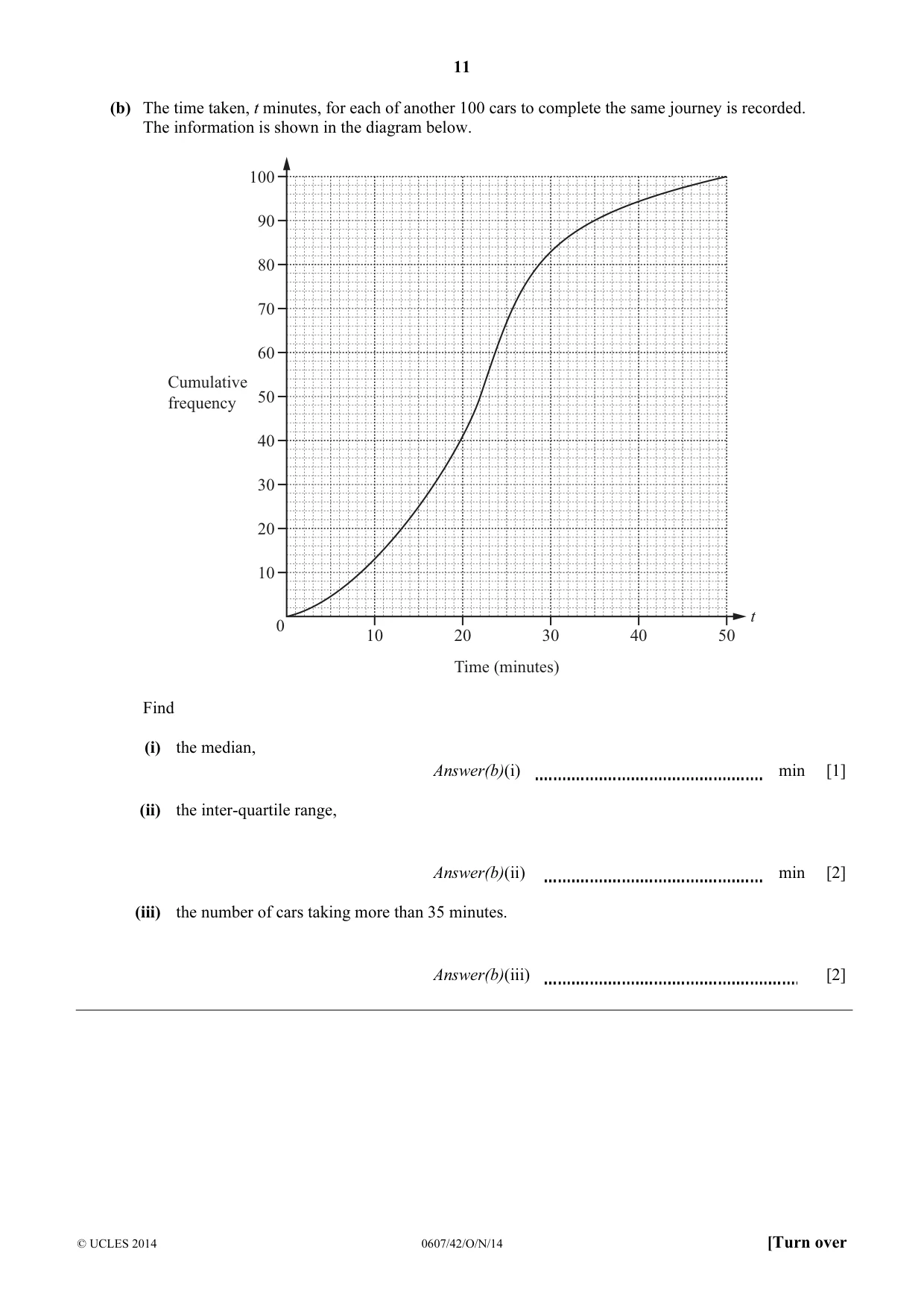
11 © UCLES 2014 0607/42/O/N/14 [Turn over (b) The time taken, t minutes, for each of another 100 cars to complete the same journey is recorded. The information is shown in the diagram below. 100 90 80 70 60 50 40 30 20 10 10 20 Time (minutes) Cumulative frequency 30 40 50 0 t Find (i) the median, Answer(b)(i) min [1] (ii) the inter-quartile range, Answer(b)(ii) min [2] (iii) the number of cars taking more than 35 minutes. Answer(b)(iii) [2]
Question paper, page 12
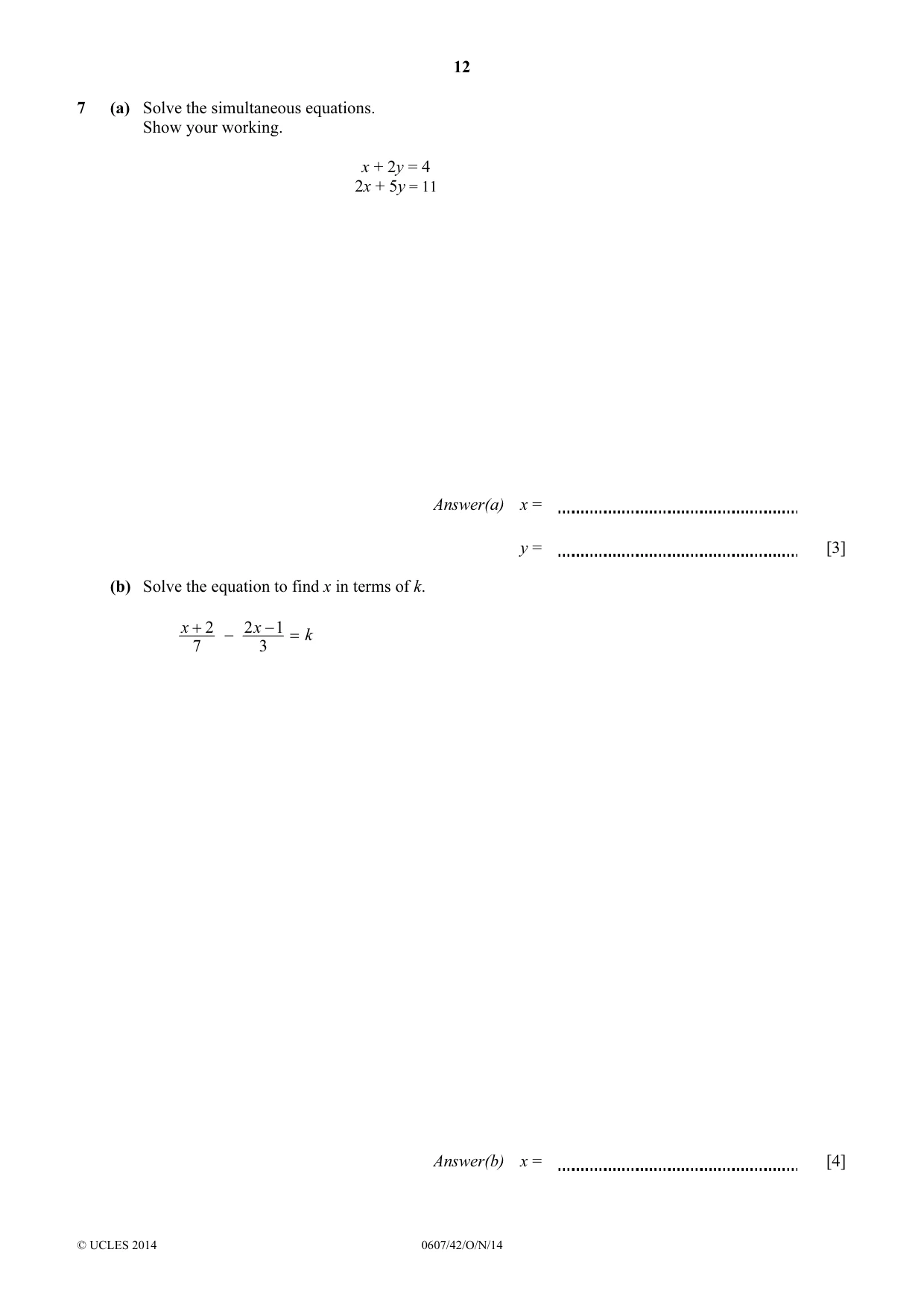
12 © UCLES 2014 0607/42/O/N/14 7 (a) Solve the simultaneous equations. Show your working. x + 2y = 4 2x + 5y = 11 Answer(a) x = y = [3] (b) Solve the equation to find x in terms of k. k x x = − − + 3 1 2 7 2 Answer(b) x = [4]
Question paper, page 13
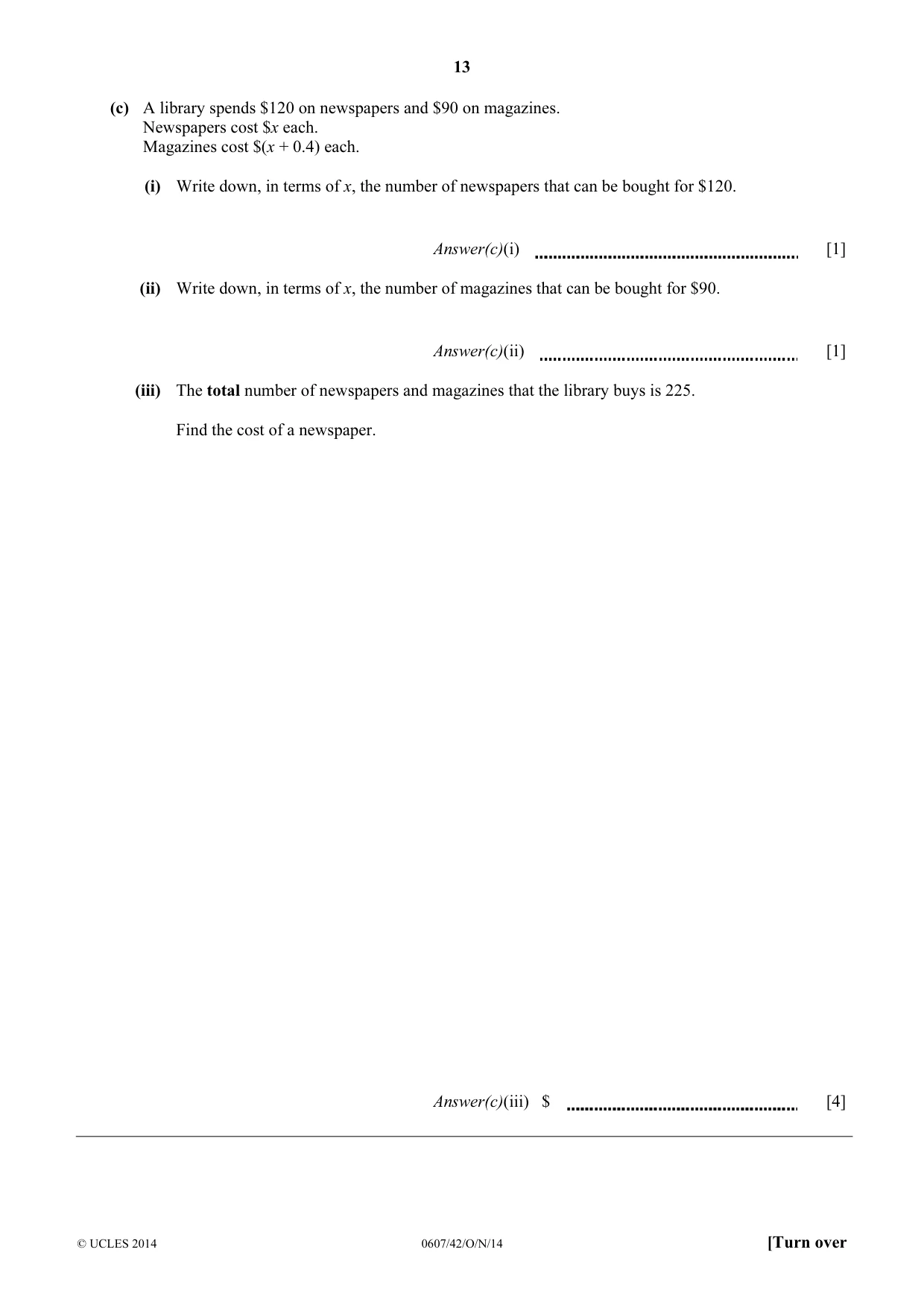
13 © UCLES 2014 0607/42/O/N/14 [Turn over (c) A library spends $120 on newspapers and $90 on magazines. Newspapers cost $x each. Magazines cost $(x + 0.4) each. (i) Write down, in terms of x, the number of newspapers that can be bought for $120. Answer(c)(i) [1] (ii) Write down, in terms of x, the number of magazines that can be bought for $90. Answer(c)(ii) [1] (iii) The total number of newspapers and magazines that the library buys is 225. Find the cost of a newspaper. Answer(c)(iii) $ [4]
Question paper, page 14
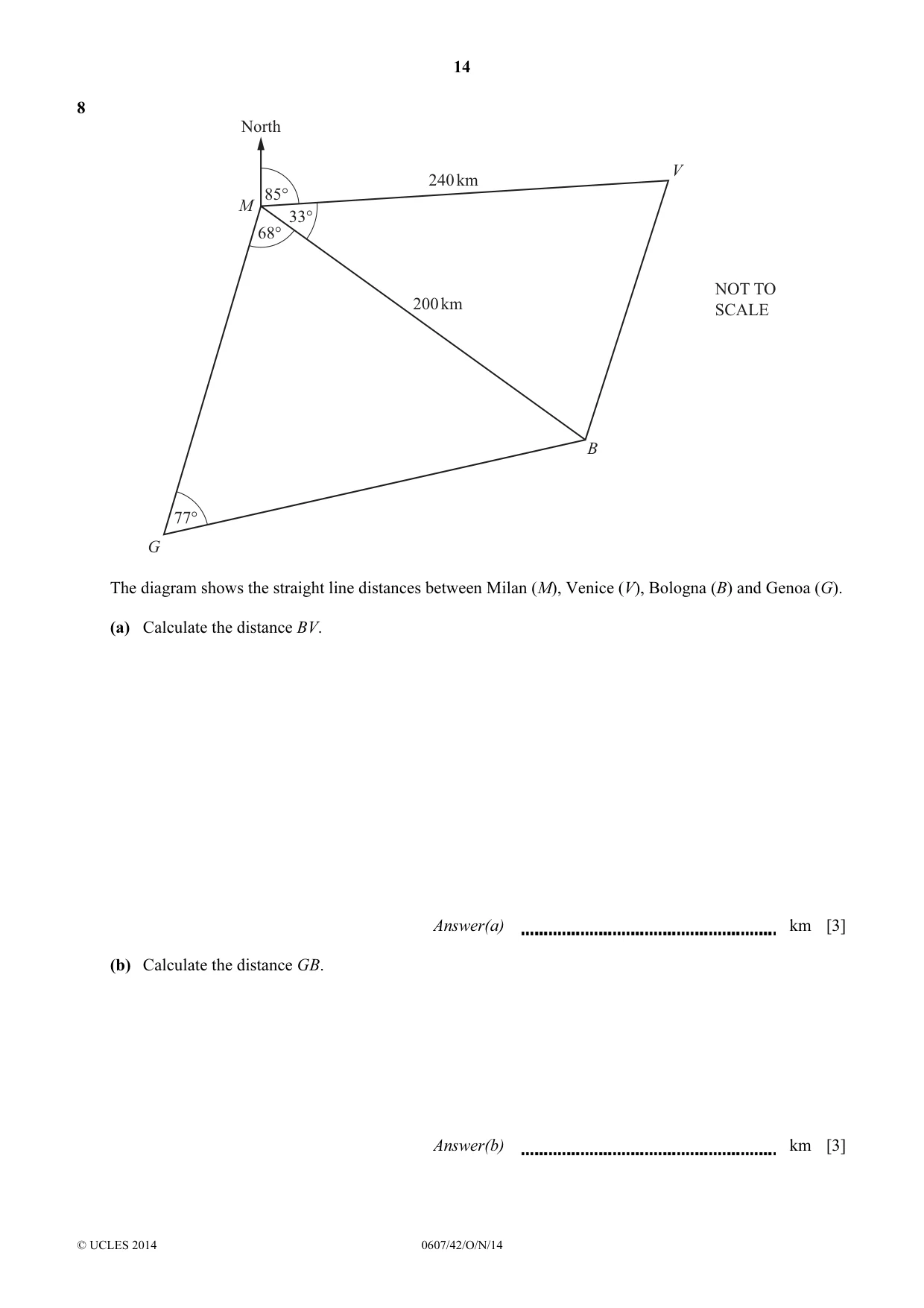
14 © UCLES 2014 0607/42/O/N/14 8 North M G B V 240 km 200 km 77° 68° 33° 85° NOT TO SCALE The diagram shows the straight line distances between Milan (M), Venice (V), Bologna (B) and Genoa (G). (a) Calculate the distance BV. Answer(a) km [3] (b) Calculate the distance GB. Answer(b) km [3]
Question paper, page 15
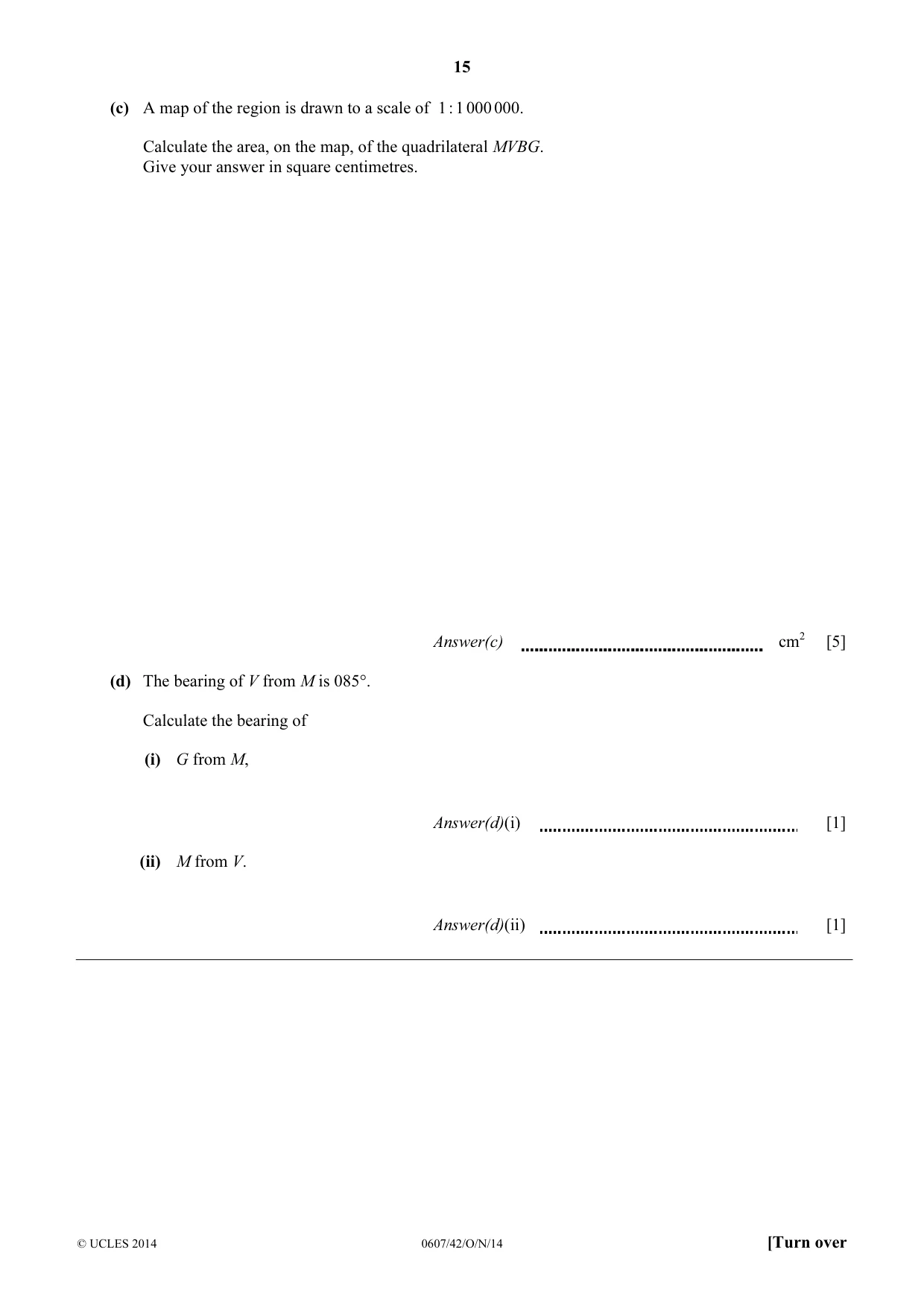
15 © UCLES 2014 0607/42/O/N/14 [Turn over (c) A map of the region is drawn to a scale of 1 : 1 000 000. Calculate the area, on the map, of the quadrilateral MVBG. Give your answer in square centimetres. Answer(c) cm2 [5] (d) The bearing of V from M is 085°. Calculate the bearing of (i) G from M, Answer(d)(i) [1] (ii) M from V. Answer(d)(ii) [1]
Question paper, page 16
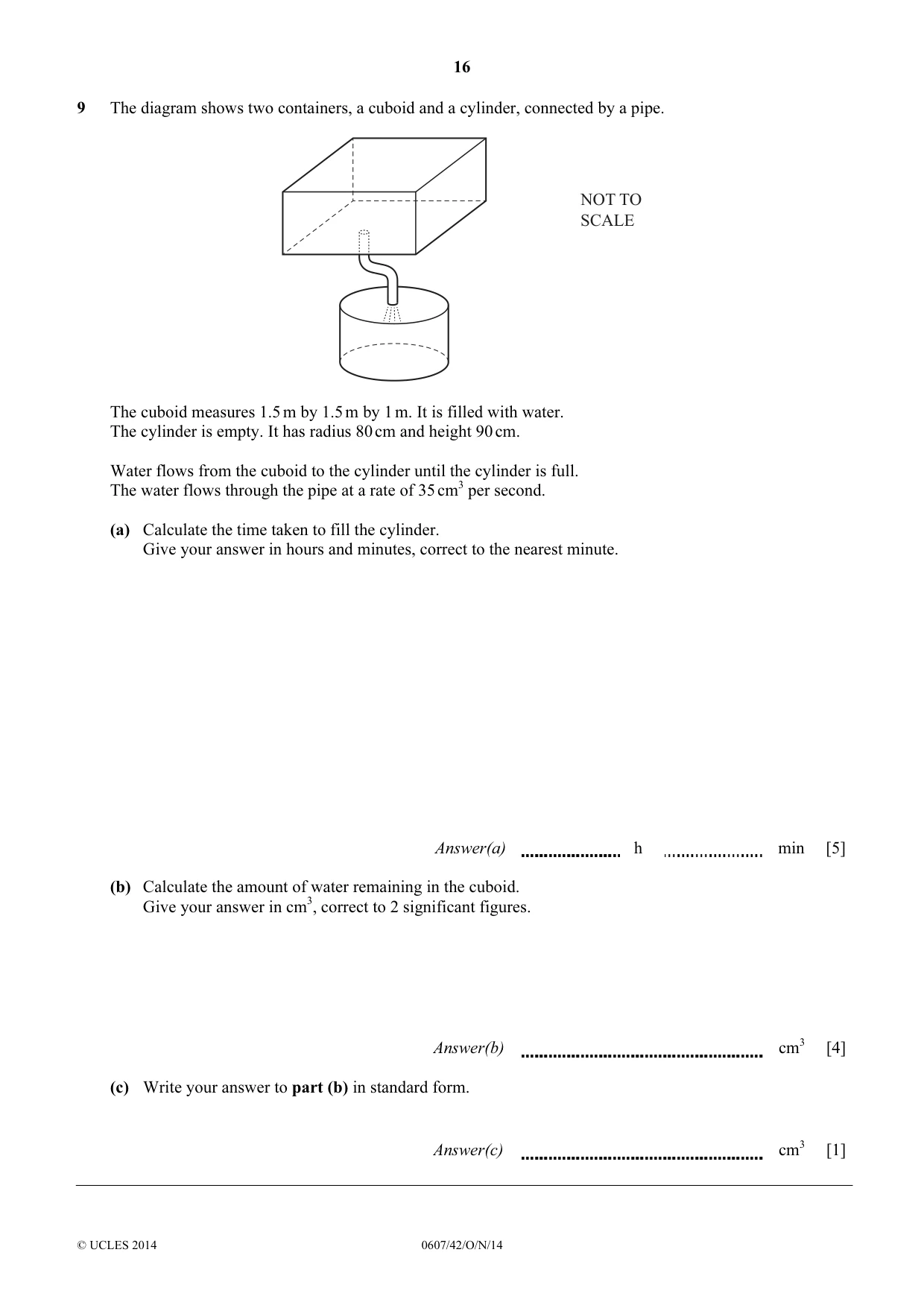
16 © UCLES 2014 0607/42/O/N/14 9 The diagram shows two containers, a cuboid and a cylinder, connected by a pipe. NOT TO SCALE The cuboid measures 1.5 m by 1.5 m by 1 m. It is filled with water. The cylinder is empty. It has radius 80 cm and height 90 cm. Water flows from the cuboid to the cylinder until the cylinder is full. The water flows through the pipe at a rate of 35 cm3 per second. (a) Calculate the time taken to fill the cylinder. Give your answer in hours and minutes, correct to the nearest minute. Answer(a) h min [5] (b) Calculate the amount of water remaining in the cuboid. Give your answer in cm3, correct to 2 significant figures. Answer(b) cm3 [4] (c) Write your answer to part (b) in standard form. Answer(c) cm3 [1]
Question paper, page 17
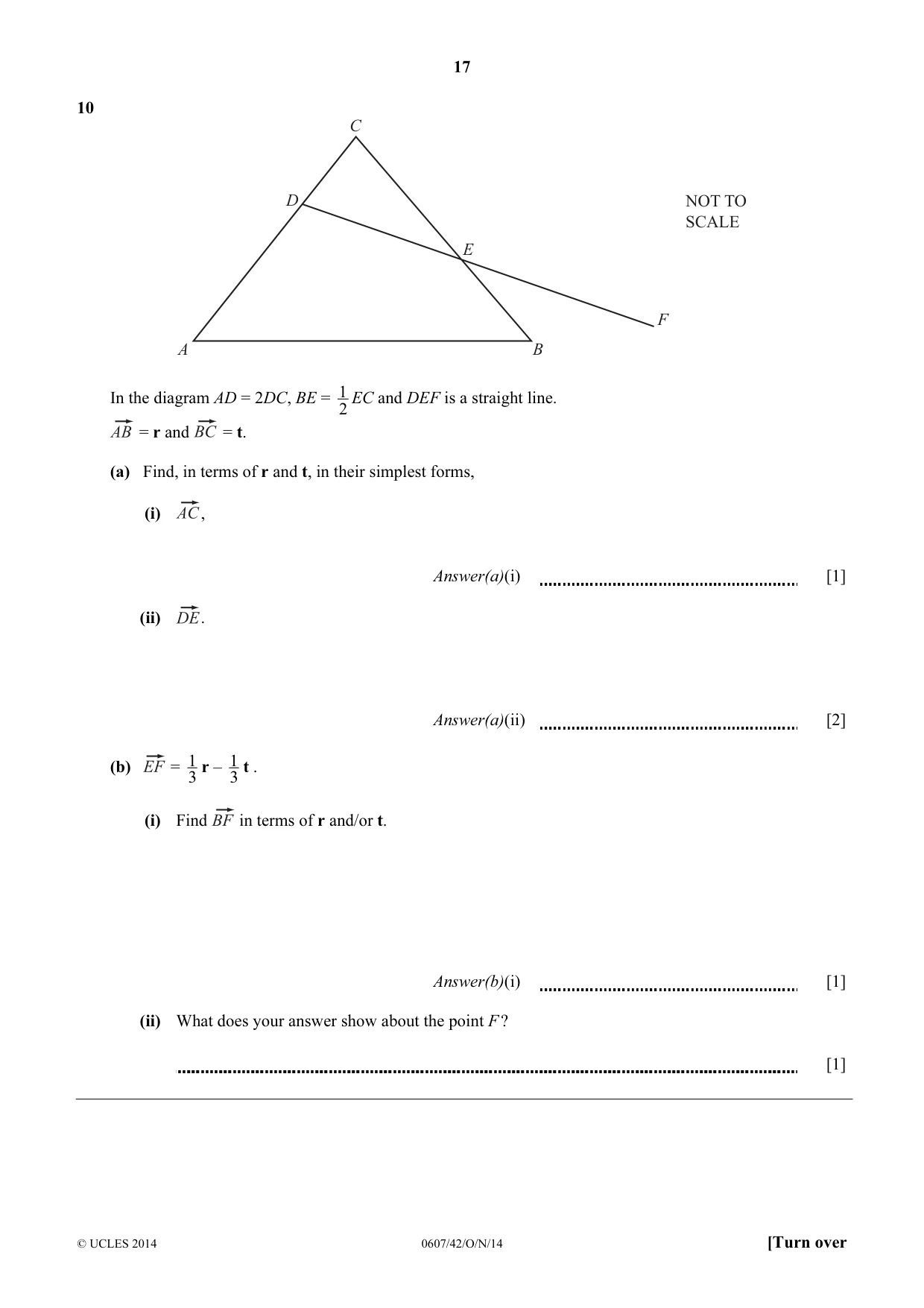
17 © UCLES 2014 0607/42/O/N/14 [Turn over 10 C D A B E F NOT TO SCALE In the diagram AD = 2DC, BE = 2 1 EC and DEF is a straight line. = r and = t. (a) Find, in terms of r and t, in their simplest forms, (i) , Answer(a)(i) [1] (ii) . Answer(a)(ii) [2] (b) = 3 1 r – 3 1 t . (i) Find in terms of r and/or t. Answer(b)(i) [1] (ii) What does your answer show about the point F ? [1]
Question paper, page 18
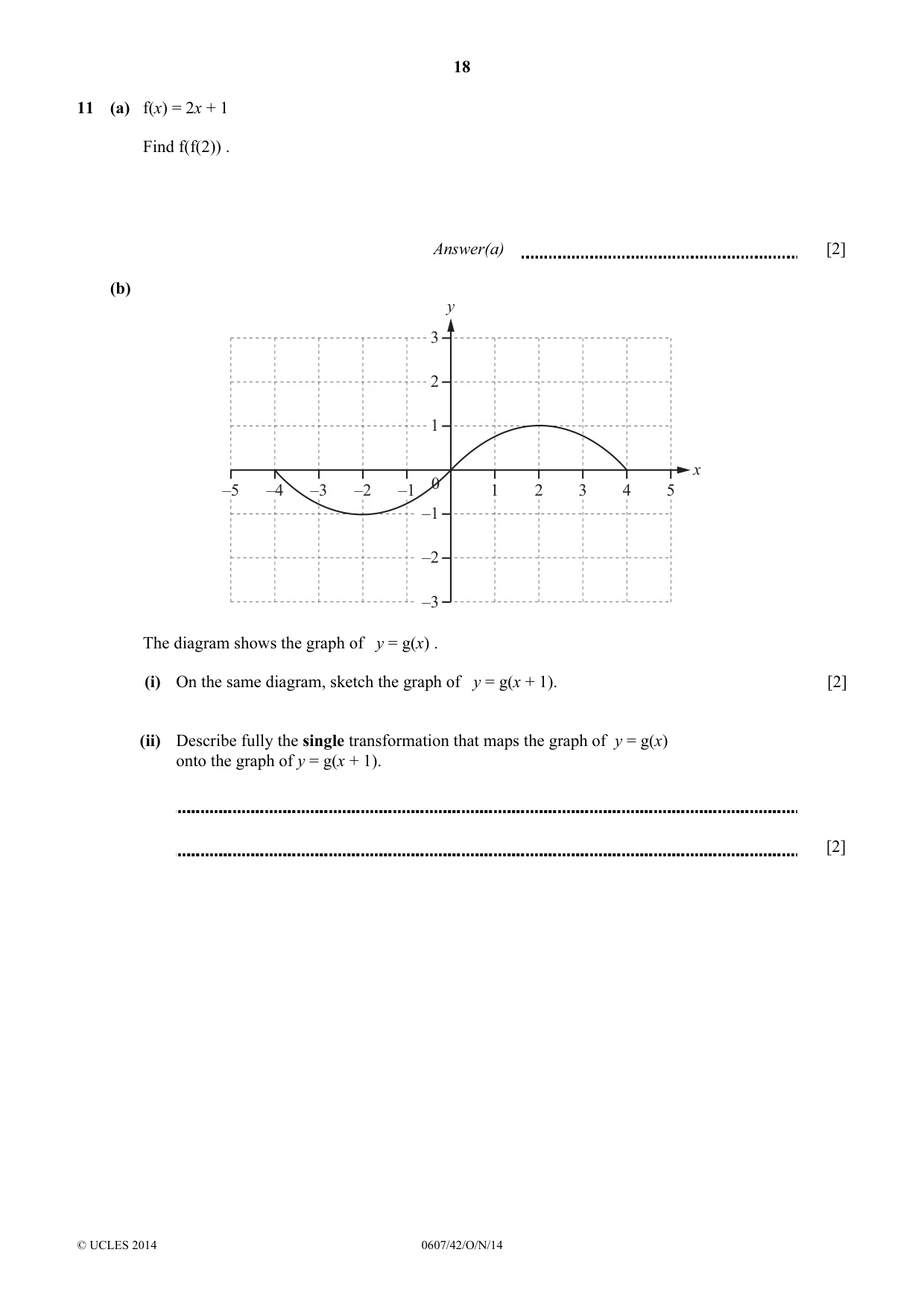
18 © UCLES 2014 0607/42/O/N/14 11 (a) f(x) = 2x + 1 Find f(f(2)) . Answer(a) [2] (b) y x 3 2 1 –1 –2 –3 0 –1 1 2 3 4 5 –2 –3 –4 –5 The diagram shows the graph of y = g(x) . (i) On the same diagram, sketch the graph of y = g(x + 1). [2] (ii) Describe fully the single transformation that maps the graph of y = g(x) onto the graph of y = g(x + 1). [2]
Question paper, page 19
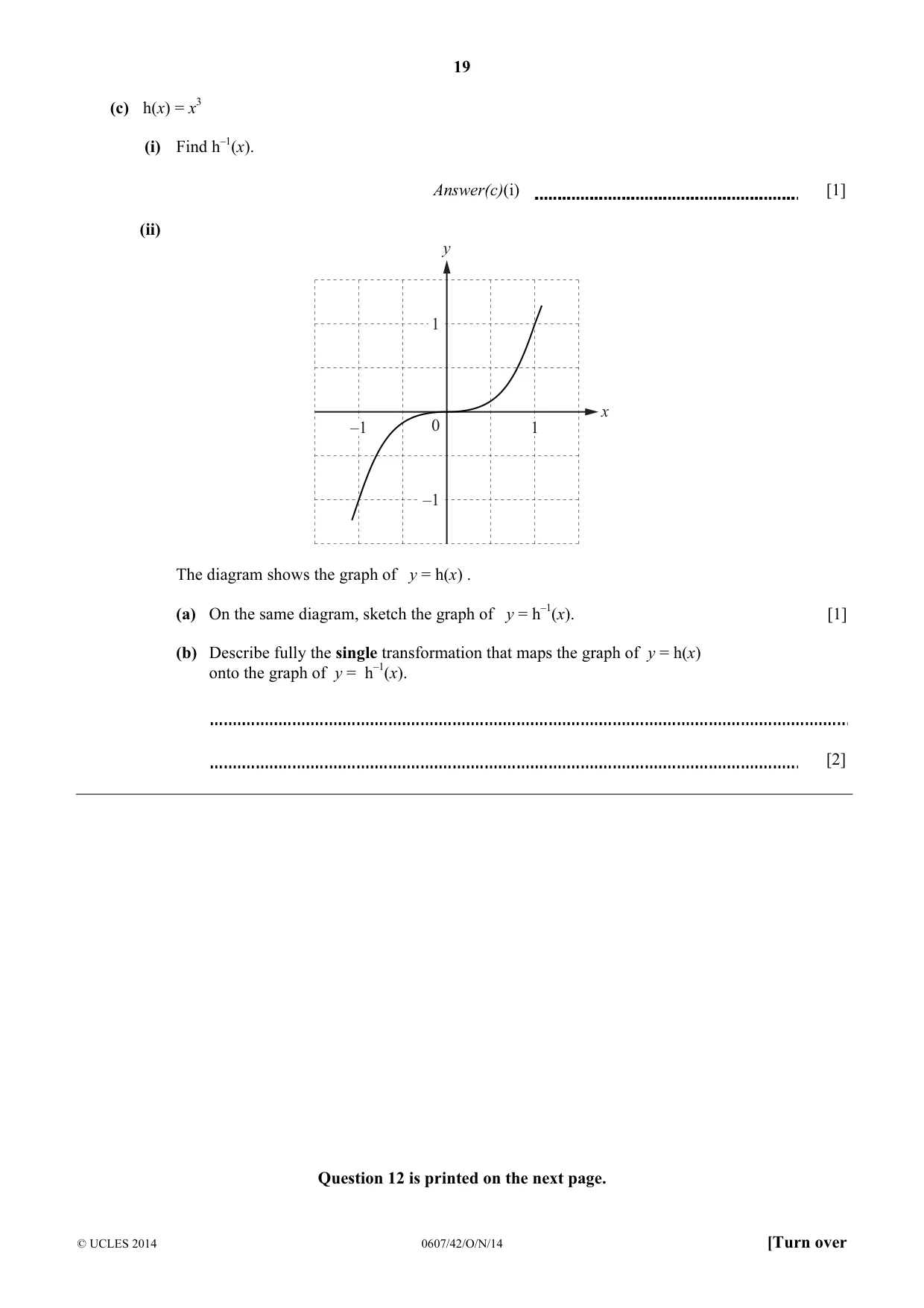
19 © UCLES 2014 0607/42/O/N/14 [Turn over (c) h(x) = x3 (i) Find h–1(x). Answer(c)(i) [1] (ii) y x 1 –1 0 1 –1 The diagram shows the graph of y = h(x) . (a) On the same diagram, sketch the graph of y = h–1(x). [1] (b) Describe fully the single transformation that maps the graph of y = h(x) onto the graph of y = h–1(x). [2] Question 12 is printed on the next page.
Question paper, page 20
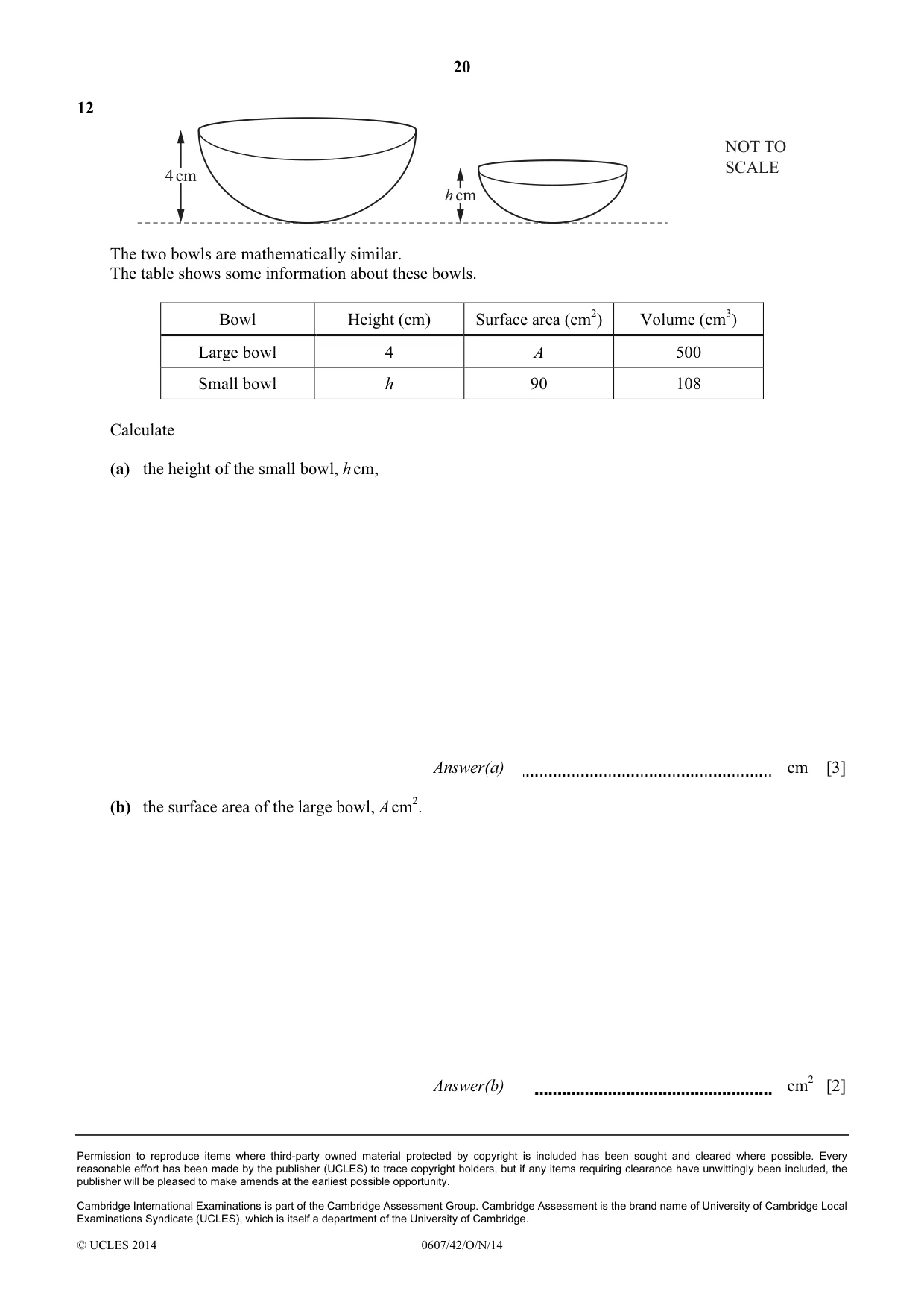
20 Permission to reproduce items where third-party owned material protected by copyright is included has been sought and cleared where possible. Every reasonable effort has been made by the publisher (UCLES) to trace copyright holders, but if any items requiring clearance have unwittingly been included, the publisher will be pleased to make amends at the earliest possible opportunity. Cambridge International Examinations is part of the Cambridge Assessment Group. Cambridge Assessment is the brand name of University of Cambridge Local Examinations Syndicate (UCLES), which is itself a department of the University of Cambridge. © UCLES 2014 0607/42/O/N/14 12 4 cm h cm NOT TO SCALE The two bowls are mathematically similar. The table shows some information about these bowls. Bowl Height (cm) Surface area (cm2) Volume (cm3) Large bowl 4 A 500 Small bowl h 90 108 Calculate (a) the height of the small bowl, h cm, Answer(a) cm [3] (b) the surface area of the large bowl, A cm2. Answer(b) cm2 [2]
Mark scheme, page 1
® IGCSE is the registered trademark of Cambridge International Examinations. CAMBRIDGE INTERNATIONAL EXAMINATIONS Cambridge International General Certificate of Secondary Education MARK SCHEME for the October/November 2014 series 0607 CAMBRIDGE INTERNATIONAL MATHEMATICS 0607/42 Paper 4 (Extended), maximum raw mark 120 This mark scheme is published as an aid to teachers and candidates, to indicate the requirements of the examination. It shows the basis on which Examiners were instructed to award marks. It does not indicate the details of the discussions that took place at an Examiners’ meeting before marking began, which would have considered the acceptability of alternative answers. Mark schemes should be read in conjunction with the question paper and the Principal Examiner Report for Teachers. Cambridge will not enter into discussions about these mark schemes. Cambridge is publishing the mark schemes for the October/November 2014 series for most Cambridge IGCSE®, Cambridge International A and AS Level components and some Cambridge O Level components.
Mark scheme, page 2
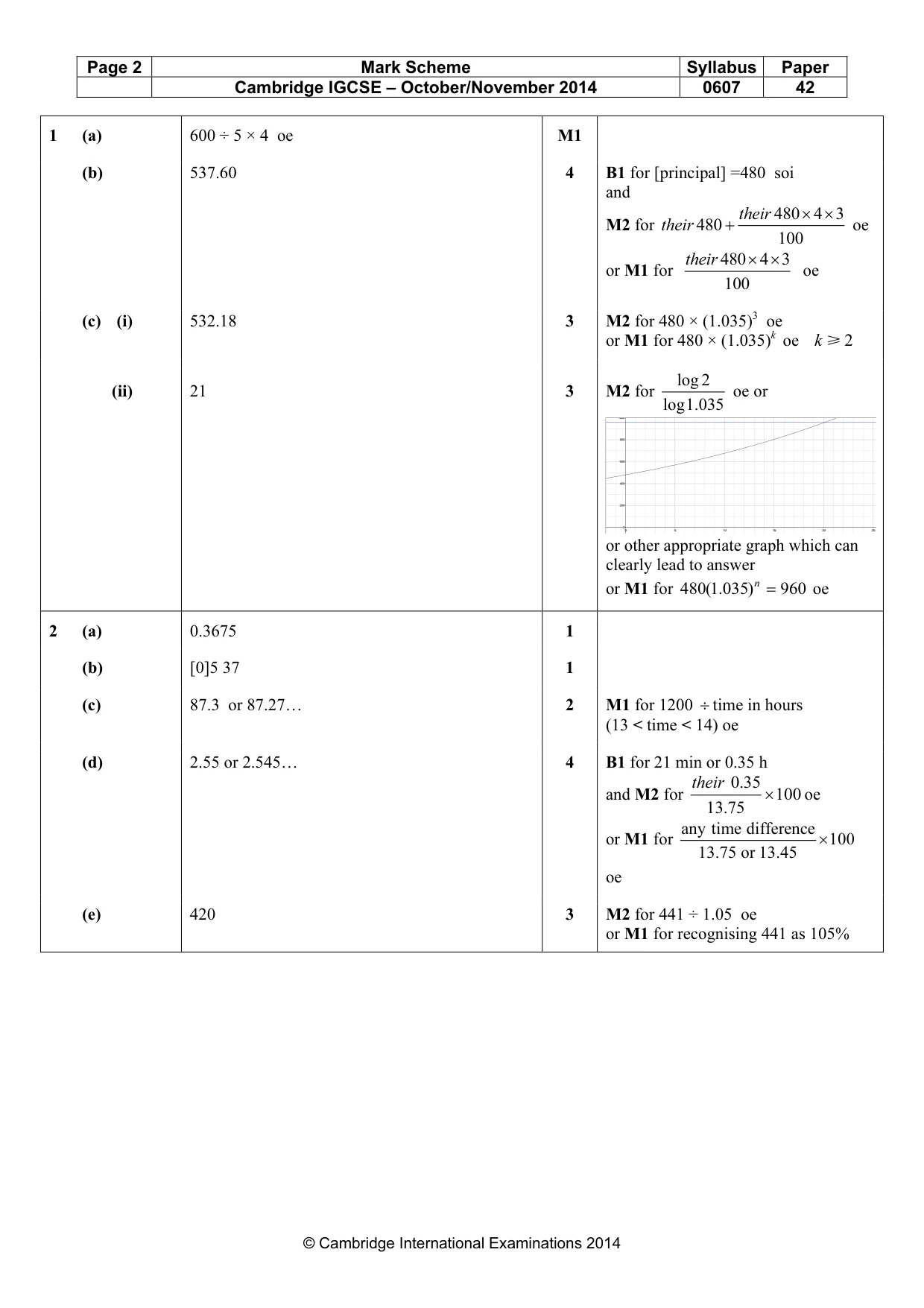
Page 2 Mark Scheme Syllabus Paper Cambridge IGCSE – October/November 2014 0607 42 © Cambridge International Examinations 2014 1 (a) 600 ÷ 5 × 4 oe M1 (b) 537.60 4 B1 for [principal] =480 soi and M2 for 480 4 3 480 100 their their × × + oe or M1 for 480 4 3 100 their × × oe (c) (i) 532.18 3 M2 for 480 × (1.035)3 oe or M1 for 480 × (1.035)k oe 2 > k (ii) 21 3 M2 for 035 .1 log 2 log oe or or other appropriate graph which can clearly lead to answer or M1 for 960 ) 035 .1( 480 = n oe 2 (a) 0.3675 1 (b) [0]5 37 1 (c) 87.3 or 87.27… 2 M1 for 1200 ÷ time in hours (13 < time < 14) oe (d) 2.55 or 2.545… 4 B1 for 21 min or 0.35 h and M2 for 100 75 . 13 35 .0 × their oe or M1 for any time difference 100 13.75 or 13.45 × oe (e) 420 3 M2 for 441 ÷ 1.05 oe or M1 for recognising 441 as 105% 25 20 15 10 5 0 1000 800 600 400 200 0 25 20 15 10 5 0 1000 800 600 400 200 0 25 20 15 10 5 0 1000 800 600 400 200 0 25 20 15 10 5 0 1000 800 600 400 200 0
Mark scheme, page 3
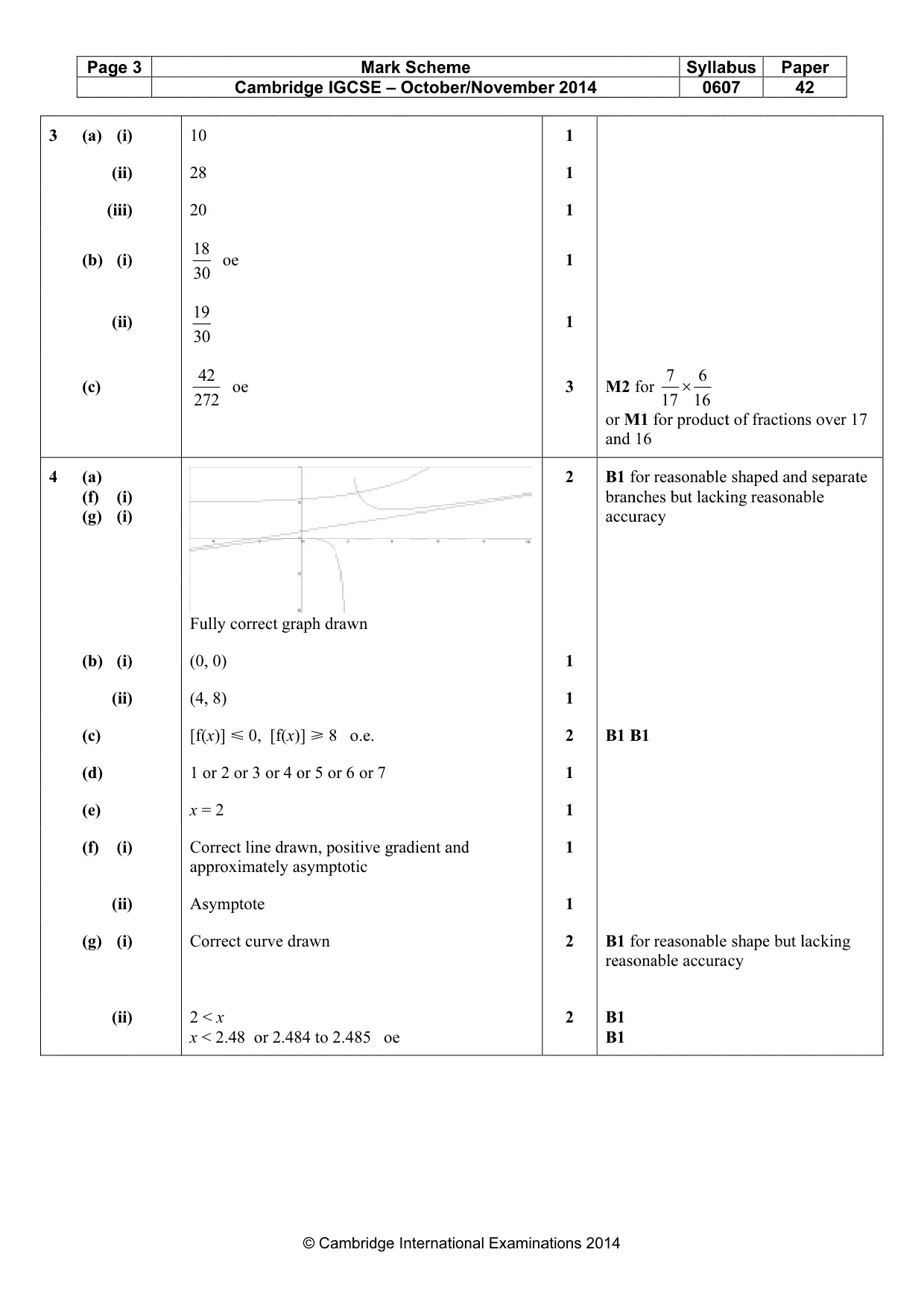
3 4 3 4 P (a (b (c (a (f (g (b (c (d (e (f (g Pag a) ( b) c) a) f) g) b) c) d) e) f) g) ge (i) (ii) (iii) (i) (ii) (i) (i) (i) (ii) (i) (ii) (i) (ii) 3 ) ) ) ) ) ) ) ) ) ) ) ) ) 10 28 20 18 30 19 30 4 27 Fu (0, (4, [f( 1 o x = Co ap As Co 2 < x < 0 8 0 8 0 o 9 0 42 72 ully , 0) , 8) (x)] or 2 = 2 orre ppro sym orre < x < 2 C oe oe y co ) ) ] < 2 or ect oxim mpt ect x .48 Cam e orre < 0, r 3 lin ma tote cu 8 o mb ect [f or ne d atel e urve or 2 brid gra f(x) 4 o draw y a e dr 2.48 dge © aph )] > or 5 wn asym raw 84 t e IG Ca h dr > 8 5 o n, po mp wn to 2 GC amb raw 8 o r 6 osi ptot 2.4 M CSE brid wn o.e. or itiv tic 85 Mar E – dge . r 7 e g o k S – O e In grad e Sch Oct nter dien hem ob rnat nt a me ber/ tion and e /No nal d ove Ex em xam mbe mina er 2 atio 20 ons 1 1 1 1 1 3 2 1 1 2 1 1 1 1 2 2 14 s 2014 M or an B br ac B B re B B 4 M2 r M nd B1 f ran ccu B1 B B1 f easo B1 B1 for M1 16 for nche urac B1 for ona r 7 17 for rea es b cy rea able S 7 7 × r pr ason but ason e a Syl 0 6 16 rodu nab t la nab ccu llab 060 6 uct ble cki ble ura bu 07 t of sh ing sh cy s f fra ape g rea ape P act ed a aso e bu Pa 4 ion and ona ut l pe 42 ns o d se able lack er ove epa e kin er 1 arat ng 7 te
Mark scheme, page 4
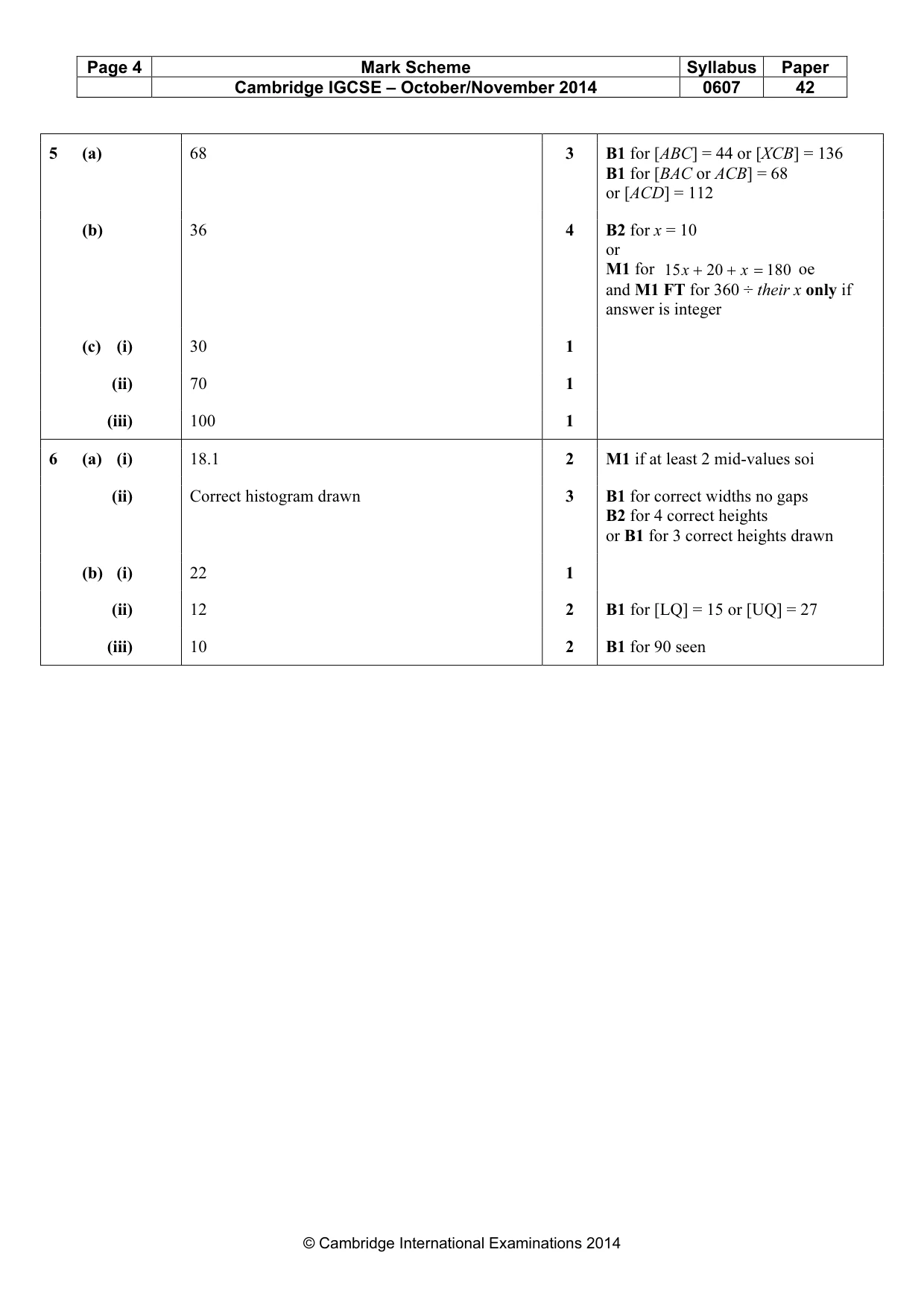
Page 4 Mark Scheme Syllabus Paper Cambridge IGCSE – October/November 2014 0607 42 © Cambridge International Examinations 2014 5 (a) 68 3 B1 for [ABC] = 44 or [XCB] = 136 B1 for [BAC or ACB] = 68 or [ACD] = 112 (b) 36 4 B2 for x = 10 or M1 for 180 20 15 = + + x x oe and M1 FT for 360 ÷ their x only if answer is integer (c) (i) 30 1 (ii) 70 1 (iii) 100 1 6 (a) (i) 18.1 2 M1 if at least 2 mid-values soi (ii) Correct histogram drawn 3 B1 for correct widths no gaps B2 for 4 correct heights or B1 for 3 correct heights drawn (b) (i) 22 1 (ii) 12 2 B1 for [LQ] = 15 or [UQ] = 27 (iii) 10 2 B1 for 90 seen
Mark scheme, page 5
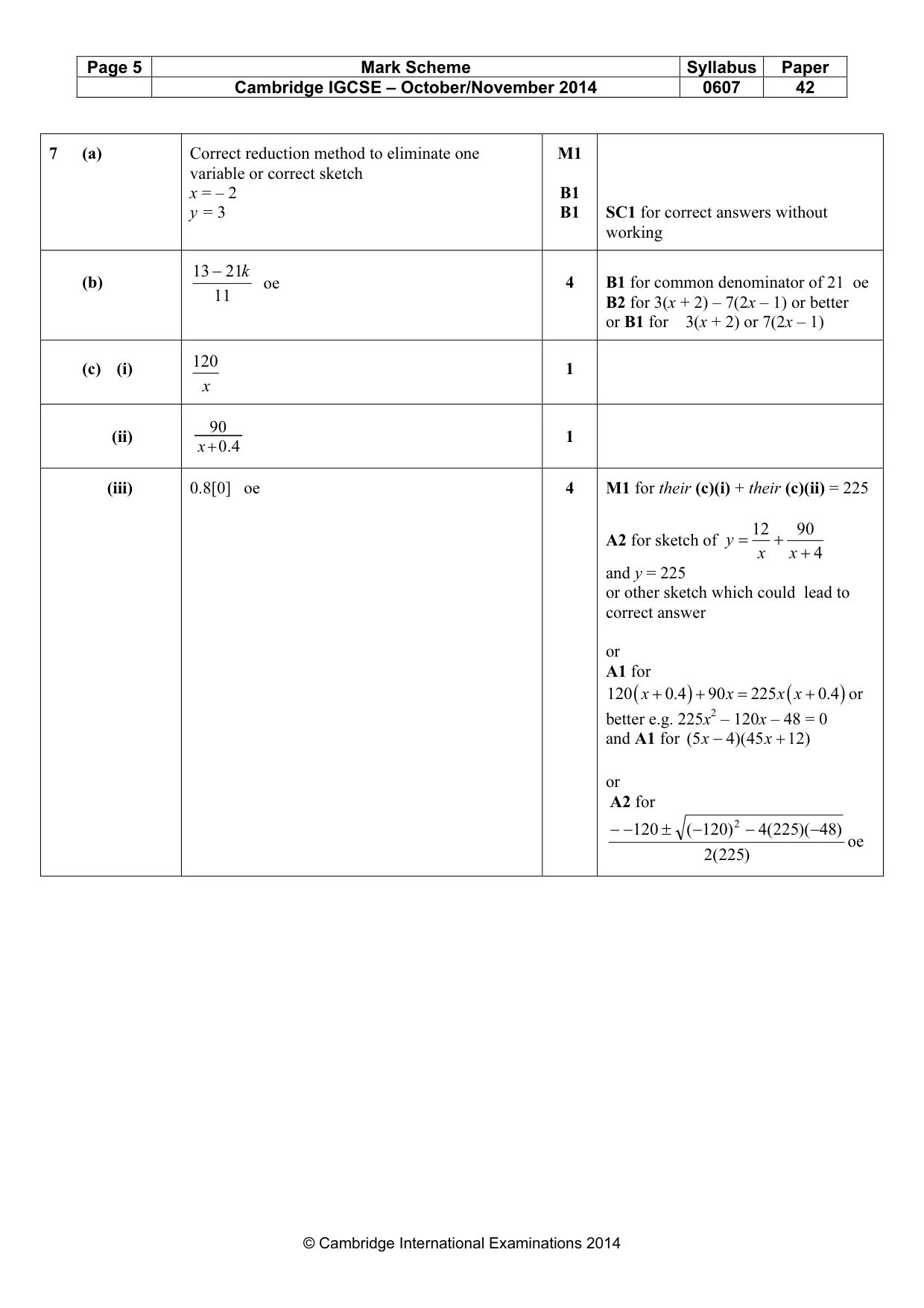
Page 5 Mark Scheme Syllabus Paper Cambridge IGCSE – October/November 2014 0607 42 © Cambridge International Examinations 2014 7 (a) Correct reduction method to eliminate one variable or correct sketch x = – 2 y = 3 M1 B1 B1 SC1 for correct answers without working (b) 11 21 13 k − oe 4 B1 for common denominator of 21 oe B2 for 3(x + 2) – 7(2x – 1) or better or B1 for 3(x + 2) or 7(2x – 1) (c) (i) 120 x 1 (ii) 4.0 90 + x 1 (iii) 0.8[0] oe 4 M1 for their (c)(i) + their (c)(ii) = 225 A2 for sketch of 4 90 12 + + = x x y and y = 225 or other sketch which could lead to correct answer or A1 for ( ) ( ) 120 0.4 90 225 0.4 x x x x + + = + or better e.g. 225x2 – 120x – 48 = 0 and A1 for ) 12 45 )( 4 5 ( + − x x or A2 for ) 225 ( 2 ) 48 )( 225 ( 4 ) 120 ( 120 2 − − − ± − − oe
Mark scheme, page 6
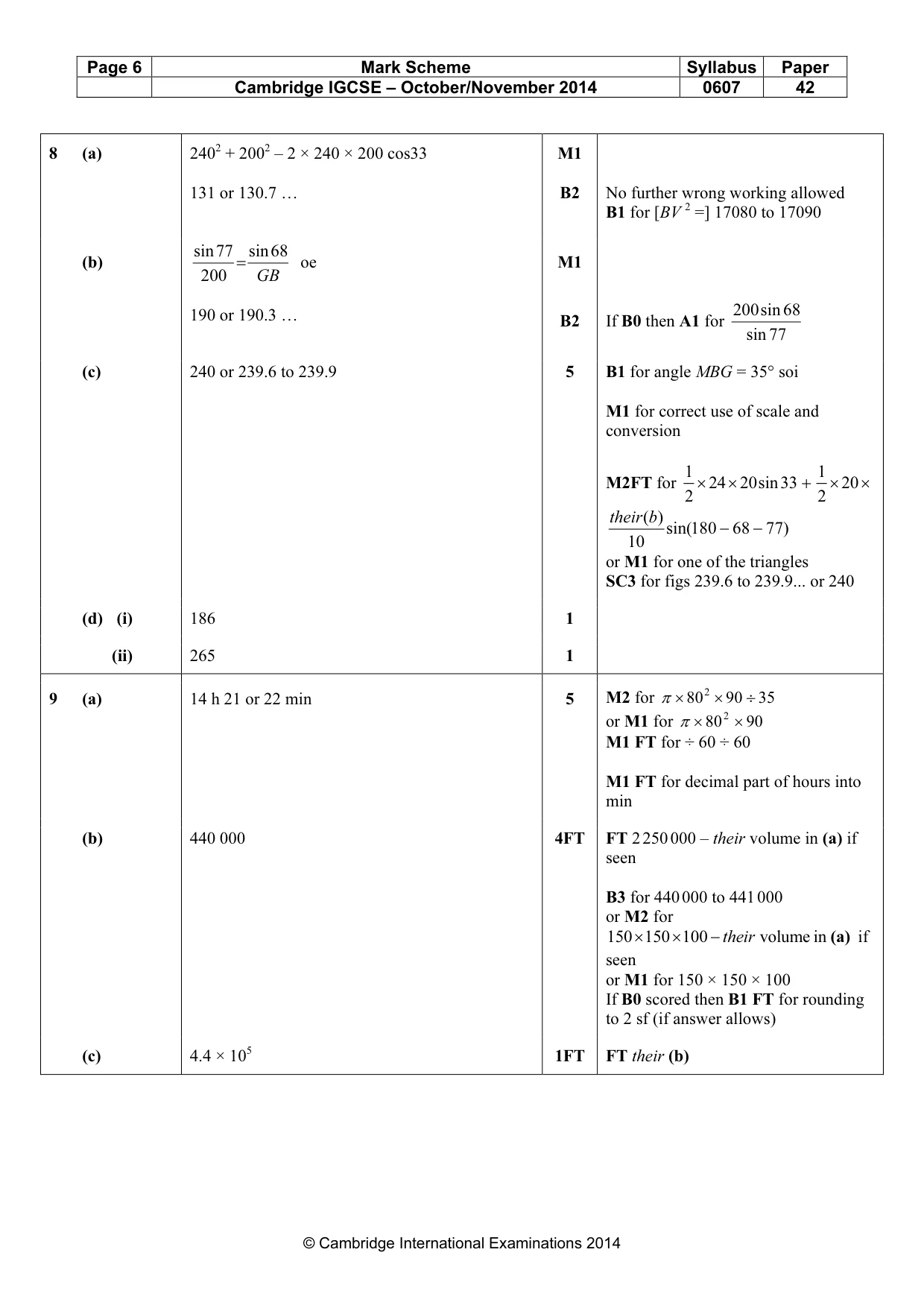
Page 6 Mark Scheme Syllabus Paper Cambridge IGCSE – October/November 2014 0607 42 © Cambridge International Examinations 2014 8 (a) 2402 + 2002 – 2 × 240 × 200 cos33 131 or 130.7 … M1 B2 No further wrong working allowed B1 for [BV 2 =] 17080 to 17090 (b) GB 68 sin 200 77 sin = oe 190 or 190.3 … M1 B2 If B0 then A1 for 77 sin 68 sin 200 (c) 240 or 239.6 to 239.9 5 B1 for angle MBG = 35° soi M1 for correct use of scale and conversion M2FT for 1 1 24 20sin33 20 2 2 × × + × × ) 77 68 180 sin( 10 ) ( − − b their or M1 for one of the triangles SC3 for figs 239.6 to 239.9... or 240 (d) (i) 186 1 (ii) 265 1 9 (a) 14 h 21 or 22 min 5 M2 for 35 90 802 ÷ × × π or M1 for 90 80 2 × × π M1 FT for ÷ 60 ÷ 60 M1 FT for decimal part of hours into min (b) 440 000 4FT FT 2 250 000 – their volume in (a) if seen B3 for 440 000 to 441 000 or M2 for 150 150 100 volume in their × × − (a) if seen or M1 for 150 × 150 × 100 If B0 scored then B1 FT for rounding to 2 sf (if answer allows) (c) 4.4 × 10⁵ 1FT FT their (b)
Mark scheme, page 7
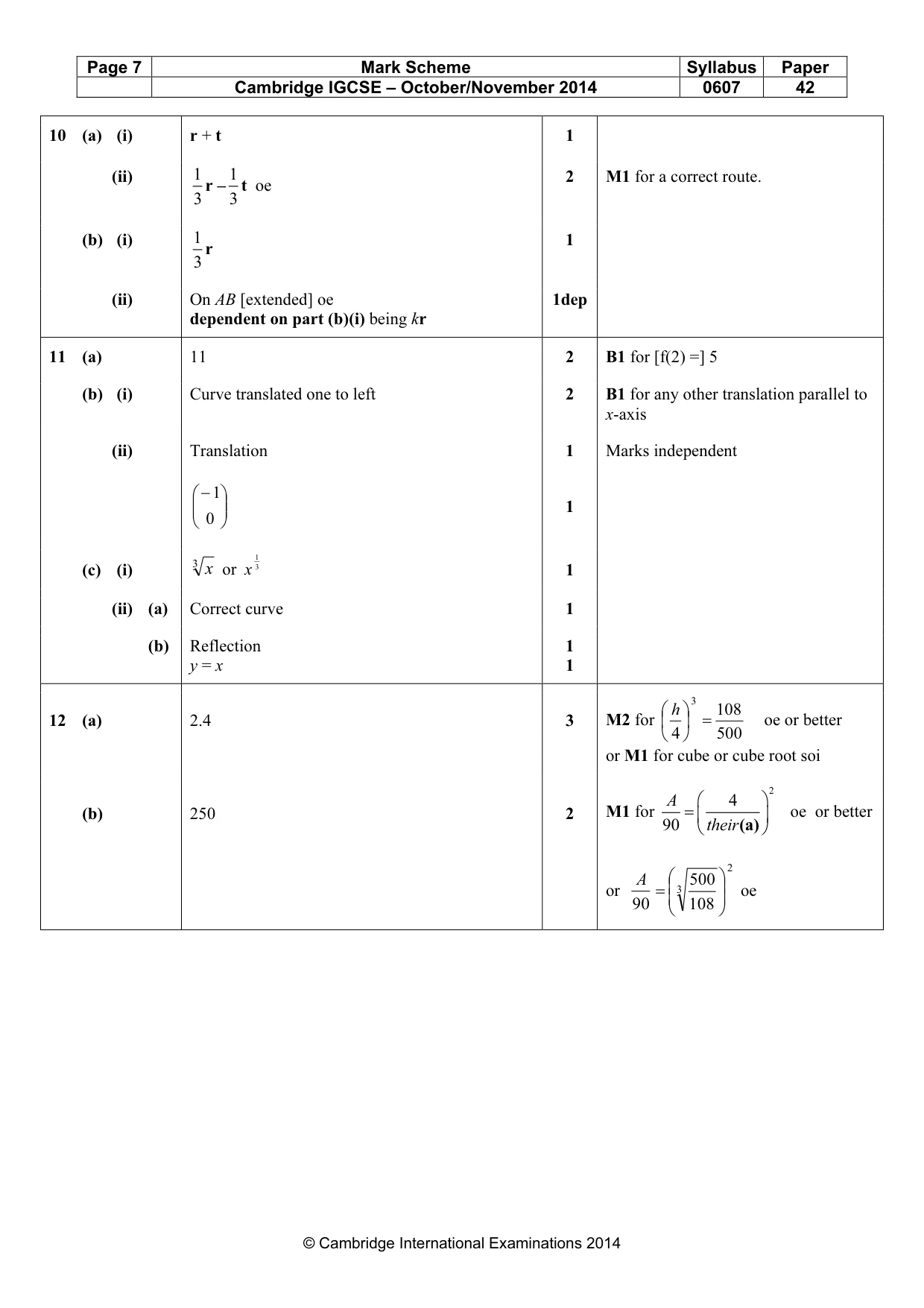
Page 7 Mark Scheme Syllabus Paper Cambridge IGCSE – October/November 2014 0607 42 © Cambridge International Examinations 2014 10 (a) (i) r + t 1 (ii) 1 3 r – 1 3 t oe 2 M1 for a correct route. (b) (i) 1 3 r 1 (ii) On AB [extended] oe dependent on part (b)(i) being kr 1dep 11 (a) 11 2 B1 for [f(2) =] 5 (b) (i) Curve translated one to left 2 B1 for any other translation parallel to x-axis (ii) Translation − 0 1 1 1 Marks independent (c) (i) 3 x or 3 1 x 1 (ii) (a) Correct curve 1 (b) Reflection y = x 1 1 12 (a) 2.4 3 M2 for 500 108 4 3 = h oe or better or M1 for cube or cube root soi (b) 250 2 M1 for 2 4 90 A their = (a) oe or better or 90 A 2 3 108 500 = oe
What you needed in this session
Cambridge’s own grade thresholds for 2014 Oct/Nov, Paper 4 · Variant 2. A higher threshold means an easier paper — the bar moves with how the cohort did.