Cambridge IGCSE Mathematics - International 0607 — 2014 May/June Paper 4 · Variant 1
0607/41/M/J/14 · 120 marks · ≈135 min
The question paper and its mark scheme, free to read here and free to download. This is Cambridge’s own paper, exactly as it was sat.
Question paper24 pages
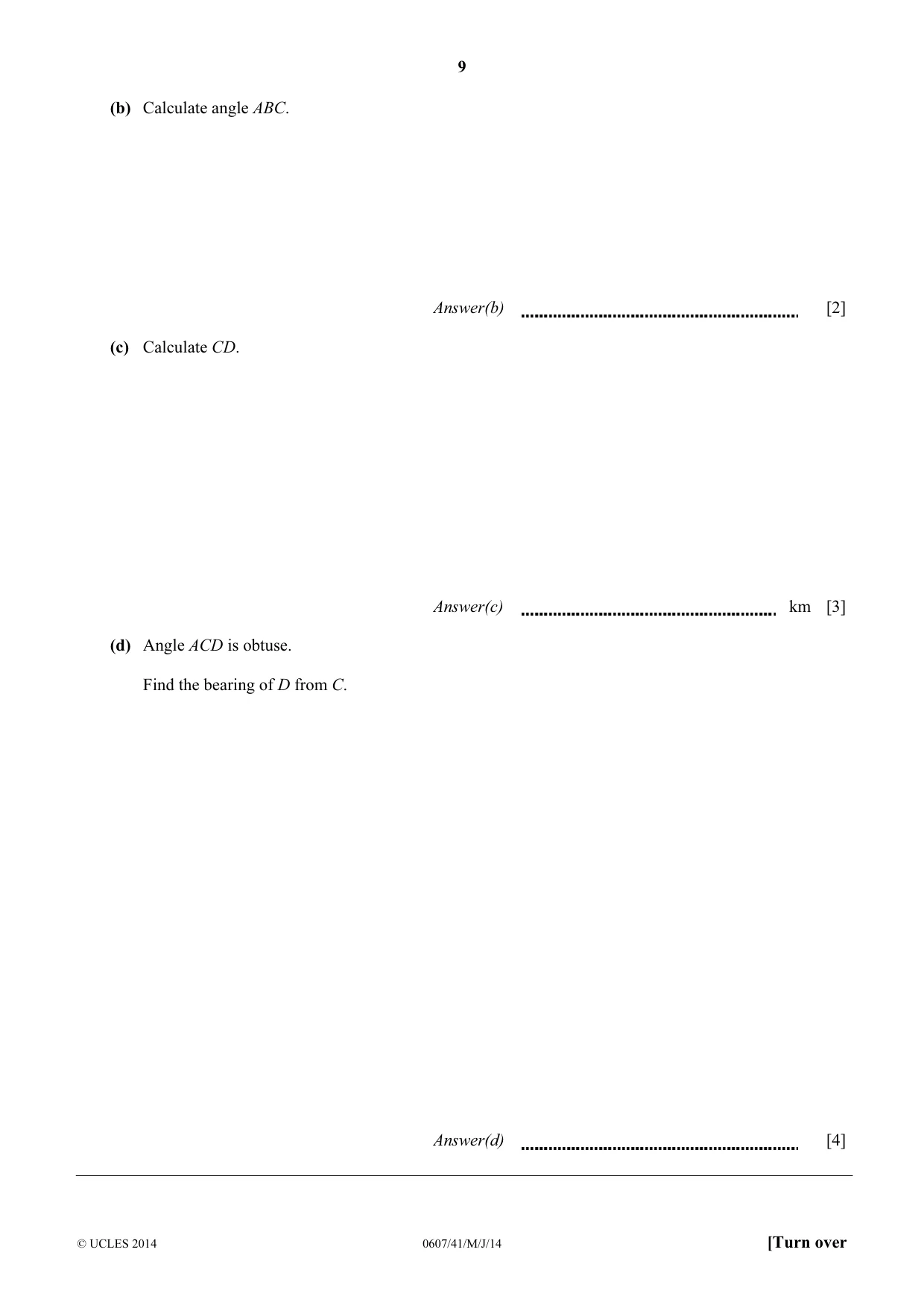
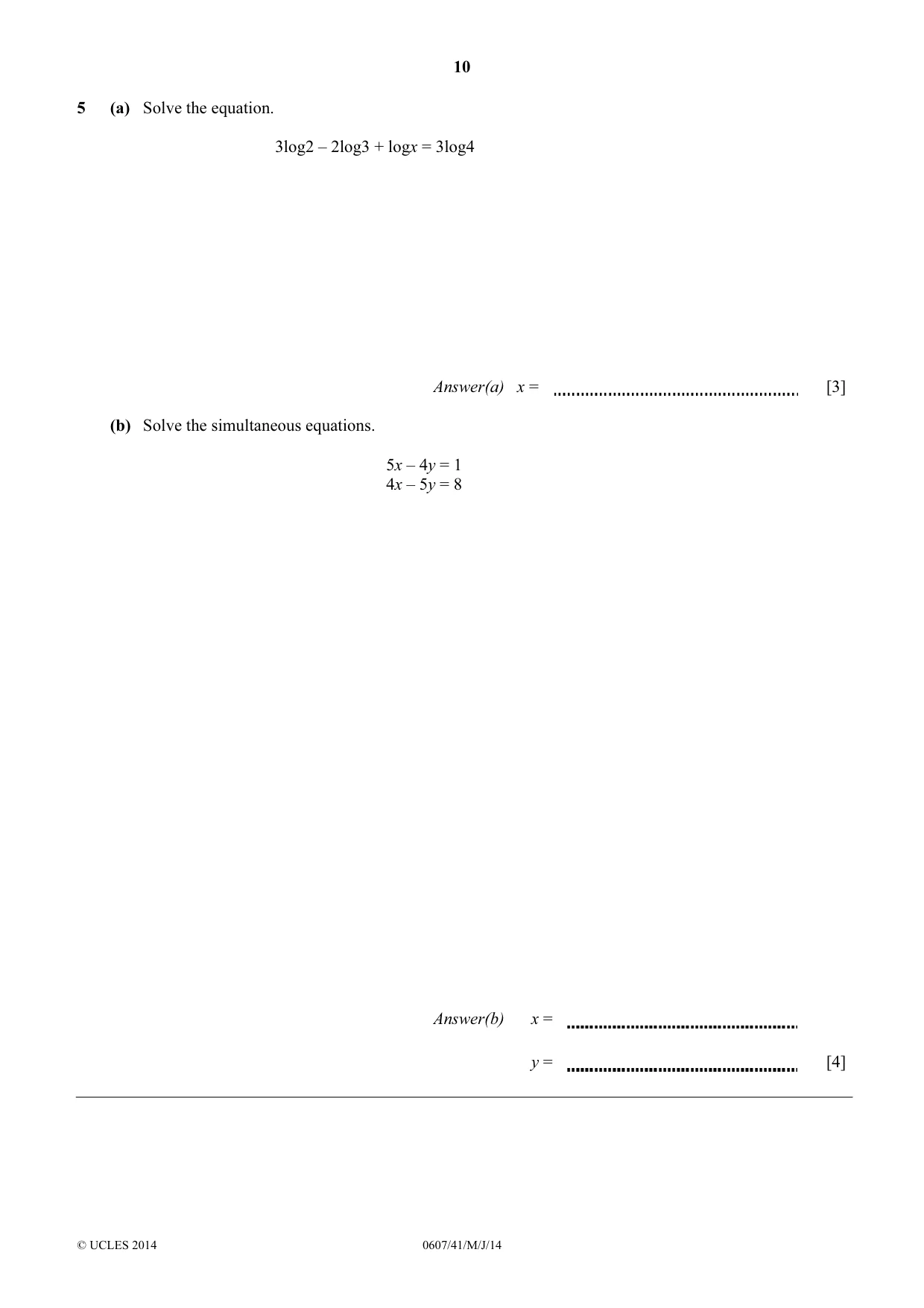
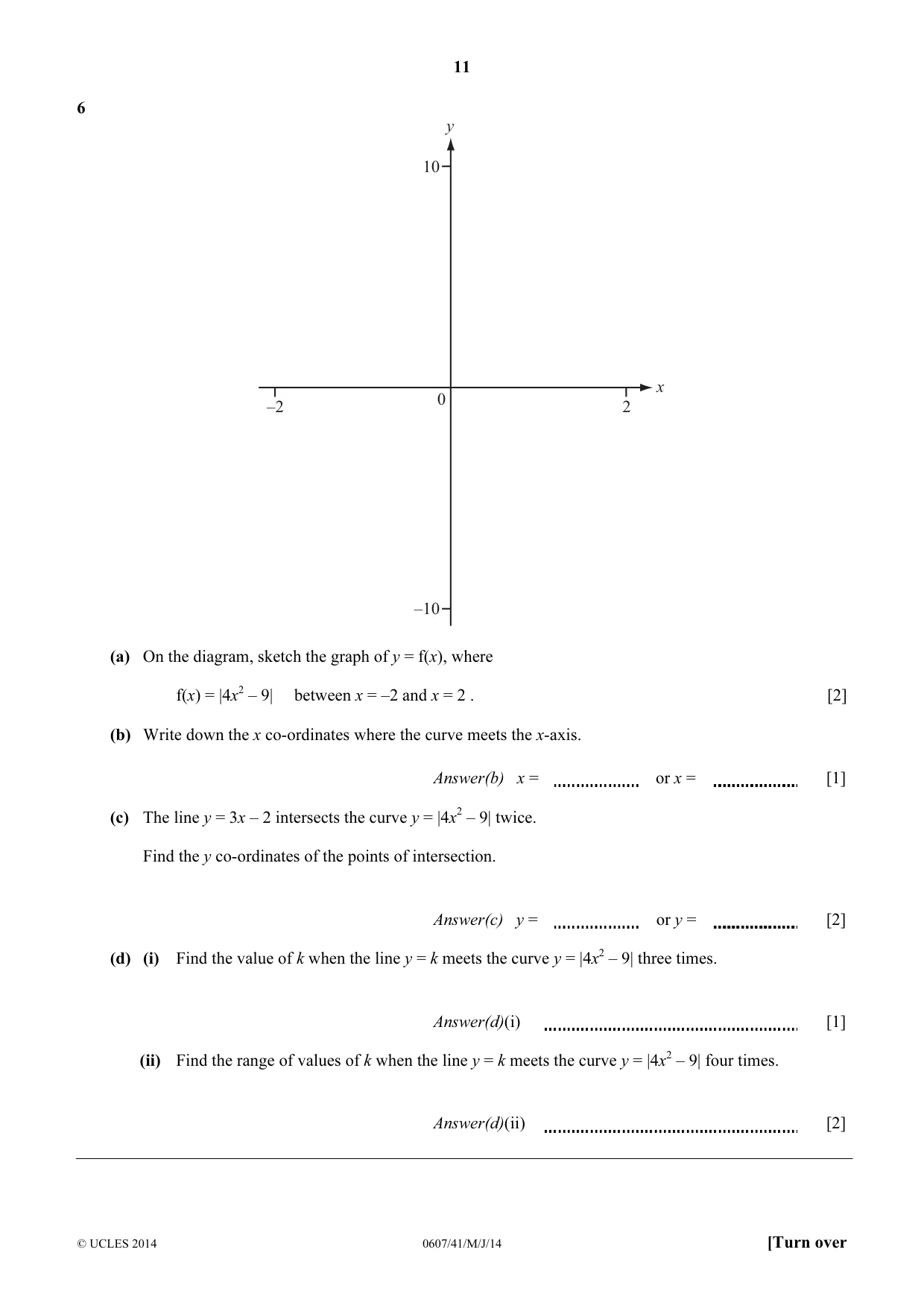
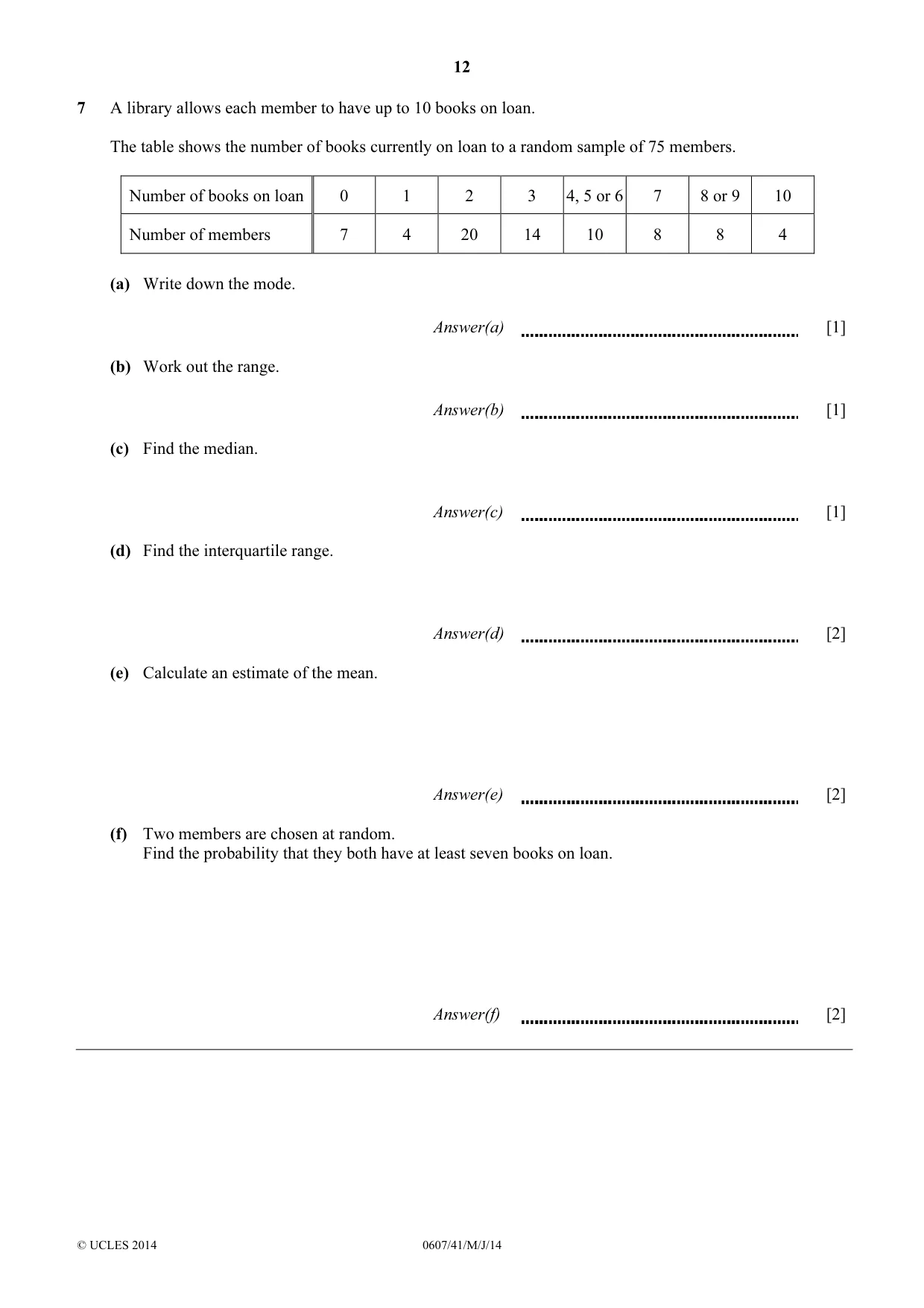

Mark scheme7 pages
Answers below. Sit the paper first if you are practising.
Paper as text
Question paper, page 1
This document consists of 22 printed pages and 2 blank pages. IB14 06_0607_41/5RP © UCLES 2014 [Turn over *7508068777* Cambridge International Examinations Cambridge International General Certificate of Secondary Education CAMBRIDGE INTERNATIONAL MATHEMATICS 0607/41 Paper 4 (Extended) May/June 2014 2 hours 15 minutes Candidates answer on the Question Paper. Additional Materials: Geometrical Instruments Graphics Calculator READ THESE INSTRUCTIONS FIRST Write your Centre number, candidate number and name on all the work you hand in. Write in dark blue or black pen. Do not use staples, paper clips, glue or correction fluid. You may use an HB pencil for any diagrams or graphs. DO NOT WRITE IN ANY BARCODES. Answer all the questions. Unless instructed otherwise, give your answers exactly or correct to three significant figures as appropriate. Answers in degrees should be given to one decimal place. For π, use your calculator value. You must show all the relevant working to gain full marks and you will be given marks for correct methods, including sketches, even if your answer is incorrect. The number of marks is given in brackets [ ] at the end of each question or part question. The total number of marks for this paper is 120.
Question paper, page 2
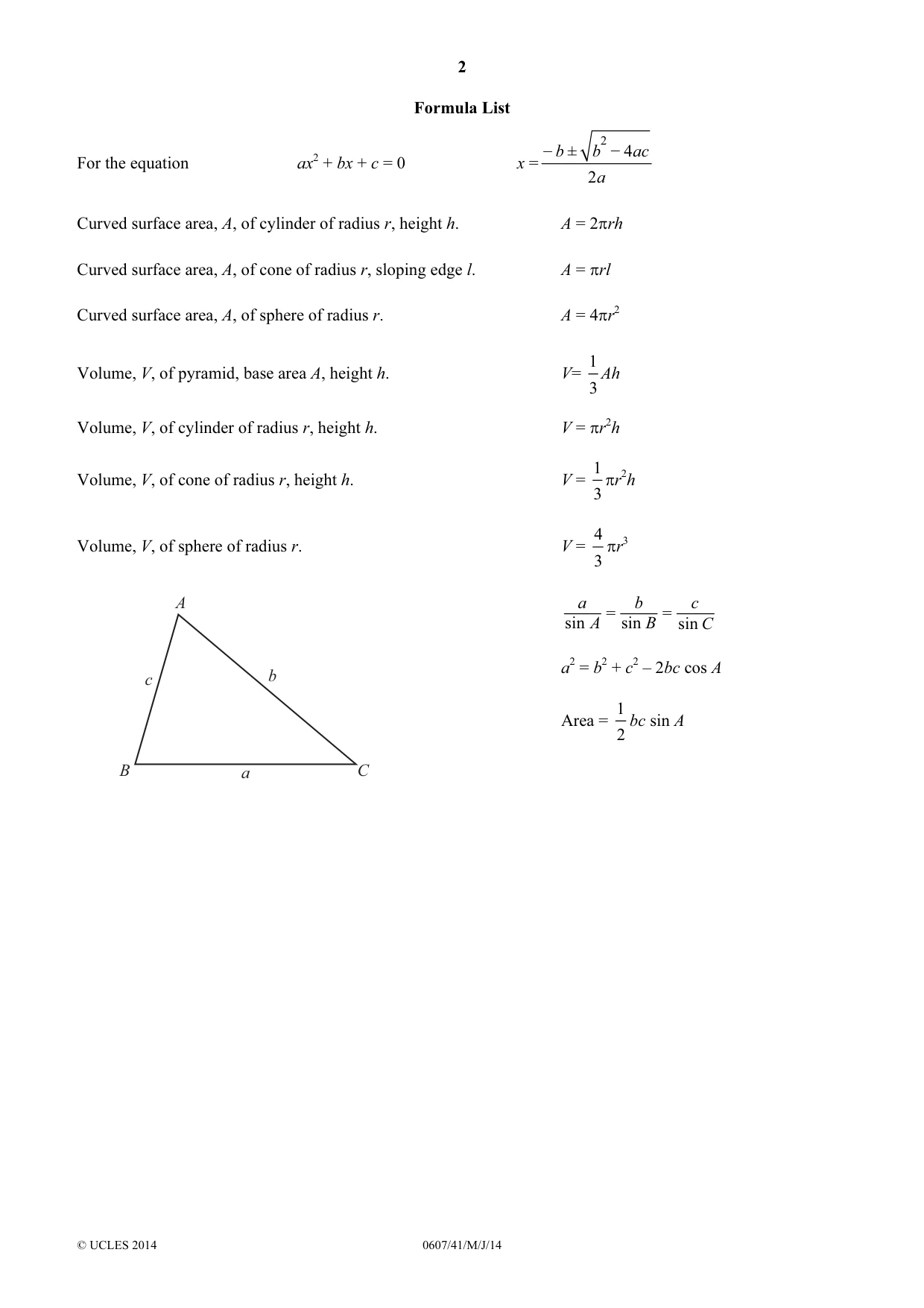
2 © UCLES 2014 0607/41/M/J/14 Formula List For the equation ax2 + bx + c = 0 x = 2 _ ± 4 2 _ b b ac a Curved surface area, A, of cylinder of radius r, height h. A = 2πrh Curved surface area, A, of cone of radius r, sloping edge l. A = πrl Curved surface area, A, of sphere of radius r. A = 4πr2 Volume, V, of pyramid, base area A, height h. V= 1 3 Ah Volume, V, of cylinder of radius r, height h. V = πr2h Volume, V, of cone of radius r, height h. V = 1 3 πr2h Volume, V, of sphere of radius r. V = 4 3 πr3 = = sin sin sin a b c A B C a2 = b2 + c2 – 2bc cos A Area = 1 2 bc sin A A a B C b c
Question paper, page 3
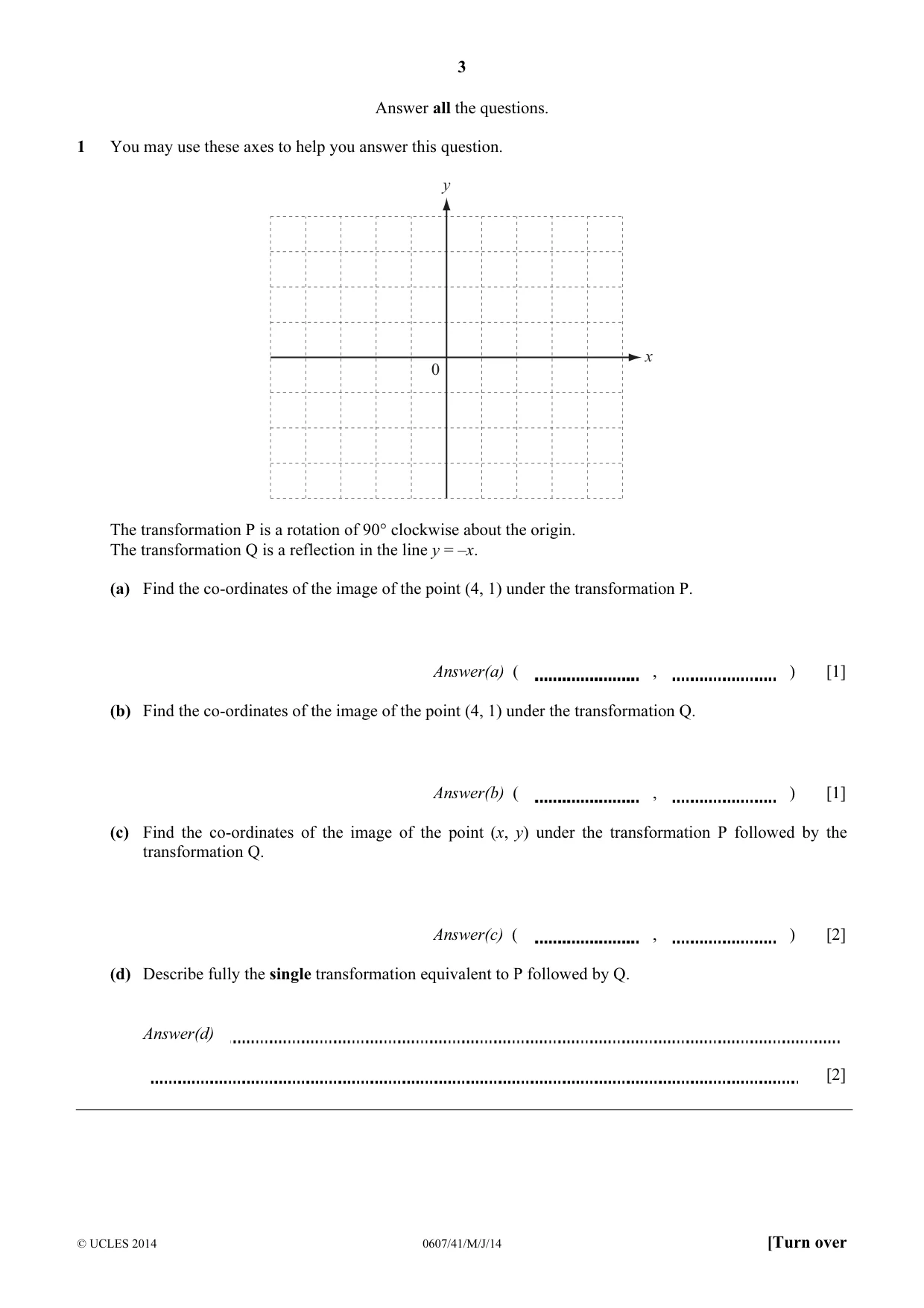
3 © UCLES 2014 0607/41/M/J/14 [Turn over Answer all the questions. 1 You may use these axes to help you answer this question. 0 y x The transformation P is a rotation of 90° clockwise about the origin. The transformation Q is a reflection in the line y = –x. (a) Find the co-ordinates of the image of the point (4, 1) under the transformation P. Answer(a) ( , ) [1] (b) Find the co-ordinates of the image of the point (4, 1) under the transformation Q. Answer(b) ( , ) [1] (c) Find the co-ordinates of the image of the point (x, y) under the transformation P followed by the transformation Q. Answer(c) ( , ) [2] (d) Describe fully the single transformation equivalent to P followed by Q. Answer(d) [2]
Question paper, page 4
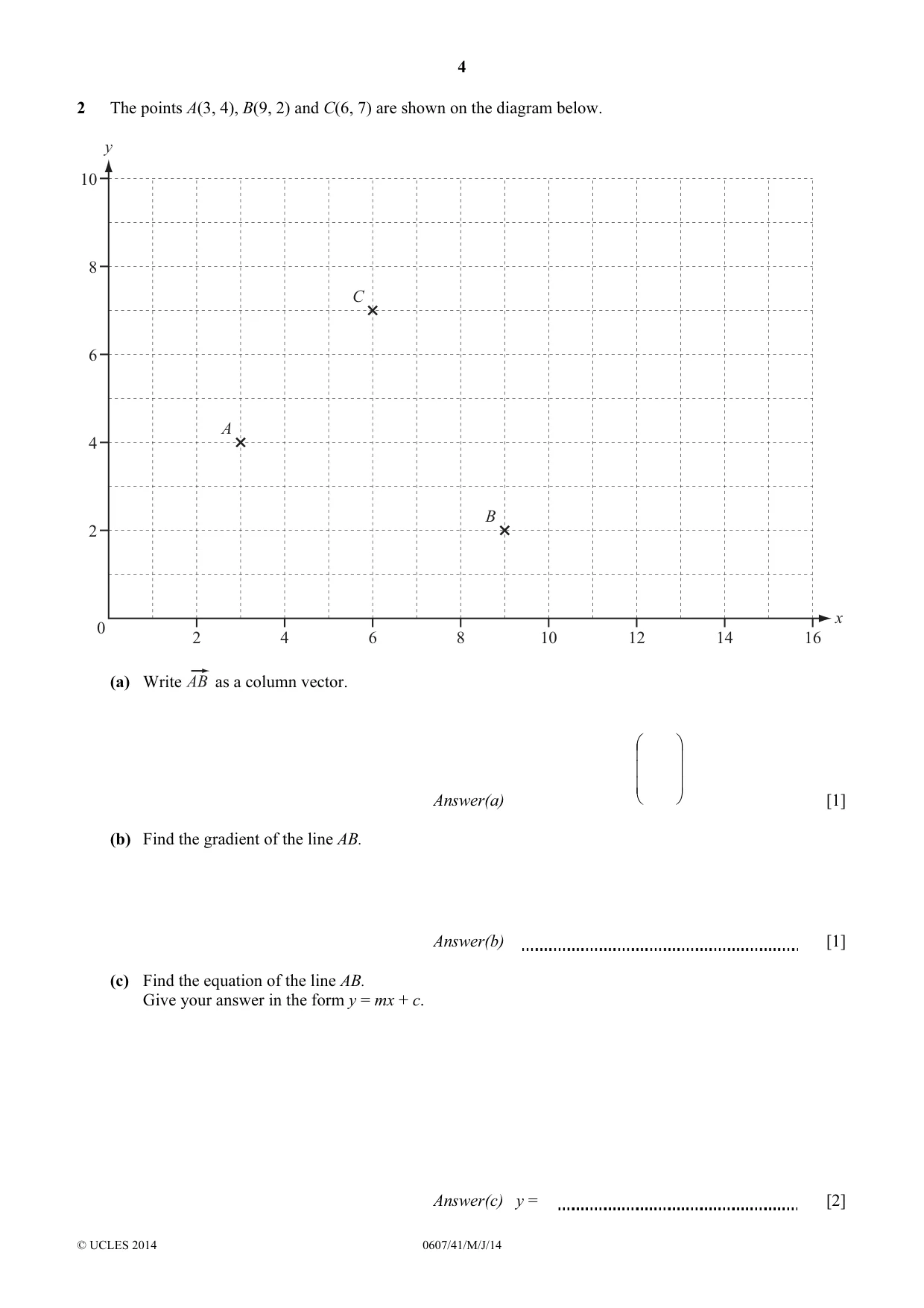
4 © UCLES 2014 0607/41/M/J/14 2 The points A(3, 4), B(9, 2) and C(6, 7) are shown on the diagram below. 2 4 6 8 10 12 14 16 10 8 6 4 2 0 y x A B C (a) Write as a column vector. Answer(a) [1] (b) Find the gradient of the line AB. Answer(b) [1] (c) Find the equation of the line AB. Give your answer in the form y = mx + c. Answer(c) y = [2]
Question paper, page 5
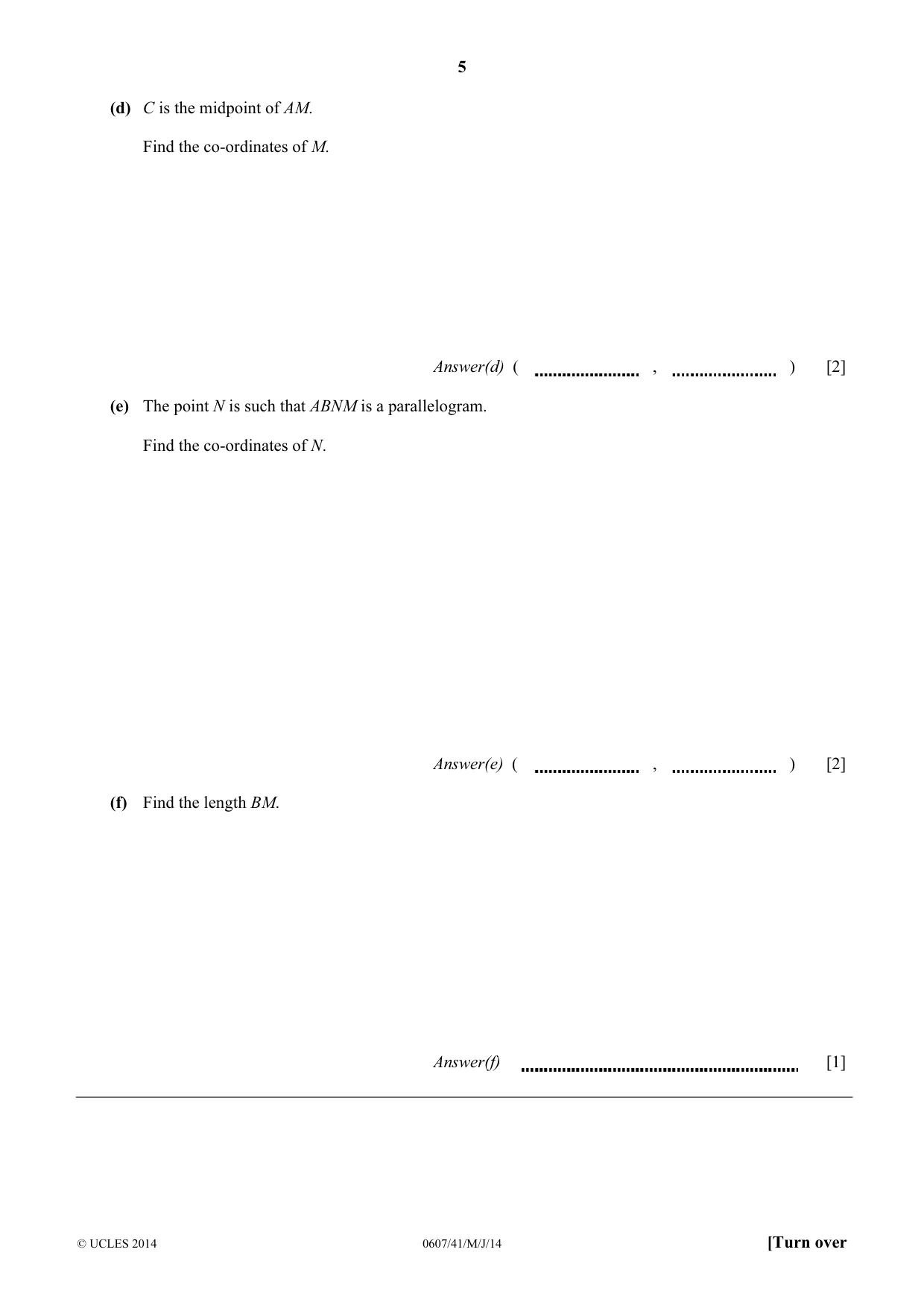
5 © UCLES 2014 0607/41/M/J/14 [Turn over (d) C is the midpoint of AM. Find the co-ordinates of M. Answer(d) ( , ) [2] (e) The point N is such that ABNM is a parallelogram. Find the co-ordinates of N. Answer(e) ( , ) [2] (f) Find the length BM. Answer(f) [1]
Question paper, page 6
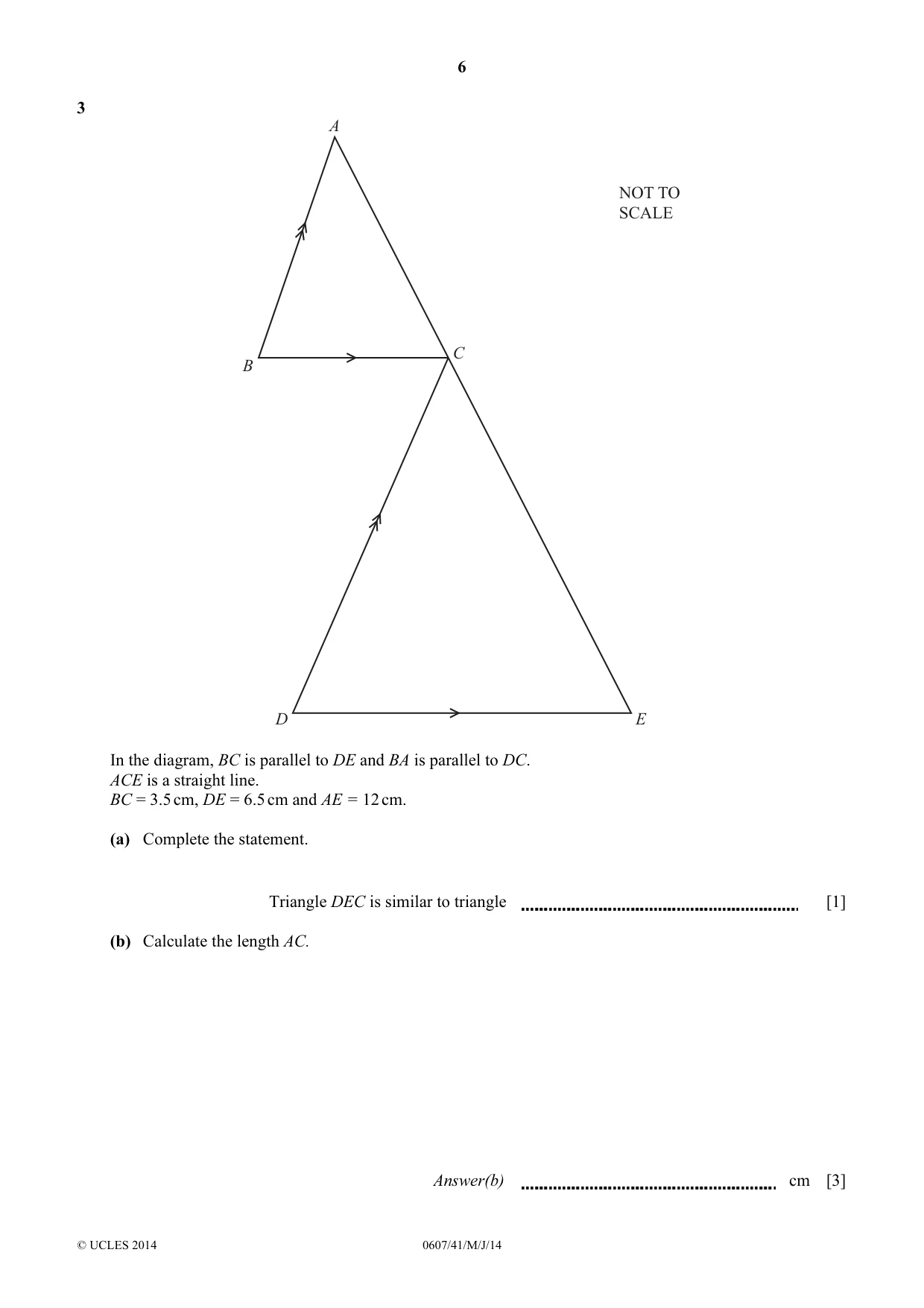
6 © UCLES 2014 0607/41/M/J/14 3 A B C E D NOT TO SCALE In the diagram, BC is parallel to DE and BA is parallel to DC. ACE is a straight line. BC = 3.5 cm, DE = 6.5 cm and AE = 12 cm. (a) Complete the statement. Triangle DEC is similar to triangle [1] (b) Calculate the length AC. Answer(b) cm [3]
Question paper, page 7
7 © UCLES 2014 0607/41/M/J/14 [Turn over (c) The area of triangle ABC is 7 cm2. Calculate the area of triangle CDE. Answer(c) cm2 [2]
Question paper, page 8
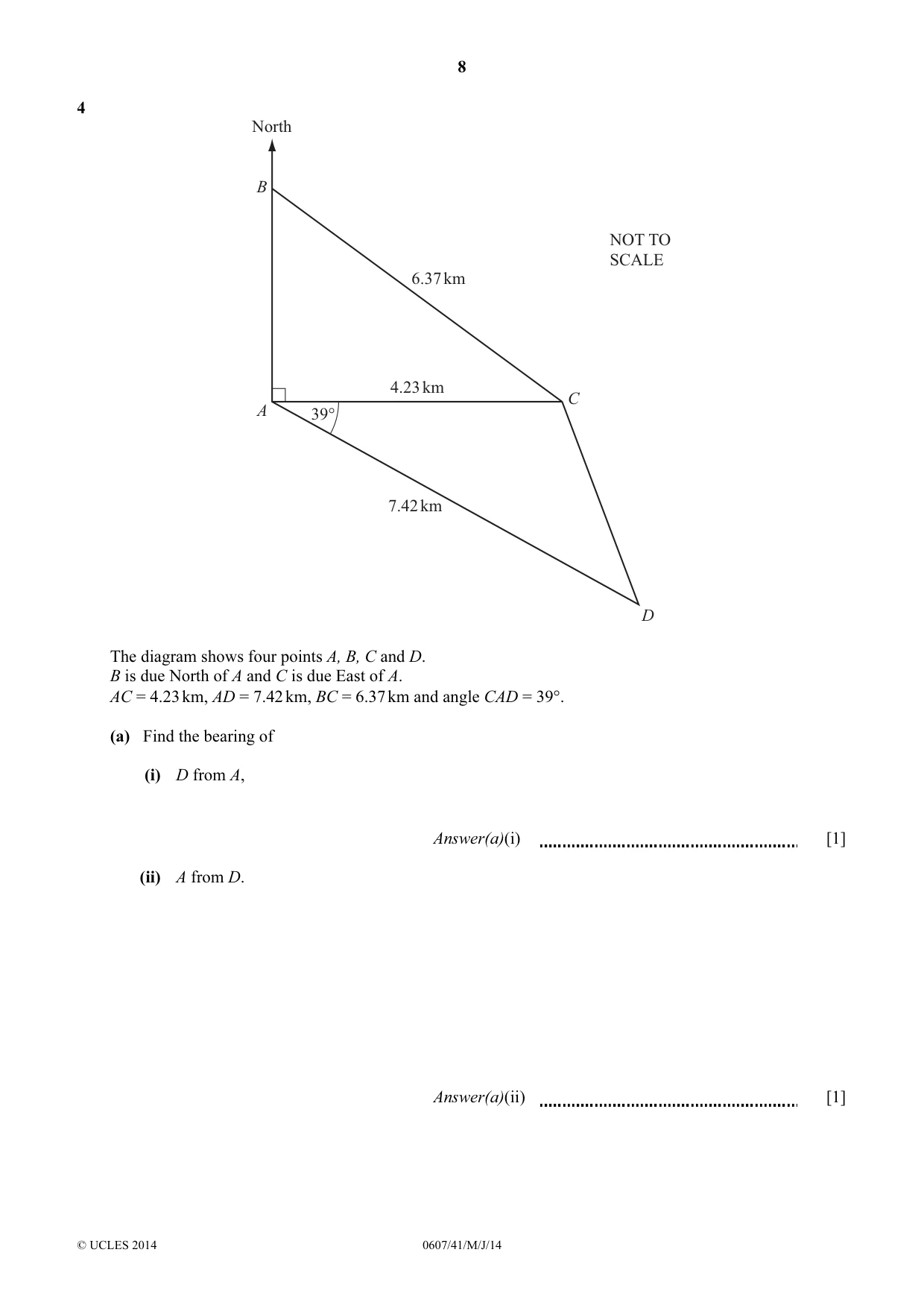
8 © UCLES 2014 0607/41/M/J/14 4 North B A C D 39° 6.37 km 4.23 km 7.42 km NOT TO SCALE The diagram shows four points A, B, C and D. B is due North of A and C is due East of A. AC = 4.23 km, AD = 7.42 km, BC = 6.37 km and angle CAD = 39°. (a) Find the bearing of (i) D from A, Answer(a)(i) [1] (ii) A from D. Answer(a)(ii) [1]
Question paper, page 9
9 © UCLES 2014 0607/41/M/J/14 [Turn over (b) Calculate angle ABC. Answer(b) [2] (c) Calculate CD. Answer(c) km [3] (d) Angle ACD is obtuse. Find the bearing of D from C. Answer(d) [4]
Question paper, page 10
10 © UCLES 2014 0607/41/M/J/14 5 (a) Solve the equation. 3log2 – 2log3 + logx = 3log4 Answer(a) x = [3] (b) Solve the simultaneous equations. 5x – 4y = 1 4x – 5y = 8 Answer(b) x = y = [4]
Question paper, page 11
11 © UCLES 2014 0607/41/M/J/14 [Turn over 6 0 –2 –10 10 2 y x (a) On the diagram, sketch the graph of y = f(x), where f(x) = |4x2 – 9| between x = –2 and x = 2 . [2] (b) Write down the x co-ordinates where the curve meets the x-axis. Answer(b) x = or x = [1] (c) The line y = 3x – 2 intersects the curve y = |4x2 – 9| twice. Find the y co-ordinates of the points of intersection. Answer(c) y = or y = [2] (d) (i) Find the value of k when the line y = k meets the curve y = |4x2 – 9| three times. Answer(d)(i) [1] (ii) Find the range of values of k when the line y = k meets the curve y = |4x2 – 9| four times. Answer(d)(ii) [2]
Question paper, page 12
12 © UCLES 2014 0607/41/M/J/14 7 A library allows each member to have up to 10 books on loan. The table shows the number of books currently on loan to a random sample of 75 members. Number of books on loan 0 1 2 3 4, 5 or 6 7 8 or 9 10 Number of members 7 4 20 14 10 8 8 4 (a) Write down the mode. Answer(a) [1] (b) Work out the range. Answer(b) [1] (c) Find the median. Answer(c) [1] (d) Find the interquartile range. Answer(d) [2] (e) Calculate an estimate of the mean. Answer(e) [2] (f) Two members are chosen at random. Find the probability that they both have at least seven books on loan. Answer(f) [2]
Question paper, page 13
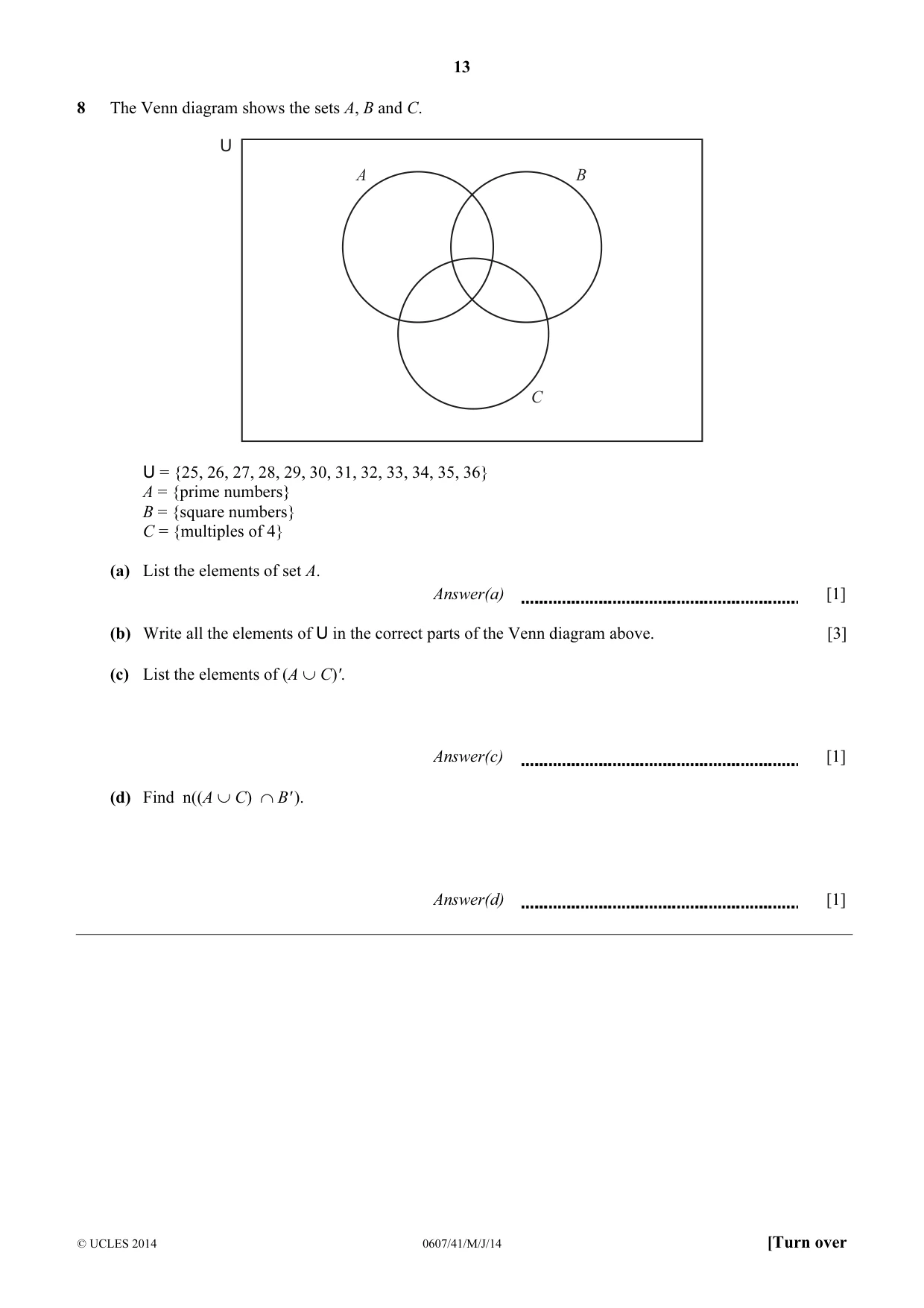
13 © UCLES 2014 0607/41/M/J/14 [Turn over 8 The Venn diagram shows the sets A, B and C. U A B C U = {25, 26, 27, 28, 29, 30, 31, 32, 33, 34, 35, 36} A = {prime numbers} B = {square numbers} C = {multiples of 4} (a) List the elements of set A. Answer(a) [1] (b) Write all the elements of U in the correct parts of the Venn diagram above. [3] (c) List the elements of (A ∪ C)'. Answer(c) [1] (d) Find n((A ∪ C) ∩ B' ). Answer(d) [1]
Question paper, page 14
14 © UCLES 2014 0607/41/M/J/14 9 (a) Find the next term and the nth term in each of the following sequences. (i) 1, 8, 27, 64, 125, ….. Answer(a)(i) next term = nth term = [2] (ii) 4, 10, 18, 28, 40, ….. Answer(a)(ii) next term = nth term = [3] (b) Use your results to part (a), to find the next term and the nth term in the following sequence. 6, 19, 46, 93, 166, ….. Answer(b) next term = nth term = [3]
Question paper, page 15
15 © UCLES 2014 0607/41/M/J/14 [Turn over 10 Paulo bought a car on January 1st 2010. By January 1st 2011 the value of the car had reduced by 20%. By January 1st 2012 the value of the car had reduced by a further 15%. The value of the car on January 1st 2012 was $18 700. (a) Find how much Paulo paid for the car. Answer(a) $ [3] (b) The value of the car reduces by 15% every year from 2012. Find the year in which the value of the car will first be below 25% of the price Paulo paid in 2010. Answer(b) [3]
Question paper, page 16
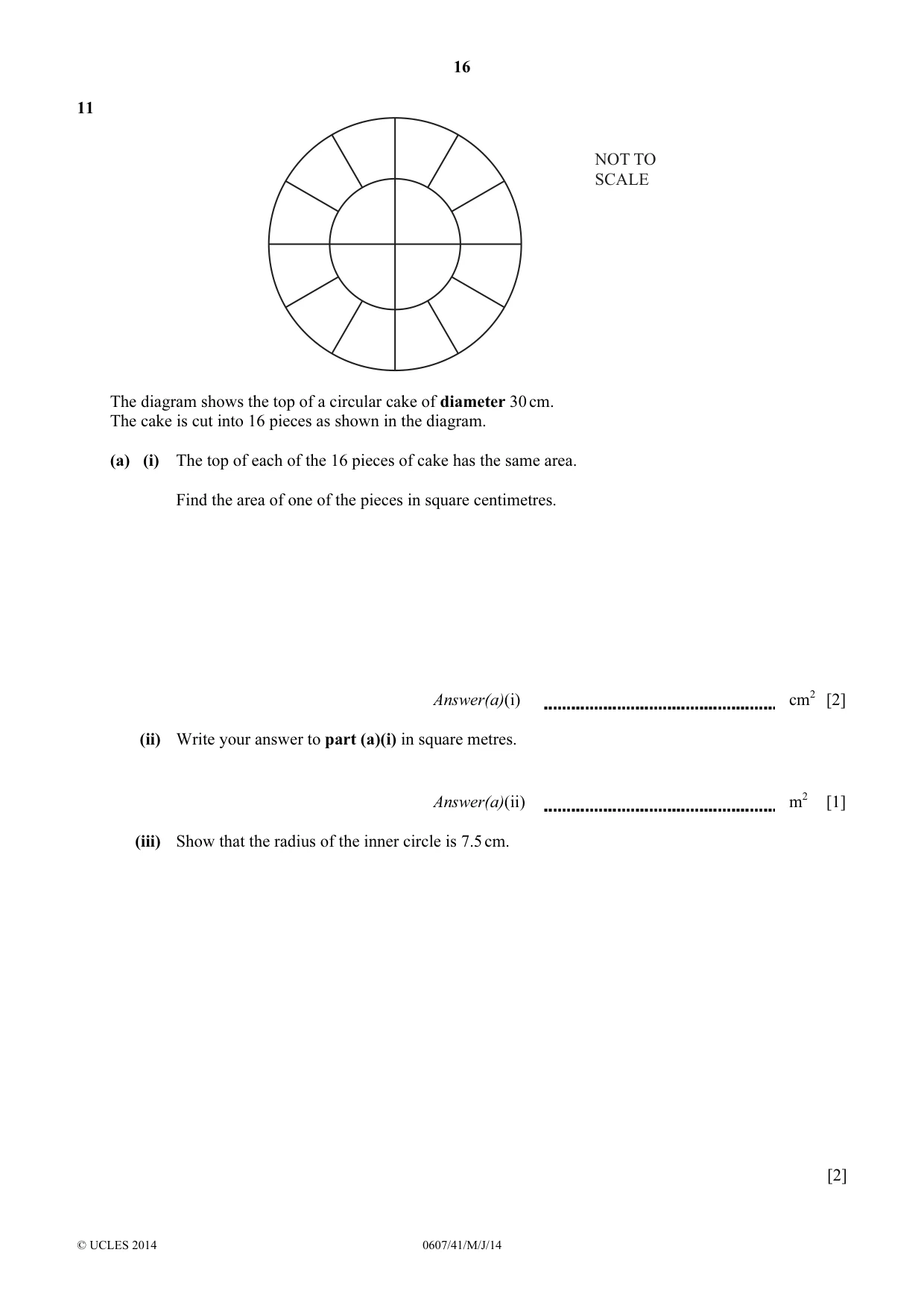
16 © UCLES 2014 0607/41/M/J/14 11 NOT TO SCALE The diagram shows the top of a circular cake of diameter 30 cm. The cake is cut into 16 pieces as shown in the diagram. (a) (i) The top of each of the 16 pieces of cake has the same area. Find the area of one of the pieces in square centimetres. Answer(a)(i) cm2 [2] (ii) Write your answer to part (a)(i) in square metres. Answer(a)(ii) m2 [1] (iii) Show that the radius of the inner circle is 7.5 cm. [2]
Question paper, page 17
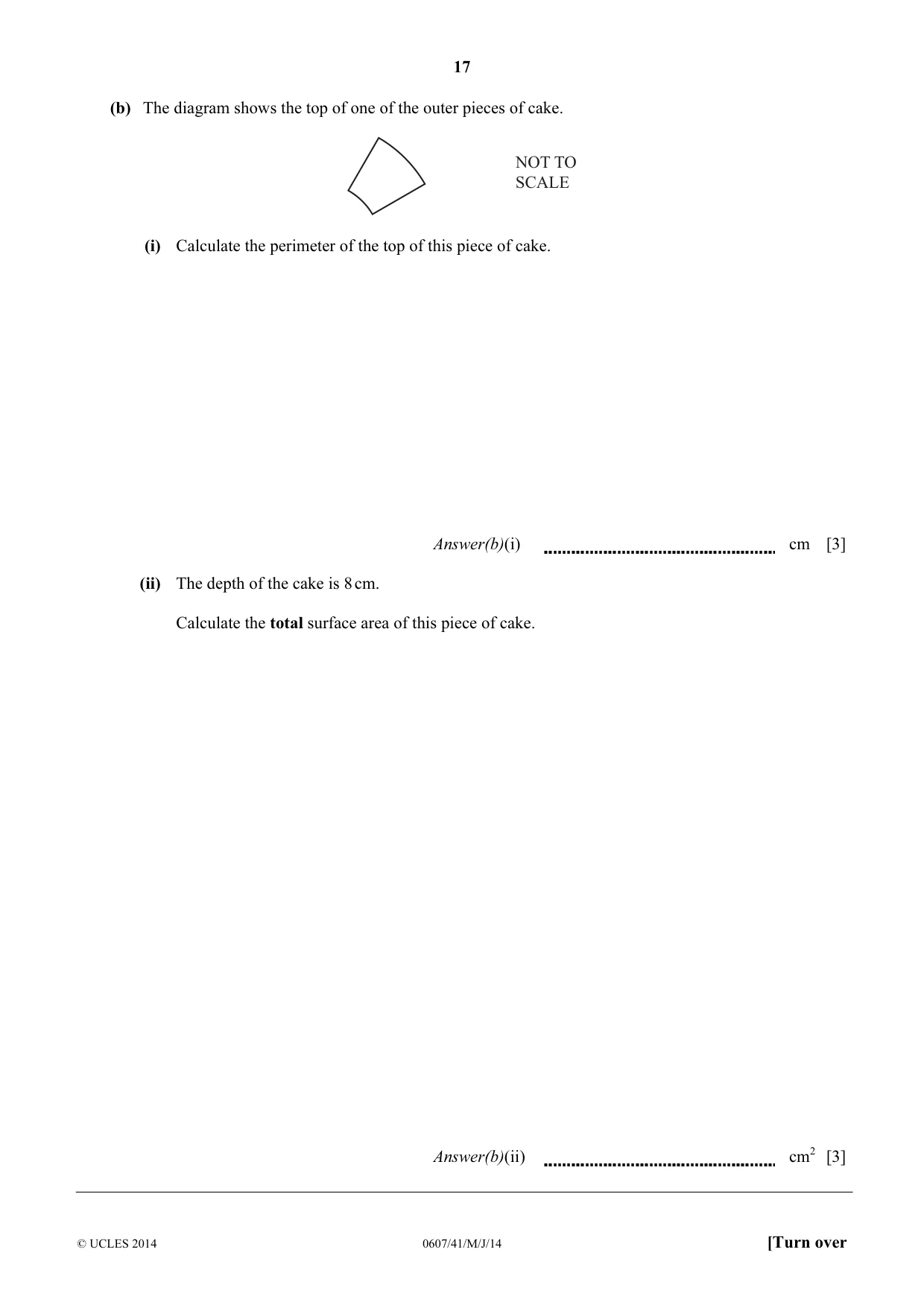
17 © UCLES 2014 0607/41/M/J/14 [Turn over (b) The diagram shows the top of one of the outer pieces of cake. NOT TO SCALE (i) Calculate the perimeter of the top of this piece of cake. Answer(b)(i) cm [3] (ii) The depth of the cake is 8 cm. Calculate the total surface area of this piece of cake. Answer(b)(ii) cm2 [3]
Question paper, page 18
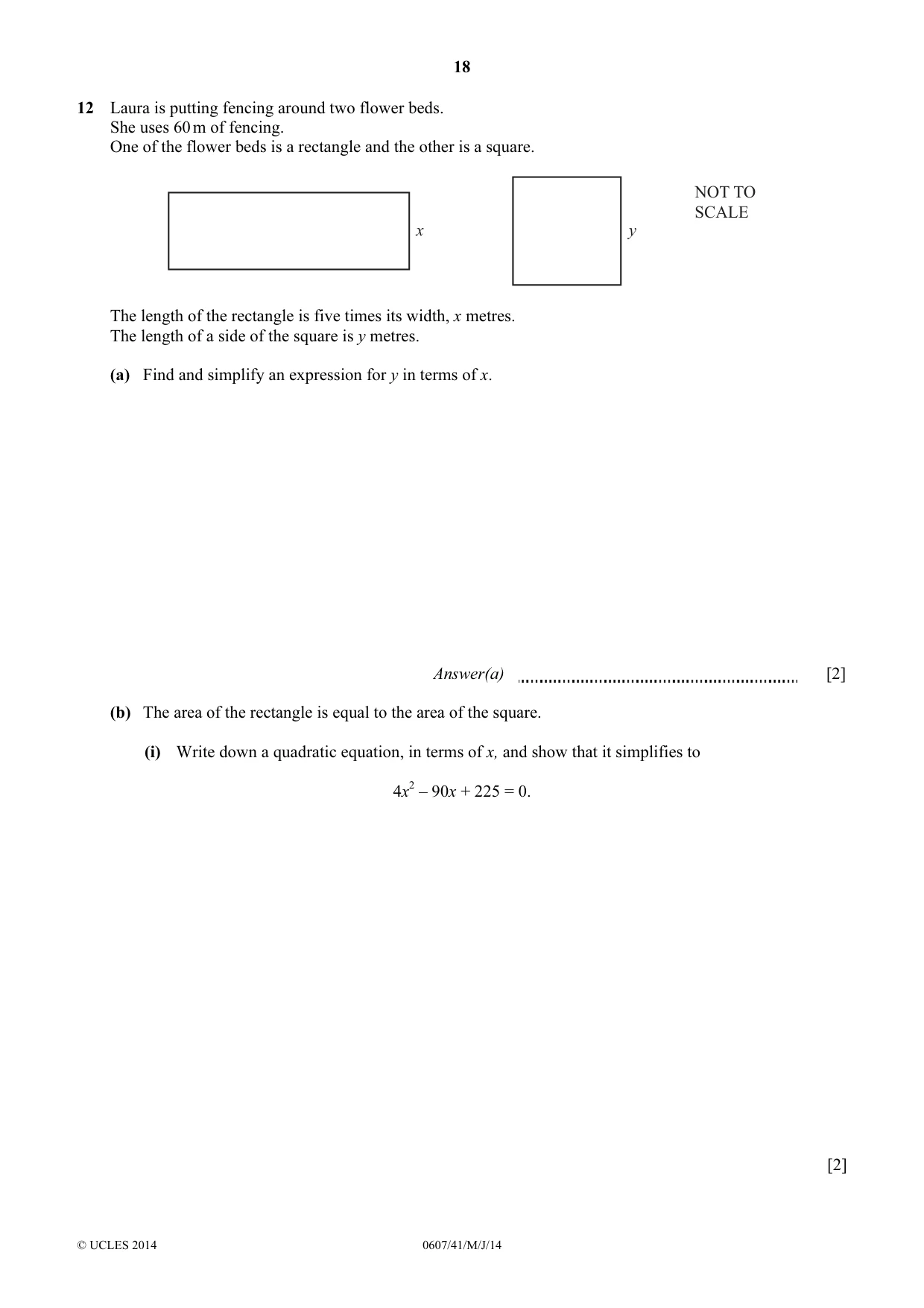
18 © UCLES 2014 0607/41/M/J/14 12 Laura is putting fencing around two flower beds. She uses 60 m of fencing. One of the flower beds is a rectangle and the other is a square. x y NOT TO SCALE The length of the rectangle is five times its width, x metres. The length of a side of the square is y metres. (a) Find and simplify an expression for y in terms of x. Answer(a) [2] (b) The area of the rectangle is equal to the area of the square. (i) Write down a quadratic equation, in terms of x, and show that it simplifies to 4x2 – 90x + 225 = 0. [2]
Question paper, page 19
19 © UCLES 2014 0607/41/M/J/14 [Turn over (ii) Solve the equation 4x2 – 90x + 225 = 0. Give your answers correct to 3 significant figures. Answer(b)(ii) x = or x = [3] (iii) Write down the width of the rectangle, giving a reason for your choice of values of x. Answer(b)(iii) x = because [1] (iv) Calculate the total area of the flower beds. Answer(b)(iv) m2 [2]
Question paper, page 20
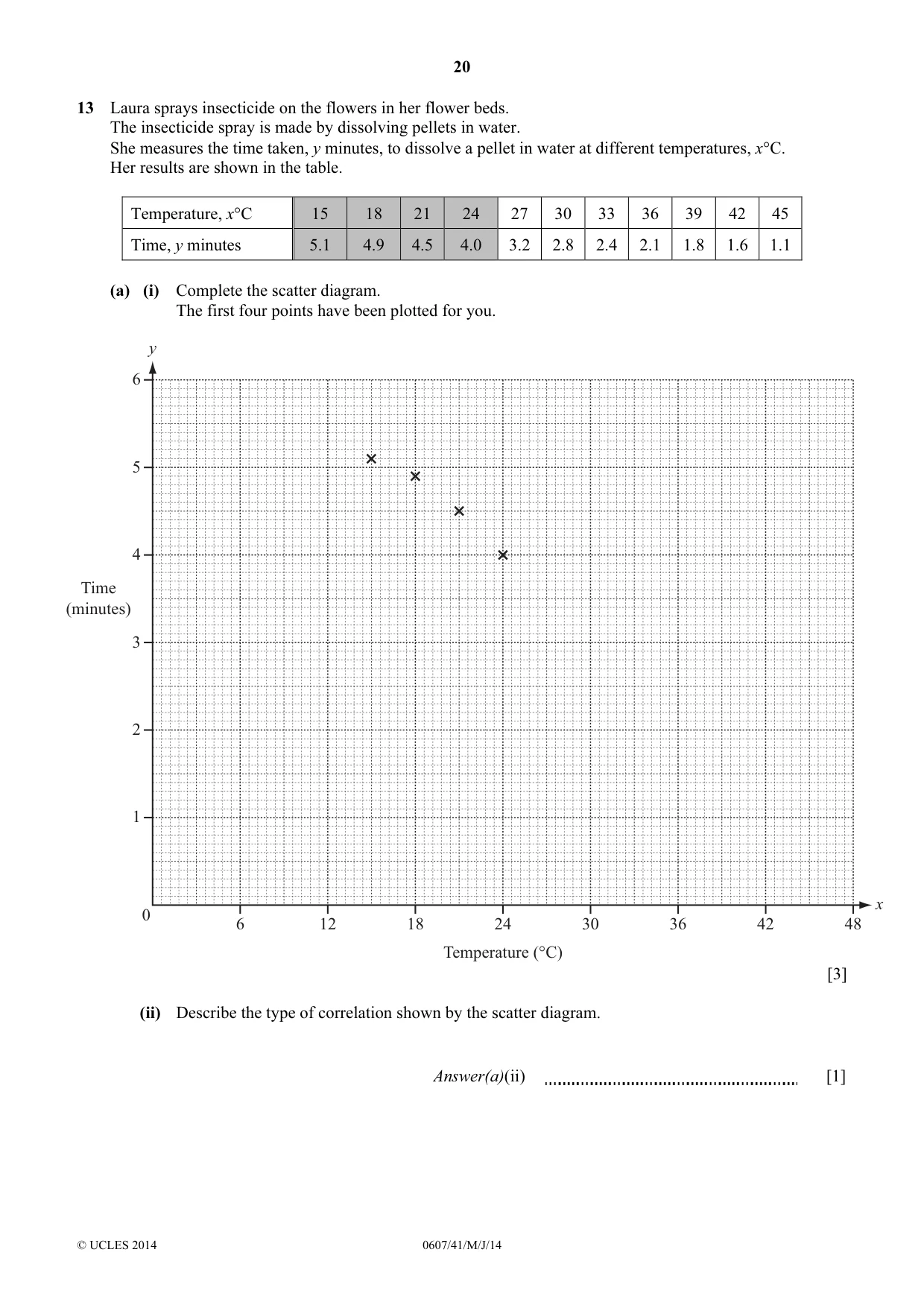
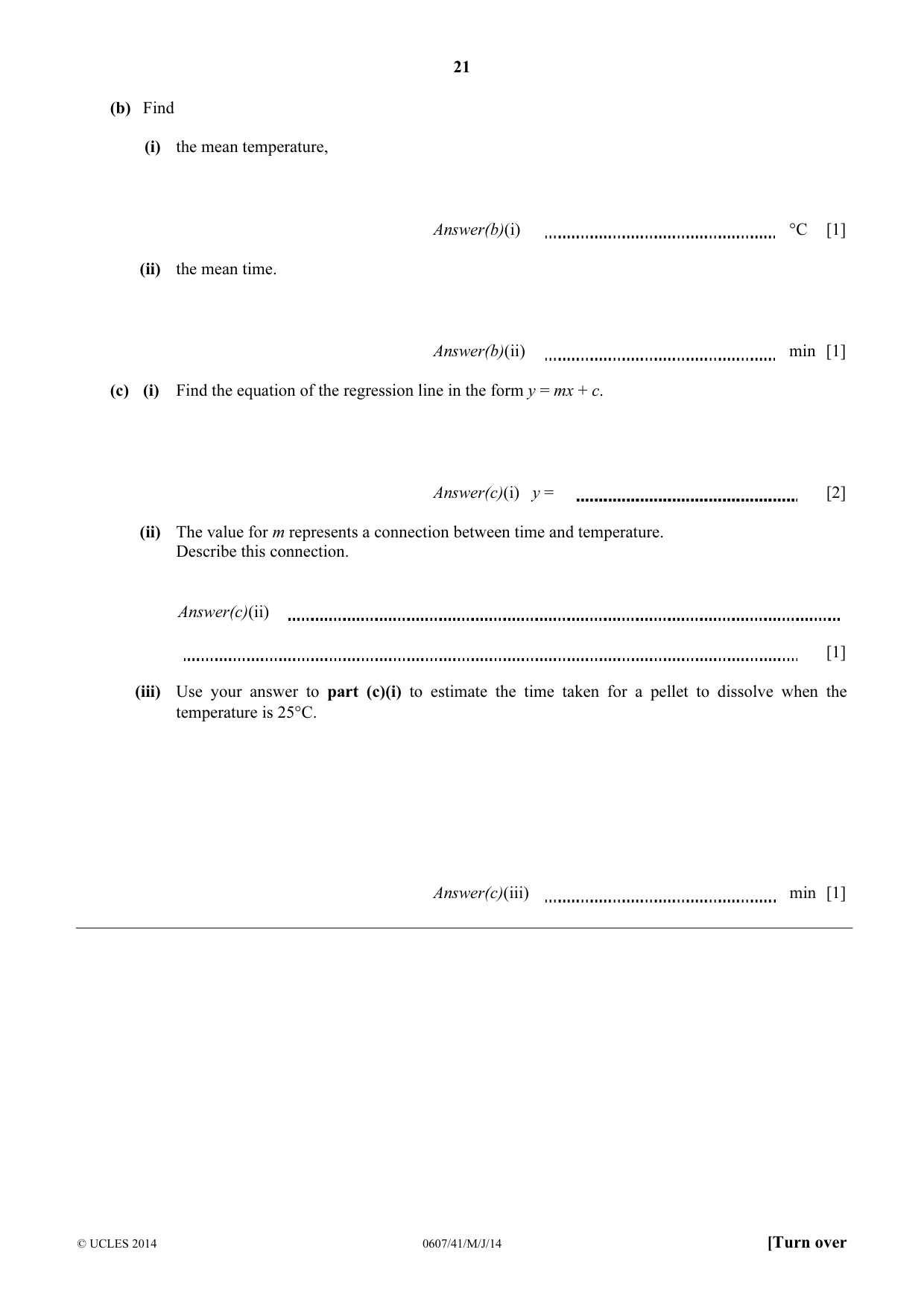
20 © UCLES 2014 0607/41/M/J/14 13 Laura sprays insecticide on the flowers in her flower beds. The insecticide spray is made by dissolving pellets in water. She measures the time taken, y minutes, to dissolve a pellet in water at different temperatures, x°C. Her results are shown in the table. Temperature, x°C 15 18 21 24 27 30 33 36 39 42 45 Time, y minutes 5.1 4.9 4.5 4.0 3.2 2.8 2.4 2.1 1.8 1.6 1.1 (a) (i) Complete the scatter diagram. The first four points have been plotted for you. 6 5 4 3 2 1 6 12 18 24 Temperature (°C) 30 36 42 48 0 y x Time (minutes) [3] (ii) Describe the type of correlation shown by the scatter diagram. Answer(a)(ii) [1]
Question paper, page 21
21 © UCLES 2014 0607/41/M/J/14 [Turn over (b) Find (i) the mean temperature, Answer(b)(i) °C [1] (ii) the mean time. Answer(b)(ii) min [1] (c) (i) Find the equation of the regression line in the form y = mx + c. Answer(c)(i) y = [2] (ii) The value for m represents a connection between time and temperature. Describe this connection. Answer(c)(ii) [1] (iii) Use your answer to part (c)(i) to estimate the time taken for a pellet to dissolve when the temperature is 25°C. Answer(c)(iii) min [1]
Question paper, page 22
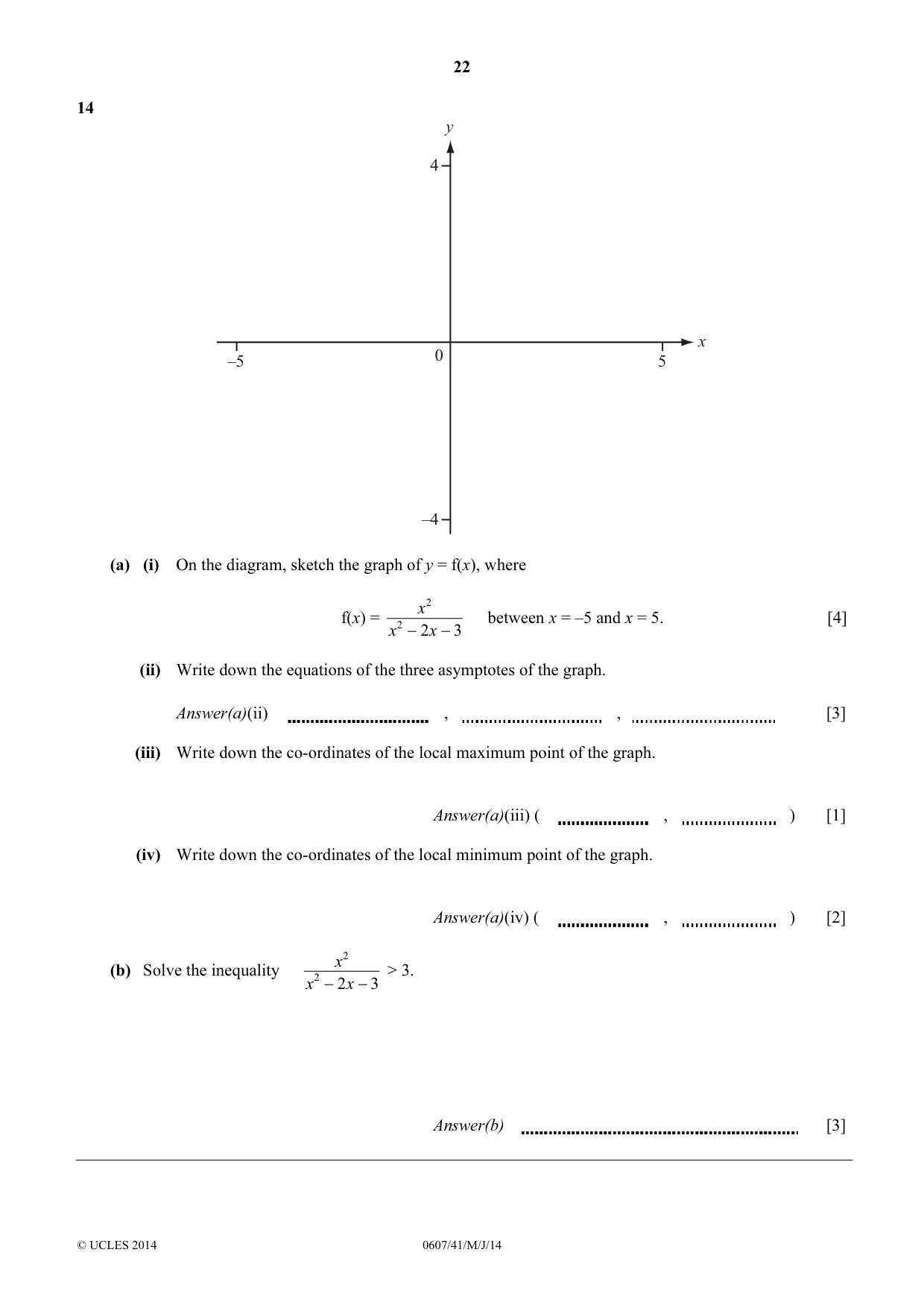
22 © UCLES 2014 0607/41/M/J/14 14 y x 4 0 –4 –5 5 (a) (i) On the diagram, sketch the graph of y = f(x), where f(x) = 3 2 2 2 − −x x x between x = –5 and x = 5. [4] (ii) Write down the equations of the three asymptotes of the graph. Answer(a)(ii) , , [3] (iii) Write down the co-ordinates of the local maximum point of the graph. Answer(a)(iii) ( , ) [1] (iv) Write down the co-ordinates of the local minimum point of the graph. Answer(a)(iv) ( , ) [2] (b) Solve the inequality 3 2 2 2 − −x x x > 3. Answer(b) [3]
Question paper, page 23
23 © UCLES 2014 0607/41/M/J/14 BLANK PAGE
Question paper, page 24
24 Permission to reproduce items where third-party owned material protected by copyright is included has been sought and cleared where possible. Every reasonable effort has been made by the publisher (UCLES) to trace copyright holders, but if any items requiring clearance have unwittingly been included, the publisher will be pleased to make amends at the earliest possible opportunity. Cambridge International Examinations is part of the Cambridge Assessment Group. Cambridge Assessment is the brand name of University of Cambridge Local Examinations Syndicate (UCLES), which is itself a department of the University of Cambridge. © UCLES 2014 0607/41/M/J/14 BLANK PAGE
Mark scheme, page 1
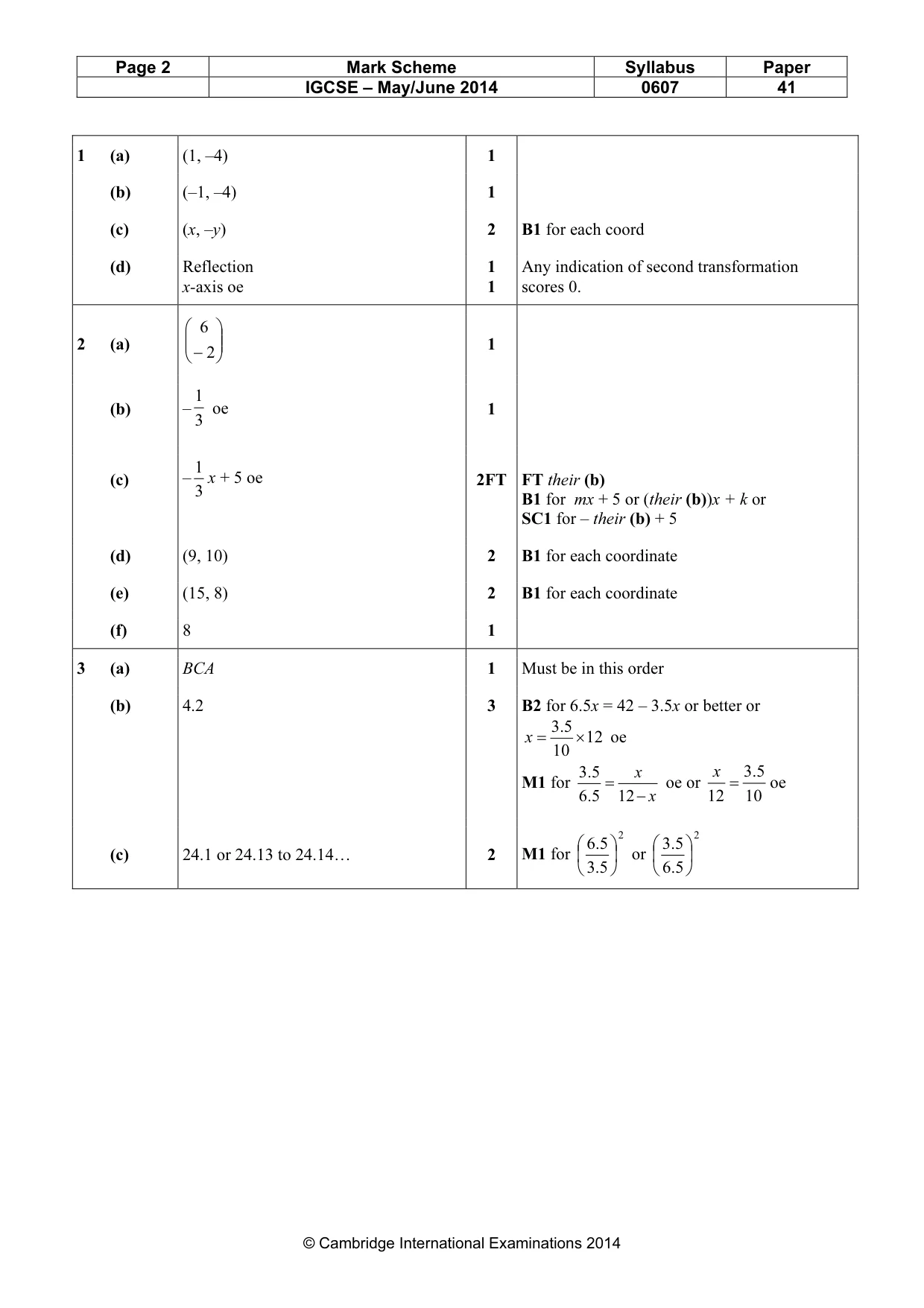
CAMBRIDGE INTERNATIONAL EXAMINATIONS International General Certificate of Secondary Education MARK SCHEME for the May/June 2014 series 0607 CAMBRIDGE INTERNATIONAL MATHEMATICS 0607/41 Paper 4 (Extended), maximum raw mark 120 This mark scheme is published as an aid to teachers and candidates, to indicate the requirements of the examination. It shows the basis on which Examiners were instructed to award marks. It does not indicate the details of the discussions that took place at an Examiners’ meeting before marking began, which would have considered the acceptability of alternative answers. Mark schemes should be read in conjunction with the question paper and the Principal Examiner Report for Teachers. Cambridge will not enter into discussions about these mark schemes. Cambridge is publishing the mark schemes for the May/June 2014 series for most IGCSE, GCE Advanced Level and Advanced Subsidiary Level components and some Ordinary Level components.
Mark scheme, page 2
Page 2 Mark Scheme Syllabus Paper IGCSE – May/June 2014 0607 41 © Cambridge International Examinations 2014 1 (a) (1, –4) 1 (b) (–1, –4) 1 (c) (x, –y) 2 B1 for each coord (d) Reflection x-axis oe 1 1 Any indication of second transformation scores 0. 2 (a) −2 6 1 (b) – 3 1 oe 1 (c) – 3 1 x + 5 oe 2FT FT their (b) B1 for mx + 5 or (their (b))x + k or SC1 for – their (b) + 5 (d) (9, 10) 2 B1 for each coordinate (e) (15, 8) 2 B1 for each coordinate (f) 8 1 3 (a) BCA 1 Must be in this order (b) 4.2 3 B2 for 6.5x = 42 – 3.5x or better or 12 10 5.3 × = x oe M1 for x x − = 12 5.6 5.3 oe or 10 5.3 12 = x oe (c) 24.1 or 24.13 to 24.14… 2 M1 for 2 5.3 5.6 or 2 5.6 5.3
Mark scheme, page 3
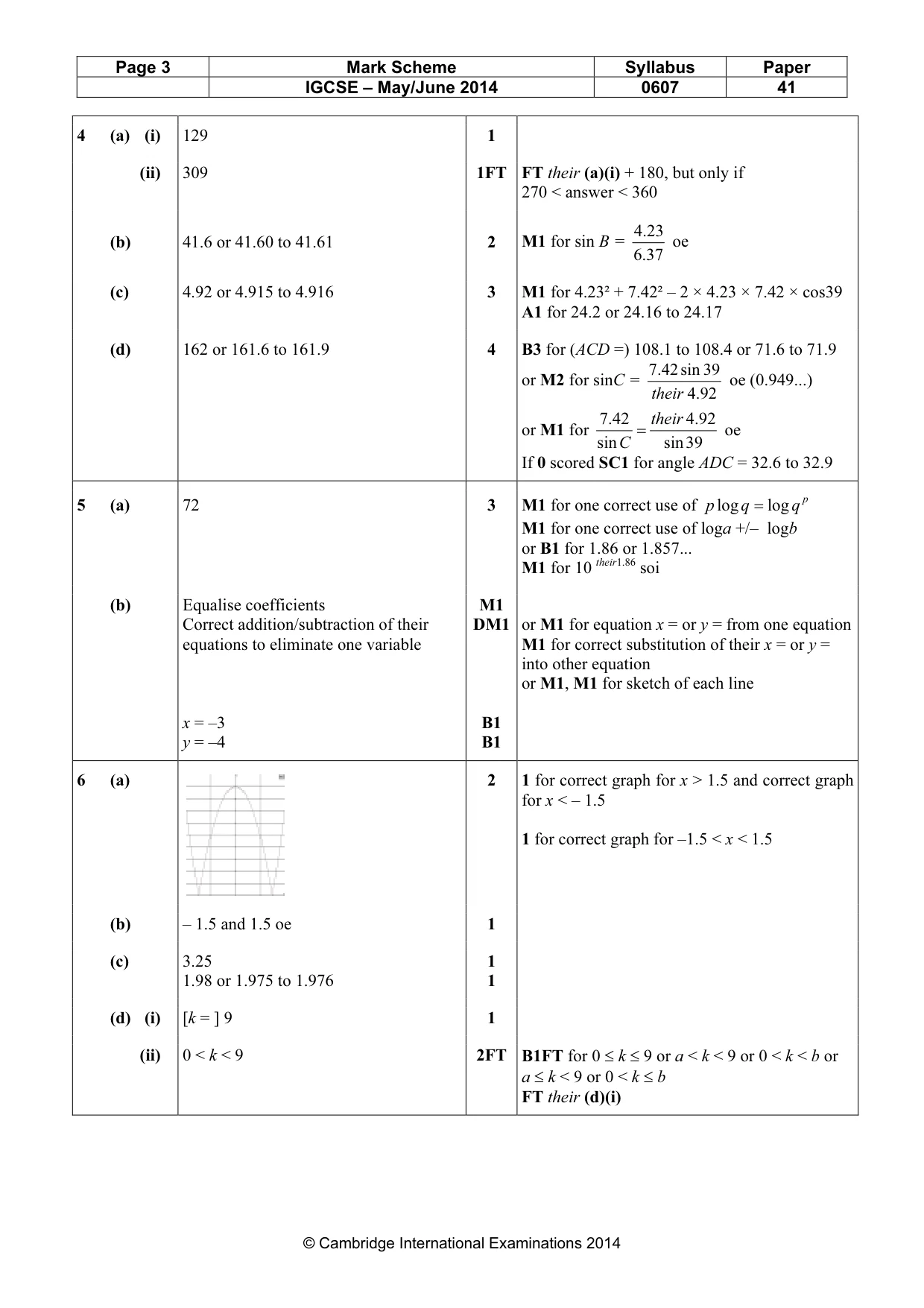
Page 3 Mark Scheme Syllabus Paper IGCSE – May/June 2014 0607 41 © Cambridge International Examinations 2014 4 (a) (i) 129 1 (ii) 309 1FT FT their (a)(i) + 180, but only if 270 < answer < 360 (b) 41.6 or 41.60 to 41.61 2 M1 for sin B = 37 .6 23 .4 oe (c) 4.92 or 4.915 to 4.916 3 M1 for 4.23² + 7.42² – 2 × 4.23 × 7.42 × cos39 A1 for 24.2 or 24.16 to 24.17 (d) 162 or 161.6 to 161.9 4 B3 for (ACD =) 108.1 to 108.4 or 71.6 to 71.9 or M2 for sinC = 92 .4 39 sin 42 .7 their oe (0.949...) or M1 for 39 sin 92 .4 sin 42 .7 their C = oe If 0 scored SC1 for angle ADC = 32.6 to 32.9 5 (a) 72 3 M1 for one correct use of p q q p log log = M1 for one correct use of loga +/– logb or B1 for 1.86 or 1.857... M1 for 10 their1.86 soi (b) Equalise coefficients Correct addition/subtraction of their equations to eliminate one variable x = –3 y = –4 M1 DM1 B1 B1 or M1 for equation x = or y = from one equation M1 for correct substitution of their x = or y = into other equation or M1, M1 for sketch of each line 6 (a) 2 1 for correct graph for x > 1.5 and correct graph for x < – 1.5 1 for correct graph for –1.5 < x < 1.5 (b) – 1.5 and 1.5 oe 1 (c) 3.25 1.98 or 1.975 to 1.976 1 1 (d) (i) [k = ] 9 1 (ii) 0 < k < 9 2FT B1FT for 0 ≤ k ≤ 9 or a < k < 9 or 0 < k < b or a ≤ k < 9 or 0 < k ≤ b FT their (d)(i)
Mark scheme, page 4
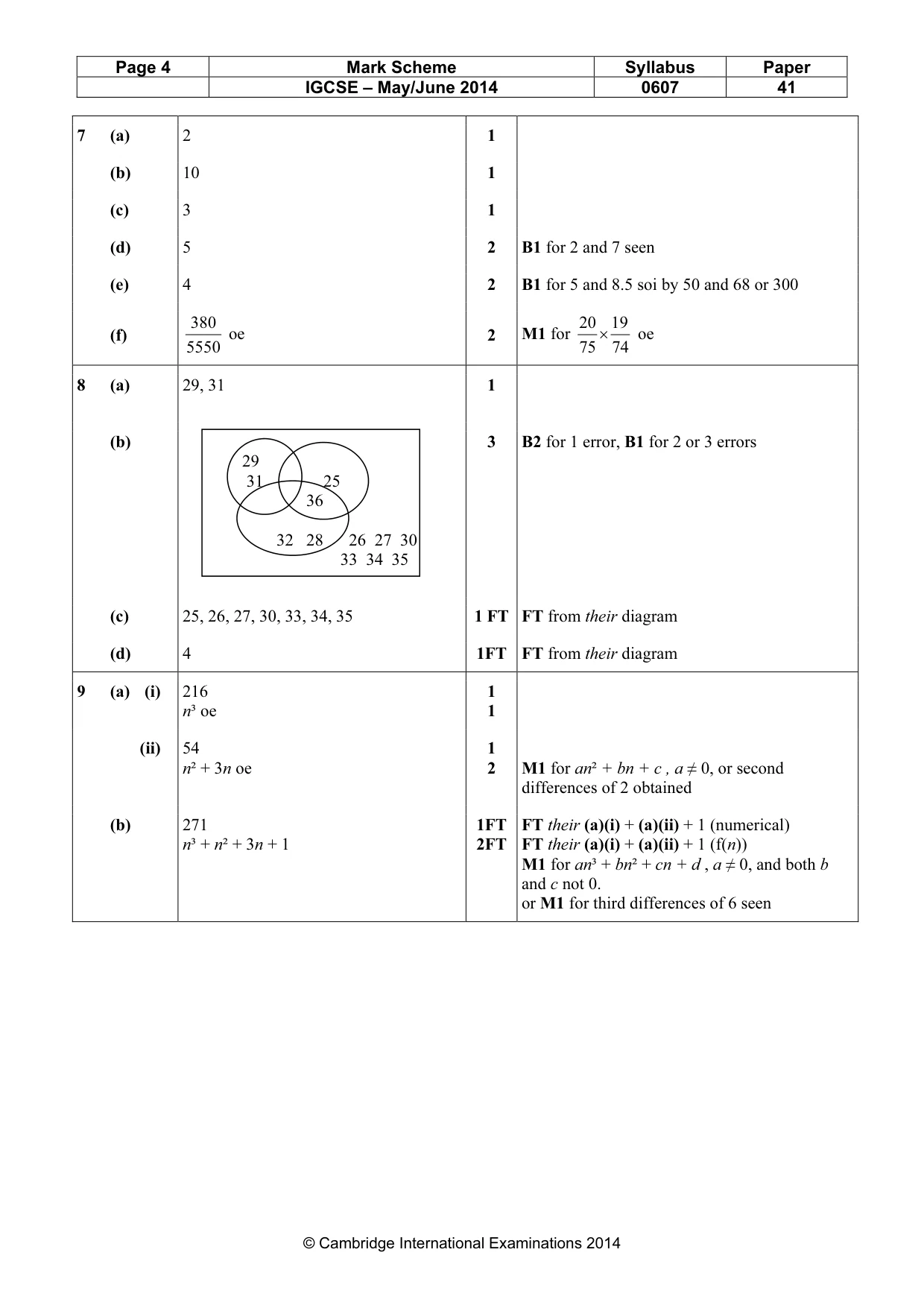
Page 4 Mark Scheme Syllabus Paper IGCSE – May/June 2014 0607 41 © Cambridge International Examinations 2014 7 (a) 2 1 (b) 10 1 (c) 3 1 (d) 5 2 B1 for 2 and 7 seen (e) 4 2 B1 for 5 and 8.5 soi by 50 and 68 or 300 (f) 5550 380 oe 2 M1 for 74 19 75 20 × oe 8 (a) 29, 31 1 (b) 29 31 25 36 32 28 26 27 30 33 34 35 3 B2 for 1 error, B1 for 2 or 3 errors (c) 25, 26, 27, 30, 33, 34, 35 1 FT FT from their diagram (d) 4 1FT FT from their diagram 9 (a) (i) 216 n³ oe 1 1 (ii) 54 n² + 3n oe 1 2 M1 for an² + bn + c , a ≠ 0, or second differences of 2 obtained (b) 271 n³ + n² + 3n + 1 1FT 2FT FT their (a)(i) + (a)(ii) + 1 (numerical) FT their (a)(i) + (a)(ii) + 1 (f(n)) M1 for an³ + bn² + cn + d , a ≠ 0, and both b and c not 0. or M1 for third differences of 6 seen
Mark scheme, page 5
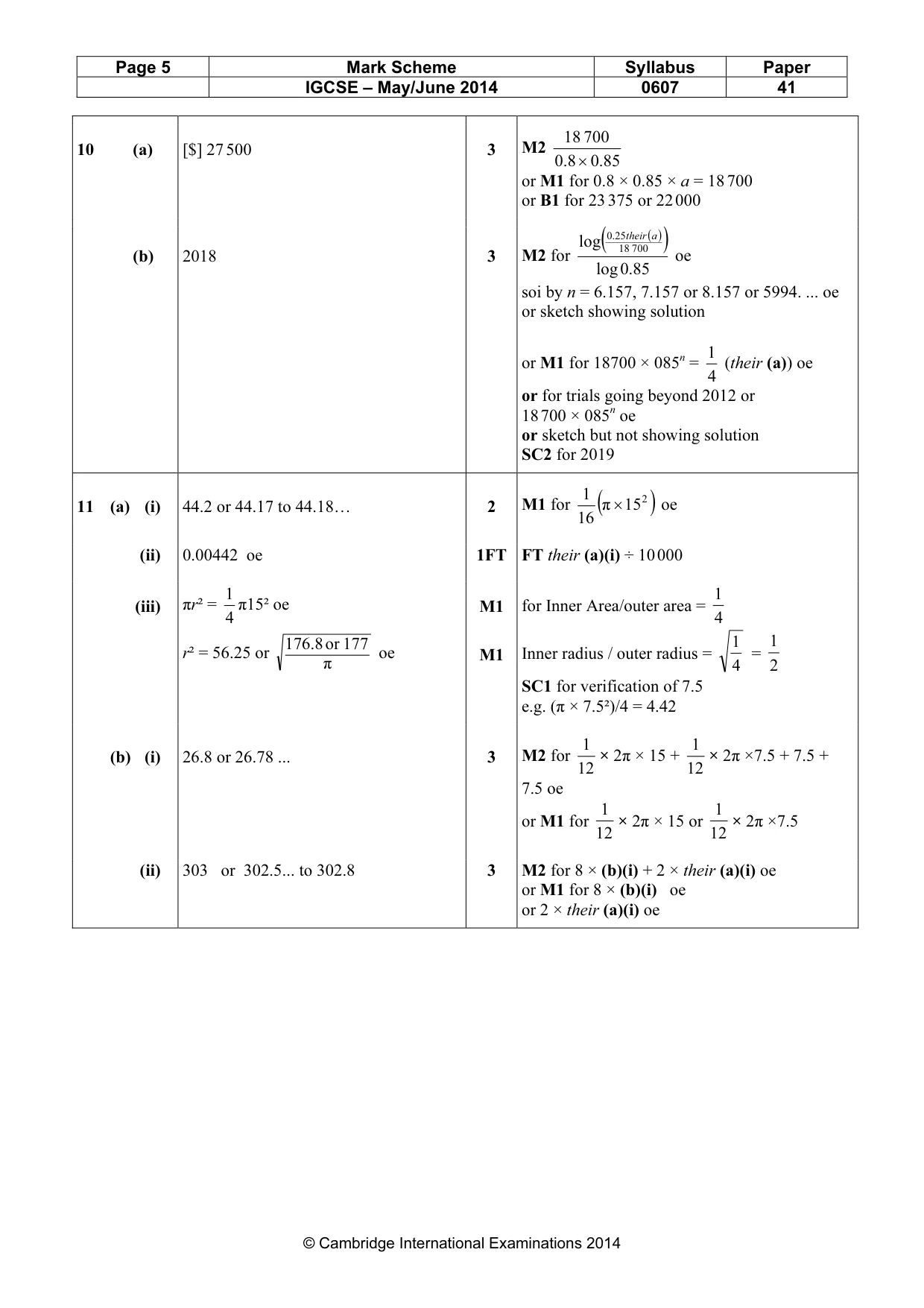
Page 5 Mark Scheme Syllabus Paper IGCSE – May/June 2014 0607 41 © Cambridge International Examinations 2014 10 (a) [$] 27 500 3 M2 85 .0 8.0 700 18 × or M1 for 0.8 × 0.85 × a = 18 700 or B1 for 23 375 or 22 000 (b) 2018 3 M2 for ( ) ( ) 85 .0 log log 700 18 25 .0 a their oe soi by n = 6.157, 7.157 or 8.157 or 5994. ... oe or sketch showing solution or M1 for 18700 × 085n = 4 1 (their (a)) oe or for trials going beyond 2012 or 18 700 × 085n oe or sketch but not showing solution SC2 for 2019 11 (a) (i) 44.2 or 44.17 to 44.18… 2 M1 for ( ) 2 15 π 16 1 × oe (ii) 0.00442 oe 1FT FT their (a)(i) ÷ 10 000 (iii) πr² = 4 1 π15² oe r² = 56.25 or π 177 or 176.8 oe M1 M1 for Inner Area/outer area = 4 1 Inner radius / outer radius = 4 1 = 2 1 SC1 for verification of 7.5 e.g. (π × 7.5²)/4 = 4.42 (b) (i) 26.8 or 26.78 ... 3 M2 for 12 1 × 2π × 15 + 12 1 × 2π ×7.5 + 7.5 + 7.5 oe or M1 for 12 1 × 2π × 15 or 12 1 × 2π ×7.5 (ii) 303 or 302.5... to 302.8 3 M2 for 8 × (b)(i) + 2 × their (a)(i) oe or M1 for 8 × (b)(i) oe or 2 × their (a)(i) oe
Mark scheme, page 6
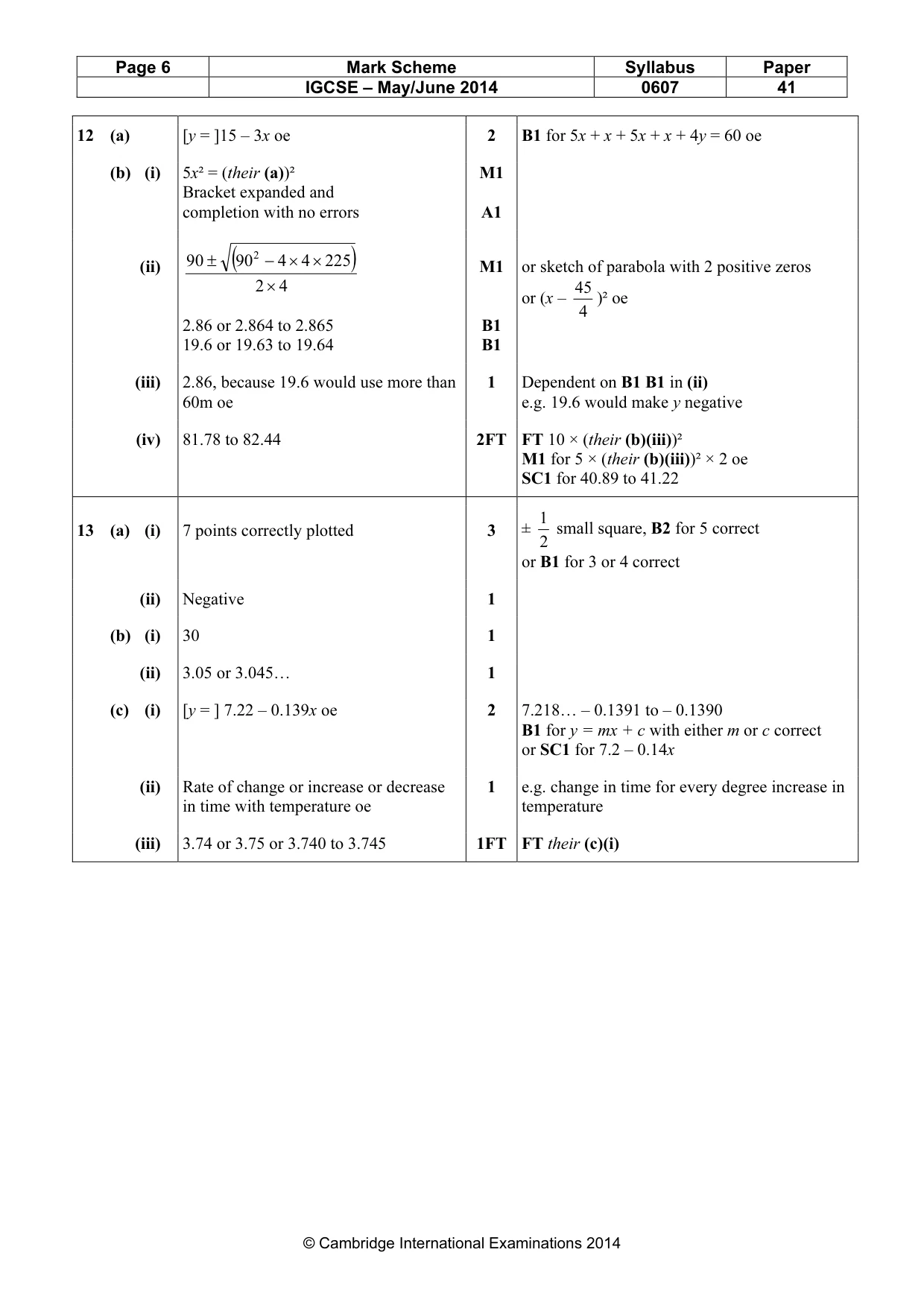
Page 6 Mark Scheme Syllabus Paper IGCSE – May/June 2014 0607 41 © Cambridge International Examinations 2014 12 (a) [y = ]15 – 3x oe 2 B1 for 5x + x + 5x + x + 4y = 60 oe (b) (i) 5x² = (their (a))² Bracket expanded and completion with no errors M1 A1 (ii) ( ) 4 2 225 4 4 90 90 2 × × × − ± 2.86 or 2.864 to 2.865 19.6 or 19.63 to 19.64 M1 B1 B1 or sketch of parabola with 2 positive zeros or (x – 4 45 )² oe (iii) 2.86, because 19.6 would use more than 60m oe 1 Dependent on B1 B1 in (ii) e.g. 19.6 would make y negative (iv) 81.78 to 82.44 2FT FT 10 × (their (b)(iii))² M1 for 5 × (their (b)(iii))² × 2 oe SC1 for 40.89 to 41.22 13 (a) (i) 7 points correctly plotted 3 ± 2 1 small square, B2 for 5 correct or B1 for 3 or 4 correct (ii) Negative 1 (b) (i) 30 1 (ii) 3.05 or 3.045… 1 (c) (i) [y = ] 7.22 – 0.139x oe 2 7.218… – 0.1391 to – 0.1390 B1 for y = mx + c with either m or c correct or SC1 for 7.2 – 0.14x (ii) Rate of change or increase or decrease in time with temperature oe 1 e.g. change in time for every degree increase in temperature (iii) 3.74 or 3.75 or 3.740 to 3.745 1FT FT their (c)(i)
Mark scheme, page 7
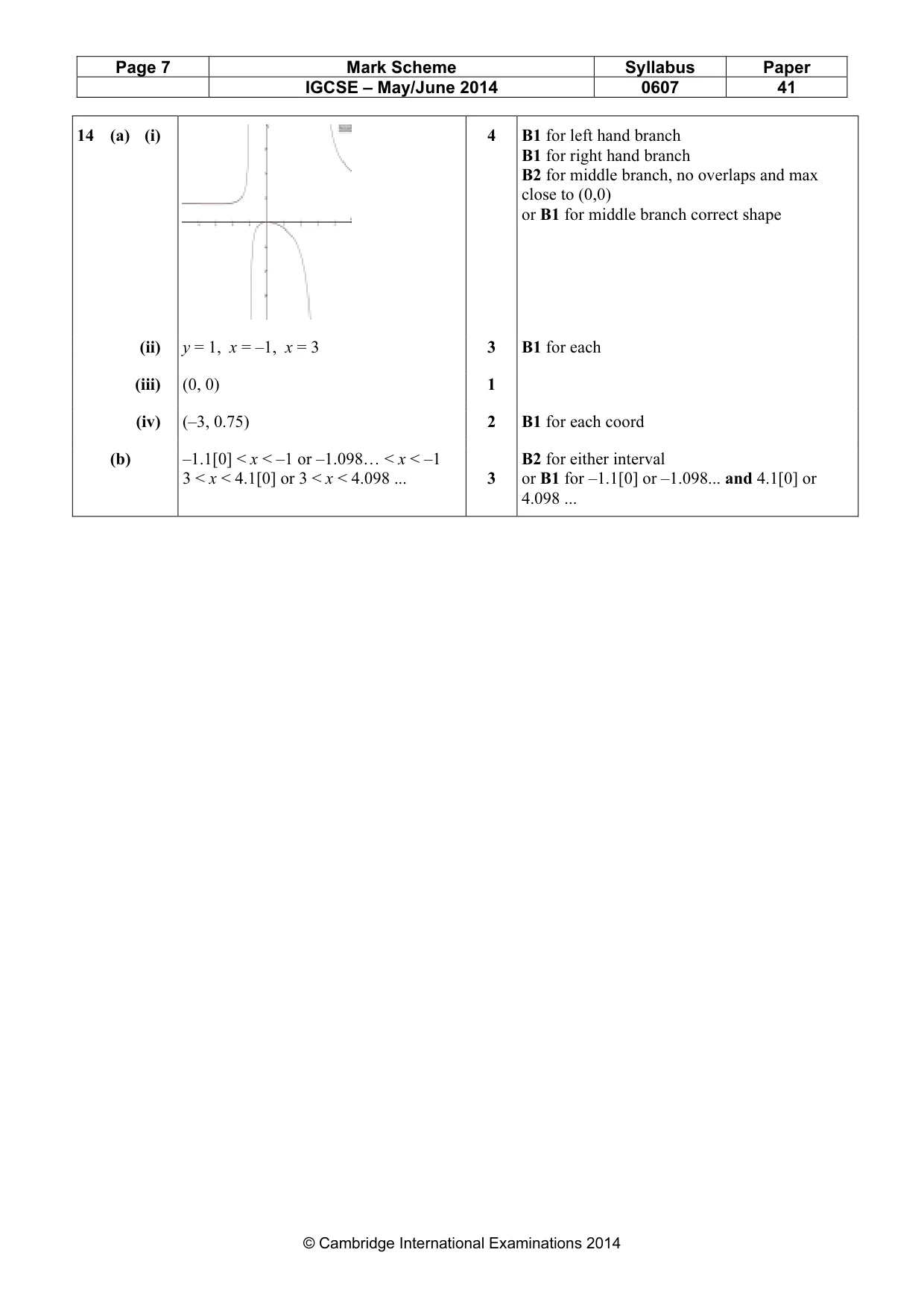
Page 7 Mark Scheme Syllabus Paper IGCSE – May/June 2014 0607 41 © Cambridge International Examinations 2014 14 (a) (i) 4 B1 for left hand branch B1 for right hand branch B2 for middle branch, no overlaps and max close to (0,0) or B1 for middle branch correct shape (ii) y = 1, x = –1, x = 3 3 B1 for each (iii) (0, 0) 1 (iv) (–3, 0.75) 2 B1 for each coord (b) –1.1[0] < x < –1 or –1.098… < x < –1 3 < x < 4.1[0] or 3 < x < 4.098 ... 3 B2 for either interval or B1 for –1.1[0] or –1.098... and 4.1[0] or 4.098 ...
What you needed in this session
Cambridge’s own grade thresholds for 2014 May/June, Paper 4 · Variant 1. A higher threshold means an easier paper — the bar moves with how the cohort did.