Cambridge IGCSE Mathematics - International 0607 — 2014 May/June Paper 4 · Variant 3
0607/43/M/J/14 · 120 marks · ≈135 min
The question paper and its mark scheme, free to read here and free to download. This is Cambridge’s own paper, exactly as it was sat.
Question paper20 pages
Mark scheme6 pages
Answers below. Sit the paper first if you are practising.
Paper as text
Question paper, page 1
This document consists of 20 printed pages. IB14 06_0607_43/4RP © UCLES 2014 [Turn over *9855804838* Cambridge International Examinations Cambridge International General Certificate of Secondary Education CAMBRIDGE INTERNATIONAL MATHEMATICS 0607/43 Paper 4 (Extended) May/June 2014 2 hours 15 minutes Candidates answer on the Question Paper. Additional Materials: Geometrical Instruments Graphics Calculator READ THESE INSTRUCTIONS FIRST Write your Centre number, candidate number and name on all the work you hand in. Write in dark blue or black pen. Do not use staples, paper clips, glue or correction fluid. You may use an HB pencil for any diagrams or graphs. DO NOT WRITE IN ANY BARCODES. Answer all the questions. Unless instructed otherwise, give your answers exactly or correct to three significant figures as appropriate. Answers in degrees should be given to one decimal place. For π, use your calculator value. You must show all the relevant working to gain full marks and you will be given marks for correct methods, including sketches, even if your answer is incorrect. The number of marks is given in brackets [ ] at the end of each question or part question. The total number of marks for this paper is 120.
Question paper, page 2
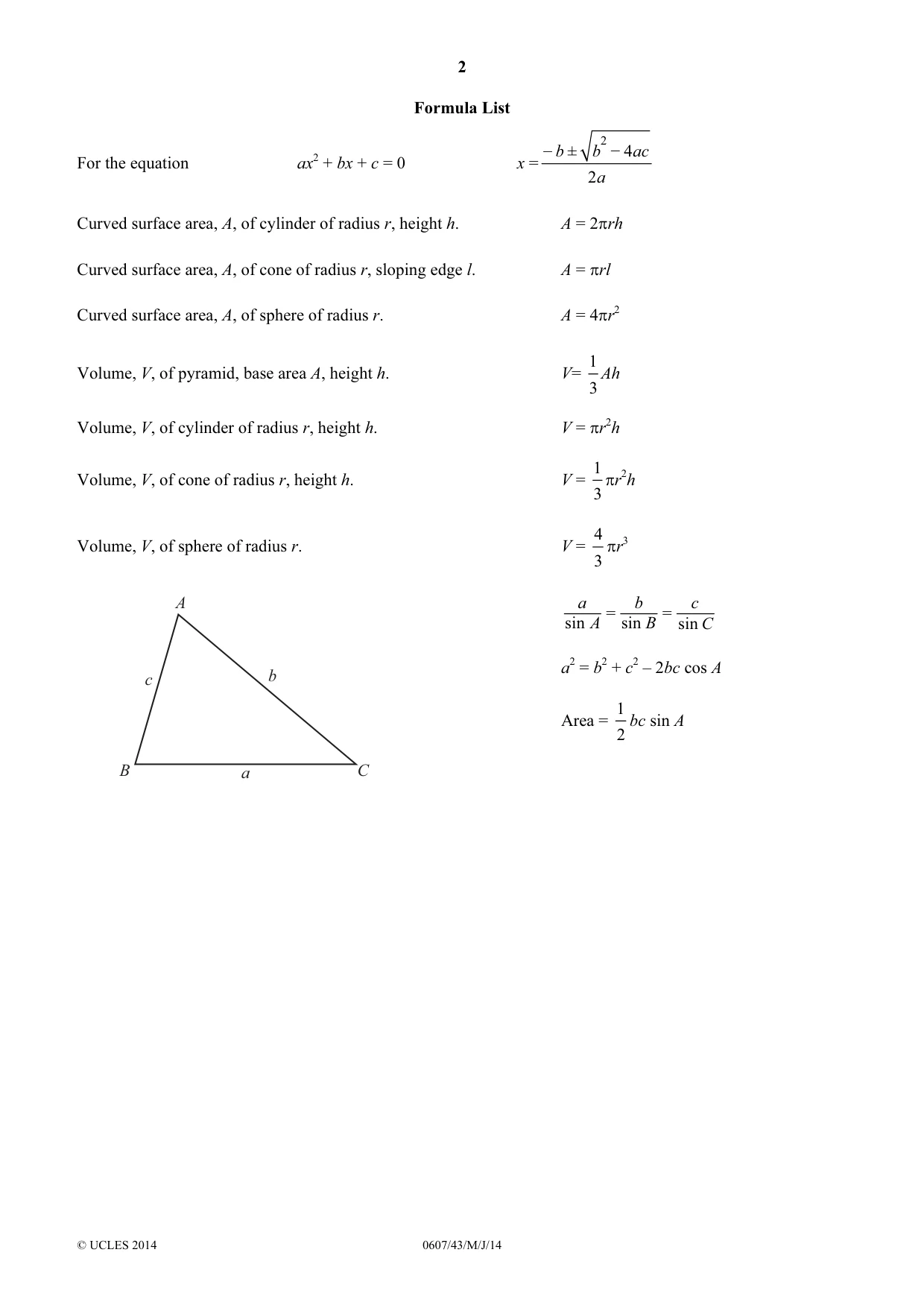
2 © UCLES 2014 0607/43/M/J/14 Formula List For the equation ax2 + bx + c = 0 x = 2 _ ± 4 2 _ b b ac a Curved surface area, A, of cylinder of radius r, height h. A = 2πrh Curved surface area, A, of cone of radius r, sloping edge l. A = πrl Curved surface area, A, of sphere of radius r. A = 4πr2 Volume, V, of pyramid, base area A, height h. V= 1 3 Ah Volume, V, of cylinder of radius r, height h. V = πr2h Volume, V, of cone of radius r, height h. V = 1 3 πr2h Volume, V, of sphere of radius r. V = 4 3 πr3 = = sin sin sin a b c A B C a2 = b2 + c2 – 2bc cos A Area = 1 2 bc sin A A a B C b c
Question paper, page 3
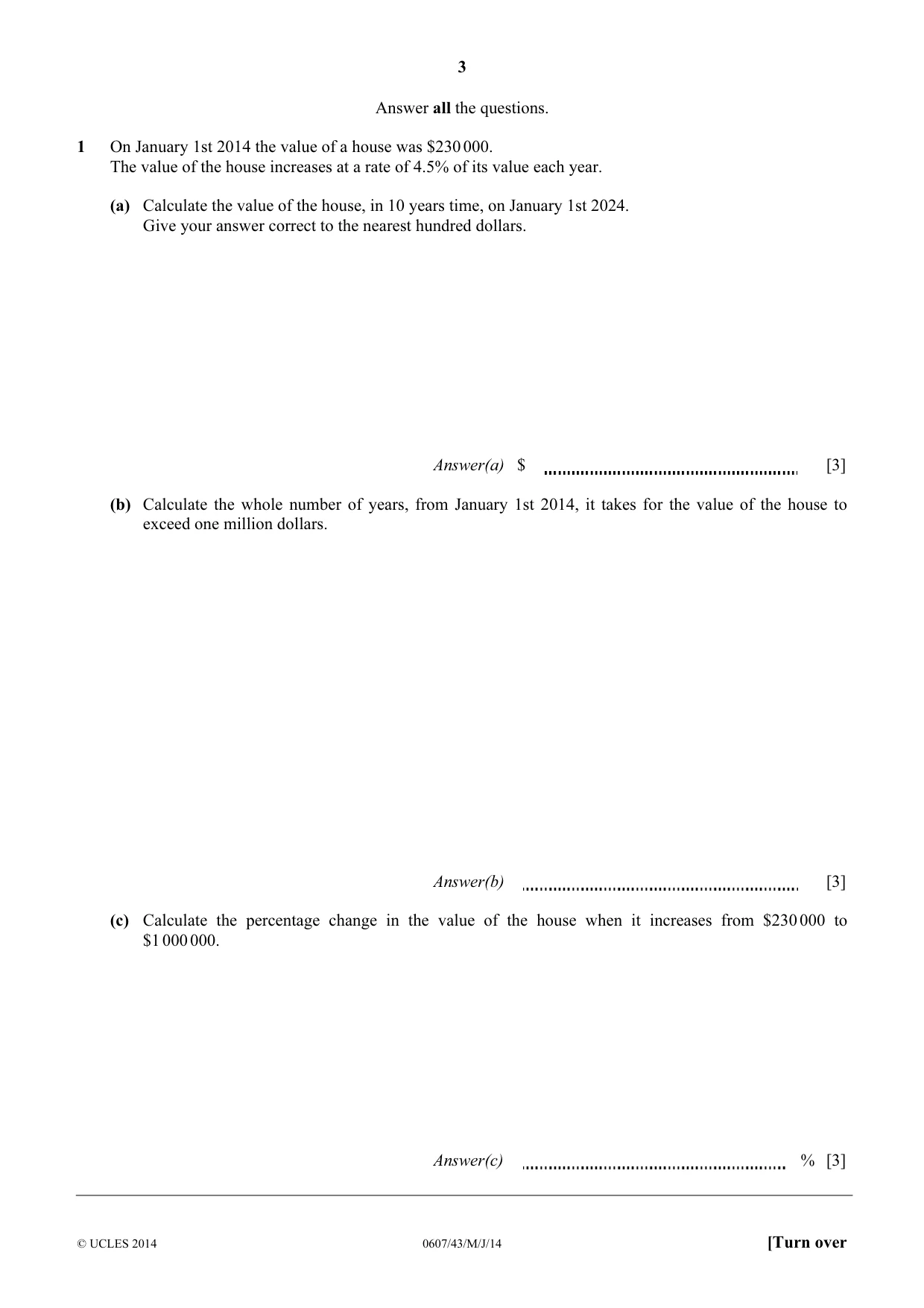
3 © UCLES 2014 0607/43/M/J/14 [Turn over Answer all the questions. 1 On January 1st 2014 the value of a house was $230 000. The value of the house increases at a rate of 4.5% of its value each year. (a) Calculate the value of the house, in 10 years time, on January 1st 2024. Give your answer correct to the nearest hundred dollars. Answer(a) $ [3] (b) Calculate the whole number of years, from January 1st 2014, it takes for the value of the house to exceed one million dollars. Answer(b) [3] (c) Calculate the percentage change in the value of the house when it increases from $230 000 to $1 000 000. Answer(c) % [3]
Question paper, page 4
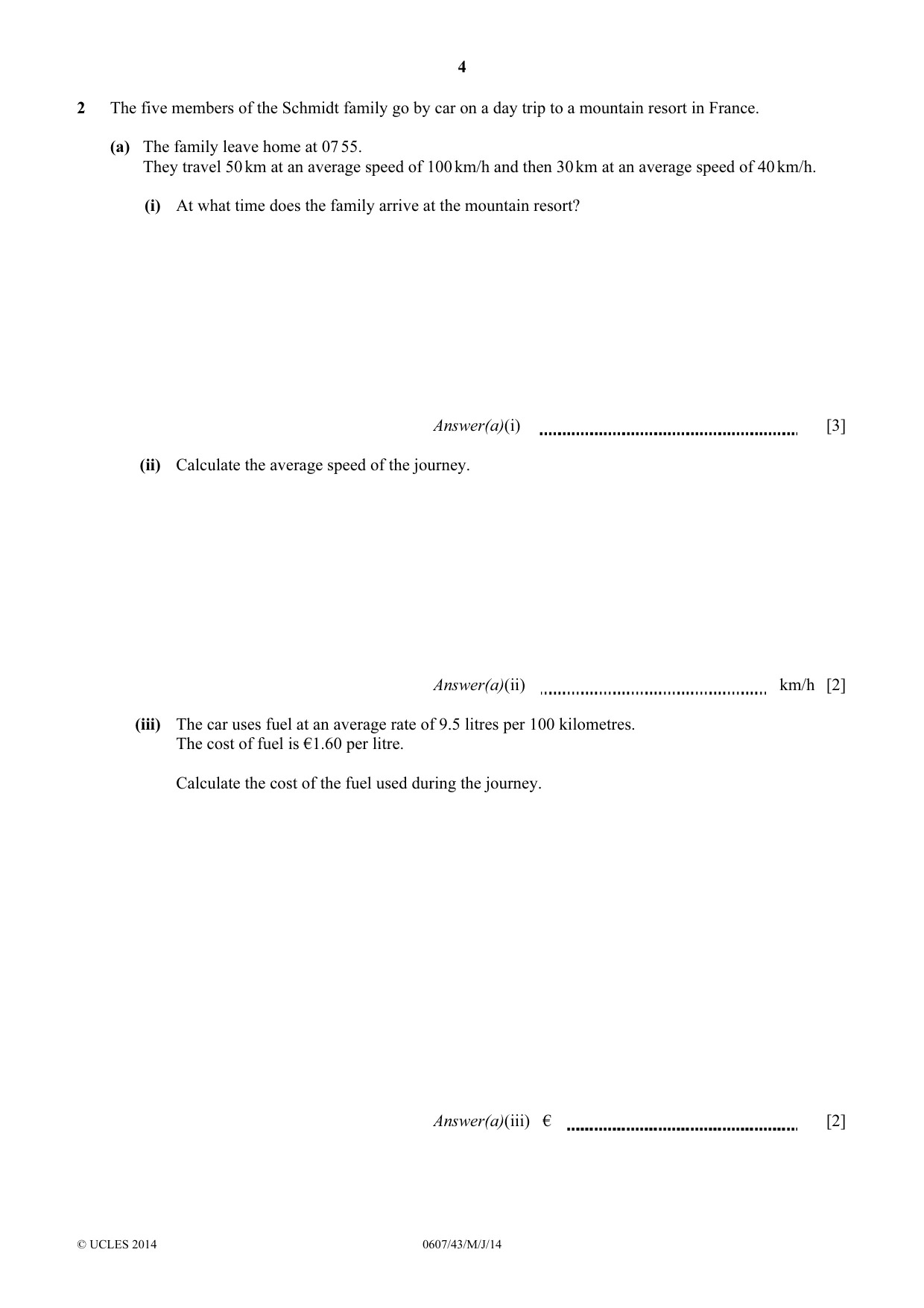
4 © UCLES 2014 0607/43/M/J/14 2 The five members of the Schmidt family go by car on a day trip to a mountain resort in France. (a) The family leave home at 07 55. They travel 50 km at an average speed of 100 km/h and then 30 km at an average speed of 40 km/h. (i) At what time does the family arrive at the mountain resort? Answer(a)(i) [3] (ii) Calculate the average speed of the journey. Answer(a)(ii) km/h [2] (iii) The car uses fuel at an average rate of 9.5 litres per 100 kilometres. The cost of fuel is €1.60 per litre. Calculate the cost of the fuel used during the journey. Answer(a)(iii) € [2]
Question paper, page 5
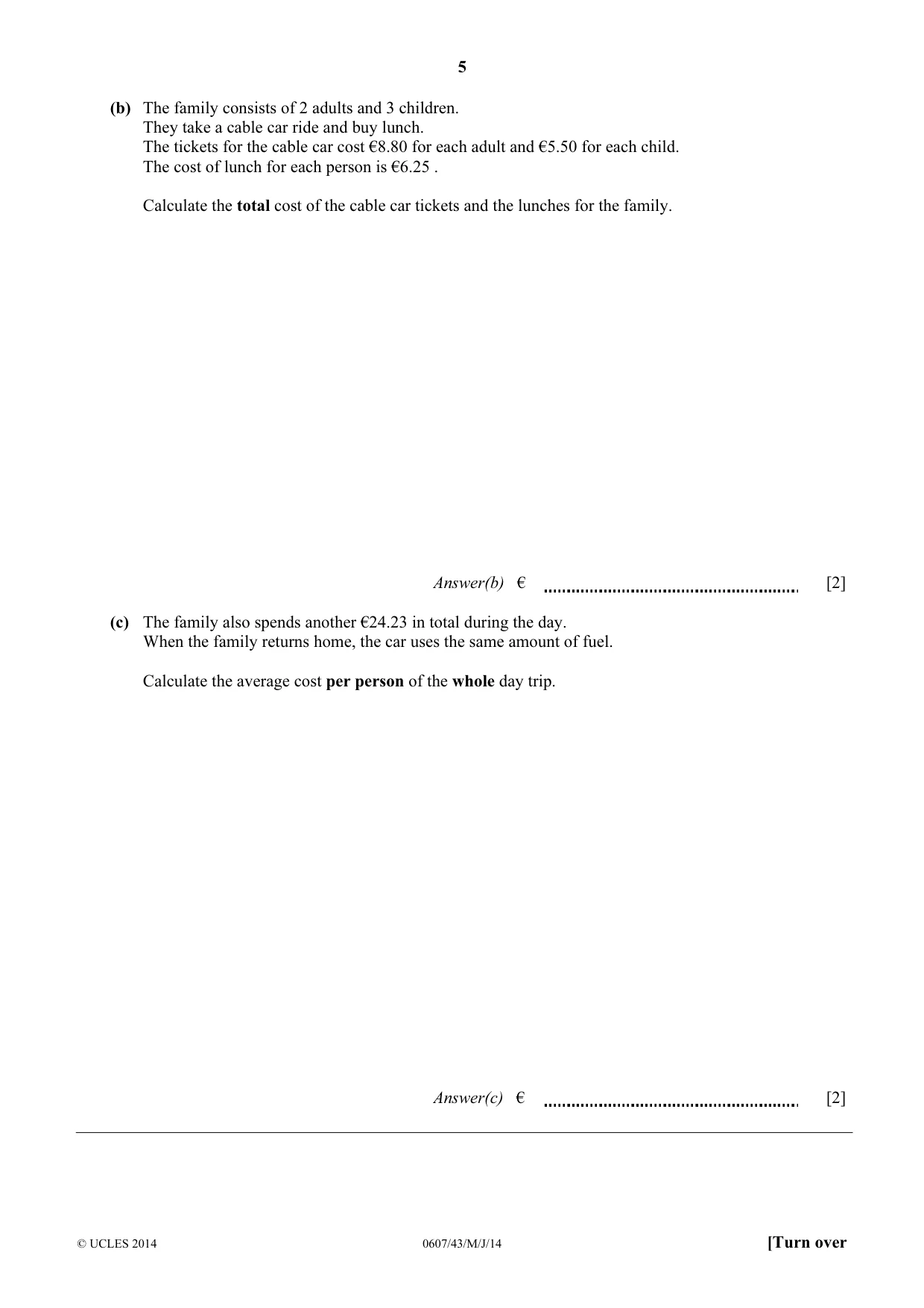
5 © UCLES 2014 0607/43/M/J/14 [Turn over (b) The family consists of 2 adults and 3 children. They take a cable car ride and buy lunch. The tickets for the cable car cost €8.80 for each adult and €5.50 for each child. The cost of lunch for each person is €6.25 . Calculate the total cost of the cable car tickets and the lunches for the family. Answer(b) € [2] (c) The family also spends another €24.23 in total during the day. When the family returns home, the car uses the same amount of fuel. Calculate the average cost per person of the whole day trip. Answer(c) € [2]
Question paper, page 6
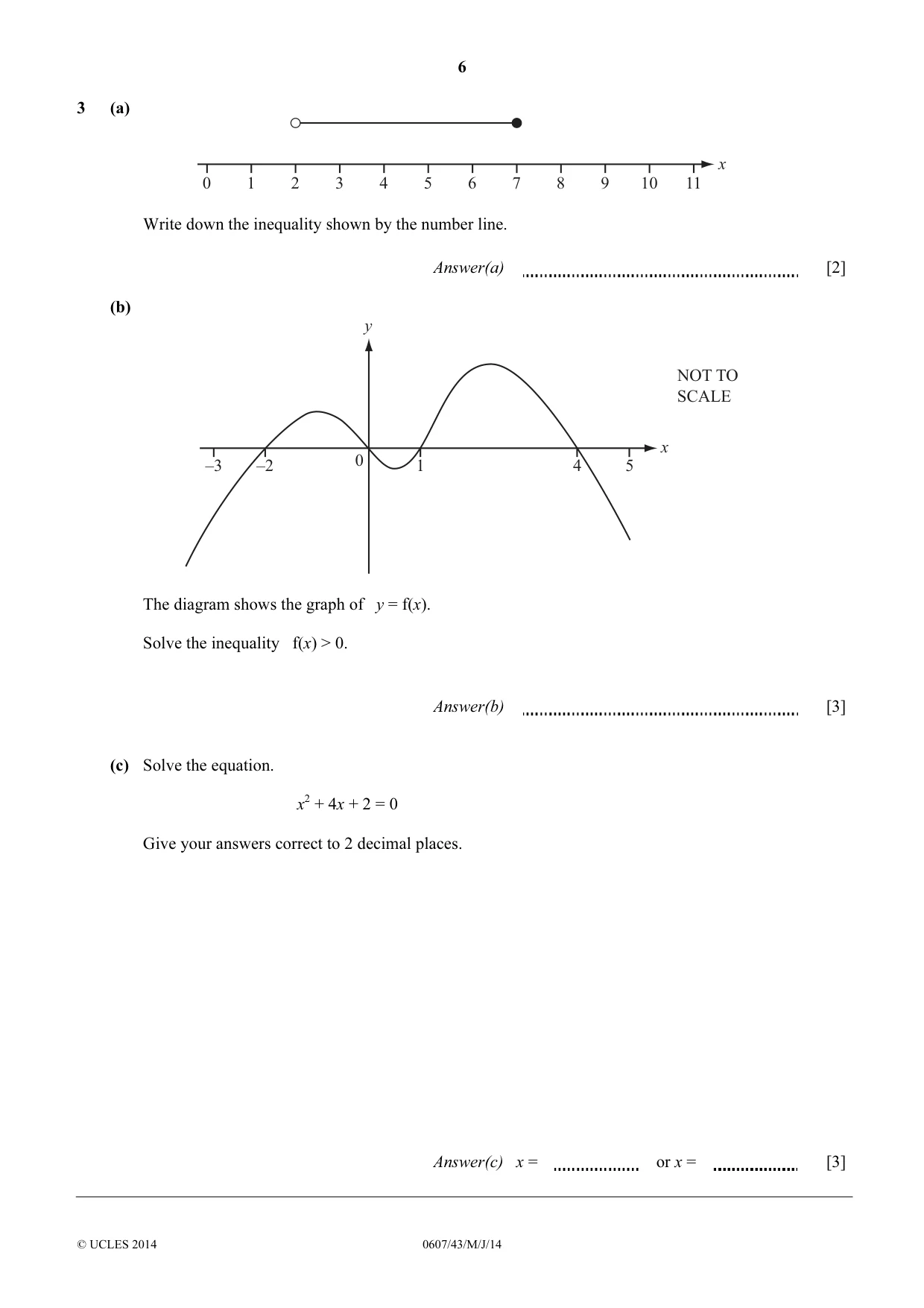
6 © UCLES 2014 0607/43/M/J/14 3 (a) 0 1 2 3 4 5 6 7 8 9 10 11 x Write down the inequality shown by the number line. Answer(a) [2] (b) y x NOT TO SCALE –3 –2 1 4 5 0 The diagram shows the graph of y = f(x). Solve the inequality f(x) > 0. Answer(b) [3] (c) Solve the equation. x2 + 4x + 2 = 0 Give your answers correct to 2 decimal places. Answer(c) x = or x = [3]
Question paper, page 7
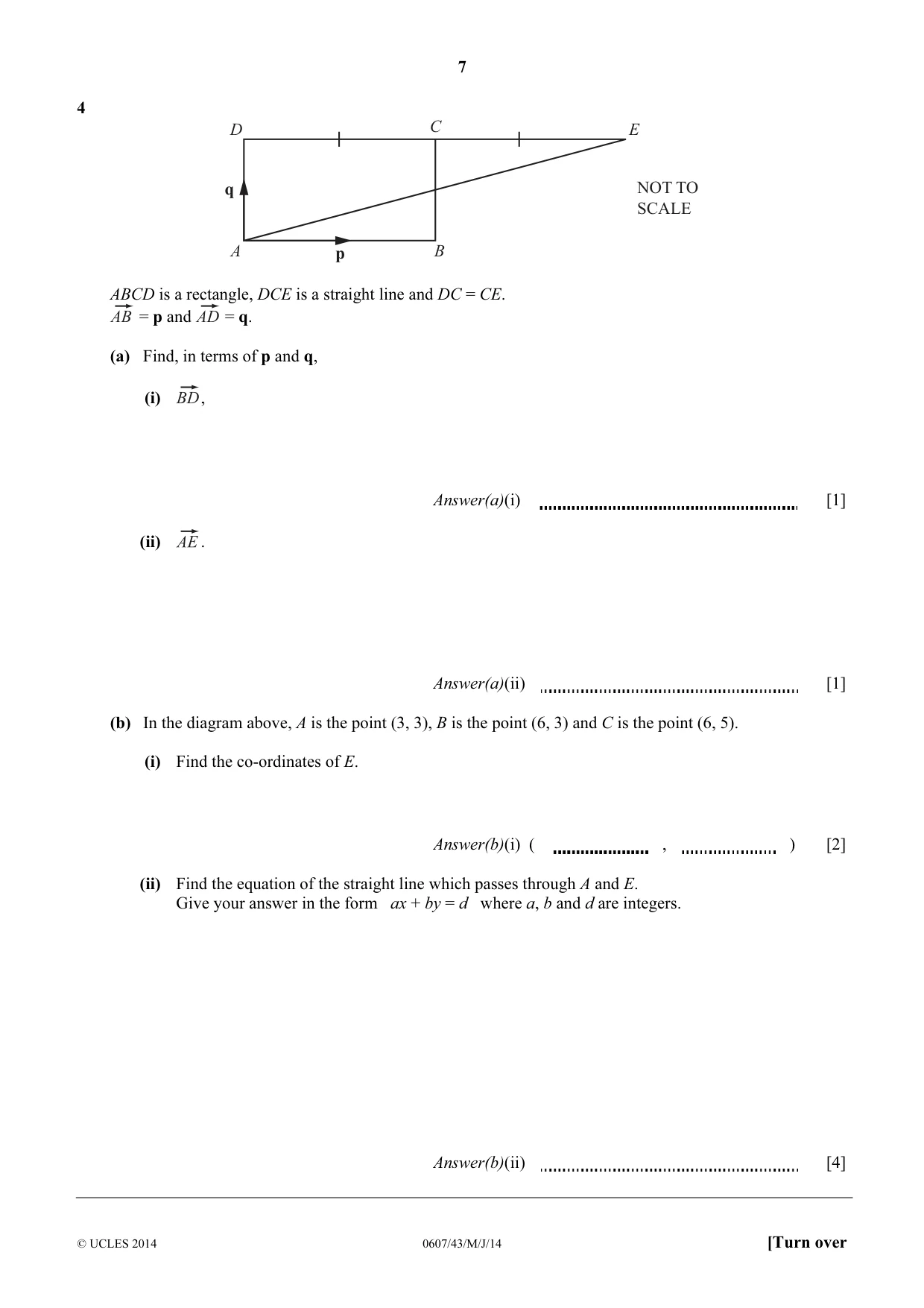
7 © UCLES 2014 0607/43/M/J/14 [Turn over 4 D E B A C p q NOT TO SCALE ABCD is a rectangle, DCE is a straight line and DC = CE. = p and = q. (a) Find, in terms of p and q, (i) , Answer(a)(i) [1] (ii) . Answer(a)(ii) [1] (b) In the diagram above, A is the point (3, 3), B is the point (6, 3) and C is the point (6, 5). (i) Find the co-ordinates of E. Answer(b)(i) ( , ) [2] (ii) Find the equation of the straight line which passes through A and E. Give your answer in the form ax + by = d where a, b and d are integers. Answer(b)(ii) [4]
Question paper, page 8
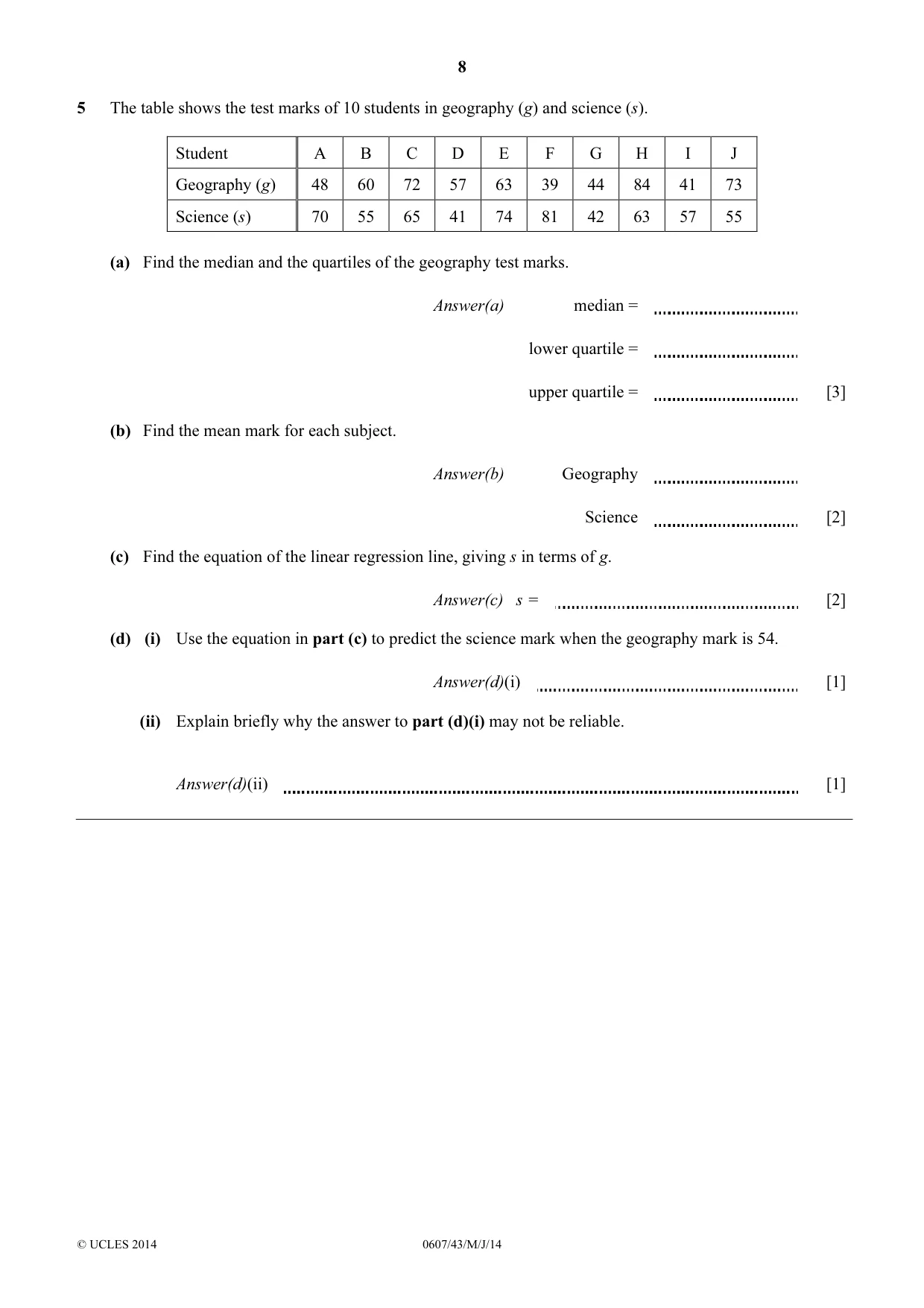
8 © UCLES 2014 0607/43/M/J/14 5 The table shows the test marks of 10 students in geography (g) and science (s). Student A B C D E F G H I J Geography (g) 48 60 72 57 63 39 44 84 41 73 Science (s) 70 55 65 41 74 81 42 63 57 55 (a) Find the median and the quartiles of the geography test marks. Answer(a) median = lower quartile = upper quartile = [3] (b) Find the mean mark for each subject. Answer(b) Geography Science [2] (c) Find the equation of the linear regression line, giving s in terms of g. Answer(c) s = [2] (d) (i) Use the equation in part (c) to predict the science mark when the geography mark is 54. Answer(d)(i) [1] (ii) Explain briefly why the answer to part (d)(i) may not be reliable. Answer(d)(ii) [1]
Question paper, page 9
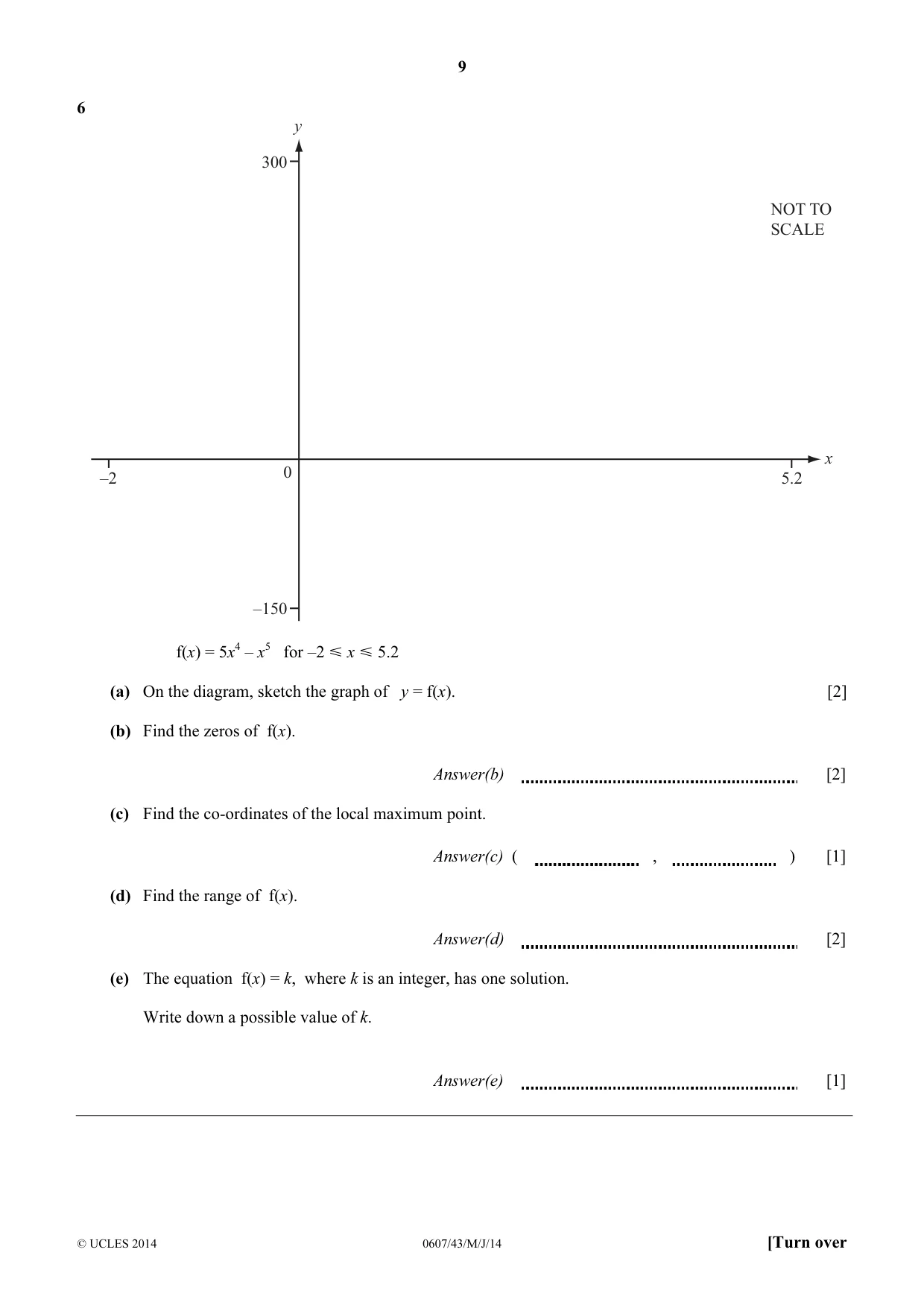
9 © UCLES 2014 0607/43/M/J/14 [Turn over 6 y x 300 0 –150 –2 5.2 NOT TO SCALE f(x) = 5x4 – x5 for –2 Y x Y 5.2 (a) On the diagram, sketch the graph of y = f(x). [2] (b) Find the zeros of f(x). Answer(b) [2] (c) Find the co-ordinates of the local maximum point. Answer(c) ( , ) [1] (d) Find the range of f(x). Answer(d) [2] (e) The equation f(x) = k, where k is an integer, has one solution. Write down a possible value of k. Answer(e) [1]
Question paper, page 10
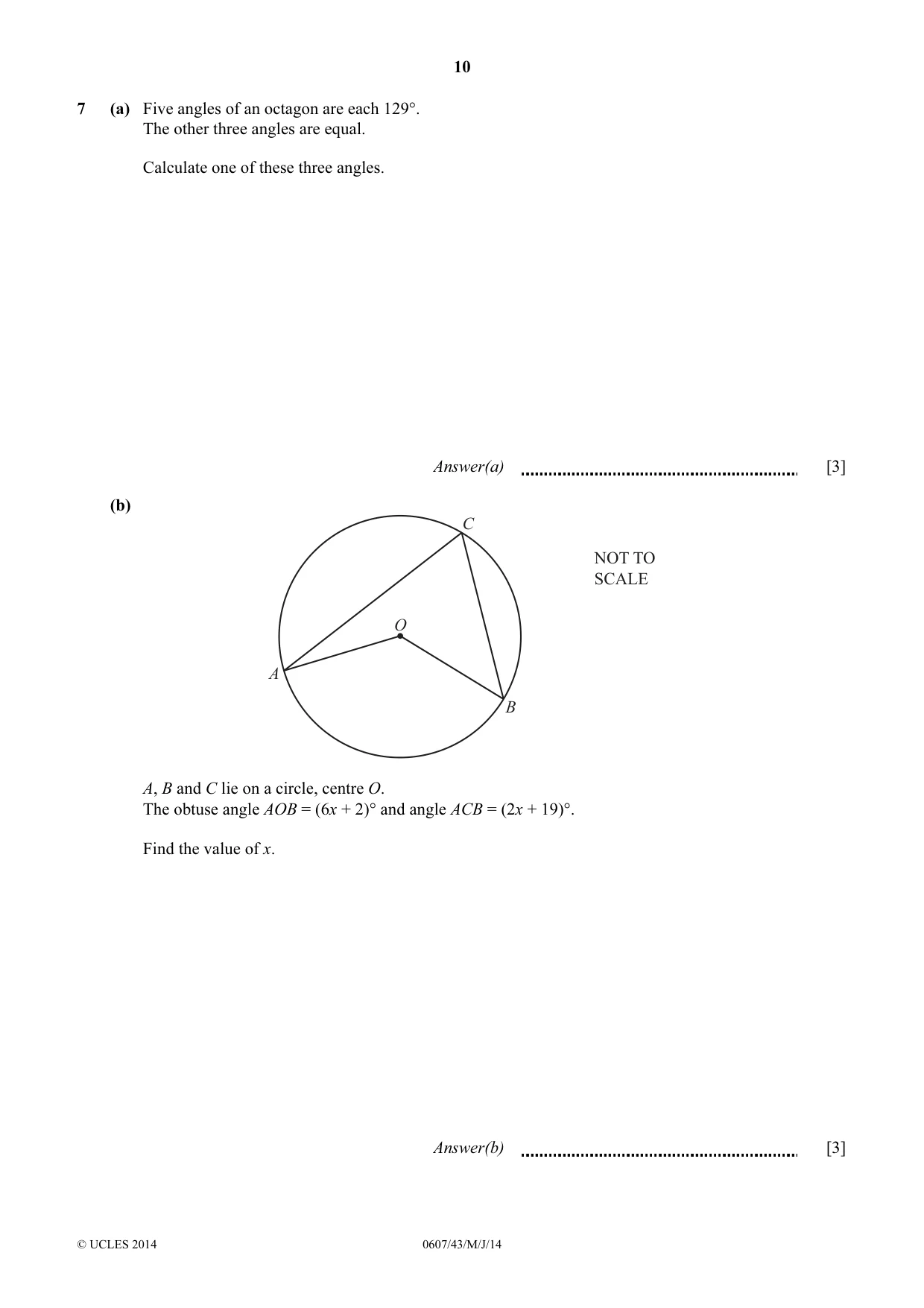
10 © UCLES 2014 0607/43/M/J/14 7 (a) Five angles of an octagon are each 129°. The other three angles are equal. Calculate one of these three angles. Answer(a) [3] (b) O C B A NOT TO SCALE A, B and C lie on a circle, centre O. The obtuse angle AOB = (6x + 2)° and angle ACB = (2x + 19)°. Find the value of x. Answer(b) [3]
Question paper, page 11
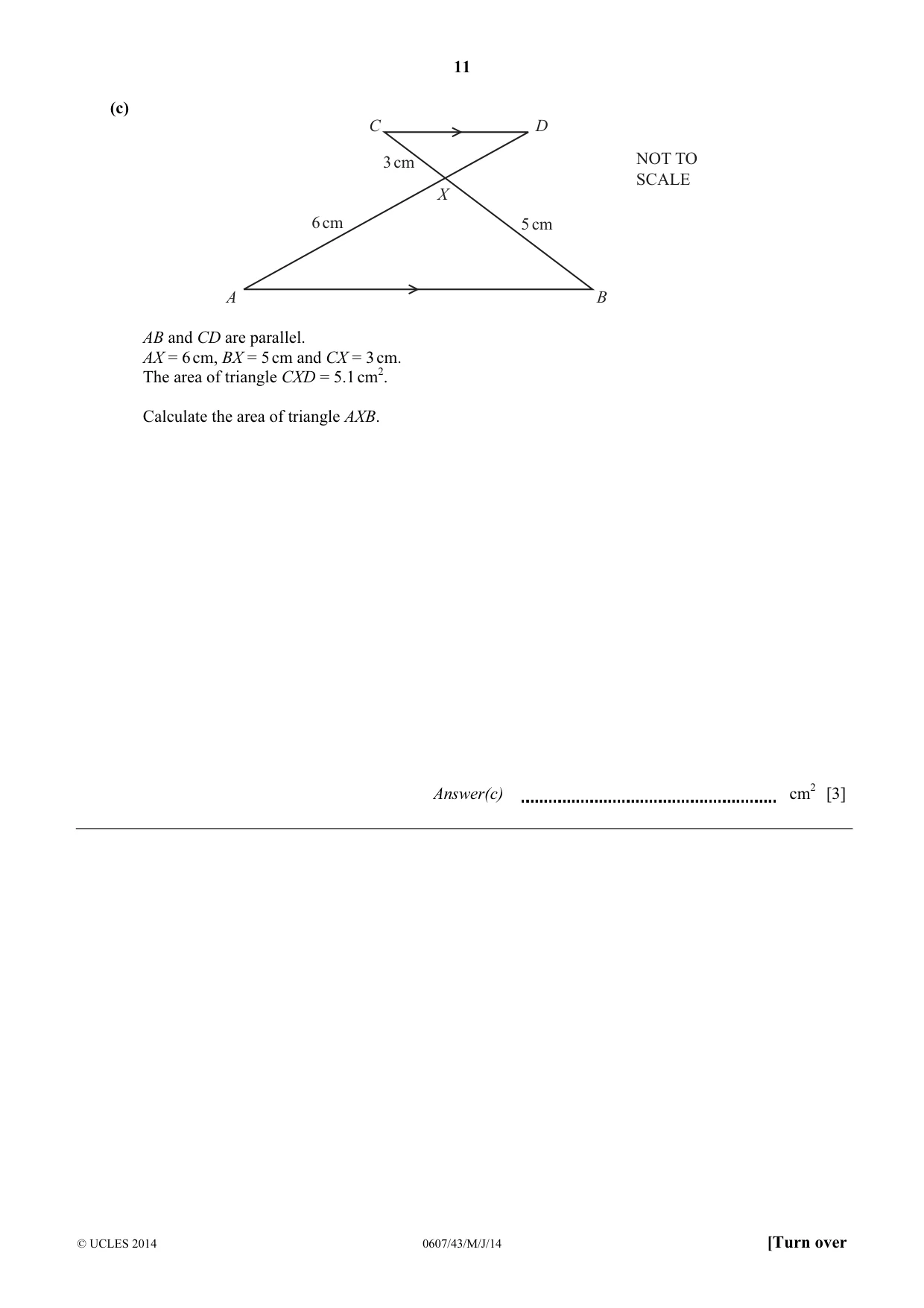
11 © UCLES 2014 0607/43/M/J/14 [Turn over (c) C D B A X 6 cm 5 cm 3 cm NOT TO SCALE AB and CD are parallel. AX = 6 cm, BX = 5 cm and CX = 3 cm. The area of triangle CXD = 5.1 cm2. Calculate the area of triangle AXB. Answer(c) cm2 [3]
Question paper, page 12
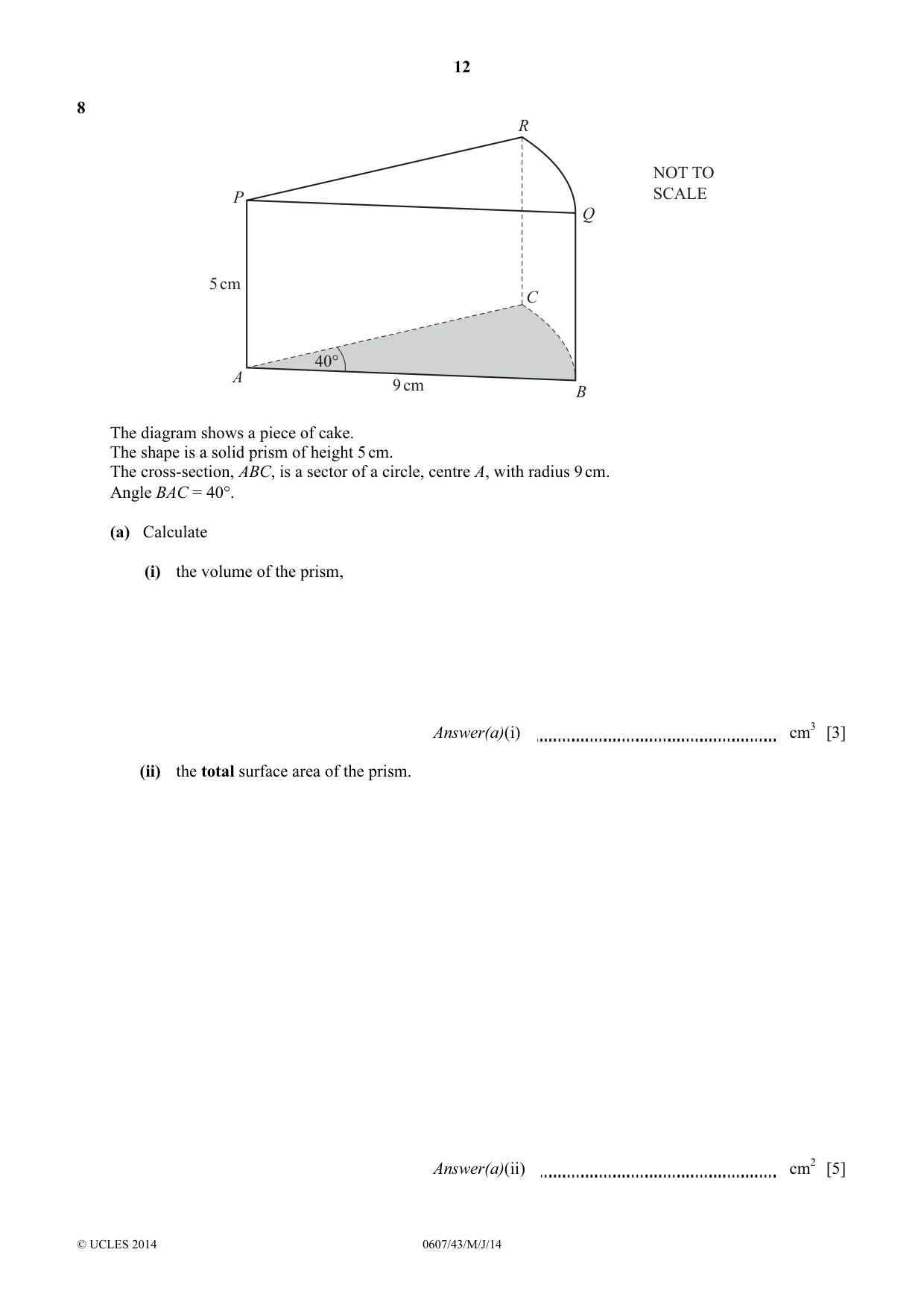
12 © UCLES 2014 0607/43/M/J/14 8 40° R Q P A B C 9 cm 5 cm NOT TO SCALE The diagram shows a piece of cake. The shape is a solid prism of height 5 cm. The cross-section, ABC, is a sector of a circle, centre A, with radius 9 cm. Angle BAC = 40°. (a) Calculate (i) the volume of the prism, Answer(a)(i) cm3 [3] (ii) the total surface area of the prism. Answer(a)(ii) cm2 [5]
Question paper, page 13
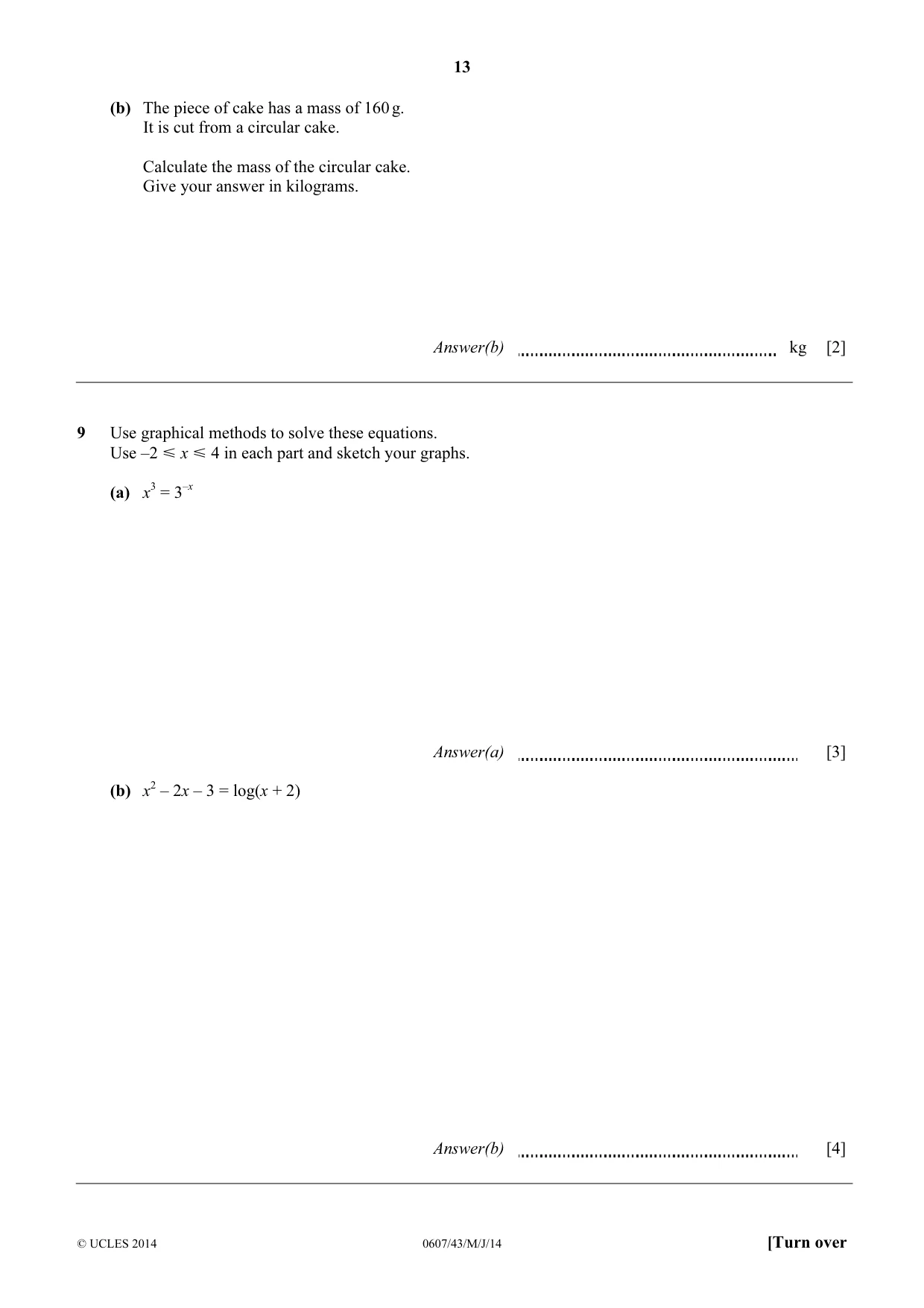
13 © UCLES 2014 0607/43/M/J/14 [Turn over (b) The piece of cake has a mass of 160 g. It is cut from a circular cake. Calculate the mass of the circular cake. Give your answer in kilograms. Answer(b) kg [2] 9 Use graphical methods to solve these equations. Use –2 Y x Y 4 in each part and sketch your graphs. (a) x3 = 3–x Answer(a) [3] (b) x2 – 2x – 3 = log(x + 2) Answer(b) [4]
Question paper, page 14
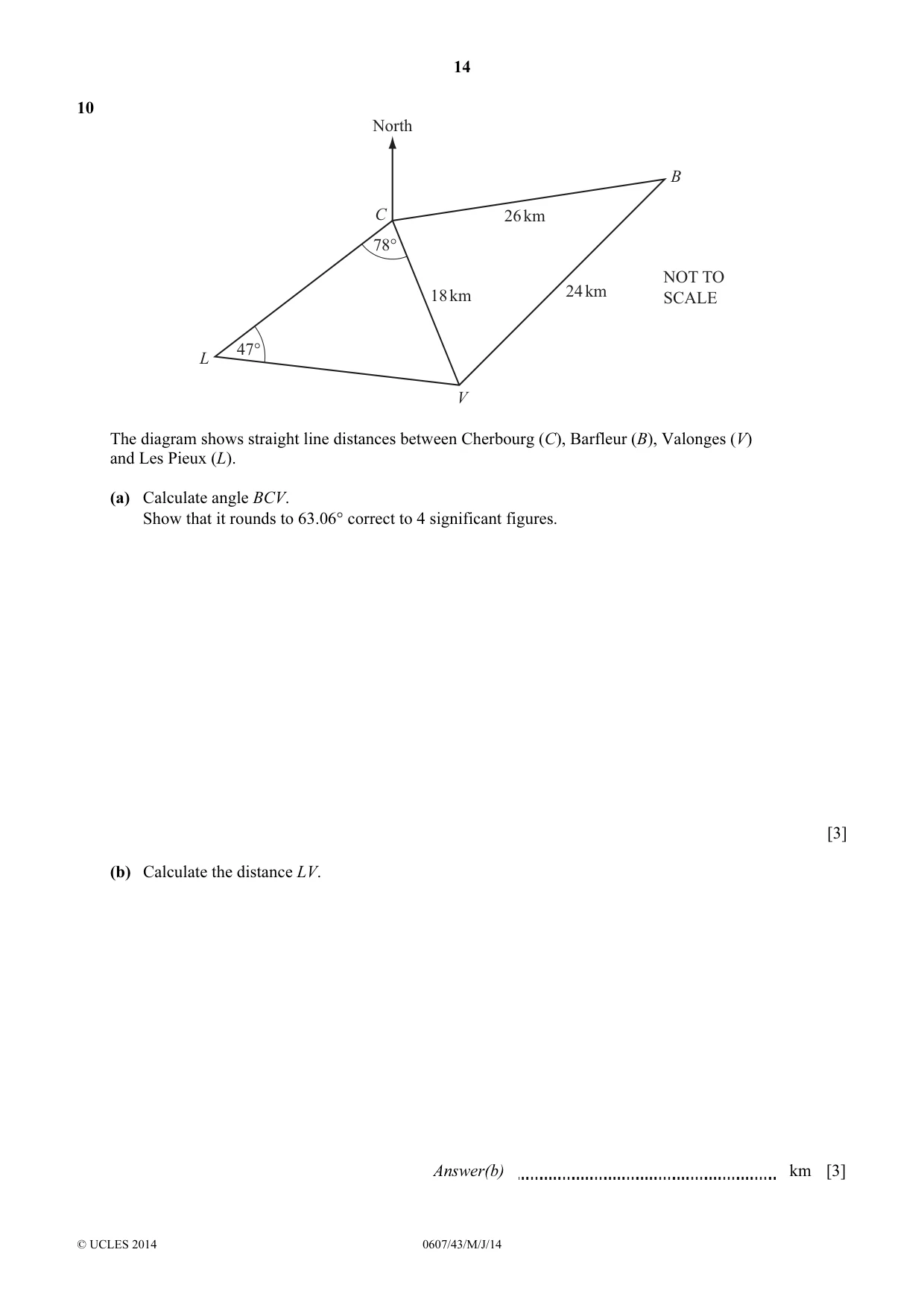
14 © UCLES 2014 0607/43/M/J/14 10 78° 47° 18 km 24 km 26 km C L V B North NOT TO SCALE The diagram shows straight line distances between Cherbourg (C), Barfleur (B), Valonges (V) and Les Pieux (L). (a) Calculate angle BCV. Show that it rounds to 63.06° correct to 4 significant figures. [3] (b) Calculate the distance LV. Answer(b) km [3]
Question paper, page 15
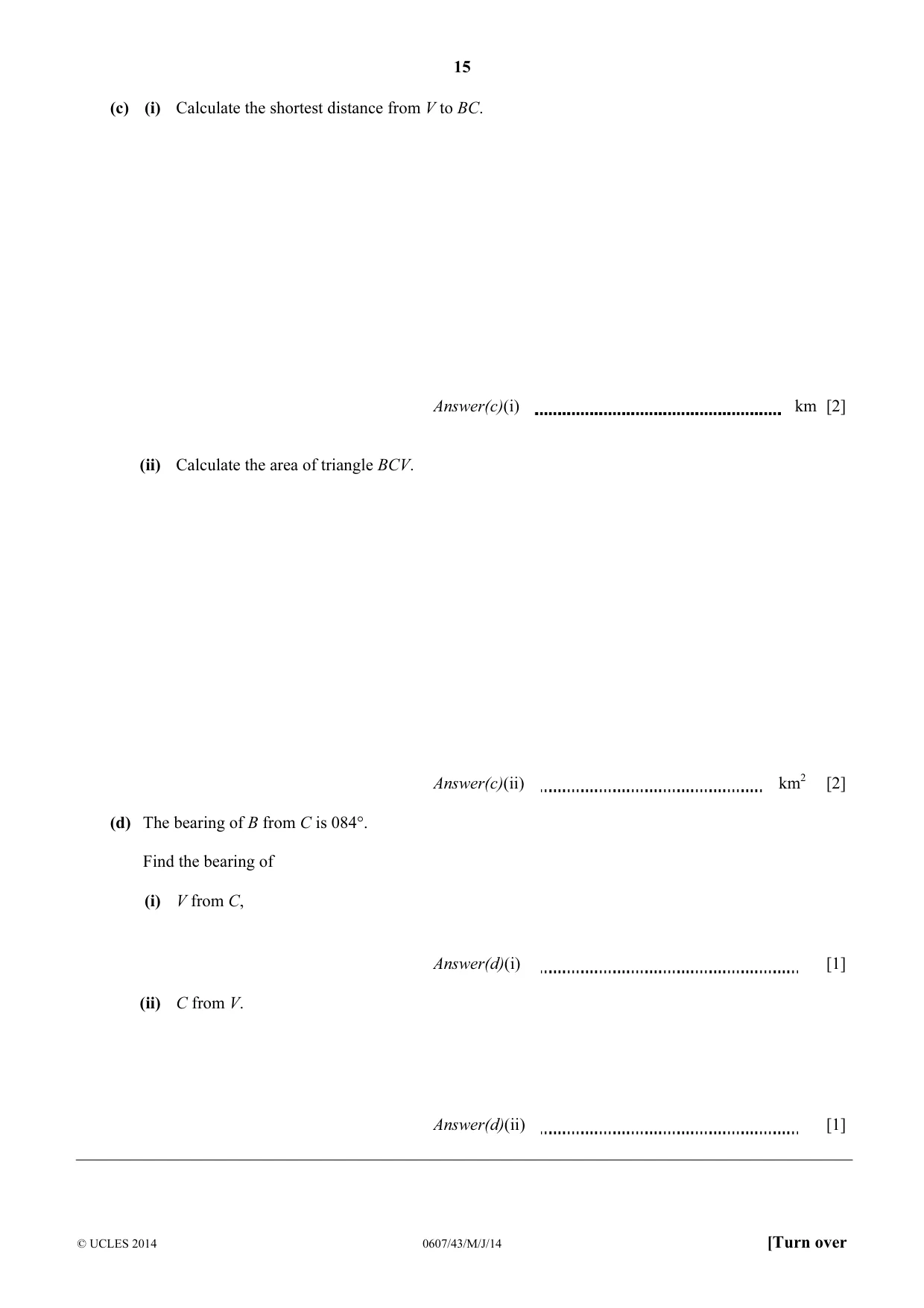
15 © UCLES 2014 0607/43/M/J/14 [Turn over (c) (i) Calculate the shortest distance from V to BC. Answer(c)(i) km [2] (ii) Calculate the area of triangle BCV. Answer(c)(ii) km2 [2] (d) The bearing of B from C is 084°. Find the bearing of (i) V from C, Answer(d)(i) [1] (ii) C from V. Answer(d)(ii) [1]
Question paper, page 16
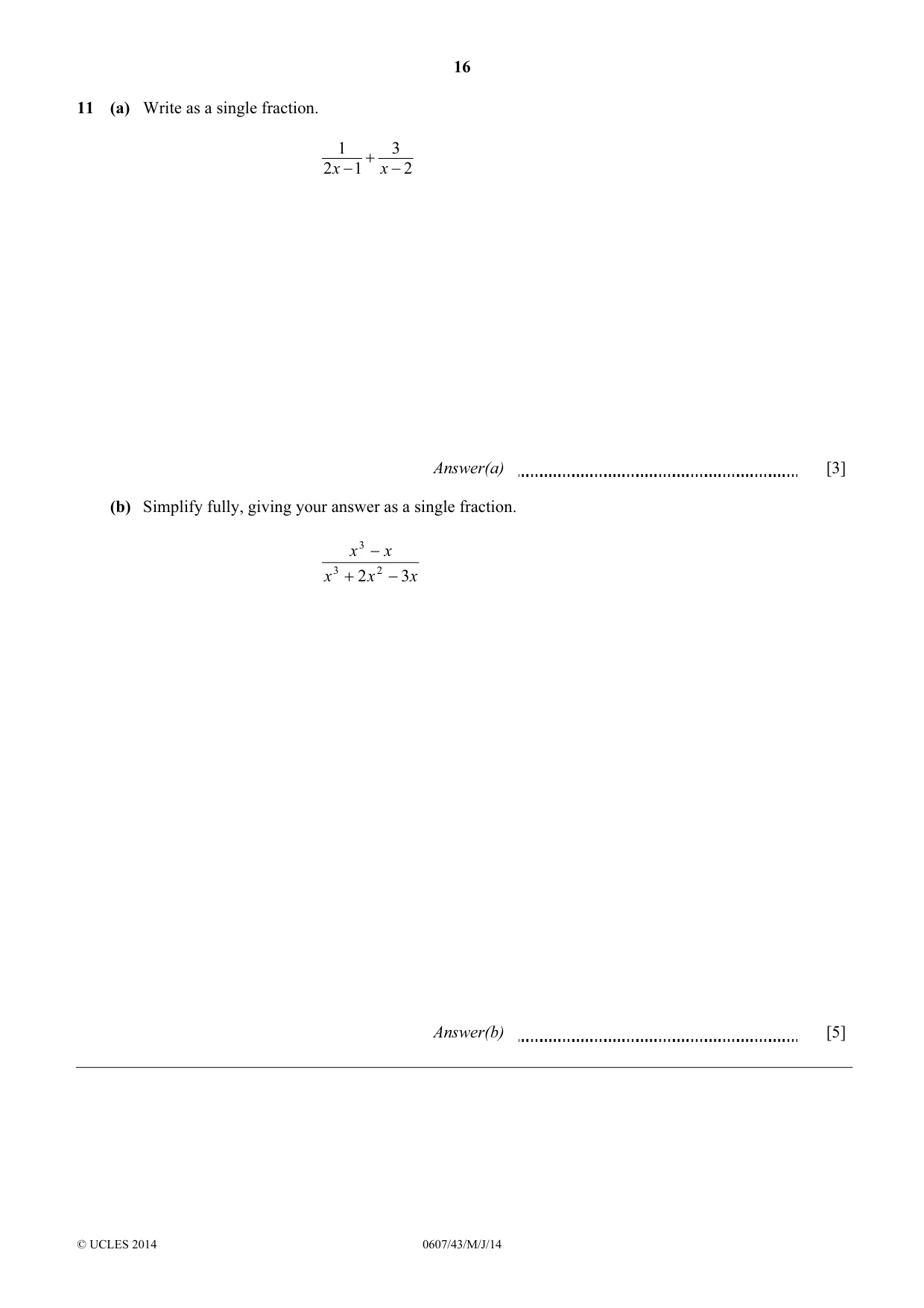
16 © UCLES 2014 0607/43/M/J/14 11 (a) Write as a single fraction. 2 3 1 2 1 − + − x x Answer(a) [3] (b) Simplify fully, giving your answer as a single fraction. x x x x x 3 2 2 3 3 − + − Answer(b) [5]
Question paper, page 17
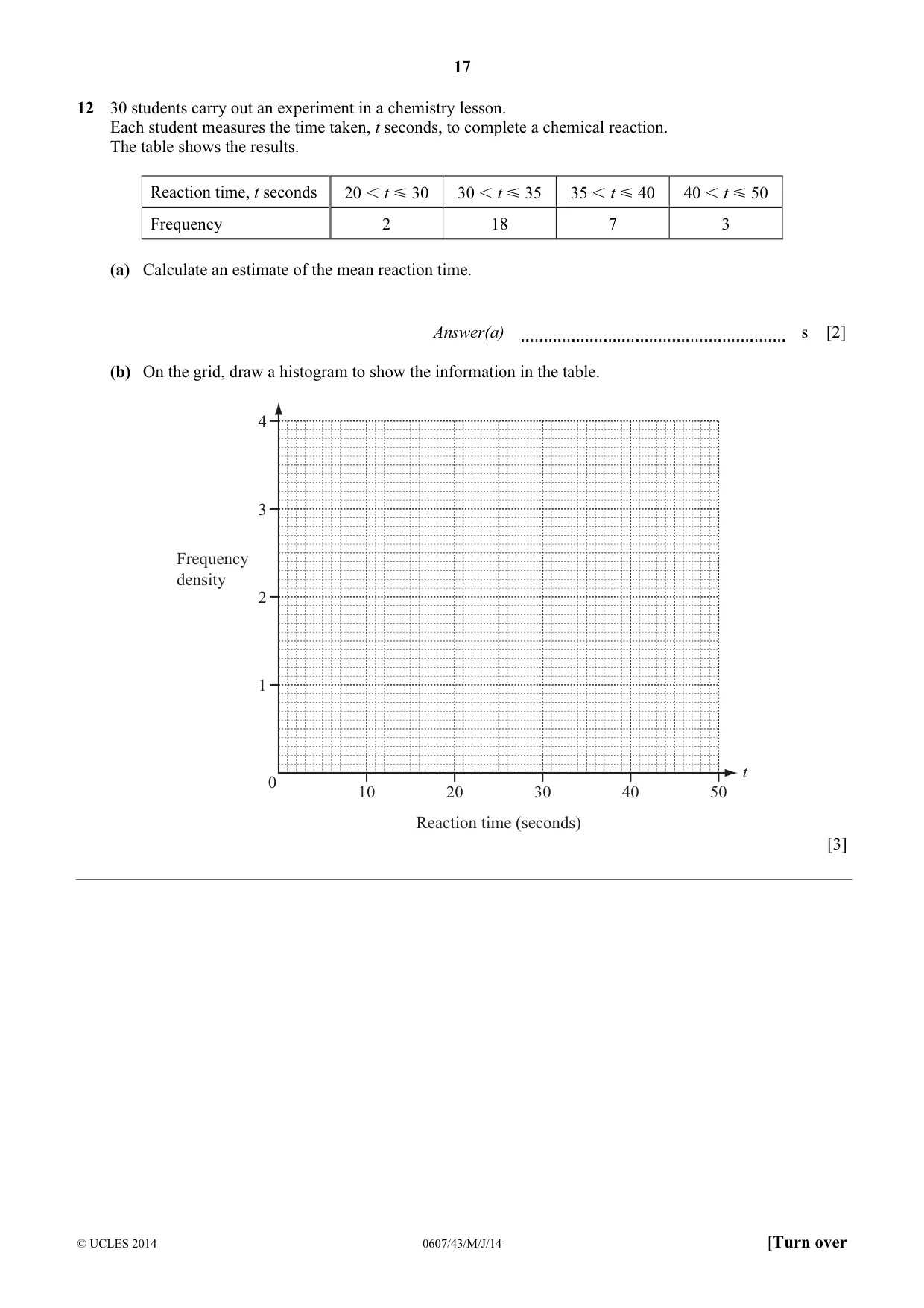
17 © UCLES 2014 0607/43/M/J/14 [Turn over 12 30 students carry out an experiment in a chemistry lesson. Each student measures the time taken, t seconds, to complete a chemical reaction. The table shows the results. Reaction time, t seconds 20 I t Y 30 30 I t Y 35 35 I t Y 40 40 I t Y 50 Frequency 2 18 7 3 (a) Calculate an estimate of the mean reaction time. Answer(a) s [2] (b) On the grid, draw a histogram to show the information in the table. 4 3 2 1 10 20 30 Reaction time (seconds) Frequency density 40 50 0 t [3]
Question paper, page 18
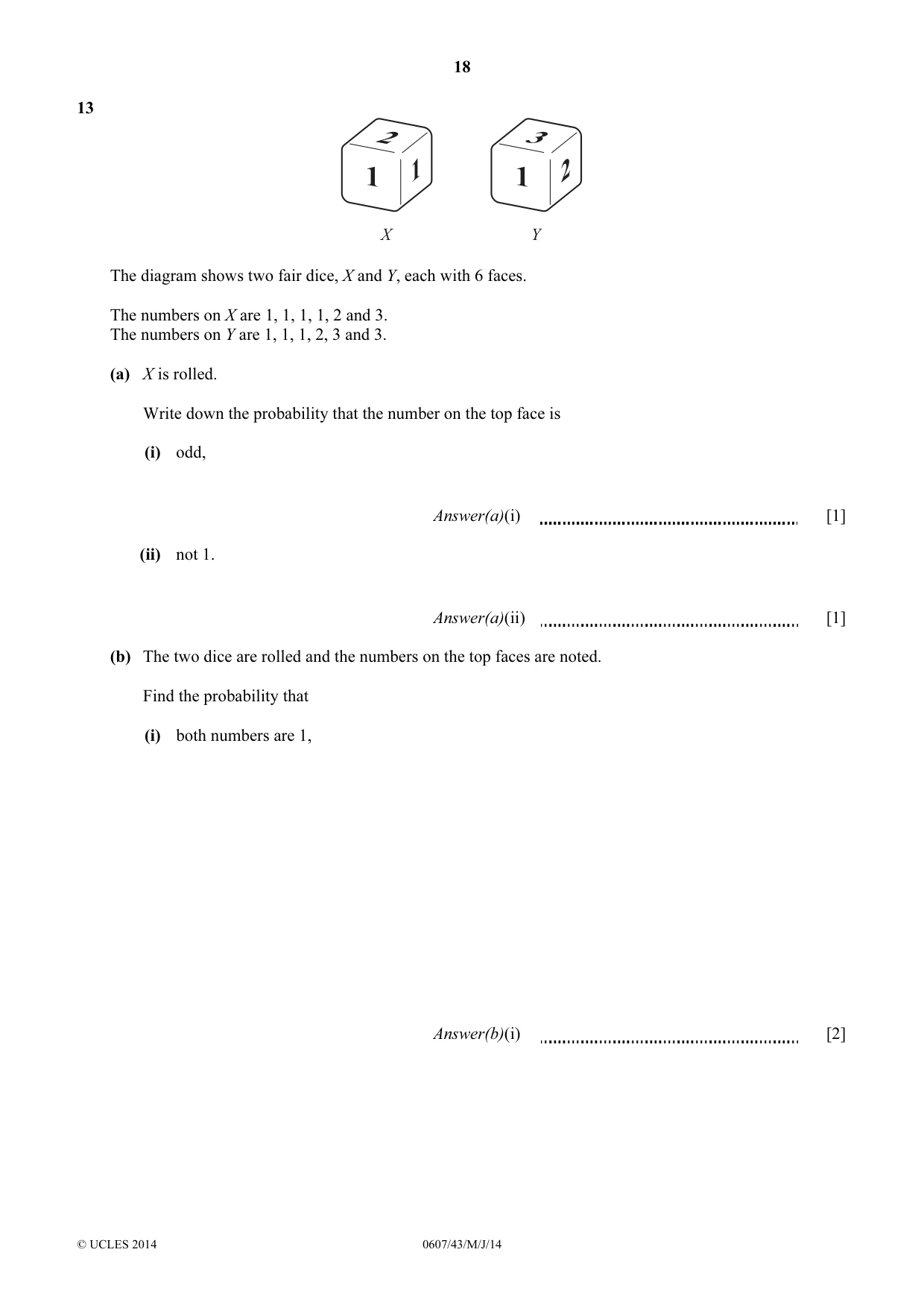
18 © UCLES 2014 0607/43/M/J/14 13 1 2 1 X 1 3 2 Y The diagram shows two fair dice, X and Y, each with 6 faces. The numbers on X are 1, 1, 1, 1, 2 and 3. The numbers on Y are 1, 1, 1, 2, 3 and 3. (a) X is rolled. Write down the probability that the number on the top face is (i) odd, Answer(a)(i) [1] (ii) not 1. Answer(a)(ii) [1] (b) The two dice are rolled and the numbers on the top faces are noted. Find the probability that (i) both numbers are 1, Answer(b)(i) [2]
Question paper, page 19
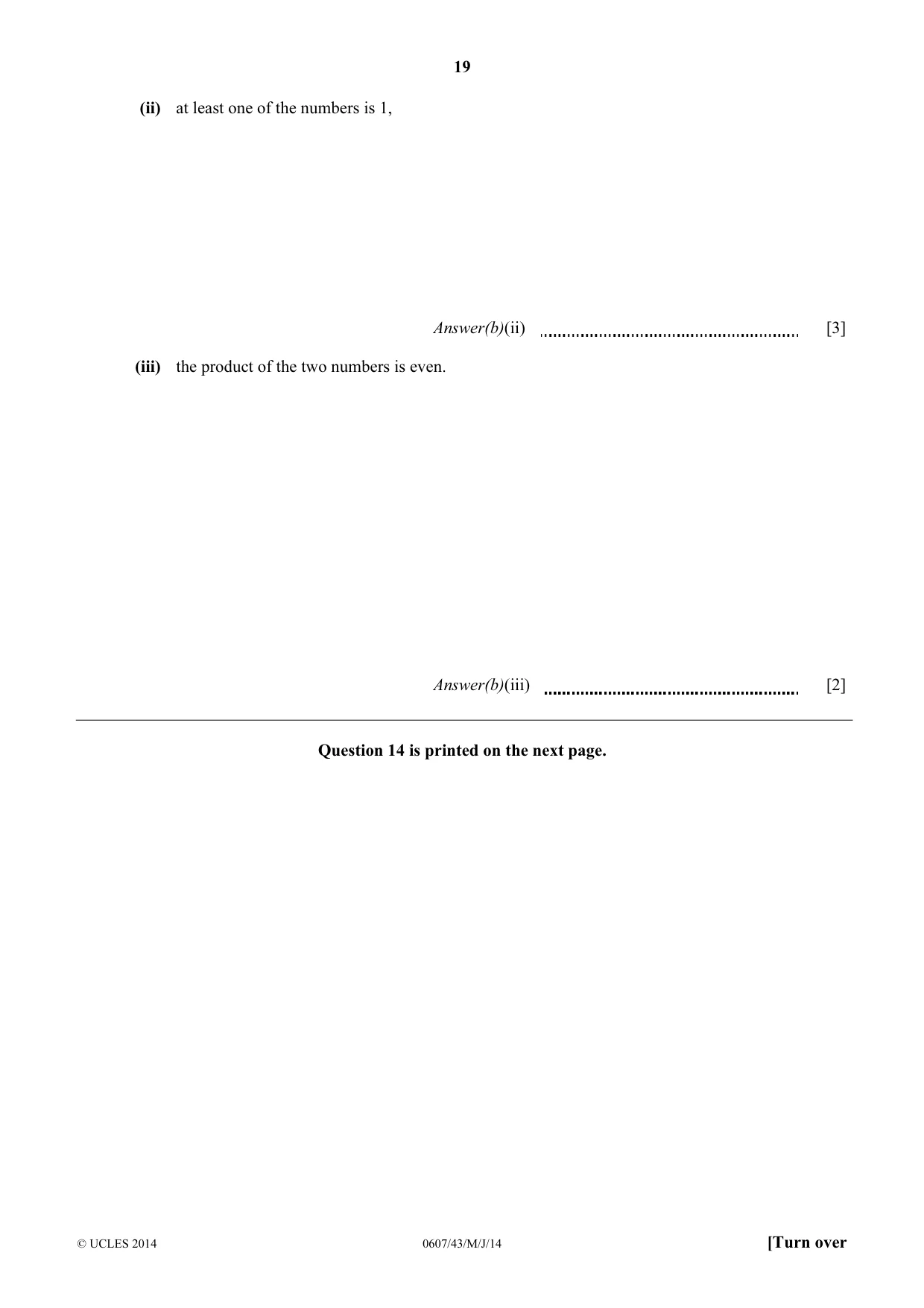
19 © UCLES 2014 0607/43/M/J/14 [Turn over (ii) at least one of the numbers is 1, Answer(b)(ii) [3] (iii) the product of the two numbers is even. Answer(b)(iii) [2] Question 14 is printed on the next page.
Question paper, page 20
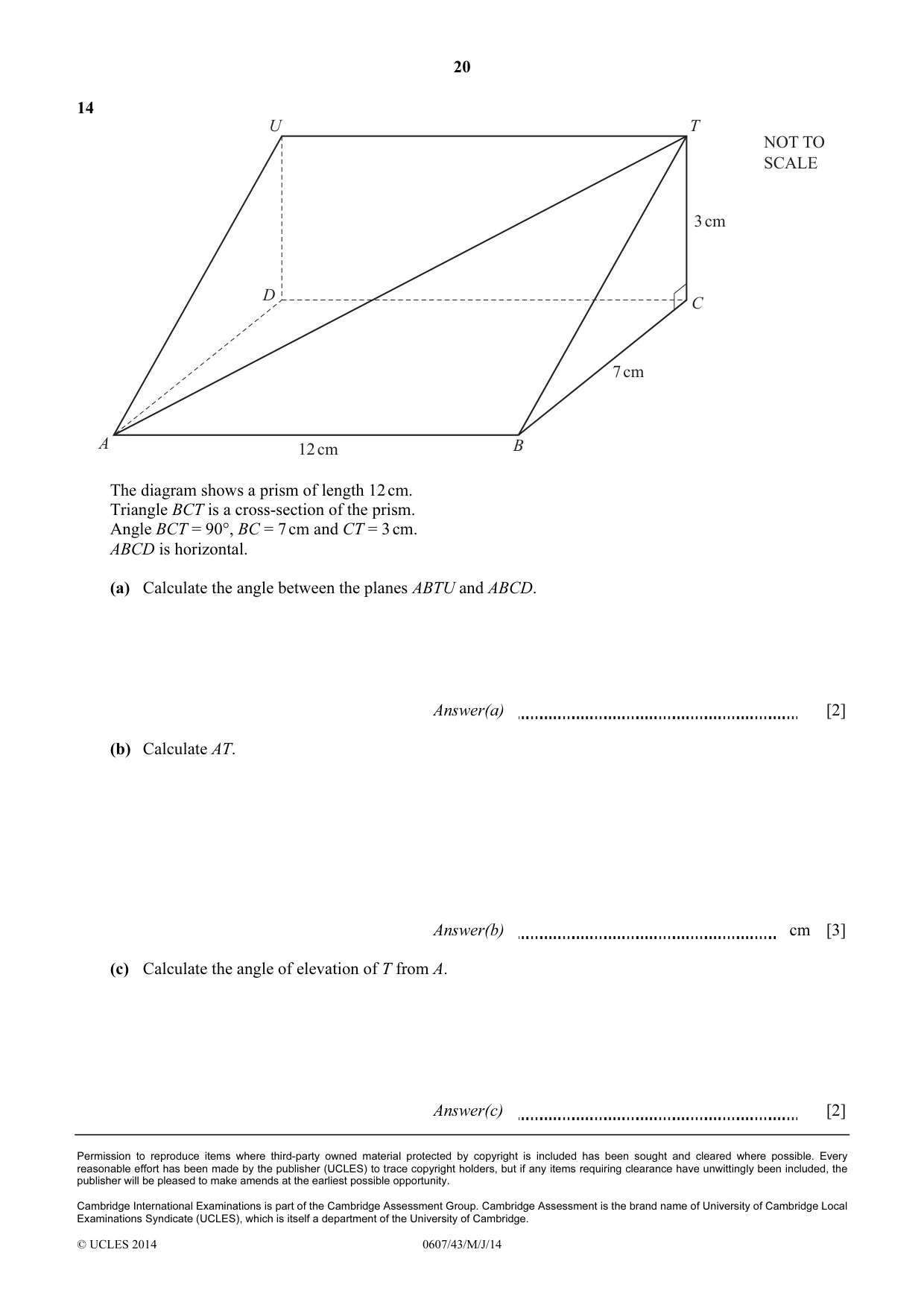
20 Permission to reproduce items where third-party owned material protected by copyright is included has been sought and cleared where possible. Every reasonable effort has been made by the publisher (UCLES) to trace copyright holders, but if any items requiring clearance have unwittingly been included, the publisher will be pleased to make amends at the earliest possible opportunity. Cambridge International Examinations is part of the Cambridge Assessment Group. Cambridge Assessment is the brand name of University of Cambridge Local Examinations Syndicate (UCLES), which is itself a department of the University of Cambridge. © UCLES 2014 0607/43/M/J/14 14 U T C B A D 12 cm 7 cm 3 cm NOT TO SCALE The diagram shows a prism of length 12 cm. Triangle BCT is a cross-section of the prism. Angle BCT = 90°, BC = 7 cm and CT = 3 cm. ABCD is horizontal. (a) Calculate the angle between the planes ABTU and ABCD. Answer(a) [2] (b) Calculate AT. Answer(b) cm [3] (c) Calculate the angle of elevation of T from A. Answer(c) [2]
Mark scheme, page 1
CAMBRIDGE INTERNATIONAL EXAMINATIONS International General Certificate of Secondary Education MARK SCHEME for the May/June 2014 series 0607 CAMBRIDGE INTERNATIONAL MATHEMATICS 0607/43 Paper 4 (Extended), maximum raw mark 120 This mark scheme is published as an aid to teachers and candidates, to indicate the requirements of the examination. It shows the basis on which Examiners were instructed to award marks. It does not indicate the details of the discussions that took place at an Examiners’ meeting before marking began, which would have considered the acceptability of alternative answers. Mark schemes should be read in conjunction with the question paper and the Principal Examiner Report for Teachers. Cambridge will not enter into discussions about these mark schemes. Cambridge is publishing the mark schemes for the May/June 2014 series for most IGCSE, GCE Advanced Level and Advanced Subsidiary Level components and some Ordinary Level components.
Mark scheme, page 2
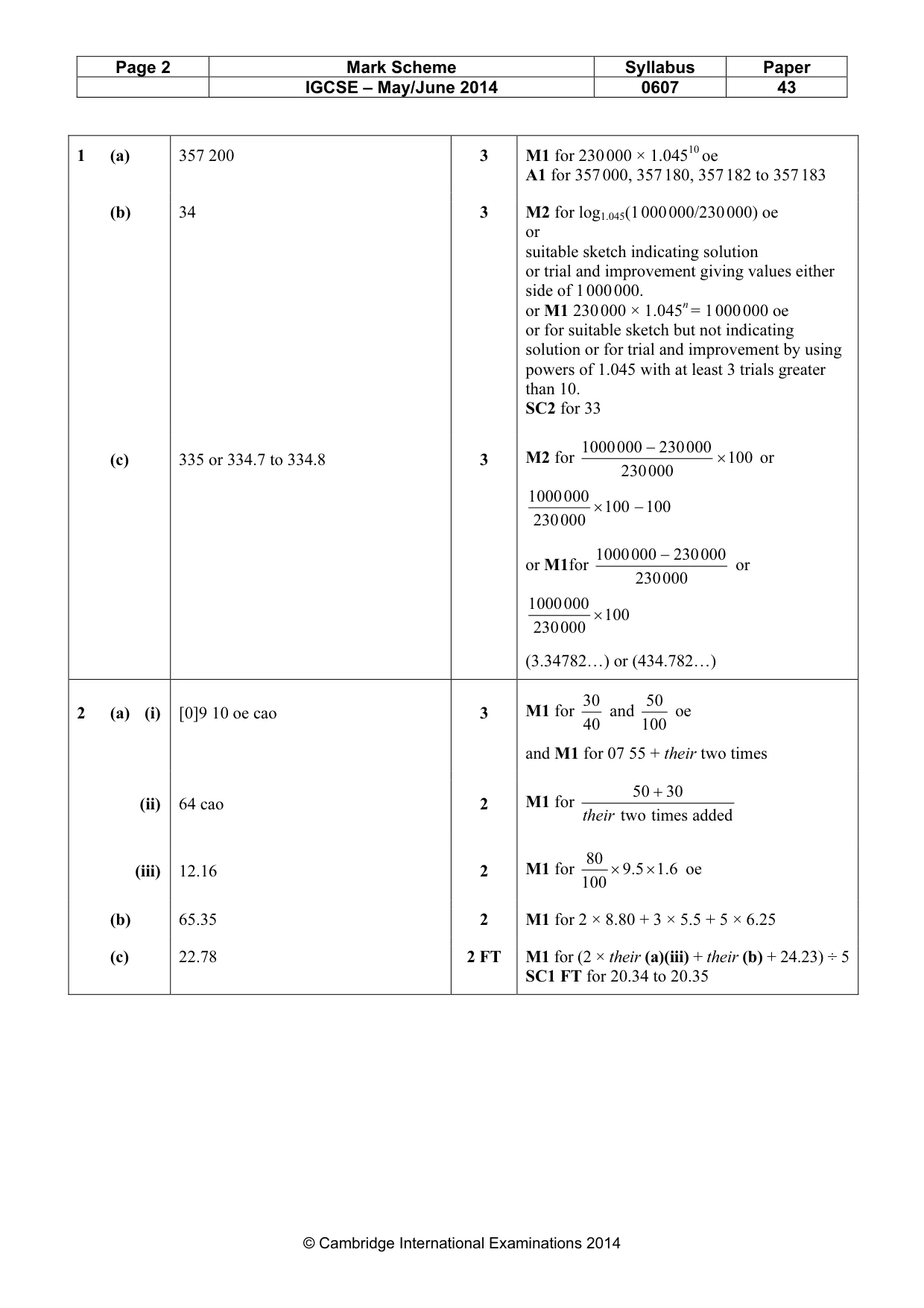
Page 2 Mark Scheme Syllabus Paper IGCSE – May/June 2014 0607 43 © Cambridge International Examinations 2014 1 (a) 357 200 3 M1 for 230 000 × 1.04510 oe A1 for 357 000, 357 180, 357 182 to 357 183 (b) 34 3 M2 for log1.045(1 000 000/230 000) oe or suitable sketch indicating solution or trial and improvement giving values either side of 1 000 000. or M1 230 000 × 1.045n = 1 000 000 oe or for suitable sketch but not indicating solution or for trial and improvement by using powers of 1.045 with at least 3 trials greater than 10. SC2 for 33 (c) 335 or 334.7 to 334.8 3 M2 for 100 000 230 000 230 000 000 1 × − or 100 100 000 230 000 000 1 − × or M1for 000 230 000 230 000 000 1 − or 100 000 230 000 000 1 × (3.34782…) or (434.782…) 2 (a) (i) [0]9 10 oe cao 3 M1 for 40 30 and 100 50 oe and M1 for 07 55 + their two times (ii) 64 cao 2 M1 for added times two 30 50 their + (iii) 12.16 2 M1 for 6.1 5.9 100 80 × × oe (b) 65.35 2 M1 for 2 × 8.80 + 3 × 5.5 + 5 × 6.25 (c) 22.78 2 FT M1 for (2 × their (a)(iii) + their (b) + 24.23) ÷ 5 SC1 FT for 20.34 to 20.35
Mark scheme, page 3
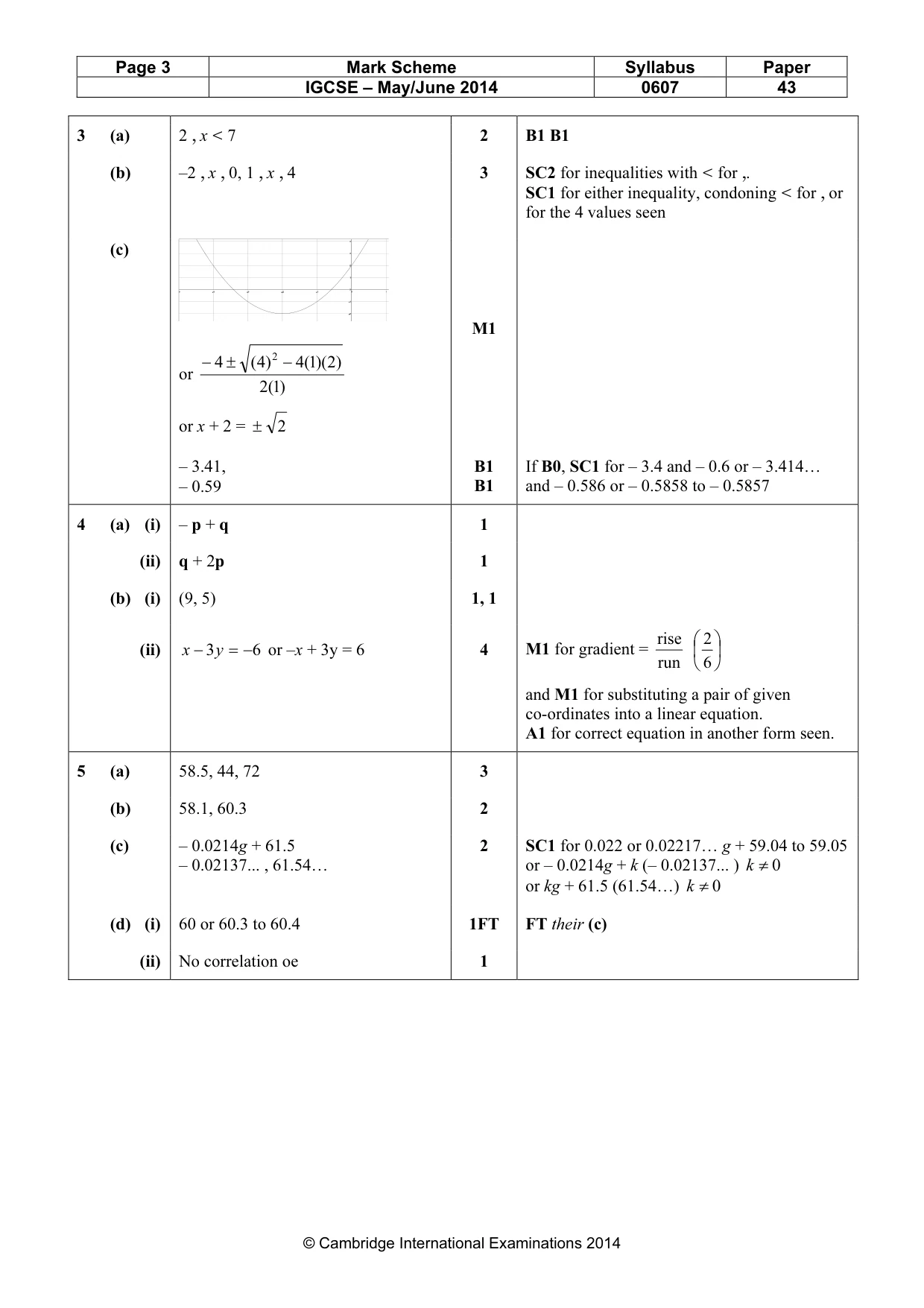
Page 3 Mark Scheme Syllabus Paper IGCSE – May/June 2014 0607 43 © Cambridge International Examinations 2014 3 (a) 2 , x < 7 2 B1 B1 (b) –2 , x , 0, 1 , x , 4 3 SC2 for inequalities with < for ,. SC1 for either inequality, condoning < for , or for the 4 values seen (c) or )1( 2 ) 2 )( 1( 4 ) 4 ( 4 2 − ± − or x + 2 = 2 ± – 3.41, – 0.59 M1 B1 B1 If B0, SC1 for – 3.4 and – 0.6 or – 3.414… and – 0.586 or – 0.5858 to – 0.5857 4 (a) (i) – p + q 1 (ii) q + 2p 1 (b) (i) (9, 5) 1, 1 (ii) 6 3 − = −y x or –x + 3y = 6 4 M1 for gradient = run rise 6 2 and M1 for substituting a pair of given co-ordinates into a linear equation. A1 for correct equation in another form seen. 5 (a) 58.5, 44, 72 3 (b) 58.1, 60.3 2 (c) – 0.0214g + 61.5 – 0.02137... , 61.54… 2 SC1 for 0.022 or 0.02217… g + 59.04 to 59.05 or – 0.0214g + k (– 0.02137... ) 0 ≠ k or kg + 61.5 (61.54…) 0 ≠ k (d) (i) 60 or 60.3 to 60.4 1FT FT their (c) (ii) No correlation oe 1 1 0 -1 -2 -3 -4 5 4 3 2 1 0 -1 -2 1 0 -1 -2 -3 -4 5 4 3 2 1 0 -1 -2 1 0 -1 -2 -3 -4 5 4 3 2 1 0 -1 -2 1 0 -1 -2 -3 -4 5 4 3 2 1 0 -1 -2
Mark scheme, page 4
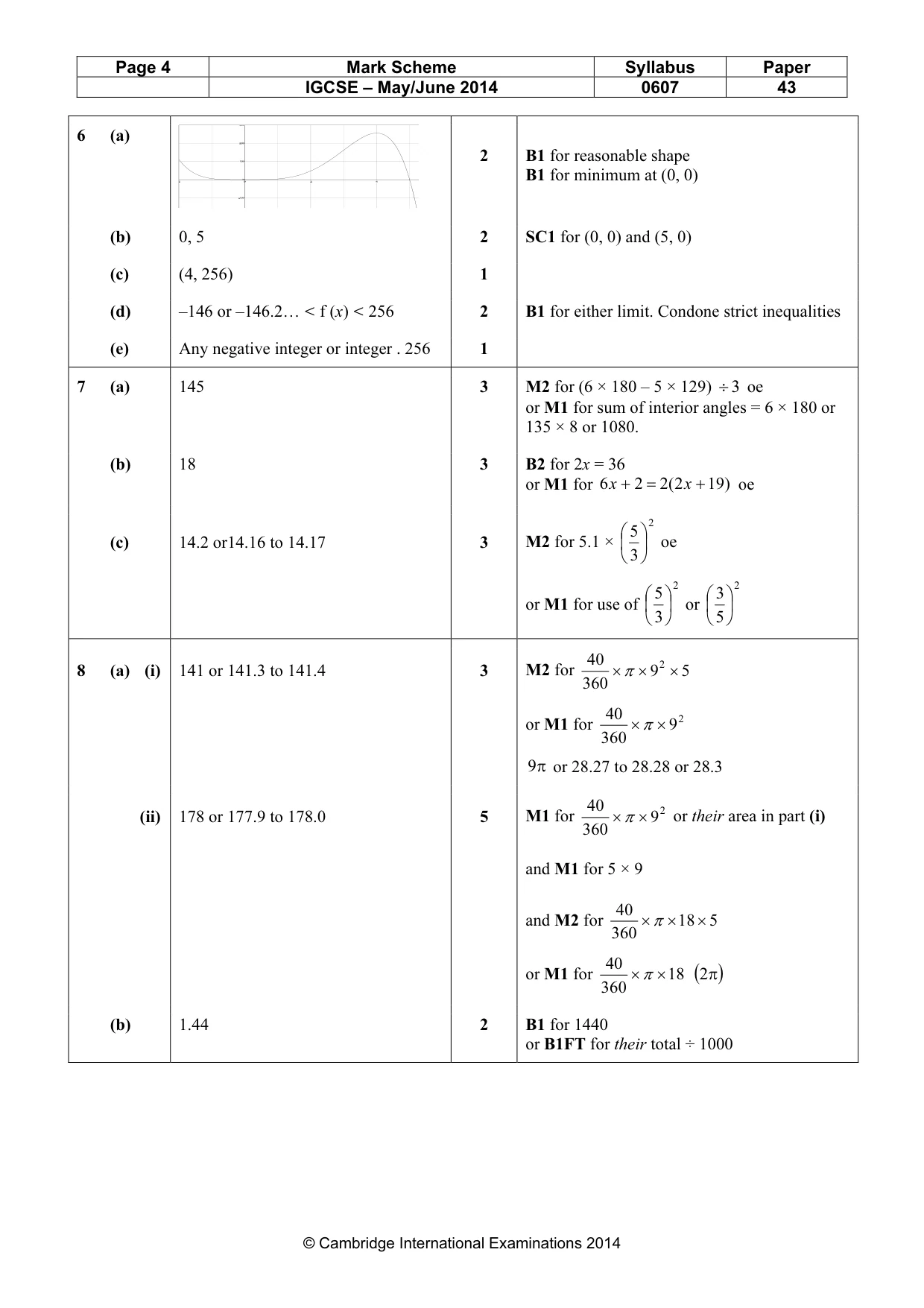
Page 4 Mark Scheme Syllabus Paper IGCSE – May/June 2014 0607 43 © Cambridge International Examinations 2014 6 (a) 2 B1 for reasonable shape B1 for minimum at (0, 0) (b) 0, 5 2 SC1 for (0, 0) and (5, 0) (c) (4, 256) 1 (d) –146 or –146.2… < f (x) < 256 2 B1 for either limit. Condone strict inequalities (e) Any negative integer or integer . 256 1 7 (a) 145 3 M2 for (6 × 180 – 5 × 129) 3 ÷ oe or M1 for sum of interior angles = 6 × 180 or 135 × 8 or 1080. (b) 18 3 B2 for 2x = 36 or M1 for ) 19 2 ( 2 2 6 + = + x x oe (c) 14.2 or14.16 to 14.17 3 M2 for 5.1 × 2 3 5 oe or M1 for use of 2 3 5 or 2 5 3 8 (a) (i) 141 or 141.3 to 141.4 3 M2 for 5 9 360 40 2 × × ×π or M1 for 2 9 360 40 × ×π π 9 or 28.27 to 28.28 or 28.3 (ii) 178 or 177.9 to 178.0 5 M1 for 2 9 360 40 × ×π or their area in part (i) and M1 for 5 × 9 and M2 for 5 18 360 40 × × ×π or M1 for 18 360 40 × ×π ( ) π 2 (b) 1.44 2 B1 for 1440 or B1FT for their total ÷ 1000 4 2 0 2 300 200 100 0 -100 4 2 0 2 300 200 100 0 -100 4 2 0 2 300 200 100 0 -100 4 2 0 2 300 200 100 0 -100
Mark scheme, page 5
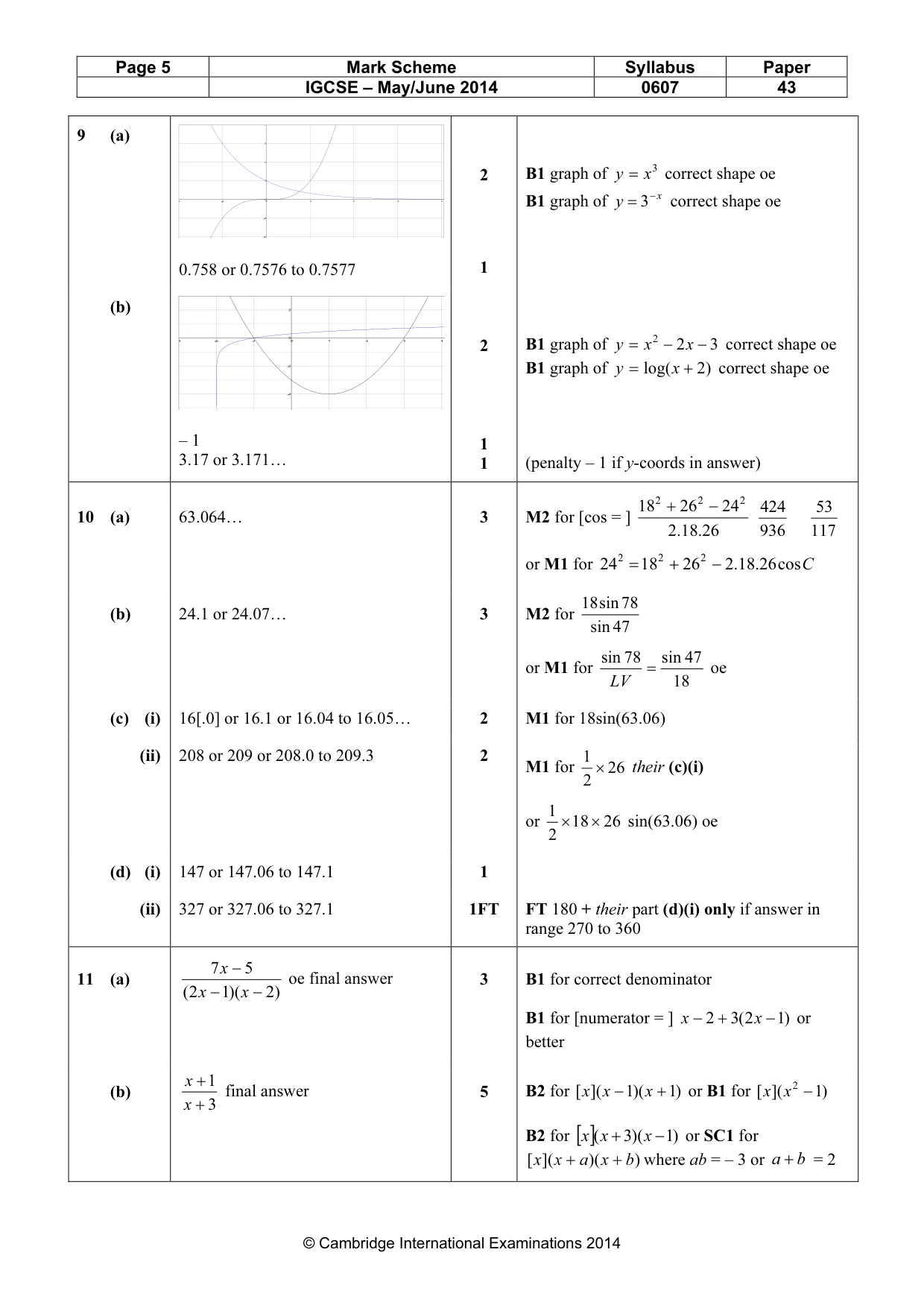
Page 5 Mark Scheme Syllabus Paper IGCSE – May/June 2014 0607 43 © Cambridge International Examinations 2014 9 (a) 0.758 or 0.7576 to 0.7577 2 1 B1 graph of 3x y = correct shape oe B1 graph of x y − = 3 correct shape oe (b) – 1 3.17 or 3.171… 2 1 1 B1 graph of 3 2 2 − − = x x y correct shape oe B1 graph of ) 2 log( + = x y correct shape oe (penalty – 1 if y-coords in answer) 10 (a) 63.064… 3 M2 for [cos = ] 26 . 18 .2 24 26 18 2 2 2 − + 117 53 936 424 or M1 for C cos 26 . 18 .2 26 18 24 2 2 2 − + = (b) 24.1 or 24.07… 3 M2 for 47 sin 78 sin 18 or M1 for 18 47 sin 78 sin = LV oe (c) (i) 16[.0] or 16.1 or 16.04 to 16.05… 2 M1 for 18sin(63.06) (ii) 208 or 209 or 208.0 to 209.3 2 M1 for 26 2 1 × their (c)(i) or 26 18 2 1 × × sin(63.06) oe (d) (i) 147 or 147.06 to 147.1 1 (ii) 327 or 327.06 to 327.1 1FT FT 180 + their part (d)(i) only if answer in range 270 to 360 11 (a) ) 2 )( 1 2 ( 5 7 − − − x x x oe final answer 3 B1 for correct denominator B1 for [numerator = ] )1 2 (3 2 − + − x x or better (b) 3 1 + + x x final answer 5 B2 for )1 )( 1 ]( [ + − x x x or B1 for )1 ]( [ 2 − x x B2 for [ ] )1 )( 3 ( − + x x x or SC1 for ) )( ]( [ b x a x x + + where ab = – 3 or b a + = 2 4 3 2 1 0 -1 2 4 3 2 1 0 -1 -2 4 3 2 1 0 -1 2 4 3 2 1 0 -1 -2 4 3 2 1 0 -1 2 4 3 2 1 0 -1 -2 4 3 2 1 0 -1 2 4 3 2 1 0 -1 -2 4 3 2 1 0 -1 -2 3 2 0 -2 -4 4 3 2 1 0 -1 -2 3 2 0 -2 -4 4 3 2 1 0 -1 -2 3 2 0 -2 -4 4 3 2 1 0 -1 -2 3 2 0 -2 -4
Mark scheme, page 6
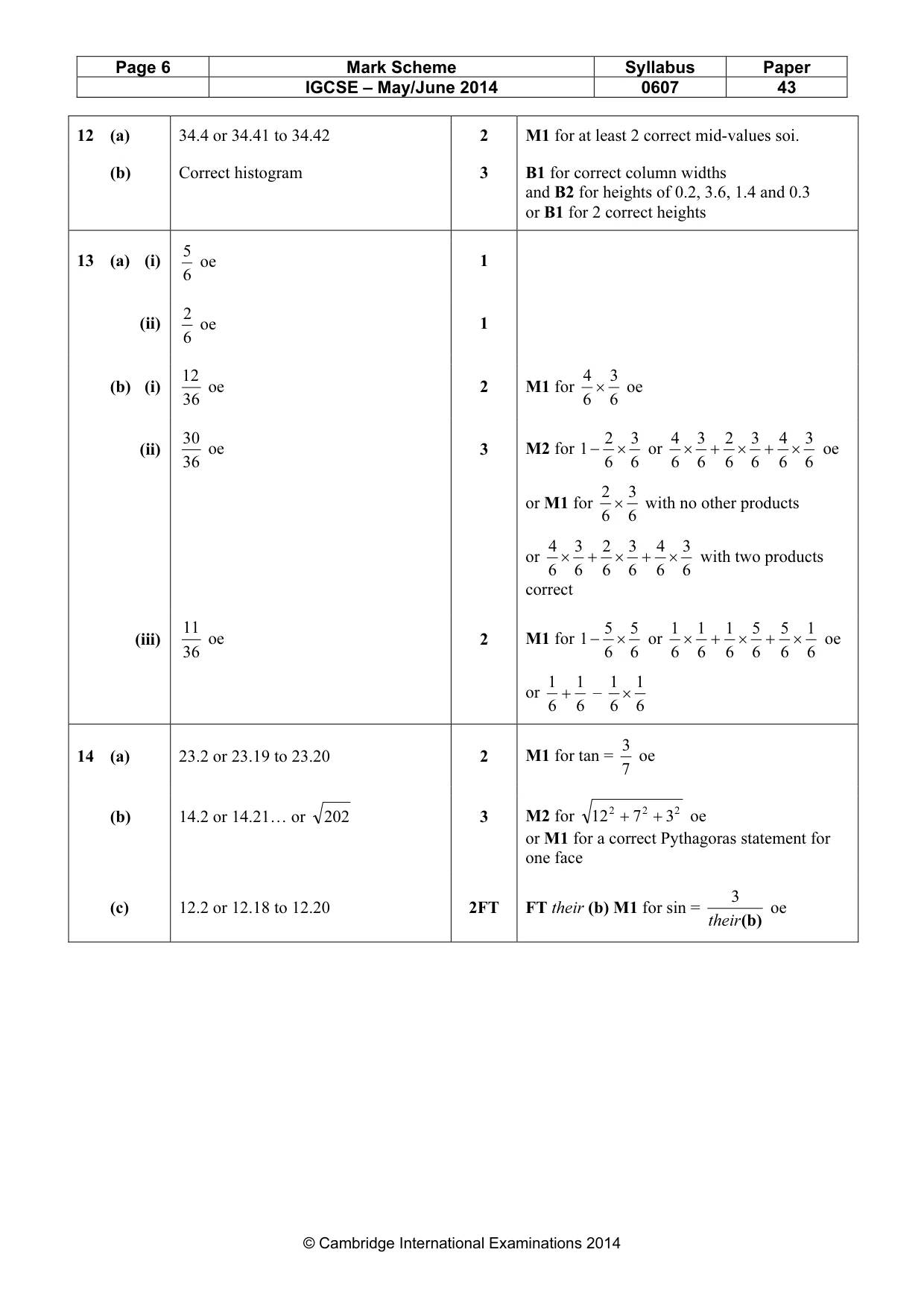
Page 6 Mark Scheme Syllabus Paper IGCSE – May/June 2014 0607 43 © Cambridge International Examinations 2014 12 (a) 34.4 or 34.41 to 34.42 2 M1 for at least 2 correct mid-values soi. (b) Correct histogram 3 B1 for correct column widths and B2 for heights of 0.2, 3.6, 1.4 and 0.3 or B1 for 2 correct heights 13 (a) (i) 6 5 oe 1 (ii) 6 2 oe 1 (b) (i) 36 12 oe 2 M1 for 6 3 6 4 × oe (ii) 36 30 oe 3 M2 for 6 3 6 2 1 × − or 6 3 6 4 6 3 6 2 6 3 6 4 × + × + × oe or M1 for 6 3 6 2 × with no other products or 6 3 6 4 6 3 6 2 6 3 6 4 × + × + × with two products correct (iii) 36 11 oe 2 M1 for 6 5 6 5 1 × − or 6 1 6 5 6 5 6 1 6 1 6 1 × + × + × oe or 6 1 6 1 + – 6 1 6 1 × 14 (a) 23.2 or 23.19 to 23.20 2 M1 for tan = 7 3 oe (b) 14.2 or 14.21… or 202 3 M2 for 2 2 2 3 7 12 + + oe or M1 for a correct Pythagoras statement for one face (c) 12.2 or 12.18 to 12.20 2FT FT their (b) M1 for sin = (b) their 3 oe
What you needed in this session
Cambridge’s own grade thresholds for 2014 May/June, Paper 4 · Variant 3. A higher threshold means an easier paper — the bar moves with how the cohort did.