Cambridge IGCSE Mathematics - International 0607 — 2014 May/June Paper 4 · Variant 2
0607/42/M/J/14 · 120 marks · ≈135 min
The question paper and its mark scheme, free to read here and free to download. This is Cambridge’s own paper, exactly as it was sat.
Question paper20 pages
Mark scheme6 pages
Answers below. Sit the paper first if you are practising.
Paper as text
Question paper, page 1
This document consists of 19 printed pages and 1 blank page. IB14 06_0607_42/6RP © UCLES 2014 [Turn over *6941565017* Cambridge International Examinations Cambridge International General Certificate of Secondary Education CAMBRIDGE INTERNATIONAL MATHEMATICS 0607/42 Paper 4 (Extended) May/June 2014 2 hours 15 minutes Candidates answer on the Question Paper. Additional Materials: Geometrical Instruments Graphics Calculator READ THESE INSTRUCTIONS FIRST Write your Centre number, candidate number and name on all the work you hand in. Write in dark blue or black pen. Do not use staples, paper clips, glue or correction fluid. You may use an HB pencil for any diagrams or graphs. DO NOT WRITE IN ANY BARCODES. Answer all the questions. Unless instructed otherwise, give your answers exactly or correct to three significant figures as appropriate. Answers in degrees should be given to one decimal place. For π, use your calculator value. You must show all the relevant working to gain full marks and you will be given marks for correct methods, including sketches, even if your answer is incorrect. The number of marks is given in brackets [ ] at the end of each question or part question. The total number of marks for this paper is 120.
Question paper, page 2
2 © UCLES 2014 0607/42/M/J/14 Formula List For the equation ax2 + bx + c = 0 x = 2 _ ± 4 2 _ b b ac a Curved surface area, A, of cylinder of radius r, height h. A = 2πrh Curved surface area, A, of cone of radius r, sloping edge l. A = πrl Curved surface area, A, of sphere of radius r. A = 4πr2 Volume, V, of pyramid, base area A, height h. V= 1 3 Ah Volume, V, of cylinder of radius r, height h. V = πr2h Volume, V, of cone of radius r, height h. V = 1 3 πr2h Volume, V, of sphere of radius r. V = 4 3 πr3 = = sin sin sin a b c A B C a2 = b2 + c2 – 2bc cos A Area = 1 2 bc sin A A a B C b c
Question paper, page 3
3 © UCLES 2014 0607/42/M/J/14 [Turn over Answer all the questions. 1 In one country the population of starlings reduced by 5% per year from 1980 to 2010. On 1st January 2000 the population was 8.5 million. (a) Write 8.5 million in standard form. Answer(a) [1] (b) Calculate the population on 1st January 2010. Give your answer correct to 2 significant figures. Answer(b) [2] (c) Calculate the population on 1st January 1980. Give your answer correct to 3 significant figures. Answer(c) [3] (d) Calculate the percentage reduction in the population from 1st January 1980 to 1st January 2010. Answer(d) % [3] (e) If the population of starlings continues to reduce at the same rate, find the year in which the population will first be below 3 500 000. Answer(e) [3]
Question paper, page 4
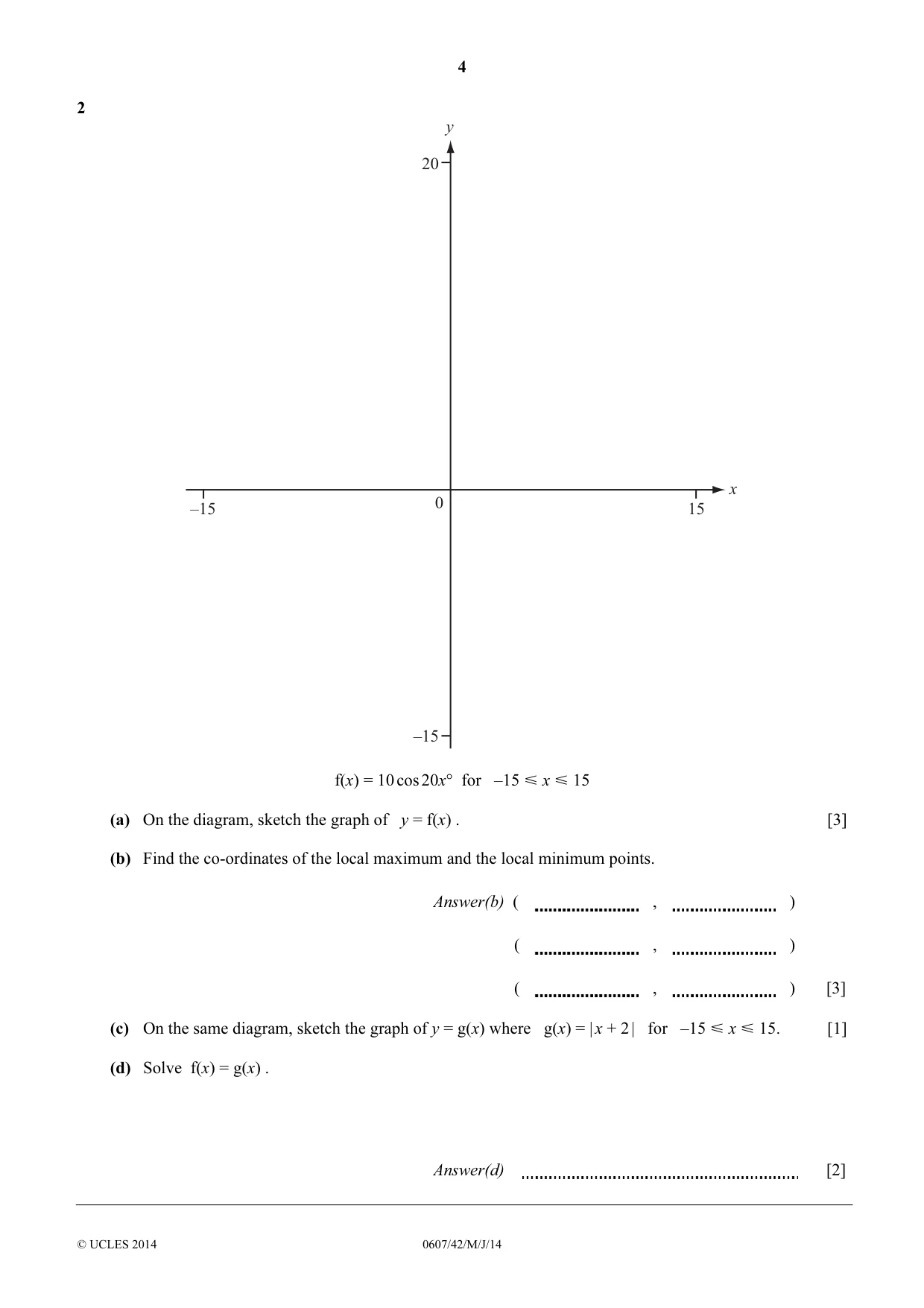
4 © UCLES 2014 0607/42/M/J/14 2 y x 20 0 –15 –15 15 f(x) = 10 cos 20x° for –15 Y x Y 15 (a) On the diagram, sketch the graph of y = f(x) . [3] (b) Find the co-ordinates of the local maximum and the local minimum points. Answer(b) ( , ) ( , ) ( , ) [3] (c) On the same diagram, sketch the graph of y = g(x) where g(x) = | x + 2 | for –15 Y x Y 15. [1] (d) Solve f(x) = g(x) . Answer(d) [2]
Question paper, page 5
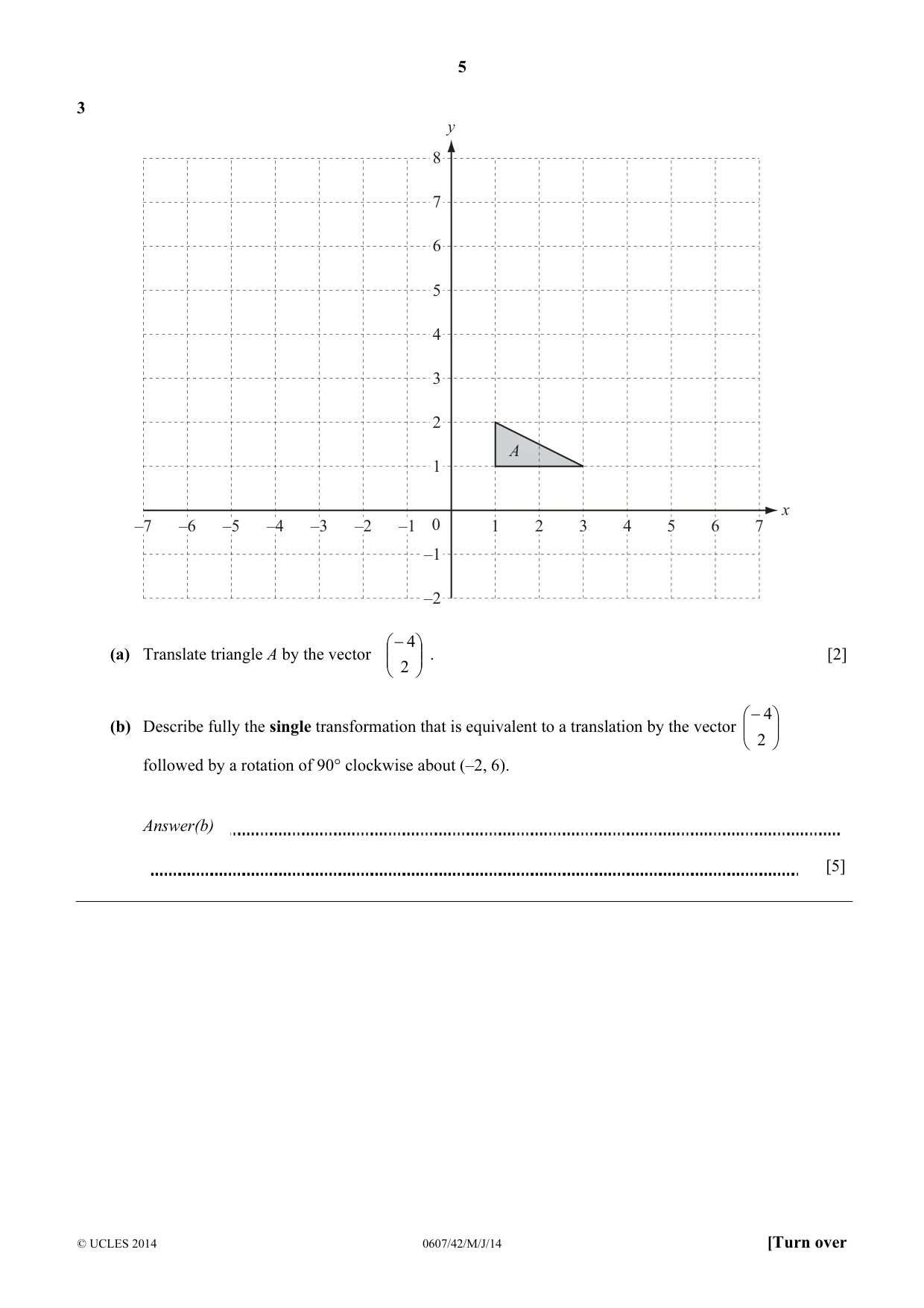
5 © UCLES 2014 0607/42/M/J/14 [Turn over 3 A y x 8 7 6 5 4 3 2 1 –1 –2 0 –1 1 2 3 4 5 6 7 –2 –3 –4 –5 –6 –7 (a) Translate triangle A by the vector − 2 4 . [2] (b) Describe fully the single transformation that is equivalent to a translation by the vector − 2 4 followed by a rotation of 90° clockwise about (–2, 6). Answer(b) [5]
Question paper, page 6
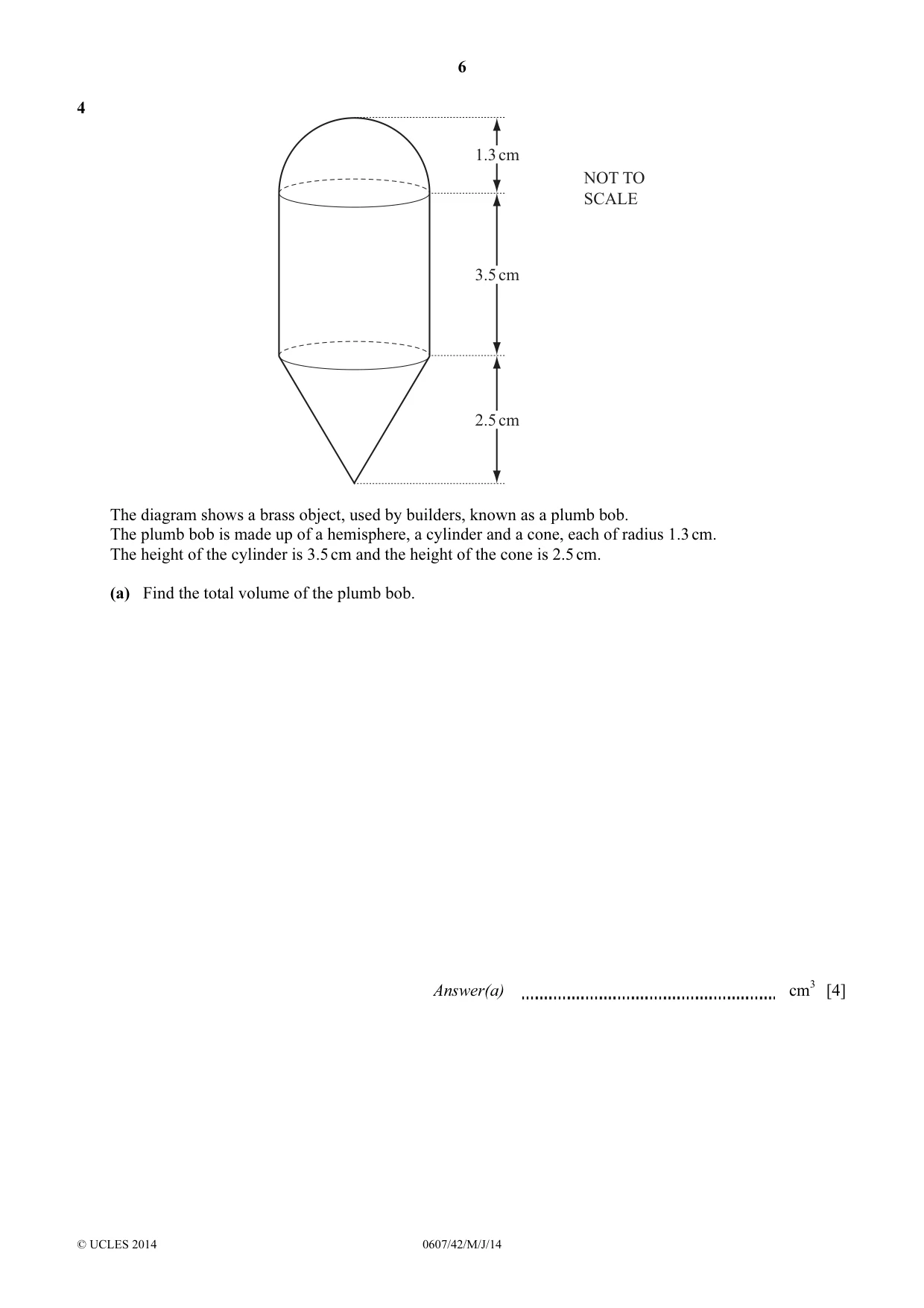
6 © UCLES 2014 0607/42/M/J/14 4 1.3 cm 3.5 cm 2.5 cm NOT TO SCALE The diagram shows a brass object, used by builders, known as a plumb bob. The plumb bob is made up of a hemisphere, a cylinder and a cone, each of radius 1.3 cm. The height of the cylinder is 3.5 cm and the height of the cone is 2.5 cm. (a) Find the total volume of the plumb bob. Answer(a) cm3 [4]
Question paper, page 7
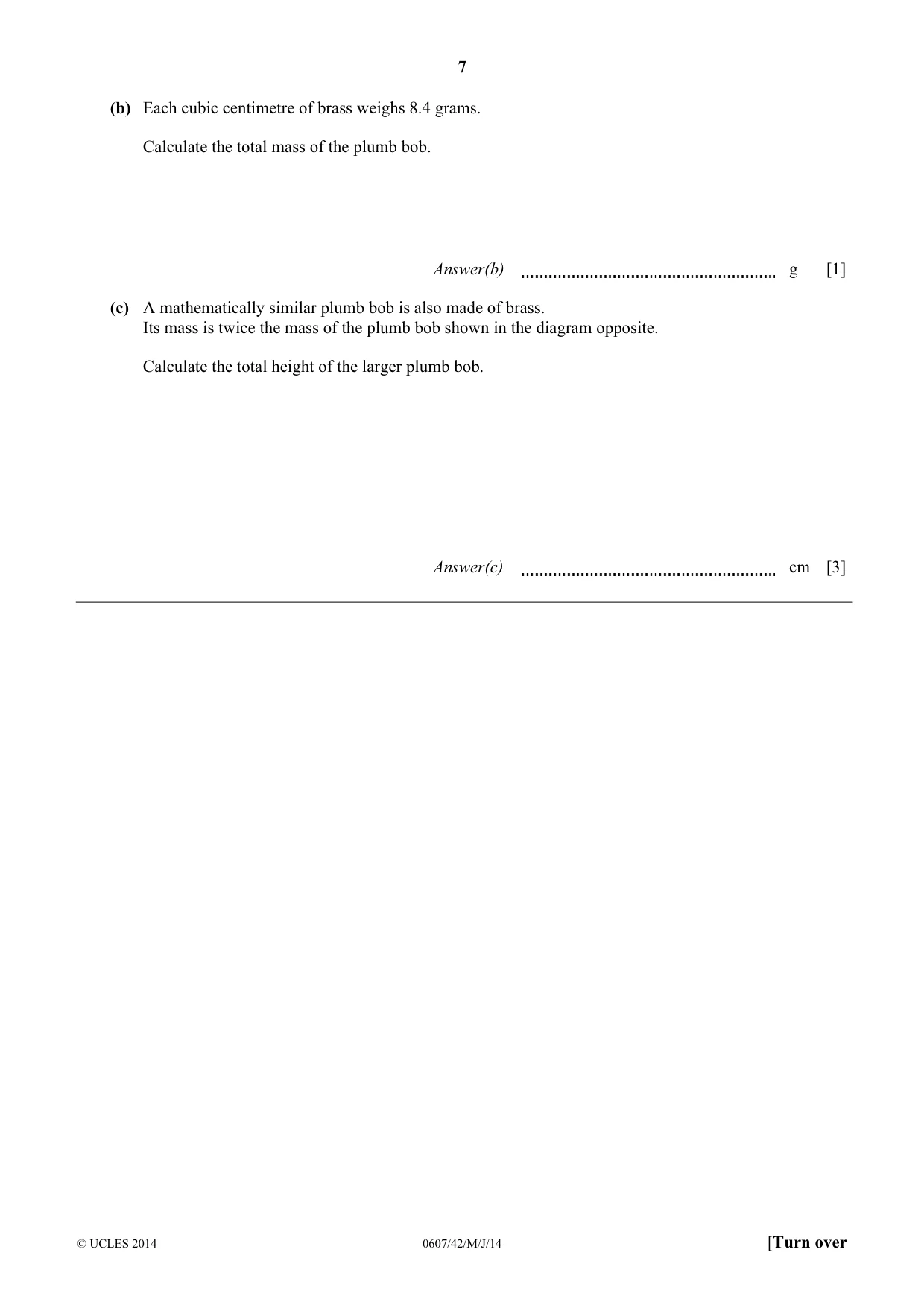
7 © UCLES 2014 0607/42/M/J/14 [Turn over (b) Each cubic centimetre of brass weighs 8.4 grams. Calculate the total mass of the plumb bob. Answer(b) g [1] (c) A mathematically similar plumb bob is also made of brass. Its mass is twice the mass of the plumb bob shown in the diagram opposite. Calculate the total height of the larger plumb bob. Answer(c) cm [3]
Question paper, page 8
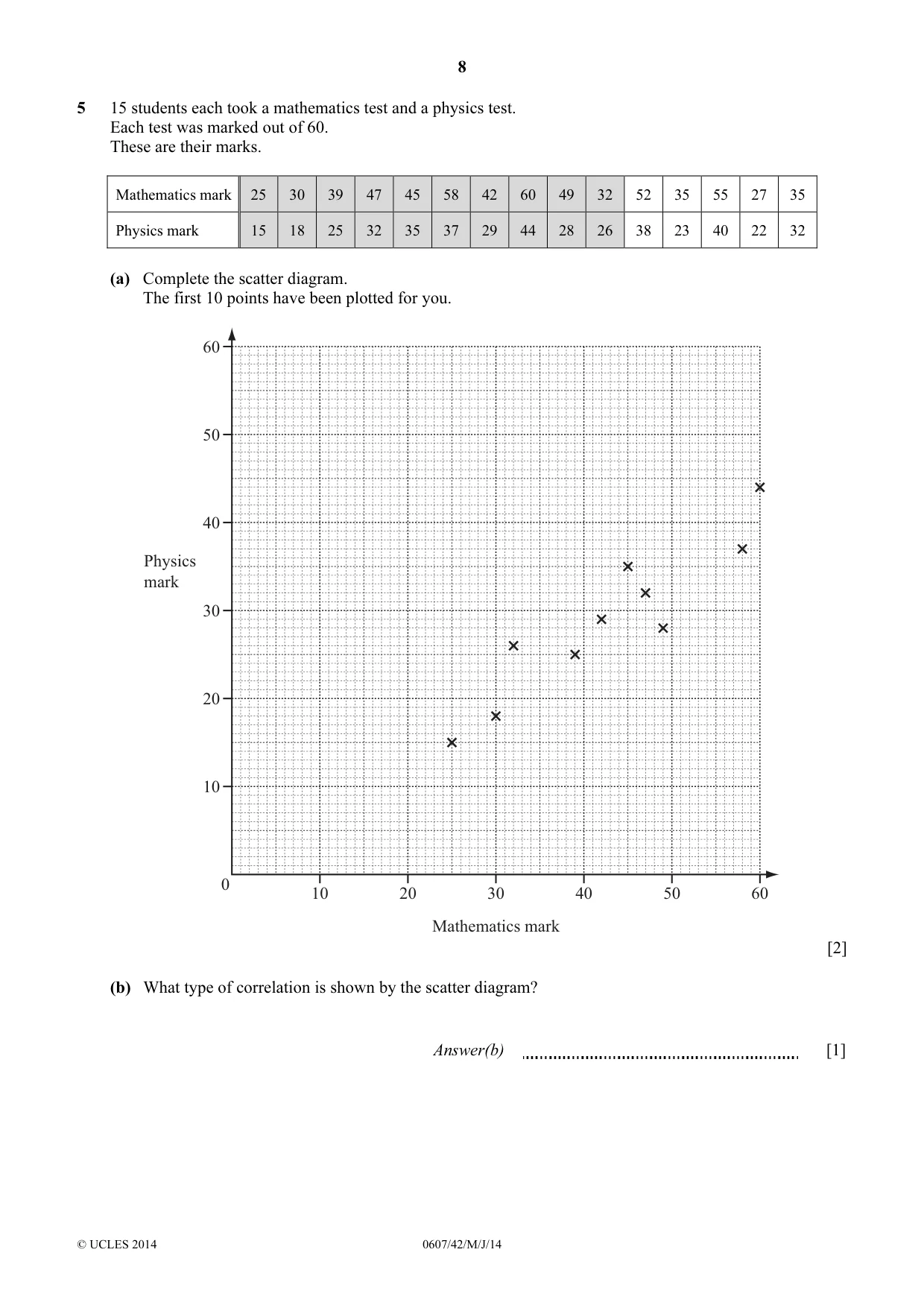
8 © UCLES 2014 0607/42/M/J/14 5 15 students each took a mathematics test and a physics test. Each test was marked out of 60. These are their marks. Mathematics mark 25 30 39 47 45 58 42 60 49 32 52 35 55 27 35 Physics mark 15 18 25 32 35 37 29 44 28 26 38 23 40 22 32 (a) Complete the scatter diagram. The first 10 points have been plotted for you. 60 50 40 30 20 10 10 20 30 Mathematics mark 40 50 60 0 Physics mark [2] (b) What type of correlation is shown by the scatter diagram? Answer(b) [1]
Question paper, page 9
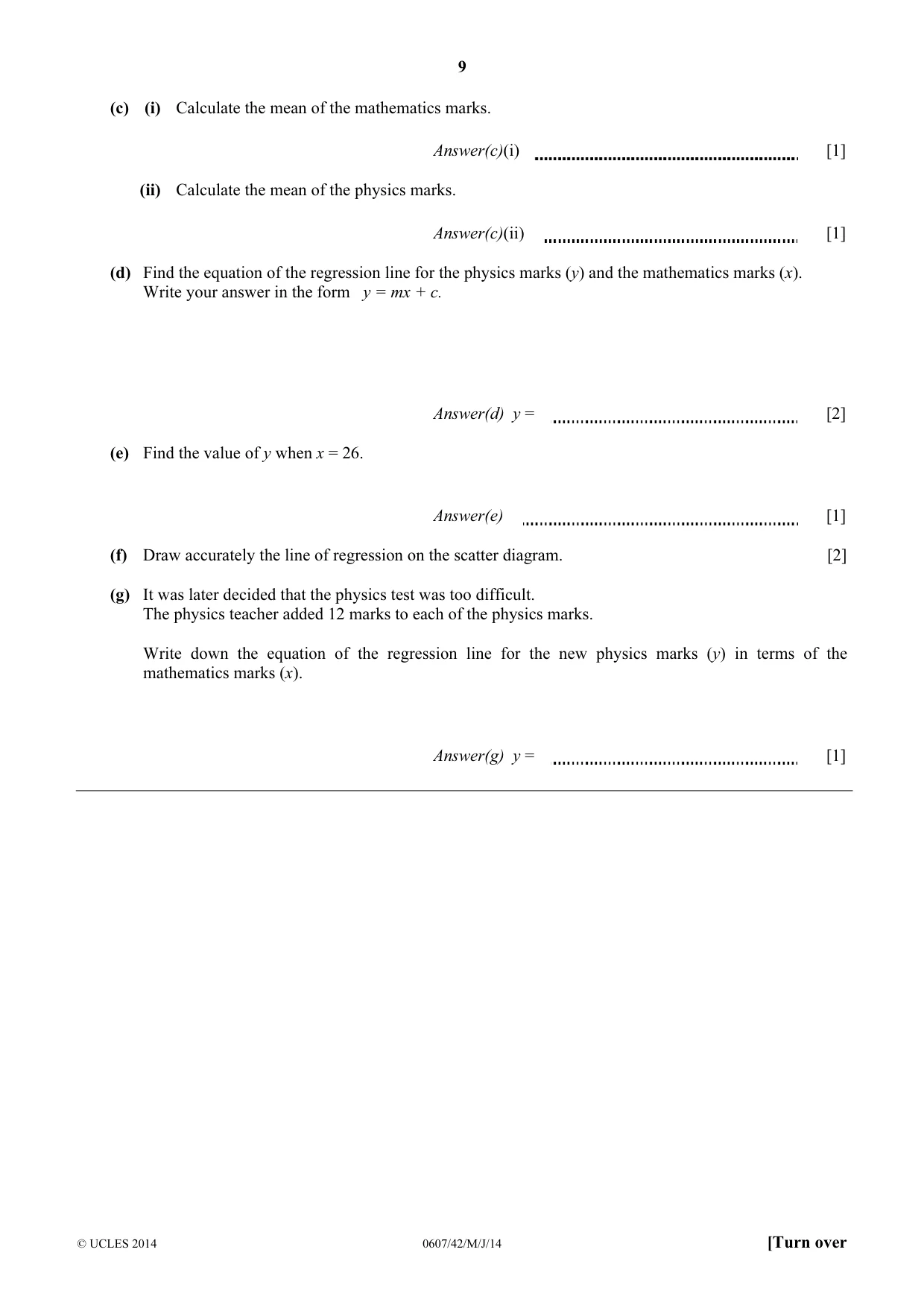
9 © UCLES 2014 0607/42/M/J/14 [Turn over (c) (i) Calculate the mean of the mathematics marks. Answer(c)(i) [1] (ii) Calculate the mean of the physics marks. Answer(c)(ii) [1] (d) Find the equation of the regression line for the physics marks (y) and the mathematics marks (x). Write your answer in the form y = mx + c. Answer(d) y = [2] (e) Find the value of y when x = 26. Answer(e) [1] (f) Draw accurately the line of regression on the scatter diagram. [2] (g) It was later decided that the physics test was too difficult. The physics teacher added 12 marks to each of the physics marks. Write down the equation of the regression line for the new physics marks (y) in terms of the mathematics marks (x). Answer(g) y = [1]
Question paper, page 10
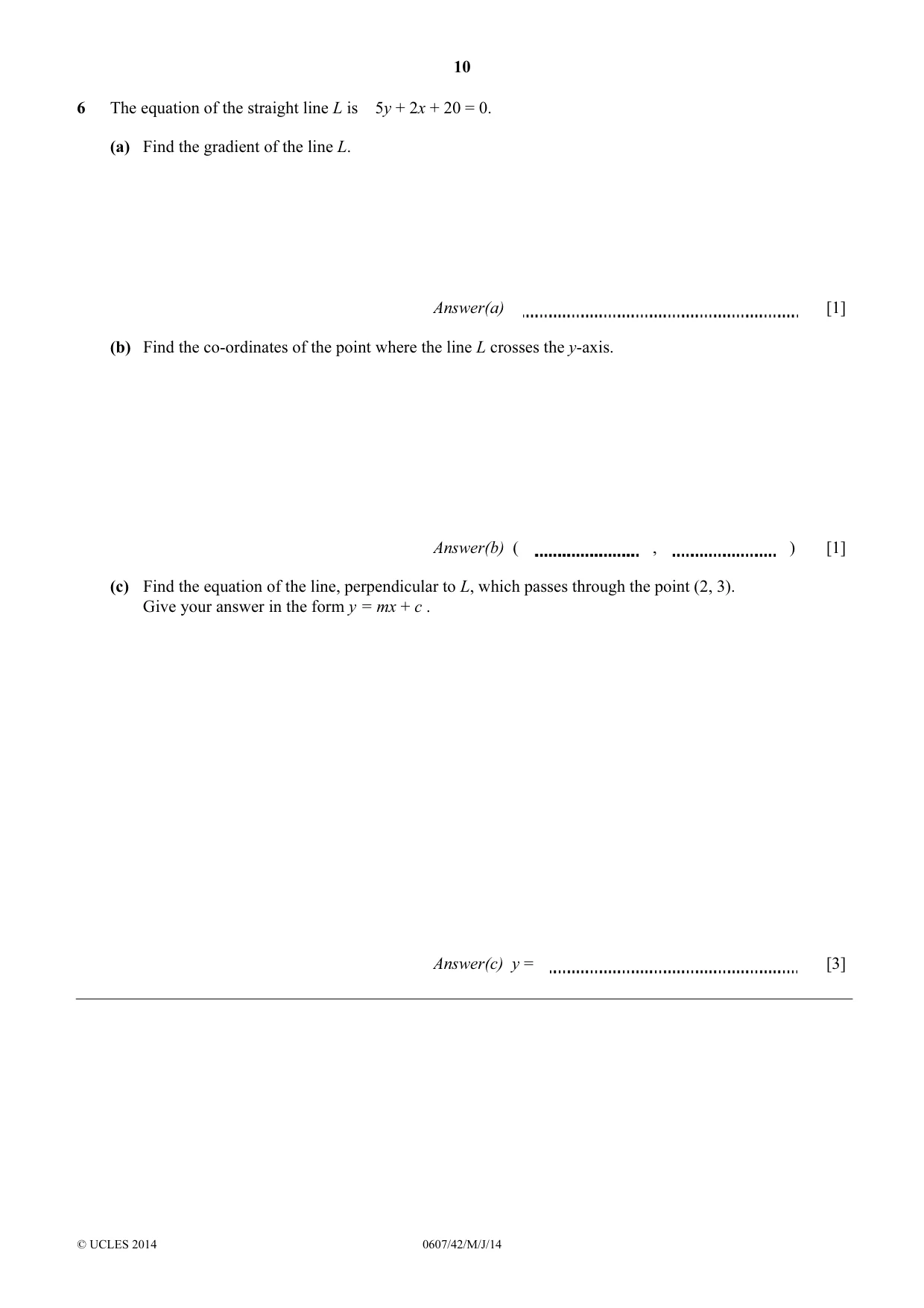
10 © UCLES 2014 0607/42/M/J/14 6 The equation of the straight line L is 5y + 2x + 20 = 0. (a) Find the gradient of the line L. Answer(a) [1] (b) Find the co-ordinates of the point where the line L crosses the y-axis. Answer(b) ( , ) [1] (c) Find the equation of the line, perpendicular to L, which passes through the point (2, 3). Give your answer in the form y = mx + c . Answer(c) y = [3]
Question paper, page 11
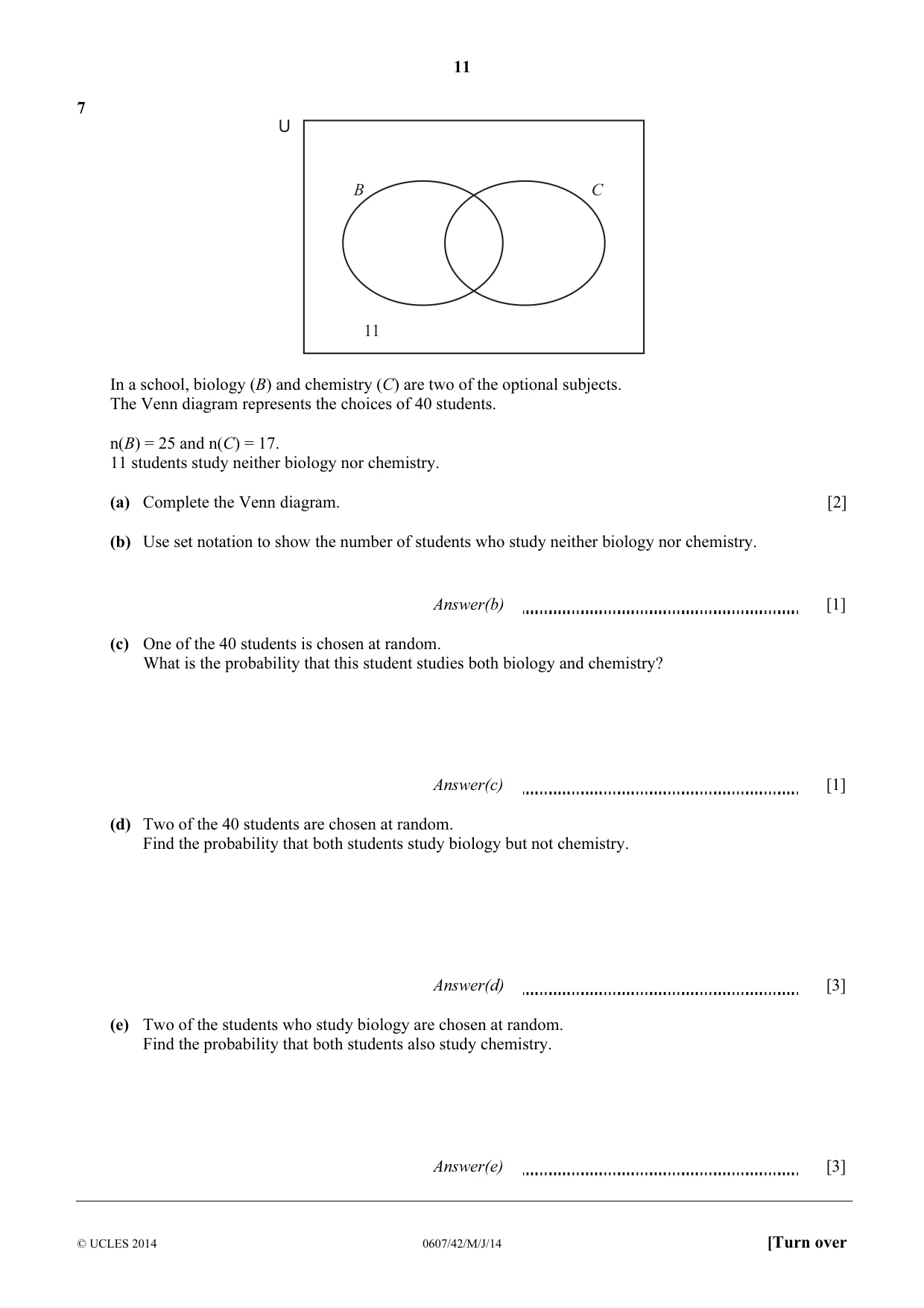
11 © UCLES 2014 0607/42/M/J/14 [Turn over 7 U B C 11 In a school, biology (B) and chemistry (C) are two of the optional subjects. The Venn diagram represents the choices of 40 students. n(B) = 25 and n(C) = 17. 11 students study neither biology nor chemistry. (a) Complete the Venn diagram. [2] (b) Use set notation to show the number of students who study neither biology nor chemistry. Answer(b) [1] (c) One of the 40 students is chosen at random. What is the probability that this student studies both biology and chemistry? Answer(c) [1] (d) Two of the 40 students are chosen at random. Find the probability that both students study biology but not chemistry. Answer(d) [3] (e) Two of the students who study biology are chosen at random. Find the probability that both students also study chemistry. Answer(e) [3]
Question paper, page 12
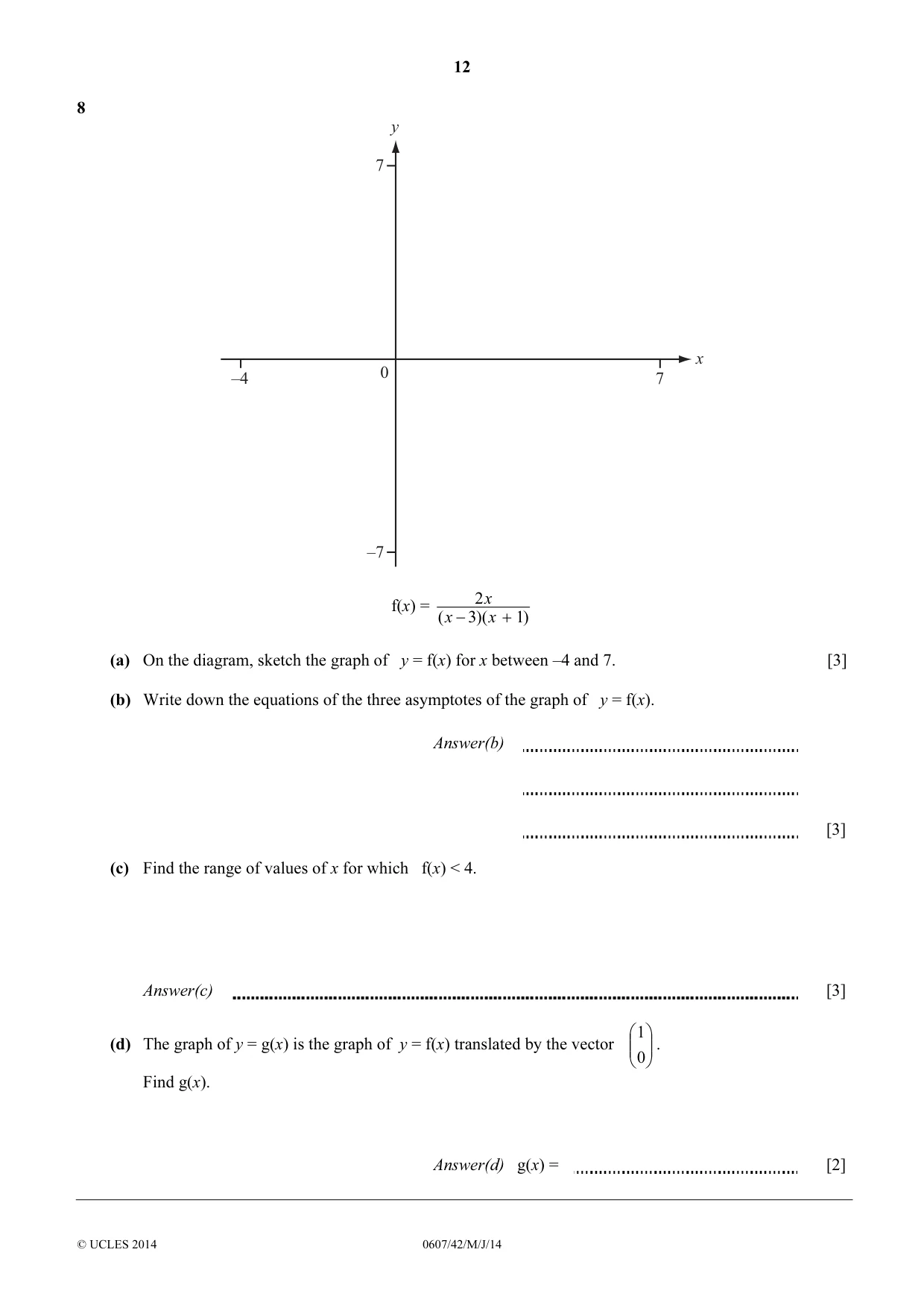
12 © UCLES 2014 0607/42/M/J/14 8 y x 7 0 –7 –4 7 f(x) = )1 )( 3 ( 2 + − x x x (a) On the diagram, sketch the graph of y = f(x) for x between –4 and 7. [3] (b) Write down the equations of the three asymptotes of the graph of y = f(x). Answer(b) [3] (c) Find the range of values of x for which f(x) < 4. Answer(c) [3] (d) The graph of y = g(x) is the graph of y = f(x) translated by the vector 0 1 . Find g(x). Answer(d) g(x) = [2]
Question paper, page 13
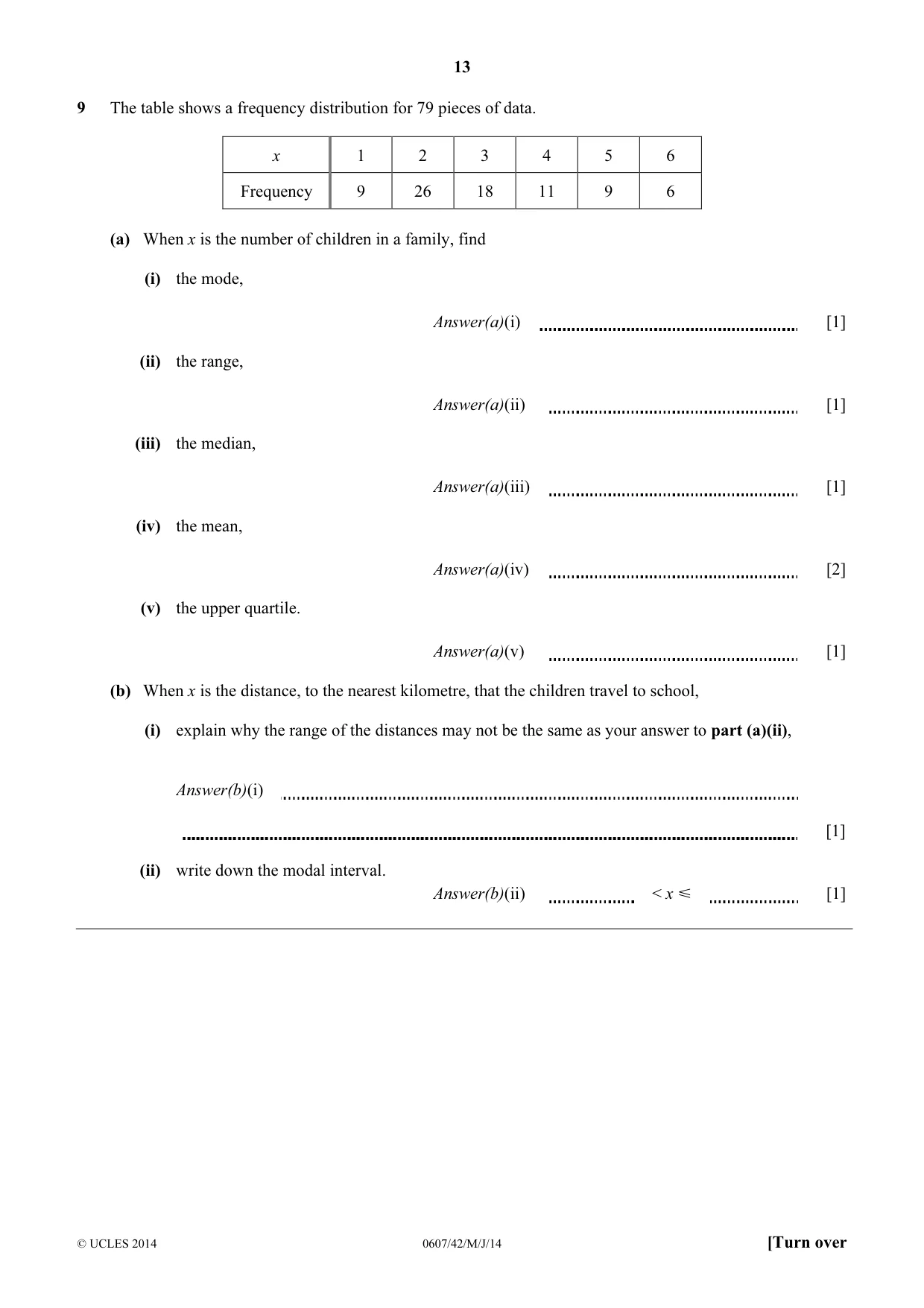
13 © UCLES 2014 0607/42/M/J/14 [Turn over 9 The table shows a frequency distribution for 79 pieces of data. x 1 2 3 4 5 6 Frequency 9 26 18 11 9 6 (a) When x is the number of children in a family, find (i) the mode, Answer(a)(i) [1] (ii) the range, Answer(a)(ii) [1] (iii) the median, Answer(a)(iii) [1] (iv) the mean, Answer(a)(iv) [2] (v) the upper quartile. Answer(a)(v) [1] (b) When x is the distance, to the nearest kilometre, that the children travel to school, (i) explain why the range of the distances may not be the same as your answer to part (a)(ii), Answer(b)(i) [1] (ii) write down the modal interval. Answer(b)(ii) < x Y [1]
Question paper, page 14
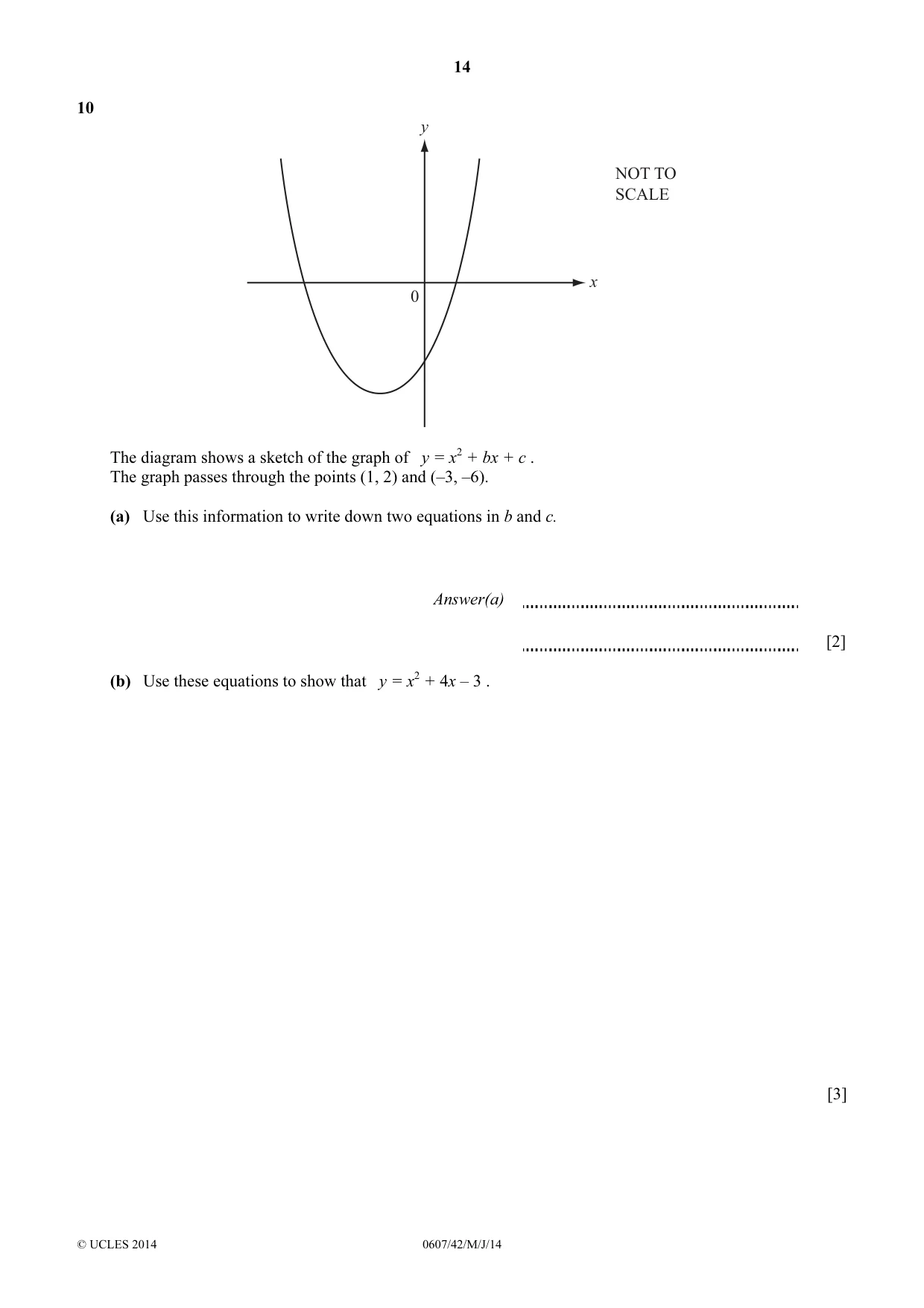
14 © UCLES 2014 0607/42/M/J/14 10 y x 0 NOT TO SCALE The diagram shows a sketch of the graph of y = x2 + bx + c . The graph passes through the points (1, 2) and (–3, –6). (a) Use this information to write down two equations in b and c. Answer(a) [2] (b) Use these equations to show that y = x2 + 4x – 3 . [3]
Question paper, page 15
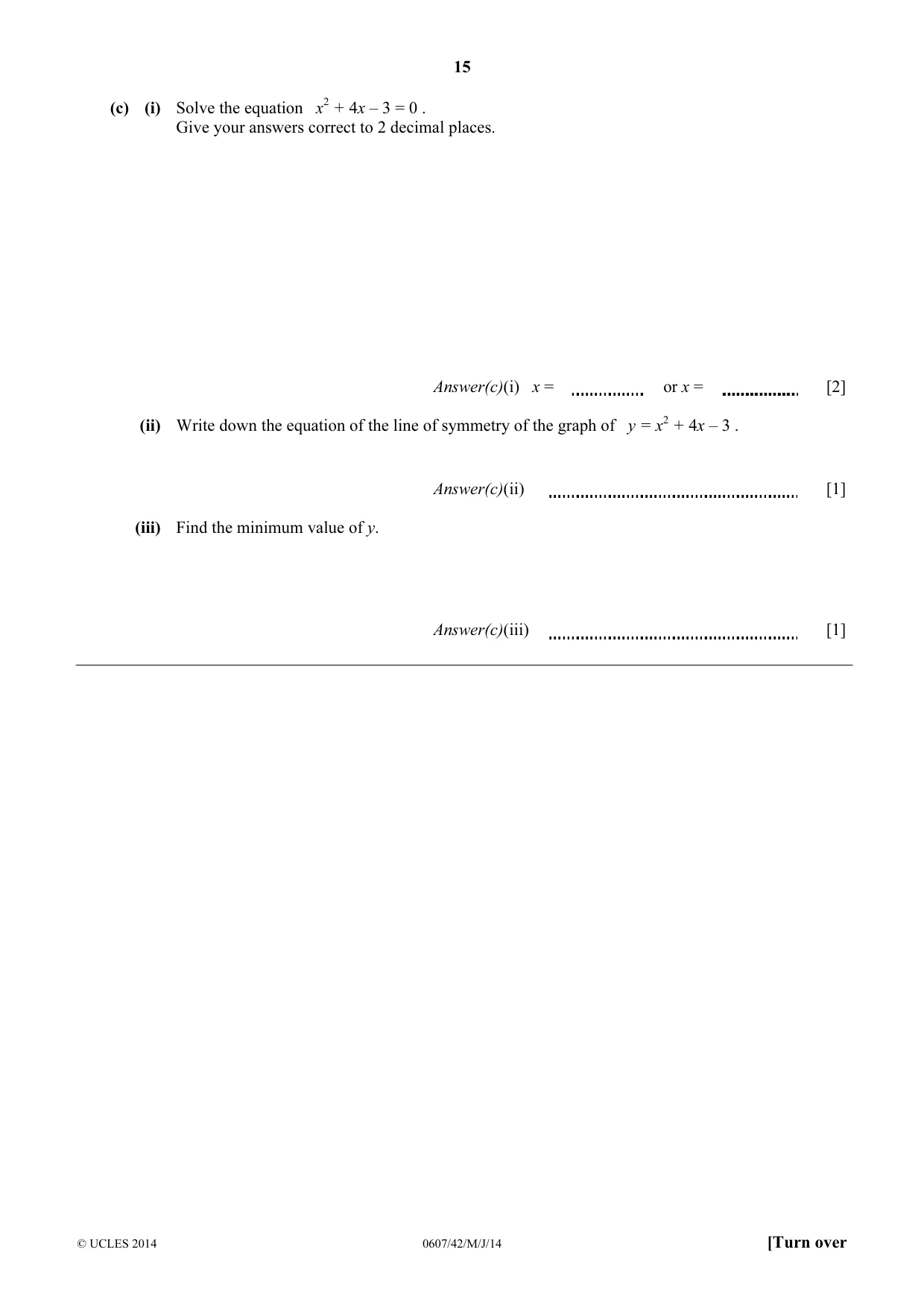
15 © UCLES 2014 0607/42/M/J/14 [Turn over (c) (i) Solve the equation x2 + 4x – 3 = 0 . Give your answers correct to 2 decimal places. Answer(c)(i) x = or x = [2] (ii) Write down the equation of the line of symmetry of the graph of y = x2 + 4x – 3 . Answer(c)(ii) [1] (iii) Find the minimum value of y. Answer(c)(iii) [1]
Question paper, page 16
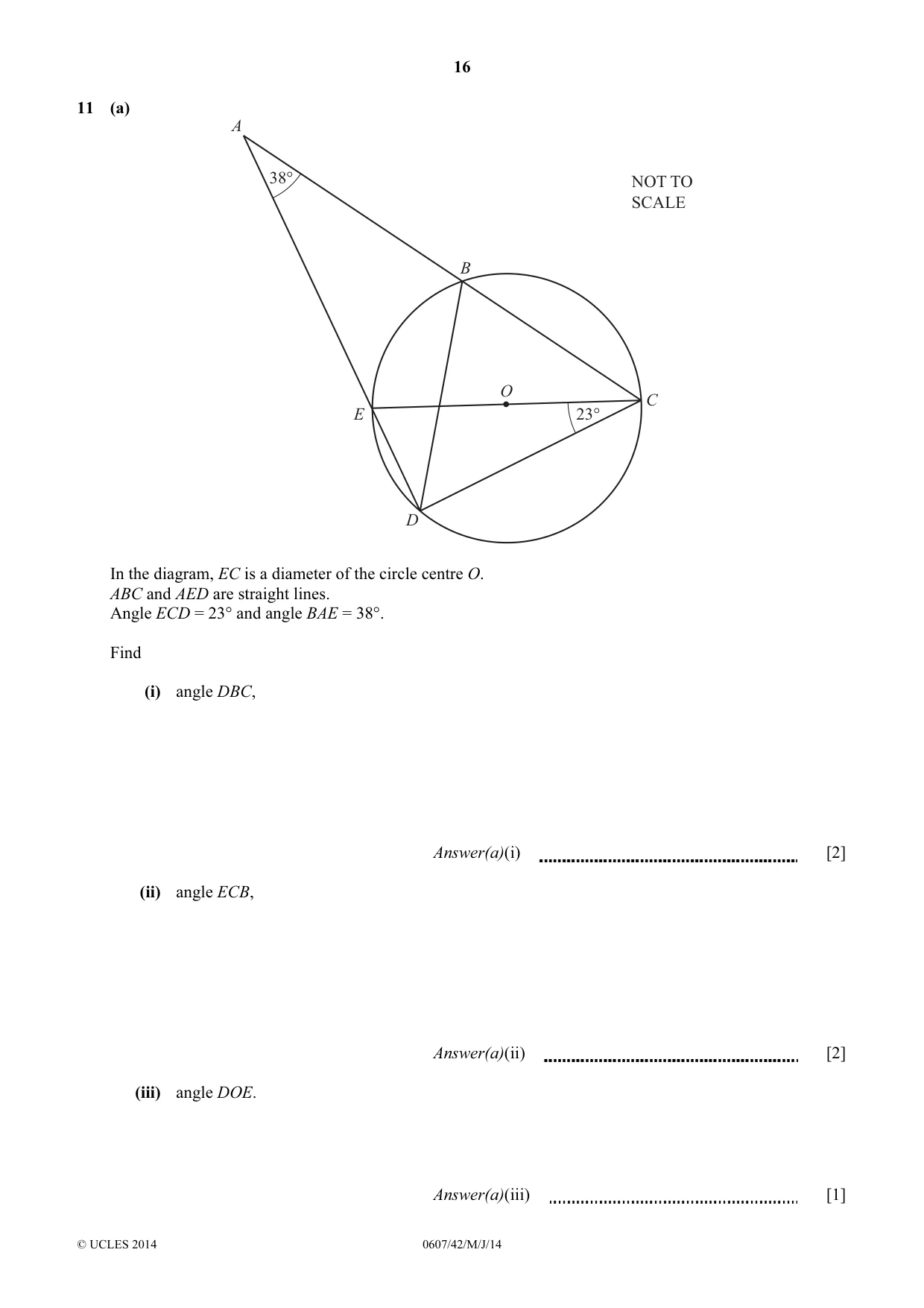
16 © UCLES 2014 0607/42/M/J/14 11 (a) O B C E D A 38° 23° NOT TO SCALE In the diagram, EC is a diameter of the circle centre O. ABC and AED are straight lines. Angle ECD = 23° and angle BAE = 38°. Find (i) angle DBC, Answer(a)(i) [2] (ii) angle ECB, Answer(a)(ii) [2] (iii) angle DOE. Answer(a)(iii) [1]
Question paper, page 17
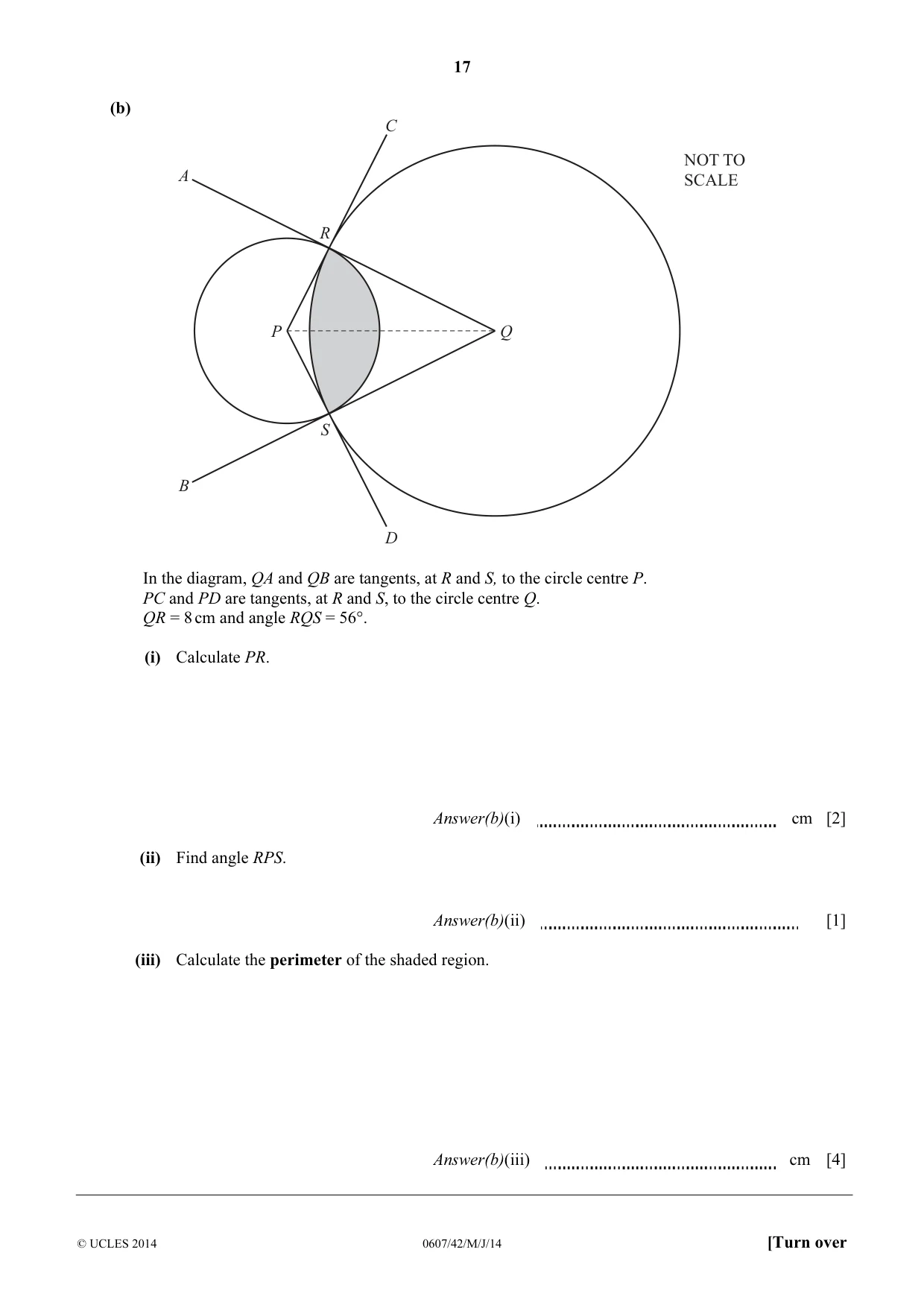
17 © UCLES 2014 0607/42/M/J/14 [Turn over (b) A B C D P Q R S NOT TO SCALE In the diagram, QA and QB are tangents, at R and S, to the circle centre P. PC and PD are tangents, at R and S, to the circle centre Q. QR = 8 cm and angle RQS = 56°. (i) Calculate PR. Answer(b)(i) cm [2] (ii) Find angle RPS. Answer(b)(ii) [1] (iii) Calculate the perimeter of the shaded region. Answer(b)(iii) cm [4]
Question paper, page 18
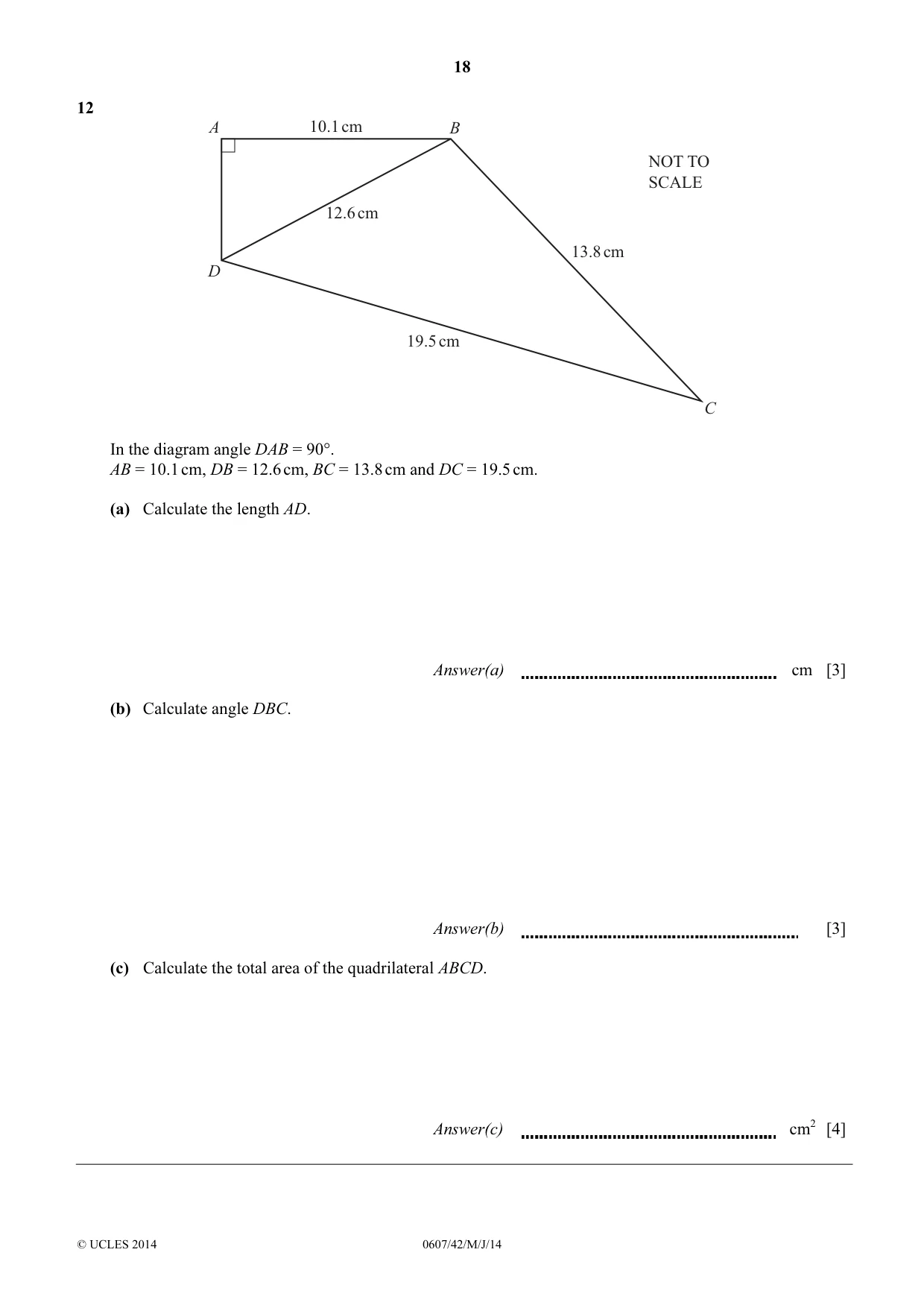
18 © UCLES 2014 0607/42/M/J/14 12 A B D C 12.6 cm 10.1 cm 13.8 cm 19.5 cm NOT TO SCALE In the diagram angle DAB = 90°. AB = 10.1 cm, DB = 12.6 cm, BC = 13.8 cm and DC = 19.5 cm. (a) Calculate the length AD. Answer(a) cm [3] (b) Calculate angle DBC. Answer(b) [3] (c) Calculate the total area of the quadrilateral ABCD. Answer(c) cm2 [4]
Question paper, page 19
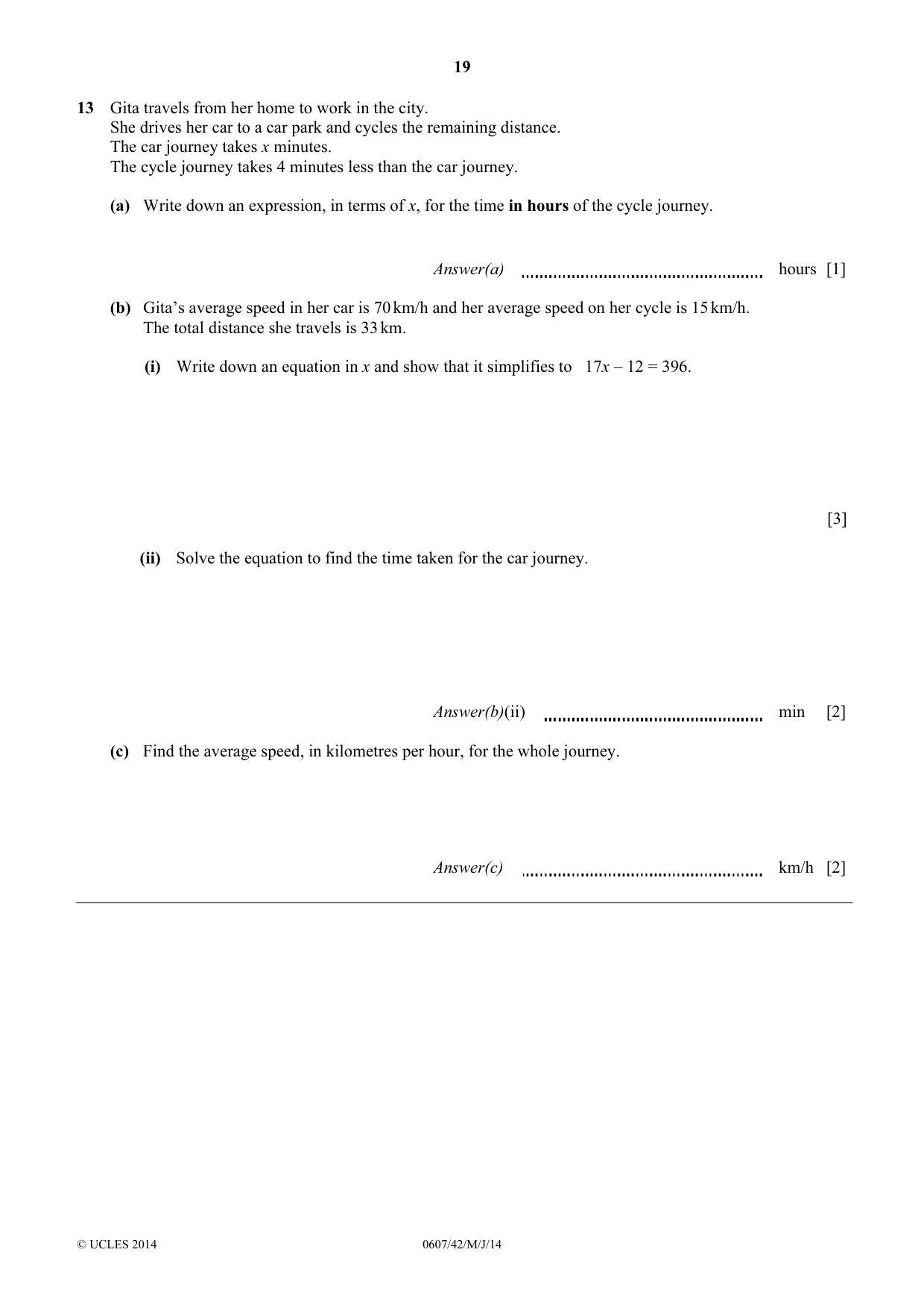
19 © UCLES 2014 0607/42/M/J/14 13 Gita travels from her home to work in the city. She drives her car to a car park and cycles the remaining distance. The car journey takes x minutes. The cycle journey takes 4 minutes less than the car journey. (a) Write down an expression, in terms of x, for the time in hours of the cycle journey. Answer(a) hours [1] (b) Gita’s average speed in her car is 70 km/h and her average speed on her cycle is 15 km/h. The total distance she travels is 33 km. (i) Write down an equation in x and show that it simplifies to 17x – 12 = 396. [3] (ii) Solve the equation to find the time taken for the car journey. Answer(b)(ii) min [2] (c) Find the average speed, in kilometres per hour, for the whole journey. Answer(c) km/h [2]
Question paper, page 20
20 Permission to reproduce items where third-party owned material protected by copyright is included has been sought and cleared where possible. Every reasonable effort has been made by the publisher (UCLES) to trace copyright holders, but if any items requiring clearance have unwittingly been included, the publisher will be pleased to make amends at the earliest possible opportunity. Cambridge International Examinations is part of the Cambridge Assessment Group. Cambridge Assessment is the brand name of University of Cambridge Local Examinations Syndicate (UCLES), which is itself a department of the University of Cambridge. © UCLES 2014 0607/42/M/J/14 BLANK PAGE
Mark scheme, page 1
CAMBRIDGE INTERNATIONAL EXAMINATIONS International General Certificate of Secondary Education MARK SCHEME for the May/June 2014 series 0607 CAMBRIDGE INTERNATIONAL MATHEMATICS 0607/42 Paper 4 (Extended), maximum raw mark 120 This mark scheme is published as an aid to teachers and candidates, to indicate the requirements of the examination. It shows the basis on which Examiners were instructed to award marks. It does not indicate the details of the discussions that took place at an Examiners’ meeting before marking began, which would have considered the acceptability of alternative answers. Mark schemes should be read in conjunction with the question paper and the Principal Examiner Report for Teachers. Cambridge will not enter into discussions about these mark schemes. Cambridge is publishing the mark schemes for the May/June 2014 series for most IGCSE, GCE Advanced Level and Advanced Subsidiary Level components and some Ordinary Level components.
Mark scheme, page 2
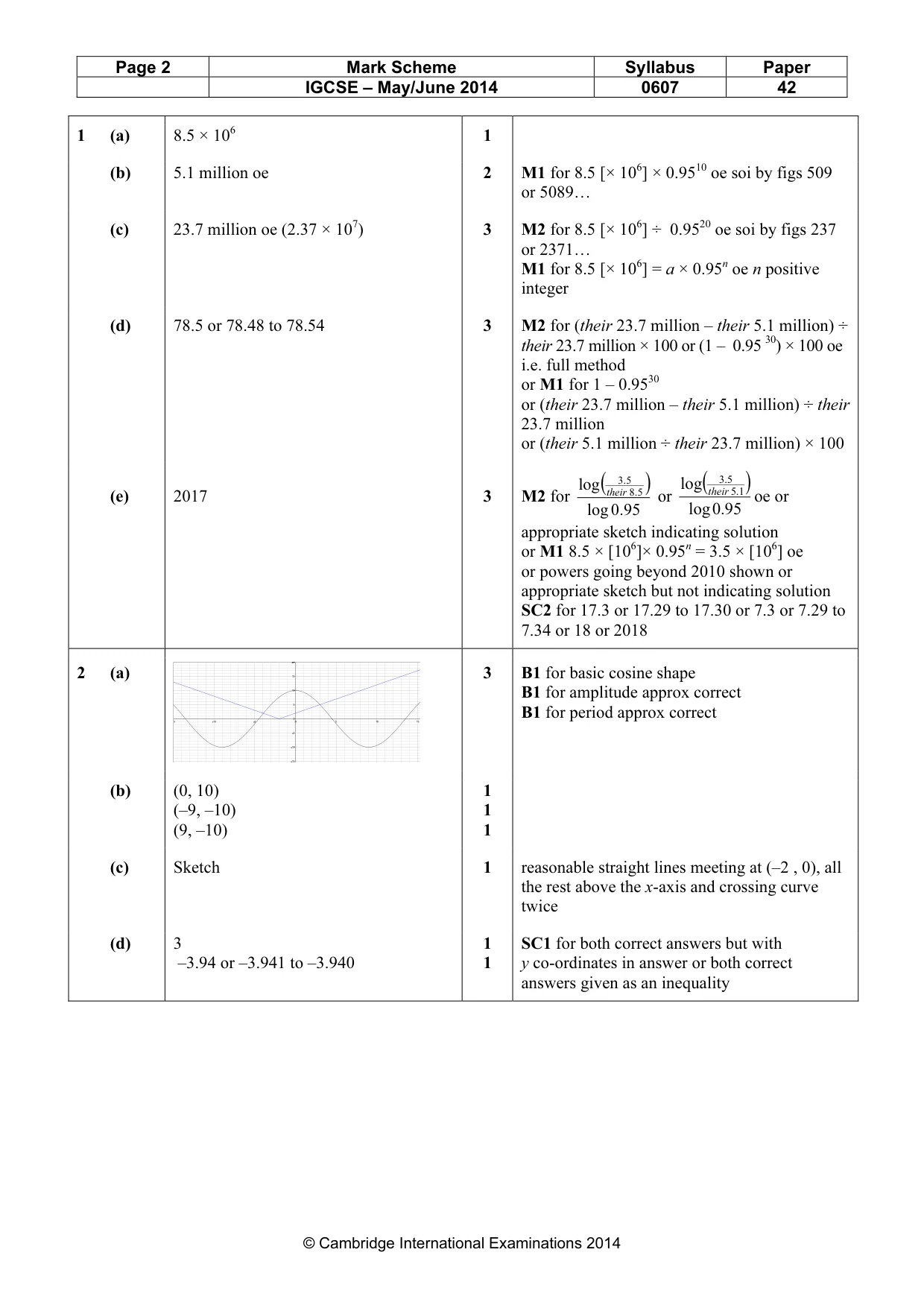
Page 2 Mark Scheme Syllabus Paper IGCSE – May/June 2014 0607 42 © Cambridge International Examinations 2014 1 (a) 8.5 × 10⁶ 1 (b) 5.1 million oe 2 M1 for 8.5 [× 106] × 0.9510 oe soi by figs 509 or 5089… (c) 23.7 million oe (2.37 × 10⁷) 3 M2 for 8.5 [× 106] ÷ 0.9520 oe soi by figs 237 or 2371… M1 for 8.5 [× 106] = a × 0.95n oe n positive integer (d) 78.5 or 78.48 to 78.54 3 M2 for (their 23.7 million – their 5.1 million) ÷ their 23.7 million × 100 or (1 – 0.95 30) × 100 oe i.e. full method or M1 for 1 – 0.9530 or (their 23.7 million – their 5.1 million) ÷ their 23.7 million or (their 5.1 million ÷ their 23.7 million) × 100 (e) 2017 3 M2 for ( ) 95 .0 log log 5.8 5.3 their or ( ) 95 .0 log log 1.5 5.3 their oe or appropriate sketch indicating solution or M1 8.5 × [106]× 0.95n = 3.5 × [106] oe or powers going beyond 2010 shown or appropriate sketch but not indicating solution SC2 for 17.3 or 17.29 to 17.30 or 7.3 or 7.29 to 7.34 or 18 or 2018 2 (a) 3 B1 for basic cosine shape B1 for amplitude approx correct B1 for period approx correct (b) (0, 10) (–9, –10) (9, –10) 1 1 1 (c) Sketch 1 reasonable straight lines meeting at (–2 , 0), all the rest above the x-axis and crossing curve twice (d) 3 –3.94 or –3.941 to –3.940 1 1 SC1 for both correct answers but with y co-ordinates in answer or both correct answers given as an inequality 15 10 5 0 -5 -10 5 20 15 10 5 0 -5 -10 -15 15 10 5 0 -5 -10 5 20 15 10 5 0 -5 -10 -15 15 10 5 0 -5 -10 5 20 15 10 5 0 -5 -10 -15 15 10 5 0 -5 -10 5 20 15 10 5 0 -5 -10 -15
Mark scheme, page 3
Page 3 Mark Scheme Syllabus Paper IGCSE – May/June 2014 0607 42 © Cambridge International Examinations 2014 3 (a) Triangle (–1, 3) (–3, 3) (–3, 4) 2 B1 for x or y movement correct. (b) Rotation 90 clockwise oe (1, 7) 5 B2 triangle drawn vertices (–5, 5) (–5, 7) (–4, 7) or SC1 FT for rotation 90 clockwise about other centre then written answers B1 Rotation B1 90 clockwise oe B1 (1, 7) If more than one transformation, these 3 B1 marks are lost 4 (a) 27.6 or 27.60 to 27.63 4 M1 for 3 3.1 π 3 2 × × (4.6[0] or 4.601 to 4.602) M1 for π × 1.3² × 3.5 (18.6 or 18.58…) M1 for 5.2 3.1 3 1 2 × × ×π (4.42 or 4.424 to 4.425) (b) 232 or 231.8 to 232.1 1FT FT their (a) × 8.4 (c) 9.2[0] or 9.197… 3 M2 for their (2.5 + 3.5 + 1.3) × 3 2 oe or M1 for s.f. = 3 2 oe (1.25992…) 5 (a) 5 Points plotted 2 ± 2 1 small square B1 for 3 or 4 correct (b) Positive 1 Ignore comment on strength (c) (i) 42.1 or 42.06 to 42. 07 1 (ii) 29.6 1 (d) [y =] 0.665x + 1.64 or 0.6646 to 0.6647 and 1.638 to 1.639 2 B1 for either a or b correct or SC1 for 0.66x + 1.6 (e) 18.9 or 18.91 to 18.93 1FT FT their (d) (f) Correct ruled line 2 M1 for line through their mean point plotted or B1 for correct freehand line (g) 0.665x + 13.6 their (0.665x + 1.64) + 12 oe 1FT 6 (a) – 0.4 oe 1 (b) (0, – 4) 1 (c) 2.5x – 2 oe 3 M1 FT for 2.5 or –1/ their (a) M1 for substituting (2, 3) into their y = 2.5x + c or y – 3 = m(x – 2)
Mark scheme, page 4
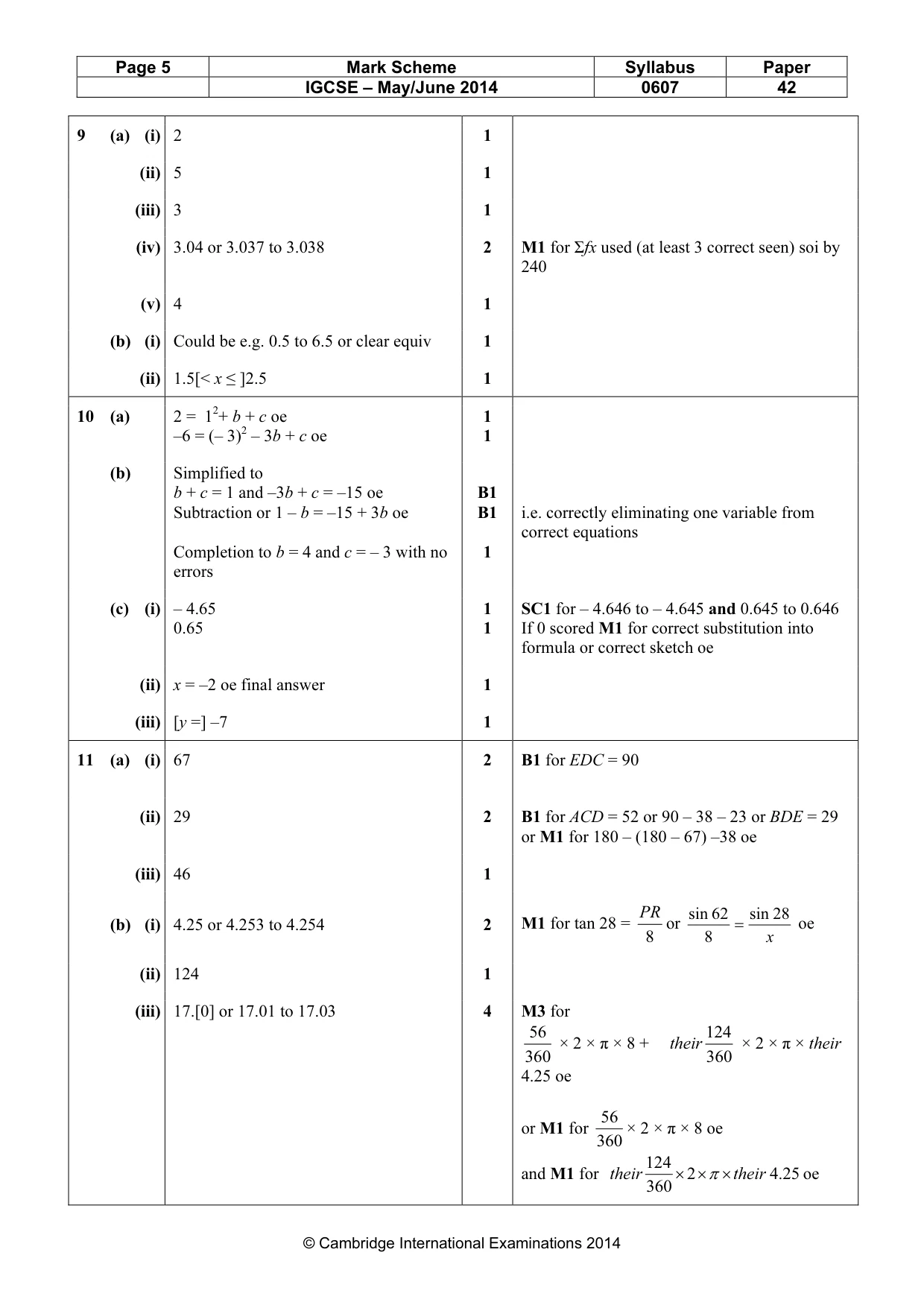
Page 4 Mark Scheme Syllabus Paper IGCSE – May/June 2014 0607 42 © Cambridge International Examinations 2014 7 (a) 12 13 4 2 M1 for 53 – x = 40 oe or 25 + 17 – x = 29 oe soi by 25 + 17 – 29 oe or 13 (b) n(B ∪ C)' oe 1 e.g. n(B' ∩ C') isw = any value (c) 40 13 1FT In parts (c), (d), (e) do not penalise incorrect cancelling or converting. No ratios or words are accepted. If decimal forms, usual 3 sig fig rule applies. FT 40 13 their (d) 130 11 oe 3 M2 for 40 12 their × 39 11 their or M1 for 40 x × 39 1 − x (e) 50 13 oe 3 M2 for 25 13 their their × 24 12 their their or M1 for 25 their x × 24 1 their x − 8 (a) 3 B1 for each branch SC2 for correct but branches joined (b) x = –1 x = 3 y = 0 1 1 1 (c) x < –1 –0.886[0…] < x < 3 x > 3.39 or 3.386…) 1 1 1 Condone Y throughout (d) ( ) ( )x x x 4 1 2 − − oe final answer 2 M1 for clear attempt to substitute x – 1 for x at least twice or SC1 for ( ) ( )( ) 2 2 1 2 + − + x x x 6 4 2 0 -2 4 6 4 2 0 -2 -4 -6 6 4 2 0 -2 4 6 4 2 0 -2 -4 -6 6 4 2 0 -2 4 6 4 2 0 -2 -4 -6 6 4 2 0 -2 4 6 4 2 0 -2 -4 -6
Mark scheme, page 5
Page 5 Mark Scheme Syllabus Paper IGCSE – May/June 2014 0607 42 © Cambridge International Examinations 2014 9 (a) (i) 2 1 (ii) 5 1 (iii) 3 1 (iv) 3.04 or 3.037 to 3.038 2 M1 for Σfx used (at least 3 correct seen) soi by 240 (v) 4 1 (b) (i) Could be e.g. 0.5 to 6.5 or clear equiv 1 (ii) 1.5[< x ≤ ]2.5 1 10 (a) 2 = 12+ b + c oe –6 = (– 3)2 – 3b + c oe 1 1 (b) Simplified to b + c = 1 and –3b + c = –15 oe Subtraction or 1 – b = –15 + 3b oe Completion to b = 4 and c = – 3 with no errors B1 B1 1 i.e. correctly eliminating one variable from correct equations (c) (i) – 4.65 0.65 1 1 SC1 for – 4.646 to – 4.645 and 0.645 to 0.646 If 0 scored M1 for correct substitution into formula or correct sketch oe (ii) x = –2 oe final answer 1 (iii) [y =] –7 1 11 (a) (i) 67 2 B1 for EDC = 90 (ii) 29 2 B1 for ACD = 52 or 90 – 38 – 23 or BDE = 29 or M1 for 180 – (180 – 67) –38 oe (iii) 46 1 (b) (i) 4.25 or 4.253 to 4.254 2 M1 for tan 28 = 8 PR or x 28 sin 8 62 sin = oe (ii) 124 1 (iii) 17.[0] or 17.01 to 17.03 4 M3 for 360 56 × 2 × π × 8 + 360 124 their × 2 × π × their 4.25 oe or M1 for 360 56 × 2 × π × 8 oe and M1 for 25 .4 2 360 124 their their × × × π oe
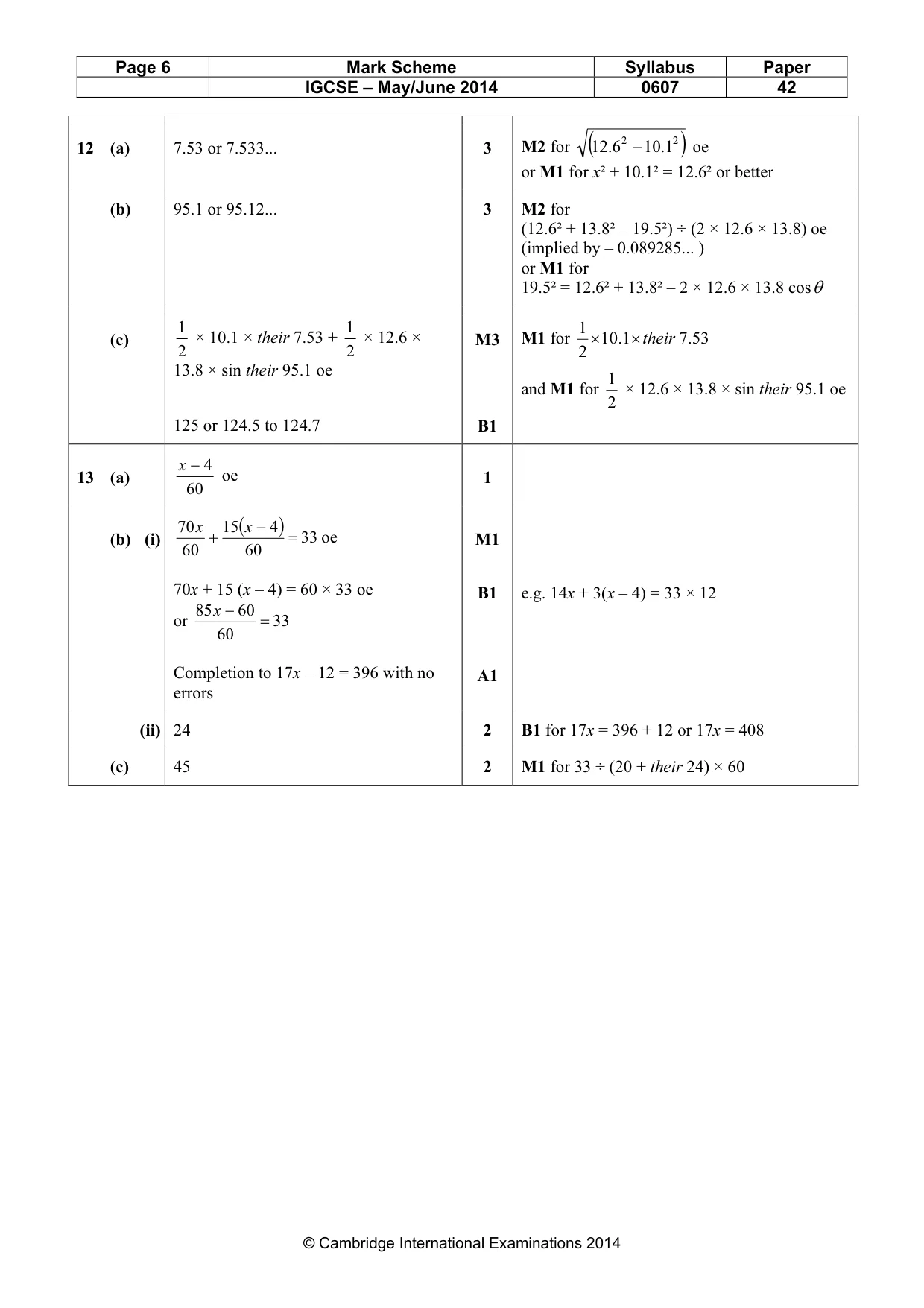
Mark scheme, page 6
Page 6 Mark Scheme Syllabus Paper IGCSE – May/June 2014 0607 42 © Cambridge International Examinations 2014 12 (a) 7.53 or 7.533... 3 M2 for ( ) 2 2 1. 10 6. 12 − oe or M1 for x² + 10.1² = 12.6² or better (b) 95.1 or 95.12... 3 M2 for (12.6² + 13.8² – 19.5²) ÷ (2 × 12.6 × 13.8) oe (implied by – 0.089285... ) or M1 for 19.5² = 12.6² + 13.8² – 2 × 12.6 × 13.8 cosθ (c) 2 1 × 10.1 × their 7.53 + 2 1 × 12.6 × 13.8 × sin their 95.1 oe 125 or 124.5 to 124.7 M3 B1 M1 for 7.53 1. 10 2 1 their × × and M1 for 2 1 × 12.6 × 13.8 × sin their 95.1 oe 13 (a) 60 4 − x oe 1 (b) (i) ( ) 33 60 4 15 60 70 = − + x x oe 70x + 15 (x – 4) = 60 × 33 oe or 33 60 60 85 = − x Completion to 17x – 12 = 396 with no errors M1 B1 A1 e.g. 14x + 3(x – 4) = 33 × 12 (ii) 24 2 B1 for 17x = 396 + 12 or 17x = 408 (c) 45 2 M1 for 33 ÷ (20 + their 24) × 60
What you needed in this session
Cambridge’s own grade thresholds for 2014 May/June, Paper 4 · Variant 2. A higher threshold means an easier paper — the bar moves with how the cohort did.