Questions as text
Q1 · Do not use a calculator in this question 0606/21 May/June 2018
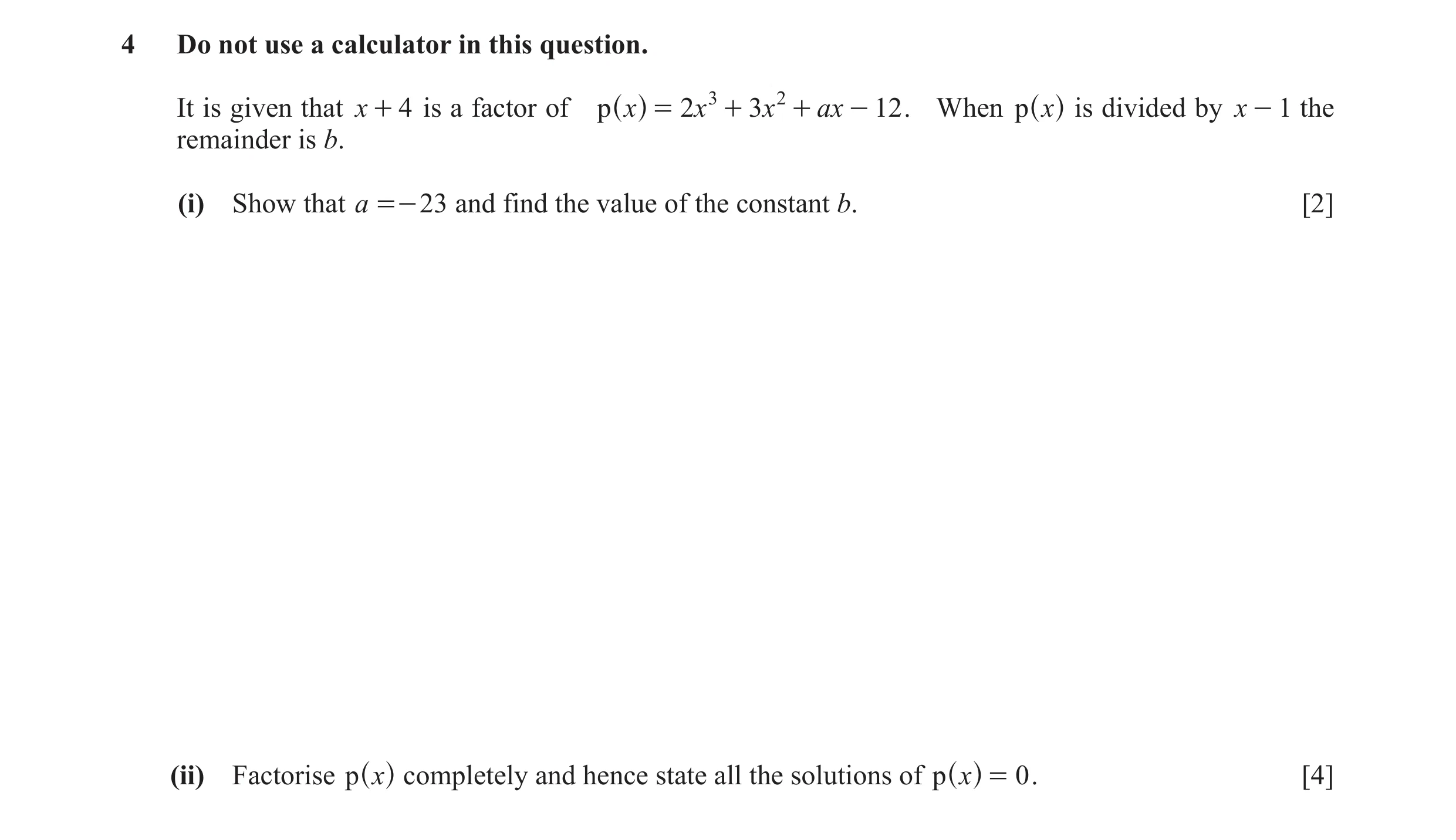
4 Do not use a calculator in this question. It is given that x + 4 is a factor of p x = 2x 3 + 3x 2 + ax - 12 . When x is divided by x - 1 the ^ h p^ h remainder is b. (i) Show that a =- 23 and find the value of the constant b. [2] (ii) Factorise x completely and hence state all the solutions of p x = 0 . [4] p^ h ^ h
6 marks
Mark scheme: 4(i) 2( − 4) 3 + 3 ( − 4 )2 − 4 a − 12 = 0 with one B1 Note: = 0 must be seen or may be implied by e.g. −92 = 4a or 92 = −4a correct interim step leading to a = −23 or convincingly showing that 2( − 4) 3 + 3 ( − 4 )2 − 4( − 23) − 12 = 0 or correct synthetic division at least as far as −4 2 3 a −12 −8 20 −4 a − 80 2 −5 a + 20 0 then a = −23 or correct long division to, e.g. verify −23, at least as far as 2 x 2 − 5 x − 3 x + 4 2 x 3 + 3 x 2 − 23 x − 12 2 x 3 + 8 x 2 − 5 x 2 − 23 x − 5 x 2 − 20 x − 3 x − 12 −3 x − 12 0 p(1) = 2 + 3 − 23 − 12 B1 b = −30 4(ii) finds a correct quadratic factor B2 B1 for quadratic factor with 2 correct terms e.g. (2x2 − 5x – 3) OR B1for finding (x – 3) using factor theorem B1for convincingly finding (2x + 1) as third factor Product of three linear factors M1 (2x + 1)(x – 3)(x + 4) 1 A1 If M0 then SC1 if quadratic factorised correctly but x = − , x = 3, x = − 4 nfww does not show full factorisation but does give all 3 2 solutions correctly
This question in 0606/21 May/June 2018
Q2 · Do not use a calculator in this question 0606/23 May/June 2018
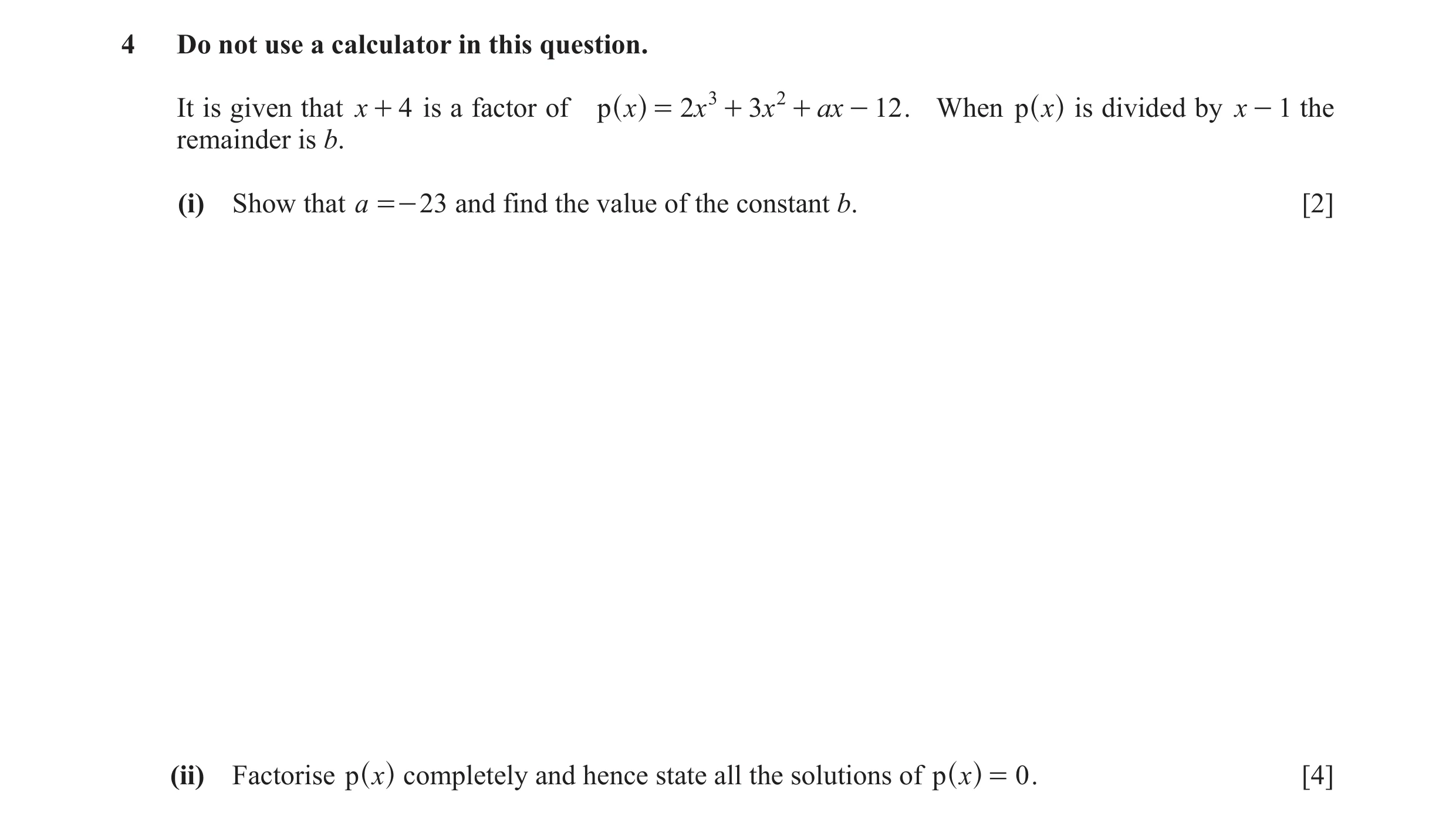
4 Do not use a calculator in this question. It is given that x + 4 is a factor of p x = 2x 3 + 3x 2 + ax - 12 . When x is divided by x - 1 the ^ h p^ h remainder is b. (i) Show that a =- 23 and find the value of the constant b. [2] (ii) Factorise x completely and hence state all the solutions of p x = 0 . [4] p^ h ^ h
6 marks
Mark scheme: 4(i) 2( − 4) 3 + 3 ( − 4 )2 − 4 a − 12 = 0 with one B1 Note: = 0 must be seen or may be implied by e.g. −92 = 4a or 92 = −4a correct interim step leading to a = −23 or convincingly showing that 2( − 4) 3 + 3 ( − 4 )2 − 4( − 23) − 12 = 0 or correct synthetic division at least as far as −4 2 3 a −12 −8 20 −4 a − 80 2 −5 a + 20 0 then a = −23 or correct long division to, e.g. verify −23, at least as far as 2 x 2 − 5 x − 3 x + 4 2 x 3 + 3 x 2 − 23 x − 12 2 x 3 + 8 x 2 − 5 x 2 − 23 x − 5 x 2 − 20 x − 3 x − 12 −3 x − 12 0 p(1) = 2 + 3 − 23 − 12 B1 b = −30 4(ii) finds a correct quadratic factor B2 B1 for quadratic factor with 2 correct terms e.g. (2x2 − 5x – 3) OR B1for finding (x – 3) using factor theorem B1for convincingly finding (2x + 1) as third factor Product of three linear factors M1 (2x + 1)(x – 3)(x + 4) 1 A1 If M0 then SC1 if quadratic factorised correctly but x = − , x = 3, x = − 4 nfww does not show full factorisation but does give all 3 2 solutions correctly
This question in 0606/23 May/June 2018
Q3 · Use the factor theorem to show that 2x - 1 is a factor of p ()x , where p ()x = 4x 3 + 9x… 0606/21 Oct/Nov 2019
7 (a) (i) Use the factor theorem to show that 2x - 1 is a factor of p ()x , where p ()x = 4x 3 + 9x - 5 . [1] (ii) Write p ()x as a product of linear and quadratic factors. [2] (b) (i) Show that 13 tan x sec x - 4 sin x - 5 sec 2 x = 0 can be written as 4 sin 3 x + 9 sin x - 5 = 0 . [3] (ii) Using your answers to part (a)(ii) and part (b)(i) solve the equation 13 tan x sec x - 4 sin x - 5 sec 2 x = 0 for 0 1 x 1 2 r radians. [4]
10 marks
Mark scheme: 7(a)(i) f ( 0.5 ) = 0.5 + 4.5 − 5 = 0 B1 7(a)(ii) Factorise to obtain 2 x 2 and 5 M1 2 x + x + 5 ( 2 x − 1)( 2 A1 ) 7(b)(i) sin x 1 M1 sin x 5 Replace tan x by and sec x by 13 − 4sin x − = 0 cos x cos x cos 2 x cos 2 x Uses cos 2 x = 1 − sin 2 x M1 13sin x − 4sin x 1 − sin 2 x − 5 = 0 ( ) 4sin 3 x + 9sinx − 5 = 0 A1 Completed correctly 7(b)(ii) 2sin 2 x + sinx + 5 = 0 no real roots B1 Suitable statement seen 2sinx −=1 0 M1 Attempt to solve π A1 x = 6 5 π A1 x = 6
This question in 0606/21 Oct/Nov 2019
Q4 · DO NOT USE A CALCULATOR IN THIS QUESTION 0606/21 May/June 2020
3 DO NOT USE A CALCULATOR IN THIS QUESTION. p( )x = 15x 3 + 22x 2 - 15 x + 2 (a) Find the remainder when p ( )x is divided by x + 1. [2] (b) (i) Show that x + 2 is a factor of p ( )x . [1] (ii) Write p ( )x as a product of linear factors. [3]
6 marks
Mark scheme: 3(a) Finds p (– 1) M1 24 A1 3(b)(i) p (– 2) = B1 15 (– 8) + 22(4) – 15 (– 2) + 2 = 0 3(b)(ii) Attempt to find the quadratic factor M1 15x2 – 8x + 1 A1 (x + 2)(3x – 1)(5x – 1) oe, cao A1 If zero scored, SC1 for an answer of (x + 2)(3x – 1)(5x – 1) without working.
This question in 0606/21 May/June 2020
Q5 · The polynomial p ( x) = mx 3 - 29 x 2 + 39x + n , where m and n are constants, has a… 0606/22 May/June 2021
4 The polynomial p ( x) = mx 3 - 29 x 2 + 39x + n , where m and n are constants, has a factor 3x - 1, and remainder 6 when divided by x - 1. Show that x - 2 is a factor of p ( x) . [6]
6 marks
Mark scheme: 4 m 29 39 B1 − + + n = 0 oe 27 9 3 m – 29 + 39 + n = 6 oe B1 Eliminates one unknown correctly for a M1 pair of linear equations in m and n and solves for one unknown m = 6, n = −10 A2 A1 for either [p(2) =] 48 – 116 + 78 – 10 = 0 oe, A1 nfww
This question in 0606/22 May/June 2021
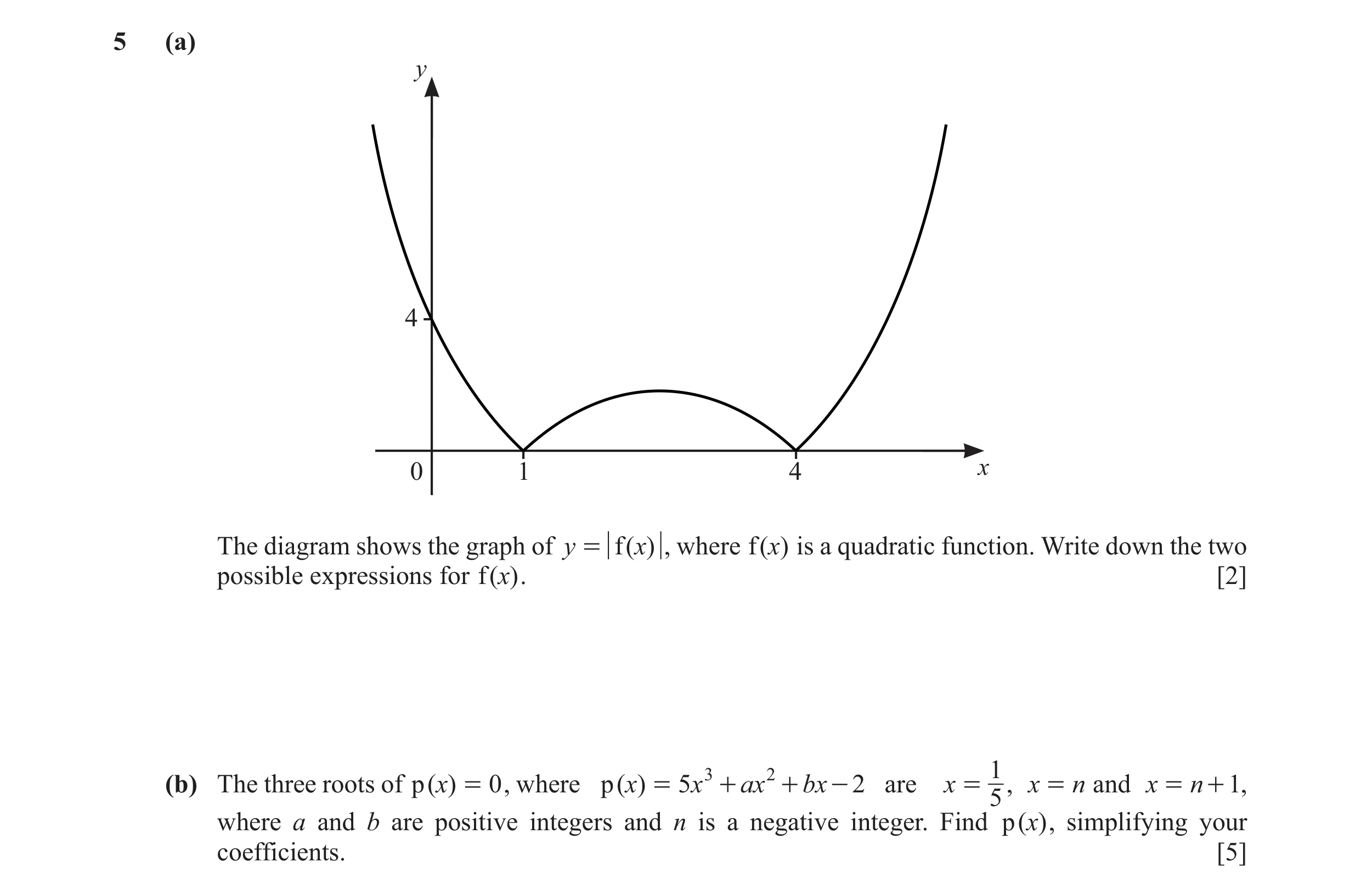
Q6 · Y 4 0 1 4 x The diagram shows the graph of y = f ( x) , where f ( x) is a quadratic… 0606/22 Feb/March 2022
5 (a) y 4 0 1 4 x The diagram shows the graph of y = f ( x) , where f ( x) is a quadratic function. Write down the two possible expressions for f ( x) . [2] 3 2 1 (b) The three roots of p ( x) = 0 , where p ( x) = 5x + ax + bx - 2 are x = , x = n and x = n + 1, 5 where a and b are positive integers and n is a negative integer. Find p ( x) , simplifying your coefficients. [5]
7 marks
Mark scheme: 5(a) f ( x ) = ( x − 1)( x − 4) oe and B2 B1 for either correct f ( x ) = − ( x − 1)( x − 4) oe 5(b) Factorised form: B1 (5 x − 1)( x − n )( x − ( n + 1)) oe their −×1 ( − n ) × ( − ( n + 1)) = −2 M1 n = −2 as the only valid solution A1 Multiplies out (5 x − 1)( x + 2)( x + 1) M1 5 x 3 + 14 x 2 + 7 x − 2 A1 or a = 14 and b = 7 following n = −2 Alternative method 1: Factorised form: (B1) (5 x − 1)( x − n )( x − ( n + 1)) oe Multiplies out (M1) 5 x 3 + ( −10 n − 6) x 2 + (5 n 2 + 7 n + 1) x − ( n 2 + n ) their (n2 + n) = 2 oe (M1) n = −2 as the only valid solution (A1) 5 x 3 + 14 x 2 + 7 x − 2 (A1) or a = 14 and b = 7 following n = −2 5(b) Alternative method 2: Using product of roots: (M1) 1 − 2 n ( n + 1) = − oe 5 5 n = −2 as the only valid solution (A1) Using sum of roots and/or sum of products (M1) of pairs of roots, solves to find a or b: 1 a + n + n + 1 = − oe and/or 5 5 1 1 b ( n ) + n ( n + 1) + ( n + 1) = 5 5 5 a = 14 or b = 7 (A1) 5 x 3 + 14 x 2 + 7 x − 2 (A1) or a = 14 and b = 7 following n = −2 If 0 scored for any method, SC3 for 1 3 1 2 1 5 + a + b − 2 = 0 oe 5 5 5 and 5 n 3 + an 2 + bn − 2 = 0 oe or 5 ( n + 1) 3 + a ( n + 1) 2 + b ( n + 1) − 2 = 0 oe leading to a = 14, b = 7 with n = −1 or n not stated 1 3 1 2 1 or SC1 for 5 + a + b − 2 = 0 oe or 5 5 5 5 n 3 + an 2 + bn − 2 = 0 oe or or 5 ( n + 1) 3 + a ( n + 1) 2 + b ( n + 1) − 2 = 0 oe
This question in 0606/22 Feb/March 2022
Q7 · The polynomial p ( )x = mx 3 - 17 x 2 + nx + 6 has a factor x - 3 0606/21 May/June 2022
4 The polynomial p ( )x = mx 3 - 17 x 2 + nx + 6 has a factor x - 3. It has a remainder of - 12 when divided by x + 1. Find the remainder when p ( )x is divided by x - 2. [6]
6 marks
Mark scheme: 4 27m – 153 + 3n + 6 = 0 or better B1 m – 17 – n + 6 = 12 or better B1 Eliminates one unknown for a pair of linear equations in M1 m and n and solves for one unknown m = 6, n = 5 A2 A1 for either 24 cao A1
This question in 0606/21 May/June 2022
Q8 · The polynomial p ( x) is such that p ( x) = 6x 3 + ax 2 - 52x + b , where a and b are… 0606/23 May/June 2022
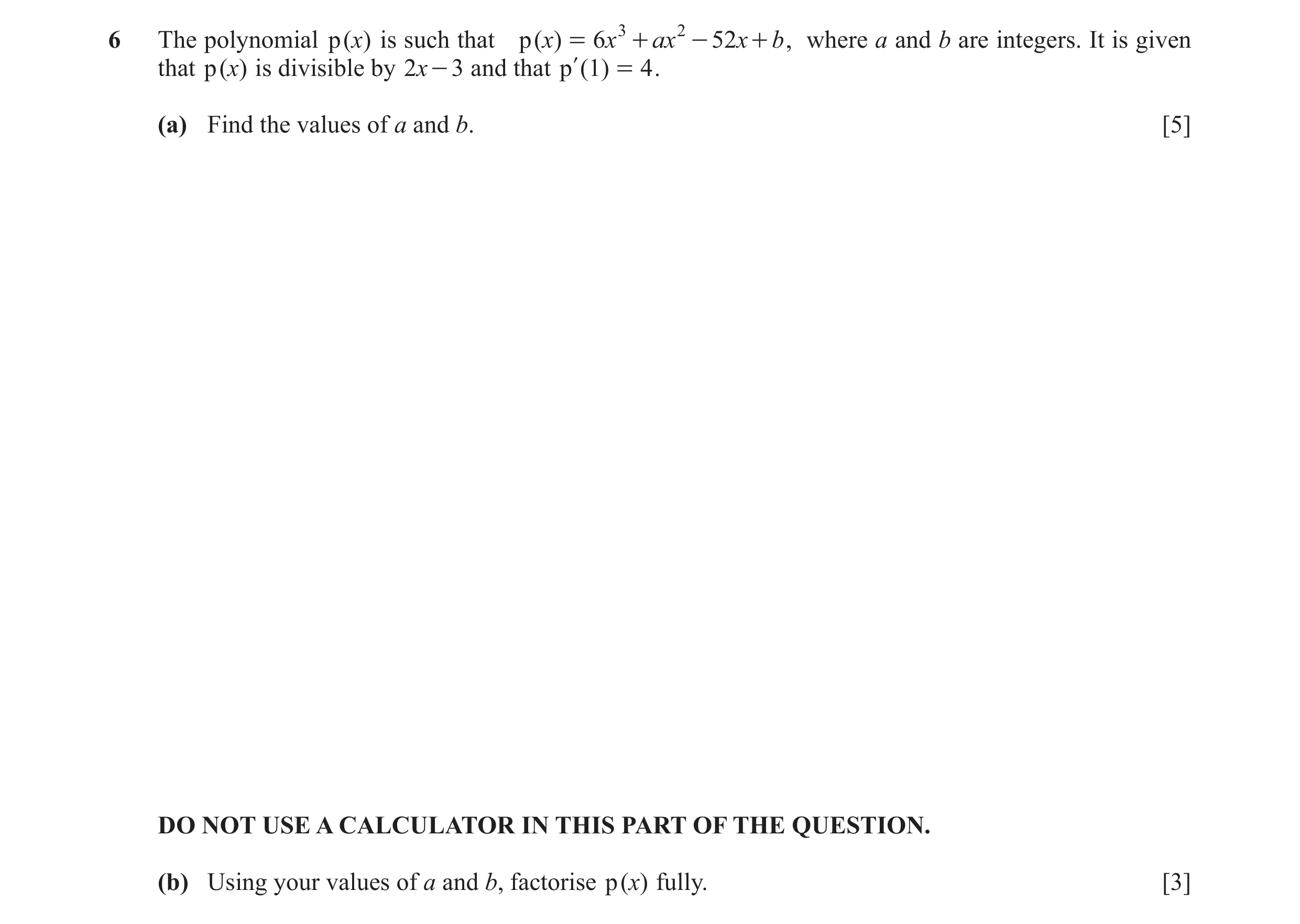
6 The polynomial p ( x) is such that p ( x) = 6x 3 + ax 2 - 52x + b , where a and b are integers. It is given that p ( x) is divisible by 2x - 3 and that p l ( 1) = 4 . (a) Find the values of a and b. [5] DO NOT USE A CALCULATOR IN THIS PART OF THE QUESTION. (b) Using your values of a and b, factorise p ( x) fully. [3]
8 marks
Mark scheme: 6(a) p x : 18 x 2 2 ax 52 B1 18 + 2a – 52 = 4 M1 FT if at least 2 terms correct in derivative and has a term in a a 19 A1 Correct method to find b M1 FT their integer value of a if used 6 27 9(19) 52 3 b 0 9(19) 4b 231 8 4 2 81 171 or 78 b 0 oe 4 4 or correct elimination of a using 9 a 4b 231 oe and 2a – 34 = 4 oe b 15 A1 If 0 scored, SC1 for 9 a 4b 231 or 81 9 a 9 231 78 b 0 or a b 4 4 4 4 oe 6(b) 2 M2 M1 for two terms correct in quadratic 3 x 14 x 5 p x 2 x 3 factor 2 x 3 3 x 1 x 5 A1
This question in 0606/23 May/June 2022
Q9 · DO NOT USE A CALCULATOR IN THIS QUESTION 0606/22 Feb/March 2023
5 DO NOT USE A CALCULATOR IN THIS QUESTION. (a) Show that x - 1 is a factor of the expression x 3 - 2 x 2 - 19x + 20 . [1] (b) Hence write x 3 - 2x 2 - 19x + 20 as a product of its linear factors. [3] (c) Hence find the exact solutions of the equation e 3 y - 2e 2 y - 19e y + 20 = 0 . [2]
6 marks
Mark scheme: 5(a) 13 – 2(12) – 19 + 20 = 0 1 5(b) (x – 1)(x2 – x – 20) M2 M1 for two terms correct in the quadratic factor (x – 1)(x + 4)(x – 5) A1 5(c) e y = 1, e y = 5 M1 y = 0, y = ln5 mark final answer A1 1.61 or decimal equivalent for ln5 seen is A0 as calculator use not permitted
This question in 0606/22 Feb/March 2023
Q10 · DO NOT USE A CALCULATOR IN THIS QUESTION 0606/22 May/June 2023
3 DO NOT USE A CALCULATOR IN THIS QUESTION. (a) Show that x + 3 is a factor of - 12 + 23x + 3x 2 - 2x 3 . [1] (b) The curve y =- 5 + 33 x + 3x 2 - 2x 3 and the line y = 10x + 7 intersect at three points, A, B and C. These points are such that the x-coordinate of A has the least value and the x-coordinate of C has the greatest value. Show that B is the mid-point of AC. [7]
8 marks
Mark scheme: 3(a) 12 – 69 + 27 + 54 = 0 B1 3(b) 10 x 7 2 x 3 3 x 2 33 x 5 oe, soi M1 Uses the correct factor x + 3 to find a M1 quadratic factor of the polynomial from part (a) oe with at least 2 terms correct 2 x 2 9 x 4 A1 or 2 x 2 9 x 4 Factorises or solves their 3-term quadratic DM1 dep on previous M1 factor = 0: (2 x 1)( x 4) or ( 2 x 1)( x 4) or (2 x 1)( x 4) oe x = 3, x = 0.5, x = 4 nfww A1 dep on at least M0 M1 A1 DM1 awarded A(3, 23), B(0.5, 12), C(4, 47) oe B2 dep on x = 3, x = 0.5, x = 4 nfww and correct method to show mid-point e.g.: 3 4 23 47 1 B1 dep on x = 3, x = 0.5, x = 4 nfww for , ,12 oe 2 2 2 A(3, 23), B(0.5, 12), C(4, 47) oe 0.5 3 3.5 AB or and 12 23 35 or 4 0.5 3.5 [x-coordinate of the mid-point ] BC 47 12 35 oe 3 4 1 oe 3 4 1 2 2 OR [x-coordinate mid-point] oe 2 2 and valid comment e.g. The points are collinear [so B is the mid-point of AC].
This question in 0606/22 May/June 2023
Q11 · The polynomial p is such that p ( )x = 2x 3 + 11x 2 + 22x + 40 0606/23 May/June 2023
4 The polynomial p is such that p ( )x = 2x 3 + 11x 2 + 22x + 40 . (a) Show that x =- 4 is a root of the equation p ( )x = 0 . [1] (b) Factorise p ( )x and hence show that p ( )x = 0 has no other real roots. [4]
5 marks
Mark scheme: 4(a) 2( 4) 3 11( 4) 2 22( 4) 40 0 oe 1 4(b) ( x 4)(2 x 2 3 x 10) B2 B1 for 2 x 2 3 x 10 with two terms out of three correct Correct use of b 2 4 ac for their 3-term quadratic M1 factor 32 – 4(2)(10) < 0 isw or A1 32 – 4(2)(10) = 71 oe, cao
This question in 0606/23 May/June 2023
 1 / 6
1 / 6![Question 3: (a) (i) Use the factor theorem to show that 2x - 1 is a factor of p ()x , where p ()x = 4x 3 + 9x - 5 . [1] (ii) Write p ()x as a product o…](https://img.pastlit.com/crops/53ad43c1-54c3-4c6f-afda-e47937f2e6d5/q7.webp) 2 / 6
2 / 6![Question 4: DO NOT USE A CALCULATOR IN THIS QUESTION. p( )x = 15x 3 + 22x 2 - 15 x + 2 (a) Find the remainder when p ( )x is divided by x + 1. [2] (b) …](https://img.pastlit.com/crops/3f4a02d0-8463-424f-bab4-cc38e4d67e4d/q3.webp)

 3 / 6
3 / 6
 4 / 6
4 / 6![Question 9: DO NOT USE A CALCULATOR IN THIS QUESTION. (a) Show that x - 1 is a factor of the expression x 3 - 2 x 2 - 19x + 20 . [1] (b) Hence write x …](https://img.pastlit.com/crops/d2fa9170-6db2-49c0-9503-849a5d0e40a6/q5.webp)
![Question 10: DO NOT USE A CALCULATOR IN THIS QUESTION. (a) Show that x + 3 is a factor of - 12 + 23x + 3x 2 - 2x 3 . [1] (b) The curve y =- 5 + 33 x + 3…](https://img.pastlit.com/crops/651fe221-b8b4-459c-89f5-8124659882a7/q3.webp) 5 / 6
5 / 6![Question 11: The polynomial p is such that p ( )x = 2x 3 + 11x 2 + 22x + 40 . (a) Show that x =- 4 is a root of the equation p ( )x = 0 . [1] (b) Factor…](https://img.pastlit.com/crops/babbe620-45f8-4fd0-82f4-1914d4b67dbb/q4.webp) 6 / 6
6 / 6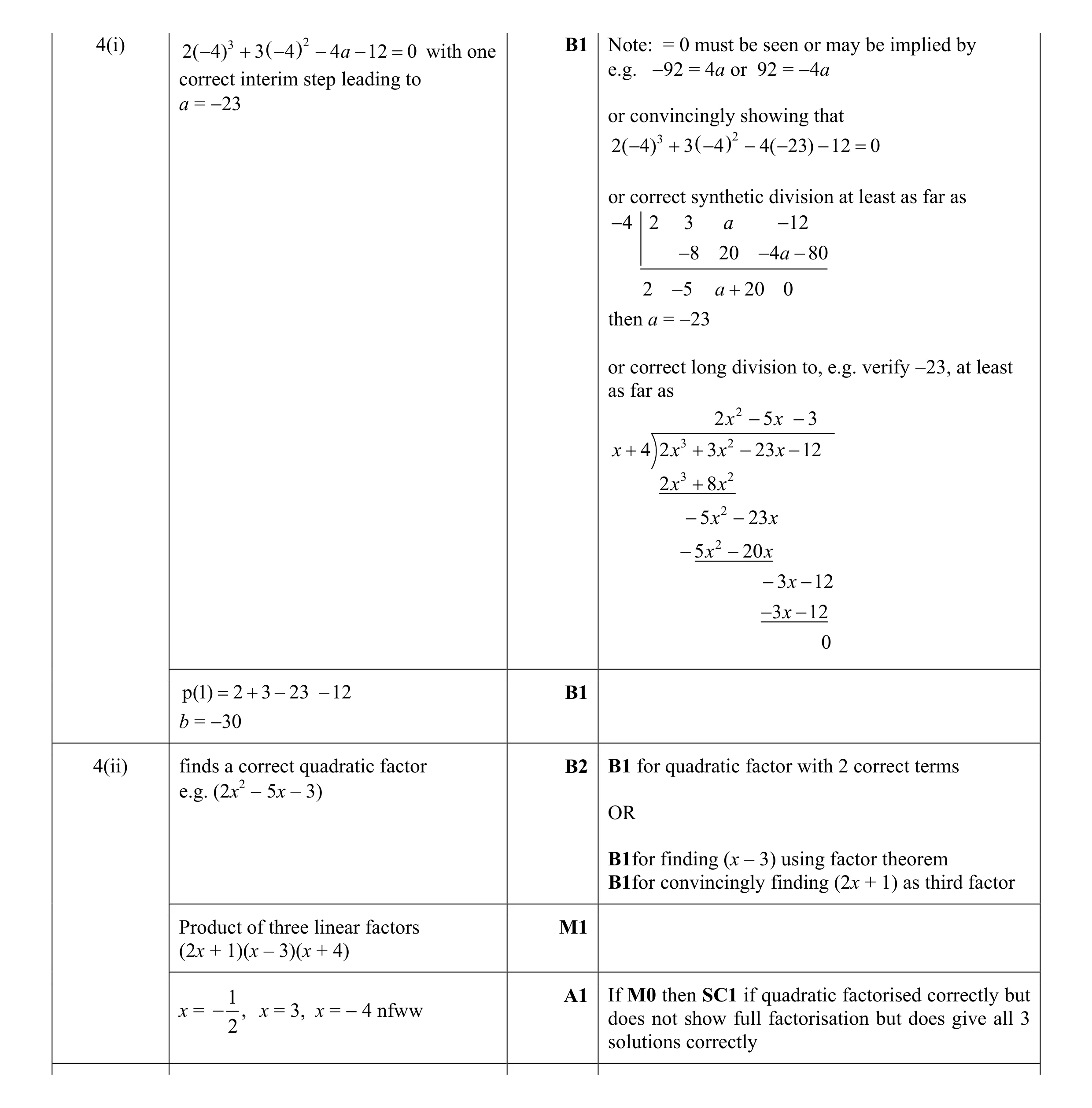 6
6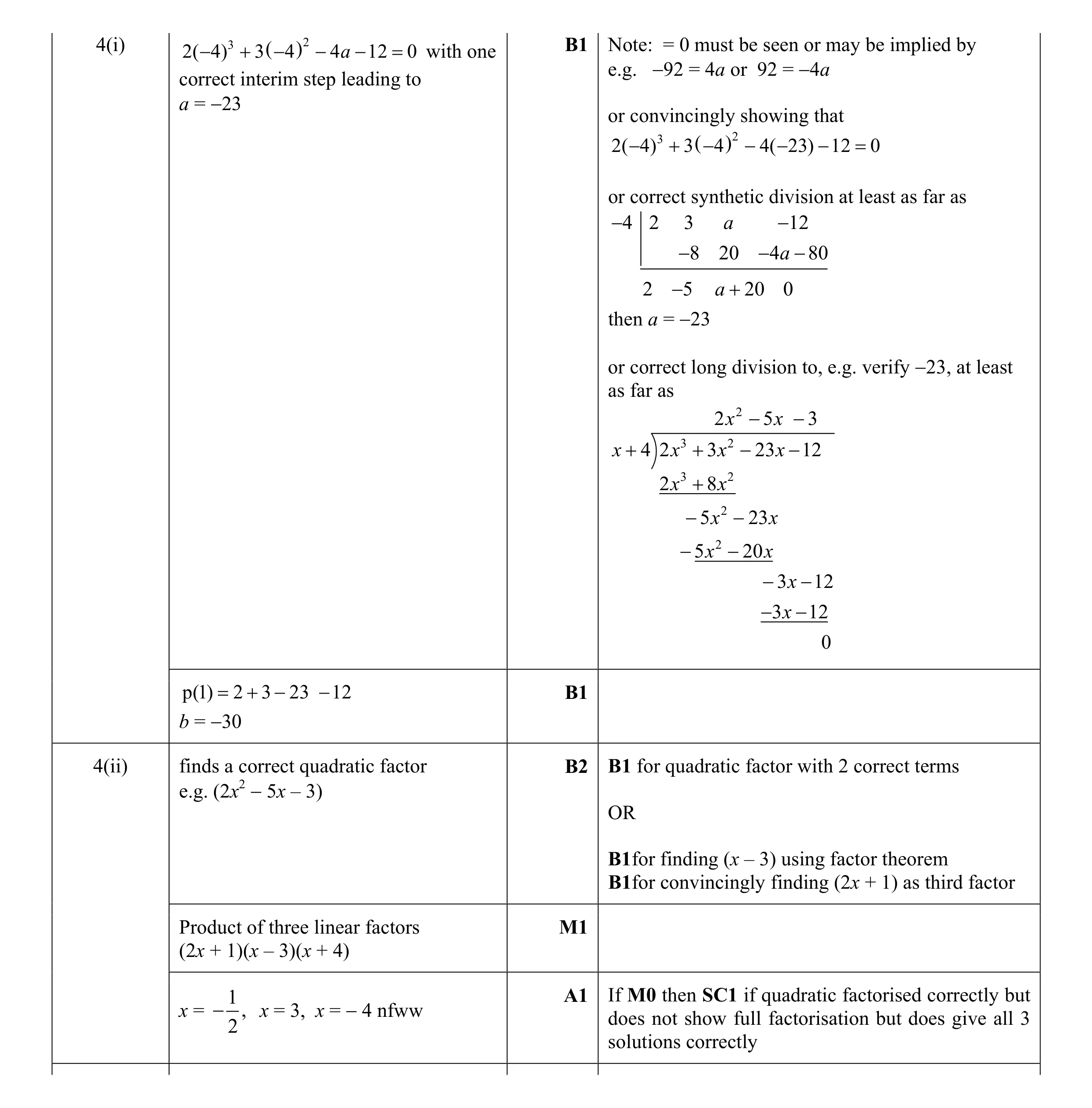 6
6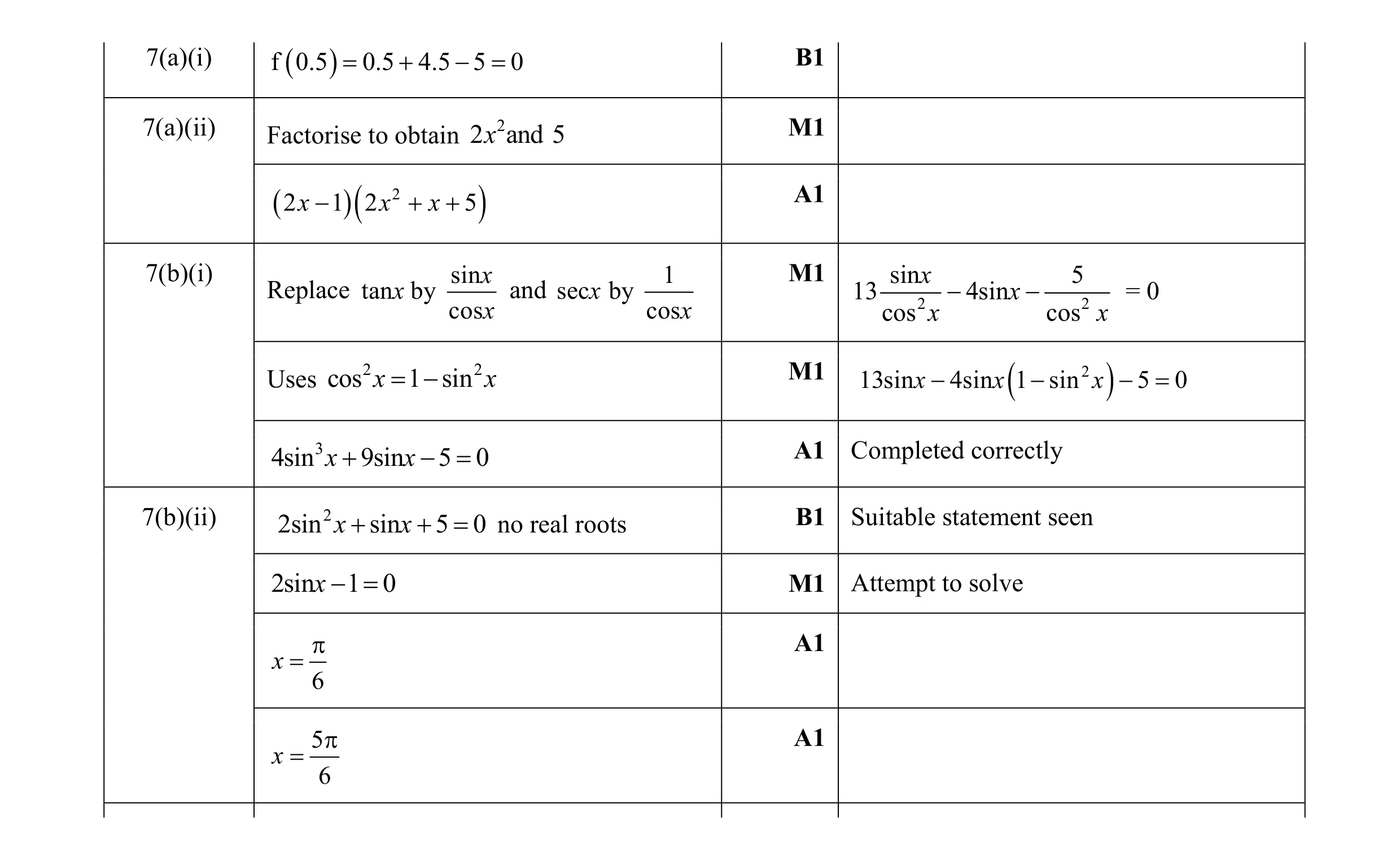 10
10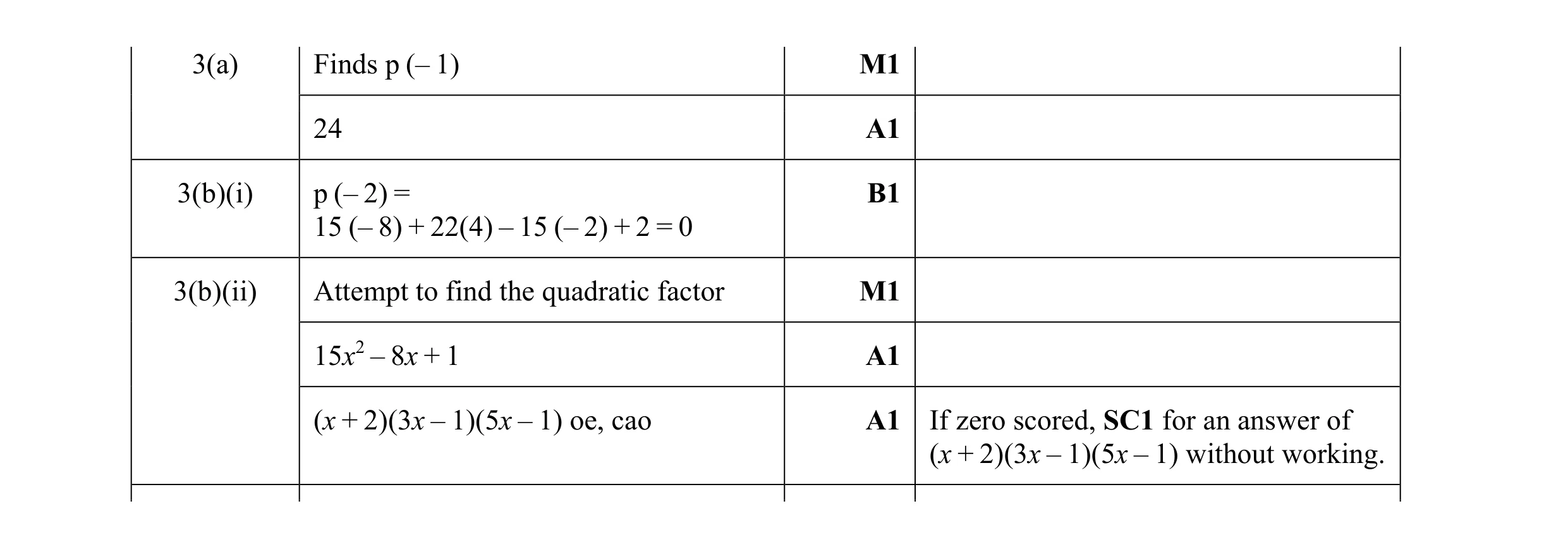 6
6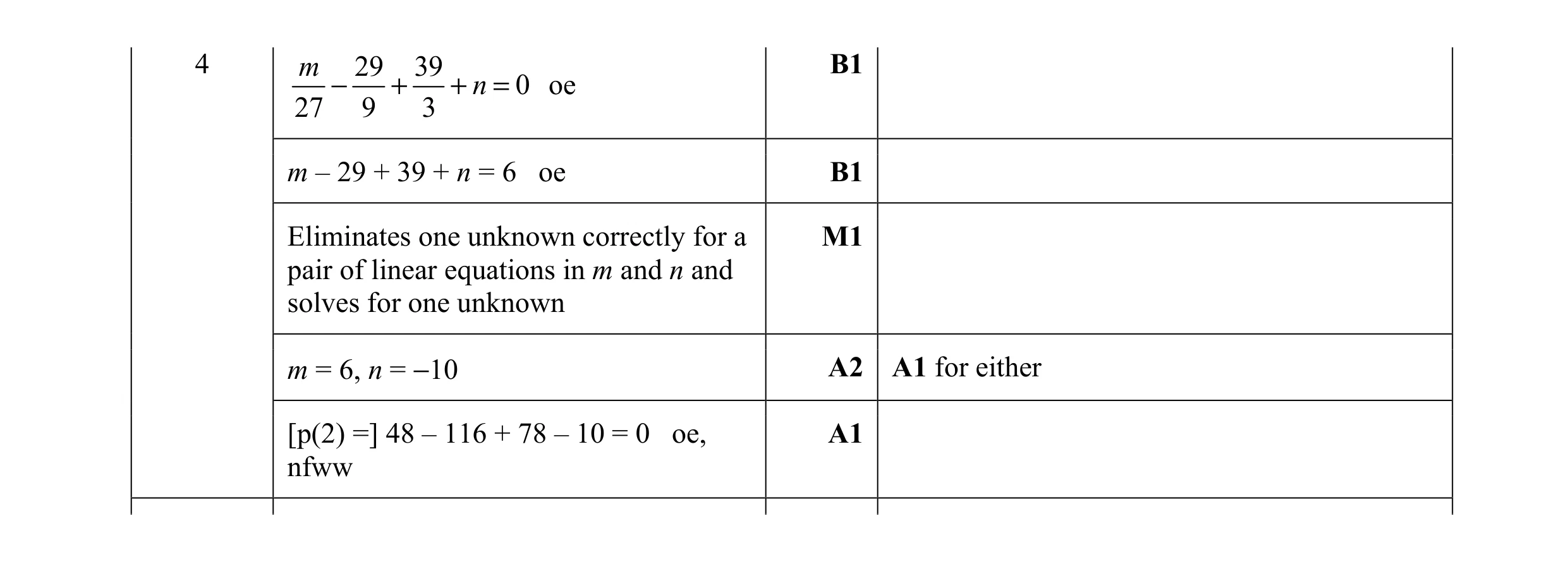 6
6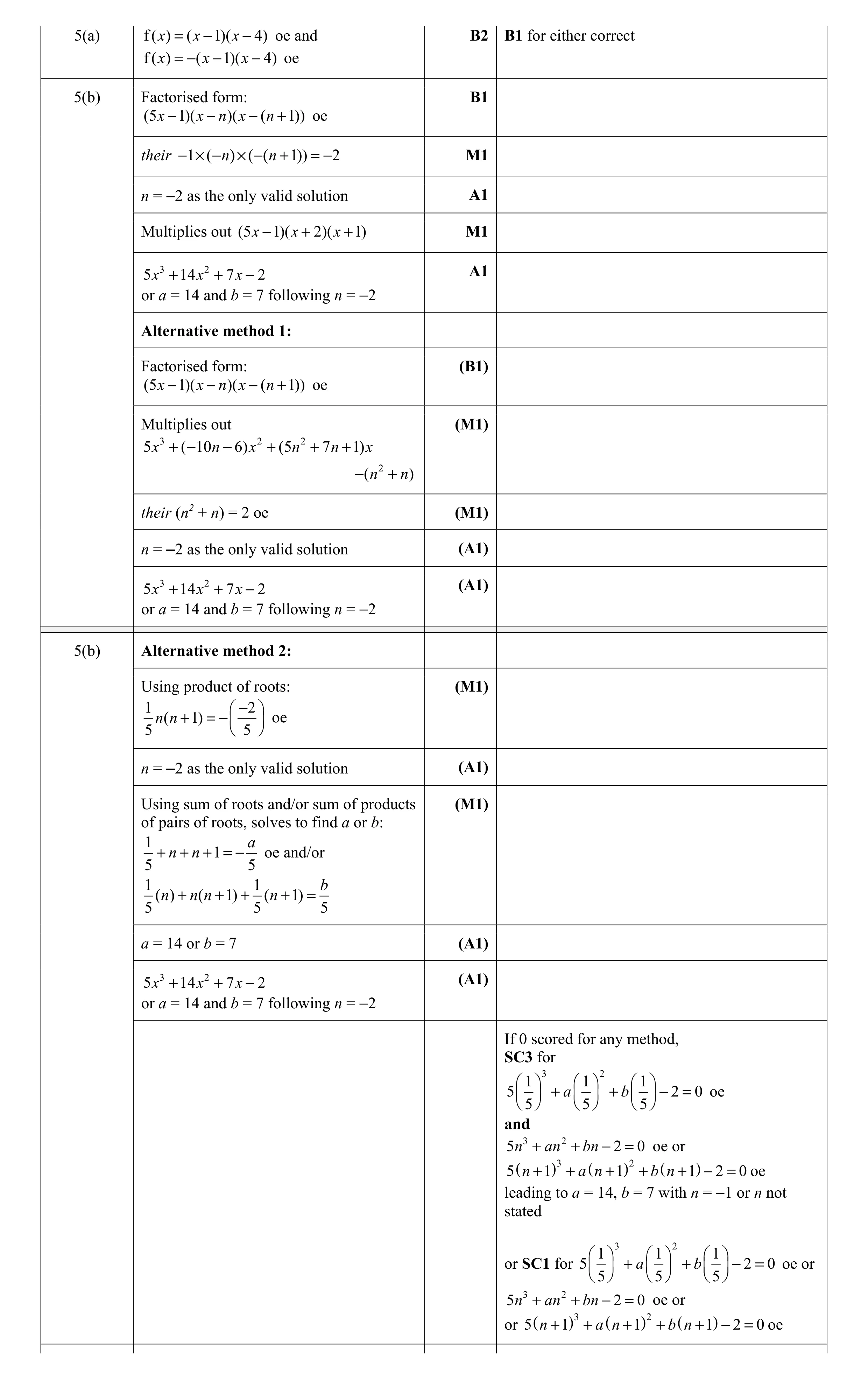 7
7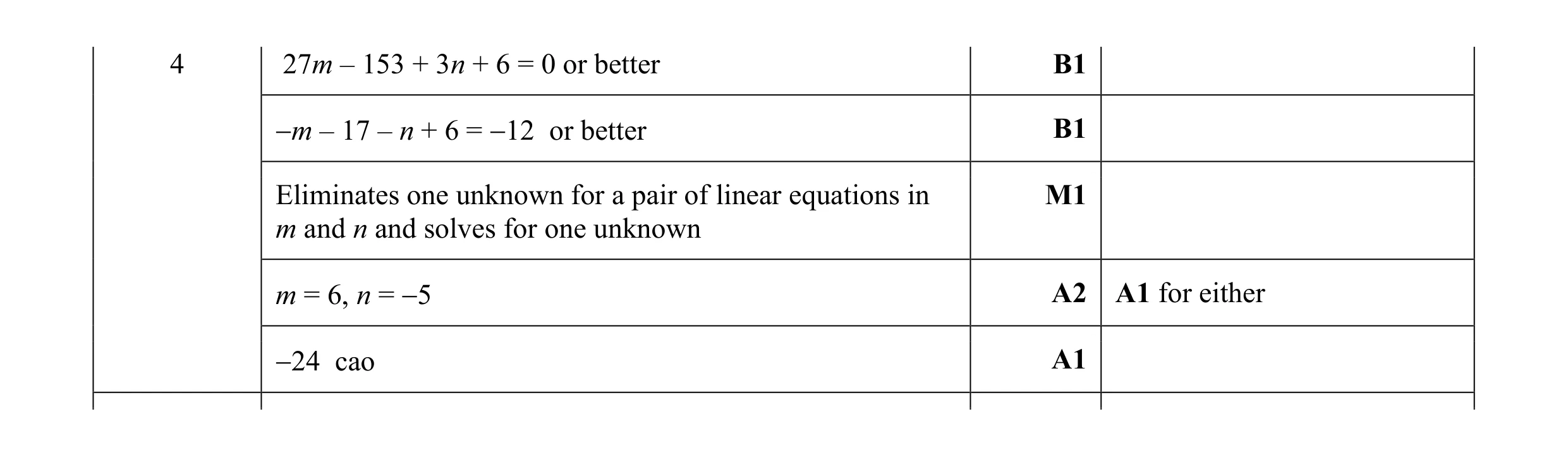 6
6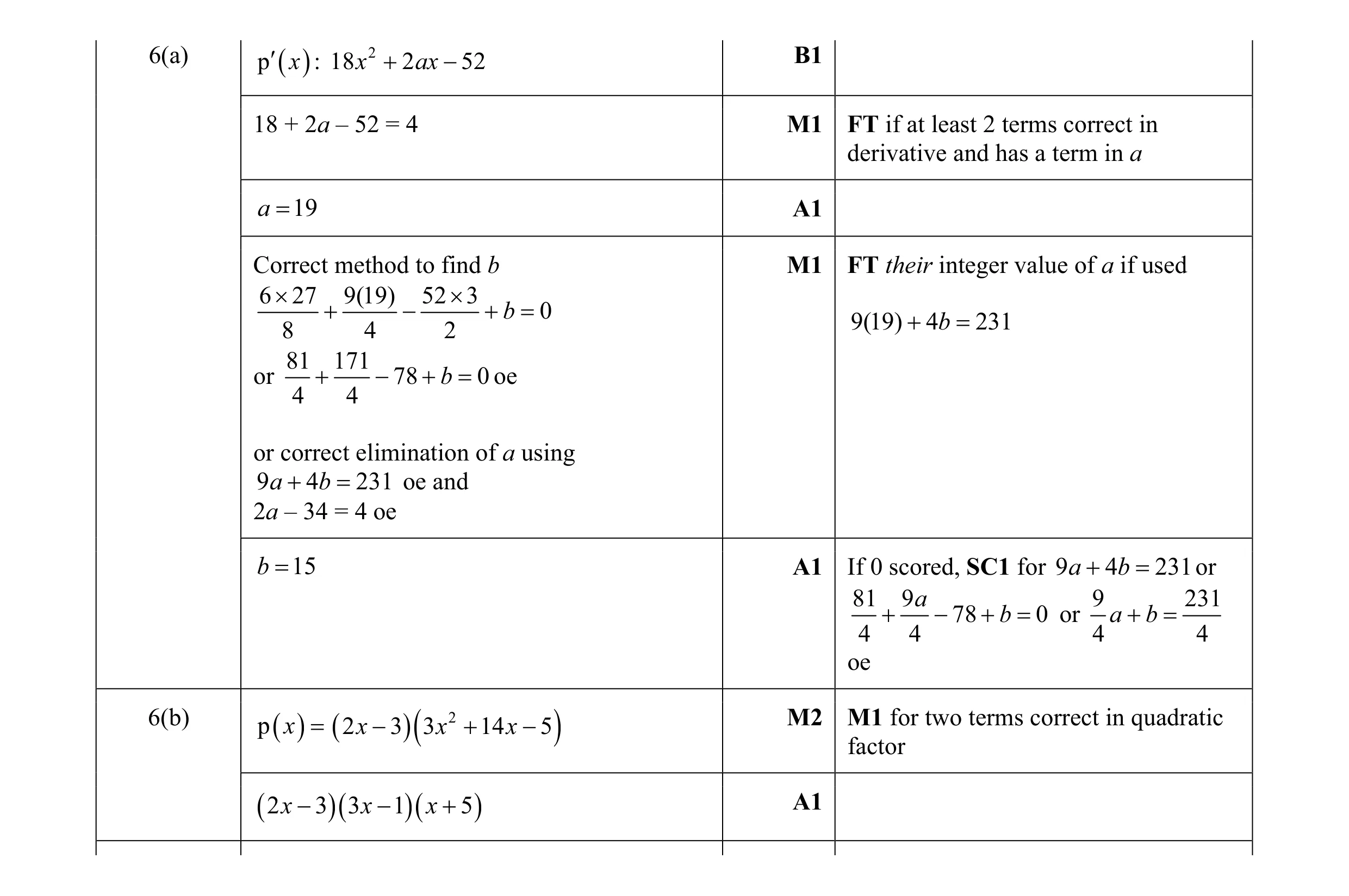 8
8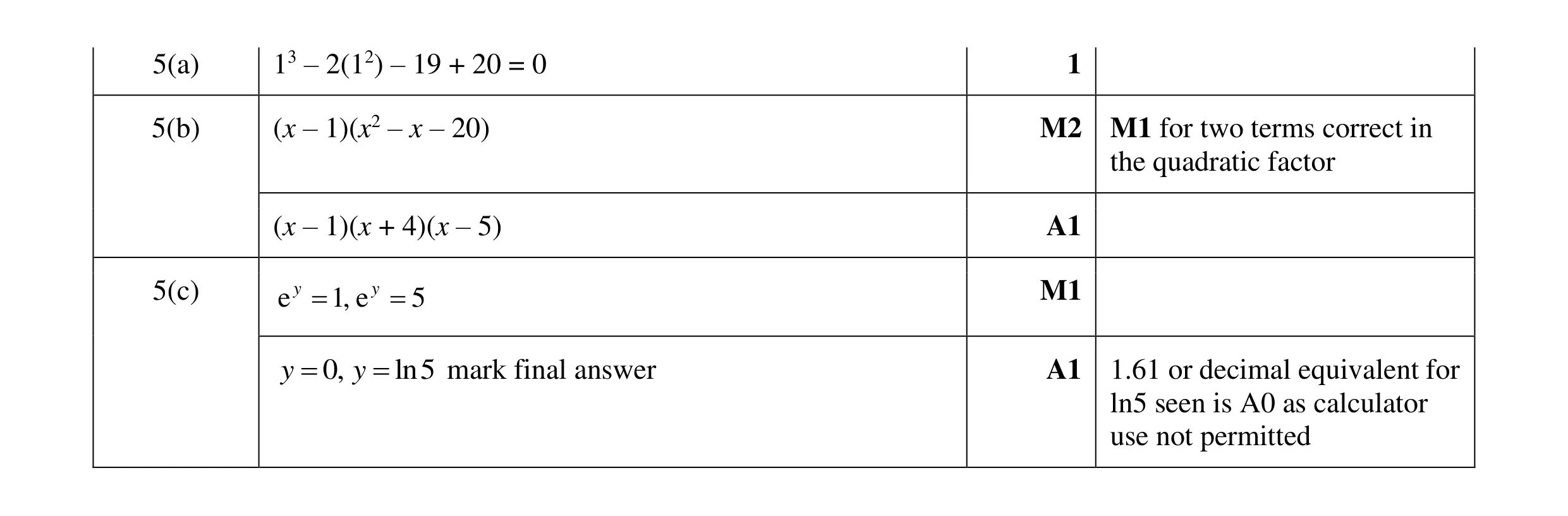 6
6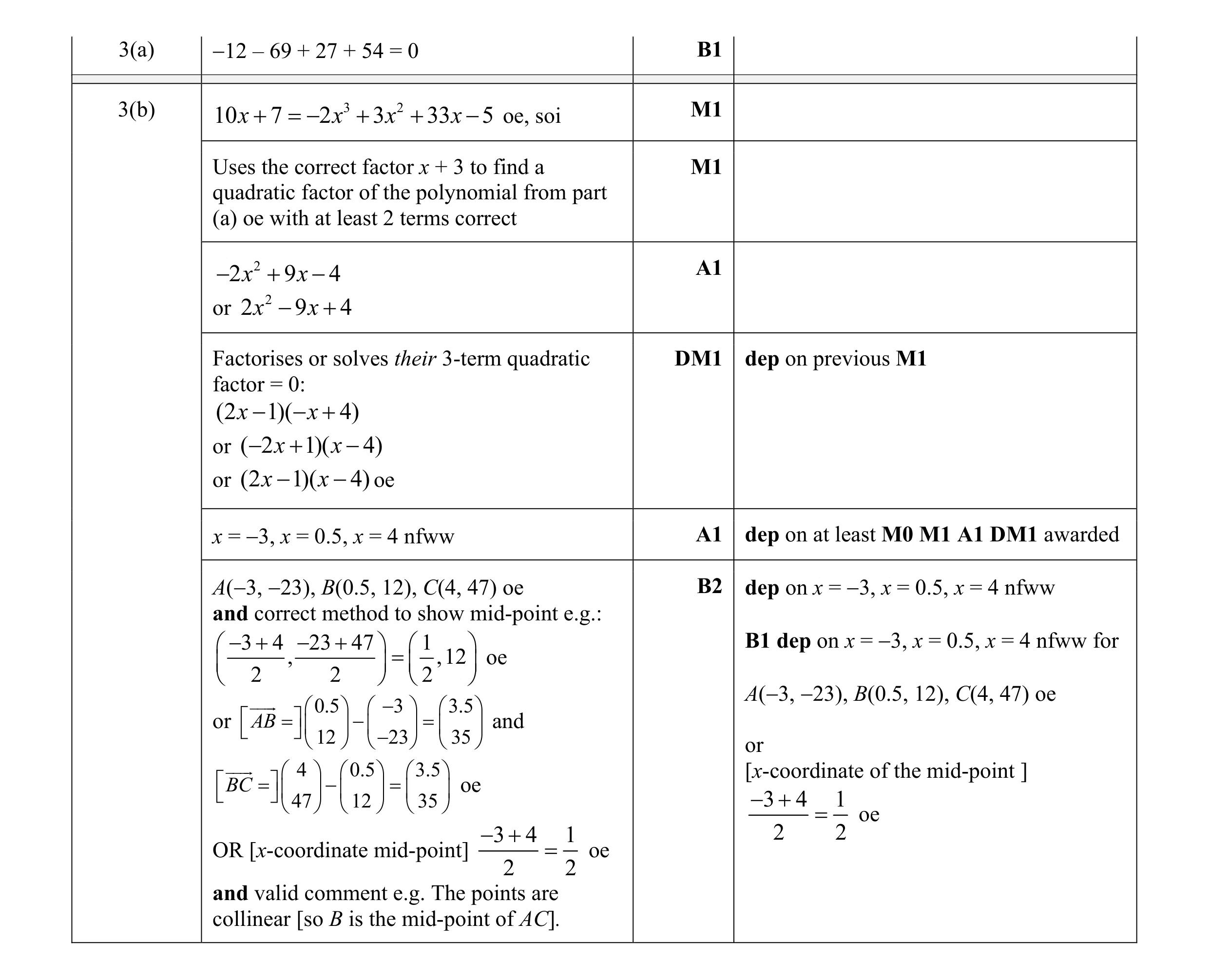 8
8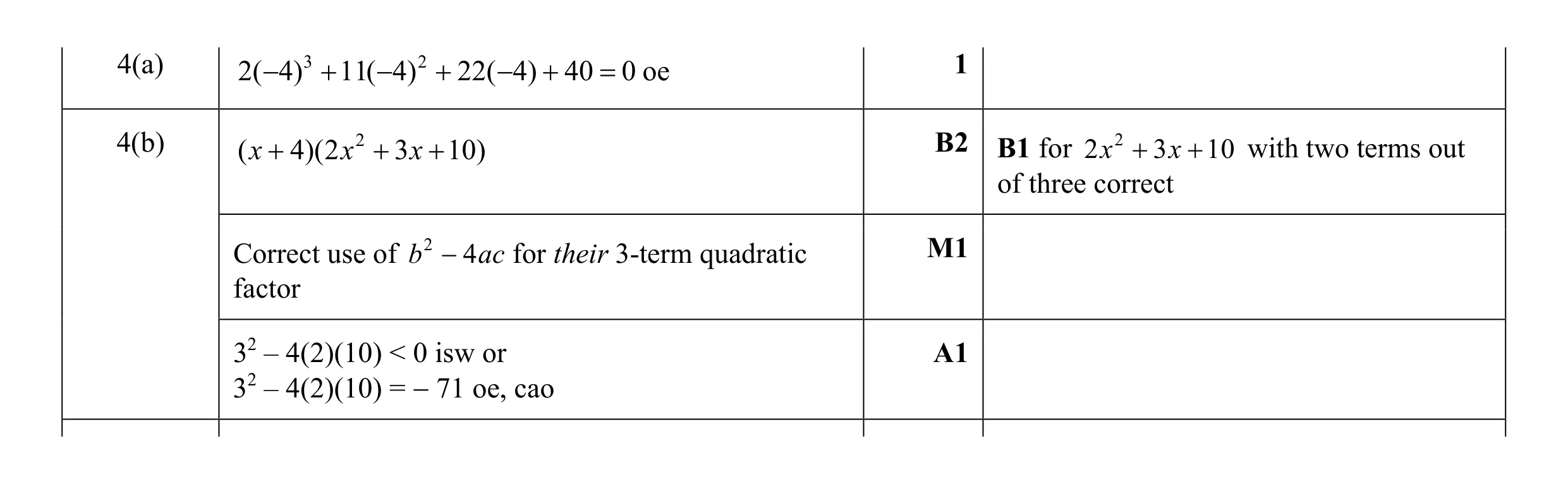 5
5