Cambridge IGCSE Mathematics - Additional 0606 — 2023 May/June Paper 2 · Variant 2
0606/22/M/J/23 · 10 questions · 80 marks · ≈90 min
The question paper and its mark scheme, free to read here and free to download. This is Cambridge’s own paper, exactly as it was sat.
Question paper16 pages
Mark scheme12 pages
Answers below. Sit the paper first if you are practising.
Questions as text
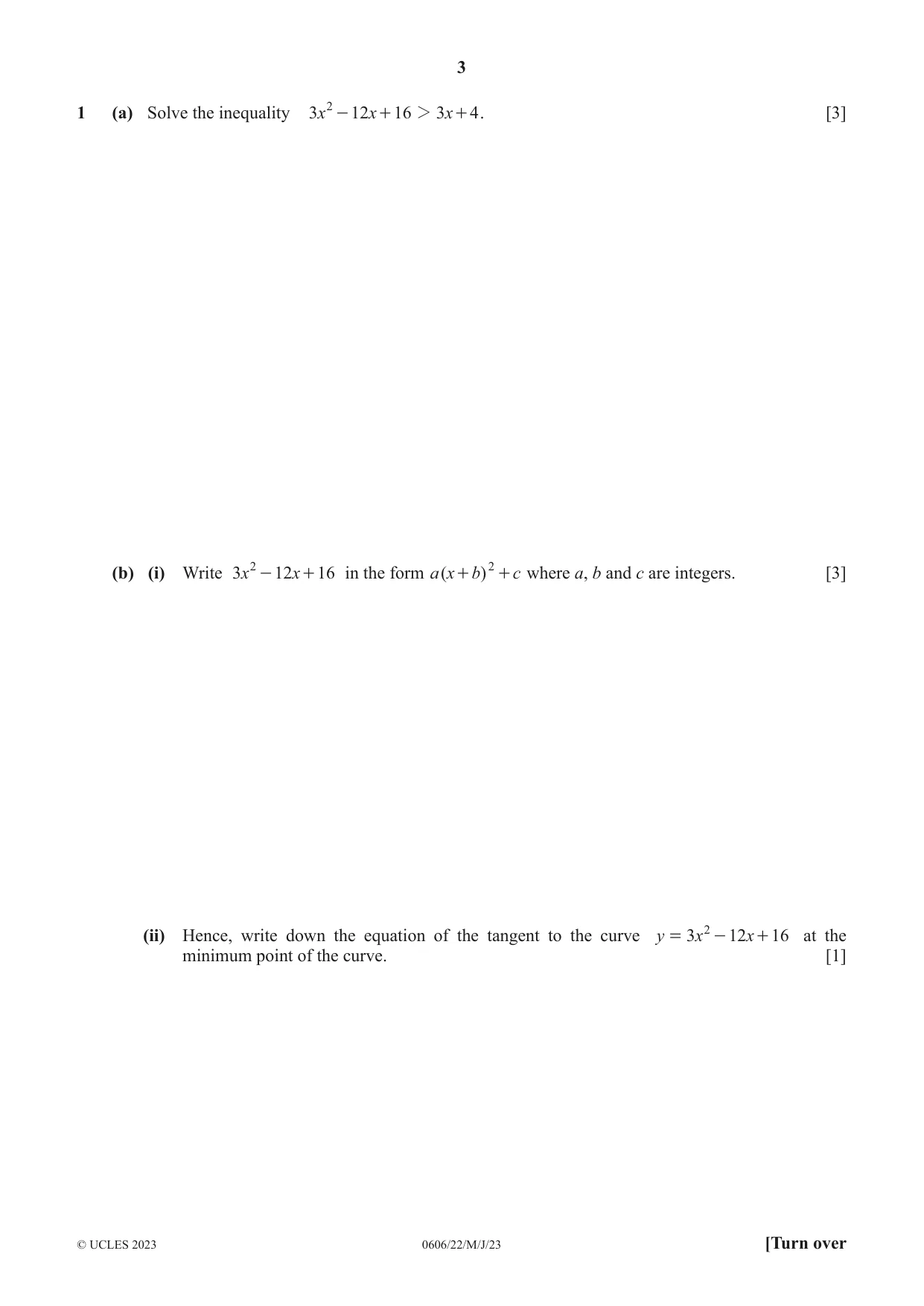
Q1 · Solve the inequality 3x 2 - 12x + 16 2 3x + 4
1 (a) Solve the inequality 3x 2 - 12x + 16 2 3x + 4 . [3] (b) (i) Write 3x 2 - 12x + 16 in the form a ( x + b) 2 + c where a, b and c are integers. [3] (ii) Hence, write down the equation of the tangent to the curve y = 3x 2 - 12x + 16 at the minimum point of the curve. [1]
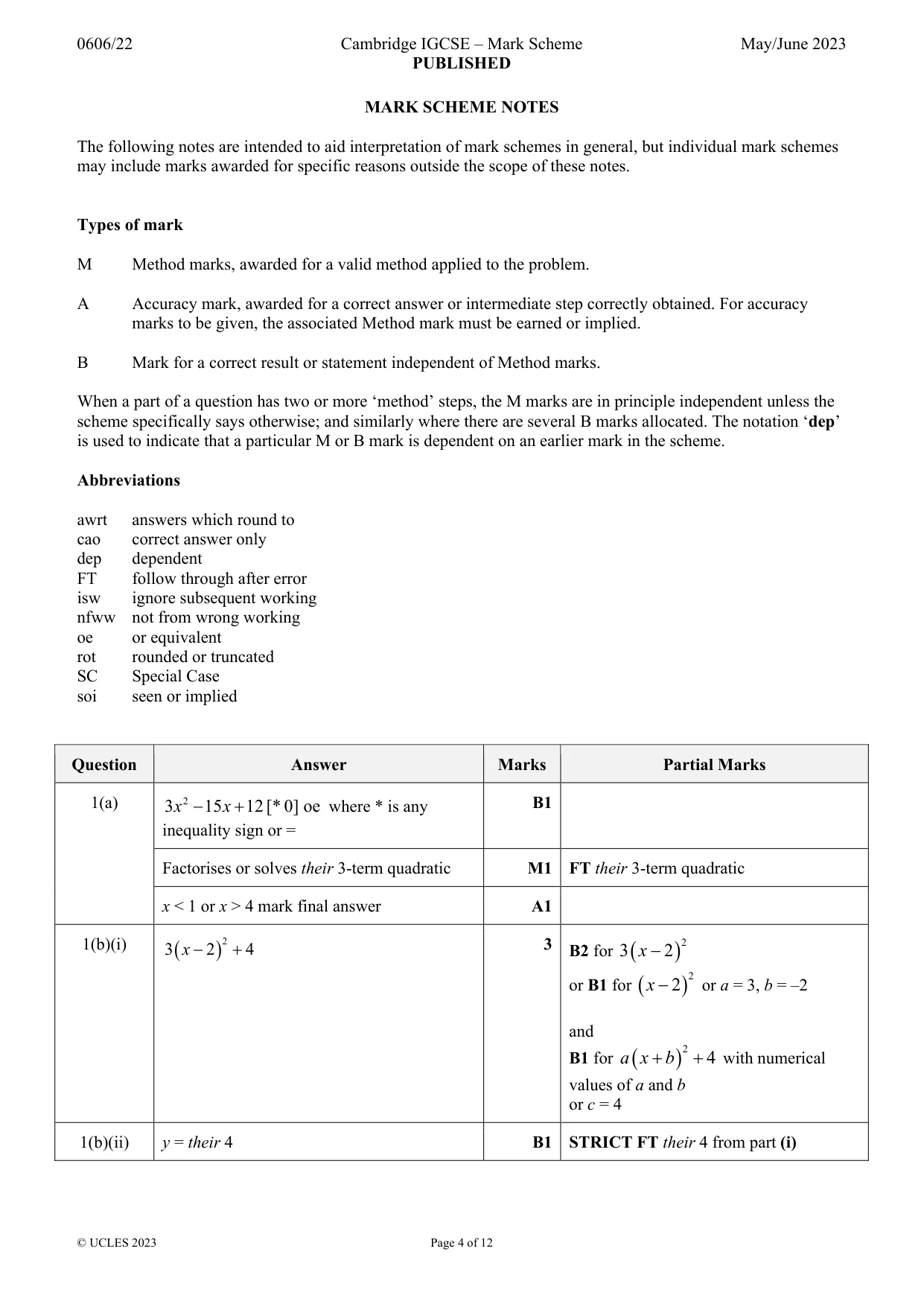
Mark scheme: Question Answer Marks Partial Marks 1(a) 3 x 2 15 x 12 [* 0] oe where * is any B1 inequality sign or = Factorises or solves their 3-term quadratic M1 FT their 3-term quadratic x < 1 or x > 4 mark final answer A1 1(b)(i) 2 3 2 3 x 2 4 B2 for 3 x 2 2 or B1 for x 2 or a = 3, b = –2 and 2 B1 for a x b 4 with numerical values of a and b or c = 4 1(b)(ii) y = their 4 B1 STRICT FT their 4 from part (i)
Question 2
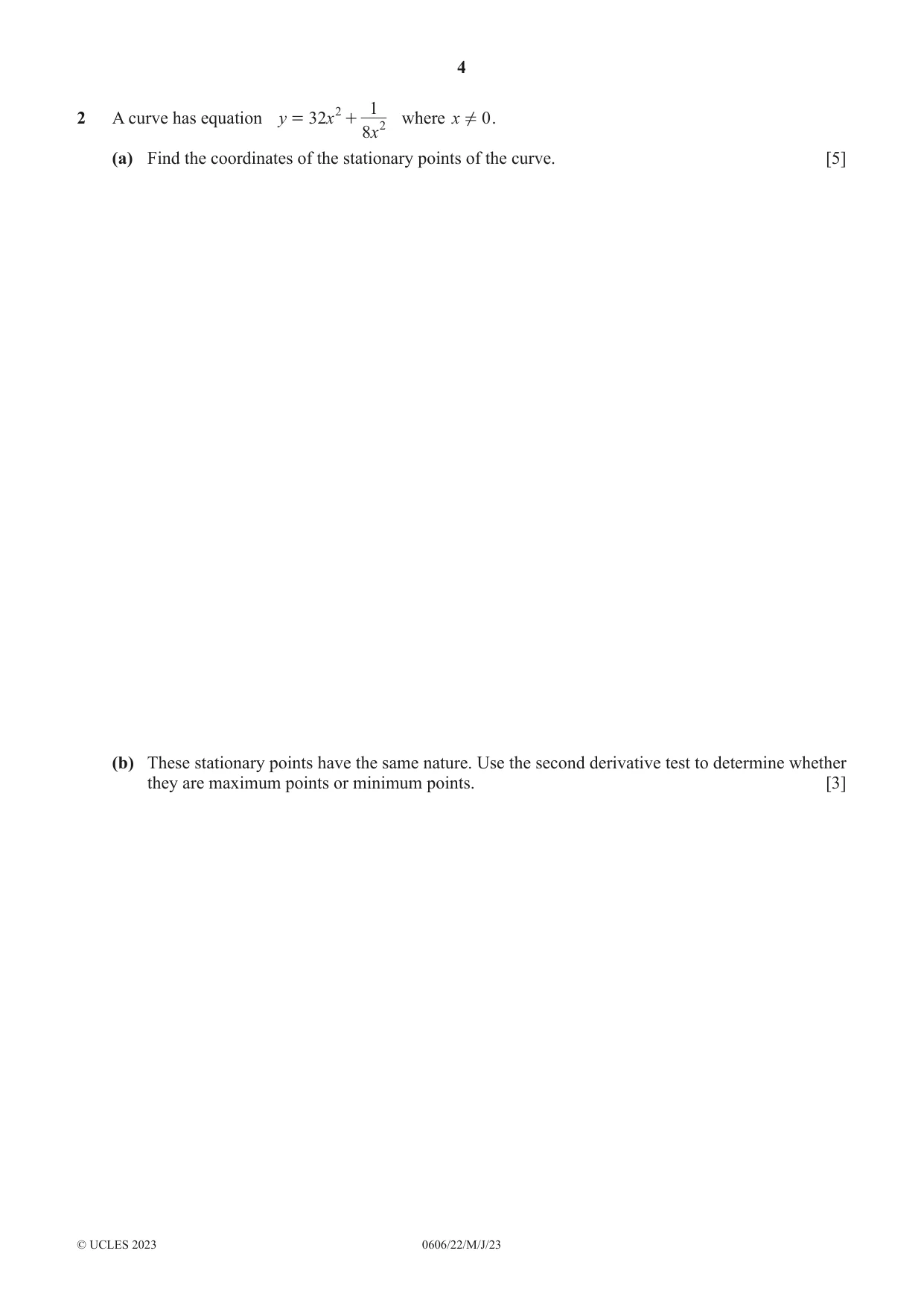
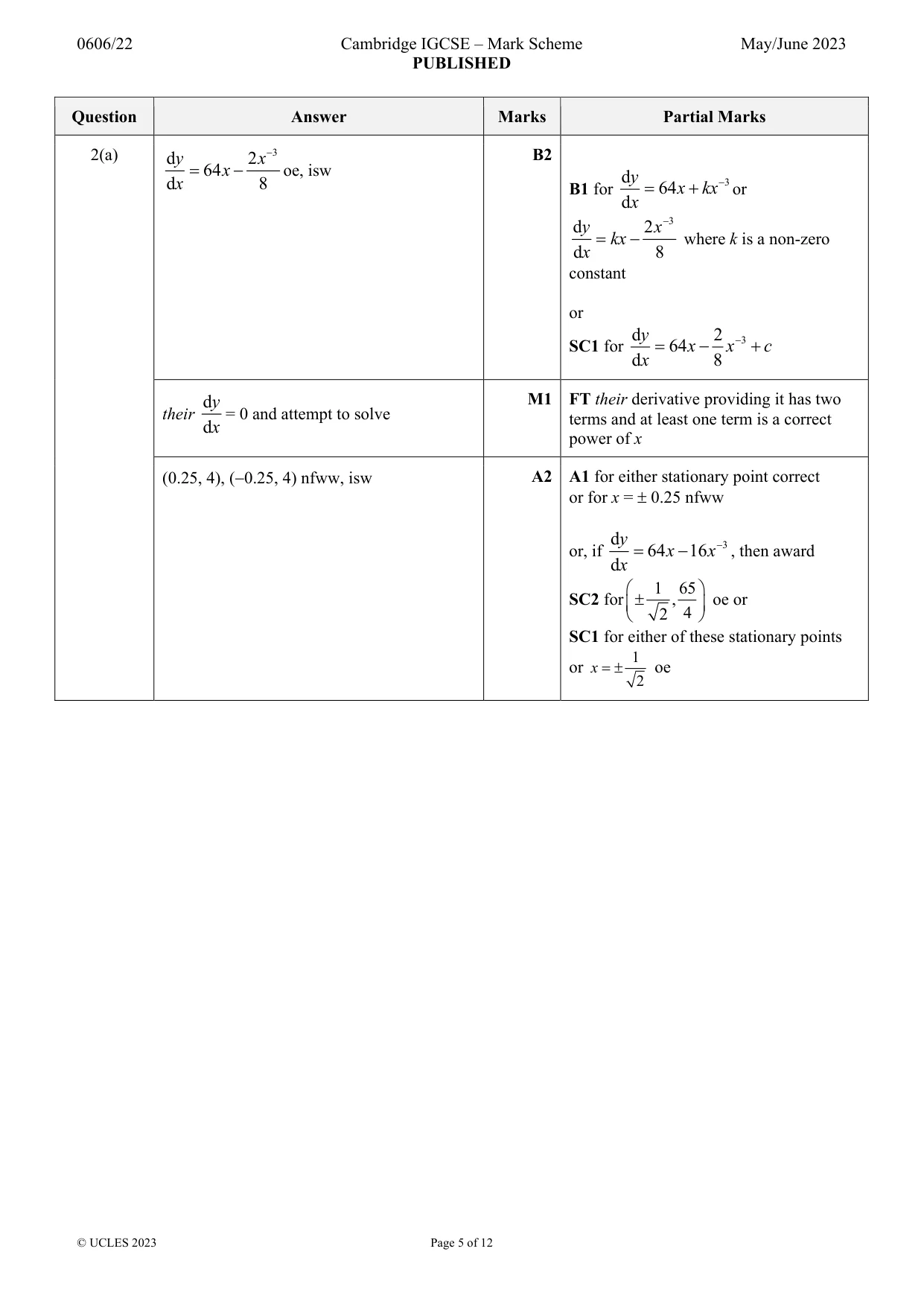
! 0 .2 A curve has equation y = 32x 2 + 2 where x 8x (a) Find the coordinates of the stationary points of the curve. [5] (b) These stationary points have the same nature. Use the second derivative test to determine whether they are maximum points or minimum points. [3]
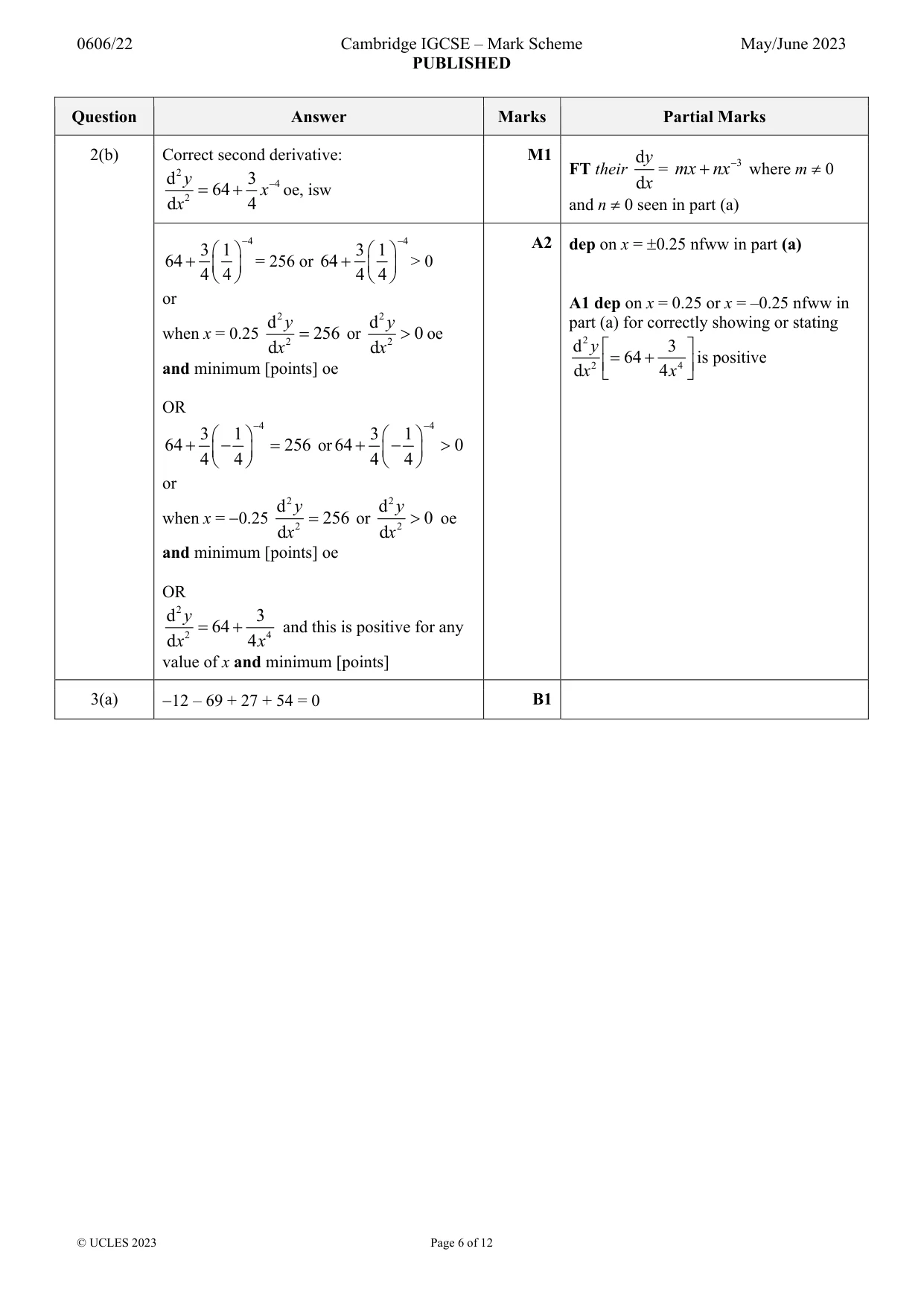
Mark scheme: 2(a) dy 2 x 3 B2 64 x oe, isw dy 3 dx 8 B1 for 64 x kx or dx dy 2 x 3 kx where k is a non-zero d x 8 constant or dy 2 3 SC1 for 64 x x c dx 8 d y M1 FT their derivative providing it has two their = 0 and attempt to solve terms and at least one term is a correct dx power of x (0.25, 4), (0.25, 4) nfww, isw A2 A1 for either stationary point correct or for x = 0.25 nfww dy 3 or, if 64 x 16 x , then award dx 1 65 SC2 for , oe or 2 4 SC1 for either of these stationary points 1 or x oe 2 2(b) Correct second derivative: M1 d y 3 2 FT their = mx nx where m 0 d y 3 4 dx 2 64 x oe, isw dx 4 and n 0 seen in part (a) 4 4 A2 dep on x = 0.25 nfww in part (a) 3 1 3 1 64 = 256 or 64 > 0 4 4 4 4 or A1 dep on x = 0.25 or x = –0.25 nfww in d 2 y d 2 y part (a) for correctly showing or stating when x = 0.25 2 256 or 2 0 oe 2 dx dx d y 3 is positive 64 and minimum [points] oe dx 2 4 x 4 OR 4 4 3 1 3 1 64 256 or 64 0 4 4 4 4 or d 2 y d 2 y when x = 0.25 2 256 or 2 0 oe dx dx and minimum [points] oe OR d 2 y 3 2 64 4 and this is positive for any dx 4 x value of x and minimum [points]
More questions on Use differentiation to find stationary points
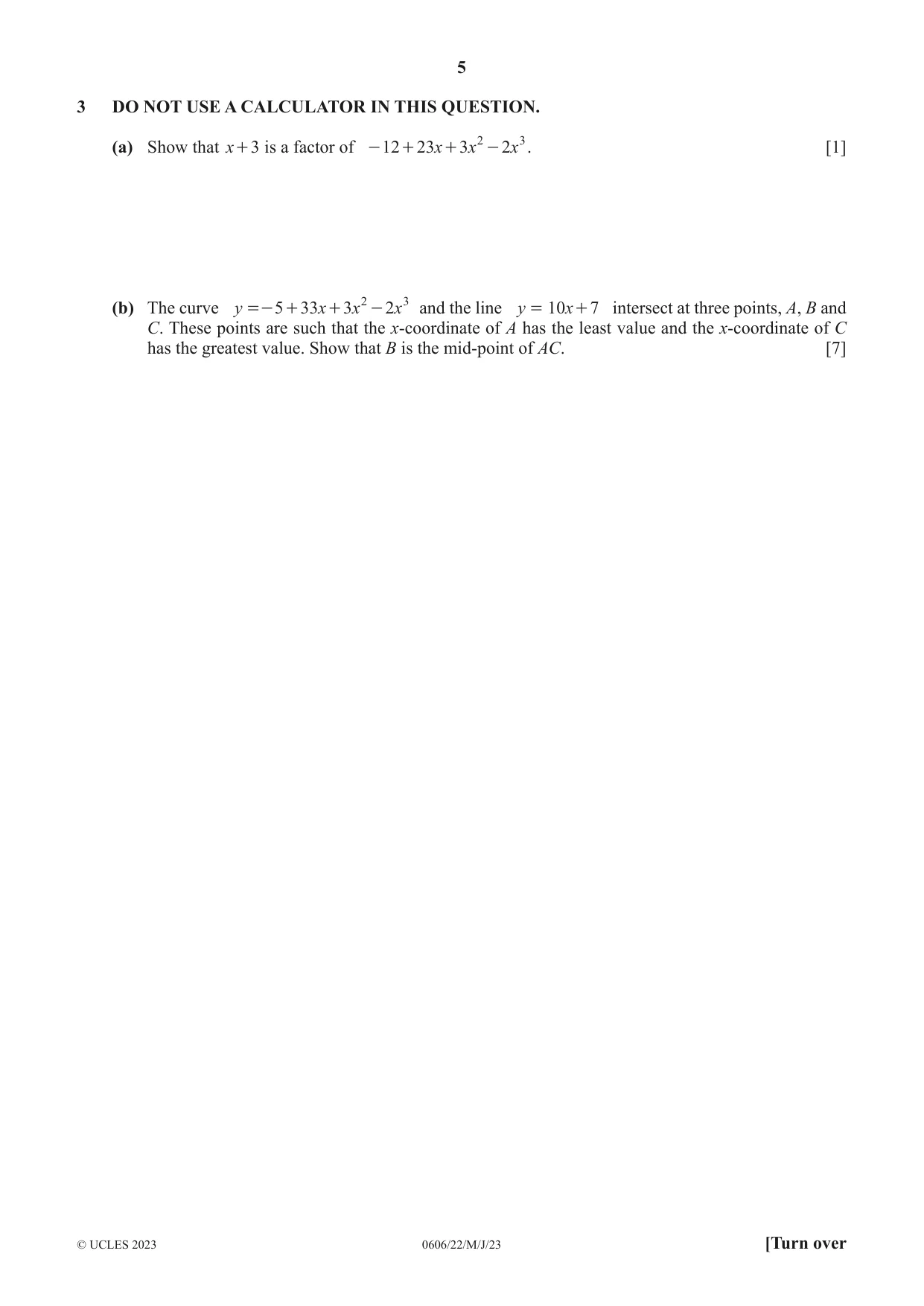
Q3 · DO NOT USE A CALCULATOR IN THIS QUESTION
3 DO NOT USE A CALCULATOR IN THIS QUESTION. (a) Show that x + 3 is a factor of - 12 + 23x + 3x 2 - 2x 3 . [1] (b) The curve y =- 5 + 33 x + 3x 2 - 2x 3 and the line y = 10x + 7 intersect at three points, A, B and C. These points are such that the x-coordinate of A has the least value and the x-coordinate of C has the greatest value. Show that B is the mid-point of AC. [7]
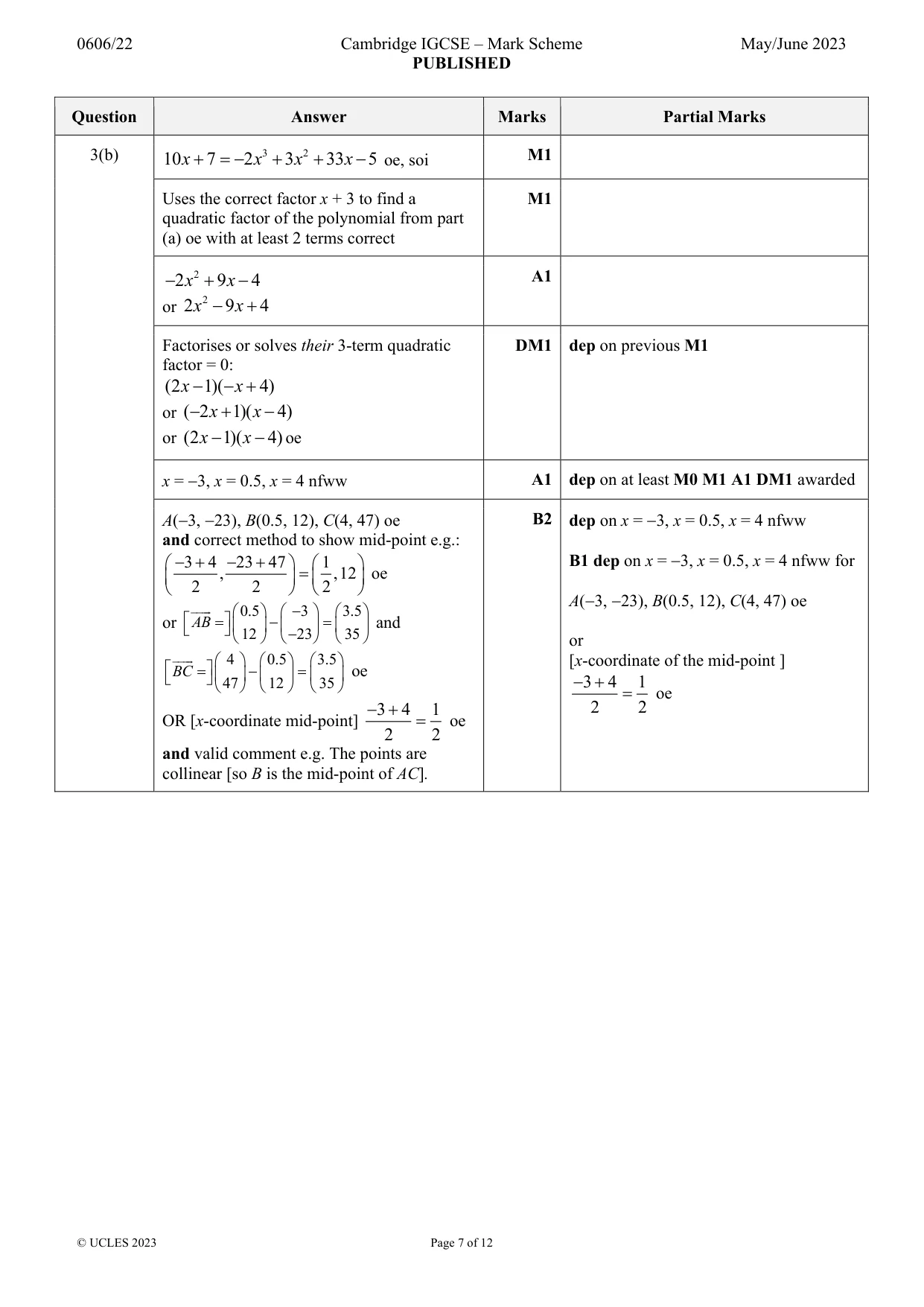
Mark scheme: 3(a) 12 – 69 + 27 + 54 = 0 B1 3(b) 10 x 7 2 x 3 3 x 2 33 x 5 oe, soi M1 Uses the correct factor x + 3 to find a M1 quadratic factor of the polynomial from part (a) oe with at least 2 terms correct 2 x 2 9 x 4 A1 or 2 x 2 9 x 4 Factorises or solves their 3-term quadratic DM1 dep on previous M1 factor = 0: (2 x 1)( x 4) or ( 2 x 1)( x 4) or (2 x 1)( x 4) oe x = 3, x = 0.5, x = 4 nfww A1 dep on at least M0 M1 A1 DM1 awarded A(3, 23), B(0.5, 12), C(4, 47) oe B2 dep on x = 3, x = 0.5, x = 4 nfww and correct method to show mid-point e.g.: 3 4 23 47 1 B1 dep on x = 3, x = 0.5, x = 4 nfww for , ,12 oe 2 2 2 A(3, 23), B(0.5, 12), C(4, 47) oe 0.5 3 3.5 AB or and 12 23 35 or 4 0.5 3.5 [x-coordinate of the mid-point ] BC 47 12 35 oe 3 4 1 oe 3 4 1 2 2 OR [x-coordinate mid-point] oe 2 2 and valid comment e.g. The points are collinear [so B is the mid-point of AC].
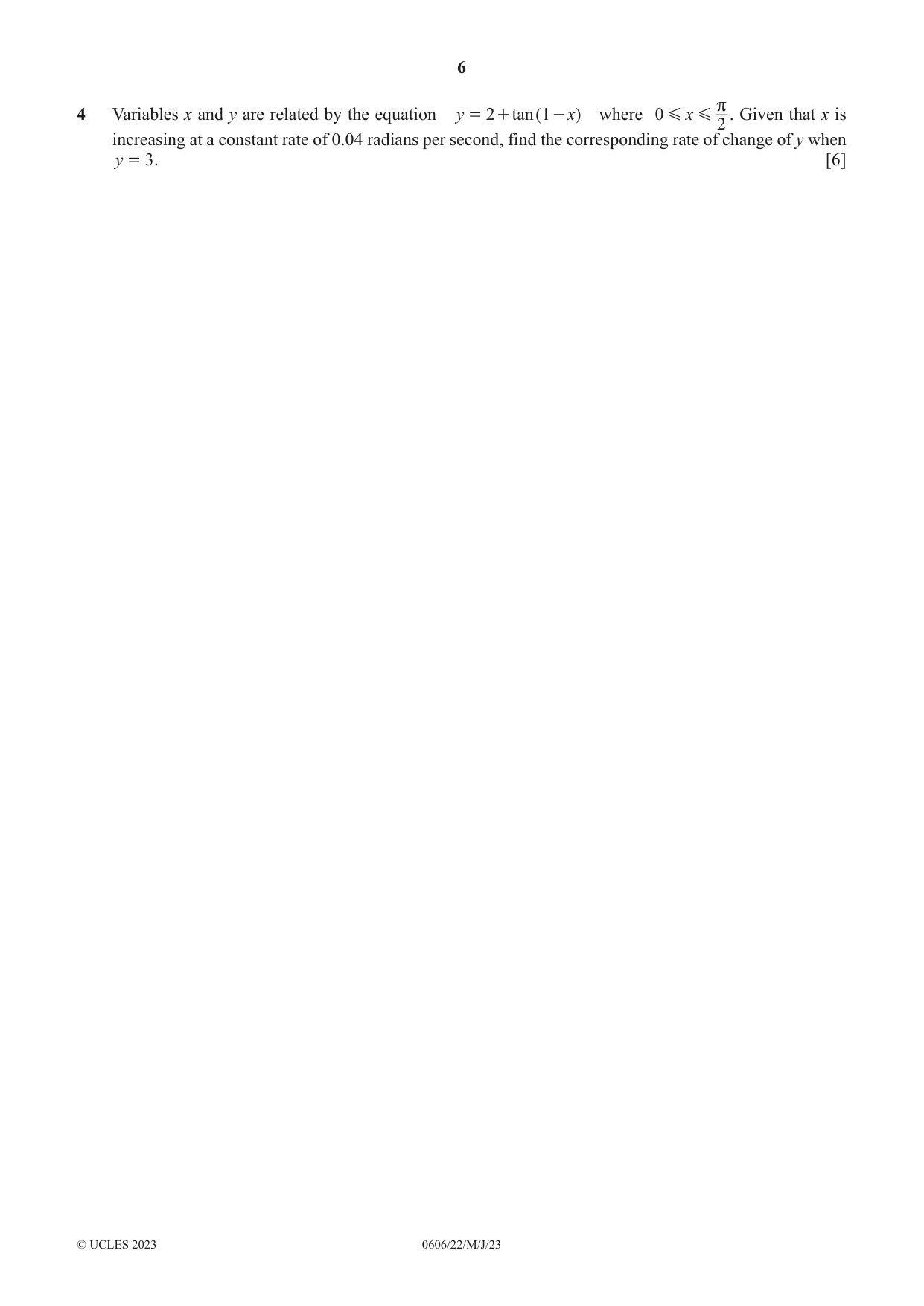
Q4 · Variables x and y are related by the equation y = 2 + tan ( 1 - x) where 0 G x G r
4 Variables x and y are related by the equation y = 2 + tan ( 1 - x) where 0 G x G r . Given that x is 2 increasing at a constant rate of 0.04 radians per second, find the corresponding rate of change of y when y = 3 . [6]
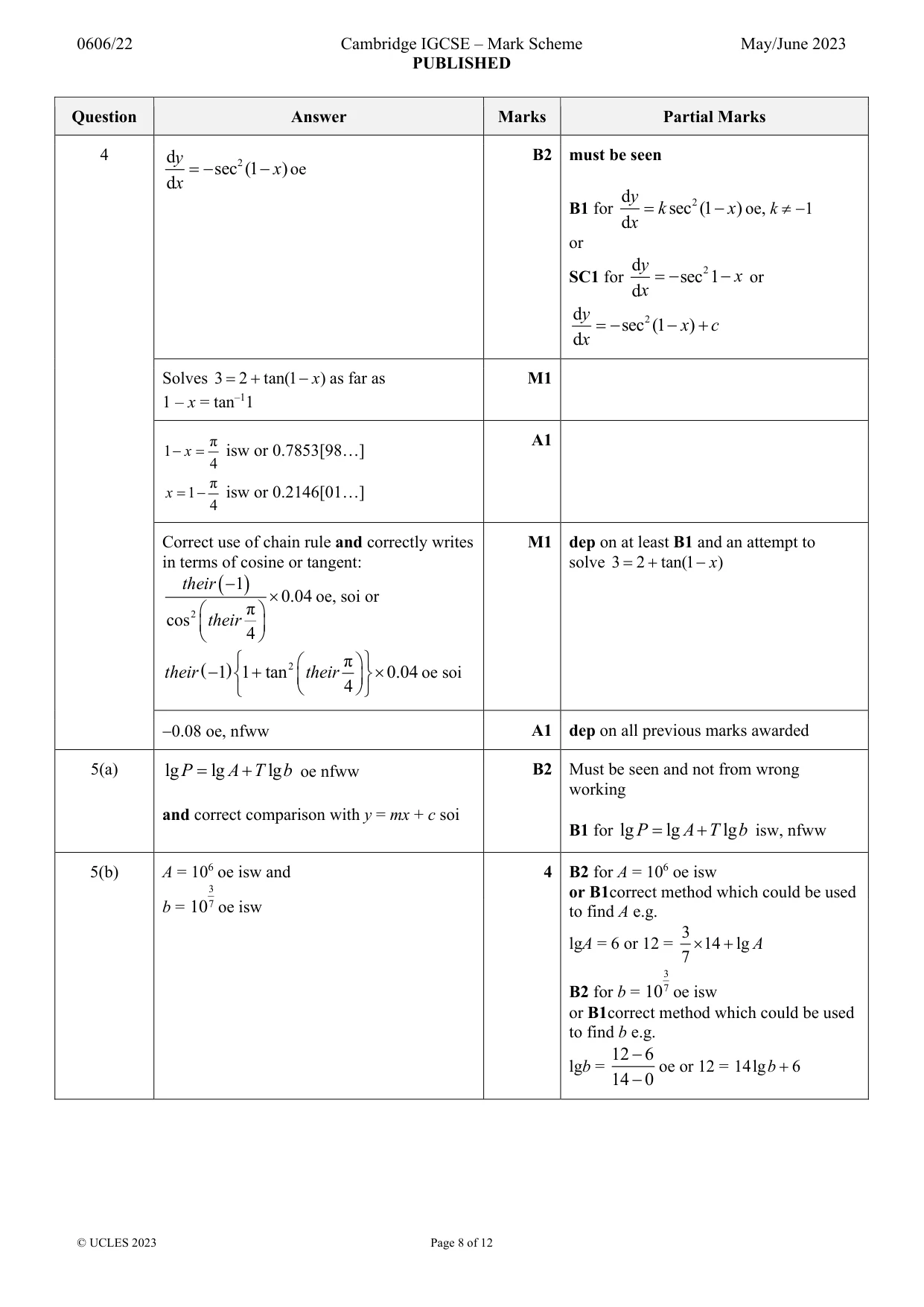
Mark scheme: 4 dy 2 B2 must be seen sec (1 x ) oe dx dy 2 B1 for k sec (1 x ) oe, k 1 dx or dy 2 SC1 for sec 1 x or dx dy 2 sec (1 x ) c dx Solves 3 2 tan(1 x ) as far as M1 1 – x = tan–11 π A1 1 x isw or 0.7853[98…] 4 π x 1 isw or 0.2146[01…] 4 Correct use of chain rule and correctly writes M1 dep on at least B1 and an attempt to in terms of cosine or tangent: solve 3 2 tan(1 x ) their 1 0.04 oe, soi or 2 π cos their 4 2 π their 1 1 tan their 0.04 oe soi 4 0.08 oe, nfww A1 dep on all previous marks awarded
More questions on Apply differentiation to connected rates of
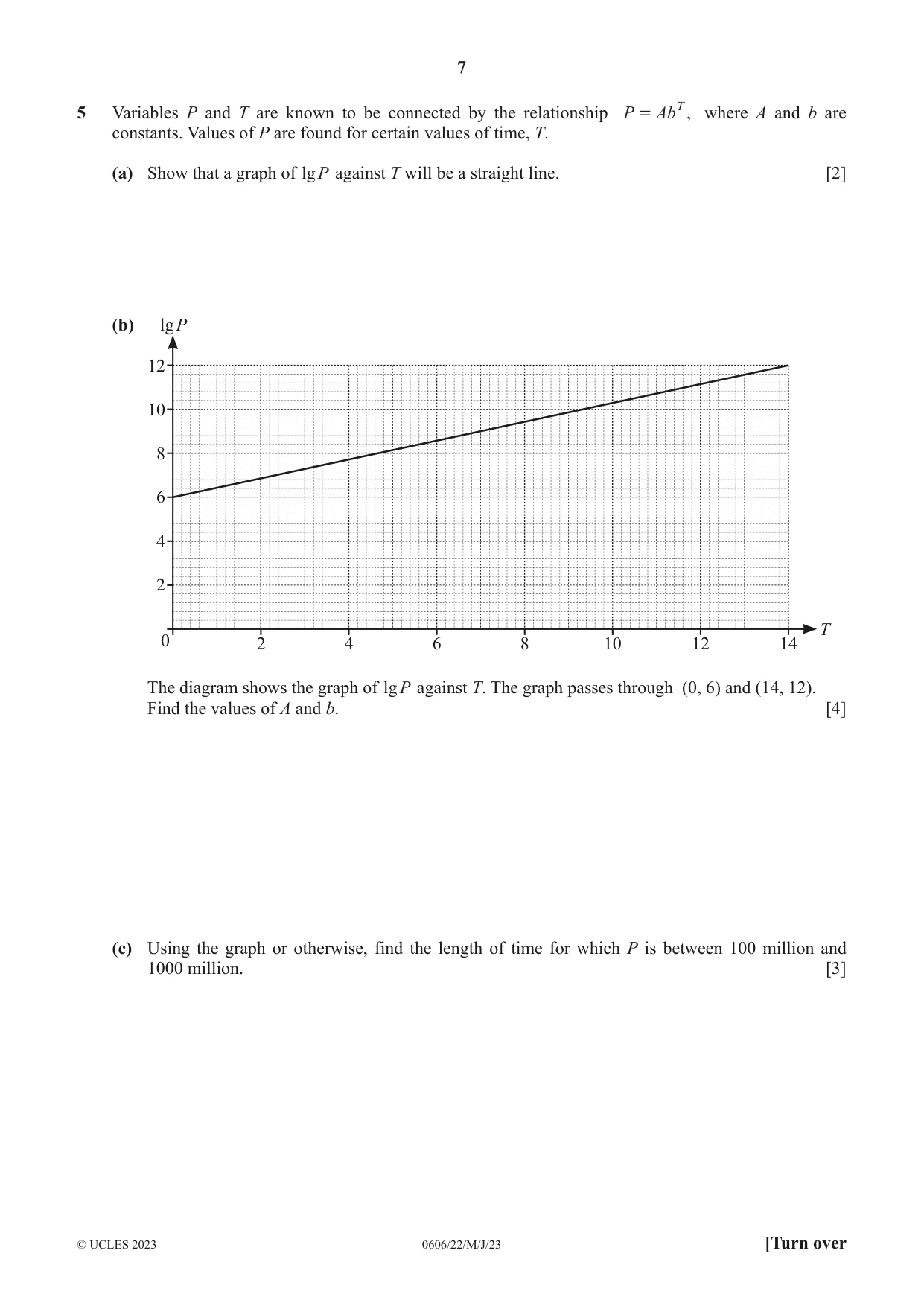
Q5 · Variables P and T are known to be connected by the relationship P = AbT , where A and b…
5 Variables P and T are known to be connected by the relationship P = AbT , where A and b are constants. Values of P are found for certain values of time, T. (a) Show that a graph of lgP against T will be a straight line. [2] (b) lg P 12 10 8 6 4 2 T 0 2 4 6 8 10 12 14 The diagram shows the graph of lgP against T. The graph passes through (0, 6) and (14, 12). Find the values of A and b. [4] (c) Using the graph or otherwise, find the length of time for which P is between 100 million and 1000 million. [3]
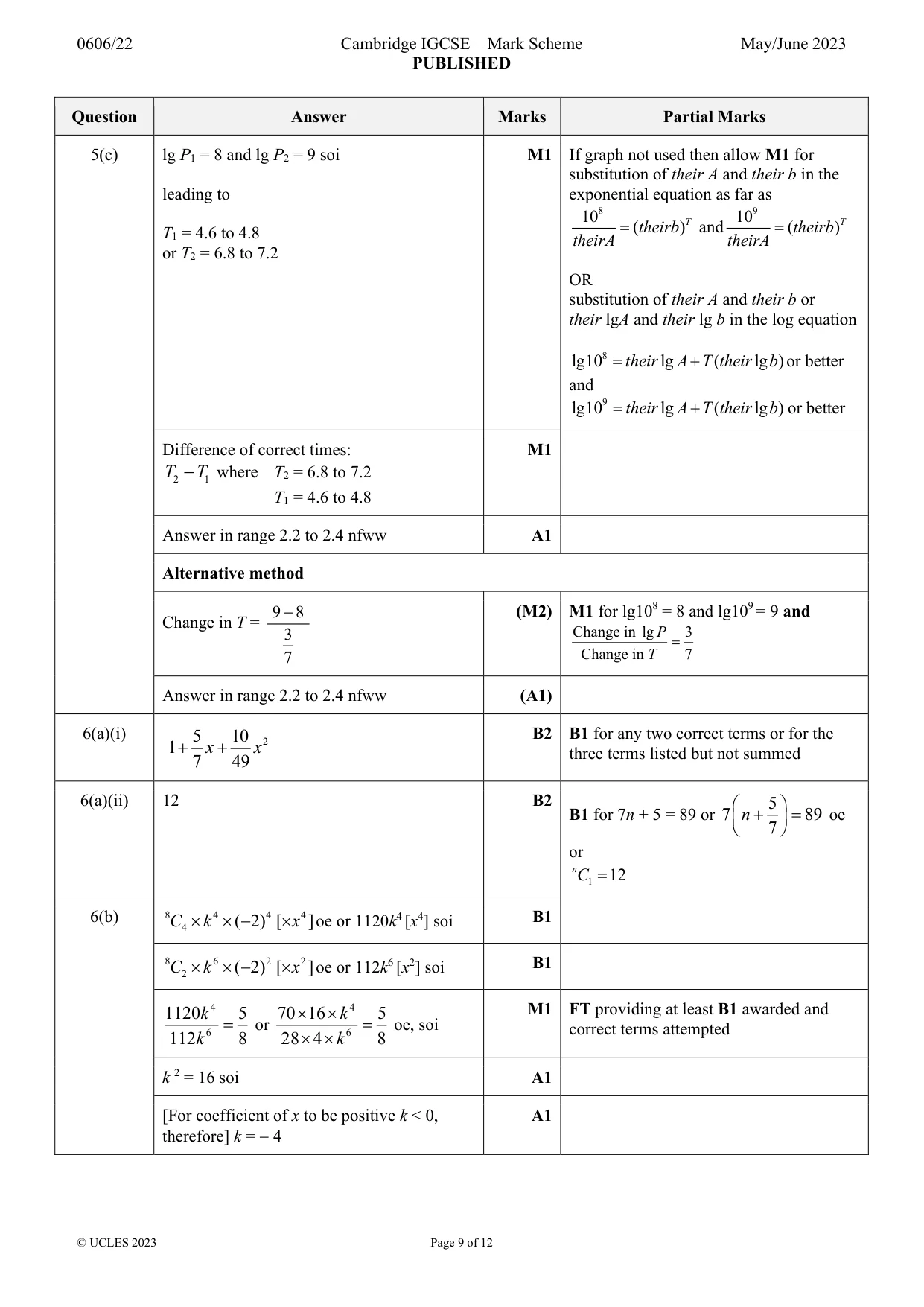
Mark scheme: 5(a) lg P lg A T lg b oe nfww B2 Must be seen and not from wrong working and correct comparison with y = mx + c soi B1 for lg P lg A T lg b isw, nfww 5(b) A = 106 oe isw and 4 B2 for A = 106 oe isw 3 or B1correct method which could be used b = 10 7 oe isw to find A e.g. 3 lgA = 6 or 12 = 14 lg A 7 3 B2 for b = 10 7 oe isw or B1correct method which could be used to find b e.g. 12 6 lgb = oe or 12 = 14lg b 6 14 0 5(c) lg P1 = 8 and lg P2 = 9 soi M1 If graph not used then allow M1 for substitution of their A and their b in the leading to exponential equation as far as 108 10 9 (theirb )T and (theirb )T T1 = 4.6 to 4.8 theirA theirA or T2 = 6.8 to 7.2 OR substitution of their A and their b or their lgA and their lg b in the log equation lg108 their lg A T (their lg b ) or better and lg109 their lg A T (their lg b ) or better Difference of correct times: M1 T2 T1 where T2 = 6.8 to 7.2 T1 = 4.6 to 4.8 Answer in range 2.2 to 2.4 nfww A1 Alternative method 9 8 (M2) M1 for lg108 = 8 and lg109 = 9 and Change in T = 3 Change in lg P 3 7 Change in T 7 Answer in range 2.2 to 2.4 nfww (A1)
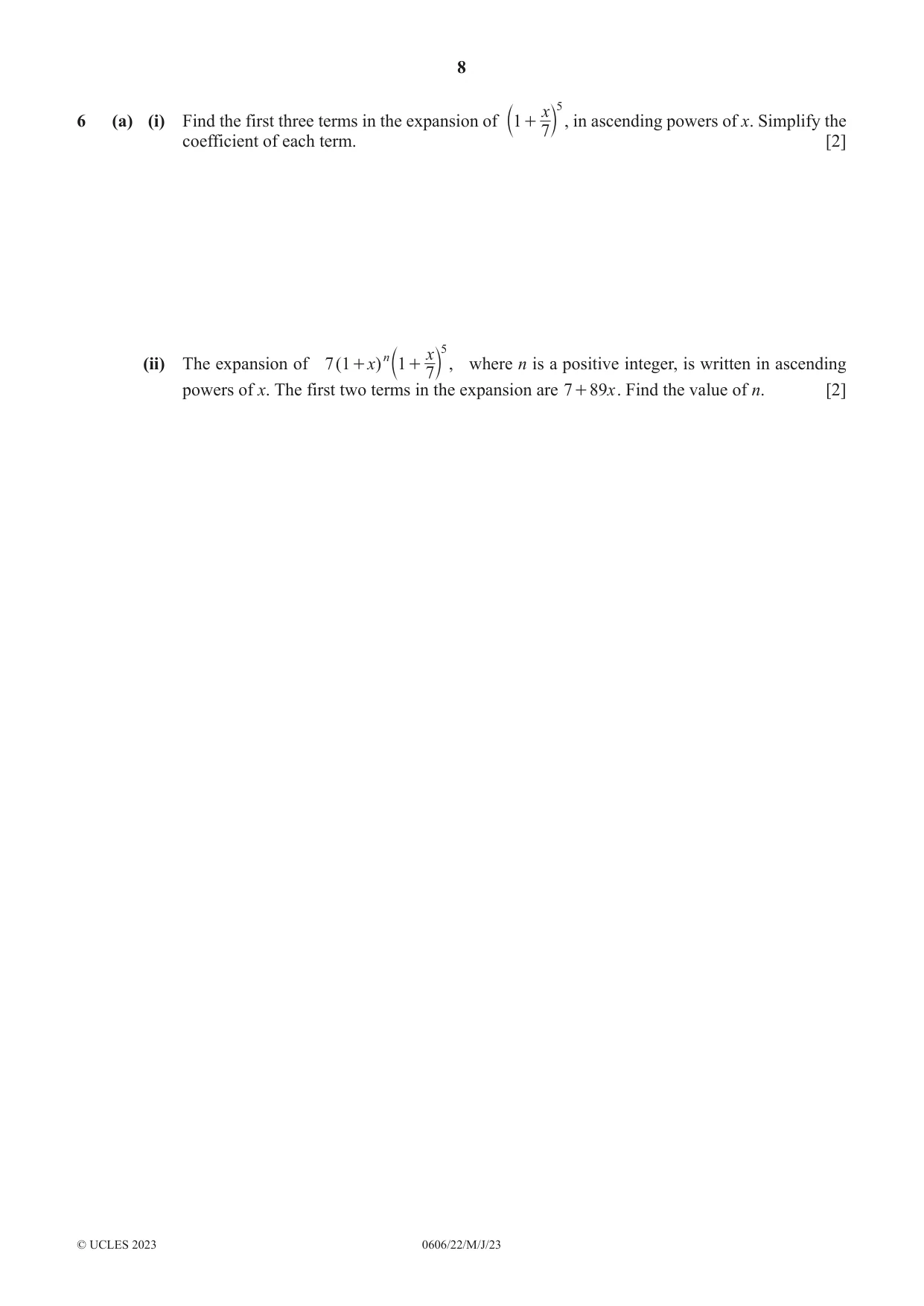
Q6 · Find the first three terms in the expansion of 1 + , in ascending powers of x
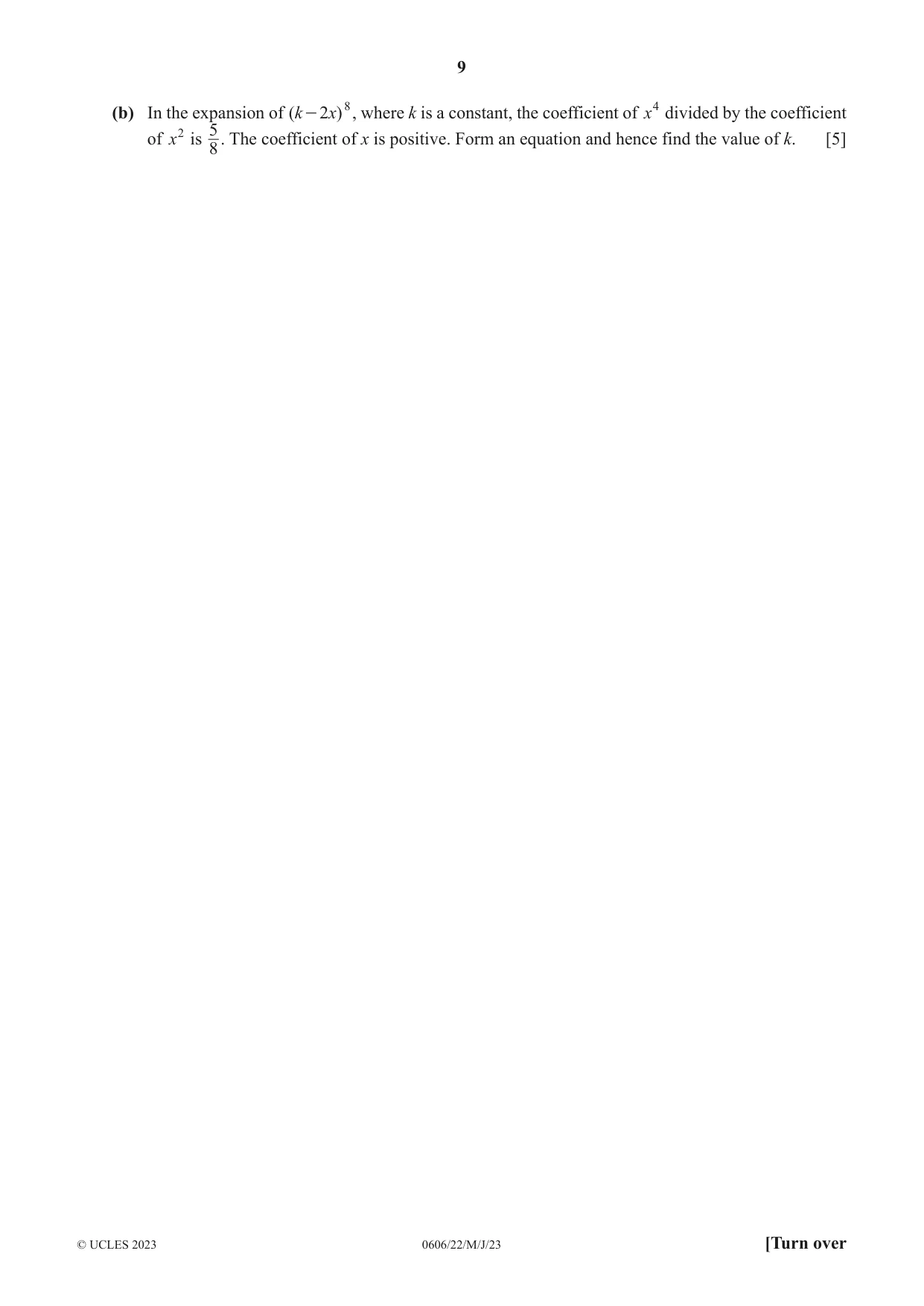
6 (a) (i) Find the first three terms in the expansion of 1 + , in ascending powers of x. Simplify the 7 coefficient of each term. [2] 5 n x (ii) The expansion of 7 ( 1 + )x 1 + , where n is a positive integer, is written in ascending b 7 l powers of x. The first two terms in the expansion are 7 + 89x . Find the value of n. [2] (b) In the expansion of ( k - 2 x) 8 , where k is a constant, the coefficient of x4 divided by the coefficient of x2 is 5. The coefficient of x is positive. Form an equation and hence find the value of k. [5] 8
Mark scheme: 6(a)(i) 5 10 2 B2 B1 for any two correct terms or for the 1 x x three terms listed but not summed 7 49 6(a)(ii) 12 B2 5 B1 for 7n + 5 = 89 or 7 n 89 oe 7 or nC1 12 6(b) 8C 4 k 4 ( 2) 4 [ x 4 ] oe or 1120k4 [x4] soi B1 8C 2 k 6 ( 2) 2 [ x 2 ] oe or 112k6 [x2] soi B1 1120 k 4 5 70 16 k 4 5 M1 FT providing at least B1 awarded and 6 or 6 oe, soi correct terms attempted 112 k 8 28 4 k 8 k 2 = 16 soi A1 [For coefficient of x to be positive k < 0, A1 therefore] k = 4
Q7 · F ( x) = 3 + ( 4 x - 2) 5 where x 2 1
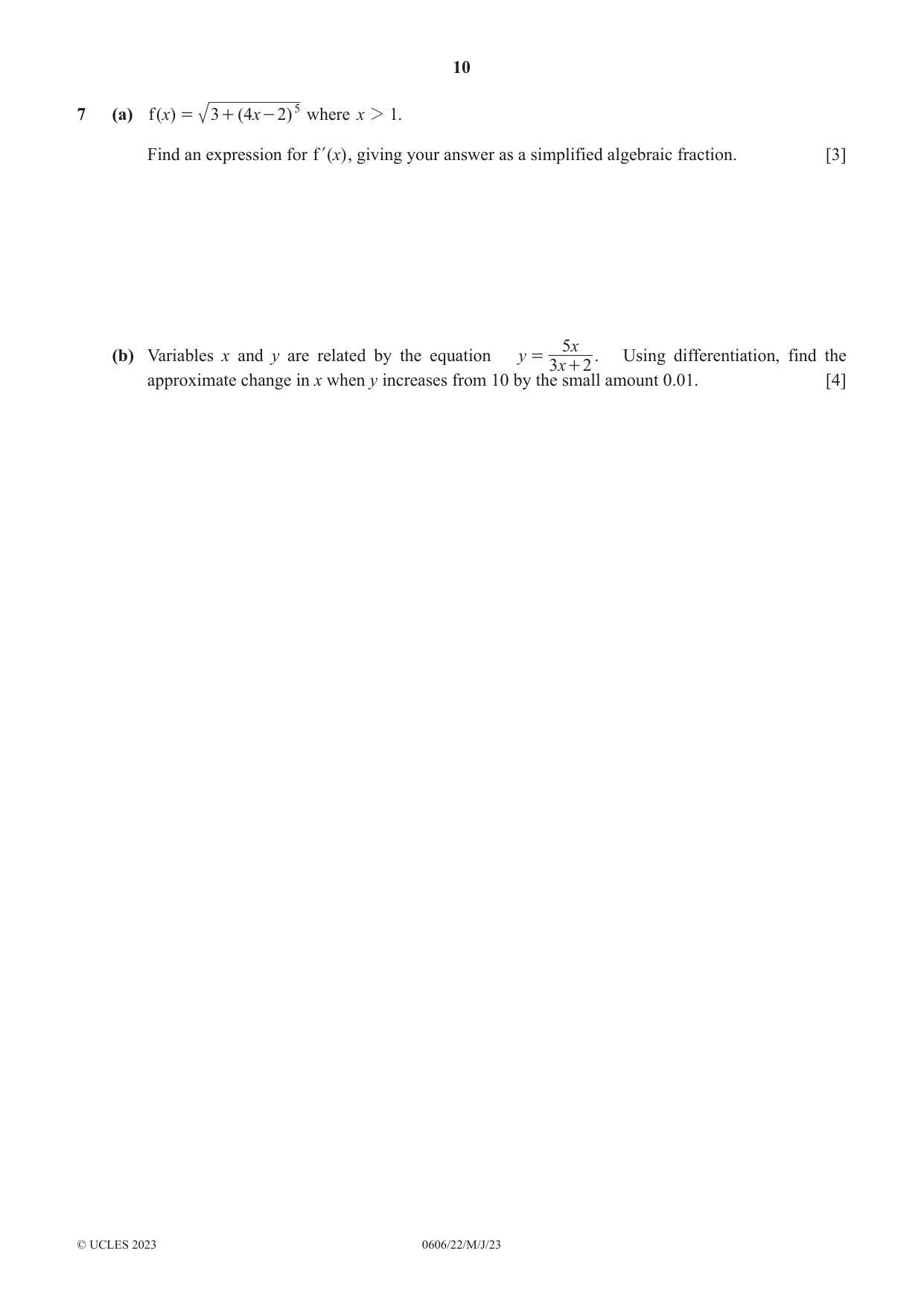
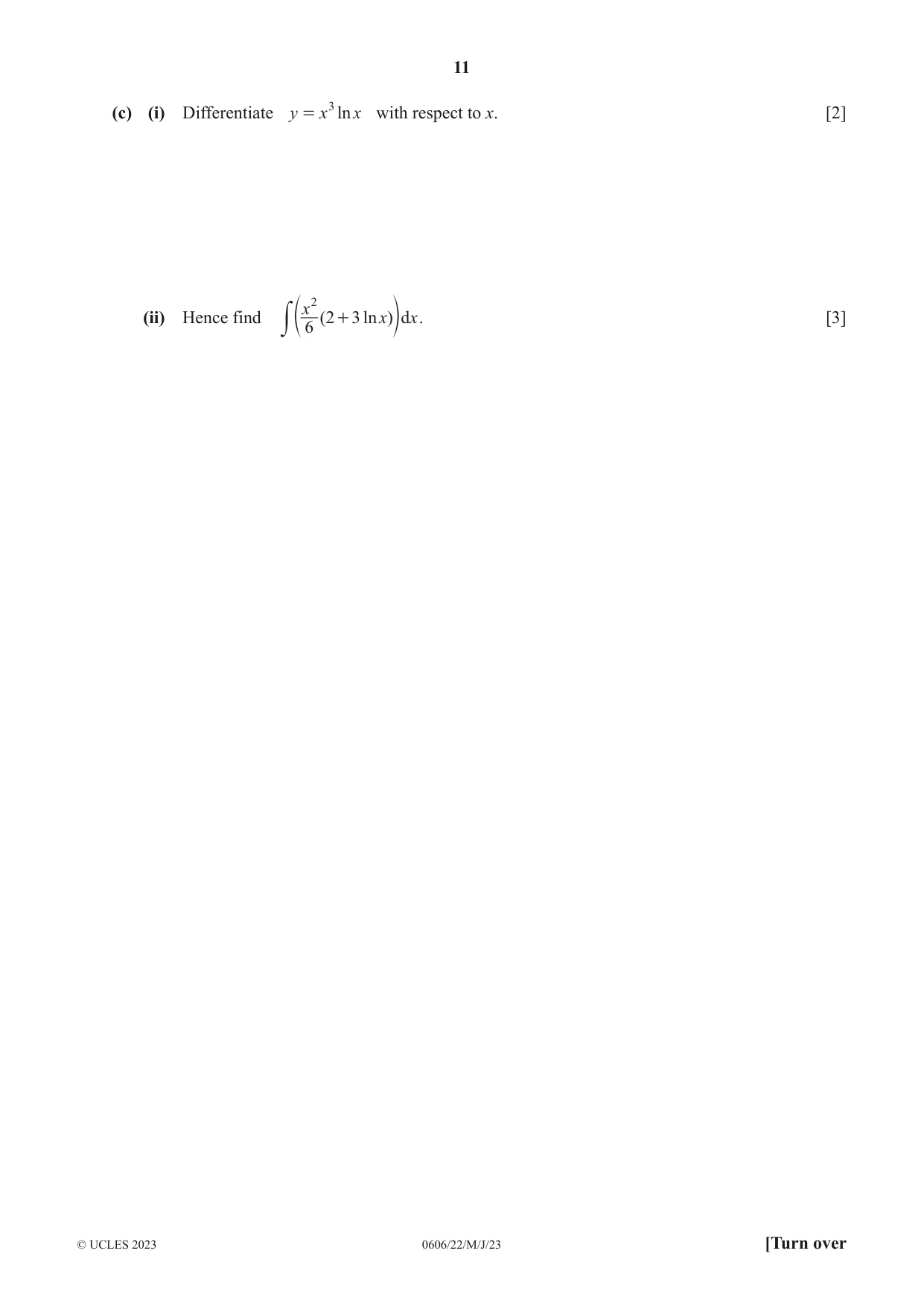
7 (a) f ( x) = 3 + ( 4 x - 2) 5 where x 2 1. Find an expression for f l ( x) , giving your answer as a simplified algebraic fraction. [3] 5x (b) Variables x and y are related by the equation y = . Using differentiation, find the 3x + 2 approximate change in x when y increases from 10 by the small amount 0.01. [4] (c) (i) Differentiate y = x 3 ln x with respect to x. [2] x 2 (ii) Hence find ( 2 + 3 ln x) dx . [3] y e 6 o
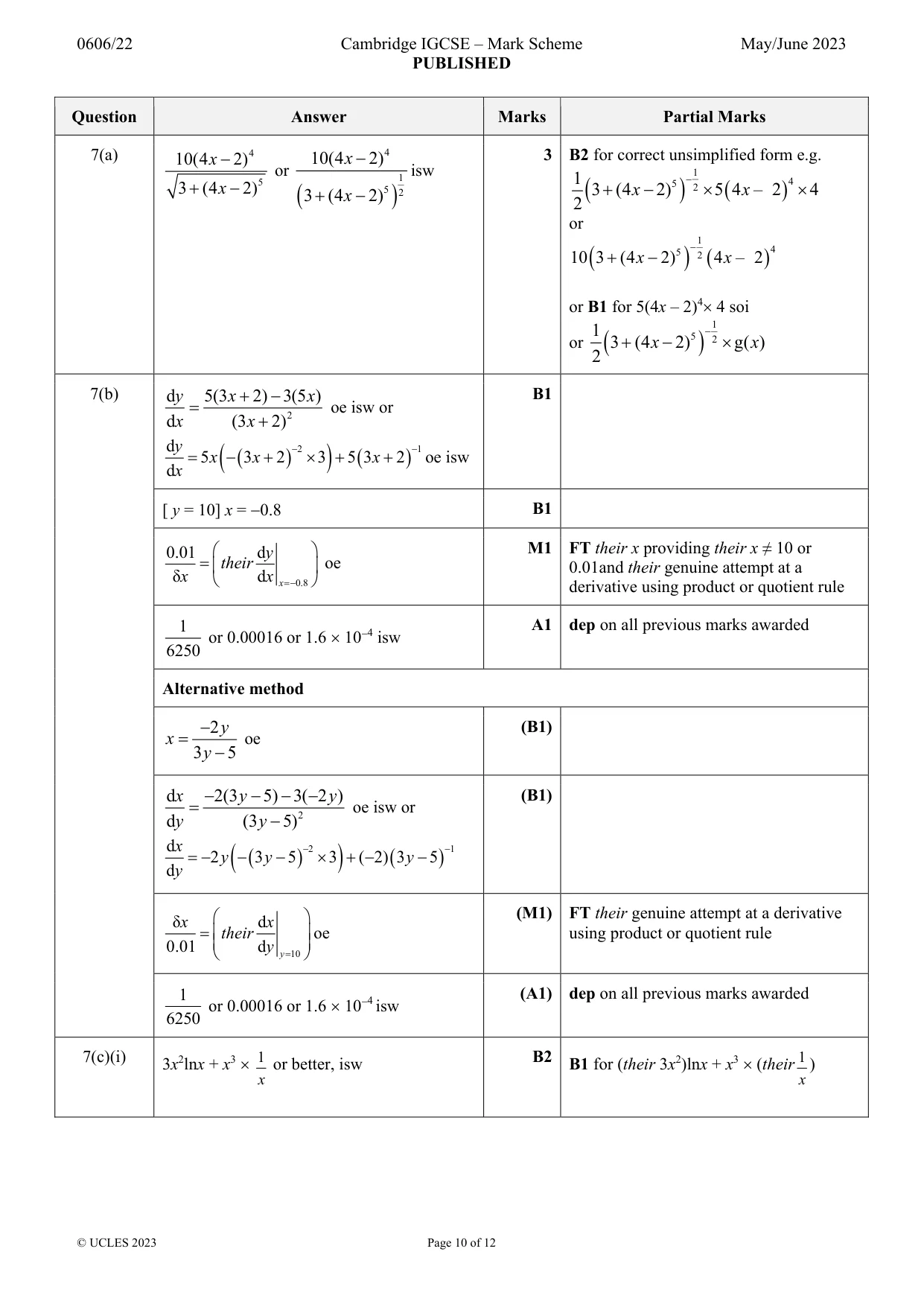
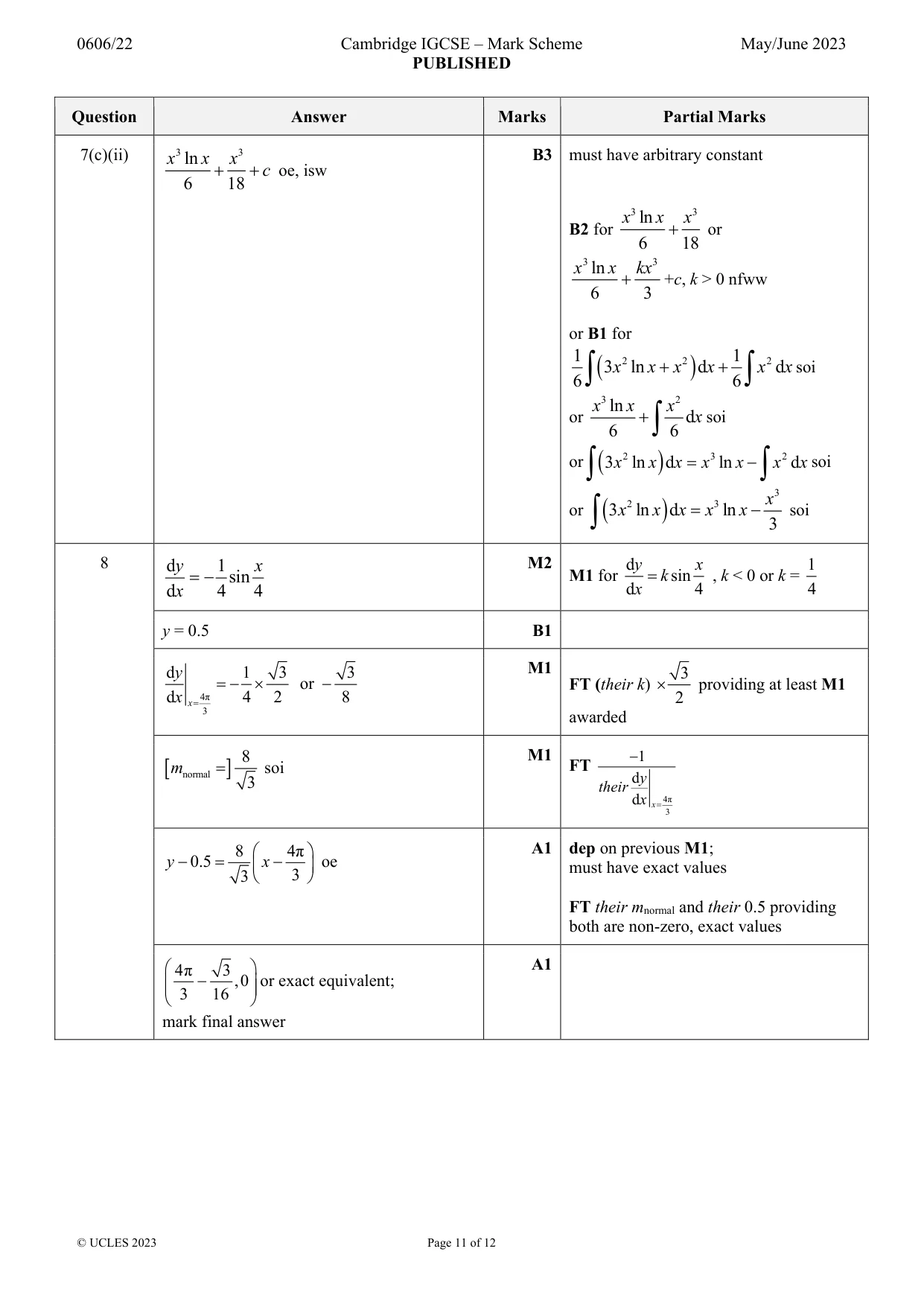
Mark scheme: 7(a) 10(4 x 2) 4 10(4 x 2) 4 3 B2 for correct unsimplified form e.g. or isw 1 5 5 3 (4 x 2) 5 2 2 5 4 x – 2 4 4 3 (4 x 2) 1 3 (4 x 2) 1 2 or 1 5 2 10 3 (4 x 2) 4 x – 2 4 or B1 for 5(4x – 2)4 4 soi 1 5 1 or 3 (4 x 2) 2 g( x ) 2 7(b) dy 5(3 x 2) 3(5 x ) B1 2 oe isw or d x (3 x 2) dy 2 1 5 x 3 x 2 3 5 3 x 2 oe isw dx [ y = 10] x = 0.8 B1 0.01 dy M1 FT their x providing their x ≠ 10 or their oe 0.01and their genuine attempt at a δx dx x 0.8 derivative using product or quotient rule 1 A1 dep on all previous marks awarded or 0.00016 or 1.6 104 isw 6250 Alternative method 2 y (B1) x oe 3 y 5 dx 2(3 y 5) 3( 2 y ) (B1) 2 oe isw or dy (3 y 5) dx 2 1 2 y 3 y 5 3 ( 2) 3 y 5 dy (M1) FT their genuine attempt at a derivative δ x d x their oe using product or quotient rule 0.01 d y y 10 1 (A1) dep on all previous marks awarded or 0.00016 or 1.6 104 isw 6250 7(c)(i) 1 B2 1 3x2lnx + x3 or better, isw B1 for (their 3x2)lnx + x3 (their ) x x 7(c)(ii) x 3 ln x x 3 B3 must have arbitrary constant c oe, isw 6 18 x 3 ln x x 3 B2 for or 6 18 x 3 ln x kx 3 +c, k > 0 nfww 6 3 or B1 for 1 3 x 2 ln x x 2 dx 1 x 2 dx soi 6 6 x 3 ln x x 2 or dx soi 6 6 or x 2 d x soi 3 ln x 3 x 2 ln x d x x 2 3 x 3 or soi 3 x ln x dx x ln x 3
Q8 · A curve has equation y = cos where x is in radians
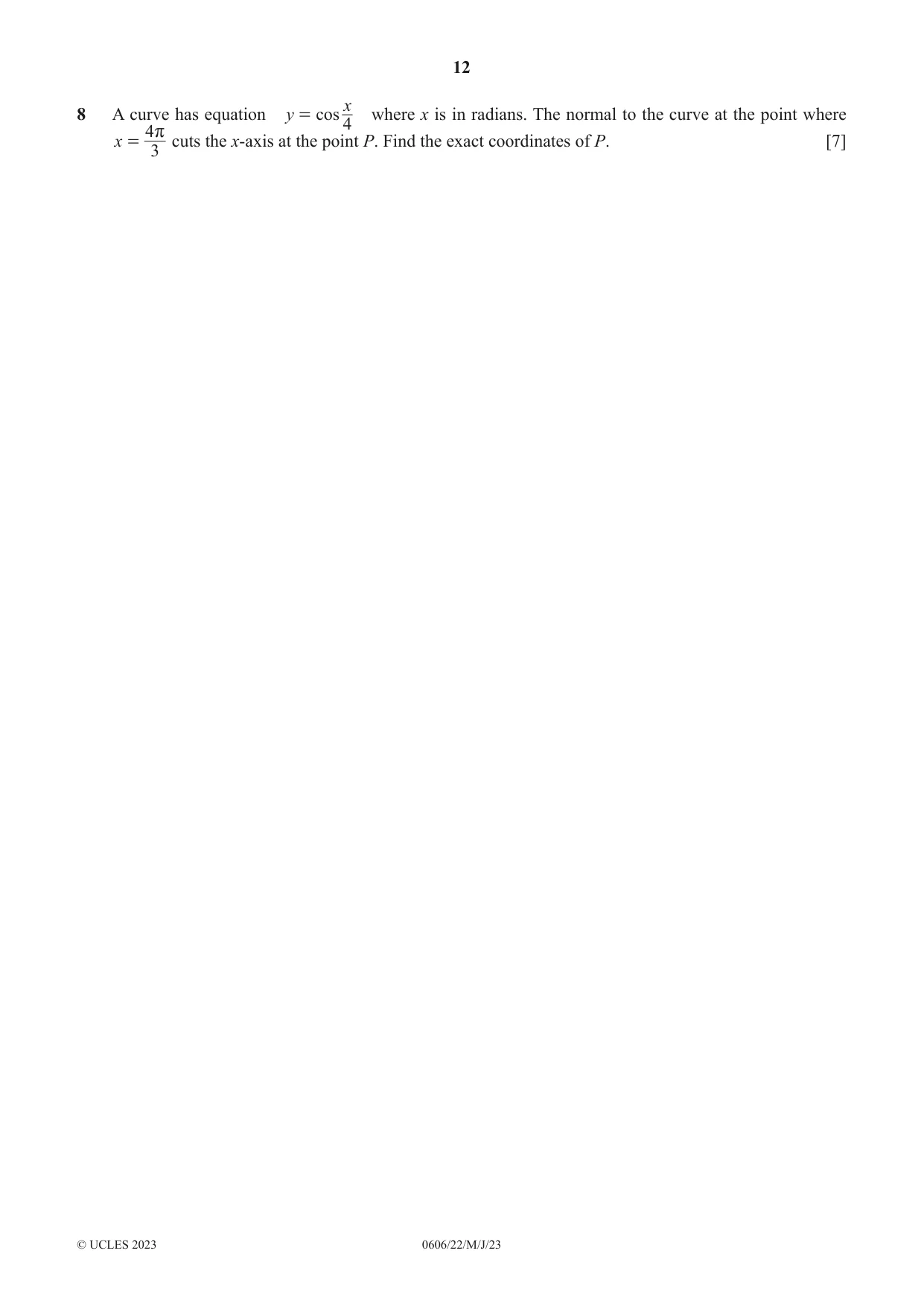
8 A curve has equation y = cos where x is in radians. The normal to the curve at the point where 4 4 r x = cuts the x-axis at the point P. Find the exact coordinates of P. [7] 3
Mark scheme: 8 dy 1 x M2 dy x 1 sin M1 for k sin , k < 0 or k = dx 4 4 dx 4 4 y = 0.5 B1 dy 1 3 3 M1 3 or FT (their k) providing at least M1 dx x 4π 4 2 8 2 3 awarded 8 M1 1 FT mnormal soi 3 their d y dx x 4π 3 8 4π A1 dep on previous M1; y 0.5 x oe must have exact values 3 3 FT their mnormal and their 0.5 providing both are non-zero, exact values 4π 3 A1 ,0 or exact equivalent; 3 16 mark final answer
More questions on Use differentiation to find gradients, tangents
Q9 · A particle travels in a straight line so that, t seconds after passing a fixed point, its…
9 A particle travels in a straight line so that, t seconds after passing a fixed point, its velocity, v ms -1 , is given by t v = e 4 for 0 G t G 4 , 16e v = 2 for 4 G t G k . t The total distance travelled by the particle between t = 0 and t = k is 13.4 metres. Find the value of k. [6]
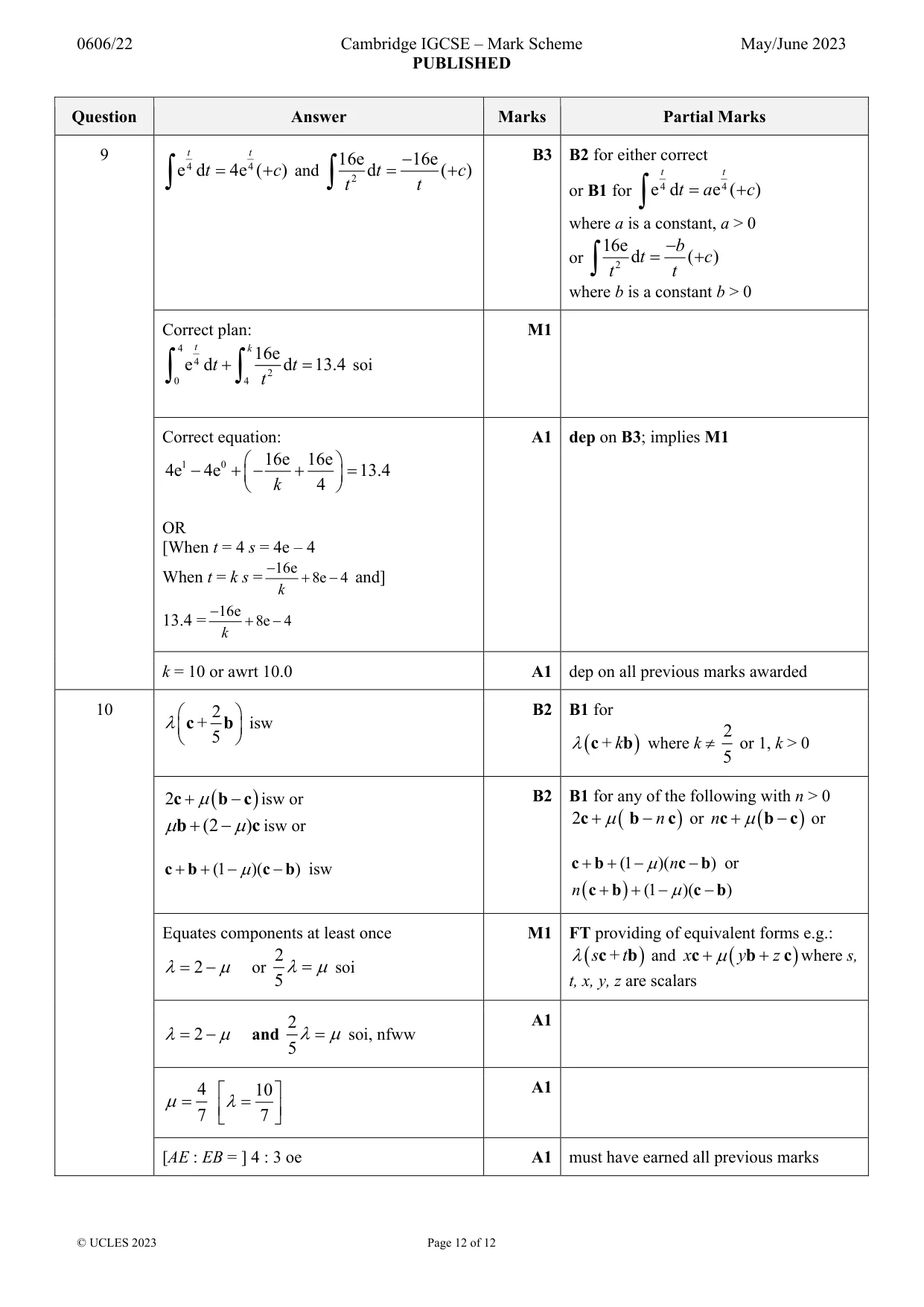
Mark scheme: t9 t 16e 16e B3 B2 for either correct 4 4 t t e dt 4e ( c ) and 2 dt ( c ) t t 4 4 or B1 for e dt ae ( c ) where a is a constant, a > 0 16e b or 2 dt ( c ) t t where b is a constant b > 0 Correct plan: M1 4 t k 16e 4 e dt 2 dt 13.4 soi 0 4 t Correct equation: A1 dep on B3; implies M1 1 0 16e 16e 4e 4e 13.4 k 4 OR [When t = 4 s = 4e – 4 16e When t = k s = 8e 4 and] k 16e 13.4 = 8e 4 k k = 10 or awrt 10.0 A1 dep on all previous marks awarded
Q10 · B E D O C A The diagram shows a triangle OAB
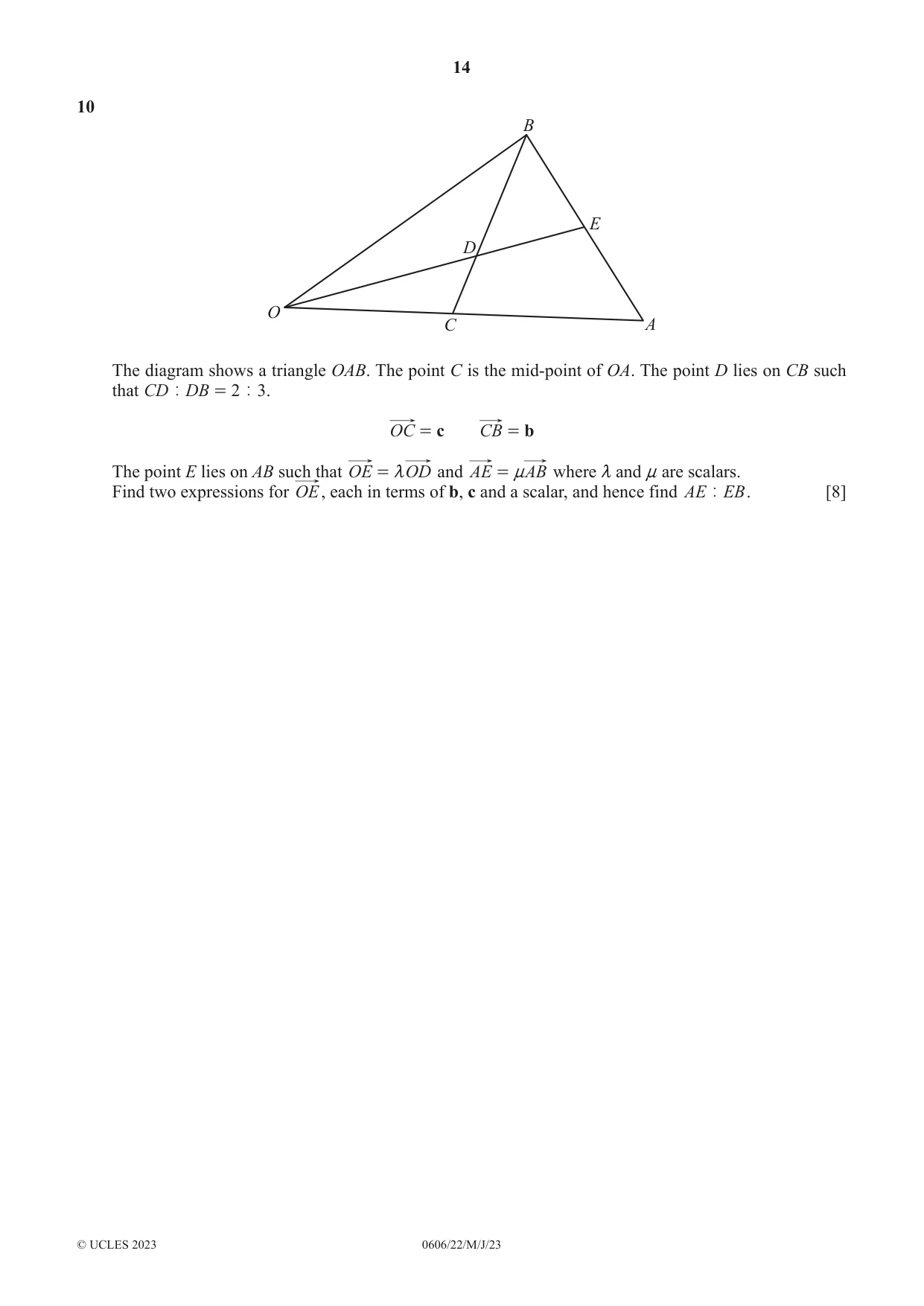
10 B E D O C A The diagram shows a triangle OAB. The point C is the mid-point of OA. The point D lies on CB such that CD | DB = 2 | 3 . OC = c CB = b The point E lies on AB such that OE = m OD and AE = nAB where m and n are scalars. Find two expressions for OE, each in terms of b, c and a scalar, and hence find AE | EB . [8] Continuation of working space for Question 10.
Mark scheme: 10 c + 2 b isw B2 B1 for 2 5 c + kb where k or 1, k > 0 5 2c b c isw or B2 B1 for any of the following with n > 0 2c b n c or nc b c or b (2 )c isw or c b (1 )( nc b ) or c b (1 )( c b ) isw n c b (1 )(c b ) Equates components at least once M1 FT providing of equivalent forms e.g.: 2 s c + t b and xc yb z c where s, 2 or soi 5 t, x, y, z are scalars 2 A1 2 and soi, nfww 5 4 10 A1 7 7 [AE : EB = ] 4 : 3 oe A1 must have earned all previous marks
What was in this paper
The subtopics covered by these 10 questions, and how many questions each got. Open one in a new tab to see every Cambridge question on it.
1Evaluate definite integrals and apply1Find the magnitude of a vector; add and1Find the maximum or minimum value of the1Make use of the relationships in1Solve simultaneous equations in two1Use differentiation to find gradients, tangents1Use differentiation to find stationary points1Use the binomial theorem for expansion of1Use the equation of a straight line1What you needed in this session
Cambridge’s own grade thresholds for 2023 May/June, Paper 2 · Variant 2. A higher threshold means an easier paper — the bar moves with how the cohort did.