Questions as text
Q1 · For Examiner's Use A B C AB is the diameter of a circle 0580/21 Oct/Nov 2012
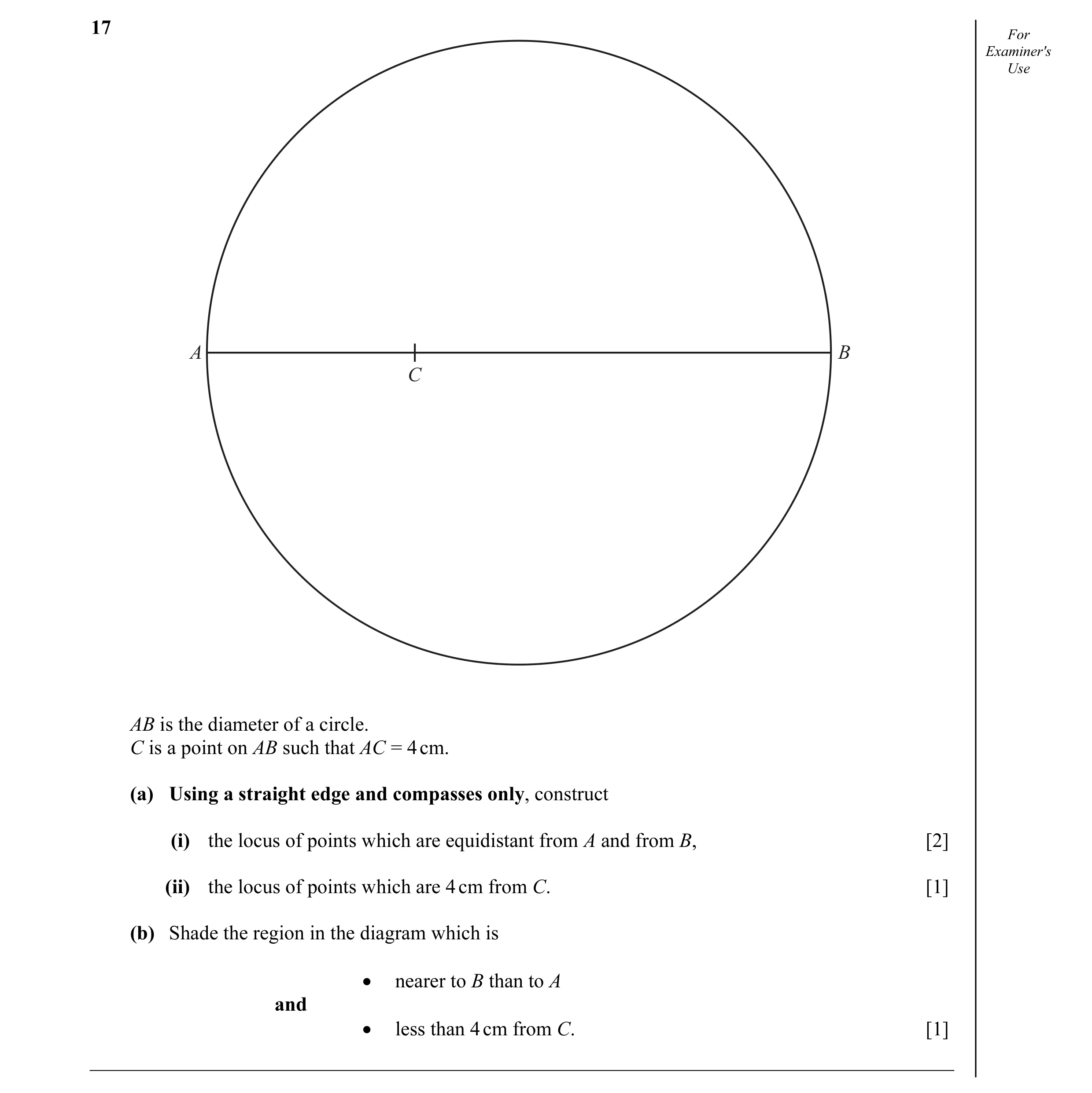
17 For Examiner's Use A B C AB is the diameter of a circle. C is a point on AB such that AC = 4 cm. (a) Using a straight edge and compasses only, construct (i) the locus of points which are equidistant from A and from B, [2] (ii) the locus of points which are 4 cm from C. [1] (b) Shade the region in the diagram which is • nearer to B than to A and • less than 4 cm from C. [1]
4 marks
Mark scheme: 17 (a) 2 B1 for correct line, on each side of AB (longer than dash at C) B1 for 2 pairs of intersecting arcs R 1 Intention to draw a full correct circle (b) 1 R shaded must be a closed region 7 84
This question in 0580/21 Oct/Nov 2012
Q2 · For Examiner′s C Use D B c b E A O OABCDE is a regular polygon 0580/23 May/June 2013
19 For Examiner′s C Use D B c b E A O OABCDE is a regular polygon. (a) Write down the geometrical name for this polygon. Answer(a) … [1] (b) O is the origin. = b and = c. Find, in terms of b and c, in their simplest form, (i) , Answer(b)(i) = … [1] (ii) , Answer(b)(ii) = … [2] (iii) the position vector of E. Answer(b)(iii) … [1] _____________________________________________________________________________________ Question 20 is printed on the next page.
5 marks
Mark scheme: 19 (a) hexagon 1 (b) (i) −b + c 1 (ii) b − 12 c 2 B1 for OB + BA or any correct route (iii) −b + c 1FT = their (b)(i) √
This question in 0580/23 May/June 2013
Q3 · B A C (a) Using compasses and a straight edge only, construct the bisector of angle BAC 0580/22 Oct/Nov 2016
11 B A C (a) Using compasses and a straight edge only, construct the bisector of angle BAC. [2] (b) Complete the statement. The bisector of angle BAC is the locus of points that are … … [1]
3 marks
Mark scheme: 11 (a) Accurate angle bisector with correct 2 B1 for accurate angle bisector arcs or correct arcs with no/wrong line (b) Equidistant (oe) from AB and AC 1
This question in 0580/22 Oct/Nov 2016
Q4 · C N L A B M In the diagram, BL is the bisector of angle ABC and MN is the perpendicular… 0580/22 Oct/Nov 2017
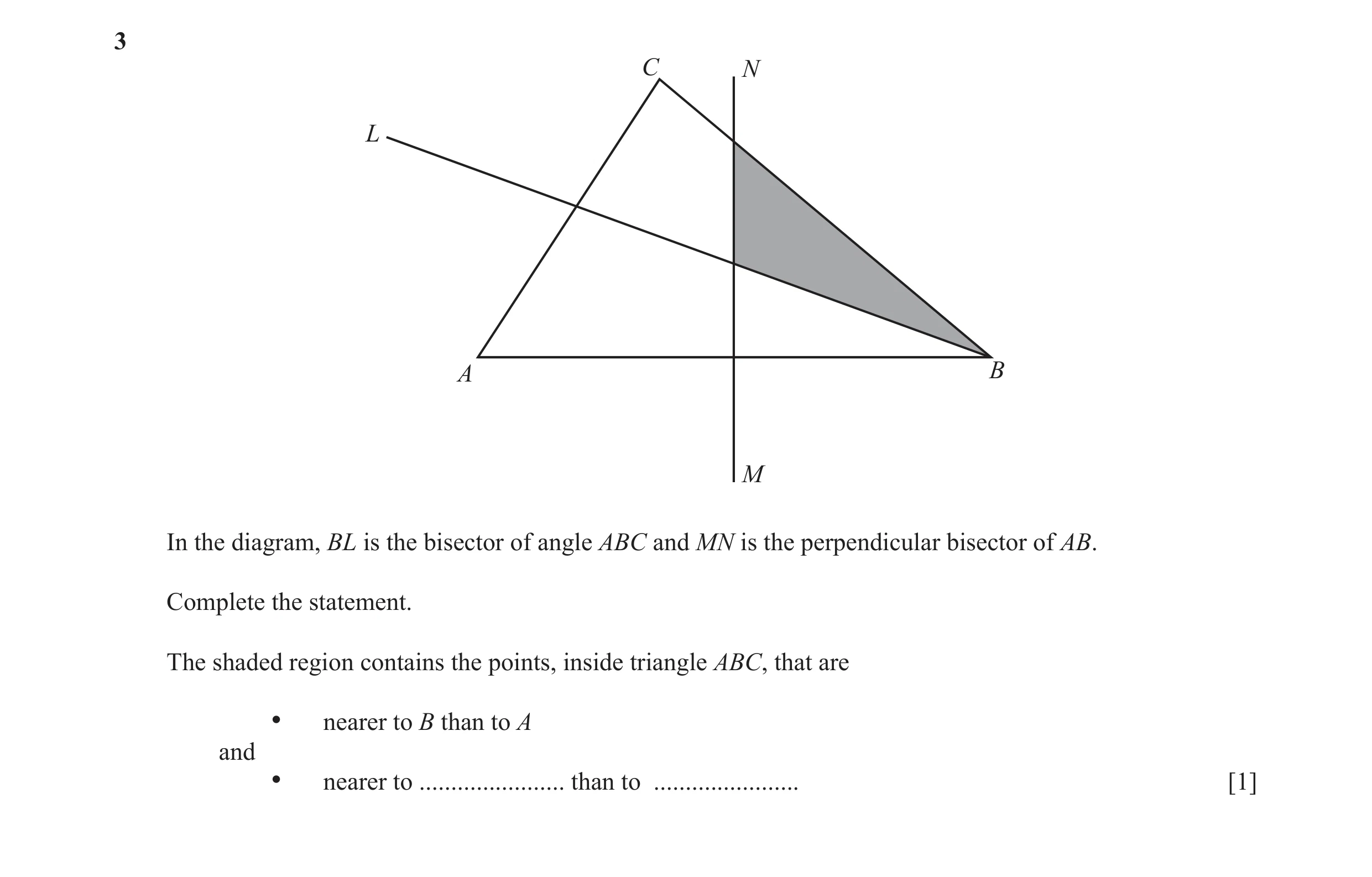
3 C N L A B M In the diagram, BL is the bisector of angle ABC and MN is the perpendicular bisector of AB. Complete the statement. The shaded region contains the points, inside triangle ABC, that are • nearer to B than to A and • nearer to … than to … [1]
1 marks
Mark scheme: 3 BC AB oe 1
This question in 0580/22 Oct/Nov 2017
Q5 · A B C The diagram shows a triangle ABC and an arc with centre C and radius 6.5 cm 0580/21 Oct/Nov 2018
13 A B C The diagram shows a triangle ABC and an arc with centre C and radius 6.5 cm. (a) Using a straight edge and compasses only, construct the locus of points inside the triangle that are equidistant from BA and BC. [2] (b) Shade the region inside the triangle that is • more than 6.5 cm from C and • nearer to BA than to BC. [1]
3 marks
Mark scheme: 13(a) Correct angle bisector at B with two 2 B1 for accurate with no/wrong arcs or for pairs of correct arcs reaching AC two pairs of correct arcs with no or wrong line or short line 13(b) Correct region shaded 1
This question in 0580/21 Oct/Nov 2018
Question 6 0580/22 May/June 2019
4 Complete each statement. (a) A quadrilateral with only one pair of parallel sides is called a … . [1] (b) An angle greater than 90° but less than 180° is called … . [1]
2 marks
Mark scheme: 4(a) Trapezium 1 4(b) Obtuse 1
This question in 0580/22 May/June 2019
Q7 · A regular polygon has an interior angle of 176° 0580/22 Oct/Nov 2019
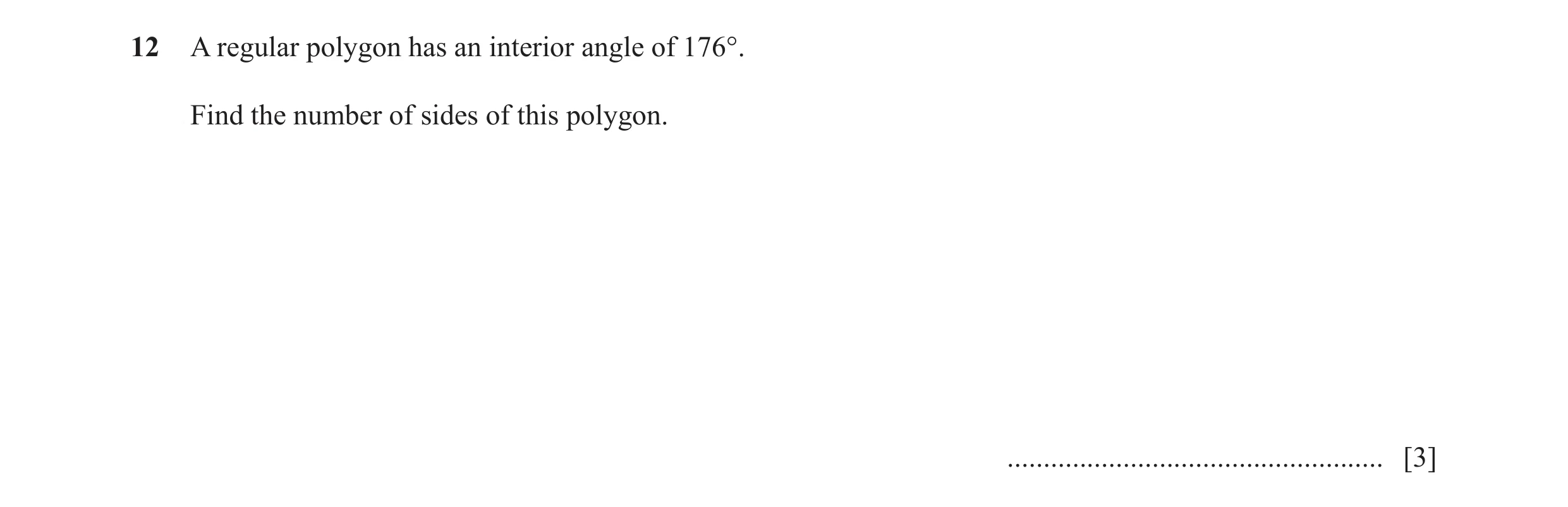
12 A regular polygon has an interior angle of 176°. Find the number of sides of this polygon. … [3]
3 marks
Mark scheme: 12 90 3 M2 for 360 ÷ (180 – 176) oe or M1 for 180(n – 2) = 176n oe or 180 – 176
This question in 0580/22 Oct/Nov 2019
Q8 · A NOT TO 58° SCALE 82° B C The diagram shows triangle ABC 0580/23 Oct/Nov 2020
6 A NOT TO 58° SCALE 82° B C The diagram shows triangle ABC. The triangle is reflected in the line BC to give a quadrilateral ABDC. (a) Write down the mathematical name of the quadrilateral ABDC. … [1] (b) Find angle ACD. Angle ACD = … [2]
3 marks
Mark scheme: 6(a) Kite 1 6(b) 80 2 M1 for (180 – 82 – 58) or better
This question in 0580/23 Oct/Nov 2020
Q9 · A B NOT TO SCALE X P Q In the diagram, AB is parallel to PQ 0580/21 May/June 2022
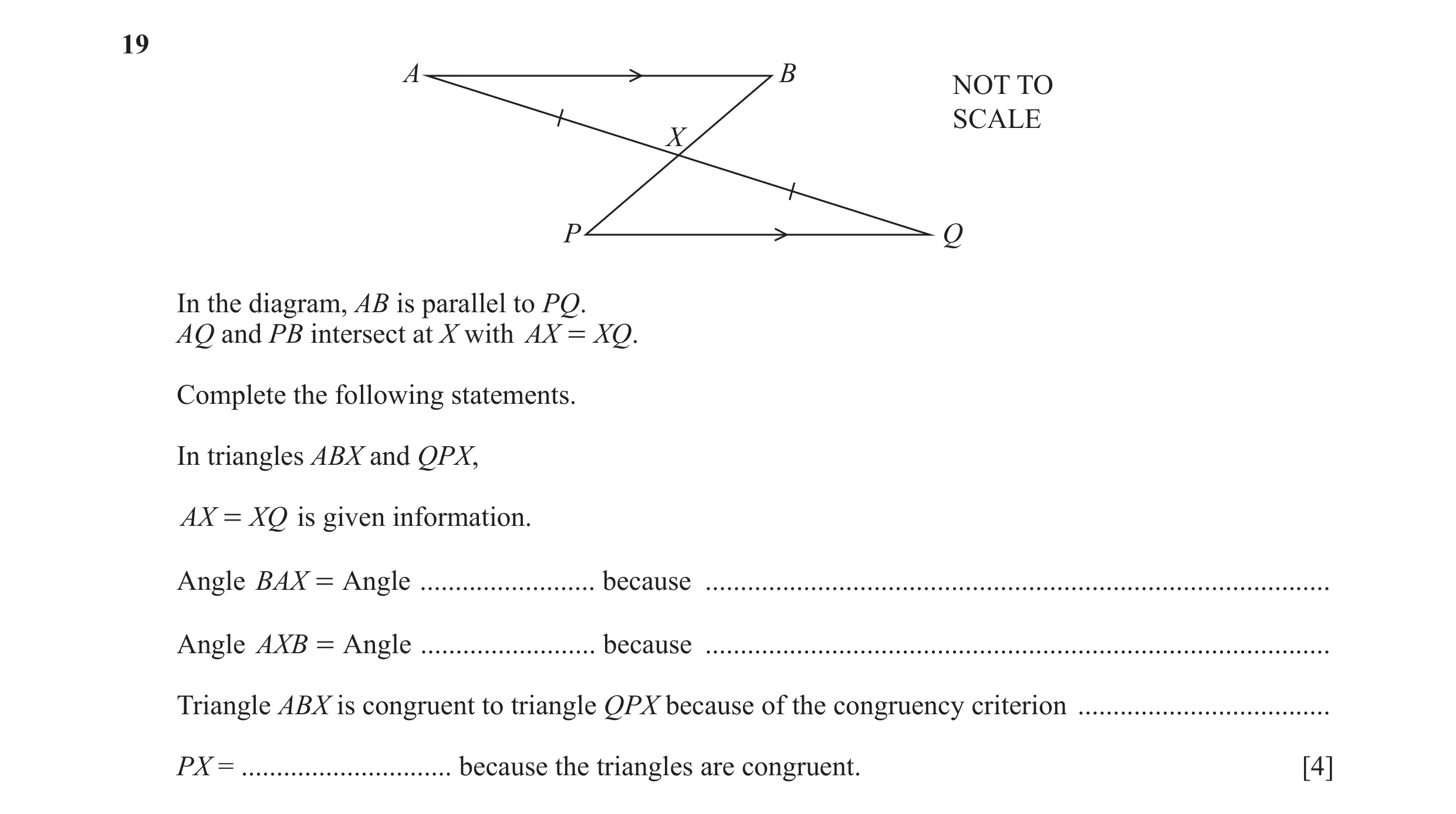
19 A B NOT TO SCALE X P Q In the diagram, AB is parallel to PQ. AQ and PB intersect at X with AX = XQ . Complete the following statements. In triangles ABX and QPX, AX = XQ is given information. Angle BAX = Angle … because … Angle AXB = Angle … because … Triangle ABX is congruent to triangle QPX because of the congruency criterion … PX = … because the triangles are congruent. [4]
4 marks
Mark scheme: 19 PQX and alternate 4 B2 for lines 1 and 2 correct PXQ and [vertically] opposite oe or B1 for line 1 or 2 correct, or both angles correct ASA XB B1 for line 3 correct B1 for line 4 correct
This question in 0580/21 May/June 2022
Q10 · A NOT TO SCALE B D C In triangle ABC, AC = AB 0580/23 May/June 2022
17 A NOT TO SCALE B D C In triangle ABC, AC = AB. D is the point on BC such that AD is perpendicular to BC. Complete the following statements to show that triangle ACD and triangle ABD are congruent. AD is perpendicular to BC so that Angle … = Angle … = … ° AC = AB is given information. Side … is common to both triangles. Triangle ACD is congruent to triangle ABD because of the congruency criterion … [3]
3 marks
Mark scheme: 17 ADC and ADB and 90 3 B1 for each correct line AD RHS
This question in 0580/23 May/June 2022
Q11 · B NOT TO 112° SCALE 44° C M A The diagram shows triangle ABC 0580/23 Oct/Nov 2023
5 B NOT TO 112° SCALE 44° C M A The diagram shows triangle ABC. M is the midpoint of AC. Triangle ABC is rotated 180° about centre M. The image and the original triangle together form a quadrilateral ABCD. (a) Write down the mathematical name of the quadrilateral ABCD. … [1] (b) Find angle BAD. Angle BAD = … [2]
3 marks
Mark scheme: 5(a) Parallelogram 1 5(b) 68 2 M1 for 180 – 112 oe or for 180 − 112 − 44
This question in 0580/23 Oct/Nov 2023
Q12 · A quadrilateral has one line of symmetry 0580/22 Feb/March 2025
3 A quadrilateral has one line of symmetry. The diagonals of the quadrilateral cross at right angles. Write down the mathematical name of the quadrilateral. … [1]
1 marks
Mark scheme: 3 Kite 1
This question in 0580/22 Feb/March 2025
 1 / 7
1 / 7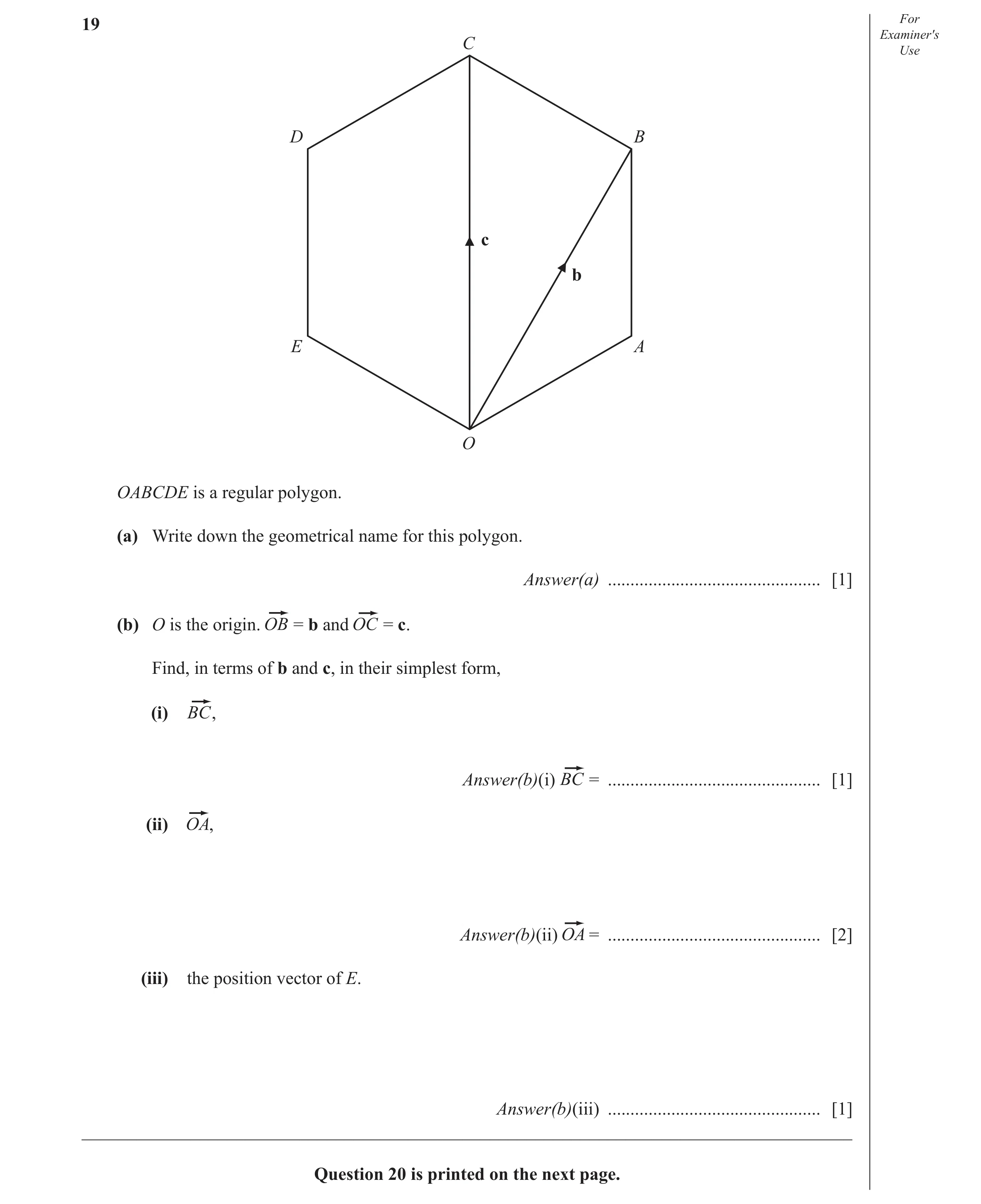 2 / 7
2 / 7![Question 3: B A C (a) Using compasses and a straight edge only, construct the bisector of angle BAC. [2] (b) Complete the statement. The bisector of an…](https://img.pastlit.com/crops/e18cd8ca-3982-4ed1-875e-59ee460b0e12/q11.webp)
 3 / 7
3 / 7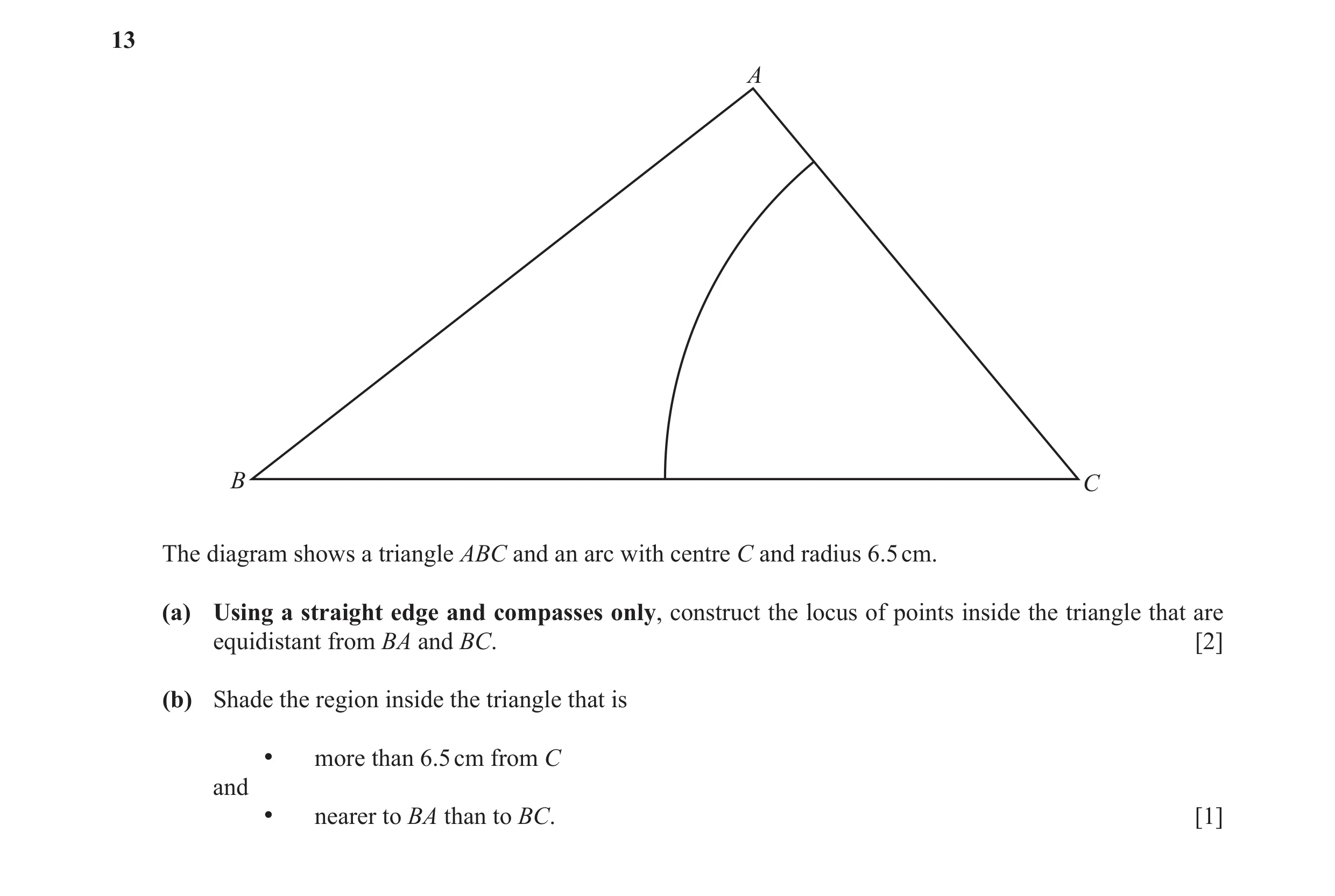
 4 / 7
4 / 7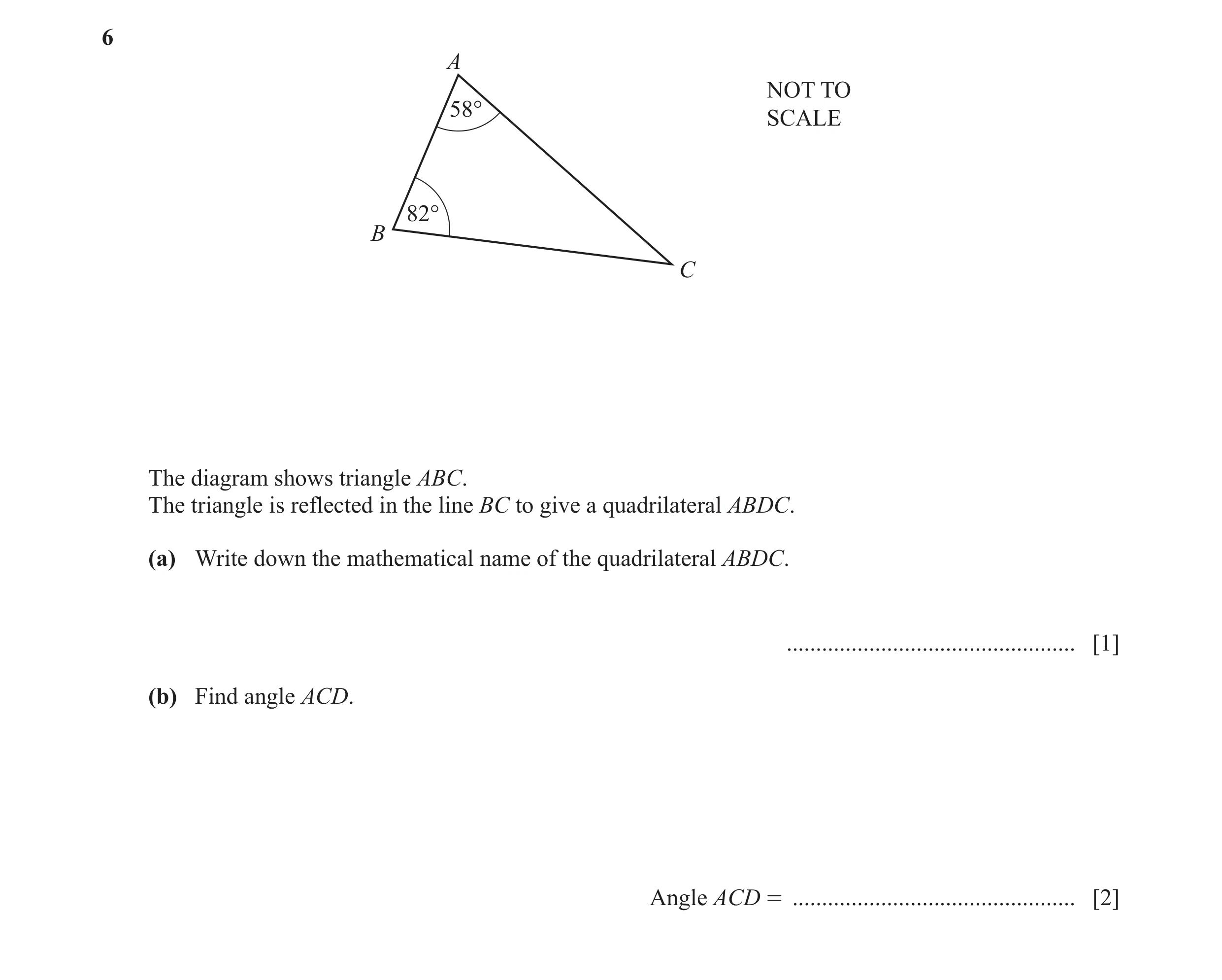
 5 / 7
5 / 7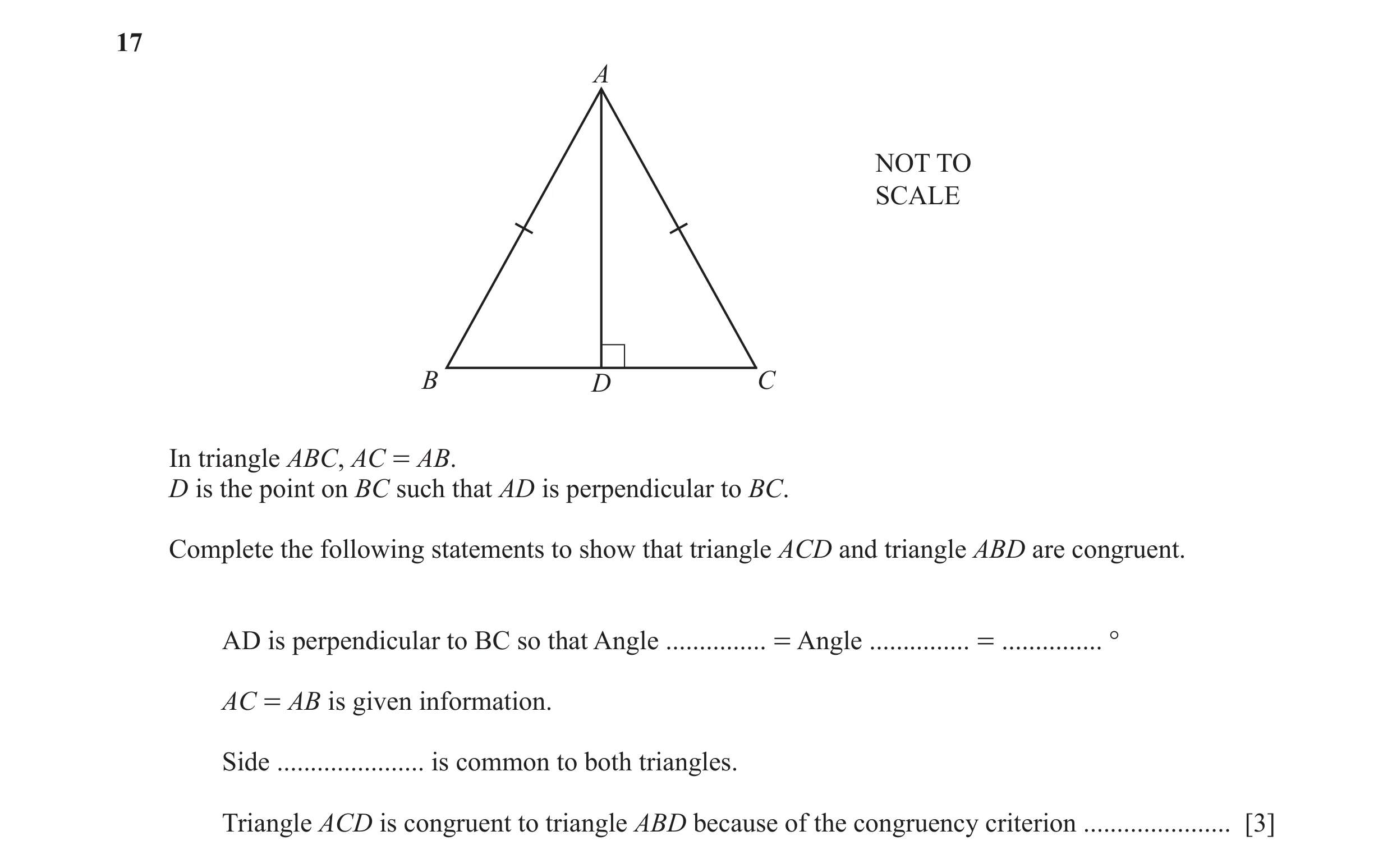 6 / 7
6 / 7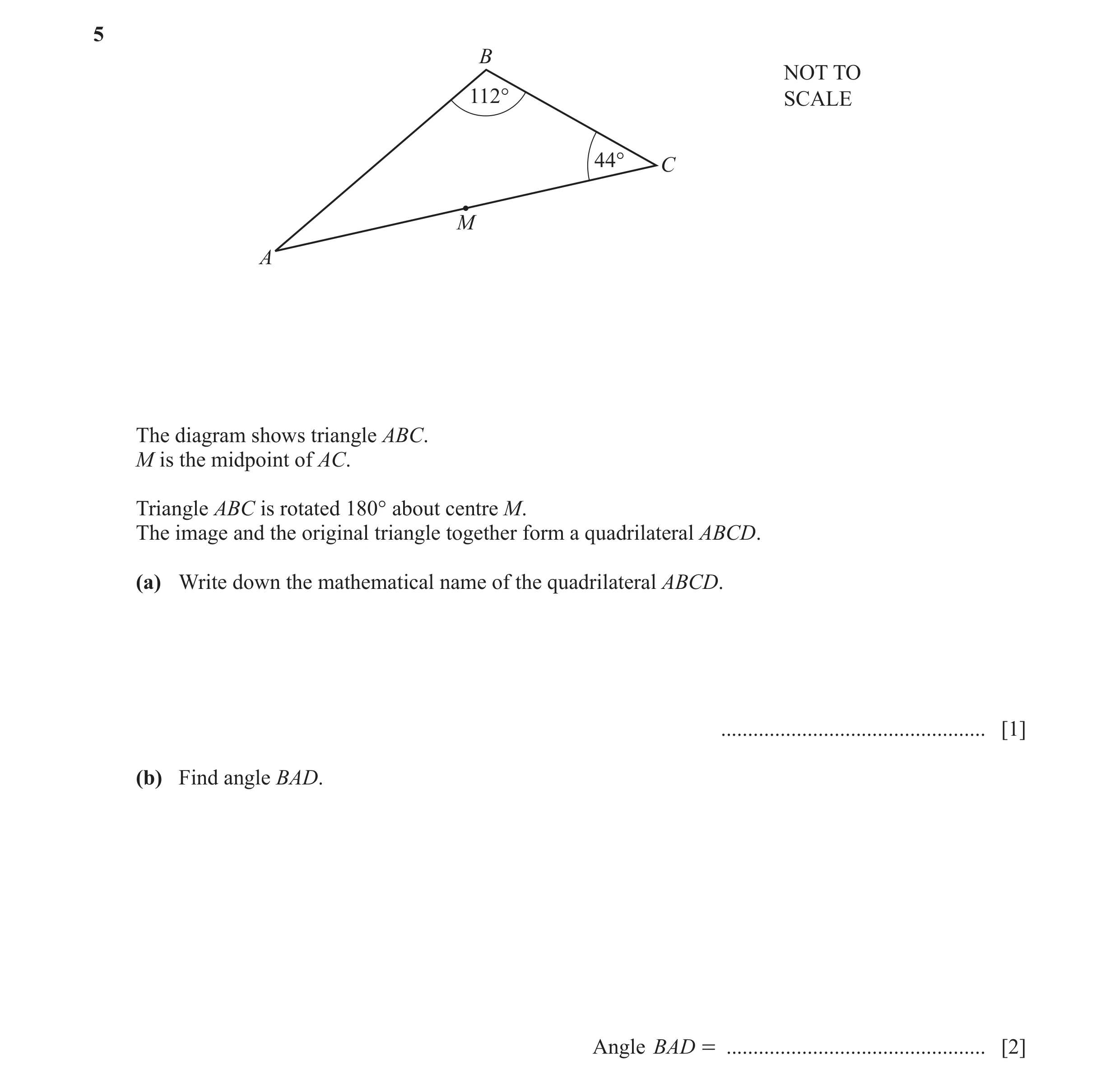
 7 / 7
7 / 7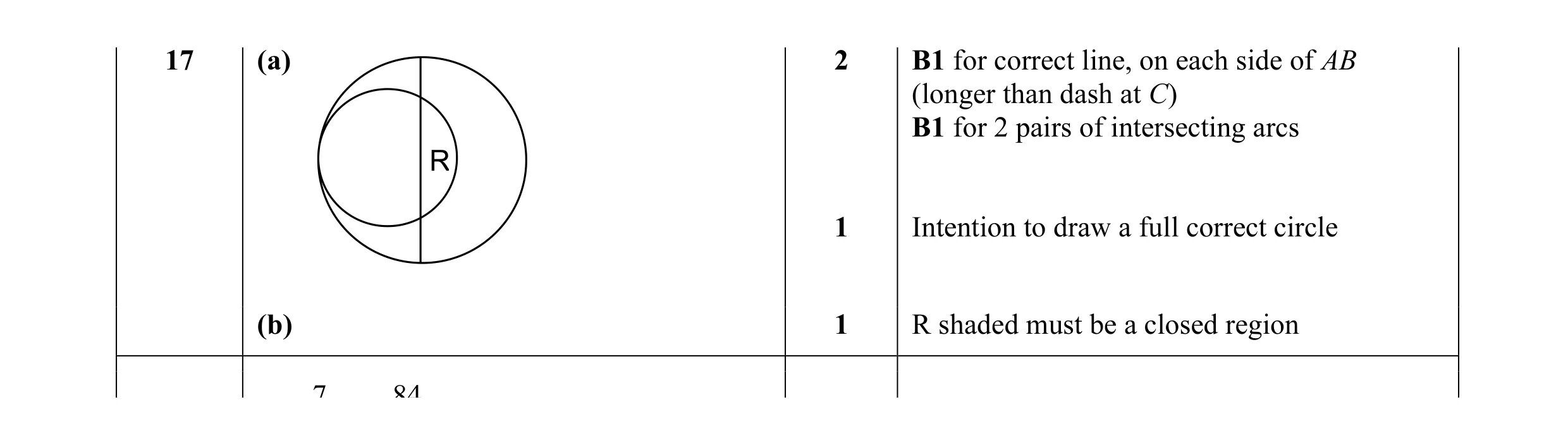 4
4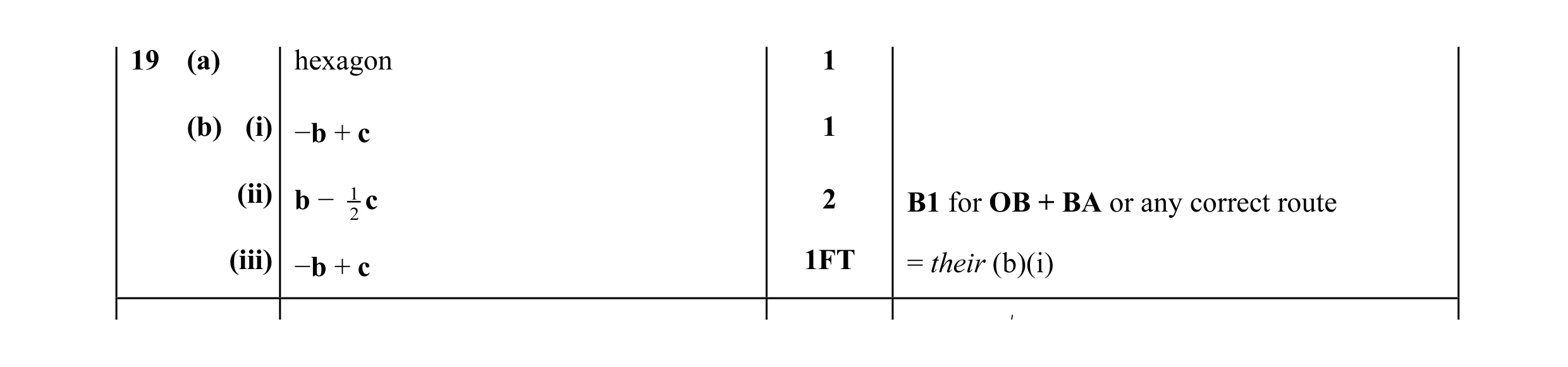 5
5 3
3 1
1 3
3 2
2 3
3 3
3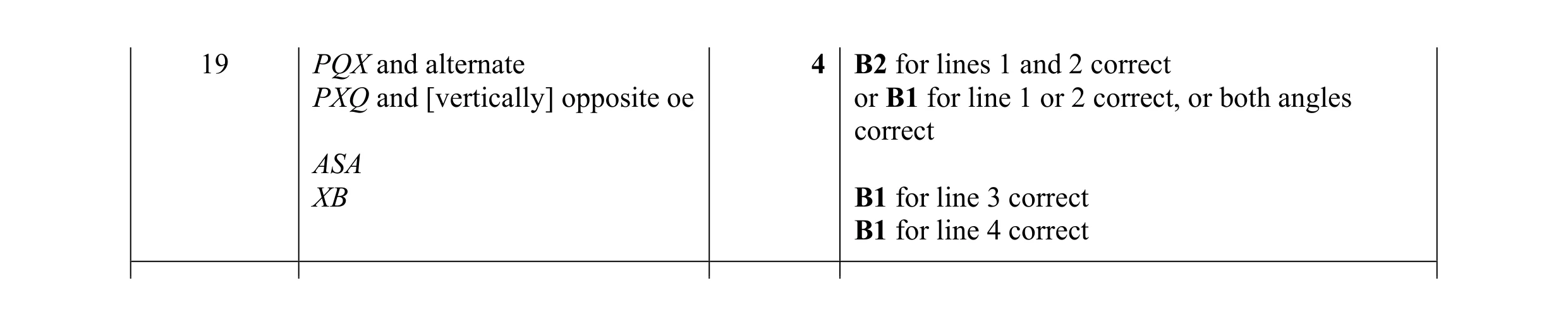 4
4 3
3 3
3 1
1