Cambridge IGCSE Mathematics 0580 — 2013 May/June Paper 2 · Variant 3
0580/23/M/J/13 · 20 questions · 70 marks · ≈79 min
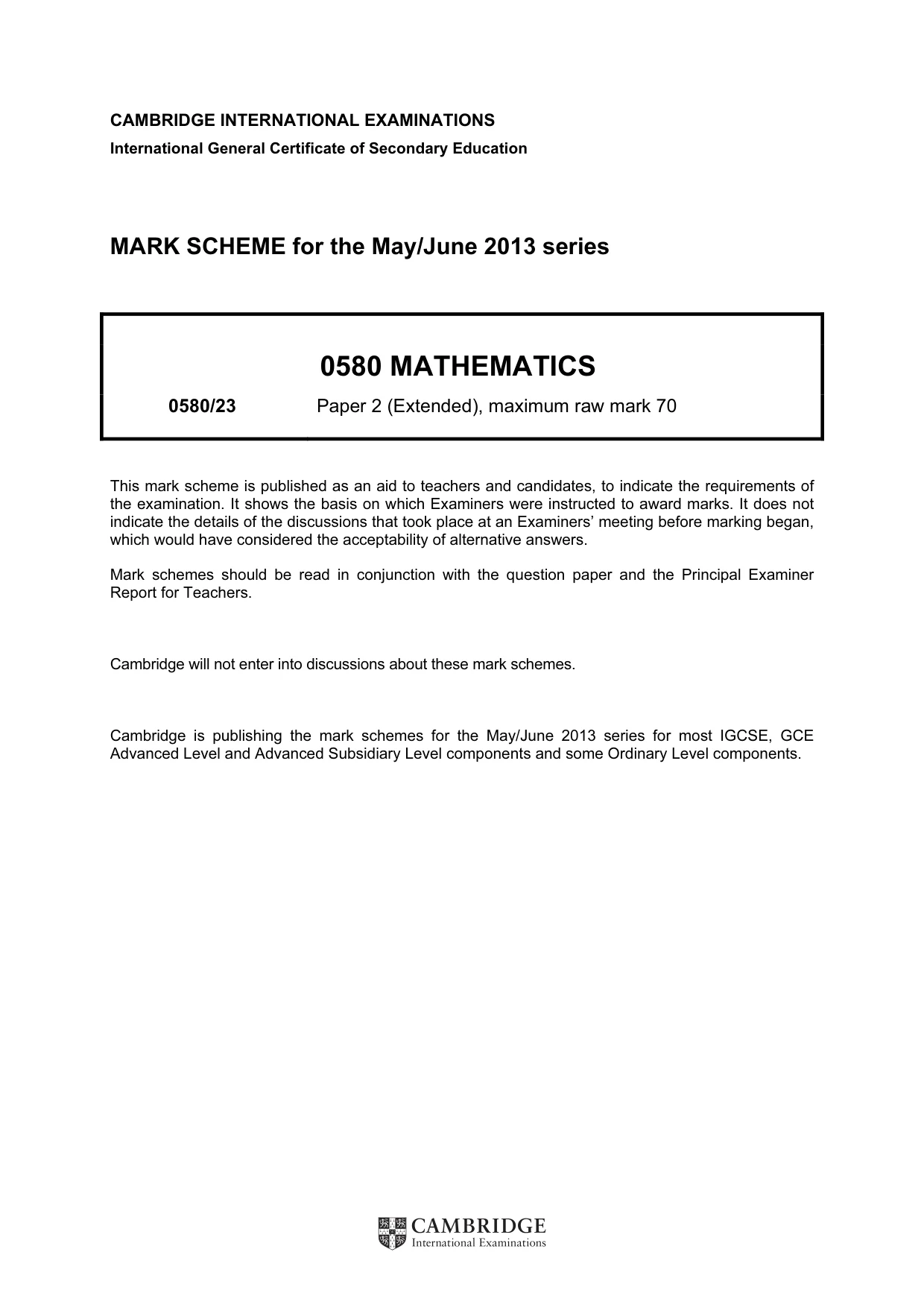
The question paper and its mark scheme, free to read here and free to download. This is Cambridge’s own paper, exactly as it was sat.
Question paper12 pages
Mark scheme4 pages
Answers below. Sit the paper first if you are practising.
Questions as text
Q1 · Sheila can pay her hotel bill in Euros (€) or Pounds (£)
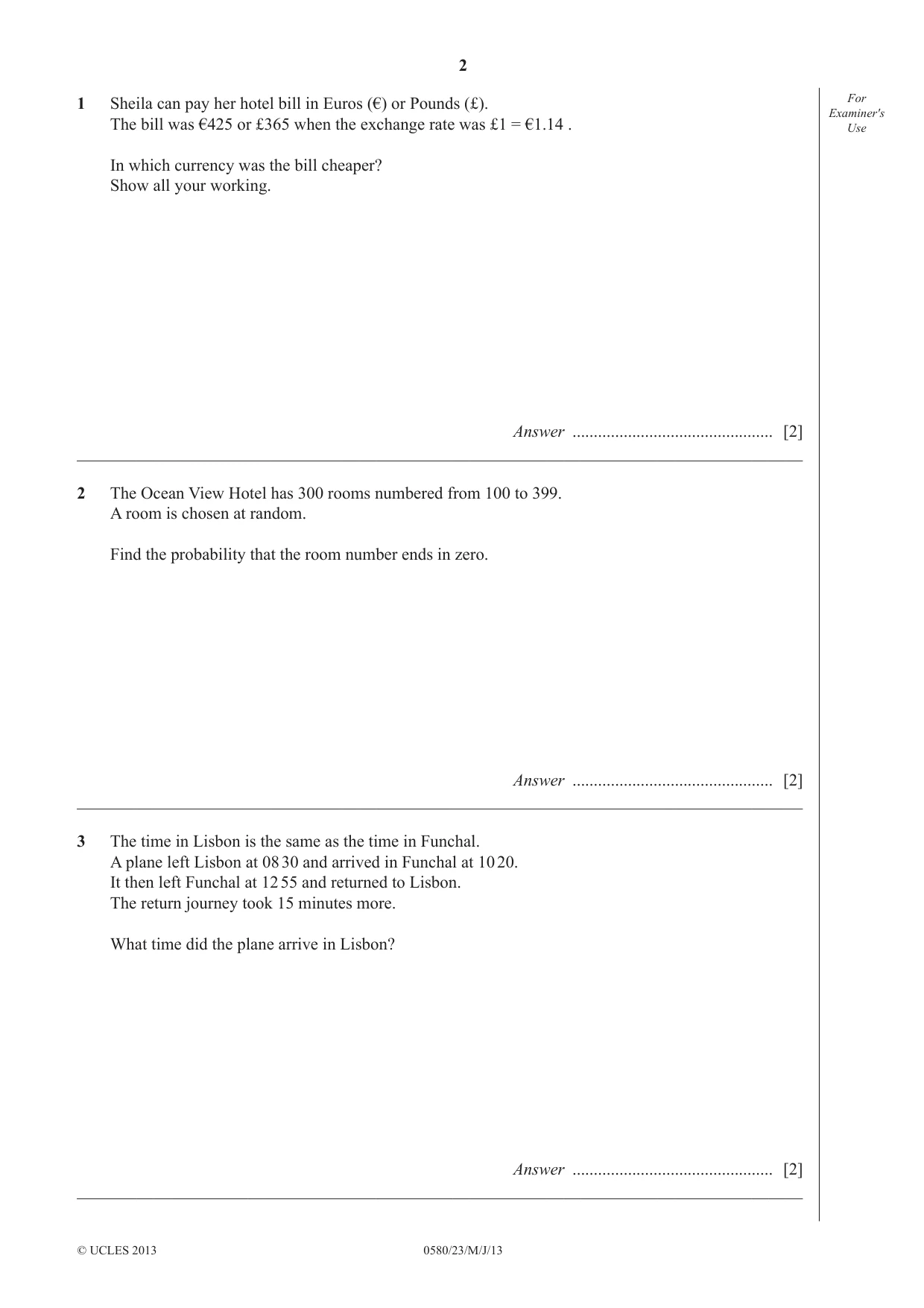
1 Sheila can pay her hotel bill in Euros (€) or Pounds (£). For Examiner′s The bill was €425 or £365 when the exchange rate was £1 = €1.14 . Use In which currency was the bill cheaper? Show all your working. Answer ............................................... [2] _____________________________________________________________________________________
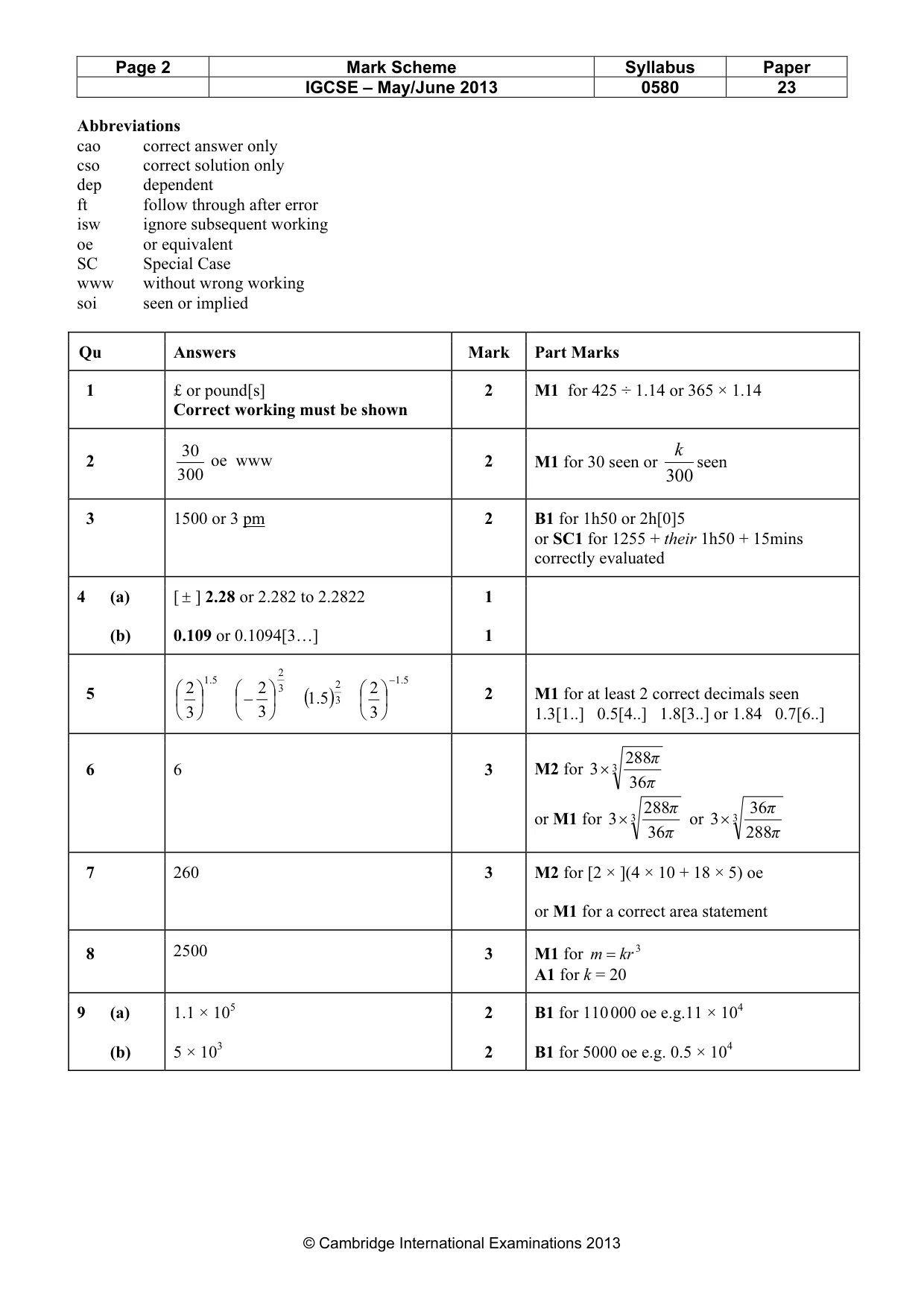
Mark scheme: Qu Answers Mark Part Marks 1 £ or pound[s] 2 M1 for 425 ÷ 1.14 or 365 × 1.14 Correct working must be shown 30 k
Q2 · The Ocean View Hotel has 300 rooms numbered from 100 to 399
2 The Ocean View Hotel has 300 rooms numbered from 100 to 399. A room is chosen at random. Find the probability that the room number ends in zero. Answer ............................................... [2] _____________________________________________________________________________________
Mark scheme: 30 k 2 oe www 2 M1 for 30 seen or seen 300 300
Q3 · The time in Lisbon is the same as the time in Funchal
3 The time in Lisbon is the same as the time in Funchal. A plane left Lisbon at 08 30 and arrived in Funchal at 10 20. It then left Funchal at 12 55 and returned to Lisbon. The return journey took 15 minutes more. What time did the plane arrive in Lisbon? Answer ............................................... [2] _____________________________________________________________________________________
Mark scheme: 3 1500 or 3 pm 2 B1 for 1h50 or 2h[0]5 or SC1 for 1255 + their 1h50 + 15mins correctly evaluated
Q4 · Use a calculator to fi nd For Examiner′s Use 5 (a) 5 24 , Answer(a)…
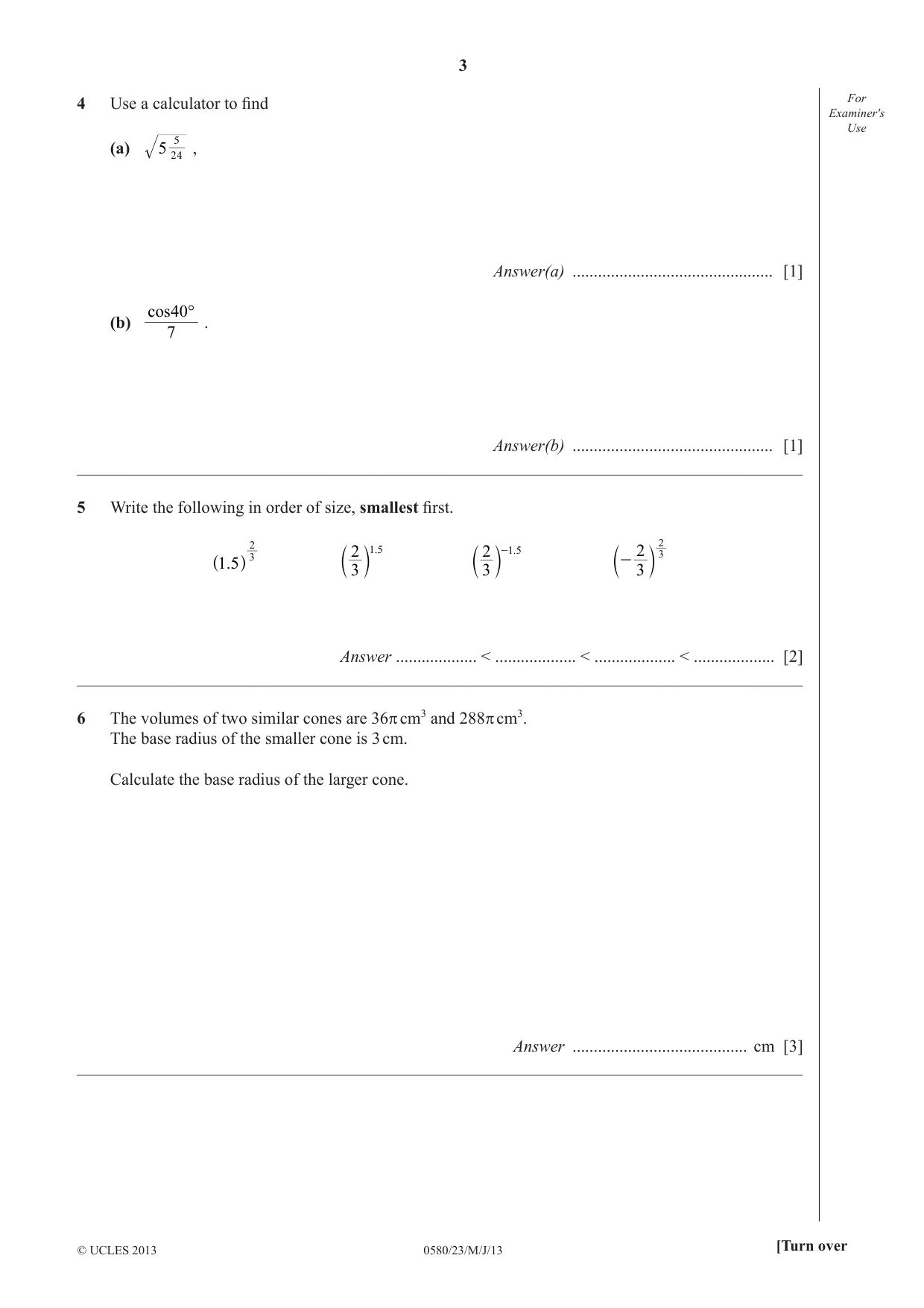
4 Use a calculator to fi nd For Examiner′s Use 5 (a) 5 24 , Answer(a) ............................................... [1] cos 40° (b) . 7 Answer(b) ............................................... [1] _____________________________________________________________________________________
Mark scheme: 4 (a) [ ± ] 2.28 or 2.282 to 2.2822 1 (b) 0.109 or 0.1094[3…] 1 2 5.1 − 5.1 2 2 3 2 2
Q5 · Write the following in order of size, smallest fi rst
5 Write the following in order of size, smallest fi rst. 2 2 3 2 2 1.5 2 -1.5 3 - .15 ^ h c 3 m c 3 m c 3 m Answer ................... < ................... < ................... < ................... [2] _____________________________________________________________________________________
Mark scheme: 2 2 3 2 2 2 M1 for at least 2 correct decimals seen5 − (5.1 )3 3 3 3 1.3[1..] 0.5[4..] 1.8[3..] or 1.84 0.7[6..] 288π
Q6 · The volumes of two similar cones are 36π cm3 and 288π cm3
6 The volumes of two similar cones are 36π cm3 and 288π cm3. The base radius of the smaller cone is 3 cm. Calculate the base radius of the larger cone. Answer ......................................... cm [3] _____________________________________________________________________________________
Mark scheme: 288π 6 6 3 M2 for 3 × 3 36π 288π 36π or M1 for 3 × 3 or 3 × 3 36π 288π
Q7 · For Examiner′s 4 cm Use NOT TO SCALE 5 cm 10 cm 18 cm The shaded shape has rotational…
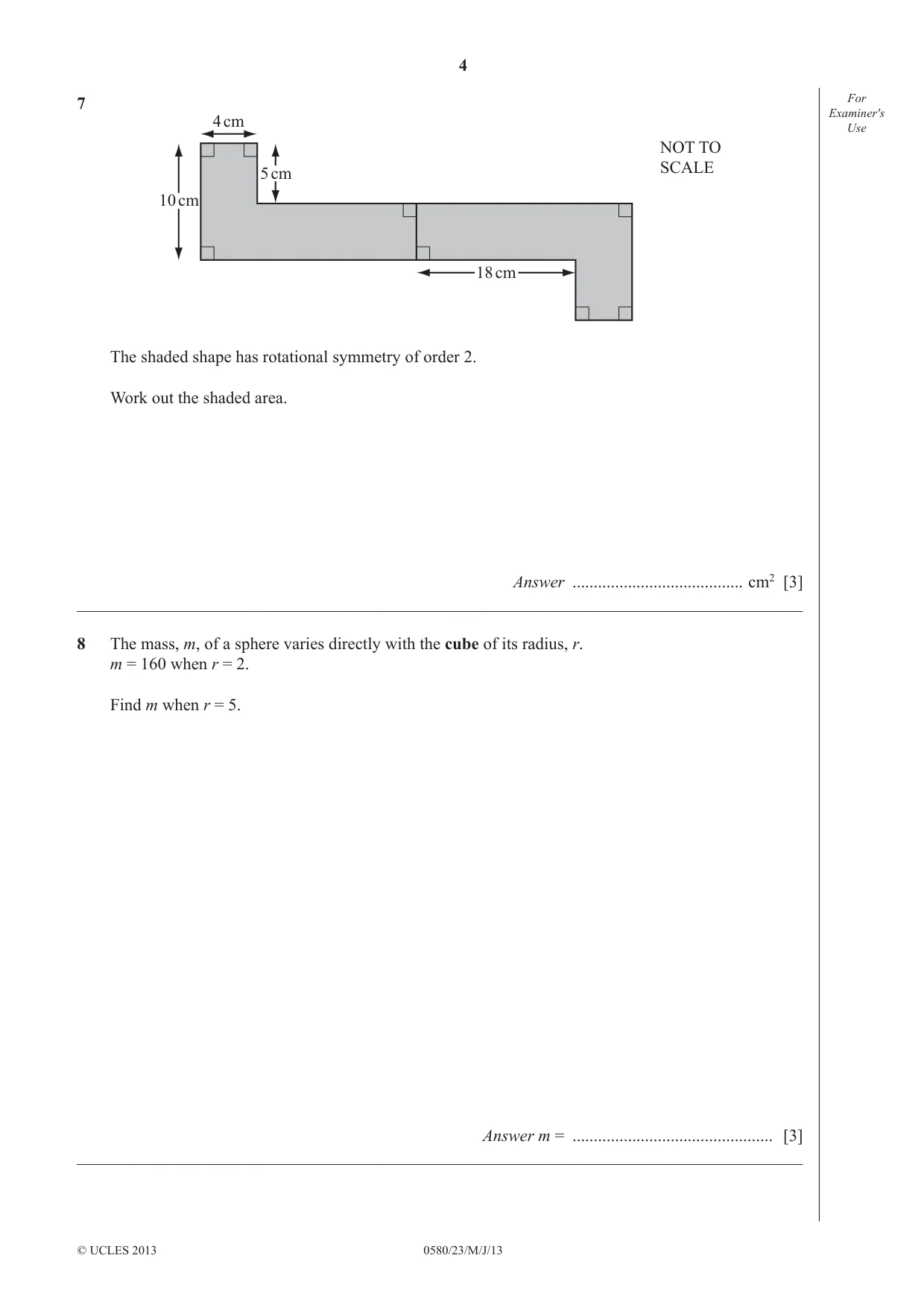
7 For Examiner′s 4 cm Use NOT TO SCALE 5 cm 10 cm 18 cm The shaded shape has rotational symmetry of order 2. Work out the shaded area. Answer ........................................ cm2 [3] _____________________________________________________________________________________
Mark scheme: 7 260 3 M2 for [2 × ](4 × 10 + 18 × 5) oe or M1 for a correct area statement 2500 3
Q8 · The mass, m, of a sphere varies directly with the cube of its radius, r
8 The mass, m, of a sphere varies directly with the cube of its radius, r. m = 160 when r = 2. Find m when r = 5. Answer m = ............................................... [3] _____________________________________________________________________________________
Mark scheme: 8 2500 3 M1 for m = kr 3 A1 for k = 20 5 4
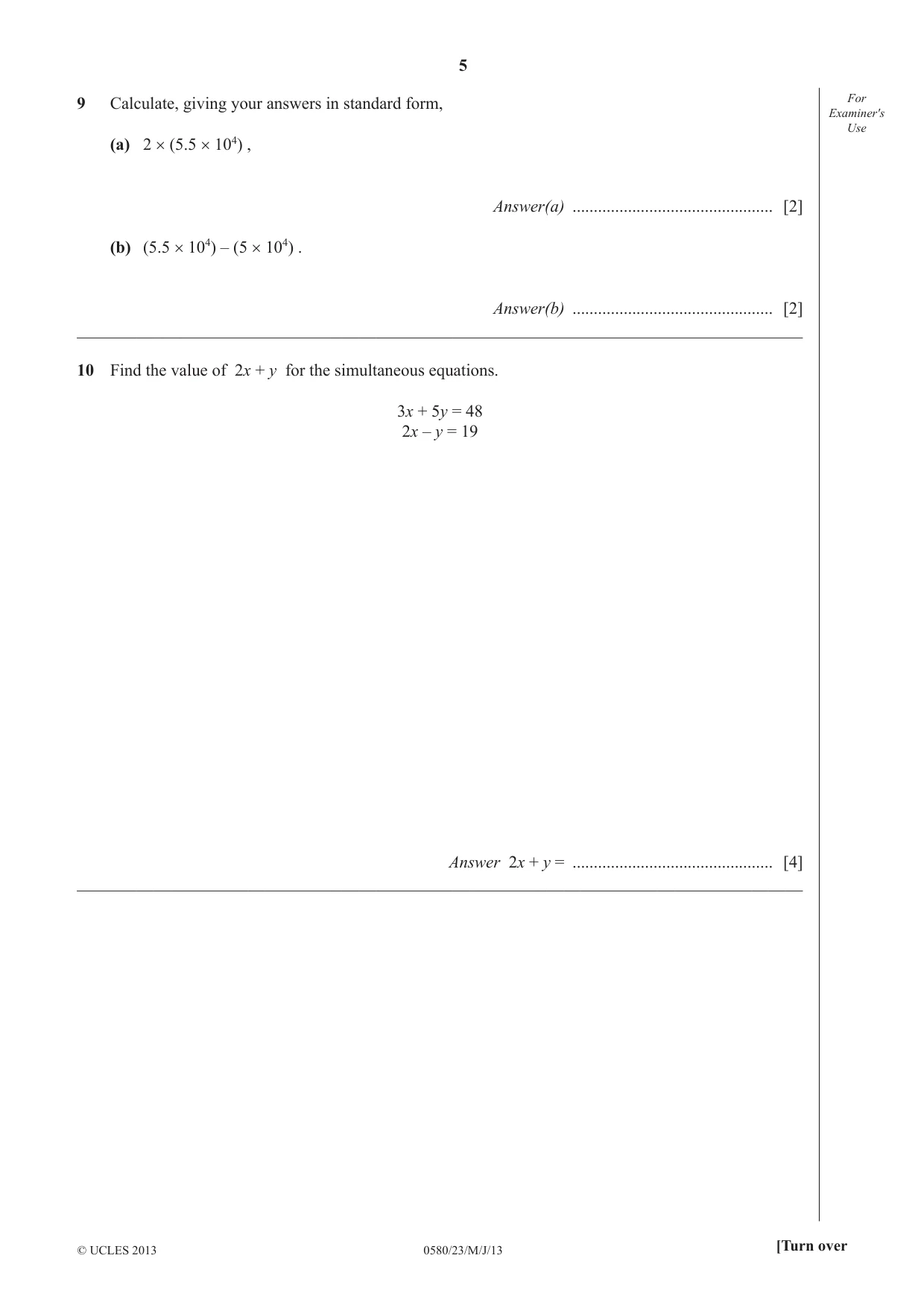
Q9 · Calculate, giving your answers in standard form, For Examiner′s Use (a) 2 × (5.5 × 104)…
9 Calculate, giving your answers in standard form, For Examiner′s Use (a) 2 × (5.5 × 104) , Answer(a) ............................................... [2] (b) (5.5 × 10⁴) – (5 × 10⁴) . Answer(b) ............................................... [2] _____________________________________________________________________________________
Mark scheme: 9 (a) 1.1 × 10⁵ 2 B1 for 110 000 oe e.g.11 × 104 (b) 5 × 10³ 2 B1 for 5000 oe e.g. 0.5 × 10⁴ IGCSE – May/June 2013 0580 23
Q10 · Find the value of 2x + y for the simultaneous equations
10 Find the value of 2x + y for the simultaneous equations. 3x + 5y = 48 2x – y = 19 Answer 2x + y = ............................................... [4] _____________________________________________________________________________________
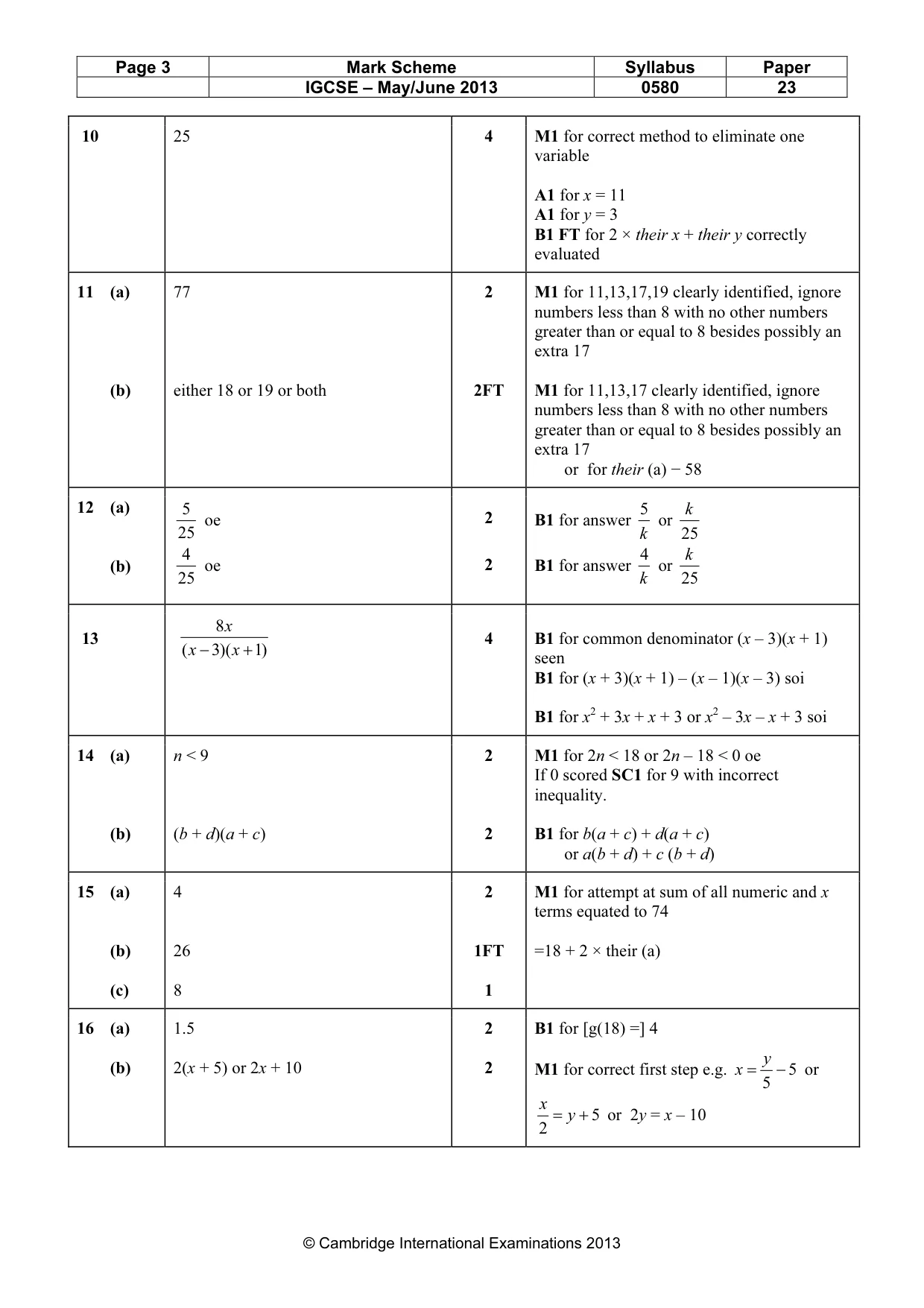
Mark scheme: 10 25 4 M1 for correct method to eliminate one variable A1 for x = 11 A1 for y = 3 B1 FT for 2 × their x + their y correctly evaluated
Q11 · The sum of the prime numbers less than 8 is equal to 17
11 The sum of the prime numbers less than 8 is equal to 17. For Examiner′s Use (a) Find the sum of the prime numbers less than 21. Answer(a) ............................................... [2] (b) The sum of the prime numbers less than x is 58. Find an integer value for x. Answer(b) x = ............................................... [2] _____________________________________________________________________________________
Mark scheme: 11 (a) 77 2 M1 for 11,13,17,19 clearly identified, ignore numbers less than 8 with no other numbers greater than or equal to 8 besides possibly an extra 17 (b) either 18 or 19 or both 2FT M1 for 11,13,17 clearly identified, ignore numbers less than 8 with no other numbers greater than or equal to 8 besides possibly an extra 17 or for their (a) − 58
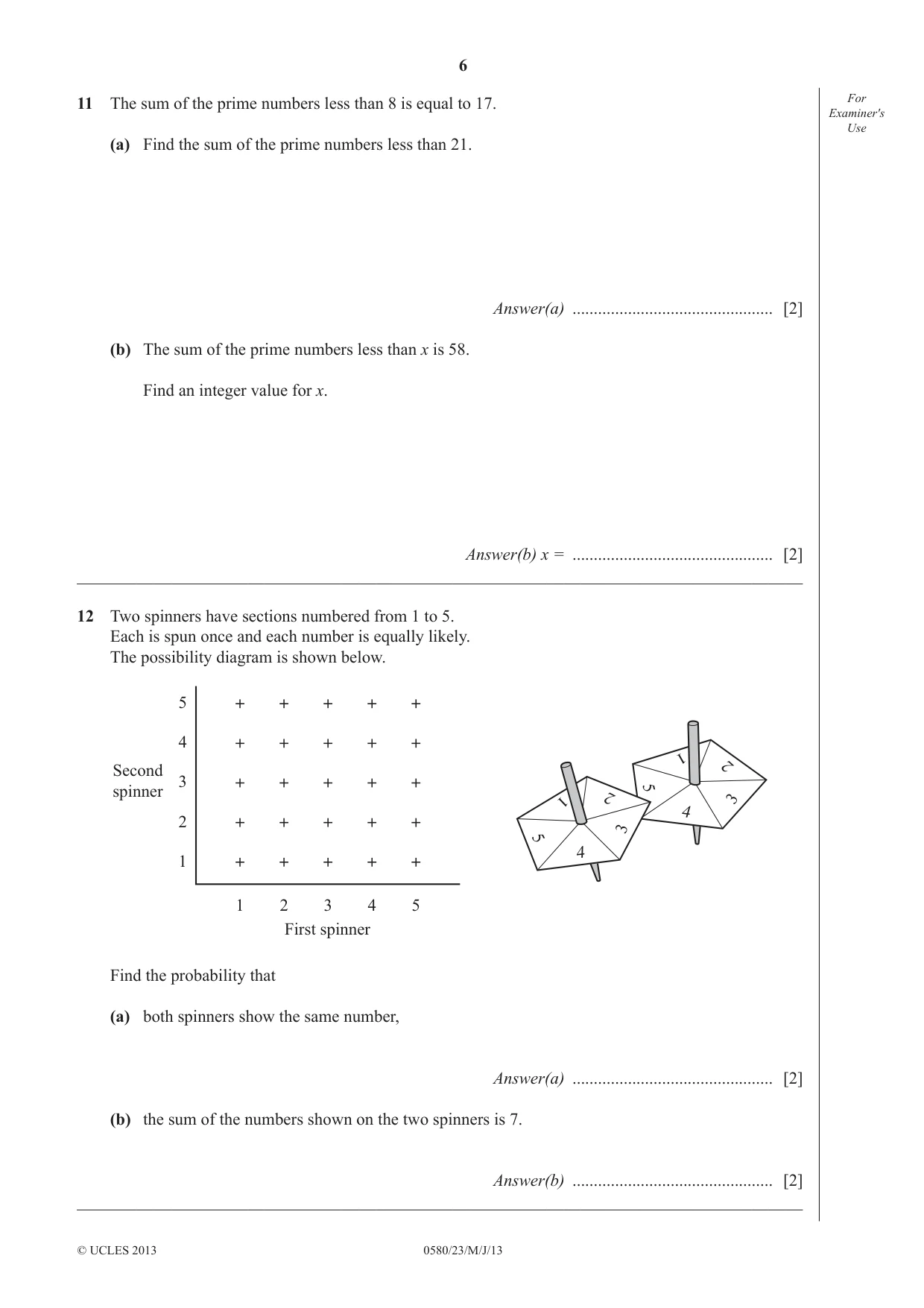
Q12 · Two spinners have sections numbered from 1 to 5
12 Two spinners have sections numbered from 1 to 5. Each is spun once and each number is equally likely. The possibility diagram is shown below. 5 4 1 Second 2 3 5 spinner 1 2 3 4 2 3 5 4 1 1 2 3 4 5 First spinner Find the probability that (a) both spinners show the same number, Answer(a) ............................................... [2] (b) the sum of the numbers shown on the two spinners is 7. Answer(b) ............................................... [2] _____________________________________________________________________________________
Mark scheme: 12 (a) 5 5 k oe 2 B1 for answer or 25 k 25 4 4 k (b) oe 2 B1 for answer or 25 k 25 8x
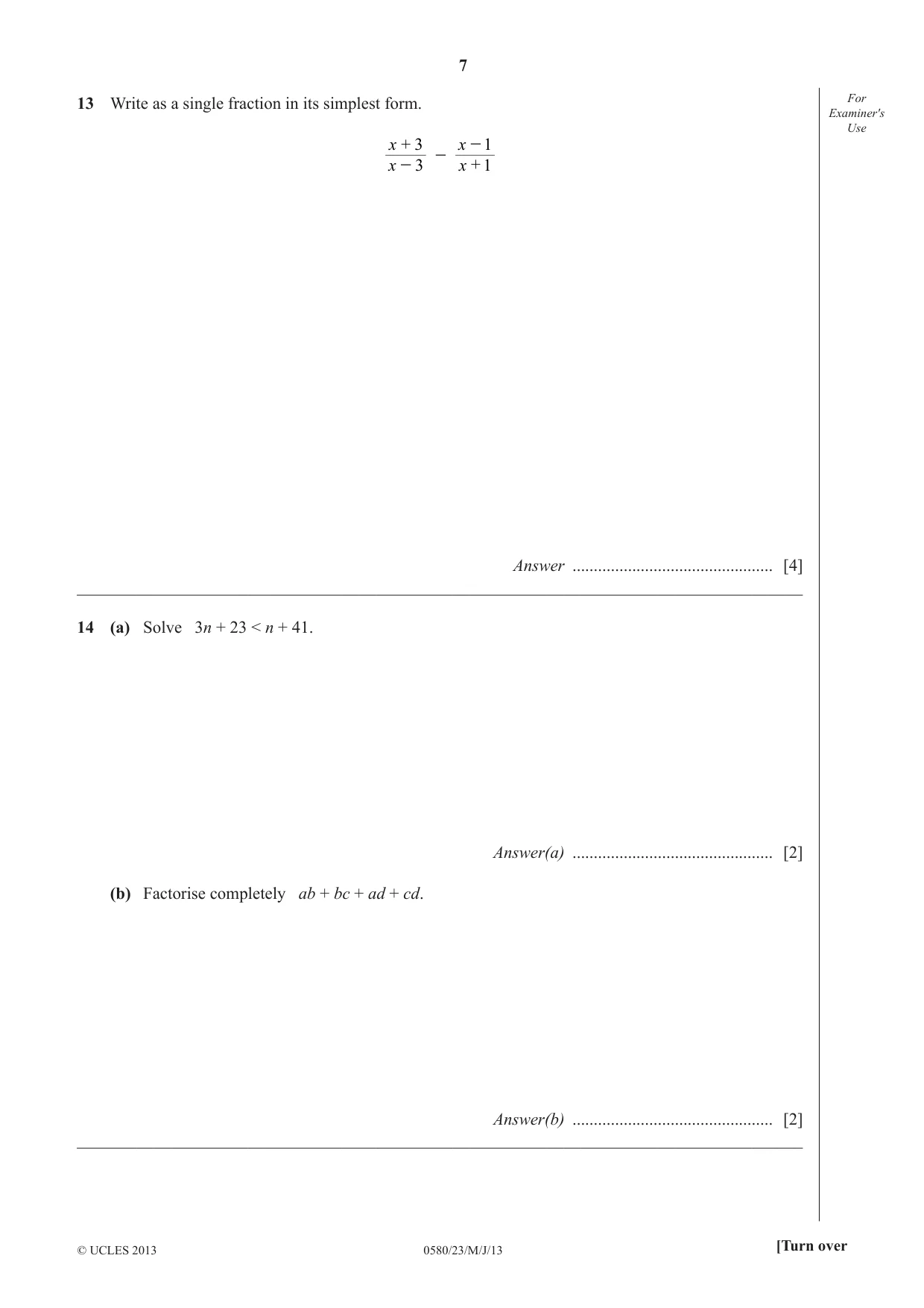
Q13 · Write as a single fraction in its simplest form
13 Write as a single fraction in its simplest form. For Examiner′s Use x + 3 x - 1 - - x 3 x + 1 Answer ............................................... [4] _____________________________________________________________________________________
Mark scheme: 8 x 13 4 B1 for common denominator (x – 3)(x + 1) ( x − 3)( x + )1 seen B1 for (x + 3)(x + 1) – (x – 1)(x – 3) soi B1 for x2 + 3x + x + 3 or x2 – 3x – x + 3 soi
Q14 · Solve 3n + 23 < n + 41
14 (a) Solve 3n + 23 < n + 41. Answer(a) ............................................... [2] (b) Factorise completely ab + bc + ad + cd. Answer(b) ............................................... [2] _____________________________________________________________________________________
Mark scheme: 14 (a) n < 9 2 M1 for 2n < 18 or 2n – 18 < 0 oe If 0 scored SC1 for 9 with incorrect inequality. (b) (b + d)(a + c) 2 B1 for b(a + c) + d(a + c) or a(b + d) + c (b + d)
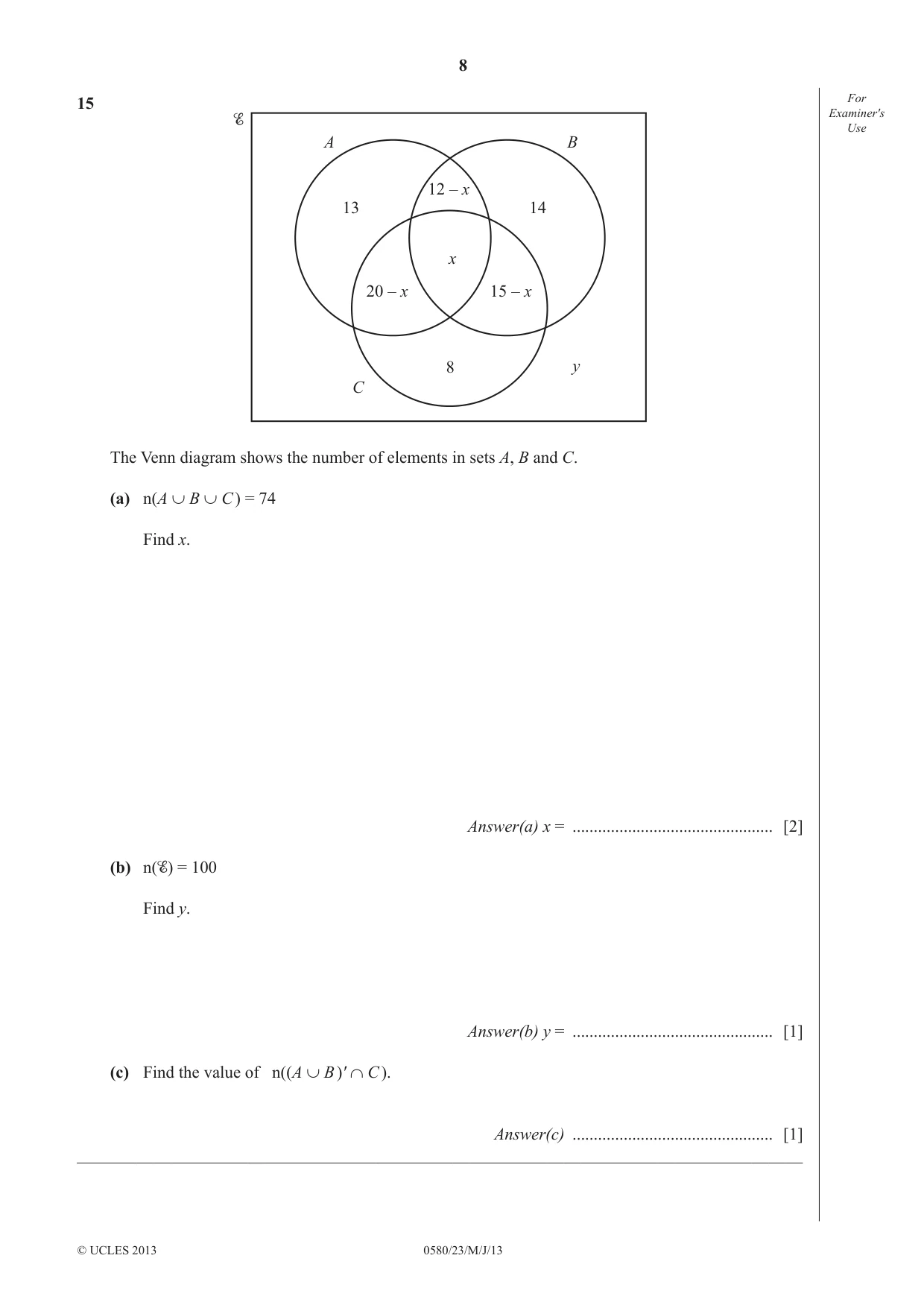
Q15 · For Examiner′s Use A B 12 – x 13 14 x 20 – x 15 – x 8 y C The Venn diagram shows the…
15 For Examiner′s Use A B 12 – x 13 14 x 20 – x 15 – x 8 y C The Venn diagram shows the number of elements in sets A, B and C. (a) n(A ∪ B ∪ C ) = 74 Find x. Answer(a) x = ............................................... [2] (b) n( ) = 100 Find y. Answer(b) y = ............................................... [1] (c) Find the value of n((A ∪ B )' ∩ C ). Answer(c) ............................................... [1] _____________________________________________________________________________________
Mark scheme: 15 (a) 4 2 M1 for attempt at sum of all numeric and x terms equated to 74 (b) 26 1FT =18 + 2 × their (a) (c) 8 1
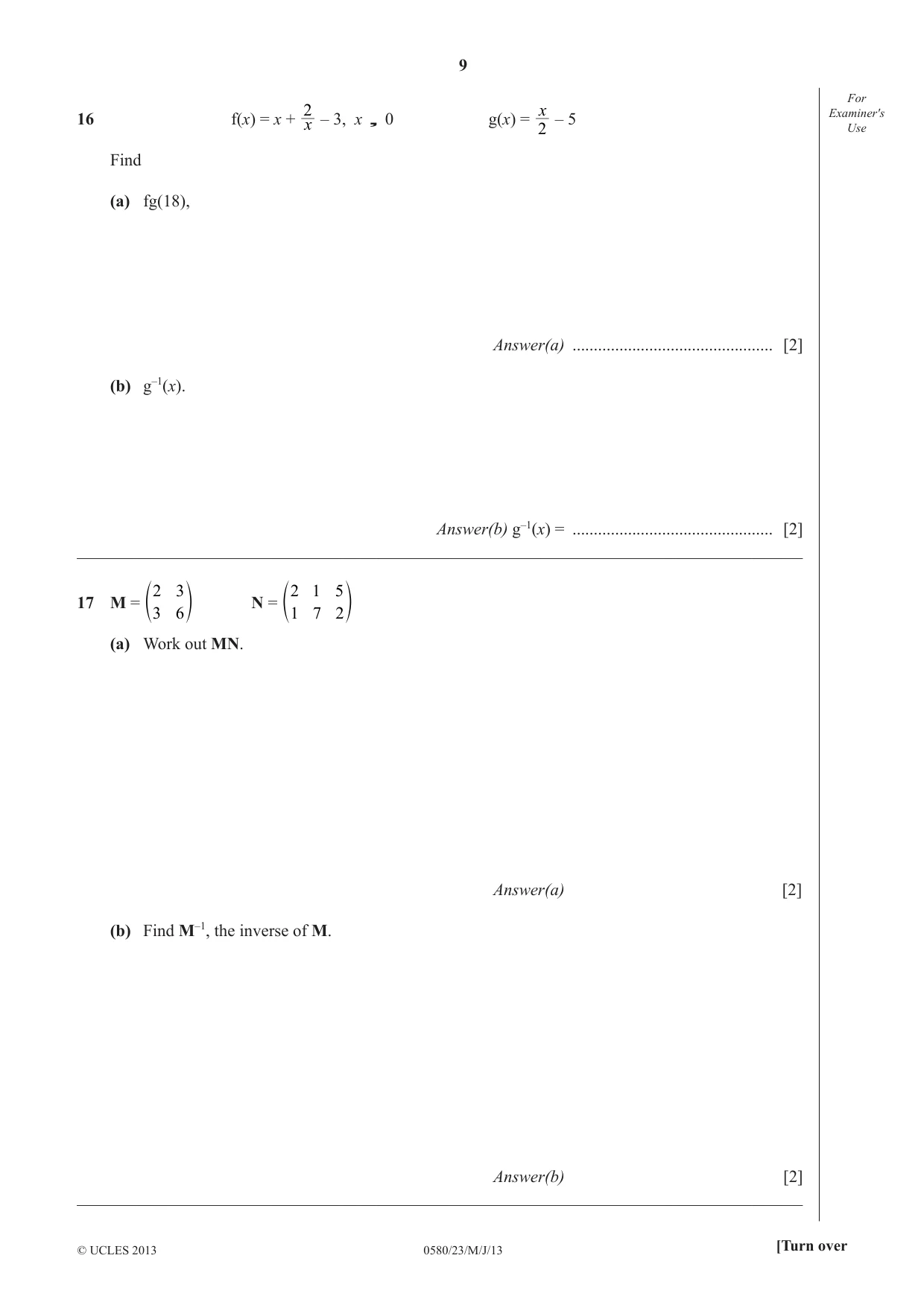
Q16 · X 2 Examiner′s – 3, x ¸ 0 g(x) = – 516 f(x) = x + x 2 Use Find (a) fg(18), Answer(a)…
x 2 Examiner′s – 3, x ¸ 0 g(x) = – 516 f(x) = x + x 2 Use Find (a) fg(18), Answer(a) ............................................... [2] (b) g–1(x). Answer(b) g–1(x) = ............................................... [2] _____________________________________________________________________________________
Mark scheme: 16 (a) 1.5 2 B1 for [g(18) =] 4 y (b) 2(x + 5) or 2x + 10 2 M1 for correct first step e.g. x = − 5 or 5 x = + 5 or 2y = x – 10 y 2 IGCSE – May/June 2013 0580 23
Q17 · 3 2 1 5 17 M = N = e 3 6 o e 1 7 2 o (a) Work out MN
2 3 2 1 5 17 M = N = e 3 6 o e 1 7 2 o (a) Work out MN. Answer(a) [2] (b) Find M–1, the inverse of M. Answer(b) [2] _____________________________________________________________________________________
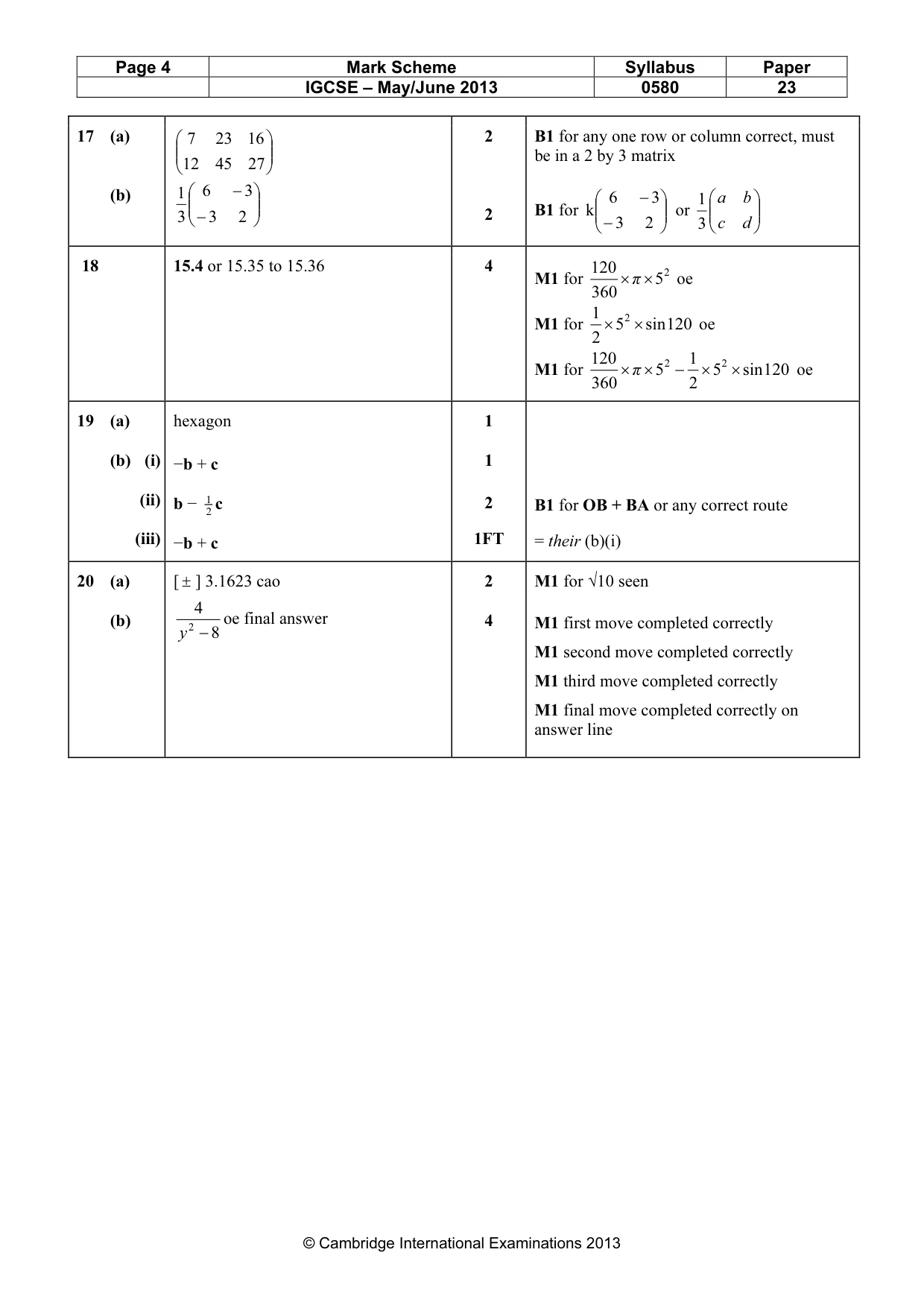
Mark scheme: 17 (a) 7 23 16 2 B1 for any one row or column correct, must be in a 2 by 3 matrix 12 45 27 1 6 − 3 (b) 6 − 3 1 a b or 3 B1 for k − 3 2 2 c d 3 − 3 2
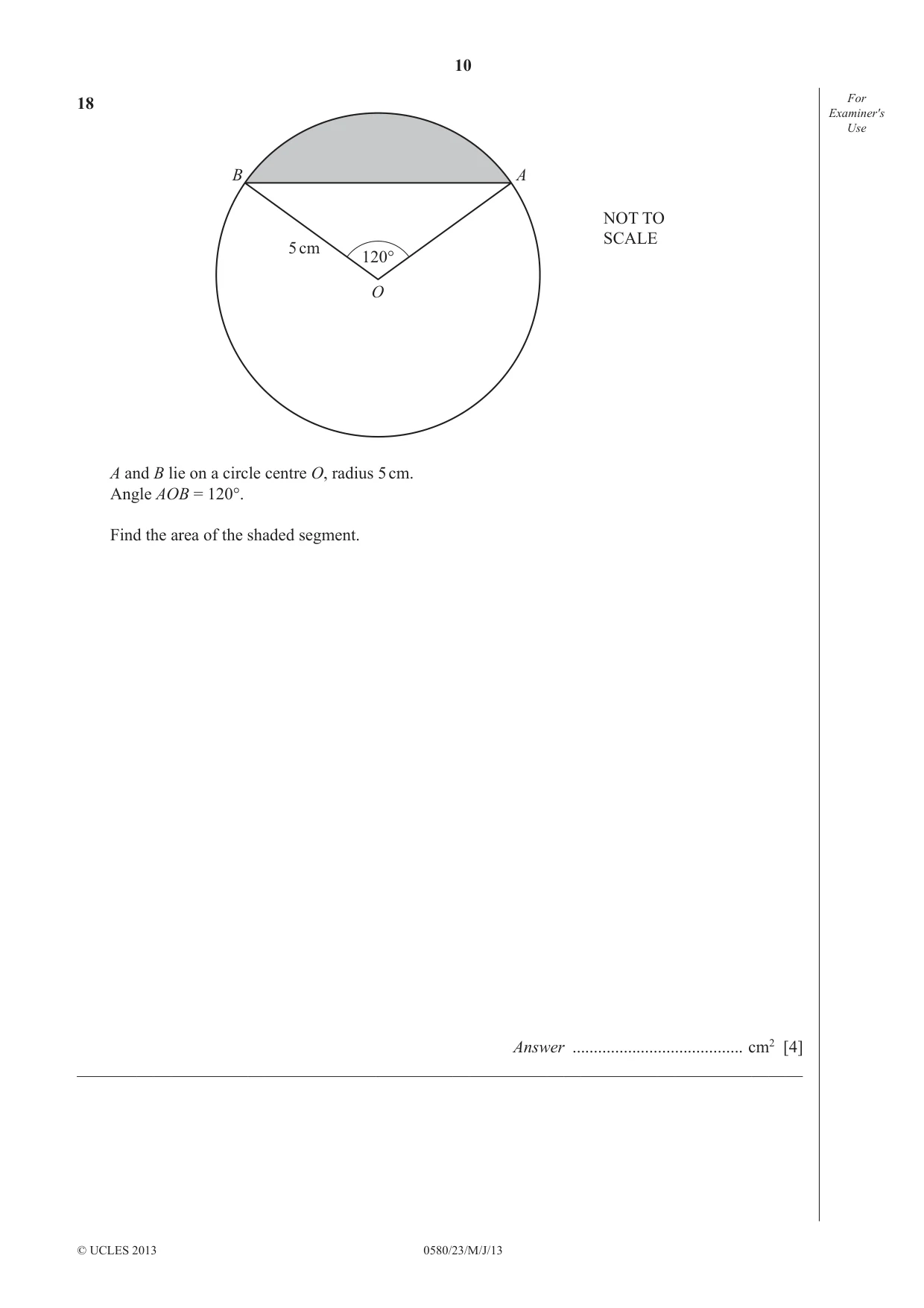
Q18 · For Examiner′s Use B A NOT TO SCALE 5 cm 120° O A and B lie on a circle centre O, radius…
18 For Examiner′s Use B A NOT TO SCALE 5 cm 120° O A and B lie on a circle centre O, radius 5 cm. Angle AOB = 120°. Find the area of the shaded segment. Answer ........................................ cm2 [4] _____________________________________________________________________________________
Mark scheme: 18 15.4 or 15.35 to 15.36 4 120 2 M1 for ×π × 5 oe 360 1 2 M1 for × 5 × sin 120 oe 2 120 2 1 2 M1 for ×π × 5 − × 5 × sin 120 oe 360 2
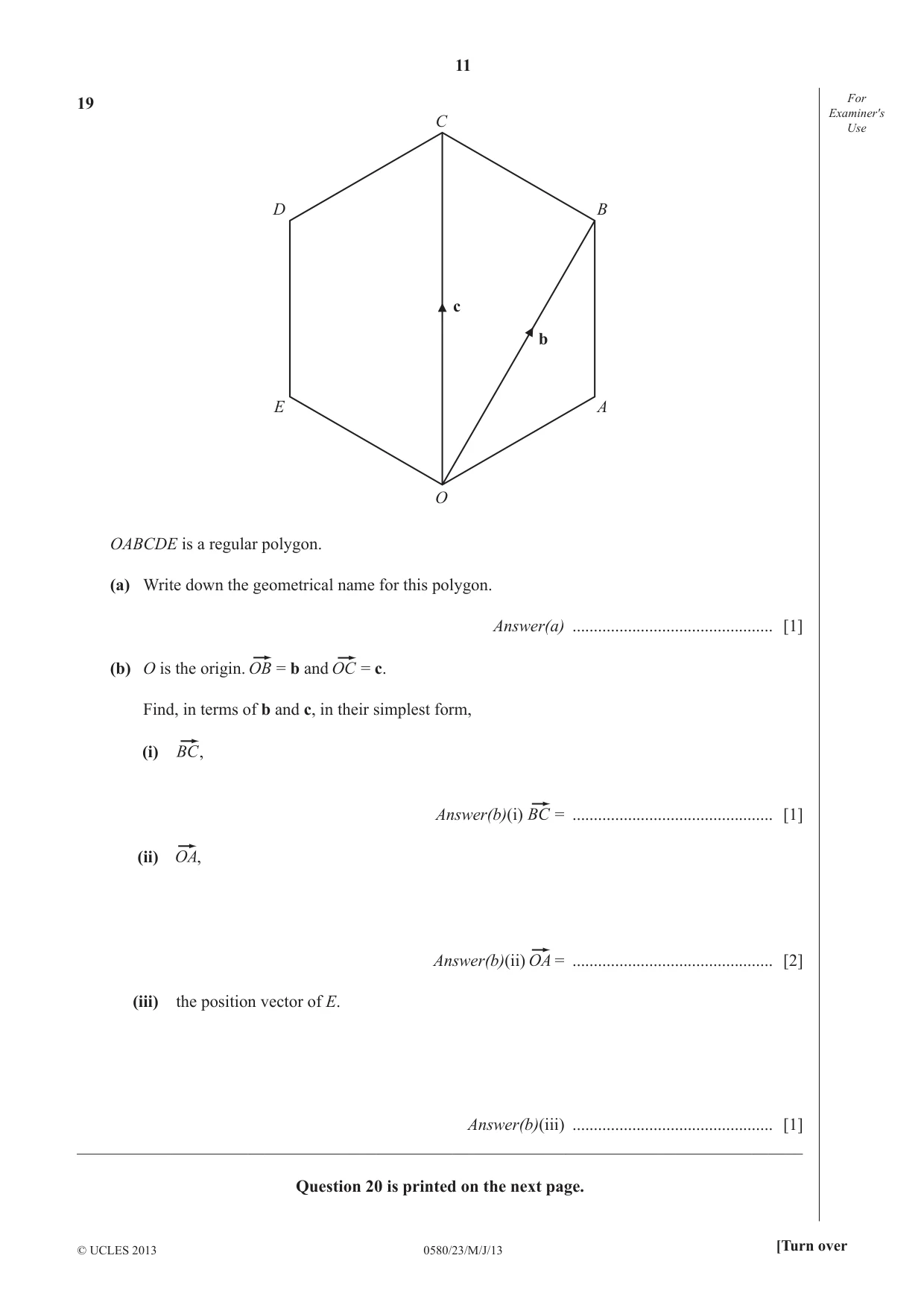
Q19 · For Examiner′s C Use D B c b E A O OABCDE is a regular polygon
19 For Examiner′s C Use D B c b E A O OABCDE is a regular polygon. (a) Write down the geometrical name for this polygon. Answer(a) ............................................... [1] (b) O is the origin. = b and = c. Find, in terms of b and c, in their simplest form, (i) , Answer(b)(i) = ............................................... [1] (ii) , Answer(b)(ii) = ............................................... [2] (iii) the position vector of E. Answer(b)(iii) ............................................... [1] _____________________________________________________________________________________ Question 20 is printed on the next page.
Mark scheme: 19 (a) hexagon 1 (b) (i) −b + c 1 (ii) b − 12 c 2 B1 for OB + BA or any correct route (iii) −b + c 1FT = their (b)(i) √
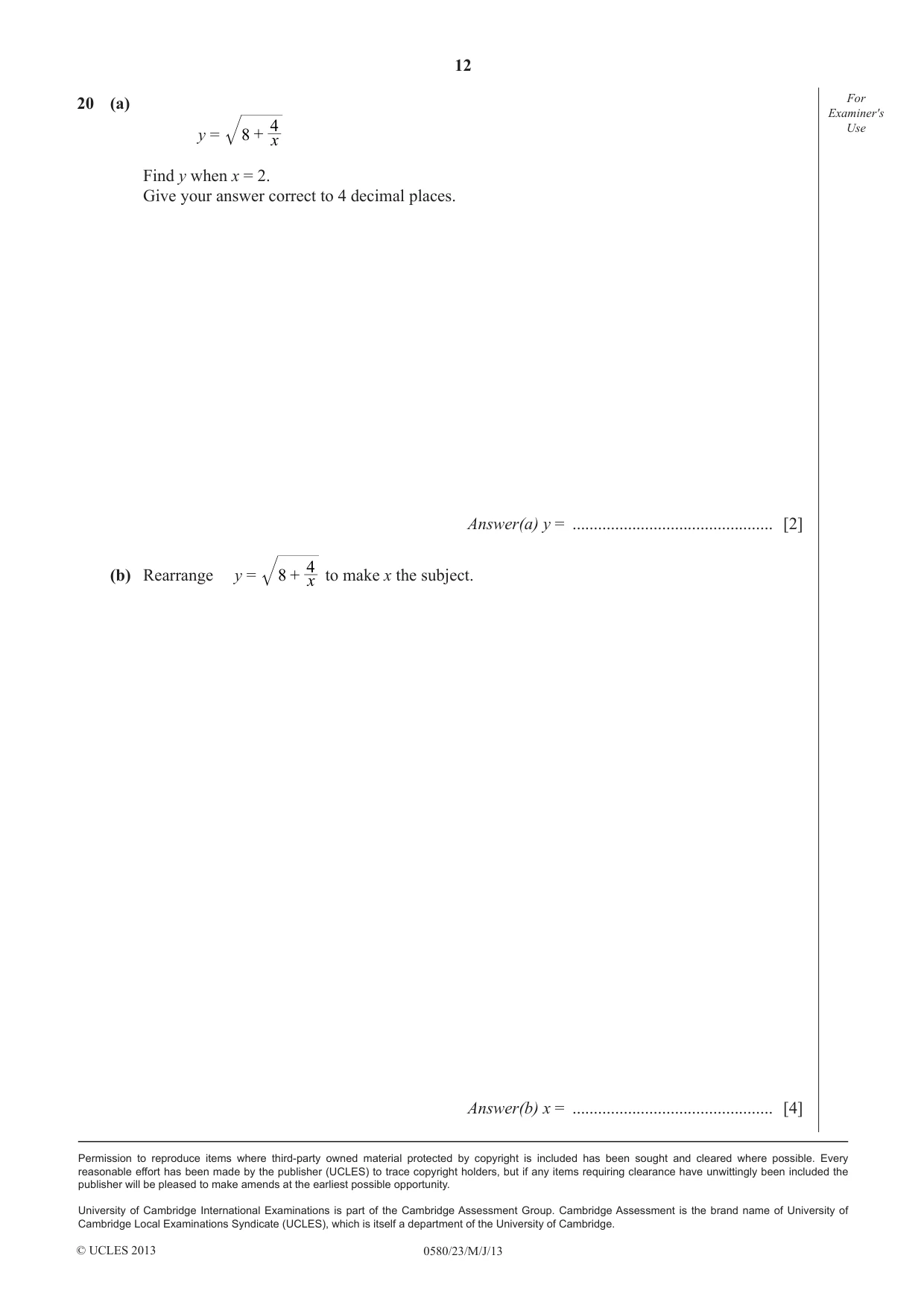
Q20 · For Examiner′s 4 Use y = 8 + x Find y when x = 2
20 (a) For Examiner′s 4 Use y = 8 + x Find y when x = 2. Give your answer correct to 4 decimal places. Answer(a) y = ............................................... [2] 4 (b) Rearrange y = 8 + to make x the subject. x Answer(b) x = ............................................... [4]
Mark scheme: 20 (a) [ ± ] 3.1623 cao 2 M1 for √10 seen 4 (b) 2 oe final answer 4 M1 first move completed correctly − 8 y M1 second move completed correctly M1 third move completed correctly M1 final move completed correctly on answer line
What was in this paper
The subtopics covered by these 20 questions, and how many questions each got. Open one in a new tab to see every Cambridge question on it.
2Introduction to probability2Algebraic fractions1Algebraic manipulation1Area and perimeter1Circles, arcs and sectors1Compound shapes and parts of shapes1Functions1Introduction to algebra1Money1Ordering1Ratio and proportion1Sets1Standard form1Time1Types of number1Using a calculator1Vectors in two dimensions1What you needed in this session
Cambridge’s own grade thresholds for 2013 May/June, Paper 2 · Variant 3. A higher threshold means an easier paper — the bar moves with how the cohort did.