Cambridge IGCSE Mathematics 0580 — 2019 May/June Paper 2 · Variant 2
0580/22/M/J/19 · 25 questions · 70 marks · ≈79 min
The question paper and its mark scheme, free to read here and free to download. This is Cambridge’s own paper, exactly as it was sat.
Question paper12 pages
Mark scheme6 pages
Answers below. Sit the paper first if you are practising.
Questions as text
Q1 · Write down a prime number between 50 and 60
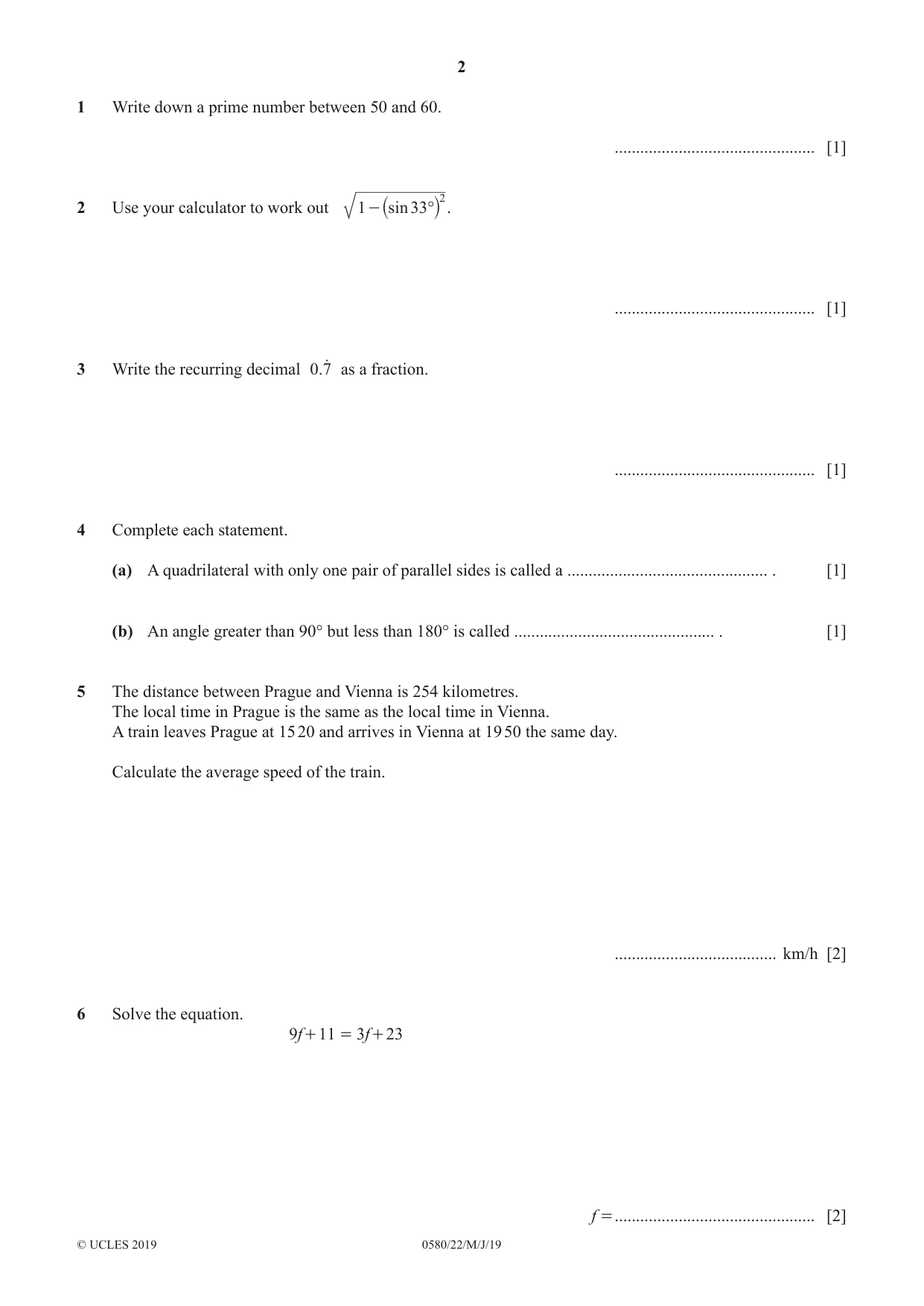
1 Write down a prime number between 50 and 60. ............................................... [1]
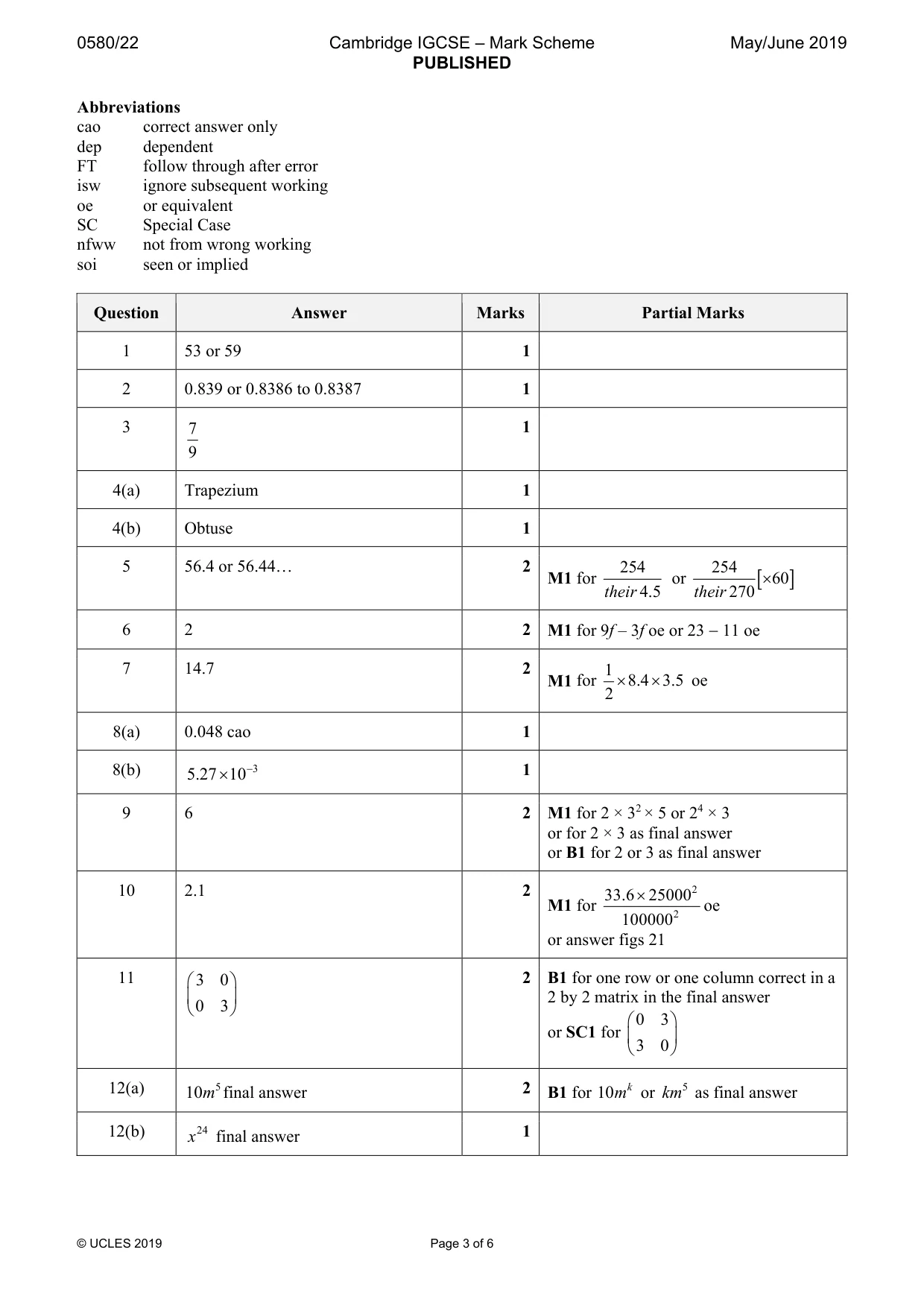
Mark scheme: Question Answer Marks Partial Marks 1 53 or 59 1
Q2 · 2 Use your calculator to work out 1 sin 33°
2 2 Use your calculator to work out 1 sin 33° . -` j ............................................... [1]
Mark scheme: 2 0.839 or 0.8386 to 0.8387 1
Q3 · Write the recurring decimal .07o as a fraction
3 Write the recurring decimal .07o as a fraction. ............................................... [1]
Mark scheme: 3 7 1 9
Question 4
4 Complete each statement. (a) A quadrilateral with only one pair of parallel sides is called a ............................................... . [1] (b) An angle greater than 90° but less than 180° is called ............................................... . [1]
Mark scheme: 4(a) Trapezium 1 4(b) Obtuse 1
Q5 · The distance between Prague and Vienna is 254 kilometres
5 The distance between Prague and Vienna is 254 kilometres. The local time in Prague is the same as the local time in Vienna. A train leaves Prague at 15 20 and arrives in Vienna at 19 50 the same day. Calculate the average speed of the train. ...................................... km/h [2]
Mark scheme: 5 56.4 or 56.44… 2 254 254 M1 for or [× 60 ] their 4.5 their 270
Question 6
6 Solve the equation. 9f + 11 = 3f + 23 f = ............................................... [2]
Mark scheme: 6 2 2 M1 for 9f – 3f oe or 23 − 11 oe
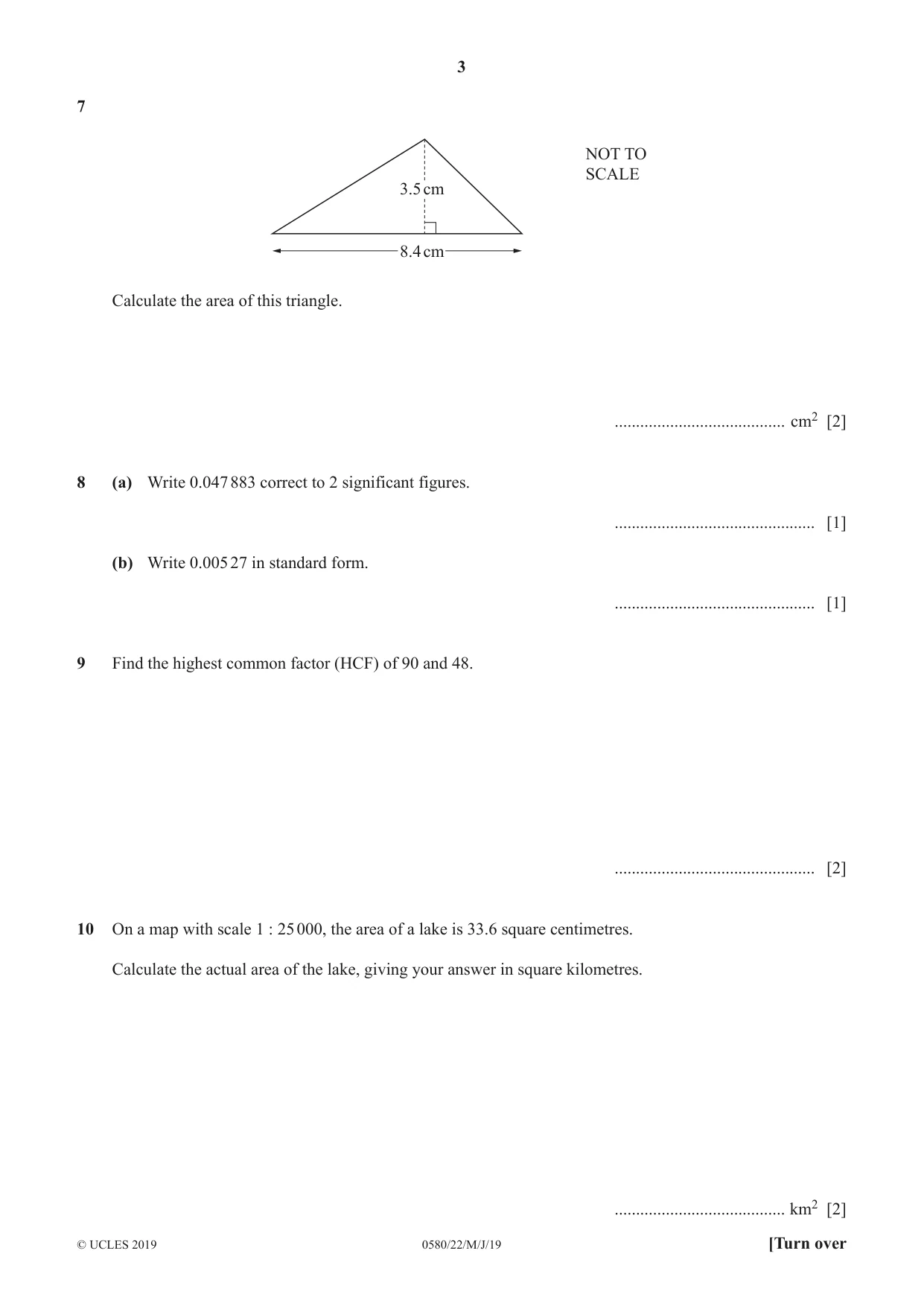
Q7 · NOT TO SCALE 3.5 cm 8.4 cm Calculate the area of this triangle
7 NOT TO SCALE 3.5 cm 8.4 cm Calculate the area of this triangle. ........................................ cm2 [2]
Mark scheme: 7 14.7 2 1 M1 for × 8.4 × 3.5 oe 2
Q8 · Write 0.047 883 correct to 2 significant figures
8 (a) Write 0.047 883 correct to 2 significant figures. ............................................... [1] (b) Write 0.005 27 in standard form. ............................................... [1]
Mark scheme: 8(a) 0.048 cao 1 8(b) 5.27 × 10⁻³ 1
Q9 · Find the highest common factor (HCF) of 90 and 48
9 Find the highest common factor (HCF) of 90 and 48. ............................................... [2]
Mark scheme: 9 6 2 M1 for 2 × 32 × 5 or 24 × 3 or for 2 × 3 as final answer or B1 for 2 or 3 as final answer
Q10 · On a map with scale 1 : 25 000, the area of a lake is 33.6 square centimetres
10 On a map with scale 1 : 25 000, the area of a lake is 33.6 square centimetres. Calculate the actual area of the lake, giving your answer in square kilometres. ........................................ km2 [2]
Mark scheme: 10 2.1 2 33.6 × 25000 2 M1 for oe 100000 2 or answer figs 21
Q11 · Write down the matrix that represents an enlargement, scale factor 3, centre (0, 0)
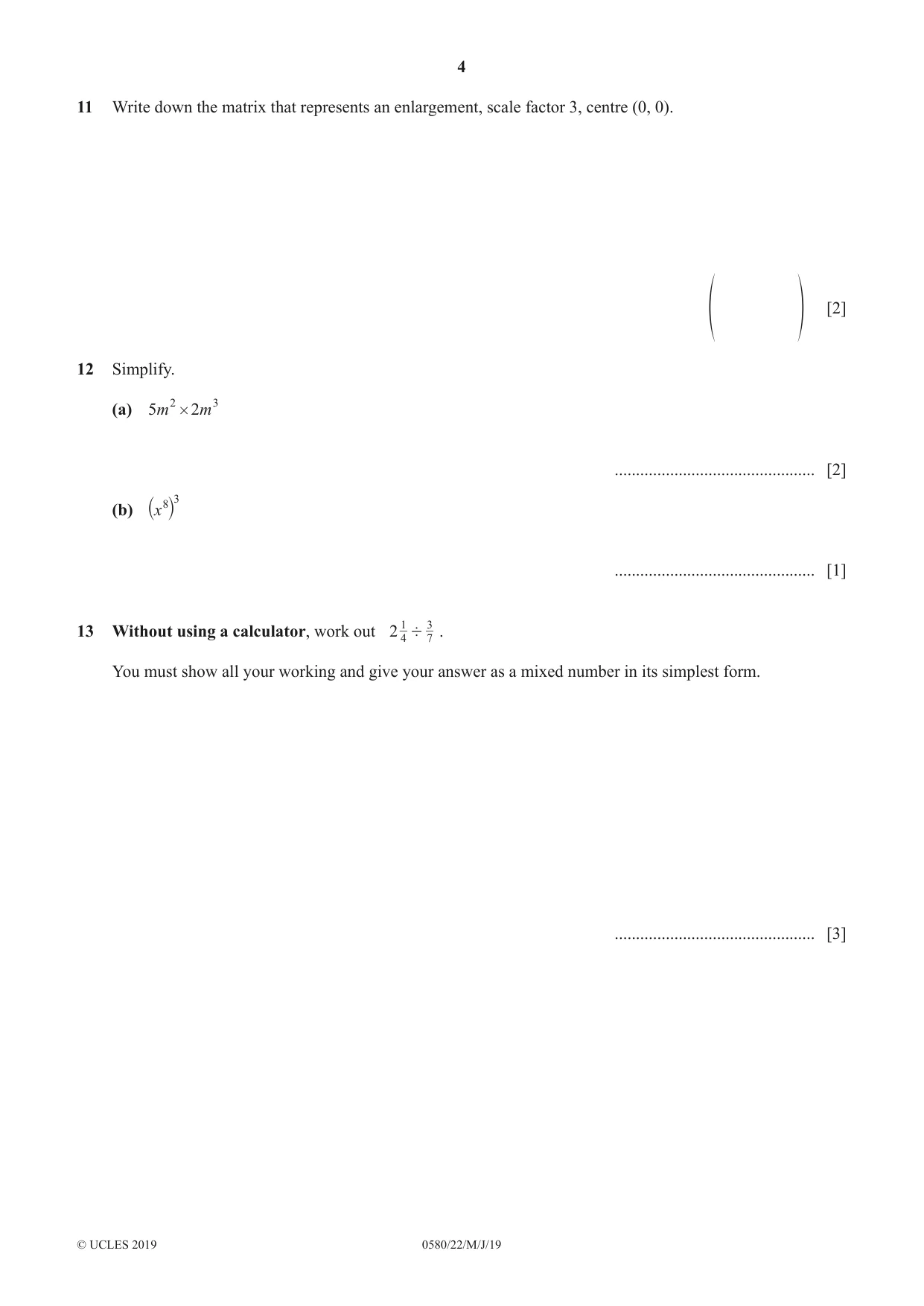
11 Write down the matrix that represents an enlargement, scale factor 3, centre (0, 0). [2] f p
Mark scheme: 11 3 0 2 B1 for one row or one column correct in a 2 by 2 matrix in the final answer 0 3 0 3 or SC1 for 3 0
Question 12
12 Simplify. (a) 5m 2 # 2m 3 ............................................... [2] 3 (b) x 8 ` j ............................................... [1]
Mark scheme: 12(a) 10m 5 final answer 2 B1 for 10 m k or km 5 as final answer 12(b) x 24 final answer 1
Q13 · ' 7 .13 Without using a calculator, work out 2 14 3 You must show all your working and…
' 7 .13 Without using a calculator, work out 2 14 3 You must show all your working and give your answer as a mixed number in its simplest form. ............................................... [3]
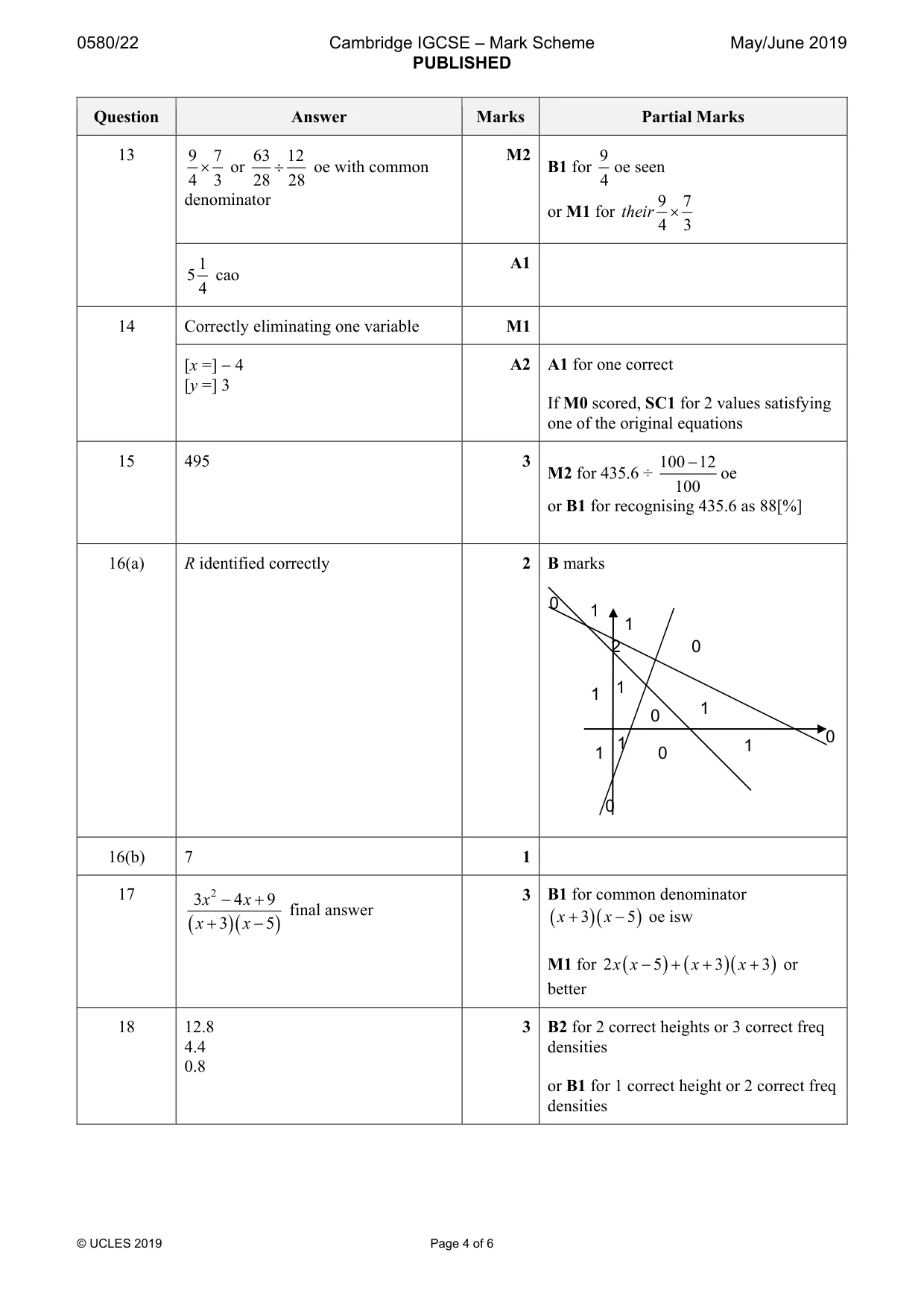
Mark scheme: 13 9 7 63 12 M2 9 × or ÷ oe with common B1 for oe seen 4 3 28 28 4 denominator 9 7 or M1 for their × 4 3 1 A1 5 cao 4
Q14 · Solve the simultaneous equations
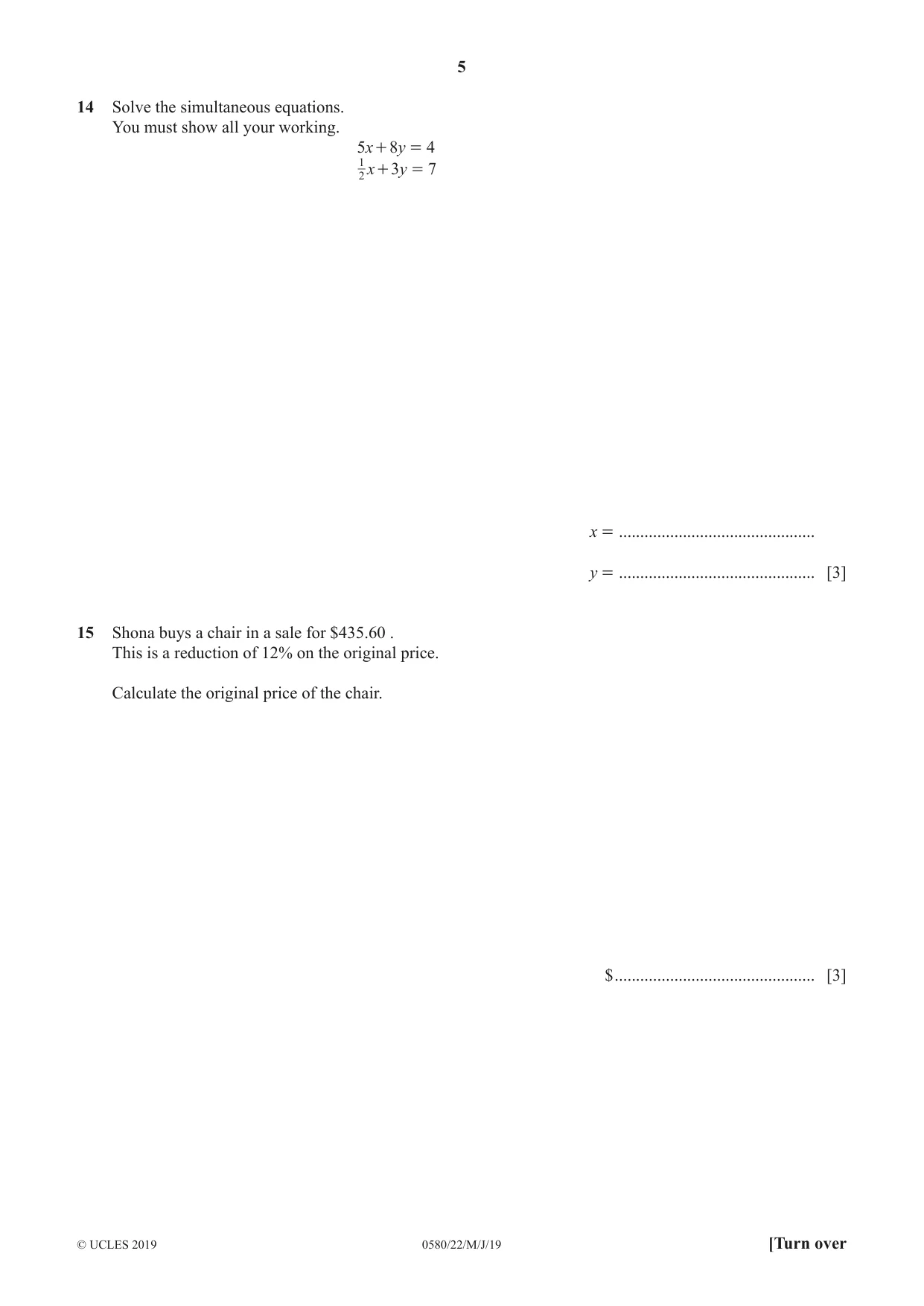
14 Solve the simultaneous equations. You must show all your working. 5x + 8y = 4 1 2 x + 3y = 7 x = .............................................. y = .............................................. [3]
Mark scheme: 14 Correctly eliminating one variable M1 [x =] − 4 A2 A1 for one correct [y =] 3 If M0 scored, SC1 for 2 values satisfying one of the original equations
Q15 · Shona buys a chair in a sale for $435.60
15 Shona buys a chair in a sale for $435.60 . This is a reduction of 12% on the original price. Calculate the original price of the chair. $ ............................................... [3]
Mark scheme: 15 495 3 100 − 12 M2 for 435.6 ÷ oe 100 or B1 for recognising 435.6 as 88[%]
Q16 · Y 10 8 6 4 2 –4 –2 0 2 4 6 8 10 12 14 x –2 –4 –6 + 6 y H 3x - 4 x + y H 5 y G- 12 x (a)…
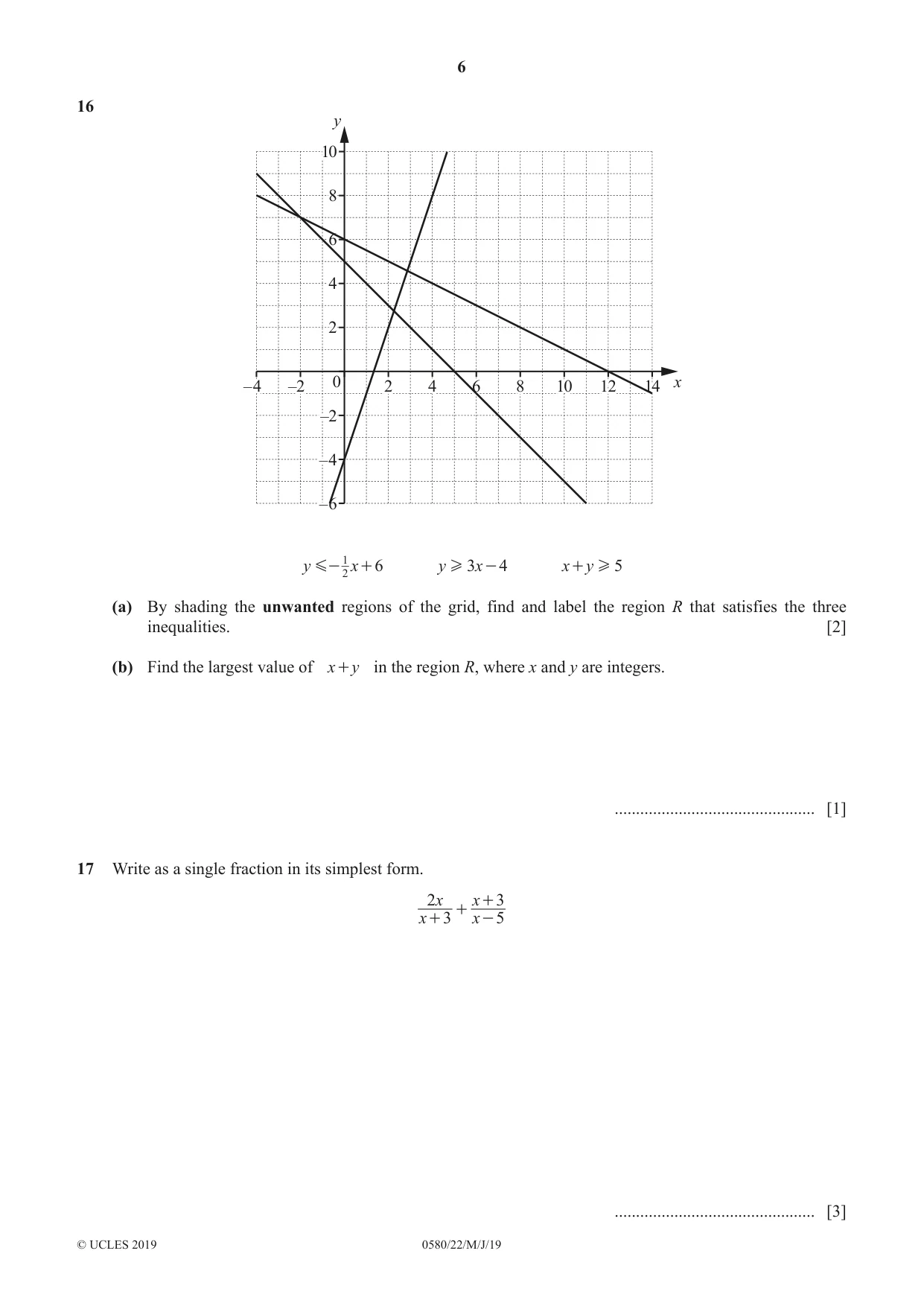
16 y 10 8 6 4 2 –4 –2 0 2 4 6 8 10 12 14 x –2 –4 –6 + 6 y H 3x - 4 x + y H 5 y G- 12 x (a) By shading the unwanted regions of the grid, find and label the region R that satisfies the three inequalities. [2] (b) Find the largest value of x + y in the region R, where x and y are integers. ............................................... [1]
Mark scheme: 16(a) R identified correctly 2 B marks 0 1 1 2 0 1 1 1 0 0 1 1 1 0 0 16(b) 7 1
Q17 · Write as a single fraction in its simplest form
17 Write as a single fraction in its simplest form. 2 x x + 3 + x + 3 x - 5 ............................................... [3]
Mark scheme: 17 3 x 2 − 4 x + 9 3 B1 for common denominator final answer ( x + 3 )( x − 5 ) oe isw ( x + 3 )( x − 5 ) M1 for 2 x ( x − 5 ) + ( x + 3 )( x + 3 ) or better
Q18 · The table shows the number of people in different age groups at a cinema
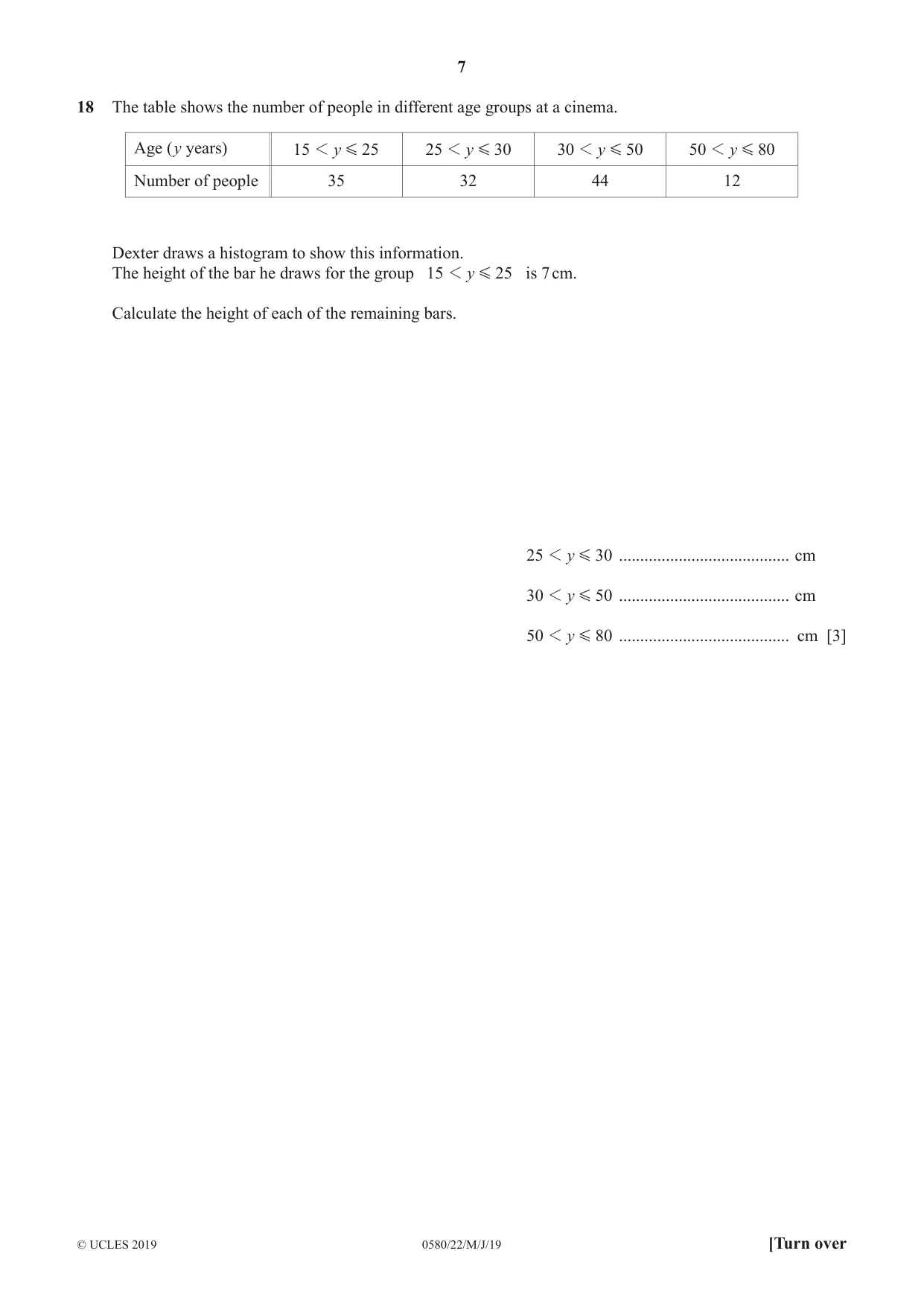
18 The table shows the number of people in different age groups at a cinema. Age ( y years) 15 1 y G 25 25 1 y G 30 30 1 y G 50 50 1 y G 80 Number of people 35 32 44 12 Dexter draws a histogram to show this information. The height of the bar he draws for the group 15 1 y G 25 is 7 cm. Calculate the height of each of the remaining bars. 25 1 y G 30 ........................................ cm 30 1 y G 50 ........................................ cm 50 1 y G 80 ........................................ cm [3]
Mark scheme: 18 12.8 3 B2 for 2 correct heights or 3 correct freq 4.4 densities 0.8 or B1 for 1 correct height or 2 correct freq densities
Q19 · Rearrange this formula to make m the subject
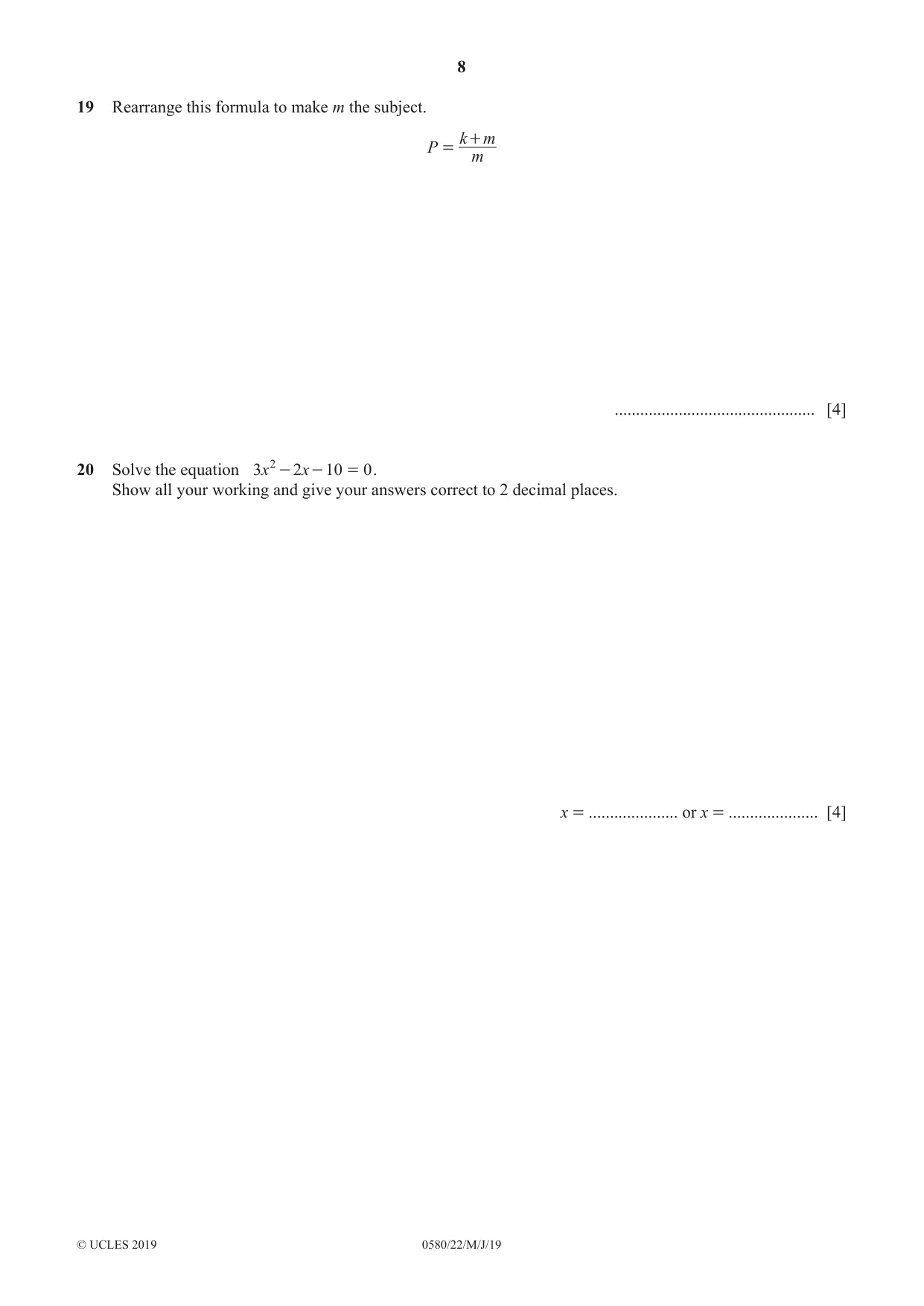
19 Rearrange this formula to make m the subject. k + m P = m ............................................... [4]
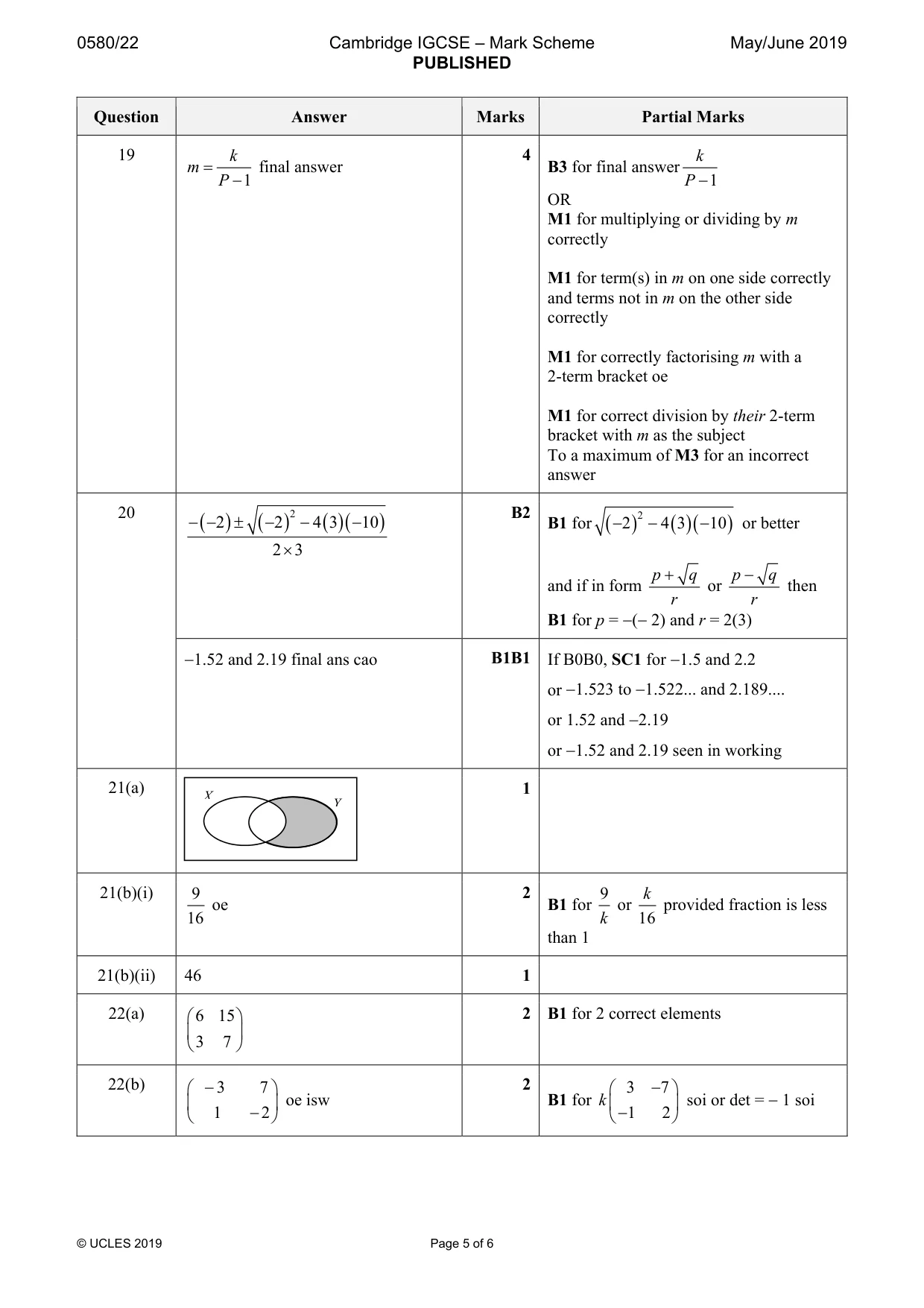
Mark scheme: 19 k 4 k m = final answer B3 for final answer P − 1 P − 1 OR M1 for multiplying or dividing by m correctly M1 for term(s) in m on one side correctly and terms not in m on the other side correctly M1 for correctly factorising m with a 2-term bracket oe M1 for correct division by their 2-term bracket with m as the subject To a maximum of M3 for an incorrect answer
Q20 · Solve the equation 3x 2 - 2x - 10 = 0
20 Solve the equation 3x 2 - 2x - 10 = 0 . Show all your working and give your answers correct to 2 decimal places. x = ..................... or x = ..................... [4]
Mark scheme: 20 2 B2 2 −−( 2 ) ± ( −2 ) − 4 ( 3 )( −10 ) B1 for ( −2 ) − 4 ( 3 )( − 10 ) or better 2 × 3 p + q p − q and if in form or then r r B1 for p = −(− 2) and r = 2(3) −1.52 and 2.19 final ans cao B1B1 If B0B0, SC1 for −1.5 and 2.2 or −1.523 to −1.522... and 2.189.... or 1.52 and −2.19 or −1.52 and 2.19 seen in working
Q21 · In the Venn diagram, shade X l k Y
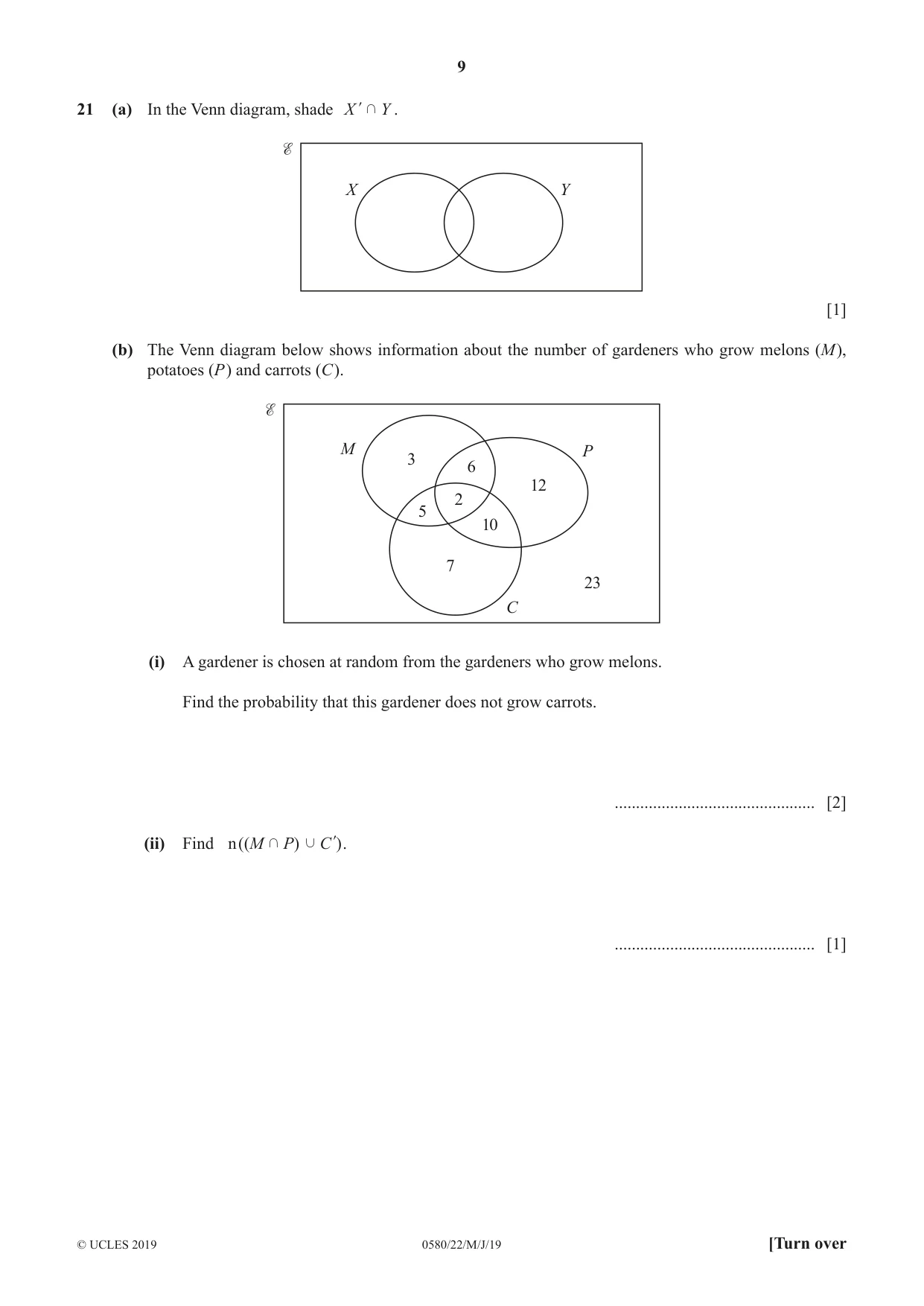
21 (a) In the Venn diagram, shade X l k Y . X Y [1] (b) The Venn diagram below shows information about the number of gardeners who grow melons (M ), potatoes (P ) and carrots (C ). M P 3 6 12 2 5 10 7 23 C (i) A gardener is chosen at random from the gardeners who grow melons. Find the probability that this gardener does not grow carrots. ............................................... [2] (ii) Find n ((M k P) j C l) . ............................................... [1]
Mark scheme: 21(a) 1 X Y 21(b)(i) 9 2 9 k oe B1 for or provided fraction is less 16 k 16 than 1 21(b)(ii) 46 1
Q22 · 7 3 4 22 A = B = e1 3o e0 1o (a) Calculate AB
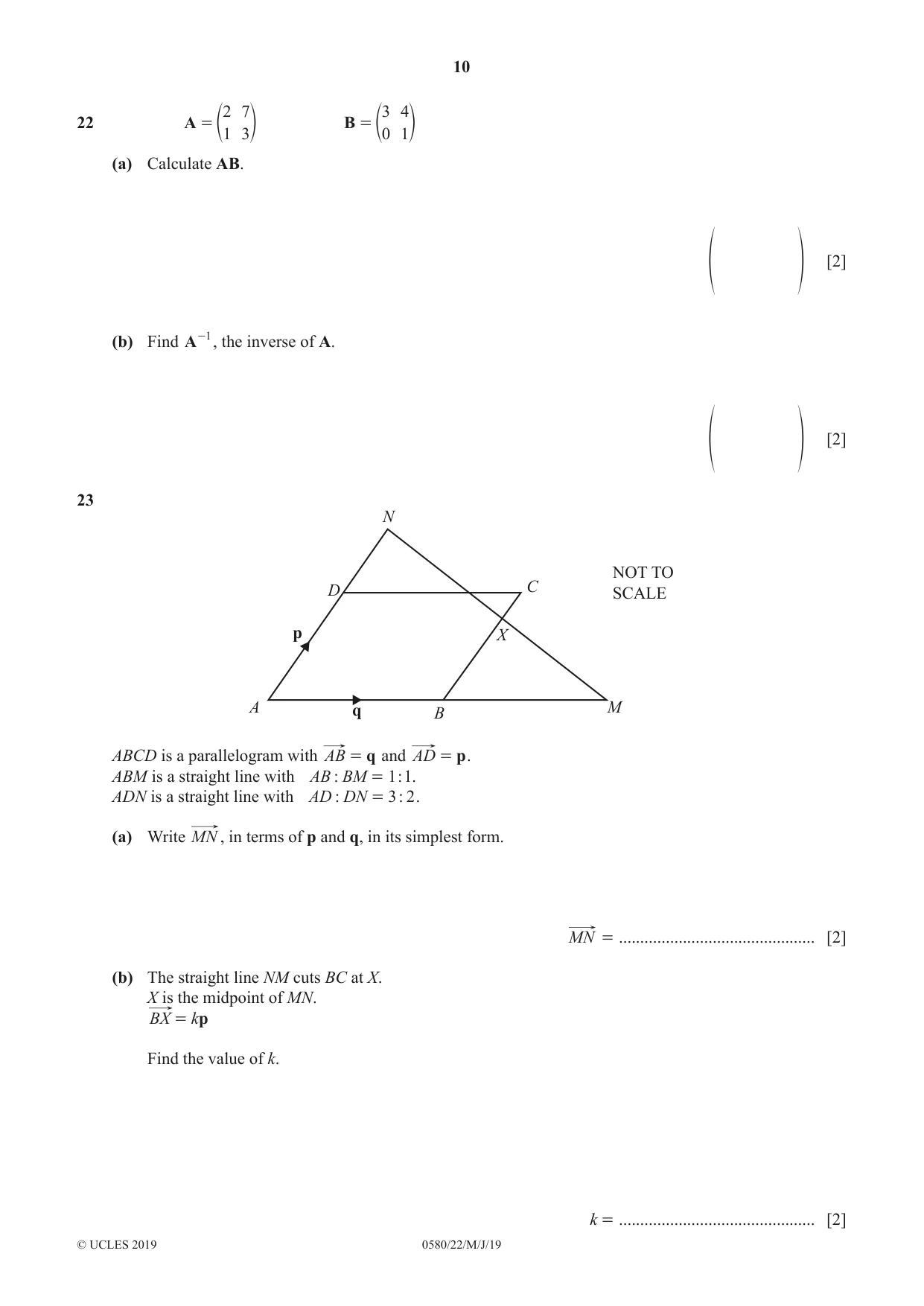
2 7 3 4 22 A = B = e1 3o e0 1o (a) Calculate AB. [2] f p (b) Find A -1 , the inverse of A. [2] f p
Mark scheme: 22(a) 6 15 2 B1 for 2 correct elements 3 7 22(b) − 3 7 2 3 −7 oe isw B1 for k soi or det = − 1 soi 1 − 2 −1 2
Q23 · N NOT TO D C SCALE p X A q B M ABCD is a parallelogram with AB = q and AD = p
23 N NOT TO D C SCALE p X A q B M ABCD is a parallelogram with AB = q and AD = p . ABM is a straight line with AB : BM = 1 : 1. ADN is a straight line with AD : DN = 3 : 2 . (a) Write MN , in terms of p and q, in its simplest form. MN = .............................................. [2] (b) The straight line NM cuts BC at X. X is the midpoint of MN. BX = kp Find the value of k. k = .............................................. [2]
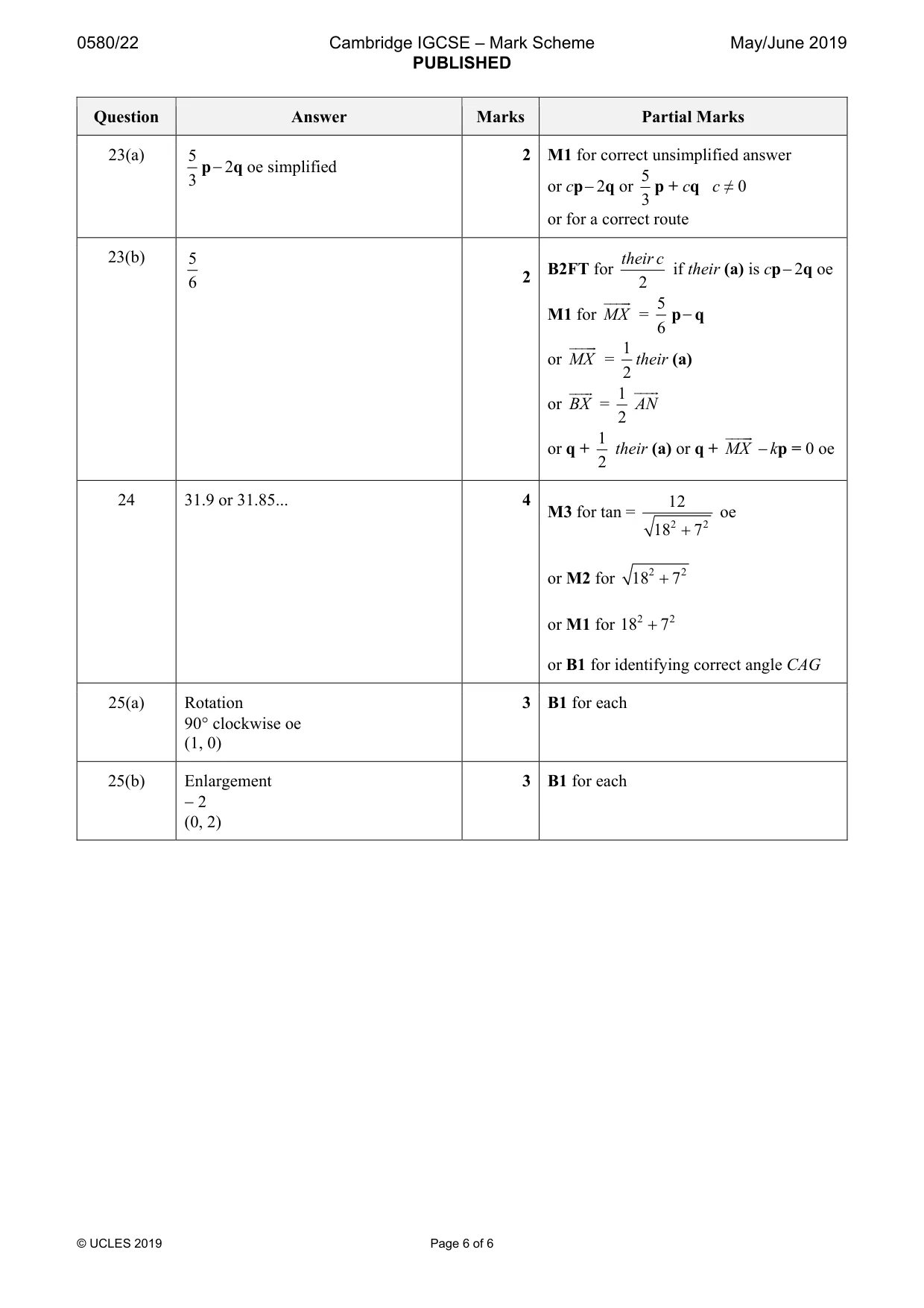
Mark scheme: 23(a) 5 2 M1 for correct unsimplified answer p−2q oe simplified 3 5 or cp−2q or p + cq c ≠ 0 3 or for a correct route 23(b) 5 their c B2FT for if their (a) is cp−2q oe 2 6 2 JJJJG 5 M1 for MX = p−q 6 JJJJG 1 or MX = their (a) 2 JJJG JJJG 1 or BX = AN 2 JJJJG 1 or q + their (a) or q + MX −kp = 0 oe 2
Q24 · H G E F 12 cm NOT TO SCALE D C 7 cm A 18 cm B ABCDEFGH is a cuboid
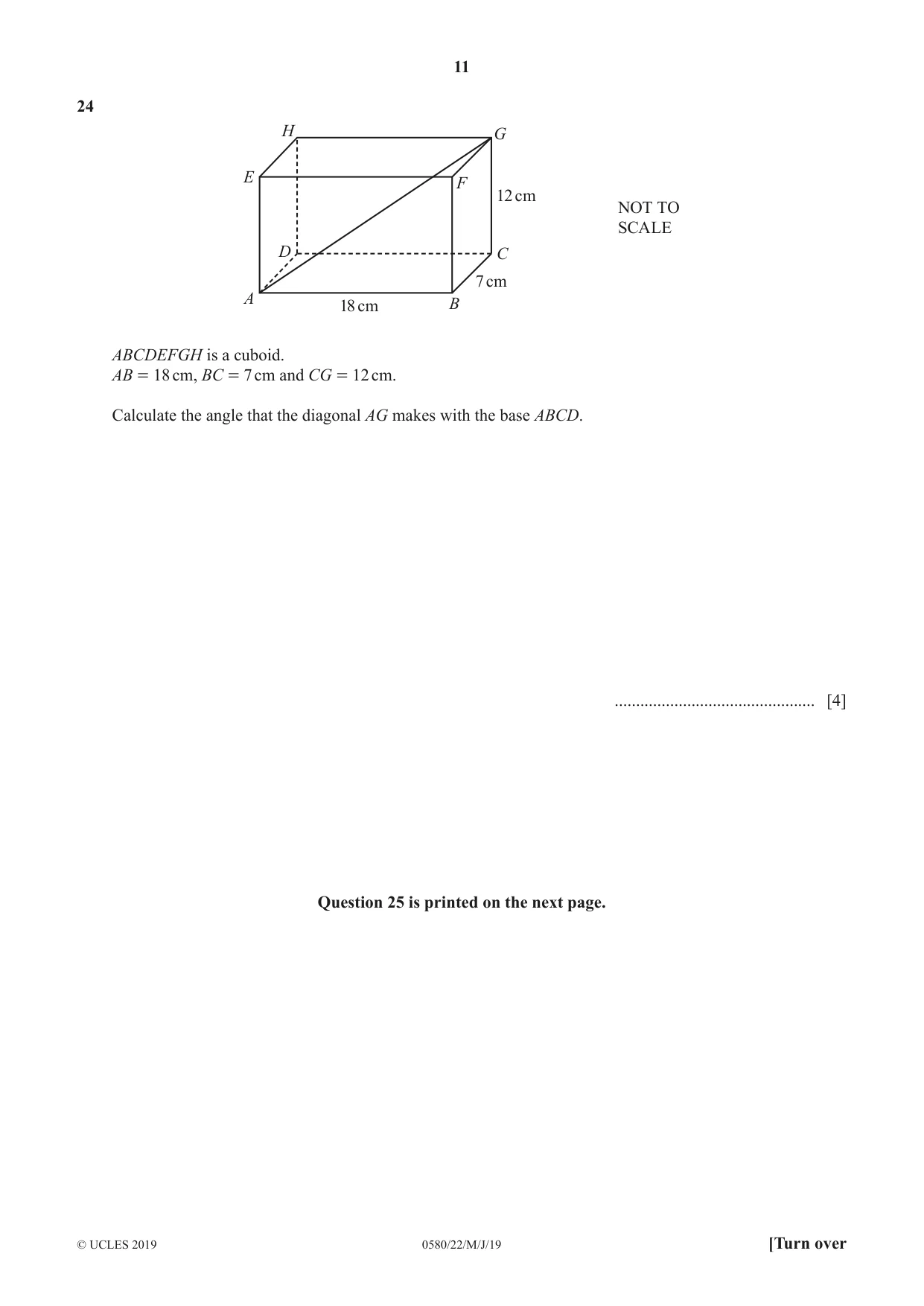
24 H G E F 12 cm NOT TO SCALE D C 7 cm A 18 cm B ABCDEFGH is a cuboid. AB = 18 cm, BC = 7 cm and CG = 12 cm. Calculate the angle that the diagonal AG makes with the base ABCD. ............................................... [4] Question 25 is printed on the next page.
Mark scheme: 24 31.9 or 31.85... 4 12 M3 for tan = oe 18 2 + 7 2 or M2 for 18 2 + 7 2 or M1 for 18 2 + 7 2 or B1 for identifying correct angle CAG
Q25 · Y 77 66 55 A 44 33 22 11 –11 –10 –9 –8 –7 –6 –5 –4 –3 –2 –1 0 1 2 3 4 5 6 7 8 x –1 –2 –3…
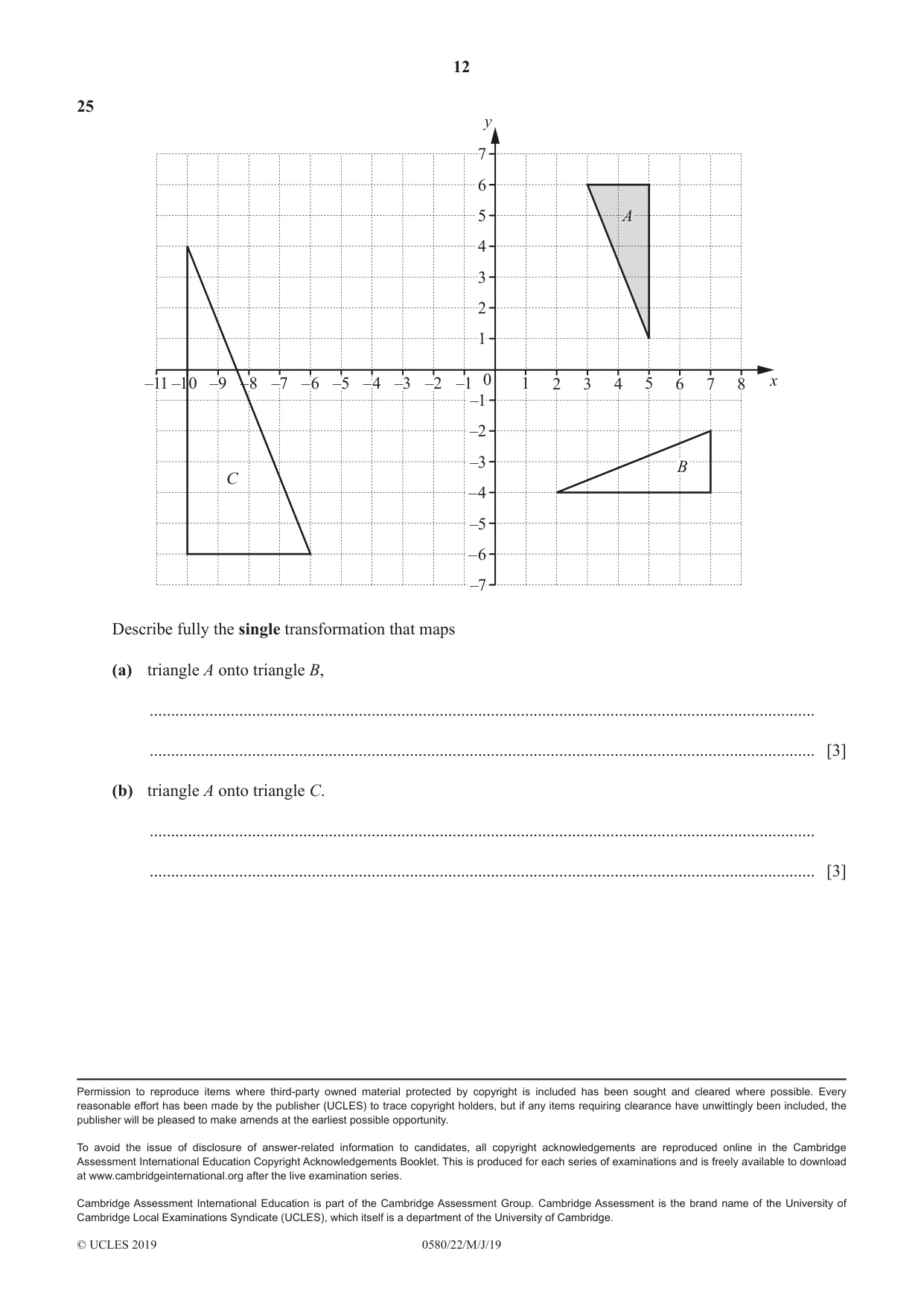
25 y 77 66 55 A 44 33 22 11 –11 –10 –9 –8 –7 –6 –5 –4 –3 –2 –1 0 1 2 3 4 5 6 7 8 x –1 –2 –3 B C –4 –5 –6 –7 Describe fully the single transformation that maps (a) triangle A onto triangle B, ............................................................................................................................................................ ............................................................................................................................................................ [3] (b) triangle A onto triangle C. ............................................................................................................................................................ ............................................................................................................................................................ [3]
Mark scheme: 25(a) Rotation 3 B1 for each 90° clockwise oe (1, 0) 25(b) Enlargement 3 B1 for each − 2 (0, 2)
What was in this paper
The subtopics covered by these 25 questions, and how many questions each got. Open one in a new tab to see every Cambridge question on it.
3Algebraic manipulation2Fractions, decimals and percentages2Transformations2Types of number2Algebraic fractions1Area and perimeter1Geometrical terms1Indices I1Inequalities1Introduction to probability1Limits of accuracy1Percentages1Rates1Ratio and proportion1Right-angled triangles1Statistical charts and diagrams1Using a calculator1Vectors in two dimensions1What you needed in this session
Cambridge’s own grade thresholds for 2019 May/June, Paper 2 · Variant 2. A higher threshold means an easier paper — the bar moves with how the cohort did.