Cambridge IGCSE Mathematics 0580 — 2018 Oct/Nov Paper 2 · Variant 1
0580/21/O/N/18 · 23 questions · 70 marks · ≈79 min
The question paper and its mark scheme, free to read here and free to download. This is Cambridge’s own paper, exactly as it was sat.
Question paper12 pages
Mark scheme5 pages
Answers below. Sit the paper first if you are practising.
Questions as text
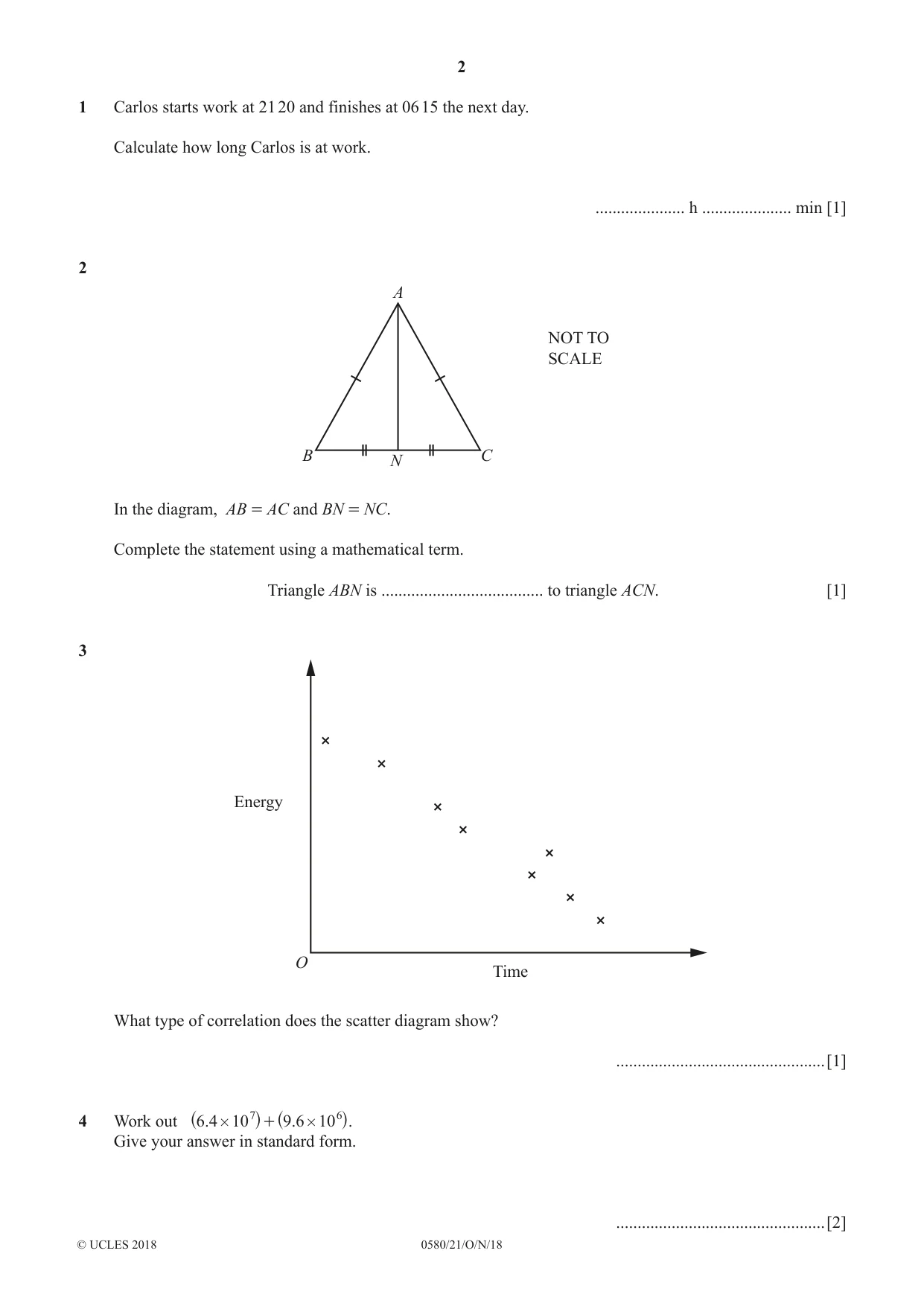
Q1 · Carlos starts work at 21 20 and finishes at 06 15 the next day
1 Carlos starts work at 21 20 and finishes at 06 15 the next day. Calculate how long Carlos is at work. ..................... h ..................... min [1]
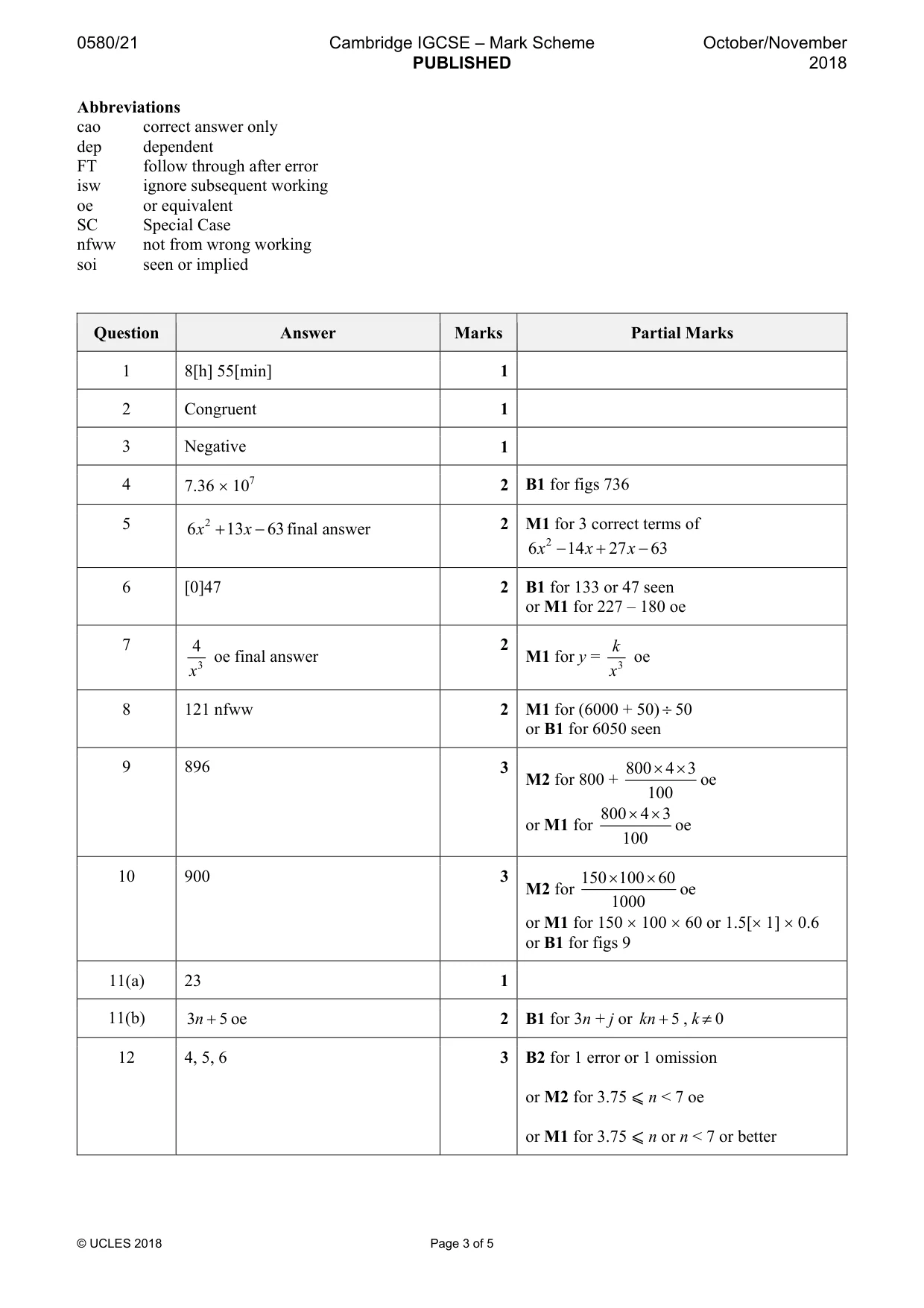
Mark scheme: Question Answer Marks Partial Marks 1 8[h] 55[min] 1
Q2 · A NOT TO SCALE B C N In the diagram, AB = AC and BN = NC
2 A NOT TO SCALE B C N In the diagram, AB = AC and BN = NC. Complete the statement using a mathematical term. Triangle ABN is ...................................... to triangle ACN. [1]
Mark scheme: 2 Congruent 1
Q3 · Energy O Time What type of correlation does the scatter diagram show?
3 Energy O Time What type of correlation does the scatter diagram show? .................................................[1]
Mark scheme: 3 Negative 1
Q4 · Work out 6 .4 # 10 7 + 9
4 Work out 6 .4 # 10 7 + 9. 6 # 10 6 ^ h ^ h. Give your answer in standard form. .................................................[2]
Mark scheme: 4 7.36 × 10⁷ 2 B1 for figs 736
Question 5
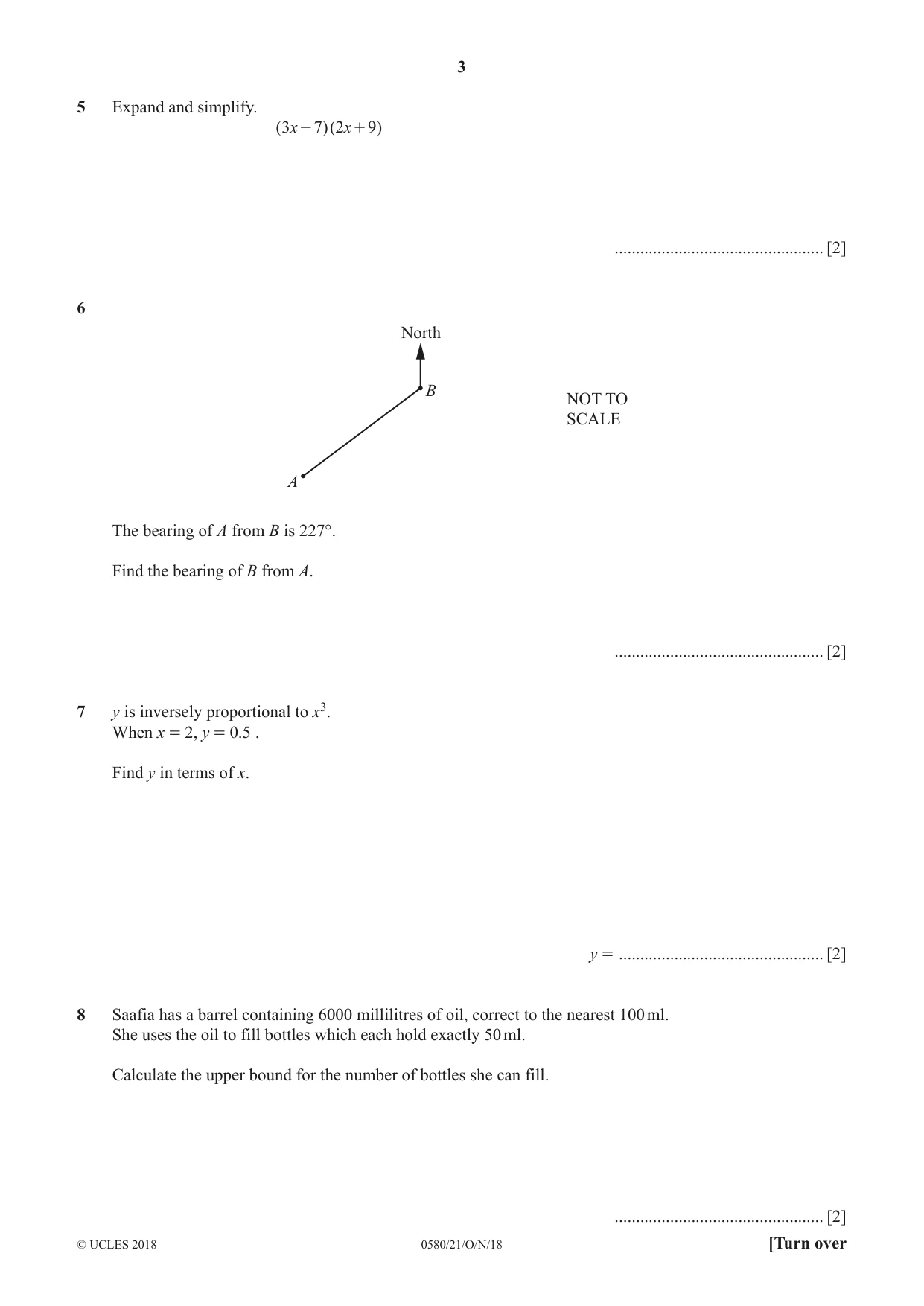
5 Expand and simplify. (3x - 7)(2x + 9) ................................................. [2]
Mark scheme: 5 6 x 2 + 13 x − 63 final answer 2 M1 for 3 correct terms of 6 x 2 − 14 x + 27 x − 63
Q6 · North B NOT TO SCALE A The bearing of A from B is 227°
6 North B NOT TO SCALE A The bearing of A from B is 227°. Find the bearing of B from A. ................................................. [2]
Mark scheme: 6 [0]47 2 B1 for 133 or 47 seen or M1 for 227 – 180 oe
Q7 · Y is inversely proportional to x3
7 y is inversely proportional to x3. When x = 2, y = 0.5 . Find y in terms of x. y = ................................................ [2]
Mark scheme: 7 4 2 k oe final answer M1 for y = oe x 3 x 3
Q8 · Saafia has a barrel containing 6000 millilitres of oil, correct to the nearest 100 ml
8 Saafia has a barrel containing 6000 millilitres of oil, correct to the nearest 100 ml. She uses the oil to fill bottles which each hold exactly 50 ml. Calculate the upper bound for the number of bottles she can fill. ................................................. [2]
Mark scheme: 8 121 nfww 2 M1 for (6000 + 50) ÷ 50 or B1 for 6050 seen
Q9 · Jan invests $800 at a rate of 3% per year simple interest
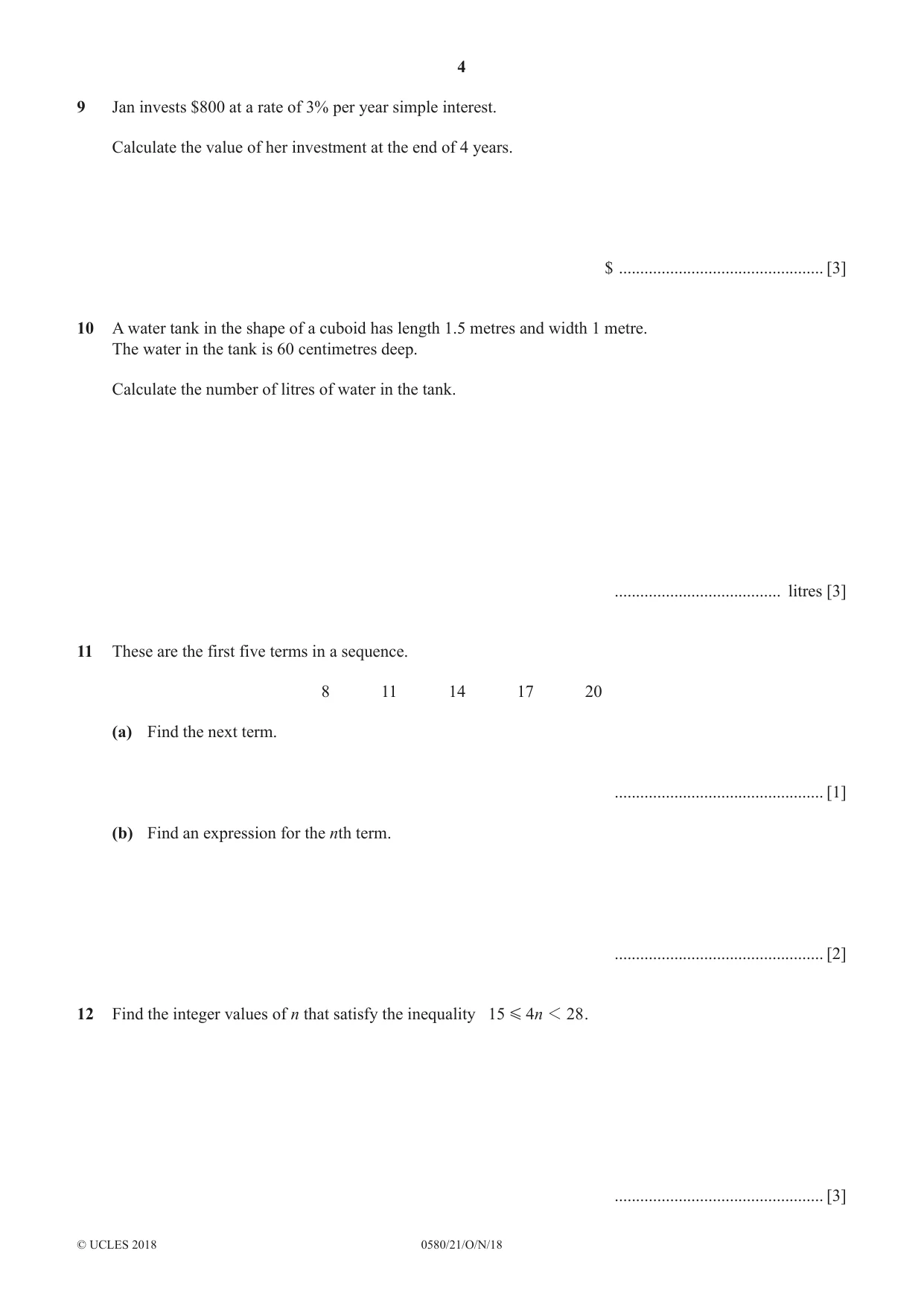
9 Jan invests $800 at a rate of 3% per year simple interest. Calculate the value of her investment at the end of 4 years. $ ................................................ [3]
Mark scheme: 9 896 3 800 × 4 × 3 M2 for 800 + oe 100 800 × 4 × 3 or M1 for oe 100
Q10 · A water tank in the shape of a cuboid has length 1.5 metres and width 1 metre
10 A water tank in the shape of a cuboid has length 1.5 metres and width 1 metre. The water in the tank is 60 centimetres deep. Calculate the number of litres of water in the tank. ....................................... litres [3]
Mark scheme: 10 900 3 150 × 100 × 60 M2 for oe 1000 or M1 for 150 × 100 × 60 or 1.5[× 1] × 0.6 or B1 for figs 9
Q11 · These are the first five terms in a sequence
11 These are the first five terms in a sequence. 8 11 14 17 20 (a) Find the next term. ................................................. [1] (b) Find an expression for the nth term. ................................................. [2]
Mark scheme: 11(a) 23 1 11(b) 3n + 5 oe 2 B1 for 3n + j or kn + 5 , k ≠0
Q12 · Find the integer values of n that satisfy the inequality 15 G 4n 1 28
12 Find the integer values of n that satisfy the inequality 15 G 4n 1 28 . ................................................. [3]
Mark scheme: 12 4, 5, 6 3 B2 for 1 error or 1 omission or M2 for 3.75 ⩽ n < 7 oe or M1 for 3.75 ⩽ n or n < 7 or better
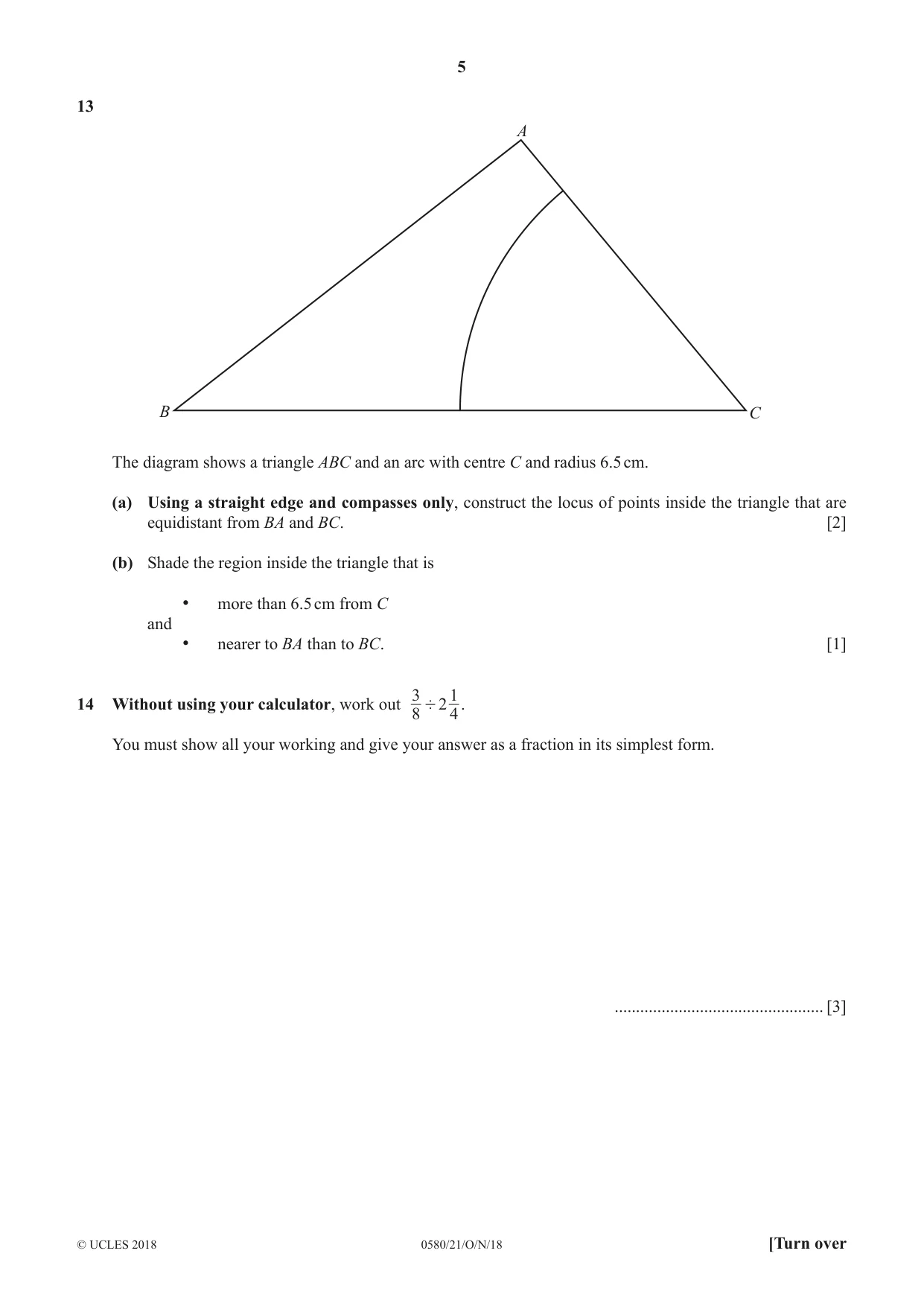
Q13 · A B C The diagram shows a triangle ABC and an arc with centre C and radius 6.5 cm
13 A B C The diagram shows a triangle ABC and an arc with centre C and radius 6.5 cm. (a) Using a straight edge and compasses only, construct the locus of points inside the triangle that are equidistant from BA and BC. [2] (b) Shade the region inside the triangle that is • more than 6.5 cm from C and • nearer to BA than to BC. [1]
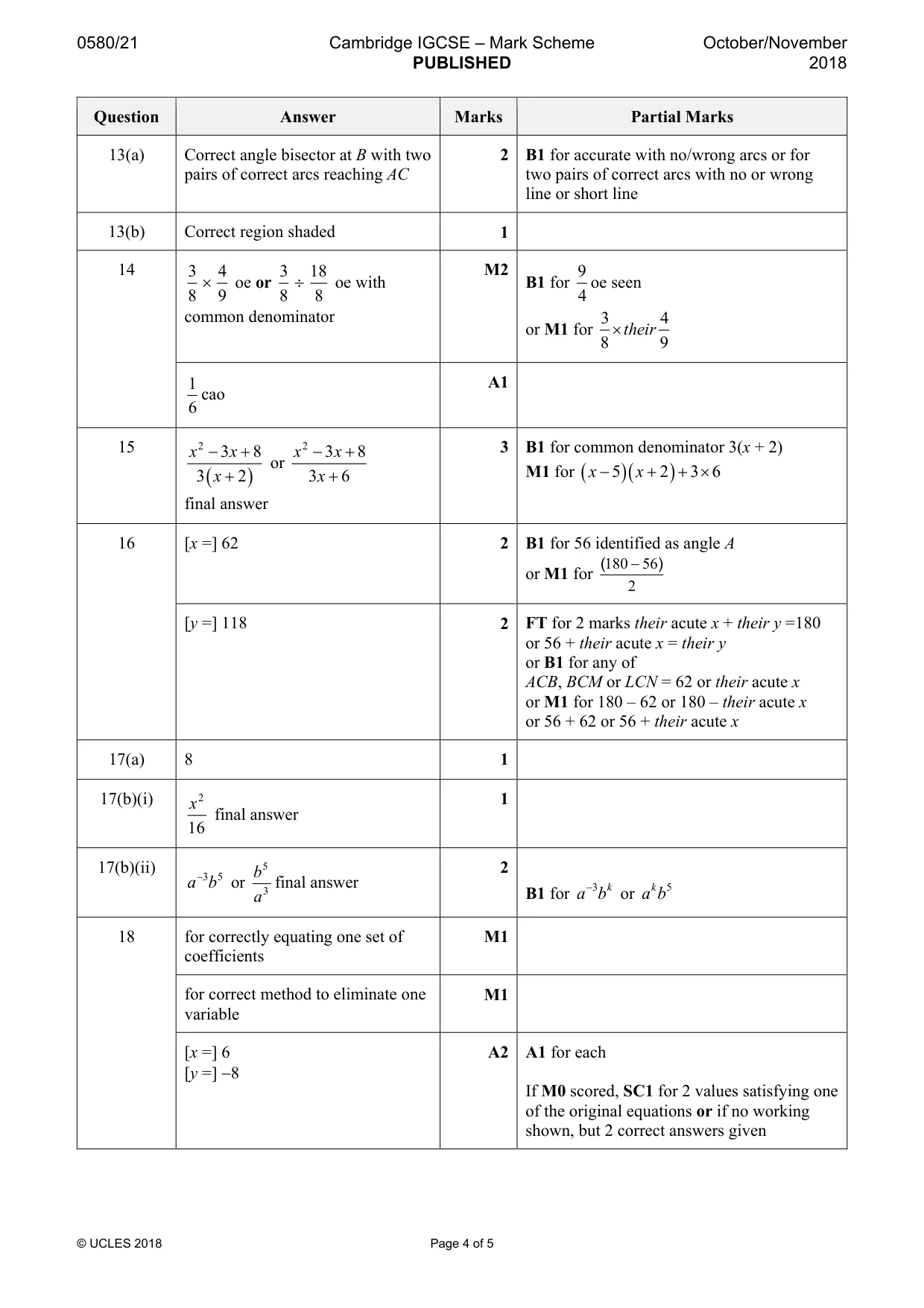
Mark scheme: 13(a) Correct angle bisector at B with two 2 B1 for accurate with no/wrong arcs or for pairs of correct arcs reaching AC two pairs of correct arcs with no or wrong line or short line 13(b) Correct region shaded 1
Q14 · 114 Without using your calculator, work out ' 2
3 114 Without using your calculator, work out ' 2 . 8 4 You must show all your working and give your answer as a fraction in its simplest form. ................................................. [3]
Mark scheme: 14 3 4 3 18 M2 9 × oe or ÷ oe with B1 for oe seen 8 9 8 8 4 common denominator 3 4 or M1 for × their 8 9 1 A1 cao 6
Q15 · Write as a single fraction in its simplest form
15 Write as a single fraction in its simplest form. x - 5 6 + 3 x + 2 ................................................. [3]
Mark scheme: 15 x 2 − 3 x + 8 x 2 − 3 x + 8 3 B1 for common denominator 3(x + 2) or x − 5 )( x + 2 ) + 3 × 6 3 ( x + 2 ) 3 x + 6 M1 for ( final answer
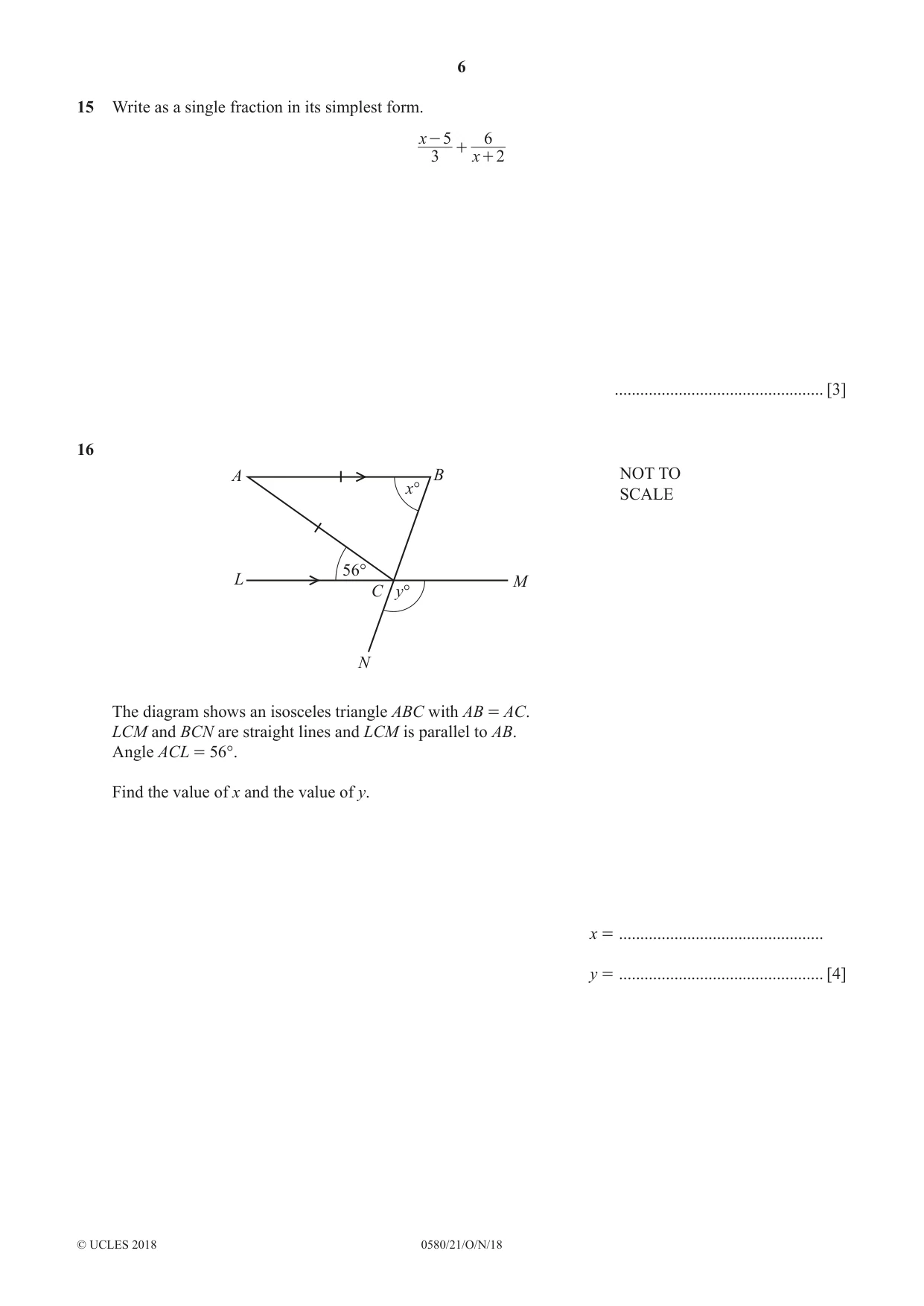
Q16 · A B NOT TO x° SCALE 56° L M C y° N The diagram shows an isosceles triangle ABC with AB =…
16 A B NOT TO x° SCALE 56° L M C y° N The diagram shows an isosceles triangle ABC with AB = AC. LCM and BCN are straight lines and LCM is parallel to AB. Angle ACL = 56°. Find the value of x and the value of y. x = ................................................ y = ................................................ [4]
Mark scheme: 16 [x =] 62 2 B1 for 56 identified as angle A (180 − 56 ) or M1 for 2 [y =] 118 2 FT for 2 marks their acute x + their y =180 or 56 + their acute x = their y or B1 for any of ACB, BCM or LCN = 62 or their acute x or M1 for 180 – 62 or 180 – their acute x or 56 + 62 or 56 + their acute x
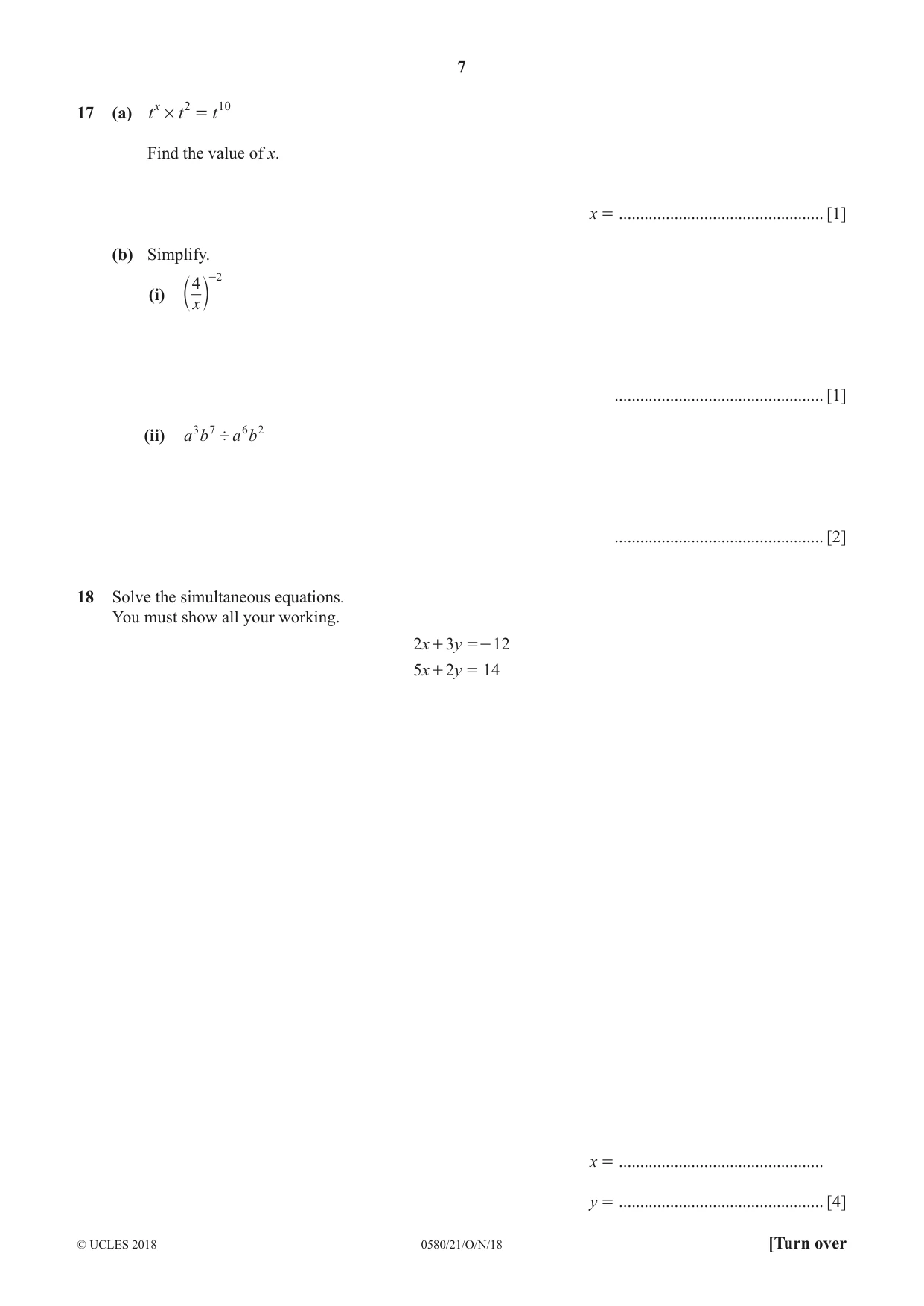
Q17 · T x # t 2 = t 10 Find the value of x
17 (a) t x # t 2 = t 10 Find the value of x. x = ................................................ [1] (b) Simplify. 4 -2 (i) c x m ................................................. [1] (ii) a 3 b 7 ' a 6 b 2 ................................................. [2]
Mark scheme: 17(a) 8 1 17(b)(i) x 2 1 final answer 16 17(b)(ii) −3 5 b 5 2 a b or final answer −3 k k 5 3 a B1 for a b or a b
Q18 · Solve the simultaneous equations
18 Solve the simultaneous equations. You must show all your working. 2x + 3y =- 12 5x + 2y = 14 x = ................................................ y = ................................................ [4]
Mark scheme: 18 for correctly equating one set of M1 coefficients for correct method to eliminate one M1 variable [x =] 6 A2 A1 for each [y =] −8 If M0 scored, SC1 for 2 values satisfying one of the original equations or if no working shown, but 2 correct answers given
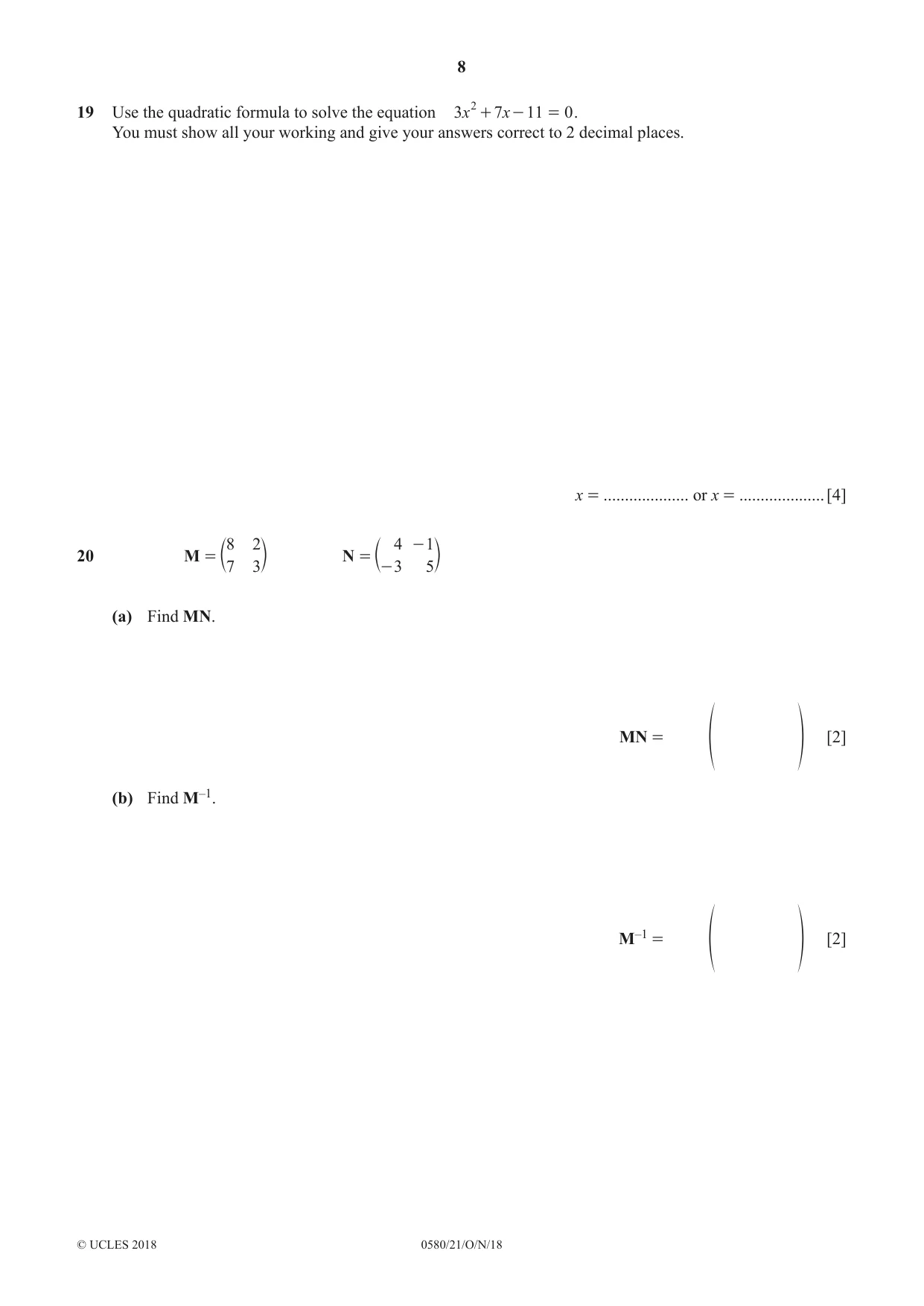
Q19 · Use the quadratic formula to solve the equation 3x 2 + 7x - 11 = 0
19 Use the quadratic formula to solve the equation 3x 2 + 7x - 11 = 0 . You must show all your working and give your answers correct to 2 decimal places. x = .................... or x = .................... [4]
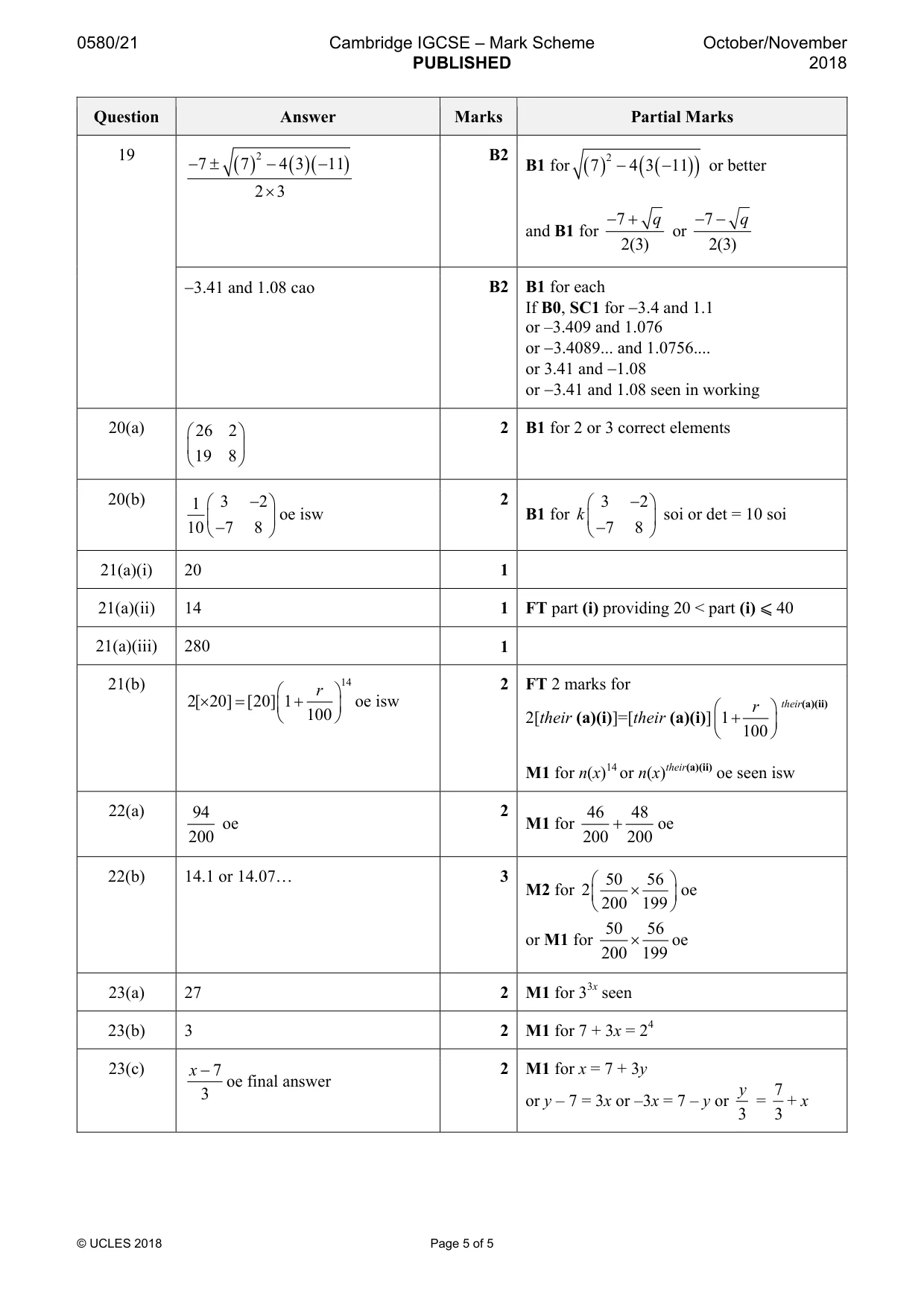
Mark scheme: 19 2 B2 2 −±7 ( 7 ) − 4 ( 3 )( −11) B1 for ( 7 ) − 4 ( 3 ( −11) ) or better 2 × 3 −+7 q −−7 q and B1 for or 2(3) 2(3) −3.41 and 1.08 cao B2 B1 for each If B0, SC1 for −3.4 and 1.1 or –3.409 and 1.076 or −3.4089... and 1.0756.... or 3.41 and −1.08 or −3.41 and 1.08 seen in working
Q20 · 2 4 - 1 20 M = N = c7 3m c- 3 5m (a) Find MN
8 2 4 - 1 20 M = N = c7 3m c- 3 5m (a) Find MN. MN = [2] f p (b) Find M–1. M–1 = [2] f p
Mark scheme: 20(a) 26 2 2 B1 for 2 or 3 correct elements 19 8 20(b) 1 3 −2 2 3 −2 oe isw B1 for k soi or det = 10 soi 10 −7 8 − 7 8
Q21 · 400 360 320 280 Value of 240investment ($) 200 160 120 80 40 0 0 4 8 12 16 20 24 28 32 36…
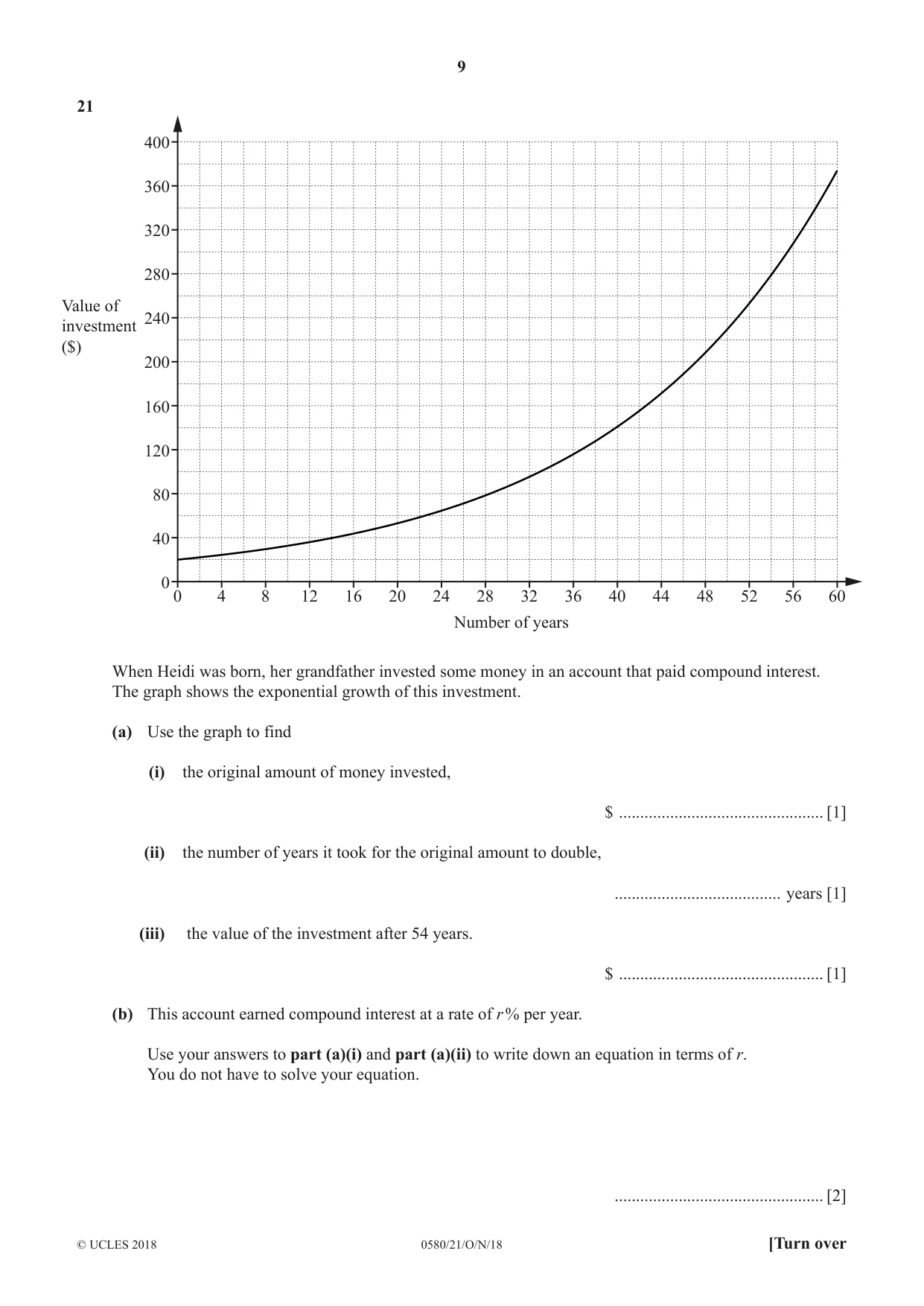
21 400 360 320 280 Value of 240investment ($) 200 160 120 80 40 0 0 4 8 12 16 20 24 28 32 36 40 44 48 52 56 60 Number of years When Heidi was born, her grandfather invested some money in an account that paid compound interest. The graph shows the exponential growth of this investment. (a) Use the graph to find (i) the original amount of money invested, $ ................................................ [1] (ii) the number of years it took for the original amount to double, ....................................... years [1] (iii) the value of the investment after 54 years. $ ................................................ [1] (b) This account earned compound interest at a rate of r % per year. Use your answers to part (a)(i) and part (a)(ii) to write down an equation in terms of r. You do not have to solve your equation. ................................................. [2]
Mark scheme: 21(a)(i) 20 1 21(a)(ii) 14 1 FT part (i) providing 20 < part (i) ⩽40 21(a)(iii) 280 1 21(b) 14 2 FT 2 marks for r 2[× 20] = [20] 1 + oe isw their(a)(ii) r 100 2[their (a)(i)]=[their (a)(i)] 1 + 100 M1 for n(x)14 or n(x)their(a)(ii) oe seen isw
Q22 · A group of 200 people were asked which city they would like to visit next
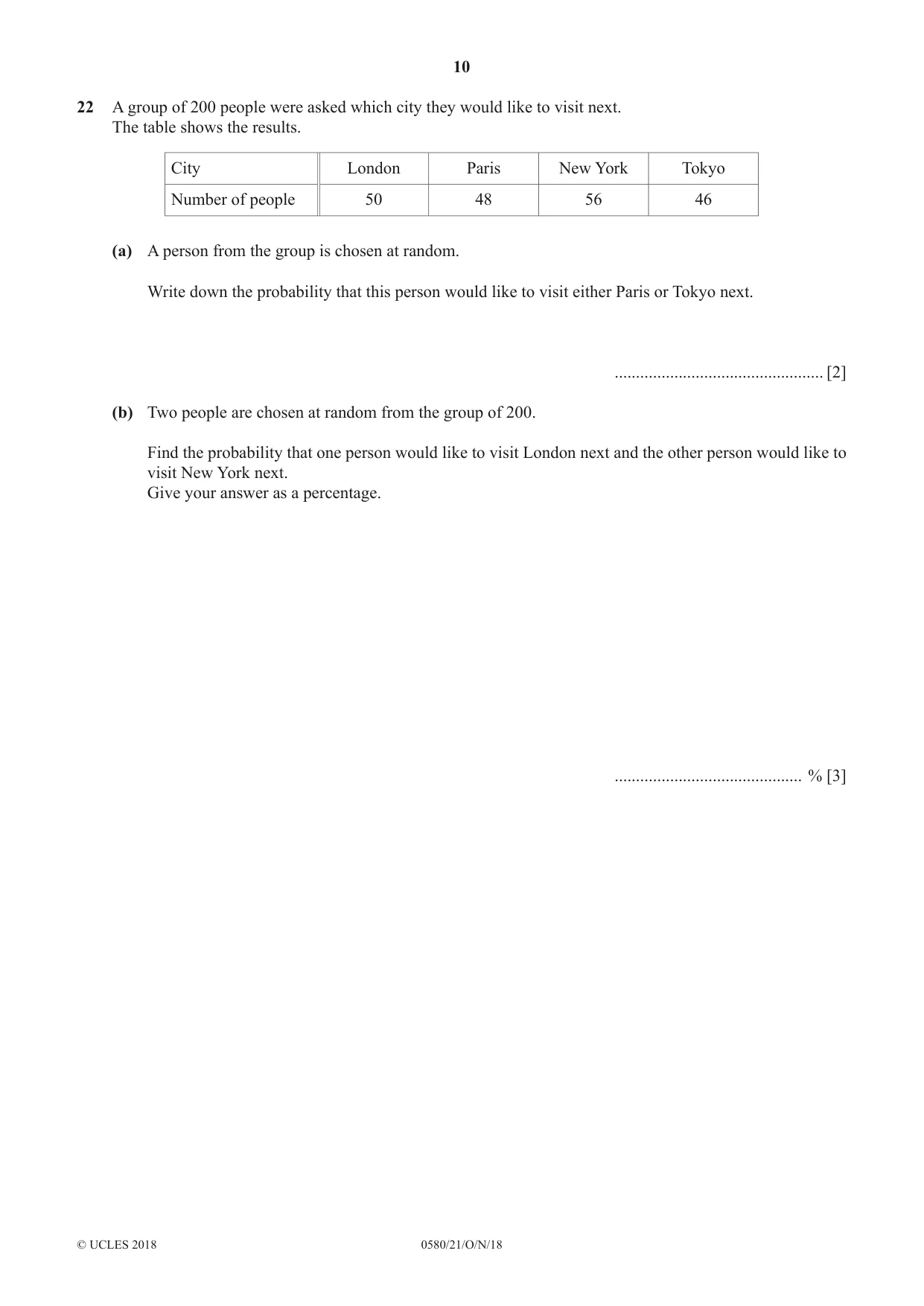
22 A group of 200 people were asked which city they would like to visit next. The table shows the results. City London Paris New York Tokyo Number of people 50 48 56 46 (a) A person from the group is chosen at random. Write down the probability that this person would like to visit either Paris or Tokyo next. ................................................. [2] (b) Two people are chosen at random from the group of 200. Find the probability that one person would like to visit London next and the other person would like to visit New York next. Give your answer as a percentage. ............................................ % [3]
Mark scheme: 22(a) 94 2 46 48 oe M1 for + oe 200 200 200 22(b) 14.1 or 14.07… 3 50 56 M2 for 2 × oe 200 199 50 56 or M1 for × oe 200 199
Q23 · F (x) = 7 + 3x g (x) = x4 h (x) = 3x (a) h (3x) = k x Find the value of k
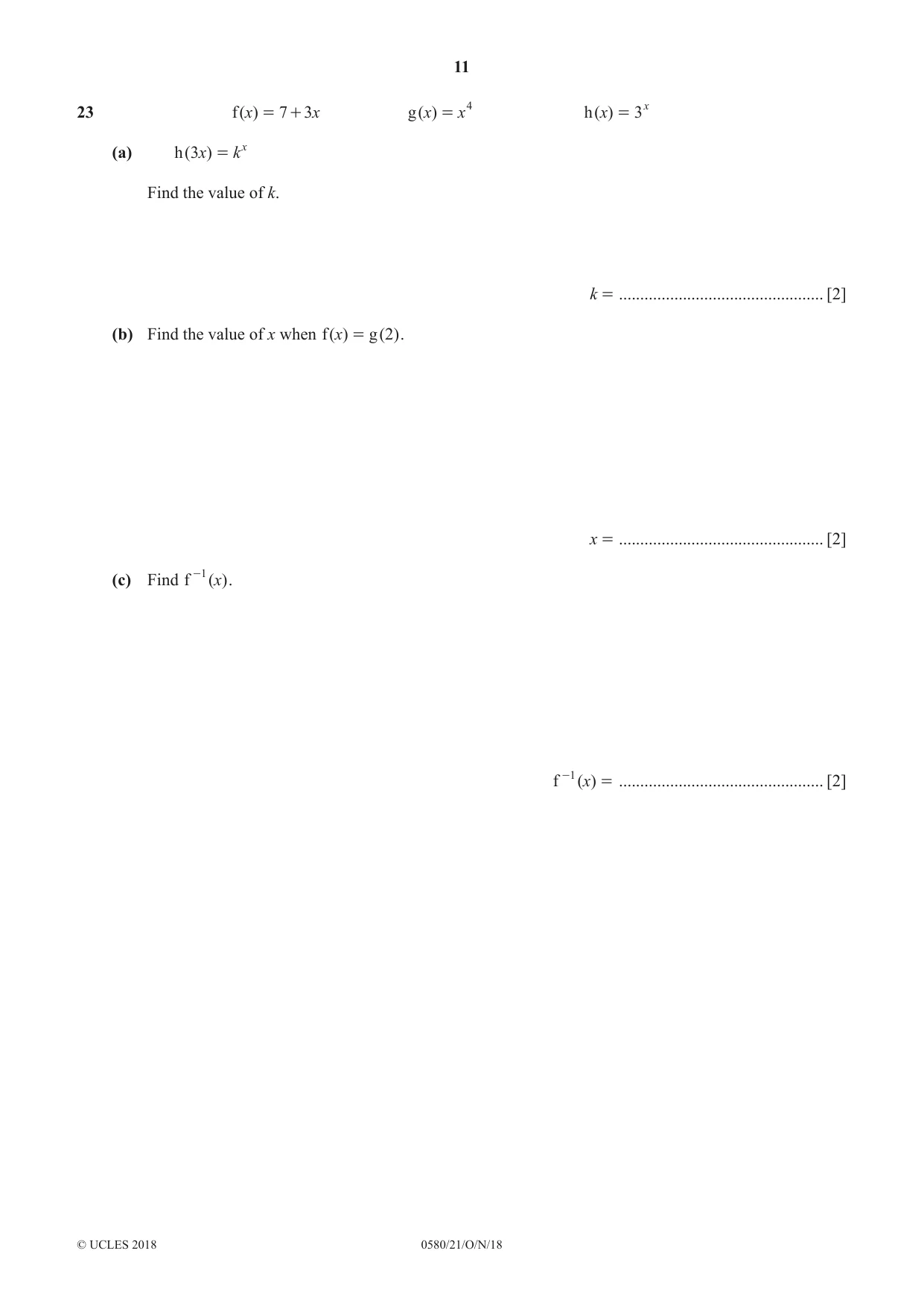
23 f (x) = 7 + 3x g (x) = x4 h (x) = 3x (a) h (3x) = k x Find the value of k. k = ................................................ [2] (b) Find the value of x when f (x) = g (2) . x = ................................................ [2] (c) Find f -1 (x) . f -1 (x) = ................................................ [2]
Mark scheme: 23(a) 27 2 M1 for 33x seen 23(b) 3 2 M1 for 7 + 3x = 24 23(c) x − 7 2 M1 for x = 7 + 3y oe final answer y 7 3 or y – 7 = 3x or –3x = 7 – y or = + x 3 3
What was in this paper
The subtopics covered by these 23 questions, and how many questions each got. Open one in a new tab to see every Cambridge question on it.
2Indices I2Algebraic fractions1Algebraic manipulation1Angles1Fractions, decimals and percentages1Geometrical terms1Inequalities1Limits of accuracy1Money1Percentages1Probability of combined events1Rates1Ratio and proportion1Scatter diagrams1Sequences1Similarity1Standard form1Surface area and volume1Time1Vectors in two dimensions1What you needed in this session
Cambridge’s own grade thresholds for 2018 Oct/Nov, Paper 2 · Variant 1. A higher threshold means an easier paper — the bar moves with how the cohort did.