Cambridge IGCSE Latin 0480 — 2025 May/June Paper 2 · Variant 2
0480/22/M/J/25 · 6 questions · 80 marks · ≈90 min
The question paper and its mark scheme, free to read here and free to download. This is Cambridge’s own paper, exactly as it was sat.
Question paper8 pages



Mark scheme9 pages
Answers below. Sit the paper first if you are practising.
Questions as text
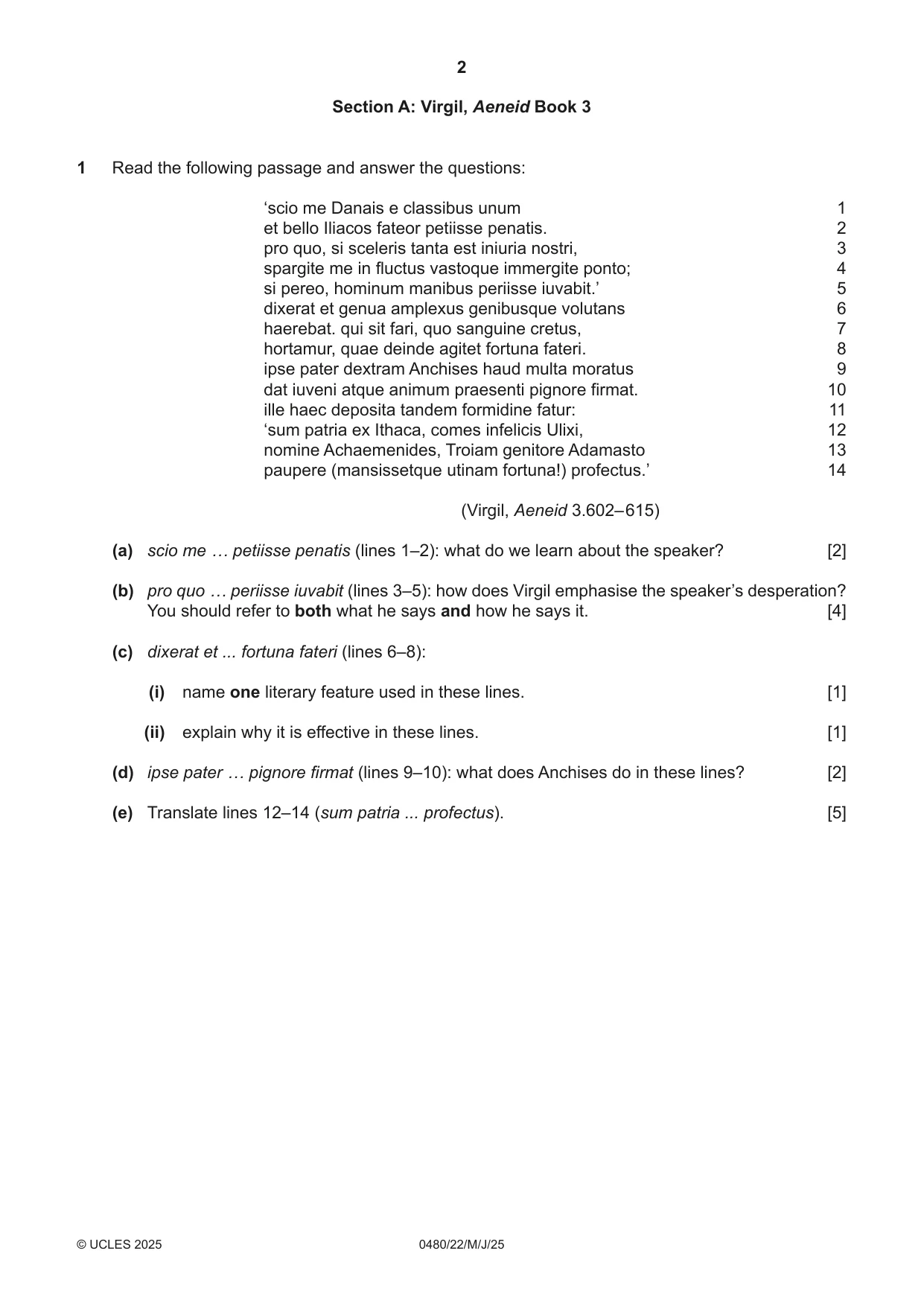
Q1 · Read the following passage and answer the questions: ‘scio me Danais e classibus unum 1…
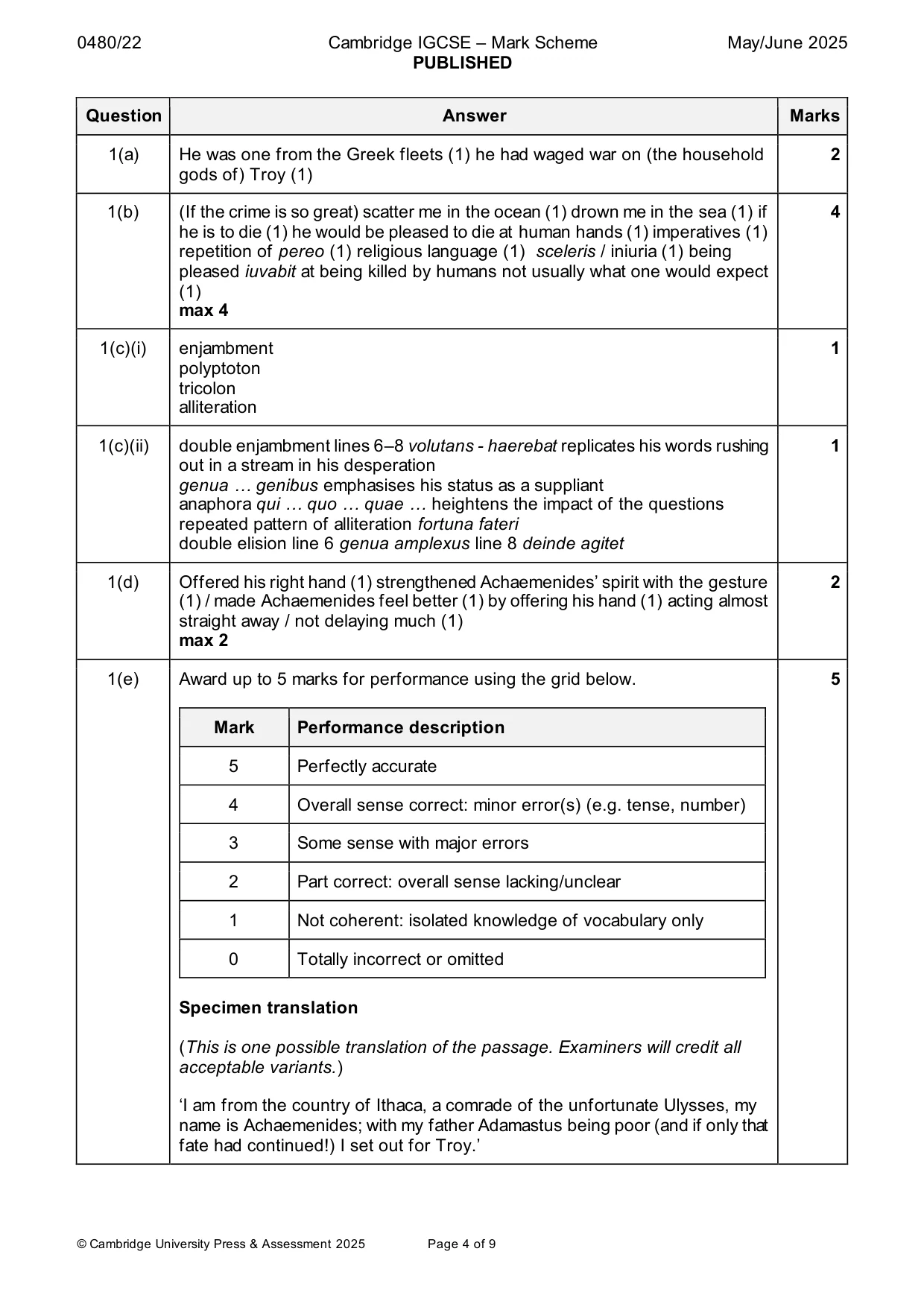
1 Read the following passage and answer the questions: ‘scio me Danais e classibus unum 1 et bello Iliacos fateor petiisse penatis. 2 pro quo, si sceleris tanta est iniuria nostri, 3 spargite me in fluctus vastoque immergite ponto; 4 si pereo, hominum manibus periisse iuvabit.’ 5 dixerat et genua amplexus genibusque volutans 6 haerebat. qui sit fari, quo sanguine cretus, 7 hortamur, quae deinde agitet fortuna fateri. 8 ipse pater dextram Anchises haud multa moratus 9 dat iuveni atque animum praesenti pignore firmat. 10 ille haec deposita tandem formidine fatur: 11 ‘sum patria ex Ithaca, comes infelicis Ulixi, 12 nomine Achaemenides, Troiam genitore Adamasto 13 paupere (mansissetque utinam fortuna!) profectus.’ 14 (Virgil, Aeneid 3.602– 615) (a) scio me … petiisse penatis (lines 1–2): what do we learn about the speaker? [2] (b) pro quo … periisse iuvabit (lines 3–5): how does Virgil emphasise the speaker’s desperation? You should refer to both what he says and how he says it. [4] (c) dixerat et ... fortuna fateri (lines 6–8): (i) name one literary feature used in these lines. [1] (ii) explain why it is effective in these lines. [1] (d) ipse pater … pignore firmat (lines 9–10): what does Anchises do in these lines? [2] (e) Translate lines 12–14 (sum patria ... profectus). [5]
Mark scheme: Question Answer Marks 1(a) He was one from the Greek fleets (1) he had waged war on (the household 2 gods of) Troy (1) 1(b) (If the crime is so great) scatter me in the ocean (1) drown me in the sea (1) if 4 he is to die (1) he would be pleased to die at human hands (1) imperatives (1) repetition of pereo (1) religious language (1) sceleris / iniuria (1) being pleased iuvabit at being killed by humans not usually what one would expect (1) max 4 1(c)(i) enjambment 1 polyptoton tricolon alliteration 1(c)(ii) double enjambment lines 6–8 volutans - haerebat replicates his words rushing 1 out in a stream in his desperation genua … genibus emphasises his status as a suppliant anaphora qui … quo … quae … heightens the impact of the questions repeated pattern of alliteration fortuna fateri double elision line 6 genua amplexus line 8 deinde agitet 1(d) Offered his right hand (1) strengthened Achaemenides’ spirit with the gesture 2 (1) / made Achaemenides feel better (1) by offering his hand (1) acting almost straight away / not delaying much (1) max 2 1(e) Award up to 5 marks for performance using the grid below. 5 Mark Performance description 5 Perfectly accurate 4 Overall sense correct: minor error(s) (e.g. tense, number) 3 Some sense with major errors 2 Part correct: overall sense lacking/unclear 1 Not coherent: isolated knowledge of vocabulary only 0 Totally incorrect or omitted Specimen translation (This is one possible translation of the passage. Examiners will credit all acceptable variants.) ‘I am from the country of Ithaca, a comrade of the unfortunate Ulysses, my name is Achaemenides; with my father Adamastus being poor (and if only that fate had continued!) I set out for Troy.’
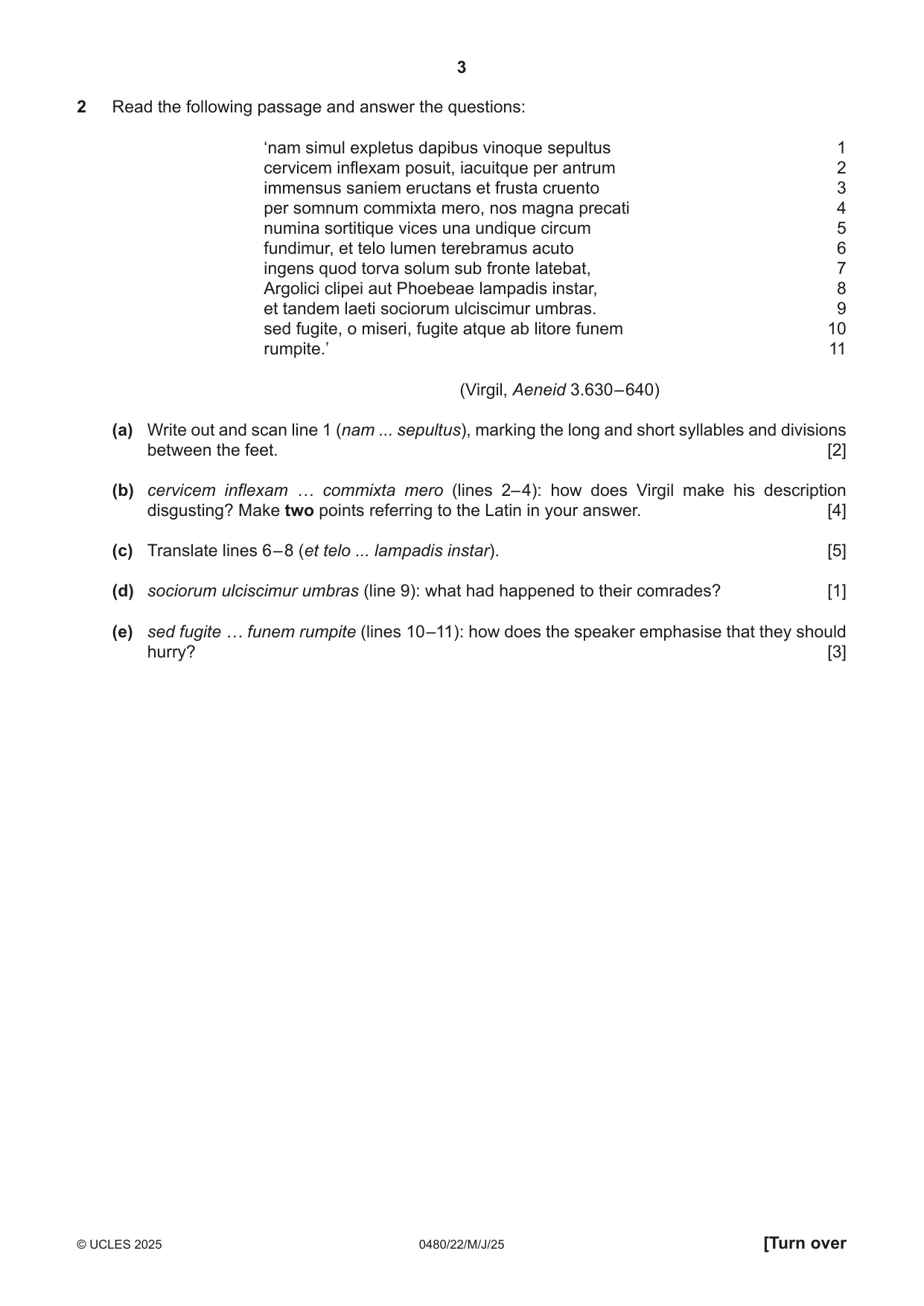
Q2 · Read the following passage and answer the questions: ‘nam simul expletus dapibus vinoque…
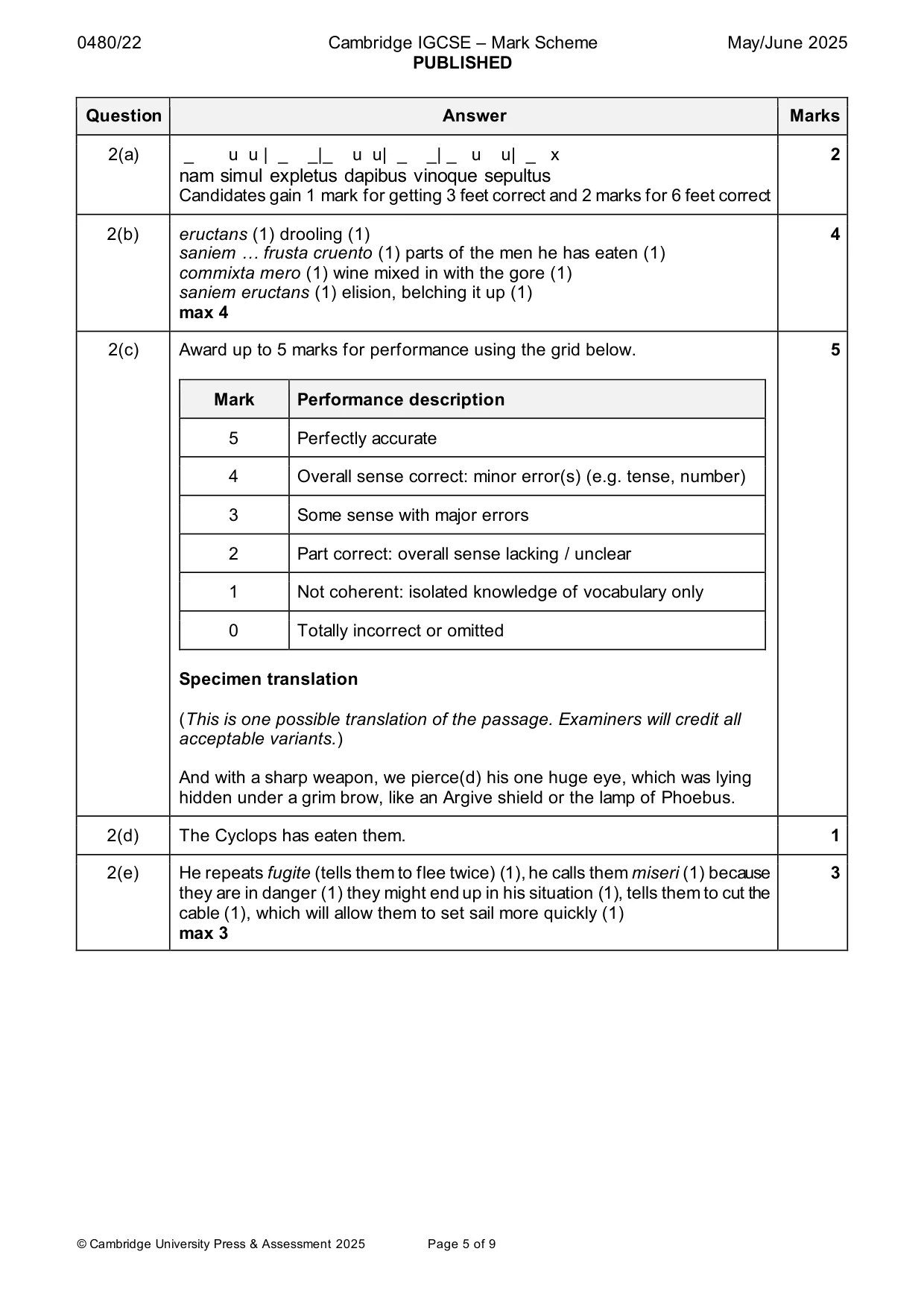
2 Read the following passage and answer the questions: ‘nam simul expletus dapibus vinoque sepultus 1 cervicem inflexam posuit, iacuitque per antrum 2 immensus saniem eructans et frusta cruento 3 per somnum commixta mero, nos magna precati 4 numina sortitique vices una undique circum 5 fundimur, et telo lumen terebramus acuto 6 ingens quod torva solum sub fronte latebat, 7 Argolici clipei aut Phoebeae lampadis instar, 8 et tandem laeti sociorum ulciscimur umbras. 9 sed fugite, o miseri, fugite atque ab litore funem 10 rumpite.’ 11 (Virgil, Aeneid 3.630 – 640) (a) Write out and scan line 1 (nam ... sepultus), marking the long and short syllables and divisions between the feet. [2] (b) cervicem inflexam … commixta mero (lines 2– 4): how does Virgil make his description disgusting? Make two points referring to the Latin in your answer. [4] (c) Translate lines 6 – 8 (et telo ... lampadis instar). [5] (d) sociorum ulciscimur umbras (line 9): what had happened to their comrades? [1] (e) sed fugite … funem rumpite (lines 10 –11): how does the speaker emphasise that they should hurry? [3]
Mark scheme: 2(a) _ u u | _ _|_ u u| _ _| _ u u| _ x 2 nam simul expletus dapibus vinoque sepultus Candidates gain 1 mark for getting 3 feet correct and 2 marks for 6 feet correct 2(b) eructans (1) drooling (1) 4 saniem … frusta cruento (1) parts of the men he has eaten (1) commixta mero (1) wine mixed in with the gore (1) saniem eructans (1) elision, belching it up (1) max 4 2(c) Award up to 5 marks for performance using the grid below. 5 Mark Performance description 5 Perfectly accurate 4 Overall sense correct: minor error(s) (e.g. tense, number) 3 Some sense with major errors 2 Part correct: overall sense lacking / unclear 1 Not coherent: isolated knowledge of vocabulary only 0 Totally incorrect or omitted Specimen translation (This is one possible translation of the passage. Examiners will credit all acceptable variants.) And with a sharp weapon, we pierce(d) his one huge eye, which was lying hidden under a grim brow, like an Argive shield or the lamp of Phoebus. 2(d) The Cyclops has eaten them. 1 2(e) He repeats fugite (tells them to flee twice) (1), he calls them miseri (1) because 3 they are in danger (1) they might end up in his situation (1), tells them to cut the cable (1), which will allow them to set sail more quickly (1) max 3
Q3 · ‘The story of the Cyclops is far more frightening than the Trojans’ encounter with the…
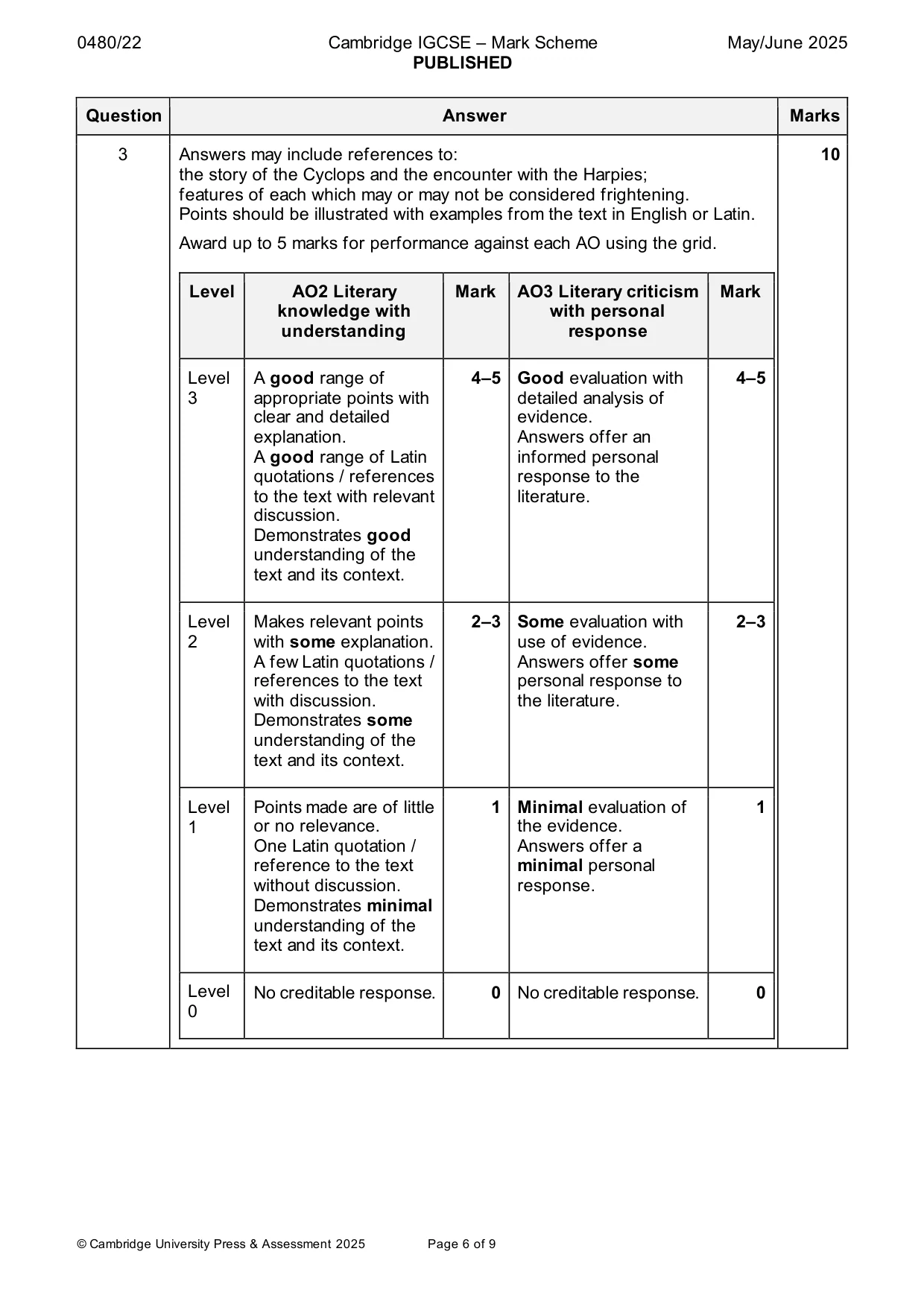
3 ‘The story of the Cyclops is far more frightening than the Trojans’ encounter with the Harpies.’ How far do you agree with this statement about Aeneid 3 based on the extracts you have studied? Support your answer with reference to the text. You should write at least 100 words. [10]
Mark scheme: 3 Answers may include references to: 10 the story of the Cyclops and the encounter with the Harpies; features of each which may or may not be considered frightening. Points should be illustrated with examples from the text in English or Latin. Award up to 5 marks for performance against each AO using the grid. Level AO2 Literary Mark AO3 Literary criticism Mark knowledge with with personal understanding response Level A good range of 4–5 Good evaluation with 4–5 3 appropriate points with detailed analysis of clear and detailed evidence. explanation. Answers offer an A good range of Latin informed personal quotations / references response to the to the text with relevant literature. discussion. Demonstrates good understanding of the text and its context. Level Makes relevant points 2–3 Some evaluation with 2–3 2 with some explanation. use of evidence. A few Latin quotations / Answers offer some references to the text personal response to with discussion. the literature. Demonstrates some understanding of the text and its context. Level Points made are of little 1 Minimal evaluation of 1 1 or no relevance. the evidence. One Latin quotation / Answers offer a reference to the text minimal personal without discussion. response. Demonstrates minimal understanding of the text and its context. Level No creditable response. 0 No creditable response. 0 0
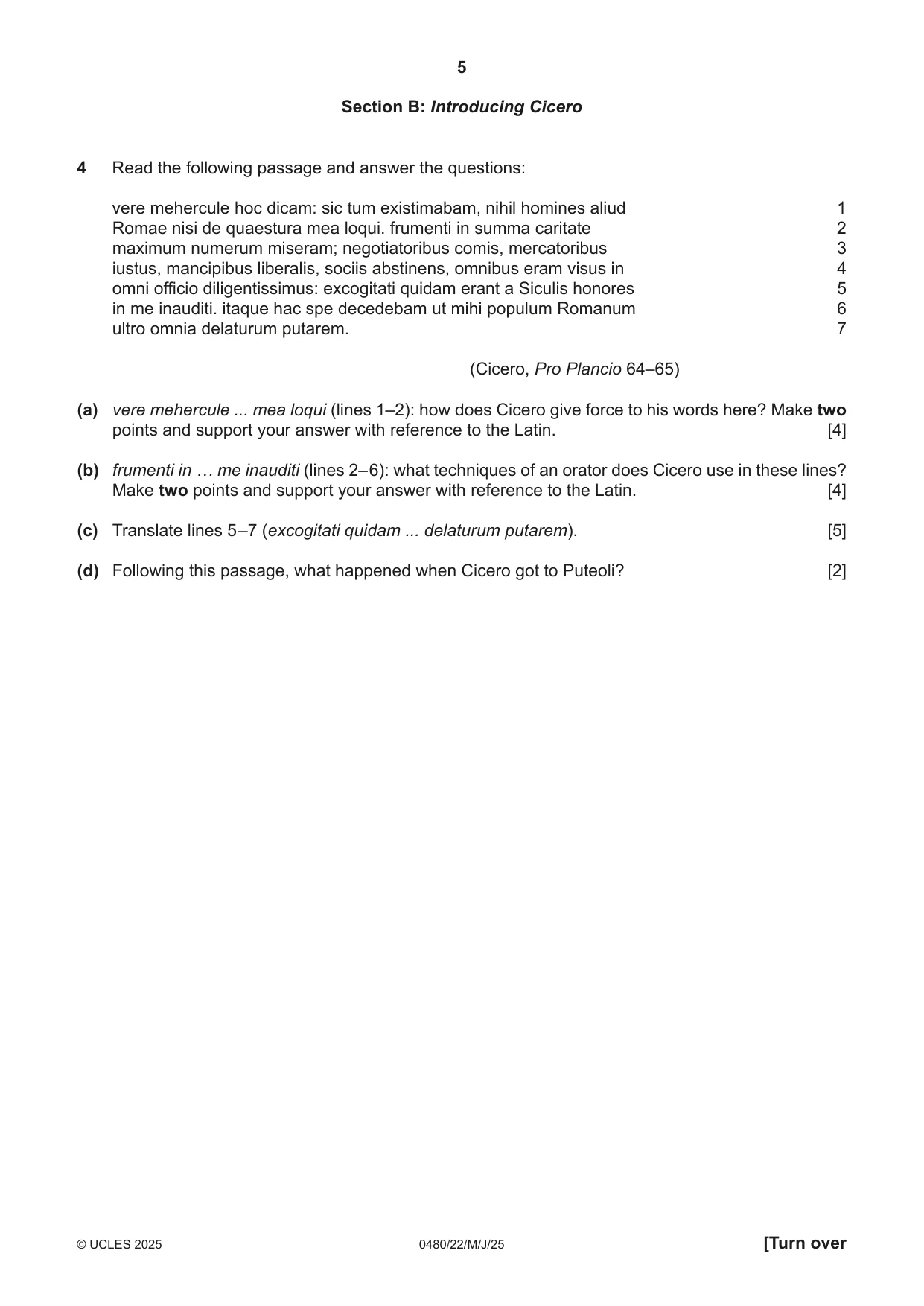
Q4 · Read the following passage and answer the questions: vere mehercule hoc dicam: sic tum…
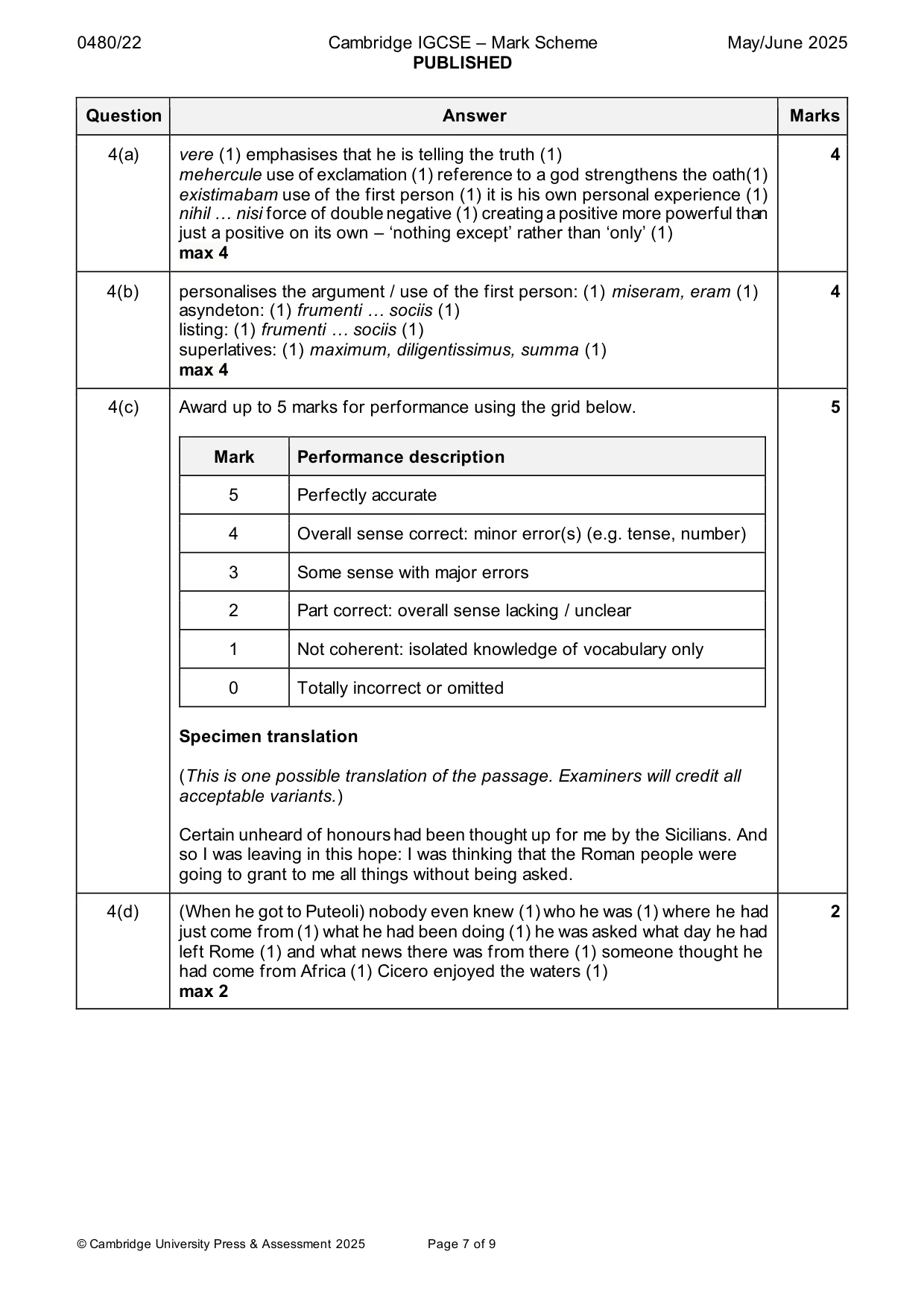
4 Read the following passage and answer the questions: vere mehercule hoc dicam: sic tum existimabam, nihil homines aliud 1 Romae nisi de quaestura mea loqui. frumenti in summa caritate 2 maximum numerum miseram; negotiatoribus comis, mercatoribus 3 iustus, mancipibus liberalis, sociis abstinens, omnibus eram visus in 4 omni officio diligentissimus: excogitati quidam erant a Siculis honores 5 in me inauditi. itaque hac spe decedebam ut mihi populum Romanum 6 ultro omnia delaturum putarem. 7 (Cicero, Pro Plancio 64–65) (a) vere mehercule ... mea loqui (lines 1–2): how does Cicero give force to his words here? Make two points and support your answer with reference to the Latin. [4] (b) frumenti in … me inauditi (lines 2– 6): what techniques of an orator does Cicero use in these lines? Make two points and support your answer with reference to the Latin. [4] (c) Translate lines 5 –7 (excogitati quidam ... delaturum putarem). [5] (d) Following this passage, what happened when Cicero got to Puteoli? [2]
Mark scheme: 4(a) vere (1) emphasises that he is telling the truth (1) 4 mehercule use of exclamation (1) reference to a god strengthens the oath(1) existimabam use of the first person (1) it is his own personal experience (1) nihil … nisi force of double negative (1) creating a positive more powerful than just a positive on its own – ‘nothing except’ rather than ‘only’ (1) max 4 4(b) personalises the argument / use of the first person: (1) miseram, eram (1) 4 asyndeton: (1) frumenti … sociis (1) listing: (1) frumenti … sociis (1) superlatives: (1) maximum, diligentissimus, summa (1) max 4 4(c) Award up to 5 marks for performance using the grid below. 5 Mark Performance description 5 Perfectly accurate 4 Overall sense correct: minor error(s) (e.g. tense, number) 3 Some sense with major errors 2 Part correct: overall sense lacking / unclear 1 Not coherent: isolated knowledge of vocabulary only 0 Totally incorrect or omitted Specimen translation (This is one possible translation of the passage. Examiners will credit all acceptable variants.) Certain unheard of honours had been thought up for me by the Sicilians. And so I was leaving in this hope: I was thinking that the Roman people were going to grant to me all things without being asked. 4(d) (When he got to Puteoli) nobody even knew (1) who he was (1) where he had 2 just come from (1) what he had been doing (1) he was asked what day he had left Rome (1) and what news there was from there (1) someone thought he had come from Africa (1) Cicero enjoyed the waters (1) max 2
Q5 · Read the following passage and answer the questions: quod cum ex oppido exportabatur…
5 Read the following passage and answer the questions: quod cum ex oppido exportabatur, quem conventum mulierum 1 factum esse arbitramini, quem fletum maiorum natu? quorum nonnulli 2 etiam illum diem memoria tenebant cum illa eadem Diana Segestam 3 Carthagine revecta victoriam populi Romani reditu suo nuntiasset. 4 quam dissimilis hic dies illi tempori videbatur! tum imperator populi 5 Romani, vir clarissimus, deos patrios reportabat Segestanis ex urbe 6 hostium recuperatos; nunc ex urbe sociorum praetor eiusdem populi 7 Romani turpissimus atque impurissimus eosdem illos deos nefario 8 scelere auferebat. 9 (Cicero, In Verrem 2, 4, 77) (a) quod cum … maiorum natu (lines 1– 2): how does Cicero appeal to the emotions of his listeners? Make two points and support your answer with reference to the Latin. [4] (b) Translate lines 2– 4 (quorum nonnulli ... suo nuntiasset). [5] (c) quam dissimilis … tempori videbatur (line 5): what two events are being compared here? [2] (d) tum imperator … scelere auferebat (lines 5 – 9): how does Cicero draw attention to the contrast between the two men? You should refer to both what he says and how he says it. [4]
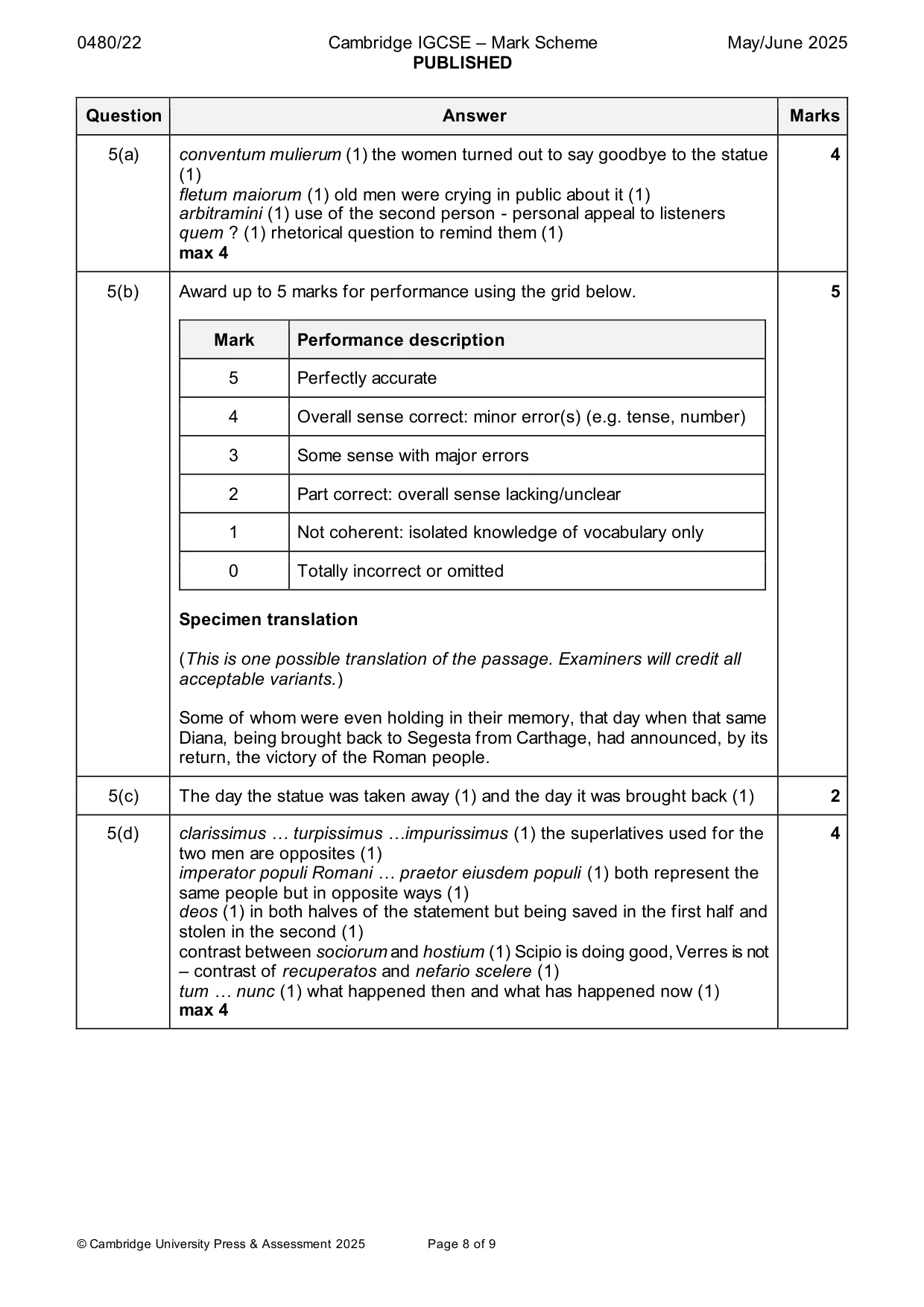
Mark scheme: 5(a) conventum mulierum (1) the women turned out to say goodbye to the statue 4 (1) fletum maiorum (1) old men were crying in public about it (1) arbitramini (1) use of the second person - personal appeal to listeners quem ? (1) rhetorical question to remind them (1) max 4 5(b) Award up to 5 marks for performance using the grid below. 5 Mark Performance description 5 Perfectly accurate 4 Overall sense correct: minor error(s) (e.g. tense, number) 3 Some sense with major errors 2 Part correct: overall sense lacking/unclear 1 Not coherent: isolated knowledge of vocabulary only 0 Totally incorrect or omitted Specimen translation (This is one possible translation of the passage. Examiners will credit all acceptable variants.) Some of whom were even holding in their memory, that day when that same Diana, being brought back to Segesta from Carthage, had announced, by its return, the victory of the Roman people. 5(c) The day the statue was taken away (1) and the day it was brought back (1) 2 5(d) clarissimus … turpissimus …impurissimus (1) the superlatives used for the 4 two men are opposites (1) imperator populi Romani … praetor eiusdem populi (1) both represent the same people but in opposite ways (1) deos (1) in both halves of the statement but being saved in the first half and stolen in the second (1) contrast between sociorum and hostium (1) Scipio is doing good, Verres is not – contrast of recuperatos and nefario scelere (1) tum … nunc (1) what happened then and what has happened now (1) max 4
Q6 · ‘We learn more about Cicero himself from his speeches than about Plancius and Verres.’…
6 ‘We learn more about Cicero himself from his speeches than about Plancius and Verres.’ How far do you agree with this statement based on the passages you have studied? Support your answer with reference to the text. You should write at least 100 words. [10]
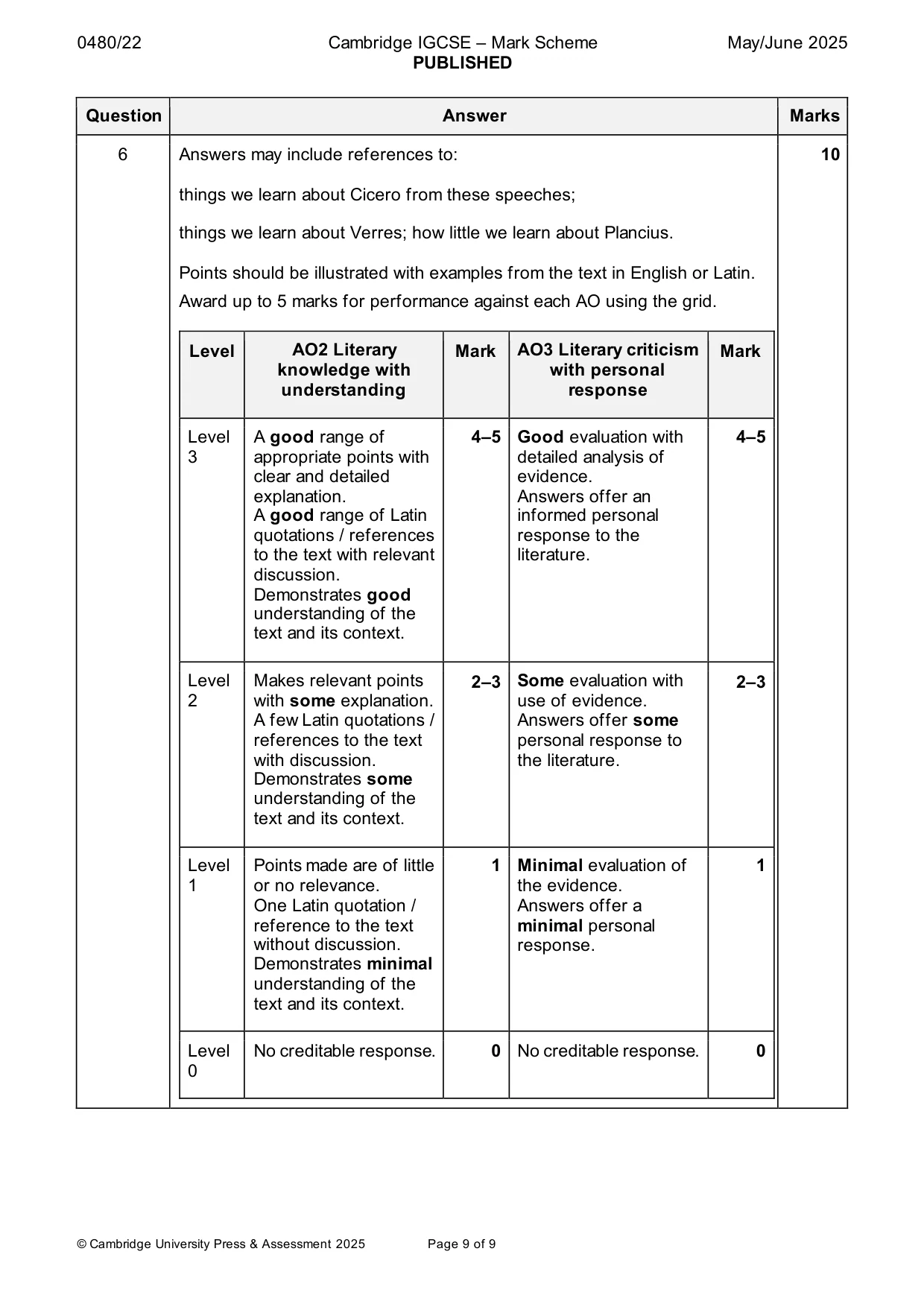
Mark scheme: 6 Answers may include references to: 10 things we learn about Cicero from these speeches; things we learn about Verres; how little we learn about Plancius. Points should be illustrated with examples from the text in English or Latin. Award up to 5 marks for performance against each AO using the grid. Level AO2 Literary Mark AO3 Literary criticism Mark knowledge with with personal understanding response Level A good range of 4–5 Good evaluation with 4–5 3 appropriate points with detailed analysis of clear and detailed evidence. explanation. Answers offer an A good range of Latin informed personal quotations / references response to the to the text with relevant literature. discussion. Demonstrates good understanding of the text and its context. Level Makes relevant points 2–3 Some evaluation with 2–3 2 with some explanation. use of evidence. A few Latin quotations / Answers offer some references to the text personal response to with discussion. the literature. Demonstrates some understanding of the text and its context. Level Points made are of little 1 Minimal evaluation of 1 1 or no relevance. the evidence. One Latin quotation / Answers offer a reference to the text minimal personal without discussion. response. Demonstrates minimal understanding of the text and its context. Level No creditable response. 0 No creditable response. 0 0
What you needed in this session
Cambridge’s own grade thresholds for 2025 May/June, Paper 2 · Variant 2. A higher threshold means an easier paper — the bar moves with how the cohort did.