Cambridge IGCSE Latin 0480 — 2020 May/June Paper 2 · Variant 2
0480/22/M/J/20 · 6 questions · 80 marks · ≈90 min
The question paper and its mark scheme, free to read here and free to download. This is Cambridge’s own paper, exactly as it was sat.
Question paper8 pages


Mark scheme10 pages
Answers below. Sit the paper first if you are practising.
Questions as text
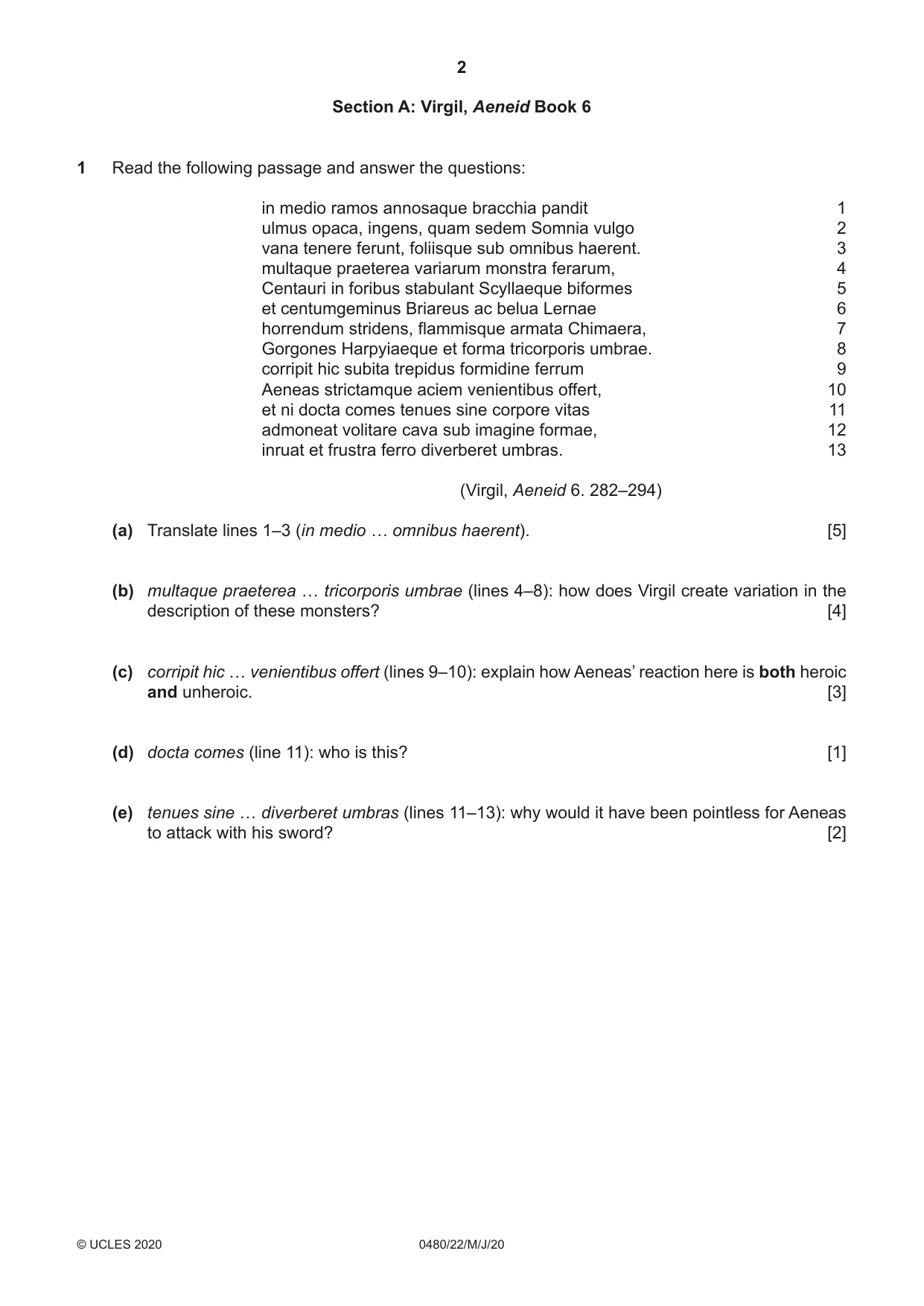
Q1 · Read the following passage and answer the questions: in medio ramos annosaque bracchia…
1 Read the following passage and answer the questions: in medio ramos annosaque bracchia pandit 1 ulmus opaca, ingens, quam sedem Somnia vulgo 2 vana tenere ferunt, foliisque sub omnibus haerent. 3 multaque praeterea variarum monstra ferarum, 4 Centauri in foribus stabulant Scyllaeque biformes 5 et centumgeminus Briareus ac belua Lernae 6 horrendum stridens, flammisque armata Chimaera, 7 Gorgones Harpyiaeque et forma tricorporis umbrae. 8 corripit hic subita trepidus formidine ferrum 9 Aeneas strictamque aciem venientibus offert, 10 et ni docta comes tenues sine corpore vitas 11 admoneat volitare cava sub imagine formae, 12 inruat et frustra ferro diverberet umbras. 13 (Virgil, Aeneid 6. 282–294) (a) Translate lines 1–3 (in medio … omnibus haerent). [5] (b) multaque praeterea … tricorporis umbrae (lines 4–8): how does Virgil create variation in the description of these monsters? [4] (c) corripit hic … venientibus offert (lines 9–10): explain how Aeneas’ reaction here is both heroic and unheroic. [3] (d) docta comes (line 11): who is this? [1] (e) tenues sine … diverberet umbras (lines 11–13): why would it have been pointless for Aeneas to attack with his sword? [2]
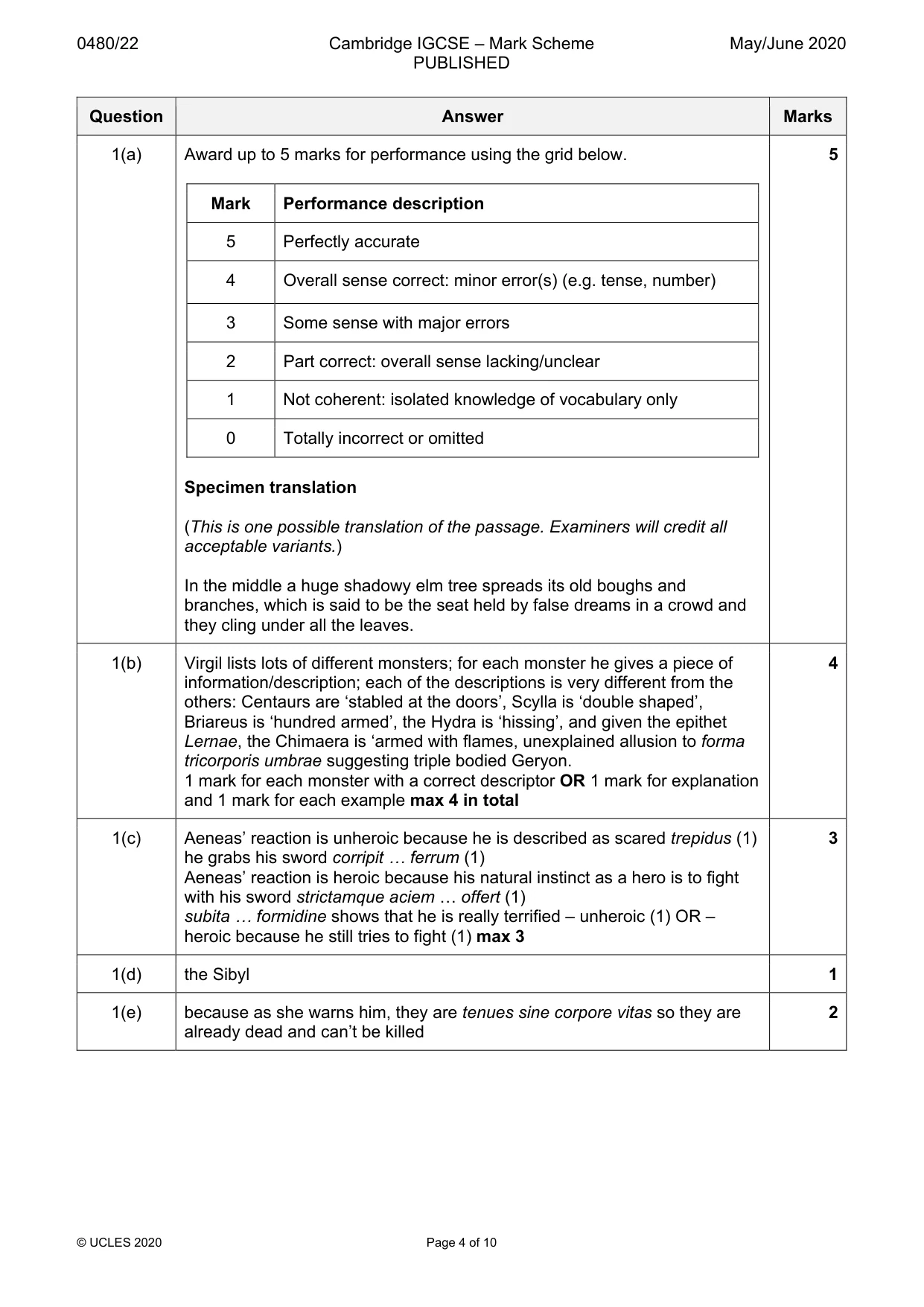
Mark scheme: Question Answer Marks 1(a) Award up to 5 marks for performance using the grid below. 5 Mark Performance description 5 Perfectly accurate 4 Overall sense correct: minor error(s) (e.g. tense, number) 3 Some sense with major errors 2 Part correct: overall sense lacking/unclear 1 Not coherent: isolated knowledge of vocabulary only 0 Totally incorrect or omitted Specimen translation (This is one possible translation of the passage. Examiners will credit all acceptable variants.) In the middle a huge shadowy elm tree spreads its old boughs and branches, which is said to be the seat held by false dreams in a crowd and they cling under all the leaves. 1(b) Virgil lists lots of different monsters; for each monster he gives a piece of 4 information/description; each of the descriptions is very different from the others: Centaurs are ‘stabled at the doors’, Scylla is ‘double shaped’, Briareus is ‘hundred armed’, the Hydra is ‘hissing’, and given the epithet Lernae, the Chimaera is ‘armed with flames, unexplained allusion to forma tricorporis umbrae suggesting triple bodied Geryon. 1 mark for each monster with a correct descriptor OR 1 mark for explanation and 1 mark for each example max 4 in total 1(c) Aeneas’ reaction is unheroic because he is described as scared trepidus (1) 3 he grabs his sword corripit … ferrum (1) Aeneas’ reaction is heroic because his natural instinct as a hero is to fight with his sword strictamque aciem … offert (1) subita … formidine shows that he is really terrified – unheroic (1) OR – heroic because he still tries to fight (1) max 3 1(d) the Sibyl 1 1(e) because as she warns him, they are tenues sine corpore vitas so they are 2 already dead and can’t be killed
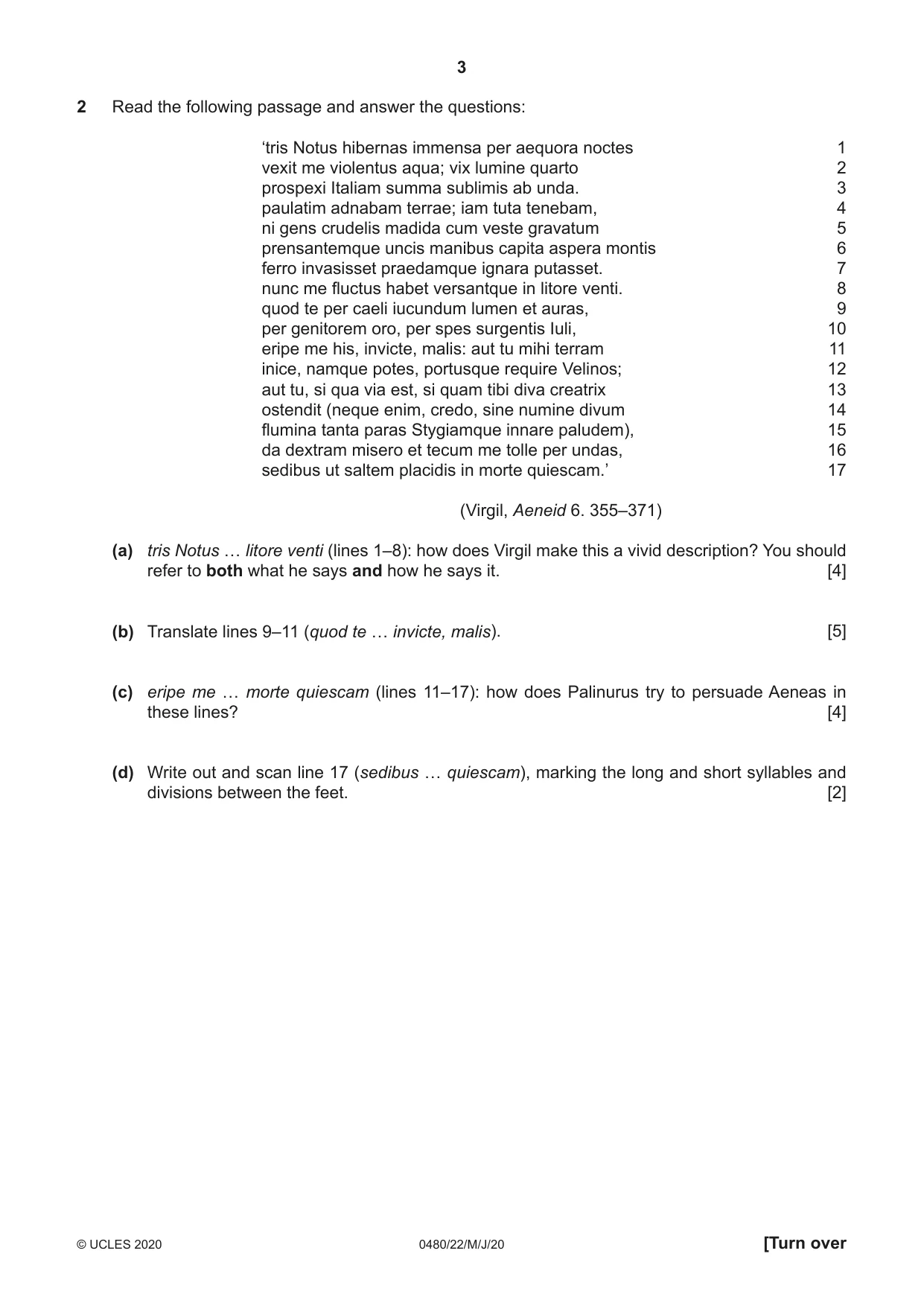
Q2 · Read the following passage and answer the questions: ‘tris Notus hibernas immensa per…
2 Read the following passage and answer the questions: ‘tris Notus hibernas immensa per aequora noctes 1 vexit me violentus aqua; vix lumine quarto 2 prospexi Italiam summa sublimis ab unda. 3 paulatim adnabam terrae; iam tuta tenebam, 4 ni gens crudelis madida cum veste gravatum 5 prensantemque uncis manibus capita aspera montis 6 ferro invasisset praedamque ignara putasset. 7 nunc me fluctus habet versantque in litore venti. 8 quod te per caeli iucundum lumen et auras, 9 per genitorem oro, per spes surgentis Iuli, 10 eripe me his, invicte, malis: aut tu mihi terram 11 inice, namque potes, portusque require Velinos; 12 aut tu, si qua via est, si quam tibi diva creatrix 13 ostendit (neque enim, credo, sine numine divum 14 flumina tanta paras Stygiamque innare paludem), 15 da dextram misero et tecum me tolle per undas, 16 sedibus ut saltem placidis in morte quiescam.’ 17 (Virgil, Aeneid 6. 355–371) (a) tris Notus … litore venti (lines 1–8): how does Virgil make this a vivid description? You should refer to both what he says and how he says it. [4] (b) Translate lines 9–11 (quod te … invicte, malis). [5] (c) eripe me … morte quiescam (lines 11–17): how does Palinurus try to persuade Aeneas in these lines? [4] (d) Write out and scan line 17 (sedibus … quiescam), marking the long and short syllables and divisions between the feet. [2]
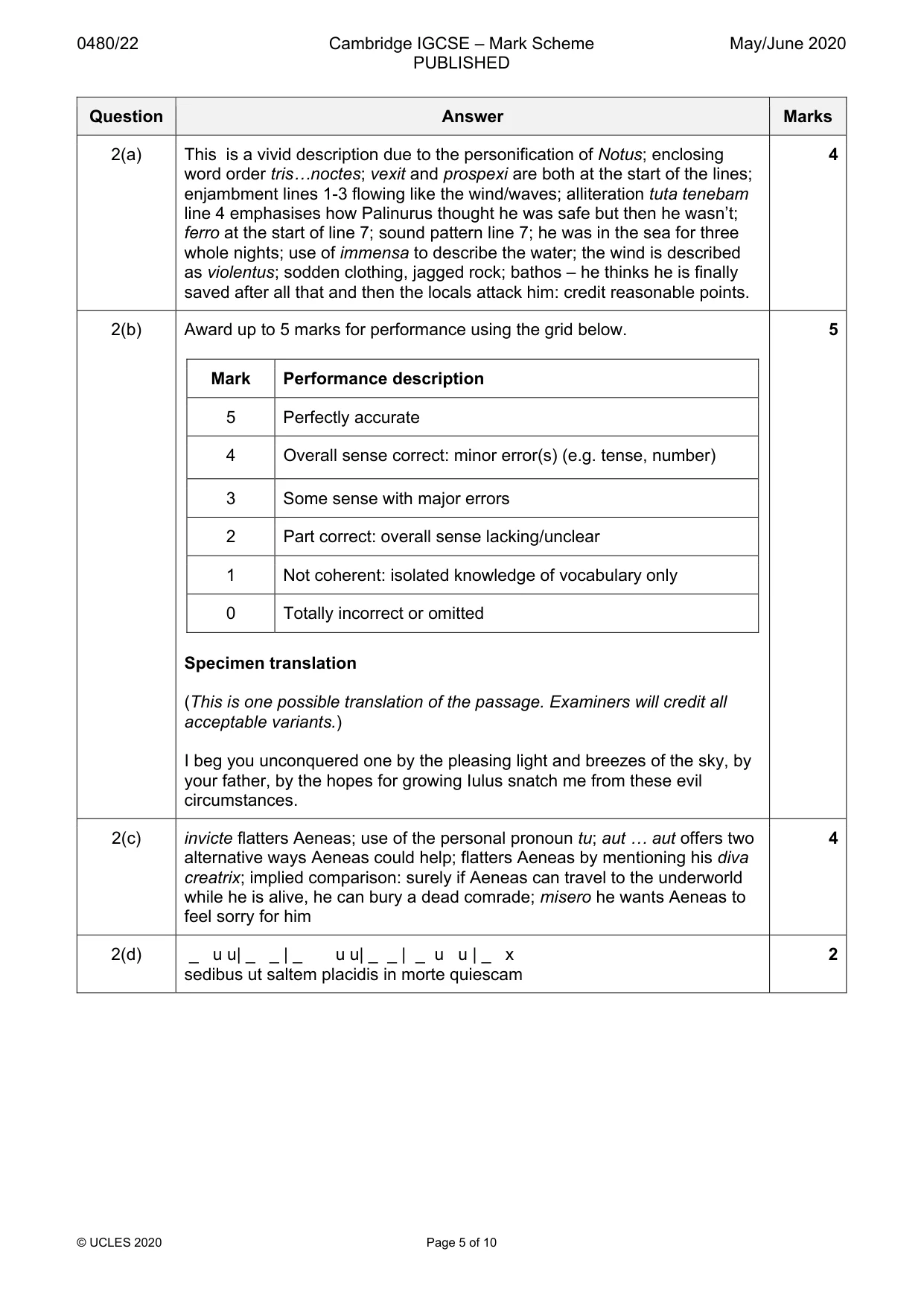
Mark scheme: 2(a) This is a vivid description due to the personification of Notus; enclosing 4 word order tris…noctes; vexit and prospexi are both at the start of the lines; enjambment lines 1-3 flowing like the wind/waves; alliteration tuta tenebam line 4 emphasises how Palinurus thought he was safe but then he wasn’t; ferro at the start of line 7; sound pattern line 7; he was in the sea for three whole nights; use of immensa to describe the water; the wind is described as violentus; sodden clothing, jagged rock; bathos – he thinks he is finally saved after all that and then the locals attack him: credit reasonable points. 2(b) Award up to 5 marks for performance using the grid below. 5 Mark Performance description 5 Perfectly accurate 4 Overall sense correct: minor error(s) (e.g. tense, number) 3 Some sense with major errors 2 Part correct: overall sense lacking/unclear 1 Not coherent: isolated knowledge of vocabulary only 0 Totally incorrect or omitted Specimen translation (This is one possible translation of the passage. Examiners will credit all acceptable variants.) I beg you unconquered one by the pleasing light and breezes of the sky, by your father, by the hopes for growing Iulus snatch me from these evil circumstances. 2(c) invicte flatters Aeneas; use of the personal pronoun tu; aut … aut offers two 4 alternative ways Aeneas could help; flatters Aeneas by mentioning his diva creatrix; implied comparison: surely if Aeneas can travel to the underworld while he is alive, he can bury a dead comrade; misero he wants Aeneas to feel sorry for him 2(d) _ u u| _ _ | _ u u| _ _ | _ u u | _ x 2 sedibus ut saltem placidis in morte quiescam
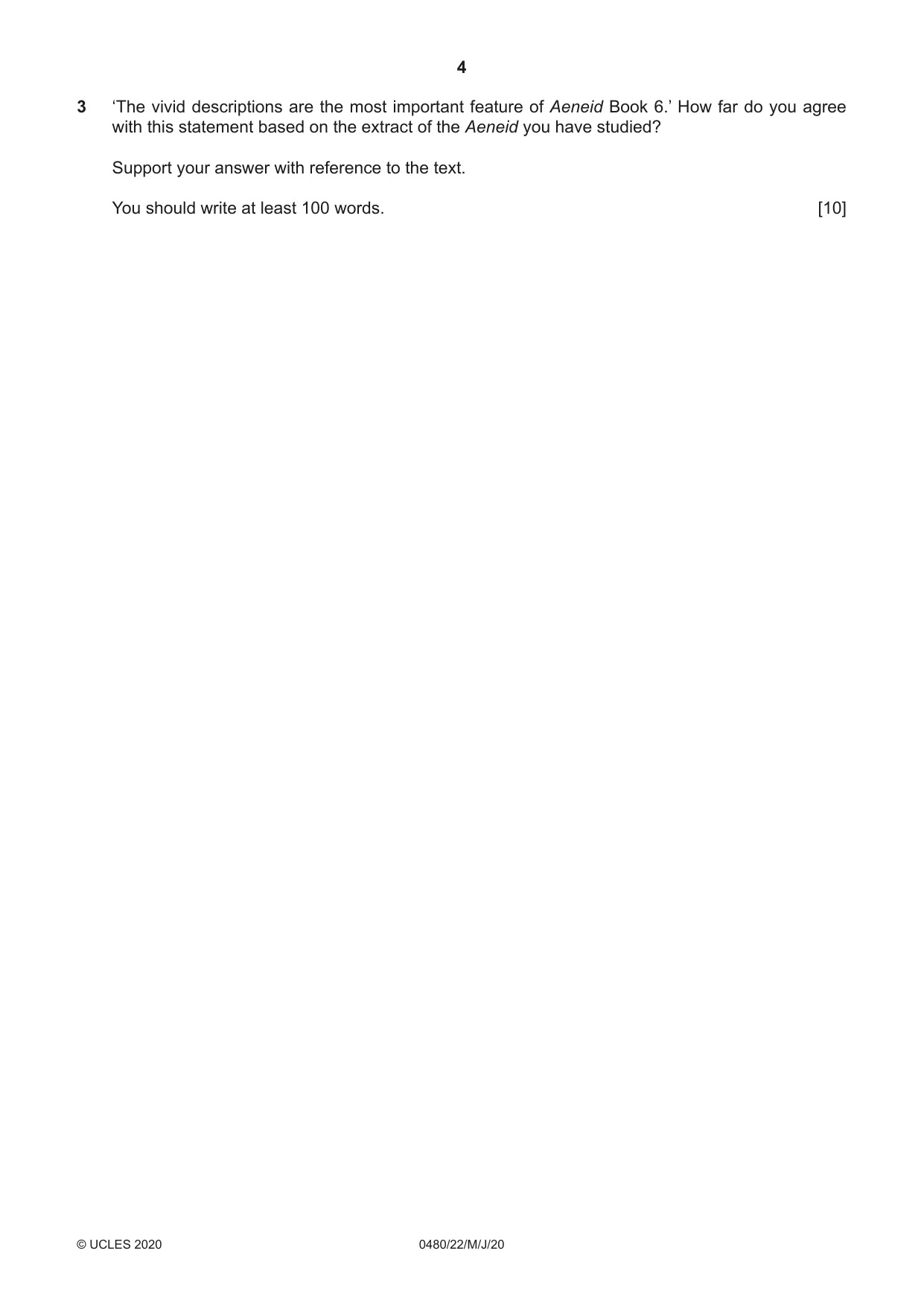
Q3 · ‘The vivid descriptions are the most important feature of Aeneid Book 6.’ How far do you…
3 ‘The vivid descriptions are the most important feature of Aeneid Book 6.’ How far do you agree with this statement based on the extract of the Aeneid you have studied? Support your answer with reference to the text. You should write at least 100 words. [10]
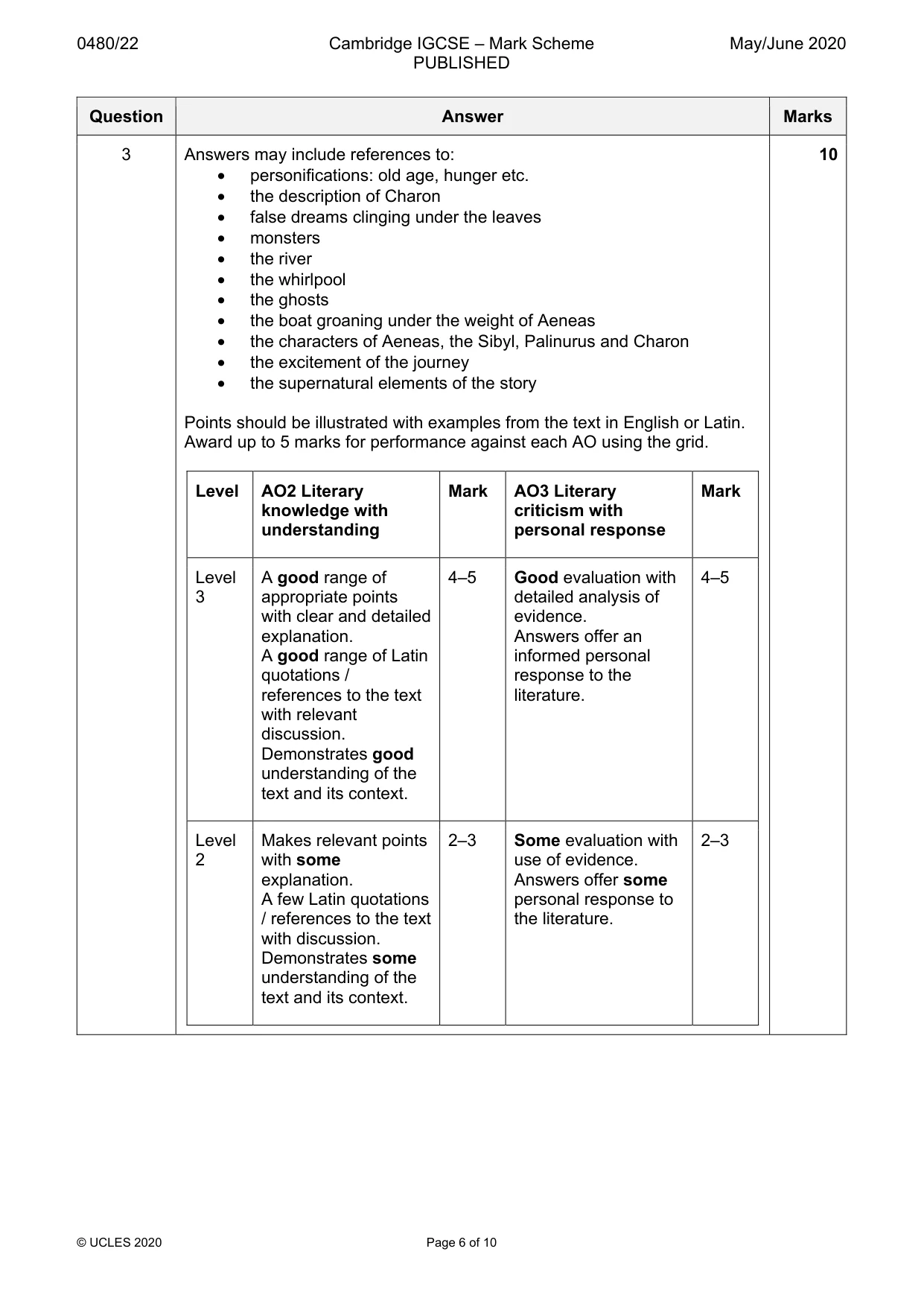
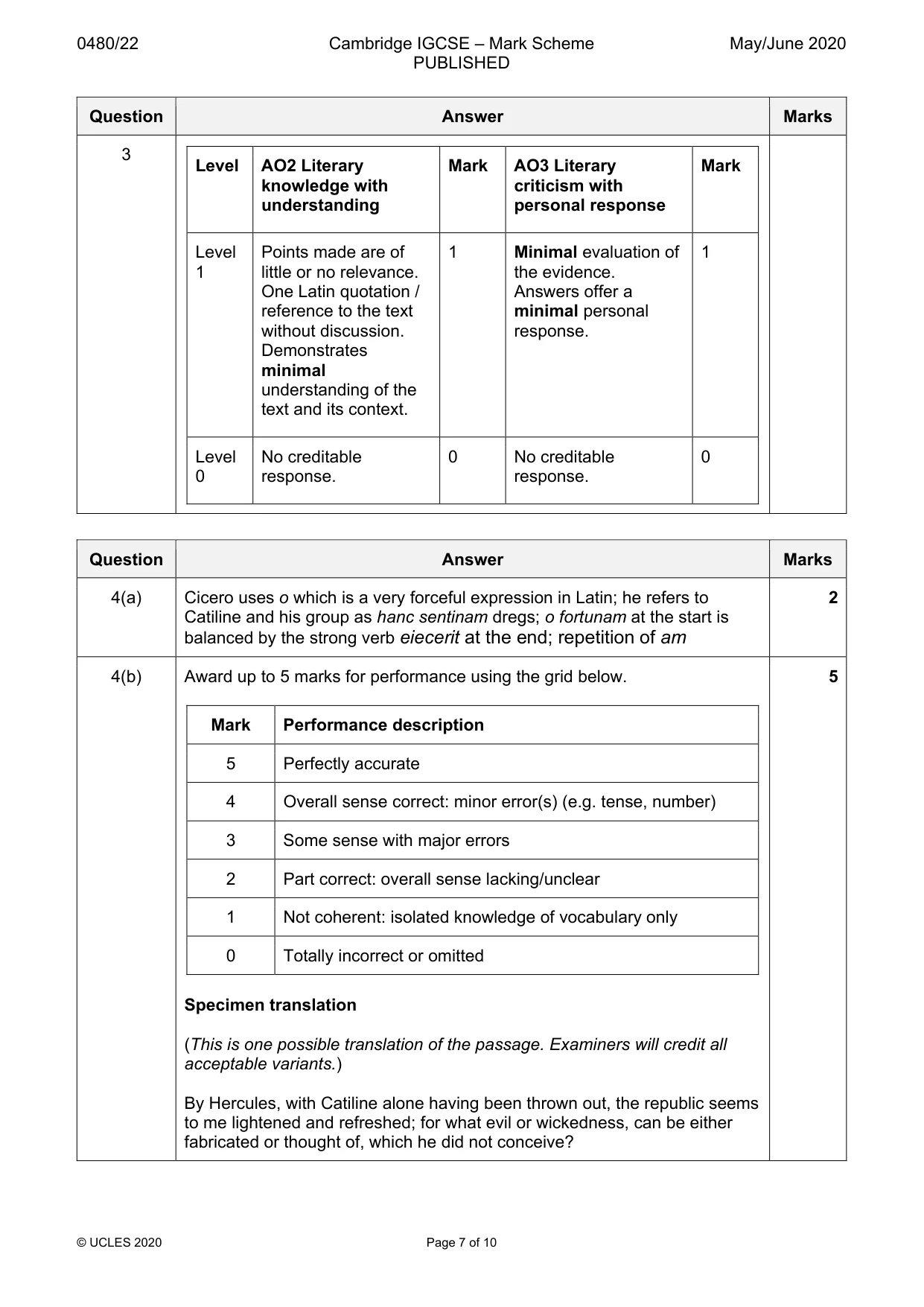
Mark scheme: 3 Answers may include references to: 10 • personifications: old age, hunger etc. • the description of Charon • false dreams clinging under the leaves • monsters • the river • the whirlpool • the ghosts • the boat groaning under the weight of Aeneas • the characters of Aeneas, the Sibyl, Palinurus and Charon • the excitement of the journey • the supernatural elements of the story Points should be illustrated with examples from the text in English or Latin. Award up to 5 marks for performance against each AO using the grid. Level AO2 Literary Mark AO3 Literary Mark knowledge with criticism with understanding personal response Level A good range of 4–5 Good evaluation with 4–5 3 appropriate points detailed analysis of with clear and detailed evidence. explanation. Answers offer an A good range of Latin informed personal quotations / response to the references to the text literature. with relevant discussion. Demonstrates good understanding of the text and its context. Level Makes relevant points 2–3 Some evaluation with 2–3 2 with some use of evidence. explanation. Answers offer some A few Latin quotations personal response to / references to the text the literature. with discussion. Demonstrates some understanding of the text and its context. 3 Level AO2 Literary Mark AO3 Literary Mark knowledge with criticism with understanding personal response Level Points made are of 1 Minimal evaluation of 1 1 little or no relevance. the evidence. One Latin quotation / Answers offer a reference to the text minimal personal without discussion. response. Demonstrates minimal understanding of the text and its context. Level No creditable 0 No creditable 0 0 response. response.
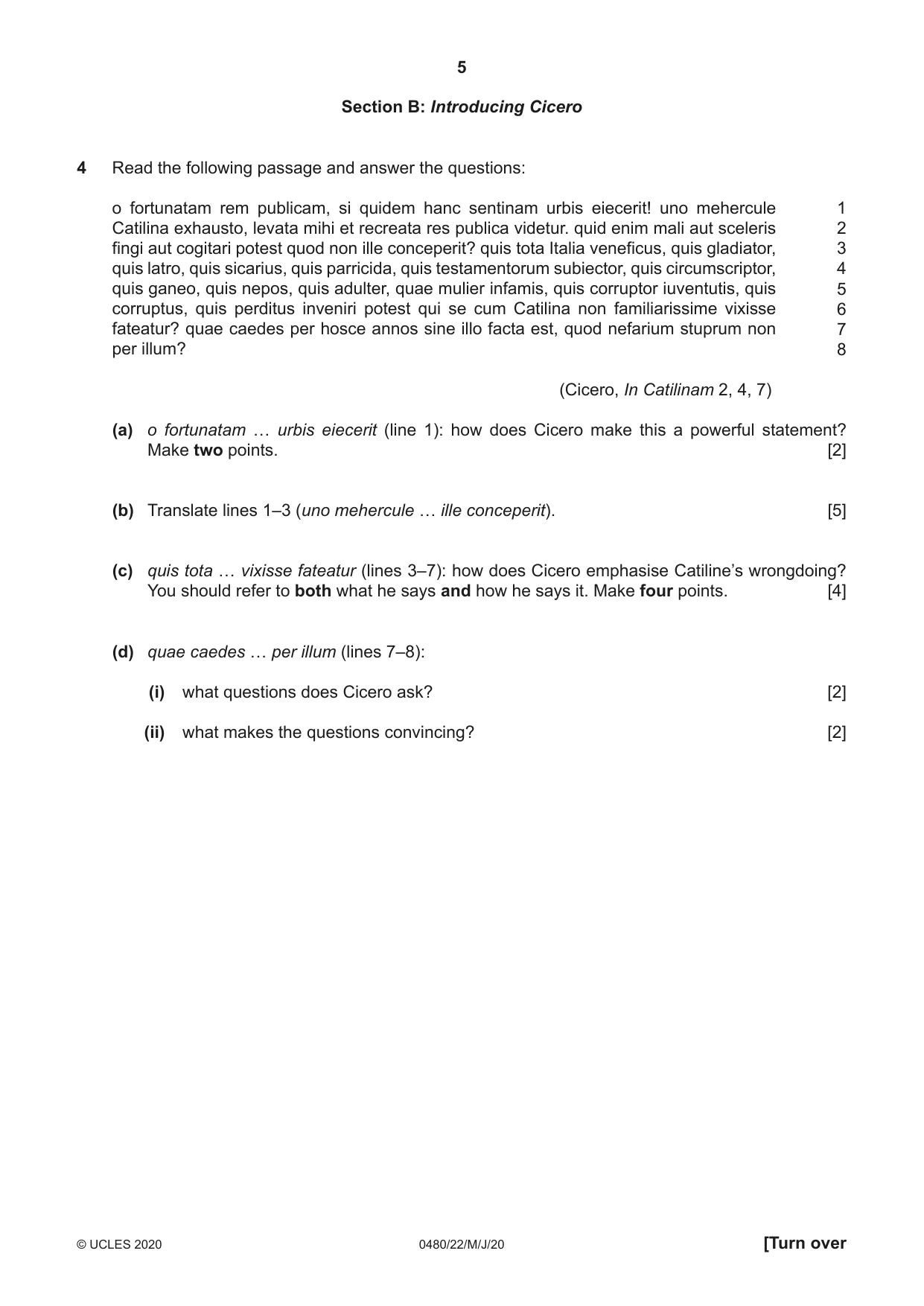
Q4 · Read the following passage and answer the questions: o fortunatam rem publicam, si quidem…
4 Read the following passage and answer the questions: o fortunatam rem publicam, si quidem hanc sentinam urbis eiecerit! uno mehercule 1 Catilina exhausto, levata mihi et recreata res publica videtur. quid enim mali aut sceleris 2 fingi aut cogitari potest quod non ille conceperit? quis tota Italia veneficus, quis gladiator, 3 quis latro, quis sicarius, quis parricida, quis testamentorum subiector, quis circumscriptor, 4 quis ganeo, quis nepos, quis adulter, quae mulier infamis, quis corruptor iuventutis, quis 5 corruptus, quis perditus inveniri potest qui se cum Catilina non familiarissime vixisse 6 fateatur? quae caedes per hosce annos sine illo facta est, quod nefarium stuprum non 7 per illum? 8 (Cicero, In Catilinam 2, 4, 7) (a) o fortunatam … urbis eiecerit (line 1): how does Cicero make this a powerful statement? Make two points. [2] (b) Translate lines 1–3 (uno mehercule … ille conceperit). [5] (c) quis tota … vixisse fateatur (lines 3–7): how does Cicero emphasise Catiline’s wrongdoing? You should refer to both what he says and how he says it. Make four points. [4] (d) quae caedes … per illum (lines 7–8): (i) what questions does Cicero ask? [2] (ii) what makes the questions convincing? [2]
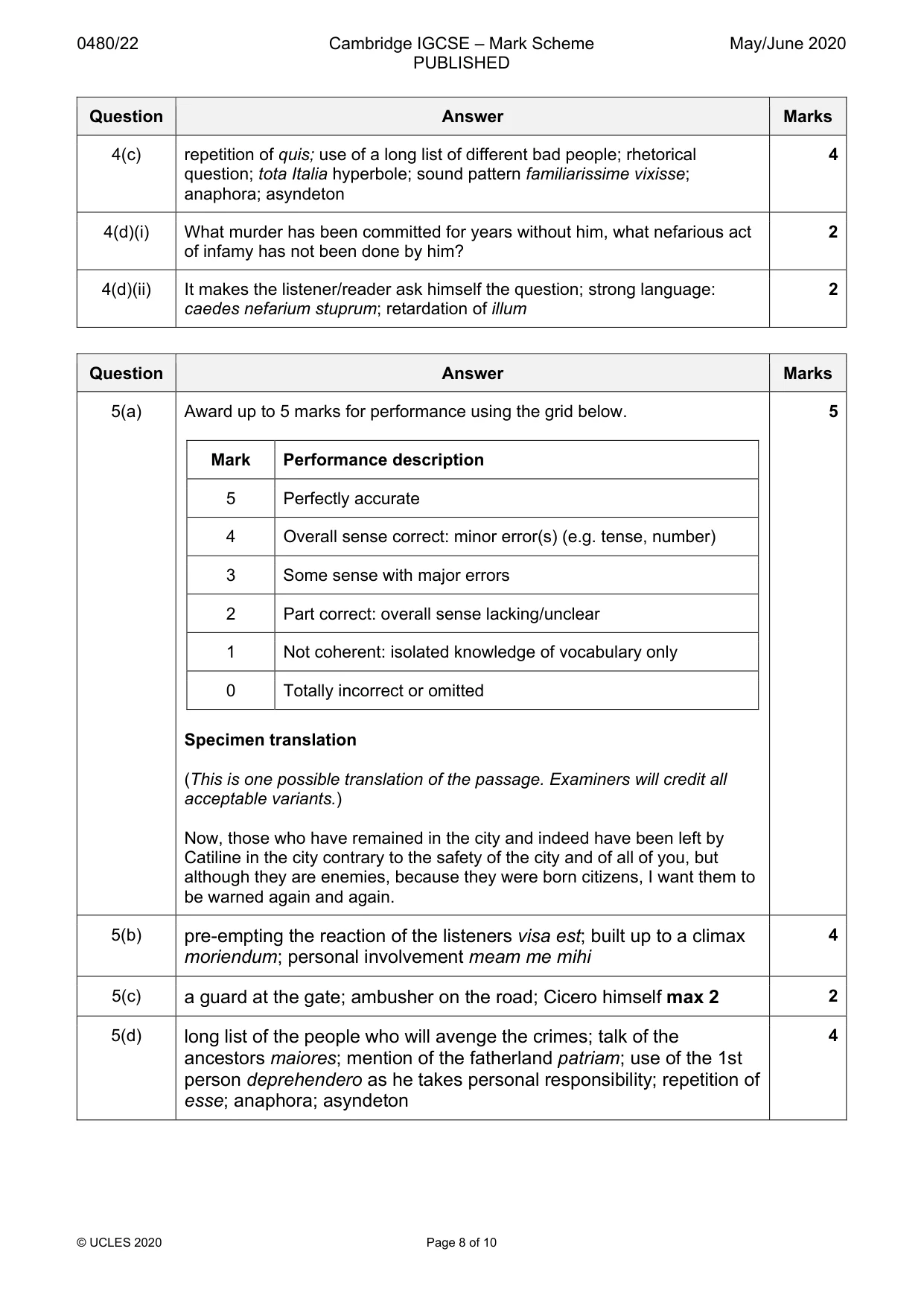
Mark scheme: 4(a) Cicero uses o which is a very forceful expression in Latin; he refers to 2 Catiline and his group as hanc sentinam dregs; o fortunam at the start is balanced by the strong verb eiecerit at the end; repetition of am 4(b) Award up to 5 marks for performance using the grid below. 5 Mark Performance description 5 Perfectly accurate 4 Overall sense correct: minor error(s) (e.g. tense, number) 3 Some sense with major errors 2 Part correct: overall sense lacking/unclear 1 Not coherent: isolated knowledge of vocabulary only 0 Totally incorrect or omitted Specimen translation (This is one possible translation of the passage. Examiners will credit all acceptable variants.) By Hercules, with Catiline alone having been thrown out, the republic seems to me lightened and refreshed; for what evil or wickedness, can be either fabricated or thought of, which he did not conceive? 4(c) repetition of quis; use of a long list of different bad people; rhetorical 4 question; tota Italia hyperbole; sound pattern familiarissime vixisse; anaphora; asyndeton 4(d)(i) What murder has been committed for years without him, what nefarious act 2 of infamy has not been done by him? 4(d)(ii) It makes the listener/reader ask himself the question; strong language: 2 caedes nefarium stuprum; retardation of illum
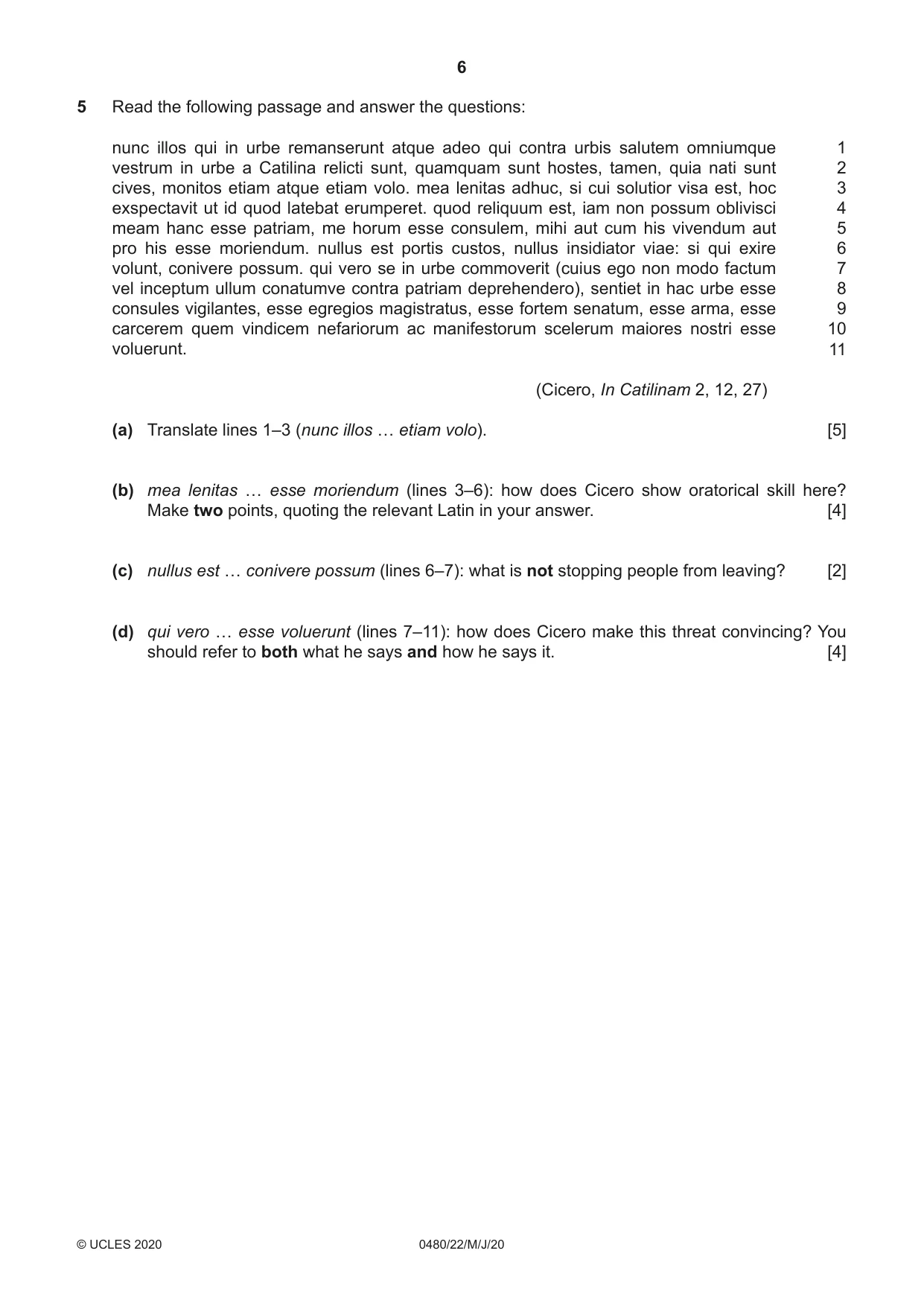
Q5 · Read the following passage and answer the questions: nunc illos qui in urbe remanserunt…
5 Read the following passage and answer the questions: nunc illos qui in urbe remanserunt atque adeo qui contra urbis salutem omniumque 1 vestrum in urbe a Catilina relicti sunt, quamquam sunt hostes, tamen, quia nati sunt 2 cives, monitos etiam atque etiam volo. mea lenitas adhuc, si cui solutior visa est, hoc 3 exspectavit ut id quod latebat erumperet. quod reliquum est, iam non possum oblivisci 4 meam hanc esse patriam, me horum esse consulem, mihi aut cum his vivendum aut 5 pro his esse moriendum. nullus est portis custos, nullus insidiator viae: si qui exire 6 volunt, conivere possum. qui vero se in urbe commoverit (cuius ego non modo factum 7 vel inceptum ullum conatumve contra patriam deprehendero), sentiet in hac urbe esse 8 consules vigilantes, esse egregios magistratus, esse fortem senatum, esse arma, esse 9 carcerem quem vindicem nefariorum ac manifestorum scelerum maiores nostri esse 10 voluerunt. 11 (Cicero, In Catilinam 2, 12, 27) (a) Translate lines 1–3 (nunc illos … etiam volo). [5] (b) mea lenitas … esse moriendum (lines 3–6): how does Cicero show oratorical skill here? Make two points, quoting the relevant Latin in your answer. [4] (c) nullus est … conivere possum (lines 6–7): what is not stopping people from leaving? [2] (d) qui vero … esse voluerunt (lines 7–11): how does Cicero make this threat convincing? You should refer to both what he says and how he says it. [4]
Mark scheme: 5(a) Award up to 5 marks for performance using the grid below. 5 Mark Performance description 5 Perfectly accurate 4 Overall sense correct: minor error(s) (e.g. tense, number) 3 Some sense with major errors 2 Part correct: overall sense lacking/unclear 1 Not coherent: isolated knowledge of vocabulary only 0 Totally incorrect or omitted Specimen translation (This is one possible translation of the passage. Examiners will credit all acceptable variants.) Now, those who have remained in the city and indeed have been left by Catiline in the city contrary to the safety of the city and of all of you, but although they are enemies, because they were born citizens, I want them to be warned again and again. 5(b) pre-empting the reaction of the listeners visa est; built up to a climax 4 moriendum; personal involvement meam me mihi 5(c) a guard at the gate; ambusher on the road; Cicero himself max 2 2 5(d) long list of the people who will avenge the crimes; talk of the 4 ancestors maiores; mention of the fatherland patriam; use of the 1st person deprehendero as he takes personal responsibility; repetition of esse; anaphora; asyndeton
Q6 · ‘The same things over and over again.’ How far do you agree with this statement about…
6 ‘The same things over and over again.’ How far do you agree with this statement about Cicero’s denunciation of Catiline based on the passages you have studied? Support your answer with reference to the text. You should write at least 100 words. [10]
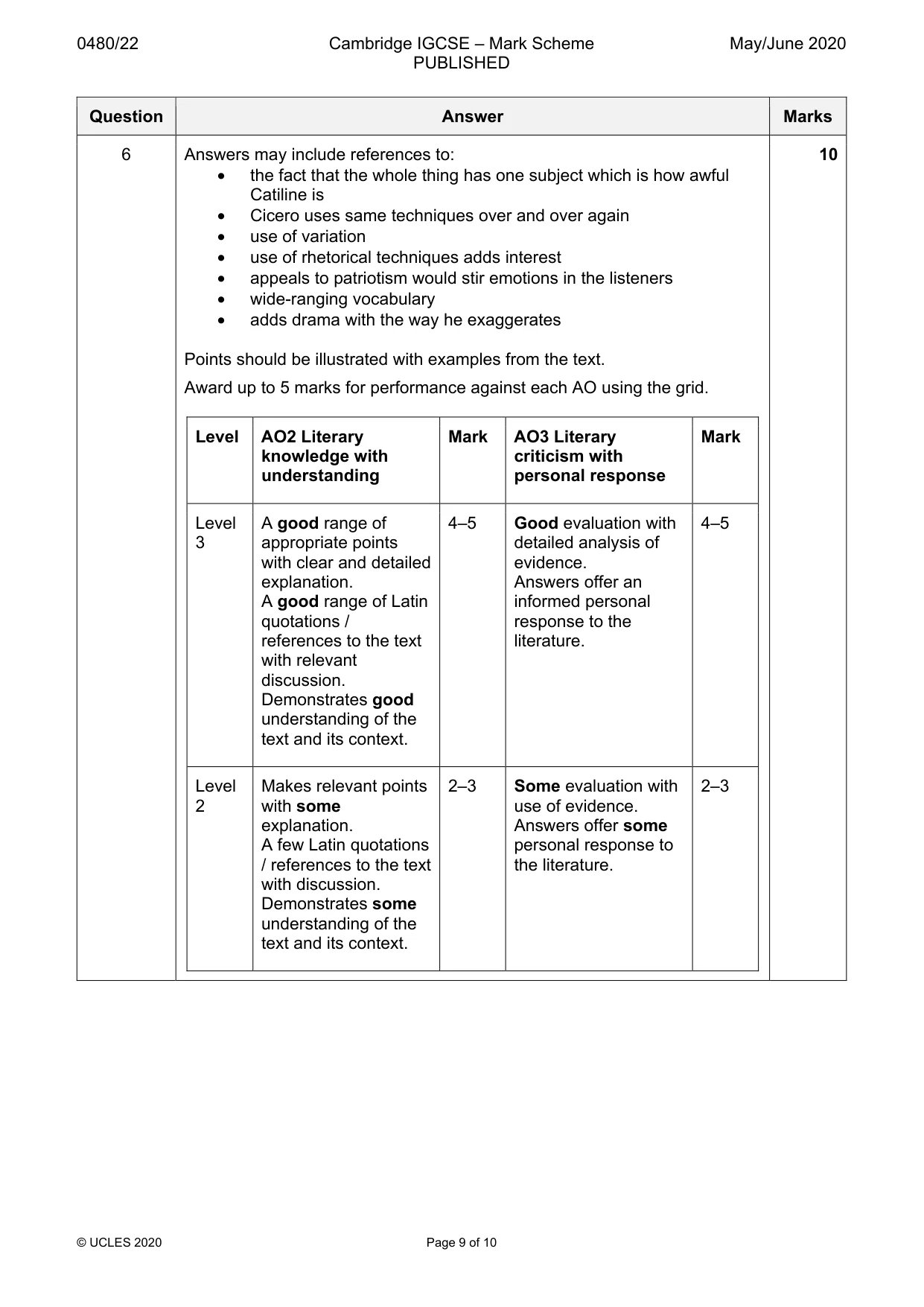
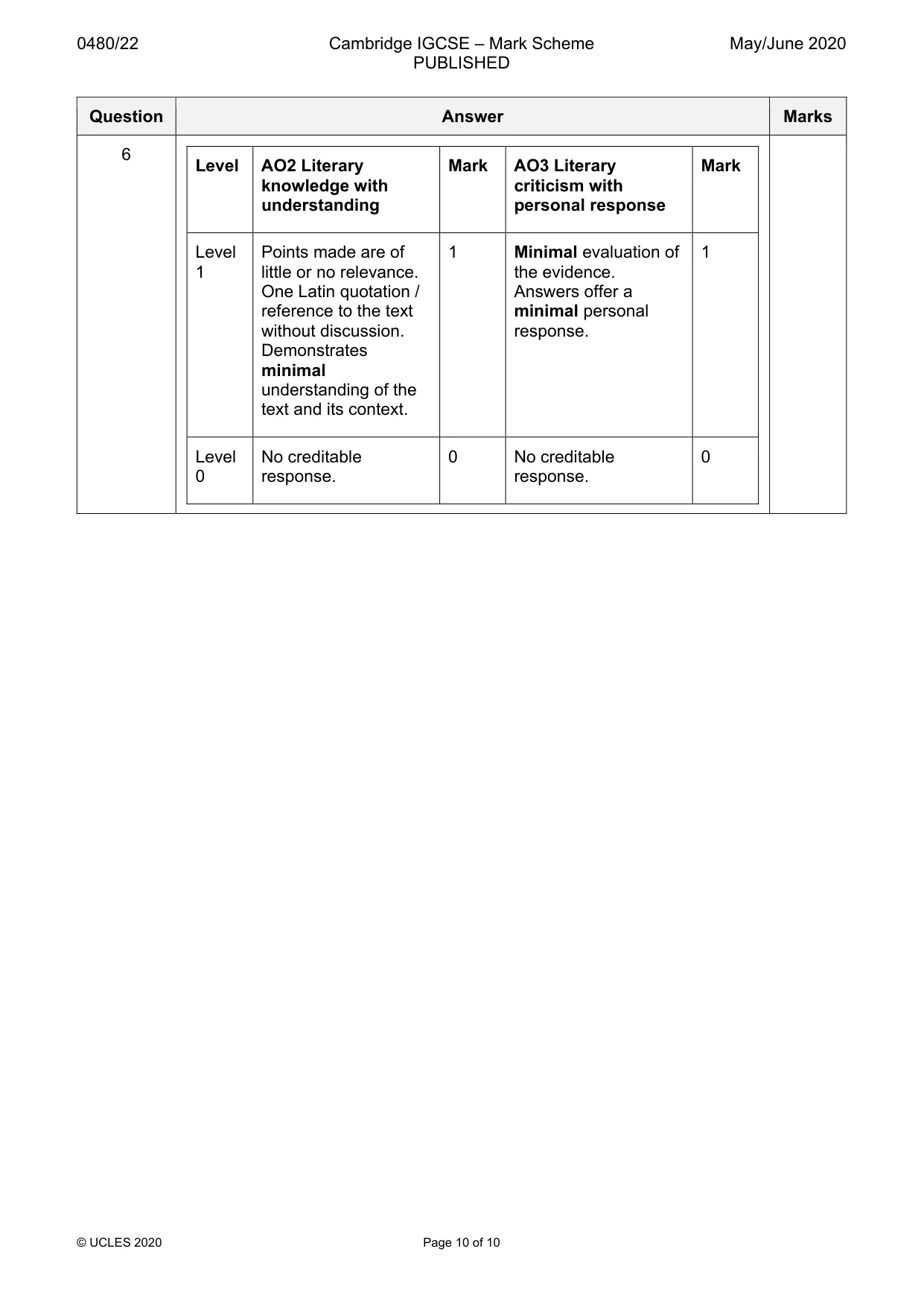
Mark scheme: 6 Answers may include references to: 10 • the fact that the whole thing has one subject which is how awful Catiline is • Cicero uses same techniques over and over again • use of variation • use of rhetorical techniques adds interest • appeals to patriotism would stir emotions in the listeners • wide-ranging vocabulary • adds drama with the way he exaggerates Points should be illustrated with examples from the text. Award up to 5 marks for performance against each AO using the grid. Level AO2 Literary Mark AO3 Literary Mark knowledge with criticism with understanding personal response Level A good range of 4–5 Good evaluation with 4–5 3 appropriate points detailed analysis of with clear and detailed evidence. explanation. Answers offer an A good range of Latin informed personal quotations / response to the references to the text literature. with relevant discussion. Demonstrates good understanding of the text and its context. Level Makes relevant points 2–3 Some evaluation with 2–3 2 with some use of evidence. explanation. Answers offer some A few Latin quotations personal response to / references to the text the literature. with discussion. Demonstrates some understanding of the text and its context. 6 Level AO2 Literary Mark AO3 Literary Mark knowledge with criticism with understanding personal response Level Points made are of 1 Minimal evaluation of 1 1 little or no relevance. the evidence. One Latin quotation / Answers offer a reference to the text minimal personal without discussion. response. Demonstrates minimal understanding of the text and its context. Level No creditable 0 No creditable 0 0 response. response.