Cambridge IGCSE Latin 0480 — 2024 May/June Paper 2 · Variant 2
0480/22/M/J/24 · 6 questions · 80 marks · ≈90 min
The question paper and its mark scheme, free to read here and free to download. This is Cambridge’s own paper, exactly as it was sat.
Question paper8 pages



Mark scheme10 pages
Answers below. Sit the paper first if you are practising.
Questions as text
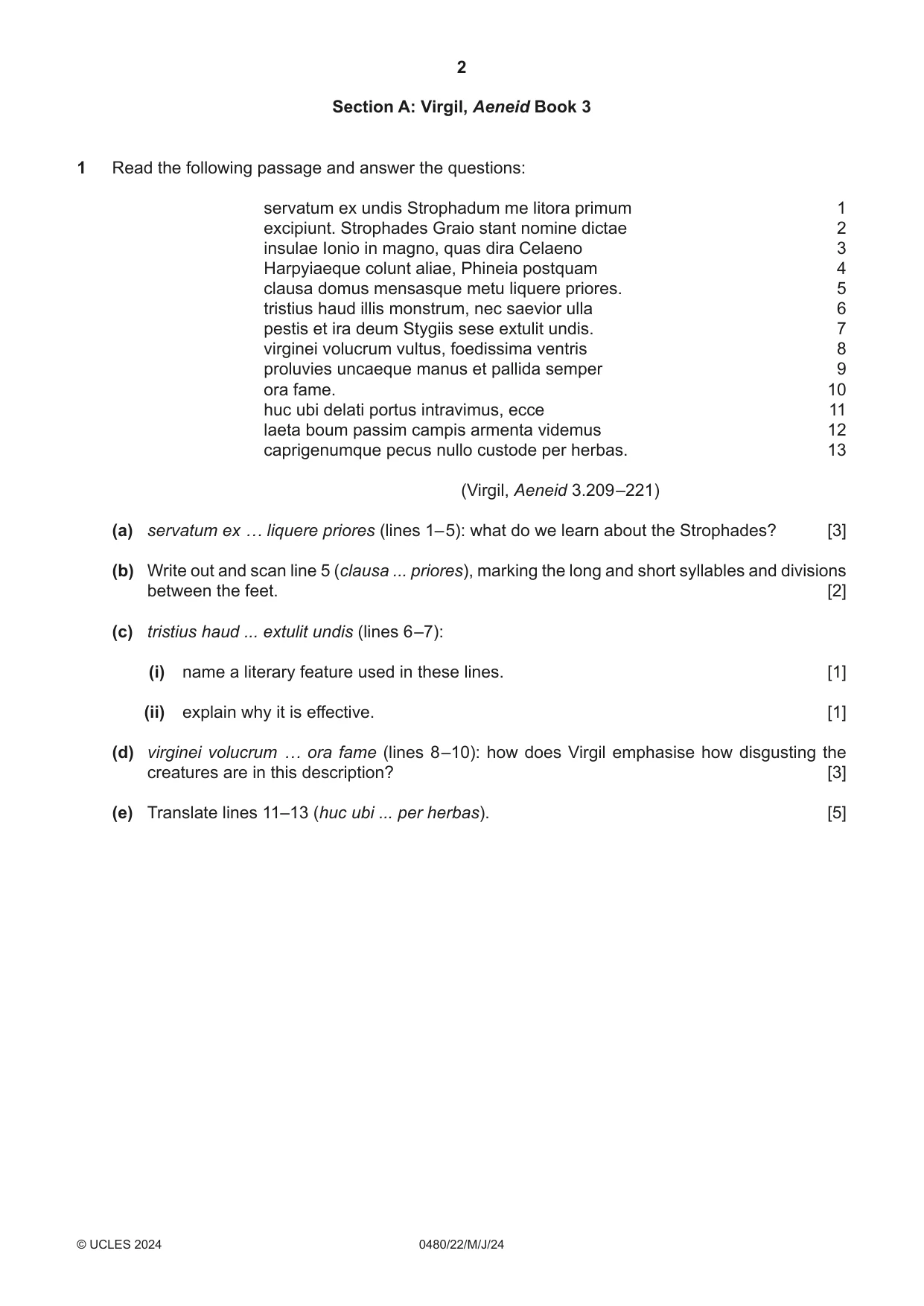
Q1 · Read the following passage and answer the questions: servatum ex undis Strophadum me…
1 Read the following passage and answer the questions: servatum ex undis Strophadum me litora primum 1 excipiunt. Strophades Graio stant nomine dictae 2 insulae Ionio in magno, quas dira Celaeno 3 Harpyiaeque colunt aliae, Phineia postquam 4 clausa domus mensasque metu liquere priores. 5 tristius haud illis monstrum, nec saevior ulla 6 pestis et ira deum Stygiis sese extulit undis. 7 virginei volucrum vultus, foedissima ventris 8 proluvies uncaeque manus et pallida semper 9 ora fame. 10 huc ubi delati portus intravimus, ecce 11 laeta boum passim campis armenta videmus 12 caprigenumque pecus nullo custode per herbas. 13 (Virgil, Aeneid 3.209 –221) (a) servatum ex … liquere priores (lines 1– 5): what do we learn about the Strophades? [3] (b) Write out and scan line 5 (clausa ... priores), marking the long and short syllables and divisions between the feet. [2] (c) tristius haud ... extulit undis (lines 6 –7): (i) name a literary feature used in these lines. [1] (ii) explain why it is effective. [1] (d) virginei volucrum … ora fame (lines 8 –10): how does Virgil emphasise how disgusting the creatures are in this description? [3] (e) Translate lines 11–13 (huc ubi ... per herbas). [5]
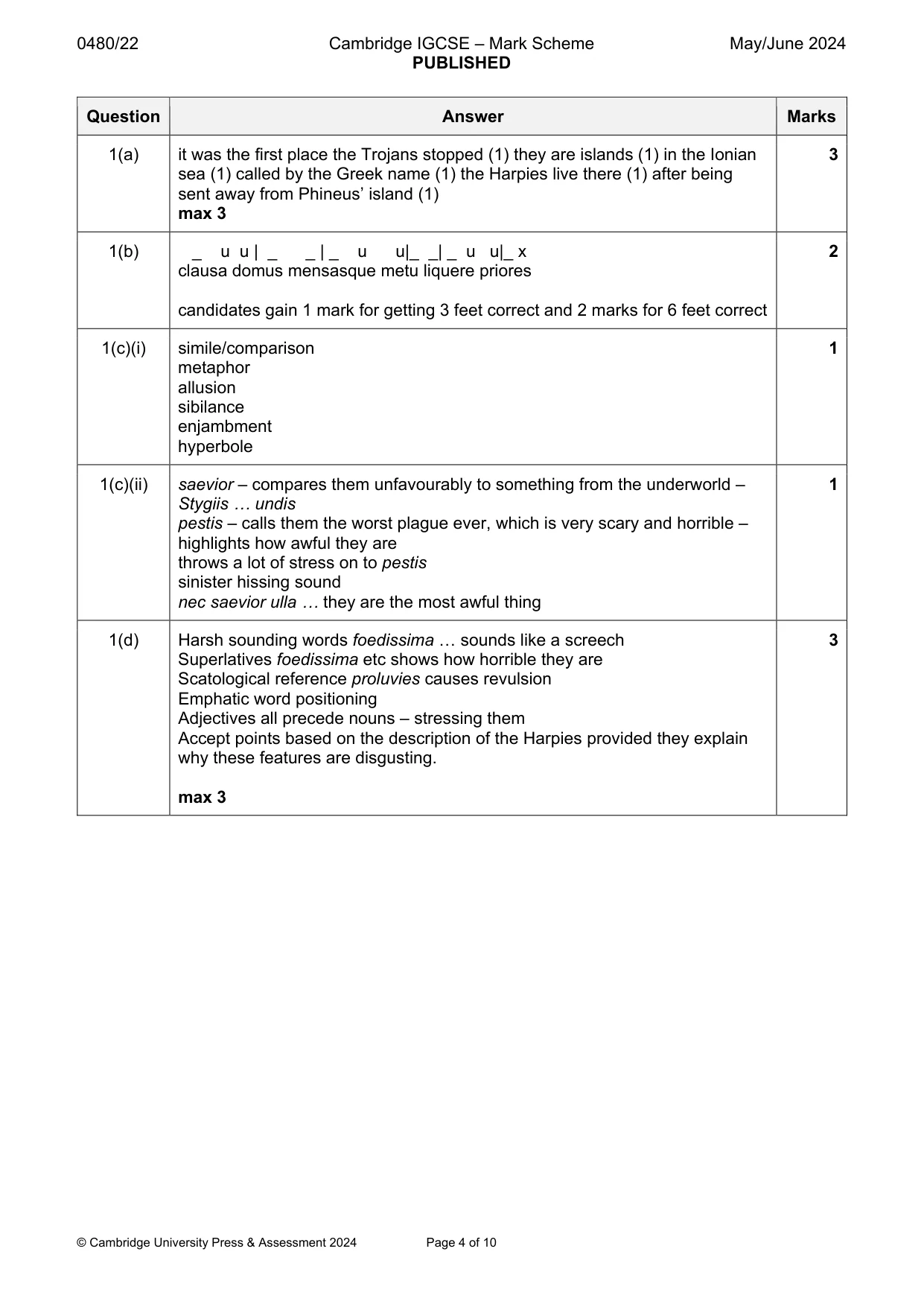
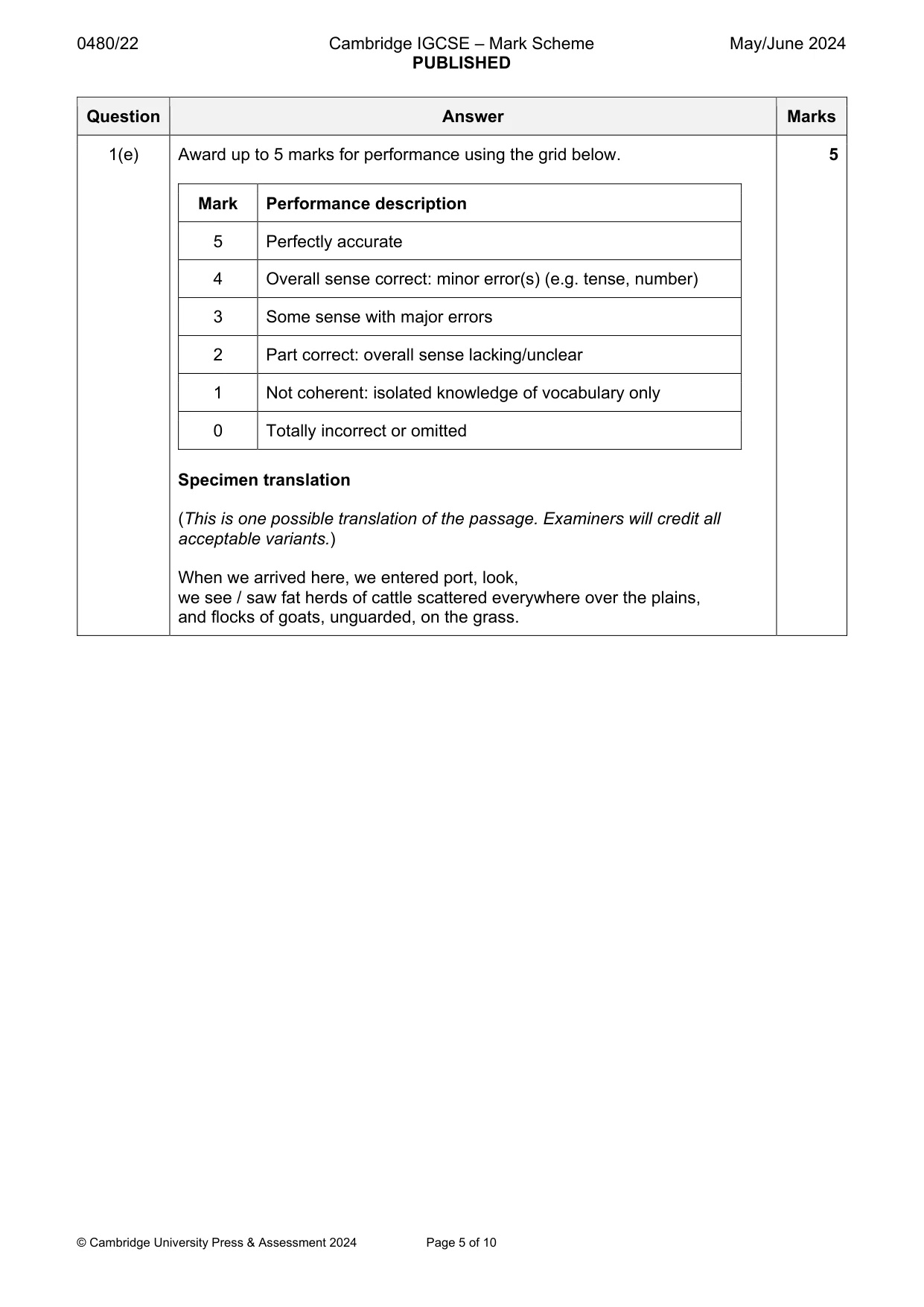
Mark scheme: Question Answer Marks 1(a) it was the first place the Trojans stopped (1) they are islands (1) in the Ionian 3 sea (1) called by the Greek name (1) the Harpies live there (1) after being sent away from Phineus’ island (1) max 3 1(b) _ u u | _ _ | _ u u|_ _| _ u u|_ x 2 clausa domus mensasque metu liquere priores candidates gain 1 mark for getting 3 feet correct and 2 marks for 6 feet correct 1(c)(i) simile/comparison 1 metaphor allusion sibilance enjambment hyperbole 1(c)(ii) saevior – compares them unfavourably to something from the underworld – 1 Stygiis … undis pestis – calls them the worst plague ever, which is very scary and horrible – highlights how awful they are throws a lot of stress on to pestis sinister hissing sound nec saevior ulla … they are the most awful thing 1(d) Harsh sounding words foedissima … sounds like a screech 3 Superlatives foedissima etc shows how horrible they are Scatological reference proluvies causes revulsion Emphatic word positioning Adjectives all precede nouns – stressing them Accept points based on the description of the Harpies provided they explain why these features are disgusting. max 3 1(e) Award up to 5 marks for performance using the grid below. 5 Mark Performance description 5 Perfectly accurate 4 Overall sense correct: minor error(s) (e.g. tense, number) 3 Some sense with major errors 2 Part correct: overall sense lacking/unclear 1 Not coherent: isolated knowledge of vocabulary only 0 Totally incorrect or omitted Specimen translation (This is one possible translation of the passage. Examiners will credit all acceptable variants.) When we arrived here, we entered port, look, we see / saw fat herds of cattle scattered everywhere over the plains, and flocks of goats, unguarded, on the grass.
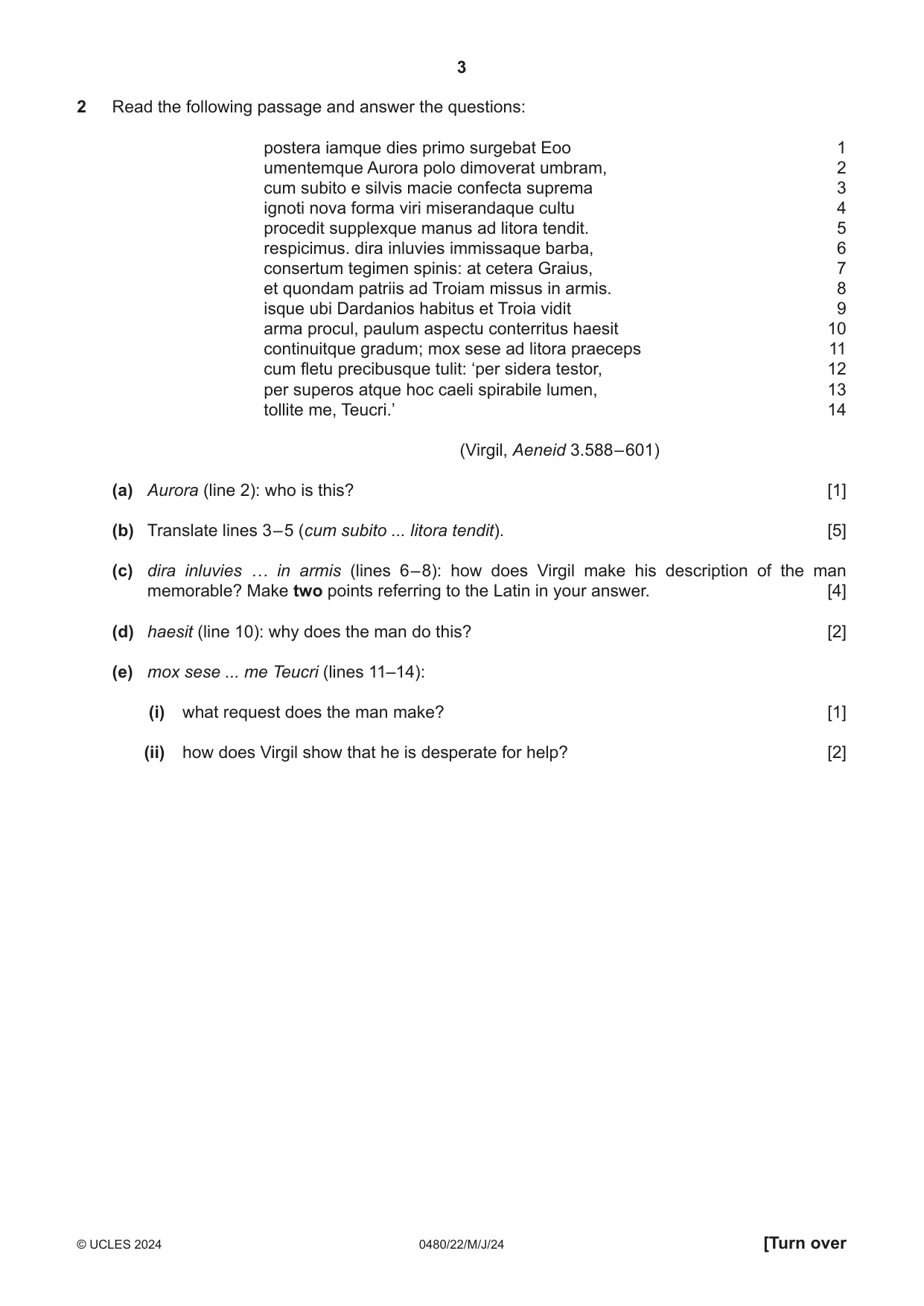
Q2 · Read the following passage and answer the questions: postera iamque dies primo surgebat…
2 Read the following passage and answer the questions: postera iamque dies primo surgebat Eoo 1 umentemque Aurora polo dimoverat umbram, 2 cum subito e silvis macie confecta suprema 3 ignoti nova forma viri miserandaque cultu 4 procedit supplexque manus ad litora tendit. 5 respicimus. dira inluvies immissaque barba, 6 consertum tegimen spinis: at cetera Graius, 7 et quondam patriis ad Troiam missus in armis. 8 isque ubi Dardanios habitus et Troia vidit 9 arma procul, paulum aspectu conterritus haesit 10 continuitque gradum; mox sese ad litora praeceps 11 cum fletu precibusque tulit: ‘per sidera testor, 12 per superos atque hoc caeli spirabile lumen, 13 tollite me, Teucri.’ 14 (Virgil, Aeneid 3.588 – 601) (a) Aurora (line 2): who is this? [1] (b) Translate lines 3 – 5 (cum subito ... litora tendit). [5] (c) dira inluvies … in armis (lines 6 – 8): how does Virgil make his description of the man memorable? Make two points referring to the Latin in your answer. [4] (d) haesit (line 10): why does the man do this? [2] (e) mox sese ... me Teucri (lines 11–14): (i) what request does the man make? [1] (ii) how does Virgil show that he is desperate for help? [2]
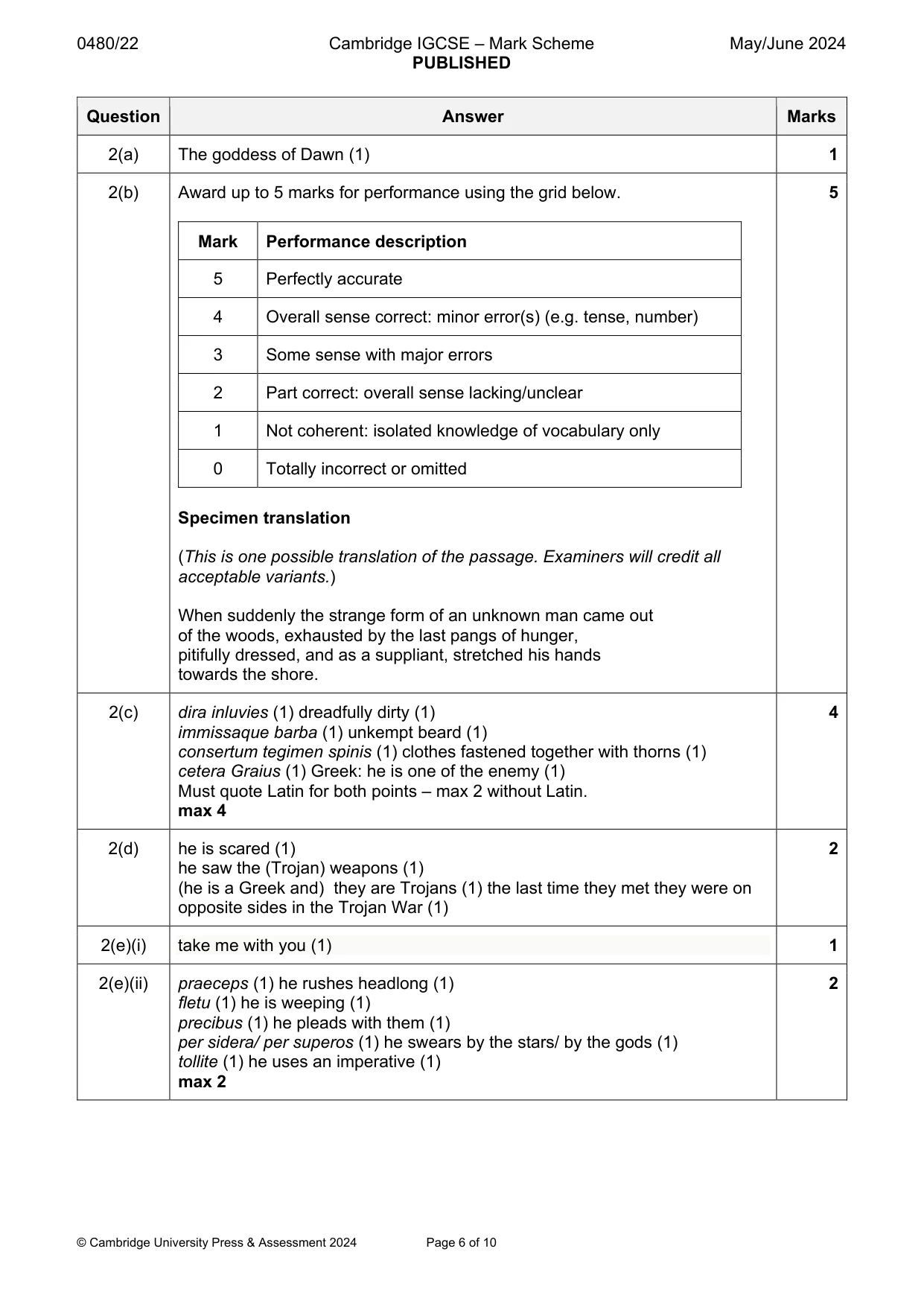
Mark scheme: 2(a) The goddess of Dawn (1) 1 2(b) Award up to 5 marks for performance using the grid below. 5 Mark Performance description 5 Perfectly accurate 4 Overall sense correct: minor error(s) (e.g. tense, number) 3 Some sense with major errors 2 Part correct: overall sense lacking/unclear 1 Not coherent: isolated knowledge of vocabulary only 0 Totally incorrect or omitted Specimen translation (This is one possible translation of the passage. Examiners will credit all acceptable variants.) When suddenly the strange form of an unknown man came out of the woods, exhausted by the last pangs of hunger, pitifully dressed, and as a suppliant, stretched his hands towards the shore. 2(c) dira inluvies (1) dreadfully dirty (1) 4 immissaque barba (1) unkempt beard (1) consertum tegimen spinis (1) clothes fastened together with thorns (1) cetera Graius (1) Greek: he is one of the enemy (1) Must quote Latin for both points – max 2 without Latin. max 4 2(d) he is scared (1) 2 he saw the (Trojan) weapons (1) (he is a Greek and) they are Trojans (1) the last time they met they were on opposite sides in the Trojan War (1) 2(e)(i) take me with you (1) 1 2(e)(ii) praeceps (1) he rushes headlong (1) 2 fletu (1) he is weeping (1) precibus (1) he pleads with them (1) per sidera/ per superos (1) he swears by the stars/ by the gods (1) tollite (1) he uses an imperative (1) max 2
Q3 · ‘Virgil wants his audience to feel only sympathy for the Cyclops.’ How far do you agree…
3 ‘Virgil wants his audience to feel only sympathy for the Cyclops.’ How far do you agree with this statement based on the extracts of the Aeneid you have studied? Support your answer with reference to the text. You should write at least 100 words. [10]
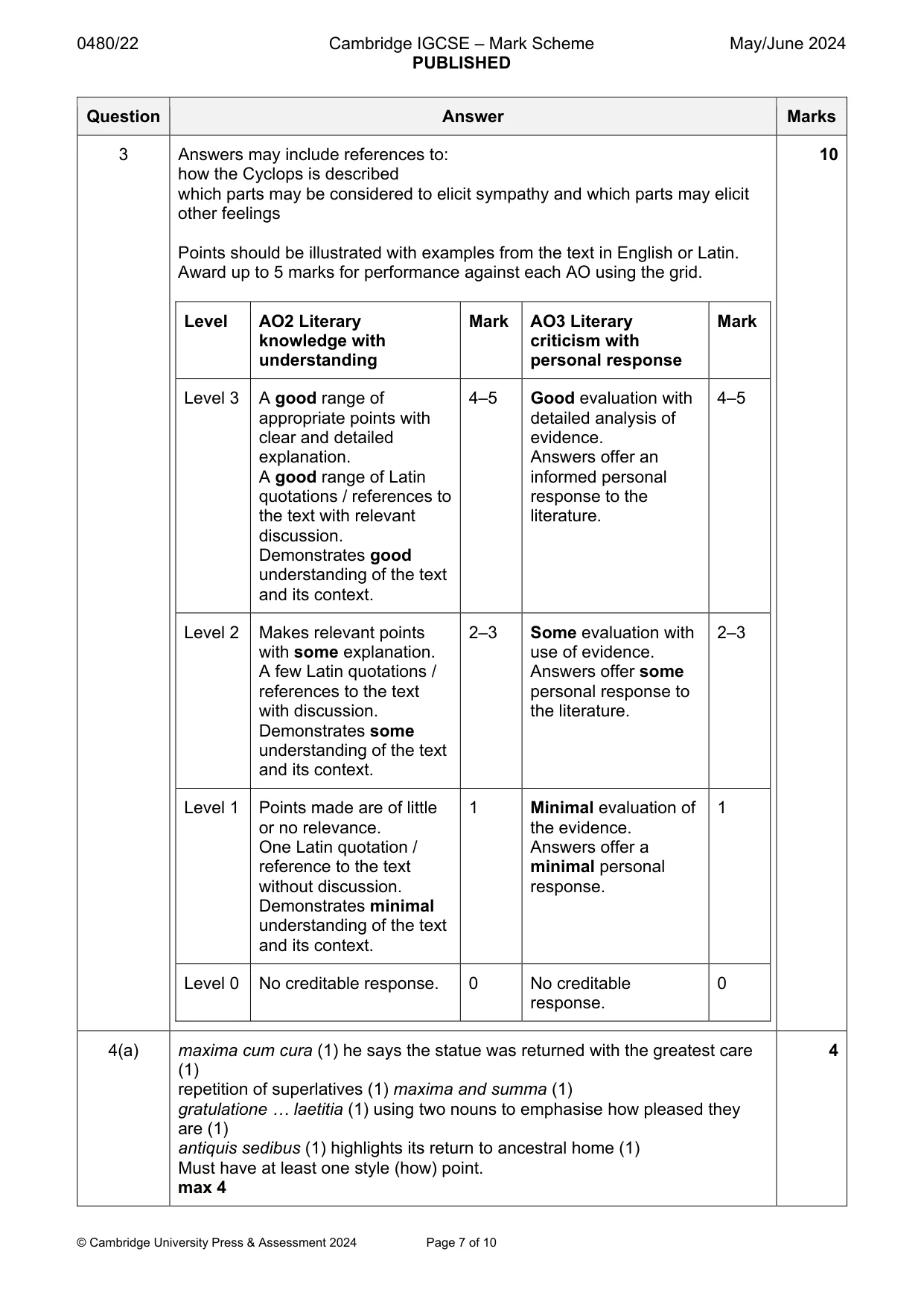
Mark scheme: 3 Answers may include references to: 10 how the Cyclops is described which parts may be considered to elicit sympathy and which parts may elicit other feelings Points should be illustrated with examples from the text in English or Latin. Award up to 5 marks for performance against each AO using the grid. Level AO2 Literary Mark AO3 Literary Mark knowledge with criticism with understanding personal response Level 3 A good range of 4–5 Good evaluation with 4–5 appropriate points with detailed analysis of clear and detailed evidence. explanation. Answers offer an A good range of Latin informed personal quotations / references to response to the the text with relevant literature. discussion. Demonstrates good understanding of the text and its context. Level 2 Makes relevant points 2–3 Some evaluation with 2–3 with some explanation. use of evidence. A few Latin quotations / Answers offer some references to the text personal response to with discussion. the literature. Demonstrates some understanding of the text and its context. Level 1 Points made are of little 1 Minimal evaluation of 1 or no relevance. the evidence. One Latin quotation / Answers offer a reference to the text minimal personal without discussion. response. Demonstrates minimal understanding of the text and its context. Level 0 No creditable response. 0 No creditable 0 response.
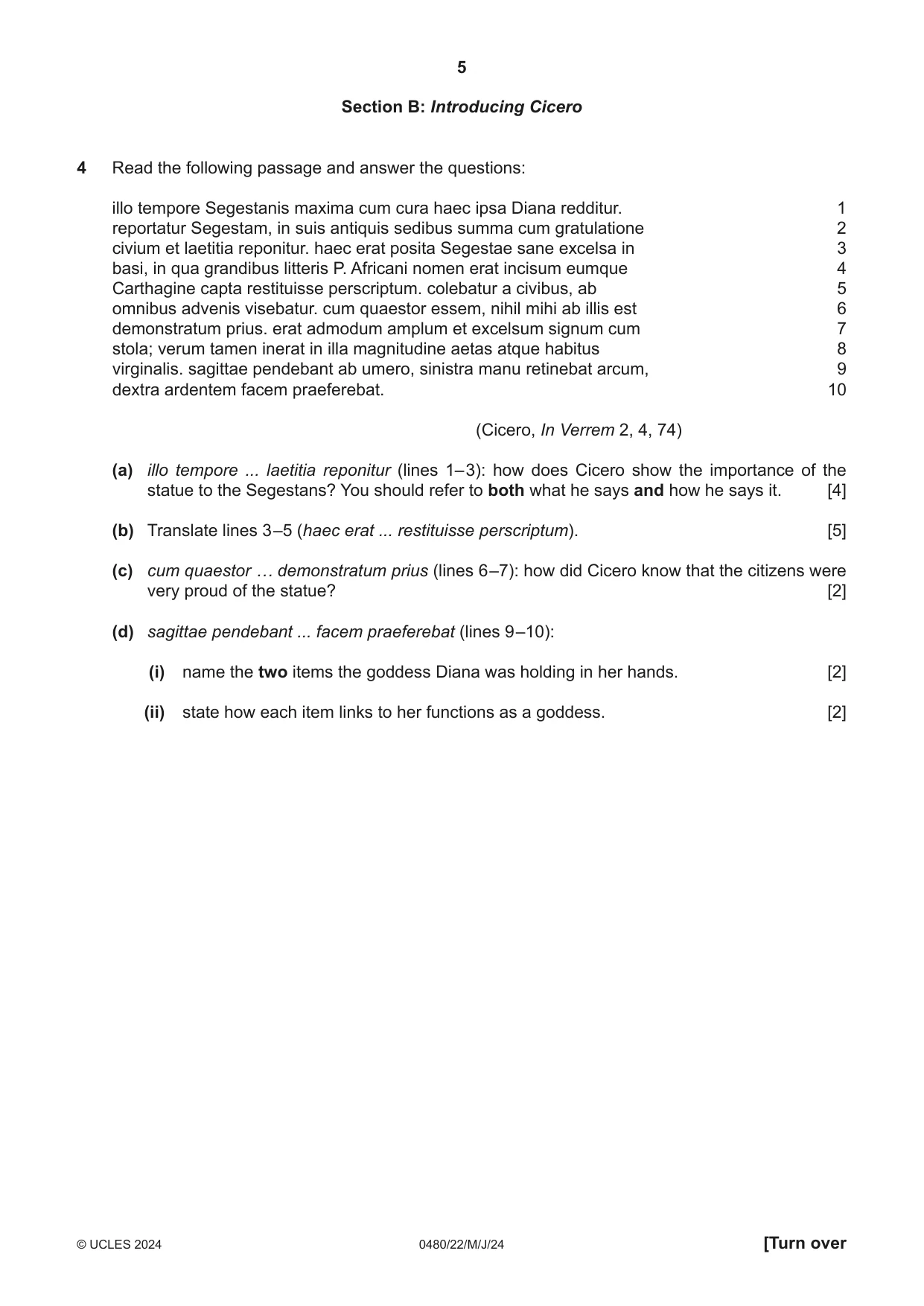
Q4 · Read the following passage and answer the questions: illo tempore Segestanis maxima cum…
4 Read the following passage and answer the questions: illo tempore Segestanis maxima cum cura haec ipsa Diana redditur. 1 reportatur Segestam, in suis antiquis sedibus summa cum gratulatione 2 civium et laetitia reponitur. haec erat posita Segestae sane excelsa in 3 basi, in qua grandibus litteris P. Africani nomen erat incisum eumque 4 Carthagine capta restituisse perscriptum. colebatur a civibus, ab 5 omnibus advenis visebatur. cum quaestor essem, nihil mihi ab illis est 6 demonstratum prius. erat admodum amplum et excelsum signum cum 7 stola; verum tamen inerat in illa magnitudine aetas atque habitus 8 virginalis. sagittae pendebant ab umero, sinistra manu retinebat arcum, 9 dextra ardentem facem praeferebat. 10 (Cicero, In Verrem 2, 4, 74) (a) illo tempore ... laetitia reponitur (lines 1– 3): how does Cicero show the importance of the statue to the Segestans? You should refer to both what he says and how he says it. [4] (b) Translate lines 3 –5 (haec erat ... restituisse perscriptum). [5] (c) cum quaestor … demonstratum prius (lines 6 –7): how did Cicero know that the citizens were very proud of the statue? [2] (d) sagittae pendebant ... facem praeferebat (lines 9 –10): (i) name the two items the goddess Diana was holding in her hands. [2] (ii) state how each item links to her functions as a goddess. [2]
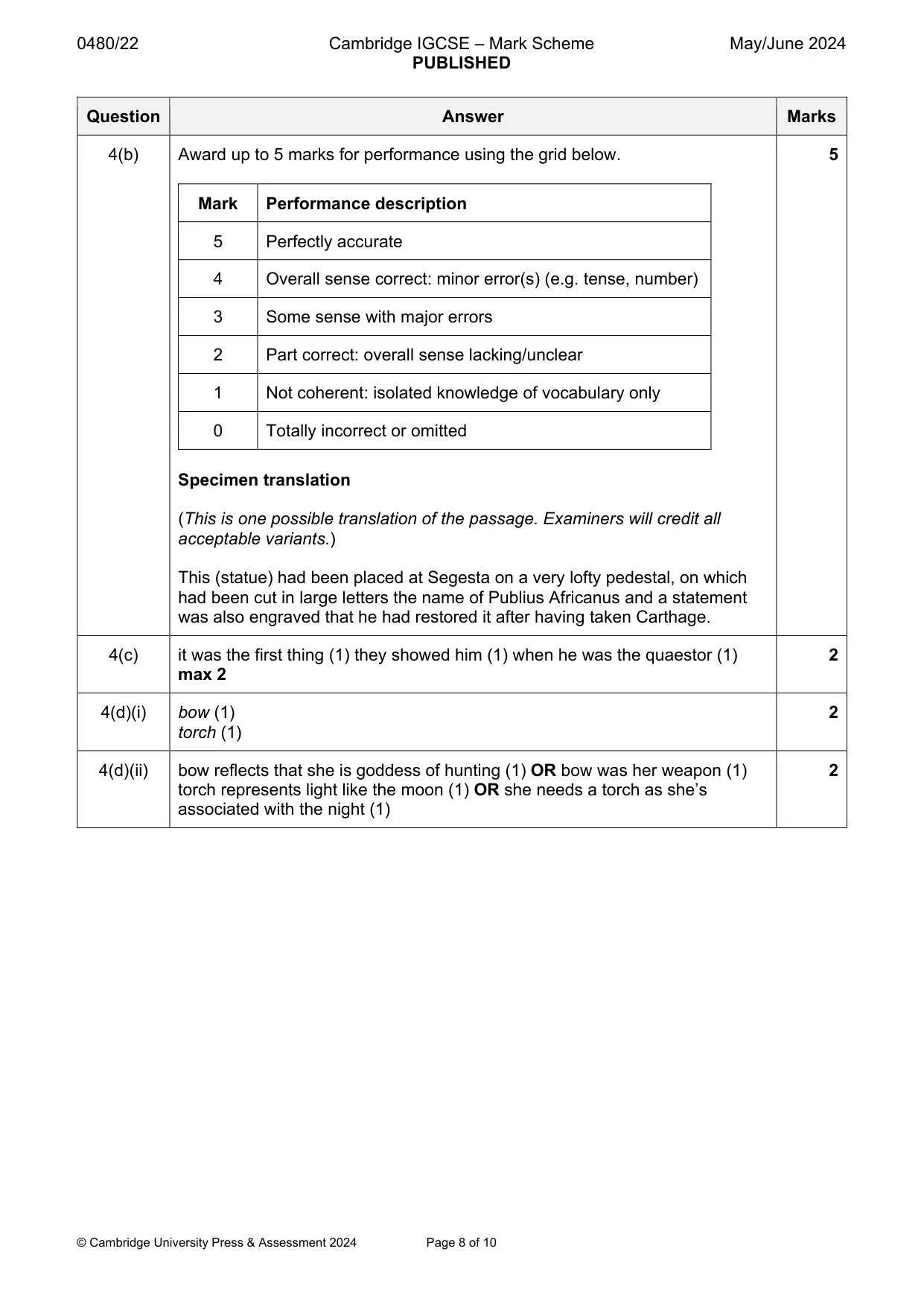
Mark scheme: 4(a) maxima cum cura (1) he says the statue was returned with the greatest care 4 (1) repetition of superlatives (1) maxima and summa (1) gratulatione … laetitia (1) using two nouns to emphasise how pleased they are (1) antiquis sedibus (1) highlights its return to ancestral home (1) Must have at least one style (how) point. max 4 4(b) Award up to 5 marks for performance using the grid below. 5 Mark Performance description 5 Perfectly accurate 4 Overall sense correct: minor error(s) (e.g. tense, number) 3 Some sense with major errors 2 Part correct: overall sense lacking/unclear 1 Not coherent: isolated knowledge of vocabulary only 0 Totally incorrect or omitted Specimen translation (This is one possible translation of the passage. Examiners will credit all acceptable variants.) This (statue) had been placed at Segesta on a very lofty pedestal, on which had been cut in large letters the name of Publius Africanus and a statement was also engraved that he had restored it after having taken Carthage. 4(c) it was the first thing (1) they showed him (1) when he was the quaestor (1) 2 max 2 4(d)(i) bow (1) 2 torch (1) 4(d)(ii) bow reflects that she is goddess of hunting (1) OR bow was her weapon (1) 2 torch represents light like the moon (1) OR she needs a torch as she’s associated with the night (1)
Q5 · Read the following passage and answer the questions: adsunt Segestani, clientes tui…
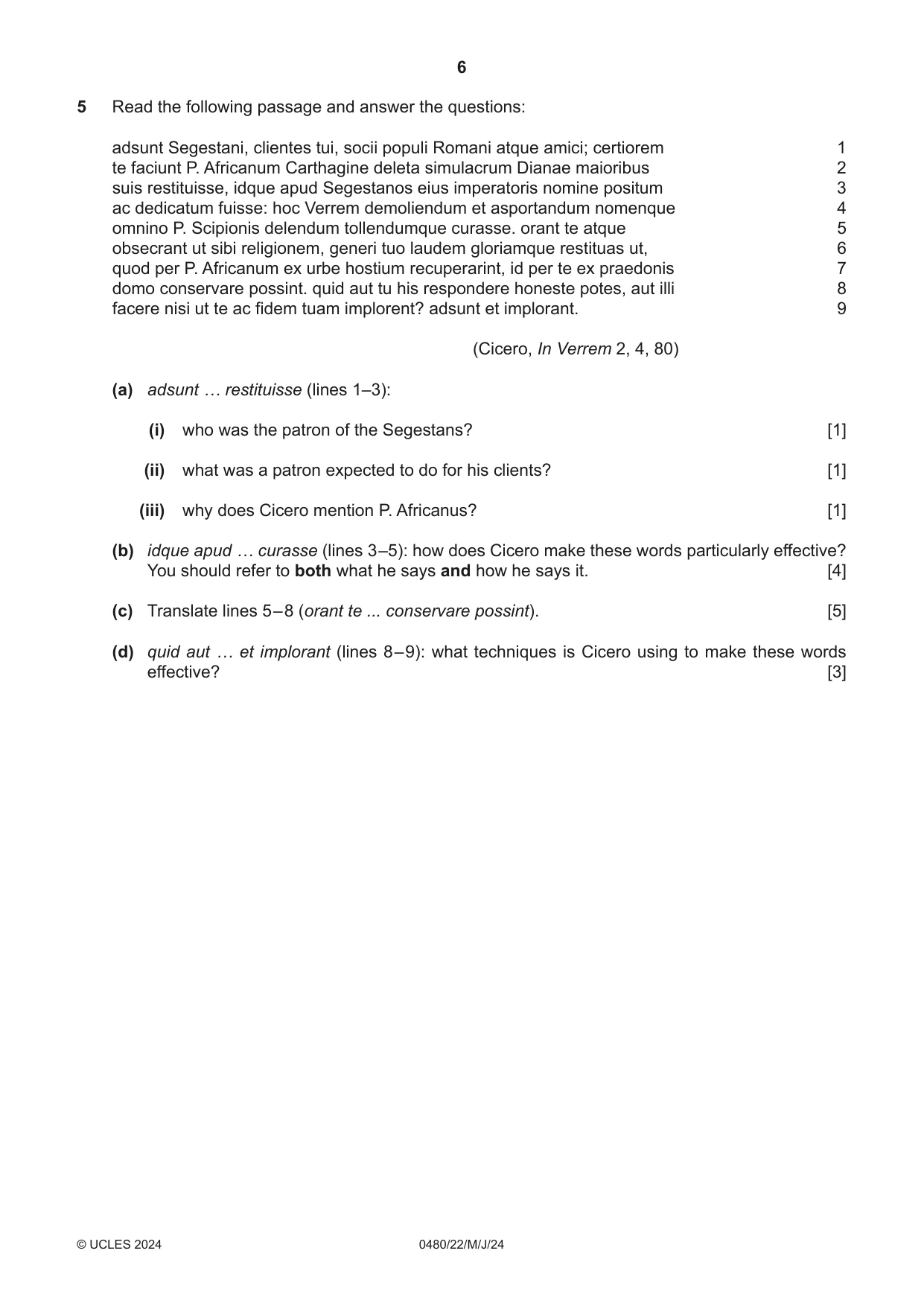
5 Read the following passage and answer the questions: adsunt Segestani, clientes tui, socii populi Romani atque amici; certiorem 1 te faciunt P. Africanum Carthagine deleta simulacrum Dianae maioribus 2 suis restituisse, idque apud Segestanos eius imperatoris nomine positum 3 ac dedicatum fuisse: hoc Verrem demoliendum et asportandum nomenque 4 omnino P. Scipionis delendum tollendumque curasse. orant te atque 5 obsecrant ut sibi religionem, generi tuo laudem gloriamque restituas ut, 6 quod per P. Africanum ex urbe hostium recuperarint, id per te ex praedonis 7 domo conservare possint. quid aut tu his respondere honeste potes, aut illi 8 facere nisi ut te ac fidem tuam implorent? adsunt et implorant. 9 (Cicero, In Verrem 2, 4, 80) (a) adsunt … restituisse (lines 1–3): (i) who was the patron of the Segestans? [1] (ii) what was a patron expected to do for his clients? [1] (iii) why does Cicero mention P. Africanus? [1] (b) idque apud … curasse (lines 3 –5): how does Cicero make these words particularly effective? You should refer to both what he says and how he says it. [4] (c) Translate lines 5 – 8 (orant te ... conservare possint). [5] (d) quid aut … et implorant (lines 8 – 9): what techniques is Cicero using to make these words effective? [3]
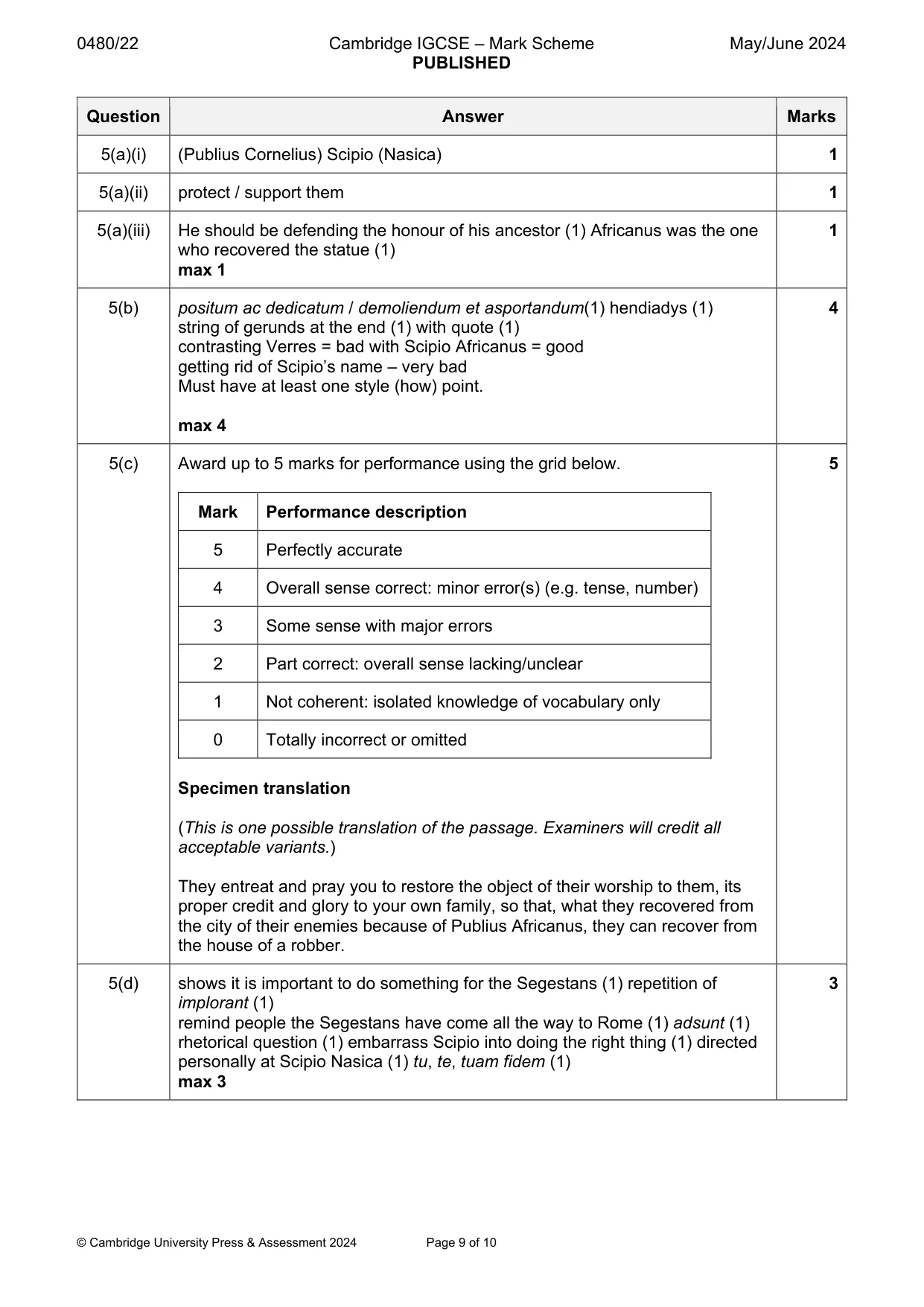
Mark scheme: 5(a)(i) (Publius Cornelius) Scipio (Nasica) 1 5(a)(ii) protect / support them 1 5(a)(iii) He should be defending the honour of his ancestor (1) Africanus was the one 1 who recovered the statue (1) max 1 5(b) positum ac dedicatum / demoliendum et asportandum(1) hendiadys (1) 4 string of gerunds at the end (1) with quote (1) contrasting Verres = bad with Scipio Africanus = good getting rid of Scipio’s name – very bad Must have at least one style (how) point. max 4 5(c) Award up to 5 marks for performance using the grid below. 5 Mark Performance description 5 Perfectly accurate 4 Overall sense correct: minor error(s) (e.g. tense, number) 3 Some sense with major errors 2 Part correct: overall sense lacking/unclear 1 Not coherent: isolated knowledge of vocabulary only 0 Totally incorrect or omitted Specimen translation (This is one possible translation of the passage. Examiners will credit all acceptable variants.) They entreat and pray you to restore the object of their worship to them, its proper credit and glory to your own family, so that, what they recovered from the city of their enemies because of Publius Africanus, they can recover from the house of a robber. 5(d) shows it is important to do something for the Segestans (1) repetition of 3 implorant (1) remind people the Segestans have come all the way to Rome (1) adsunt (1) rhetorical question (1) embarrass Scipio into doing the right thing (1) directed personally at Scipio Nasica (1) tu, te, tuam fidem (1) max 3
Q6 · ‘To make his speech entertaining, Cicero ignores the terrible nature of Verres’ crimes.’…
6 ‘To make his speech entertaining, Cicero ignores the terrible nature of Verres’ crimes.’ How far do you agree with this statement about Cicero’s speech against Verres based on the passages you have studied? Support your answer with reference to the text. You should write at least 100 words. [10]
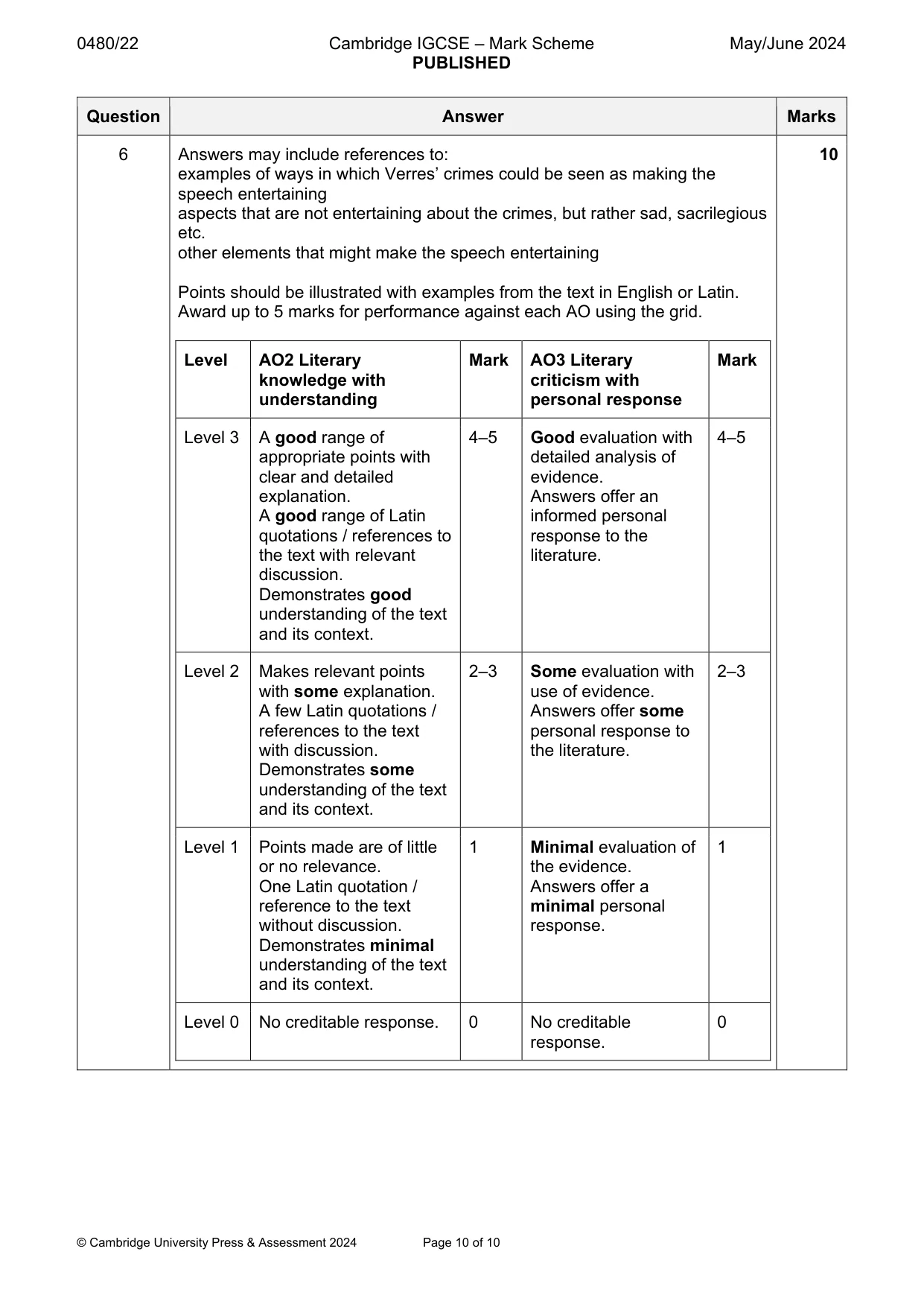
Mark scheme: 6 Answers may include references to: 10 examples of ways in which Verres’ crimes could be seen as making the speech entertaining aspects that are not entertaining about the crimes, but rather sad, sacrilegious etc. other elements that might make the speech entertaining Points should be illustrated with examples from the text in English or Latin. Award up to 5 marks for performance against each AO using the grid. Level AO2 Literary Mark AO3 Literary Mark knowledge with criticism with understanding personal response Level 3 A good range of 4–5 Good evaluation with 4–5 appropriate points with detailed analysis of clear and detailed evidence. explanation. Answers offer an A good range of Latin informed personal quotations / references to response to the the text with relevant literature. discussion. Demonstrates good understanding of the text and its context. Level 2 Makes relevant points 2–3 Some evaluation with 2–3 with some explanation. use of evidence. A few Latin quotations / Answers offer some references to the text personal response to with discussion. the literature. Demonstrates some understanding of the text and its context. Level 1 Points made are of little 1 Minimal evaluation of 1 or no relevance. the evidence. One Latin quotation / Answers offer a reference to the text minimal personal without discussion. response. Demonstrates minimal understanding of the text and its context. Level 0 No creditable response. 0 No creditable 0 response.
What you needed in this session
Cambridge’s own grade thresholds for 2024 May/June, Paper 2 · Variant 2. A higher threshold means an easier paper — the bar moves with how the cohort did.