Cambridge IGCSE Latin 0480 — 2022 May/June Paper 2 · Variant 2
0480/22/M/J/22 · 6 questions · 80 marks · ≈90 min
The question paper and its mark scheme, free to read here and free to download. This is Cambridge’s own paper, exactly as it was sat.
Question paper8 pages



Mark scheme9 pages
Answers below. Sit the paper first if you are practising.
Questions as text
Q1 · Read the following passage and answer the questions: olli sic breviter fata est longaeva…
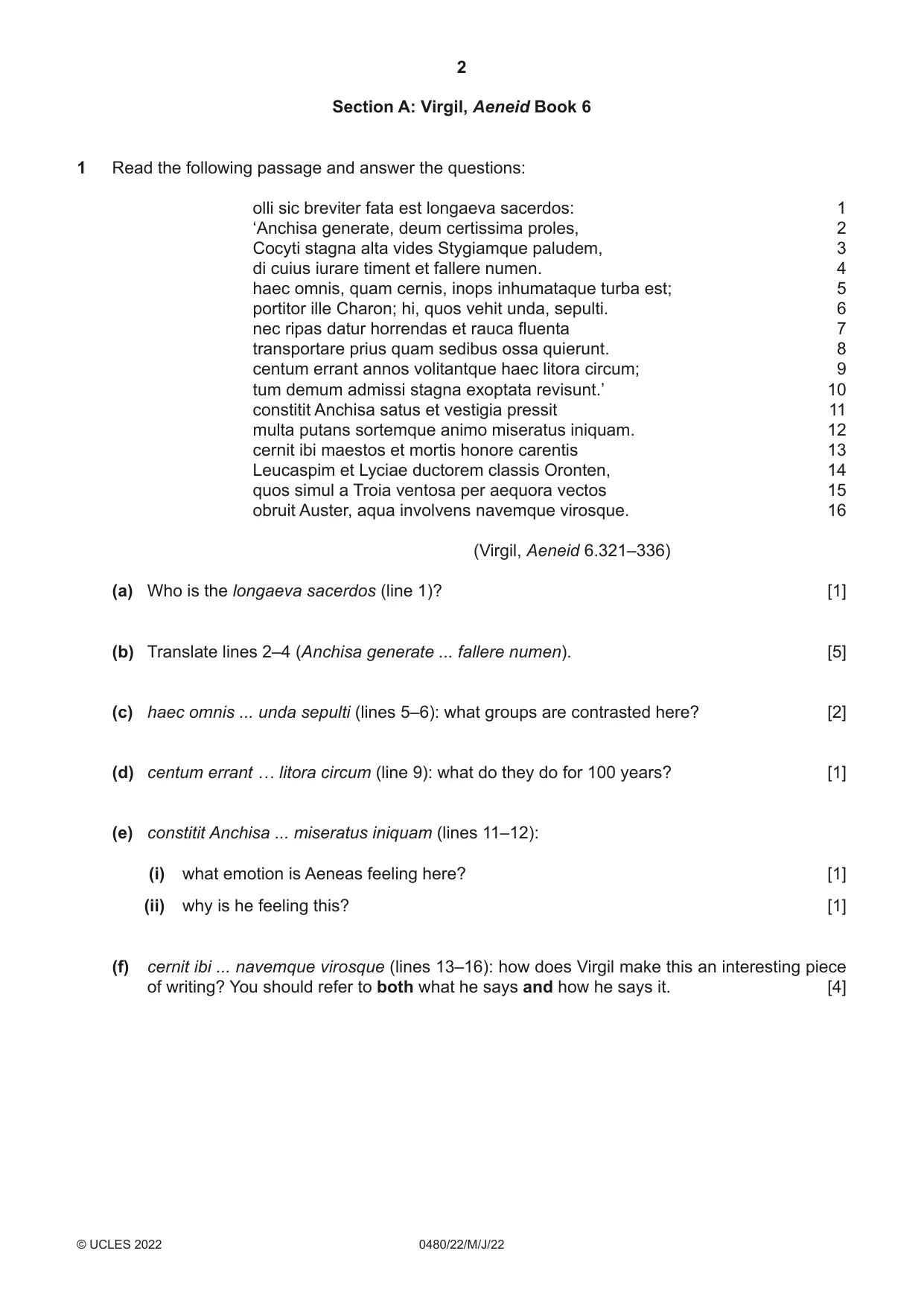
1 Read the following passage and answer the questions: olli sic breviter fata est longaeva sacerdos: 1 ‘Anchisa generate, deum certissima proles, 2 Cocyti stagna alta vides Stygiamque paludem, 3 di cuius iurare timent et fallere numen. 4 haec omnis, quam cernis, inops inhumataque turba est; 5 portitor ille Charon; hi, quos vehit unda, sepulti. 6 nec ripas datur horrendas et rauca fluenta 7 transportare prius quam sedibus ossa quierunt. 8 centum errant annos volitantque haec litora circum; 9 tum demum admissi stagna exoptata revisunt.’ 10 constitit Anchisa satus et vestigia pressit 11 multa putans sortemque animo miseratus iniquam. 12 cernit ibi maestos et mortis honore carentis 13 Leucaspim et Lyciae ductorem classis Oronten, 14 quos simul a Troia ventosa per aequora vectos 15 obruit Auster, aqua involvens navemque virosque. 16 (Virgil, Aeneid 6.321–336) (a) Who is the longaeva sacerdos (line 1)? [1] (b) Translate lines 2–4 (Anchisa generate ... fallere numen). [5] (c) haec omnis ... unda sepulti (lines 5–6): what groups are contrasted here? [2] (d) centum errant … litora circum (line 9): what do they do for 100 years? [1] (e) constitit Anchisa ... miseratus iniquam (lines 11–12): (i) what emotion is Aeneas feeling here? [1] (ii) why is he feeling this? [1] (f) cernit ibi ... navemque virosque (lines 13–16): how does Virgil make this an interesting piece of writing? You should refer to both what he says and how he says it. [4]
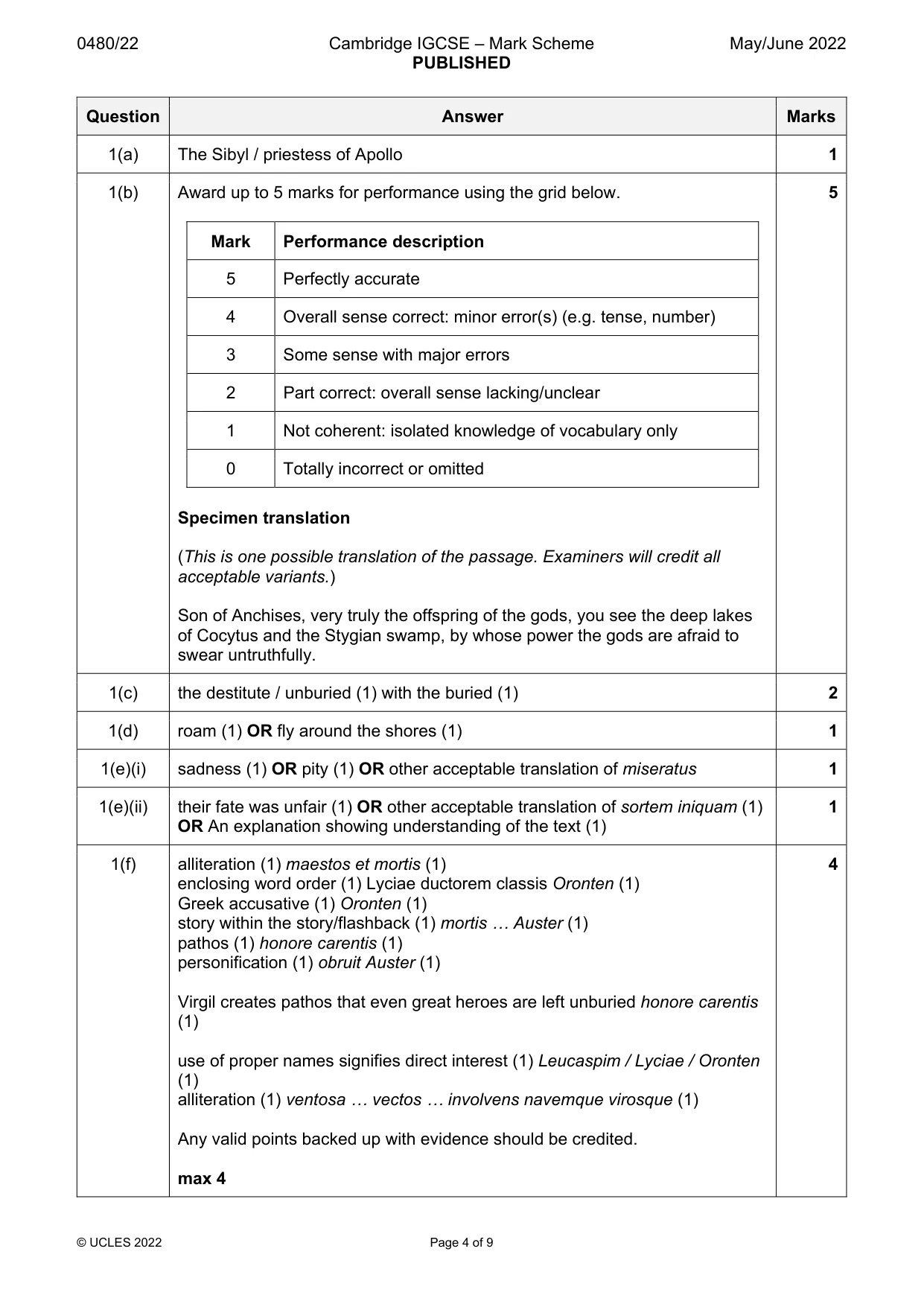
Mark scheme: Question Answer Marks 1(a) The Sibyl / priestess of Apollo 1 1(b) Award up to 5 marks for performance using the grid below. 5 Mark Performance description 5 Perfectly accurate 4 Overall sense correct: minor error(s) (e.g. tense, number) 3 Some sense with major errors 2 Part correct: overall sense lacking/unclear 1 Not coherent: isolated knowledge of vocabulary only 0 Totally incorrect or omitted Specimen translation (This is one possible translation of the passage. Examiners will credit all acceptable variants.) Son of Anchises, very truly the offspring of the gods, you see the deep lakes of Cocytus and the Stygian swamp, by whose power the gods are afraid to swear untruthfully. 1(c) the destitute / unburied (1) with the buried (1) 2 1(d) roam (1) OR fly around the shores (1) 1 1(e)(i) sadness (1) OR pity (1) OR other acceptable translation of miseratus 1 1(e)(ii) their fate was unfair (1) OR other acceptable translation of sortem iniquam (1) 1 OR An explanation showing understanding of the text (1) 1(f) alliteration (1) maestos et mortis (1) 4 enclosing word order (1) Lyciae ductorem classis Oronten (1) Greek accusative (1) Oronten (1) story within the story/flashback (1) mortis … Auster (1) pathos (1) honore carentis (1) personification (1) obruit Auster (1) Virgil creates pathos that even great heroes are left unburied honore carentis (1) use of proper names signifies direct interest (1) Leucaspim / Lyciae / Oronten (1) alliteration (1) ventosa … vectos … involvens navemque virosque (1) Any valid points backed up with evidence should be credited. max 4
Q2 · Read the following passage and answer the questions: ‘unde haec, o Palinure, tibi tam…
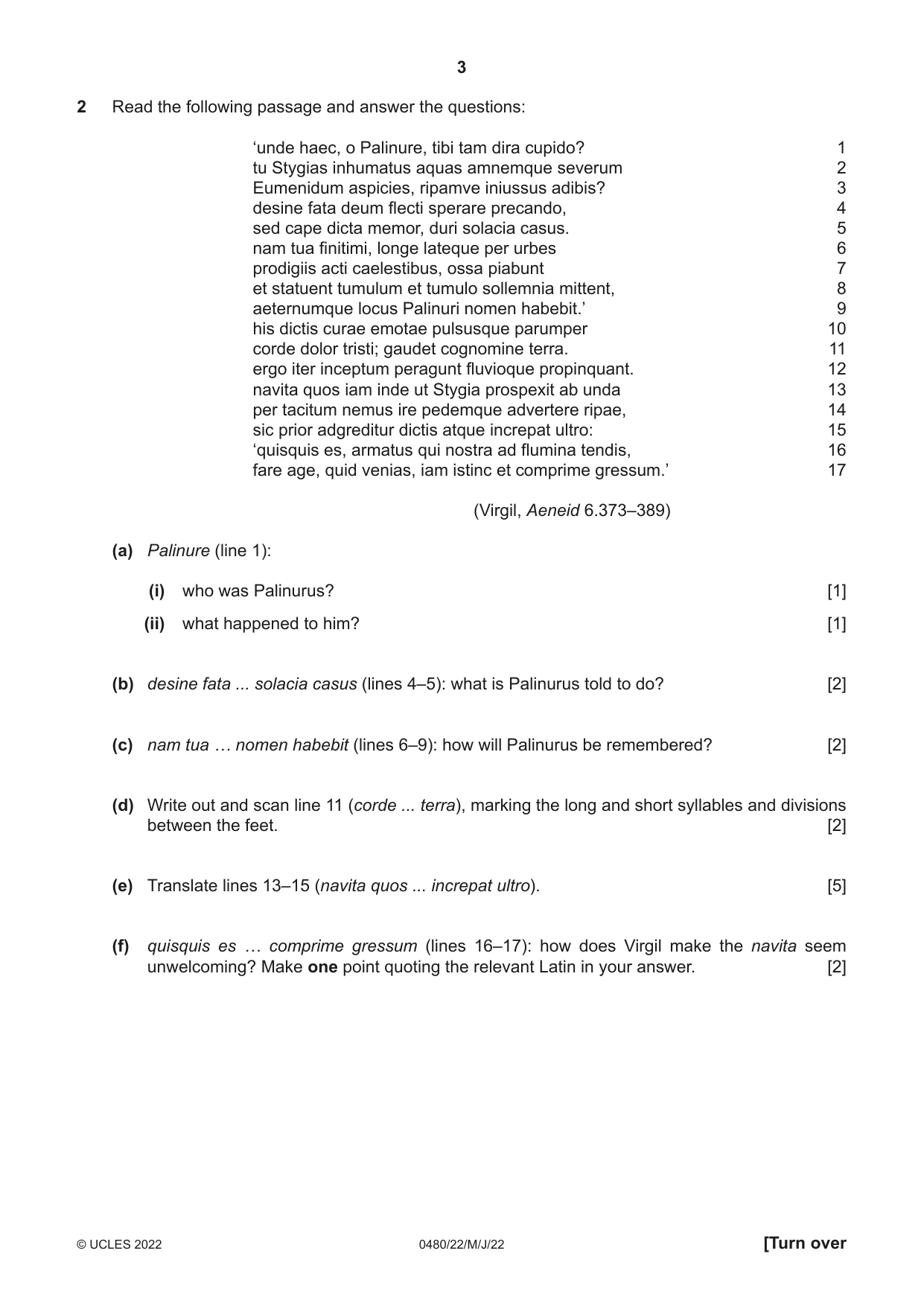
2 Read the following passage and answer the questions: ‘unde haec, o Palinure, tibi tam dira cupido? 1 tu Stygias inhumatus aquas amnemque severum 2 Eumenidum aspicies, ripamve iniussus adibis? 3 desine fata deum flecti sperare precando, 4 sed cape dicta memor, duri solacia casus. 5 nam tua finitimi, longe lateque per urbes 6 prodigiis acti caelestibus, ossa piabunt 7 et statuent tumulum et tumulo sollemnia mittent, 8 aeternumque locus Palinuri nomen habebit.’ 9 his dictis curae emotae pulsusque parumper 10 corde dolor tristi; gaudet cognomine terra. 11 ergo iter inceptum peragunt fluvioque propinquant. 12 navita quos iam inde ut Stygia prospexit ab unda 13 per tacitum nemus ire pedemque advertere ripae, 14 sic prior adgreditur dictis atque increpat ultro: 15 ‘quisquis es, armatus qui nostra ad flumina tendis, 16 fare age, quid venias, iam istinc et comprime gressum.’ 17 (Virgil, Aeneid 6.373–389) (a) Palinure (line 1): (i) who was Palinurus? [1] (ii) what happened to him? [1] (b) desine fata ... solacia casus (lines 4–5): what is Palinurus told to do? [2] (c) nam tua … nomen habebit (lines 6–9): how will Palinurus be remembered? [2] (d) Write out and scan line 11 (corde ... terra), marking the long and short syllables and divisions between the feet. [2] (e) Translate lines 13–15 (navita quos ... increpat ultro). [5] (f) quisquis es … comprime gressum (lines 16–17): how does Virgil make the navita seem unwelcoming? Make one point quoting the relevant Latin in your answer. [2]
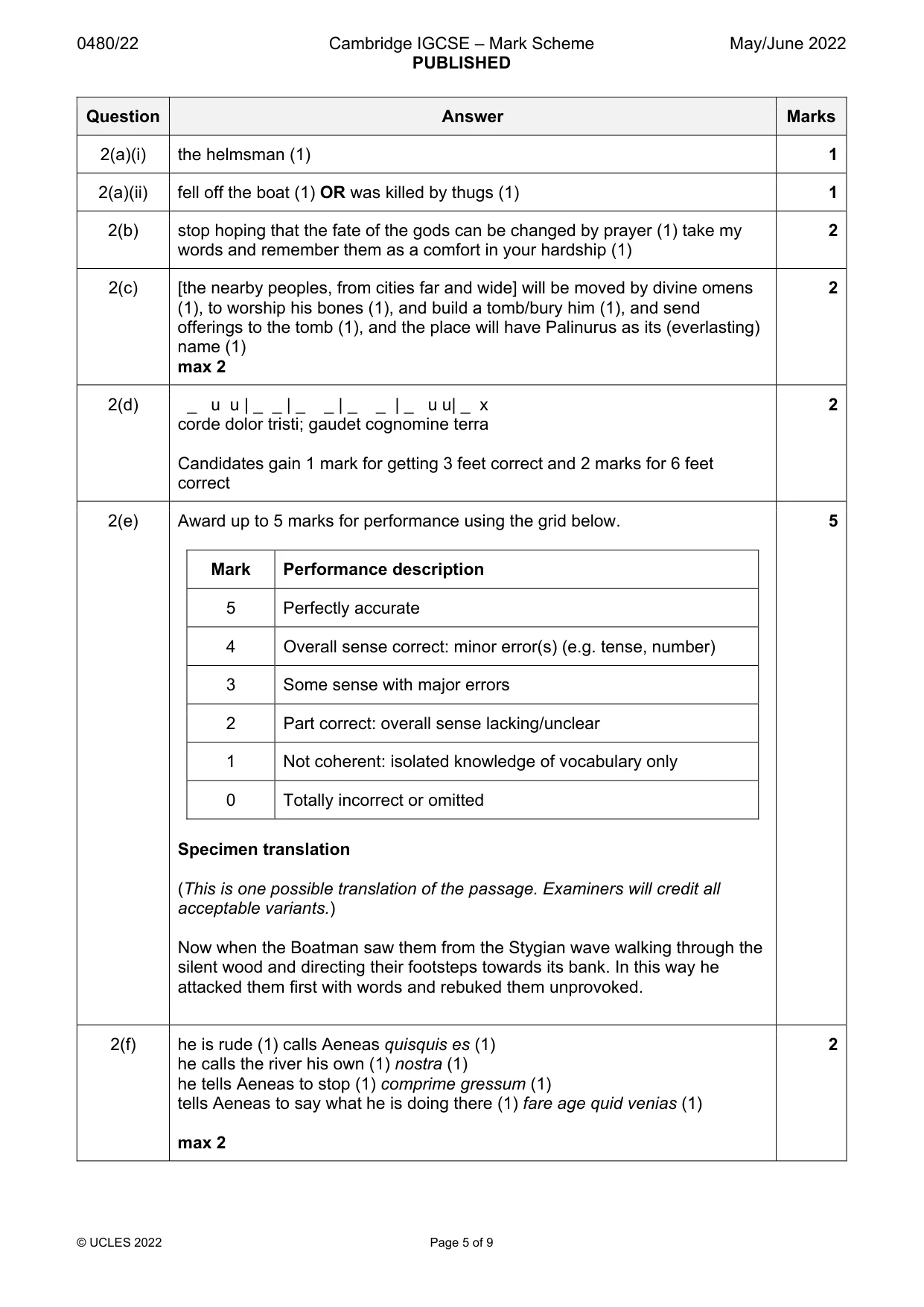
Mark scheme: 2(a)(i) the helmsman (1) 1 2(a)(ii) fell off the boat (1) OR was killed by thugs (1) 1 2(b) stop hoping that the fate of the gods can be changed by prayer (1) take my 2 words and remember them as a comfort in your hardship (1) 2(c) [the nearby peoples, from cities far and wide] will be moved by divine omens 2 (1), to worship his bones (1), and build a tomb/bury him (1), and send offerings to the tomb (1), and the place will have Palinurus as its (everlasting) name (1) max 2 2(d) _ u u | _ _ | _ _ | _ _ | _ u u| _ x 2 corde dolor tristi; gaudet cognomine terra Candidates gain 1 mark for getting 3 feet correct and 2 marks for 6 feet correct 2(e) Award up to 5 marks for performance using the grid below. 5 Mark Performance description 5 Perfectly accurate 4 Overall sense correct: minor error(s) (e.g. tense, number) 3 Some sense with major errors 2 Part correct: overall sense lacking/unclear 1 Not coherent: isolated knowledge of vocabulary only 0 Totally incorrect or omitted Specimen translation (This is one possible translation of the passage. Examiners will credit all acceptable variants.) Now when the Boatman saw them from the Stygian wave walking through the silent wood and directing their footsteps towards its bank. In this way he attacked them first with words and rebuked them unprovoked. 2(f) he is rude (1) calls Aeneas quisquis es (1) 2 he calls the river his own (1) nostra (1) he tells Aeneas to stop (1) comprime gressum (1) tells Aeneas to say what he is doing there (1) fare age quid venias (1) max 2
Q3 · ‘The character of Aeneas is what makes Aeneid 6 such a gripping read.’ How far do you…
3 ‘The character of Aeneas is what makes Aeneid 6 such a gripping read.’ How far do you agree with this statement based on the extract of the Aeneid you have studied? Support your answer with reference to the text. You should write at least 100 words. [10]
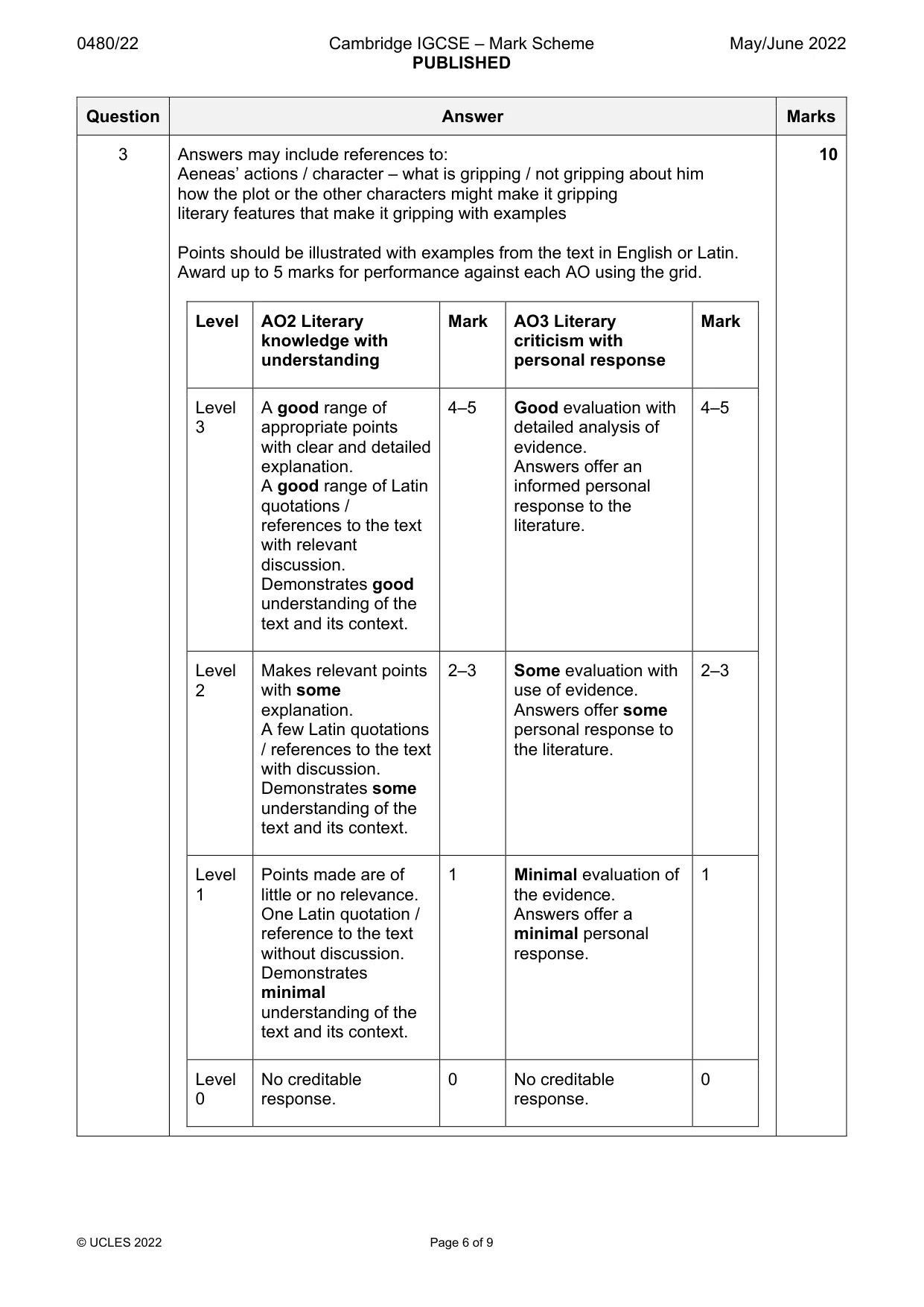
Mark scheme: 3 Answers may include references to: 10 Aeneas’ actions / character – what is gripping / not gripping about him how the plot or the other characters might make it gripping literary features that make it gripping with examples Points should be illustrated with examples from the text in English or Latin. Award up to 5 marks for performance against each AO using the grid. Level AO2 Literary Mark AO3 Literary Mark knowledge with criticism with understanding personal response Level A good range of 4–5 Good evaluation with 4–5 3 appropriate points detailed analysis of with clear and detailed evidence. explanation. Answers offer an A good range of Latin informed personal quotations / response to the references to the text literature. with relevant discussion. Demonstrates good understanding of the text and its context. Level Makes relevant points 2–3 Some evaluation with 2–3 2 with some use of evidence. explanation. Answers offer some A few Latin quotations personal response to / references to the text the literature. with discussion. Demonstrates some understanding of the text and its context. Level Points made are of 1 Minimal evaluation of 1 1 little or no relevance. the evidence. One Latin quotation / Answers offer a reference to the text minimal personal without discussion. response. Demonstrates minimal understanding of the text and its context. Level No creditable 0 No creditable 0 0 response. response.
Q4 · Read the following passage and answer the questions: video cui sit Apulia attributa, quis…
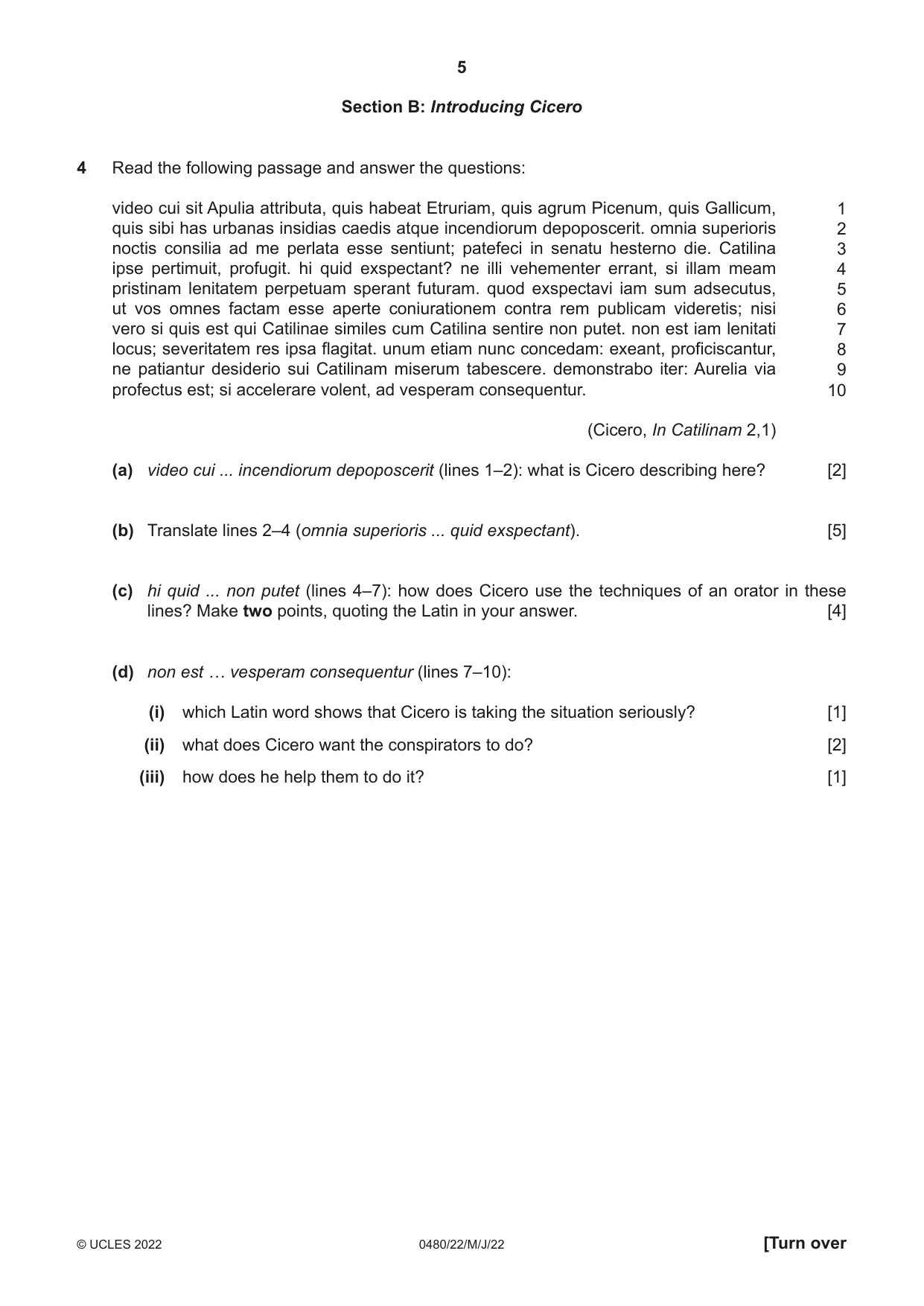
4 Read the following passage and answer the questions: video cui sit Apulia attributa, quis habeat Etruriam, quis agrum Picenum, quis Gallicum, 1 quis sibi has urbanas insidias caedis atque incendiorum depoposcerit. omnia superioris 2 noctis consilia ad me perlata esse sentiunt; patefeci in senatu hesterno die. Catilina 3 ipse pertimuit, profugit. hi quid exspectant? ne illi vehementer errant, si illam meam 4 pristinam lenitatem perpetuam sperant futuram. quod exspectavi iam sum adsecutus, 5 ut vos omnes factam esse aperte coniurationem contra rem publicam videretis; nisi 6 vero si quis est qui Catilinae similes cum Catilina sentire non putet. non est iam lenitati 7 locus; severitatem res ipsa flagitat. unum etiam nunc concedam: exeant, proficiscantur, 8 ne patiantur desiderio sui Catilinam miserum tabescere. demonstrabo iter: Aurelia via 9 profectus est; si accelerare volent, ad vesperam consequentur. 10 (Cicero, In Catilinam 2,1) (a) video cui ... incendiorum depoposcerit (lines 1–2): what is Cicero describing here? [2] (b) Translate lines 2–4 (omnia superioris ... quid exspectant). [5] (c) hi quid ... non putet (lines 4–7): how does Cicero use the techniques of an orator in these lines? Make two points, quoting the Latin in your answer. [4] (d) non est … vesperam consequentur (lines 7–10): (i) which Latin word shows that Cicero is taking the situation seriously? [1] (ii) what does Cicero want the conspirators to do? [2] (iii) how does he help them to do it? [1]
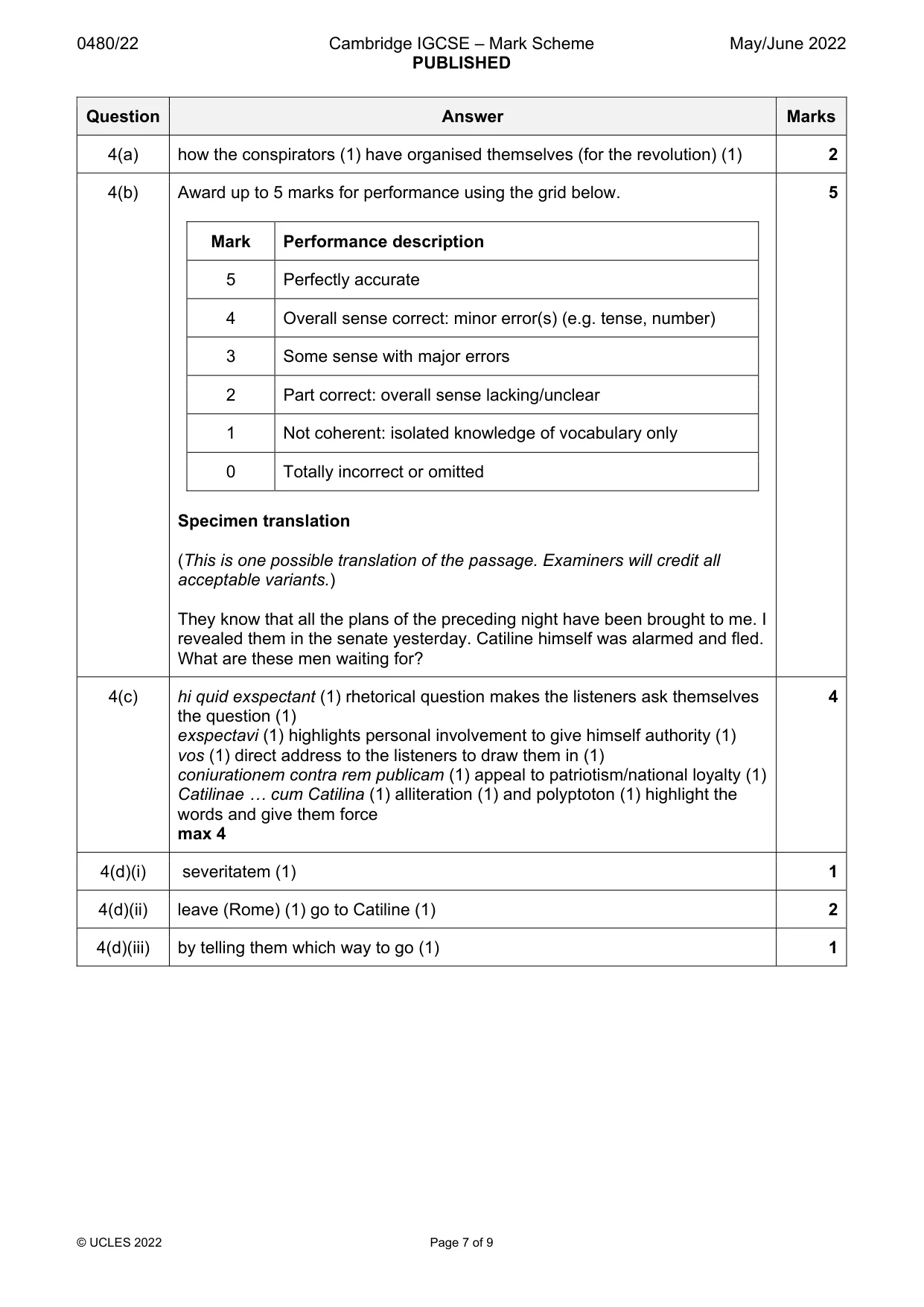
Mark scheme: 4(a) how the conspirators (1) have organised themselves (for the revolution) (1) 2 4(b) Award up to 5 marks for performance using the grid below. 5 Mark Performance description 5 Perfectly accurate 4 Overall sense correct: minor error(s) (e.g. tense, number) 3 Some sense with major errors 2 Part correct: overall sense lacking/unclear 1 Not coherent: isolated knowledge of vocabulary only 0 Totally incorrect or omitted Specimen translation (This is one possible translation of the passage. Examiners will credit all acceptable variants.) They know that all the plans of the preceding night have been brought to me. I revealed them in the senate yesterday. Catiline himself was alarmed and fled. What are these men waiting for? 4(c) hi quid exspectant (1) rhetorical question makes the listeners ask themselves 4 the question (1) exspectavi (1) highlights personal involvement to give himself authority (1) vos (1) direct address to the listeners to draw them in (1) coniurationem contra rem publicam (1) appeal to patriotism/national loyalty (1) Catilinae … cum Catilina (1) alliteration (1) and polyptoton (1) highlight the words and give them force max 4 4(d)(i) severitatem (1) 1 4(d)(ii) leave (Rome) (1) go to Catiline (1) 2 4(d)(iii) by telling them which way to go (1) 1
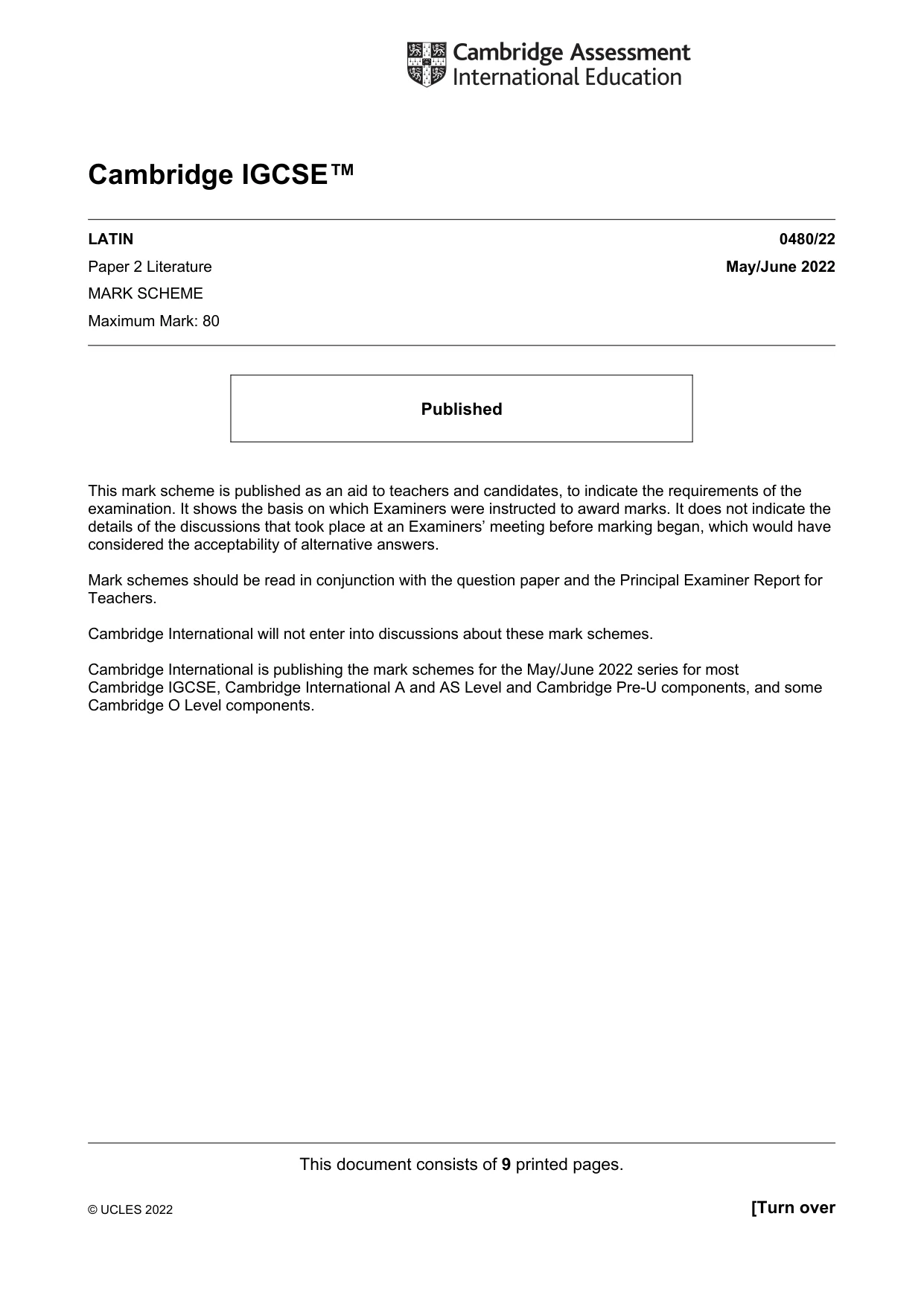
Q5 · Read the following passage and answer the questions: iam vero urbes coloniarum ac…
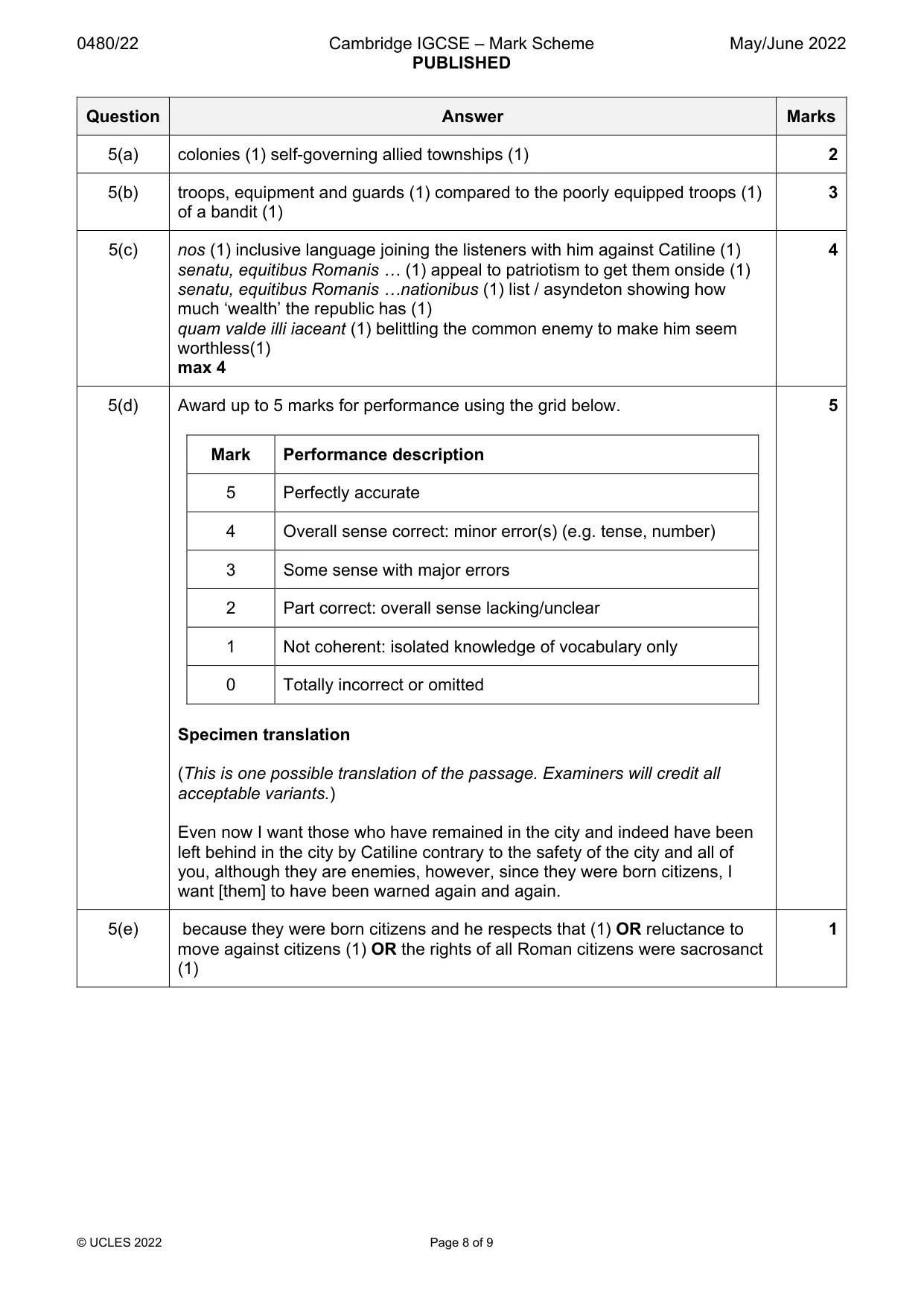
5 Read the following passage and answer the questions: iam vero urbes coloniarum ac municipiorum respondebunt Catilinae tumulis silvestribus. 1 neque ego ceteras copias, ornamenta, praesidia vestra cum illius latronis inopia atque 2 egestate conferre debeo. sed si, omissis his rebus quibus nos suppeditamur, eget ille – 3 senatu, equitibus Romanis, urbe, aerario, vectigalibus, cuncta Italia, provinciis omnibus, 4 exteris nationibus – si his rebus omissis causas ipsas quae inter se confligunt contendere 5 velimus, ex eo ipso quam valde illi iaceant intellegere possumus. nunc illos qui in urbe 6 remanserunt atque adeo qui contra urbis salutem omniumque vestrum in urbe a Catilina 7 relicti sunt, quamquam sunt hostes, tamen, quia nati sunt cives, monitos etiam atque 8 etiam volo. 9 (Cicero, In Catilinam 2, 24–25 and 27) (a) iam vero ... tumulis silvestribus (line 1): from where will troops come to oppose Catiline? [2] (b) neque ego … conferre debeo (lines 2–3): what contrast does Cicero make here? [3] (c) sed si … intellegere possumus (lines 3–6): how does Cicero make his words here persuasive? Make two points, quoting the Latin in your answer. [4] (d) Translate lines 6–9 (nunc illos ... etiam volo). [5] (e) monitos (line 8): why is this course of action towards Catiline’s supporters so important to Cicero? [1]
Mark scheme: 5(a) colonies (1) self-governing allied townships (1) 2 5(b) troops, equipment and guards (1) compared to the poorly equipped troops (1) 3 of a bandit (1) 5(c) nos (1) inclusive language joining the listeners with him against Catiline (1) 4 senatu, equitibus Romanis … (1) appeal to patriotism to get them onside (1) senatu, equitibus Romanis …nationibus (1) list / asyndeton showing how much ‘wealth’ the republic has (1) quam valde illi iaceant (1) belittling the common enemy to make him seem worthless(1) max 4 5(d) Award up to 5 marks for performance using the grid below. 5 Mark Performance description 5 Perfectly accurate 4 Overall sense correct: minor error(s) (e.g. tense, number) 3 Some sense with major errors 2 Part correct: overall sense lacking/unclear 1 Not coherent: isolated knowledge of vocabulary only 0 Totally incorrect or omitted Specimen translation (This is one possible translation of the passage. Examiners will credit all acceptable variants.) Even now I want those who have remained in the city and indeed have been left behind in the city by Catiline contrary to the safety of the city and all of you, although they are enemies, however, since they were born citizens, I want [them] to have been warned again and again. 5(e) because they were born citizens and he respects that (1) OR reluctance to 1 move against citizens (1) OR the rights of all Roman citizens were sacrosanct (1)
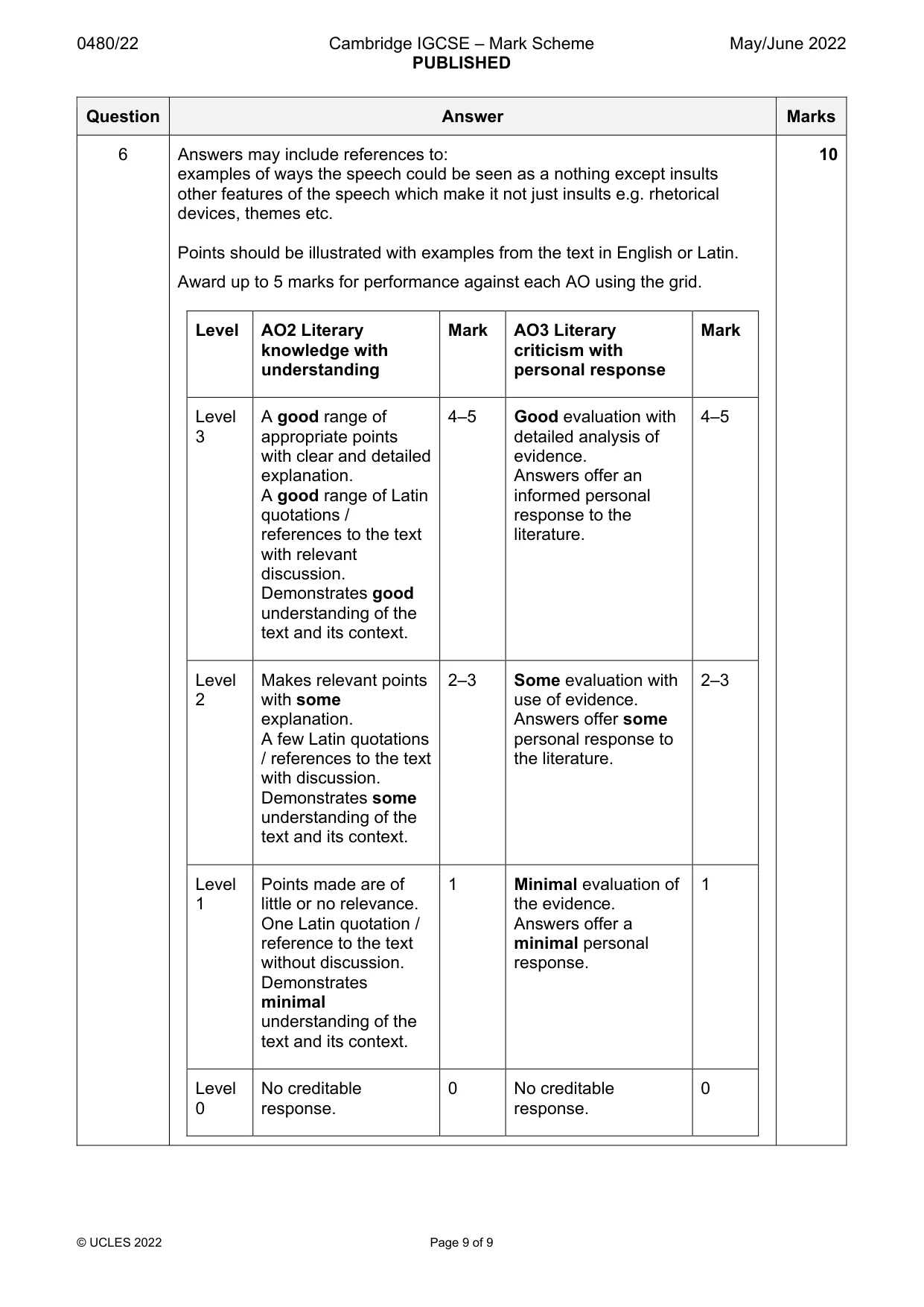
Q6 · ‘Cicero does nothing except insult Catiline.’ How far do you agree with this statement…
6 ‘Cicero does nothing except insult Catiline.’ How far do you agree with this statement about Cicero’s speech against Catiline based on the passages you have studied? Support your answer with reference to the text. You should write at least 100 words. [10]
Mark scheme: 6 Answers may include references to: 10 examples of ways the speech could be seen as a nothing except insults other features of the speech which make it not just insults e.g. rhetorical devices, themes etc. Points should be illustrated with examples from the text in English or Latin. Award up to 5 marks for performance against each AO using the grid. Level AO2 Literary Mark AO3 Literary Mark knowledge with criticism with understanding personal response Level A good range of 4–5 Good evaluation with 4–5 3 appropriate points detailed analysis of with clear and detailed evidence. explanation. Answers offer an A good range of Latin informed personal quotations / response to the references to the text literature. with relevant discussion. Demonstrates good understanding of the text and its context. Level Makes relevant points 2–3 Some evaluation with 2–3 2 with some use of evidence. explanation. Answers offer some A few Latin quotations personal response to / references to the text the literature. with discussion. Demonstrates some understanding of the text and its context. Level Points made are of 1 Minimal evaluation of 1 1 little or no relevance. the evidence. One Latin quotation / Answers offer a reference to the text minimal personal without discussion. response. Demonstrates minimal understanding of the text and its context. Level No creditable 0 No creditable 0 0 response. response.
What you needed in this session
Cambridge’s own grade thresholds for 2022 May/June, Paper 2 · Variant 2. A higher threshold means an easier paper — the bar moves with how the cohort did.