Cambridge IGCSE Latin 0480 — 2019 May/June Paper 2 · Variant 2
0480/22/M/J/19 · 6 questions · 80 marks · ≈90 min
The question paper and its mark scheme, free to read here and free to download. This is Cambridge’s own paper, exactly as it was sat.
Question paper8 pages
Mark scheme10 pages
Answers below. Sit the paper first if you are practising.
Questions as text
Q1 · Read the following passage and answer the questions: atque illi, ut vacuo patuerunt…
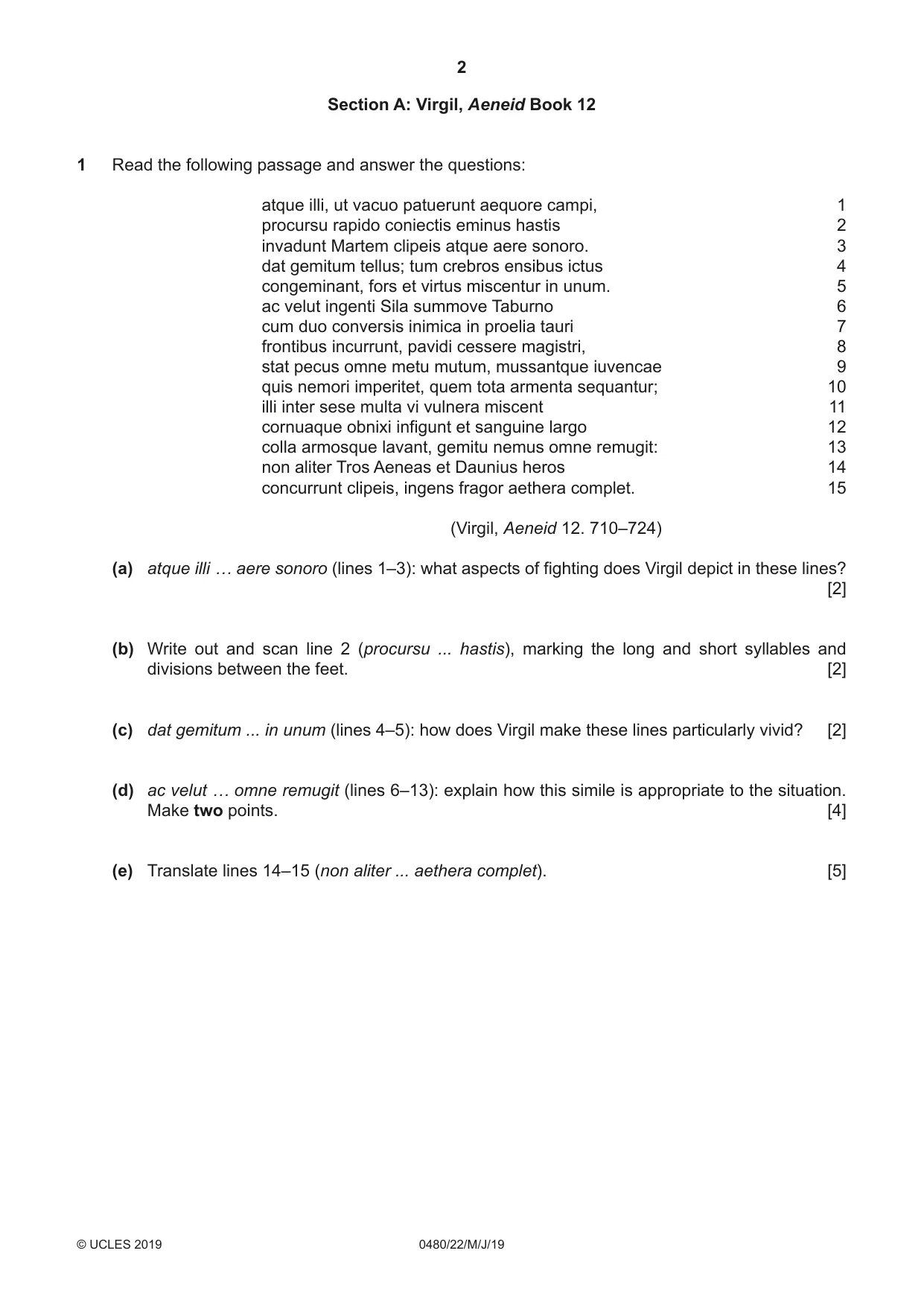
1 Read the following passage and answer the questions: atque illi, ut vacuo patuerunt aequore campi, 1 procursu rapido coniectis eminus hastis 2 invadunt Martem clipeis atque aere sonoro. 3 dat gemitum tellus; tum crebros ensibus ictus 4 congeminant, fors et virtus miscentur in unum. 5 ac velut ingenti Sila summove Taburno 6 cum duo conversis inimica in proelia tauri 7 frontibus incurrunt, pavidi cessere magistri, 8 stat pecus omne metu mutum, mussantque iuvencae 9 quis nemori imperitet, quem tota armenta sequantur; 10 illi inter sese multa vi vulnera miscent 11 cornuaque obnixi infigunt et sanguine largo 12 colla armosque lavant, gemitu nemus omne remugit: 13 non aliter Tros Aeneas et Daunius heros 14 concurrunt clipeis, ingens fragor aethera complet. 15 (Virgil, Aeneid 12. 710–724) (a) atque illi … aere sonoro (lines 1–3): what aspects of fighting does Virgil depict in these lines? [2] (b) Write out and scan line 2 (procursu ... hastis), marking the long and short syllables and divisions between the feet. [2] (c) dat gemitum ... in unum (lines 4–5): how does Virgil make these lines particularly vivid? [2] (d) ac velut … omne remugit (lines 6–13): explain how this simile is appropriate to the situation. Make two points. [4] (e) Translate lines 14–15 (non aliter ... aethera complet). [5]
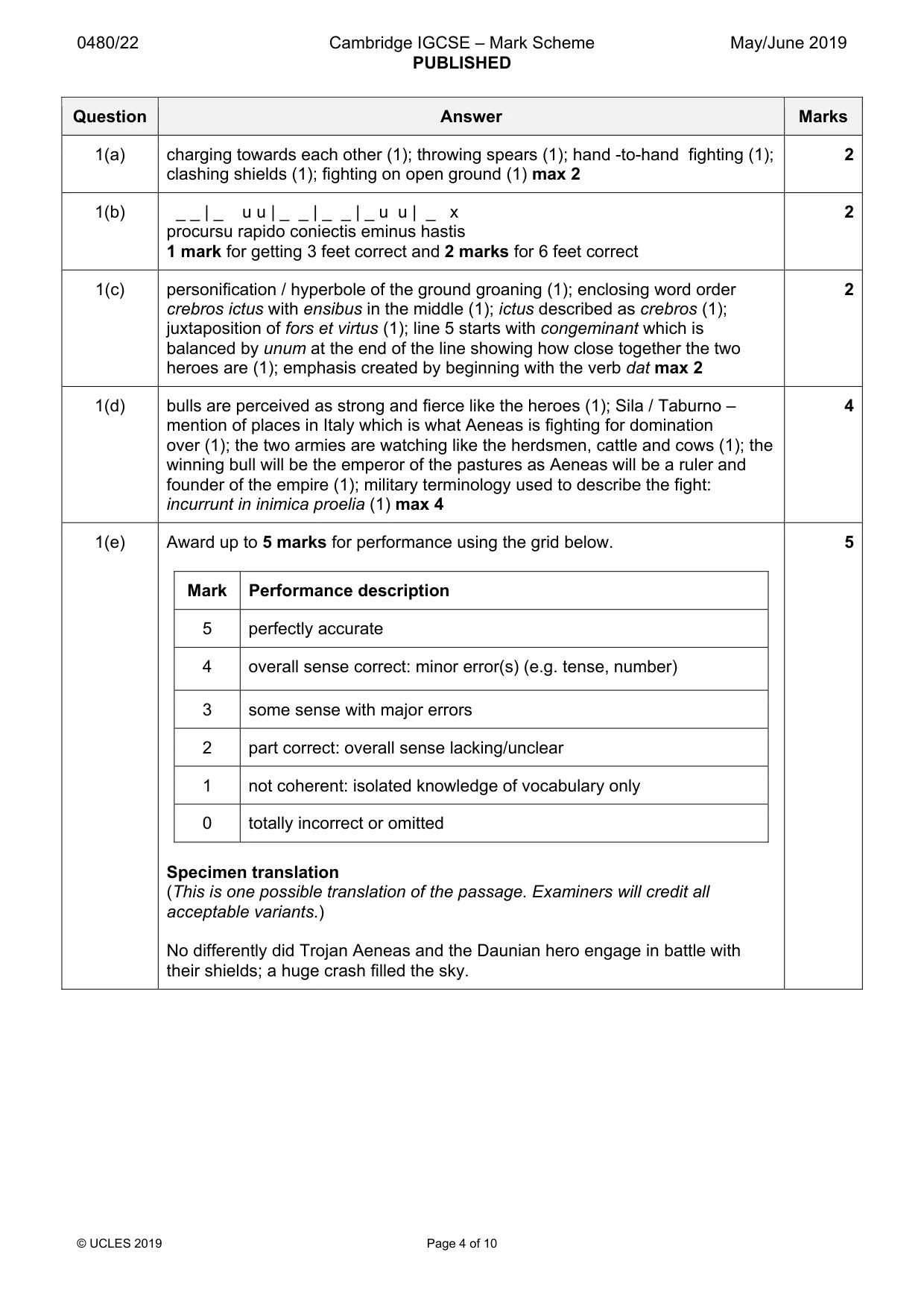
Mark scheme: Question Answer Marks 1(a) charging towards each other (1); throwing spears (1); hand -to-hand fighting (1); 2 clashing shields (1); fighting on open ground (1) max 2 1(b) _ _ | _ u u | _ _ | _ _ | _ u u | _ x 2 procursu rapido coniectis eminus hastis 1 mark for getting 3 feet correct and 2 marks for 6 feet correct 1(c) personification / hyperbole of the ground groaning (1); enclosing word order 2 crebros ictus with ensibus in the middle (1); ictus described as crebros (1); juxtaposition of fors et virtus (1); line 5 starts with congeminant which is balanced by unum at the end of the line showing how close together the two heroes are (1); emphasis created by beginning with the verb dat max 2 1(d) bulls are perceived as strong and fierce like the heroes (1); Sila / Taburno – 4 mention of places in Italy which is what Aeneas is fighting for domination over (1); the two armies are watching like the herdsmen, cattle and cows (1); the winning bull will be the emperor of the pastures as Aeneas will be a ruler and founder of the empire (1); military terminology used to describe the fight: incurrunt in inimica proelia (1) max 4 1(e) Award up to 5 marks for performance using the grid below. 5 Mark Performance description 5 perfectly accurate 4 overall sense correct: minor error(s) (e.g. tense, number) 3 some sense with major errors 2 part correct: overall sense lacking/unclear 1 not coherent: isolated knowledge of vocabulary only 0 totally incorrect or omitted Specimen translation (This is one possible translation of the passage. Examiners will credit all acceptable variants.) No differently did Trojan Aeneas and the Daunian hero engage in battle with their shields; a huge crash filled the sky.
Q2 · Read the following passage and answer the questions: ‘quid nunc te tua, Turne, potest…
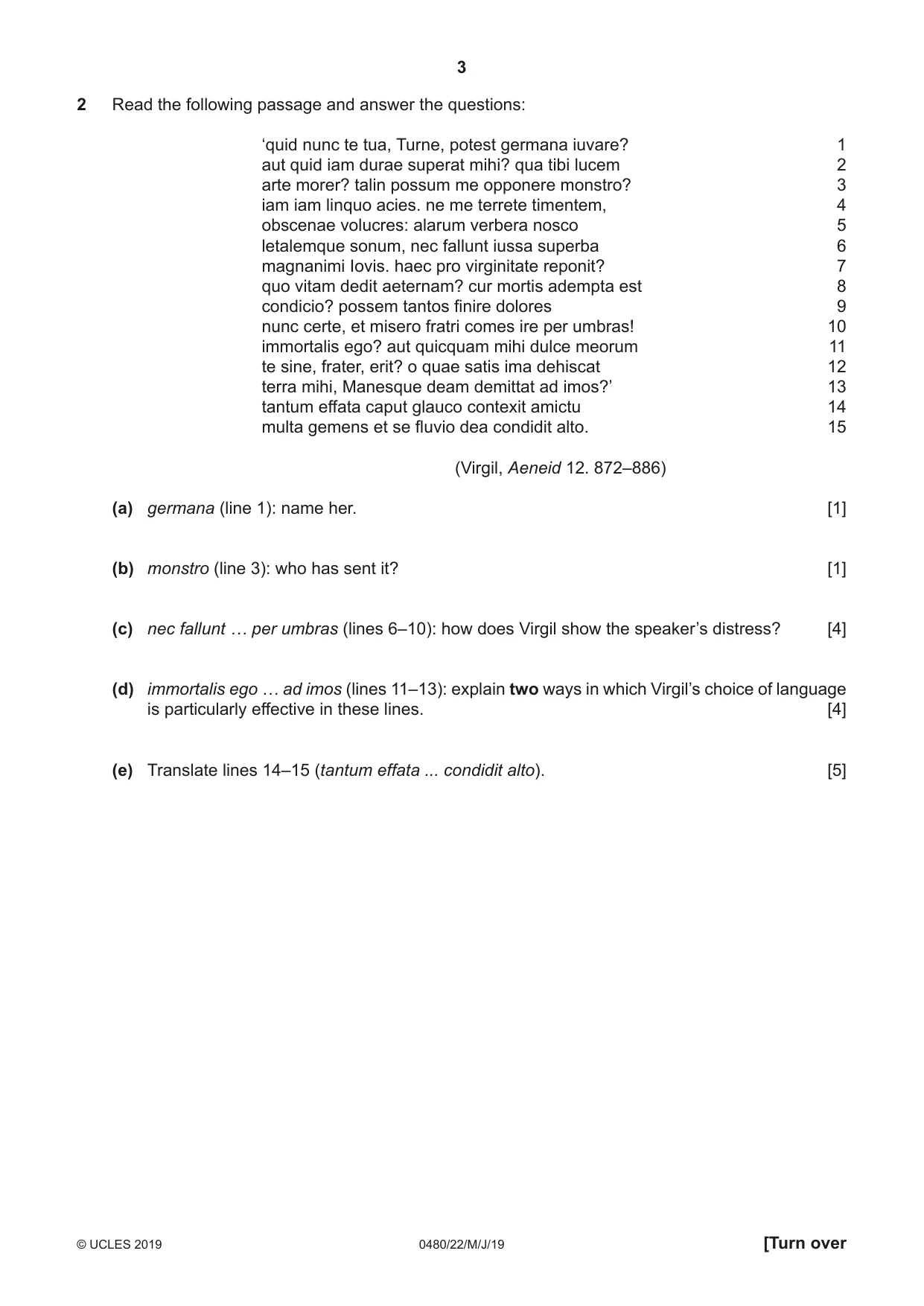
2 Read the following passage and answer the questions: ‘quid nunc te tua, Turne, potest germana iuvare? 1 aut quid iam durae superat mihi? qua tibi lucem 2 arte morer? talin possum me opponere monstro? 3 iam iam linquo acies. ne me terrete timentem, 4 obscenae volucres: alarum verbera nosco 5 letalemque sonum, nec fallunt iussa superba 6 magnanimi Iovis. haec pro virginitate reponit? 7 quo vitam dedit aeternam? cur mortis adempta est 8 condicio? possem tantos finire dolores 9 nunc certe, et misero fratri comes ire per umbras! 10 immortalis ego? aut quicquam mihi dulce meorum 11 te sine, frater, erit? o quae satis ima dehiscat 12 terra mihi, Manesque deam demittat ad imos?’ 13 tantum effata caput glauco contexit amictu 14 multa gemens et se fluvio dea condidit alto. 15 (Virgil, Aeneid 12. 872–886) (a) germana (line 1): name her. [1] (b) monstro (line 3): who has sent it? [1] (c) nec fallunt … per umbras (lines 6–10): how does Virgil show the speaker’s distress? [4] (d) immortalis ego … ad imos (lines 11–13): explain two ways in which Virgil’s choice of language is particularly effective in these lines. [4] (e) Translate lines 14–15 (tantum effata ... condidit alto). [5]
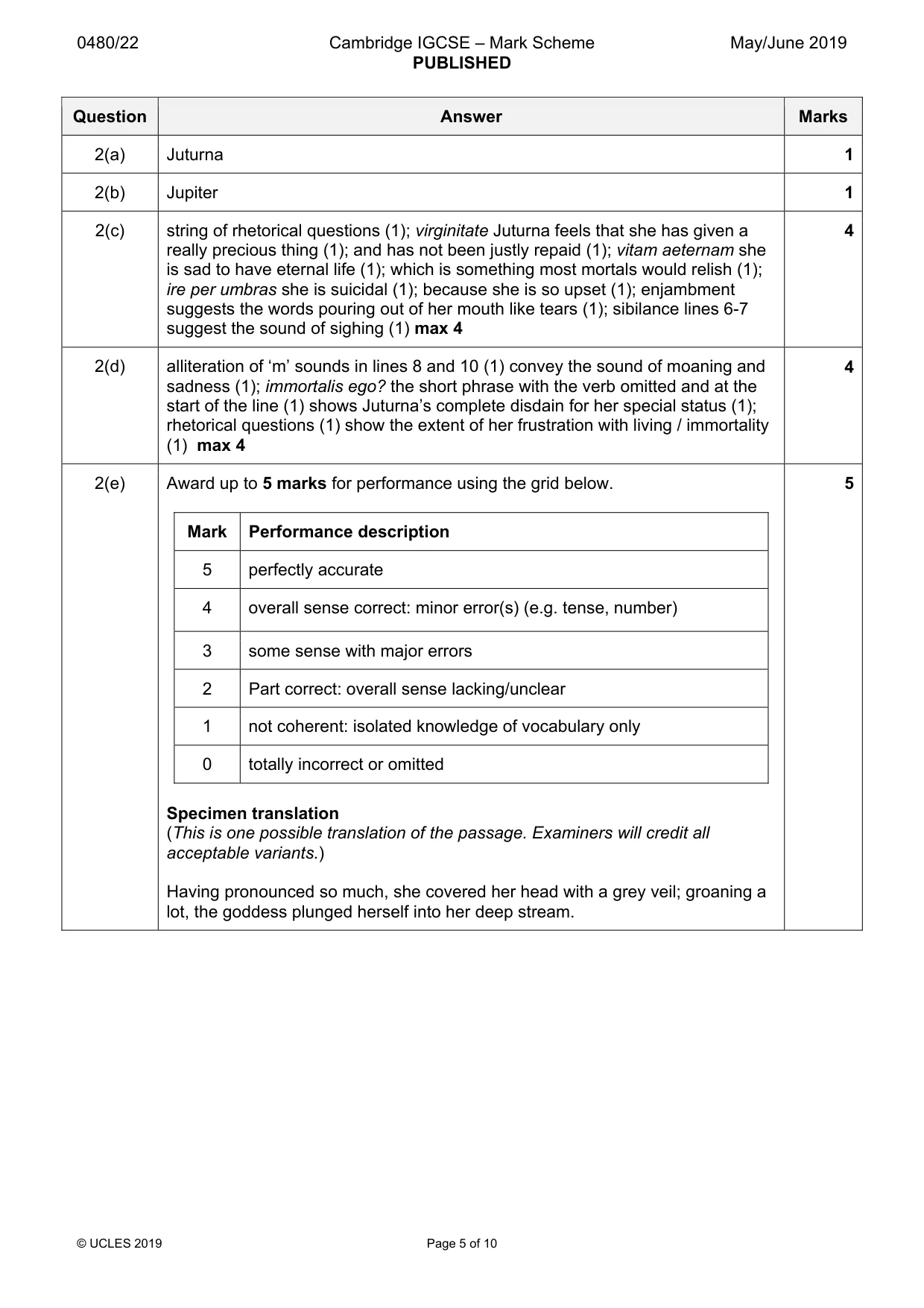
Mark scheme: 2(a) Juturna 1 2(b) Jupiter 1 2(c) string of rhetorical questions (1); virginitate Juturna feels that she has given a 4 really precious thing (1); and has not been justly repaid (1); vitam aeternam she is sad to have eternal life (1); which is something most mortals would relish (1); ire per umbras she is suicidal (1); because she is so upset (1); enjambment suggests the words pouring out of her mouth like tears (1); sibilance lines 6-7 suggest the sound of sighing (1) max 4 2(d) alliteration of ‘m’ sounds in lines 8 and 10 (1) convey the sound of moaning and 4 sadness (1); immortalis ego? the short phrase with the verb omitted and at the start of the line (1) shows Juturna’s complete disdain for her special status (1); rhetorical questions (1) show the extent of her frustration with living / immortality (1) max 4 2(e) Award up to 5 marks for performance using the grid below. 5 Mark Performance description 5 perfectly accurate 4 overall sense correct: minor error(s) (e.g. tense, number) 3 some sense with major errors 2 Part correct: overall sense lacking/unclear 1 not coherent: isolated knowledge of vocabulary only 0 totally incorrect or omitted Specimen translation (This is one possible translation of the passage. Examiners will credit all acceptable variants.) Having pronounced so much, she covered her head with a grey veil; groaning a lot, the goddess plunged herself into her deep stream.
Q3 · ‘The depth of the emotions evoked is what makes Aeneid 12 so interesting.’ How far do you…
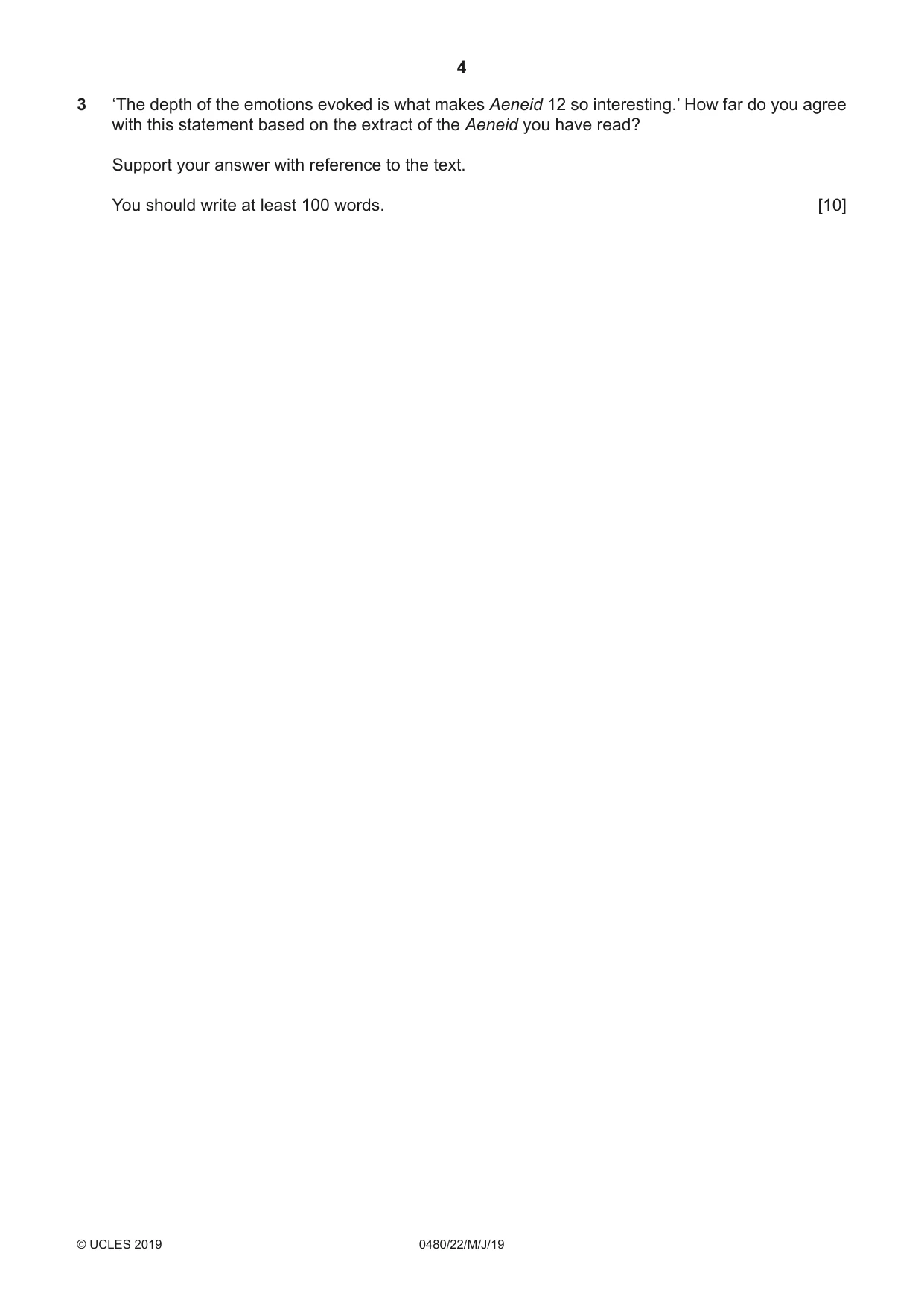
3 ‘The depth of the emotions evoked is what makes Aeneid 12 so interesting.’ How far do you agree with this statement based on the extract of the Aeneid you have read? Support your answer with reference to the text. You should write at least 100 words. [10]
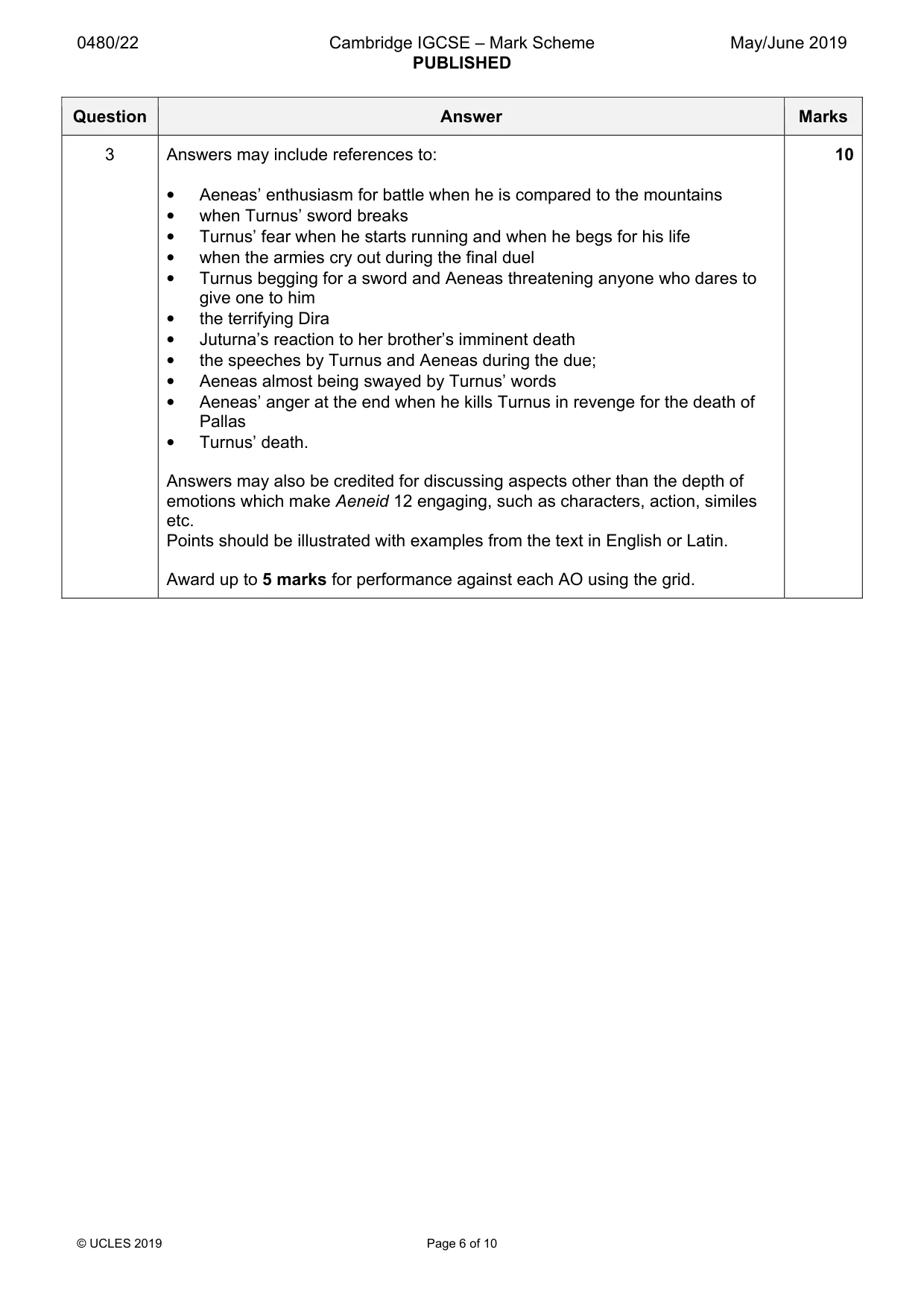
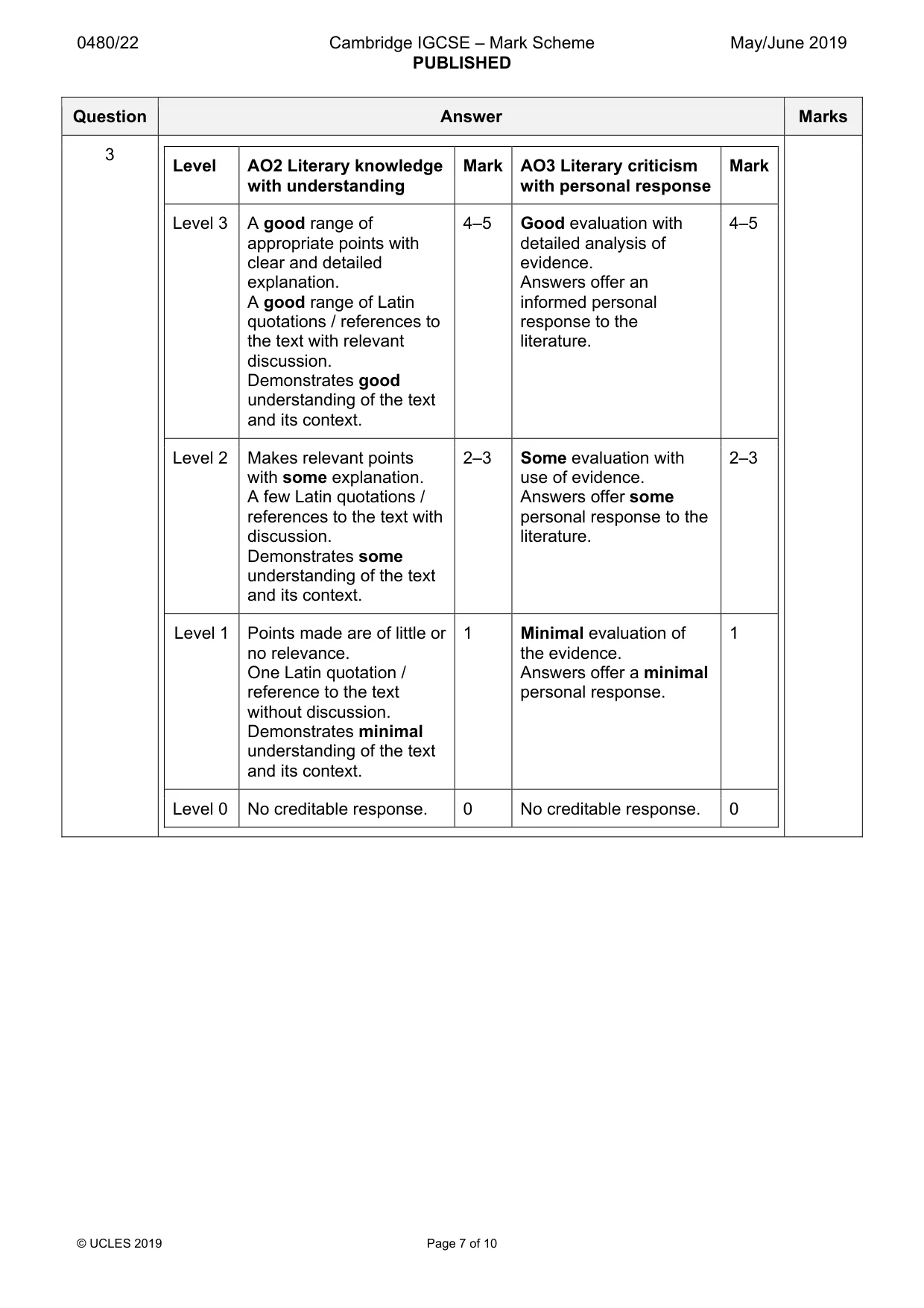
Mark scheme: 3 Answers may include references to: 10 • Aeneas’ enthusiasm for battle when he is compared to the mountains • when Turnus’ sword breaks • Turnus’ fear when he starts running and when he begs for his life • when the armies cry out during the final duel • Turnus begging for a sword and Aeneas threatening anyone who dares to give one to him • the terrifying Dira • Juturna’s reaction to her brother’s imminent death • the speeches by Turnus and Aeneas during the due; • Aeneas almost being swayed by Turnus’ words • Aeneas’ anger at the end when he kills Turnus in revenge for the death of Pallas • Turnus’ death. Answers may also be credited for discussing aspects other than the depth of emotions which make Aeneid 12 engaging, such as characters, action, similes etc. Points should be illustrated with examples from the text in English or Latin. Award up to 5 marks for performance against each AO using the grid. 3 Level AO2 Literary knowledge Mark AO3 Literary criticism Mark with understanding with personal response Level 3 A good range of 4–5 Good evaluation with 4–5 appropriate points with detailed analysis of clear and detailed evidence. explanation. Answers offer an A good range of Latin informed personal quotations / references to response to the the text with relevant literature. discussion. Demonstrates good understanding of the text and its context. Level 2 Makes relevant points 2–3 Some evaluation with 2–3 with some explanation. use of evidence. A few Latin quotations / Answers offer some references to the text with personal response to the discussion. literature. Demonstrates some understanding of the text and its context. Level 1 Points made are of little or 1 Minimal evaluation of 1 no relevance. the evidence. One Latin quotation / Answers offer a minimal reference to the text personal response. without discussion. Demonstrates minimal understanding of the text and its context. Level 0 No creditable response. 0 No creditable response. 0
Q4 · Read the following passage and answer the questions: Idibus Septembribus in Laterio fui
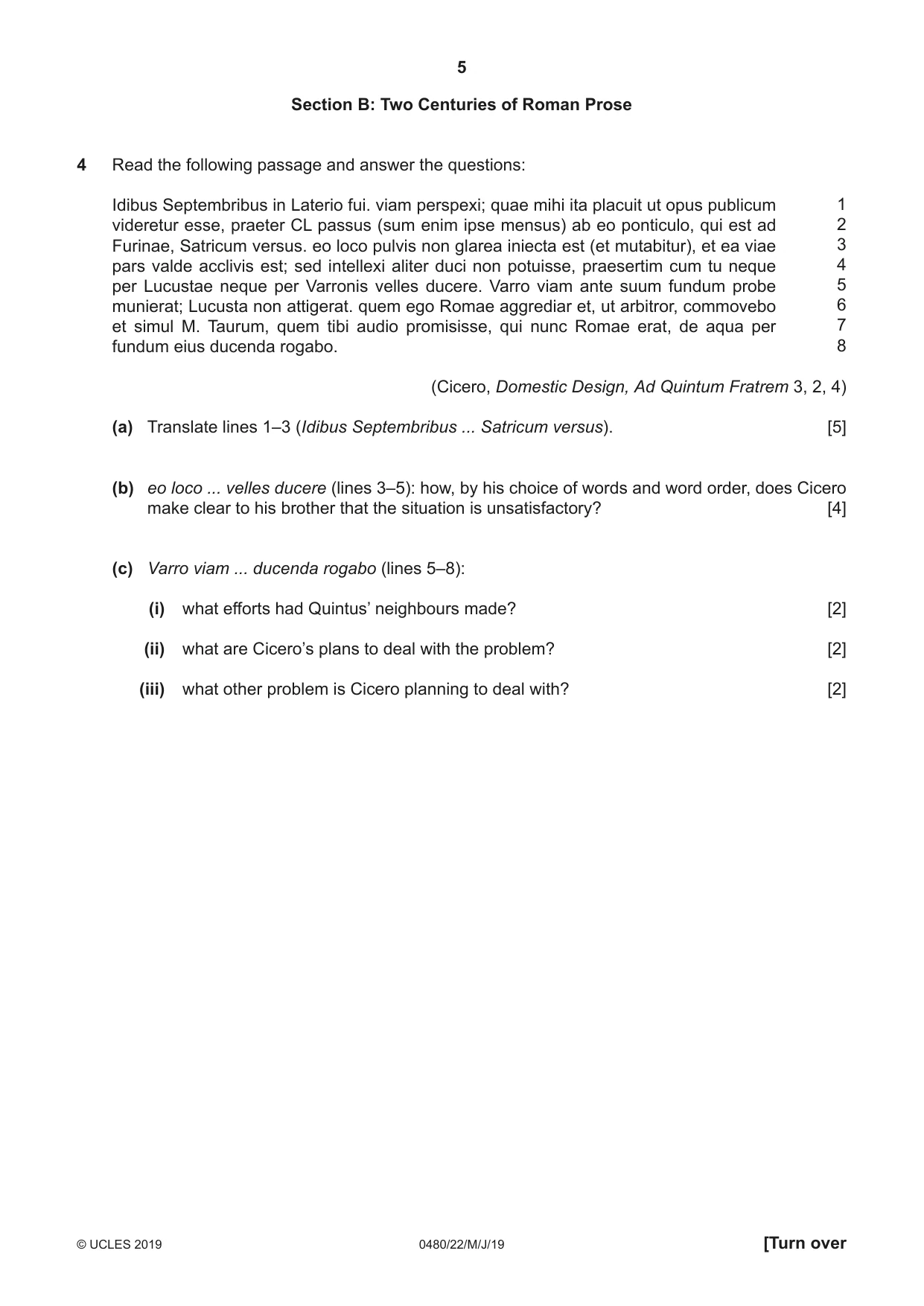
4 Read the following passage and answer the questions: Idibus Septembribus in Laterio fui. viam perspexi; quae mihi ita placuit ut opus publicum 1 videretur esse, praeter CL passus (sum enim ipse mensus) ab eo ponticulo, qui est ad 2 Furinae, Satricum versus. eo loco pulvis non glarea iniecta est (et mutabitur), et ea viae 3 pars valde acclivis est; sed intellexi aliter duci non potuisse, praesertim cum tu neque 4 per Lucustae neque per Varronis velles ducere. Varro viam ante suum fundum probe 5 munierat; Lucusta non attigerat. quem ego Romae aggrediar et, ut arbitror, commovebo 6 et simul M. Taurum, quem tibi audio promisisse, qui nunc Romae erat, de aqua per 7 fundum eius ducenda rogabo. 8 (Cicero, Domestic Design, Ad Quintum Fratrem 3, 2, 4) (a) Translate lines 1–3 (Idibus Septembribus ... Satricum versus). [5] (b) eo loco ... velles ducere (lines 3–5): how, by his choice of words and word order, does Cicero make clear to his brother that the situation is unsatisfactory? [4] (c) Varro viam ... ducenda rogabo (lines 5–8): (i) what efforts had Quintus’ neighbours made? [2] (ii) what are Cicero’s plans to deal with the problem? [2] (iii) what other problem is Cicero planning to deal with? [2]
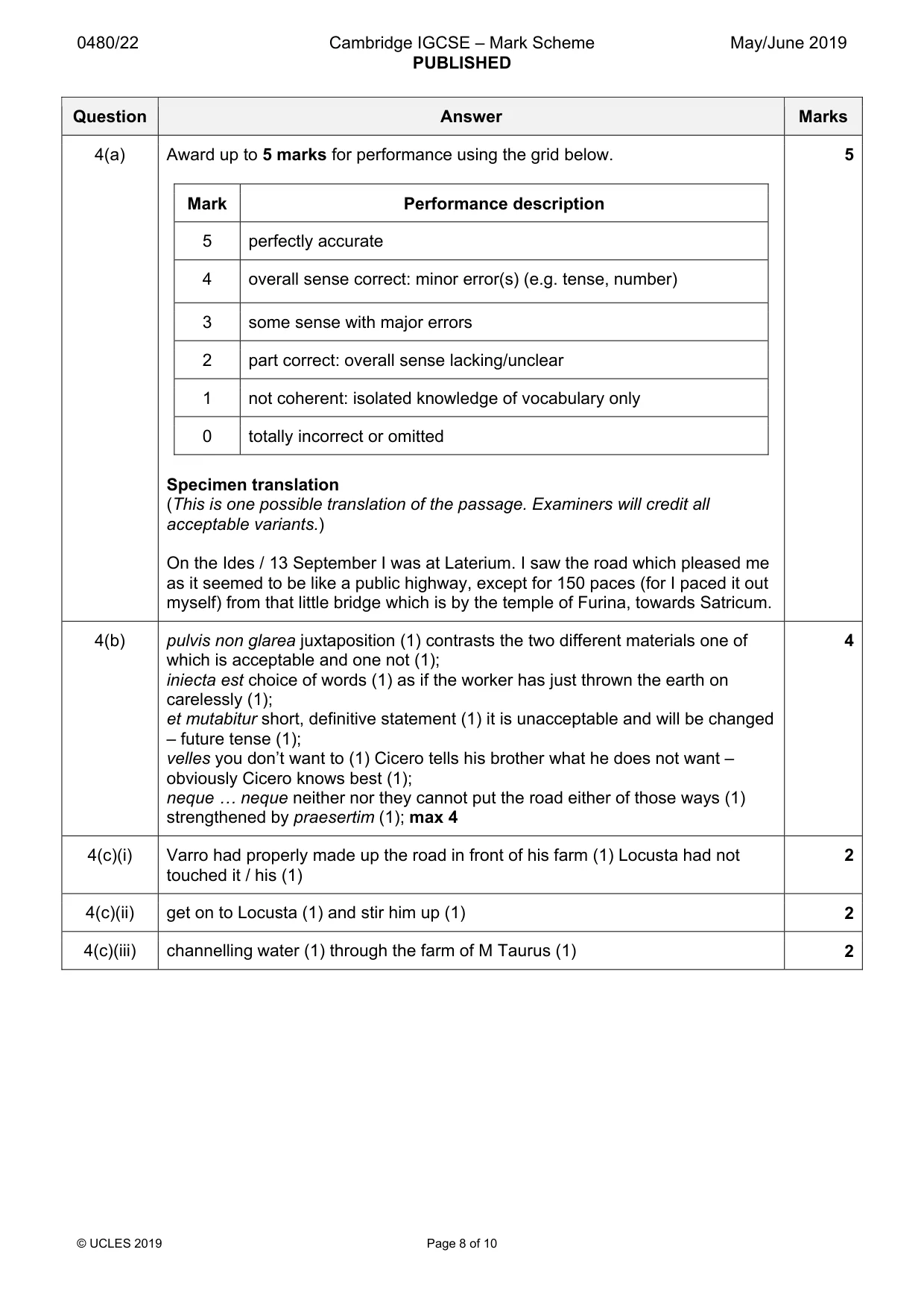
Mark scheme: 4(a) Award up to 5 marks for performance using the grid below. 5 Mark Performance description 5 perfectly accurate 4 overall sense correct: minor error(s) (e.g. tense, number) 3 some sense with major errors 2 part correct: overall sense lacking/unclear 1 not coherent: isolated knowledge of vocabulary only 0 totally incorrect or omitted Specimen translation (This is one possible translation of the passage. Examiners will credit all acceptable variants.) On the Ides / 13 September I was at Laterium. I saw the road which pleased me as it seemed to be like a public highway, except for 150 paces (for I paced it out myself) from that little bridge which is by the temple of Furina, towards Satricum. 4(b) pulvis non glarea juxtaposition (1) contrasts the two different materials one of 4 which is acceptable and one not (1); iniecta est choice of words (1) as if the worker has just thrown the earth on carelessly (1); et mutabitur short, definitive statement (1) it is unacceptable and will be changed – future tense (1); velles you don’t want to (1) Cicero tells his brother what he does not want – obviously Cicero knows best (1); neque « neque neither nor they cannot put the road either of those ways (1) strengthened by praesertim (1); max 4 4(c)(i) Varro had properly made up the road in front of his farm (1) Locusta had not 2 touched it / his (1) 4(c)(ii) get on to Locusta (1) and stir him up (1) 2 4(c)(iii) channelling water (1) through the farm of M Taurus (1) 2
Q5 · Read the following passage and answer the questions: ad Curium vero, suavissimum hominem…
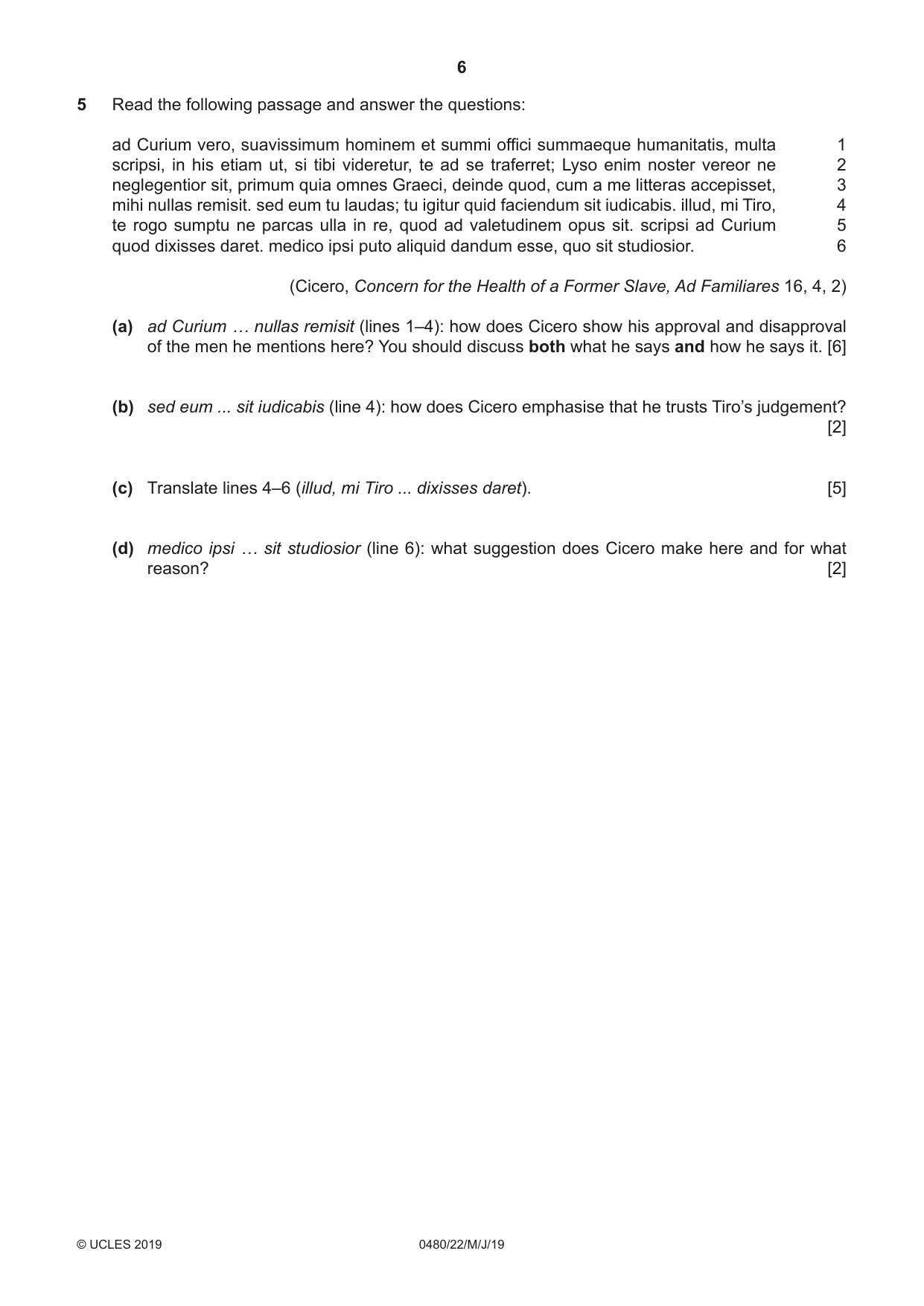
5 Read the following passage and answer the questions: ad Curium vero, suavissimum hominem et summi offici summaeque humanitatis, multa 1 scripsi, in his etiam ut, si tibi videretur, te ad se traferret; Lyso enim noster vereor ne 2 neglegentior sit, primum quia omnes Graeci, deinde quod, cum a me litteras accepisset, 3 mihi nullas remisit. sed eum tu laudas; tu igitur quid faciendum sit iudicabis. illud, mi Tiro, 4 te rogo sumptu ne parcas ulla in re, quod ad valetudinem opus sit. scripsi ad Curium 5 quod dixisses daret. medico ipsi puto aliquid dandum esse, quo sit studiosior. 6 (Cicero, Concern for the Health of a Former Slave, Ad Familiares 16, 4, 2) (a) ad Curium … nullas remisit (lines 1–4): how does Cicero show his approval and disapproval of the men he mentions here? You should discuss both what he says and how he says it. [6] (b) sed eum ... sit iudicabis (line 4): how does Cicero emphasise that he trusts Tiro’s judgement? [2] (c) Translate lines 4–6 (illud, mi Tiro ... dixisses daret). [5] (d) medico ipsi … sit studiosior (line 6): what suggestion does Cicero make here and for what reason? [2]
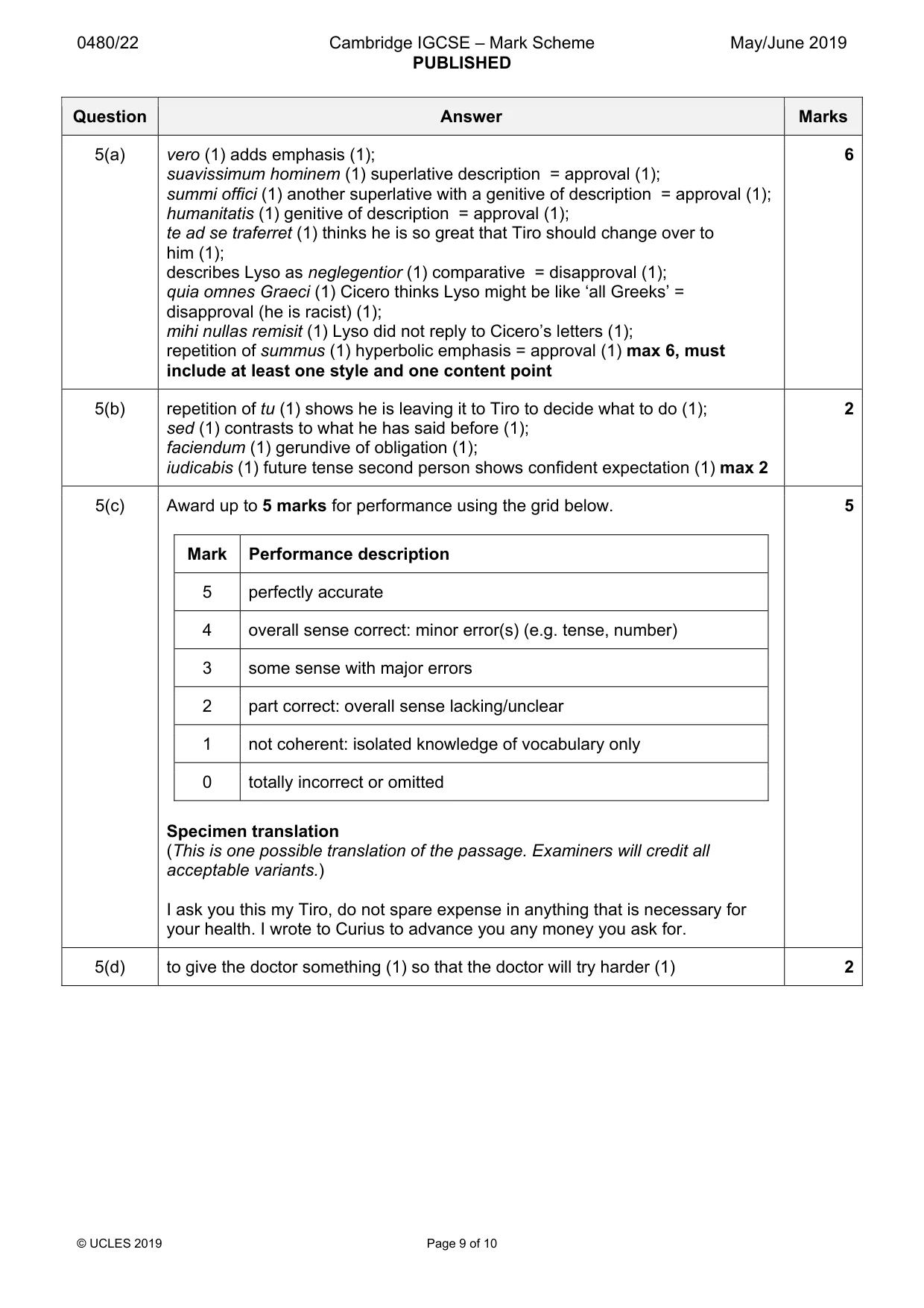
Mark scheme: 5(a) vero (1) adds emphasis (1); 6 suavissimum hominem (1) superlative description = approval (1); summi offici (1) another superlative with a genitive of description = approval (1); humanitatis (1) genitive of description = approval (1); te ad se traferret (1) thinks he is so great that Tiro should change over to him (1); describes Lyso as neglegentior (1) comparative = disapproval (1); quia omnes Graeci (1) Cicero thinks Lyso might be like ‘all Greeks’ = disapproval (he is racist) (1); mihi nullas remisit (1) Lyso did not reply to Cicero’s letters (1); repetition of summus (1) hyperbolic emphasis = approval (1) max 6, must include at least one style and one content point 5(b) repetition of tu (1) shows he is leaving it to Tiro to decide what to do (1); 2 sed (1) contrasts to what he has said before (1); faciendum (1) gerundive of obligation (1); iudicabis (1) future tense second person shows confident expectation (1) max 2 5(c) Award up to 5 marks for performance using the grid below. 5 Mark Performance description 5 perfectly accurate 4 overall sense correct: minor error(s) (e.g. tense, number) 3 some sense with major errors 2 part correct: overall sense lacking/unclear 1 not coherent: isolated knowledge of vocabulary only 0 totally incorrect or omitted Specimen translation (This is one possible translation of the passage. Examiners will credit all acceptable variants.) I ask you this my Tiro, do not spare expense in anything that is necessary for your health. I wrote to Curius to advance you any money you ask for. 5(d) to give the doctor something (1) so that the doctor will try harder (1) 2
Q6 · ‘The beauty of Cicero’s prose lifts any subject matter to the level of great literature.’…
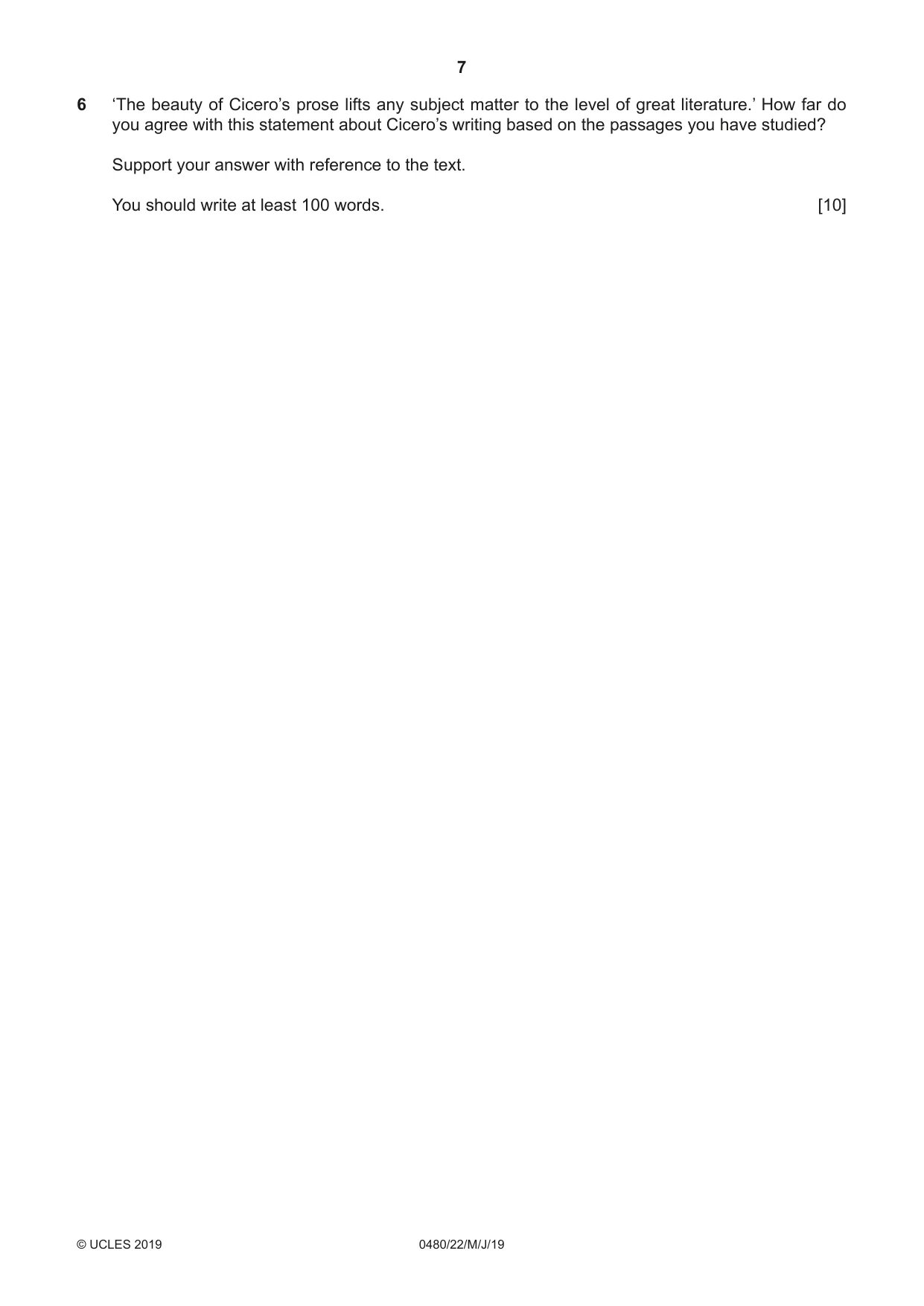
6 ‘The beauty of Cicero’s prose lifts any subject matter to the level of great literature.’ How far do you agree with this statement about Cicero’s writing based on the passages you have studied? Support your answer with reference to the text. You should write at least 100 words. [10]
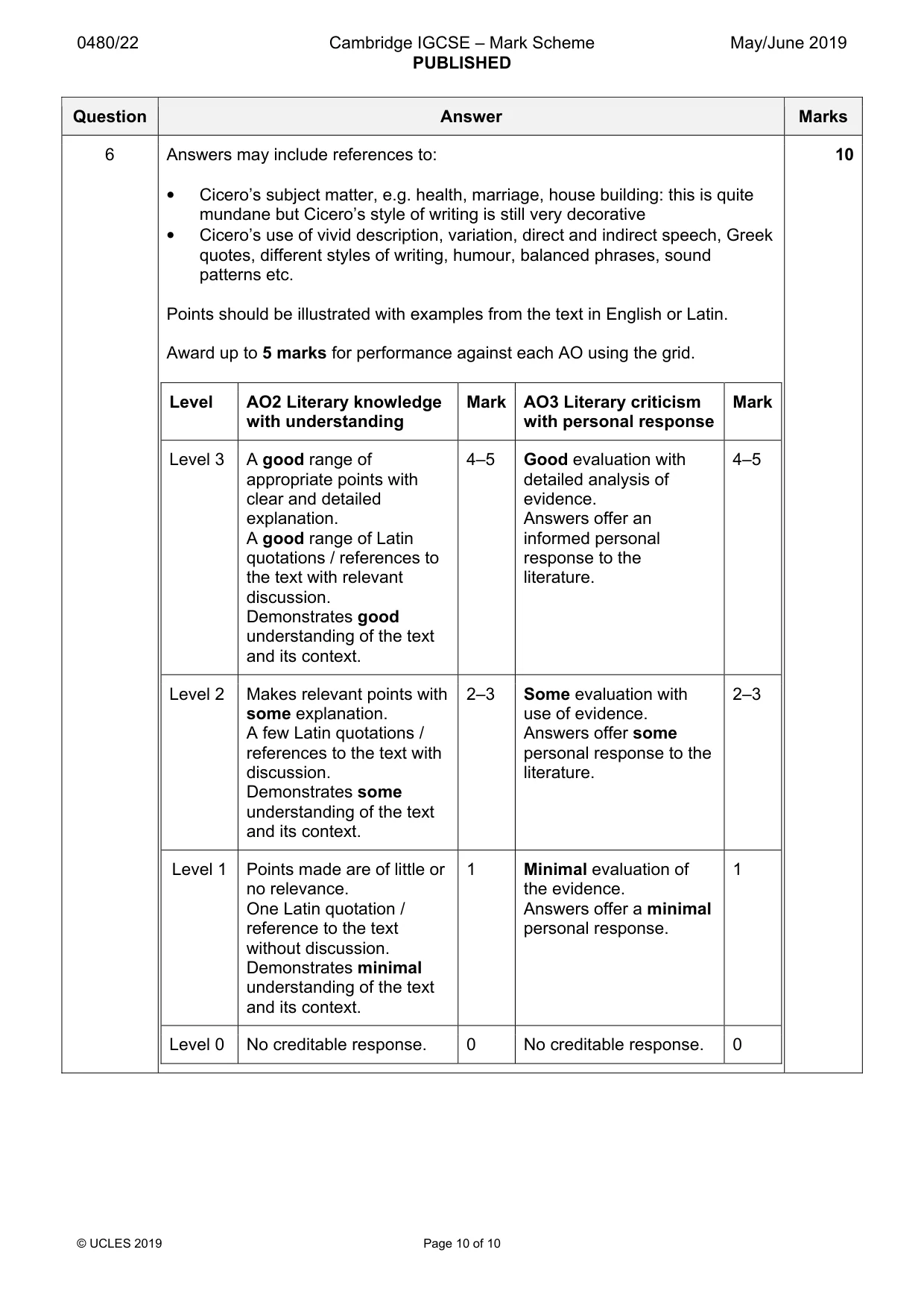
Mark scheme: 6 Answers may include references to: 10 • Cicero’s subject matter, e.g. health, marriage, house building: this is quite mundane but Cicero’s style of writing is still very decorative • Cicero’s use of vivid description, variation, direct and indirect speech, Greek quotes, different styles of writing, humour, balanced phrases, sound patterns etc. Points should be illustrated with examples from the text in English or Latin. Award up to 5 marks for performance against each AO using the grid. Level AO2 Literary knowledge Mark AO3 Literary criticism Mark with understanding with personal response Level 3 A good range of 4–5 Good evaluation with 4–5 appropriate points with detailed analysis of clear and detailed evidence. explanation. Answers offer an A good range of Latin informed personal quotations / references to response to the the text with relevant literature. discussion. Demonstrates good understanding of the text and its context. Level 2 Makes relevant points with 2–3 Some evaluation with 2–3 some explanation. use of evidence. A few Latin quotations / Answers offer some references to the text with personal response to the discussion. literature. Demonstrates some understanding of the text and its context. Level 1 Points made are of little or 1 Minimal evaluation of 1 no relevance. the evidence. One Latin quotation / Answers offer a minimal reference to the text personal response. without discussion. Demonstrates minimal understanding of the text and its context. Level 0 No creditable response. 0 No creditable response. 0
What you needed in this session
Cambridge’s own grade thresholds for 2019 May/June, Paper 2 · Variant 2. A higher threshold means an easier paper — the bar moves with how the cohort did.