Cambridge IGCSE Latin 0480 — 2021 May/June Paper 2 · Variant 2
0480/22/M/J/21 · 6 questions · 80 marks · ≈90 min
The question paper and its mark scheme, free to read here and free to download. This is Cambridge’s own paper, exactly as it was sat.
Question paper8 pages


Mark scheme10 pages
Answers below. Sit the paper first if you are practising.
Questions as text
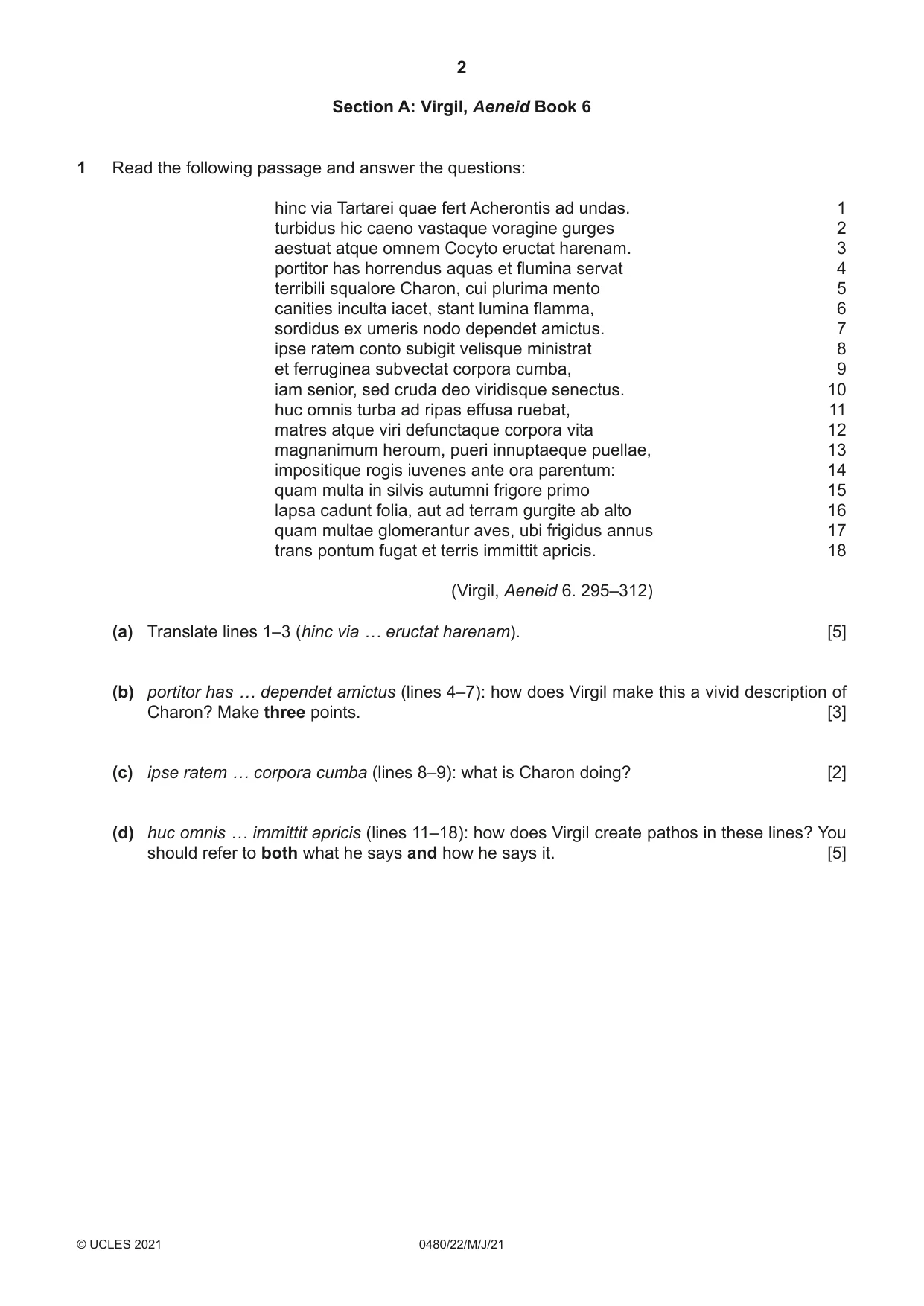
Q1 · Read the following passage and answer the questions: hinc via Tartarei quae fert…
1 Read the following passage and answer the questions: hinc via Tartarei quae fert Acherontis ad undas. 1 turbidus hic caeno vastaque voragine gurges 2 aestuat atque omnem Cocyto eructat harenam. 3 portitor has horrendus aquas et flumina servat 4 terribili squalore Charon, cui plurima mento 5 canities inculta iacet, stant lumina flamma, 6 sordidus ex umeris nodo dependet amictus. 7 ipse ratem conto subigit velisque ministrat 8 et ferruginea subvectat corpora cumba, 9 iam senior, sed cruda deo viridisque senectus. 10 huc omnis turba ad ripas effusa ruebat, 11 matres atque viri defunctaque corpora vita 12 magnanimum heroum, pueri innuptaeque puellae, 13 impositique rogis iuvenes ante ora parentum: 14 quam multa in silvis autumni frigore primo 15 lapsa cadunt folia, aut ad terram gurgite ab alto 16 quam multae glomerantur aves, ubi frigidus annus 17 trans pontum fugat et terris immittit apricis. 18 (Virgil, Aeneid 6. 295–312) (a) Translate lines 1–3 (hinc via … eructat harenam). [5] (b) portitor has … dependet amictus (lines 4–7): how does Virgil make this a vivid description of Charon? Make three points. [3] (c) ipse ratem … corpora cumba (lines 8–9): what is Charon doing? [2] (d) huc omnis … immittit apricis (lines 11–18): how does Virgil create pathos in these lines? You should refer to both what he says and how he says it. [5]
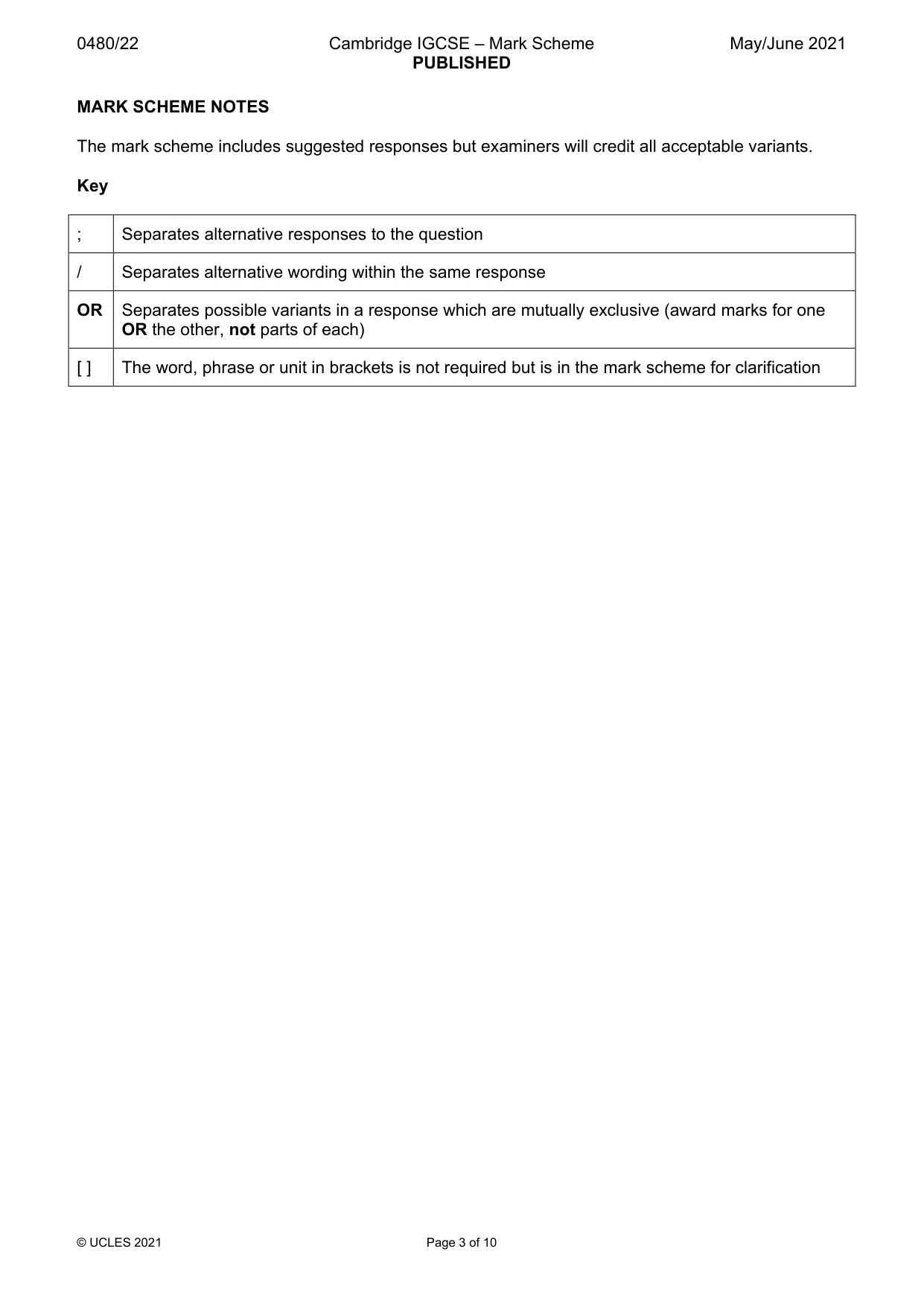
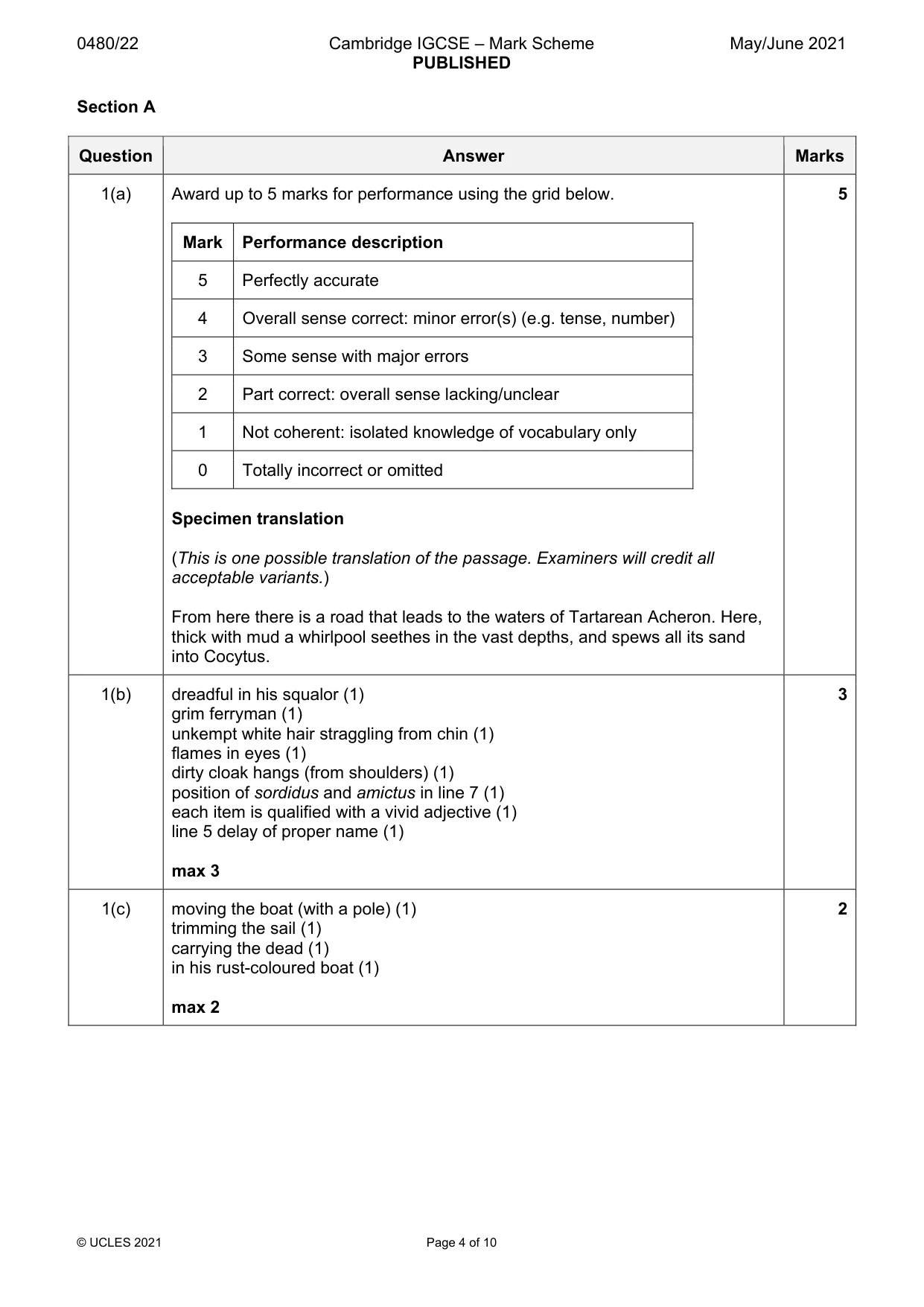
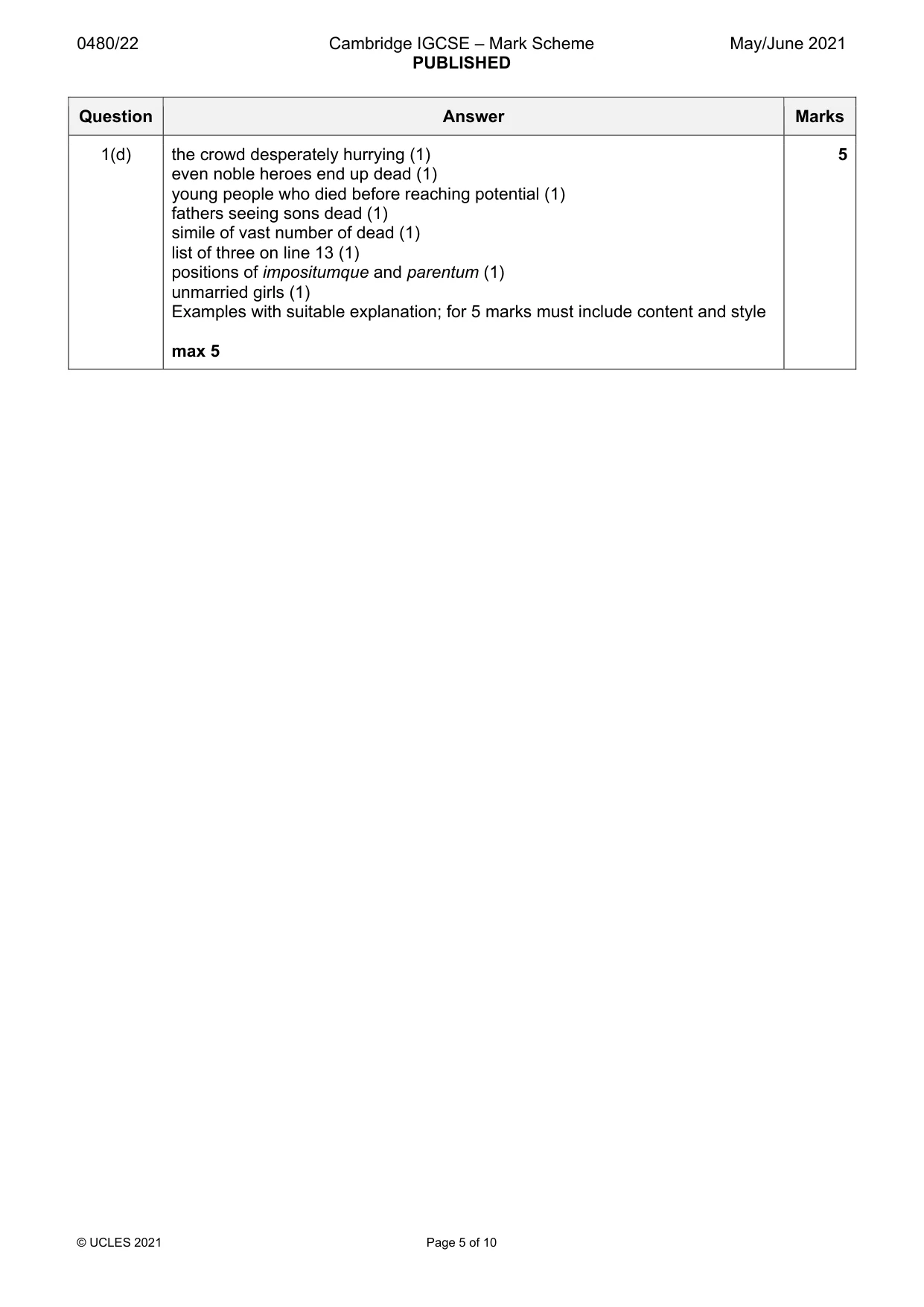
Mark scheme: Question Answer Marks 1(a) Award up to 5 marks for performance using the grid below. 5 Mark Performance description 5 Perfectly accurate 4 Overall sense correct: minor error(s) (e.g. tense, number) 3 Some sense with major errors 2 Part correct: overall sense lacking/unclear 1 Not coherent: isolated knowledge of vocabulary only 0 Totally incorrect or omitted Specimen translation (This is one possible translation of the passage. Examiners will credit all acceptable variants.) From here there is a road that leads to the waters of Tartarean Acheron. Here, thick with mud a whirlpool seethes in the vast depths, and spews all its sand into Cocytus. 1(b) dreadful in his squalor (1) 3 grim ferryman (1) unkempt white hair straggling from chin (1) flames in eyes (1) dirty cloak hangs (from shoulders) (1) position of sordidus and amictus in line 7 (1) each item is qualified with a vivid adjective (1) line 5 delay of proper name (1) max 3 1(c) moving the boat (with a pole) (1) 2 trimming the sail (1) carrying the dead (1) in his rust-coloured boat (1) max 2 1(d) the crowd desperately hurrying (1) 5 even noble heroes end up dead (1) young people who died before reaching potential (1) fathers seeing sons dead (1) simile of vast number of dead (1) list of three on line 13 (1) positions of impositumque and parentum (1) unmarried girls (1) Examples with suitable explanation; for 5 marks must include content and style max 5
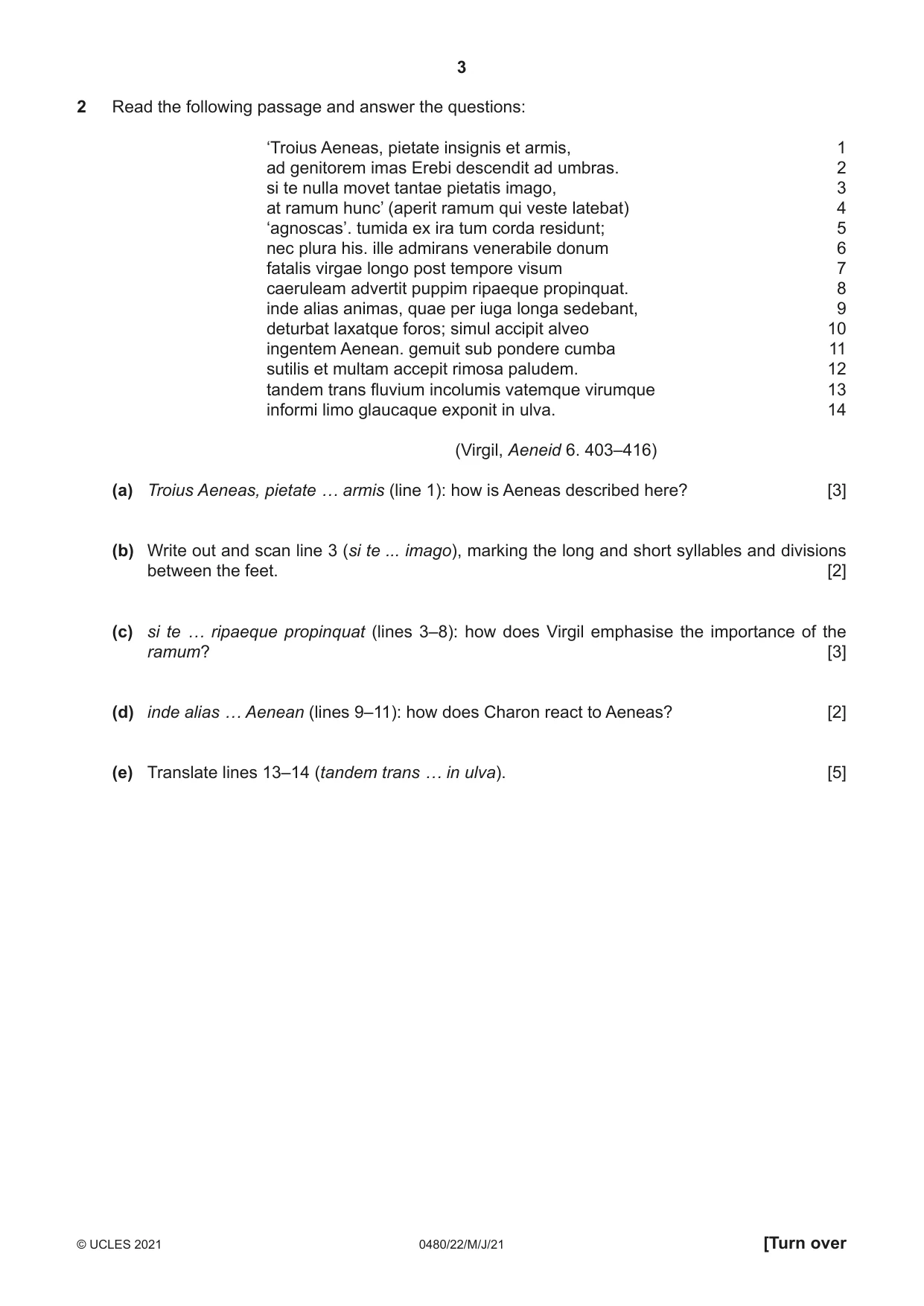
Q2 · Read the following passage and answer the questions: ‘Troius Aeneas, pietate insignis et…
2 Read the following passage and answer the questions: ‘Troius Aeneas, pietate insignis et armis, 1 ad genitorem imas Erebi descendit ad umbras. 2 si te nulla movet tantae pietatis imago, 3 at ramum hunc’ (aperit ramum qui veste latebat) 4 ‘agnoscas’. tumida ex ira tum corda residunt; 5 nec plura his. ille admirans venerabile donum 6 fatalis virgae longo post tempore visum 7 caeruleam advertit puppim ripaeque propinquat. 8 inde alias animas, quae per iuga longa sedebant, 9 deturbat laxatque foros; simul accipit alveo 10 ingentem Aenean. gemuit sub pondere cumba 11 sutilis et multam accepit rimosa paludem. 12 tandem trans fluvium incolumis vatemque virumque 13 informi limo glaucaque exponit in ulva. 14 (Virgil, Aeneid 6. 403–416) (a) Troius Aeneas, pietate … armis (line 1): how is Aeneas described here? [3] (b) Write out and scan line 3 (si te ... imago), marking the long and short syllables and divisions between the feet. [2] (c) si te … ripaeque propinquat (lines 3–8): how does Virgil emphasise the importance of the ramum? [3] (d) inde alias … Aenean (lines 9–11): how does Charon react to Aeneas? [2] (e) Translate lines 13–14 (tandem trans … in ulva). [5]
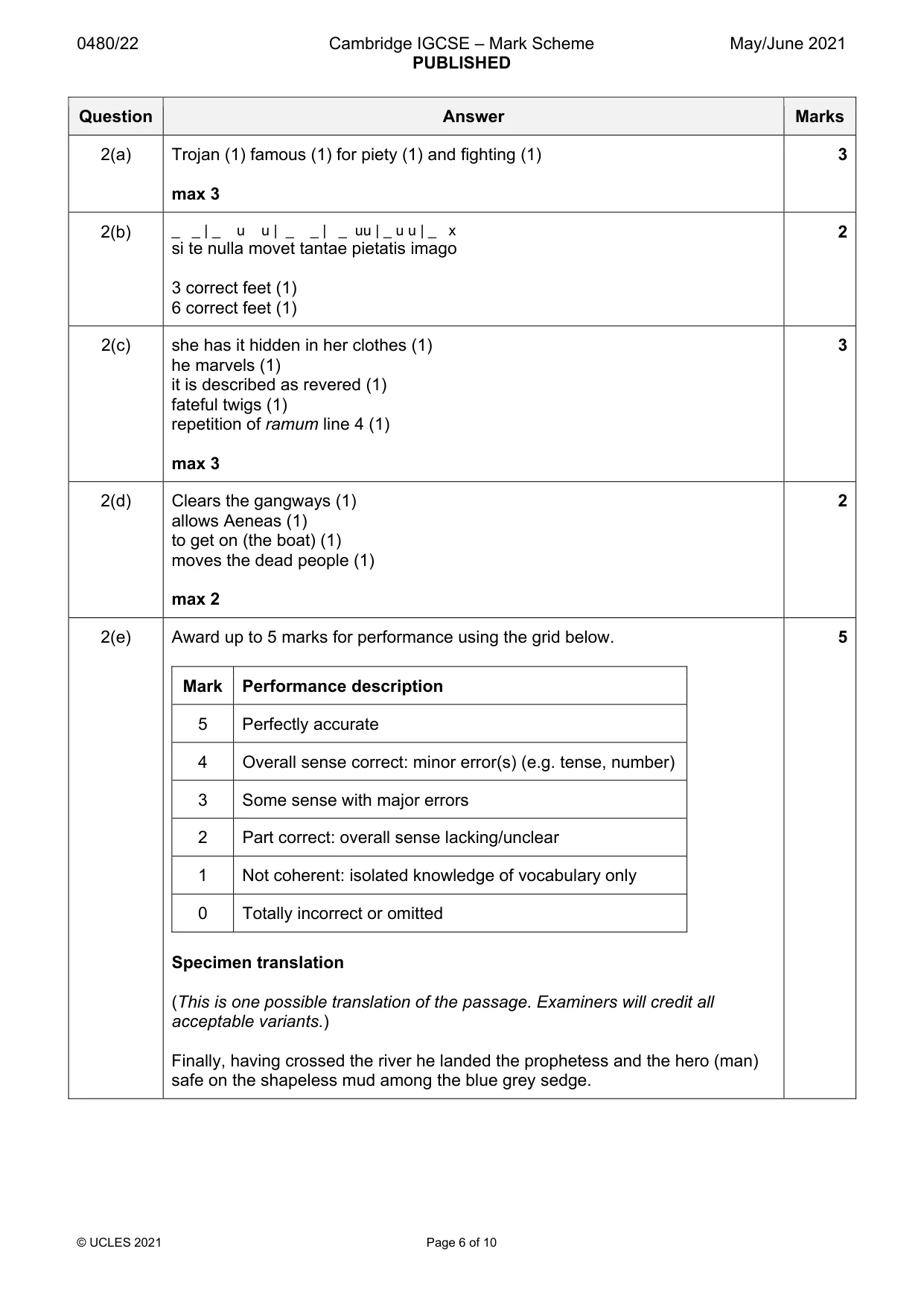
Mark scheme: 2(a) Trojan (1) famous (1) for piety (1) and fighting (1) 3 max 3 2(b) _ _ | _ u u | _ _ | _ uu | _ u u | _ x 2 si te nulla movet tantae pietatis imago 3 correct feet (1) 6 correct feet (1) 2(c) she has it hidden in her clothes (1) 3 he marvels (1) it is described as revered (1) fateful twigs (1) repetition of ramum line 4 (1) max 3 2(d) Clears the gangways (1) 2 allows Aeneas (1) to get on (the boat) (1) moves the dead people (1) max 2 2(e) Award up to 5 marks for performance using the grid below. 5 Mark Performance description 5 Perfectly accurate 4 Overall sense correct: minor error(s) (e.g. tense, number) 3 Some sense with major errors 2 Part correct: overall sense lacking/unclear 1 Not coherent: isolated knowledge of vocabulary only 0 Totally incorrect or omitted Specimen translation (This is one possible translation of the passage. Examiners will credit all acceptable variants.) Finally, having crossed the river he landed the prophetess and the hero (man) safe on the shapeless mud among the blue grey sedge.
Q3 · ‘Too focused on death to be interesting.’ How far do you agree with this statement based…
3 ‘Too focused on death to be interesting.’ How far do you agree with this statement based on the extract of the Aeneid you have studied? Support your answer with reference to the text. You should write at least 100 words. [10]
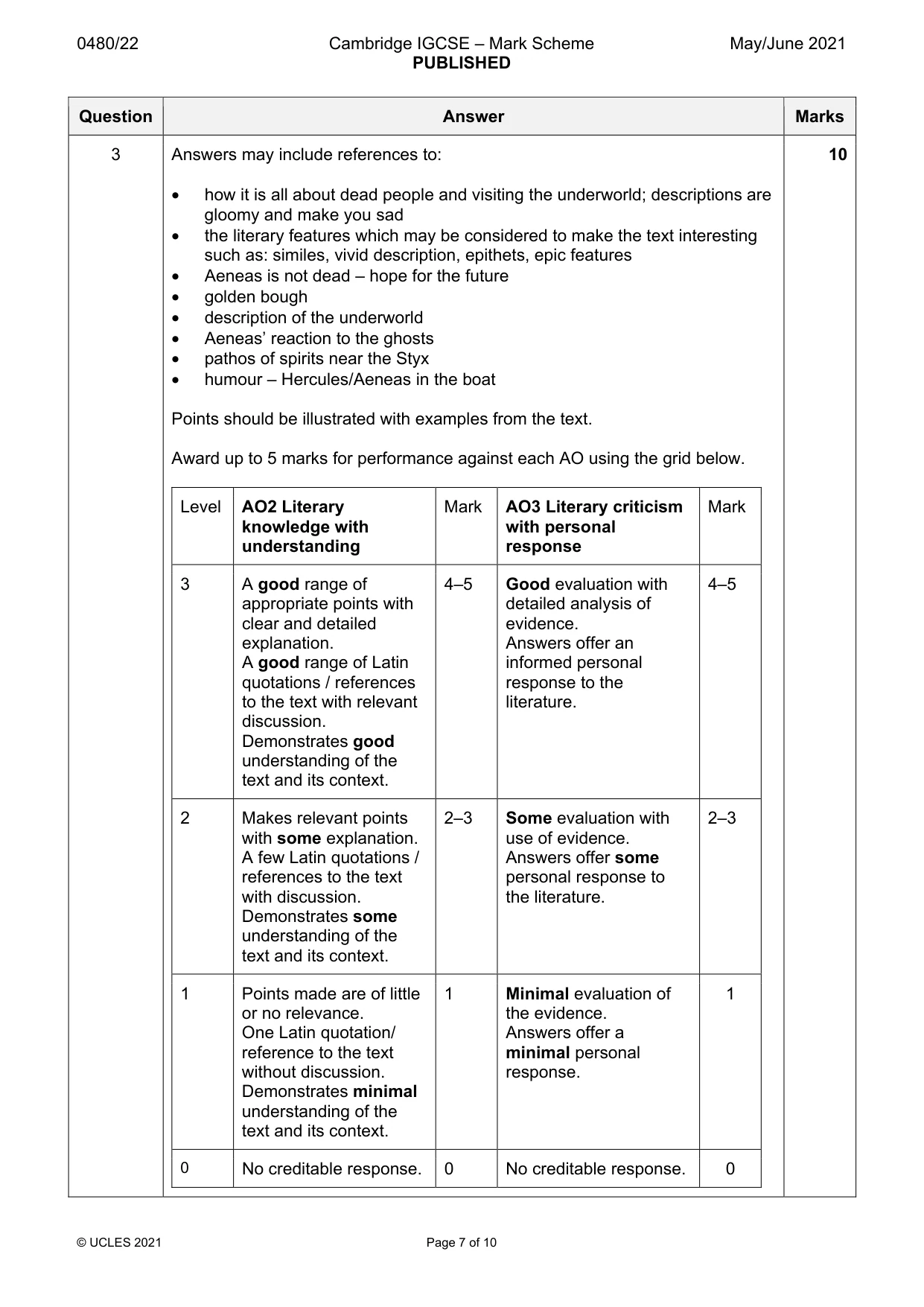
Mark scheme: 3 Answers may include references to: 10 • how it is all about dead people and visiting the underworld; descriptions are gloomy and make you sad • the literary features which may be considered to make the text interesting such as: similes, vivid description, epithets, epic features • Aeneas is not dead – hope for the future • golden bough • description of the underworld • Aeneas’ reaction to the ghosts • pathos of spirits near the Styx • humour – Hercules/Aeneas in the boat Points should be illustrated with examples from the text. Award up to 5 marks for performance against each AO using the grid below. Level AO2 Literary Mark AO3 Literary criticism Mark knowledge with with personal understanding response 3 A good range of 4–5 Good evaluation with 4–5 appropriate points with detailed analysis of clear and detailed evidence. explanation. Answers offer an A good range of Latin informed personal quotations / references response to the to the text with relevant literature. discussion. Demonstrates good understanding of the text and its context. 2 Makes relevant points 2–3 Some evaluation with 2–3 with some explanation. use of evidence. A few Latin quotations / Answers offer some references to the text personal response to with discussion. the literature. Demonstrates some understanding of the text and its context. 1 Points made are of little 1 Minimal evaluation of 1 or no relevance. the evidence. One Latin quotation/ Answers offer a reference to the text minimal personal without discussion. response. Demonstrates minimal understanding of the text and its context. 0 No creditable response. 0 No creditable response. 0 Section B
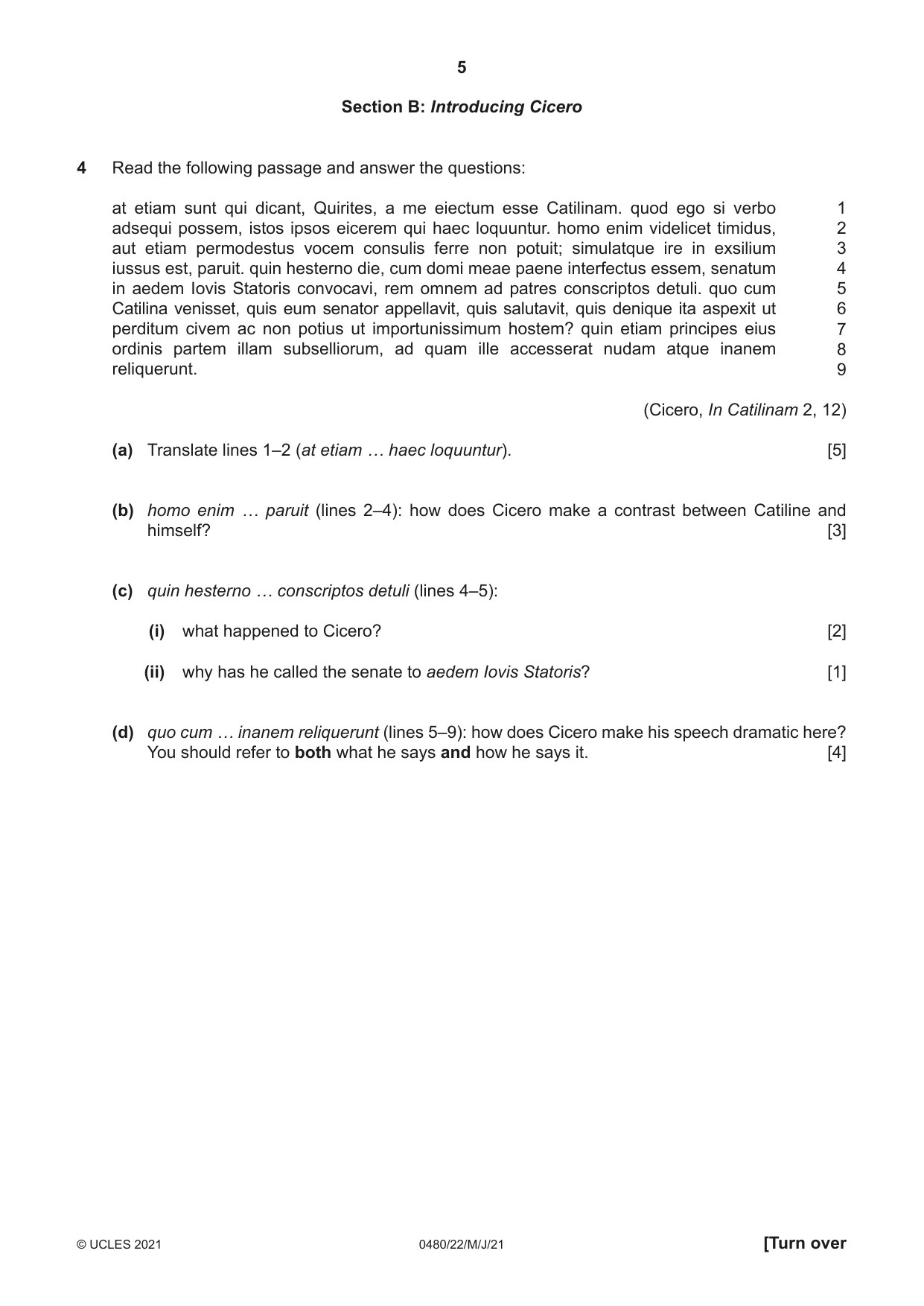
Q4 · Read the following passage and answer the questions: at etiam sunt qui dicant, Quirites…
4 Read the following passage and answer the questions: at etiam sunt qui dicant, Quirites, a me eiectum esse Catilinam. quod ego si verbo 1 adsequi possem, istos ipsos eicerem qui haec loquuntur. homo enim videlicet timidus, 2 aut etiam permodestus vocem consulis ferre non potuit; simulatque ire in exsilium 3 iussus est, paruit. quin hesterno die, cum domi meae paene interfectus essem, senatum 4 in aedem Iovis Statoris convocavi, rem omnem ad patres conscriptos detuli. quo cum 5 Catilina venisset, quis eum senator appellavit, quis salutavit, quis denique ita aspexit ut 6 perditum civem ac non potius ut importunissimum hostem? quin etiam principes eius 7 ordinis partem illam subselliorum, ad quam ille accesserat nudam atque inanem 8 reliquerunt. 9 (Cicero, In Catilinam 2, 12) (a) Translate lines 1–2 (at etiam … haec loquuntur). [5] (b) homo enim … paruit (lines 2–4): how does Cicero make a contrast between Catiline and himself? [3] (c) quin hesterno … conscriptos detuli (lines 4–5): (i) what happened to Cicero? [2] (ii) why has he called the senate to aedem Iovis Statoris? [1] (d) quo cum … inanem reliquerunt (lines 5–9): how does Cicero make his speech dramatic here? You should refer to both what he says and how he says it. [4]
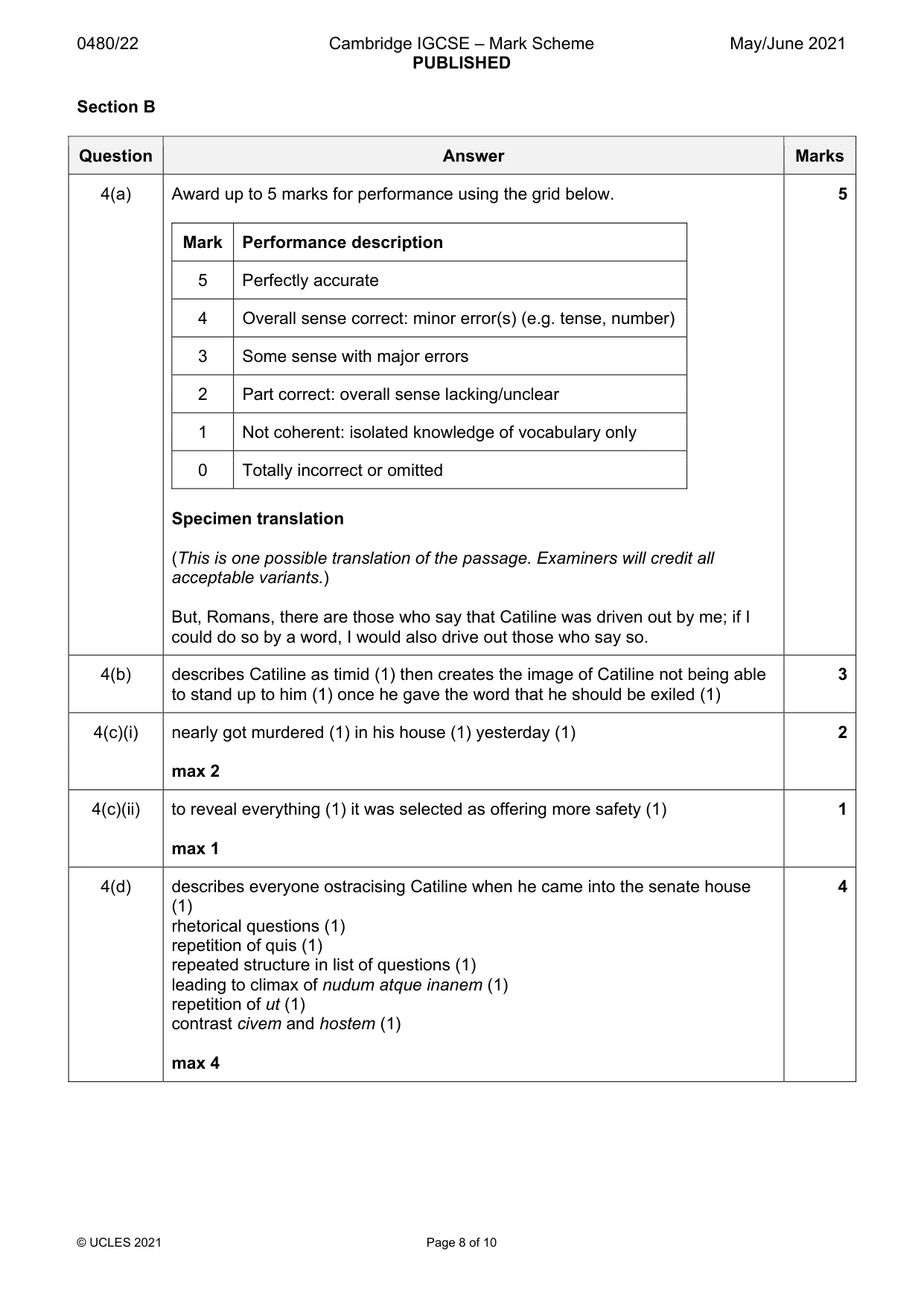
Mark scheme: 4(a) Award up to 5 marks for performance using the grid below. 5 Mark Performance description 5 Perfectly accurate 4 Overall sense correct: minor error(s) (e.g. tense, number) 3 Some sense with major errors 2 Part correct: overall sense lacking/unclear 1 Not coherent: isolated knowledge of vocabulary only 0 Totally incorrect or omitted Specimen translation (This is one possible translation of the passage. Examiners will credit all acceptable variants.) But, Romans, there are those who say that Catiline was driven out by me; if I could do so by a word, I would also drive out those who say so. 4(b) describes Catiline as timid (1) then creates the image of Catiline not being able 3 to stand up to him (1) once he gave the word that he should be exiled (1) 4(c)(i) nearly got murdered (1) in his house (1) yesterday (1) 2 max 2 4(c)(ii) to reveal everything (1) it was selected as offering more safety (1) 1 max 1 4(d) describes everyone ostracising Catiline when he came into the senate house 4 (1) rhetorical questions (1) repetition of quis (1) repeated structure in list of questions (1) leading to climax of nudum atque inanem (1) repetition of ut (1) contrast civem and hostem (1) max 4
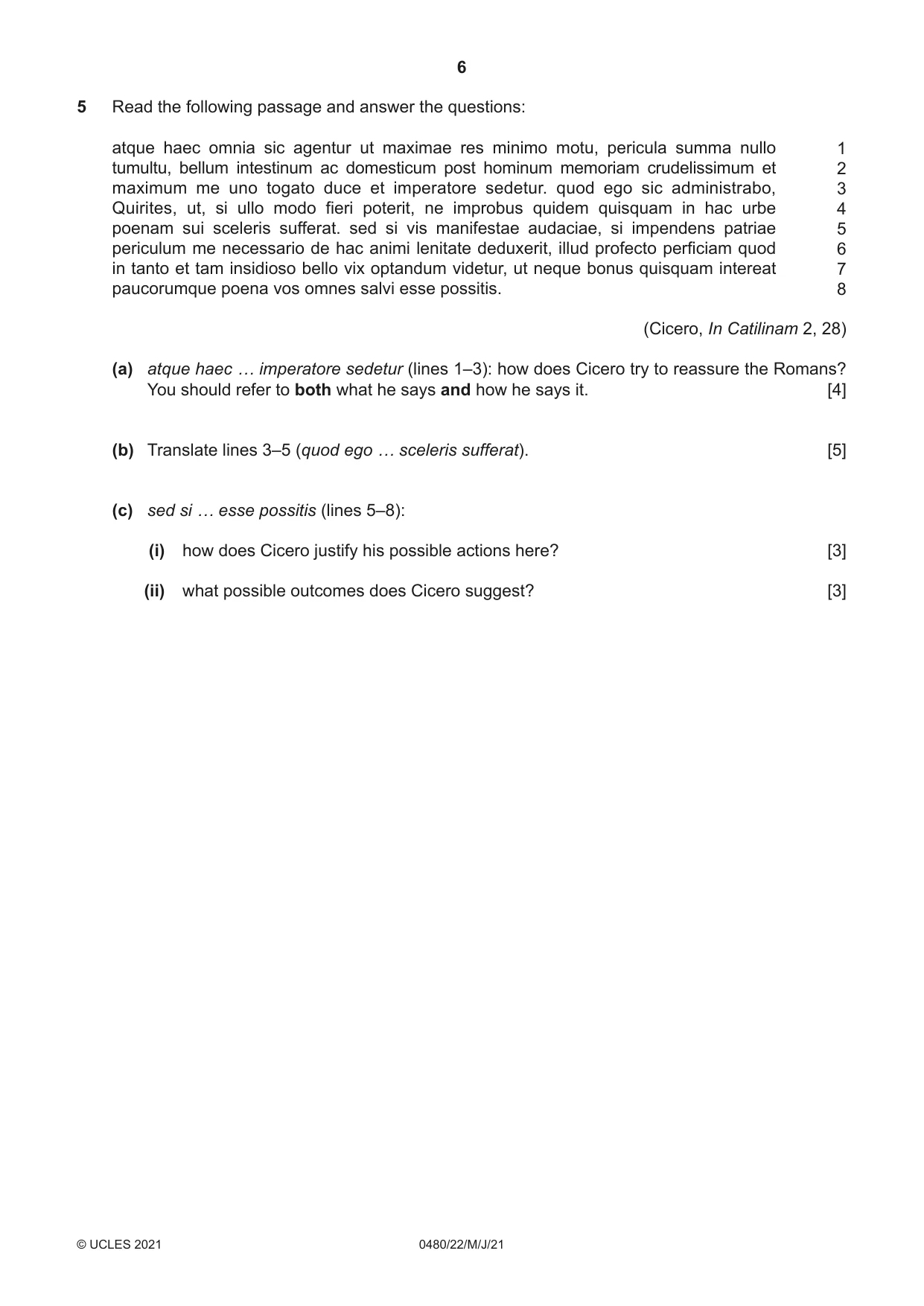
Q5 · Read the following passage and answer the questions: atque haec omnia sic agentur ut…
5 Read the following passage and answer the questions: atque haec omnia sic agentur ut maximae res minimo motu, pericula summa nullo 1 tumultu, bellum intestinum ac domesticum post hominum memoriam crudelissimum et 2 maximum me uno togato duce et imperatore sedetur. quod ego sic administrabo, 3 Quirites, ut, si ullo modo fieri poterit, ne improbus quidem quisquam in hac urbe 4 poenam sui sceleris sufferat. sed si vis manifestae audaciae, si impendens patriae 5 periculum me necessario de hac animi lenitate deduxerit, illud profecto perficiam quod 6 in tanto et tam insidioso bello vix optandum videtur, ut neque bonus quisquam intereat 7 paucorumque poena vos omnes salvi esse possitis. 8 (Cicero, In Catilinam 2, 28) (a) atque haec … imperatore sedetur (lines 1–3): how does Cicero try to reassure the Romans? You should refer to both what he says and how he says it. [4] (b) Translate lines 3–5 (quod ego … sceleris sufferat). [5] (c) sed si … esse possitis (lines 5–8): (i) how does Cicero justify his possible actions here? [3] (ii) what possible outcomes does Cicero suggest? [3]
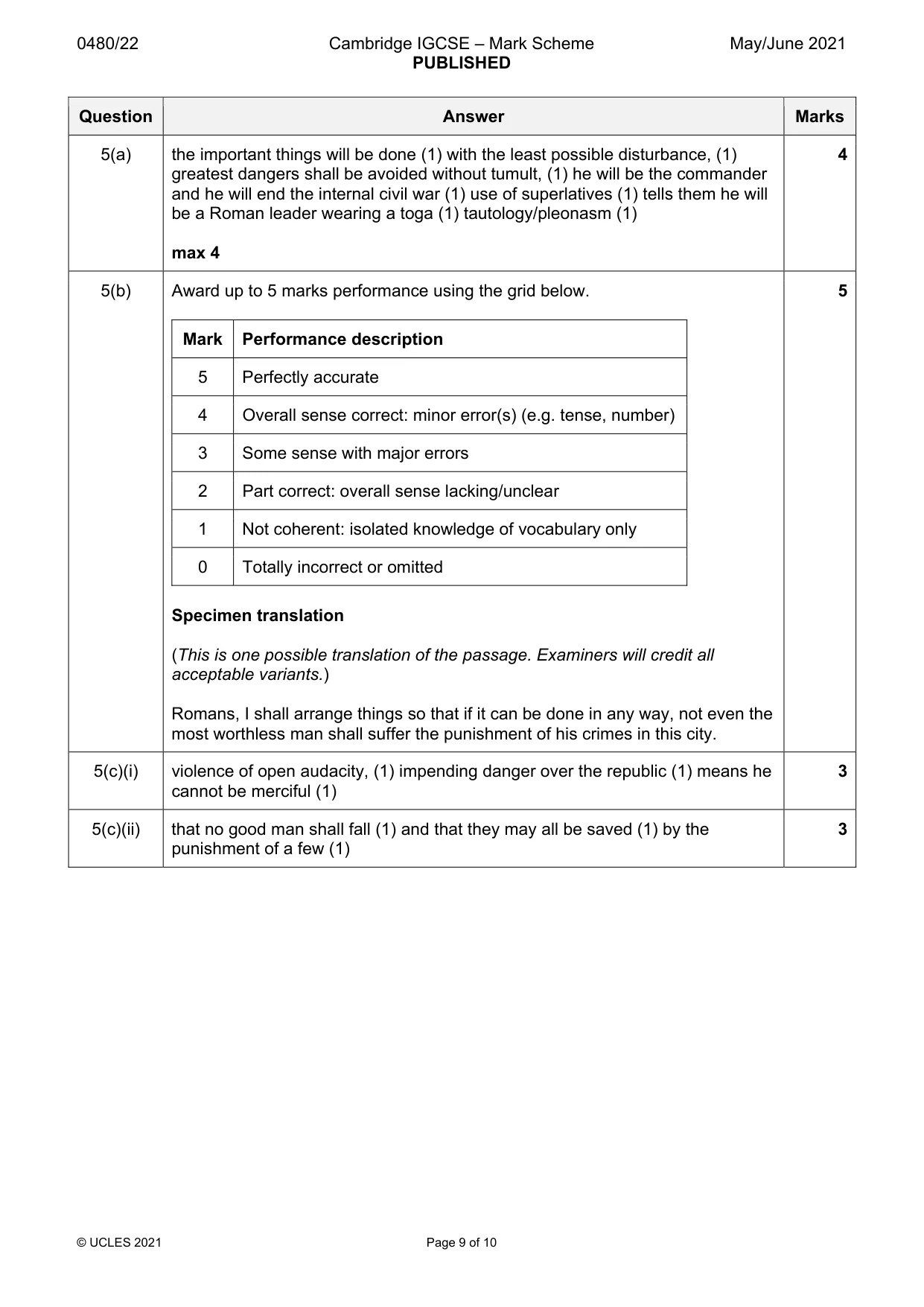
Mark scheme: 5(a) the important things will be done (1) with the least possible disturbance, (1) 4 greatest dangers shall be avoided without tumult, (1) he will be the commander and he will end the internal civil war (1) use of superlatives (1) tells them he will be a Roman leader wearing a toga (1) tautology/pleonasm (1) max 4 5(b) Award up to 5 marks performance using the grid below. 5 Mark Performance description 5 Perfectly accurate 4 Overall sense correct: minor error(s) (e.g. tense, number) 3 Some sense with major errors 2 Part correct: overall sense lacking/unclear 1 Not coherent: isolated knowledge of vocabulary only 0 Totally incorrect or omitted Specimen translation (This is one possible translation of the passage. Examiners will credit all acceptable variants.) Romans, I shall arrange things so that if it can be done in any way, not even the most worthless man shall suffer the punishment of his crimes in this city. 5(c)(i) violence of open audacity, (1) impending danger over the republic (1) means he 3 cannot be merciful (1) 5(c)(ii) that no good man shall fall (1) and that they may all be saved (1) by the 3 punishment of a few (1)
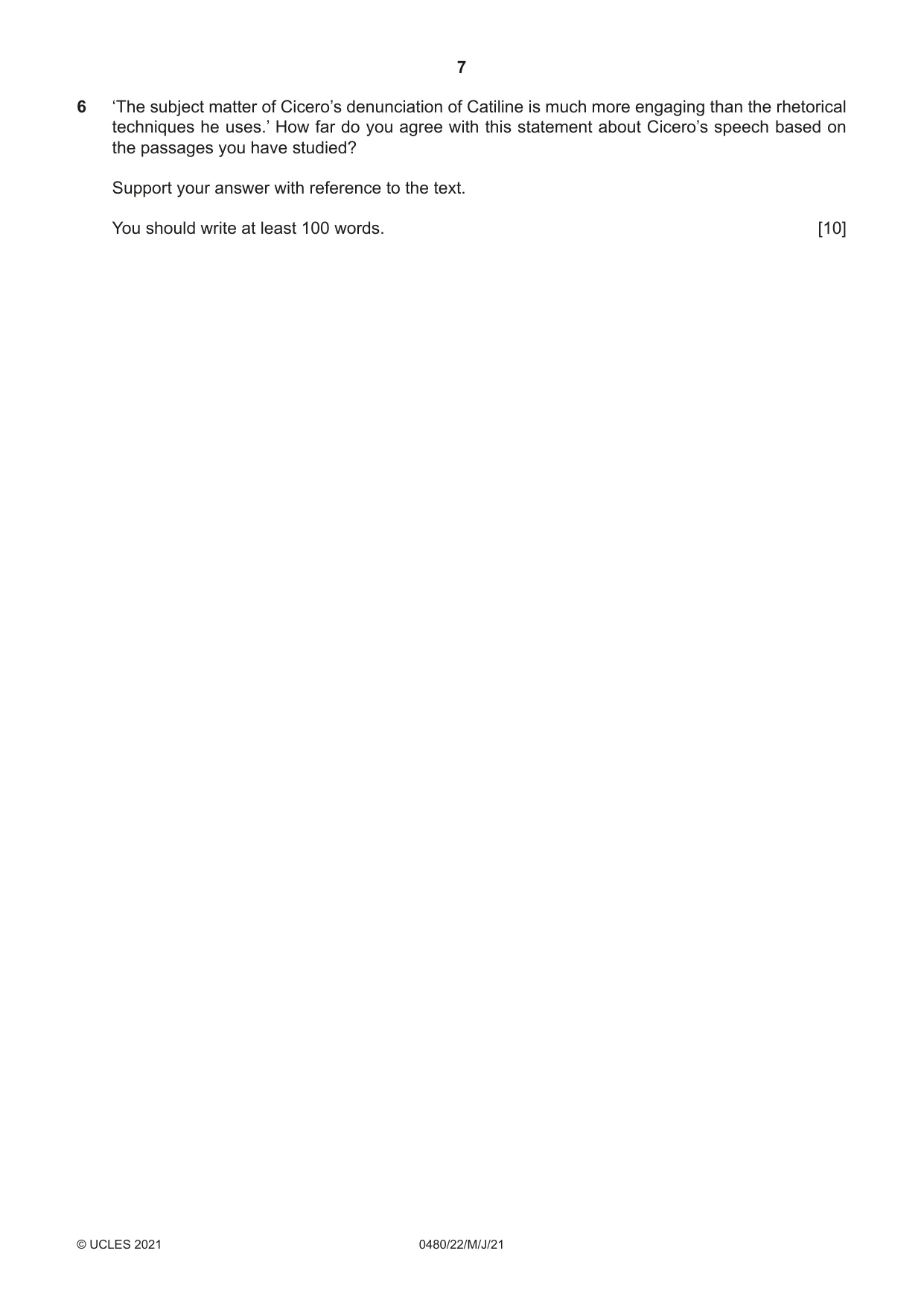
Q6 · ‘The subject matter of Cicero’s denunciation of Catiline is much more engaging than the…
6 ‘The subject matter of Cicero’s denunciation of Catiline is much more engaging than the rhetorical techniques he uses.’ How far do you agree with this statement about Cicero’s speech based on the passages you have studied? Support your answer with reference to the text. You should write at least 100 words. [10]
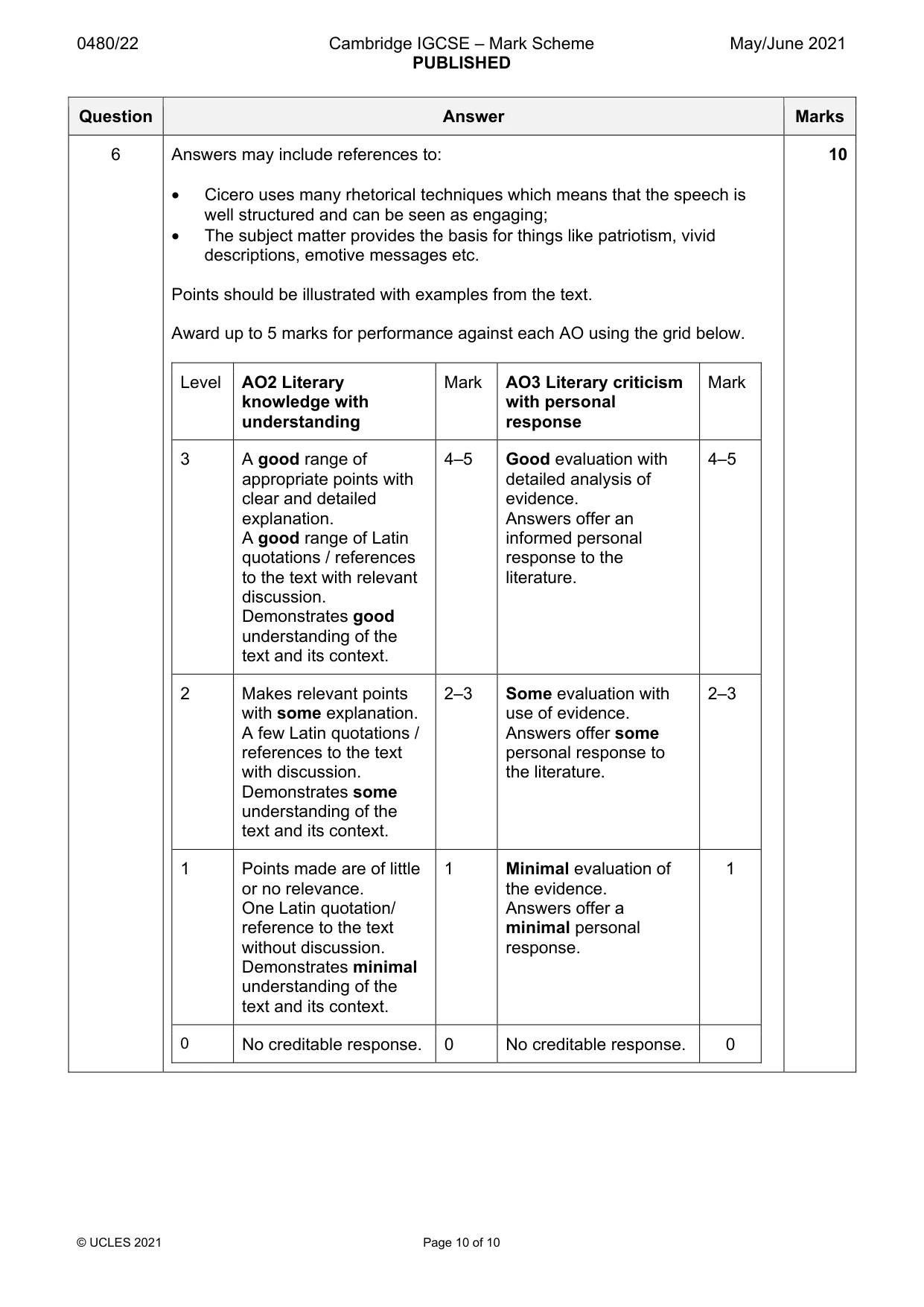
Mark scheme: 6 Answers may include references to: 10 • Cicero uses many rhetorical techniques which means that the speech is well structured and can be seen as engaging; • The subject matter provides the basis for things like patriotism, vivid descriptions, emotive messages etc. Points should be illustrated with examples from the text. Award up to 5 marks for performance against each AO using the grid below. Level AO2 Literary Mark AO3 Literary criticism Mark knowledge with with personal understanding response 3 A good range of 4–5 Good evaluation with 4–5 appropriate points with detailed analysis of clear and detailed evidence. explanation. Answers offer an A good range of Latin informed personal quotations / references response to the to the text with relevant literature. discussion. Demonstrates good understanding of the text and its context. 2 Makes relevant points 2–3 Some evaluation with 2–3 with some explanation. use of evidence. A few Latin quotations / Answers offer some references to the text personal response to with discussion. the literature. Demonstrates some understanding of the text and its context. 1 Points made are of little 1 Minimal evaluation of 1 or no relevance. the evidence. One Latin quotation/ Answers offer a reference to the text minimal personal without discussion. response. Demonstrates minimal understanding of the text and its context. 0 No creditable response. 0 No creditable response. 0
What you needed in this session
Cambridge’s own grade thresholds for 2021 May/June, Paper 2 · Variant 2. A higher threshold means an easier paper — the bar moves with how the cohort did.