Cambridge IGCSE Latin 0480 — 2023 May/June Paper 2 · Variant 2
0480/22/M/J/23 · 6 questions · 80 marks · ≈90 min
The question paper and its mark scheme, free to read here and free to download. This is Cambridge’s own paper, exactly as it was sat.
Question paper8 pages



Mark scheme9 pages
Answers below. Sit the paper first if you are practising.
Questions as text
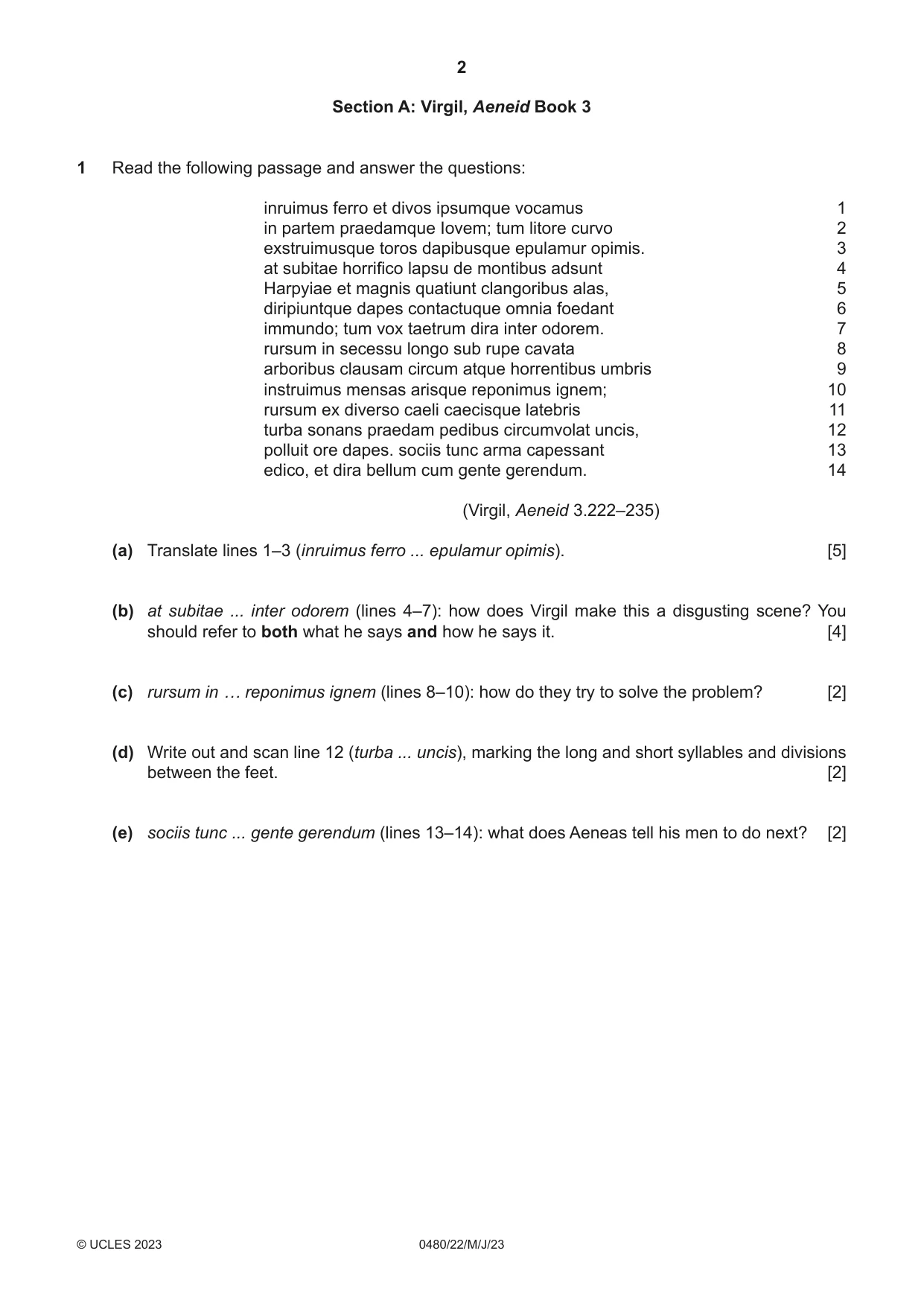
Q1 · Read the following passage and answer the questions: inruimus ferro et divos ipsumque…
1 Read the following passage and answer the questions: inruimus ferro et divos ipsumque vocamus 1 in partem praedamque Iovem; tum litore curvo 2 exstruimusque toros dapibusque epulamur opimis. 3 at subitae horrifico lapsu de montibus adsunt 4 Harpyiae et magnis quatiunt clangoribus alas, 5 diripiuntque dapes contactuque omnia foedant 6 immundo; tum vox taetrum dira inter odorem. 7 rursum in secessu longo sub rupe cavata 8 arboribus clausam circum atque horrentibus umbris 9 instruimus mensas arisque reponimus ignem; 10 rursum ex diverso caeli caecisque latebris 11 turba sonans praedam pedibus circumvolat uncis, 12 polluit ore dapes. sociis tunc arma capessant 13 edico, et dira bellum cum gente gerendum. 14 (Virgil, Aeneid 3.222–235) (a) Translate lines 1–3 (inruimus ferro ... epulamur opimis). [5] (b) at subitae ... inter odorem (lines 4–7): how does Virgil make this a disgusting scene? You should refer to both what he says and how he says it. [4] (c) rursum in … reponimus ignem (lines 8–10): how do they try to solve the problem? [2] (d) Write out and scan line 12 (turba ... uncis), marking the long and short syllables and divisions between the feet. [2] (e) sociis tunc ... gente gerendum (lines 13–14): what does Aeneas tell his men to do next? [2]
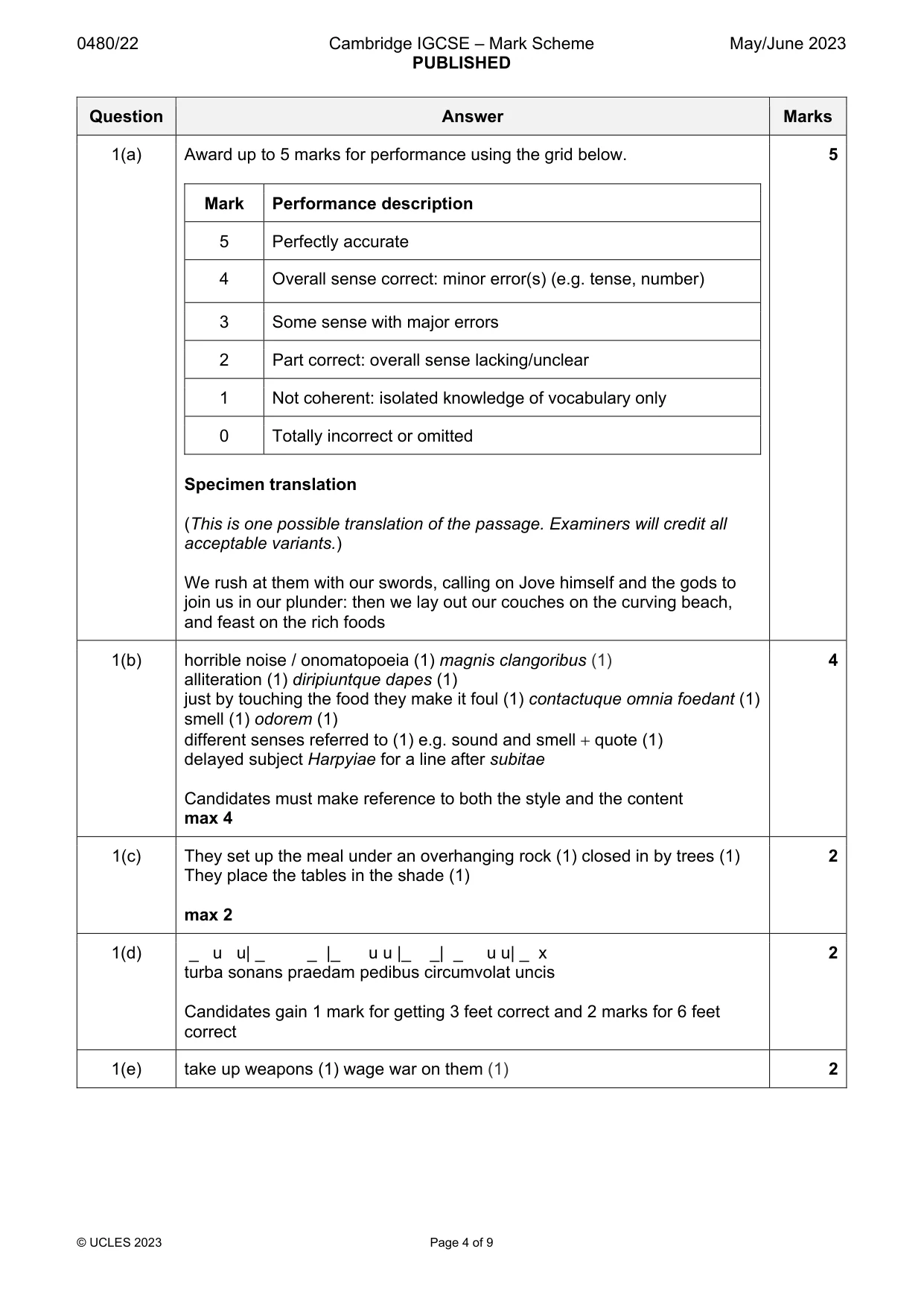
Mark scheme: Question Answer Marks 1(a) Award up to 5 marks for performance using the grid below. 5 Mark Performance description 5 Perfectly accurate 4 Overall sense correct: minor error(s) (e.g. tense, number) 3 Some sense with major errors 2 Part correct: overall sense lacking/unclear 1 Not coherent: isolated knowledge of vocabulary only 0 Totally incorrect or omitted Specimen translation (This is one possible translation of the passage. Examiners will credit all acceptable variants.) We rush at them with our swords, calling on Jove himself and the gods to join us in our plunder: then we lay out our couches on the curving beach, and feast on the rich foods 1(b) horrible noise / onomatopoeia (1) magnis clangoribus (1) 4 alliteration (1) diripiuntque dapes (1) just by touching the food they make it foul (1) contactuque omnia foedant (1) smell (1) odorem (1) different senses referred to (1) e.g. sound and smell quote (1) delayed subject Harpyiae for a line after subitae Candidates must make reference to both the style and the content max 4 1(c) They set up the meal under an overhanging rock (1) closed in by trees (1) 2 They place the tables in the shade (1) max 2 1(d) _ u u| _ _ |_ u u |_ _| _ u u| _ x 2 turba sonans praedam pedibus circumvolat uncis Candidates gain 1 mark for getting 3 feet correct and 2 marks for 6 feet correct 1(e) take up weapons (1) wage war on them (1) 2
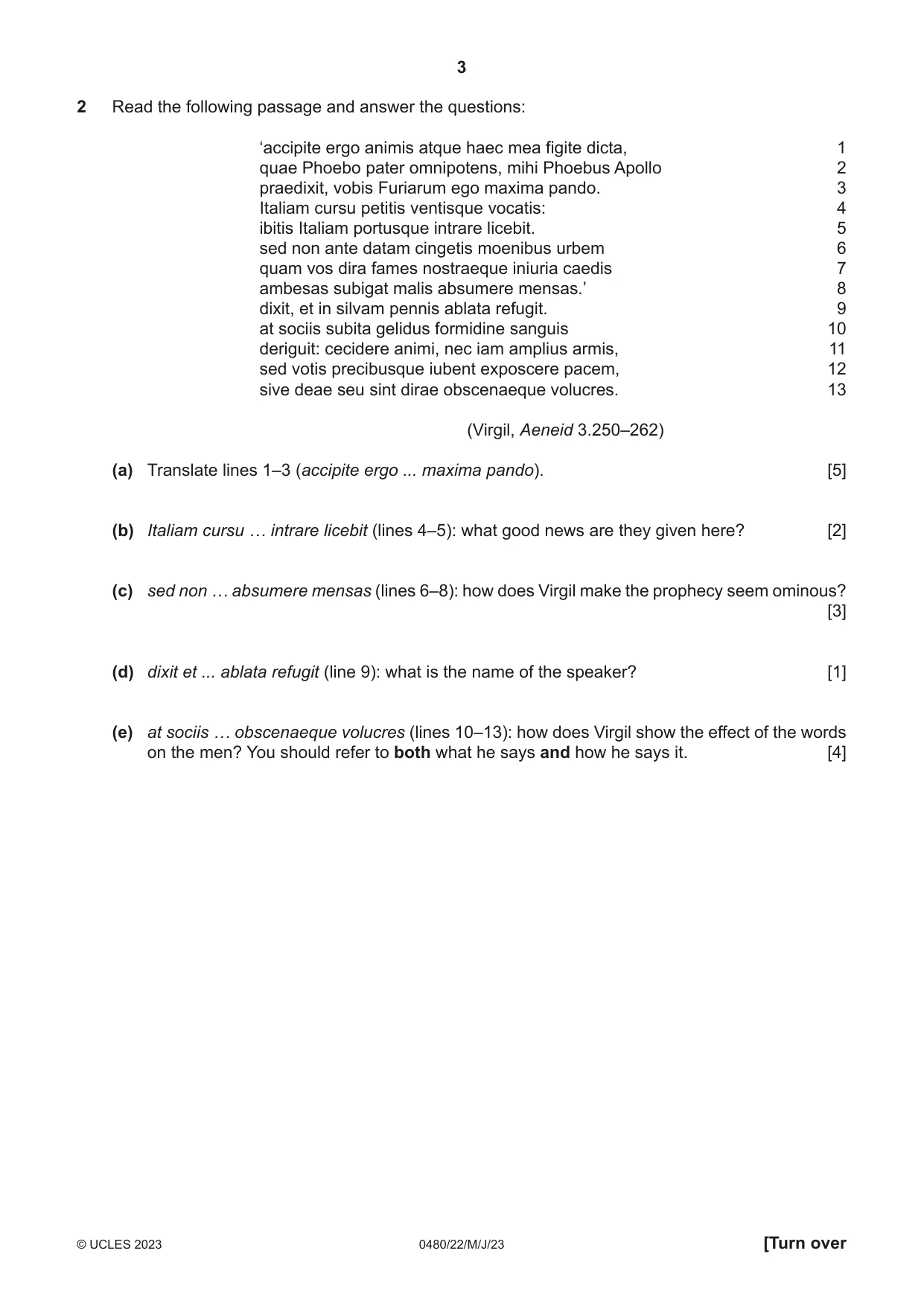
Q2 · Read the following passage and answer the questions: ‘accipite ergo animis atque haec mea…
2 Read the following passage and answer the questions: ‘accipite ergo animis atque haec mea figite dicta, 1 quae Phoebo pater omnipotens, mihi Phoebus Apollo 2 praedixit, vobis Furiarum ego maxima pando. 3 Italiam cursu petitis ventisque vocatis: 4 ibitis Italiam portusque intrare licebit. 5 sed non ante datam cingetis moenibus urbem 6 quam vos dira fames nostraeque iniuria caedis 7 ambesas subigat malis absumere mensas.’ 8 dixit, et in silvam pennis ablata refugit. 9 at sociis subita gelidus formidine sanguis 10 deriguit: cecidere animi, nec iam amplius armis, 11 sed votis precibusque iubent exposcere pacem, 12 sive deae seu sint dirae obscenaeque volucres. 13 (Virgil, Aeneid 3.250–262) (a) Translate lines 1–3 (accipite ergo ... maxima pando). [5] (b) Italiam cursu … intrare licebit (lines 4–5): what good news are they given here? [2] (c) sed non … absumere mensas (lines 6–8): how does Virgil make the prophecy seem ominous? [3] (d) dixit et ... ablata refugit (line 9): what is the name of the speaker? [1] (e) at sociis … obscenaeque volucres (lines 10–13): how does Virgil show the effect of the words on the men? You should refer to both what he says and how he says it. [4]
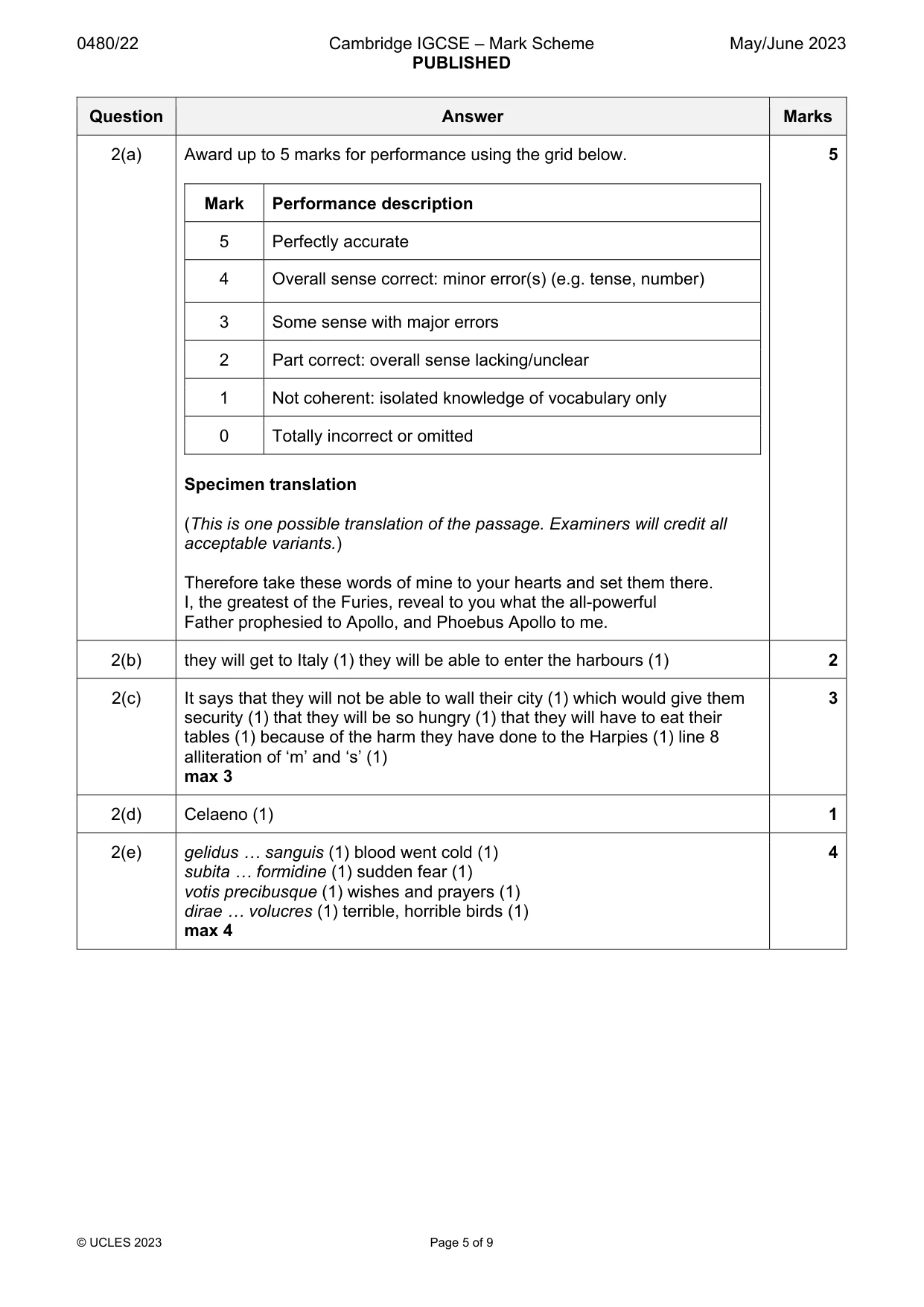
Mark scheme: 2(a) Award up to 5 marks for performance using the grid below. 5 Mark Performance description 5 Perfectly accurate 4 Overall sense correct: minor error(s) (e.g. tense, number) 3 Some sense with major errors 2 Part correct: overall sense lacking/unclear 1 Not coherent: isolated knowledge of vocabulary only 0 Totally incorrect or omitted Specimen translation (This is one possible translation of the passage. Examiners will credit all acceptable variants.) Therefore take these words of mine to your hearts and set them there. I, the greatest of the Furies, reveal to you what the all-powerful Father prophesied to Apollo, and Phoebus Apollo to me. 2(b) they will get to Italy (1) they will be able to enter the harbours (1) 2 2(c) It says that they will not be able to wall their city (1) which would give them 3 security (1) that they will be so hungry (1) that they will have to eat their tables (1) because of the harm they have done to the Harpies (1) line 8 alliteration of ‘m’ and ‘s’ (1) max 3 2(d) Celaeno (1) 1 2(e) gelidus … sanguis (1) blood went cold (1) 4 subita … formidine (1) sudden fear (1) votis precibusque (1) wishes and prayers (1) dirae … volucres (1) terrible, horrible birds (1) max 4
Q3 · ‘Full of literary techniques but without much of a plot.’ How far do you agree with this…
3 ‘Full of literary techniques but without much of a plot.’ How far do you agree with this statement about Aeneid 3 based on the extracts you have studied? Support your answer with reference to the text. You should write at least 100 words. [10]
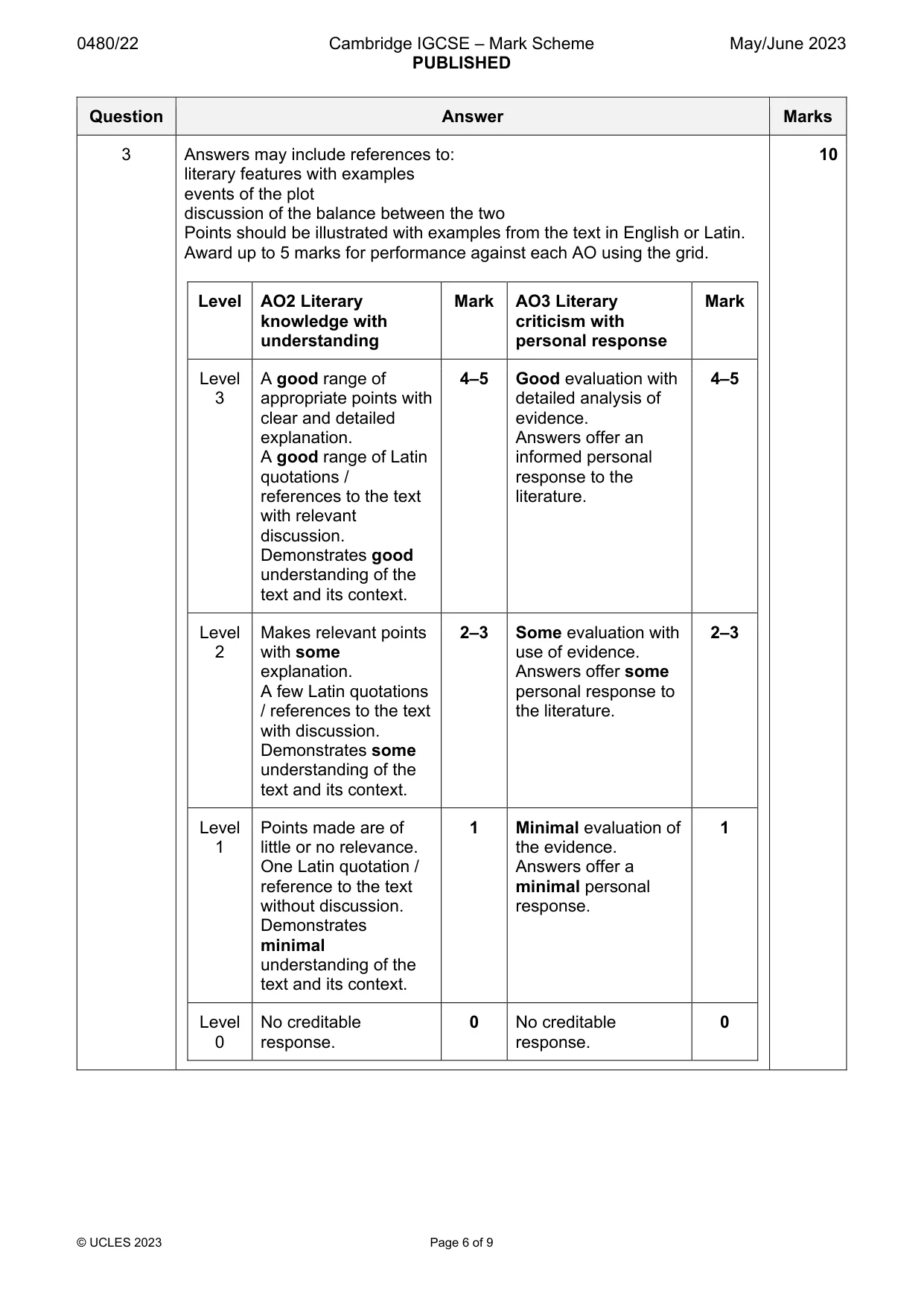
Mark scheme: 3 Answers may include references to: 10 literary features with examples events of the plot discussion of the balance between the two Points should be illustrated with examples from the text in English or Latin. Award up to 5 marks for performance against each AO using the grid. Level AO2 Literary Mark AO3 Literary Mark knowledge with criticism with understanding personal response Level A good range of 4–5 Good evaluation with 4–5 3 appropriate points with detailed analysis of clear and detailed evidence. explanation. Answers offer an A good range of Latin informed personal quotations / response to the references to the text literature. with relevant discussion. Demonstrates good understanding of the text and its context. Level Makes relevant points 2–3 Some evaluation with 2–3 2 with some use of evidence. explanation. Answers offer some A few Latin quotations personal response to / references to the text the literature. with discussion. Demonstrates some understanding of the text and its context. Level Points made are of 1 Minimal evaluation of 1 1 little or no relevance. the evidence. One Latin quotation / Answers offer a reference to the text minimal personal without discussion. response. Demonstrates minimal understanding of the text and its context. Level No creditable 0 No creditable 0 0 response. response.
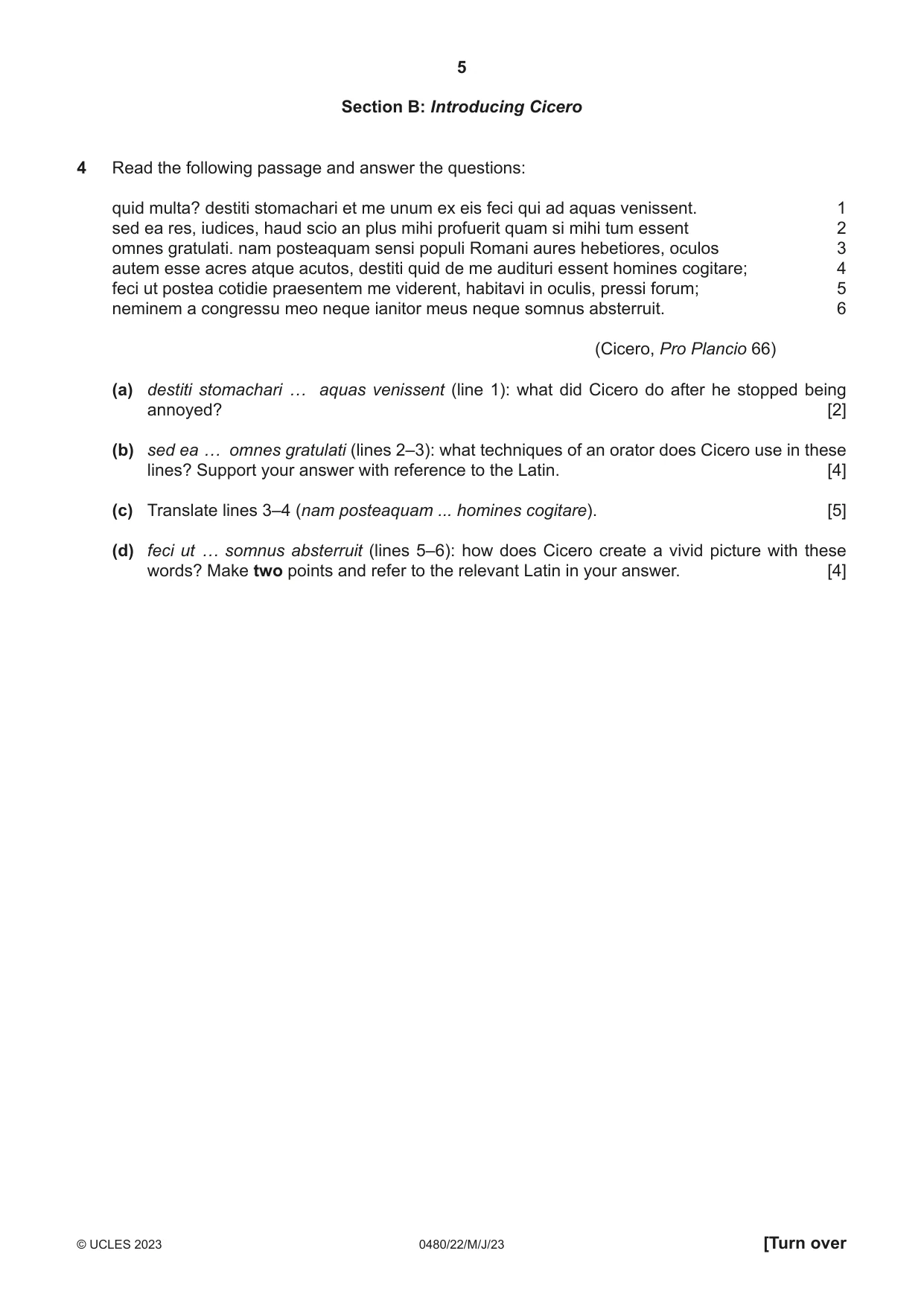
Q4 · Read the following passage and answer the questions: quid multa?
4 Read the following passage and answer the questions: quid multa? destiti stomachari et me unum ex eis feci qui ad aquas venissent. 1 sed ea res, iudices, haud scio an plus mihi profuerit quam si mihi tum essent 2 omnes gratulati. nam posteaquam sensi populi Romani aures hebetiores, oculos 3 autem esse acres atque acutos, destiti quid de me audituri essent homines cogitare; 4 feci ut postea cotidie praesentem me viderent, habitavi in oculis, pressi forum; 5 neminem a congressu meo neque ianitor meus neque somnus absterruit. 6 (Cicero, Pro Plancio 66) (a) destiti stomachari … aquas venissent (line 1): what did Cicero do after he stopped being annoyed? [2] (b) sed ea … omnes gratulati (lines 2–3): what techniques of an orator does Cicero use in these lines? Support your answer with reference to the Latin. [4] (c) Translate lines 3–4 (nam posteaquam ... homines cogitare). [5] (d) feci ut … somnus absterruit (lines 5–6): how does Cicero create a vivid picture with these words? Make two points and refer to the relevant Latin in your answer. [4]
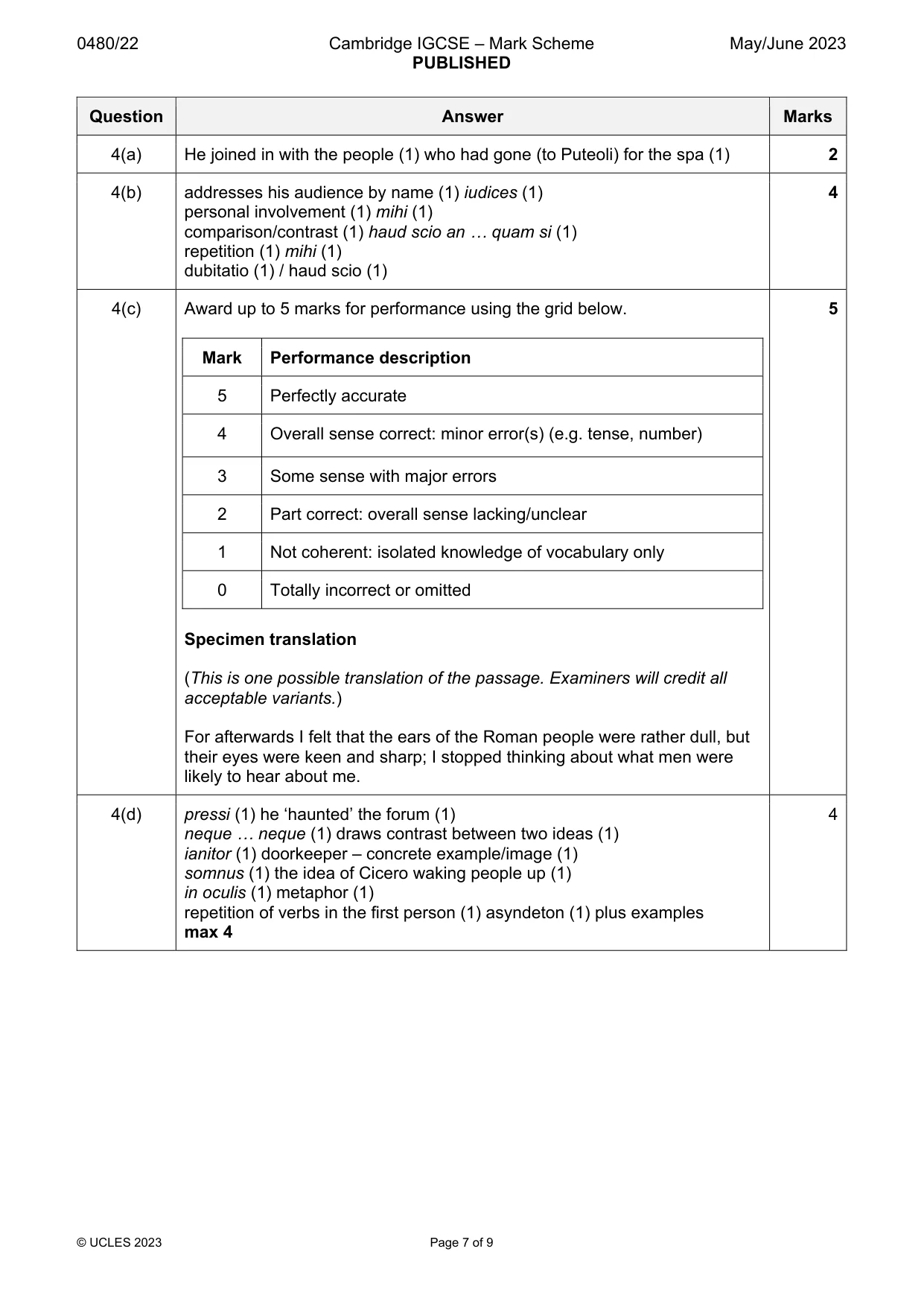
Mark scheme: 4(a) He joined in with the people (1) who had gone (to Puteoli) for the spa (1) 2 4(b) addresses his audience by name (1) iudices (1) 4 personal involvement (1) mihi (1) comparison/contrast (1) haud scio an … quam si (1) repetition (1) mihi (1) dubitatio (1) / haud scio (1) 4(c) Award up to 5 marks for performance using the grid below. 5 Mark Performance description 5 Perfectly accurate 4 Overall sense correct: minor error(s) (e.g. tense, number) 3 Some sense with major errors 2 Part correct: overall sense lacking/unclear 1 Not coherent: isolated knowledge of vocabulary only 0 Totally incorrect or omitted Specimen translation (This is one possible translation of the passage. Examiners will credit all acceptable variants.) For afterwards I felt that the ears of the Roman people were rather dull, but their eyes were keen and sharp; I stopped thinking about what men were likely to hear about me. 4(d) pressi (1) he ‘haunted’ the forum (1) 4 neque … neque (1) draws contrast between two ideas (1) ianitor (1) doorkeeper – concrete example/image (1) somnus (1) the idea of Cicero waking people up (1) in oculis (1) metaphor (1) repetition of verbs in the first person (1) asyndeton (1) plus examples max 4
Q5 · Read the following passage and answer the questions: te nunc, P
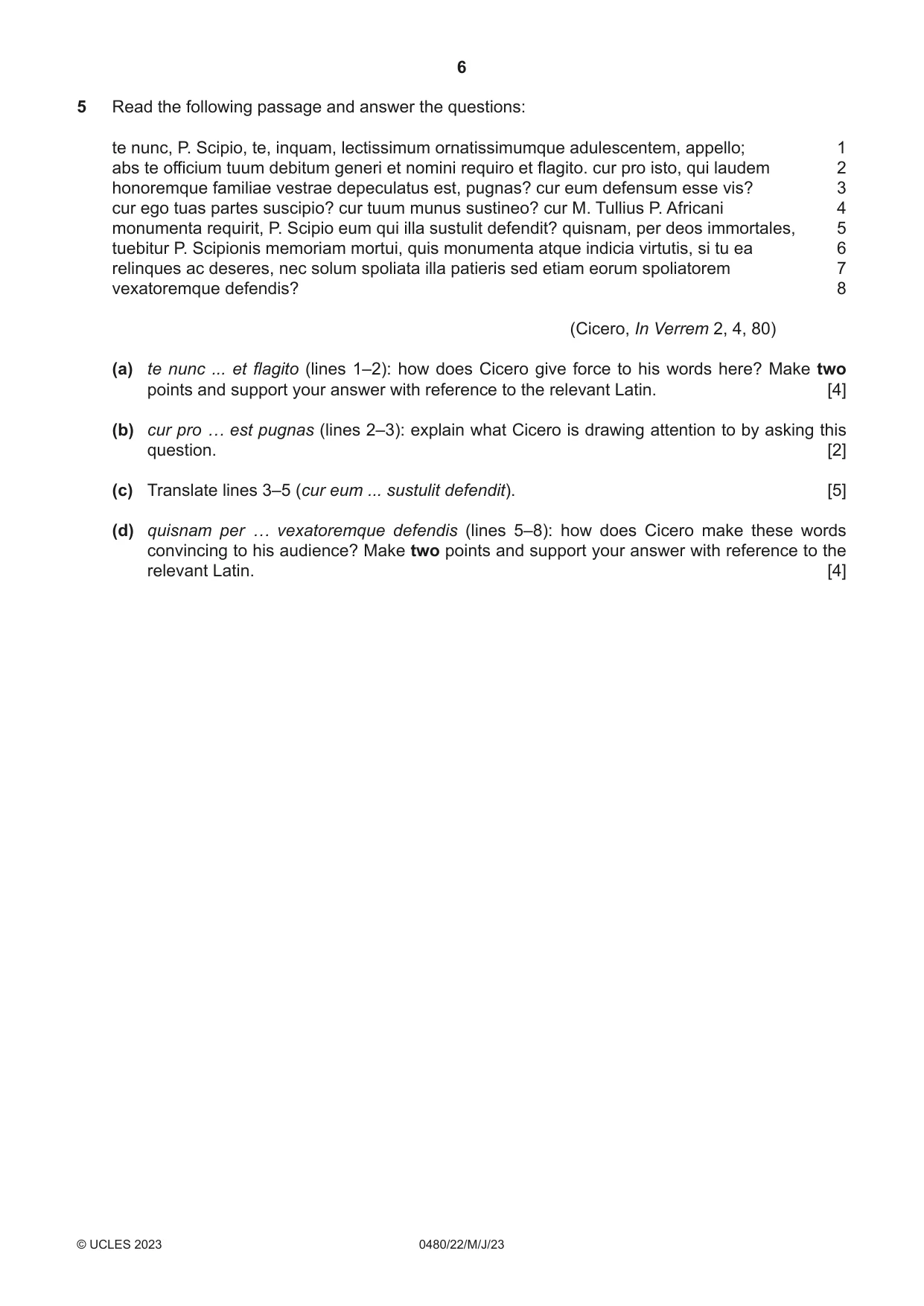
5 Read the following passage and answer the questions: te nunc, P. Scipio, te, inquam, lectissimum ornatissimumque adulescentem, appello; 1 abs te officium tuum debitum generi et nomini requiro et flagito. cur pro isto, qui laudem 2 honoremque familiae vestrae depeculatus est, pugnas? cur eum defensum esse vis? 3 cur ego tuas partes suscipio? cur tuum munus sustineo? cur M. Tullius P. Africani 4 monumenta requirit, P. Scipio eum qui illa sustulit defendit? quisnam, per deos immortales, 5 tuebitur P. Scipionis memoriam mortui, quis monumenta atque indicia virtutis, si tu ea 6 relinques ac deseres, nec solum spoliata illa patieris sed etiam eorum spoliatorem 7 vexatoremque defendis? 8 (Cicero, In Verrem 2, 4, 80) (a) te nunc ... et flagito (lines 1–2): how does Cicero give force to his words here? Make two points and support your answer with reference to the relevant Latin. [4] (b) cur pro … est pugnas (lines 2–3): explain what Cicero is drawing attention to by asking this question. [2] (c) Translate lines 3–5 (cur eum ... sustulit defendit). [5] (d) quisnam per … vexatoremque defendis (lines 5–8): how does Cicero make these words convincing to his audience? Make two points and support your answer with reference to the relevant Latin. [4]
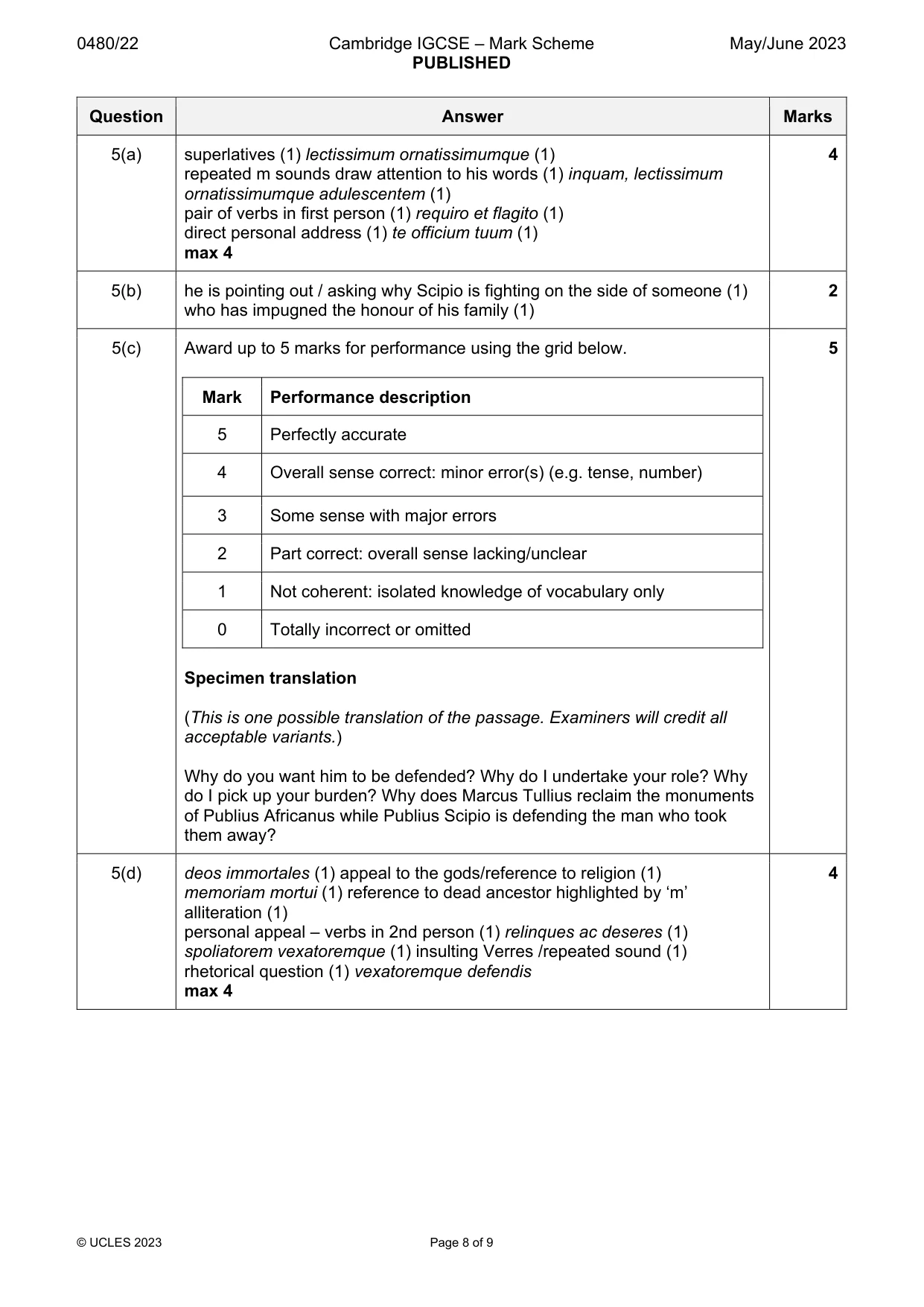
Mark scheme: 5(a) superlatives (1) lectissimum ornatissimumque (1) 4 repeated m sounds draw attention to his words (1) inquam, lectissimum ornatissimumque adulescentem (1) pair of verbs in first person (1) requiro et flagito (1) direct personal address (1) te officium tuum (1) max 4 5(b) he is pointing out / asking why Scipio is fighting on the side of someone (1) 2 who has impugned the honour of his family (1) 5(c) Award up to 5 marks for performance using the grid below. 5 Mark Performance description 5 Perfectly accurate 4 Overall sense correct: minor error(s) (e.g. tense, number) 3 Some sense with major errors 2 Part correct: overall sense lacking/unclear 1 Not coherent: isolated knowledge of vocabulary only 0 Totally incorrect or omitted Specimen translation (This is one possible translation of the passage. Examiners will credit all acceptable variants.) Why do you want him to be defended? Why do I undertake your role? Why do I pick up your burden? Why does Marcus Tullius reclaim the monuments of Publius Africanus while Publius Scipio is defending the man who took them away? 5(d) deos immortales (1) appeal to the gods/reference to religion (1) 4 memoriam mortui (1) reference to dead ancestor highlighted by ‘m’ alliteration (1) personal appeal – verbs in 2nd person (1) relinques ac deseres (1) spoliatorem vexatoremque (1) insulting Verres /repeated sound (1) rhetorical question (1) vexatoremque defendis max 4
Q6 · ‘When you have no basis for an argument, make a personal attack on the defendant.’ How…
6 ‘When you have no basis for an argument, make a personal attack on the defendant.’ How far do you agree that Cicero followed this advice in his speech against Verres based on the passages you have studied? Support your answer with reference to the text. You should write at least 100 words. [10]
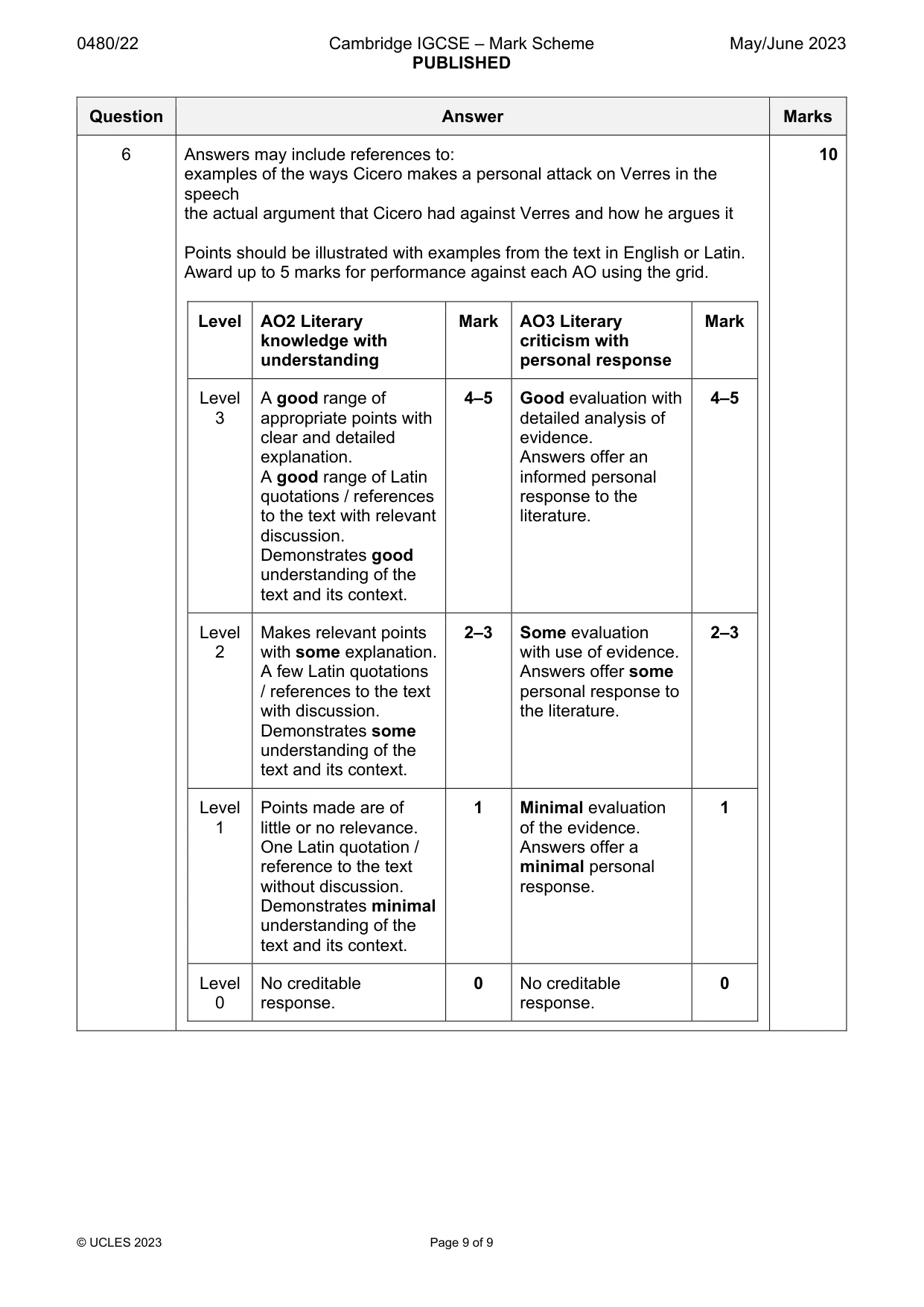
Mark scheme: 6 Answers may include references to: 10 examples of the ways Cicero makes a personal attack on Verres in the speech the actual argument that Cicero had against Verres and how he argues it Points should be illustrated with examples from the text in English or Latin. Award up to 5 marks for performance against each AO using the grid. Level AO2 Literary Mark AO3 Literary Mark knowledge with criticism with understanding personal response Level A good range of 4–5 Good evaluation with 4–5 3 appropriate points with detailed analysis of clear and detailed evidence. explanation. Answers offer an A good range of Latin informed personal quotations / references response to the to the text with relevant literature. discussion. Demonstrates good understanding of the text and its context. Level Makes relevant points 2–3 Some evaluation 2–3 2 with some explanation. with use of evidence. A few Latin quotations Answers offer some / references to the text personal response to with discussion. the literature. Demonstrates some understanding of the text and its context. Level Points made are of 1 Minimal evaluation 1 1 little or no relevance. of the evidence. One Latin quotation / Answers offer a reference to the text minimal personal without discussion. response. Demonstrates minimal understanding of the text and its context. Level No creditable 0 No creditable 0 0 response. response.
What you needed in this session
Cambridge’s own grade thresholds for 2023 May/June, Paper 2 · Variant 2. A higher threshold means an easier paper — the bar moves with how the cohort did.