Cambridge IGCSE Latin 0480 — 2025 May/June Paper 2 · Variant 3
0480/23/M/J/25 · 6 questions · 80 marks · ≈90 min
The question paper and its mark scheme, free to read here and free to download. This is Cambridge’s own paper, exactly as it was sat.
Question paper8 pages
Mark scheme10 pages
Answers below. Sit the paper first if you are practising.
Questions as text
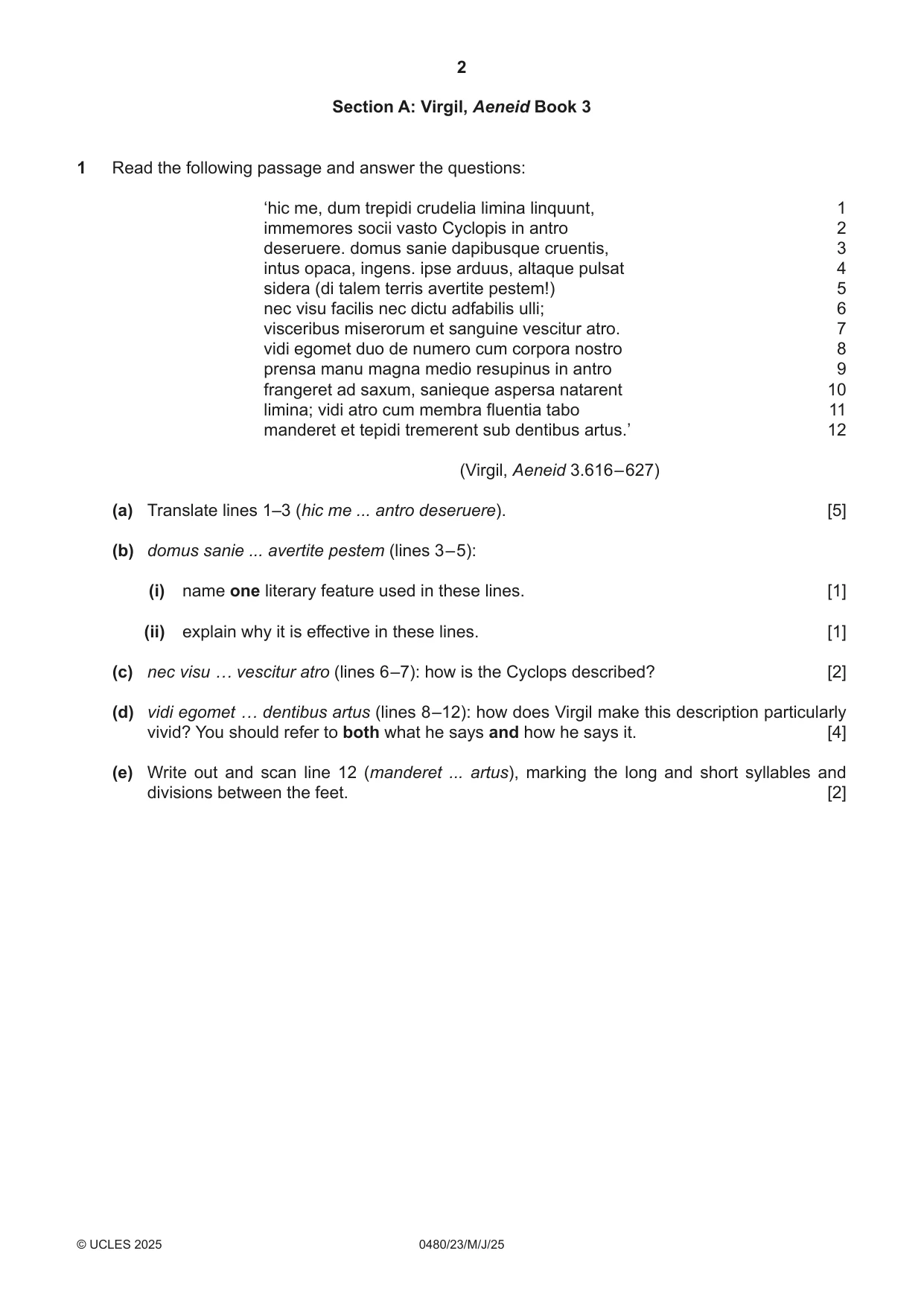
Q1 · Read the following passage and answer the questions: ‘hic me, dum trepidi crudelia limina…
1 Read the following passage and answer the questions: ‘hic me, dum trepidi crudelia limina linquunt, 1 immemores socii vasto Cyclopis in antro 2 deseruere. domus sanie dapibusque cruentis, 3 intus opaca, ingens. ipse arduus, altaque pulsat 4 sidera (di talem terris avertite pestem!) 5 nec visu facilis nec dictu adfabilis ulli; 6 visceribus miserorum et sanguine vescitur atro. 7 vidi egomet duo de numero cum corpora nostro 8 prensa manu magna medio resupinus in antro 9 frangeret ad saxum, sanieque aspersa natarent 10 limina; vidi atro cum membra fluentia tabo 11 manderet et tepidi tremerent sub dentibus artus.’ 12 (Virgil, Aeneid 3.616 – 627) (a) Translate lines 1–3 (hic me ... antro deseruere). [5] (b) domus sanie ... avertite pestem (lines 3 – 5): (i) name one literary feature used in these lines. [1] (ii) explain why it is effective in these lines. [1] (c) nec visu … vescitur atro (lines 6 –7): how is the Cyclops described? [2] (d) vidi egomet … dentibus artus (lines 8 –12): how does Virgil make this description particularly vivid? You should refer to both what he says and how he says it. [4] (e) Write out and scan line 12 (manderet ... artus), marking the long and short syllables and divisions between the feet. [2]
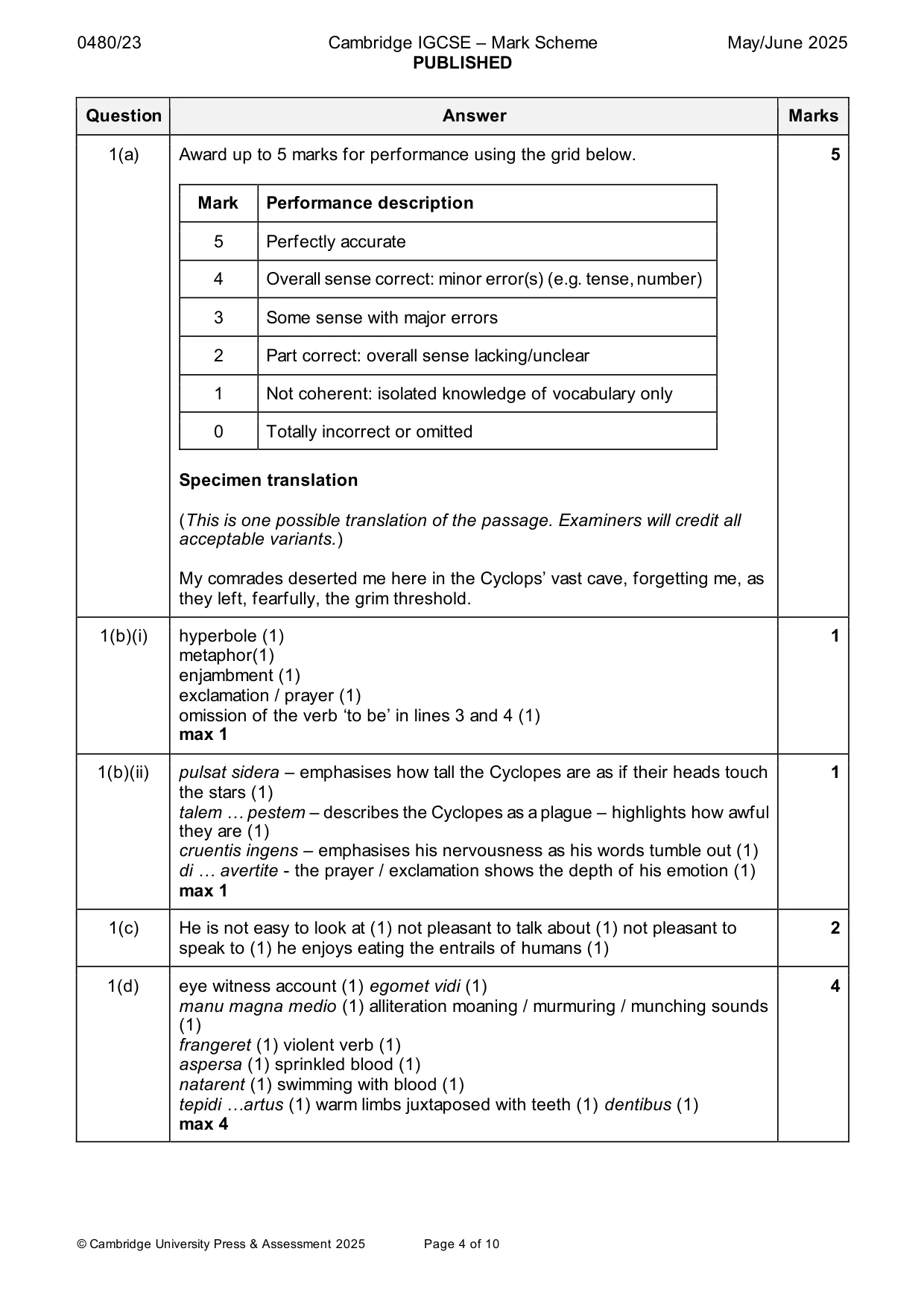
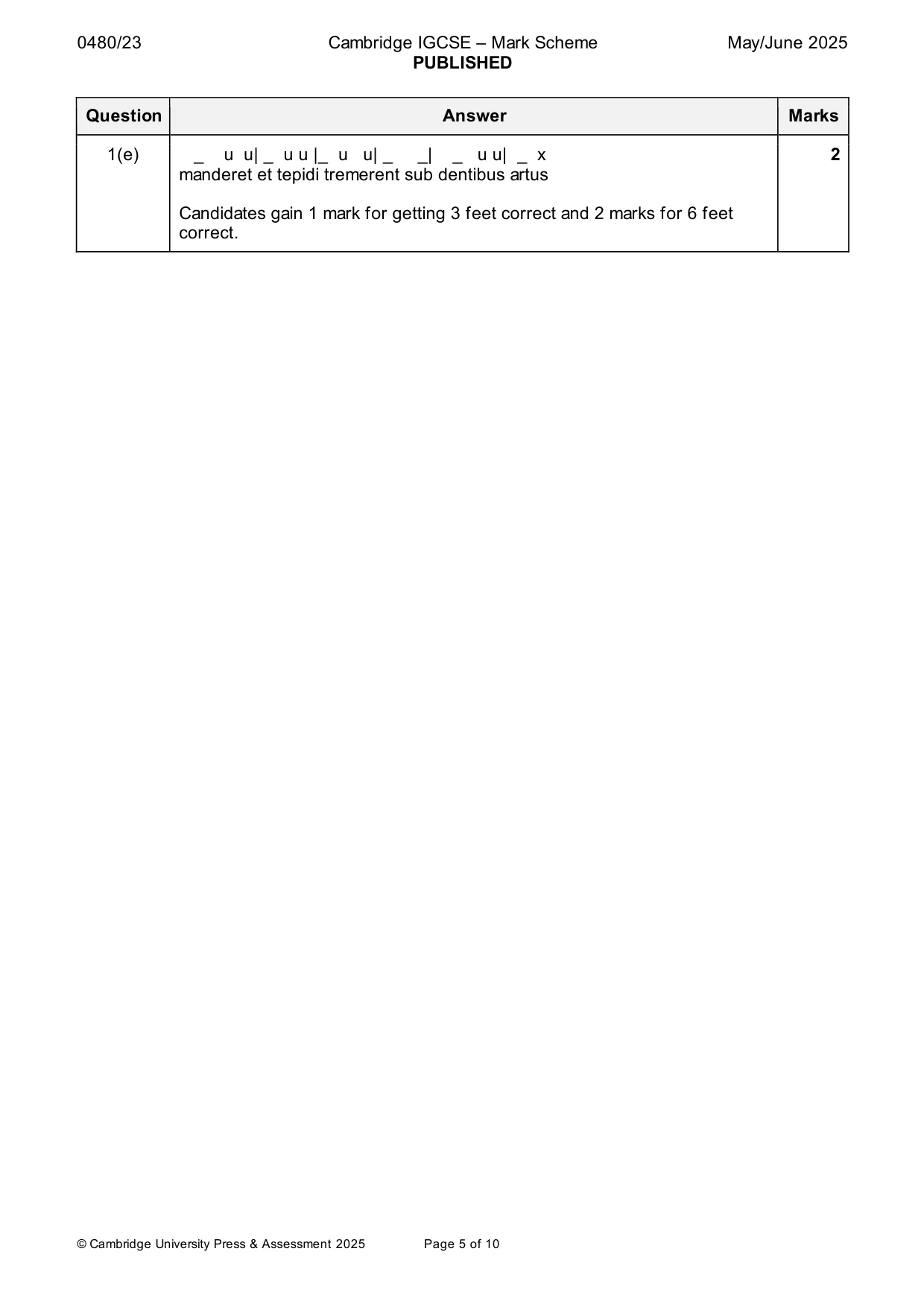
Mark scheme: Question Answer Marks 1(a) Award up to 5 marks for performance using the grid below. 5 Mark Performance description 5 Perfectly accurate 4 Overall sense correct: minor error(s) (e.g. tense, number) 3 Some sense with major errors 2 Part correct: overall sense lacking/unclear 1 Not coherent: isolated knowledge of vocabulary only 0 Totally incorrect or omitted Specimen translation (This is one possible translation of the passage. Examiners will credit all acceptable variants.) My comrades deserted me here in the Cyclops’ vast cave, forgetting me, as they left, fearfully, the grim threshold. 1(b)(i) hyperbole (1) 1 metaphor(1) enjambment (1) exclamation / prayer (1) omission of the verb ‘to be’ in lines 3 and 4 (1) max 1 1(b)(ii) pulsat sidera – emphasises how tall the Cyclopes are as if their heads touch 1 the stars (1) talem … pestem – describes the Cyclopes as a plague – highlights how awful they are (1) cruentis ingens – emphasises his nervousness as his words tumble out (1) di … avertite - the prayer / exclamation shows the depth of his emotion (1) max 1 1(c) He is not easy to look at (1) not pleasant to talk about (1) not pleasant to 2 speak to (1) he enjoys eating the entrails of humans (1) 1(d) eye witness account (1) egomet vidi (1) 4 manu magna medio (1) alliteration moaning / murmuring / munching sounds (1) frangeret (1) violent verb (1) aspersa (1) sprinkled blood (1) natarent (1) swimming with blood (1) tepidi …artus (1) warm limbs juxtaposed with teeth (1) dentibus (1) max 4 1(e) _ u u| _ u u |_ u u| _ _| _ u u| _ x 2 manderet et tepidi tremerent sub dentibus artus Candidates gain 1 mark for getting 3 feet correct and 2 marks for 6 feet correct.
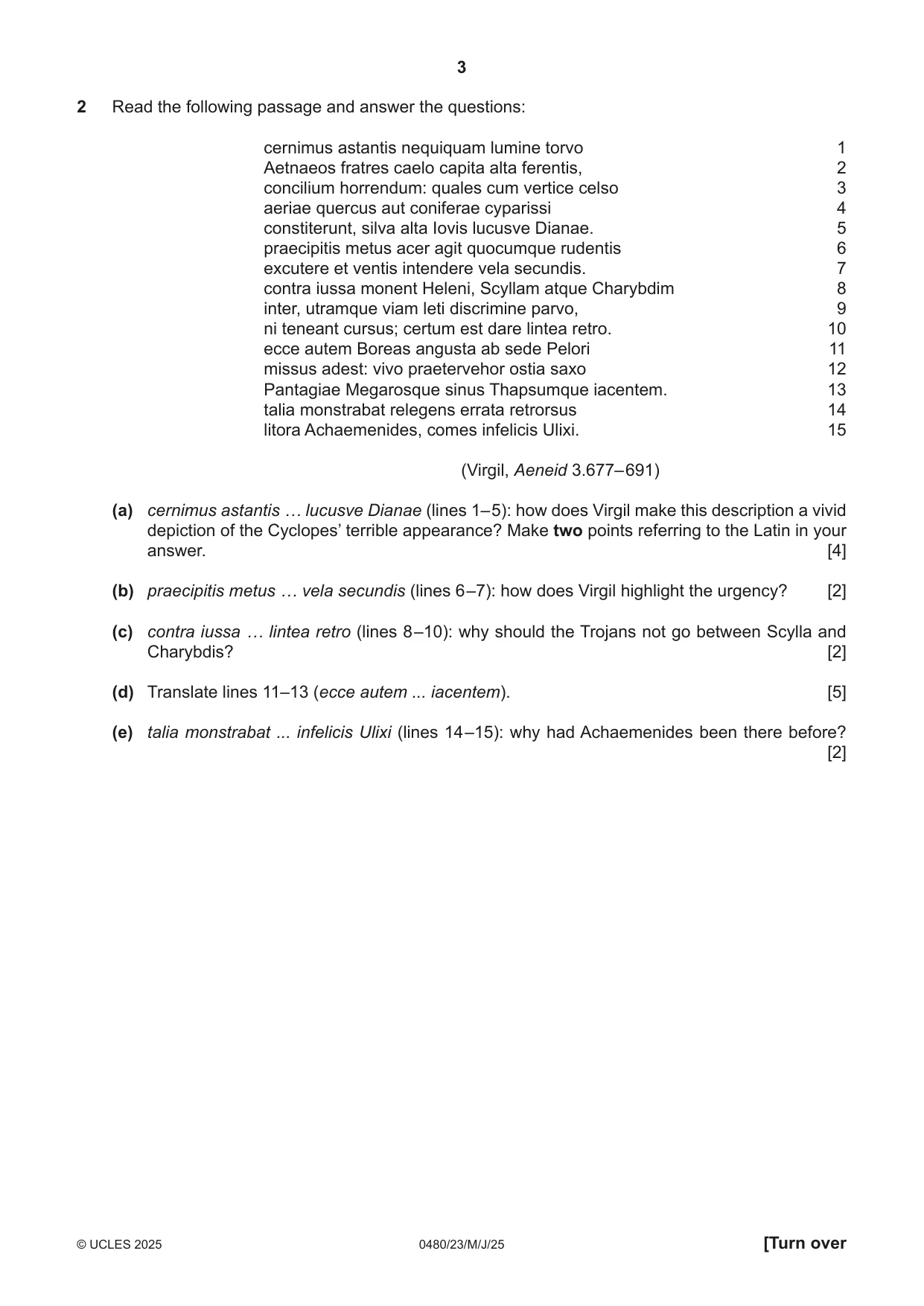
Q2 · Read the following passage and answer the questions: cernimus astantis nequiquam lumine…
2 Read the following passage and answer the questions: cernimus astantis nequiquam lumine torvo 1 Aetnaeos fratres caelo capita alta ferentis, 2 concilium horrendum: quales cum vertice celso 3 aeriae quercus aut coniferae cyparissi 4 constiterunt, silva alta Iovis lucusve Dianae. 5 praecipitis metus acer agit quocumque rudentis 6 excutere et ventis intendere vela secundis. 7 contra iussa monent Heleni, Scyllam atque Charybdim 8 inter, utramque viam leti discrimine parvo, 9 ni teneant cursus; certum est dare lintea retro. 10 ecce autem Boreas angusta ab sede Pelori 11 missus adest: vivo praetervehor ostia saxo 12 Pantagiae Megarosque sinus Thapsumque iacentem. 13 talia monstrabat relegens errata retrorsus 14 litora Achaemenides, comes infelicis Ulixi. 15 (Virgil, Aeneid 3.677– 691) (a) cernimus astantis … lucusve Dianae (lines 1– 5): how does Virgil make this description a vivid depiction of the Cyclopes’ terrible appearance? Make two points referring to the Latin in your answer. [4] (b) praecipitis metus … vela secundis (lines 6 –7): how does Virgil highlight the urgency? [2] (c) contra iussa … lintea retro (lines 8 –10): why should the Trojans not go between Scylla and Charybdis? [2] (d) Translate lines 11–13 (ecce autem ... iacentem). [5] (e) talia monstrabat ... infelicis Ulixi (lines 14 –15): why had Achaemenides been there before? [2]
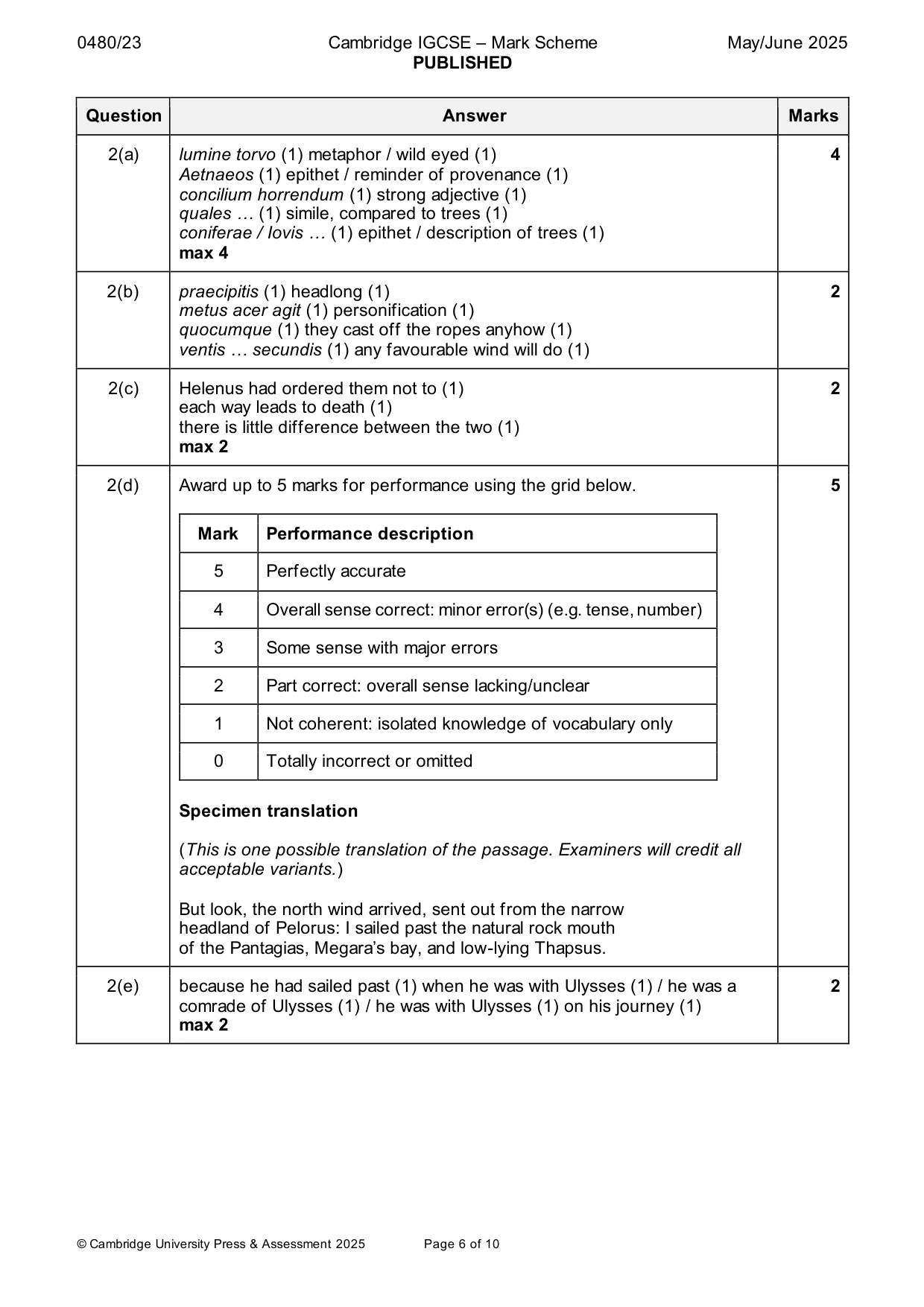
Mark scheme: 2(a) lumine torvo (1) metaphor / wild eyed (1) 4 Aetnaeos (1) epithet / reminder of provenance (1) concilium horrendum (1) strong adjective (1) quales … (1) simile, compared to trees (1) coniferae / Iovis … (1) epithet / description of trees (1) max 4 2(b) praecipitis (1) headlong (1) 2 metus acer agit (1) personification (1) quocumque (1) they cast off the ropes anyhow (1) ventis … secundis (1) any favourable wind will do (1) 2(c) Helenus had ordered them not to (1) 2 each way leads to death (1) there is little difference between the two (1) max 2 2(d) Award up to 5 marks for performance using the grid below. 5 Mark Performance description 5 Perfectly accurate 4 Overall sense correct: minor error(s) (e.g. tense, number) 3 Some sense with major errors 2 Part correct: overall sense lacking/unclear 1 Not coherent: isolated knowledge of vocabulary only 0 Totally incorrect or omitted Specimen translation (This is one possible translation of the passage. Examiners will credit all acceptable variants.) But look, the north wind arrived, sent out from the narrow headland of Pelorus: I sailed past the natural rock mouth of the Pantagias, Megara’s bay, and low-lying Thapsus. 2(e) because he had sailed past (1) when he was with Ulysses (1) / he was a 2 comrade of Ulysses (1) / he was with Ulysses (1) on his journey (1) max 2
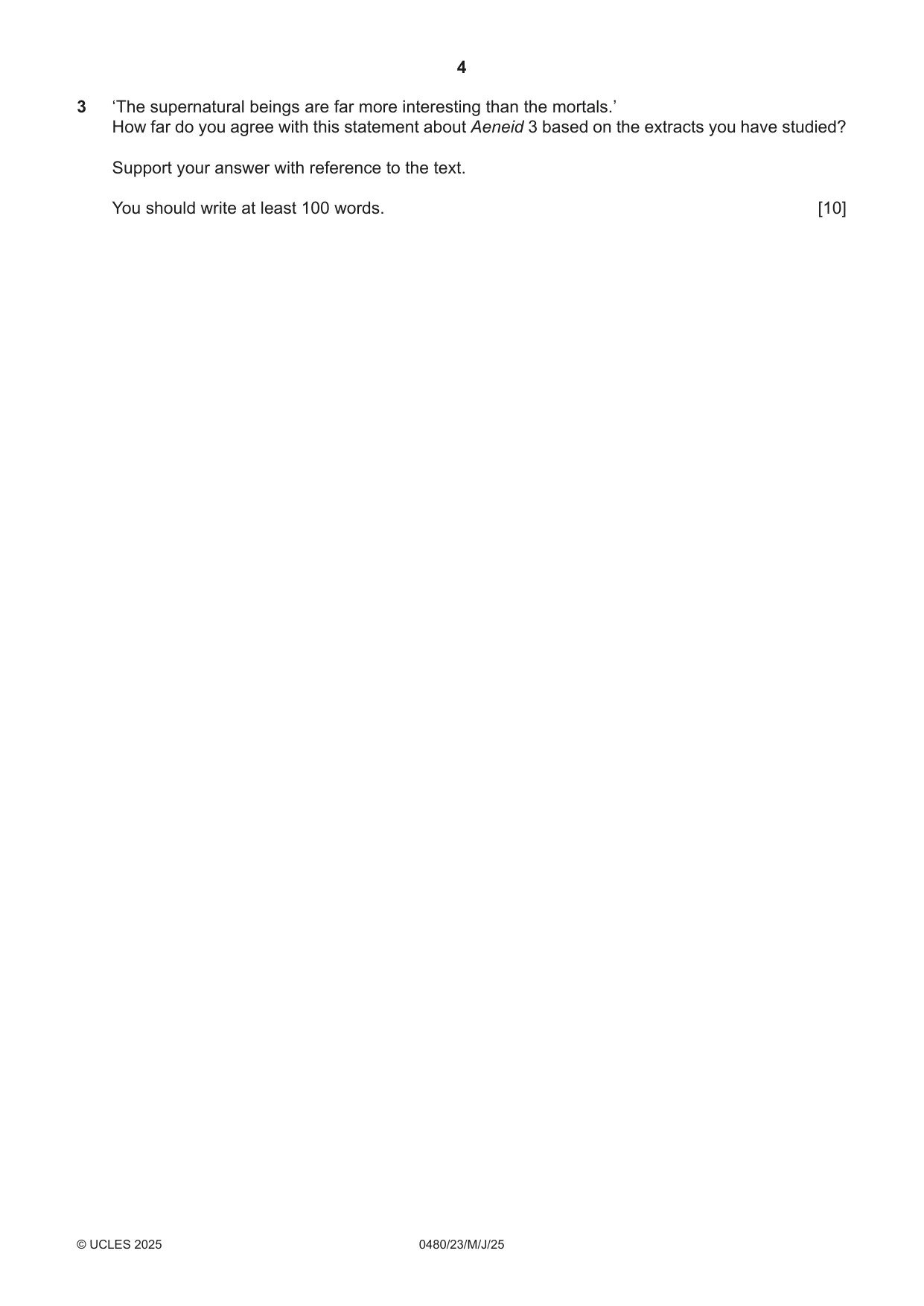
Q3 · ‘The supernatural beings are far more interesting than the mortals.’ How far do you agree…
3 ‘The supernatural beings are far more interesting than the mortals.’ How far do you agree with this statement about Aeneid 3 based on the extracts you have studied? Support your answer with reference to the text. You should write at least 100 words. [10]
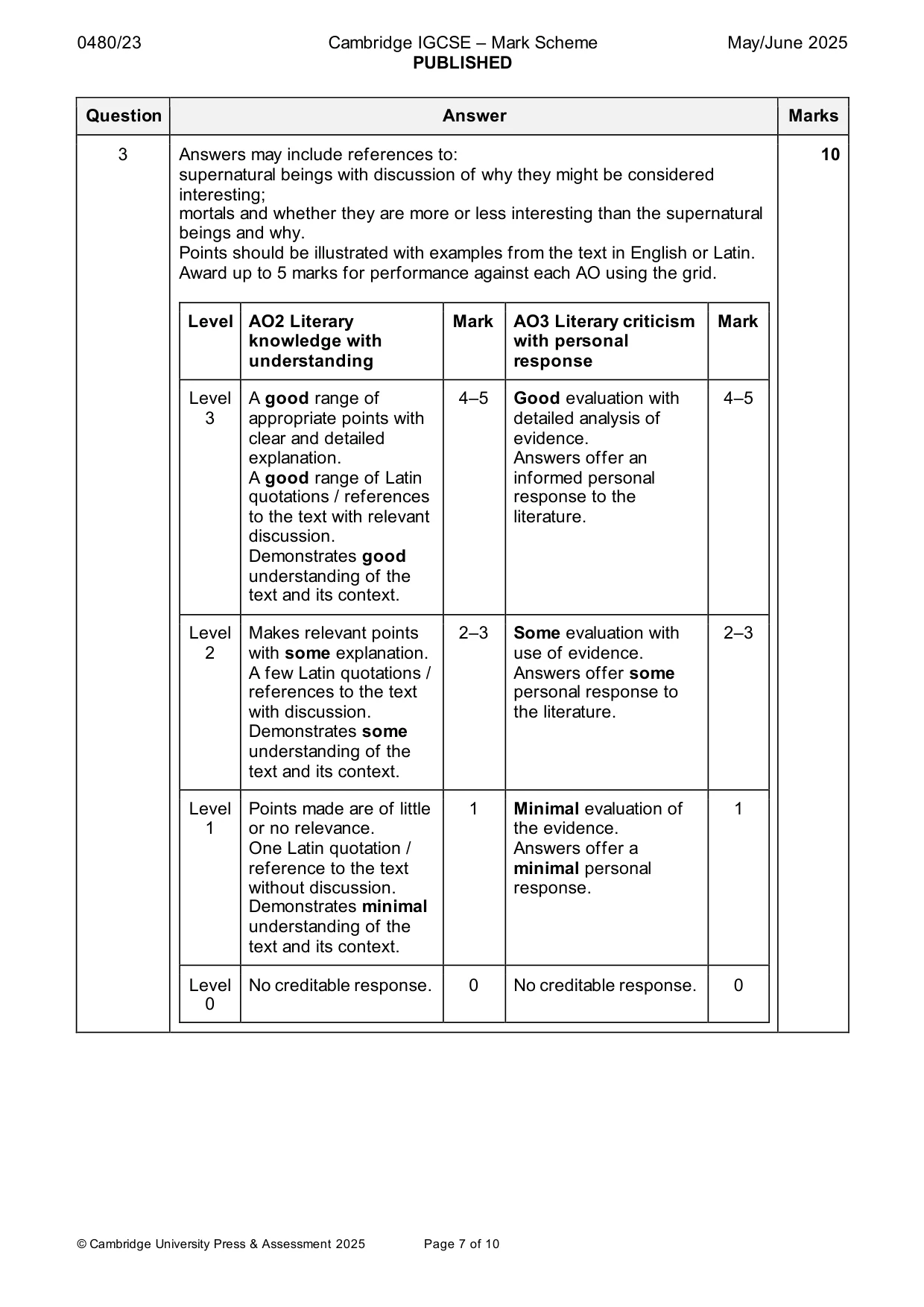
Mark scheme: 3 Answers may include references to: 10 supernatural beings with discussion of why they might be considered interesting; mortals and whether they are more or less interesting than the supernatural beings and why. Points should be illustrated with examples from the text in English or Latin. Award up to 5 marks for performance against each AO using the grid. Level AO2 Literary Mark AO3 Literary criticism Mark knowledge with with personal understanding response Level A good range of 4–5 Good evaluation with 4–5 3 appropriate points with detailed analysis of clear and detailed evidence. explanation. Answers offer an A good range of Latin informed personal quotations / references response to the to the text with relevant literature. discussion. Demonstrates good understanding of the text and its context. Level Makes relevant points 2–3 Some evaluation with 2–3 2 with some explanation. use of evidence. A few Latin quotations / Answers offer some references to the text personal response to with discussion. the literature. Demonstrates some understanding of the text and its context. Level Points made are of little 1 Minimal evaluation of 1 1 or no relevance. the evidence. One Latin quotation / Answers offer a reference to the text minimal personal without discussion. response. Demonstrates minimal understanding of the text and its context. Level No creditable response. 0 No creditable response. 0 0
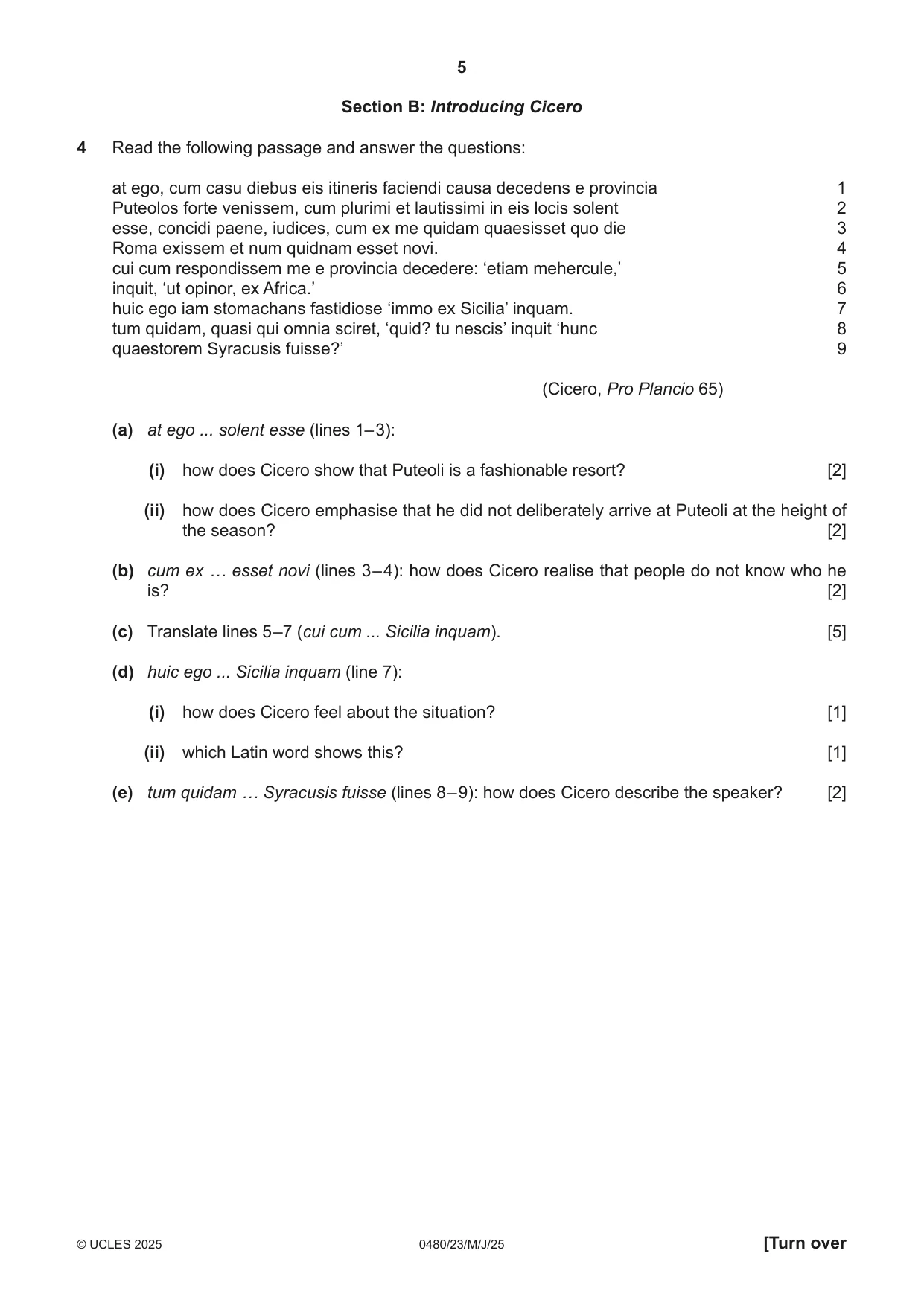
Q4 · Read the following passage and answer the questions: at ego, cum casu diebus eis itineris…
4 Read the following passage and answer the questions: at ego, cum casu diebus eis itineris faciendi causa decedens e provincia 1 Puteolos forte venissem, cum plurimi et lautissimi in eis locis solent 2 esse, concidi paene, iudices, cum ex me quidam quaesisset quo die 3 Roma exissem et num quidnam esset novi. 4 cui cum respondissem me e provincia decedere: ‘etiam mehercule,’ 5 inquit, ‘ut opinor, ex Africa.’ 6 huic ego iam stomachans fastidiose ‘immo ex Sicilia’ inquam. 7 tum quidam, quasi qui omnia sciret, ‘quid? tu nescis’ inquit ‘hunc 8 quaestorem Syracusis fuisse?’ 9 (Cicero, Pro Plancio 65) (a) at ego ... solent esse (lines 1– 3): (i) how does Cicero show that Puteoli is a fashionable resort? [2] (ii) how does Cicero emphasise that he did not deliberately arrive at Puteoli at the height of the season? [2] (b) cum ex … esset novi (lines 3 – 4): how does Cicero realise that people do not know who he is? [2] (c) Translate lines 5 –7 (cui cum ... Sicilia inquam). [5] (d) huic ego ... Sicilia inquam (line 7): (i) how does Cicero feel about the situation? [1] (ii) which Latin word shows this? [1] (e) tum quidam … Syracusis fuisse (lines 8 – 9): how does Cicero describe the speaker? [2]
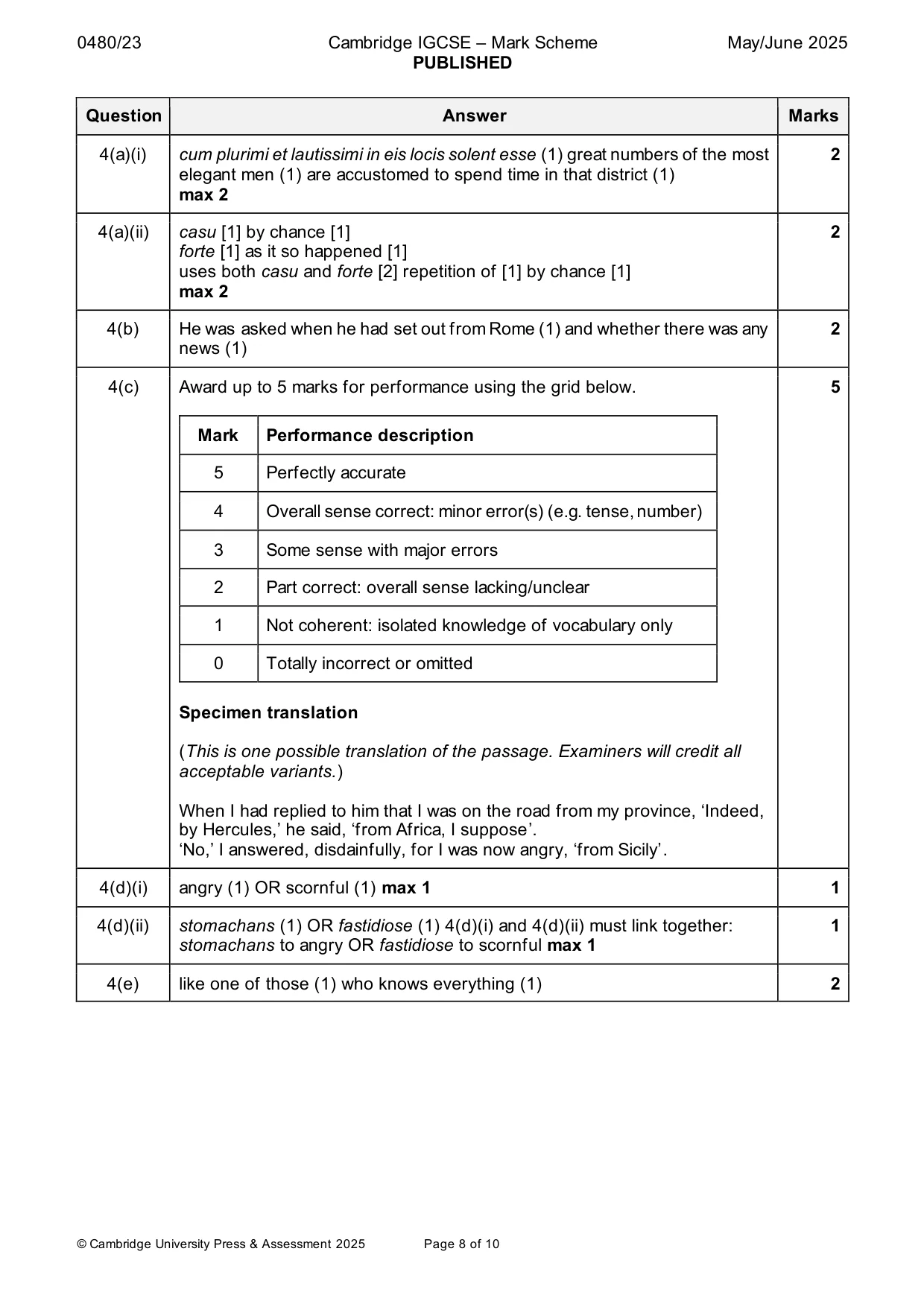
Mark scheme: 4(a)(i) cum plurimi et lautissimi in eis locis solent esse (1) great numbers of the most 2 elegant men (1) are accustomed to spend time in that district (1) max 2 4(a)(ii) casu [1] by chance [1] 2 forte [1] as it so happened [1] uses both casu and forte [2] repetition of [1] by chance [1] max 2 4(b) He was asked when he had set out from Rome (1) and whether there was any 2 news (1) 4(c) Award up to 5 marks for performance using the grid below. 5 Mark Performance description 5 Perfectly accurate 4 Overall sense correct: minor error(s) (e.g. tense, number) 3 Some sense with major errors 2 Part correct: overall sense lacking/unclear 1 Not coherent: isolated knowledge of vocabulary only 0 Totally incorrect or omitted Specimen translation (This is one possible translation of the passage. Examiners will credit all acceptable variants.) When I had replied to him that I was on the road from my province, ‘Indeed, by Hercules,’ he said, ‘from Africa, I suppose’. ‘No,’ I answered, disdainfully, for I was now angry, ‘from Sicily’. 4(d)(i) angry (1) OR scornful (1) max 1 1 4(d)(ii) stomachans (1) OR fastidiose (1) 4(d)(i) and 4(d)(ii) must link together: 1 stomachans to angry OR fastidiose to scornful max 1 4(e) like one of those (1) who knows everything (1) 2
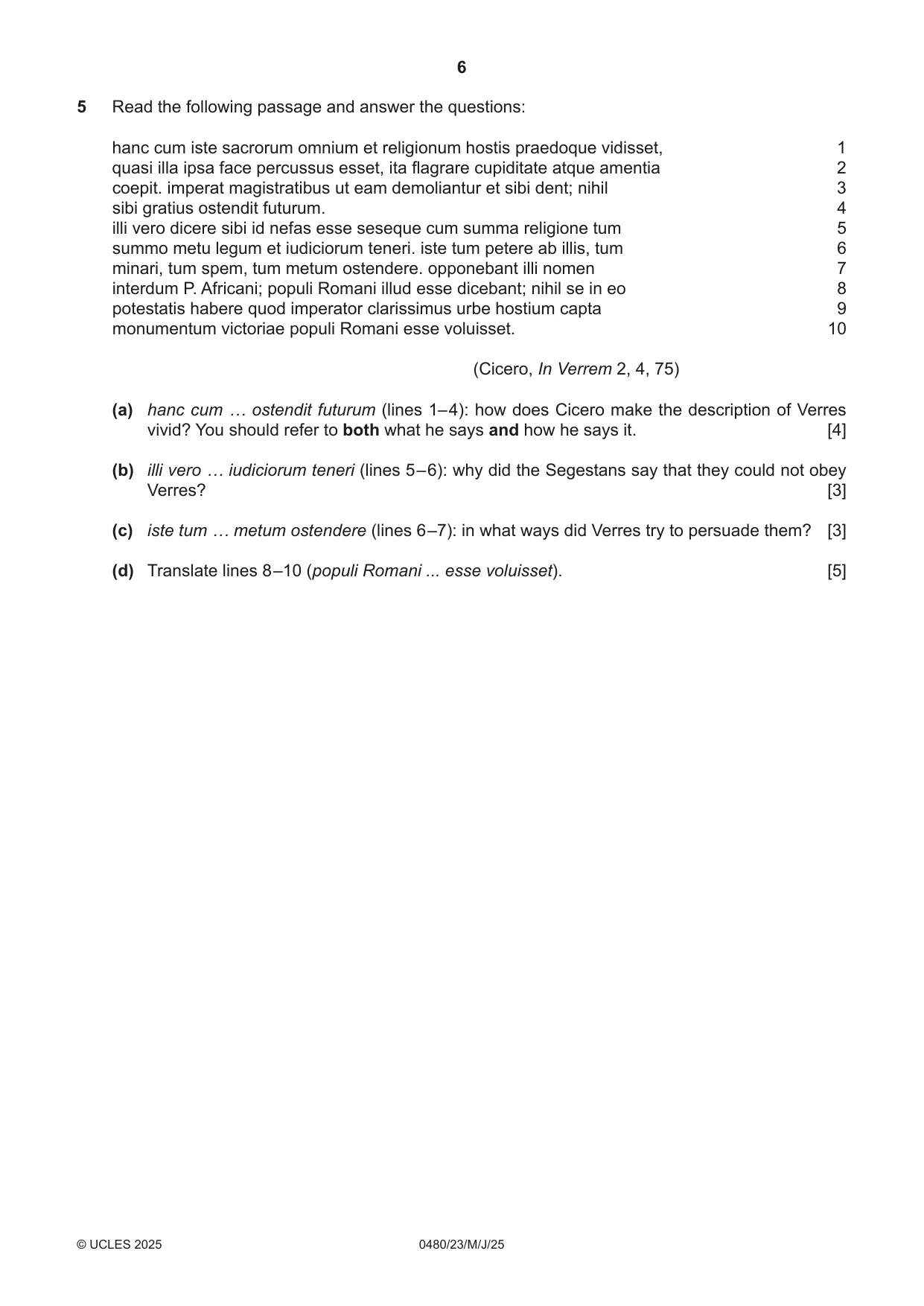
Q5 · Read the following passage and answer the questions: hanc cum iste sacrorum omnium et…
5 Read the following passage and answer the questions: hanc cum iste sacrorum omnium et religionum hostis praedoque vidisset, 1 quasi illa ipsa face percussus esset, ita flagrare cupiditate atque amentia 2 coepit. imperat magistratibus ut eam demoliantur et sibi dent; nihil 3 sibi gratius ostendit futurum. 4 illi vero dicere sibi id nefas esse seseque cum summa religione tum 5 summo metu legum et iudiciorum teneri. iste tum petere ab illis, tum 6 minari, tum spem, tum metum ostendere. opponebant illi nomen 7 interdum P. Africani; populi Romani illud esse dicebant; nihil se in eo 8 potestatis habere quod imperator clarissimus urbe hostium capta 9 monumentum victoriae populi Romani esse voluisset. 10 (Cicero, In Verrem 2, 4, 75) (a) hanc cum … ostendit futurum (lines 1– 4): how does Cicero make the description of Verres vivid? You should refer to both what he says and how he says it. [4] (b) illi vero … iudiciorum teneri (lines 5 – 6): why did the Segestans say that they could not obey Verres? [3] (c) iste tum … metum ostendere (lines 6 –7): in what ways did Verres try to persuade them? [3] (d) Translate lines 8 –10 (populi Romani ... esse voluisset). [5]
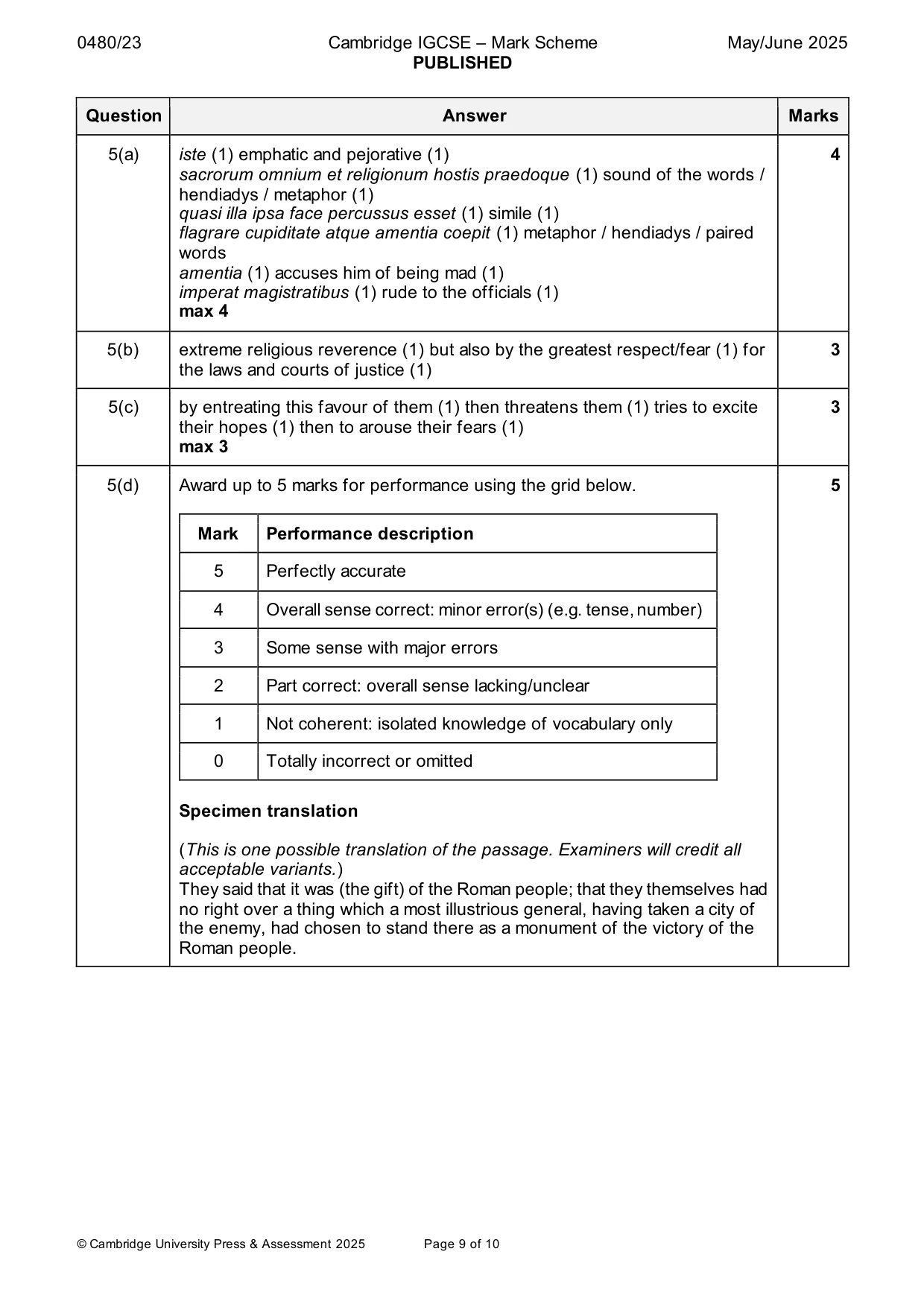
Mark scheme: 5(a) iste (1) emphatic and pejorative (1) 4 sacrorum omnium et religionum hostis praedoque (1) sound of the words / hendiadys / metaphor (1) quasi illa ipsa face percussus esset (1) simile (1) flagrare cupiditate atque amentia coepit (1) metaphor / hendiadys / paired words amentia (1) accuses him of being mad (1) imperat magistratibus (1) rude to the officials (1) max 4 5(b) extreme religious reverence (1) but also by the greatest respect/fear (1) for 3 the laws and courts of justice (1) 5(c) by entreating this favour of them (1) then threatens them (1) tries to excite 3 their hopes (1) then to arouse their fears (1) max 3 5(d) Award up to 5 marks for performance using the grid below. 5 Mark Performance description 5 Perfectly accurate 4 Overall sense correct: minor error(s) (e.g. tense, number) 3 Some sense with major errors 2 Part correct: overall sense lacking/unclear 1 Not coherent: isolated knowledge of vocabulary only 0 Totally incorrect or omitted Specimen translation (This is one possible translation of the passage. Examiners will credit all acceptable variants.) They said that it was (the gift) of the Roman people; that they themselves had no right over a thing which a most illustrious general, having taken a city of the enemy, had chosen to stand there as a monument of the victory of the Roman people.
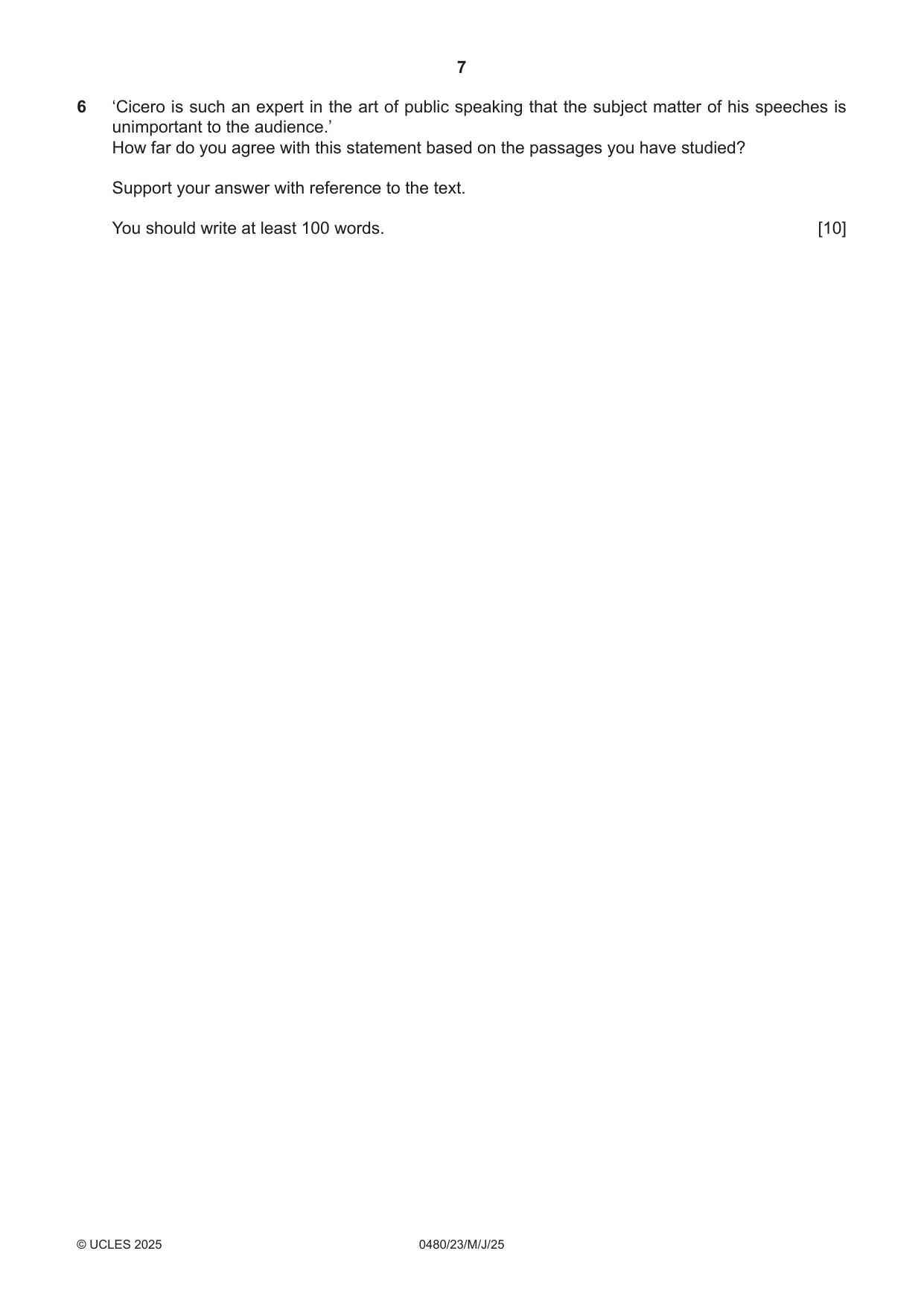
Q6 · ‘Cicero is such an expert in the art of public speaking that the subject matter of his…
6 ‘Cicero is such an expert in the art of public speaking that the subject matter of his speeches is unimportant to the audience.’ How far do you agree with this statement based on the passages you have studied? Support your answer with reference to the text. You should write at least 100 words. [10]
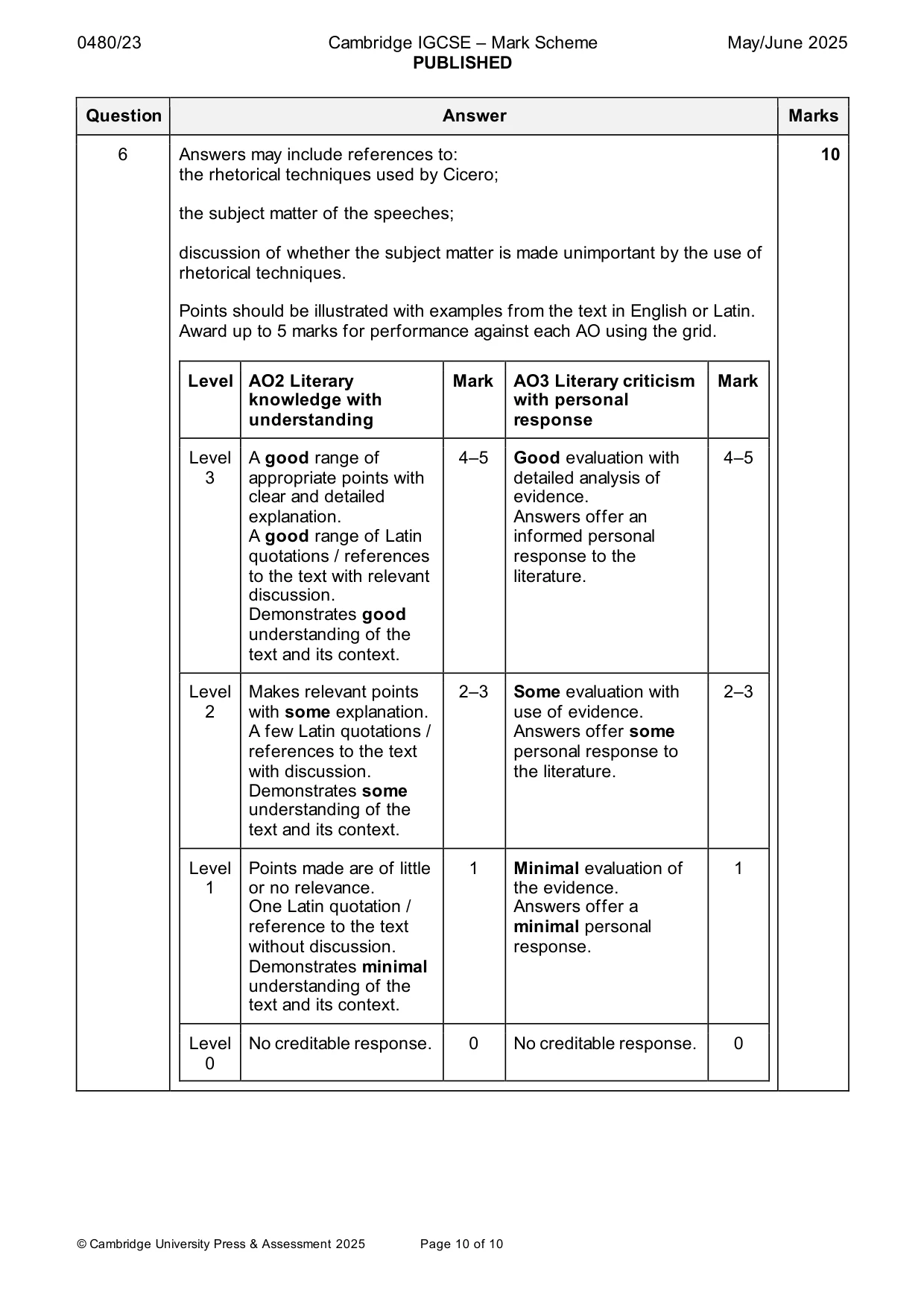
Mark scheme: 6 Answers may include references to: 10 the rhetorical techniques used by Cicero; the subject matter of the speeches; discussion of whether the subject matter is made unimportant by the use of rhetorical techniques. Points should be illustrated with examples from the text in English or Latin. Award up to 5 marks for performance against each AO using the grid. Level AO2 Literary Mark AO3 Literary criticism Mark knowledge with with personal understanding response Level A good range of 4–5 Good evaluation with 4–5 3 appropriate points with detailed analysis of clear and detailed evidence. explanation. Answers offer an A good range of Latin informed personal quotations / references response to the to the text with relevant literature. discussion. Demonstrates good understanding of the text and its context. Level Makes relevant points 2–3 Some evaluation with 2–3 2 with some explanation. use of evidence. A few Latin quotations / Answers offer some references to the text personal response to with discussion. the literature. Demonstrates some understanding of the text and its context. Level Points made are of little 1 Minimal evaluation of 1 1 or no relevance. the evidence. One Latin quotation / Answers offer a reference to the text minimal personal without discussion. response. Demonstrates minimal understanding of the text and its context. Level No creditable response. 0 No creditable response. 0 0
What you needed in this session
Cambridge’s own grade thresholds for 2025 May/June, Paper 2 · Variant 3. A higher threshold means an easier paper — the bar moves with how the cohort did.