Cambridge IGCSE Latin 0480 — 2021 May/June Paper 2 · Variant 3
0480/23/M/J/21 · 6 questions · 80 marks · ≈90 min
The question paper and its mark scheme, free to read here and free to download. This is Cambridge’s own paper, exactly as it was sat.
Question paper8 pages

Mark scheme9 pages
Answers below. Sit the paper first if you are practising.
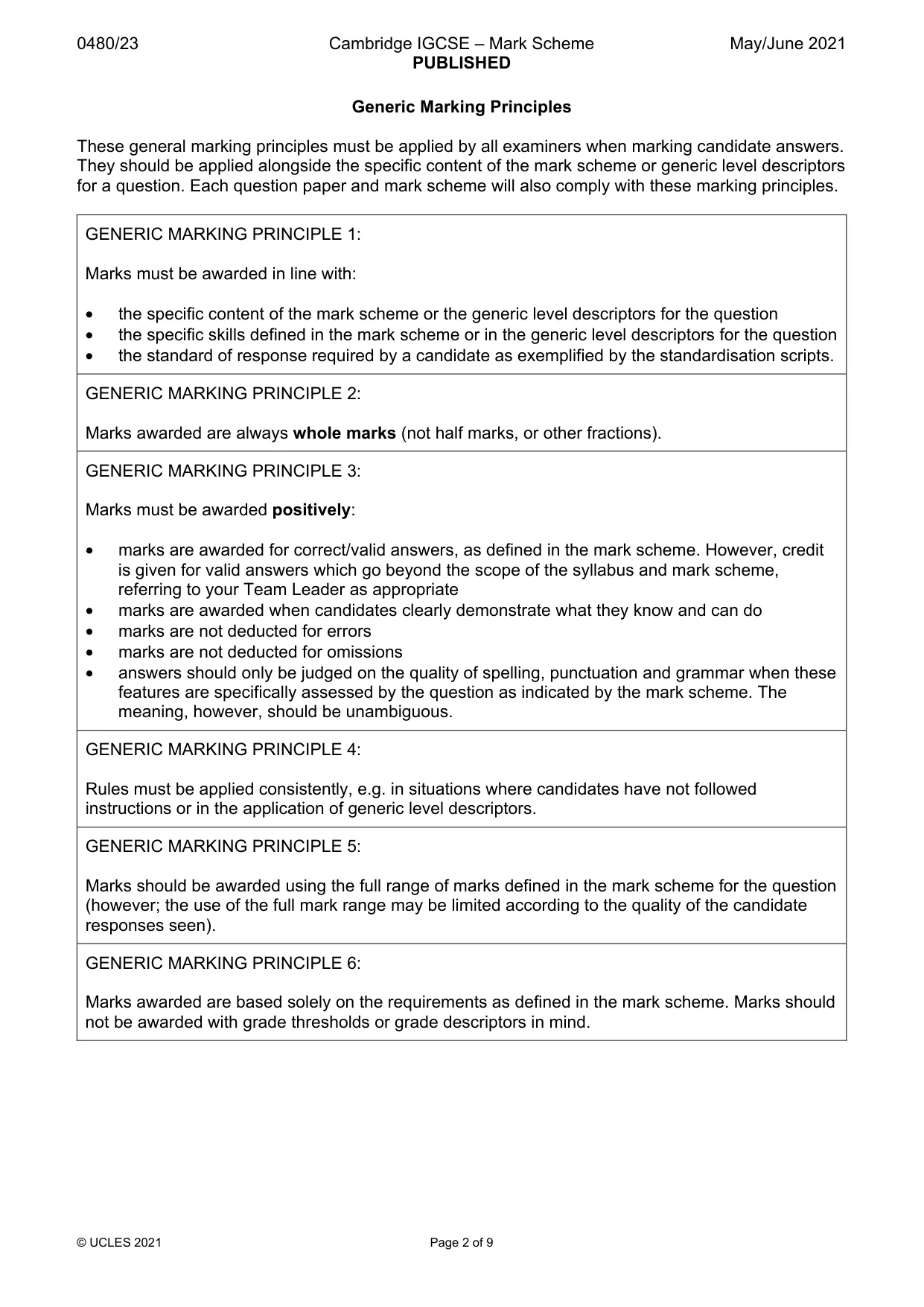
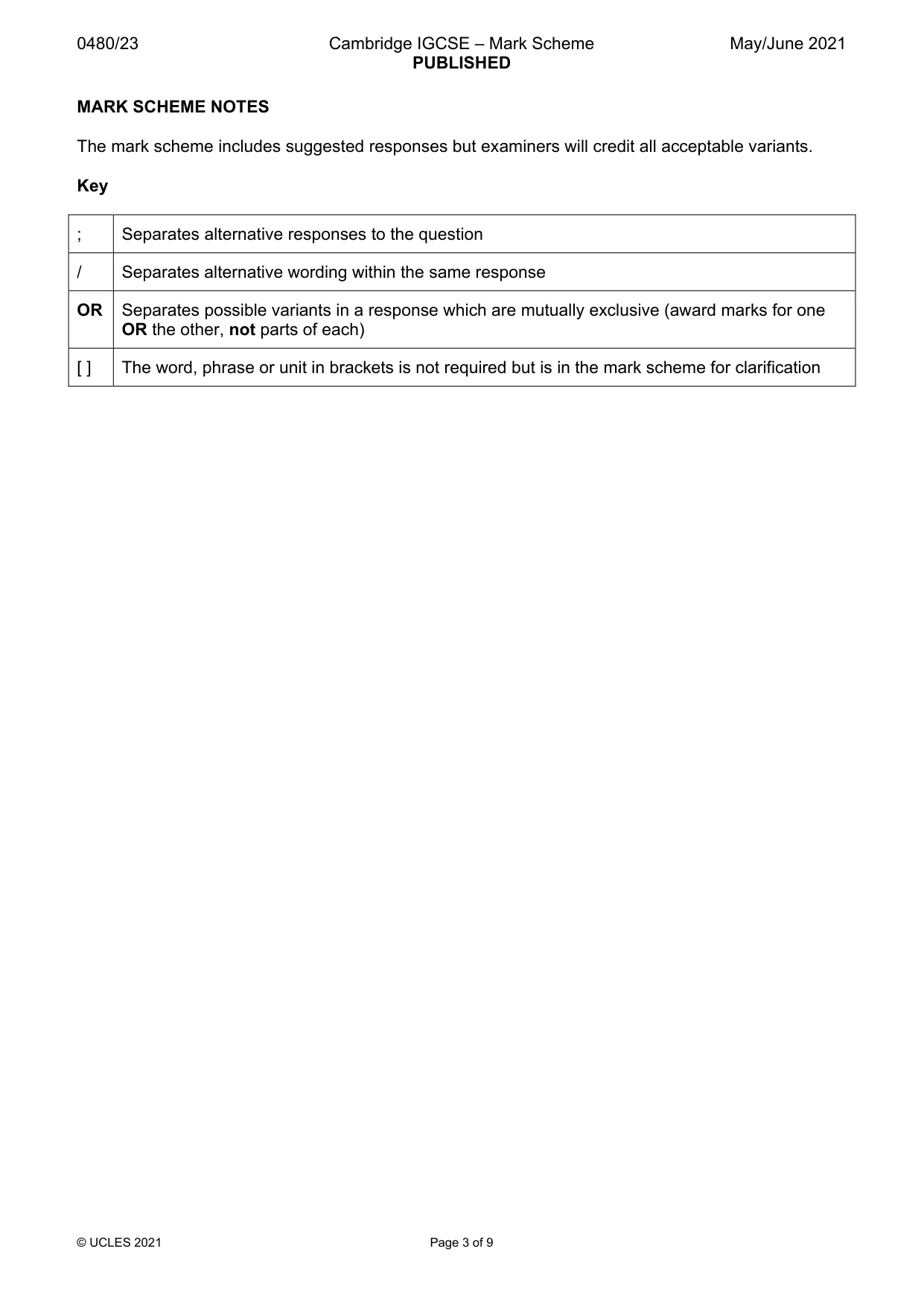
Questions as text
Q1 · Read the following passage and answer the questions: ibant obscuri sola sub nocte per…
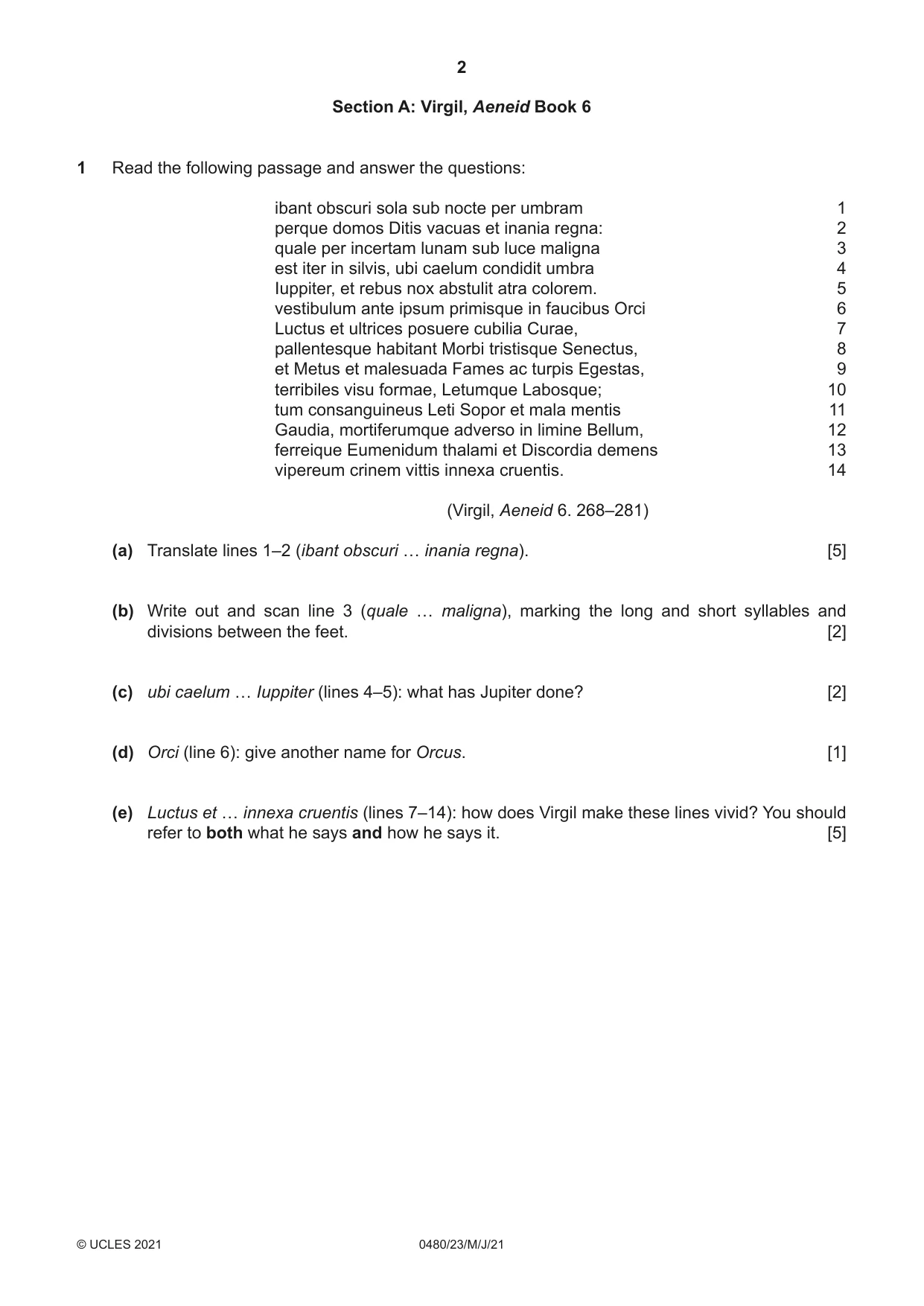
1 Read the following passage and answer the questions: ibant obscuri sola sub nocte per umbram 1 perque domos Ditis vacuas et inania regna: 2 quale per incertam lunam sub luce maligna 3 est iter in silvis, ubi caelum condidit umbra 4 Iuppiter, et rebus nox abstulit atra colorem. 5 vestibulum ante ipsum primisque in faucibus Orci 6 Luctus et ultrices posuere cubilia Curae, 7 pallentesque habitant Morbi tristisque Senectus, 8 et Metus et malesuada Fames ac turpis Egestas, 9 terribiles visu formae, Letumque Labosque; 10 tum consanguineus Leti Sopor et mala mentis 11 Gaudia, mortiferumque adverso in limine Bellum, 12 ferreique Eumenidum thalami et Discordia demens 13 vipereum crinem vittis innexa cruentis. 14 (Virgil, Aeneid 6. 268–281) (a) Translate lines 1–2 (ibant obscuri … inania regna). [5] (b) Write out and scan line 3 (quale … maligna), marking the long and short syllables and divisions between the feet. [2] (c) ubi caelum … Iuppiter (lines 4–5): what has Jupiter done? [2] (d) Orci (line 6): give another name for Orcus. [1] (e) Luctus et … innexa cruentis (lines 7–14): how does Virgil make these lines vivid? You should refer to both what he says and how he says it. [5]
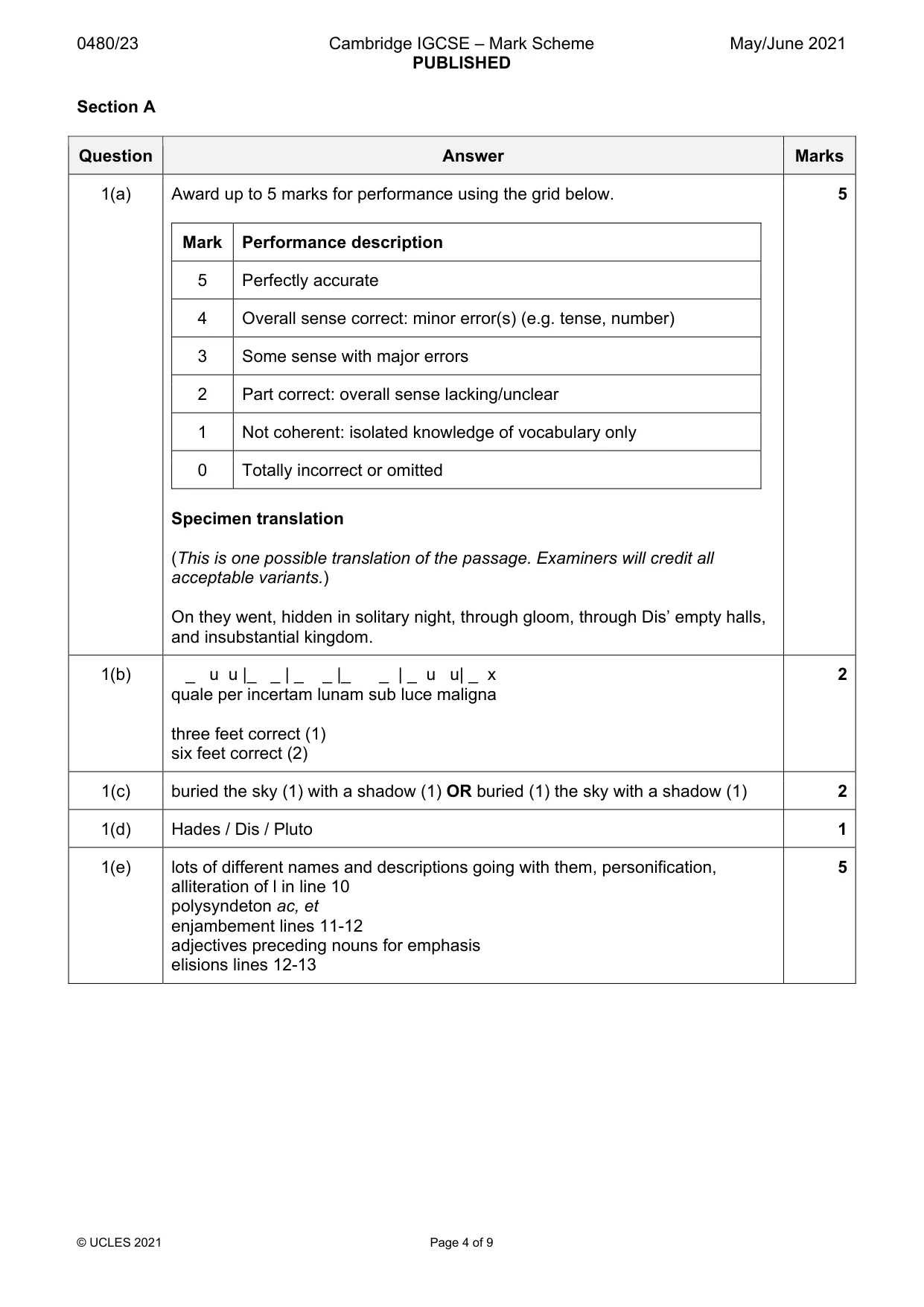
Mark scheme: Question Answer Marks 1(a) Award up to 5 marks for performance using the grid below. 5 Mark Performance description 5 Perfectly accurate 4 Overall sense correct: minor error(s) (e.g. tense, number) 3 Some sense with major errors 2 Part correct: overall sense lacking/unclear 1 Not coherent: isolated knowledge of vocabulary only 0 Totally incorrect or omitted Specimen translation (This is one possible translation of the passage. Examiners will credit all acceptable variants.) On they went, hidden in solitary night, through gloom, through Dis’ empty halls, and insubstantial kingdom. 1(b) _ u u |_ _ | _ _ |_ _ | _ u u| _ x 2 quale per incertam lunam sub luce maligna three feet correct (1) six feet correct (2) 1(c) buried the sky (1) with a shadow (1) OR buried (1) the sky with a shadow (1) 2 1(d) Hades / Dis / Pluto 1 1(e) lots of different names and descriptions going with them, personification, 5 alliteration of l in line 10 polysyndeton ac, et enjambement lines 11-12 adjectives preceding nouns for emphasis elisions lines 12-13
Q2 · Read the following passage and answer the questions: ‘umbrarum hic locus est, somni…
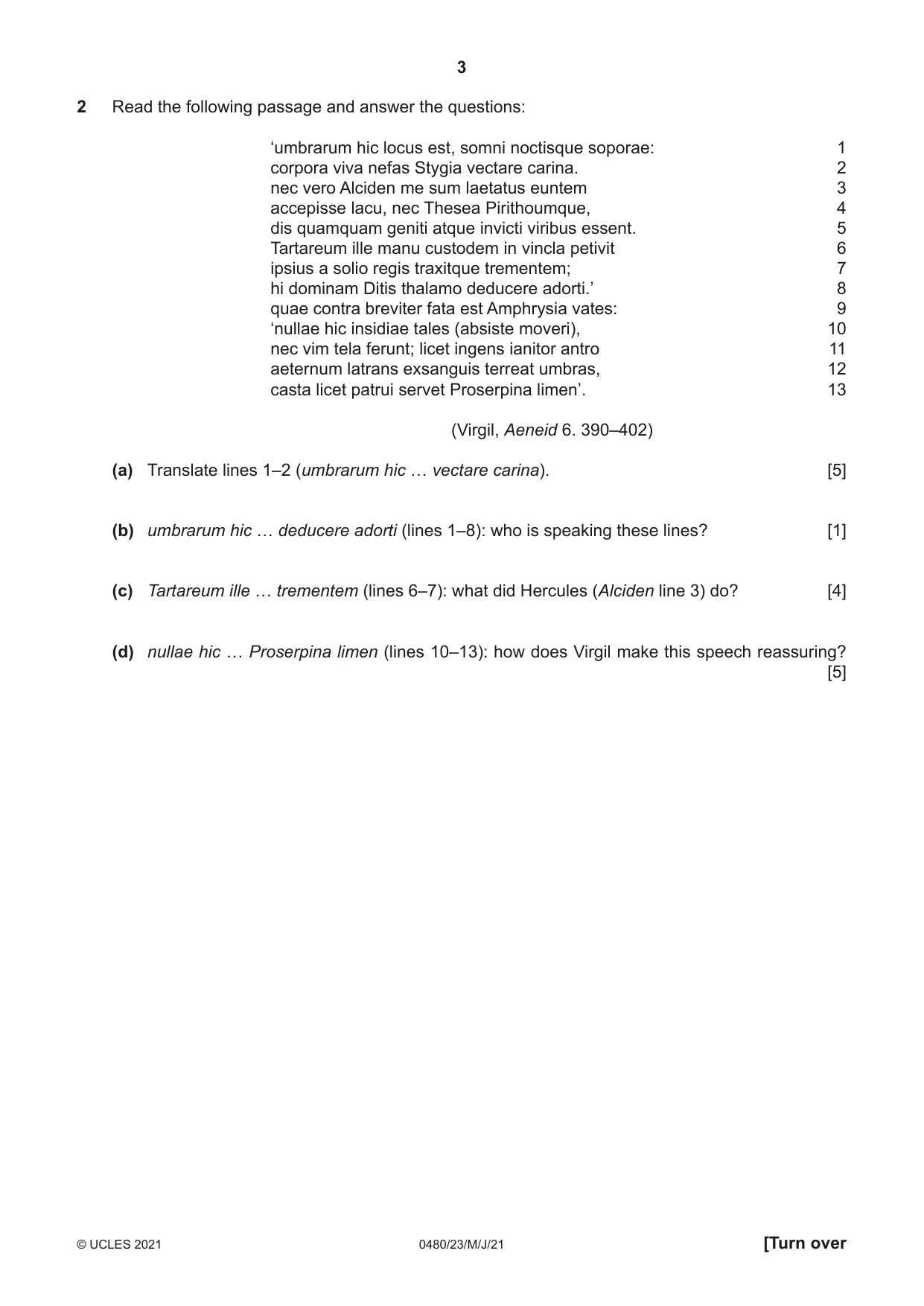
2 Read the following passage and answer the questions: ‘umbrarum hic locus est, somni noctisque soporae: 1 corpora viva nefas Stygia vectare carina. 2 nec vero Alciden me sum laetatus euntem 3 accepisse lacu, nec Thesea Pirithoumque, 4 dis quamquam geniti atque invicti viribus essent. 5 Tartareum ille manu custodem in vincla petivit 6 ipsius a solio regis traxitque trementem; 7 hi dominam Ditis thalamo deducere adorti.’ 8 quae contra breviter fata est Amphrysia vates: 9 ‘nullae hic insidiae tales (absiste moveri), 10 nec vim tela ferunt; licet ingens ianitor antro 11 aeternum latrans exsanguis terreat umbras, 12 casta licet patrui servet Proserpina limen’. 13 (Virgil, Aeneid 6. 390–402) (a) Translate lines 1–2 (umbrarum hic … vectare carina). [5] (b) umbrarum hic … deducere adorti (lines 1–8): who is speaking these lines? [1] (c) Tartareum ille … trementem (lines 6–7): what did Hercules (Alciden line 3) do? [4] (d) nullae hic … Proserpina limen (lines 10–13): how does Virgil make this speech reassuring? [5]
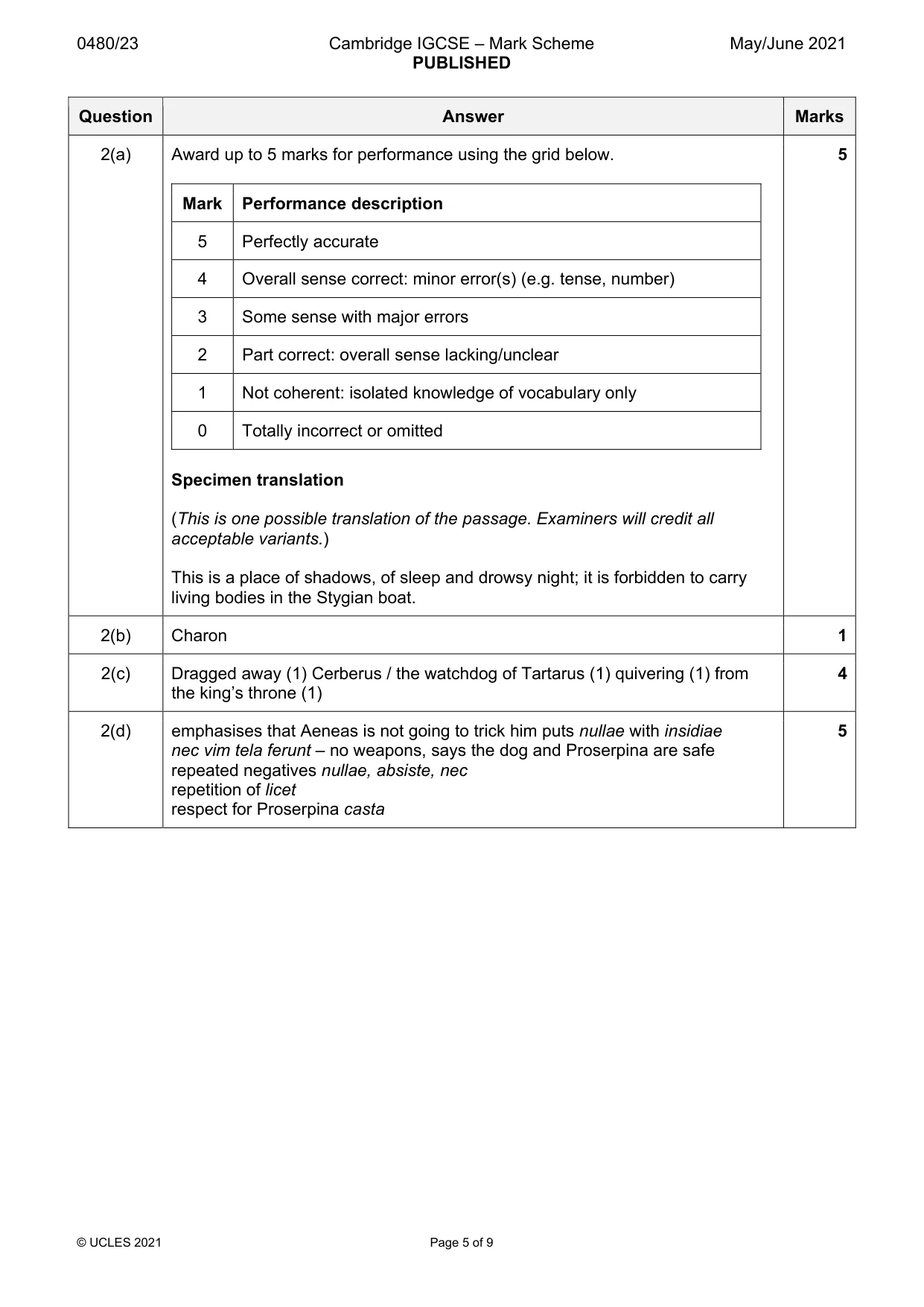
Mark scheme: 2(a) Award up to 5 marks for performance using the grid below. 5 Mark Performance description 5 Perfectly accurate 4 Overall sense correct: minor error(s) (e.g. tense, number) 3 Some sense with major errors 2 Part correct: overall sense lacking/unclear 1 Not coherent: isolated knowledge of vocabulary only 0 Totally incorrect or omitted Specimen translation (This is one possible translation of the passage. Examiners will credit all acceptable variants.) This is a place of shadows, of sleep and drowsy night; it is forbidden to carry living bodies in the Stygian boat. 2(b) Charon 1 2(c) Dragged away (1) Cerberus / the watchdog of Tartarus (1) quivering (1) from 4 the king’s throne (1) 2(d) emphasises that Aeneas is not going to trick him puts nullae with insidiae 5 nec vim tela ferunt – no weapons, says the dog and Proserpina are safe repeated negatives nullae, absiste, nec repetition of licet respect for Proserpina casta
Q3 · ‘Too gloomy to capture the interest of the reader.’ How far do you agree with this…
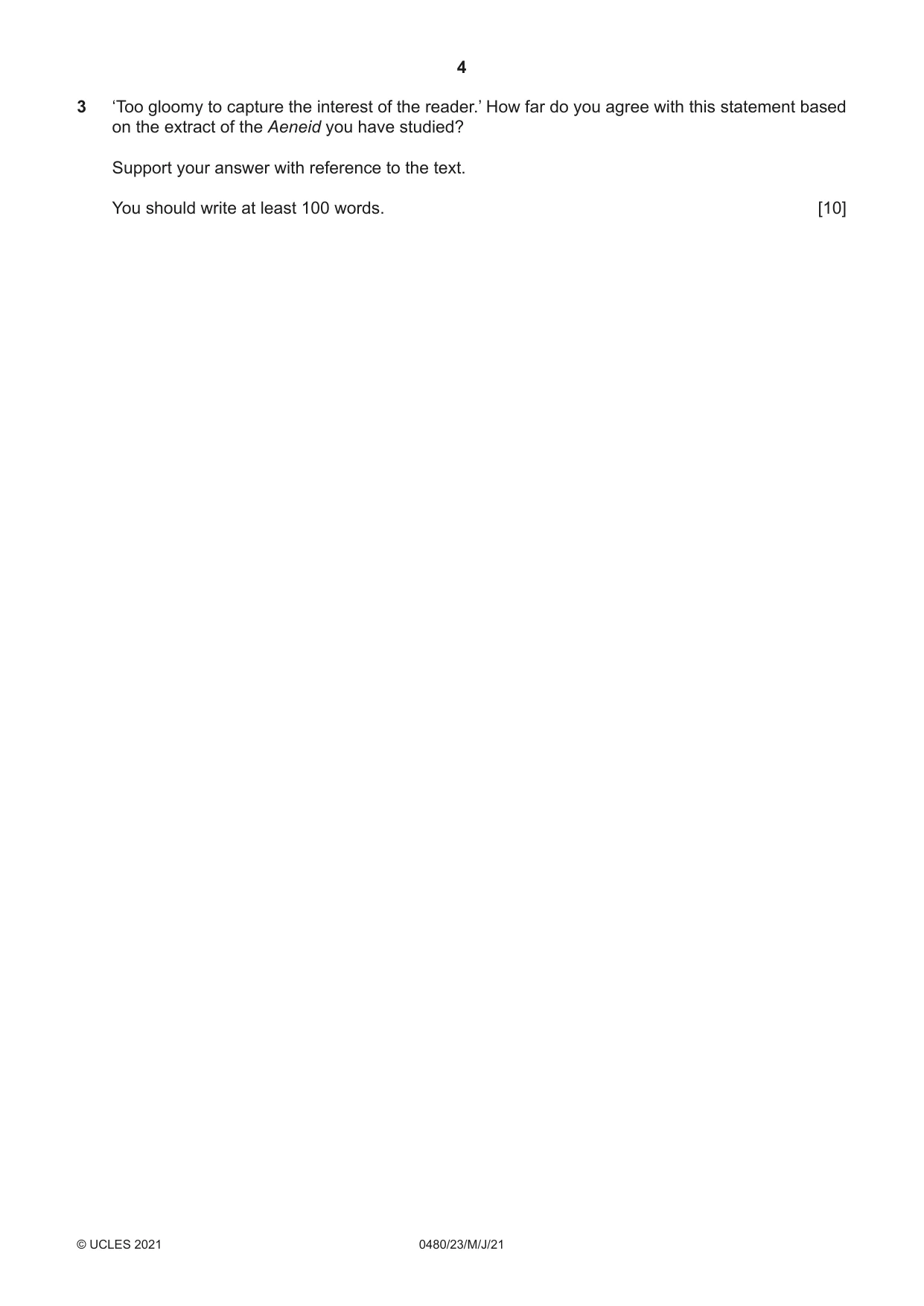
3 ‘Too gloomy to capture the interest of the reader.’ How far do you agree with this statement based on the extract of the Aeneid you have studied? Support your answer with reference to the text. You should write at least 100 words. [10]
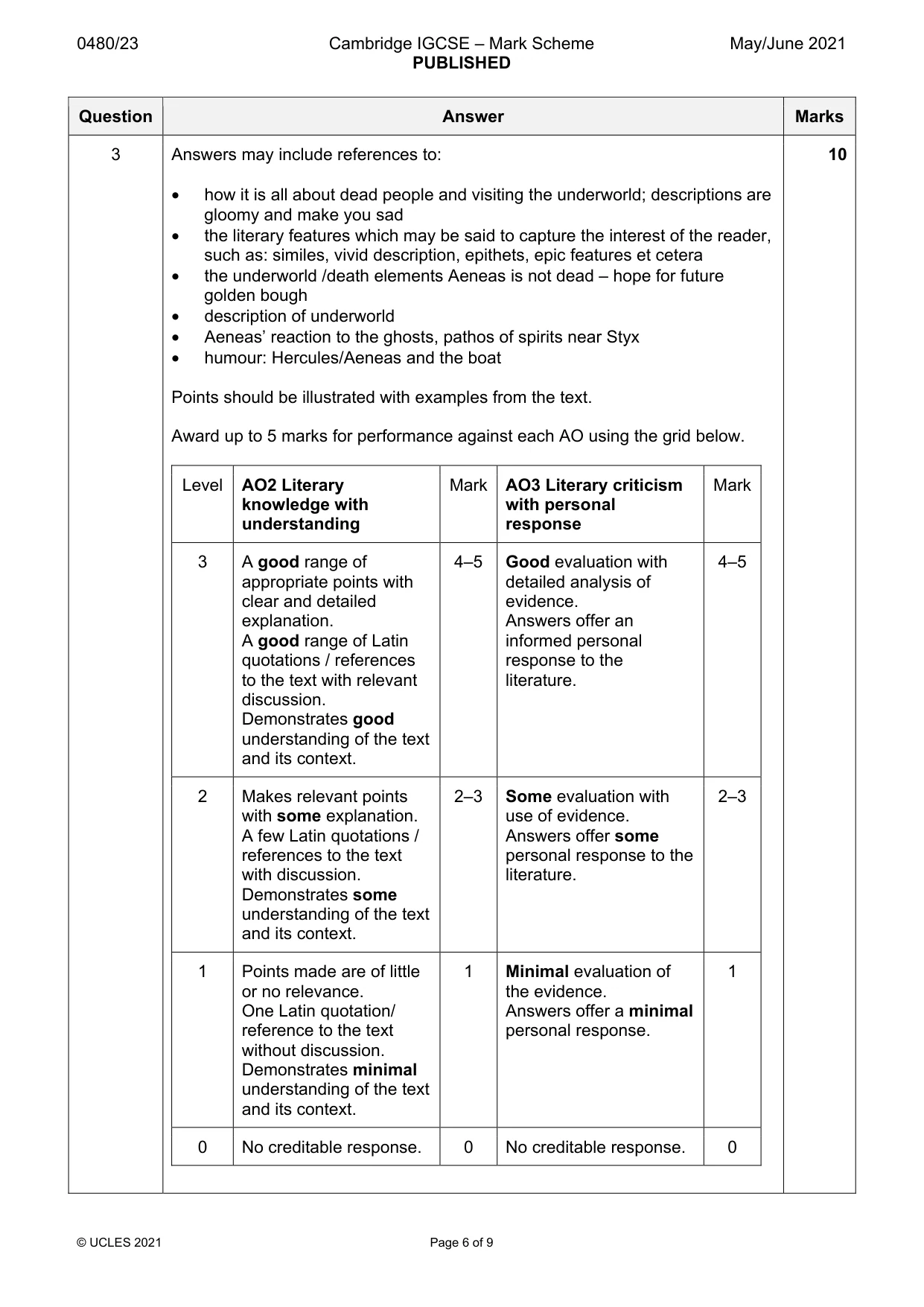
Mark scheme: 3 Answers may include references to: 10 • how it is all about dead people and visiting the underworld; descriptions are gloomy and make you sad • the literary features which may be said to capture the interest of the reader, such as: similes, vivid description, epithets, epic features et cetera • the underworld /death elements Aeneas is not dead – hope for future golden bough • description of underworld • Aeneas’ reaction to the ghosts, pathos of spirits near Styx • humour: Hercules/Aeneas and the boat Points should be illustrated with examples from the text. Award up to 5 marks for performance against each AO using the grid below. Level AO2 Literary Mark AO3 Literary criticism Mark knowledge with with personal understanding response 3 A good range of 4–5 Good evaluation with 4–5 appropriate points with detailed analysis of clear and detailed evidence. explanation. Answers offer an A good range of Latin informed personal quotations / references response to the to the text with relevant literature. discussion. Demonstrates good understanding of the text and its context. 2 Makes relevant points 2–3 Some evaluation with 2–3 with some explanation. use of evidence. A few Latin quotations / Answers offer some references to the text personal response to the with discussion. literature. Demonstrates some understanding of the text and its context. 1 Points made are of little 1 Minimal evaluation of 1 or no relevance. the evidence. One Latin quotation/ Answers offer a minimal reference to the text personal response. without discussion. Demonstrates minimal understanding of the text and its context. 0 No creditable response. 0 No creditable response. 0 Section B
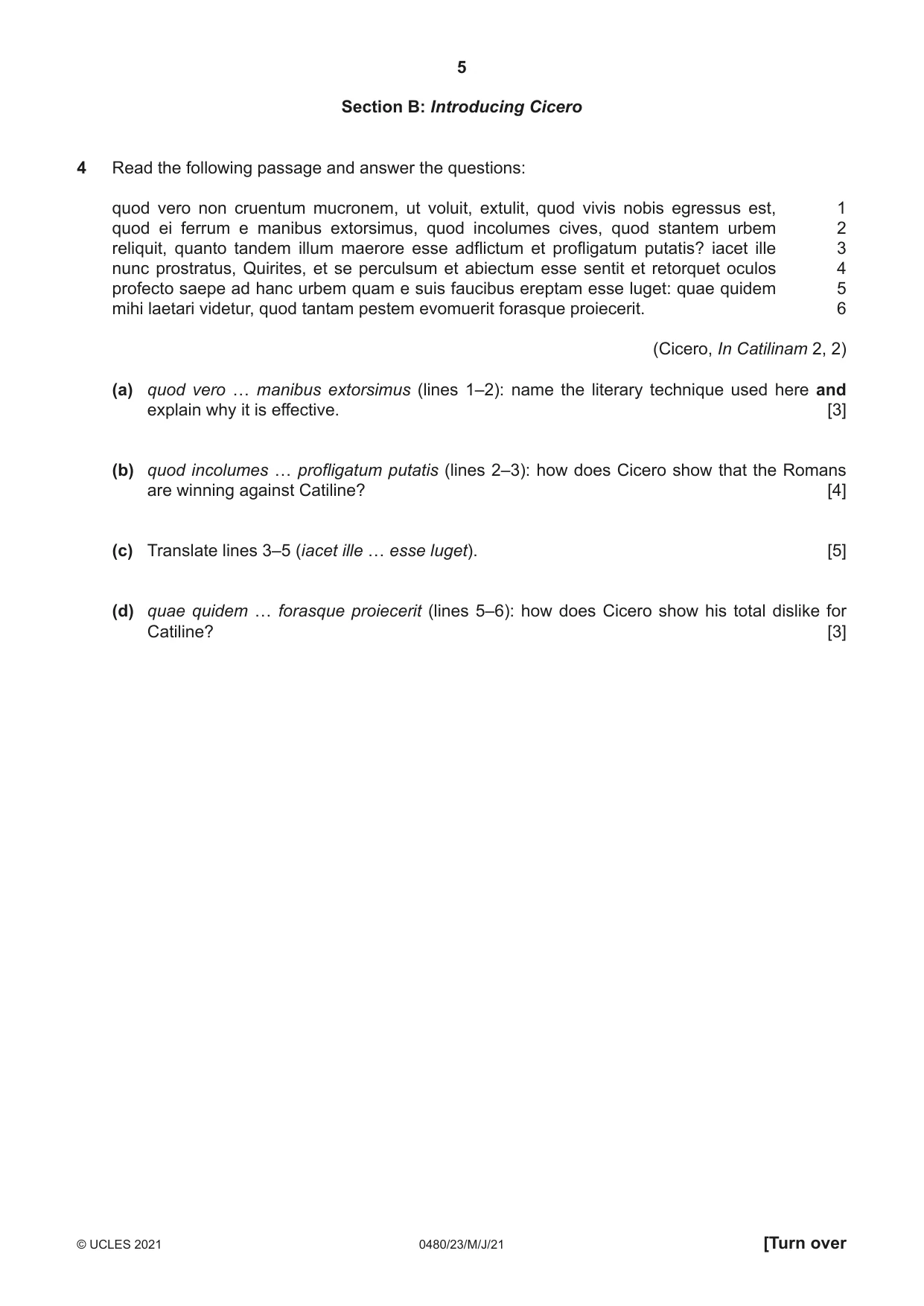
Q4 · Read the following passage and answer the questions: quod vero non cruentum mucronem, ut…
4 Read the following passage and answer the questions: quod vero non cruentum mucronem, ut voluit, extulit, quod vivis nobis egressus est, 1 quod ei ferrum e manibus extorsimus, quod incolumes cives, quod stantem urbem 2 reliquit, quanto tandem illum maerore esse adflictum et profligatum putatis? iacet ille 3 nunc prostratus, Quirites, et se perculsum et abiectum esse sentit et retorquet oculos 4 profecto saepe ad hanc urbem quam e suis faucibus ereptam esse luget: quae quidem 5 mihi laetari videtur, quod tantam pestem evomuerit forasque proiecerit. 6 (Cicero, In Catilinam 2, 2) (a) quod vero … manibus extorsimus (lines 1–2): name the literary technique used here and explain why it is effective. [3] (b) quod incolumes … profligatum putatis (lines 2–3): how does Cicero show that the Romans are winning against Catiline? [4] (c) Translate lines 3–5 (iacet ille … esse luget). [5] (d) quae quidem … forasque proiecerit (lines 5–6): how does Cicero show his total dislike for Catiline? [3]
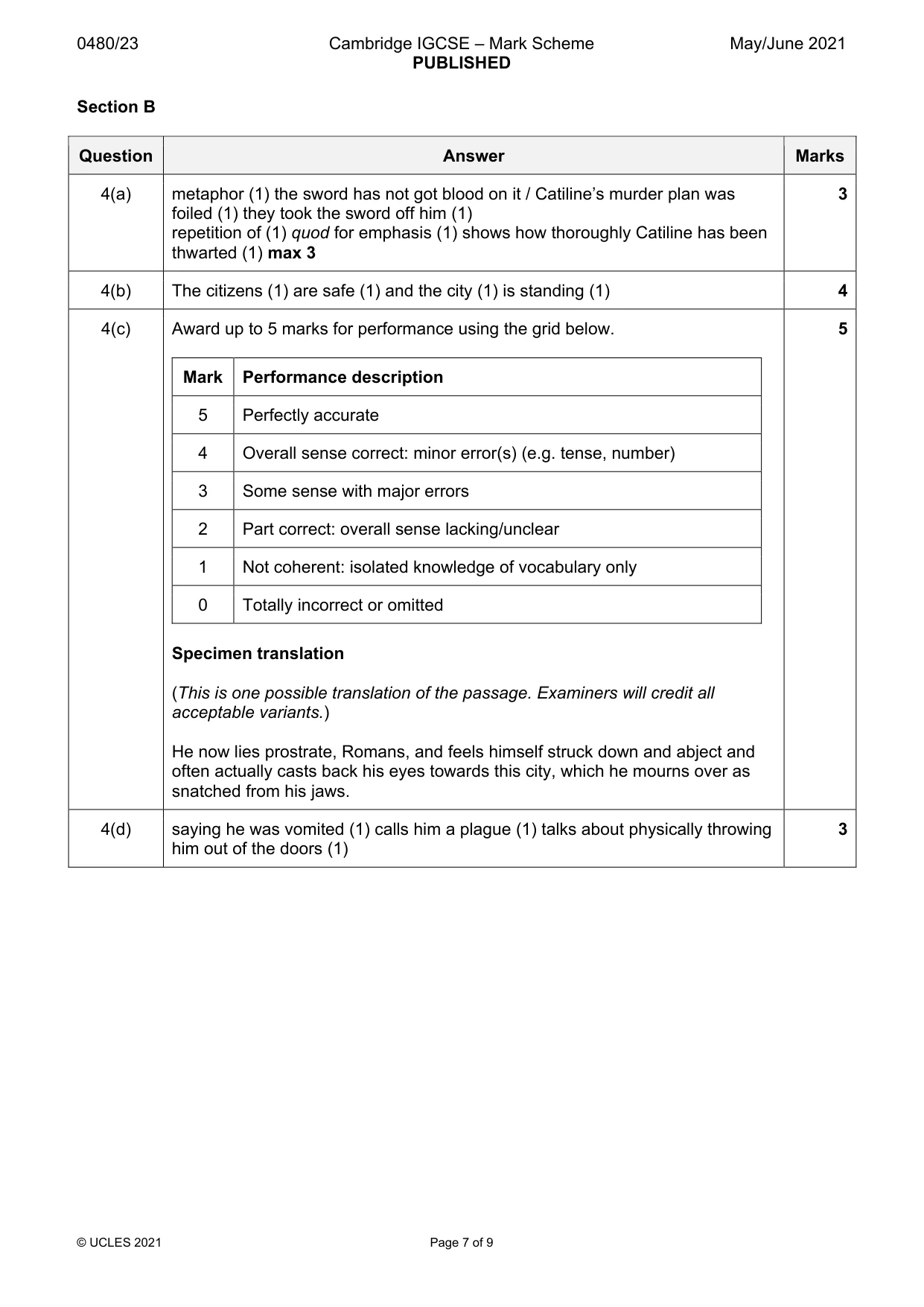
Mark scheme: 4(a) metaphor (1) the sword has not got blood on it / Catiline’s murder plan was 3 foiled (1) they took the sword off him (1) repetition of (1) quod for emphasis (1) shows how thoroughly Catiline has been thwarted (1) max 3 4(b) The citizens (1) are safe (1) and the city (1) is standing (1) 4 4(c) Award up to 5 marks for performance using the grid below. 5 Mark Performance description 5 Perfectly accurate 4 Overall sense correct: minor error(s) (e.g. tense, number) 3 Some sense with major errors 2 Part correct: overall sense lacking/unclear 1 Not coherent: isolated knowledge of vocabulary only 0 Totally incorrect or omitted Specimen translation (This is one possible translation of the passage. Examiners will credit all acceptable variants.) He now lies prostrate, Romans, and feels himself struck down and abject and often actually casts back his eyes towards this city, which he mourns over as snatched from his jaws. 4(d) saying he was vomited (1) calls him a plague (1) talks about physically throwing 3 him out of the doors (1)
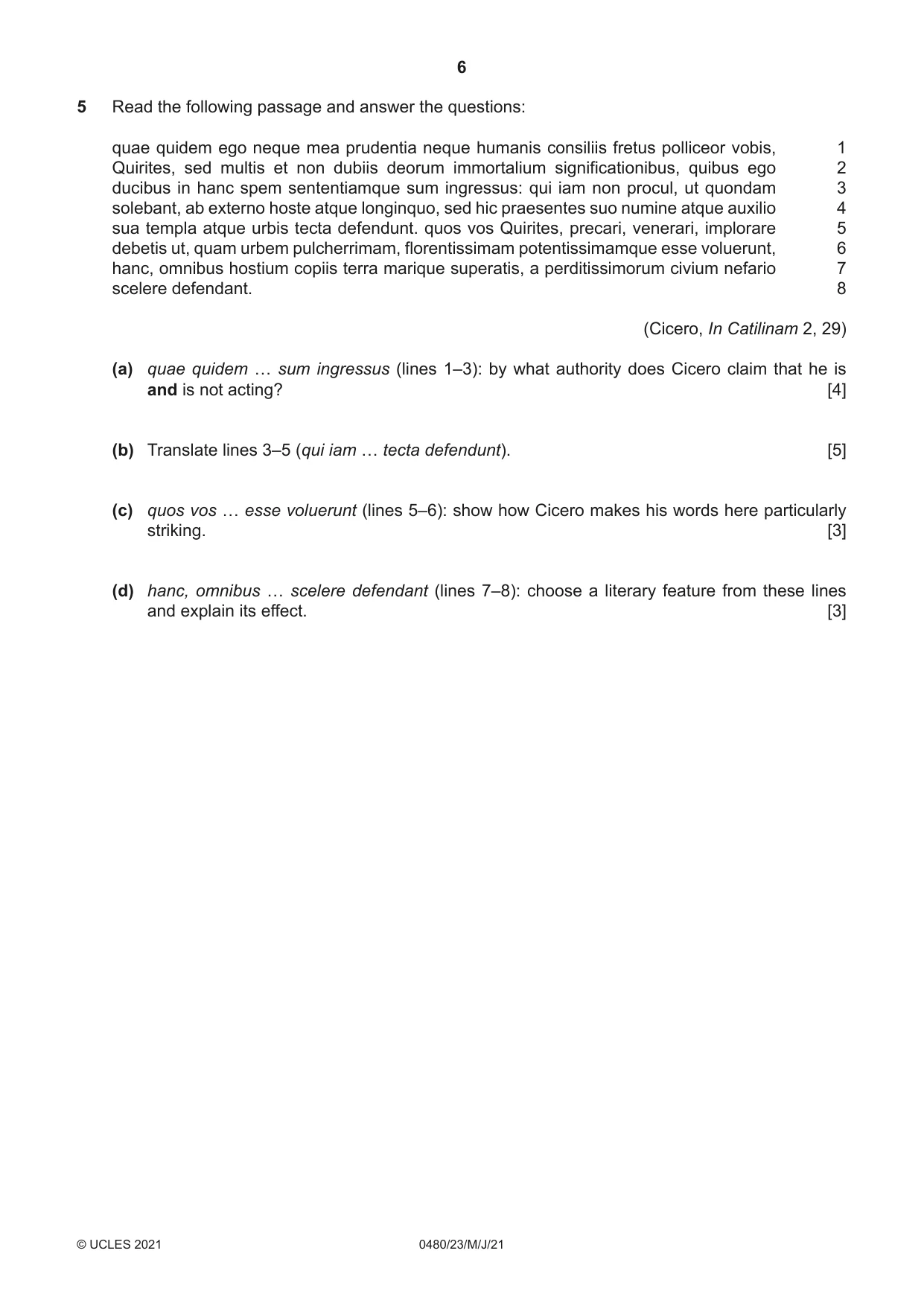
Q5 · Read the following passage and answer the questions: quae quidem ego neque mea prudentia…
5 Read the following passage and answer the questions: quae quidem ego neque mea prudentia neque humanis consiliis fretus polliceor vobis, 1 Quirites, sed multis et non dubiis deorum immortalium significationibus, quibus ego 2 ducibus in hanc spem sententiamque sum ingressus: qui iam non procul, ut quondam 3 solebant, ab externo hoste atque longinquo, sed hic praesentes suo numine atque auxilio 4 sua templa atque urbis tecta defendunt. quos vos Quirites, precari, venerari, implorare 5 debetis ut, quam urbem pulcherrimam, florentissimam potentissimamque esse voluerunt, 6 hanc, omnibus hostium copiis terra marique superatis, a perditissimorum civium nefario 7 scelere defendant. 8 (Cicero, In Catilinam 2, 29) (a) quae quidem … sum ingressus (lines 1–3): by what authority does Cicero claim that he is and is not acting? [4] (b) Translate lines 3–5 (qui iam … tecta defendunt). [5] (c) quos vos … esse voluerunt (lines 5–6): show how Cicero makes his words here particularly striking. [3] (d) hanc, omnibus … scelere defendant (lines 7–8): choose a literary feature from these lines and explain its effect. [3]
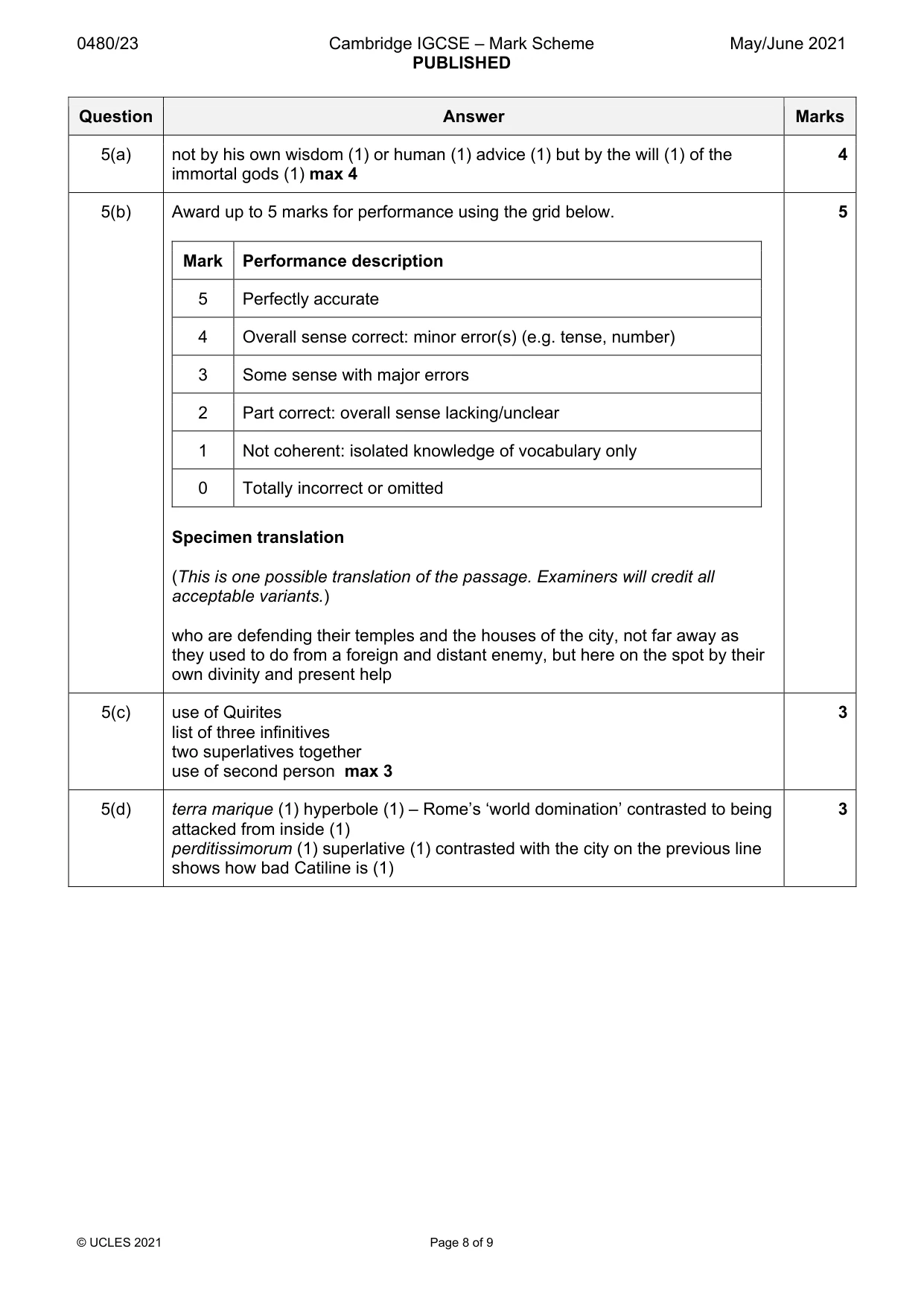
Mark scheme: 5(a) not by his own wisdom (1) or human (1) advice (1) but by the will (1) of the 4 immortal gods (1) max 4 5(b) Award up to 5 marks for performance using the grid below. 5 Mark Performance description 5 Perfectly accurate 4 Overall sense correct: minor error(s) (e.g. tense, number) 3 Some sense with major errors 2 Part correct: overall sense lacking/unclear 1 Not coherent: isolated knowledge of vocabulary only 0 Totally incorrect or omitted Specimen translation (This is one possible translation of the passage. Examiners will credit all acceptable variants.) who are defending their temples and the houses of the city, not far away as they used to do from a foreign and distant enemy, but here on the spot by their own divinity and present help 5(c) use of Quirites 3 list of three infinitives two superlatives together use of second person max 3 5(d) terra marique (1) hyperbole (1) – Rome’s ‘world domination’ contrasted to being 3 attacked from inside (1) perditissimorum (1) superlative (1) contrasted with the city on the previous line shows how bad Catiline is (1)
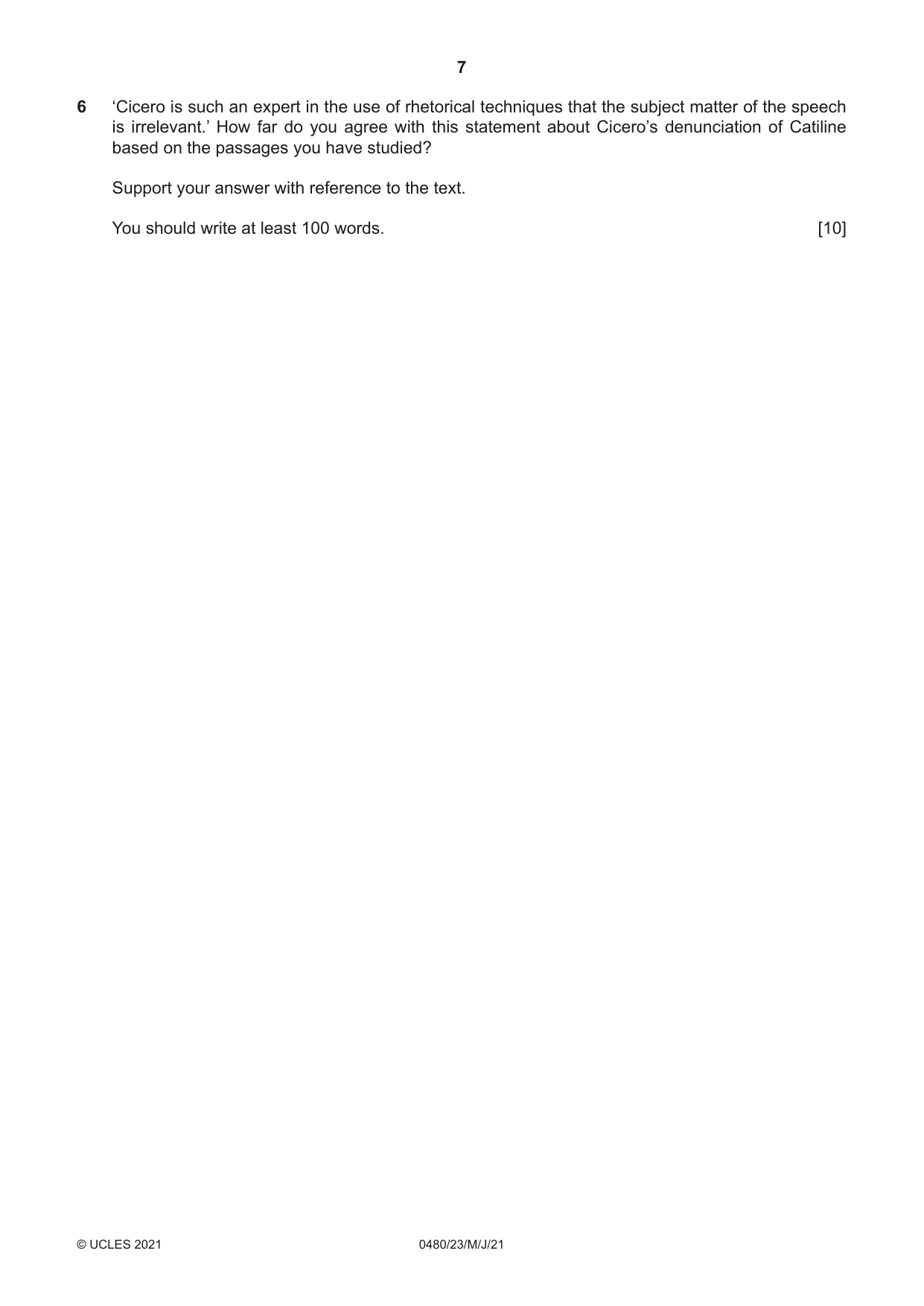
Q6 · ‘Cicero is such an expert in the use of rhetorical techniques that the subject matter of…
6 ‘Cicero is such an expert in the use of rhetorical techniques that the subject matter of the speech is irrelevant.’ How far do you agree with this statement about Cicero’s denunciation of Catiline based on the passages you have studied? Support your answer with reference to the text. You should write at least 100 words. [10]
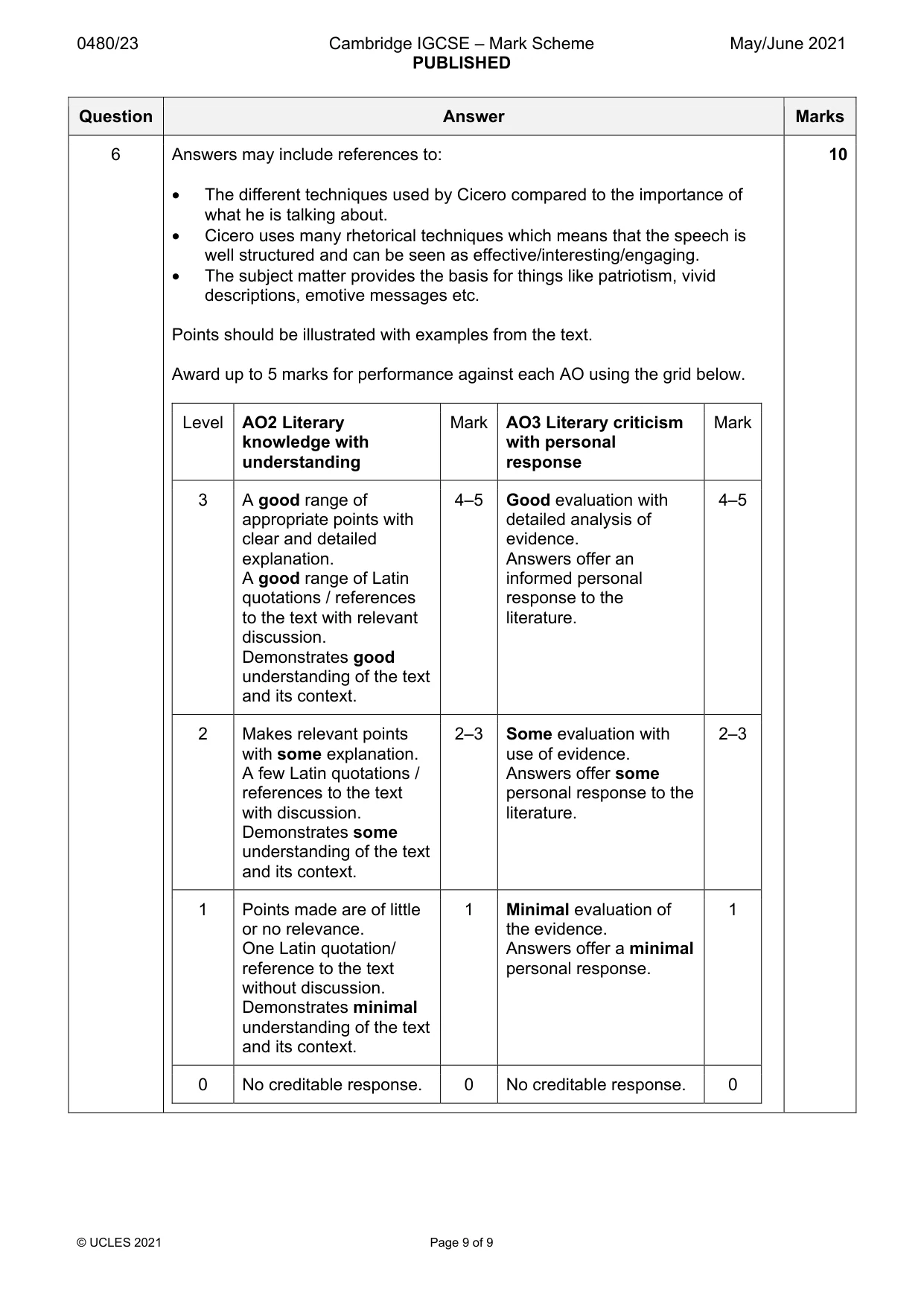
Mark scheme: 6 Answers may include references to: 10 • The different techniques used by Cicero compared to the importance of what he is talking about. • Cicero uses many rhetorical techniques which means that the speech is well structured and can be seen as effective/interesting/engaging. • The subject matter provides the basis for things like patriotism, vivid descriptions, emotive messages etc. Points should be illustrated with examples from the text. Award up to 5 marks for performance against each AO using the grid below. Level AO2 Literary Mark AO3 Literary criticism Mark knowledge with with personal understanding response 3 A good range of 4–5 Good evaluation with 4–5 appropriate points with detailed analysis of clear and detailed evidence. explanation. Answers offer an A good range of Latin informed personal quotations / references response to the to the text with relevant literature. discussion. Demonstrates good understanding of the text and its context. 2 Makes relevant points 2–3 Some evaluation with 2–3 with some explanation. use of evidence. A few Latin quotations / Answers offer some references to the text personal response to the with discussion. literature. Demonstrates some understanding of the text and its context. 1 Points made are of little 1 Minimal evaluation of 1 or no relevance. the evidence. One Latin quotation/ Answers offer a minimal reference to the text personal response. without discussion. Demonstrates minimal understanding of the text and its context. 0 No creditable response. 0 No creditable response. 0
What you needed in this session
Cambridge’s own grade thresholds for 2021 May/June, Paper 2 · Variant 3. A higher threshold means an easier paper — the bar moves with how the cohort did.