Cambridge IGCSE Latin 0480 — 2019 May/June Paper 2 · Variant 3
0480/23/M/J/19 · 6 questions · 80 marks · ≈90 min
The question paper and its mark scheme, free to read here and free to download. This is Cambridge’s own paper, exactly as it was sat.
Question paper8 pages
Mark scheme8 pages
Answers below. Sit the paper first if you are practising.
Questions as text
Q1 · Read the following passage and answer the questions: ille simul fugiens Rutulos simul…
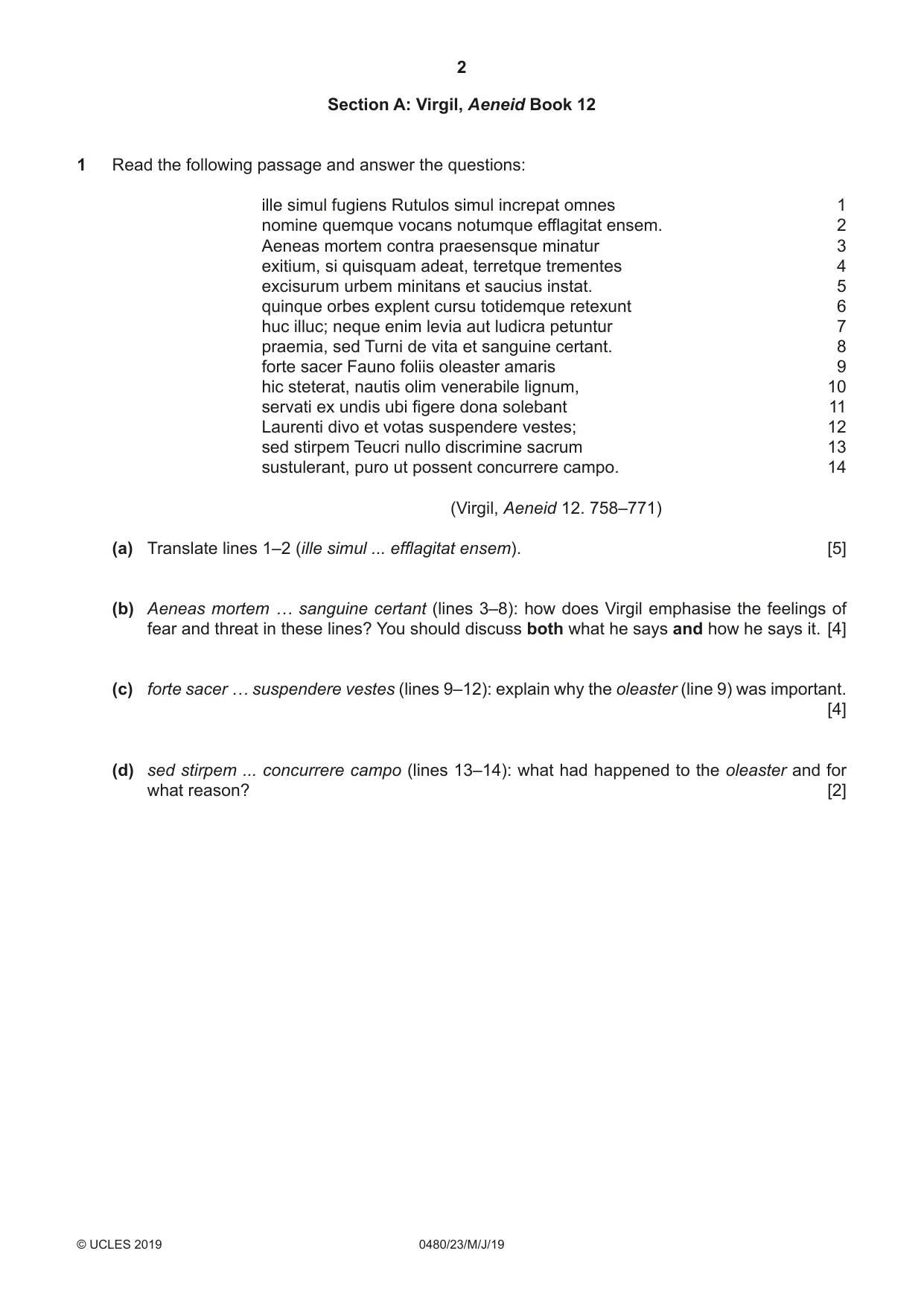
1 Read the following passage and answer the questions: ille simul fugiens Rutulos simul increpat omnes 1 nomine quemque vocans notumque efflagitat ensem. 2 Aeneas mortem contra praesensque minatur 3 exitium, si quisquam adeat, terretque trementes 4 excisurum urbem minitans et saucius instat. 5 quinque orbes explent cursu totidemque retexunt 6 huc illuc; neque enim levia aut ludicra petuntur 7 praemia, sed Turni de vita et sanguine certant. 8 forte sacer Fauno foliis oleaster amaris 9 hic steterat, nautis olim venerabile lignum, 10 servati ex undis ubi figere dona solebant 11 Laurenti divo et votas suspendere vestes; 12 sed stirpem Teucri nullo discrimine sacrum 13 sustulerant, puro ut possent concurrere campo. 14 (Virgil, Aeneid 12. 758–771) (a) Translate lines 1–2 (ille simul ... efflagitat ensem). [5] (b) Aeneas mortem … sanguine certant (lines 3–8): how does Virgil emphasise the feelings of fear and threat in these lines? You should discuss both what he says and how he says it. [4] (c) forte sacer … suspendere vestes (lines 9–12): explain why the oleaster (line 9) was important. [4] (d) sed stirpem ... concurrere campo (lines 13–14): what had happened to the oleaster and for what reason? [2]
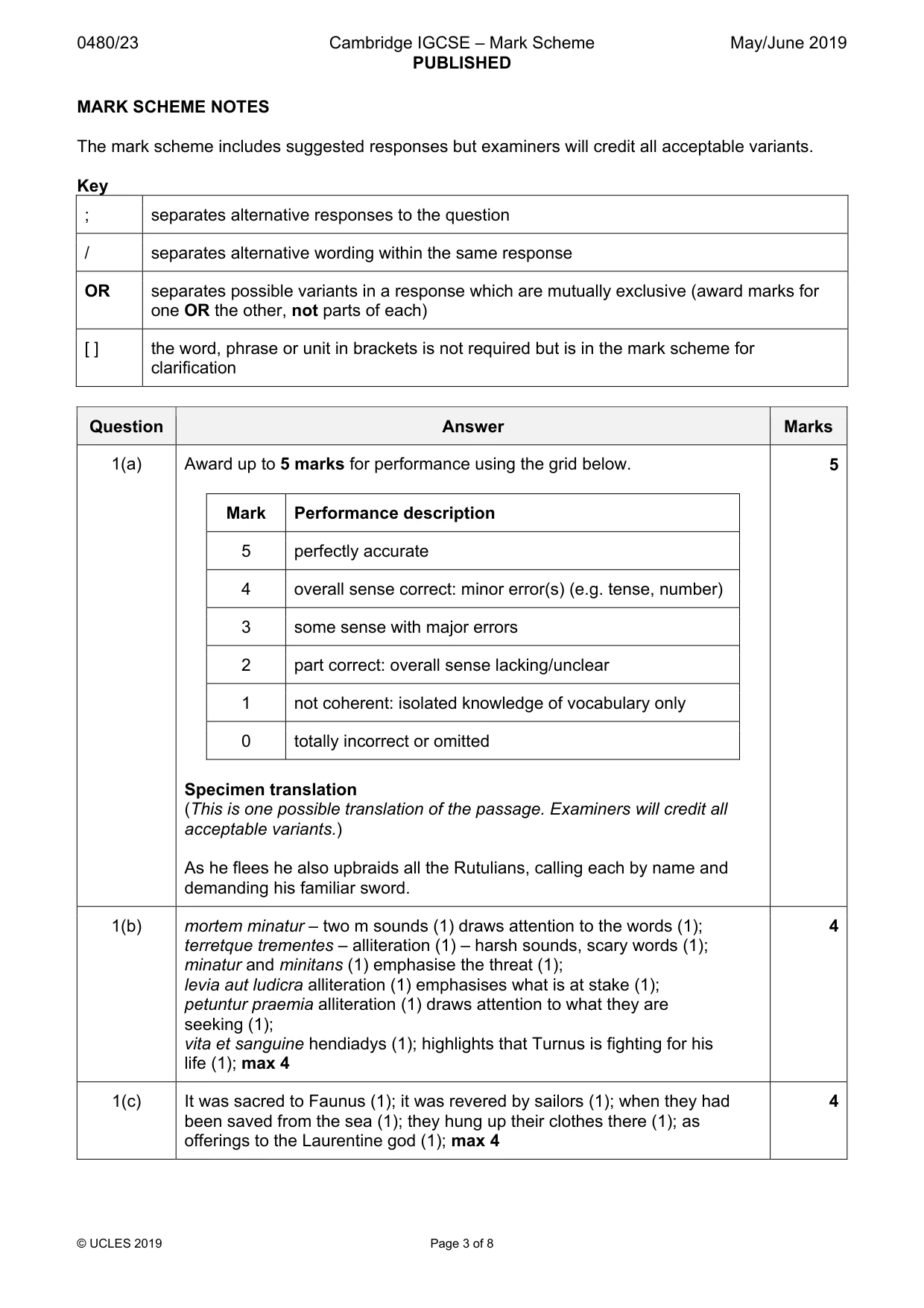
Mark scheme: Question Answer Marks 1(a) Award up to 5 marks for performance using the grid below. 5 Mark Performance description 5 perfectly accurate 4 overall sense correct: minor error(s) (e.g. tense, number) 3 some sense with major errors 2 part correct: overall sense lacking/unclear 1 not coherent: isolated knowledge of vocabulary only 0 totally incorrect or omitted Specimen translation (This is one possible translation of the passage. Examiners will credit all acceptable variants.) As he flees he also upbraids all the Rutulians, calling each by name and demanding his familiar sword. 1(b) mortem minatur – two m sounds (1) draws attention to the words (1); 4 terretque trementes – alliteration (1) – harsh sounds, scary words (1); minatur and minitans (1) emphasise the threat (1); levia aut ludicra alliteration (1) emphasises what is at stake (1); petuntur praemia alliteration (1) draws attention to what they are seeking (1); vita et sanguine hendiadys (1); highlights that Turnus is fighting for his life (1); max 4 1(c) It was sacred to Faunus (1); it was revered by sailors (1); when they had 4 been saved from the sea (1); they hung up their clothes there (1); as offerings to the Laurentine god (1); max 4 1(d) it was chopped down (1) because the Trojans wanted to fight on a clear 2 plain (1)
Q2 · Read the following passage and answer the questions: cunctanti telum Aeneas fatale…
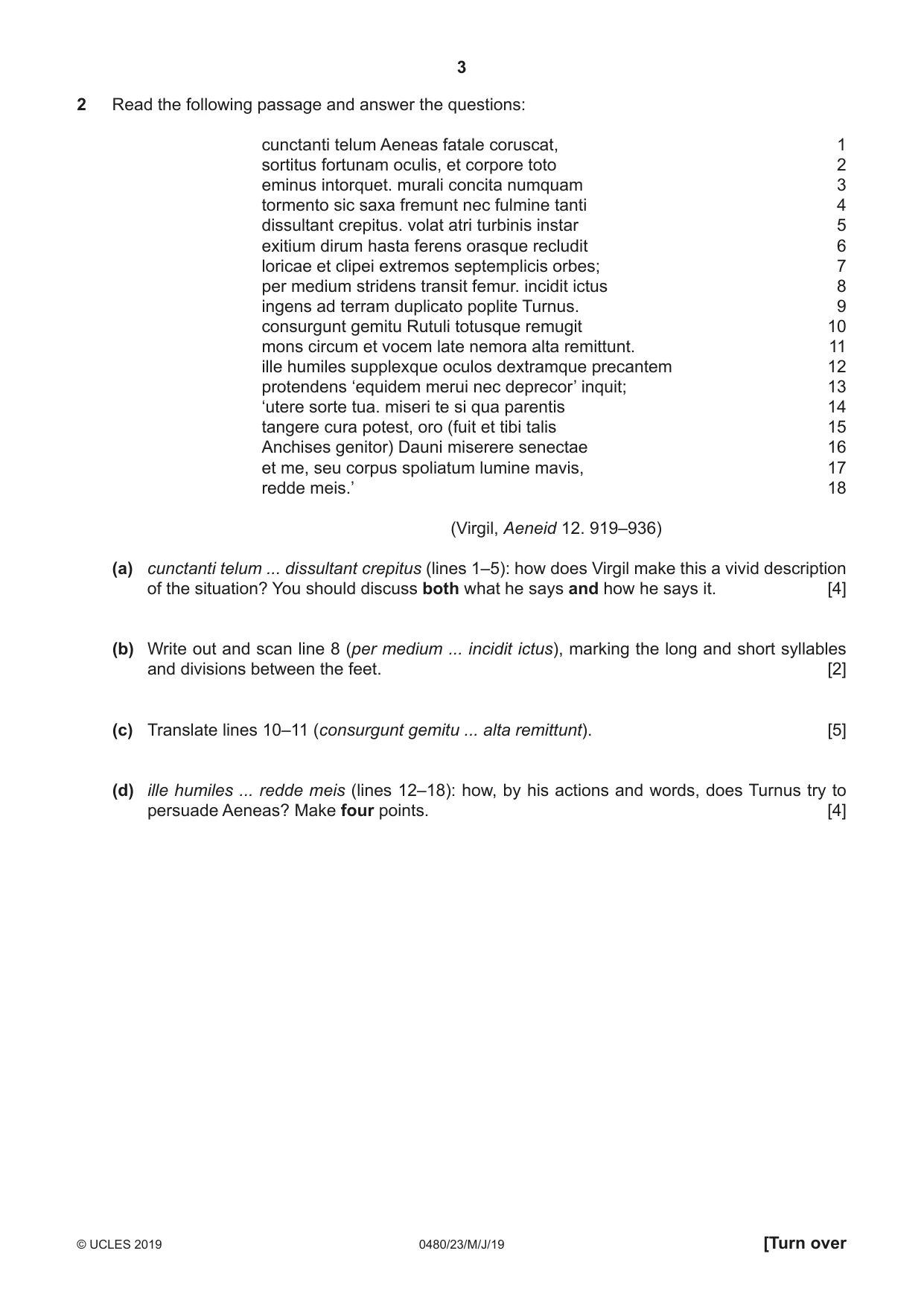
2 Read the following passage and answer the questions: cunctanti telum Aeneas fatale coruscat, 1 sortitus fortunam oculis, et corpore toto 2 eminus intorquet. murali concita numquam 3 tormento sic saxa fremunt nec fulmine tanti 4 dissultant crepitus. volat atri turbinis instar 5 exitium dirum hasta ferens orasque recludit 6 loricae et clipei extremos septemplicis orbes; 7 per medium stridens transit femur. incidit ictus 8 ingens ad terram duplicato poplite Turnus. 9 consurgunt gemitu Rutuli totusque remugit 10 mons circum et vocem late nemora alta remittunt. 11 ille humiles supplexque oculos dextramque precantem 12 protendens ‘equidem merui nec deprecor’ inquit; 13 ‘utere sorte tua. miseri te si qua parentis 14 tangere cura potest, oro (fuit et tibi talis 15 Anchises genitor) Dauni miserere senectae 16 et me, seu corpus spoliatum lumine mavis, 17 redde meis.’ 18 (Virgil, Aeneid 12. 919–936) (a) cunctanti telum ... dissultant crepitus (lines 1–5): how does Virgil make this a vivid description of the situation? You should discuss both what he says and how he says it. [4] (b) Write out and scan line 8 (per medium ... incidit ictus), marking the long and short syllables and divisions between the feet. [2] (c) Translate lines 10–11 (consurgunt gemitu ... alta remittunt). [5] (d) ille humiles ... redde meis (lines 12–18): how, by his actions and words, does Turnus try to persuade Aeneas? Make four points. [4]
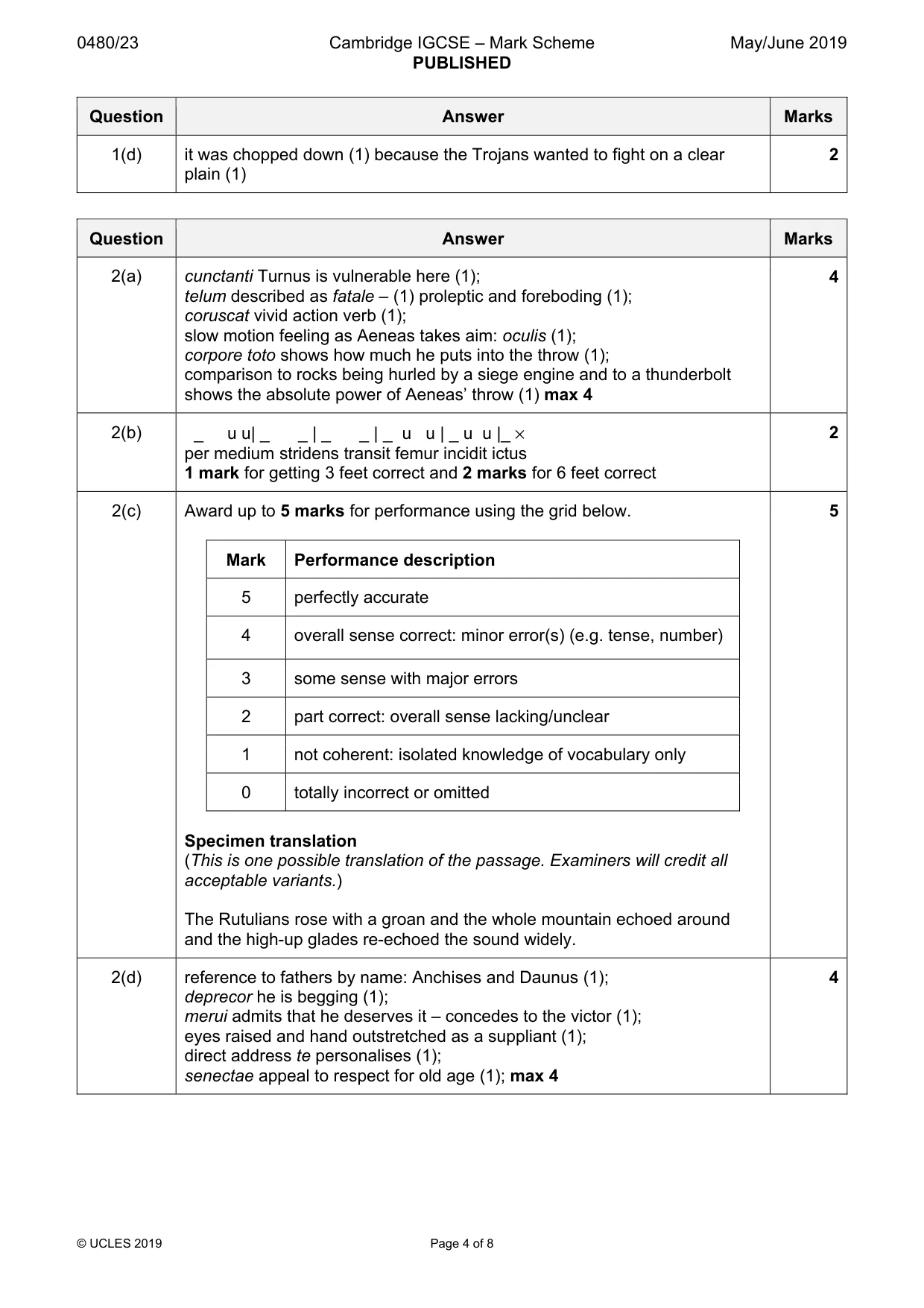
Mark scheme: 2(a) cunctanti Turnus is vulnerable here (1); 4 telum described as fatale – (1) proleptic and foreboding (1); coruscat vivid action verb (1); slow motion feeling as Aeneas takes aim: oculis (1); corpore toto shows how much he puts into the throw (1); comparison to rocks being hurled by a siege engine and to a thunderbolt shows the absolute power of Aeneas’ throw (1) max 4 2(b) _ u u| _ _ | _ _ | _ u u | _ u u |_ × 2 per medium stridens transit femur incidit ictus 1 mark for getting 3 feet correct and 2 marks for 6 feet correct 2(c) Award up to 5 marks for performance using the grid below. 5 Mark Performance description 5 perfectly accurate 4 overall sense correct: minor error(s) (e.g. tense, number) 3 some sense with major errors 2 part correct: overall sense lacking/unclear 1 not coherent: isolated knowledge of vocabulary only 0 totally incorrect or omitted Specimen translation (This is one possible translation of the passage. Examiners will credit all acceptable variants.) The Rutulians rose with a groan and the whole mountain echoed around and the high-up glades re-echoed the sound widely. 2(d) reference to fathers by name: Anchises and Daunus (1); 4 deprecor he is begging (1); merui admits that he deserves it – concedes to the victor (1); eyes raised and hand outstretched as a suppliant (1); direct address te personalises (1); senectae appeal to respect for old age (1); max 4
Q3 · ‘The contrast between the gods and humans is what makes the Aeneid so enjoyable.’ How far…
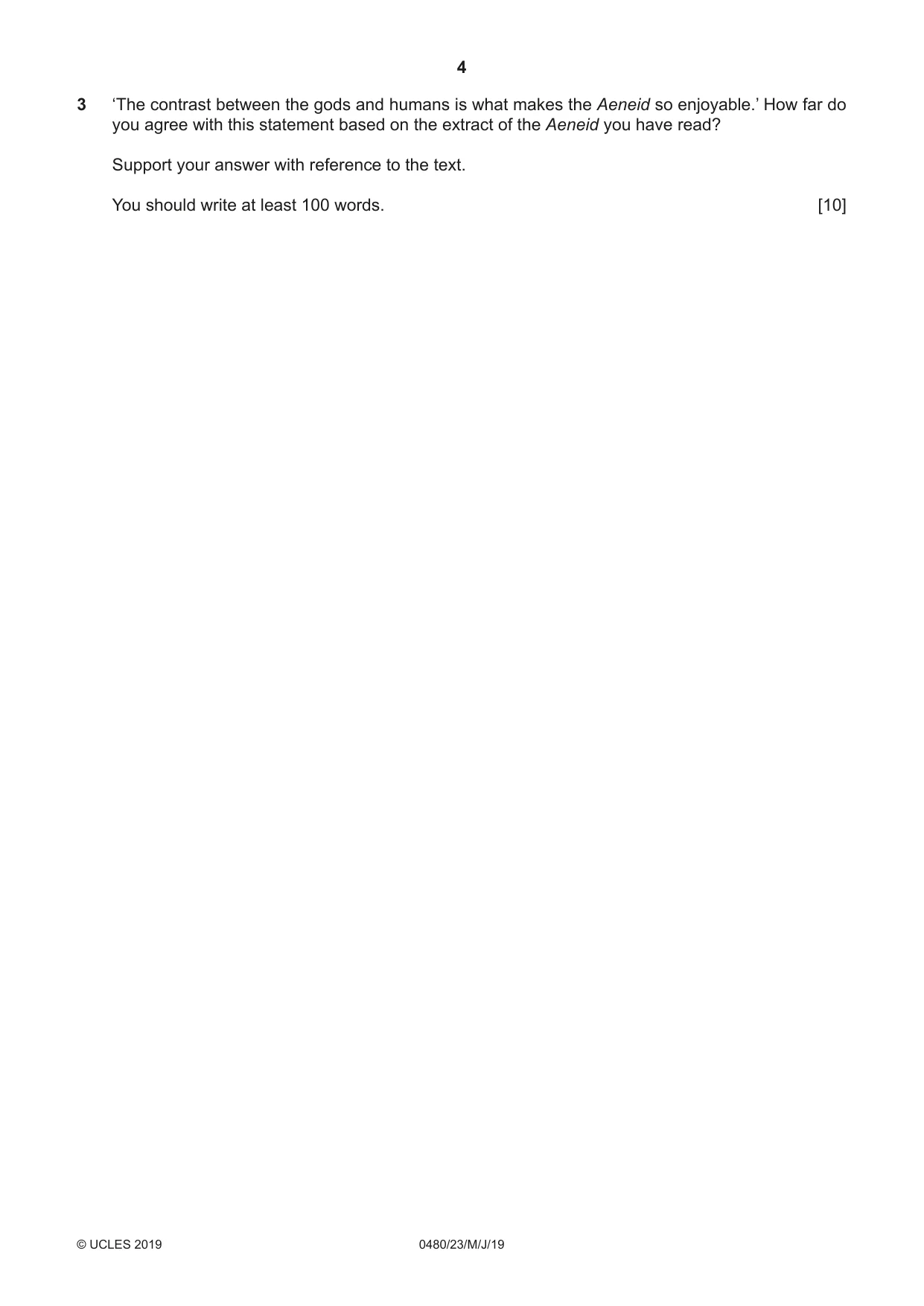
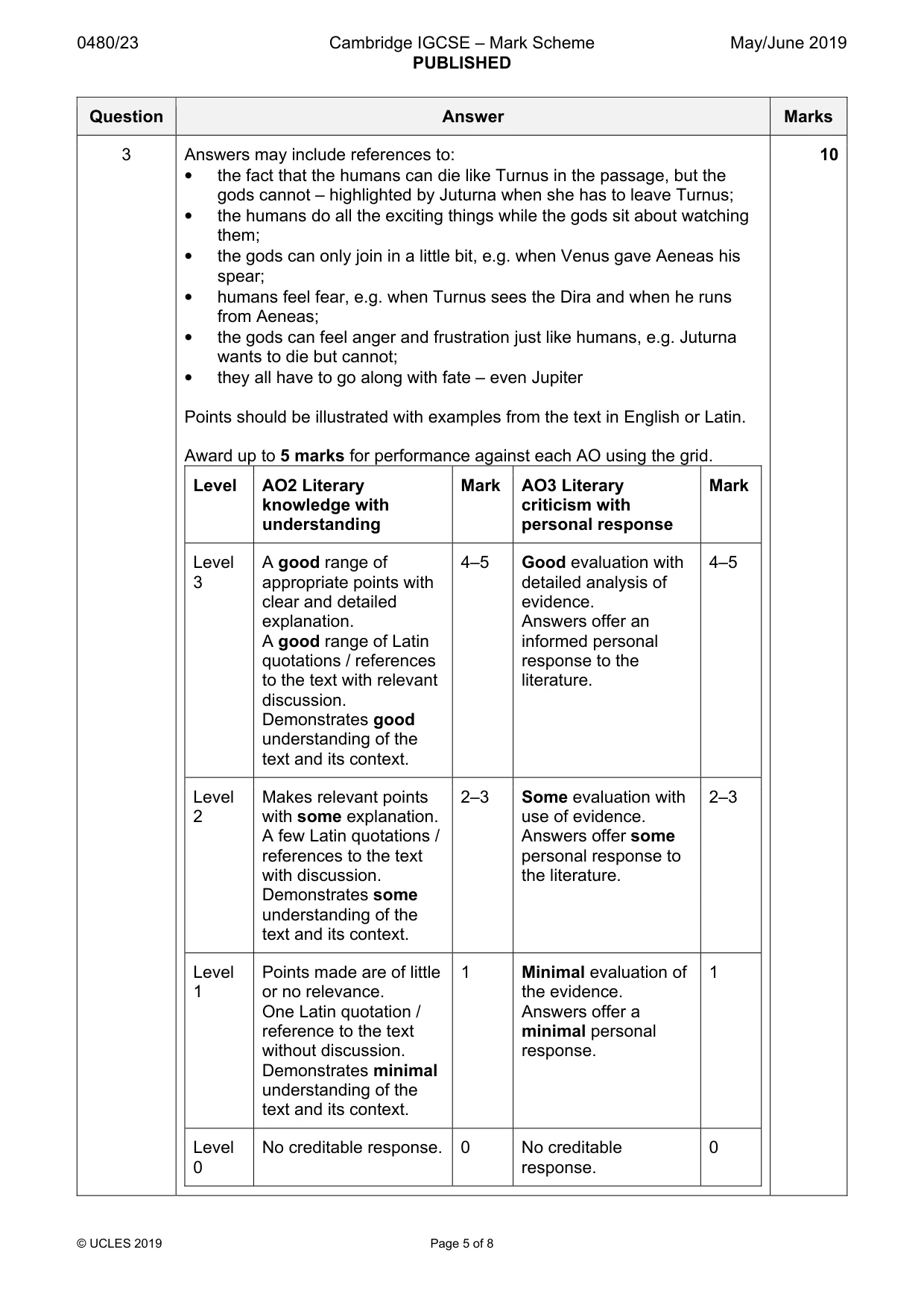
3 ‘The contrast between the gods and humans is what makes the Aeneid so enjoyable.’ How far do you agree with this statement based on the extract of the Aeneid you have read? Support your answer with reference to the text. You should write at least 100 words. [10]
Mark scheme: 3 Answers may include references to: 10 • the fact that the humans can die like Turnus in the passage, but the gods cannot – highlighted by Juturna when she has to leave Turnus; • the humans do all the exciting things while the gods sit about watching them; • the gods can only join in a little bit, e.g. when Venus gave Aeneas his spear; • humans feel fear, e.g. when Turnus sees the Dira and when he runs from Aeneas; • the gods can feel anger and frustration just like humans, e.g. Juturna wants to die but cannot; • they all have to go along with fate – even Jupiter Points should be illustrated with examples from the text in English or Latin. Award up to 5 marks for performance against each AO using the grid. Level AO2 Literary Mark AO3 Literary Mark knowledge with criticism with understanding personal response Level A good range of 4–5 Good evaluation with 4–5 3 appropriate points with detailed analysis of clear and detailed evidence. explanation. Answers offer an A good range of Latin informed personal quotations / references response to the to the text with relevant literature. discussion. Demonstrates good understanding of the text and its context. Level Makes relevant points 2–3 Some evaluation with 2–3 2 with some explanation. use of evidence. A few Latin quotations / Answers offer some references to the text personal response to with discussion. the literature. Demonstrates some understanding of the text and its context. Level Points made are of little 1 Minimal evaluation of 1 1 or no relevance. the evidence. One Latin quotation / Answers offer a reference to the text minimal personal without discussion. response. Demonstrates minimal understanding of the text and its context. Level No creditable response. 0 No creditable 0 0 response.
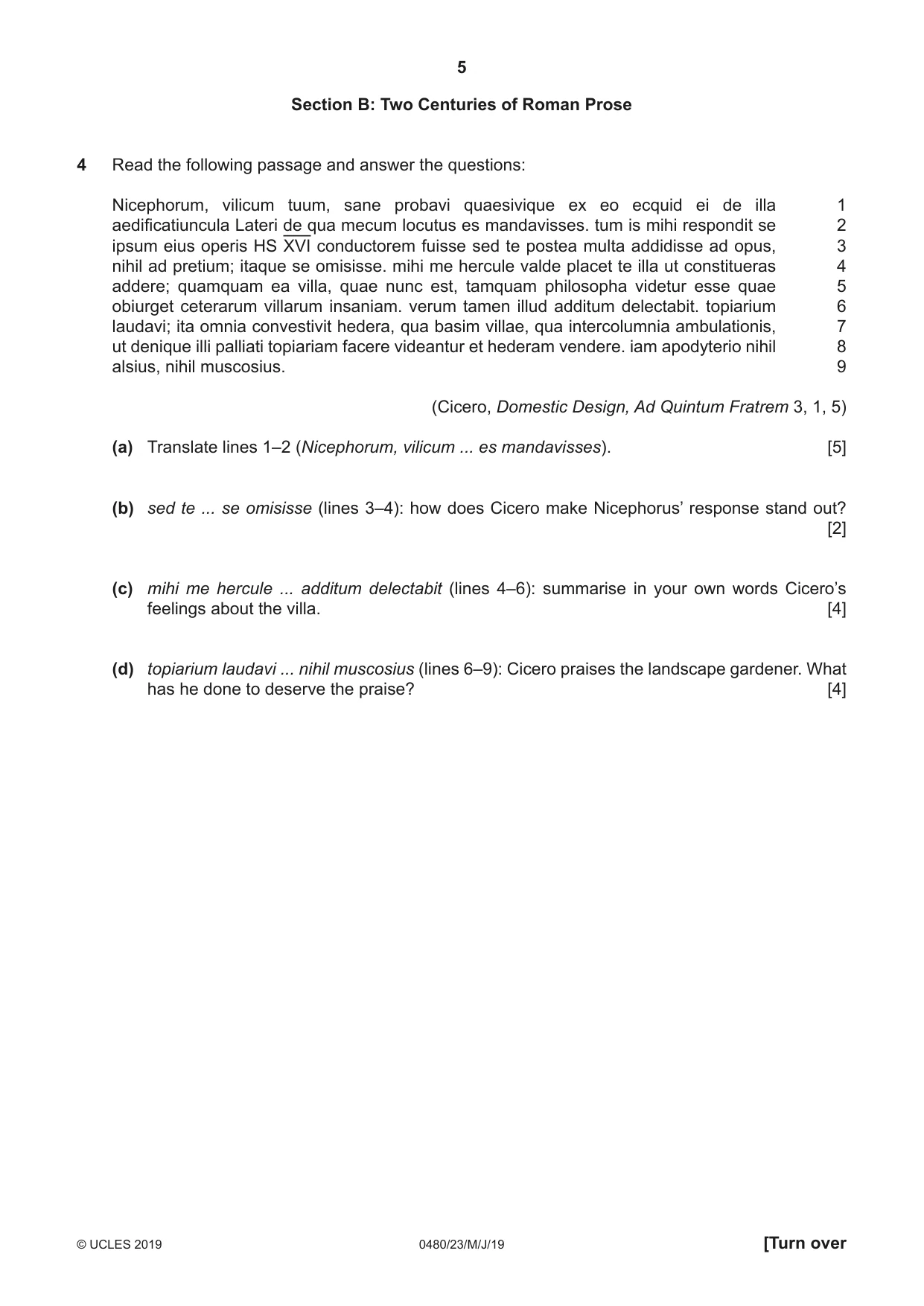
Q4 · Read the following passage and answer the questions: Nicephorum, vilicum tuum, sane…
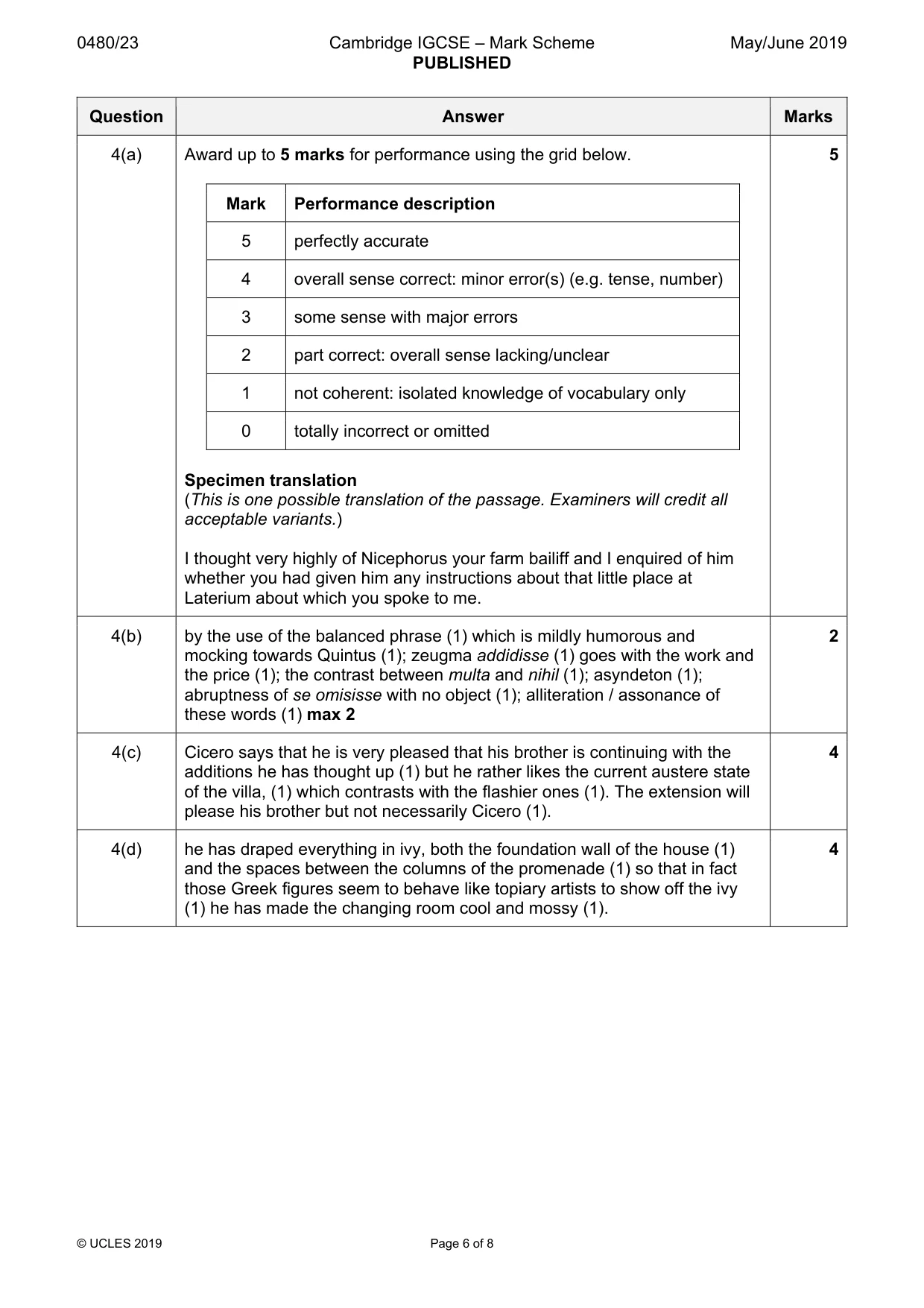
4 Read the following passage and answer the questions: Nicephorum, vilicum tuum, sane probavi quaesivique ex eo ecquid ei de illa 1 aedificatiuncula Lateri de qua mecum locutus es mandavisses. tum is mihi respondit se 2 ipsum eius operis HS XVI conductorem fuisse sed te postea multa addidisse ad opus, 3 nihil ad pretium; itaque se omisisse. mihi me hercule valde placet te illa ut constitueras 4 addere; quamquam ea villa, quae nunc est, tamquam philosopha videtur esse quae 5 obiurget ceterarum villarum insaniam. verum tamen illud additum delectabit. topiarium 6 laudavi; ita omnia convestivit hedera, qua basim villae, qua intercolumnia ambulationis, 7 ut denique illi palliati topiariam facere videantur et hederam vendere. iam apodyterio nihil 8 alsius, nihil muscosius. 9 (Cicero, Domestic Design, Ad Quintum Fratrem 3, 1, 5) (a) Translate lines 1–2 (Nicephorum, vilicum ... es mandavisses). [5] (b) sed te ... se omisisse (lines 3–4): how does Cicero make Nicephorus’ response stand out? [2] (c) mihi me hercule ... additum delectabit (lines 4–6): summarise in your own words Cicero’s feelings about the villa. [4] (d) topiarium laudavi ... nihil muscosius (lines 6–9): Cicero praises the landscape gardener. What has he done to deserve the praise? [4]
Mark scheme: 4(a) Award up to 5 marks for performance using the grid below. 5 Mark Performance description 5 perfectly accurate 4 overall sense correct: minor error(s) (e.g. tense, number) 3 some sense with major errors 2 part correct: overall sense lacking/unclear 1 not coherent: isolated knowledge of vocabulary only 0 totally incorrect or omitted Specimen translation (This is one possible translation of the passage. Examiners will credit all acceptable variants.) I thought very highly of Nicephorus your farm bailiff and I enquired of him whether you had given him any instructions about that little place at Laterium about which you spoke to me. 4(b) by the use of the balanced phrase (1) which is mildly humorous and 2 mocking towards Quintus (1); zeugma addidisse (1) goes with the work and the price (1); the contrast between multa and nihil (1); asyndeton (1); abruptness of se omisisse with no object (1); alliteration / assonance of these words (1) max 2 4(c) Cicero says that he is very pleased that his brother is continuing with the 4 additions he has thought up (1) but he rather likes the current austere state of the villa, (1) which contrasts with the flashier ones (1). The extension will please his brother but not necessarily Cicero (1). 4(d) he has draped everything in ivy, both the foundation wall of the house (1) 4 and the spaces between the columns of the promenade (1) so that in fact those Greek figures seem to behave like topiary artists to show off the ivy (1) he has made the changing room cool and mossy (1).
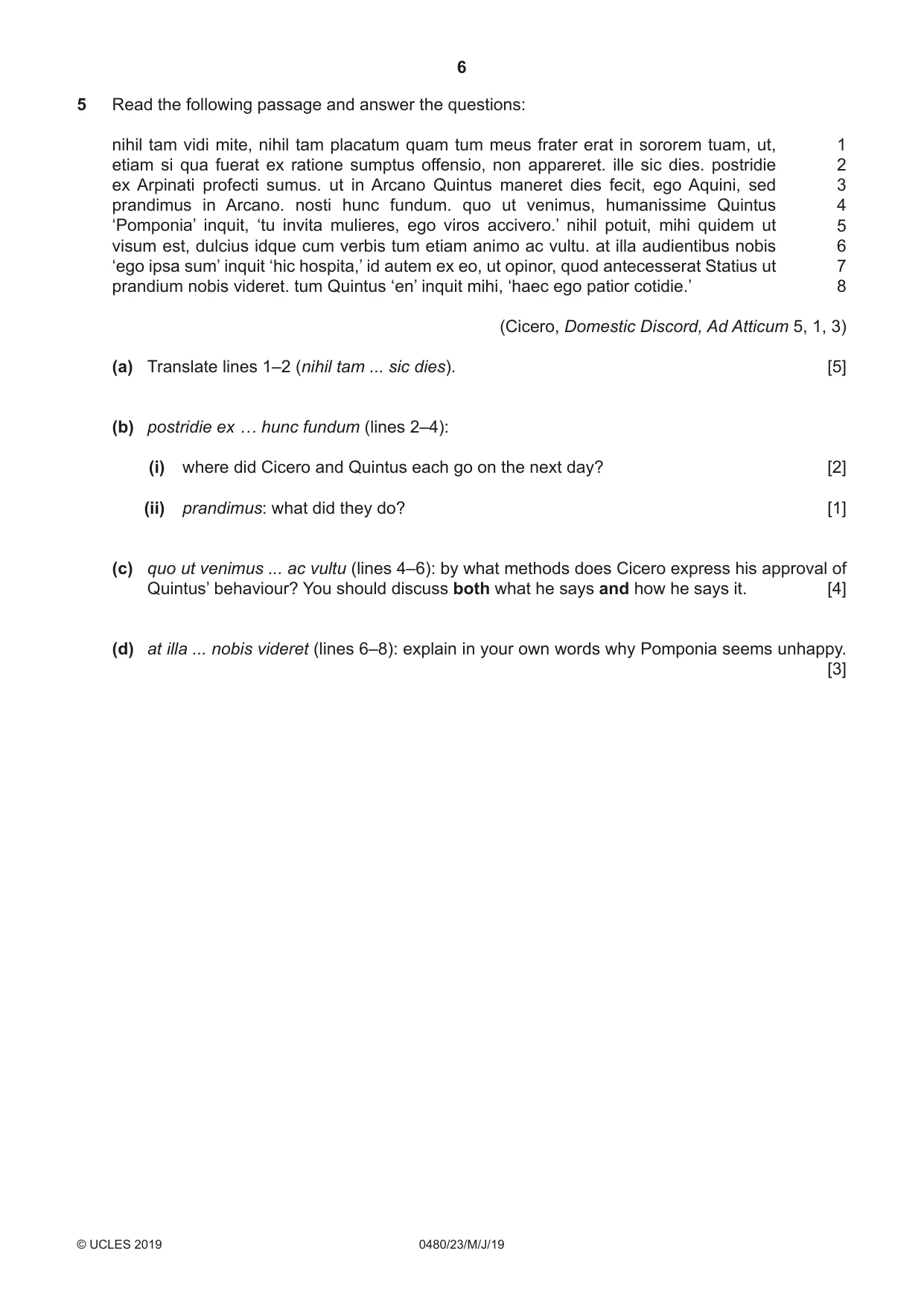
Q5 · Read the following passage and answer the questions: nihil tam vidi mite, nihil tam…
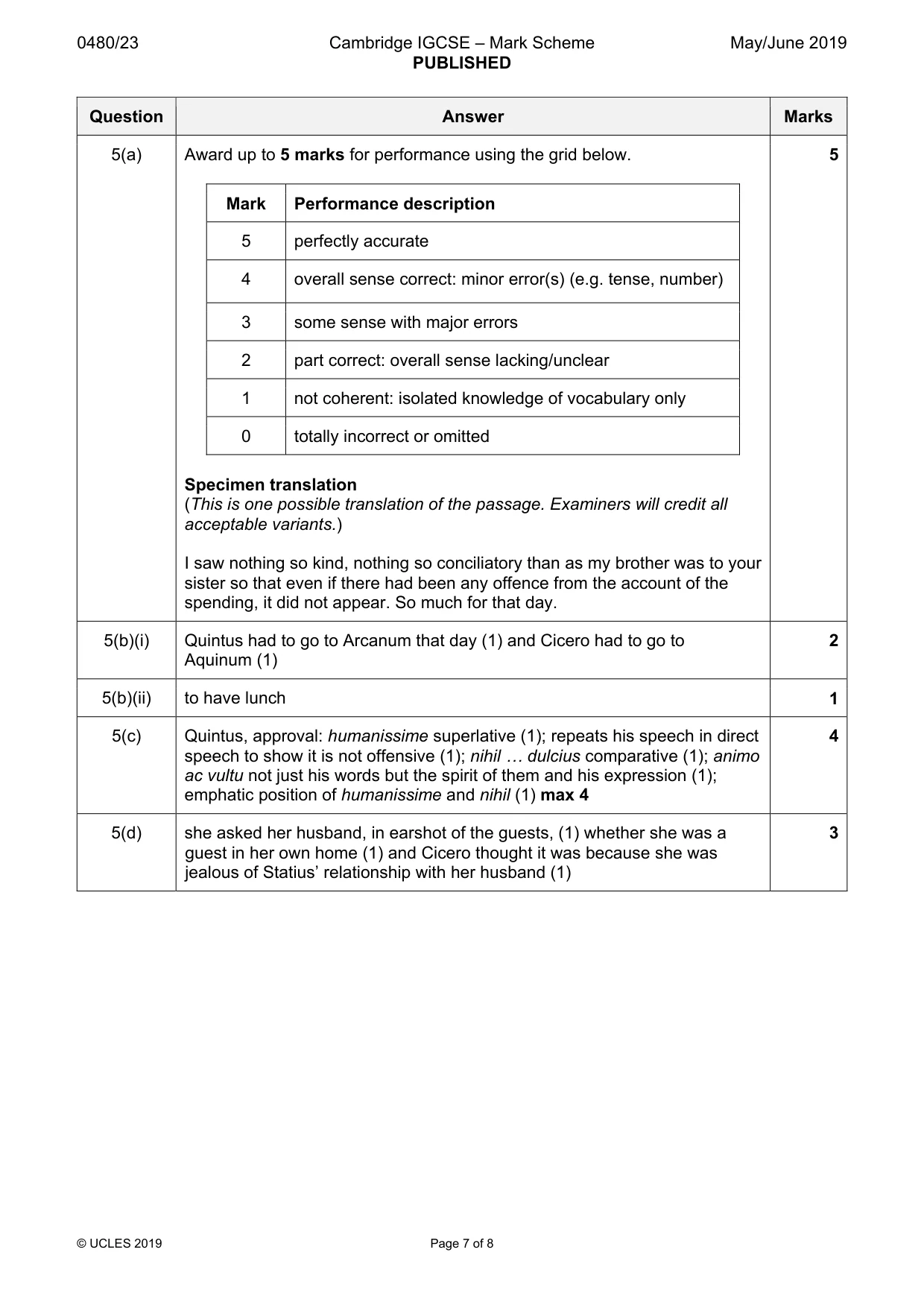
5 Read the following passage and answer the questions: nihil tam vidi mite, nihil tam placatum quam tum meus frater erat in sororem tuam, ut, 1 etiam si qua fuerat ex ratione sumptus offensio, non appareret. ille sic dies. postridie 2 ex Arpinati profecti sumus. ut in Arcano Quintus maneret dies fecit, ego Aquini, sed 3 prandimus in Arcano. nosti hunc fundum. quo ut venimus, humanissime Quintus 4 ‘Pomponia’ inquit, ‘tu invita mulieres, ego viros accivero.’ nihil potuit, mihi quidem ut 5 visum est, dulcius idque cum verbis tum etiam animo ac vultu. at illa audientibus nobis 6 ‘ego ipsa sum’ inquit ‘hic hospita,’ id autem ex eo, ut opinor, quod antecesserat Statius ut 7 prandium nobis videret. tum Quintus ‘en’ inquit mihi, ‘haec ego patior cotidie.’ 8 (Cicero, Domestic Discord, Ad Atticum 5, 1, 3) (a) Translate lines 1–2 (nihil tam ... sic dies). [5] (b) postridie ex … hunc fundum (lines 2–4): (i) where did Cicero and Quintus each go on the next day? [2] (ii) prandimus: what did they do? [1] (c) quo ut venimus ... ac vultu (lines 4–6): by what methods does Cicero express his approval of Quintus’ behaviour? You should discuss both what he says and how he says it. [4] (d) at illa ... nobis videret (lines 6–8): explain in your own words why Pomponia seems unhappy. [3]
Mark scheme: 5(a) Award up to 5 marks for performance using the grid below. 5 Mark Performance description 5 perfectly accurate 4 overall sense correct: minor error(s) (e.g. tense, number) 3 some sense with major errors 2 part correct: overall sense lacking/unclear 1 not coherent: isolated knowledge of vocabulary only 0 totally incorrect or omitted Specimen translation (This is one possible translation of the passage. Examiners will credit all acceptable variants.) I saw nothing so kind, nothing so conciliatory than as my brother was to your sister so that even if there had been any offence from the account of the spending, it did not appear. So much for that day. 5(b)(i) Quintus had to go to Arcanum that day (1) and Cicero had to go to 2 Aquinum (1) 5(b)(ii) to have lunch 1 5(c) Quintus, approval: humanissime superlative (1); repeats his speech in direct 4 speech to show it is not offensive (1); nihil « dulcius comparative (1); animo ac vultu not just his words but the spirit of them and his expression (1); emphatic position of humanissime and nihil (1) max 4 5(d) she asked her husband, in earshot of the guests, (1) whether she was a 3 guest in her own home (1) and Cicero thought it was because she was jealous of Statius’ relationship with her husband (1)
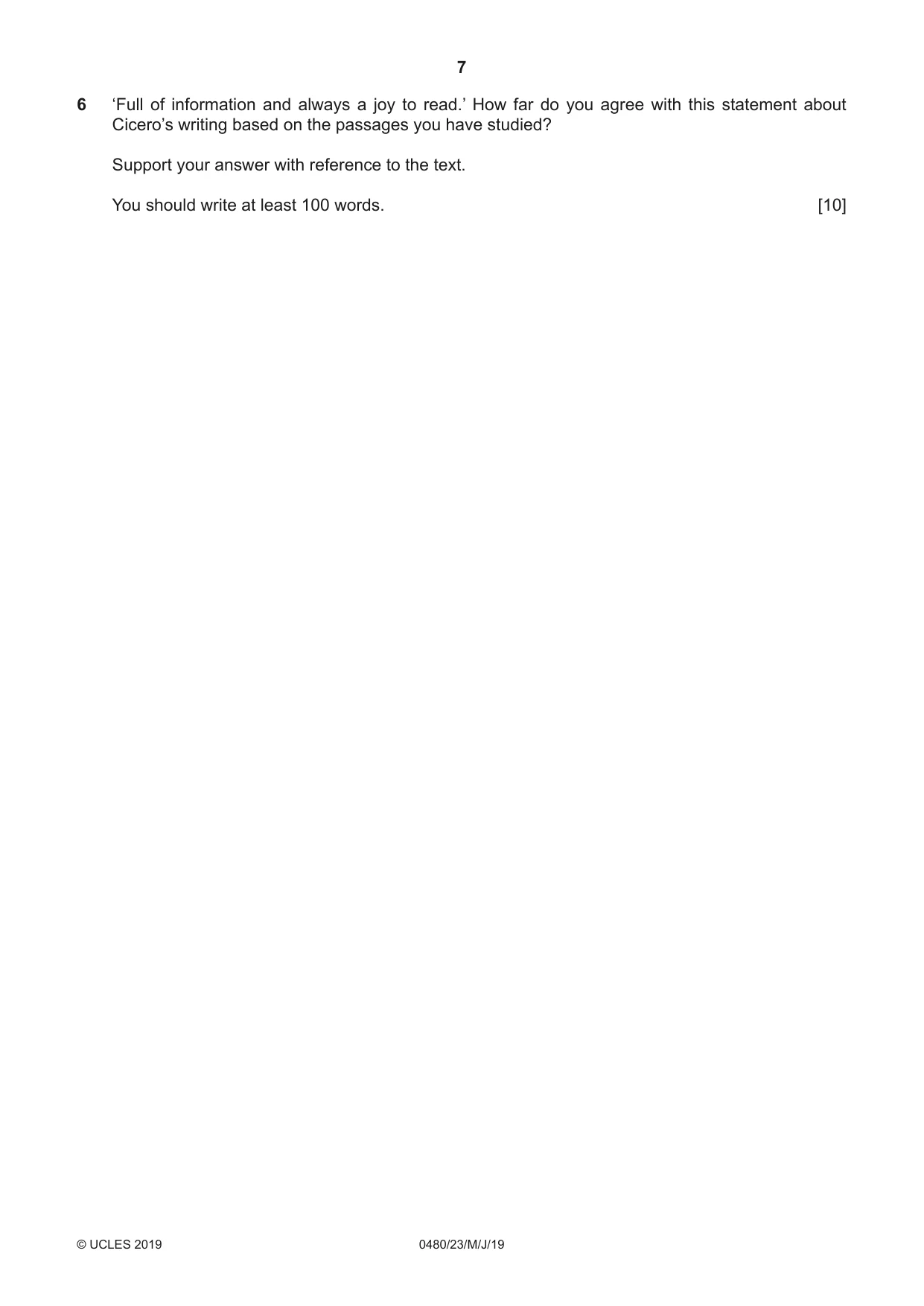
Q6 · ‘Full of information and always a joy to read.’ How far do you agree with this statement…
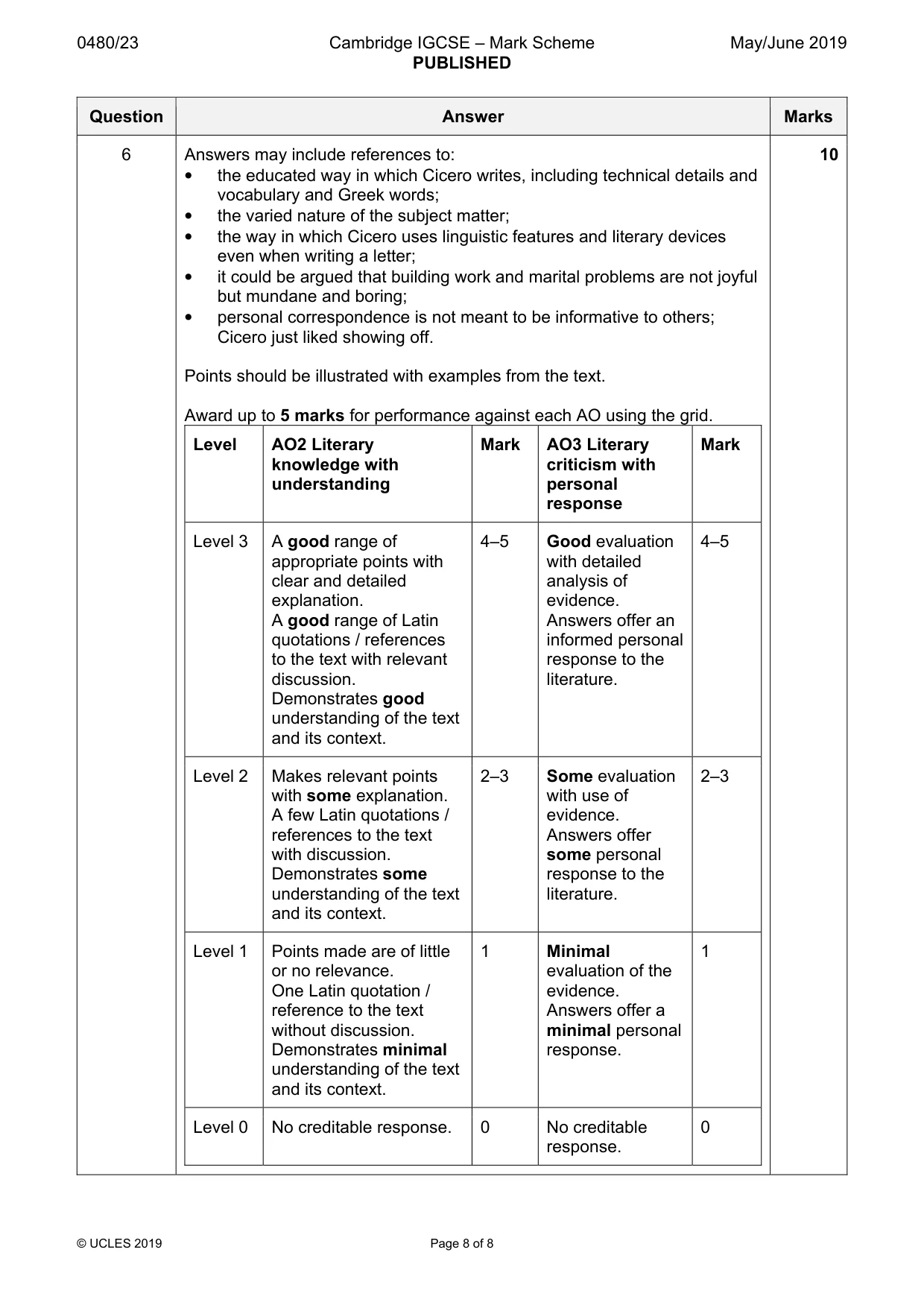
6 ‘Full of information and always a joy to read.’ How far do you agree with this statement about Cicero’s writing based on the passages you have studied? Support your answer with reference to the text. You should write at least 100 words. [10]
Mark scheme: 6 Answers may include references to: 10 • the educated way in which Cicero writes, including technical details and vocabulary and Greek words; • the varied nature of the subject matter; • the way in which Cicero uses linguistic features and literary devices even when writing a letter; • it could be argued that building work and marital problems are not joyful but mundane and boring; • personal correspondence is not meant to be informative to others; Cicero just liked showing off. Points should be illustrated with examples from the text. Award up to 5 marks for performance against each AO using the grid. Level AO2 Literary Mark AO3 Literary Mark knowledge with criticism with understanding personal response Level 3 A good range of 4–5 Good evaluation 4–5 appropriate points with with detailed clear and detailed analysis of explanation. evidence. A good range of Latin Answers offer an quotations / references informed personal to the text with relevant response to the discussion. literature. Demonstrates good understanding of the text and its context. Level 2 Makes relevant points 2–3 Some evaluation 2–3 with some explanation. with use of A few Latin quotations / evidence. references to the text Answers offer with discussion. some personal Demonstrates some response to the understanding of the text literature. and its context. Level 1 Points made are of little 1 Minimal 1 or no relevance. evaluation of the One Latin quotation / evidence. reference to the text Answers offer a without discussion. minimal personal Demonstrates minimal response. understanding of the text and its context. Level 0 No creditable response. 0 No creditable 0 response.
What you needed in this session
Cambridge’s own grade thresholds for 2019 May/June, Paper 2 · Variant 3. A higher threshold means an easier paper — the bar moves with how the cohort did.