Cambridge IGCSE History 0470 — 2025 May/June Paper 4 · Variant 1
0470/41/M/J/25 · 40 marks · 60 min
The question paper and its mark scheme, free to read here and free to download. This is Cambridge’s own paper, exactly as it was sat.
Question paper4 pages

Mark scheme18 pages
Answers below. Sit the paper first if you are practising.
Paper as text
Question paper, page 1
Cambridge IGCSE™ 0470/41 May/June 2025 1 hour HISTORY Paper 4 Alternative to Coursework You must answer on the enclosed answer booklet. You will need: Answer booklet (enclosed) INSTRUCTIONS • Answer one question from your chosen Depth study. • Follow the instructions on the front cover of the answer booklet. If you need additional answer paper, ask the invigilator for a continuation booklet. INFORMATION • The total mark for this paper is 40. • The number of marks for each question or part question is shown in brackets [ ]. This document has 4 pages. [Turn over 06_0470_41_2025_1.9 © UCLES 2025 *2294373871*
Question paper, page 2
Answer one question. Depth study A: The First World War, 1914–18 Write an account of the trench system on the Western Front. [15] (a) 1 Discuss the impact of machine guns in the fighting on the Western Front. [25] (b) Write an account of the role of Canadian troops on the Western Front. [15] (a) 2 Discuss the impact of British Empire troops in the fighting in Africa. [25] (b) Depth study B: Germany, 1918–45 Write an account of the Kapp Putsch. [15] (a) 3 Discuss the impact of reparations on Germany. [25] (b) Write an account of how women were treated in Nazi Germany. [15] (a) 4 Discuss the importance of the Hitler Youth in Nazi Germany. [25] (b) Depth study C: Russia, 1905–41 Write an account of Trotsky’s contribution to the downfall of the Provisional Government. [15] (a) 5 Discuss the importance of Lenin’s April Theses. [25] (b) Write an account of how Trotsky was affected by Stalin’s rise to power. [15] (a) 6 Discuss the impact of the Purges for the Soviet Union. [25] (b) 06_0470_41_2025_1.9 © UCLES 2025 2
Question paper, page 3
Depth study D: The United States, 1919–41 Write an account of how the Roaring Twenties changed society in the USA. [15] (a) 7 Discuss the impact of jazz music in the 1920s. [25] (b) Write an account of how the Depression affected American society. [15] (a) 8 Discuss the importance of Roosevelt’s election as President in 1932. [25] (b) Depth study E: The Second World War in Europe and the Asia–Pacific, 1939–c.1945 Write an account of the Battle of Stalingrad. [15] (a) 9 Discuss the importance of the German invasion of the Soviet Union. [25] (b) Write an account of Japanese military operations in Malaya and Singapore in 1941–42. [15] (a) 10 Discuss the extent to which the Battle of Midway was a turning point in the war in the Asia-Pacific. [25] (b) [Turn over 06_0470_41_2025_1.9 © UCLES 2025 3
Question paper, page 4
Permission to reproduce items where third-party owned material protected by copyright is included has been sought and cleared where possible. Every reasonable effort has been made by the publisher (UCLES) to trace copyright holders, but if any items requiring clearance have unwittingly been included, the publisher will be pleased to make amends at the earliest possible opportunity. To avoid the issue of disclosure of answer-related information to candidates, all copyright acknowledgements are reproduced online in the Cambridge Assessment International Education Copyright Acknowledgements Booklet. This is produced for each series of examinations and is freely available to download at www.cambridgeinternational.org after the live examination series. Cambridge Assessment International Education is part of Cambridge Assessment. Cambridge Assessment is the brand name of the University of Cambridge Local Examinations Syndicate (UCLES), which is a department of the University of Cambridge. 06_0470_41_2025_1.9 © UCLES 2025 4
Mark scheme, page 1
This document consists of 18 printed pages. © Cambridge University Press & Assessment 2025 [Turn over Cambridge IGCSE™ HISTORY 0470/41 Paper 4 Alternative to Coursework May/June 2025 MARK SCHEME Maximum Mark: 40 Published This mark scheme is published as an aid to teachers and candidates, to indicate the requirements of the examination. It shows the basis on which Examiners were instructed to award marks. It does not indicate the details of the discussions that took place at an Examiners’ meeting before marking began, which would have considered the acceptability of alternative answers. Mark schemes should be read in conjunction with the question paper and the Principal Examiner Report for Teachers. Cambridge International will not enter into discussions about these mark schemes. Cambridge International is publishing the mark schemes for the May/June 2025 series for most Cambridge IGCSE, Cambridge International A and AS Level components, and some Cambridge O Level components.
Mark scheme, page 2
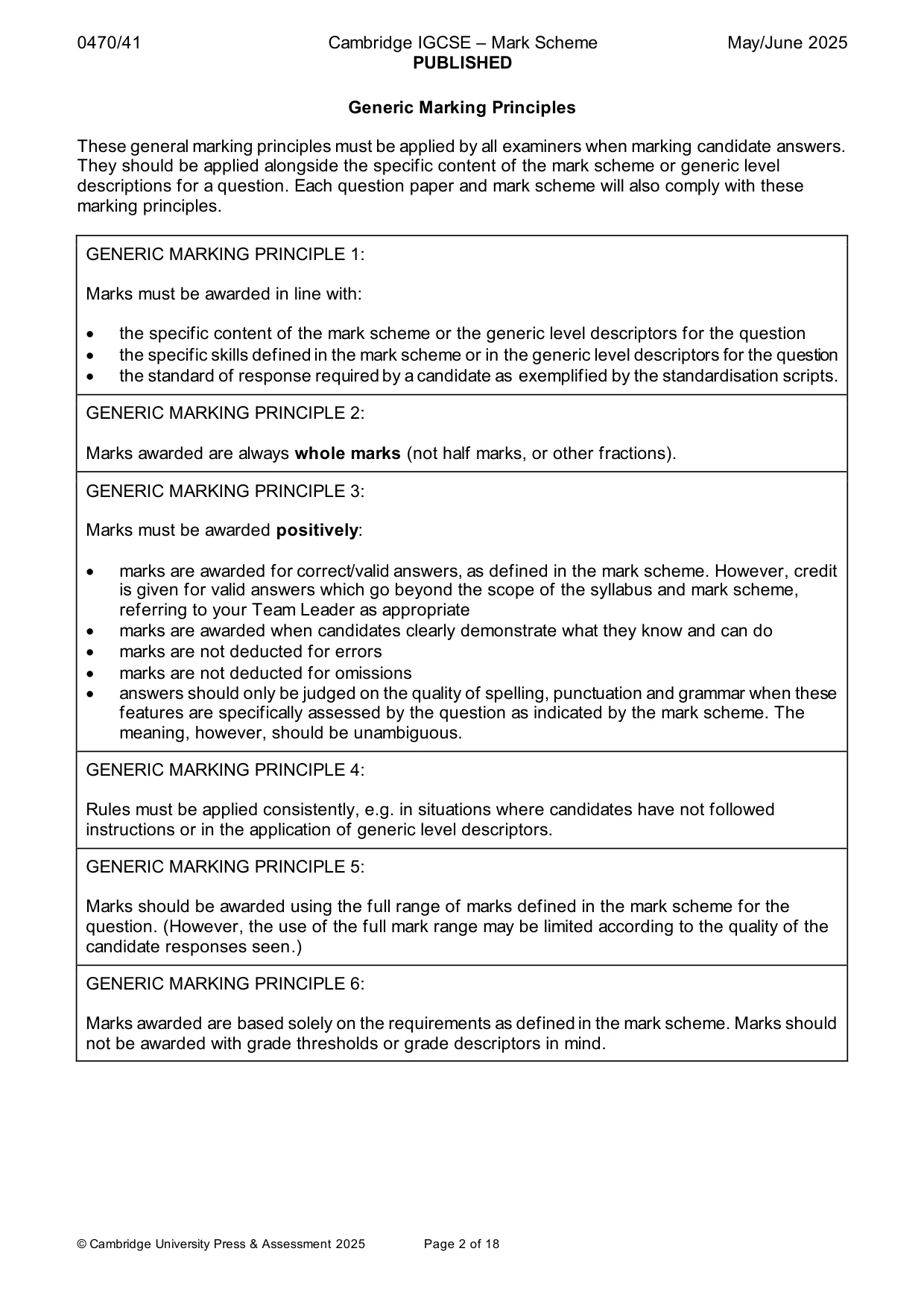
0470/41 Cambridge IGCSE – Mark Scheme PUBLISHED May/June 2025 © Cambridge University Press & Assessment 2025 Page 2 of 18 Generic Marking Principles These general marking principles must be applied by all examiners when marking candidate answers. They should be applied alongside the specific content of the mark scheme or generic level descriptions for a question. Each question paper and mark scheme will also comply with these marking principles. GENERIC MARKING PRINCIPLE 1: Marks must be awarded in line with: • the specific content of the mark scheme or the generic level descriptors for the question • the specific skills defined in the mark scheme or in the generic level descriptors for the question • the standard of response required by a candidate as exemplified by the standardisation scripts. GENERIC MARKING PRINCIPLE 2: Marks awarded are always whole marks (not half marks, or other fractions). GENERIC MARKING PRINCIPLE 3: Marks must be awarded positively: • marks are awarded for correct/valid answers, as defined in the mark scheme. However, credit is given for valid answers which go beyond the scope of the syllabus and mark scheme, referring to your Team Leader as appropriate • marks are awarded when candidates clearly demonstrate what they know and can do • marks are not deducted for errors • marks are not deducted for omissions • answers should only be judged on the quality of spelling, punctuation and grammar when these features are specifically assessed by the question as indicated by the mark scheme. The meaning, however, should be unambiguous. GENERIC MARKING PRINCIPLE 4: Rules must be applied consistently, e.g. in situations where candidates have not followed instructions or in the application of generic level descriptors. GENERIC MARKING PRINCIPLE 5: Marks should be awarded using the full range of marks defined in the mark scheme for the question. (However, the use of the full mark range may be limited according to the quality of the candidate responses seen.) GENERIC MARKING PRINCIPLE 6: Marks awarded are based solely on the requirements as defined in the mark scheme. Marks should not be awarded with grade thresholds or grade descriptors in mind.
Mark scheme, page 3
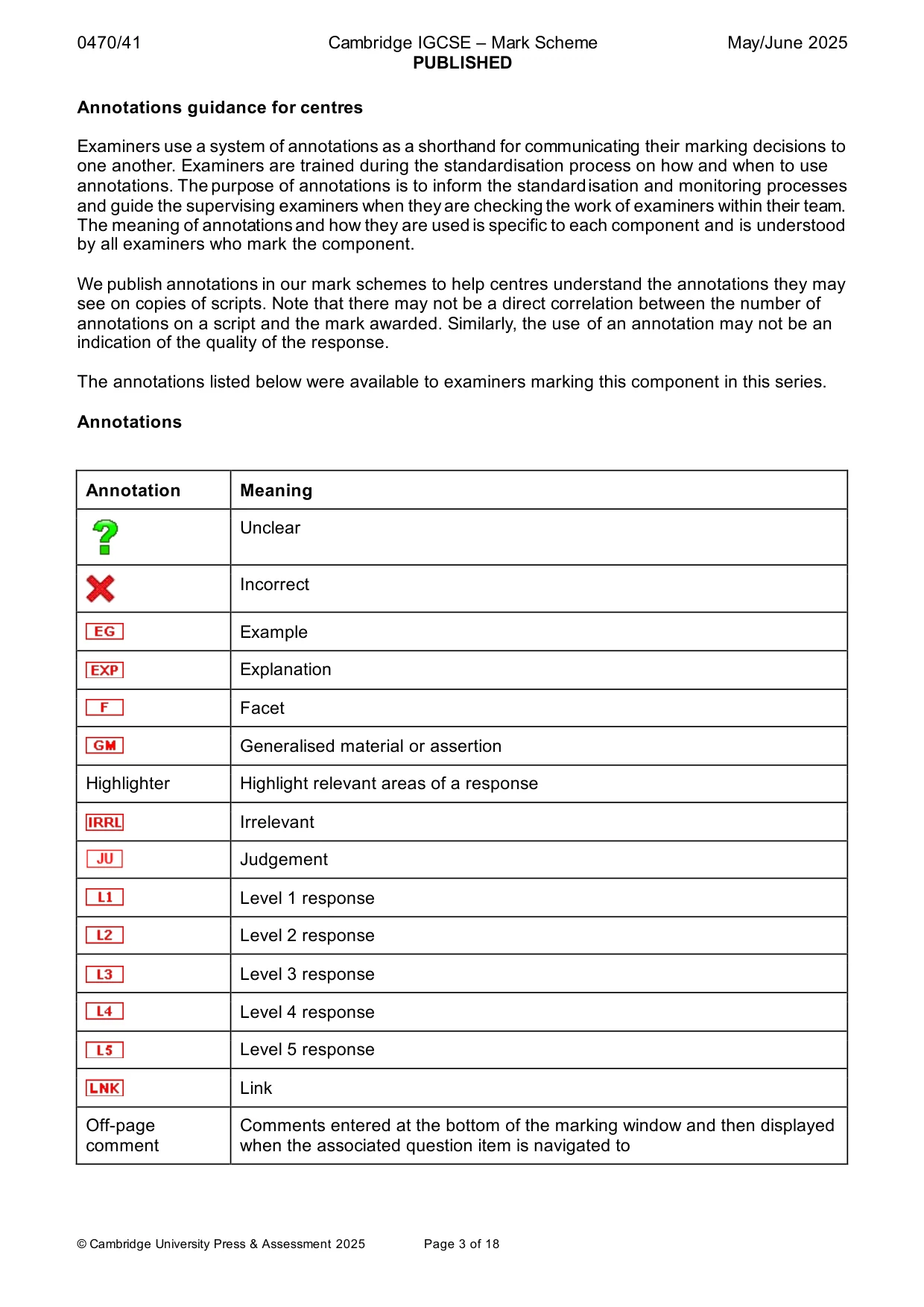
0470/41 Cambridge IGCSE – Mark Scheme PUBLISHED May/June 2025 © Cambridge University Press & Assessment 2025 Page 3 of 18 Annotations guidance for centres Examiners use a system of annotations as a shorthand for communicating their marking decisions to one another. Examiners are trained during the standardisation process on how and when to use annotations. The purpose of annotations is to inform the standardisation and monitoring processes and guide the supervising examiners when they are checking the work of examiners within their team. The meaning of annotations and how they are used is specific to each component and is understood by all examiners who mark the component. We publish annotations in our mark schemes to help centres understand the annotations they may see on copies of scripts. Note that there may not be a direct correlation between the number of annotations on a script and the mark awarded. Similarly, the use of an annotation may not be an indication of the quality of the response. The annotations listed below were available to examiners marking this component in this series. Annotations Annotation Meaning Unclear Incorrect Example Explanation Facet Generalised material or assertion Highlighter Highlight relevant areas of a response Irrelevant Judgement Level 1 response Level 2 response Level 3 response Level 4 response Level 5 response Link Off-page comment Comments entered at the bottom of the marking window and then displayed when the associated question item is navigated to
Mark scheme, page 4
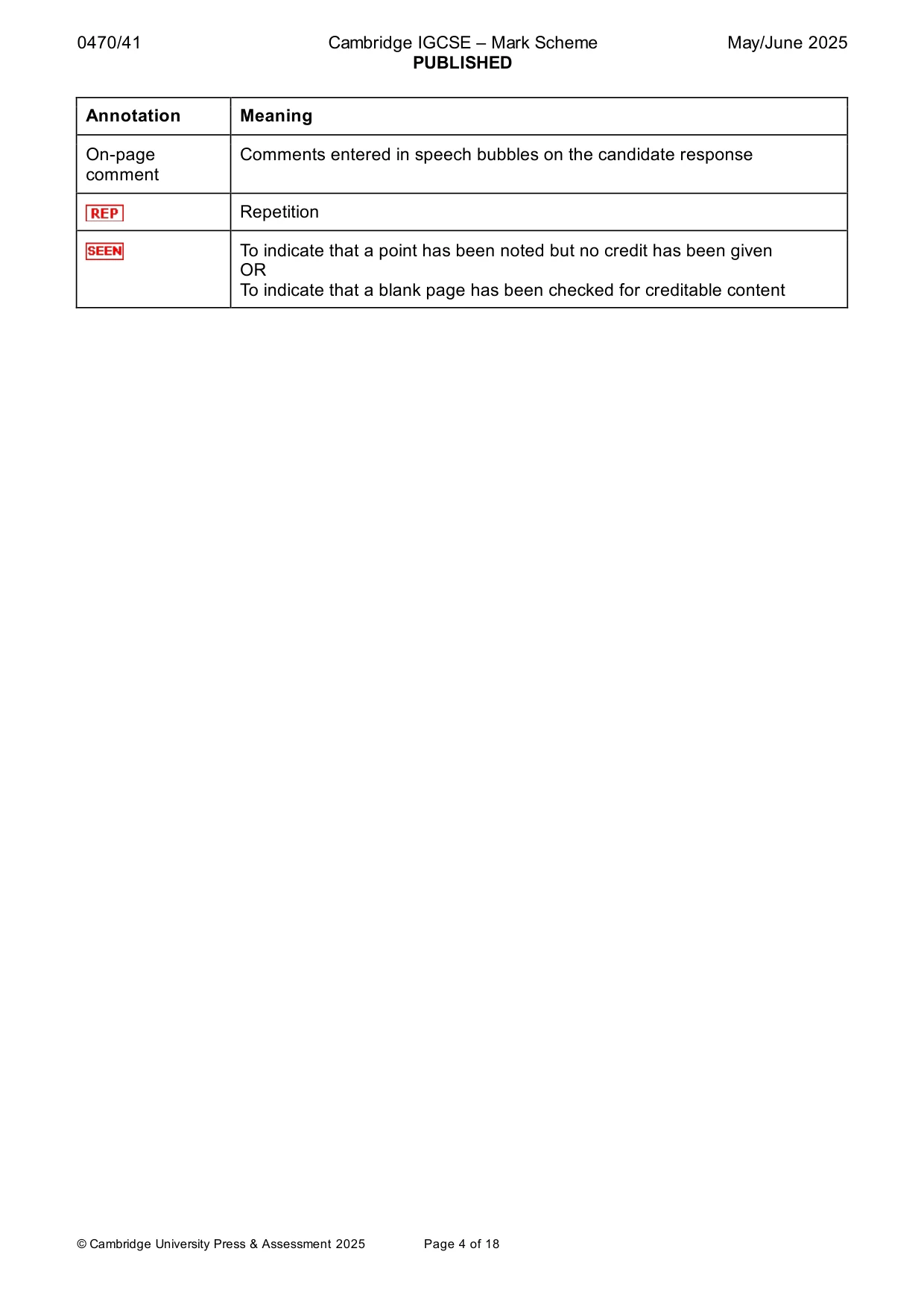
0470/41 Cambridge IGCSE – Mark Scheme PUBLISHED May/June 2025 © Cambridge University Press & Assessment 2025 Page 4 of 18 Annotation Meaning On-page comment Comments entered in speech bubbles on the candidate response Repetition To indicate that a point has been noted but no credit has been given OR To indicate that a blank page has been checked for creditable content
Mark scheme, page 5
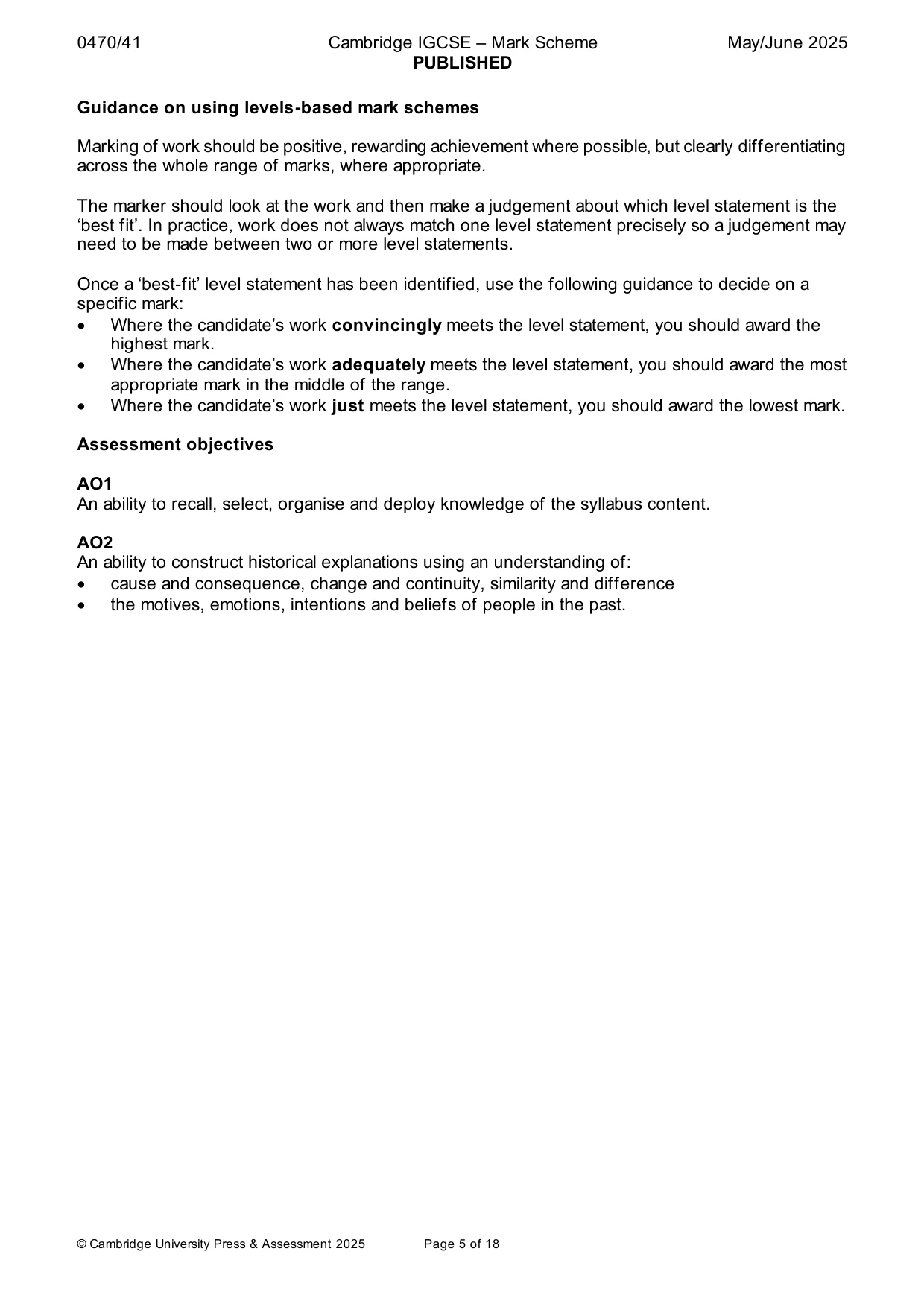
0470/41 Cambridge IGCSE – Mark Scheme PUBLISHED May/June 2025 © Cambridge University Press & Assessment 2025 Page 5 of 18 Guidance on using levels-based mark schemes Marking of work should be positive, rewarding achievement where possible, but clearly differentiating across the whole range of marks, where appropriate. The marker should look at the work and then make a judgement about which level statement is the ‘best fit’. In practice, work does not always match one level statement precisely so a judgement may need to be made between two or more level statements. Once a ‘best-fit’ level statement has been identified, use the following guidance to decide on a specific mark: • Where the candidate’s work convincingly meets the level statement, you should award the highest mark. • Where the candidate’s work adequately meets the level statement, you should award the most appropriate mark in the middle of the range. • Where the candidate’s work just meets the level statement, you should award the lowest mark. Assessment objectives AO1 An ability to recall, select, organise and deploy knowledge of the syllabus content. AO2 An ability to construct historical explanations using an understanding of: • cause and consequence, change and continuity, similarity and difference • the motives, emotions, intentions and beliefs of people in the past.
Mark scheme, page 6
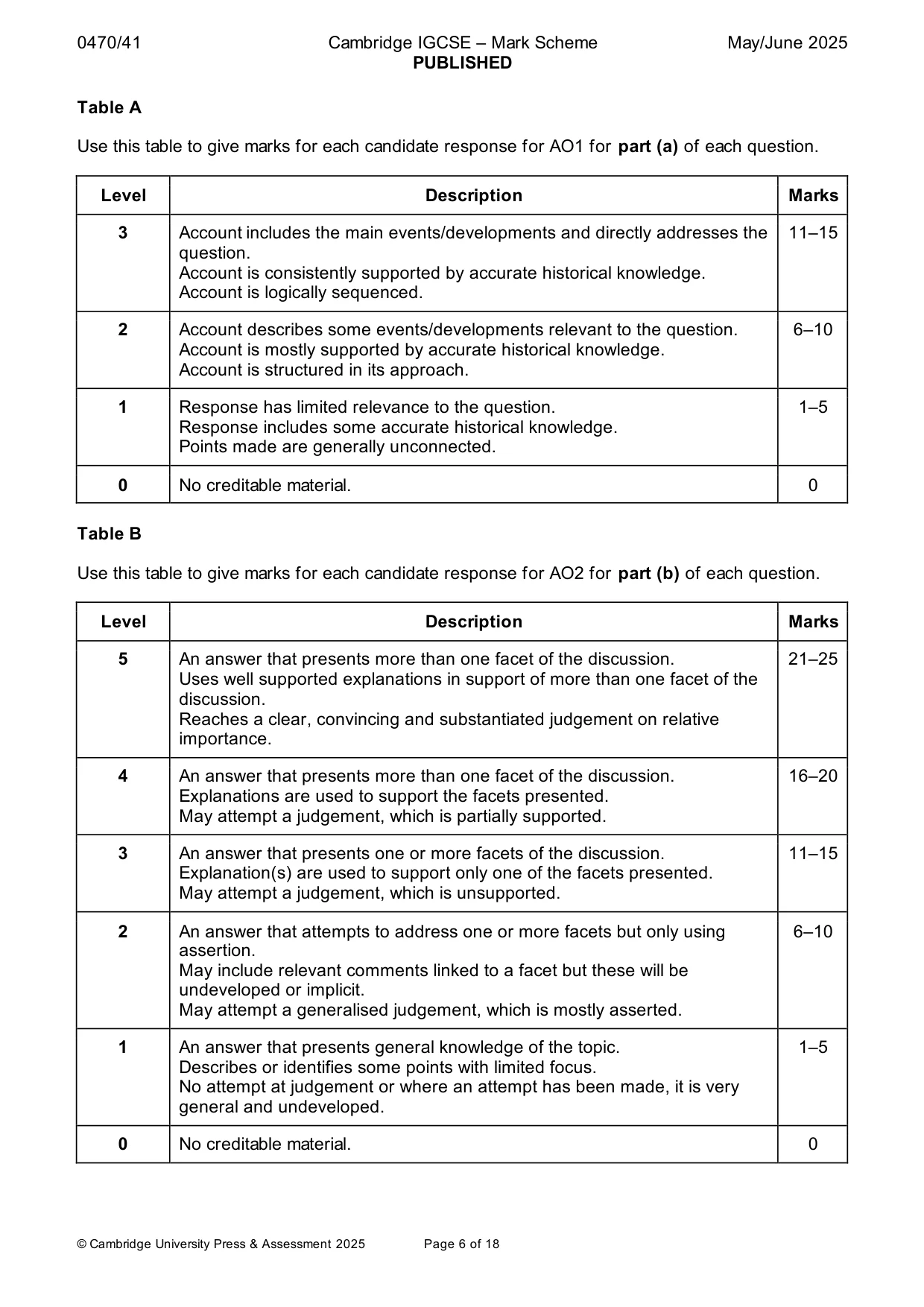
0470/41 Cambridge IGCSE – Mark Scheme PUBLISHED May/June 2025 © Cambridge University Press & Assessment 2025 Page 6 of 18 Table A Use this table to give marks for each candidate response for AO1 for part (a) of each question. Level Description Marks 3 Account includes the main events/developments and directly addresses the question. Account is consistently supported by accurate historical knowledge. Account is logically sequenced. 11–15 2 Account describes some events/developments relevant to the question. Account is mostly supported by accurate historical knowledge. Account is structured in its approach. 6–10 1 Response has limited relevance to the question. Response includes some accurate historical knowledge. Points made are generally unconnected. 1–5 0 No creditable material. 0 Table B Use this table to give marks for each candidate response for AO2 for part (b) of each question. Level Description Marks 5 An answer that presents more than one facet of the discussion. Uses well supported explanations in support of more than one facet of the discussion. Reaches a clear, convincing and substantiated judgement on relative importance. 21–25 4 An answer that presents more than one facet of the discussion. Explanations are used to support the facets presented. May attempt a judgement, which is partially supported. 16–20 3 An answer that presents one or more facets of the discussion. Explanation(s) are used to support only one of the facets presented. May attempt a judgement, which is unsupported. 11–15 2 An answer that attempts to address one or more facets but only using assertion. May include relevant comments linked to a facet but these will be undeveloped or implicit. May attempt a generalised judgement, which is mostly asserted. 6–10 1 An answer that presents general knowledge of the topic. Describes or identifies some points with limited focus. No attempt at judgement or where an attempt has been made, it is very general and undeveloped. 1–5 0 No creditable material. 0
Mark scheme, page 7
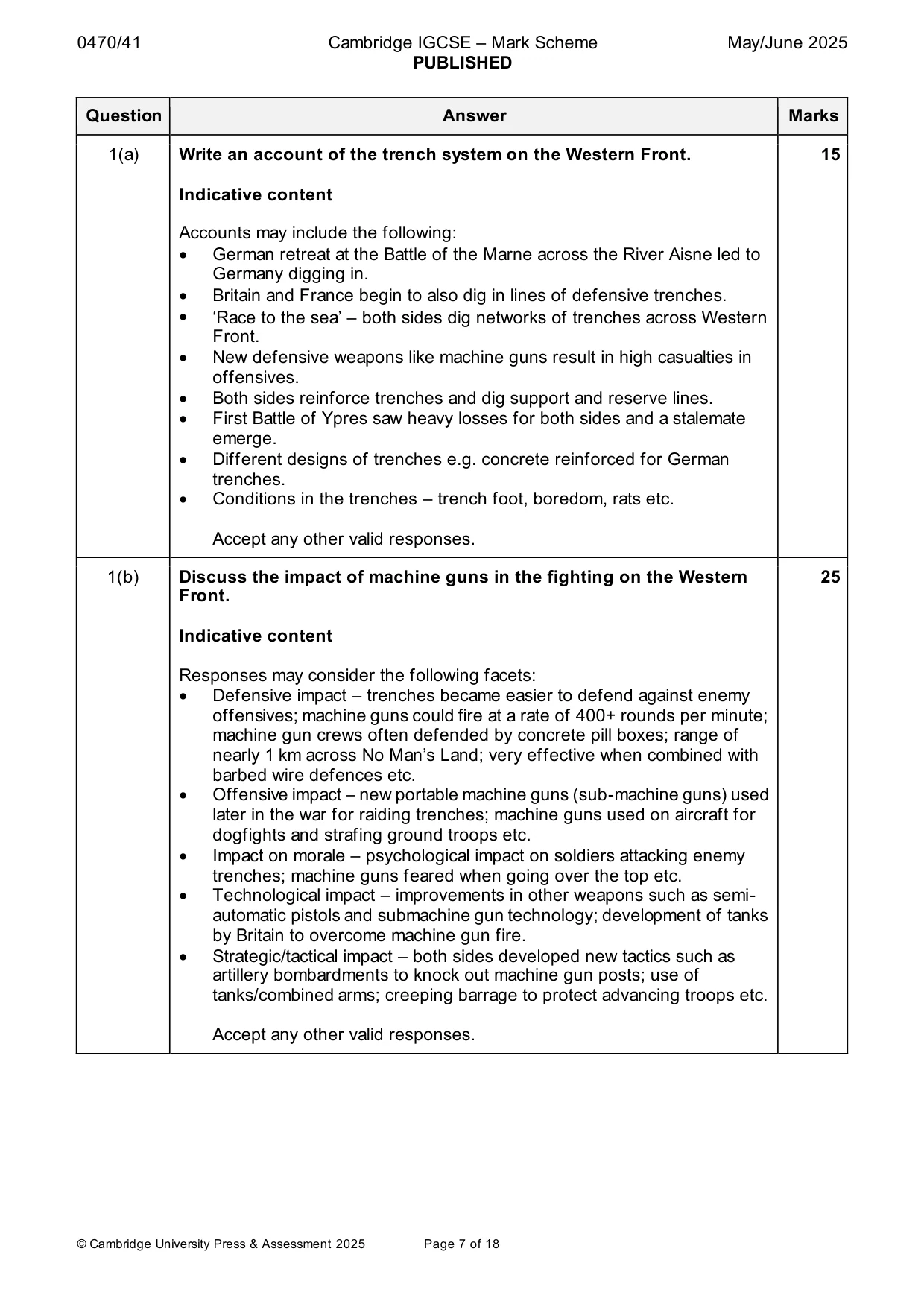
0470/41 Cambridge IGCSE – Mark Scheme PUBLISHED May/June 2025 © Cambridge University Press & Assessment 2025 Page 7 of 18 Question Answer Marks 1(a) Write an account of the trench system on the Western Front. Indicative content Accounts may include the following: • German retreat at the Battle of the Marne across the River Aisne led to Germany digging in. • Britain and France begin to also dig in lines of defensive trenches. • ‘Race to the sea’ – both sides dig networks of trenches across Western Front. • New defensive weapons like machine guns result in high casualties in offensives. • Both sides reinforce trenches and dig support and reserve lines. • First Battle of Ypres saw heavy losses for both sides and a stalemate emerge. • Different designs of trenches e.g. concrete reinforced for German trenches. • Conditions in the trenches – trench foot, boredom, rats etc. Accept any other valid responses. 15 1(b) Discuss the impact of machine guns in the fighting on the Western Front. Indicative content Responses may consider the following facets: • Defensive impact – trenches became easier to defend against enemy offensives; machine guns could fire at a rate of 400+ rounds per minute; machine gun crews often defended by concrete pill boxes; range of nearly 1 km across No Man’s Land; very effective when combined with barbed wire defences etc. • Offensive impact – new portable machine guns (sub-machine guns) used later in the war for raiding trenches; machine guns used on aircraft for dogfights and strafing ground troops etc. • Impact on morale – psychological impact on soldiers attacking enemy trenches; machine guns feared when going over the top etc. • Technological impact – improvements in other weapons such as semi- automatic pistols and submachine gun technology; development of tanks by Britain to overcome machine gun fire. • Strategic/tactical impact – both sides developed new tactics such as artillery bombardments to knock out machine gun posts; use of tanks/combined arms; creeping barrage to protect advancing troops etc. Accept any other valid responses. 25
Mark scheme, page 8
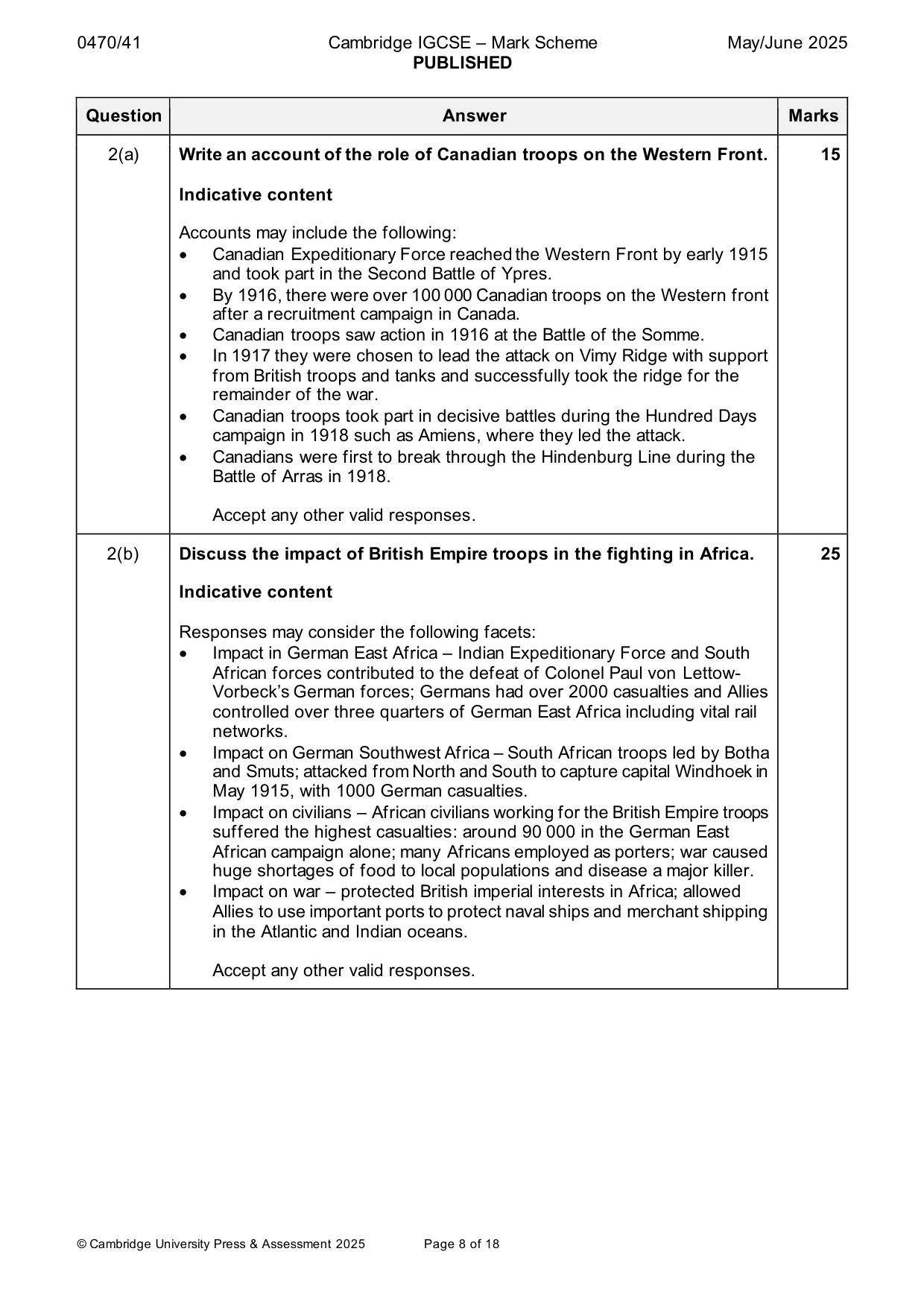
0470/41 Cambridge IGCSE – Mark Scheme PUBLISHED May/June 2025 © Cambridge University Press & Assessment 2025 Page 8 of 18 Question Answer Marks 2(a) Write an account of the role of Canadian troops on the Western Front. Indicative content Accounts may include the following: • Canadian Expeditionary Force reached the Western Front by early 1915 and took part in the Second Battle of Ypres. • By 1916, there were over 100 000 Canadian troops on the Western front after a recruitment campaign in Canada. • Canadian troops saw action in 1916 at the Battle of the Somme. • In 1917 they were chosen to lead the attack on Vimy Ridge with support from British troops and tanks and successfully took the ridge for the remainder of the war. • Canadian troops took part in decisive battles during the Hundred Days campaign in 1918 such as Amiens, where they led the attack. • Canadians were first to break through the Hindenburg Line during the Battle of Arras in 1918. Accept any other valid responses. 15 2(b) Discuss the impact of British Empire troops in the fighting in Africa. Indicative content Responses may consider the following facets: • Impact in German East Africa – Indian Expeditionary Force and South African forces contributed to the defeat of Colonel Paul von Lettow- Vorbeck’s German forces; Germans had over 2000 casualties and Allies controlled over three quarters of German East Africa including vital rail networks. • Impact on German Southwest Africa – South African troops led by Botha and Smuts; attacked from North and South to capture capital Windhoek in May 1915, with 1000 German casualties. • Impact on civilians – African civilians working for the British Empire troops suffered the highest casualties: around 90 000 in the German East African campaign alone; many Africans employed as porters; war caused huge shortages of food to local populations and disease a major killer. • Impact on war – protected British imperial interests in Africa; allowed Allies to use important ports to protect naval ships and merchant shipping in the Atlantic and Indian oceans. Accept any other valid responses. 25
Mark scheme, page 9
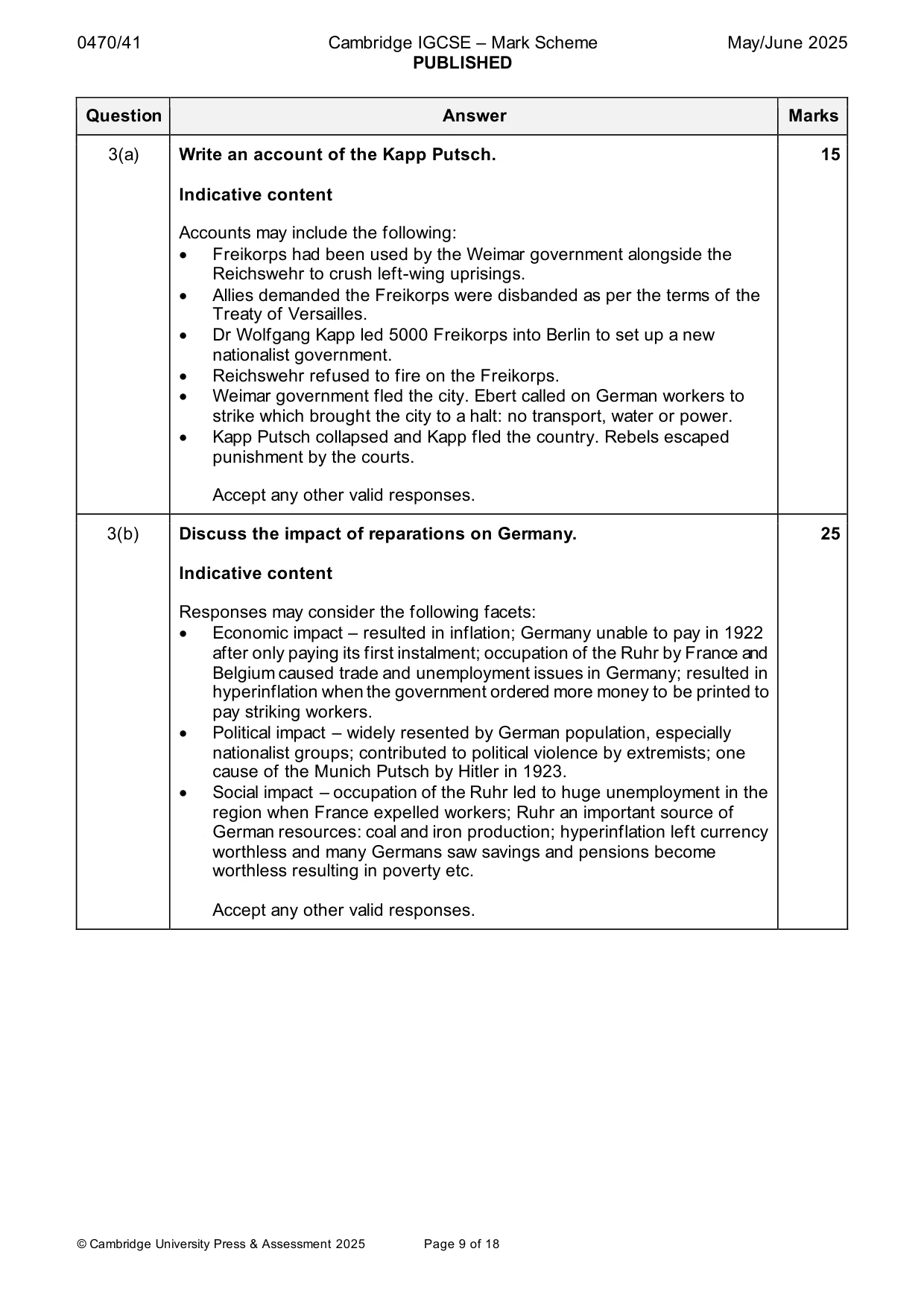
0470/41 Cambridge IGCSE – Mark Scheme PUBLISHED May/June 2025 © Cambridge University Press & Assessment 2025 Page 9 of 18 Question Answer Marks 3(a) Write an account of the Kapp Putsch. Indicative content Accounts may include the following: • Freikorps had been used by the Weimar government alongside the Reichswehr to crush left-wing uprisings. • Allies demanded the Freikorps were disbanded as per the terms of the Treaty of Versailles. • Dr Wolfgang Kapp led 5000 Freikorps into Berlin to set up a new nationalist government. • Reichswehr refused to fire on the Freikorps. • Weimar government fled the city. Ebert called on German workers to strike which brought the city to a halt: no transport, water or power. • Kapp Putsch collapsed and Kapp fled the country. Rebels escaped punishment by the courts. Accept any other valid responses. 15 3(b) Discuss the impact of reparations on Germany. Indicative content Responses may consider the following facets: • Economic impact – resulted in inflation; Germany unable to pay in 1922 after only paying its first instalment; occupation of the Ruhr by France and Belgium caused trade and unemployment issues in Germany; resulted in hyperinflation when the government ordered more money to be printed to pay striking workers. • Political impact – widely resented by German population, especially nationalist groups; contributed to political violence by extremists; one cause of the Munich Putsch by Hitler in 1923. • Social impact – occupation of the Ruhr led to huge unemployment in the region when France expelled workers; Ruhr an important source of German resources: coal and iron production; hyperinflation left currency worthless and many Germans saw savings and pensions become worthless resulting in poverty etc. Accept any other valid responses. 25
Mark scheme, page 10
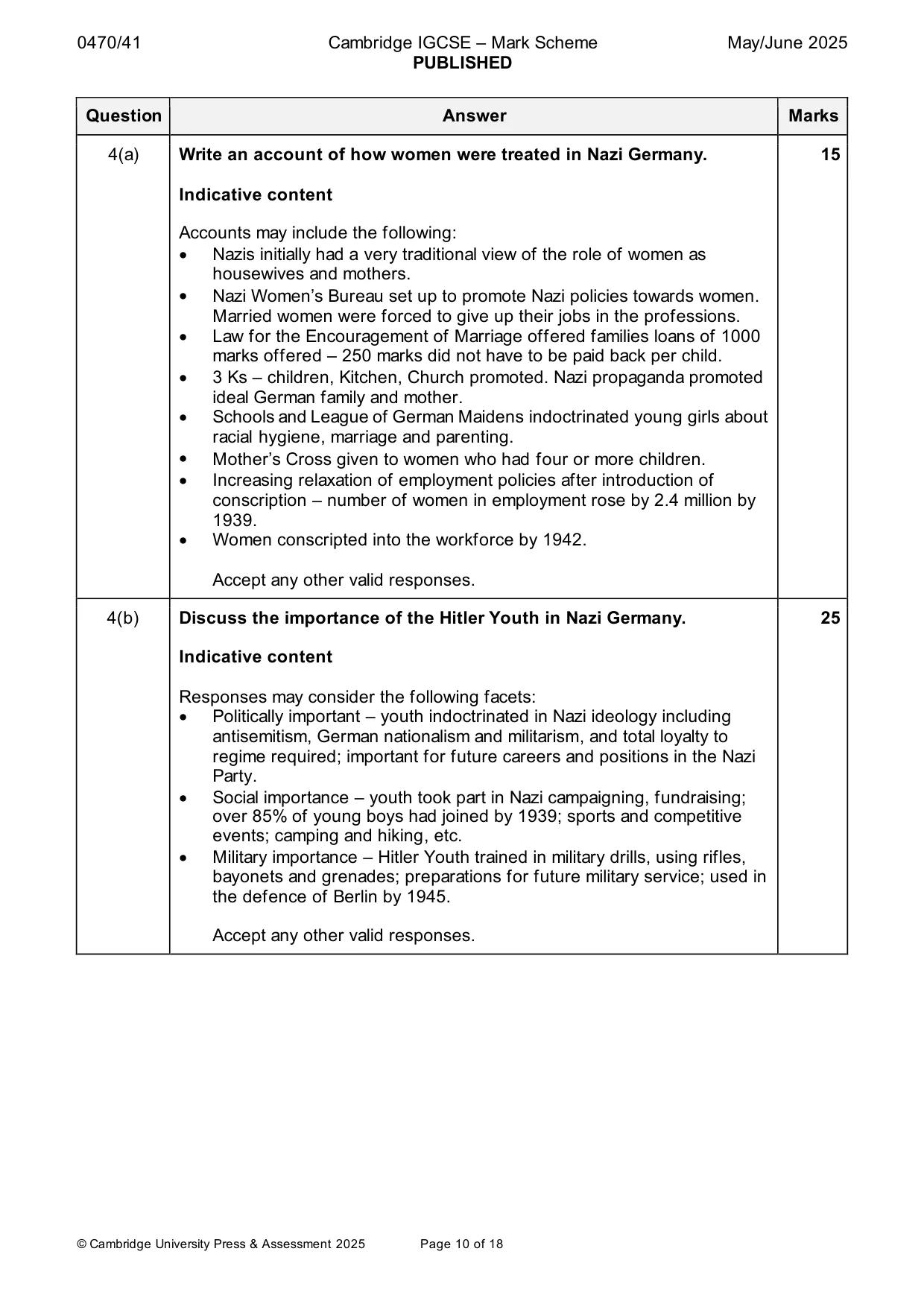
0470/41 Cambridge IGCSE – Mark Scheme PUBLISHED May/June 2025 © Cambridge University Press & Assessment 2025 Page 10 of 18 Question Answer Marks 4(a) Write an account of how women were treated in Nazi Germany. Indicative content Accounts may include the following: • Nazis initially had a very traditional view of the role of women as housewives and mothers. • Nazi Women’s Bureau set up to promote Nazi policies towards women. Married women were forced to give up their jobs in the professions. • Law for the Encouragement of Marriage offered families loans of 1000 marks offered – 250 marks did not have to be paid back per child. • 3 Ks – children, Kitchen, Church promoted. Nazi propaganda promoted ideal German family and mother. • Schools and League of German Maidens indoctrinated young girls about racial hygiene, marriage and parenting. • Mother’s Cross given to women who had four or more children. • Increasing relaxation of employment policies after introduction of conscription – number of women in employment rose by 2.4 million by 1939. • Women conscripted into the workforce by 1942. Accept any other valid responses. 15 4(b) Discuss the importance of the Hitler Youth in Nazi Germany. Indicative content Responses may consider the following facets: • Politically important – youth indoctrinated in Nazi ideology including antisemitism, German nationalism and militarism, and total loyalty to regime required; important for future careers and positions in the Nazi Party. • Social importance – youth took part in Nazi campaigning, fundraising; over 85% of young boys had joined by 1939; sports and competitive events; camping and hiking, etc. • Military importance – Hitler Youth trained in military drills, using rifles, bayonets and grenades; preparations for future military service; used in the defence of Berlin by 1945. Accept any other valid responses. 25
Mark scheme, page 11
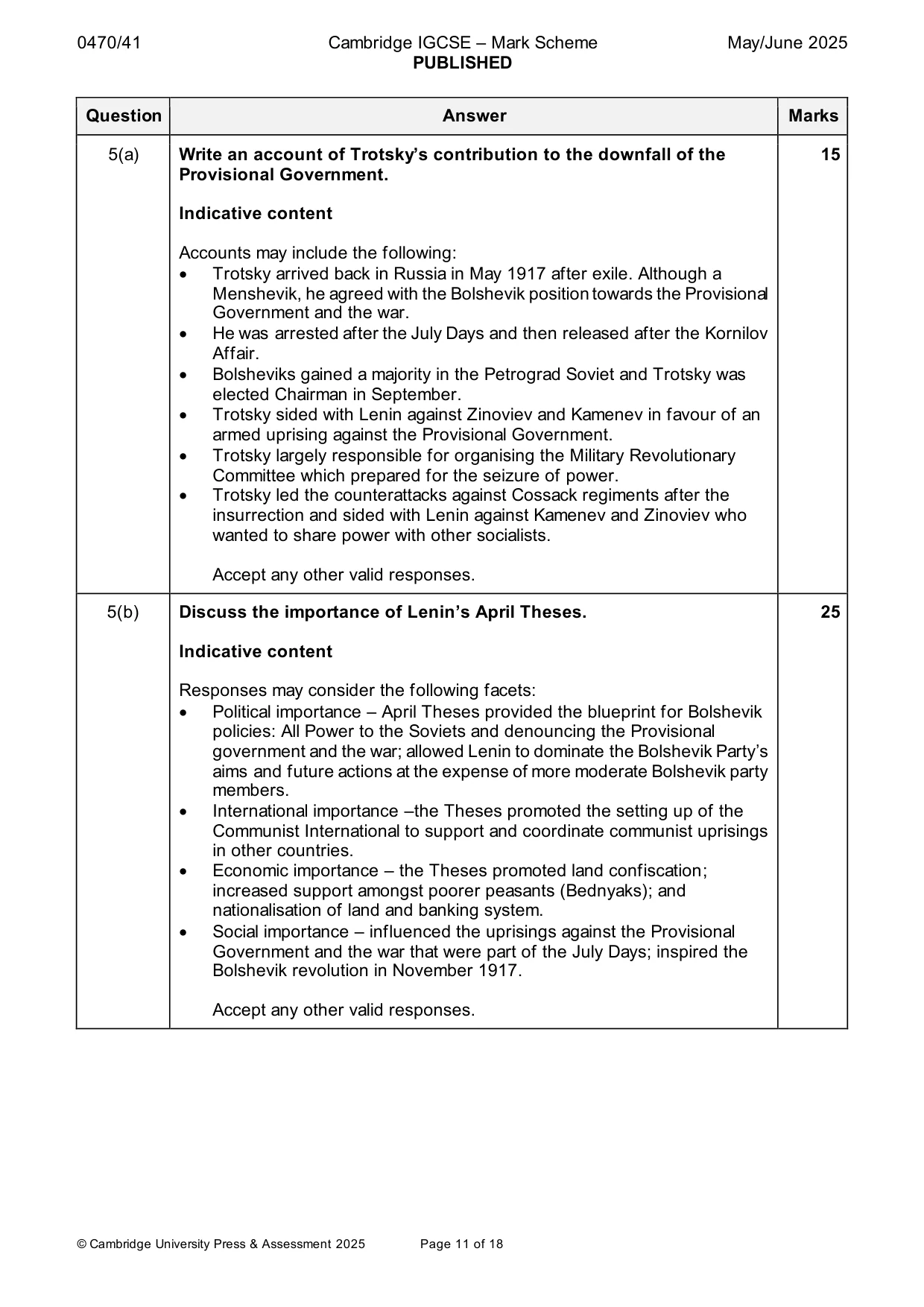
0470/41 Cambridge IGCSE – Mark Scheme PUBLISHED May/June 2025 © Cambridge University Press & Assessment 2025 Page 11 of 18 Question Answer Marks 5(a) Write an account of Trotsky’s contribution to the downfall of the Provisional Government. Indicative content Accounts may include the following: • Trotsky arrived back in Russia in May 1917 after exile. Although a Menshevik, he agreed with the Bolshevik position towards the Provisional Government and the war. • He was arrested after the July Days and then released after the Kornilov Affair. • Bolsheviks gained a majority in the Petrograd Soviet and Trotsky was elected Chairman in September. • Trotsky sided with Lenin against Zinoviev and Kamenev in favour of an armed uprising against the Provisional Government. • Trotsky largely responsible for organising the Military Revolutionary Committee which prepared for the seizure of power. • Trotsky led the counterattacks against Cossack regiments after the insurrection and sided with Lenin against Kamenev and Zinoviev who wanted to share power with other socialists. Accept any other valid responses. 15 5(b) Discuss the importance of Lenin’s April Theses. Indicative content Responses may consider the following facets: • Political importance – April Theses provided the blueprint for Bolshevik policies: All Power to the Soviets and denouncing the Provisional government and the war; allowed Lenin to dominate the Bolshevik Party’s aims and future actions at the expense of more moderate Bolshevik party members. • International importance –the Theses promoted the setting up of the Communist International to support and coordinate communist uprisings in other countries. • Economic importance – the Theses promoted land confiscation; increased support amongst poorer peasants (Bednyaks); and nationalisation of land and banking system. • Social importance – influenced the uprisings against the Provisional Government and the war that were part of the July Days; inspired the Bolshevik revolution in November 1917. Accept any other valid responses. 25
Mark scheme, page 12
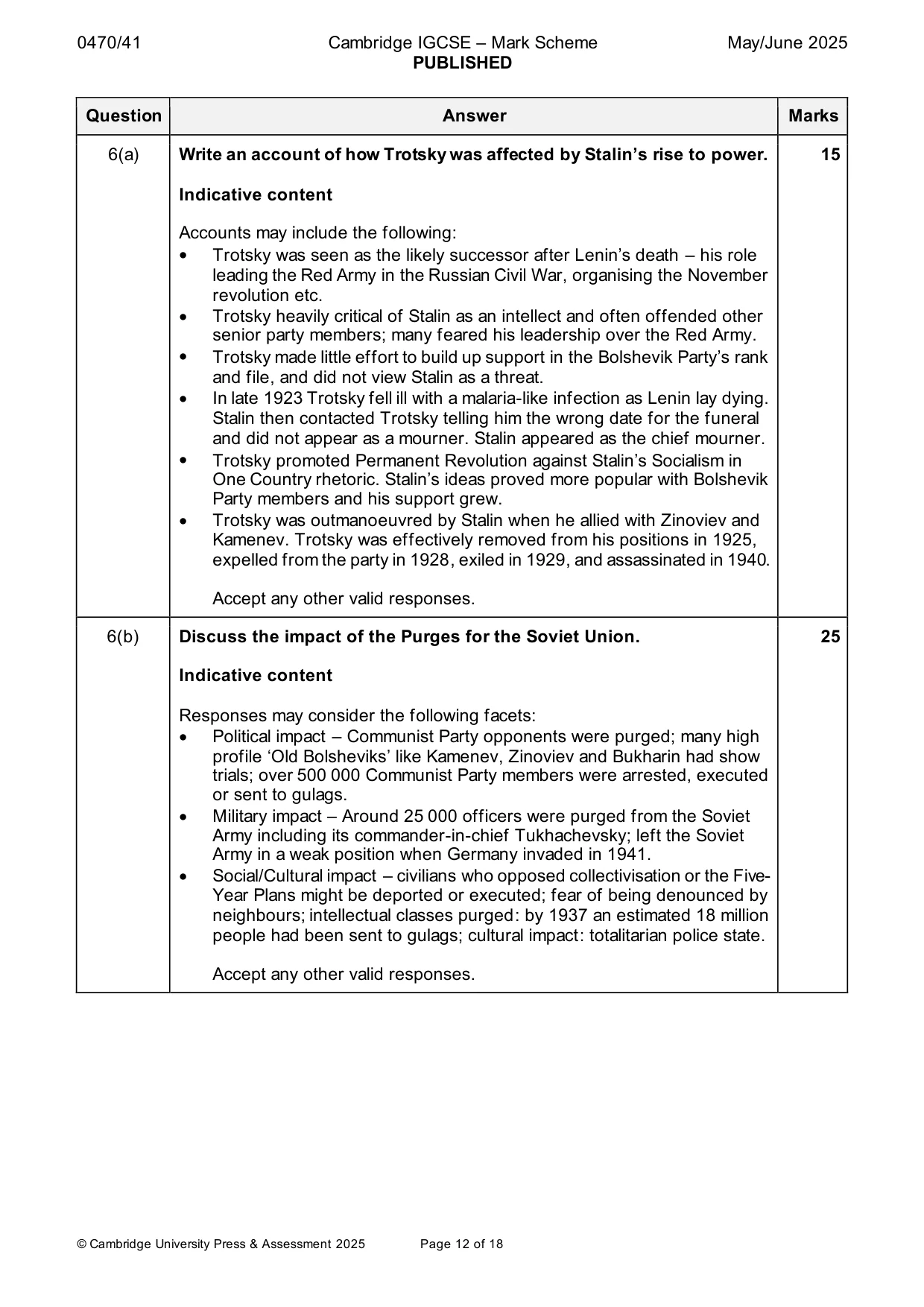
0470/41 Cambridge IGCSE – Mark Scheme PUBLISHED May/June 2025 © Cambridge University Press & Assessment 2025 Page 12 of 18 Question Answer Marks 6(a) Write an account of how Trotsky was affected by Stalin’s rise to power. Indicative content Accounts may include the following: • Trotsky was seen as the likely successor after Lenin’s death – his role leading the Red Army in the Russian Civil War, organising the November revolution etc. • Trotsky heavily critical of Stalin as an intellect and often offended other senior party members; many feared his leadership over the Red Army. • Trotsky made little effort to build up support in the Bolshevik Party’s rank and file, and did not view Stalin as a threat. • In late 1923 Trotsky fell ill with a malaria-like infection as Lenin lay dying. Stalin then contacted Trotsky telling him the wrong date for the funeral and did not appear as a mourner. Stalin appeared as the chief mourner. • Trotsky promoted Permanent Revolution against Stalin’s Socialism in One Country rhetoric. Stalin’s ideas proved more popular with Bolshevik Party members and his support grew. • Trotsky was outmanoeuvred by Stalin when he allied with Zinoviev and Kamenev. Trotsky was effectively removed from his positions in 1925, expelled from the party in 1928, exiled in 1929, and assassinated in 1940. Accept any other valid responses. 15 6(b) Discuss the impact of the Purges for the Soviet Union. Indicative content Responses may consider the following facets: • Political impact – Communist Party opponents were purged; many high profile ‘Old Bolsheviks’ like Kamenev, Zinoviev and Bukharin had show trials; over 500 000 Communist Party members were arrested, executed or sent to gulags. • Military impact – Around 25 000 officers were purged from the Soviet Army including its commander-in-chief Tukhachevsky; left the Soviet Army in a weak position when Germany invaded in 1941. • Social/Cultural impact – civilians who opposed collectivisation or the Five- Year Plans might be deported or executed; fear of being denounced by neighbours; intellectual classes purged: by 1937 an estimated 18 million people had been sent to gulags; cultural impact: totalitarian police state. Accept any other valid responses. 25
Mark scheme, page 13
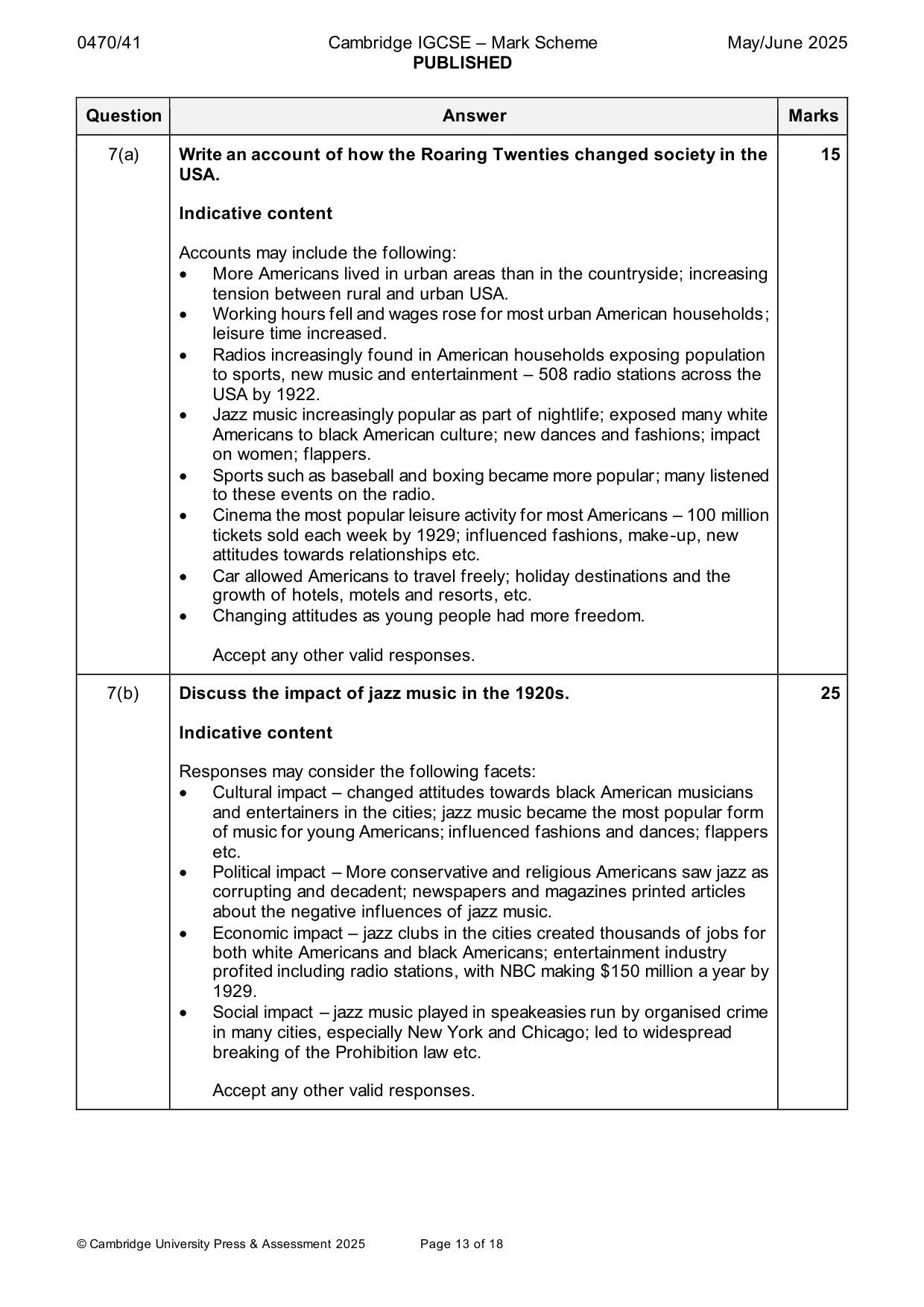
0470/41 Cambridge IGCSE – Mark Scheme PUBLISHED May/June 2025 © Cambridge University Press & Assessment 2025 Page 13 of 18 Question Answer Marks 7(a) Write an account of how the Roaring Twenties changed society in the USA. Indicative content Accounts may include the following: • More Americans lived in urban areas than in the countryside; increasing tension between rural and urban USA. • Working hours fell and wages rose for most urban American households; leisure time increased. • Radios increasingly found in American households exposing population to sports, new music and entertainment – 508 radio stations across the USA by 1922. • Jazz music increasingly popular as part of nightlife; exposed many white Americans to black American culture; new dances and fashions; impact on women; flappers. • Sports such as baseball and boxing became more popular; many listened to these events on the radio. • Cinema the most popular leisure activity for most Americans – 100 million tickets sold each week by 1929; influenced fashions, make-up, new attitudes towards relationships etc. • Car allowed Americans to travel freely; holiday destinations and the growth of hotels, motels and resorts, etc. • Changing attitudes as young people had more freedom. Accept any other valid responses. 15 7(b) Discuss the impact of jazz music in the 1920s. Indicative content Responses may consider the following facets: • Cultural impact – changed attitudes towards black American musicians and entertainers in the cities; jazz music became the most popular form of music for young Americans; influenced fashions and dances; flappers etc. • Political impact – More conservative and religious Americans saw jazz as corrupting and decadent; newspapers and magazines printed articles about the negative influences of jazz music. • Economic impact – jazz clubs in the cities created thousands of jobs for both white Americans and black Americans; entertainment industry profited including radio stations, with NBC making $150 million a year by 1929. • Social impact – jazz music played in speakeasies run by organised crime in many cities, especially New York and Chicago; led to widespread breaking of the Prohibition law etc. Accept any other valid responses. 25
Mark scheme, page 14
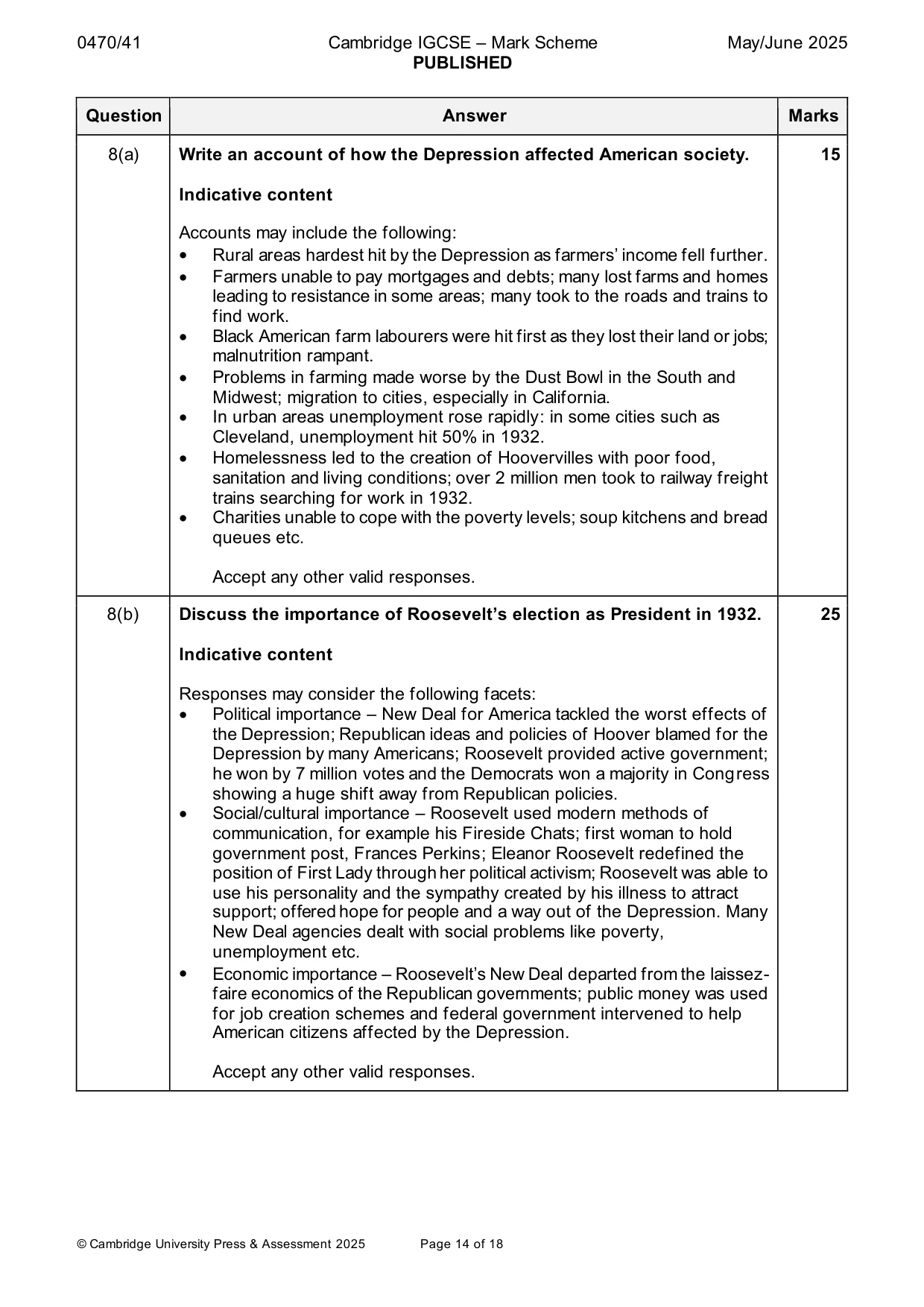
0470/41 Cambridge IGCSE – Mark Scheme PUBLISHED May/June 2025 © Cambridge University Press & Assessment 2025 Page 14 of 18 Question Answer Marks 8(a) Write an account of how the Depression affected American society. Indicative content Accounts may include the following: • Rural areas hardest hit by the Depression as farmers’ income fell further. • Farmers unable to pay mortgages and debts; many lost farms and homes leading to resistance in some areas; many took to the roads and trains to find work. • Black American farm labourers were hit first as they lost their land or jobs; malnutrition rampant. • Problems in farming made worse by the Dust Bowl in the South and Midwest; migration to cities, especially in California. • In urban areas unemployment rose rapidly: in some cities such as Cleveland, unemployment hit 50% in 1932. • Homelessness led to the creation of Hoovervilles with poor food, sanitation and living conditions; over 2 million men took to railway freight trains searching for work in 1932. • Charities unable to cope with the poverty levels; soup kitchens and bread queues etc. Accept any other valid responses. 15 8(b) Discuss the importance of Roosevelt’s election as President in 1932. Indicative content Responses may consider the following facets: • Political importance – New Deal for America tackled the worst effects of the Depression; Republican ideas and policies of Hoover blamed for the Depression by many Americans; Roosevelt provided active government; he won by 7 million votes and the Democrats won a majority in Congress showing a huge shift away from Republican policies. • Social/cultural importance – Roosevelt used modern methods of communication, for example his Fireside Chats; first woman to hold government post, Frances Perkins; Eleanor Roosevelt redefined the position of First Lady through her political activism; Roosevelt was able to use his personality and the sympathy created by his illness to attract support; offered hope for people and a way out of the Depression. Many New Deal agencies dealt with social problems like poverty, unemployment etc. • Economic importance – Roosevelt’s New Deal departed from the laissez- faire economics of the Republican governments; public money was used for job creation schemes and federal government intervened to help American citizens affected by the Depression. Accept any other valid responses. 25
Mark scheme, page 15
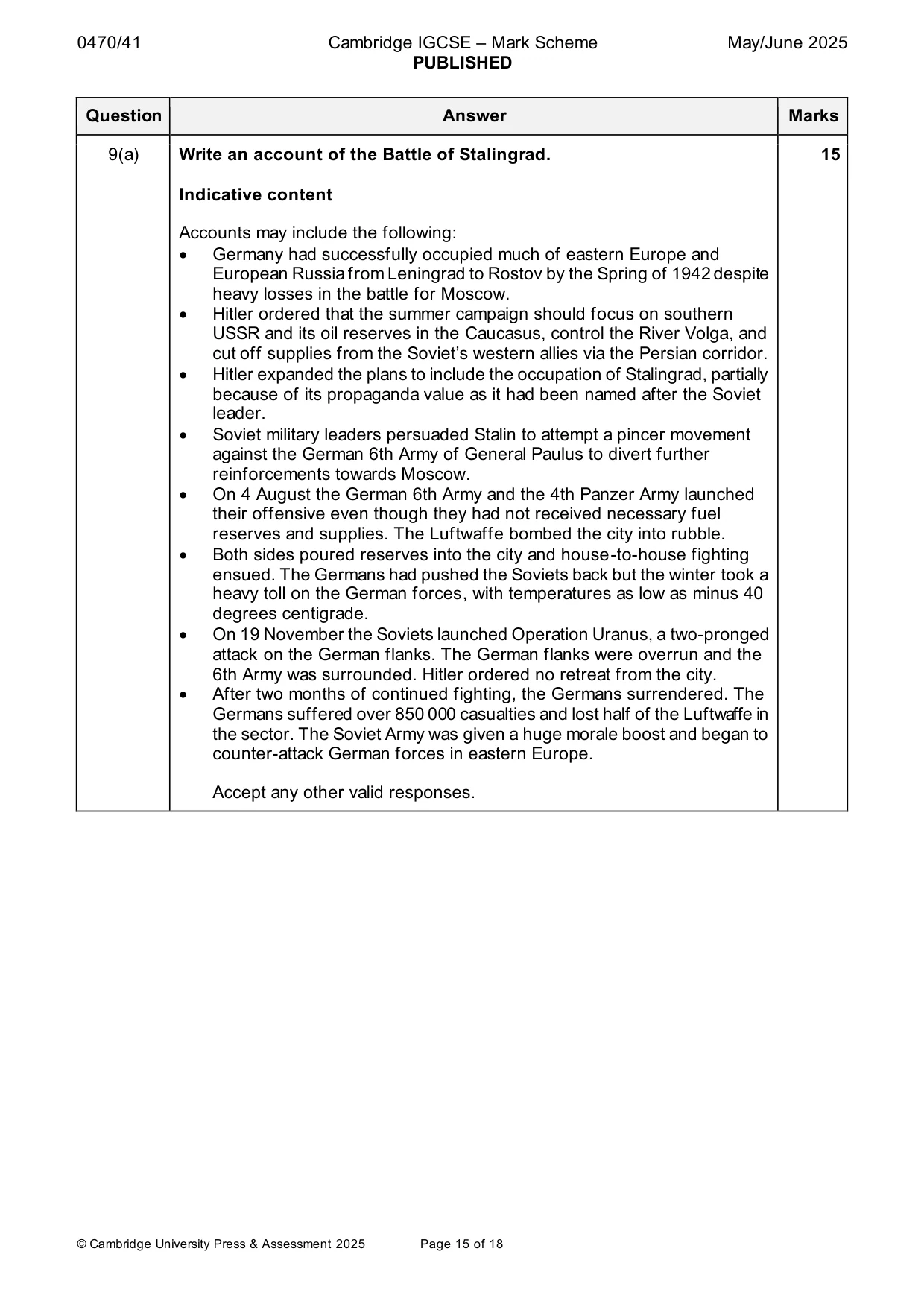
0470/41 Cambridge IGCSE – Mark Scheme PUBLISHED May/June 2025 © Cambridge University Press & Assessment 2025 Page 15 of 18 Question Answer Marks 9(a) Write an account of the Battle of Stalingrad. Indicative content Accounts may include the following: • Germany had successfully occupied much of eastern Europe and European Russia from Leningrad to Rostov by the Spring of 1942 despite heavy losses in the battle for Moscow. • Hitler ordered that the summer campaign should focus on southern USSR and its oil reserves in the Caucasus, control the River Volga, and cut off supplies from the Soviet’s western allies via the Persian corridor. • Hitler expanded the plans to include the occupation of Stalingrad, partially because of its propaganda value as it had been named after the Soviet leader. • Soviet military leaders persuaded Stalin to attempt a pincer movement against the German 6th Army of General Paulus to divert further reinforcements towards Moscow. • On 4 August the German 6th Army and the 4th Panzer Army launched their offensive even though they had not received necessary fuel reserves and supplies. The Luftwaffe bombed the city into rubble. • Both sides poured reserves into the city and house-to-house fighting ensued. The Germans had pushed the Soviets back but the winter took a heavy toll on the German forces, with temperatures as low as minus 40 degrees centigrade. • On 19 November the Soviets launched Operation Uranus, a two-pronged attack on the German flanks. The German flanks were overrun and the 6th Army was surrounded. Hitler ordered no retreat from the city. • After two months of continued fighting, the Germans surrendered. The Germans suffered over 850 000 casualties and lost half of the Luftwaffe in the sector. The Soviet Army was given a huge morale boost and began to counter-attack German forces in eastern Europe. Accept any other valid responses. 15
Mark scheme, page 16
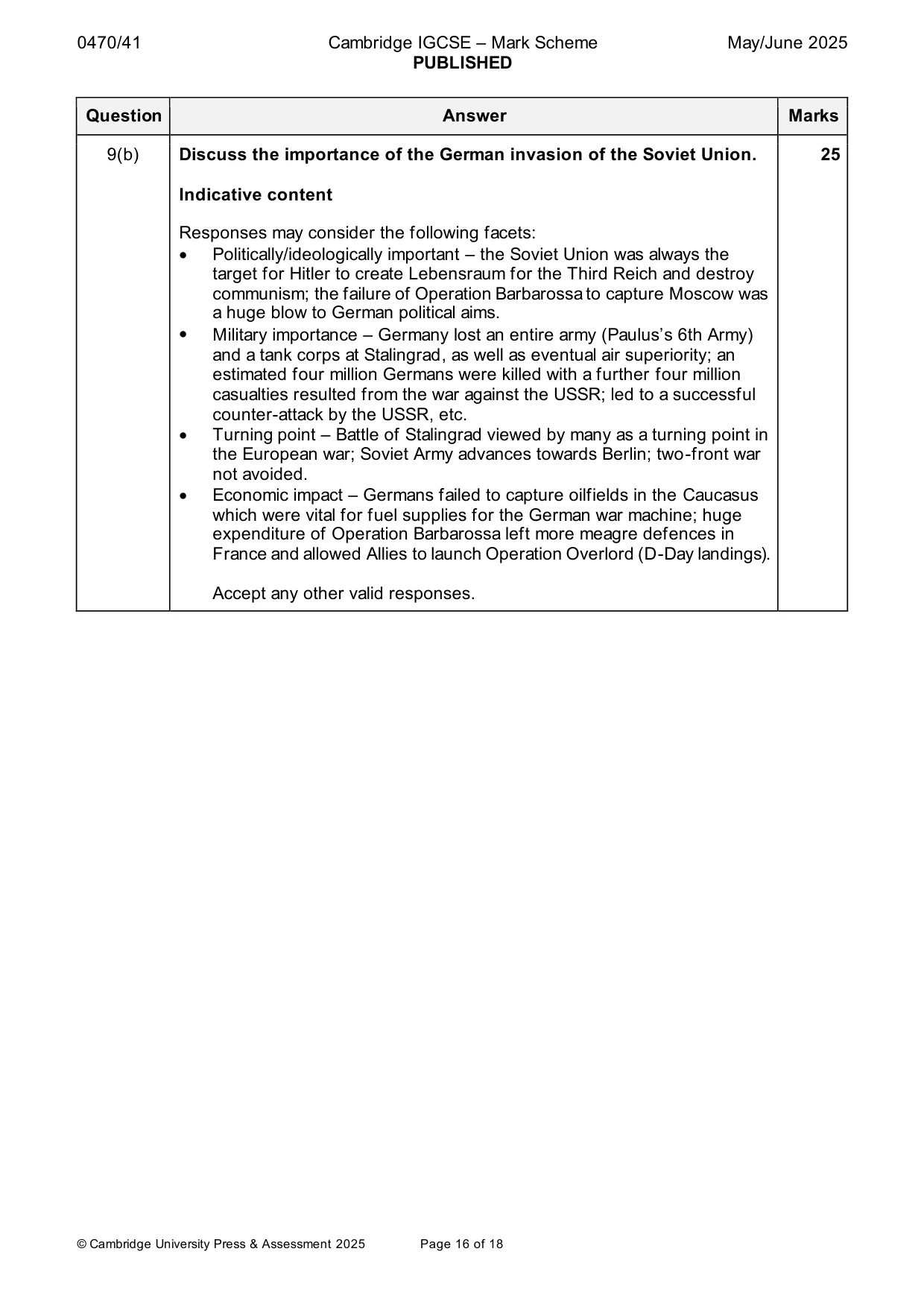
0470/41 Cambridge IGCSE – Mark Scheme PUBLISHED May/June 2025 © Cambridge University Press & Assessment 2025 Page 16 of 18 Question Answer Marks 9(b) Discuss the importance of the German invasion of the Soviet Union. Indicative content Responses may consider the following facets: • Politically/ideologically important – the Soviet Union was always the target for Hitler to create Lebensraum for the Third Reich and destroy communism; the failure of Operation Barbarossa to capture Moscow was a huge blow to German political aims. • Military importance – Germany lost an entire army (Paulus’s 6th Army) and a tank corps at Stalingrad, as well as eventual air superiority; an estimated four million Germans were killed with a further four million casualties resulted from the war against the USSR; led to a successful counter-attack by the USSR, etc. • Turning point – Battle of Stalingrad viewed by many as a turning point in the European war; Soviet Army advances towards Berlin; two-front war not avoided. • Economic impact – Germans failed to capture oilfields in the Caucasus which were vital for fuel supplies for the German war machine; huge expenditure of Operation Barbarossa left more meagre defences in France and allowed Allies to launch Operation Overlord (D-Day landings). Accept any other valid responses. 25
Mark scheme, page 17
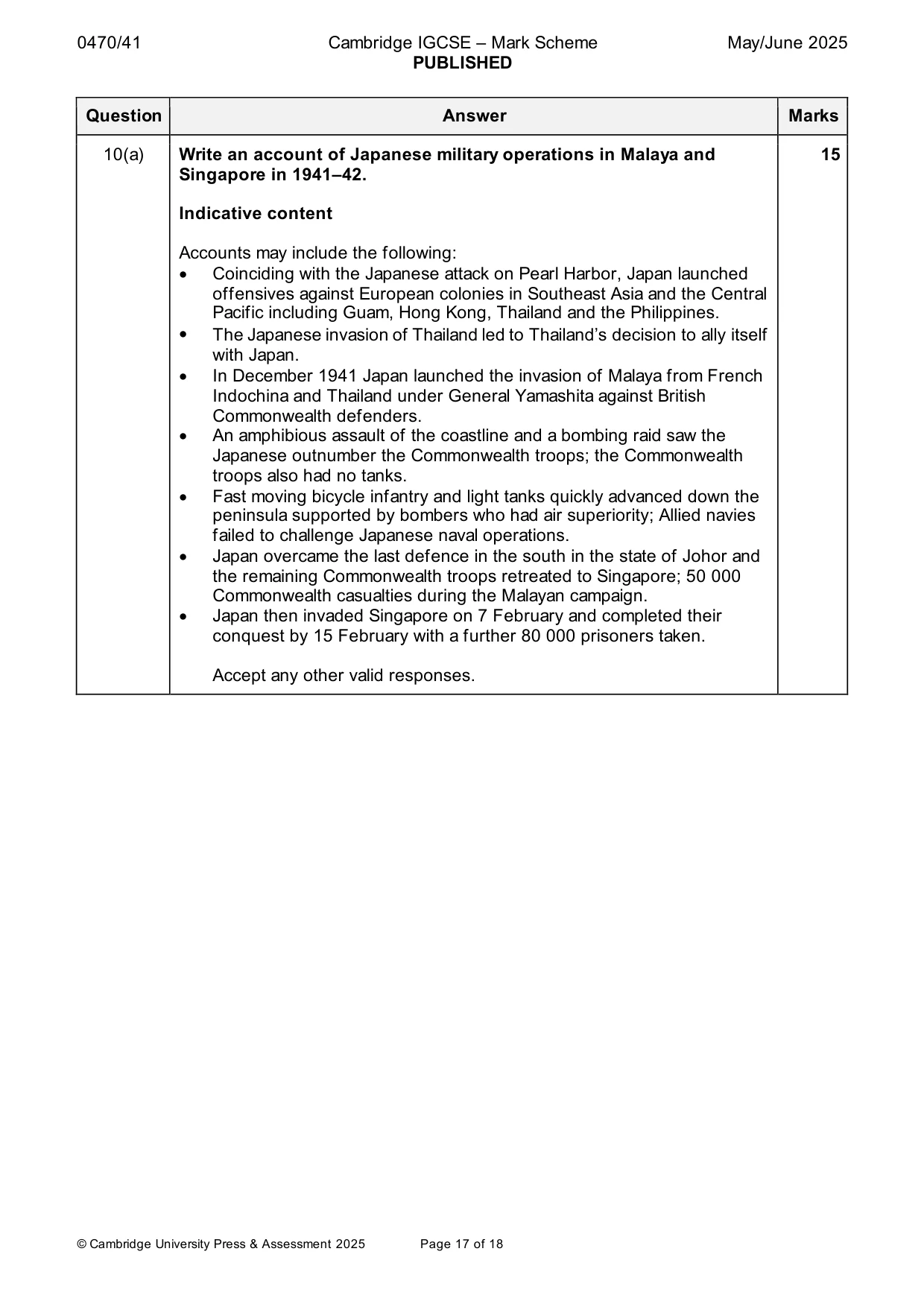
0470/41 Cambridge IGCSE – Mark Scheme PUBLISHED May/June 2025 © Cambridge University Press & Assessment 2025 Page 17 of 18 Question Answer Marks 10(a) Write an account of Japanese military operations in Malaya and Singapore in 1941–42. Indicative content Accounts may include the following: • Coinciding with the Japanese attack on Pearl Harbor, Japan launched offensives against European colonies in Southeast Asia and the Central Pacific including Guam, Hong Kong, Thailand and the Philippines. • The Japanese invasion of Thailand led to Thailand’s decision to ally itself with Japan. • In December 1941 Japan launched the invasion of Malaya from French Indochina and Thailand under General Yamashita against British Commonwealth defenders. • An amphibious assault of the coastline and a bombing raid saw the Japanese outnumber the Commonwealth troops; the Commonwealth troops also had no tanks. • Fast moving bicycle infantry and light tanks quickly advanced down the peninsula supported by bombers who had air superiority; Allied navies failed to challenge Japanese naval operations. • Japan overcame the last defence in the south in the state of Johor and the remaining Commonwealth troops retreated to Singapore; 50 000 Commonwealth casualties during the Malayan campaign. • Japan then invaded Singapore on 7 February and completed their conquest by 15 February with a further 80 000 prisoners taken. Accept any other valid responses. 15
Mark scheme, page 18
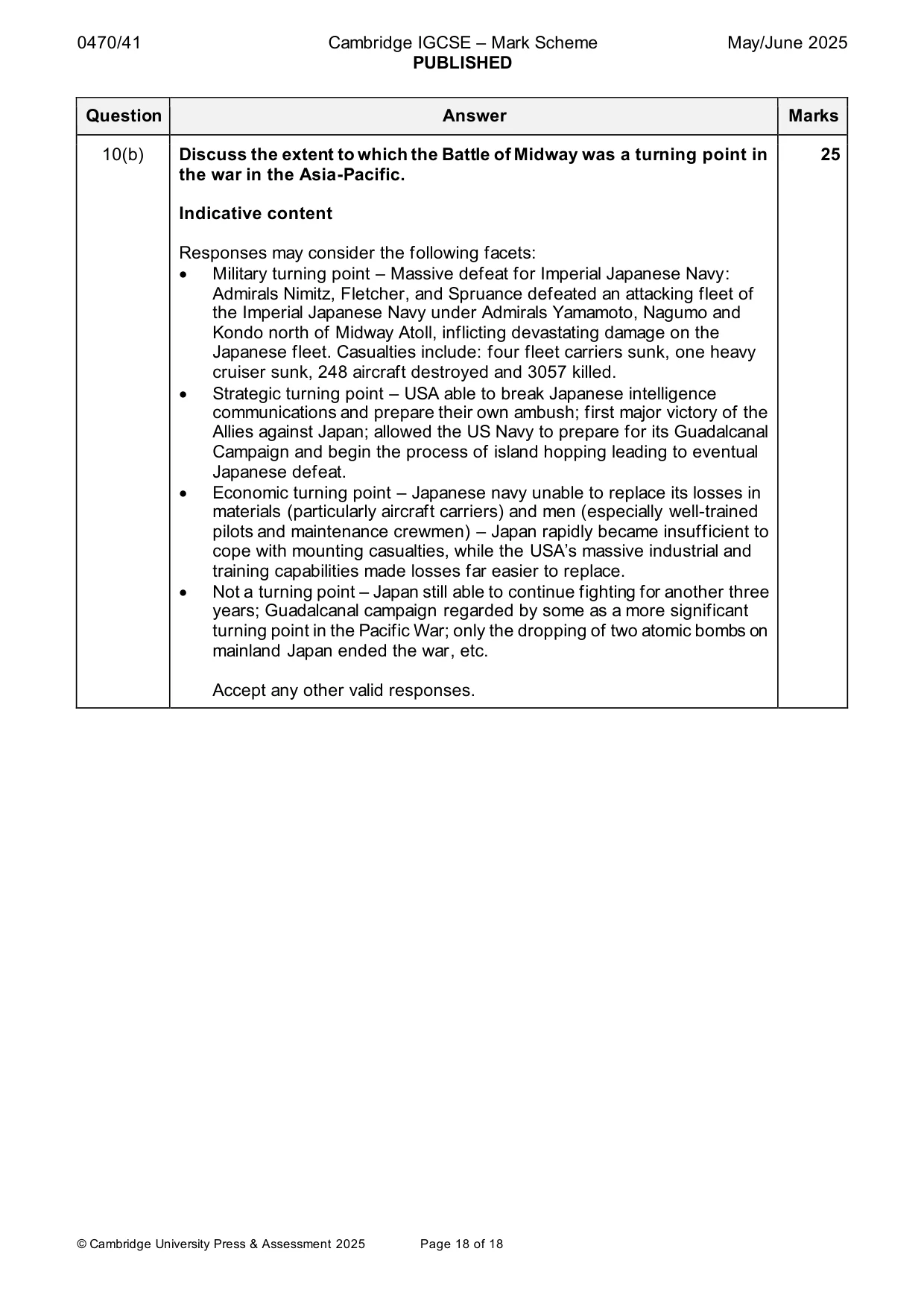
0470/41 Cambridge IGCSE – Mark Scheme PUBLISHED May/June 2025 © Cambridge University Press & Assessment 2025 Page 18 of 18 Question Answer Marks 10(b) Discuss the extent to which the Battle of Midway was a turning point in the war in the Asia-Pacific. Indicative content Responses may consider the following facets: • Military turning point – Massive defeat for Imperial Japanese Navy: Admirals Nimitz, Fletcher, and Spruance defeated an attacking fleet of the Imperial Japanese Navy under Admirals Yamamoto, Nagumo and Kondo north of Midway Atoll, inflicting devastating damage on the Japanese fleet. Casualties include: four fleet carriers sunk, one heavy cruiser sunk, 248 aircraft destroyed and 3057 killed. • Strategic turning point – USA able to break Japanese intelligence communications and prepare their own ambush; first major victory of the Allies against Japan; allowed the US Navy to prepare for its Guadalcanal Campaign and begin the process of island hopping leading to eventual Japanese defeat. • Economic turning point – Japanese navy unable to replace its losses in materials (particularly aircraft carriers) and men (especially well-trained pilots and maintenance crewmen) – Japan rapidly became insufficient to cope with mounting casualties, while the USA’s massive industrial and training capabilities made losses far easier to replace. • Not a turning point – Japan still able to continue fighting for another three years; Guadalcanal campaign regarded by some as a more significant turning point in the Pacific War; only the dropping of two atomic bombs on mainland Japan ended the war, etc. Accept any other valid responses. 25
What you needed in this session
Cambridge’s own grade thresholds for 2025 May/June, Paper 4 · Variant 1. A higher threshold means an easier paper — the bar moves with how the cohort did.