Cambridge IGCSE History 0470 — 2024 May/June Paper 4 · Variant 1
0470/41/M/J/24 · 40 marks · 60 min
The question paper and its mark scheme, free to read here and free to download. This is Cambridge’s own paper, exactly as it was sat.
Question paper4 pages

Mark scheme14 pages
Answers below. Sit the paper first if you are practising.
Paper as text
Question paper, page 1
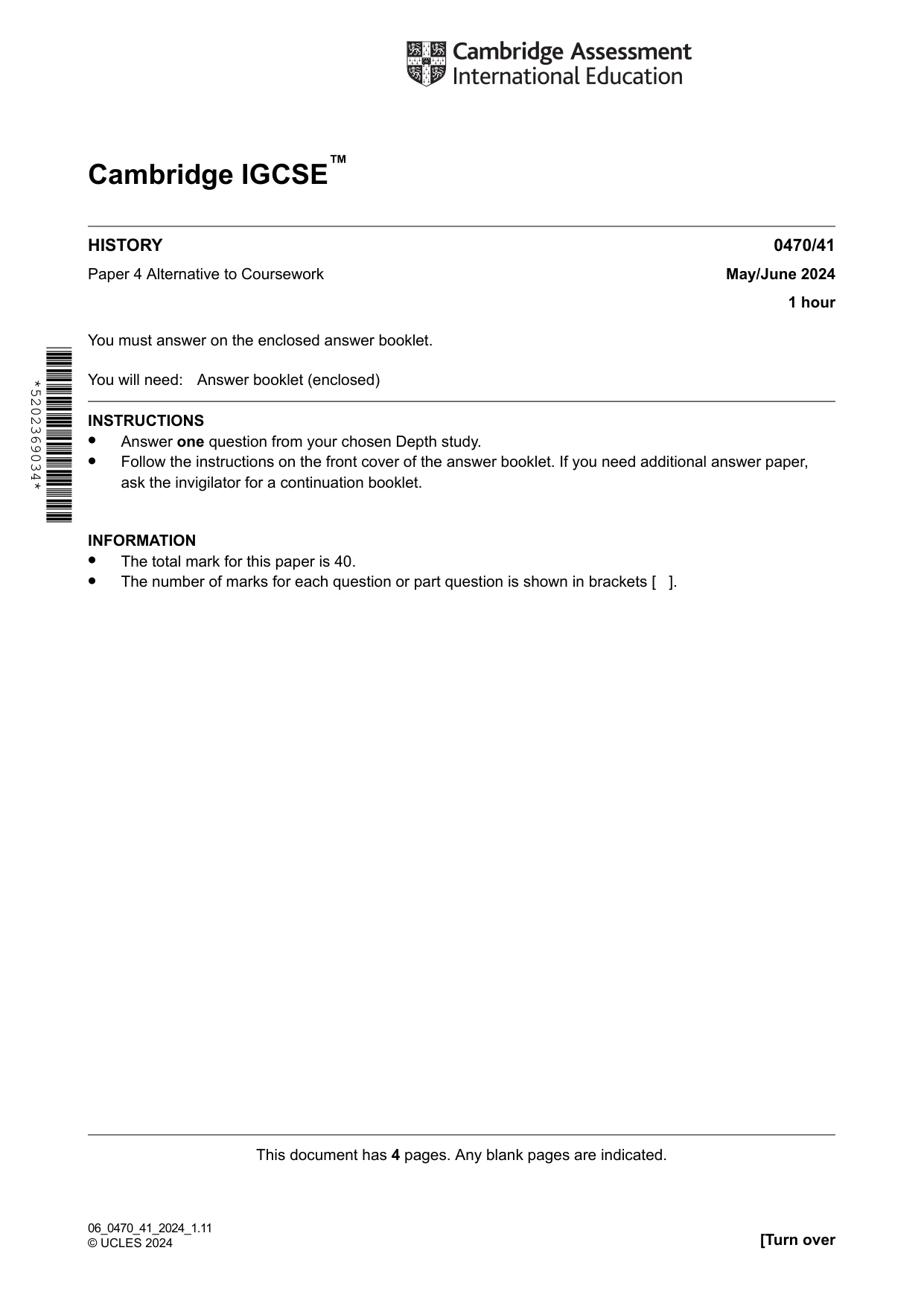
Cambridge IGCSE™ 0470/41 May/June 2024 1 hour HISTORY Paper 4 Alternative to Coursework You must answer on the enclosed answer booklet. You will need: Answer booklet (enclosed) INSTRUCTIONS • Answer one question from your chosen Depth study. • Follow the instructions on the front cover of the answer booklet. If you need additional answer paper, ask the invigilator for a continuation booklet. INFORMATION • The total mark for this paper is 40. • The number of marks for each question or part question is shown in brackets [ ]. This document has 4 pages. Any blank pages are indicated. [Turn over 06_0470_41_2024_1.11 © UCLES 2024 *5202369034*
Question paper, page 2
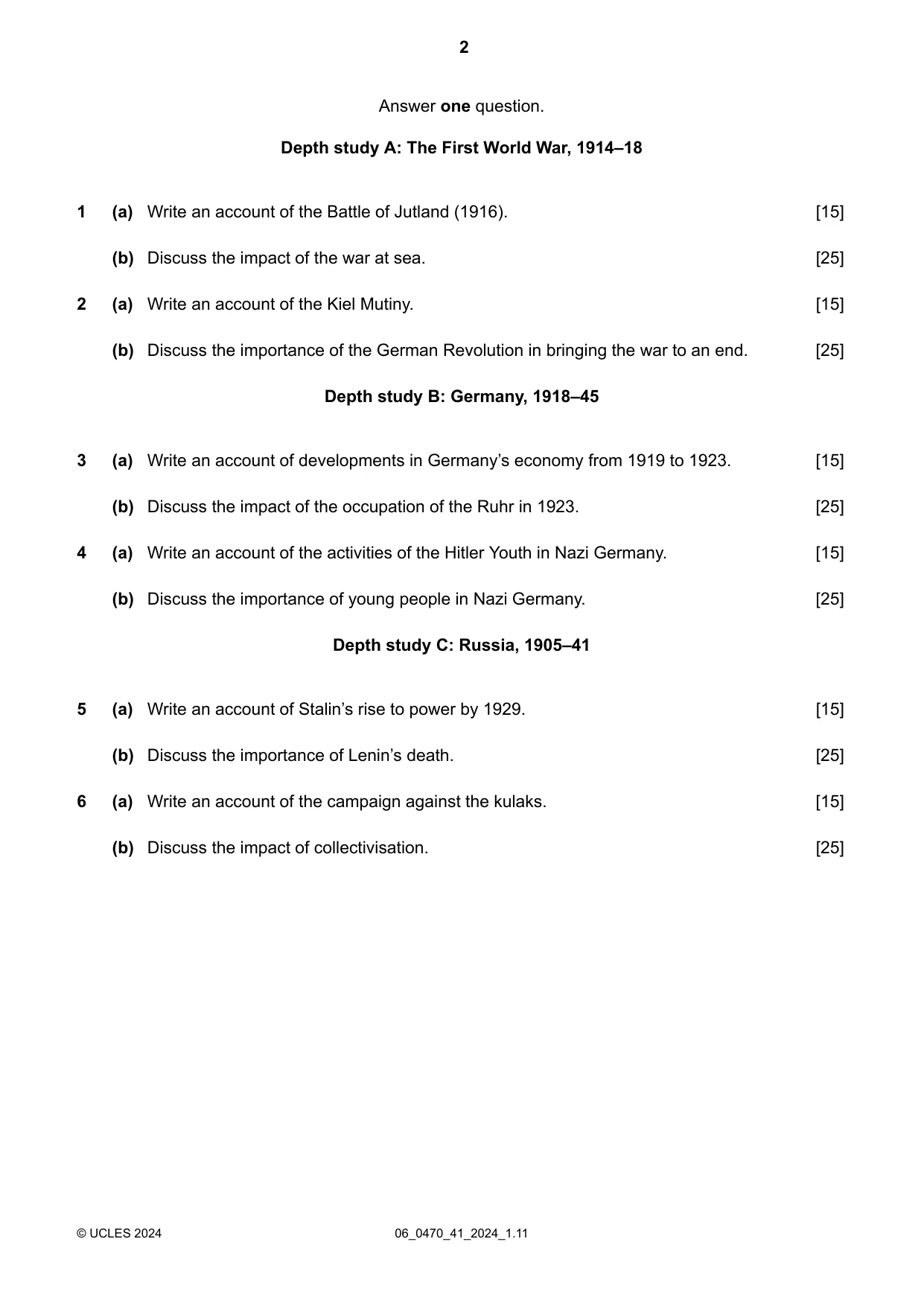
Answer one question. Depth study A: The First World War, 1914–18 Write an account of the Battle of Jutland (1916). [15] (a) 1 Discuss the impact of the war at sea. [25] (b) Write an account of the Kiel Mutiny. [15] (a) 2 Discuss the importance of the German Revolution in bringing the war to an end. [25] (b) Depth study B: Germany, 1918–45 Write an account of developments in Germany’s economy from 1919 to 1923. [15] (a) 3 Discuss the impact of the occupation of the Ruhr in 1923. [25] (b) Write an account of the activities of the Hitler Youth in Nazi Germany. [15] (a) 4 Discuss the importance of young people in Nazi Germany. [25] (b) Depth study C: Russia, 1905–41 Write an account of Stalin’s rise to power by 1929. [15] (a) 5 Discuss the importance of Lenin’s death. [25] (b) Write an account of the campaign against the kulaks. [15] (a) 6 Discuss the impact of collectivisation. [25] (b) 06_0470_41_2024_1.11 © UCLES 2024 2
Question paper, page 3
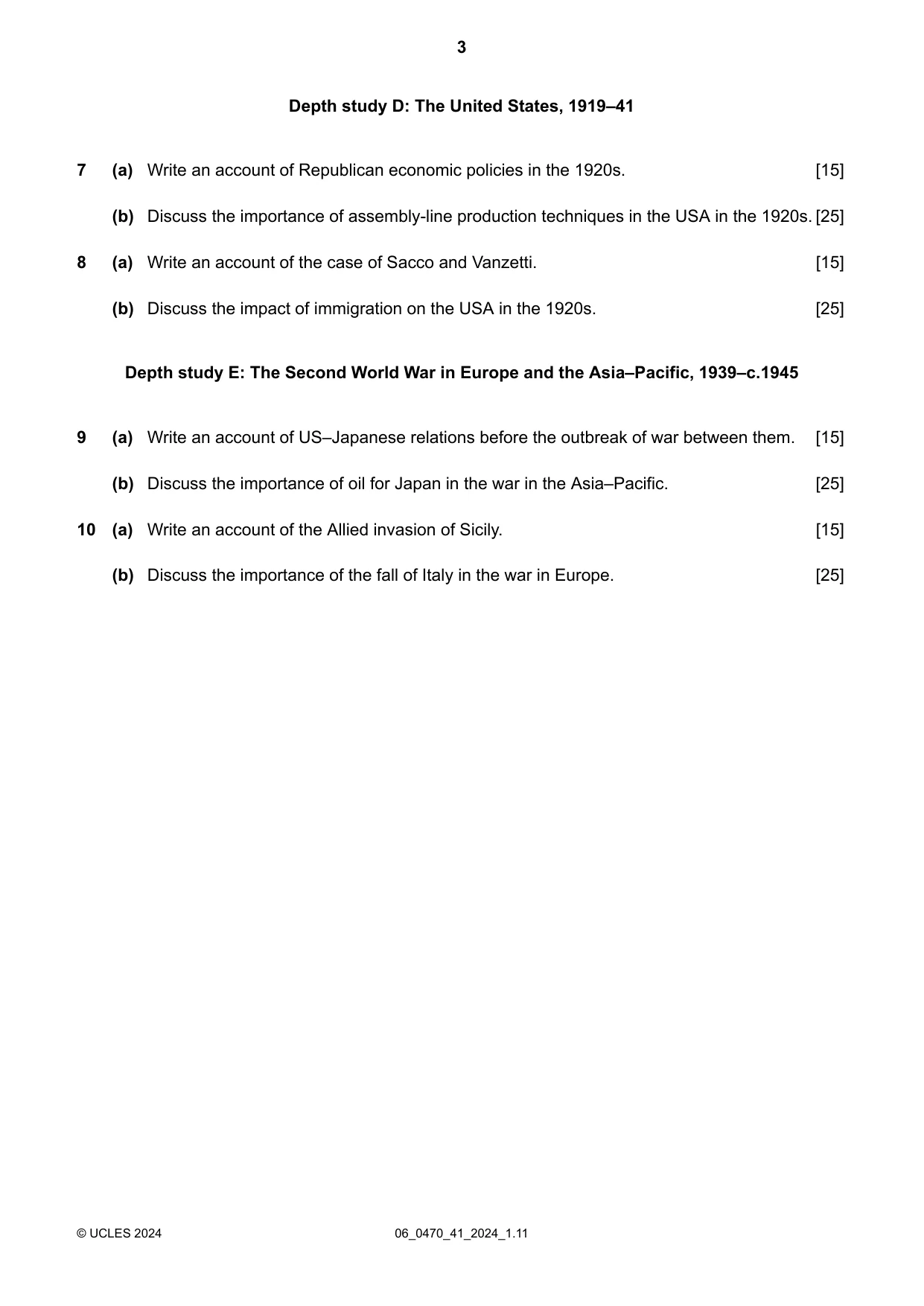
Depth study D: The United States, 1919–41 Write an account of Republican economic policies in the 1920s. [15] (a) 7 Discuss the importance of assembly-line production techniques in the USA in the 1920s. [25] (b) Write an account of the case of Sacco and Vanzetti. [15] (a) 8 Discuss the impact of immigration on the USA in the 1920s. [25] (b) Depth study E: The Second World War in Europe and the Asia–Pacific, 1939–c.1945 Write an account of US–Japanese relations before the outbreak of war between them. [15] (a) 9 Discuss the importance of oil for Japan in the war in the Asia–Pacific. [25] (b) Write an account of the Allied invasion of Sicily. [15] (a) 10 Discuss the importance of the fall of Italy in the war in Europe. [25] (b) 06_0470_41_2024_1.11 © UCLES 2024 3
Question paper, page 4
BLANK PAGE Permission to reproduce items where third-party owned material protected by copyright is included has been sought and cleared where possible. Every reasonable effort has been made by the publisher (UCLES) to trace copyright holders, but if any items requiring clearance have unwittingly been included, the publisher will be pleased to make amends at the earliest possible opportunity. To avoid the issue of disclosure of answer-related information to candidates, all copyright acknowledgements are reproduced online in the Cambridge Assessment International Education Copyright Acknowledgements Booklet. This is produced for each series of examinations and is freely available to download at www.cambridgeinternational.org after the live examination series. Cambridge Assessment International Education is part of Cambridge Assessment. Cambridge Assessment is the brand name of the University of Cambridge Local Examinations Syndicate (UCLES), which is a department of the University of Cambridge. 06_0470_41_2024_1.11 © UCLES 2024 4
Mark scheme, page 1
This document consists of 14 printed pages. © Cambridge University Press & Assessment 2024 [Turn over Cambridge IGCSE™ HISTORY 0470/41 Paper 4 Alternative to Coursework May/June 2024 MARK SCHEME Maximum Mark: 40 Published This mark scheme is published as an aid to teachers and candidates, to indicate the requirements of the examination. It shows the basis on which Examiners were instructed to award marks. It does not indicate the details of the discussions that took place at an Examiners’ meeting before marking began, which would have considered the acceptability of alternative answers. Mark schemes should be read in conjunction with the question paper and the Principal Examiner Report for Teachers. Cambridge International will not enter into discussions about these mark schemes. Cambridge International is publishing the mark schemes for the May/June 2024 series for most Cambridge IGCSE, Cambridge International A and AS Level and Cambridge Pre-U components, and some Cambridge O Level components.
Mark scheme, page 2
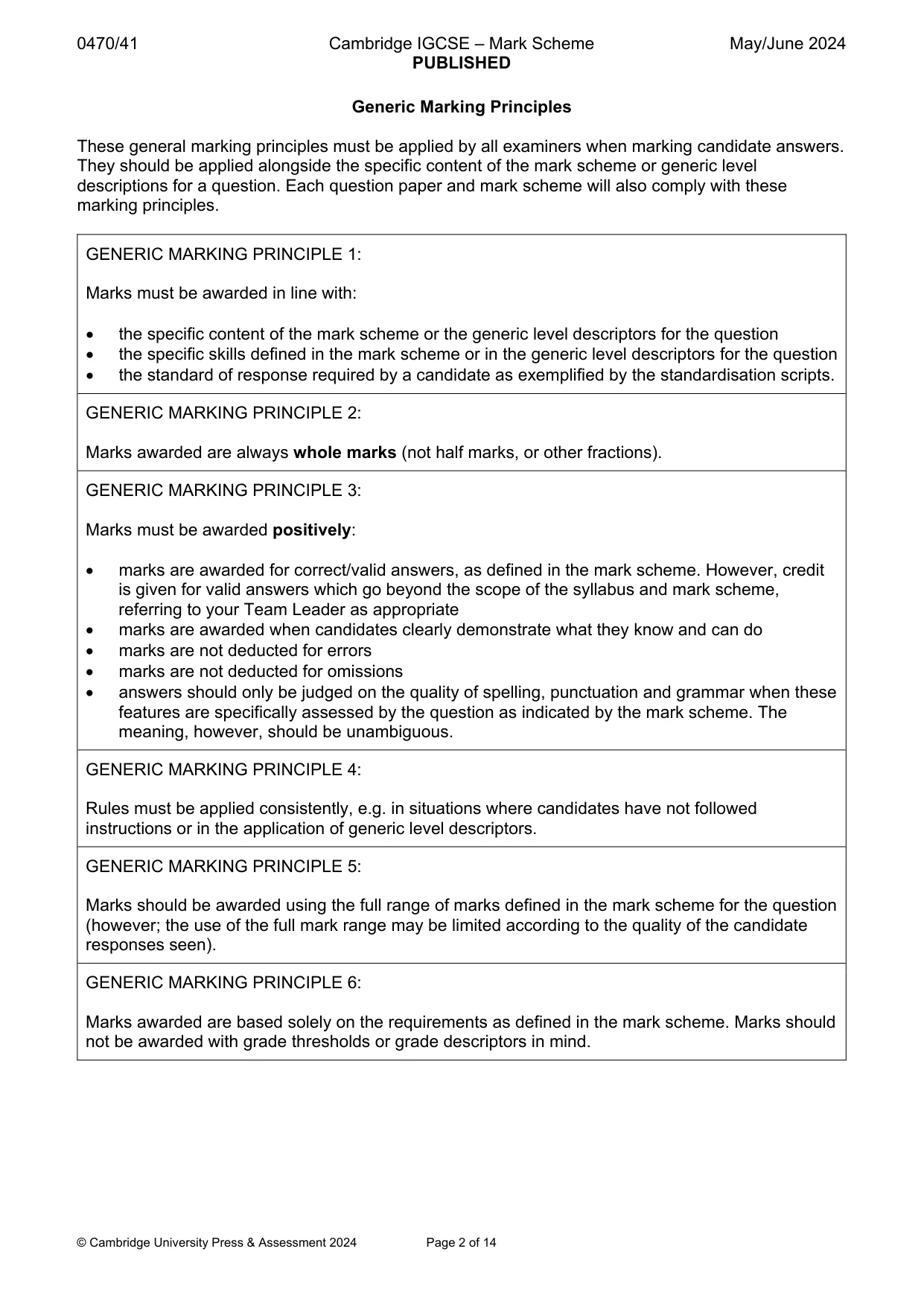
0470/41 Cambridge IGCSE – Mark Scheme PUBLISHED May/June 2024 © Cambridge University Press & Assessment 2024 Page 2 of 14 Generic Marking Principles These general marking principles must be applied by all examiners when marking candidate answers. They should be applied alongside the specific content of the mark scheme or generic level descriptions for a question. Each question paper and mark scheme will also comply with these marking principles. GENERIC MARKING PRINCIPLE 1: Marks must be awarded in line with: the specific content of the mark scheme or the generic level descriptors for the question the specific skills defined in the mark scheme or in the generic level descriptors for the question the standard of response required by a candidate as exemplified by the standardisation scripts. GENERIC MARKING PRINCIPLE 2: Marks awarded are always whole marks (not half marks, or other fractions). GENERIC MARKING PRINCIPLE 3: Marks must be awarded positively: marks are awarded for correct/valid answers, as defined in the mark scheme. However, credit is given for valid answers which go beyond the scope of the syllabus and mark scheme, referring to your Team Leader as appropriate marks are awarded when candidates clearly demonstrate what they know and can do marks are not deducted for errors marks are not deducted for omissions answers should only be judged on the quality of spelling, punctuation and grammar when these features are specifically assessed by the question as indicated by the mark scheme. The meaning, however, should be unambiguous. GENERIC MARKING PRINCIPLE 4: Rules must be applied consistently, e.g. in situations where candidates have not followed instructions or in the application of generic level descriptors. GENERIC MARKING PRINCIPLE 5: Marks should be awarded using the full range of marks defined in the mark scheme for the question (however; the use of the full mark range may be limited according to the quality of the candidate responses seen). GENERIC MARKING PRINCIPLE 6: Marks awarded are based solely on the requirements as defined in the mark scheme. Marks should not be awarded with grade thresholds or grade descriptors in mind.
Mark scheme, page 3
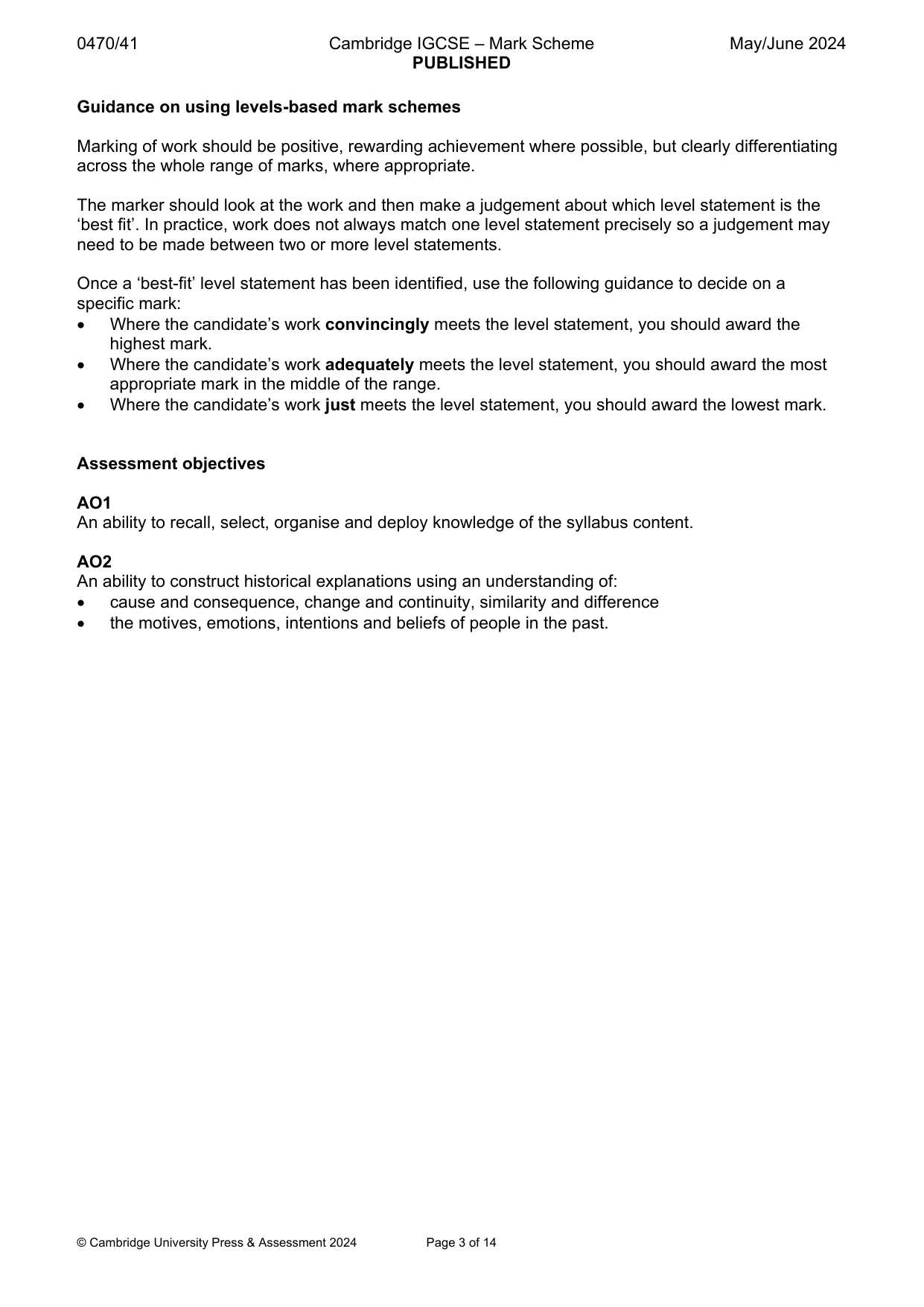
0470/41 Cambridge IGCSE – Mark Scheme PUBLISHED May/June 2024 © Cambridge University Press & Assessment 2024 Page 3 of 14 Guidance on using levels-based mark schemes Marking of work should be positive, rewarding achievement where possible, but clearly differentiating across the whole range of marks, where appropriate. The marker should look at the work and then make a judgement about which level statement is the ‘best fit’. In practice, work does not always match one level statement precisely so a judgement may need to be made between two or more level statements. Once a ‘best-fit’ level statement has been identified, use the following guidance to decide on a specific mark: Where the candidate’s work convincingly meets the level statement, you should award the highest mark. Where the candidate’s work adequately meets the level statement, you should award the most appropriate mark in the middle of the range. Where the candidate’s work just meets the level statement, you should award the lowest mark. Assessment objectives AO1 An ability to recall, select, organise and deploy knowledge of the syllabus content. AO2 An ability to construct historical explanations using an understanding of: cause and consequence, change and continuity, similarity and difference the motives, emotions, intentions and beliefs of people in the past.
Mark scheme, page 4
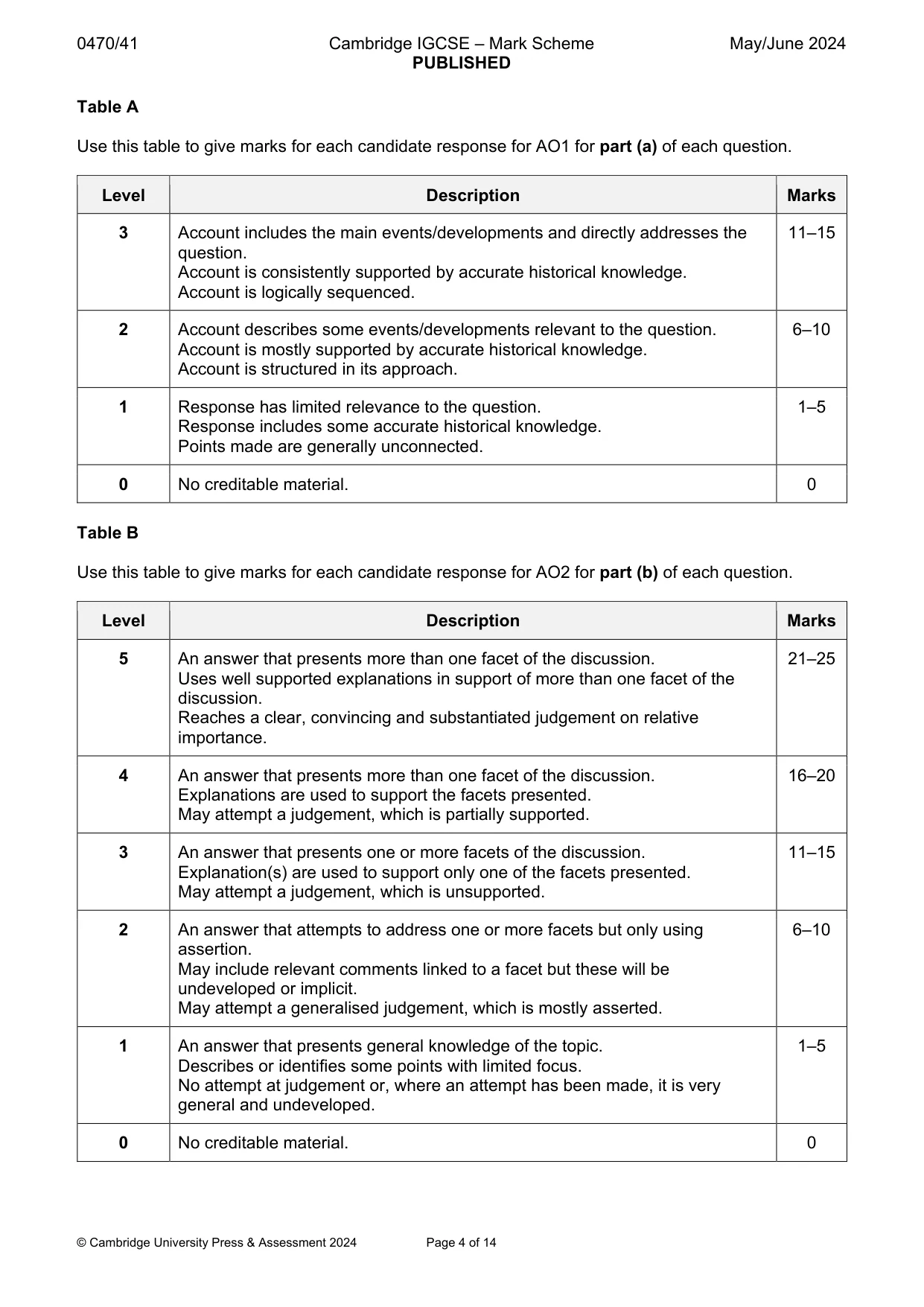
0470/41 Cambridge IGCSE – Mark Scheme PUBLISHED May/June 2024 © Cambridge University Press & Assessment 2024 Page 4 of 14 Table A Use this table to give marks for each candidate response for AO1 for part (a) of each question. Level Description Marks 3 Account includes the main events/developments and directly addresses the question. Account is consistently supported by accurate historical knowledge. Account is logically sequenced. 11–15 2 Account describes some events/developments relevant to the question. Account is mostly supported by accurate historical knowledge. Account is structured in its approach. 6–10 1 Response has limited relevance to the question. Response includes some accurate historical knowledge. Points made are generally unconnected. 1–5 0 No creditable material. 0 Table B Use this table to give marks for each candidate response for AO2 for part (b) of each question. Level Description Marks 5 An answer that presents more than one facet of the discussion. Uses well supported explanations in support of more than one facet of the discussion. Reaches a clear, convincing and substantiated judgement on relative importance. 21–25 4 An answer that presents more than one facet of the discussion. Explanations are used to support the facets presented. May attempt a judgement, which is partially supported. 16–20 3 An answer that presents one or more facets of the discussion. Explanation(s) are used to support only one of the facets presented. May attempt a judgement, which is unsupported. 11–15 2 An answer that attempts to address one or more facets but only using assertion. May include relevant comments linked to a facet but these will be undeveloped or implicit. May attempt a generalised judgement, which is mostly asserted. 6–10 1 An answer that presents general knowledge of the topic. Describes or identifies some points with limited focus. No attempt at judgement or, where an attempt has been made, it is very general and undeveloped. 1–5 0 No creditable material. 0
Mark scheme, page 5
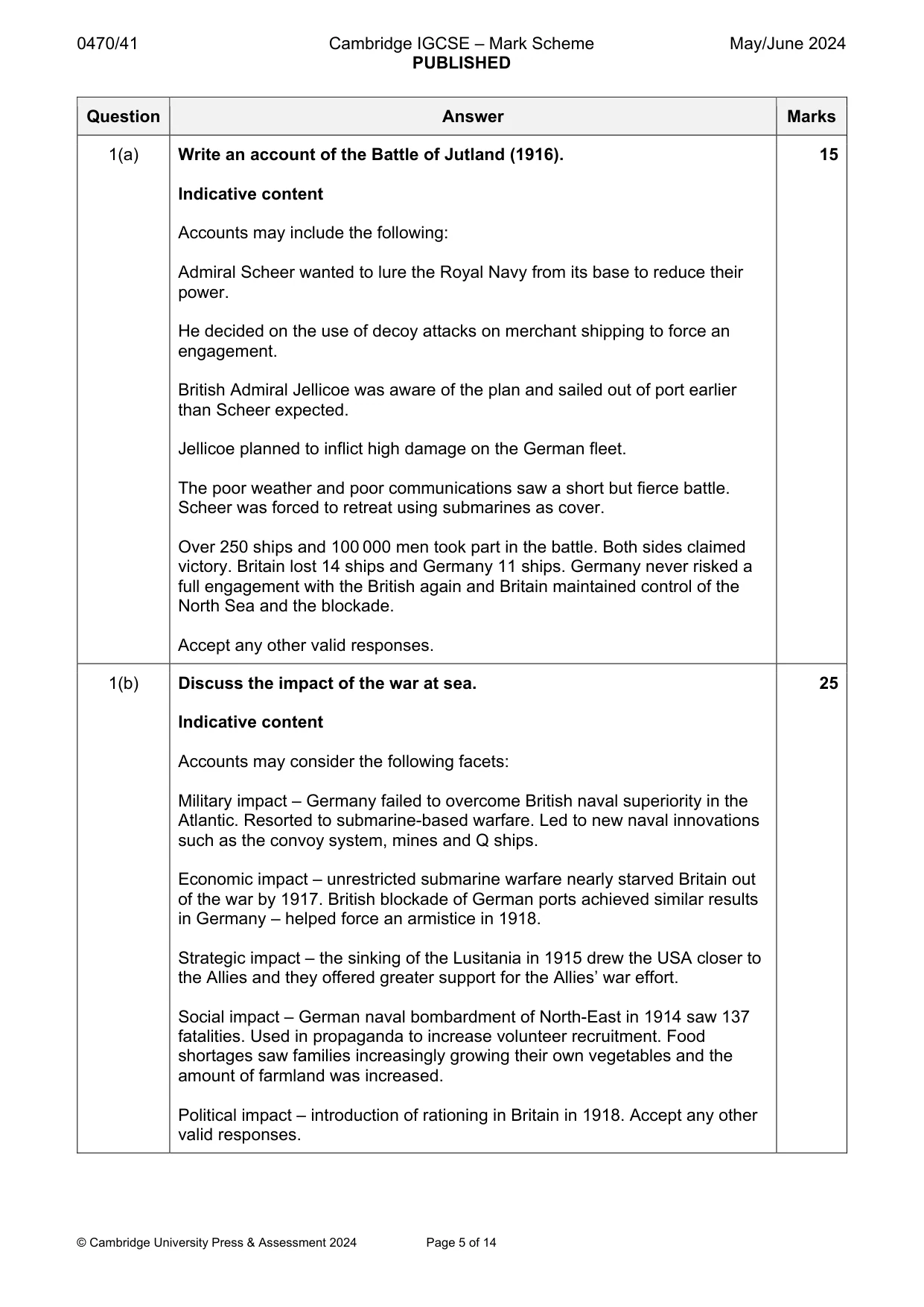
0470/41 Cambridge IGCSE – Mark Scheme PUBLISHED May/June 2024 © Cambridge University Press & Assessment 2024 Page 5 of 14 Question Answer Marks 1(a) Write an account of the Battle of Jutland (1916). Indicative content Accounts may include the following: Admiral Scheer wanted to lure the Royal Navy from its base to reduce their power. He decided on the use of decoy attacks on merchant shipping to force an engagement. British Admiral Jellicoe was aware of the plan and sailed out of port earlier than Scheer expected. Jellicoe planned to inflict high damage on the German fleet. The poor weather and poor communications saw a short but fierce battle. Scheer was forced to retreat using submarines as cover. Over 250 ships and 100 000 men took part in the battle. Both sides claimed victory. Britain lost 14 ships and Germany 11 ships. Germany never risked a full engagement with the British again and Britain maintained control of the North Sea and the blockade. Accept any other valid responses. 15 1(b) Discuss the impact of the war at sea. Indicative content Accounts may consider the following facets: Military impact – Germany failed to overcome British naval superiority in the Atlantic. Resorted to submarine-based warfare. Led to new naval innovations such as the convoy system, mines and Q ships. Economic impact – unrestricted submarine warfare nearly starved Britain out of the war by 1917. British blockade of German ports achieved similar results in Germany – helped force an armistice in 1918. Strategic impact – the sinking of the Lusitania in 1915 drew the USA closer to the Allies and they offered greater support for the Allies’ war effort. Social impact – German naval bombardment of North-East in 1914 saw 137 fatalities. Used in propaganda to increase volunteer recruitment. Food shortages saw families increasingly growing their own vegetables and the amount of farmland was increased. Political impact – introduction of rationing in Britain in 1918. Accept any other valid responses. 25
Mark scheme, page 6
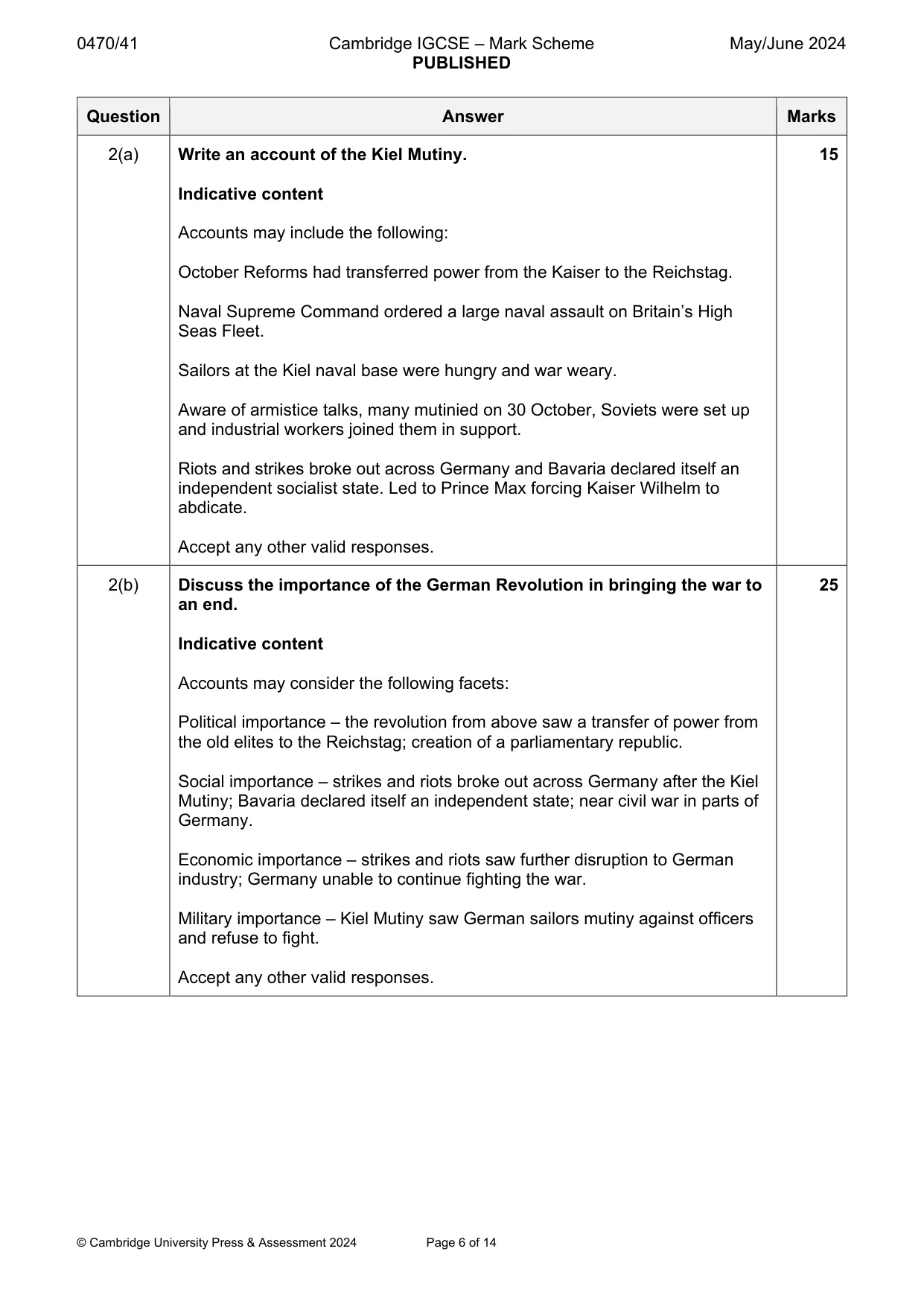
0470/41 Cambridge IGCSE – Mark Scheme PUBLISHED May/June 2024 © Cambridge University Press & Assessment 2024 Page 6 of 14 Question Answer Marks 2(a) Write an account of the Kiel Mutiny. Indicative content Accounts may include the following: October Reforms had transferred power from the Kaiser to the Reichstag. Naval Supreme Command ordered a large naval assault on Britain’s High Seas Fleet. Sailors at the Kiel naval base were hungry and war weary. Aware of armistice talks, many mutinied on 30 October, Soviets were set up and industrial workers joined them in support. Riots and strikes broke out across Germany and Bavaria declared itself an independent socialist state. Led to Prince Max forcing Kaiser Wilhelm to abdicate. Accept any other valid responses. 15 2(b) Discuss the importance of the German Revolution in bringing the war to an end. Indicative content Accounts may consider the following facets: Political importance – the revolution from above saw a transfer of power from the old elites to the Reichstag; creation of a parliamentary republic. Social importance – strikes and riots broke out across Germany after the Kiel Mutiny; Bavaria declared itself an independent state; near civil war in parts of Germany. Economic importance – strikes and riots saw further disruption to German industry; Germany unable to continue fighting the war. Military importance – Kiel Mutiny saw German sailors mutiny against officers and refuse to fight. Accept any other valid responses. 25
Mark scheme, page 7
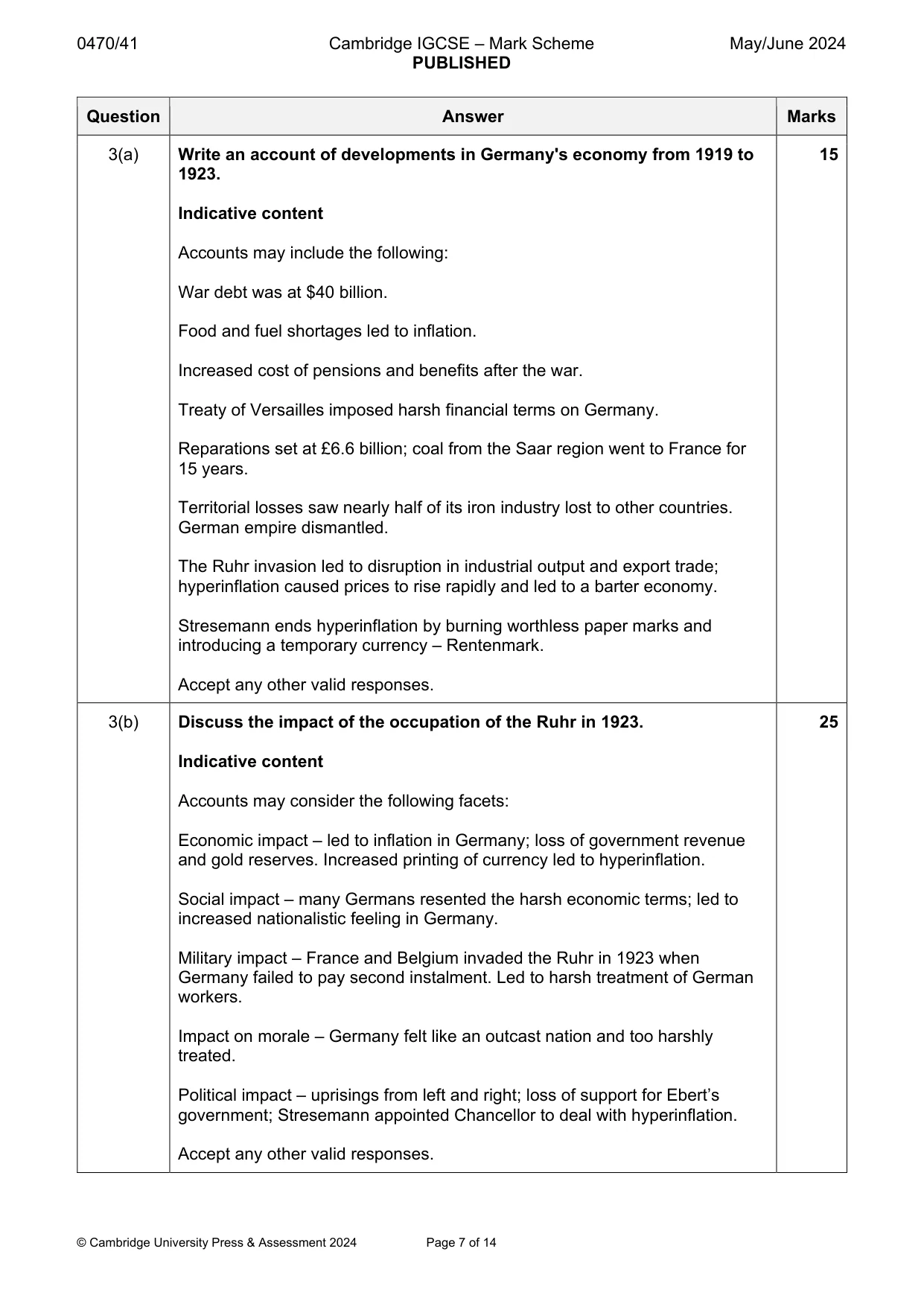
0470/41 Cambridge IGCSE – Mark Scheme PUBLISHED May/June 2024 © Cambridge University Press & Assessment 2024 Page 7 of 14 Question Answer Marks 3(a) Write an account of developments in Germany's economy from 1919 to 1923. Indicative content Accounts may include the following: War debt was at $40 billion. Food and fuel shortages led to inflation. Increased cost of pensions and benefits after the war. Treaty of Versailles imposed harsh financial terms on Germany. Reparations set at £6.6 billion; coal from the Saar region went to France for 15 years. Territorial losses saw nearly half of its iron industry lost to other countries. German empire dismantled. The Ruhr invasion led to disruption in industrial output and export trade; hyperinflation caused prices to rise rapidly and led to a barter economy. Stresemann ends hyperinflation by burning worthless paper marks and introducing a temporary currency – Rentenmark. Accept any other valid responses. 15 3(b) Discuss the impact of the occupation of the Ruhr in 1923. Indicative content Accounts may consider the following facets: Economic impact – led to inflation in Germany; loss of government revenue and gold reserves. Increased printing of currency led to hyperinflation. Social impact – many Germans resented the harsh economic terms; led to increased nationalistic feeling in Germany. Military impact – France and Belgium invaded the Ruhr in 1923 when Germany failed to pay second instalment. Led to harsh treatment of German workers. Impact on morale – Germany felt like an outcast nation and too harshly treated. Political impact – uprisings from left and right; loss of support for Ebert’s government; Stresemann appointed Chancellor to deal with hyperinflation. Accept any other valid responses. 25
Mark scheme, page 8
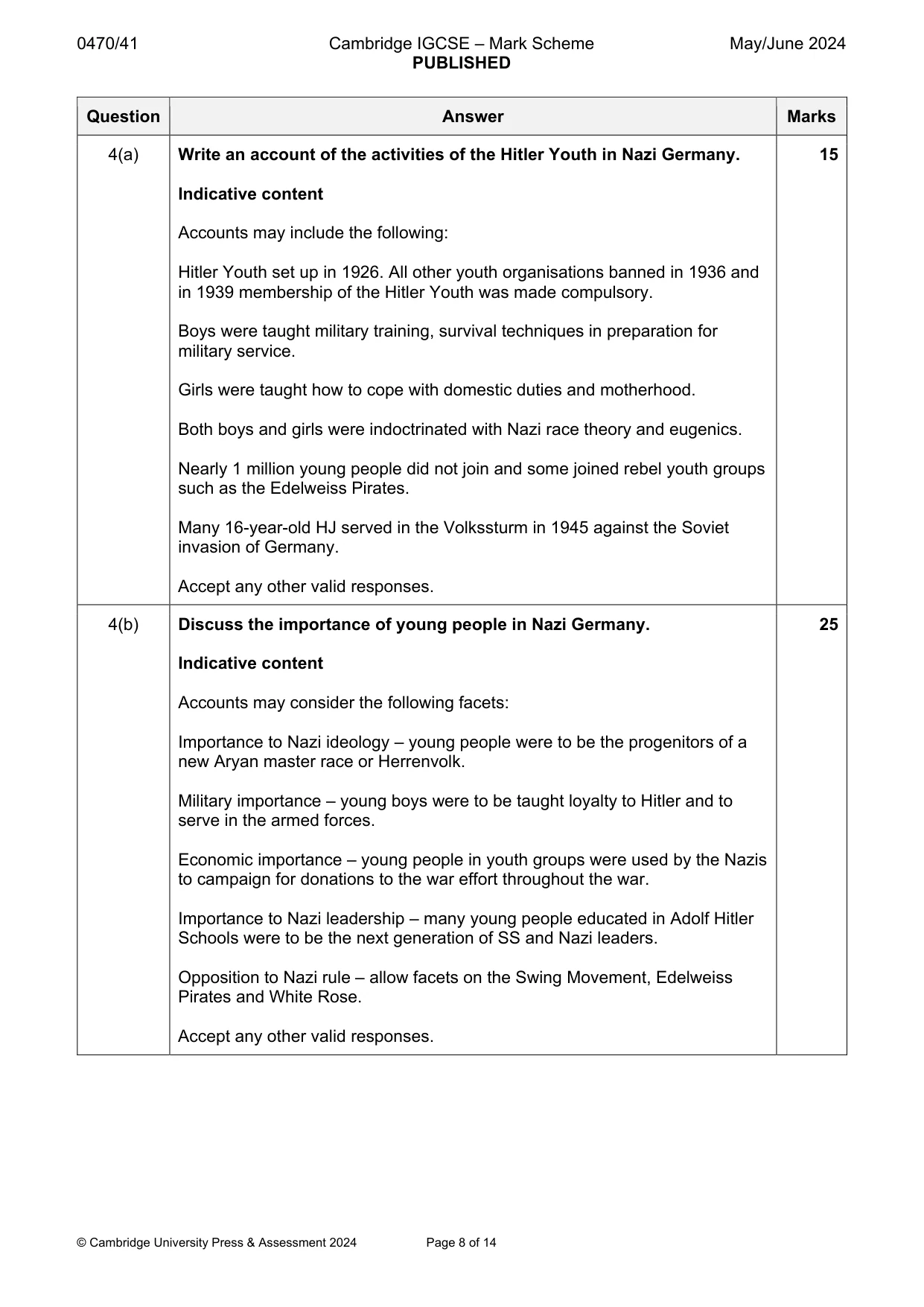
0470/41 Cambridge IGCSE – Mark Scheme PUBLISHED May/June 2024 © Cambridge University Press & Assessment 2024 Page 8 of 14 Question Answer Marks 4(a) Write an account of the activities of the Hitler Youth in Nazi Germany. Indicative content Accounts may include the following: Hitler Youth set up in 1926. All other youth organisations banned in 1936 and in 1939 membership of the Hitler Youth was made compulsory. Boys were taught military training, survival techniques in preparation for military service. Girls were taught how to cope with domestic duties and motherhood. Both boys and girls were indoctrinated with Nazi race theory and eugenics. Nearly 1 million young people did not join and some joined rebel youth groups such as the Edelweiss Pirates. Many 16-year-old HJ served in the Volkssturm in 1945 against the Soviet invasion of Germany. Accept any other valid responses. 15 4(b) Discuss the importance of young people in Nazi Germany. Indicative content Accounts may consider the following facets: Importance to Nazi ideology – young people were to be the progenitors of a new Aryan master race or Herrenvolk. Military importance – young boys were to be taught loyalty to Hitler and to serve in the armed forces. Economic importance – young people in youth groups were used by the Nazis to campaign for donations to the war effort throughout the war. Importance to Nazi leadership – many young people educated in Adolf Hitler Schools were to be the next generation of SS and Nazi leaders. Opposition to Nazi rule – allow facets on the Swing Movement, Edelweiss Pirates and White Rose. Accept any other valid responses. 25
Mark scheme, page 9
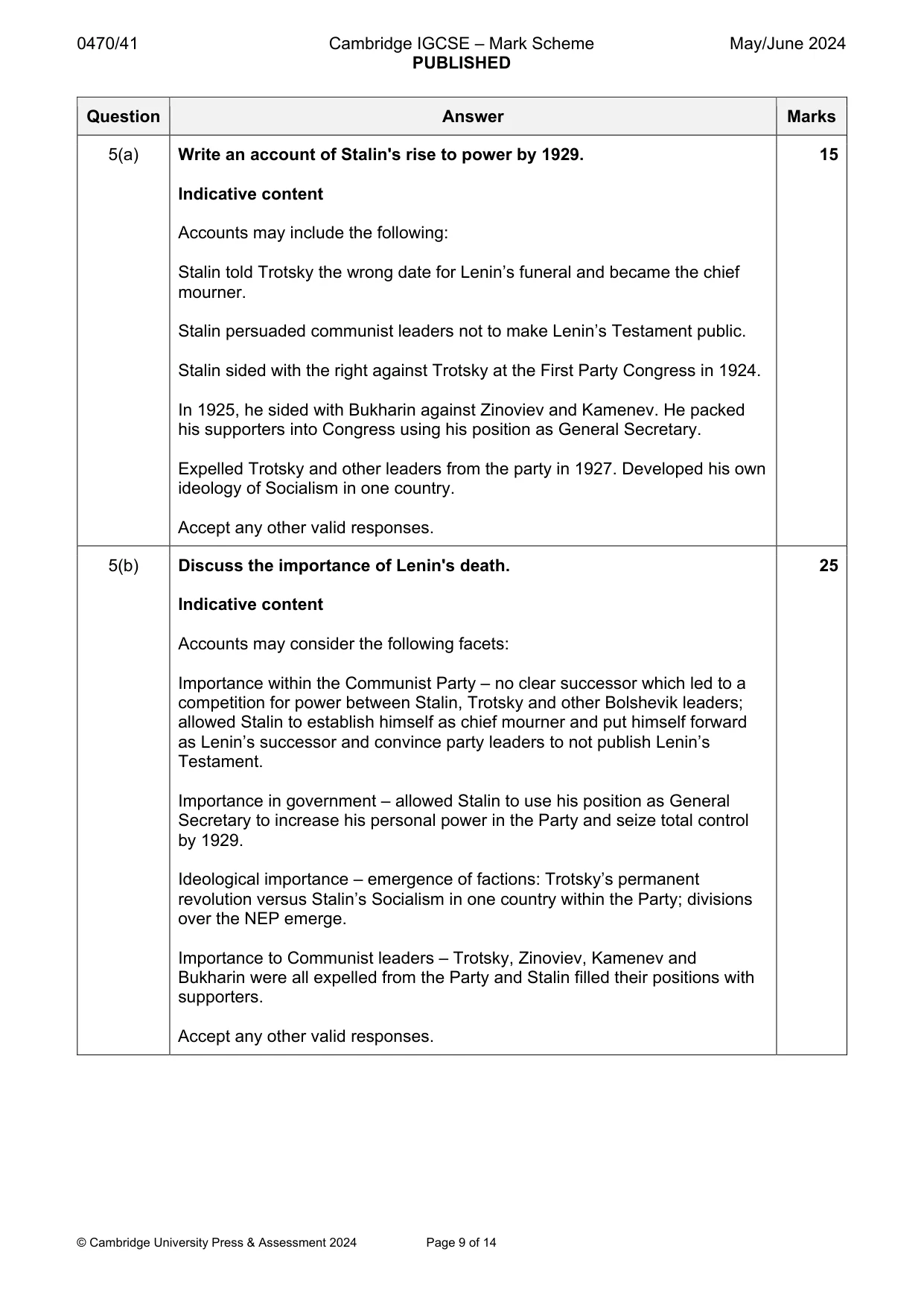
0470/41 Cambridge IGCSE – Mark Scheme PUBLISHED May/June 2024 © Cambridge University Press & Assessment 2024 Page 9 of 14 Question Answer Marks 5(a) Write an account of Stalin's rise to power by 1929. Indicative content Accounts may include the following: Stalin told Trotsky the wrong date for Lenin’s funeral and became the chief mourner. Stalin persuaded communist leaders not to make Lenin’s Testament public. Stalin sided with the right against Trotsky at the First Party Congress in 1924. In 1925, he sided with Bukharin against Zinoviev and Kamenev. He packed his supporters into Congress using his position as General Secretary. Expelled Trotsky and other leaders from the party in 1927. Developed his own ideology of Socialism in one country. Accept any other valid responses. 15 5(b) Discuss the importance of Lenin's death. Indicative content Accounts may consider the following facets: Importance within the Communist Party – no clear successor which led to a competition for power between Stalin, Trotsky and other Bolshevik leaders; allowed Stalin to establish himself as chief mourner and put himself forward as Lenin’s successor and convince party leaders to not publish Lenin’s Testament. Importance in government – allowed Stalin to use his position as General Secretary to increase his personal power in the Party and seize total control by 1929. Ideological importance – emergence of factions: Trotsky’s permanent revolution versus Stalin’s Socialism in one country within the Party; divisions over the NEP emerge. Importance to Communist leaders – Trotsky, Zinoviev, Kamenev and Bukharin were all expelled from the Party and Stalin filled their positions with supporters. Accept any other valid responses. 25
Mark scheme, page 10
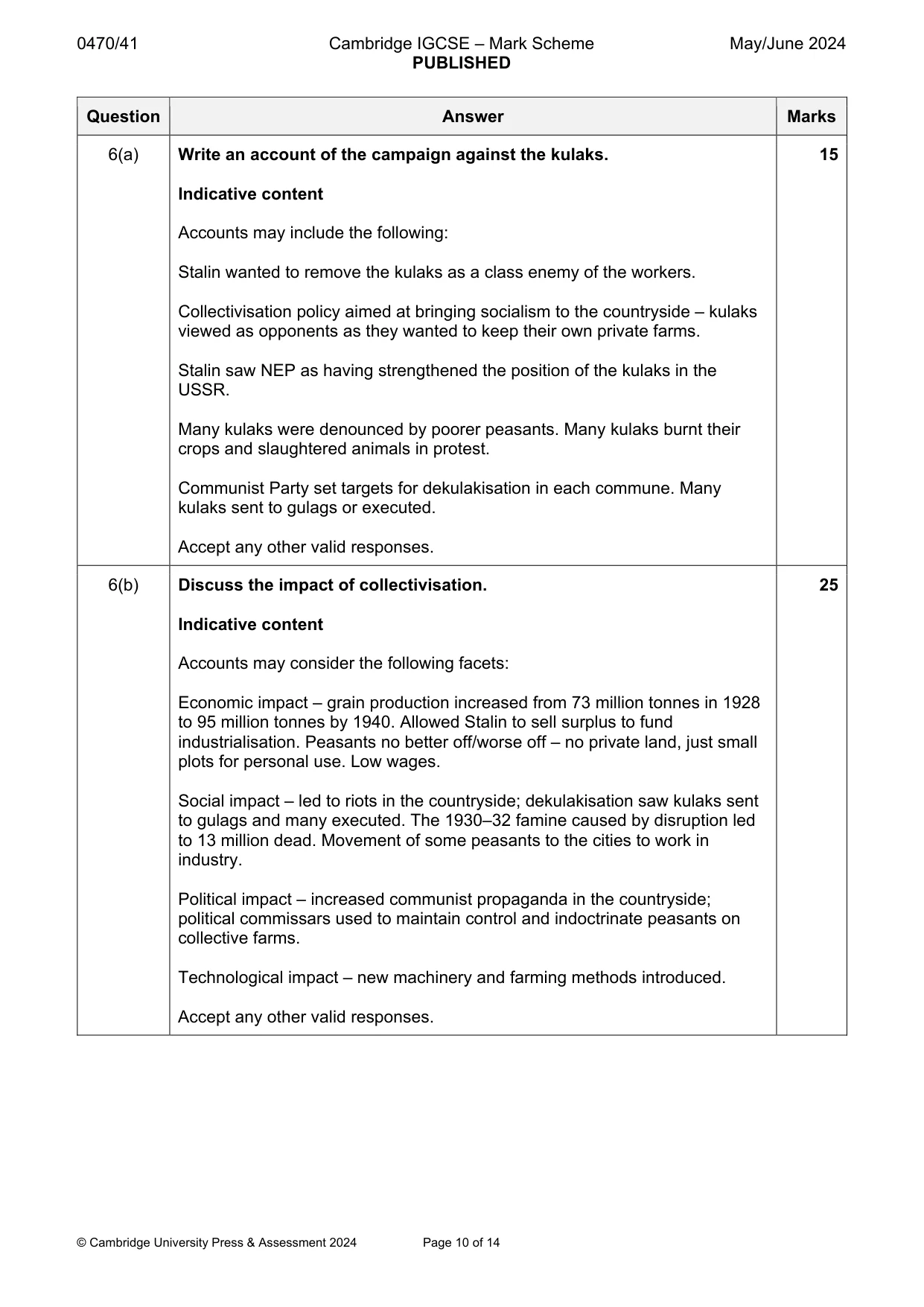
0470/41 Cambridge IGCSE – Mark Scheme PUBLISHED May/June 2024 © Cambridge University Press & Assessment 2024 Page 10 of 14 Question Answer Marks 6(a) Write an account of the campaign against the kulaks. Indicative content Accounts may include the following: Stalin wanted to remove the kulaks as a class enemy of the workers. Collectivisation policy aimed at bringing socialism to the countryside – kulaks viewed as opponents as they wanted to keep their own private farms. Stalin saw NEP as having strengthened the position of the kulaks in the USSR. Many kulaks were denounced by poorer peasants. Many kulaks burnt their crops and slaughtered animals in protest. Communist Party set targets for dekulakisation in each commune. Many kulaks sent to gulags or executed. Accept any other valid responses. 15 6(b) Discuss the impact of collectivisation. Indicative content Accounts may consider the following facets: Economic impact – grain production increased from 73 million tonnes in 1928 to 95 million tonnes by 1940. Allowed Stalin to sell surplus to fund industrialisation. Peasants no better off/worse off – no private land, just small plots for personal use. Low wages. Social impact – led to riots in the countryside; dekulakisation saw kulaks sent to gulags and many executed. The 1930–32 famine caused by disruption led to 13 million dead. Movement of some peasants to the cities to work in industry. Political impact – increased communist propaganda in the countryside; political commissars used to maintain control and indoctrinate peasants on collective farms. Technological impact – new machinery and farming methods introduced. Accept any other valid responses. 25
Mark scheme, page 11
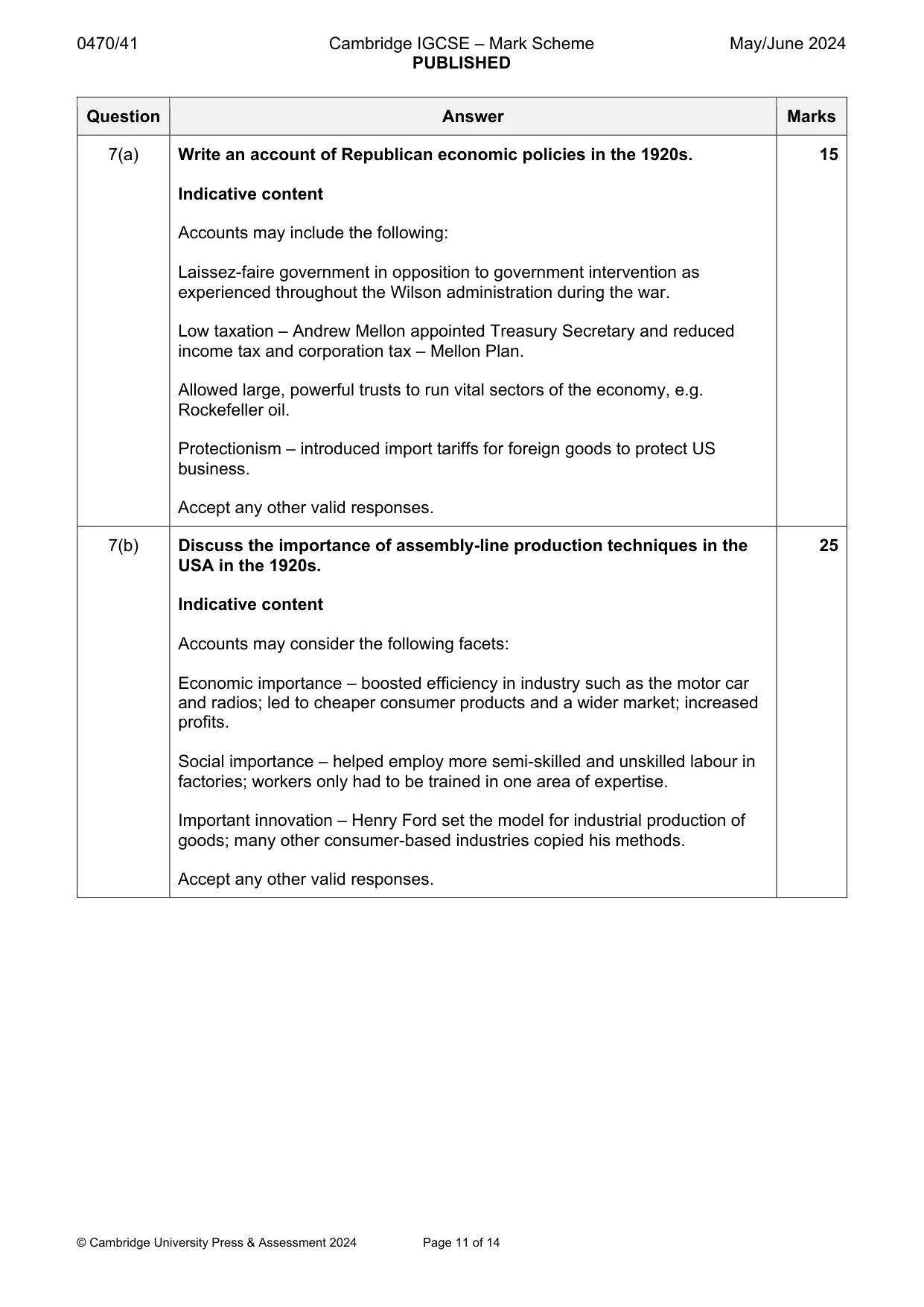
0470/41 Cambridge IGCSE – Mark Scheme PUBLISHED May/June 2024 © Cambridge University Press & Assessment 2024 Page 11 of 14 Question Answer Marks 7(a) Write an account of Republican economic policies in the 1920s. Indicative content Accounts may include the following: Laissez-faire government in opposition to government intervention as experienced throughout the Wilson administration during the war. Low taxation – Andrew Mellon appointed Treasury Secretary and reduced income tax and corporation tax – Mellon Plan. Allowed large, powerful trusts to run vital sectors of the economy, e.g. Rockefeller oil. Protectionism – introduced import tariffs for foreign goods to protect US business. Accept any other valid responses. 15 7(b) Discuss the importance of assembly-line production techniques in the USA in the 1920s. Indicative content Accounts may consider the following facets: Economic importance – boosted efficiency in industry such as the motor car and radios; led to cheaper consumer products and a wider market; increased profits. Social importance – helped employ more semi-skilled and unskilled labour in factories; workers only had to be trained in one area of expertise. Important innovation – Henry Ford set the model for industrial production of goods; many other consumer-based industries copied his methods. Accept any other valid responses. 25
Mark scheme, page 12
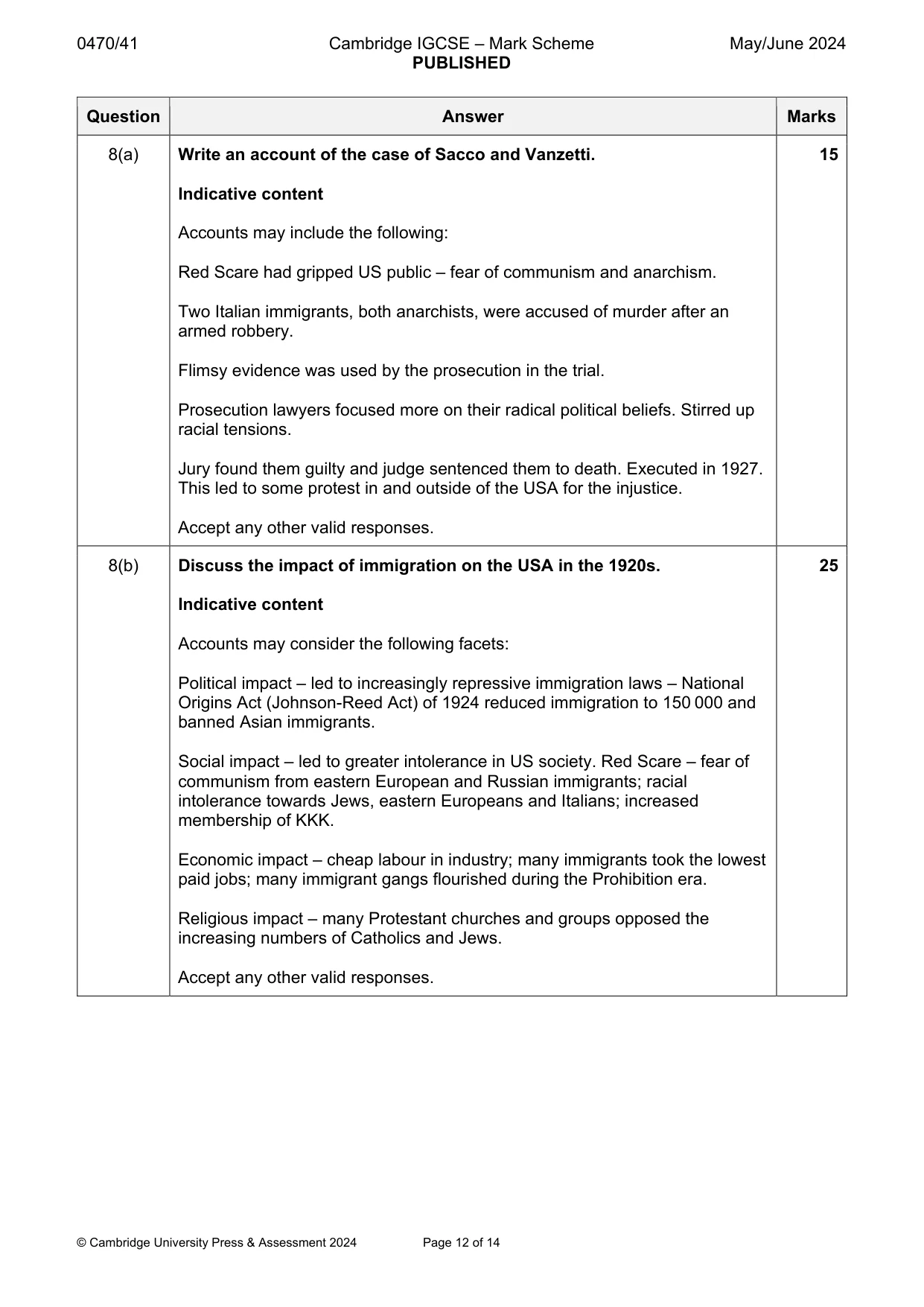
0470/41 Cambridge IGCSE – Mark Scheme PUBLISHED May/June 2024 © Cambridge University Press & Assessment 2024 Page 12 of 14 Question Answer Marks 8(a) Write an account of the case of Sacco and Vanzetti. Indicative content Accounts may include the following: Red Scare had gripped US public – fear of communism and anarchism. Two Italian immigrants, both anarchists, were accused of murder after an armed robbery. Flimsy evidence was used by the prosecution in the trial. Prosecution lawyers focused more on their radical political beliefs. Stirred up racial tensions. Jury found them guilty and judge sentenced them to death. Executed in 1927. This led to some protest in and outside of the USA for the injustice. Accept any other valid responses. 15 8(b) Discuss the impact of immigration on the USA in the 1920s. Indicative content Accounts may consider the following facets: Political impact – led to increasingly repressive immigration laws – National Origins Act (Johnson-Reed Act) of 1924 reduced immigration to 150 000 and banned Asian immigrants. Social impact – led to greater intolerance in US society. Red Scare – fear of communism from eastern European and Russian immigrants; racial intolerance towards Jews, eastern Europeans and Italians; increased membership of KKK. Economic impact – cheap labour in industry; many immigrants took the lowest paid jobs; many immigrant gangs flourished during the Prohibition era. Religious impact – many Protestant churches and groups opposed the increasing numbers of Catholics and Jews. Accept any other valid responses. 25
Mark scheme, page 13
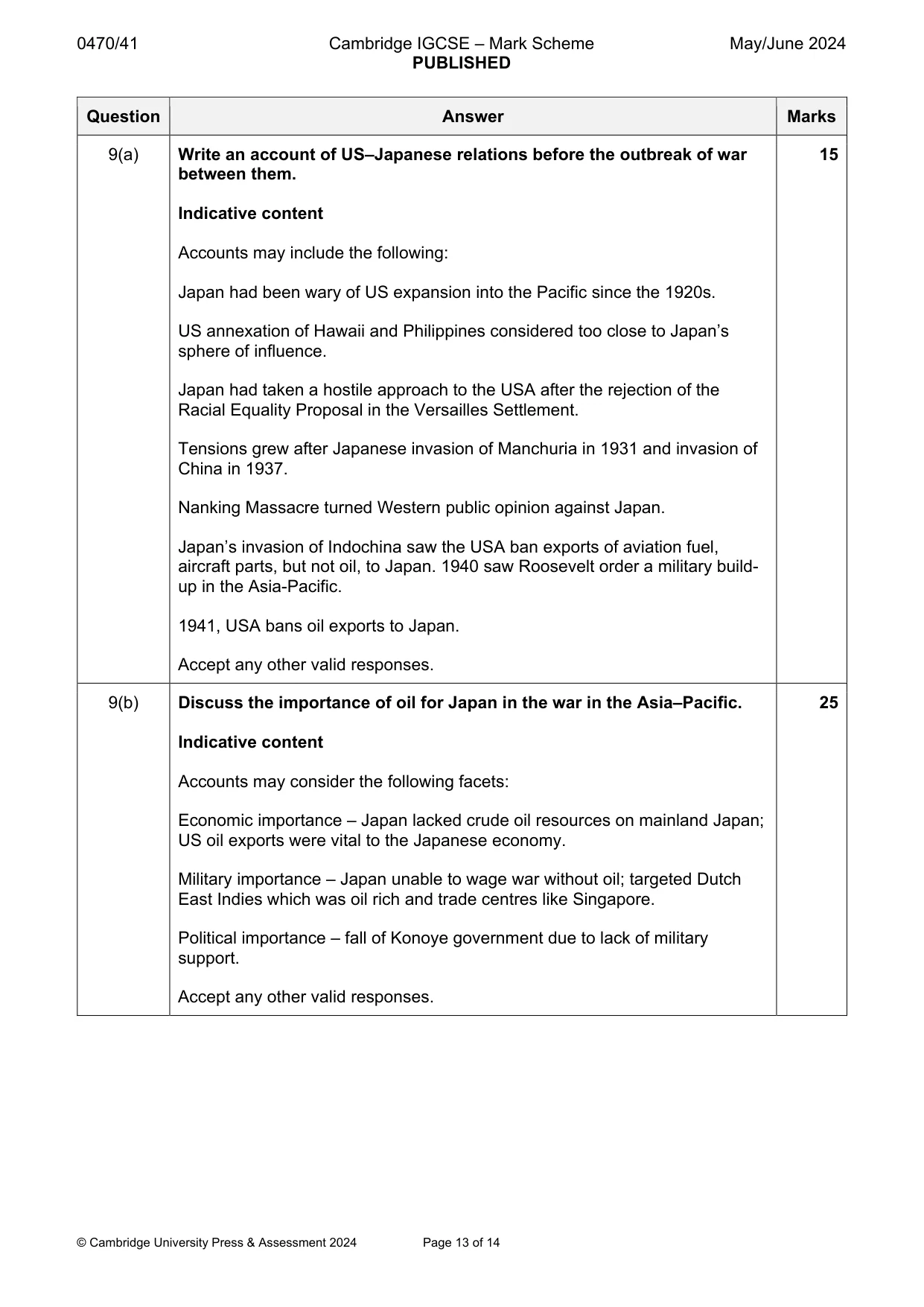
0470/41 Cambridge IGCSE – Mark Scheme PUBLISHED May/June 2024 © Cambridge University Press & Assessment 2024 Page 13 of 14 Question Answer Marks 9(a) Write an account of US–Japanese relations before the outbreak of war between them. Indicative content Accounts may include the following: Japan had been wary of US expansion into the Pacific since the 1920s. US annexation of Hawaii and Philippines considered too close to Japan’s sphere of influence. Japan had taken a hostile approach to the USA after the rejection of the Racial Equality Proposal in the Versailles Settlement. Tensions grew after Japanese invasion of Manchuria in 1931 and invasion of China in 1937. Nanking Massacre turned Western public opinion against Japan. Japan’s invasion of Indochina saw the USA ban exports of aviation fuel, aircraft parts, but not oil, to Japan. 1940 saw Roosevelt order a military build- up in the Asia-Pacific. 1941, USA bans oil exports to Japan. Accept any other valid responses. 15 9(b) Discuss the importance of oil for Japan in the war in the Asia–Pacific. Indicative content Accounts may consider the following facets: Economic importance – Japan lacked crude oil resources on mainland Japan; US oil exports were vital to the Japanese economy. Military importance – Japan unable to wage war without oil; targeted Dutch East Indies which was oil rich and trade centres like Singapore. Political importance – fall of Konoye government due to lack of military support. Accept any other valid responses. 25
Mark scheme, page 14
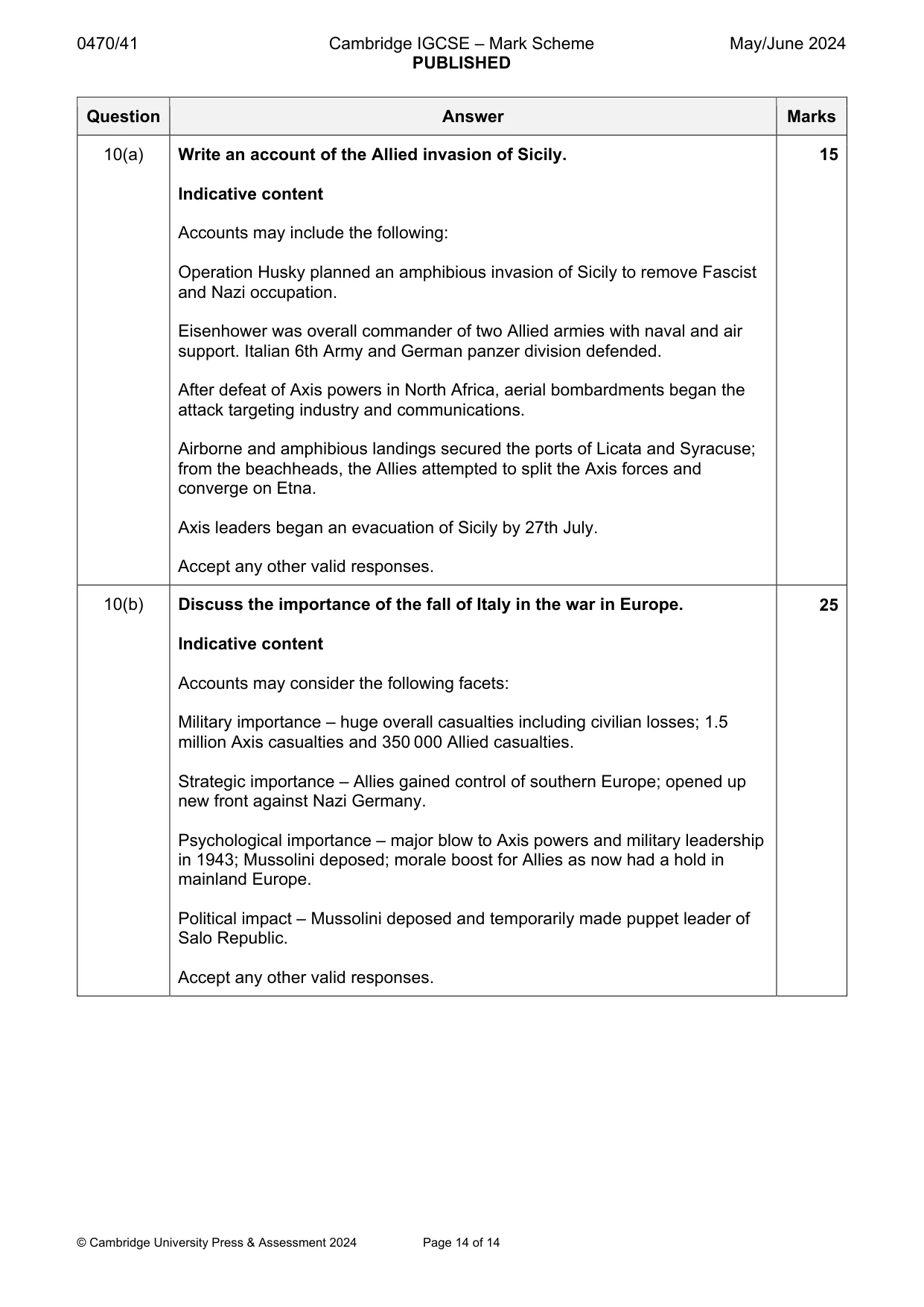
0470/41 Cambridge IGCSE – Mark Scheme PUBLISHED May/June 2024 © Cambridge University Press & Assessment 2024 Page 14 of 14 Question Answer Marks 10(a) Write an account of the Allied invasion of Sicily. Indicative content Accounts may include the following: Operation Husky planned an amphibious invasion of Sicily to remove Fascist and Nazi occupation. Eisenhower was overall commander of two Allied armies with naval and air support. Italian 6th Army and German panzer division defended. After defeat of Axis powers in North Africa, aerial bombardments began the attack targeting industry and communications. Airborne and amphibious landings secured the ports of Licata and Syracuse; from the beachheads, the Allies attempted to split the Axis forces and converge on Etna. Axis leaders began an evacuation of Sicily by 27th July. Accept any other valid responses. 15 10(b) Discuss the importance of the fall of Italy in the war in Europe. Indicative content Accounts may consider the following facets: Military importance – huge overall casualties including civilian losses; 1.5 million Axis casualties and 350 000 Allied casualties. Strategic importance – Allies gained control of southern Europe; opened up new front against Nazi Germany. Psychological importance – major blow to Axis powers and military leadership in 1943; Mussolini deposed; morale boost for Allies as now had a hold in mainland Europe. Political impact – Mussolini deposed and temporarily made puppet leader of Salo Republic. Accept any other valid responses. 25
What you needed in this session
Cambridge’s own grade thresholds for 2024 May/June, Paper 4 · Variant 1. A higher threshold means an easier paper — the bar moves with how the cohort did.