Cambridge IGCSE History 0470 — 2023 May/June Paper 4 · Variant 1
0470/41/M/J/23 · 40 marks · ≈45 min
The question paper and its mark scheme, free to read here and free to download. This is Cambridge’s own paper, exactly as it was sat.
Question paper4 pages
Mark scheme16 pages
Answers below. Sit the paper first if you are practising.
Paper as text
Question paper, page 1
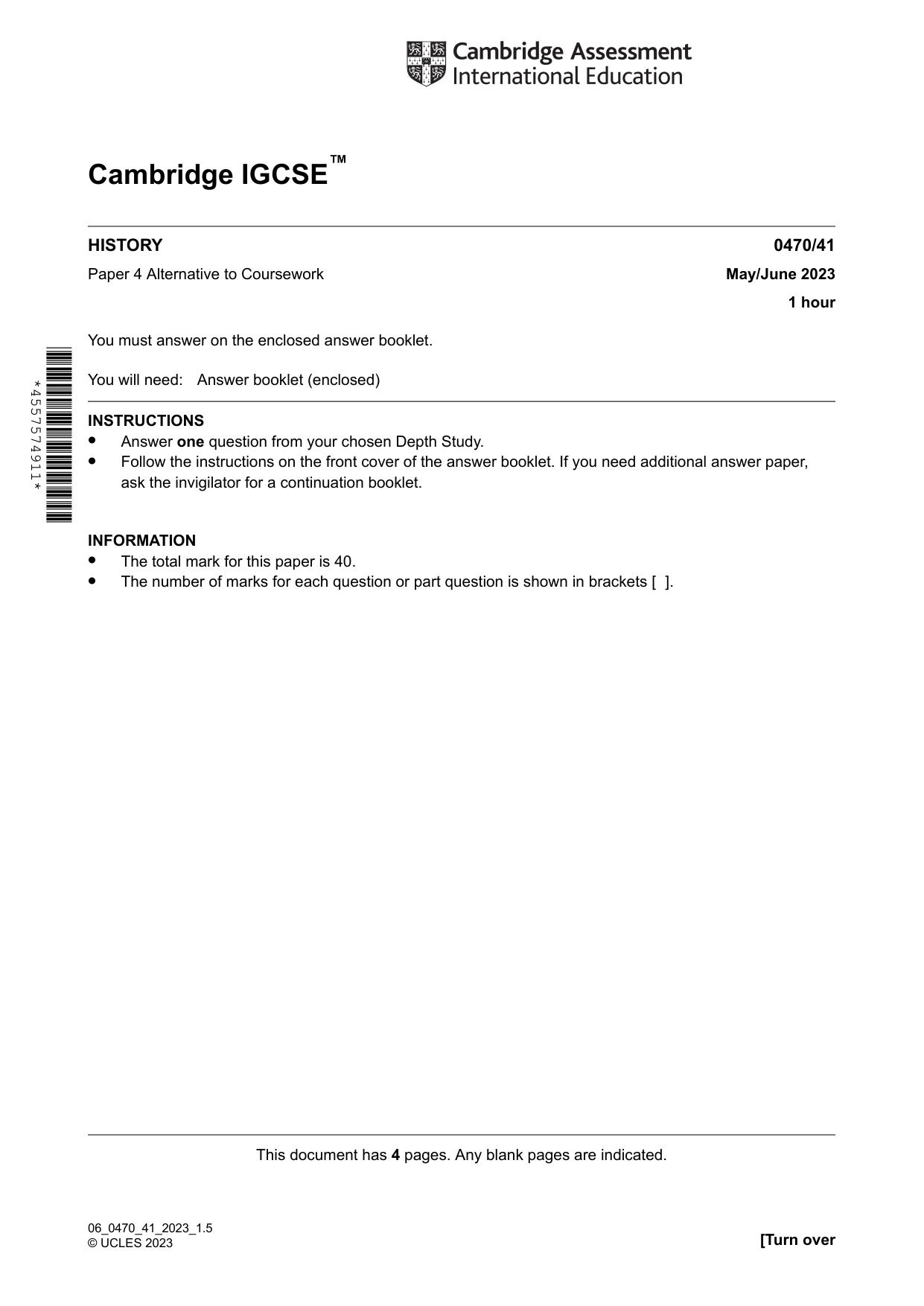
Cambridge IGCSE™ 0470/41 May/June 2023 1 hour HISTORY Paper 4 Alternative to Coursework You must answer on the enclosed answer booklet. You will need: Answer booklet (enclosed) INSTRUCTIONS • Answer one question from your chosen Depth Study. • Follow the instructions on the front cover of the answer booklet. If you need additional answer paper, ask the invigilator for a continuation booklet. INFORMATION • The total mark for this paper is 40. • The number of marks for each question or part question is shown in brackets [ ]. This document has 4 pages. Any blank pages are indicated. [Turn over 06_0470_41_2023_1.5 © UCLES 2023 *4557574911*
Question paper, page 2
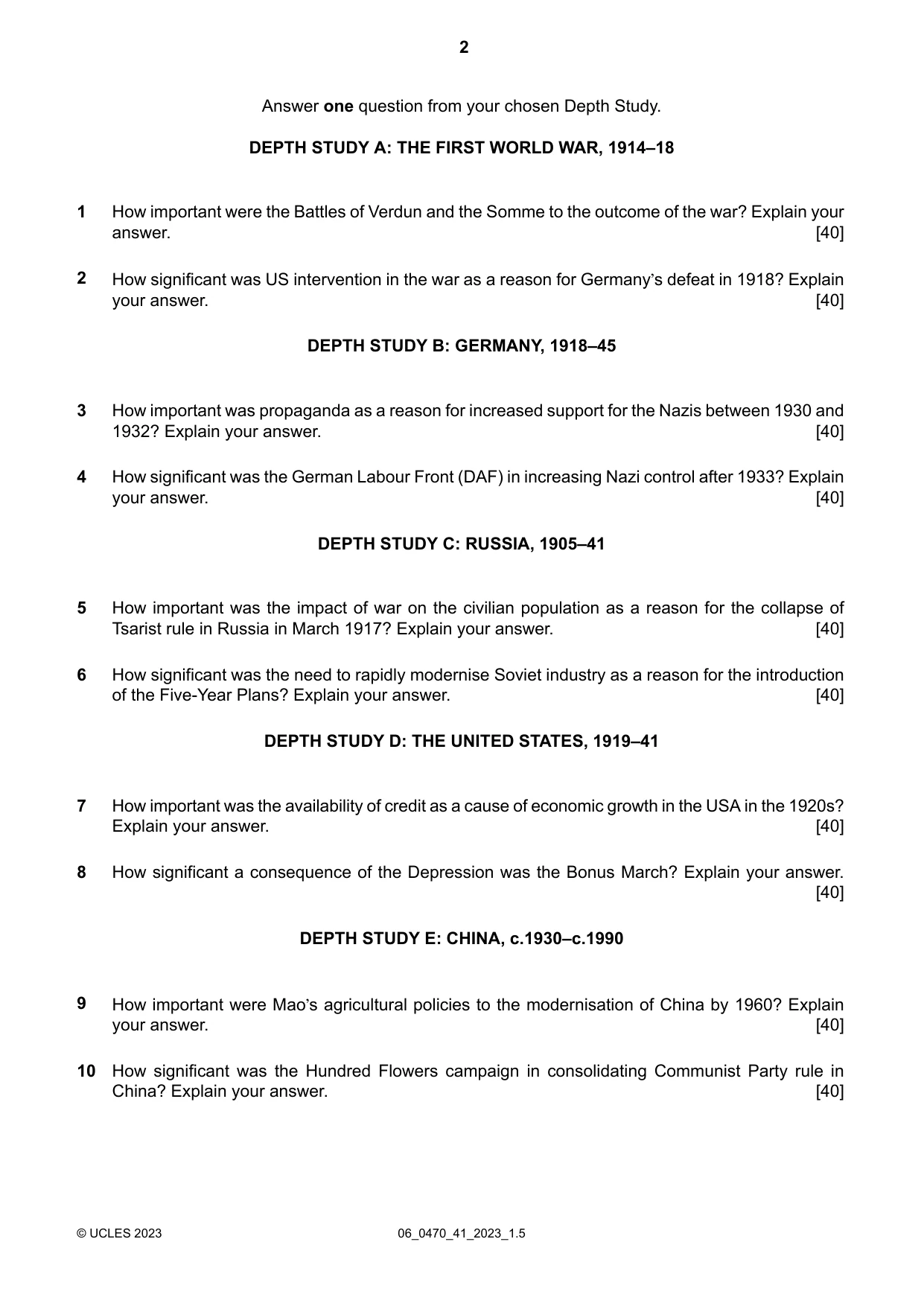
Answer one question from your chosen Depth Study. DEPTH STUDY A: THE FIRST WORLD WAR, 1914–18 How important were the Battles of Verdun and the Somme to the outcome of the war? Explain your answer. [40] 1 How significant was US intervention in the war as a reason for Germany’s defeat in 1918? Explain your answer. [40] 2 DEPTH STUDY B: GERMANY, 1918–45 How important was propaganda as a reason for increased support for the Nazis between 1930 and 1932? Explain your answer. [40] 3 How significant was the German Labour Front (DAF) in increasing Nazi control after 1933? Explain your answer. [40] 4 DEPTH STUDY C: RUSSIA, 1905–41 How important was the impact of war on the civilian population as a reason for the collapse of Tsarist rule in Russia in March 1917? Explain your answer. [40] 5 How significant was the need to rapidly modernise Soviet industry as a reason for the introduction of the Five-Year Plans? Explain your answer. [40] 6 DEPTH STUDY D: THE UNITED STATES, 1919–41 How important was the availability of credit as a cause of economic growth in the USA in the 1920s? Explain your answer. [40] 7 How significant a consequence of the Depression was the Bonus March? Explain your answer. [40] 8 DEPTH STUDY E: CHINA, c.1930–c.1990 How important were Mao’s agricultural policies to the modernisation of China by 1960? Explain your answer. [40] 9 How significant was the Hundred Flowers campaign in consolidating Communist Party rule in China? Explain your answer. [40] 10 06_0470_41_2023_1.5 © UCLES 2023 2
Question paper, page 3
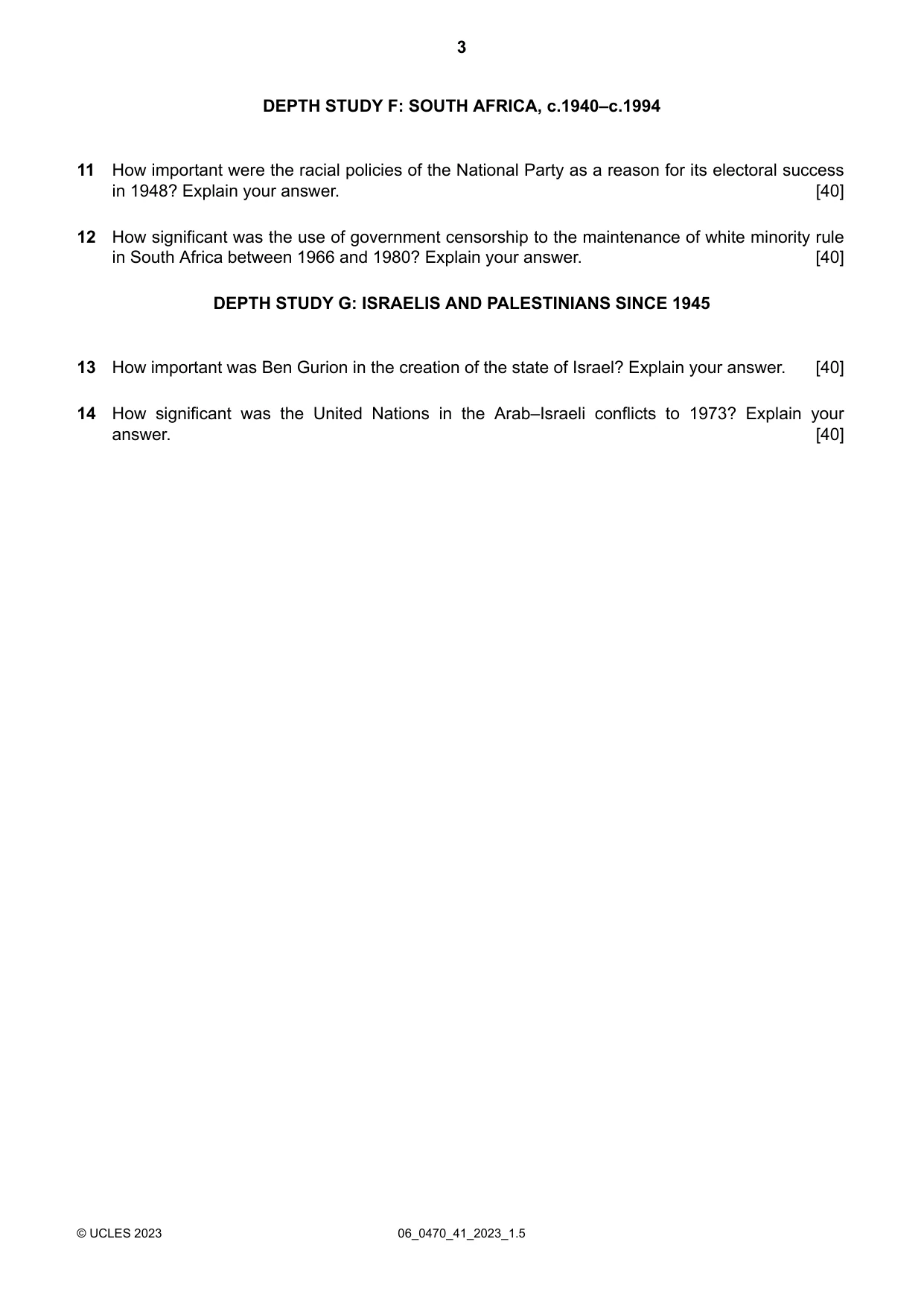
DEPTH STUDY F: SOUTH AFRICA, c.1940–c.1994 How important were the racial policies of the National Party as a reason for its electoral success in 1948? Explain your answer. [40] 11 How significant was the use of government censorship to the maintenance of white minority rule in South Africa between 1966 and 1980? Explain your answer. [40] 12 DEPTH STUDY G: ISRAELIS AND PALESTINIANS SINCE 1945 How important was Ben Gurion in the creation of the state of Israel? Explain your answer. [40] 13 How significant was the United Nations in the Arab–Israeli conflicts to 1973? Explain your answer. [40] 14 06_0470_41_2023_1.5 © UCLES 2023 3
Question paper, page 4
BLANK PAGE Permission to reproduce items where third-party owned material protected by copyright is included has been sought and cleared where possible. Every reasonable effort has been made by the publisher (UCLES) to trace copyright holders, but if any items requiring clearance have unwittingly been included, the publisher will be pleased to make amends at the earliest possible opportunity. To avoid the issue of disclosure of answer-related information to candidates, all copyright acknowledgements are reproduced online in the Cambridge Assessment International Education Copyright Acknowledgements Booklet. This is produced for each series of examinations and is freely available to download at www.cambridgeinternational.org after the live examination series. Cambridge Assessment International Education is part of Cambridge Assessment. Cambridge Assessment is the brand name of the University of Cambridge Local Examinations Syndicate (UCLES), which is a department of the University of Cambridge. 06_0470_41_2023_1.5 © UCLES 2023 4
Mark scheme, page 1
This document consists of 16 printed pages. © UCLES 2023 [Turn over Cambridge IGCSE™ HISTORY 0470/41 Paper 4 Alternative to Coursework May/June 2023 MARK SCHEME Maximum Mark: 40 Published This mark scheme is published as an aid to teachers and candidates, to indicate the requirements of the examination. It shows the basis on which Examiners were instructed to award marks. It does not indicate the details of the discussions that took place at an Examiners’ meeting before marking began, which would have considered the acceptability of alternative answers. Mark schemes should be read in conjunction with the question paper and the Principal Examiner Report for Teachers. Cambridge International will not enter into discussions about these mark schemes. Cambridge International is publishing the mark schemes for the May/June 2023 series for most Cambridge IGCSE, Cambridge International A and AS Level and Cambridge Pre-U components, and some Cambridge O Level components.
Mark scheme, page 2
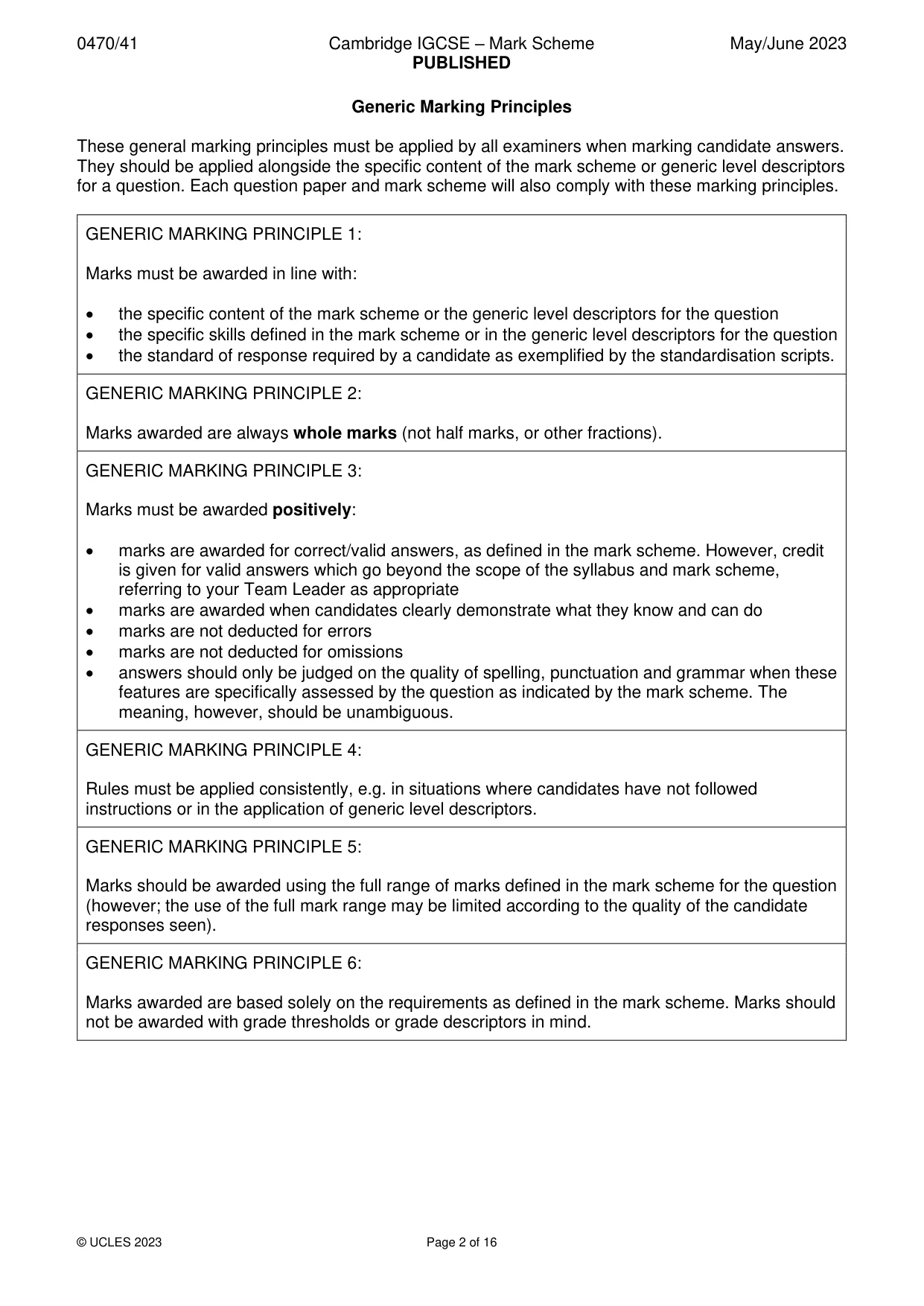
0470/41 Cambridge IGCSE – Mark Scheme PUBLISHED May/June 2023 © UCLES 2023 Page 2 of 16 Generic Marking Principles These general marking principles must be applied by all examiners when marking candidate answers. They should be applied alongside the specific content of the mark scheme or generic level descriptors for a question. Each question paper and mark scheme will also comply with these marking principles. GENERIC MARKING PRINCIPLE 1: Marks must be awarded in line with: • the specific content of the mark scheme or the generic level descriptors for the question • the specific skills defined in the mark scheme or in the generic level descriptors for the question • the standard of response required by a candidate as exemplified by the standardisation scripts. GENERIC MARKING PRINCIPLE 2: Marks awarded are always whole marks (not half marks, or other fractions). GENERIC MARKING PRINCIPLE 3: Marks must be awarded positively: • marks are awarded for correct/valid answers, as defined in the mark scheme. However, credit is given for valid answers which go beyond the scope of the syllabus and mark scheme, referring to your Team Leader as appropriate • marks are awarded when candidates clearly demonstrate what they know and can do • marks are not deducted for errors • marks are not deducted for omissions • answers should only be judged on the quality of spelling, punctuation and grammar when these features are specifically assessed by the question as indicated by the mark scheme. The meaning, however, should be unambiguous. GENERIC MARKING PRINCIPLE 4: Rules must be applied consistently, e.g. in situations where candidates have not followed instructions or in the application of generic level descriptors. GENERIC MARKING PRINCIPLE 5: Marks should be awarded using the full range of marks defined in the mark scheme for the question (however; the use of the full mark range may be limited according to the quality of the candidate responses seen). GENERIC MARKING PRINCIPLE 6: Marks awarded are based solely on the requirements as defined in the mark scheme. Marks should not be awarded with grade thresholds or grade descriptors in mind.
Mark scheme, page 3
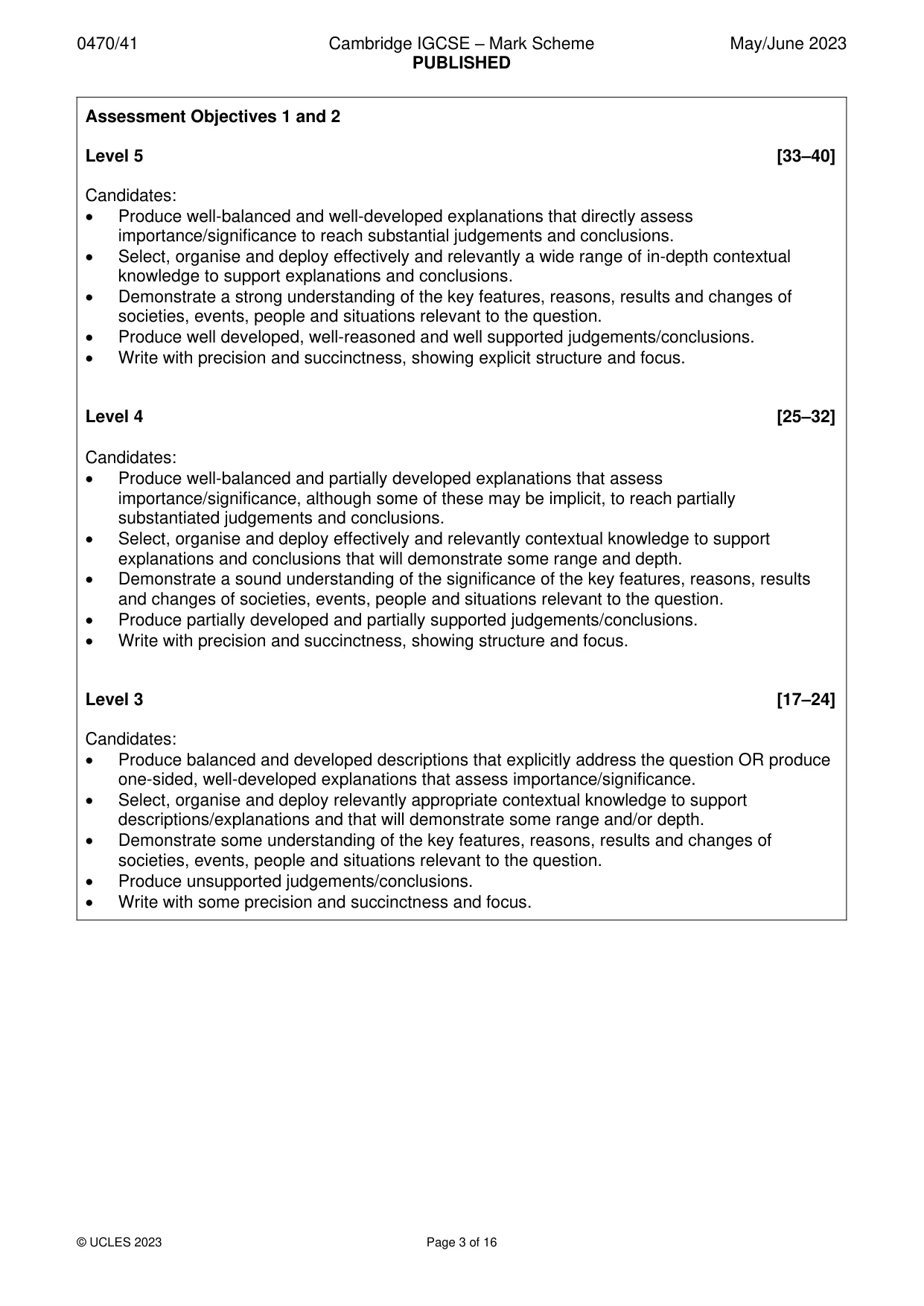
0470/41 Cambridge IGCSE – Mark Scheme PUBLISHED May/June 2023 © UCLES 2023 Page 3 of 16 Assessment Objectives 1 and 2 Level 5 [33–40] Candidates: • Produce well-balanced and well-developed explanations that directly assess importance/significance to reach substantial judgements and conclusions. • Select, organise and deploy effectively and relevantly a wide range of in-depth contextual knowledge to support explanations and conclusions. • Demonstrate a strong understanding of the key features, reasons, results and changes of societies, events, people and situations relevant to the question. • Produce well developed, well-reasoned and well supported judgements/conclusions. • Write with precision and succinctness, showing explicit structure and focus. Level 4 [25–32] Candidates: • Produce well-balanced and partially developed explanations that assess importance/significance, although some of these may be implicit, to reach partially substantiated judgements and conclusions. • Select, organise and deploy effectively and relevantly contextual knowledge to support explanations and conclusions that will demonstrate some range and depth. • Demonstrate a sound understanding of the significance of the key features, reasons, results and changes of societies, events, people and situations relevant to the question. • Produce partially developed and partially supported judgements/conclusions. • Write with precision and succinctness, showing structure and focus. Level 3 [17–24] Candidates: • Produce balanced and developed descriptions that explicitly address the question OR produce one-sided, well-developed explanations that assess importance/significance. • Select, organise and deploy relevantly appropriate contextual knowledge to support descriptions/explanations and that will demonstrate some range and/or depth. • Demonstrate some understanding of the key features, reasons, results and changes of societies, events, people and situations relevant to the question. • Produce unsupported judgements/conclusions. • Write with some precision and succinctness and focus.
Mark scheme, page 4
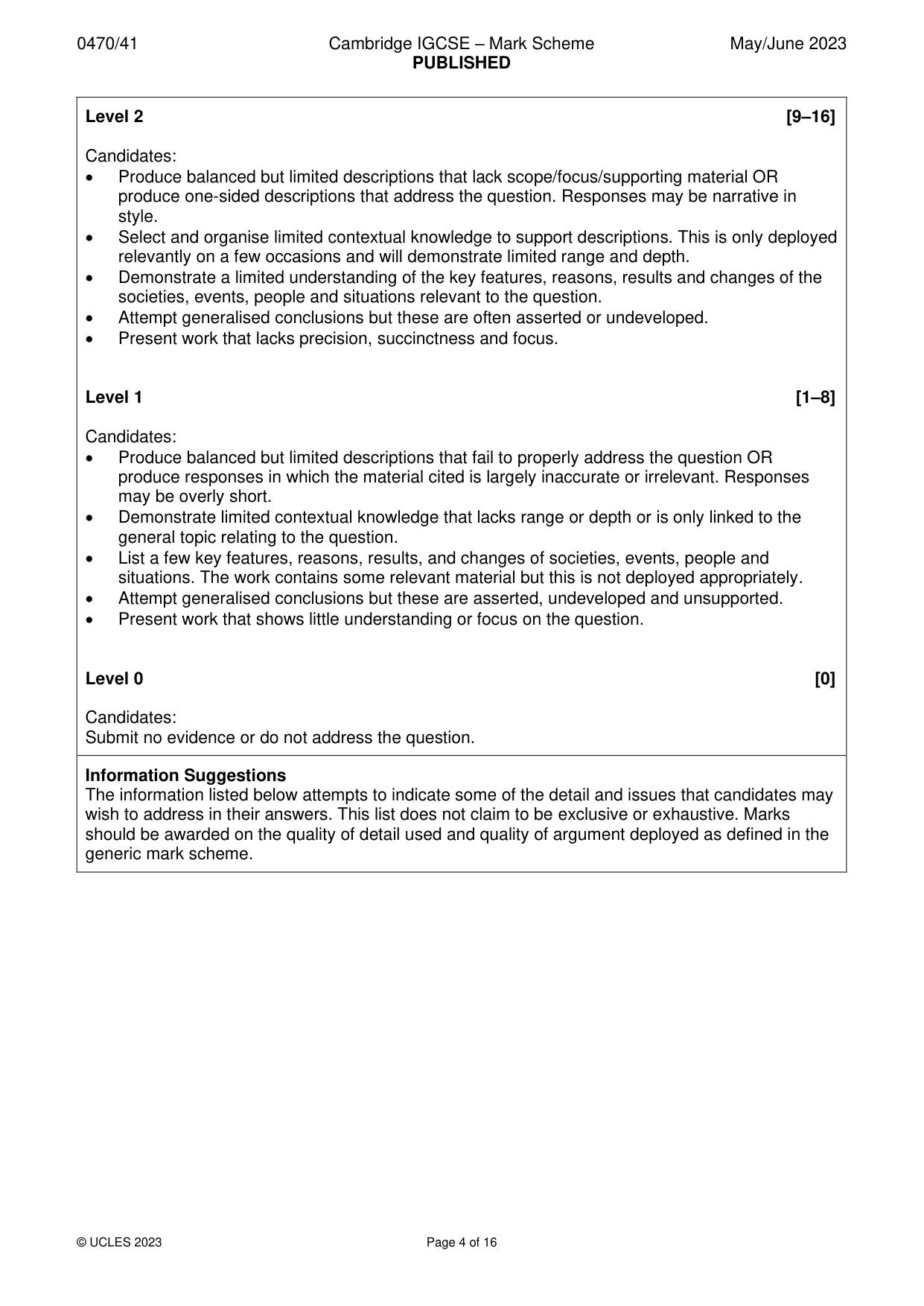
0470/41 Cambridge IGCSE – Mark Scheme PUBLISHED May/June 2023 © UCLES 2023 Page 4 of 16 Level 2 [9–16] Candidates: • Produce balanced but limited descriptions that lack scope/focus/supporting material OR produce one-sided descriptions that address the question. Responses may be narrative in style. • Select and organise limited contextual knowledge to support descriptions. This is only deployed relevantly on a few occasions and will demonstrate limited range and depth. • Demonstrate a limited understanding of the key features, reasons, results and changes of the societies, events, people and situations relevant to the question. • Attempt generalised conclusions but these are often asserted or undeveloped. • Present work that lacks precision, succinctness and focus. Level 1 [1–8] Candidates: • Produce balanced but limited descriptions that fail to properly address the question OR produce responses in which the material cited is largely inaccurate or irrelevant. Responses may be overly short. • Demonstrate limited contextual knowledge that lacks range or depth or is only linked to the general topic relating to the question. • List a few key features, reasons, results, and changes of societies, events, people and situations. The work contains some relevant material but this is not deployed appropriately. • Attempt generalised conclusions but these are asserted, undeveloped and unsupported. • Present work that shows little understanding or focus on the question. Level 0 [0] Candidates: Submit no evidence or do not address the question. Information Suggestions The information listed below attempts to indicate some of the detail and issues that candidates may wish to address in their answers. This list does not claim to be exclusive or exhaustive. Marks should be awarded on the quality of detail used and quality of argument deployed as defined in the generic mark scheme.
Mark scheme, page 5
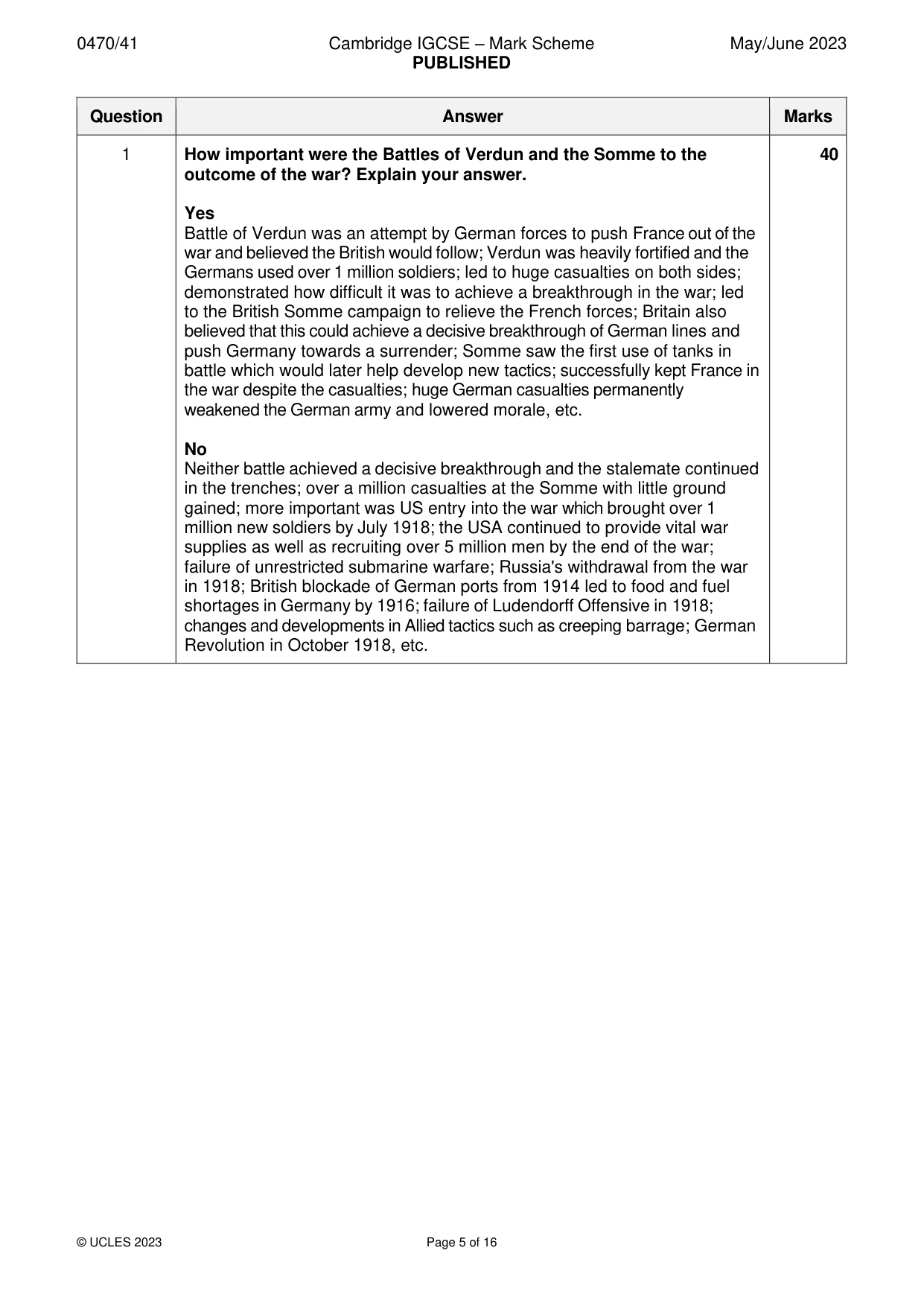
0470/41 Cambridge IGCSE – Mark Scheme PUBLISHED May/June 2023 © UCLES 2023 Page 5 of 16 Question Answer Marks 1 How important were the Battles of Verdun and the Somme to the outcome of the war? Explain your answer. Yes Battle of Verdun was an attempt by German forces to push France out of the war and believed the British would follow; Verdun was heavily fortified and the Germans used over 1 million soldiers; led to huge casualties on both sides; demonstrated how difficult it was to achieve a breakthrough in the war; led to the British Somme campaign to relieve the French forces; Britain also believed that this could achieve a decisive breakthrough of German lines and push Germany towards a surrender; Somme saw the first use of tanks in battle which would later help develop new tactics; successfully kept France in the war despite the casualties; huge German casualties permanently weakened the German army and lowered morale, etc. No Neither battle achieved a decisive breakthrough and the stalemate continued in the trenches; over a million casualties at the Somme with little ground gained; more important was US entry into the war which brought over 1 million new soldiers by July 1918; the USA continued to provide vital war supplies as well as recruiting over 5 million men by the end of the war; failure of unrestricted submarine warfare; Russia's withdrawal from the war in 1918; British blockade of German ports from 1914 led to food and fuel shortages in Germany by 1916; failure of Ludendorff Offensive in 1918; changes and developments in Allied tactics such as creeping barrage; German Revolution in October 1918, etc. 40
Mark scheme, page 6
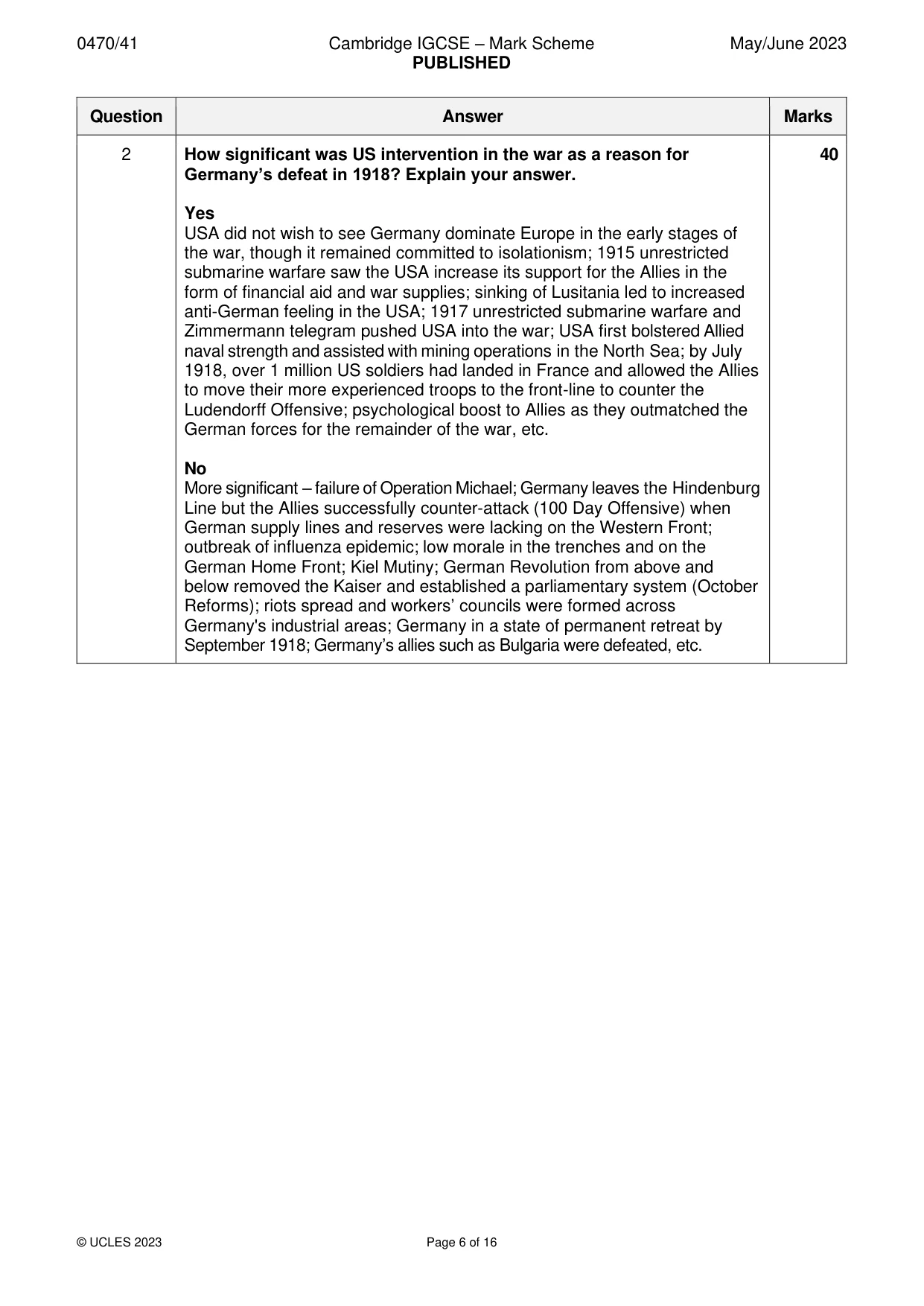
0470/41 Cambridge IGCSE – Mark Scheme PUBLISHED May/June 2023 © UCLES 2023 Page 6 of 16 Question Answer Marks 2 How significant was US intervention in the war as a reason for Germany’s defeat in 1918? Explain your answer. Yes USA did not wish to see Germany dominate Europe in the early stages of the war, though it remained committed to isolationism; 1915 unrestricted submarine warfare saw the USA increase its support for the Allies in the form of financial aid and war supplies; sinking of Lusitania led to increased anti-German feeling in the USA; 1917 unrestricted submarine warfare and Zimmermann telegram pushed USA into the war; USA first bolstered Allied naval strength and assisted with mining operations in the North Sea; by July 1918, over 1 million US soldiers had landed in France and allowed the Allies to move their more experienced troops to the front-line to counter the Ludendorff Offensive; psychological boost to Allies as they outmatched the German forces for the remainder of the war, etc. No More significant – failure of Operation Michael; Germany leaves the Hindenburg Line but the Allies successfully counter-attack (100 Day Offensive) when German supply lines and reserves were lacking on the Western Front; outbreak of influenza epidemic; low morale in the trenches and on the German Home Front; Kiel Mutiny; German Revolution from above and below removed the Kaiser and established a parliamentary system (October Reforms); riots spread and workers’ councils were formed across Germany's industrial areas; Germany in a state of permanent retreat by September 1918; Germany’s allies such as Bulgaria were defeated, etc. 40
Mark scheme, page 7
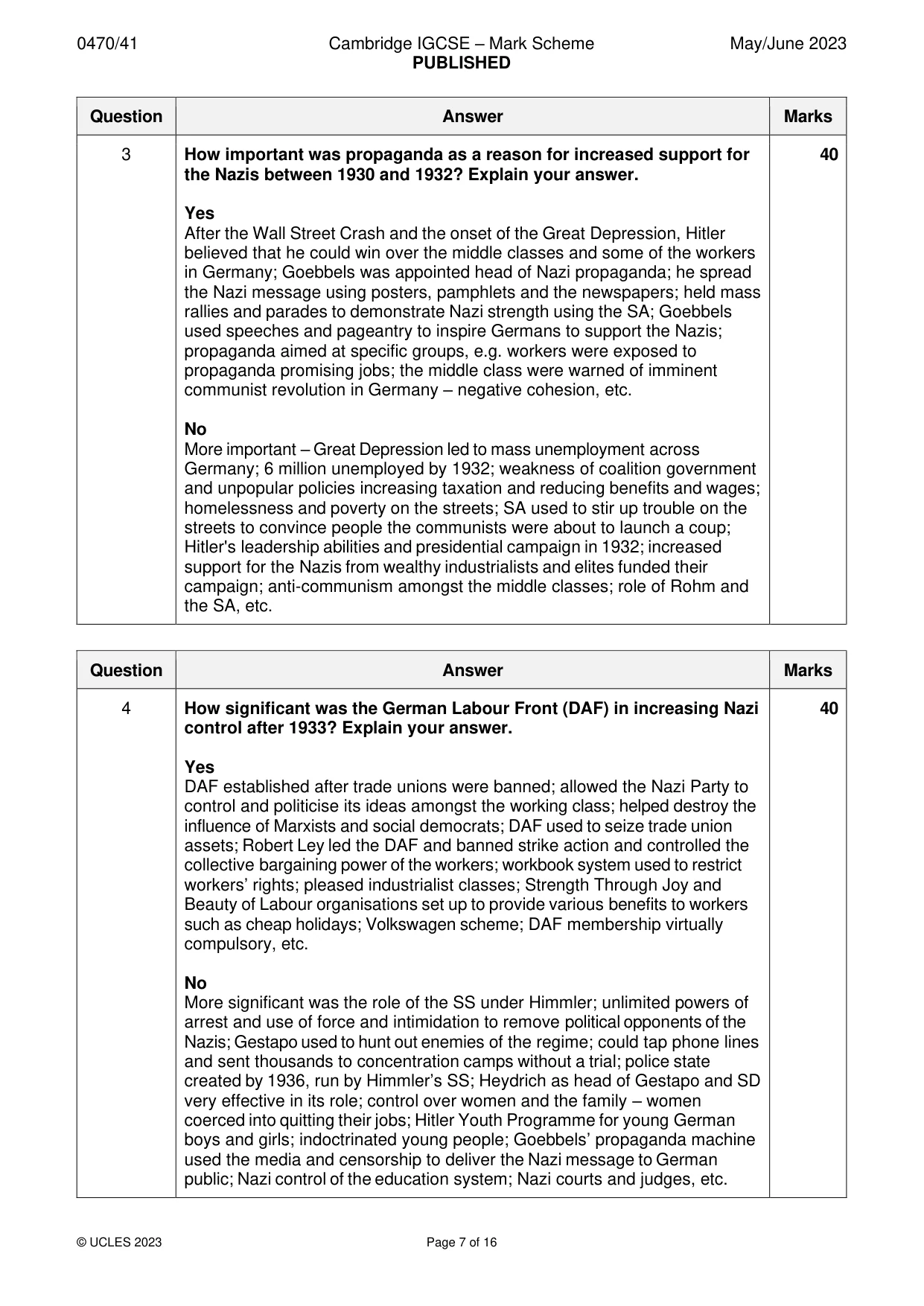
0470/41 Cambridge IGCSE – Mark Scheme PUBLISHED May/June 2023 © UCLES 2023 Page 7 of 16 Question Answer Marks 3 How important was propaganda as a reason for increased support for the Nazis between 1930 and 1932? Explain your answer. Yes After the Wall Street Crash and the onset of the Great Depression, Hitler believed that he could win over the middle classes and some of the workers in Germany; Goebbels was appointed head of Nazi propaganda; he spread the Nazi message using posters, pamphlets and the newspapers; held mass rallies and parades to demonstrate Nazi strength using the SA; Goebbels used speeches and pageantry to inspire Germans to support the Nazis; propaganda aimed at specific groups, e.g. workers were exposed to propaganda promising jobs; the middle class were warned of imminent communist revolution in Germany – negative cohesion, etc. No More important – Great Depression led to mass unemployment across Germany; 6 million unemployed by 1932; weakness of coalition government and unpopular policies increasing taxation and reducing benefits and wages; homelessness and poverty on the streets; SA used to stir up trouble on the streets to convince people the communists were about to launch a coup; Hitler's leadership abilities and presidential campaign in 1932; increased support for the Nazis from wealthy industrialists and elites funded their campaign; anti-communism amongst the middle classes; role of Rohm and the SA, etc. 40 Question Answer Marks 4 How significant was the German Labour Front (DAF) in increasing Nazi control after 1933? Explain your answer. Yes DAF established after trade unions were banned; allowed the Nazi Party to control and politicise its ideas amongst the working class; helped destroy the influence of Marxists and social democrats; DAF used to seize trade union assets; Robert Ley led the DAF and banned strike action and controlled the collective bargaining power of the workers; workbook system used to restrict workers’ rights; pleased industrialist classes; Strength Through Joy and Beauty of Labour organisations set up to provide various benefits to workers such as cheap holidays; Volkswagen scheme; DAF membership virtually compulsory, etc. No More significant was the role of the SS under Himmler; unlimited powers of arrest and use of force and intimidation to remove political opponents of the Nazis; Gestapo used to hunt out enemies of the regime; could tap phone lines and sent thousands to concentration camps without a trial; police state created by 1936, run by Himmler’s SS; Heydrich as head of Gestapo and SD very effective in its role; control over women and the family – women coerced into quitting their jobs; Hitler Youth Programme for young German boys and girls; indoctrinated young people; Goebbels’ propaganda machine used the media and censorship to deliver the Nazi message to German public; Nazi control of the education system; Nazi courts and judges, etc. 40
Mark scheme, page 8
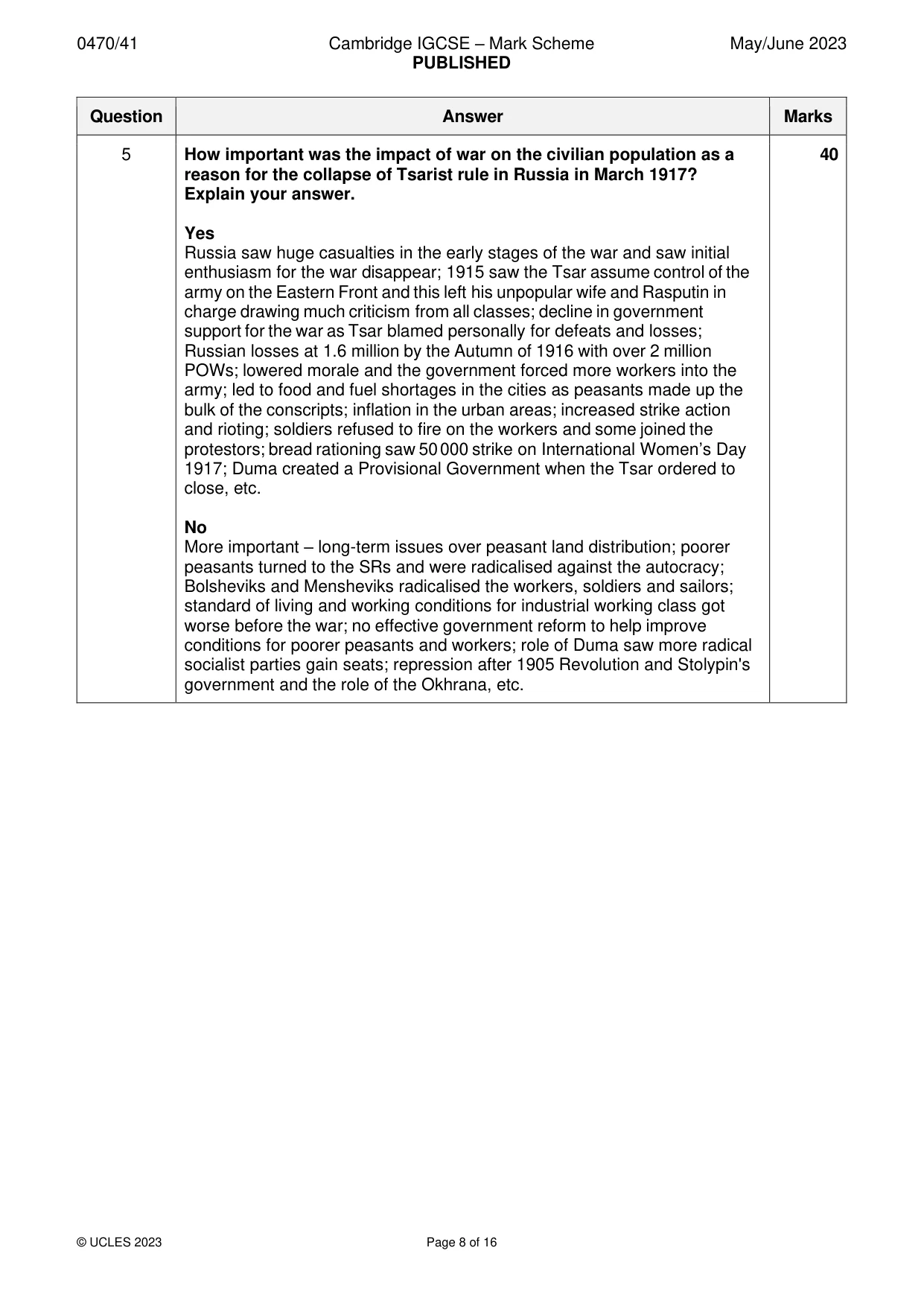
0470/41 Cambridge IGCSE – Mark Scheme PUBLISHED May/June 2023 © UCLES 2023 Page 8 of 16 Question Answer Marks 5 How important was the impact of war on the civilian population as a reason for the collapse of Tsarist rule in Russia in March 1917? Explain your answer. Yes Russia saw huge casualties in the early stages of the war and saw initial enthusiasm for the war disappear; 1915 saw the Tsar assume control of the army on the Eastern Front and this left his unpopular wife and Rasputin in charge drawing much criticism from all classes; decline in government support for the war as Tsar blamed personally for defeats and losses; Russian losses at 1.6 million by the Autumn of 1916 with over 2 million POWs; lowered morale and the government forced more workers into the army; led to food and fuel shortages in the cities as peasants made up the bulk of the conscripts; inflation in the urban areas; increased strike action and rioting; soldiers refused to fire on the workers and some joined the protestors; bread rationing saw 50 000 strike on International Women’s Day 1917; Duma created a Provisional Government when the Tsar ordered to close, etc. No More important – long-term issues over peasant land distribution; poorer peasants turned to the SRs and were radicalised against the autocracy; Bolsheviks and Mensheviks radicalised the workers, soldiers and sailors; standard of living and working conditions for industrial working class got worse before the war; no effective government reform to help improve conditions for poorer peasants and workers; role of Duma saw more radical socialist parties gain seats; repression after 1905 Revolution and Stolypin's government and the role of the Okhrana, etc. 40
Mark scheme, page 9
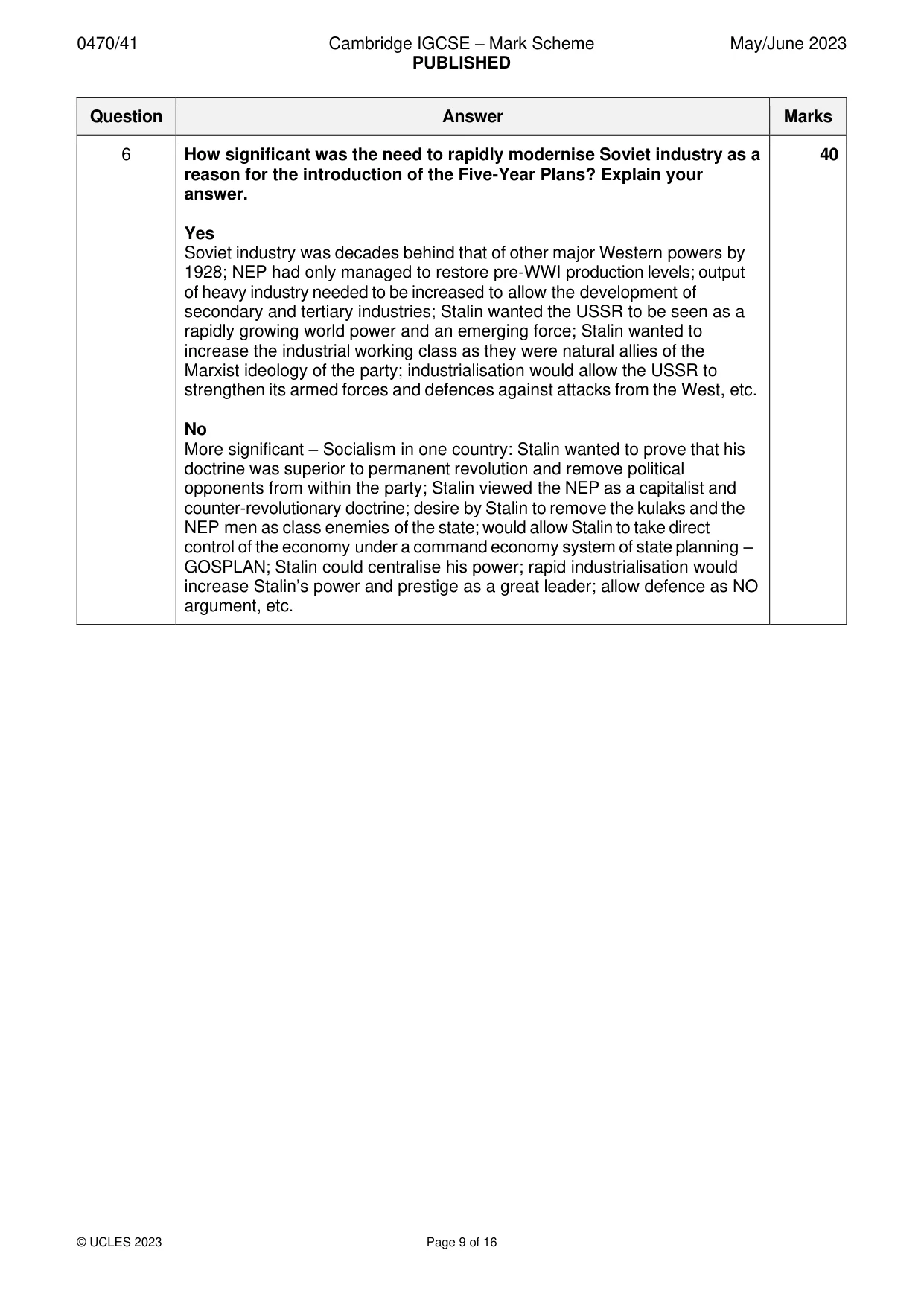
0470/41 Cambridge IGCSE – Mark Scheme PUBLISHED May/June 2023 © UCLES 2023 Page 9 of 16 Question Answer Marks 6 How significant was the need to rapidly modernise Soviet industry as a reason for the introduction of the Five-Year Plans? Explain your answer. Yes Soviet industry was decades behind that of other major Western powers by 1928; NEP had only managed to restore pre-WWI production levels; output of heavy industry needed to be increased to allow the development of secondary and tertiary industries; Stalin wanted the USSR to be seen as a rapidly growing world power and an emerging force; Stalin wanted to increase the industrial working class as they were natural allies of the Marxist ideology of the party; industrialisation would allow the USSR to strengthen its armed forces and defences against attacks from the West, etc. No More significant – Socialism in one country: Stalin wanted to prove that his doctrine was superior to permanent revolution and remove political opponents from within the party; Stalin viewed the NEP as a capitalist and counter-revolutionary doctrine; desire by Stalin to remove the kulaks and the NEP men as class enemies of the state; would allow Stalin to take direct control of the economy under a command economy system of state planning – GOSPLAN; Stalin could centralise his power; rapid industrialisation would increase Stalin’s power and prestige as a great leader; allow defence as NO argument, etc. 40
Mark scheme, page 10
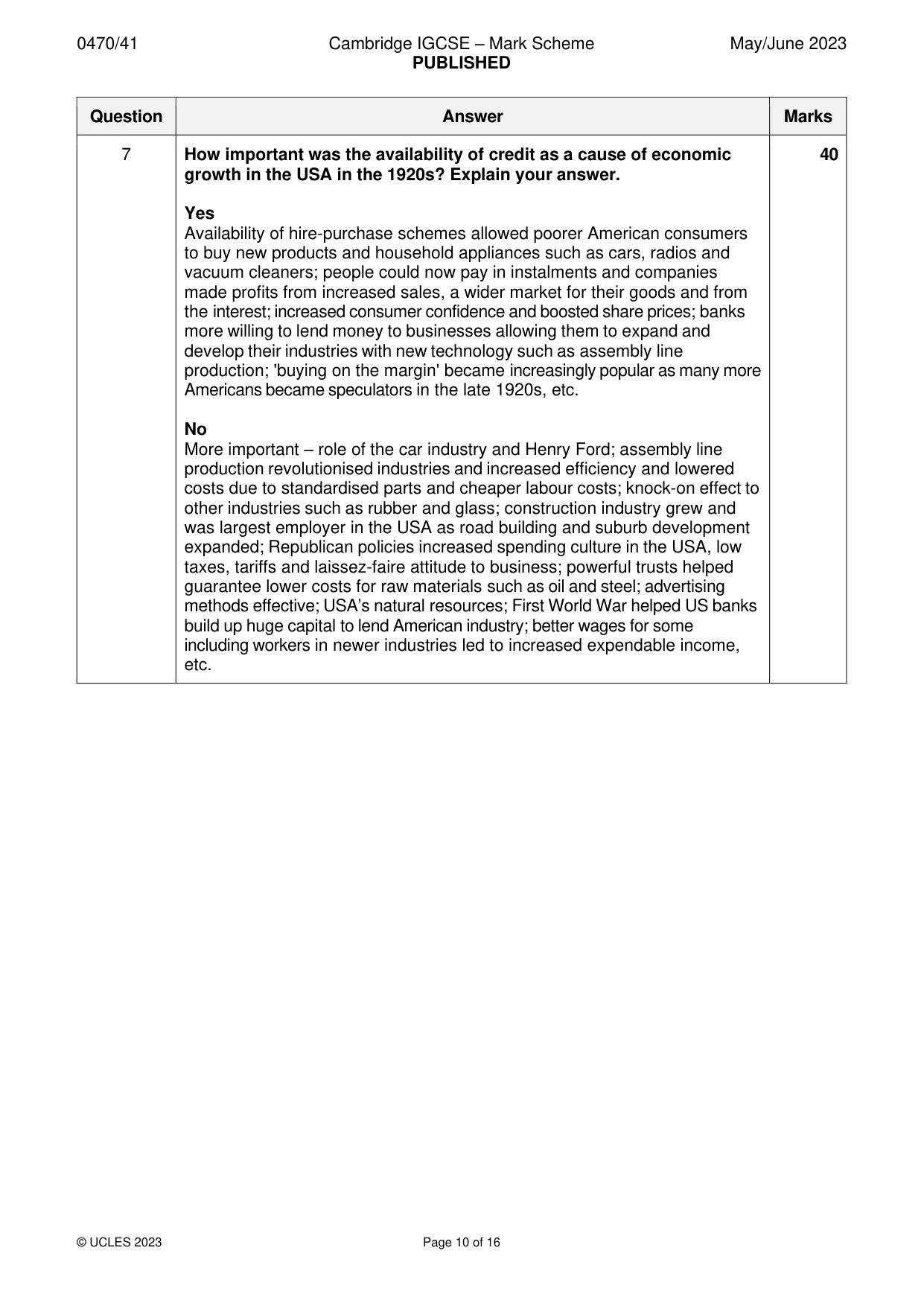
0470/41 Cambridge IGCSE – Mark Scheme PUBLISHED May/June 2023 © UCLES 2023 Page 10 of 16 Question Answer Marks 7 How important was the availability of credit as a cause of economic growth in the USA in the 1920s? Explain your answer. Yes Availability of hire-purchase schemes allowed poorer American consumers to buy new products and household appliances such as cars, radios and vacuum cleaners; people could now pay in instalments and companies made profits from increased sales, a wider market for their goods and from the interest; increased consumer confidence and boosted share prices; banks more willing to lend money to businesses allowing them to expand and develop their industries with new technology such as assembly line production; 'buying on the margin' became increasingly popular as many more Americans became speculators in the late 1920s, etc. No More important – role of the car industry and Henry Ford; assembly line production revolutionised industries and increased efficiency and lowered costs due to standardised parts and cheaper labour costs; knock-on effect to other industries such as rubber and glass; construction industry grew and was largest employer in the USA as road building and suburb development expanded; Republican policies increased spending culture in the USA, low taxes, tariffs and laissez-faire attitude to business; powerful trusts helped guarantee lower costs for raw materials such as oil and steel; advertising methods effective; USA’s natural resources; First World War helped US banks build up huge capital to lend American industry; better wages for some including workers in newer industries led to increased expendable income, etc. 40
Mark scheme, page 11
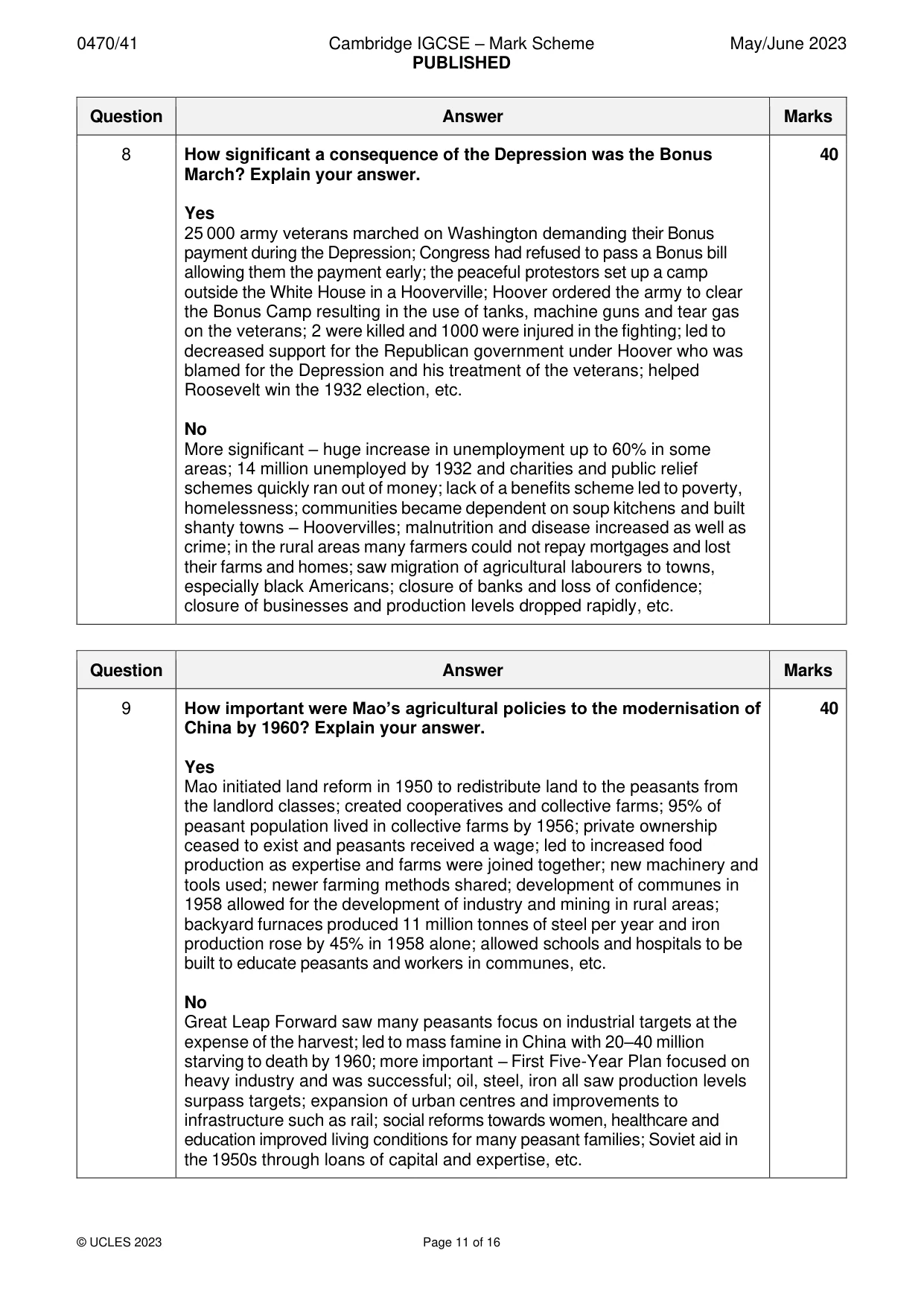
0470/41 Cambridge IGCSE – Mark Scheme PUBLISHED May/June 2023 © UCLES 2023 Page 11 of 16 Question Answer Marks 8 How significant a consequence of the Depression was the Bonus March? Explain your answer. Yes 25 000 army veterans marched on Washington demanding their Bonus payment during the Depression; Congress had refused to pass a Bonus bill allowing them the payment early; the peaceful protestors set up a camp outside the White House in a Hooverville; Hoover ordered the army to clear the Bonus Camp resulting in the use of tanks, machine guns and tear gas on the veterans; 2 were killed and 1000 were injured in the fighting; led to decreased support for the Republican government under Hoover who was blamed for the Depression and his treatment of the veterans; helped Roosevelt win the 1932 election, etc. No More significant – huge increase in unemployment up to 60% in some areas; 14 million unemployed by 1932 and charities and public relief schemes quickly ran out of money; lack of a benefits scheme led to poverty, homelessness; communities became dependent on soup kitchens and built shanty towns – Hoovervilles; malnutrition and disease increased as well as crime; in the rural areas many farmers could not repay mortgages and lost their farms and homes; saw migration of agricultural labourers to towns, especially black Americans; closure of banks and loss of confidence; closure of businesses and production levels dropped rapidly, etc. 40 Question Answer Marks 9 How important were Mao’s agricultural policies to the modernisation of China by 1960? Explain your answer. Yes Mao initiated land reform in 1950 to redistribute land to the peasants from the landlord classes; created cooperatives and collective farms; 95% of peasant population lived in collective farms by 1956; private ownership ceased to exist and peasants received a wage; led to increased food production as expertise and farms were joined together; new machinery and tools used; newer farming methods shared; development of communes in 1958 allowed for the development of industry and mining in rural areas; backyard furnaces produced 11 million tonnes of steel per year and iron production rose by 45% in 1958 alone; allowed schools and hospitals to be built to educate peasants and workers in communes, etc. No Great Leap Forward saw many peasants focus on industrial targets at the expense of the harvest; led to mass famine in China with 20–40 million starving to death by 1960; more important – First Five-Year Plan focused on heavy industry and was successful; oil, steel, iron all saw production levels surpass targets; expansion of urban centres and improvements to infrastructure such as rail; social reforms towards women, healthcare and education improved living conditions for many peasant families; Soviet aid in the 1950s through loans of capital and expertise, etc. 40
Mark scheme, page 12
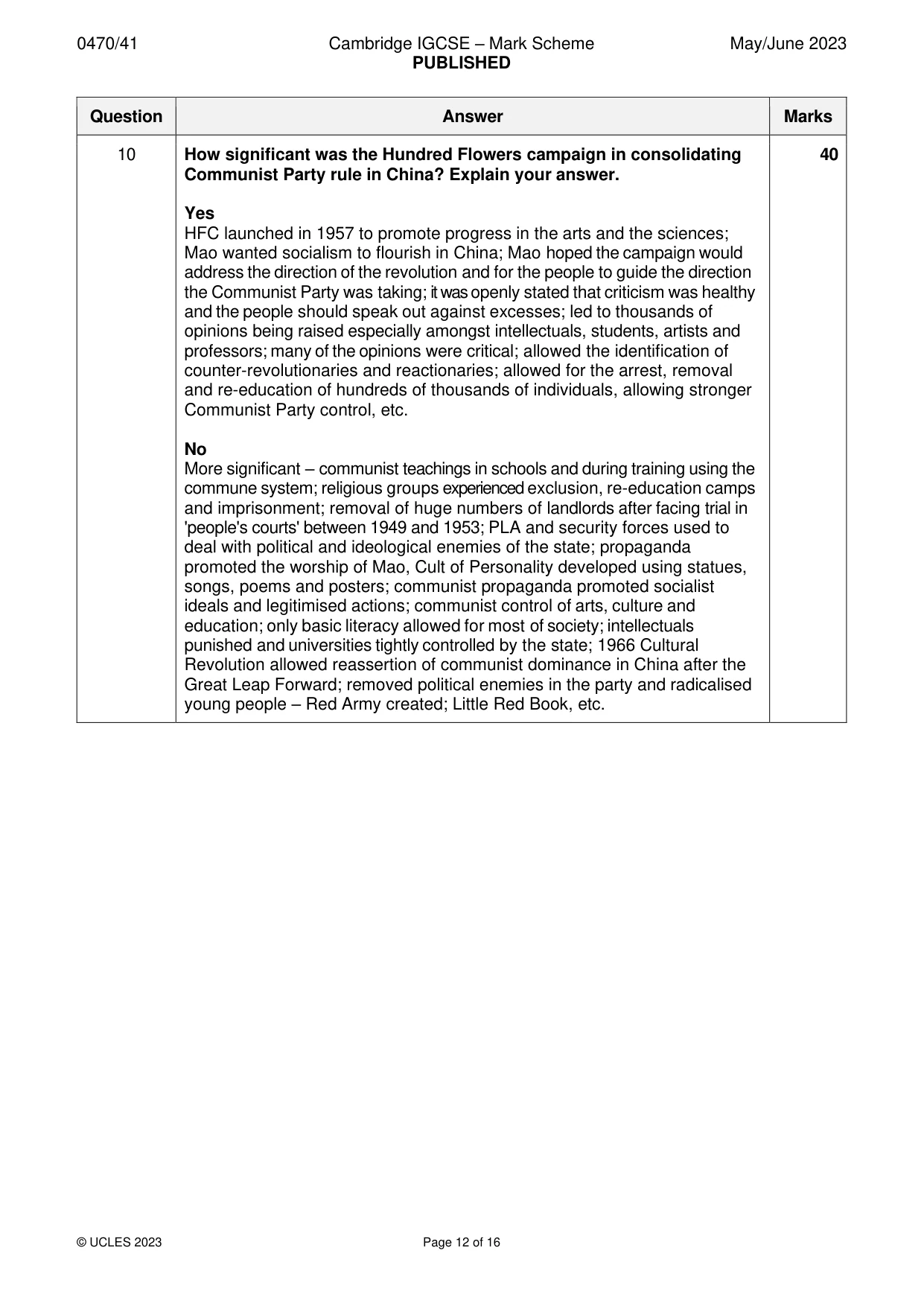
0470/41 Cambridge IGCSE – Mark Scheme PUBLISHED May/June 2023 © UCLES 2023 Page 12 of 16 Question Answer Marks 10 How significant was the Hundred Flowers campaign in consolidating Communist Party rule in China? Explain your answer. Yes HFC launched in 1957 to promote progress in the arts and the sciences; Mao wanted socialism to flourish in China; Mao hoped the campaign would address the direction of the revolution and for the people to guide the direction the Communist Party was taking; it was openly stated that criticism was healthy and the people should speak out against excesses; led to thousands of opinions being raised especially amongst intellectuals, students, artists and professors; many of the opinions were critical; allowed the identification of counter-revolutionaries and reactionaries; allowed for the arrest, removal and re-education of hundreds of thousands of individuals, allowing stronger Communist Party control, etc. No More significant – communist teachings in schools and during training using the commune system; religious groups experienced exclusion, re-education camps and imprisonment; removal of huge numbers of landlords after facing trial in 'people's courts' between 1949 and 1953; PLA and security forces used to deal with political and ideological enemies of the state; propaganda promoted the worship of Mao, Cult of Personality developed using statues, songs, poems and posters; communist propaganda promoted socialist ideals and legitimised actions; communist control of arts, culture and education; only basic literacy allowed for most of society; intellectuals punished and universities tightly controlled by the state; 1966 Cultural Revolution allowed reassertion of communist dominance in China after the Great Leap Forward; removed political enemies in the party and radicalised young people – Red Army created; Little Red Book, etc. 40
Mark scheme, page 13
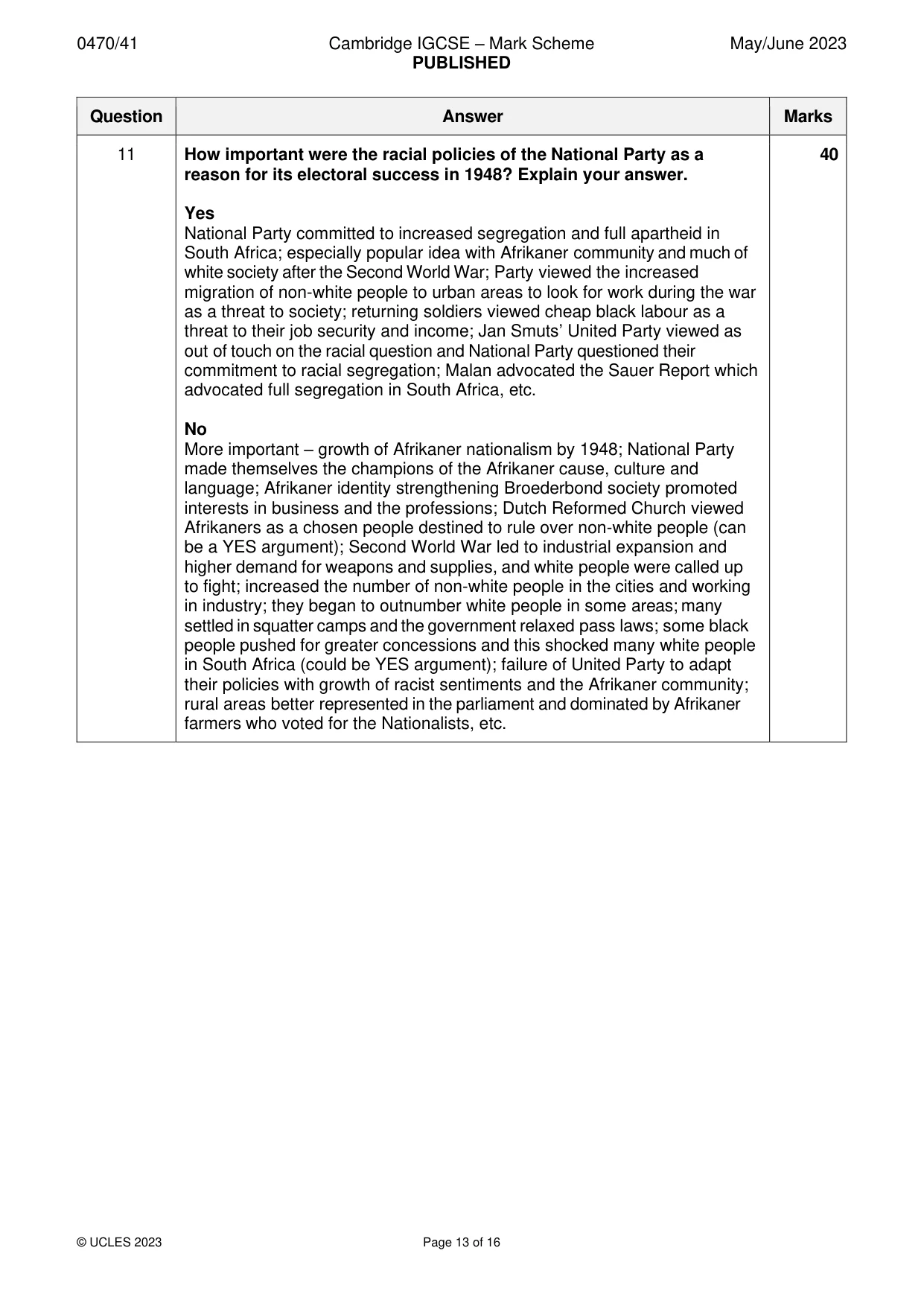
0470/41 Cambridge IGCSE – Mark Scheme PUBLISHED May/June 2023 © UCLES 2023 Page 13 of 16 Question Answer Marks 11 How important were the racial policies of the National Party as a reason for its electoral success in 1948? Explain your answer. Yes National Party committed to increased segregation and full apartheid in South Africa; especially popular idea with Afrikaner community and much of white society after the Second World War; Party viewed the increased migration of non-white people to urban areas to look for work during the war as a threat to society; returning soldiers viewed cheap black labour as a threat to their job security and income; Jan Smuts’ United Party viewed as out of touch on the racial question and National Party questioned their commitment to racial segregation; Malan advocated the Sauer Report which advocated full segregation in South Africa, etc. No More important – growth of Afrikaner nationalism by 1948; National Party made themselves the champions of the Afrikaner cause, culture and language; Afrikaner identity strengthening Broederbond society promoted interests in business and the professions; Dutch Reformed Church viewed Afrikaners as a chosen people destined to rule over non-white people (can be a YES argument); Second World War led to industrial expansion and higher demand for weapons and supplies, and white people were called up to fight; increased the number of non-white people in the cities and working in industry; they began to outnumber white people in some areas; many settled in squatter camps and the government relaxed pass laws; some black people pushed for greater concessions and this shocked many white people in South Africa (could be YES argument); failure of United Party to adapt their policies with growth of racist sentiments and the Afrikaner community; rural areas better represented in the parliament and dominated by Afrikaner farmers who voted for the Nationalists, etc. 40
Mark scheme, page 14
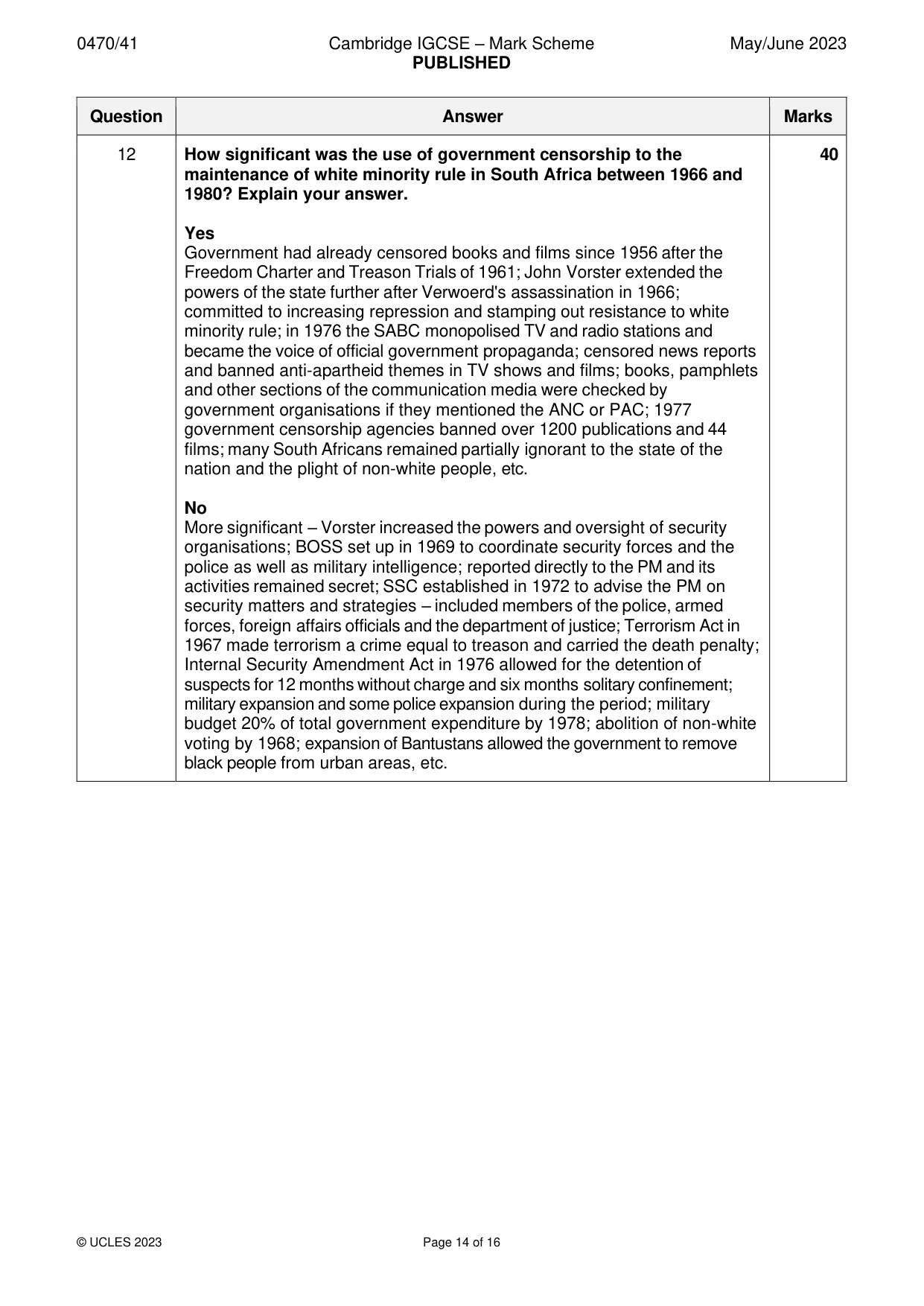
0470/41 Cambridge IGCSE – Mark Scheme PUBLISHED May/June 2023 © UCLES 2023 Page 14 of 16 Question Answer Marks 12 How significant was the use of government censorship to the maintenance of white minority rule in South Africa between 1966 and 1980? Explain your answer. Yes Government had already censored books and films since 1956 after the Freedom Charter and Treason Trials of 1961; John Vorster extended the powers of the state further after Verwoerd's assassination in 1966; committed to increasing repression and stamping out resistance to white minority rule; in 1976 the SABC monopolised TV and radio stations and became the voice of official government propaganda; censored news reports and banned anti-apartheid themes in TV shows and films; books, pamphlets and other sections of the communication media were checked by government organisations if they mentioned the ANC or PAC; 1977 government censorship agencies banned over 1200 publications and 44 films; many South Africans remained partially ignorant to the state of the nation and the plight of non-white people, etc. No More significant – Vorster increased the powers and oversight of security organisations; BOSS set up in 1969 to coordinate security forces and the police as well as military intelligence; reported directly to the PM and its activities remained secret; SSC established in 1972 to advise the PM on security matters and strategies – included members of the police, armed forces, foreign affairs officials and the department of justice; Terrorism Act in 1967 made terrorism a crime equal to treason and carried the death penalty; Internal Security Amendment Act in 1976 allowed for the detention of suspects for 12 months without charge and six months solitary confinement; military expansion and some police expansion during the period; military budget 20% of total government expenditure by 1978; abolition of non-white voting by 1968; expansion of Bantustans allowed the government to remove black people from urban areas, etc. 40
Mark scheme, page 15
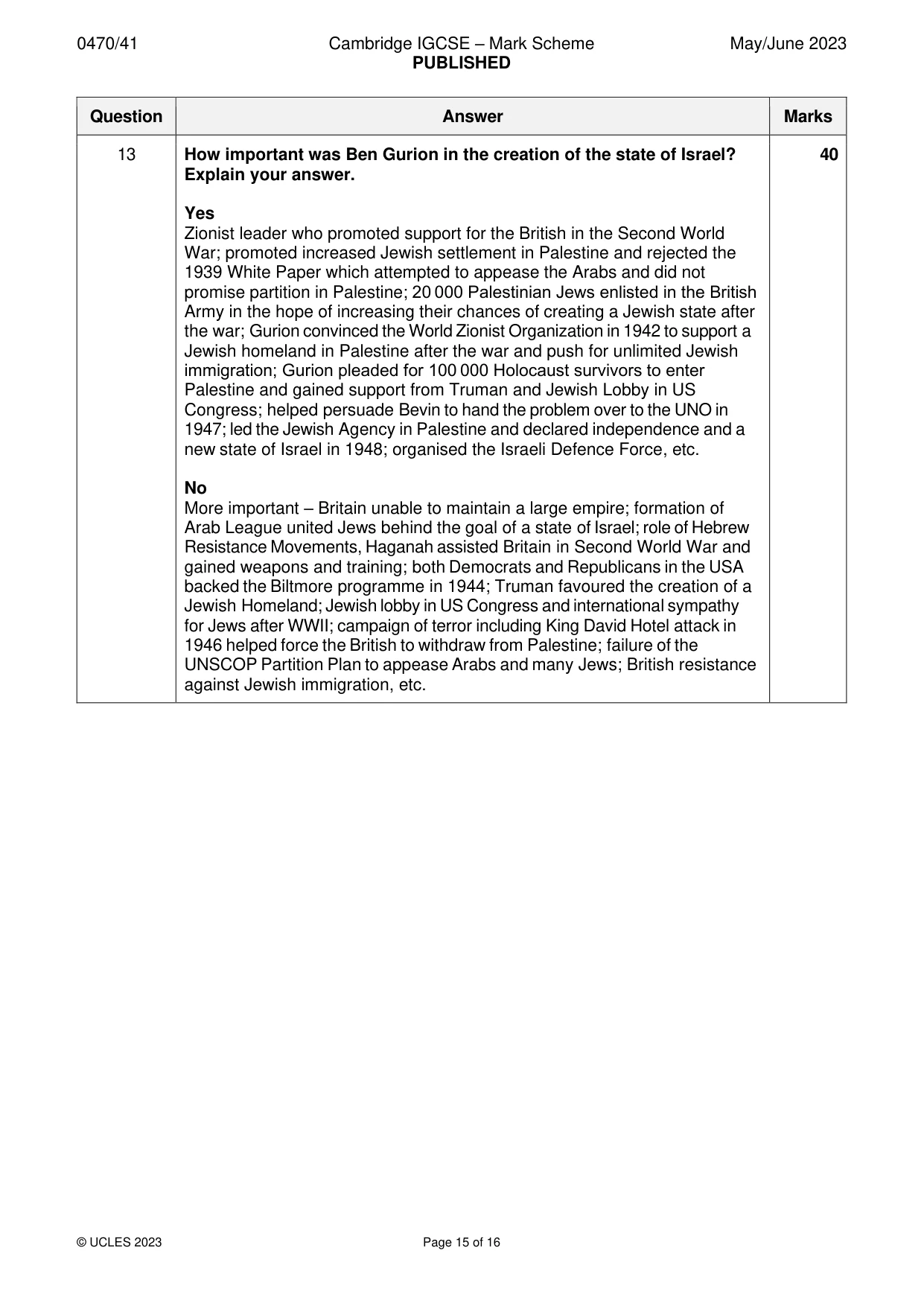
0470/41 Cambridge IGCSE – Mark Scheme PUBLISHED May/June 2023 © UCLES 2023 Page 15 of 16 Question Answer Marks 13 How important was Ben Gurion in the creation of the state of Israel? Explain your answer. Yes Zionist leader who promoted support for the British in the Second World War; promoted increased Jewish settlement in Palestine and rejected the 1939 White Paper which attempted to appease the Arabs and did not promise partition in Palestine; 20 000 Palestinian Jews enlisted in the British Army in the hope of increasing their chances of creating a Jewish state after the war; Gurion convinced the World Zionist Organization in 1942 to support a Jewish homeland in Palestine after the war and push for unlimited Jewish immigration; Gurion pleaded for 100 000 Holocaust survivors to enter Palestine and gained support from Truman and Jewish Lobby in US Congress; helped persuade Bevin to hand the problem over to the UNO in 1947; led the Jewish Agency in Palestine and declared independence and a new state of Israel in 1948; organised the Israeli Defence Force, etc. No More important – Britain unable to maintain a large empire; formation of Arab League united Jews behind the goal of a state of Israel; role of Hebrew Resistance Movements, Haganah assisted Britain in Second World War and gained weapons and training; both Democrats and Republicans in the USA backed the Biltmore programme in 1944; Truman favoured the creation of a Jewish Homeland; Jewish lobby in US Congress and international sympathy for Jews after WWII; campaign of terror including King David Hotel attack in 1946 helped force the British to withdraw from Palestine; failure of the UNSCOP Partition Plan to appease Arabs and many Jews; British resistance against Jewish immigration, etc. 40
Mark scheme, page 16
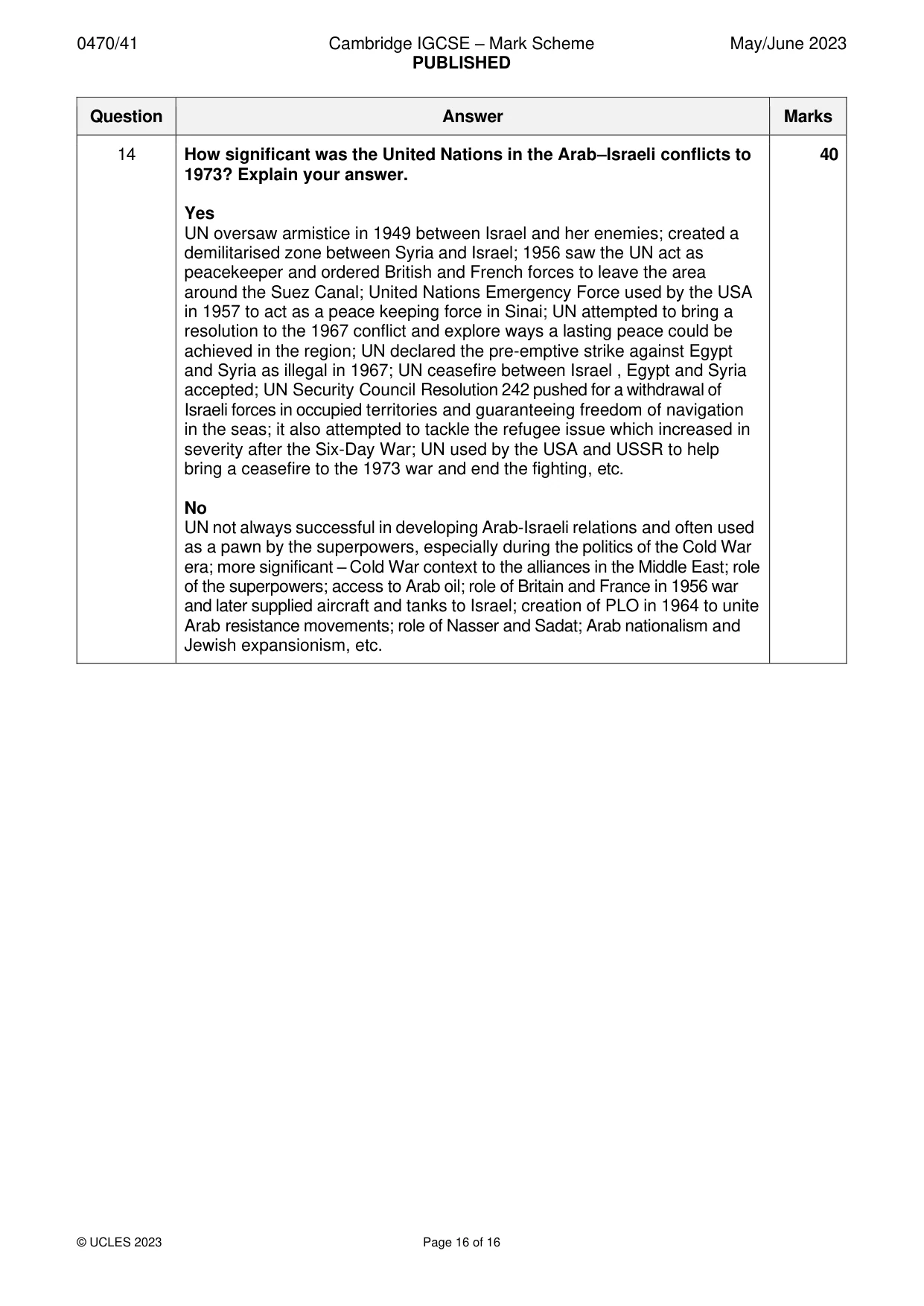
0470/41 Cambridge IGCSE – Mark Scheme PUBLISHED May/June 2023 © UCLES 2023 Page 16 of 16 Question Answer Marks 14 How significant was the United Nations in the Arab–Israeli conflicts to 1973? Explain your answer. Yes UN oversaw armistice in 1949 between Israel and her enemies; created a demilitarised zone between Syria and Israel; 1956 saw the UN act as peacekeeper and ordered British and French forces to leave the area around the Suez Canal; United Nations Emergency Force used by the USA in 1957 to act as a peace keeping force in Sinai; UN attempted to bring a resolution to the 1967 conflict and explore ways a lasting peace could be achieved in the region; UN declared the pre-emptive strike against Egypt and Syria as illegal in 1967; UN ceasefire between Israel , Egypt and Syria accepted; UN Security Council Resolution 242 pushed for a withdrawal of Israeli forces in occupied territories and guaranteeing freedom of navigation in the seas; it also attempted to tackle the refugee issue which increased in severity after the Six-Day War; UN used by the USA and USSR to help bring a ceasefire to the 1973 war and end the fighting, etc. No UN not always successful in developing Arab-Israeli relations and often used as a pawn by the superpowers, especially during the politics of the Cold War era; more significant – Cold War context to the alliances in the Middle East; role of the superpowers; access to Arab oil; role of Britain and France in 1956 war and later supplied aircraft and tanks to Israel; creation of PLO in 1964 to unite Arab resistance movements; role of Nasser and Sadat; Arab nationalism and Jewish expansionism, etc. 40
What you needed in this session
Cambridge’s own grade thresholds for 2023 May/June, Paper 4 · Variant 1. A higher threshold means an easier paper — the bar moves with how the cohort did.