Cambridge IGCSE History 0470 — 2022 May/June Paper 1 · Variant 3
0470/13/M/J/22 · 60 marks · ≈68 min
The question paper and its mark scheme, free to read here and free to download. This is Cambridge’s own paper, exactly as it was sat.
Question paper12 pages


Mark scheme65 pages
Answers below. Sit the paper first if you are practising.
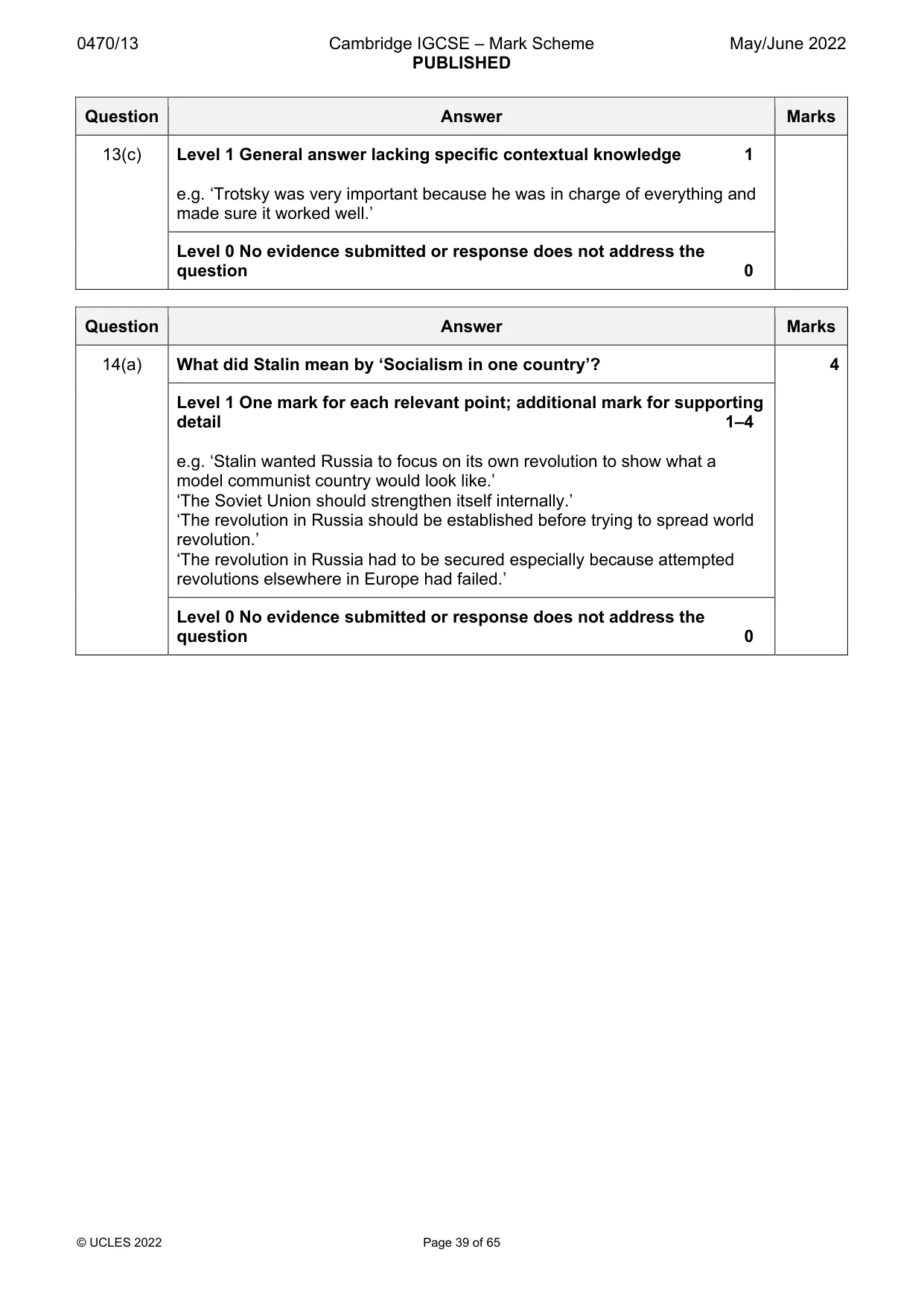
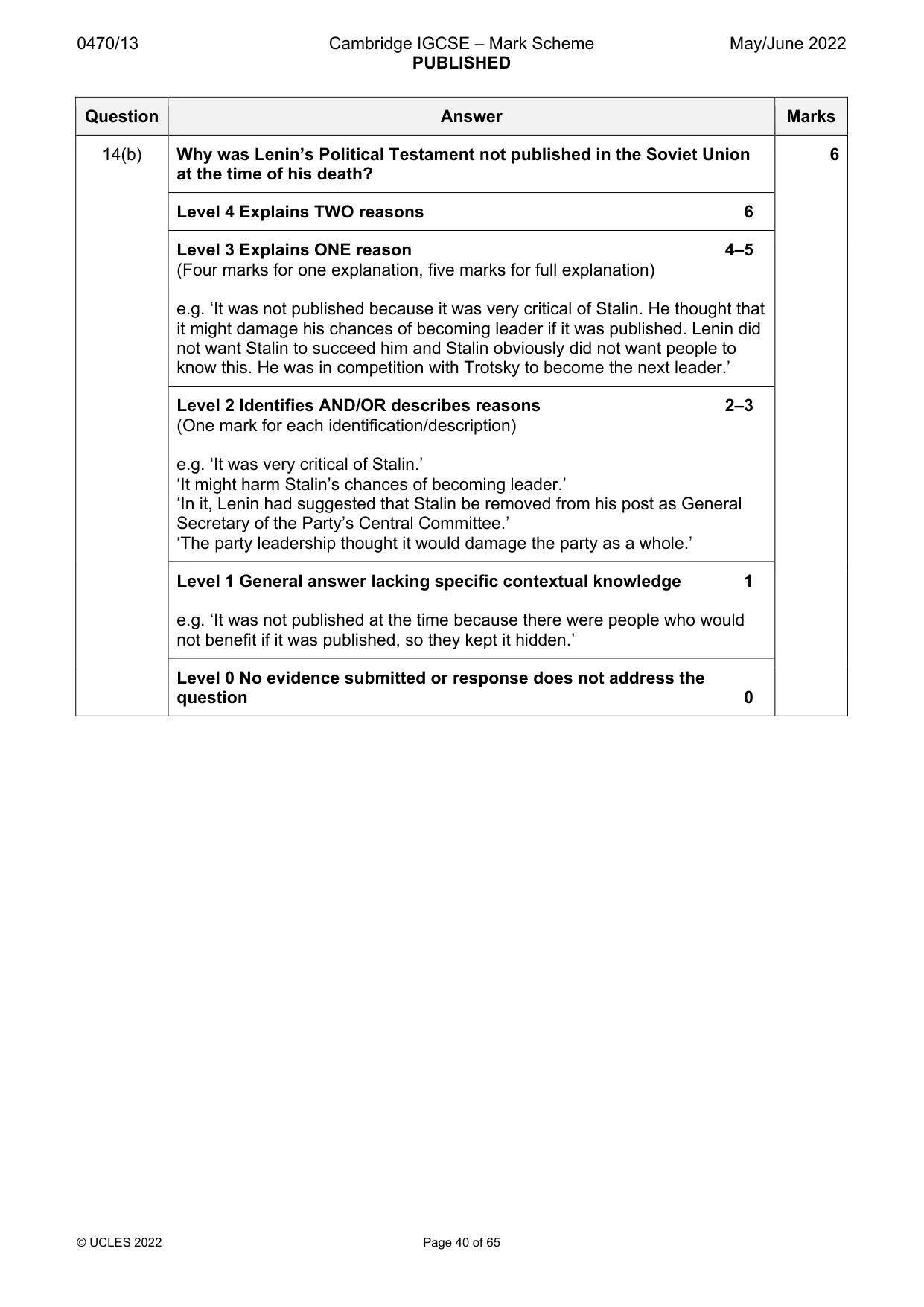
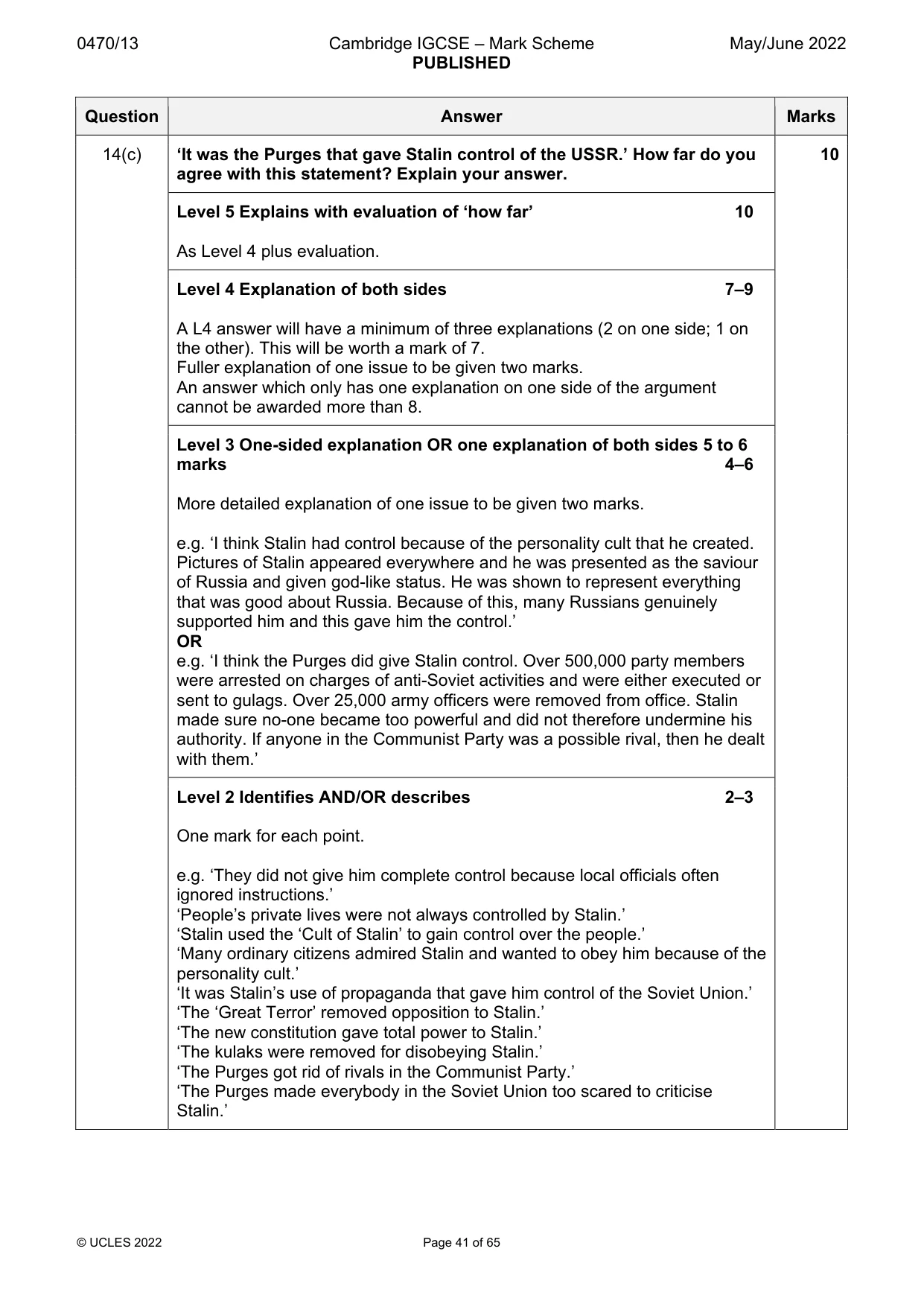
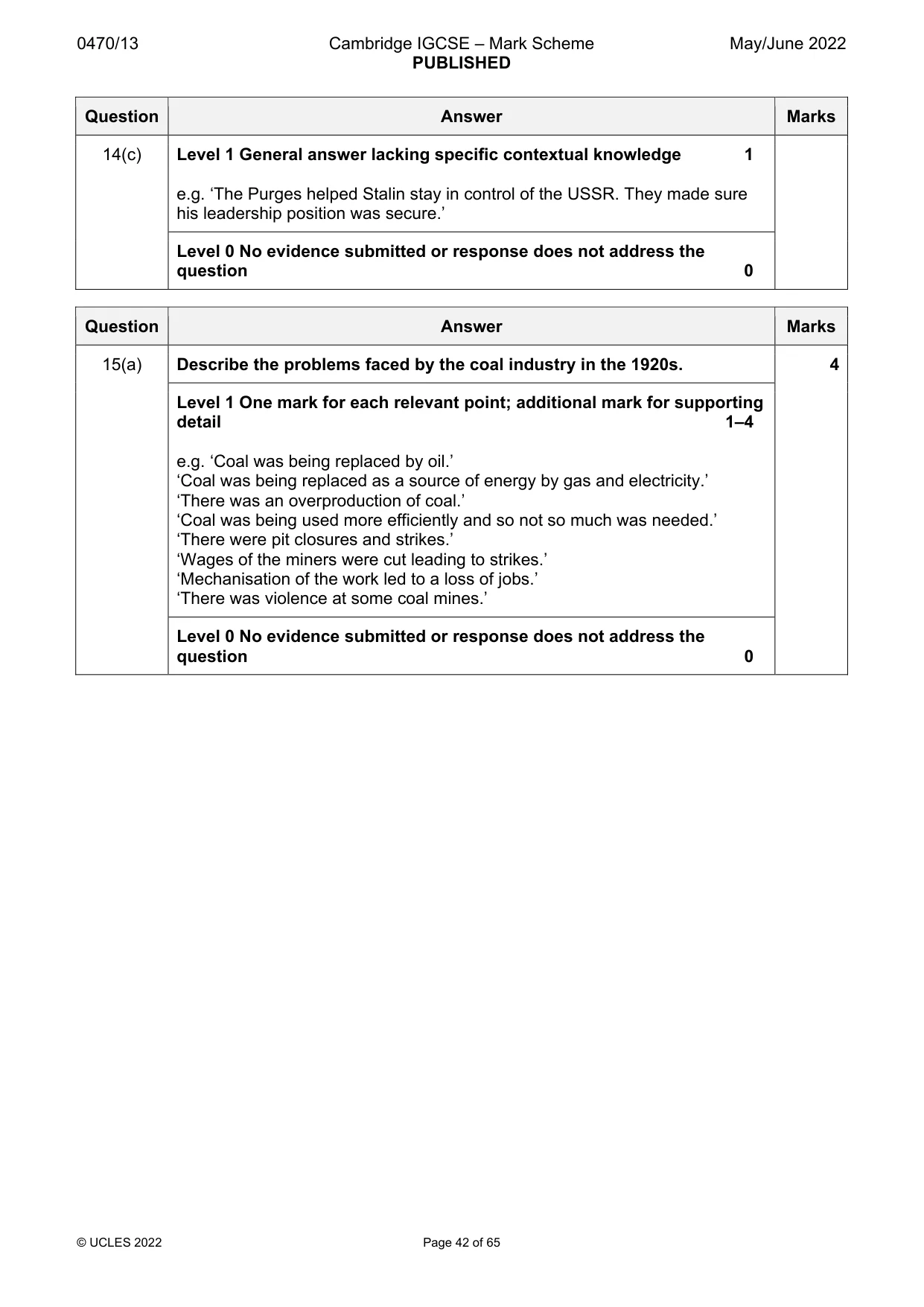
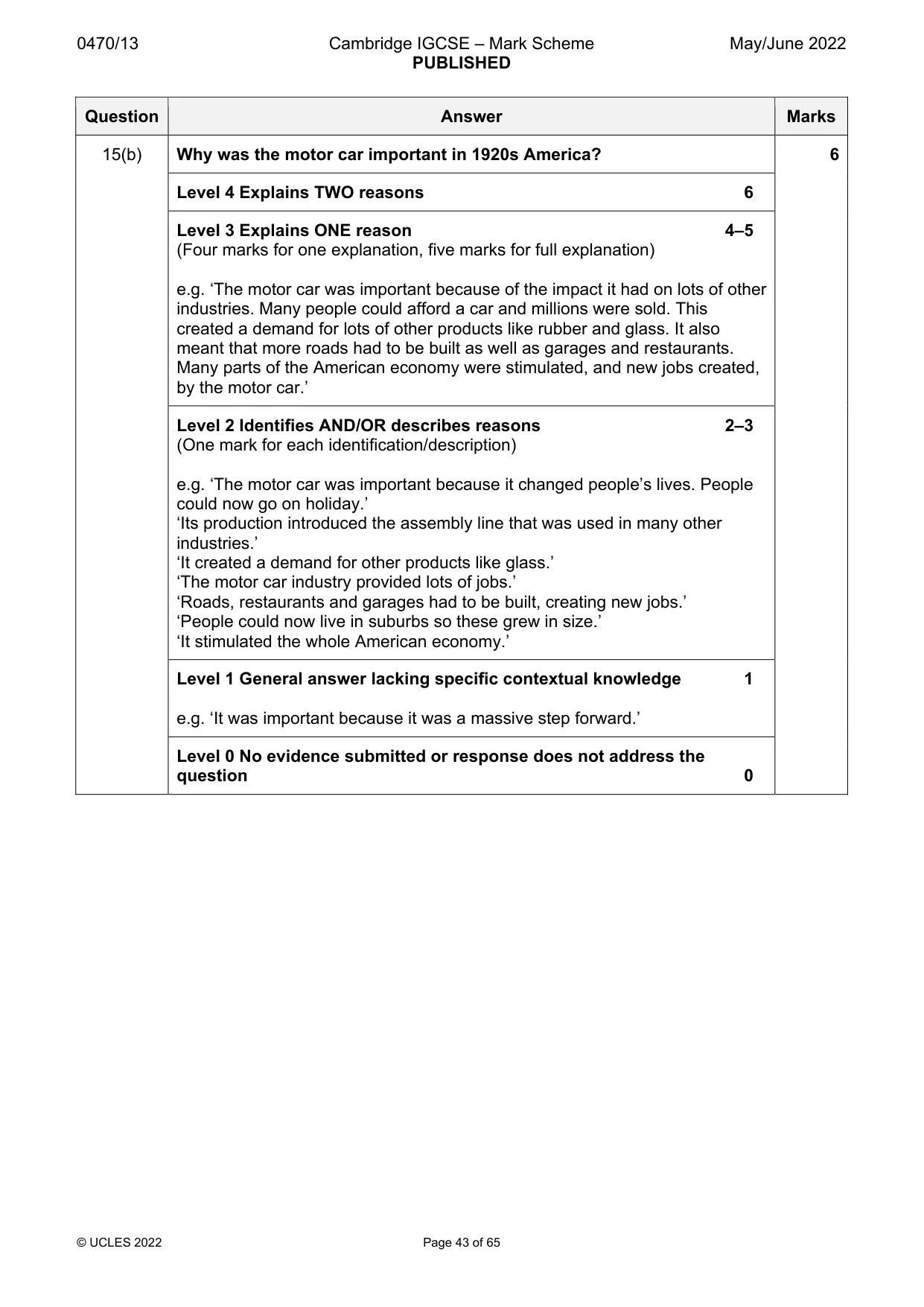
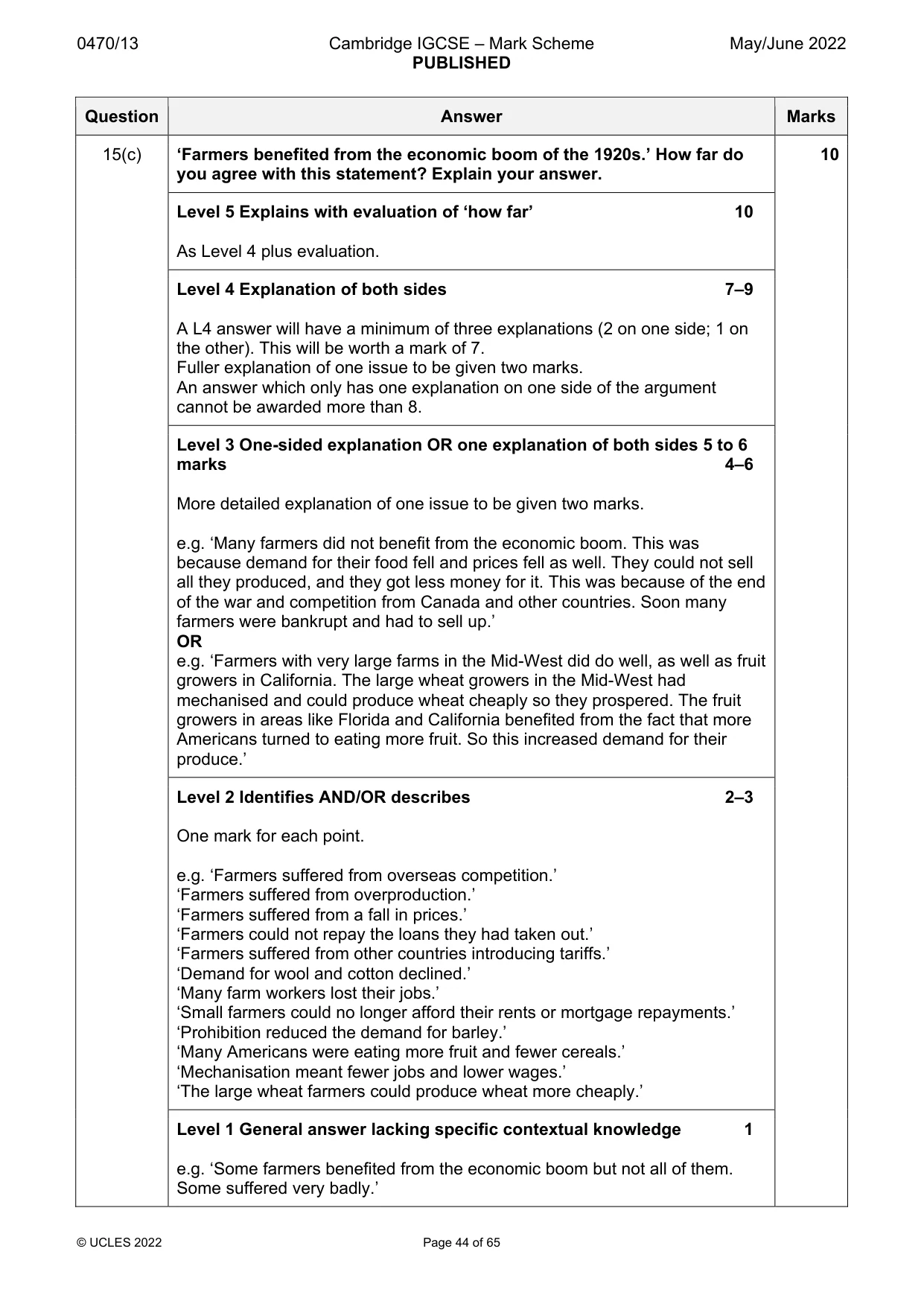
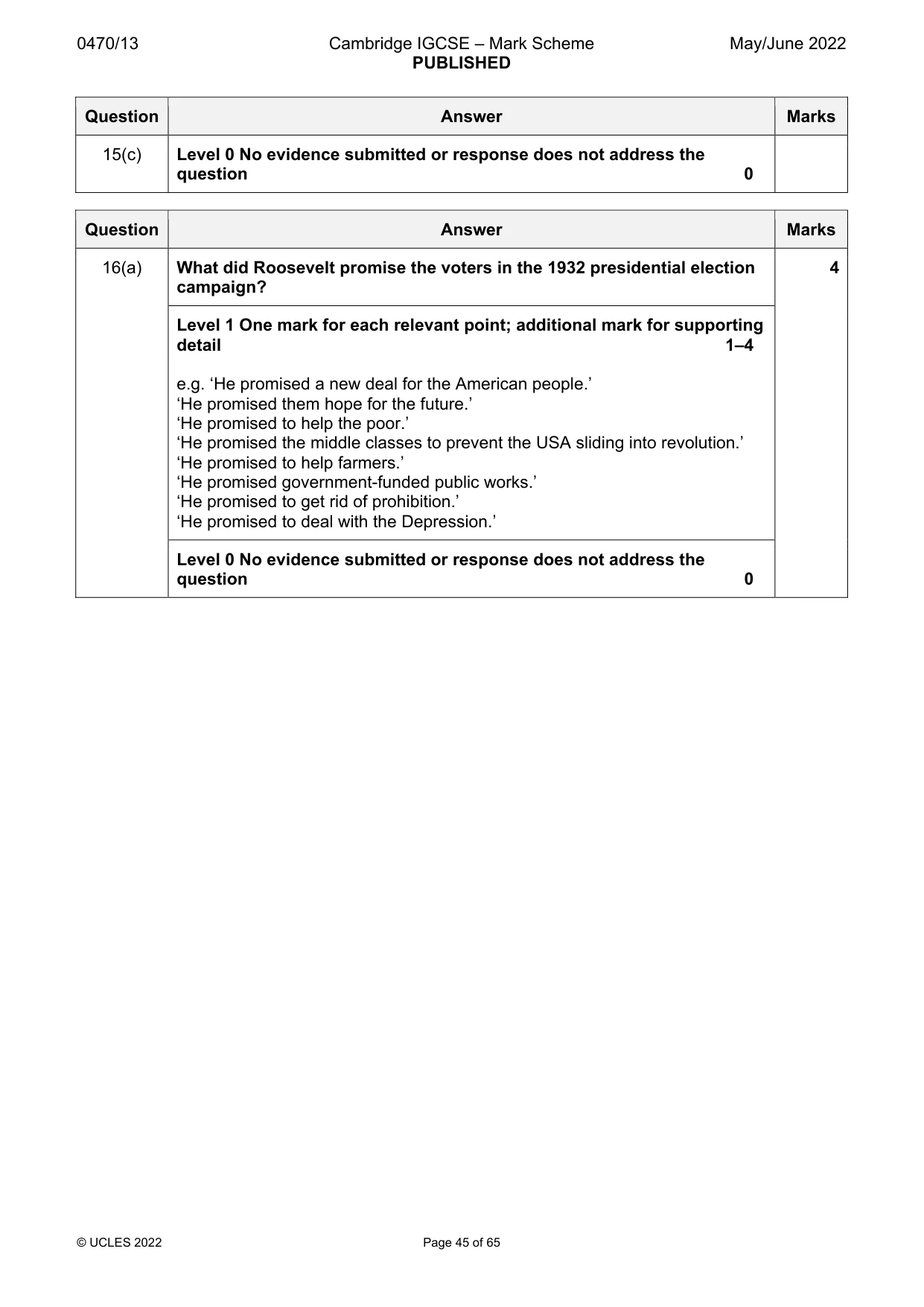
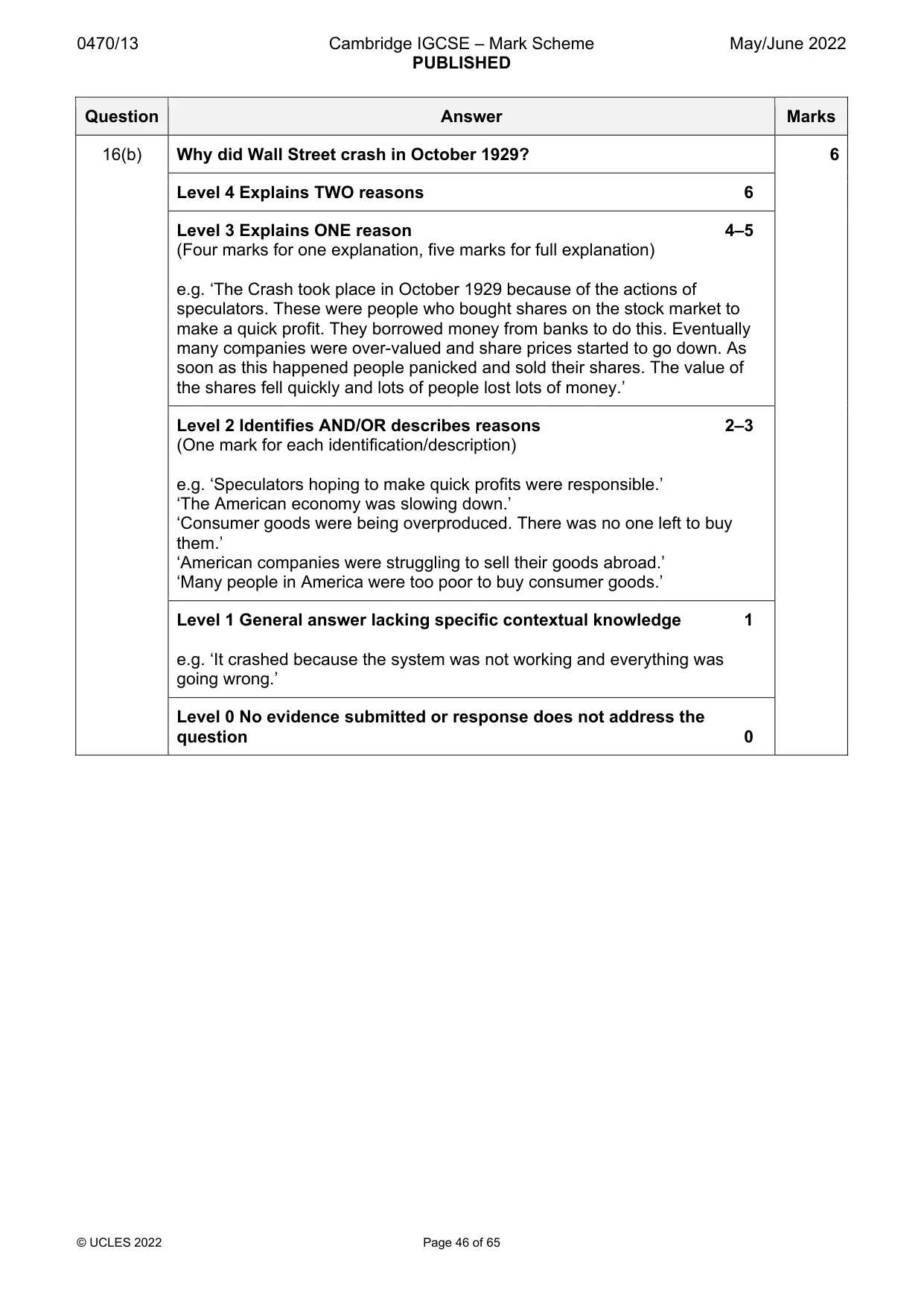
Paper as text
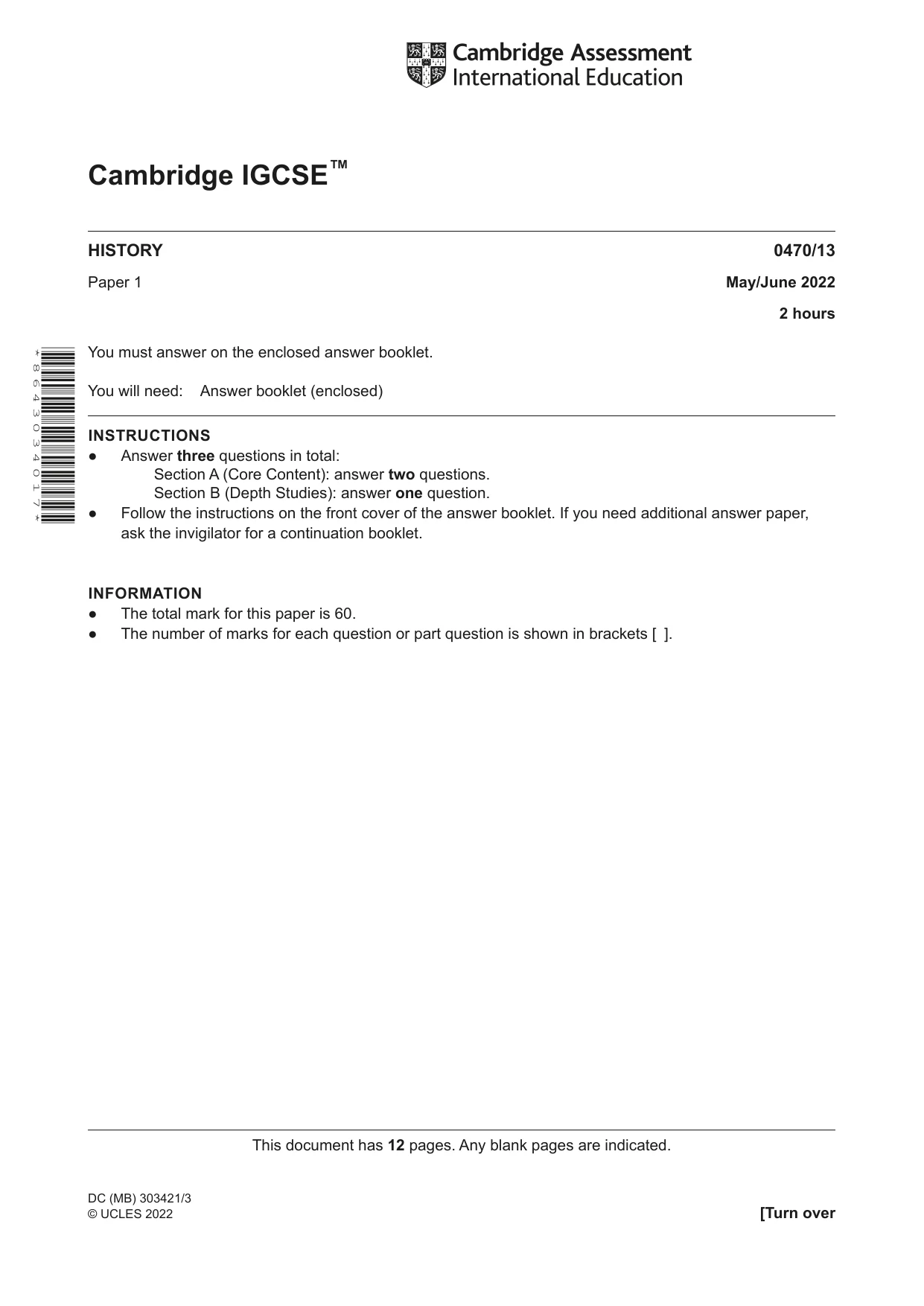
Question paper, page 1
This document has 12 pages. Any blank pages are indicated. [Turn over Cambridge IGCSE™ HISTORY 0470/13 Paper 1 May/June 2022 2 hours You must answer on the enclosed answer booklet. You will need: Answer booklet (enclosed) INSTRUCTIONS ● Answer three questions in total: Section A (Core Content): answer two questions. Section B (Depth Studies): answer one question. ● Follow the instructions on the front cover of the answer booklet. If you need additional answer paper, ask the invigilator for a continuation booklet. INFORMATION ● The total mark for this paper is 60. ● The number of marks for each question or part question is shown in brackets [ ]. DC (MB) 303421/3 © UCLES 2022 * 8 6 4 3 0 3 4 0 1 7 *
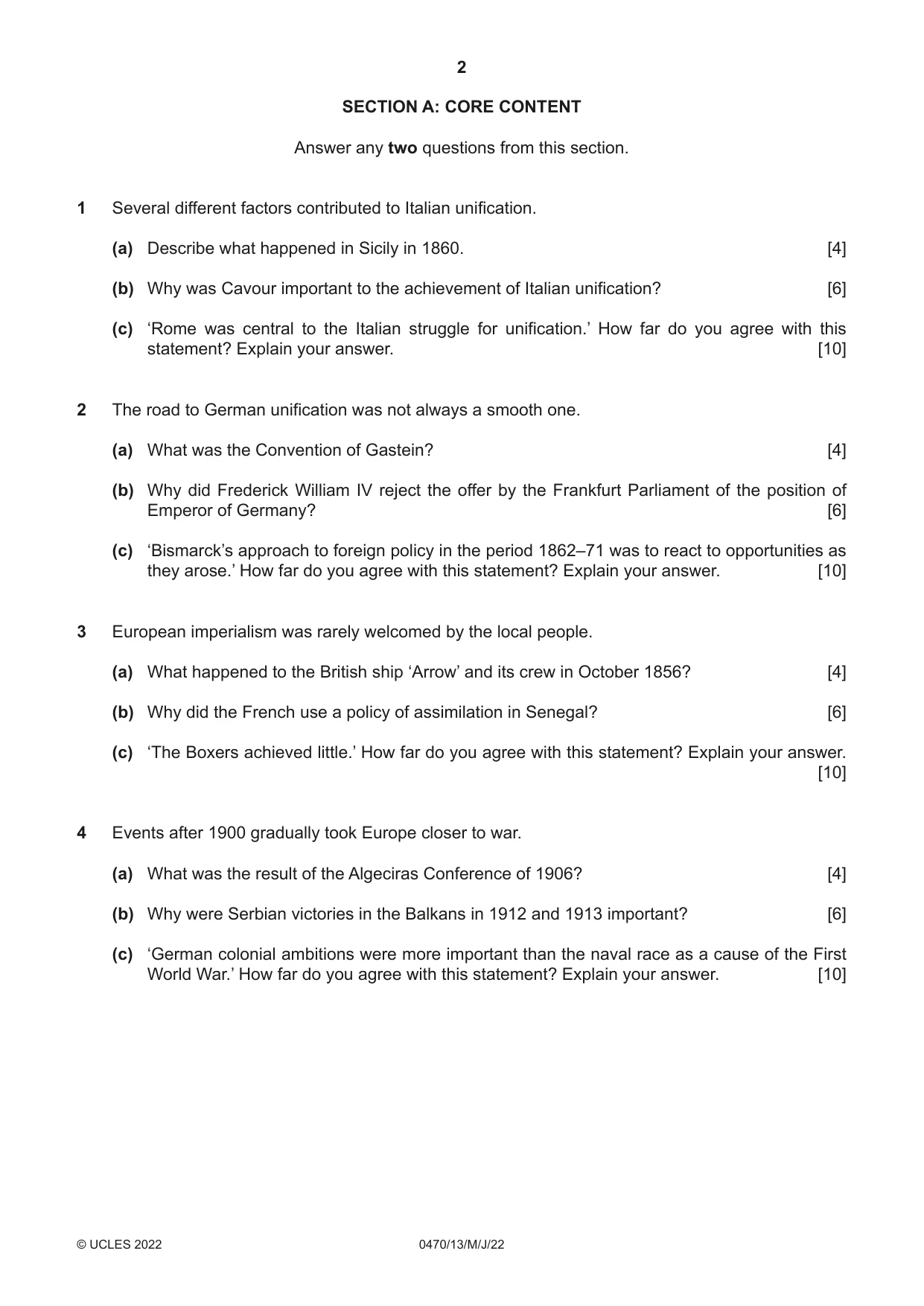
Question paper, page 2
2 0470/13/M/J/22 © UCLES 2022 SECTION A: CORE CONTENT Answer any two questions from this section. 1 Several different factors contributed to Italian unification. (a) Describe what happened in Sicily in 1860. [4] (b) Why was Cavour important to the achievement of Italian unification? [6] (c) ‘Rome was central to the Italian struggle for unification.’ How far do you agree with this statement? Explain your answer. [10] 2 The road to German unification was not always a smooth one. (a) What was the Convention of Gastein? [4] (b) Why did Frederick William IV reject the offer by the Frankfurt Parliament of the position of Emperor of Germany? [6] (c) ‘Bismarck’s approach to foreign policy in the period 1862–71 was to react to opportunities as they arose.’ How far do you agree with this statement? Explain your answer. [10] 3 European imperialism was rarely welcomed by the local people. (a) What happened to the British ship ‘Arrow’ and its crew in October 1856? [4] (b) Why did the French use a policy of assimilation in Senegal? [6] (c) ‘The Boxers achieved little.’ How far do you agree with this statement? Explain your answer. [10] 4 Events after 1900 gradually took Europe closer to war. (a) What was the result of the Algeciras Conference of 1906? [4] (b) Why were Serbian victories in the Balkans in 1912 and 1913 important? [6] (c) ‘German colonial ambitions were more important than the naval race as a cause of the First World War.’ How far do you agree with this statement? Explain your answer. [10]
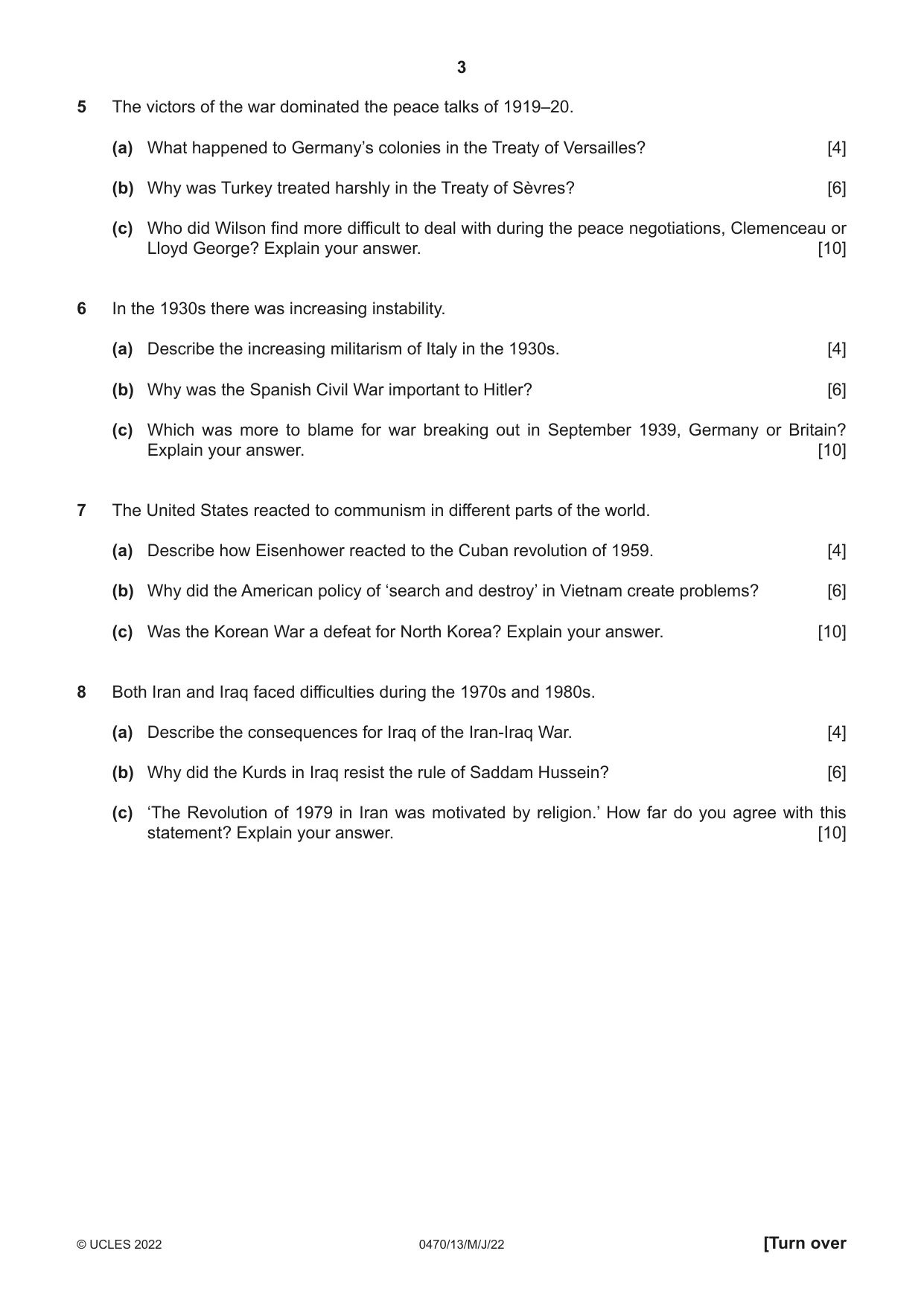
Question paper, page 3
3 0470/13/M/J/22 © UCLES 2022 [Turn over 5 The victors of the war dominated the peace talks of 1919–20. (a) What happened to Germany’s colonies in the Treaty of Versailles? [4] (b) Why was Turkey treated harshly in the Treaty of Sèvres? [6] (c) Who did Wilson find more difficult to deal with during the peace negotiations, Clemenceau or Lloyd George? Explain your answer. [10] 6 In the 1930s there was increasing instability. (a) Describe the increasing militarism of Italy in the 1930s. [4] (b) Why was the Spanish Civil War important to Hitler? [6] (c) Which was more to blame for war breaking out in September 1939, Germany or Britain? Explain your answer. [10] 7 The United States reacted to communism in different parts of the world. (a) Describe how Eisenhower reacted to the Cuban revolution of 1959. [4] (b) Why did the American policy of ‘search and destroy’ in Vietnam create problems? [6] (c) Was the Korean War a defeat for North Korea? Explain your answer. [10] 8 Both Iran and Iraq faced difficulties during the 1970s and 1980s. (a) Describe the consequences for Iraq of the Iran-Iraq War. [4] (b) Why did the Kurds in Iraq resist the rule of Saddam Hussein? [6] (c) ‘The Revolution of 1979 in Iran was motivated by religion.’ How far do you agree with this statement? Explain your answer. [10]
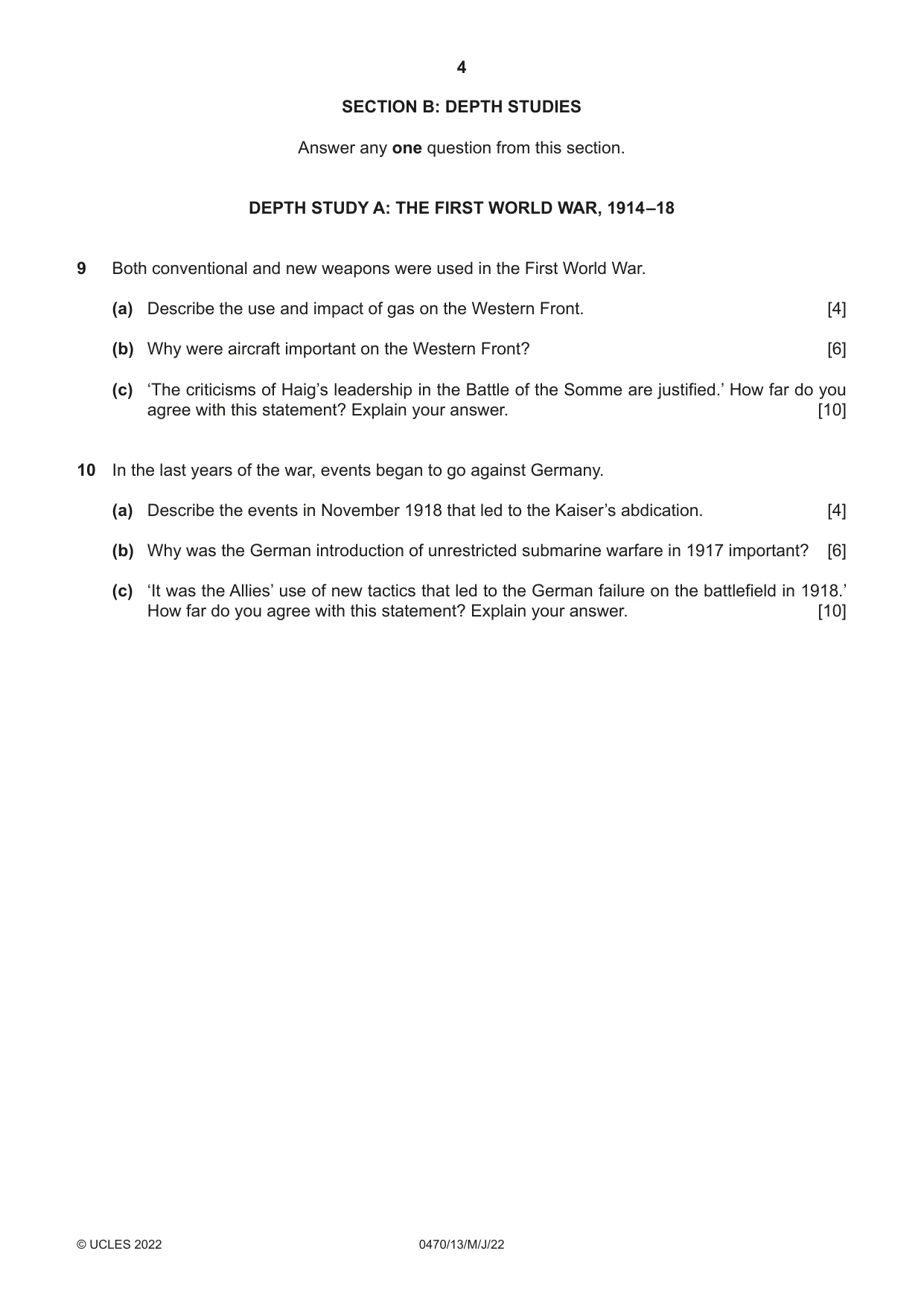
Question paper, page 4
4 0470/13/M/J/22 © UCLES 2022 SECTION B: DEPTH STUDIES Answer any one question from this section. DEPTH STUDY A: THE FIRST WORLD WAR, 1914 –18 9 Both conventional and new weapons were used in the First World War. (a) Describe the use and impact of gas on the Western Front. [4] (b) Why were aircraft important on the Western Front? [6] (c) ‘The criticisms of Haig’s leadership in the Battle of the Somme are justified.’ How far do you agree with this statement? Explain your answer. [10] 10 In the last years of the war, events began to go against Germany. (a) Describe the events in November 1918 that led to the Kaiser’s abdication. [4] (b) Why was the German introduction of unrestricted submarine warfare in 1917 important? [6] (c) ‘It was the Allies’ use of new tactics that led to the German failure on the battlefield in 1918.’ How far do you agree with this statement? Explain your answer. [10]
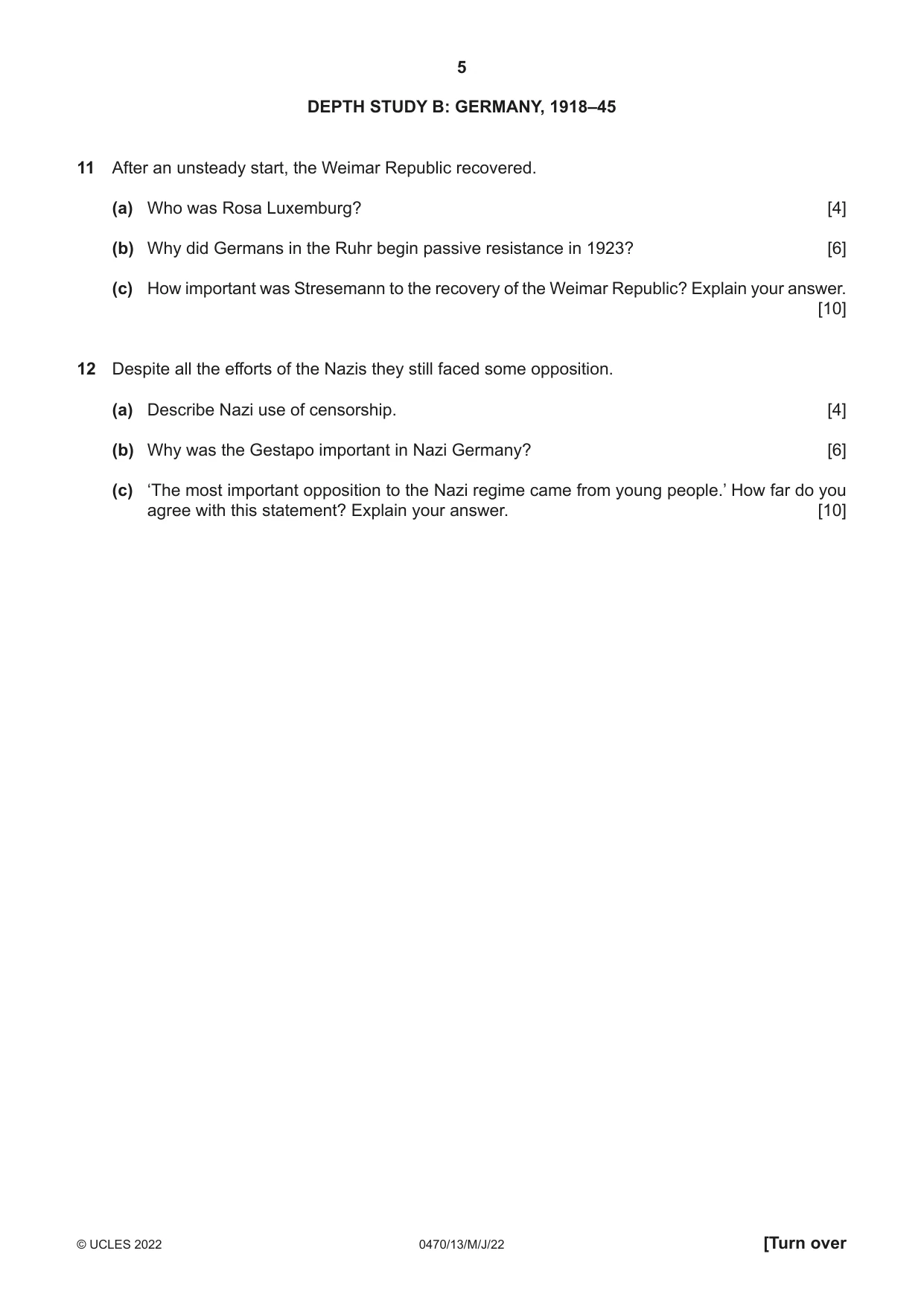
Question paper, page 5
5 0470/13/M/J/22 © UCLES 2022 [Turn over DEPTH STUDY B: GERMANY, 1918–45 11 After an unsteady start, the Weimar Republic recovered. (a) Who was Rosa Luxemburg? [4] (b) Why did Germans in the Ruhr begin passive resistance in 1923? [6] (c) How important was Stresemann to the recovery of the Weimar Republic? Explain your answer. [10] 12 Despite all the efforts of the Nazis they still faced some opposition. (a) Describe Nazi use of censorship. [4] (b) Why was the Gestapo important in Nazi Germany? [6] (c) ‘The most important opposition to the Nazi regime came from young people.’ How far do you agree with this statement? Explain your answer. [10]
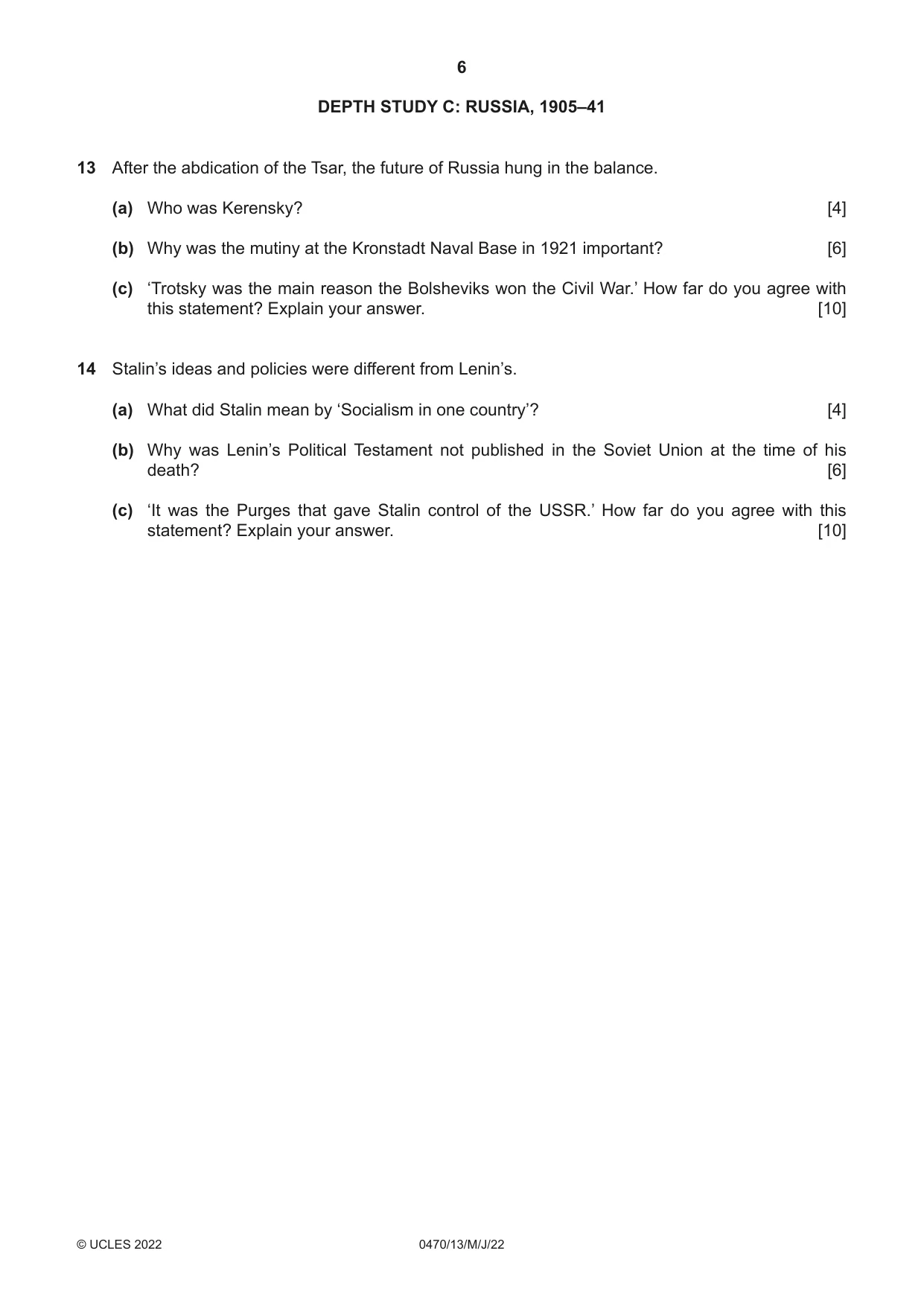
Question paper, page 6
6 0470/13/M/J/22 © UCLES 2022 DEPTH STUDY C: RUSSIA, 1905–41 13 After the abdication of the Tsar, the future of Russia hung in the balance. (a) Who was Kerensky? [4] (b) Why was the mutiny at the Kronstadt Naval Base in 1921 important? [6] (c) ‘Trotsky was the main reason the Bolsheviks won the Civil War.’ How far do you agree with this statement? Explain your answer. [10] 14 Stalin’s ideas and policies were different from Lenin’s. (a) What did Stalin mean by ‘Socialism in one country’? [4] (b) Why was Lenin’s Political Testament not published in the Soviet Union at the time of his death? [6] (c) ‘It was the Purges that gave Stalin control of the USSR.’ How far do you agree with this statement? Explain your answer. [10]
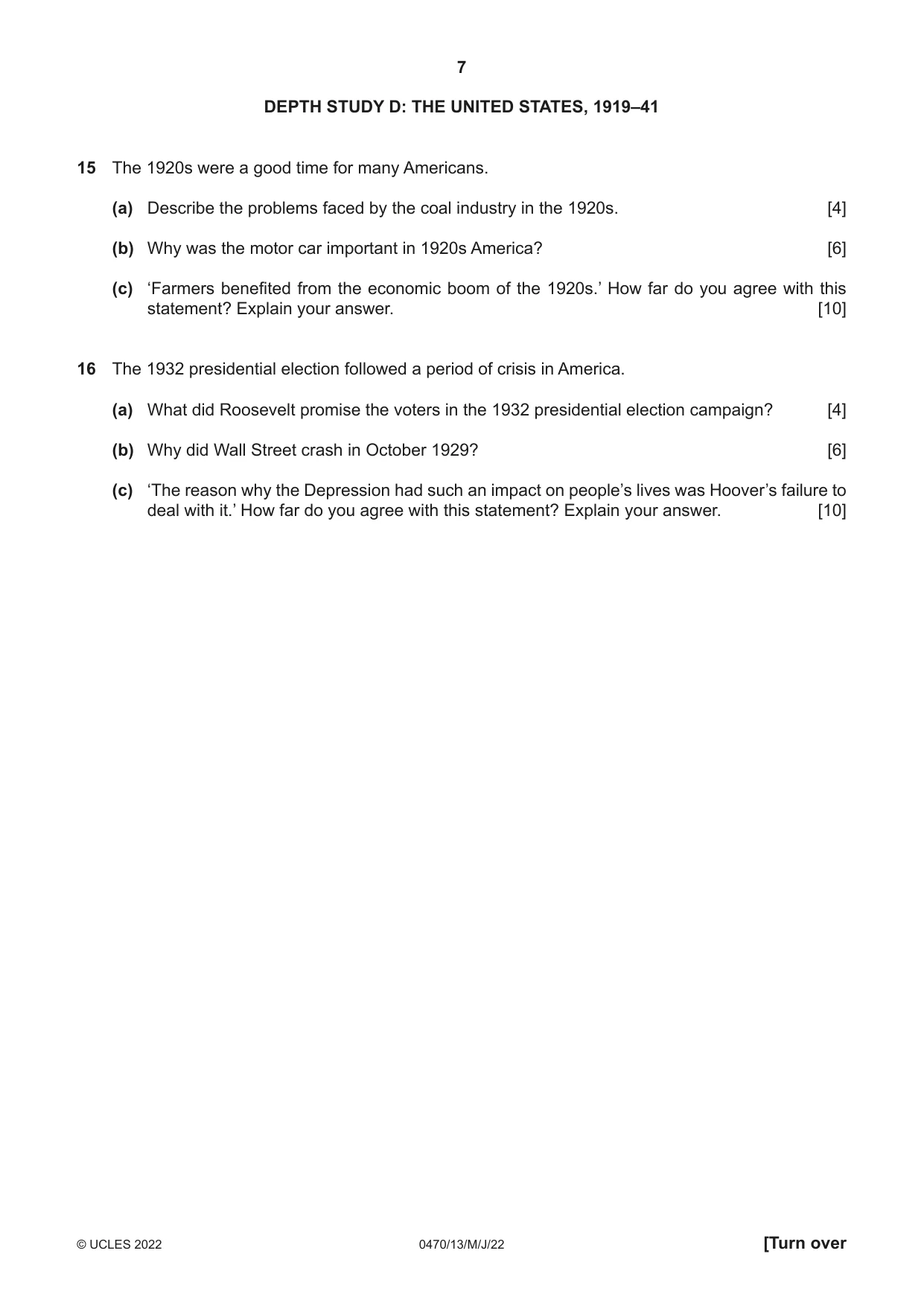
Question paper, page 7
7 0470/13/M/J/22 © UCLES 2022 [Turn over DEPTH STUDY D: THE UNITED STATES, 1919–41 15 The 1920s were a good time for many Americans. (a) Describe the problems faced by the coal industry in the 1920s. [4] (b) Why was the motor car important in 1920s America? [6] (c) ‘Farmers benefited from the economic boom of the 1920s.’ How far do you agree with this statement? Explain your answer. [10] 16 The 1932 presidential election followed a period of crisis in America. (a) What did Roosevelt promise the voters in the 1932 presidential election campaign? [4] (b) Why did Wall Street crash in October 1929? [6] (c) ‘The reason why the Depression had such an impact on people’s lives was Hoover’s failure to deal with it.’ How far do you agree with this statement? Explain your answer. [10]
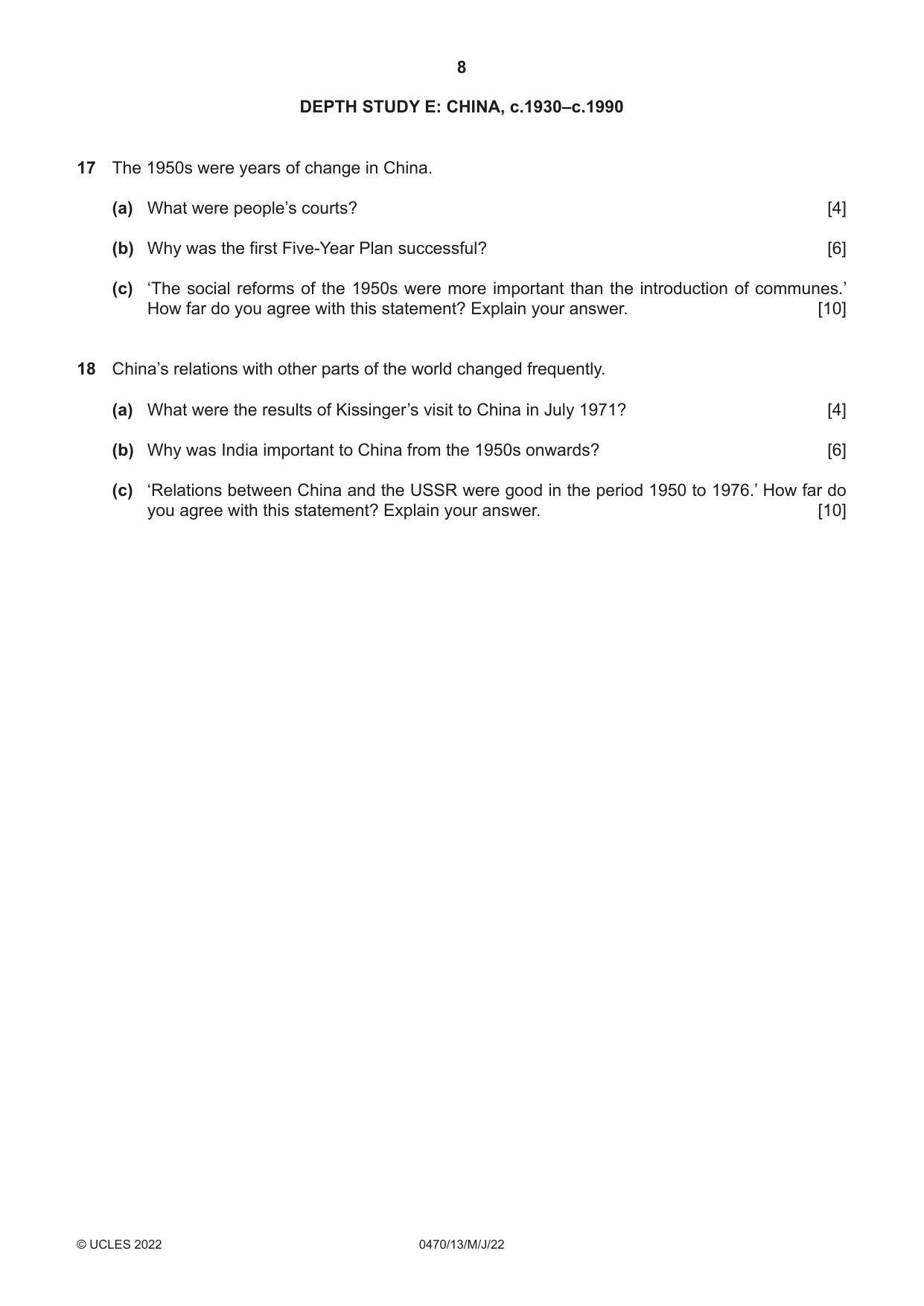
Question paper, page 8
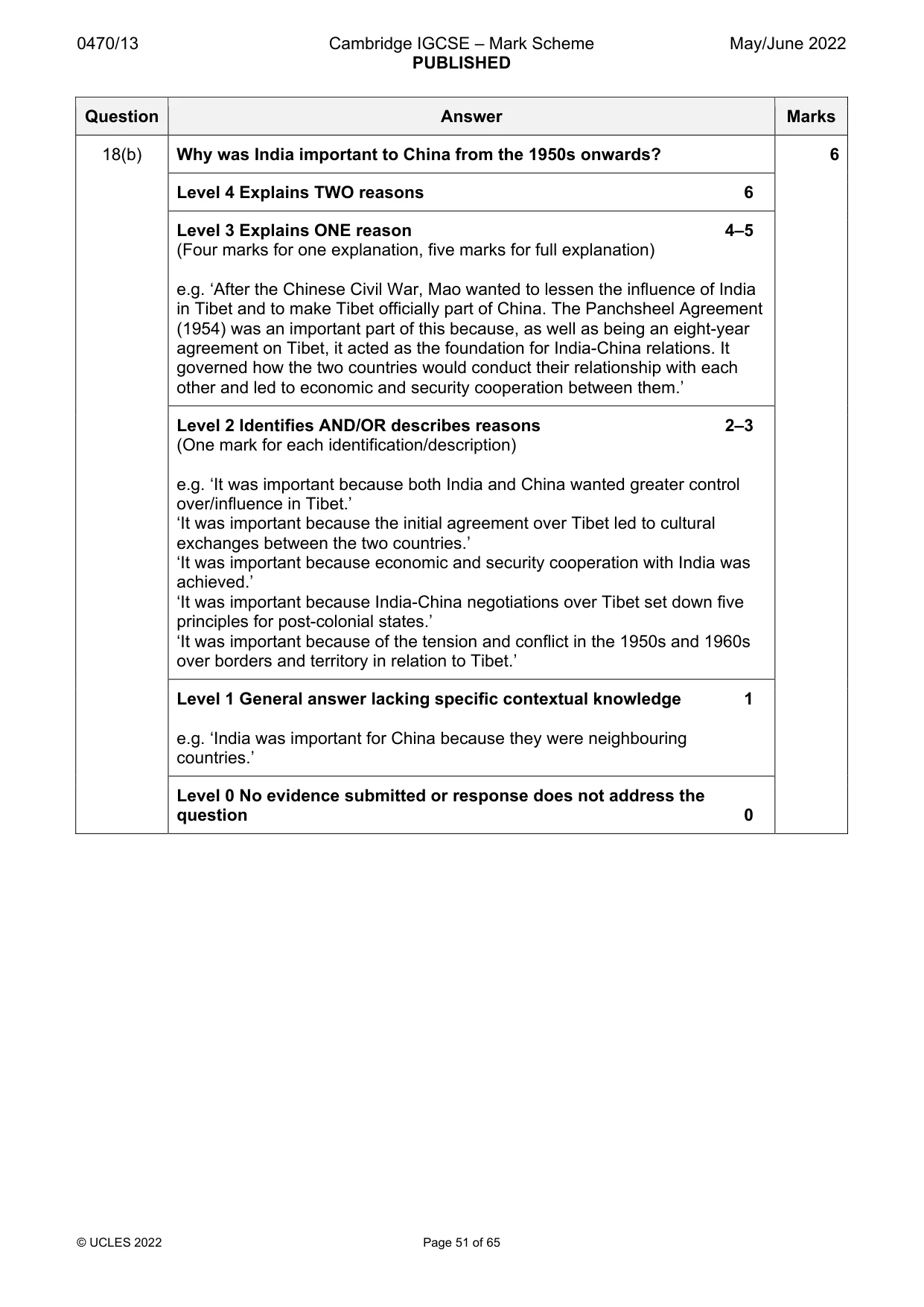
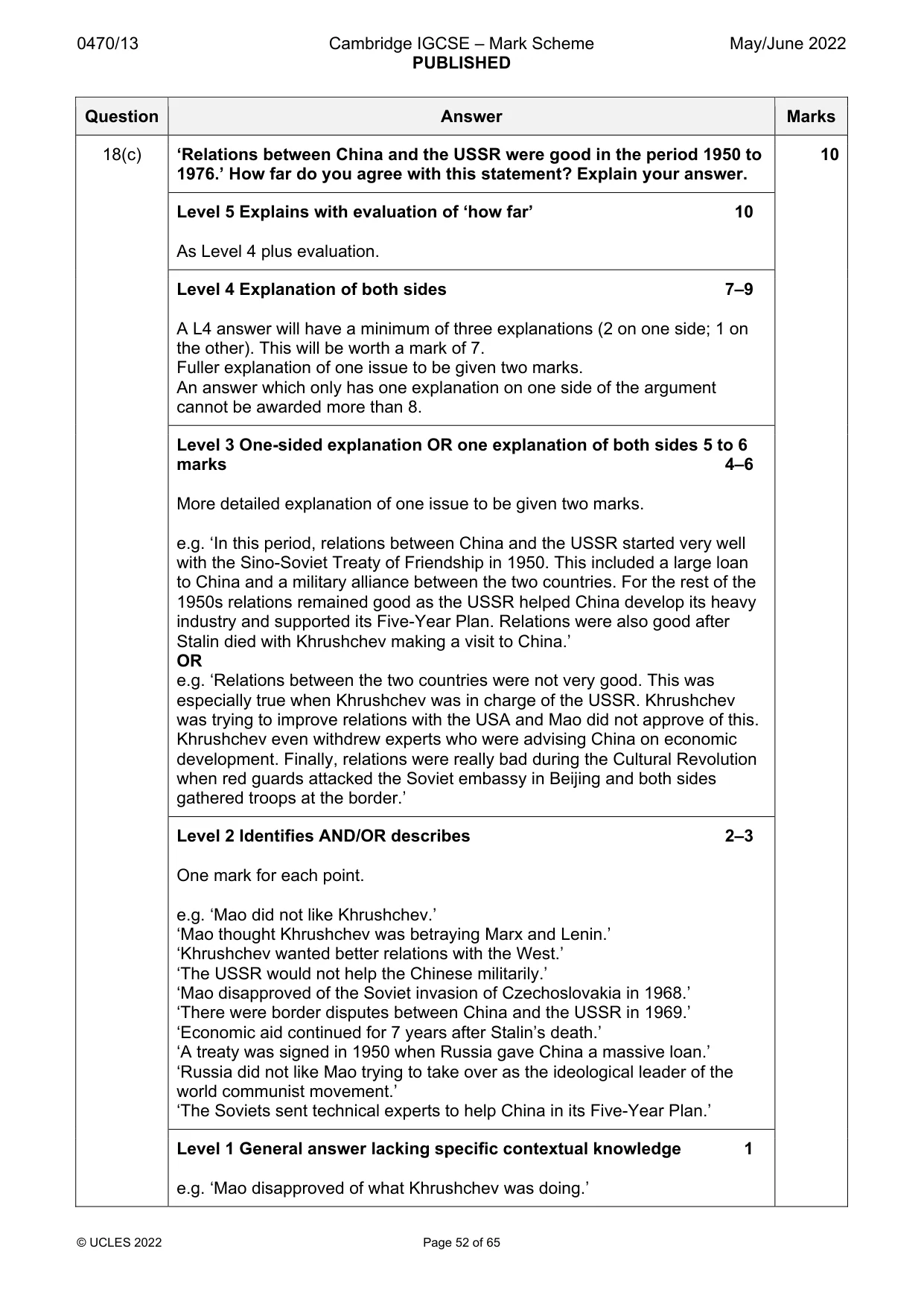
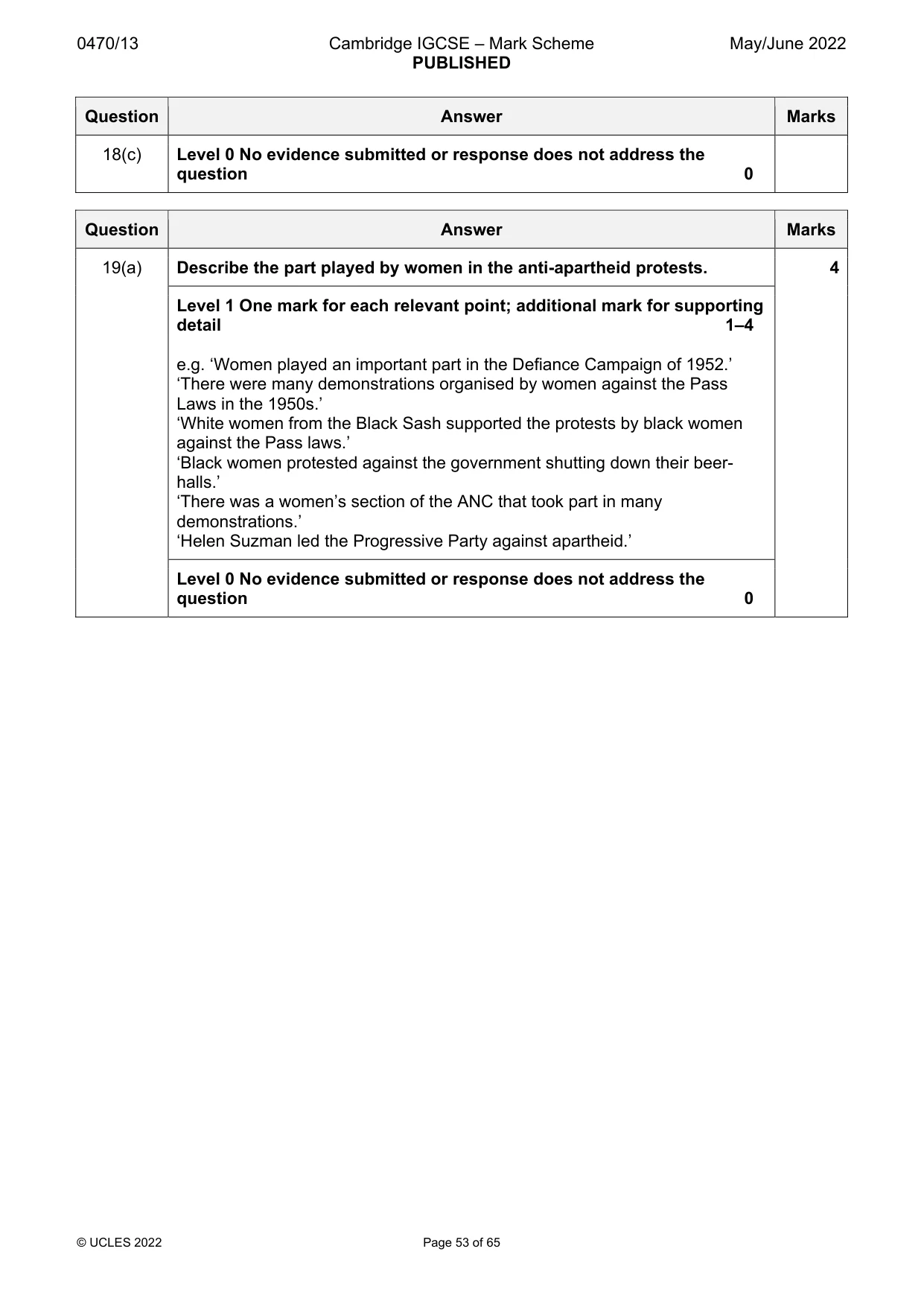
8 0470/13/M/J/22 © UCLES 2022 DEPTH STUDY E: CHINA, c.1930–c.1990 17 The 1950s were years of change in China. (a) What were people’s courts? [4] (b) Why was the first Five-Year Plan successful? [6] (c) ‘The social reforms of the 1950s were more important than the introduction of communes.’ How far do you agree with this statement? Explain your answer. [10] 18 China’s relations with other parts of the world changed frequently. (a) What were the results of Kissinger’s visit to China in July 1971? [4] (b) Why was India important to China from the 1950s onwards? [6] (c) ‘Relations between China and the USSR were good in the period 1950 to 1976.’ How far do you agree with this statement? Explain your answer. [10]
Question paper, page 9
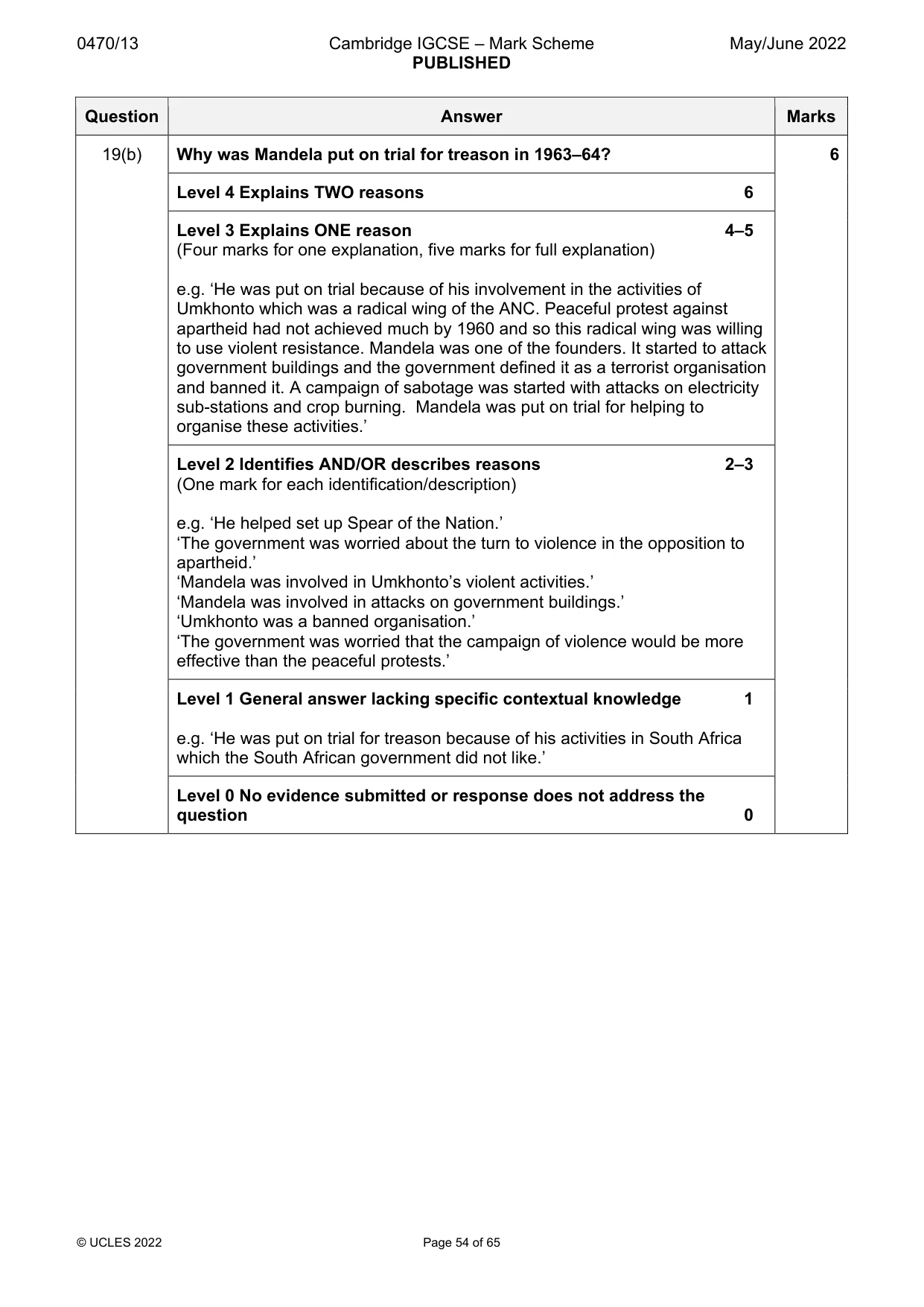
9 0470/13/M/J/22 © UCLES 2022 [Turn over DEPTH STUDY F: SOUTH AFRICA, c.1940–c.1994 19 The introduction of apartheid led to protest movements. (a) Describe the part played by women in the anti-apartheid protests. [4] (b) Why was Mandela put on trial for treason in 1963–64? [6] (c) ‘Few South Africans benefited from the introduction of apartheid.’ How far do you agree with this statement? Explain your answer. [10] 20 The end of apartheid came only after a long struggle. (a) Describe the part played by Archbishop Tutu in the ending of apartheid. [4] (b) Why did de Klerk face opposition from some white South Africans during his discussions with Mandela in the early 1990s? [6] (c) How far was Botha’s policy of ‘total strategy’ in the 1980s a success? Explain your answer. [10]
Question paper, page 10
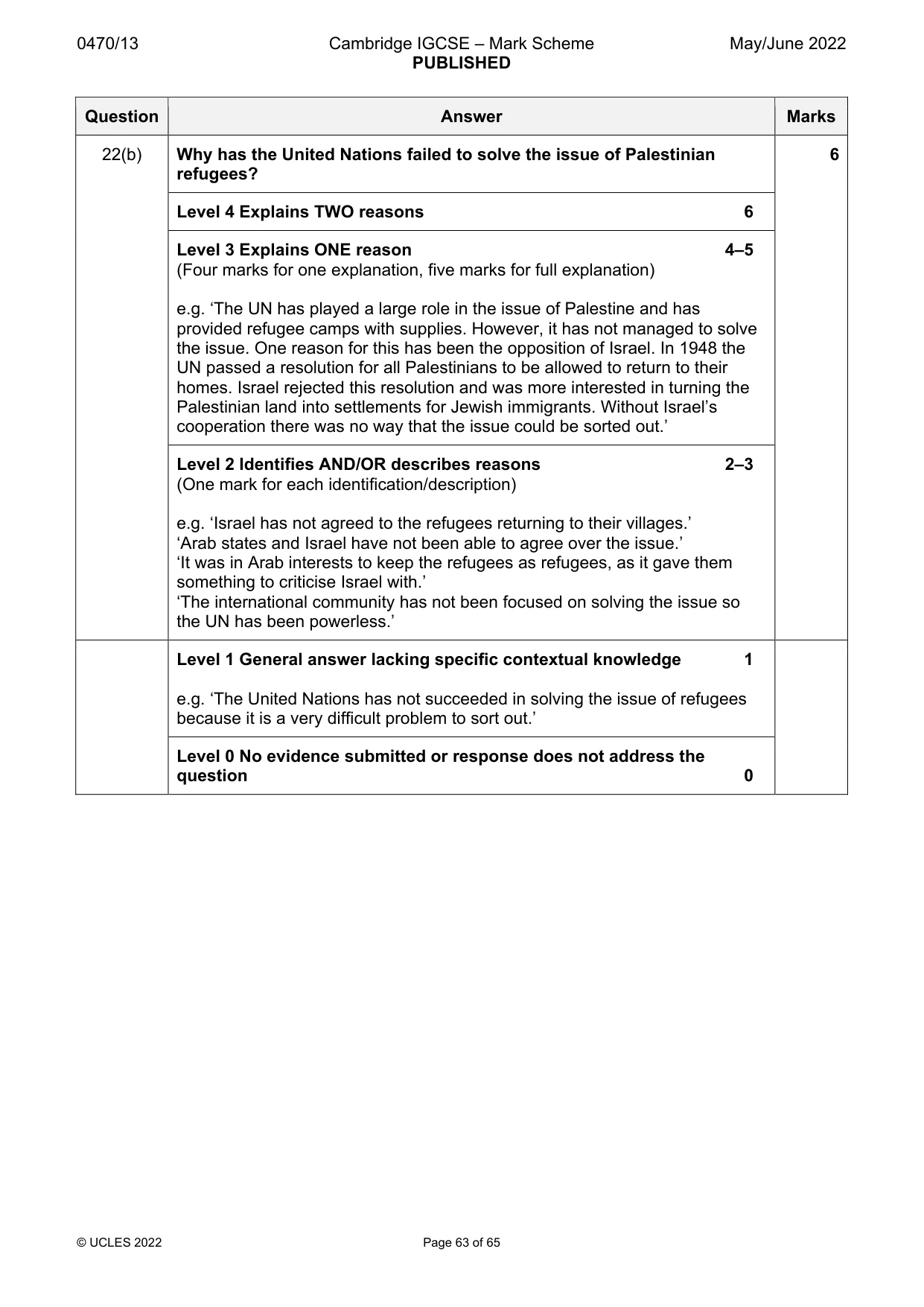
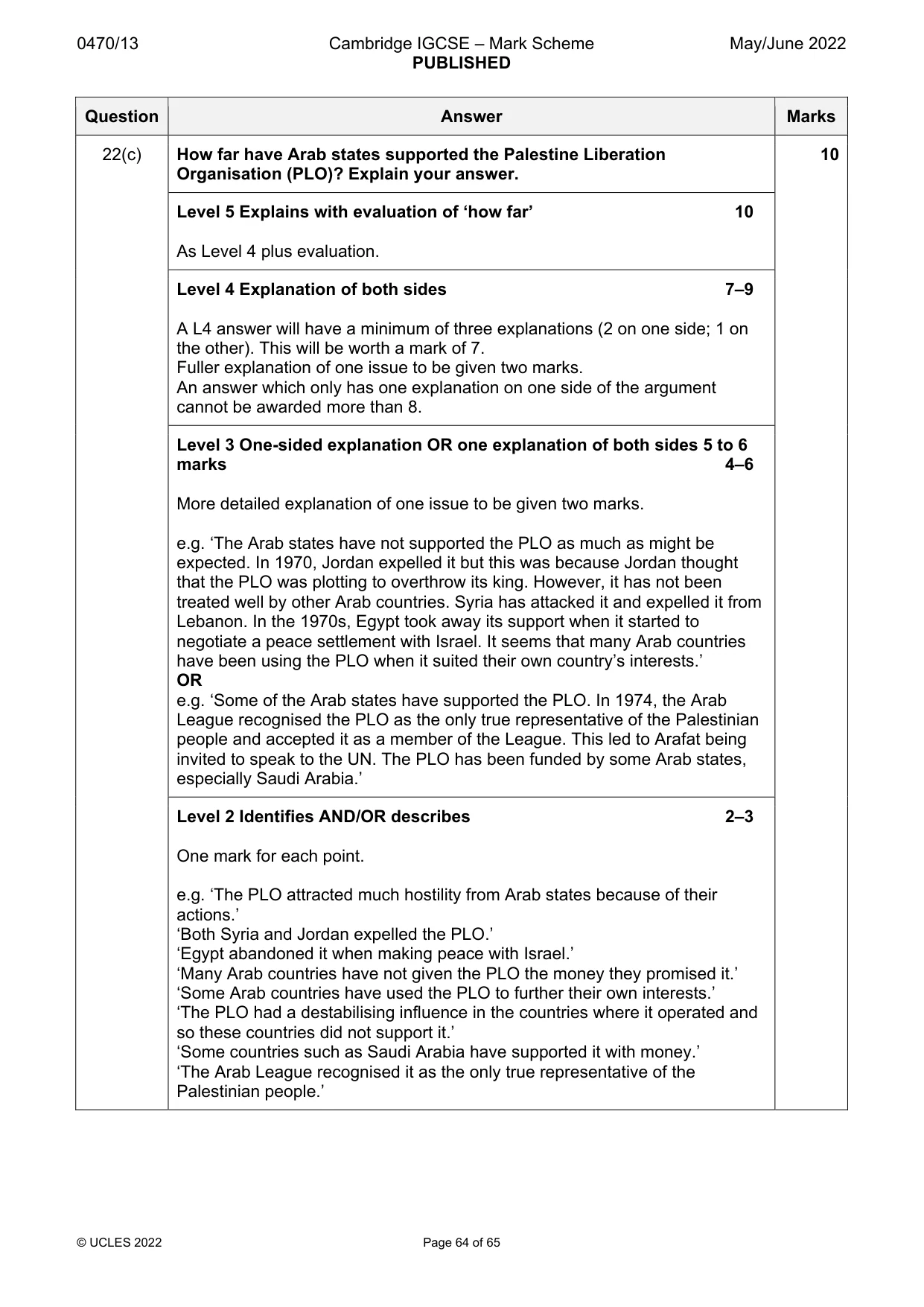
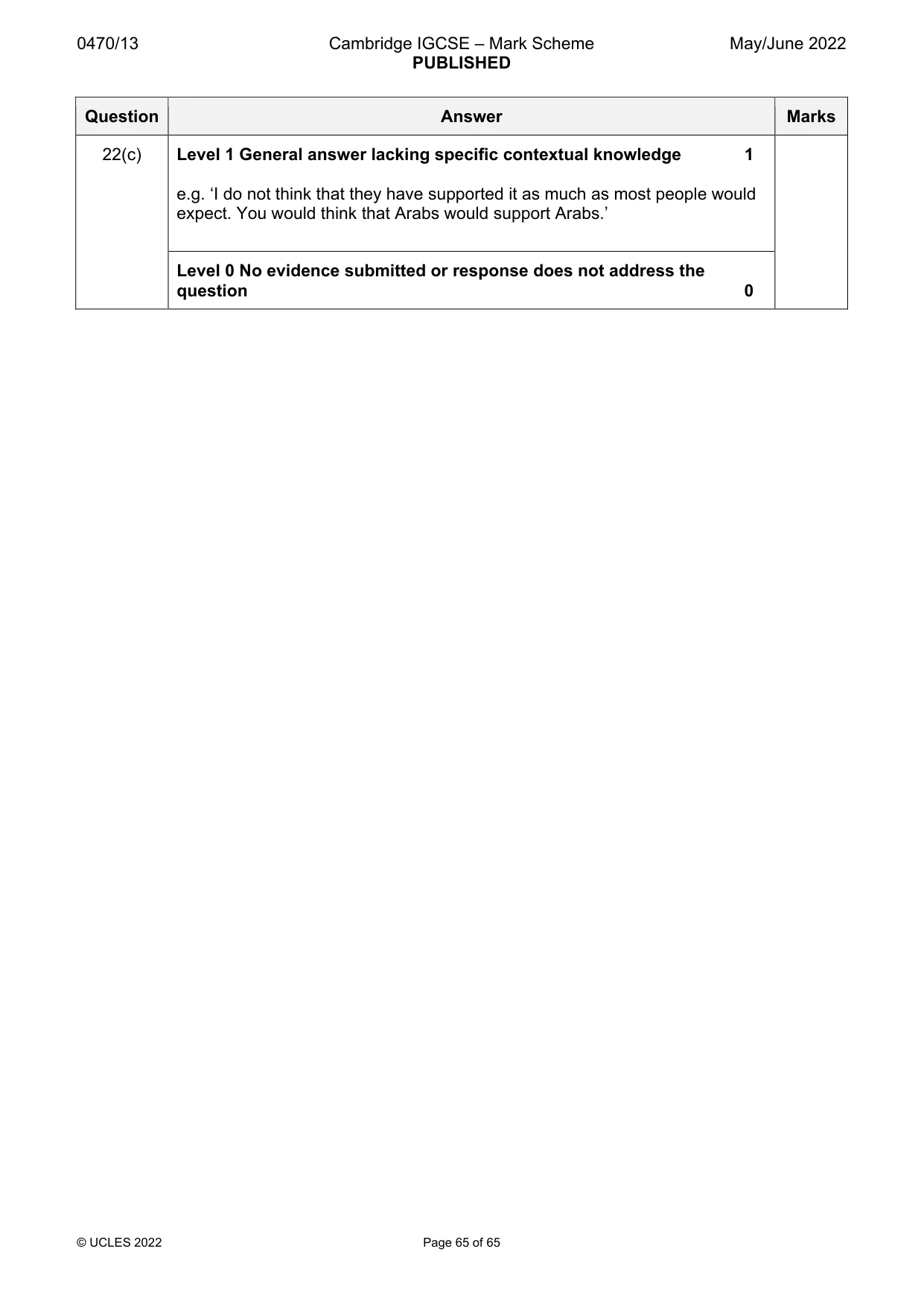
10 0470/13/M/J/22 © UCLES 2022 DEPTH STUDY G: ISRAELIS AND PALESTINIANS SINCE 1945 21 Once the Second World War had ended, the issue of Palestine had to be dealt with. (a) What were the Arab objections to the United Nations’ partition plan for Palestine? [4] (b) Why was Palestine important for the Jews at the end of the Second World War? [6] (c) How far were British actions to blame for the crisis in Palestine after the Second World War? Explain your answer. [10] 22 Attempts to address the issue of Palestinian refugees have not been very effective. (a) Describe the impact on the Palestinians of Jewish West Bank settlements. [4] (b) Why has the United Nations failed to solve the issue of Palestinian refugees? [6] (c) How far have Arab states supported the Palestine Liberation Organisation (PLO)? Explain your answer. [10]
Question paper, page 11
11 0470/13/M/J/22 © UCLES 2022 BLANK PAGE
Question paper, page 12
12 0470/13/M/J/22 © UCLES 2022 Permission to reproduce items where third-party owned material protected by copyright is included has been sought and cleared where possible. Every reasonable effort has been made by the publisher (UCLES) to trace copyright holders, but if any items requiring clearance have unwittingly been included, the publisher will be pleased to make amends at the earliest possible opportunity. To avoid the issue of disclosure of answer-related information to candidates, all copyright acknowledgements are reproduced online in the Cambridge Assessment International Education Copyright Acknowledgements Booklet. This is produced for each series of examinations and is freely available to download at www.cambridgeinternational.org after the live examination series. Cambridge Assessment International Education is part of Cambridge Assessment. Cambridge Assessment is the brand name of the University of Cambridge Local Examinations Syndicate (UCLES), which is a department of the University of Cambridge. BLANK PAGE
Mark scheme, page 1
This document consists of 65 printed pages. © UCLES 2022 [Turn over Cambridge IGCSE™ HISTORY 0470/13 Paper 1 May/June 2022 MARK SCHEME Maximum Mark: 60 Published This mark scheme is published as an aid to teachers and candidates, to indicate the requirements of the examination. It shows the basis on which Examiners were instructed to award marks. It does not indicate the details of the discussions that took place at an Examiners’ meeting before marking began, which would have considered the acceptability of alternative answers. Mark schemes should be read in conjunction with the question paper and the Principal Examiner Report for Teachers. Cambridge International will not enter into discussions about these mark schemes. Cambridge International is publishing the mark schemes for the May/June 2022 series for most Cambridge IGCSE, Cambridge International A and AS Level and Cambridge Pre-U components, and some Cambridge O Level components.
Mark scheme, page 2
0470/13 Cambridge IGCSE – Mark Scheme PUBLISHED May/June 2022 © UCLES 2022 Page 2 of 65 Generic Marking Principles These general marking principles must be applied by all examiners when marking candidate answers. They should be applied alongside the specific content of the mark scheme or generic level descriptors for a question. Each question paper and mark scheme will also comply with these marking principles. GENERIC MARKING PRINCIPLE 1: Marks must be awarded in line with: the specific content of the mark scheme or the generic level descriptors for the question the specific skills defined in the mark scheme or in the generic level descriptors for the question the standard of response required by a candidate as exemplified by the standardisation scripts. GENERIC MARKING PRINCIPLE 2: Marks awarded are always whole marks (not half marks, or other fractions). GENERIC MARKING PRINCIPLE 3: Marks must be awarded positively: marks are awarded for correct/valid answers, as defined in the mark scheme. However, credit is given for valid answers which go beyond the scope of the syllabus and mark scheme, referring to your Team Leader as appropriate marks are awarded when candidates clearly demonstrate what they know and can do marks are not deducted for errors marks are not deducted for omissions answers should only be judged on the quality of spelling, punctuation and grammar when these features are specifically assessed by the question as indicated by the mark scheme. The meaning, however, should be unambiguous. GENERIC MARKING PRINCIPLE 4: Rules must be applied consistently, e.g. in situations where candidates have not followed instructions or in the application of generic level descriptors. GENERIC MARKING PRINCIPLE 5: Marks should be awarded using the full range of marks defined in the mark scheme for the question (however; the use of the full mark range may be limited according to the quality of the candidate responses seen). GENERIC MARKING PRINCIPLE 6: Marks awarded are based solely on the requirements as defined in the mark scheme. Marks should not be awarded with grade thresholds or grade descriptors in mind.
Mark scheme, page 3
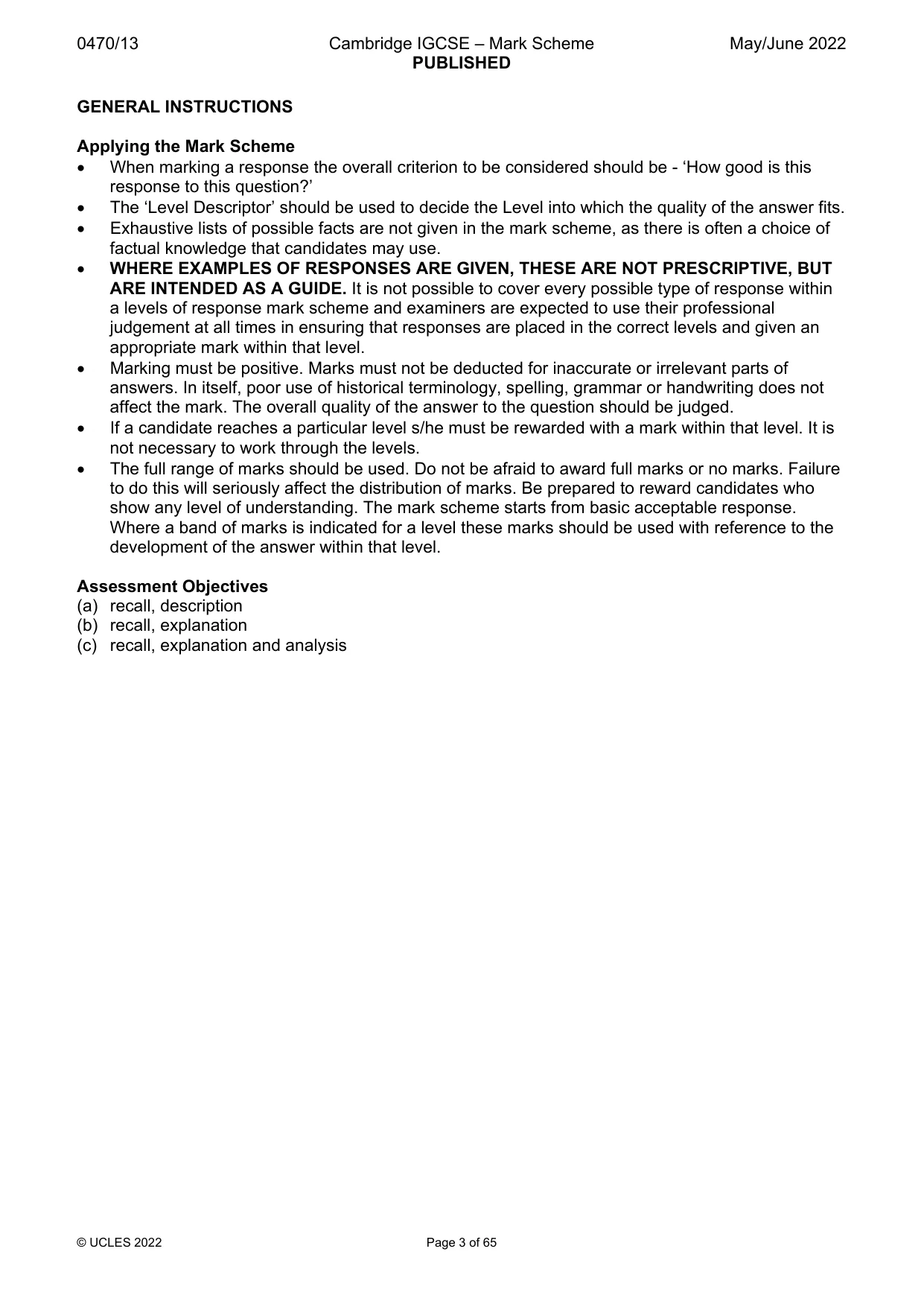
0470/13 Cambridge IGCSE – Mark Scheme PUBLISHED May/June 2022 © UCLES 2022 Page 3 of 65 GENERAL INSTRUCTIONS Applying the Mark Scheme When marking a response the overall criterion to be considered should be - ‘How good is this response to this question?’ The ‘Level Descriptor’ should be used to decide the Level into which the quality of the answer fits. Exhaustive lists of possible facts are not given in the mark scheme, as there is often a choice of factual knowledge that candidates may use. WHERE EXAMPLES OF RESPONSES ARE GIVEN, THESE ARE NOT PRESCRIPTIVE, BUT ARE INTENDED AS A GUIDE. It is not possible to cover every possible type of response within a levels of response mark scheme and examiners are expected to use their professional judgement at all times in ensuring that responses are placed in the correct levels and given an appropriate mark within that level. Marking must be positive. Marks must not be deducted for inaccurate or irrelevant parts of answers. In itself, poor use of historical terminology, spelling, grammar or handwriting does not affect the mark. The overall quality of the answer to the question should be judged. If a candidate reaches a particular level s/he must be rewarded with a mark within that level. It is not necessary to work through the levels. The full range of marks should be used. Do not be afraid to award full marks or no marks. Failure to do this will seriously affect the distribution of marks. Be prepared to reward candidates who show any level of understanding. The mark scheme starts from basic acceptable response. Where a band of marks is indicated for a level these marks should be used with reference to the development of the answer within that level. Assessment Objectives (a) recall, description (b) recall, explanation (c) recall, explanation and analysis
Mark scheme, page 4
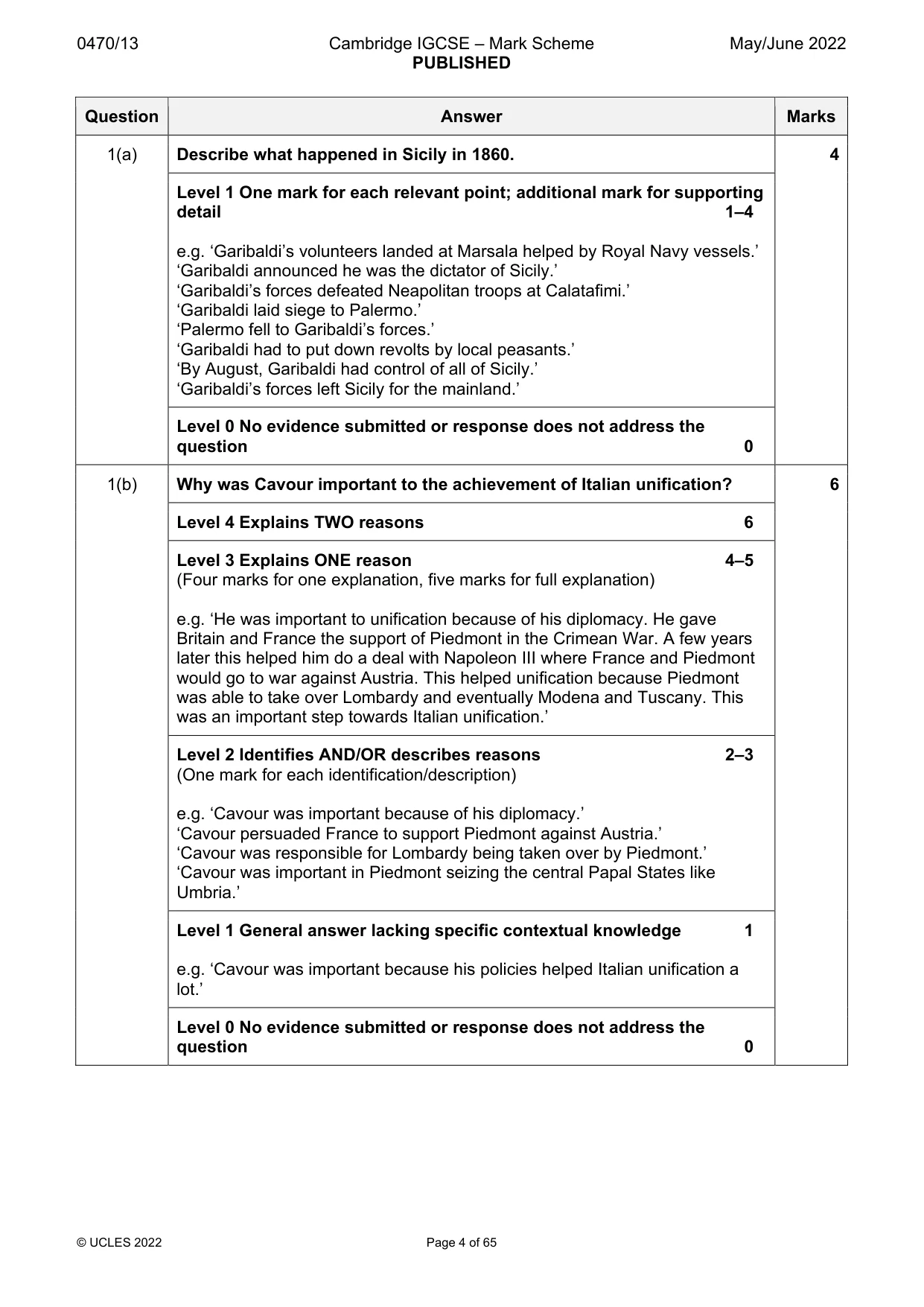
0470/13 Cambridge IGCSE – Mark Scheme PUBLISHED May/June 2022 © UCLES 2022 Page 4 of 65 Question Answer Marks 1(a) Describe what happened in Sicily in 1860. 4 Level 1 One mark for each relevant point; additional mark for supporting detail 1–4 e.g. ‘Garibaldi’s volunteers landed at Marsala helped by Royal Navy vessels.’ ‘Garibaldi announced he was the dictator of Sicily.’ ‘Garibaldi’s forces defeated Neapolitan troops at Calatafimi.’ ‘Garibaldi laid siege to Palermo.’ ‘Palermo fell to Garibaldi’s forces.’ ‘Garibaldi had to put down revolts by local peasants.’ ‘By August, Garibaldi had control of all of Sicily.’ ‘Garibaldi’s forces left Sicily for the mainland.’ Level 0 No evidence submitted or response does not address the question 0 1(b) Why was Cavour important to the achievement of Italian unification? 6 Level 4 Explains TWO reasons 6 Level 3 Explains ONE reason 4–5 (Four marks for one explanation, five marks for full explanation) e.g. ‘He was important to unification because of his diplomacy. He gave Britain and France the support of Piedmont in the Crimean War. A few years later this helped him do a deal with Napoleon III where France and Piedmont would go to war against Austria. This helped unification because Piedmont was able to take over Lombardy and eventually Modena and Tuscany. This was an important step towards Italian unification.’ Level 2 Identifies AND/OR describes reasons 2–3 (One mark for each identification/description) e.g. ‘Cavour was important because of his diplomacy.’ ‘Cavour persuaded France to support Piedmont against Austria.’ ‘Cavour was responsible for Lombardy being taken over by Piedmont.’ ‘Cavour was important in Piedmont seizing the central Papal States like Umbria.’ Level 1 General answer lacking specific contextual knowledge 1 e.g. ‘Cavour was important because his policies helped Italian unification a lot.’ Level 0 No evidence submitted or response does not address the question 0
Mark scheme, page 5
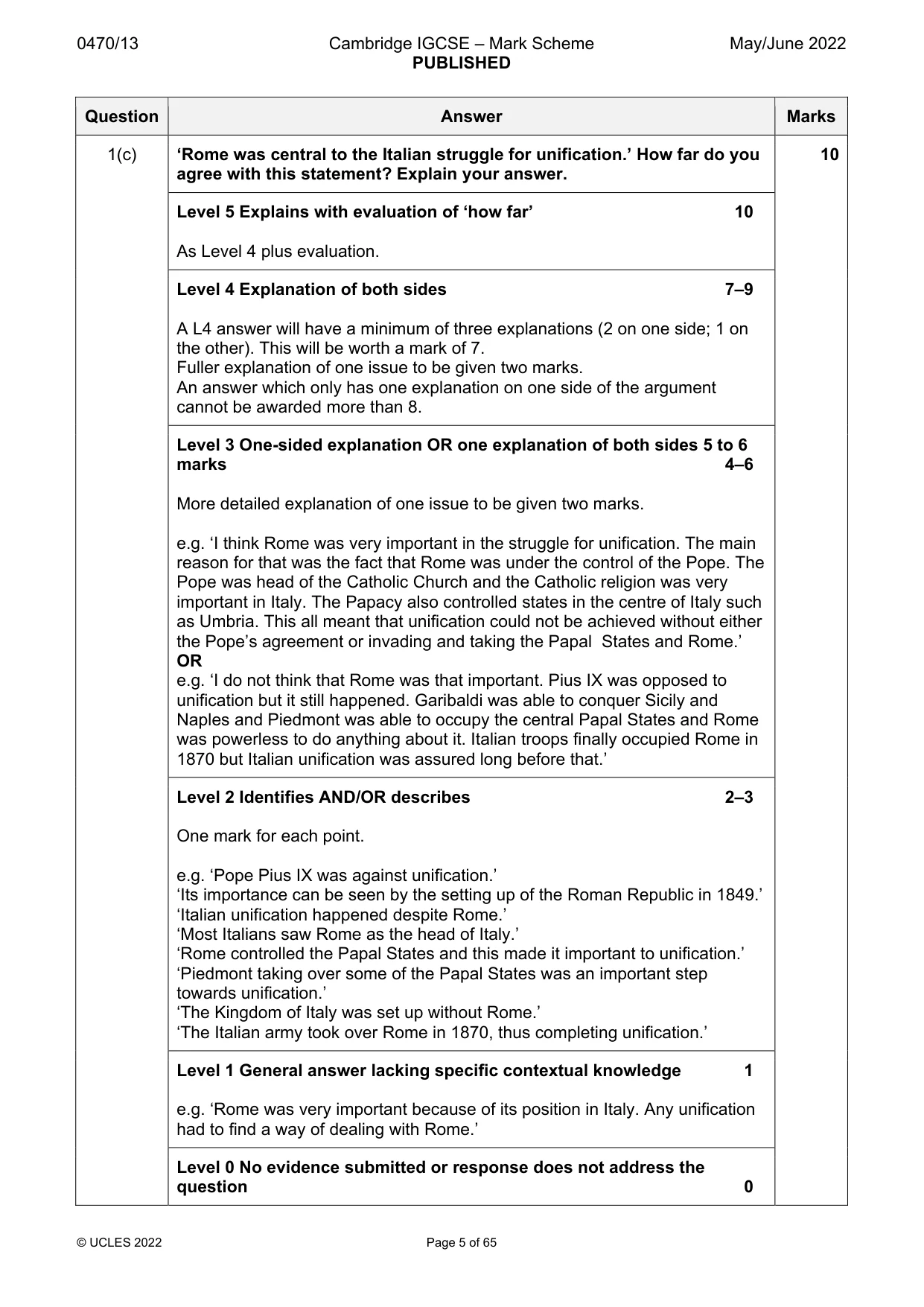
0470/13 Cambridge IGCSE – Mark Scheme PUBLISHED May/June 2022 © UCLES 2022 Page 5 of 65 Question Answer Marks 1(c) ‘Rome was central to the Italian struggle for unification.’ How far do you agree with this statement? Explain your answer. 10 Level 5 Explains with evaluation of ‘how far’ 10 As Level 4 plus evaluation. Level 4 Explanation of both sides 7–9 A L4 answer will have a minimum of three explanations (2 on one side; 1 on the other). This will be worth a mark of 7. Fuller explanation of one issue to be given two marks. An answer which only has one explanation on one side of the argument cannot be awarded more than 8. Level 3 One-sided explanation OR one explanation of both sides 5 to 6 marks 4–6 More detailed explanation of one issue to be given two marks. e.g. ‘I think Rome was very important in the struggle for unification. The main reason for that was the fact that Rome was under the control of the Pope. The Pope was head of the Catholic Church and the Catholic religion was very important in Italy. The Papacy also controlled states in the centre of Italy such as Umbria. This all meant that unification could not be achieved without either the Pope’s agreement or invading and taking the Papal States and Rome.’ OR e.g. ‘I do not think that Rome was that important. Pius IX was opposed to unification but it still happened. Garibaldi was able to conquer Sicily and Naples and Piedmont was able to occupy the central Papal States and Rome was powerless to do anything about it. Italian troops finally occupied Rome in 1870 but Italian unification was assured long before that.’ Level 2 Identifies AND/OR describes 2–3 One mark for each point. e.g. ‘Pope Pius IX was against unification.’ ‘Its importance can be seen by the setting up of the Roman Republic in 1849.’ ‘Italian unification happened despite Rome.’ ‘Most Italians saw Rome as the head of Italy.’ ‘Rome controlled the Papal States and this made it important to unification.’ ‘Piedmont taking over some of the Papal States was an important step towards unification.’ ‘The Kingdom of Italy was set up without Rome.’ ‘The Italian army took over Rome in 1870, thus completing unification.’ Level 1 General answer lacking specific contextual knowledge 1 e.g. ‘Rome was very important because of its position in Italy. Any unification had to find a way of dealing with Rome.’ Level 0 No evidence submitted or response does not address the question 0
Mark scheme, page 6
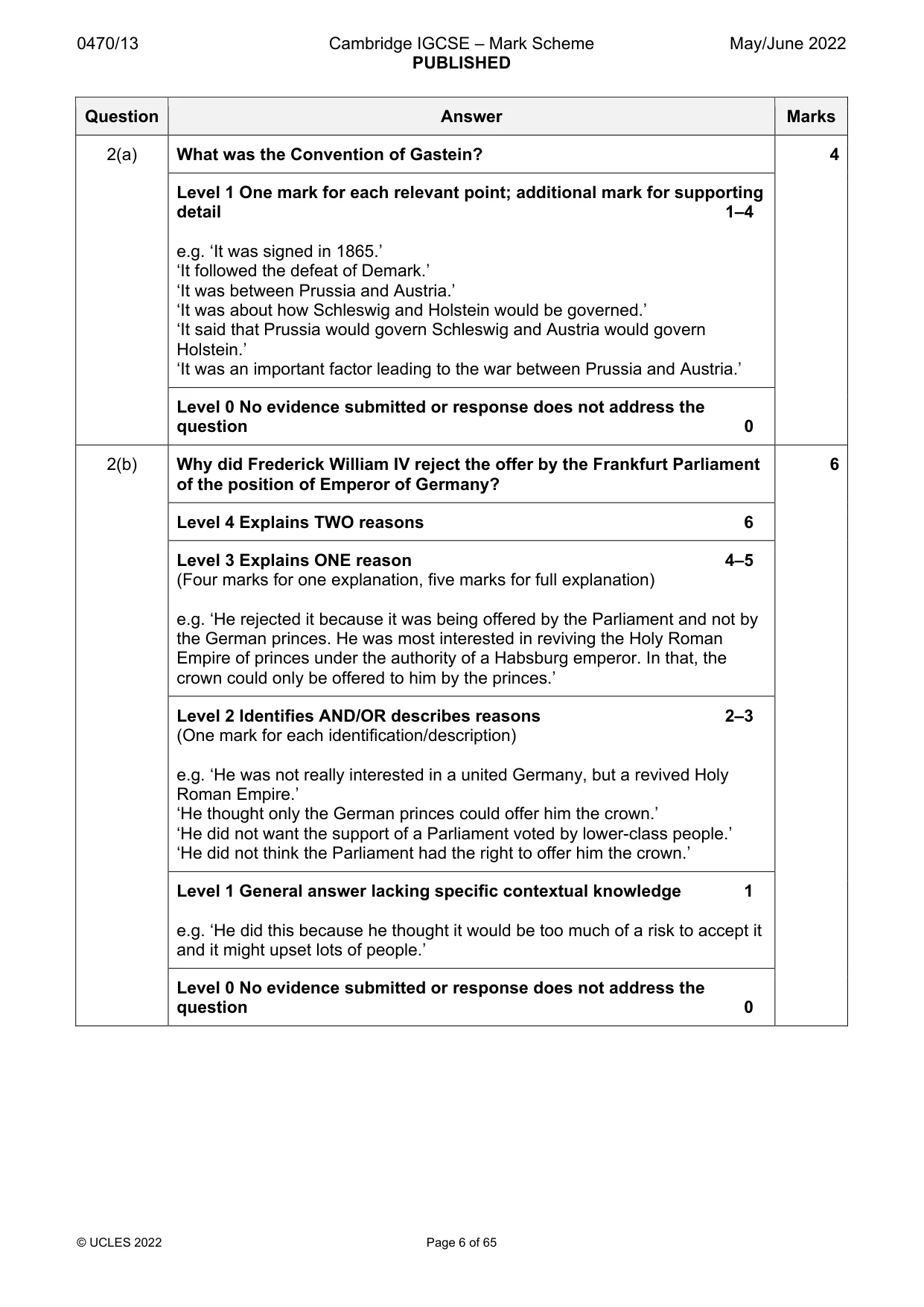
0470/13 Cambridge IGCSE – Mark Scheme PUBLISHED May/June 2022 © UCLES 2022 Page 6 of 65 Question Answer Marks 2(a) What was the Convention of Gastein? 4 Level 1 One mark for each relevant point; additional mark for supporting detail 1–4 e.g. ‘It was signed in 1865.’ ‘It followed the defeat of Demark.’ ‘It was between Prussia and Austria.’ ‘It was about how Schleswig and Holstein would be governed.’ ‘It said that Prussia would govern Schleswig and Austria would govern Holstein.’ ‘It was an important factor leading to the war between Prussia and Austria.’ Level 0 No evidence submitted or response does not address the question 0 2(b) Why did Frederick William IV reject the offer by the Frankfurt Parliament of the position of Emperor of Germany? 6 Level 4 Explains TWO reasons 6 Level 3 Explains ONE reason 4–5 (Four marks for one explanation, five marks for full explanation) e.g. ‘He rejected it because it was being offered by the Parliament and not by the German princes. He was most interested in reviving the Holy Roman Empire of princes under the authority of a Habsburg emperor. In that, the crown could only be offered to him by the princes.’ Level 2 Identifies AND/OR describes reasons 2–3 (One mark for each identification/description) e.g. ‘He was not really interested in a united Germany, but a revived Holy Roman Empire.’ ‘He thought only the German princes could offer him the crown.’ ‘He did not want the support of a Parliament voted by lower-class people.’ ‘He did not think the Parliament had the right to offer him the crown.’ Level 1 General answer lacking specific contextual knowledge 1 e.g. ‘He did this because he thought it would be too much of a risk to accept it and it might upset lots of people.’ Level 0 No evidence submitted or response does not address the question 0
Mark scheme, page 7
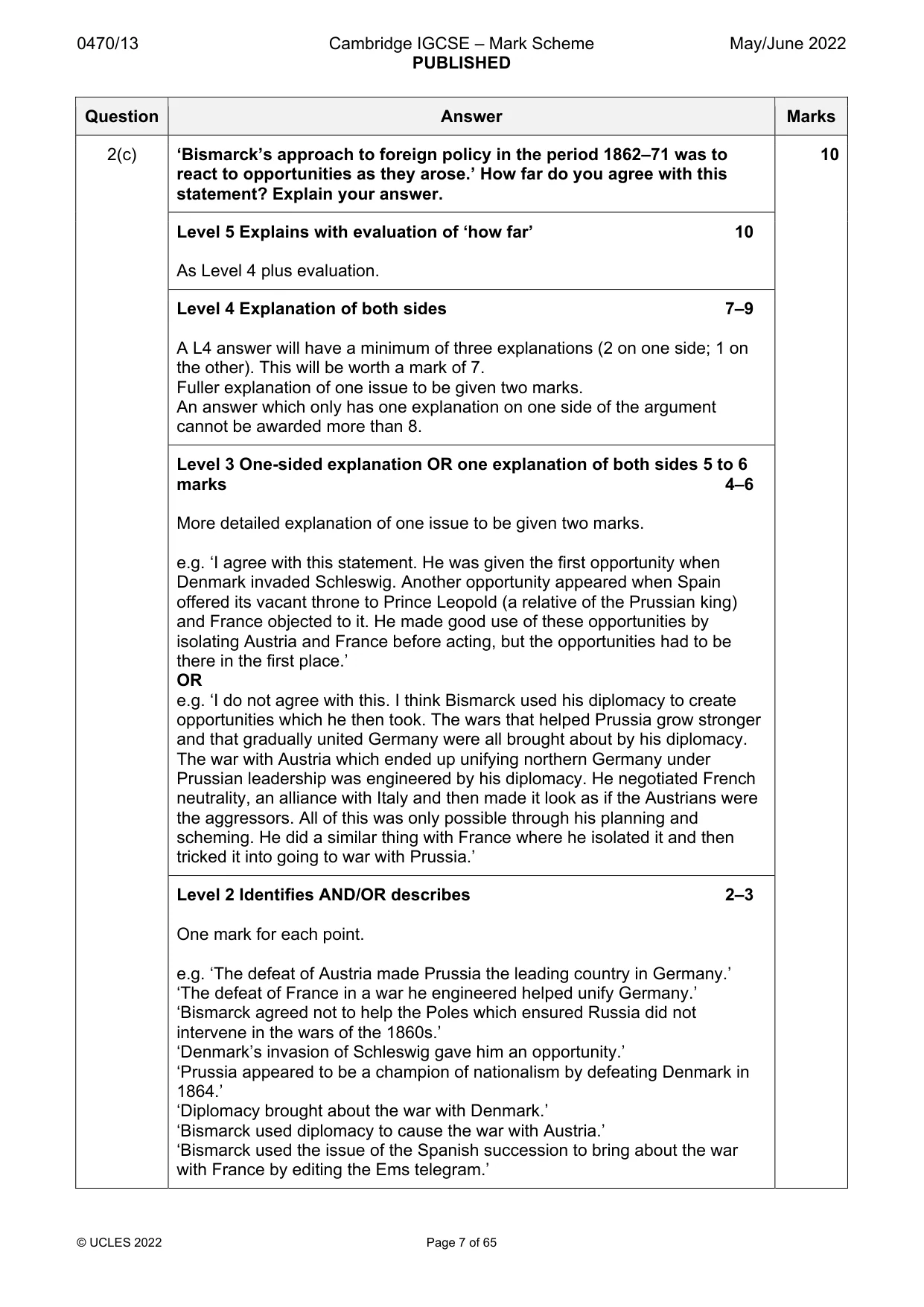
0470/13 Cambridge IGCSE – Mark Scheme PUBLISHED May/June 2022 © UCLES 2022 Page 7 of 65 Question Answer Marks 2(c) ‘Bismarck’s approach to foreign policy in the period 1862–71 was to react to opportunities as they arose.’ How far do you agree with this statement? Explain your answer. 10 Level 5 Explains with evaluation of ‘how far’ 10 As Level 4 plus evaluation. Level 4 Explanation of both sides 7–9 A L4 answer will have a minimum of three explanations (2 on one side; 1 on the other). This will be worth a mark of 7. Fuller explanation of one issue to be given two marks. An answer which only has one explanation on one side of the argument cannot be awarded more than 8. Level 3 One-sided explanation OR one explanation of both sides 5 to 6 marks 4–6 More detailed explanation of one issue to be given two marks. e.g. ‘I agree with this statement. He was given the first opportunity when Denmark invaded Schleswig. Another opportunity appeared when Spain offered its vacant throne to Prince Leopold (a relative of the Prussian king) and France objected to it. He made good use of these opportunities by isolating Austria and France before acting, but the opportunities had to be there in the first place.’ OR e.g. ‘I do not agree with this. I think Bismarck used his diplomacy to create opportunities which he then took. The wars that helped Prussia grow stronger and that gradually united Germany were all brought about by his diplomacy. The war with Austria which ended up unifying northern Germany under Prussian leadership was engineered by his diplomacy. He negotiated French neutrality, an alliance with Italy and then made it look as if the Austrians were the aggressors. All of this was only possible through his planning and scheming. He did a similar thing with France where he isolated it and then tricked it into going to war with Prussia.’ Level 2 Identifies AND/OR describes 2–3 One mark for each point. e.g. ‘The defeat of Austria made Prussia the leading country in Germany.’ ‘The defeat of France in a war he engineered helped unify Germany.’ ‘Bismarck agreed not to help the Poles which ensured Russia did not intervene in the wars of the 1860s.’ ‘Denmark’s invasion of Schleswig gave him an opportunity.’ ‘Prussia appeared to be a champion of nationalism by defeating Denmark in 1864.’ ‘Diplomacy brought about the war with Denmark.’ ‘Bismarck used diplomacy to cause the war with Austria.’ ‘Bismarck used the issue of the Spanish succession to bring about the war with France by editing the Ems telegram.’
Mark scheme, page 8
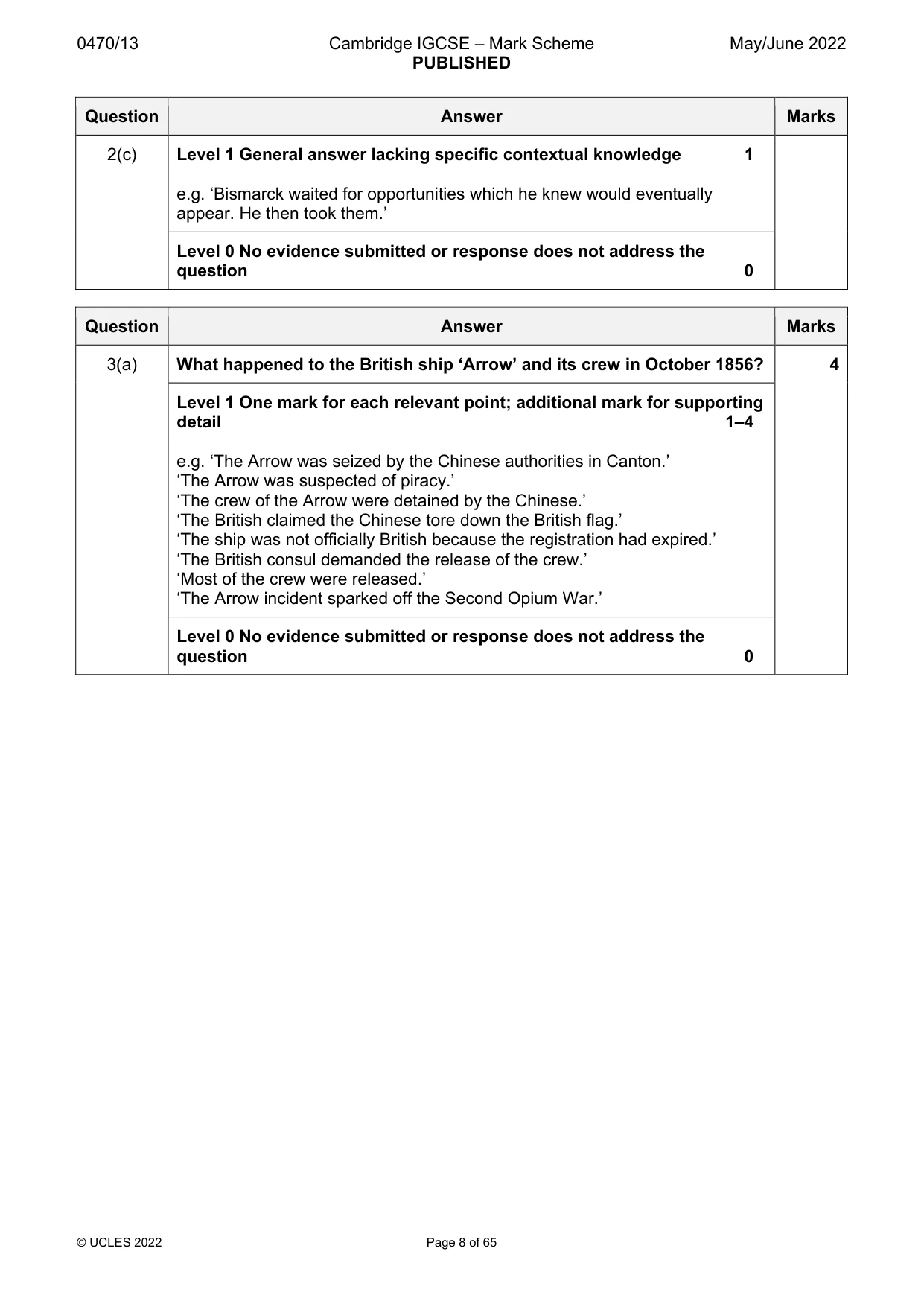
0470/13 Cambridge IGCSE – Mark Scheme PUBLISHED May/June 2022 © UCLES 2022 Page 8 of 65 Question Answer Marks 2(c) Level 1 General answer lacking specific contextual knowledge 1 e.g. ‘Bismarck waited for opportunities which he knew would eventually appear. He then took them.’ Level 0 No evidence submitted or response does not address the question 0 Question Answer Marks 3(a) What happened to the British ship ‘Arrow’ and its crew in October 1856? 4 Level 1 One mark for each relevant point; additional mark for supporting detail 1–4 e.g. ‘The Arrow was seized by the Chinese authorities in Canton.’ ‘The Arrow was suspected of piracy.’ ‘The crew of the Arrow were detained by the Chinese.’ ‘The British claimed the Chinese tore down the British flag.’ ‘The ship was not officially British because the registration had expired.’ ‘The British consul demanded the release of the crew.’ ‘Most of the crew were released.’ ‘The Arrow incident sparked off the Second Opium War.’ Level 0 No evidence submitted or response does not address the question 0
Mark scheme, page 9
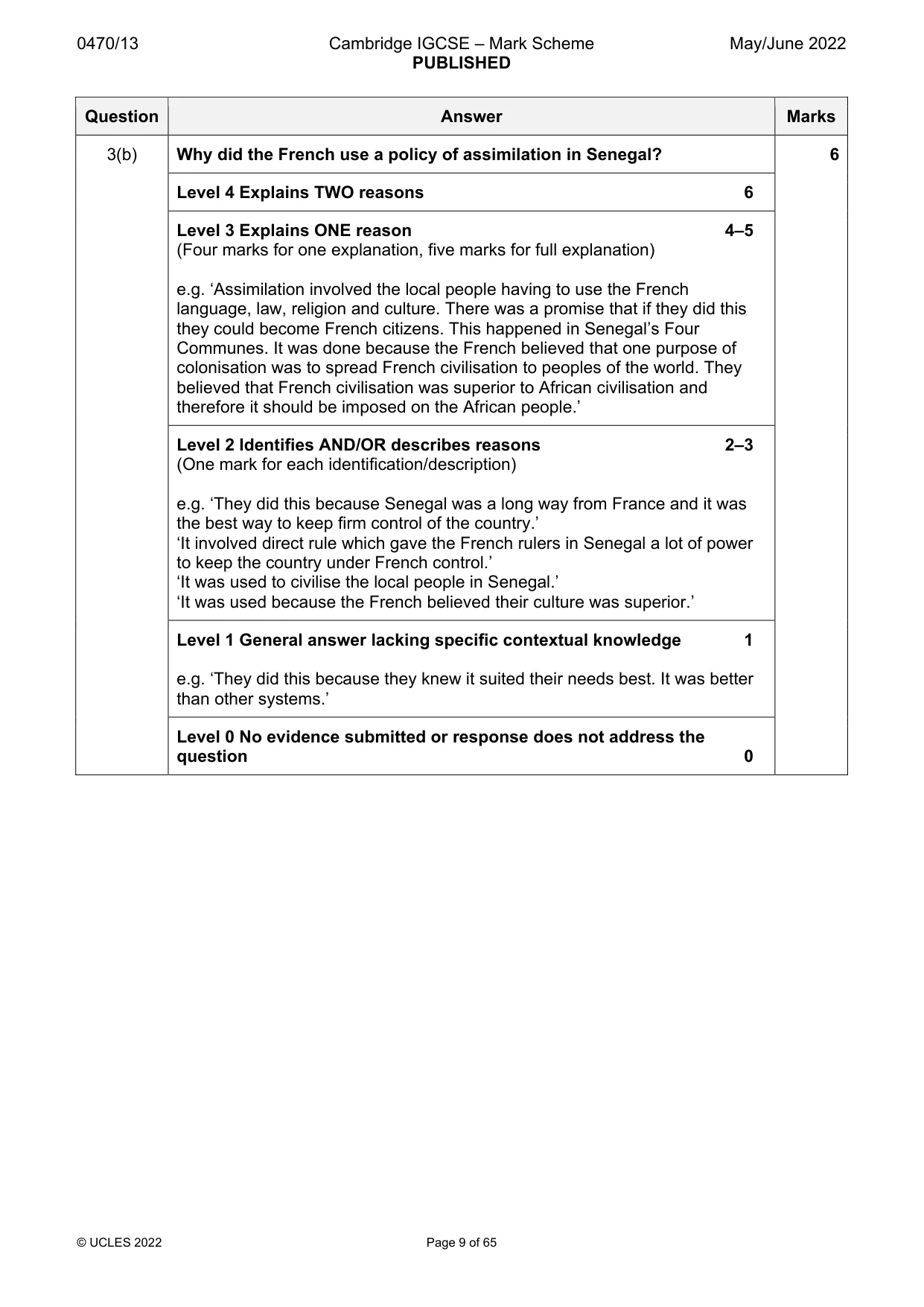
0470/13 Cambridge IGCSE – Mark Scheme PUBLISHED May/June 2022 © UCLES 2022 Page 9 of 65 Question Answer Marks 3(b) Why did the French use a policy of assimilation in Senegal? 6 Level 4 Explains TWO reasons 6 Level 3 Explains ONE reason 4–5 (Four marks for one explanation, five marks for full explanation) e.g. ‘Assimilation involved the local people having to use the French language, law, religion and culture. There was a promise that if they did this they could become French citizens. This happened in Senegal’s Four Communes. It was done because the French believed that one purpose of colonisation was to spread French civilisation to peoples of the world. They believed that French civilisation was superior to African civilisation and therefore it should be imposed on the African people.’ Level 2 Identifies AND/OR describes reasons 2–3 (One mark for each identification/description) e.g. ‘They did this because Senegal was a long way from France and it was the best way to keep firm control of the country.’ ‘It involved direct rule which gave the French rulers in Senegal a lot of power to keep the country under French control.’ ‘It was used to civilise the local people in Senegal.’ ‘It was used because the French believed their culture was superior.’ Level 1 General answer lacking specific contextual knowledge 1 e.g. ‘They did this because they knew it suited their needs best. It was better than other systems.’ Level 0 No evidence submitted or response does not address the question 0
Mark scheme, page 10
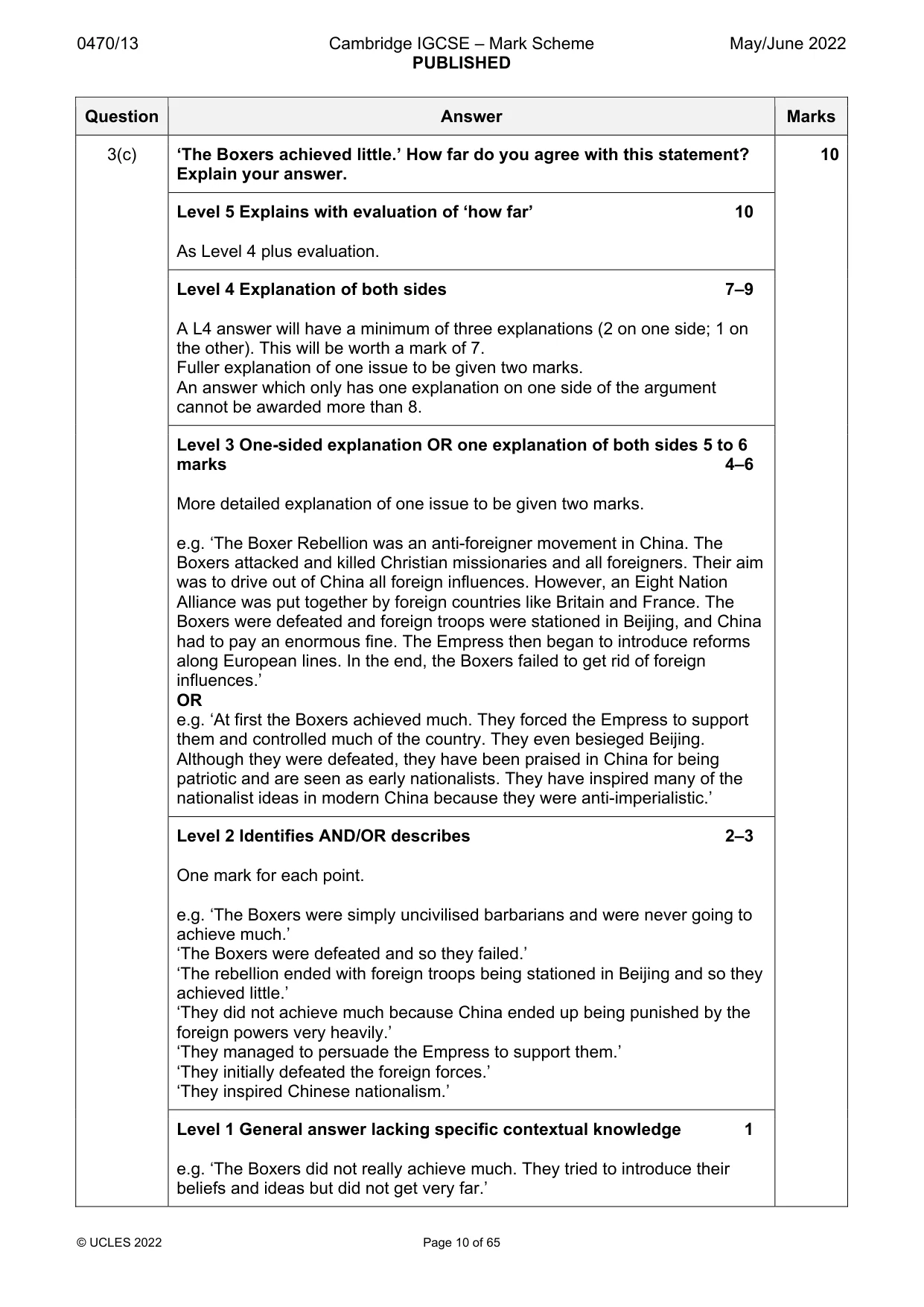
0470/13 Cambridge IGCSE – Mark Scheme PUBLISHED May/June 2022 © UCLES 2022 Page 10 of 65 Question Answer Marks 3(c) ‘The Boxers achieved little.’ How far do you agree with this statement? Explain your answer. 10 Level 5 Explains with evaluation of ‘how far’ 10 As Level 4 plus evaluation. Level 4 Explanation of both sides 7–9 A L4 answer will have a minimum of three explanations (2 on one side; 1 on the other). This will be worth a mark of 7. Fuller explanation of one issue to be given two marks. An answer which only has one explanation on one side of the argument cannot be awarded more than 8. Level 3 One-sided explanation OR one explanation of both sides 5 to 6 marks 4–6 More detailed explanation of one issue to be given two marks. e.g. ‘The Boxer Rebellion was an anti-foreigner movement in China. The Boxers attacked and killed Christian missionaries and all foreigners. Their aim was to drive out of China all foreign influences. However, an Eight Nation Alliance was put together by foreign countries like Britain and France. The Boxers were defeated and foreign troops were stationed in Beijing, and China had to pay an enormous fine. The Empress then began to introduce reforms along European lines. In the end, the Boxers failed to get rid of foreign influences.’ OR e.g. ‘At first the Boxers achieved much. They forced the Empress to support them and controlled much of the country. They even besieged Beijing. Although they were defeated, they have been praised in China for being patriotic and are seen as early nationalists. They have inspired many of the nationalist ideas in modern China because they were anti-imperialistic.’ Level 2 Identifies AND/OR describes 2–3 One mark for each point. e.g. ‘The Boxers were simply uncivilised barbarians and were never going to achieve much.’ ‘The Boxers were defeated and so they failed.’ ‘The rebellion ended with foreign troops being stationed in Beijing and so they achieved little.’ ‘They did not achieve much because China ended up being punished by the foreign powers very heavily.’ ‘They managed to persuade the Empress to support them.’ ‘They initially defeated the foreign forces.’ ‘They inspired Chinese nationalism.’ Level 1 General answer lacking specific contextual knowledge 1 e.g. ‘The Boxers did not really achieve much. They tried to introduce their beliefs and ideas but did not get very far.’
Mark scheme, page 11
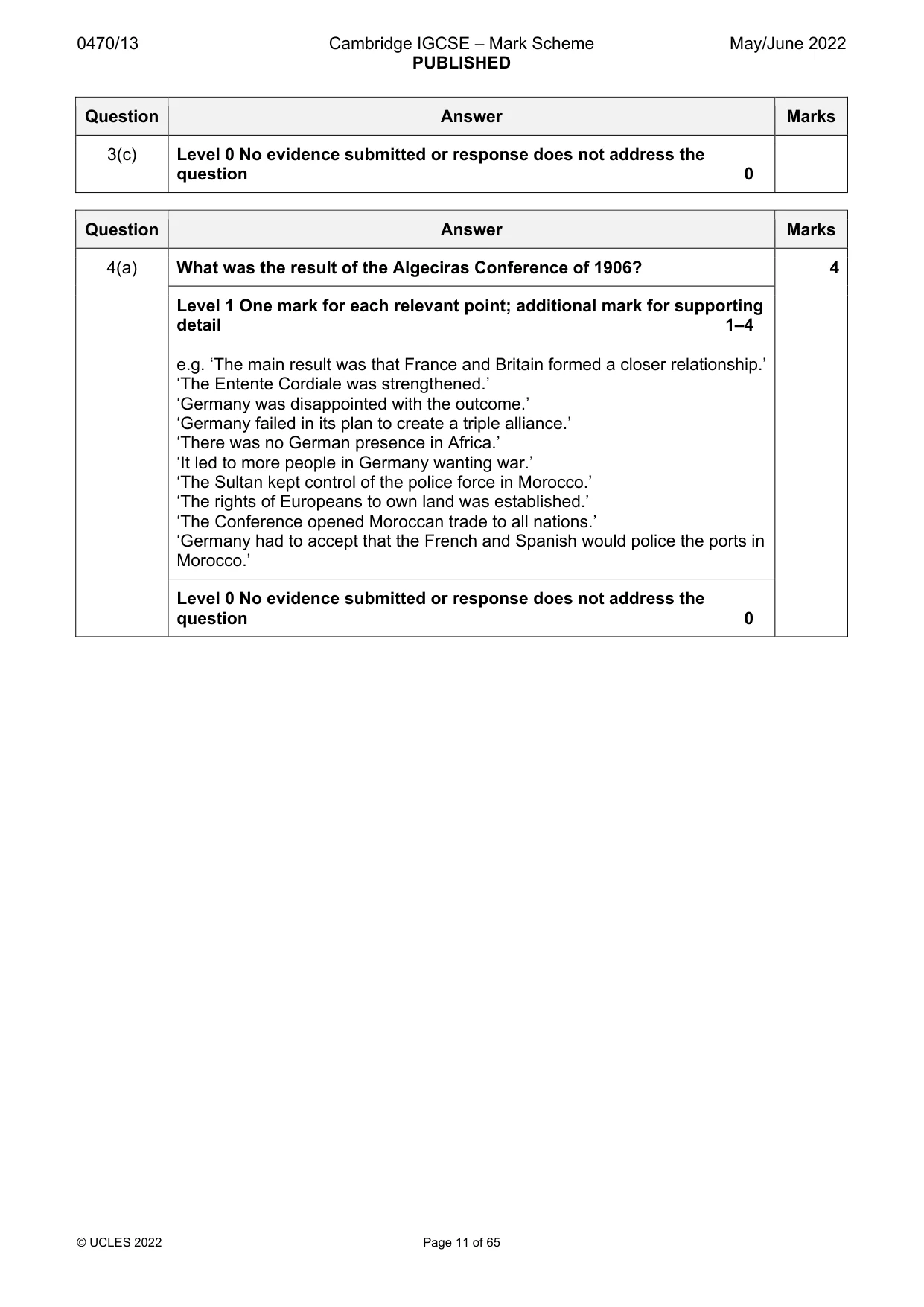
0470/13 Cambridge IGCSE – Mark Scheme PUBLISHED May/June 2022 © UCLES 2022 Page 11 of 65 Question Answer Marks 3(c) Level 0 No evidence submitted or response does not address the question 0 Question Answer Marks 4(a) What was the result of the Algeciras Conference of 1906? 4 Level 1 One mark for each relevant point; additional mark for supporting detail 1–4 e.g. ‘The main result was that France and Britain formed a closer relationship.’ ‘The Entente Cordiale was strengthened.’ ‘Germany was disappointed with the outcome.’ ‘Germany failed in its plan to create a triple alliance.’ ‘There was no German presence in Africa.’ ‘It led to more people in Germany wanting war.’ ‘The Sultan kept control of the police force in Morocco.’ ‘The rights of Europeans to own land was established.’ ‘The Conference opened Moroccan trade to all nations.’ ‘Germany had to accept that the French and Spanish would police the ports in Morocco.’ Level 0 No evidence submitted or response does not address the question 0
Mark scheme, page 12
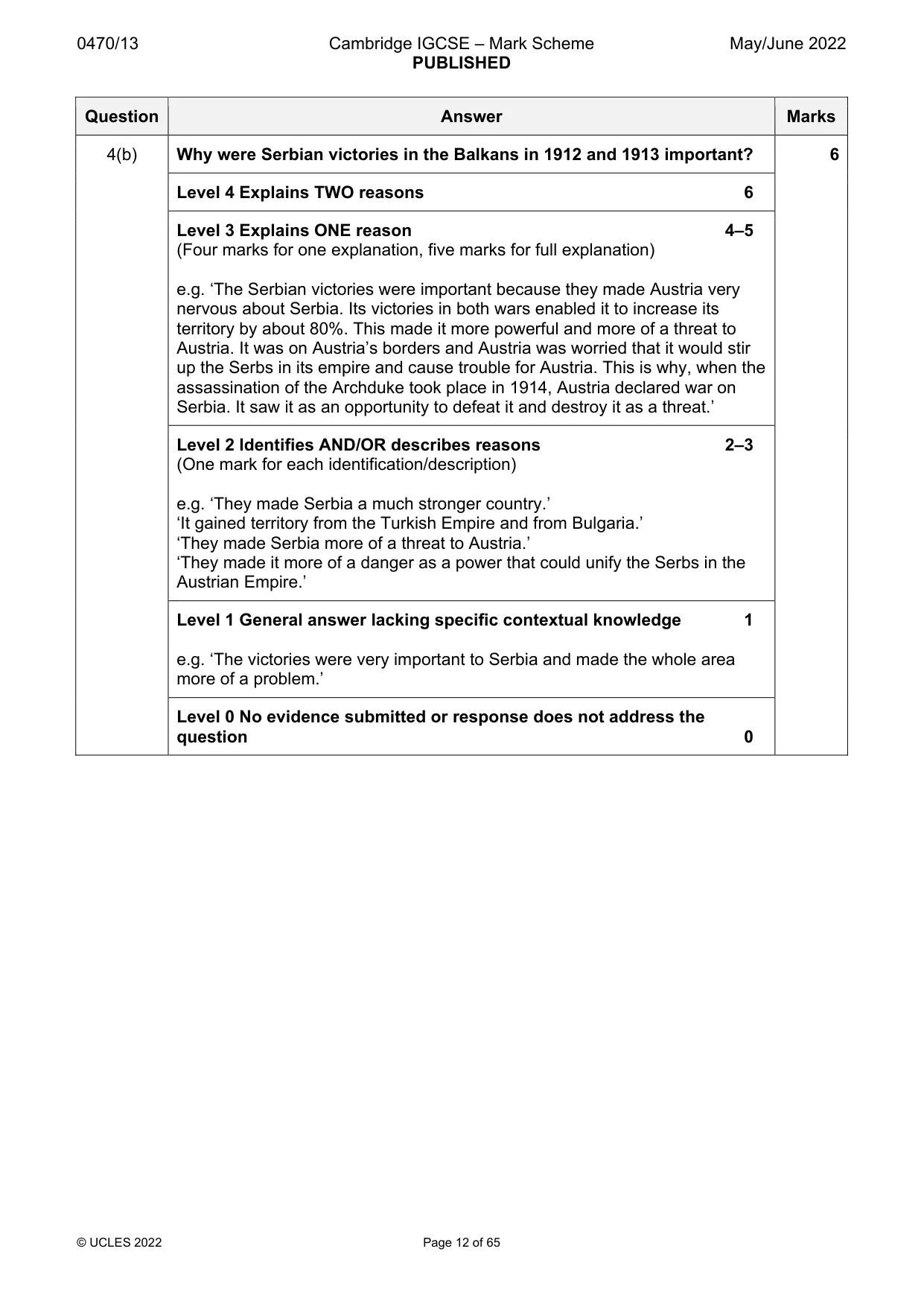
0470/13 Cambridge IGCSE – Mark Scheme PUBLISHED May/June 2022 © UCLES 2022 Page 12 of 65 Question Answer Marks 4(b) Why were Serbian victories in the Balkans in 1912 and 1913 important? 6 Level 4 Explains TWO reasons 6 Level 3 Explains ONE reason 4–5 (Four marks for one explanation, five marks for full explanation) e.g. ‘The Serbian victories were important because they made Austria very nervous about Serbia. Its victories in both wars enabled it to increase its territory by about 80%. This made it more powerful and more of a threat to Austria. It was on Austria’s borders and Austria was worried that it would stir up the Serbs in its empire and cause trouble for Austria. This is why, when the assassination of the Archduke took place in 1914, Austria declared war on Serbia. It saw it as an opportunity to defeat it and destroy it as a threat.’ Level 2 Identifies AND/OR describes reasons 2–3 (One mark for each identification/description) e.g. ‘They made Serbia a much stronger country.’ ‘It gained territory from the Turkish Empire and from Bulgaria.’ ‘They made Serbia more of a threat to Austria.’ ‘They made it more of a danger as a power that could unify the Serbs in the Austrian Empire.’ Level 1 General answer lacking specific contextual knowledge 1 e.g. ‘The victories were very important to Serbia and made the whole area more of a problem.’ Level 0 No evidence submitted or response does not address the question 0
Mark scheme, page 13
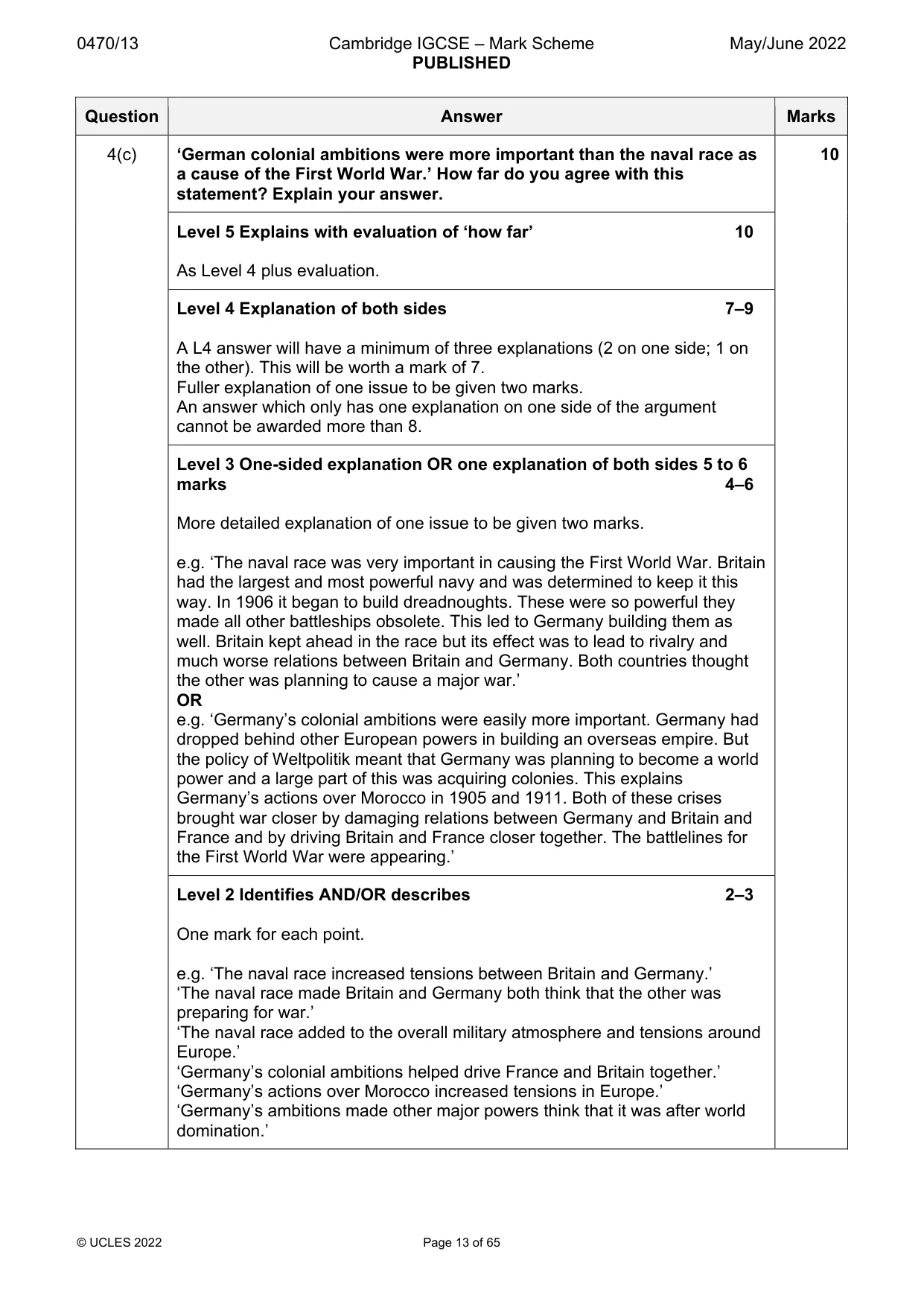
0470/13 Cambridge IGCSE – Mark Scheme PUBLISHED May/June 2022 © UCLES 2022 Page 13 of 65 Question Answer Marks 4(c) ‘German colonial ambitions were more important than the naval race as a cause of the First World War.’ How far do you agree with this statement? Explain your answer. 10 Level 5 Explains with evaluation of ‘how far’ 10 As Level 4 plus evaluation. Level 4 Explanation of both sides 7–9 A L4 answer will have a minimum of three explanations (2 on one side; 1 on the other). This will be worth a mark of 7. Fuller explanation of one issue to be given two marks. An answer which only has one explanation on one side of the argument cannot be awarded more than 8. Level 3 One-sided explanation OR one explanation of both sides 5 to 6 marks 4–6 More detailed explanation of one issue to be given two marks. e.g. ‘The naval race was very important in causing the First World War. Britain had the largest and most powerful navy and was determined to keep it this way. In 1906 it began to build dreadnoughts. These were so powerful they made all other battleships obsolete. This led to Germany building them as well. Britain kept ahead in the race but its effect was to lead to rivalry and much worse relations between Britain and Germany. Both countries thought the other was planning to cause a major war.’ OR e.g. ‘Germany’s colonial ambitions were easily more important. Germany had dropped behind other European powers in building an overseas empire. But the policy of Weltpolitik meant that Germany was planning to become a world power and a large part of this was acquiring colonies. This explains Germany’s actions over Morocco in 1905 and 1911. Both of these crises brought war closer by damaging relations between Germany and Britain and France and by driving Britain and France closer together. The battlelines for the First World War were appearing.’ Level 2 Identifies AND/OR describes 2–3 One mark for each point. e.g. ‘The naval race increased tensions between Britain and Germany.’ ‘The naval race made Britain and Germany both think that the other was preparing for war.’ ‘The naval race added to the overall military atmosphere and tensions around Europe.’ ‘Germany’s colonial ambitions helped drive France and Britain together.’ ‘Germany’s actions over Morocco increased tensions in Europe.’ ‘Germany’s ambitions made other major powers think that it was after world domination.’
Mark scheme, page 14
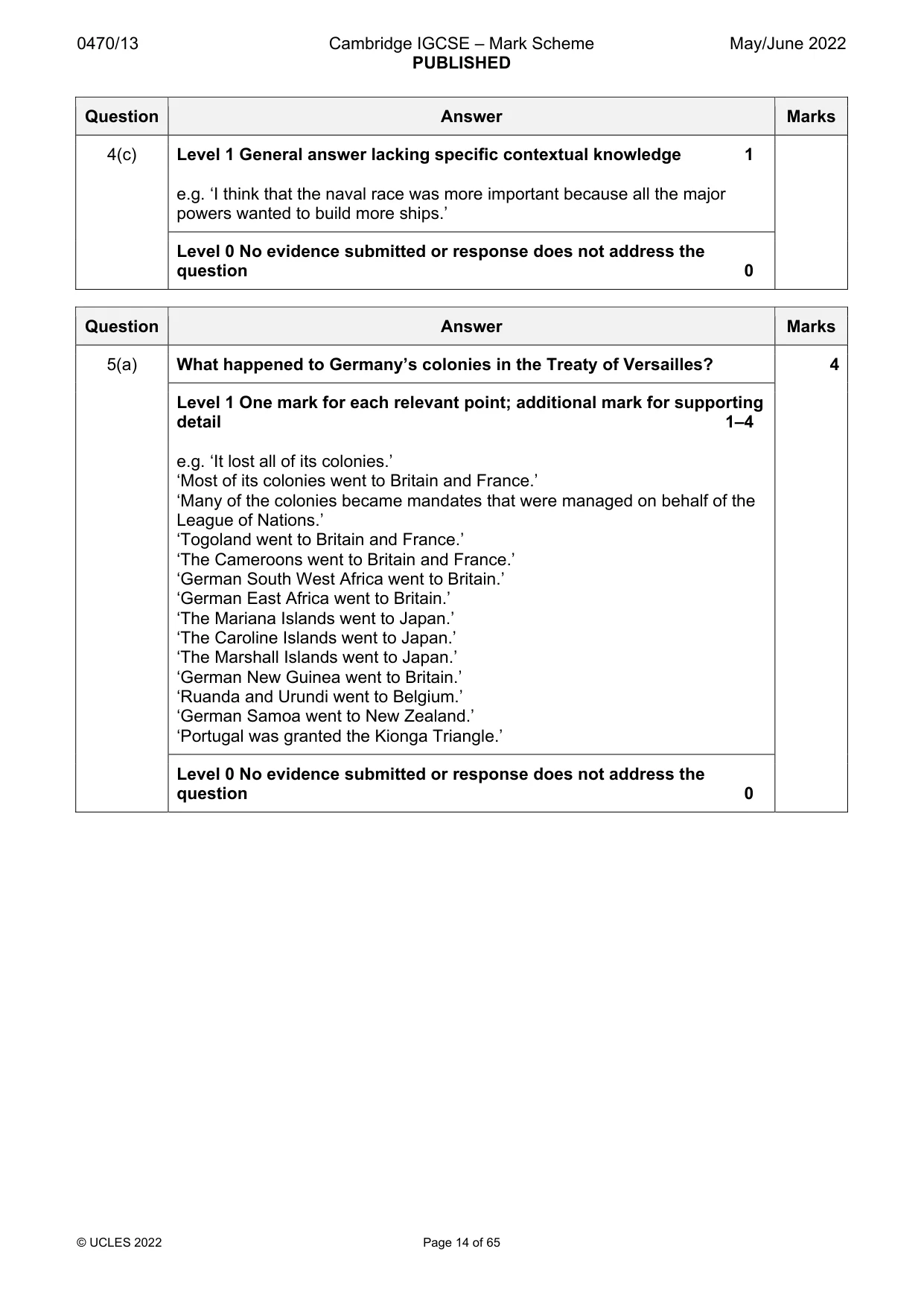
0470/13 Cambridge IGCSE – Mark Scheme PUBLISHED May/June 2022 © UCLES 2022 Page 14 of 65 Question Answer Marks 4(c) Level 1 General answer lacking specific contextual knowledge 1 e.g. ‘I think that the naval race was more important because all the major powers wanted to build more ships.’ Level 0 No evidence submitted or response does not address the question 0 Question Answer Marks 5(a) What happened to Germany’s colonies in the Treaty of Versailles? 4 Level 1 One mark for each relevant point; additional mark for supporting detail 1–4 e.g. ‘It lost all of its colonies.’ ‘Most of its colonies went to Britain and France.’ ‘Many of the colonies became mandates that were managed on behalf of the League of Nations.’ ‘Togoland went to Britain and France.’ ‘The Cameroons went to Britain and France.’ ‘German South West Africa went to Britain.’ ‘German East Africa went to Britain.’ ‘The Mariana Islands went to Japan.’ ‘The Caroline Islands went to Japan.’ ‘The Marshall Islands went to Japan.’ ‘German New Guinea went to Britain.’ ‘Ruanda and Urundi went to Belgium.’ ‘German Samoa went to New Zealand.’ ‘Portugal was granted the Kionga Triangle.’ Level 0 No evidence submitted or response does not address the question 0
Mark scheme, page 15
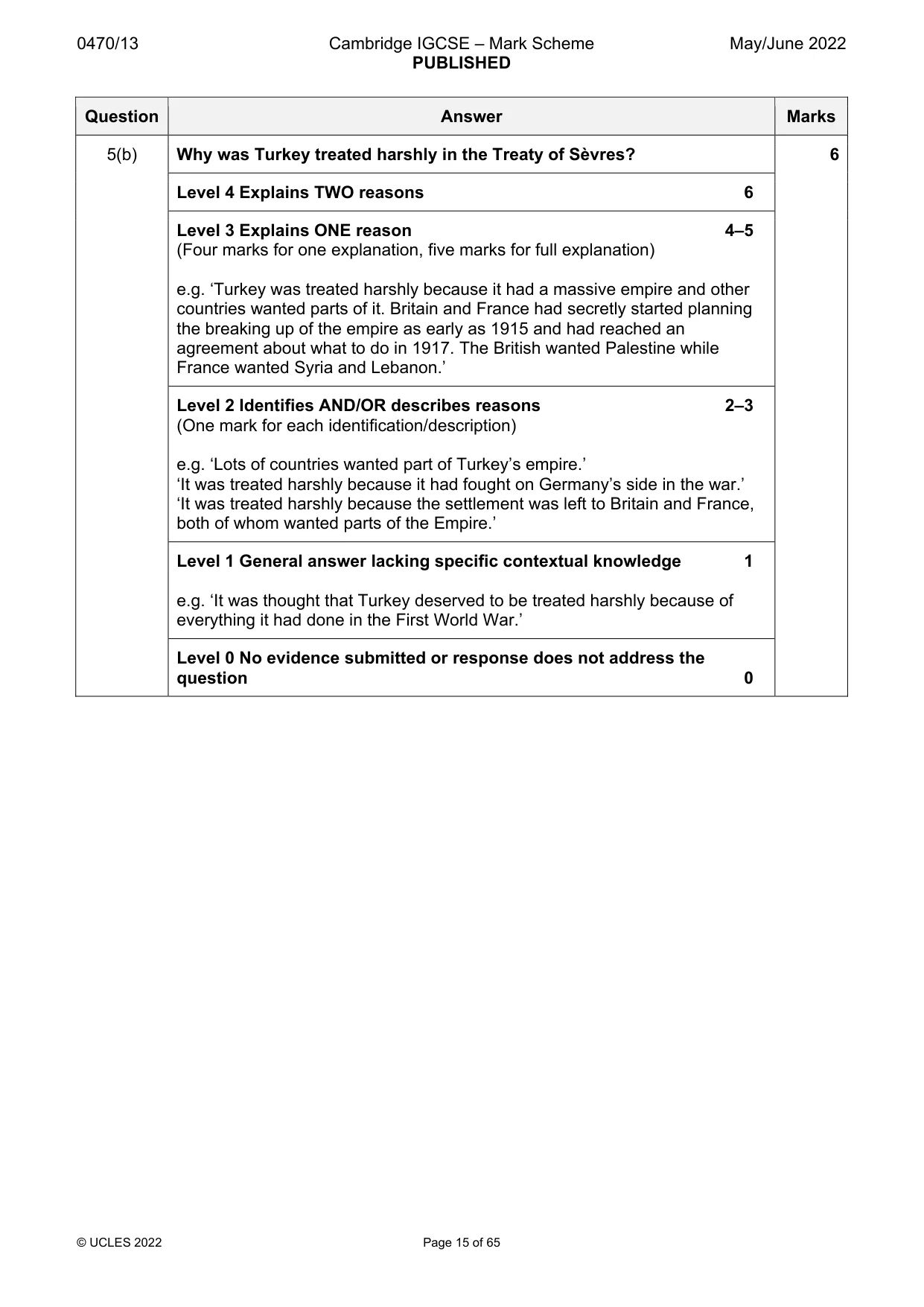
0470/13 Cambridge IGCSE – Mark Scheme PUBLISHED May/June 2022 © UCLES 2022 Page 15 of 65 Question Answer Marks 5(b) Why was Turkey treated harshly in the Treaty of Sèvres? 6 Level 4 Explains TWO reasons 6 Level 3 Explains ONE reason 4–5 (Four marks for one explanation, five marks for full explanation) e.g. ‘Turkey was treated harshly because it had a massive empire and other countries wanted parts of it. Britain and France had secretly started planning the breaking up of the empire as early as 1915 and had reached an agreement about what to do in 1917. The British wanted Palestine while France wanted Syria and Lebanon.’ Level 2 Identifies AND/OR describes reasons 2–3 (One mark for each identification/description) e.g. ‘Lots of countries wanted part of Turkey’s empire.’ ‘It was treated harshly because it had fought on Germany’s side in the war.’ ‘It was treated harshly because the settlement was left to Britain and France, both of whom wanted parts of the Empire.’ Level 1 General answer lacking specific contextual knowledge 1 e.g. ‘It was thought that Turkey deserved to be treated harshly because of everything it had done in the First World War.’ Level 0 No evidence submitted or response does not address the question 0
Mark scheme, page 16
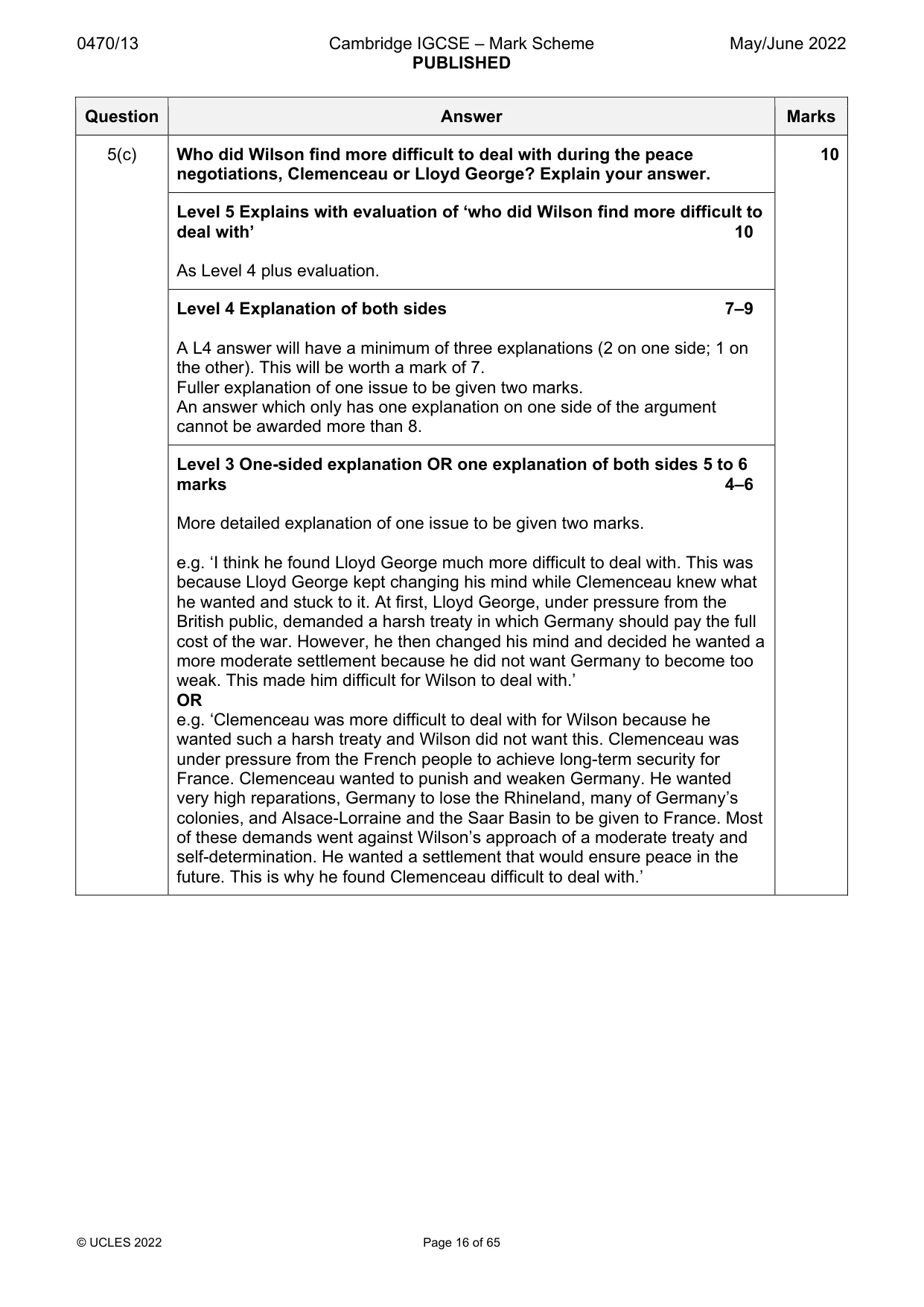
0470/13 Cambridge IGCSE – Mark Scheme PUBLISHED May/June 2022 © UCLES 2022 Page 16 of 65 Question Answer Marks 5(c) Who did Wilson find more difficult to deal with during the peace negotiations, Clemenceau or Lloyd George? Explain your answer. 10 Level 5 Explains with evaluation of ‘who did Wilson find more difficult to deal with’ 10 As Level 4 plus evaluation. Level 4 Explanation of both sides 7–9 A L4 answer will have a minimum of three explanations (2 on one side; 1 on the other). This will be worth a mark of 7. Fuller explanation of one issue to be given two marks. An answer which only has one explanation on one side of the argument cannot be awarded more than 8. Level 3 One-sided explanation OR one explanation of both sides 5 to 6 marks 4–6 More detailed explanation of one issue to be given two marks. e.g. ‘I think he found Lloyd George much more difficult to deal with. This was because Lloyd George kept changing his mind while Clemenceau knew what he wanted and stuck to it. At first, Lloyd George, under pressure from the British public, demanded a harsh treaty in which Germany should pay the full cost of the war. However, he then changed his mind and decided he wanted a more moderate settlement because he did not want Germany to become too weak. This made him difficult for Wilson to deal with.’ OR e.g. ‘Clemenceau was more difficult to deal with for Wilson because he wanted such a harsh treaty and Wilson did not want this. Clemenceau was under pressure from the French people to achieve long-term security for France. Clemenceau wanted to punish and weaken Germany. He wanted very high reparations, Germany to lose the Rhineland, many of Germany’s colonies, and Alsace-Lorraine and the Saar Basin to be given to France. Most of these demands went against Wilson’s approach of a moderate treaty and self-determination. He wanted a settlement that would ensure peace in the future. This is why he found Clemenceau difficult to deal with.’
Mark scheme, page 17
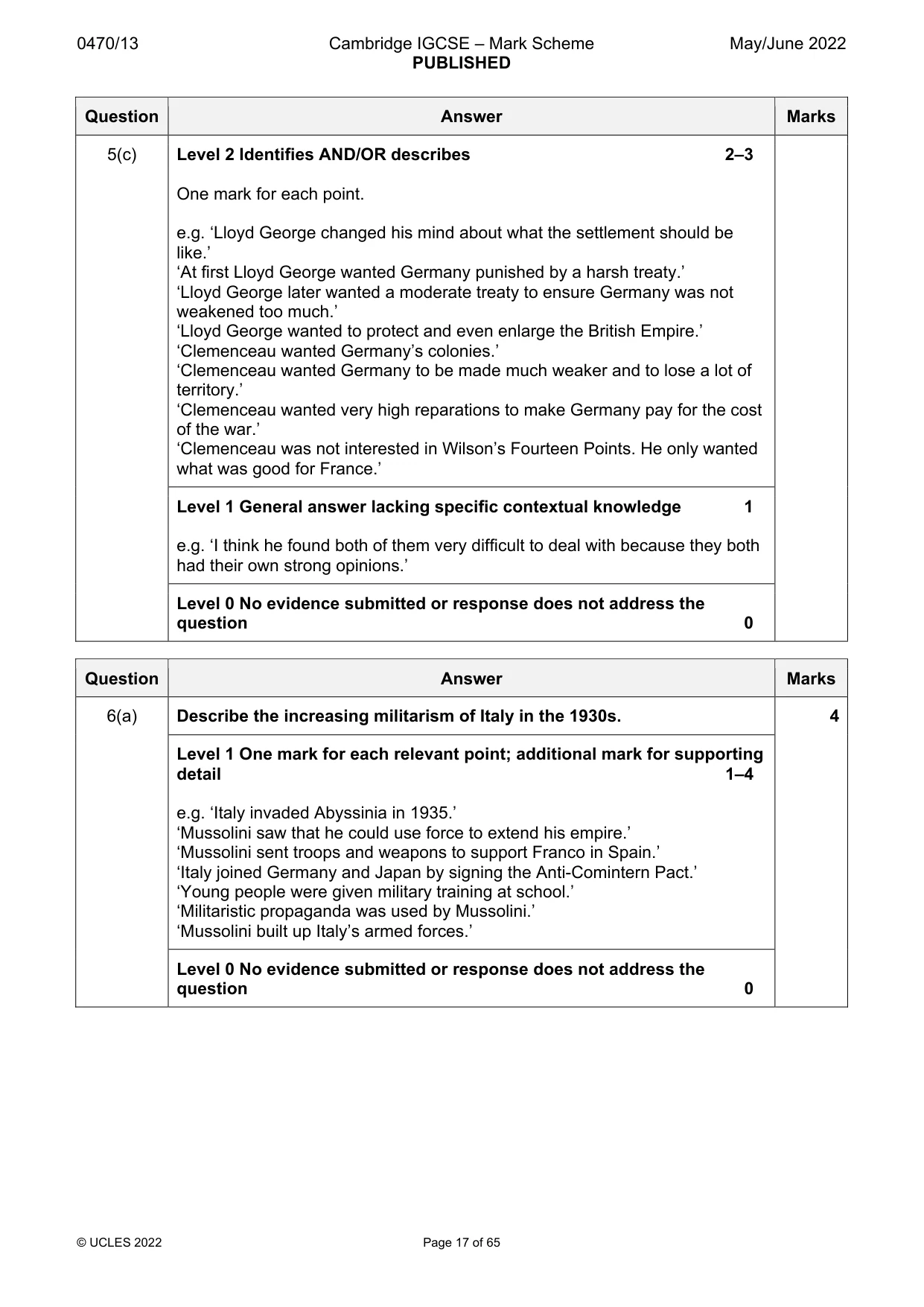
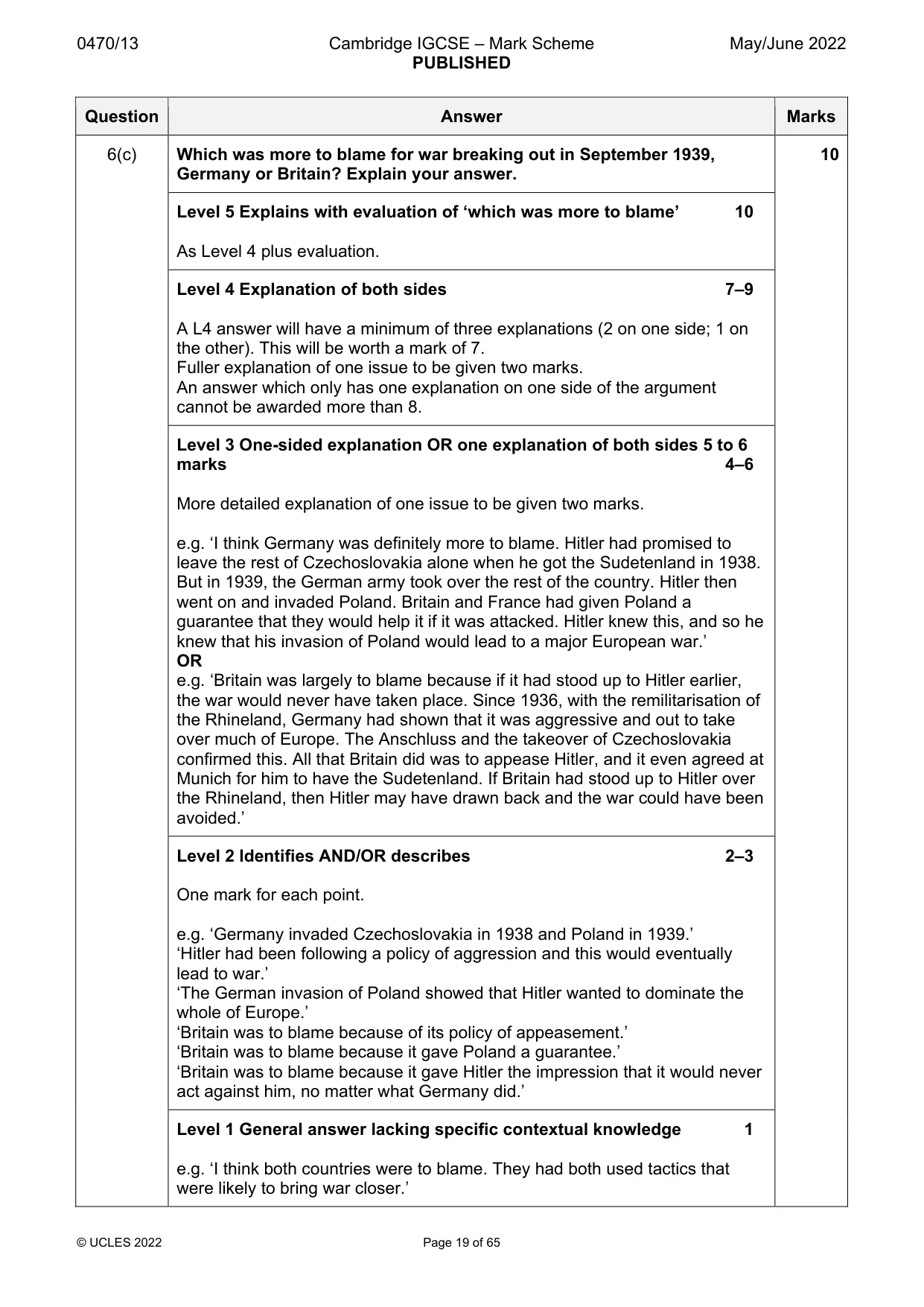
0470/13 Cambridge IGCSE – Mark Scheme PUBLISHED May/June 2022 © UCLES 2022 Page 17 of 65 Question Answer Marks 5(c) Level 2 Identifies AND/OR describes 2–3 One mark for each point. e.g. ‘Lloyd George changed his mind about what the settlement should be like.’ ‘At first Lloyd George wanted Germany punished by a harsh treaty.’ ‘Lloyd George later wanted a moderate treaty to ensure Germany was not weakened too much.’ ‘Lloyd George wanted to protect and even enlarge the British Empire.’ ‘Clemenceau wanted Germany’s colonies.’ ‘Clemenceau wanted Germany to be made much weaker and to lose a lot of territory.’ ‘Clemenceau wanted very high reparations to make Germany pay for the cost of the war.’ ‘Clemenceau was not interested in Wilson’s Fourteen Points. He only wanted what was good for France.’ Level 1 General answer lacking specific contextual knowledge 1 e.g. ‘I think he found both of them very difficult to deal with because they both had their own strong opinions.’ Level 0 No evidence submitted or response does not address the question 0 Question Answer Marks 6(a) Describe the increasing militarism of Italy in the 1930s. 4 Level 1 One mark for each relevant point; additional mark for supporting detail 1–4 e.g. ‘Italy invaded Abyssinia in 1935.’ ‘Mussolini saw that he could use force to extend his empire.’ ‘Mussolini sent troops and weapons to support Franco in Spain.’ ‘Italy joined Germany and Japan by signing the Anti-Comintern Pact.’ ‘Young people were given military training at school.’ ‘Militaristic propaganda was used by Mussolini.’ ‘Mussolini built up Italy’s armed forces.’ Level 0 No evidence submitted or response does not address the question 0
Mark scheme, page 18
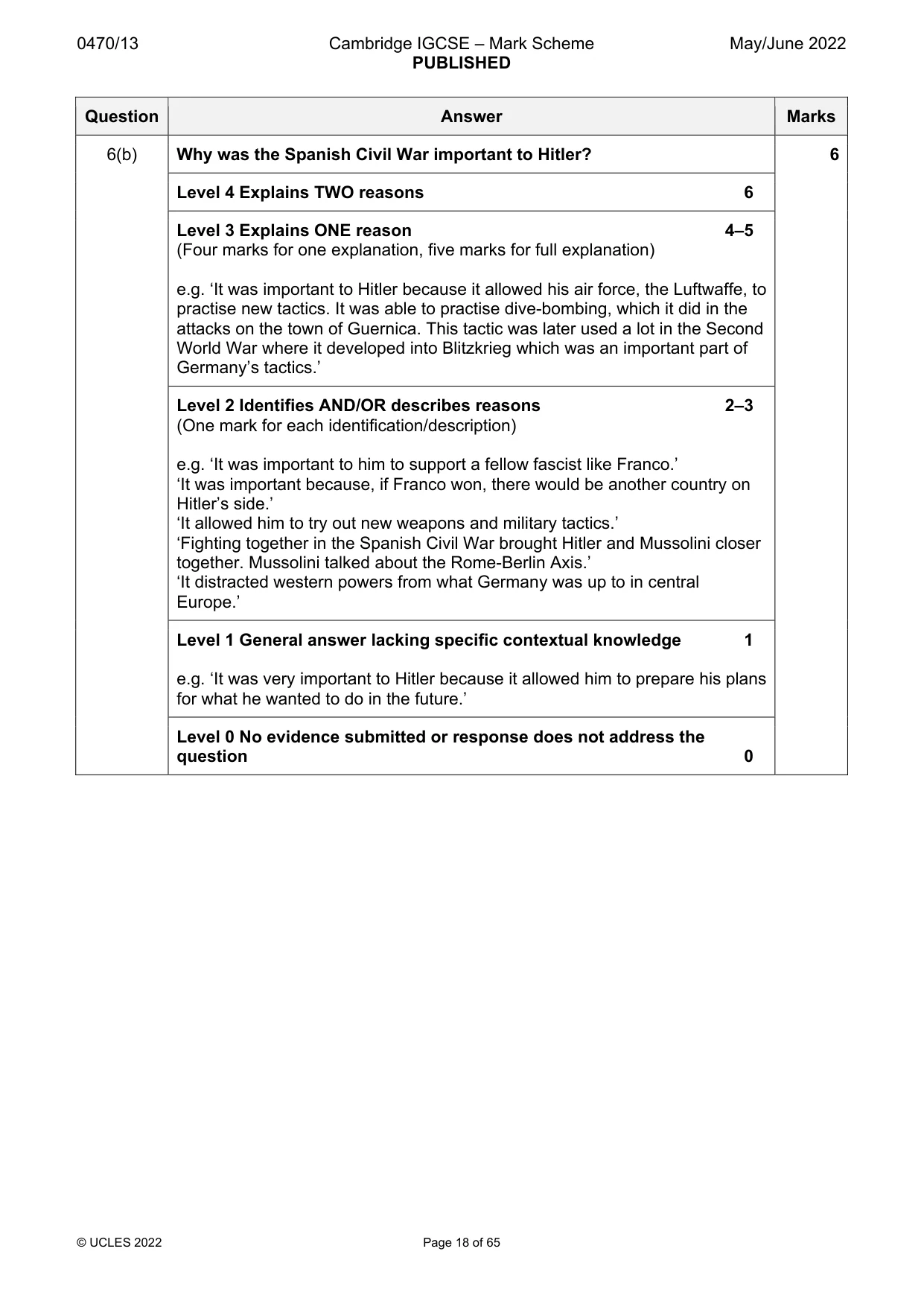
0470/13 Cambridge IGCSE – Mark Scheme PUBLISHED May/June 2022 © UCLES 2022 Page 18 of 65 Question Answer Marks 6(b) Why was the Spanish Civil War important to Hitler? 6 Level 4 Explains TWO reasons 6 Level 3 Explains ONE reason 4–5 (Four marks for one explanation, five marks for full explanation) e.g. ‘It was important to Hitler because it allowed his air force, the Luftwaffe, to practise new tactics. It was able to practise dive-bombing, which it did in the attacks on the town of Guernica. This tactic was later used a lot in the Second World War where it developed into Blitzkrieg which was an important part of Germany’s tactics.’ Level 2 Identifies AND/OR describes reasons 2–3 (One mark for each identification/description) e.g. ‘It was important to him to support a fellow fascist like Franco.’ ‘It was important because, if Franco won, there would be another country on Hitler’s side.’ ‘It allowed him to try out new weapons and military tactics.’ ‘Fighting together in the Spanish Civil War brought Hitler and Mussolini closer together. Mussolini talked about the Rome-Berlin Axis.’ ‘It distracted western powers from what Germany was up to in central Europe.’ Level 1 General answer lacking specific contextual knowledge 1 e.g. ‘It was very important to Hitler because it allowed him to prepare his plans for what he wanted to do in the future.’ Level 0 No evidence submitted or response does not address the question 0
Mark scheme, page 19
0470/13 Cambridge IGCSE – Mark Scheme PUBLISHED May/June 2022 © UCLES 2022 Page 19 of 65 Question Answer Marks 6(c) Which was more to blame for war breaking out in September 1939, Germany or Britain? Explain your answer. 10 Level 5 Explains with evaluation of ‘which was more to blame’ 10 As Level 4 plus evaluation. Level 4 Explanation of both sides 7–9 A L4 answer will have a minimum of three explanations (2 on one side; 1 on the other). This will be worth a mark of 7. Fuller explanation of one issue to be given two marks. An answer which only has one explanation on one side of the argument cannot be awarded more than 8. Level 3 One-sided explanation OR one explanation of both sides 5 to 6 marks 4–6 More detailed explanation of one issue to be given two marks. e.g. ‘I think Germany was definitely more to blame. Hitler had promised to leave the rest of Czechoslovakia alone when he got the Sudetenland in 1938. But in 1939, the German army took over the rest of the country. Hitler then went on and invaded Poland. Britain and France had given Poland a guarantee that they would help it if it was attacked. Hitler knew this, and so he knew that his invasion of Poland would lead to a major European war.’ OR e.g. ‘Britain was largely to blame because if it had stood up to Hitler earlier, the war would never have taken place. Since 1936, with the remilitarisation of the Rhineland, Germany had shown that it was aggressive and out to take over much of Europe. The Anschluss and the takeover of Czechoslovakia confirmed this. All that Britain did was to appease Hitler, and it even agreed at Munich for him to have the Sudetenland. If Britain had stood up to Hitler over the Rhineland, then Hitler may have drawn back and the war could have been avoided.’ Level 2 Identifies AND/OR describes 2–3 One mark for each point. e.g. ‘Germany invaded Czechoslovakia in 1938 and Poland in 1939.’ ‘Hitler had been following a policy of aggression and this would eventually lead to war.’ ‘The German invasion of Poland showed that Hitler wanted to dominate the whole of Europe.’ ‘Britain was to blame because of its policy of appeasement.’ ‘Britain was to blame because it gave Poland a guarantee.’ ‘Britain was to blame because it gave Hitler the impression that it would never act against him, no matter what Germany did.’ Level 1 General answer lacking specific contextual knowledge 1 e.g. ‘I think both countries were to blame. They had both used tactics that were likely to bring war closer.’
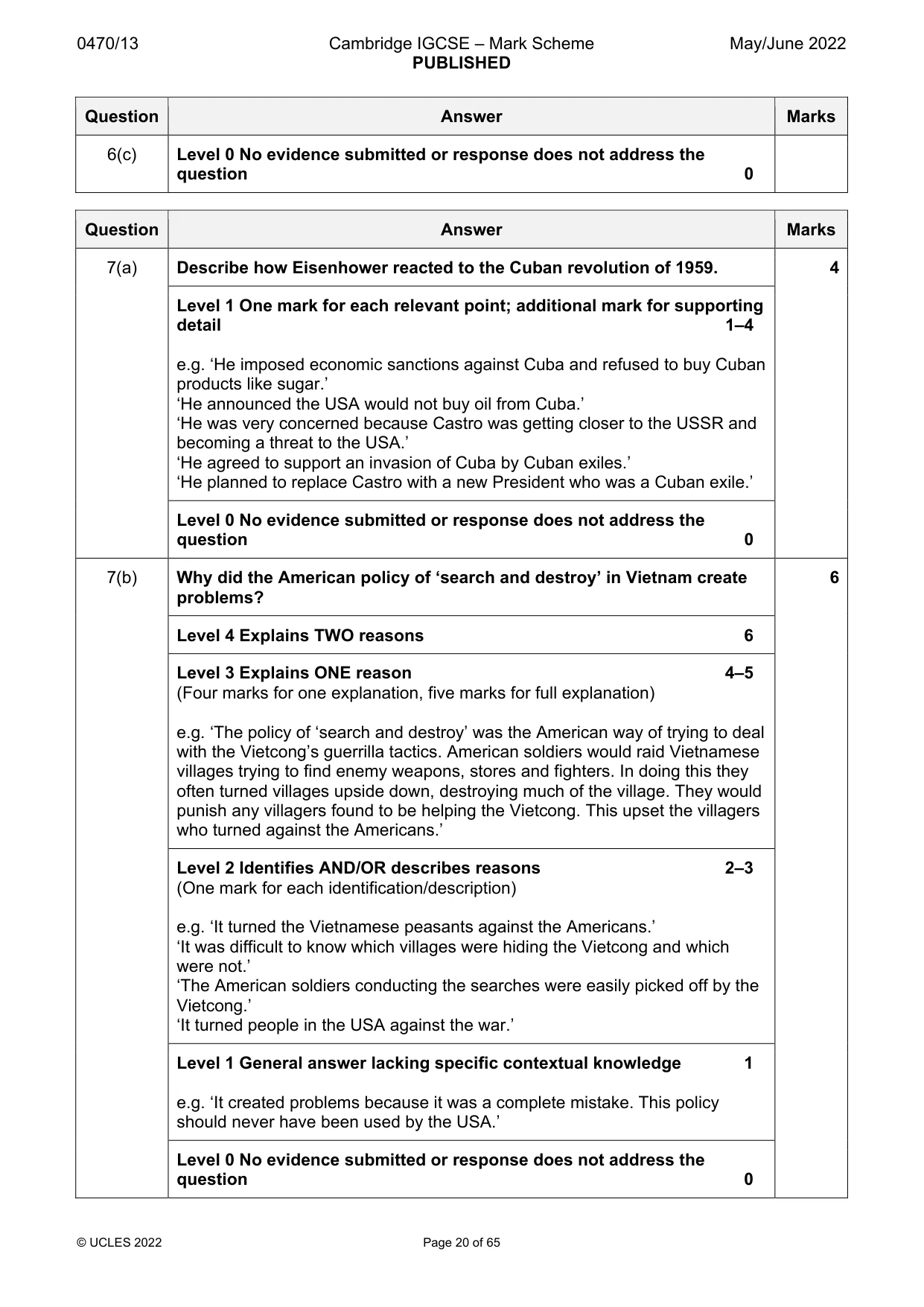
Mark scheme, page 20
0470/13 Cambridge IGCSE – Mark Scheme PUBLISHED May/June 2022 © UCLES 2022 Page 20 of 65 Question Answer Marks 6(c) Level 0 No evidence submitted or response does not address the question 0 Question Answer Marks 7(a) Describe how Eisenhower reacted to the Cuban revolution of 1959. 4 Level 1 One mark for each relevant point; additional mark for supporting detail 1–4 e.g. ‘He imposed economic sanctions against Cuba and refused to buy Cuban products like sugar.’ ‘He announced the USA would not buy oil from Cuba.’ ‘He was very concerned because Castro was getting closer to the USSR and becoming a threat to the USA.’ ‘He agreed to support an invasion of Cuba by Cuban exiles.’ ‘He planned to replace Castro with a new President who was a Cuban exile.’ Level 0 No evidence submitted or response does not address the question 0 7(b) Why did the American policy of ‘search and destroy’ in Vietnam create problems? 6 Level 4 Explains TWO reasons 6 Level 3 Explains ONE reason 4–5 (Four marks for one explanation, five marks for full explanation) e.g. ‘The policy of ‘search and destroy’ was the American way of trying to deal with the Vietcong’s guerrilla tactics. American soldiers would raid Vietnamese villages trying to find enemy weapons, stores and fighters. In doing this they often turned villages upside down, destroying much of the village. They would punish any villagers found to be helping the Vietcong. This upset the villagers who turned against the Americans.’ Level 2 Identifies AND/OR describes reasons 2–3 (One mark for each identification/description) e.g. ‘It turned the Vietnamese peasants against the Americans.’ ‘It was difficult to know which villages were hiding the Vietcong and which were not.’ ‘The American soldiers conducting the searches were easily picked off by the Vietcong.’ ‘It turned people in the USA against the war.’ Level 1 General answer lacking specific contextual knowledge 1 e.g. ‘It created problems because it was a complete mistake. This policy should never have been used by the USA.’ Level 0 No evidence submitted or response does not address the question 0
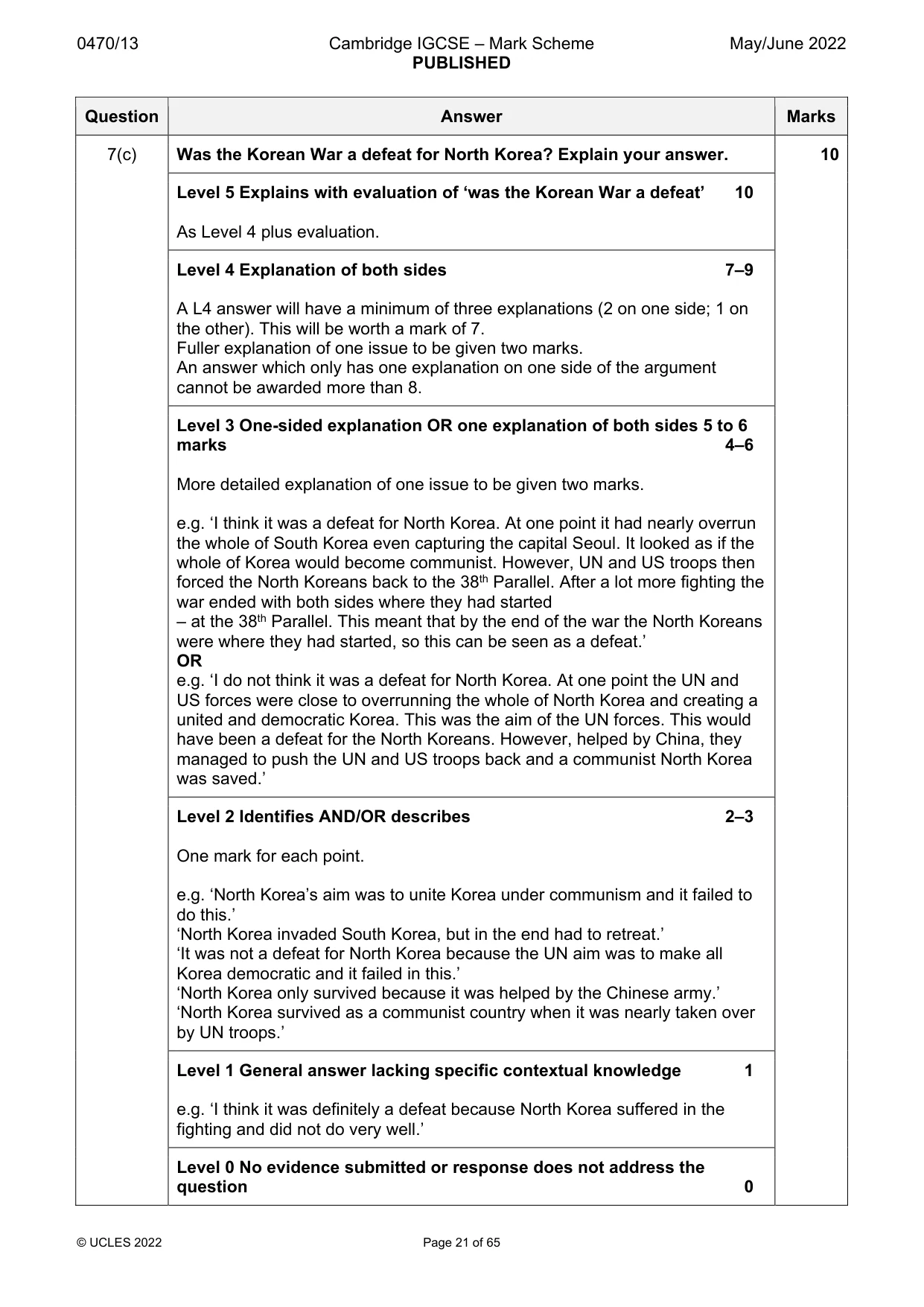
Mark scheme, page 21
0470/13 Cambridge IGCSE – Mark Scheme PUBLISHED May/June 2022 © UCLES 2022 Page 21 of 65 Question Answer Marks 7(c) Was the Korean War a defeat for North Korea? Explain your answer. 10 Level 5 Explains with evaluation of ‘was the Korean War a defeat’ 10 As Level 4 plus evaluation. Level 4 Explanation of both sides 7–9 A L4 answer will have a minimum of three explanations (2 on one side; 1 on the other). This will be worth a mark of 7. Fuller explanation of one issue to be given two marks. An answer which only has one explanation on one side of the argument cannot be awarded more than 8. Level 3 One-sided explanation OR one explanation of both sides 5 to 6 marks 4–6 More detailed explanation of one issue to be given two marks. e.g. ‘I think it was a defeat for North Korea. At one point it had nearly overrun the whole of South Korea even capturing the capital Seoul. It looked as if the whole of Korea would become communist. However, UN and US troops then forced the North Koreans back to the 38th Parallel. After a lot more fighting the war ended with both sides where they had started – at the 38th Parallel. This meant that by the end of the war the North Koreans were where they had started, so this can be seen as a defeat.’ OR e.g. ‘I do not think it was a defeat for North Korea. At one point the UN and US forces were close to overrunning the whole of North Korea and creating a united and democratic Korea. This was the aim of the UN forces. This would have been a defeat for the North Koreans. However, helped by China, they managed to push the UN and US troops back and a communist North Korea was saved.’ Level 2 Identifies AND/OR describes 2–3 One mark for each point. e.g. ‘North Korea’s aim was to unite Korea under communism and it failed to do this.’ ‘North Korea invaded South Korea, but in the end had to retreat.’ ‘It was not a defeat for North Korea because the UN aim was to make all Korea democratic and it failed in this.’ ‘North Korea only survived because it was helped by the Chinese army.’ ‘North Korea survived as a communist country when it was nearly taken over by UN troops.’ Level 1 General answer lacking specific contextual knowledge 1 e.g. ‘I think it was definitely a defeat because North Korea suffered in the fighting and did not do very well.’ Level 0 No evidence submitted or response does not address the question 0
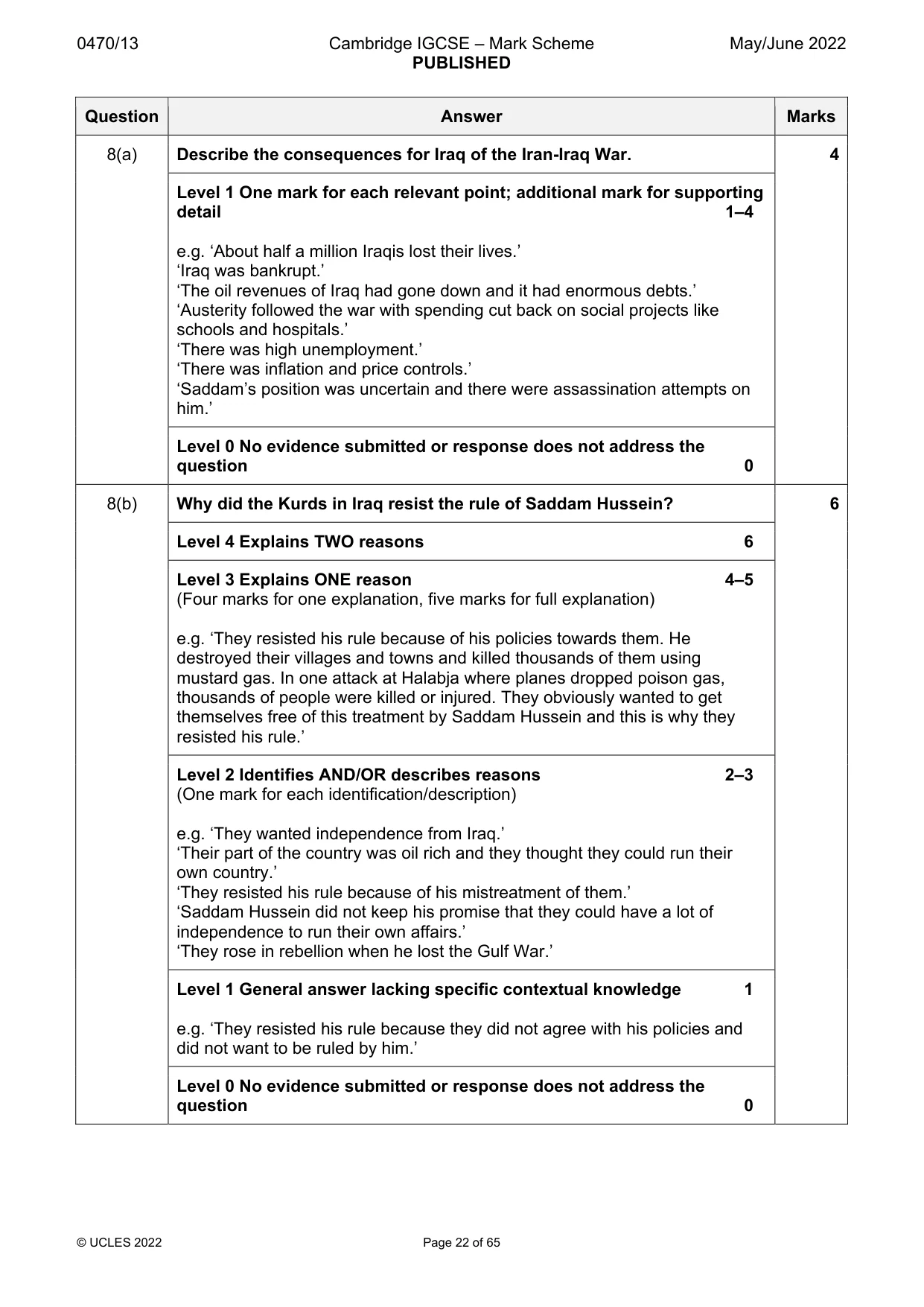
Mark scheme, page 22
0470/13 Cambridge IGCSE – Mark Scheme PUBLISHED May/June 2022 © UCLES 2022 Page 22 of 65 Question Answer Marks 8(a) Describe the consequences for Iraq of the Iran-Iraq War. 4 Level 1 One mark for each relevant point; additional mark for supporting detail 1–4 e.g. ‘About half a million Iraqis lost their lives.’ ‘Iraq was bankrupt.’ ‘The oil revenues of Iraq had gone down and it had enormous debts.’ ‘Austerity followed the war with spending cut back on social projects like schools and hospitals.’ ‘There was high unemployment.’ ‘There was inflation and price controls.’ ‘Saddam’s position was uncertain and there were assassination attempts on him.’ Level 0 No evidence submitted or response does not address the question 0 8(b) Why did the Kurds in Iraq resist the rule of Saddam Hussein? 6 Level 4 Explains TWO reasons 6 Level 3 Explains ONE reason 4–5 (Four marks for one explanation, five marks for full explanation) e.g. ‘They resisted his rule because of his policies towards them. He destroyed their villages and towns and killed thousands of them using mustard gas. In one attack at Halabja where planes dropped poison gas, thousands of people were killed or injured. They obviously wanted to get themselves free of this treatment by Saddam Hussein and this is why they resisted his rule.’ Level 2 Identifies AND/OR describes reasons 2–3 (One mark for each identification/description) e.g. ‘They wanted independence from Iraq.’ ‘Their part of the country was oil rich and they thought they could run their own country.’ ‘They resisted his rule because of his mistreatment of them.’ ‘Saddam Hussein did not keep his promise that they could have a lot of independence to run their own affairs.’ ‘They rose in rebellion when he lost the Gulf War.’ Level 1 General answer lacking specific contextual knowledge 1 e.g. ‘They resisted his rule because they did not agree with his policies and did not want to be ruled by him.’ Level 0 No evidence submitted or response does not address the question 0
Mark scheme, page 23
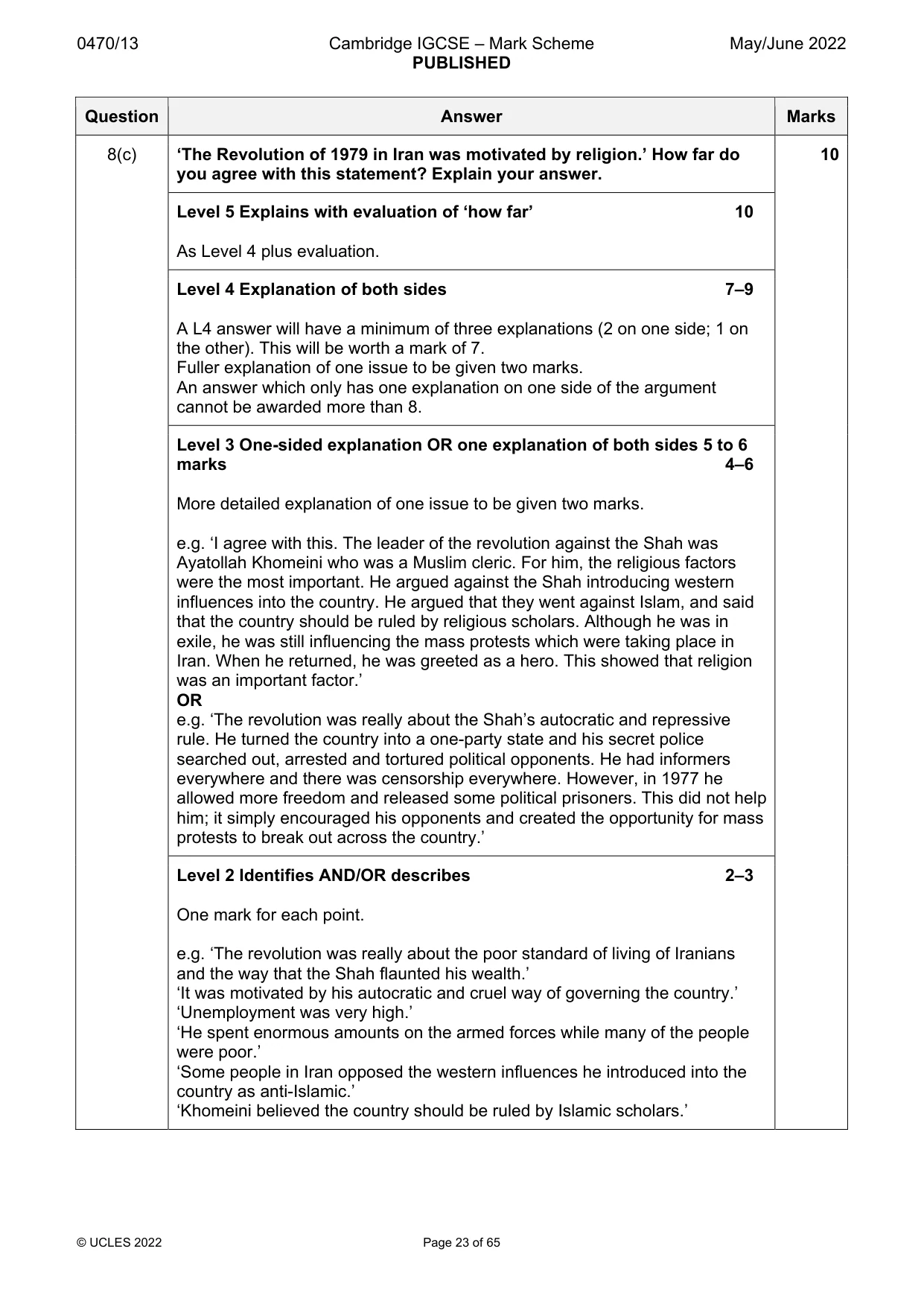
0470/13 Cambridge IGCSE – Mark Scheme PUBLISHED May/June 2022 © UCLES 2022 Page 23 of 65 Question Answer Marks 8(c) ‘The Revolution of 1979 in Iran was motivated by religion.’ How far do you agree with this statement? Explain your answer. 10 Level 5 Explains with evaluation of ‘how far’ 10 As Level 4 plus evaluation. Level 4 Explanation of both sides 7–9 A L4 answer will have a minimum of three explanations (2 on one side; 1 on the other). This will be worth a mark of 7. Fuller explanation of one issue to be given two marks. An answer which only has one explanation on one side of the argument cannot be awarded more than 8. Level 3 One-sided explanation OR one explanation of both sides 5 to 6 marks 4–6 More detailed explanation of one issue to be given two marks. e.g. ‘I agree with this. The leader of the revolution against the Shah was Ayatollah Khomeini who was a Muslim cleric. For him, the religious factors were the most important. He argued against the Shah introducing western influences into the country. He argued that they went against Islam, and said that the country should be ruled by religious scholars. Although he was in exile, he was still influencing the mass protests which were taking place in Iran. When he returned, he was greeted as a hero. This showed that religion was an important factor.’ OR e.g. ‘The revolution was really about the Shah’s autocratic and repressive rule. He turned the country into a one-party state and his secret police searched out, arrested and tortured political opponents. He had informers everywhere and there was censorship everywhere. However, in 1977 he allowed more freedom and released some political prisoners. This did not help him; it simply encouraged his opponents and created the opportunity for mass protests to break out across the country.’ Level 2 Identifies AND/OR describes 2–3 One mark for each point. e.g. ‘The revolution was really about the poor standard of living of Iranians and the way that the Shah flaunted his wealth.’ ‘It was motivated by his autocratic and cruel way of governing the country.’ ‘Unemployment was very high.’ ‘He spent enormous amounts on the armed forces while many of the people were poor.’ ‘Some people in Iran opposed the western influences he introduced into the country as anti-Islamic.’ ‘Khomeini believed the country should be ruled by Islamic scholars.’
Mark scheme, page 24
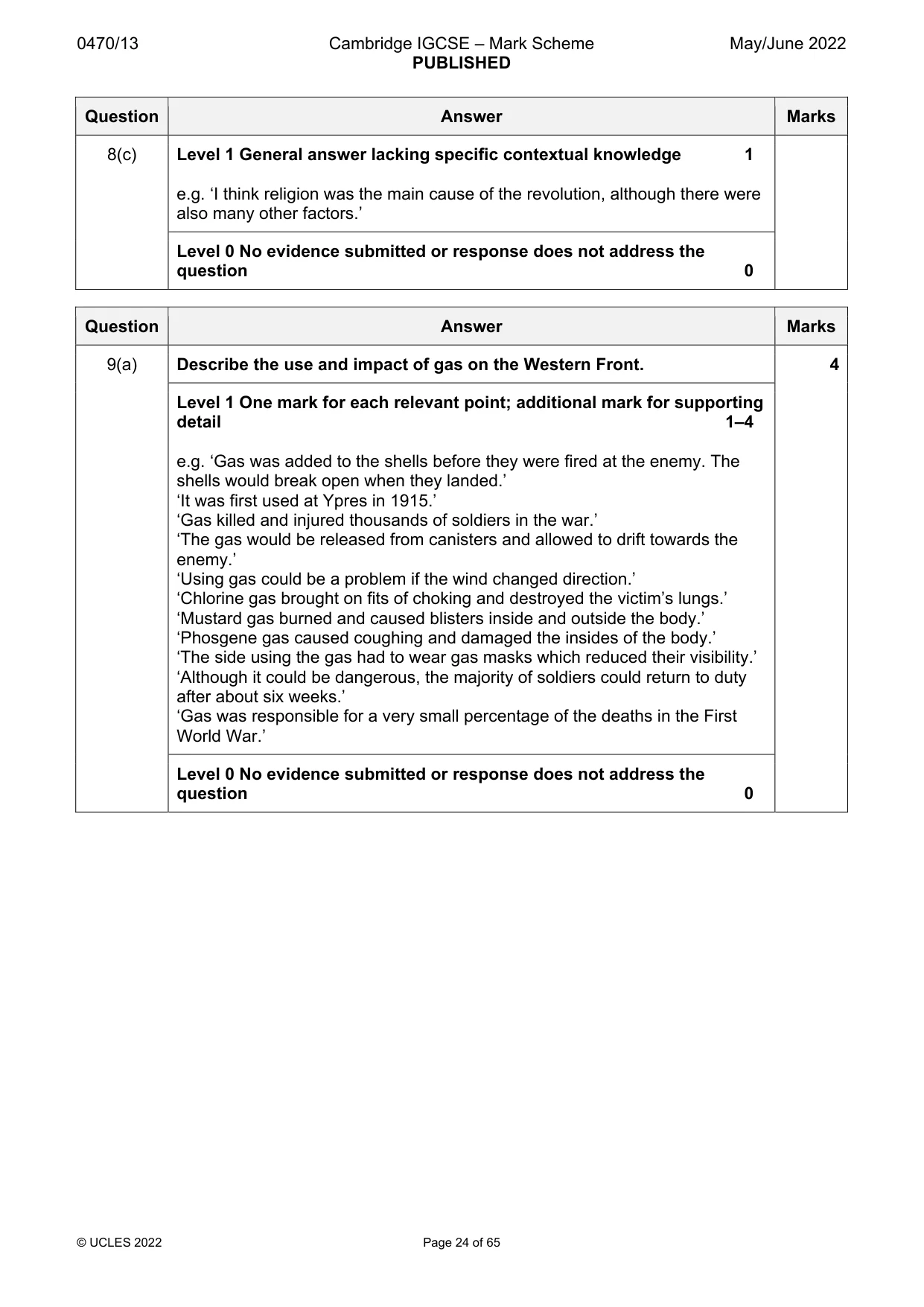
0470/13 Cambridge IGCSE – Mark Scheme PUBLISHED May/June 2022 © UCLES 2022 Page 24 of 65 Question Answer Marks 8(c) Level 1 General answer lacking specific contextual knowledge 1 e.g. ‘I think religion was the main cause of the revolution, although there were also many other factors.’ Level 0 No evidence submitted or response does not address the question 0 Question Answer Marks 9(a) Describe the use and impact of gas on the Western Front. 4 Level 1 One mark for each relevant point; additional mark for supporting detail 1–4 e.g. ‘Gas was added to the shells before they were fired at the enemy. The shells would break open when they landed.’ ‘It was first used at Ypres in 1915.’ ‘Gas killed and injured thousands of soldiers in the war.’ ‘The gas would be released from canisters and allowed to drift towards the enemy.’ ‘Using gas could be a problem if the wind changed direction.’ ‘Chlorine gas brought on fits of choking and destroyed the victim’s lungs.’ ‘Mustard gas burned and caused blisters inside and outside the body.’ ‘Phosgene gas caused coughing and damaged the insides of the body.’ ‘The side using the gas had to wear gas masks which reduced their visibility.’ ‘Although it could be dangerous, the majority of soldiers could return to duty after about six weeks.’ ‘Gas was responsible for a very small percentage of the deaths in the First World War.’ Level 0 No evidence submitted or response does not address the question 0
Mark scheme, page 25
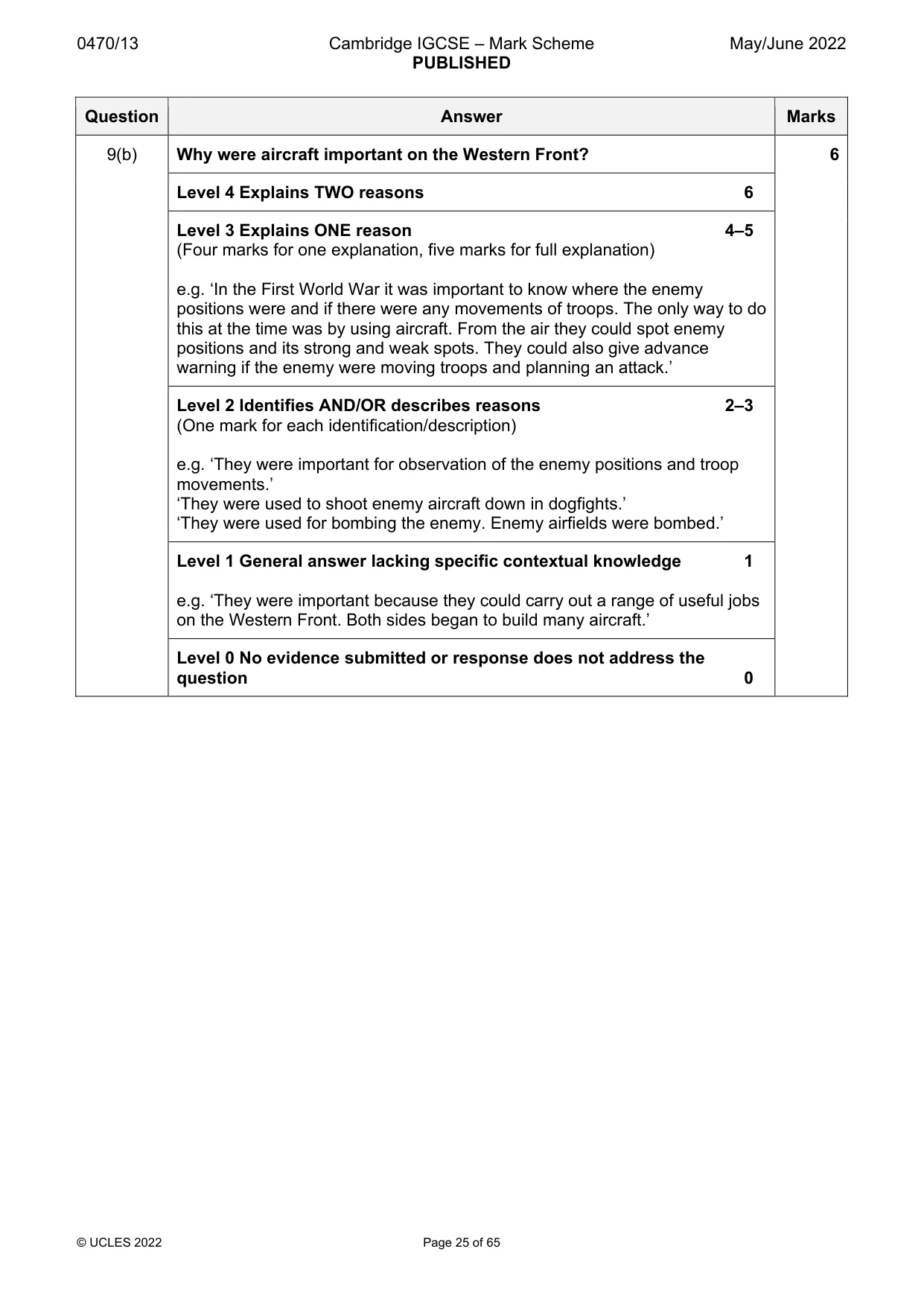
0470/13 Cambridge IGCSE – Mark Scheme PUBLISHED May/June 2022 © UCLES 2022 Page 25 of 65 Question Answer Marks 9(b) Why were aircraft important on the Western Front? 6 Level 4 Explains TWO reasons 6 Level 3 Explains ONE reason 4–5 (Four marks for one explanation, five marks for full explanation) e.g. ‘In the First World War it was important to know where the enemy positions were and if there were any movements of troops. The only way to do this at the time was by using aircraft. From the air they could spot enemy positions and its strong and weak spots. They could also give advance warning if the enemy were moving troops and planning an attack.’ Level 2 Identifies AND/OR describes reasons 2–3 (One mark for each identification/description) e.g. ‘They were important for observation of the enemy positions and troop movements.’ ‘They were used to shoot enemy aircraft down in dogfights.’ ‘They were used for bombing the enemy. Enemy airfields were bombed.’ Level 1 General answer lacking specific contextual knowledge 1 e.g. ‘They were important because they could carry out a range of useful jobs on the Western Front. Both sides began to build many aircraft.’ Level 0 No evidence submitted or response does not address the question 0
Mark scheme, page 26
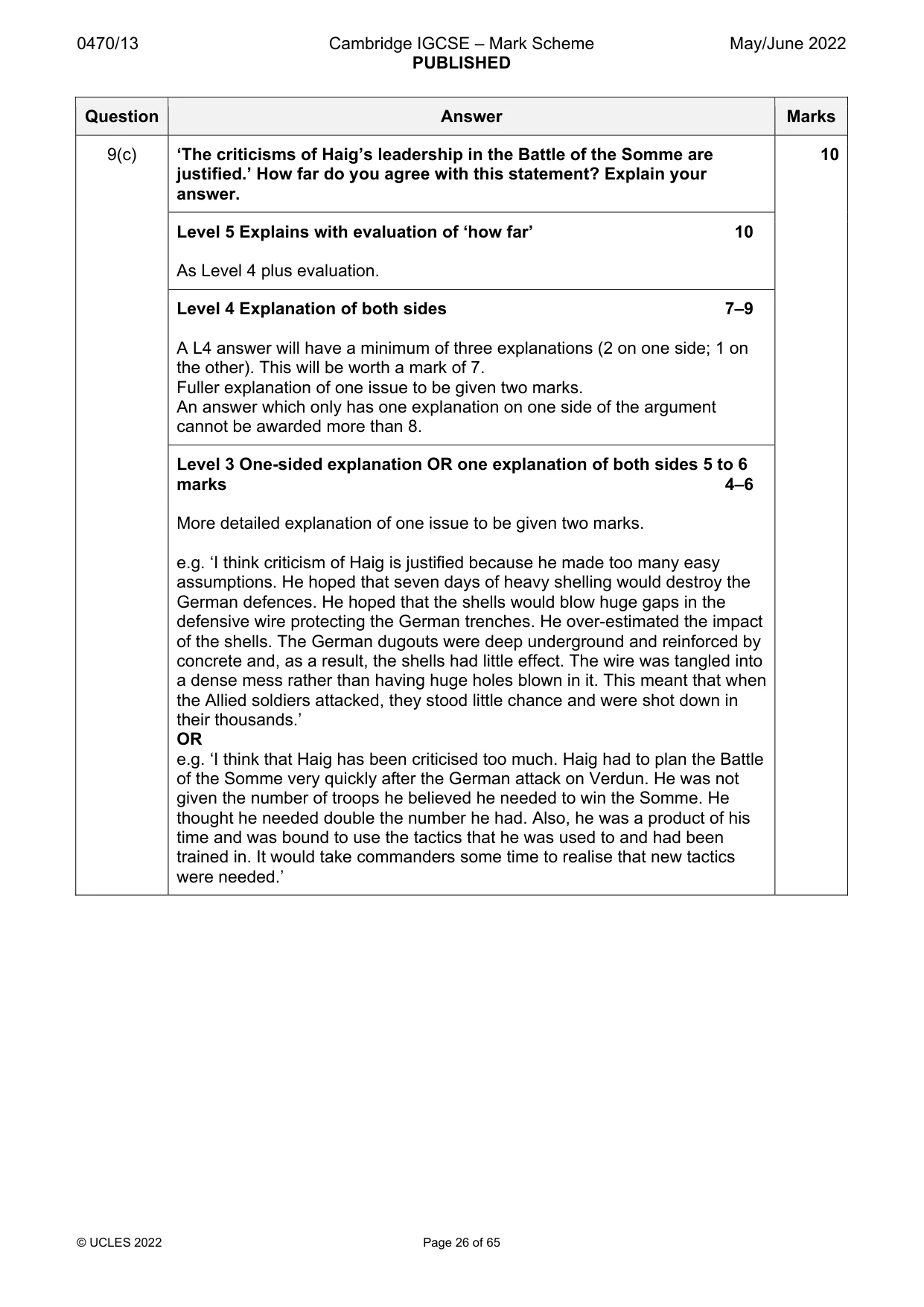
0470/13 Cambridge IGCSE – Mark Scheme PUBLISHED May/June 2022 © UCLES 2022 Page 26 of 65 Question Answer Marks 9(c) ‘The criticisms of Haig’s leadership in the Battle of the Somme are justified.’ How far do you agree with this statement? Explain your answer. 10 Level 5 Explains with evaluation of ‘how far’ 10 As Level 4 plus evaluation. Level 4 Explanation of both sides 7–9 A L4 answer will have a minimum of three explanations (2 on one side; 1 on the other). This will be worth a mark of 7. Fuller explanation of one issue to be given two marks. An answer which only has one explanation on one side of the argument cannot be awarded more than 8. Level 3 One-sided explanation OR one explanation of both sides 5 to 6 marks 4–6 More detailed explanation of one issue to be given two marks. e.g. ‘I think criticism of Haig is justified because he made too many easy assumptions. He hoped that seven days of heavy shelling would destroy the German defences. He hoped that the shells would blow huge gaps in the defensive wire protecting the German trenches. He over-estimated the impact of the shells. The German dugouts were deep underground and reinforced by concrete and, as a result, the shells had little effect. The wire was tangled into a dense mess rather than having huge holes blown in it. This meant that when the Allied soldiers attacked, they stood little chance and were shot down in their thousands.’ OR e.g. ‘I think that Haig has been criticised too much. Haig had to plan the Battle of the Somme very quickly after the German attack on Verdun. He was not given the number of troops he believed he needed to win the Somme. He thought he needed double the number he had. Also, he was a product of his time and was bound to use the tactics that he was used to and had been trained in. It would take commanders some time to realise that new tactics were needed.’
Mark scheme, page 27
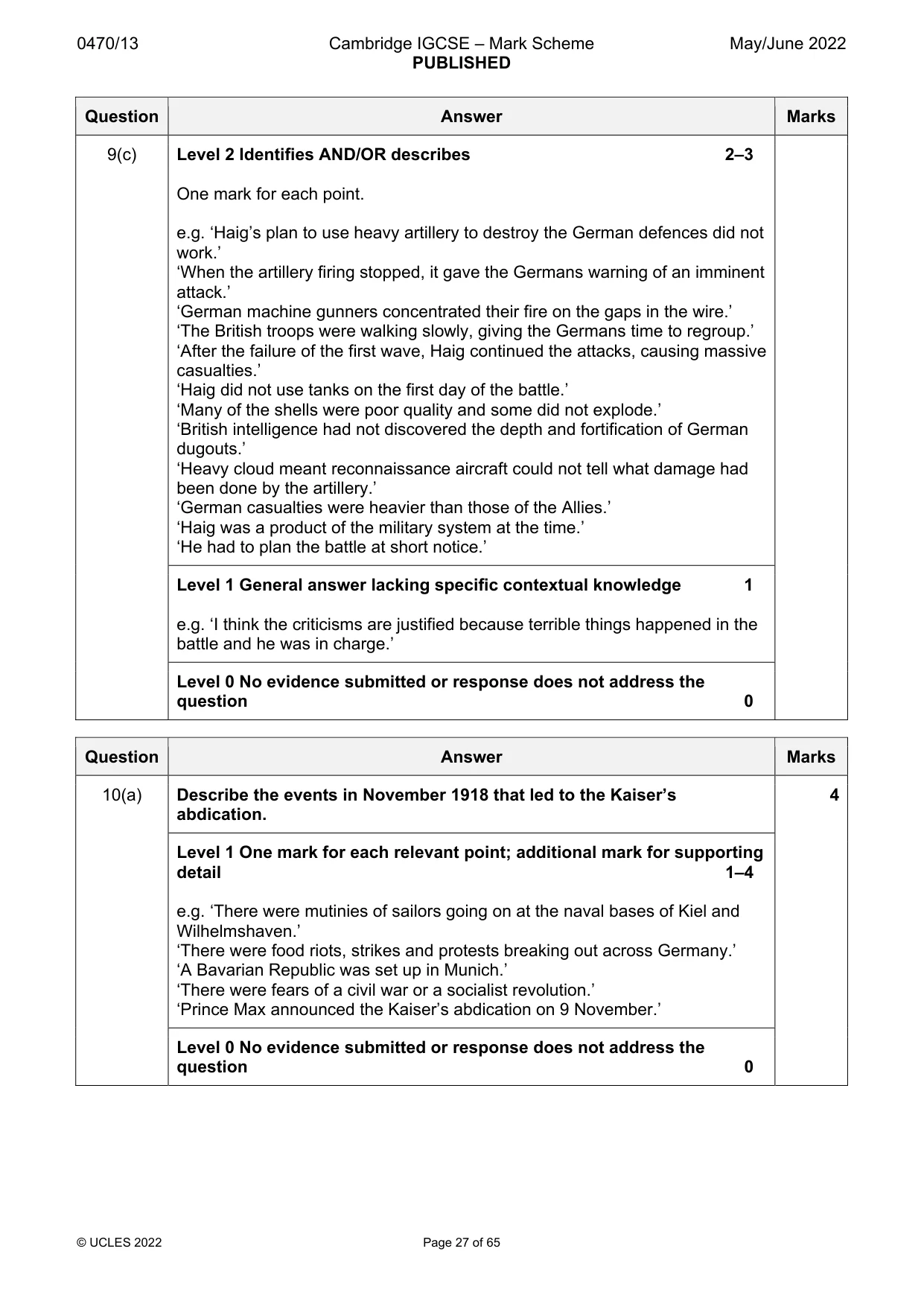
0470/13 Cambridge IGCSE – Mark Scheme PUBLISHED May/June 2022 © UCLES 2022 Page 27 of 65 Question Answer Marks 9(c) Level 2 Identifies AND/OR describes 2–3 One mark for each point. e.g. ‘Haig’s plan to use heavy artillery to destroy the German defences did not work.’ ‘When the artillery firing stopped, it gave the Germans warning of an imminent attack.’ ‘German machine gunners concentrated their fire on the gaps in the wire.’ ‘The British troops were walking slowly, giving the Germans time to regroup.’ ‘After the failure of the first wave, Haig continued the attacks, causing massive casualties.’ ‘Haig did not use tanks on the first day of the battle.’ ‘Many of the shells were poor quality and some did not explode.’ ‘British intelligence had not discovered the depth and fortification of German dugouts.’ ‘Heavy cloud meant reconnaissance aircraft could not tell what damage had been done by the artillery.’ ‘German casualties were heavier than those of the Allies.’ ‘Haig was a product of the military system at the time.’ ‘He had to plan the battle at short notice.’ Level 1 General answer lacking specific contextual knowledge 1 e.g. ‘I think the criticisms are justified because terrible things happened in the battle and he was in charge.’ Level 0 No evidence submitted or response does not address the question 0 Question Answer Marks 10(a) Describe the events in November 1918 that led to the Kaiser’s abdication. 4 Level 1 One mark for each relevant point; additional mark for supporting detail 1–4 e.g. ‘There were mutinies of sailors going on at the naval bases of Kiel and Wilhelmshaven.’ ‘There were food riots, strikes and protests breaking out across Germany.’ ‘A Bavarian Republic was set up in Munich.’ ‘There were fears of a civil war or a socialist revolution.’ ‘Prince Max announced the Kaiser’s abdication on 9 November.’ Level 0 No evidence submitted or response does not address the question 0
Mark scheme, page 28
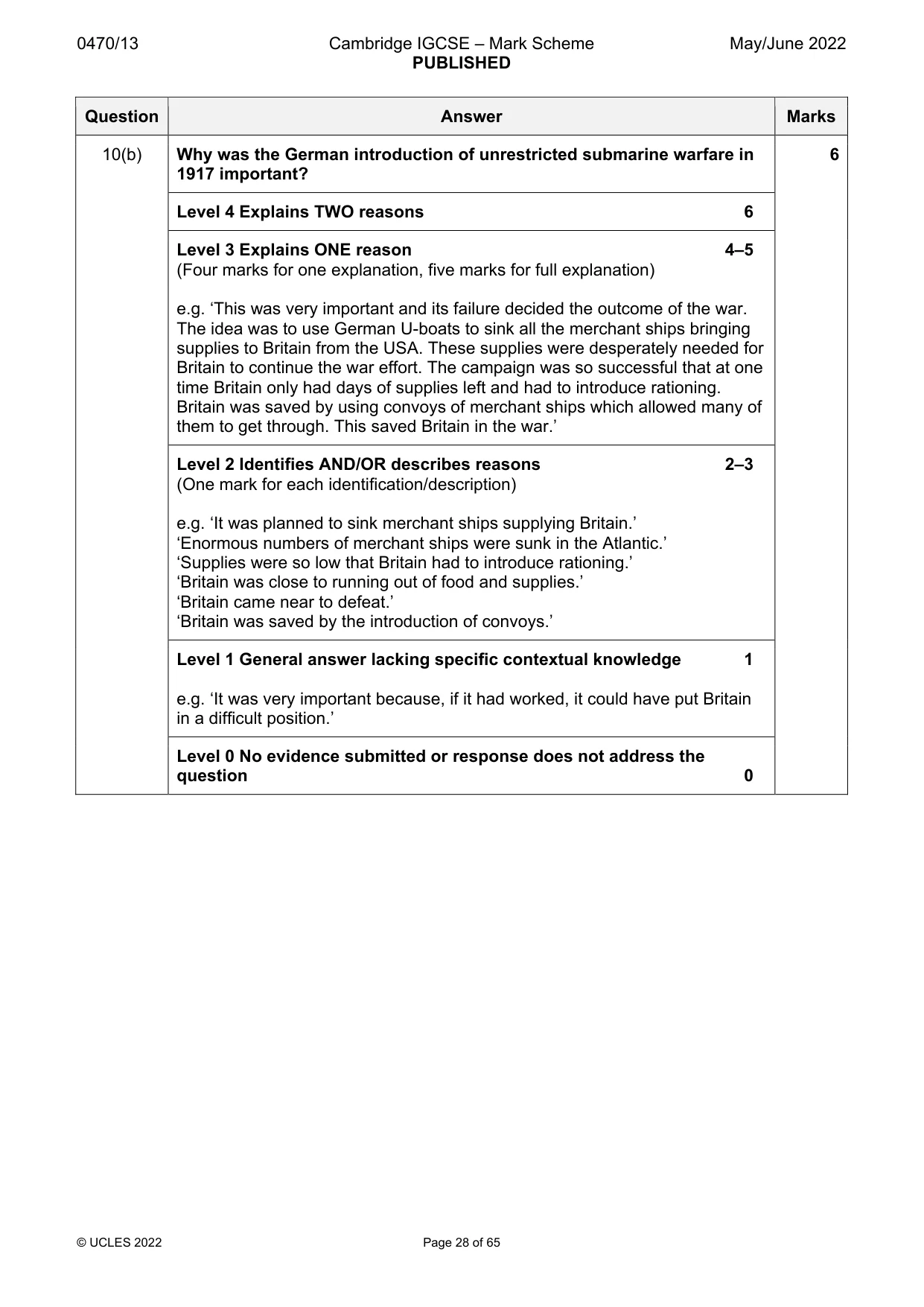
0470/13 Cambridge IGCSE – Mark Scheme PUBLISHED May/June 2022 © UCLES 2022 Page 28 of 65 Question Answer Marks 10(b) Why was the German introduction of unrestricted submarine warfare in 1917 important? 6 Level 4 Explains TWO reasons 6 Level 3 Explains ONE reason 4–5 (Four marks for one explanation, five marks for full explanation) e.g. ‘This was very important and its failure decided the outcome of the war. The idea was to use German U-boats to sink all the merchant ships bringing supplies to Britain from the USA. These supplies were desperately needed for Britain to continue the war effort. The campaign was so successful that at one time Britain only had days of supplies left and had to introduce rationing. Britain was saved by using convoys of merchant ships which allowed many of them to get through. This saved Britain in the war.’ Level 2 Identifies AND/OR describes reasons 2–3 (One mark for each identification/description) e.g. ‘It was planned to sink merchant ships supplying Britain.’ ‘Enormous numbers of merchant ships were sunk in the Atlantic.’ ‘Supplies were so low that Britain had to introduce rationing.’ ‘Britain was close to running out of food and supplies.’ ‘Britain came near to defeat.’ ‘Britain was saved by the introduction of convoys.’ Level 1 General answer lacking specific contextual knowledge 1 e.g. ‘It was very important because, if it had worked, it could have put Britain in a difficult position.’ Level 0 No evidence submitted or response does not address the question 0
Mark scheme, page 29
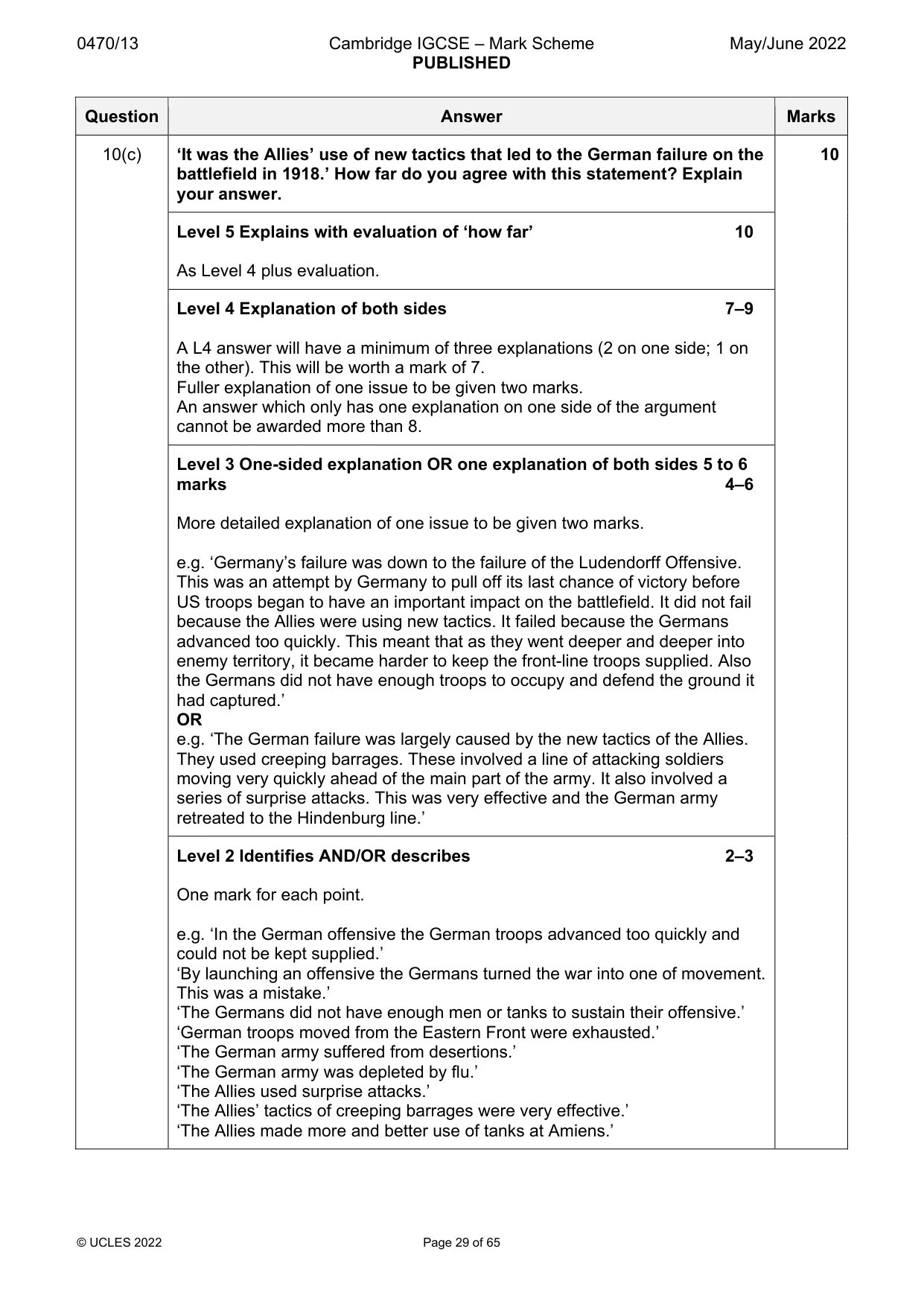
0470/13 Cambridge IGCSE – Mark Scheme PUBLISHED May/June 2022 © UCLES 2022 Page 29 of 65 Question Answer Marks 10(c) ‘It was the Allies’ use of new tactics that led to the German failure on the battlefield in 1918.’ How far do you agree with this statement? Explain your answer. 10 Level 5 Explains with evaluation of ‘how far’ 10 As Level 4 plus evaluation. Level 4 Explanation of both sides 7–9 A L4 answer will have a minimum of three explanations (2 on one side; 1 on the other). This will be worth a mark of 7. Fuller explanation of one issue to be given two marks. An answer which only has one explanation on one side of the argument cannot be awarded more than 8. Level 3 One-sided explanation OR one explanation of both sides 5 to 6 marks 4–6 More detailed explanation of one issue to be given two marks. e.g. ‘Germany’s failure was down to the failure of the Ludendorff Offensive. This was an attempt by Germany to pull off its last chance of victory before US troops began to have an important impact on the battlefield. It did not fail because the Allies were using new tactics. It failed because the Germans advanced too quickly. This meant that as they went deeper and deeper into enemy territory, it became harder to keep the front-line troops supplied. Also the Germans did not have enough troops to occupy and defend the ground it had captured.’ OR e.g. ‘The German failure was largely caused by the new tactics of the Allies. They used creeping barrages. These involved a line of attacking soldiers moving very quickly ahead of the main part of the army. It also involved a series of surprise attacks. This was very effective and the German army retreated to the Hindenburg line.’ Level 2 Identifies AND/OR describes 2–3 One mark for each point. e.g. ‘In the German offensive the German troops advanced too quickly and could not be kept supplied.’ ‘By launching an offensive the Germans turned the war into one of movement. This was a mistake.’ ‘The Germans did not have enough men or tanks to sustain their offensive.’ ‘German troops moved from the Eastern Front were exhausted.’ ‘The German army suffered from desertions.’ ‘The German army was depleted by flu.’ ‘The Allies used surprise attacks.’ ‘The Allies’ tactics of creeping barrages were very effective.’ ‘The Allies made more and better use of tanks at Amiens.’
Mark scheme, page 30
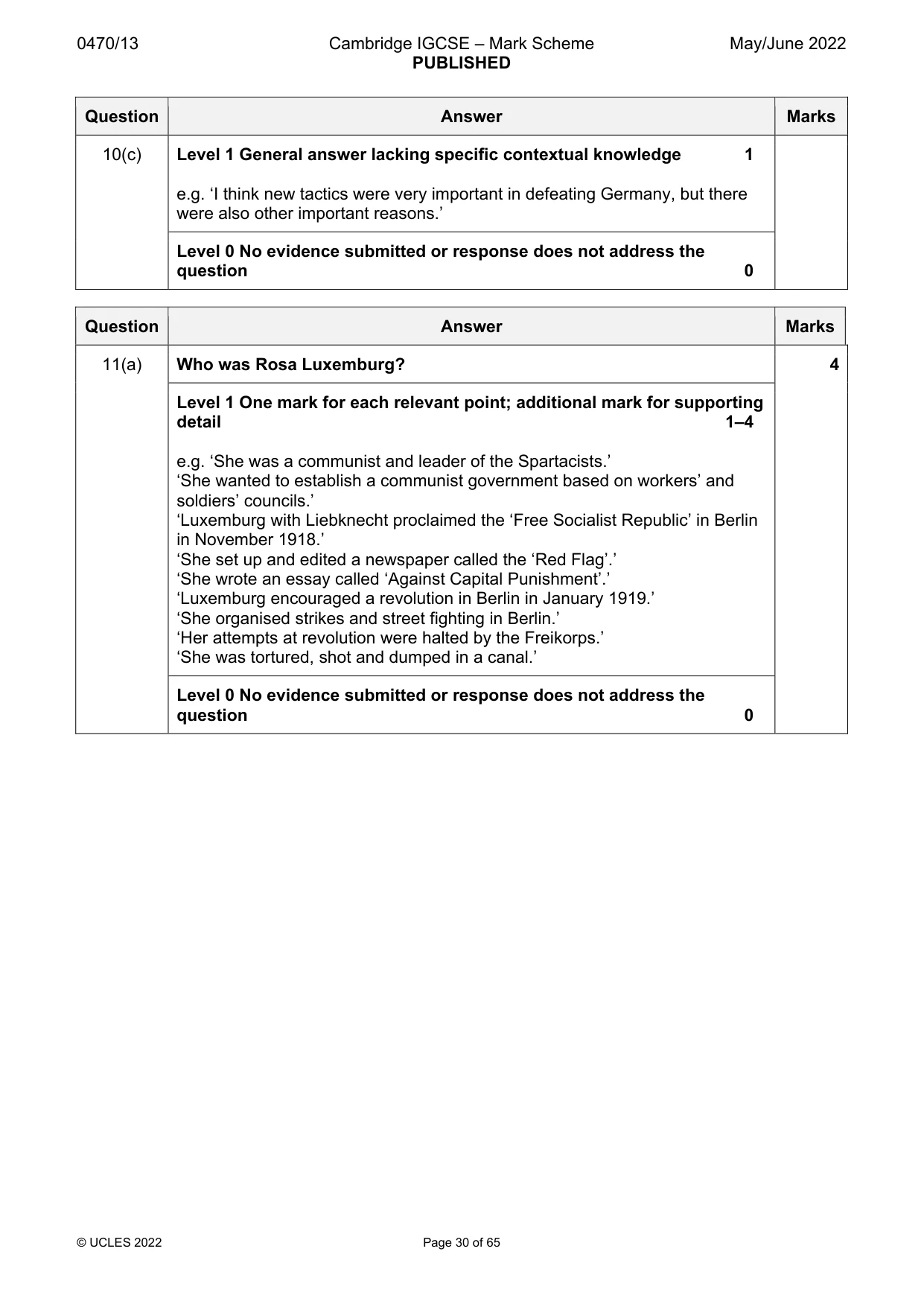
0470/13 Cambridge IGCSE – Mark Scheme PUBLISHED May/June 2022 © UCLES 2022 Page 30 of 65 Question Answer Marks 10(c) Level 1 General answer lacking specific contextual knowledge 1 e.g. ‘I think new tactics were very important in defeating Germany, but there were also other important reasons.’ Level 0 No evidence submitted or response does not address the question 0 Question Answer Marks 11(a) Who was Rosa Luxemburg? 4 Level 1 One mark for each relevant point; additional mark for supporting detail 1–4 e.g. ‘She was a communist and leader of the Spartacists.’ ‘She wanted to establish a communist government based on workers’ and soldiers’ councils.’ ‘Luxemburg with Liebknecht proclaimed the ‘Free Socialist Republic’ in Berlin in November 1918.’ ‘She set up and edited a newspaper called the ‘Red Flag’.’ ‘She wrote an essay called ‘Against Capital Punishment’.’ ‘Luxemburg encouraged a revolution in Berlin in January 1919.’ ‘She organised strikes and street fighting in Berlin.’ ‘Her attempts at revolution were halted by the Freikorps.’ ‘She was tortured, shot and dumped in a canal.’ Level 0 No evidence submitted or response does not address the question 0
Mark scheme, page 31
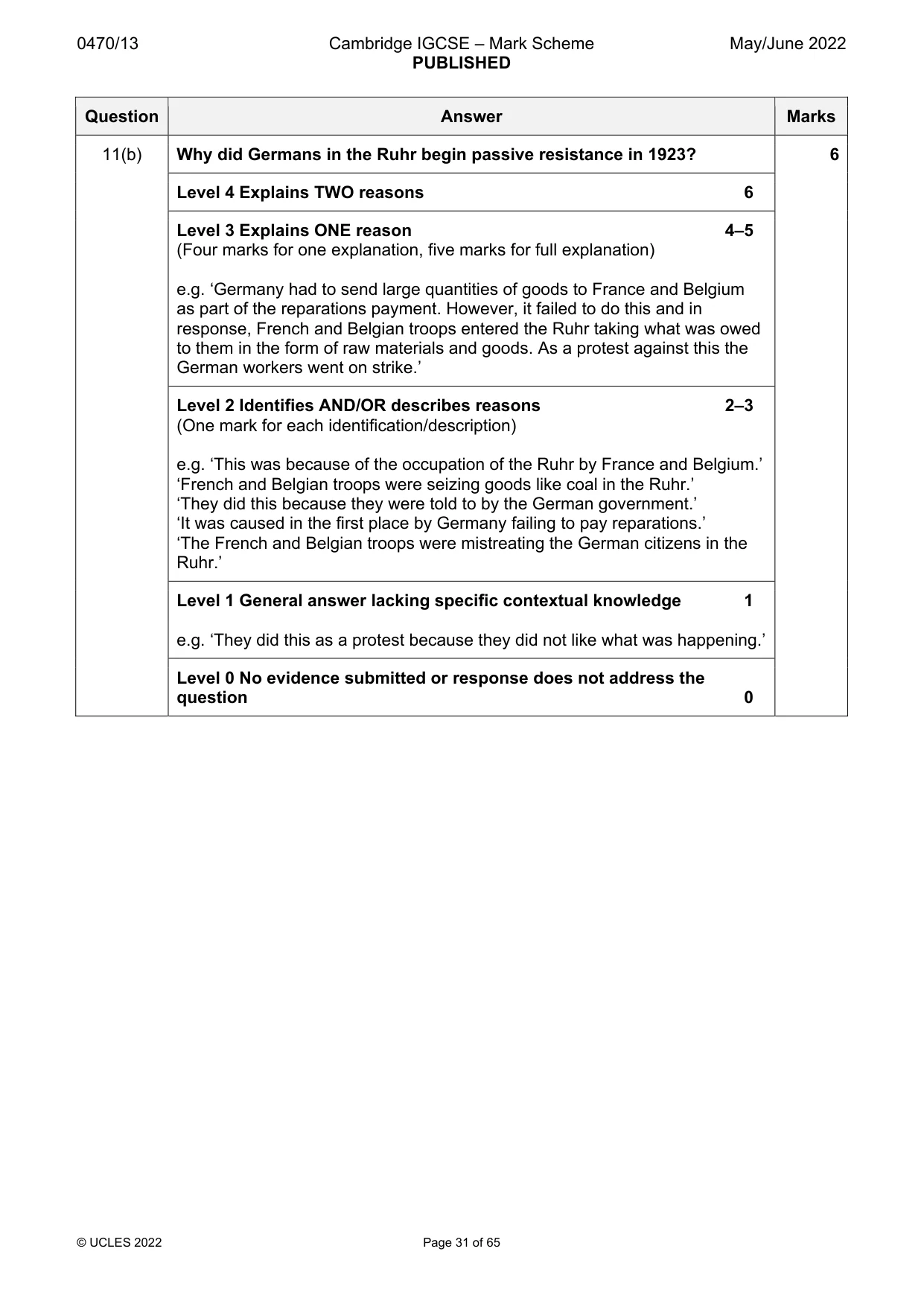
0470/13 Cambridge IGCSE – Mark Scheme PUBLISHED May/June 2022 © UCLES 2022 Page 31 of 65 Question Answer Marks 11(b) Why did Germans in the Ruhr begin passive resistance in 1923? 6 Level 4 Explains TWO reasons 6 Level 3 Explains ONE reason 4–5 (Four marks for one explanation, five marks for full explanation) e.g. ‘Germany had to send large quantities of goods to France and Belgium as part of the reparations payment. However, it failed to do this and in response, French and Belgian troops entered the Ruhr taking what was owed to them in the form of raw materials and goods. As a protest against this the German workers went on strike.’ Level 2 Identifies AND/OR describes reasons 2–3 (One mark for each identification/description) e.g. ‘This was because of the occupation of the Ruhr by France and Belgium.’ ‘French and Belgian troops were seizing goods like coal in the Ruhr.’ ‘They did this because they were told to by the German government.’ ‘It was caused in the first place by Germany failing to pay reparations.’ ‘The French and Belgian troops were mistreating the German citizens in the Ruhr.’ Level 1 General answer lacking specific contextual knowledge 1 e.g. ‘They did this as a protest because they did not like what was happening.’ Level 0 No evidence submitted or response does not address the question 0
Mark scheme, page 32
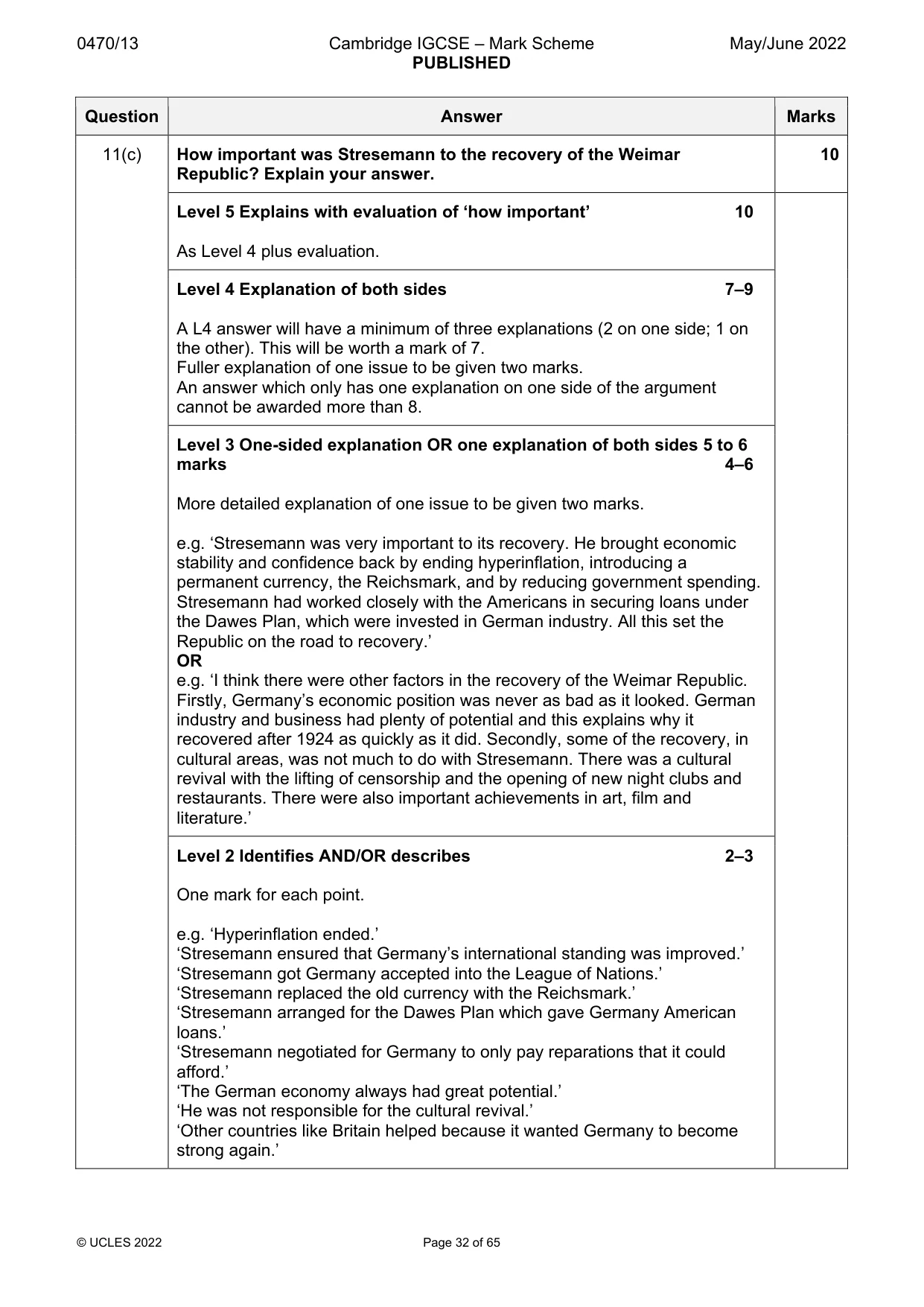
0470/13 Cambridge IGCSE – Mark Scheme PUBLISHED May/June 2022 © UCLES 2022 Page 32 of 65 Question Answer Marks 11(c) How important was Stresemann to the recovery of the Weimar Republic? Explain your answer. 10 Level 5 Explains with evaluation of ‘how important’ 10 As Level 4 plus evaluation. Level 4 Explanation of both sides 7–9 A L4 answer will have a minimum of three explanations (2 on one side; 1 on the other). This will be worth a mark of 7. Fuller explanation of one issue to be given two marks. An answer which only has one explanation on one side of the argument cannot be awarded more than 8. Level 3 One-sided explanation OR one explanation of both sides 5 to 6 marks 4–6 More detailed explanation of one issue to be given two marks. e.g. ‘Stresemann was very important to its recovery. He brought economic stability and confidence back by ending hyperinflation, introducing a permanent currency, the Reichsmark, and by reducing government spending. Stresemann had worked closely with the Americans in securing loans under the Dawes Plan, which were invested in German industry. All this set the Republic on the road to recovery.’ OR e.g. ‘I think there were other factors in the recovery of the Weimar Republic. Firstly, Germany’s economic position was never as bad as it looked. German industry and business had plenty of potential and this explains why it recovered after 1924 as quickly as it did. Secondly, some of the recovery, in cultural areas, was not much to do with Stresemann. There was a cultural revival with the lifting of censorship and the opening of new night clubs and restaurants. There were also important achievements in art, film and literature.’ Level 2 Identifies AND/OR describes 2–3 One mark for each point. e.g. ‘Hyperinflation ended.’ ‘Stresemann ensured that Germany’s international standing was improved.’ ‘Stresemann got Germany accepted into the League of Nations.’ ‘Stresemann replaced the old currency with the Reichsmark.’ ‘Stresemann arranged for the Dawes Plan which gave Germany American loans.’ ‘Stresemann negotiated for Germany to only pay reparations that it could afford.’ ‘The German economy always had great potential.’ ‘He was not responsible for the cultural revival.’ ‘Other countries like Britain helped because it wanted Germany to become strong again.’
Mark scheme, page 33
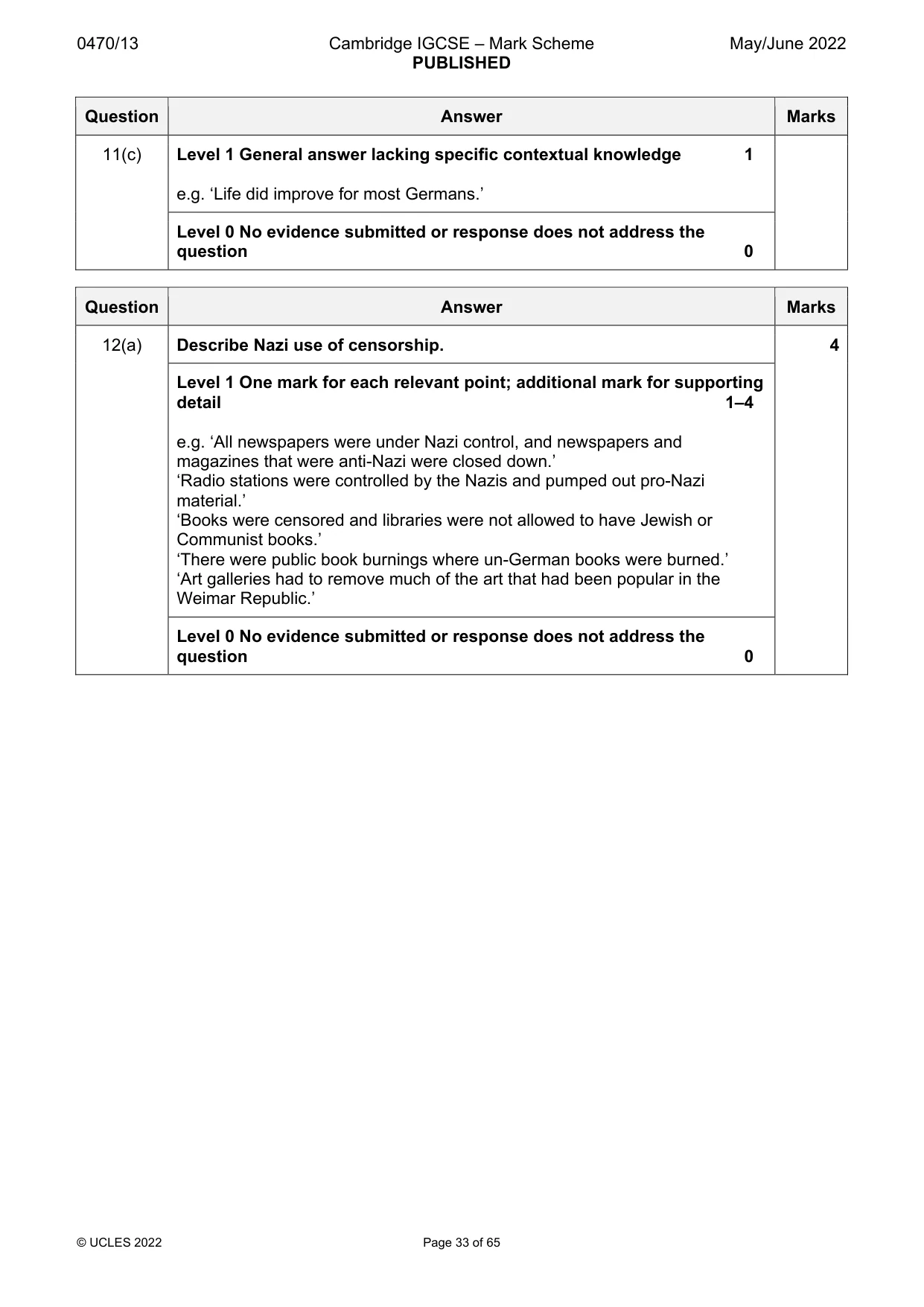
0470/13 Cambridge IGCSE – Mark Scheme PUBLISHED May/June 2022 © UCLES 2022 Page 33 of 65 Question Answer Marks 11(c) Level 1 General answer lacking specific contextual knowledge 1 e.g. ‘Life did improve for most Germans.’ Level 0 No evidence submitted or response does not address the question 0 Question Answer Marks 12(a) Describe Nazi use of censorship. 4 Level 1 One mark for each relevant point; additional mark for supporting detail 1–4 e.g. ‘All newspapers were under Nazi control, and newspapers and magazines that were anti-Nazi were closed down.’ ‘Radio stations were controlled by the Nazis and pumped out pro-Nazi material.’ ‘Books were censored and libraries were not allowed to have Jewish or Communist books.’ ‘There were public book burnings where un-German books were burned.’ ‘Art galleries had to remove much of the art that had been popular in the Weimar Republic.’ Level 0 No evidence submitted or response does not address the question 0
Mark scheme, page 34
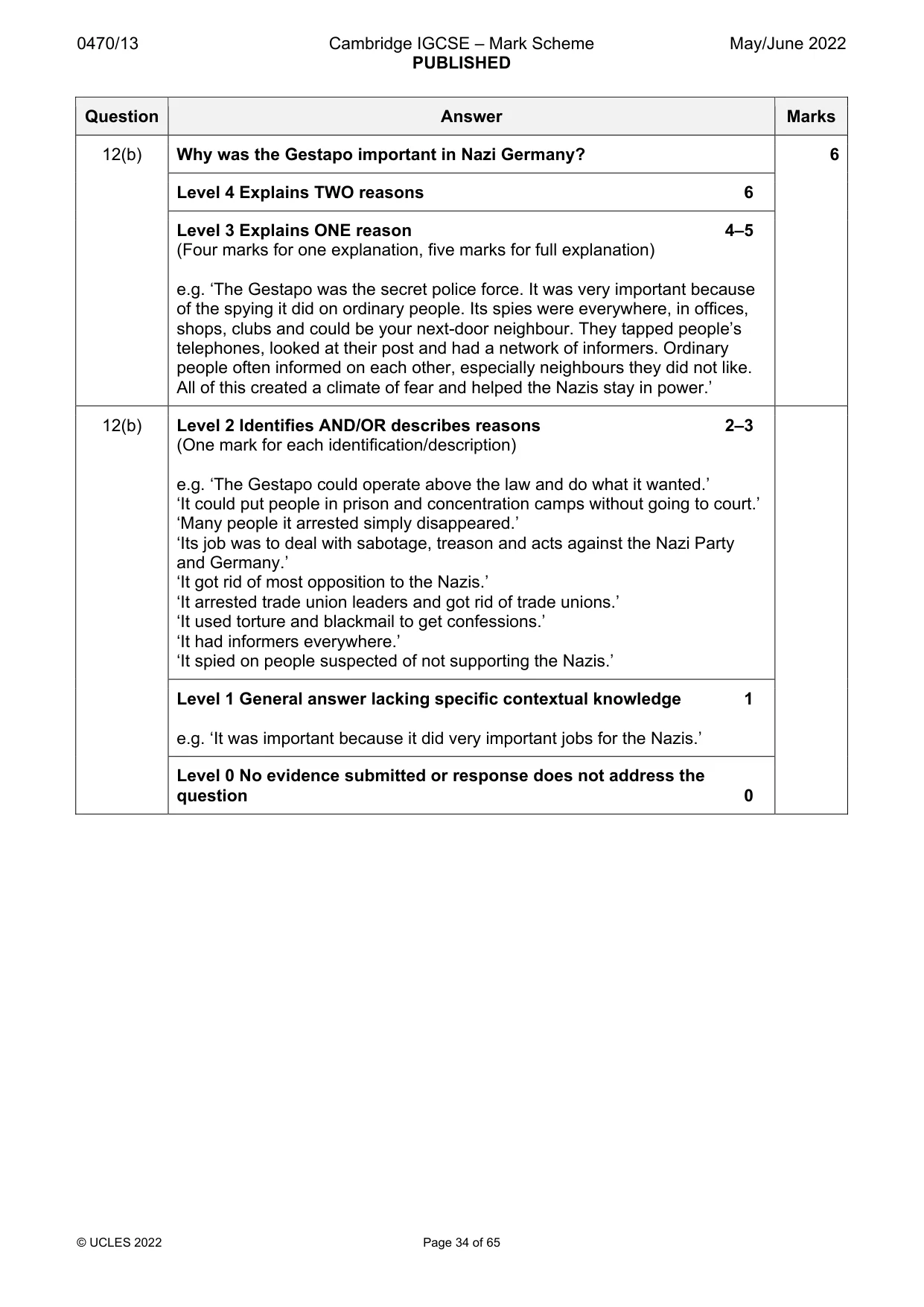
0470/13 Cambridge IGCSE – Mark Scheme PUBLISHED May/June 2022 © UCLES 2022 Page 34 of 65 Question Answer Marks 12(b) Why was the Gestapo important in Nazi Germany? 6 Level 4 Explains TWO reasons 6 Level 3 Explains ONE reason 4–5 (Four marks for one explanation, five marks for full explanation) e.g. ‘The Gestapo was the secret police force. It was very important because of the spying it did on ordinary people. Its spies were everywhere, in offices, shops, clubs and could be your next-door neighbour. They tapped people’s telephones, looked at their post and had a network of informers. Ordinary people often informed on each other, especially neighbours they did not like. All of this created a climate of fear and helped the Nazis stay in power.’ 12(b) Level 2 Identifies AND/OR describes reasons 2–3 (One mark for each identification/description) e.g. ‘The Gestapo could operate above the law and do what it wanted.’ ‘It could put people in prison and concentration camps without going to court.’ ‘Many people it arrested simply disappeared.’ ‘Its job was to deal with sabotage, treason and acts against the Nazi Party and Germany.’ ‘It got rid of most opposition to the Nazis.’ ‘It arrested trade union leaders and got rid of trade unions.’ ‘It used torture and blackmail to get confessions.’ ‘It had informers everywhere.’ ‘It spied on people suspected of not supporting the Nazis.’ Level 1 General answer lacking specific contextual knowledge 1 e.g. ‘It was important because it did very important jobs for the Nazis.’ Level 0 No evidence submitted or response does not address the question 0
Mark scheme, page 35
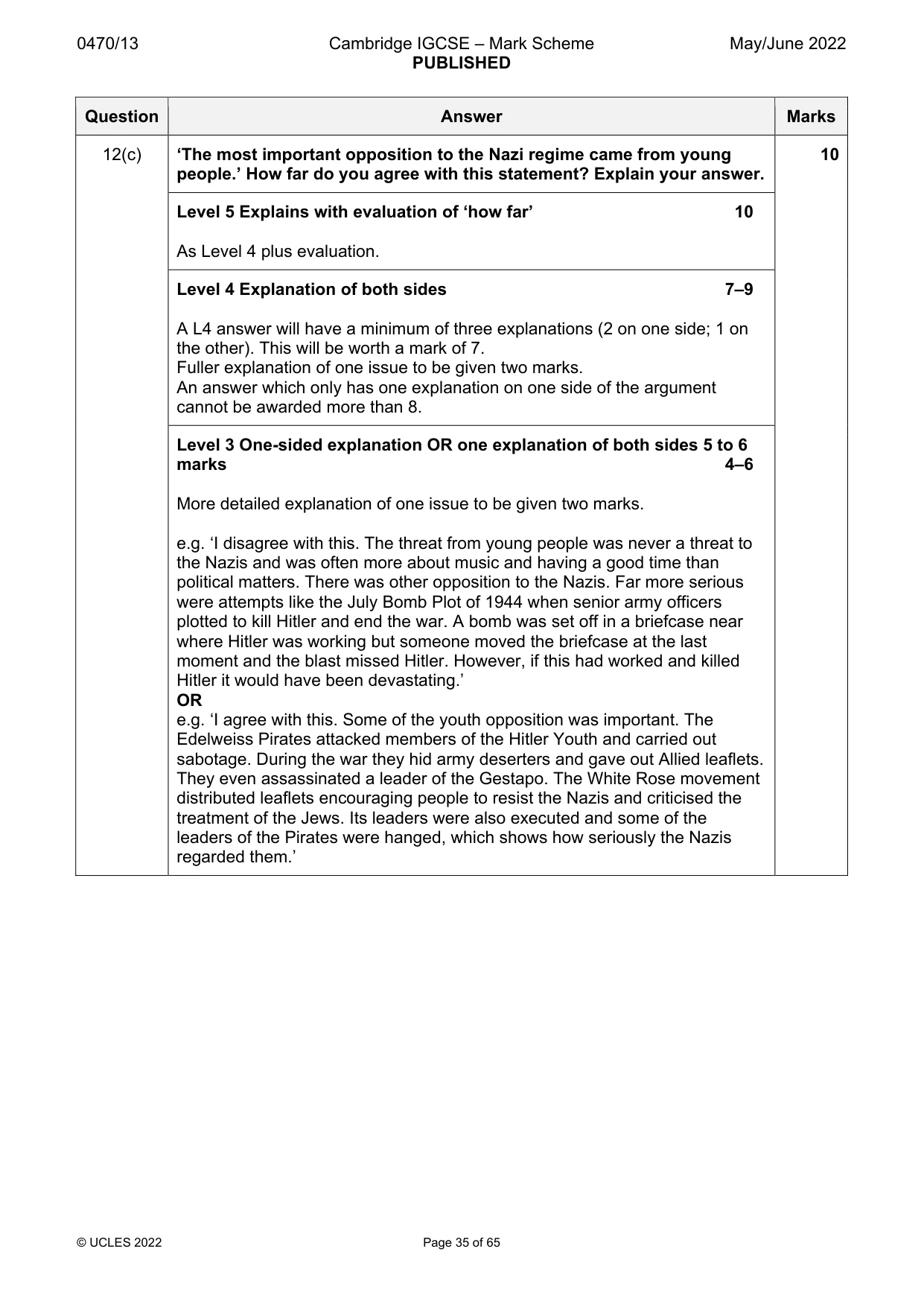
0470/13 Cambridge IGCSE – Mark Scheme PUBLISHED May/June 2022 © UCLES 2022 Page 35 of 65 Question Answer Marks 12(c) ‘The most important opposition to the Nazi regime came from young people.’ How far do you agree with this statement? Explain your answer. 10 Level 5 Explains with evaluation of ‘how far’ 10 As Level 4 plus evaluation. Level 4 Explanation of both sides 7–9 A L4 answer will have a minimum of three explanations (2 on one side; 1 on the other). This will be worth a mark of 7. Fuller explanation of one issue to be given two marks. An answer which only has one explanation on one side of the argument cannot be awarded more than 8. Level 3 One-sided explanation OR one explanation of both sides 5 to 6 marks 4–6 More detailed explanation of one issue to be given two marks. e.g. ‘I disagree with this. The threat from young people was never a threat to the Nazis and was often more about music and having a good time than political matters. There was other opposition to the Nazis. Far more serious were attempts like the July Bomb Plot of 1944 when senior army officers plotted to kill Hitler and end the war. A bomb was set off in a briefcase near where Hitler was working but someone moved the briefcase at the last moment and the blast missed Hitler. However, if this had worked and killed Hitler it would have been devastating.’ OR e.g. ‘I agree with this. Some of the youth opposition was important. The Edelweiss Pirates attacked members of the Hitler Youth and carried out sabotage. During the war they hid army deserters and gave out Allied leaflets. They even assassinated a leader of the Gestapo. The White Rose movement distributed leaflets encouraging people to resist the Nazis and criticised the treatment of the Jews. Its leaders were also executed and some of the leaders of the Pirates were hanged, which shows how seriously the Nazis regarded them.’
Mark scheme, page 36
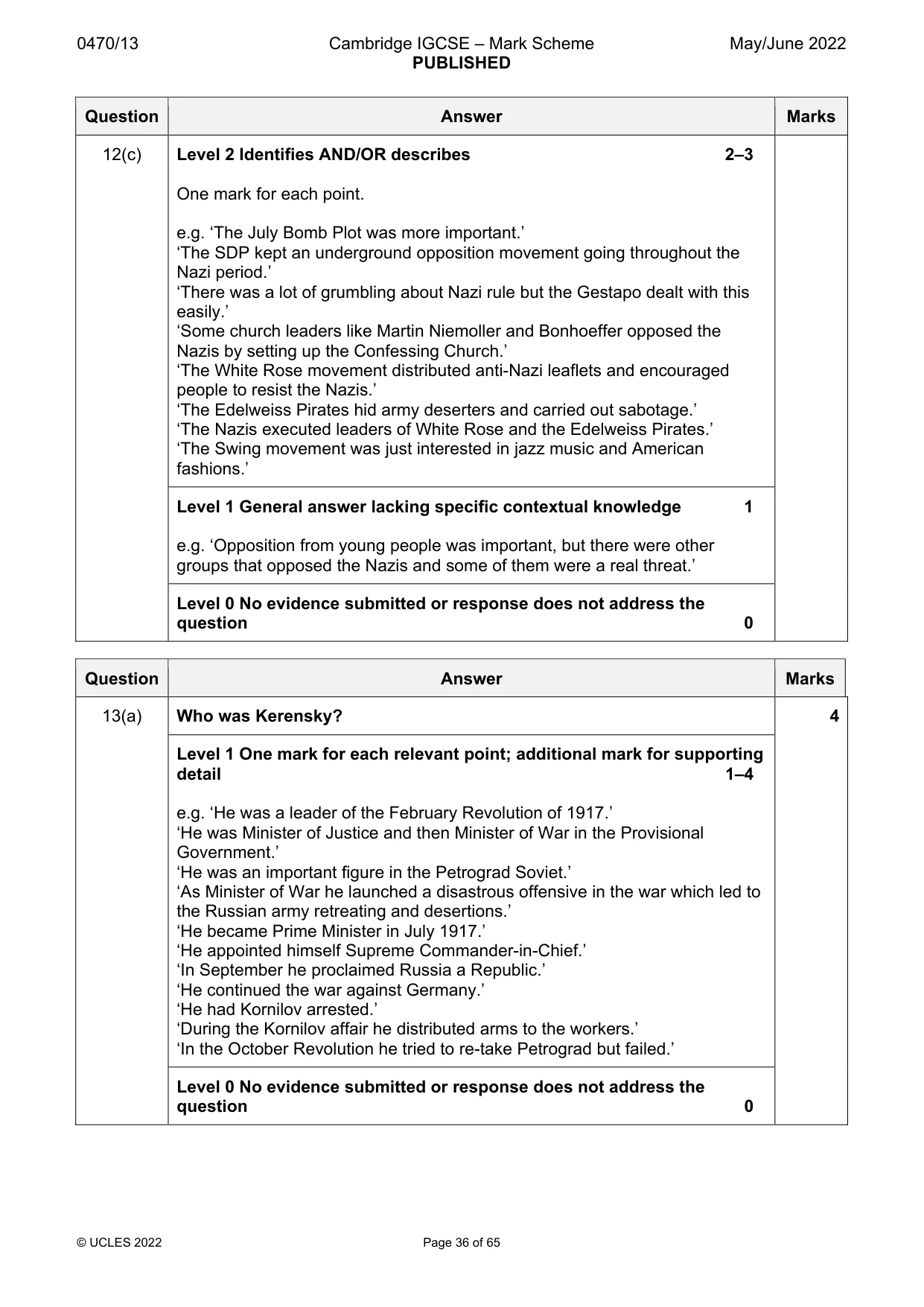
0470/13 Cambridge IGCSE – Mark Scheme PUBLISHED May/June 2022 © UCLES 2022 Page 36 of 65 Question Answer Marks 12(c) Level 2 Identifies AND/OR describes 2–3 One mark for each point. e.g. ‘The July Bomb Plot was more important.’ ‘The SDP kept an underground opposition movement going throughout the Nazi period.’ ‘There was a lot of grumbling about Nazi rule but the Gestapo dealt with this easily.’ ‘Some church leaders like Martin Niemoller and Bonhoeffer opposed the Nazis by setting up the Confessing Church.’ ‘The White Rose movement distributed anti-Nazi leaflets and encouraged people to resist the Nazis.’ ‘The Edelweiss Pirates hid army deserters and carried out sabotage.’ ‘The Nazis executed leaders of White Rose and the Edelweiss Pirates.’ ‘The Swing movement was just interested in jazz music and American fashions.’ Level 1 General answer lacking specific contextual knowledge 1 e.g. ‘Opposition from young people was important, but there were other groups that opposed the Nazis and some of them were a real threat.’ Level 0 No evidence submitted or response does not address the question 0 Question Answer Marks 13(a) Who was Kerensky? 4 Level 1 One mark for each relevant point; additional mark for supporting detail 1–4 e.g. ‘He was a leader of the February Revolution of 1917.’ ‘He was Minister of Justice and then Minister of War in the Provisional Government.’ ‘He was an important figure in the Petrograd Soviet.’ ‘As Minister of War he launched a disastrous offensive in the war which led to the Russian army retreating and desertions.’ ‘He became Prime Minister in July 1917.’ ‘He appointed himself Supreme Commander-in-Chief.’ ‘In September he proclaimed Russia a Republic.’ ‘He continued the war against Germany.’ ‘He had Kornilov arrested.’ ‘During the Kornilov affair he distributed arms to the workers.’ ‘In the October Revolution he tried to re-take Petrograd but failed.’ Level 0 No evidence submitted or response does not address the question 0
Mark scheme, page 37
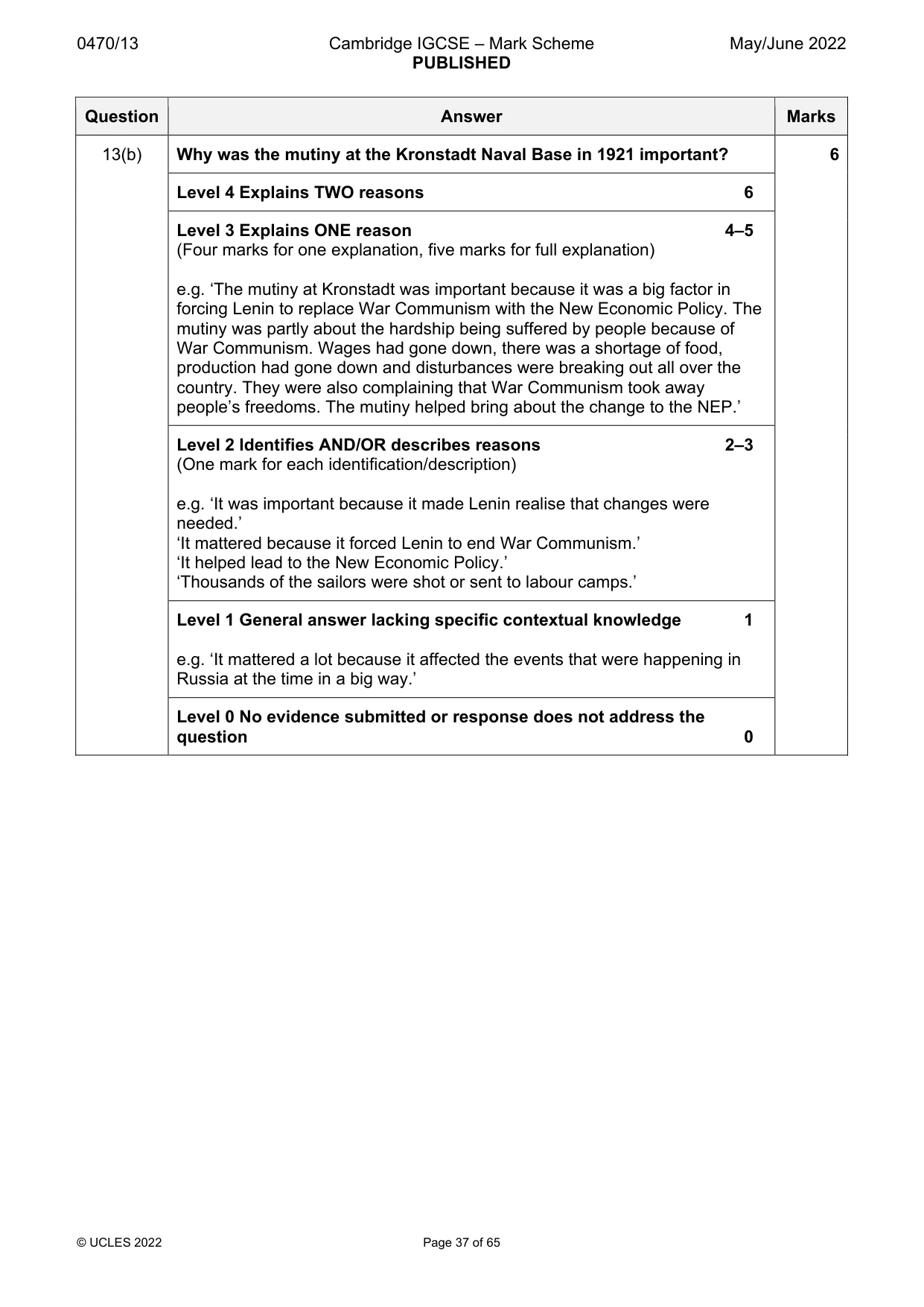
0470/13 Cambridge IGCSE – Mark Scheme PUBLISHED May/June 2022 © UCLES 2022 Page 37 of 65 Question Answer Marks 13(b) Why was the mutiny at the Kronstadt Naval Base in 1921 important? 6 Level 4 Explains TWO reasons 6 Level 3 Explains ONE reason 4–5 (Four marks for one explanation, five marks for full explanation) e.g. ‘The mutiny at Kronstadt was important because it was a big factor in forcing Lenin to replace War Communism with the New Economic Policy. The mutiny was partly about the hardship being suffered by people because of War Communism. Wages had gone down, there was a shortage of food, production had gone down and disturbances were breaking out all over the country. They were also complaining that War Communism took away people’s freedoms. The mutiny helped bring about the change to the NEP.’ Level 2 Identifies AND/OR describes reasons 2–3 (One mark for each identification/description) e.g. ‘It was important because it made Lenin realise that changes were needed.’ ‘It mattered because it forced Lenin to end War Communism.’ ‘It helped lead to the New Economic Policy.’ ‘Thousands of the sailors were shot or sent to labour camps.’ Level 1 General answer lacking specific contextual knowledge 1 e.g. ‘It mattered a lot because it affected the events that were happening in Russia at the time in a big way.’ Level 0 No evidence submitted or response does not address the question 0
Mark scheme, page 38
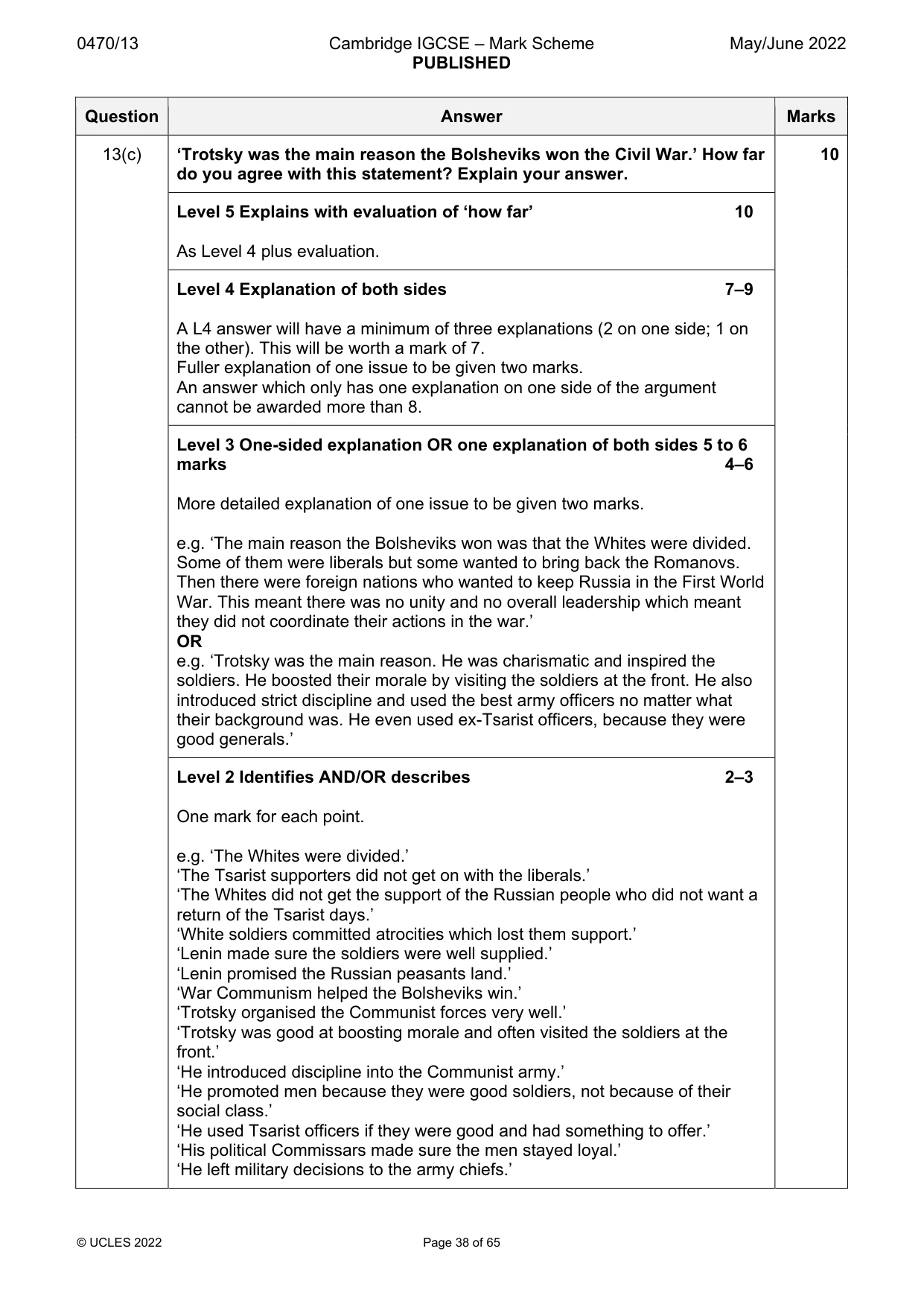
0470/13 Cambridge IGCSE – Mark Scheme PUBLISHED May/June 2022 © UCLES 2022 Page 38 of 65 Question Answer Marks 13(c) ‘Trotsky was the main reason the Bolsheviks won the Civil War.’ How far do you agree with this statement? Explain your answer. 10 Level 5 Explains with evaluation of ‘how far’ 10 As Level 4 plus evaluation. Level 4 Explanation of both sides 7–9 A L4 answer will have a minimum of three explanations (2 on one side; 1 on the other). This will be worth a mark of 7. Fuller explanation of one issue to be given two marks. An answer which only has one explanation on one side of the argument cannot be awarded more than 8. Level 3 One-sided explanation OR one explanation of both sides 5 to 6 marks 4–6 More detailed explanation of one issue to be given two marks. e.g. ‘The main reason the Bolsheviks won was that the Whites were divided. Some of them were liberals but some wanted to bring back the Romanovs. Then there were foreign nations who wanted to keep Russia in the First World War. This meant there was no unity and no overall leadership which meant they did not coordinate their actions in the war.’ OR e.g. ‘Trotsky was the main reason. He was charismatic and inspired the soldiers. He boosted their morale by visiting the soldiers at the front. He also introduced strict discipline and used the best army officers no matter what their background was. He even used ex-Tsarist officers, because they were good generals.’ Level 2 Identifies AND/OR describes 2–3 One mark for each point. e.g. ‘The Whites were divided.’ ‘The Tsarist supporters did not get on with the liberals.’ ‘The Whites did not get the support of the Russian people who did not want a return of the Tsarist days.’ ‘White soldiers committed atrocities which lost them support.’ ‘Lenin made sure the soldiers were well supplied.’ ‘Lenin promised the Russian peasants land.’ ‘War Communism helped the Bolsheviks win.’ ‘Trotsky organised the Communist forces very well.’ ‘Trotsky was good at boosting morale and often visited the soldiers at the front.’ ‘He introduced discipline into the Communist army.’ ‘He promoted men because they were good soldiers, not because of their social class.’ ‘He used Tsarist officers if they were good and had something to offer.’ ‘His political Commissars made sure the men stayed loyal.’ ‘He left military decisions to the army chiefs.’
Mark scheme, page 39
0470/13 Cambridge IGCSE – Mark Scheme PUBLISHED May/June 2022 © UCLES 2022 Page 39 of 65 Question Answer Marks 13(c) Level 1 General answer lacking specific contextual knowledge 1 e.g. ‘Trotsky was very important because he was in charge of everything and made sure it worked well.’ Level 0 No evidence submitted or response does not address the question 0 Question Answer Marks 14(a) What did Stalin mean by ‘Socialism in one country’? 4 Level 1 One mark for each relevant point; additional mark for supporting detail 1–4 e.g. ‘Stalin wanted Russia to focus on its own revolution to show what a model communist country would look like.’ ‘The Soviet Union should strengthen itself internally.’ ‘The revolution in Russia should be established before trying to spread world revolution.’ ‘The revolution in Russia had to be secured especially because attempted revolutions elsewhere in Europe had failed.’ Level 0 No evidence submitted or response does not address the question 0
Mark scheme, page 40
0470/13 Cambridge IGCSE – Mark Scheme PUBLISHED May/June 2022 © UCLES 2022 Page 40 of 65 Question Answer Marks 14(b) Why was Lenin’s Political Testament not published in the Soviet Union at the time of his death? 6 Level 4 Explains TWO reasons 6 Level 3 Explains ONE reason 4–5 (Four marks for one explanation, five marks for full explanation) e.g. ‘It was not published because it was very critical of Stalin. He thought that it might damage his chances of becoming leader if it was published. Lenin did not want Stalin to succeed him and Stalin obviously did not want people to know this. He was in competition with Trotsky to become the next leader.’ Level 2 Identifies AND/OR describes reasons 2–3 (One mark for each identification/description) e.g. ‘It was very critical of Stalin.’ ‘It might harm Stalin’s chances of becoming leader.’ ‘In it, Lenin had suggested that Stalin be removed from his post as General Secretary of the Party’s Central Committee.’ ‘The party leadership thought it would damage the party as a whole.’ Level 1 General answer lacking specific contextual knowledge 1 e.g. ‘It was not published at the time because there were people who would not benefit if it was published, so they kept it hidden.’ Level 0 No evidence submitted or response does not address the question 0
Mark scheme, page 41
0470/13 Cambridge IGCSE – Mark Scheme PUBLISHED May/June 2022 © UCLES 2022 Page 41 of 65 Question Answer Marks 14(c) ‘It was the Purges that gave Stalin control of the USSR.’ How far do you agree with this statement? Explain your answer. 10 Level 5 Explains with evaluation of ‘how far’ 10 As Level 4 plus evaluation. Level 4 Explanation of both sides 7–9 A L4 answer will have a minimum of three explanations (2 on one side; 1 on the other). This will be worth a mark of 7. Fuller explanation of one issue to be given two marks. An answer which only has one explanation on one side of the argument cannot be awarded more than 8. Level 3 One-sided explanation OR one explanation of both sides 5 to 6 marks 4–6 More detailed explanation of one issue to be given two marks. e.g. ‘I think Stalin had control because of the personality cult that he created. Pictures of Stalin appeared everywhere and he was presented as the saviour of Russia and given god-like status. He was shown to represent everything that was good about Russia. Because of this, many Russians genuinely supported him and this gave him the control.’ OR e.g. ‘I think the Purges did give Stalin control. Over 500,000 party members were arrested on charges of anti-Soviet activities and were either executed or sent to gulags. Over 25,000 army officers were removed from office. Stalin made sure no-one became too powerful and did not therefore undermine his authority. If anyone in the Communist Party was a possible rival, then he dealt with them.’ Level 2 Identifies AND/OR describes 2–3 One mark for each point. e.g. ‘They did not give him complete control because local officials often ignored instructions.’ ‘People’s private lives were not always controlled by Stalin.’ ‘Stalin used the ‘Cult of Stalin’ to gain control over the people.’ ‘Many ordinary citizens admired Stalin and wanted to obey him because of the personality cult.’ ‘It was Stalin’s use of propaganda that gave him control of the Soviet Union.’ ‘The ‘Great Terror’ removed opposition to Stalin.’ ‘The new constitution gave total power to Stalin.’ ‘The kulaks were removed for disobeying Stalin.’ ‘The Purges got rid of rivals in the Communist Party.’ ‘The Purges made everybody in the Soviet Union too scared to criticise Stalin.’
Mark scheme, page 42
0470/13 Cambridge IGCSE – Mark Scheme PUBLISHED May/June 2022 © UCLES 2022 Page 42 of 65 Question Answer Marks 14(c) Level 1 General answer lacking specific contextual knowledge 1 e.g. ‘The Purges helped Stalin stay in control of the USSR. They made sure his leadership position was secure.’ Level 0 No evidence submitted or response does not address the question 0 Question Answer Marks 15(a) Describe the problems faced by the coal industry in the 1920s. 4 Level 1 One mark for each relevant point; additional mark for supporting detail 1–4 e.g. ‘Coal was being replaced by oil.’ ‘Coal was being replaced as a source of energy by gas and electricity.’ ‘There was an overproduction of coal.’ ‘Coal was being used more efficiently and so not so much was needed.’ ‘There were pit closures and strikes.’ ‘Wages of the miners were cut leading to strikes.’ ‘Mechanisation of the work led to a loss of jobs.’ ‘There was violence at some coal mines.’ Level 0 No evidence submitted or response does not address the question 0
Mark scheme, page 43
0470/13 Cambridge IGCSE – Mark Scheme PUBLISHED May/June 2022 © UCLES 2022 Page 43 of 65 Question Answer Marks 15(b) Why was the motor car important in 1920s America? 6 Level 4 Explains TWO reasons 6 Level 3 Explains ONE reason 4–5 (Four marks for one explanation, five marks for full explanation) e.g. ‘The motor car was important because of the impact it had on lots of other industries. Many people could afford a car and millions were sold. This created a demand for lots of other products like rubber and glass. It also meant that more roads had to be built as well as garages and restaurants. Many parts of the American economy were stimulated, and new jobs created, by the motor car.’ Level 2 Identifies AND/OR describes reasons 2–3 (One mark for each identification/description) e.g. ‘The motor car was important because it changed people’s lives. People could now go on holiday.’ ‘Its production introduced the assembly line that was used in many other industries.’ ‘It created a demand for other products like glass.’ ‘The motor car industry provided lots of jobs.’ ‘Roads, restaurants and garages had to be built, creating new jobs.’ ‘People could now live in suburbs so these grew in size.’ ‘It stimulated the whole American economy.’ Level 1 General answer lacking specific contextual knowledge 1 e.g. ‘It was important because it was a massive step forward.’ Level 0 No evidence submitted or response does not address the question 0
Mark scheme, page 44
0470/13 Cambridge IGCSE – Mark Scheme PUBLISHED May/June 2022 © UCLES 2022 Page 44 of 65 Question Answer Marks 15(c) ‘Farmers benefited from the economic boom of the 1920s.’ How far do you agree with this statement? Explain your answer. 10 Level 5 Explains with evaluation of ‘how far’ 10 As Level 4 plus evaluation. Level 4 Explanation of both sides 7–9 A L4 answer will have a minimum of three explanations (2 on one side; 1 on the other). This will be worth a mark of 7. Fuller explanation of one issue to be given two marks. An answer which only has one explanation on one side of the argument cannot be awarded more than 8. Level 3 One-sided explanation OR one explanation of both sides 5 to 6 marks 4–6 More detailed explanation of one issue to be given two marks. e.g. ‘Many farmers did not benefit from the economic boom. This was because demand for their food fell and prices fell as well. They could not sell all they produced, and they got less money for it. This was because of the end of the war and competition from Canada and other countries. Soon many farmers were bankrupt and had to sell up.’ OR e.g. ‘Farmers with very large farms in the Mid-West did do well, as well as fruit growers in California. The large wheat growers in the Mid-West had mechanised and could produce wheat cheaply so they prospered. The fruit growers in areas like Florida and California benefited from the fact that more Americans turned to eating more fruit. So this increased demand for their produce.’ Level 2 Identifies AND/OR describes 2–3 One mark for each point. e.g. ‘Farmers suffered from overseas competition.’ ‘Farmers suffered from overproduction.’ ‘Farmers suffered from a fall in prices.’ ‘Farmers could not repay the loans they had taken out.’ ‘Farmers suffered from other countries introducing tariffs.’ ‘Demand for wool and cotton declined.’ ‘Many farm workers lost their jobs.’ ‘Small farmers could no longer afford their rents or mortgage repayments.’ ‘Prohibition reduced the demand for barley.’ ‘Many Americans were eating more fruit and fewer cereals.’ ‘Mechanisation meant fewer jobs and lower wages.’ ‘The large wheat farmers could produce wheat more cheaply.’ Level 1 General answer lacking specific contextual knowledge 1 e.g. ‘Some farmers benefited from the economic boom but not all of them. Some suffered very badly.’
Mark scheme, page 45
0470/13 Cambridge IGCSE – Mark Scheme PUBLISHED May/June 2022 © UCLES 2022 Page 45 of 65 Question Answer Marks 15(c) Level 0 No evidence submitted or response does not address the question 0 Question Answer Marks 16(a) What did Roosevelt promise the voters in the 1932 presidential election campaign? 4 Level 1 One mark for each relevant point; additional mark for supporting detail 1–4 e.g. ‘He promised a new deal for the American people.’ ‘He promised them hope for the future.’ ‘He promised to help the poor.’ ‘He promised the middle classes to prevent the USA sliding into revolution.’ ‘He promised to help farmers.’ ‘He promised government-funded public works.’ ‘He promised to get rid of prohibition.’ ‘He promised to deal with the Depression.’ Level 0 No evidence submitted or response does not address the question 0
Mark scheme, page 46
0470/13 Cambridge IGCSE – Mark Scheme PUBLISHED May/June 2022 © UCLES 2022 Page 46 of 65 Question Answer Marks 16(b) Why did Wall Street crash in October 1929? 6 Level 4 Explains TWO reasons 6 Level 3 Explains ONE reason 4–5 (Four marks for one explanation, five marks for full explanation) e.g. ‘The Crash took place in October 1929 because of the actions of speculators. These were people who bought shares on the stock market to make a quick profit. They borrowed money from banks to do this. Eventually many companies were over-valued and share prices started to go down. As soon as this happened people panicked and sold their shares. The value of the shares fell quickly and lots of people lost lots of money.’ Level 2 Identifies AND/OR describes reasons 2–3 (One mark for each identification/description) e.g. ‘Speculators hoping to make quick profits were responsible.’ ‘The American economy was slowing down.’ ‘Consumer goods were being overproduced. There was no one left to buy them.’ ‘American companies were struggling to sell their goods abroad.’ ‘Many people in America were too poor to buy consumer goods.’ Level 1 General answer lacking specific contextual knowledge 1 e.g. ‘It crashed because the system was not working and everything was going wrong.’ Level 0 No evidence submitted or response does not address the question 0
Mark scheme, page 47
0470/13 Cambridge IGCSE – Mark Scheme PUBLISHED May/June 2022 © UCLES 2022 Page 47 of 65 Question Answer Marks 16(c) ‘The reason why the Depression had such an impact on people’s lives was Hoover’s failure to deal with it.’ How far do you agree with this statement? Explain your answer. 10 Level 5 Explains with evaluation of ‘how far’ 10 As Level 4 plus evaluation. Level 4 Explanation of both sides 7–9 A L4 answer will have a minimum of three explanations (2 on one side; 1 on the other). This will be worth a mark of 7. Fuller explanation of one issue to be given two marks. An answer which only has one explanation on one side of the argument cannot be awarded more than 8. Level 3 One-sided explanation OR one explanation of both sides 5 to 6 marks 4–6 More detailed explanation of one issue to be given two marks. e.g. ‘I think it was Hoover’s fault. He did very little to help people in trouble. Hoover was a Republican and so was against the government helping people much. He thought that people should stand on their own two feet and look after their families themselves. People lost their jobs and became homeless but Hoover did little. The measures he did pass like reducing taxes and buying surplus farm produce was too little, too late. His actions against the Bonus Army in Washington showed that he did not care much.’ OR e.g. ‘I think this is unfair. The problem was an enormous one and there was bound to be a big impact on people’s lives. Hoover did pass some measures. He started building programmes like the Hoover Dam to provide jobs. Taxes were reduced and tariffs were introduced to protect American companies. He also provided companies with loans to keep them going. Without these measures the situation would have been a lot worse.’ Level 2 Identifies AND/OR describes 2–3 One mark for each point. e.g. ‘Hoover did not believe in government providing welfare support.’ ‘Hoover believed in rugged individualism.’ ‘Hoover’s measures were inadequate to deal with the scale of the problem.’ ‘Hoover reduced taxes.’ ‘Hoover did start a building programme to create jobs.’ ‘Hoover did arrange to buy surplus farm produce to try and stop prices falling too much.’ Level 1 General answer lacking specific contextual knowledge 1 e.g. ‘The Depression had such an effect on people’s lives because no one was really sorting out the problems, and this included Hoover.’
Mark scheme, page 48
0470/13 Cambridge IGCSE – Mark Scheme PUBLISHED May/June 2022 © UCLES 2022 Page 48 of 65 Question Answer Marks 16(c) Level 0 No evidence submitted or response does not address the question 0 Question Answer Marks 17(a) What were people’s courts? 4 Level 1 One mark for each relevant point; additional mark for supporting detail 1–4 e.g. ‘It was where landlords were put on trial.’ ‘Landlords were tried for mistreating peasants such as high rents.’ ‘They were tried by a jury of peasants, often their ex-tenants.’ ‘Landlords were imprisoned or executed after appearing in a people’s court.’ ‘People’s courts had over a million landlords executed.’ ‘They were used to punish people for the evils of the old system in China.’ ‘They were supported by the Communist Party.’ Level 0 No evidence submitted or response does not address the question 0 17(b) Why was the first Five-Year Plan successful? 6 Level 4 Explains TWO reasons 6 Level 3 Explains ONE reason 4–5 (Four marks for one explanation, five marks for full explanation) e.g. ‘The first Five-Year Plan was successful because the Chinese people got behind it. This was largely due to communist propaganda and the enthusiasm there still was for the new regime. Many Chinese felt that if they failed to meet the targets they were letting down their fellow countrymen.’ Level 2 Identifies AND/OR describes reasons 2–3 (One mark for each identification/description) e.g. ‘The Chinese were helped by Russian experts who had developed similar plans in Russia.’ ‘It was modelled on the Russian model.’ ‘The Chinese people supported it.’ ‘Communist propaganda encouraged the Chinese people to support it.’ ‘Workers were given rewards for increasing productivity.’ ‘The Plan had clear targets so people knew what they were aiming for.’ Level 1 General answer lacking specific contextual knowledge 1 e.g. ‘It was successful because it worked well and was exactly what China needed at the time.’ Level 0 No evidence submitted or response does not address the question 0
Mark scheme, page 49
0470/13 Cambridge IGCSE – Mark Scheme PUBLISHED May/June 2022 © UCLES 2022 Page 49 of 65 Question Answer Marks 17(c) ‘The social reforms of the 1950s were more important than the introduction of communes.’ How far do you agree with this statement? Explain your answer. 10 Level 5 Explains with evaluation of ‘how far’ 10 As Level 4 plus evaluation. Level 4 Explanation of both sides 7–9 A L4 answer will have a minimum of three explanations (2 on one side; 1 on the other). This will be worth a mark of 7. Fuller explanation of one issue to be given two marks. An answer which only has one explanation on one side of the argument cannot be awarded more than 8. Level 3 One-sided explanation OR one explanation of both sides 5 to 6 marks 4–6 More detailed explanation of one issue to be given two marks. e.g. ‘The social reforms were much more important because they made a real difference to people’s lives. Free health care was introduced. Prevention of disease was focused on and the number of doctors was increased. These measures produced dramatic results – rates of illness fell dramatically. Education was also improved and the literacy rate went up to 90% of the population. This meant people were able to contribute better to China’s economic development.’ OR e.g. ‘The introduction of communes was more important – it had a greater impact on people’s lives. In the communes people’s lives were transformed. All aspects of their lives were provided for and controlled. Schools were provided and the very young and old were looked after. People no longer worked on their own farms but worked on massive commune farms where their working lives were controlled. They were also subjected to communist propaganda, even in the fields where they were working.’ Level 2 Identifies AND/OR describes 2–3 One mark for each point. e.g. ‘Health care was greatly improved.’ ‘Literacy rates were improved.’ ‘Marriage reforms were introduced.’ ‘Women were given more freedom.’ ‘Communes meant that the lives of the Chinese people were controlled much more.’ ‘In communes, people had their working lives directed by the commune.’ ‘Communes provided schools and care for the very young and very old.’ Level 1 General answer lacking specific contextual knowledge 1 e.g. ‘I think the social reforms were very important because they affected people’s lives. They were far more important than communes.’
Mark scheme, page 50
0470/13 Cambridge IGCSE – Mark Scheme PUBLISHED May/June 2022 © UCLES 2022 Page 50 of 65 Question Answer Marks 17(c) Level 0 No evidence submitted or response does not address the question 0 Question Answer Marks 18(a) What were the results of Kissinger’s visit to China in July 1971? 4 Level 1 One mark for each relevant point; additional mark for supporting detail 1–4 e.g. ‘Relations between the USA and China improved.’ ‘The USA withdrew many troops from Taiwan.’ ‘It led to Nixon’s visit to China in 1972.’ ‘Taiwan was voted out of the UN.’ ‘It led to a trade agreement in 1972.’ Level 0 No evidence submitted or response does not address the question 0
Mark scheme, page 51
0470/13 Cambridge IGCSE – Mark Scheme PUBLISHED May/June 2022 © UCLES 2022 Page 51 of 65 Question Answer Marks 18(b) Why was India important to China from the 1950s onwards? 6 Level 4 Explains TWO reasons 6 Level 3 Explains ONE reason 4–5 (Four marks for one explanation, five marks for full explanation) e.g. ‘After the Chinese Civil War, Mao wanted to lessen the influence of India in Tibet and to make Tibet officially part of China. The Panchsheel Agreement (1954) was an important part of this because, as well as being an eight-year agreement on Tibet, it acted as the foundation for India-China relations. It governed how the two countries would conduct their relationship with each other and led to economic and security cooperation between them.’ Level 2 Identifies AND/OR describes reasons 2–3 (One mark for each identification/description) e.g. ‘It was important because both India and China wanted greater control over/influence in Tibet.’ ‘It was important because the initial agreement over Tibet led to cultural exchanges between the two countries.’ ‘It was important because economic and security cooperation with India was achieved.’ ‘It was important because India-China negotiations over Tibet set down five principles for post-colonial states.’ ‘It was important because of the tension and conflict in the 1950s and 1960s over borders and territory in relation to Tibet.’ Level 1 General answer lacking specific contextual knowledge 1 e.g. ‘India was important for China because they were neighbouring countries.’ Level 0 No evidence submitted or response does not address the question 0
Mark scheme, page 52
0470/13 Cambridge IGCSE – Mark Scheme PUBLISHED May/June 2022 © UCLES 2022 Page 52 of 65 Question Answer Marks 18(c) ‘Relations between China and the USSR were good in the period 1950 to 1976.’ How far do you agree with this statement? Explain your answer. 10 Level 5 Explains with evaluation of ‘how far’ 10 As Level 4 plus evaluation. Level 4 Explanation of both sides 7–9 A L4 answer will have a minimum of three explanations (2 on one side; 1 on the other). This will be worth a mark of 7. Fuller explanation of one issue to be given two marks. An answer which only has one explanation on one side of the argument cannot be awarded more than 8. Level 3 One-sided explanation OR one explanation of both sides 5 to 6 marks 4–6 More detailed explanation of one issue to be given two marks. e.g. ‘In this period, relations between China and the USSR started very well with the Sino-Soviet Treaty of Friendship in 1950. This included a large loan to China and a military alliance between the two countries. For the rest of the 1950s relations remained good as the USSR helped China develop its heavy industry and supported its Five-Year Plan. Relations were also good after Stalin died with Khrushchev making a visit to China.’ OR e.g. ‘Relations between the two countries were not very good. This was especially true when Khrushchev was in charge of the USSR. Khrushchev was trying to improve relations with the USA and Mao did not approve of this. Khrushchev even withdrew experts who were advising China on economic development. Finally, relations were really bad during the Cultural Revolution when red guards attacked the Soviet embassy in Beijing and both sides gathered troops at the border.’ Level 2 Identifies AND/OR describes 2–3 One mark for each point. e.g. ‘Mao did not like Khrushchev.’ ‘Mao thought Khrushchev was betraying Marx and Lenin.’ ‘Khrushchev wanted better relations with the West.’ ‘The USSR would not help the Chinese militarily.’ ‘Mao disapproved of the Soviet invasion of Czechoslovakia in 1968.’ ‘There were border disputes between China and the USSR in 1969.’ ‘Economic aid continued for 7 years after Stalin’s death.’ ‘A treaty was signed in 1950 when Russia gave China a massive loan.’ ‘Russia did not like Mao trying to take over as the ideological leader of the world communist movement.’ ‘The Soviets sent technical experts to help China in its Five-Year Plan.’ Level 1 General answer lacking specific contextual knowledge 1 e.g. ‘Mao disapproved of what Khrushchev was doing.’
Mark scheme, page 53
0470/13 Cambridge IGCSE – Mark Scheme PUBLISHED May/June 2022 © UCLES 2022 Page 53 of 65 Question Answer Marks 18(c) Level 0 No evidence submitted or response does not address the question 0 Question Answer Marks 19(a) Describe the part played by women in the anti-apartheid protests. 4 Level 1 One mark for each relevant point; additional mark for supporting detail 1–4 e.g. ‘Women played an important part in the Defiance Campaign of 1952.’ ‘There were many demonstrations organised by women against the Pass Laws in the 1950s.’ ‘White women from the Black Sash supported the protests by black women against the Pass laws.’ ‘Black women protested against the government shutting down their beer- halls.’ ‘There was a women’s section of the ANC that took part in many demonstrations.’ ‘Helen Suzman led the Progressive Party against apartheid.’ Level 0 No evidence submitted or response does not address the question 0
Mark scheme, page 54
0470/13 Cambridge IGCSE – Mark Scheme PUBLISHED May/June 2022 © UCLES 2022 Page 54 of 65 Question Answer Marks 19(b) Why was Mandela put on trial for treason in 1963–64? 6 Level 4 Explains TWO reasons 6 Level 3 Explains ONE reason 4–5 (Four marks for one explanation, five marks for full explanation) e.g. ‘He was put on trial because of his involvement in the activities of Umkhonto which was a radical wing of the ANC. Peaceful protest against apartheid had not achieved much by 1960 and so this radical wing was willing to use violent resistance. Mandela was one of the founders. It started to attack government buildings and the government defined it as a terrorist organisation and banned it. A campaign of sabotage was started with attacks on electricity sub-stations and crop burning. Mandela was put on trial for helping to organise these activities.’ Level 2 Identifies AND/OR describes reasons 2–3 (One mark for each identification/description) e.g. ‘He helped set up Spear of the Nation.’ ‘The government was worried about the turn to violence in the opposition to apartheid.’ ‘Mandela was involved in Umkhonto’s violent activities.’ ‘Mandela was involved in attacks on government buildings.’ ‘Umkhonto was a banned organisation.’ ‘The government was worried that the campaign of violence would be more effective than the peaceful protests.’ Level 1 General answer lacking specific contextual knowledge 1 e.g. ‘He was put on trial for treason because of his activities in South Africa which the South African government did not like.’ Level 0 No evidence submitted or response does not address the question 0
Mark scheme, page 55
0470/13 Cambridge IGCSE – Mark Scheme PUBLISHED May/June 2022 © UCLES 2022 Page 55 of 65 Question Answer Marks 19(c) ‘Few South Africans benefited from the introduction of apartheid.’ How far do you agree with this statement? Explain your answer. 10 Level 5 Explains with evaluation of ‘how far’ 10 As Level 4 plus evaluation. Level 4 Explanation of both sides 7–9 A L4 answer will have a minimum of three explanations (2 on one side; 1 on the other). This will be worth a mark of 7. Fuller explanation of one issue to be given two marks. An answer which only has one explanation on one side of the argument cannot be awarded more than 8. Level 3 One-sided explanation OR one explanation of both sides 5 to 6 marks 4–6 More detailed explanation of one issue to be given two marks. e.g. ‘White South Africans benefited from the introduction of apartheid. They supported it because the economy boomed and they benefited from better wages and a high standard of living. In particular, Afrikaners did well. They were appointed to top jobs in the government which sent a lot of official business to Afrikaner banks and businesses. Also, Afrikaner farmers were given a lot of help by the government.’ OR e.g. ‘Black South Africans did not benefit. Their wages stayed low and they had a much lower standard of living than white South Africans. The conditions in the Homelands were terrible. There was overcrowding and the health facilities were poor. Life expectancy was lower than for white people. They also suffered from all the restrictions such as having to carry passes and only being able to live in certain poorer areas.’ Level 2 Identifies AND/OR describes 2–3 One mark for each point. e.g. ‘Black South Africans had to carry passes.’ ‘Black South Africans had to live in ‘black’ areas which were much poorer.’ ‘Black South Africans were banned from urban areas except for going to work.’ ‘Black education taught an inferior curriculum.’ ‘Health provision for black South Africans was poor.’ ‘Living conditions in the Homelands were terrible.’ ‘Black workers were paid very low wages and had a poor standard of living.’ ‘White South Africans enjoyed a high standard of living.’ ‘White farmers were given a lot of help by the government.’ ‘Many of the best jobs went to Afrikaners.’ ‘Services such as schools, hospitals, electricity and roads were much better for white South Africans than for black South Africans.’
Mark scheme, page 56
0470/13 Cambridge IGCSE – Mark Scheme PUBLISHED May/June 2022 © UCLES 2022 Page 56 of 65 Question Answer Marks 19(c) Level 1 General answer lacking specific contextual knowledge 1 e.g. ‘The introduction of apartheid did help some South Africans but not many of them. Most of them were worse off because of it.’ Level 0 No evidence submitted or response does not address the question 0 Question Answer Marks 20(a) Describe the part played by Archbishop Tutu in the ending of apartheid. 4 Level 1 One mark for each relevant point; additional mark for supporting detail 1–4 e.g. ‘As a leading churchman his opposition to apartheid was very important.’ ‘He campaigned consistently for an end to apartheid.’ ‘He was given the Nobel Peace Prize for his work against apartheid.’ ‘He campaigned for reconciliation of all the different groups in South Africa.’ ‘He encouraged non-violent protest against apartheid.’ ‘During the peace talks he mediated between different black groups.’ ‘He chaired the Truth and Reconciliation Commission.’ Level 0 No evidence submitted or response does not address the question 0
Mark scheme, page 57
0470/13 Cambridge IGCSE – Mark Scheme PUBLISHED May/June 2022 © UCLES 2022 Page 57 of 65 Question Answer Marks 20(b) Why did de Klerk face opposition from some white South Africans during his discussions with Mandela in the early 1990s? 6 Level 4 Explains TWO reasons 6 Level 3 Explains ONE reason 4–5 (Four marks for one explanation, five marks for full explanation) e.g. ‘De Klerk faced opposition from some white South Africans because they were more conservative than him. The Conservative Party won a lot of votes in the 1989 election and wanted a return to full apartheid. This was the opposition to what de Klerk was discussing with Mandela. De Klerk thought that South Africa was in danger of descending into a civil war while the Conservative Party thought the answer was to deal with the protestors more strongly.’ Level 2 Identifies AND/OR describes reasons 2–3 (One mark for each identification/description) e.g. ‘Some white South Africans wanted to return to full apartheid.’ ‘Some white South Africans thought he was betraying the white South Africans.’ ‘Some white South Africans wanted the government to come down hard on the protestors.’ ‘Many in the security forces disagreed with the discussions and wanted to wipe out those opposing apartheid.’ ‘There were some white supremacists like Terre’Blanche who wanted to keep minority rule.’ ‘Some believed that allowing black South Africans the vote would lead to them taking over and white people suffering.’ Level 1 General answer lacking specific contextual knowledge 1 e.g. ‘He faced this opposition because they did not agree with what he was doing in the discussions.’ Level 0 No evidence submitted or response does not address the question 0
Mark scheme, page 58
0470/13 Cambridge IGCSE – Mark Scheme PUBLISHED May/June 2022 © UCLES 2022 Page 58 of 65 Question Answer Marks 20(c) How far was Botha’s policy of ‘total strategy’ in the 1980s a success? Explain your answer. 10 Level 5 Explains with evaluation of ‘how far’ 10 As Level 4 plus evaluation. Level 4 Explanation of both sides 7–9 A L4 answer will have a minimum of three explanations (2 on one side; 1 on the other). This will be worth a mark of 7. Fuller explanation of one issue to be given two marks. An answer which only has one explanation on one side of the argument cannot be awarded more than 8. Level 3 One sided explanation OR one explanation of both sides 5 to 6 marks 4–6 More detailed explanation of one issue to be given two marks. e.g. ‘His policy of total strategy was aimed at dealing with the threats to apartheid and minority government. It was meant to deal with threats inside and outside South Africa. Inside South Africa he tried to pass some reforms that would stop some people from protesting but also deal firmly with those that kept causing trouble. He introduced a new constitution which gave the vote to some non-white groups. This did not win most of them over because few voted in the first elections. The trouble with other reforms like getting rid of some segregation laws and allowing more black people to live in towns, was that they did not go far enough to win anyone over and a new wave of protests broke out. Botha had to introduce a State of Emergency in 1985.’ OR e.g. ‘Botha thought that one threat he could deal with was the threat from ANC training camps in neighbouring states. These camps were in countries like Zambia and Zimbabwe. To deal with them he ordered air strikes against them. He also introduced some reforms inside South Africa such as legalising interracial marriage and relaxing the Group Areas Act. He also authorised contacts with Mandela. So, it could be said that he started South Africa off on a direction that would lead to the settlement that was eventually reached by Mandela and de Klerk. This was also true of his social, labour and economic reforms which began moves towards non-racialism.’
Mark scheme, page 59
0470/13 Cambridge IGCSE – Mark Scheme PUBLISHED May/June 2022 © UCLES 2022 Page 59 of 65 Question Answer Marks 20(c) Level 2 Identifies AND/OR describes 2–3 One mark for each point. e.g. ‘His policy did not win over any opponents of apartheid.’ ‘His reforms did not go far enough.’ ‘His reforms upset some white people who broke away and formed the Conservative Party.’ ‘Violent protests and bombings broke out in the 1980s and South Africa seemed to be on the edge of revolution.’ ‘He had to introduce a State of Emergency in 1985.’ ‘He did introduce some reforms to apartheid.’ ‘He did relax the Group Areas Act.’ ‘He dealt harshly with ANC camps outside South Africa.’ ‘He started South Africa on the long road to eventual ending of apartheid and minority government.’ Level 1 General answer lacking specific contextual knowledge 1 e.g. ‘His policy was not really a success because it did not achieve what he wanted.’ Level 0 No evidence submitted or response does not address the question 0 Question Answer Marks 21(a) What were the Arab objections to the United Nations’ partition plan for Palestine? 4 Level 1 One mark for each relevant point; additional mark for supporting detail 1–4 e.g. ‘It created two separate states, including a Jewish state.’ ‘Much of the land allotted to the Arabs was poor land, no good for farming.’ ‘Over half of Palestine was given to the Jews who made up less than half the population.’ ‘Many Arabs would be left in the Jewish state.’ Level 0 No evidence submitted or response does not address the question 0
Mark scheme, page 60
0470/13 Cambridge IGCSE – Mark Scheme PUBLISHED May/June 2022 © UCLES 2022 Page 60 of 65 Question Answer Marks 21(b) Why was Palestine important for the Jews at the end of the Second World War? 6 Level 4 Explains TWO reasons 6 Level 3 Explains ONE reason 4–5 (Four marks for one explanation, five marks for full explanation) e.g. ‘Jews had a longstanding claim to Palestine and many had moved there hoping that a Jewish state would be created. During the Second World War many Palestinian Jews signed up for the British army. Their great hope was that when the war ended they would be rewarded by a Jewish state being established. There was growing support for this idea and many Jews thought their time had come.’ Level 2 Identifies AND/OR describes reasons 2–3 (One mark for each identification/description) e.g. ‘Jews hoped that the British government would be sympathetic to their demands for a Jewish state in Palestine.’ ‘It was important because they knew that, after the war, decisions would be made about what to do with Palestine.’ ‘The Holocaust had created a lot of sympathy for the Jews and they hoped this would increase support for a Jewish state.’ ‘During the war Britain had plans for both an Arab and a Jewish state, and so the Jews were hopeful.’ Level 1 General answer lacking specific contextual knowledge 1 e.g. ‘It was important to them because they wanted Palestine and it was their great chance to get it.’ Level 0 No evidence submitted or response does not address the question 0
Mark scheme, page 61
0470/13 Cambridge IGCSE – Mark Scheme PUBLISHED May/June 2022 © UCLES 2022 Page 61 of 65 Question Answer Marks 21(c) How far were British actions to blame for the crisis in Palestine after the Second World War? Explain your answer. 10 Level 5 Explains with evaluation of ‘how far’ 10 As Level 4 plus evaluation. Level 4 Explanation of both sides 7–9 A L4 answer will have a minimum of three explanations (2 on one side; 1 on the other). This will be worth a mark of 7. Fuller explanation of one issue to be given two marks. An answer which only has one explanation on one side of the argument cannot be awarded more than 8. Level 3 One-sided explanation OR one explanation of both sides 5 to 6 marks 4–6 More detailed explanation of one issue to be given two marks. e.g. ‘I think the British were to blame. Before the war, and during it, they had raised hopes for both Arab and Jewish states. Both groups were hopeful when the war ended. However, the British then surprised and disappointed everyone by refusing to leave Palestine. It wanted to stay so that it could control the Eastern Mediterranean. The situation was made worse when Britain than tried to limit Jewish immigration into Palestine. This caused a lot of criticism. All these actions by Britain led to Jews starting a violent campaign to drive the British out. However, this was Britain’s fault for refusing to go in the first place.’ OR e.g. ‘The crisis in Palestine was caused by Jews. In 1946 they started a campaign of terror in Palestine against the British. The worst part was the blowing up of the King David Hotel and the killing of over 90 people. Hundreds of British soldiers were killed by the terrorists. Jews were responsible for turning the situation into one of terrible violence and Britain was forced out.’ Level 2 Identifies AND/OR describes 2–3 One mark for each point. e.g. ‘Britain failed to leave Palestine.’ ‘Britain was to blame because it had raised the hopes of both Arabs and Jews.’ ‘The Jews were responsible for starting a campaign of terror.’ ‘The issue was a very difficult one with two opposing groups both wanting their own state. It was no one’s fault that there was a crisis.’ Level 1 General answer lacking specific contextual knowledge 1 e.g. ‘The British were to blame. The decisions they made were hopeless and were bound to lead to trouble.’
Mark scheme, page 62
0470/13 Cambridge IGCSE – Mark Scheme PUBLISHED May/June 2022 © UCLES 2022 Page 62 of 65 Question Answer Marks 21(c) Level 0 No evidence submitted or response does not address the question 0 Question Answer Marks 22(a) Describe the impact on the Palestinians of Jewish West Bank settlements. 4 Level 1 One mark for each relevant point; additional mark for supporting detail 1–4 e.g. ‘There have been hundreds of settlements on the land of Palestinians who have had their land confiscated.’ ‘The building of the settlements has led to a reduction in the water supplies for Palestinians.’ ‘The settlements have had a damaging economic impact on the Palestinians.’ ‘The settlements were carried out to stop a Palestinian state being set up.’ ‘There have been attacks on Palestinian property and civilians.’ ‘Palestinian houses have been demolished.’ Level 0 No evidence submitted or response does not address the question 0
Mark scheme, page 63
0470/13 Cambridge IGCSE – Mark Scheme PUBLISHED May/June 2022 © UCLES 2022 Page 63 of 65 Question Answer Marks 22(b) Why has the United Nations failed to solve the issue of Palestinian refugees? 6 Level 4 Explains TWO reasons 6 Level 3 Explains ONE reason 4–5 (Four marks for one explanation, five marks for full explanation) e.g. ‘The UN has played a large role in the issue of Palestine and has provided refugee camps with supplies. However, it has not managed to solve the issue. One reason for this has been the opposition of Israel. In 1948 the UN passed a resolution for all Palestinians to be allowed to return to their homes. Israel rejected this resolution and was more interested in turning the Palestinian land into settlements for Jewish immigrants. Without Israel’s cooperation there was no way that the issue could be sorted out.’ Level 2 Identifies AND/OR describes reasons 2–3 (One mark for each identification/description) e.g. ‘Israel has not agreed to the refugees returning to their villages.’ ‘Arab states and Israel have not been able to agree over the issue.’ ‘It was in Arab interests to keep the refugees as refugees, as it gave them something to criticise Israel with.’ ‘The international community has not been focused on solving the issue so the UN has been powerless.’ Level 1 General answer lacking specific contextual knowledge 1 e.g. ‘The United Nations has not succeeded in solving the issue of refugees because it is a very difficult problem to sort out.’ Level 0 No evidence submitted or response does not address the question 0
Mark scheme, page 64
0470/13 Cambridge IGCSE – Mark Scheme PUBLISHED May/June 2022 © UCLES 2022 Page 64 of 65 Question Answer Marks 22(c) How far have Arab states supported the Palestine Liberation Organisation (PLO)? Explain your answer. 10 Level 5 Explains with evaluation of ‘how far’ 10 As Level 4 plus evaluation. Level 4 Explanation of both sides 7–9 A L4 answer will have a minimum of three explanations (2 on one side; 1 on the other). This will be worth a mark of 7. Fuller explanation of one issue to be given two marks. An answer which only has one explanation on one side of the argument cannot be awarded more than 8. Level 3 One-sided explanation OR one explanation of both sides 5 to 6 marks 4–6 More detailed explanation of one issue to be given two marks. e.g. ‘The Arab states have not supported the PLO as much as might be expected. In 1970, Jordan expelled it but this was because Jordan thought that the PLO was plotting to overthrow its king. However, it has not been treated well by other Arab countries. Syria has attacked it and expelled it from Lebanon. In the 1970s, Egypt took away its support when it started to negotiate a peace settlement with Israel. It seems that many Arab countries have been using the PLO when it suited their own country’s interests.’ OR e.g. ‘Some of the Arab states have supported the PLO. In 1974, the Arab League recognised the PLO as the only true representative of the Palestinian people and accepted it as a member of the League. This led to Arafat being invited to speak to the UN. The PLO has been funded by some Arab states, especially Saudi Arabia.’ Level 2 Identifies AND/OR describes 2–3 One mark for each point. e.g. ‘The PLO attracted much hostility from Arab states because of their actions.’ ‘Both Syria and Jordan expelled the PLO.’ ‘Egypt abandoned it when making peace with Israel.’ ‘Many Arab countries have not given the PLO the money they promised it.’ ‘Some Arab countries have used the PLO to further their own interests.’ ‘The PLO had a destabilising influence in the countries where it operated and so these countries did not support it.’ ‘Some countries such as Saudi Arabia have supported it with money.’ ‘The Arab League recognised it as the only true representative of the Palestinian people.’
Mark scheme, page 65
0470/13 Cambridge IGCSE – Mark Scheme PUBLISHED May/June 2022 © UCLES 2022 Page 65 of 65 Question Answer Marks 22(c) Level 1 General answer lacking specific contextual knowledge 1 e.g. ‘I do not think that they have supported it as much as most people would expect. You would think that Arabs would support Arabs.’ Level 0 No evidence submitted or response does not address the question 0
What you needed in this session
Cambridge’s own grade thresholds for 2022 May/June, Paper 1 · Variant 3. A higher threshold means an easier paper — the bar moves with how the cohort did.