Cambridge IGCSE History 0470 — 2023 May/June Paper 1 · Variant 2
0470/12/M/J/23 · 60 marks · ≈68 min
The question paper and its mark scheme, free to read here and free to download. This is Cambridge’s own paper, exactly as it was sat.
Question paper12 pages


Mark scheme92 pages
Answers below. Sit the paper first if you are practising.
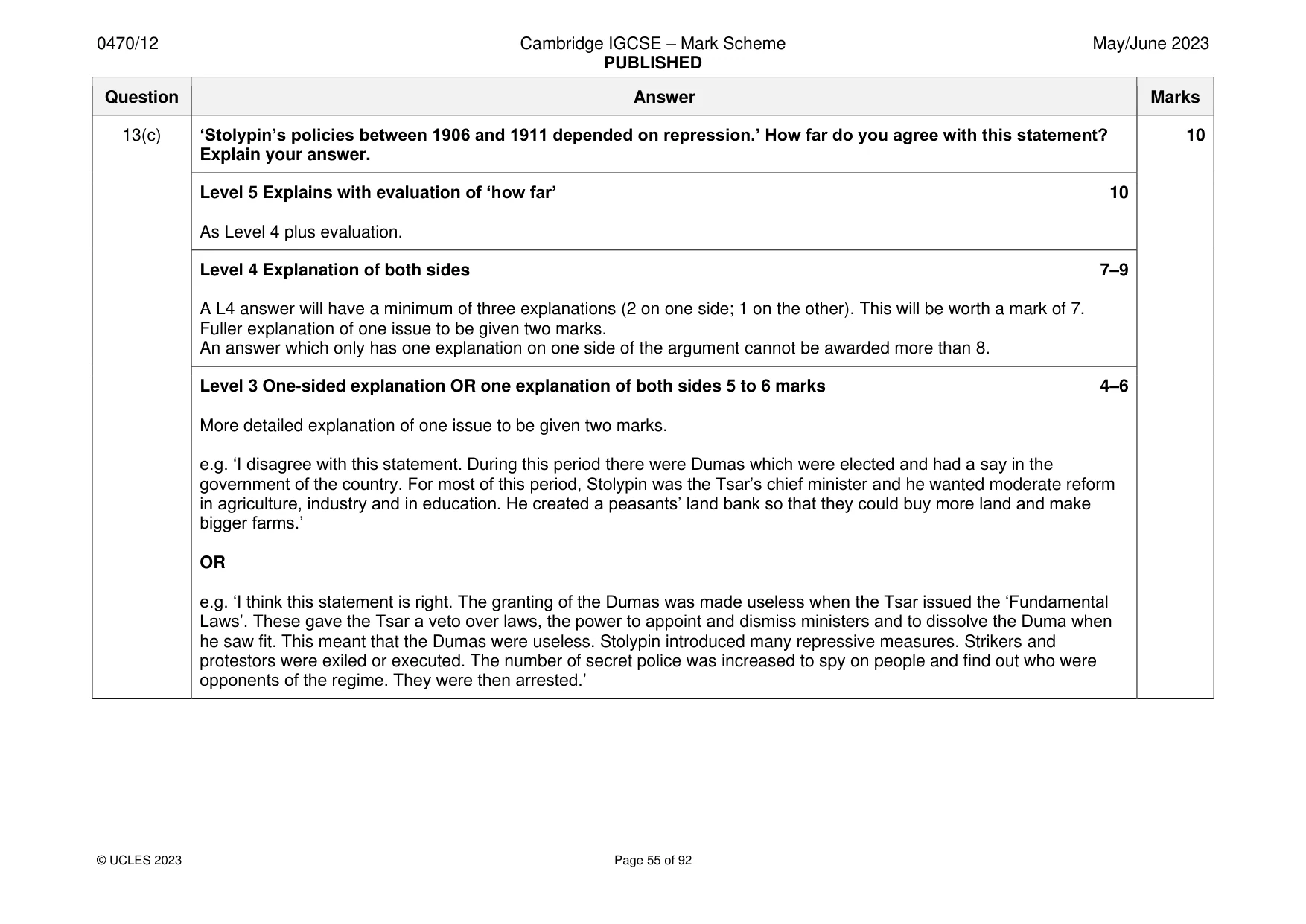
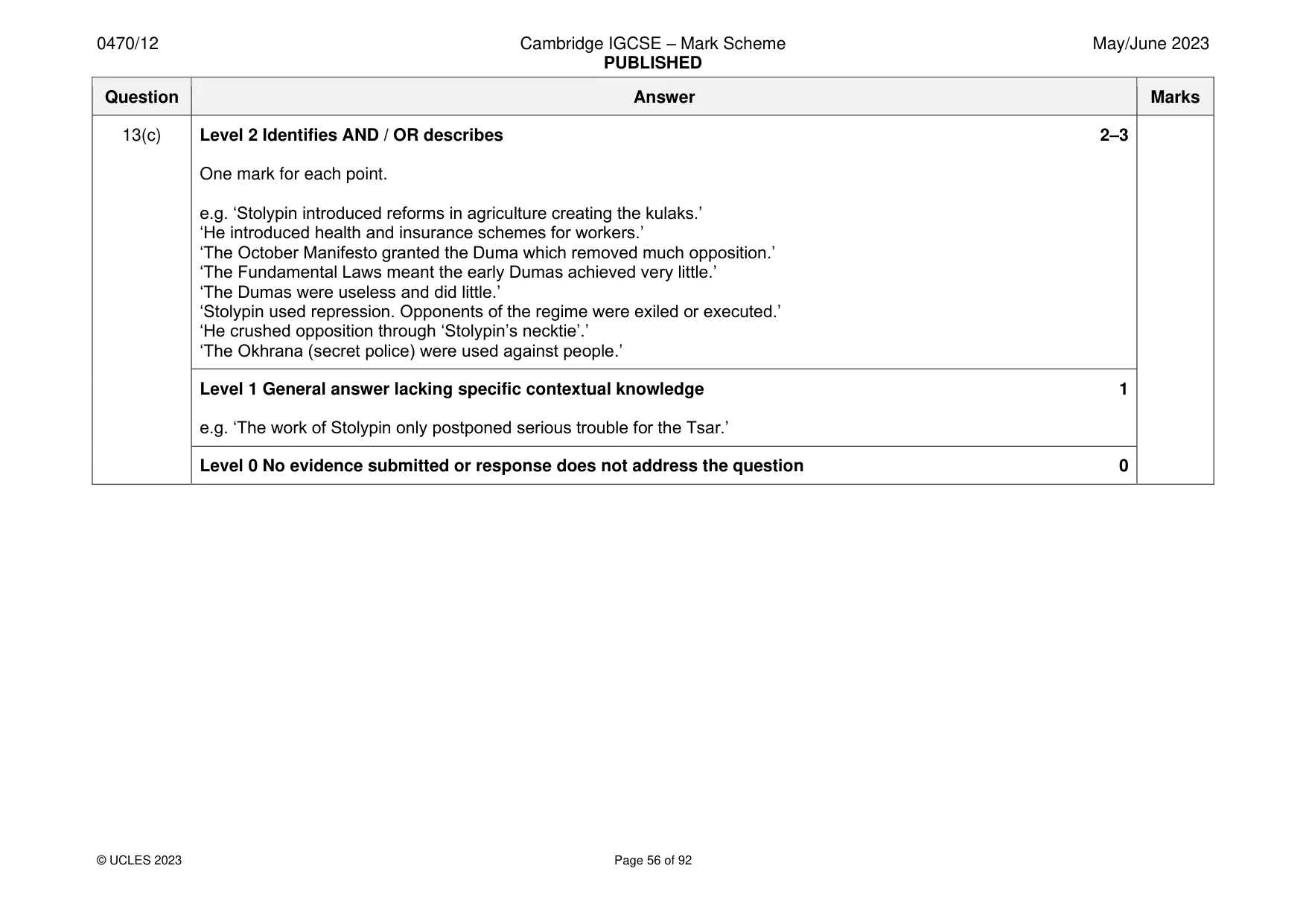
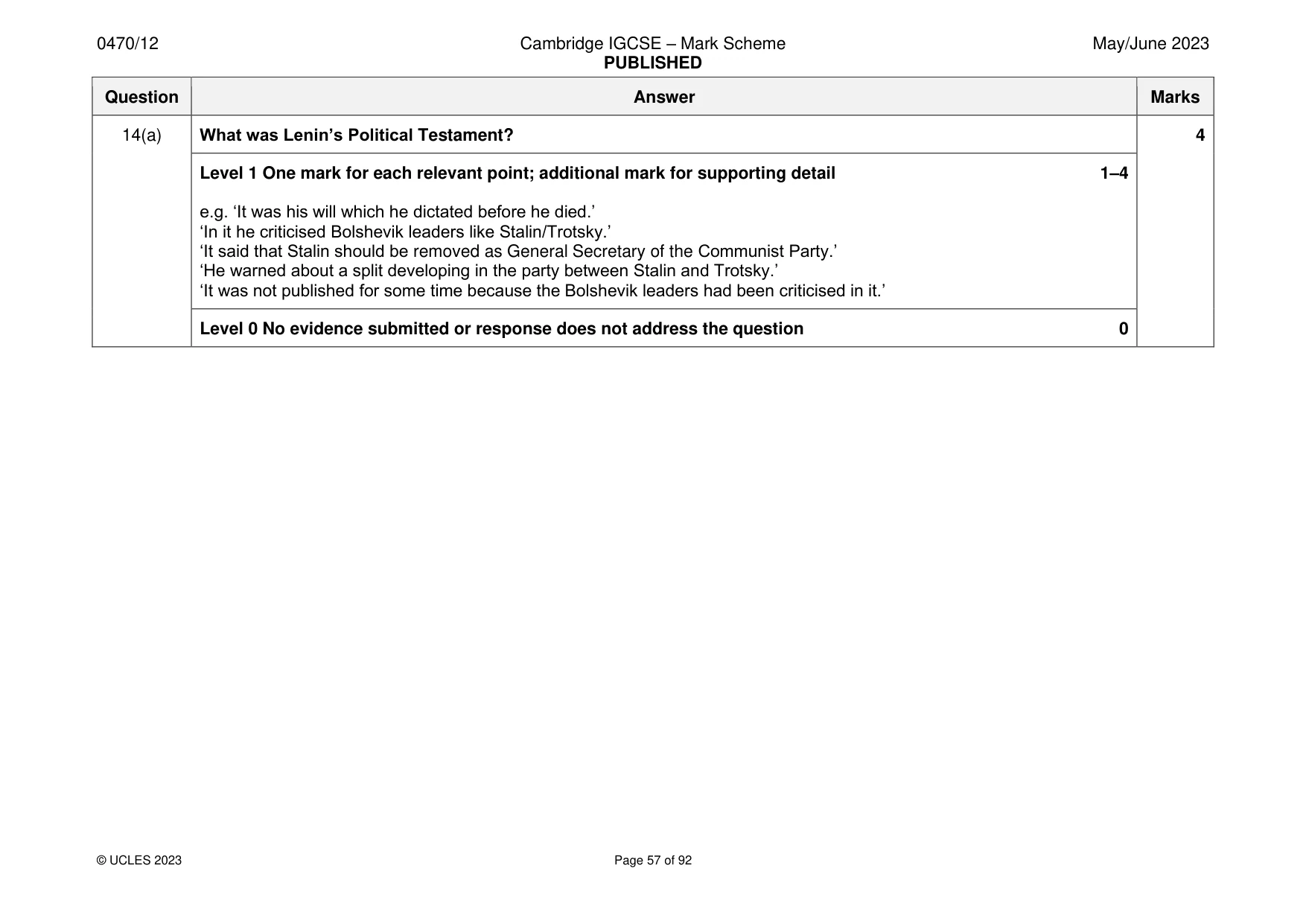
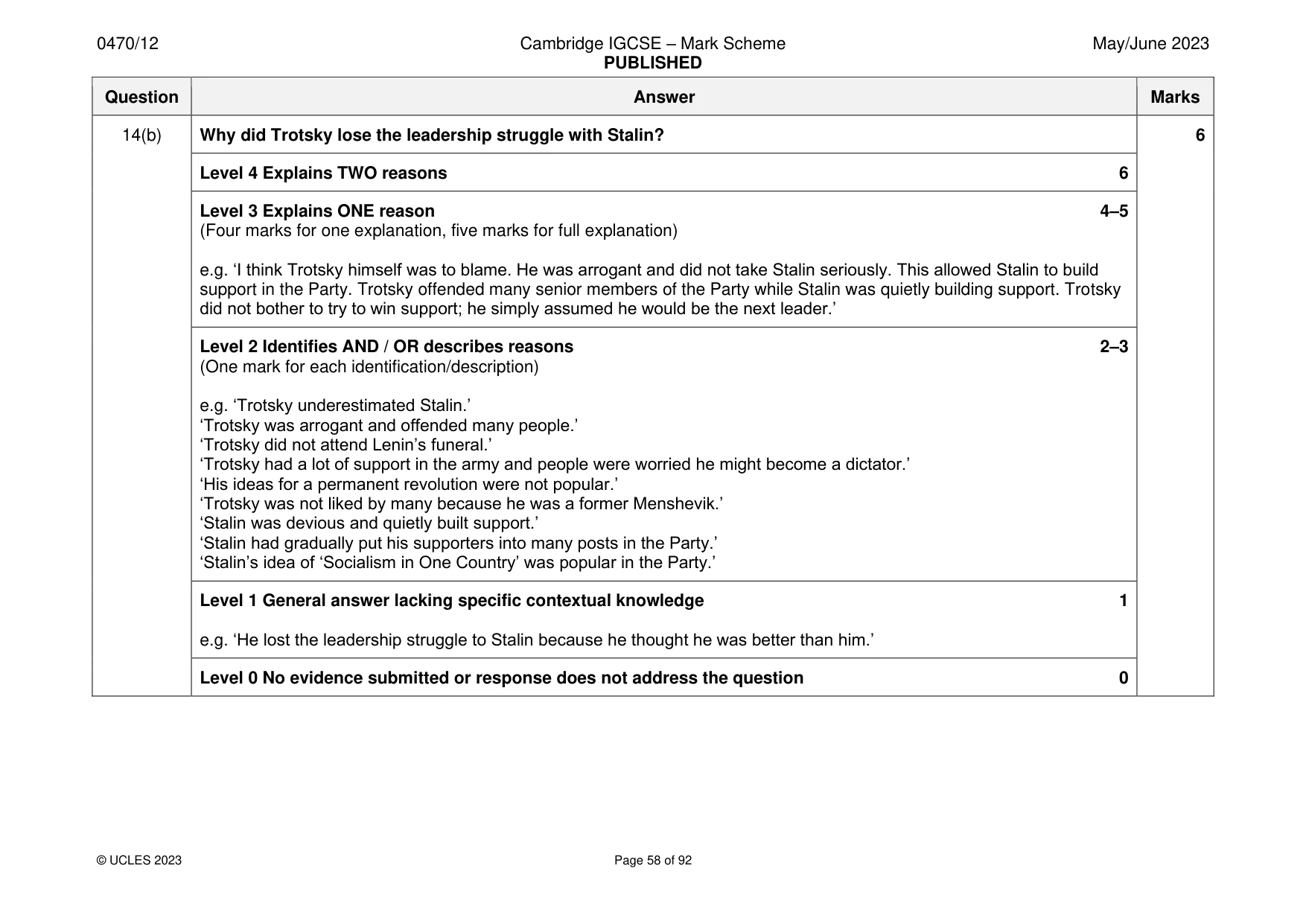
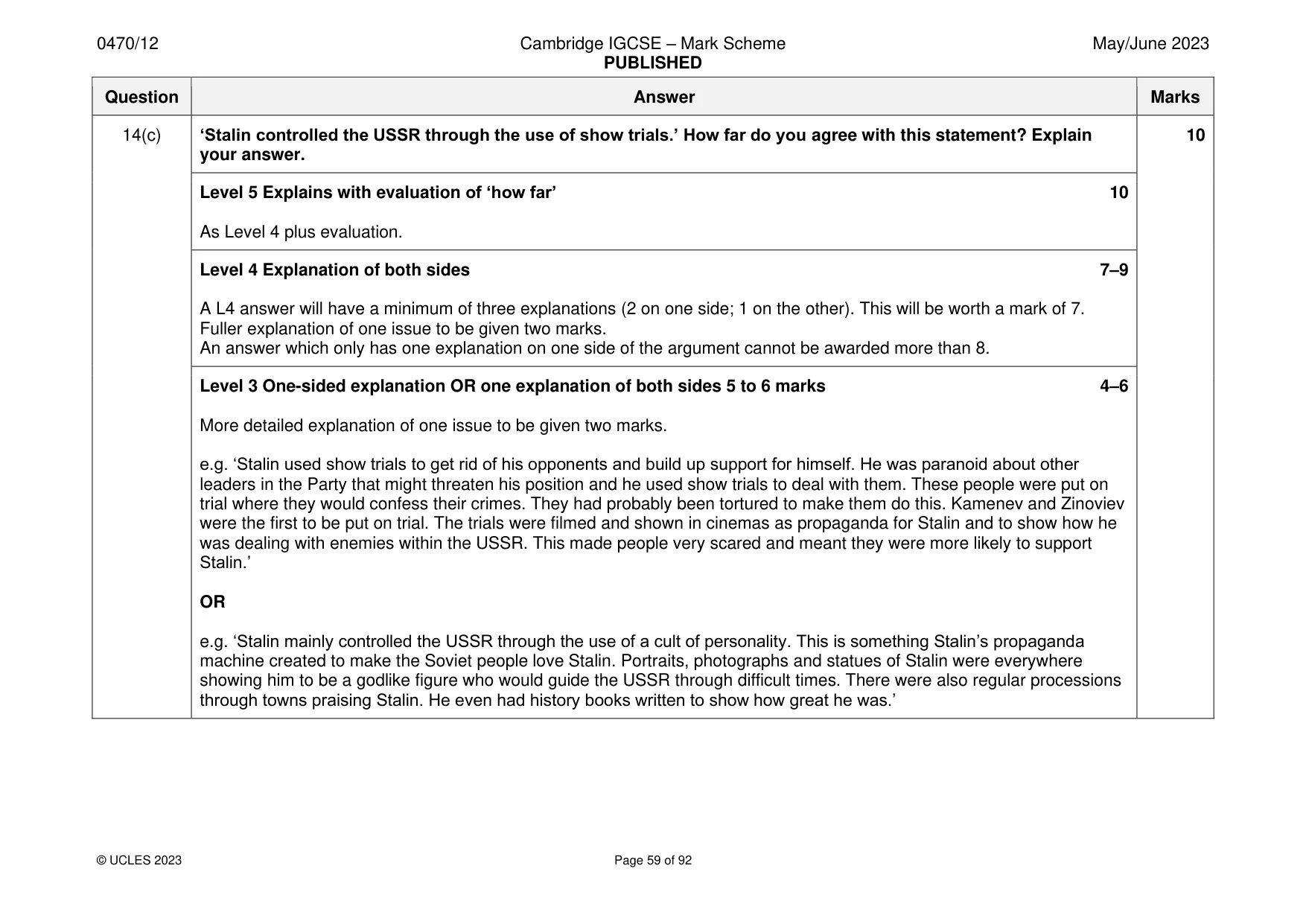
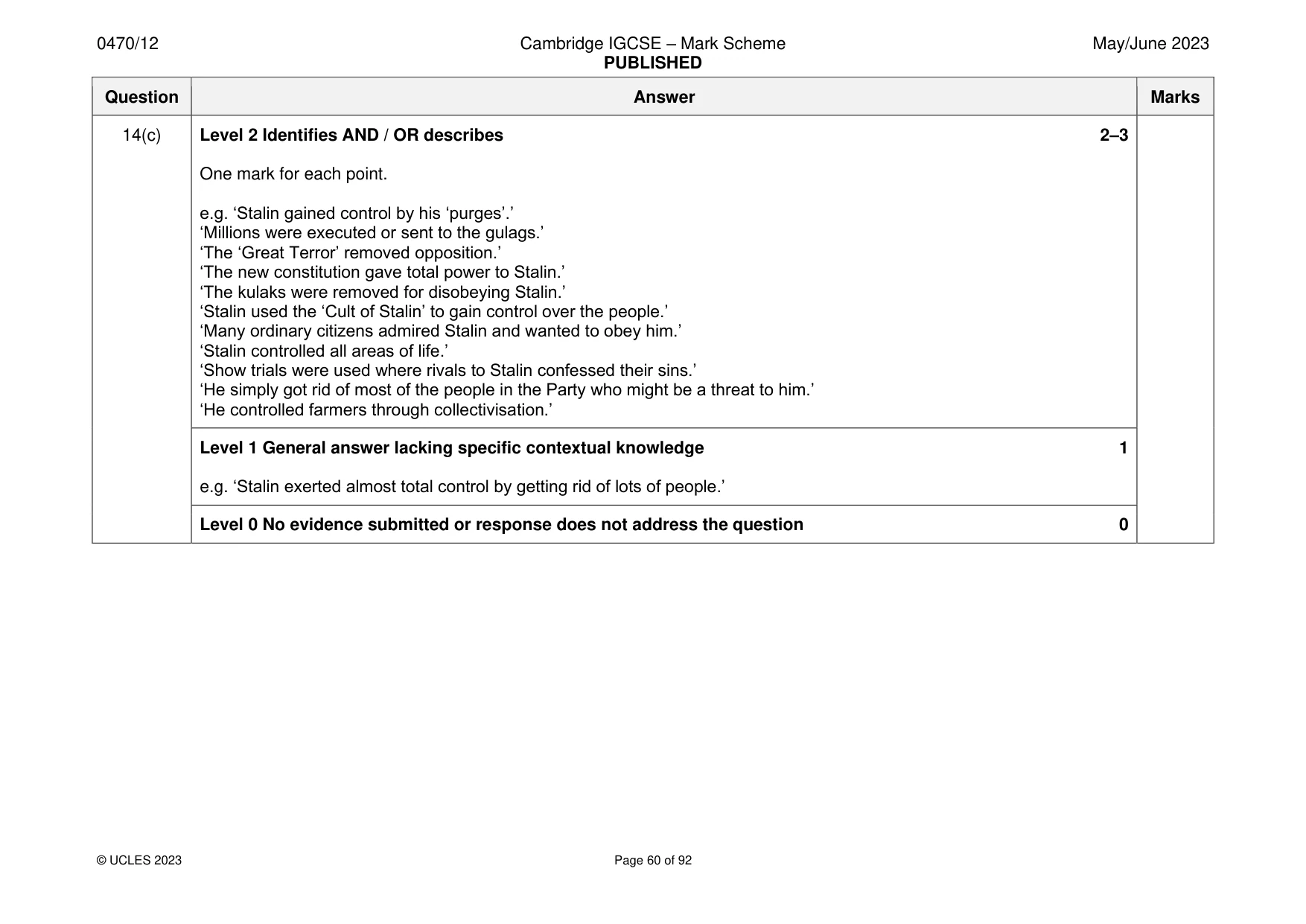
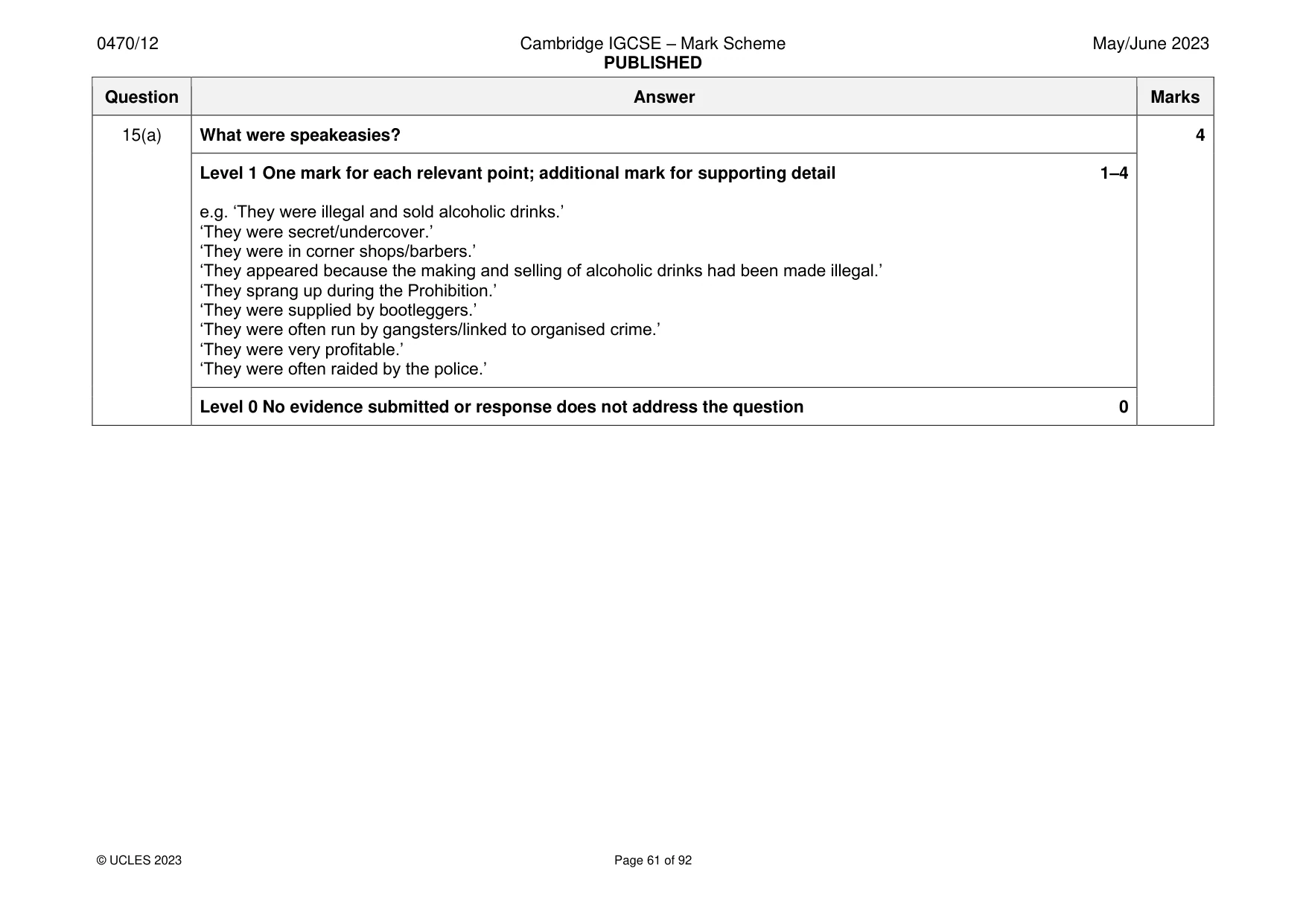
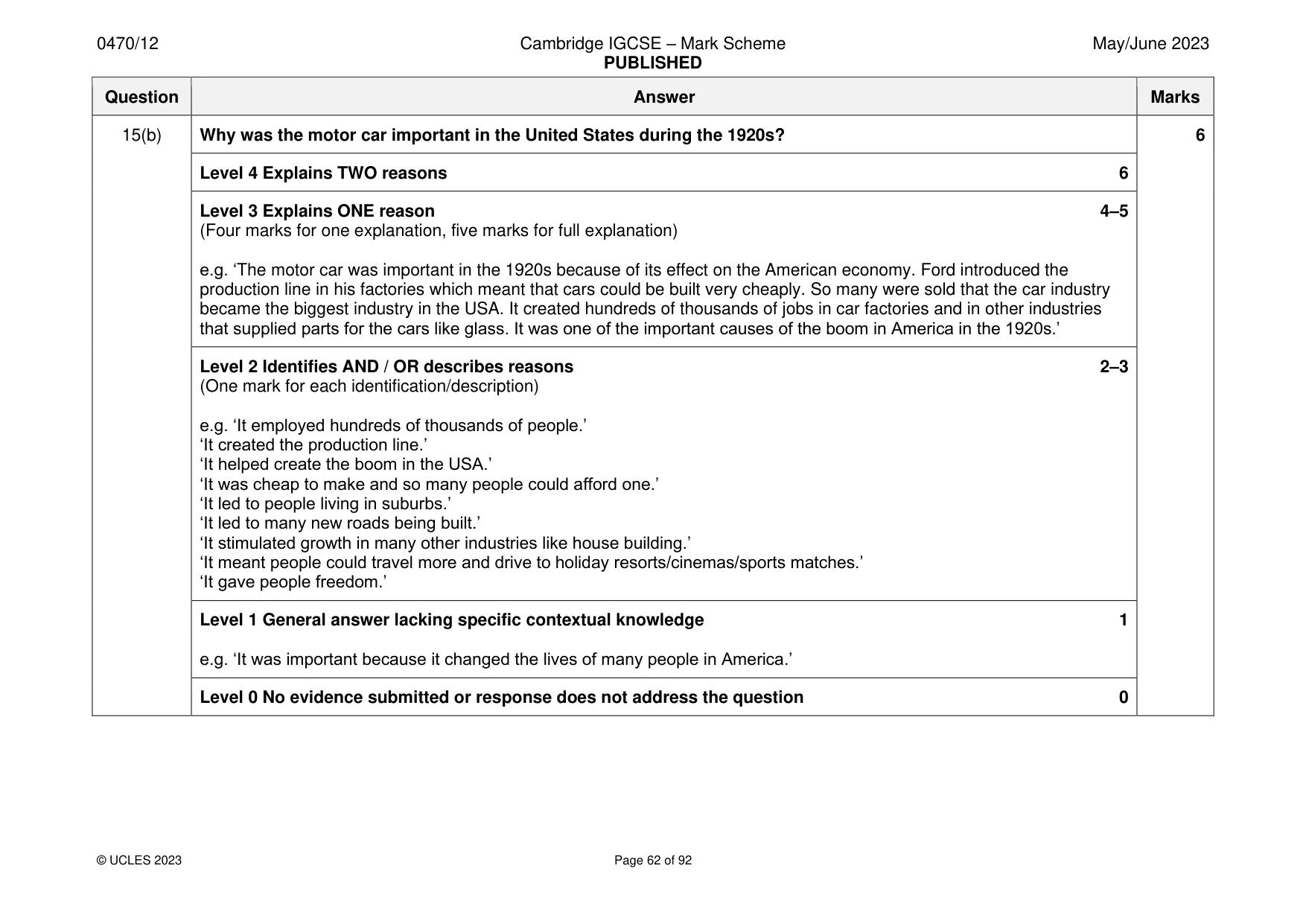
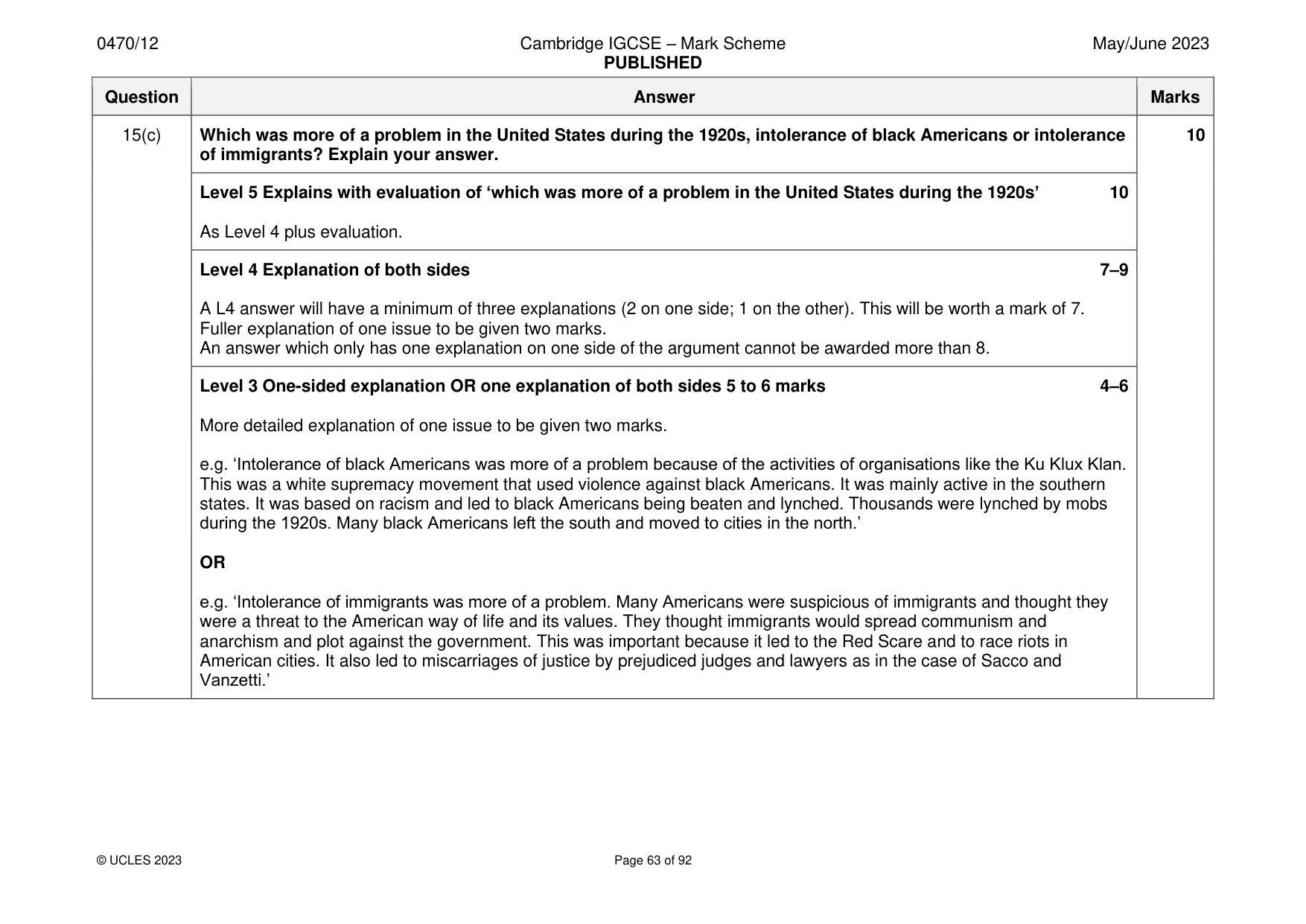
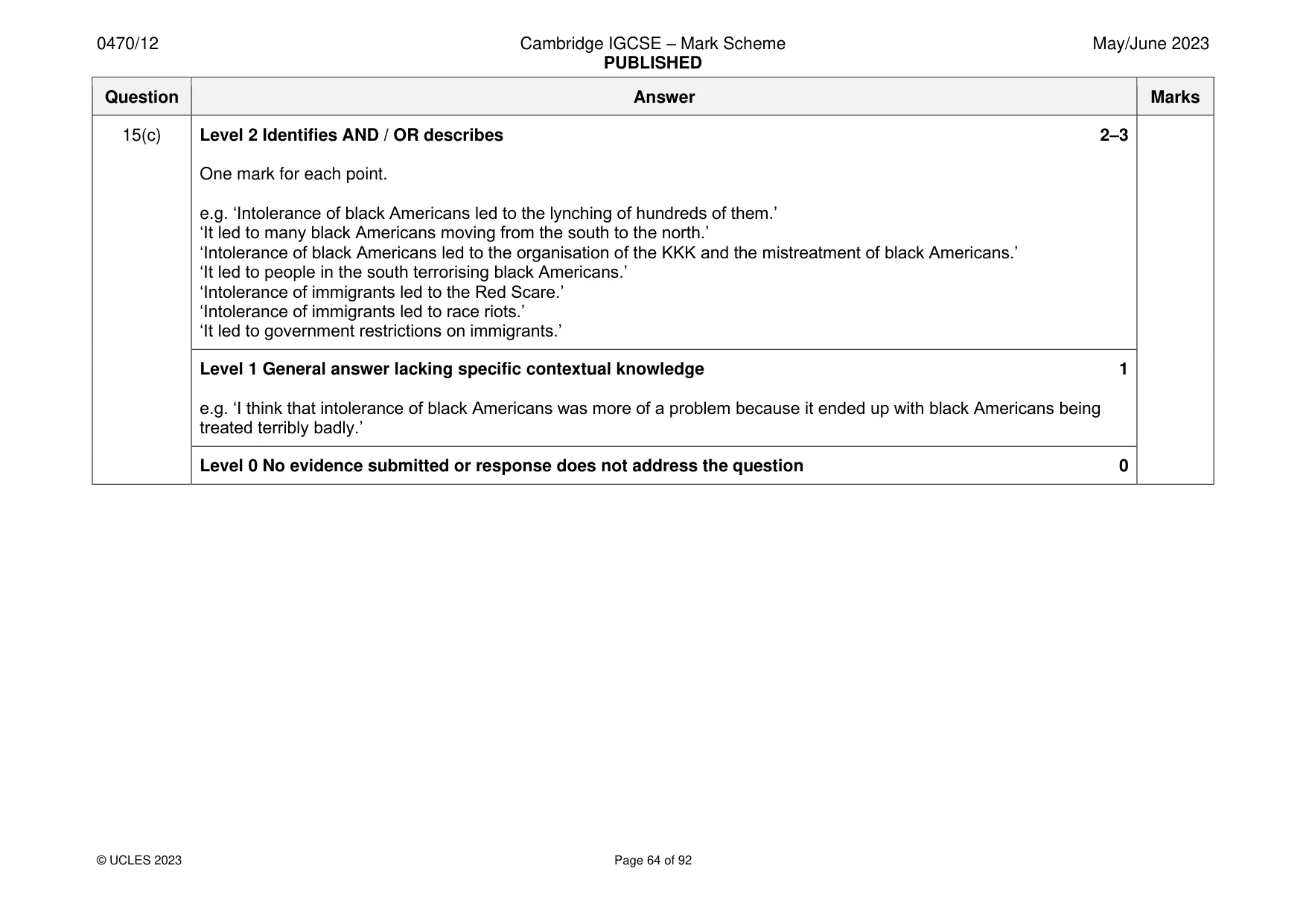
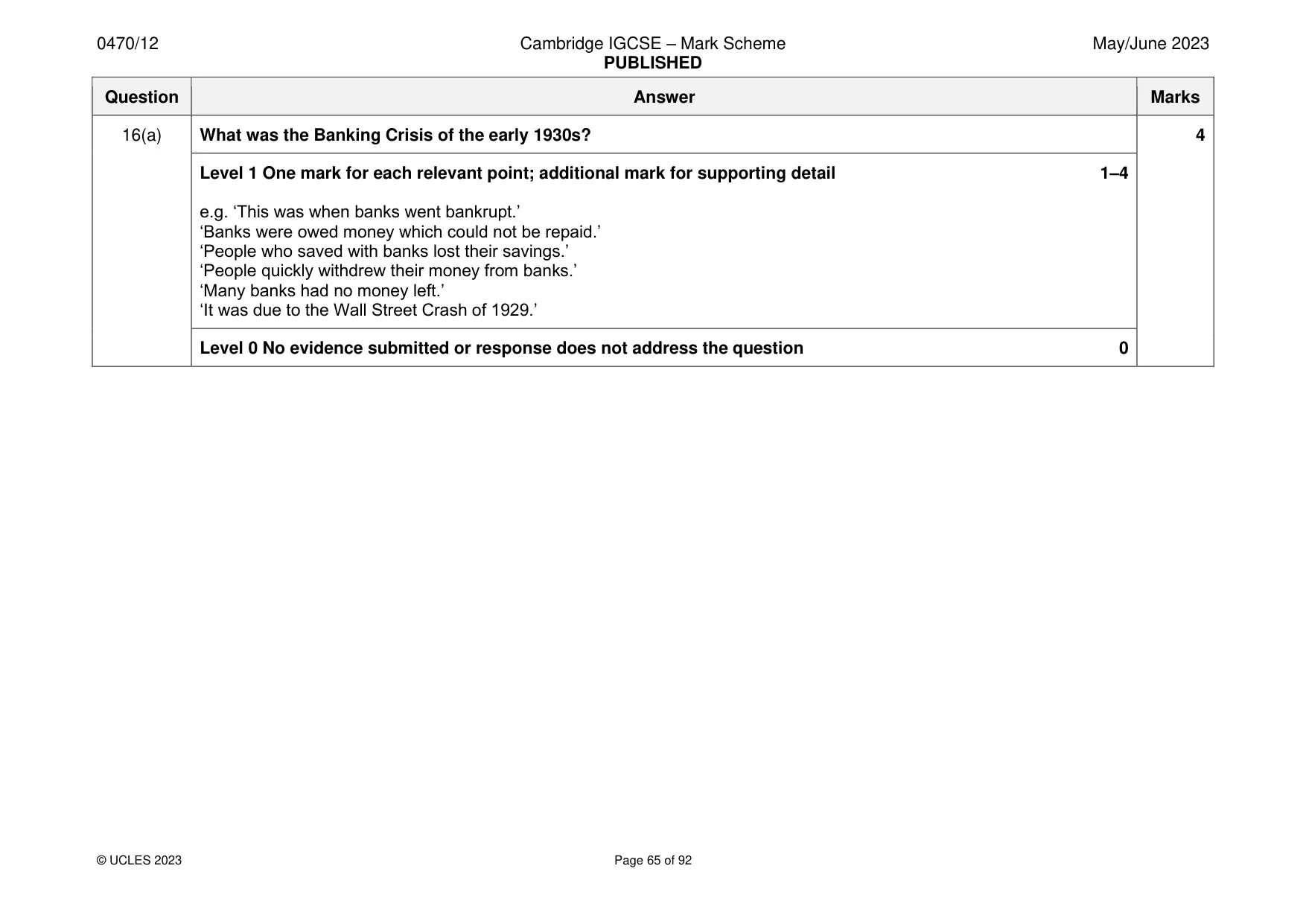
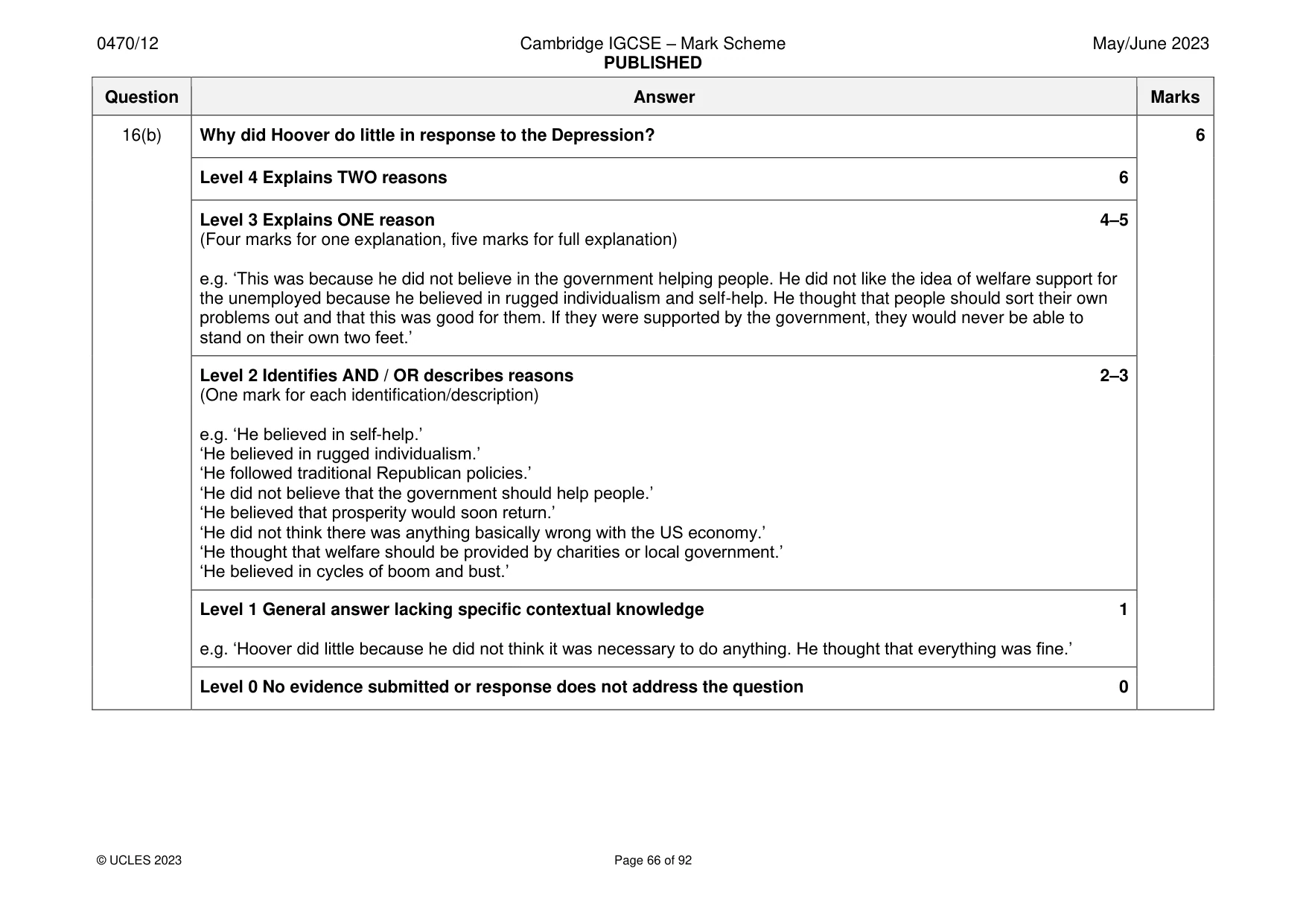
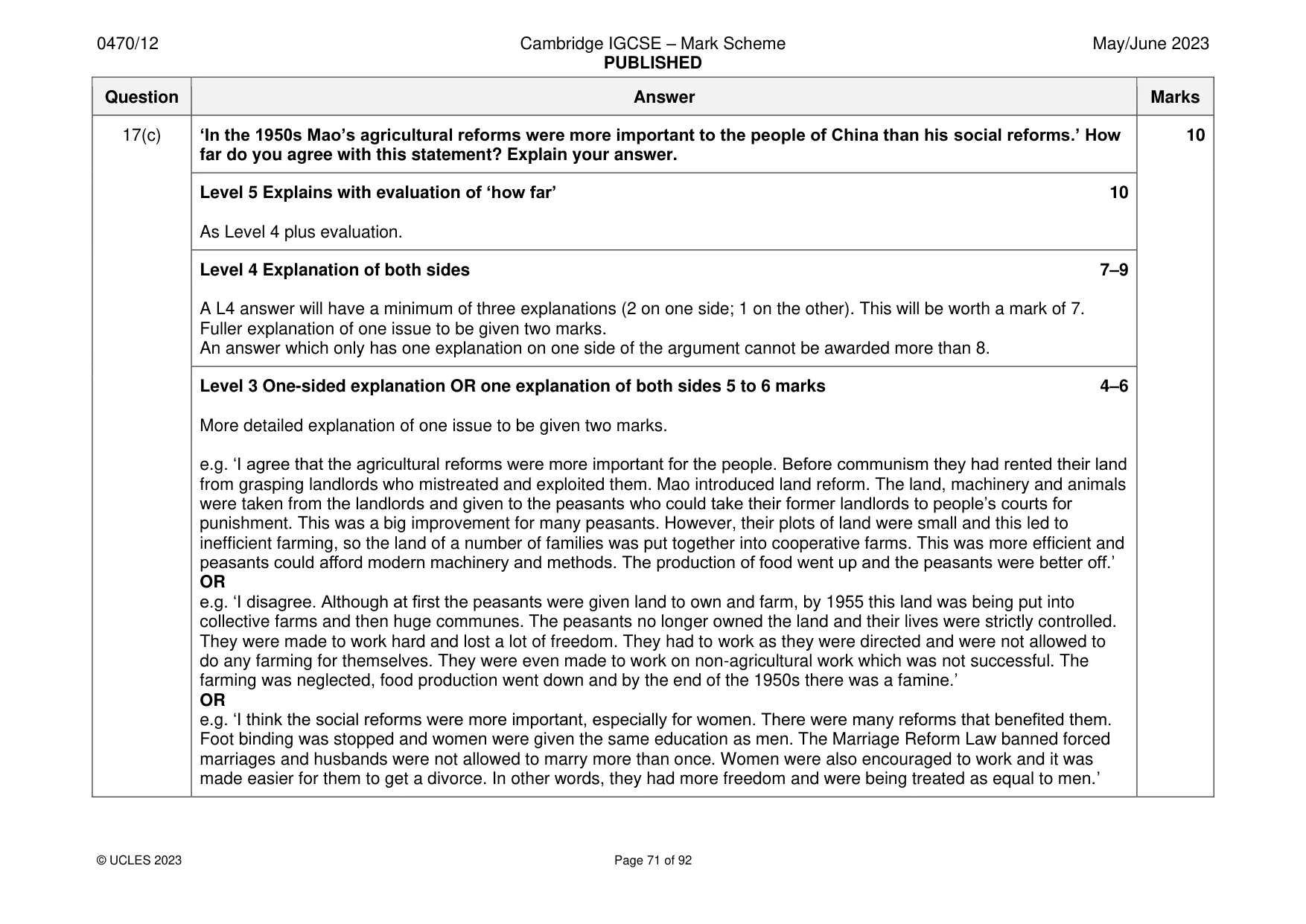
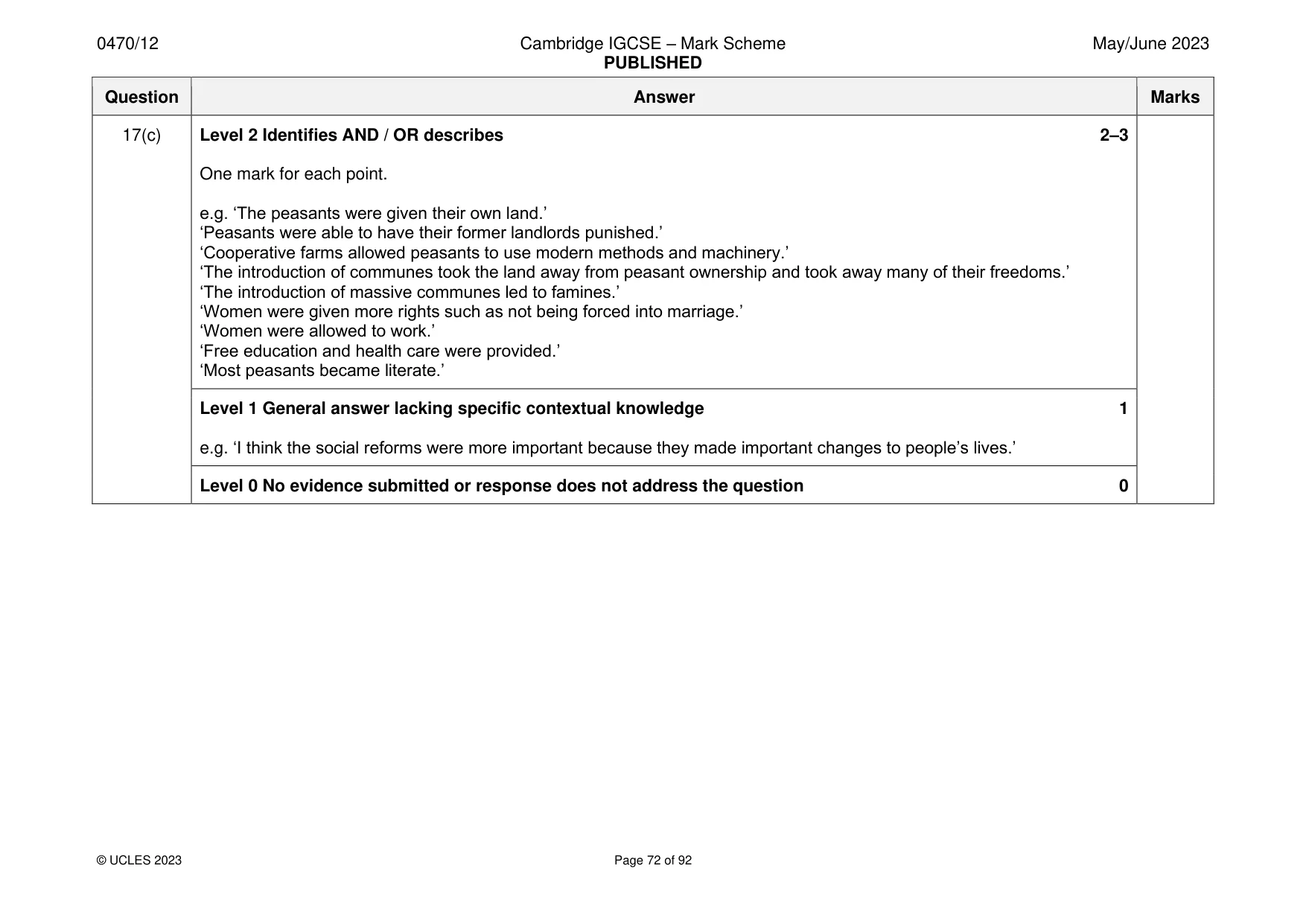
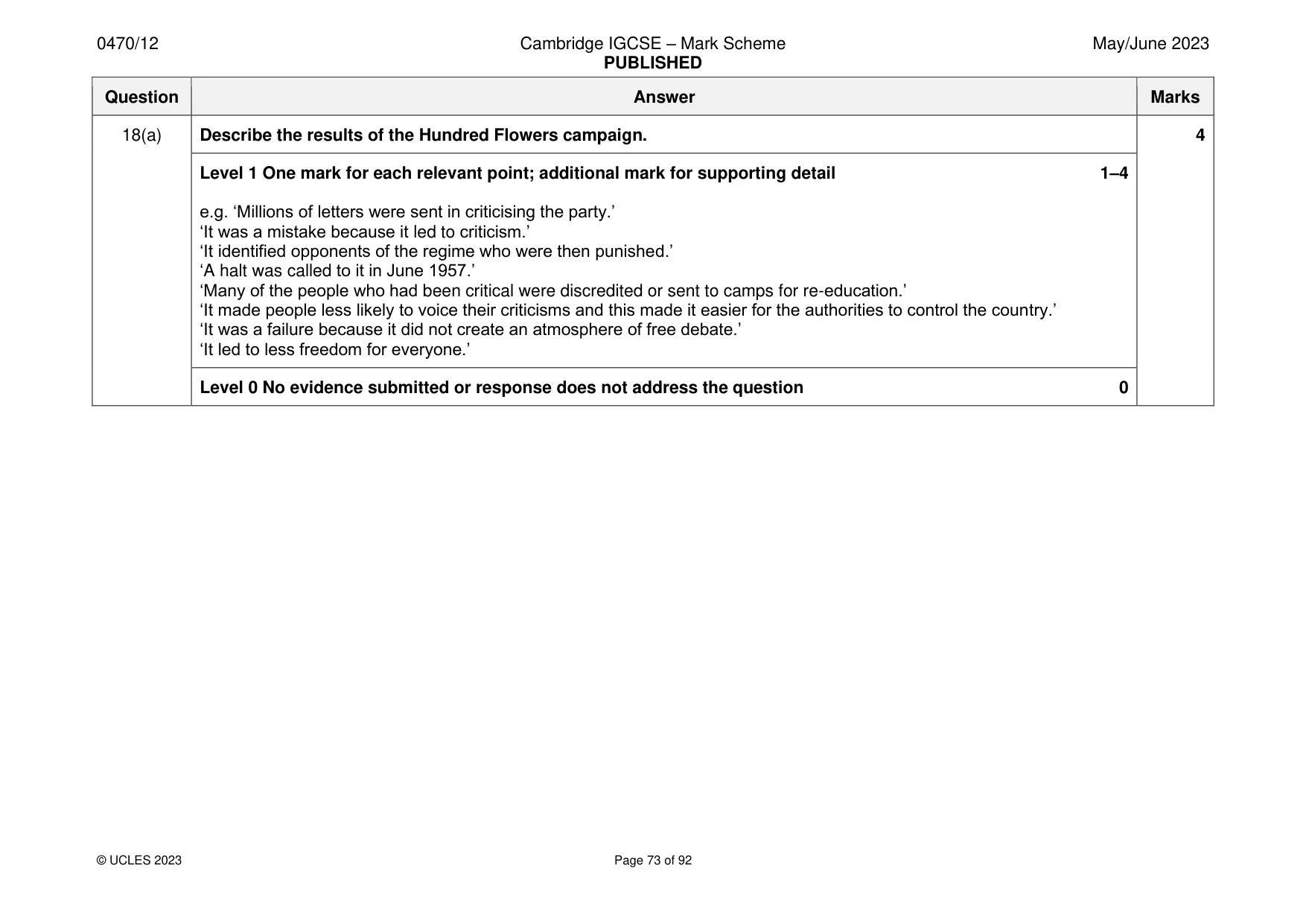
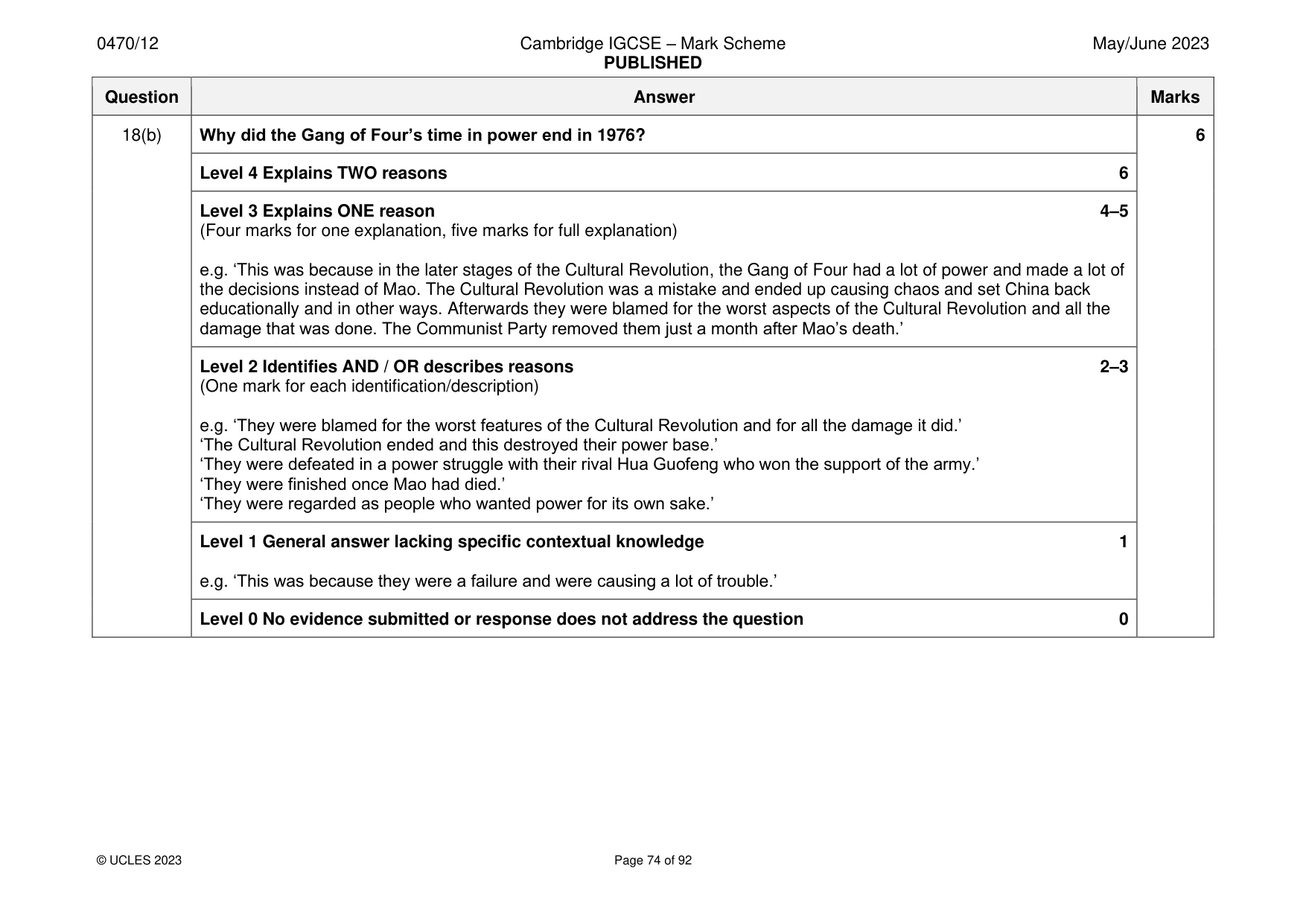
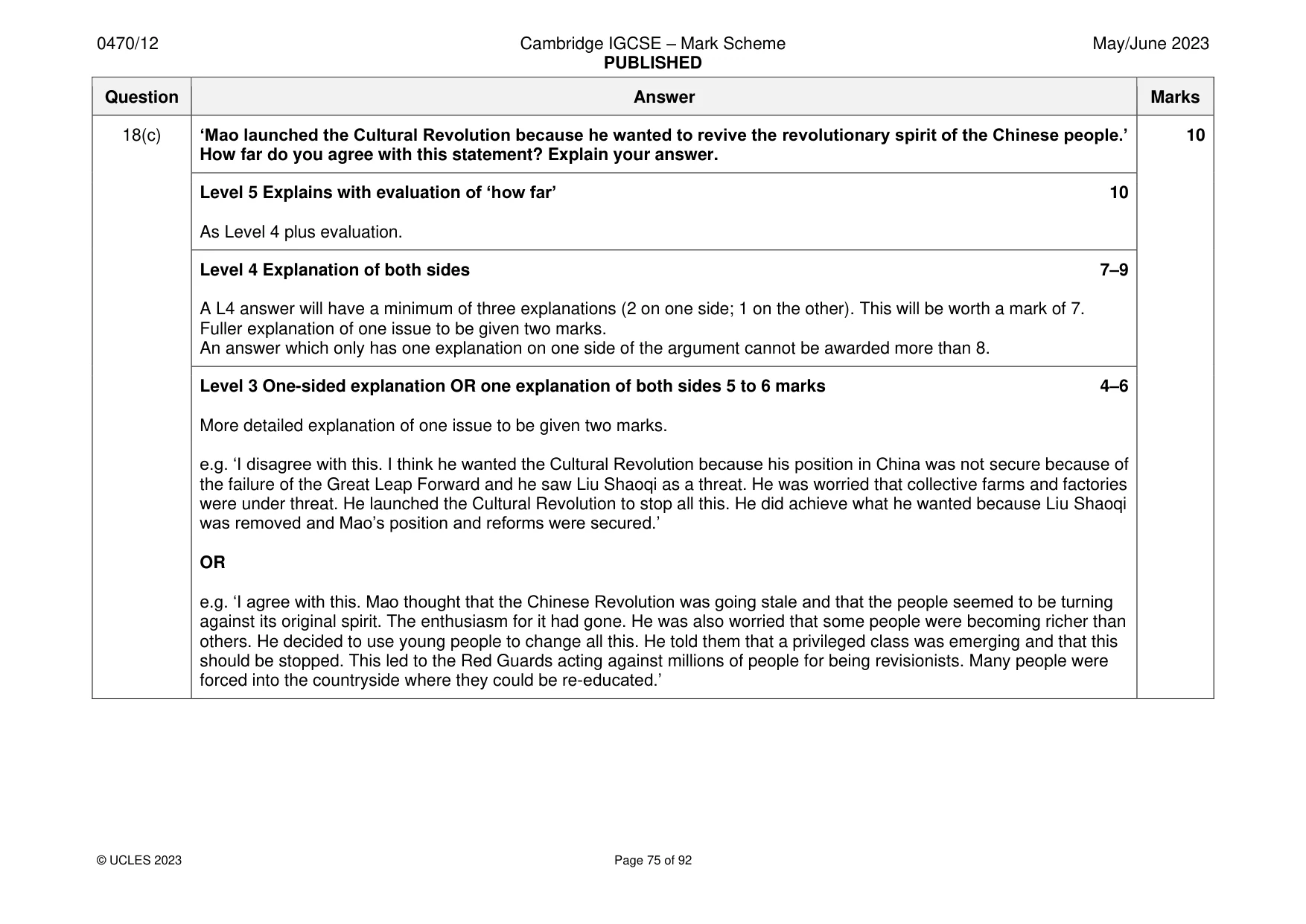
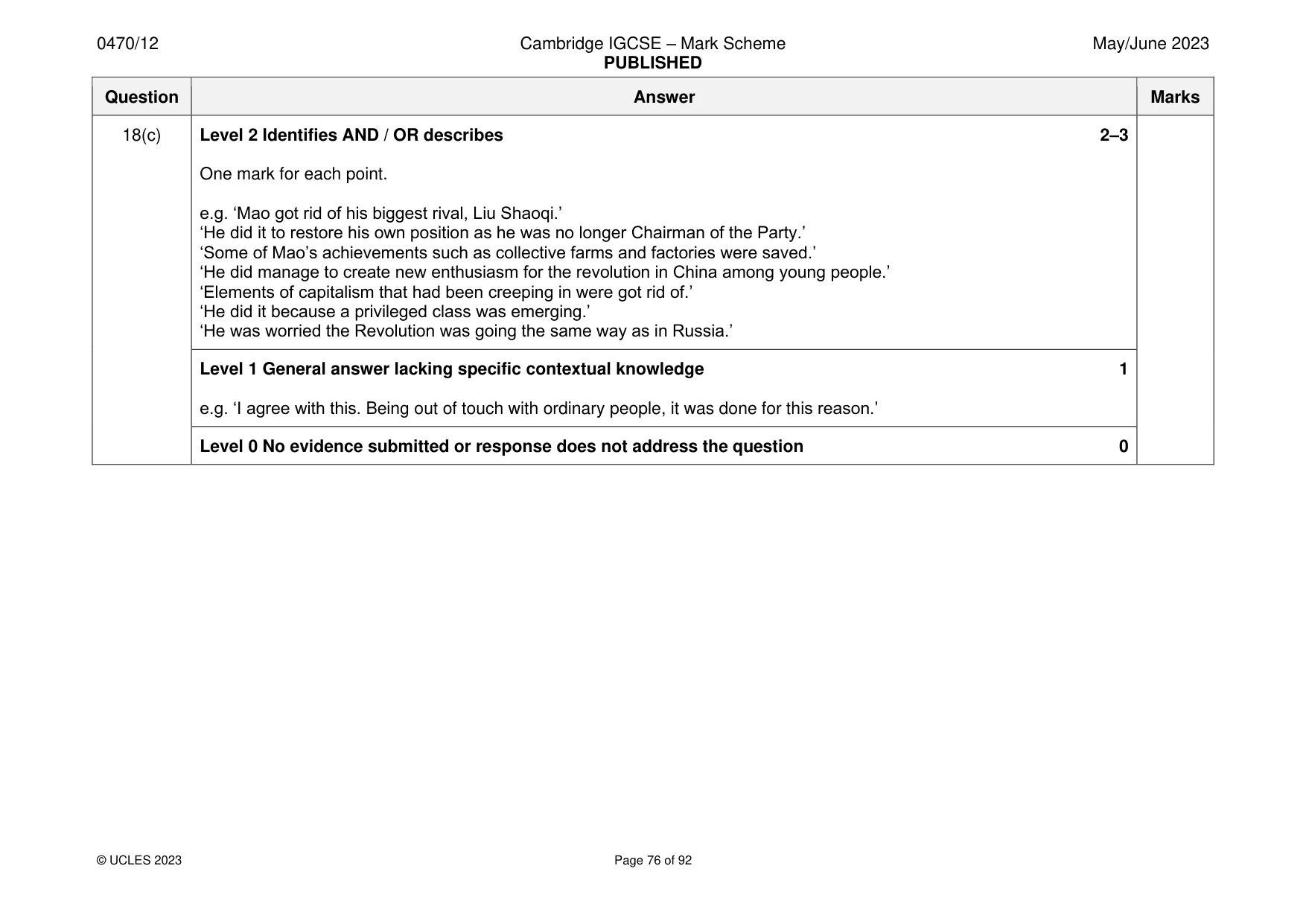
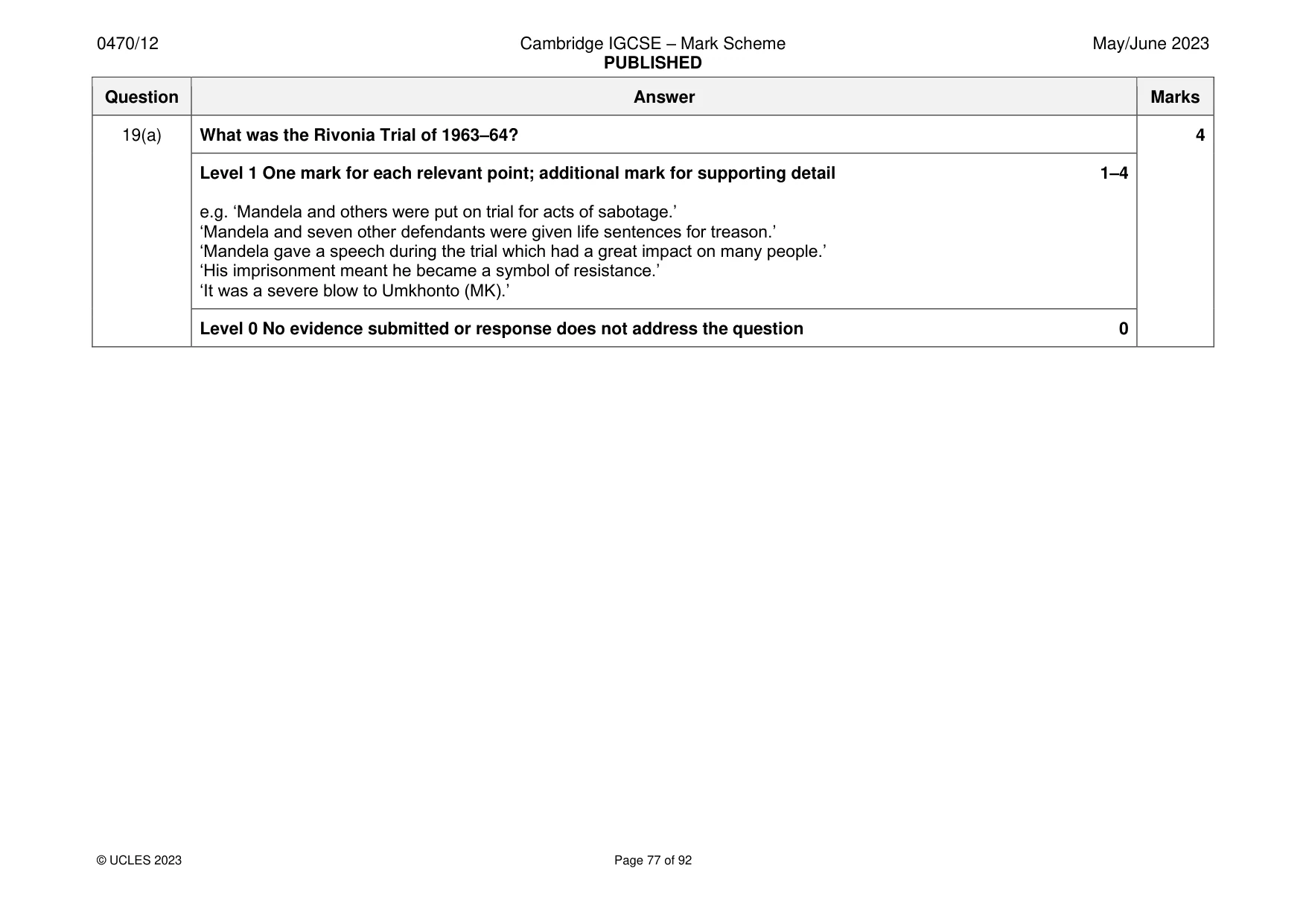
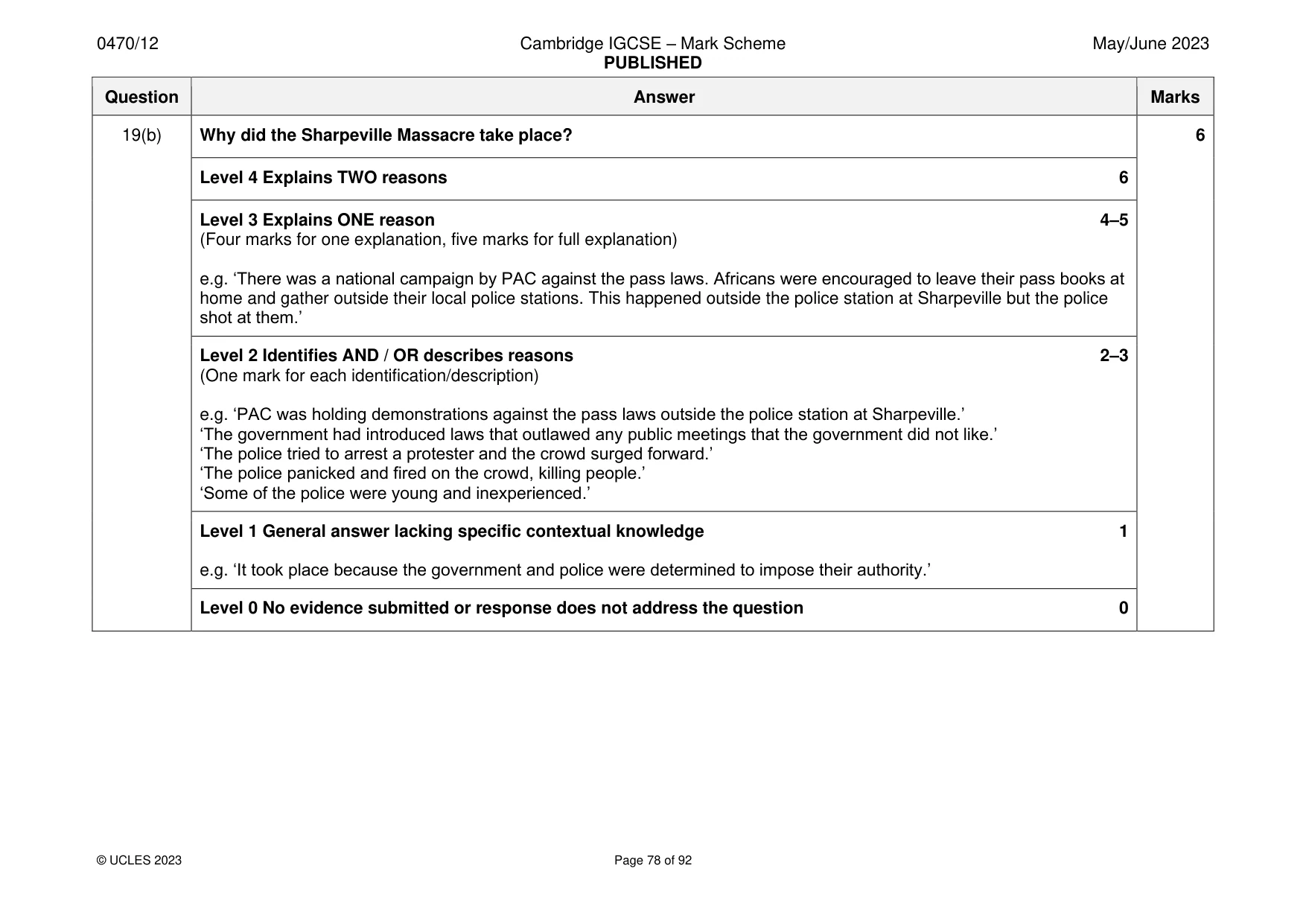
Paper as text
Question paper, page 1
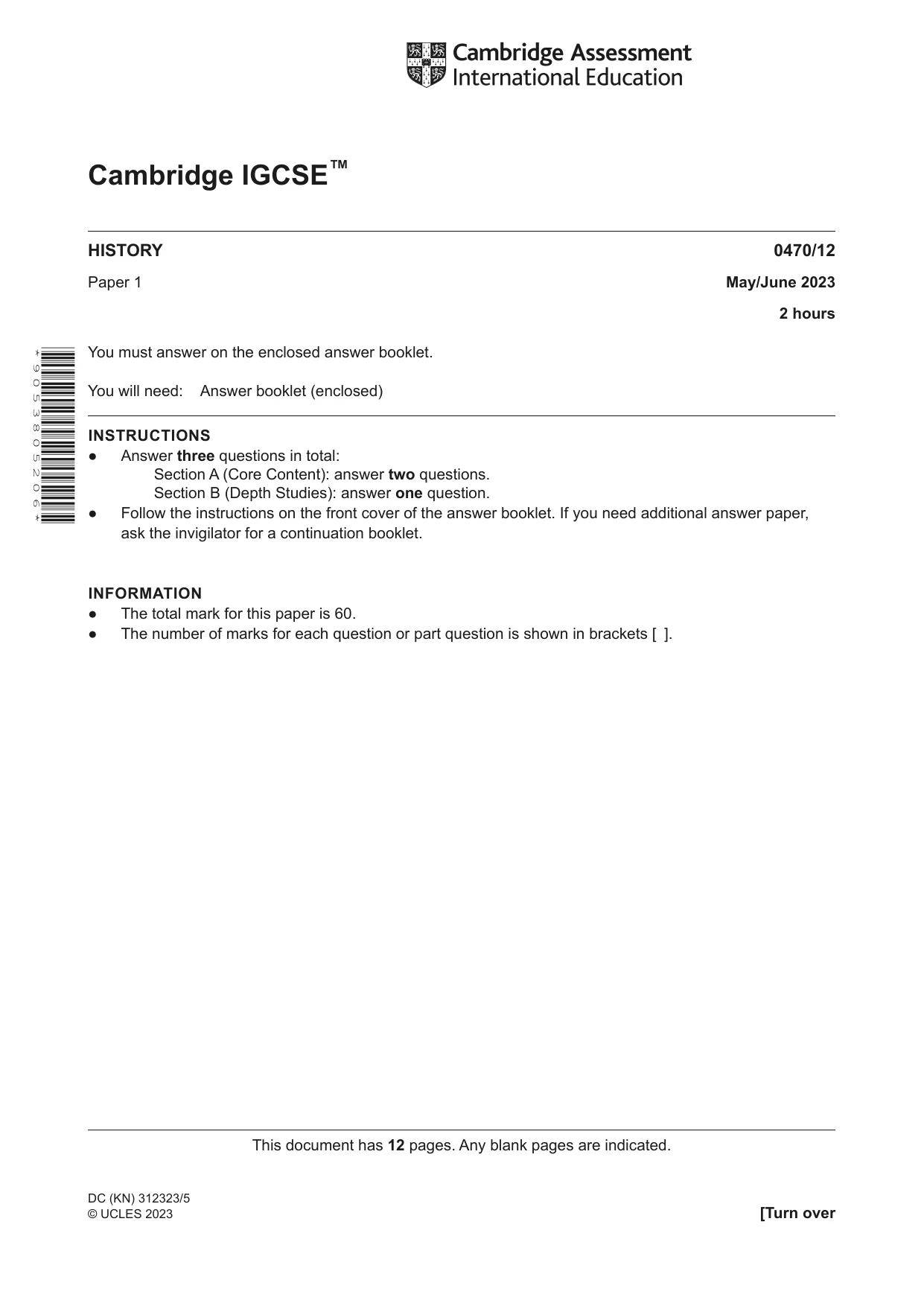
This document has 12 pages. Any blank pages are indicated. [Turn over Cambridge IGCSE™ DC (KN) 312323/5 © UCLES 2023 * 9 0 5 3 8 0 5 2 0 6 * HISTORY 0470/12 Paper 1 May/June 2023 2 hours You must answer on the enclosed answer booklet. You will need: Answer booklet (enclosed) INSTRUCTIONS ● Answer three questions in total: Section A (Core Content): answer two questions. Section B (Depth Studies): answer one question. ● Follow the instructions on the front cover of the answer booklet. If you need additional answer paper, ask the invigilator for a continuation booklet. INFORMATION ● The total mark for this paper is 60. ● The number of marks for each question or part question is shown in brackets [ ].
Question paper, page 2
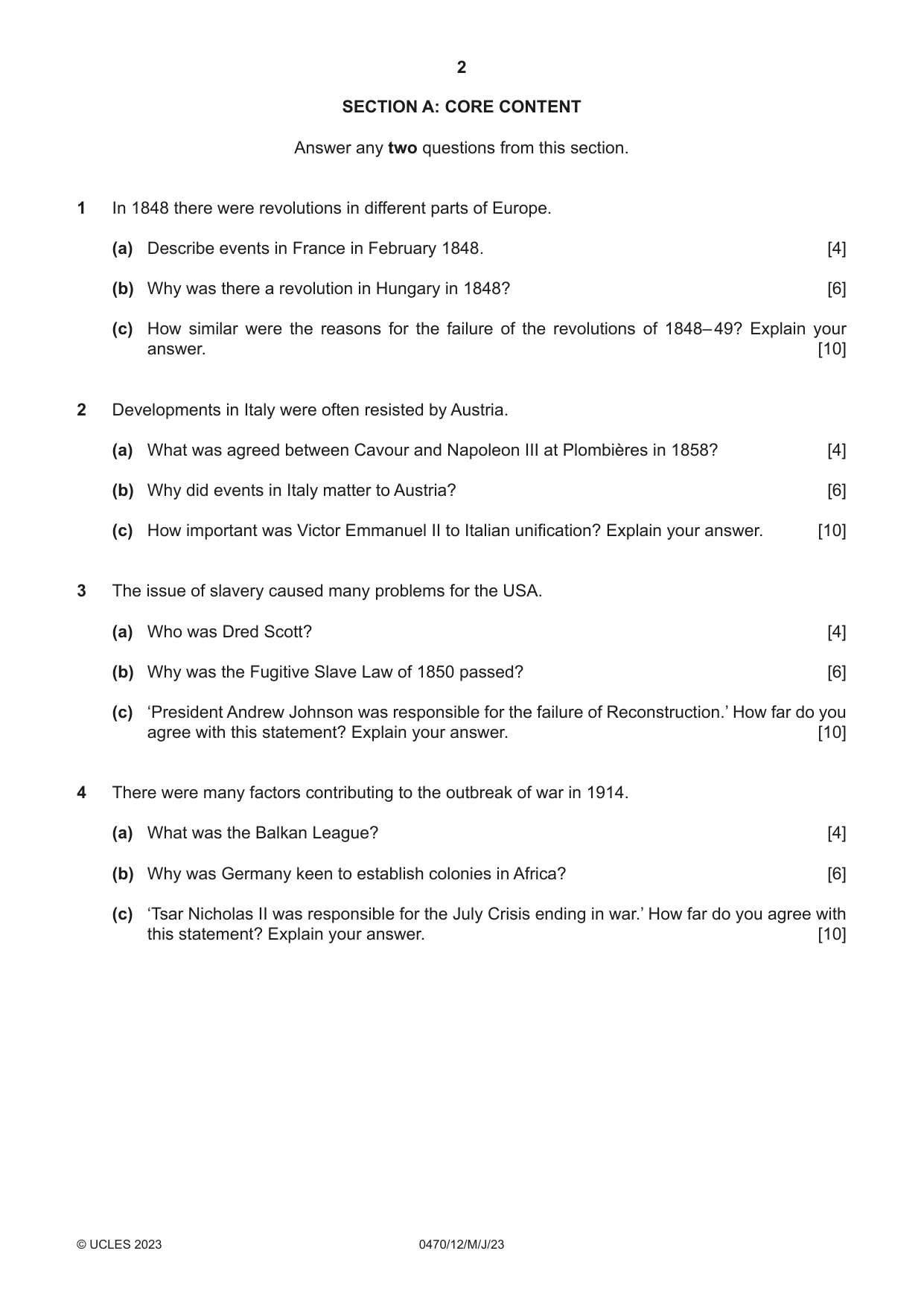
2 0470/12/M/J/23 © UCLES 2023 SECTION A: CORE CONTENT Answer any two questions from this section. 1 In 1848 there were revolutions in different parts of Europe. (a) Describe events in France in February 1848. [4] (b) Why was there a revolution in Hungary in 1848? [6] (c) How similar were the reasons for the failure of the revolutions of 1848– 49? Explain your answer. [10] 2 Developments in Italy were often resisted by Austria. (a) What was agreed between Cavour and Napoleon III at Plombières in 1858? [4] (b) Why did events in Italy matter to Austria? [6] (c) How important was Victor Emmanuel II to Italian unification? Explain your answer. [10] 3 The issue of slavery caused many problems for the USA. (a) Who was Dred Scott? [4] (b) Why was the Fugitive Slave Law of 1850 passed? [6] (c) ‘President Andrew Johnson was responsible for the failure of Reconstruction.’ How far do you agree with this statement? Explain your answer. [10] 4 There were many factors contributing to the outbreak of war in 1914. (a) What was the Balkan League? [4] (b) Why was Germany keen to establish colonies in Africa? [6] (c) ‘Tsar Nicholas II was responsible for the July Crisis ending in war.’ How far do you agree with this statement? Explain your answer. [10]
Question paper, page 3
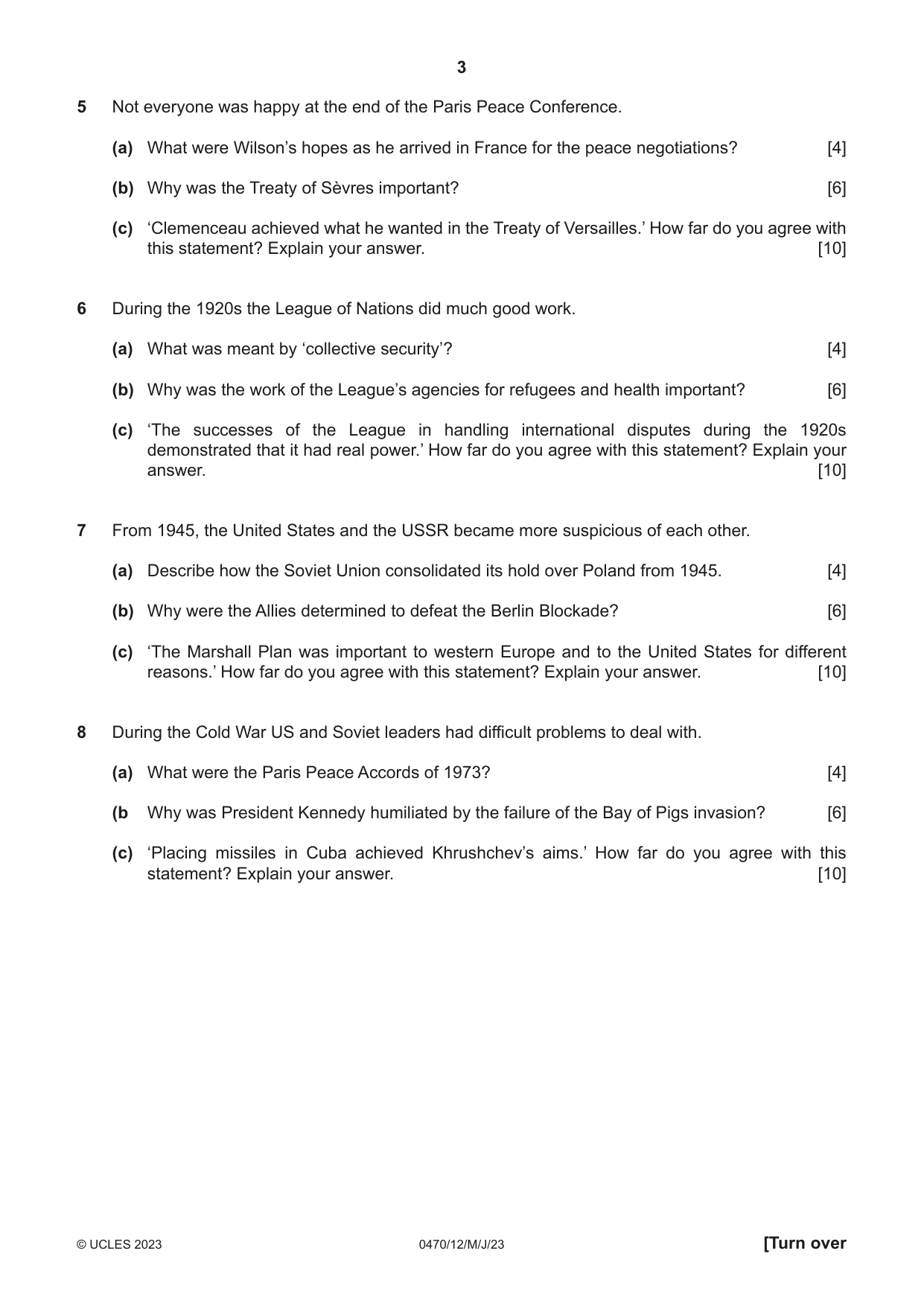
3 0470/12/M/J/23 © UCLES 2023 [Turn over 5 Not everyone was happy at the end of the Paris Peace Conference. (a) What were Wilson’s hopes as he arrived in France for the peace negotiations? [4] (b) Why was the Treaty of Sèvres important? [6] (c) ‘Clemenceau achieved what he wanted in the Treaty of Versailles.’ How far do you agree with this statement? Explain your answer. [10] 6 During the 1920s the League of Nations did much good work. (a) What was meant by ‘collective security’? [4] (b) Why was the work of the League’s agencies for refugees and health important? [6] (c) ‘The successes of the League in handling international disputes during the 1920s demonstrated that it had real power.’ How far do you agree with this statement? Explain your answer. [10] 7 From 1945, the United States and the USSR became more suspicious of each other. (a) Describe how the Soviet Union consolidated its hold over Poland from 1945. [4] (b) Why were the Allies determined to defeat the Berlin Blockade? [6] (c) ‘The Marshall Plan was important to western Europe and to the United States for different reasons.’ How far do you agree with this statement? Explain your answer. [10] 8 During the Cold War US and Soviet leaders had difficult problems to deal with. (a) What were the Paris Peace Accords of 1973? [4] (b Why was President Kennedy humiliated by the failure of the Bay of Pigs invasion? [6] (c) ‘Placing missiles in Cuba achieved Khrushchev’s aims.’ How far do you agree with this statement? Explain your answer. [10]
Question paper, page 4
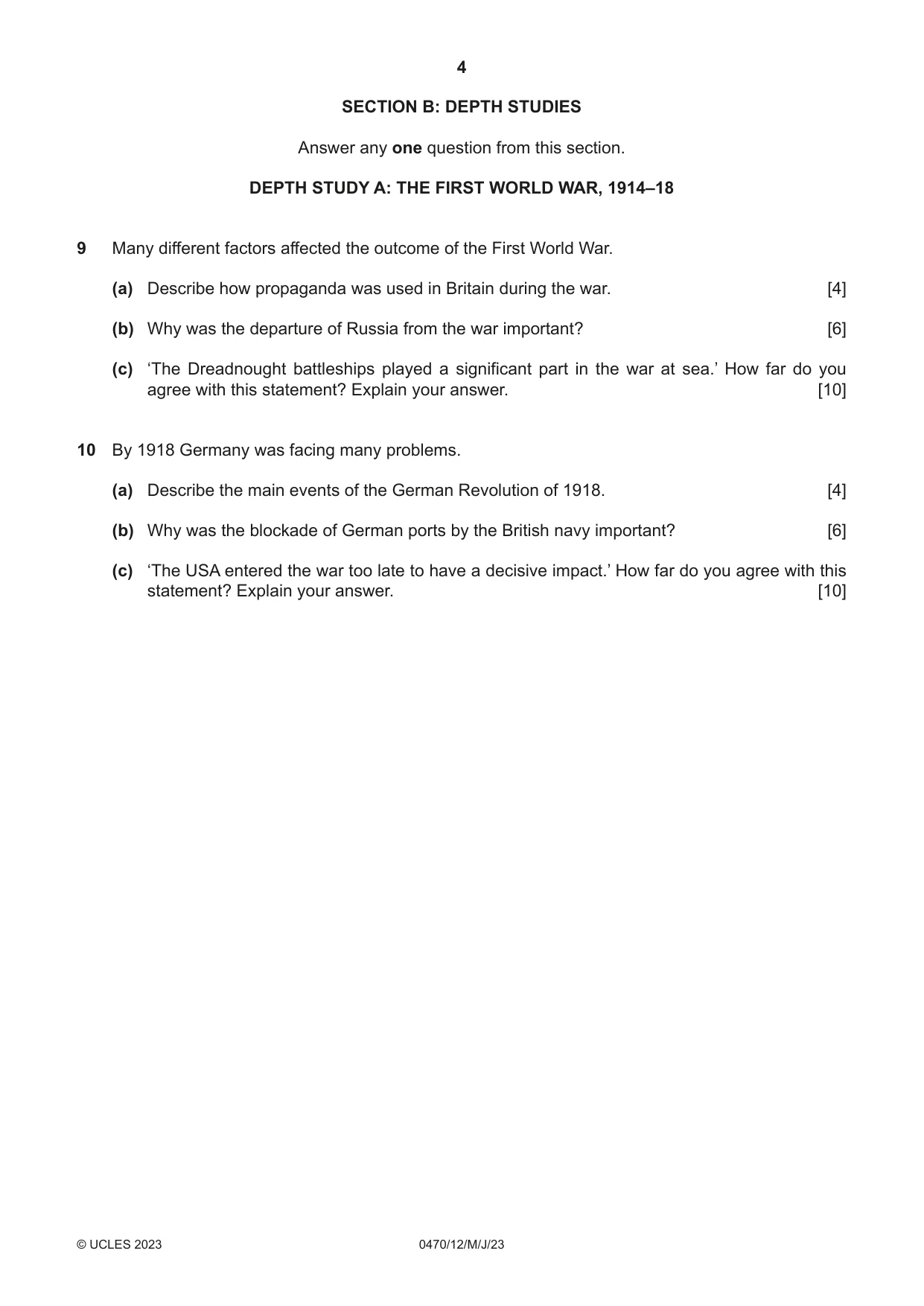
4 0470/12/M/J/23 © UCLES 2023 SECTION B: DEPTH STUDIES Answer any one question from this section. DEPTH STUDY A: THE FIRST WORLD WAR, 1914–18 9 Many different factors affected the outcome of the First World War. (a) Describe how propaganda was used in Britain during the war. [4] (b) Why was the departure of Russia from the war important? [6] (c) ‘The Dreadnought battleships played a significant part in the war at sea.’ How far do you agree with this statement? Explain your answer. [10] 10 By 1918 Germany was facing many problems. (a) Describe the main events of the German Revolution of 1918. [4] (b) Why was the blockade of German ports by the British navy important? [6] (c) ‘The USA entered the war too late to have a decisive impact.’ How far do you agree with this statement? Explain your answer. [10]
Question paper, page 5
5 0470/12/M/J/23 © UCLES 2023 [Turn over DEPTH STUDY B: GERMANY, 1918–45 11 Despite the problems it faced, the Weimar Republic had some achievements. (a) Describe the reactions of France and Belgium when Germany failed to pay reparations in 1922. [4] (b) Why did the Weimar Republic face threats to its existence in 1919–20? [6] (c) ‘Recovery from hyper-inflation was the most important achievement of the Weimar Republic.’ How far do you agree with this statement? Explain your answer. [10] 12 The Nazis tried to control all parts of German society. (a) What were the Nuremberg Laws of 1935? [4] (b) Why were the 1936 Olympic Games important to Hitler? [6] (c) How far were the Nazis able to maintain control over the German people between 1933 and 1945? Explain your answer. [10]
Question paper, page 6
6 0470/12/M/J/23 © UCLES 2023 DEPTH STUDY C: RUSSIA, 1905–41 13 Russia faced many problems in the years 1905 to 1917. (a) Describe Russia’s economic problems at the beginning of the twentieth century. [4] (b) Why was the revolution of March 1917 successful? [6] (c) ‘Stolypin’s policies between 1906 and 1911 depended on repression.’ How far do you agree with this statement? Explain your answer. [10] 14 After 1929 Stalin dominated the USSR. (a) What was Lenin’s Political Testament? [4] (b) Why did Trotsky lose the leadership struggle with Stalin? [6] (c) ‘Stalin controlled the USSR through the use of show trials.’ How far do you agree with this statement? Explain your answer. [10]
Question paper, page 7
7 0470/12/M/J/23 © UCLES 2023 [Turn over DEPTH STUDY D: THE UNITED STATES, 1919–41 15 The United States in the 1920s was both an exciting and a frightening place to live in. (a) What were speakeasies? [4] (b) Why was the motor car important in the United States during the 1920s? [6] (c) Which was more of a problem in the United States during the 1920s, intolerance of black Americans or intolerance of immigrants? Explain your answer. [10] 16 The Depression affected both the rich and the poor. (a) What was the Banking Crisis of the early 1930s? [4] (b) Why did Hoover do little in response to the Depression? [6] (c) ‘The impact of the Depression was worse in the countryside than in towns and cities.’ How far do you agree with this statement? Explain your answer. [10]
Question paper, page 8
8 0470/12/M/J/23 © UCLES 2023 DEPTH STUDY E: CHINA, c.1930–c.1990 17 The Communists brought about much change in the 1950s. (a) What were ‘speak bitterness’ meetings? [4] (b) Why was the first Five-Year Plan important? [6] (c) ‘In the 1950s Mao’s agricultural reforms were more important to the people of China than his social reforms.’ How far do you agree with this statement? Explain your answer. [10] 18 Mao led China for many years. (a) Describe the results of the Hundred Flowers campaign. [4] (b) Why did the Gang of Four’s time in power end in 1976? [6] (c) ‘Mao launched the Cultural Revolution because he wanted to revive the revolutionary spirit of the Chinese people.’ How far do you agree with this statement? Explain your answer. [10]
Question paper, page 9
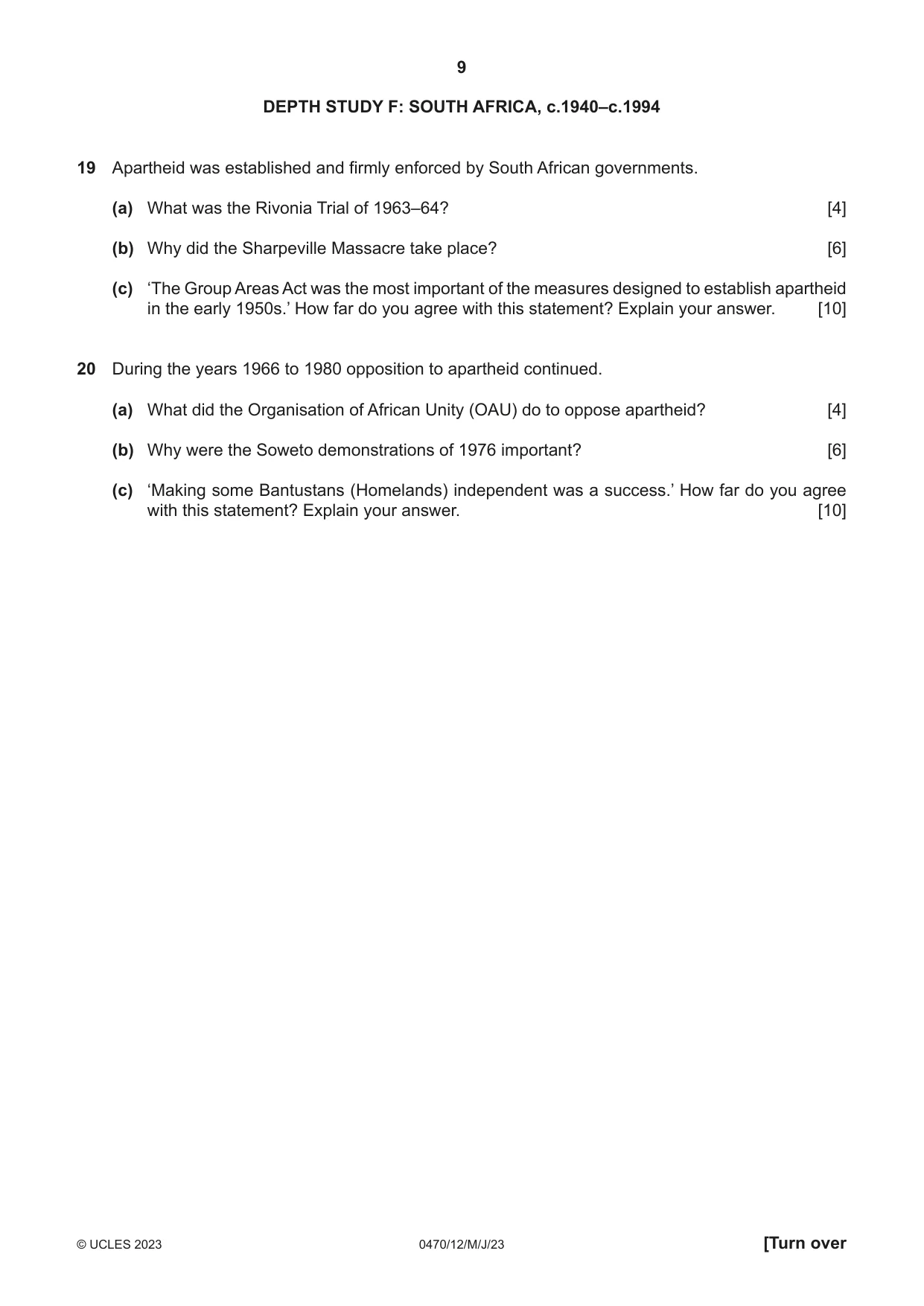
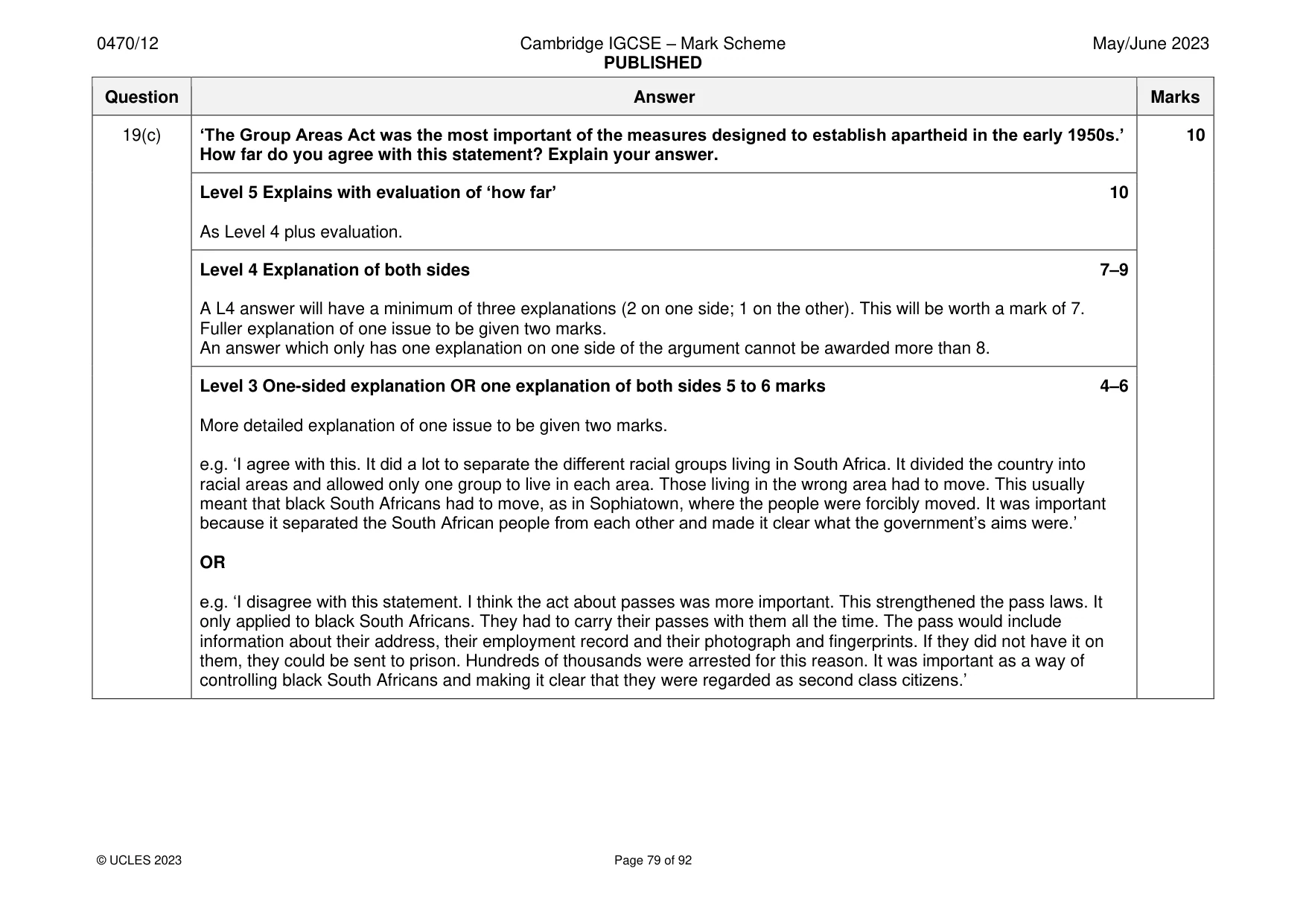
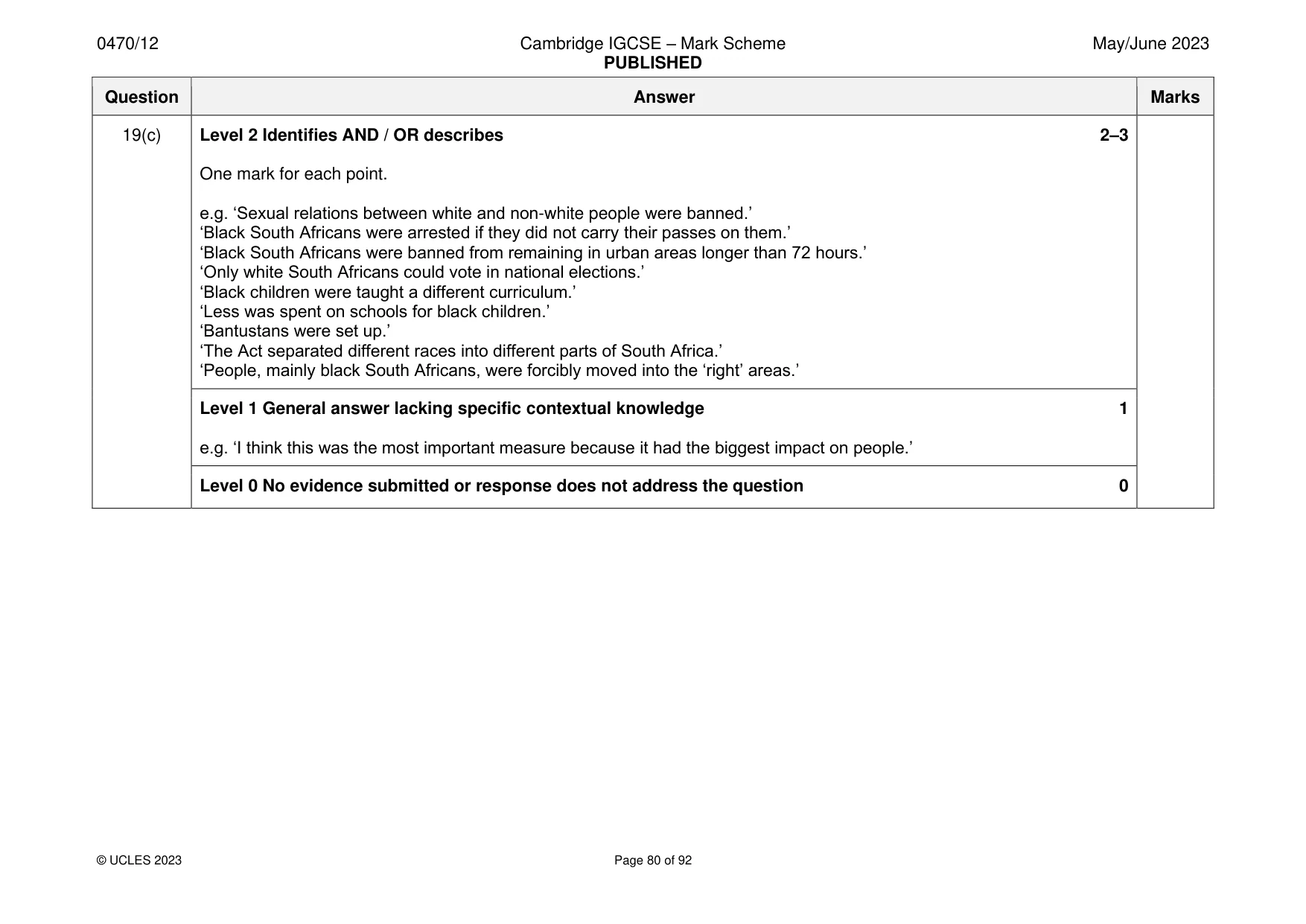
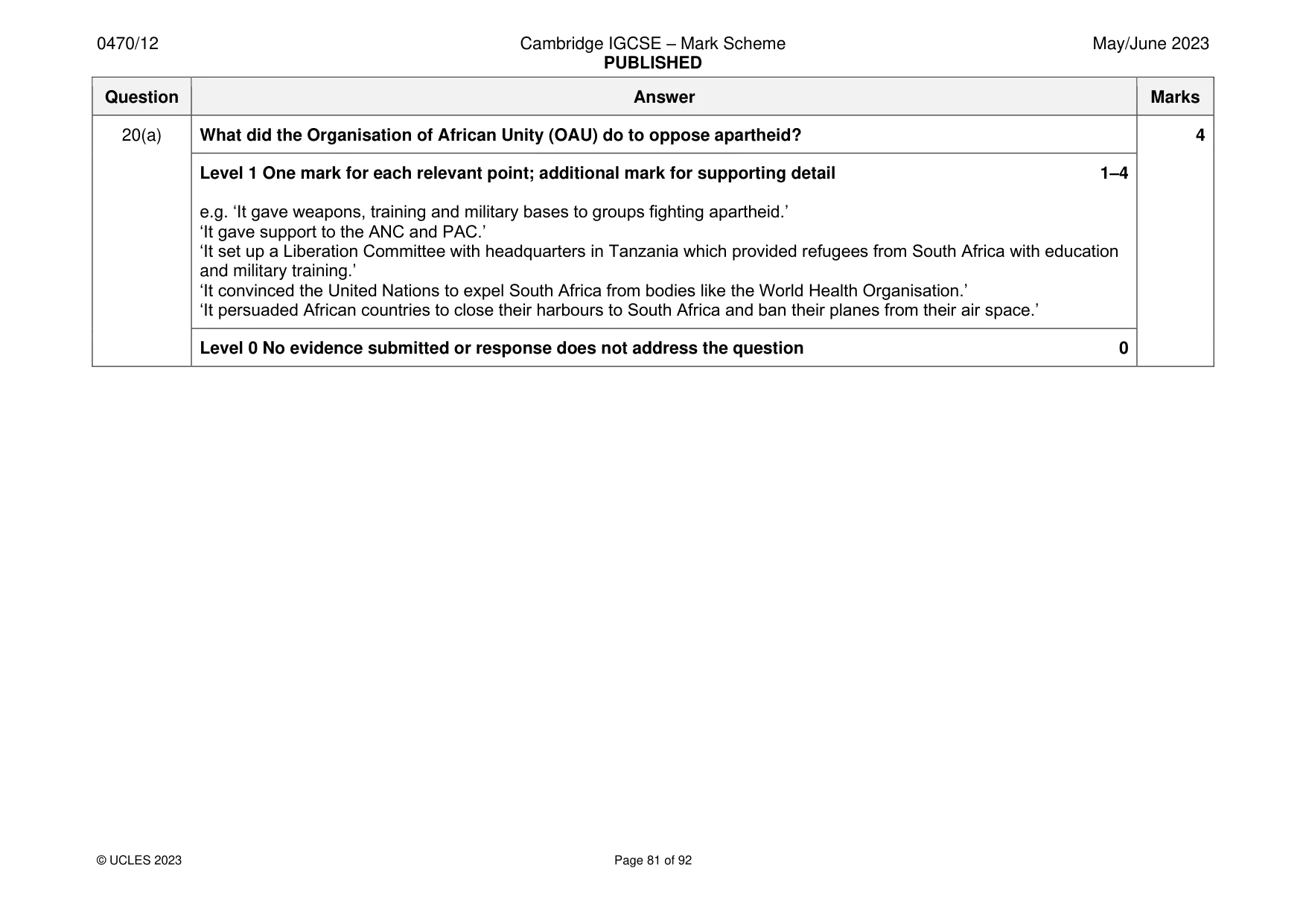
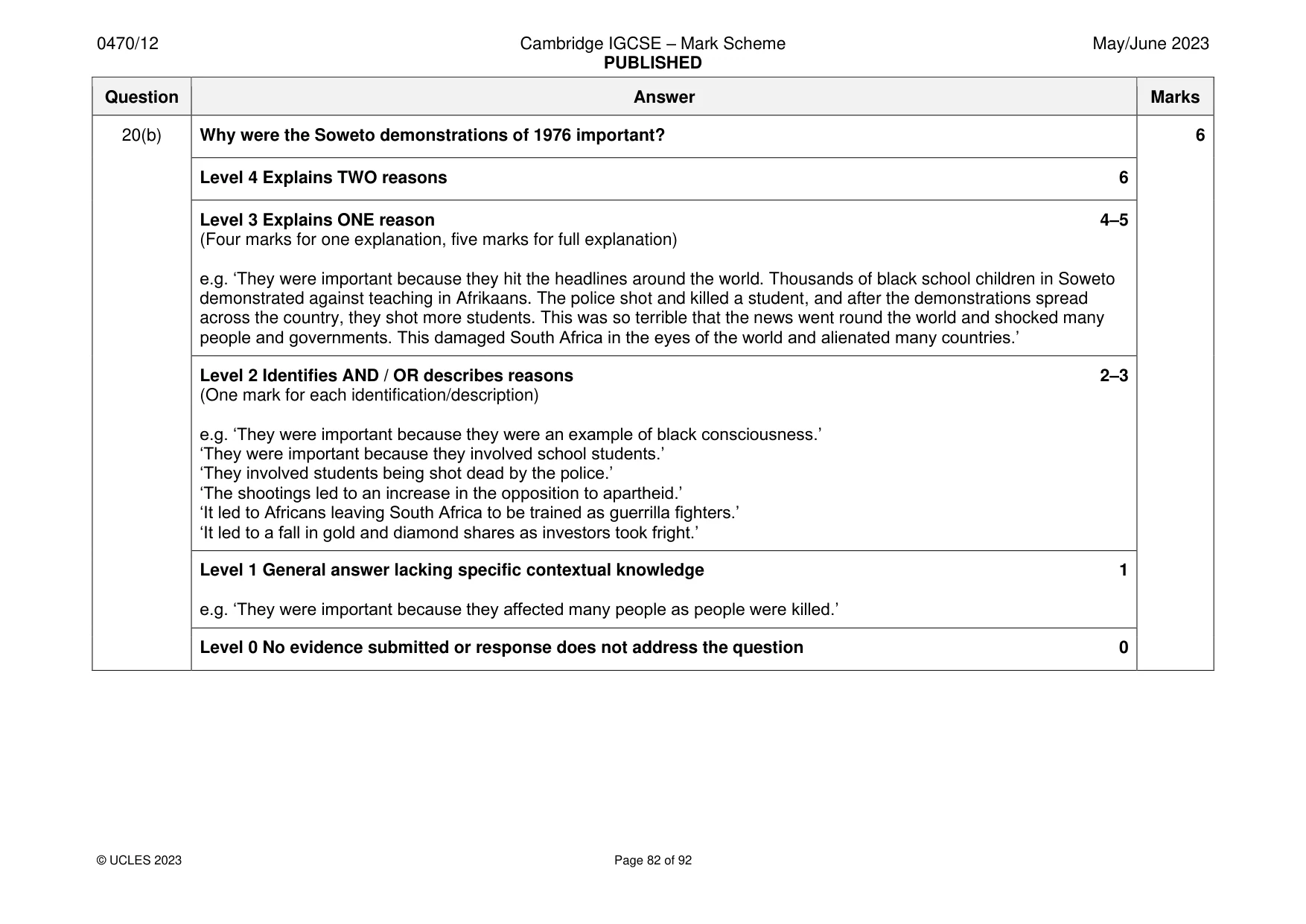
9 0470/12/M/J/23 © UCLES 2023 [Turn over DEPTH STUDY F: SOUTH AFRICA, c.1940–c.1994 19 Apartheid was established and firmly enforced by South African governments. (a) What was the Rivonia Trial of 1963–64? [4] (b) Why did the Sharpeville Massacre take place? [6] (c) ‘The Group Areas Act was the most important of the measures designed to establish apartheid in the early 1950s.’ How far do you agree with this statement? Explain your answer. [10] 20 During the years 1966 to 1980 opposition to apartheid continued. (a) What did the Organisation of African Unity (OAU) do to oppose apartheid? [4] (b) Why were the Soweto demonstrations of 1976 important? [6] (c) ‘Making some Bantustans (Homelands) independent was a success.’ How far do you agree with this statement? Explain your answer. [10]
Question paper, page 10
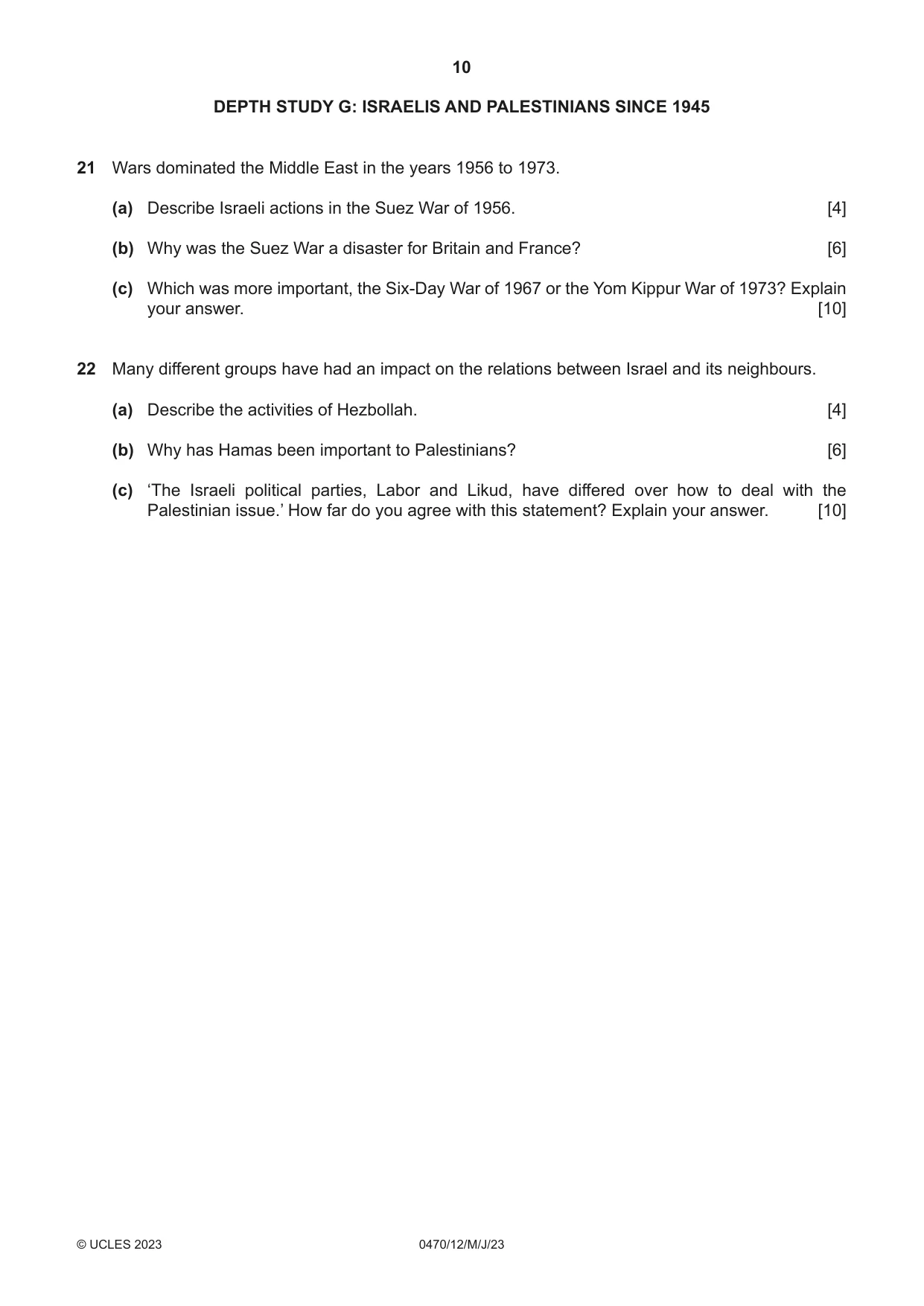
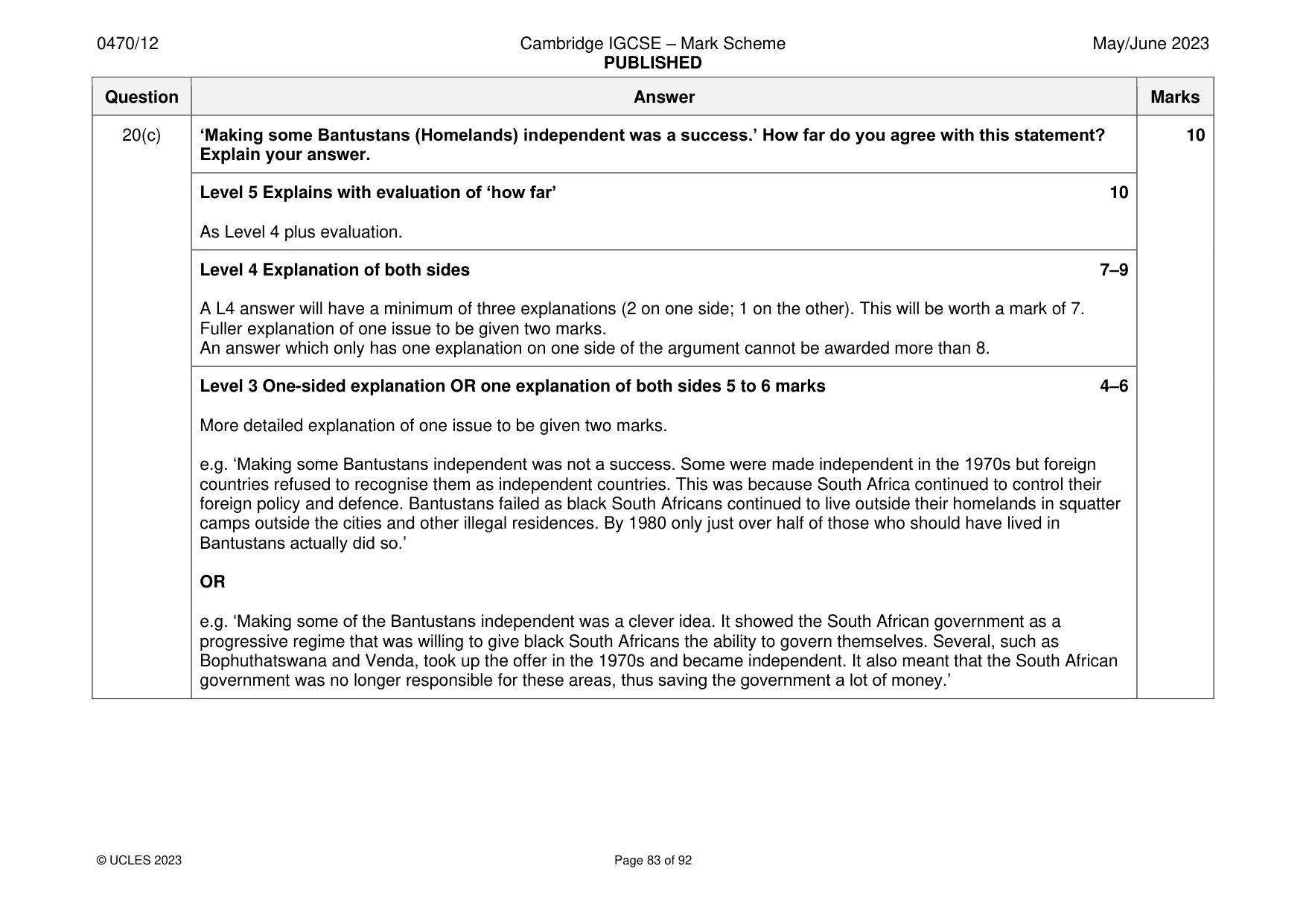
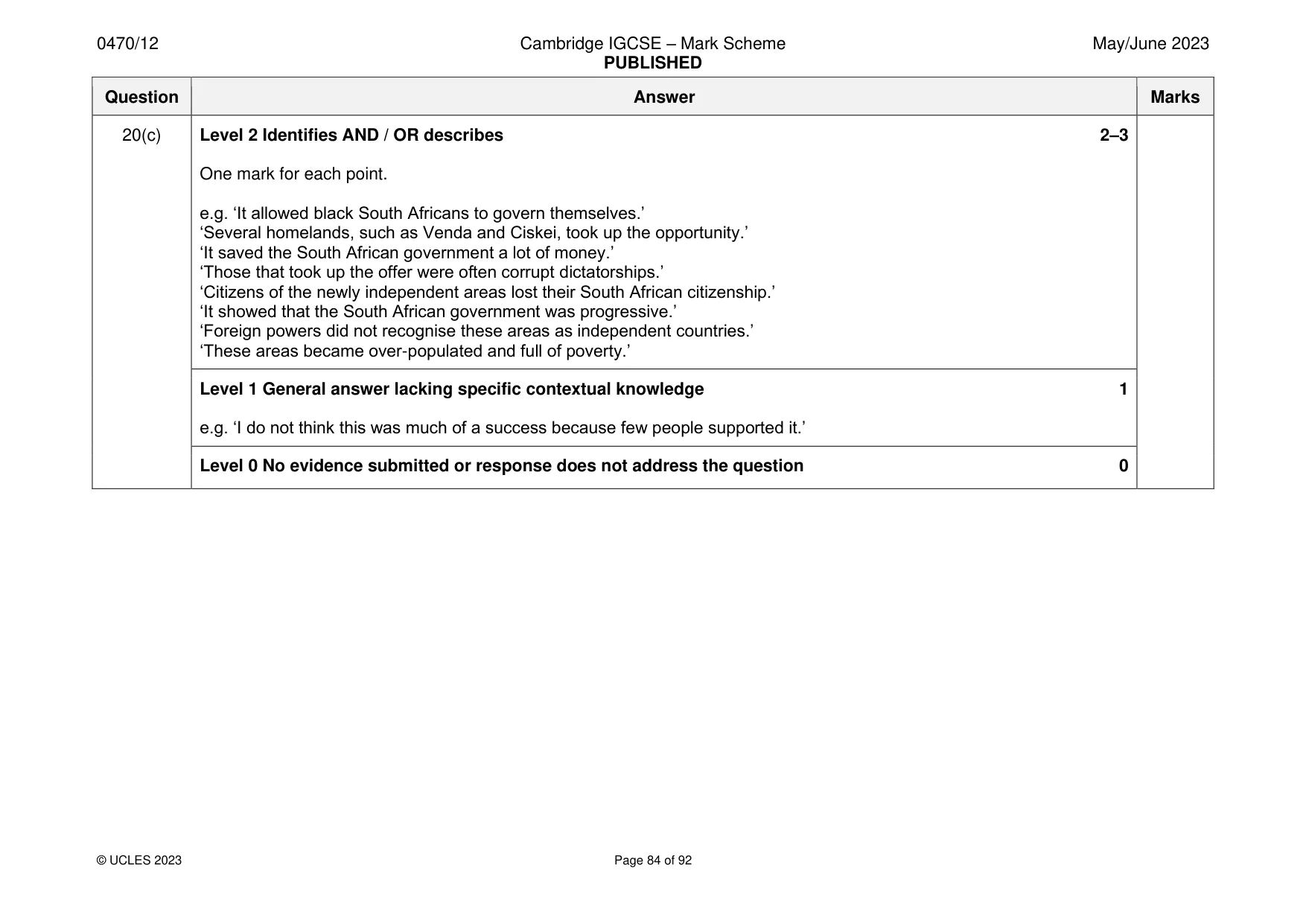
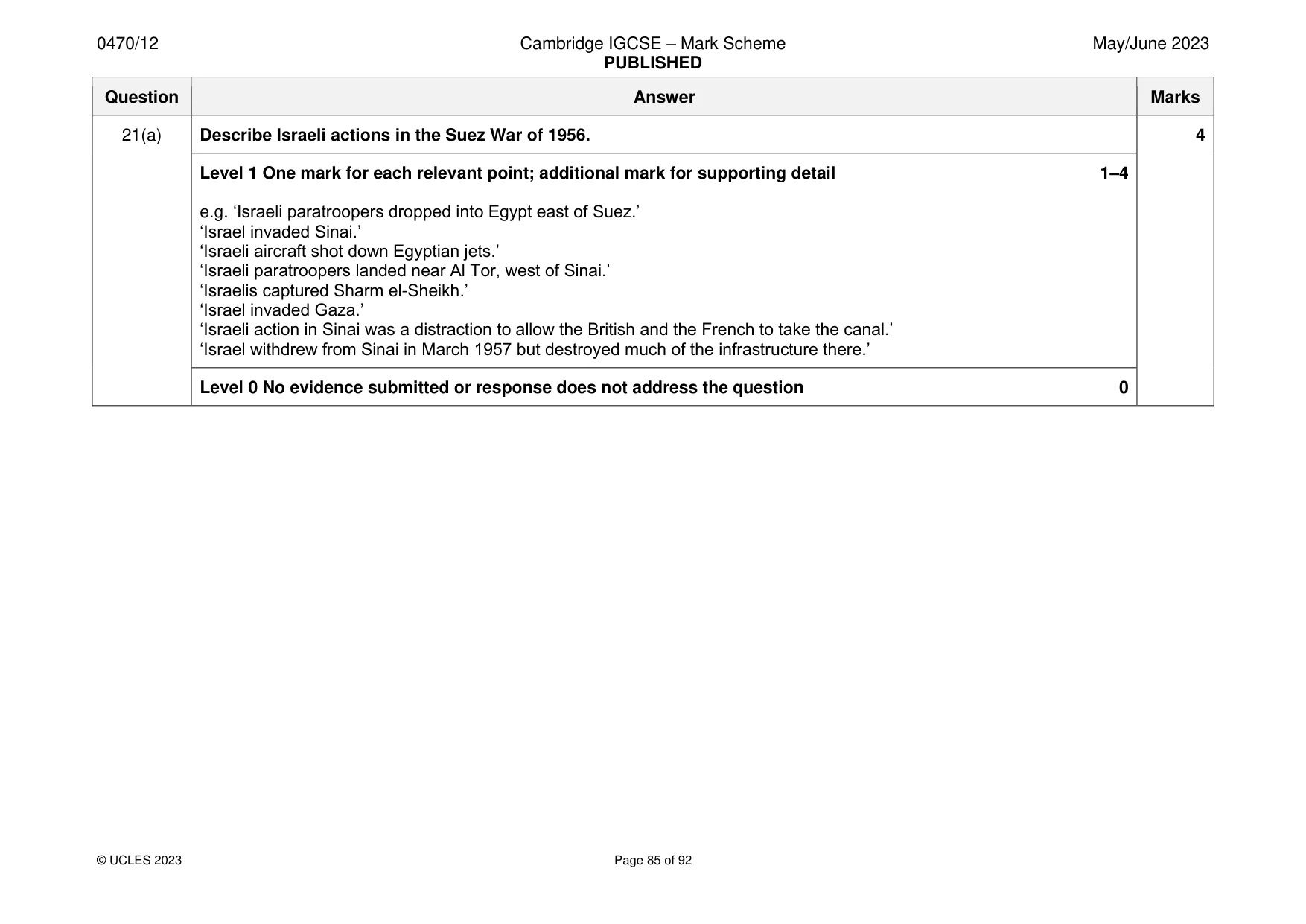
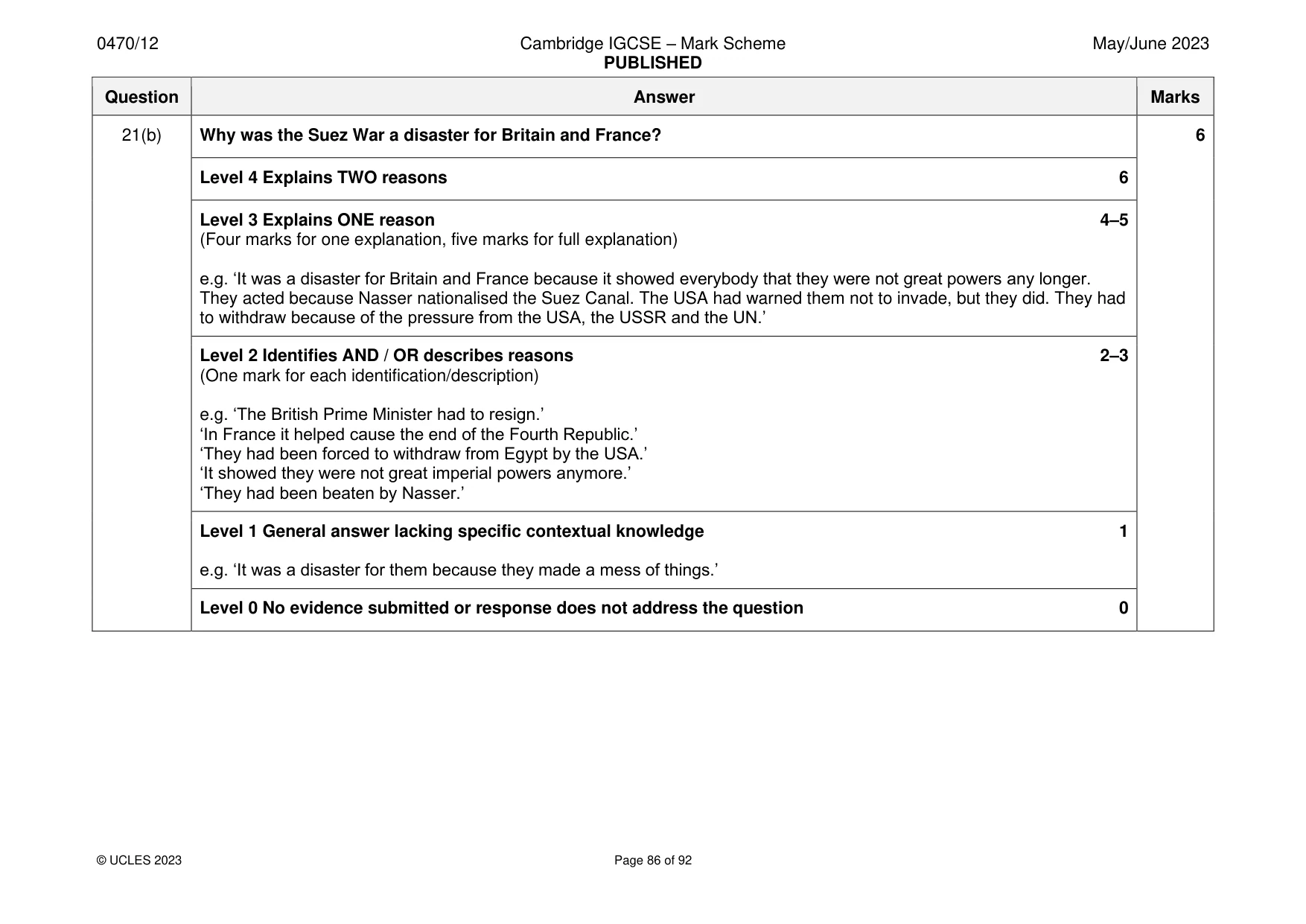
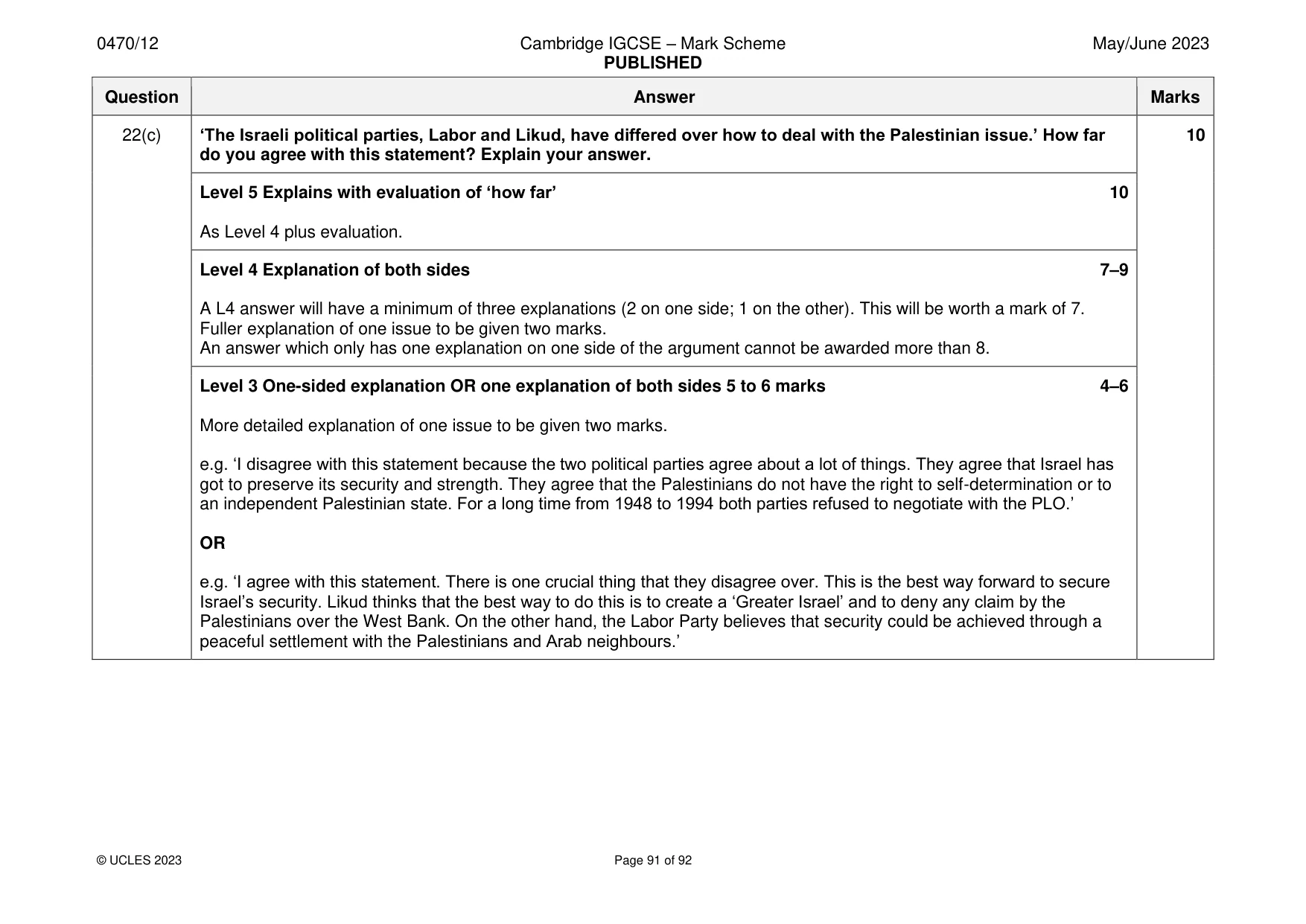
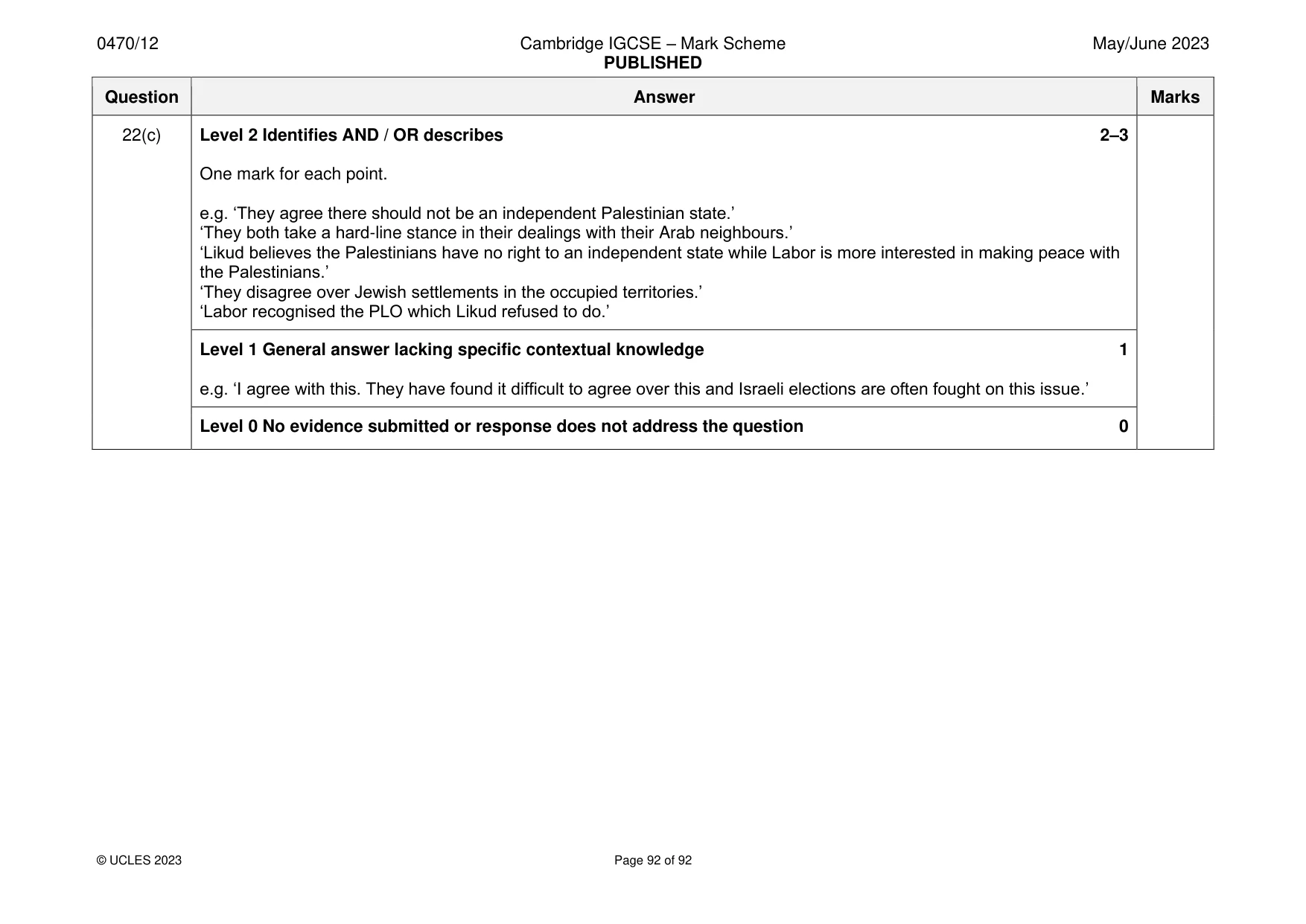
10 0470/12/M/J/23 © UCLES 2023 DEPTH STUDY G: ISRAELIS AND PALESTINIANS SINCE 1945 21 Wars dominated the Middle East in the years 1956 to 1973. (a) Describe Israeli actions in the Suez War of 1956. [4] (b) Why was the Suez War a disaster for Britain and France? [6] (c) Which was more important, the Six-Day War of 1967 or the Yom Kippur War of 1973? Explain your answer. [10] 22 Many different groups have had an impact on the relations between Israel and its neighbours. (a) Describe the activities of Hezbollah. [4] (b) Why has Hamas been important to Palestinians? [6] (c) ‘The Israeli political parties, Labor and Likud, have differed over how to deal with the Palestinian issue.’ How far do you agree with this statement? Explain your answer. [10]
Question paper, page 11
11 0470/12/M/J/23 © UCLES 2023 BLANK PAGE
Question paper, page 12
12 0470/12/M/J/23 © UCLES 2023 Permission to reproduce items where third-party owned material protected by copyright is included has been sought and cleared where possible. Every reasonable effort has been made by the publisher (UCLES) to trace copyright holders, but if any items requiring clearance have unwittingly been included, the publisher will be pleased to make amends at the earliest possible opportunity. To avoid the issue of disclosure of answer-related information to candidates, all copyright acknowledgements are reproduced online in the Cambridge Assessment International Education Copyright Acknowledgements Booklet. This is produced for each series of examinations and is freely available to download at www.cambridgeinternational.org after the live examination series. Cambridge Assessment International Education is part of Cambridge Assessment. Cambridge Assessment is the brand name of the University of Cambridge Local Examinations Syndicate (UCLES), which is a department of the University of Cambridge. BLANK PAGE
Mark scheme, page 1
This document consists of 92 printed pages. © UCLES 2023 [Turn over Cambridge IGCSE™ HISTORY 0470/12 Paper 1 May/June 2023 MARK SCHEME Maximum Mark: 60 Published This mark scheme is published as an aid to teachers and candidates, to indicate the requirements of the examination. It shows the basis on which Examiners were instructed to award marks. It does not indicate the details of the discussions that took place at an Examiners’ meeting before marking began, which would have considered the acceptability of alternative answers. Mark schemes should be read in conjunction with the question paper and the Principal Examiner Report for Teachers. Cambridge International will not enter into discussions about these mark schemes. Cambridge International is publishing the mark schemes for the May/June 2023 series for most Cambridge IGCSE, Cambridge International A and AS Level and Cambridge Pre-U components, and some Cambridge O Level components.
Mark scheme, page 2
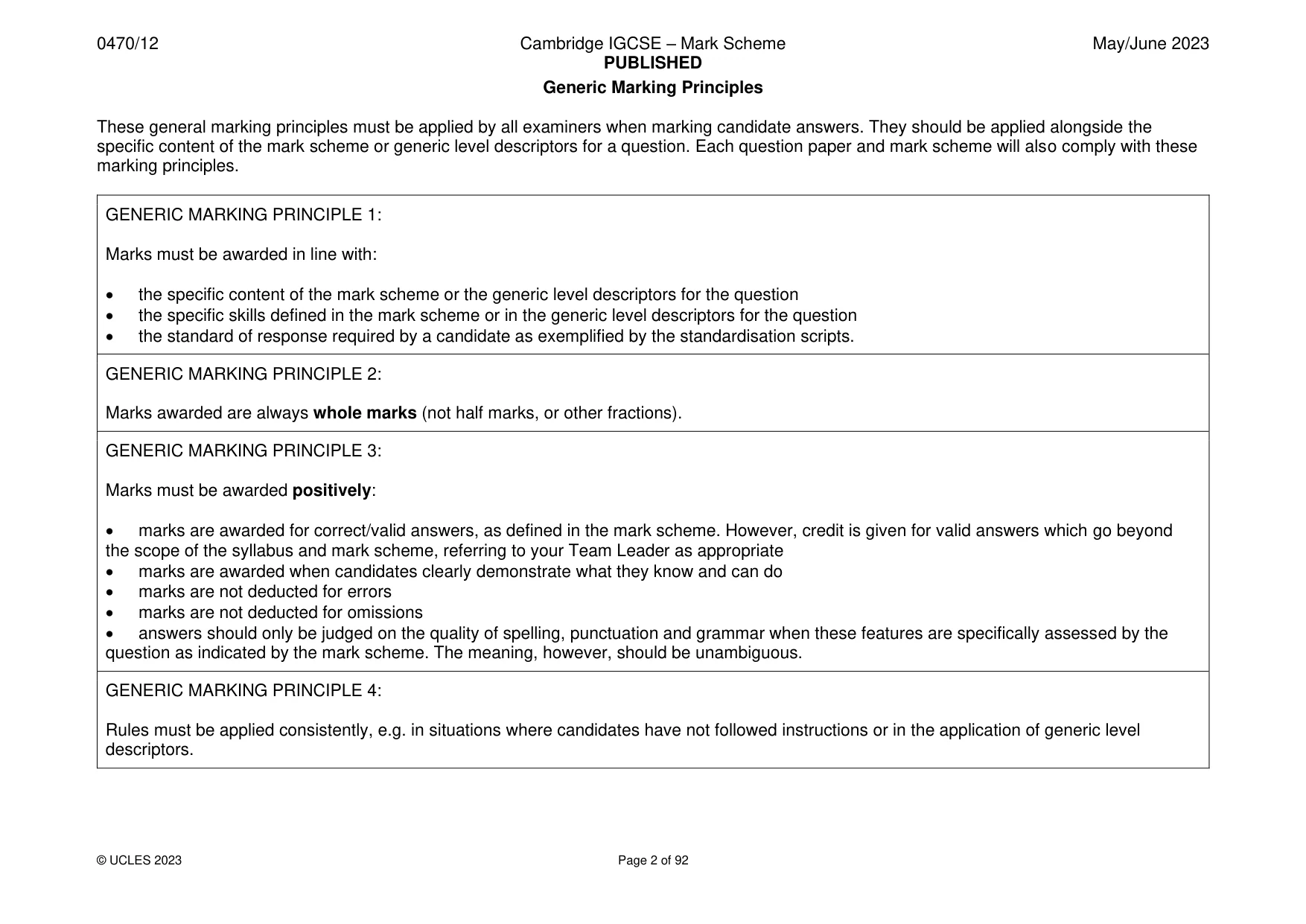
0470/12 Cambridge IGCSE – Mark Scheme PUBLISHED May/June 2023 © UCLES 2023 Page 2 of 92 Generic Marking Principles These general marking principles must be applied by all examiners when marking candidate answers. They should be applied alongside the specific content of the mark scheme or generic level descriptors for a question. Each question paper and mark scheme will also comply with these marking principles. GENERIC MARKING PRINCIPLE 1: Marks must be awarded in line with: • the specific content of the mark scheme or the generic level descriptors for the question • the specific skills defined in the mark scheme or in the generic level descriptors for the question • the standard of response required by a candidate as exemplified by the standardisation scripts. GENERIC MARKING PRINCIPLE 2: Marks awarded are always whole marks (not half marks, or other fractions). GENERIC MARKING PRINCIPLE 3: Marks must be awarded positively: • marks are awarded for correct/valid answers, as defined in the mark scheme. However, credit is given for valid answers which go beyond the scope of the syllabus and mark scheme, referring to your Team Leader as appropriate • marks are awarded when candidates clearly demonstrate what they know and can do • marks are not deducted for errors • marks are not deducted for omissions • answers should only be judged on the quality of spelling, punctuation and grammar when these features are specifically assessed by the question as indicated by the mark scheme. The meaning, however, should be unambiguous. GENERIC MARKING PRINCIPLE 4: Rules must be applied consistently, e.g. in situations where candidates have not followed instructions or in the application of generic level descriptors.
Mark scheme, page 3
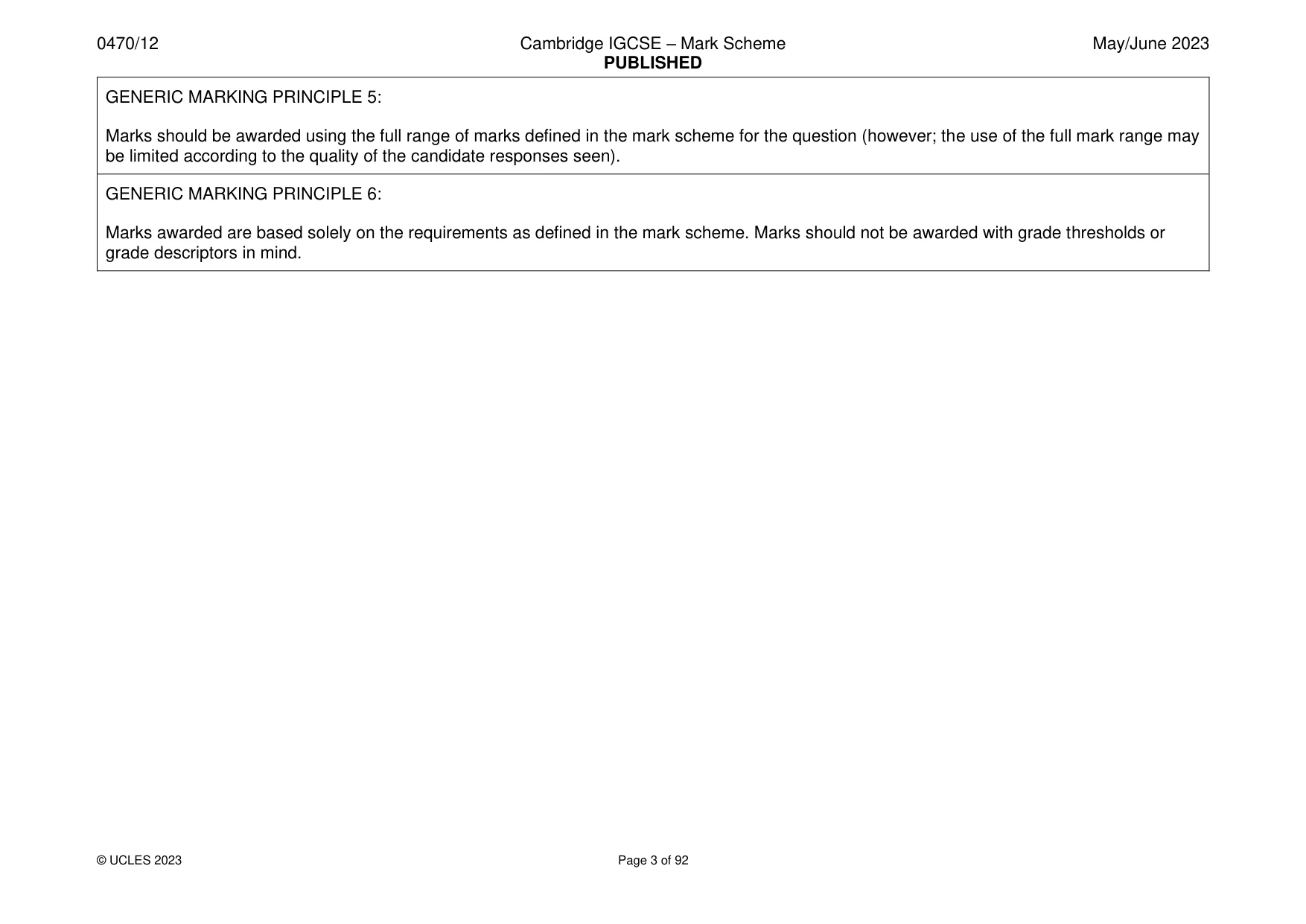
0470/12 Cambridge IGCSE – Mark Scheme PUBLISHED May/June 2023 © UCLES 2023 Page 3 of 92 GENERIC MARKING PRINCIPLE 5: Marks should be awarded using the full range of marks defined in the mark scheme for the question (however; the use of the full mark range may be limited according to the quality of the candidate responses seen). GENERIC MARKING PRINCIPLE 6: Marks awarded are based solely on the requirements as defined in the mark scheme. Marks should not be awarded with grade thresholds or grade descriptors in mind.
Mark scheme, page 4
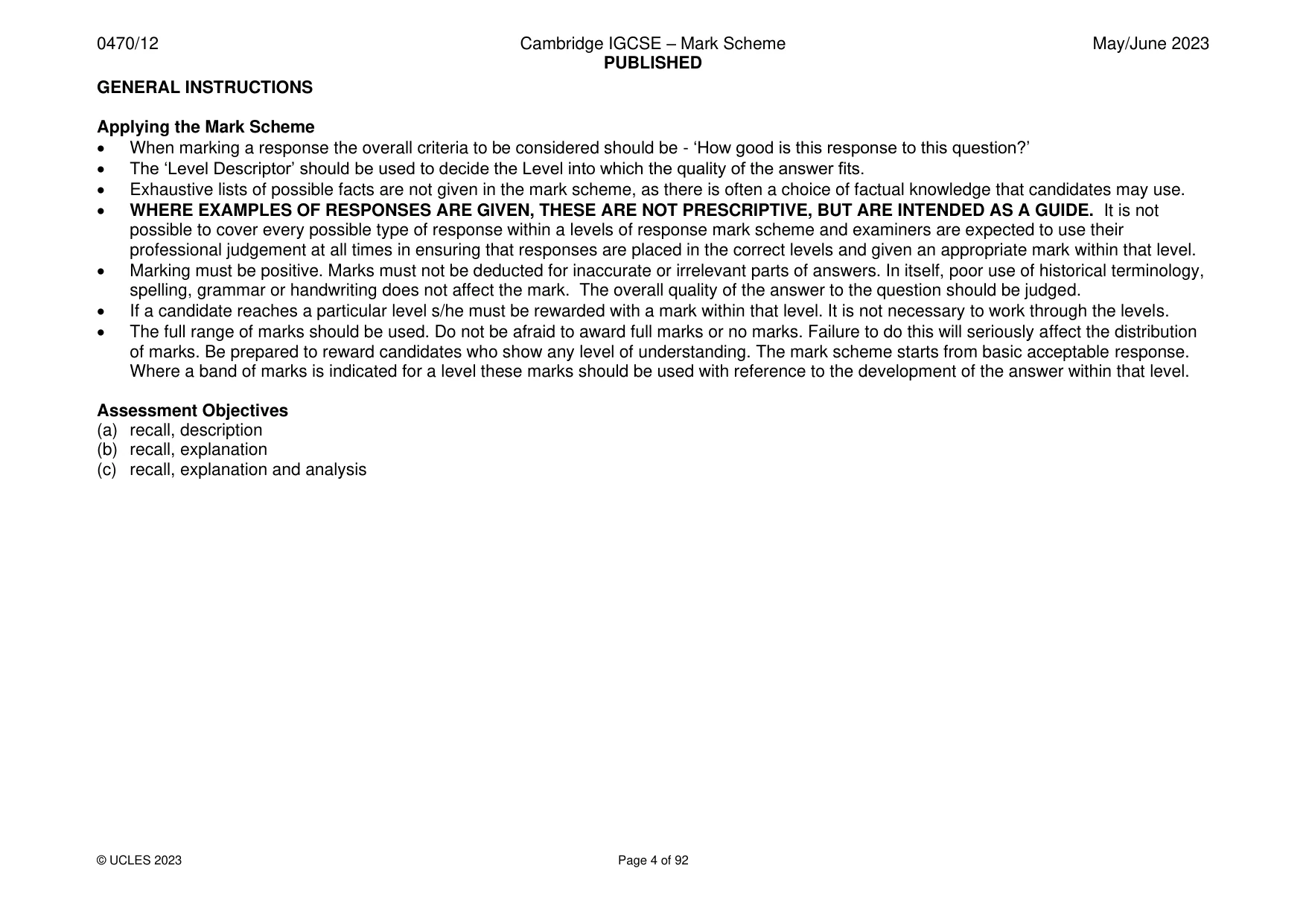
0470/12 Cambridge IGCSE – Mark Scheme PUBLISHED May/June 2023 © UCLES 2023 Page 4 of 92 GENERAL INSTRUCTIONS Applying the Mark Scheme • When marking a response the overall criteria to be considered should be - ‘How good is this response to this question?’ • The ‘Level Descriptor’ should be used to decide the Level into which the quality of the answer fits. • Exhaustive lists of possible facts are not given in the mark scheme, as there is often a choice of factual knowledge that candidates may use. • WHERE EXAMPLES OF RESPONSES ARE GIVEN, THESE ARE NOT PRESCRIPTIVE, BUT ARE INTENDED AS A GUIDE. It is not possible to cover every possible type of response within a levels of response mark scheme and examiners are expected to use their professional judgement at all times in ensuring that responses are placed in the correct levels and given an appropriate mark within that level. • Marking must be positive. Marks must not be deducted for inaccurate or irrelevant parts of answers. In itself, poor use of historical terminology, spelling, grammar or handwriting does not affect the mark. The overall quality of the answer to the question should be judged. • If a candidate reaches a particular level s/he must be rewarded with a mark within that level. It is not necessary to work through the levels. • The full range of marks should be used. Do not be afraid to award full marks or no marks. Failure to do this will seriously affect the distribution of marks. Be prepared to reward candidates who show any level of understanding. The mark scheme starts from basic acceptable response. Where a band of marks is indicated for a level these marks should be used with reference to the development of the answer within that level. Assessment Objectives (a) recall, description (b) recall, explanation (c) recall, explanation and analysis
Mark scheme, page 5
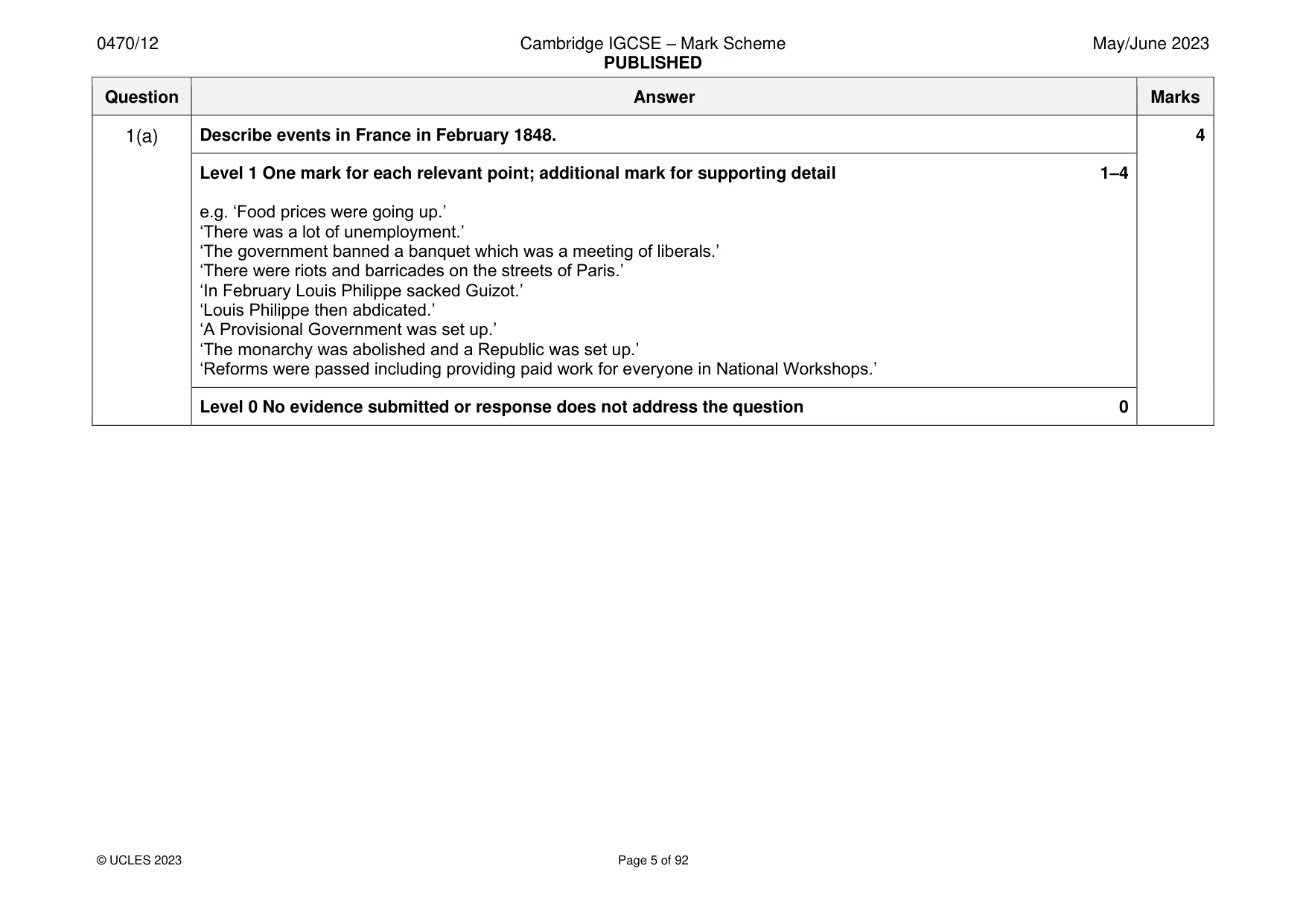
0470/12 Cambridge IGCSE – Mark Scheme PUBLISHED May/June 2023 © UCLES 2023 Page 5 of 92 Question Answer Marks 1(a) Describe events in France in February 1848. 4 Level 1 One mark for each relevant point; additional mark for supporting detail 1–4 e.g. ‘Food prices were going up.’ ‘There was a lot of unemployment.’ ‘The government banned a banquet which was a meeting of liberals.’ ‘There were riots and barricades on the streets of Paris.’ ‘In February Louis Philippe sacked Guizot.’ ‘Louis Philippe then abdicated.’ ‘A Provisional Government was set up.’ ‘The monarchy was abolished and a Republic was set up.’ ‘Reforms were passed including providing paid work for everyone in National Workshops.’ Level 0 No evidence submitted or response does not address the question 0
Mark scheme, page 6
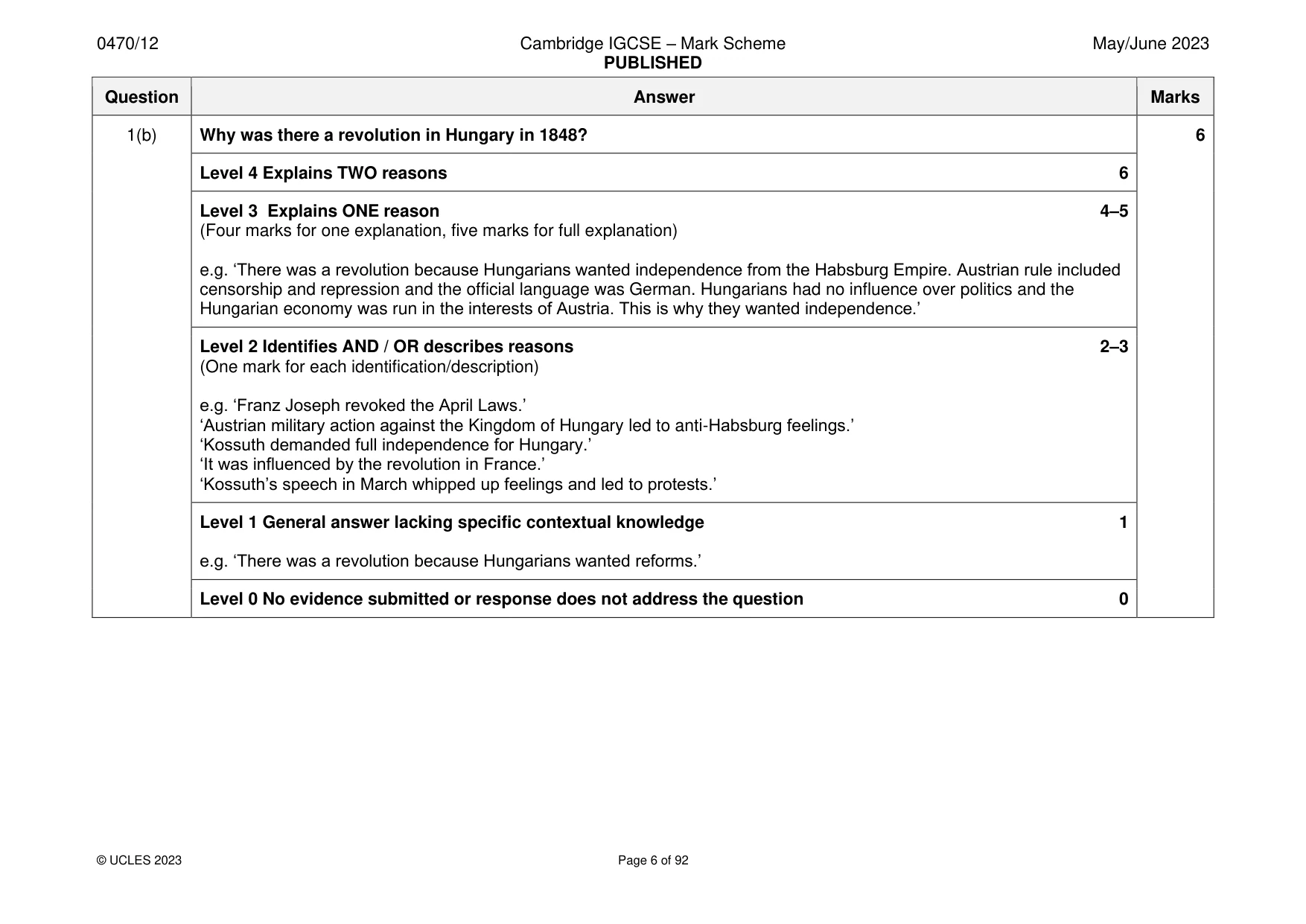
0470/12 Cambridge IGCSE – Mark Scheme PUBLISHED May/June 2023 © UCLES 2023 Page 6 of 92 Question Answer Marks 1(b) Why was there a revolution in Hungary in 1848? 6 Level 4 Explains TWO reasons 6 Level 3 Explains ONE reason 4–5 (Four marks for one explanation, five marks for full explanation) e.g. ‘There was a revolution because Hungarians wanted independence from the Habsburg Empire. Austrian rule included censorship and repression and the official language was German. Hungarians had no influence over politics and the Hungarian economy was run in the interests of Austria. This is why they wanted independence.’ Level 2 Identifies AND / OR describes reasons 2–3 (One mark for each identification/description) e.g. ‘Franz Joseph revoked the April Laws.’ ‘Austrian military action against the Kingdom of Hungary led to anti-Habsburg feelings.’ ‘Kossuth demanded full independence for Hungary.’ ‘It was influenced by the revolution in France.’ ‘Kossuth’s speech in March whipped up feelings and led to protests.’ Level 1 General answer lacking specific contextual knowledge 1 e.g. ‘There was a revolution because Hungarians wanted reforms.’ Level 0 No evidence submitted or response does not address the question 0
Mark scheme, page 7
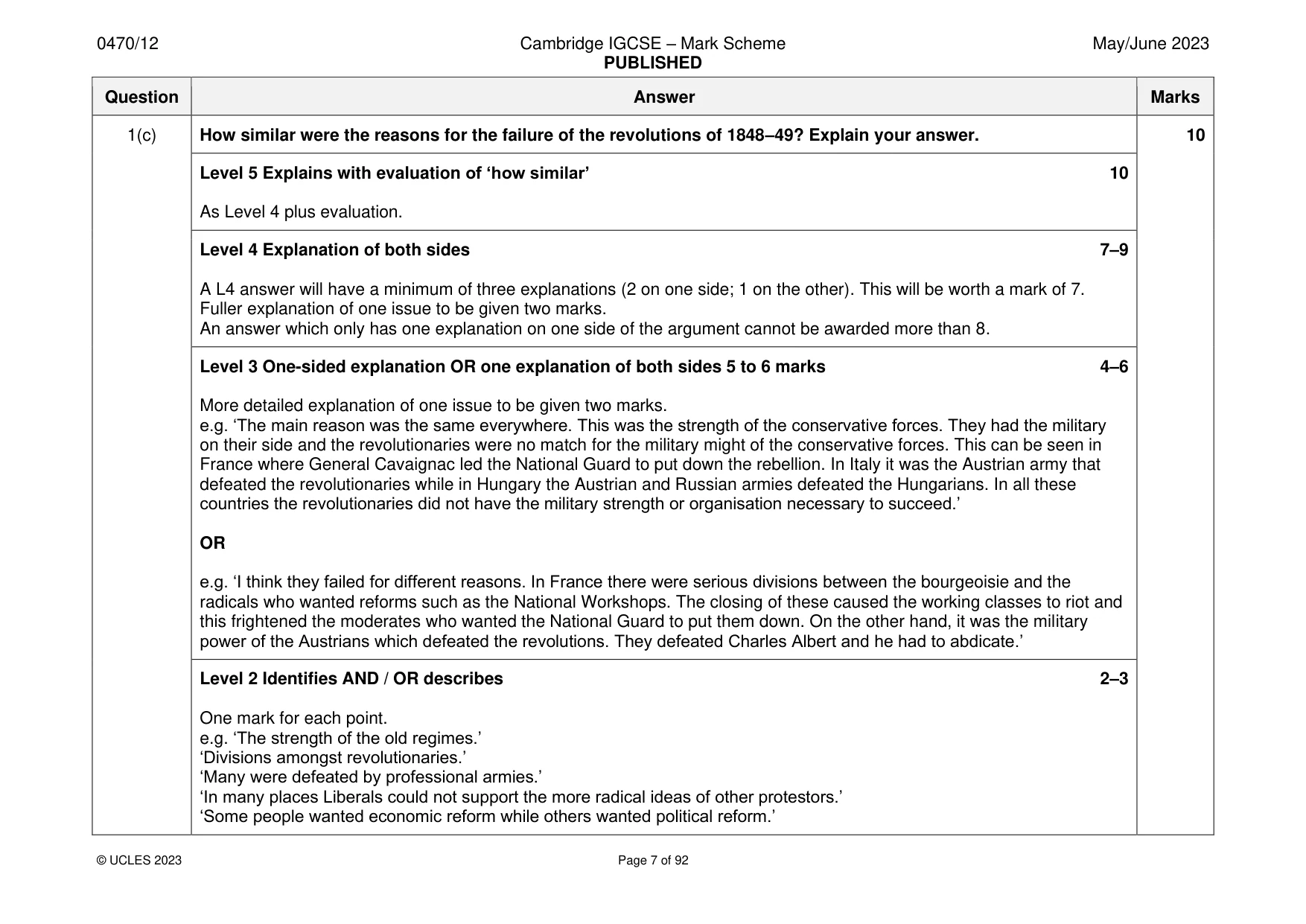
0470/12 Cambridge IGCSE – Mark Scheme PUBLISHED May/June 2023 © UCLES 2023 Page 7 of 92 Question Answer Marks 1(c) How similar were the reasons for the failure of the revolutions of 1848–49? Explain your answer. 10 Level 5 Explains with evaluation of ‘how similar’ 10 As Level 4 plus evaluation. Level 4 Explanation of both sides 7–9 A L4 answer will have a minimum of three explanations (2 on one side; 1 on the other). This will be worth a mark of 7. Fuller explanation of one issue to be given two marks. An answer which only has one explanation on one side of the argument cannot be awarded more than 8. Level 3 One-sided explanation OR one explanation of both sides 5 to 6 marks 4–6 More detailed explanation of one issue to be given two marks. e.g. ‘The main reason was the same everywhere. This was the strength of the conservative forces. They had the military on their side and the revolutionaries were no match for the military might of the conservative forces. This can be seen in France where General Cavaignac led the National Guard to put down the rebellion. In Italy it was the Austrian army that defeated the revolutionaries while in Hungary the Austrian and Russian armies defeated the Hungarians. In all these countries the revolutionaries did not have the military strength or organisation necessary to succeed.’ OR e.g. ‘I think they failed for different reasons. In France there were serious divisions between the bourgeoisie and the radicals who wanted reforms such as the National Workshops. The closing of these caused the working classes to riot and this frightened the moderates who wanted the National Guard to put them down. On the other hand, it was the military power of the Austrians which defeated the revolutions. They defeated Charles Albert and he had to abdicate.’ Level 2 Identifies AND / OR describes 2–3 One mark for each point. e.g. ‘The strength of the old regimes.’ ‘Divisions amongst revolutionaries.’ ‘Many were defeated by professional armies.’ ‘In many places Liberals could not support the more radical ideas of other protestors.’ ‘Some people wanted economic reform while others wanted political reform.’
Mark scheme, page 8
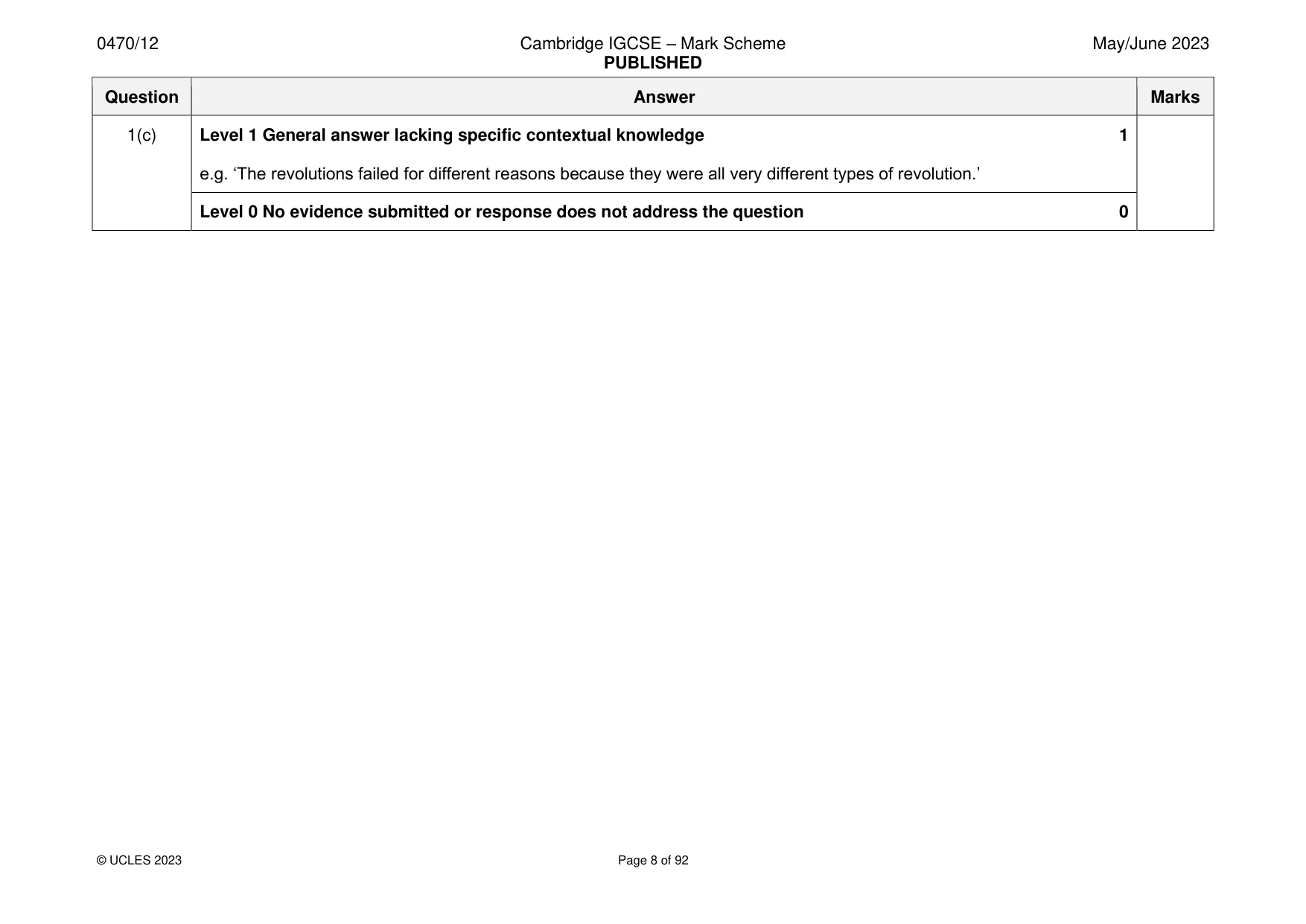
0470/12 Cambridge IGCSE – Mark Scheme PUBLISHED May/June 2023 © UCLES 2023 Page 8 of 92 Question Answer Marks 1(c) Level 1 General answer lacking specific contextual knowledge 1 e.g. ‘The revolutions failed for different reasons because they were all very different types of revolution.’ Level 0 No evidence submitted or response does not address the question 0
Mark scheme, page 9
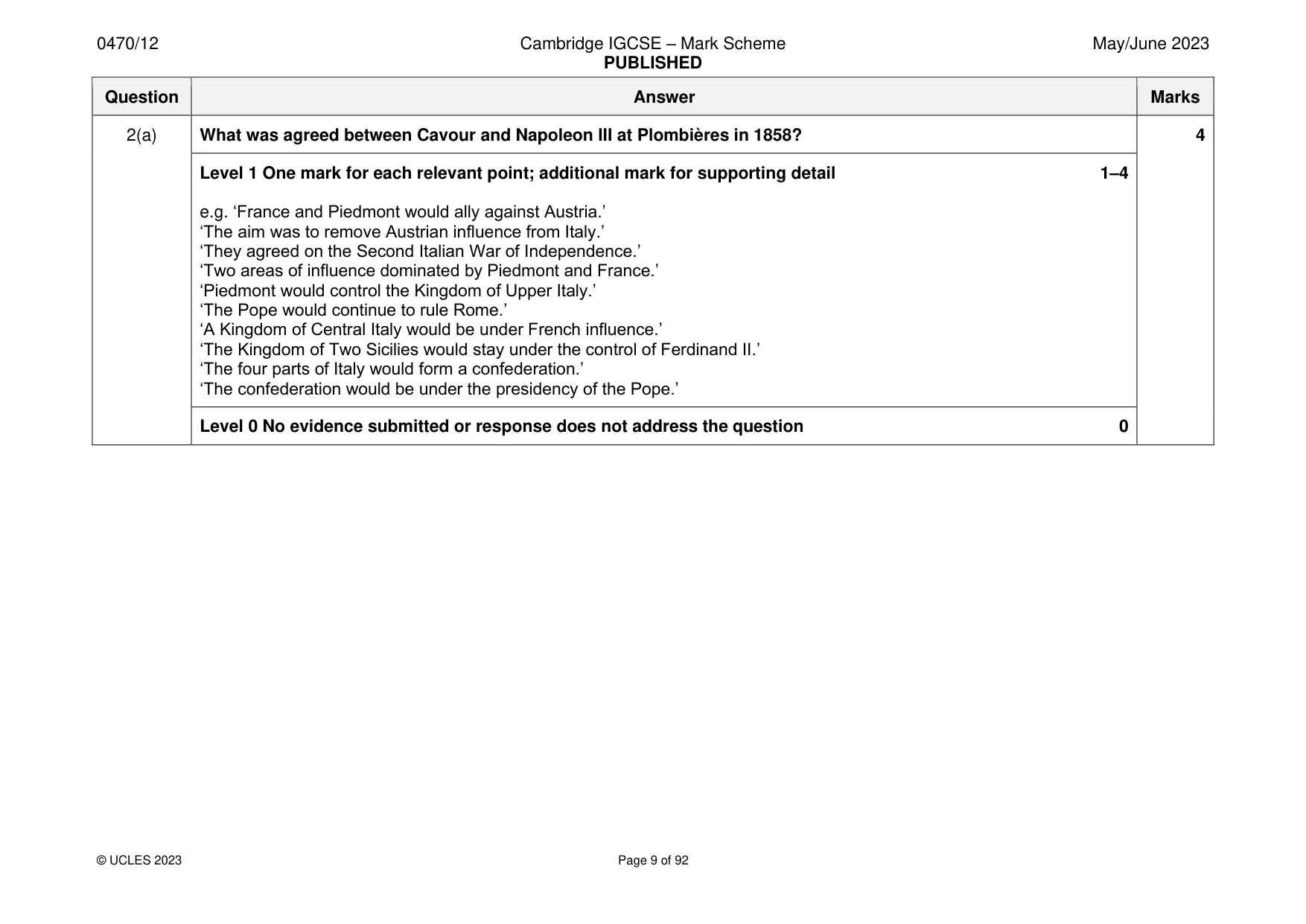
0470/12 Cambridge IGCSE – Mark Scheme PUBLISHED May/June 2023 © UCLES 2023 Page 9 of 92 Question Answer Marks 2(a) What was agreed between Cavour and Napoleon III at Plombières in 1858? 4 Level 1 One mark for each relevant point; additional mark for supporting detail 1–4 e.g. ‘France and Piedmont would ally against Austria.’ ‘The aim was to remove Austrian influence from Italy.’ ‘They agreed on the Second Italian War of Independence.’ ‘Two areas of influence dominated by Piedmont and France.’ ‘Piedmont would control the Kingdom of Upper Italy.’ ‘The Pope would continue to rule Rome.’ ‘A Kingdom of Central Italy would be under French influence.’ ‘The Kingdom of Two Sicilies would stay under the control of Ferdinand II.’ ‘The four parts of Italy would form a confederation.’ ‘The confederation would be under the presidency of the Pope.’ Level 0 No evidence submitted or response does not address the question 0
Mark scheme, page 10
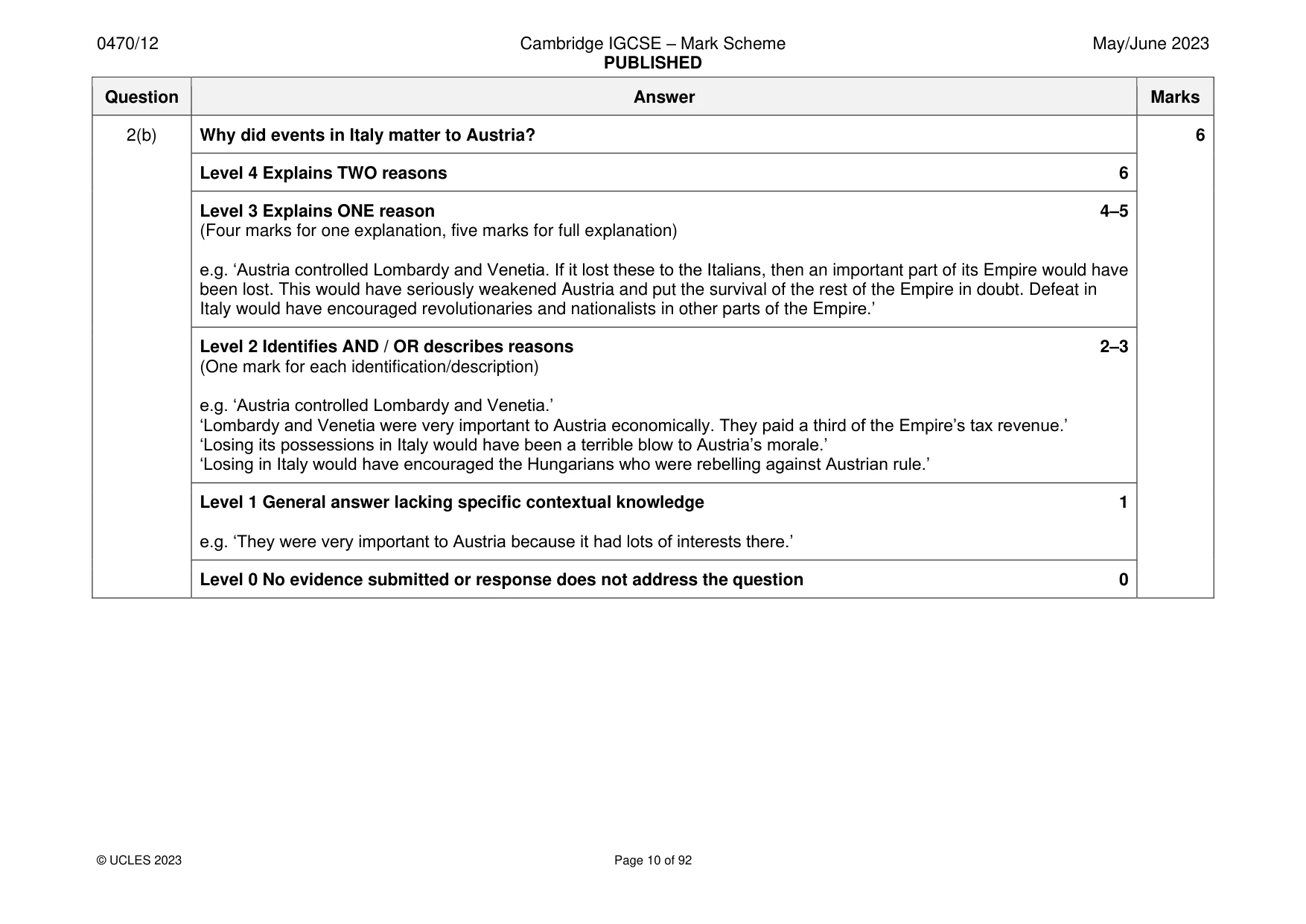
0470/12 Cambridge IGCSE – Mark Scheme PUBLISHED May/June 2023 © UCLES 2023 Page 10 of 92 Question Answer Marks 2(b) Why did events in Italy matter to Austria? 6 Level 4 Explains TWO reasons 6 Level 3 Explains ONE reason 4–5 (Four marks for one explanation, five marks for full explanation) e.g. ‘Austria controlled Lombardy and Venetia. If it lost these to the Italians, then an important part of its Empire would have been lost. This would have seriously weakened Austria and put the survival of the rest of the Empire in doubt. Defeat in Italy would have encouraged revolutionaries and nationalists in other parts of the Empire.’ Level 2 Identifies AND / OR describes reasons 2–3 (One mark for each identification/description) e.g. ‘Austria controlled Lombardy and Venetia.’ ‘Lombardy and Venetia were very important to Austria economically. They paid a third of the Empire’s tax revenue.’ ‘Losing its possessions in Italy would have been a terrible blow to Austria’s morale.’ ‘Losing in Italy would have encouraged the Hungarians who were rebelling against Austrian rule.’ Level 1 General answer lacking specific contextual knowledge 1 e.g. ‘They were very important to Austria because it had lots of interests there.’ Level 0 No evidence submitted or response does not address the question 0
Mark scheme, page 11
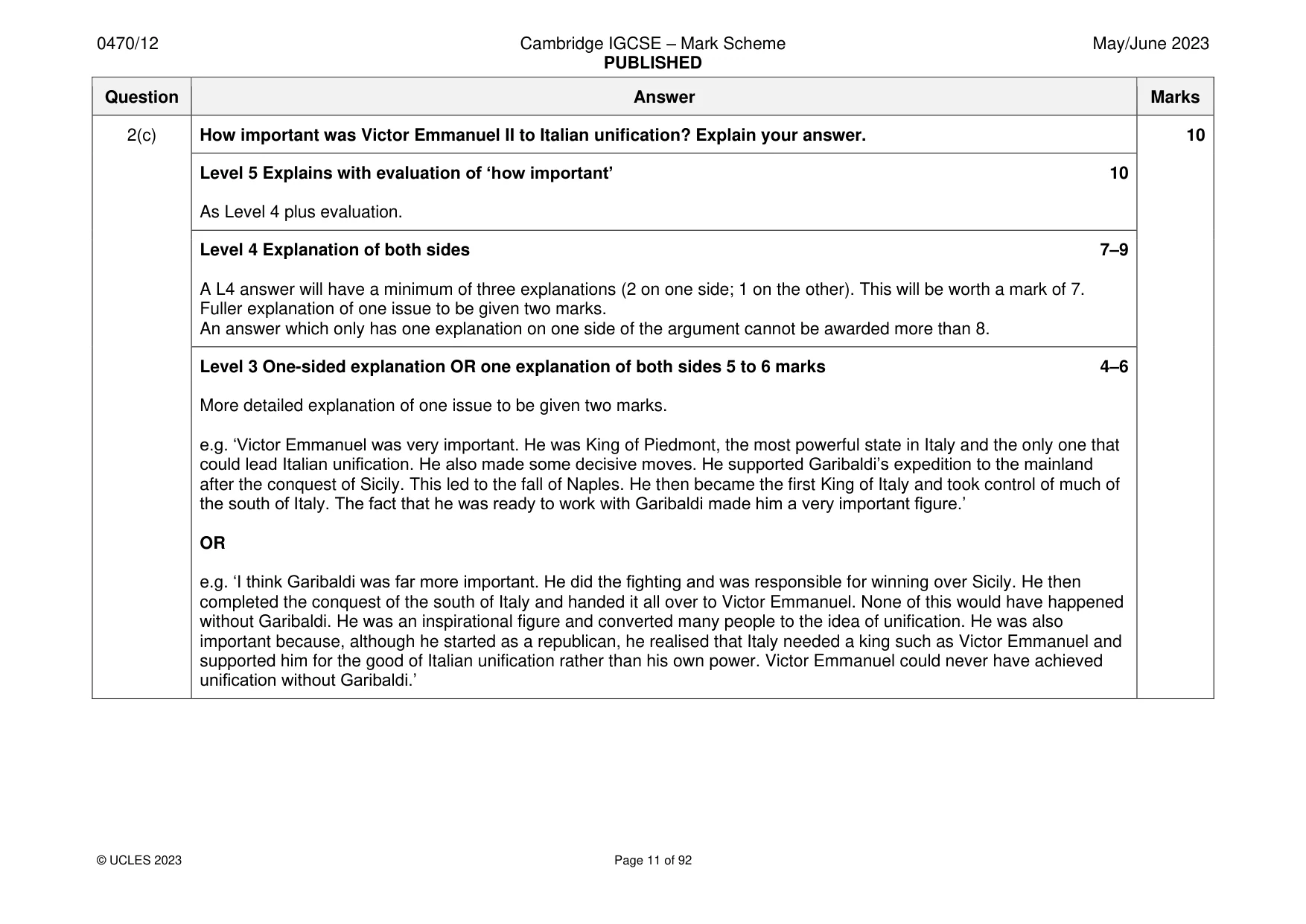
0470/12 Cambridge IGCSE – Mark Scheme PUBLISHED May/June 2023 © UCLES 2023 Page 11 of 92 Question Answer Marks 2(c) How important was Victor Emmanuel II to Italian unification? Explain your answer. 10 Level 5 Explains with evaluation of ‘how important’ 10 As Level 4 plus evaluation. Level 4 Explanation of both sides 7–9 A L4 answer will have a minimum of three explanations (2 on one side; 1 on the other). This will be worth a mark of 7. Fuller explanation of one issue to be given two marks. An answer which only has one explanation on one side of the argument cannot be awarded more than 8. Level 3 One-sided explanation OR one explanation of both sides 5 to 6 marks 4–6 More detailed explanation of one issue to be given two marks. e.g. ‘Victor Emmanuel was very important. He was King of Piedmont, the most powerful state in Italy and the only one that could lead Italian unification. He also made some decisive moves. He supported Garibaldi’s expedition to the mainland after the conquest of Sicily. This led to the fall of Naples. He then became the first King of Italy and took control of much of the south of Italy. The fact that he was ready to work with Garibaldi made him a very important figure.’ OR e.g. ‘I think Garibaldi was far more important. He did the fighting and was responsible for winning over Sicily. He then completed the conquest of the south of Italy and handed it all over to Victor Emmanuel. None of this would have happened without Garibaldi. He was an inspirational figure and converted many people to the idea of unification. He was also important because, although he started as a republican, he realised that Italy needed a king such as Victor Emmanuel and supported him for the good of Italian unification rather than his own power. Victor Emmanuel could never have achieved unification without Garibaldi.’
Mark scheme, page 12
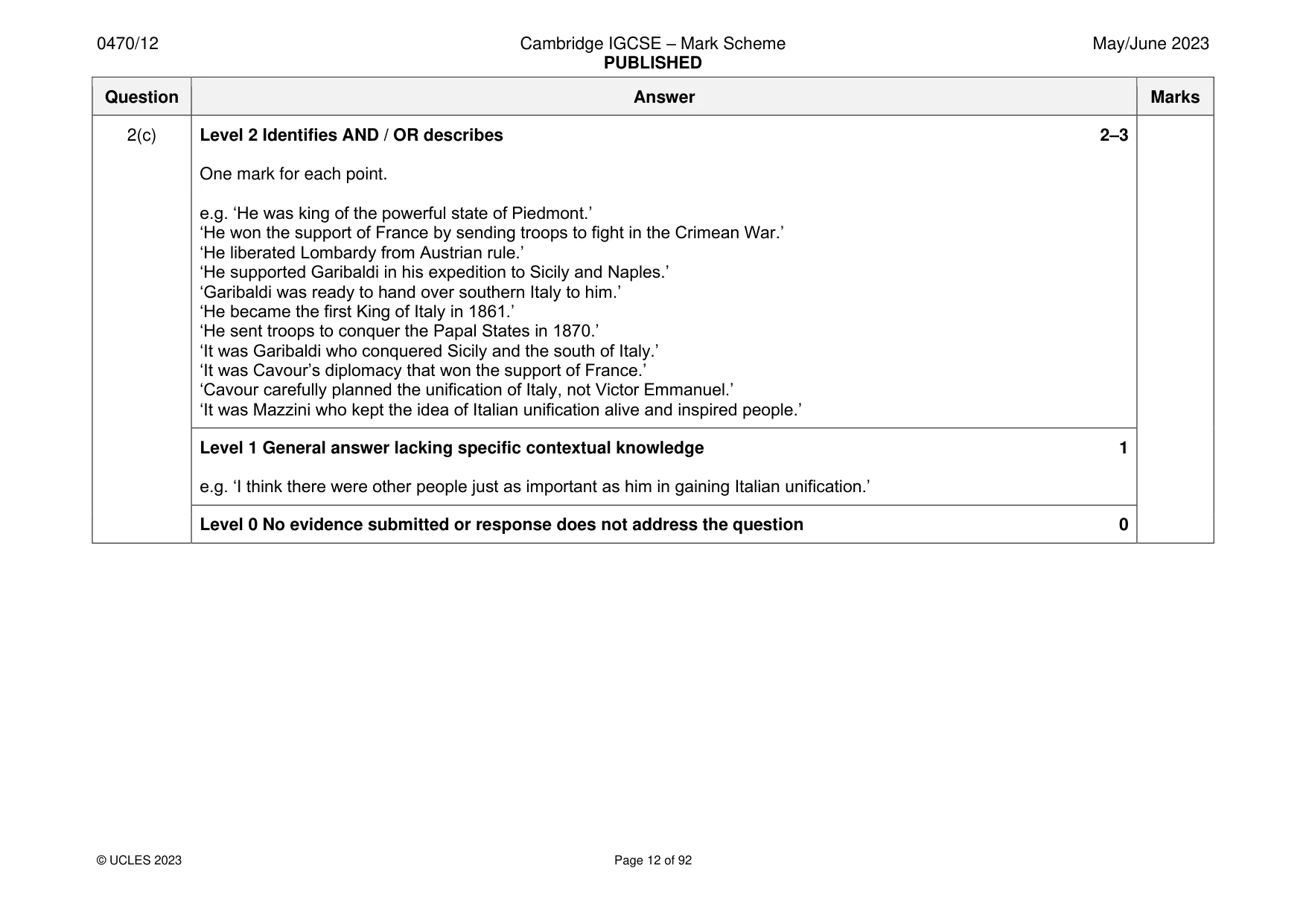
0470/12 Cambridge IGCSE – Mark Scheme PUBLISHED May/June 2023 © UCLES 2023 Page 12 of 92 Question Answer Marks 2(c) Level 2 Identifies AND / OR describes 2–3 One mark for each point. e.g. ‘He was king of the powerful state of Piedmont.’ ‘He won the support of France by sending troops to fight in the Crimean War.’ ‘He liberated Lombardy from Austrian rule.’ ‘He supported Garibaldi in his expedition to Sicily and Naples.’ ‘Garibaldi was ready to hand over southern Italy to him.’ ‘He became the first King of Italy in 1861.’ ‘He sent troops to conquer the Papal States in 1870.’ ‘It was Garibaldi who conquered Sicily and the south of Italy.’ ‘It was Cavour’s diplomacy that won the support of France.’ ‘Cavour carefully planned the unification of Italy, not Victor Emmanuel.’ ‘It was Mazzini who kept the idea of Italian unification alive and inspired people.’ Level 1 General answer lacking specific contextual knowledge 1 e.g. ‘I think there were other people just as important as him in gaining Italian unification.’ Level 0 No evidence submitted or response does not address the question 0
Mark scheme, page 13
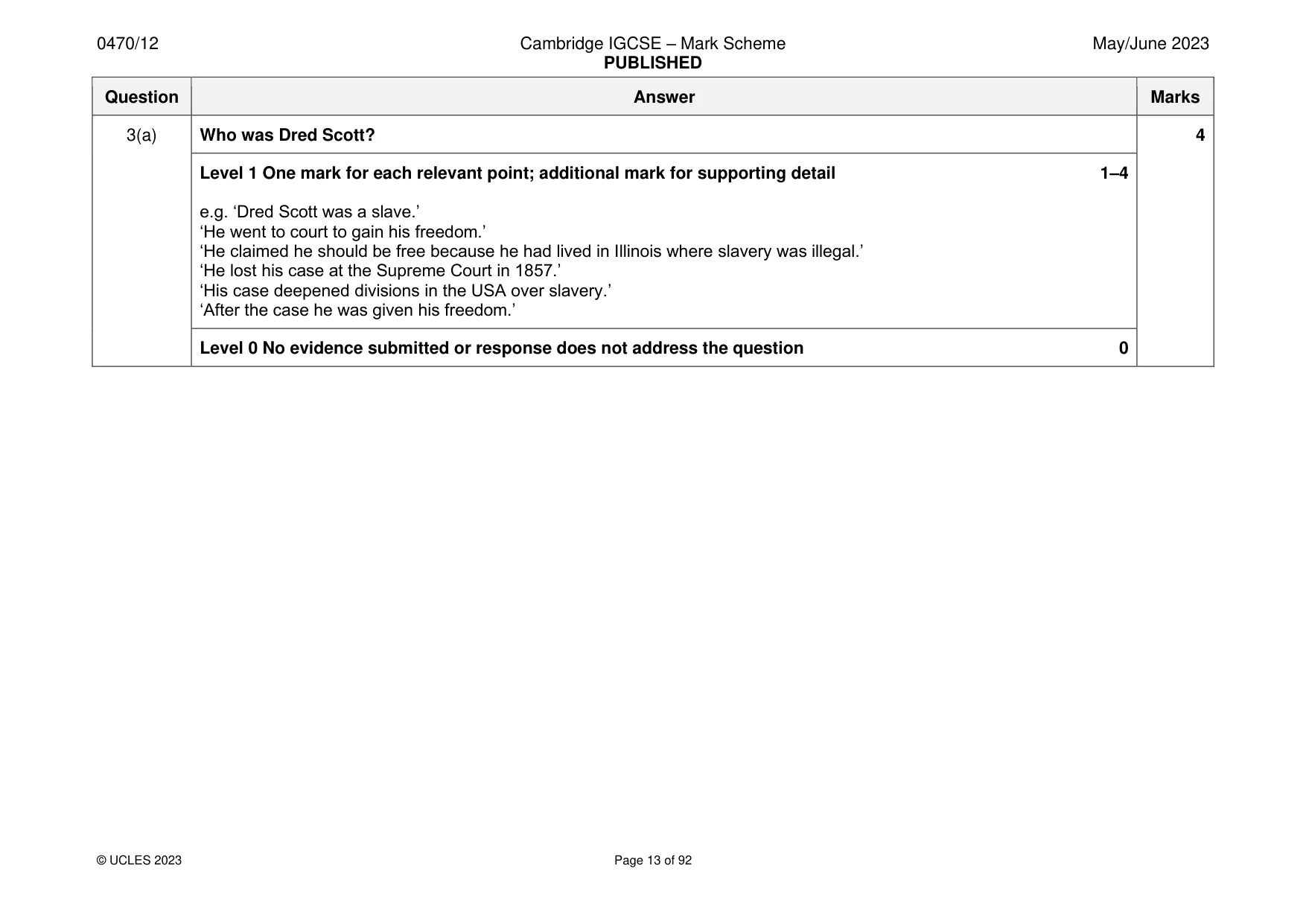
0470/12 Cambridge IGCSE – Mark Scheme PUBLISHED May/June 2023 © UCLES 2023 Page 13 of 92 Question Answer Marks 3(a) Who was Dred Scott? 4 Level 1 One mark for each relevant point; additional mark for supporting detail 1–4 e.g. ‘Dred Scott was a slave.’ ‘He went to court to gain his freedom.’ ‘He claimed he should be free because he had lived in Illinois where slavery was illegal.’ ‘He lost his case at the Supreme Court in 1857.’ ‘His case deepened divisions in the USA over slavery.’ ‘After the case he was given his freedom.’ Level 0 No evidence submitted or response does not address the question 0
Mark scheme, page 14
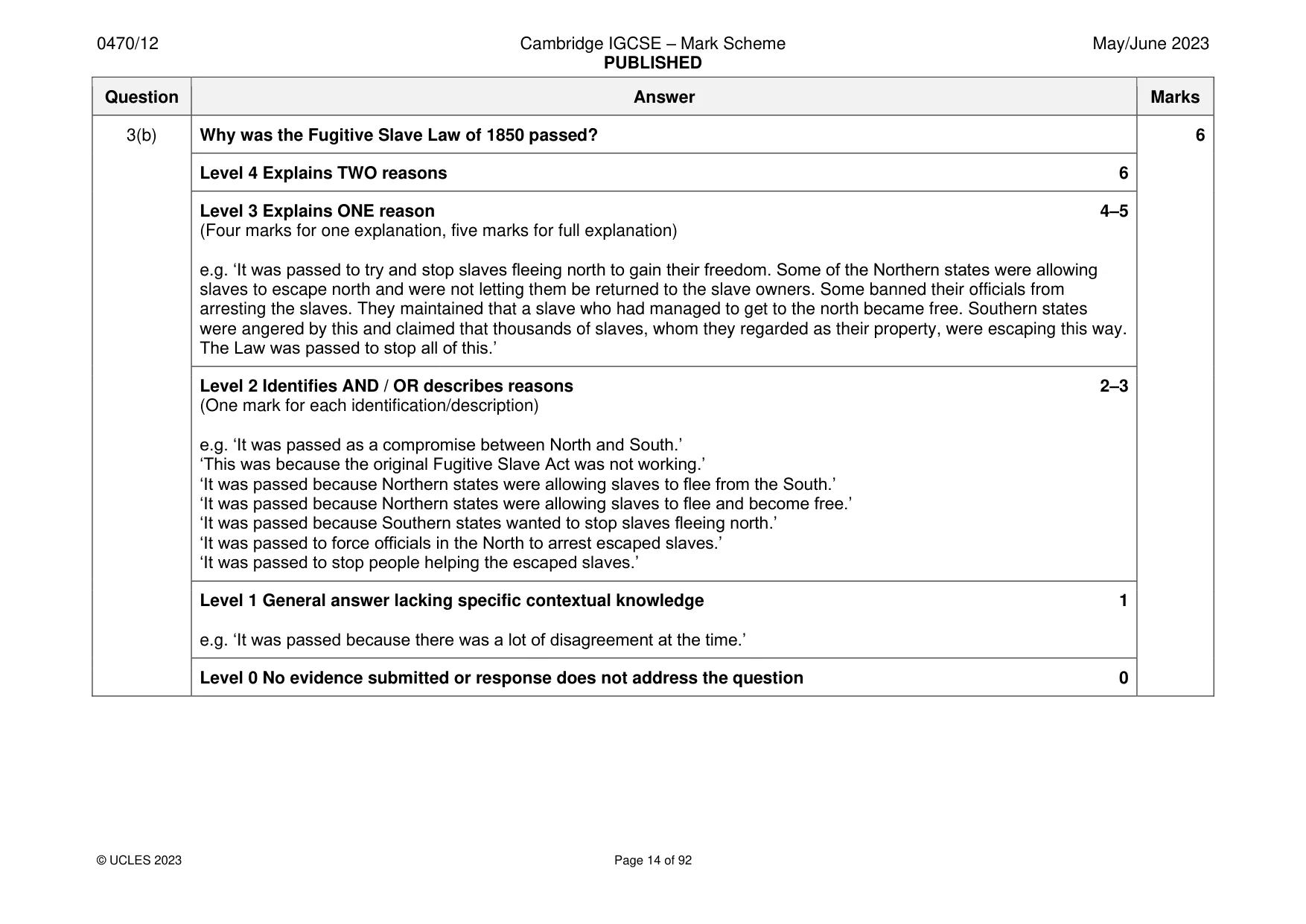
0470/12 Cambridge IGCSE – Mark Scheme PUBLISHED May/June 2023 © UCLES 2023 Page 14 of 92 Question Answer Marks 3(b) Why was the Fugitive Slave Law of 1850 passed? 6 Level 4 Explains TWO reasons 6 Level 3 Explains ONE reason 4–5 (Four marks for one explanation, five marks for full explanation) e.g. ‘It was passed to try and stop slaves fleeing north to gain their freedom. Some of the Northern states were allowing slaves to escape north and were not letting them be returned to the slave owners. Some banned their officials from arresting the slaves. They maintained that a slave who had managed to get to the north became free. Southern states were angered by this and claimed that thousands of slaves, whom they regarded as their property, were escaping this way. The Law was passed to stop all of this.’ Level 2 Identifies AND / OR describes reasons 2–3 (One mark for each identification/description) e.g. ‘It was passed as a compromise between North and South.’ ‘This was because the original Fugitive Slave Act was not working.’ ‘It was passed because Northern states were allowing slaves to flee from the South.’ ‘It was passed because Northern states were allowing slaves to flee and become free.’ ‘It was passed because Southern states wanted to stop slaves fleeing north.’ ‘It was passed to force officials in the North to arrest escaped slaves.’ ‘It was passed to stop people helping the escaped slaves.’ Level 1 General answer lacking specific contextual knowledge 1 e.g. ‘It was passed because there was a lot of disagreement at the time.’ Level 0 No evidence submitted or response does not address the question 0
Mark scheme, page 15
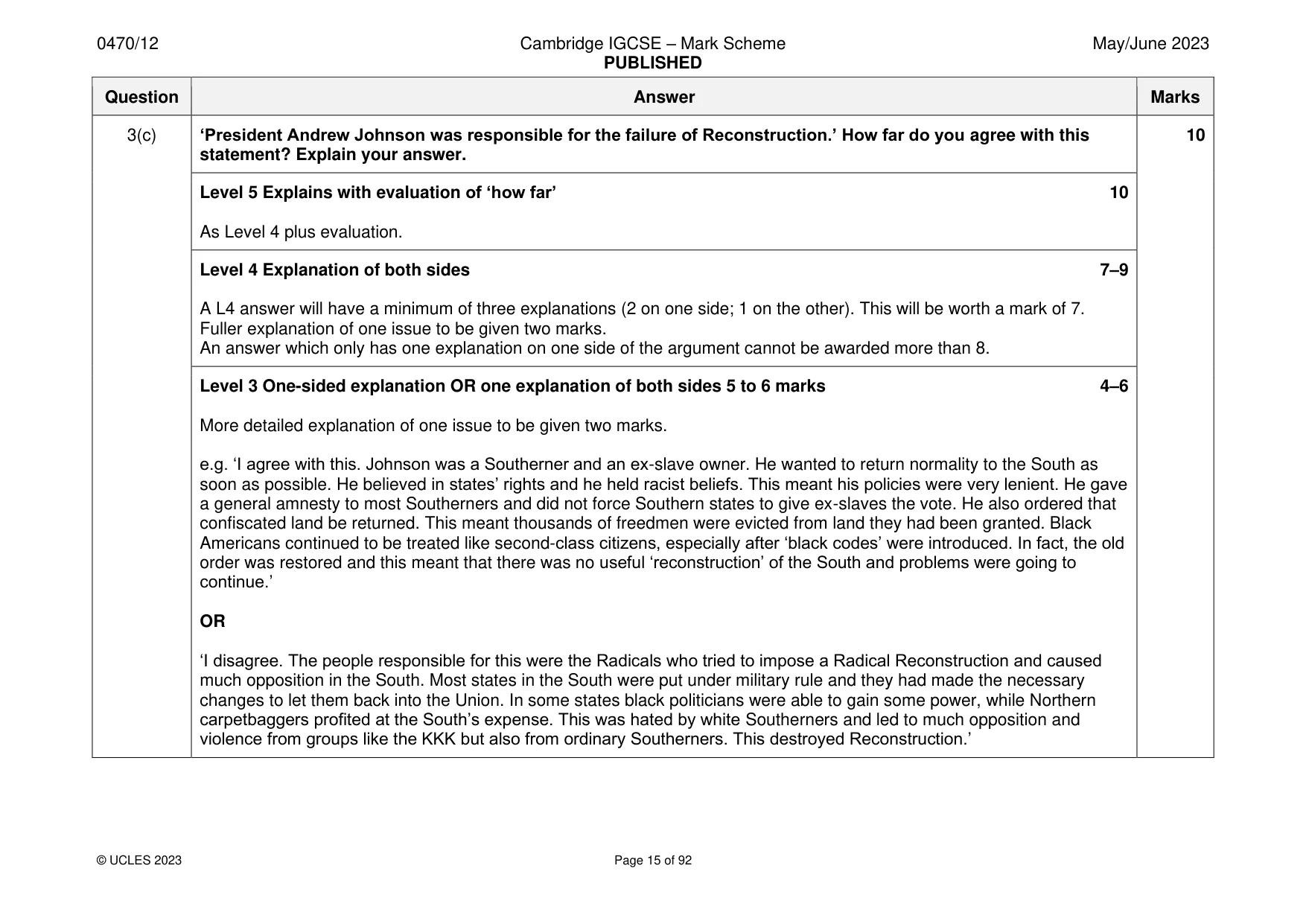
0470/12 Cambridge IGCSE – Mark Scheme PUBLISHED May/June 2023 © UCLES 2023 Page 15 of 92 Question Answer Marks 3(c) ‘President Andrew Johnson was responsible for the failure of Reconstruction.’ How far do you agree with this statement? Explain your answer. 10 Level 5 Explains with evaluation of ‘how far’ 10 As Level 4 plus evaluation. Level 4 Explanation of both sides 7–9 A L4 answer will have a minimum of three explanations (2 on one side; 1 on the other). This will be worth a mark of 7. Fuller explanation of one issue to be given two marks. An answer which only has one explanation on one side of the argument cannot be awarded more than 8. Level 3 One-sided explanation OR one explanation of both sides 5 to 6 marks 4–6 More detailed explanation of one issue to be given two marks. e.g. ‘I agree with this. Johnson was a Southerner and an ex-slave owner. He wanted to return normality to the South as soon as possible. He believed in states’ rights and he held racist beliefs. This meant his policies were very lenient. He gave a general amnesty to most Southerners and did not force Southern states to give ex-slaves the vote. He also ordered that confiscated land be returned. This meant thousands of freedmen were evicted from land they had been granted. Black Americans continued to be treated like second-class citizens, especially after ‘black codes’ were introduced. In fact, the old order was restored and this meant that there was no useful ‘reconstruction’ of the South and problems were going to continue.’ OR ‘I disagree. The people responsible for this were the Radicals who tried to impose a Radical Reconstruction and caused much opposition in the South. Most states in the South were put under military rule and they had made the necessary changes to let them back into the Union. In some states black politicians were able to gain some power, while Northern carpetbaggers profited at the South’s expense. This was hated by white Southerners and led to much opposition and violence from groups like the KKK but also from ordinary Southerners. This destroyed Reconstruction.’
Mark scheme, page 16
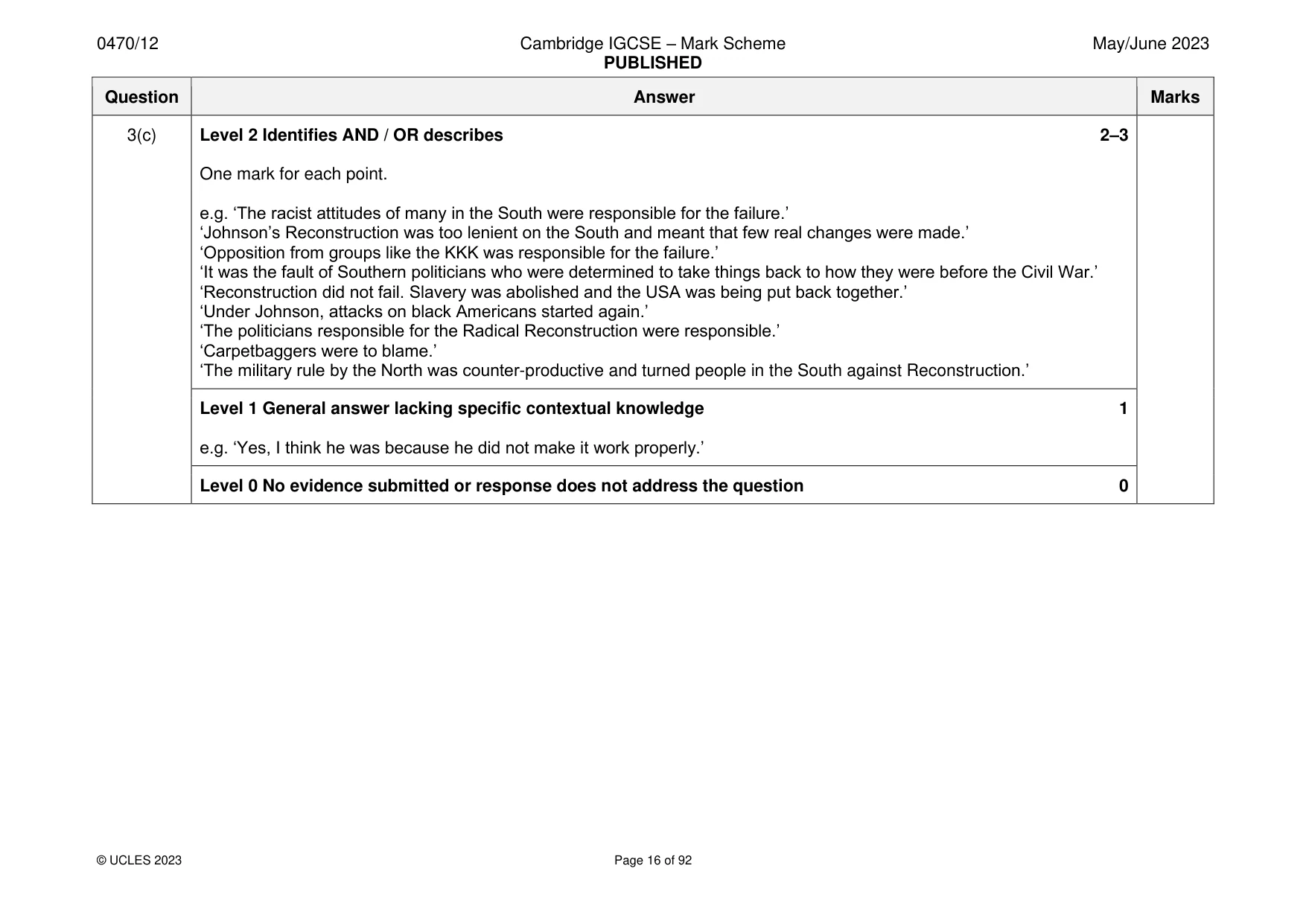
0470/12 Cambridge IGCSE – Mark Scheme PUBLISHED May/June 2023 © UCLES 2023 Page 16 of 92 Question Answer Marks 3(c) Level 2 Identifies AND / OR describes 2–3 One mark for each point. e.g. ‘The racist attitudes of many in the South were responsible for the failure.’ ‘Johnson’s Reconstruction was too lenient on the South and meant that few real changes were made.’ ‘Opposition from groups like the KKK was responsible for the failure.’ ‘It was the fault of Southern politicians who were determined to take things back to how they were before the Civil War.’ ‘Reconstruction did not fail. Slavery was abolished and the USA was being put back together.’ ‘Under Johnson, attacks on black Americans started again.’ ‘The politicians responsible for the Radical Reconstruction were responsible.’ ‘Carpetbaggers were to blame.’ ‘The military rule by the North was counter-productive and turned people in the South against Reconstruction.’ Level 1 General answer lacking specific contextual knowledge 1 e.g. ‘Yes, I think he was because he did not make it work properly.’ Level 0 No evidence submitted or response does not address the question 0
Mark scheme, page 17
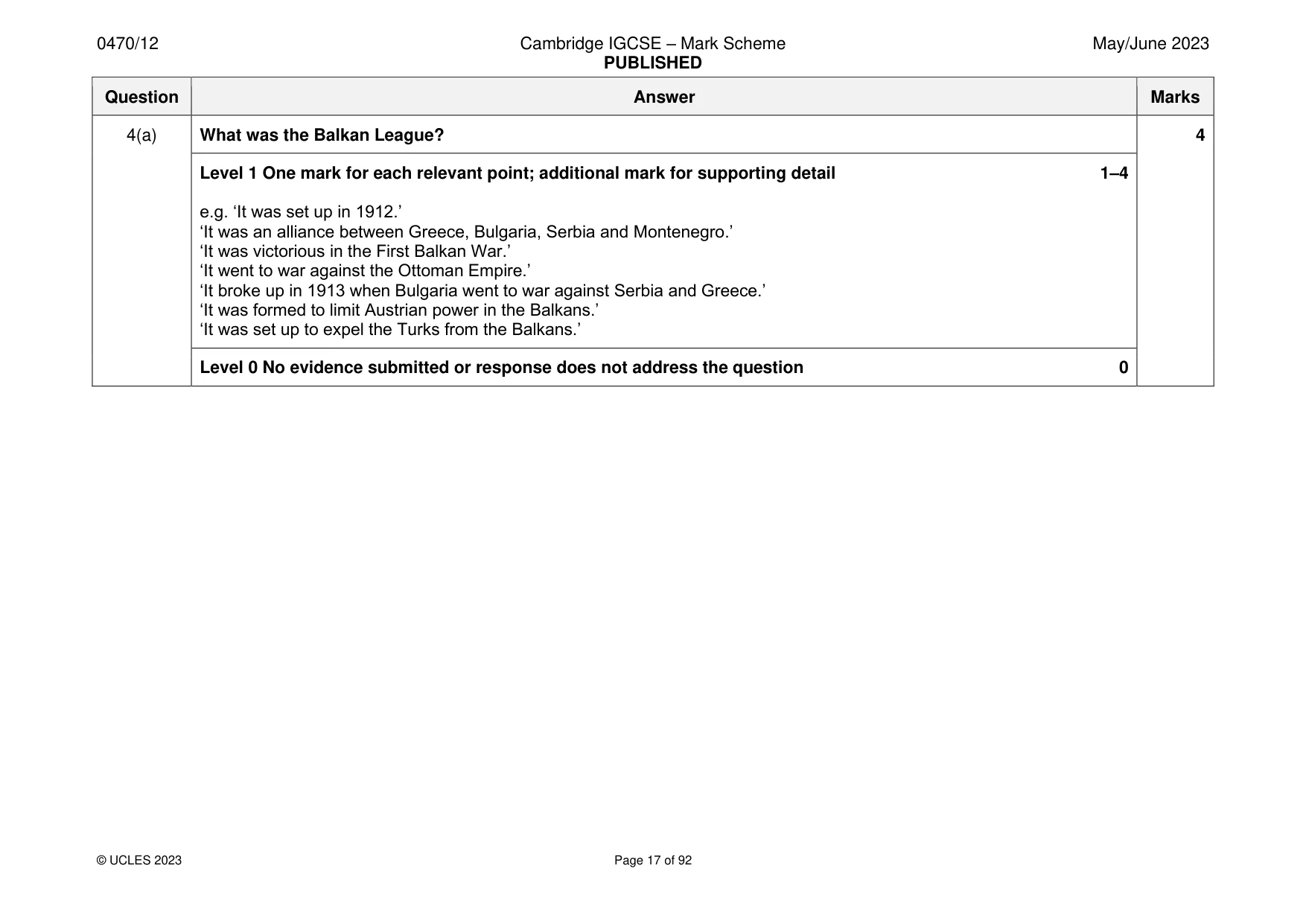
0470/12 Cambridge IGCSE – Mark Scheme PUBLISHED May/June 2023 © UCLES 2023 Page 17 of 92 Question Answer Marks 4(a) What was the Balkan League? 4 Level 1 One mark for each relevant point; additional mark for supporting detail 1–4 e.g. ‘It was set up in 1912.’ ‘It was an alliance between Greece, Bulgaria, Serbia and Montenegro.’ ‘It was victorious in the First Balkan War.’ ‘It went to war against the Ottoman Empire.’ ‘It broke up in 1913 when Bulgaria went to war against Serbia and Greece.’ ‘It was formed to limit Austrian power in the Balkans.’ ‘It was set up to expel the Turks from the Balkans.’ Level 0 No evidence submitted or response does not address the question 0
Mark scheme, page 18
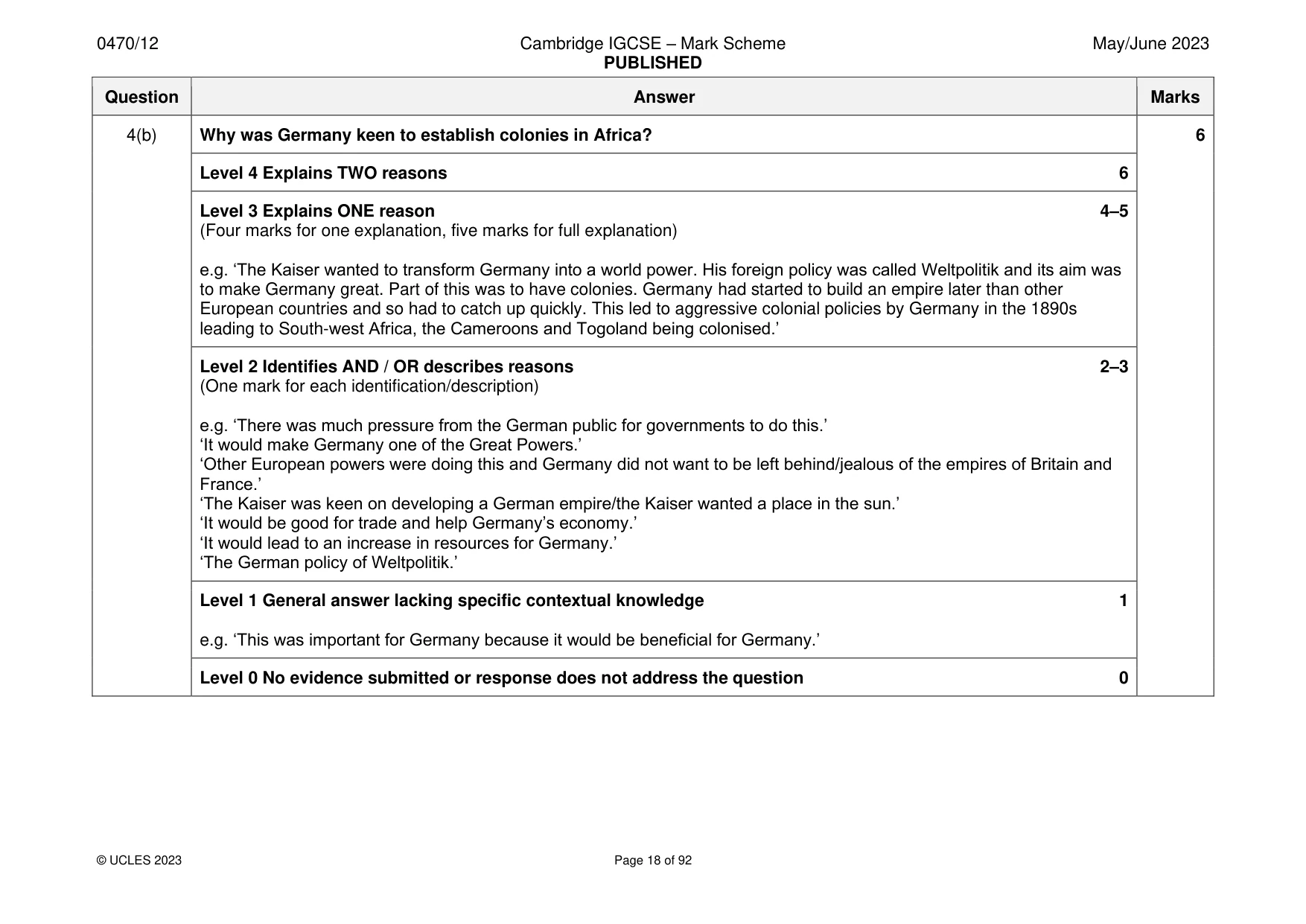
0470/12 Cambridge IGCSE – Mark Scheme PUBLISHED May/June 2023 © UCLES 2023 Page 18 of 92 Question Answer Marks 4(b) Why was Germany keen to establish colonies in Africa? 6 Level 4 Explains TWO reasons 6 Level 3 Explains ONE reason 4–5 (Four marks for one explanation, five marks for full explanation) e.g. ‘The Kaiser wanted to transform Germany into a world power. His foreign policy was called Weltpolitik and its aim was to make Germany great. Part of this was to have colonies. Germany had started to build an empire later than other European countries and so had to catch up quickly. This led to aggressive colonial policies by Germany in the 1890s leading to South-west Africa, the Cameroons and Togoland being colonised.’ Level 2 Identifies AND / OR describes reasons 2–3 (One mark for each identification/description) e.g. ‘There was much pressure from the German public for governments to do this.’ ‘It would make Germany one of the Great Powers.’ ‘Other European powers were doing this and Germany did not want to be left behind/jealous of the empires of Britain and France.’ ‘The Kaiser was keen on developing a German empire/the Kaiser wanted a place in the sun.’ ‘It would be good for trade and help Germany’s economy.’ ‘It would lead to an increase in resources for Germany.’ ‘The German policy of Weltpolitik.’ Level 1 General answer lacking specific contextual knowledge 1 e.g. ‘This was important for Germany because it would be beneficial for Germany.’ Level 0 No evidence submitted or response does not address the question 0
Mark scheme, page 19
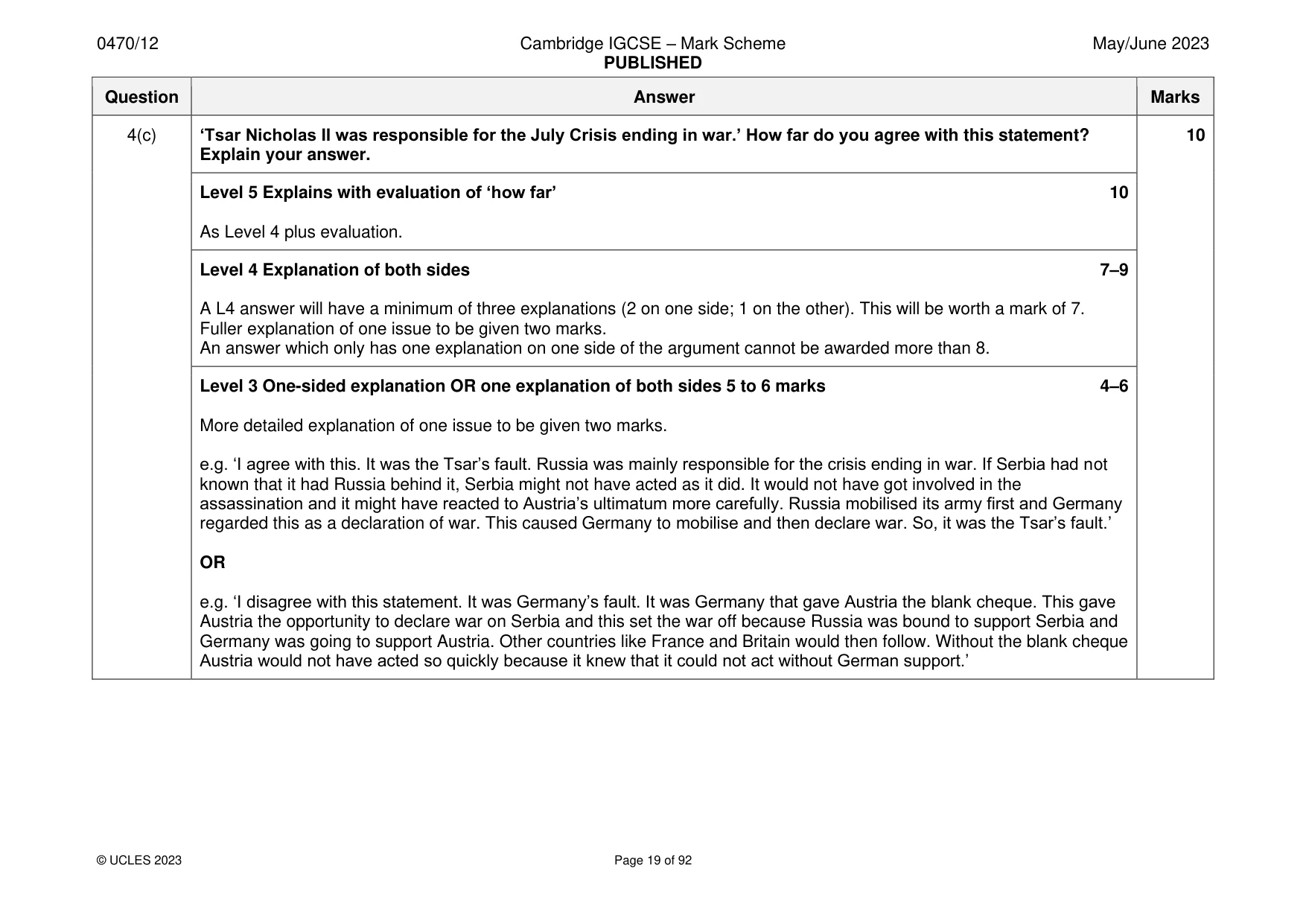
0470/12 Cambridge IGCSE – Mark Scheme PUBLISHED May/June 2023 © UCLES 2023 Page 19 of 92 Question Answer Marks 4(c) ‘Tsar Nicholas II was responsible for the July Crisis ending in war.’ How far do you agree with this statement? Explain your answer. 10 Level 5 Explains with evaluation of ‘how far’ 10 As Level 4 plus evaluation. Level 4 Explanation of both sides 7–9 A L4 answer will have a minimum of three explanations (2 on one side; 1 on the other). This will be worth a mark of 7. Fuller explanation of one issue to be given two marks. An answer which only has one explanation on one side of the argument cannot be awarded more than 8. Level 3 One-sided explanation OR one explanation of both sides 5 to 6 marks 4–6 More detailed explanation of one issue to be given two marks. e.g. ‘I agree with this. It was the Tsar’s fault. Russia was mainly responsible for the crisis ending in war. If Serbia had not known that it had Russia behind it, Serbia might not have acted as it did. It would not have got involved in the assassination and it might have reacted to Austria’s ultimatum more carefully. Russia mobilised its army first and Germany regarded this as a declaration of war. This caused Germany to mobilise and then declare war. So, it was the Tsar’s fault.’ OR e.g. ‘I disagree with this statement. It was Germany’s fault. It was Germany that gave Austria the blank cheque. This gave Austria the opportunity to declare war on Serbia and this set the war off because Russia was bound to support Serbia and Germany was going to support Austria. Other countries like France and Britain would then follow. Without the blank cheque Austria would not have acted so quickly because it knew that it could not act without German support.’
Mark scheme, page 20
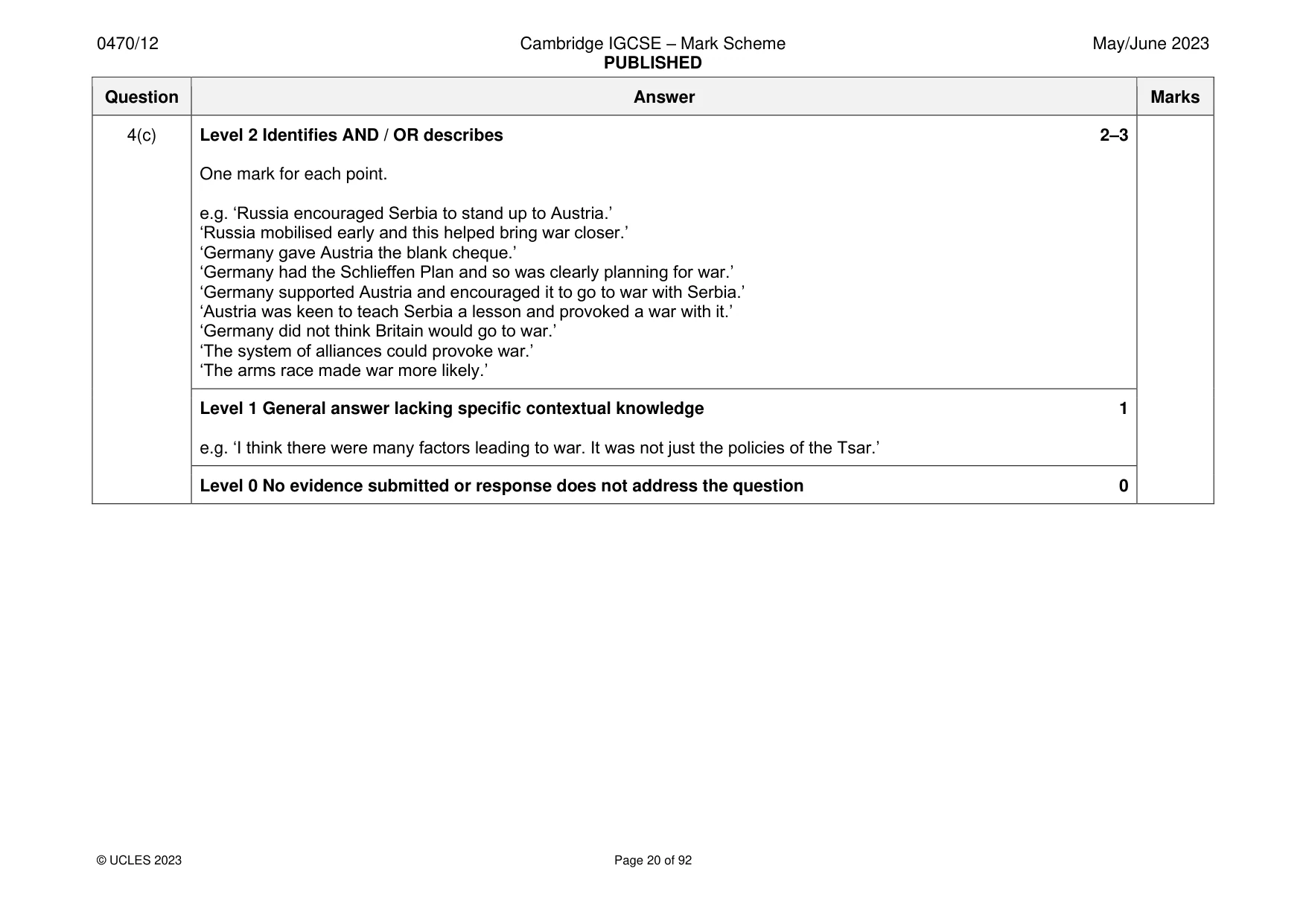
0470/12 Cambridge IGCSE – Mark Scheme PUBLISHED May/June 2023 © UCLES 2023 Page 20 of 92 Question Answer Marks 4(c) Level 2 Identifies AND / OR describes 2–3 One mark for each point. e.g. ‘Russia encouraged Serbia to stand up to Austria.’ ‘Russia mobilised early and this helped bring war closer.’ ‘Germany gave Austria the blank cheque.’ ‘Germany had the Schlieffen Plan and so was clearly planning for war.’ ‘Germany supported Austria and encouraged it to go to war with Serbia.’ ‘Austria was keen to teach Serbia a lesson and provoked a war with it.’ ‘Germany did not think Britain would go to war.’ ‘The system of alliances could provoke war.’ ‘The arms race made war more likely.’ Level 1 General answer lacking specific contextual knowledge 1 e.g. ‘I think there were many factors leading to war. It was not just the policies of the Tsar.’ Level 0 No evidence submitted or response does not address the question 0
Mark scheme, page 21
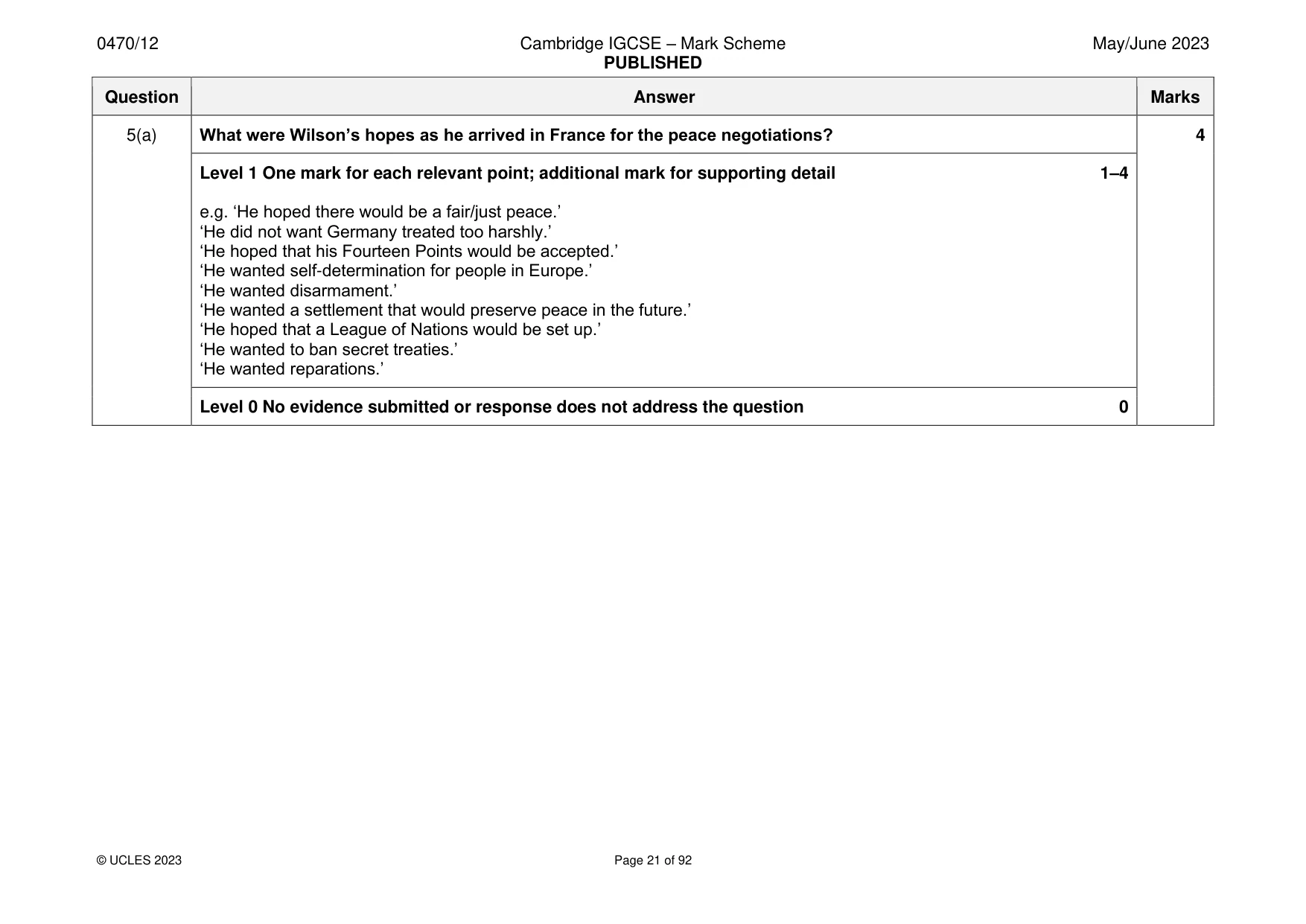
0470/12 Cambridge IGCSE – Mark Scheme PUBLISHED May/June 2023 © UCLES 2023 Page 21 of 92 Question Answer Marks 5(a) What were Wilson’s hopes as he arrived in France for the peace negotiations? 4 Level 1 One mark for each relevant point; additional mark for supporting detail 1–4 e.g. ‘He hoped there would be a fair/just peace.’ ‘He did not want Germany treated too harshly.’ ‘He hoped that his Fourteen Points would be accepted.’ ‘He wanted self-determination for people in Europe.’ ‘He wanted disarmament.’ ‘He wanted a settlement that would preserve peace in the future.’ ‘He hoped that a League of Nations would be set up.’ ‘He wanted to ban secret treaties.’ ‘He wanted reparations.’ Level 0 No evidence submitted or response does not address the question 0
Mark scheme, page 22
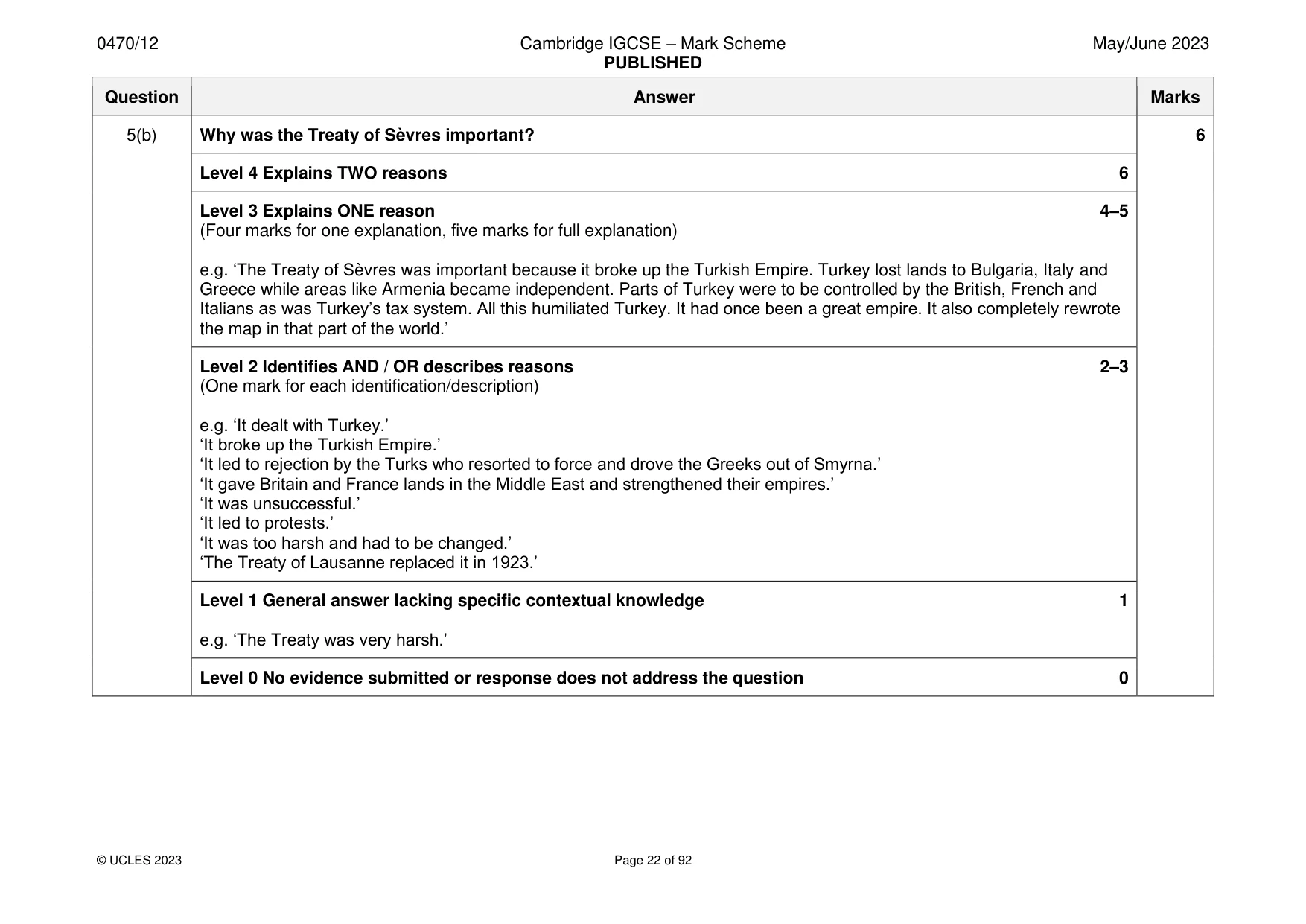
0470/12 Cambridge IGCSE – Mark Scheme PUBLISHED May/June 2023 © UCLES 2023 Page 22 of 92 Question Answer Marks 5(b) Why was the Treaty of Sèvres important? 6 Level 4 Explains TWO reasons 6 Level 3 Explains ONE reason 4–5 (Four marks for one explanation, five marks for full explanation) e.g. ‘The Treaty of Sèvres was important because it broke up the Turkish Empire. Turkey lost lands to Bulgaria, Italy and Greece while areas like Armenia became independent. Parts of Turkey were to be controlled by the British, French and Italians as was Turkey’s tax system. All this humiliated Turkey. It had once been a great empire. It also completely rewrote the map in that part of the world.’ Level 2 Identifies AND / OR describes reasons 2–3 (One mark for each identification/description) e.g. ‘It dealt with Turkey.’ ‘It broke up the Turkish Empire.’ ‘It led to rejection by the Turks who resorted to force and drove the Greeks out of Smyrna.’ ‘It gave Britain and France lands in the Middle East and strengthened their empires.’ ‘It was unsuccessful.’ ‘It led to protests.’ ‘It was too harsh and had to be changed.’ ‘The Treaty of Lausanne replaced it in 1923.’ Level 1 General answer lacking specific contextual knowledge 1 e.g. ‘The Treaty was very harsh.’ Level 0 No evidence submitted or response does not address the question 0
Mark scheme, page 23
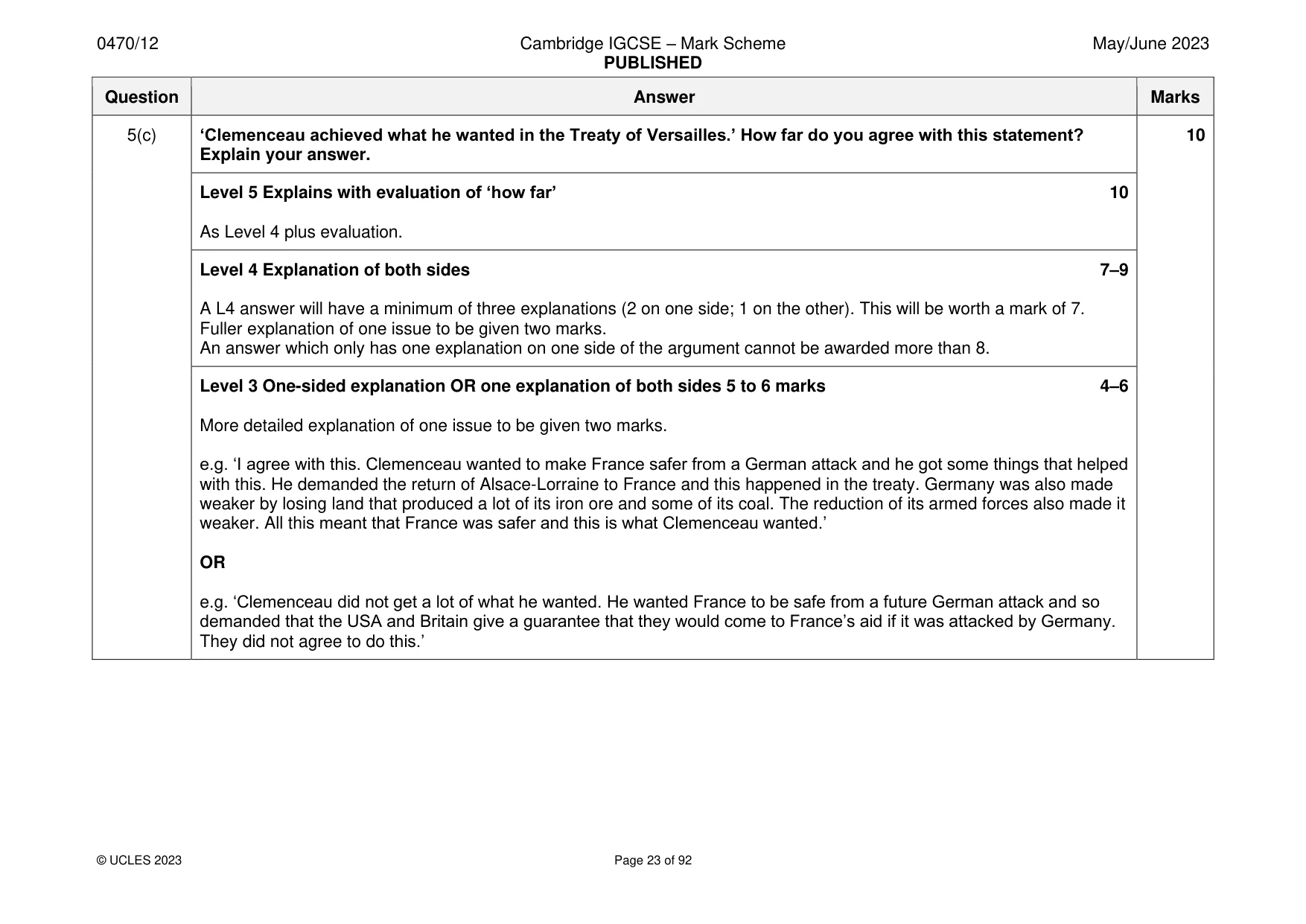
0470/12 Cambridge IGCSE – Mark Scheme PUBLISHED May/June 2023 © UCLES 2023 Page 23 of 92 Question Answer Marks 5(c) ‘Clemenceau achieved what he wanted in the Treaty of Versailles.’ How far do you agree with this statement? Explain your answer. 10 Level 5 Explains with evaluation of ‘how far’ 10 As Level 4 plus evaluation. Level 4 Explanation of both sides 7–9 A L4 answer will have a minimum of three explanations (2 on one side; 1 on the other). This will be worth a mark of 7. Fuller explanation of one issue to be given two marks. An answer which only has one explanation on one side of the argument cannot be awarded more than 8. Level 3 One-sided explanation OR one explanation of both sides 5 to 6 marks 4–6 More detailed explanation of one issue to be given two marks. e.g. ‘I agree with this. Clemenceau wanted to make France safer from a German attack and he got some things that helped with this. He demanded the return of Alsace-Lorraine to France and this happened in the treaty. Germany was also made weaker by losing land that produced a lot of its iron ore and some of its coal. The reduction of its armed forces also made it weaker. All this meant that France was safer and this is what Clemenceau wanted.’ OR e.g. ‘Clemenceau did not get a lot of what he wanted. He wanted France to be safe from a future German attack and so demanded that the USA and Britain give a guarantee that they would come to France’s aid if it was attacked by Germany. They did not agree to do this.’
Mark scheme, page 24
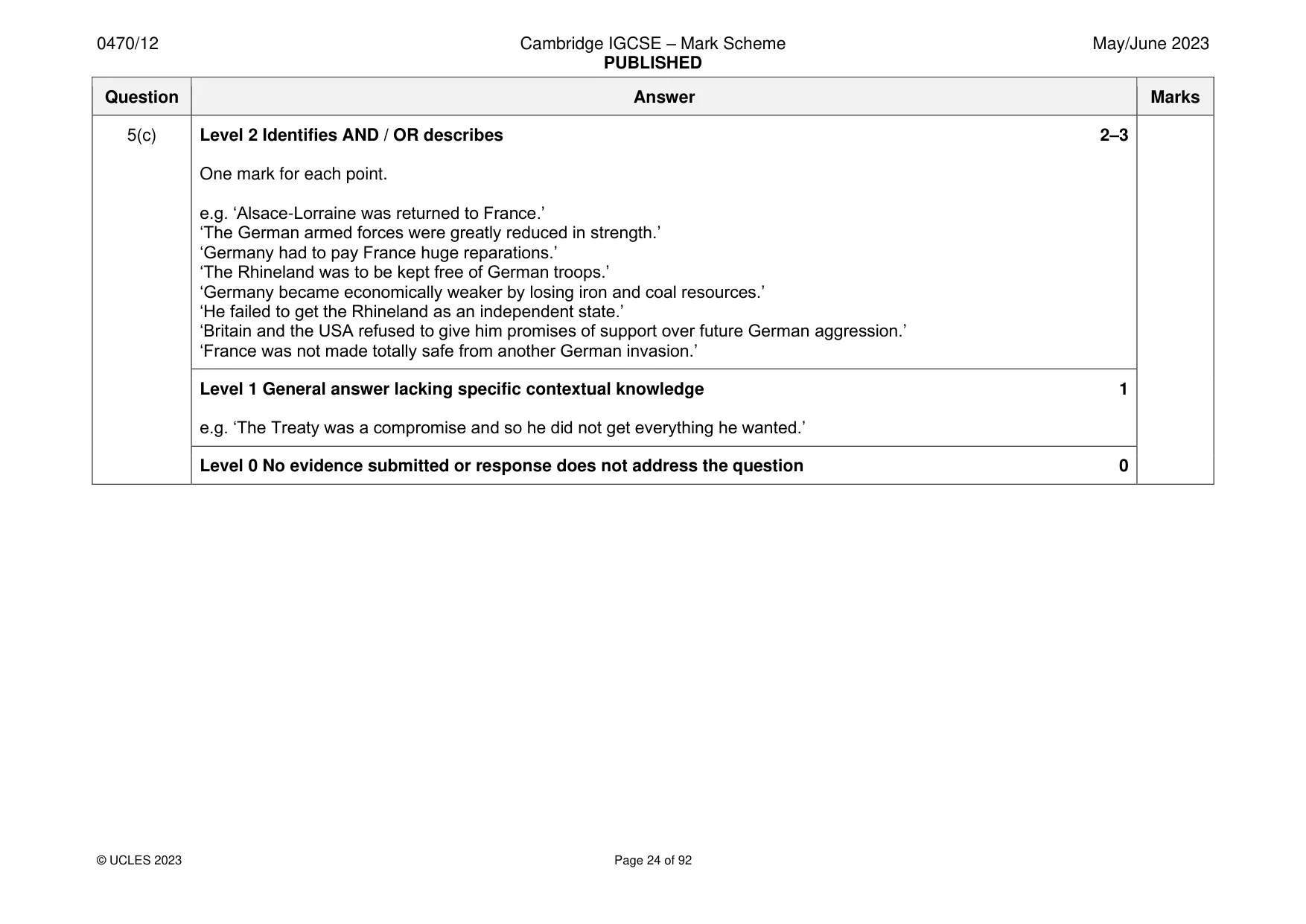
0470/12 Cambridge IGCSE – Mark Scheme PUBLISHED May/June 2023 © UCLES 2023 Page 24 of 92 Question Answer Marks 5(c) Level 2 Identifies AND / OR describes 2–3 One mark for each point. e.g. ‘Alsace-Lorraine was returned to France.’ ‘The German armed forces were greatly reduced in strength.’ ‘Germany had to pay France huge reparations.’ ‘The Rhineland was to be kept free of German troops.’ ‘Germany became economically weaker by losing iron and coal resources.’ ‘He failed to get the Rhineland as an independent state.’ ‘Britain and the USA refused to give him promises of support over future German aggression.’ ‘France was not made totally safe from another German invasion.’ Level 1 General answer lacking specific contextual knowledge 1 e.g. ‘The Treaty was a compromise and so he did not get everything he wanted.’ Level 0 No evidence submitted or response does not address the question 0
Mark scheme, page 25
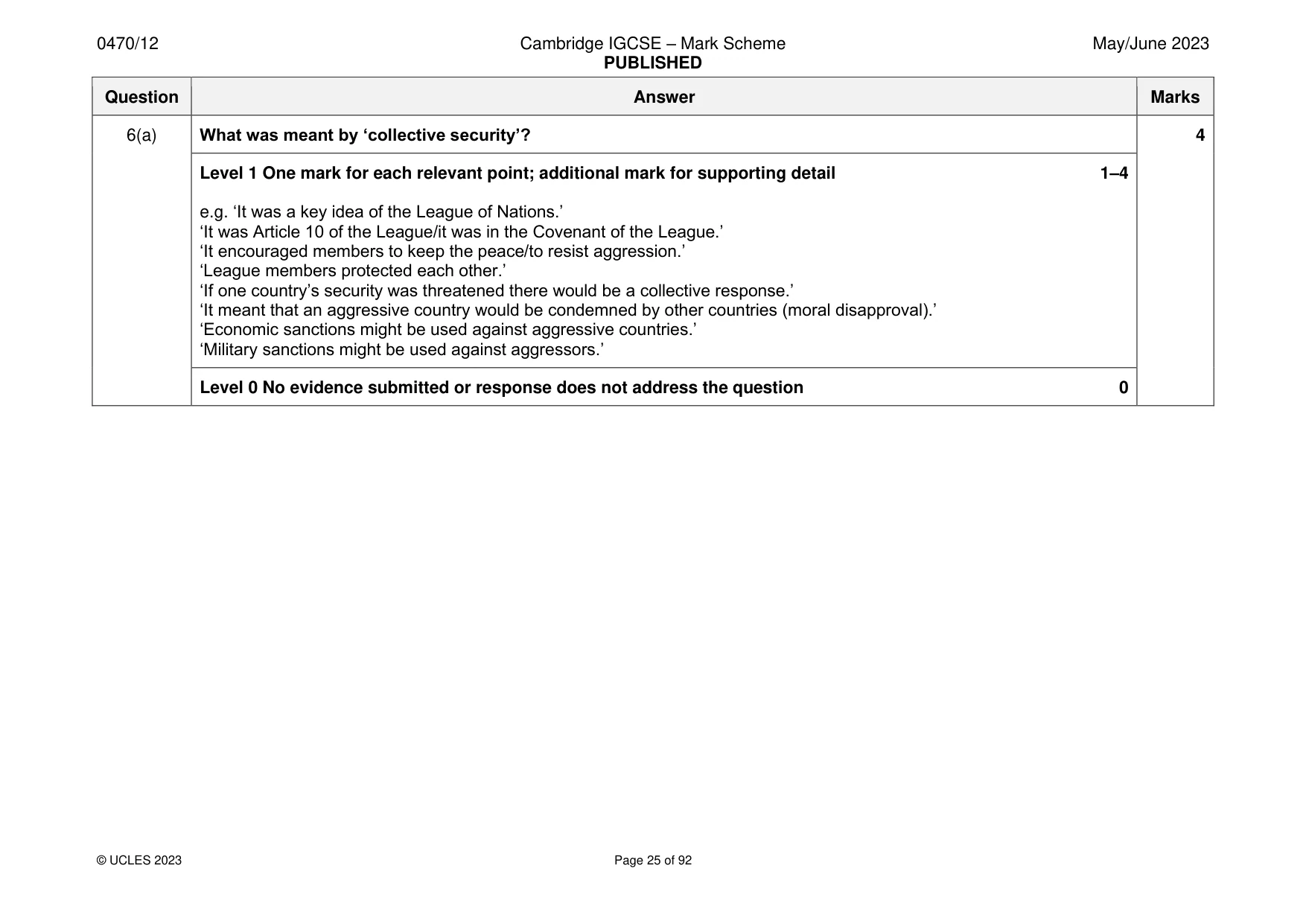
0470/12 Cambridge IGCSE – Mark Scheme PUBLISHED May/June 2023 © UCLES 2023 Page 25 of 92 Question Answer Marks 6(a) What was meant by ‘collective security’? 4 Level 1 One mark for each relevant point; additional mark for supporting detail 1–4 e.g. ‘It was a key idea of the League of Nations.’ ‘It was Article 10 of the League/it was in the Covenant of the League.’ ‘It encouraged members to keep the peace/to resist aggression.’ ‘League members protected each other.’ ‘If one country’s security was threatened there would be a collective response.’ ‘It meant that an aggressive country would be condemned by other countries (moral disapproval).’ ‘Economic sanctions might be used against aggressive countries.’ ‘Military sanctions might be used against aggressors.’ Level 0 No evidence submitted or response does not address the question 0
Mark scheme, page 26
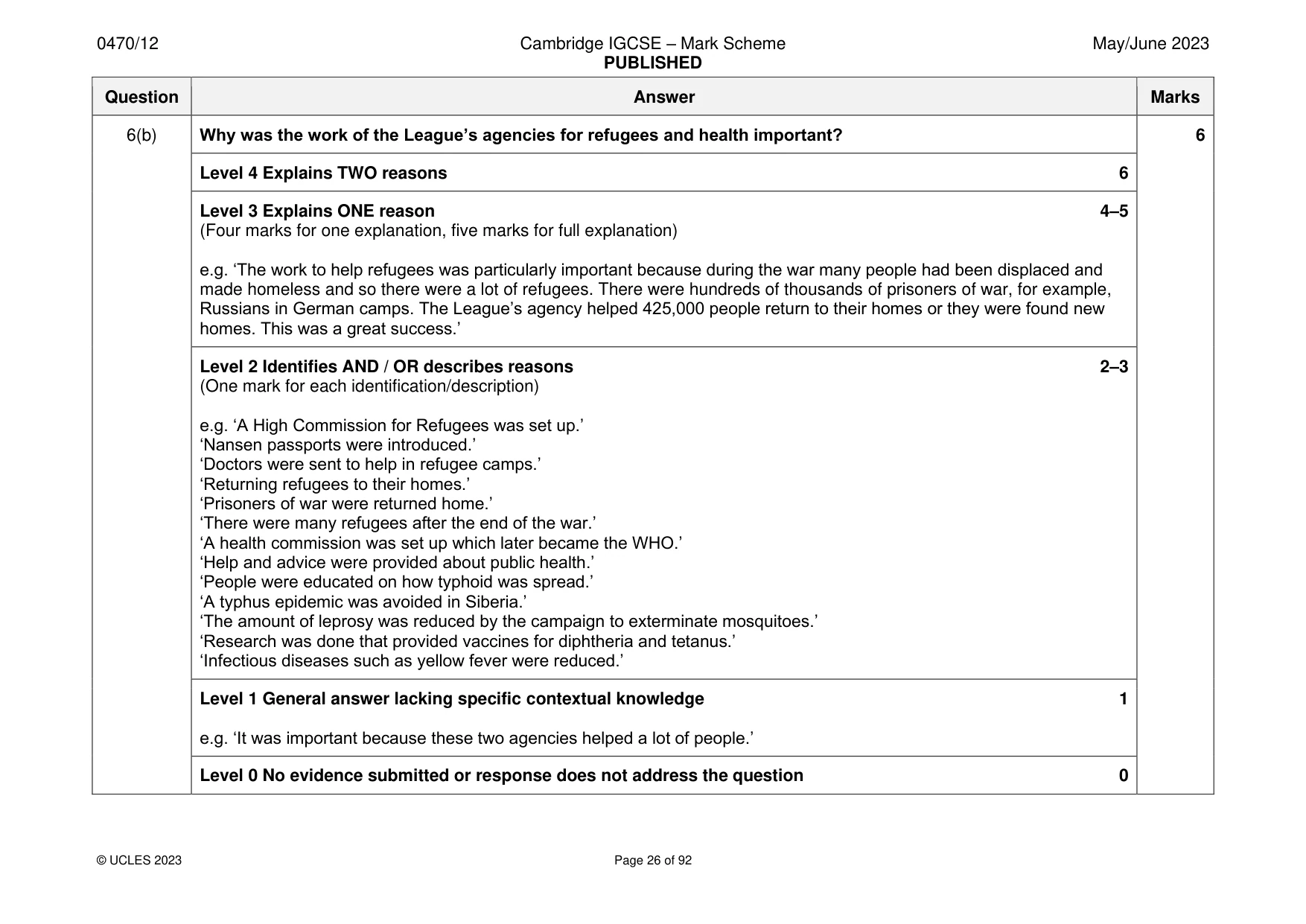
0470/12 Cambridge IGCSE – Mark Scheme PUBLISHED May/June 2023 © UCLES 2023 Page 26 of 92 Question Answer Marks 6(b) Why was the work of the League’s agencies for refugees and health important? 6 Level 4 Explains TWO reasons 6 Level 3 Explains ONE reason 4–5 (Four marks for one explanation, five marks for full explanation) e.g. ‘The work to help refugees was particularly important because during the war many people had been displaced and made homeless and so there were a lot of refugees. There were hundreds of thousands of prisoners of war, for example, Russians in German camps. The League’s agency helped 425,000 people return to their homes or they were found new homes. This was a great success.’ Level 2 Identifies AND / OR describes reasons 2–3 (One mark for each identification/description) e.g. ‘A High Commission for Refugees was set up.’ ‘Nansen passports were introduced.’ ‘Doctors were sent to help in refugee camps.’ ‘Returning refugees to their homes.’ ‘Prisoners of war were returned home.’ ‘There were many refugees after the end of the war.’ ‘A health commission was set up which later became the WHO.’ ‘Help and advice were provided about public health.’ ‘People were educated on how typhoid was spread.’ ‘A typhus epidemic was avoided in Siberia.’ ‘The amount of leprosy was reduced by the campaign to exterminate mosquitoes.’ ‘Research was done that provided vaccines for diphtheria and tetanus.’ ‘Infectious diseases such as yellow fever were reduced.’ Level 1 General answer lacking specific contextual knowledge 1 e.g. ‘It was important because these two agencies helped a lot of people.’ Level 0 No evidence submitted or response does not address the question 0
Mark scheme, page 27
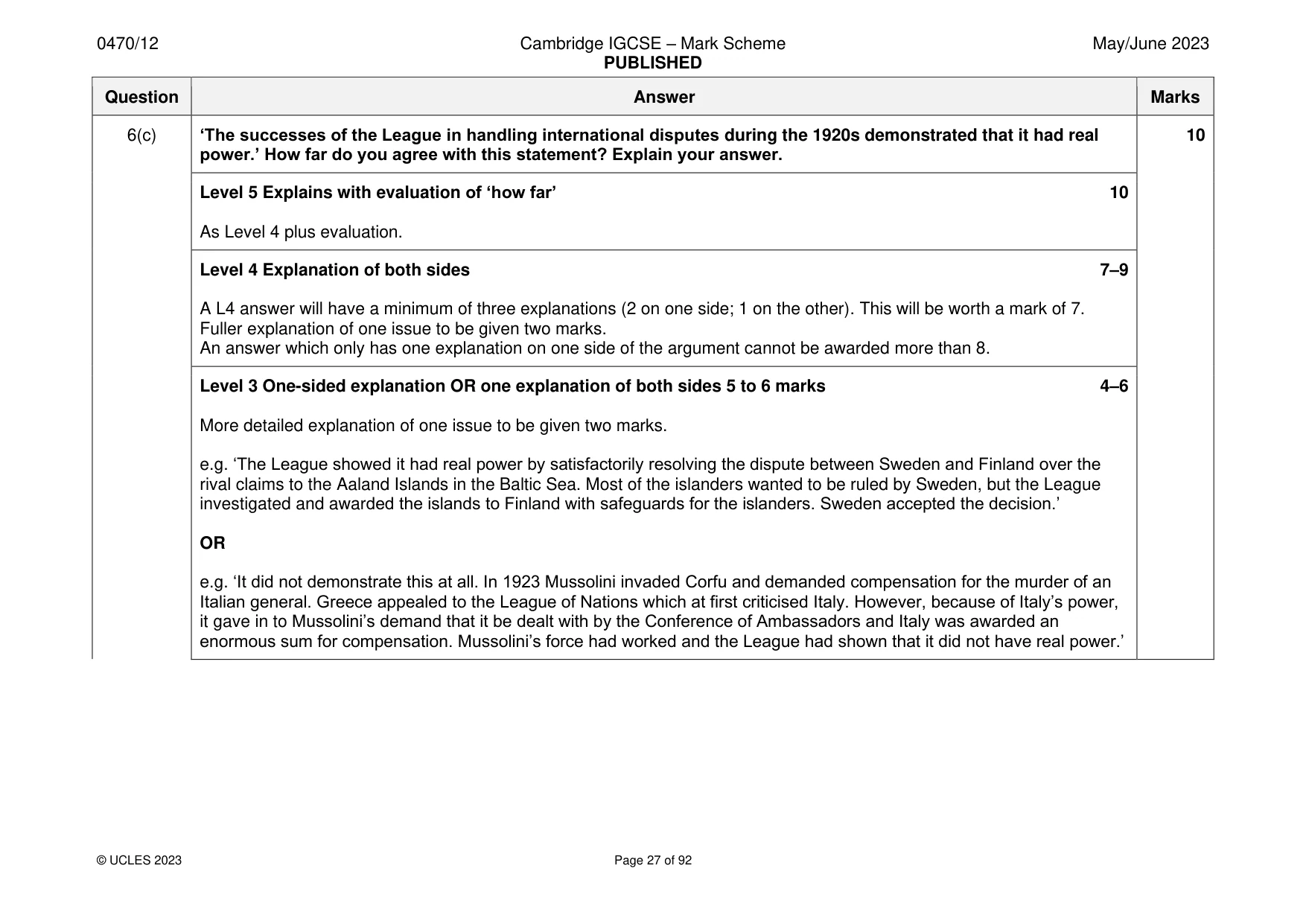
0470/12 Cambridge IGCSE – Mark Scheme PUBLISHED May/June 2023 © UCLES 2023 Page 27 of 92 Question Answer Marks 6(c) ‘The successes of the League in handling international disputes during the 1920s demonstrated that it had real power.’ How far do you agree with this statement? Explain your answer. 10 Level 5 Explains with evaluation of ‘how far’ 10 As Level 4 plus evaluation. Level 4 Explanation of both sides 7–9 A L4 answer will have a minimum of three explanations (2 on one side; 1 on the other). This will be worth a mark of 7. Fuller explanation of one issue to be given two marks. An answer which only has one explanation on one side of the argument cannot be awarded more than 8. Level 3 One-sided explanation OR one explanation of both sides 5 to 6 marks 4–6 More detailed explanation of one issue to be given two marks. e.g. ‘The League showed it had real power by satisfactorily resolving the dispute between Sweden and Finland over the rival claims to the Aaland Islands in the Baltic Sea. Most of the islanders wanted to be ruled by Sweden, but the League investigated and awarded the islands to Finland with safeguards for the islanders. Sweden accepted the decision.’ OR e.g. ‘It did not demonstrate this at all. In 1923 Mussolini invaded Corfu and demanded compensation for the murder of an Italian general. Greece appealed to the League of Nations which at first criticised Italy. However, because of Italy’s power, it gave in to Mussolini’s demand that it be dealt with by the Conference of Ambassadors and Italy was awarded an enormous sum for compensation. Mussolini’s force had worked and the League had shown that it did not have real power.’
Mark scheme, page 28
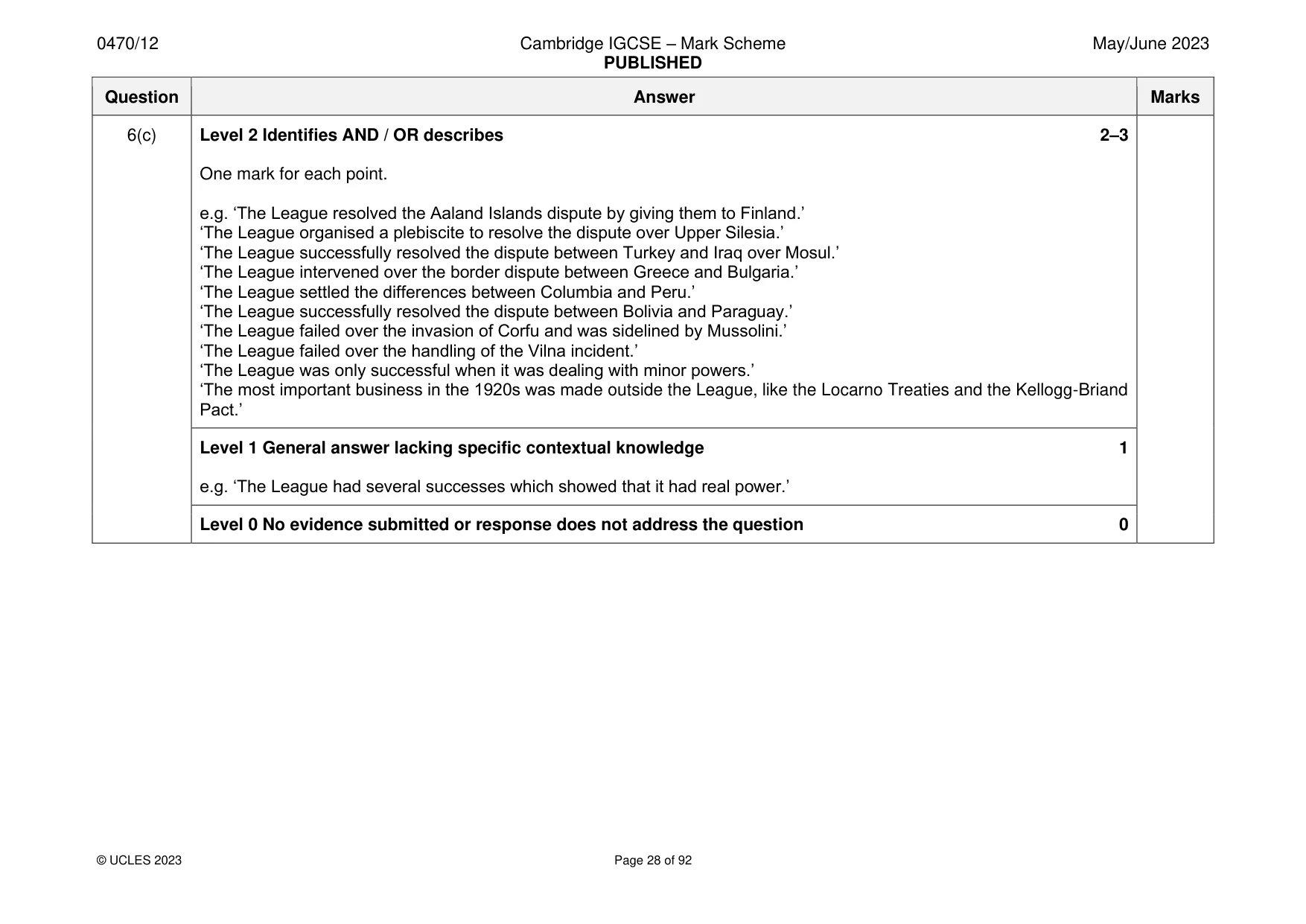
0470/12 Cambridge IGCSE – Mark Scheme PUBLISHED May/June 2023 © UCLES 2023 Page 28 of 92 Question Answer Marks 6(c) Level 2 Identifies AND / OR describes 2–3 One mark for each point. e.g. ‘The League resolved the Aaland Islands dispute by giving them to Finland.’ ‘The League organised a plebiscite to resolve the dispute over Upper Silesia.’ ‘The League successfully resolved the dispute between Turkey and Iraq over Mosul.’ ‘The League intervened over the border dispute between Greece and Bulgaria.’ ‘The League settled the differences between Columbia and Peru.’ ‘The League successfully resolved the dispute between Bolivia and Paraguay.’ ‘The League failed over the invasion of Corfu and was sidelined by Mussolini.’ ‘The League failed over the handling of the Vilna incident.’ ‘The League was only successful when it was dealing with minor powers.’ ‘The most important business in the 1920s was made outside the League, like the Locarno Treaties and the Kellogg-Briand Pact.’ Level 1 General answer lacking specific contextual knowledge 1 e.g. ‘The League had several successes which showed that it had real power.’ Level 0 No evidence submitted or response does not address the question 0
Mark scheme, page 29
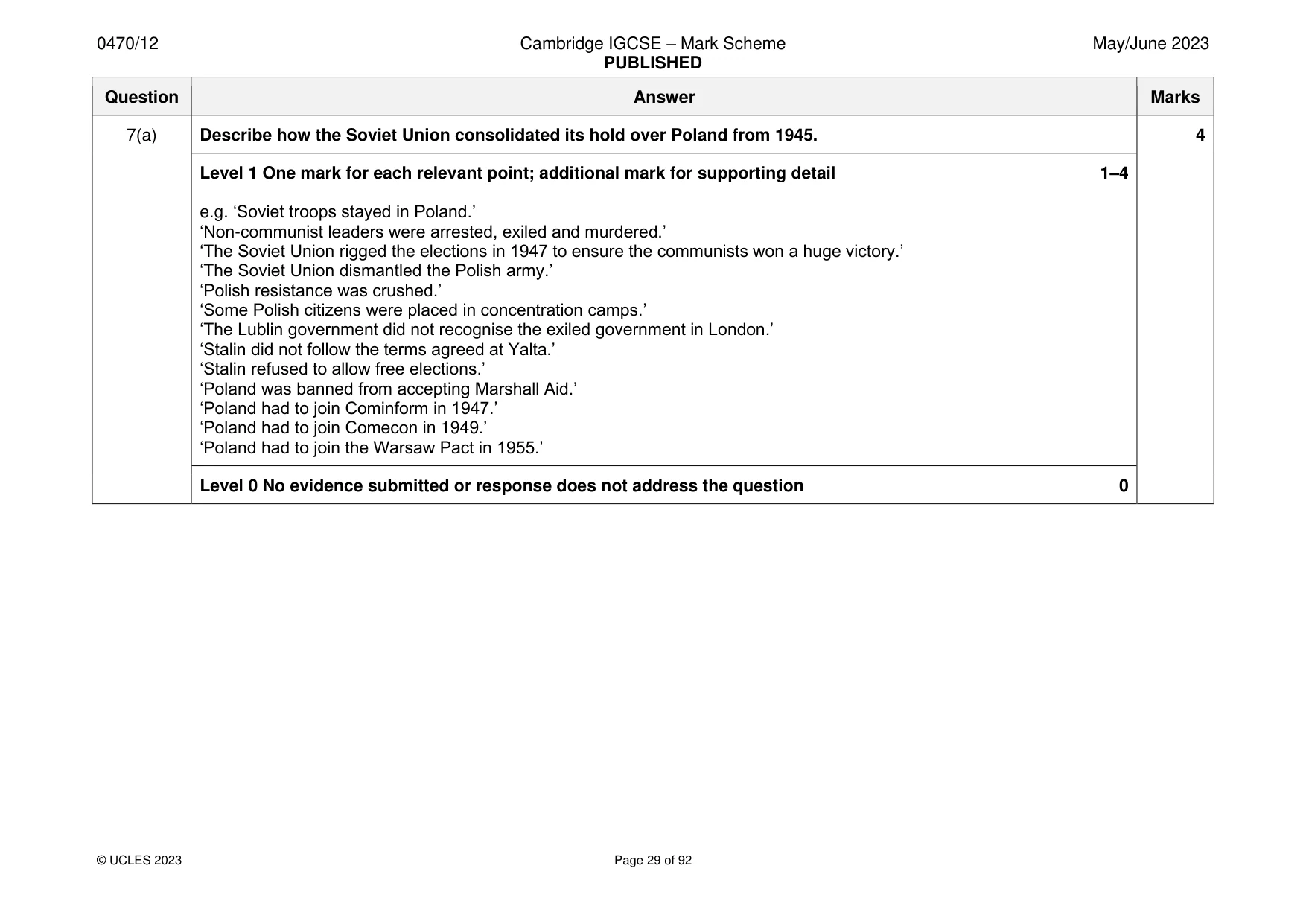
0470/12 Cambridge IGCSE – Mark Scheme PUBLISHED May/June 2023 © UCLES 2023 Page 29 of 92 Question Answer Marks 7(a) Describe how the Soviet Union consolidated its hold over Poland from 1945. 4 Level 1 One mark for each relevant point; additional mark for supporting detail 1–4 e.g. ‘Soviet troops stayed in Poland.’ ‘Non-communist leaders were arrested, exiled and murdered.’ ‘The Soviet Union rigged the elections in 1947 to ensure the communists won a huge victory.’ ‘The Soviet Union dismantled the Polish army.’ ‘Polish resistance was crushed.’ ‘Some Polish citizens were placed in concentration camps.’ ‘The Lublin government did not recognise the exiled government in London.’ ‘Stalin did not follow the terms agreed at Yalta.’ ‘Stalin refused to allow free elections.’ ‘Poland was banned from accepting Marshall Aid.’ ‘Poland had to join Cominform in 1947.’ ‘Poland had to join Comecon in 1949.’ ‘Poland had to join the Warsaw Pact in 1955.’ Level 0 No evidence submitted or response does not address the question 0
Mark scheme, page 30
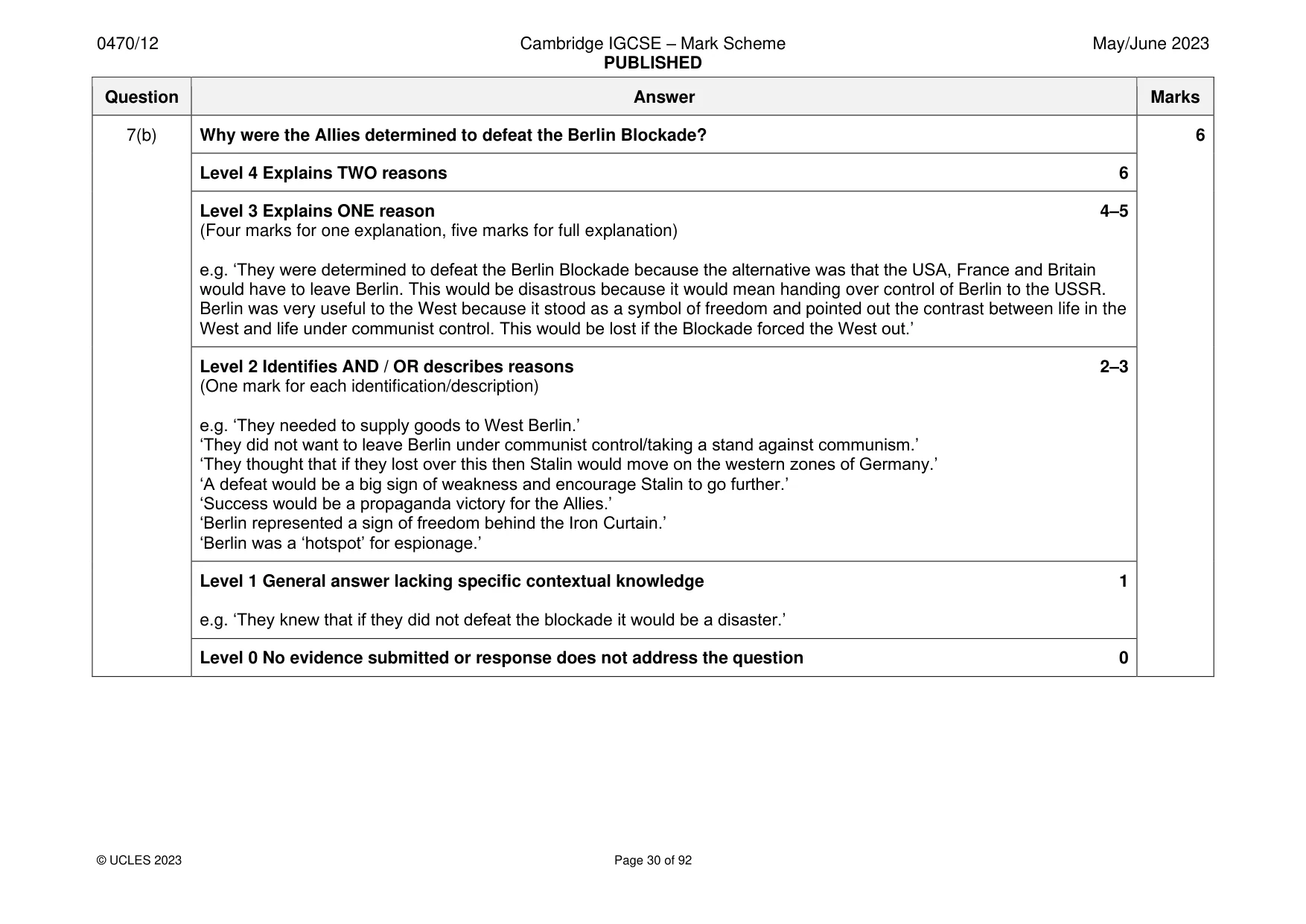
0470/12 Cambridge IGCSE – Mark Scheme PUBLISHED May/June 2023 © UCLES 2023 Page 30 of 92 Question Answer Marks 7(b) Why were the Allies determined to defeat the Berlin Blockade? 6 Level 4 Explains TWO reasons 6 Level 3 Explains ONE reason 4–5 (Four marks for one explanation, five marks for full explanation) e.g. ‘They were determined to defeat the Berlin Blockade because the alternative was that the USA, France and Britain would have to leave Berlin. This would be disastrous because it would mean handing over control of Berlin to the USSR. Berlin was very useful to the West because it stood as a symbol of freedom and pointed out the contrast between life in the West and life under communist control. This would be lost if the Blockade forced the West out.’ Level 2 Identifies AND / OR describes reasons 2–3 (One mark for each identification/description) e.g. ‘They needed to supply goods to West Berlin.’ ‘They did not want to leave Berlin under communist control/taking a stand against communism.’ ‘They thought that if they lost over this then Stalin would move on the western zones of Germany.’ ‘A defeat would be a big sign of weakness and encourage Stalin to go further.’ ‘Success would be a propaganda victory for the Allies.’ ‘Berlin represented a sign of freedom behind the Iron Curtain.’ ‘Berlin was a ‘hotspot’ for espionage.’ Level 1 General answer lacking specific contextual knowledge 1 e.g. ‘They knew that if they did not defeat the blockade it would be a disaster.’ Level 0 No evidence submitted or response does not address the question 0
Mark scheme, page 31
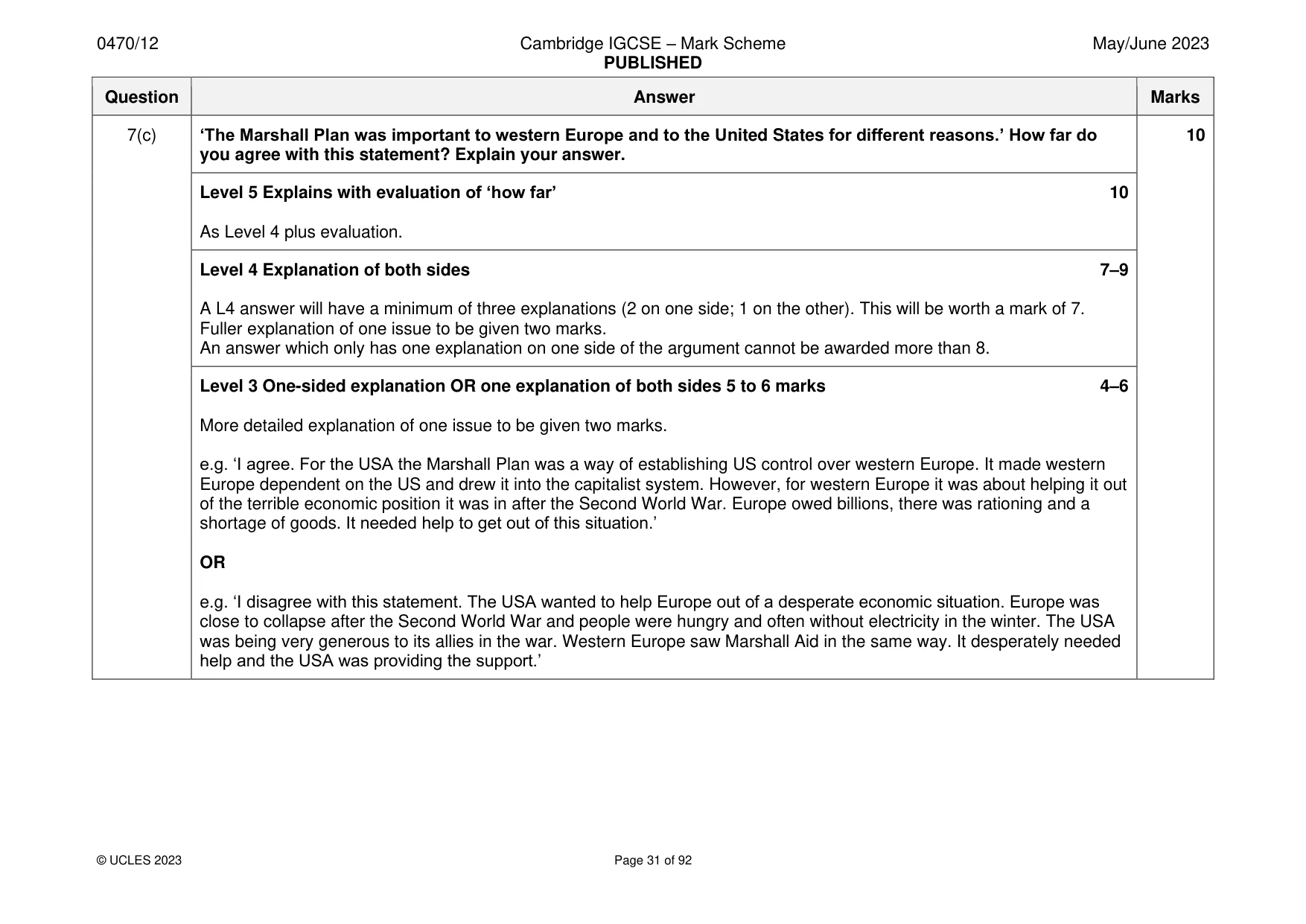
0470/12 Cambridge IGCSE – Mark Scheme PUBLISHED May/June 2023 © UCLES 2023 Page 31 of 92 Question Answer Marks 7(c) ‘The Marshall Plan was important to western Europe and to the United States for different reasons.’ How far do you agree with this statement? Explain your answer. 10 Level 5 Explains with evaluation of ‘how far’ 10 As Level 4 plus evaluation. Level 4 Explanation of both sides 7–9 A L4 answer will have a minimum of three explanations (2 on one side; 1 on the other). This will be worth a mark of 7. Fuller explanation of one issue to be given two marks. An answer which only has one explanation on one side of the argument cannot be awarded more than 8. Level 3 One-sided explanation OR one explanation of both sides 5 to 6 marks 4–6 More detailed explanation of one issue to be given two marks. e.g. ‘I agree. For the USA the Marshall Plan was a way of establishing US control over western Europe. It made western Europe dependent on the US and drew it into the capitalist system. However, for western Europe it was about helping it out of the terrible economic position it was in after the Second World War. Europe owed billions, there was rationing and a shortage of goods. It needed help to get out of this situation.’ OR e.g. ‘I disagree with this statement. The USA wanted to help Europe out of a desperate economic situation. Europe was close to collapse after the Second World War and people were hungry and often without electricity in the winter. The USA was being very generous to its allies in the war. Western Europe saw Marshall Aid in the same way. It desperately needed help and the USA was providing the support.’
Mark scheme, page 32
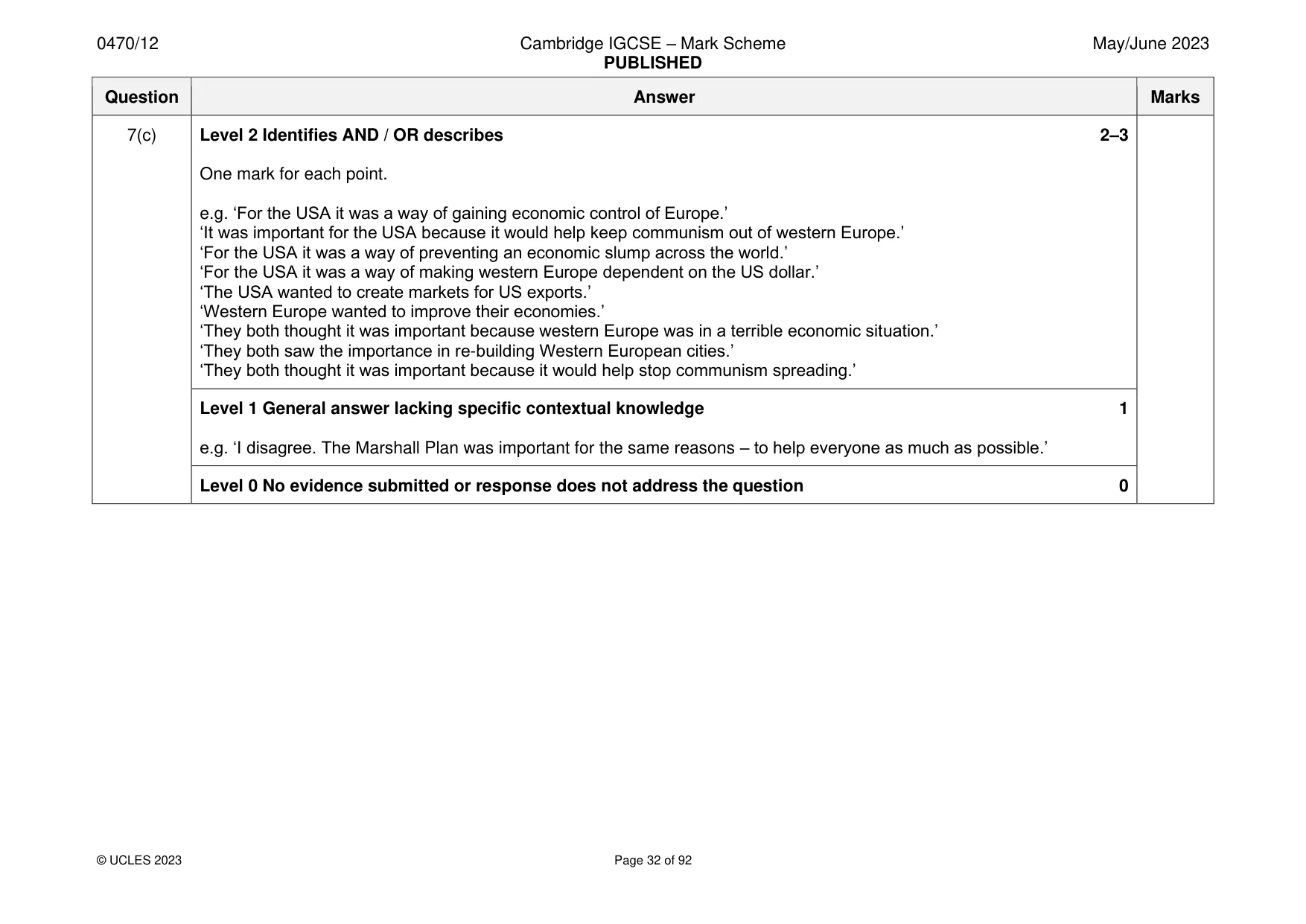
0470/12 Cambridge IGCSE – Mark Scheme PUBLISHED May/June 2023 © UCLES 2023 Page 32 of 92 Question Answer Marks 7(c) Level 2 Identifies AND / OR describes 2–3 One mark for each point. e.g. ‘For the USA it was a way of gaining economic control of Europe.’ ‘It was important for the USA because it would help keep communism out of western Europe.’ ‘For the USA it was a way of preventing an economic slump across the world.’ ‘For the USA it was a way of making western Europe dependent on the US dollar.’ ‘The USA wanted to create markets for US exports.’ ‘Western Europe wanted to improve their economies.’ ‘They both thought it was important because western Europe was in a terrible economic situation.’ ‘They both saw the importance in re-building Western European cities.’ ‘They both thought it was important because it would help stop communism spreading.’ Level 1 General answer lacking specific contextual knowledge 1 e.g. ‘I disagree. The Marshall Plan was important for the same reasons – to help everyone as much as possible.’ Level 0 No evidence submitted or response does not address the question 0
Mark scheme, page 33
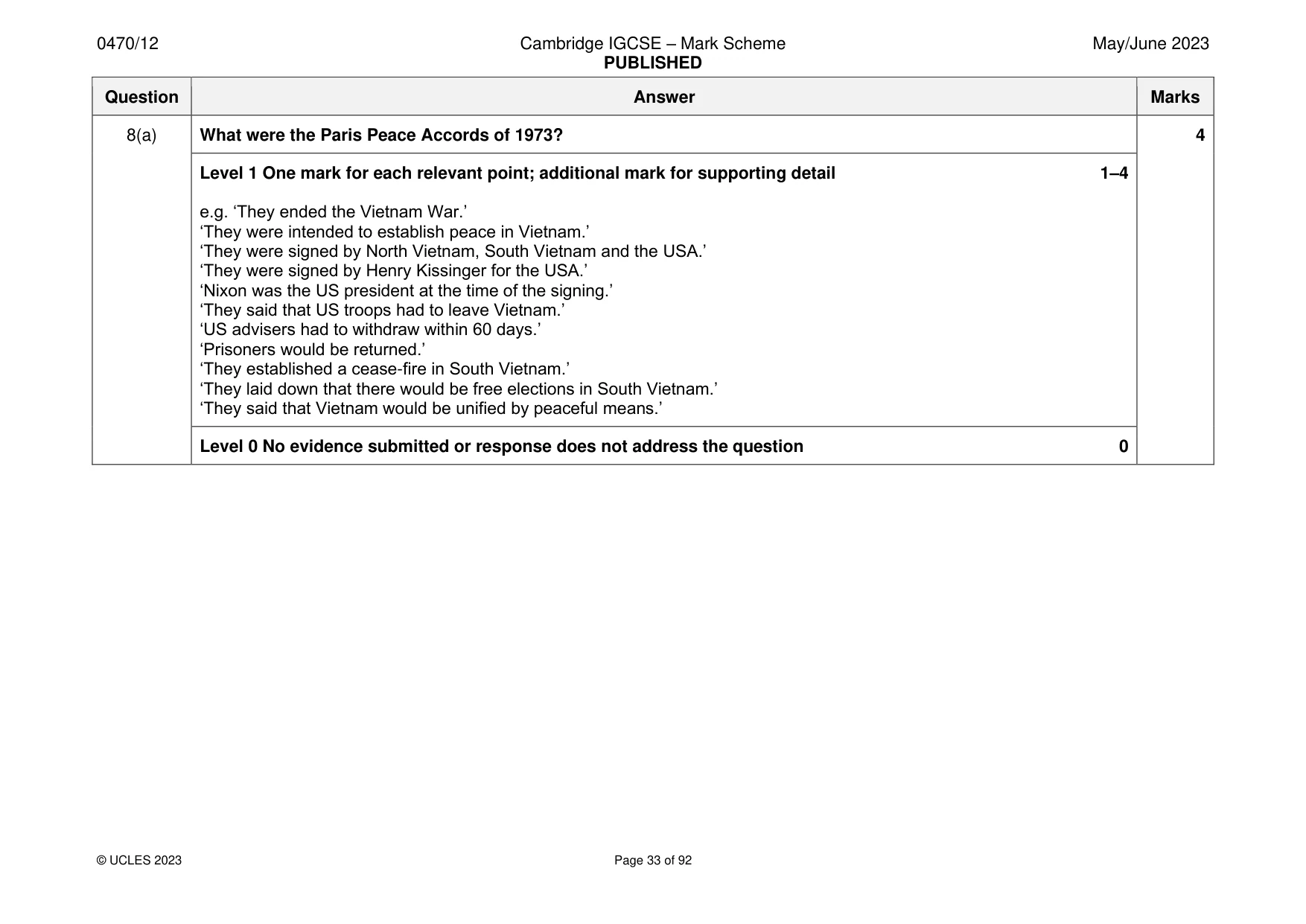
0470/12 Cambridge IGCSE – Mark Scheme PUBLISHED May/June 2023 © UCLES 2023 Page 33 of 92 Question Answer Marks 8(a) What were the Paris Peace Accords of 1973? 4 Level 1 One mark for each relevant point; additional mark for supporting detail 1–4 e.g. ‘They ended the Vietnam War.’ ‘They were intended to establish peace in Vietnam.’ ‘They were signed by North Vietnam, South Vietnam and the USA.’ ‘They were signed by Henry Kissinger for the USA.’ ‘Nixon was the US president at the time of the signing.’ ‘They said that US troops had to leave Vietnam.’ ‘US advisers had to withdraw within 60 days.’ ‘Prisoners would be returned.’ ‘They established a cease-fire in South Vietnam.’ ‘They laid down that there would be free elections in South Vietnam.’ ‘They said that Vietnam would be unified by peaceful means.’ Level 0 No evidence submitted or response does not address the question 0
Mark scheme, page 34
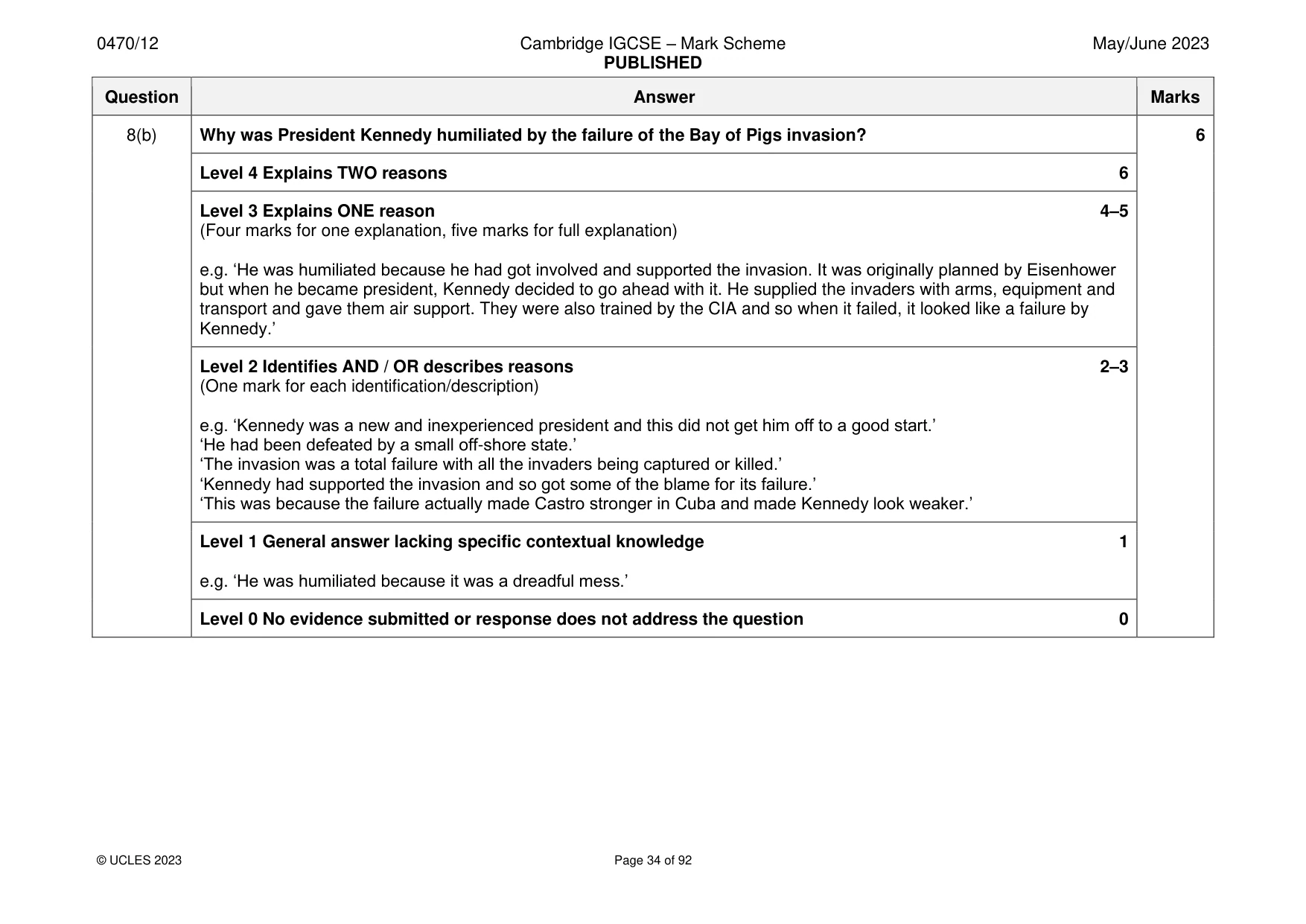
0470/12 Cambridge IGCSE – Mark Scheme PUBLISHED May/June 2023 © UCLES 2023 Page 34 of 92 Question Answer Marks 8(b) Why was President Kennedy humiliated by the failure of the Bay of Pigs invasion? 6 Level 4 Explains TWO reasons 6 Level 3 Explains ONE reason 4–5 (Four marks for one explanation, five marks for full explanation) e.g. ‘He was humiliated because he had got involved and supported the invasion. It was originally planned by Eisenhower but when he became president, Kennedy decided to go ahead with it. He supplied the invaders with arms, equipment and transport and gave them air support. They were also trained by the CIA and so when it failed, it looked like a failure by Kennedy.’ Level 2 Identifies AND / OR describes reasons 2–3 (One mark for each identification/description) e.g. ‘Kennedy was a new and inexperienced president and this did not get him off to a good start.’ ‘He had been defeated by a small off-shore state.’ ‘The invasion was a total failure with all the invaders being captured or killed.’ ‘Kennedy had supported the invasion and so got some of the blame for its failure.’ ‘This was because the failure actually made Castro stronger in Cuba and made Kennedy look weaker.’ Level 1 General answer lacking specific contextual knowledge 1 e.g. ‘He was humiliated because it was a dreadful mess.’ Level 0 No evidence submitted or response does not address the question 0
Mark scheme, page 35
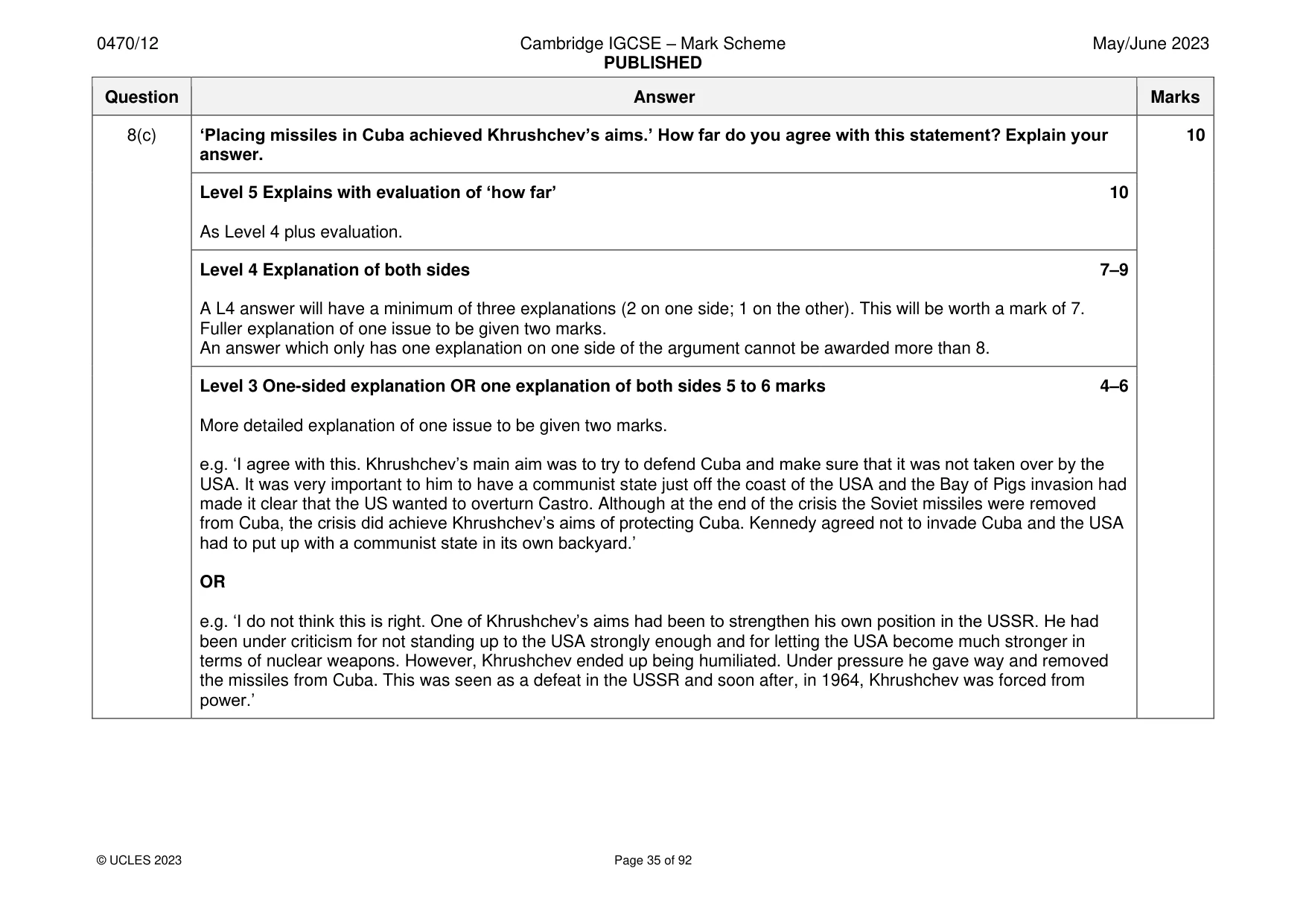
0470/12 Cambridge IGCSE – Mark Scheme PUBLISHED May/June 2023 © UCLES 2023 Page 35 of 92 Question Answer Marks 8(c) ‘Placing missiles in Cuba achieved Khrushchev’s aims.’ How far do you agree with this statement? Explain your answer. 10 Level 5 Explains with evaluation of ‘how far’ 10 As Level 4 plus evaluation. Level 4 Explanation of both sides 7–9 A L4 answer will have a minimum of three explanations (2 on one side; 1 on the other). This will be worth a mark of 7. Fuller explanation of one issue to be given two marks. An answer which only has one explanation on one side of the argument cannot be awarded more than 8. Level 3 One-sided explanation OR one explanation of both sides 5 to 6 marks 4–6 More detailed explanation of one issue to be given two marks. e.g. ‘I agree with this. Khrushchev’s main aim was to try to defend Cuba and make sure that it was not taken over by the USA. It was very important to him to have a communist state just off the coast of the USA and the Bay of Pigs invasion had made it clear that the US wanted to overturn Castro. Although at the end of the crisis the Soviet missiles were removed from Cuba, the crisis did achieve Khrushchev’s aims of protecting Cuba. Kennedy agreed not to invade Cuba and the USA had to put up with a communist state in its own backyard.’ OR e.g. ‘I do not think this is right. One of Khrushchev’s aims had been to strengthen his own position in the USSR. He had been under criticism for not standing up to the USA strongly enough and for letting the USA become much stronger in terms of nuclear weapons. However, Khrushchev ended up being humiliated. Under pressure he gave way and removed the missiles from Cuba. This was seen as a defeat in the USSR and soon after, in 1964, Khrushchev was forced from power.’
Mark scheme, page 36
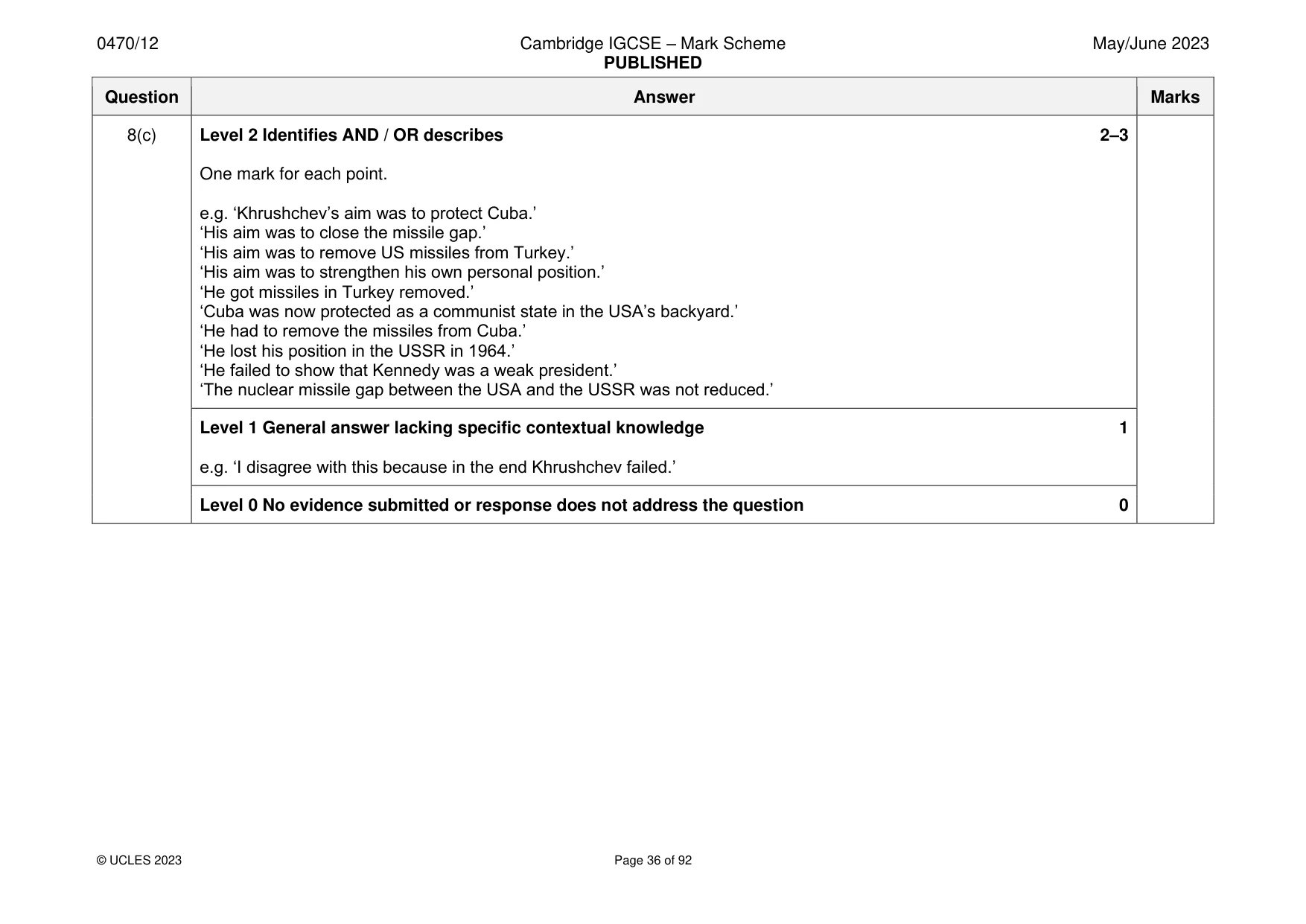
0470/12 Cambridge IGCSE – Mark Scheme PUBLISHED May/June 2023 © UCLES 2023 Page 36 of 92 Question Answer Marks 8(c) Level 2 Identifies AND / OR describes 2–3 One mark for each point. e.g. ‘Khrushchev’s aim was to protect Cuba.’ ‘His aim was to close the missile gap.’ ‘His aim was to remove US missiles from Turkey.’ ‘His aim was to strengthen his own personal position.’ ‘He got missiles in Turkey removed.’ ‘Cuba was now protected as a communist state in the USA’s backyard.’ ‘He had to remove the missiles from Cuba.’ ‘He lost his position in the USSR in 1964.’ ‘He failed to show that Kennedy was a weak president.’ ‘The nuclear missile gap between the USA and the USSR was not reduced.’ Level 1 General answer lacking specific contextual knowledge 1 e.g. ‘I disagree with this because in the end Khrushchev failed.’ Level 0 No evidence submitted or response does not address the question 0
Mark scheme, page 37
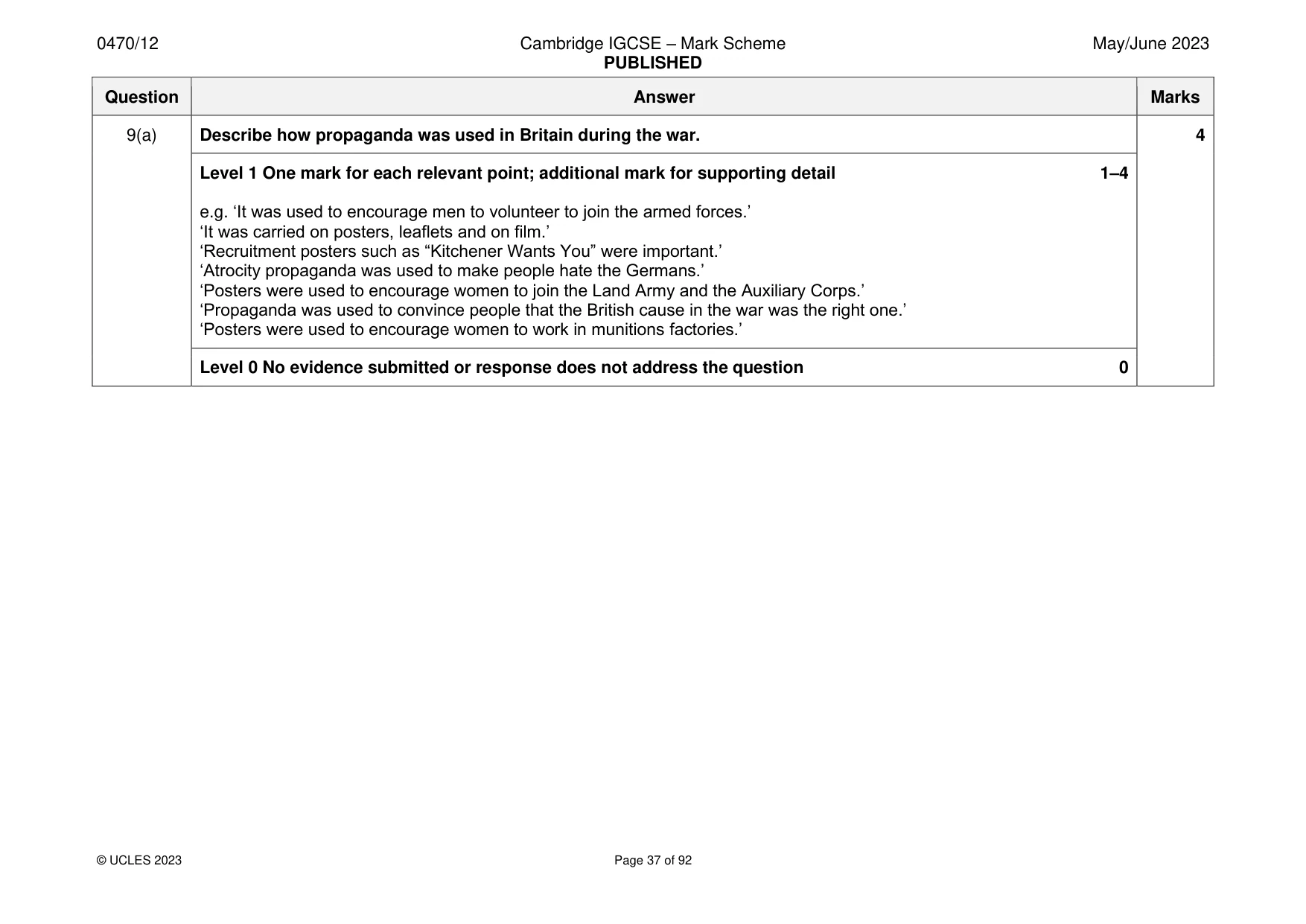
0470/12 Cambridge IGCSE – Mark Scheme PUBLISHED May/June 2023 © UCLES 2023 Page 37 of 92 Question Answer Marks 9(a) Describe how propaganda was used in Britain during the war. 4 Level 1 One mark for each relevant point; additional mark for supporting detail 1–4 e.g. ‘It was used to encourage men to volunteer to join the armed forces.’ ‘It was carried on posters, leaflets and on film.’ ‘Recruitment posters such as “Kitchener Wants You” were important.’ ‘Atrocity propaganda was used to make people hate the Germans.’ ‘Posters were used to encourage women to join the Land Army and the Auxiliary Corps.’ ‘Propaganda was used to convince people that the British cause in the war was the right one.’ ‘Posters were used to encourage women to work in munitions factories.’ Level 0 No evidence submitted or response does not address the question 0
Mark scheme, page 38
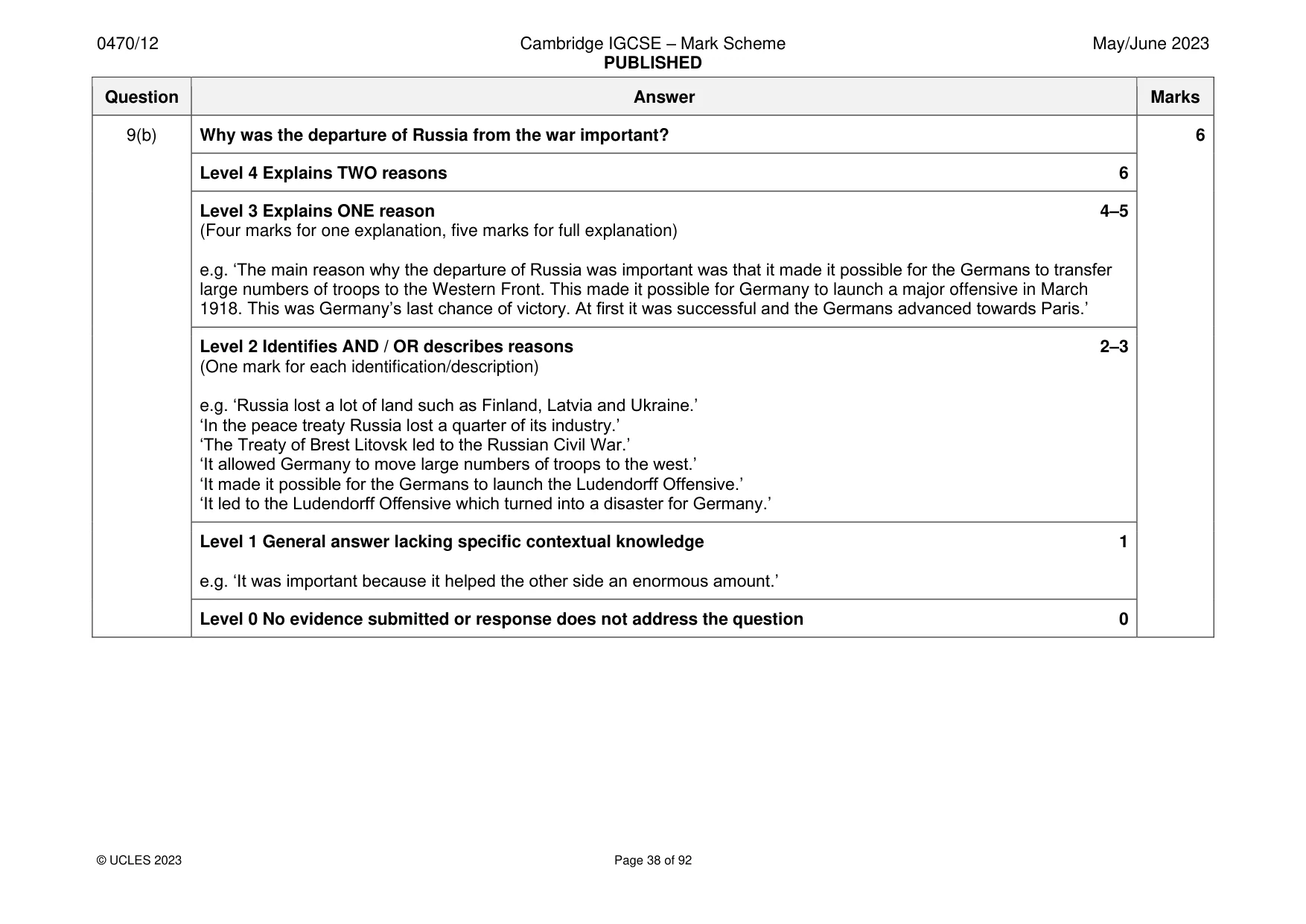
0470/12 Cambridge IGCSE – Mark Scheme PUBLISHED May/June 2023 © UCLES 2023 Page 38 of 92 Question Answer Marks 9(b) Why was the departure of Russia from the war important? 6 Level 4 Explains TWO reasons 6 Level 3 Explains ONE reason 4–5 (Four marks for one explanation, five marks for full explanation) e.g. ‘The main reason why the departure of Russia was important was that it made it possible for the Germans to transfer large numbers of troops to the Western Front. This made it possible for Germany to launch a major offensive in March 1918. This was Germany’s last chance of victory. At first it was successful and the Germans advanced towards Paris.’ Level 2 Identifies AND / OR describes reasons 2–3 (One mark for each identification/description) e.g. ‘Russia lost a lot of land such as Finland, Latvia and Ukraine.’ ‘In the peace treaty Russia lost a quarter of its industry.’ ‘The Treaty of Brest Litovsk led to the Russian Civil War.’ ‘It allowed Germany to move large numbers of troops to the west.’ ‘It made it possible for the Germans to launch the Ludendorff Offensive.’ ‘It led to the Ludendorff Offensive which turned into a disaster for Germany.’ Level 1 General answer lacking specific contextual knowledge 1 e.g. ‘It was important because it helped the other side an enormous amount.’ Level 0 No evidence submitted or response does not address the question 0
Mark scheme, page 39
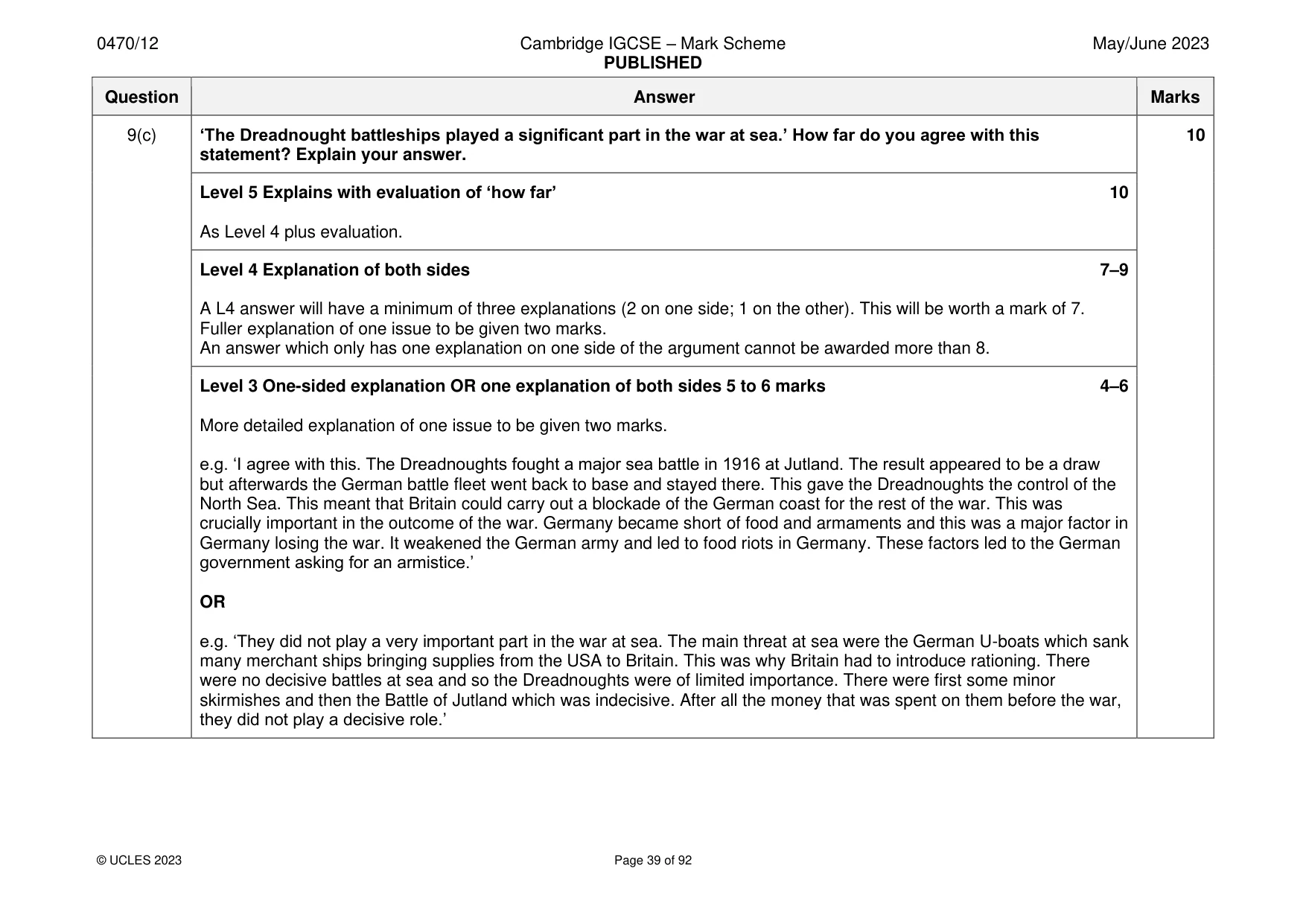
0470/12 Cambridge IGCSE – Mark Scheme PUBLISHED May/June 2023 © UCLES 2023 Page 39 of 92 Question Answer Marks 9(c) ‘The Dreadnought battleships played a significant part in the war at sea.’ How far do you agree with this statement? Explain your answer. 10 Level 5 Explains with evaluation of ‘how far’ 10 As Level 4 plus evaluation. Level 4 Explanation of both sides 7–9 A L4 answer will have a minimum of three explanations (2 on one side; 1 on the other). This will be worth a mark of 7. Fuller explanation of one issue to be given two marks. An answer which only has one explanation on one side of the argument cannot be awarded more than 8. Level 3 One-sided explanation OR one explanation of both sides 5 to 6 marks 4–6 More detailed explanation of one issue to be given two marks. e.g. ‘I agree with this. The Dreadnoughts fought a major sea battle in 1916 at Jutland. The result appeared to be a draw but afterwards the German battle fleet went back to base and stayed there. This gave the Dreadnoughts the control of the North Sea. This meant that Britain could carry out a blockade of the German coast for the rest of the war. This was crucially important in the outcome of the war. Germany became short of food and armaments and this was a major factor in Germany losing the war. It weakened the German army and led to food riots in Germany. These factors led to the German government asking for an armistice.’ OR e.g. ‘They did not play a very important part in the war at sea. The main threat at sea were the German U-boats which sank many merchant ships bringing supplies from the USA to Britain. This was why Britain had to introduce rationing. There were no decisive battles at sea and so the Dreadnoughts were of limited importance. There were first some minor skirmishes and then the Battle of Jutland which was indecisive. After all the money that was spent on them before the war, they did not play a decisive role.’
Mark scheme, page 40
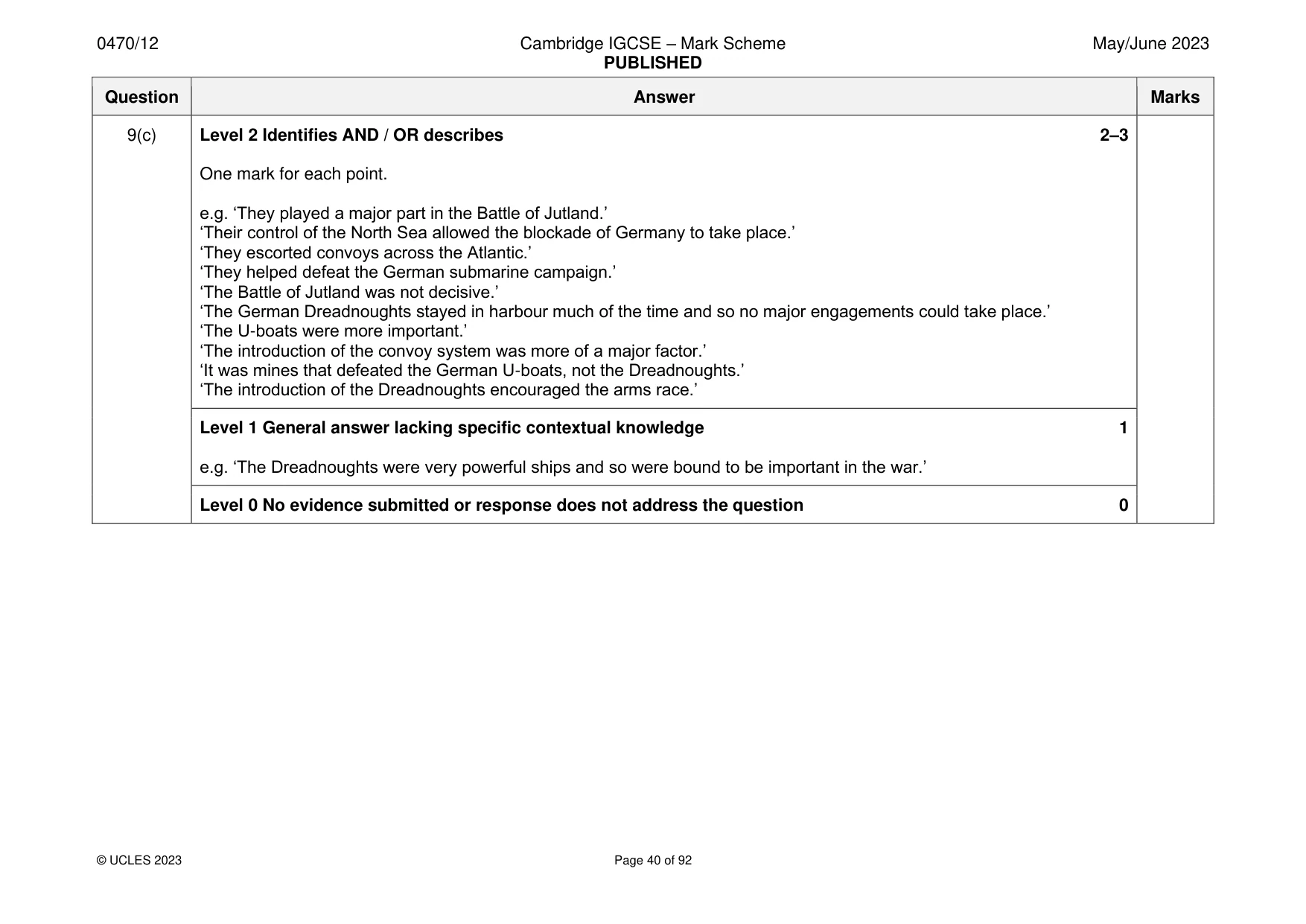
0470/12 Cambridge IGCSE – Mark Scheme PUBLISHED May/June 2023 © UCLES 2023 Page 40 of 92 Question Answer Marks 9(c) Level 2 Identifies AND / OR describes 2–3 One mark for each point. e.g. ‘They played a major part in the Battle of Jutland.’ ‘Their control of the North Sea allowed the blockade of Germany to take place.’ ‘They escorted convoys across the Atlantic.’ ‘They helped defeat the German submarine campaign.’ ‘The Battle of Jutland was not decisive.’ ‘The German Dreadnoughts stayed in harbour much of the time and so no major engagements could take place.’ ‘The U-boats were more important.’ ‘The introduction of the convoy system was more of a major factor.’ ‘It was mines that defeated the German U-boats, not the Dreadnoughts.’ ‘The introduction of the Dreadnoughts encouraged the arms race.’ Level 1 General answer lacking specific contextual knowledge 1 e.g. ‘The Dreadnoughts were very powerful ships and so were bound to be important in the war.’ Level 0 No evidence submitted or response does not address the question 0
Mark scheme, page 41
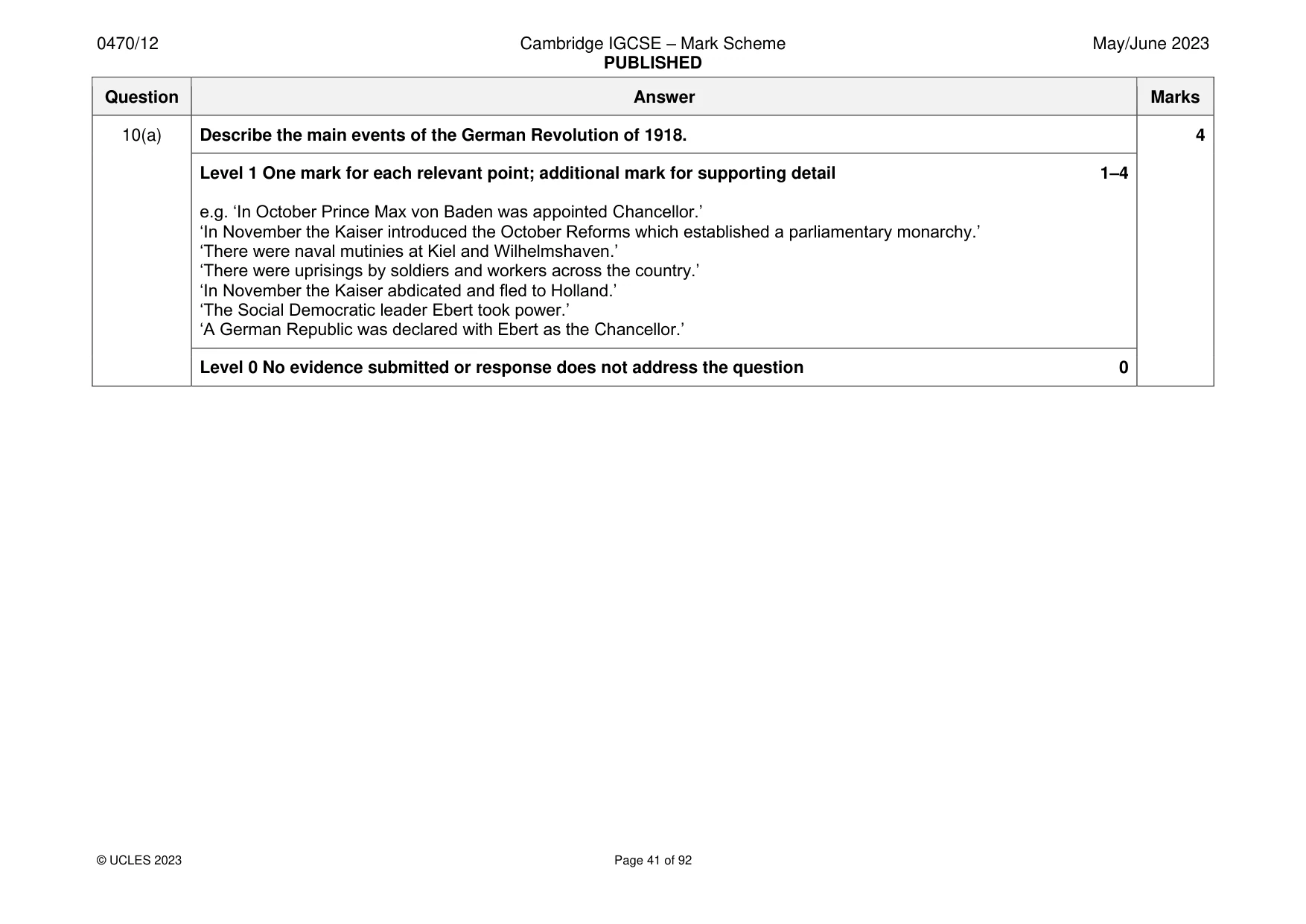
0470/12 Cambridge IGCSE – Mark Scheme PUBLISHED May/June 2023 © UCLES 2023 Page 41 of 92 Question Answer Marks 10(a) Describe the main events of the German Revolution of 1918. 4 Level 1 One mark for each relevant point; additional mark for supporting detail 1–4 e.g. ‘In October Prince Max von Baden was appointed Chancellor.’ ‘In November the Kaiser introduced the October Reforms which established a parliamentary monarchy.’ ‘There were naval mutinies at Kiel and Wilhelmshaven.’ ‘There were uprisings by soldiers and workers across the country.’ ‘In November the Kaiser abdicated and fled to Holland.’ ‘The Social Democratic leader Ebert took power.’ ‘A German Republic was declared with Ebert as the Chancellor.’ Level 0 No evidence submitted or response does not address the question 0
Mark scheme, page 42
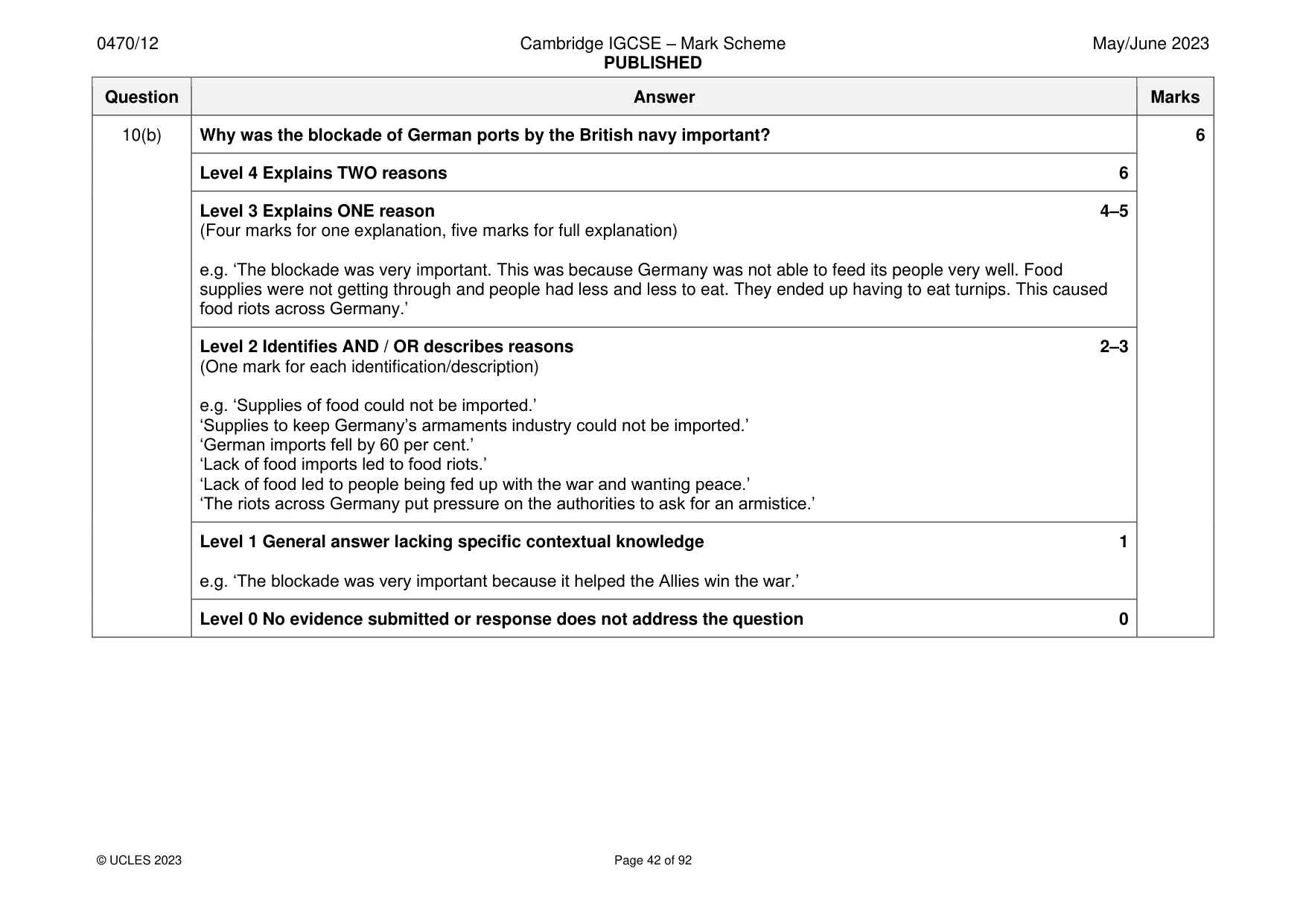
0470/12 Cambridge IGCSE – Mark Scheme PUBLISHED May/June 2023 © UCLES 2023 Page 42 of 92 Question Answer Marks 10(b) Why was the blockade of German ports by the British navy important? 6 Level 4 Explains TWO reasons 6 Level 3 Explains ONE reason 4–5 (Four marks for one explanation, five marks for full explanation) e.g. ‘The blockade was very important. This was because Germany was not able to feed its people very well. Food supplies were not getting through and people had less and less to eat. They ended up having to eat turnips. This caused food riots across Germany.’ Level 2 Identifies AND / OR describes reasons 2–3 (One mark for each identification/description) e.g. ‘Supplies of food could not be imported.’ ‘Supplies to keep Germany’s armaments industry could not be imported.’ ‘German imports fell by 60 per cent.’ ‘Lack of food imports led to food riots.’ ‘Lack of food led to people being fed up with the war and wanting peace.’ ‘The riots across Germany put pressure on the authorities to ask for an armistice.’ Level 1 General answer lacking specific contextual knowledge 1 e.g. ‘The blockade was very important because it helped the Allies win the war.’ Level 0 No evidence submitted or response does not address the question 0
Mark scheme, page 43
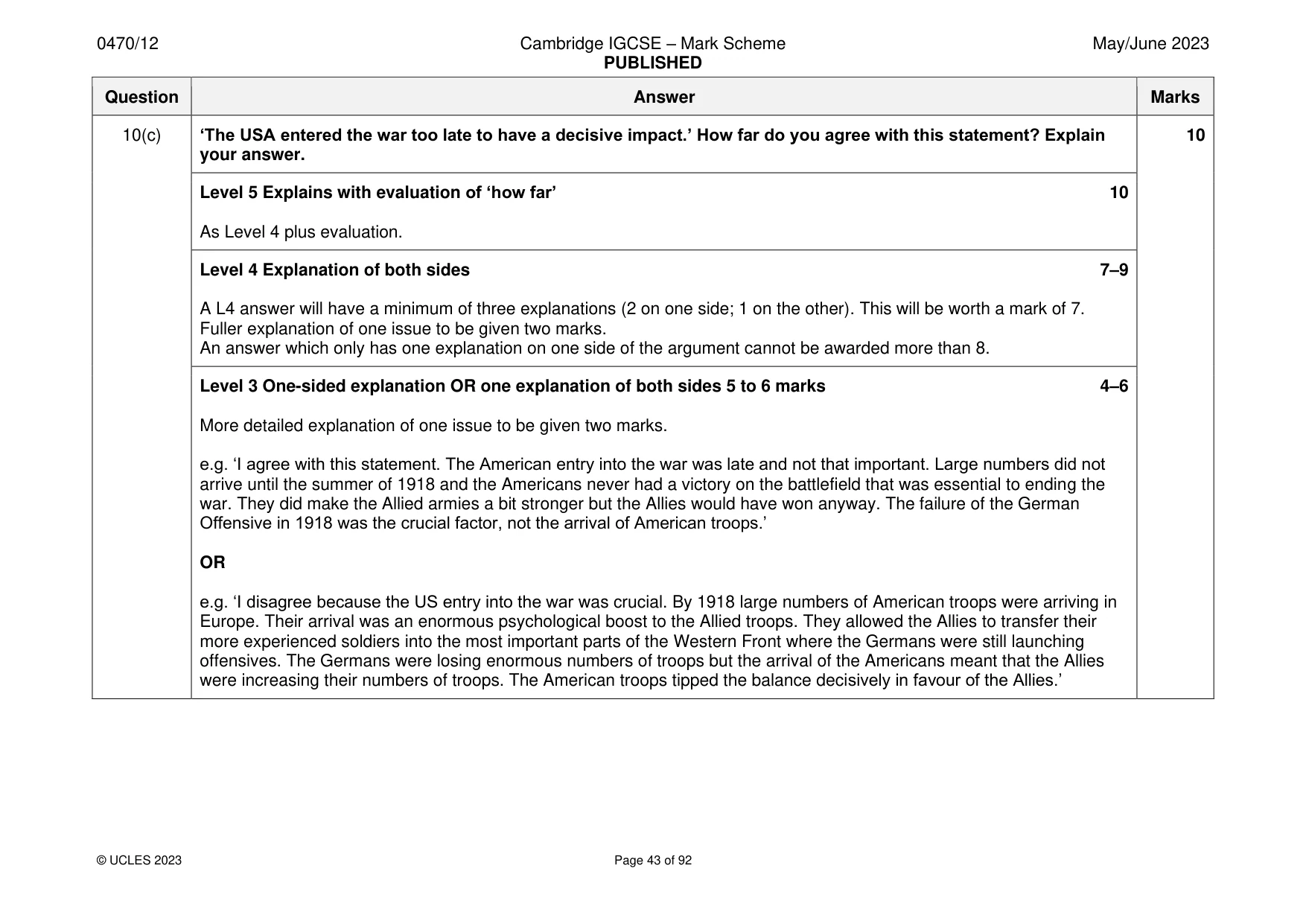
0470/12 Cambridge IGCSE – Mark Scheme PUBLISHED May/June 2023 © UCLES 2023 Page 43 of 92 Question Answer Marks 10(c) ‘The USA entered the war too late to have a decisive impact.’ How far do you agree with this statement? Explain your answer. 10 Level 5 Explains with evaluation of ‘how far’ 10 As Level 4 plus evaluation. Level 4 Explanation of both sides 7–9 A L4 answer will have a minimum of three explanations (2 on one side; 1 on the other). This will be worth a mark of 7. Fuller explanation of one issue to be given two marks. An answer which only has one explanation on one side of the argument cannot be awarded more than 8. Level 3 One-sided explanation OR one explanation of both sides 5 to 6 marks 4–6 More detailed explanation of one issue to be given two marks. e.g. ‘I agree with this statement. The American entry into the war was late and not that important. Large numbers did not arrive until the summer of 1918 and the Americans never had a victory on the battlefield that was essential to ending the war. They did make the Allied armies a bit stronger but the Allies would have won anyway. The failure of the German Offensive in 1918 was the crucial factor, not the arrival of American troops.’ OR e.g. ‘I disagree because the US entry into the war was crucial. By 1918 large numbers of American troops were arriving in Europe. Their arrival was an enormous psychological boost to the Allied troops. They allowed the Allies to transfer their more experienced soldiers into the most important parts of the Western Front where the Germans were still launching offensives. The Germans were losing enormous numbers of troops but the arrival of the Americans meant that the Allies were increasing their numbers of troops. The American troops tipped the balance decisively in favour of the Allies.’
Mark scheme, page 44
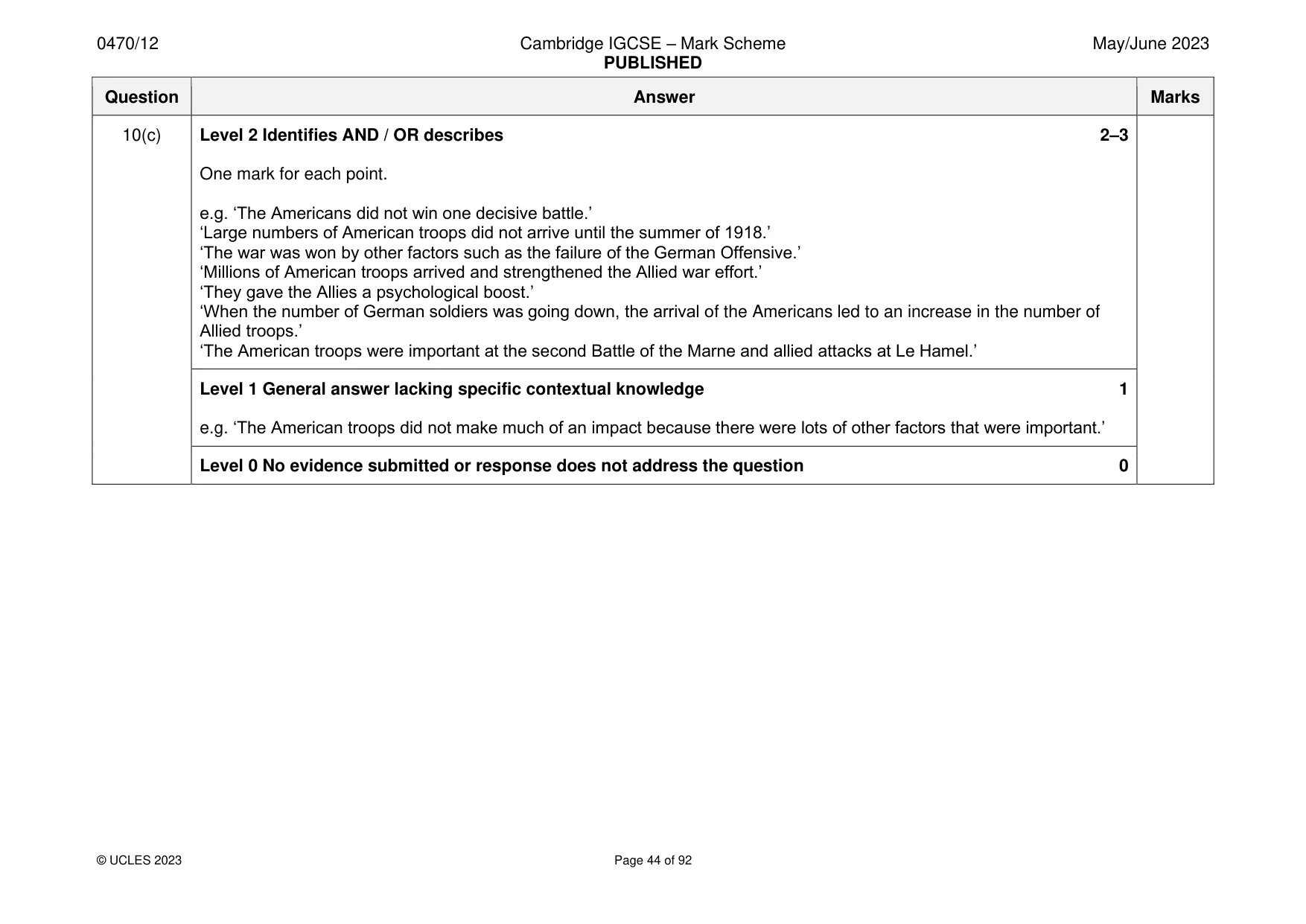
0470/12 Cambridge IGCSE – Mark Scheme PUBLISHED May/June 2023 © UCLES 2023 Page 44 of 92 Question Answer Marks 10(c) Level 2 Identifies AND / OR describes 2–3 One mark for each point. e.g. ‘The Americans did not win one decisive battle.’ ‘Large numbers of American troops did not arrive until the summer of 1918.’ ‘The war was won by other factors such as the failure of the German Offensive.’ ‘Millions of American troops arrived and strengthened the Allied war effort.’ ‘They gave the Allies a psychological boost.’ ‘When the number of German soldiers was going down, the arrival of the Americans led to an increase in the number of Allied troops.’ ‘The American troops were important at the second Battle of the Marne and allied attacks at Le Hamel.’ Level 1 General answer lacking specific contextual knowledge 1 e.g. ‘The American troops did not make much of an impact because there were lots of other factors that were important.’ Level 0 No evidence submitted or response does not address the question 0
Mark scheme, page 45
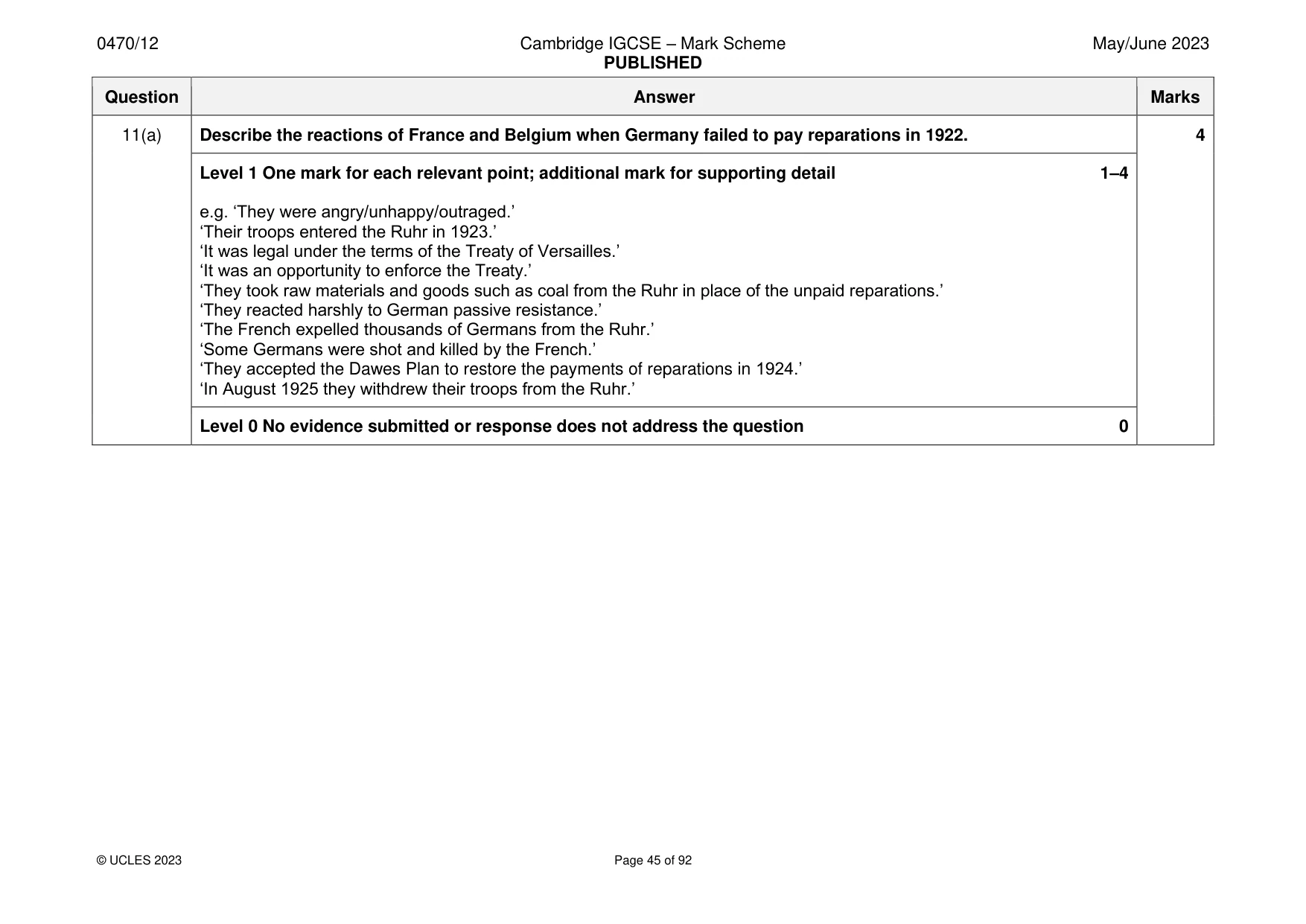
0470/12 Cambridge IGCSE – Mark Scheme PUBLISHED May/June 2023 © UCLES 2023 Page 45 of 92 Question Answer Marks 11(a) Describe the reactions of France and Belgium when Germany failed to pay reparations in 1922. 4 Level 1 One mark for each relevant point; additional mark for supporting detail 1–4 e.g. ‘They were angry/unhappy/outraged.’ ‘Their troops entered the Ruhr in 1923.’ ‘It was legal under the terms of the Treaty of Versailles.’ ‘It was an opportunity to enforce the Treaty.’ ‘They took raw materials and goods such as coal from the Ruhr in place of the unpaid reparations.’ ‘They reacted harshly to German passive resistance.’ ‘The French expelled thousands of Germans from the Ruhr.’ ‘Some Germans were shot and killed by the French.’ ‘They accepted the Dawes Plan to restore the payments of reparations in 1924.’ ‘In August 1925 they withdrew their troops from the Ruhr.’ Level 0 No evidence submitted or response does not address the question 0
Mark scheme, page 46
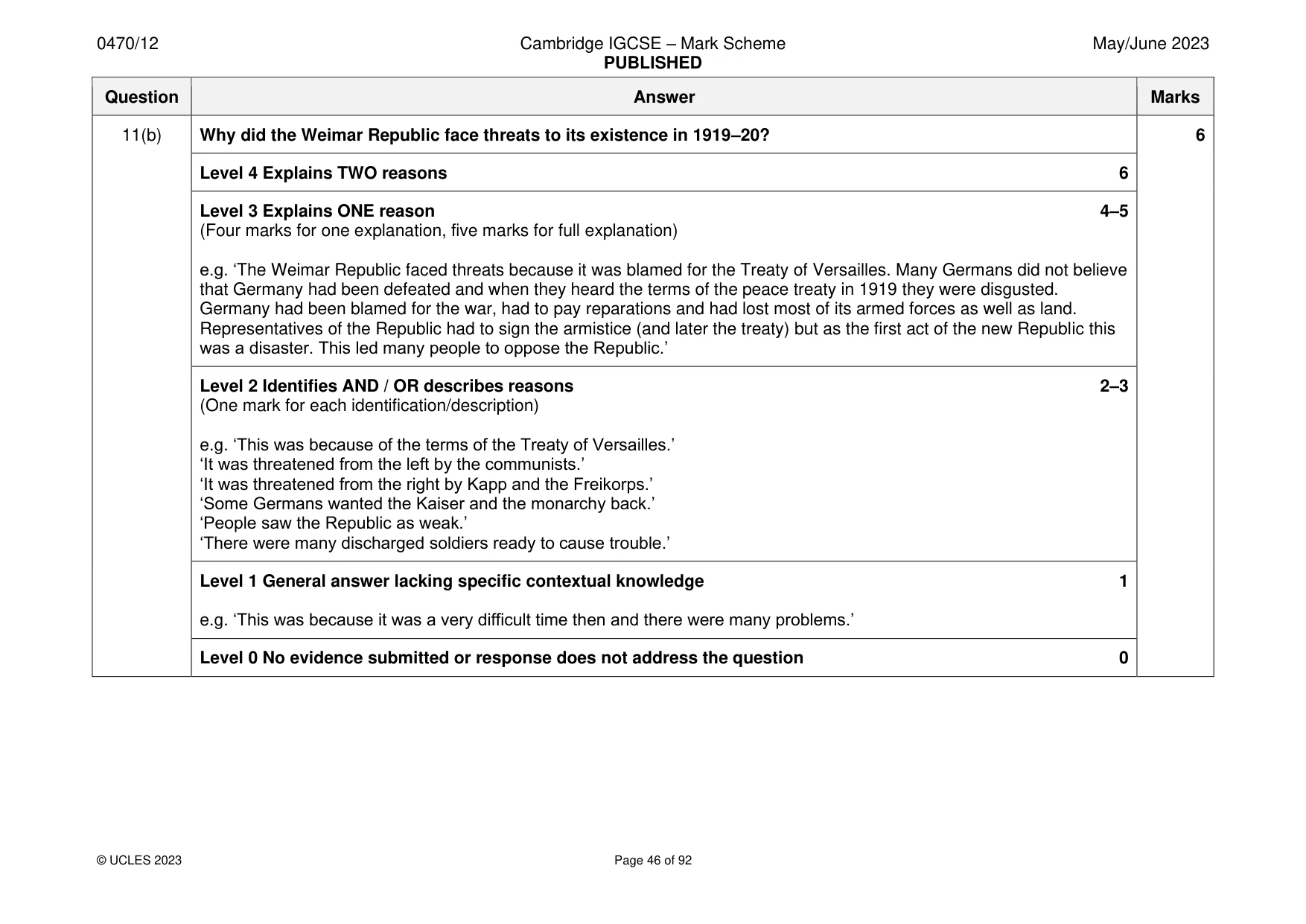
0470/12 Cambridge IGCSE – Mark Scheme PUBLISHED May/June 2023 © UCLES 2023 Page 46 of 92 Question Answer Marks 11(b) Why did the Weimar Republic face threats to its existence in 1919–20? 6 Level 4 Explains TWO reasons 6 Level 3 Explains ONE reason 4–5 (Four marks for one explanation, five marks for full explanation) e.g. ‘The Weimar Republic faced threats because it was blamed for the Treaty of Versailles. Many Germans did not believe that Germany had been defeated and when they heard the terms of the peace treaty in 1919 they were disgusted. Germany had been blamed for the war, had to pay reparations and had lost most of its armed forces as well as land. Representatives of the Republic had to sign the armistice (and later the treaty) but as the first act of the new Republic this was a disaster. This led many people to oppose the Republic.’ Level 2 Identifies AND / OR describes reasons 2–3 (One mark for each identification/description) e.g. ‘This was because of the terms of the Treaty of Versailles.’ ‘It was threatened from the left by the communists.’ ‘It was threatened from the right by Kapp and the Freikorps.’ ‘Some Germans wanted the Kaiser and the monarchy back.’ ‘People saw the Republic as weak.’ ‘There were many discharged soldiers ready to cause trouble.’ Level 1 General answer lacking specific contextual knowledge 1 e.g. ‘This was because it was a very difficult time then and there were many problems.’ Level 0 No evidence submitted or response does not address the question 0
Mark scheme, page 47
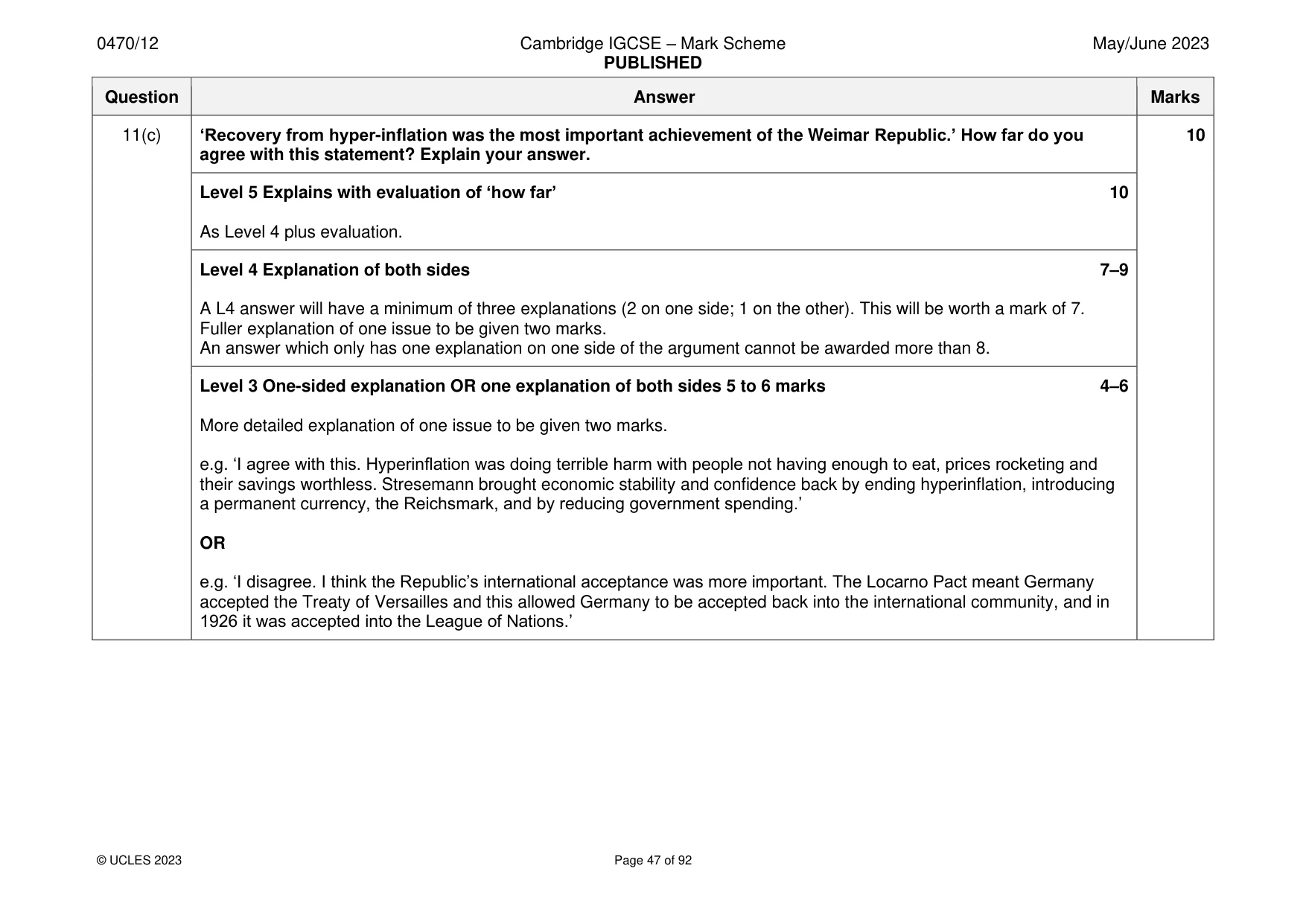
0470/12 Cambridge IGCSE – Mark Scheme PUBLISHED May/June 2023 © UCLES 2023 Page 47 of 92 Question Answer Marks 11(c) ‘Recovery from hyper-inflation was the most important achievement of the Weimar Republic.’ How far do you agree with this statement? Explain your answer. 10 Level 5 Explains with evaluation of ‘how far’ 10 As Level 4 plus evaluation. Level 4 Explanation of both sides 7–9 A L4 answer will have a minimum of three explanations (2 on one side; 1 on the other). This will be worth a mark of 7. Fuller explanation of one issue to be given two marks. An answer which only has one explanation on one side of the argument cannot be awarded more than 8. Level 3 One-sided explanation OR one explanation of both sides 5 to 6 marks 4–6 More detailed explanation of one issue to be given two marks. e.g. ‘I agree with this. Hyperinflation was doing terrible harm with people not having enough to eat, prices rocketing and their savings worthless. Stresemann brought economic stability and confidence back by ending hyperinflation, introducing a permanent currency, the Reichsmark, and by reducing government spending.’ OR e.g. ‘I disagree. I think the Republic’s international acceptance was more important. The Locarno Pact meant Germany accepted the Treaty of Versailles and this allowed Germany to be accepted back into the international community, and in 1926 it was accepted into the League of Nations.’
Mark scheme, page 48
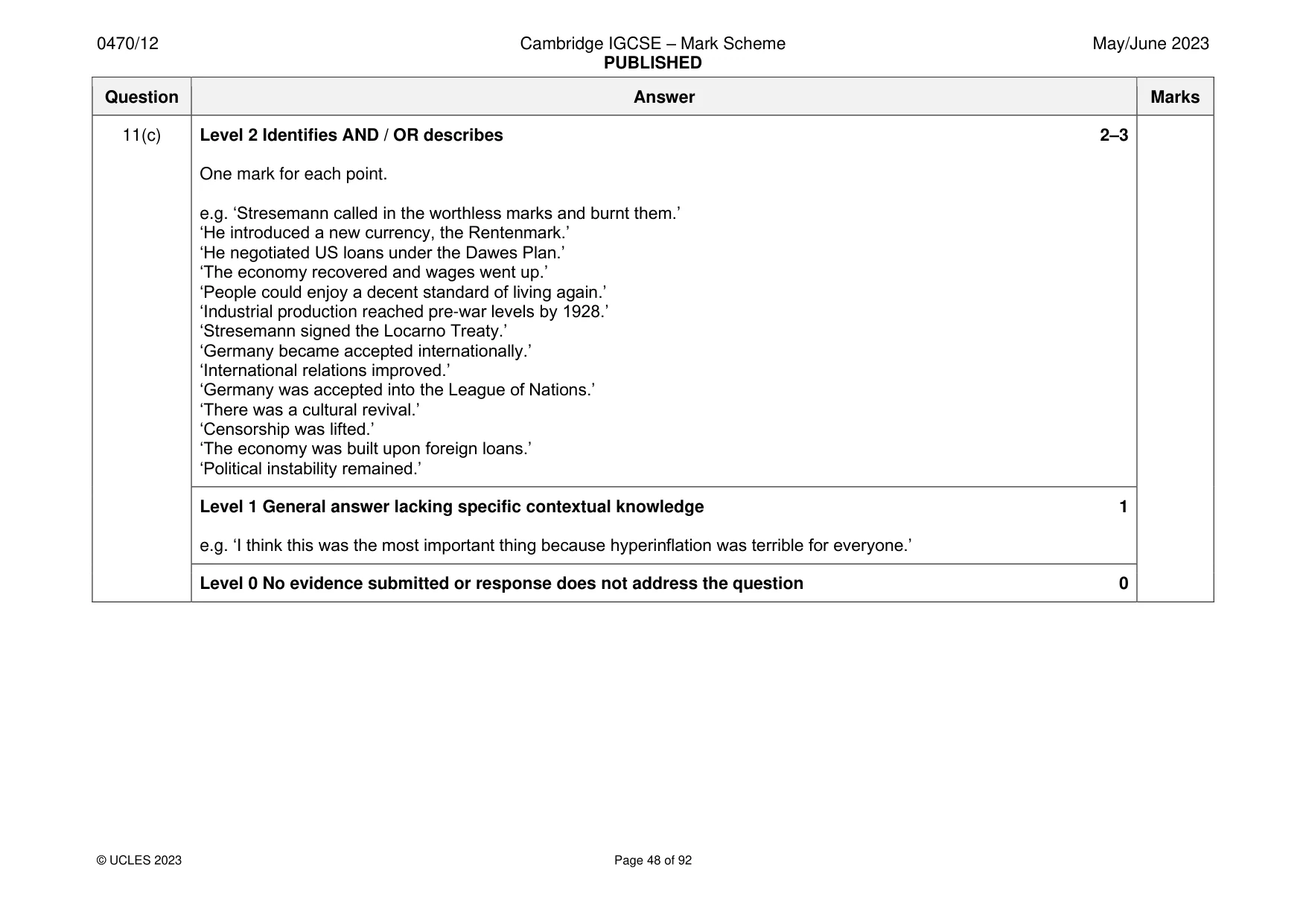
0470/12 Cambridge IGCSE – Mark Scheme PUBLISHED May/June 2023 © UCLES 2023 Page 48 of 92 Question Answer Marks 11(c) Level 2 Identifies AND / OR describes 2–3 One mark for each point. e.g. ‘Stresemann called in the worthless marks and burnt them.’ ‘He introduced a new currency, the Rentenmark.’ ‘He negotiated US loans under the Dawes Plan.’ ‘The economy recovered and wages went up.’ ‘People could enjoy a decent standard of living again.’ ‘Industrial production reached pre-war levels by 1928.’ ‘Stresemann signed the Locarno Treaty.’ ‘Germany became accepted internationally.’ ‘International relations improved.’ ‘Germany was accepted into the League of Nations.’ ‘There was a cultural revival.’ ‘Censorship was lifted.’ ‘The economy was built upon foreign loans.’ ‘Political instability remained.’ Level 1 General answer lacking specific contextual knowledge 1 e.g. ‘I think this was the most important thing because hyperinflation was terrible for everyone.’ Level 0 No evidence submitted or response does not address the question 0
Mark scheme, page 49
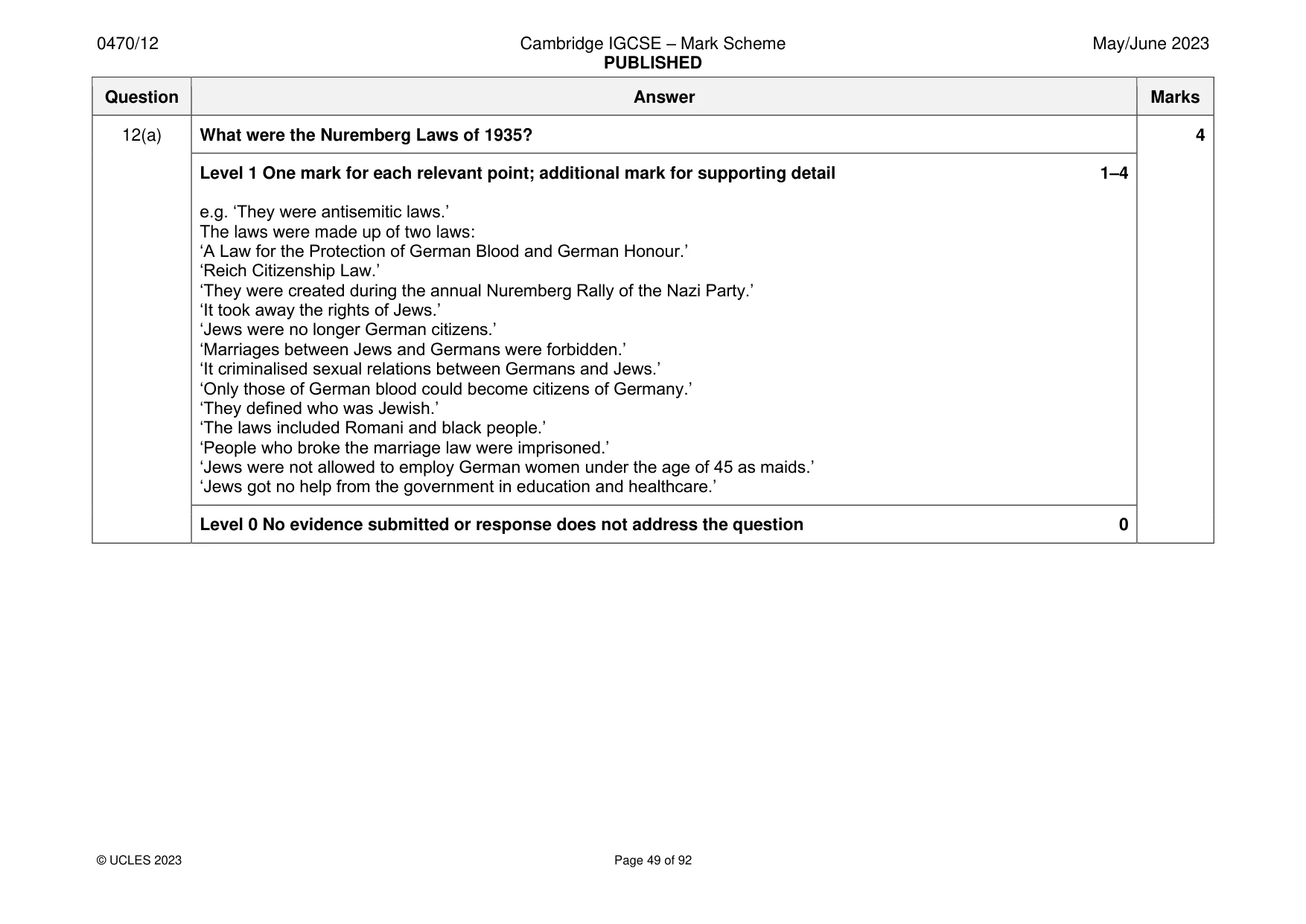
0470/12 Cambridge IGCSE – Mark Scheme PUBLISHED May/June 2023 © UCLES 2023 Page 49 of 92 Question Answer Marks 12(a) What were the Nuremberg Laws of 1935? 4 Level 1 One mark for each relevant point; additional mark for supporting detail 1–4 e.g. ‘They were antisemitic laws.’ The laws were made up of two laws: ‘A Law for the Protection of German Blood and German Honour.’ ‘Reich Citizenship Law.’ ‘They were created during the annual Nuremberg Rally of the Nazi Party.’ ‘It took away the rights of Jews.’ ‘Jews were no longer German citizens.’ ‘Marriages between Jews and Germans were forbidden.’ ‘It criminalised sexual relations between Germans and Jews.’ ‘Only those of German blood could become citizens of Germany.’ ‘They defined who was Jewish.’ ‘The laws included Romani and black people.’ ‘People who broke the marriage law were imprisoned.’ ‘Jews were not allowed to employ German women under the age of 45 as maids.’ ‘Jews got no help from the government in education and healthcare.’ Level 0 No evidence submitted or response does not address the question 0
Mark scheme, page 50
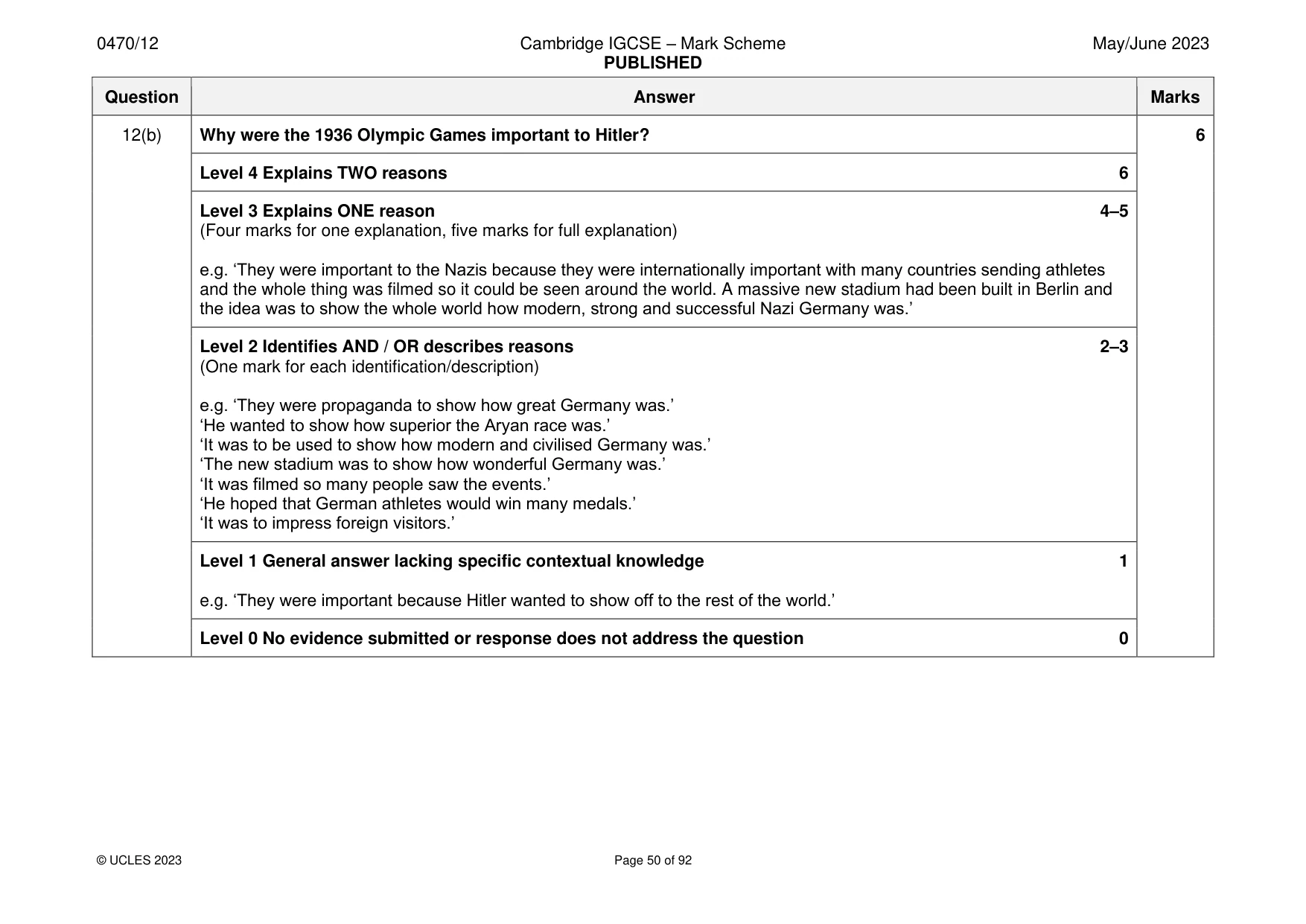
0470/12 Cambridge IGCSE – Mark Scheme PUBLISHED May/June 2023 © UCLES 2023 Page 50 of 92 Question Answer Marks 12(b) Why were the 1936 Olympic Games important to Hitler? 6 Level 4 Explains TWO reasons 6 Level 3 Explains ONE reason 4–5 (Four marks for one explanation, five marks for full explanation) e.g. ‘They were important to the Nazis because they were internationally important with many countries sending athletes and the whole thing was filmed so it could be seen around the world. A massive new stadium had been built in Berlin and the idea was to show the whole world how modern, strong and successful Nazi Germany was.’ Level 2 Identifies AND / OR describes reasons 2–3 (One mark for each identification/description) e.g. ‘They were propaganda to show how great Germany was.’ ‘He wanted to show how superior the Aryan race was.’ ‘It was to be used to show how modern and civilised Germany was.’ ‘The new stadium was to show how wonderful Germany was.’ ‘It was filmed so many people saw the events.’ ‘He hoped that German athletes would win many medals.’ ‘It was to impress foreign visitors.’ Level 1 General answer lacking specific contextual knowledge 1 e.g. ‘They were important because Hitler wanted to show off to the rest of the world.’ Level 0 No evidence submitted or response does not address the question 0
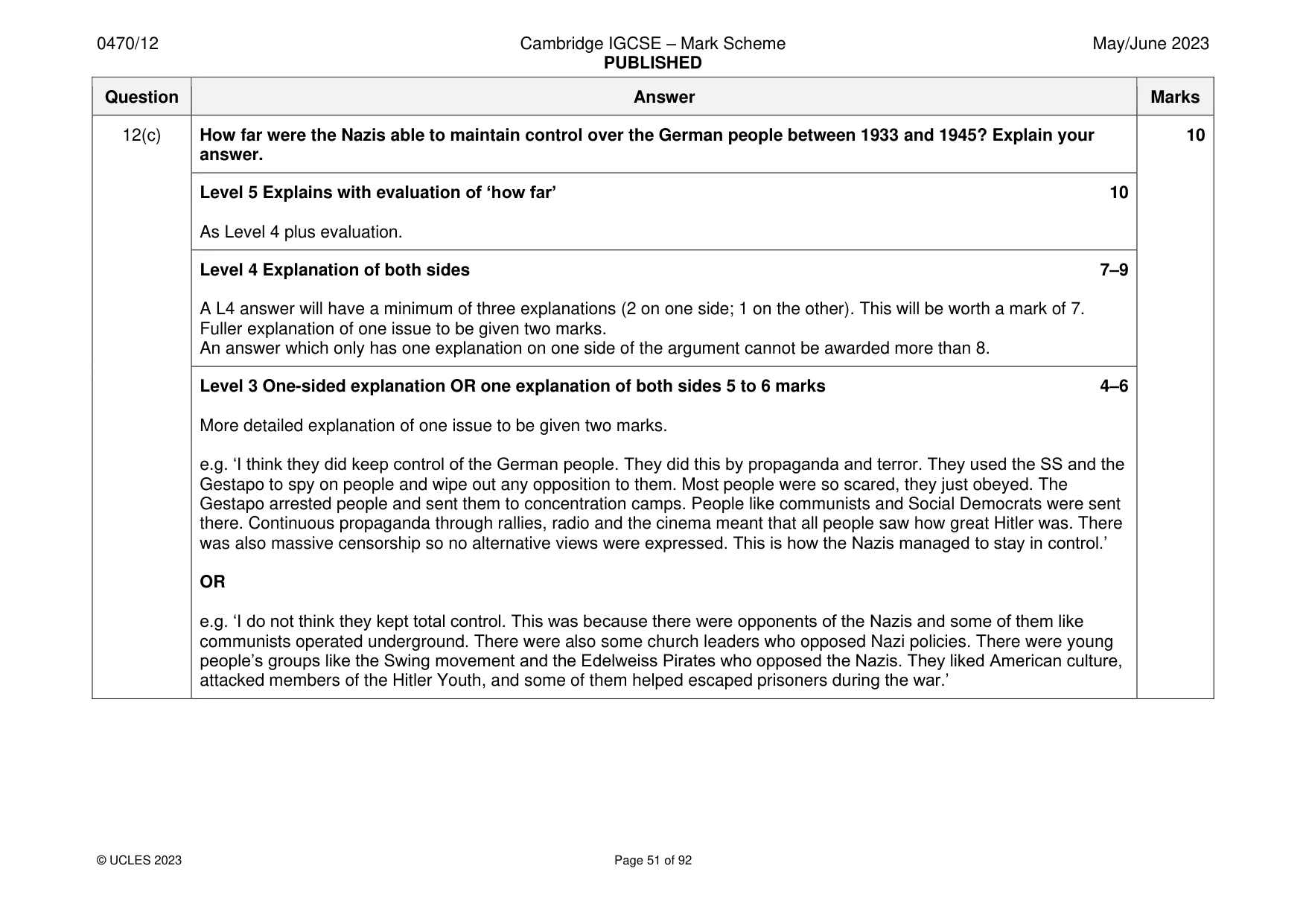
Mark scheme, page 51
0470/12 Cambridge IGCSE – Mark Scheme PUBLISHED May/June 2023 © UCLES 2023 Page 51 of 92 Question Answer Marks 12(c) How far were the Nazis able to maintain control over the German people between 1933 and 1945? Explain your answer. 10 Level 5 Explains with evaluation of ‘how far’ 10 As Level 4 plus evaluation. Level 4 Explanation of both sides 7–9 A L4 answer will have a minimum of three explanations (2 on one side; 1 on the other). This will be worth a mark of 7. Fuller explanation of one issue to be given two marks. An answer which only has one explanation on one side of the argument cannot be awarded more than 8. Level 3 One-sided explanation OR one explanation of both sides 5 to 6 marks 4–6 More detailed explanation of one issue to be given two marks. e.g. ‘I think they did keep control of the German people. They did this by propaganda and terror. They used the SS and the Gestapo to spy on people and wipe out any opposition to them. Most people were so scared, they just obeyed. The Gestapo arrested people and sent them to concentration camps. People like communists and Social Democrats were sent there. Continuous propaganda through rallies, radio and the cinema meant that all people saw how great Hitler was. There was also massive censorship so no alternative views were expressed. This is how the Nazis managed to stay in control.’ OR e.g. ‘I do not think they kept total control. This was because there were opponents of the Nazis and some of them like communists operated underground. There were also some church leaders who opposed Nazi policies. There were young people’s groups like the Swing movement and the Edelweiss Pirates who opposed the Nazis. They liked American culture, attacked members of the Hitler Youth, and some of them helped escaped prisoners during the war.’
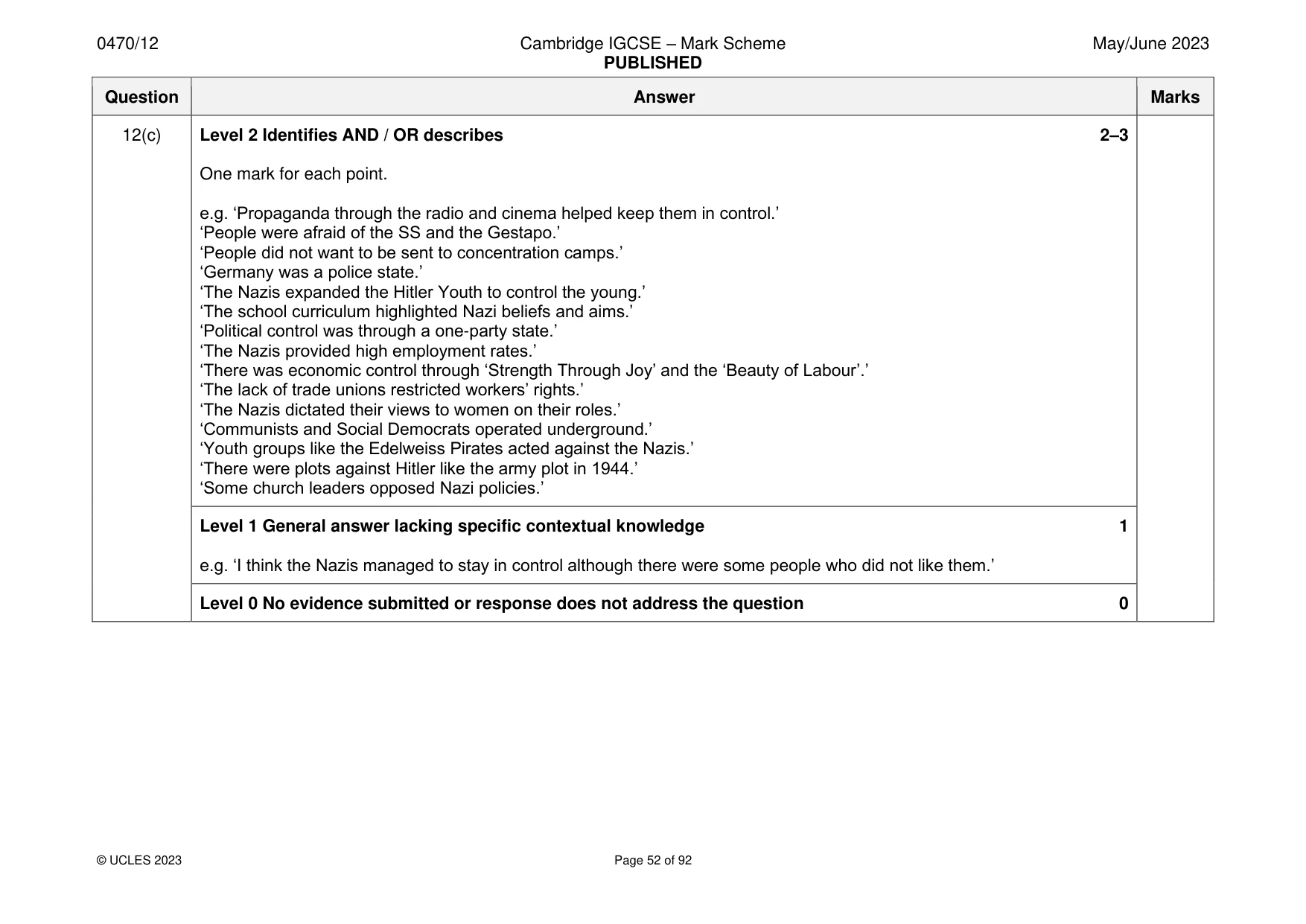
Mark scheme, page 52
0470/12 Cambridge IGCSE – Mark Scheme PUBLISHED May/June 2023 © UCLES 2023 Page 52 of 92 Question Answer Marks 12(c) Level 2 Identifies AND / OR describes 2–3 One mark for each point. e.g. ‘Propaganda through the radio and cinema helped keep them in control.’ ‘People were afraid of the SS and the Gestapo.’ ‘People did not want to be sent to concentration camps.’ ‘Germany was a police state.’ ‘The Nazis expanded the Hitler Youth to control the young.’ ‘The school curriculum highlighted Nazi beliefs and aims.’ ‘Political control was through a one-party state.’ ‘The Nazis provided high employment rates.’ ‘There was economic control through ‘Strength Through Joy’ and the ‘Beauty of Labour’.’ ‘The lack of trade unions restricted workers’ rights.’ ‘The Nazis dictated their views to women on their roles.’ ‘Communists and Social Democrats operated underground.’ ‘Youth groups like the Edelweiss Pirates acted against the Nazis.’ ‘There were plots against Hitler like the army plot in 1944.’ ‘Some church leaders opposed Nazi policies.’ Level 1 General answer lacking specific contextual knowledge 1 e.g. ‘I think the Nazis managed to stay in control although there were some people who did not like them.’ Level 0 No evidence submitted or response does not address the question 0
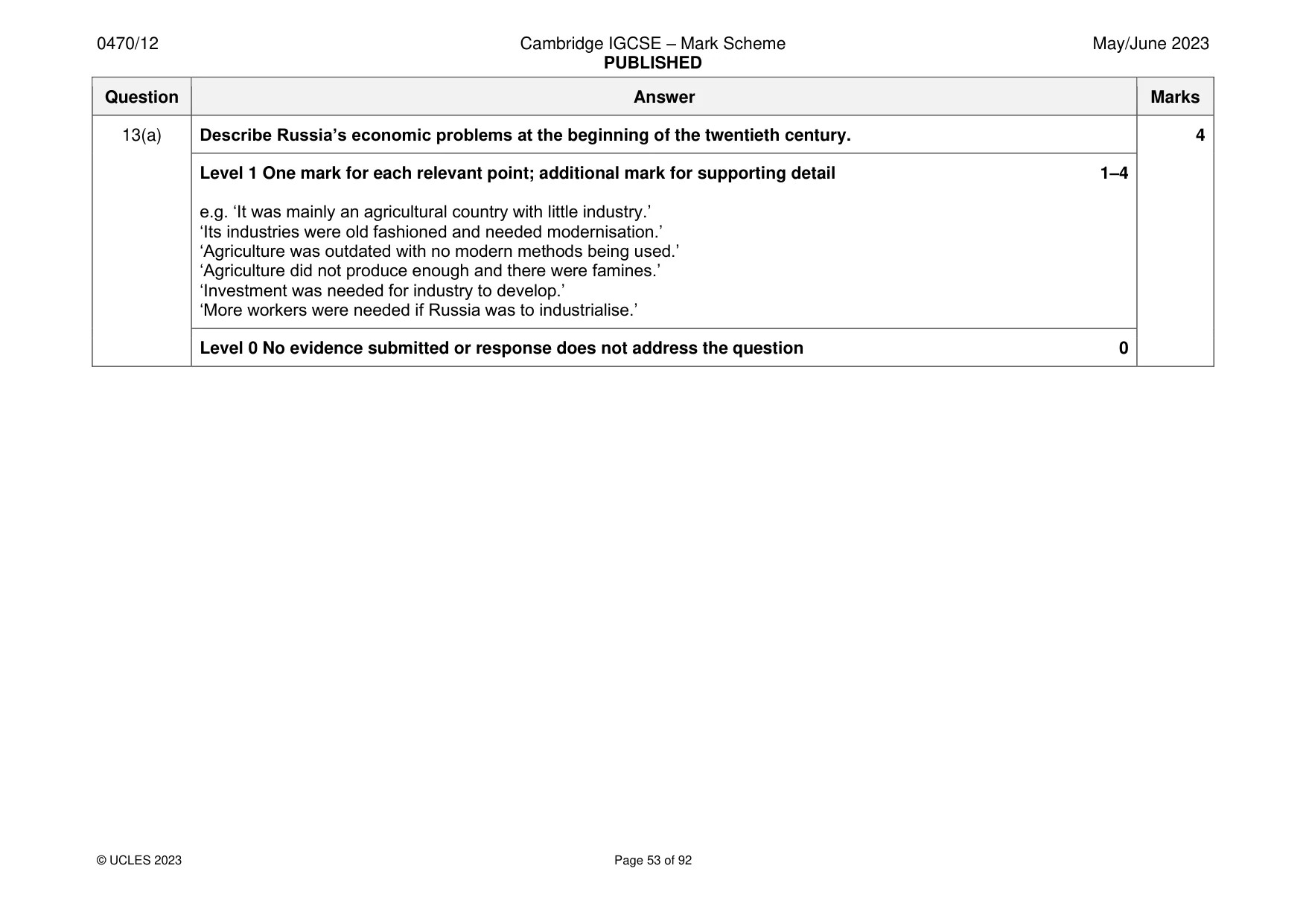
Mark scheme, page 53
0470/12 Cambridge IGCSE – Mark Scheme PUBLISHED May/June 2023 © UCLES 2023 Page 53 of 92 Question Answer Marks 13(a) Describe Russia’s economic problems at the beginning of the twentieth century. 4 Level 1 One mark for each relevant point; additional mark for supporting detail 1–4 e.g. ‘It was mainly an agricultural country with little industry.’ ‘Its industries were old fashioned and needed modernisation.’ ‘Agriculture was outdated with no modern methods being used.’ ‘Agriculture did not produce enough and there were famines.’ ‘Investment was needed for industry to develop.’ ‘More workers were needed if Russia was to industrialise.’ Level 0 No evidence submitted or response does not address the question 0
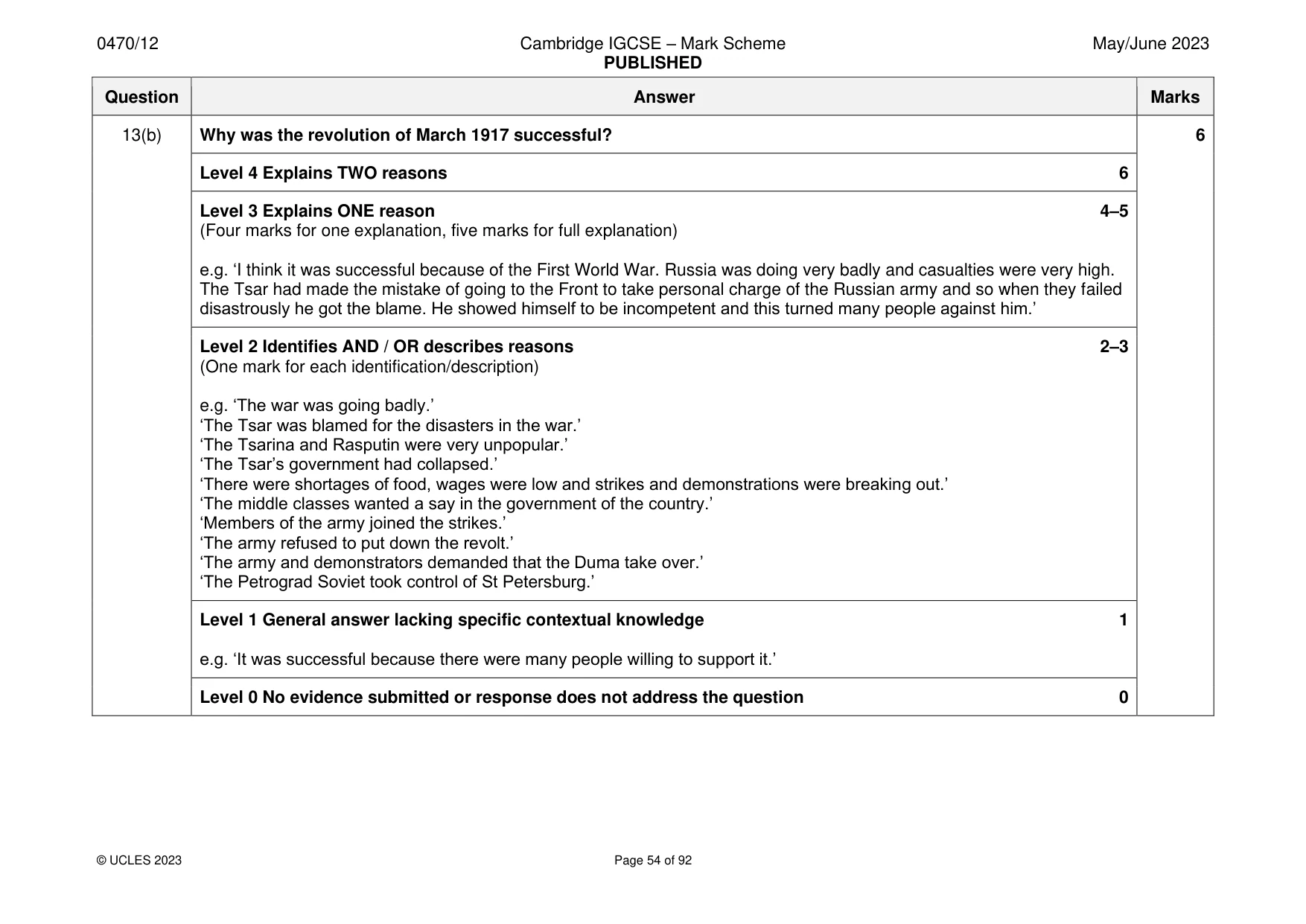
Mark scheme, page 54
0470/12 Cambridge IGCSE – Mark Scheme PUBLISHED May/June 2023 © UCLES 2023 Page 54 of 92 Question Answer Marks 13(b) Why was the revolution of March 1917 successful? 6 Level 4 Explains TWO reasons 6 Level 3 Explains ONE reason 4–5 (Four marks for one explanation, five marks for full explanation) e.g. ‘I think it was successful because of the First World War. Russia was doing very badly and casualties were very high. The Tsar had made the mistake of going to the Front to take personal charge of the Russian army and so when they failed disastrously he got the blame. He showed himself to be incompetent and this turned many people against him.’ Level 2 Identifies AND / OR describes reasons 2–3 (One mark for each identification/description) e.g. ‘The war was going badly.’ ‘The Tsar was blamed for the disasters in the war.’ ‘The Tsarina and Rasputin were very unpopular.’ ‘The Tsar’s government had collapsed.’ ‘There were shortages of food, wages were low and strikes and demonstrations were breaking out.’ ‘The middle classes wanted a say in the government of the country.’ ‘Members of the army joined the strikes.’ ‘The army refused to put down the revolt.’ ‘The army and demonstrators demanded that the Duma take over.’ ‘The Petrograd Soviet took control of St Petersburg.’ Level 1 General answer lacking specific contextual knowledge 1 e.g. ‘It was successful because there were many people willing to support it.’ Level 0 No evidence submitted or response does not address the question 0
Mark scheme, page 55
0470/12 Cambridge IGCSE – Mark Scheme PUBLISHED May/June 2023 © UCLES 2023 Page 55 of 92 Question Answer Marks 13(c) ‘Stolypin’s policies between 1906 and 1911 depended on repression.’ How far do you agree with this statement? Explain your answer. 10 Level 5 Explains with evaluation of ‘how far’ 10 As Level 4 plus evaluation. Level 4 Explanation of both sides 7–9 A L4 answer will have a minimum of three explanations (2 on one side; 1 on the other). This will be worth a mark of 7. Fuller explanation of one issue to be given two marks. An answer which only has one explanation on one side of the argument cannot be awarded more than 8. Level 3 One-sided explanation OR one explanation of both sides 5 to 6 marks 4–6 More detailed explanation of one issue to be given two marks. e.g. ‘I disagree with this statement. During this period there were Dumas which were elected and had a say in the government of the country. For most of this period, Stolypin was the Tsar’s chief minister and he wanted moderate reform in agriculture, industry and in education. He created a peasants’ land bank so that they could buy more land and make bigger farms.’ OR e.g. ‘I think this statement is right. The granting of the Dumas was made useless when the Tsar issued the ‘Fundamental Laws’. These gave the Tsar a veto over laws, the power to appoint and dismiss ministers and to dissolve the Duma when he saw fit. This meant that the Dumas were useless. Stolypin introduced many repressive measures. Strikers and protestors were exiled or executed. The number of secret police was increased to spy on people and find out who were opponents of the regime. They were then arrested.’
Mark scheme, page 56
0470/12 Cambridge IGCSE – Mark Scheme PUBLISHED May/June 2023 © UCLES 2023 Page 56 of 92 Question Answer Marks 13(c) Level 2 Identifies AND / OR describes 2–3 One mark for each point. e.g. ‘Stolypin introduced reforms in agriculture creating the kulaks.’ ‘He introduced health and insurance schemes for workers.’ ‘The October Manifesto granted the Duma which removed much opposition.’ ‘The Fundamental Laws meant the early Dumas achieved very little.’ ‘The Dumas were useless and did little.’ ‘Stolypin used repression. Opponents of the regime were exiled or executed.’ ‘He crushed opposition through ‘Stolypin’s necktie’.’ ‘The Okhrana (secret police) were used against people.’ Level 1 General answer lacking specific contextual knowledge 1 e.g. ‘The work of Stolypin only postponed serious trouble for the Tsar.’ Level 0 No evidence submitted or response does not address the question 0
Mark scheme, page 57
0470/12 Cambridge IGCSE – Mark Scheme PUBLISHED May/June 2023 © UCLES 2023 Page 57 of 92 Question Answer Marks 14(a) What was Lenin’s Political Testament? 4 Level 1 One mark for each relevant point; additional mark for supporting detail 1–4 e.g. ‘It was his will which he dictated before he died.’ ‘In it he criticised Bolshevik leaders like Stalin/Trotsky.’ ‘It said that Stalin should be removed as General Secretary of the Communist Party.’ ‘He warned about a split developing in the party between Stalin and Trotsky.’ ‘It was not published for some time because the Bolshevik leaders had been criticised in it.’ Level 0 No evidence submitted or response does not address the question 0
Mark scheme, page 58
0470/12 Cambridge IGCSE – Mark Scheme PUBLISHED May/June 2023 © UCLES 2023 Page 58 of 92 Question Answer Marks 14(b) Why did Trotsky lose the leadership struggle with Stalin? 6 Level 4 Explains TWO reasons 6 Level 3 Explains ONE reason 4–5 (Four marks for one explanation, five marks for full explanation) e.g. ‘I think Trotsky himself was to blame. He was arrogant and did not take Stalin seriously. This allowed Stalin to build support in the Party. Trotsky offended many senior members of the Party while Stalin was quietly building support. Trotsky did not bother to try to win support; he simply assumed he would be the next leader.’ Level 2 Identifies AND / OR describes reasons 2–3 (One mark for each identification/description) e.g. ‘Trotsky underestimated Stalin.’ ‘Trotsky was arrogant and offended many people.’ ‘Trotsky did not attend Lenin’s funeral.’ ‘Trotsky had a lot of support in the army and people were worried he might become a dictator.’ ‘His ideas for a permanent revolution were not popular.’ ‘Trotsky was not liked by many because he was a former Menshevik.’ ‘Stalin was devious and quietly built support.’ ‘Stalin had gradually put his supporters into many posts in the Party.’ ‘Stalin’s idea of ‘Socialism in One Country’ was popular in the Party.’ Level 1 General answer lacking specific contextual knowledge 1 e.g. ‘He lost the leadership struggle to Stalin because he thought he was better than him.’ Level 0 No evidence submitted or response does not address the question 0
Mark scheme, page 59
0470/12 Cambridge IGCSE – Mark Scheme PUBLISHED May/June 2023 © UCLES 2023 Page 59 of 92 Question Answer Marks 14(c) ‘Stalin controlled the USSR through the use of show trials.’ How far do you agree with this statement? Explain your answer. 10 Level 5 Explains with evaluation of ‘how far’ 10 As Level 4 plus evaluation. Level 4 Explanation of both sides 7–9 A L4 answer will have a minimum of three explanations (2 on one side; 1 on the other). This will be worth a mark of 7. Fuller explanation of one issue to be given two marks. An answer which only has one explanation on one side of the argument cannot be awarded more than 8. Level 3 One-sided explanation OR one explanation of both sides 5 to 6 marks 4–6 More detailed explanation of one issue to be given two marks. e.g. ‘Stalin used show trials to get rid of his opponents and build up support for himself. He was paranoid about other leaders in the Party that might threaten his position and he used show trials to deal with them. These people were put on trial where they would confess their crimes. They had probably been tortured to make them do this. Kamenev and Zinoviev were the first to be put on trial. The trials were filmed and shown in cinemas as propaganda for Stalin and to show how he was dealing with enemies within the USSR. This made people very scared and meant they were more likely to support Stalin.’ OR e.g. ‘Stalin mainly controlled the USSR through the use of a cult of personality. This is something Stalin’s propaganda machine created to make the Soviet people love Stalin. Portraits, photographs and statues of Stalin were everywhere showing him to be a godlike figure who would guide the USSR through difficult times. There were also regular processions through towns praising Stalin. He even had history books written to show how great he was.’
Mark scheme, page 60
0470/12 Cambridge IGCSE – Mark Scheme PUBLISHED May/June 2023 © UCLES 2023 Page 60 of 92 Question Answer Marks 14(c) Level 2 Identifies AND / OR describes 2–3 One mark for each point. e.g. ‘Stalin gained control by his ‘purges’.’ ‘Millions were executed or sent to the gulags.’ ‘The ‘Great Terror’ removed opposition.’ ‘The new constitution gave total power to Stalin.’ ‘The kulaks were removed for disobeying Stalin.’ ‘Stalin used the ‘Cult of Stalin’ to gain control over the people.’ ‘Many ordinary citizens admired Stalin and wanted to obey him.’ ‘Stalin controlled all areas of life.’ ‘Show trials were used where rivals to Stalin confessed their sins.’ ‘He simply got rid of most of the people in the Party who might be a threat to him.’ ‘He controlled farmers through collectivisation.’ Level 1 General answer lacking specific contextual knowledge 1 e.g. ‘Stalin exerted almost total control by getting rid of lots of people.’ Level 0 No evidence submitted or response does not address the question 0
Mark scheme, page 61
0470/12 Cambridge IGCSE – Mark Scheme PUBLISHED May/June 2023 © UCLES 2023 Page 61 of 92 Question Answer Marks 15(a) What were speakeasies? 4 Level 1 One mark for each relevant point; additional mark for supporting detail 1–4 e.g. ‘They were illegal and sold alcoholic drinks.’ ‘They were secret/undercover.’ ‘They were in corner shops/barbers.’ ‘They appeared because the making and selling of alcoholic drinks had been made illegal.’ ‘They sprang up during the Prohibition.’ ‘They were supplied by bootleggers.’ ‘They were often run by gangsters/linked to organised crime.’ ‘They were very profitable.’ ‘They were often raided by the police.’ Level 0 No evidence submitted or response does not address the question 0
Mark scheme, page 62
0470/12 Cambridge IGCSE – Mark Scheme PUBLISHED May/June 2023 © UCLES 2023 Page 62 of 92 Question Answer Marks 15(b) Why was the motor car important in the United States during the 1920s? 6 Level 4 Explains TWO reasons 6 Level 3 Explains ONE reason 4–5 (Four marks for one explanation, five marks for full explanation) e.g. ‘The motor car was important in the 1920s because of its effect on the American economy. Ford introduced the production line in his factories which meant that cars could be built very cheaply. So many were sold that the car industry became the biggest industry in the USA. It created hundreds of thousands of jobs in car factories and in other industries that supplied parts for the cars like glass. It was one of the important causes of the boom in America in the 1920s.’ Level 2 Identifies AND / OR describes reasons 2–3 (One mark for each identification/description) e.g. ‘It employed hundreds of thousands of people.’ ‘It created the production line.’ ‘It helped create the boom in the USA.’ ‘It was cheap to make and so many people could afford one.’ ‘It led to people living in suburbs.’ ‘It led to many new roads being built.’ ‘It stimulated growth in many other industries like house building.’ ‘It meant people could travel more and drive to holiday resorts/cinemas/sports matches.’ ‘It gave people freedom.’ Level 1 General answer lacking specific contextual knowledge 1 e.g. ‘It was important because it changed the lives of many people in America.’ Level 0 No evidence submitted or response does not address the question 0
Mark scheme, page 63
0470/12 Cambridge IGCSE – Mark Scheme PUBLISHED May/June 2023 © UCLES 2023 Page 63 of 92 Question Answer Marks 15(c) Which was more of a problem in the United States during the 1920s, intolerance of black Americans or intolerance of immigrants? Explain your answer. 10 Level 5 Explains with evaluation of ‘which was more of a problem in the United States during the 1920s’ 10 As Level 4 plus evaluation. Level 4 Explanation of both sides 7–9 A L4 answer will have a minimum of three explanations (2 on one side; 1 on the other). This will be worth a mark of 7. Fuller explanation of one issue to be given two marks. An answer which only has one explanation on one side of the argument cannot be awarded more than 8. Level 3 One-sided explanation OR one explanation of both sides 5 to 6 marks 4–6 More detailed explanation of one issue to be given two marks. e.g. ‘Intolerance of black Americans was more of a problem because of the activities of organisations like the Ku Klux Klan. This was a white supremacy movement that used violence against black Americans. It was mainly active in the southern states. It was based on racism and led to black Americans being beaten and lynched. Thousands were lynched by mobs during the 1920s. Many black Americans left the south and moved to cities in the north.’ OR e.g. ‘Intolerance of immigrants was more of a problem. Many Americans were suspicious of immigrants and thought they were a threat to the American way of life and its values. They thought immigrants would spread communism and anarchism and plot against the government. This was important because it led to the Red Scare and to race riots in American cities. It also led to miscarriages of justice by prejudiced judges and lawyers as in the case of Sacco and Vanzetti.’
Mark scheme, page 64
0470/12 Cambridge IGCSE – Mark Scheme PUBLISHED May/June 2023 © UCLES 2023 Page 64 of 92 Question Answer Marks 15(c) Level 2 Identifies AND / OR describes 2–3 One mark for each point. e.g. ‘Intolerance of black Americans led to the lynching of hundreds of them.’ ‘It led to many black Americans moving from the south to the north.’ ‘Intolerance of black Americans led to the organisation of the KKK and the mistreatment of black Americans.’ ‘It led to people in the south terrorising black Americans.’ ‘Intolerance of immigrants led to the Red Scare.’ ‘Intolerance of immigrants led to race riots.’ ‘It led to government restrictions on immigrants.’ Level 1 General answer lacking specific contextual knowledge 1 e.g. ‘I think that intolerance of black Americans was more of a problem because it ended up with black Americans being treated terribly badly.’ Level 0 No evidence submitted or response does not address the question 0
Mark scheme, page 65
0470/12 Cambridge IGCSE – Mark Scheme PUBLISHED May/June 2023 © UCLES 2023 Page 65 of 92 Question Answer Marks 16(a) What was the Banking Crisis of the early 1930s? 4 Level 1 One mark for each relevant point; additional mark for supporting detail 1–4 e.g. ‘This was when banks went bankrupt.’ ‘Banks were owed money which could not be repaid.’ ‘People who saved with banks lost their savings.’ ‘People quickly withdrew their money from banks.’ ‘Many banks had no money left.’ ‘It was due to the Wall Street Crash of 1929.’ Level 0 No evidence submitted or response does not address the question 0
Mark scheme, page 66
0470/12 Cambridge IGCSE – Mark Scheme PUBLISHED May/June 2023 © UCLES 2023 Page 66 of 92 Question Answer Marks 16(b) Why did Hoover do little in response to the Depression? 6 Level 4 Explains TWO reasons 6 Level 3 Explains ONE reason 4–5 (Four marks for one explanation, five marks for full explanation) e.g. ‘This was because he did not believe in the government helping people. He did not like the idea of welfare support for the unemployed because he believed in rugged individualism and self-help. He thought that people should sort their own problems out and that this was good for them. If they were supported by the government, they would never be able to stand on their own two feet.’ Level 2 Identifies AND / OR describes reasons 2–3 (One mark for each identification/description) e.g. ‘He believed in self-help.’ ‘He believed in rugged individualism.’ ‘He followed traditional Republican policies.’ ‘He did not believe that the government should help people.’ ‘He believed that prosperity would soon return.’ ‘He did not think there was anything basically wrong with the US economy.’ ‘He thought that welfare should be provided by charities or local government.’ ‘He believed in cycles of boom and bust.’ Level 1 General answer lacking specific contextual knowledge 1 e.g. ‘Hoover did little because he did not think it was necessary to do anything. He thought that everything was fine.’ Level 0 No evidence submitted or response does not address the question 0
Mark scheme, page 67
0470/12 Cambridge IGCSE – Mark Scheme PUBLISHED May/June 2023 © UCLES 2023 Page 67 of 92 Question Answer Marks 16(c) ‘The impact of the Depression was worse in the countryside than in towns and cities.’ How far do you agree with this statement? Explain your answer. 10 Level 5 Explains with evaluation of ‘how far’ 10 As Level 4 plus evaluation. Level 4 Explanation of both sides 7–9 A L4 answer will have a minimum of three explanations (2 on one side; 1 on the other). This will be worth a mark of 7. Fuller explanation of one issue to be given two marks. An answer which only has one explanation on one side of the argument cannot be awarded more than 8. Level 3 One-sided explanation OR one explanation of both sides 5 to 6 marks 4–6 More detailed explanation of one issue to be given two marks. e.g. ‘I agree with this. It was terrible in the countryside and farmers and farm labourers suffered badly. Food prices were down and farmers had little income. They could not pay their mortgages and had to sell up. They were then homeless and they had nothing to feed their children with. There was then a drought in the south and this created the Dust Bowl where nothing could grow and nobody could live.’ OR e.g. ‘I disagree. I think it was worse in towns. This is where many factories were and these had to close. This left millions of people losing their jobs in cities like Cleveland where there was a big steel industry. People could not pay their rents and thousands ended up living in parks and shanty towns. People resorted to trying to find food in rubbish tips.’
Mark scheme, page 68
0470/12 Cambridge IGCSE – Mark Scheme PUBLISHED May/June 2023 © UCLES 2023 Page 68 of 92 Question Answer Marks 16(c) Level 2 Identifies AND / OR describes 2–3 One mark for each point. e.g. ‘The price of food produced by farmers went right down.’ ‘Farmers were not able to pay their mortgages.’ ‘Many farmers had to pack up and move to California looking for work.’ ‘The dust bowl made farming impossible.’ ‘There were many people laid off by industries in cities.’ ‘Parks were full of homeless people.’ ‘People in cities ended up living in shanty towns.’ ‘Many people in cities were left with nothing to eat.’ Level 1 General answer lacking specific contextual knowledge 1 e.g. ‘I am sure it was worse in the countryside because they had less help there.’ Level 0 No evidence submitted or response does not address the question 0
Mark scheme, page 69
0470/12 Cambridge IGCSE – Mark Scheme PUBLISHED May/June 2023 © UCLES 2023 Page 69 of 92 Question Answer Marks 17(a) What were ‘speak bitterness’ meetings? 4 Level 1 One mark for each relevant point; additional mark for supporting detail 1–4 e.g. ‘They were an important part of land distribution under the Communists.’ ‘They were organised by Communist regional party leaders.’ ‘These were meetings of peasants that were set up once the Communists were in power.’ ‘Peasants would tell how they had been mistreated by their landlords.’ ‘Former landlords were accused of charging very high rents.’ ‘Former landlords were held accountable for their mistreatment of their tenants under the old regime.’ ‘The meetings were often emotional, hostile and one-sided.’ ‘If landlords refused to answer questions, they were often insulted or punished.’ ‘The purpose of most meetings was to humiliate rather than punish the landlords.’ Level 0 No evidence submitted or response does not address the question 0
Mark scheme, page 70
0470/12 Cambridge IGCSE – Mark Scheme PUBLISHED May/June 2023 © UCLES 2023 Page 70 of 92 Question Answer Marks 17(b) Why was the first Five-Year Plan important? 6 Level 4 Explains TWO reasons 6 Level 3 Explains ONE reason 4–5 (Four marks for one explanation, five marks for full explanation) e.g. ‘The first Five-Year Plan was important because it greatly increased China’s industrial production. All industries were put under government control and production targets were set for each factory over five years. Workers were told that if they did not reach their targets, they would be letting everyone down. This led to increases in production of steel, coal, oil and other products.’ Level 2 Identifies AND / OR describes reasons 2–3 (One mark for each identification/description) e.g. ‘Mao wanted to turn China into a leading industrial country.’ ‘Increases in production would enable China to afford larger and more modern armed forces.’ ‘It increased China’s industrial production.’ ‘It transformed China with large cities and industries developing.’ ‘It showed that communism was working.’ ‘Its success encouraged Mao to go ahead with the Great Leap Forward in 1958.’ Level 1 General answer lacking specific contextual knowledge 1 e.g. ‘It was important because it helped a lot of people at the time.’ Level 0 No evidence submitted or response does not address the question 0
Mark scheme, page 71
0470/12 Cambridge IGCSE – Mark Scheme PUBLISHED May/June 2023 © UCLES 2023 Page 71 of 92 Question Answer Marks 17(c) ‘In the 1950s Mao’s agricultural reforms were more important to the people of China than his social reforms.’ How far do you agree with this statement? Explain your answer. 10 Level 5 Explains with evaluation of ‘how far’ 10 As Level 4 plus evaluation. Level 4 Explanation of both sides 7–9 A L4 answer will have a minimum of three explanations (2 on one side; 1 on the other). This will be worth a mark of 7. Fuller explanation of one issue to be given two marks. An answer which only has one explanation on one side of the argument cannot be awarded more than 8. Level 3 One-sided explanation OR one explanation of both sides 5 to 6 marks 4–6 More detailed explanation of one issue to be given two marks. e.g. ‘I agree that the agricultural reforms were more important for the people. Before communism they had rented their land from grasping landlords who mistreated and exploited them. Mao introduced land reform. The land, machinery and animals were taken from the landlords and given to the peasants who could take their former landlords to people’s courts for punishment. This was a big improvement for many peasants. However, their plots of land were small and this led to inefficient farming, so the land of a number of families was put together into cooperative farms. This was more efficient and peasants could afford modern machinery and methods. The production of food went up and the peasants were better off.’ OR e.g. ‘I disagree. Although at first the peasants were given land to own and farm, by 1955 this land was being put into collective farms and then huge communes. The peasants no longer owned the land and their lives were strictly controlled. They were made to work hard and lost a lot of freedom. They had to work as they were directed and were not allowed to do any farming for themselves. They were even made to work on non-agricultural work which was not successful. The farming was neglected, food production went down and by the end of the 1950s there was a famine.’ OR e.g. ‘I think the social reforms were more important, especially for women. There were many reforms that benefited them. Foot binding was stopped and women were given the same education as men. The Marriage Reform Law banned forced marriages and husbands were not allowed to marry more than once. Women were also encouraged to work and it was made easier for them to get a divorce. In other words, they had more freedom and were being treated as equal to men.’
Mark scheme, page 72
0470/12 Cambridge IGCSE – Mark Scheme PUBLISHED May/June 2023 © UCLES 2023 Page 72 of 92 Question Answer Marks 17(c) Level 2 Identifies AND / OR describes 2–3 One mark for each point. e.g. ‘The peasants were given their own land.’ ‘Peasants were able to have their former landlords punished.’ ‘Cooperative farms allowed peasants to use modern methods and machinery.’ ‘The introduction of communes took the land away from peasant ownership and took away many of their freedoms.’ ‘The introduction of massive communes led to famines.’ ‘Women were given more rights such as not being forced into marriage.’ ‘Women were allowed to work.’ ‘Free education and health care were provided.’ ‘Most peasants became literate.’ Level 1 General answer lacking specific contextual knowledge 1 e.g. ‘I think the social reforms were more important because they made important changes to people’s lives.’ Level 0 No evidence submitted or response does not address the question 0
Mark scheme, page 73
0470/12 Cambridge IGCSE – Mark Scheme PUBLISHED May/June 2023 © UCLES 2023 Page 73 of 92 Question Answer Marks 18(a) Describe the results of the Hundred Flowers campaign. 4 Level 1 One mark for each relevant point; additional mark for supporting detail 1–4 e.g. ‘Millions of letters were sent in criticising the party.’ ‘It was a mistake because it led to criticism.’ ‘It identified opponents of the regime who were then punished.’ ‘A halt was called to it in June 1957.’ ‘Many of the people who had been critical were discredited or sent to camps for re-education.’ ‘It made people less likely to voice their criticisms and this made it easier for the authorities to control the country.’ ‘It was a failure because it did not create an atmosphere of free debate.’ ‘It led to less freedom for everyone.’ Level 0 No evidence submitted or response does not address the question 0
Mark scheme, page 74
0470/12 Cambridge IGCSE – Mark Scheme PUBLISHED May/June 2023 © UCLES 2023 Page 74 of 92 Question Answer Marks 18(b) Why did the Gang of Four’s time in power end in 1976? 6 Level 4 Explains TWO reasons 6 Level 3 Explains ONE reason 4–5 (Four marks for one explanation, five marks for full explanation) e.g. ‘This was because in the later stages of the Cultural Revolution, the Gang of Four had a lot of power and made a lot of the decisions instead of Mao. The Cultural Revolution was a mistake and ended up causing chaos and set China back educationally and in other ways. Afterwards they were blamed for the worst aspects of the Cultural Revolution and all the damage that was done. The Communist Party removed them just a month after Mao’s death.’ Level 2 Identifies AND / OR describes reasons 2–3 (One mark for each identification/description) e.g. ‘They were blamed for the worst features of the Cultural Revolution and for all the damage it did.’ ‘The Cultural Revolution ended and this destroyed their power base.’ ‘They were defeated in a power struggle with their rival Hua Guofeng who won the support of the army.’ ‘They were finished once Mao had died.’ ‘They were regarded as people who wanted power for its own sake.’ Level 1 General answer lacking specific contextual knowledge 1 e.g. ‘This was because they were a failure and were causing a lot of trouble.’ Level 0 No evidence submitted or response does not address the question 0
Mark scheme, page 75
0470/12 Cambridge IGCSE – Mark Scheme PUBLISHED May/June 2023 © UCLES 2023 Page 75 of 92 Question Answer Marks 18(c) ‘Mao launched the Cultural Revolution because he wanted to revive the revolutionary spirit of the Chinese people.’ How far do you agree with this statement? Explain your answer. 10 Level 5 Explains with evaluation of ‘how far’ 10 As Level 4 plus evaluation. Level 4 Explanation of both sides 7–9 A L4 answer will have a minimum of three explanations (2 on one side; 1 on the other). This will be worth a mark of 7. Fuller explanation of one issue to be given two marks. An answer which only has one explanation on one side of the argument cannot be awarded more than 8. Level 3 One-sided explanation OR one explanation of both sides 5 to 6 marks 4–6 More detailed explanation of one issue to be given two marks. e.g. ‘I disagree with this. I think he wanted the Cultural Revolution because his position in China was not secure because of the failure of the Great Leap Forward and he saw Liu Shaoqi as a threat. He was worried that collective farms and factories were under threat. He launched the Cultural Revolution to stop all this. He did achieve what he wanted because Liu Shaoqi was removed and Mao’s position and reforms were secured.’ OR e.g. ‘I agree with this. Mao thought that the Chinese Revolution was going stale and that the people seemed to be turning against its original spirit. The enthusiasm for it had gone. He was also worried that some people were becoming richer than others. He decided to use young people to change all this. He told them that a privileged class was emerging and that this should be stopped. This led to the Red Guards acting against millions of people for being revisionists. Many people were forced into the countryside where they could be re-educated.’
Mark scheme, page 76
0470/12 Cambridge IGCSE – Mark Scheme PUBLISHED May/June 2023 © UCLES 2023 Page 76 of 92 Question Answer Marks 18(c) Level 2 Identifies AND / OR describes 2–3 One mark for each point. e.g. ‘Mao got rid of his biggest rival, Liu Shaoqi.’ ‘He did it to restore his own position as he was no longer Chairman of the Party.’ ‘Some of Mao’s achievements such as collective farms and factories were saved.’ ‘He did manage to create new enthusiasm for the revolution in China among young people.’ ‘Elements of capitalism that had been creeping in were got rid of.’ ‘He did it because a privileged class was emerging.’ ‘He was worried the Revolution was going the same way as in Russia.’ Level 1 General answer lacking specific contextual knowledge 1 e.g. ‘I agree with this. Being out of touch with ordinary people, it was done for this reason.’ Level 0 No evidence submitted or response does not address the question 0
Mark scheme, page 77
0470/12 Cambridge IGCSE – Mark Scheme PUBLISHED May/June 2023 © UCLES 2023 Page 77 of 92 Question Answer Marks 19(a) What was the Rivonia Trial of 1963–64? 4 Level 1 One mark for each relevant point; additional mark for supporting detail 1–4 e.g. ‘Mandela and others were put on trial for acts of sabotage.’ ‘Mandela and seven other defendants were given life sentences for treason.’ ‘Mandela gave a speech during the trial which had a great impact on many people.’ ‘His imprisonment meant he became a symbol of resistance.’ ‘It was a severe blow to Umkhonto (MK).’ Level 0 No evidence submitted or response does not address the question 0
Mark scheme, page 78
0470/12 Cambridge IGCSE – Mark Scheme PUBLISHED May/June 2023 © UCLES 2023 Page 78 of 92 Question Answer Marks 19(b) Why did the Sharpeville Massacre take place? 6 Level 4 Explains TWO reasons 6 Level 3 Explains ONE reason 4–5 (Four marks for one explanation, five marks for full explanation) e.g. ‘There was a national campaign by PAC against the pass laws. Africans were encouraged to leave their pass books at home and gather outside their local police stations. This happened outside the police station at Sharpeville but the police shot at them.’ Level 2 Identifies AND / OR describes reasons 2–3 (One mark for each identification/description) e.g. ‘PAC was holding demonstrations against the pass laws outside the police station at Sharpeville.’ ‘The government had introduced laws that outlawed any public meetings that the government did not like.’ ‘The police tried to arrest a protester and the crowd surged forward.’ ‘The police panicked and fired on the crowd, killing people.’ ‘Some of the police were young and inexperienced.’ Level 1 General answer lacking specific contextual knowledge 1 e.g. ‘It took place because the government and police were determined to impose their authority.’ Level 0 No evidence submitted or response does not address the question 0
Mark scheme, page 79
0470/12 Cambridge IGCSE – Mark Scheme PUBLISHED May/June 2023 © UCLES 2023 Page 79 of 92 Question Answer Marks 19(c) ‘The Group Areas Act was the most important of the measures designed to establish apartheid in the early 1950s.’ How far do you agree with this statement? Explain your answer. 10 Level 5 Explains with evaluation of ‘how far’ 10 As Level 4 plus evaluation. Level 4 Explanation of both sides 7–9 A L4 answer will have a minimum of three explanations (2 on one side; 1 on the other). This will be worth a mark of 7. Fuller explanation of one issue to be given two marks. An answer which only has one explanation on one side of the argument cannot be awarded more than 8. Level 3 One-sided explanation OR one explanation of both sides 5 to 6 marks 4–6 More detailed explanation of one issue to be given two marks. e.g. ‘I agree with this. It did a lot to separate the different racial groups living in South Africa. It divided the country into racial areas and allowed only one group to live in each area. Those living in the wrong area had to move. This usually meant that black South Africans had to move, as in Sophiatown, where the people were forcibly moved. It was important because it separated the South African people from each other and made it clear what the government’s aims were.’ OR e.g. ‘I disagree with this statement. I think the act about passes was more important. This strengthened the pass laws. It only applied to black South Africans. They had to carry their passes with them all the time. The pass would include information about their address, their employment record and their photograph and fingerprints. If they did not have it on them, they could be sent to prison. Hundreds of thousands were arrested for this reason. It was important as a way of controlling black South Africans and making it clear that they were regarded as second class citizens.’
Mark scheme, page 80
0470/12 Cambridge IGCSE – Mark Scheme PUBLISHED May/June 2023 © UCLES 2023 Page 80 of 92 Question Answer Marks 19(c) Level 2 Identifies AND / OR describes 2–3 One mark for each point. e.g. ‘Sexual relations between white and non-white people were banned.’ ‘Black South Africans were arrested if they did not carry their passes on them.’ ‘Black South Africans were banned from remaining in urban areas longer than 72 hours.’ ‘Only white South Africans could vote in national elections.’ ‘Black children were taught a different curriculum.’ ‘Less was spent on schools for black children.’ ‘Bantustans were set up.’ ‘The Act separated different races into different parts of South Africa.’ ‘People, mainly black South Africans, were forcibly moved into the ‘right’ areas.’ Level 1 General answer lacking specific contextual knowledge 1 e.g. ‘I think this was the most important measure because it had the biggest impact on people.’ Level 0 No evidence submitted or response does not address the question 0
Mark scheme, page 81
0470/12 Cambridge IGCSE – Mark Scheme PUBLISHED May/June 2023 © UCLES 2023 Page 81 of 92 Question Answer Marks 20(a) What did the Organisation of African Unity (OAU) do to oppose apartheid? 4 Level 1 One mark for each relevant point; additional mark for supporting detail 1–4 e.g. ‘It gave weapons, training and military bases to groups fighting apartheid.’ ‘It gave support to the ANC and PAC.’ ‘It set up a Liberation Committee with headquarters in Tanzania which provided refugees from South Africa with education and military training.’ ‘It convinced the United Nations to expel South Africa from bodies like the World Health Organisation.’ ‘It persuaded African countries to close their harbours to South Africa and ban their planes from their air space.’ Level 0 No evidence submitted or response does not address the question 0
Mark scheme, page 82
0470/12 Cambridge IGCSE – Mark Scheme PUBLISHED May/June 2023 © UCLES 2023 Page 82 of 92 Question Answer Marks 20(b) Why were the Soweto demonstrations of 1976 important? 6 Level 4 Explains TWO reasons 6 Level 3 Explains ONE reason 4–5 (Four marks for one explanation, five marks for full explanation) e.g. ‘They were important because they hit the headlines around the world. Thousands of black school children in Soweto demonstrated against teaching in Afrikaans. The police shot and killed a student, and after the demonstrations spread across the country, they shot more students. This was so terrible that the news went round the world and shocked many people and governments. This damaged South Africa in the eyes of the world and alienated many countries.’ Level 2 Identifies AND / OR describes reasons 2–3 (One mark for each identification/description) e.g. ‘They were important because they were an example of black consciousness.’ ‘They were important because they involved school students.’ ‘They involved students being shot dead by the police.’ ‘The shootings led to an increase in the opposition to apartheid.’ ‘It led to Africans leaving South Africa to be trained as guerrilla fighters.’ ‘It led to a fall in gold and diamond shares as investors took fright.’ Level 1 General answer lacking specific contextual knowledge 1 e.g. ‘They were important because they affected many people as people were killed.’ Level 0 No evidence submitted or response does not address the question 0
Mark scheme, page 83
0470/12 Cambridge IGCSE – Mark Scheme PUBLISHED May/June 2023 © UCLES 2023 Page 83 of 92 Question Answer Marks 20(c) ‘Making some Bantustans (Homelands) independent was a success.’ How far do you agree with this statement? Explain your answer. 10 Level 5 Explains with evaluation of ‘how far’ 10 As Level 4 plus evaluation. Level 4 Explanation of both sides 7–9 A L4 answer will have a minimum of three explanations (2 on one side; 1 on the other). This will be worth a mark of 7. Fuller explanation of one issue to be given two marks. An answer which only has one explanation on one side of the argument cannot be awarded more than 8. Level 3 One-sided explanation OR one explanation of both sides 5 to 6 marks 4–6 More detailed explanation of one issue to be given two marks. e.g. ‘Making some Bantustans independent was not a success. Some were made independent in the 1970s but foreign countries refused to recognise them as independent countries. This was because South Africa continued to control their foreign policy and defence. Bantustans failed as black South Africans continued to live outside their homelands in squatter camps outside the cities and other illegal residences. By 1980 only just over half of those who should have lived in Bantustans actually did so.’ OR e.g. ‘Making some of the Bantustans independent was a clever idea. It showed the South African government as a progressive regime that was willing to give black South Africans the ability to govern themselves. Several, such as Bophuthatswana and Venda, took up the offer in the 1970s and became independent. It also meant that the South African government was no longer responsible for these areas, thus saving the government a lot of money.’
Mark scheme, page 84
0470/12 Cambridge IGCSE – Mark Scheme PUBLISHED May/June 2023 © UCLES 2023 Page 84 of 92 Question Answer Marks 20(c) Level 2 Identifies AND / OR describes 2–3 One mark for each point. e.g. ‘It allowed black South Africans to govern themselves.’ ‘Several homelands, such as Venda and Ciskei, took up the opportunity.’ ‘It saved the South African government a lot of money.’ ‘Those that took up the offer were often corrupt dictatorships.’ ‘Citizens of the newly independent areas lost their South African citizenship.’ ‘It showed that the South African government was progressive.’ ‘Foreign powers did not recognise these areas as independent countries.’ ‘These areas became over-populated and full of poverty.’ Level 1 General answer lacking specific contextual knowledge 1 e.g. ‘I do not think this was much of a success because few people supported it.’ Level 0 No evidence submitted or response does not address the question 0
Mark scheme, page 85
0470/12 Cambridge IGCSE – Mark Scheme PUBLISHED May/June 2023 © UCLES 2023 Page 85 of 92 Question Answer Marks 21(a) Describe Israeli actions in the Suez War of 1956. 4 Level 1 One mark for each relevant point; additional mark for supporting detail 1–4 e.g. ‘Israeli paratroopers dropped into Egypt east of Suez.’ ‘Israel invaded Sinai.’ ‘Israeli aircraft shot down Egyptian jets.’ ‘Israeli paratroopers landed near Al Tor, west of Sinai.’ ‘Israelis captured Sharm el-Sheikh.’ ‘Israel invaded Gaza.’ ‘Israeli action in Sinai was a distraction to allow the British and the French to take the canal.’ ‘Israel withdrew from Sinai in March 1957 but destroyed much of the infrastructure there.’ Level 0 No evidence submitted or response does not address the question 0
Mark scheme, page 86
0470/12 Cambridge IGCSE – Mark Scheme PUBLISHED May/June 2023 © UCLES 2023 Page 86 of 92 Question Answer Marks 21(b) Why was the Suez War a disaster for Britain and France? 6 Level 4 Explains TWO reasons 6 Level 3 Explains ONE reason 4–5 (Four marks for one explanation, five marks for full explanation) e.g. ‘It was a disaster for Britain and France because it showed everybody that they were not great powers any longer. They acted because Nasser nationalised the Suez Canal. The USA had warned them not to invade, but they did. They had to withdraw because of the pressure from the USA, the USSR and the UN.’ Level 2 Identifies AND / OR describes reasons 2–3 (One mark for each identification/description) e.g. ‘The British Prime Minister had to resign.’ ‘In France it helped cause the end of the Fourth Republic.’ ‘They had been forced to withdraw from Egypt by the USA.’ ‘It showed they were not great imperial powers anymore.’ ‘They had been beaten by Nasser.’ Level 1 General answer lacking specific contextual knowledge 1 e.g. ‘It was a disaster for them because they made a mess of things.’ Level 0 No evidence submitted or response does not address the question 0
Mark scheme, page 87
0470/12 Cambridge IGCSE – Mark Scheme PUBLISHED May/June 2023 © UCLES 2023 Page 87 of 92 Question Answer Marks 21(c) Which was more important, the Six-Day War of 1967 or the Yom Kippur War of 1973? Explain your answer. 10 Level 5 Explains with evaluation of ‘which was more important’ 10 As Level 4 plus evaluation. Level 4 Explanation of both sides 7–9 A L4 answer will have a minimum of three explanations (2 on one side; 1 on the other). This will be worth a mark of 7. Fuller explanation of one issue to be given two marks. An answer which only has one explanation on one side of the argument cannot be awarded more than 8. Level 3 One-sided explanation OR one explanation of both sides 5 to 6 marks 4–6 More detailed explanation of one issue to be given two marks. e.g. ‘I think the Six-Day War was more important. This is because Israel won an enormous amount of territory which made it much stronger. It gained Gaza, the West Bank, East Jerusalem and the Golan Heights. This meant that it had tripled its size and had become the strongest power in the region. It made clear that Israel was there to stay.’ OR e.g. ‘I think the Yom Kippur War was more important. It was started by a surprise attack from Syria and Egypt. Although Israel recovered from this attack and recaptured lost ground, it made clear to the Israelis that there was no solution to its situation in the Middle East without a diplomatic settlement. Military solutions would never be permanent. Israel would never be secure without a diplomatic solution, particularly with Egypt. This made Israel keen to look for one.’
Mark scheme, page 88
0470/12 Cambridge IGCSE – Mark Scheme PUBLISHED May/June 2023 © UCLES 2023 Page 88 of 92 Question Answer Marks 21(c) Level 2 Identifies AND / OR describes 2–3 One mark for each point. e.g. ‘After the Six-Day War, Egypt was determined to get the territory it lost back by force if necessary.’ ‘The Six-Day War made Israel much bigger and stronger.’ ‘The Six-Day War demonstrated Israel’s military strength and expertise.’ ‘The land acquired by Israel in the Six-Day War brought it many problems in the future.’ ‘The Yom Kippur War showed how Arab countries could use oil as a weapon.’ ‘The Yom Kippur War demonstrated Israel’s military superiority.’ ‘The Yom Kippur War made Israel realise that it needed a diplomatic solution.’ Level 1 General answer lacking specific contextual knowledge 1 e.g. ‘I think the Six-Day War of 1967 was far more important because it was a great victory for Israel.’ Level 0 No evidence submitted or response does not address the question 0
Mark scheme, page 89
0470/12 Cambridge IGCSE – Mark Scheme PUBLISHED May/June 2023 © UCLES 2023 Page 89 of 92 Question Answer Marks 22(a) Describe the activities of Hezbollah. 4 Level 1 One mark for each relevant point; additional mark for supporting detail 1–4 e.g. ‘A Lebanese Shia militant group.’ ‘It fought against the Israelis and the South Lebanon Army in Lebanon.’ ‘It is anti-Semitic.’ ‘It has served in Lebanese governments.’ ‘It was involved in the Syrian civil war.’ ‘It has been designated as a terrorist organisation by many countries.’ Level 0 No evidence submitted or response does not address the question 0
Mark scheme, page 90
0470/12 Cambridge IGCSE – Mark Scheme PUBLISHED May/June 2023 © UCLES 2023 Page 90 of 92 Question Answer Marks 22(b) Why has Hamas been important to Palestinians? 6 Level 4 Explains TWO reasons 6 Level 3 Explains ONE reason 4–5 (Four marks for one explanation, five marks for full explanation) e.g. ‘It is important because in 2007 in the Battle of Gaza with Fatah it took control of the Gaza Strip. This led to the dissolution of the unity government and the division of the Palestinian territories into two – the West Bank governed by the Palestinian National Authority and Gaza governed by Hamas.’ Level 2 Identifies AND / OR describes reasons 2–3 (One mark for each identification/description) e.g. ‘Its aim is to liberate Palestine.’ ‘It defeated Fatah in the 2007 Battle of Gaza.’ ‘It is the governing authority of the Gaza strip.’ ‘It had a majority in the parliament of the Palestinian National Authority.’ ‘It has fought several wars with Israel.’ Level 1 General answer lacking specific contextual knowledge 1 e.g. ‘It has been important because it has been supportive of the Palestinians.’ Level 0 No evidence submitted or response does not address the question 0
Mark scheme, page 91
0470/12 Cambridge IGCSE – Mark Scheme PUBLISHED May/June 2023 © UCLES 2023 Page 91 of 92 Question Answer Marks 22(c) ‘The Israeli political parties, Labor and Likud, have differed over how to deal with the Palestinian issue.’ How far do you agree with this statement? Explain your answer. 10 Level 5 Explains with evaluation of ‘how far’ 10 As Level 4 plus evaluation. Level 4 Explanation of both sides 7–9 A L4 answer will have a minimum of three explanations (2 on one side; 1 on the other). This will be worth a mark of 7. Fuller explanation of one issue to be given two marks. An answer which only has one explanation on one side of the argument cannot be awarded more than 8. Level 3 One-sided explanation OR one explanation of both sides 5 to 6 marks 4–6 More detailed explanation of one issue to be given two marks. e.g. ‘I disagree with this statement because the two political parties agree about a lot of things. They agree that Israel has got to preserve its security and strength. They agree that the Palestinians do not have the right to self-determination or to an independent Palestinian state. For a long time from 1948 to 1994 both parties refused to negotiate with the PLO.’ OR e.g. ‘I agree with this statement. There is one crucial thing that they disagree over. This is the best way forward to secure Israel’s security. Likud thinks that the best way to do this is to create a ‘Greater Israel’ and to deny any claim by the Palestinians over the West Bank. On the other hand, the Labor Party believes that security could be achieved through a peaceful settlement with the Palestinians and Arab neighbours.’
Mark scheme, page 92
0470/12 Cambridge IGCSE – Mark Scheme PUBLISHED May/June 2023 © UCLES 2023 Page 92 of 92 Question Answer Marks 22(c) Level 2 Identifies AND / OR describes 2–3 One mark for each point. e.g. ‘They agree there should not be an independent Palestinian state.’ ‘They both take a hard-line stance in their dealings with their Arab neighbours.’ ‘Likud believes the Palestinians have no right to an independent state while Labor is more interested in making peace with the Palestinians.’ ‘They disagree over Jewish settlements in the occupied territories.’ ‘Labor recognised the PLO which Likud refused to do.’ Level 1 General answer lacking specific contextual knowledge 1 e.g. ‘I agree with this. They have found it difficult to agree over this and Israeli elections are often fought on this issue.’ Level 0 No evidence submitted or response does not address the question 0
What you needed in this session
Cambridge’s own grade thresholds for 2023 May/June, Paper 1 · Variant 2. A higher threshold means an easier paper — the bar moves with how the cohort did.