Cambridge IGCSE History 0470 — 2025 Feb/March Paper 1 · Variant 2
0470/12/F/M/25 · 60 marks · 120 min
The question paper and its mark scheme, free to read here and free to download. This is Cambridge’s own paper, exactly as it was sat.
Question paper8 pages

Mark scheme77 pages
Answers below. Sit the paper first if you are practising.
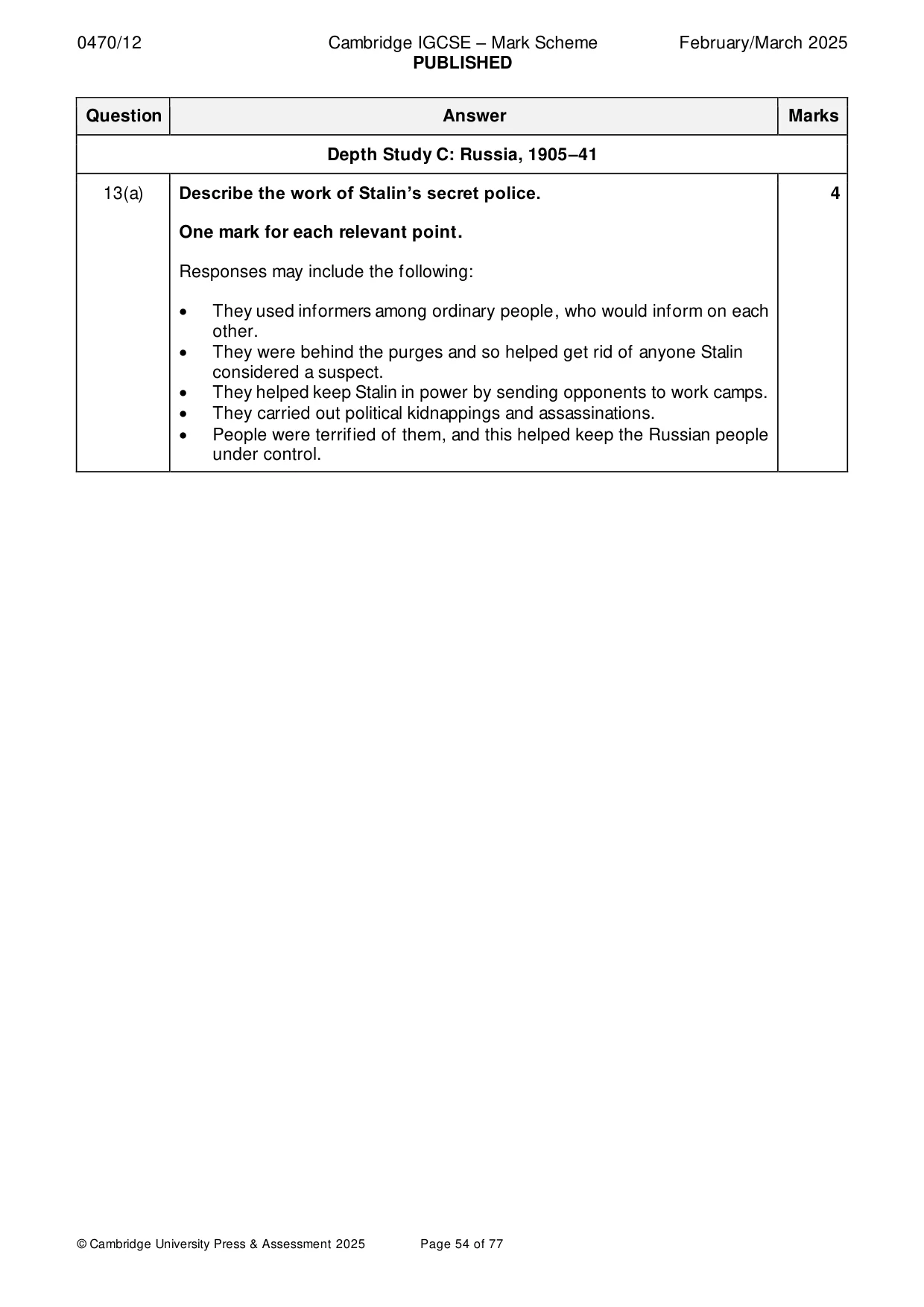
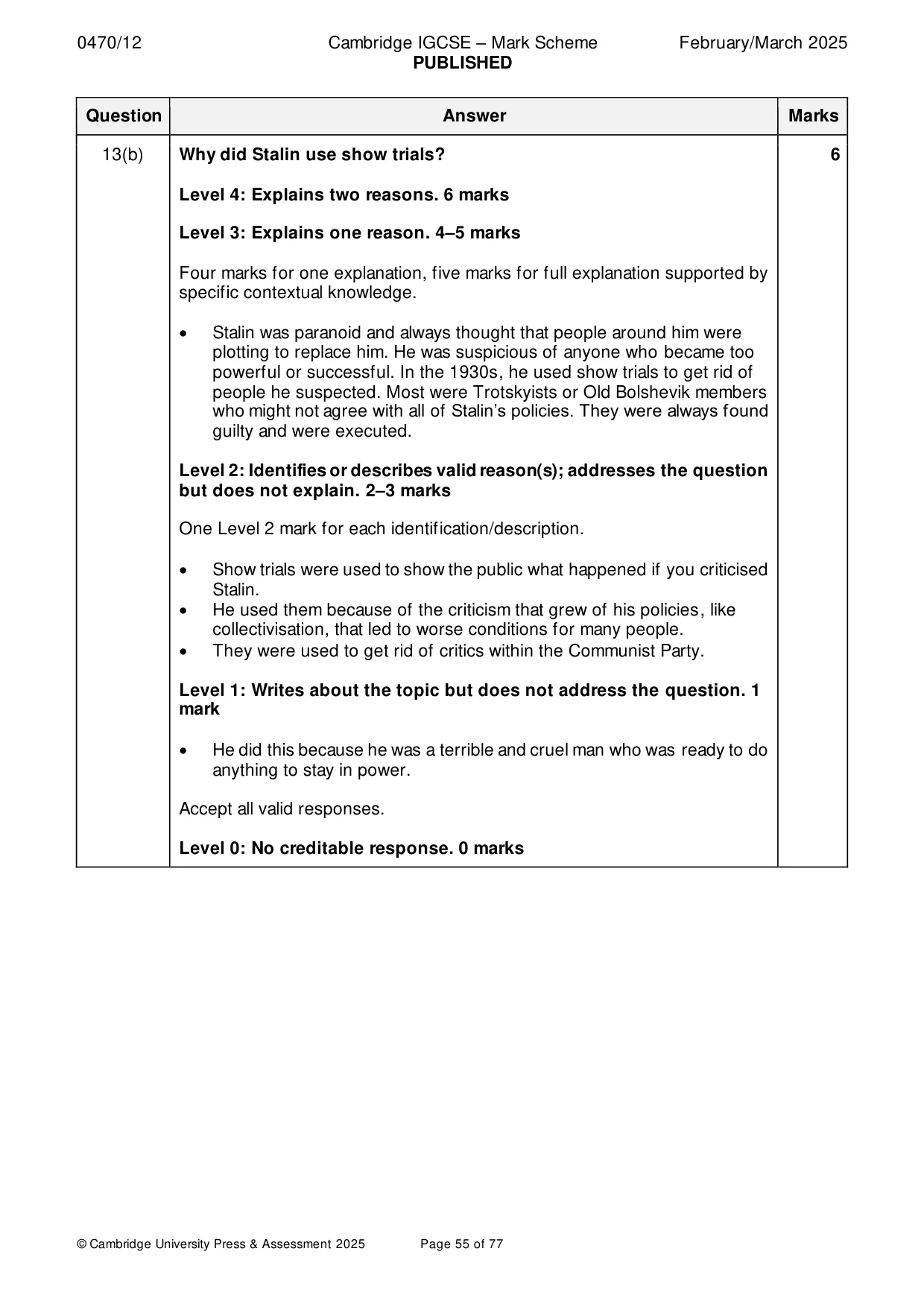
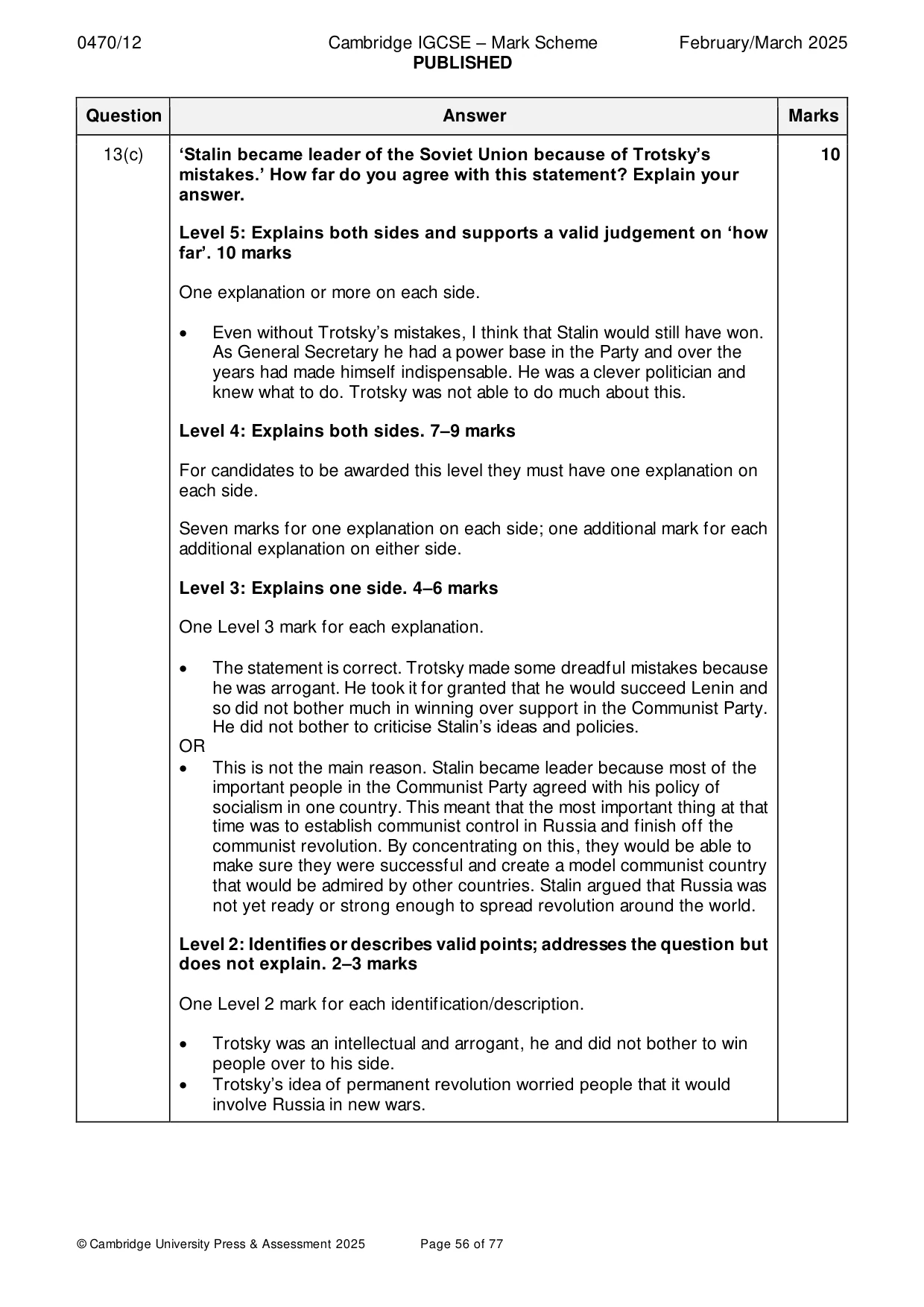
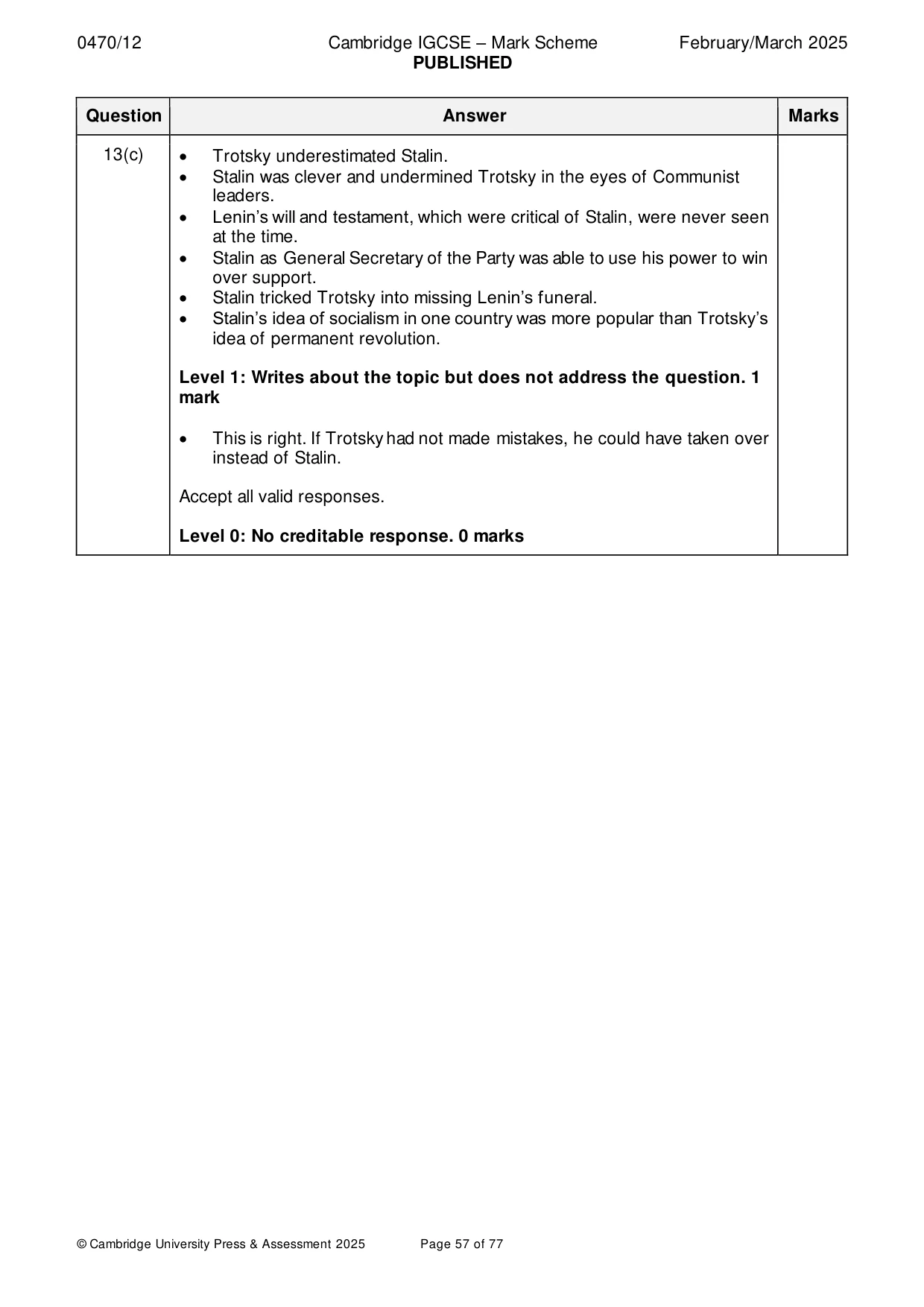
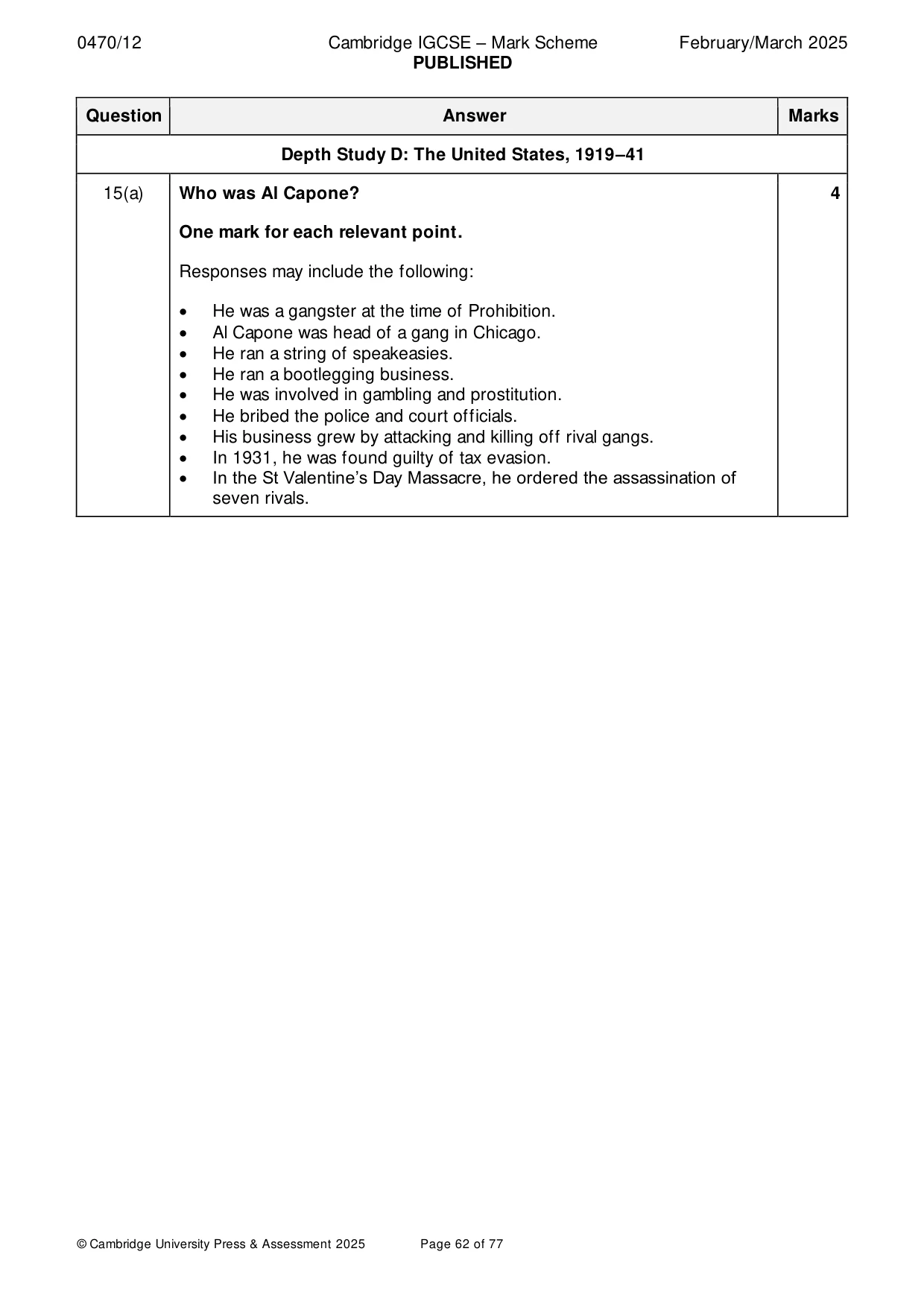
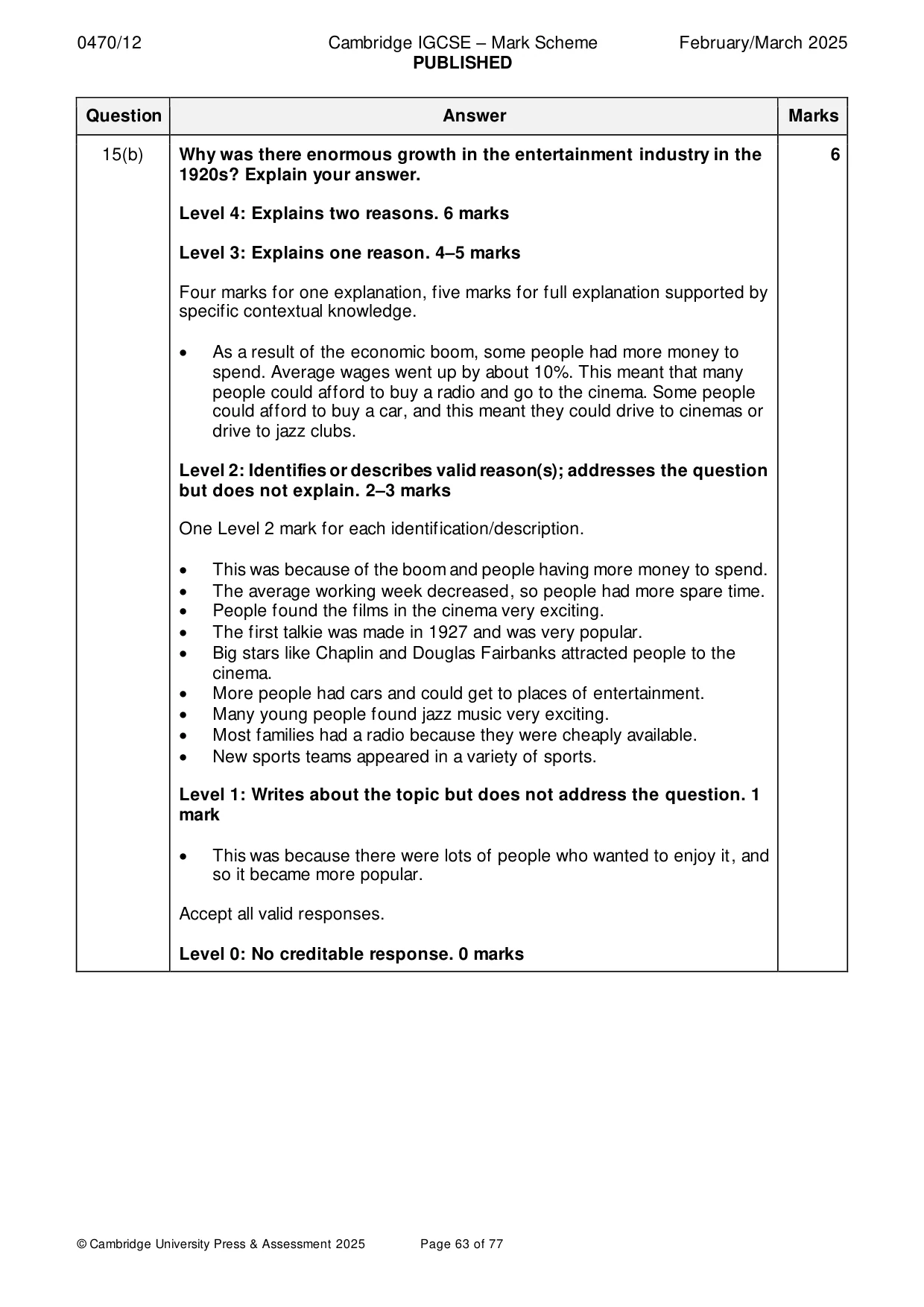
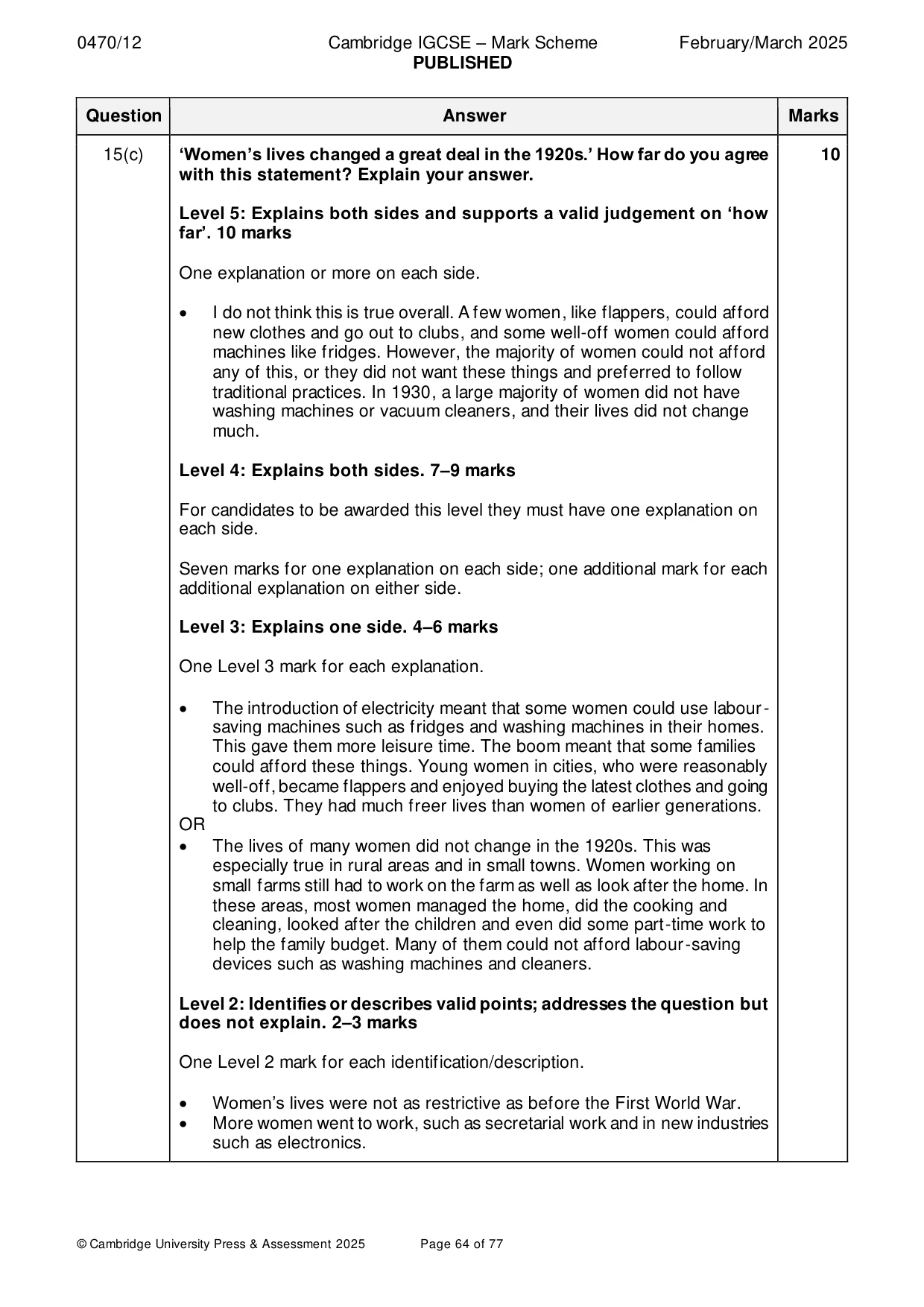
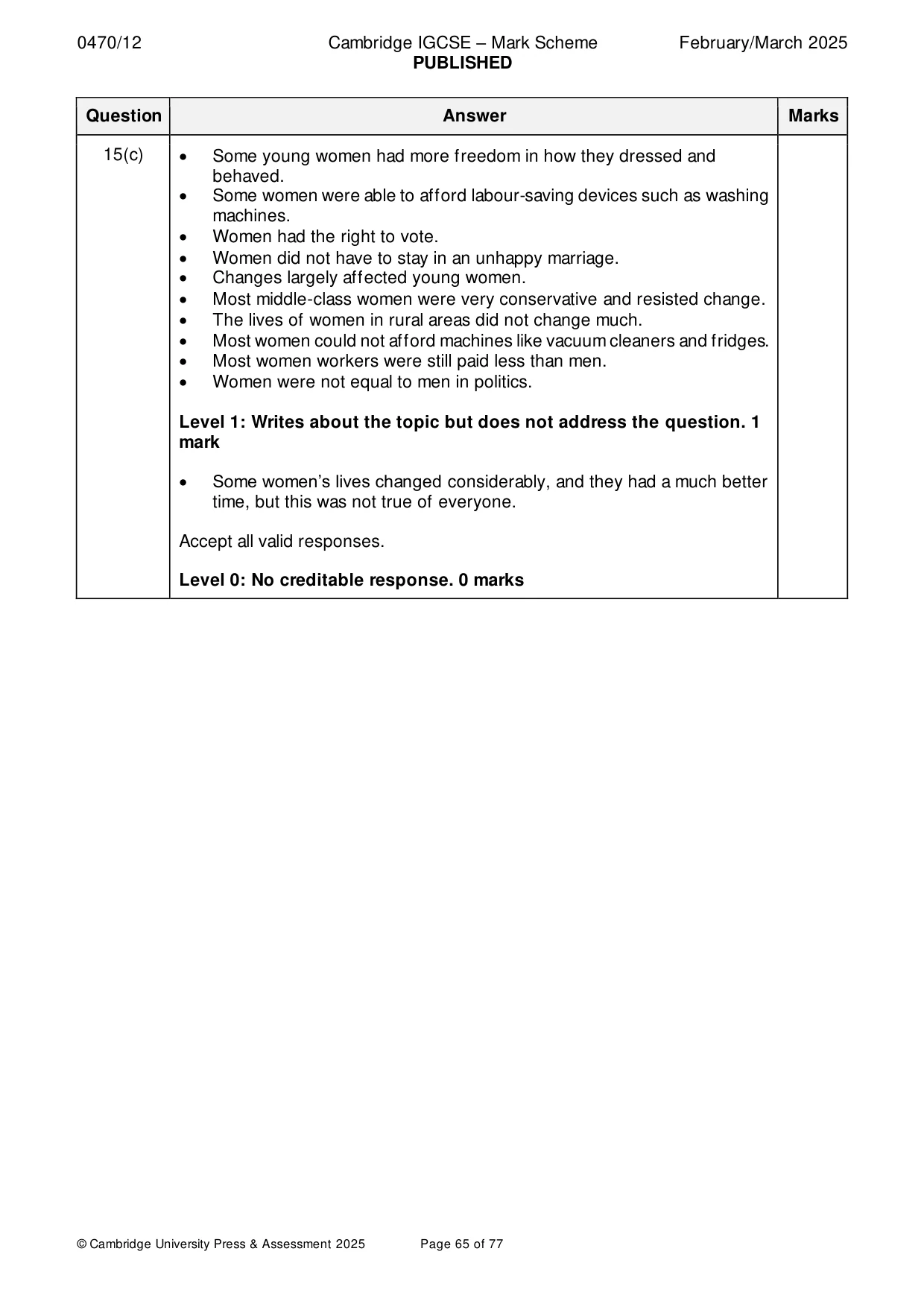
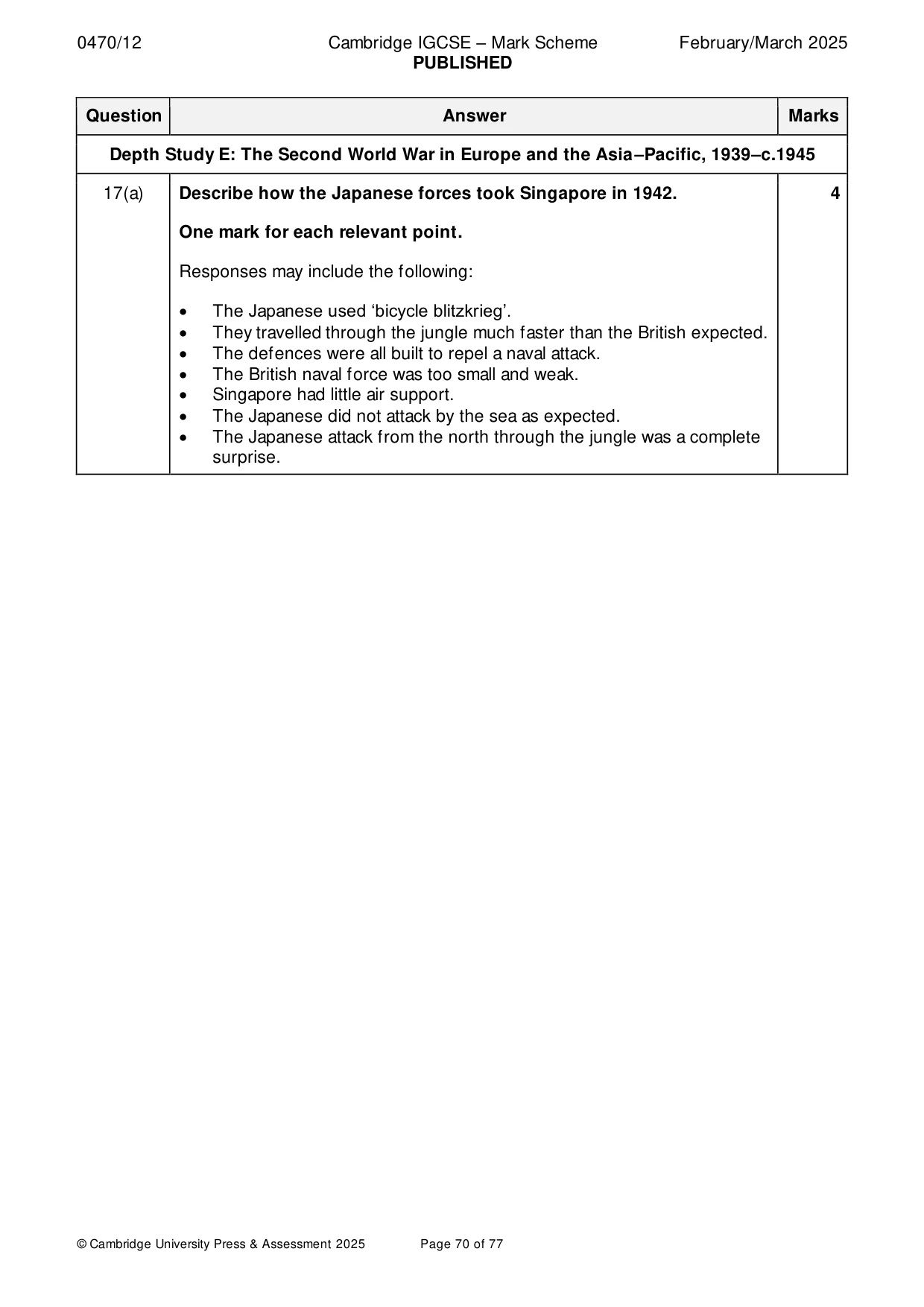
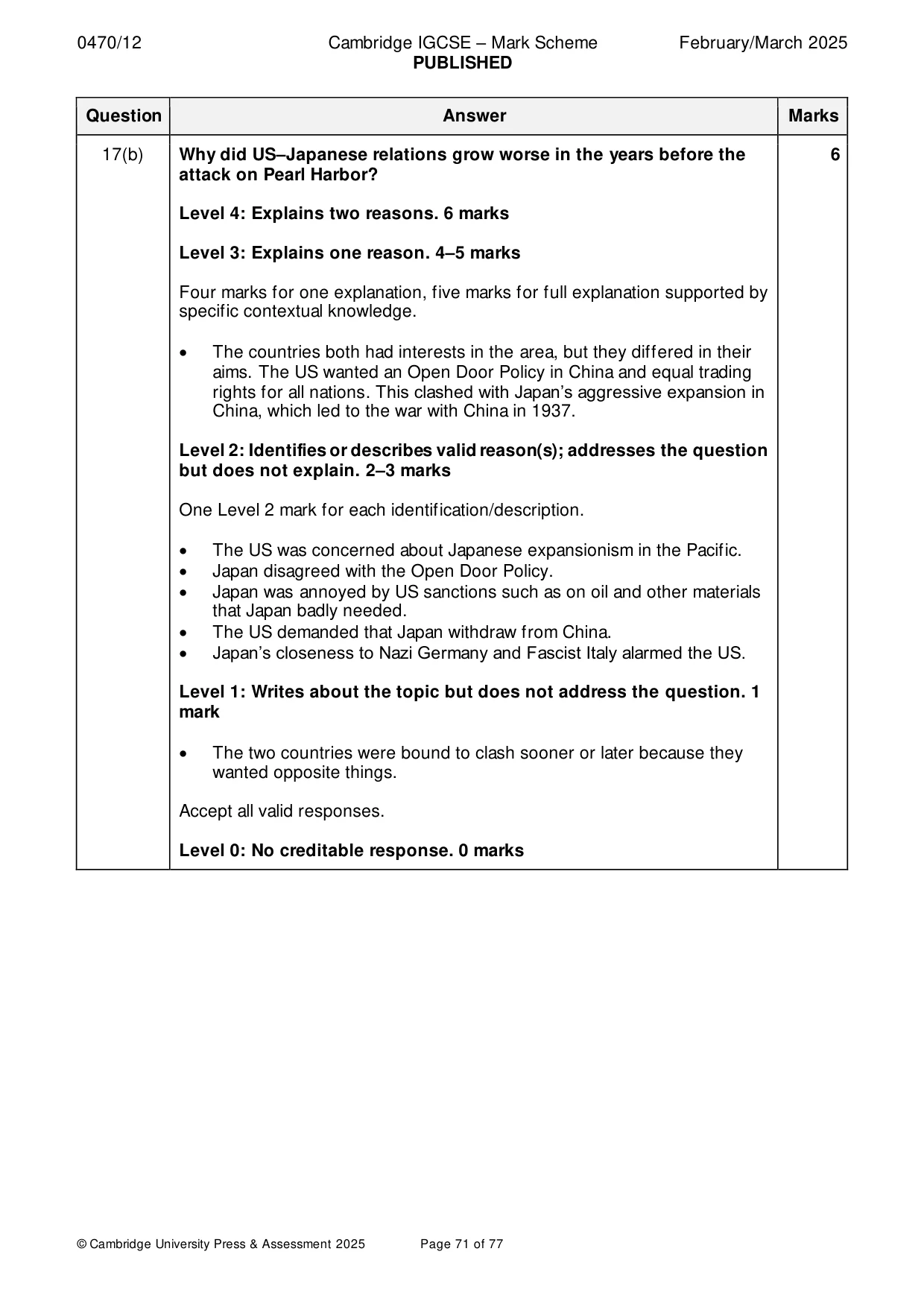
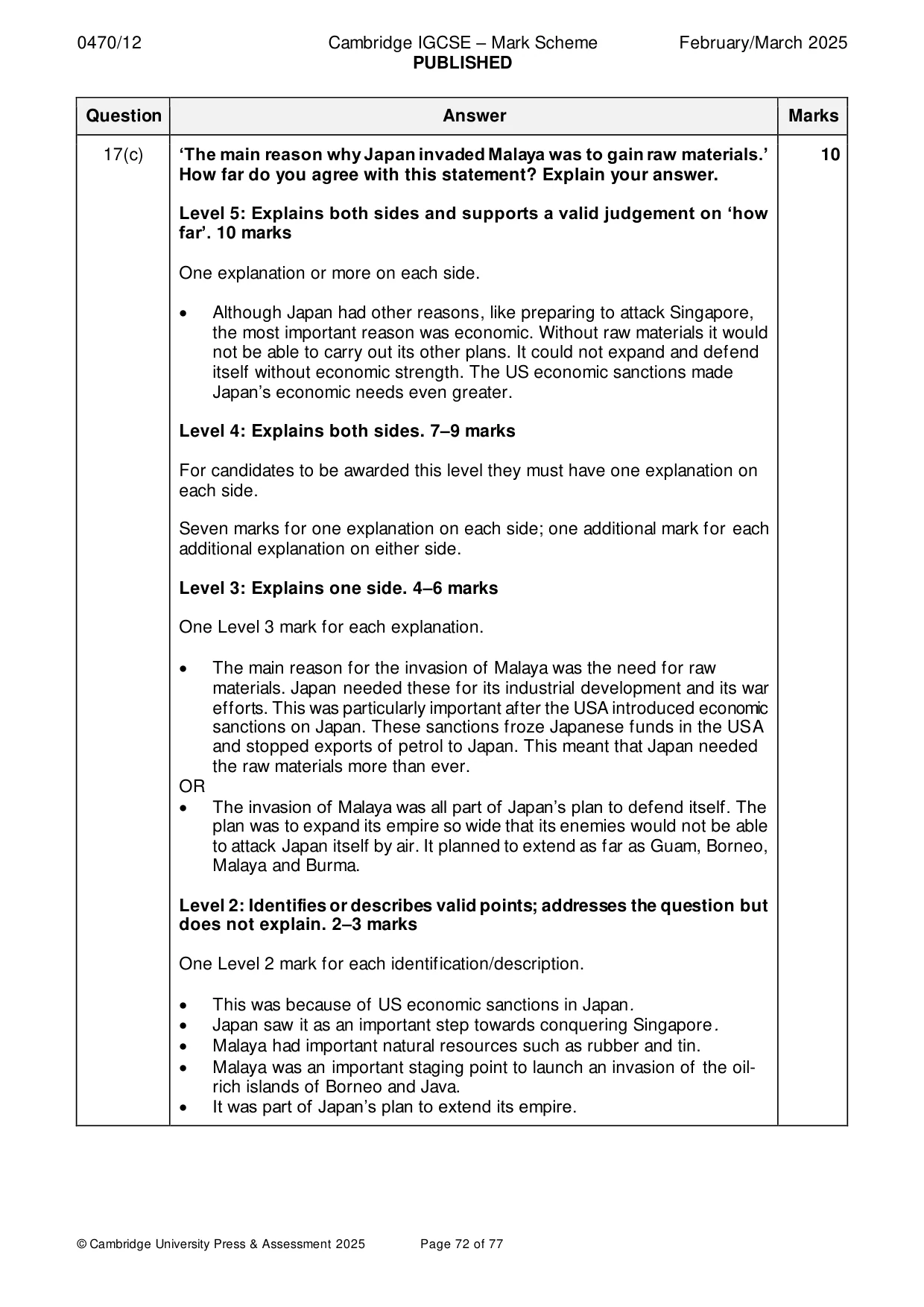
Paper as text
Question paper, page 1
This document has 8 pages. Any blank pages are indicated. [Turn over Cambridge IGCSE™ DC (CE) 342298/3 © UCLES 2025 HISTORY 0470/12 Paper 1 Structured Questions February/March 2025 2 hours You must answer on the enclosed answer booklet. You will need: Answer booklet (enclosed) INSTRUCTIONS ● Answer three questions in total: Section A (Core content): answer two questions. Section B (Depth studies): answer one question. ● Follow the instructions on the front cover of the answer booklet. If you need additional answer paper, ask the invigilator for a continuation booklet. INFORMATION ● The total mark for this paper is 60. ● The number of marks for each question or part question is shown in brackets [ ]. * 6 3 8 7 0 2 2 8 7 2 *
Question paper, page 2
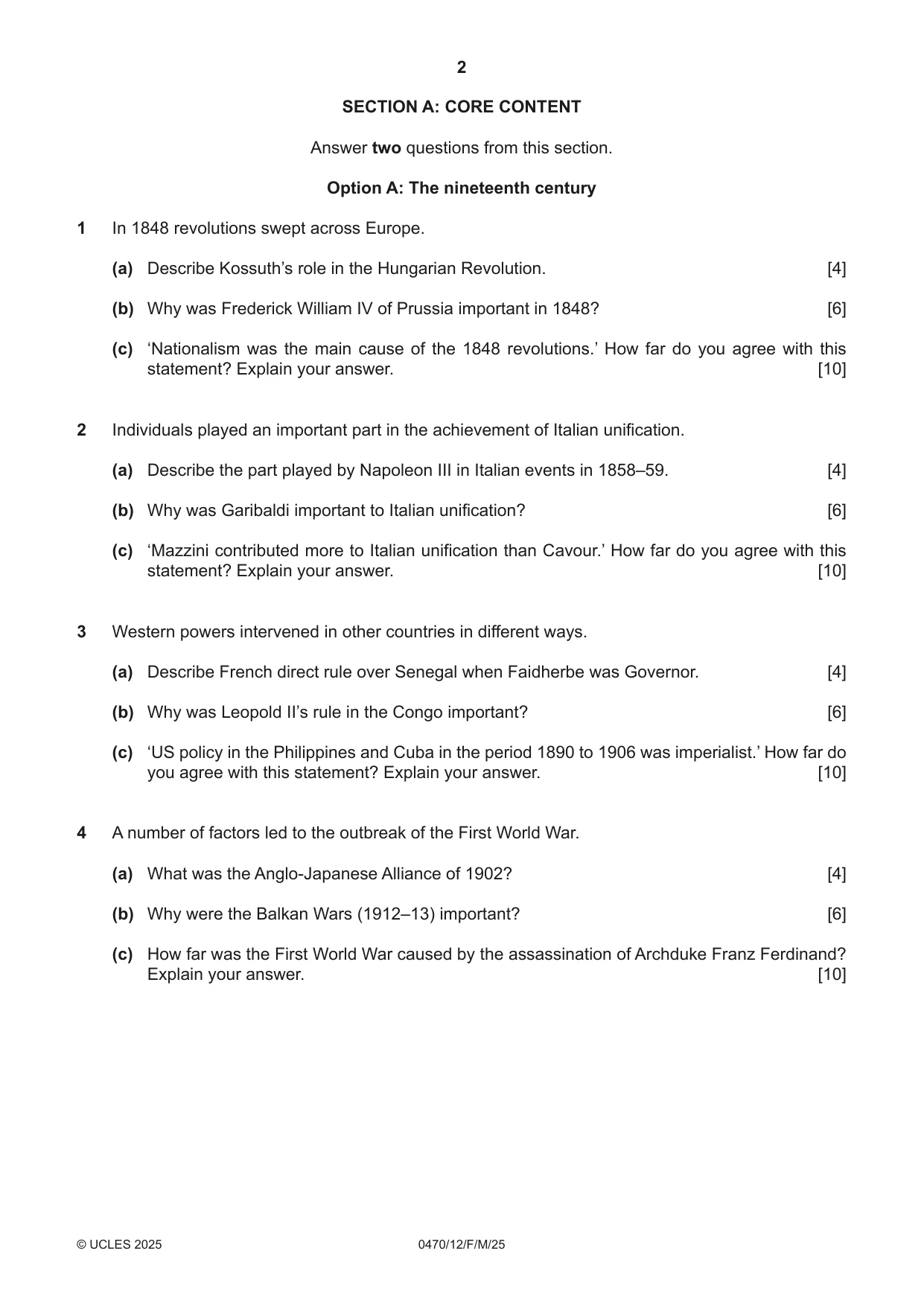
2 0470/12/F/M/25 © UCLES 2025 SECTION A: CORE CONTENT Answer two questions from this section. Option A: The nineteenth century 1 In 1848 revolutions swept across Europe. (a) Describe Kossuth’s role in the Hungarian Revolution. [4] (b) Why was Frederick William IV of Prussia important in 1848? [6] (c) ‘Nationalism was the main cause of the 1848 revolutions.’ How far do you agree with this statement? Explain your answer. [10] 2 Individuals played an important part in the achievement of Italian unification. (a) Describe the part played by Napoleon III in Italian events in 1858–59. [4] (b) Why was Garibaldi important to Italian unification? [6] (c) ‘Mazzini contributed more to Italian unification than Cavour.’ How far do you agree with this statement? Explain your answer. [10] 3 Western powers intervened in other countries in different ways. (a) Describe French direct rule over Senegal when Faidherbe was Governor. [4] (b) Why was Leopold II’s rule in the Congo important? [6] (c) ‘US policy in the Philippines and Cuba in the period 1890 to 1906 was imperialist.’ How far do you agree with this statement? Explain your answer. [10] 4 A number of factors led to the outbreak of the First World War. (a) What was the Anglo-Japanese Alliance of 1902? [4] (b) Why were the Balkan Wars (1912–13) important? [6] (c) How far was the First World War caused by the assassination of Archduke Franz Ferdinand? Explain your answer. [10]
Question paper, page 3
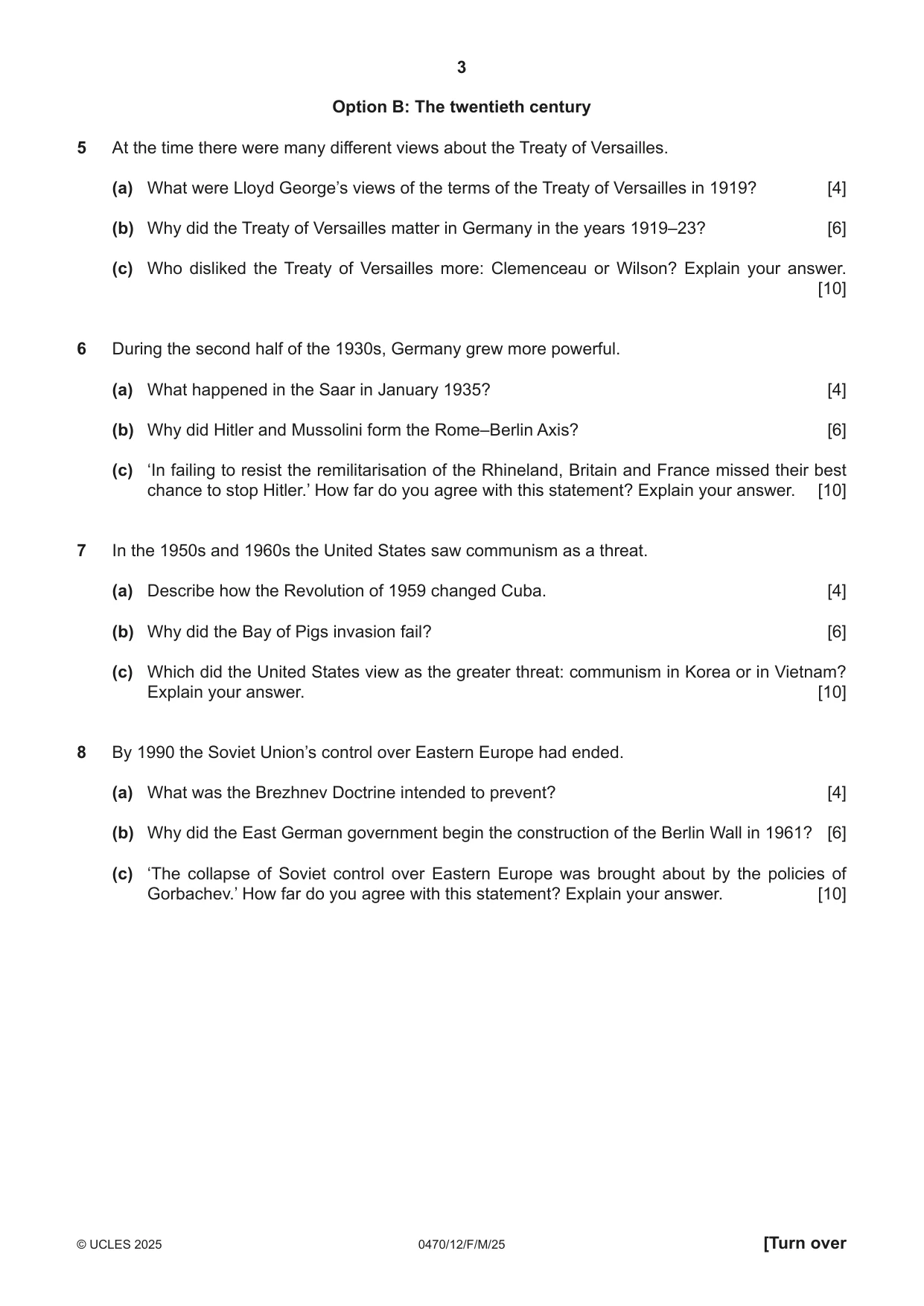
3 0470/12/F/M/25 © UCLES 2025 [Turn over Option B: The twentieth century 5 At the time there were many different views about the Treaty of Versailles. (a) What were Lloyd George’s views of the terms of the Treaty of Versailles in 1919? [4] (b) Why did the Treaty of Versailles matter in Germany in the years 1919–23? [6] (c) Who disliked the Treaty of Versailles more: Clemenceau or Wilson? Explain your answer. [10] 6 During the second half of the 1930s, Germany grew more powerful. (a) What happened in the Saar in January 1935? [4] (b) Why did Hitler and Mussolini form the Rome–Berlin Axis? [6] (c) ‘In failing to resist the remilitarisation of the Rhineland, Britain and France missed their best chance to stop Hitler.’ How far do you agree with this statement? Explain your answer. [10] 7 In the 1950s and 1960s the United States saw communism as a threat. (a) Describe how the Revolution of 1959 changed Cuba. [4] (b) Why did the Bay of Pigs invasion fail? [6] (c) Which did the United States view as the greater threat: communism in Korea or in Vietnam? Explain your answer. [10] 8 By 1990 the Soviet Union’s control over Eastern Europe had ended. (a) What was the Brezhnev Doctrine intended to prevent? [4] (b) Why did the East German government begin the construction of the Berlin Wall in 1961? [6] (c) ‘The collapse of Soviet control over Eastern Europe was brought about by the policies of Gorbachev.’ How far do you agree with this statement? Explain your answer. [10]
Question paper, page 4
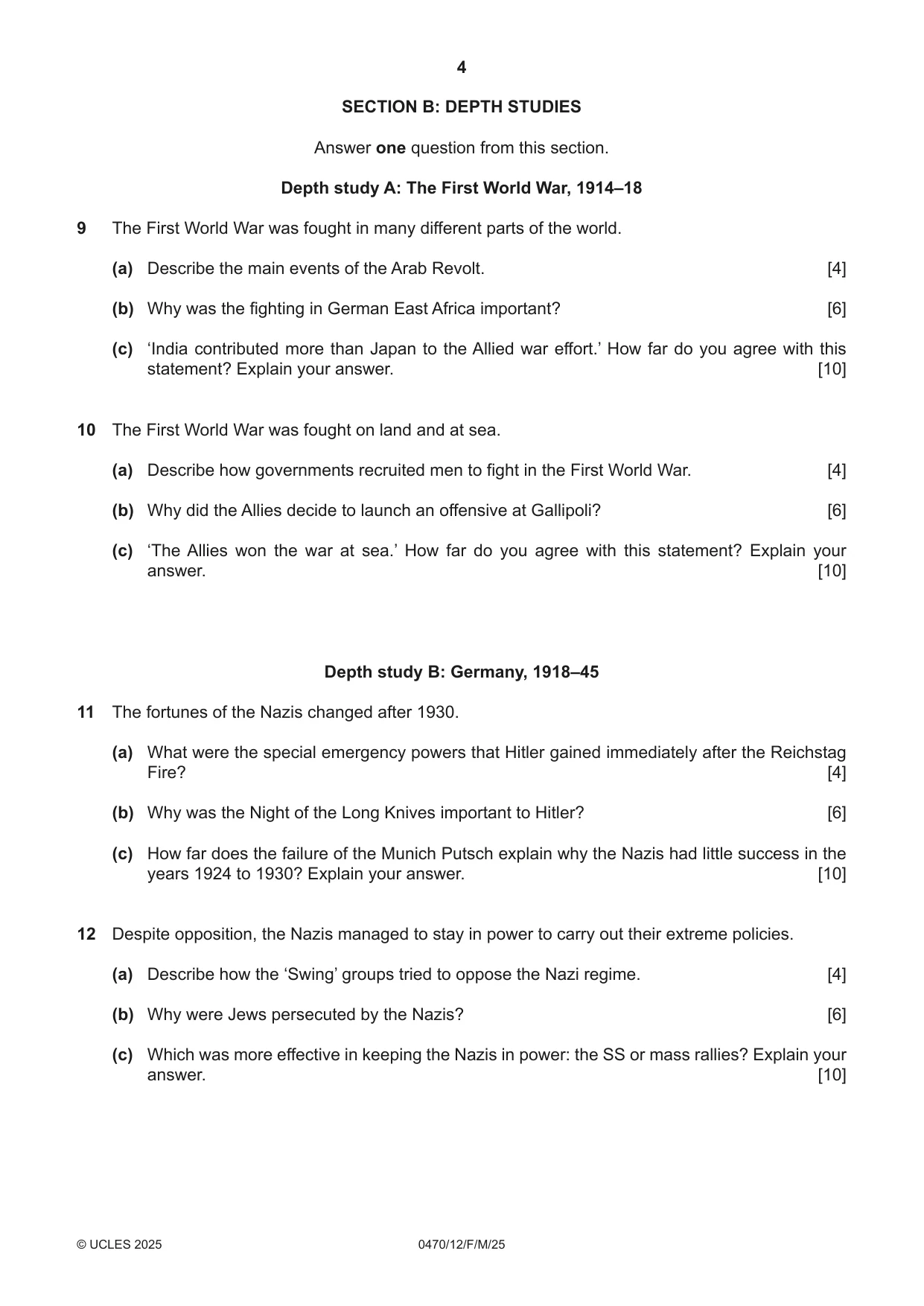
4 0470/12/F/M/25 © UCLES 2025 SECTION B: DEPTH STUDIES Answer one question from this section. Depth study A: The First World War, 1914–18 9 The First World War was fought in many different parts of the world. (a) Describe the main events of the Arab Revolt. [4] (b) Why was the fighting in German East Africa important? [6] (c) ‘India contributed more than Japan to the Allied war effort.’ How far do you agree with this statement? Explain your answer. [10] 10 The First World War was fought on land and at sea. (a) Describe how governments recruited men to fight in the First World War. [4] (b) Why did the Allies decide to launch an offensive at Gallipoli? [6] (c) ‘The Allies won the war at sea.’ How far do you agree with this statement? Explain your answer. [10] Depth study B: Germany, 1918–45 11 The fortunes of the Nazis changed after 1930. (a) What were the special emergency powers that Hitler gained immediately after the Reichstag Fire? [4] (b) Why was the Night of the Long Knives important to Hitler? [6] (c) How far does the failure of the Munich Putsch explain why the Nazis had little success in the years 1924 to 1930? Explain your answer. [10] 12 Despite opposition, the Nazis managed to stay in power to carry out their extreme policies. (a) Describe how the ‘Swing’ groups tried to oppose the Nazi regime. [4] (b) Why were Jews persecuted by the Nazis? [6] (c) Which was more effective in keeping the Nazis in power: the SS or mass rallies? Explain your answer. [10]
Question paper, page 5
5 0470/12/F/M/25 © UCLES 2025 [Turn over Depth study C: Russia, 1905–41 13 Once he was in power, Stalin quickly asserted his authority. (a) Describe the work of Stalin’s secret police. [4] (b) Why did Stalin use show trials? [6] (c) ‘Stalin became leader of the Soviet Union because of Trotsky’s mistakes.’ How far do you agree with this statement? Explain your answer. [10] 14 Stalin was determined to modernise the Soviet Union. (a) What was GOSPLAN? [4] (b) Why did Stalin want to modernise the Soviet Union? [6] (c) How successful were Stalin’s industrial policies? Explain your answer. [10] Depth study D: The United States, 1919–41 15 The 1920s were years of great changes in the USA. (a) Who was Al Capone? [4] (b) Why was there enormous growth in the entertainment industry in the 1920s? Explain your answer. [6] (c) ‘Women’s lives changed a great deal in the 1920s.’ How far do you agree with this statement? Explain your answer. [10] 16 The New Deal divided opinion in the USA. (a) Describe the Supreme Court’s opposition to the New Deal. [4] (b) Why did many of the rich oppose the New Deal? [6] (c) ‘The setting up of the Tennessee Valley Authority was the most important part of the New Deal.’ How far do you agree with this statement? Explain your answer. [10]
Question paper, page 6
6 0470/12/F/M/25 © UCLES 2025 Depth study E: The Second World War in Europe and the Asia–Pacific, 1939–c.1945 17 The Japanese were successful in the early phases of the war. (a) Describe how the Japanese forces took Singapore in 1942. [4] (b) Why did US–Japanese relations grow worse in the years before the attack on Pearl Harbor? [6] (c) ‘The main reason why Japan invaded Malaya was to gain raw materials.’ How far do you agree with this statement? Explain your answer. [10] 18 Both Germany and Japan were finally defeated in 1945. (a) What were the war crimes trials? [4] (b) Why did the USA decide to drop atomic bombs on Japan? [6] (c) ‘Germany’s final defeat was ensured by the D-Day landings.’ How far do you agree with this statement? Explain your answer. [10]
Question paper, page 7
7 0470/12/F/M/25 © UCLES 2025 BLANK PAGE
Question paper, page 8
8 0470/12/F/M/25 © UCLES 2025 Permission to reproduce items where third-party owned material protected by copyright is included has been sought and cleared where possible. Every reasonable effort has been made by the publisher (UCLES) to trace copyright holders, but if any items requiring clearance have unwittingly been included, the publisher will be pleased to make amends at the earliest possible opportunity. To avoid the issue of disclosure of answer-related information to candidates, all copyright acknowledgements are reproduced online in the Cambridge Assessment International Education Copyright Acknowledgements Booklet. This is produced for each series of examinations and is freely available to download at www.cambridgeinternational.org after the live examination series. Cambridge Assessment International Education is part of Cambridge Assessment. Cambridge Assessment is the brand name of the University of Cambridge Local Examinations Syndicate (UCLES), which is a department of the University of Cambridge. BLANK PAGE
Mark scheme, page 1
This document consists of 77 printed pages. © Cambridge University Press & Assessment 2025 [Turn over Cambridge IGCSE™ HISTORY 0470/12 Paper 1 February/March 2025 MARK SCHEME Maximum Mark: 60 Published This mark scheme is published as an aid to teachers and candidates, to indicate the requirements of the examination. It shows the basis on which Examiners were instructed to award marks. It does not indicate the details of the discussions that took place at an Examiners’ meeting before marking began, which would have considered the acceptability of alternative answers. Mark schemes should be read in conjunction with the question paper and the Principal Examiner Report for Teachers. Cambridge International will not enter into discussions about these mark schemes. Cambridge International is publishing the mark schemes for the February/March 2025 series for most Cambridge IGCSE, Cambridge International A and AS Level components, and some Cambridge O Level components.
Mark scheme, page 2
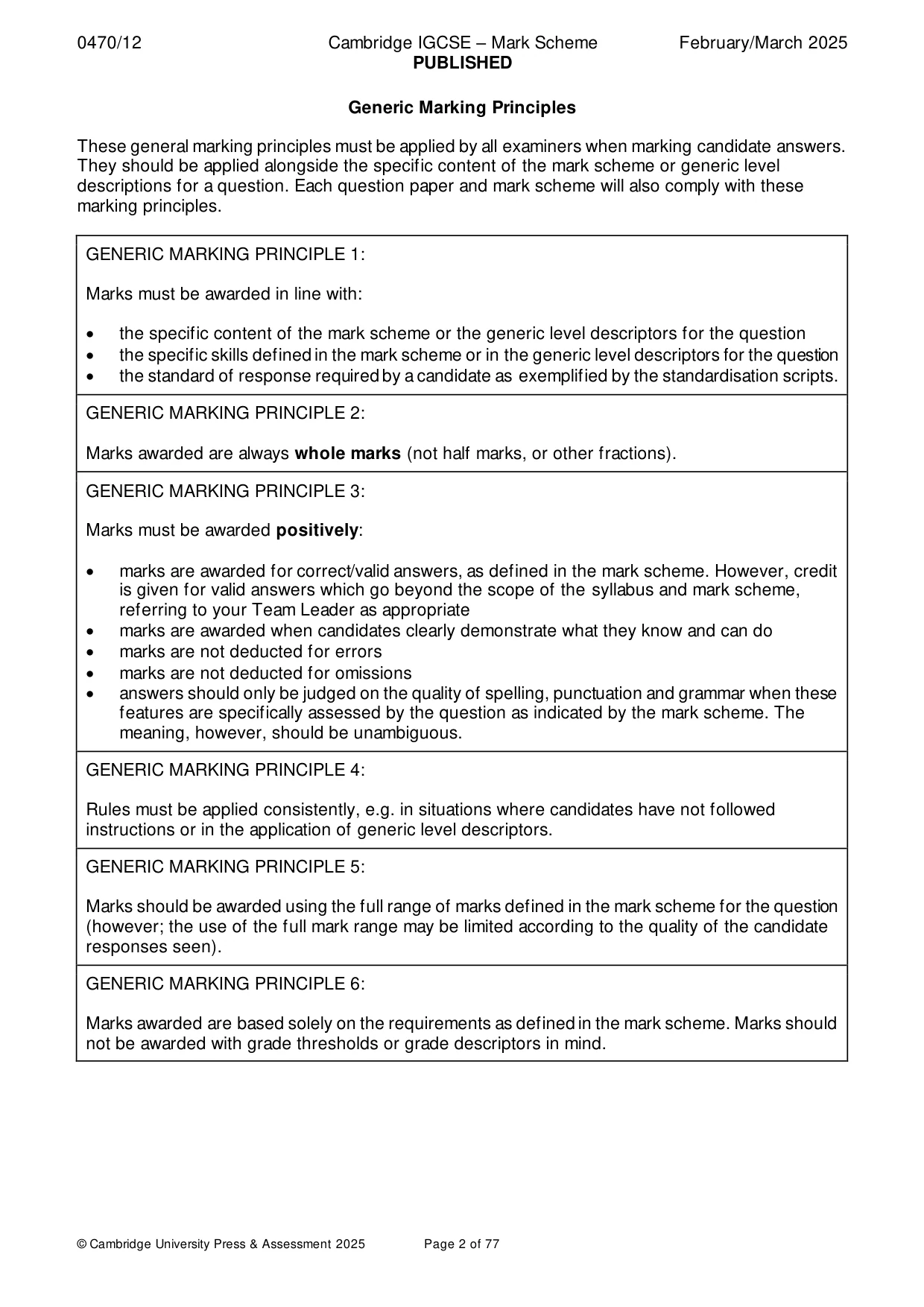
0470/12 Cambridge IGCSE – Mark Scheme PUBLISHED February/March 2025 © Cambridge University Press & Assessment 2025 Page 2 of 77 Generic Marking Principles These general marking principles must be applied by all examiners when marking candidate answers. They should be applied alongside the specific content of the mark scheme or generic level descriptions for a question. Each question paper and mark scheme will also comply with these marking principles. GENERIC MARKING PRINCIPLE 1: Marks must be awarded in line with: • the specific content of the mark scheme or the generic level descriptors for the question • the specific skills defined in the mark scheme or in the generic level descriptors for the question • the standard of response required by a candidate as exemplified by the standardisation scripts. GENERIC MARKING PRINCIPLE 2: Marks awarded are always whole marks (not half marks, or other fractions). GENERIC MARKING PRINCIPLE 3: Marks must be awarded positively: • marks are awarded for correct/valid answers, as defined in the mark scheme. However, credit is given for valid answers which go beyond the scope of the syllabus and mark scheme, referring to your Team Leader as appropriate • marks are awarded when candidates clearly demonstrate what they know and can do • marks are not deducted for errors • marks are not deducted for omissions • answers should only be judged on the quality of spelling, punctuation and grammar when these features are specifically assessed by the question as indicated by the mark scheme. The meaning, however, should be unambiguous. GENERIC MARKING PRINCIPLE 4: Rules must be applied consistently, e.g. in situations where candidates have not followed instructions or in the application of generic level descriptors. GENERIC MARKING PRINCIPLE 5: Marks should be awarded using the full range of marks defined in the mark scheme for the question (however; the use of the full mark range may be limited according to the quality of the candidate responses seen). GENERIC MARKING PRINCIPLE 6: Marks awarded are based solely on the requirements as defined in the mark scheme. Marks should not be awarded with grade thresholds or grade descriptors in mind.
Mark scheme, page 3
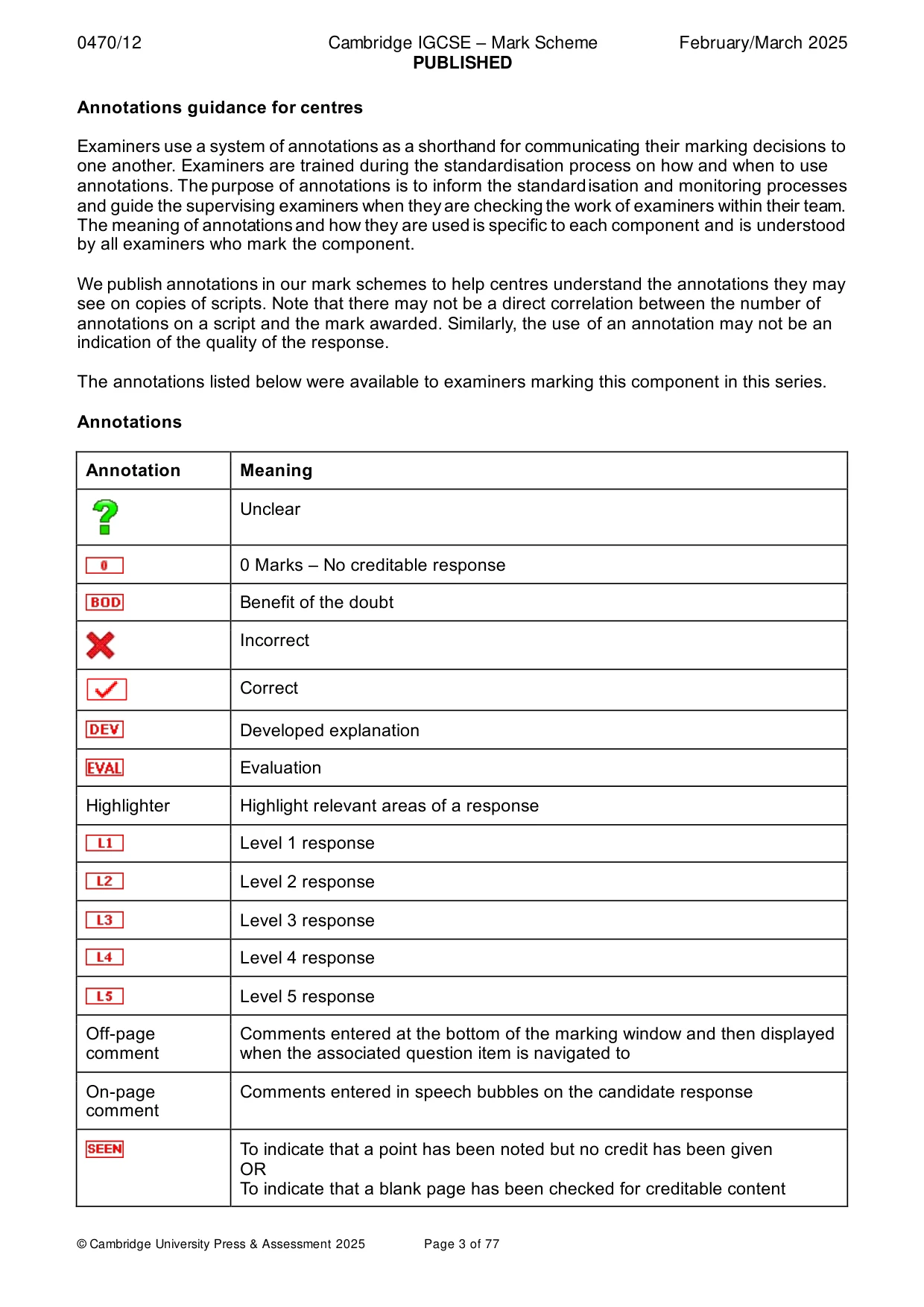
0470/12 Cambridge IGCSE – Mark Scheme PUBLISHED February/March 2025 © Cambridge University Press & Assessment 2025 Page 3 of 77 Annotations guidance for centres Examiners use a system of annotations as a shorthand for communicating their marking decisions to one another. Examiners are trained during the standardisation process on how and when to use annotations. The purpose of annotations is to inform the standardisation and monitoring processes and guide the supervising examiners when they are checking the work of examiners within their team. The meaning of annotations and how they are used is specific to each component and is understood by all examiners who mark the component. We publish annotations in our mark schemes to help centres understand the annotations they may see on copies of scripts. Note that there may not be a direct correlation between the number of annotations on a script and the mark awarded. Similarly, the use of an annotation may not be an indication of the quality of the response. The annotations listed below were available to examiners marking this component in this series. Annotations Annotation Meaning Unclear 0 Marks – No creditable response Benefit of the doubt Incorrect Correct Developed explanation Evaluation Highlighter Highlight relevant areas of a response Level 1 response Level 2 response Level 3 response Level 4 response Level 5 response Off-page comment Comments entered at the bottom of the marking window and then displayed when the associated question item is navigated to On-page comment Comments entered in speech bubbles on the candidate response To indicate that a point has been noted but no credit has been given OR To indicate that a blank page has been checked for creditable content
Mark scheme, page 4
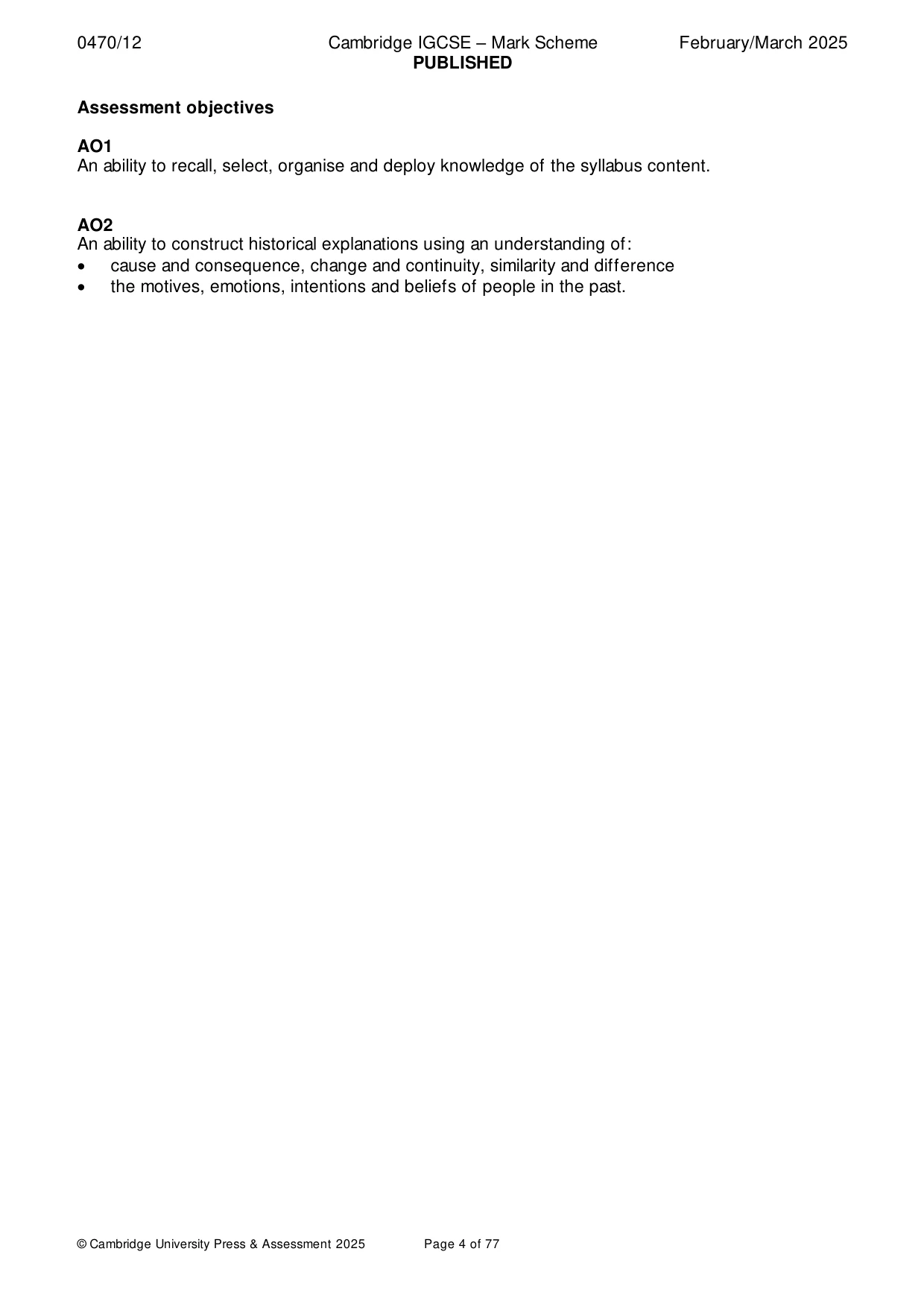
0470/12 Cambridge IGCSE – Mark Scheme PUBLISHED February/March 2025 © Cambridge University Press & Assessment 2025 Page 4 of 77 Assessment objectives AO1 An ability to recall, select, organise and deploy knowledge of the syllabus content. AO2 An ability to construct historical explanations using an understanding of: • cause and consequence, change and continuity, similarity and difference • the motives, emotions, intentions and beliefs of people in the past.
Mark scheme, page 5
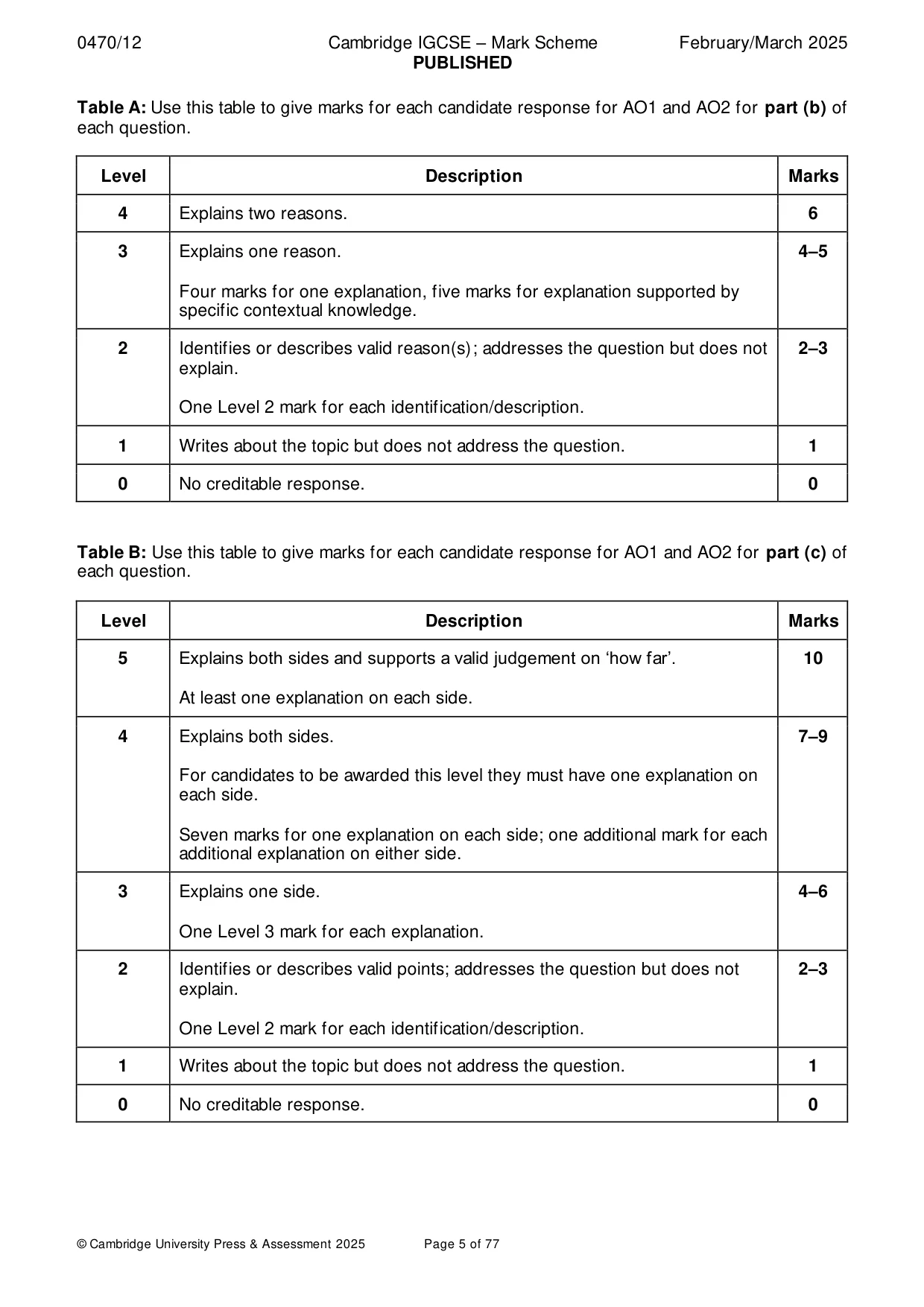
0470/12 Cambridge IGCSE – Mark Scheme PUBLISHED February/March 2025 © Cambridge University Press & Assessment 2025 Page 5 of 77 Table A: Use this table to give marks for each candidate response for AO1 and AO2 for part (b) of each question. Level Description Marks 4 Explains two reasons. 6 3 Explains one reason. Four marks for one explanation, five marks for explanation supported by specific contextual knowledge. 4–5 2 Identifies or describes valid reason(s); addresses the question but does not explain. One Level 2 mark for each identification/description. 2–3 1 Writes about the topic but does not address the question. 1 0 No creditable response. 0 Table B: Use this table to give marks for each candidate response for AO1 and AO2 for part (c) of each question. Level Description Marks 5 Explains both sides and supports a valid judgement on ‘how far’. At least one explanation on each side. 10 4 Explains both sides. For candidates to be awarded this level they must have one explanation on each side. Seven marks for one explanation on each side; one additional mark for each additional explanation on either side. 7–9 3 Explains one side. One Level 3 mark for each explanation. 4–6 2 Identifies or describes valid points; addresses the question but does not explain. One Level 2 mark for each identification/description. 2–3 1 Writes about the topic but does not address the question. 1 0 No creditable response. 0
Mark scheme, page 6
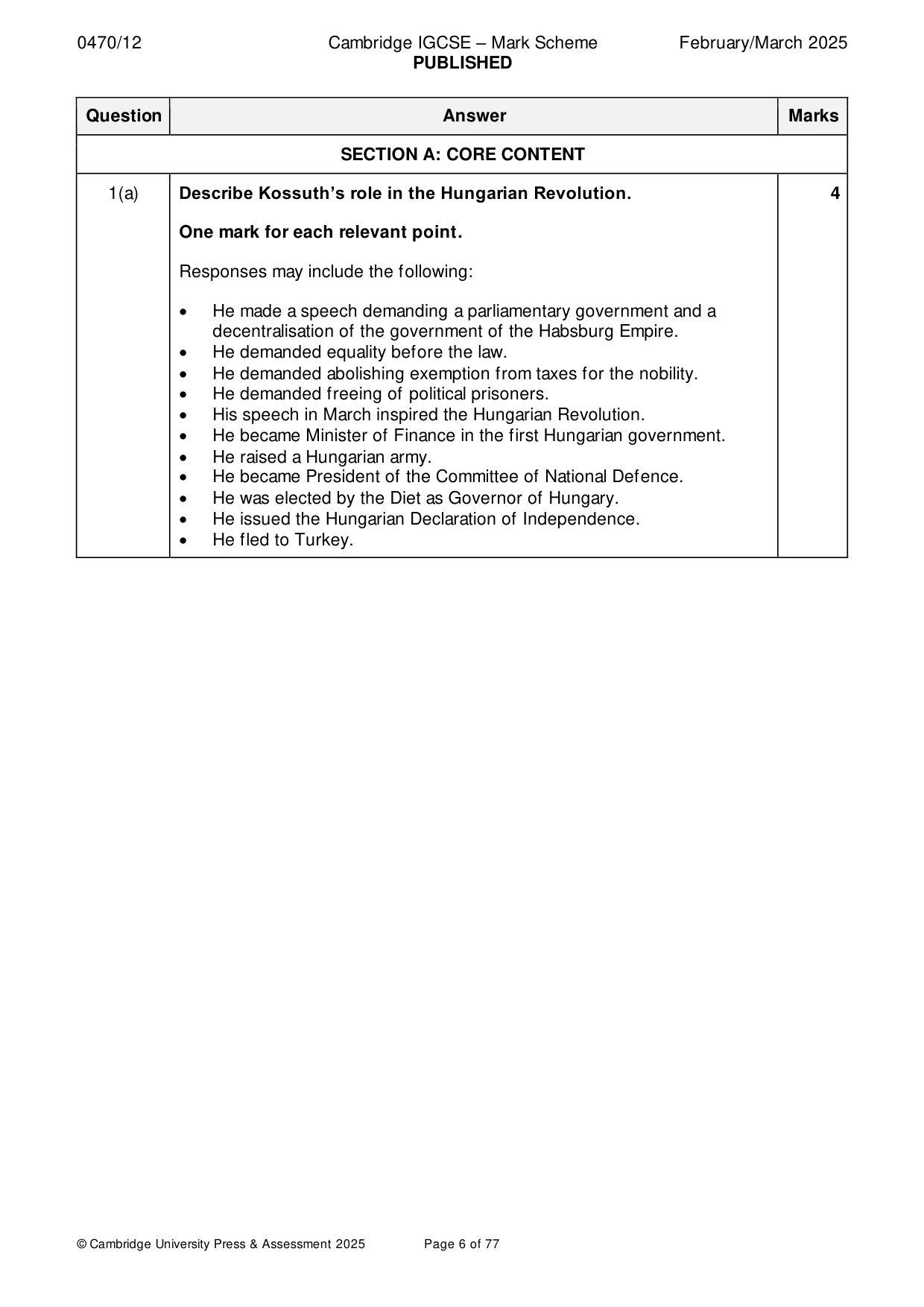
0470/12 Cambridge IGCSE – Mark Scheme PUBLISHED February/March 2025 © Cambridge University Press & Assessment 2025 Page 6 of 77 Question Answer Marks SECTION A: CORE CONTENT 1(a) Describe Kossuth’s role in the Hungarian Revolution. One mark for each relevant point. Responses may include the following: • He made a speech demanding a parliamentary government and a decentralisation of the government of the Habsburg Empire. • He demanded equality before the law. • He demanded abolishing exemption from taxes for the nobility. • He demanded freeing of political prisoners. • His speech in March inspired the Hungarian Revolution. • He became Minister of Finance in the first Hungarian government. • He raised a Hungarian army. • He became President of the Committee of National Defence. • He was elected by the Diet as Governor of Hungary. • He issued the Hungarian Declaration of Independence. • He fled to Turkey. 4
Mark scheme, page 7
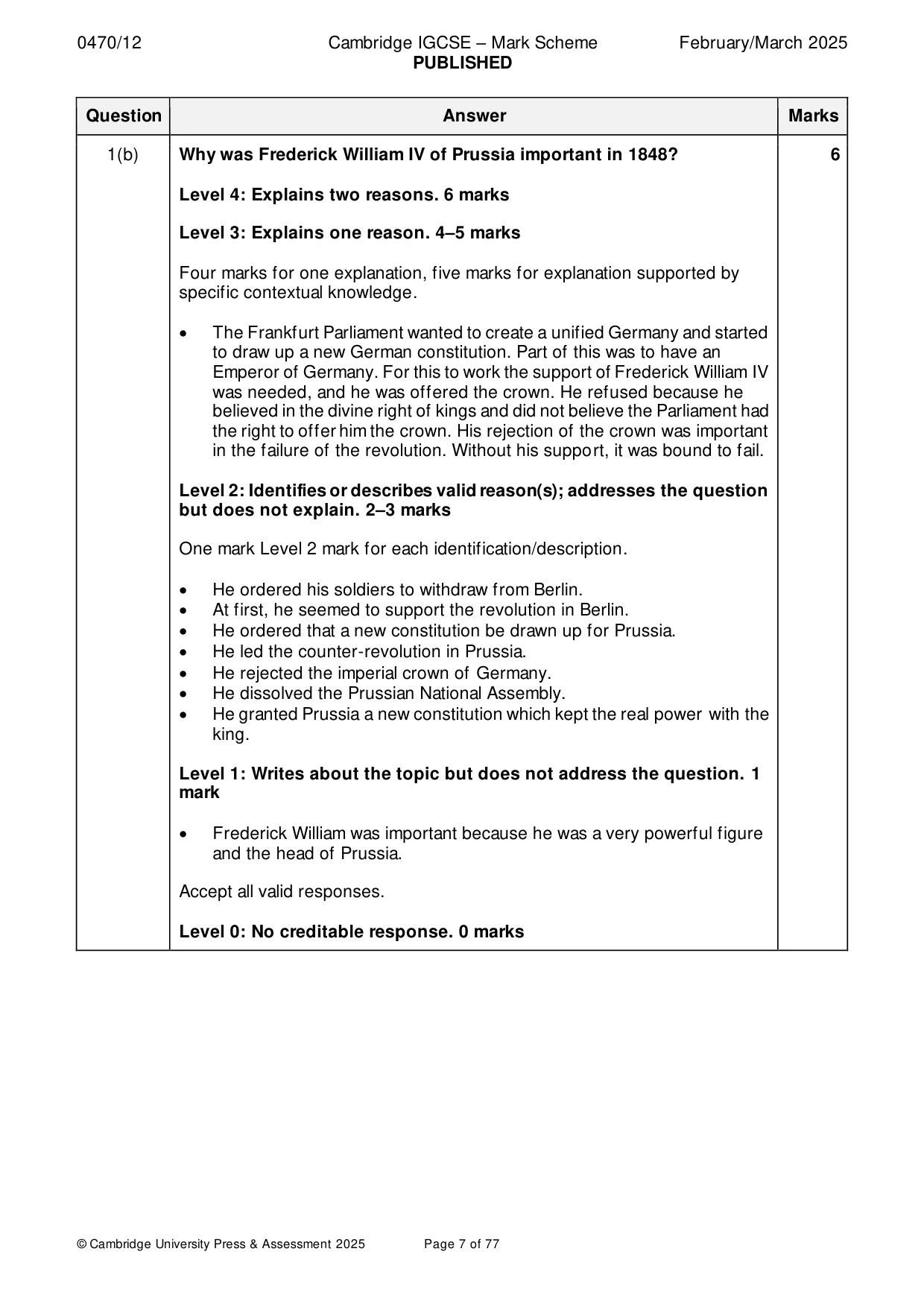
0470/12 Cambridge IGCSE – Mark Scheme PUBLISHED February/March 2025 © Cambridge University Press & Assessment 2025 Page 7 of 77 Question Answer Marks 1(b) Why was Frederick William IV of Prussia important in 1848? Level 4: Explains two reasons. 6 marks Level 3: Explains one reason. 4–5 marks Four marks for one explanation, five marks for explanation supported by specific contextual knowledge. • The Frankfurt Parliament wanted to create a unified Germany and started to draw up a new German constitution. Part of this was to have an Emperor of Germany. For this to work the support of Frederick William IV was needed, and he was offered the crown. He refused because he believed in the divine right of kings and did not believe the Parliament had the right to offer him the crown. His rejection of the crown was important in the failure of the revolution. Without his support, it was bound to fail. Level 2: Identifies or describes valid reason(s); addresses the question but does not explain. 2–3 marks One mark Level 2 mark for each identification/description. • He ordered his soldiers to withdraw from Berlin. • At first, he seemed to support the revolution in Berlin. • He ordered that a new constitution be drawn up for Prussia. • He led the counter-revolution in Prussia. • He rejected the imperial crown of Germany. • He dissolved the Prussian National Assembly. • He granted Prussia a new constitution which kept the real power with the king. Level 1: Writes about the topic but does not address the question. 1 mark • Frederick William was important because he was a very powerful figure and the head of Prussia. Accept all valid responses. Level 0: No creditable response. 0 marks 6
Mark scheme, page 8
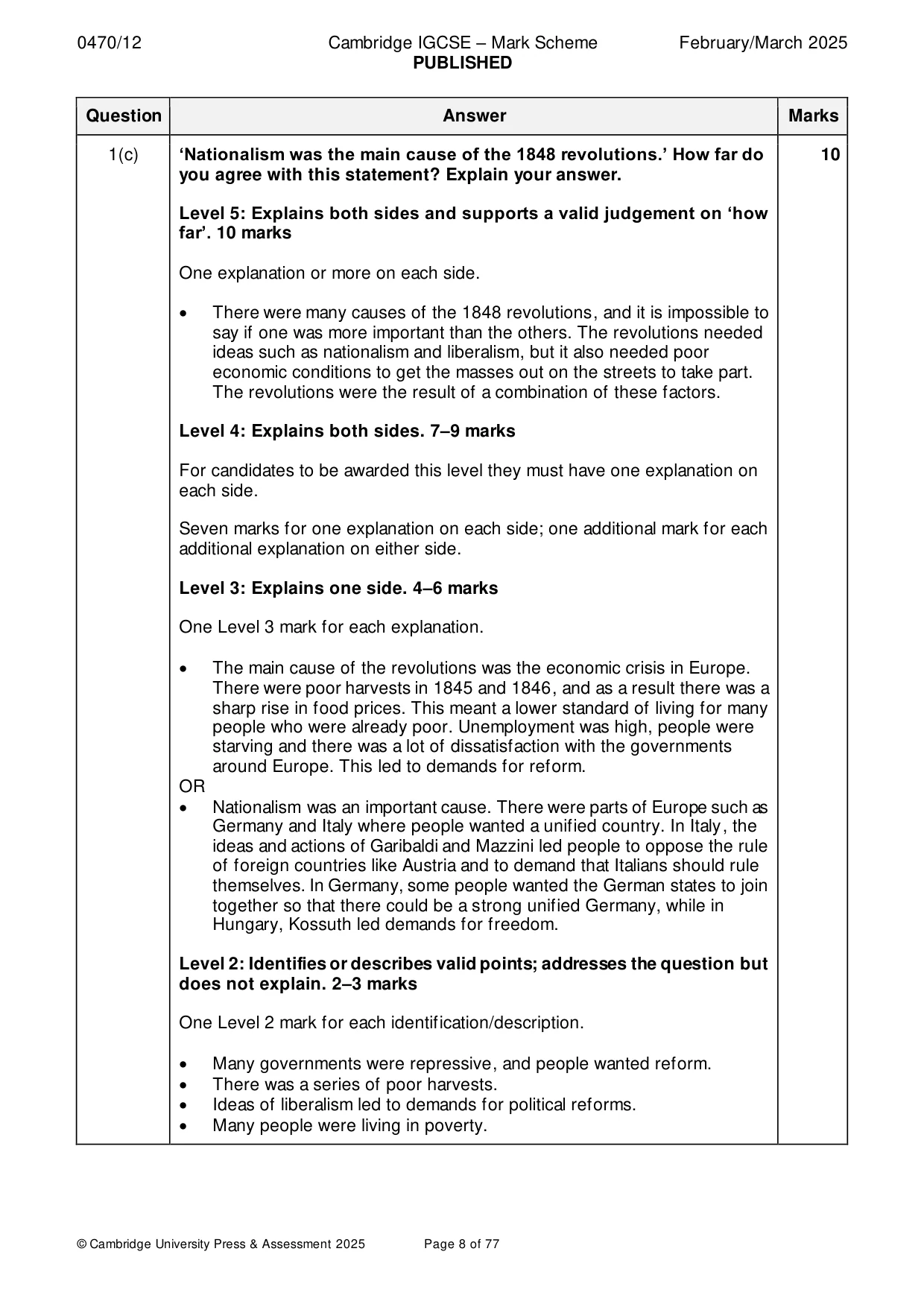
0470/12 Cambridge IGCSE – Mark Scheme PUBLISHED February/March 2025 © Cambridge University Press & Assessment 2025 Page 8 of 77 Question Answer Marks 1(c) ‘Nationalism was the main cause of the 1848 revolutions.’ How far do you agree with this statement? Explain your answer. Level 5: Explains both sides and supports a valid judgement on ‘how far’. 10 marks One explanation or more on each side. • There were many causes of the 1848 revolutions, and it is impossible to say if one was more important than the others. The revolutions needed ideas such as nationalism and liberalism, but it also needed poor economic conditions to get the masses out on the streets to take part. The revolutions were the result of a combination of these factors. Level 4: Explains both sides. 7–9 marks For candidates to be awarded this level they must have one explanation on each side. Seven marks for one explanation on each side; one additional mark for each additional explanation on either side. Level 3: Explains one side. 4–6 marks One Level 3 mark for each explanation. • The main cause of the revolutions was the economic crisis in Europe. There were poor harvests in 1845 and 1846, and as a result there was a sharp rise in food prices. This meant a lower standard of living for many people who were already poor. Unemployment was high, people were starving and there was a lot of dissatisfaction with the governments around Europe. This led to demands for reform. OR • Nationalism was an important cause. There were parts of Europe such as Germany and Italy where people wanted a unified country. In Italy, the ideas and actions of Garibaldi and Mazzini led people to oppose the rule of foreign countries like Austria and to demand that Italians should rule themselves. In Germany, some people wanted the German states to join together so that there could be a strong unified Germany, while in Hungary, Kossuth led demands for freedom. Level 2: Identifies or describes valid points; addresses the question but does not explain. 2–3 marks One Level 2 mark for each identification/description. • Many governments were repressive, and people wanted reform. • There was a series of poor harvests. • Ideas of liberalism led to demands for political reforms. • Many people were living in poverty. 10
Mark scheme, page 9
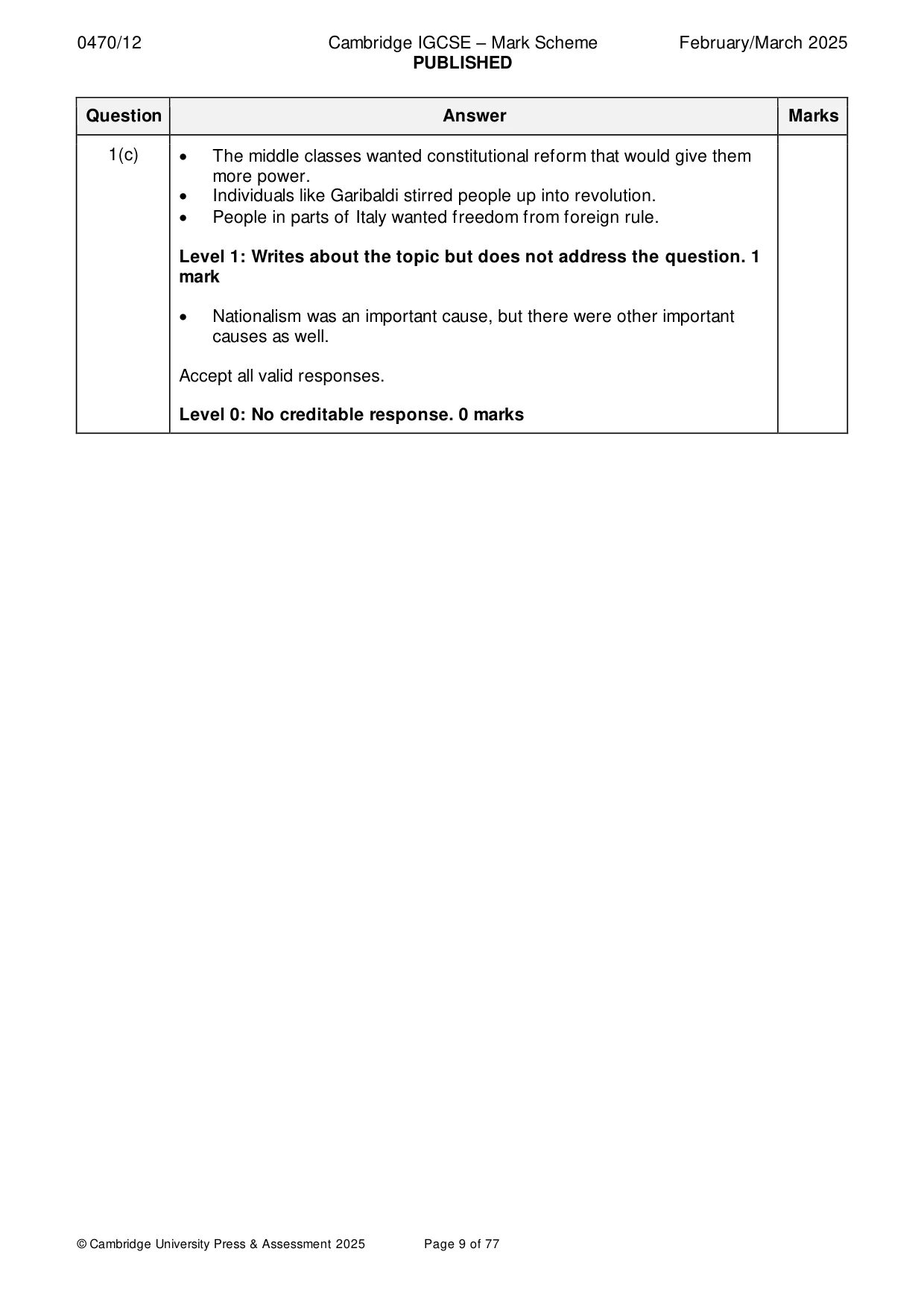
0470/12 Cambridge IGCSE – Mark Scheme PUBLISHED February/March 2025 © Cambridge University Press & Assessment 2025 Page 9 of 77 Question Answer Marks 1(c) • The middle classes wanted constitutional reform that would give them more power. • Individuals like Garibaldi stirred people up into revolution. • People in parts of Italy wanted freedom from foreign rule. Level 1: Writes about the topic but does not address the question. 1 mark • Nationalism was an important cause, but there were other important causes as well. Accept all valid responses. Level 0: No creditable response. 0 marks
Mark scheme, page 10
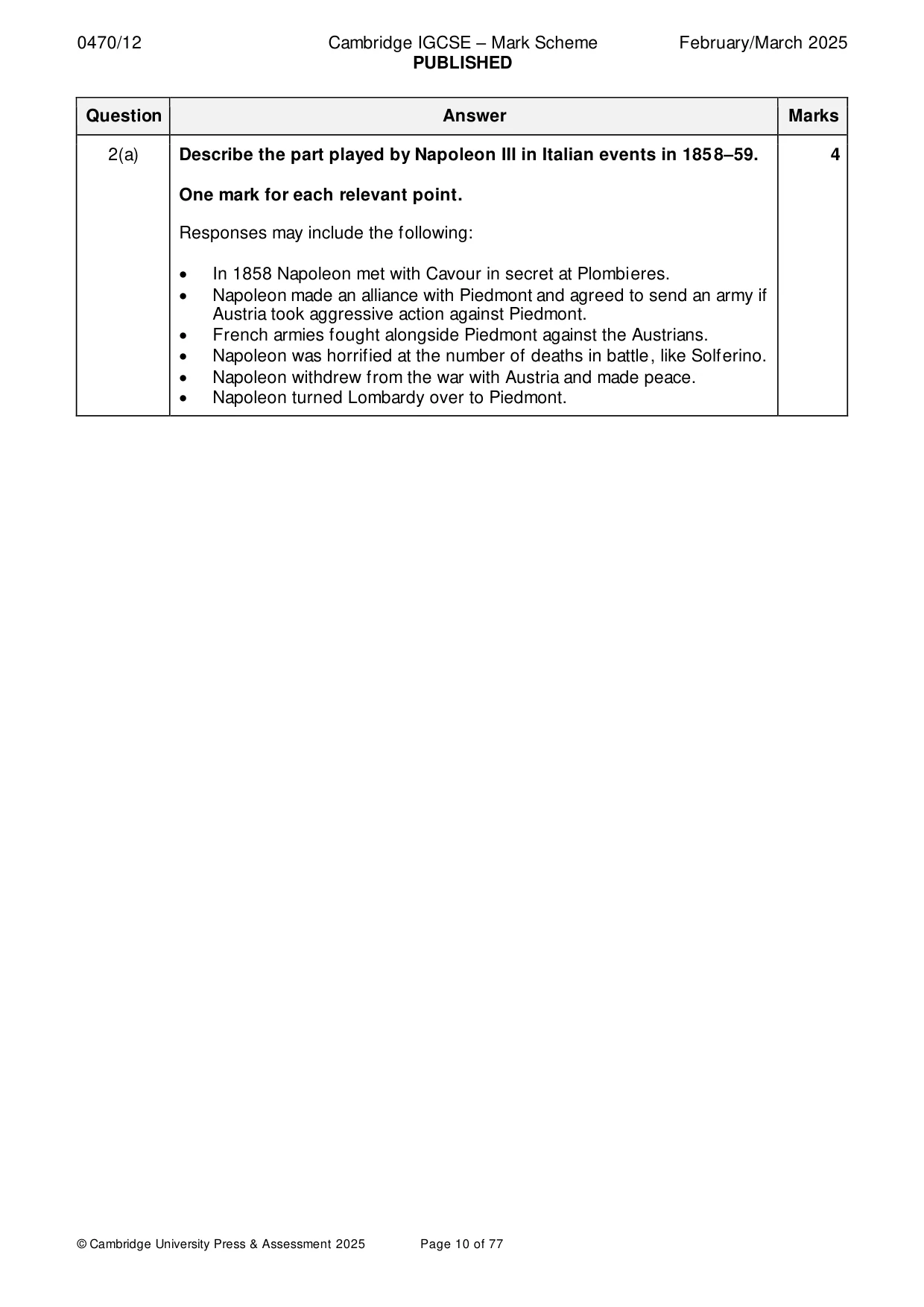
0470/12 Cambridge IGCSE – Mark Scheme PUBLISHED February/March 2025 © Cambridge University Press & Assessment 2025 Page 10 of 77 Question Answer Marks 2(a) Describe the part played by Napoleon III in Italian events in 1858–59. One mark for each relevant point. Responses may include the following: • In 1858 Napoleon met with Cavour in secret at Plombieres. • Napoleon made an alliance with Piedmont and agreed to send an army if Austria took aggressive action against Piedmont. • French armies fought alongside Piedmont against the Austrians. • Napoleon was horrified at the number of deaths in battle, like Solferino. • Napoleon withdrew from the war with Austria and made peace. • Napoleon turned Lombardy over to Piedmont. 4
Mark scheme, page 11
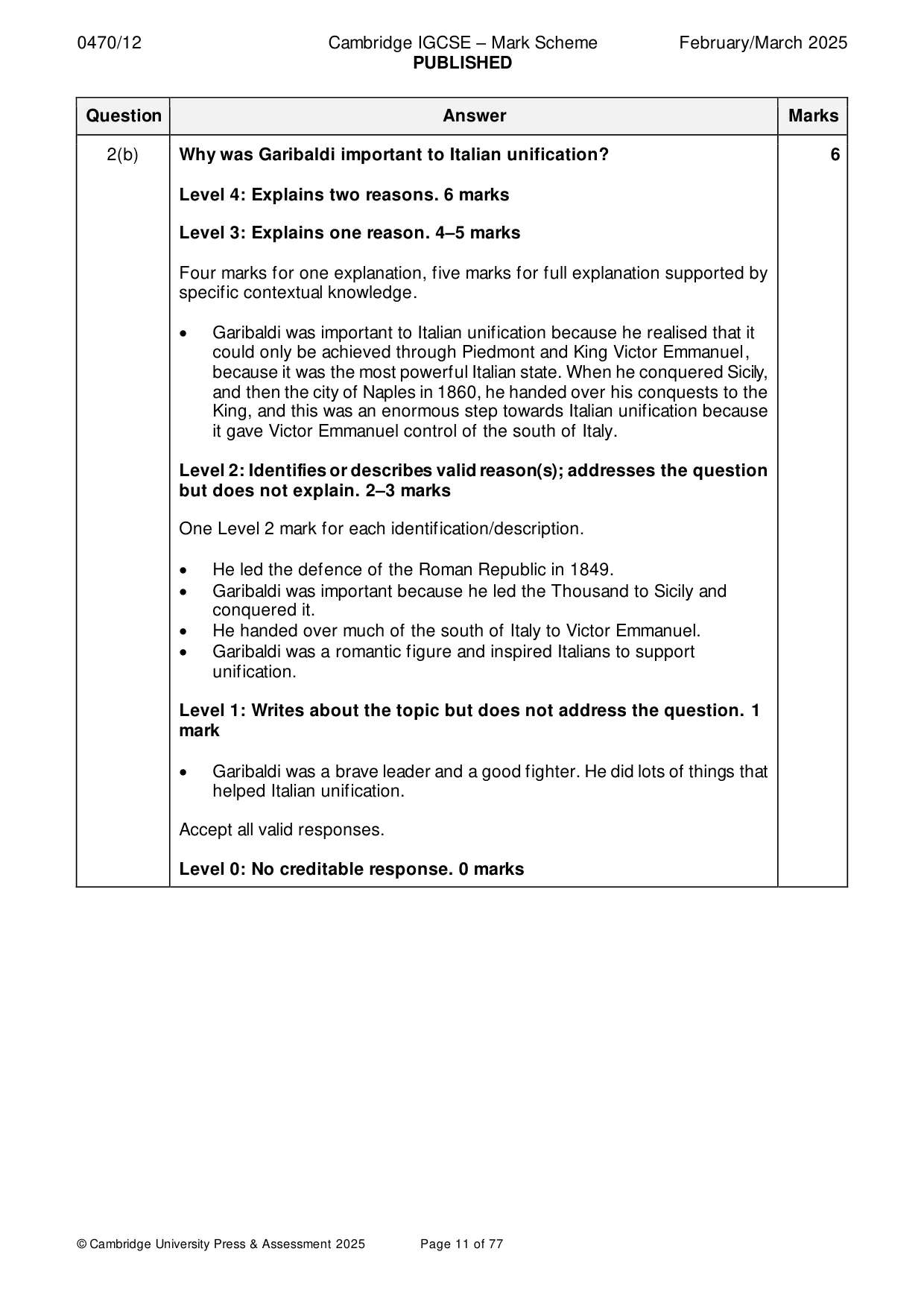
0470/12 Cambridge IGCSE – Mark Scheme PUBLISHED February/March 2025 © Cambridge University Press & Assessment 2025 Page 11 of 77 Question Answer Marks 2(b) Why was Garibaldi important to Italian unification? Level 4: Explains two reasons. 6 marks Level 3: Explains one reason. 4–5 marks Four marks for one explanation, five marks for full explanation supported by specific contextual knowledge. • Garibaldi was important to Italian unification because he realised that it could only be achieved through Piedmont and King Victor Emmanuel, because it was the most powerful Italian state. When he conquered Sicily, and then the city of Naples in 1860, he handed over his conquests to the King, and this was an enormous step towards Italian unification because it gave Victor Emmanuel control of the south of Italy. Level 2: Identifies or describes valid reason(s); addresses the question but does not explain. 2–3 marks One Level 2 mark for each identification/description. • He led the defence of the Roman Republic in 1849. • Garibaldi was important because he led the Thousand to Sicily and conquered it. • He handed over much of the south of Italy to Victor Emmanuel. • Garibaldi was a romantic figure and inspired Italians to support unification. Level 1: Writes about the topic but does not address the question. 1 mark • Garibaldi was a brave leader and a good fighter. He did lots of things that helped Italian unification. Accept all valid responses. Level 0: No creditable response. 0 marks 6
Mark scheme, page 12
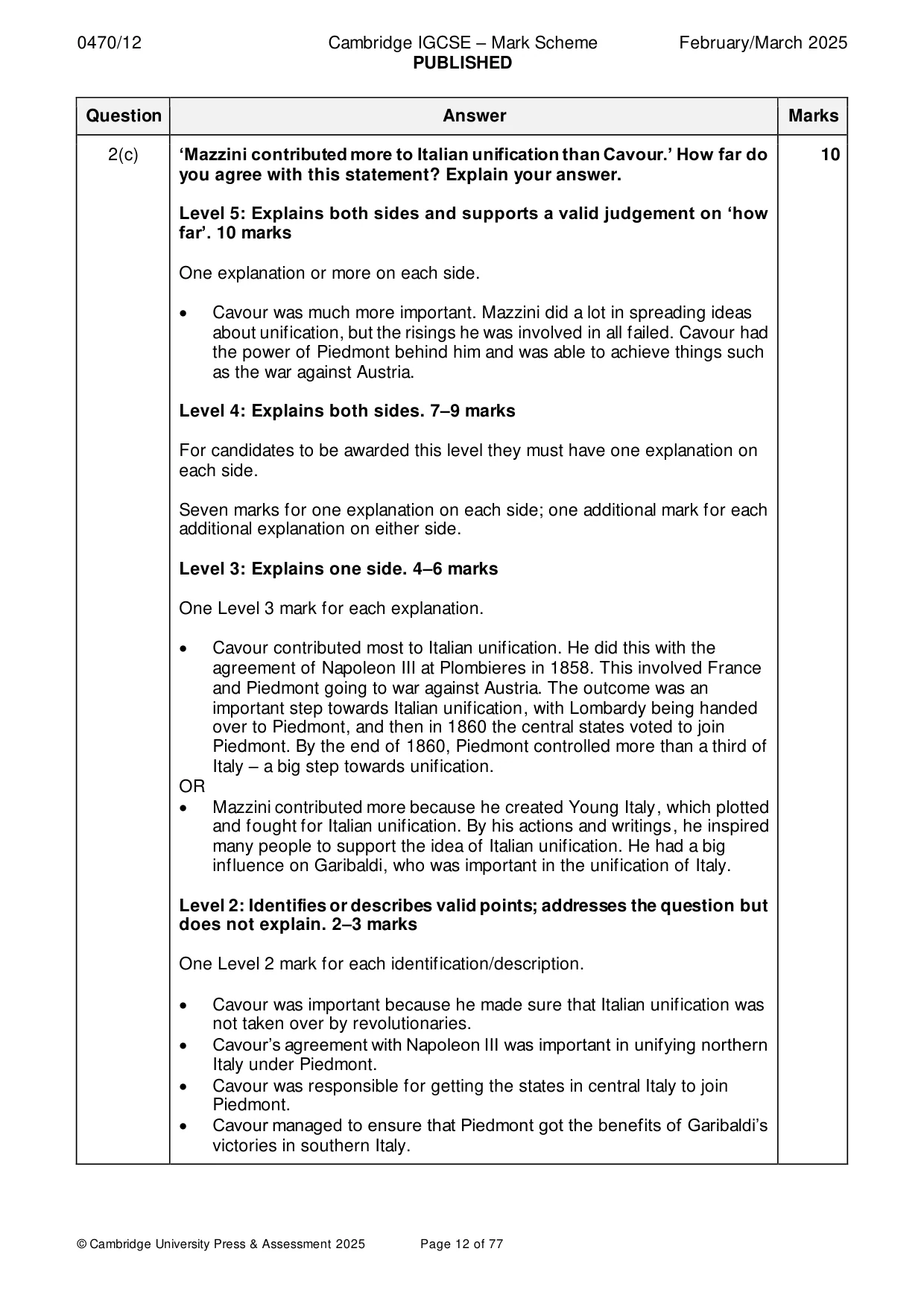
0470/12 Cambridge IGCSE – Mark Scheme PUBLISHED February/March 2025 © Cambridge University Press & Assessment 2025 Page 12 of 77 Question Answer Marks 2(c) ‘Mazzini contributed more to Italian unification than Cavour.’ How far do you agree with this statement? Explain your answer. Level 5: Explains both sides and supports a valid judgement on ‘how far’. 10 marks One explanation or more on each side. • Cavour was much more important. Mazzini did a lot in spreading ideas about unification, but the risings he was involved in all failed. Cavour had the power of Piedmont behind him and was able to achieve things such as the war against Austria. Level 4: Explains both sides. 7–9 marks For candidates to be awarded this level they must have one explanation on each side. Seven marks for one explanation on each side; one additional mark for each additional explanation on either side. Level 3: Explains one side. 4–6 marks One Level 3 mark for each explanation. • Cavour contributed most to Italian unification. He did this with the agreement of Napoleon III at Plombieres in 1858. This involved France and Piedmont going to war against Austria. The outcome was an important step towards Italian unification, with Lombardy being handed over to Piedmont, and then in 1860 the central states voted to join Piedmont. By the end of 1860, Piedmont controlled more than a third of Italy – a big step towards unification. OR • Mazzini contributed more because he created Young Italy, which plotted and fought for Italian unification. By his actions and writings, he inspired many people to support the idea of Italian unification. He had a big influence on Garibaldi, who was important in the unification of Italy. Level 2: Identifies or describes valid points; addresses the question but does not explain. 2–3 marks One Level 2 mark for each identification/description. • Cavour was important because he made sure that Italian unification was not taken over by revolutionaries. • Cavour’s agreement with Napoleon III was important in unifying northern Italy under Piedmont. • Cavour was responsible for getting the states in central Italy to join Piedmont. • Cavour managed to ensure that Piedmont got the benefits of Garibaldi’s victories in southern Italy. 10
Mark scheme, page 13
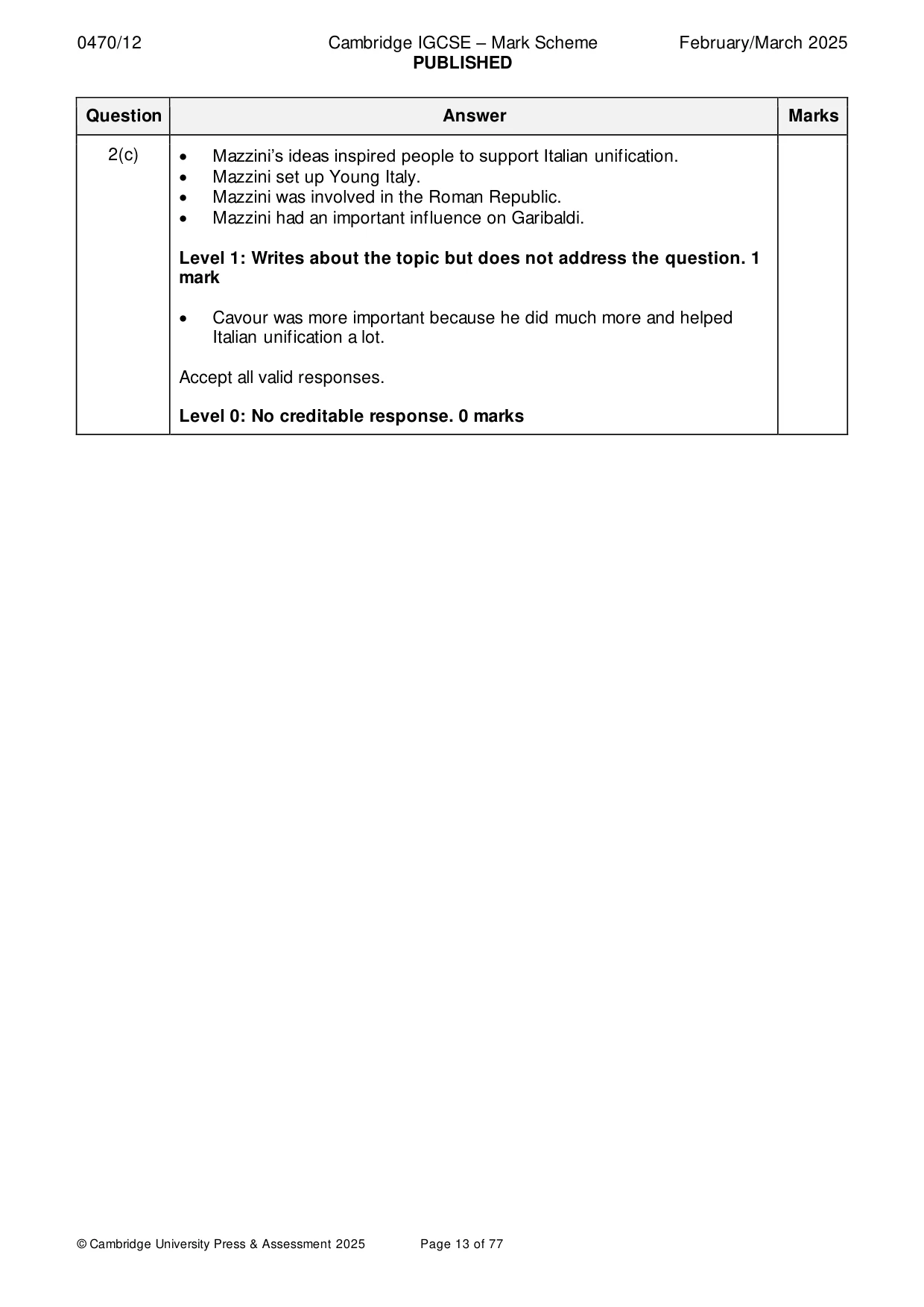
0470/12 Cambridge IGCSE – Mark Scheme PUBLISHED February/March 2025 © Cambridge University Press & Assessment 2025 Page 13 of 77 Question Answer Marks 2(c) • Mazzini’s ideas inspired people to support Italian unification. • Mazzini set up Young Italy. • Mazzini was involved in the Roman Republic. • Mazzini had an important influence on Garibaldi. Level 1: Writes about the topic but does not address the question. 1 mark • Cavour was more important because he did much more and helped Italian unification a lot. Accept all valid responses. Level 0: No creditable response. 0 marks
Mark scheme, page 14
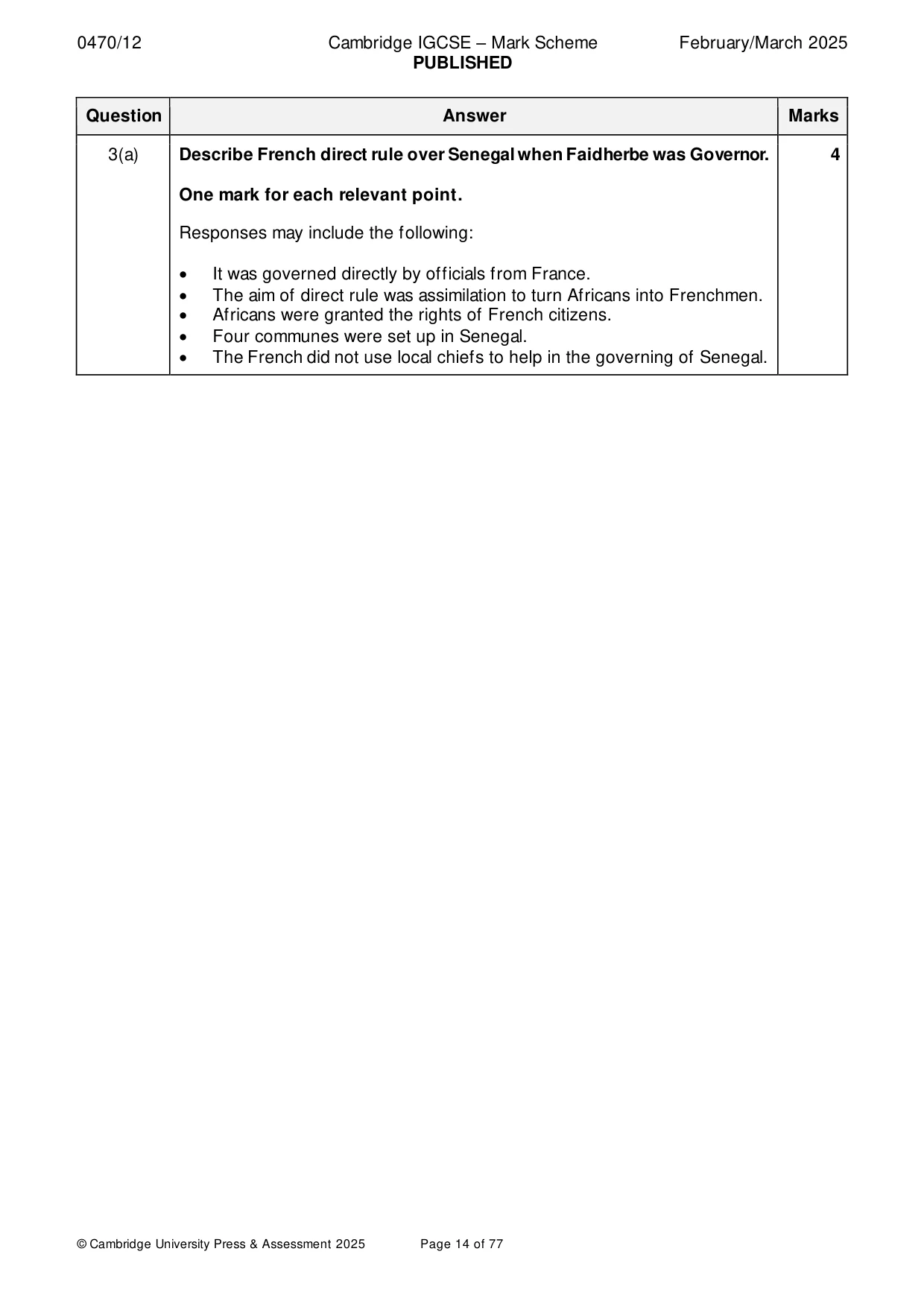
0470/12 Cambridge IGCSE – Mark Scheme PUBLISHED February/March 2025 © Cambridge University Press & Assessment 2025 Page 14 of 77 Question Answer Marks 3(a) Describe French direct rule over Senegal when Faidherbe was Governor. One mark for each relevant point. Responses may include the following: • It was governed directly by officials from France. • The aim of direct rule was assimilation to turn Africans into Frenchmen. • Africans were granted the rights of French citizens. • Four communes were set up in Senegal. • The French did not use local chiefs to help in the governing of Senegal. 4
Mark scheme, page 15
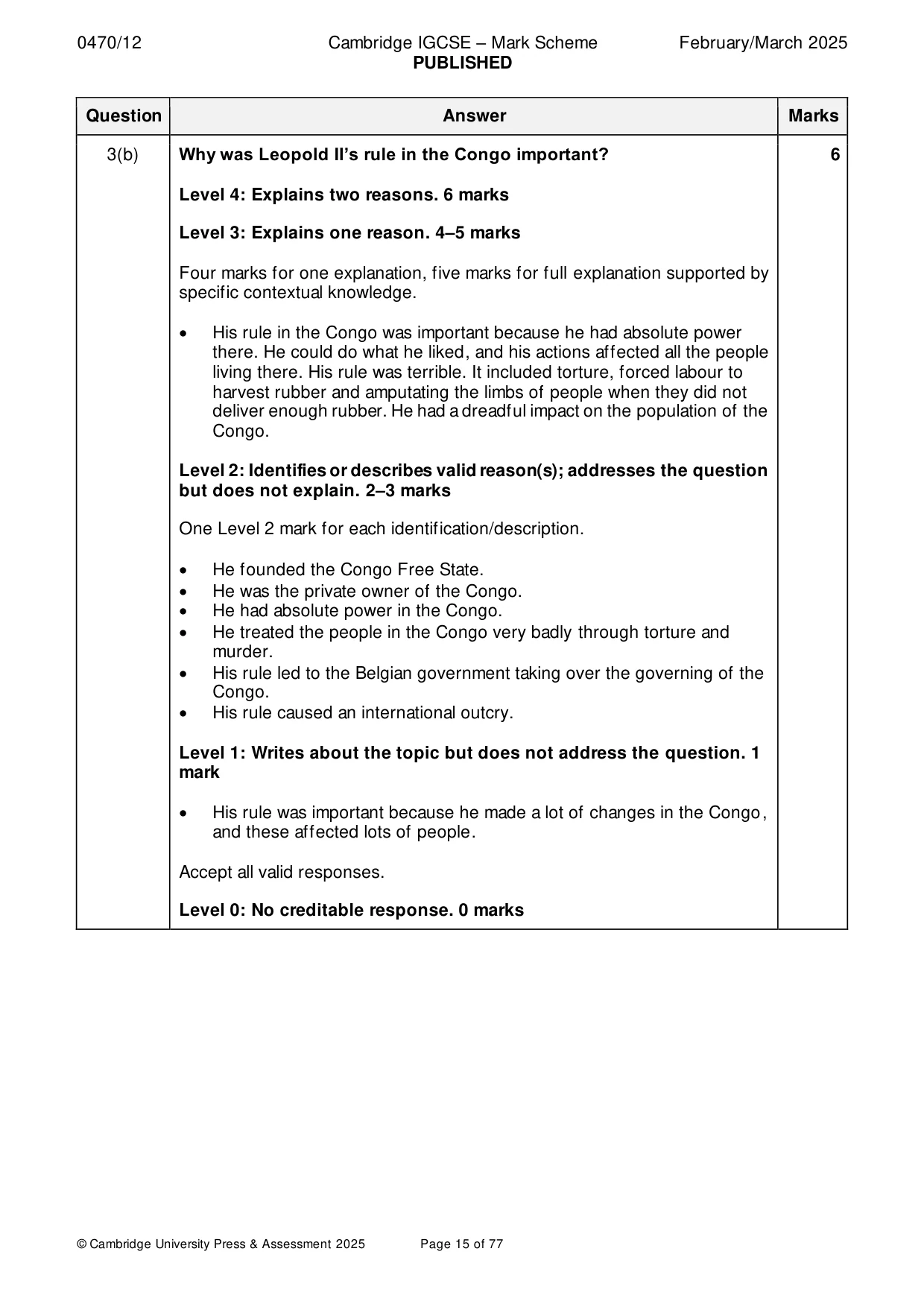
0470/12 Cambridge IGCSE – Mark Scheme PUBLISHED February/March 2025 © Cambridge University Press & Assessment 2025 Page 15 of 77 Question Answer Marks 3(b) Why was Leopold II’s rule in the Congo important? Level 4: Explains two reasons. 6 marks Level 3: Explains one reason. 4–5 marks Four marks for one explanation, five marks for full explanation supported by specific contextual knowledge. • His rule in the Congo was important because he had absolute power there. He could do what he liked, and his actions affected all the people living there. His rule was terrible. It included torture, forced labour to harvest rubber and amputating the limbs of people when they did not deliver enough rubber. He had a dreadful impact on the population of the Congo. Level 2: Identifies or describes valid reason(s); addresses the question but does not explain. 2–3 marks One Level 2 mark for each identification/description. • He founded the Congo Free State. • He was the private owner of the Congo. • He had absolute power in the Congo. • He treated the people in the Congo very badly through torture and murder. • His rule led to the Belgian government taking over the governing of the Congo. • His rule caused an international outcry. Level 1: Writes about the topic but does not address the question. 1 mark • His rule was important because he made a lot of changes in the Congo, and these affected lots of people. Accept all valid responses. Level 0: No creditable response. 0 marks 6
Mark scheme, page 16
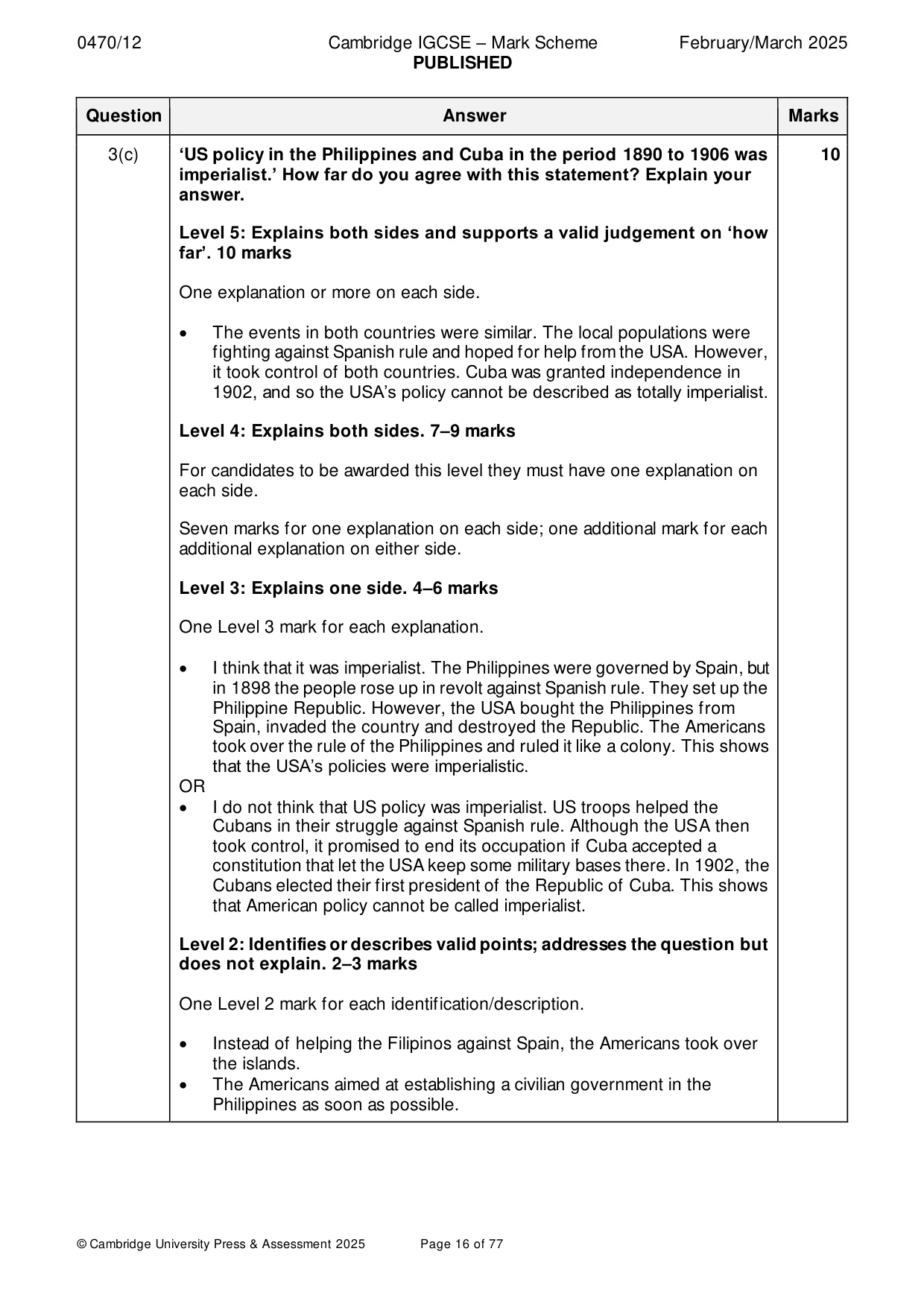
0470/12 Cambridge IGCSE – Mark Scheme PUBLISHED February/March 2025 © Cambridge University Press & Assessment 2025 Page 16 of 77 Question Answer Marks 3(c) ‘US policy in the Philippines and Cuba in the period 1890 to 1906 was imperialist.’ How far do you agree with this statement? Explain your answer. Level 5: Explains both sides and supports a valid judgement on ‘how far’. 10 marks One explanation or more on each side. • The events in both countries were similar. The local populations were fighting against Spanish rule and hoped for help from the USA. However, it took control of both countries. Cuba was granted independence in 1902, and so the USA’s policy cannot be described as totally imperialist. Level 4: Explains both sides. 7–9 marks For candidates to be awarded this level they must have one explanation on each side. Seven marks for one explanation on each side; one additional mark for each additional explanation on either side. Level 3: Explains one side. 4–6 marks One Level 3 mark for each explanation. • I think that it was imperialist. The Philippines were governed by Spain, but in 1898 the people rose up in revolt against Spanish rule. They set up the Philippine Republic. However, the USA bought the Philippines from Spain, invaded the country and destroyed the Republic. The Americans took over the rule of the Philippines and ruled it like a colony. This shows that the USA’s policies were imperialistic. OR • I do not think that US policy was imperialist. US troops helped the Cubans in their struggle against Spanish rule. Although the USA then took control, it promised to end its occupation if Cuba accepted a constitution that let the USA keep some military bases there. In 1902, the Cubans elected their first president of the Republic of Cuba. This shows that American policy cannot be called imperialist. Level 2: Identifies or describes valid points; addresses the question but does not explain. 2–3 marks One Level 2 mark for each identification/description. • Instead of helping the Filipinos against Spain, the Americans took over the islands. • The Americans aimed at establishing a civilian government in the Philippines as soon as possible. 10
Mark scheme, page 17
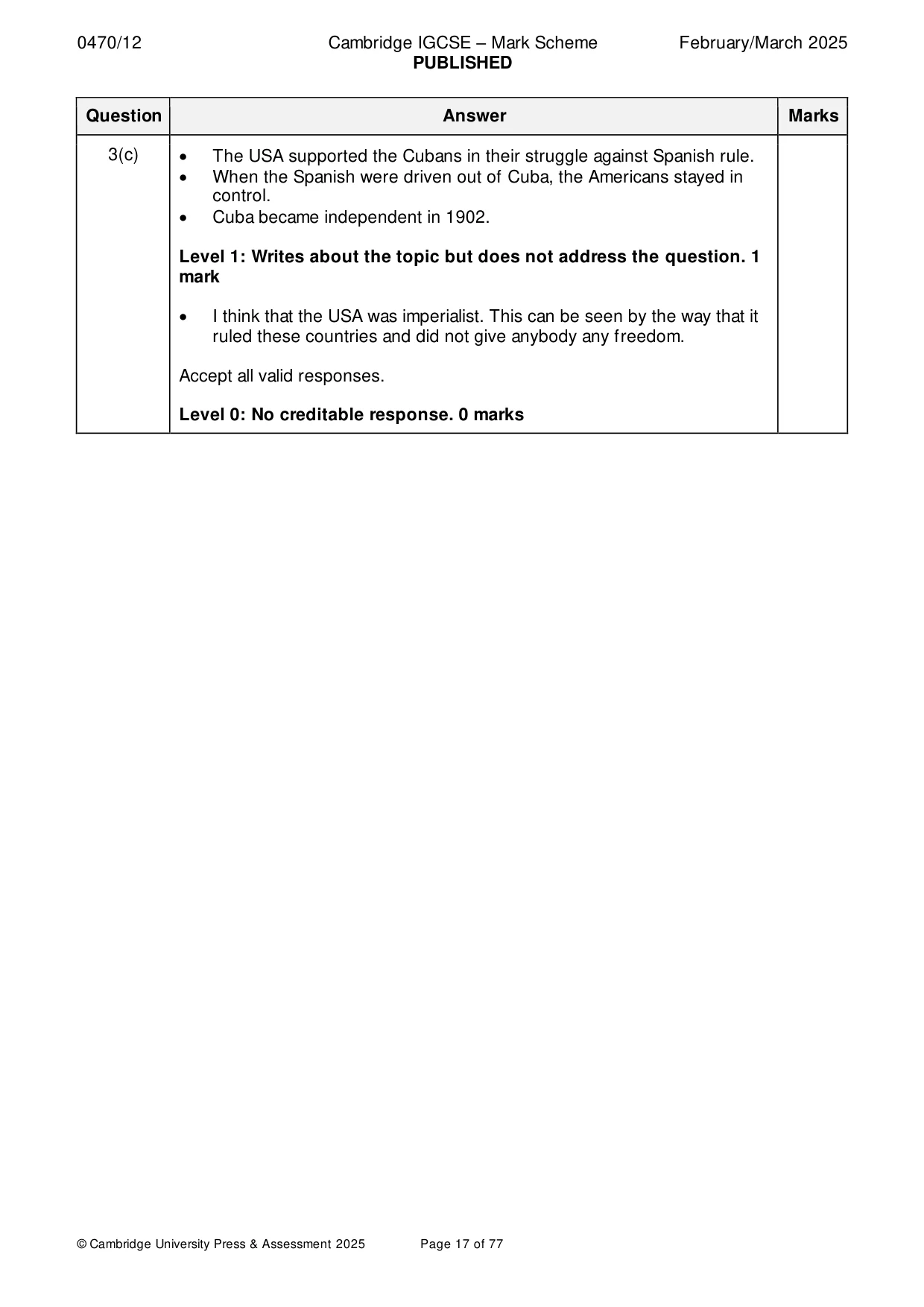
0470/12 Cambridge IGCSE – Mark Scheme PUBLISHED February/March 2025 © Cambridge University Press & Assessment 2025 Page 17 of 77 Question Answer Marks 3(c) • The USA supported the Cubans in their struggle against Spanish rule. • When the Spanish were driven out of Cuba, the Americans stayed in control. • Cuba became independent in 1902. Level 1: Writes about the topic but does not address the question. 1 mark • I think that the USA was imperialist. This can be seen by the way that it ruled these countries and did not give anybody any freedom. Accept all valid responses. Level 0: No creditable response. 0 marks
Mark scheme, page 18
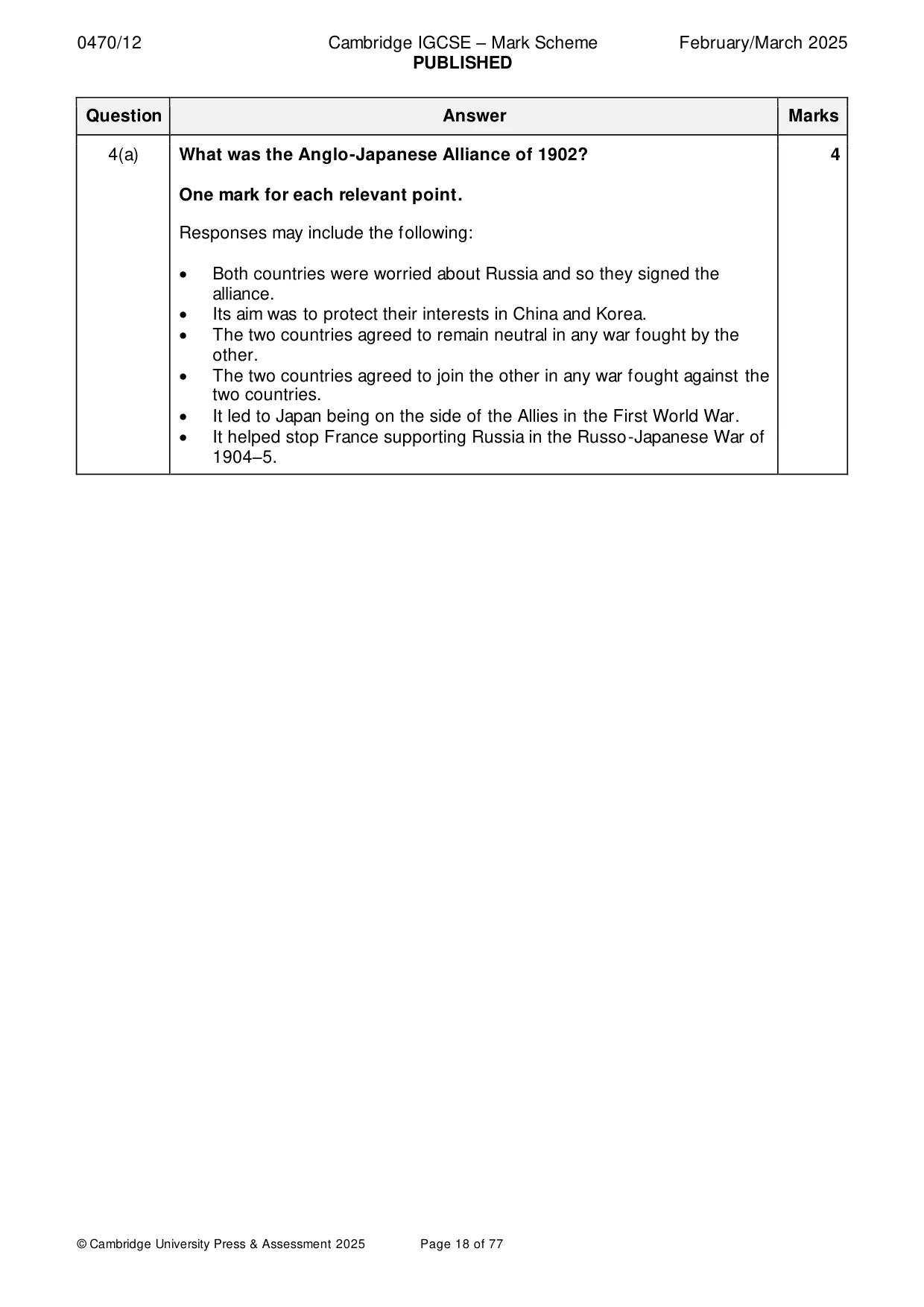
0470/12 Cambridge IGCSE – Mark Scheme PUBLISHED February/March 2025 © Cambridge University Press & Assessment 2025 Page 18 of 77 Question Answer Marks 4(a) What was the Anglo-Japanese Alliance of 1902? One mark for each relevant point. Responses may include the following: • Both countries were worried about Russia and so they signed the alliance. • Its aim was to protect their interests in China and Korea. • The two countries agreed to remain neutral in any war fought by the other. • The two countries agreed to join the other in any war fought against the two countries. • It led to Japan being on the side of the Allies in the First World War. • It helped stop France supporting Russia in the Russo-Japanese War of 1904–5. 4
Mark scheme, page 19
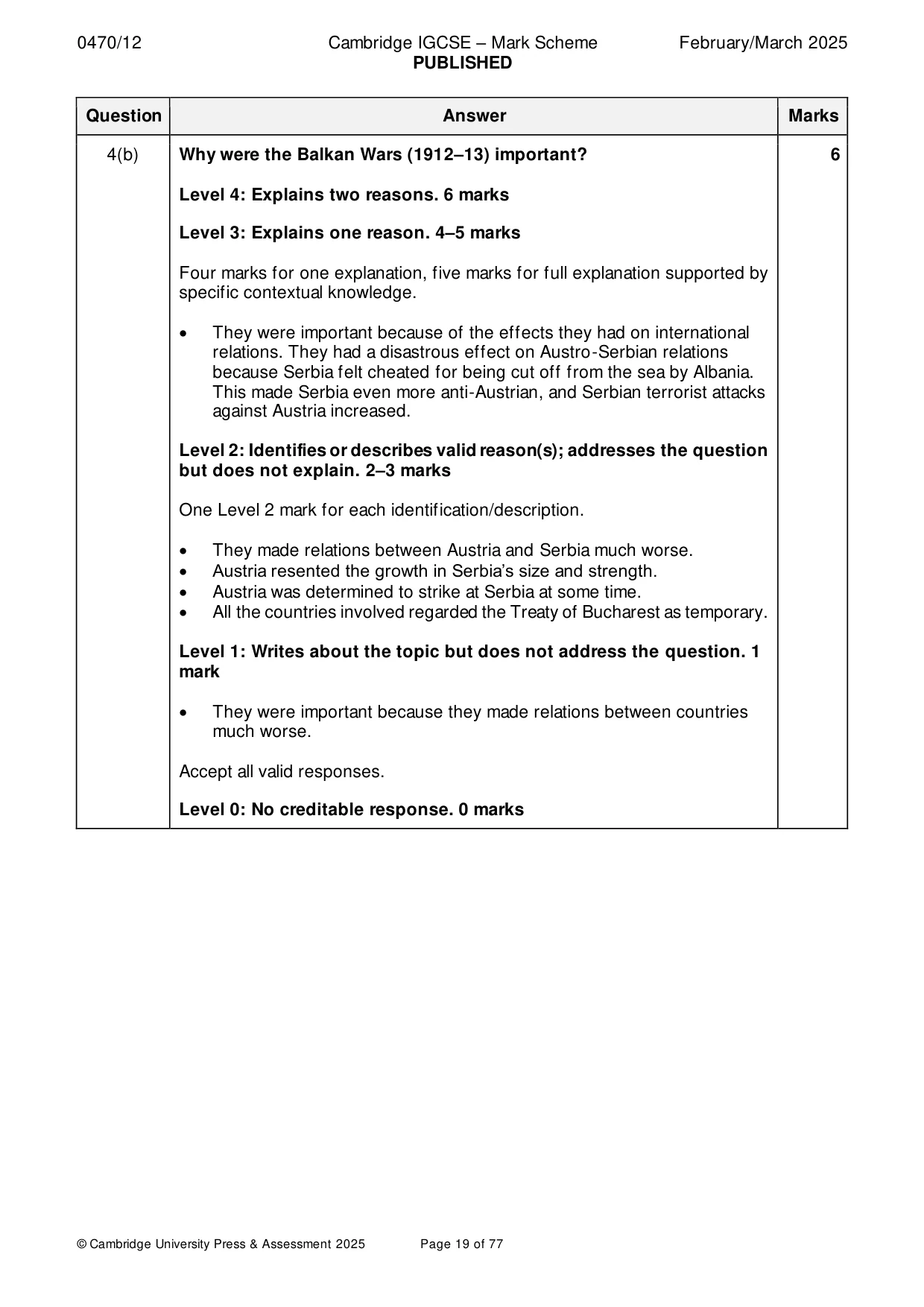
0470/12 Cambridge IGCSE – Mark Scheme PUBLISHED February/March 2025 © Cambridge University Press & Assessment 2025 Page 19 of 77 Question Answer Marks 4(b) Why were the Balkan Wars (1912–13) important? Level 4: Explains two reasons. 6 marks Level 3: Explains one reason. 4–5 marks Four marks for one explanation, five marks for full explanation supported by specific contextual knowledge. • They were important because of the effects they had on international relations. They had a disastrous effect on Austro-Serbian relations because Serbia felt cheated for being cut off from the sea by Albania. This made Serbia even more anti-Austrian, and Serbian terrorist attacks against Austria increased. Level 2: Identifies or describes valid reason(s); addresses the question but does not explain. 2–3 marks One Level 2 mark for each identification/description. • They made relations between Austria and Serbia much worse. • Austria resented the growth in Serbia’s size and strength. • Austria was determined to strike at Serbia at some time. • All the countries involved regarded the Treaty of Bucharest as temporary. Level 1: Writes about the topic but does not address the question. 1 mark • They were important because they made relations between countries much worse. Accept all valid responses. Level 0: No creditable response. 0 marks 6
Mark scheme, page 20
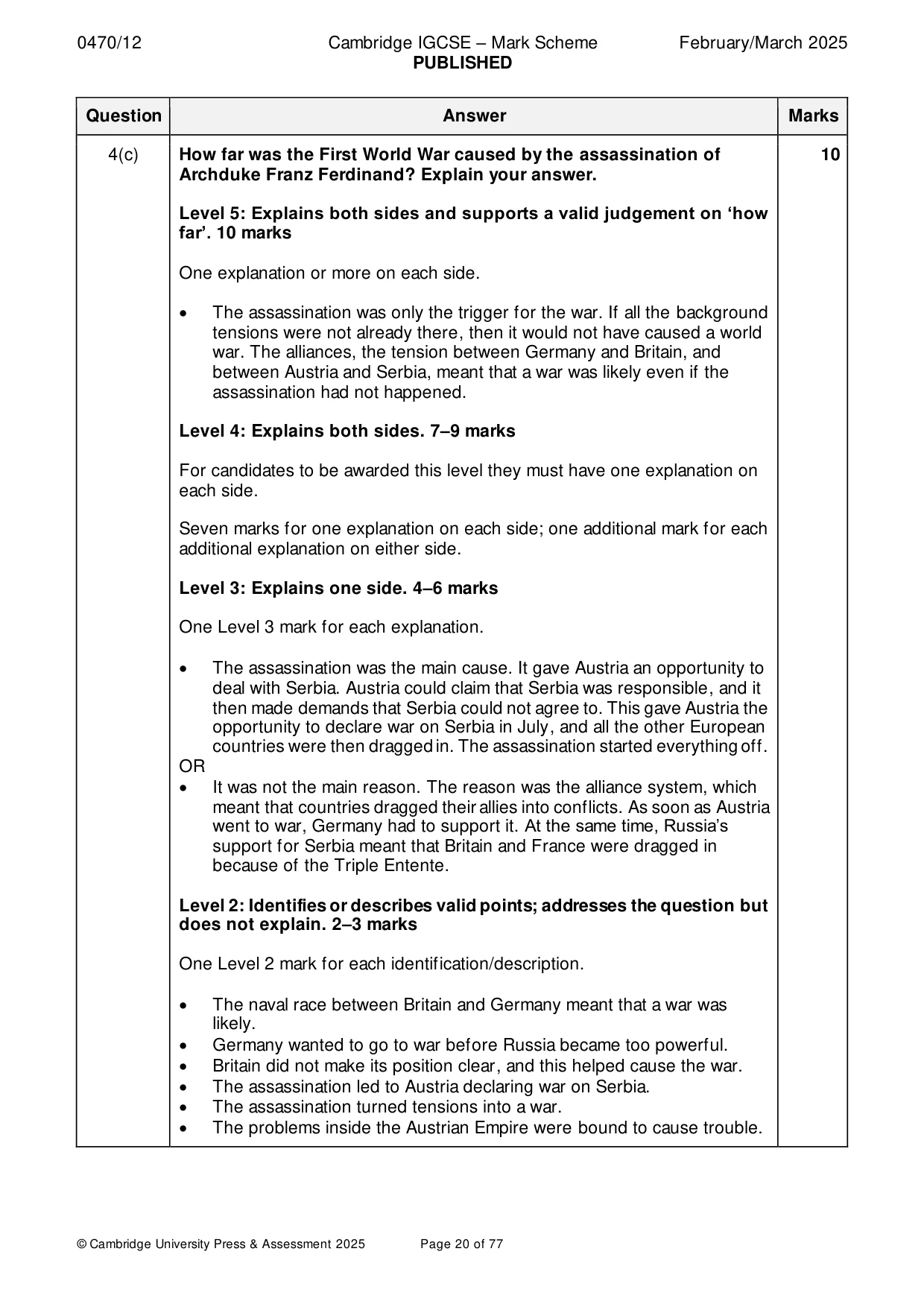
0470/12 Cambridge IGCSE – Mark Scheme PUBLISHED February/March 2025 © Cambridge University Press & Assessment 2025 Page 20 of 77 Question Answer Marks 4(c) How far was the First World War caused by the assassination of Archduke Franz Ferdinand? Explain your answer. Level 5: Explains both sides and supports a valid judgement on ‘how far’. 10 marks One explanation or more on each side. • The assassination was only the trigger for the war. If all the background tensions were not already there, then it would not have caused a world war. The alliances, the tension between Germany and Britain, and between Austria and Serbia, meant that a war was likely even if the assassination had not happened. Level 4: Explains both sides. 7–9 marks For candidates to be awarded this level they must have one explanation on each side. Seven marks for one explanation on each side; one additional mark for each additional explanation on either side. Level 3: Explains one side. 4–6 marks One Level 3 mark for each explanation. • The assassination was the main cause. It gave Austria an opportunity to deal with Serbia. Austria could claim that Serbia was responsible, and it then made demands that Serbia could not agree to. This gave Austria the opportunity to declare war on Serbia in July, and all the other European countries were then dragged in. The assassination started everything off. OR • It was not the main reason. The reason was the alliance system, which meant that countries dragged their allies into conflicts. As soon as Austria went to war, Germany had to support it. At the same time, Russia’s support for Serbia meant that Britain and France were dragged in because of the Triple Entente. Level 2: Identifies or describes valid points; addresses the question but does not explain. 2–3 marks One Level 2 mark for each identification/description. • The naval race between Britain and Germany meant that a war was likely. • Germany wanted to go to war before Russia became too powerful. • Britain did not make its position clear, and this helped cause the war. • The assassination led to Austria declaring war on Serbia. • The assassination turned tensions into a war. • The problems inside the Austrian Empire were bound to cause trouble. 10
Mark scheme, page 21
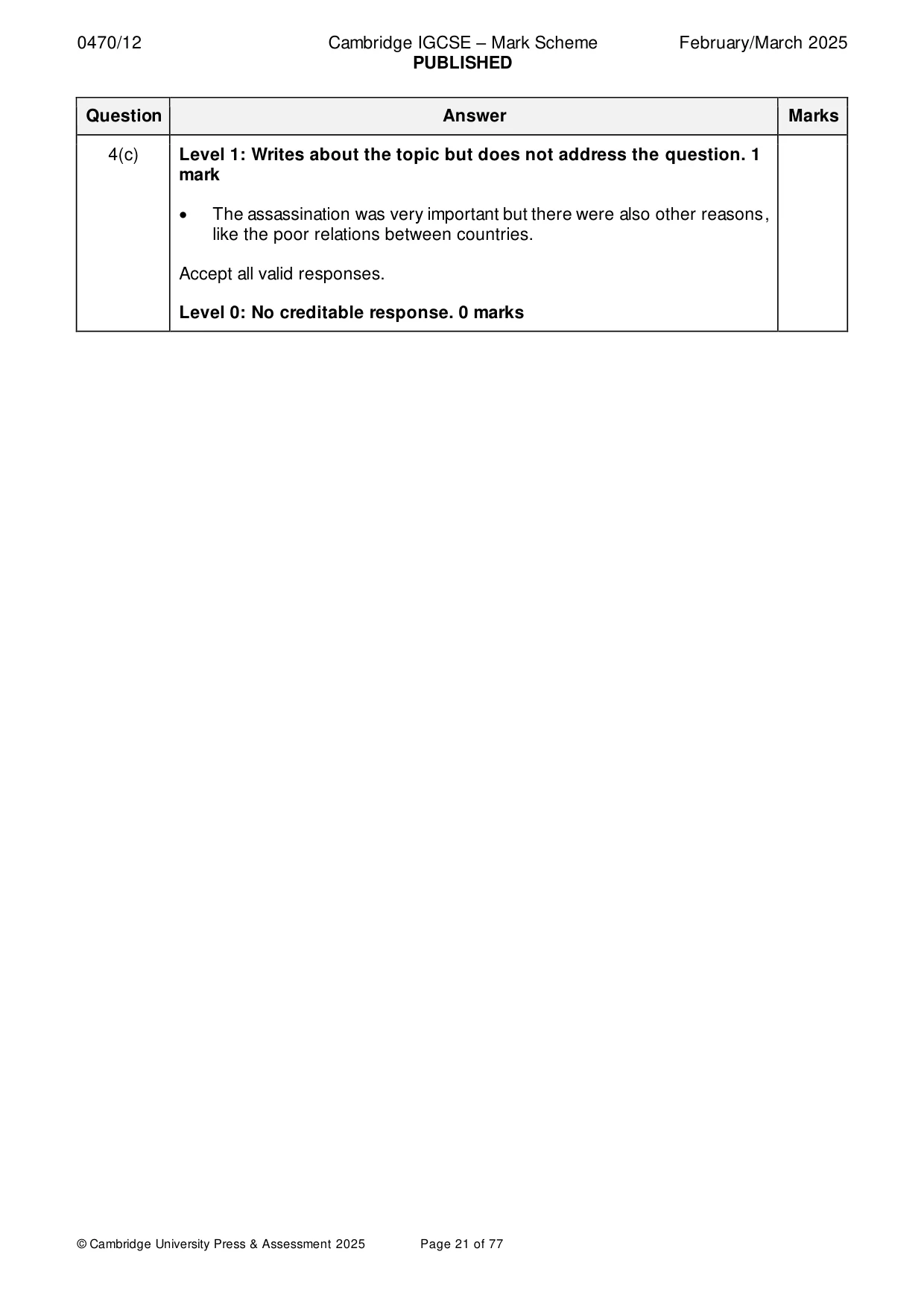
0470/12 Cambridge IGCSE – Mark Scheme PUBLISHED February/March 2025 © Cambridge University Press & Assessment 2025 Page 21 of 77 Question Answer Marks 4(c) Level 1: Writes about the topic but does not address the question. 1 mark • The assassination was very important but there were also other reasons, like the poor relations between countries. Accept all valid responses. Level 0: No creditable response. 0 marks
Mark scheme, page 22
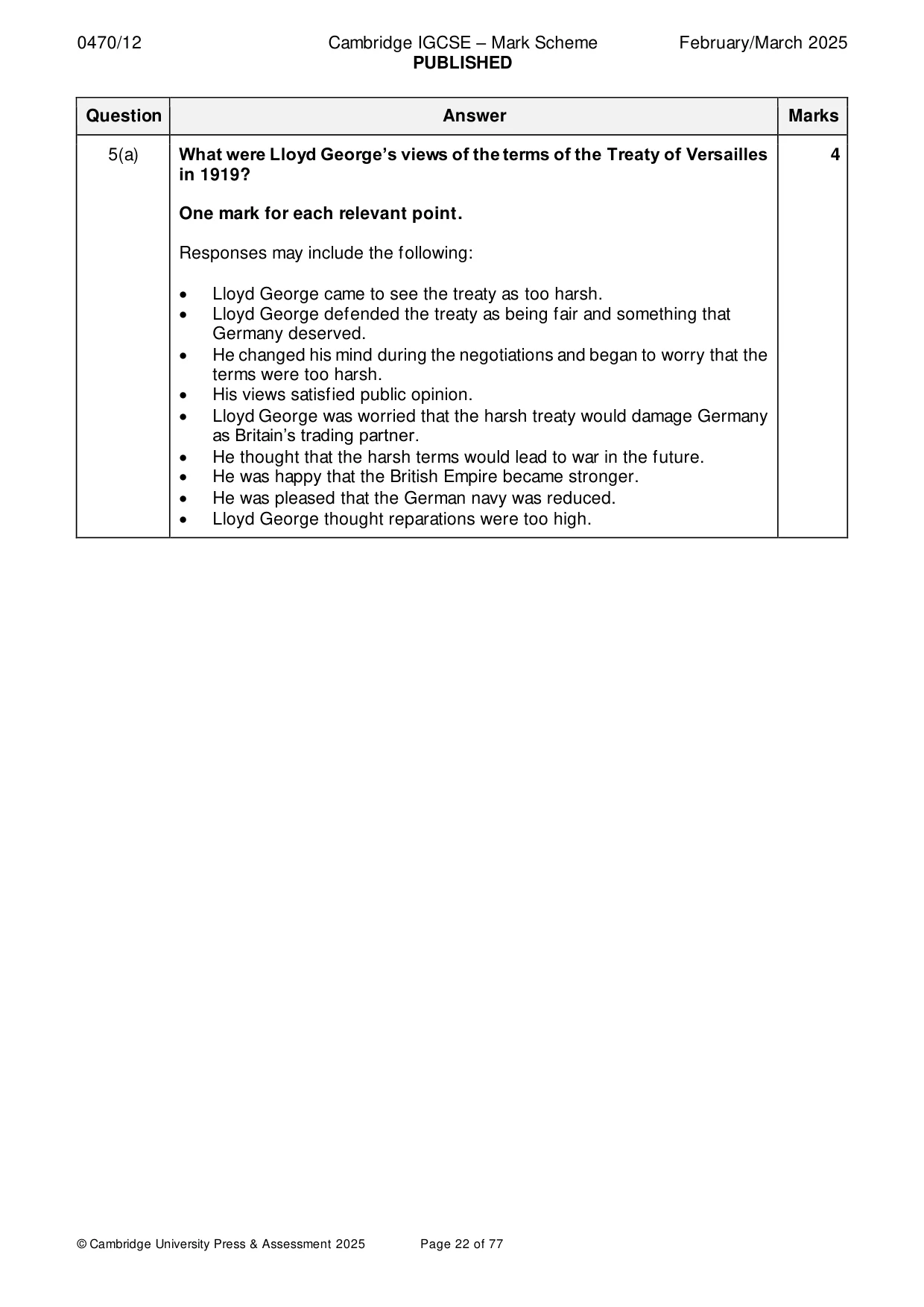
0470/12 Cambridge IGCSE – Mark Scheme PUBLISHED February/March 2025 © Cambridge University Press & Assessment 2025 Page 22 of 77 Question Answer Marks 5(a) What were Lloyd George’s views of the terms of the Treaty of Versailles in 1919? One mark for each relevant point. Responses may include the following: • Lloyd George came to see the treaty as too harsh. • Lloyd George defended the treaty as being fair and something that Germany deserved. • He changed his mind during the negotiations and began to worry that the terms were too harsh. • His views satisfied public opinion. • Lloyd George was worried that the harsh treaty would damage Germany as Britain’s trading partner. • He thought that the harsh terms would lead to war in the future. • He was happy that the British Empire became stronger. • He was pleased that the German navy was reduced. • Lloyd George thought reparations were too high. 4
Mark scheme, page 23
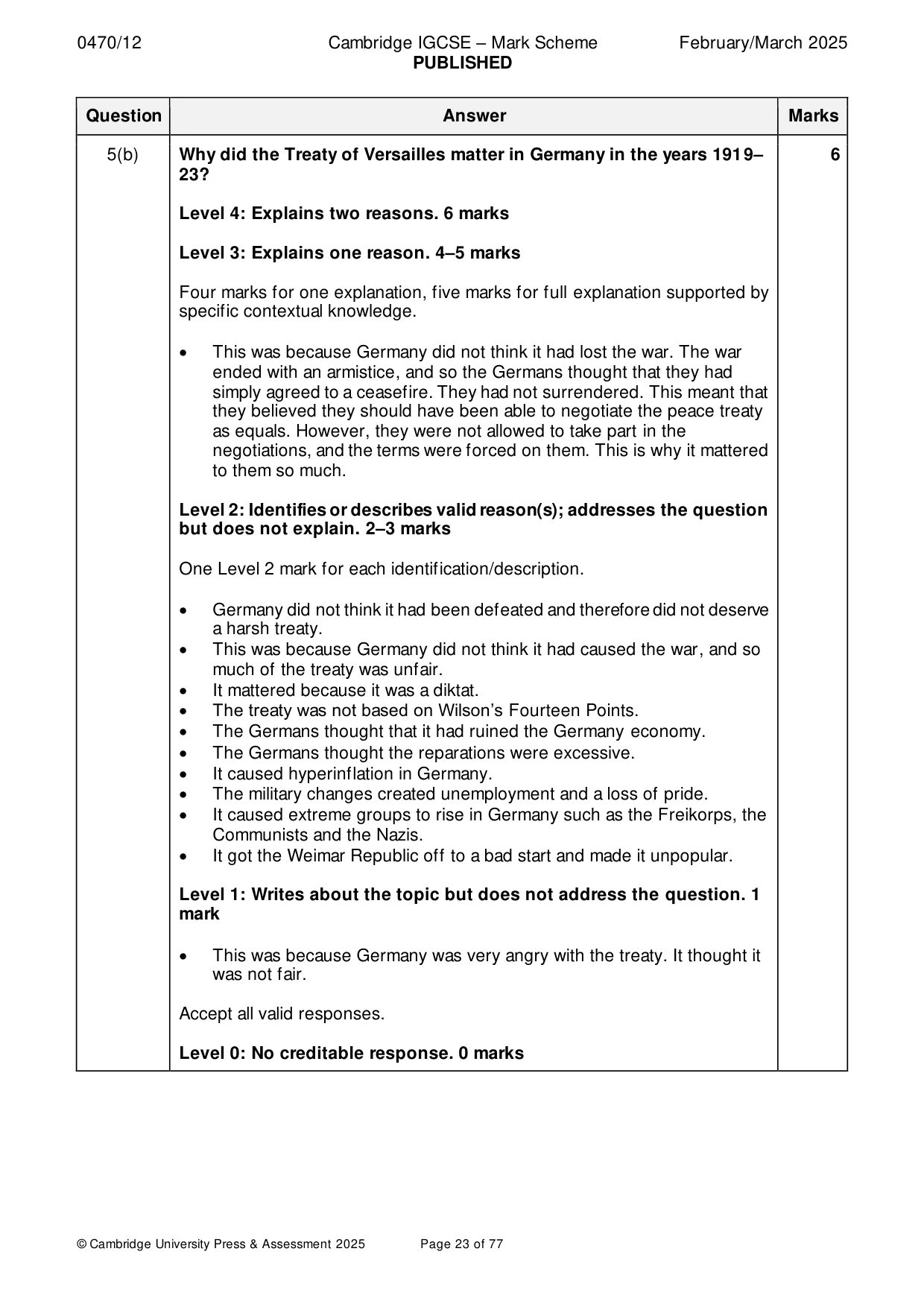
0470/12 Cambridge IGCSE – Mark Scheme PUBLISHED February/March 2025 © Cambridge University Press & Assessment 2025 Page 23 of 77 Question Answer Marks 5(b) Why did the Treaty of Versailles matter in Germany in the years 1919– 23? Level 4: Explains two reasons. 6 marks Level 3: Explains one reason. 4–5 marks Four marks for one explanation, five marks for full explanation supported by specific contextual knowledge. • This was because Germany did not think it had lost the war. The war ended with an armistice, and so the Germans thought that they had simply agreed to a ceasefire. They had not surrendered. This meant that they believed they should have been able to negotiate the peace treaty as equals. However, they were not allowed to take part in the negotiations, and the terms were forced on them. This is why it mattered to them so much. Level 2: Identifies or describes valid reason(s); addresses the question but does not explain. 2–3 marks One Level 2 mark for each identification/description. • Germany did not think it had been defeated and therefore did not deserve a harsh treaty. • This was because Germany did not think it had caused the war, and so much of the treaty was unfair. • It mattered because it was a diktat. • The treaty was not based on Wilson’s Fourteen Points. • The Germans thought that it had ruined the Germany economy. • The Germans thought the reparations were excessive. • It caused hyperinflation in Germany. • The military changes created unemployment and a loss of pride. • It caused extreme groups to rise in Germany such as the Freikorps, the Communists and the Nazis. • It got the Weimar Republic off to a bad start and made it unpopular. Level 1: Writes about the topic but does not address the question. 1 mark • This was because Germany was very angry with the treaty. It thought it was not fair. Accept all valid responses. Level 0: No creditable response. 0 marks 6
Mark scheme, page 24
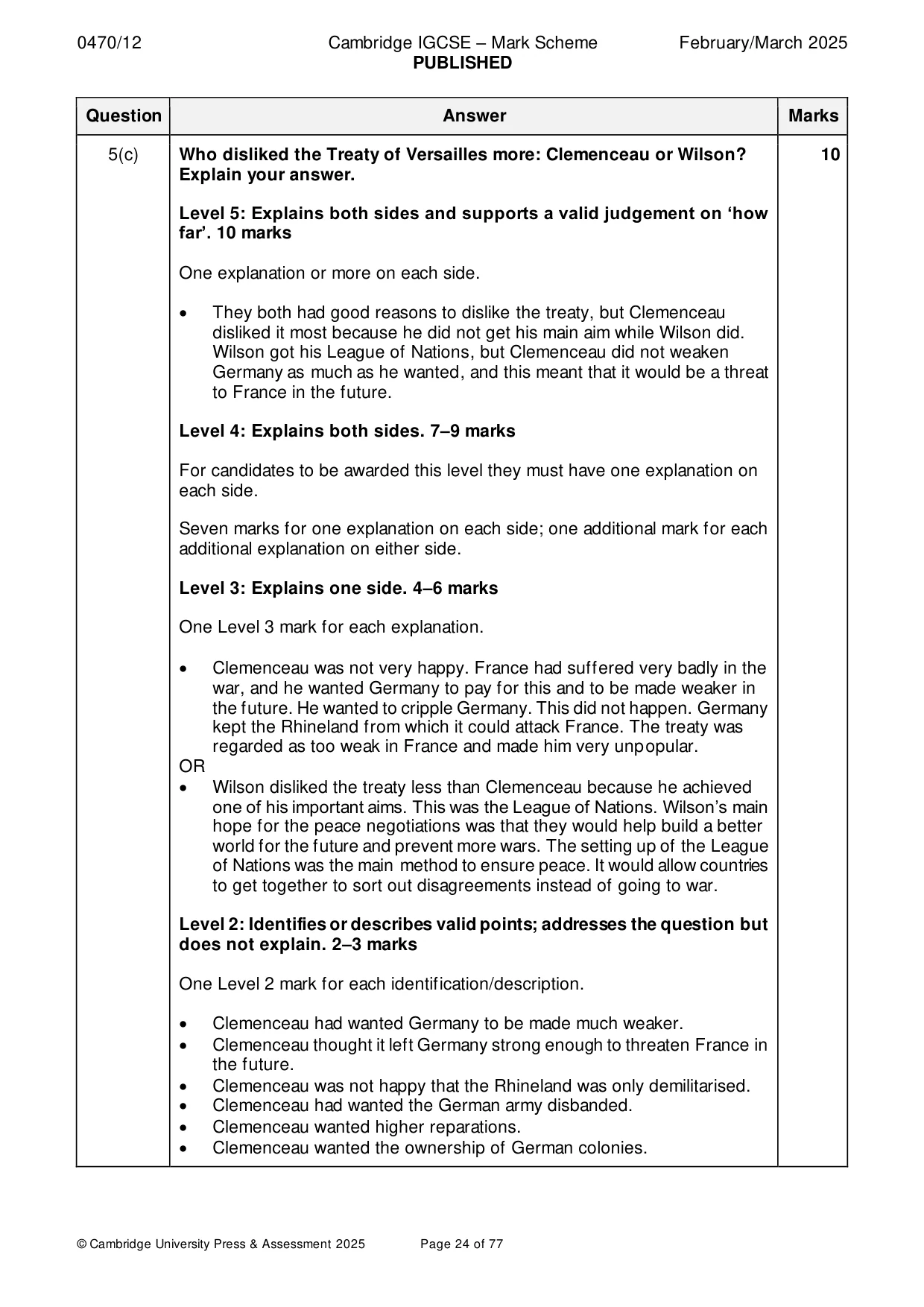
0470/12 Cambridge IGCSE – Mark Scheme PUBLISHED February/March 2025 © Cambridge University Press & Assessment 2025 Page 24 of 77 Question Answer Marks 5(c) Who disliked the Treaty of Versailles more: Clemenceau or Wilson? Explain your answer. Level 5: Explains both sides and supports a valid judgement on ‘how far’. 10 marks One explanation or more on each side. • They both had good reasons to dislike the treaty, but Clemenceau disliked it most because he did not get his main aim while Wilson did. Wilson got his League of Nations, but Clemenceau did not weaken Germany as much as he wanted, and this meant that it would be a threat to France in the future. Level 4: Explains both sides. 7–9 marks For candidates to be awarded this level they must have one explanation on each side. Seven marks for one explanation on each side; one additional mark for each additional explanation on either side. Level 3: Explains one side. 4–6 marks One Level 3 mark for each explanation. • Clemenceau was not very happy. France had suffered very badly in the war, and he wanted Germany to pay for this and to be made weaker in the future. He wanted to cripple Germany. This did not happen. Germany kept the Rhineland from which it could attack France. The treaty was regarded as too weak in France and made him very unpopular. OR • Wilson disliked the treaty less than Clemenceau because he achieved one of his important aims. This was the League of Nations. Wilson’s main hope for the peace negotiations was that they would help build a better world for the future and prevent more wars. The setting up of the League of Nations was the main method to ensure peace. It would allow countries to get together to sort out disagreements instead of going to war. Level 2: Identifies or describes valid points; addresses the question but does not explain. 2–3 marks One Level 2 mark for each identification/description. • Clemenceau had wanted Germany to be made much weaker. • Clemenceau thought it left Germany strong enough to threaten France in the future. • Clemenceau was not happy that the Rhineland was only demilitarised. • Clemenceau had wanted the German army disbanded. • Clemenceau wanted higher reparations. • Clemenceau wanted the ownership of German colonies. 10
Mark scheme, page 25
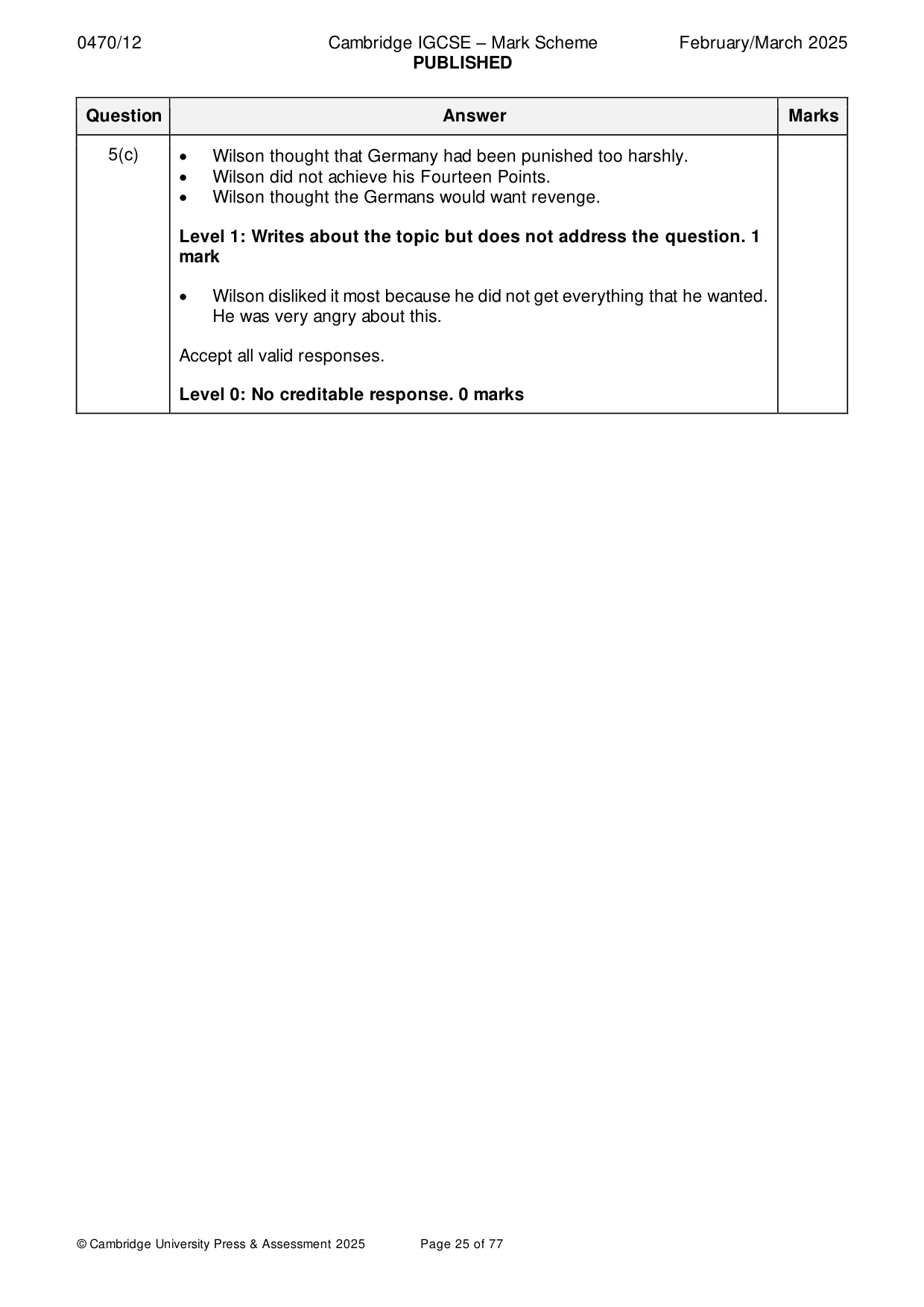
0470/12 Cambridge IGCSE – Mark Scheme PUBLISHED February/March 2025 © Cambridge University Press & Assessment 2025 Page 25 of 77 Question Answer Marks 5(c) • Wilson thought that Germany had been punished too harshly. • Wilson did not achieve his Fourteen Points. • Wilson thought the Germans would want revenge. Level 1: Writes about the topic but does not address the question. 1 mark • Wilson disliked it most because he did not get everything that he wanted. He was very angry about this. Accept all valid responses. Level 0: No creditable response. 0 marks
Mark scheme, page 26
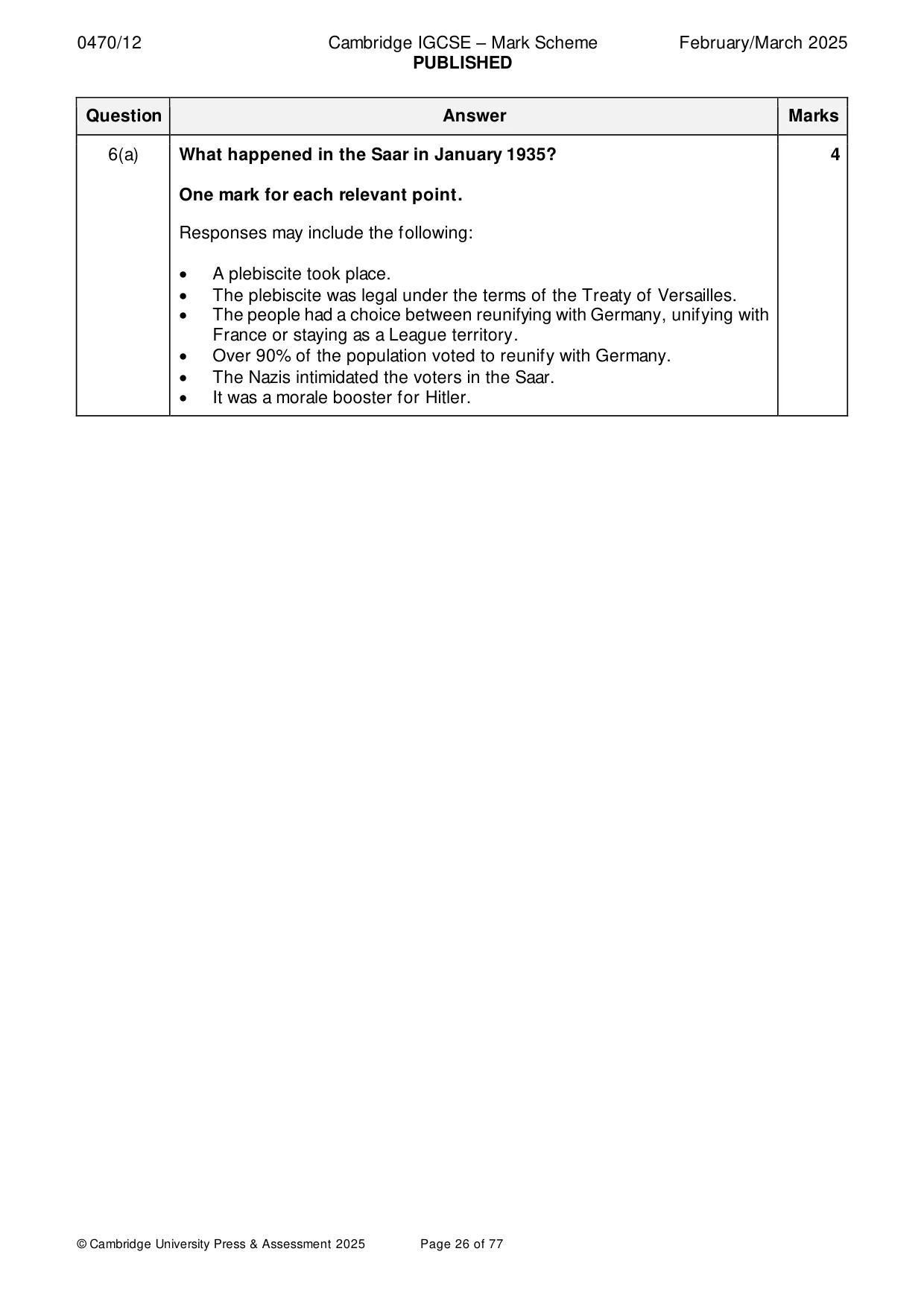
0470/12 Cambridge IGCSE – Mark Scheme PUBLISHED February/March 2025 © Cambridge University Press & Assessment 2025 Page 26 of 77 Question Answer Marks 6(a) What happened in the Saar in January 1935? One mark for each relevant point. Responses may include the following: • A plebiscite took place. • The plebiscite was legal under the terms of the Treaty of Versailles. • The people had a choice between reunifying with Germany, unifying with France or staying as a League territory. • Over 90% of the population voted to reunify with Germany. • The Nazis intimidated the voters in the Saar. • It was a morale booster for Hitler. 4
Mark scheme, page 27
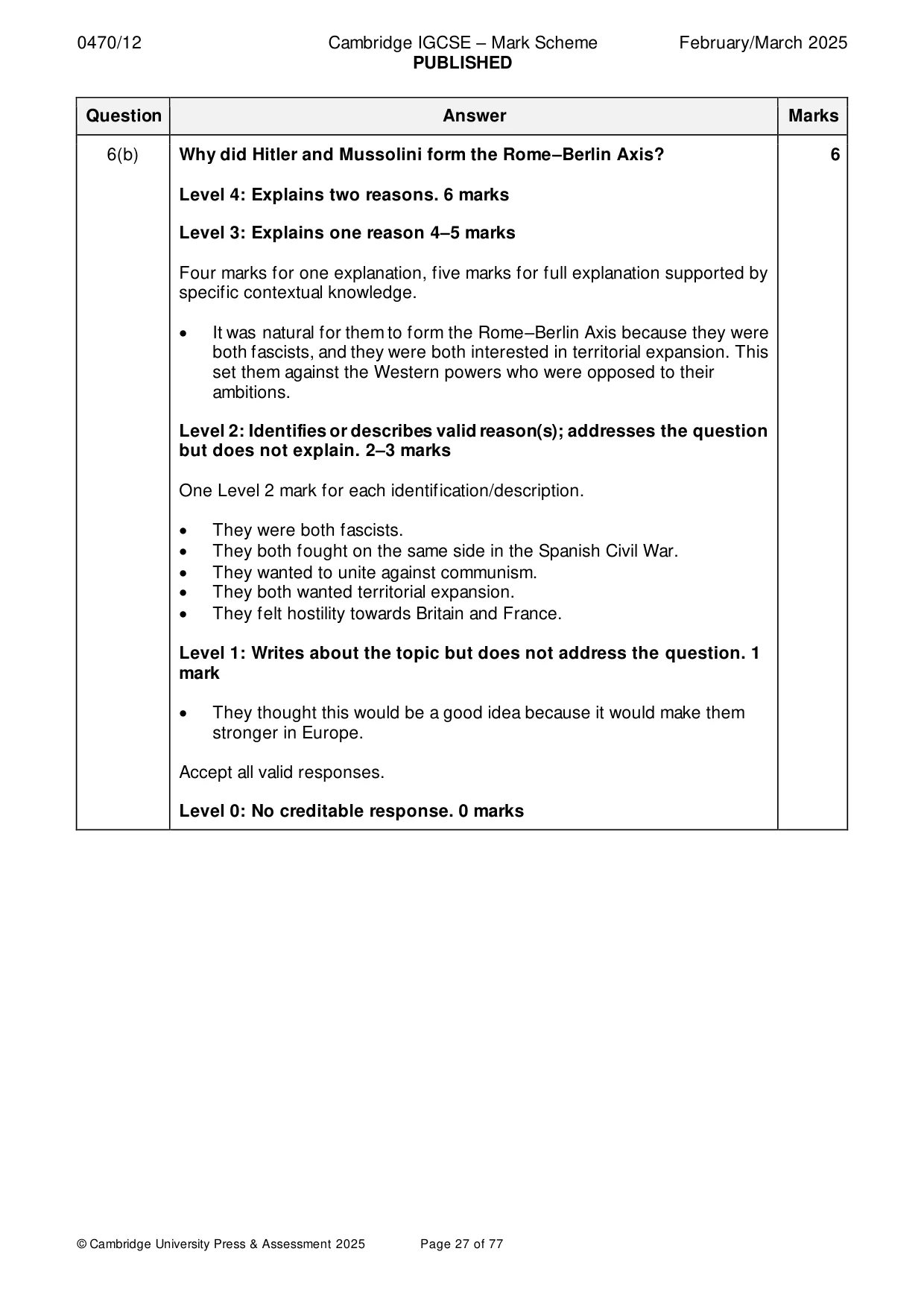
0470/12 Cambridge IGCSE – Mark Scheme PUBLISHED February/March 2025 © Cambridge University Press & Assessment 2025 Page 27 of 77 Question Answer Marks 6(b) Why did Hitler and Mussolini form the Rome–Berlin Axis? Level 4: Explains two reasons. 6 marks Level 3: Explains one reason 4–5 marks Four marks for one explanation, five marks for full explanation supported by specific contextual knowledge. • It was natural for them to form the Rome–Berlin Axis because they were both fascists, and they were both interested in territorial expansion. This set them against the Western powers who were opposed to their ambitions. Level 2: Identifies or describes valid reason(s); addresses the question but does not explain. 2–3 marks One Level 2 mark for each identification/description. • They were both fascists. • They both fought on the same side in the Spanish Civil War. • They wanted to unite against communism. • They both wanted territorial expansion. • They felt hostility towards Britain and France. Level 1: Writes about the topic but does not address the question. 1 mark • They thought this would be a good idea because it would make them stronger in Europe. Accept all valid responses. Level 0: No creditable response. 0 marks 6
Mark scheme, page 28
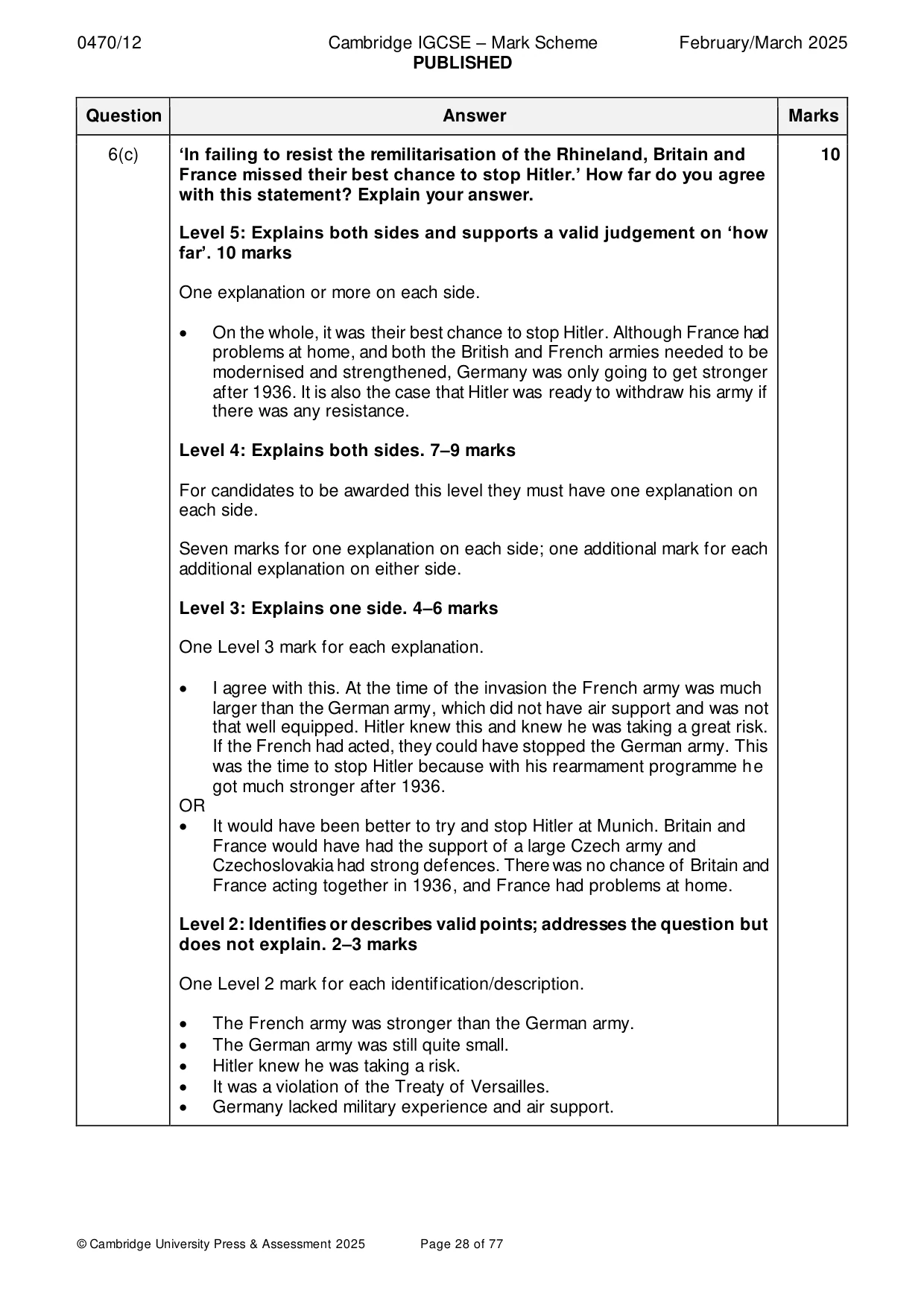
0470/12 Cambridge IGCSE – Mark Scheme PUBLISHED February/March 2025 © Cambridge University Press & Assessment 2025 Page 28 of 77 Question Answer Marks 6(c) ‘In failing to resist the remilitarisation of the Rhineland, Britain and France missed their best chance to stop Hitler.’ How far do you agree with this statement? Explain your answer. Level 5: Explains both sides and supports a valid judgement on ‘how far’. 10 marks One explanation or more on each side. • On the whole, it was their best chance to stop Hitler. Although France had problems at home, and both the British and French armies needed to be modernised and strengthened, Germany was only going to get stronger after 1936. It is also the case that Hitler was ready to withdraw his army if there was any resistance. Level 4: Explains both sides. 7–9 marks For candidates to be awarded this level they must have one explanation on each side. Seven marks for one explanation on each side; one additional mark for each additional explanation on either side. Level 3: Explains one side. 4–6 marks One Level 3 mark for each explanation. • I agree with this. At the time of the invasion the French army was much larger than the German army, which did not have air support and was not that well equipped. Hitler knew this and knew he was taking a great risk. If the French had acted, they could have stopped the German army. This was the time to stop Hitler because with his rearmament programme he got much stronger after 1936. OR • It would have been better to try and stop Hitler at Munich. Britain and France would have had the support of a large Czech army and Czechoslovakia had strong defences. There was no chance of Britain and France acting together in 1936, and France had problems at home. Level 2: Identifies or describes valid points; addresses the question but does not explain. 2–3 marks One Level 2 mark for each identification/description. • The French army was stronger than the German army. • The German army was still quite small. • Hitler knew he was taking a risk. • It was a violation of the Treaty of Versailles. • Germany lacked military experience and air support. 10
Mark scheme, page 29
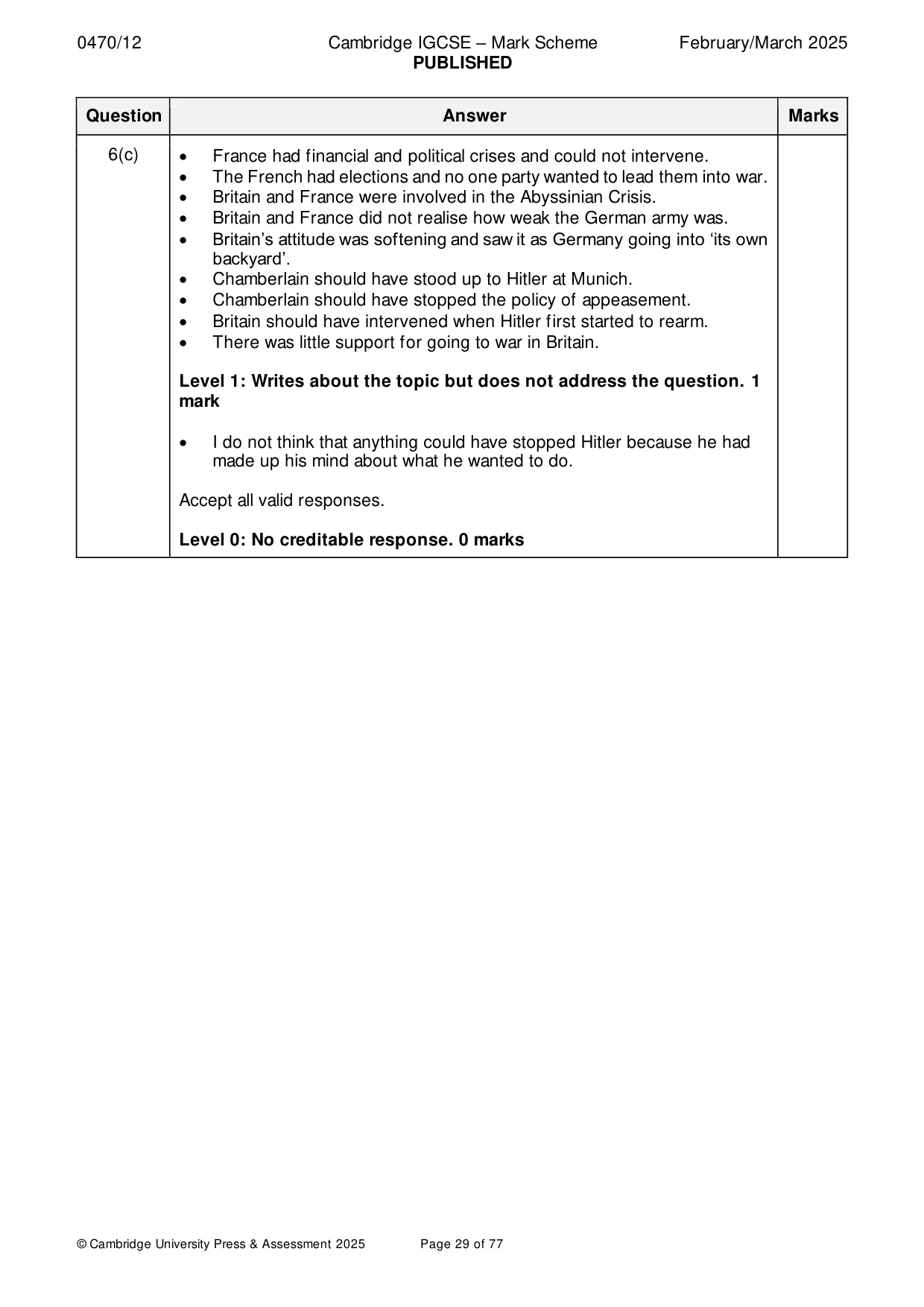
0470/12 Cambridge IGCSE – Mark Scheme PUBLISHED February/March 2025 © Cambridge University Press & Assessment 2025 Page 29 of 77 Question Answer Marks 6(c) • France had financial and political crises and could not intervene. • The French had elections and no one party wanted to lead them into war. • Britain and France were involved in the Abyssinian Crisis. • Britain and France did not realise how weak the German army was. • Britain’s attitude was softening and saw it as Germany going into ‘its own backyard’. • Chamberlain should have stood up to Hitler at Munich. • Chamberlain should have stopped the policy of appeasement. • Britain should have intervened when Hitler first started to rearm. • There was little support for going to war in Britain. Level 1: Writes about the topic but does not address the question. 1 mark • I do not think that anything could have stopped Hitler because he had made up his mind about what he wanted to do. Accept all valid responses. Level 0: No creditable response. 0 marks
Mark scheme, page 30
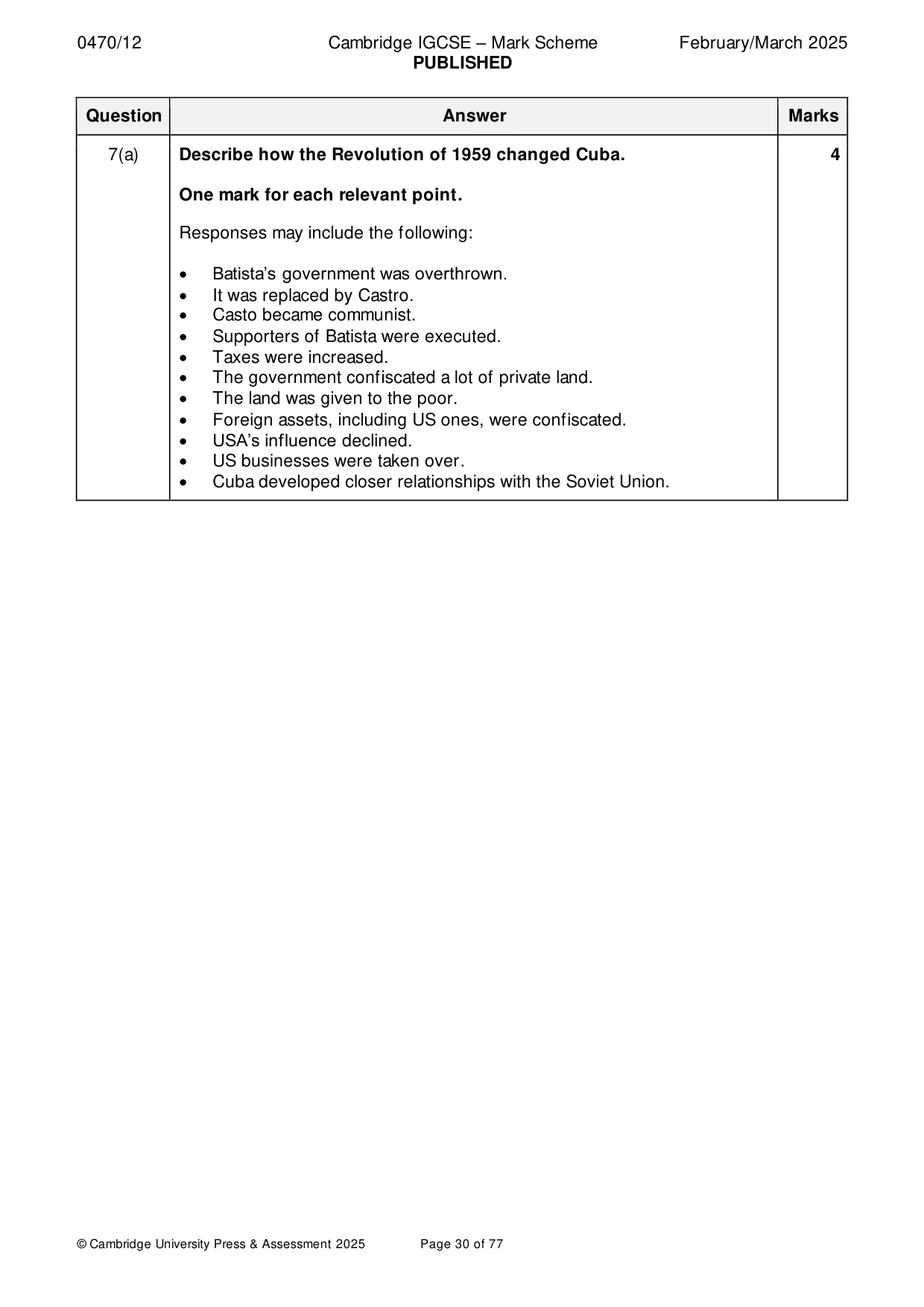
0470/12 Cambridge IGCSE – Mark Scheme PUBLISHED February/March 2025 © Cambridge University Press & Assessment 2025 Page 30 of 77 Question Answer Marks 7(a) Describe how the Revolution of 1959 changed Cuba. One mark for each relevant point. Responses may include the following: • Batista’s government was overthrown. • It was replaced by Castro. • Casto became communist. • Supporters of Batista were executed. • Taxes were increased. • The government confiscated a lot of private land. • The land was given to the poor. • Foreign assets, including US ones, were confiscated. • USA’s influence declined. • US businesses were taken over. • Cuba developed closer relationships with the Soviet Union. 4
Mark scheme, page 31
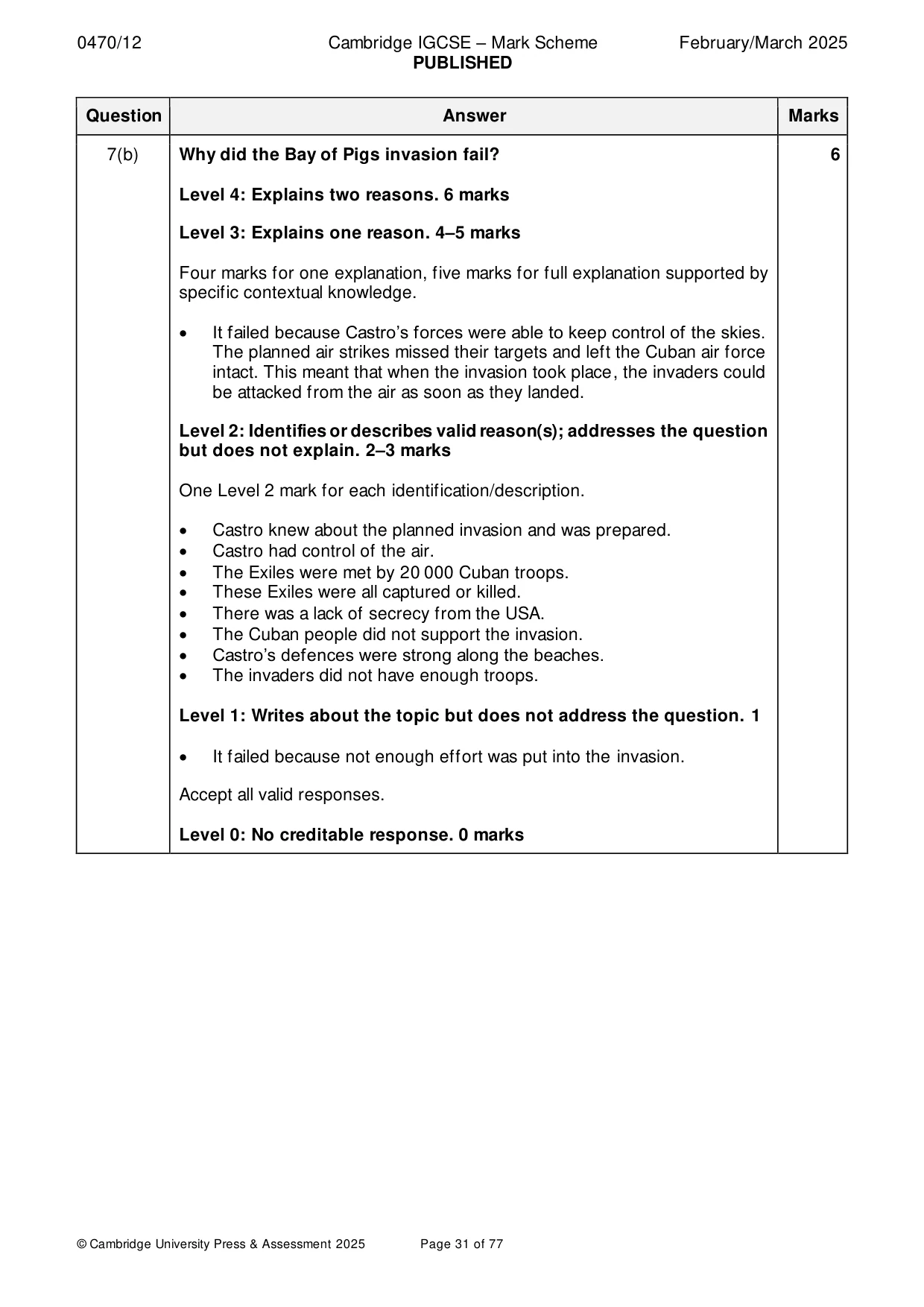
0470/12 Cambridge IGCSE – Mark Scheme PUBLISHED February/March 2025 © Cambridge University Press & Assessment 2025 Page 31 of 77 Question Answer Marks 7(b) Why did the Bay of Pigs invasion fail? Level 4: Explains two reasons. 6 marks Level 3: Explains one reason. 4–5 marks Four marks for one explanation, five marks for full explanation supported by specific contextual knowledge. • It failed because Castro’s forces were able to keep control of the skies. The planned air strikes missed their targets and left the Cuban air force intact. This meant that when the invasion took place, the invaders could be attacked from the air as soon as they landed. Level 2: Identifies or describes valid reason(s); addresses the question but does not explain. 2–3 marks One Level 2 mark for each identification/description. • Castro knew about the planned invasion and was prepared. • Castro had control of the air. • The Exiles were met by 20 000 Cuban troops. • These Exiles were all captured or killed. • There was a lack of secrecy from the USA. • The Cuban people did not support the invasion. • Castro’s defences were strong along the beaches. • The invaders did not have enough troops. Level 1: Writes about the topic but does not address the question. 1 • It failed because not enough effort was put into the invasion. Accept all valid responses. Level 0: No creditable response. 0 marks 6
Mark scheme, page 32
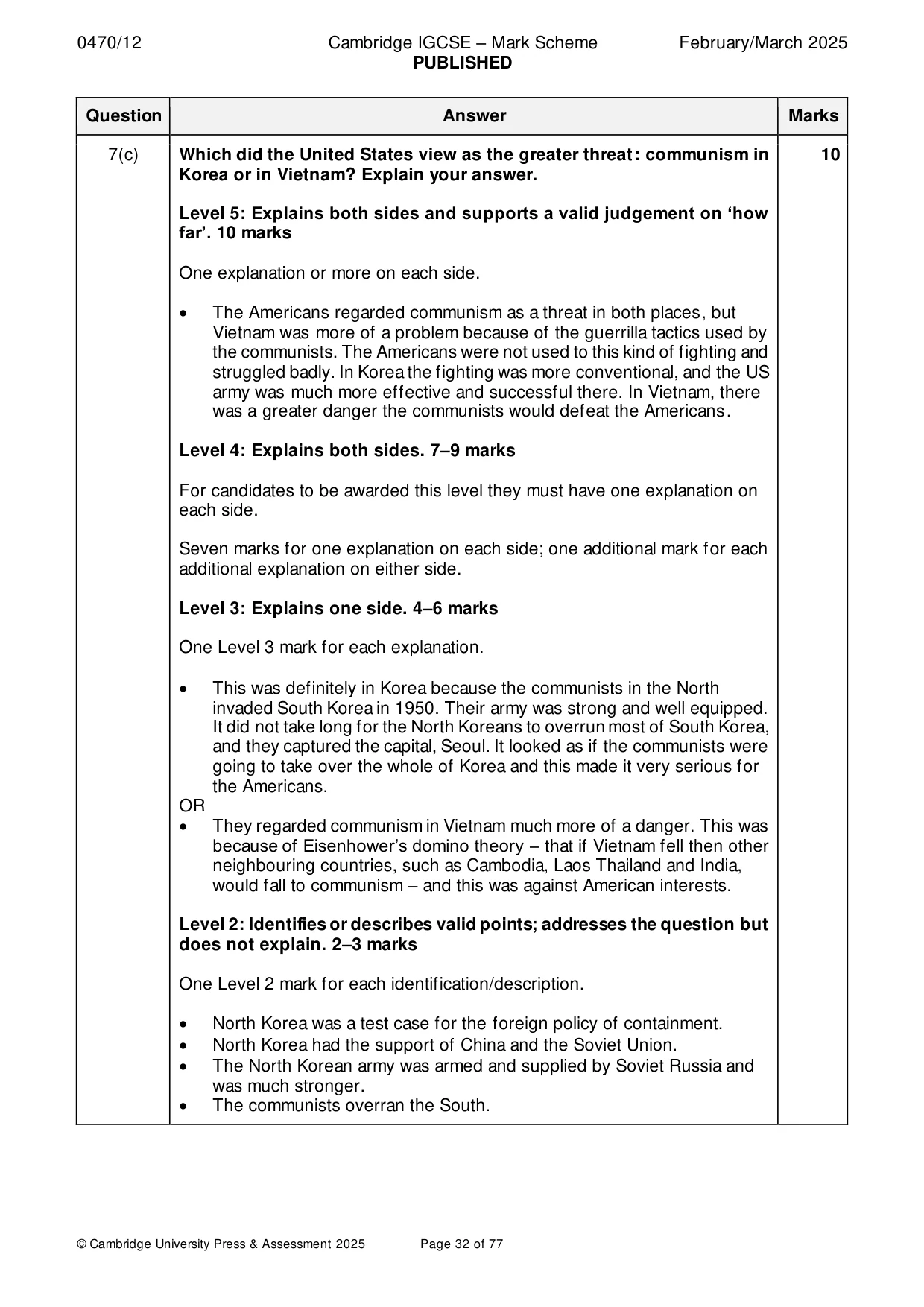
0470/12 Cambridge IGCSE – Mark Scheme PUBLISHED February/March 2025 © Cambridge University Press & Assessment 2025 Page 32 of 77 Question Answer Marks 7(c) Which did the United States view as the greater threat: communism in Korea or in Vietnam? Explain your answer. Level 5: Explains both sides and supports a valid judgement on ‘how far’. 10 marks One explanation or more on each side. • The Americans regarded communism as a threat in both places, but Vietnam was more of a problem because of the guerrilla tactics used by the communists. The Americans were not used to this kind of fighting and struggled badly. In Korea the fighting was more conventional, and the US army was much more effective and successful there. In Vietnam, there was a greater danger the communists would defeat the Americans. Level 4: Explains both sides. 7–9 marks For candidates to be awarded this level they must have one explanation on each side. Seven marks for one explanation on each side; one additional mark for each additional explanation on either side. Level 3: Explains one side. 4–6 marks One Level 3 mark for each explanation. • This was definitely in Korea because the communists in the North invaded South Korea in 1950. Their army was strong and well equipped. It did not take long for the North Koreans to overrun most of South Korea, and they captured the capital, Seoul. It looked as if the communists were going to take over the whole of Korea and this made it very serious for the Americans. OR • They regarded communism in Vietnam much more of a danger. This was because of Eisenhower’s domino theory – that if Vietnam fell then other neighbouring countries, such as Cambodia, Laos Thailand and India, would fall to communism – and this was against American interests. Level 2: Identifies or describes valid points; addresses the question but does not explain. 2–3 marks One Level 2 mark for each identification/description. • North Korea was a test case for the foreign policy of containment. • North Korea had the support of China and the Soviet Union. • The North Korean army was armed and supplied by Soviet Russia and was much stronger. • The communists overran the South. 10
Mark scheme, page 33
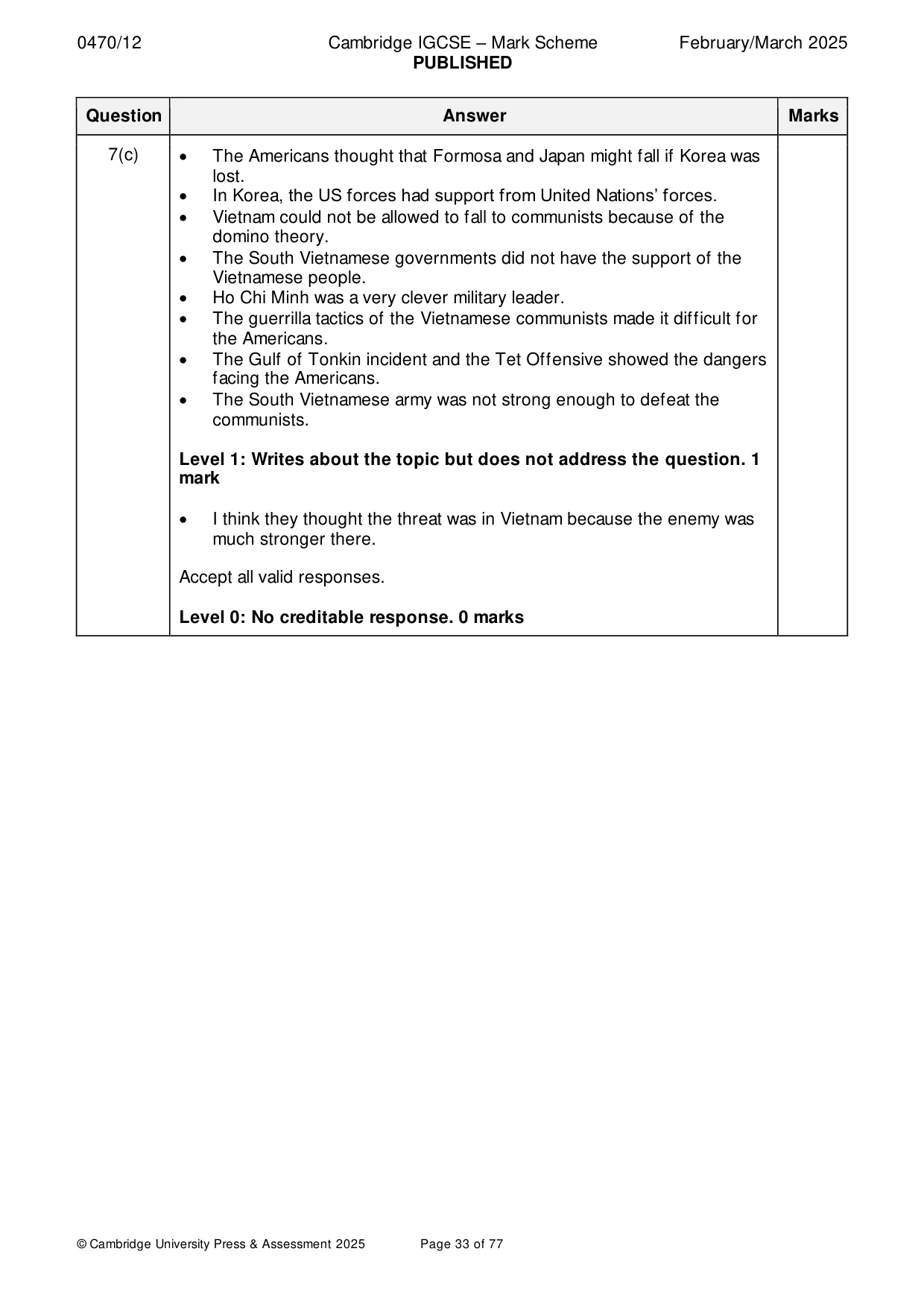
0470/12 Cambridge IGCSE – Mark Scheme PUBLISHED February/March 2025 © Cambridge University Press & Assessment 2025 Page 33 of 77 Question Answer Marks 7(c) • The Americans thought that Formosa and Japan might fall if Korea was lost. • In Korea, the US forces had support from United Nations’ forces. • Vietnam could not be allowed to fall to communists because of the domino theory. • The South Vietnamese governments did not have the support of the Vietnamese people. • Ho Chi Minh was a very clever military leader. • The guerrilla tactics of the Vietnamese communists made it difficult for the Americans. • The Gulf of Tonkin incident and the Tet Offensive showed the dangers facing the Americans. • The South Vietnamese army was not strong enough to defeat the communists. Level 1: Writes about the topic but does not address the question. 1 mark • I think they thought the threat was in Vietnam because the enemy was much stronger there. Accept all valid responses. Level 0: No creditable response. 0 marks
Mark scheme, page 34
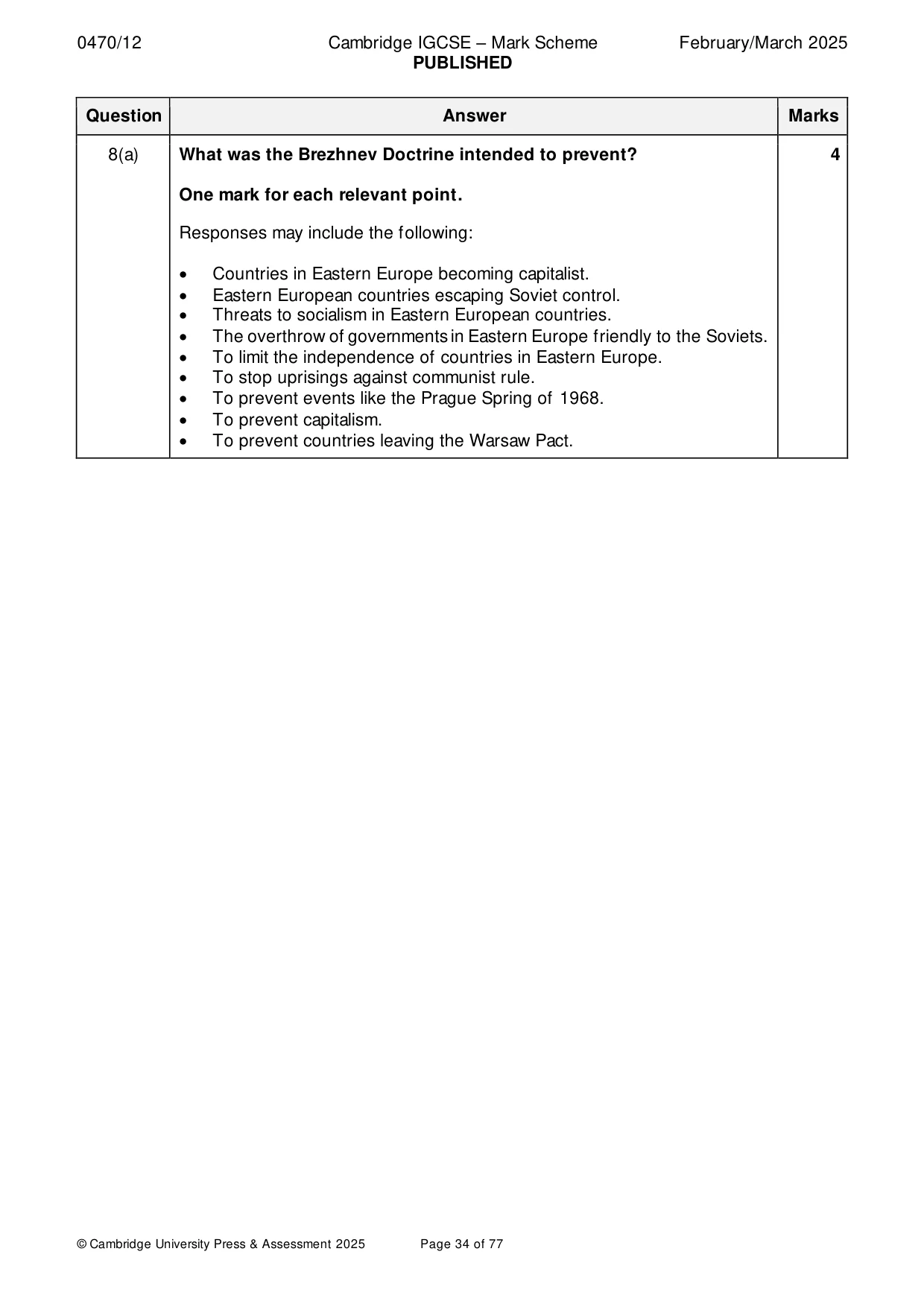
0470/12 Cambridge IGCSE – Mark Scheme PUBLISHED February/March 2025 © Cambridge University Press & Assessment 2025 Page 34 of 77 Question Answer Marks 8(a) What was the Brezhnev Doctrine intended to prevent? One mark for each relevant point. Responses may include the following: • Countries in Eastern Europe becoming capitalist. • Eastern European countries escaping Soviet control. • Threats to socialism in Eastern European countries. • The overthrow of governments in Eastern Europe friendly to the Soviets. • To limit the independence of countries in Eastern Europe. • To stop uprisings against communist rule. • To prevent events like the Prague Spring of 1968. • To prevent capitalism. • To prevent countries leaving the Warsaw Pact. 4
Mark scheme, page 35
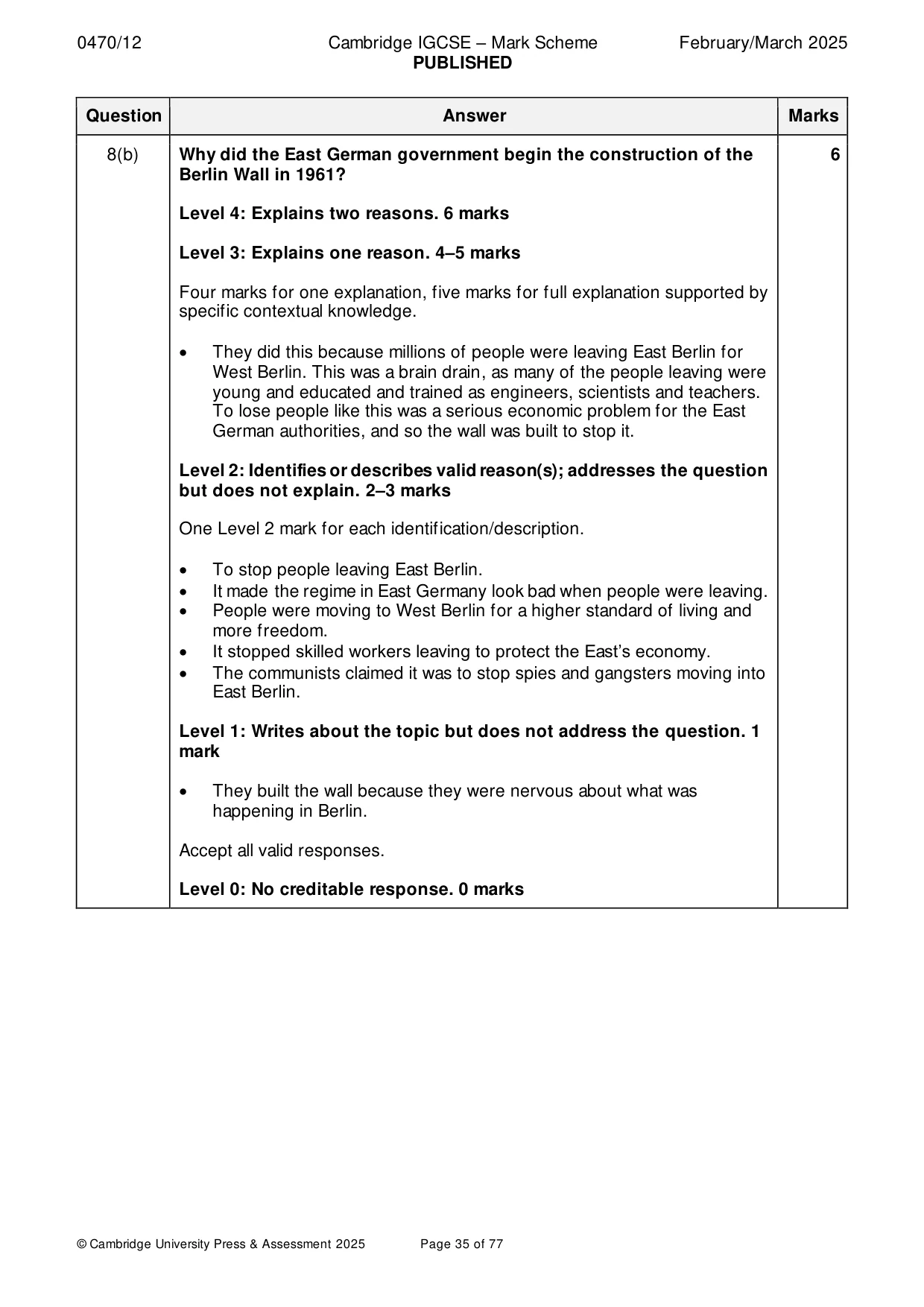
0470/12 Cambridge IGCSE – Mark Scheme PUBLISHED February/March 2025 © Cambridge University Press & Assessment 2025 Page 35 of 77 Question Answer Marks 8(b) Why did the East German government begin the construction of the Berlin Wall in 1961? Level 4: Explains two reasons. 6 marks Level 3: Explains one reason. 4–5 marks Four marks for one explanation, five marks for full explanation supported by specific contextual knowledge. • They did this because millions of people were leaving East Berlin for West Berlin. This was a brain drain, as many of the people leaving were young and educated and trained as engineers, scientists and teachers. To lose people like this was a serious economic problem for the East German authorities, and so the wall was built to stop it. Level 2: Identifies or describes valid reason(s); addresses the question but does not explain. 2–3 marks One Level 2 mark for each identification/description. • To stop people leaving East Berlin. • It made the regime in East Germany look bad when people were leaving. • People were moving to West Berlin for a higher standard of living and more freedom. • It stopped skilled workers leaving to protect the East’s economy. • The communists claimed it was to stop spies and gangsters moving into East Berlin. Level 1: Writes about the topic but does not address the question. 1 mark • They built the wall because they were nervous about what was happening in Berlin. Accept all valid responses. Level 0: No creditable response. 0 marks 6
Mark scheme, page 36
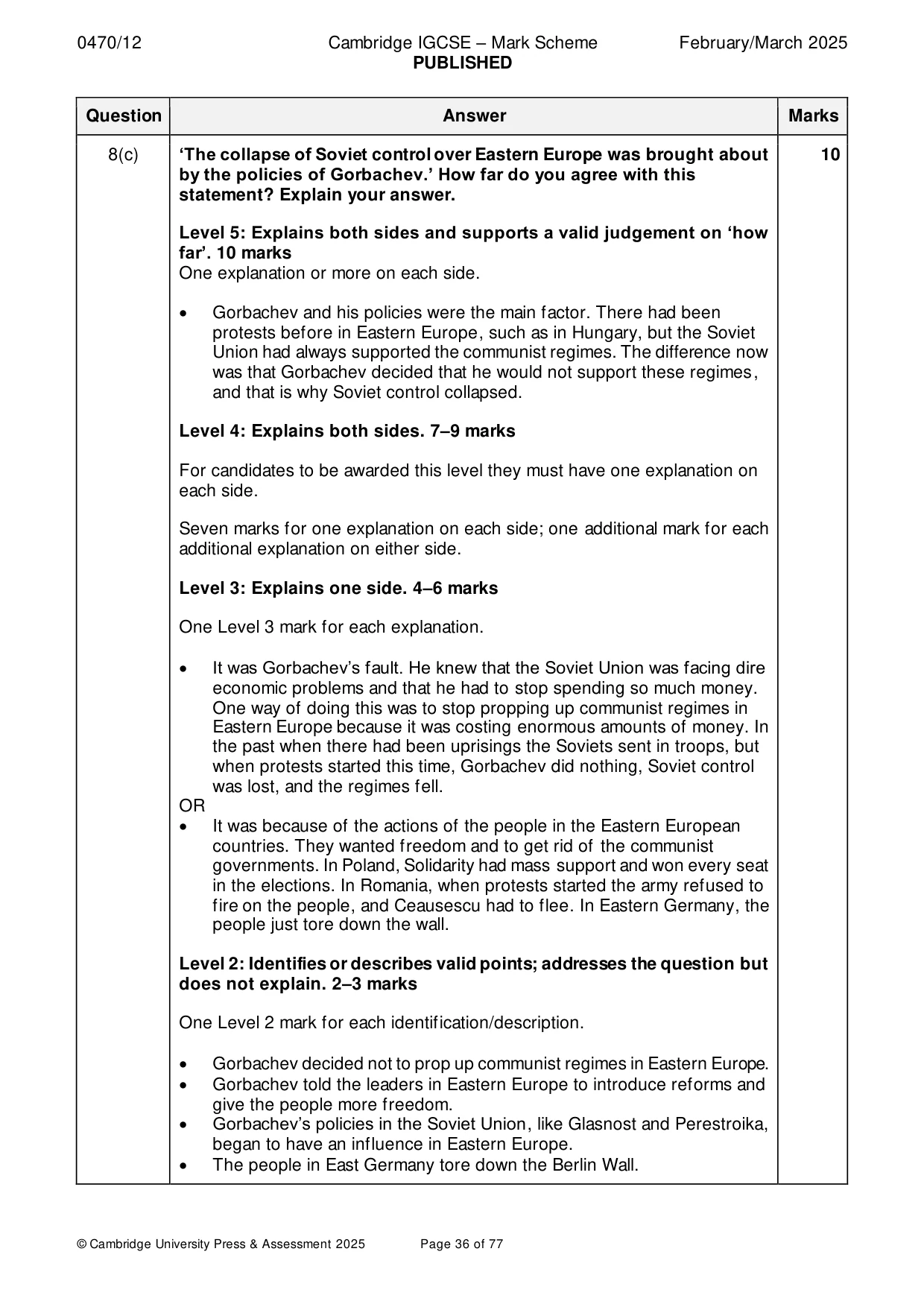
0470/12 Cambridge IGCSE – Mark Scheme PUBLISHED February/March 2025 © Cambridge University Press & Assessment 2025 Page 36 of 77 Question Answer Marks 8(c) ‘The collapse of Soviet control over Eastern Europe was brought about by the policies of Gorbachev.’ How far do you agree with this statement? Explain your answer. Level 5: Explains both sides and supports a valid judgement on ‘how far’. 10 marks One explanation or more on each side. • Gorbachev and his policies were the main factor. There had been protests before in Eastern Europe, such as in Hungary, but the Soviet Union had always supported the communist regimes. The difference now was that Gorbachev decided that he would not support these regimes, and that is why Soviet control collapsed. Level 4: Explains both sides. 7–9 marks For candidates to be awarded this level they must have one explanation on each side. Seven marks for one explanation on each side; one additional mark for each additional explanation on either side. Level 3: Explains one side. 4–6 marks One Level 3 mark for each explanation. • It was Gorbachev’s fault. He knew that the Soviet Union was facing dire economic problems and that he had to stop spending so much money. One way of doing this was to stop propping up communist regimes in Eastern Europe because it was costing enormous amounts of money. In the past when there had been uprisings the Soviets sent in troops, but when protests started this time, Gorbachev did nothing, Soviet control was lost, and the regimes fell. OR • It was because of the actions of the people in the Eastern European countries. They wanted freedom and to get rid of the communist governments. In Poland, Solidarity had mass support and won every seat in the elections. In Romania, when protests started the army refused to fire on the people, and Ceausescu had to flee. In Eastern Germany, the people just tore down the wall. Level 2: Identifies or describes valid points; addresses the question but does not explain. 2–3 marks One Level 2 mark for each identification/description. • Gorbachev decided not to prop up communist regimes in Eastern Europe. • Gorbachev told the leaders in Eastern Europe to introduce reforms and give the people more freedom. • Gorbachev’s policies in the Soviet Union, like Glasnost and Perestroika, began to have an influence in Eastern Europe. • The people in East Germany tore down the Berlin Wall. 10
Mark scheme, page 37
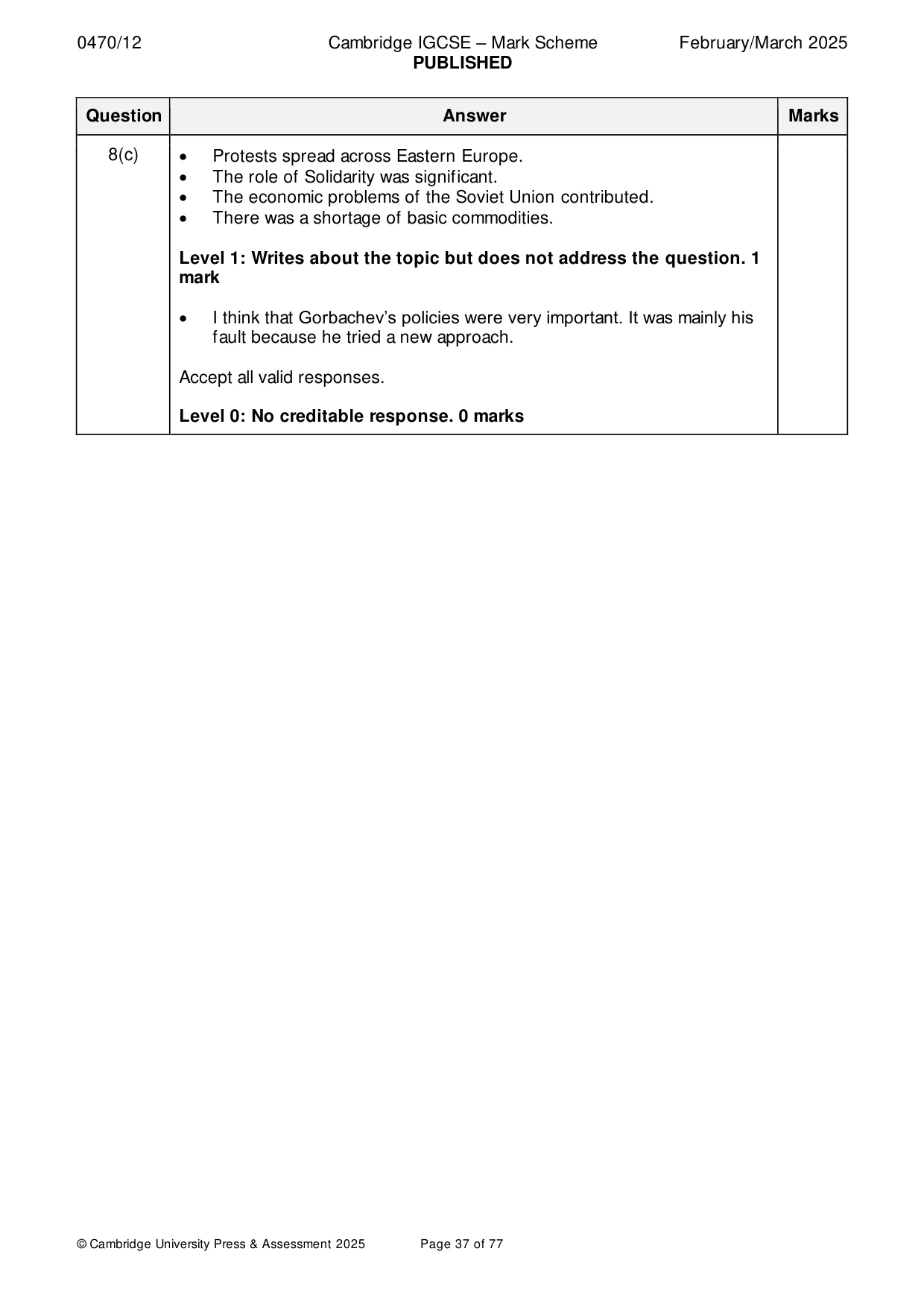
0470/12 Cambridge IGCSE – Mark Scheme PUBLISHED February/March 2025 © Cambridge University Press & Assessment 2025 Page 37 of 77 Question Answer Marks 8(c) • Protests spread across Eastern Europe. • The role of Solidarity was significant. • The economic problems of the Soviet Union contributed. • There was a shortage of basic commodities. Level 1: Writes about the topic but does not address the question. 1 mark • I think that Gorbachev’s policies were very important. It was mainly his fault because he tried a new approach. Accept all valid responses. Level 0: No creditable response. 0 marks
Mark scheme, page 38
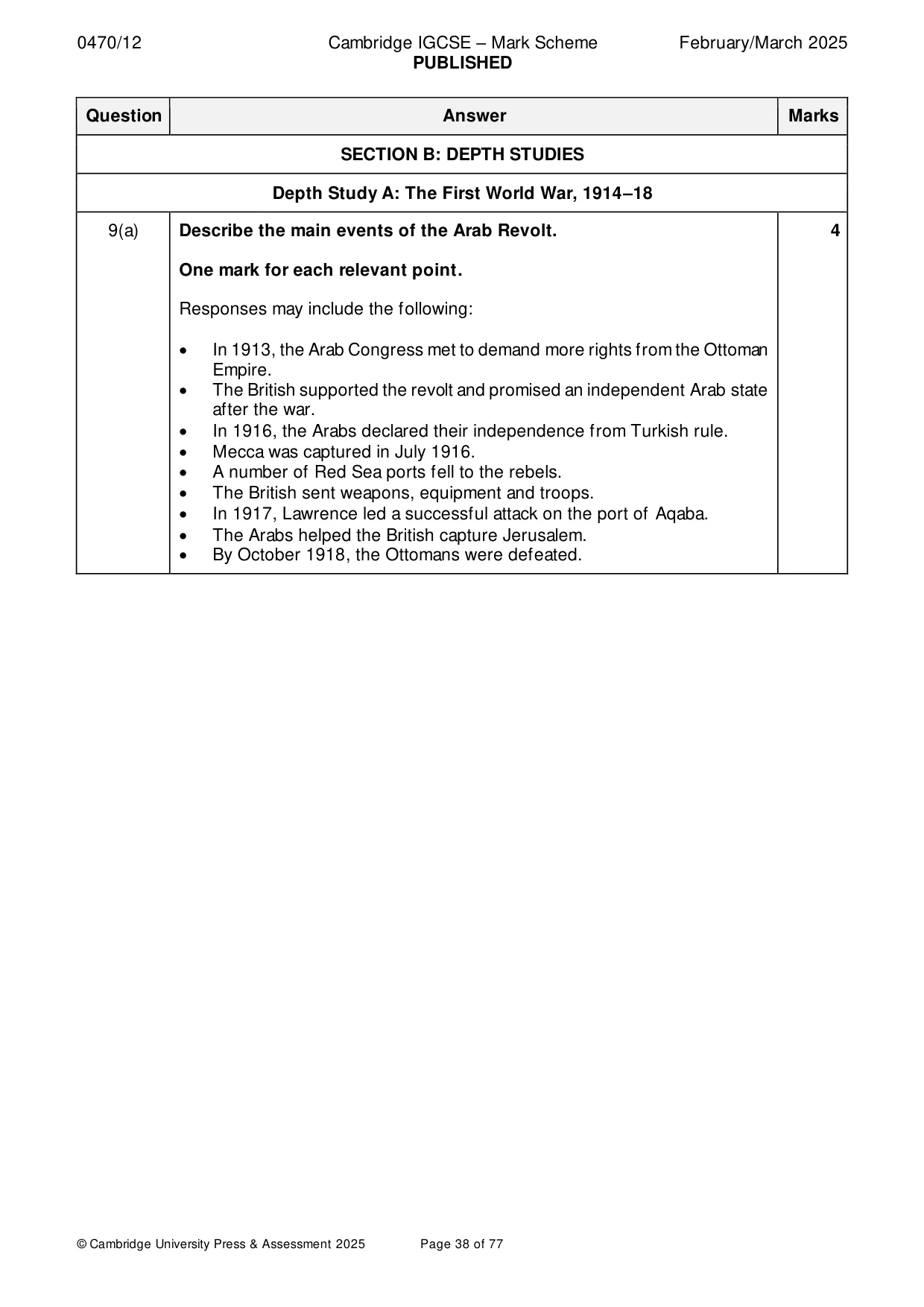
0470/12 Cambridge IGCSE – Mark Scheme PUBLISHED February/March 2025 © Cambridge University Press & Assessment 2025 Page 38 of 77 Question Answer Marks SECTION B: DEPTH STUDIES Depth Study A: The First World War, 1914–18 9(a) Describe the main events of the Arab Revolt. One mark for each relevant point. Responses may include the following: • In 1913, the Arab Congress met to demand more rights from the Ottoman Empire. • The British supported the revolt and promised an independent Arab state after the war. • In 1916, the Arabs declared their independence from Turkish rule. • Mecca was captured in July 1916. • A number of Red Sea ports fell to the rebels. • The British sent weapons, equipment and troops. • In 1917, Lawrence led a successful attack on the port of Aqaba. • The Arabs helped the British capture Jerusalem. • By October 1918, the Ottomans were defeated. 4
Mark scheme, page 39
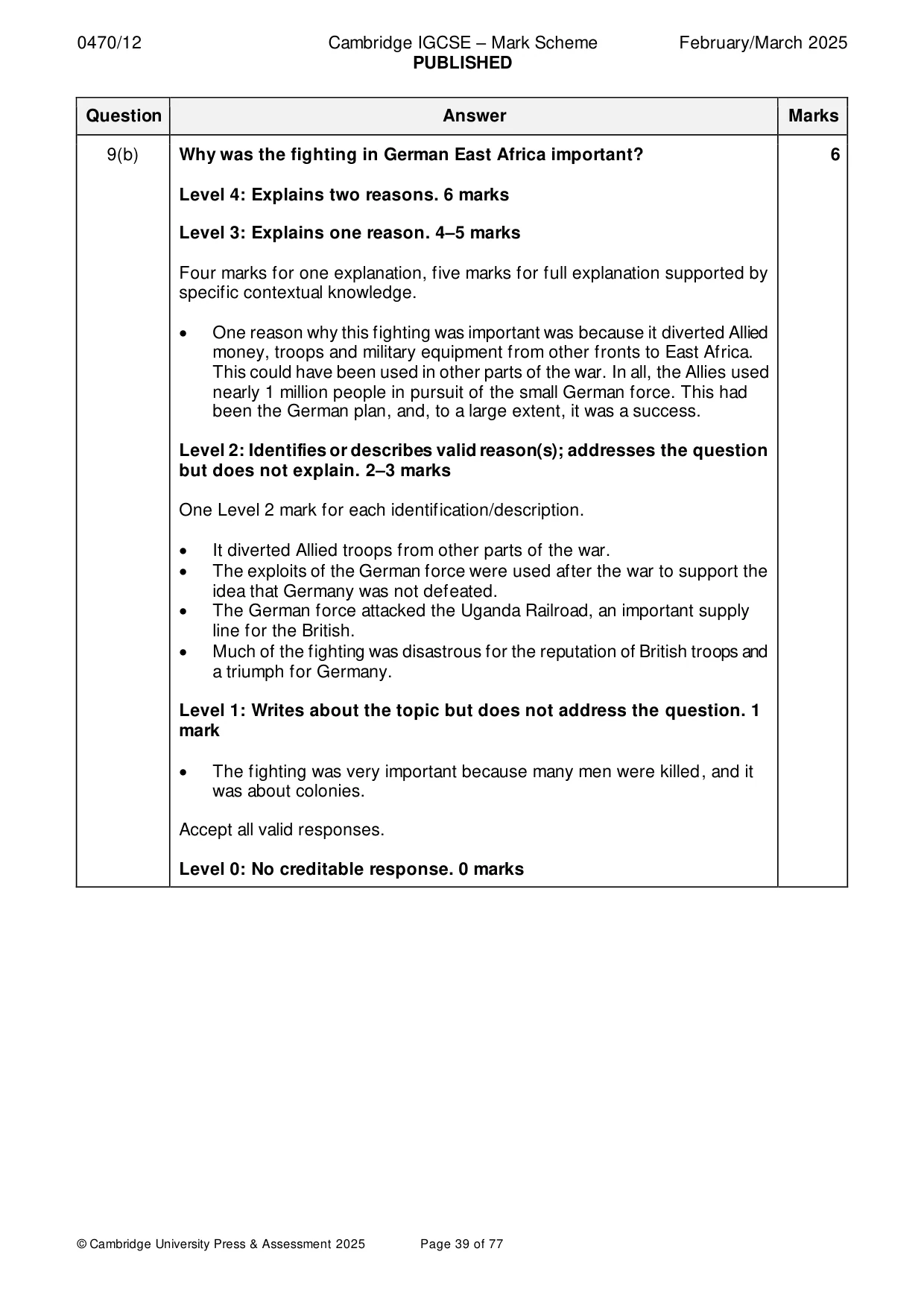
0470/12 Cambridge IGCSE – Mark Scheme PUBLISHED February/March 2025 © Cambridge University Press & Assessment 2025 Page 39 of 77 Question Answer Marks 9(b) Why was the fighting in German East Africa important? Level 4: Explains two reasons. 6 marks Level 3: Explains one reason. 4–5 marks Four marks for one explanation, five marks for full explanation supported by specific contextual knowledge. • One reason why this fighting was important was because it diverted Allied money, troops and military equipment from other fronts to East Africa. This could have been used in other parts of the war. In all, the Allies used nearly 1 million people in pursuit of the small German force. This had been the German plan, and, to a large extent, it was a success. Level 2: Identifies or describes valid reason(s); addresses the question but does not explain. 2–3 marks One Level 2 mark for each identification/description. • It diverted Allied troops from other parts of the war. • The exploits of the German force were used after the war to support the idea that Germany was not defeated. • The German force attacked the Uganda Railroad, an important supply line for the British. • Much of the fighting was disastrous for the reputation of British troops and a triumph for Germany. Level 1: Writes about the topic but does not address the question. 1 mark • The fighting was very important because many men were killed, and it was about colonies. Accept all valid responses. Level 0: No creditable response. 0 marks 6
Mark scheme, page 40
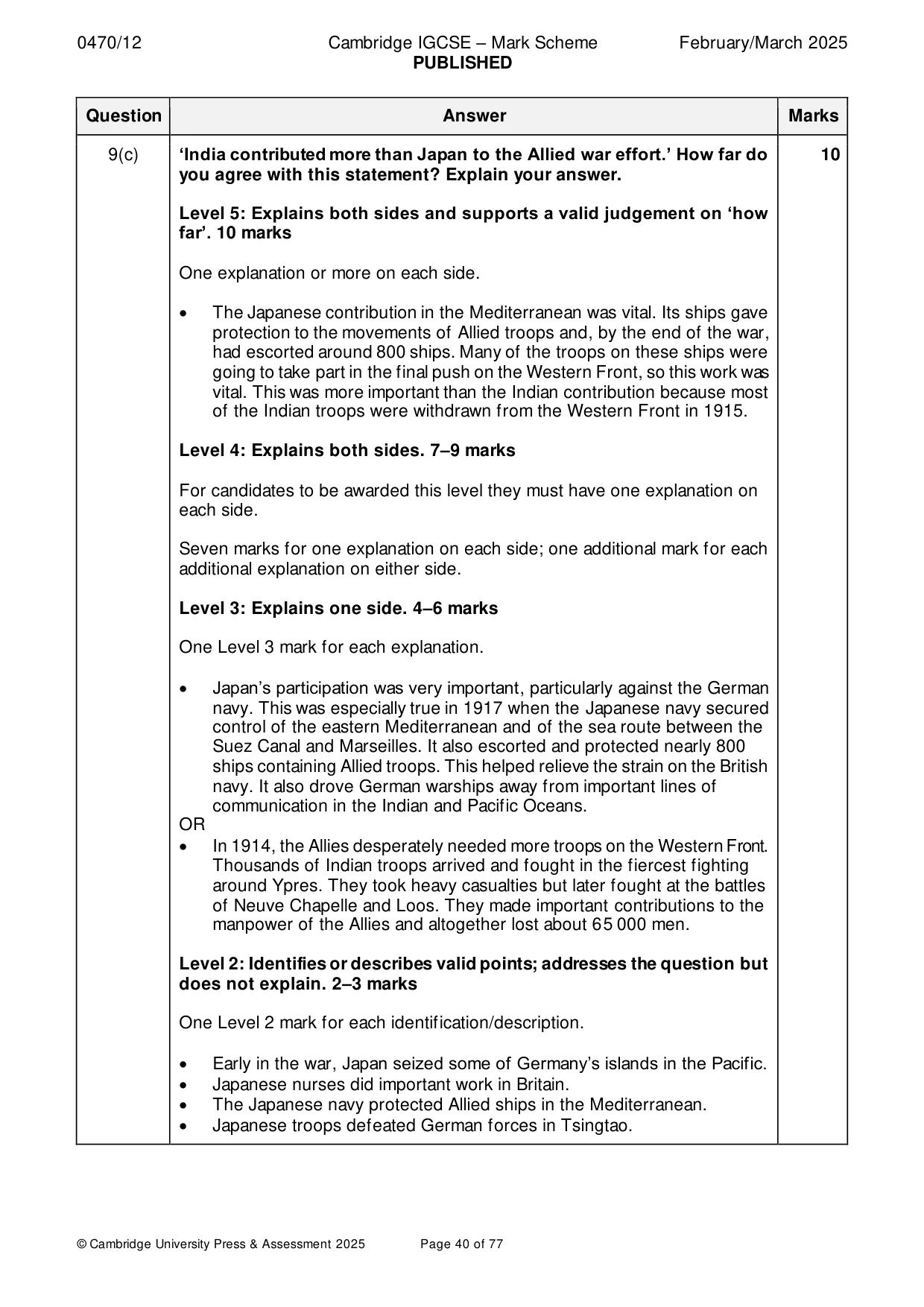
0470/12 Cambridge IGCSE – Mark Scheme PUBLISHED February/March 2025 © Cambridge University Press & Assessment 2025 Page 40 of 77 Question Answer Marks 9(c) ‘India contributed more than Japan to the Allied war effort.’ How far do you agree with this statement? Explain your answer. Level 5: Explains both sides and supports a valid judgement on ‘how far’. 10 marks One explanation or more on each side. • The Japanese contribution in the Mediterranean was vital. Its ships gave protection to the movements of Allied troops and, by the end of the war, had escorted around 800 ships. Many of the troops on these ships were going to take part in the final push on the Western Front, so this work was vital. This was more important than the Indian contribution because most of the Indian troops were withdrawn from the Western Front in 1915. Level 4: Explains both sides. 7–9 marks For candidates to be awarded this level they must have one explanation on each side. Seven marks for one explanation on each side; one additional mark for each additional explanation on either side. Level 3: Explains one side. 4–6 marks One Level 3 mark for each explanation. • Japan’s participation was very important, particularly against the German navy. This was especially true in 1917 when the Japanese navy secured control of the eastern Mediterranean and of the sea route between the Suez Canal and Marseilles. It also escorted and protected nearly 800 ships containing Allied troops. This helped relieve the strain on the British navy. It also drove German warships away from important lines of communication in the Indian and Pacific Oceans. OR • In 1914, the Allies desperately needed more troops on the Western Front. Thousands of Indian troops arrived and fought in the fiercest fighting around Ypres. They took heavy casualties but later fought at the battles of Neuve Chapelle and Loos. They made important contributions to the manpower of the Allies and altogether lost about 65 000 men. Level 2: Identifies or describes valid points; addresses the question but does not explain. 2–3 marks One Level 2 mark for each identification/description. • Early in the war, Japan seized some of Germany’s islands in the Pacific. • Japanese nurses did important work in Britain. • The Japanese navy protected Allied ships in the Mediterranean. • Japanese troops defeated German forces in Tsingtao. 10
Mark scheme, page 41
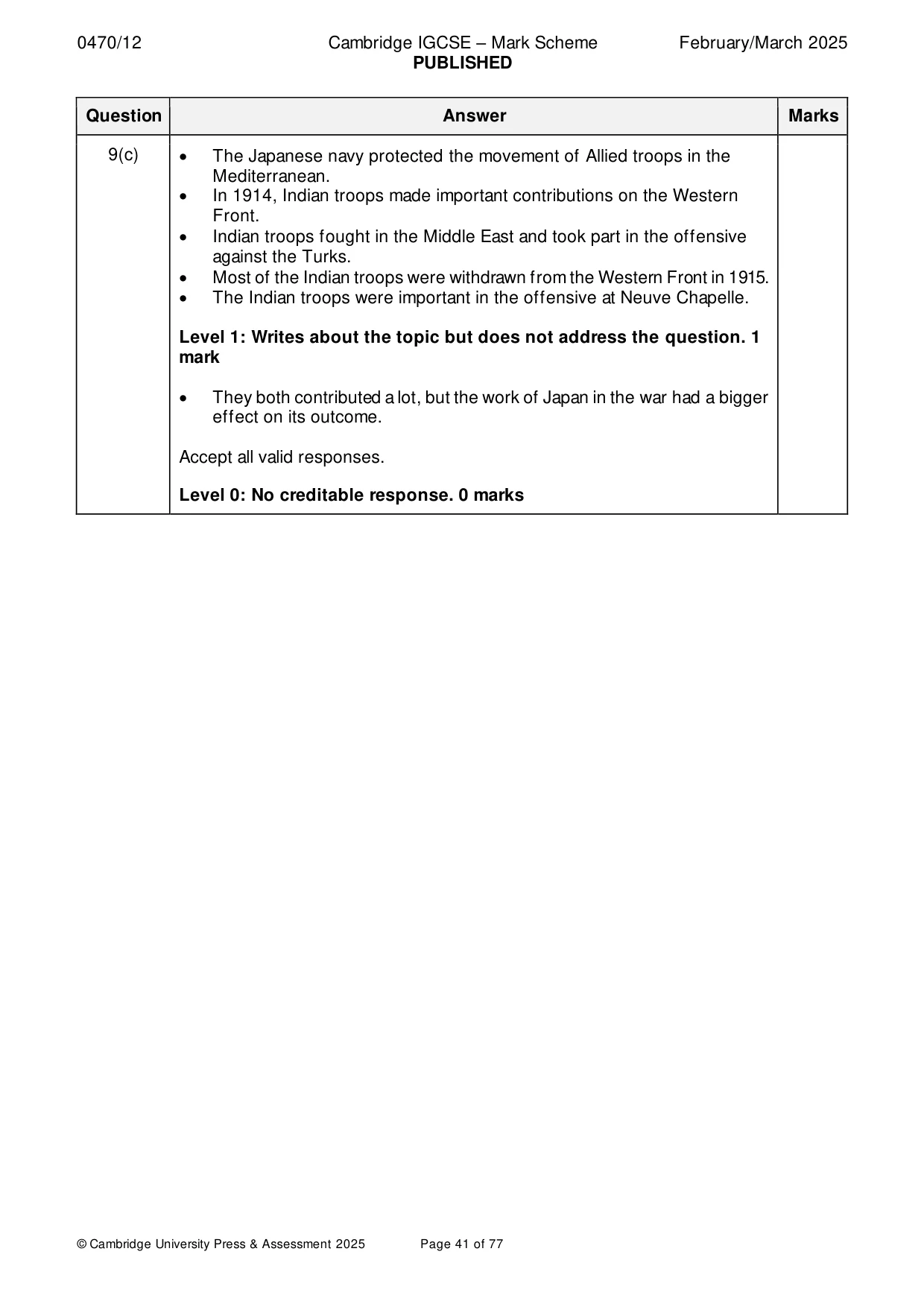
0470/12 Cambridge IGCSE – Mark Scheme PUBLISHED February/March 2025 © Cambridge University Press & Assessment 2025 Page 41 of 77 Question Answer Marks 9(c) • The Japanese navy protected the movement of Allied troops in the Mediterranean. • In 1914, Indian troops made important contributions on the Western Front. • Indian troops fought in the Middle East and took part in the offensive against the Turks. • Most of the Indian troops were withdrawn from the Western Front in 1915. • The Indian troops were important in the offensive at Neuve Chapelle. Level 1: Writes about the topic but does not address the question. 1 mark • They both contributed a lot, but the work of Japan in the war had a bigger effect on its outcome. Accept all valid responses. Level 0: No creditable response. 0 marks
Mark scheme, page 42
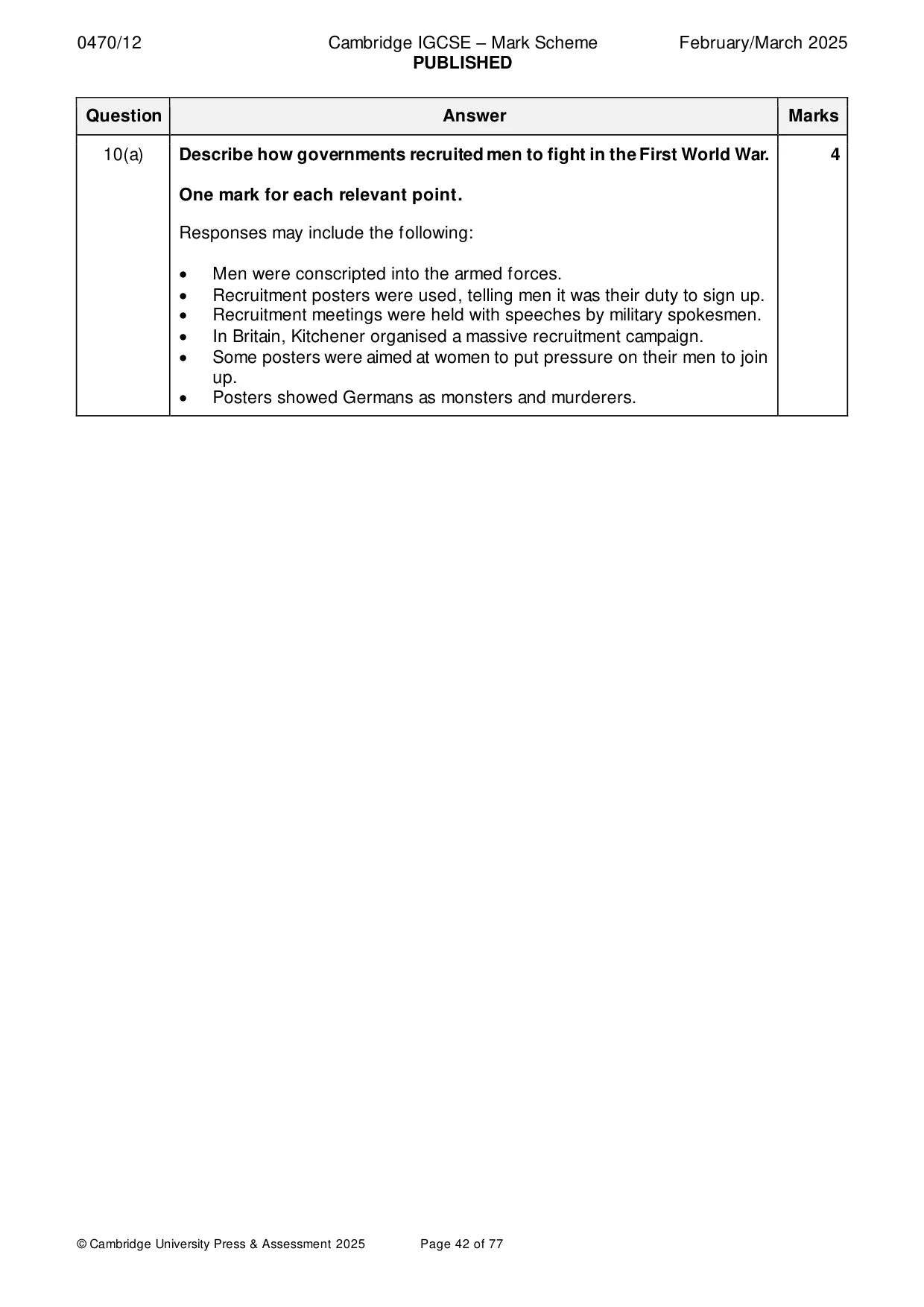
0470/12 Cambridge IGCSE – Mark Scheme PUBLISHED February/March 2025 © Cambridge University Press & Assessment 2025 Page 42 of 77 Question Answer Marks 10(a) Describe how governments recruited men to fight in the First World War. One mark for each relevant point. Responses may include the following: • Men were conscripted into the armed forces. • Recruitment posters were used, telling men it was their duty to sign up. • Recruitment meetings were held with speeches by military spokesmen. • In Britain, Kitchener organised a massive recruitment campaign. • Some posters were aimed at women to put pressure on their men to join up. • Posters showed Germans as monsters and murderers. 4
Mark scheme, page 43
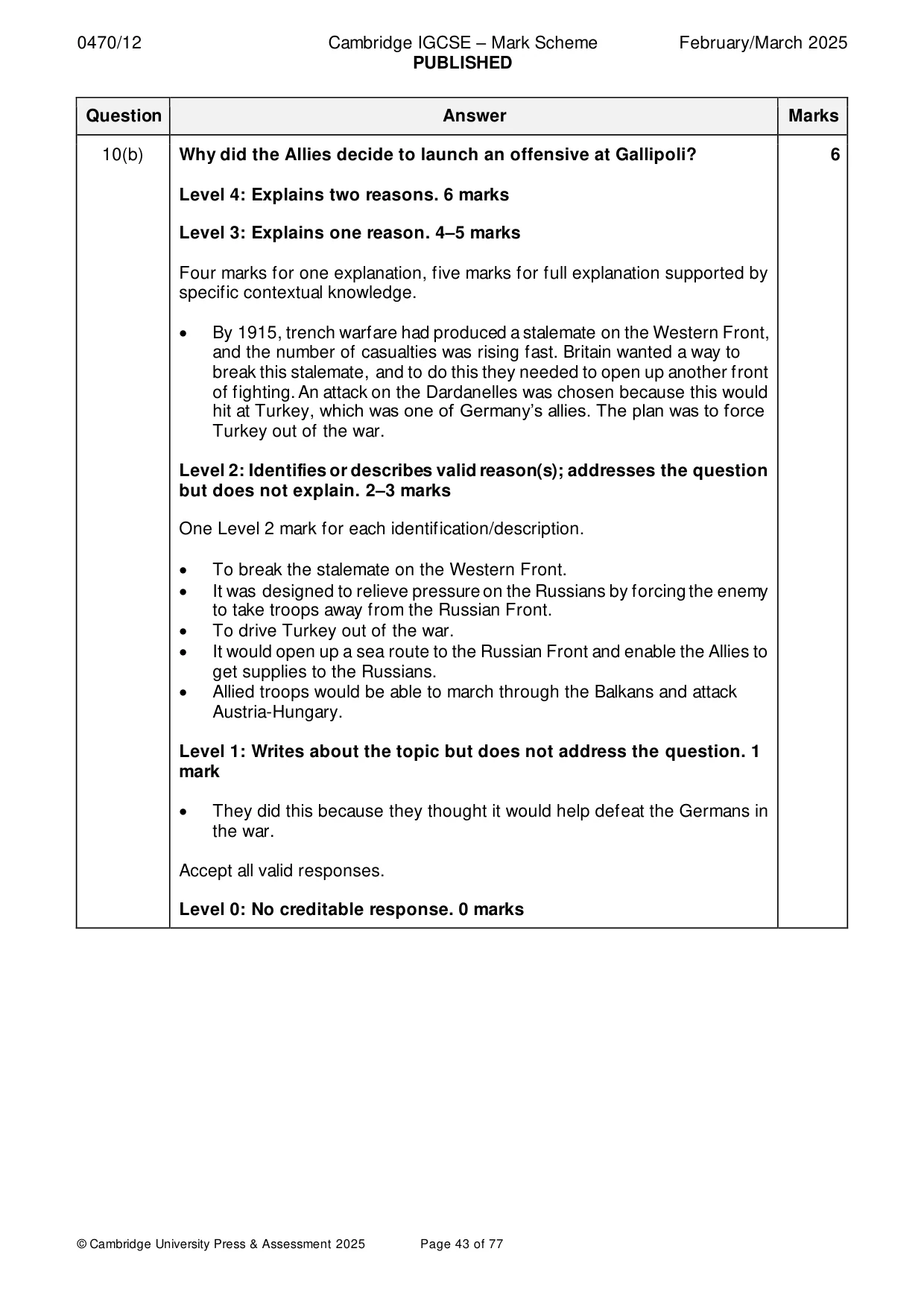
0470/12 Cambridge IGCSE – Mark Scheme PUBLISHED February/March 2025 © Cambridge University Press & Assessment 2025 Page 43 of 77 Question Answer Marks 10(b) Why did the Allies decide to launch an offensive at Gallipoli? Level 4: Explains two reasons. 6 marks Level 3: Explains one reason. 4–5 marks Four marks for one explanation, five marks for full explanation supported by specific contextual knowledge. • By 1915, trench warfare had produced a stalemate on the Western Front, and the number of casualties was rising fast. Britain wanted a way to break this stalemate, and to do this they needed to open up another front of fighting. An attack on the Dardanelles was chosen because this would hit at Turkey, which was one of Germany’s allies. The plan was to force Turkey out of the war. Level 2: Identifies or describes valid reason(s); addresses the question but does not explain. 2–3 marks One Level 2 mark for each identification/description. • To break the stalemate on the Western Front. • It was designed to relieve pressure on the Russians by forcing the enemy to take troops away from the Russian Front. • To drive Turkey out of the war. • It would open up a sea route to the Russian Front and enable the Allies to get supplies to the Russians. • Allied troops would be able to march through the Balkans and attack Austria-Hungary. Level 1: Writes about the topic but does not address the question. 1 mark • They did this because they thought it would help defeat the Germans in the war. Accept all valid responses. Level 0: No creditable response. 0 marks 6
Mark scheme, page 44
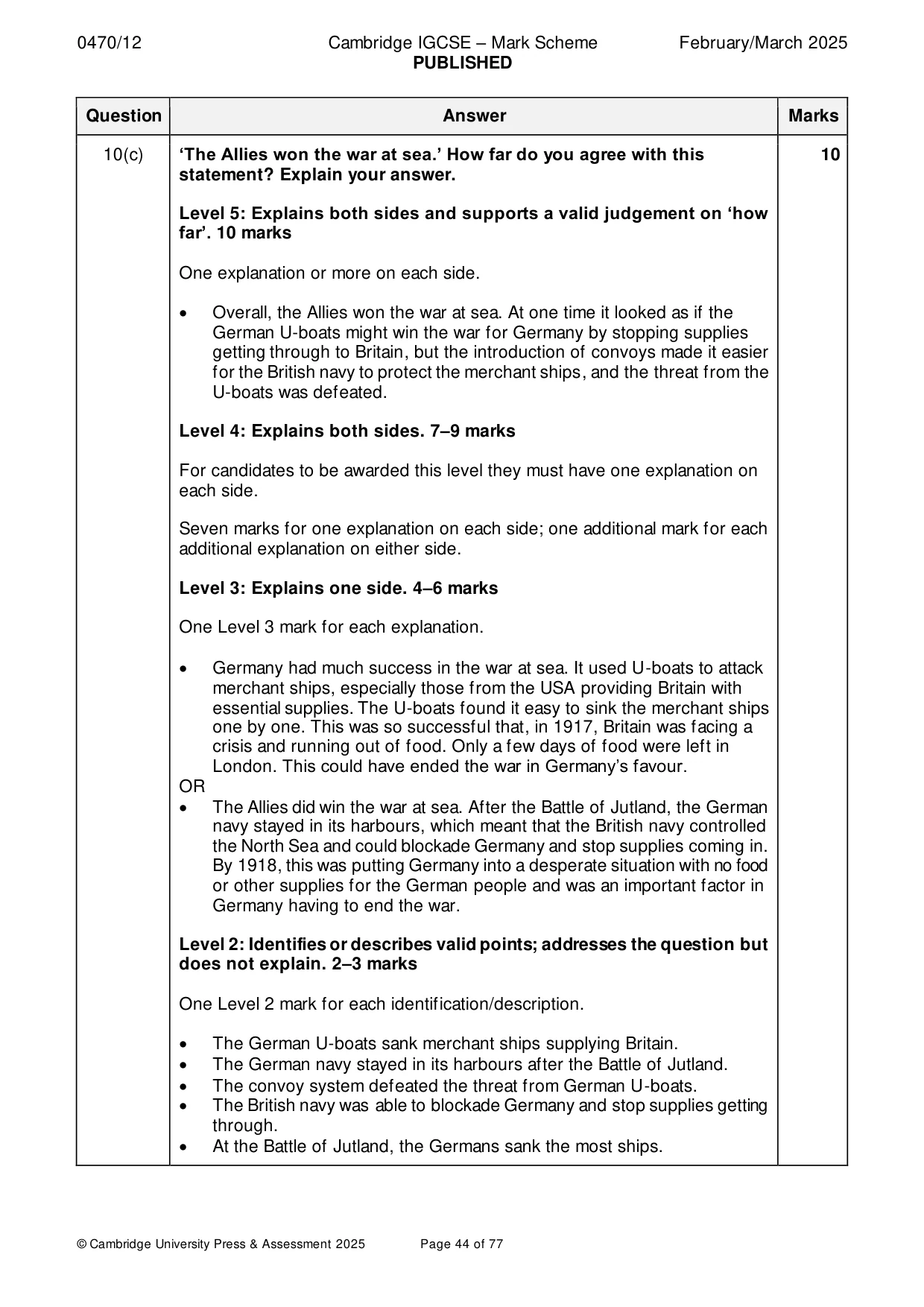
0470/12 Cambridge IGCSE – Mark Scheme PUBLISHED February/March 2025 © Cambridge University Press & Assessment 2025 Page 44 of 77 Question Answer Marks 10(c) ‘The Allies won the war at sea.’ How far do you agree with this statement? Explain your answer. Level 5: Explains both sides and supports a valid judgement on ‘how far’. 10 marks One explanation or more on each side. • Overall, the Allies won the war at sea. At one time it looked as if the German U-boats might win the war for Germany by stopping supplies getting through to Britain, but the introduction of convoys made it easier for the British navy to protect the merchant ships, and the threat from the U-boats was defeated. Level 4: Explains both sides. 7–9 marks For candidates to be awarded this level they must have one explanation on each side. Seven marks for one explanation on each side; one additional mark for each additional explanation on either side. Level 3: Explains one side. 4–6 marks One Level 3 mark for each explanation. • Germany had much success in the war at sea. It used U-boats to attack merchant ships, especially those from the USA providing Britain with essential supplies. The U-boats found it easy to sink the merchant ships one by one. This was so successful that, in 1917, Britain was facing a crisis and running out of food. Only a few days of food were left in London. This could have ended the war in Germany’s favour. OR • The Allies did win the war at sea. After the Battle of Jutland, the German navy stayed in its harbours, which meant that the British navy controlled the North Sea and could blockade Germany and stop supplies coming in. By 1918, this was putting Germany into a desperate situation with no food or other supplies for the German people and was an important factor in Germany having to end the war. Level 2: Identifies or describes valid points; addresses the question but does not explain. 2–3 marks One Level 2 mark for each identification/description. • The German U-boats sank merchant ships supplying Britain. • The German navy stayed in its harbours after the Battle of Jutland. • The convoy system defeated the threat from German U-boats. • The British navy was able to blockade Germany and stop supplies getting through. • At the Battle of Jutland, the Germans sank the most ships. 10
Mark scheme, page 45
0470/12 Cambridge IGCSE – Mark Scheme PUBLISHED February/March 2025 © Cambridge University Press & Assessment 2025 Page 45 of 77 Question Answer Marks 10(c) Level 1: Writes about the topic but does not address the question. 1 mark • Both sides had successes in the war at sea, but by the end of the war the Allies had had more success. Accept all valid responses. Level 0: No creditable response. 0 marks
Mark scheme, page 46
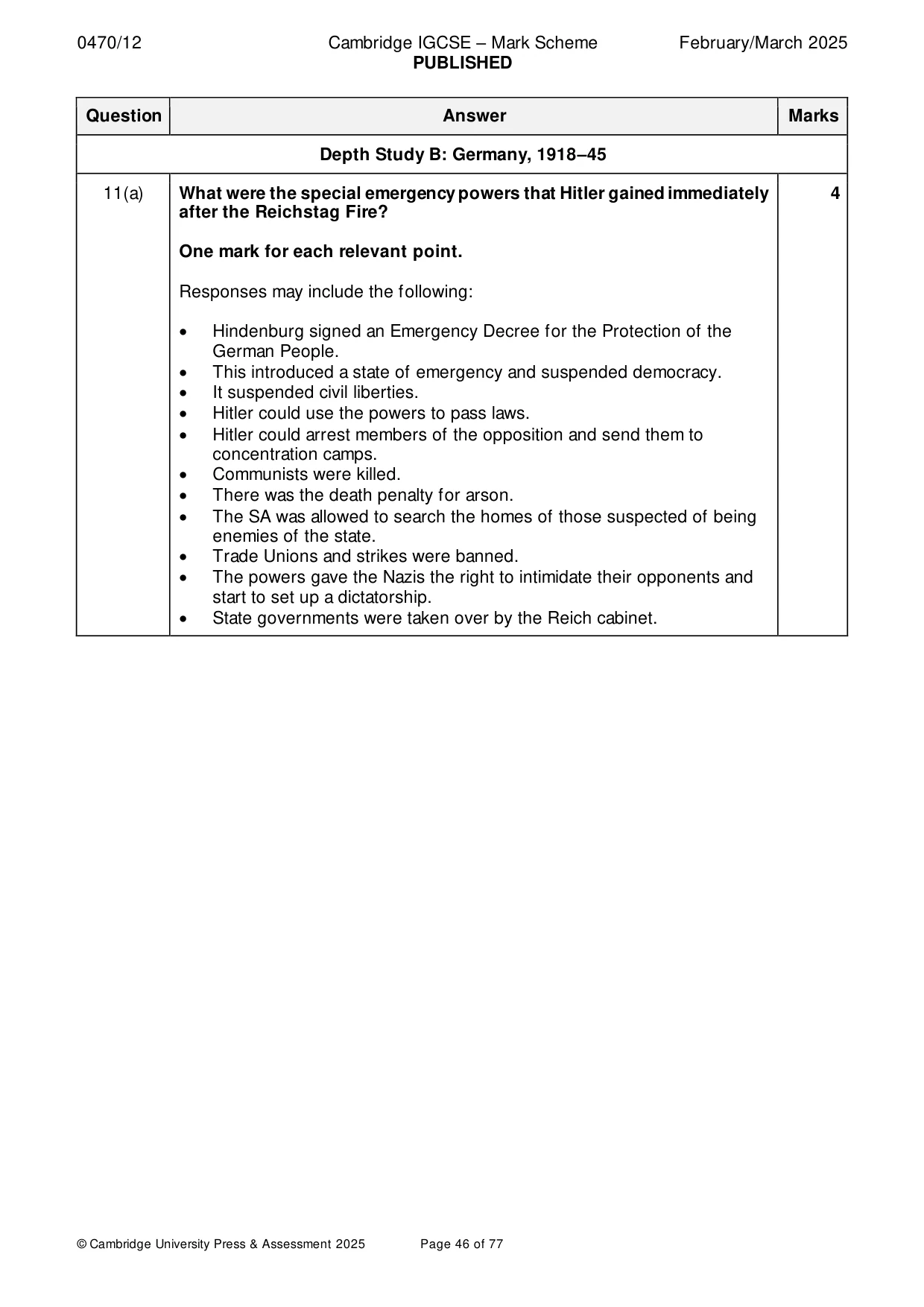
0470/12 Cambridge IGCSE – Mark Scheme PUBLISHED February/March 2025 © Cambridge University Press & Assessment 2025 Page 46 of 77 Question Answer Marks Depth Study B: Germany, 1918–45 11(a) What were the special emergency powers that Hitler gained immediately after the Reichstag Fire? One mark for each relevant point. Responses may include the following: • Hindenburg signed an Emergency Decree for the Protection of the German People. • This introduced a state of emergency and suspended democracy. • It suspended civil liberties. • Hitler could use the powers to pass laws. • Hitler could arrest members of the opposition and send them to concentration camps. • Communists were killed. • There was the death penalty for arson. • The SA was allowed to search the homes of those suspected of being enemies of the state. • Trade Unions and strikes were banned. • The powers gave the Nazis the right to intimidate their opponents and start to set up a dictatorship. • State governments were taken over by the Reich cabinet. 4
Mark scheme, page 47
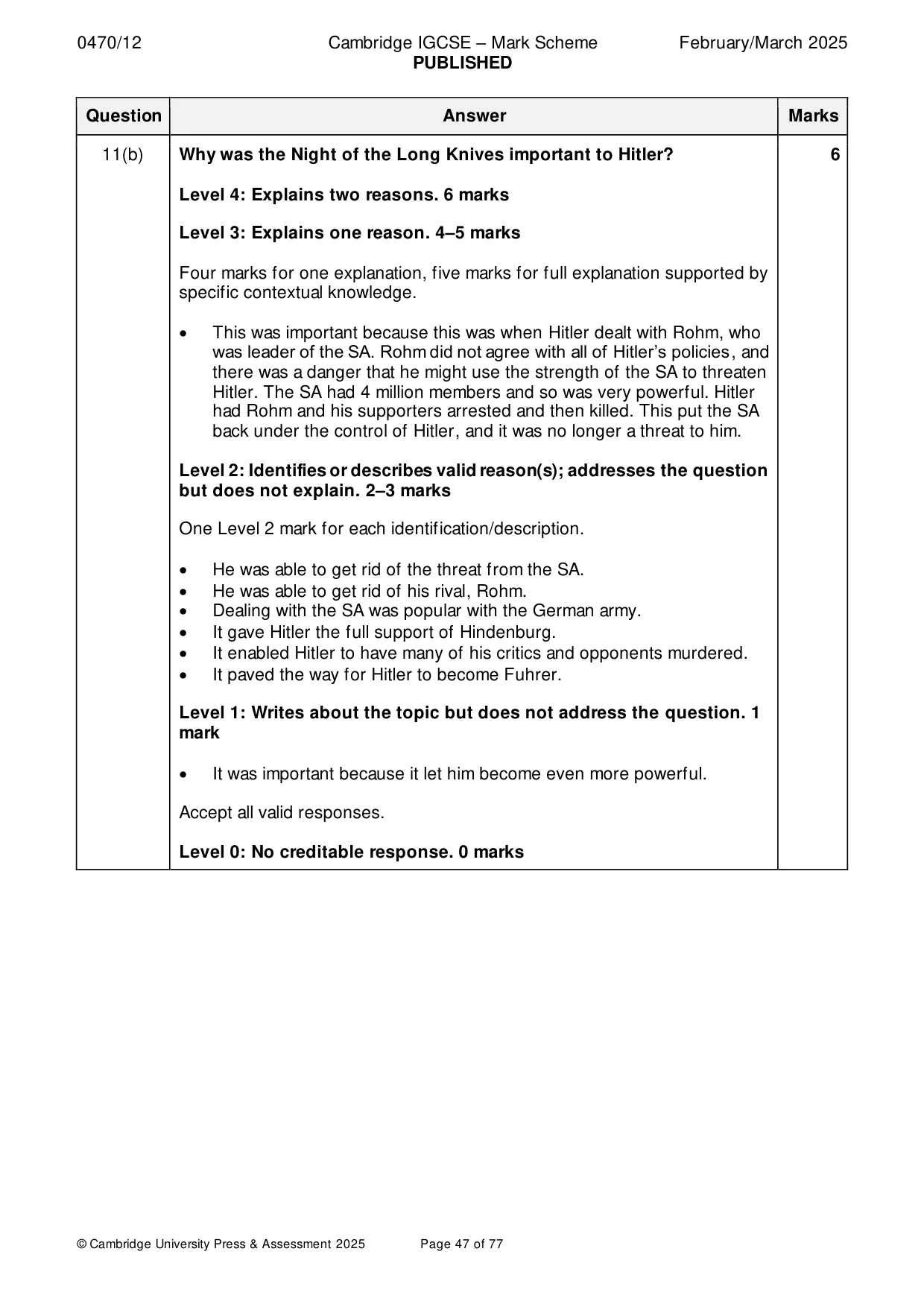
0470/12 Cambridge IGCSE – Mark Scheme PUBLISHED February/March 2025 © Cambridge University Press & Assessment 2025 Page 47 of 77 Question Answer Marks 11(b) Why was the Night of the Long Knives important to Hitler? Level 4: Explains two reasons. 6 marks Level 3: Explains one reason. 4–5 marks Four marks for one explanation, five marks for full explanation supported by specific contextual knowledge. • This was important because this was when Hitler dealt with Rohm, who was leader of the SA. Rohm did not agree with all of Hitler’s policies, and there was a danger that he might use the strength of the SA to threaten Hitler. The SA had 4 million members and so was very powerful. Hitler had Rohm and his supporters arrested and then killed. This put the SA back under the control of Hitler, and it was no longer a threat to him. Level 2: Identifies or describes valid reason(s); addresses the question but does not explain. 2–3 marks One Level 2 mark for each identification/description. • He was able to get rid of the threat from the SA. • He was able to get rid of his rival, Rohm. • Dealing with the SA was popular with the German army. • It gave Hitler the full support of Hindenburg. • It enabled Hitler to have many of his critics and opponents murdered. • It paved the way for Hitler to become Fuhrer. Level 1: Writes about the topic but does not address the question. 1 mark • It was important because it let him become even more powerful. Accept all valid responses. Level 0: No creditable response. 0 marks 6
Mark scheme, page 48
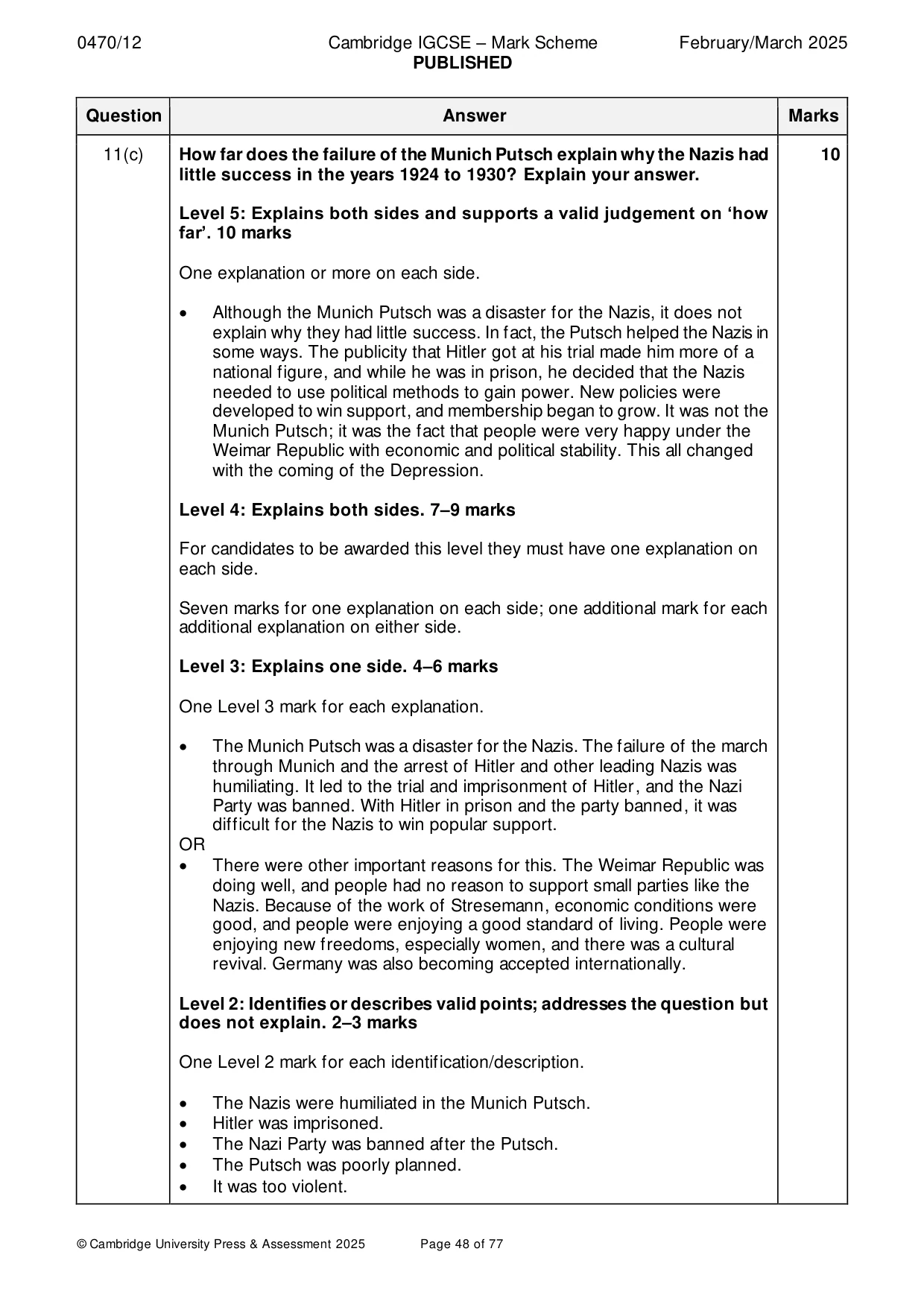
0470/12 Cambridge IGCSE – Mark Scheme PUBLISHED February/March 2025 © Cambridge University Press & Assessment 2025 Page 48 of 77 Question Answer Marks 11(c) How far does the failure of the Munich Putsch explain why the Nazis had little success in the years 1924 to 1930? Explain your answer. Level 5: Explains both sides and supports a valid judgement on ‘how far’. 10 marks One explanation or more on each side. • Although the Munich Putsch was a disaster for the Nazis, it does not explain why they had little success. In fact, the Putsch helped the Nazis in some ways. The publicity that Hitler got at his trial made him more of a national figure, and while he was in prison, he decided that the Nazis needed to use political methods to gain power. New policies were developed to win support, and membership began to grow. It was not the Munich Putsch; it was the fact that people were very happy under the Weimar Republic with economic and political stability. This all changed with the coming of the Depression. Level 4: Explains both sides. 7–9 marks For candidates to be awarded this level they must have one explanation on each side. Seven marks for one explanation on each side; one additional mark for each additional explanation on either side. Level 3: Explains one side. 4–6 marks One Level 3 mark for each explanation. • The Munich Putsch was a disaster for the Nazis. The failure of the march through Munich and the arrest of Hitler and other leading Nazis was humiliating. It led to the trial and imprisonment of Hitler, and the Nazi Party was banned. With Hitler in prison and the party banned, it was difficult for the Nazis to win popular support. OR • There were other important reasons for this. The Weimar Republic was doing well, and people had no reason to support small parties like the Nazis. Because of the work of Stresemann, economic conditions were good, and people were enjoying a good standard of living. People were enjoying new freedoms, especially women, and there was a cultural revival. Germany was also becoming accepted internationally. Level 2: Identifies or describes valid points; addresses the question but does not explain. 2–3 marks One Level 2 mark for each identification/description. • The Nazis were humiliated in the Munich Putsch. • Hitler was imprisoned. • The Nazi Party was banned after the Putsch. • The Putsch was poorly planned. • It was too violent. 10
Mark scheme, page 49
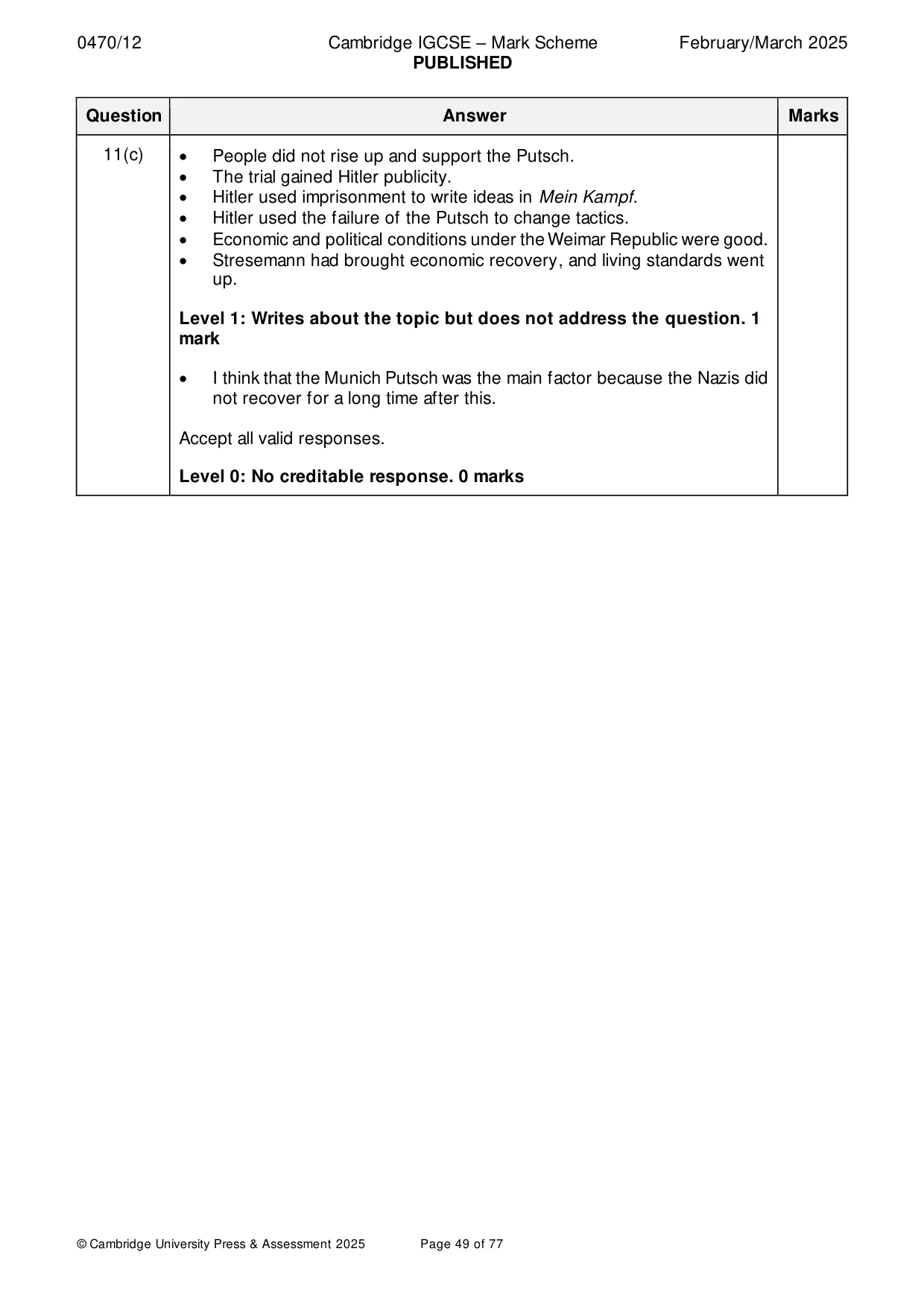
0470/12 Cambridge IGCSE – Mark Scheme PUBLISHED February/March 2025 © Cambridge University Press & Assessment 2025 Page 49 of 77 Question Answer Marks 11(c) • People did not rise up and support the Putsch. • The trial gained Hitler publicity. • Hitler used imprisonment to write ideas in Mein Kampf. • Hitler used the failure of the Putsch to change tactics. • Economic and political conditions under the Weimar Republic were good. • Stresemann had brought economic recovery, and living standards went up. Level 1: Writes about the topic but does not address the question. 1 mark • I think that the Munich Putsch was the main factor because the Nazis did not recover for a long time after this. Accept all valid responses. Level 0: No creditable response. 0 marks
Mark scheme, page 50
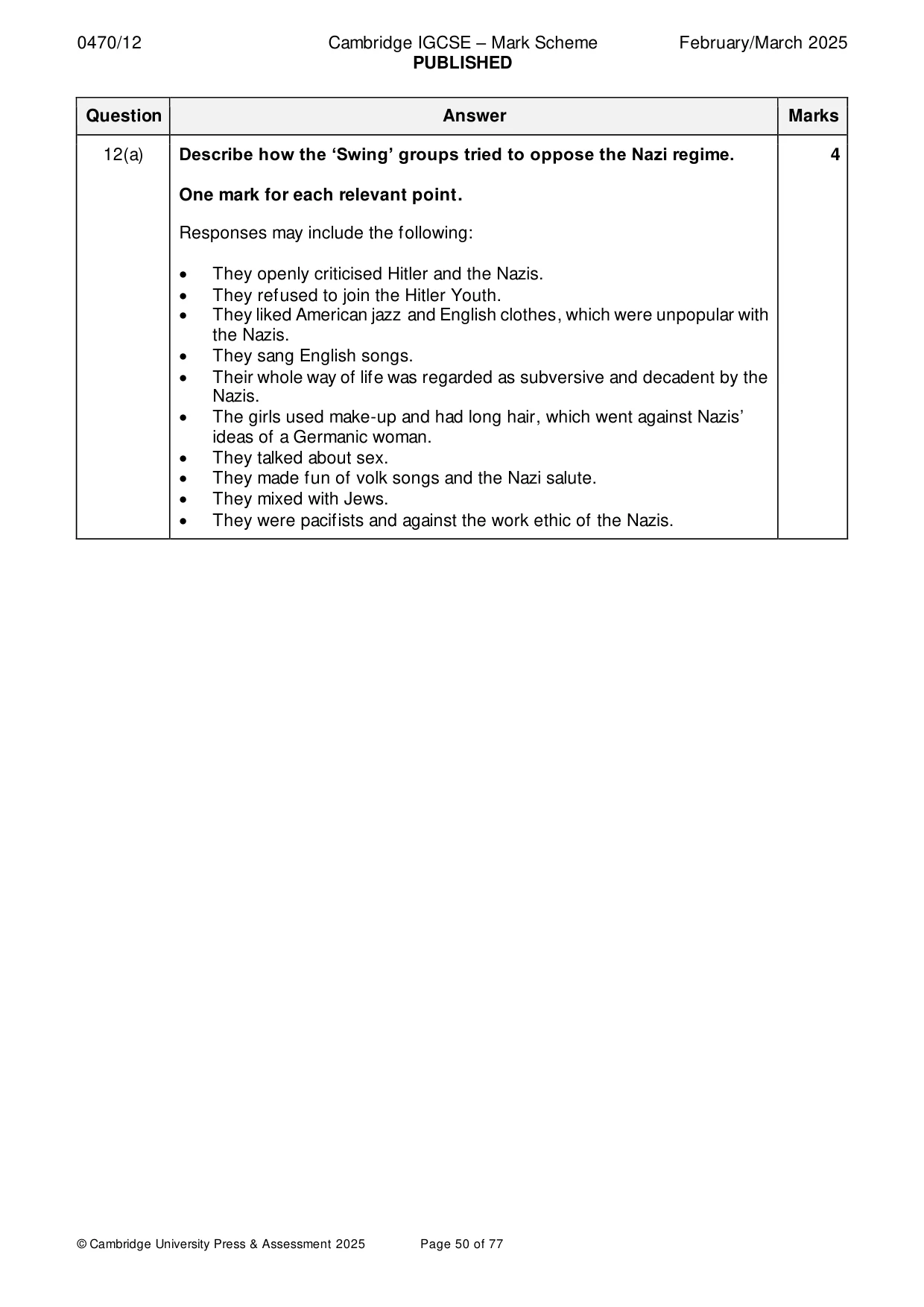
0470/12 Cambridge IGCSE – Mark Scheme PUBLISHED February/March 2025 © Cambridge University Press & Assessment 2025 Page 50 of 77 Question Answer Marks 12(a) Describe how the ‘Swing’ groups tried to oppose the Nazi regime. One mark for each relevant point. Responses may include the following: • They openly criticised Hitler and the Nazis. • They refused to join the Hitler Youth. • They liked American jazz and English clothes, which were unpopular with the Nazis. • They sang English songs. • Their whole way of life was regarded as subversive and decadent by the Nazis. • The girls used make-up and had long hair, which went against Nazis’ ideas of a Germanic woman. • They talked about sex. • They made fun of volk songs and the Nazi salute. • They mixed with Jews. • They were pacifists and against the work ethic of the Nazis. 4
Mark scheme, page 51
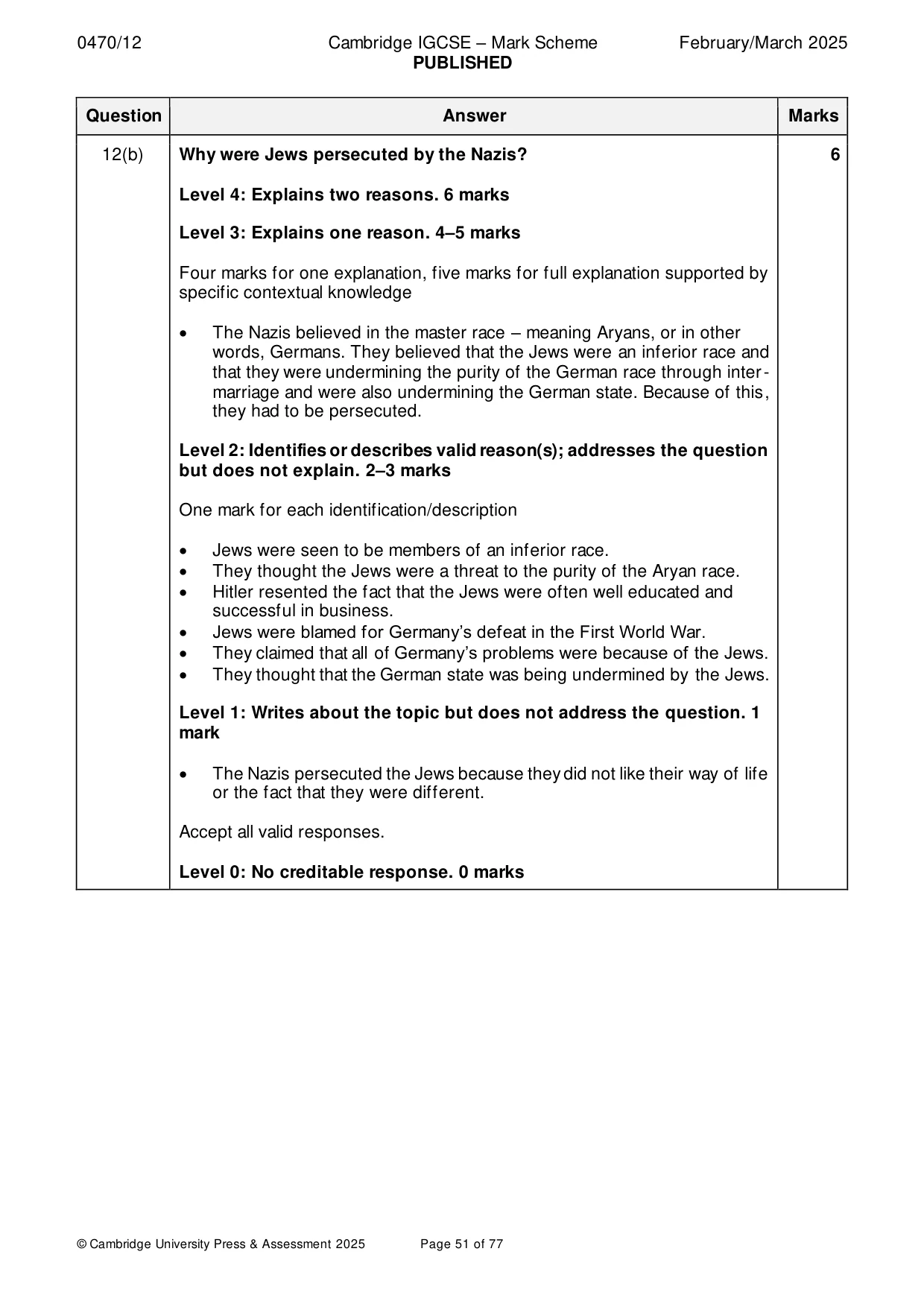
0470/12 Cambridge IGCSE – Mark Scheme PUBLISHED February/March 2025 © Cambridge University Press & Assessment 2025 Page 51 of 77 Question Answer Marks 12(b) Why were Jews persecuted by the Nazis? Level 4: Explains two reasons. 6 marks Level 3: Explains one reason. 4–5 marks Four marks for one explanation, five marks for full explanation supported by specific contextual knowledge • The Nazis believed in the master race – meaning Aryans, or in other words, Germans. They believed that the Jews were an inferior race and that they were undermining the purity of the German race through inter- marriage and were also undermining the German state. Because of this, they had to be persecuted. Level 2: Identifies or describes valid reason(s); addresses the question but does not explain. 2–3 marks One mark for each identification/description • Jews were seen to be members of an inferior race. • They thought the Jews were a threat to the purity of the Aryan race. • Hitler resented the fact that the Jews were often well educated and successful in business. • Jews were blamed for Germany’s defeat in the First World War. • They claimed that all of Germany’s problems were because of the Jews. • They thought that the German state was being undermined by the Jews. Level 1: Writes about the topic but does not address the question. 1 mark • The Nazis persecuted the Jews because they did not like their way of life or the fact that they were different. Accept all valid responses. Level 0: No creditable response. 0 marks 6
Mark scheme, page 52
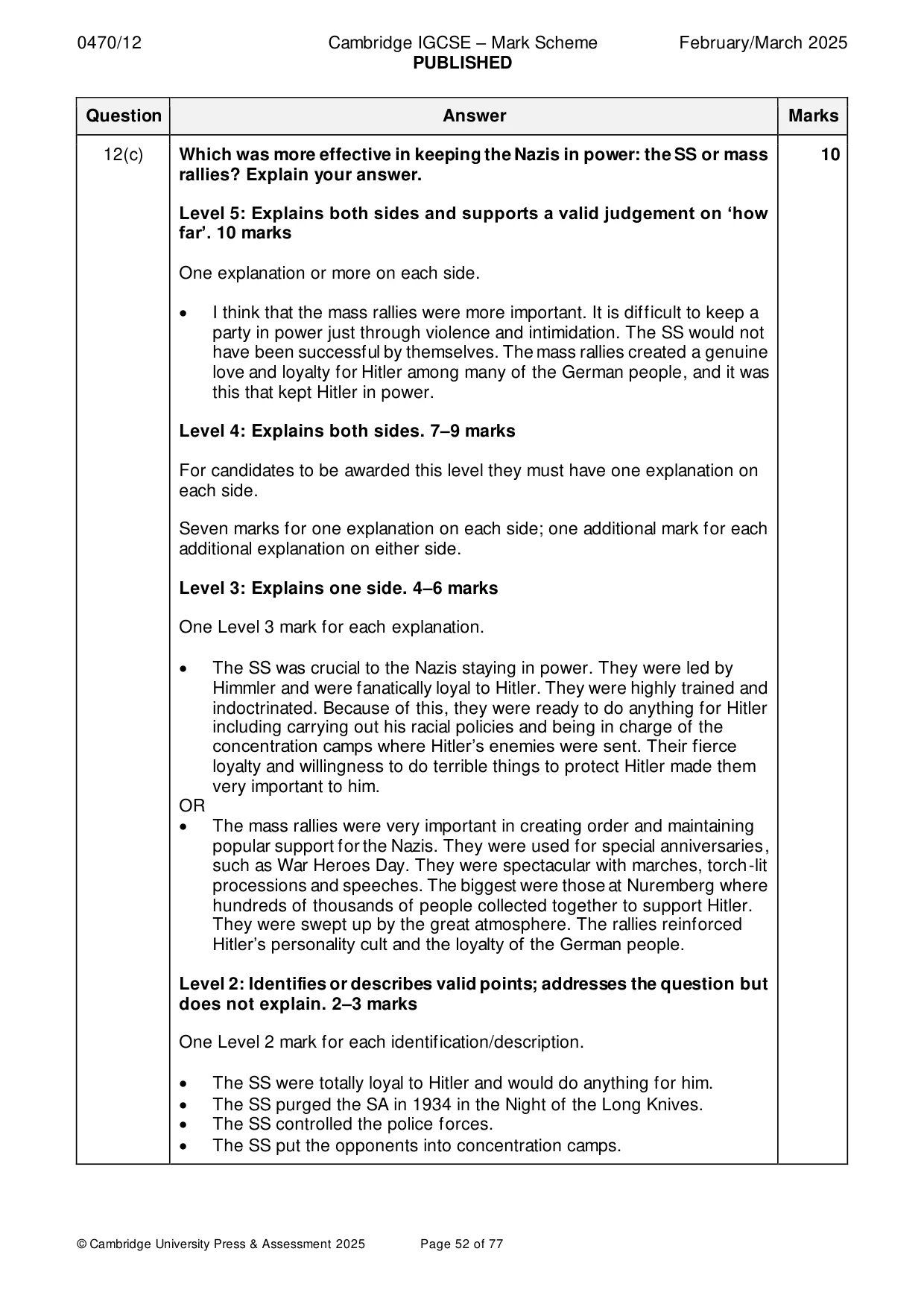
0470/12 Cambridge IGCSE – Mark Scheme PUBLISHED February/March 2025 © Cambridge University Press & Assessment 2025 Page 52 of 77 Question Answer Marks 12(c) Which was more effective in keeping the Nazis in power: the SS or mass rallies? Explain your answer. Level 5: Explains both sides and supports a valid judgement on ‘how far’. 10 marks One explanation or more on each side. • I think that the mass rallies were more important. It is difficult to keep a party in power just through violence and intimidation. The SS would not have been successful by themselves. The mass rallies created a genuine love and loyalty for Hitler among many of the German people, and it was this that kept Hitler in power. Level 4: Explains both sides. 7–9 marks For candidates to be awarded this level they must have one explanation on each side. Seven marks for one explanation on each side; one additional mark for each additional explanation on either side. Level 3: Explains one side. 4–6 marks One Level 3 mark for each explanation. • The SS was crucial to the Nazis staying in power. They were led by Himmler and were fanatically loyal to Hitler. They were highly trained and indoctrinated. Because of this, they were ready to do anything for Hitler including carrying out his racial policies and being in charge of the concentration camps where Hitler’s enemies were sent. Their fierce loyalty and willingness to do terrible things to protect Hitler made them very important to him. OR • The mass rallies were very important in creating order and maintaining popular support for the Nazis. They were used for special anniversaries, such as War Heroes Day. They were spectacular with marches, torch-lit processions and speeches. The biggest were those at Nuremberg where hundreds of thousands of people collected together to support Hitler. They were swept up by the great atmosphere. The rallies reinforced Hitler’s personality cult and the loyalty of the German people. Level 2: Identifies or describes valid points; addresses the question but does not explain. 2–3 marks One Level 2 mark for each identification/description. • The SS were totally loyal to Hitler and would do anything for him. • The SS purged the SA in 1934 in the Night of the Long Knives. • The SS controlled the police forces. • The SS put the opponents into concentration camps. 10
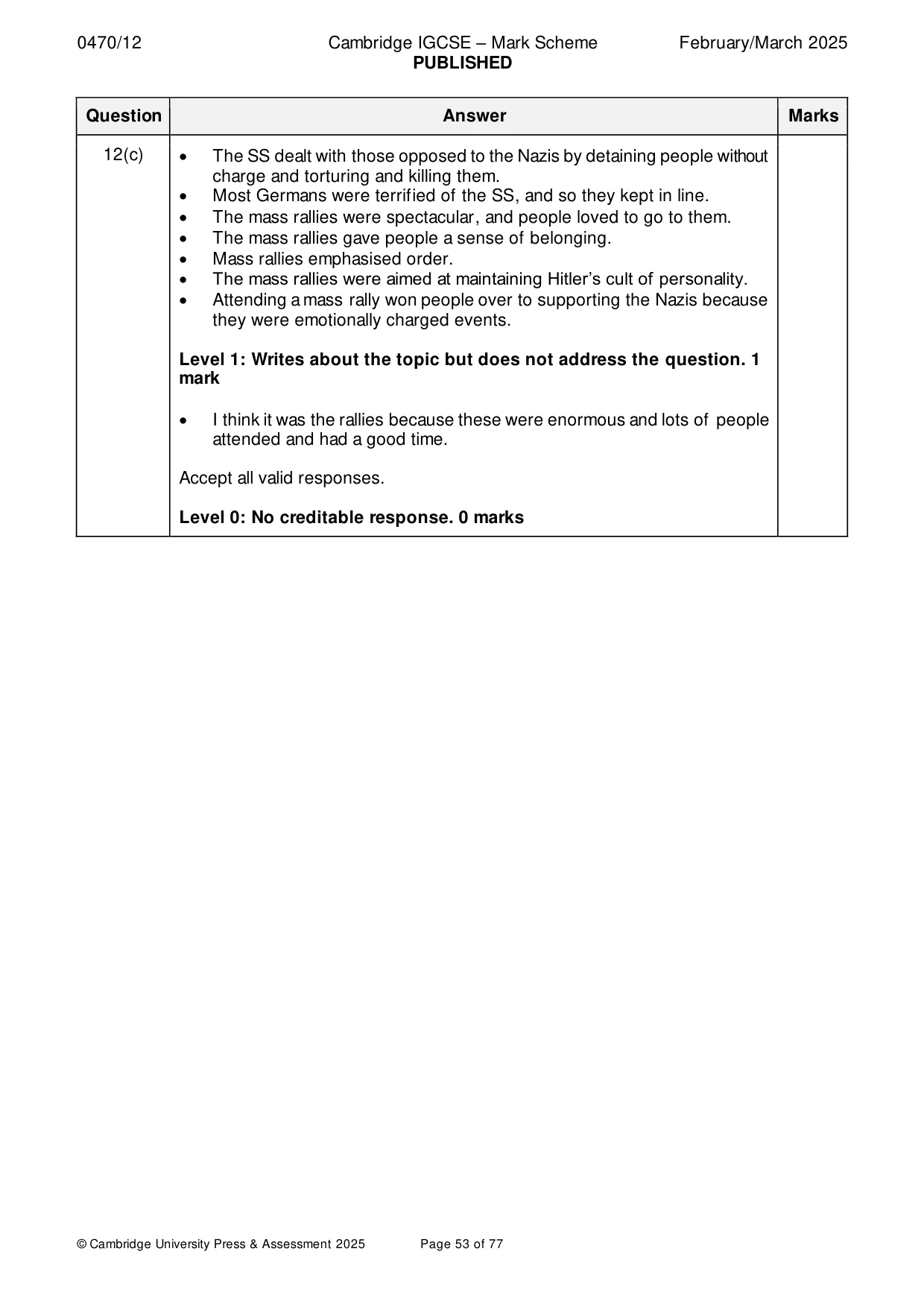
Mark scheme, page 53
0470/12 Cambridge IGCSE – Mark Scheme PUBLISHED February/March 2025 © Cambridge University Press & Assessment 2025 Page 53 of 77 Question Answer Marks 12(c) • The SS dealt with those opposed to the Nazis by detaining people without charge and torturing and killing them. • Most Germans were terrified of the SS, and so they kept in line. • The mass rallies were spectacular, and people loved to go to them. • The mass rallies gave people a sense of belonging. • Mass rallies emphasised order. • The mass rallies were aimed at maintaining Hitler’s cult of personality. • Attending a mass rally won people over to supporting the Nazis because they were emotionally charged events. Level 1: Writes about the topic but does not address the question. 1 mark • I think it was the rallies because these were enormous and lots of people attended and had a good time. Accept all valid responses. Level 0: No creditable response. 0 marks
Mark scheme, page 54
0470/12 Cambridge IGCSE – Mark Scheme PUBLISHED February/March 2025 © Cambridge University Press & Assessment 2025 Page 54 of 77 Question Answer Marks Depth Study C: Russia, 1905–41 13(a) Describe the work of Stalin’s secret police. One mark for each relevant point. Responses may include the following: • They used informers among ordinary people, who would inform on each other. • They were behind the purges and so helped get rid of anyone Stalin considered a suspect. • They helped keep Stalin in power by sending opponents to work camps. • They carried out political kidnappings and assassinations. • People were terrified of them, and this helped keep the Russian people under control. 4
Mark scheme, page 55
0470/12 Cambridge IGCSE – Mark Scheme PUBLISHED February/March 2025 © Cambridge University Press & Assessment 2025 Page 55 of 77 Question Answer Marks 13(b) Why did Stalin use show trials? Level 4: Explains two reasons. 6 marks Level 3: Explains one reason. 4–5 marks Four marks for one explanation, five marks for full explanation supported by specific contextual knowledge. • Stalin was paranoid and always thought that people around him were plotting to replace him. He was suspicious of anyone who became too powerful or successful. In the 1930s, he used show trials to get rid of people he suspected. Most were Trotskyists or Old Bolshevik members who might not agree with all of Stalin’s policies. They were always found guilty and were executed. Level 2: Identifies or describes valid reason(s); addresses the question but does not explain. 2–3 marks One Level 2 mark for each identification/description. • Show trials were used to show the public what happened if you criticised Stalin. • He used them because of the criticism that grew of his policies, like collectivisation, that led to worse conditions for many people. • They were used to get rid of critics within the Communist Party. Level 1: Writes about the topic but does not address the question. 1 mark • He did this because he was a terrible and cruel man who was ready to do anything to stay in power. Accept all valid responses. Level 0: No creditable response. 0 marks 6
Mark scheme, page 56
0470/12 Cambridge IGCSE – Mark Scheme PUBLISHED February/March 2025 © Cambridge University Press & Assessment 2025 Page 56 of 77 Question Answer Marks 13(c) ‘Stalin became leader of the Soviet Union because of Trotsky’s mistakes.’ How far do you agree with this statement? Explain your answer. Level 5: Explains both sides and supports a valid judgement on ‘how far’. 10 marks One explanation or more on each side. • Even without Trotsky’s mistakes, I think that Stalin would still have won. As General Secretary he had a power base in the Party and over the years had made himself indispensable. He was a clever politician and knew what to do. Trotsky was not able to do much about this. Level 4: Explains both sides. 7–9 marks For candidates to be awarded this level they must have one explanation on each side. Seven marks for one explanation on each side; one additional mark for each additional explanation on either side. Level 3: Explains one side. 4–6 marks One Level 3 mark for each explanation. • The statement is correct. Trotsky made some dreadful mistakes because he was arrogant. He took it for granted that he would succeed Lenin and so did not bother much in winning over support in the Communist Party. He did not bother to criticise Stalin’s ideas and policies. OR • This is not the main reason. Stalin became leader because most of the important people in the Communist Party agreed with his policy of socialism in one country. This meant that the most important thing at that time was to establish communist control in Russia and finish off the communist revolution. By concentrating on this, they would be able to make sure they were successful and create a model communist country that would be admired by other countries. Stalin argued that Russia was not yet ready or strong enough to spread revolution around the world. Level 2: Identifies or describes valid points; addresses the question but does not explain. 2–3 marks One Level 2 mark for each identification/description. • Trotsky was an intellectual and arrogant, he and did not bother to win people over to his side. • Trotsky’s idea of permanent revolution worried people that it would involve Russia in new wars. 10
Mark scheme, page 57
0470/12 Cambridge IGCSE – Mark Scheme PUBLISHED February/March 2025 © Cambridge University Press & Assessment 2025 Page 57 of 77 Question Answer Marks 13(c) • Trotsky underestimated Stalin. • Stalin was clever and undermined Trotsky in the eyes of Communist leaders. • Lenin’s will and testament, which were critical of Stalin, were never seen at the time. • Stalin as General Secretary of the Party was able to use his power to win over support. • Stalin tricked Trotsky into missing Lenin’s funeral. • Stalin’s idea of socialism in one country was more popular than Trotsky’s idea of permanent revolution. Level 1: Writes about the topic but does not address the question. 1 mark • This is right. If Trotsky had not made mistakes, he could have taken over instead of Stalin. Accept all valid responses. Level 0: No creditable response. 0 marks
Mark scheme, page 58
0470/12 Cambridge IGCSE – Mark Scheme PUBLISHED February/March 2025 © Cambridge University Press & Assessment 2025 Page 58 of 77 Question Answer Marks 14(a) What was GOSPLAN? One mark for each relevant point. Responses may include the following: • It was set up in 1921. • It was set up by Lenin. • It supervised the planned economy of the Soviet Union. • It set up targets for coal, iron, oil and electricity for specific regions. • Its job was to develop and carry out the Five-Year Plans. • It had control over much of the Russian economy, such as production and distribution. • It monitored the implementation of the plans. 4
Mark scheme, page 59
0470/12 Cambridge IGCSE – Mark Scheme PUBLISHED February/March 2025 © Cambridge University Press & Assessment 2025 Page 59 of 77 Question Answer Marks 14(b) Why did Stalin want to modernise the Soviet Union? Level 4: Explains two reasons. 6 marks Level 3: Explains one reason. 4–5 marks Four marks for one explanation, five marks for full explanation supported by specific contextual knowledge. • Stalin knew that the Soviet Union was surrounded by enemies and that there would be struggles in the future. However, because of Russia’s old, out-of-date industry, it was in no state to compete with other countries and was weak militarily. If the Soviet Union was to survive, it was crucial that it modernised its industry and farming so that it could produce more and therefore become stronger. Level 2: Identifies or describes valid reason(s); addresses the question but does not explain. 2–3 marks One Level 2 mark for each identification/description. • Stalin wanted to make the Soviet Union into a stronger country. • Stalin wanted to make the Soviet Union strong militarily. • Many parts of Russia were very backward. • Many Russian workers were unskilled and poorly educated. • He knew that the Soviet Union had to produce more. • He wanted Russia to become a super-power. • It was necessary for Russia’s security. Level 1: Writes about the topic but does not address the question. 1 mark • He wanted to do this because it was badly needed. He wanted to improve the state of the Soviet Union. Accept all valid responses. Level 0: No creditable response. 0 marks 6
Mark scheme, page 60
0470/12 Cambridge IGCSE – Mark Scheme PUBLISHED February/March 2025 © Cambridge University Press & Assessment 2025 Page 60 of 77 Question Answer Marks 14(c) How successful were Stalin’s industrial policies? Explain your answer. Level 5: Explains both sides and supports a valid judgement on ‘how far’. 10 marks One explanation or more on each side. • Russia’s industry was behind the industries of most of the other leading countries of the world. Its industry was small and out-of-date. Stalin’s policies transformed Russia into a modern state. It had enormous industrial strength, and production shot up. This meant it could defend itself in the Second World War. It came with a human cost, with workers dying because of dreadful working and living conditions, and it took a long time for the living standards of many people to improve. However, Stalin would have argued this was a price worth paying because his aim to modernise Russia was achieved. Level 4: Explains both sides. 7–9 marks For candidates to be awarded this level they must have one explanation on each side. Seven marks for one explanation on each side; one additional mark for each additional explanation on either side. Level 3: Explains one side. 4–6 marks One Level 3 mark for each explanation. • Stalin’s policies were successful. The production of coal, steel and oil rose enormously. This helped to make Russia a stronger country militarily, which had been one of Stalin’s aims. Much of the increased production was linked to weapons and equipment, and so when the Second World War came Russia was equipped to defend itself. OR • Stalin’s policies were not totally successful. The emphasis on targets and increasing production meant that more attention was paid to quantity rather than quality. This meant that much of what was produced was not high quality. The emphasis on targets also meant that workers were put under enormous pressure, and the working conditions were often terrible. Level 2: Identifies or describes valid points; addresses the question but does not explain. 2–3 marks One Level 2 mark for each identification/description. • Production of coal and steel was increased. • Russia was able to make itself much stronger militarily. • Huge new steel mills and new dams for hydroelectric power were built. • New factories and industrial plants were built in areas that had had no industry before. 10
Mark scheme, page 61
0470/12 Cambridge IGCSE – Mark Scheme PUBLISHED February/March 2025 © Cambridge University Press & Assessment 2025 Page 61 of 77 Question Answer Marks 14(c) • Transport and communications were revolutionised. • There was a great deal of inefficiency and waste. • Industrial workers worked in terrible conditions, and discipline was strict. • Many of the major building projects were very dangerous, and there was little safety for the workers. • Workers lived in poor, cramped conditions. Level 1: Writes about the topic but does not address the question. 1 mark • His industrial policies were good for Russia, but not everyone in the country was better off. Accept all valid responses. Level 0: No creditable response. 0 marks
Mark scheme, page 62
0470/12 Cambridge IGCSE – Mark Scheme PUBLISHED February/March 2025 © Cambridge University Press & Assessment 2025 Page 62 of 77 Question Answer Marks Depth Study D: The United States, 1919–41 15(a) Who was Al Capone? One mark for each relevant point. Responses may include the following: • He was a gangster at the time of Prohibition. • Al Capone was head of a gang in Chicago. • He ran a string of speakeasies. • He ran a bootlegging business. • He was involved in gambling and prostitution. • He bribed the police and court officials. • His business grew by attacking and killing off rival gangs. • In 1931, he was found guilty of tax evasion. • In the St Valentine’s Day Massacre, he ordered the assassination of seven rivals. 4
Mark scheme, page 63
0470/12 Cambridge IGCSE – Mark Scheme PUBLISHED February/March 2025 © Cambridge University Press & Assessment 2025 Page 63 of 77 Question Answer Marks 15(b) Why was there enormous growth in the entertainment industry in the 1920s? Explain your answer. Level 4: Explains two reasons. 6 marks Level 3: Explains one reason. 4–5 marks Four marks for one explanation, five marks for full explanation supported by specific contextual knowledge. • As a result of the economic boom, some people had more money to spend. Average wages went up by about 10%. This meant that many people could afford to buy a radio and go to the cinema. Some people could afford to buy a car, and this meant they could drive to cinemas or drive to jazz clubs. Level 2: Identifies or describes valid reason(s); addresses the question but does not explain. 2–3 marks One Level 2 mark for each identification/description. • This was because of the boom and people having more money to spend. • The average working week decreased, so people had more spare time. • People found the films in the cinema very exciting. • The first talkie was made in 1927 and was very popular. • Big stars like Chaplin and Douglas Fairbanks attracted people to the cinema. • More people had cars and could get to places of entertainment. • Many young people found jazz music very exciting. • Most families had a radio because they were cheaply available. • New sports teams appeared in a variety of sports. Level 1: Writes about the topic but does not address the question. 1 mark • This was because there were lots of people who wanted to enjoy it, and so it became more popular. Accept all valid responses. Level 0: No creditable response. 0 marks 6
Mark scheme, page 64
0470/12 Cambridge IGCSE – Mark Scheme PUBLISHED February/March 2025 © Cambridge University Press & Assessment 2025 Page 64 of 77 Question Answer Marks 15(c) ‘Women’s lives changed a great deal in the 1920s.’ How far do you agree with this statement? Explain your answer. Level 5: Explains both sides and supports a valid judgement on ‘how far’. 10 marks One explanation or more on each side. • I do not think this is true overall. A few women, like flappers, could afford new clothes and go out to clubs, and some well-off women could afford machines like fridges. However, the majority of women could not afford any of this, or they did not want these things and preferred to follow traditional practices. In 1930, a large majority of women did not have washing machines or vacuum cleaners, and their lives did not change much. Level 4: Explains both sides. 7–9 marks For candidates to be awarded this level they must have one explanation on each side. Seven marks for one explanation on each side; one additional mark for each additional explanation on either side. Level 3: Explains one side. 4–6 marks One Level 3 mark for each explanation. • The introduction of electricity meant that some women could use labour- saving machines such as fridges and washing machines in their homes. This gave them more leisure time. The boom meant that some families could afford these things. Young women in cities, who were reasonably well-off, became flappers and enjoyed buying the latest clothes and going to clubs. They had much freer lives than women of earlier generations. OR • The lives of many women did not change in the 1920s. This was especially true in rural areas and in small towns. Women working on small farms still had to work on the farm as well as look after the home. In these areas, most women managed the home, did the cooking and cleaning, looked after the children and even did some part-time work to help the family budget. Many of them could not afford labour-saving devices such as washing machines and cleaners. Level 2: Identifies or describes valid points; addresses the question but does not explain. 2–3 marks One Level 2 mark for each identification/description. • Women’s lives were not as restrictive as before the First World War. • More women went to work, such as secretarial work and in new industries such as electronics. 10
Mark scheme, page 65
0470/12 Cambridge IGCSE – Mark Scheme PUBLISHED February/March 2025 © Cambridge University Press & Assessment 2025 Page 65 of 77 Question Answer Marks 15(c) • Some young women had more freedom in how they dressed and behaved. • Some women were able to afford labour-saving devices such as washing machines. • Women had the right to vote. • Women did not have to stay in an unhappy marriage. • Changes largely affected young women. • Most middle-class women were very conservative and resisted change. • The lives of women in rural areas did not change much. • Most women could not afford machines like vacuum cleaners and fridges. • Most women workers were still paid less than men. • Women were not equal to men in politics. Level 1: Writes about the topic but does not address the question. 1 mark • Some women’s lives changed considerably, and they had a much better time, but this was not true of everyone. Accept all valid responses. Level 0: No creditable response. 0 marks
Mark scheme, page 66
0470/12 Cambridge IGCSE – Mark Scheme PUBLISHED February/March 2025 © Cambridge University Press & Assessment 2025 Page 66 of 77 Question Answer Marks 16(a) Describe the Supreme Court’s opposition to the New Deal. One mark for each relevant point. Responses may include the following: • The Supreme Court declared that the NRA and the AAA were unconstitutional. • Most of the judges were old and Republican, and so it was likely that they disliked the New Deal. • Roosevelt was a Democrat, and the Court was dominated by Republicans. • Roosevelt tried to appoint new judges to the Court to increase his support, but the Supreme Court managed to create opposition to this, and it did not happen. 4
Mark scheme, page 67
0470/12 Cambridge IGCSE – Mark Scheme PUBLISHED February/March 2025 © Cambridge University Press & Assessment 2025 Page 67 of 77 Question Answer Marks 16(b) Why did many of the rich oppose the New Deal? Level 4: Explains two reasons. 6 marks Level 3: Explains one reason. 4–5 marks Four marks for one explanation, five marks for full explanation supported by specific contextual knowledge. • The rich opposed the New Deal because their taxes went up to pay for it all. In 1935, the Revenue Act increased taxes for the rich. It was known as the ‘Soak the Rich’ tax, and many of the rich resented it. Some of them had to pay 75% of their income in taxes. Level 2: Identifies or describes valid reason(s); addresses the question but does not explain. 2–3 marks One Level 2 mark for each identification/description. • They were against it because taxes went up. • Many of the rich thought that it was a threat to free enterprise, so they set up the American Liberty League. • The rich thought they were having to pay more to allow a lot of people to be lazy. • Many of the rich made money out of their ownership of businesses and did not like government interference in businesses. • The rich thought it was a form of socialism and were worried that this would be a threat to their wealth. • Many of the rich thought Roosevelt was acting like a dictator. Level 1: Writes about the topic but does not address the question. 1 mark • They opposed the New Deal because they thought they would suffer from it and that it was bad for the country as a whole. Accept all valid responses. Level 0: No creditable response. 0 marks 6
Mark scheme, page 68
0470/12 Cambridge IGCSE – Mark Scheme PUBLISHED February/March 2025 © Cambridge University Press & Assessment 2025 Page 68 of 77 Question Answer Marks 16(c) ‘The setting up of the Tennessee Valley Authority was the most important part of the New Deal.’ How far do you agree with this statement? Explain your answer. Level 5: Explains both sides and supports a valid judgement on ‘how far’. 10 marks One explanation or more on each side. • I disagree because the TVA did help people in the Tennessee Valley, but this was only one part of the country. Much still had to be done in other areas. On the other hand, the Emergency Banking Act prevented the banking system from collapsing. This would have been disastrous for everyone in the USA. This makes it much more important. Level 4: Explains both sides. 7–9 marks For candidates to be awarded this level they must have one explanation on each side. Seven marks for one explanation on each side; one additional mark for each additional explanation on either side. Level 3: Explains one side. 4–6 marks One Level 3 mark for each explanation. • The TVA was the most important part of the New Deal. This was because the Tennessee Valley was a depressed area. It had suffered from flooding and soil erosion and become a dust bowl with no chance of any farming. Over half the population were so poor that they had to be helped financially by government schemes. The TVA turned things around. A number of hydroelectric dams were built that allowed the land to be irrigated and used for farming. Flood prevention schemes and electricity were introduced as well as thousands of jobs created. OR • I disagree because the Emergency Banking Act was more important. The banking system was close to collapse, with people panicking and withdrawing their money. There was a danger of more banks closing and even the whole system collapsing. This would have been disastrous for the whole country. The Act closed unsound banks and supported the rest with grants. Roosevelt explained what he was doing, and people regained their confidence and put their money back into the banks. Level 2: Identifies or describes valid points; addresses the question but does not explain. 2–3 marks One Level 2 mark for each identification/description. • The TVA made farming possible again. • The TVA set up flood prevention schemes. • The TVA created lots of jobs. 10
Mark scheme, page 69
0470/12 Cambridge IGCSE – Mark Scheme PUBLISHED February/March 2025 © Cambridge University Press & Assessment 2025 Page 69 of 77 Question Answer Marks 16(c) • The TVA made massive improvements in an area that was very poor. • The TVA provided electricity. • The Civilian Conservation Corps created many jobs. • The AAA helped farmers, whose income doubled. • The Emergency Banking Act, which saved the banking system, was very important. • Working conditions were improved by the NIRA. Level 1: Writes about the topic but does not address the question. 1 mark • I agree with this because the Authority changed the lives of a lot of people, and this made it important. Accept all valid responses. Level 0: No creditable response. 0 marks
Mark scheme, page 70
0470/12 Cambridge IGCSE – Mark Scheme PUBLISHED February/March 2025 © Cambridge University Press & Assessment 2025 Page 70 of 77 Question Answer Marks Depth Study E: The Second World War in Europe and the Asia–Pacific, 1939–c.1945 17(a) Describe how the Japanese forces took Singapore in 1942. One mark for each relevant point. Responses may include the following: • The Japanese used ‘bicycle blitzkrieg’. • They travelled through the jungle much faster than the British expected. • The defences were all built to repel a naval attack. • The British naval force was too small and weak. • Singapore had little air support. • The Japanese did not attack by the sea as expected. • The Japanese attack from the north through the jungle was a complete surprise. 4
Mark scheme, page 71
0470/12 Cambridge IGCSE – Mark Scheme PUBLISHED February/March 2025 © Cambridge University Press & Assessment 2025 Page 71 of 77 Question Answer Marks 17(b) Why did US–Japanese relations grow worse in the years before the attack on Pearl Harbor? Level 4: Explains two reasons. 6 marks Level 3: Explains one reason. 4–5 marks Four marks for one explanation, five marks for full explanation supported by specific contextual knowledge. • The countries both had interests in the area, but they differed in their aims. The US wanted an Open Door Policy in China and equal trading rights for all nations. This clashed with Japan’s aggressive expansion in China, which led to the war with China in 1937. Level 2: Identifies or describes valid reason(s); addresses the question but does not explain. 2–3 marks One Level 2 mark for each identification/description. • The US was concerned about Japanese expansionism in the Pacific. • Japan disagreed with the Open Door Policy. • Japan was annoyed by US sanctions such as on oil and other materials that Japan badly needed. • The US demanded that Japan withdraw from China. • Japan’s closeness to Nazi Germany and Fascist Italy alarmed the US. Level 1: Writes about the topic but does not address the question. 1 mark • The two countries were bound to clash sooner or later because they wanted opposite things. Accept all valid responses. Level 0: No creditable response. 0 marks 6
Mark scheme, page 72
0470/12 Cambridge IGCSE – Mark Scheme PUBLISHED February/March 2025 © Cambridge University Press & Assessment 2025 Page 72 of 77 Question Answer Marks 17(c) ‘The main reason why Japan invaded Malaya was to gain raw materials.’ How far do you agree with this statement? Explain your answer. Level 5: Explains both sides and supports a valid judgement on ‘how far’. 10 marks One explanation or more on each side. • Although Japan had other reasons, like preparing to attack Singapore, the most important reason was economic. Without raw materials it would not be able to carry out its other plans. It could not expand and defend itself without economic strength. The US economic sanctions made Japan’s economic needs even greater. Level 4: Explains both sides. 7–9 marks For candidates to be awarded this level they must have one explanation on each side. Seven marks for one explanation on each side; one additional mark for each additional explanation on either side. Level 3: Explains one side. 4–6 marks One Level 3 mark for each explanation. • The main reason for the invasion of Malaya was the need for raw materials. Japan needed these for its industrial development and its war efforts. This was particularly important after the USA introduced economic sanctions on Japan. These sanctions froze Japanese funds in the USA and stopped exports of petrol to Japan. This meant that Japan needed the raw materials more than ever. OR • The invasion of Malaya was all part of Japan’s plan to defend itself. The plan was to expand its empire so wide that its enemies would not be able to attack Japan itself by air. It planned to extend as far as Guam, Borneo, Malaya and Burma. Level 2: Identifies or describes valid points; addresses the question but does not explain. 2–3 marks One Level 2 mark for each identification/description. • This was because of US economic sanctions in Japan. • Japan saw it as an important step towards conquering Singapore. • Malaya had important natural resources such as rubber and tin. • Malaya was an important staging point to launch an invasion of the oil- rich islands of Borneo and Java. • It was part of Japan’s plan to extend its empire. 10
Mark scheme, page 73
0470/12 Cambridge IGCSE – Mark Scheme PUBLISHED February/March 2025 © Cambridge University Press & Assessment 2025 Page 73 of 77 Question Answer Marks 17(c) Level 1: Writes about the topic but does not address the question. 1 mark • The main reason for the invasion of Malaya was to make Japan stronger. Accept all valid responses. Level 0: No creditable response. 0 marks
Mark scheme, page 74
0470/12 Cambridge IGCSE – Mark Scheme PUBLISHED February/March 2025 © Cambridge University Press & Assessment 2025 Page 74 of 77 Question Answer Marks 18(a) What were the war crimes trials? One mark for each relevant point. Responses may include the following: • They were held in Nuremberg after the war. • Judges from Britain, France, the Soviet Union and the USA presided. • They tried top Nazis for crimes against humanity during the war. • 161 of the 199 defendants were convicted and 37 were sentenced to death. • Those tried included Goring and Speer. • Trials were also held for Japan’s leaders. 4
Mark scheme, page 75
0470/12 Cambridge IGCSE – Mark Scheme PUBLISHED February/March 2025 © Cambridge University Press & Assessment 2025 Page 75 of 77 Question Answer Marks 18(b) Why did the USA decide to drop atomic bombs on Japan? Level 4: Explains two reasons. 6 marks Level 3: Explains one reason. 4–5 marks Four marks for one explanation, five marks for full explanation supported by specific contextual knowledge. • The main reason for this was because of Japan’s refusal to surrender. Germany was defeated in Europe, and Japan had no realistic chance of victory. However, Japan could keep fighting for a long time, and Allied troops were being killed all the time. The Americans knew that conventional warfare would not end the war quickly, but the use of the atomic bomb could achieve this. Level 2: Identifies or describes valid reason(s); addresses the question but does not explain. 2–3 marks One Level 2 mark for each identification/description. • Japan said it would fight until the bitter end. • To bring the war to an end more quickly. • The use of the bombs would put the US in a strong position after the end of the war. • A land invasion of Japan would have cost many American lives. • To keep the USSR out of Japan. Level 1: Writes about the topic but does not address the question. 1 mark • They did this because they were fighting Japan in the Second World War. Accept all valid responses. Level 0: No creditable response. 0 marks 6
Mark scheme, page 76
0470/12 Cambridge IGCSE – Mark Scheme PUBLISHED February/March 2025 © Cambridge University Press & Assessment 2025 Page 76 of 77 Question Answer Marks 18(c) ‘Germany’s final defeat was ensured by the D-Day landings.’ How far do you agree with this statement? Explain your answer. Level 5: Explains both sides and supports a valid judgement on ‘how far’. 10 marks One explanation or more on each side. • Overall, I do not agree. The D-Day landings were crucially important because then Germany was being attacked from both east and west. But it also needed the Soviet advance from the east. This is what made it impossible for Germany to defend itself: the attacks on two fronts. Level 4: Explains both sides. 7–9 marks For candidates to be awarded this level they must have one explanation on each side. Seven marks for one explanation on each side; one additional mark for each additional explanation on either side. Level 3: Explains one side. 4–6 marks One Level 3 mark for each explanation. • The D-Day landings were a turning point in the war. They meant that the Allies had a foothold on mainland Europe for the first time. On the first day alone, 156 000 Allied troops landed. From here, Allied armies moved into north-west Europe and then eventually into Germany. The landings opened up a new front in the war, which allowed the full force of the American army to be used. OR • Germany was not defeated by the D-Day landings. The crucial factor in the defeat of Germany was the advance of Soviet troops into western Europe. The Soviet offensive started in January 1945 and swept into Poland. From there, the Soviets advanced into Germany and by April were advancing into Berlin. This is what ensured the defeat of Germany. Level 2: Identifies or describes valid points; addresses the question but does not explain. 2–3 marks One Level 2 mark for each identification/description. • The D-Day landings meant that Germany could no longer exploit the resources of France. • They convinced most of the German High Command that defeat was inevitable. • When France fell to the Allies, Germany lost its U-boat ports and V- weapon sites. • They opened up a second front, which put extra pressure on Germany. 10
Mark scheme, page 77
0470/12 Cambridge IGCSE – Mark Scheme PUBLISHED February/March 2025 © Cambridge University Press & Assessment 2025 Page 77 of 77 Question Answer Marks 18(c) • They meant that Germany could now be attacked from east and west. • The Allies were able to succeed because of the Soviet advance in the east. • The real threat to Germany and Berlin came more from the Soviets than the Allies in the west. Level 1: Writes about the topic but does not address the question. 1 mark • The D-Day landings were very important. After they had taken place, Germany’s defeat was inevitable. Accept all valid responses. Level 0: No creditable response.0
What you needed in this session
Cambridge’s own grade thresholds for 2025 Feb/March, Paper 1 · Variant 2. A higher threshold means an easier paper — the bar moves with how the cohort did.