Cambridge IGCSE History 0470 — 2024 Oct/Nov Paper 4 · Variant 2
0470/42/O/N/24 · 40 marks · 60 min
The question paper and its mark scheme, free to read here and free to download. This is Cambridge’s own paper, exactly as it was sat.
Question paper4 pages

Mark scheme17 pages
Answers below. Sit the paper first if you are practising.
Paper as text
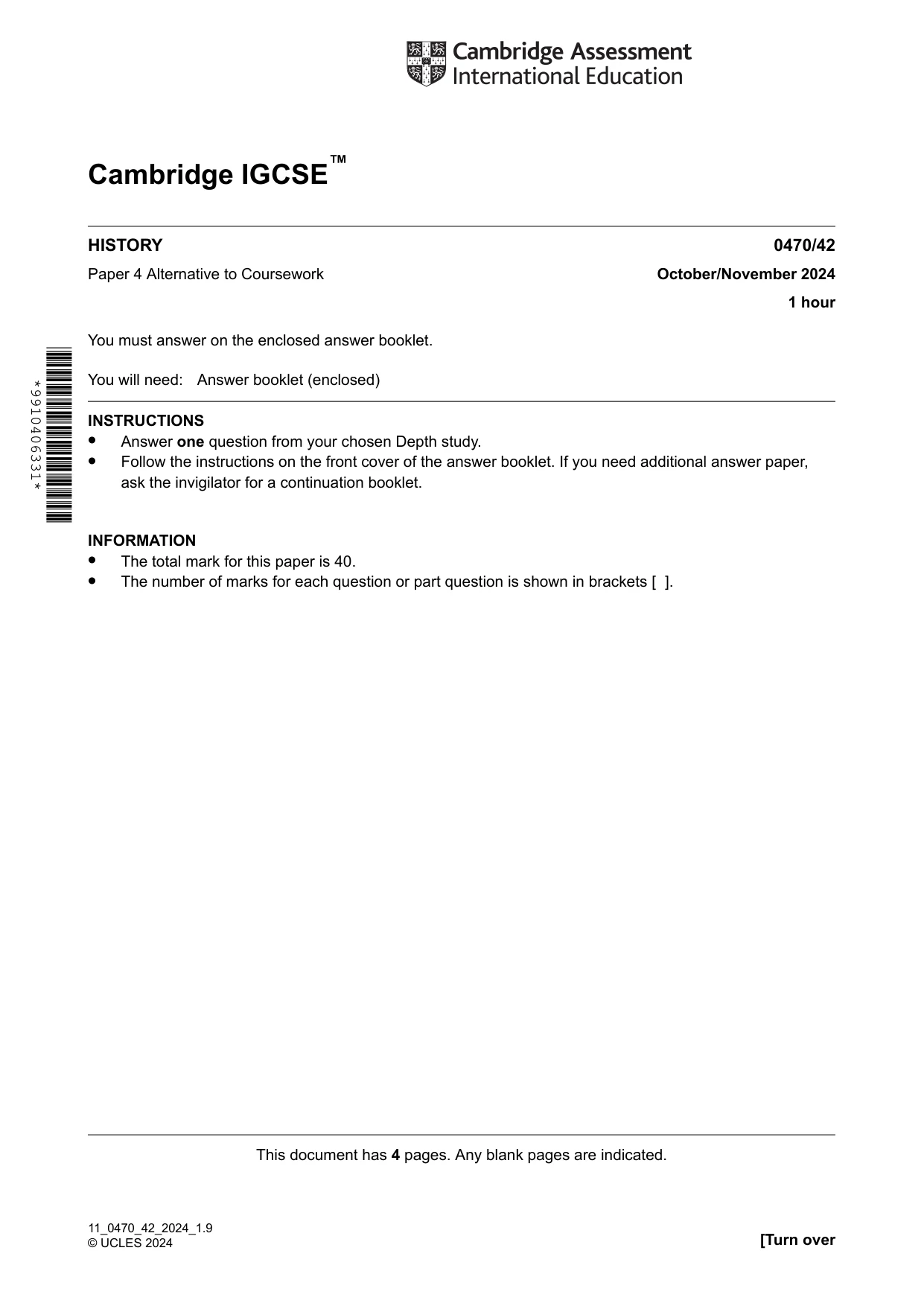
Question paper, page 1
Cambridge IGCSE™ 0470/42 October/November 2024 1 hour HISTORY Paper 4 Alternative to Coursework You must answer on the enclosed answer booklet. You will need: Answer booklet (enclosed) INSTRUCTIONS • Answer one question from your chosen Depth study. • Follow the instructions on the front cover of the answer booklet. If you need additional answer paper, ask the invigilator for a continuation booklet. INFORMATION • The total mark for this paper is 40. • The number of marks for each question or part question is shown in brackets [ ]. This document has 4 pages. Any blank pages are indicated. [Turn over 11_0470_42_2024_1.9 © UCLES 2024 *9910406331*
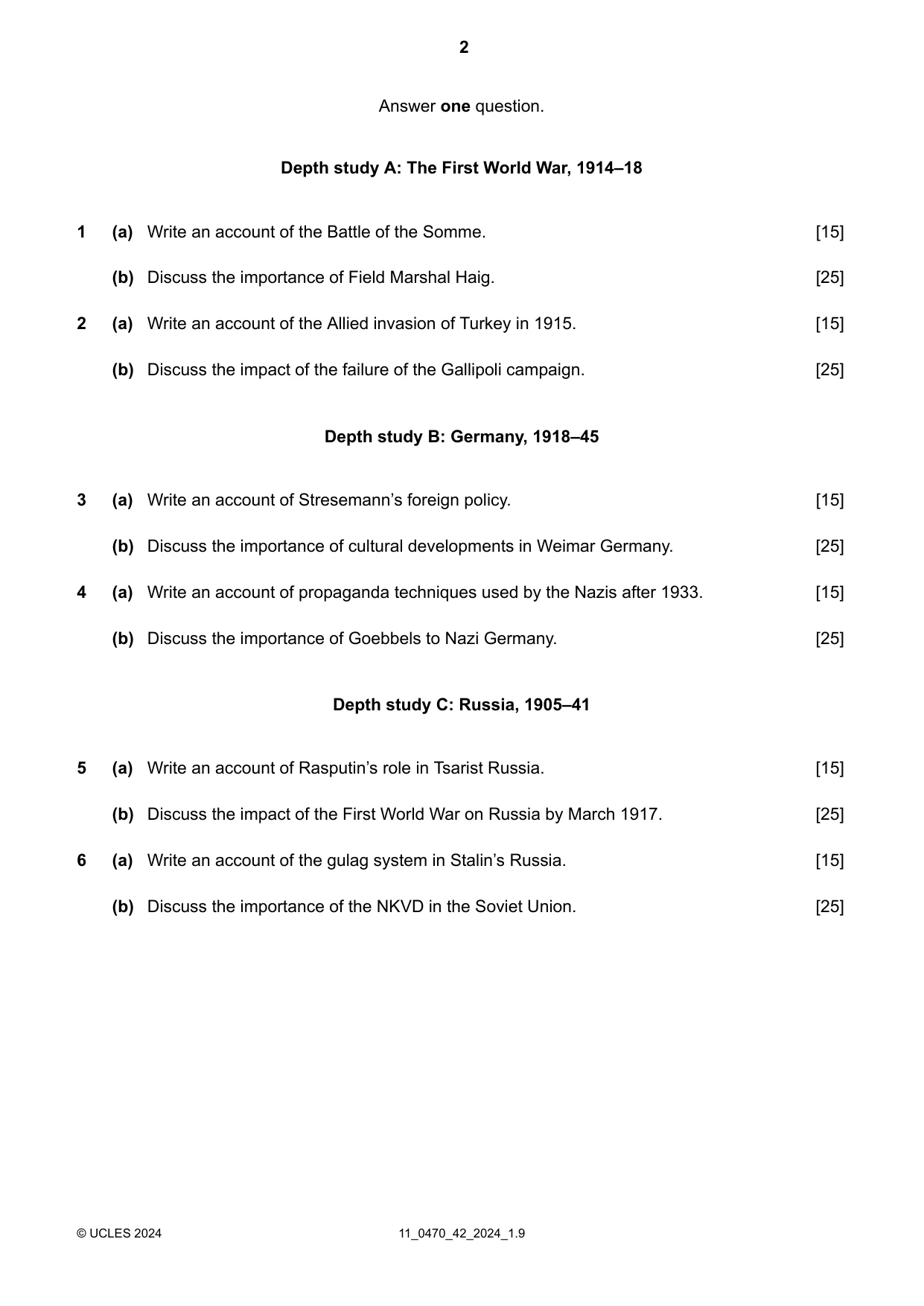
Question paper, page 2
Answer one question. Depth study A: The First World War, 1914–18 Write an account of the Battle of the Somme. [15] (a) 1 Discuss the importance of Field Marshal Haig. [25] (b) Write an account of the Allied invasion of Turkey in 1915. [15] (a) 2 Discuss the impact of the failure of the Gallipoli campaign. [25] (b) Depth study B: Germany, 1918–45 Write an account of Stresemann’s foreign policy. [15] (a) 3 Discuss the importance of cultural developments in Weimar Germany. [25] (b) Write an account of propaganda techniques used by the Nazis after 1933. [15] (a) 4 Discuss the importance of Goebbels to Nazi Germany. [25] (b) Depth study C: Russia, 1905–41 Write an account of Rasputin’s role in Tsarist Russia. [15] (a) 5 Discuss the impact of the First World War on Russia by March 1917. [25] (b) Write an account of the gulag system in Stalin’s Russia. [15] (a) 6 Discuss the importance of the NKVD in the Soviet Union. [25] (b) 11_0470_42_2024_1.9 © UCLES 2024 2
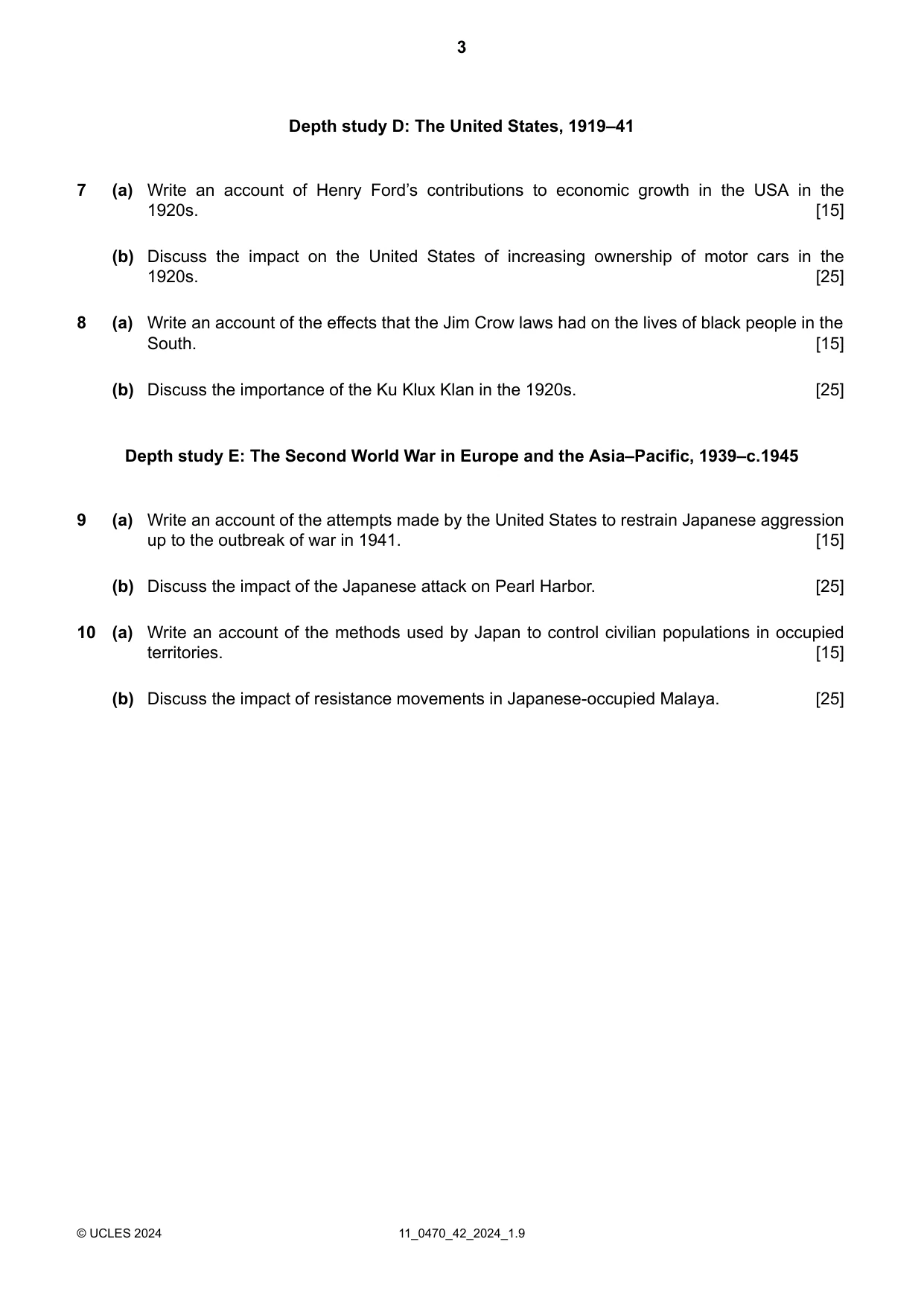
Question paper, page 3
Depth study D: The United States, 1919–41 Write an account of Henry Ford’s contributions to economic growth in the USA in the 1920s. [15] (a) 7 Discuss the impact on the United States of increasing ownership of motor cars in the 1920s. [25] (b) Write an account of the effects that the Jim Crow laws had on the lives of black people in the South. [15] (a) 8 Discuss the importance of the Ku Klux Klan in the 1920s. [25] (b) Depth study E: The Second World War in Europe and the Asia–Pacific, 1939–c.1945 Write an account of the attempts made by the United States to restrain Japanese aggression up to the outbreak of war in 1941. [15] (a) 9 Discuss the impact of the Japanese attack on Pearl Harbor. [25] (b) Write an account of the methods used by Japan to control civilian populations in occupied territories. [15] (a) 10 Discuss the impact of resistance movements in Japanese-occupied Malaya. [25] (b) 11_0470_42_2024_1.9 © UCLES 2024 3
Question paper, page 4
BLANK PAGE Permission to reproduce items where third-party owned material protected by copyright is included has been sought and cleared where possible. Every reasonable effort has been made by the publisher (UCLES) to trace copyright holders, but if any items requiring clearance have unwittingly been included, the publisher will be pleased to make amends at the earliest possible opportunity. To avoid the issue of disclosure of answer-related information to candidates, all copyright acknowledgements are reproduced online in the Cambridge Assessment International Education Copyright Acknowledgements Booklet. This is produced for each series of examinations and is freely available to download at www.cambridgeinternational.org after the live examination series. Cambridge Assessment International Education is part of Cambridge Assessment. Cambridge Assessment is the brand name of the University of Cambridge Local Examinations Syndicate (UCLES), which is a department of the University of Cambridge. 11_0470_42_2024_1.9 © UCLES 2024 4
Mark scheme, page 1
This document consists of 17 printed pages. © Cambridge University Press & Assessment 2024 [Turn over Cambridge IGCSE™ HISTORY 0470/42 Paper 4 Alternative to Coursework October/November 2024 MARK SCHEME Maximum Mark: 40 Published This mark scheme is published as an aid to teachers and candidates, to indicate the requirements of the examination. It shows the basis on which Examiners were instructed to award marks. It does not indicate the details of the discussions that took place at an Examiners’ meeting before marking began, which would have considered the acceptability of alternative answers. Mark schemes should be read in conjunction with the question paper and the Principal Examiner Report for Teachers. Cambridge International will not enter into discussions about these mark schemes. Cambridge International is publishing the mark schemes for the October/November 2024 series for most Cambridge IGCSE, Cambridge International A and AS Level components, and some Cambridge O Level components.
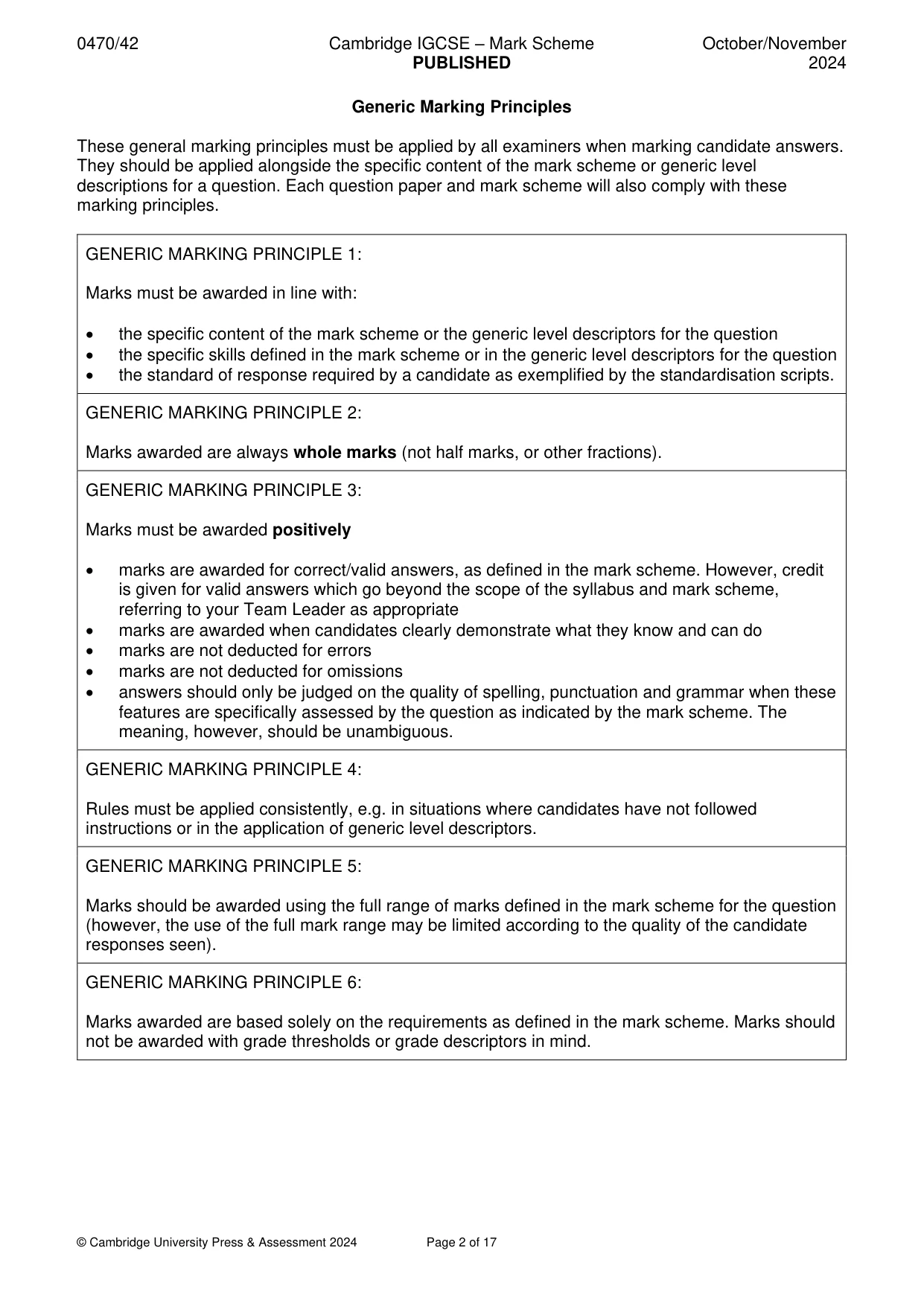
Mark scheme, page 2
0470/42 Cambridge IGCSE – Mark Scheme PUBLISHED October/November 2024 © Cambridge University Press & Assessment 2024 Page 2 of 17 Generic Marking Principles These general marking principles must be applied by all examiners when marking candidate answers. They should be applied alongside the specific content of the mark scheme or generic level descriptions for a question. Each question paper and mark scheme will also comply with these marking principles. GENERIC MARKING PRINCIPLE 1: Marks must be awarded in line with: • the specific content of the mark scheme or the generic level descriptors for the question • the specific skills defined in the mark scheme or in the generic level descriptors for the question • the standard of response required by a candidate as exemplified by the standardisation scripts. GENERIC MARKING PRINCIPLE 2: Marks awarded are always whole marks (not half marks, or other fractions). GENERIC MARKING PRINCIPLE 3: Marks must be awarded positively • marks are awarded for correct/valid answers, as defined in the mark scheme. However, credit is given for valid answers which go beyond the scope of the syllabus and mark scheme, referring to your Team Leader as appropriate • marks are awarded when candidates clearly demonstrate what they know and can do • marks are not deducted for errors • marks are not deducted for omissions • answers should only be judged on the quality of spelling, punctuation and grammar when these features are specifically assessed by the question as indicated by the mark scheme. The meaning, however, should be unambiguous. GENERIC MARKING PRINCIPLE 4: Rules must be applied consistently, e.g. in situations where candidates have not followed instructions or in the application of generic level descriptors. GENERIC MARKING PRINCIPLE 5: Marks should be awarded using the full range of marks defined in the mark scheme for the question (however, the use of the full mark range may be limited according to the quality of the candidate responses seen). GENERIC MARKING PRINCIPLE 6: Marks awarded are based solely on the requirements as defined in the mark scheme. Marks should not be awarded with grade thresholds or grade descriptors in mind.
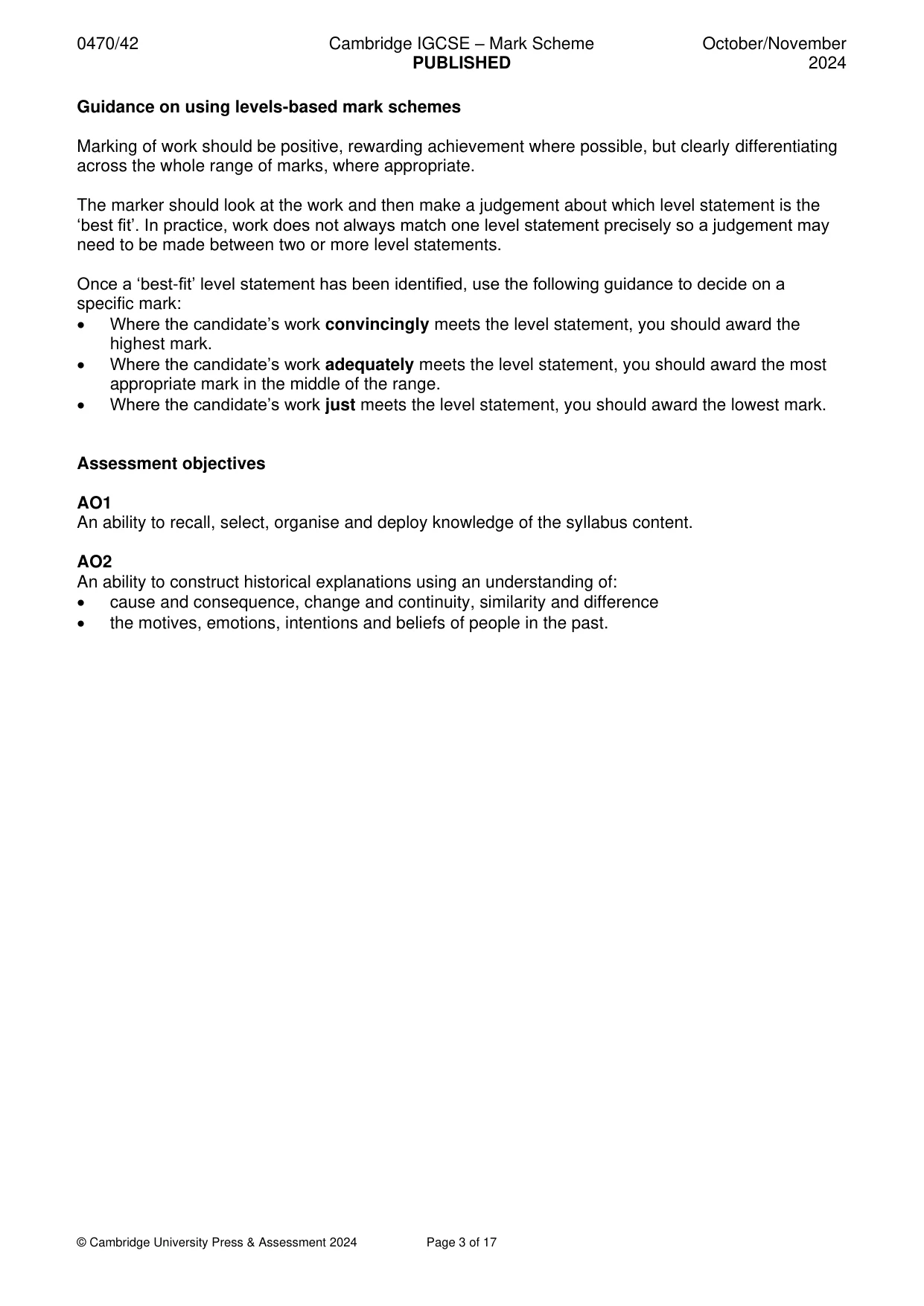
Mark scheme, page 3
0470/42 Cambridge IGCSE – Mark Scheme PUBLISHED October/November 2024 © Cambridge University Press & Assessment 2024 Page 3 of 17 Guidance on using levels-based mark schemes Marking of work should be positive, rewarding achievement where possible, but clearly differentiating across the whole range of marks, where appropriate. The marker should look at the work and then make a judgement about which level statement is the ‘best fit’. In practice, work does not always match one level statement precisely so a judgement may need to be made between two or more level statements. Once a ‘best-fit’ level statement has been identified, use the following guidance to decide on a specific mark: • Where the candidate’s work convincingly meets the level statement, you should award the highest mark. • Where the candidate’s work adequately meets the level statement, you should award the most appropriate mark in the middle of the range. • Where the candidate’s work just meets the level statement, you should award the lowest mark. Assessment objectives AO1 An ability to recall, select, organise and deploy knowledge of the syllabus content. AO2 An ability to construct historical explanations using an understanding of: • cause and consequence, change and continuity, similarity and difference • the motives, emotions, intentions and beliefs of people in the past.
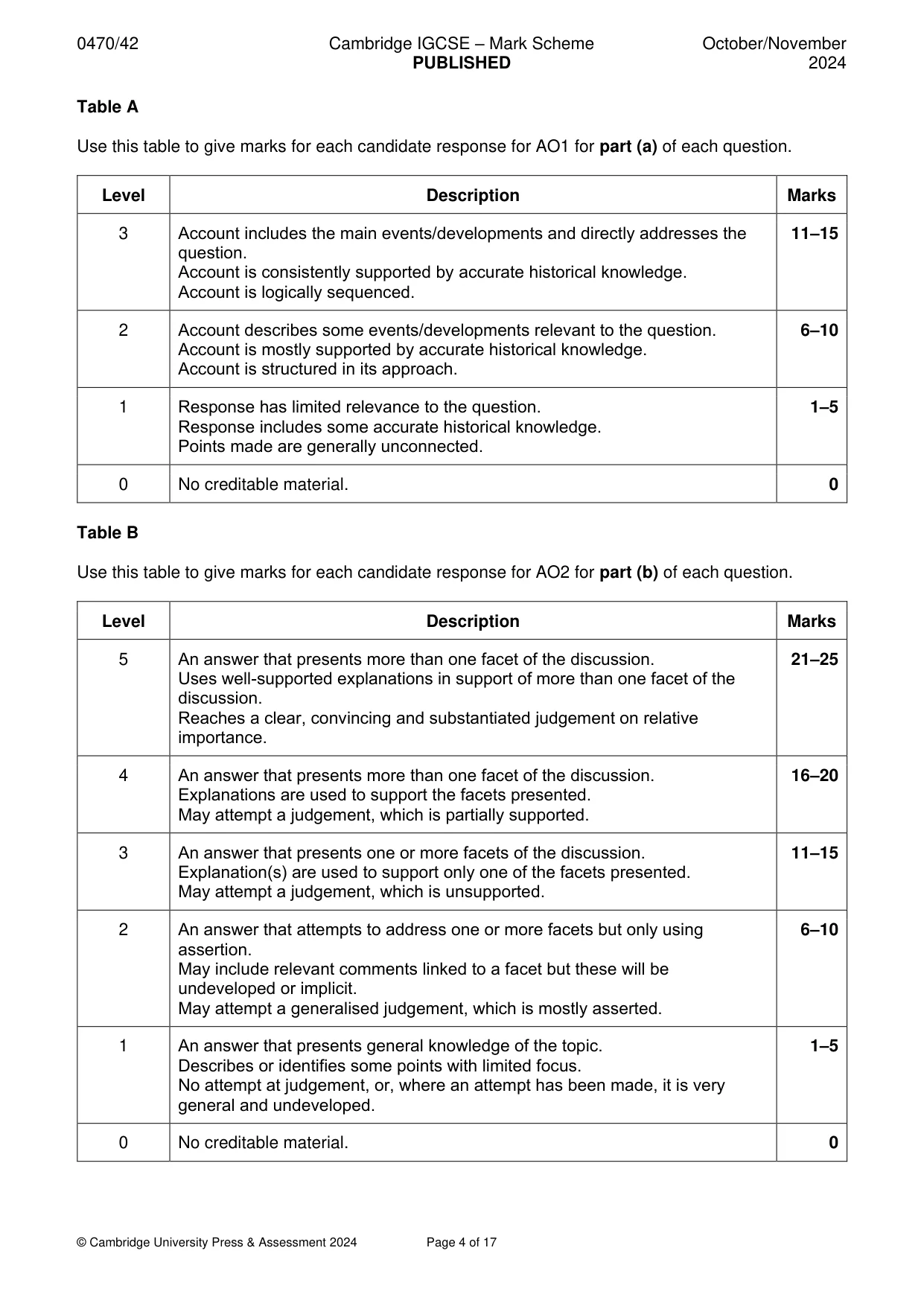
Mark scheme, page 4
0470/42 Cambridge IGCSE – Mark Scheme PUBLISHED October/November 2024 © Cambridge University Press & Assessment 2024 Page 4 of 17 Table A Use this table to give marks for each candidate response for AO1 for part (a) of each question. Level Description Marks 3 Account includes the main events/developments and directly addresses the question. Account is consistently supported by accurate historical knowledge. Account is logically sequenced. 11–15 2 Account describes some events/developments relevant to the question. Account is mostly supported by accurate historical knowledge. Account is structured in its approach. 6–10 1 Response has limited relevance to the question. Response includes some accurate historical knowledge. Points made are generally unconnected. 1–5 0 No creditable material. 0 Table B Use this table to give marks for each candidate response for AO2 for part (b) of each question. Level Description Marks 5 An answer that presents more than one facet of the discussion. Uses well-supported explanations in support of more than one facet of the discussion. Reaches a clear, convincing and substantiated judgement on relative importance. 21–25 4 An answer that presents more than one facet of the discussion. Explanations are used to support the facets presented. May attempt a judgement, which is partially supported. 16–20 3 An answer that presents one or more facets of the discussion. Explanation(s) are used to support only one of the facets presented. May attempt a judgement, which is unsupported. 11–15 2 An answer that attempts to address one or more facets but only using assertion. May include relevant comments linked to a facet but these will be undeveloped or implicit. May attempt a generalised judgement, which is mostly asserted. 6–10 1 An answer that presents general knowledge of the topic. Describes or identifies some points with limited focus. No attempt at judgement, or, where an attempt has been made, it is very general and undeveloped. 1–5 0 No creditable material. 0
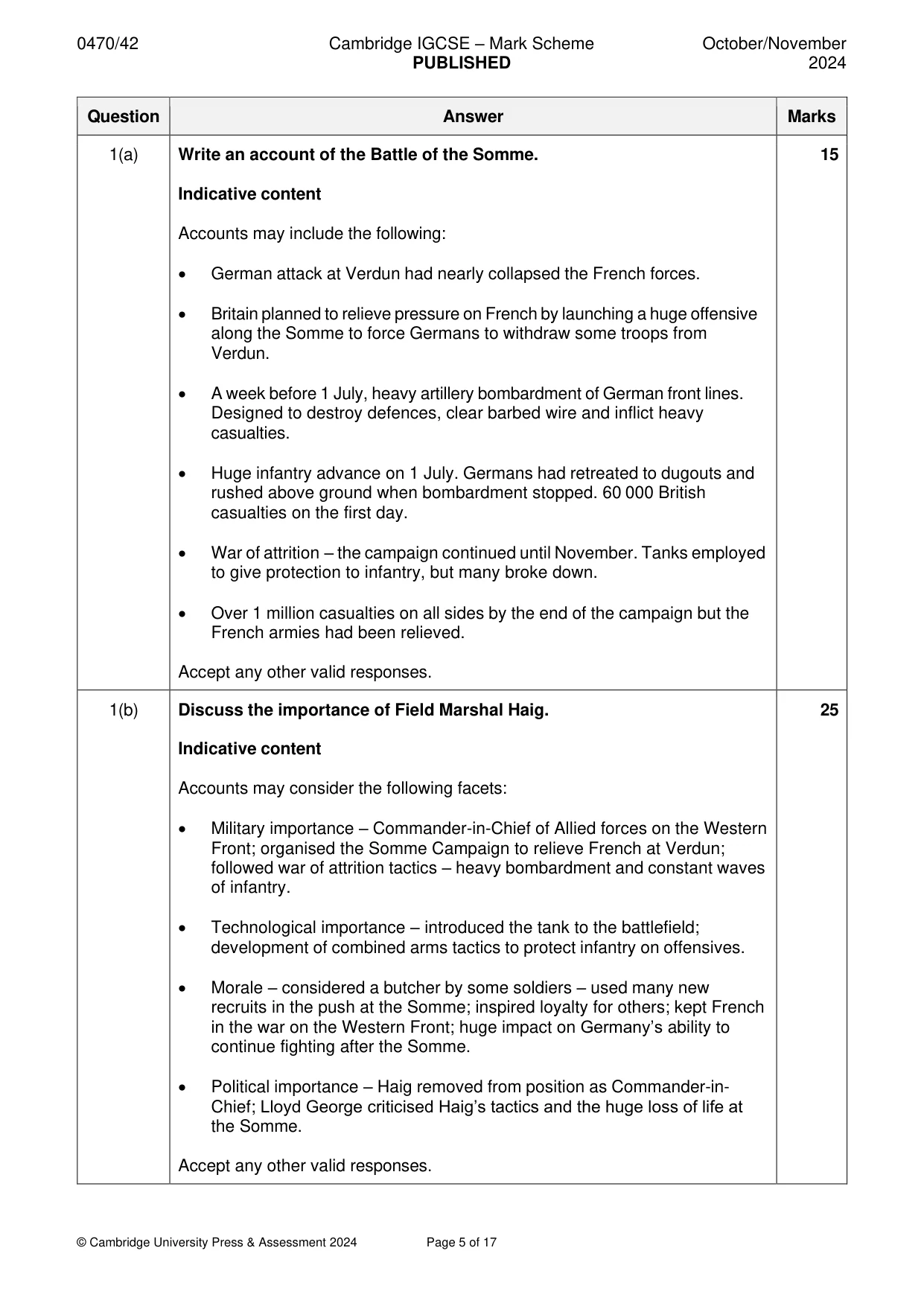
Mark scheme, page 5
0470/42 Cambridge IGCSE – Mark Scheme PUBLISHED October/November 2024 © Cambridge University Press & Assessment 2024 Page 5 of 17 Question Answer Marks 1(a) Write an account of the Battle of the Somme. Indicative content Accounts may include the following: • German attack at Verdun had nearly collapsed the French forces. • Britain planned to relieve pressure on French by launching a huge offensive along the Somme to force Germans to withdraw some troops from Verdun. • A week before 1 July, heavy artillery bombardment of German front lines. Designed to destroy defences, clear barbed wire and inflict heavy casualties. • Huge infantry advance on 1 July. Germans had retreated to dugouts and rushed above ground when bombardment stopped. 60 000 British casualties on the first day. • War of attrition – the campaign continued until November. Tanks employed to give protection to infantry, but many broke down. • Over 1 million casualties on all sides by the end of the campaign but the French armies had been relieved. Accept any other valid responses. 15 1(b) Discuss the importance of Field Marshal Haig. Indicative content Accounts may consider the following facets: • Military importance – Commander-in-Chief of Allied forces on the Western Front; organised the Somme Campaign to relieve French at Verdun; followed war of attrition tactics – heavy bombardment and constant waves of infantry. • Technological importance – introduced the tank to the battlefield; development of combined arms tactics to protect infantry on offensives. • Morale – considered a butcher by some soldiers – used many new recruits in the push at the Somme; inspired loyalty for others; kept French in the war on the Western Front; huge impact on Germany’s ability to continue fighting after the Somme. • Political importance – Haig removed from position as Commander-in- Chief; Lloyd George criticised Haig’s tactics and the huge loss of life at the Somme. Accept any other valid responses. 25
Mark scheme, page 6
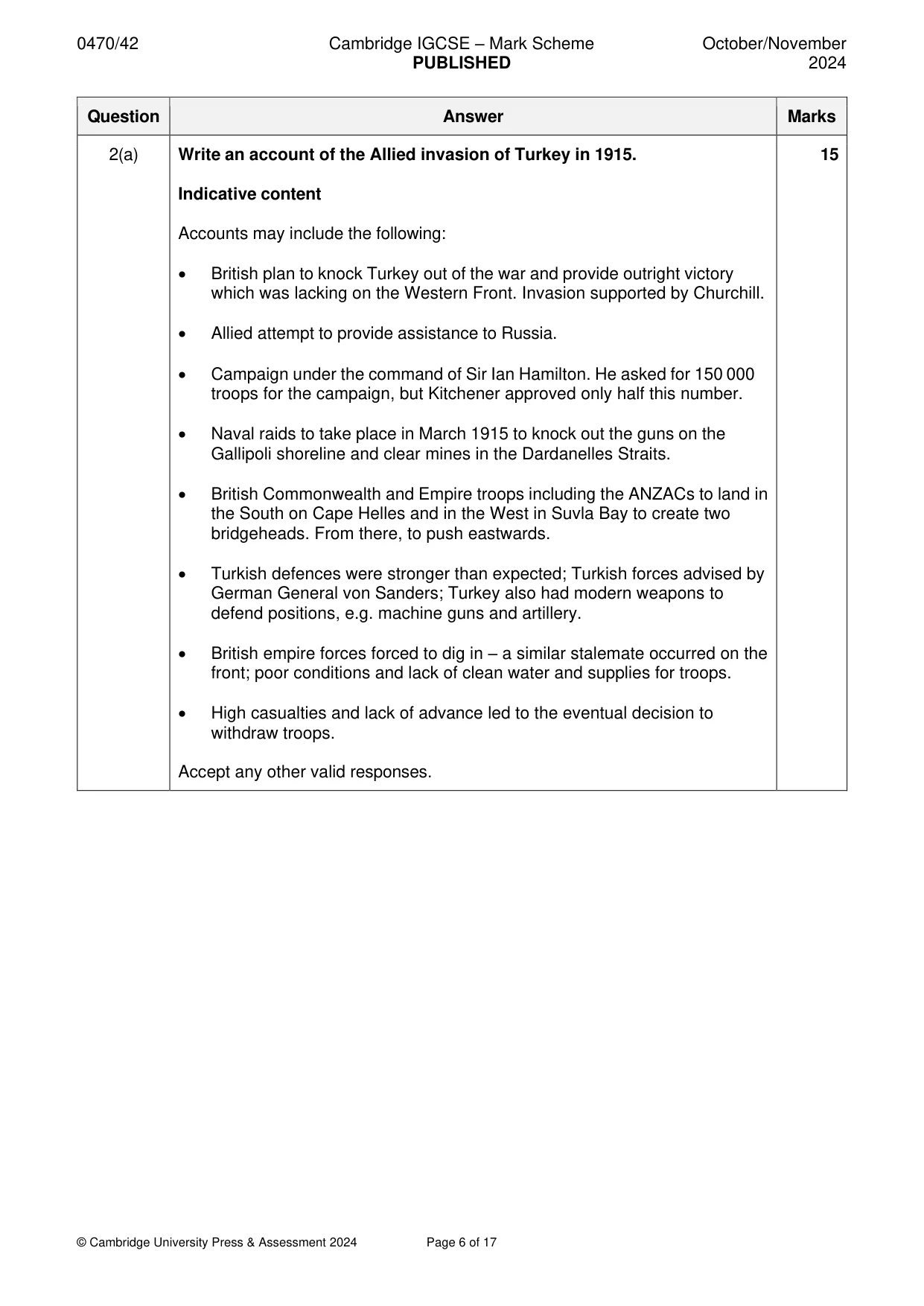
0470/42 Cambridge IGCSE – Mark Scheme PUBLISHED October/November 2024 © Cambridge University Press & Assessment 2024 Page 6 of 17 Question Answer Marks 2(a) Write an account of the Allied invasion of Turkey in 1915. Indicative content Accounts may include the following: • British plan to knock Turkey out of the war and provide outright victory which was lacking on the Western Front. Invasion supported by Churchill. • Allied attempt to provide assistance to Russia. • Campaign under the command of Sir Ian Hamilton. He asked for 150 000 troops for the campaign, but Kitchener approved only half this number. • Naval raids to take place in March 1915 to knock out the guns on the Gallipoli shoreline and clear mines in the Dardanelles Straits. • British Commonwealth and Empire troops including the ANZACs to land in the South on Cape Helles and in the West in Suvla Bay to create two bridgeheads. From there, to push eastwards. • Turkish defences were stronger than expected; Turkish forces advised by German General von Sanders; Turkey also had modern weapons to defend positions, e.g. machine guns and artillery. • British empire forces forced to dig in – a similar stalemate occurred on the front; poor conditions and lack of clean water and supplies for troops. • High casualties and lack of advance led to the eventual decision to withdraw troops. Accept any other valid responses. 15
Mark scheme, page 7
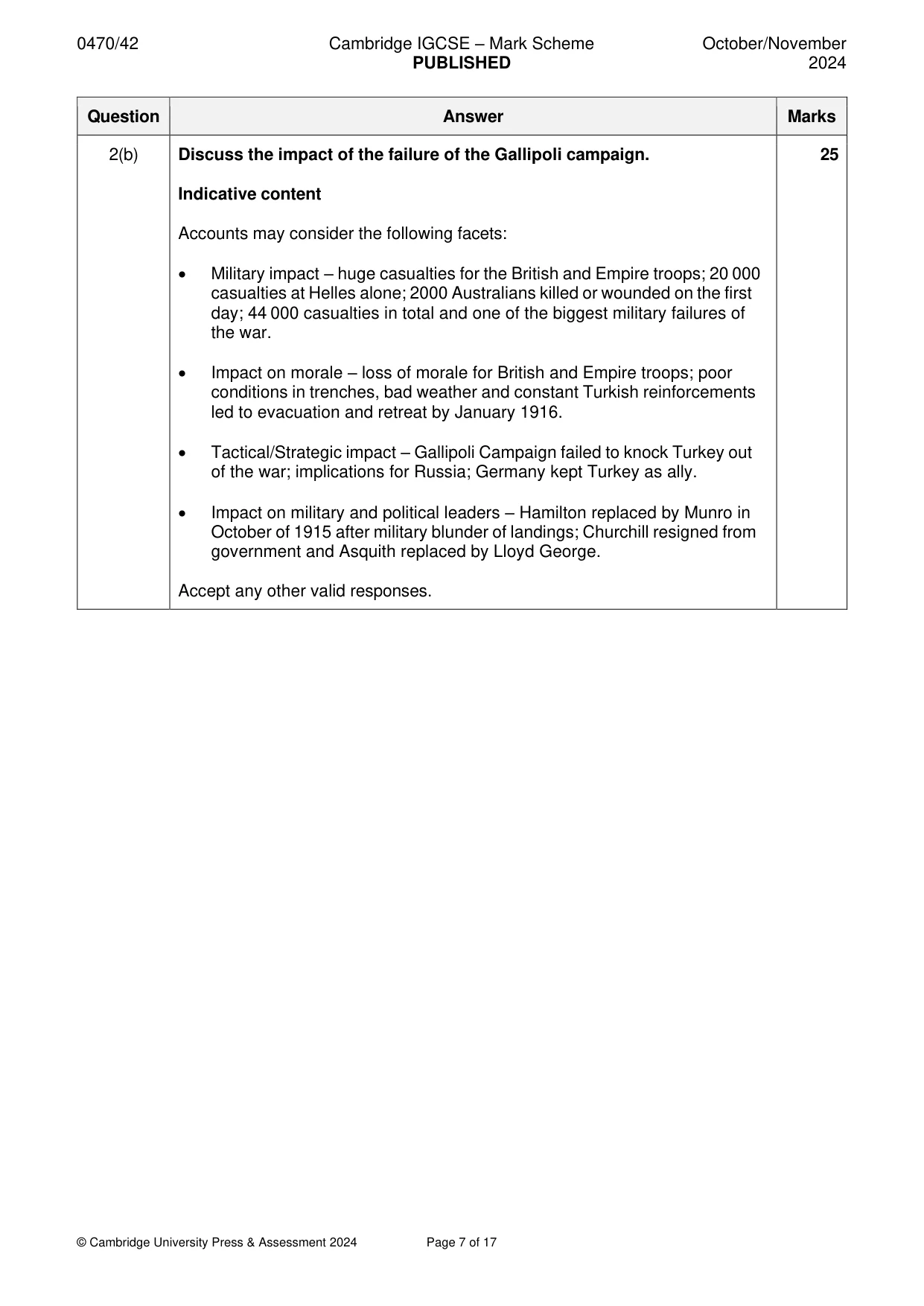
0470/42 Cambridge IGCSE – Mark Scheme PUBLISHED October/November 2024 © Cambridge University Press & Assessment 2024 Page 7 of 17 Question Answer Marks 2(b) Discuss the impact of the failure of the Gallipoli campaign. Indicative content Accounts may consider the following facets: • Military impact – huge casualties for the British and Empire troops; 20 000 casualties at Helles alone; 2000 Australians killed or wounded on the first day; 44 000 casualties in total and one of the biggest military failures of the war. • Impact on morale – loss of morale for British and Empire troops; poor conditions in trenches, bad weather and constant Turkish reinforcements led to evacuation and retreat by January 1916. • Tactical/Strategic impact – Gallipoli Campaign failed to knock Turkey out of the war; implications for Russia; Germany kept Turkey as ally. • Impact on military and political leaders – Hamilton replaced by Munro in October of 1915 after military blunder of landings; Churchill resigned from government and Asquith replaced by Lloyd George. Accept any other valid responses. 25
Mark scheme, page 8
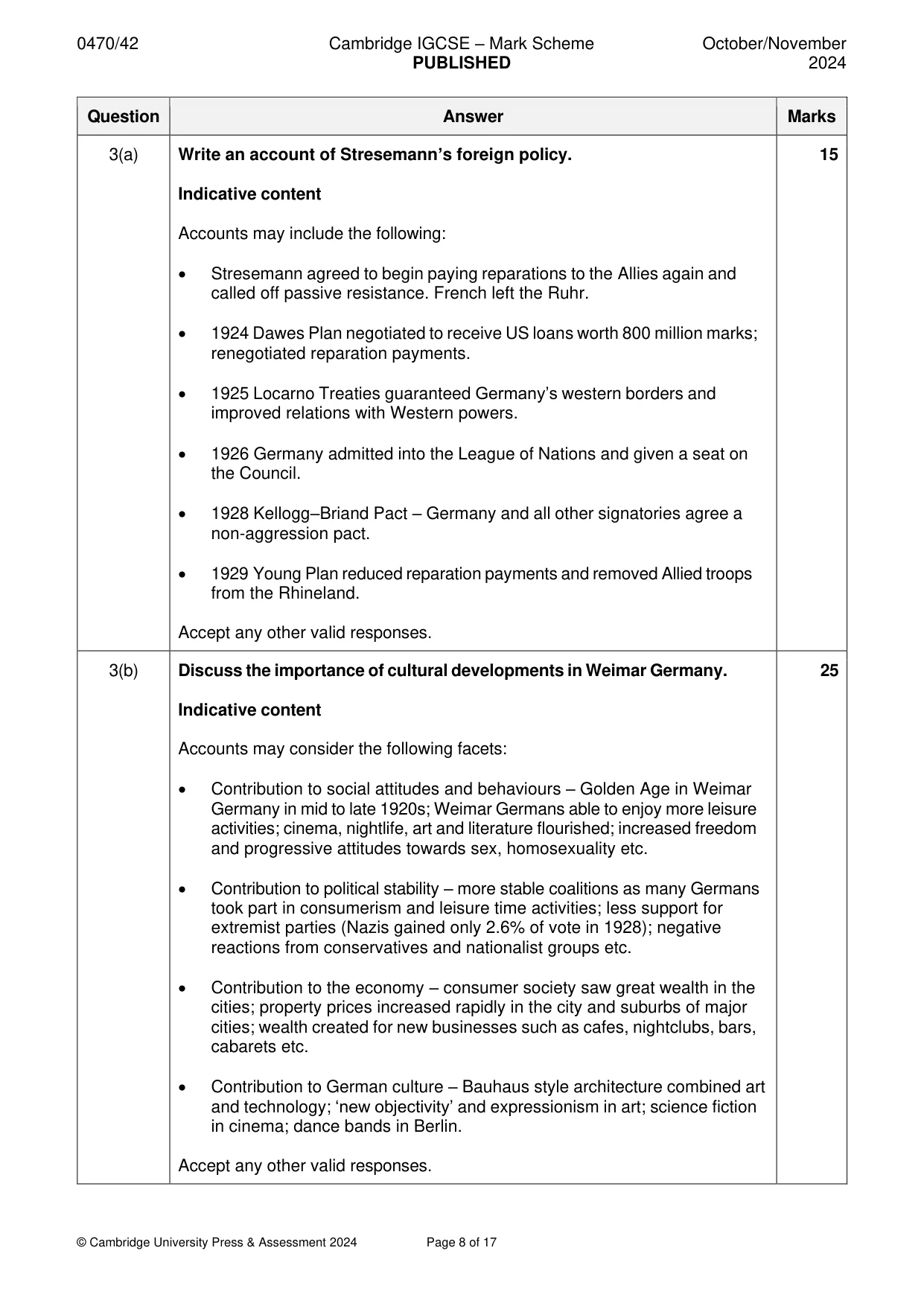
0470/42 Cambridge IGCSE – Mark Scheme PUBLISHED October/November 2024 © Cambridge University Press & Assessment 2024 Page 8 of 17 Question Answer Marks 3(a) Write an account of Stresemann’s foreign policy. Indicative content Accounts may include the following: • Stresemann agreed to begin paying reparations to the Allies again and called off passive resistance. French left the Ruhr. • 1924 Dawes Plan negotiated to receive US loans worth 800 million marks; renegotiated reparation payments. • 1925 Locarno Treaties guaranteed Germany’s western borders and improved relations with Western powers. • 1926 Germany admitted into the League of Nations and given a seat on the Council. • 1928 Kellogg–Briand Pact – Germany and all other signatories agree a non-aggression pact. • 1929 Young Plan reduced reparation payments and removed Allied troops from the Rhineland. Accept any other valid responses. 15 3(b) Discuss the importance of cultural developments in Weimar Germany. Indicative content Accounts may consider the following facets: • Contribution to social attitudes and behaviours – Golden Age in Weimar Germany in mid to late 1920s; Weimar Germans able to enjoy more leisure activities; cinema, nightlife, art and literature flourished; increased freedom and progressive attitudes towards sex, homosexuality etc. • Contribution to political stability – more stable coalitions as many Germans took part in consumerism and leisure time activities; less support for extremist parties (Nazis gained only 2.6% of vote in 1928); negative reactions from conservatives and nationalist groups etc. • Contribution to the economy – consumer society saw great wealth in the cities; property prices increased rapidly in the city and suburbs of major cities; wealth created for new businesses such as cafes, nightclubs, bars, cabarets etc. • Contribution to German culture – Bauhaus style architecture combined art and technology; ‘new objectivity’ and expressionism in art; science fiction in cinema; dance bands in Berlin. Accept any other valid responses. 25
Mark scheme, page 9
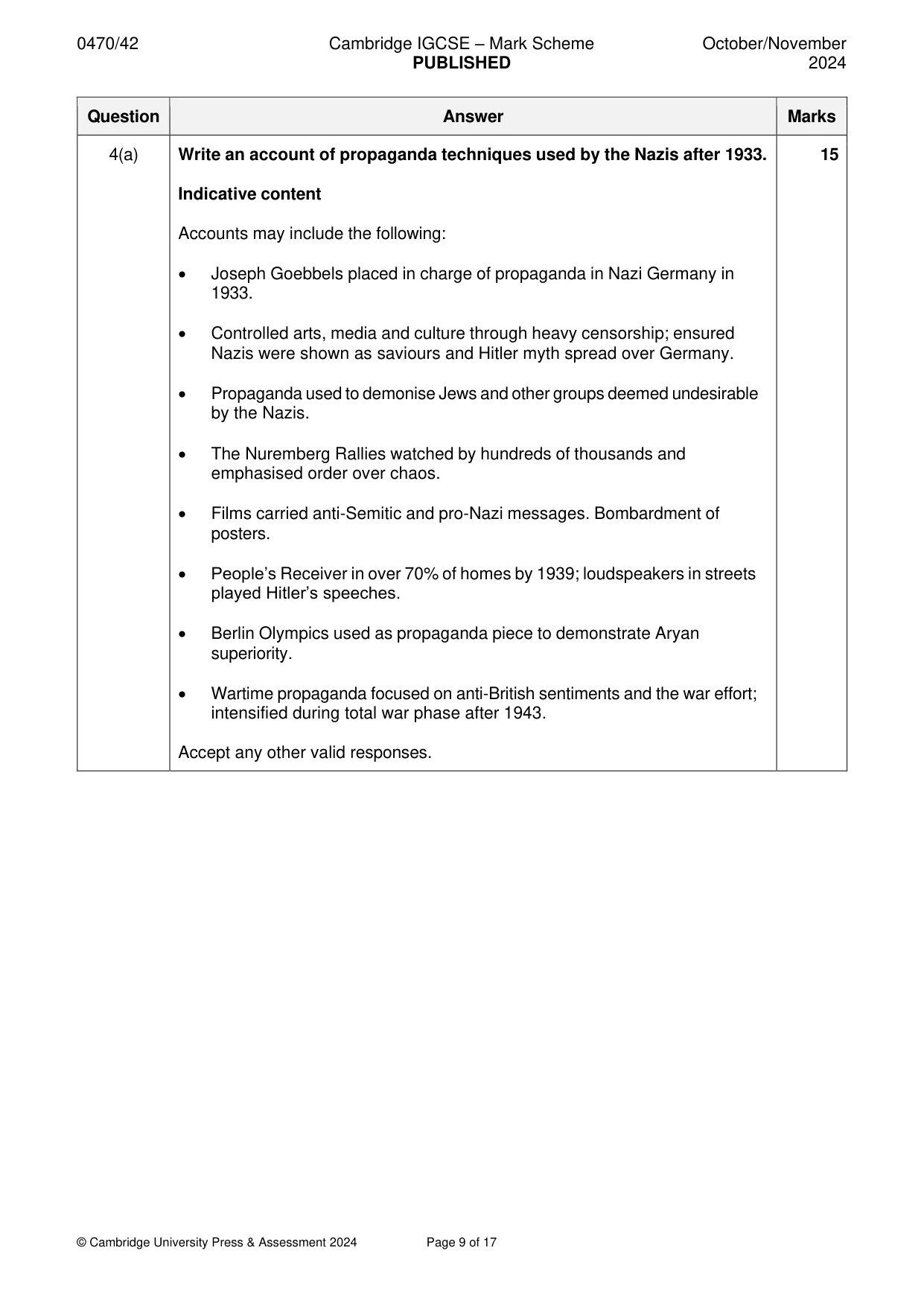
0470/42 Cambridge IGCSE – Mark Scheme PUBLISHED October/November 2024 © Cambridge University Press & Assessment 2024 Page 9 of 17 Question Answer Marks 4(a) Write an account of propaganda techniques used by the Nazis after 1933. Indicative content Accounts may include the following: • Joseph Goebbels placed in charge of propaganda in Nazi Germany in 1933. • Controlled arts, media and culture through heavy censorship; ensured Nazis were shown as saviours and Hitler myth spread over Germany. • Propaganda used to demonise Jews and other groups deemed undesirable by the Nazis. • The Nuremberg Rallies watched by hundreds of thousands and emphasised order over chaos. • Films carried anti-Semitic and pro-Nazi messages. Bombardment of posters. • People’s Receiver in over 70% of homes by 1939; loudspeakers in streets played Hitler’s speeches. • Berlin Olympics used as propaganda piece to demonstrate Aryan superiority. • Wartime propaganda focused on anti-British sentiments and the war effort; intensified during total war phase after 1943. Accept any other valid responses. 15
Mark scheme, page 10
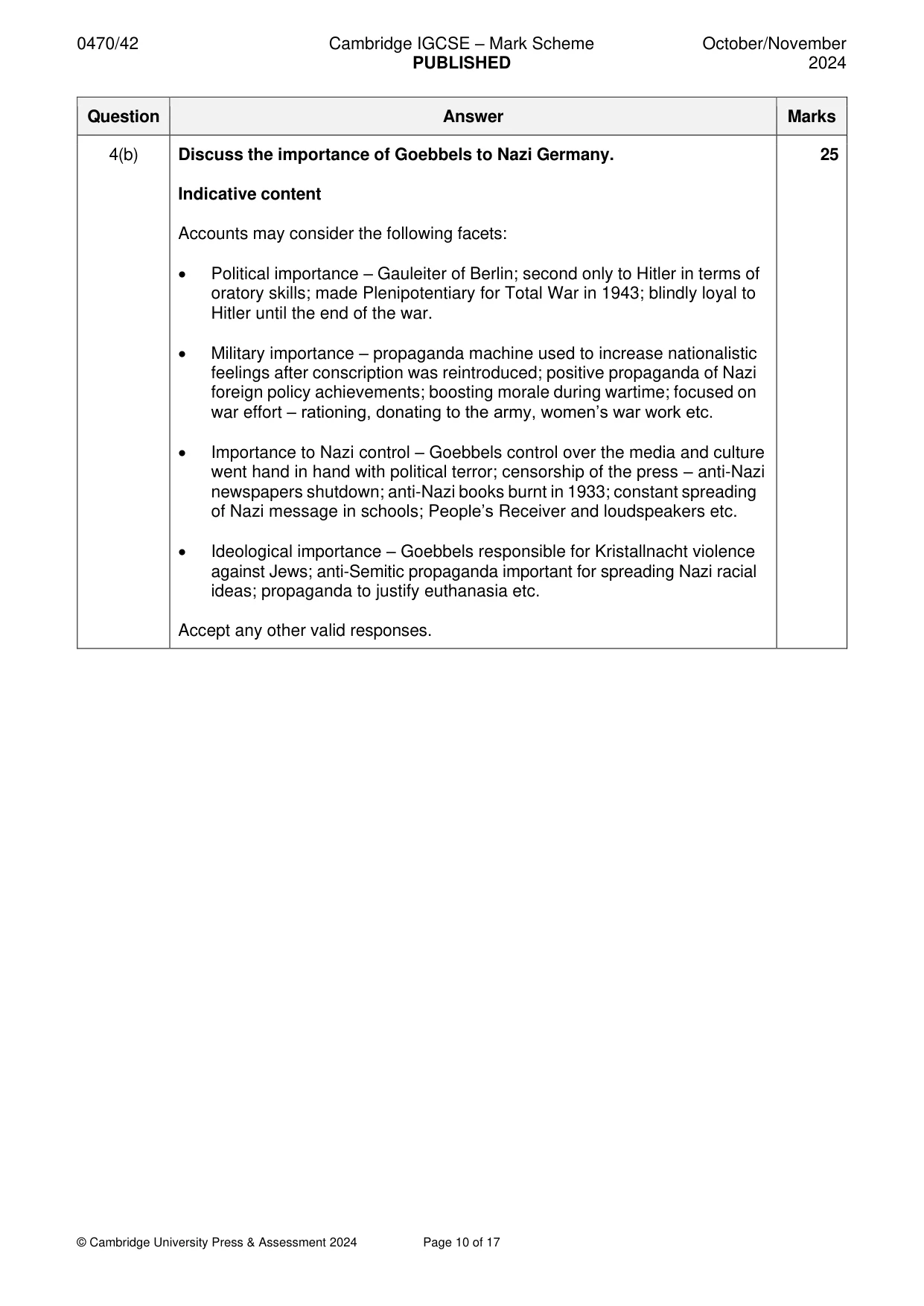
0470/42 Cambridge IGCSE – Mark Scheme PUBLISHED October/November 2024 © Cambridge University Press & Assessment 2024 Page 10 of 17 Question Answer Marks 4(b) Discuss the importance of Goebbels to Nazi Germany. Indicative content Accounts may consider the following facets: • Political importance – Gauleiter of Berlin; second only to Hitler in terms of oratory skills; made Plenipotentiary for Total War in 1943; blindly loyal to Hitler until the end of the war. • Military importance – propaganda machine used to increase nationalistic feelings after conscription was reintroduced; positive propaganda of Nazi foreign policy achievements; boosting morale during wartime; focused on war effort – rationing, donating to the army, women’s war work etc. • Importance to Nazi control – Goebbels control over the media and culture went hand in hand with political terror; censorship of the press – anti-Nazi newspapers shutdown; anti-Nazi books burnt in 1933; constant spreading of Nazi message in schools; People’s Receiver and loudspeakers etc. • Ideological importance – Goebbels responsible for Kristallnacht violence against Jews; anti-Semitic propaganda important for spreading Nazi racial ideas; propaganda to justify euthanasia etc. Accept any other valid responses. 25
Mark scheme, page 11
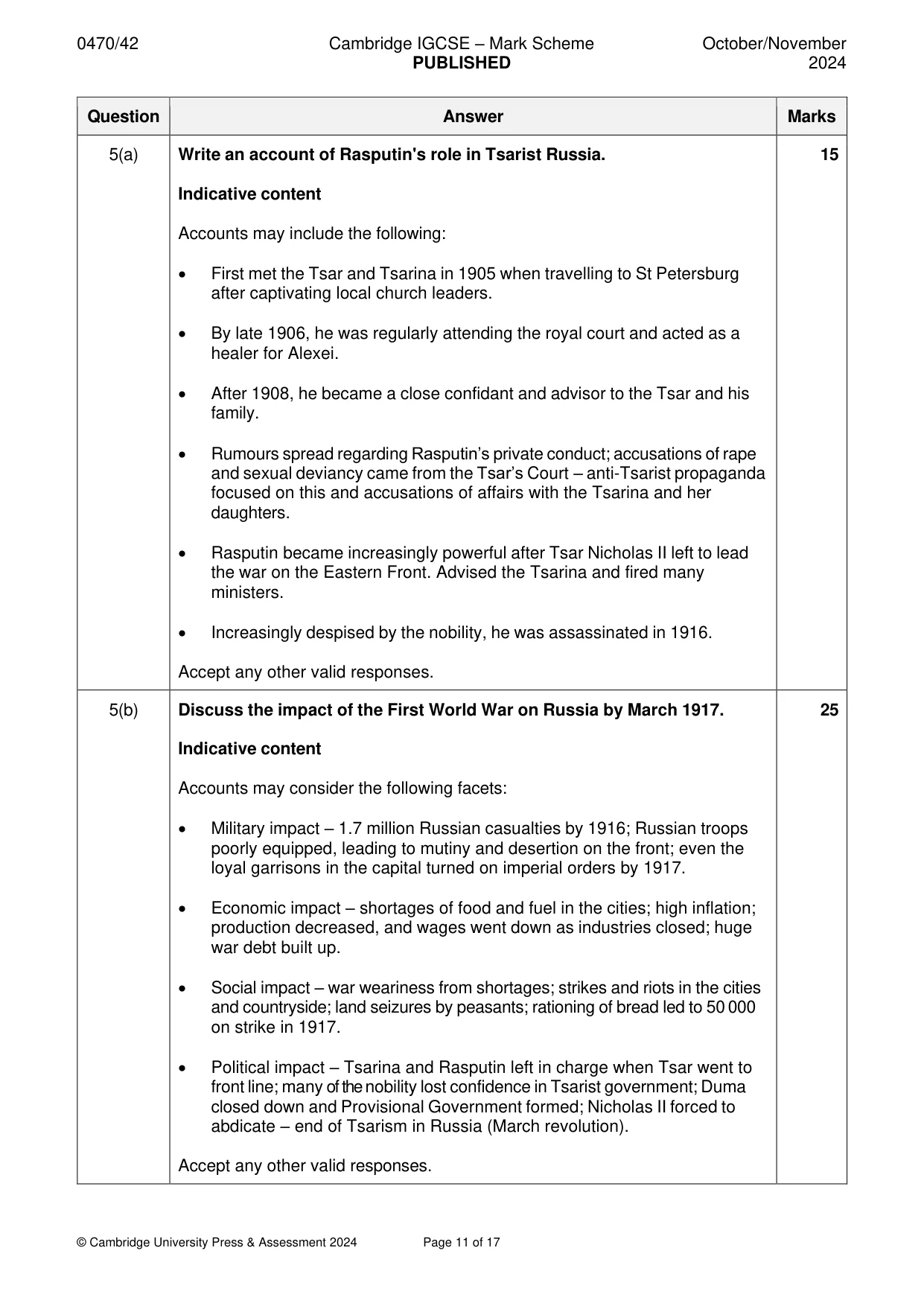
0470/42 Cambridge IGCSE – Mark Scheme PUBLISHED October/November 2024 © Cambridge University Press & Assessment 2024 Page 11 of 17 Question Answer Marks 5(a) Write an account of Rasputin's role in Tsarist Russia. Indicative content Accounts may include the following: • First met the Tsar and Tsarina in 1905 when travelling to St Petersburg after captivating local church leaders. • By late 1906, he was regularly attending the royal court and acted as a healer for Alexei. • After 1908, he became a close confidant and advisor to the Tsar and his family. • Rumours spread regarding Rasputin’s private conduct; accusations of rape and sexual deviancy came from the Tsar’s Court – anti-Tsarist propaganda focused on this and accusations of affairs with the Tsarina and her daughters. • Rasputin became increasingly powerful after Tsar Nicholas II left to lead the war on the Eastern Front. Advised the Tsarina and fired many ministers. • Increasingly despised by the nobility, he was assassinated in 1916. Accept any other valid responses. 15 5(b) Discuss the impact of the First World War on Russia by March 1917. Indicative content Accounts may consider the following facets: • Military impact – 1.7 million Russian casualties by 1916; Russian troops poorly equipped, leading to mutiny and desertion on the front; even the loyal garrisons in the capital turned on imperial orders by 1917. • Economic impact – shortages of food and fuel in the cities; high inflation; production decreased, and wages went down as industries closed; huge war debt built up. • Social impact – war weariness from shortages; strikes and riots in the cities and countryside; land seizures by peasants; rationing of bread led to 50 000 on strike in 1917. • Political impact – Tsarina and Rasputin left in charge when Tsar went to front line; many of the nobility lost confidence in Tsarist government; Duma closed down and Provisional Government formed; Nicholas II forced to abdicate – end of Tsarism in Russia (March revolution). Accept any other valid responses. 25
Mark scheme, page 12
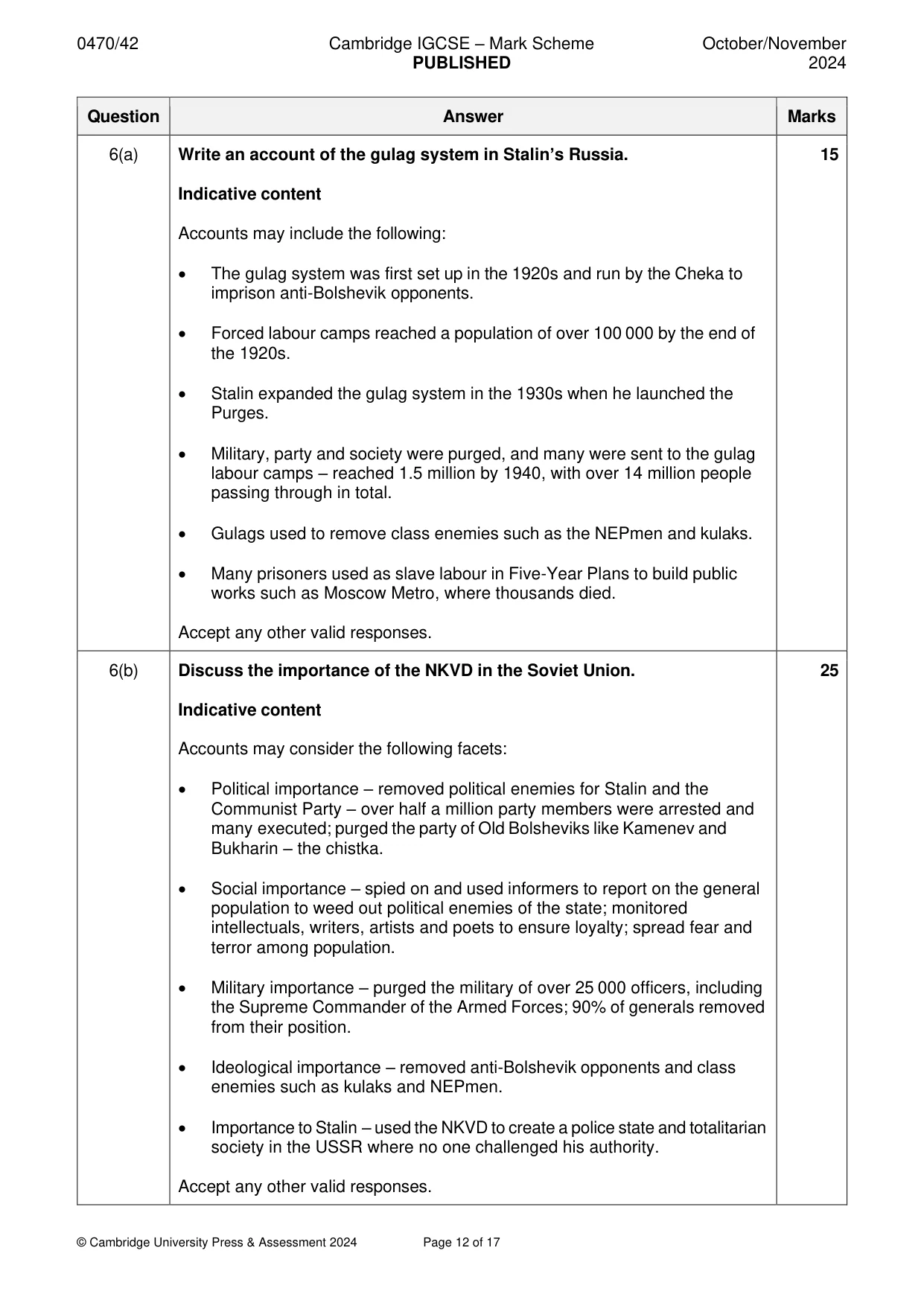
0470/42 Cambridge IGCSE – Mark Scheme PUBLISHED October/November 2024 © Cambridge University Press & Assessment 2024 Page 12 of 17 Question Answer Marks 6(a) Write an account of the gulag system in Stalin’s Russia. Indicative content Accounts may include the following: • The gulag system was first set up in the 1920s and run by the Cheka to imprison anti-Bolshevik opponents. • Forced labour camps reached a population of over 100 000 by the end of the 1920s. • Stalin expanded the gulag system in the 1930s when he launched the Purges. • Military, party and society were purged, and many were sent to the gulag labour camps – reached 1.5 million by 1940, with over 14 million people passing through in total. • Gulags used to remove class enemies such as the NEPmen and kulaks. • Many prisoners used as slave labour in Five-Year Plans to build public works such as Moscow Metro, where thousands died. Accept any other valid responses. 15 6(b) Discuss the importance of the NKVD in the Soviet Union. Indicative content Accounts may consider the following facets: • Political importance – removed political enemies for Stalin and the Communist Party – over half a million party members were arrested and many executed; purged the party of Old Bolsheviks like Kamenev and Bukharin – the chistka. • Social importance – spied on and used informers to report on the general population to weed out political enemies of the state; monitored intellectuals, writers, artists and poets to ensure loyalty; spread fear and terror among population. • Military importance – purged the military of over 25 000 officers, including the Supreme Commander of the Armed Forces; 90% of generals removed from their position. • Ideological importance – removed anti-Bolshevik opponents and class enemies such as kulaks and NEPmen. • Importance to Stalin – used the NKVD to create a police state and totalitarian society in the USSR where no one challenged his authority. Accept any other valid responses. 25
Mark scheme, page 13
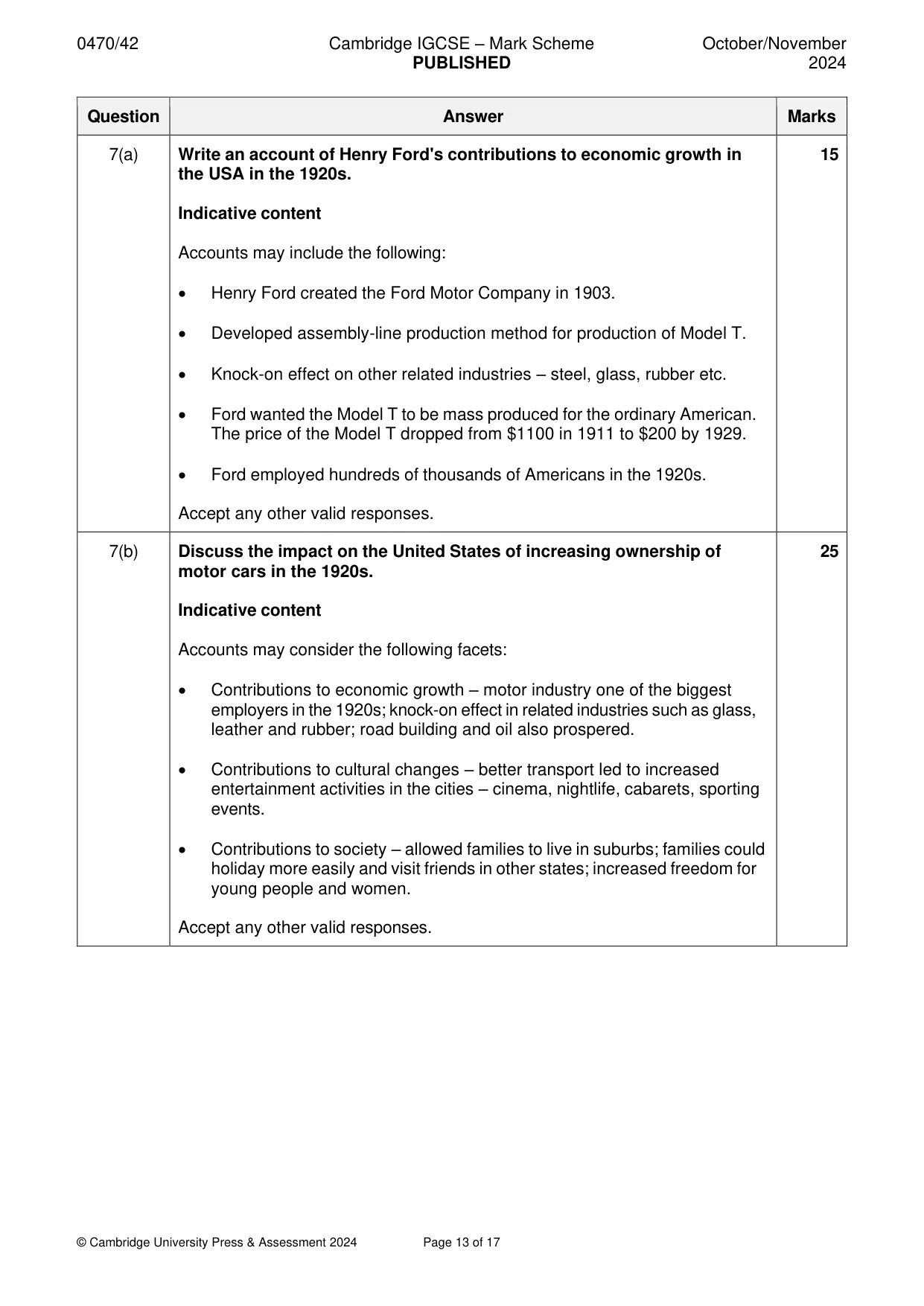
0470/42 Cambridge IGCSE – Mark Scheme PUBLISHED October/November 2024 © Cambridge University Press & Assessment 2024 Page 13 of 17 Question Answer Marks 7(a) Write an account of Henry Ford's contributions to economic growth in the USA in the 1920s. Indicative content Accounts may include the following: • Henry Ford created the Ford Motor Company in 1903. • Developed assembly-line production method for production of Model T. • Knock-on effect on other related industries – steel, glass, rubber etc. • Ford wanted the Model T to be mass produced for the ordinary American. The price of the Model T dropped from $1100 in 1911 to $200 by 1929. • Ford employed hundreds of thousands of Americans in the 1920s. Accept any other valid responses. 15 7(b) Discuss the impact on the United States of increasing ownership of motor cars in the 1920s. Indicative content Accounts may consider the following facets: • Contributions to economic growth – motor industry one of the biggest employers in the 1920s; knock-on effect in related industries such as glass, leather and rubber; road building and oil also prospered. • Contributions to cultural changes – better transport led to increased entertainment activities in the cities – cinema, nightlife, cabarets, sporting events. • Contributions to society – allowed families to live in suburbs; families could holiday more easily and visit friends in other states; increased freedom for young people and women. Accept any other valid responses. 25
Mark scheme, page 14
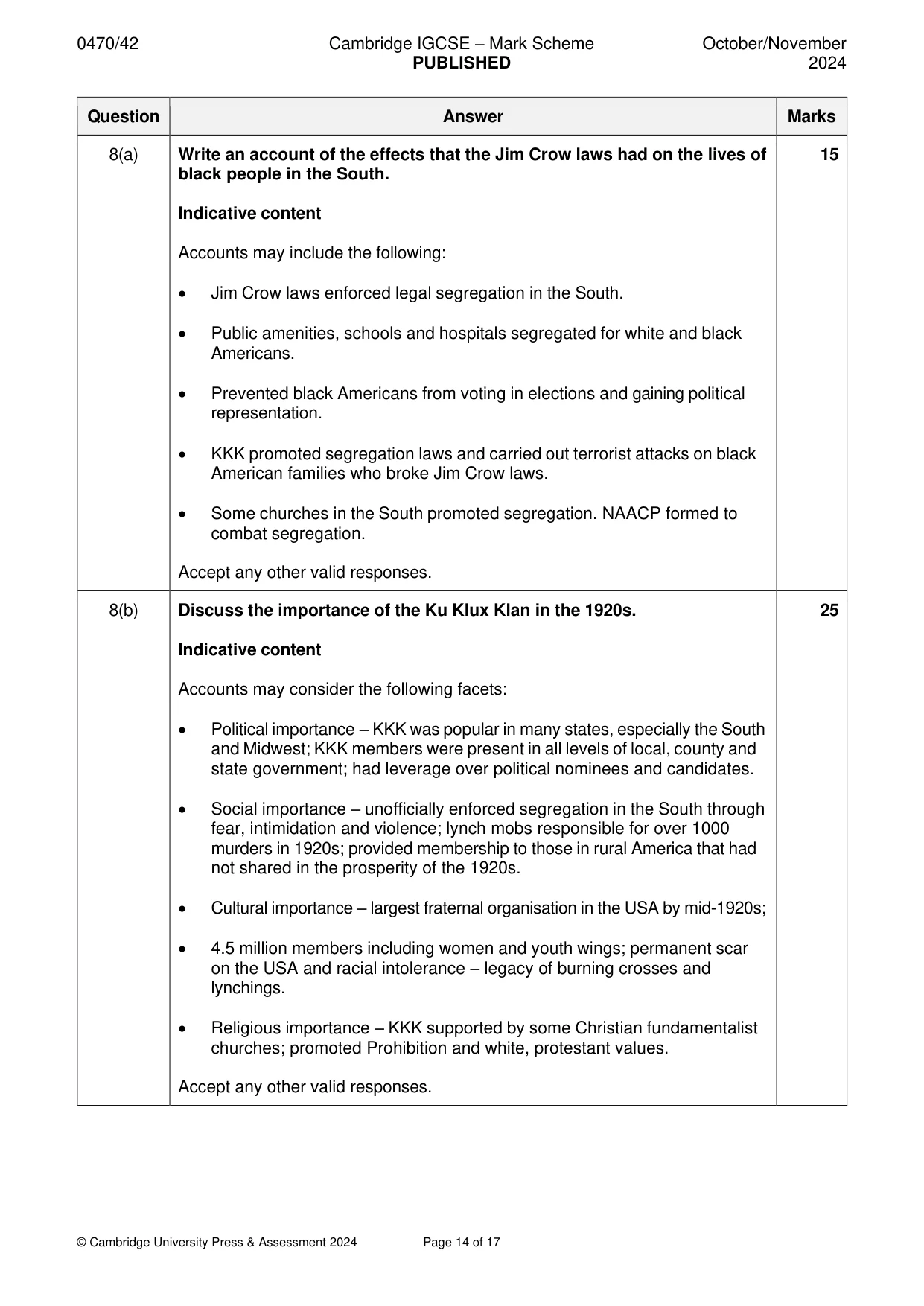
0470/42 Cambridge IGCSE – Mark Scheme PUBLISHED October/November 2024 © Cambridge University Press & Assessment 2024 Page 14 of 17 Question Answer Marks 8(a) Write an account of the effects that the Jim Crow laws had on the lives of black people in the South. Indicative content Accounts may include the following: • Jim Crow laws enforced legal segregation in the South. • Public amenities, schools and hospitals segregated for white and black Americans. • Prevented black Americans from voting in elections and gaining political representation. • KKK promoted segregation laws and carried out terrorist attacks on black American families who broke Jim Crow laws. • Some churches in the South promoted segregation. NAACP formed to combat segregation. Accept any other valid responses. 15 8(b) Discuss the importance of the Ku Klux Klan in the 1920s. Indicative content Accounts may consider the following facets: • Political importance – KKK was popular in many states, especially the South and Midwest; KKK members were present in all levels of local, county and state government; had leverage over political nominees and candidates. • Social importance – unofficially enforced segregation in the South through fear, intimidation and violence; lynch mobs responsible for over 1000 murders in 1920s; provided membership to those in rural America that had not shared in the prosperity of the 1920s. • Cultural importance – largest fraternal organisation in the USA by mid-1920s; • 4.5 million members including women and youth wings; permanent scar on the USA and racial intolerance – legacy of burning crosses and lynchings. • Religious importance – KKK supported by some Christian fundamentalist churches; promoted Prohibition and white, protestant values. Accept any other valid responses. 25
Mark scheme, page 15
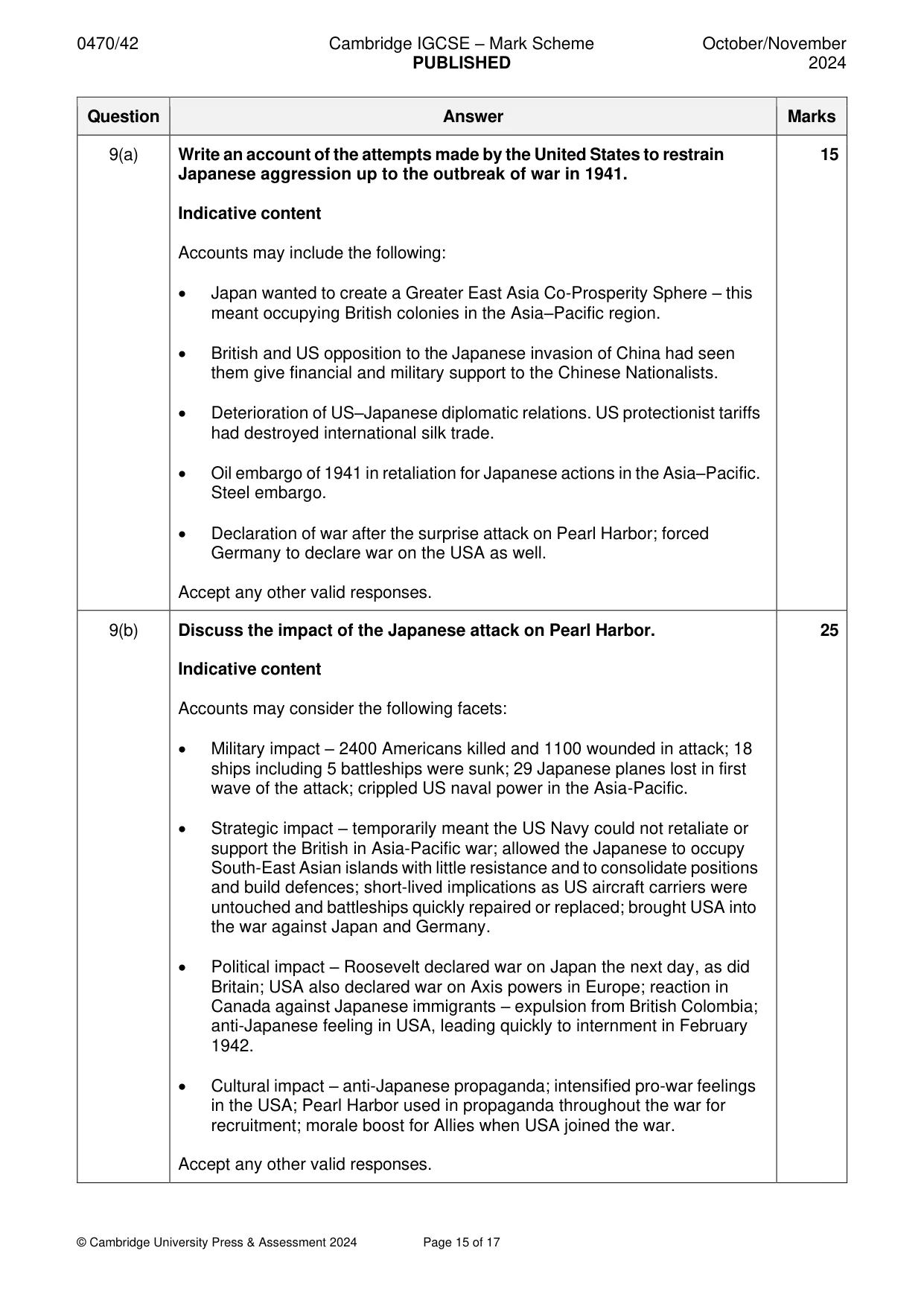
0470/42 Cambridge IGCSE – Mark Scheme PUBLISHED October/November 2024 © Cambridge University Press & Assessment 2024 Page 15 of 17 Question Answer Marks 9(a) Write an account of the attempts made by the United States to restrain Japanese aggression up to the outbreak of war in 1941. Indicative content Accounts may include the following: • Japan wanted to create a Greater East Asia Co-Prosperity Sphere – this meant occupying British colonies in the Asia–Pacific region. • British and US opposition to the Japanese invasion of China had seen them give financial and military support to the Chinese Nationalists. • Deterioration of US–Japanese diplomatic relations. US protectionist tariffs had destroyed international silk trade. • Oil embargo of 1941 in retaliation for Japanese actions in the Asia–Pacific. Steel embargo. • Declaration of war after the surprise attack on Pearl Harbor; forced Germany to declare war on the USA as well. Accept any other valid responses. 15 9(b) Discuss the impact of the Japanese attack on Pearl Harbor. Indicative content Accounts may consider the following facets: • Military impact – 2400 Americans killed and 1100 wounded in attack; 18 ships including 5 battleships were sunk; 29 Japanese planes lost in first wave of the attack; crippled US naval power in the Asia-Pacific. • Strategic impact – temporarily meant the US Navy could not retaliate or support the British in Asia-Pacific war; allowed the Japanese to occupy South-East Asian islands with little resistance and to consolidate positions and build defences; short-lived implications as US aircraft carriers were untouched and battleships quickly repaired or replaced; brought USA into the war against Japan and Germany. • Political impact – Roosevelt declared war on Japan the next day, as did Britain; USA also declared war on Axis powers in Europe; reaction in Canada against Japanese immigrants – expulsion from British Colombia; anti-Japanese feeling in USA, leading quickly to internment in February 1942. • Cultural impact – anti-Japanese propaganda; intensified pro-war feelings in the USA; Pearl Harbor used in propaganda throughout the war for recruitment; morale boost for Allies when USA joined the war. Accept any other valid responses. 25
Mark scheme, page 16
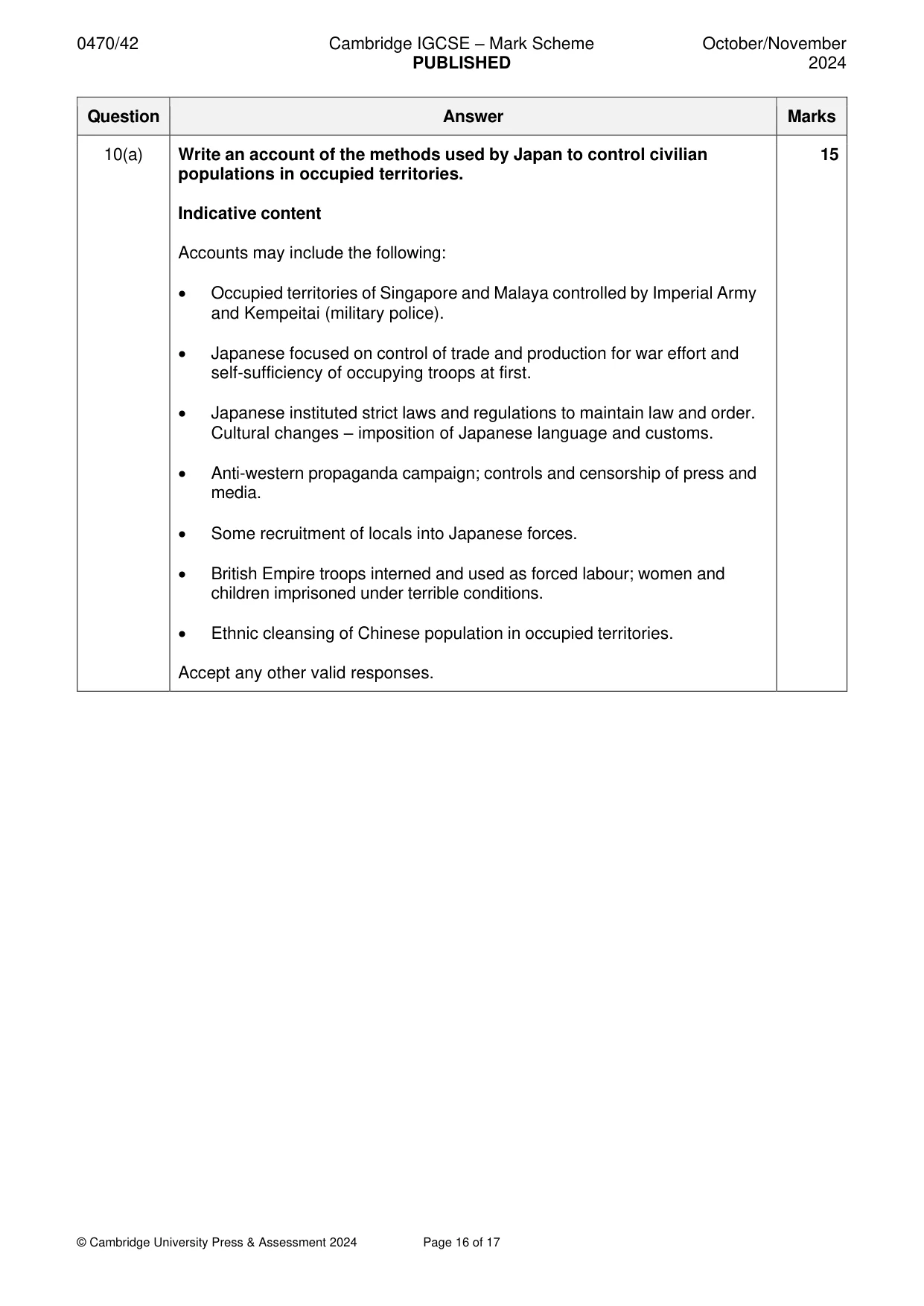
0470/42 Cambridge IGCSE – Mark Scheme PUBLISHED October/November 2024 © Cambridge University Press & Assessment 2024 Page 16 of 17 Question Answer Marks 10(a) Write an account of the methods used by Japan to control civilian populations in occupied territories. Indicative content Accounts may include the following: • Occupied territories of Singapore and Malaya controlled by Imperial Army and Kempeitai (military police). • Japanese focused on control of trade and production for war effort and self-sufficiency of occupying troops at first. • Japanese instituted strict laws and regulations to maintain law and order. Cultural changes – imposition of Japanese language and customs. • Anti-western propaganda campaign; controls and censorship of press and media. • Some recruitment of locals into Japanese forces. • British Empire troops interned and used as forced labour; women and children imprisoned under terrible conditions. • Ethnic cleansing of Chinese population in occupied territories. Accept any other valid responses. 15
Mark scheme, page 17
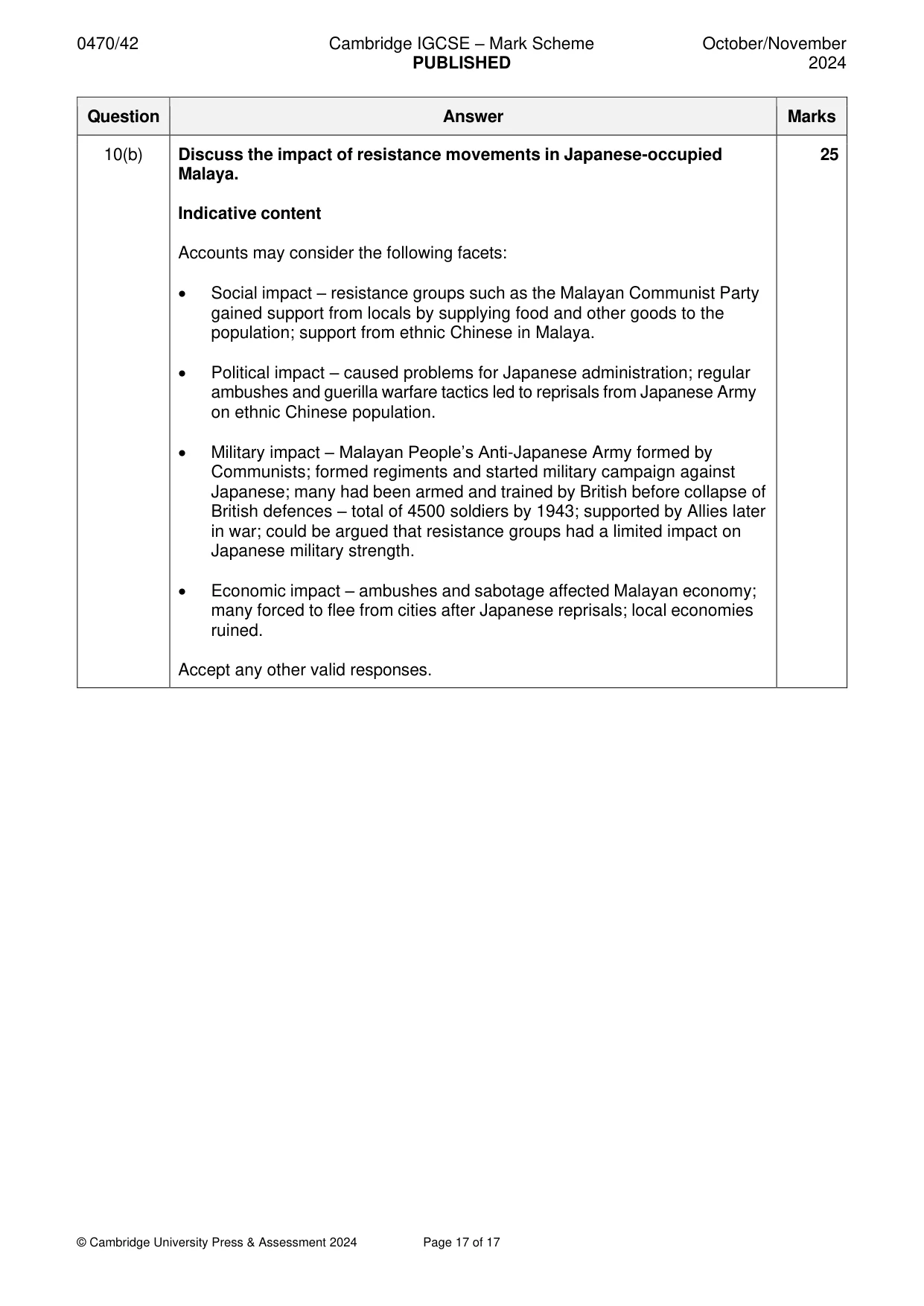
0470/42 Cambridge IGCSE – Mark Scheme PUBLISHED October/November 2024 © Cambridge University Press & Assessment 2024 Page 17 of 17 Question Answer Marks 10(b) Discuss the impact of resistance movements in Japanese-occupied Malaya. Indicative content Accounts may consider the following facets: • Social impact – resistance groups such as the Malayan Communist Party gained support from locals by supplying food and other goods to the population; support from ethnic Chinese in Malaya. • Political impact – caused problems for Japanese administration; regular ambushes and guerilla warfare tactics led to reprisals from Japanese Army on ethnic Chinese population. • Military impact – Malayan People’s Anti-Japanese Army formed by Communists; formed regiments and started military campaign against Japanese; many had been armed and trained by British before collapse of British defences – total of 4500 soldiers by 1943; supported by Allies later in war; could be argued that resistance groups had a limited impact on Japanese military strength. • Economic impact – ambushes and sabotage affected Malayan economy; many forced to flee from cities after Japanese reprisals; local economies ruined. Accept any other valid responses. 25
What you needed in this session
Cambridge’s own grade thresholds for 2024 Oct/Nov, Paper 4 · Variant 2. A higher threshold means an easier paper — the bar moves with how the cohort did.