Cambridge IGCSE History 0470 — 2022 Oct/Nov Paper 4 · Variant 3
0470/43/O/N/22 · 40 marks · ≈45 min
The question paper and its mark scheme, free to read here and free to download. This is Cambridge’s own paper, exactly as it was sat.
Question paper4 pages

Mark scheme14 pages
Answers below. Sit the paper first if you are practising.
Paper as text
Question paper, page 1
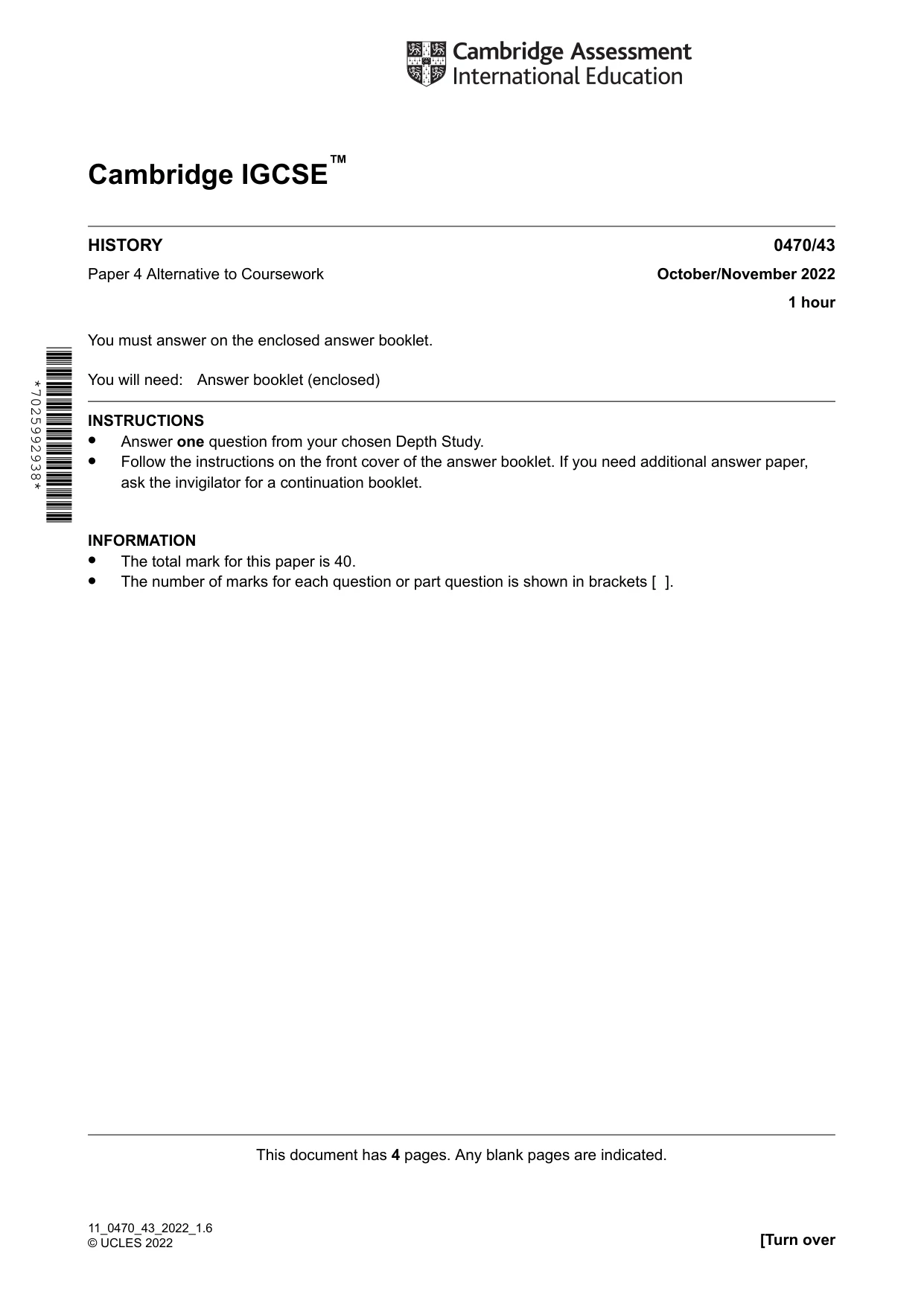
Cambridge IGCSE™ 0470/43 October/November 2022 1 hour HISTORY Paper 4 Alternative to Coursework You must answer on the enclosed answer booklet. You will need: Answer booklet (enclosed) INSTRUCTIONS • Answer one question from your chosen Depth Study. • Follow the instructions on the front cover of the answer booklet. If you need additional answer paper, ask the invigilator for a continuation booklet. INFORMATION • The total mark for this paper is 40. • The number of marks for each question or part question is shown in brackets [ ]. This document has 4 pages. Any blank pages are indicated. [Turn over 11_0470_43_2022_1.6 © UCLES 2022 *7025992938*
Question paper, page 2
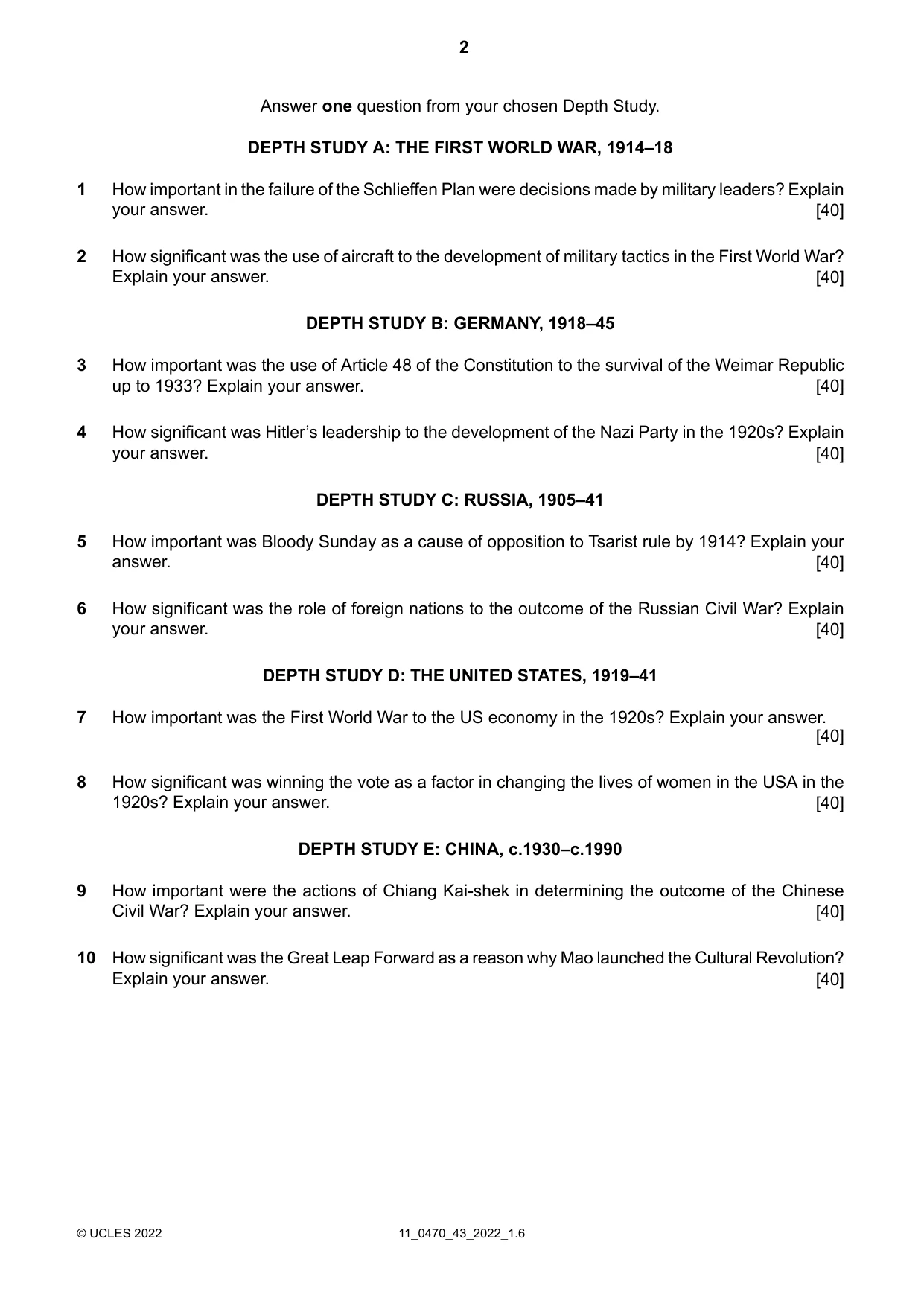
Answer one question from your chosen Depth Study. DEPTH STUDY A: THE FIRST WORLD WAR, 1914–18 How important in the failure of the Schlieffen Plan were decisions made by military leaders? Explain your answer. [40] 1 How significant was the use of aircraft to the development of military tactics in the First World War? Explain your answer. [40] 2 DEPTH STUDY B: GERMANY, 1918–45 How important was the use of Article 48 of the Constitution to the survival of the Weimar Republic up to 1933? Explain your answer. [40] 3 How significant was Hitler’s leadership to the development of the Nazi Party in the 1920s? Explain your answer. [40] 4 DEPTH STUDY C: RUSSIA, 1905–41 How important was Bloody Sunday as a cause of opposition to Tsarist rule by 1914? Explain your answer. [40] 5 How significant was the role of foreign nations to the outcome of the Russian Civil War? Explain your answer. [40] 6 DEPTH STUDY D: THE UNITED STATES, 1919–41 How important was the First World War to the US economy in the 1920s? Explain your answer. [40] 7 How significant was winning the vote as a factor in changing the lives of women in the USA in the 1920s? Explain your answer. [40] 8 DEPTH STUDY E: CHINA, c.1930–c.1990 How important were the actions of Chiang Kai-shek in determining the outcome of the Chinese Civil War? Explain your answer. [40] 9 How significant was the Great Leap Forward as a reason why Mao launched the Cultural Revolution? Explain your answer. [40] 10 11_0470_43_2022_1.6 © UCLES 2022 2
Question paper, page 3
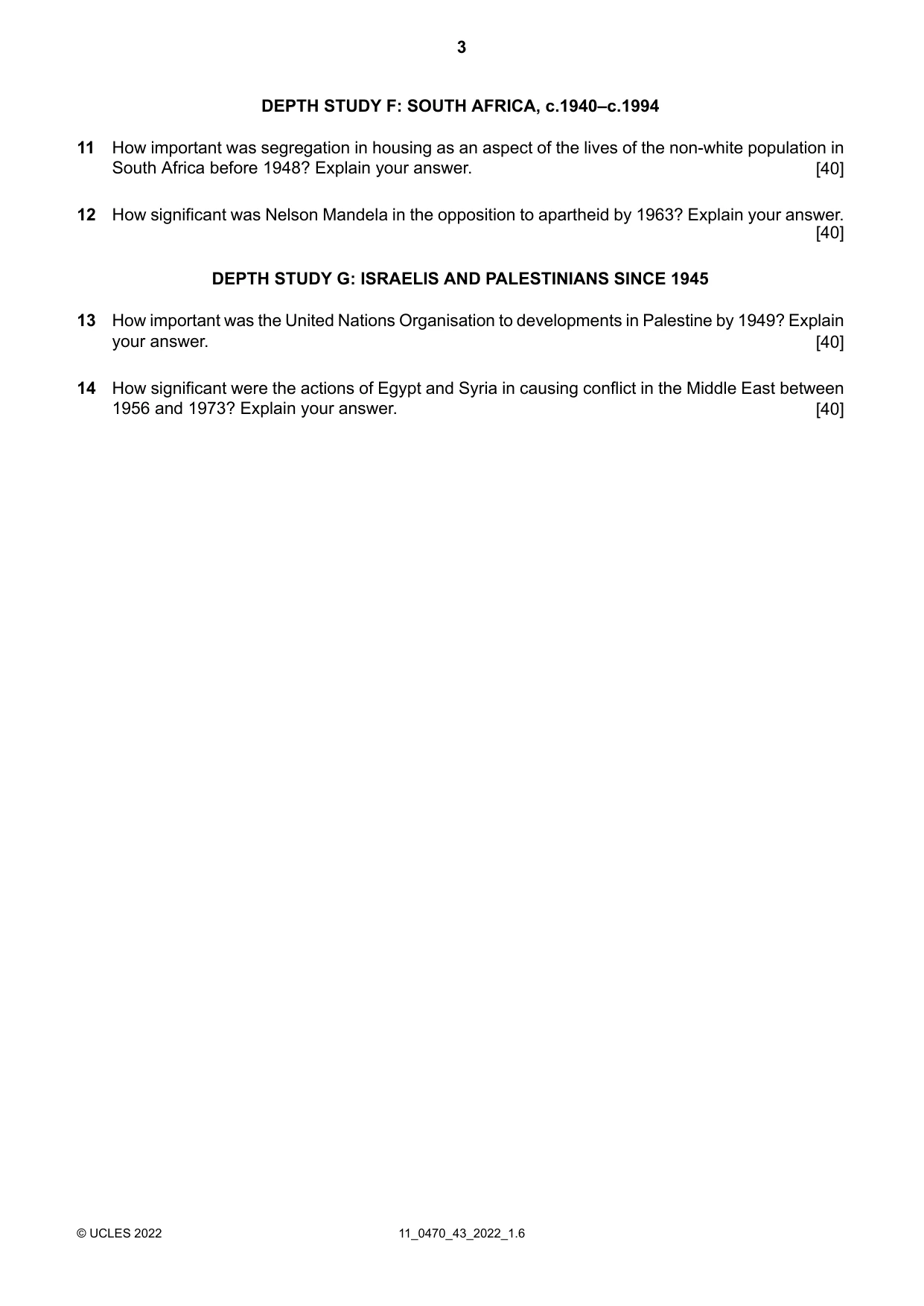
DEPTH STUDY F: SOUTH AFRICA, c.1940–c.1994 How important was segregation in housing as an aspect of the lives of the non-white population in South Africa before 1948? Explain your answer. [40] 11 How significant was Nelson Mandela in the opposition to apartheid by 1963? Explain your answer. [40] 12 DEPTH STUDY G: ISRAELIS AND PALESTINIANS SINCE 1945 How important was the United Nations Organisation to developments in Palestine by 1949? Explain your answer. [40] 13 How significant were the actions of Egypt and Syria in causing conflict in the Middle East between 1956 and 1973? Explain your answer. [40] 14 11_0470_43_2022_1.6 © UCLES 2022 3
Question paper, page 4
BLANK PAGE Permission to reproduce items where third-party owned material protected by copyright is included has been sought and cleared where possible. Every reasonable effort has been made by the publisher (UCLES) to trace copyright holders, but if any items requiring clearance have unwittingly been included, the publisher will be pleased to make amends at the earliest possible opportunity. To avoid the issue of disclosure of answer-related information to candidates, all copyright acknowledgements are reproduced online in the Cambridge Assessment International Education Copyright Acknowledgements Booklet. This is produced for each series of examinations and is freely available to download at www.cambridgeinternational.org after the live examination series. Cambridge Assessment International Education is part of Cambridge Assessment. Cambridge Assessment is the brand name of the University of Cambridge Local Examinations Syndicate (UCLES), which is a department of the University of Cambridge. 11_0470_43_2022_1.6 © UCLES 2022 4
Mark scheme, page 1
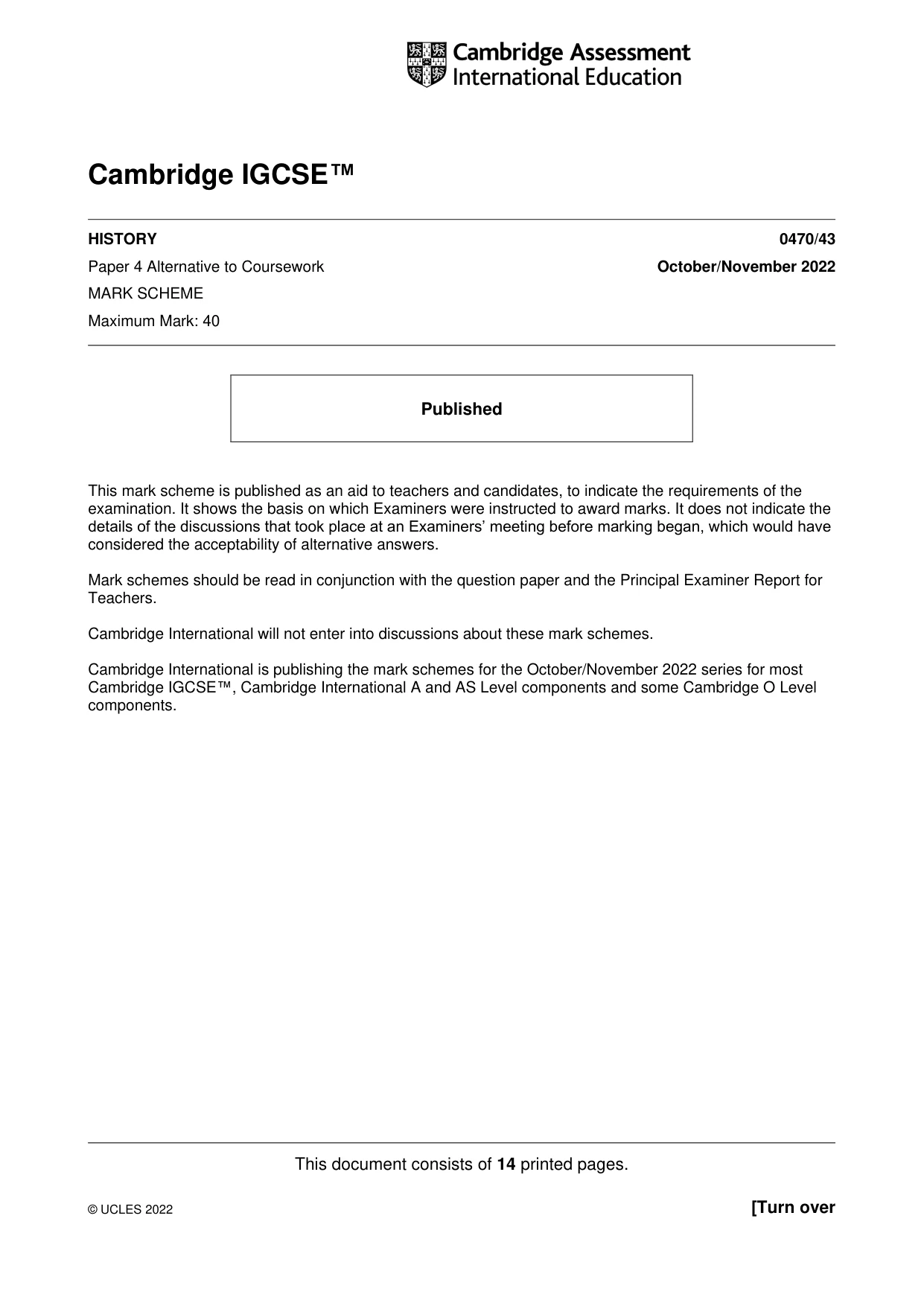
This document consists of 14 printed pages. © UCLES 2022 [Turn over Cambridge IGCSE™ HISTORY 0470/43 Paper 4 Alternative to Coursework October/November 2022 MARK SCHEME Maximum Mark: 40 Published This mark scheme is published as an aid to teachers and candidates, to indicate the requirements of the examination. It shows the basis on which Examiners were instructed to award marks. It does not indicate the details of the discussions that took place at an Examiners’ meeting before marking began, which would have considered the acceptability of alternative answers. Mark schemes should be read in conjunction with the question paper and the Principal Examiner Report for Teachers. Cambridge International will not enter into discussions about these mark schemes. Cambridge International is publishing the mark schemes for the October/November 2022 series for most Cambridge IGCSE™, Cambridge International A and AS Level components and some Cambridge O Level components.
Mark scheme, page 2
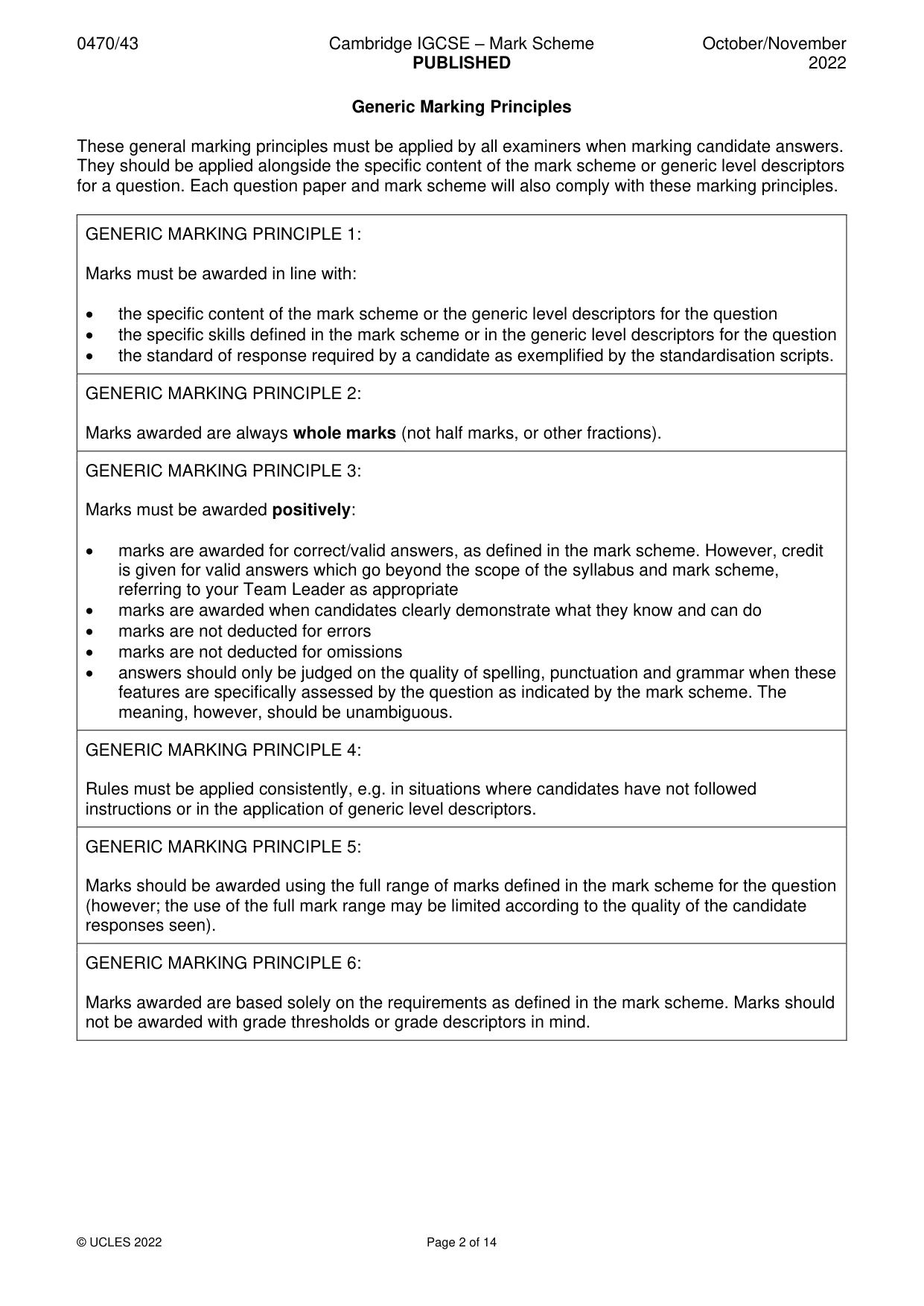
0470/43 Cambridge IGCSE – Mark Scheme PUBLISHED October/November 2022 © UCLES 2022 Page 2 of 14 Generic Marking Principles These general marking principles must be applied by all examiners when marking candidate answers. They should be applied alongside the specific content of the mark scheme or generic level descriptors for a question. Each question paper and mark scheme will also comply with these marking principles. GENERIC MARKING PRINCIPLE 1: Marks must be awarded in line with: • the specific content of the mark scheme or the generic level descriptors for the question • the specific skills defined in the mark scheme or in the generic level descriptors for the question • the standard of response required by a candidate as exemplified by the standardisation scripts. GENERIC MARKING PRINCIPLE 2: Marks awarded are always whole marks (not half marks, or other fractions). GENERIC MARKING PRINCIPLE 3: Marks must be awarded positively: • marks are awarded for correct/valid answers, as defined in the mark scheme. However, credit is given for valid answers which go beyond the scope of the syllabus and mark scheme, referring to your Team Leader as appropriate • marks are awarded when candidates clearly demonstrate what they know and can do • marks are not deducted for errors • marks are not deducted for omissions • answers should only be judged on the quality of spelling, punctuation and grammar when these features are specifically assessed by the question as indicated by the mark scheme. The meaning, however, should be unambiguous. GENERIC MARKING PRINCIPLE 4: Rules must be applied consistently, e.g. in situations where candidates have not followed instructions or in the application of generic level descriptors. GENERIC MARKING PRINCIPLE 5: Marks should be awarded using the full range of marks defined in the mark scheme for the question (however; the use of the full mark range may be limited according to the quality of the candidate responses seen). GENERIC MARKING PRINCIPLE 6: Marks awarded are based solely on the requirements as defined in the mark scheme. Marks should not be awarded with grade thresholds or grade descriptors in mind.
Mark scheme, page 3
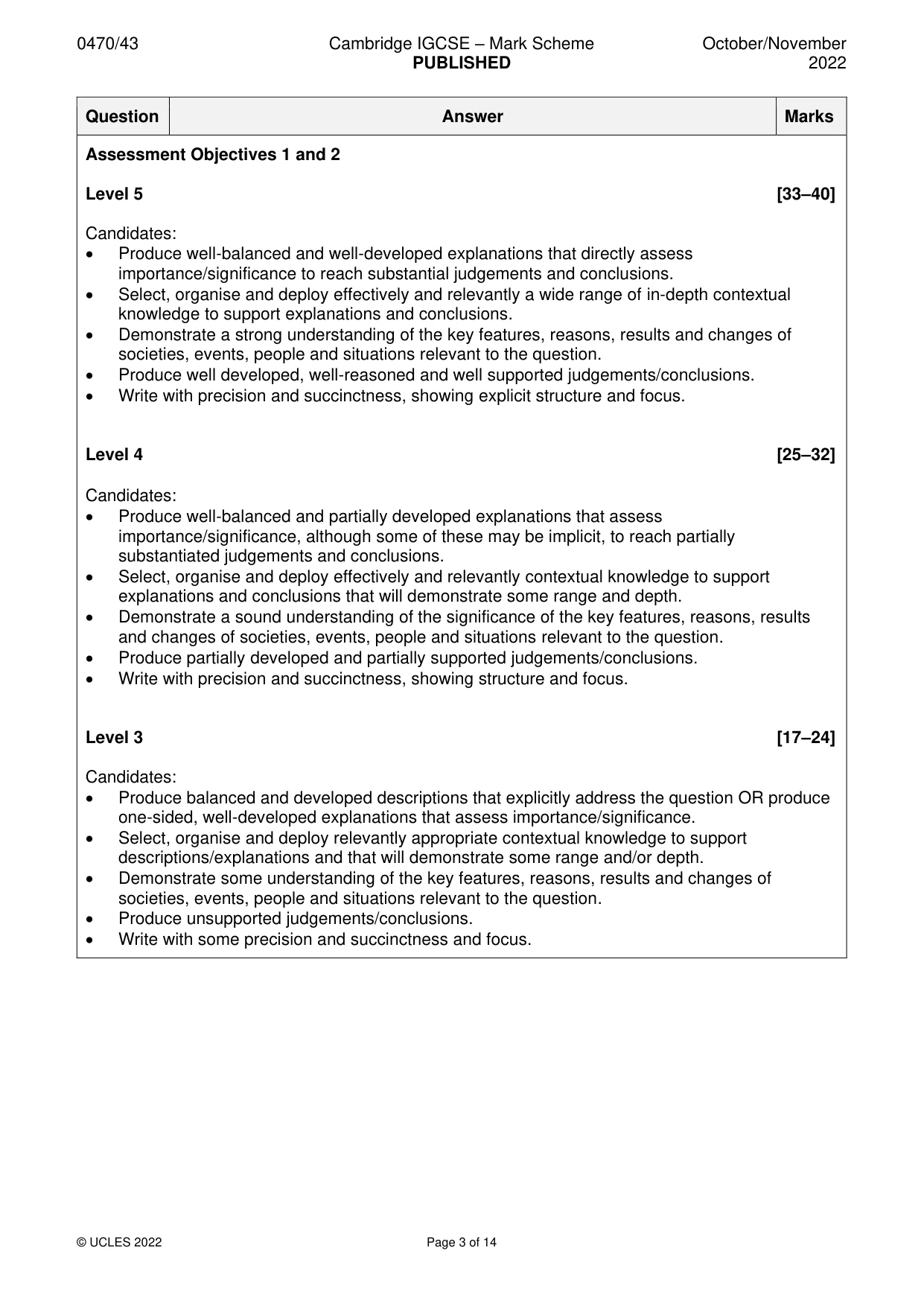
0470/43 Cambridge IGCSE – Mark Scheme PUBLISHED October/November 2022 © UCLES 2022 Page 3 of 14 Question Answer Marks Assessment Objectives 1 and 2 Level 5 [33–40] Candidates: • Produce well-balanced and well-developed explanations that directly assess importance/significance to reach substantial judgements and conclusions. • Select, organise and deploy effectively and relevantly a wide range of in-depth contextual knowledge to support explanations and conclusions. • Demonstrate a strong understanding of the key features, reasons, results and changes of societies, events, people and situations relevant to the question. • Produce well developed, well-reasoned and well supported judgements/conclusions. • Write with precision and succinctness, showing explicit structure and focus. Level 4 [25–32] Candidates: • Produce well-balanced and partially developed explanations that assess importance/significance, although some of these may be implicit, to reach partially substantiated judgements and conclusions. • Select, organise and deploy effectively and relevantly contextual knowledge to support explanations and conclusions that will demonstrate some range and depth. • Demonstrate a sound understanding of the significance of the key features, reasons, results and changes of societies, events, people and situations relevant to the question. • Produce partially developed and partially supported judgements/conclusions. • Write with precision and succinctness, showing structure and focus. Level 3 [17–24] Candidates: • Produce balanced and developed descriptions that explicitly address the question OR produce one-sided, well-developed explanations that assess importance/significance. • Select, organise and deploy relevantly appropriate contextual knowledge to support descriptions/explanations and that will demonstrate some range and/or depth. • Demonstrate some understanding of the key features, reasons, results and changes of societies, events, people and situations relevant to the question. • Produce unsupported judgements/conclusions. • Write with some precision and succinctness and focus.
Mark scheme, page 4
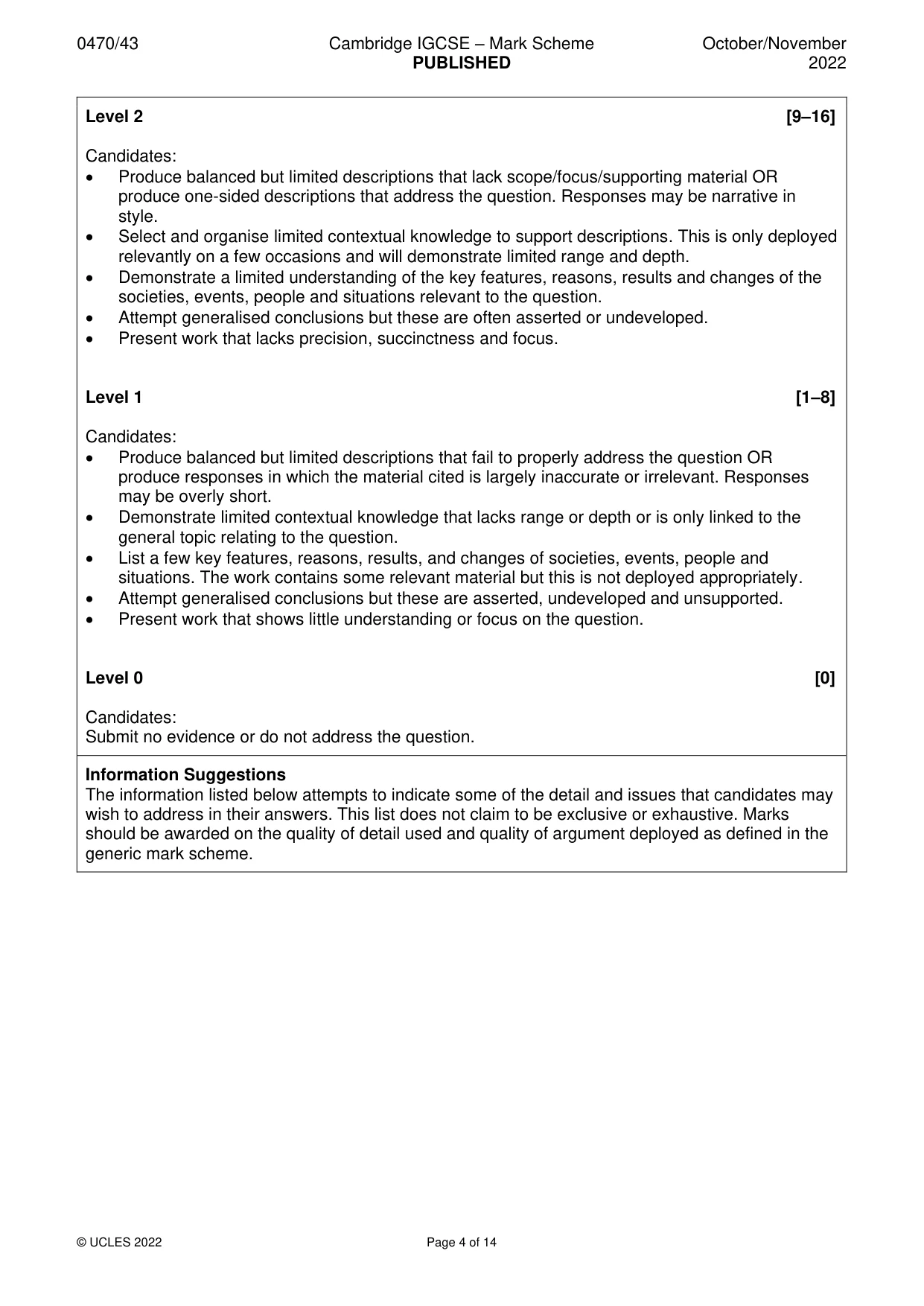
0470/43 Cambridge IGCSE – Mark Scheme PUBLISHED October/November 2022 © UCLES 2022 Page 4 of 14 Level 2 [9–16] Candidates: • Produce balanced but limited descriptions that lack scope/focus/supporting material OR produce one-sided descriptions that address the question. Responses may be narrative in style. • Select and organise limited contextual knowledge to support descriptions. This is only deployed relevantly on a few occasions and will demonstrate limited range and depth. • Demonstrate a limited understanding of the key features, reasons, results and changes of the societies, events, people and situations relevant to the question. • Attempt generalised conclusions but these are often asserted or undeveloped. • Present work that lacks precision, succinctness and focus. Level 1 [1–8] Candidates: • Produce balanced but limited descriptions that fail to properly address the question OR produce responses in which the material cited is largely inaccurate or irrelevant. Responses may be overly short. • Demonstrate limited contextual knowledge that lacks range or depth or is only linked to the general topic relating to the question. • List a few key features, reasons, results, and changes of societies, events, people and situations. The work contains some relevant material but this is not deployed appropriately. • Attempt generalised conclusions but these are asserted, undeveloped and unsupported. • Present work that shows little understanding or focus on the question. Level 0 [0] Candidates: Submit no evidence or do not address the question. Information Suggestions The information listed below attempts to indicate some of the detail and issues that candidates may wish to address in their answers. This list does not claim to be exclusive or exhaustive. Marks should be awarded on the quality of detail used and quality of argument deployed as defined in the generic mark scheme.
Mark scheme, page 5
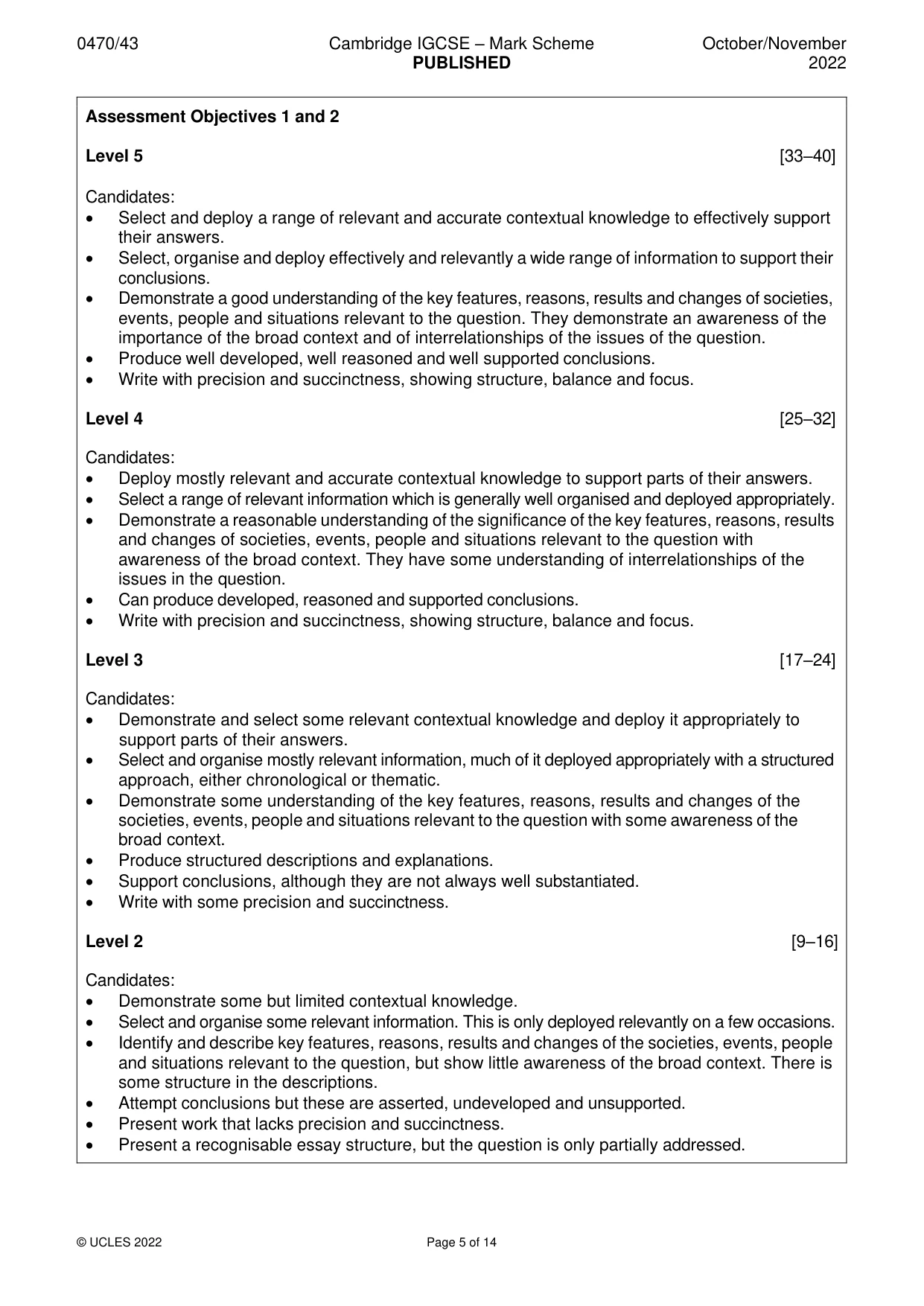
0470/43 Cambridge IGCSE – Mark Scheme PUBLISHED October/November 2022 © UCLES 2022 Page 5 of 14 Assessment Objectives 1 and 2 Level 5 [33–40] Candidates: • Select and deploy a range of relevant and accurate contextual knowledge to effectively support their answers. • Select, organise and deploy effectively and relevantly a wide range of information to support their conclusions. • Demonstrate a good understanding of the key features, reasons, results and changes of societies, events, people and situations relevant to the question. They demonstrate an awareness of the importance of the broad context and of interrelationships of the issues of the question. • Produce well developed, well reasoned and well supported conclusions. • Write with precision and succinctness, showing structure, balance and focus. Level 4 [25–32] Candidates: • Deploy mostly relevant and accurate contextual knowledge to support parts of their answers. • Select a range of relevant information which is generally well organised and deployed appropriately. • Demonstrate a reasonable understanding of the significance of the key features, reasons, results and changes of societies, events, people and situations relevant to the question with awareness of the broad context. They have some understanding of interrelationships of the issues in the question. • Can produce developed, reasoned and supported conclusions. • Write with precision and succinctness, showing structure, balance and focus. Level 3 [17–24] Candidates: • Demonstrate and select some relevant contextual knowledge and deploy it appropriately to support parts of their answers. • Select and organise mostly relevant information, much of it deployed appropriately with a structured approach, either chronological or thematic. • Demonstrate some understanding of the key features, reasons, results and changes of the societies, events, people and situations relevant to the question with some awareness of the broad context. • Produce structured descriptions and explanations. • Support conclusions, although they are not always well substantiated. • Write with some precision and succinctness. Level 2 [9–16] Candidates: • Demonstrate some but limited contextual knowledge. • Select and organise some relevant information. This is only deployed relevantly on a few occasions. • Identify and describe key features, reasons, results and changes of the societies, events, people and situations relevant to the question, but show little awareness of the broad context. There is some structure in the descriptions. • Attempt conclusions but these are asserted, undeveloped and unsupported. • Present work that lacks precision and succinctness. • Present a recognisable essay structure, but the question is only partially addressed.
Mark scheme, page 6
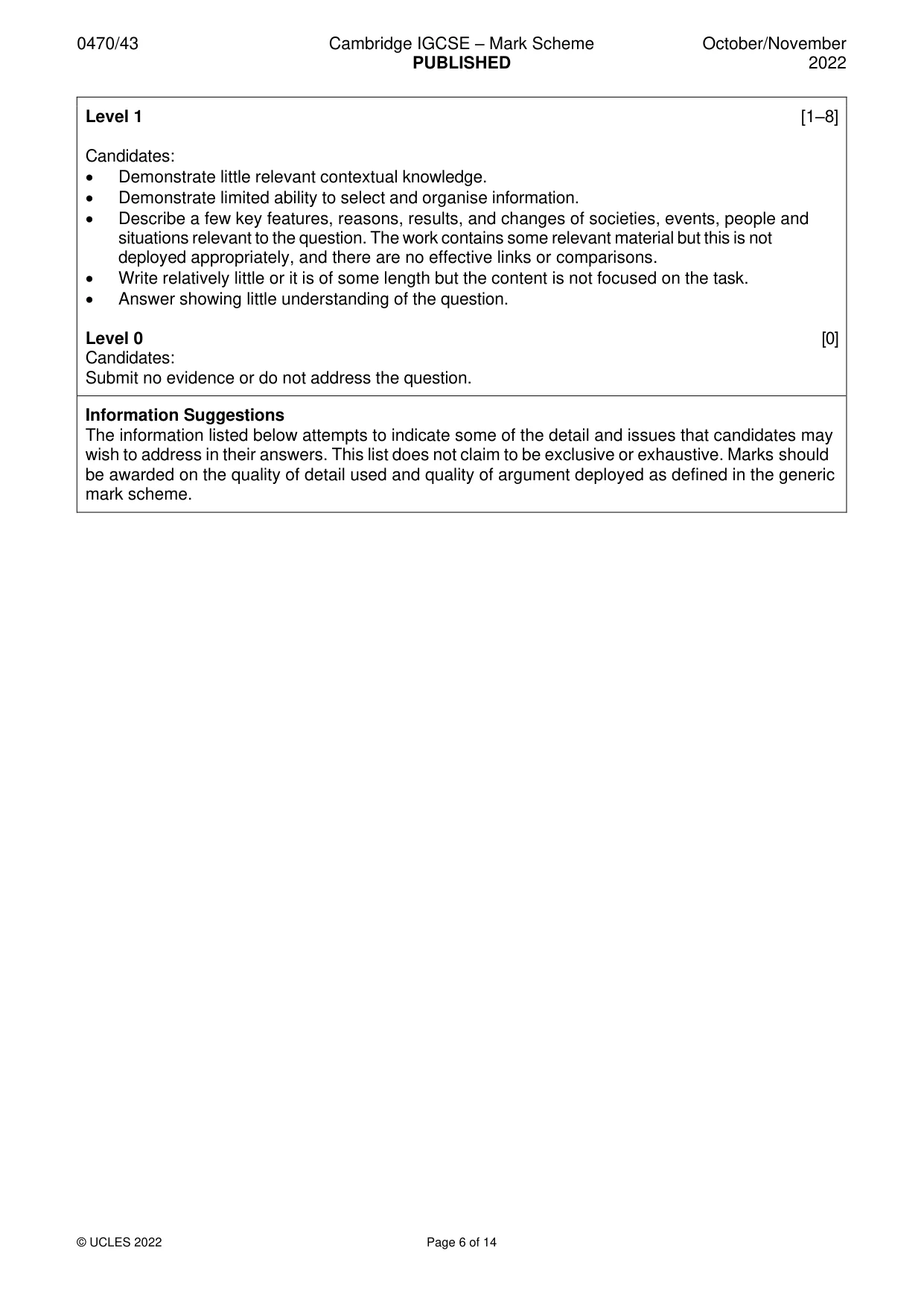
0470/43 Cambridge IGCSE – Mark Scheme PUBLISHED October/November 2022 © UCLES 2022 Page 6 of 14 Level 1 [1–8] Candidates: • Demonstrate little relevant contextual knowledge. • Demonstrate limited ability to select and organise information. • Describe a few key features, reasons, results, and changes of societies, events, people and situations relevant to the question. The work contains some relevant material but this is not deployed appropriately, and there are no effective links or comparisons. • Write relatively little or it is of some length but the content is not focused on the task. • Answer showing little understanding of the question. Level 0 [0] Candidates: Submit no evidence or do not address the question. Information Suggestions The information listed below attempts to indicate some of the detail and issues that candidates may wish to address in their answers. This list does not claim to be exclusive or exhaustive. Marks should be awarded on the quality of detail used and quality of argument deployed as defined in the generic mark scheme.
Mark scheme, page 7
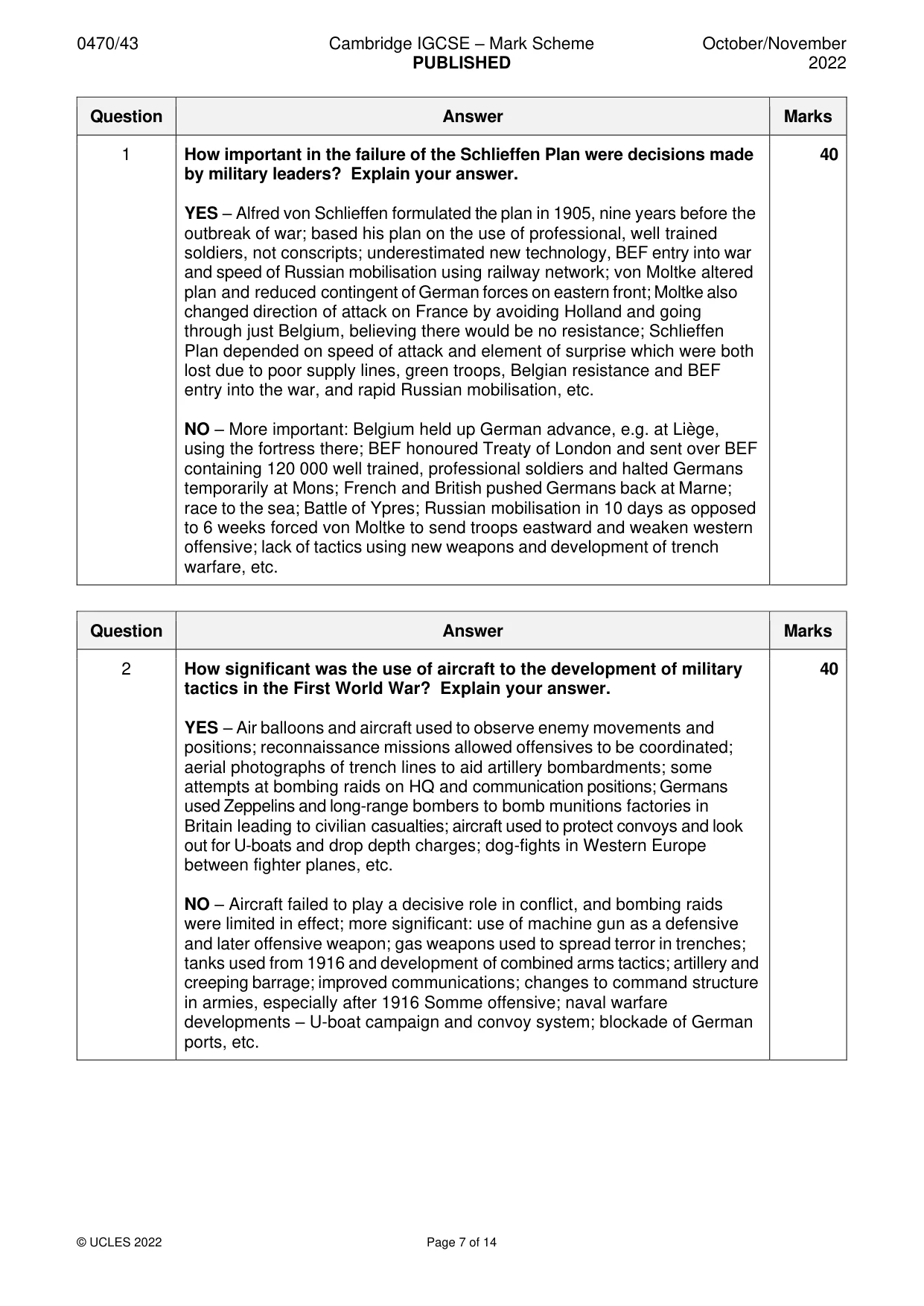
0470/43 Cambridge IGCSE – Mark Scheme PUBLISHED October/November 2022 © UCLES 2022 Page 7 of 14 Question Answer Marks 1 How important in the failure of the Schlieffen Plan were decisions made by military leaders? Explain your answer. YES – Alfred von Schlieffen formulated the plan in 1905, nine years before the outbreak of war; based his plan on the use of professional, well trained soldiers, not conscripts; underestimated new technology, BEF entry into war and speed of Russian mobilisation using railway network; von Moltke altered plan and reduced contingent of German forces on eastern front; Moltke also changed direction of attack on France by avoiding Holland and going through just Belgium, believing there would be no resistance; Schlieffen Plan depended on speed of attack and element of surprise which were both lost due to poor supply lines, green troops, Belgian resistance and BEF entry into the war, and rapid Russian mobilisation, etc. NO – More important: Belgium held up German advance, e.g. at Liège, using the fortress there; BEF honoured Treaty of London and sent over BEF containing 120 000 well trained, professional soldiers and halted Germans temporarily at Mons; French and British pushed Germans back at Marne; race to the sea; Battle of Ypres; Russian mobilisation in 10 days as opposed to 6 weeks forced von Moltke to send troops eastward and weaken western offensive; lack of tactics using new weapons and development of trench warfare, etc. 40 Question Answer Marks 2 How significant was the use of aircraft to the development of military tactics in the First World War? Explain your answer. YES – Air balloons and aircraft used to observe enemy movements and positions; reconnaissance missions allowed offensives to be coordinated; aerial photographs of trench lines to aid artillery bombardments; some attempts at bombing raids on HQ and communication positions; Germans used Zeppelins and long-range bombers to bomb munitions factories in Britain leading to civilian casualties; aircraft used to protect convoys and look out for U-boats and drop depth charges; dog-fights in Western Europe between fighter planes, etc. NO – Aircraft failed to play a decisive role in conflict, and bombing raids were limited in effect; more significant: use of machine gun as a defensive and later offensive weapon; gas weapons used to spread terror in trenches; tanks used from 1916 and development of combined arms tactics; artillery and creeping barrage; improved communications; changes to command structure in armies, especially after 1916 Somme offensive; naval warfare developments – U-boat campaign and convoy system; blockade of German ports, etc. 40
Mark scheme, page 8
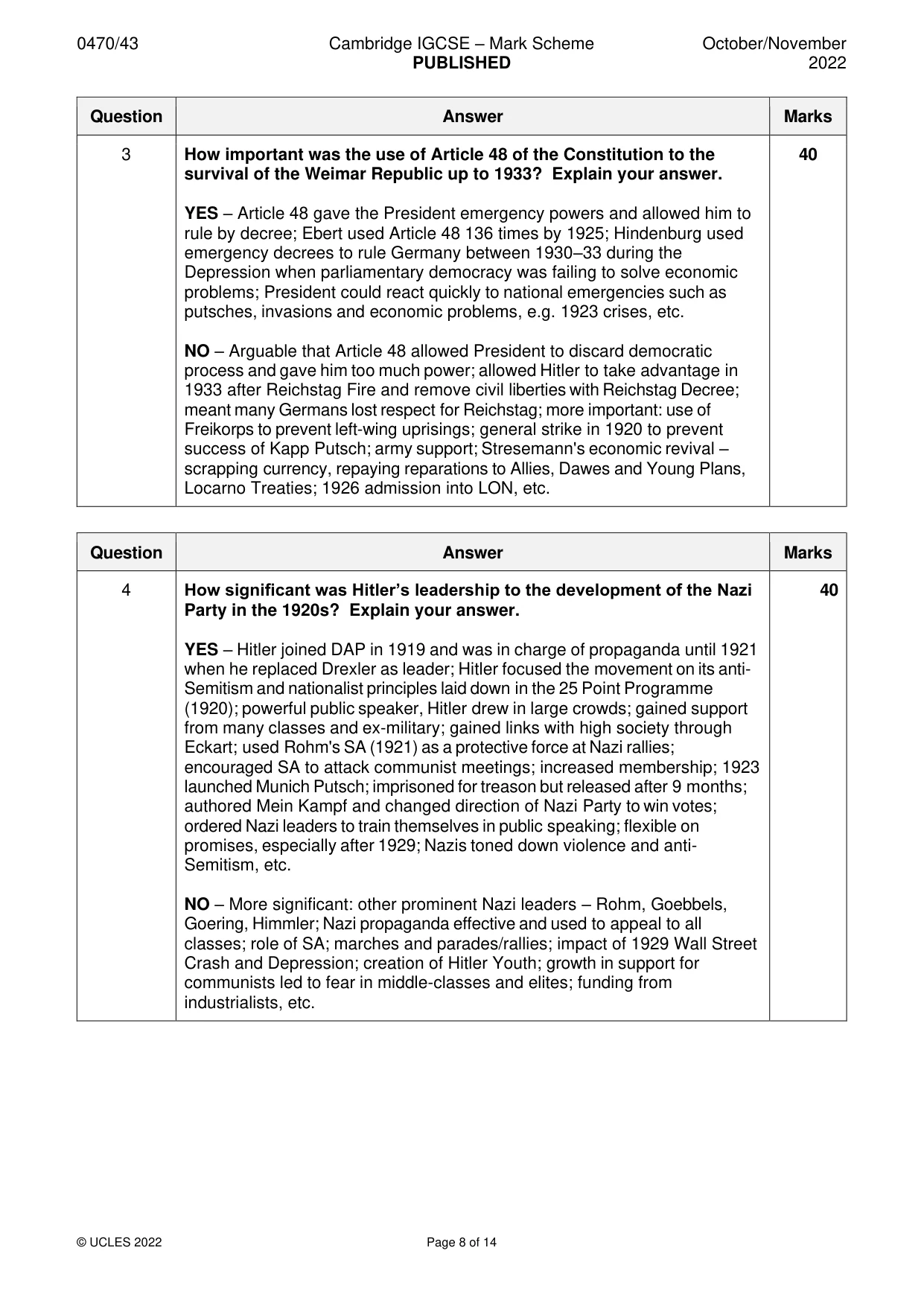
0470/43 Cambridge IGCSE – Mark Scheme PUBLISHED October/November 2022 © UCLES 2022 Page 8 of 14 Question Answer Marks 3 How important was the use of Article 48 of the Constitution to the survival of the Weimar Republic up to 1933? Explain your answer. YES – Article 48 gave the President emergency powers and allowed him to rule by decree; Ebert used Article 48 136 times by 1925; Hindenburg used emergency decrees to rule Germany between 1930–33 during the Depression when parliamentary democracy was failing to solve economic problems; President could react quickly to national emergencies such as putsches, invasions and economic problems, e.g. 1923 crises, etc. NO – Arguable that Article 48 allowed President to discard democratic process and gave him too much power; allowed Hitler to take advantage in 1933 after Reichstag Fire and remove civil liberties with Reichstag Decree; meant many Germans lost respect for Reichstag; more important: use of Freikorps to prevent left-wing uprisings; general strike in 1920 to prevent success of Kapp Putsch; army support; Stresemann's economic revival – scrapping currency, repaying reparations to Allies, Dawes and Young Plans, Locarno Treaties; 1926 admission into LON, etc. 40 Question Answer Marks 4 How significant was Hitler’s leadership to the development of the Nazi Party in the 1920s? Explain your answer. YES – Hitler joined DAP in 1919 and was in charge of propaganda until 1921 when he replaced Drexler as leader; Hitler focused the movement on its anti- Semitism and nationalist principles laid down in the 25 Point Programme (1920); powerful public speaker, Hitler drew in large crowds; gained support from many classes and ex-military; gained links with high society through Eckart; used Rohm's SA (1921) as a protective force at Nazi rallies; encouraged SA to attack communist meetings; increased membership; 1923 launched Munich Putsch; imprisoned for treason but released after 9 months; authored Mein Kampf and changed direction of Nazi Party to win votes; ordered Nazi leaders to train themselves in public speaking; flexible on promises, especially after 1929; Nazis toned down violence and anti- Semitism, etc. NO – More significant: other prominent Nazi leaders – Rohm, Goebbels, Goering, Himmler; Nazi propaganda effective and used to appeal to all classes; role of SA; marches and parades/rallies; impact of 1929 Wall Street Crash and Depression; creation of Hitler Youth; growth in support for communists led to fear in middle-classes and elites; funding from industrialists, etc. 40
Mark scheme, page 9
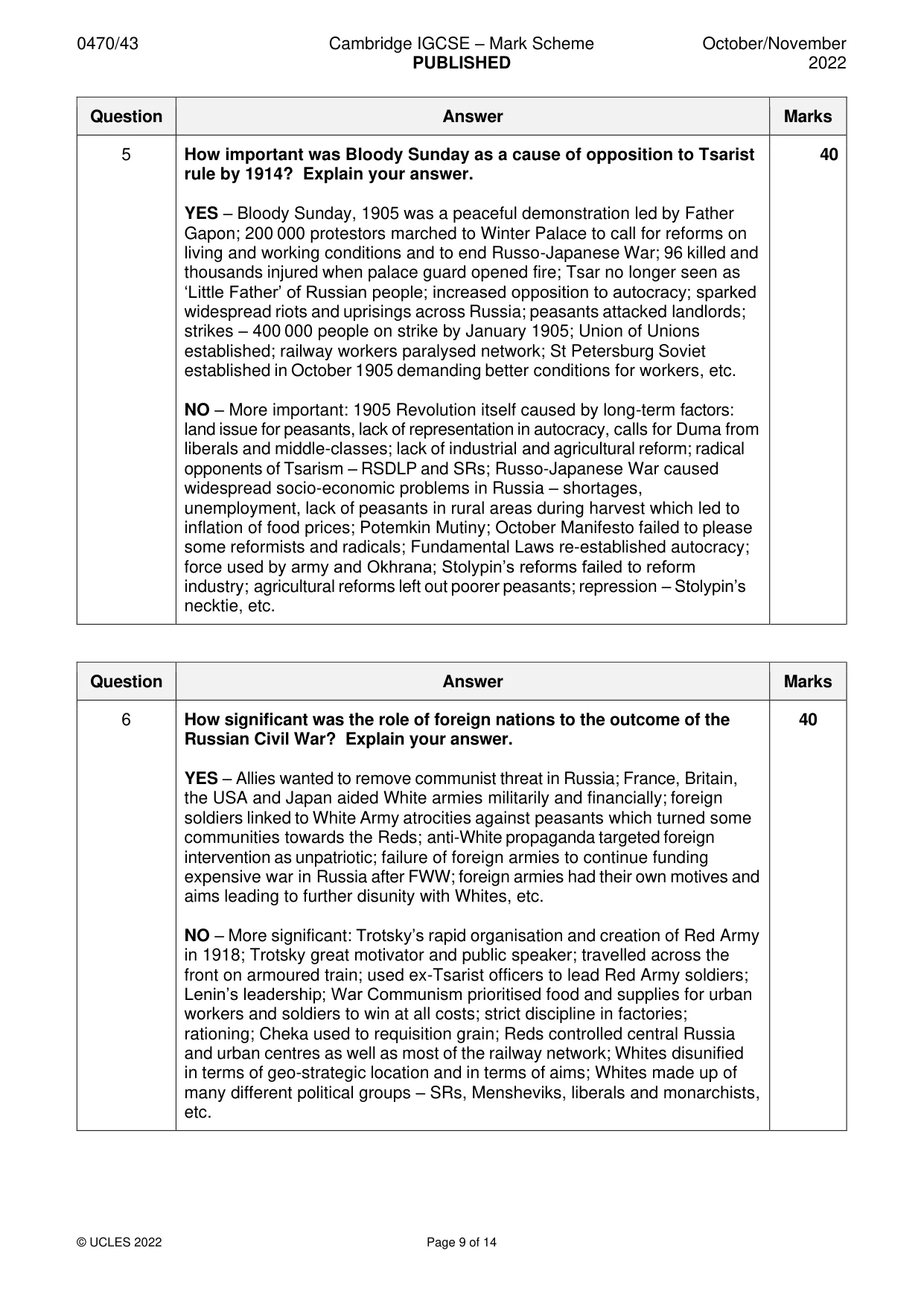
0470/43 Cambridge IGCSE – Mark Scheme PUBLISHED October/November 2022 © UCLES 2022 Page 9 of 14 Question Answer Marks 5 How important was Bloody Sunday as a cause of opposition to Tsarist rule by 1914? Explain your answer. YES – Bloody Sunday, 1905 was a peaceful demonstration led by Father Gapon; 200 000 protestors marched to Winter Palace to call for reforms on living and working conditions and to end Russo-Japanese War; 96 killed and thousands injured when palace guard opened fire; Tsar no longer seen as ‘Little Father’ of Russian people; increased opposition to autocracy; sparked widespread riots and uprisings across Russia; peasants attacked landlords; strikes – 400 000 people on strike by January 1905; Union of Unions established; railway workers paralysed network; St Petersburg Soviet established in October 1905 demanding better conditions for workers, etc. NO – More important: 1905 Revolution itself caused by long-term factors: land issue for peasants, lack of representation in autocracy, calls for Duma from liberals and middle-classes; lack of industrial and agricultural reform; radical opponents of Tsarism – RSDLP and SRs; Russo-Japanese War caused widespread socio-economic problems in Russia – shortages, unemployment, lack of peasants in rural areas during harvest which led to inflation of food prices; Potemkin Mutiny; October Manifesto failed to please some reformists and radicals; Fundamental Laws re-established autocracy; force used by army and Okhrana; Stolypin’s reforms failed to reform industry; agricultural reforms left out poorer peasants; repression – Stolypin’s necktie, etc. 40 Question Answer Marks 6 How significant was the role of foreign nations to the outcome of the Russian Civil War? Explain your answer. YES – Allies wanted to remove communist threat in Russia; France, Britain, the USA and Japan aided White armies militarily and financially; foreign soldiers linked to White Army atrocities against peasants which turned some communities towards the Reds; anti-White propaganda targeted foreign intervention as unpatriotic; failure of foreign armies to continue funding expensive war in Russia after FWW; foreign armies had their own motives and aims leading to further disunity with Whites, etc. NO – More significant: Trotsky’s rapid organisation and creation of Red Army in 1918; Trotsky great motivator and public speaker; travelled across the front on armoured train; used ex-Tsarist officers to lead Red Army soldiers; Lenin’s leadership; War Communism prioritised food and supplies for urban workers and soldiers to win at all costs; strict discipline in factories; rationing; Cheka used to requisition grain; Reds controlled central Russia and urban centres as well as most of the railway network; Whites disunified in terms of geo-strategic location and in terms of aims; Whites made up of many different political groups – SRs, Mensheviks, liberals and monarchists, etc. 40
Mark scheme, page 10
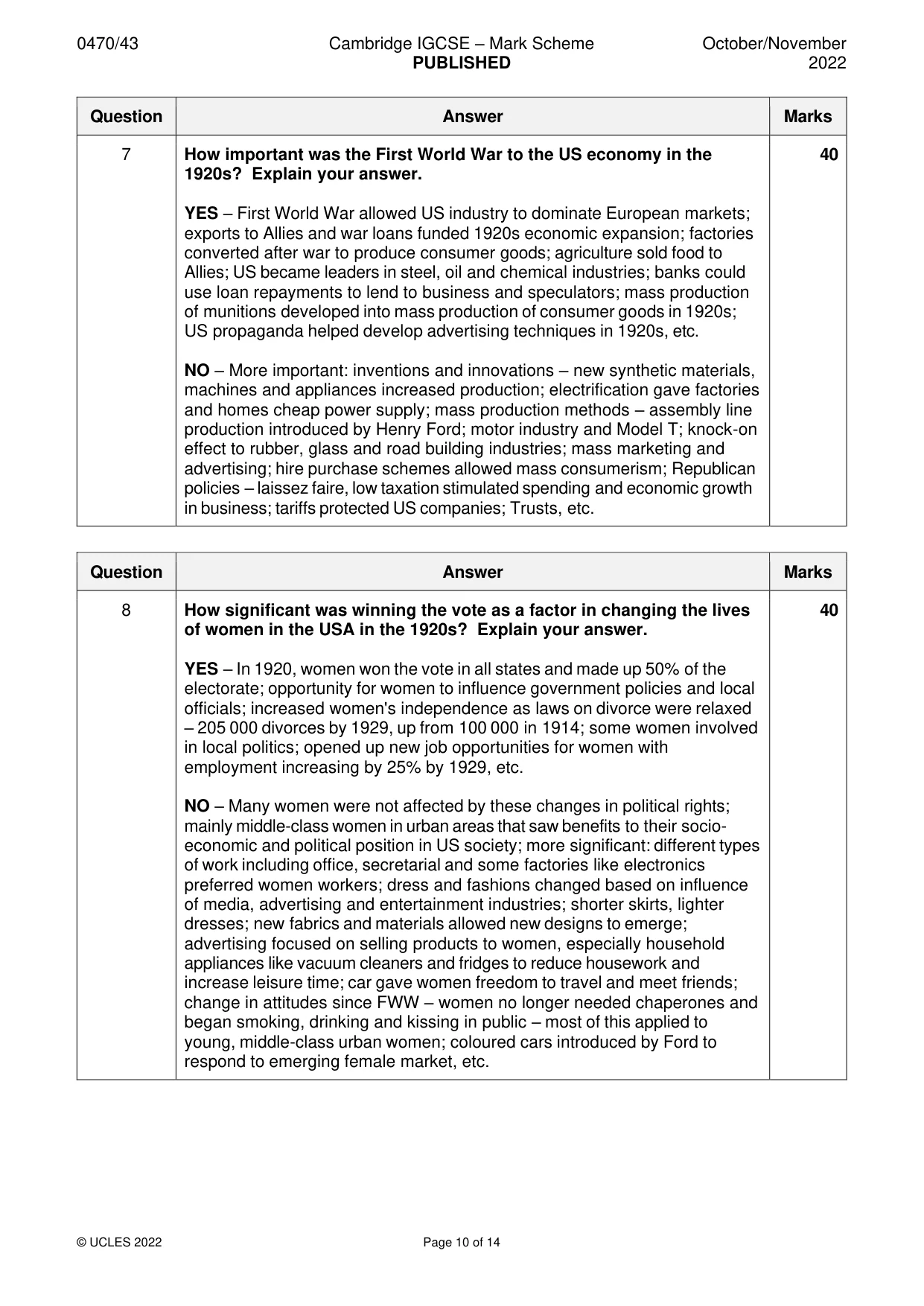
0470/43 Cambridge IGCSE – Mark Scheme PUBLISHED October/November 2022 © UCLES 2022 Page 10 of 14 Question Answer Marks 7 How important was the First World War to the US economy in the 1920s? Explain your answer. YES – First World War allowed US industry to dominate European markets; exports to Allies and war loans funded 1920s economic expansion; factories converted after war to produce consumer goods; agriculture sold food to Allies; US became leaders in steel, oil and chemical industries; banks could use loan repayments to lend to business and speculators; mass production of munitions developed into mass production of consumer goods in 1920s; US propaganda helped develop advertising techniques in 1920s, etc. NO – More important: inventions and innovations – new synthetic materials, machines and appliances increased production; electrification gave factories and homes cheap power supply; mass production methods – assembly line production introduced by Henry Ford; motor industry and Model T; knock-on effect to rubber, glass and road building industries; mass marketing and advertising; hire purchase schemes allowed mass consumerism; Republican policies – laissez faire, low taxation stimulated spending and economic growth in business; tariffs protected US companies; Trusts, etc. 40 Question Answer Marks 8 How significant was winning the vote as a factor in changing the lives of women in the USA in the 1920s? Explain your answer. YES – In 1920, women won the vote in all states and made up 50% of the electorate; opportunity for women to influence government policies and local officials; increased women's independence as laws on divorce were relaxed – 205 000 divorces by 1929, up from 100 000 in 1914; some women involved in local politics; opened up new job opportunities for women with employment increasing by 25% by 1929, etc. NO – Many women were not affected by these changes in political rights; mainly middle-class women in urban areas that saw benefits to their socio- economic and political position in US society; more significant: different types of work including office, secretarial and some factories like electronics preferred women workers; dress and fashions changed based on influence of media, advertising and entertainment industries; shorter skirts, lighter dresses; new fabrics and materials allowed new designs to emerge; advertising focused on selling products to women, especially household appliances like vacuum cleaners and fridges to reduce housework and increase leisure time; car gave women freedom to travel and meet friends; change in attitudes since FWW – women no longer needed chaperones and began smoking, drinking and kissing in public – most of this applied to young, middle-class urban women; coloured cars introduced by Ford to respond to emerging female market, etc. 40
Mark scheme, page 11
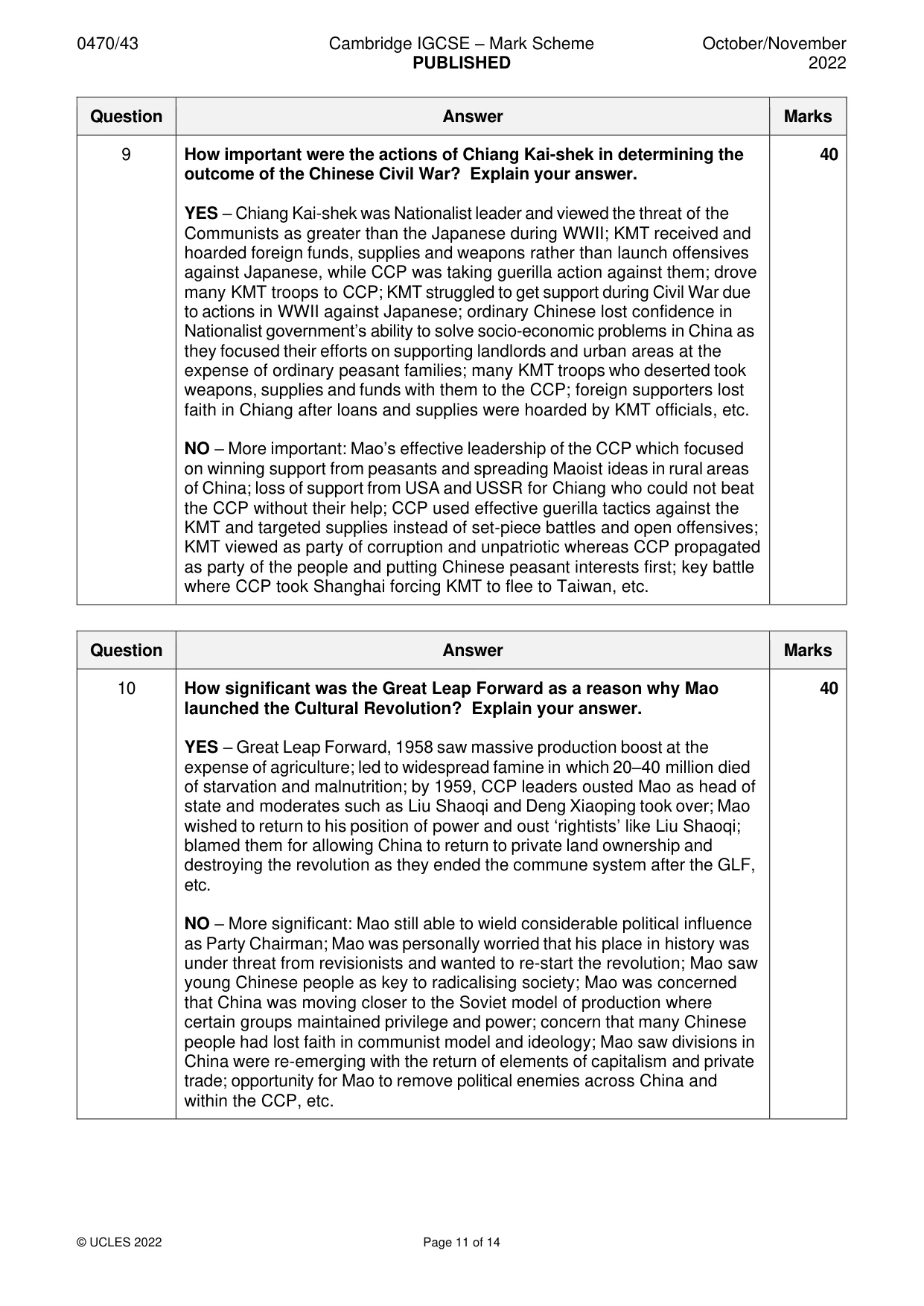
0470/43 Cambridge IGCSE – Mark Scheme PUBLISHED October/November 2022 © UCLES 2022 Page 11 of 14 Question Answer Marks 9 How important were the actions of Chiang Kai-shek in determining the outcome of the Chinese Civil War? Explain your answer. YES – Chiang Kai-shek was Nationalist leader and viewed the threat of the Communists as greater than the Japanese during WWII; KMT received and hoarded foreign funds, supplies and weapons rather than launch offensives against Japanese, while CCP was taking guerilla action against them; drove many KMT troops to CCP; KMT struggled to get support during Civil War due to actions in WWII against Japanese; ordinary Chinese lost confidence in Nationalist government’s ability to solve socio-economic problems in China as they focused their efforts on supporting landlords and urban areas at the expense of ordinary peasant families; many KMT troops who deserted took weapons, supplies and funds with them to the CCP; foreign supporters lost faith in Chiang after loans and supplies were hoarded by KMT officials, etc. NO – More important: Mao’s effective leadership of the CCP which focused on winning support from peasants and spreading Maoist ideas in rural areas of China; loss of support from USA and USSR for Chiang who could not beat the CCP without their help; CCP used effective guerilla tactics against the KMT and targeted supplies instead of set-piece battles and open offensives; KMT viewed as party of corruption and unpatriotic whereas CCP propagated as party of the people and putting Chinese peasant interests first; key battle where CCP took Shanghai forcing KMT to flee to Taiwan, etc. 40 Question Answer Marks 10 How significant was the Great Leap Forward as a reason why Mao launched the Cultural Revolution? Explain your answer. YES – Great Leap Forward, 1958 saw massive production boost at the expense of agriculture; led to widespread famine in which 20–40 million died of starvation and malnutrition; by 1959, CCP leaders ousted Mao as head of state and moderates such as Liu Shaoqi and Deng Xiaoping took over; Mao wished to return to his position of power and oust ‘rightists’ like Liu Shaoqi; blamed them for allowing China to return to private land ownership and destroying the revolution as they ended the commune system after the GLF, etc. NO – More significant: Mao still able to wield considerable political influence as Party Chairman; Mao was personally worried that his place in history was under threat from revisionists and wanted to re-start the revolution; Mao saw young Chinese people as key to radicalising society; Mao was concerned that China was moving closer to the Soviet model of production where certain groups maintained privilege and power; concern that many Chinese people had lost faith in communist model and ideology; Mao saw divisions in China were re-emerging with the return of elements of capitalism and private trade; opportunity for Mao to remove political enemies across China and within the CCP, etc. 40
Mark scheme, page 12
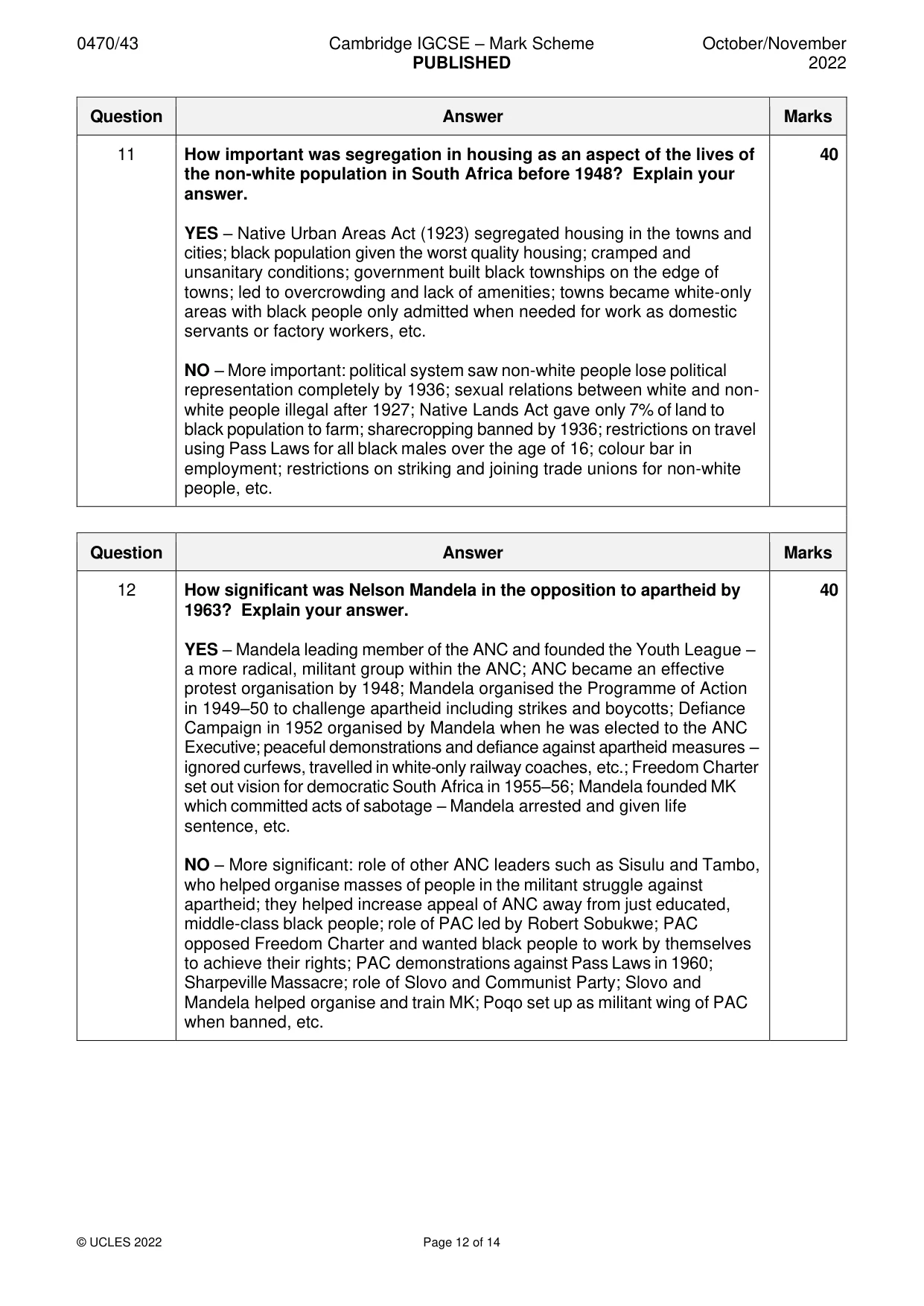
0470/43 Cambridge IGCSE – Mark Scheme PUBLISHED October/November 2022 © UCLES 2022 Page 12 of 14 Question Answer Marks 11 How important was segregation in housing as an aspect of the lives of the non-white population in South Africa before 1948? Explain your answer. YES – Native Urban Areas Act (1923) segregated housing in the towns and cities; black population given the worst quality housing; cramped and unsanitary conditions; government built black townships on the edge of towns; led to overcrowding and lack of amenities; towns became white-only areas with black people only admitted when needed for work as domestic servants or factory workers, etc. NO – More important: political system saw non-white people lose political representation completely by 1936; sexual relations between white and non- white people illegal after 1927; Native Lands Act gave only 7% of land to black population to farm; sharecropping banned by 1936; restrictions on travel using Pass Laws for all black males over the age of 16; colour bar in employment; restrictions on striking and joining trade unions for non-white people, etc. 40 Question Answer Marks 12 How significant was Nelson Mandela in the opposition to apartheid by 1963? Explain your answer. YES – Mandela leading member of the ANC and founded the Youth League – a more radical, militant group within the ANC; ANC became an effective protest organisation by 1948; Mandela organised the Programme of Action in 1949–50 to challenge apartheid including strikes and boycotts; Defiance Campaign in 1952 organised by Mandela when he was elected to the ANC Executive; peaceful demonstrations and defiance against apartheid measures – ignored curfews, travelled in white-only railway coaches, etc.; Freedom Charter set out vision for democratic South Africa in 1955–56; Mandela founded MK which committed acts of sabotage – Mandela arrested and given life sentence, etc. NO – More significant: role of other ANC leaders such as Sisulu and Tambo, who helped organise masses of people in the militant struggle against apartheid; they helped increase appeal of ANC away from just educated, middle-class black people; role of PAC led by Robert Sobukwe; PAC opposed Freedom Charter and wanted black people to work by themselves to achieve their rights; PAC demonstrations against Pass Laws in 1960; Sharpeville Massacre; role of Slovo and Communist Party; Slovo and Mandela helped organise and train MK; Poqo set up as militant wing of PAC when banned, etc. 40
Mark scheme, page 13
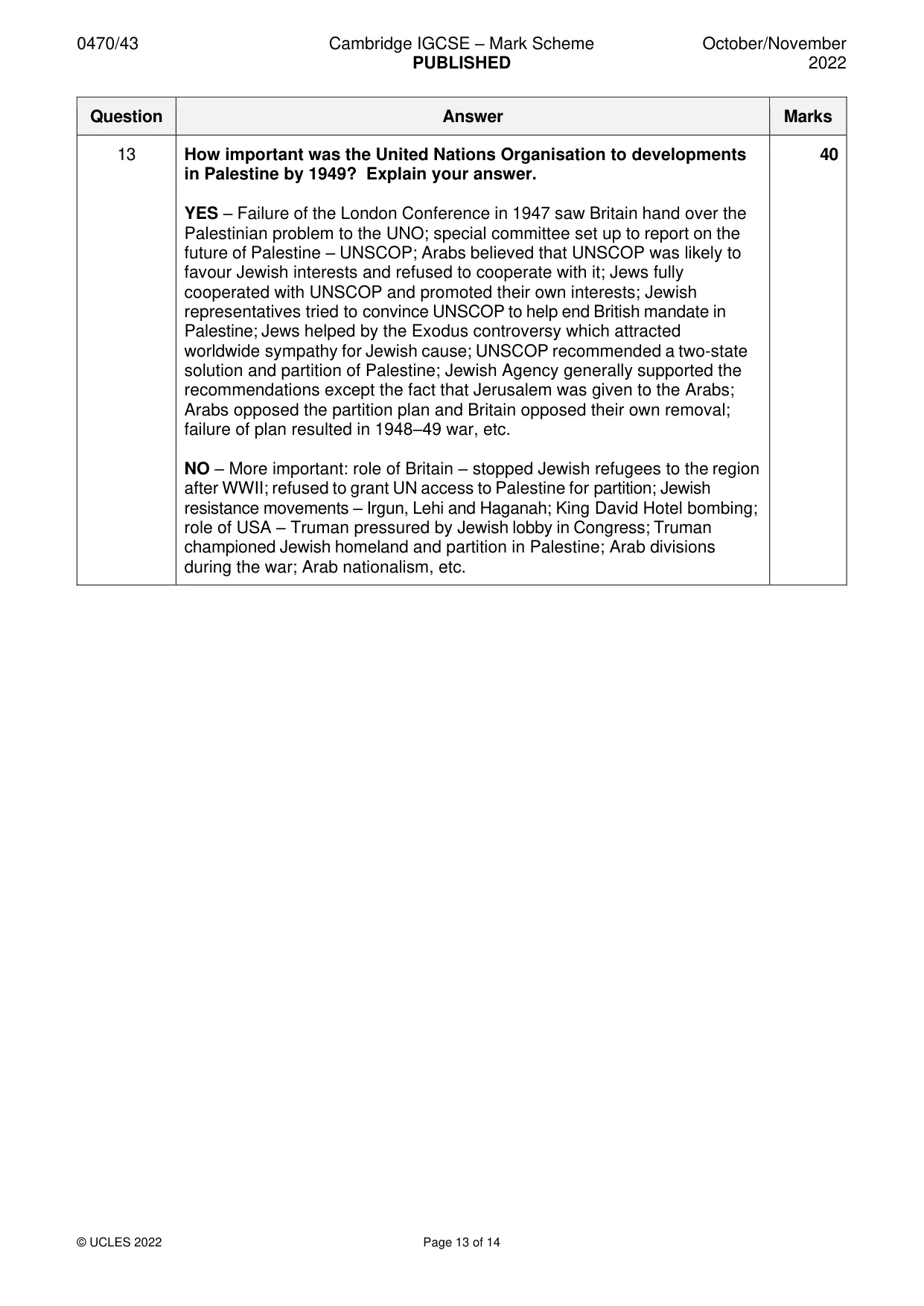
0470/43 Cambridge IGCSE – Mark Scheme PUBLISHED October/November 2022 © UCLES 2022 Page 13 of 14 Question Answer Marks 13 How important was the United Nations Organisation to developments in Palestine by 1949? Explain your answer. YES – Failure of the London Conference in 1947 saw Britain hand over the Palestinian problem to the UNO; special committee set up to report on the future of Palestine – UNSCOP; Arabs believed that UNSCOP was likely to favour Jewish interests and refused to cooperate with it; Jews fully cooperated with UNSCOP and promoted their own interests; Jewish representatives tried to convince UNSCOP to help end British mandate in Palestine; Jews helped by the Exodus controversy which attracted worldwide sympathy for Jewish cause; UNSCOP recommended a two-state solution and partition of Palestine; Jewish Agency generally supported the recommendations except the fact that Jerusalem was given to the Arabs; Arabs opposed the partition plan and Britain opposed their own removal; failure of plan resulted in 1948–49 war, etc. NO – More important: role of Britain – stopped Jewish refugees to the region after WWII; refused to grant UN access to Palestine for partition; Jewish resistance movements – Irgun, Lehi and Haganah; King David Hotel bombing; role of USA – Truman pressured by Jewish lobby in Congress; Truman championed Jewish homeland and partition in Palestine; Arab divisions during the war; Arab nationalism, etc. 40
Mark scheme, page 14
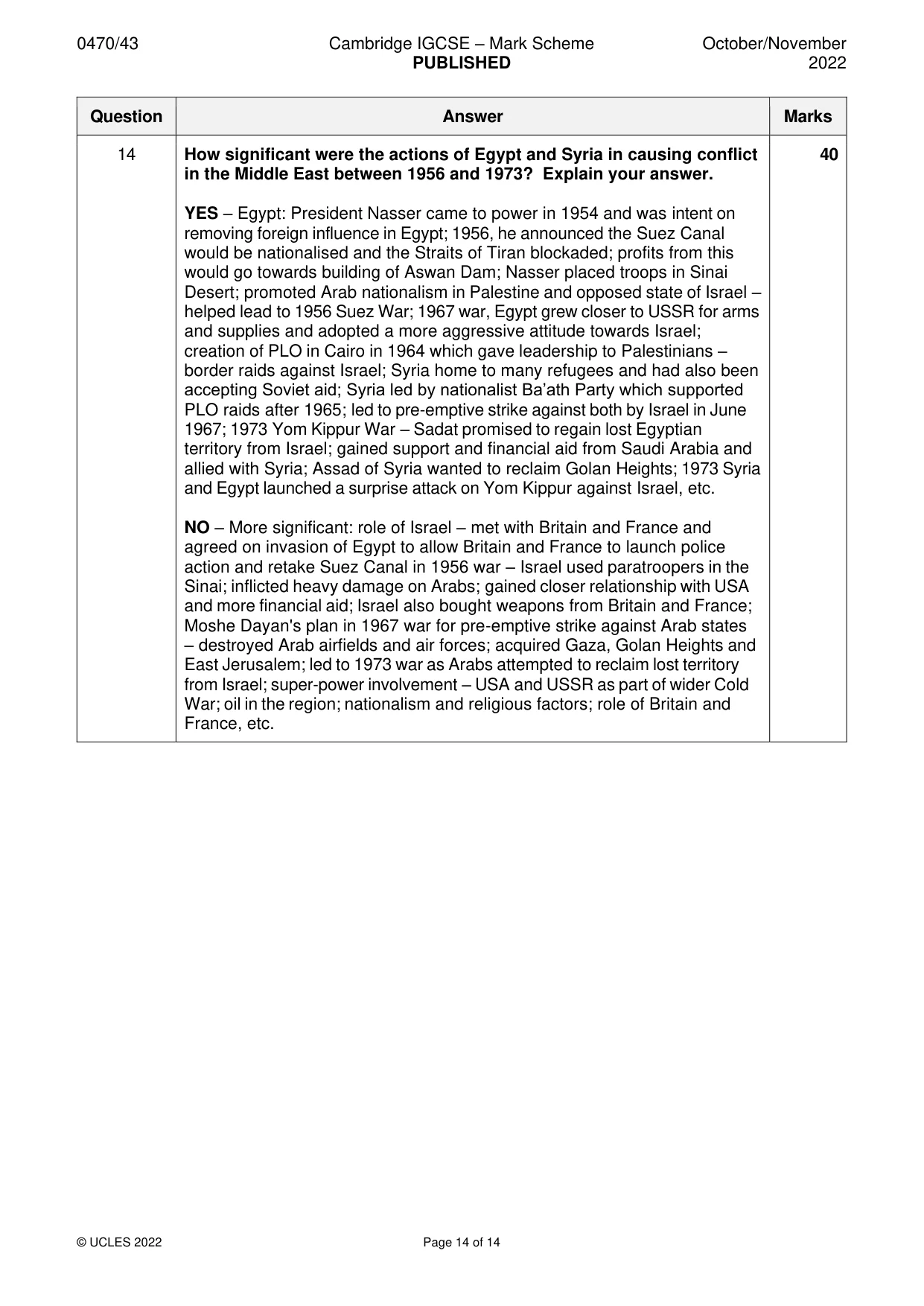
0470/43 Cambridge IGCSE – Mark Scheme PUBLISHED October/November 2022 © UCLES 2022 Page 14 of 14 Question Answer Marks 14 How significant were the actions of Egypt and Syria in causing conflict in the Middle East between 1956 and 1973? Explain your answer. YES – Egypt: President Nasser came to power in 1954 and was intent on removing foreign influence in Egypt; 1956, he announced the Suez Canal would be nationalised and the Straits of Tiran blockaded; profits from this would go towards building of Aswan Dam; Nasser placed troops in Sinai Desert; promoted Arab nationalism in Palestine and opposed state of Israel – helped lead to 1956 Suez War; 1967 war, Egypt grew closer to USSR for arms and supplies and adopted a more aggressive attitude towards Israel; creation of PLO in Cairo in 1964 which gave leadership to Palestinians – border raids against Israel; Syria home to many refugees and had also been accepting Soviet aid; Syria led by nationalist Ba’ath Party which supported PLO raids after 1965; led to pre-emptive strike against both by Israel in June 1967; 1973 Yom Kippur War – Sadat promised to regain lost Egyptian territory from Israel; gained support and financial aid from Saudi Arabia and allied with Syria; Assad of Syria wanted to reclaim Golan Heights; 1973 Syria and Egypt launched a surprise attack on Yom Kippur against Israel, etc. NO – More significant: role of Israel – met with Britain and France and agreed on invasion of Egypt to allow Britain and France to launch police action and retake Suez Canal in 1956 war – Israel used paratroopers in the Sinai; inflicted heavy damage on Arabs; gained closer relationship with USA and more financial aid; Israel also bought weapons from Britain and France; Moshe Dayan's plan in 1967 war for pre-emptive strike against Arab states – destroyed Arab airfields and air forces; acquired Gaza, Golan Heights and East Jerusalem; led to 1973 war as Arabs attempted to reclaim lost territory from Israel; super-power involvement – USA and USSR as part of wider Cold War; oil in the region; nationalism and religious factors; role of Britain and France, etc. 40
What you needed in this session
Cambridge’s own grade thresholds for 2022 Oct/Nov, Paper 4 · Variant 3. A higher threshold means an easier paper — the bar moves with how the cohort did.