Cambridge IGCSE History 0470 — 2022 Oct/Nov Paper 4 · Variant 2
0470/42/O/N/22 · 40 marks · ≈45 min
The question paper and its mark scheme, free to read here and free to download. This is Cambridge’s own paper, exactly as it was sat.
Question paper4 pages

Mark scheme12 pages
Answers below. Sit the paper first if you are practising.
Paper as text
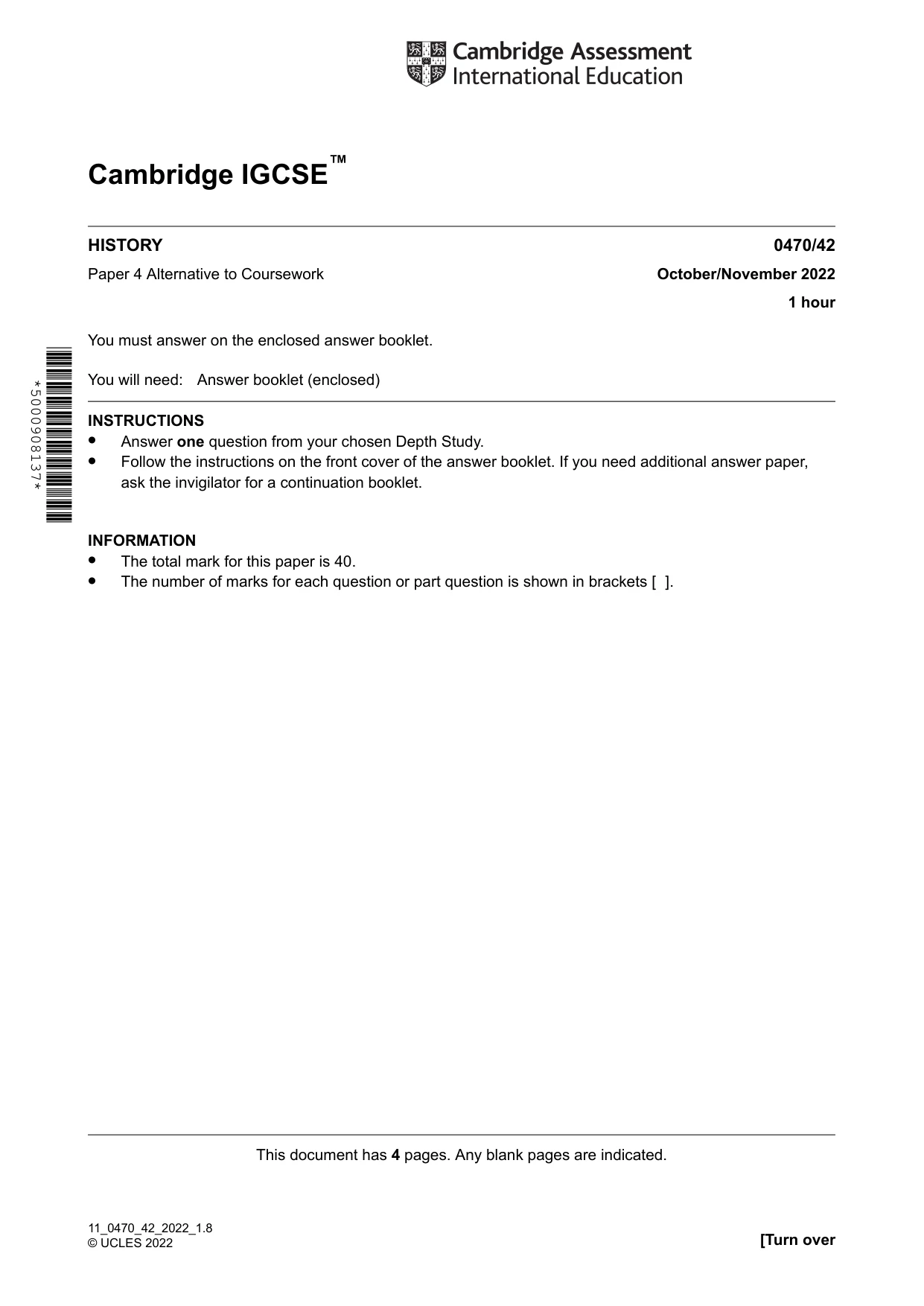
Question paper, page 1
Cambridge IGCSE™ 0470/42 October/November 2022 1 hour HISTORY Paper 4 Alternative to Coursework You must answer on the enclosed answer booklet. You will need: Answer booklet (enclosed) INSTRUCTIONS • Answer one question from your chosen Depth Study. • Follow the instructions on the front cover of the answer booklet. If you need additional answer paper, ask the invigilator for a continuation booklet. INFORMATION • The total mark for this paper is 40. • The number of marks for each question or part question is shown in brackets [ ]. This document has 4 pages. Any blank pages are indicated. [Turn over 11_0470_42_2022_1.8 © UCLES 2022 *5000908137*
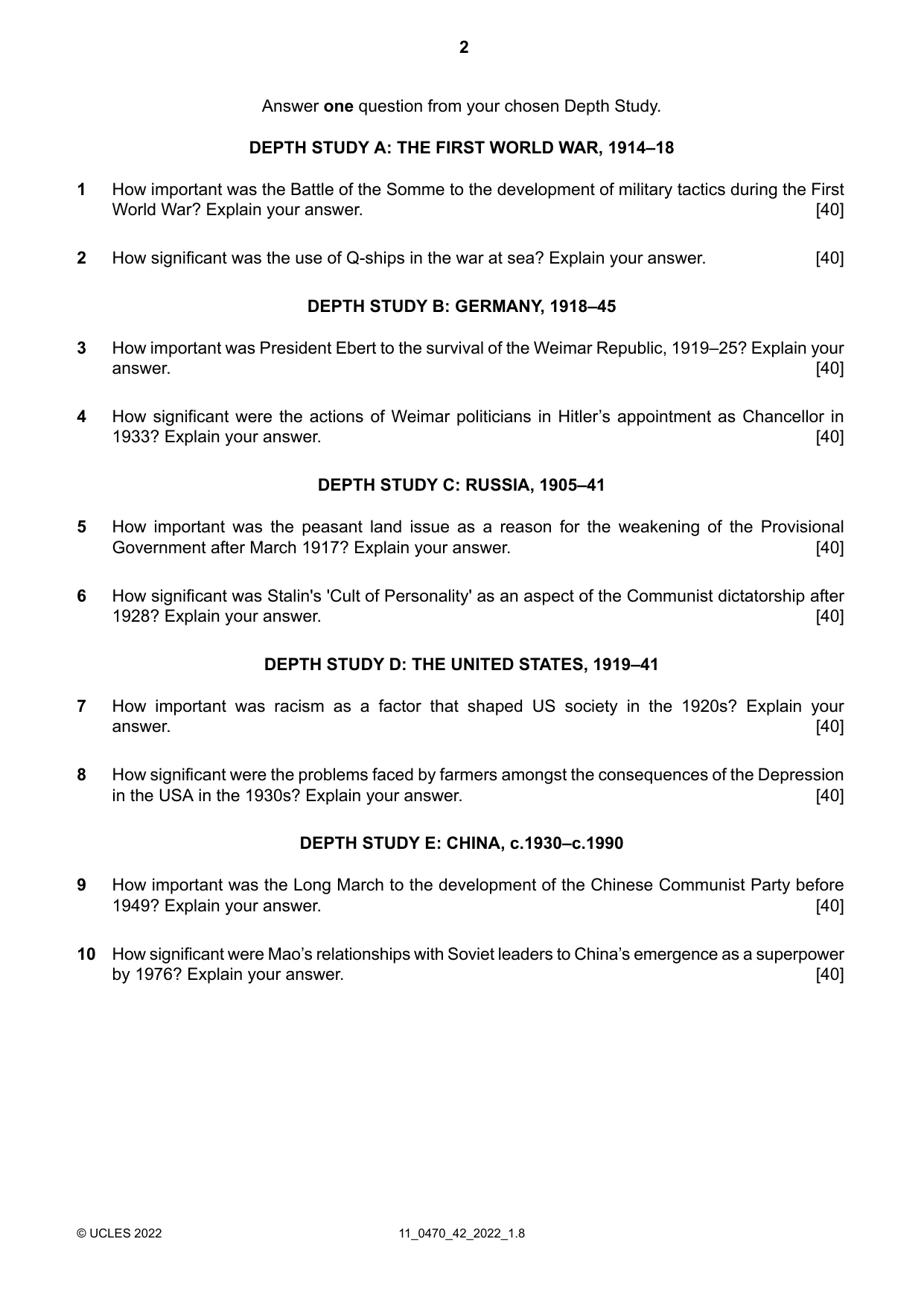
Question paper, page 2
Answer one question from your chosen Depth Study. DEPTH STUDY A: THE FIRST WORLD WAR, 1914–18 How important was the Battle of the Somme to the development of military tactics during the First World War? Explain your answer. [40] 1 How significant was the use of Q-ships in the war at sea? Explain your answer. [40] 2 DEPTH STUDY B: GERMANY, 1918–45 How important was President Ebert to the survival of the Weimar Republic, 1919–25? Explain your answer. [40] 3 How significant were the actions of Weimar politicians in Hitler’s appointment as Chancellor in 1933? Explain your answer. [40] 4 DEPTH STUDY C: RUSSIA, 1905–41 How important was the peasant land issue as a reason for the weakening of the Provisional Government after March 1917? Explain your answer. [40] 5 How significant was Stalin's 'Cult of Personality' as an aspect of the Communist dictatorship after 1928? Explain your answer. [40] 6 DEPTH STUDY D: THE UNITED STATES, 1919–41 How important was racism as a factor that shaped US society in the 1920s? Explain your answer. [40] 7 How significant were the problems faced by farmers amongst the consequences of the Depression in the USA in the 1930s? Explain your answer. [40] 8 DEPTH STUDY E: CHINA, c.1930–c.1990 How important was the Long March to the development of the Chinese Communist Party before 1949? Explain your answer. [40] 9 How significant were Mao’s relationships with Soviet leaders to China’s emergence as a superpower by 1976? Explain your answer. [40] 10 11_0470_42_2022_1.8 © UCLES 2022 2
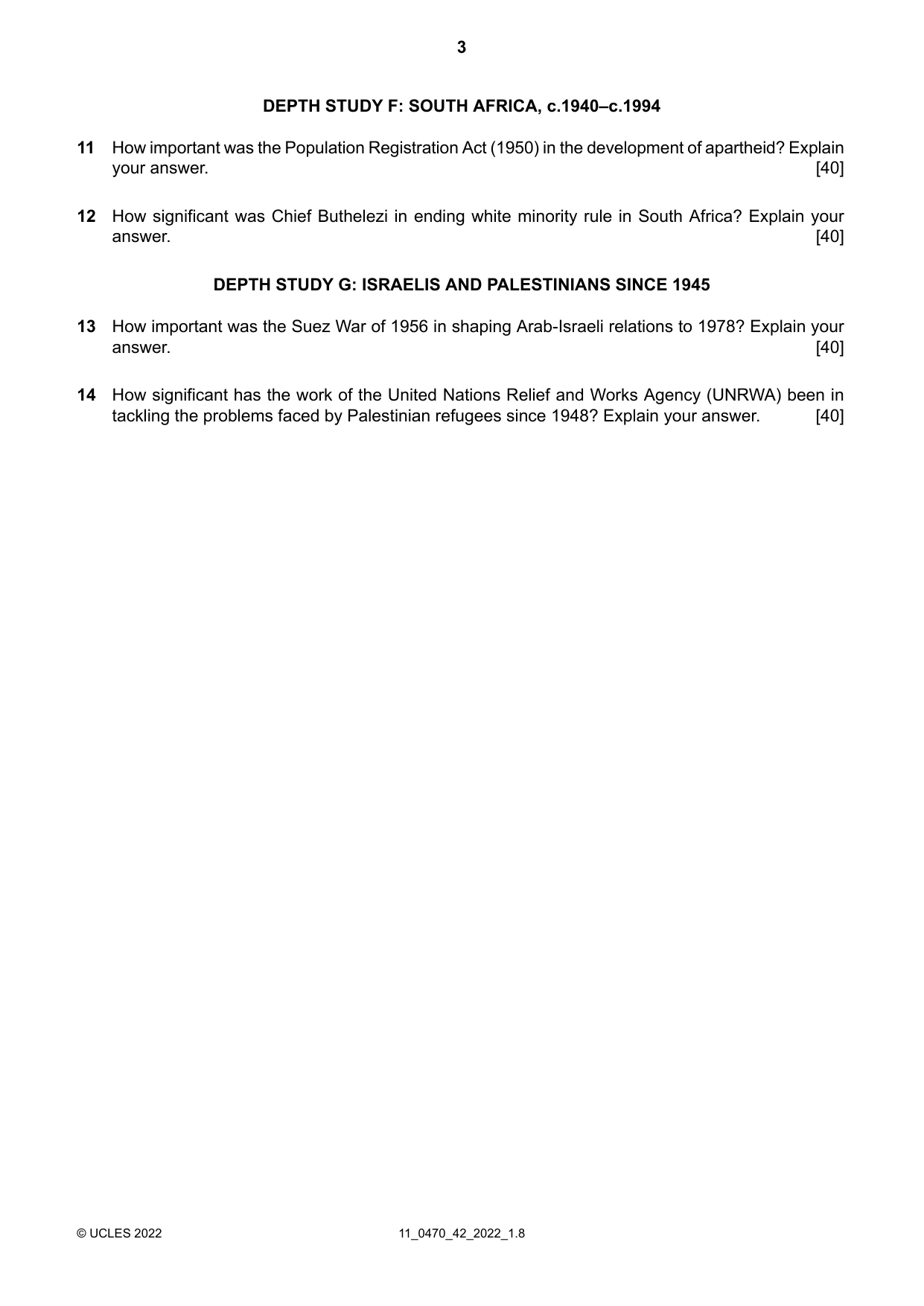
Question paper, page 3
DEPTH STUDY F: SOUTH AFRICA, c.1940–c.1994 How important was the Population Registration Act (1950) in the development of apartheid? Explain your answer. [40] 11 How significant was Chief Buthelezi in ending white minority rule in South Africa? Explain your answer. [40] 12 DEPTH STUDY G: ISRAELIS AND PALESTINIANS SINCE 1945 How important was the Suez War of 1956 in shaping Arab-Israeli relations to 1978? Explain your answer. [40] 13 How significant has the work of the United Nations Relief and Works Agency (UNRWA) been in tackling the problems faced by Palestinian refugees since 1948? Explain your answer. [40] 14 11_0470_42_2022_1.8 © UCLES 2022 3
Question paper, page 4
BLANK PAGE Permission to reproduce items where third-party owned material protected by copyright is included has been sought and cleared where possible. Every reasonable effort has been made by the publisher (UCLES) to trace copyright holders, but if any items requiring clearance have unwittingly been included, the publisher will be pleased to make amends at the earliest possible opportunity. To avoid the issue of disclosure of answer-related information to candidates, all copyright acknowledgements are reproduced online in the Cambridge Assessment International Education Copyright Acknowledgements Booklet. This is produced for each series of examinations and is freely available to download at www.cambridgeinternational.org after the live examination series. Cambridge Assessment International Education is part of Cambridge Assessment. Cambridge Assessment is the brand name of the University of Cambridge Local Examinations Syndicate (UCLES), which is a department of the University of Cambridge. 11_0470_42_2022_1.8 © UCLES 2022 4
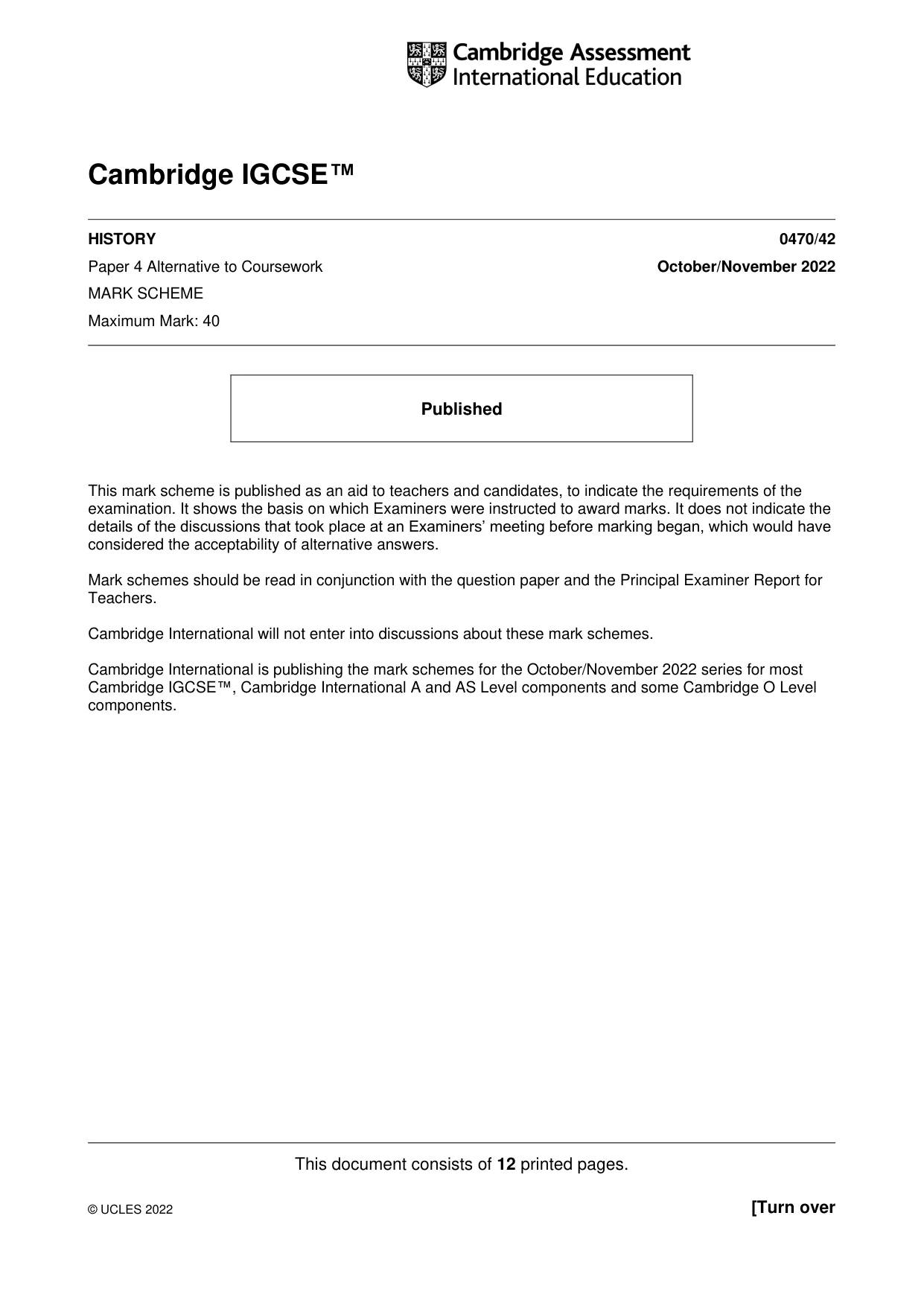
Mark scheme, page 1
This document consists of 12 printed pages. © UCLES 2022 [Turn over Cambridge IGCSE™ HISTORY 0470/42 Paper 4 Alternative to Coursework October/November 2022 MARK SCHEME Maximum Mark: 40 Published This mark scheme is published as an aid to teachers and candidates, to indicate the requirements of the examination. It shows the basis on which Examiners were instructed to award marks. It does not indicate the details of the discussions that took place at an Examiners’ meeting before marking began, which would have considered the acceptability of alternative answers. Mark schemes should be read in conjunction with the question paper and the Principal Examiner Report for Teachers. Cambridge International will not enter into discussions about these mark schemes. Cambridge International is publishing the mark schemes for the October/November 2022 series for most Cambridge IGCSE™, Cambridge International A and AS Level components and some Cambridge O Level components.
Mark scheme, page 2
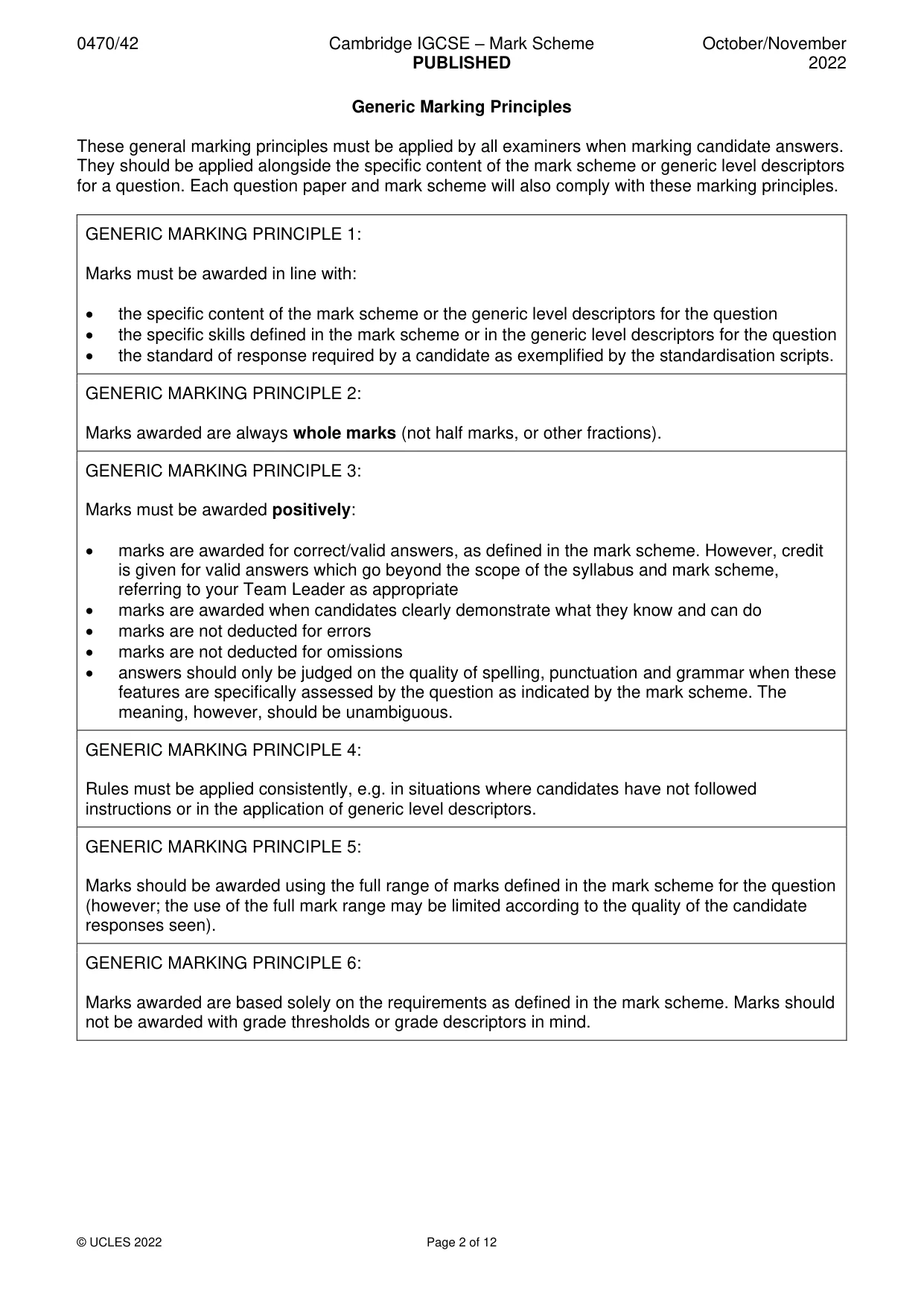
0470/42 Cambridge IGCSE – Mark Scheme PUBLISHED October/November 2022 © UCLES 2022 Page 2 of 12 Generic Marking Principles These general marking principles must be applied by all examiners when marking candidate answers. They should be applied alongside the specific content of the mark scheme or generic level descriptors for a question. Each question paper and mark scheme will also comply with these marking principles. GENERIC MARKING PRINCIPLE 1: Marks must be awarded in line with: • the specific content of the mark scheme or the generic level descriptors for the question • the specific skills defined in the mark scheme or in the generic level descriptors for the question • the standard of response required by a candidate as exemplified by the standardisation scripts. GENERIC MARKING PRINCIPLE 2: Marks awarded are always whole marks (not half marks, or other fractions). GENERIC MARKING PRINCIPLE 3: Marks must be awarded positively: • marks are awarded for correct/valid answers, as defined in the mark scheme. However, credit is given for valid answers which go beyond the scope of the syllabus and mark scheme, referring to your Team Leader as appropriate • marks are awarded when candidates clearly demonstrate what they know and can do • marks are not deducted for errors • marks are not deducted for omissions • answers should only be judged on the quality of spelling, punctuation and grammar when these features are specifically assessed by the question as indicated by the mark scheme. The meaning, however, should be unambiguous. GENERIC MARKING PRINCIPLE 4: Rules must be applied consistently, e.g. in situations where candidates have not followed instructions or in the application of generic level descriptors. GENERIC MARKING PRINCIPLE 5: Marks should be awarded using the full range of marks defined in the mark scheme for the question (however; the use of the full mark range may be limited according to the quality of the candidate responses seen). GENERIC MARKING PRINCIPLE 6: Marks awarded are based solely on the requirements as defined in the mark scheme. Marks should not be awarded with grade thresholds or grade descriptors in mind.
Mark scheme, page 3
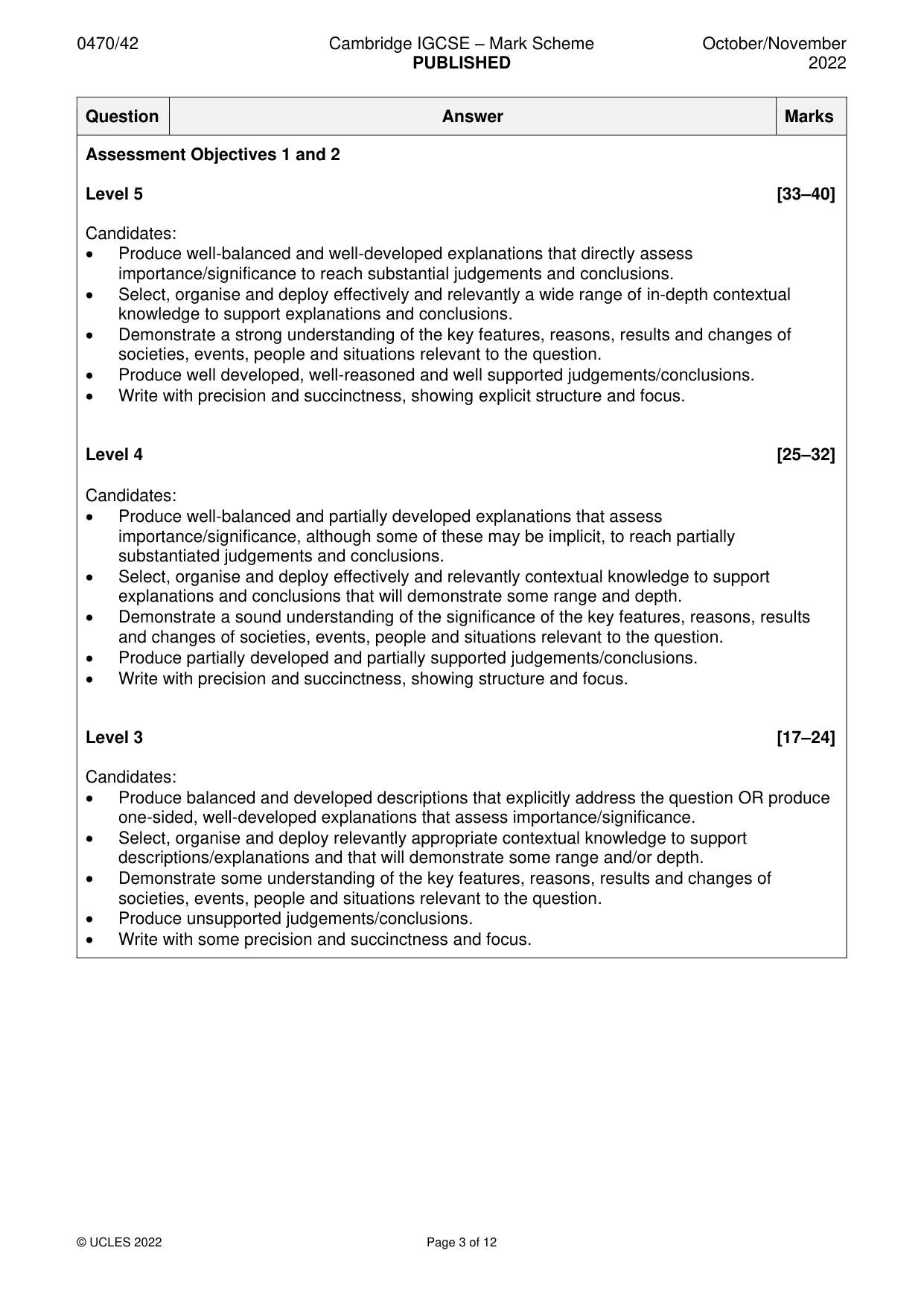
0470/42 Cambridge IGCSE – Mark Scheme PUBLISHED October/November 2022 © UCLES 2022 Page 3 of 12 Question Answer Marks Assessment Objectives 1 and 2 Level 5 [33–40] Candidates: • Produce well-balanced and well-developed explanations that directly assess importance/significance to reach substantial judgements and conclusions. • Select, organise and deploy effectively and relevantly a wide range of in-depth contextual knowledge to support explanations and conclusions. • Demonstrate a strong understanding of the key features, reasons, results and changes of societies, events, people and situations relevant to the question. • Produce well developed, well-reasoned and well supported judgements/conclusions. • Write with precision and succinctness, showing explicit structure and focus. Level 4 [25–32] Candidates: • Produce well-balanced and partially developed explanations that assess importance/significance, although some of these may be implicit, to reach partially substantiated judgements and conclusions. • Select, organise and deploy effectively and relevantly contextual knowledge to support explanations and conclusions that will demonstrate some range and depth. • Demonstrate a sound understanding of the significance of the key features, reasons, results and changes of societies, events, people and situations relevant to the question. • Produce partially developed and partially supported judgements/conclusions. • Write with precision and succinctness, showing structure and focus. Level 3 [17–24] Candidates: • Produce balanced and developed descriptions that explicitly address the question OR produce one-sided, well-developed explanations that assess importance/significance. • Select, organise and deploy relevantly appropriate contextual knowledge to support descriptions/explanations and that will demonstrate some range and/or depth. • Demonstrate some understanding of the key features, reasons, results and changes of societies, events, people and situations relevant to the question. • Produce unsupported judgements/conclusions. • Write with some precision and succinctness and focus.
Mark scheme, page 4
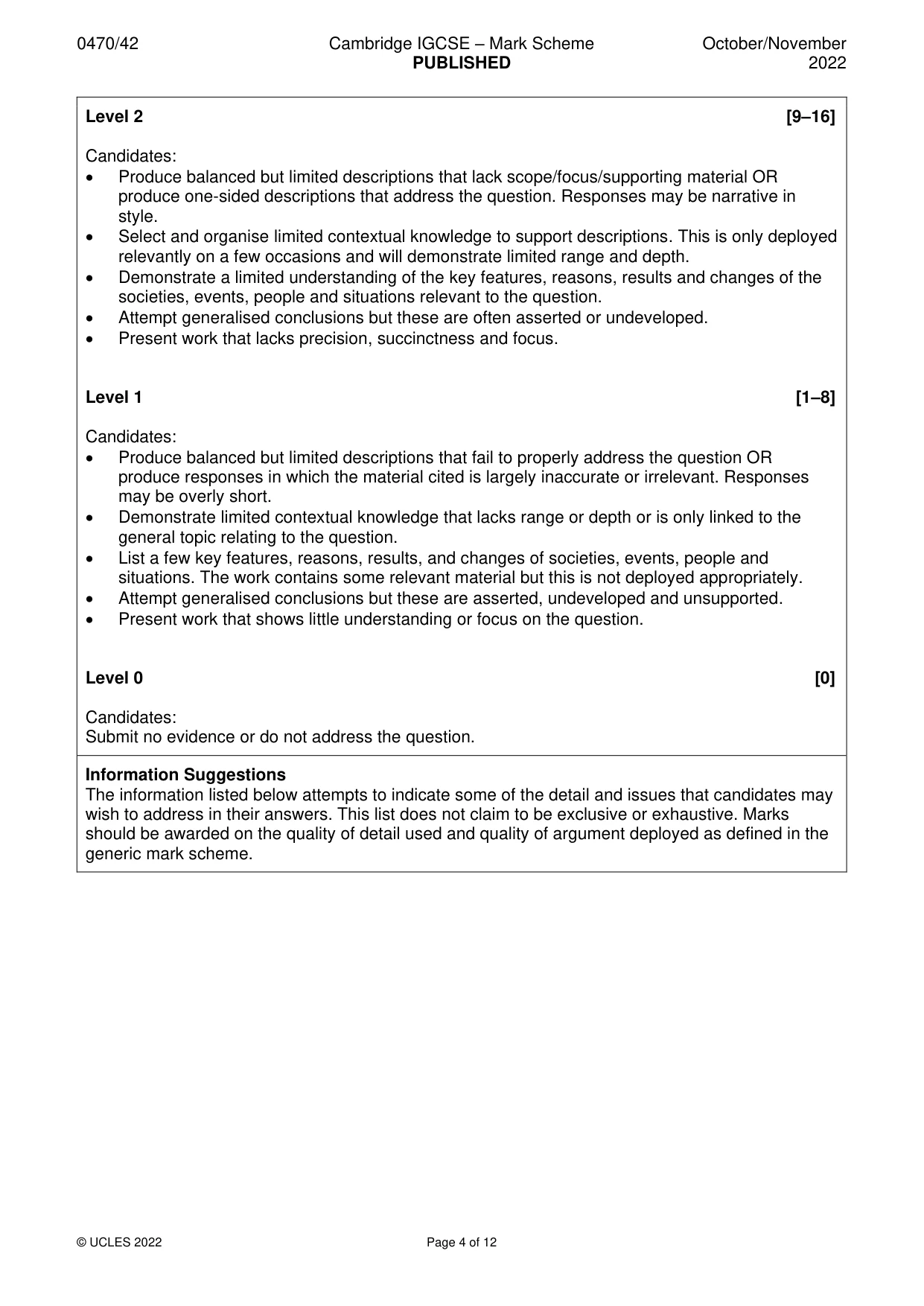
0470/42 Cambridge IGCSE – Mark Scheme PUBLISHED October/November 2022 © UCLES 2022 Page 4 of 12 Level 2 [9–16] Candidates: • Produce balanced but limited descriptions that lack scope/focus/supporting material OR produce one-sided descriptions that address the question. Responses may be narrative in style. • Select and organise limited contextual knowledge to support descriptions. This is only deployed relevantly on a few occasions and will demonstrate limited range and depth. • Demonstrate a limited understanding of the key features, reasons, results and changes of the societies, events, people and situations relevant to the question. • Attempt generalised conclusions but these are often asserted or undeveloped. • Present work that lacks precision, succinctness and focus. Level 1 [1–8] Candidates: • Produce balanced but limited descriptions that fail to properly address the question OR produce responses in which the material cited is largely inaccurate or irrelevant. Responses may be overly short. • Demonstrate limited contextual knowledge that lacks range or depth or is only linked to the general topic relating to the question. • List a few key features, reasons, results, and changes of societies, events, people and situations. The work contains some relevant material but this is not deployed appropriately. • Attempt generalised conclusions but these are asserted, undeveloped and unsupported. • Present work that shows little understanding or focus on the question. Level 0 [0] Candidates: Submit no evidence or do not address the question. Information Suggestions The information listed below attempts to indicate some of the detail and issues that candidates may wish to address in their answers. This list does not claim to be exclusive or exhaustive. Marks should be awarded on the quality of detail used and quality of argument deployed as defined in the generic mark scheme.
Mark scheme, page 5
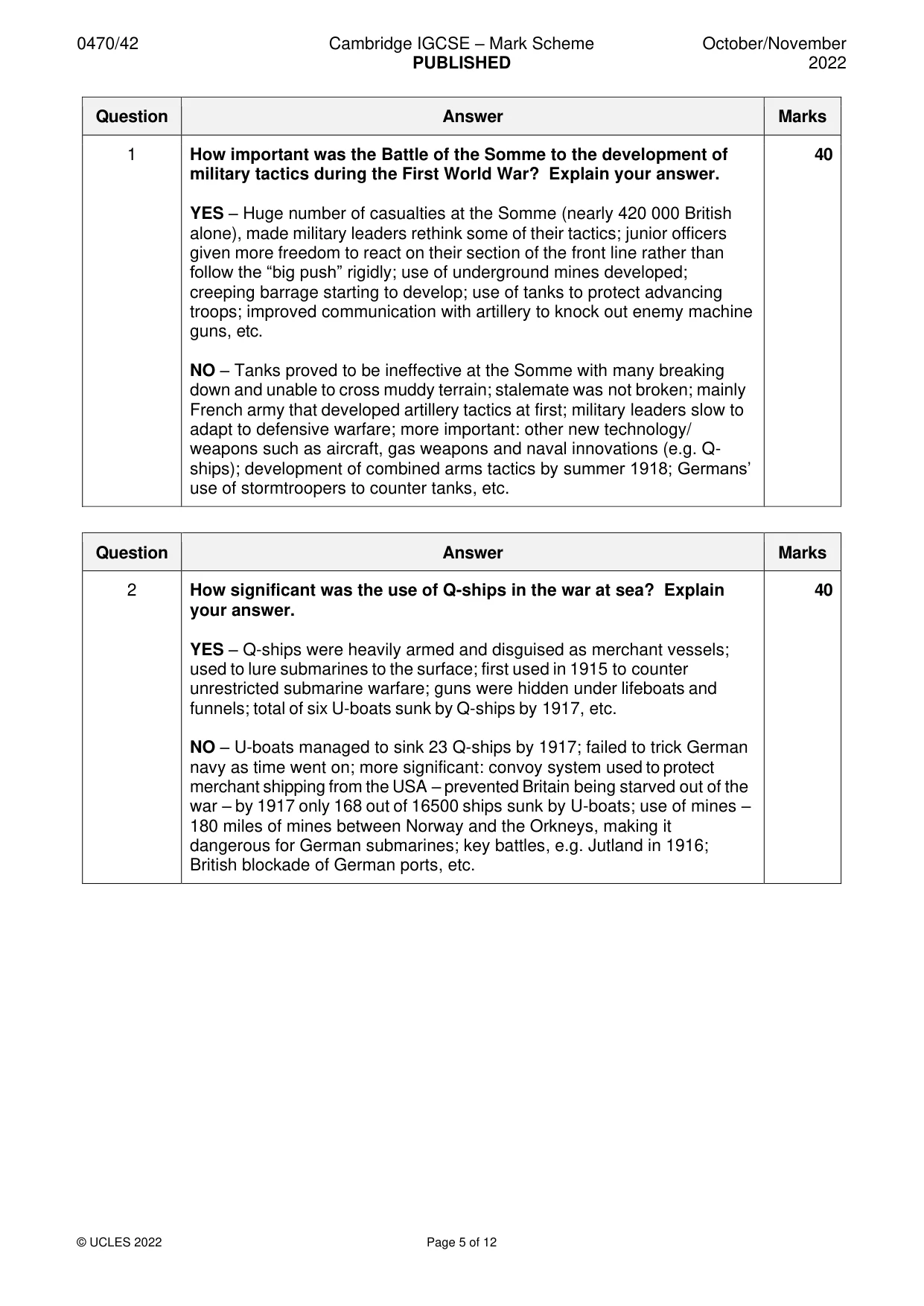
0470/42 Cambridge IGCSE – Mark Scheme PUBLISHED October/November 2022 © UCLES 2022 Page 5 of 12 Question Answer Marks 1 How important was the Battle of the Somme to the development of military tactics during the First World War? Explain your answer. YES – Huge number of casualties at the Somme (nearly 420 000 British alone), made military leaders rethink some of their tactics; junior officers given more freedom to react on their section of the front line rather than follow the “big push” rigidly; use of underground mines developed; creeping barrage starting to develop; use of tanks to protect advancing troops; improved communication with artillery to knock out enemy machine guns, etc. NO – Tanks proved to be ineffective at the Somme with many breaking down and unable to cross muddy terrain; stalemate was not broken; mainly French army that developed artillery tactics at first; military leaders slow to adapt to defensive warfare; more important: other new technology/ weapons such as aircraft, gas weapons and naval innovations (e.g. Q- ships); development of combined arms tactics by summer 1918; Germans’ use of stormtroopers to counter tanks, etc. 40 Question Answer Marks 2 How significant was the use of Q-ships in the war at sea? Explain your answer. YES – Q-ships were heavily armed and disguised as merchant vessels; used to lure submarines to the surface; first used in 1915 to counter unrestricted submarine warfare; guns were hidden under lifeboats and funnels; total of six U-boats sunk by Q-ships by 1917, etc. NO – U-boats managed to sink 23 Q-ships by 1917; failed to trick German navy as time went on; more significant: convoy system used to protect merchant shipping from the USA – prevented Britain being starved out of the war – by 1917 only 168 out of 16500 ships sunk by U-boats; use of mines – 180 miles of mines between Norway and the Orkneys, making it dangerous for German submarines; key battles, e.g. Jutland in 1916; British blockade of German ports, etc. 40
Mark scheme, page 6
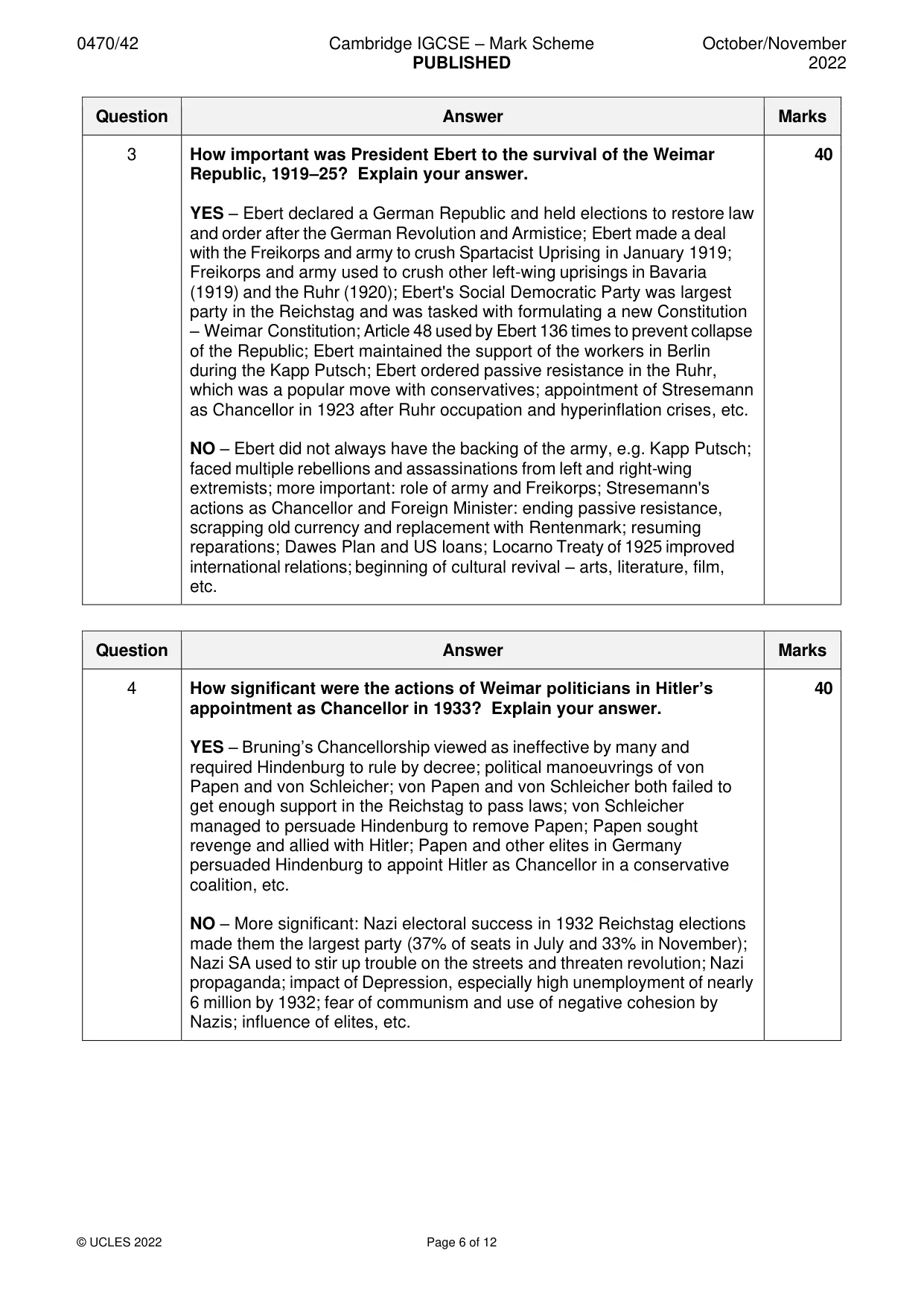
0470/42 Cambridge IGCSE – Mark Scheme PUBLISHED October/November 2022 © UCLES 2022 Page 6 of 12 Question Answer Marks 3 How important was President Ebert to the survival of the Weimar Republic, 1919–25? Explain your answer. YES – Ebert declared a German Republic and held elections to restore law and order after the German Revolution and Armistice; Ebert made a deal with the Freikorps and army to crush Spartacist Uprising in January 1919; Freikorps and army used to crush other left-wing uprisings in Bavaria (1919) and the Ruhr (1920); Ebert's Social Democratic Party was largest party in the Reichstag and was tasked with formulating a new Constitution – Weimar Constitution; Article 48 used by Ebert 136 times to prevent collapse of the Republic; Ebert maintained the support of the workers in Berlin during the Kapp Putsch; Ebert ordered passive resistance in the Ruhr, which was a popular move with conservatives; appointment of Stresemann as Chancellor in 1923 after Ruhr occupation and hyperinflation crises, etc. NO – Ebert did not always have the backing of the army, e.g. Kapp Putsch; faced multiple rebellions and assassinations from left and right-wing extremists; more important: role of army and Freikorps; Stresemann's actions as Chancellor and Foreign Minister: ending passive resistance, scrapping old currency and replacement with Rentenmark; resuming reparations; Dawes Plan and US loans; Locarno Treaty of 1925 improved international relations; beginning of cultural revival – arts, literature, film, etc. 40 Question Answer Marks 4 How significant were the actions of Weimar politicians in Hitler’s appointment as Chancellor in 1933? Explain your answer. YES – Bruning’s Chancellorship viewed as ineffective by many and required Hindenburg to rule by decree; political manoeuvrings of von Papen and von Schleicher; von Papen and von Schleicher both failed to get enough support in the Reichstag to pass laws; von Schleicher managed to persuade Hindenburg to remove Papen; Papen sought revenge and allied with Hitler; Papen and other elites in Germany persuaded Hindenburg to appoint Hitler as Chancellor in a conservative coalition, etc. NO – More significant: Nazi electoral success in 1932 Reichstag elections made them the largest party (37% of seats in July and 33% in November); Nazi SA used to stir up trouble on the streets and threaten revolution; Nazi propaganda; impact of Depression, especially high unemployment of nearly 6 million by 1932; fear of communism and use of negative cohesion by Nazis; influence of elites, etc. 40
Mark scheme, page 7
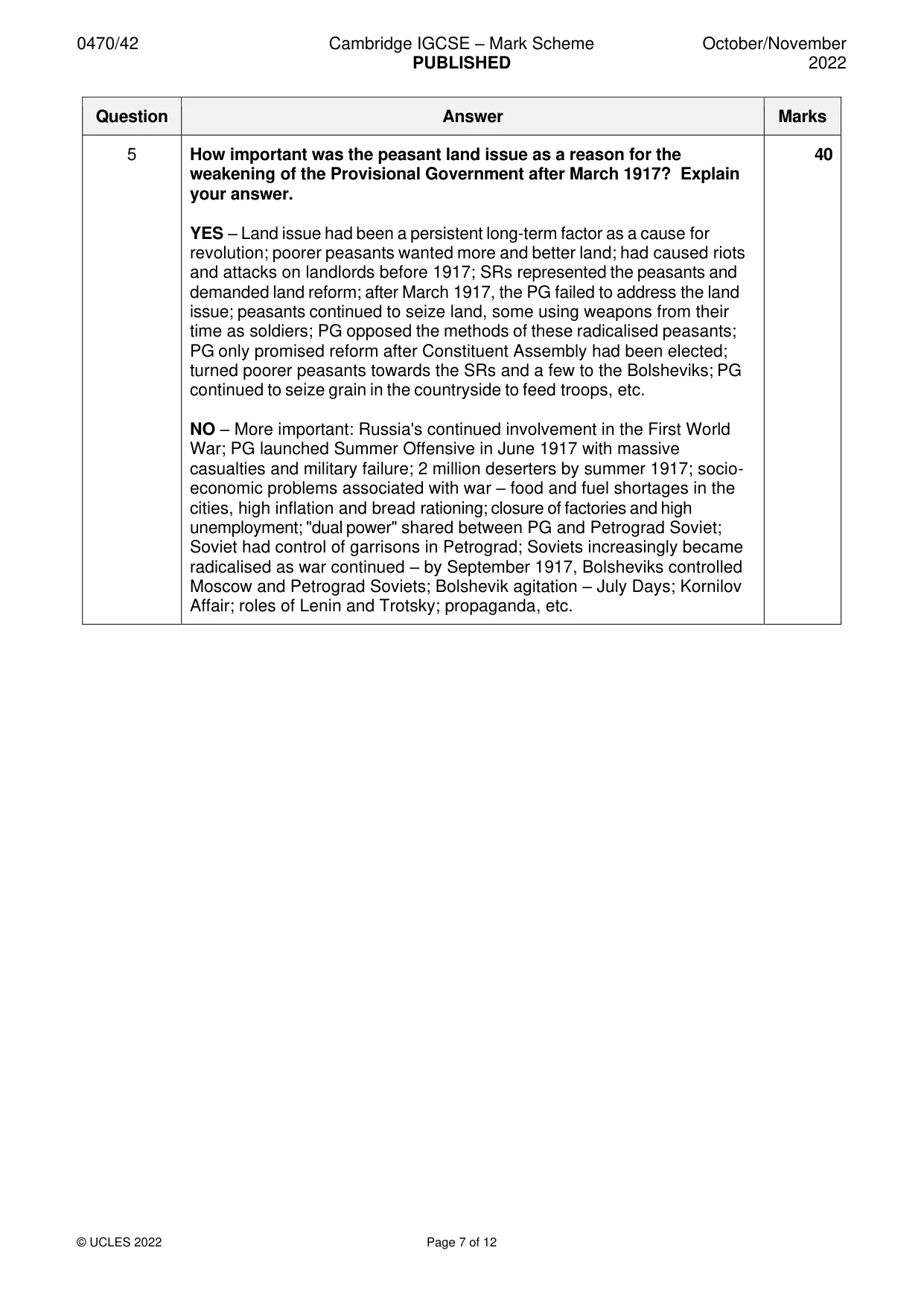
0470/42 Cambridge IGCSE – Mark Scheme PUBLISHED October/November 2022 © UCLES 2022 Page 7 of 12 Question Answer Marks 5 How important was the peasant land issue as a reason for the weakening of the Provisional Government after March 1917? Explain your answer. YES – Land issue had been a persistent long-term factor as a cause for revolution; poorer peasants wanted more and better land; had caused riots and attacks on landlords before 1917; SRs represented the peasants and demanded land reform; after March 1917, the PG failed to address the land issue; peasants continued to seize land, some using weapons from their time as soldiers; PG opposed the methods of these radicalised peasants; PG only promised reform after Constituent Assembly had been elected; turned poorer peasants towards the SRs and a few to the Bolsheviks; PG continued to seize grain in the countryside to feed troops, etc. NO – More important: Russia's continued involvement in the First World War; PG launched Summer Offensive in June 1917 with massive casualties and military failure; 2 million deserters by summer 1917; socio- economic problems associated with war – food and fuel shortages in the cities, high inflation and bread rationing; closure of factories and high unemployment; "dual power" shared between PG and Petrograd Soviet; Soviet had control of garrisons in Petrograd; Soviets increasingly became radicalised as war continued – by September 1917, Bolsheviks controlled Moscow and Petrograd Soviets; Bolshevik agitation – July Days; Kornilov Affair; roles of Lenin and Trotsky; propaganda, etc. 40
Mark scheme, page 8
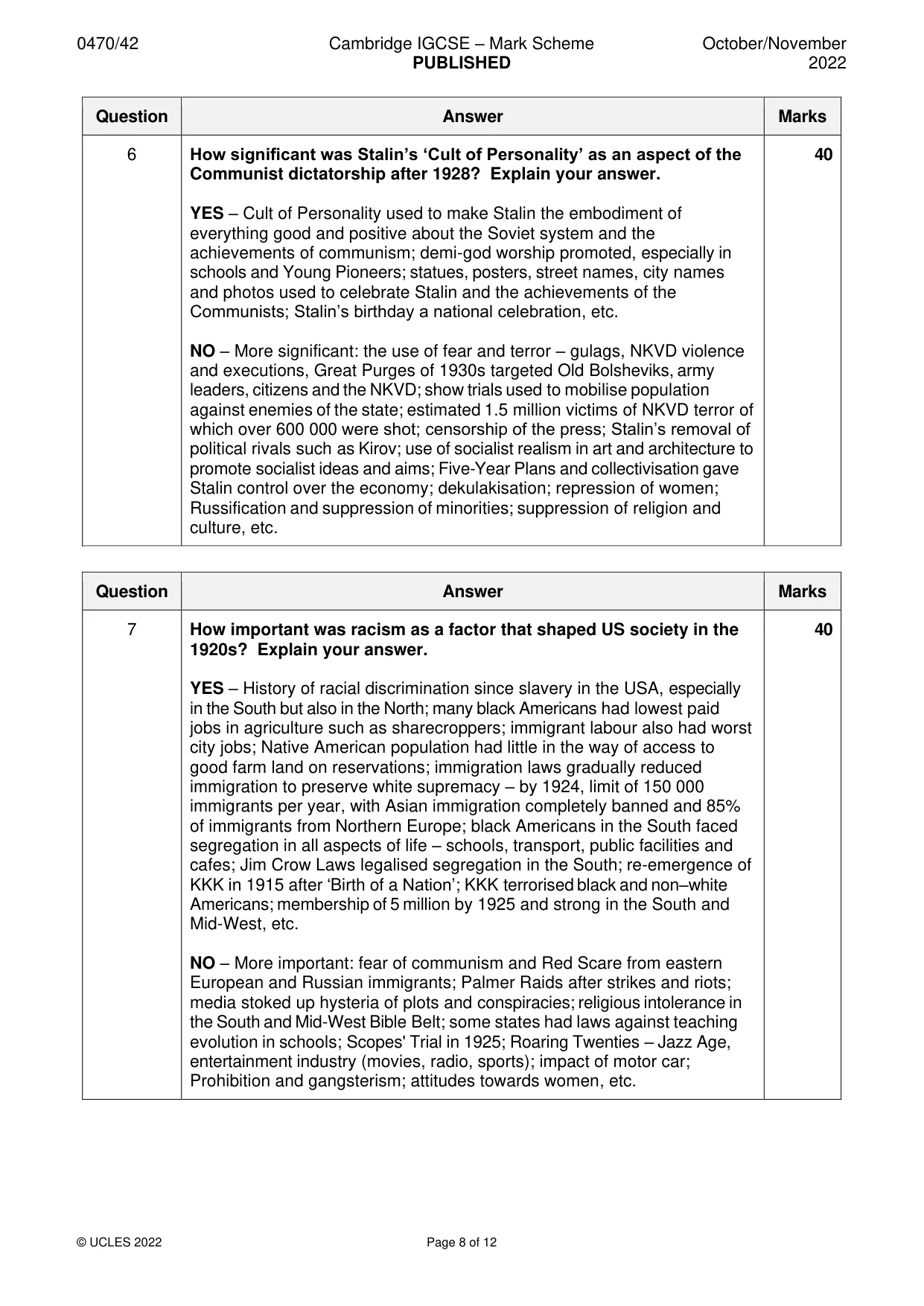
0470/42 Cambridge IGCSE – Mark Scheme PUBLISHED October/November 2022 © UCLES 2022 Page 8 of 12 Question Answer Marks 6 How significant was Stalin’s ‘Cult of Personality’ as an aspect of the Communist dictatorship after 1928? Explain your answer. YES – Cult of Personality used to make Stalin the embodiment of everything good and positive about the Soviet system and the achievements of communism; demi-god worship promoted, especially in schools and Young Pioneers; statues, posters, street names, city names and photos used to celebrate Stalin and the achievements of the Communists; Stalin’s birthday a national celebration, etc. NO – More significant: the use of fear and terror – gulags, NKVD violence and executions, Great Purges of 1930s targeted Old Bolsheviks, army leaders, citizens and the NKVD; show trials used to mobilise population against enemies of the state; estimated 1.5 million victims of NKVD terror of which over 600 000 were shot; censorship of the press; Stalin’s removal of political rivals such as Kirov; use of socialist realism in art and architecture to promote socialist ideas and aims; Five-Year Plans and collectivisation gave Stalin control over the economy; dekulakisation; repression of women; Russification and suppression of minorities; suppression of religion and culture, etc. 40 Question Answer Marks 7 How important was racism as a factor that shaped US society in the 1920s? Explain your answer. YES – History of racial discrimination since slavery in the USA, especially in the South but also in the North; many black Americans had lowest paid jobs in agriculture such as sharecroppers; immigrant labour also had worst city jobs; Native American population had little in the way of access to good farm land on reservations; immigration laws gradually reduced immigration to preserve white supremacy – by 1924, limit of 150 000 immigrants per year, with Asian immigration completely banned and 85% of immigrants from Northern Europe; black Americans in the South faced segregation in all aspects of life – schools, transport, public facilities and cafes; Jim Crow Laws legalised segregation in the South; re-emergence of KKK in 1915 after ‘Birth of a Nation’; KKK terrorised black and non–white Americans; membership of 5 million by 1925 and strong in the South and Mid-West, etc. NO – More important: fear of communism and Red Scare from eastern European and Russian immigrants; Palmer Raids after strikes and riots; media stoked up hysteria of plots and conspiracies; religious intolerance in the South and Mid-West Bible Belt; some states had laws against teaching evolution in schools; Scopes' Trial in 1925; Roaring Twenties – Jazz Age, entertainment industry (movies, radio, sports); impact of motor car; Prohibition and gangsterism; attitudes towards women, etc. 40
Mark scheme, page 9
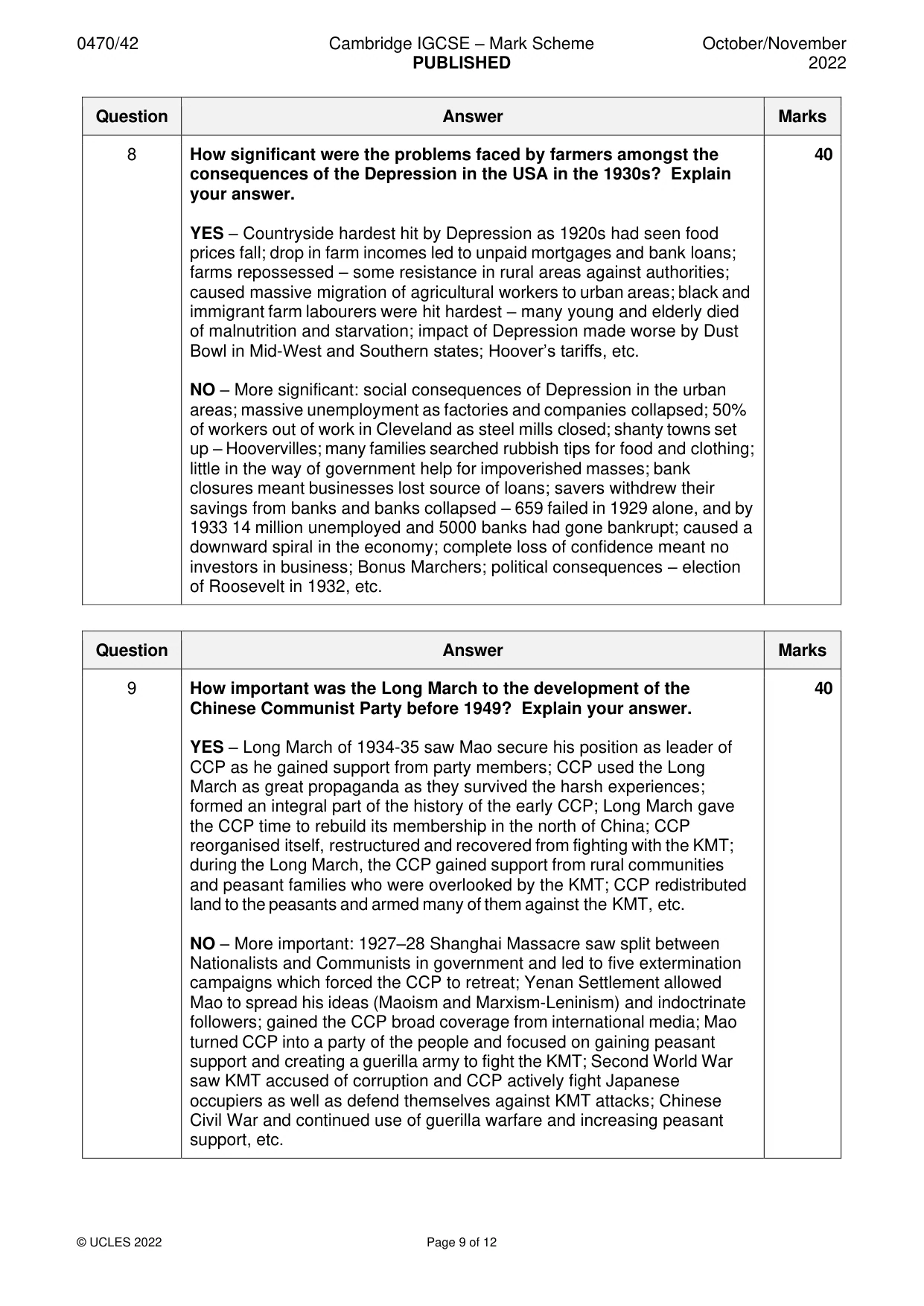
0470/42 Cambridge IGCSE – Mark Scheme PUBLISHED October/November 2022 © UCLES 2022 Page 9 of 12 Question Answer Marks 8 How significant were the problems faced by farmers amongst the consequences of the Depression in the USA in the 1930s? Explain your answer. YES – Countryside hardest hit by Depression as 1920s had seen food prices fall; drop in farm incomes led to unpaid mortgages and bank loans; farms repossessed – some resistance in rural areas against authorities; caused massive migration of agricultural workers to urban areas; black and immigrant farm labourers were hit hardest – many young and elderly died of malnutrition and starvation; impact of Depression made worse by Dust Bowl in Mid-West and Southern states; Hoover’s tariffs, etc. NO – More significant: social consequences of Depression in the urban areas; massive unemployment as factories and companies collapsed; 50% of workers out of work in Cleveland as steel mills closed; shanty towns set up – Hoovervilles; many families searched rubbish tips for food and clothing; little in the way of government help for impoverished masses; bank closures meant businesses lost source of loans; savers withdrew their savings from banks and banks collapsed – 659 failed in 1929 alone, and by 1933 14 million unemployed and 5000 banks had gone bankrupt; caused a downward spiral in the economy; complete loss of confidence meant no investors in business; Bonus Marchers; political consequences – election of Roosevelt in 1932, etc. 40 Question Answer Marks 9 How important was the Long March to the development of the Chinese Communist Party before 1949? Explain your answer. YES – Long March of 1934-35 saw Mao secure his position as leader of CCP as he gained support from party members; CCP used the Long March as great propaganda as they survived the harsh experiences; formed an integral part of the history of the early CCP; Long March gave the CCP time to rebuild its membership in the north of China; CCP reorganised itself, restructured and recovered from fighting with the KMT; during the Long March, the CCP gained support from rural communities and peasant families who were overlooked by the KMT; CCP redistributed land to the peasants and armed many of them against the KMT, etc. NO – More important: 1927–28 Shanghai Massacre saw split between Nationalists and Communists in government and led to five extermination campaigns which forced the CCP to retreat; Yenan Settlement allowed Mao to spread his ideas (Maoism and Marxism-Leninism) and indoctrinate followers; gained the CCP broad coverage from international media; Mao turned CCP into a party of the people and focused on gaining peasant support and creating a guerilla army to fight the KMT; Second World War saw KMT accused of corruption and CCP actively fight Japanese occupiers as well as defend themselves against KMT attacks; Chinese Civil War and continued use of guerilla warfare and increasing peasant support, etc. 40
Mark scheme, page 10
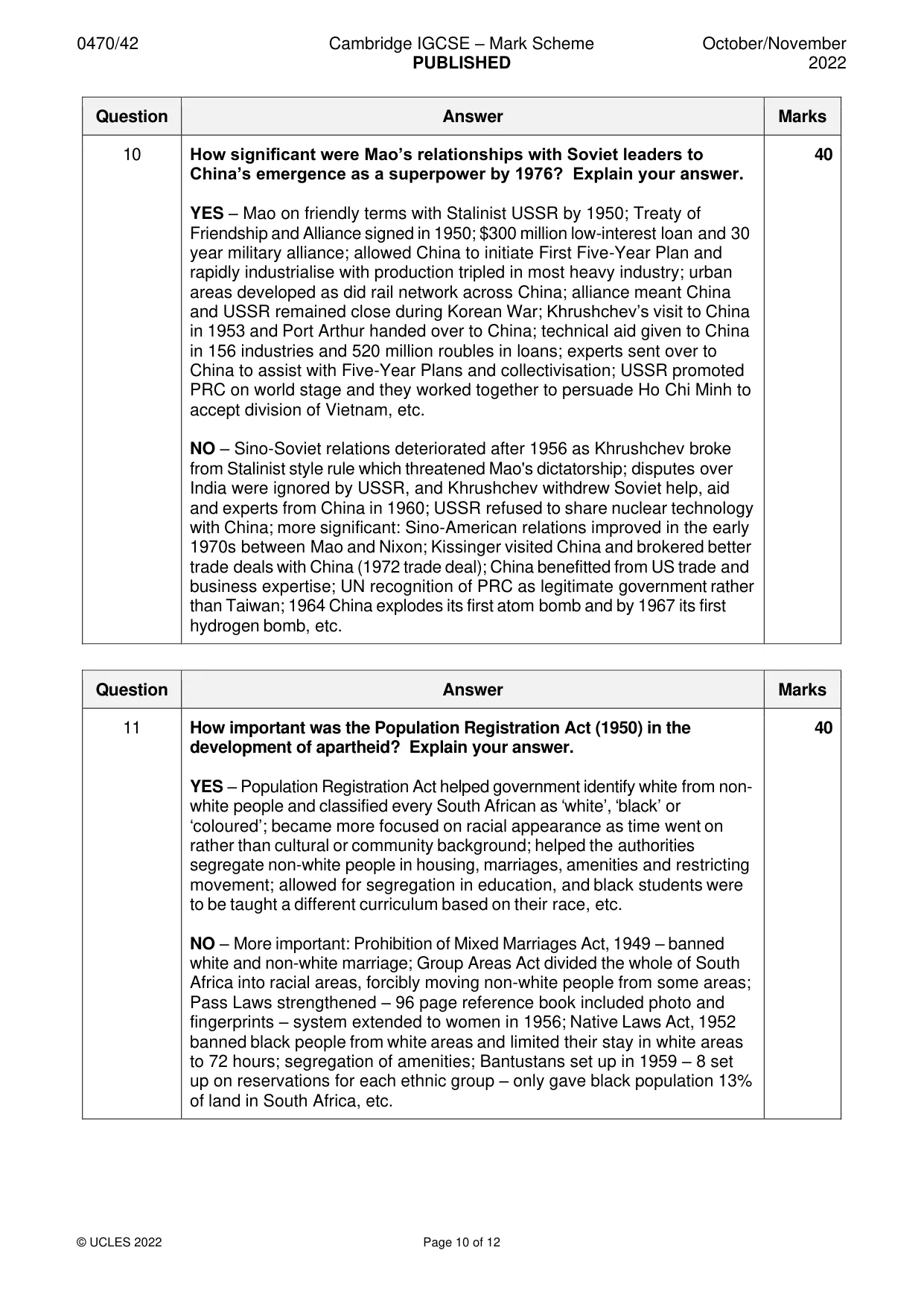
0470/42 Cambridge IGCSE – Mark Scheme PUBLISHED October/November 2022 © UCLES 2022 Page 10 of 12 Question Answer Marks 10 How significant were Mao’s relationships with Soviet leaders to China’s emergence as a superpower by 1976? Explain your answer. YES – Mao on friendly terms with Stalinist USSR by 1950; Treaty of Friendship and Alliance signed in 1950; $300 million low-interest loan and 30 year military alliance; allowed China to initiate First Five-Year Plan and rapidly industrialise with production tripled in most heavy industry; urban areas developed as did rail network across China; alliance meant China and USSR remained close during Korean War; Khrushchev’s visit to China in 1953 and Port Arthur handed over to China; technical aid given to China in 156 industries and 520 million roubles in loans; experts sent over to China to assist with Five-Year Plans and collectivisation; USSR promoted PRC on world stage and they worked together to persuade Ho Chi Minh to accept division of Vietnam, etc. NO – Sino-Soviet relations deteriorated after 1956 as Khrushchev broke from Stalinist style rule which threatened Mao's dictatorship; disputes over India were ignored by USSR, and Khrushchev withdrew Soviet help, aid and experts from China in 1960; USSR refused to share nuclear technology with China; more significant: Sino-American relations improved in the early 1970s between Mao and Nixon; Kissinger visited China and brokered better trade deals with China (1972 trade deal); China benefitted from US trade and business expertise; UN recognition of PRC as legitimate government rather than Taiwan; 1964 China explodes its first atom bomb and by 1967 its first hydrogen bomb, etc. 40 Question Answer Marks 11 How important was the Population Registration Act (1950) in the development of apartheid? Explain your answer. YES – Population Registration Act helped government identify white from non- white people and classified every South African as ‘white’, ‘black’ or ‘coloured’; became more focused on racial appearance as time went on rather than cultural or community background; helped the authorities segregate non-white people in housing, marriages, amenities and restricting movement; allowed for segregation in education, and black students were to be taught a different curriculum based on their race, etc. NO – More important: Prohibition of Mixed Marriages Act, 1949 – banned white and non-white marriage; Group Areas Act divided the whole of South Africa into racial areas, forcibly moving non-white people from some areas; Pass Laws strengthened – 96 page reference book included photo and fingerprints – system extended to women in 1956; Native Laws Act, 1952 banned black people from white areas and limited their stay in white areas to 72 hours; segregation of amenities; Bantustans set up in 1959 – 8 set up on reservations for each ethnic group – only gave black population 13% of land in South Africa, etc. 40
Mark scheme, page 11
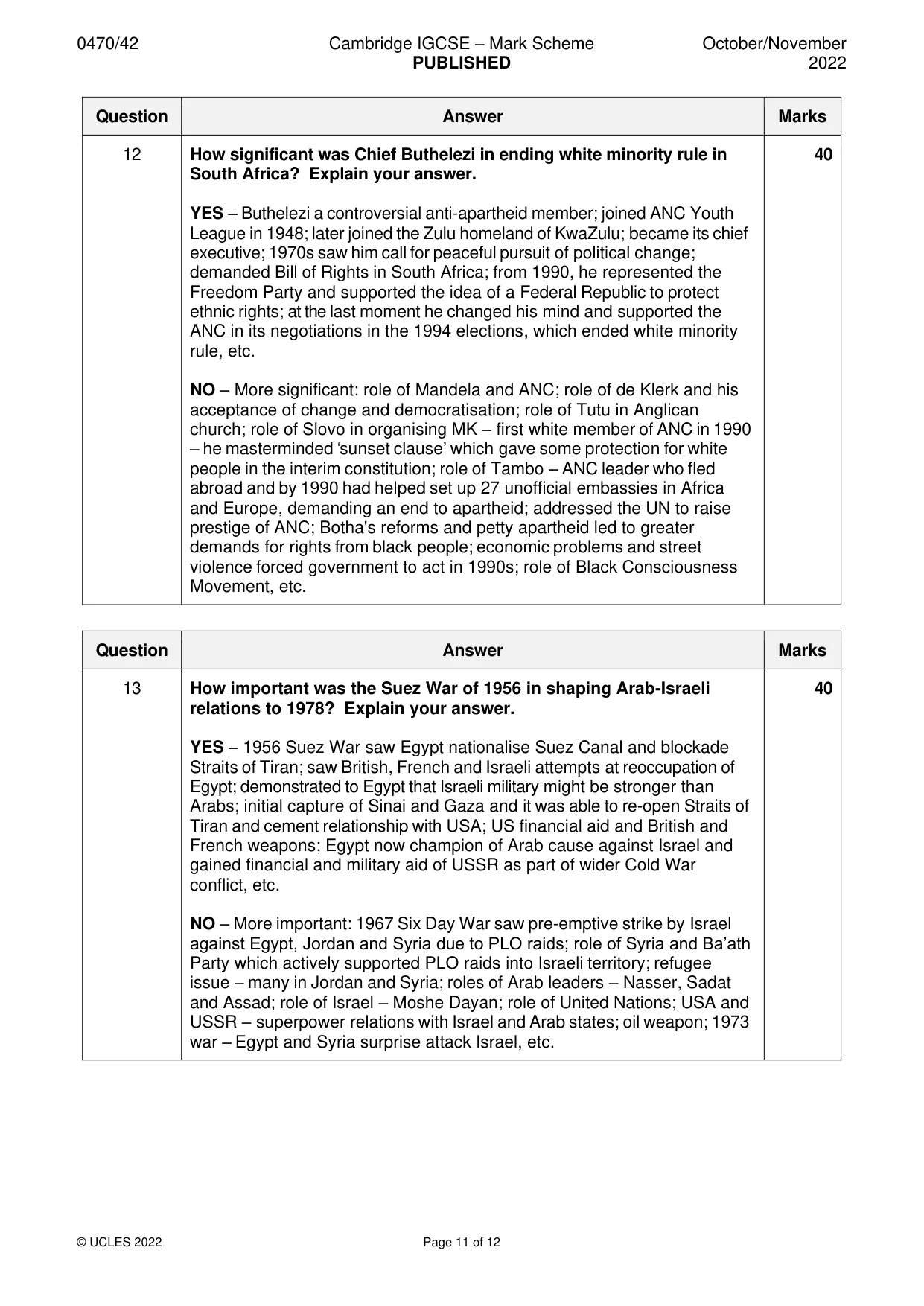
0470/42 Cambridge IGCSE – Mark Scheme PUBLISHED October/November 2022 © UCLES 2022 Page 11 of 12 Question Answer Marks 12 How significant was Chief Buthelezi in ending white minority rule in South Africa? Explain your answer. YES – Buthelezi a controversial anti-apartheid member; joined ANC Youth League in 1948; later joined the Zulu homeland of KwaZulu; became its chief executive; 1970s saw him call for peaceful pursuit of political change; demanded Bill of Rights in South Africa; from 1990, he represented the Freedom Party and supported the idea of a Federal Republic to protect ethnic rights; at the last moment he changed his mind and supported the ANC in its negotiations in the 1994 elections, which ended white minority rule, etc. NO – More significant: role of Mandela and ANC; role of de Klerk and his acceptance of change and democratisation; role of Tutu in Anglican church; role of Slovo in organising MK – first white member of ANC in 1990 – he masterminded ‘sunset clause’ which gave some protection for white people in the interim constitution; role of Tambo – ANC leader who fled abroad and by 1990 had helped set up 27 unofficial embassies in Africa and Europe, demanding an end to apartheid; addressed the UN to raise prestige of ANC; Botha's reforms and petty apartheid led to greater demands for rights from black people; economic problems and street violence forced government to act in 1990s; role of Black Consciousness Movement, etc. 40 Question Answer Marks 13 How important was the Suez War of 1956 in shaping Arab-Israeli relations to 1978? Explain your answer. YES – 1956 Suez War saw Egypt nationalise Suez Canal and blockade Straits of Tiran; saw British, French and Israeli attempts at reoccupation of Egypt; demonstrated to Egypt that Israeli military might be stronger than Arabs; initial capture of Sinai and Gaza and it was able to re-open Straits of Tiran and cement relationship with USA; US financial aid and British and French weapons; Egypt now champion of Arab cause against Israel and gained financial and military aid of USSR as part of wider Cold War conflict, etc. NO – More important: 1967 Six Day War saw pre-emptive strike by Israel against Egypt, Jordan and Syria due to PLO raids; role of Syria and Ba’ath Party which actively supported PLO raids into Israeli territory; refugee issue – many in Jordan and Syria; roles of Arab leaders – Nasser, Sadat and Assad; role of Israel – Moshe Dayan; role of United Nations; USA and USSR – superpower relations with Israel and Arab states; oil weapon; 1973 war – Egypt and Syria surprise attack Israel, etc. 40
Mark scheme, page 12
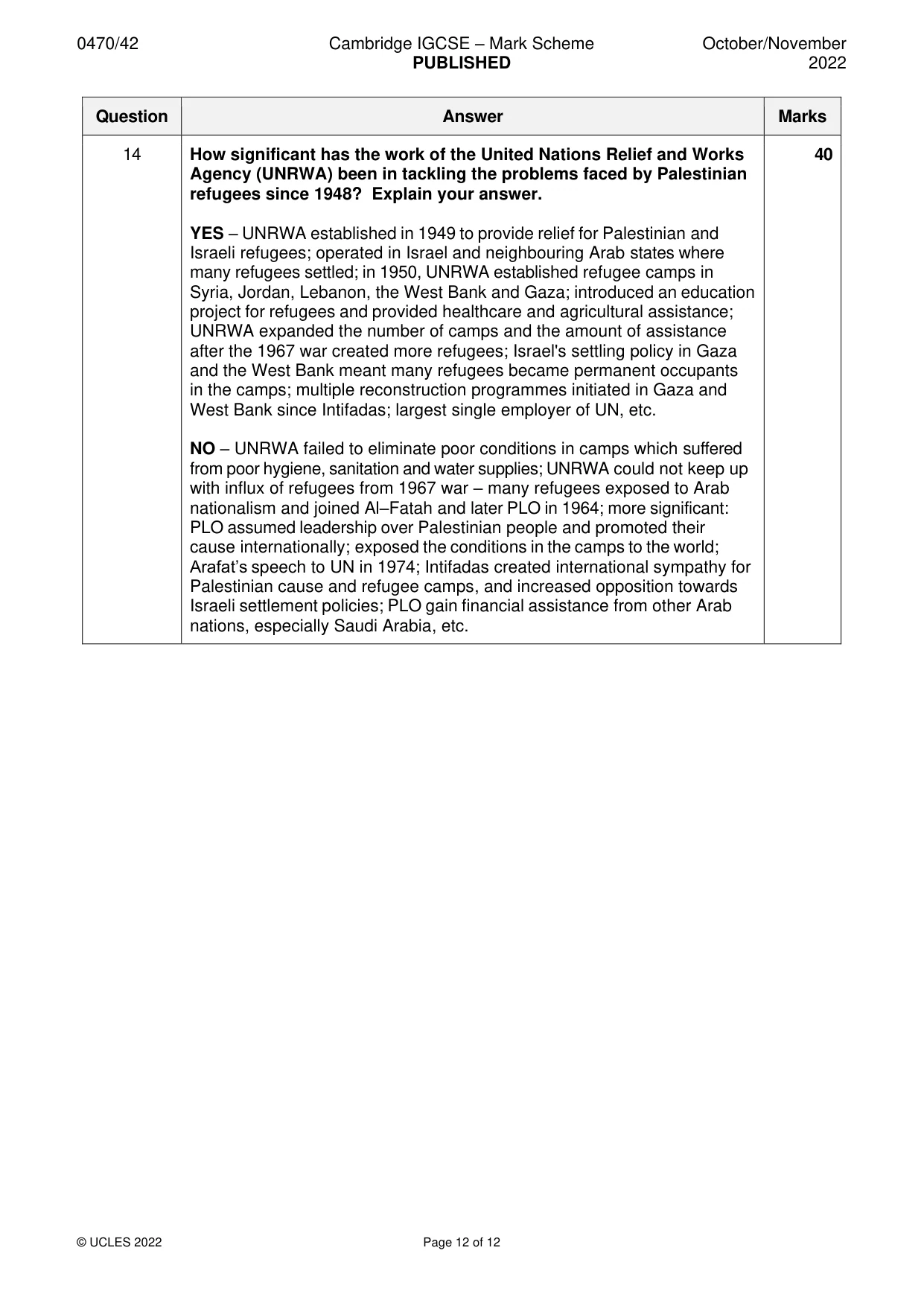
0470/42 Cambridge IGCSE – Mark Scheme PUBLISHED October/November 2022 © UCLES 2022 Page 12 of 12 Question Answer Marks 14 How significant has the work of the United Nations Relief and Works Agency (UNRWA) been in tackling the problems faced by Palestinian refugees since 1948? Explain your answer. YES – UNRWA established in 1949 to provide relief for Palestinian and Israeli refugees; operated in Israel and neighbouring Arab states where many refugees settled; in 1950, UNRWA established refugee camps in Syria, Jordan, Lebanon, the West Bank and Gaza; introduced an education project for refugees and provided healthcare and agricultural assistance; UNRWA expanded the number of camps and the amount of assistance after the 1967 war created more refugees; Israel's settling policy in Gaza and the West Bank meant many refugees became permanent occupants in the camps; multiple reconstruction programmes initiated in Gaza and West Bank since Intifadas; largest single employer of UN, etc. NO – UNRWA failed to eliminate poor conditions in camps which suffered from poor hygiene, sanitation and water supplies; UNRWA could not keep up with influx of refugees from 1967 war – many refugees exposed to Arab nationalism and joined Al–Fatah and later PLO in 1964; more significant: PLO assumed leadership over Palestinian people and promoted their cause internationally; exposed the conditions in the camps to the world; Arafat’s speech to UN in 1974; Intifadas created international sympathy for Palestinian cause and refugee camps, and increased opposition towards Israeli settlement policies; PLO gain financial assistance from other Arab nations, especially Saudi Arabia, etc. 40
What you needed in this session
Cambridge’s own grade thresholds for 2022 Oct/Nov, Paper 4 · Variant 2. A higher threshold means an easier paper — the bar moves with how the cohort did.