Cambridge IGCSE History 0470 — 2021 May/June Paper 4 · Variant 3
0470/43/M/J/21 · 40 marks · ≈45 min
The question paper and its mark scheme, free to read here and free to download. This is Cambridge’s own paper, exactly as it was sat.
Question paper4 pages

Mark scheme12 pages
Answers below. Sit the paper first if you are practising.

Paper as text
Question paper, page 1
Cambridge IGCSE™ 0470/43 May/June 2021 1 hour HISTORY Paper 4 Alternative to Coursework You must answer on the enclosed answer booklet. You will need: Answer booklet (enclosed) INSTRUCTIONS • Answer one question from your chosen Depth Study. • Follow the instructions on the front cover of the answer booklet. If you need additional answer paper, ask the invigilator for a continuation booklet. INFORMATION • The total mark for this paper is 40. • The number of marks for each question or part question is shown in brackets [ ]. This document has 4 pages. Any blank pages are indicated. [Turn over 06_0470_43_2021_1.8 © UCLES 2021 *5130284152*
Question paper, page 2
Answer one question from your chosen Depth Study. DEPTH STUDY A: THE FIRST WORLD WAR, 1914–18 How important were new weapons as a cause of trench warfare on the Western Front? Explain your answer. [40] 1 How significant was Germany’s two-front war as a reason for its defeat in 1918? Explain your answer. [40] 2 DEPTH STUDY B: GERMANY, 1918–45 How important were left-wing uprisings in Germany’s problems, 1919–23? Explain your answer. [40] 3 How significant was the persecution of minorities as an aspect of Nazi policy, 1933–45? Explain your answer. [40] 4 DEPTH STUDY C: RUSSIA, 1905–41 How important was Russia’s autocratic political system as a reason for the regime’s collapse by March 1917? Explain your answer. [40] 5 How significant were Stalin’s Purges in the creation of a totalitarian state in the Soviet Union after 1928? Explain your answer. [40] 6 DEPTH STUDY D: THE UNITED STATES, 1919–41 How important was the movie industry in changing the lives of the American people in the 1920s? Explain your answer. [40] 7 How significant was financial speculation as a cause of the Wall Street Crash in 1929? Explain your answer. [40] 8 DEPTH STUDY E: CHINA, c.1930–c.1990 How important were health reforms in changing the lives of Chinese peasants by 1960? Explain your answer. [40] 9 How significant were economic reforms in changing the lives of the Chinese people in the period 1976–c.1990? Explain your answer. [40] 10 06_0470_43_2021_1.8 © UCLES 2021 2
Question paper, page 3
DEPTH STUDY F: SOUTH AFRICA, c.1940–c.1994 How important were the policies of the United Party as a reason for the success of the National Party in 1948? Explain your answer. [40] 11 How significant was the Rivonia Trial (1963–64) in preventing organised opposition to apartheid? Explain your answer. [40] 12 DEPTH STUDY G: ISRAELIS AND PALESTINIANS SINCE 1945 How important was British policy as a cause of tension in Palestine up to 1948? Explain your answer. [40] 13 How significant were the Oslo Accords in dealing with the causes of tension between Israelis and Palestinians? Explain your answer. [40] 14 06_0470_43_2021_1.8 © UCLES 2021 3
Question paper, page 4
BLANK PAGE Permission to reproduce items where third-party owned material protected by copyright is included has been sought and cleared where possible. Every reasonable effort has been made by the publisher (UCLES) to trace copyright holders, but if any items requiring clearance have unwittingly been included, the publisher will be pleased to make amends at the earliest possible opportunity. To avoid the issue of disclosure of answer-related information to candidates, all copyright acknowledgements are reproduced online in the Cambridge Assessment International Education Copyright Acknowledgements Booklet. This is produced for each series of examinations and is freely available to download at www.cambridgeinternational.org after the live examination series. Cambridge Assessment International Education is part of the Cambridge Assessment Group. Cambridge Assessment is the brand name of the University of Cambridge Local Examinations Syndicate (UCLES), which itself is a department of the University of Cambridge. 06_0470_43_2021_1.8 © UCLES 2021 4
Mark scheme, page 1
This document consists of 12 printed pages. © UCLES 2021 [Turn over Cambridge IGCSE™ HISTORY 0470/43 Paper 4 Alternative to Coursework May/June 2021 MARK SCHEME Maximum Mark: 40 Published This mark scheme is published as an aid to teachers and candidates, to indicate the requirements of the examination. It shows the basis on which Examiners were instructed to award marks. It does not indicate the details of the discussions that took place at an Examiners’ meeting before marking began, which would have considered the acceptability of alternative answers. Mark schemes should be read in conjunction with the question paper and the Principal Examiner Report for Teachers. Cambridge International will not enter into discussions about these mark schemes. Cambridge International is publishing the mark schemes for the May/June 2021 series for most Cambridge IGCSE™, Cambridge International A and AS Level components and some Cambridge O Level components.
Mark scheme, page 2
0470/43 Cambridge IGCSE – Mark Scheme PUBLISHED May/June 2021 © UCLES 2021 Page 2 of 12 Generic Marking Principles These general marking principles must be applied by all examiners when marking candidate answers. They should be applied alongside the specific content of the mark scheme or generic level descriptors for a question. Each question paper and mark scheme will also comply with these marking principles. GENERIC MARKING PRINCIPLE 1: Marks must be awarded in line with: • the specific content of the mark scheme or the generic level descriptors for the question • the specific skills defined in the mark scheme or in the generic level descriptors for the question • the standard of response required by a candidate as exemplified by the standardisation scripts. GENERIC MARKING PRINCIPLE 2: Marks awarded are always whole marks (not half marks, or other fractions). GENERIC MARKING PRINCIPLE 3: Marks must be awarded positively: • marks are awarded for correct/valid answers, as defined in the mark scheme. However, credit is given for valid answers which go beyond the scope of the syllabus and mark scheme, referring to your Team Leader as appropriate • marks are awarded when candidates clearly demonstrate what they know and can do • marks are not deducted for errors • marks are not deducted for omissions • answers should only be judged on the quality of spelling, punctuation and grammar when these features are specifically assessed by the question as indicated by the mark scheme. The meaning, however, should be unambiguous. GENERIC MARKING PRINCIPLE 4: Rules must be applied consistently, e.g. in situations where candidates have not followed instructions or in the application of generic level descriptors. GENERIC MARKING PRINCIPLE 5: Marks should be awarded using the full range of marks defined in the mark scheme for the question (however; the use of the full mark range may be limited according to the quality of the candidate responses seen). GENERIC MARKING PRINCIPLE 6: Marks awarded are based solely on the requirements as defined in the mark scheme. Marks should not be awarded with grade thresholds or grade descriptors in mind.
Mark scheme, page 3
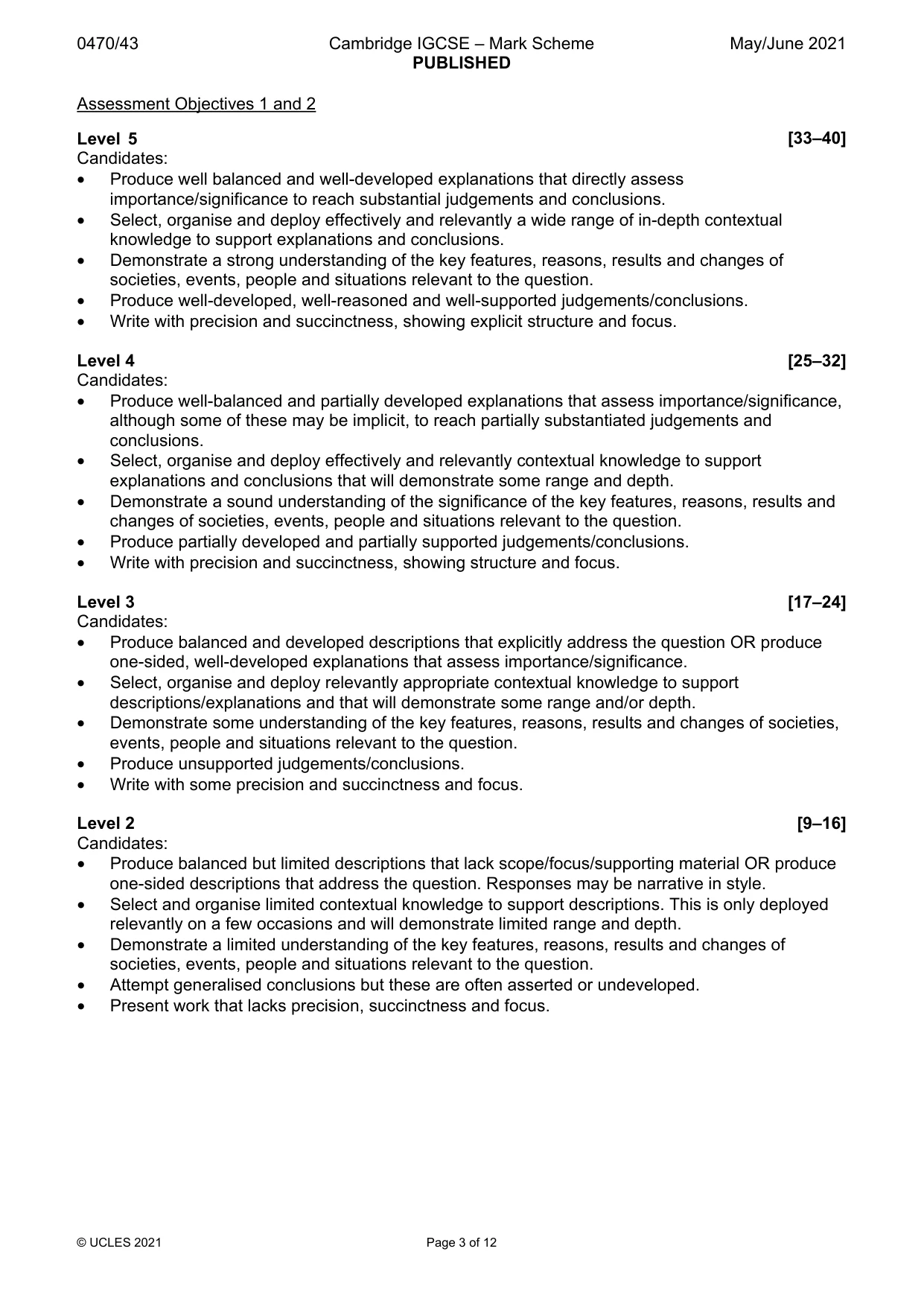
0470/43 Cambridge IGCSE – Mark Scheme PUBLISHED May/June 2021 © UCLES 2021 Page 3 of 12 Assessment Objectives 1 and 2 Level 5 [33–40] Candidates: • Produce well balanced and well-developed explanations that directly assess importance/significance to reach substantial judgements and conclusions. • Select, organise and deploy effectively and relevantly a wide range of in-depth contextual knowledge to support explanations and conclusions. • Demonstrate a strong understanding of the key features, reasons, results and changes of societies, events, people and situations relevant to the question. • Produce well-developed, well-reasoned and well-supported judgements/conclusions. • Write with precision and succinctness, showing explicit structure and focus. Level 4 [25–32] Candidates: • Produce well-balanced and partially developed explanations that assess importance/significance, although some of these may be implicit, to reach partially substantiated judgements and conclusions. • Select, organise and deploy effectively and relevantly contextual knowledge to support explanations and conclusions that will demonstrate some range and depth. • Demonstrate a sound understanding of the significance of the key features, reasons, results and changes of societies, events, people and situations relevant to the question. • Produce partially developed and partially supported judgements/conclusions. • Write with precision and succinctness, showing structure and focus. Level 3 [17–24] Candidates: • Produce balanced and developed descriptions that explicitly address the question OR produce one-sided, well-developed explanations that assess importance/significance. • Select, organise and deploy relevantly appropriate contextual knowledge to support descriptions/explanations and that will demonstrate some range and/or depth. • Demonstrate some understanding of the key features, reasons, results and changes of societies, events, people and situations relevant to the question. • Produce unsupported judgements/conclusions. • Write with some precision and succinctness and focus. Level 2 [9–16] Candidates: • Produce balanced but limited descriptions that lack scope/focus/supporting material OR produce one-sided descriptions that address the question. Responses may be narrative in style. • Select and organise limited contextual knowledge to support descriptions. This is only deployed relevantly on a few occasions and will demonstrate limited range and depth. • Demonstrate a limited understanding of the key features, reasons, results and changes of societies, events, people and situations relevant to the question. • Attempt generalised conclusions but these are often asserted or undeveloped. • Present work that lacks precision, succinctness and focus.
Mark scheme, page 4
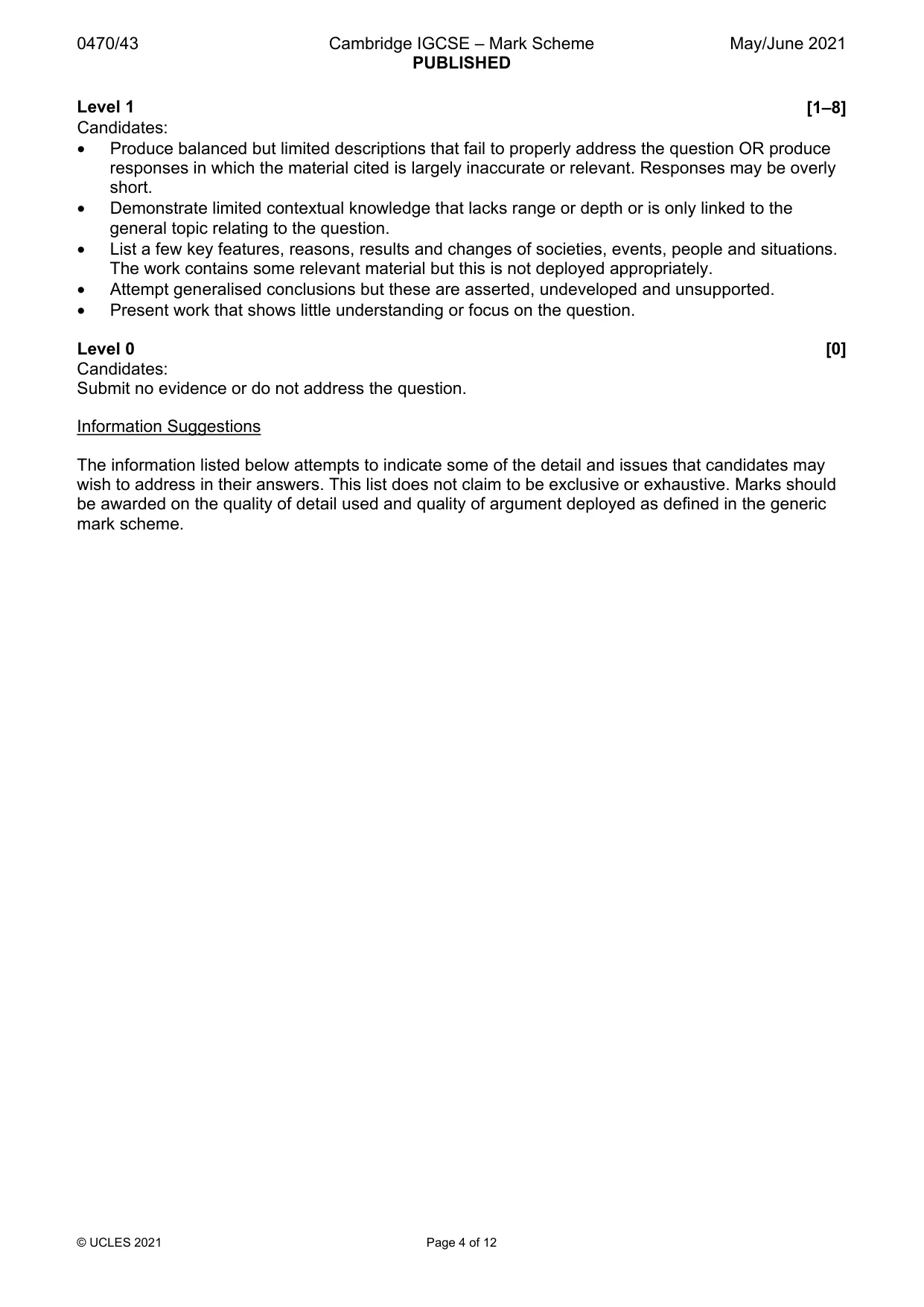
0470/43 Cambridge IGCSE – Mark Scheme PUBLISHED May/June 2021 © UCLES 2021 Page 4 of 12 Level 1 [1–8] Candidates: • Produce balanced but limited descriptions that fail to properly address the question OR produce responses in which the material cited is largely inaccurate or relevant. Responses may be overly short. • Demonstrate limited contextual knowledge that lacks range or depth or is only linked to the general topic relating to the question. • List a few key features, reasons, results and changes of societies, events, people and situations. The work contains some relevant material but this is not deployed appropriately. • Attempt generalised conclusions but these are asserted, undeveloped and unsupported. • Present work that shows little understanding or focus on the question. Level 0 [0] Candidates: Submit no evidence or do not address the question. Information Suggestions The information listed below attempts to indicate some of the detail and issues that candidates may wish to address in their answers. This list does not claim to be exclusive or exhaustive. Marks should be awarded on the quality of detail used and quality of argument deployed as defined in the generic mark scheme.
Mark scheme, page 5
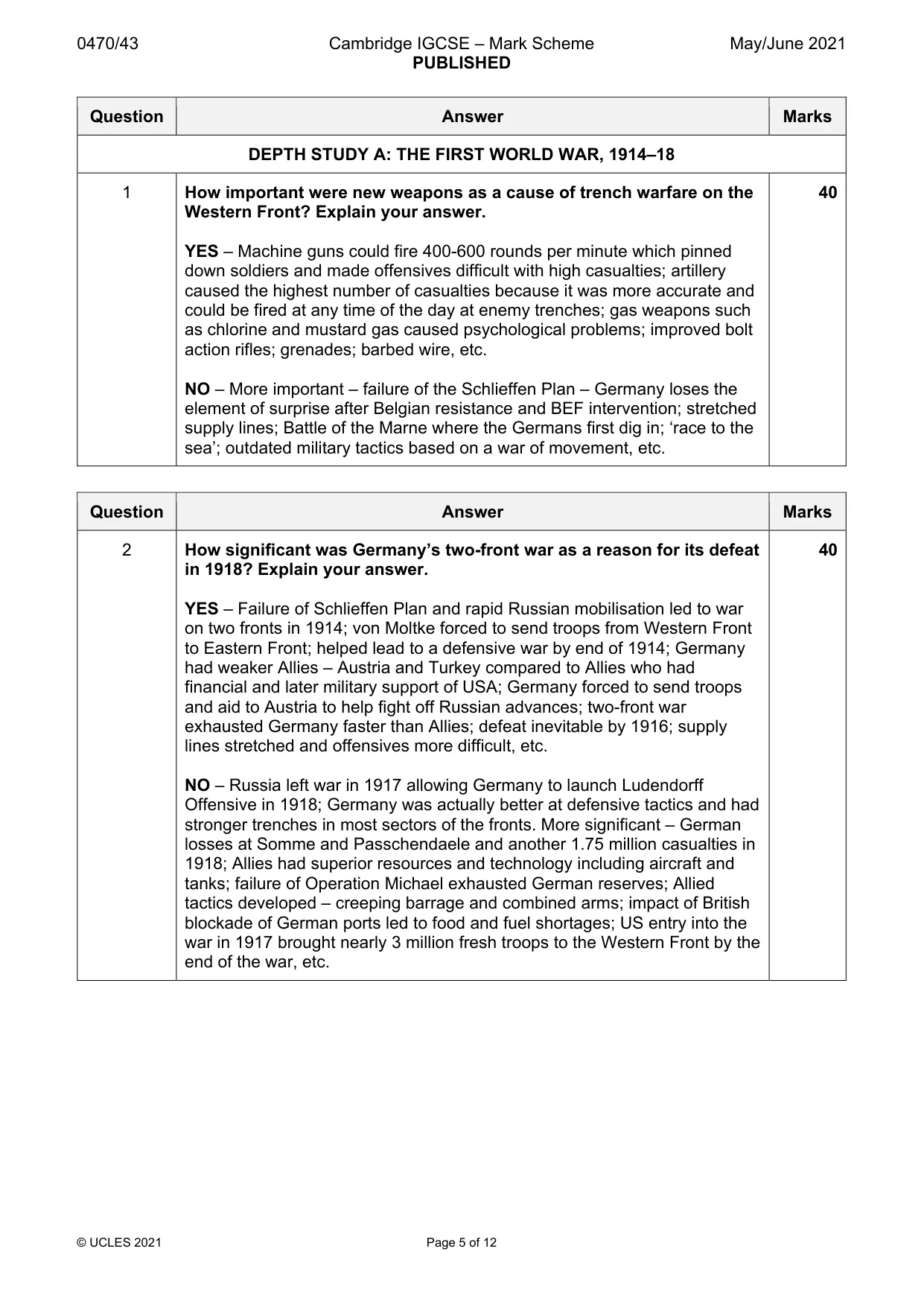
0470/43 Cambridge IGCSE – Mark Scheme PUBLISHED May/June 2021 © UCLES 2021 Page 5 of 12 Question Answer Marks DEPTH STUDY A: THE FIRST WORLD WAR, 1914–18 1 How important were new weapons as a cause of trench warfare on the Western Front? Explain your answer. YES – Machine guns could fire 400-600 rounds per minute which pinned down soldiers and made offensives difficult with high casualties; artillery caused the highest number of casualties because it was more accurate and could be fired at any time of the day at enemy trenches; gas weapons such as chlorine and mustard gas caused psychological problems; improved bolt action rifles; grenades; barbed wire, etc. NO – More important – failure of the Schlieffen Plan – Germany loses the element of surprise after Belgian resistance and BEF intervention; stretched supply lines; Battle of the Marne where the Germans first dig in; ‘race to the sea’; outdated military tactics based on a war of movement, etc. 40 Question Answer Marks 2 How significant was Germany’s two-front war as a reason for its defeat in 1918? Explain your answer. YES – Failure of Schlieffen Plan and rapid Russian mobilisation led to war on two fronts in 1914; von Moltke forced to send troops from Western Front to Eastern Front; helped lead to a defensive war by end of 1914; Germany had weaker Allies – Austria and Turkey compared to Allies who had financial and later military support of USA; Germany forced to send troops and aid to Austria to help fight off Russian advances; two-front war exhausted Germany faster than Allies; defeat inevitable by 1916; supply lines stretched and offensives more difficult, etc. NO – Russia left war in 1917 allowing Germany to launch Ludendorff Offensive in 1918; Germany was actually better at defensive tactics and had stronger trenches in most sectors of the fronts. More significant – German losses at Somme and Passchendaele and another 1.75 million casualties in 1918; Allies had superior resources and technology including aircraft and tanks; failure of Operation Michael exhausted German reserves; Allied tactics developed – creeping barrage and combined arms; impact of British blockade of German ports led to food and fuel shortages; US entry into the war in 1917 brought nearly 3 million fresh troops to the Western Front by the end of the war, etc. 40
Mark scheme, page 6
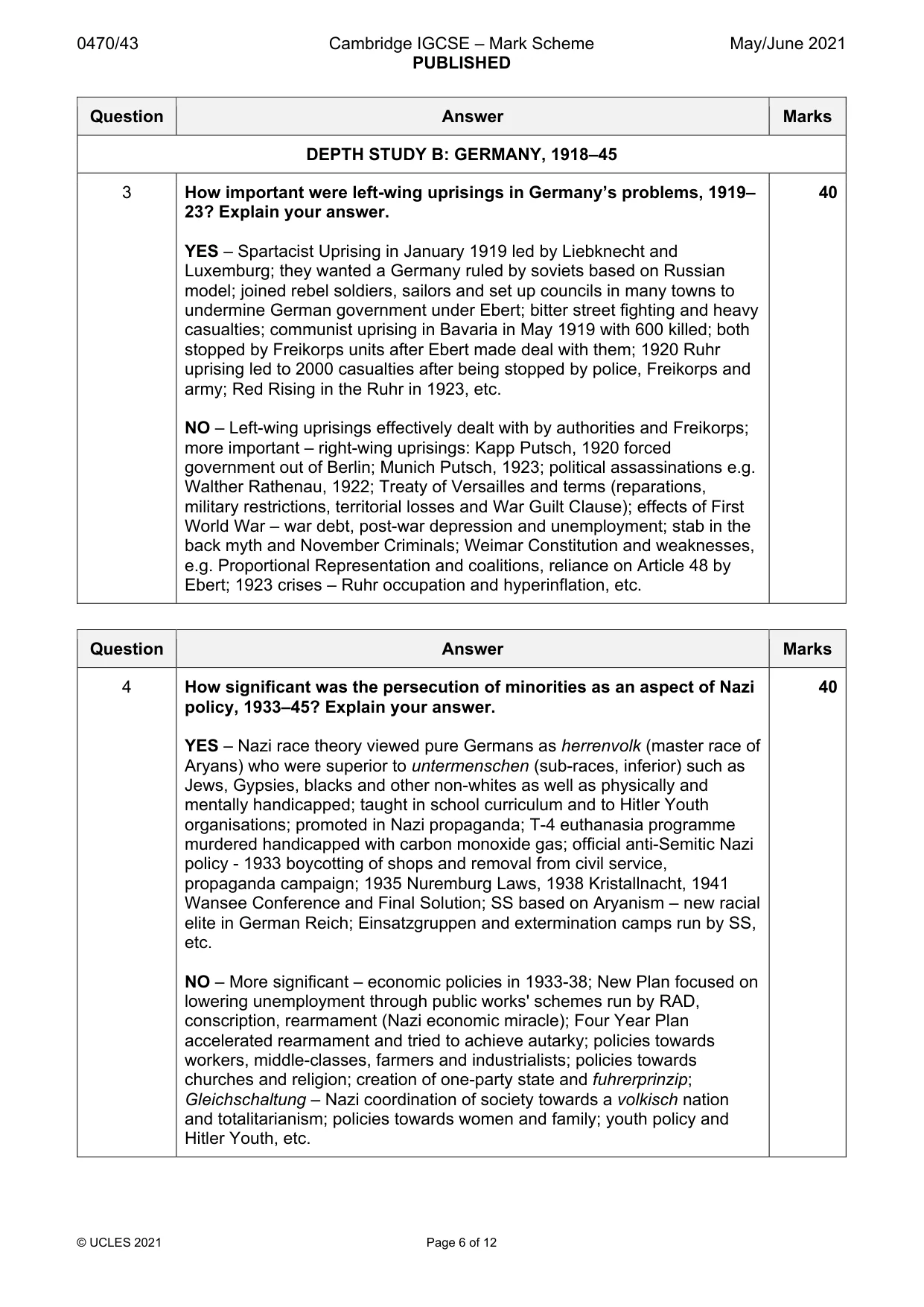
0470/43 Cambridge IGCSE – Mark Scheme PUBLISHED May/June 2021 © UCLES 2021 Page 6 of 12 Question Answer Marks DEPTH STUDY B: GERMANY, 1918–45 3 How important were left-wing uprisings in Germany’s problems, 1919– 23? Explain your answer. YES – Spartacist Uprising in January 1919 led by Liebknecht and Luxemburg; they wanted a Germany ruled by soviets based on Russian model; joined rebel soldiers, sailors and set up councils in many towns to undermine German government under Ebert; bitter street fighting and heavy casualties; communist uprising in Bavaria in May 1919 with 600 killed; both stopped by Freikorps units after Ebert made deal with them; 1920 Ruhr uprising led to 2000 casualties after being stopped by police, Freikorps and army; Red Rising in the Ruhr in 1923, etc. NO – Left-wing uprisings effectively dealt with by authorities and Freikorps; more important – right-wing uprisings: Kapp Putsch, 1920 forced government out of Berlin; Munich Putsch, 1923; political assassinations e.g. Walther Rathenau, 1922; Treaty of Versailles and terms (reparations, military restrictions, territorial losses and War Guilt Clause); effects of First World War – war debt, post-war depression and unemployment; stab in the back myth and November Criminals; Weimar Constitution and weaknesses, e.g. Proportional Representation and coalitions, reliance on Article 48 by Ebert; 1923 crises – Ruhr occupation and hyperinflation, etc. 40 Question Answer Marks 4 How significant was the persecution of minorities as an aspect of Nazi policy, 1933–45? Explain your answer. YES – Nazi race theory viewed pure Germans as herrenvolk (master race of Aryans) who were superior to untermenschen (sub-races, inferior) such as Jews, Gypsies, blacks and other non-whites as well as physically and mentally handicapped; taught in school curriculum and to Hitler Youth organisations; promoted in Nazi propaganda; T-4 euthanasia programme murdered handicapped with carbon monoxide gas; official anti-Semitic Nazi policy - 1933 boycotting of shops and removal from civil service, propaganda campaign; 1935 Nuremburg Laws, 1938 Kristallnacht, 1941 Wansee Conference and Final Solution; SS based on Aryanism – new racial elite in German Reich; Einsatzgruppen and extermination camps run by SS, etc. NO – More significant – economic policies in 1933-38; New Plan focused on lowering unemployment through public works' schemes run by RAD, conscription, rearmament (Nazi economic miracle); Four Year Plan accelerated rearmament and tried to achieve autarky; policies towards workers, middle-classes, farmers and industrialists; policies towards churches and religion; creation of one-party state and fuhrerprinzip; Gleichschaltung – Nazi coordination of society towards a volkisch nation and totalitarianism; policies towards women and family; youth policy and Hitler Youth, etc. 40
Mark scheme, page 7
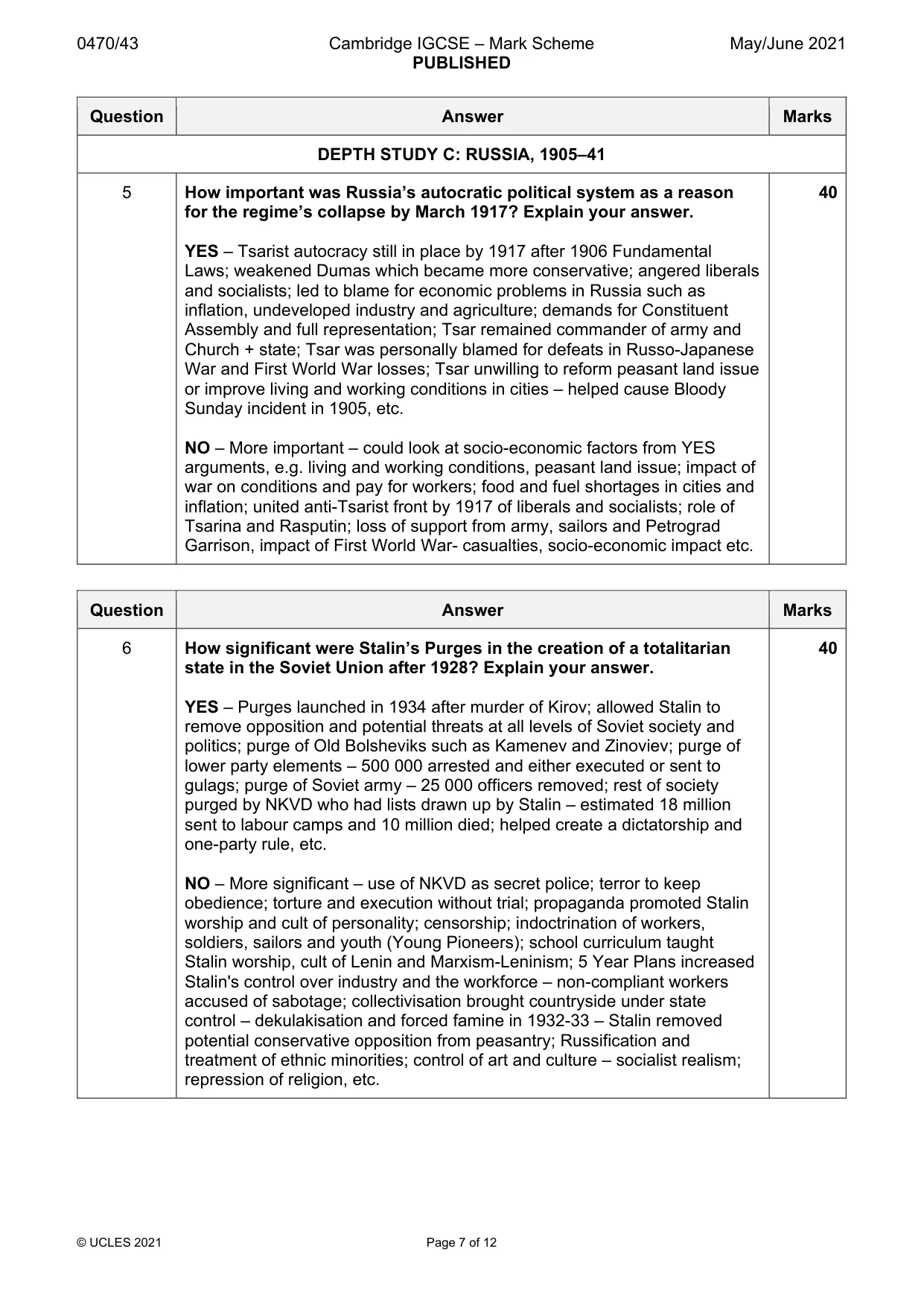
0470/43 Cambridge IGCSE – Mark Scheme PUBLISHED May/June 2021 © UCLES 2021 Page 7 of 12 Question Answer Marks DEPTH STUDY C: RUSSIA, 1905–41 5 How important was Russia’s autocratic political system as a reason for the regime’s collapse by March 1917? Explain your answer. YES – Tsarist autocracy still in place by 1917 after 1906 Fundamental Laws; weakened Dumas which became more conservative; angered liberals and socialists; led to blame for economic problems in Russia such as inflation, undeveloped industry and agriculture; demands for Constituent Assembly and full representation; Tsar remained commander of army and Church + state; Tsar was personally blamed for defeats in Russo-Japanese War and First World War losses; Tsar unwilling to reform peasant land issue or improve living and working conditions in cities – helped cause Bloody Sunday incident in 1905, etc. NO – More important – could look at socio-economic factors from YES arguments, e.g. living and working conditions, peasant land issue; impact of war on conditions and pay for workers; food and fuel shortages in cities and inflation; united anti-Tsarist front by 1917 of liberals and socialists; role of Tsarina and Rasputin; loss of support from army, sailors and Petrograd Garrison, impact of First World War- casualties, socio-economic impact etc. 40 Question Answer Marks 6 How significant were Stalin’s Purges in the creation of a totalitarian state in the Soviet Union after 1928? Explain your answer. YES – Purges launched in 1934 after murder of Kirov; allowed Stalin to remove opposition and potential threats at all levels of Soviet society and politics; purge of Old Bolsheviks such as Kamenev and Zinoviev; purge of lower party elements – 500 000 arrested and either executed or sent to gulags; purge of Soviet army – 25 000 officers removed; rest of society purged by NKVD who had lists drawn up by Stalin – estimated 18 million sent to labour camps and 10 million died; helped create a dictatorship and one-party rule, etc. NO – More significant – use of NKVD as secret police; terror to keep obedience; torture and execution without trial; propaganda promoted Stalin worship and cult of personality; censorship; indoctrination of workers, soldiers, sailors and youth (Young Pioneers); school curriculum taught Stalin worship, cult of Lenin and Marxism-Leninism; 5 Year Plans increased Stalin's control over industry and the workforce – non-compliant workers accused of sabotage; collectivisation brought countryside under state control – dekulakisation and forced famine in 1932-33 – Stalin removed potential conservative opposition from peasantry; Russification and treatment of ethnic minorities; control of art and culture – socialist realism; repression of religion, etc. 40
Mark scheme, page 8
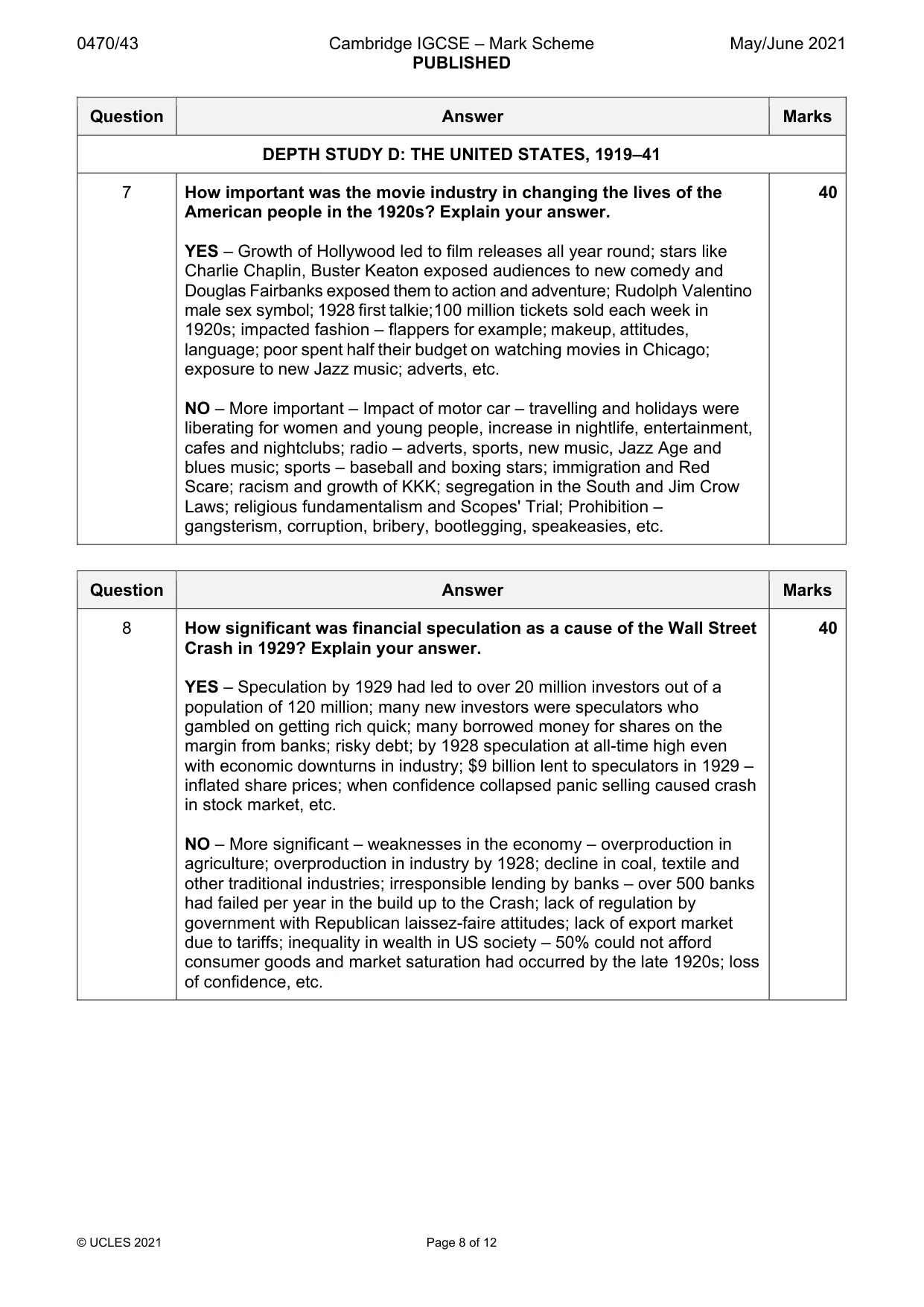
0470/43 Cambridge IGCSE – Mark Scheme PUBLISHED May/June 2021 © UCLES 2021 Page 8 of 12 Question Answer Marks DEPTH STUDY D: THE UNITED STATES, 1919–41 7 How important was the movie industry in changing the lives of the American people in the 1920s? Explain your answer. YES – Growth of Hollywood led to film releases all year round; stars like Charlie Chaplin, Buster Keaton exposed audiences to new comedy and Douglas Fairbanks exposed them to action and adventure; Rudolph Valentino male sex symbol; 1928 first talkie; 100 million tickets sold each week in 1920s; impacted fashion – flappers for example; makeup, attitudes, language; poor spent half their budget on watching movies in Chicago; exposure to new Jazz music; adverts, etc. NO – More important – Impact of motor car – travelling and holidays were liberating for women and young people, increase in nightlife, entertainment, cafes and nightclubs; radio – adverts, sports, new music, Jazz Age and blues music; sports – baseball and boxing stars; immigration and Red Scare; racism and growth of KKK; segregation in the South and Jim Crow Laws; religious fundamentalism and Scopes' Trial; Prohibition – gangsterism, corruption, bribery, bootlegging, speakeasies, etc. 40 Question Answer Marks 8 How significant was financial speculation as a cause of the Wall Street Crash in 1929? Explain your answer. YES – Speculation by 1929 had led to over 20 million investors out of a population of 120 million; many new investors were speculators who gambled on getting rich quick; many borrowed money for shares on the margin from banks; risky debt; by 1928 speculation at all-time high even with economic downturns in industry; $9 billion lent to speculators in 1929 – inflated share prices; when confidence collapsed panic selling caused crash in stock market, etc. NO – More significant – weaknesses in the economy – overproduction in agriculture; overproduction in industry by 1928; decline in coal, textile and other traditional industries; irresponsible lending by banks – over 500 banks had failed per year in the build up to the Crash; lack of regulation by government with Republican laissez-faire attitudes; lack of export market due to tariffs; inequality in wealth in US society – 50% could not afford consumer goods and market saturation had occurred by the late 1920s; loss of confidence, etc. 40
Mark scheme, page 9
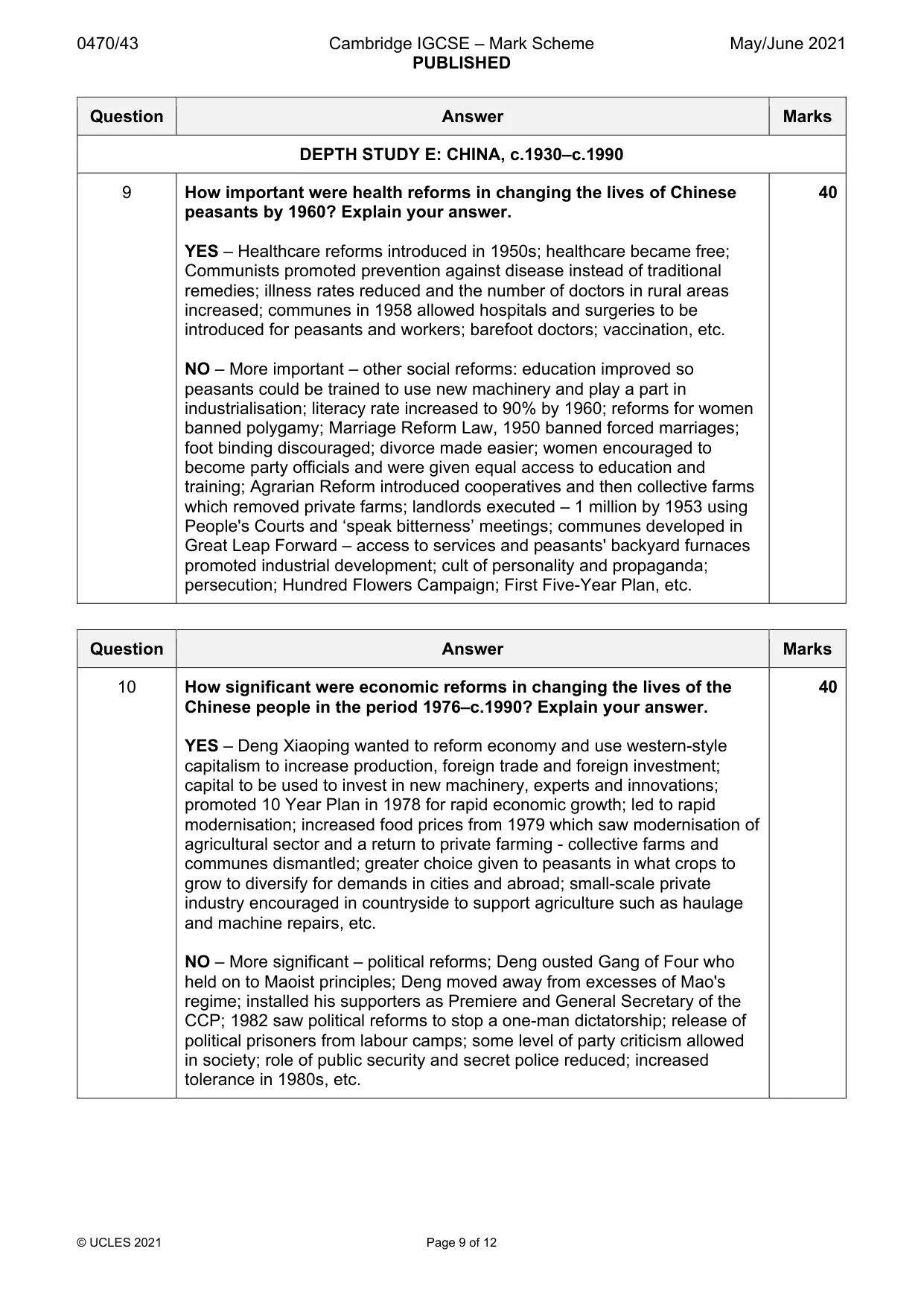
0470/43 Cambridge IGCSE – Mark Scheme PUBLISHED May/June 2021 © UCLES 2021 Page 9 of 12 Question Answer Marks DEPTH STUDY E: CHINA, c.1930–c.1990 9 How important were health reforms in changing the lives of Chinese peasants by 1960? Explain your answer. YES – Healthcare reforms introduced in 1950s; healthcare became free; Communists promoted prevention against disease instead of traditional remedies; illness rates reduced and the number of doctors in rural areas increased; communes in 1958 allowed hospitals and surgeries to be introduced for peasants and workers; barefoot doctors; vaccination, etc. NO – More important – other social reforms: education improved so peasants could be trained to use new machinery and play a part in industrialisation; literacy rate increased to 90% by 1960; reforms for women banned polygamy; Marriage Reform Law, 1950 banned forced marriages; foot binding discouraged; divorce made easier; women encouraged to become party officials and were given equal access to education and training; Agrarian Reform introduced cooperatives and then collective farms which removed private farms; landlords executed – 1 million by 1953 using People's Courts and ‘speak bitterness’ meetings; communes developed in Great Leap Forward – access to services and peasants' backyard furnaces promoted industrial development; cult of personality and propaganda; persecution; Hundred Flowers Campaign; First Five-Year Plan, etc. 40 Question Answer Marks 10 How significant were economic reforms in changing the lives of the Chinese people in the period 1976–c.1990? Explain your answer. YES – Deng Xiaoping wanted to reform economy and use western-style capitalism to increase production, foreign trade and foreign investment; capital to be used to invest in new machinery, experts and innovations; promoted 10 Year Plan in 1978 for rapid economic growth; led to rapid modernisation; increased food prices from 1979 which saw modernisation of agricultural sector and a return to private farming - collective farms and communes dismantled; greater choice given to peasants in what crops to grow to diversify for demands in cities and abroad; small-scale private industry encouraged in countryside to support agriculture such as haulage and machine repairs, etc. NO – More significant – political reforms; Deng ousted Gang of Four who held on to Maoist principles; Deng moved away from excesses of Mao's regime; installed his supporters as Premiere and General Secretary of the CCP; 1982 saw political reforms to stop a one-man dictatorship; release of political prisoners from labour camps; some level of party criticism allowed in society; role of public security and secret police reduced; increased tolerance in 1980s, etc. 40
Mark scheme, page 10
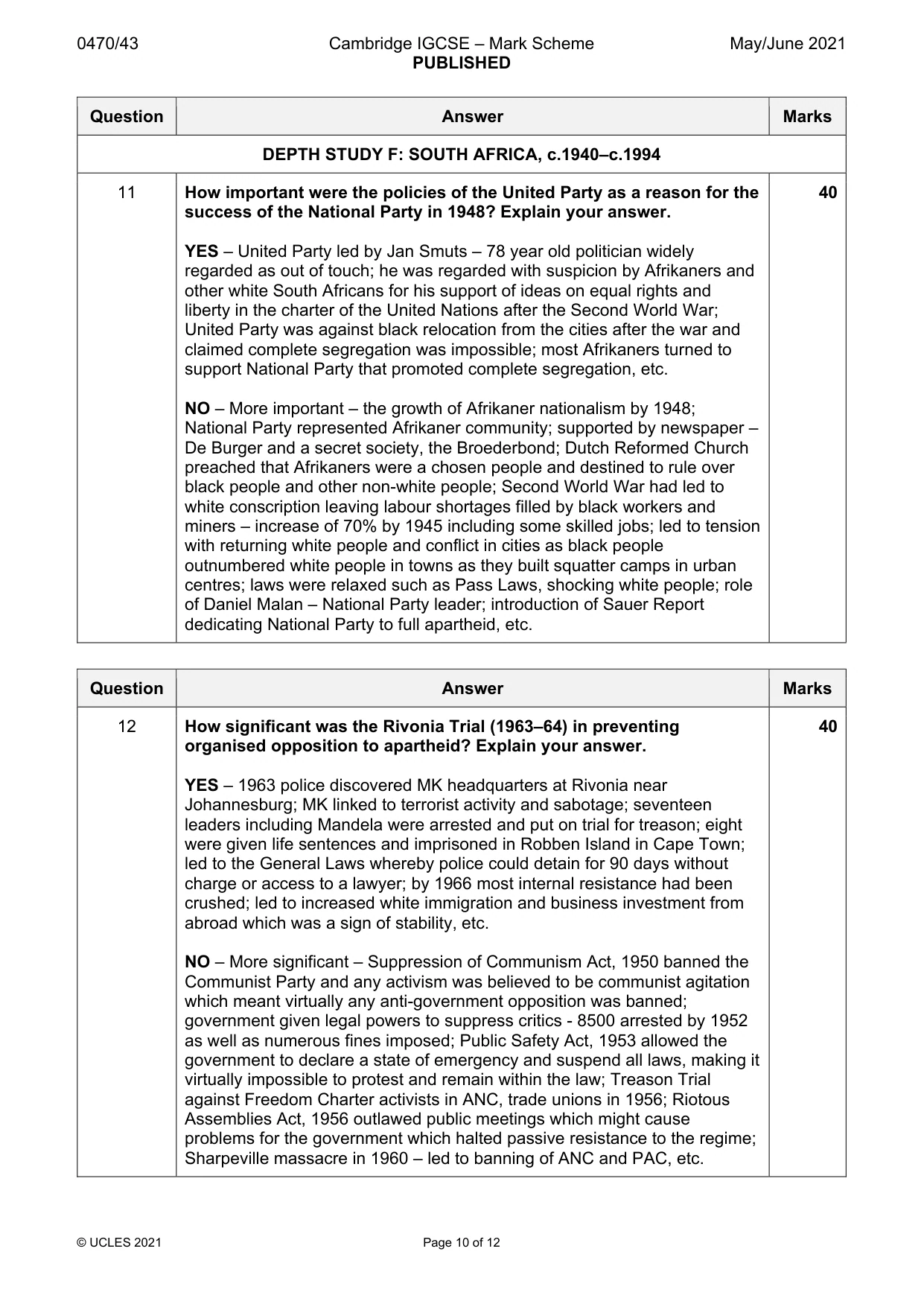
0470/43 Cambridge IGCSE – Mark Scheme PUBLISHED May/June 2021 © UCLES 2021 Page 10 of 12 Question Answer Marks DEPTH STUDY F: SOUTH AFRICA, c.1940–c.1994 11 How important were the policies of the United Party as a reason for the success of the National Party in 1948? Explain your answer. YES – United Party led by Jan Smuts – 78 year old politician widely regarded as out of touch; he was regarded with suspicion by Afrikaners and other white South Africans for his support of ideas on equal rights and liberty in the charter of the United Nations after the Second World War; United Party was against black relocation from the cities after the war and claimed complete segregation was impossible; most Afrikaners turned to support National Party that promoted complete segregation, etc. NO – More important – the growth of Afrikaner nationalism by 1948; National Party represented Afrikaner community; supported by newspaper – De Burger and a secret society, the Broederbond; Dutch Reformed Church preached that Afrikaners were a chosen people and destined to rule over black people and other non-white people; Second World War had led to white conscription leaving labour shortages filled by black workers and miners – increase of 70% by 1945 including some skilled jobs; led to tension with returning white people and conflict in cities as black people outnumbered white people in towns as they built squatter camps in urban centres; laws were relaxed such as Pass Laws, shocking white people; role of Daniel Malan – National Party leader; introduction of Sauer Report dedicating National Party to full apartheid, etc. 40 Question Answer Marks 12 How significant was the Rivonia Trial (1963–64) in preventing organised opposition to apartheid? Explain your answer. YES – 1963 police discovered MK headquarters at Rivonia near Johannesburg; MK linked to terrorist activity and sabotage; seventeen leaders including Mandela were arrested and put on trial for treason; eight were given life sentences and imprisoned in Robben Island in Cape Town; led to the General Laws whereby police could detain for 90 days without charge or access to a lawyer; by 1966 most internal resistance had been crushed; led to increased white immigration and business investment from abroad which was a sign of stability, etc. NO – More significant – Suppression of Communism Act, 1950 banned the Communist Party and any activism was believed to be communist agitation which meant virtually any anti-government opposition was banned; government given legal powers to suppress critics - 8500 arrested by 1952 as well as numerous fines imposed; Public Safety Act, 1953 allowed the government to declare a state of emergency and suspend all laws, making it virtually impossible to protest and remain within the law; Treason Trial against Freedom Charter activists in ANC, trade unions in 1956; Riotous Assemblies Act, 1956 outlawed public meetings which might cause problems for the government which halted passive resistance to the regime; Sharpeville massacre in 1960 – led to banning of ANC and PAC, etc. 40
Mark scheme, page 11
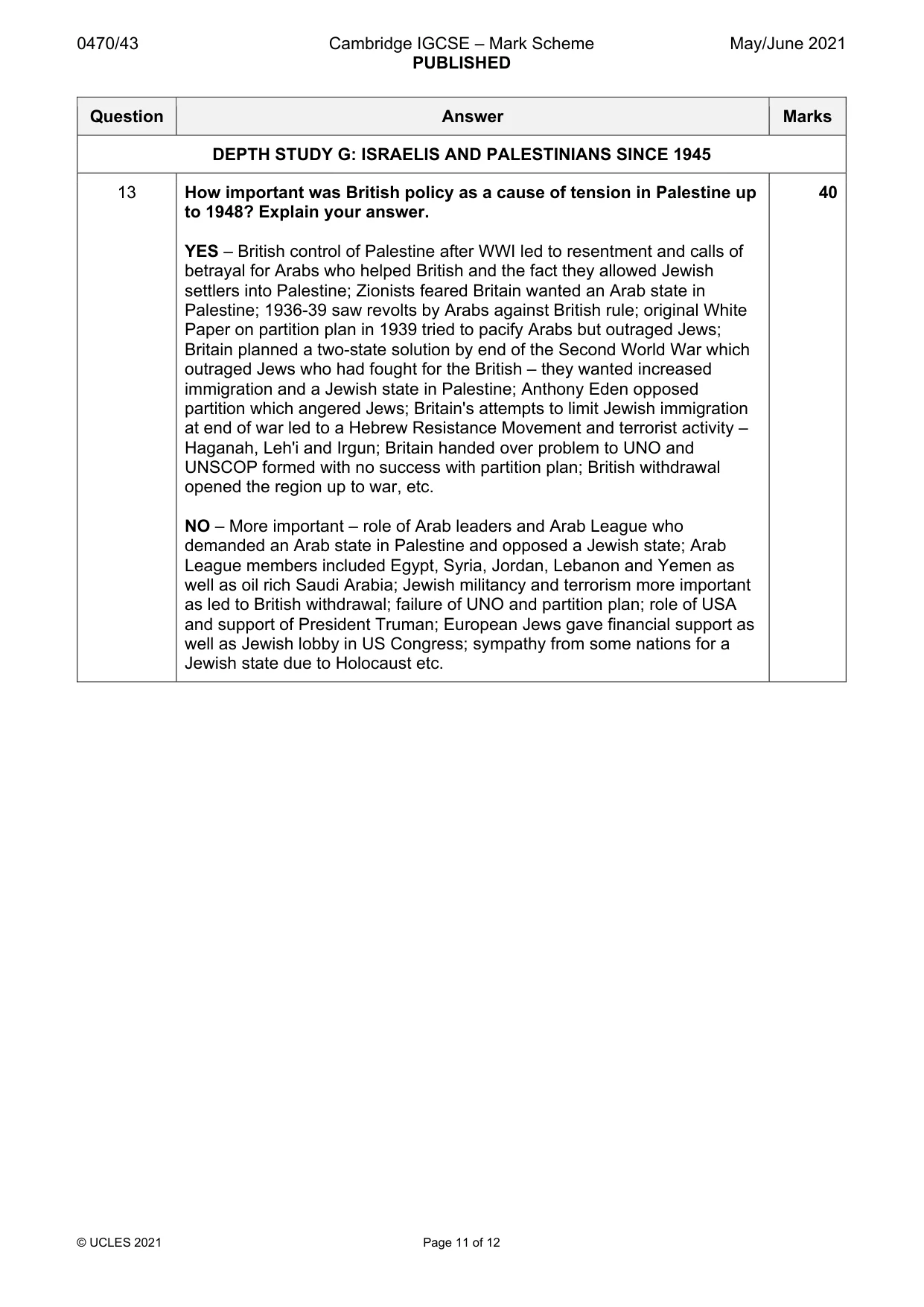
0470/43 Cambridge IGCSE – Mark Scheme PUBLISHED May/June 2021 © UCLES 2021 Page 11 of 12 Question Answer Marks DEPTH STUDY G: ISRAELIS AND PALESTINIANS SINCE 1945 13 How important was British policy as a cause of tension in Palestine up to 1948? Explain your answer. YES – British control of Palestine after WWI led to resentment and calls of betrayal for Arabs who helped British and the fact they allowed Jewish settlers into Palestine; Zionists feared Britain wanted an Arab state in Palestine; 1936-39 saw revolts by Arabs against British rule; original White Paper on partition plan in 1939 tried to pacify Arabs but outraged Jews; Britain planned a two-state solution by end of the Second World War which outraged Jews who had fought for the British – they wanted increased immigration and a Jewish state in Palestine; Anthony Eden opposed partition which angered Jews; Britain's attempts to limit Jewish immigration at end of war led to a Hebrew Resistance Movement and terrorist activity – Haganah, Leh'i and Irgun; Britain handed over problem to UNO and UNSCOP formed with no success with partition plan; British withdrawal opened the region up to war, etc. NO – More important – role of Arab leaders and Arab League who demanded an Arab state in Palestine and opposed a Jewish state; Arab League members included Egypt, Syria, Jordan, Lebanon and Yemen as well as oil rich Saudi Arabia; Jewish militancy and terrorism more important as led to British withdrawal; failure of UNO and partition plan; role of USA and support of President Truman; European Jews gave financial support as well as Jewish lobby in US Congress; sympathy from some nations for a Jewish state due to Holocaust etc. 40
Mark scheme, page 12
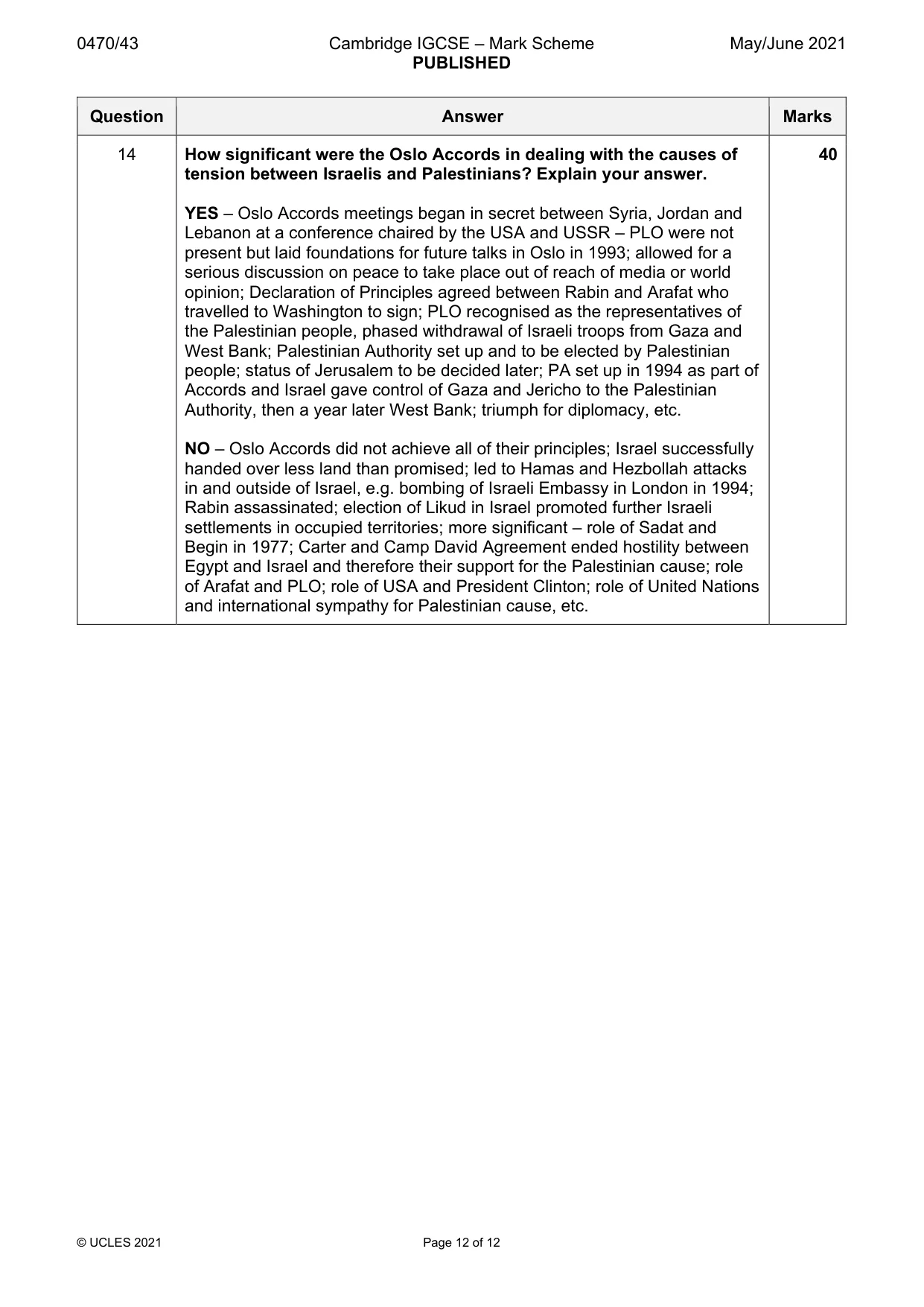
0470/43 Cambridge IGCSE – Mark Scheme PUBLISHED May/June 2021 © UCLES 2021 Page 12 of 12 Question Answer Marks 14 How significant were the Oslo Accords in dealing with the causes of tension between Israelis and Palestinians? Explain your answer. YES – Oslo Accords meetings began in secret between Syria, Jordan and Lebanon at a conference chaired by the USA and USSR – PLO were not present but laid foundations for future talks in Oslo in 1993; allowed for a serious discussion on peace to take place out of reach of media or world opinion; Declaration of Principles agreed between Rabin and Arafat who travelled to Washington to sign; PLO recognised as the representatives of the Palestinian people, phased withdrawal of Israeli troops from Gaza and West Bank; Palestinian Authority set up and to be elected by Palestinian people; status of Jerusalem to be decided later; PA set up in 1994 as part of Accords and Israel gave control of Gaza and Jericho to the Palestinian Authority, then a year later West Bank; triumph for diplomacy, etc. NO – Oslo Accords did not achieve all of their principles; Israel successfully handed over less land than promised; led to Hamas and Hezbollah attacks in and outside of Israel, e.g. bombing of Israeli Embassy in London in 1994; Rabin assassinated; election of Likud in Israel promoted further Israeli settlements in occupied territories; more significant – role of Sadat and Begin in 1977; Carter and Camp David Agreement ended hostility between Egypt and Israel and therefore their support for the Palestinian cause; role of Arafat and PLO; role of USA and President Clinton; role of United Nations and international sympathy for Palestinian cause, etc. 40
What you needed in this session
Cambridge’s own grade thresholds for 2021 May/June, Paper 4 · Variant 3. A higher threshold means an easier paper — the bar moves with how the cohort did.