Cambridge IGCSE History 0470 — 2021 May/June Paper 4 · Variant 1
0470/41/M/J/21 · 40 marks · ≈45 min
The question paper and its mark scheme, free to read here and free to download. This is Cambridge’s own paper, exactly as it was sat.
Question paper4 pages

Mark scheme14 pages
Answers below. Sit the paper first if you are practising.

Paper as text
Question paper, page 1
Cambridge IGCSE™ 0470/41 May/June 2021 1 hour HISTORY Paper 4 Alternative to Coursework You must answer on the enclosed answer booklet. You will need: Answer booklet (enclosed) INSTRUCTIONS • Answer one question from your chosen Depth Study. • Follow the instructions on the front cover of the answer booklet. If you need additional answer paper, ask the invigilator for a continuation booklet. INFORMATION • The total mark for this paper is 40. • The number of marks for each question or part question is shown in brackets [ ]. This document has 4 pages. Any blank pages are indicated. [Turn over 06_0470_41_2021_1.8 © UCLES 2021 *7968167723*
Question paper, page 2
Answer one question from your chosen Depth Study. DEPTH STUDY A: THE FIRST WORLD WAR, 1914–18 How important was the failure of the Schlieffen Plan as a reason why the war was not over by the end of 1914? Explain your answer. [40] 1 How significant was the impact of German submarine warfare on Britain’s ability to continue waging war? Explain your answer. [40] 2 DEPTH STUDY B: GERMANY, 1918–45 How important were the social and economic effects of the First World War in shaping the lives of the German people, 1919–23? Explain your answer. [40] 3 How significant was Joseph Goebbels in winning support for the Nazis, 1930–33? Explain your answer. [40] 4 DEPTH STUDY C: RUSSIA, 1905–41 How important was Lenin in causing the downfall of the Provisional Government? Explain your answer. [40] 5 How significant were the Five-Year Plans in changing life in the Soviet Union after 1928? Explain your answer. [40] 6 DEPTH STUDY D: THE UNITED STATES, 1919–41 How important was assembly-line production as a reason for increasing prosperity in the USA in the 1920s? Explain your answer. [40] 7 How significant was homelessness in the impact of the Depression after 1929? Explain your answer. [40] 8 DEPTH STUDY E: CHINA, c.1930–c.1990 How important was land reform as an aspect of Communist rule in the 1950s and 1960s? Explain your answer. [40] 9 How significant was political reform in changes made in China after 1976? Explain your answer. [40] 10 06_0470_41_2021_1.8 © UCLES 2021 2
Question paper, page 3
DEPTH STUDY F: SOUTH AFRICA, c.1940–c.1994 How important was the Bantu Self-Government Act in changing life for black South Africans after 1948? Explain your answer. [40] 11 How significant were the government’s security measures in maintaining white minority rule between 1966 and 1980? Explain your answer. [40] 12 DEPTH STUDY G: ISRAELIS AND PALESTINIANS SINCE 1945 How important was the Arab League as a cause of increased tension in Palestine by 1948? Explain your answer. [40] 13 How significant was the refugee crisis in gaining international attention for the Palestinian cause after 1948? Explain your answer. [40] 14 06_0470_41_2021_1.8 © UCLES 2021 3
Question paper, page 4
BLANK PAGE Permission to reproduce items where third-party owned material protected by copyright is included has been sought and cleared where possible. Every reasonable effort has been made by the publisher (UCLES) to trace copyright holders, but if any items requiring clearance have unwittingly been included, the publisher will be pleased to make amends at the earliest possible opportunity. To avoid the issue of disclosure of answer-related information to candidates, all copyright acknowledgements are reproduced online in the Cambridge Assessment International Education Copyright Acknowledgements Booklet. This is produced for each series of examinations and is freely available to download at www.cambridgeinternational.org after the live examination series. Cambridge Assessment International Education is part of the Cambridge Assessment Group. Cambridge Assessment is the brand name of the University of Cambridge Local Examinations Syndicate (UCLES), which itself is a department of the University of Cambridge. 06_0470_41_2021_1.8 © UCLES 2021 4
Mark scheme, page 1
This document consists of 14 printed pages. © UCLES 2021 [Turn over Cambridge IGCSE™ HISTORY 0470/41 Paper 4 Alternative to Coursework May/June 2021 MARK SCHEME Maximum Mark: 40 Published This mark scheme is published as an aid to teachers and candidates, to indicate the requirements of the examination. It shows the basis on which Examiners were instructed to award marks. It does not indicate the details of the discussions that took place at an Examiners’ meeting before marking began, which would have considered the acceptability of alternative answers. Mark schemes should be read in conjunction with the question paper and the Principal Examiner Report for Teachers. Cambridge International will not enter into discussions about these mark schemes. Cambridge International is publishing the mark schemes for the May/June 2021 series for most Cambridge IGCSE™, Cambridge International A and AS Level components and some Cambridge O Level components.
Mark scheme, page 2
0470/41 Cambridge IGCSE – Mark Scheme PUBLISHED May/June 2021 © UCLES 2021 Page 2 of 14 Generic Marking Principles These general marking principles must be applied by all examiners when marking candidate answers. They should be applied alongside the specific content of the mark scheme or generic level descriptors for a question. Each question paper and mark scheme will also comply with these marking principles. GENERIC MARKING PRINCIPLE 1: Marks must be awarded in line with: • the specific content of the mark scheme or the generic level descriptors for the question • the specific skills defined in the mark scheme or in the generic level descriptors for the question • the standard of response required by a candidate as exemplified by the standardisation scripts. GENERIC MARKING PRINCIPLE 2: Marks awarded are always whole marks (not half marks, or other fractions). GENERIC MARKING PRINCIPLE 3: Marks must be awarded positively: • marks are awarded for correct/valid answers, as defined in the mark scheme. However, credit is given for valid answers which go beyond the scope of the syllabus and mark scheme, referring to your Team Leader as appropriate • marks are awarded when candidates clearly demonstrate what they know and can do • marks are not deducted for errors • marks are not deducted for omissions • answers should only be judged on the quality of spelling, punctuation and grammar when these features are specifically assessed by the question as indicated by the mark scheme. The meaning, however, should be unambiguous. GENERIC MARKING PRINCIPLE 4: Rules must be applied consistently, e.g. in situations where candidates have not followed instructions or in the application of generic level descriptors. GENERIC MARKING PRINCIPLE 5: Marks should be awarded using the full range of marks defined in the mark scheme for the question (however; the use of the full mark range may be limited according to the quality of the candidate responses seen). GENERIC MARKING PRINCIPLE 6: Marks awarded are based solely on the requirements as defined in the mark scheme. Marks should not be awarded with grade thresholds or grade descriptors in mind.
Mark scheme, page 3
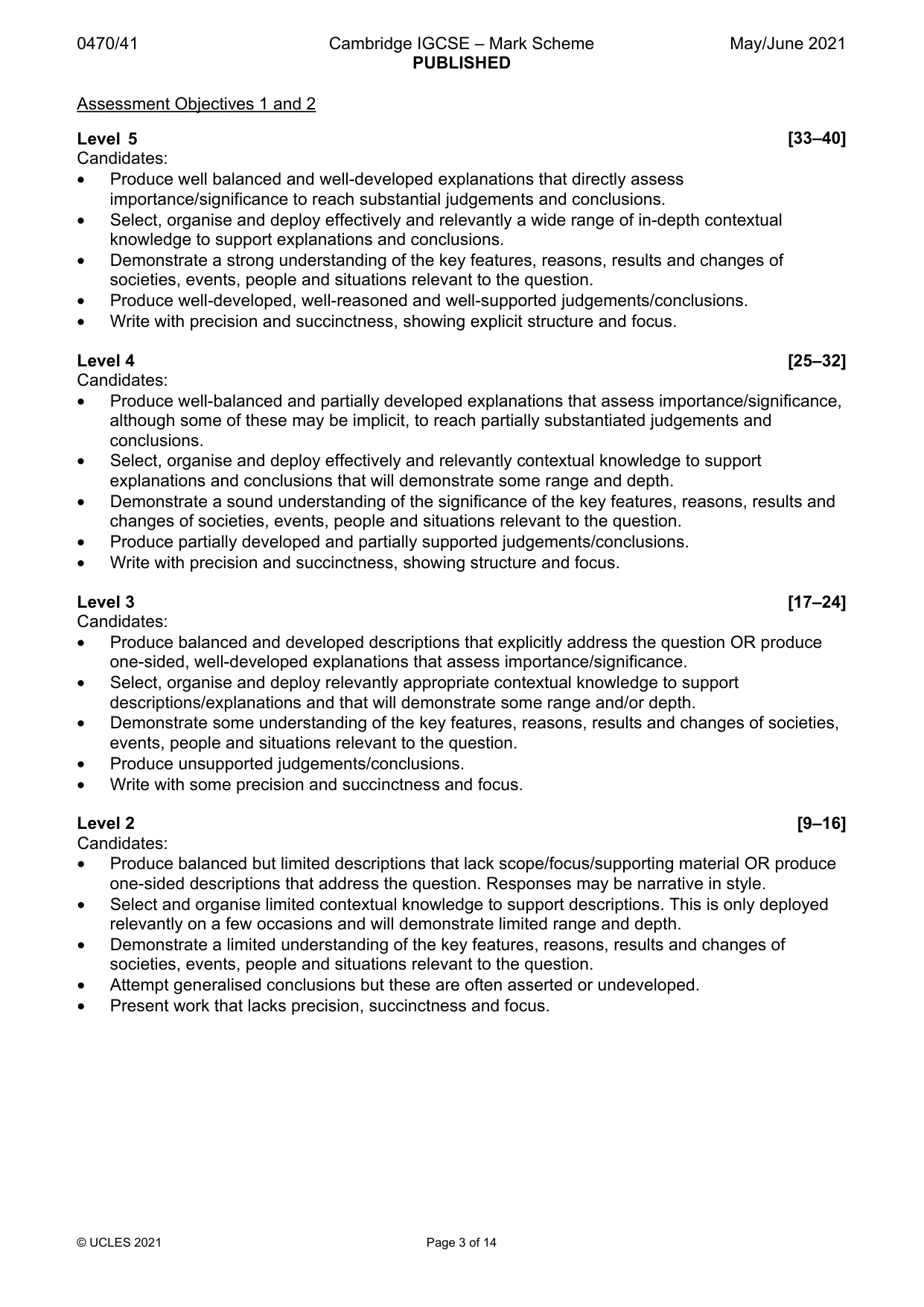
0470/41 Cambridge IGCSE – Mark Scheme PUBLISHED May/June 2021 © UCLES 2021 Page 3 of 14 Assessment Objectives 1 and 2 Level 5 [33–40] Candidates: • Produce well balanced and well-developed explanations that directly assess importance/significance to reach substantial judgements and conclusions. • Select, organise and deploy effectively and relevantly a wide range of in-depth contextual knowledge to support explanations and conclusions. • Demonstrate a strong understanding of the key features, reasons, results and changes of societies, events, people and situations relevant to the question. • Produce well-developed, well-reasoned and well-supported judgements/conclusions. • Write with precision and succinctness, showing explicit structure and focus. Level 4 [25–32] Candidates: • Produce well-balanced and partially developed explanations that assess importance/significance, although some of these may be implicit, to reach partially substantiated judgements and conclusions. • Select, organise and deploy effectively and relevantly contextual knowledge to support explanations and conclusions that will demonstrate some range and depth. • Demonstrate a sound understanding of the significance of the key features, reasons, results and changes of societies, events, people and situations relevant to the question. • Produce partially developed and partially supported judgements/conclusions. • Write with precision and succinctness, showing structure and focus. Level 3 [17–24] Candidates: • Produce balanced and developed descriptions that explicitly address the question OR produce one-sided, well-developed explanations that assess importance/significance. • Select, organise and deploy relevantly appropriate contextual knowledge to support descriptions/explanations and that will demonstrate some range and/or depth. • Demonstrate some understanding of the key features, reasons, results and changes of societies, events, people and situations relevant to the question. • Produce unsupported judgements/conclusions. • Write with some precision and succinctness and focus. Level 2 [9–16] Candidates: • Produce balanced but limited descriptions that lack scope/focus/supporting material OR produce one-sided descriptions that address the question. Responses may be narrative in style. • Select and organise limited contextual knowledge to support descriptions. This is only deployed relevantly on a few occasions and will demonstrate limited range and depth. • Demonstrate a limited understanding of the key features, reasons, results and changes of societies, events, people and situations relevant to the question. • Attempt generalised conclusions but these are often asserted or undeveloped. • Present work that lacks precision, succinctness and focus.
Mark scheme, page 4
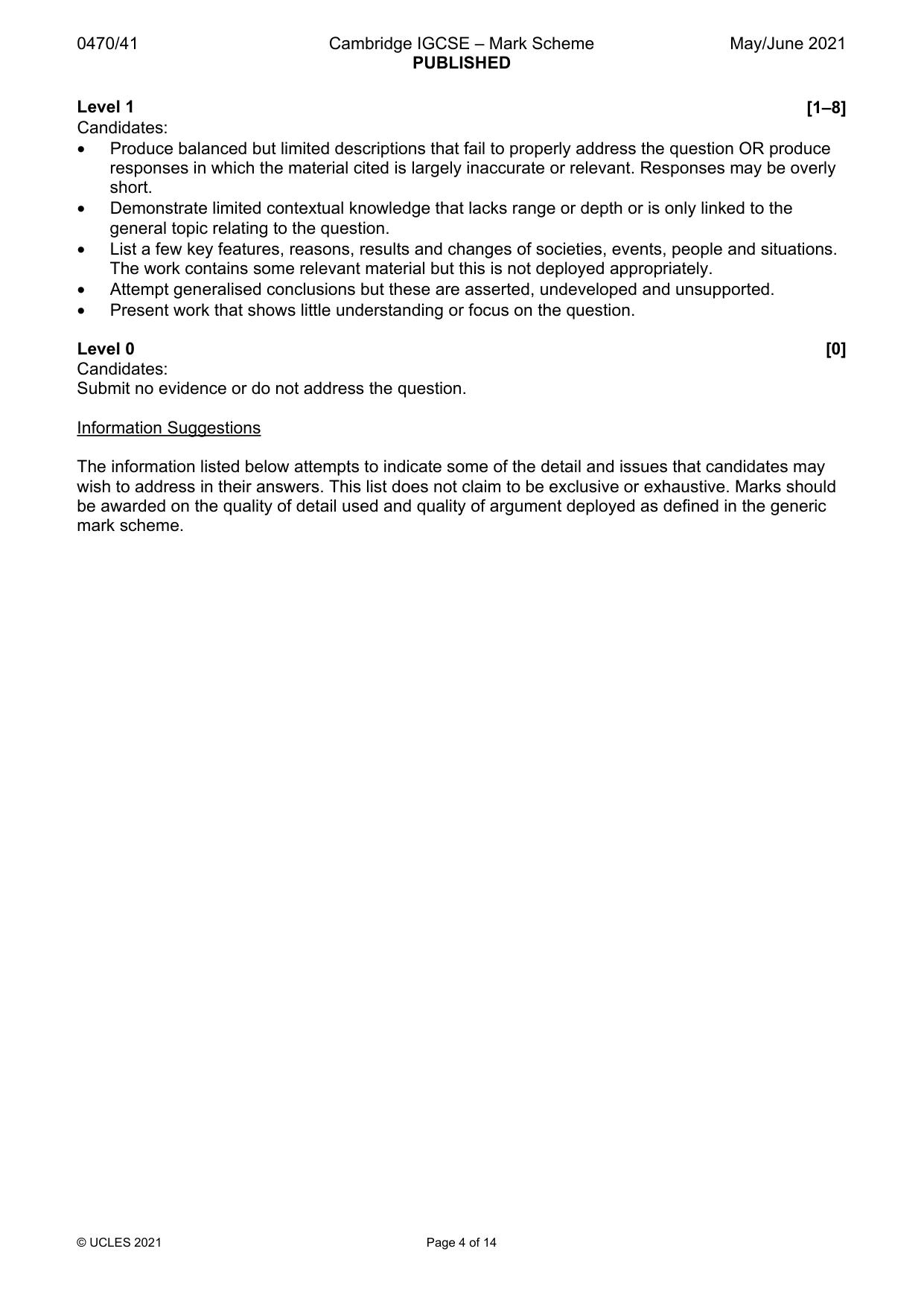
0470/41 Cambridge IGCSE – Mark Scheme PUBLISHED May/June 2021 © UCLES 2021 Page 4 of 14 Level 1 [1–8] Candidates: • Produce balanced but limited descriptions that fail to properly address the question OR produce responses in which the material cited is largely inaccurate or relevant. Responses may be overly short. • Demonstrate limited contextual knowledge that lacks range or depth or is only linked to the general topic relating to the question. • List a few key features, reasons, results and changes of societies, events, people and situations. The work contains some relevant material but this is not deployed appropriately. • Attempt generalised conclusions but these are asserted, undeveloped and unsupported. • Present work that shows little understanding or focus on the question. Level 0 [0] Candidates: Submit no evidence or do not address the question. Information Suggestions The information listed below attempts to indicate some of the detail and issues that candidates may wish to address in their answers. This list does not claim to be exclusive or exhaustive. Marks should be awarded on the quality of detail used and quality of argument deployed as defined in the generic mark scheme.
Mark scheme, page 5
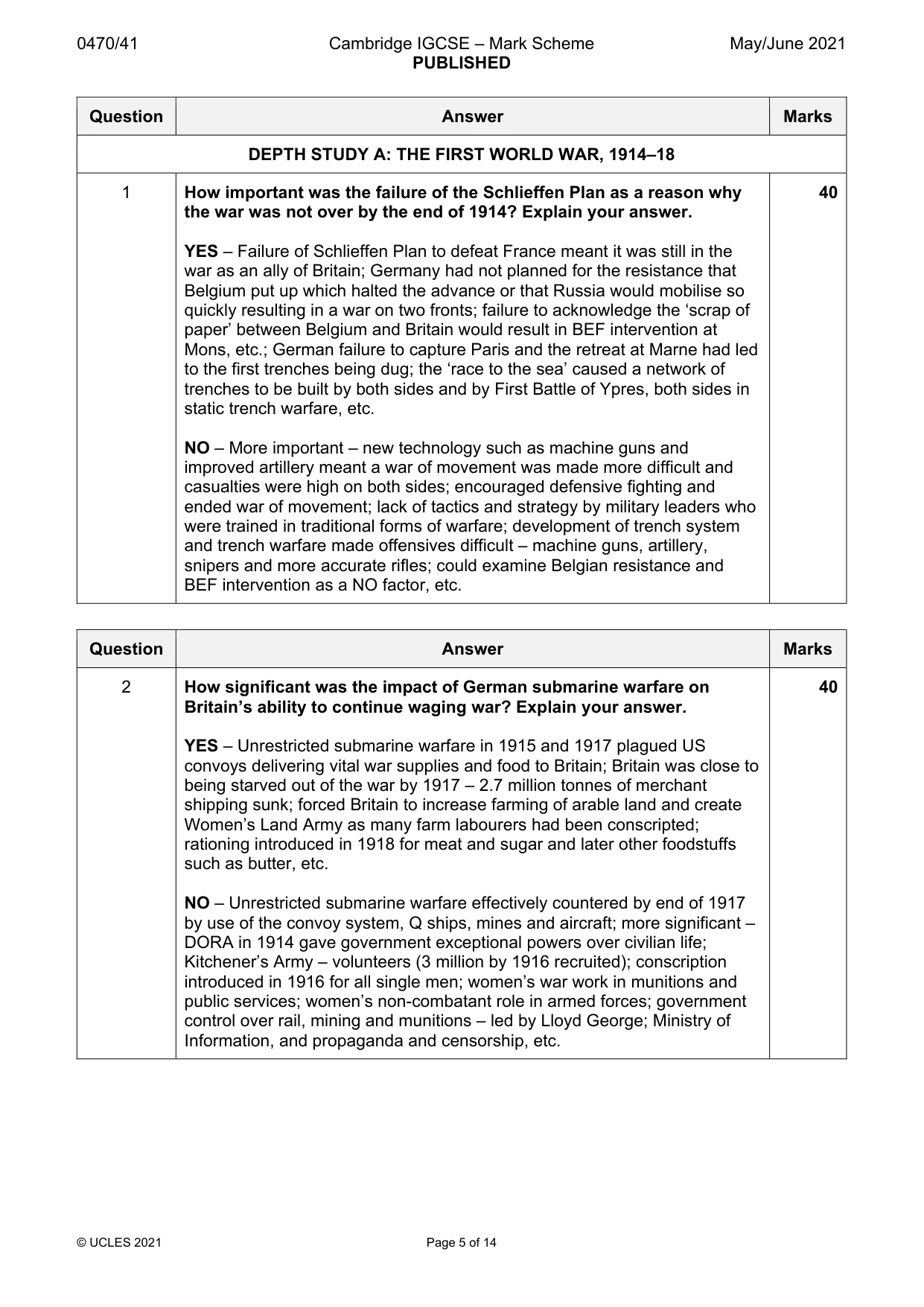
0470/41 Cambridge IGCSE – Mark Scheme PUBLISHED May/June 2021 © UCLES 2021 Page 5 of 14 Question Answer Marks DEPTH STUDY A: THE FIRST WORLD WAR, 1914–18 1 How important was the failure of the Schlieffen Plan as a reason why the war was not over by the end of 1914? Explain your answer. YES – Failure of Schlieffen Plan to defeat France meant it was still in the war as an ally of Britain; Germany had not planned for the resistance that Belgium put up which halted the advance or that Russia would mobilise so quickly resulting in a war on two fronts; failure to acknowledge the ‘scrap of paper’ between Belgium and Britain would result in BEF intervention at Mons, etc.; German failure to capture Paris and the retreat at Marne had led to the first trenches being dug; the ‘race to the sea’ caused a network of trenches to be built by both sides and by First Battle of Ypres, both sides in static trench warfare, etc. NO – More important – new technology such as machine guns and improved artillery meant a war of movement was made more difficult and casualties were high on both sides; encouraged defensive fighting and ended war of movement; lack of tactics and strategy by military leaders who were trained in traditional forms of warfare; development of trench system and trench warfare made offensives difficult – machine guns, artillery, snipers and more accurate rifles; could examine Belgian resistance and BEF intervention as a NO factor, etc. 40 Question Answer Marks 2 How significant was the impact of German submarine warfare on Britain’s ability to continue waging war? Explain your answer. YES – Unrestricted submarine warfare in 1915 and 1917 plagued US convoys delivering vital war supplies and food to Britain; Britain was close to being starved out of the war by 1917 – 2.7 million tonnes of merchant shipping sunk; forced Britain to increase farming of arable land and create Women’s Land Army as many farm labourers had been conscripted; rationing introduced in 1918 for meat and sugar and later other foodstuffs such as butter, etc. NO – Unrestricted submarine warfare effectively countered by end of 1917 by use of the convoy system, Q ships, mines and aircraft; more significant – DORA in 1914 gave government exceptional powers over civilian life; Kitchener’s Army – volunteers (3 million by 1916 recruited); conscription introduced in 1916 for all single men; women’s war work in munitions and public services; women’s non-combatant role in armed forces; government control over rail, mining and munitions – led by Lloyd George; Ministry of Information, and propaganda and censorship, etc. 40
Mark scheme, page 6
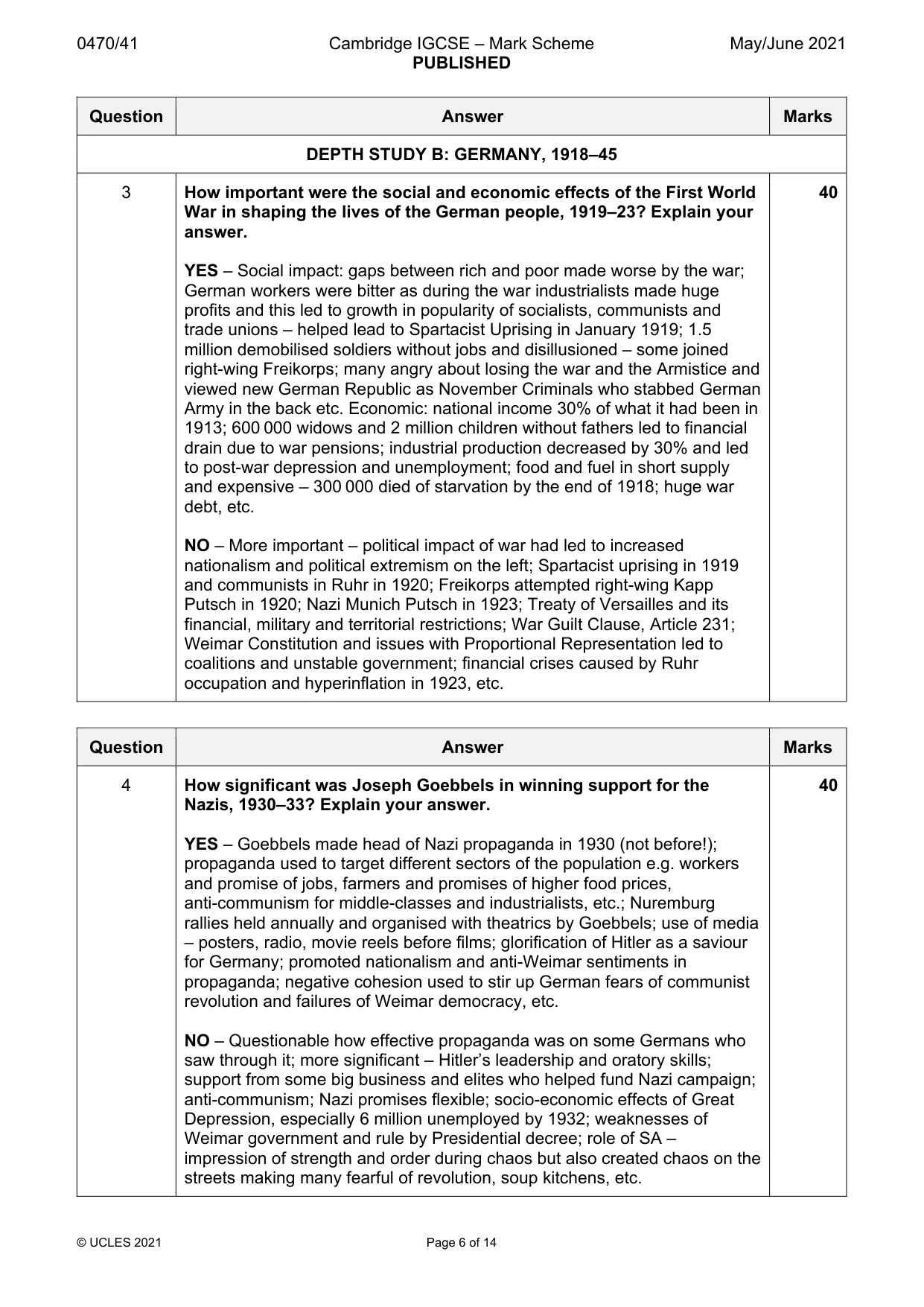
0470/41 Cambridge IGCSE – Mark Scheme PUBLISHED May/June 2021 © UCLES 2021 Page 6 of 14 Question Answer Marks DEPTH STUDY B: GERMANY, 1918–45 3 How important were the social and economic effects of the First World War in shaping the lives of the German people, 1919–23? Explain your answer. YES – Social impact: gaps between rich and poor made worse by the war; German workers were bitter as during the war industrialists made huge profits and this led to growth in popularity of socialists, communists and trade unions – helped lead to Spartacist Uprising in January 1919; 1.5 million demobilised soldiers without jobs and disillusioned – some joined right-wing Freikorps; many angry about losing the war and the Armistice and viewed new German Republic as November Criminals who stabbed German Army in the back etc. Economic: national income 30% of what it had been in 1913; 600 000 widows and 2 million children without fathers led to financial drain due to war pensions; industrial production decreased by 30% and led to post-war depression and unemployment; food and fuel in short supply and expensive – 300 000 died of starvation by the end of 1918; huge war debt, etc. NO – More important – political impact of war had led to increased nationalism and political extremism on the left; Spartacist uprising in 1919 and communists in Ruhr in 1920; Freikorps attempted right-wing Kapp Putsch in 1920; Nazi Munich Putsch in 1923; Treaty of Versailles and its financial, military and territorial restrictions; War Guilt Clause, Article 231; Weimar Constitution and issues with Proportional Representation led to coalitions and unstable government; financial crises caused by Ruhr occupation and hyperinflation in 1923, etc. 40 Question Answer Marks 4 How significant was Joseph Goebbels in winning support for the Nazis, 1930–33? Explain your answer. YES – Goebbels made head of Nazi propaganda in 1930 (not before!); propaganda used to target different sectors of the population e.g. workers and promise of jobs, farmers and promises of higher food prices, anti-communism for middle-classes and industrialists, etc.; Nuremburg rallies held annually and organised with theatrics by Goebbels; use of media – posters, radio, movie reels before films; glorification of Hitler as a saviour for Germany; promoted nationalism and anti-Weimar sentiments in propaganda; negative cohesion used to stir up German fears of communist revolution and failures of Weimar democracy, etc. NO – Questionable how effective propaganda was on some Germans who saw through it; more significant – Hitler’s leadership and oratory skills; support from some big business and elites who helped fund Nazi campaign; anti-communism; Nazi promises flexible; socio-economic effects of Great Depression, especially 6 million unemployed by 1932; weaknesses of Weimar government and rule by Presidential decree; role of SA – impression of strength and order during chaos but also created chaos on the streets making many fearful of revolution, soup kitchens, etc. 40
Mark scheme, page 7
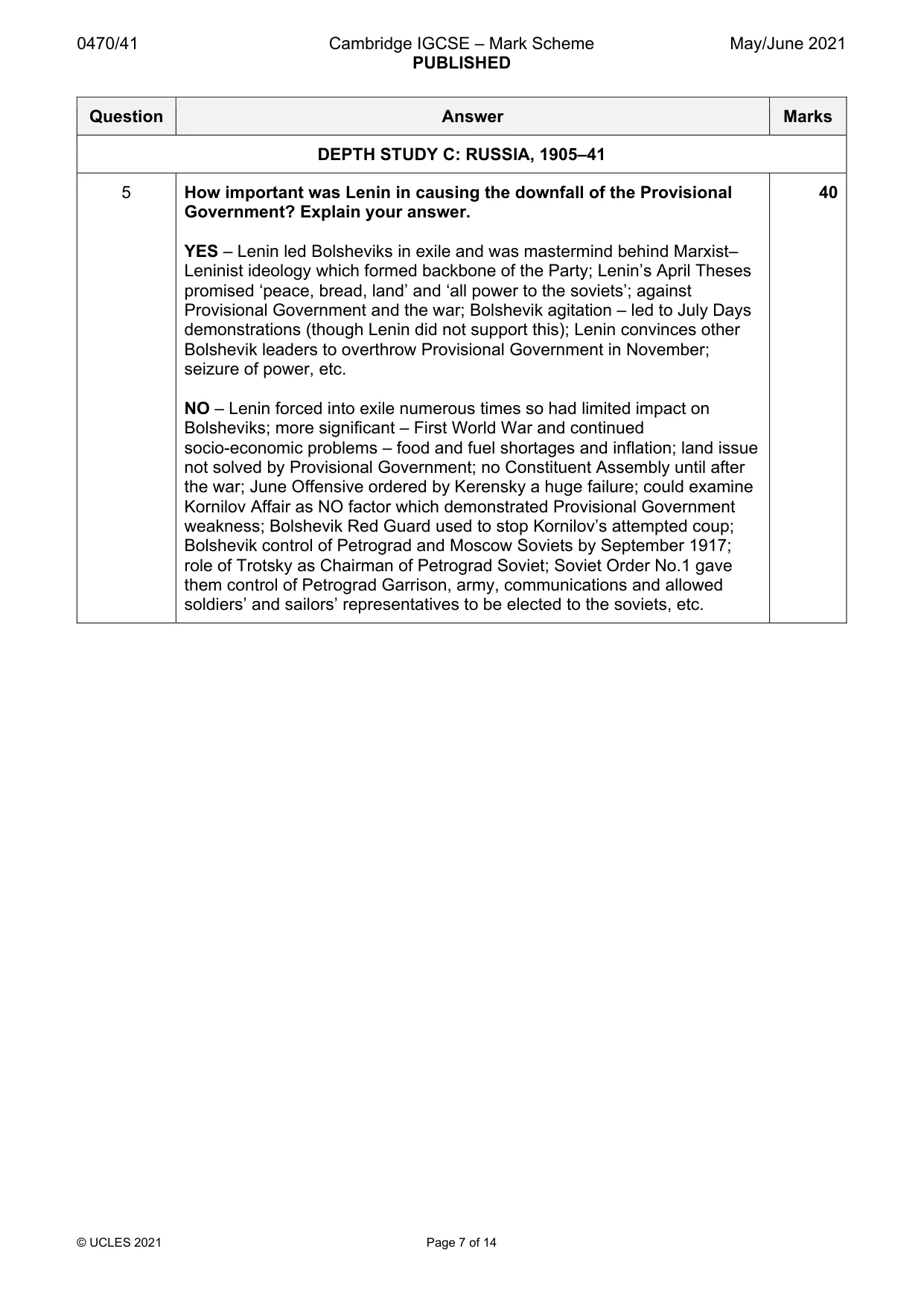
0470/41 Cambridge IGCSE – Mark Scheme PUBLISHED May/June 2021 © UCLES 2021 Page 7 of 14 Question Answer Marks DEPTH STUDY C: RUSSIA, 1905–41 5 How important was Lenin in causing the downfall of the Provisional Government? Explain your answer. YES – Lenin led Bolsheviks in exile and was mastermind behind Marxist– Leninist ideology which formed backbone of the Party; Lenin’s April Theses promised ‘peace, bread, land’ and ‘all power to the soviets’; against Provisional Government and the war; Bolshevik agitation – led to July Days demonstrations (though Lenin did not support this); Lenin convinces other Bolshevik leaders to overthrow Provisional Government in November; seizure of power, etc. NO – Lenin forced into exile numerous times so had limited impact on Bolsheviks; more significant – First World War and continued socio-economic problems – food and fuel shortages and inflation; land issue not solved by Provisional Government; no Constituent Assembly until after the war; June Offensive ordered by Kerensky a huge failure; could examine Kornilov Affair as NO factor which demonstrated Provisional Government weakness; Bolshevik Red Guard used to stop Kornilov’s attempted coup; Bolshevik control of Petrograd and Moscow Soviets by September 1917; role of Trotsky as Chairman of Petrograd Soviet; Soviet Order No.1 gave them control of Petrograd Garrison, army, communications and allowed soldiers’ and sailors’ representatives to be elected to the soviets, etc. 40
Mark scheme, page 8
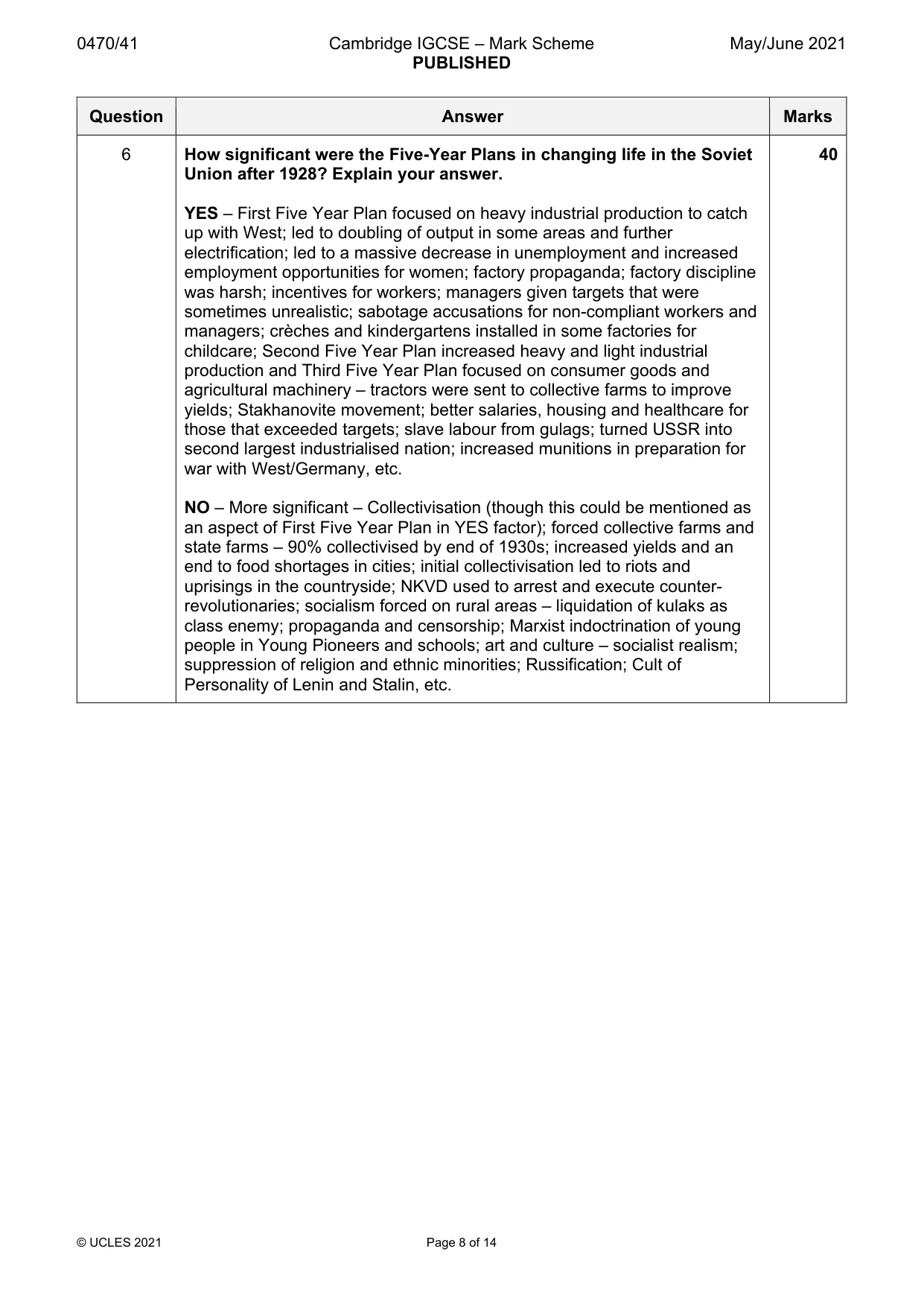
0470/41 Cambridge IGCSE – Mark Scheme PUBLISHED May/June 2021 © UCLES 2021 Page 8 of 14 Question Answer Marks 6 How significant were the Five-Year Plans in changing life in the Soviet Union after 1928? Explain your answer. YES – First Five Year Plan focused on heavy industrial production to catch up with West; led to doubling of output in some areas and further electrification; led to a massive decrease in unemployment and increased employment opportunities for women; factory propaganda; factory discipline was harsh; incentives for workers; managers given targets that were sometimes unrealistic; sabotage accusations for non-compliant workers and managers; crèches and kindergartens installed in some factories for childcare; Second Five Year Plan increased heavy and light industrial production and Third Five Year Plan focused on consumer goods and agricultural machinery – tractors were sent to collective farms to improve yields; Stakhanovite movement; better salaries, housing and healthcare for those that exceeded targets; slave labour from gulags; turned USSR into second largest industrialised nation; increased munitions in preparation for war with West/Germany, etc. NO – More significant – Collectivisation (though this could be mentioned as an aspect of First Five Year Plan in YES factor); forced collective farms and state farms – 90% collectivised by end of 1930s; increased yields and an end to food shortages in cities; initial collectivisation led to riots and uprisings in the countryside; NKVD used to arrest and execute counter- revolutionaries; socialism forced on rural areas – liquidation of kulaks as class enemy; propaganda and censorship; Marxist indoctrination of young people in Young Pioneers and schools; art and culture – socialist realism; suppression of religion and ethnic minorities; Russification; Cult of Personality of Lenin and Stalin, etc. 40
Mark scheme, page 9
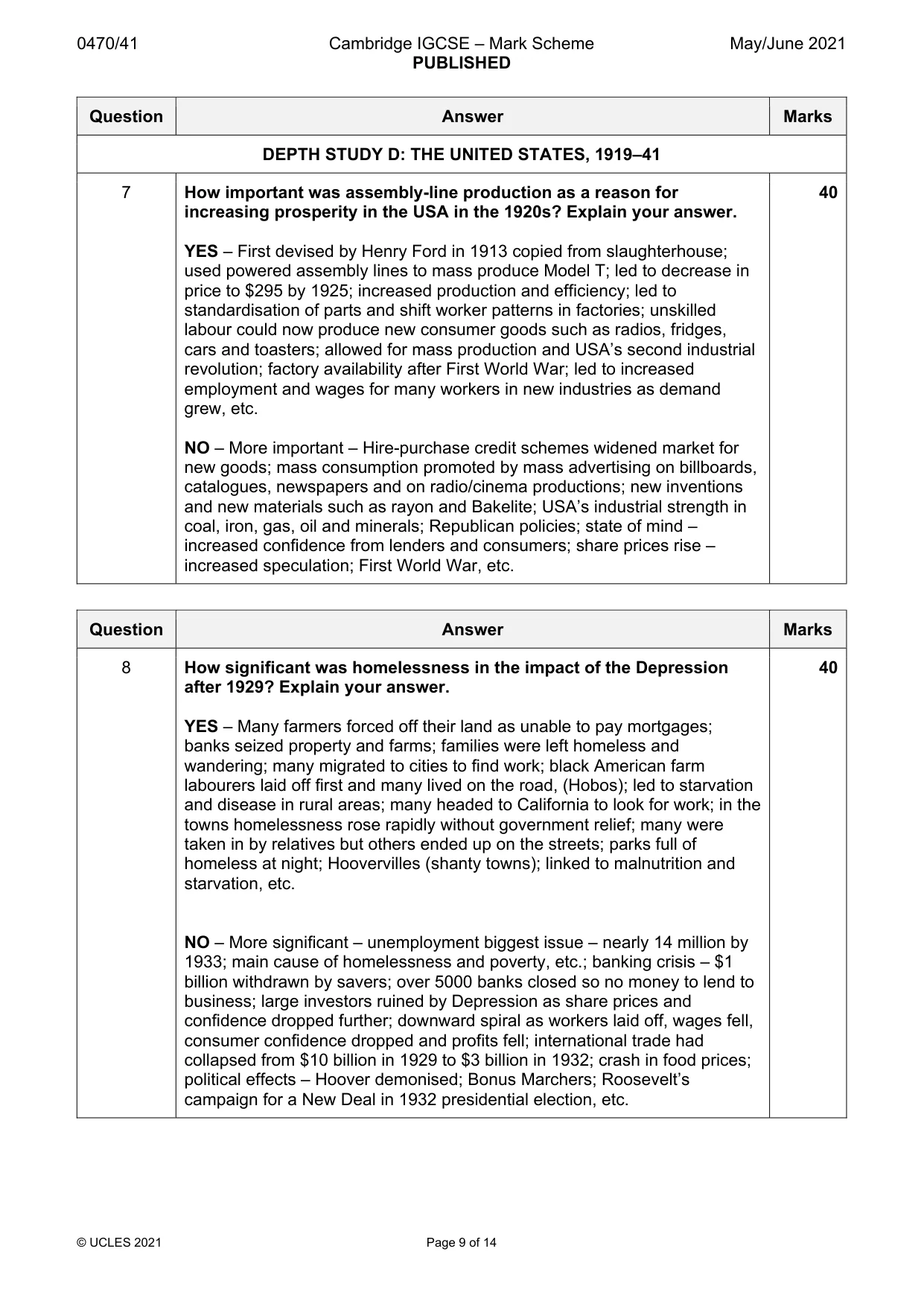
0470/41 Cambridge IGCSE – Mark Scheme PUBLISHED May/June 2021 © UCLES 2021 Page 9 of 14 Question Answer Marks DEPTH STUDY D: THE UNITED STATES, 1919–41 7 How important was assembly-line production as a reason for increasing prosperity in the USA in the 1920s? Explain your answer. YES – First devised by Henry Ford in 1913 copied from slaughterhouse; used powered assembly lines to mass produce Model T; led to decrease in price to $295 by 1925; increased production and efficiency; led to standardisation of parts and shift worker patterns in factories; unskilled labour could now produce new consumer goods such as radios, fridges, cars and toasters; allowed for mass production and USA’s second industrial revolution; factory availability after First World War; led to increased employment and wages for many workers in new industries as demand grew, etc. NO – More important – Hire-purchase credit schemes widened market for new goods; mass consumption promoted by mass advertising on billboards, catalogues, newspapers and on radio/cinema productions; new inventions and new materials such as rayon and Bakelite; USA’s industrial strength in coal, iron, gas, oil and minerals; Republican policies; state of mind – increased confidence from lenders and consumers; share prices rise – increased speculation; First World War, etc. 40 Question Answer Marks 8 How significant was homelessness in the impact of the Depression after 1929? Explain your answer. YES – Many farmers forced off their land as unable to pay mortgages; banks seized property and farms; families were left homeless and wandering; many migrated to cities to find work; black American farm labourers laid off first and many lived on the road, (Hobos); led to starvation and disease in rural areas; many headed to California to look for work; in the towns homelessness rose rapidly without government relief; many were taken in by relatives but others ended up on the streets; parks full of homeless at night; Hoovervilles (shanty towns); linked to malnutrition and starvation, etc. NO – More significant – unemployment biggest issue – nearly 14 million by 1933; main cause of homelessness and poverty, etc.; banking crisis – $1 billion withdrawn by savers; over 5000 banks closed so no money to lend to business; large investors ruined by Depression as share prices and confidence dropped further; downward spiral as workers laid off, wages fell, consumer confidence dropped and profits fell; international trade had collapsed from $10 billion in 1929 to $3 billion in 1932; crash in food prices; political effects – Hoover demonised; Bonus Marchers; Roosevelt’s campaign for a New Deal in 1932 presidential election, etc. 40
Mark scheme, page 10
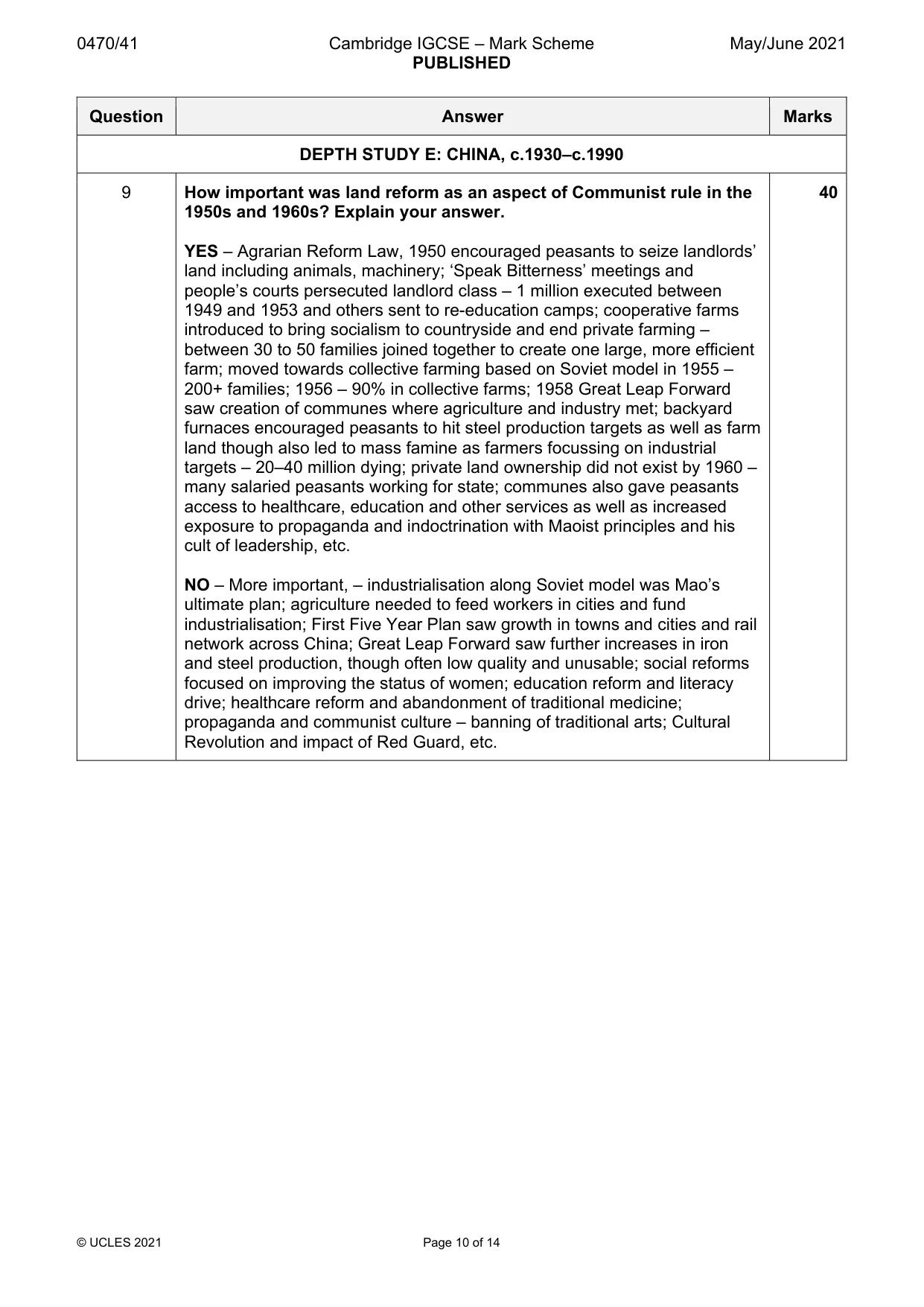
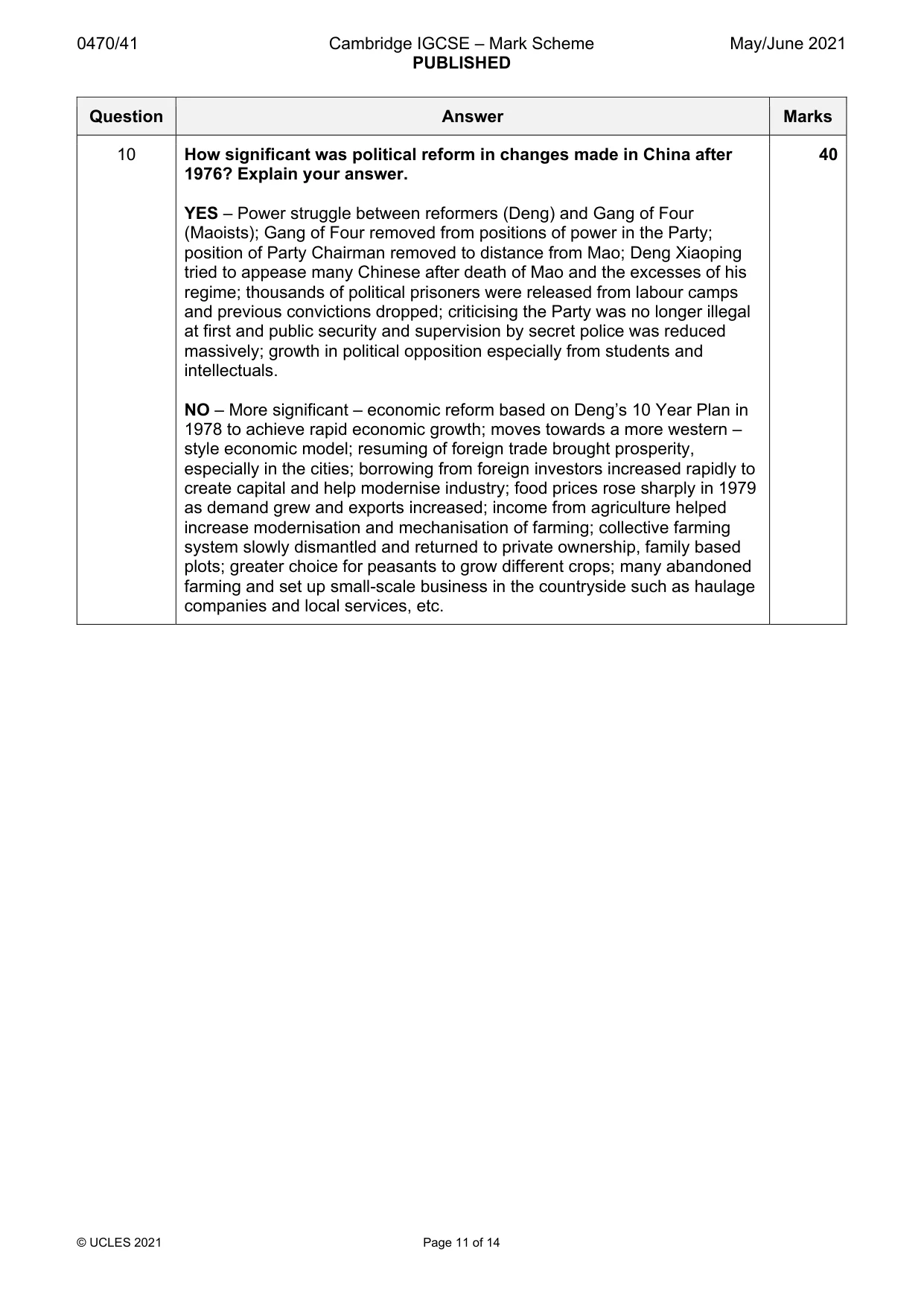
0470/41 Cambridge IGCSE – Mark Scheme PUBLISHED May/June 2021 © UCLES 2021 Page 10 of 14 Question Answer Marks DEPTH STUDY E: CHINA, c.1930–c.1990 9 How important was land reform as an aspect of Communist rule in the 1950s and 1960s? Explain your answer. YES – Agrarian Reform Law, 1950 encouraged peasants to seize landlords’ land including animals, machinery; ‘Speak Bitterness’ meetings and people’s courts persecuted landlord class – 1 million executed between 1949 and 1953 and others sent to re-education camps; cooperative farms introduced to bring socialism to countryside and end private farming – between 30 to 50 families joined together to create one large, more efficient farm; moved towards collective farming based on Soviet model in 1955 – 200+ families; 1956 – 90% in collective farms; 1958 Great Leap Forward saw creation of communes where agriculture and industry met; backyard furnaces encouraged peasants to hit steel production targets as well as farm land though also led to mass famine as farmers focussing on industrial targets – 20–40 million dying; private land ownership did not exist by 1960 – many salaried peasants working for state; communes also gave peasants access to healthcare, education and other services as well as increased exposure to propaganda and indoctrination with Maoist principles and his cult of leadership, etc. NO – More important, – industrialisation along Soviet model was Mao’s ultimate plan; agriculture needed to feed workers in cities and fund industrialisation; First Five Year Plan saw growth in towns and cities and rail network across China; Great Leap Forward saw further increases in iron and steel production, though often low quality and unusable; social reforms focused on improving the status of women; education reform and literacy drive; healthcare reform and abandonment of traditional medicine; propaganda and communist culture – banning of traditional arts; Cultural Revolution and impact of Red Guard, etc. 40
Mark scheme, page 11
0470/41 Cambridge IGCSE – Mark Scheme PUBLISHED May/June 2021 © UCLES 2021 Page 11 of 14 Question Answer Marks 10 How significant was political reform in changes made in China after 1976? Explain your answer. YES – Power struggle between reformers (Deng) and Gang of Four (Maoists); Gang of Four removed from positions of power in the Party; position of Party Chairman removed to distance from Mao; Deng Xiaoping tried to appease many Chinese after death of Mao and the excesses of his regime; thousands of political prisoners were released from labour camps and previous convictions dropped; criticising the Party was no longer illegal at first and public security and supervision by secret police was reduced massively; growth in political opposition especially from students and intellectuals. NO – More significant – economic reform based on Deng’s 10 Year Plan in 1978 to achieve rapid economic growth; moves towards a more western – style economic model; resuming of foreign trade brought prosperity, especially in the cities; borrowing from foreign investors increased rapidly to create capital and help modernise industry; food prices rose sharply in 1979 as demand grew and exports increased; income from agriculture helped increase modernisation and mechanisation of farming; collective farming system slowly dismantled and returned to private ownership, family based plots; greater choice for peasants to grow different crops; many abandoned farming and set up small-scale business in the countryside such as haulage companies and local services, etc. 40
Mark scheme, page 12
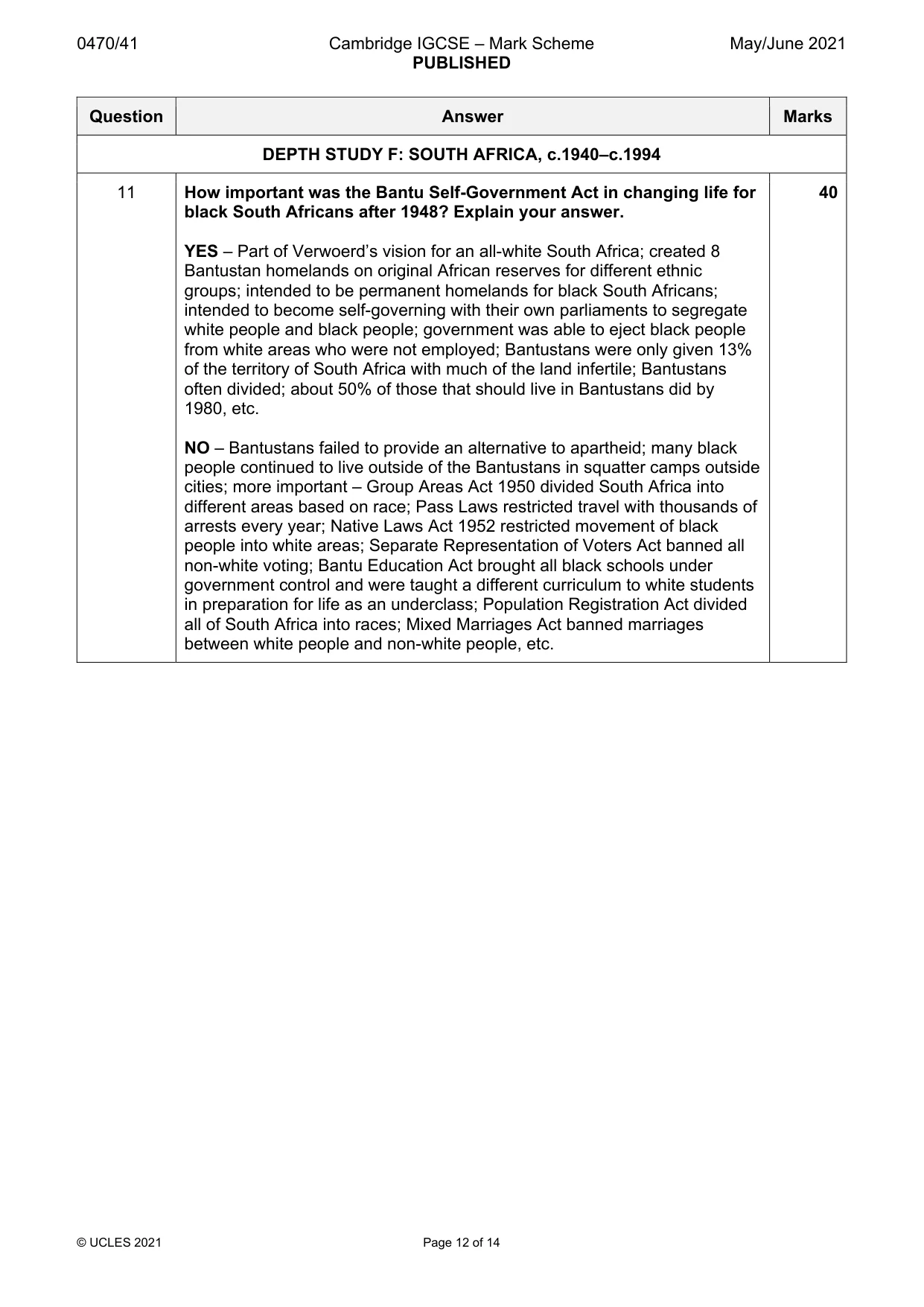
0470/41 Cambridge IGCSE – Mark Scheme PUBLISHED May/June 2021 © UCLES 2021 Page 12 of 14 Question Answer Marks DEPTH STUDY F: SOUTH AFRICA, c.1940–c.1994 11 How important was the Bantu Self-Government Act in changing life for black South Africans after 1948? Explain your answer. YES – Part of Verwoerd’s vision for an all-white South Africa; created 8 Bantustan homelands on original African reserves for different ethnic groups; intended to be permanent homelands for black South Africans; intended to become self-governing with their own parliaments to segregate white people and black people; government was able to eject black people from white areas who were not employed; Bantustans were only given 13% of the territory of South Africa with much of the land infertile; Bantustans often divided; about 50% of those that should live in Bantustans did by 1980, etc. NO – Bantustans failed to provide an alternative to apartheid; many black people continued to live outside of the Bantustans in squatter camps outside cities; more important – Group Areas Act 1950 divided South Africa into different areas based on race; Pass Laws restricted travel with thousands of arrests every year; Native Laws Act 1952 restricted movement of black people into white areas; Separate Representation of Voters Act banned all non-white voting; Bantu Education Act brought all black schools under government control and were taught a different curriculum to white students in preparation for life as an underclass; Population Registration Act divided all of South Africa into races; Mixed Marriages Act banned marriages between white people and non-white people, etc. 40
Mark scheme, page 13
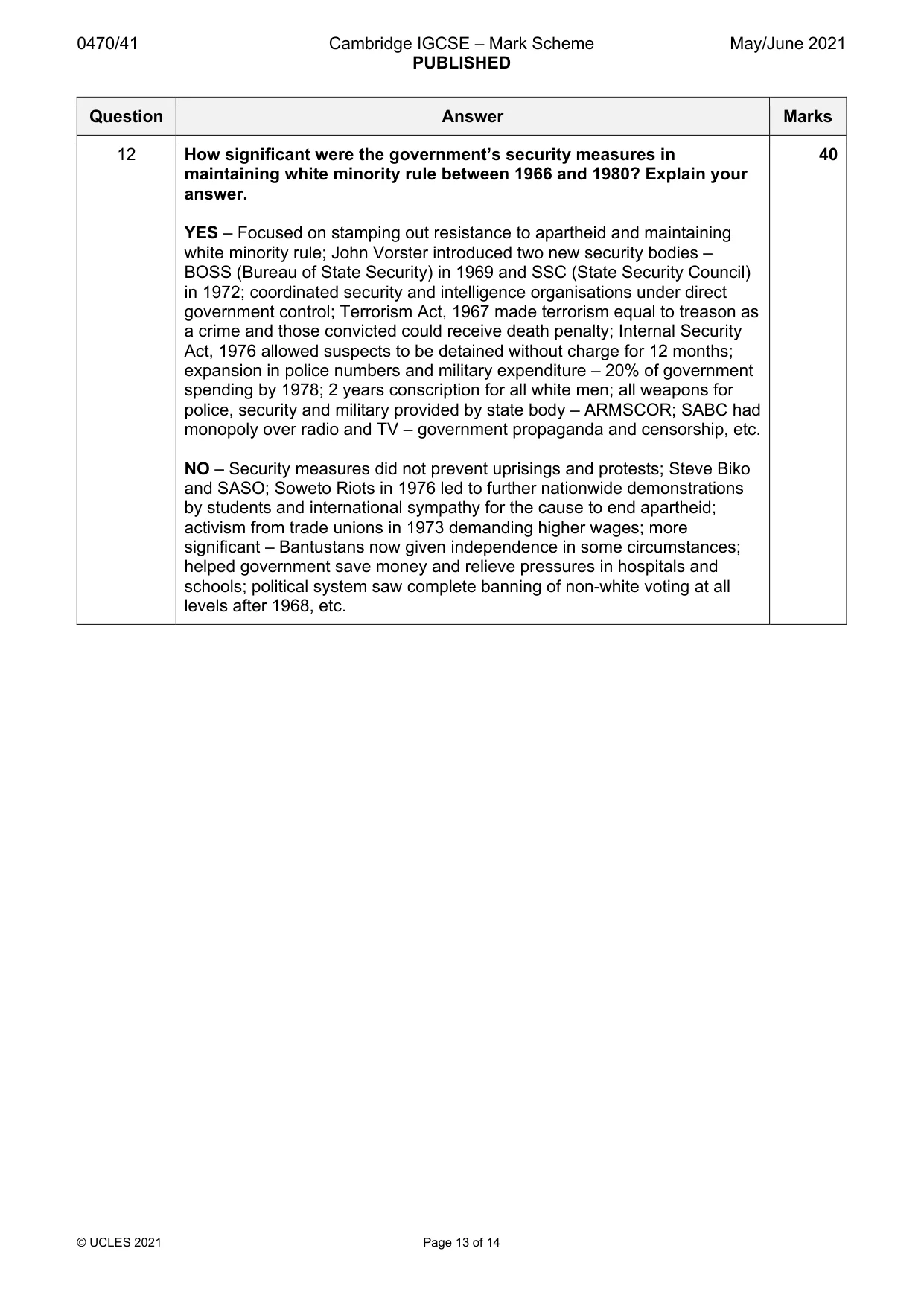
0470/41 Cambridge IGCSE – Mark Scheme PUBLISHED May/June 2021 © UCLES 2021 Page 13 of 14 Question Answer Marks 12 How significant were the government’s security measures in maintaining white minority rule between 1966 and 1980? Explain your answer. YES – Focused on stamping out resistance to apartheid and maintaining white minority rule; John Vorster introduced two new security bodies – BOSS (Bureau of State Security) in 1969 and SSC (State Security Council) in 1972; coordinated security and intelligence organisations under direct government control; Terrorism Act, 1967 made terrorism equal to treason as a crime and those convicted could receive death penalty; Internal Security Act, 1976 allowed suspects to be detained without charge for 12 months; expansion in police numbers and military expenditure – 20% of government spending by 1978; 2 years conscription for all white men; all weapons for police, security and military provided by state body – ARMSCOR; SABC had monopoly over radio and TV – government propaganda and censorship, etc. NO – Security measures did not prevent uprisings and protests; Steve Biko and SASO; Soweto Riots in 1976 led to further nationwide demonstrations by students and international sympathy for the cause to end apartheid; activism from trade unions in 1973 demanding higher wages; more significant – Bantustans now given independence in some circumstances; helped government save money and relieve pressures in hospitals and schools; political system saw complete banning of non-white voting at all levels after 1968, etc. 40
Mark scheme, page 14
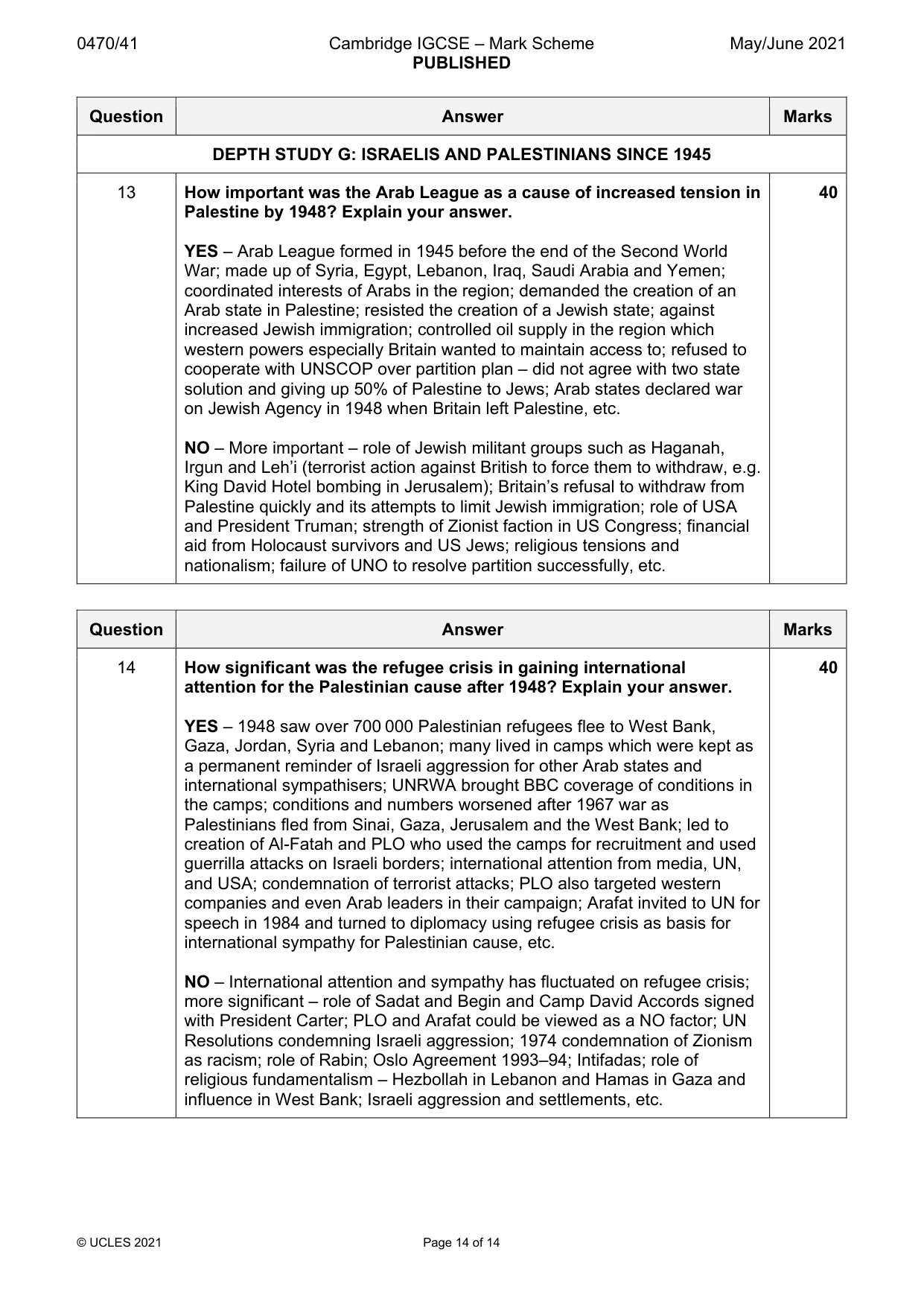
0470/41 Cambridge IGCSE – Mark Scheme PUBLISHED May/June 2021 © UCLES 2021 Page 14 of 14 Question Answer Marks DEPTH STUDY G: ISRAELIS AND PALESTINIANS SINCE 1945 13 How important was the Arab League as a cause of increased tension in Palestine by 1948? Explain your answer. YES – Arab League formed in 1945 before the end of the Second World War; made up of Syria, Egypt, Lebanon, Iraq, Saudi Arabia and Yemen; coordinated interests of Arabs in the region; demanded the creation of an Arab state in Palestine; resisted the creation of a Jewish state; against increased Jewish immigration; controlled oil supply in the region which western powers especially Britain wanted to maintain access to; refused to cooperate with UNSCOP over partition plan – did not agree with two state solution and giving up 50% of Palestine to Jews; Arab states declared war on Jewish Agency in 1948 when Britain left Palestine, etc. NO – More important – role of Jewish militant groups such as Haganah, Irgun and Leh’i (terrorist action against British to force them to withdraw, e.g. King David Hotel bombing in Jerusalem); Britain’s refusal to withdraw from Palestine quickly and its attempts to limit Jewish immigration; role of USA and President Truman; strength of Zionist faction in US Congress; financial aid from Holocaust survivors and US Jews; religious tensions and nationalism; failure of UNO to resolve partition successfully, etc. 40 Question Answer Marks 14 How significant was the refugee crisis in gaining international attention for the Palestinian cause after 1948? Explain your answer. YES – 1948 saw over 700 000 Palestinian refugees flee to West Bank, Gaza, Jordan, Syria and Lebanon; many lived in camps which were kept as a permanent reminder of Israeli aggression for other Arab states and international sympathisers; UNRWA brought BBC coverage of conditions in the camps; conditions and numbers worsened after 1967 war as Palestinians fled from Sinai, Gaza, Jerusalem and the West Bank; led to creation of Al-Fatah and PLO who used the camps for recruitment and used guerrilla attacks on Israeli borders; international attention from media, UN, and USA; condemnation of terrorist attacks; PLO also targeted western companies and even Arab leaders in their campaign; Arafat invited to UN for speech in 1984 and turned to diplomacy using refugee crisis as basis for international sympathy for Palestinian cause, etc. NO – International attention and sympathy has fluctuated on refugee crisis; more significant – role of Sadat and Begin and Camp David Accords signed with President Carter; PLO and Arafat could be viewed as a NO factor; UN Resolutions condemning Israeli aggression; 1974 condemnation of Zionism as racism; role of Rabin; Oslo Agreement 1993–94; Intifadas; role of religious fundamentalism – Hezbollah in Lebanon and Hamas in Gaza and influence in West Bank; Israeli aggression and settlements, etc. 40
What you needed in this session
Cambridge’s own grade thresholds for 2021 May/June, Paper 4 · Variant 1. A higher threshold means an easier paper — the bar moves with how the cohort did.