Cambridge IGCSE History 0470 — 2020 Oct/Nov Paper 4 · Variant 3
0470/43/O/N/20 · 40 marks · ≈45 min
The question paper and its mark scheme, free to read here and free to download. This is Cambridge’s own paper, exactly as it was sat.
Question paper4 pages

Mark scheme11 pages
Answers below. Sit the paper first if you are practising.
Paper as text
Question paper, page 1
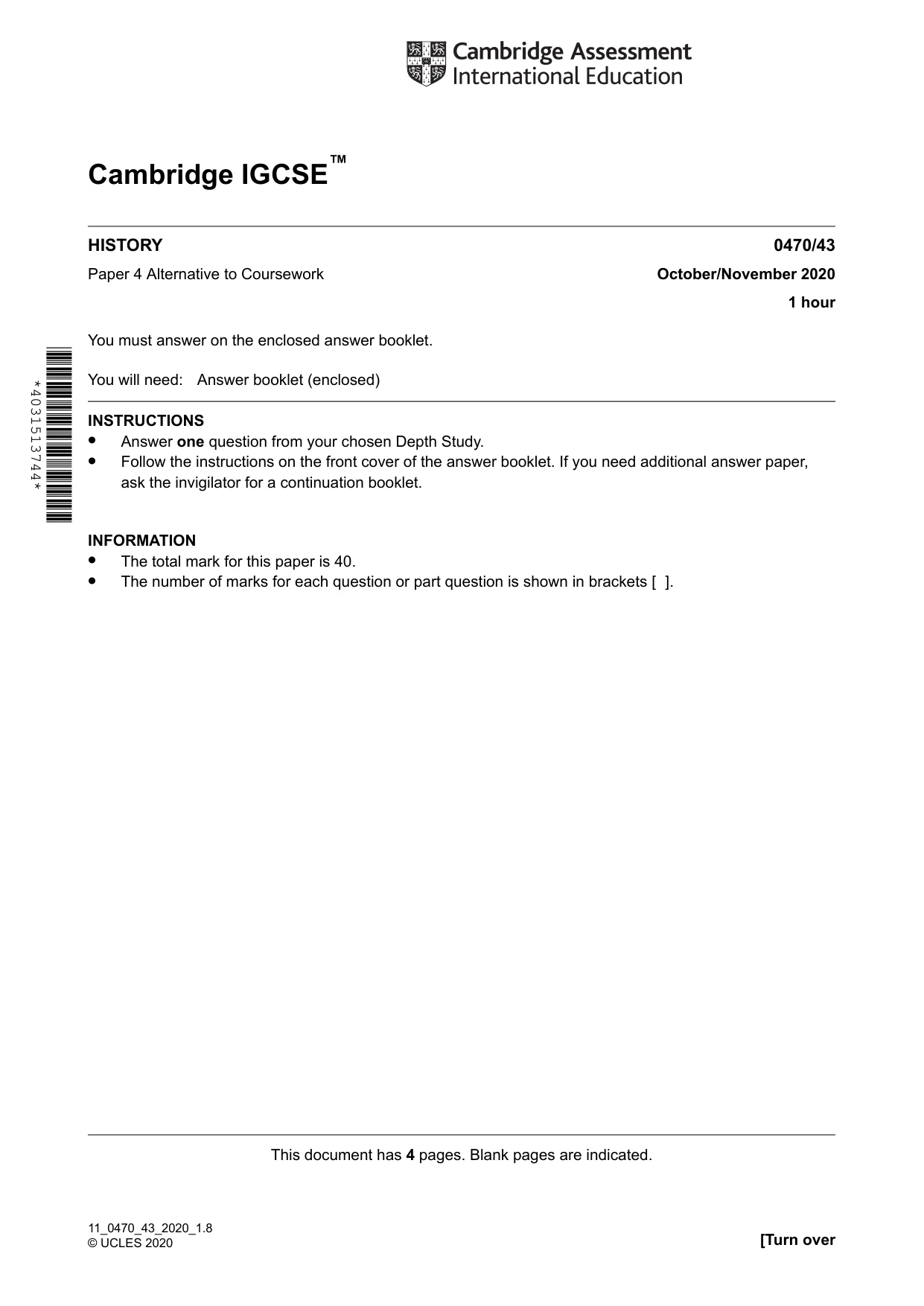
Cambridge IGCSE™ 0470/43 October/November 2020 1 hour HISTORY Paper 4 Alternative to Coursework You must answer on the enclosed answer booklet. You will need: Answer booklet (enclosed) INSTRUCTIONS • Answer one question from your chosen Depth Study. • Follow the instructions on the front cover of the answer booklet. If you need additional answer paper, ask the invigilator for a continuation booklet. INFORMATION • The total mark for this paper is 40. • The number of marks for each question or part question is shown in brackets [ ]. This document has 4 pages. Blank pages are indicated. [Turn over 11_0470_43_2020_1.8 © UCLES 2020 *4031513744*
Question paper, page 2
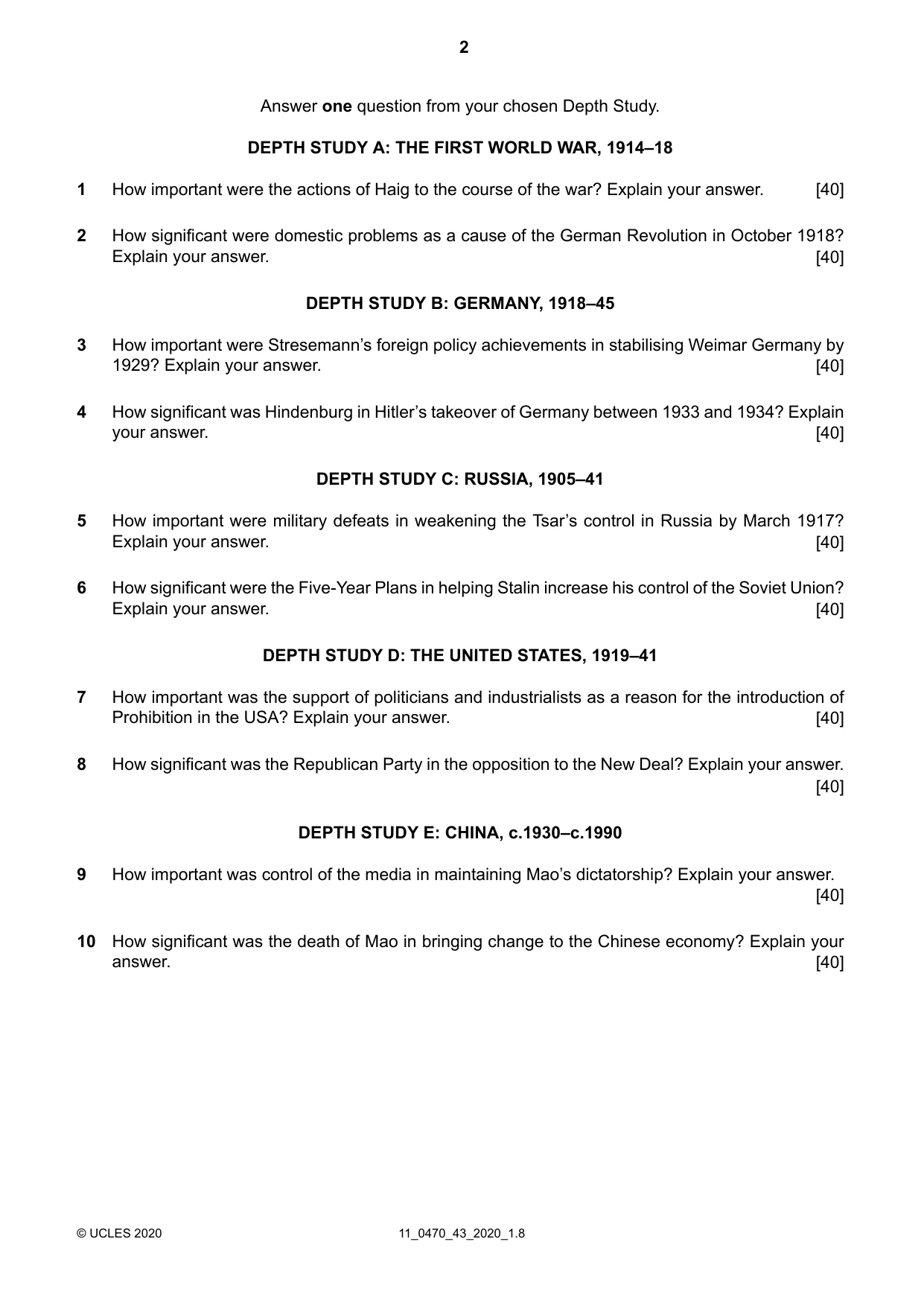
Answer one question from your chosen Depth Study. DEPTH STUDY A: THE FIRST WORLD WAR, 1914–18 How important were the actions of Haig to the course of the war? Explain your answer. [40] 1 How significant were domestic problems as a cause of the German Revolution in October 1918? Explain your answer. [40] 2 DEPTH STUDY B: GERMANY, 1918–45 How important were Stresemann’s foreign policy achievements in stabilising Weimar Germany by 1929? Explain your answer. [40] 3 How significant was Hindenburg in Hitler’s takeover of Germany between 1933 and 1934? Explain your answer. [40] 4 DEPTH STUDY C: RUSSIA, 1905–41 How important were military defeats in weakening the Tsar’s control in Russia by March 1917? Explain your answer. [40] 5 How significant were the Five-Year Plans in helping Stalin increase his control of the Soviet Union? Explain your answer. [40] 6 DEPTH STUDY D: THE UNITED STATES, 1919–41 How important was the support of politicians and industrialists as a reason for the introduction of Prohibition in the USA? Explain your answer. [40] 7 How significant was the Republican Party in the opposition to the New Deal? Explain your answer. [40] 8 DEPTH STUDY E: CHINA, c.1930–c.1990 How important was control of the media in maintaining Mao’s dictatorship? Explain your answer. [40] 9 How significant was the death of Mao in bringing change to the Chinese economy? Explain your answer. [40] 10 11_0470_43_2020_1.8 © UCLES 2020 2
Question paper, page 3
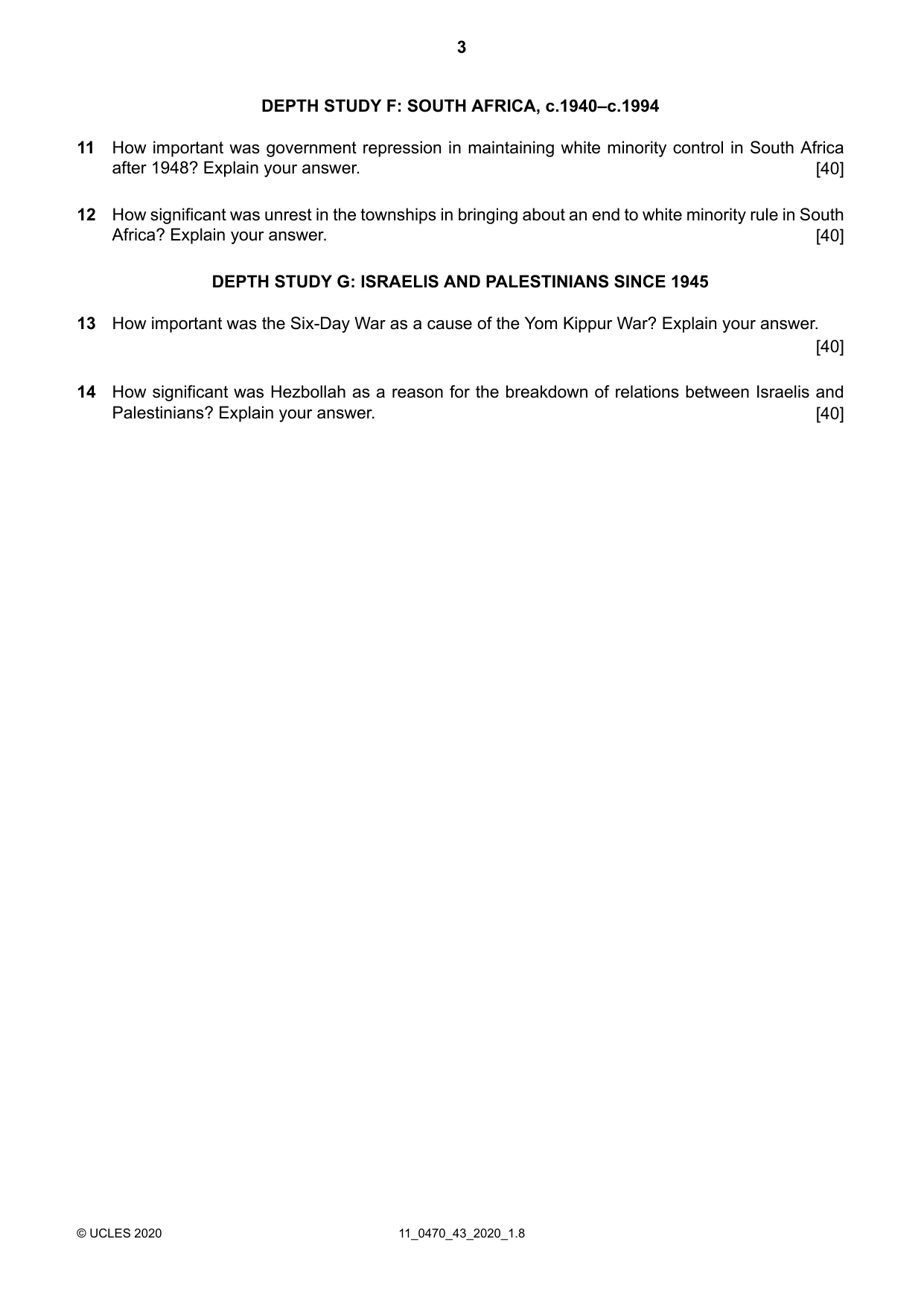
DEPTH STUDY F: SOUTH AFRICA, c.1940–c.1994 How important was government repression in maintaining white minority control in South Africa after 1948? Explain your answer. [40] 11 How significant was unrest in the townships in bringing about an end to white minority rule in South Africa? Explain your answer. [40] 12 DEPTH STUDY G: ISRAELIS AND PALESTINIANS SINCE 1945 How important was the Six-Day War as a cause of the Yom Kippur War? Explain your answer. [40] 13 How significant was Hezbollah as a reason for the breakdown of relations between Israelis and Palestinians? Explain your answer. [40] 14 11_0470_43_2020_1.8 © UCLES 2020 3
Question paper, page 4
BLANK PAGE Permission to reproduce items where third-party owned material protected by copyright is included has been sought and cleared where possible. Every reasonable effort has been made by the publisher (UCLES) to trace copyright holders, but if any items requiring clearance have unwittingly been included, the publisher will be pleased to make amends at the earliest possible opportunity. To avoid the issue of disclosure of answer-related information to candidates, all copyright acknowledgements are reproduced online in the Cambridge Assessment International Education Copyright Acknowledgements Booklet. This is produced for each series of examinations and is freely available to download at www.cambridgeinternational.org after the live examination series. Cambridge Assessment International Education is part of the Cambridge Assessment Group. Cambridge Assessment is the brand name of the University of Cambridge Local Examinations Syndicate (UCLES), which itself is a department of the University of Cambridge. 11_0470_43_2020_1.8 © UCLES 2020 4
Mark scheme, page 1
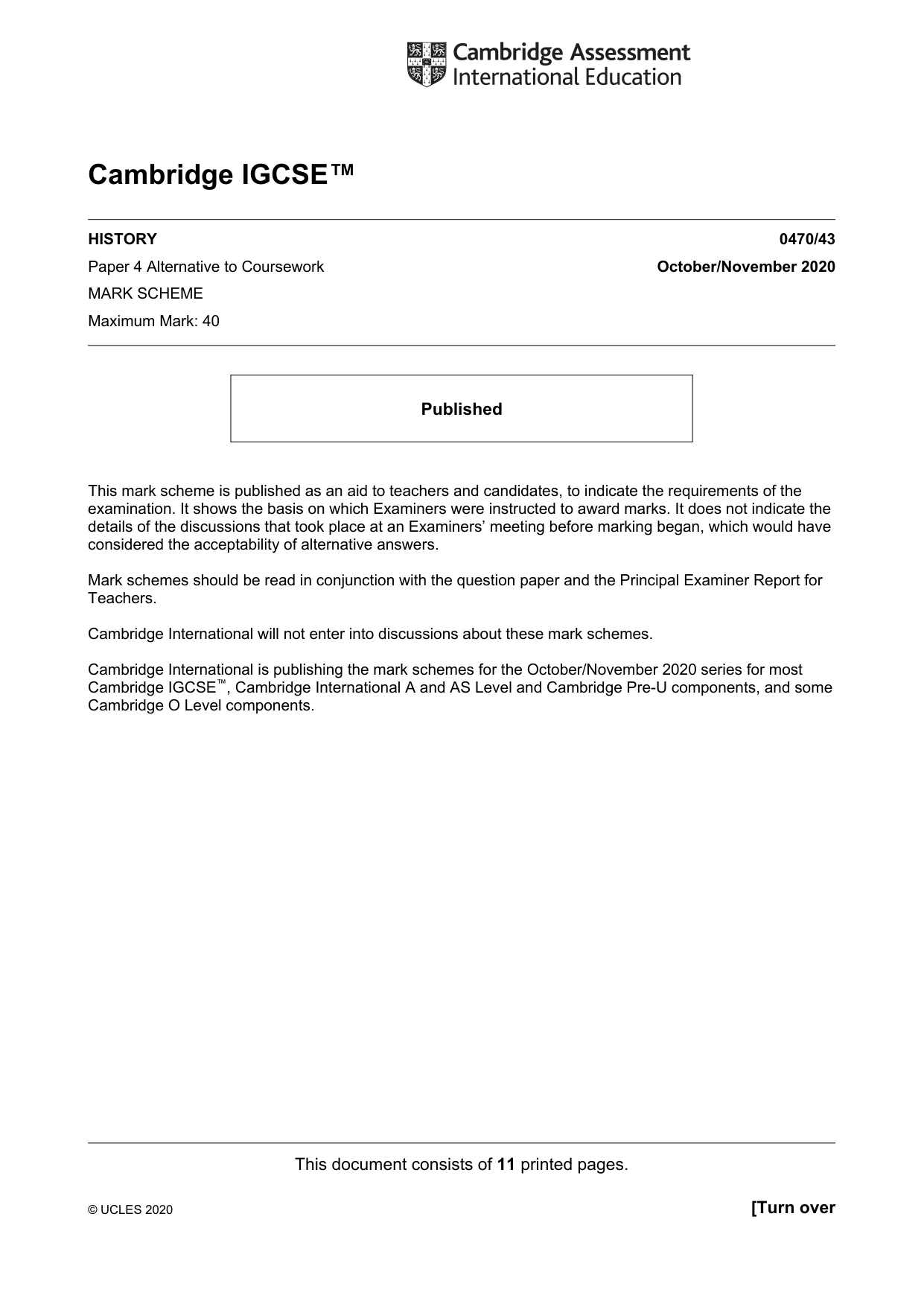
This document consists of 11 printed pages. © UCLES 2020 [Turn over Cambridge IGCSE™ HISTORY 0470/43 Paper 4 Alternative to Coursework October/November 2020 MARK SCHEME Maximum Mark: 40 Published This mark scheme is published as an aid to teachers and candidates, to indicate the requirements of the examination. It shows the basis on which Examiners were instructed to award marks. It does not indicate the details of the discussions that took place at an Examiners’ meeting before marking began, which would have considered the acceptability of alternative answers. Mark schemes should be read in conjunction with the question paper and the Principal Examiner Report for Teachers. Cambridge International will not enter into discussions about these mark schemes. Cambridge International is publishing the mark schemes for the October/November 2020 series for most Cambridge IGCSE™, Cambridge International A and AS Level and Cambridge Pre-U components, and some Cambridge O Level components.
Mark scheme, page 2
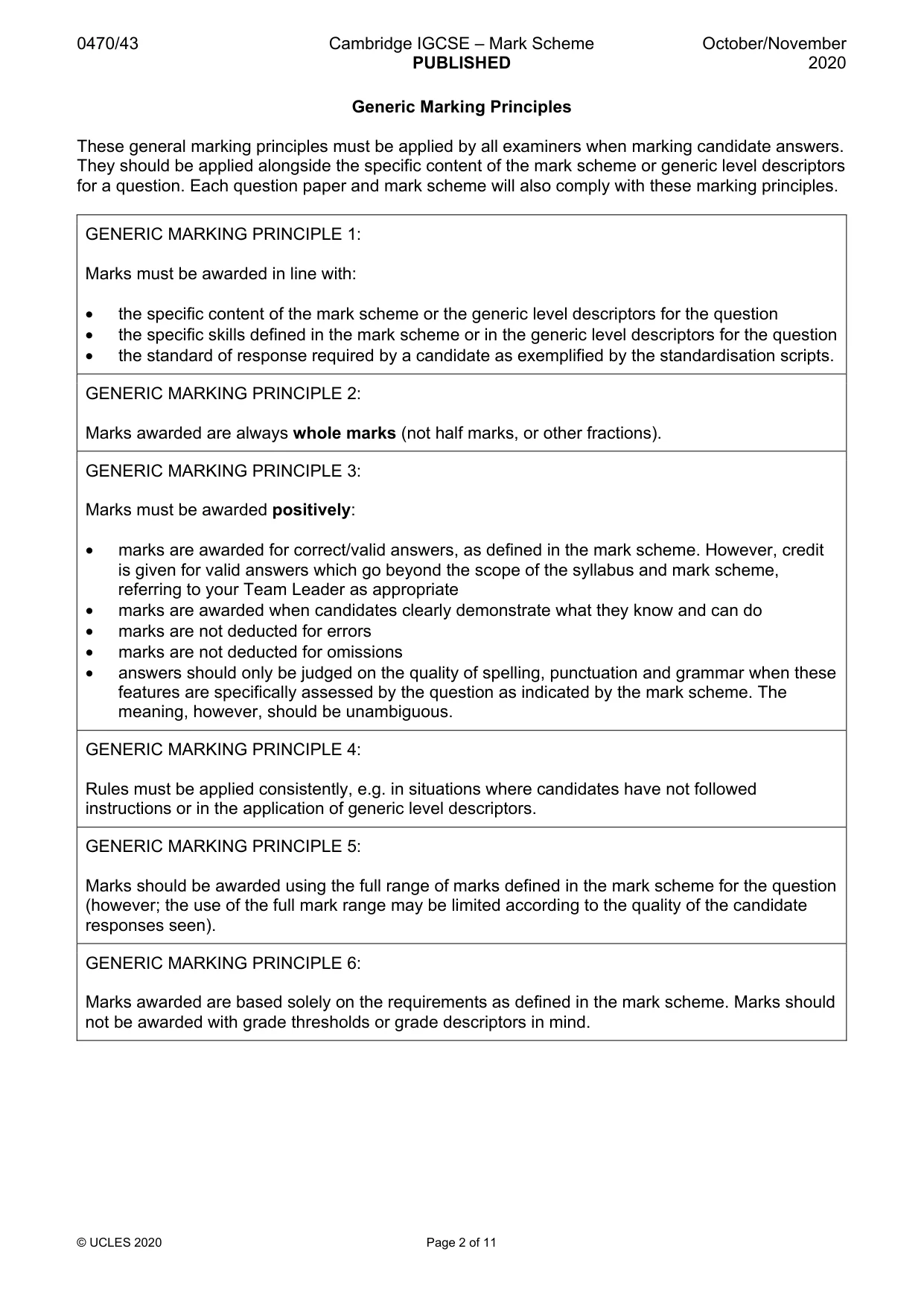
0470/43 Cambridge IGCSE – Mark Scheme PUBLISHED October/November 2020 © UCLES 2020 Page 2 of 11 Generic Marking Principles These general marking principles must be applied by all examiners when marking candidate answers. They should be applied alongside the specific content of the mark scheme or generic level descriptors for a question. Each question paper and mark scheme will also comply with these marking principles. GENERIC MARKING PRINCIPLE 1: Marks must be awarded in line with: • the specific content of the mark scheme or the generic level descriptors for the question • the specific skills defined in the mark scheme or in the generic level descriptors for the question • the standard of response required by a candidate as exemplified by the standardisation scripts. GENERIC MARKING PRINCIPLE 2: Marks awarded are always whole marks (not half marks, or other fractions). GENERIC MARKING PRINCIPLE 3: Marks must be awarded positively: • marks are awarded for correct/valid answers, as defined in the mark scheme. However, credit is given for valid answers which go beyond the scope of the syllabus and mark scheme, referring to your Team Leader as appropriate • marks are awarded when candidates clearly demonstrate what they know and can do • marks are not deducted for errors • marks are not deducted for omissions • answers should only be judged on the quality of spelling, punctuation and grammar when these features are specifically assessed by the question as indicated by the mark scheme. The meaning, however, should be unambiguous. GENERIC MARKING PRINCIPLE 4: Rules must be applied consistently, e.g. in situations where candidates have not followed instructions or in the application of generic level descriptors. GENERIC MARKING PRINCIPLE 5: Marks should be awarded using the full range of marks defined in the mark scheme for the question (however; the use of the full mark range may be limited according to the quality of the candidate responses seen). GENERIC MARKING PRINCIPLE 6: Marks awarded are based solely on the requirements as defined in the mark scheme. Marks should not be awarded with grade thresholds or grade descriptors in mind.
Mark scheme, page 3
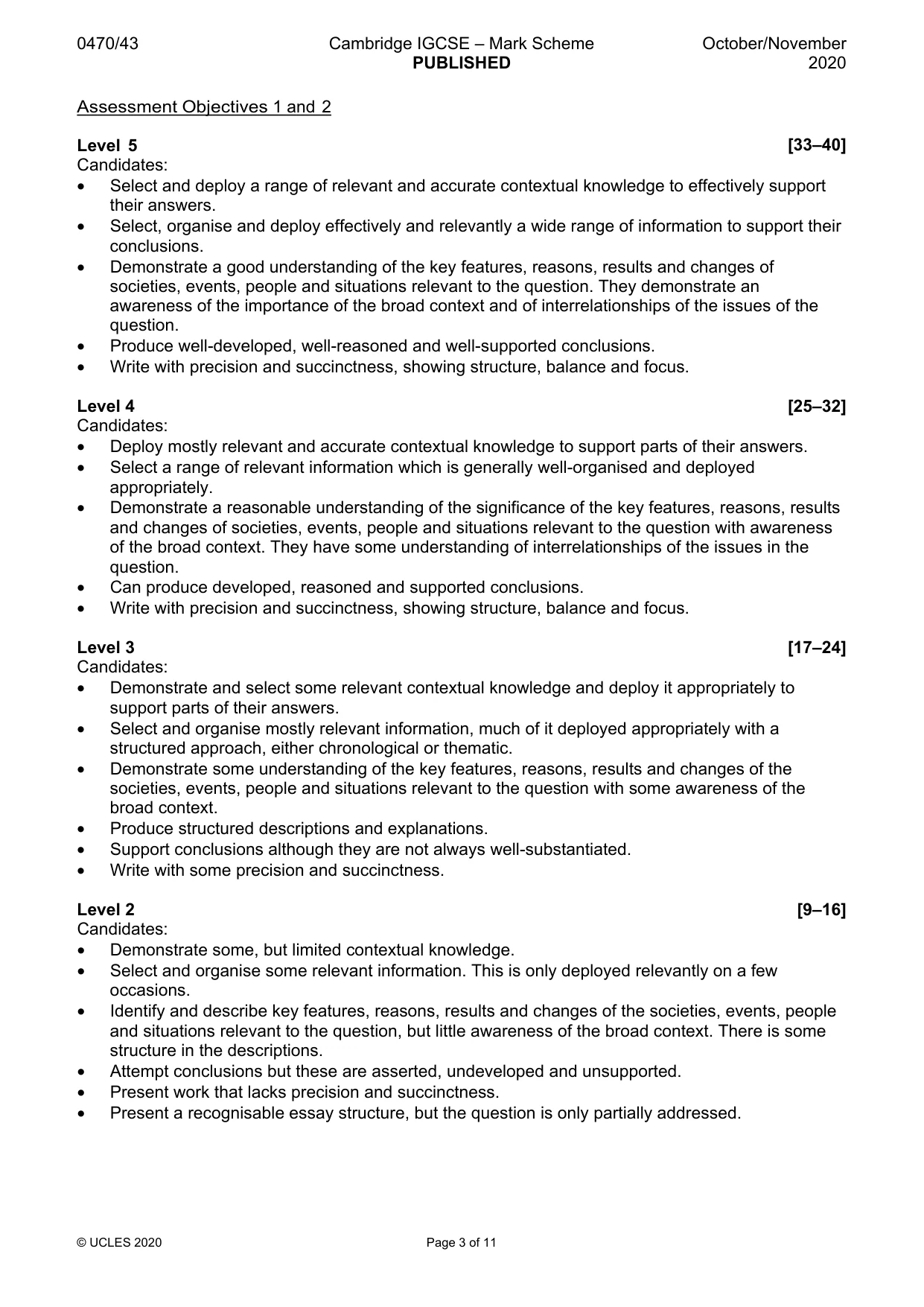
0470/43 Cambridge IGCSE – Mark Scheme PUBLISHED October/November 2020 © UCLES 2020 Page 3 of 11 Assessment Objectives 1 and 2 Level 5 [33–40] Candidates: • Select and deploy a range of relevant and accurate contextual knowledge to effectively support their answers. • Select, organise and deploy effectively and relevantly a wide range of information to support their conclusions. • Demonstrate a good understanding of the key features, reasons, results and changes of societies, events, people and situations relevant to the question. They demonstrate an awareness of the importance of the broad context and of interrelationships of the issues of the question. • Produce well-developed, well-reasoned and well-supported conclusions. • Write with precision and succinctness, showing structure, balance and focus. Level 4 [25–32] Candidates: • Deploy mostly relevant and accurate contextual knowledge to support parts of their answers. • Select a range of relevant information which is generally well-organised and deployed appropriately. • Demonstrate a reasonable understanding of the significance of the key features, reasons, results and changes of societies, events, people and situations relevant to the question with awareness of the broad context. They have some understanding of interrelationships of the issues in the question. • Can produce developed, reasoned and supported conclusions. • Write with precision and succinctness, showing structure, balance and focus. Level 3 [17–24] Candidates: • Demonstrate and select some relevant contextual knowledge and deploy it appropriately to support parts of their answers. • Select and organise mostly relevant information, much of it deployed appropriately with a structured approach, either chronological or thematic. • Demonstrate some understanding of the key features, reasons, results and changes of the societies, events, people and situations relevant to the question with some awareness of the broad context. • Produce structured descriptions and explanations. • Support conclusions although they are not always well-substantiated. • Write with some precision and succinctness. Level 2 [9–16] Candidates: • Demonstrate some, but limited contextual knowledge. • Select and organise some relevant information. This is only deployed relevantly on a few occasions. • Identify and describe key features, reasons, results and changes of the societies, events, people and situations relevant to the question, but little awareness of the broad context. There is some structure in the descriptions. • Attempt conclusions but these are asserted, undeveloped and unsupported. • Present work that lacks precision and succinctness. • Present a recognisable essay structure, but the question is only partially addressed.
Mark scheme, page 4
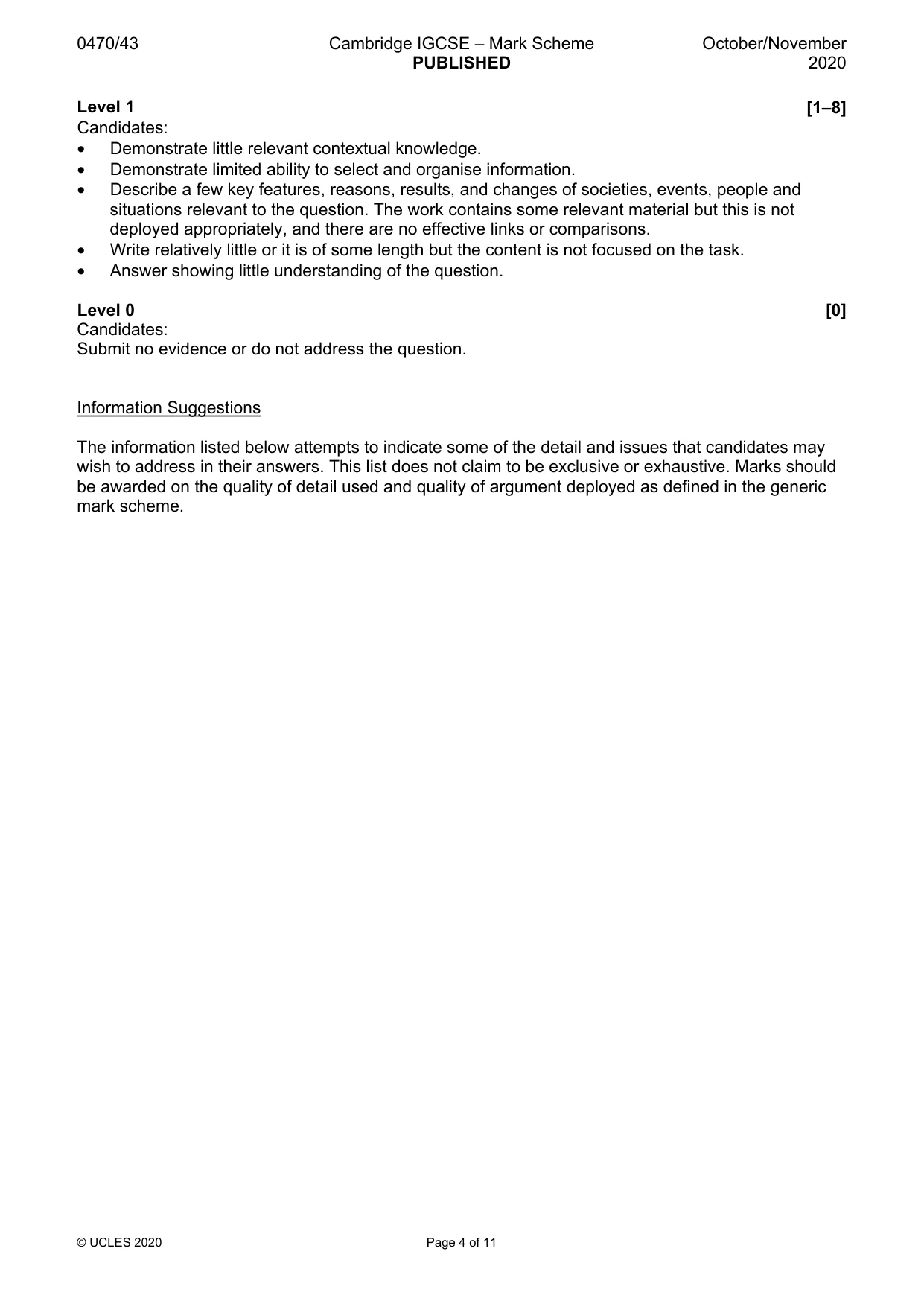
0470/43 Cambridge IGCSE – Mark Scheme PUBLISHED October/November 2020 © UCLES 2020 Page 4 of 11 Level 1 [1–8] Candidates: • Demonstrate little relevant contextual knowledge. • Demonstrate limited ability to select and organise information. • Describe a few key features, reasons, results, and changes of societies, events, people and situations relevant to the question. The work contains some relevant material but this is not deployed appropriately, and there are no effective links or comparisons. • Write relatively little or it is of some length but the content is not focused on the task. • Answer showing little understanding of the question. Level 0 [0] Candidates: Submit no evidence or do not address the question. Information Suggestions The information listed below attempts to indicate some of the detail and issues that candidates may wish to address in their answers. This list does not claim to be exclusive or exhaustive. Marks should be awarded on the quality of detail used and quality of argument deployed as defined in the generic mark scheme.
Mark scheme, page 5
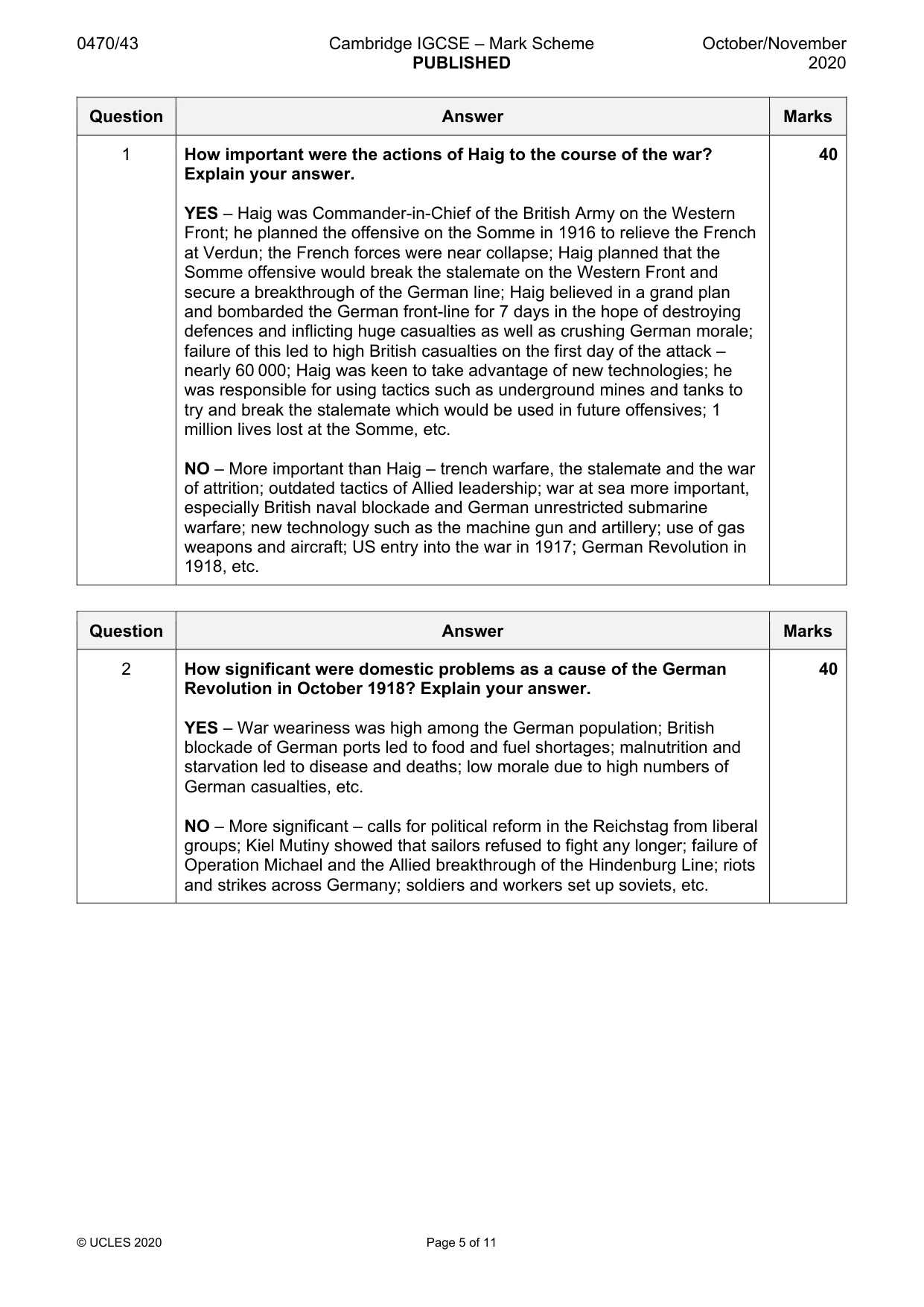
0470/43 Cambridge IGCSE – Mark Scheme PUBLISHED October/November 2020 © UCLES 2020 Page 5 of 11 Question Answer Marks 1 How important were the actions of Haig to the course of the war? Explain your answer. YES – Haig was Commander-in-Chief of the British Army on the Western Front; he planned the offensive on the Somme in 1916 to relieve the French at Verdun; the French forces were near collapse; Haig planned that the Somme offensive would break the stalemate on the Western Front and secure a breakthrough of the German line; Haig believed in a grand plan and bombarded the German front-line for 7 days in the hope of destroying defences and inflicting huge casualties as well as crushing German morale; failure of this led to high British casualties on the first day of the attack – nearly 60 000; Haig was keen to take advantage of new technologies; he was responsible for using tactics such as underground mines and tanks to try and break the stalemate which would be used in future offensives; 1 million lives lost at the Somme, etc. NO – More important than Haig – trench warfare, the stalemate and the war of attrition; outdated tactics of Allied leadership; war at sea more important, especially British naval blockade and German unrestricted submarine warfare; new technology such as the machine gun and artillery; use of gas weapons and aircraft; US entry into the war in 1917; German Revolution in 1918, etc. 40 Question Answer Marks 2 How significant were domestic problems as a cause of the German Revolution in October 1918? Explain your answer. YES – War weariness was high among the German population; British blockade of German ports led to food and fuel shortages; malnutrition and starvation led to disease and deaths; low morale due to high numbers of German casualties, etc. NO – More significant – calls for political reform in the Reichstag from liberal groups; Kiel Mutiny showed that sailors refused to fight any longer; failure of Operation Michael and the Allied breakthrough of the Hindenburg Line; riots and strikes across Germany; soldiers and workers set up soviets, etc. 40
Mark scheme, page 6
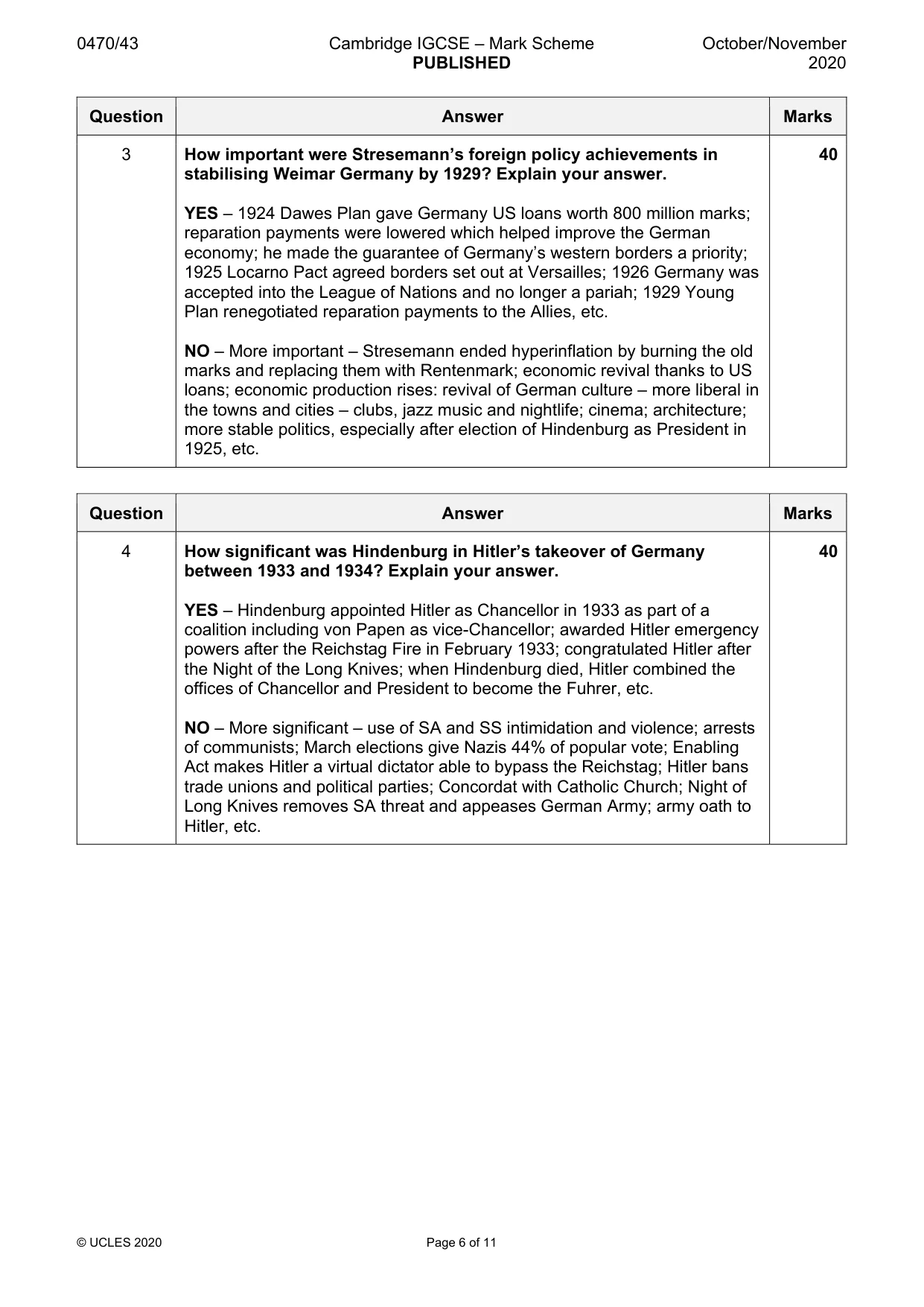
0470/43 Cambridge IGCSE – Mark Scheme PUBLISHED October/November 2020 © UCLES 2020 Page 6 of 11 Question Answer Marks 3 How important were Stresemann’s foreign policy achievements in stabilising Weimar Germany by 1929? Explain your answer. YES – 1924 Dawes Plan gave Germany US loans worth 800 million marks; reparation payments were lowered which helped improve the German economy; he made the guarantee of Germany’s western borders a priority; 1925 Locarno Pact agreed borders set out at Versailles; 1926 Germany was accepted into the League of Nations and no longer a pariah; 1929 Young Plan renegotiated reparation payments to the Allies, etc. NO – More important – Stresemann ended hyperinflation by burning the old marks and replacing them with Rentenmark; economic revival thanks to US loans; economic production rises: revival of German culture – more liberal in the towns and cities – clubs, jazz music and nightlife; cinema; architecture; more stable politics, especially after election of Hindenburg as President in 1925, etc. 40 Question Answer Marks 4 How significant was Hindenburg in Hitler’s takeover of Germany between 1933 and 1934? Explain your answer. YES – Hindenburg appointed Hitler as Chancellor in 1933 as part of a coalition including von Papen as vice-Chancellor; awarded Hitler emergency powers after the Reichstag Fire in February 1933; congratulated Hitler after the Night of the Long Knives; when Hindenburg died, Hitler combined the offices of Chancellor and President to become the Fuhrer, etc. NO – More significant – use of SA and SS intimidation and violence; arrests of communists; March elections give Nazis 44% of popular vote; Enabling Act makes Hitler a virtual dictator able to bypass the Reichstag; Hitler bans trade unions and political parties; Concordat with Catholic Church; Night of Long Knives removes SA threat and appeases German Army; army oath to Hitler, etc. 40
Mark scheme, page 7
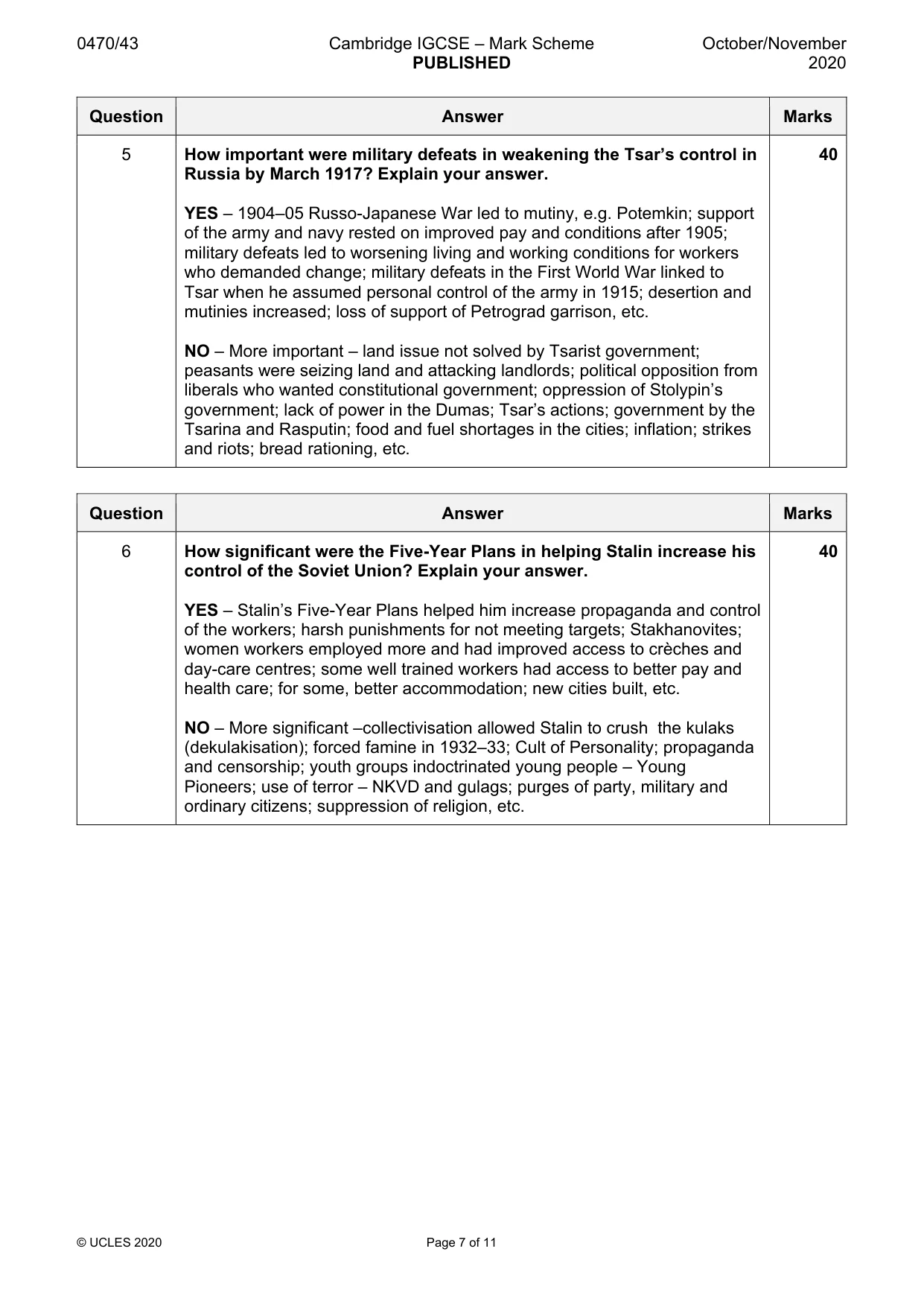
0470/43 Cambridge IGCSE – Mark Scheme PUBLISHED October/November 2020 © UCLES 2020 Page 7 of 11 Question Answer Marks 5 How important were military defeats in weakening the Tsar’s control in Russia by March 1917? Explain your answer. YES – 1904–05 Russo-Japanese War led to mutiny, e.g. Potemkin; support of the army and navy rested on improved pay and conditions after 1905; military defeats led to worsening living and working conditions for workers who demanded change; military defeats in the First World War linked to Tsar when he assumed personal control of the army in 1915; desertion and mutinies increased; loss of support of Petrograd garrison, etc. NO – More important – land issue not solved by Tsarist government; peasants were seizing land and attacking landlords; political opposition from liberals who wanted constitutional government; oppression of Stolypin’s government; lack of power in the Dumas; Tsar’s actions; government by the Tsarina and Rasputin; food and fuel shortages in the cities; inflation; strikes and riots; bread rationing, etc. 40 Question Answer Marks 6 How significant were the Five-Year Plans in helping Stalin increase his control of the Soviet Union? Explain your answer. YES – Stalin’s Five-Year Plans helped him increase propaganda and control of the workers; harsh punishments for not meeting targets; Stakhanovites; women workers employed more and had improved access to crèches and day-care centres; some well trained workers had access to better pay and health care; for some, better accommodation; new cities built, etc. NO – More significant –collectivisation allowed Stalin to crush the kulaks (dekulakisation); forced famine in 1932–33; Cult of Personality; propaganda and censorship; youth groups indoctrinated young people – Young Pioneers; use of terror – NKVD and gulags; purges of party, military and ordinary citizens; suppression of religion, etc. 40
Mark scheme, page 8
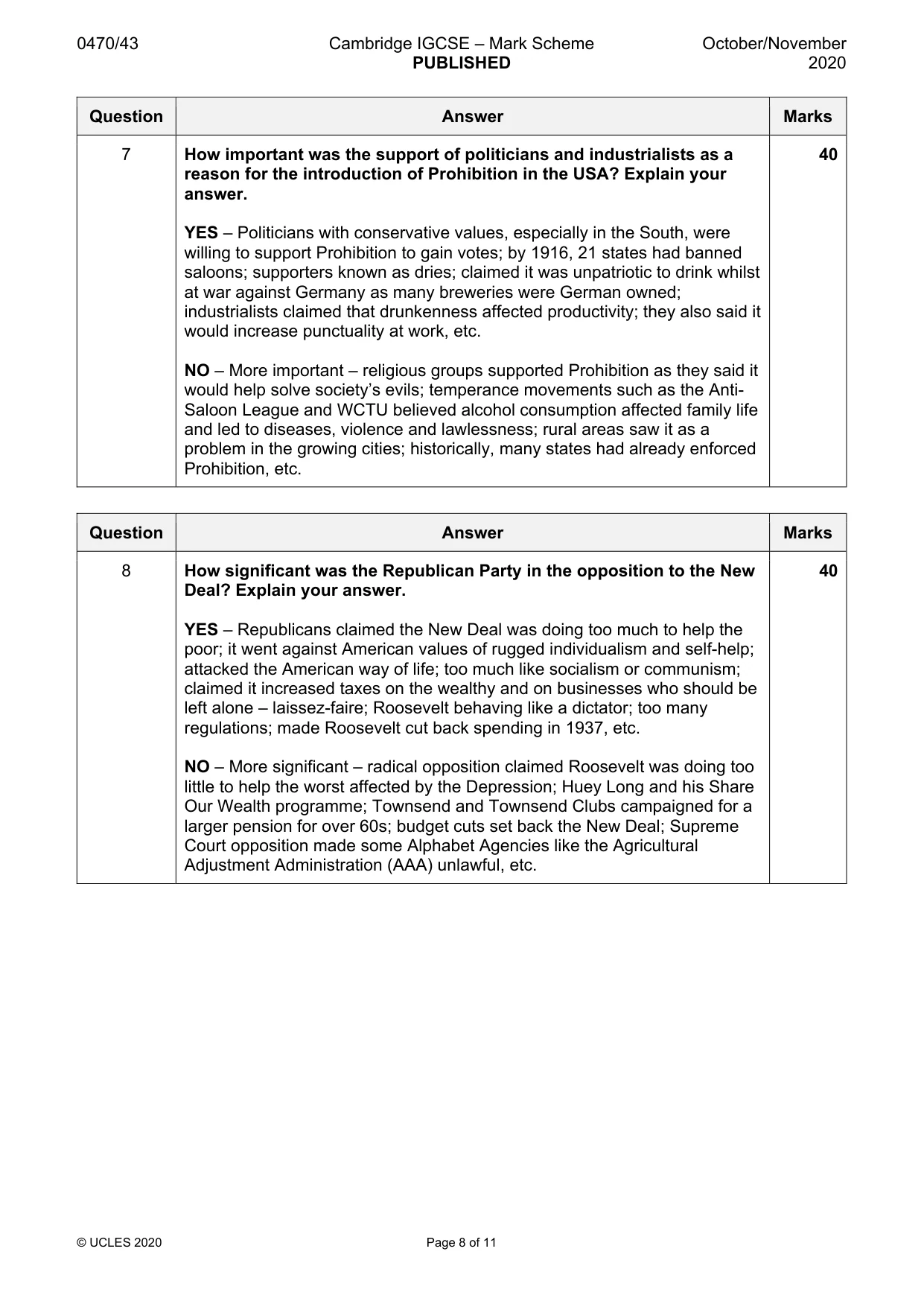
0470/43 Cambridge IGCSE – Mark Scheme PUBLISHED October/November 2020 © UCLES 2020 Page 8 of 11 Question Answer Marks 7 How important was the support of politicians and industrialists as a reason for the introduction of Prohibition in the USA? Explain your answer. YES – Politicians with conservative values, especially in the South, were willing to support Prohibition to gain votes; by 1916, 21 states had banned saloons; supporters known as dries; claimed it was unpatriotic to drink whilst at war against Germany as many breweries were German owned; industrialists claimed that drunkenness affected productivity; they also said it would increase punctuality at work, etc. NO – More important – religious groups supported Prohibition as they said it would help solve society’s evils; temperance movements such as the Anti- Saloon League and WCTU believed alcohol consumption affected family life and led to diseases, violence and lawlessness; rural areas saw it as a problem in the growing cities; historically, many states had already enforced Prohibition, etc. 40 Question Answer Marks 8 How significant was the Republican Party in the opposition to the New Deal? Explain your answer. YES – Republicans claimed the New Deal was doing too much to help the poor; it went against American values of rugged individualism and self-help; attacked the American way of life; too much like socialism or communism; claimed it increased taxes on the wealthy and on businesses who should be left alone – laissez-faire; Roosevelt behaving like a dictator; too many regulations; made Roosevelt cut back spending in 1937, etc. NO – More significant – radical opposition claimed Roosevelt was doing too little to help the worst affected by the Depression; Huey Long and his Share Our Wealth programme; Townsend and Townsend Clubs campaigned for a larger pension for over 60s; budget cuts set back the New Deal; Supreme Court opposition made some Alphabet Agencies like the Agricultural Adjustment Administration (AAA) unlawful, etc. 40
Mark scheme, page 9
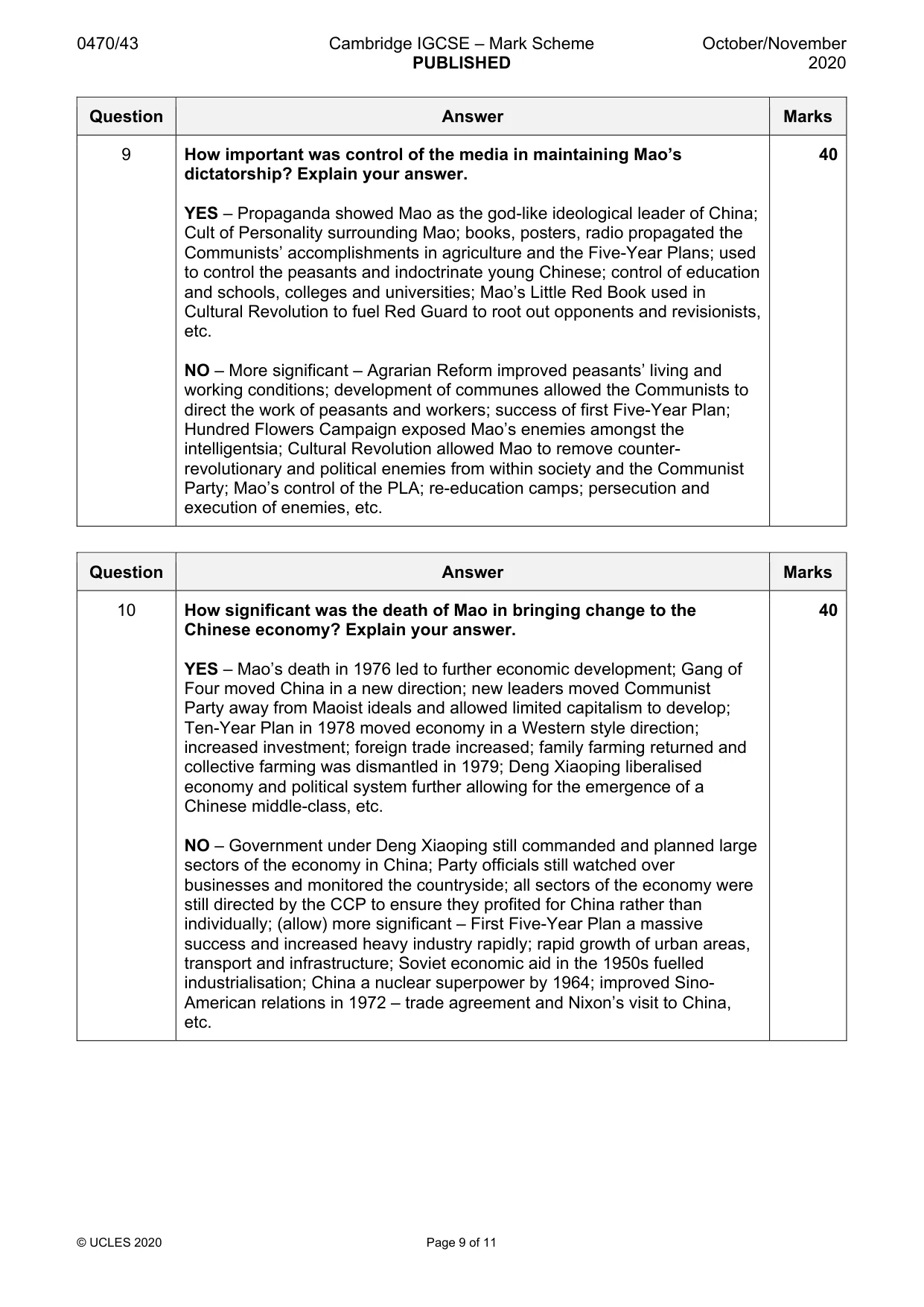
0470/43 Cambridge IGCSE – Mark Scheme PUBLISHED October/November 2020 © UCLES 2020 Page 9 of 11 Question Answer Marks 9 How important was control of the media in maintaining Mao’s dictatorship? Explain your answer. YES – Propaganda showed Mao as the god-like ideological leader of China; Cult of Personality surrounding Mao; books, posters, radio propagated the Communists’ accomplishments in agriculture and the Five-Year Plans; used to control the peasants and indoctrinate young Chinese; control of education and schools, colleges and universities; Mao’s Little Red Book used in Cultural Revolution to fuel Red Guard to root out opponents and revisionists, etc. NO – More significant – Agrarian Reform improved peasants’ living and working conditions; development of communes allowed the Communists to direct the work of peasants and workers; success of first Five-Year Plan; Hundred Flowers Campaign exposed Mao’s enemies amongst the intelligentsia; Cultural Revolution allowed Mao to remove counter- revolutionary and political enemies from within society and the Communist Party; Mao’s control of the PLA; re-education camps; persecution and execution of enemies, etc. 40 Question Answer Marks 10 How significant was the death of Mao in bringing change to the Chinese economy? Explain your answer. YES – Mao’s death in 1976 led to further economic development; Gang of Four moved China in a new direction; new leaders moved Communist Party away from Maoist ideals and allowed limited capitalism to develop; Ten-Year Plan in 1978 moved economy in a Western style direction; increased investment; foreign trade increased; family farming returned and collective farming was dismantled in 1979; Deng Xiaoping liberalised economy and political system further allowing for the emergence of a Chinese middle-class, etc. NO – Government under Deng Xiaoping still commanded and planned large sectors of the economy in China; Party officials still watched over businesses and monitored the countryside; all sectors of the economy were still directed by the CCP to ensure they profited for China rather than individually; (allow) more significant – First Five-Year Plan a massive success and increased heavy industry rapidly; rapid growth of urban areas, transport and infrastructure; Soviet economic aid in the 1950s fuelled industrialisation; China a nuclear superpower by 1964; improved Sino- American relations in 1972 – trade agreement and Nixon’s visit to China, etc. 40
Mark scheme, page 10
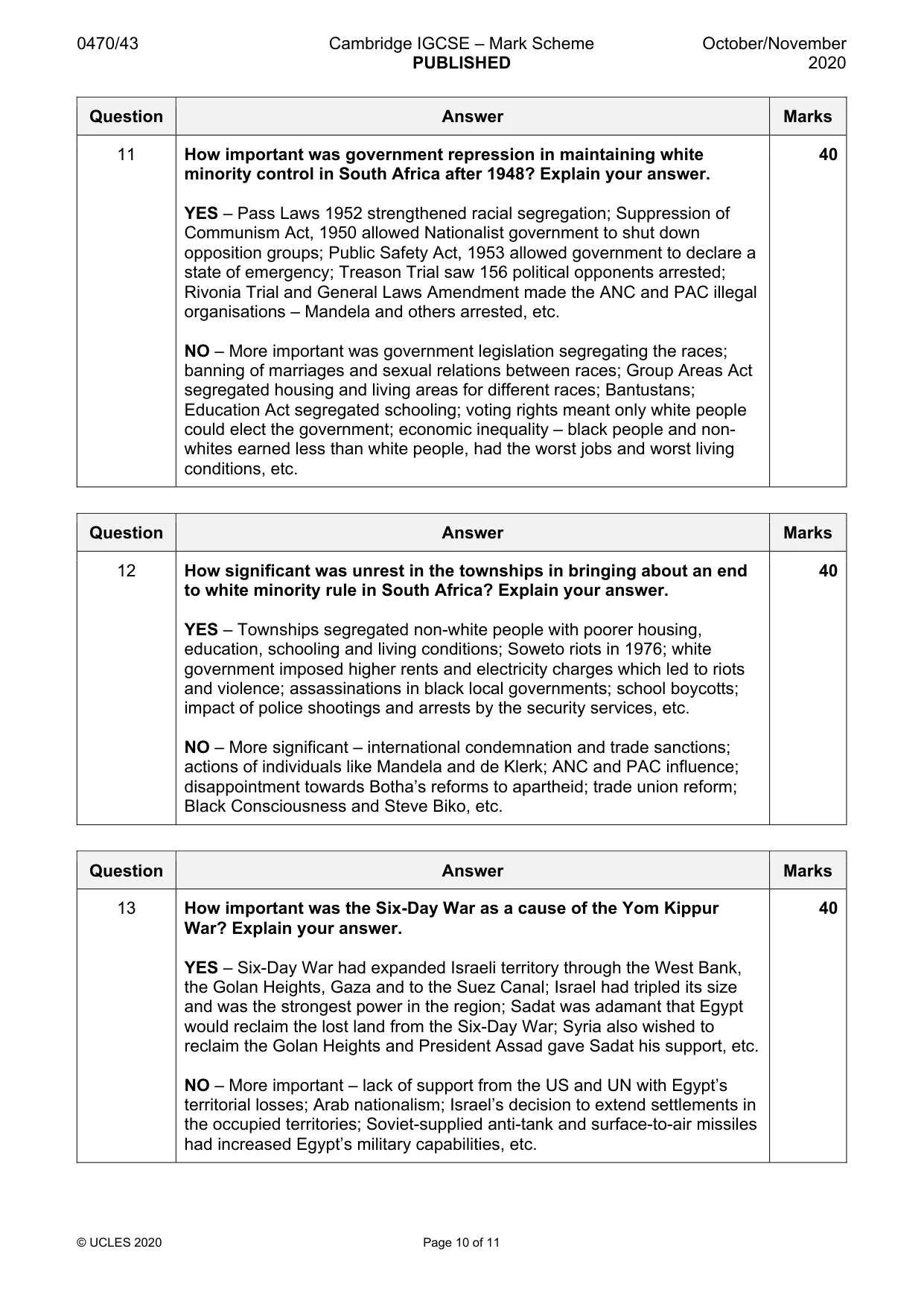
0470/43 Cambridge IGCSE – Mark Scheme PUBLISHED October/November 2020 © UCLES 2020 Page 10 of 11 Question Answer Marks 11 How important was government repression in maintaining white minority control in South Africa after 1948? Explain your answer. YES – Pass Laws 1952 strengthened racial segregation; Suppression of Communism Act, 1950 allowed Nationalist government to shut down opposition groups; Public Safety Act, 1953 allowed government to declare a state of emergency; Treason Trial saw 156 political opponents arrested; Rivonia Trial and General Laws Amendment made the ANC and PAC illegal organisations – Mandela and others arrested, etc. NO – More important was government legislation segregating the races; banning of marriages and sexual relations between races; Group Areas Act segregated housing and living areas for different races; Bantustans; Education Act segregated schooling; voting rights meant only white people could elect the government; economic inequality – black people and non- whites earned less than white people, had the worst jobs and worst living conditions, etc. 40 Question Answer Marks 12 How significant was unrest in the townships in bringing about an end to white minority rule in South Africa? Explain your answer. YES – Townships segregated non-white people with poorer housing, education, schooling and living conditions; Soweto riots in 1976; white government imposed higher rents and electricity charges which led to riots and violence; assassinations in black local governments; school boycotts; impact of police shootings and arrests by the security services, etc. NO – More significant – international condemnation and trade sanctions; actions of individuals like Mandela and de Klerk; ANC and PAC influence; disappointment towards Botha’s reforms to apartheid; trade union reform; Black Consciousness and Steve Biko, etc. 40 Question Answer Marks 13 How important was the Six-Day War as a cause of the Yom Kippur War? Explain your answer. YES – Six-Day War had expanded Israeli territory through the West Bank, the Golan Heights, Gaza and to the Suez Canal; Israel had tripled its size and was the strongest power in the region; Sadat was adamant that Egypt would reclaim the lost land from the Six-Day War; Syria also wished to reclaim the Golan Heights and President Assad gave Sadat his support, etc. NO – More important – lack of support from the US and UN with Egypt’s territorial losses; Arab nationalism; Israel’s decision to extend settlements in the occupied territories; Soviet-supplied anti-tank and surface-to-air missiles had increased Egypt’s military capabilities, etc. 40
Mark scheme, page 11
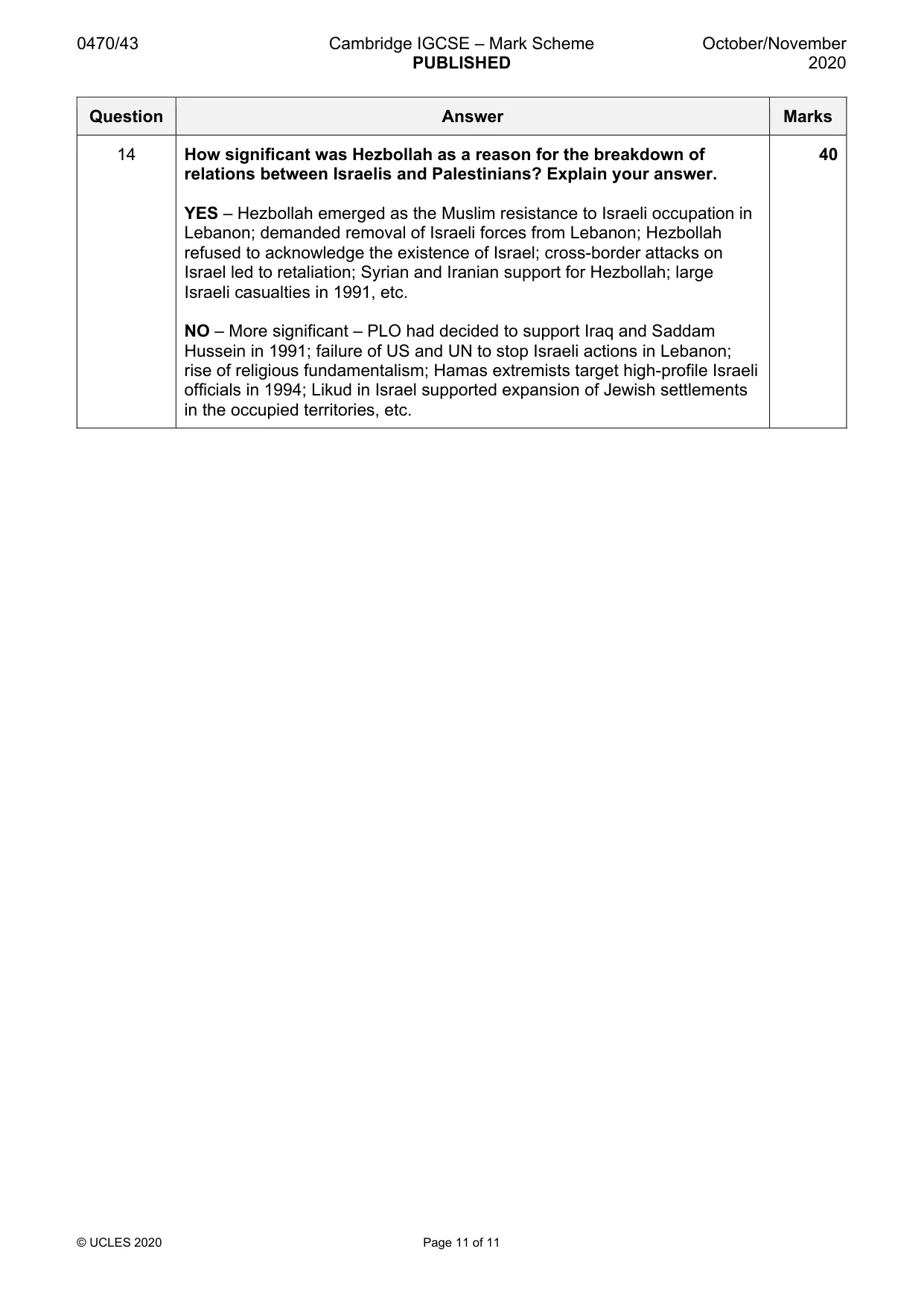
0470/43 Cambridge IGCSE – Mark Scheme PUBLISHED October/November 2020 © UCLES 2020 Page 11 of 11 Question Answer Marks 14 How significant was Hezbollah as a reason for the breakdown of relations between Israelis and Palestinians? Explain your answer. YES – Hezbollah emerged as the Muslim resistance to Israeli occupation in Lebanon; demanded removal of Israeli forces from Lebanon; Hezbollah refused to acknowledge the existence of Israel; cross-border attacks on Israel led to retaliation; Syrian and Iranian support for Hezbollah; large Israeli casualties in 1991, etc. NO – More significant – PLO had decided to support Iraq and Saddam Hussein in 1991; failure of US and UN to stop Israeli actions in Lebanon; rise of religious fundamentalism; Hamas extremists target high-profile Israeli officials in 1994; Likud in Israel supported expansion of Jewish settlements in the occupied territories, etc. 40
What you needed in this session
Cambridge’s own grade thresholds for 2020 Oct/Nov, Paper 4 · Variant 3. A higher threshold means an easier paper — the bar moves with how the cohort did.