Cambridge IGCSE History 0470 — 2020 Oct/Nov Paper 4 · Variant 1
0470/41/O/N/20 · 40 marks · ≈45 min
The question paper and its mark scheme, free to read here and free to download. This is Cambridge’s own paper, exactly as it was sat.
Question paper4 pages

Mark scheme10 pages
Answers below. Sit the paper first if you are practising.
Paper as text
Question paper, page 1
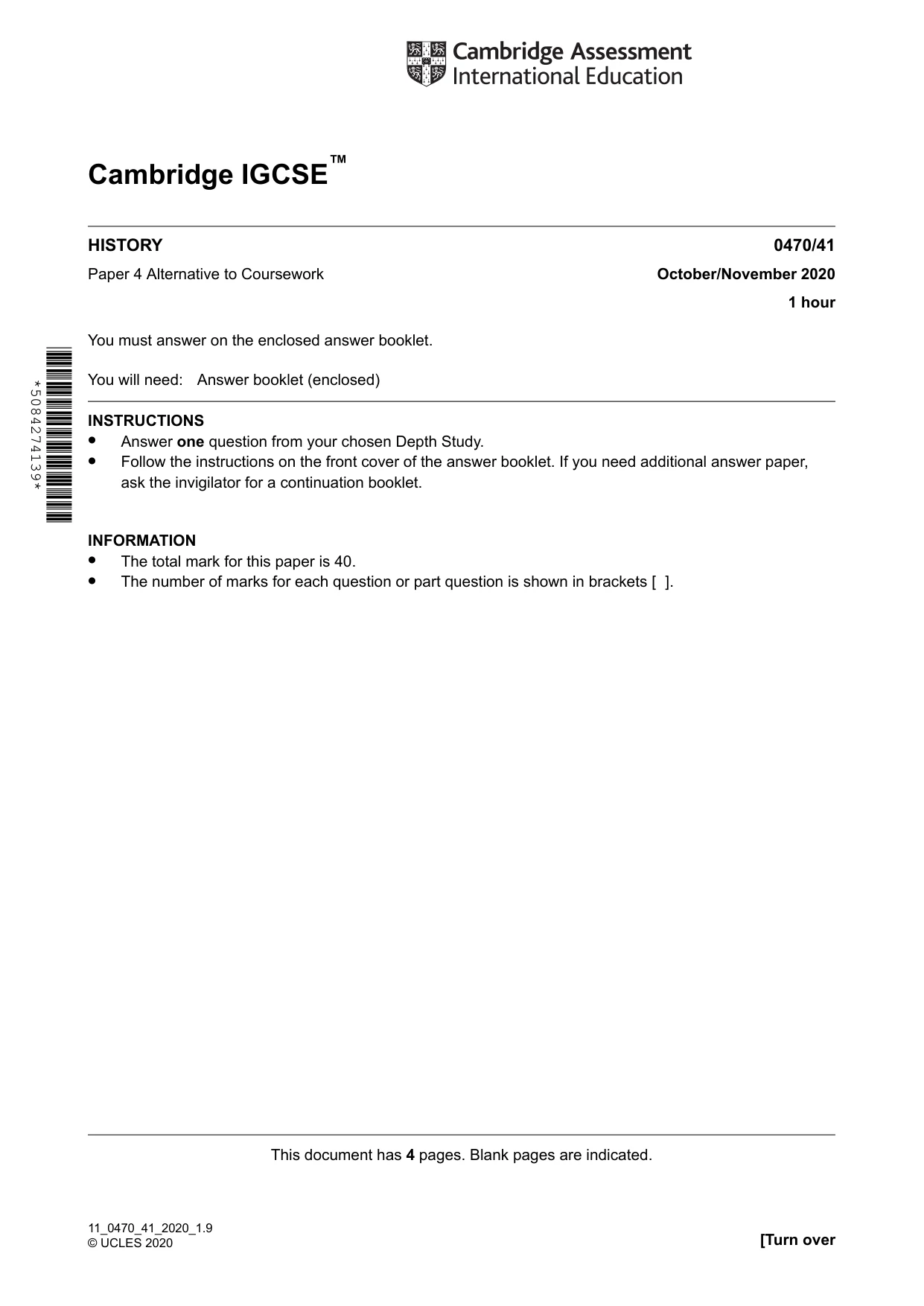
Cambridge IGCSE™ 0470/41 October/November 2020 1 hour HISTORY Paper 4 Alternative to Coursework You must answer on the enclosed answer booklet. You will need: Answer booklet (enclosed) INSTRUCTIONS • Answer one question from your chosen Depth Study. • Follow the instructions on the front cover of the answer booklet. If you need additional answer paper, ask the invigilator for a continuation booklet. INFORMATION • The total mark for this paper is 40. • The number of marks for each question or part question is shown in brackets [ ]. This document has 4 pages. Blank pages are indicated. [Turn over 11_0470_41_2020_1.9 © UCLES 2020 *5084274139*
Question paper, page 2
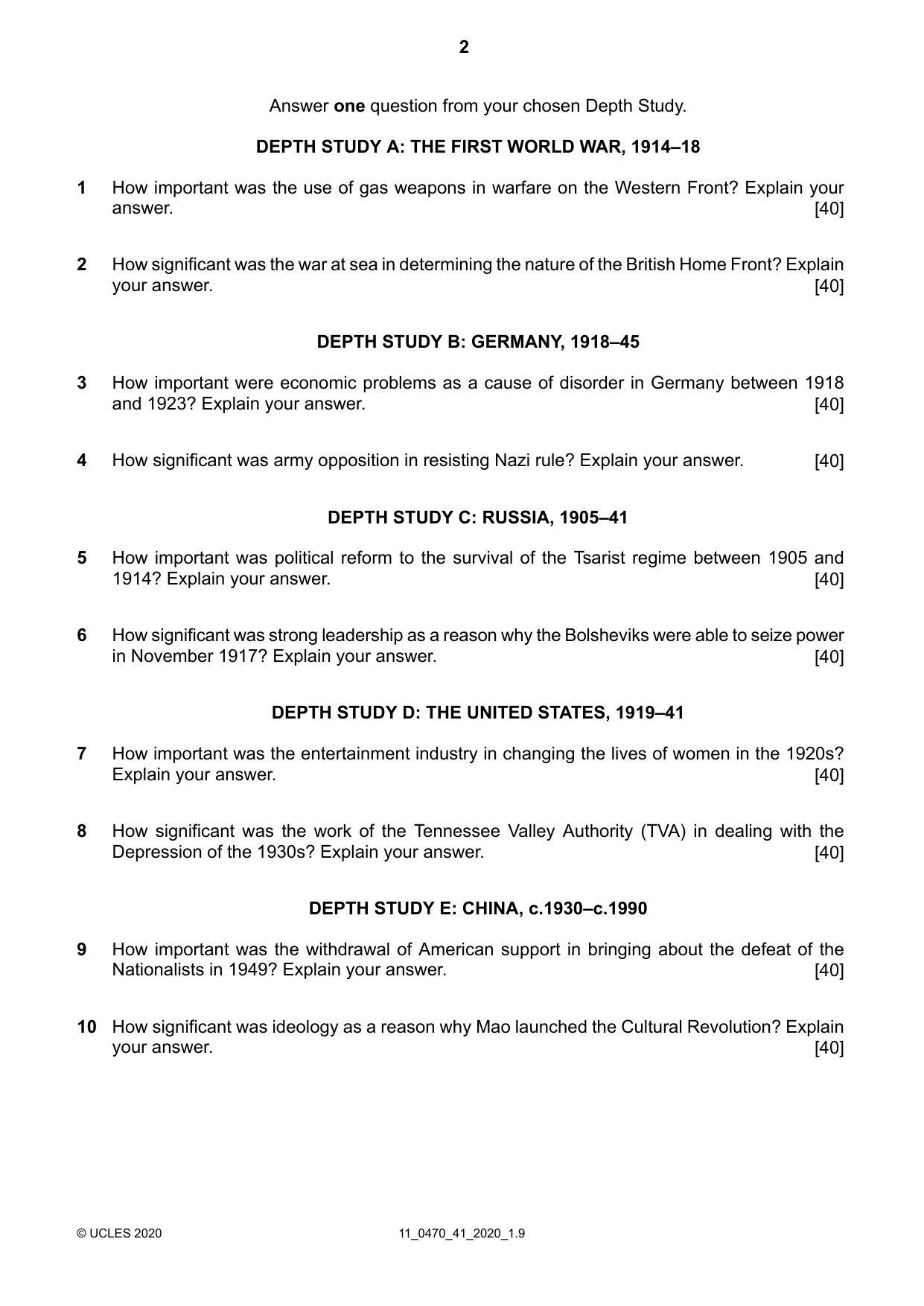
Answer one question from your chosen Depth Study. DEPTH STUDY A: THE FIRST WORLD WAR, 1914–18 How important was the use of gas weapons in warfare on the Western Front? Explain your answer. [40] 1 How significant was the war at sea in determining the nature of the British Home Front? Explain your answer. [40] 2 DEPTH STUDY B: GERMANY, 1918–45 How important were economic problems as a cause of disorder in Germany between 1918 and 1923? Explain your answer. [40] 3 How significant was army opposition in resisting Nazi rule? Explain your answer. [40] 4 DEPTH STUDY C: RUSSIA, 1905–41 How important was political reform to the survival of the Tsarist regime between 1905 and 1914? Explain your answer. [40] 5 How significant was strong leadership as a reason why the Bolsheviks were able to seize power in November 1917? Explain your answer. [40] 6 DEPTH STUDY D: THE UNITED STATES, 1919–41 How important was the entertainment industry in changing the lives of women in the 1920s? Explain your answer. [40] 7 How significant was the work of the Tennessee Valley Authority (TVA) in dealing with the Depression of the 1930s? Explain your answer. [40] 8 DEPTH STUDY E: CHINA, c.1930–c.1990 How important was the withdrawal of American support in bringing about the defeat of the Nationalists in 1949? Explain your answer. [40] 9 How significant was ideology as a reason why Mao launched the Cultural Revolution? Explain your answer. [40] 10 11_0470_41_2020_1.9 © UCLES 2020 2
Question paper, page 3
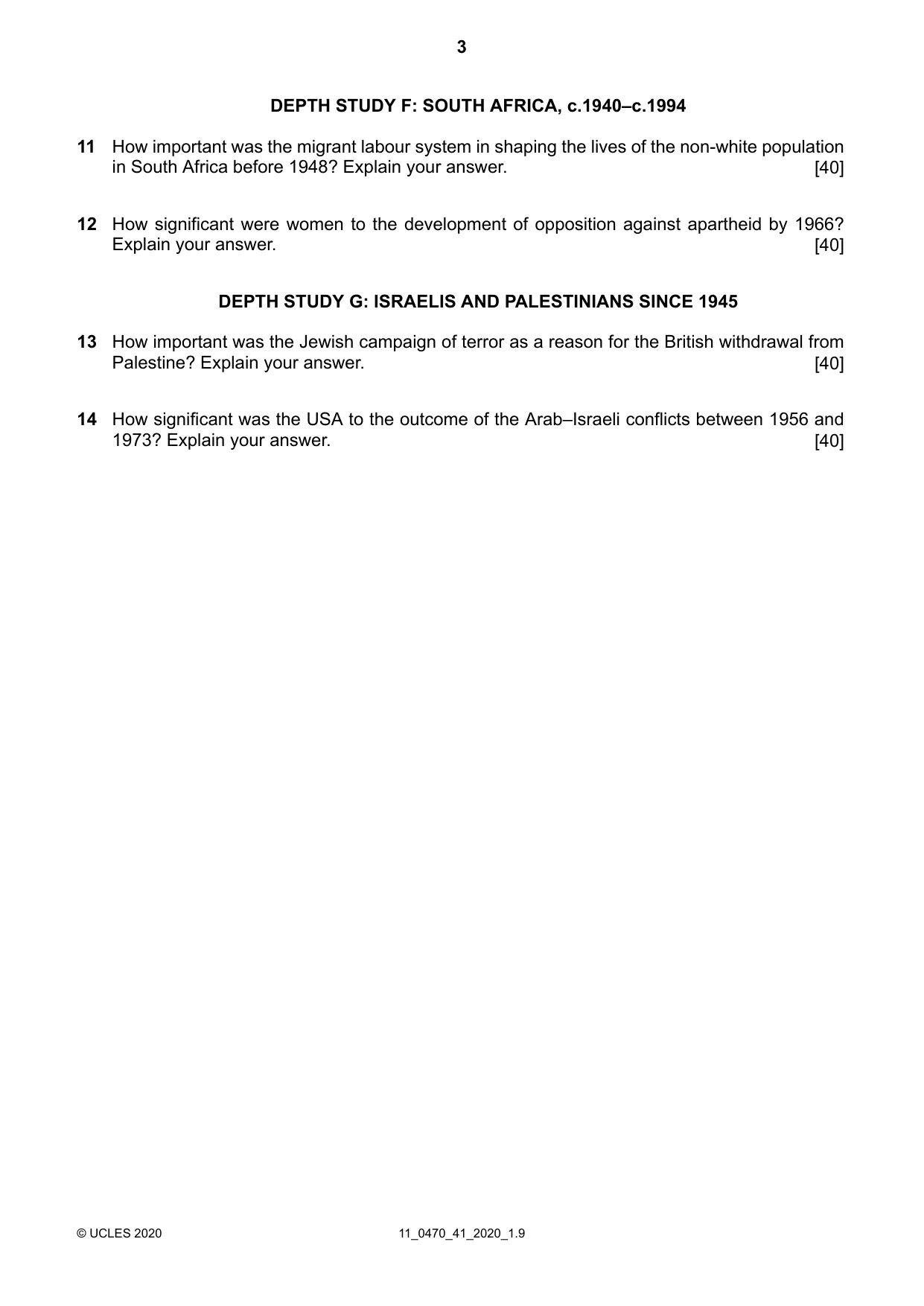
DEPTH STUDY F: SOUTH AFRICA, c.1940–c.1994 How important was the migrant labour system in shaping the lives of the non-white population in South Africa before 1948? Explain your answer. [40] 11 How significant were women to the development of opposition against apartheid by 1966? Explain your answer. [40] 12 DEPTH STUDY G: ISRAELIS AND PALESTINIANS SINCE 1945 How important was the Jewish campaign of terror as a reason for the British withdrawal from Palestine? Explain your answer. [40] 13 How significant was the USA to the outcome of the Arab–Israeli conflicts between 1956 and 1973? Explain your answer. [40] 14 11_0470_41_2020_1.9 © UCLES 2020 3
Question paper, page 4
BLANK PAGE Permission to reproduce items where third-party owned material protected by copyright is included has been sought and cleared where possible. Every reasonable effort has been made by the publisher (UCLES) to trace copyright holders, but if any items requiring clearance have unwittingly been included, the publisher will be pleased to make amends at the earliest possible opportunity. To avoid the issue of disclosure of answer-related information to candidates, all copyright acknowledgements are reproduced online in the Cambridge Assessment International Education Copyright Acknowledgements Booklet. This is produced for each series of examinations and is freely available to download at www.cambridgeinternational.org after the live examination series. Cambridge Assessment International Education is part of the Cambridge Assessment Group. Cambridge Assessment is the brand name of the University of Cambridge Local Examinations Syndicate (UCLES), which itself is a department of the University of Cambridge. 11_0470_41_2020_1.9 © UCLES 2020 4
Mark scheme, page 1
This document consists of 10 printed pages. © UCLES 2020 [Turn over Cambridge IGCSE™ HISTORY 0470/41 Paper 4 Alternative to Coursework October/November 2020 MARK SCHEME Maximum Mark: 40 Published This mark scheme is published as an aid to teachers and candidates, to indicate the requirements of the examination. It shows the basis on which Examiners were instructed to award marks. It does not indicate the details of the discussions that took place at an Examiners’ meeting before marking began, which would have considered the acceptability of alternative answers. Mark schemes should be read in conjunction with the question paper and the Principal Examiner Report for Teachers. Cambridge International will not enter into discussions about these mark schemes. Cambridge International is publishing the mark schemes for the October/November 2020 series for most Cambridge IGCSE™, Cambridge International A and AS Level and Cambridge Pre-U components, and some Cambridge O Level components.
Mark scheme, page 2
0470/41 Cambridge IGCSE – Mark Scheme PUBLISHED October/November 2020 © UCLES 2020 Page 2 of 10 Generic Marking Principles These general marking principles must be applied by all examiners when marking candidate answers. They should be applied alongside the specific content of the mark scheme or generic level descriptors for a question. Each question paper and mark scheme will also comply with these marking principles. GENERIC MARKING PRINCIPLE 1: Marks must be awarded in line with: • the specific content of the mark scheme or the generic level descriptors for the question • the specific skills defined in the mark scheme or in the generic level descriptors for the question • the standard of response required by a candidate as exemplified by the standardisation scripts. GENERIC MARKING PRINCIPLE 2: Marks awarded are always whole marks (not half marks, or other fractions). GENERIC MARKING PRINCIPLE 3: Marks must be awarded positively: • marks are awarded for correct/valid answers, as defined in the mark scheme. However, credit is given for valid answers which go beyond the scope of the syllabus and mark scheme, referring to your Team Leader as appropriate • marks are awarded when candidates clearly demonstrate what they know and can do • marks are not deducted for errors • marks are not deducted for omissions • answers should only be judged on the quality of spelling, punctuation and grammar when these features are specifically assessed by the question as indicated by the mark scheme. The meaning, however, should be unambiguous. GENERIC MARKING PRINCIPLE 4: Rules must be applied consistently, e.g. in situations where candidates have not followed instructions or in the application of generic level descriptors. GENERIC MARKING PRINCIPLE 5: Marks should be awarded using the full range of marks defined in the mark scheme for the question (however; the use of the full mark range may be limited according to the quality of the candidate responses seen). GENERIC MARKING PRINCIPLE 6: Marks awarded are based solely on the requirements as defined in the mark scheme. Marks should not be awarded with grade thresholds or grade descriptors in mind.
Mark scheme, page 3
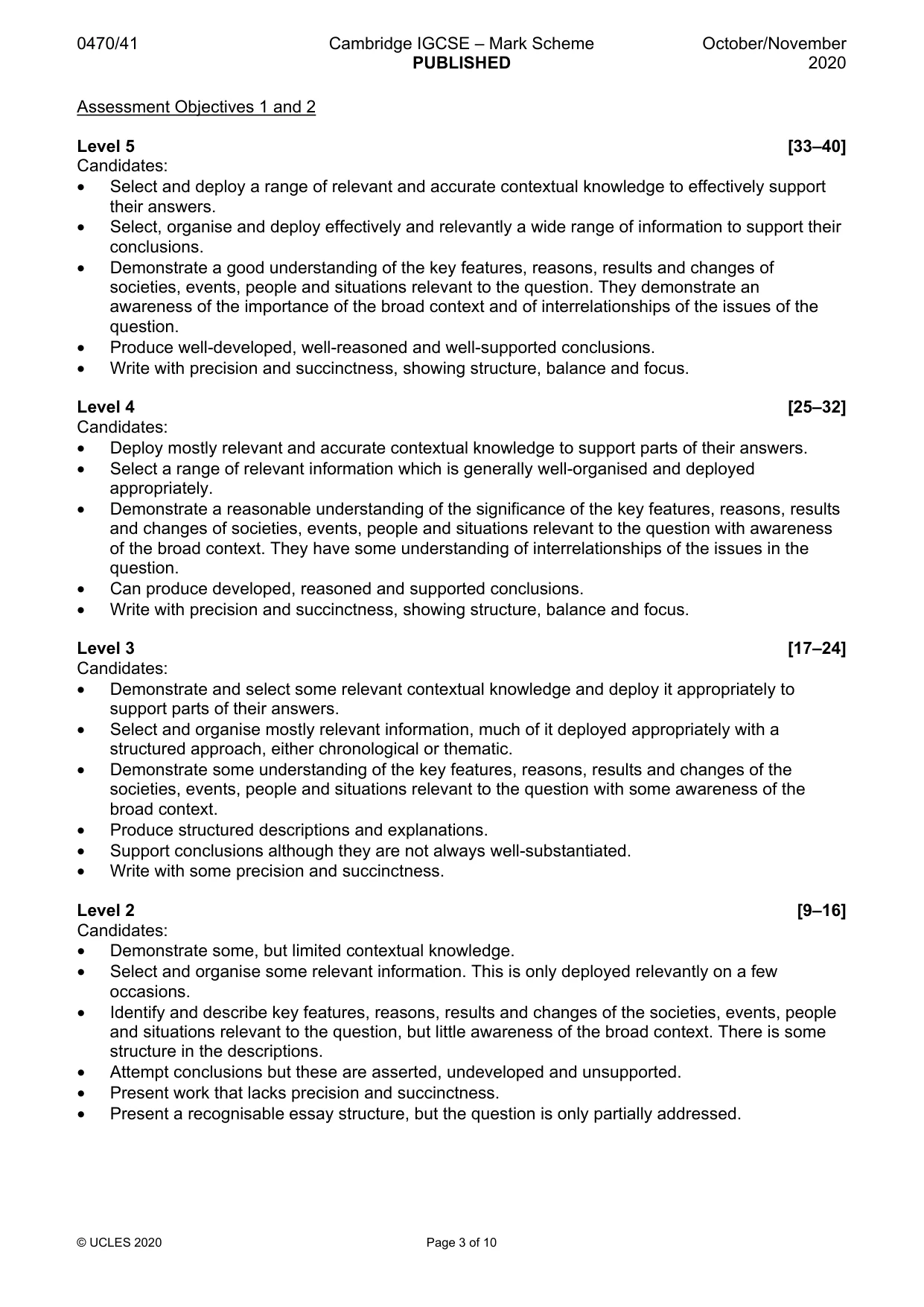
0470/41 Cambridge IGCSE – Mark Scheme PUBLISHED October/November 2020 © UCLES 2020 Page 3 of 10 Assessment Objectives 1 and 2 Level 5 [33–40] Candidates: • Select and deploy a range of relevant and accurate contextual knowledge to effectively support their answers. • Select, organise and deploy effectively and relevantly a wide range of information to support their conclusions. • Demonstrate a good understanding of the key features, reasons, results and changes of societies, events, people and situations relevant to the question. They demonstrate an awareness of the importance of the broad context and of interrelationships of the issues of the question. • Produce well-developed, well-reasoned and well-supported conclusions. • Write with precision and succinctness, showing structure, balance and focus. Level 4 [25–32] Candidates: • Deploy mostly relevant and accurate contextual knowledge to support parts of their answers. • Select a range of relevant information which is generally well-organised and deployed appropriately. • Demonstrate a reasonable understanding of the significance of the key features, reasons, results and changes of societies, events, people and situations relevant to the question with awareness of the broad context. They have some understanding of interrelationships of the issues in the question. • Can produce developed, reasoned and supported conclusions. • Write with precision and succinctness, showing structure, balance and focus. Level 3 [17–24] Candidates: • Demonstrate and select some relevant contextual knowledge and deploy it appropriately to support parts of their answers. • Select and organise mostly relevant information, much of it deployed appropriately with a structured approach, either chronological or thematic. • Demonstrate some understanding of the key features, reasons, results and changes of the societies, events, people and situations relevant to the question with some awareness of the broad context. • Produce structured descriptions and explanations. • Support conclusions although they are not always well-substantiated. • Write with some precision and succinctness. Level 2 [9–16] Candidates: • Demonstrate some, but limited contextual knowledge. • Select and organise some relevant information. This is only deployed relevantly on a few occasions. • Identify and describe key features, reasons, results and changes of the societies, events, people and situations relevant to the question, but little awareness of the broad context. There is some structure in the descriptions. • Attempt conclusions but these are asserted, undeveloped and unsupported. • Present work that lacks precision and succinctness. • Present a recognisable essay structure, but the question is only partially addressed.
Mark scheme, page 4
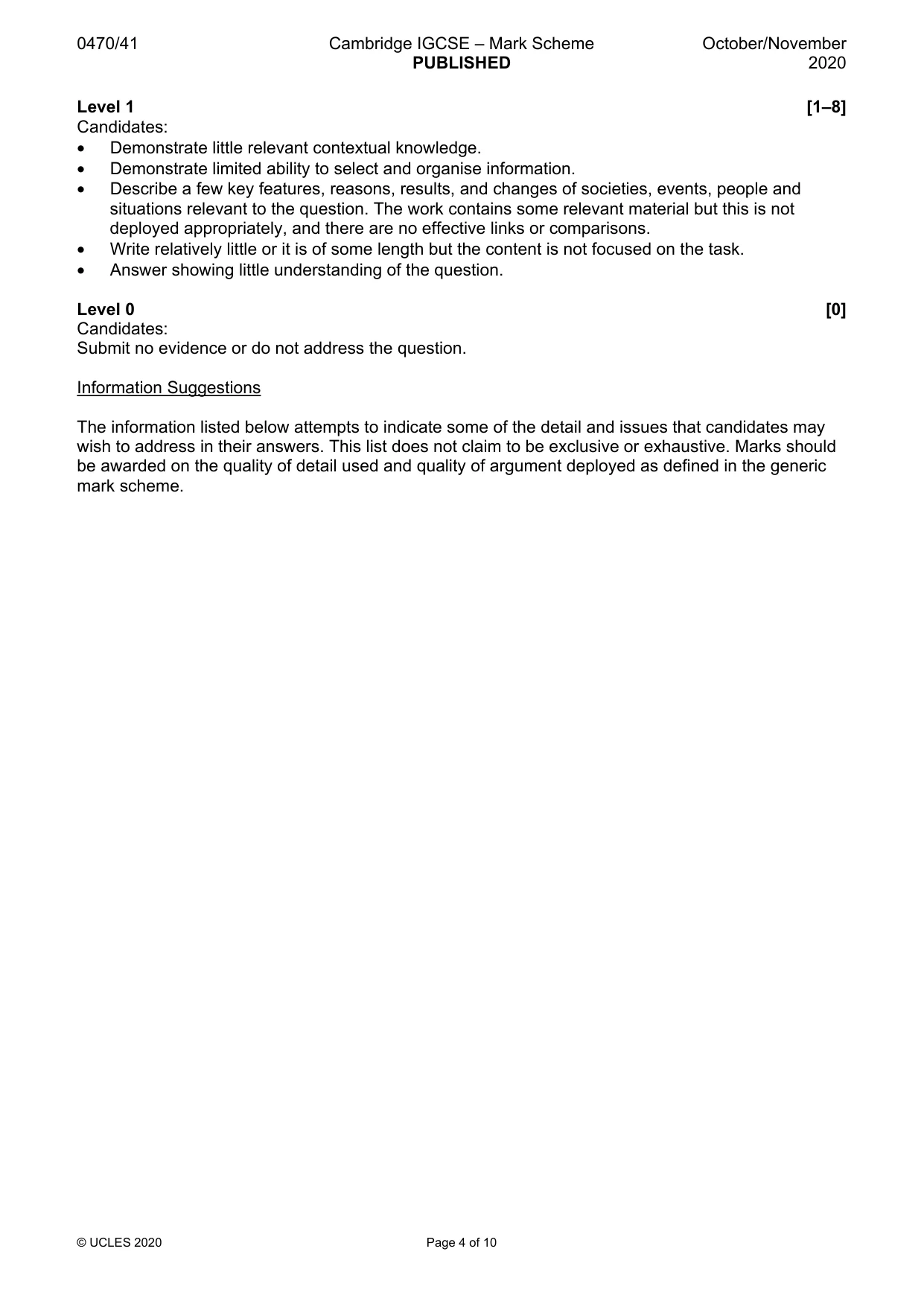
0470/41 Cambridge IGCSE – Mark Scheme PUBLISHED October/November 2020 © UCLES 2020 Page 4 of 10 Level 1 [1–8] Candidates: • Demonstrate little relevant contextual knowledge. • Demonstrate limited ability to select and organise information. • Describe a few key features, reasons, results, and changes of societies, events, people and situations relevant to the question. The work contains some relevant material but this is not deployed appropriately, and there are no effective links or comparisons. • Write relatively little or it is of some length but the content is not focused on the task. • Answer showing little understanding of the question. Level 0 [0] Candidates: Submit no evidence or do not address the question. Information Suggestions The information listed below attempts to indicate some of the detail and issues that candidates may wish to address in their answers. This list does not claim to be exclusive or exhaustive. Marks should be awarded on the quality of detail used and quality of argument deployed as defined in the generic mark scheme.
Mark scheme, page 5
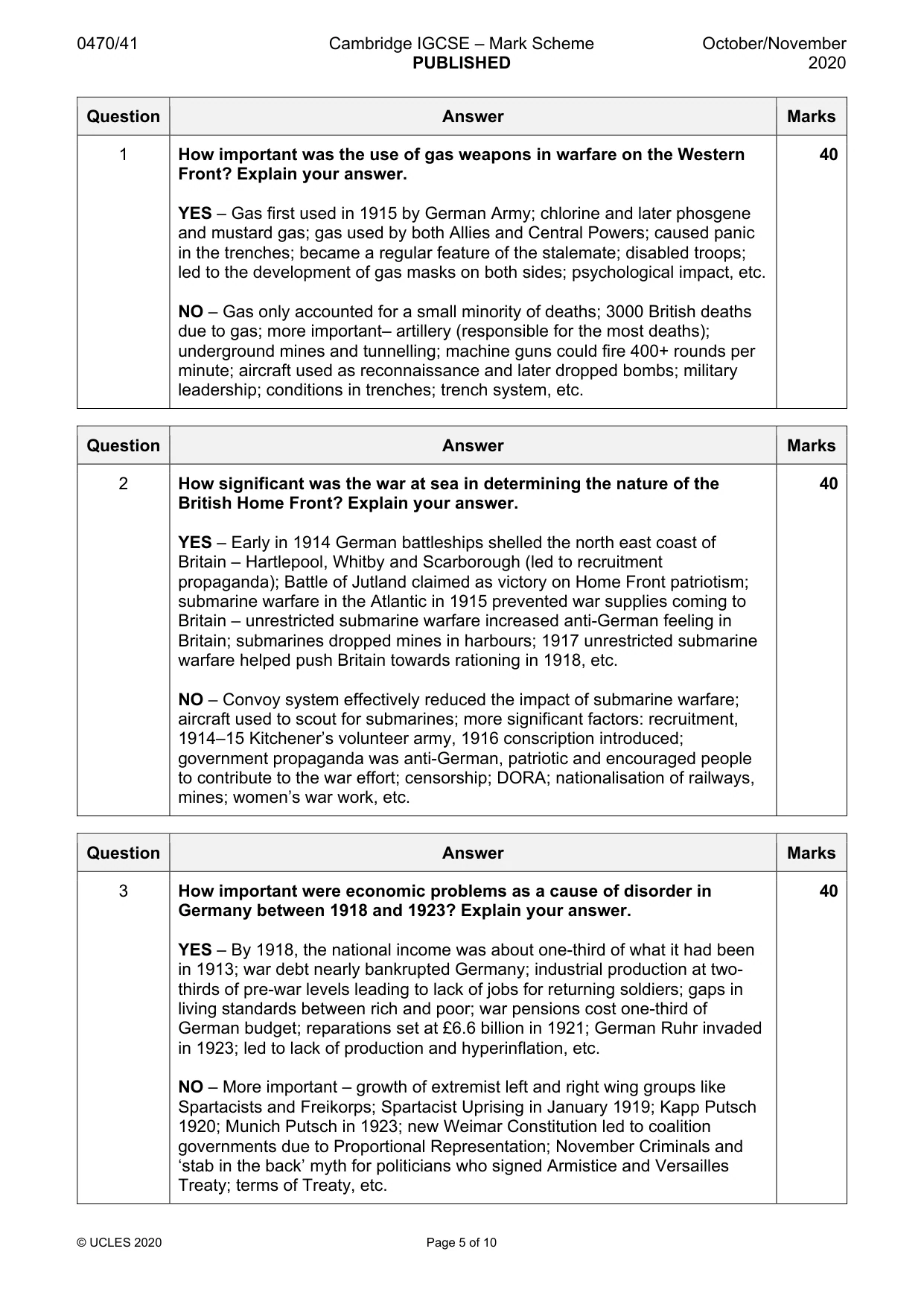
0470/41 Cambridge IGCSE – Mark Scheme PUBLISHED October/November 2020 © UCLES 2020 Page 5 of 10 Question Answer Marks 1 How important was the use of gas weapons in warfare on the Western Front? Explain your answer. YES – Gas first used in 1915 by German Army; chlorine and later phosgene and mustard gas; gas used by both Allies and Central Powers; caused panic in the trenches; became a regular feature of the stalemate; disabled troops; led to the development of gas masks on both sides; psychological impact, etc. NO – Gas only accounted for a small minority of deaths; 3000 British deaths due to gas; more important– artillery (responsible for the most deaths); underground mines and tunnelling; machine guns could fire 400+ rounds per minute; aircraft used as reconnaissance and later dropped bombs; military leadership; conditions in trenches; trench system, etc. 40 Question Answer Marks 2 How significant was the war at sea in determining the nature of the British Home Front? Explain your answer. YES – Early in 1914 German battleships shelled the north east coast of Britain – Hartlepool, Whitby and Scarborough (led to recruitment propaganda); Battle of Jutland claimed as victory on Home Front patriotism; submarine warfare in the Atlantic in 1915 prevented war supplies coming to Britain – unrestricted submarine warfare increased anti-German feeling in Britain; submarines dropped mines in harbours; 1917 unrestricted submarine warfare helped push Britain towards rationing in 1918, etc. NO – Convoy system effectively reduced the impact of submarine warfare; aircraft used to scout for submarines; more significant factors: recruitment, 1914–15 Kitchener’s volunteer army, 1916 conscription introduced; government propaganda was anti-German, patriotic and encouraged people to contribute to the war effort; censorship; DORA; nationalisation of railways, mines; women’s war work, etc. 40 Question Answer Marks 3 How important were economic problems as a cause of disorder in Germany between 1918 and 1923? Explain your answer. YES – By 1918, the national income was about one-third of what it had been in 1913; war debt nearly bankrupted Germany; industrial production at two- thirds of pre-war levels leading to lack of jobs for returning soldiers; gaps in living standards between rich and poor; war pensions cost one-third of German budget; reparations set at £6.6 billion in 1921; German Ruhr invaded in 1923; led to lack of production and hyperinflation, etc. NO – More important – growth of extremist left and right wing groups like Spartacists and Freikorps; Spartacist Uprising in January 1919; Kapp Putsch 1920; Munich Putsch in 1923; new Weimar Constitution led to coalition governments due to Proportional Representation; November Criminals and ‘stab in the back’ myth for politicians who signed Armistice and Versailles Treaty; terms of Treaty, etc. 40
Mark scheme, page 6
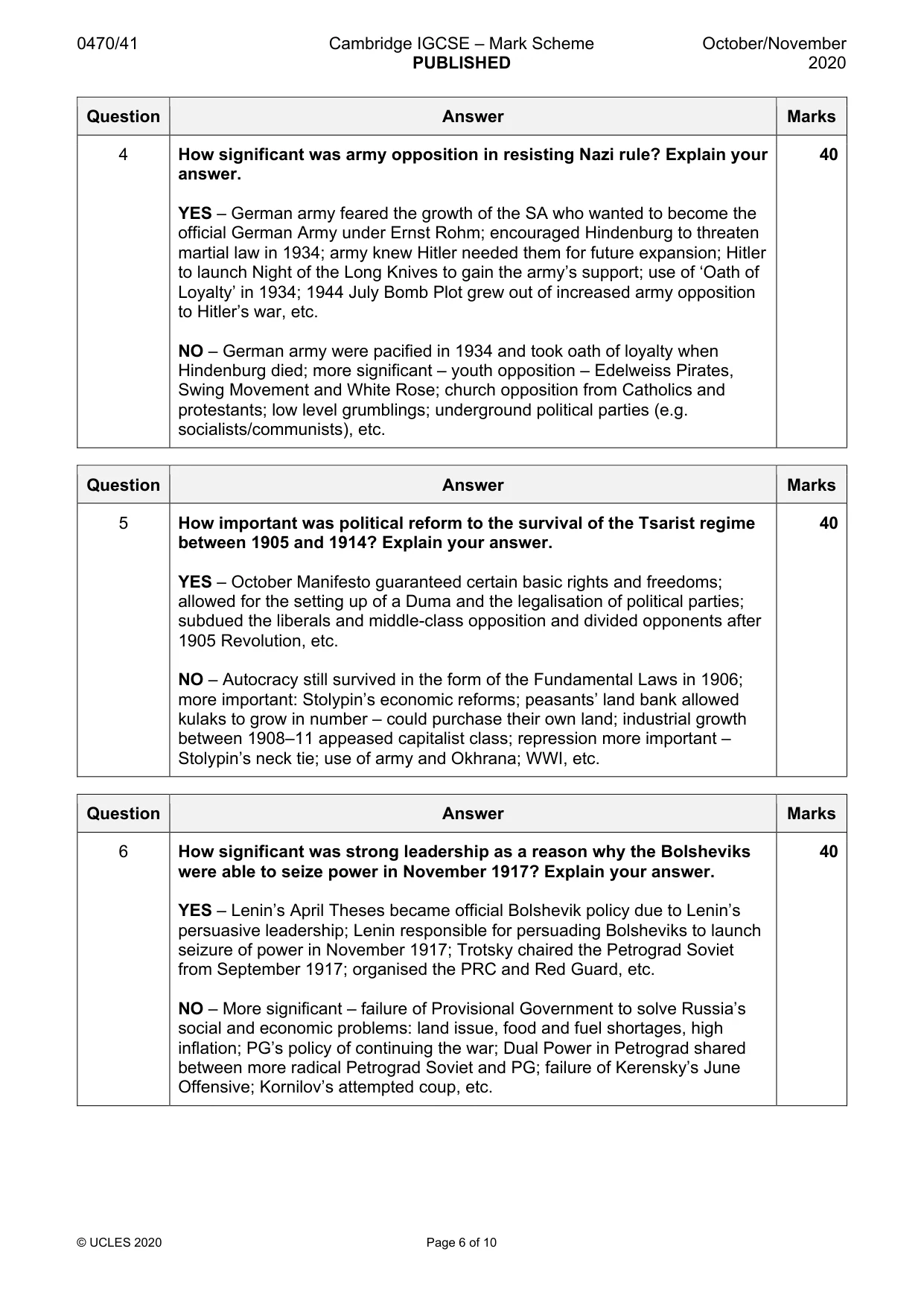
0470/41 Cambridge IGCSE – Mark Scheme PUBLISHED October/November 2020 © UCLES 2020 Page 6 of 10 Question Answer Marks 4 How significant was army opposition in resisting Nazi rule? Explain your answer. YES – German army feared the growth of the SA who wanted to become the official German Army under Ernst Rohm; encouraged Hindenburg to threaten martial law in 1934; army knew Hitler needed them for future expansion; Hitler to launch Night of the Long Knives to gain the army’s support; use of ‘Oath of Loyalty’ in 1934; 1944 July Bomb Plot grew out of increased army opposition to Hitler’s war, etc. NO – German army were pacified in 1934 and took oath of loyalty when Hindenburg died; more significant – youth opposition – Edelweiss Pirates, Swing Movement and White Rose; church opposition from Catholics and protestants; low level grumblings; underground political parties (e.g. socialists/communists), etc. 40 Question Answer Marks 5 How important was political reform to the survival of the Tsarist regime between 1905 and 1914? Explain your answer. YES – October Manifesto guaranteed certain basic rights and freedoms; allowed for the setting up of a Duma and the legalisation of political parties; subdued the liberals and middle-class opposition and divided opponents after 1905 Revolution, etc. NO – Autocracy still survived in the form of the Fundamental Laws in 1906; more important: Stolypin’s economic reforms; peasants’ land bank allowed kulaks to grow in number – could purchase their own land; industrial growth between 1908–11 appeased capitalist class; repression more important – Stolypin’s neck tie; use of army and Okhrana; WWI, etc. 40 Question Answer Marks 6 How significant was strong leadership as a reason why the Bolsheviks were able to seize power in November 1917? Explain your answer. YES – Lenin’s April Theses became official Bolshevik policy due to Lenin’s persuasive leadership; Lenin responsible for persuading Bolsheviks to launch seizure of power in November 1917; Trotsky chaired the Petrograd Soviet from September 1917; organised the PRC and Red Guard, etc. NO – More significant – failure of Provisional Government to solve Russia’s social and economic problems: land issue, food and fuel shortages, high inflation; PG’s policy of continuing the war; Dual Power in Petrograd shared between more radical Petrograd Soviet and PG; failure of Kerensky’s June Offensive; Kornilov’s attempted coup, etc. 40
Mark scheme, page 7
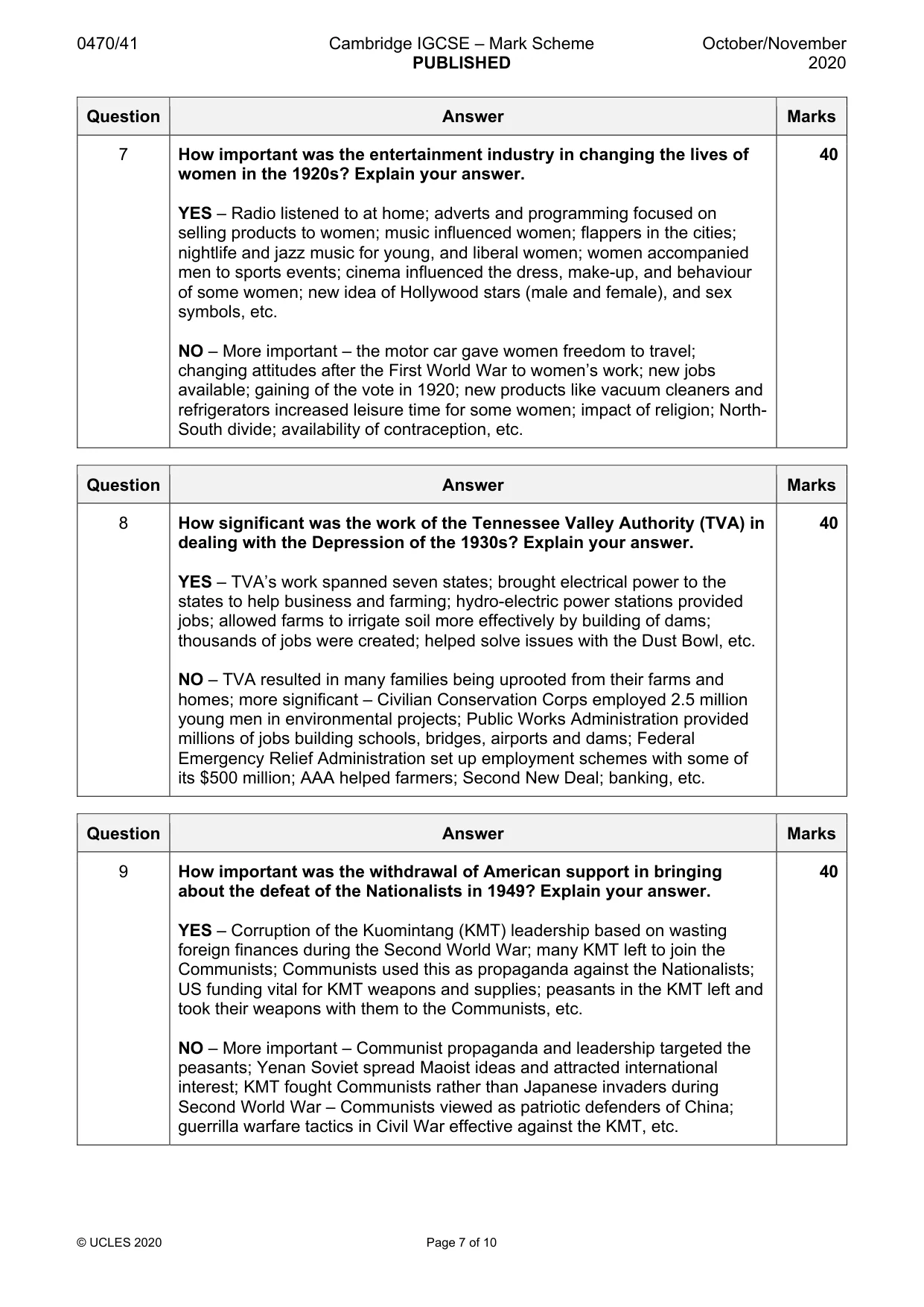
0470/41 Cambridge IGCSE – Mark Scheme PUBLISHED October/November 2020 © UCLES 2020 Page 7 of 10 Question Answer Marks 7 How important was the entertainment industry in changing the lives of women in the 1920s? Explain your answer. YES – Radio listened to at home; adverts and programming focused on selling products to women; music influenced women; flappers in the cities; nightlife and jazz music for young, and liberal women; women accompanied men to sports events; cinema influenced the dress, make-up, and behaviour of some women; new idea of Hollywood stars (male and female), and sex symbols, etc. NO – More important – the motor car gave women freedom to travel; changing attitudes after the First World War to women’s work; new jobs available; gaining of the vote in 1920; new products like vacuum cleaners and refrigerators increased leisure time for some women; impact of religion; North- South divide; availability of contraception, etc. 40 Question Answer Marks 8 How significant was the work of the Tennessee Valley Authority (TVA) in dealing with the Depression of the 1930s? Explain your answer. YES – TVA’s work spanned seven states; brought electrical power to the states to help business and farming; hydro-electric power stations provided jobs; allowed farms to irrigate soil more effectively by building of dams; thousands of jobs were created; helped solve issues with the Dust Bowl, etc. NO – TVA resulted in many families being uprooted from their farms and homes; more significant – Civilian Conservation Corps employed 2.5 million young men in environmental projects; Public Works Administration provided millions of jobs building schools, bridges, airports and dams; Federal Emergency Relief Administration set up employment schemes with some of its $500 million; AAA helped farmers; Second New Deal; banking, etc. 40 Question Answer Marks 9 How important was the withdrawal of American support in bringing about the defeat of the Nationalists in 1949? Explain your answer. YES – Corruption of the Kuomintang (KMT) leadership based on wasting foreign finances during the Second World War; many KMT left to join the Communists; Communists used this as propaganda against the Nationalists; US funding vital for KMT weapons and supplies; peasants in the KMT left and took their weapons with them to the Communists, etc. NO – More important – Communist propaganda and leadership targeted the peasants; Yenan Soviet spread Maoist ideas and attracted international interest; KMT fought Communists rather than Japanese invaders during Second World War – Communists viewed as patriotic defenders of China; guerrilla warfare tactics in Civil War effective against the KMT, etc. 40
Mark scheme, page 8
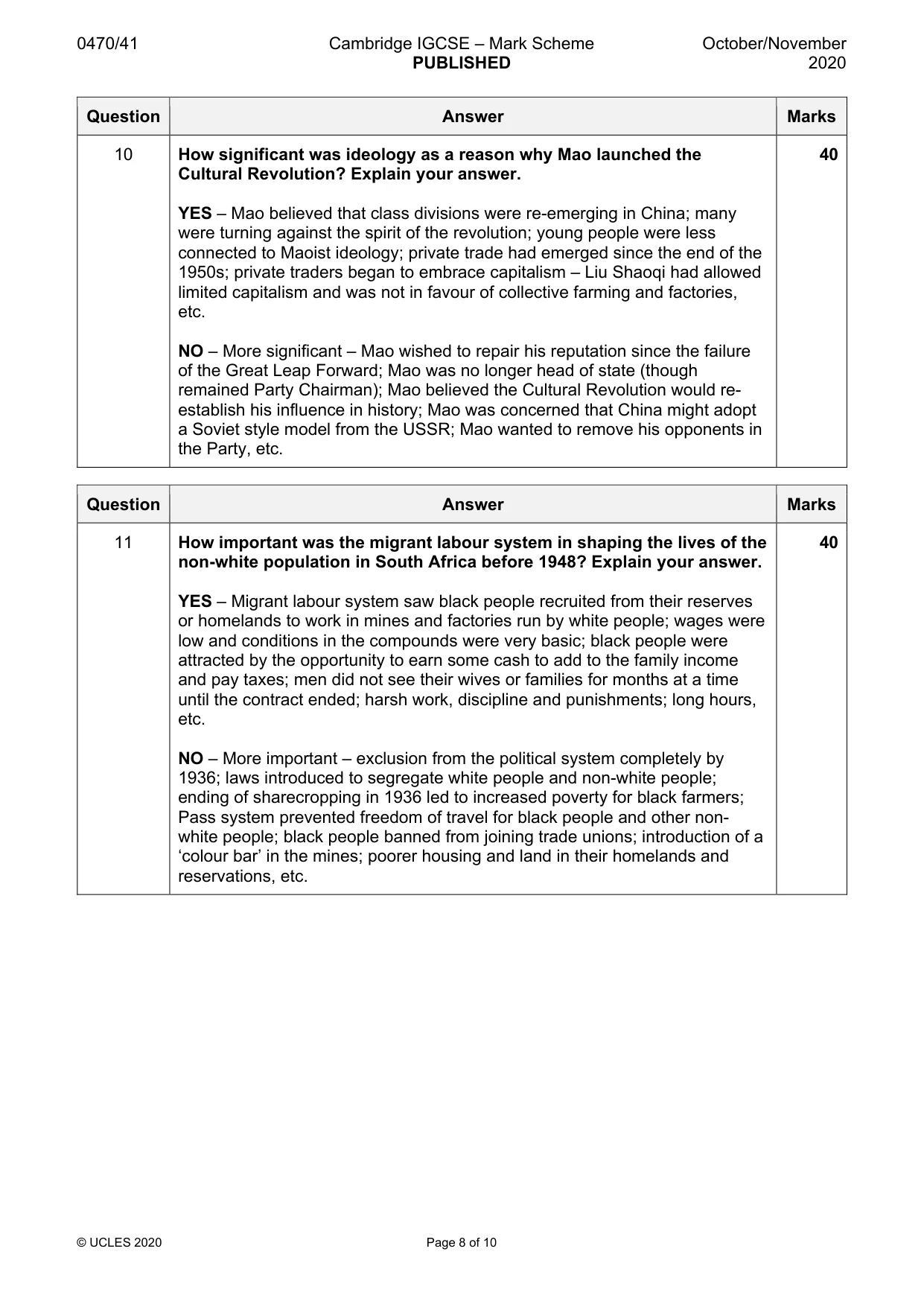
0470/41 Cambridge IGCSE – Mark Scheme PUBLISHED October/November 2020 © UCLES 2020 Page 8 of 10 Question Answer Marks 10 How significant was ideology as a reason why Mao launched the Cultural Revolution? Explain your answer. YES – Mao believed that class divisions were re-emerging in China; many were turning against the spirit of the revolution; young people were less connected to Maoist ideology; private trade had emerged since the end of the 1950s; private traders began to embrace capitalism – Liu Shaoqi had allowed limited capitalism and was not in favour of collective farming and factories, etc. NO – More significant – Mao wished to repair his reputation since the failure of the Great Leap Forward; Mao was no longer head of state (though remained Party Chairman); Mao believed the Cultural Revolution would re- establish his influence in history; Mao was concerned that China might adopt a Soviet style model from the USSR; Mao wanted to remove his opponents in the Party, etc. 40 Question Answer Marks 11 How important was the migrant labour system in shaping the lives of the non-white population in South Africa before 1948? Explain your answer. YES – Migrant labour system saw black people recruited from their reserves or homelands to work in mines and factories run by white people; wages were low and conditions in the compounds were very basic; black people were attracted by the opportunity to earn some cash to add to the family income and pay taxes; men did not see their wives or families for months at a time until the contract ended; harsh work, discipline and punishments; long hours, etc. NO – More important – exclusion from the political system completely by 1936; laws introduced to segregate white people and non-white people; ending of sharecropping in 1936 led to increased poverty for black farmers; Pass system prevented freedom of travel for black people and other non- white people; black people banned from joining trade unions; introduction of a ‘colour bar’ in the mines; poorer housing and land in their homelands and reservations, etc. 40
Mark scheme, page 9
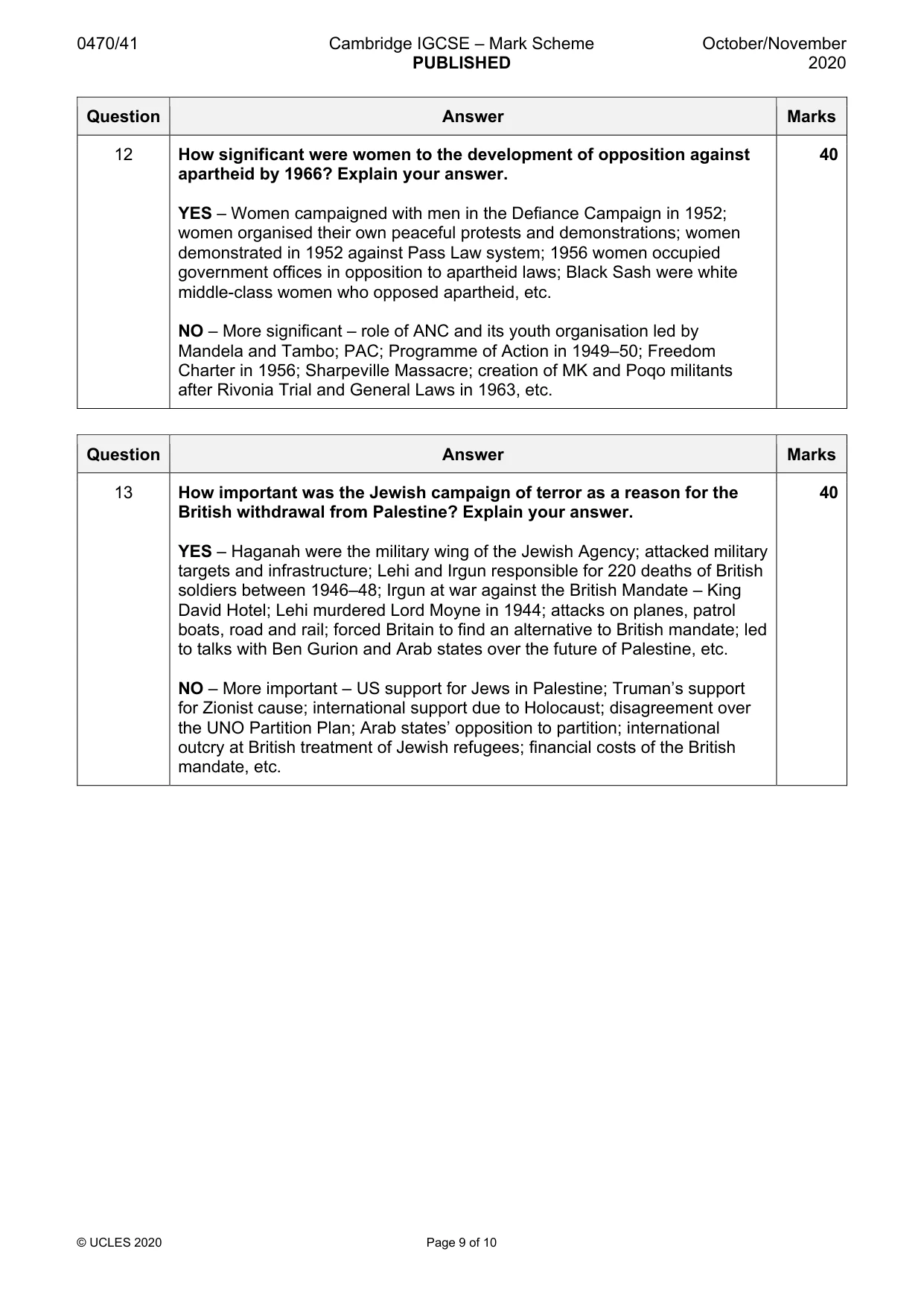
0470/41 Cambridge IGCSE – Mark Scheme PUBLISHED October/November 2020 © UCLES 2020 Page 9 of 10 Question Answer Marks 12 How significant were women to the development of opposition against apartheid by 1966? Explain your answer. YES – Women campaigned with men in the Defiance Campaign in 1952; women organised their own peaceful protests and demonstrations; women demonstrated in 1952 against Pass Law system; 1956 women occupied government offices in opposition to apartheid laws; Black Sash were white middle-class women who opposed apartheid, etc. NO – More significant – role of ANC and its youth organisation led by Mandela and Tambo; PAC; Programme of Action in 1949–50; Freedom Charter in 1956; Sharpeville Massacre; creation of MK and Poqo militants after Rivonia Trial and General Laws in 1963, etc. 40 Question Answer Marks 13 How important was the Jewish campaign of terror as a reason for the British withdrawal from Palestine? Explain your answer. YES – Haganah were the military wing of the Jewish Agency; attacked military targets and infrastructure; Lehi and Irgun responsible for 220 deaths of British soldiers between 1946–48; Irgun at war against the British Mandate – King David Hotel; Lehi murdered Lord Moyne in 1944; attacks on planes, patrol boats, road and rail; forced Britain to find an alternative to British mandate; led to talks with Ben Gurion and Arab states over the future of Palestine, etc. NO – More important – US support for Jews in Palestine; Truman’s support for Zionist cause; international support due to Holocaust; disagreement over the UNO Partition Plan; Arab states’ opposition to partition; international outcry at British treatment of Jewish refugees; financial costs of the British mandate, etc. 40
Mark scheme, page 10
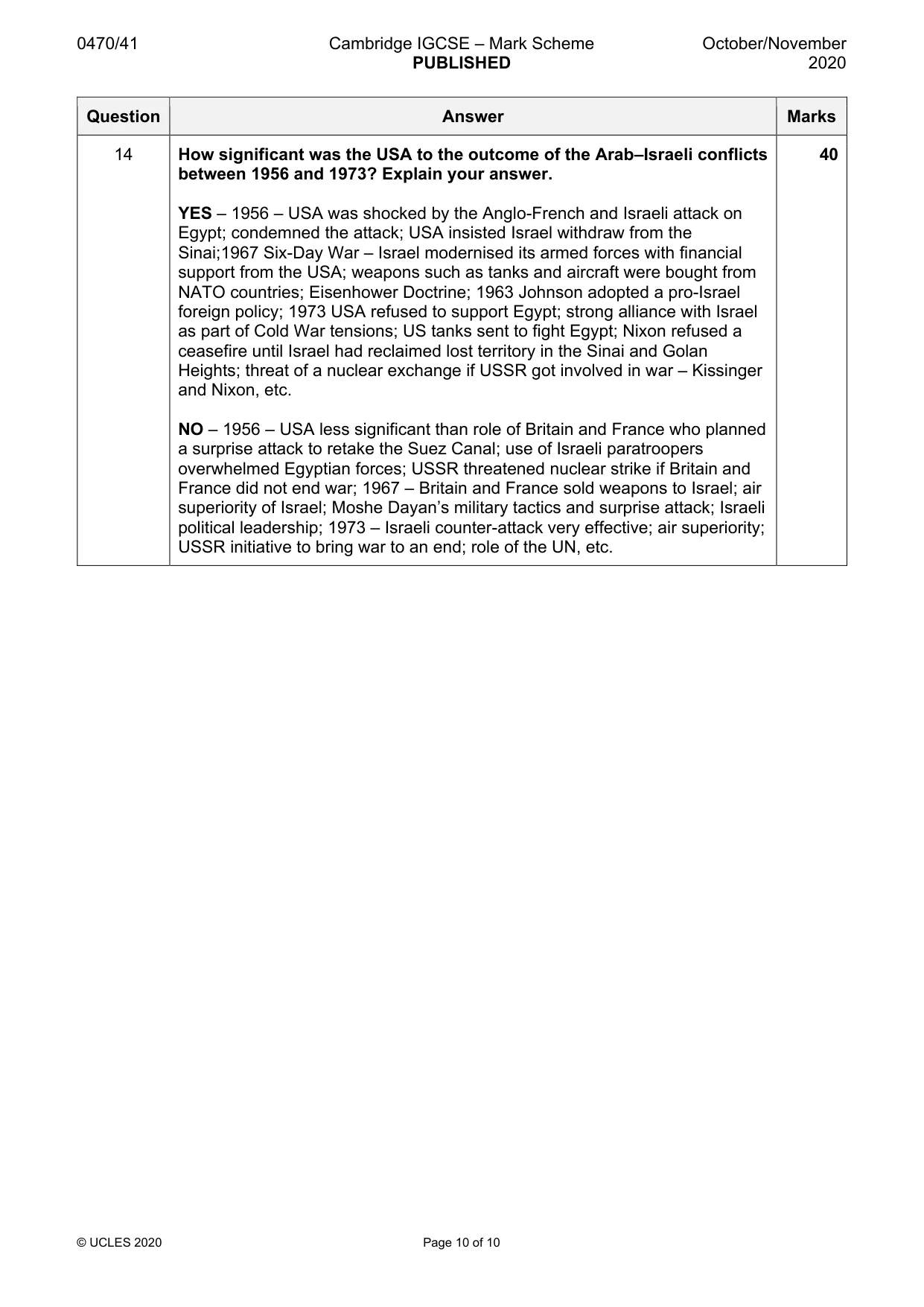
0470/41 Cambridge IGCSE – Mark Scheme PUBLISHED October/November 2020 © UCLES 2020 Page 10 of 10 Question Answer Marks 14 How significant was the USA to the outcome of the Arab–Israeli conflicts between 1956 and 1973? Explain your answer. YES – 1956 – USA was shocked by the Anglo-French and Israeli attack on Egypt; condemned the attack; USA insisted Israel withdraw from the Sinai;1967 Six-Day War – Israel modernised its armed forces with financial support from the USA; weapons such as tanks and aircraft were bought from NATO countries; Eisenhower Doctrine; 1963 Johnson adopted a pro-Israel foreign policy; 1973 USA refused to support Egypt; strong alliance with Israel as part of Cold War tensions; US tanks sent to fight Egypt; Nixon refused a ceasefire until Israel had reclaimed lost territory in the Sinai and Golan Heights; threat of a nuclear exchange if USSR got involved in war – Kissinger and Nixon, etc. NO – 1956 – USA less significant than role of Britain and France who planned a surprise attack to retake the Suez Canal; use of Israeli paratroopers overwhelmed Egyptian forces; USSR threatened nuclear strike if Britain and France did not end war; 1967 – Britain and France sold weapons to Israel; air superiority of Israel; Moshe Dayan’s military tactics and surprise attack; Israeli political leadership; 1973 – Israeli counter-attack very effective; air superiority; USSR initiative to bring war to an end; role of the UN, etc. 40
What you needed in this session
Cambridge’s own grade thresholds for 2020 Oct/Nov, Paper 4 · Variant 1. A higher threshold means an easier paper — the bar moves with how the cohort did.