Cambridge IGCSE History 0470 — 2020 Oct/Nov Paper 2 · Variant 3
0470/23/O/N/20 · 50 marks · ≈56 min
The question paper and its mark scheme, free to read here and free to download. This is Cambridge’s own paper, exactly as it was sat.
Question paper12 pages

Mark scheme14 pages
Answers below. Sit the paper first if you are practising.
Paper as text
Question paper, page 1
Cambridge IGCSE™ This document has 12 pages. Blank pages are indicated. DC (TC/CGW) 190811/4 © UCLES 2020 [Turn over * 6 0 1 0 2 5 3 6 9 9 * HISTORY 0470/23 Paper 2 October/November 2020 2 hours You must answer on the enclosed answer booklet. You will need: Answer booklet (enclosed) INSTRUCTIONS ● Answer all the questions on one option only. Option A: Nineteenth century topic Option B: Twentieth century topic ● Follow the instructions on the front cover of the answer booklet. If you need additional answer paper, ask the invigilator for a continuation booklet. INFORMATION ● The total mark for this paper is 50. ● The number of marks for each question or part question is shown in brackets [ ].
Question paper, page 2
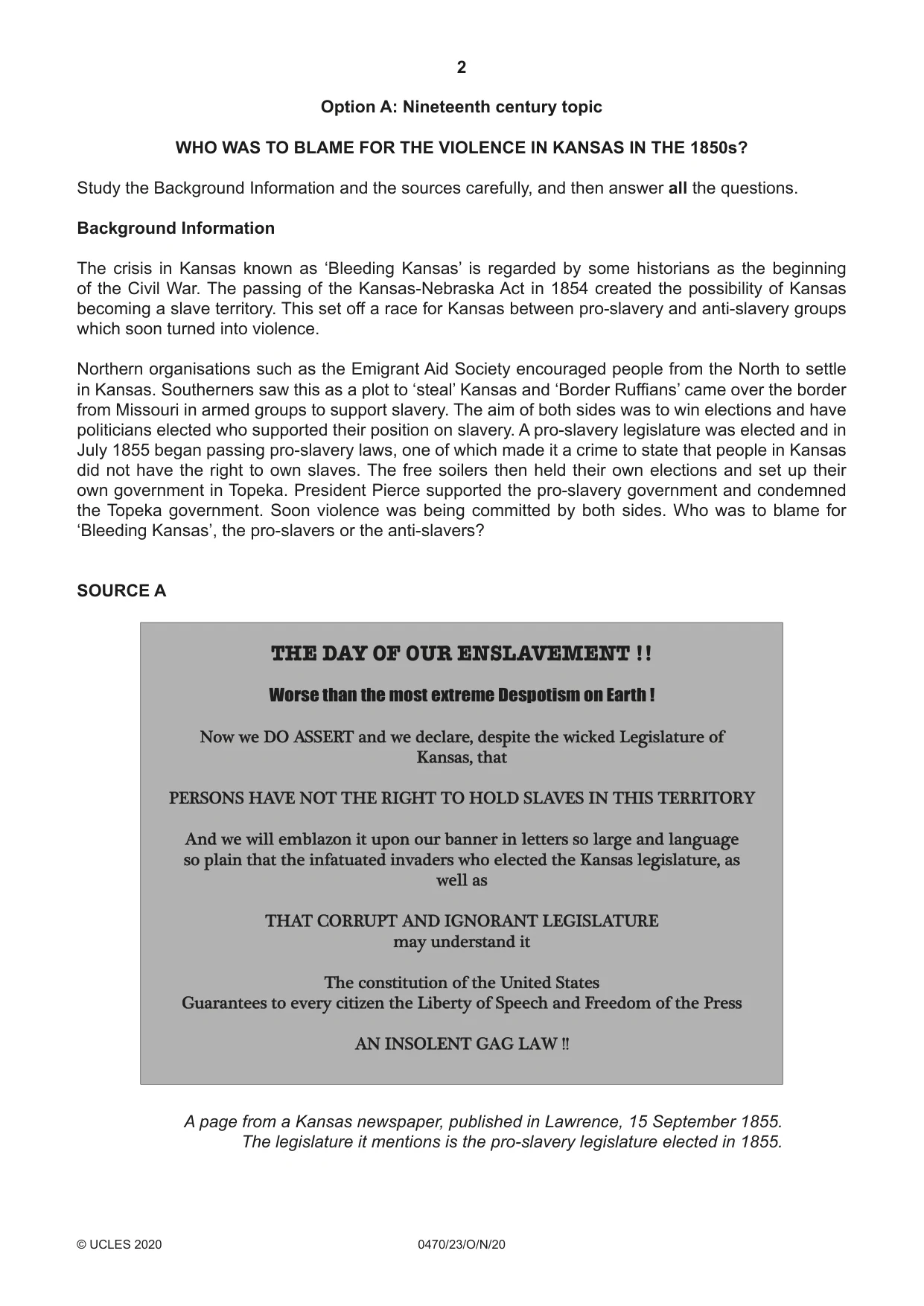
2 0470/23/O/N/20 © UCLES 2020 Option A: Nineteenth century topic WHO WAS TO BLAME FOR THE VIOLENCE IN KANSAS IN THE 1850s? Study the Background Information and the sources carefully, and then answer all the questions. Background Information The crisis in Kansas known as ‘Bleeding Kansas’ is regarded by some historians as the beginning of the Civil War. The passing of the Kansas-Nebraska Act in 1854 created the possibility of Kansas becoming a slave territory. This set off a race for Kansas between pro-slavery and anti-slavery groups which soon turned into violence. Northern organisations such as the Emigrant Aid Society encouraged people from the North to settle in Kansas. Southerners saw this as a plot to ‘steal’ Kansas and ‘Border Ruffians’ came over the border from Missouri in armed groups to support slavery. The aim of both sides was to win elections and have politicians elected who supported their position on slavery. A pro-slavery legislature was elected and in July 1855 began passing pro-slavery laws, one of which made it a crime to state that people in Kansas did not have the right to own slaves. The free soilers then held their own elections and set up their own government in Topeka. President Pierce supported the pro-slavery government and condemned the Topeka government. Soon violence was being committed by both sides. Who was to blame for ‘Bleeding Kansas’, the pro-slavers or the anti-slavers? SOURCE A THE DAY OF OUR ENSLAVEMENT !! Worse than the most extreme Despotism on Earth ! Now we DO ASSERT and we declare, despite the wicked Legislature of Kansas, that PERSONS HAVE NOT THE RIGHT TO HOLD SLAVES IN THIS TERRITORY And we will emblazon it upon our banner in letters so large and language so plain that the infatuated invaders who elected the Kansas legislature, as well as THAT CORRUPT AND IGNORANT LEGISLATURE may understand it The constitution of the United States Guarantees to every citizen the Liberty of Speech and Freedom of the Press AN INSOLENT GAG LAW !! A page from a Kansas newspaper, published in Lawrence, 15 September 1855. The legislature it mentions is the pro-slavery legislature elected in 1855.
Question paper, page 3
3 0470/23/O/N/20 © UCLES 2020 [Turn over SOURCE B By the start of 1856 there were two rival governments in Kansas; the official pro-slavery government and the free state government. Northern groups sent weapons to help the free-staters. The Southern response was for well-armed Missourians to move into Kansas. In May 1856 a pro-slavery posse, trying to arrest an armed band of free-staters who had been terrorising pro-slavery settlers, ‘sacked’ Lawrence (a free state town). This event was blown up out of all proportion by Northern journalists who invented facts. According to them dozens of free-staters were killed. In reality there were no casualties. Nevertheless the pro-slavers did demolish a hotel, two newspaper offices and a few houses and shops. The Lawrence raid sparked off more serious violence. The man responsible for this was John Brown. At Pottawatomie Creek, Brown and his sons dragged five young pro-slavery settlers from their cabins and murdered them in cold blood. Brown shot some of his victims: others were hacked to pieces with a sword. Northern newspapers, suppressing the facts, claimed that Brown had acted in self-defence. As a result of his terrible crime, he became a Northern hero. These events led to worsening tension. The Northern press again exaggerated the situation, describing it as civil war. Events in Kansas – and the distorted reporting of them – led to ‘Bleeding Kansas’ becoming a rallying cry for Northerners. From a history book published in 2002. SOURCE C Kansas became the battleground of Southern extremists and anti-slavery activists. Indeed, it could be said that the Civil War started here. When elections came Missourians crossed the border and swamped the polls. The new government expelled any anti-slavers from the legislature and adopted a slave-code. The anti-slavers drafted a new constitution which banned slaves and elected another government. A congressional committee reported the first elections to be fraudulent, and that the free state government represented the will of the majority. Then the fighting began. Northern clergymen sent guns. The South moved in guns as well. In May 1856 a mob of slavers sacked Lawrence, blew up the hotel, burned the governor’s house and tossed the presses of the local newspapers into the river. Two days later John Brown, his four sons, and some others headed for Pottawatomie Creek where the Doyle family, notorious slave catchers, lived. Brown told his men that they were to be taken prisoner, but they attacked the family with swords and killed them. Brown did not take part in the actual killings. Doyle’s wife and his youngest sons were left unharmed. By the end of the year over 200 people had been murdered in ‘Bleeding Kansas’. From a recent account of ‘Bleeding Kansas’.
Question paper, page 4
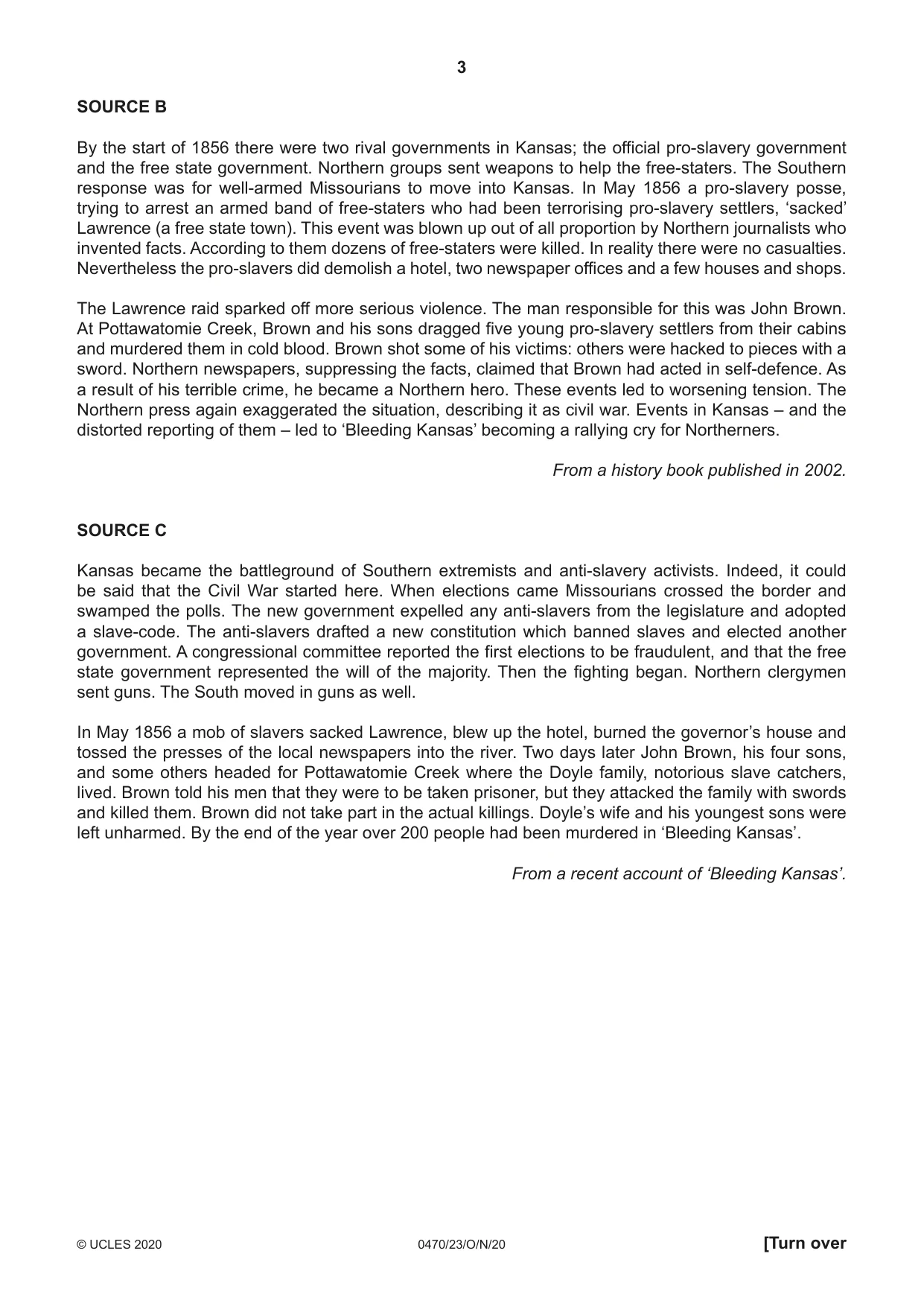
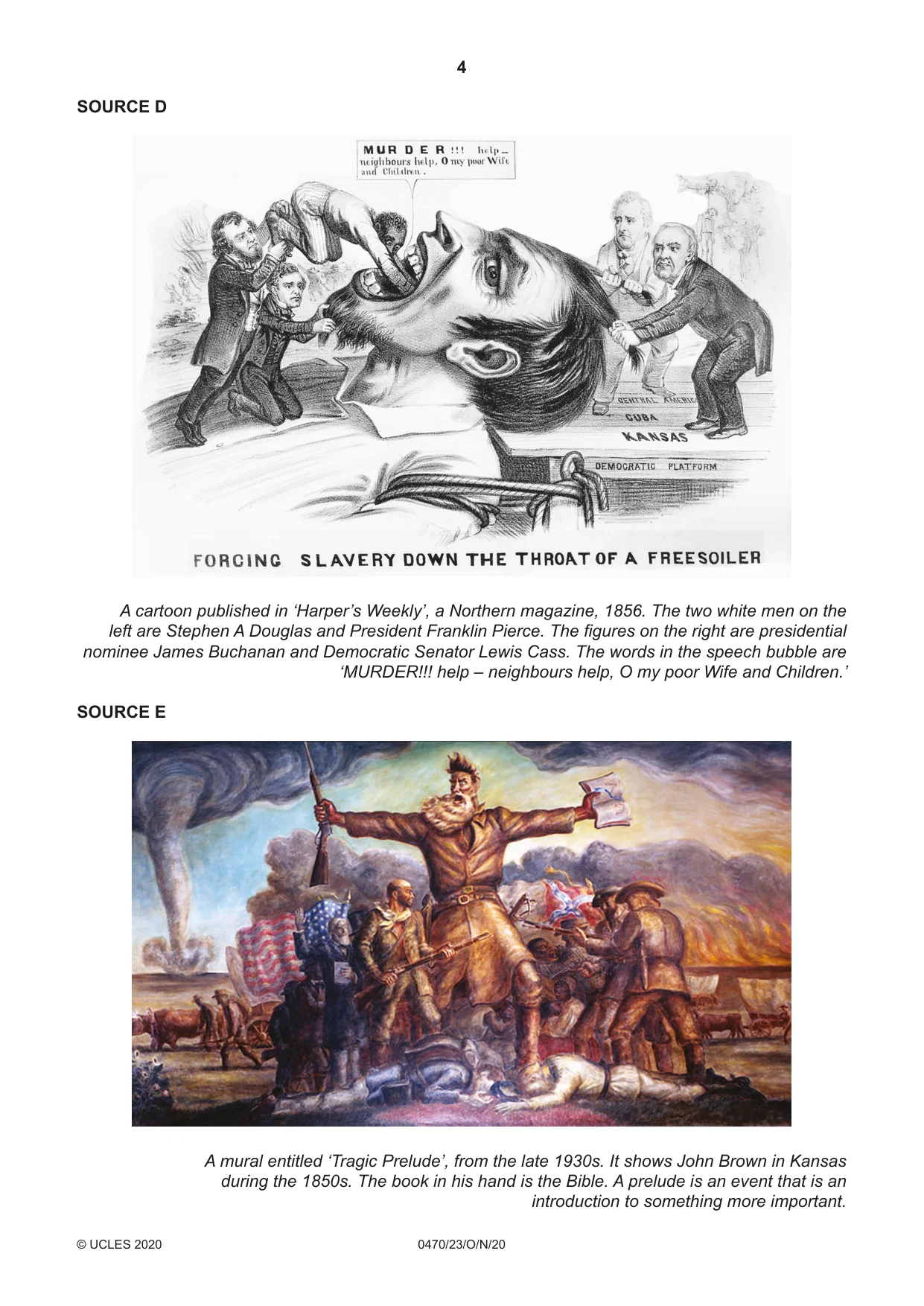
4 0470/23/O/N/20 © UCLES 2020 SOURCE D A cartoon published in ‘Harper’s Weekly’, a Northern magazine, 1856. The two white men on the left are Stephen A Douglas and President Franklin Pierce. The figures on the right are presidential nominee James Buchanan and Democratic Senator Lewis Cass. The words in the speech bubble are ‘MURDER!!! help – neighbours help, O my poor Wife and Children.’ SOURCE E A mural entitled ‘Tragic Prelude’, from the late 1930s. It shows John Brown in Kansas during the 1850s. The book in his hand is the Bible. A prelude is an event that is an introduction to something more important.
Question paper, page 5
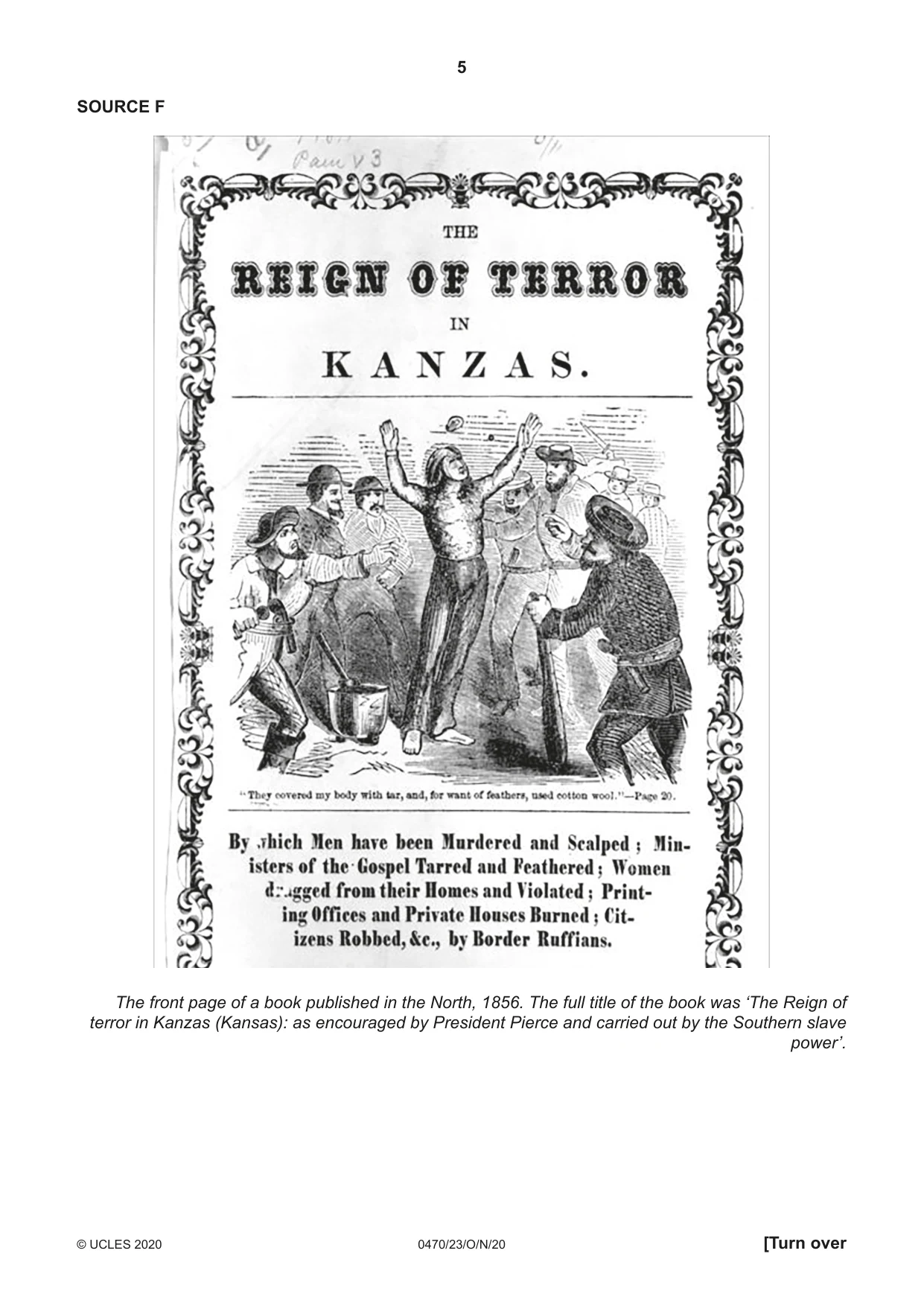
5 0470/23/O/N/20 © UCLES 2020 [Turn over SOURCE F The front page of a book published in the North, 1856. The full title of the book was ‘The Reign of terror in Kanzas (Kansas): as encouraged by President Pierce and carried out by the Southern slave power’.
Question paper, page 6
6 0470/23/O/N/20 © UCLES 2020 SOURCE G Brown said he wanted me to guide him and his men into the neighbourhood where I lived, and show them where all the Pro-slavery men resided; that he proposed to sweep the creek of all the Pro-slavery men living on it. I refused to do it. He insisted upon it. I then wanted to go home, but he refused to let me do so. Some time after dark we were ordered to march. The old man Doyle and his sons were ordered to come out. They did not immediately obey and Henry Thompson threw into the house some balls of hay in which gunpowder had been mixed, setting fire to them as he threw them in. The old man and his sons came out. John Brown drew his revolver and shot old man Doyle in the forehead. Brown’s two sons immediately fell upon the younger Doyles with their short two-edged swords. One of the young Doyles was quickly killed; the other was pursued a short distance and cut down also. I thought this was terrible but after time I became satisfied that it resulted in good to the Free State cause, and was especially beneficial to Free State settlers on Pottawatomie Creek. An account of events at Pottawatomie Creek on 24 May 1856 by James Townsley who was interviewed by a journalist in 1879 when he made this statement. Now answer all the following questions. You may use any of the sources to help you answer the questions, in addition to those sources which you are told to use. In answering the questions you should use your knowledge of the topic to help you interpret and evaluate the sources. 1 Study Source A. Why was this source published in September 1855? Explain your answer using details of the source and your knowledge. [8] 2 Study Sources B and C. How far do these two sources agree? Explain your answer using details of the sources. [7] 3 Study Source D. What is the message of the cartoonist? Explain your answer using details of the source and your knowledge. [8] 4 Study Sources E and F. How similar are these two sources? Explain your answer using details of the sources and your knowledge. [8] 5 Study Source G. Do you trust this source? Explain your answer using details of the source and your knowledge. [7] 6 Study all the sources. How far do these sources provide convincing evidence that the anti-slavery groups were responsible for the violence in Kansas? Use the sources to explain your answer. [12]
Question paper, page 7
7 0470/23/O/N/20 © UCLES 2020 [Turn over BLANK PAGE
Question paper, page 8
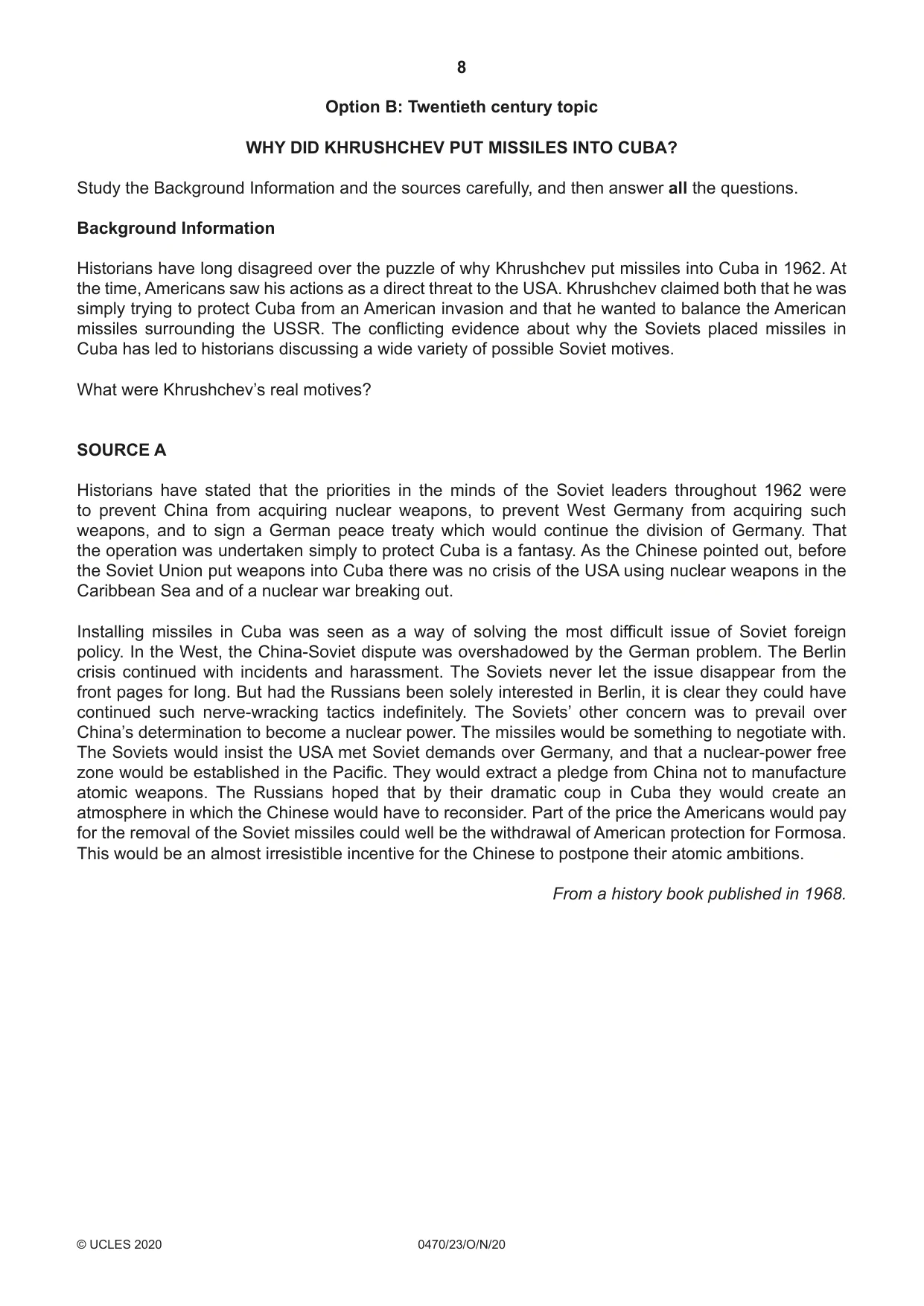
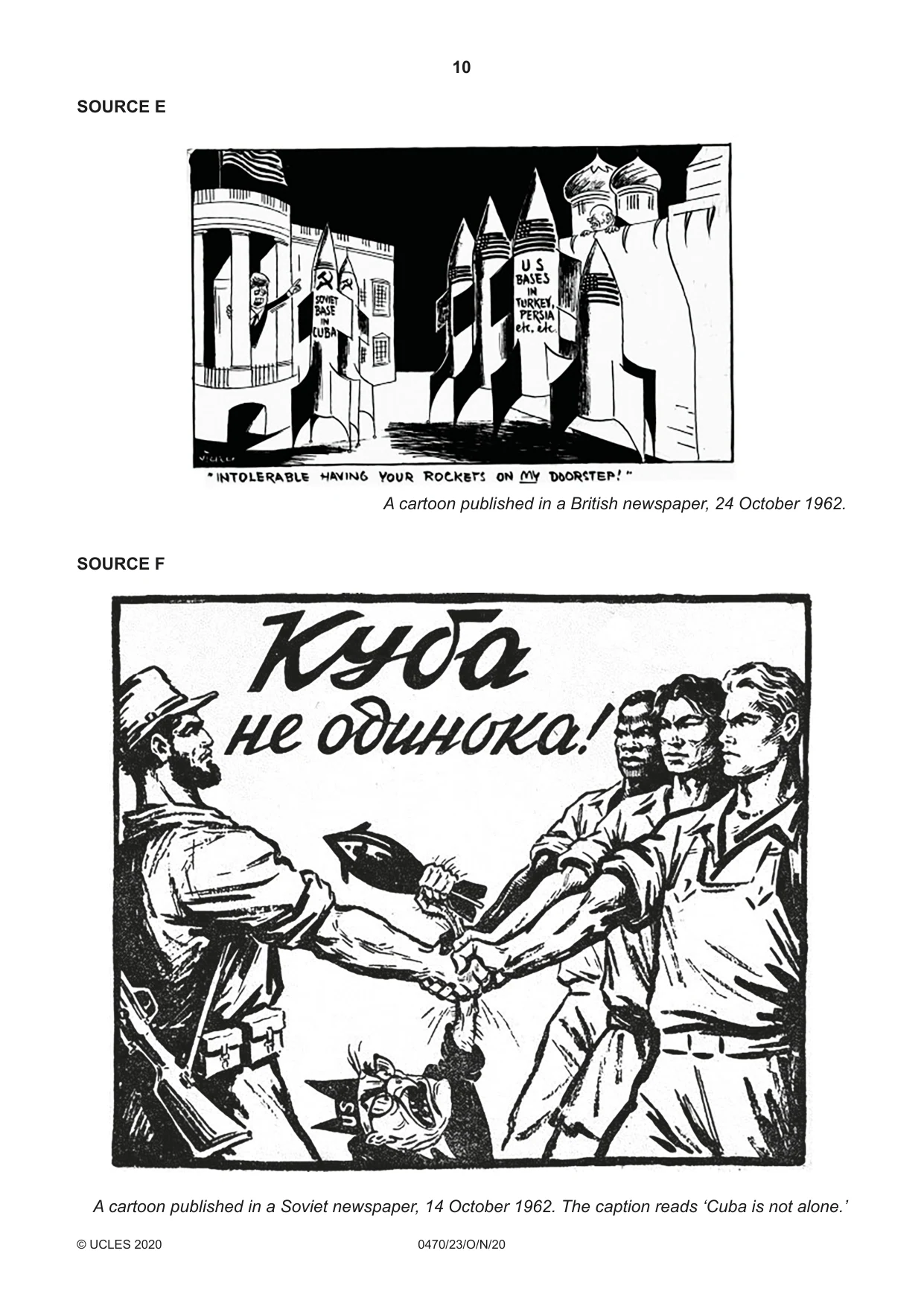
8 0470/23/O/N/20 © UCLES 2020 Option B: Twentieth century topic WHY DID KHRUSHCHEV PUT MISSILES INTO CUBA? Study the Background Information and the sources carefully, and then answer all the questions. Background Information Historians have long disagreed over the puzzle of why Khrushchev put missiles into Cuba in 1962. At the time, Americans saw his actions as a direct threat to the USA. Khrushchev claimed both that he was simply trying to protect Cuba from an American invasion and that he wanted to balance the American missiles surrounding the USSR. The conflicting evidence about why the Soviets placed missiles in Cuba has led to historians discussing a wide variety of possible Soviet motives. What were Khrushchev’s real motives? SOURCE A Historians have stated that the priorities in the minds of the Soviet leaders throughout 1962 were to prevent China from acquiring nuclear weapons, to prevent West Germany from acquiring such weapons, and to sign a German peace treaty which would continue the division of Germany. That the operation was undertaken simply to protect Cuba is a fantasy. As the Chinese pointed out, before the Soviet Union put weapons into Cuba there was no crisis of the USA using nuclear weapons in the Caribbean Sea and of a nuclear war breaking out. Installing missiles in Cuba was seen as a way of solving the most difficult issue of Soviet foreign policy. In the West, the China-Soviet dispute was overshadowed by the German problem. The Berlin crisis continued with incidents and harassment. The Soviets never let the issue disappear from the front pages for long. But had the Russians been solely interested in Berlin, it is clear they could have continued such nerve-wracking tactics indefinitely. The Soviets’ other concern was to prevail over China’s determination to become a nuclear power. The missiles would be something to negotiate with. The Soviets would insist the USA met Soviet demands over Germany, and that a nuclear-power free zone would be established in the Pacific. They would extract a pledge from China not to manufacture atomic weapons. The Russians hoped that by their dramatic coup in Cuba they would create an atmosphere in which the Chinese would have to reconsider. Part of the price the Americans would pay for the removal of the Soviet missiles could well be the withdrawal of American protection for Formosa. This would be an almost irresistible incentive for the Chinese to postpone their atomic ambitions. From a history book published in 1968.
Question paper, page 9
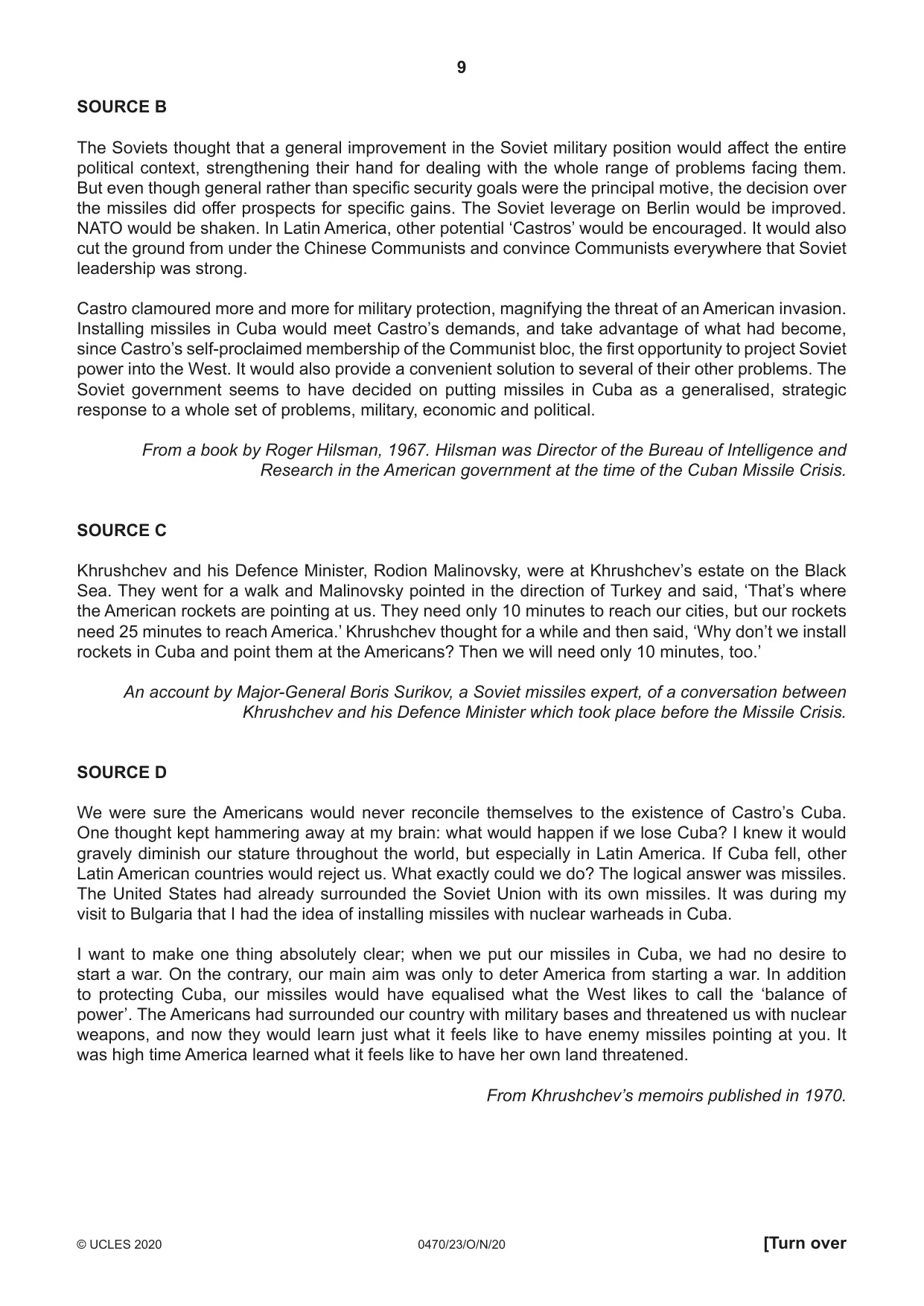
9 0470/23/O/N/20 © UCLES 2020 [Turn over SOURCE B The Soviets thought that a general improvement in the Soviet military position would affect the entire political context, strengthening their hand for dealing with the whole range of problems facing them. But even though general rather than specific security goals were the principal motive, the decision over the missiles did offer prospects for specific gains. The Soviet leverage on Berlin would be improved. NATO would be shaken. In Latin America, other potential ‘Castros’ would be encouraged. It would also cut the ground from under the Chinese Communists and convince Communists everywhere that Soviet leadership was strong. Castro clamoured more and more for military protection, magnifying the threat of an American invasion. Installing missiles in Cuba would meet Castro’s demands, and take advantage of what had become, since Castro’s self-proclaimed membership of the Communist bloc, the first opportunity to project Soviet power into the West. It would also provide a convenient solution to several of their other problems. The Soviet government seems to have decided on putting missiles in Cuba as a generalised, strategic response to a whole set of problems, military, economic and political. From a book by Roger Hilsman, 1967. Hilsman was Director of the Bureau of Intelligence and Research in the American government at the time of the Cuban Missile Crisis. SOURCE C Khrushchev and his Defence Minister, Rodion Malinovsky, were at Khrushchev’s estate on the Black Sea. They went for a walk and Malinovsky pointed in the direction of Turkey and said, ‘That’s where the American rockets are pointing at us. They need only 10 minutes to reach our cities, but our rockets need 25 minutes to reach America.’ Khrushchev thought for a while and then said, ‘Why don’t we install rockets in Cuba and point them at the Americans? Then we will need only 10 minutes, too.’ An account by Major-General Boris Surikov, a Soviet missiles expert, of a conversation between Khrushchev and his Defence Minister which took place before the Missile Crisis. SOURCE D We were sure the Americans would never reconcile themselves to the existence of Castro’s Cuba. One thought kept hammering away at my brain: what would happen if we lose Cuba? I knew it would gravely diminish our stature throughout the world, but especially in Latin America. If Cuba fell, other Latin American countries would reject us. What exactly could we do? The logical answer was missiles. The United States had already surrounded the Soviet Union with its own missiles. It was during my visit to Bulgaria that I had the idea of installing missiles with nuclear warheads in Cuba. I want to make one thing absolutely clear; when we put our missiles in Cuba, we had no desire to start a war. On the contrary, our main aim was only to deter America from starting a war. In addition to protecting Cuba, our missiles would have equalised what the West likes to call the ‘balance of power’. The Americans had surrounded our country with military bases and threatened us with nuclear weapons, and now they would learn just what it feels like to have enemy missiles pointing at you. It was high time America learned what it feels like to have her own land threatened. From Khrushchev’s memoirs published in 1970.
Question paper, page 10
10 0470/23/O/N/20 © UCLES 2020 SOURCE E A cartoon published in a British newspaper, 24 October 1962. SOURCE F A cartoon published in a Soviet newspaper, 14 October 1962. The caption reads ‘Cuba is not alone.’
Question paper, page 11
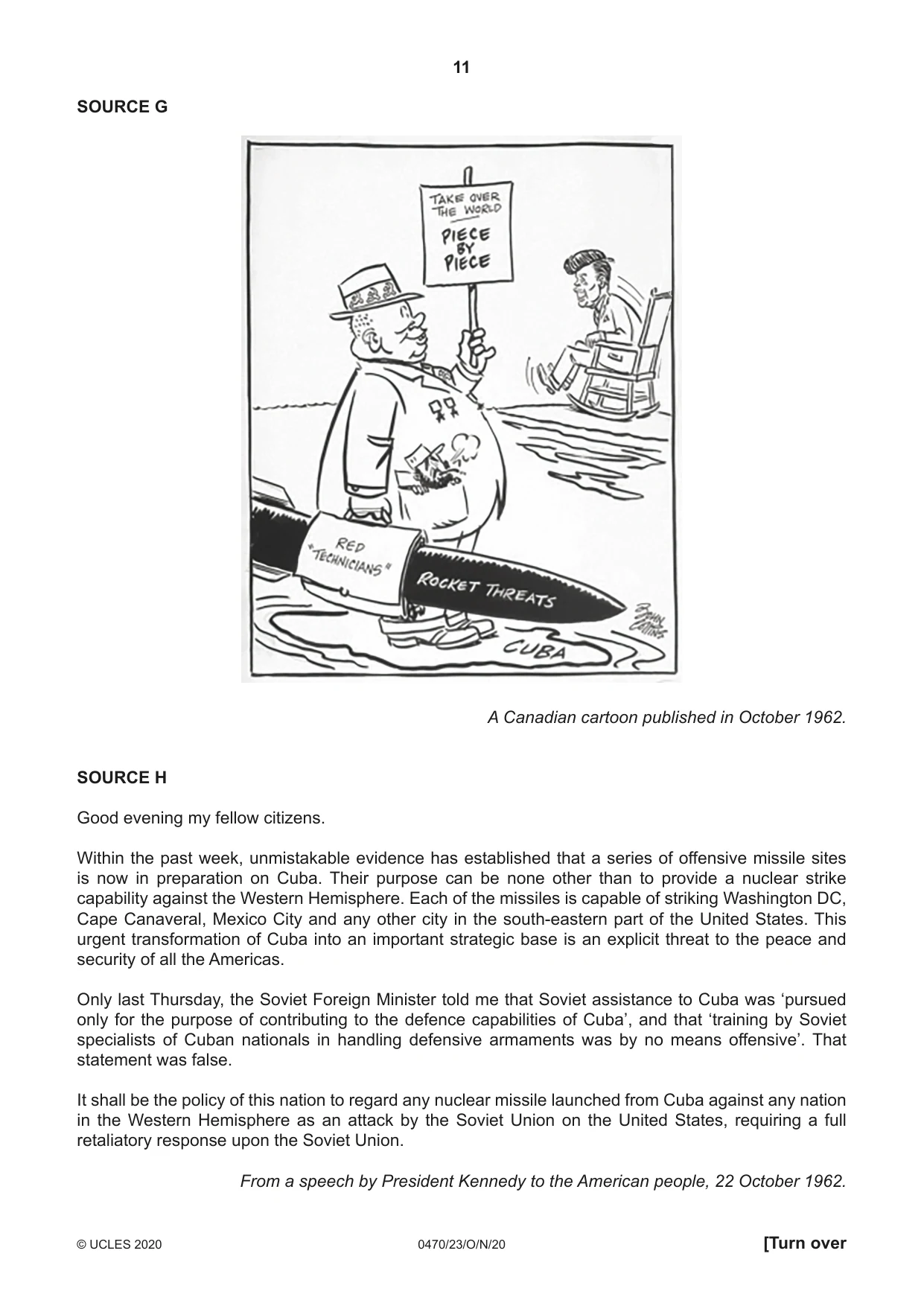
11 0470/23/O/N/20 © UCLES 2020 [Turn over SOURCE G A Canadian cartoon published in October 1962. SOURCE H Good evening my fellow citizens. Within the past week, unmistakable evidence has established that a series of offensive missile sites is now in preparation on Cuba. Their purpose can be none other than to provide a nuclear strike capability against the Western Hemisphere. Each of the missiles is capable of striking Washington DC, Cape Canaveral, Mexico City and any other city in the south-eastern part of the United States. This urgent transformation of Cuba into an important strategic base is an explicit threat to the peace and security of all the Americas. Only last Thursday, the Soviet Foreign Minister told me that Soviet assistance to Cuba was ‘pursued only for the purpose of contributing to the defence capabilities of Cuba’, and that ‘training by Soviet specialists of Cuban nationals in handling defensive armaments was by no means offensive’. That statement was false. It shall be the policy of this nation to regard any nuclear missile launched from Cuba against any nation in the Western Hemisphere as an attack by the Soviet Union on the United States, requiring a full retaliatory response upon the Soviet Union. From a speech by President Kennedy to the American people, 22 October 1962.
Question paper, page 12
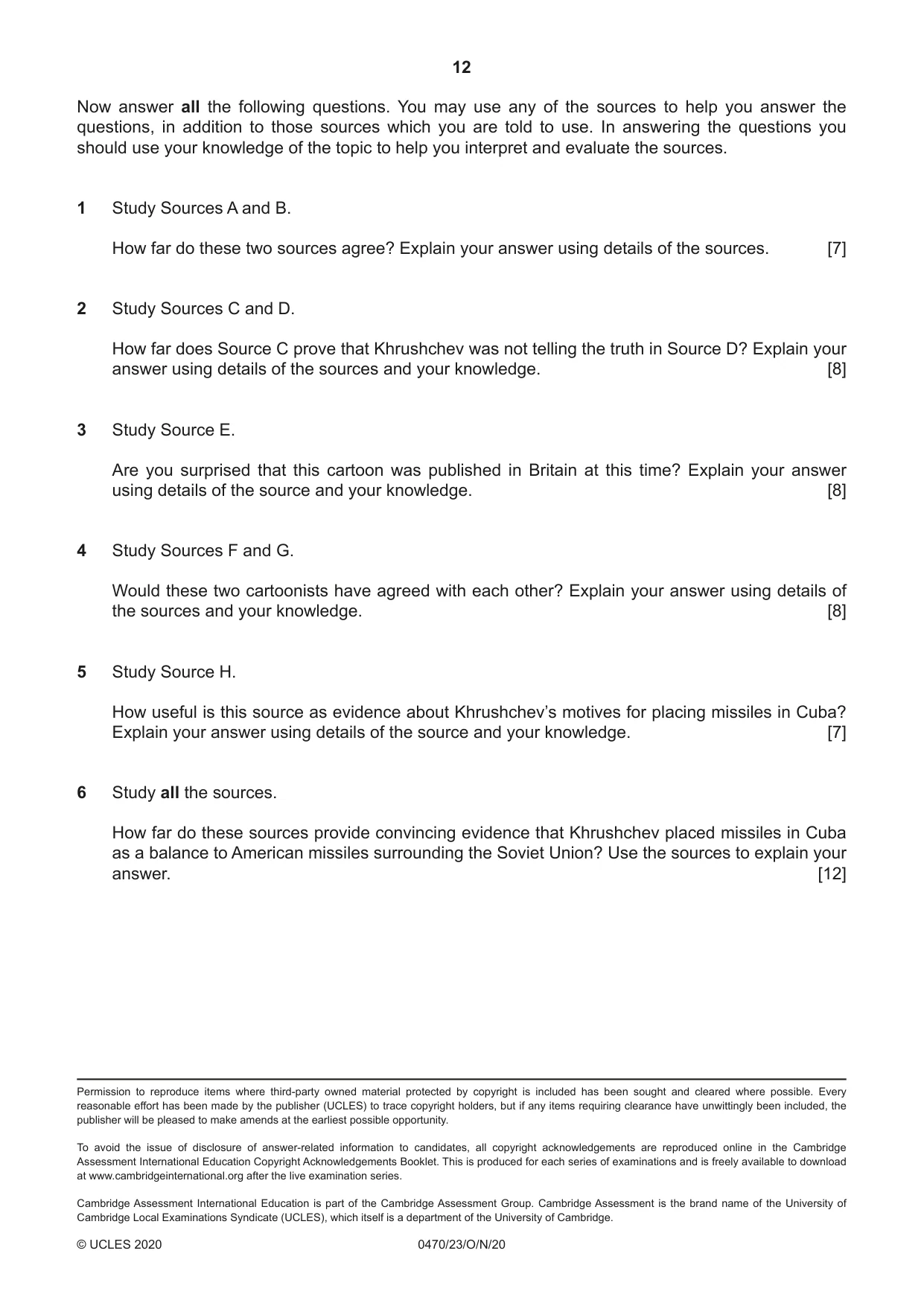
12 0470/23/O/N/20 © UCLES 2020 Permission to reproduce items where third-party owned material protected by copyright is included has been sought and cleared where possible. Every reasonable effort has been made by the publisher (UCLES) to trace copyright holders, but if any items requiring clearance have unwittingly been included, the publisher will be pleased to make amends at the earliest possible opportunity. To avoid the issue of disclosure of answer-related information to candidates, all copyright acknowledgements are reproduced online in the Cambridge Assessment International Education Copyright Acknowledgements Booklet. This is produced for each series of examinations and is freely available to download at www.cambridgeinternational.org after the live examination series. Cambridge Assessment International Education is part of the Cambridge Assessment Group. Cambridge Assessment is the brand name of the University of Cambridge Local Examinations Syndicate (UCLES), which itself is a department of the University of Cambridge. Now answer all the following questions. You may use any of the sources to help you answer the questions, in addition to those sources which you are told to use. In answering the questions you should use your knowledge of the topic to help you interpret and evaluate the sources. 1 Study Sources A and B. How far do these two sources agree? Explain your answer using details of the sources. [7] 2 Study Sources C and D. How far does Source C prove that Khrushchev was not telling the truth in Source D? Explain your answer using details of the sources and your knowledge. [8] 3 Study Source E. Are you surprised that this cartoon was published in Britain at this time? Explain your answer using details of the source and your knowledge. [8] 4 Study Sources F and G. Would these two cartoonists have agreed with each other? Explain your answer using details of the sources and your knowledge. [8] 5 Study Source H. How useful is this source as evidence about Khrushchev’s motives for placing missiles in Cuba? Explain your answer using details of the source and your knowledge. [7] 6 Study all the sources. How far do these sources provide convincing evidence that Khrushchev placed missiles in Cuba as a balance to American missiles surrounding the Soviet Union? Use the sources to explain your answer. [12]
Mark scheme, page 1
This document consists of 14 printed pages. © UCLES 2020 [Turn over Cambridge IGCSE™ HISTORY 0470/23 Paper 2 October/November 2020 MARK SCHEME Maximum Mark: 50 Published This mark scheme is published as an aid to teachers and candidates, to indicate the requirements of the examination. It shows the basis on which Examiners were instructed to award marks. It does not indicate the details of the discussions that took place at an Examiners’ meeting before marking began, which would have considered the acceptability of alternative answers. Mark schemes should be read in conjunction with the question paper and the Principal Examiner Report for Teachers. Cambridge International will not enter into discussions about these mark schemes. Cambridge International is publishing the mark schemes for the October/November 2020 series for most Cambridge IGCSE™, Cambridge International A and AS Level and Cambridge Pre-U components, and some Cambridge O Level components.
Mark scheme, page 2
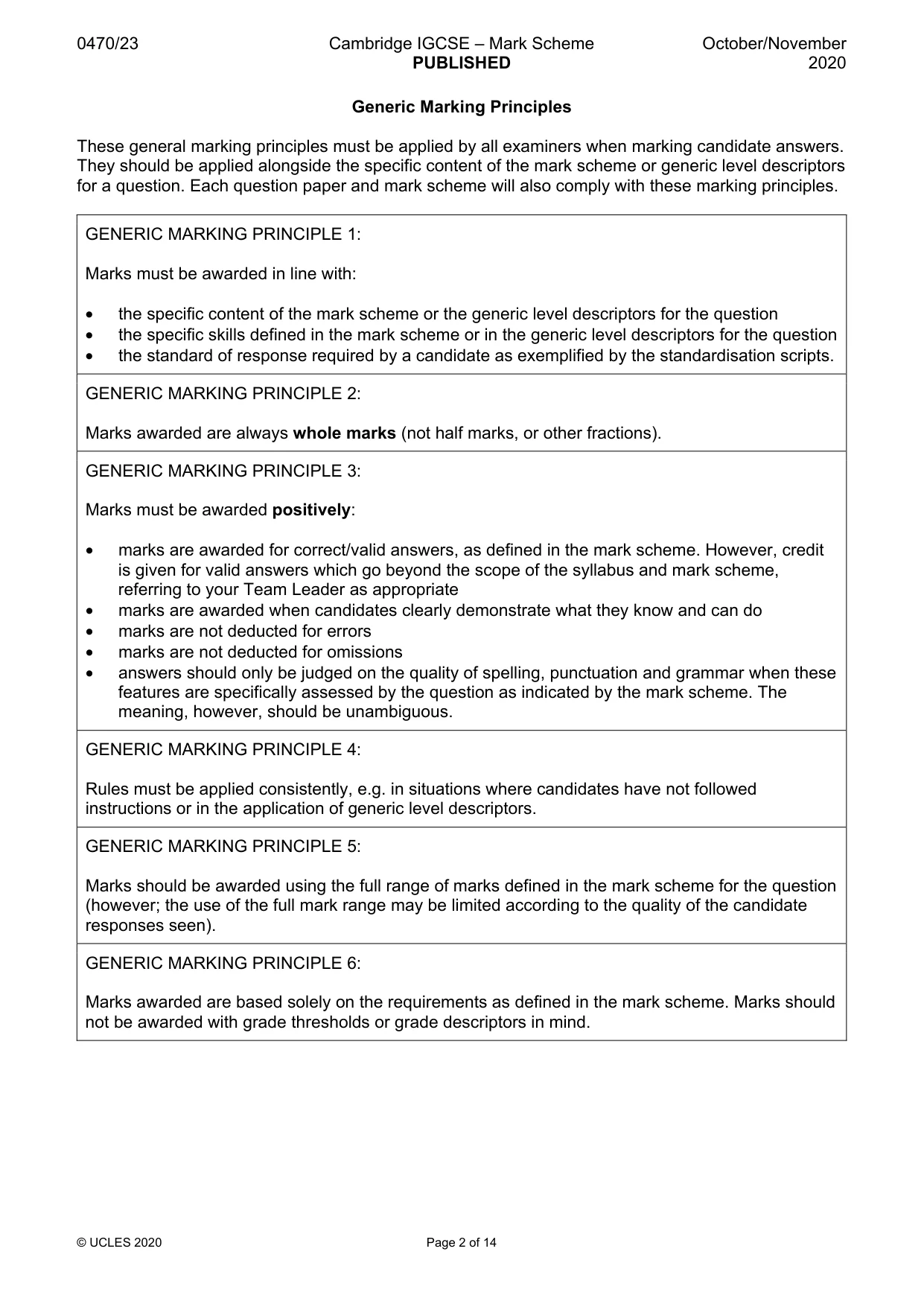
0470/23 Cambridge IGCSE – Mark Scheme PUBLISHED October/November 2020 © UCLES 2020 Page 2 of 14 Generic Marking Principles These general marking principles must be applied by all examiners when marking candidate answers. They should be applied alongside the specific content of the mark scheme or generic level descriptors for a question. Each question paper and mark scheme will also comply with these marking principles. GENERIC MARKING PRINCIPLE 1: Marks must be awarded in line with: • the specific content of the mark scheme or the generic level descriptors for the question • the specific skills defined in the mark scheme or in the generic level descriptors for the question • the standard of response required by a candidate as exemplified by the standardisation scripts. GENERIC MARKING PRINCIPLE 2: Marks awarded are always whole marks (not half marks, or other fractions). GENERIC MARKING PRINCIPLE 3: Marks must be awarded positively: • marks are awarded for correct/valid answers, as defined in the mark scheme. However, credit is given for valid answers which go beyond the scope of the syllabus and mark scheme, referring to your Team Leader as appropriate • marks are awarded when candidates clearly demonstrate what they know and can do • marks are not deducted for errors • marks are not deducted for omissions • answers should only be judged on the quality of spelling, punctuation and grammar when these features are specifically assessed by the question as indicated by the mark scheme. The meaning, however, should be unambiguous. GENERIC MARKING PRINCIPLE 4: Rules must be applied consistently, e.g. in situations where candidates have not followed instructions or in the application of generic level descriptors. GENERIC MARKING PRINCIPLE 5: Marks should be awarded using the full range of marks defined in the mark scheme for the question (however; the use of the full mark range may be limited according to the quality of the candidate responses seen). GENERIC MARKING PRINCIPLE 6: Marks awarded are based solely on the requirements as defined in the mark scheme. Marks should not be awarded with grade thresholds or grade descriptors in mind.
Mark scheme, page 3
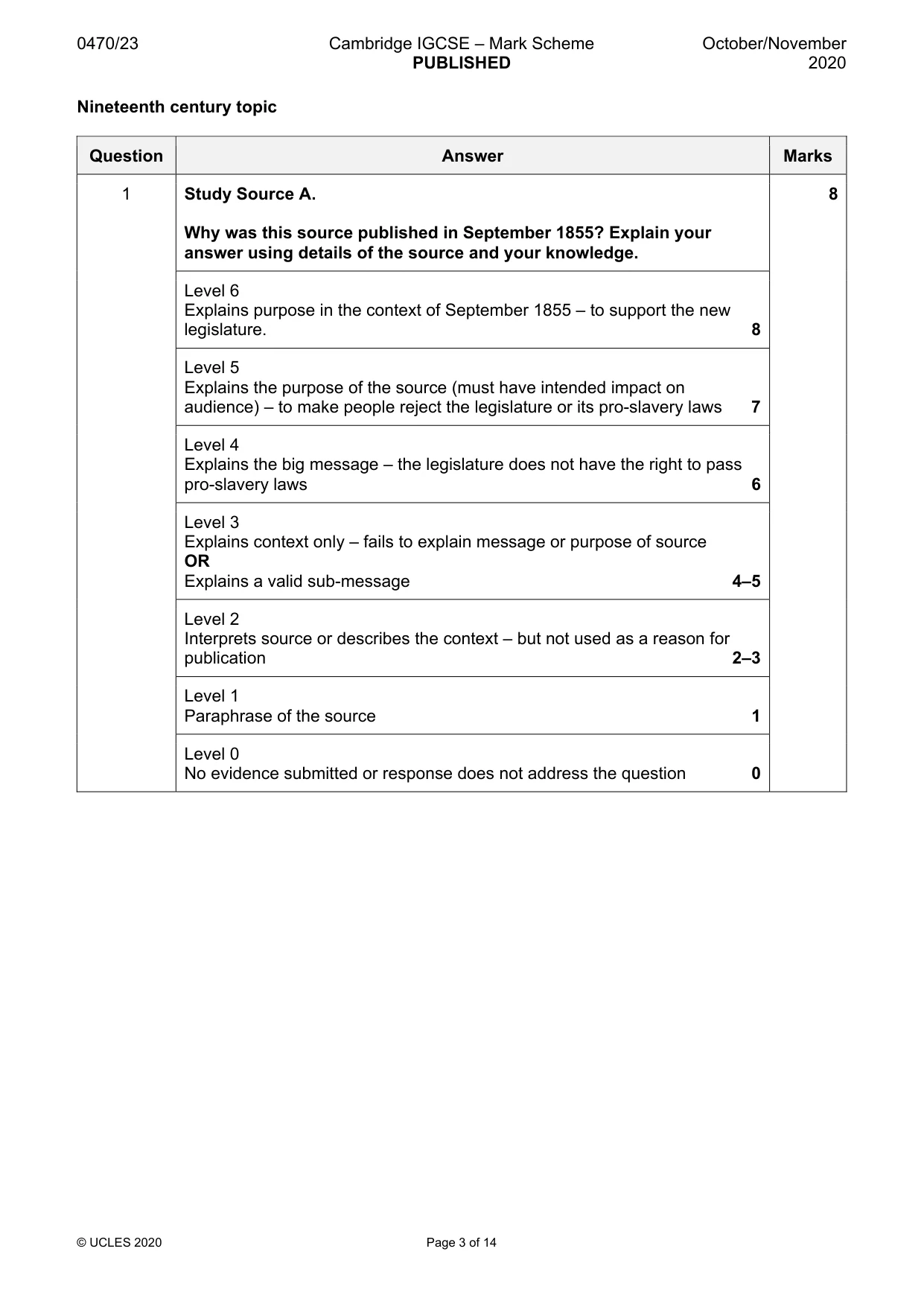
0470/23 Cambridge IGCSE – Mark Scheme PUBLISHED October/November 2020 © UCLES 2020 Page 3 of 14 Nineteenth century topic Question Answer Marks 1 Study Source A. Why was this source published in September 1855? Explain your answer using details of the source and your knowledge. 8 Level 6 Explains purpose in the context of September 1855 – to support the new legislature. 8 Level 5 Explains the purpose of the source (must have intended impact on audience) – to make people reject the legislature or its pro-slavery laws 7 Level 4 Explains the big message – the legislature does not have the right to pass pro-slavery laws 6 Level 3 Explains context only – fails to explain message or purpose of source OR Explains a valid sub-message 4–5 Level 2 Interprets source or describes the context – but not used as a reason for publication 2–3 Level 1 Paraphrase of the source 1 Level 0 No evidence submitted or response does not address the question 0
Mark scheme, page 4
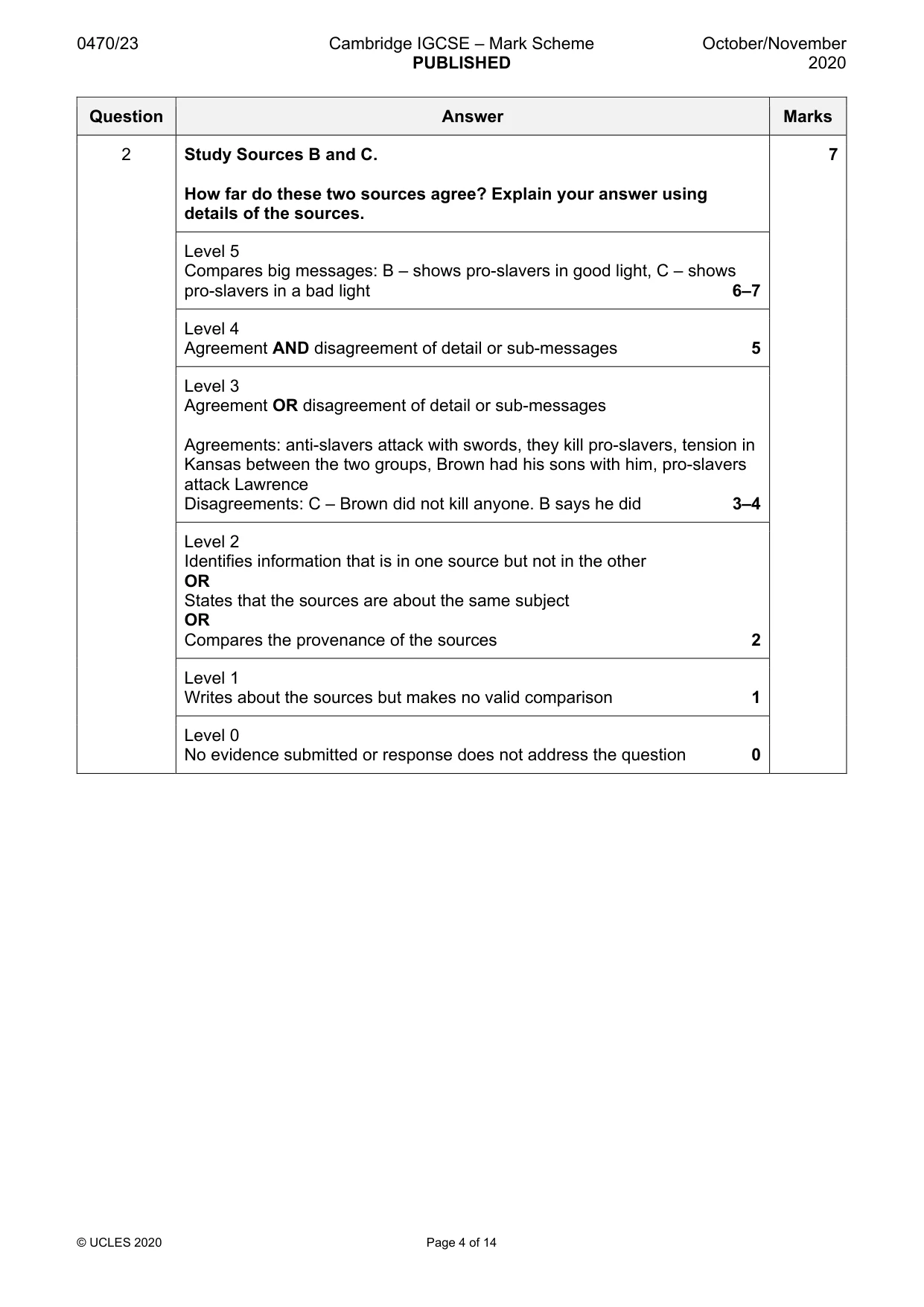
0470/23 Cambridge IGCSE – Mark Scheme PUBLISHED October/November 2020 © UCLES 2020 Page 4 of 14 Question Answer Marks 2 Study Sources B and C. How far do these two sources agree? Explain your answer using details of the sources. 7 Level 5 Compares big messages: B – shows pro-slavers in good light, C – shows pro-slavers in a bad light 6–7 Level 4 Agreement AND disagreement of detail or sub-messages 5 Level 3 Agreement OR disagreement of detail or sub-messages Agreements: anti-slavers attack with swords, they kill pro-slavers, tension in Kansas between the two groups, Brown had his sons with him, pro-slavers attack Lawrence Disagreements: C – Brown did not kill anyone. B says he did 3–4 Level 2 Identifies information that is in one source but not in the other OR States that the sources are about the same subject OR Compares the provenance of the sources 2 Level 1 Writes about the sources but makes no valid comparison 1 Level 0 No evidence submitted or response does not address the question 0
Mark scheme, page 5
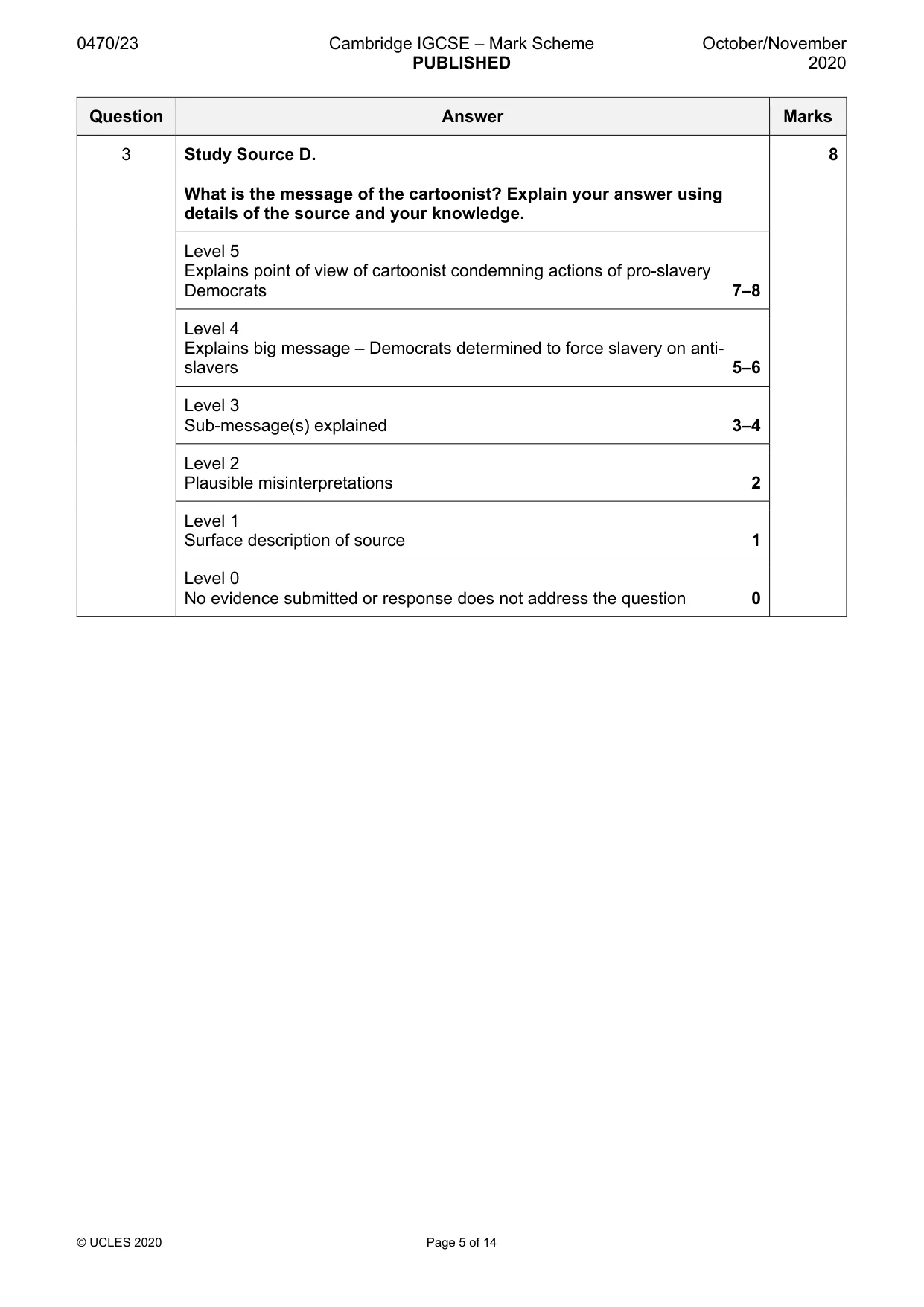
0470/23 Cambridge IGCSE – Mark Scheme PUBLISHED October/November 2020 © UCLES 2020 Page 5 of 14 Question Answer Marks 3 Study Source D. What is the message of the cartoonist? Explain your answer using details of the source and your knowledge. 8 Level 5 Explains point of view of cartoonist condemning actions of pro-slavery Democrats 7–8 Level 4 Explains big message – Democrats determined to force slavery on anti- slavers 5–6 Level 3 Sub-message(s) explained 3–4 Level 2 Plausible misinterpretations 2 Level 1 Surface description of source 1 Level 0 No evidence submitted or response does not address the question 0
Mark scheme, page 6
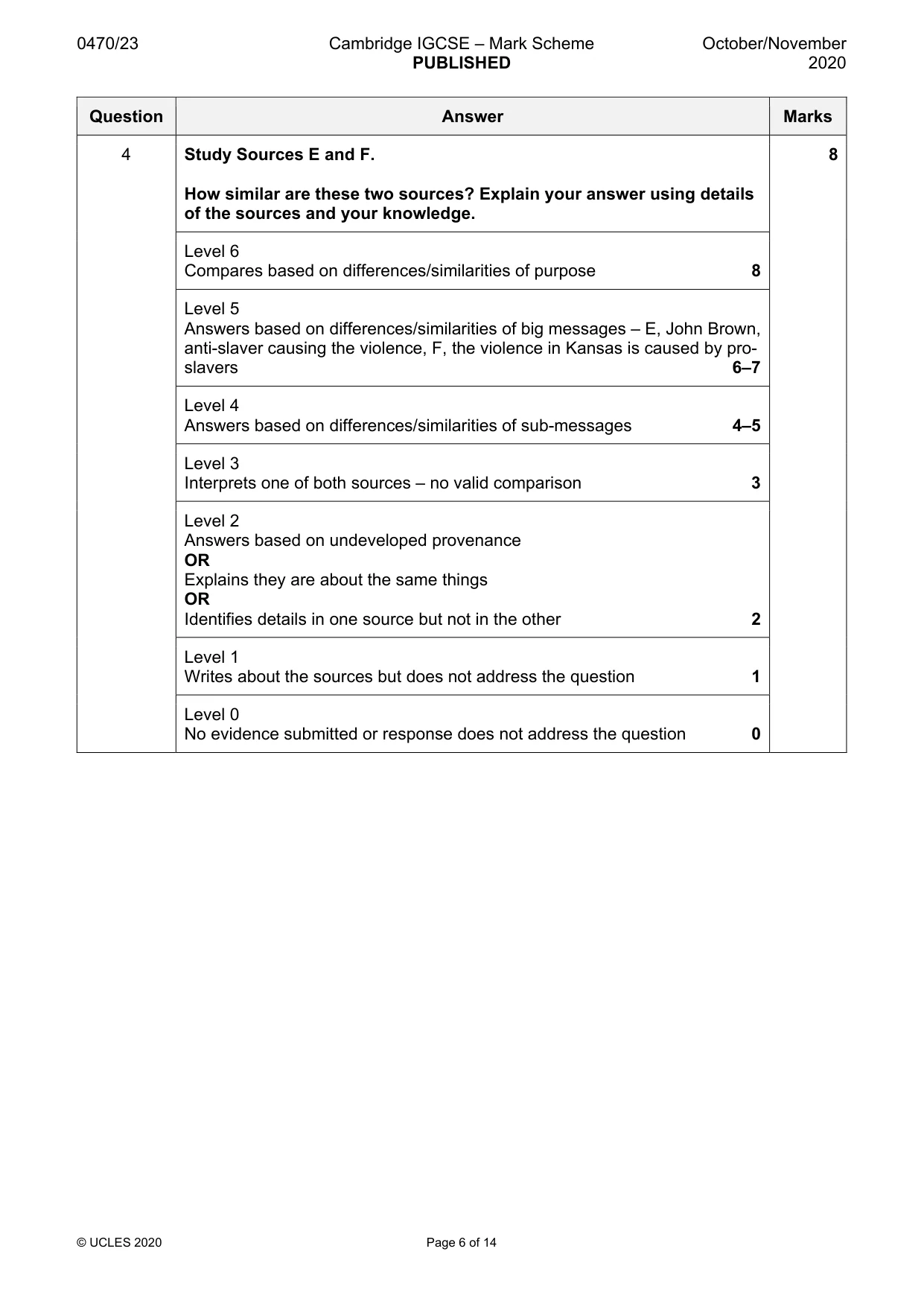
0470/23 Cambridge IGCSE – Mark Scheme PUBLISHED October/November 2020 © UCLES 2020 Page 6 of 14 Question Answer Marks 4 Study Sources E and F. How similar are these two sources? Explain your answer using details of the sources and your knowledge. 8 Level 6 Compares based on differences/similarities of purpose 8 Level 5 Answers based on differences/similarities of big messages – E, John Brown, anti-slaver causing the violence, F, the violence in Kansas is caused by pro- slavers 6–7 Level 4 Answers based on differences/similarities of sub-messages 4–5 Level 3 Interprets one of both sources – no valid comparison 3 Level 2 Answers based on undeveloped provenance OR Explains they are about the same things OR Identifies details in one source but not in the other 2 Level 1 Writes about the sources but does not address the question 1 Level 0 No evidence submitted or response does not address the question 0
Mark scheme, page 7
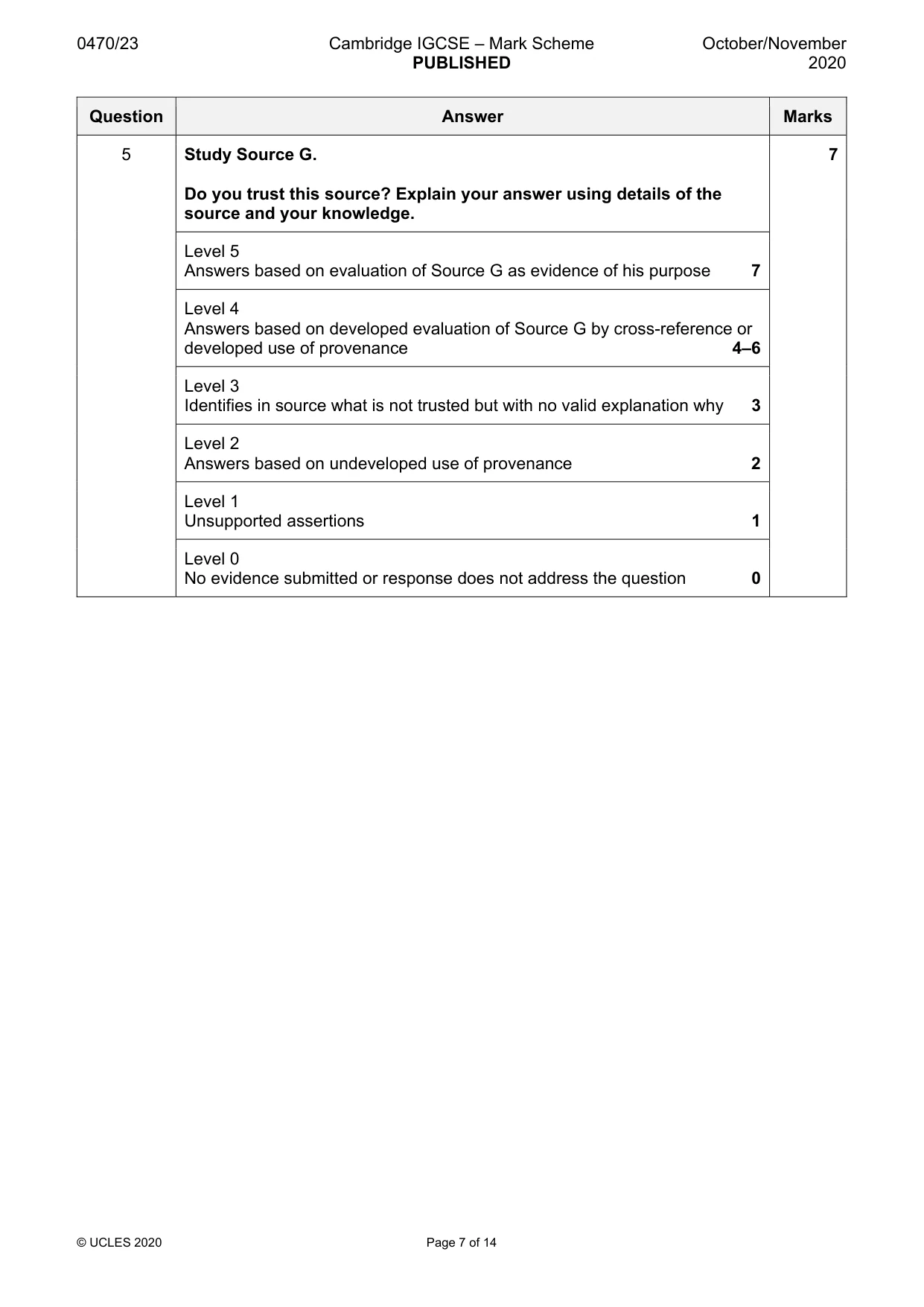
0470/23 Cambridge IGCSE – Mark Scheme PUBLISHED October/November 2020 © UCLES 2020 Page 7 of 14 Question Answer Marks 5 Study Source G. Do you trust this source? Explain your answer using details of the source and your knowledge. 7 Level 5 Answers based on evaluation of Source G as evidence of his purpose 7 Level 4 Answers based on developed evaluation of Source G by cross-reference or developed use of provenance 4–6 Level 3 Identifies in source what is not trusted but with no valid explanation why 3 Level 2 Answers based on undeveloped use of provenance 2 Level 1 Unsupported assertions 1 Level 0 No evidence submitted or response does not address the question 0
Mark scheme, page 8
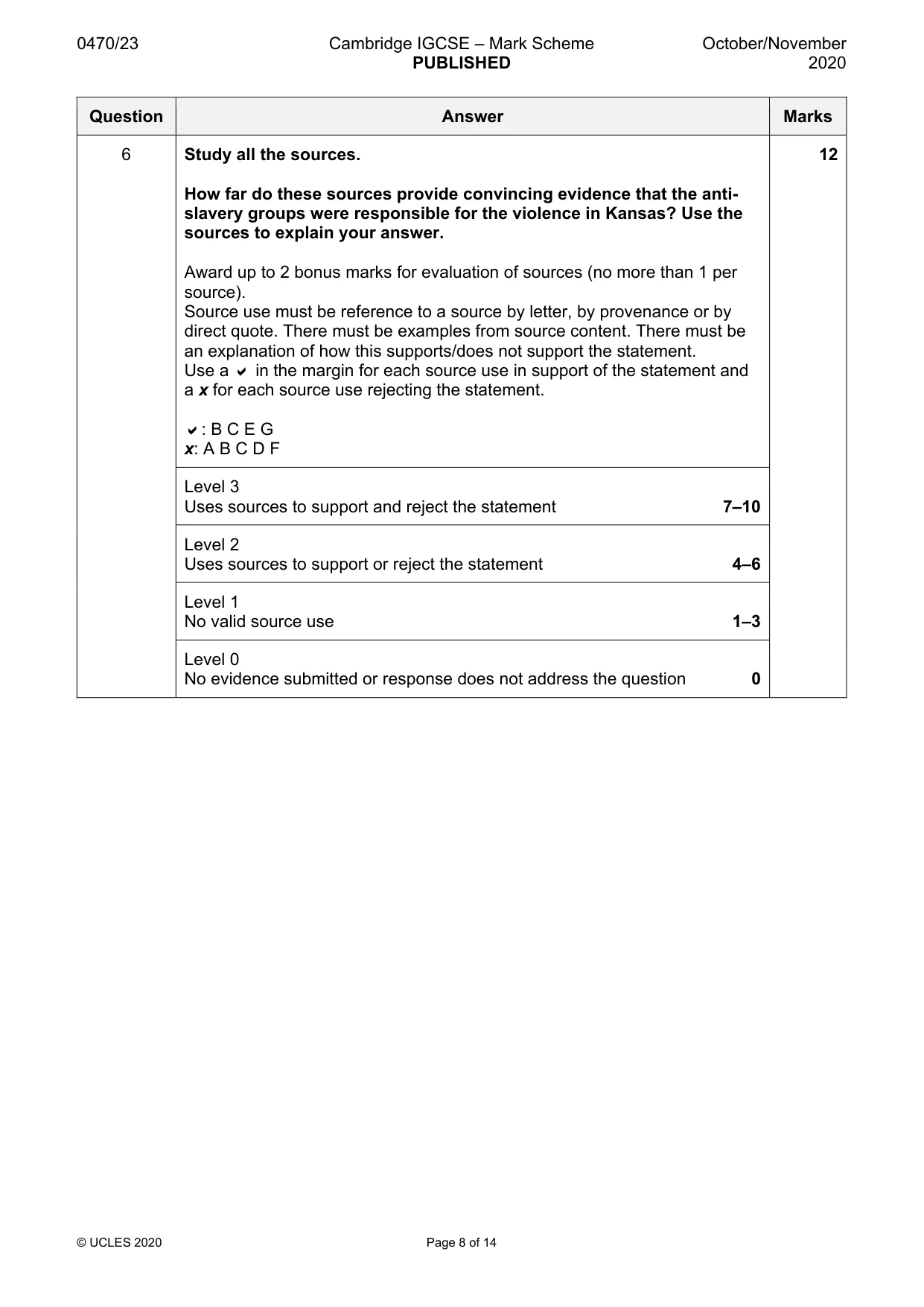
0470/23 Cambridge IGCSE – Mark Scheme PUBLISHED October/November 2020 © UCLES 2020 Page 8 of 14 Question Answer Marks 6 Study all the sources. How far do these sources provide convincing evidence that the anti- slavery groups were responsible for the violence in Kansas? Use the sources to explain your answer. Award up to 2 bonus marks for evaluation of sources (no more than 1 per source). Source use must be reference to a source by letter, by provenance or by direct quote. There must be examples from source content. There must be an explanation of how this supports/does not support the statement. Use a in the margin for each source use in support of the statement and a x for each source use rejecting the statement. : B C E G x: A B C D F 12 Level 3 Uses sources to support and reject the statement 7–10 Level 2 Uses sources to support or reject the statement 4–6 Level 1 No valid source use 1–3 Level 0 No evidence submitted or response does not address the question 0
Mark scheme, page 9
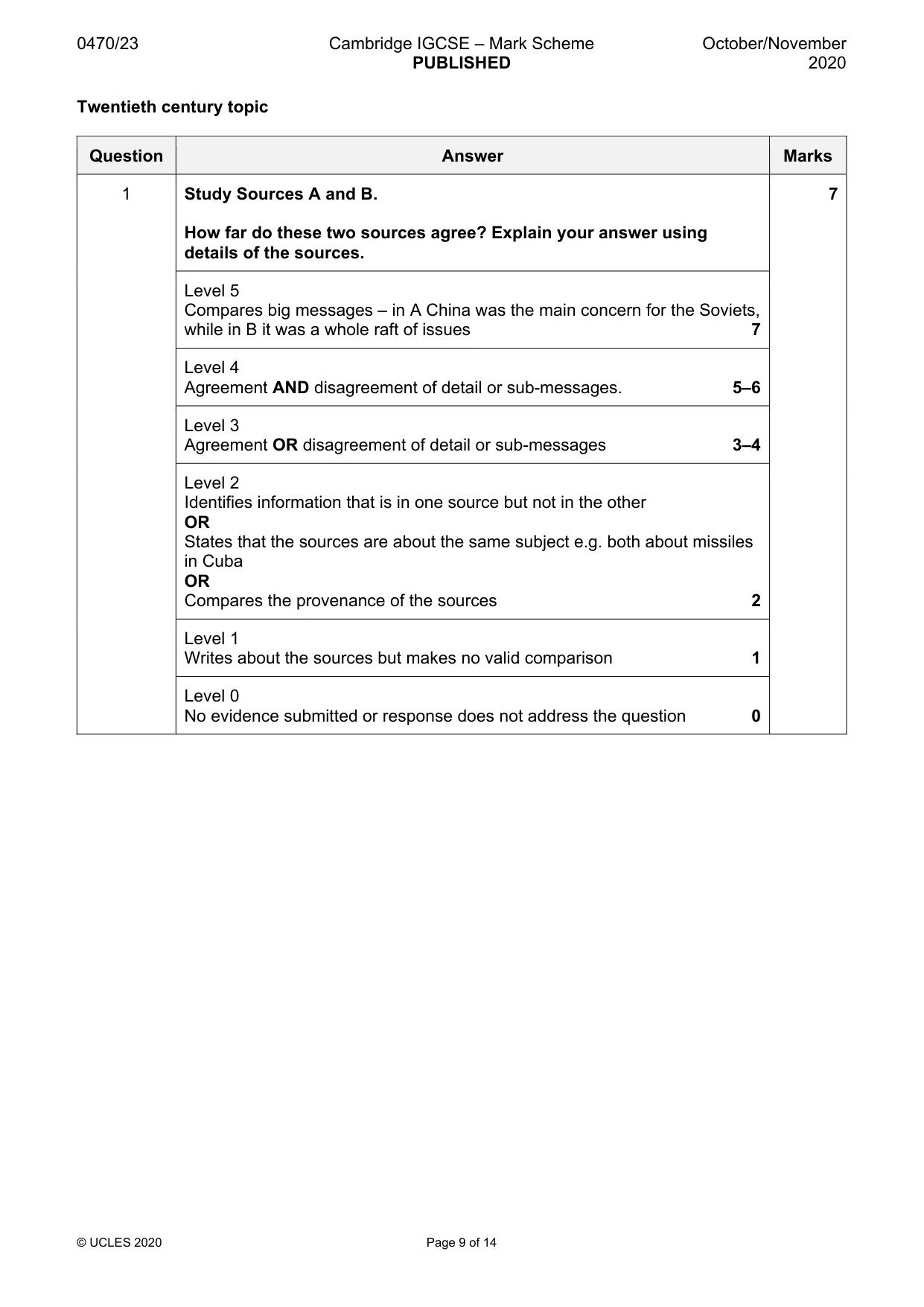
0470/23 Cambridge IGCSE – Mark Scheme PUBLISHED October/November 2020 © UCLES 2020 Page 9 of 14 Twentieth century topic Question Answer Marks 1 Study Sources A and B. How far do these two sources agree? Explain your answer using details of the sources. 7 Level 5 Compares big messages – in A China was the main concern for the Soviets, while in B it was a whole raft of issues 7 Level 4 Agreement AND disagreement of detail or sub-messages. 5–6 Level 3 Agreement OR disagreement of detail or sub-messages 3–4 Level 2 Identifies information that is in one source but not in the other OR States that the sources are about the same subject e.g. both about missiles in Cuba OR Compares the provenance of the sources 2 Level 1 Writes about the sources but makes no valid comparison 1 Level 0 No evidence submitted or response does not address the question 0
Mark scheme, page 10
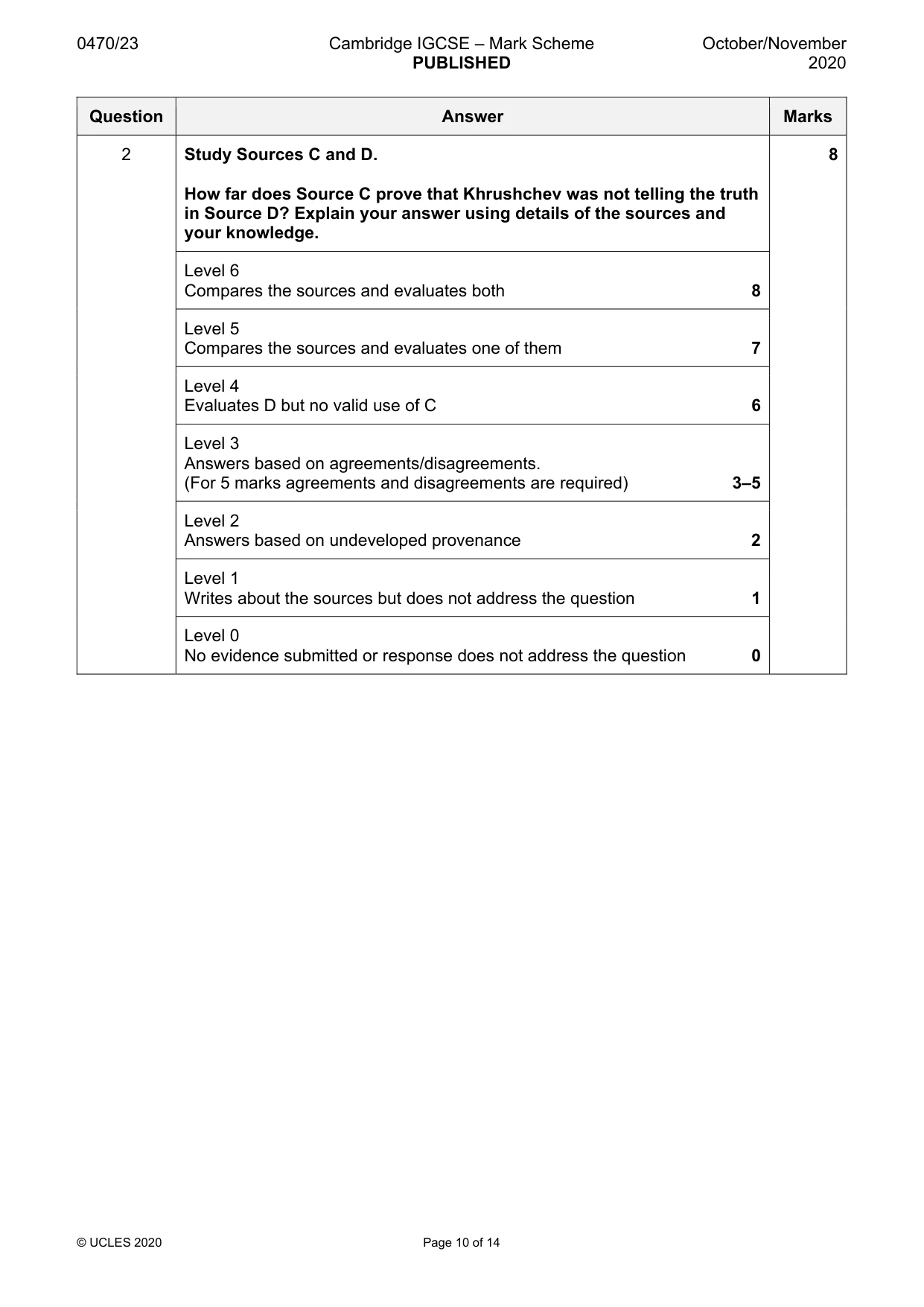
0470/23 Cambridge IGCSE – Mark Scheme PUBLISHED October/November 2020 © UCLES 2020 Page 10 of 14 Question Answer Marks 2 Study Sources C and D. How far does Source C prove that Khrushchev was not telling the truth in Source D? Explain your answer using details of the sources and your knowledge. 8 Level 6 Compares the sources and evaluates both 8 Level 5 Compares the sources and evaluates one of them 7 Level 4 Evaluates D but no valid use of C 6 Level 3 Answers based on agreements/disagreements. (For 5 marks agreements and disagreements are required) 3–5 Level 2 Answers based on undeveloped provenance 2 Level 1 Writes about the sources but does not address the question 1 Level 0 No evidence submitted or response does not address the question 0
Mark scheme, page 11
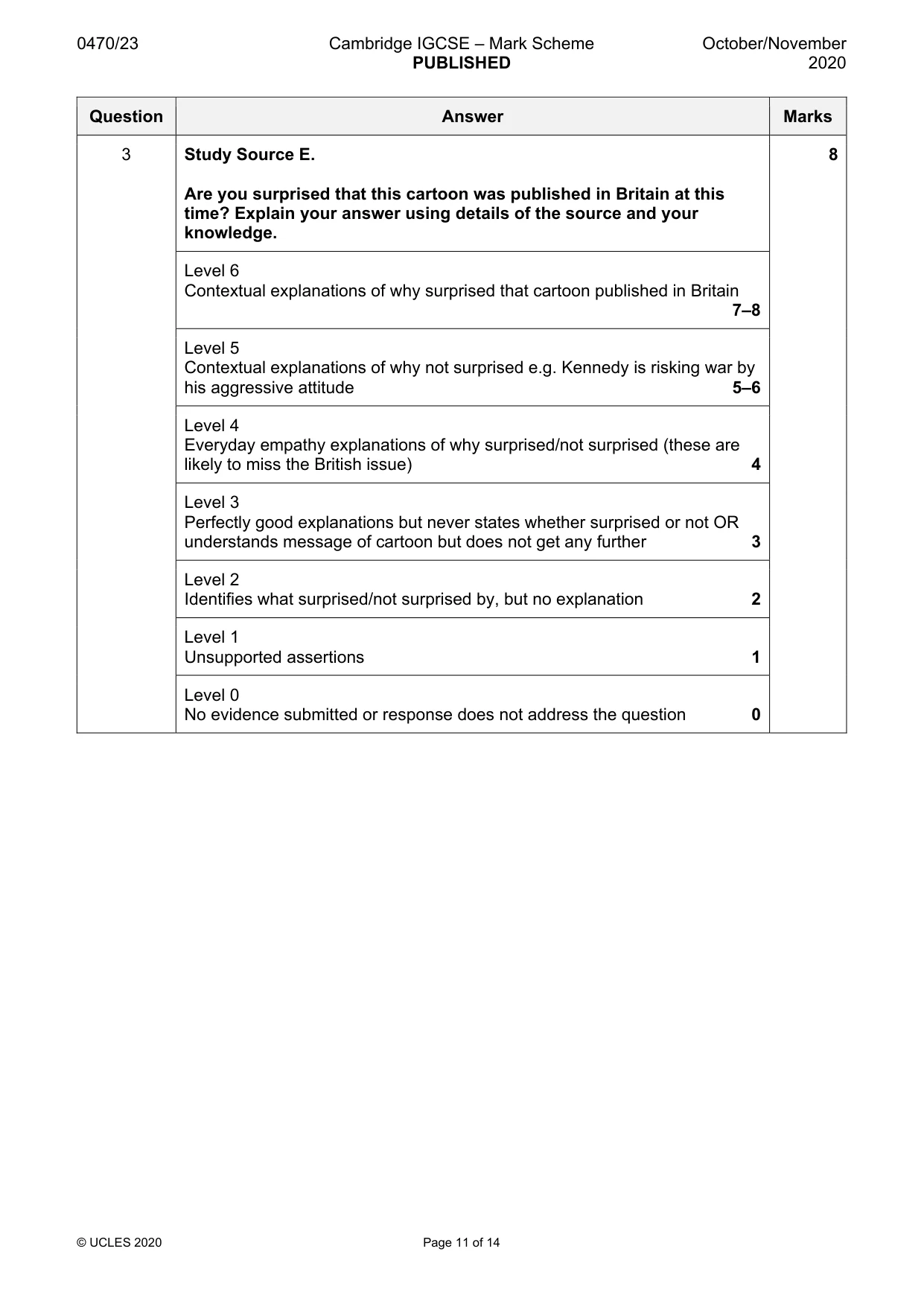
0470/23 Cambridge IGCSE – Mark Scheme PUBLISHED October/November 2020 © UCLES 2020 Page 11 of 14 Question Answer Marks 3 Study Source E. Are you surprised that this cartoon was published in Britain at this time? Explain your answer using details of the source and your knowledge. 8 Level 6 Contextual explanations of why surprised that cartoon published in Britain 7–8 Level 5 Contextual explanations of why not surprised e.g. Kennedy is risking war by his aggressive attitude 5–6 Level 4 Everyday empathy explanations of why surprised/not surprised (these are likely to miss the British issue) 4 Level 3 Perfectly good explanations but never states whether surprised or not OR understands message of cartoon but does not get any further 3 Level 2 Identifies what surprised/not surprised by, but no explanation 2 Level 1 Unsupported assertions 1 Level 0 No evidence submitted or response does not address the question 0
Mark scheme, page 12
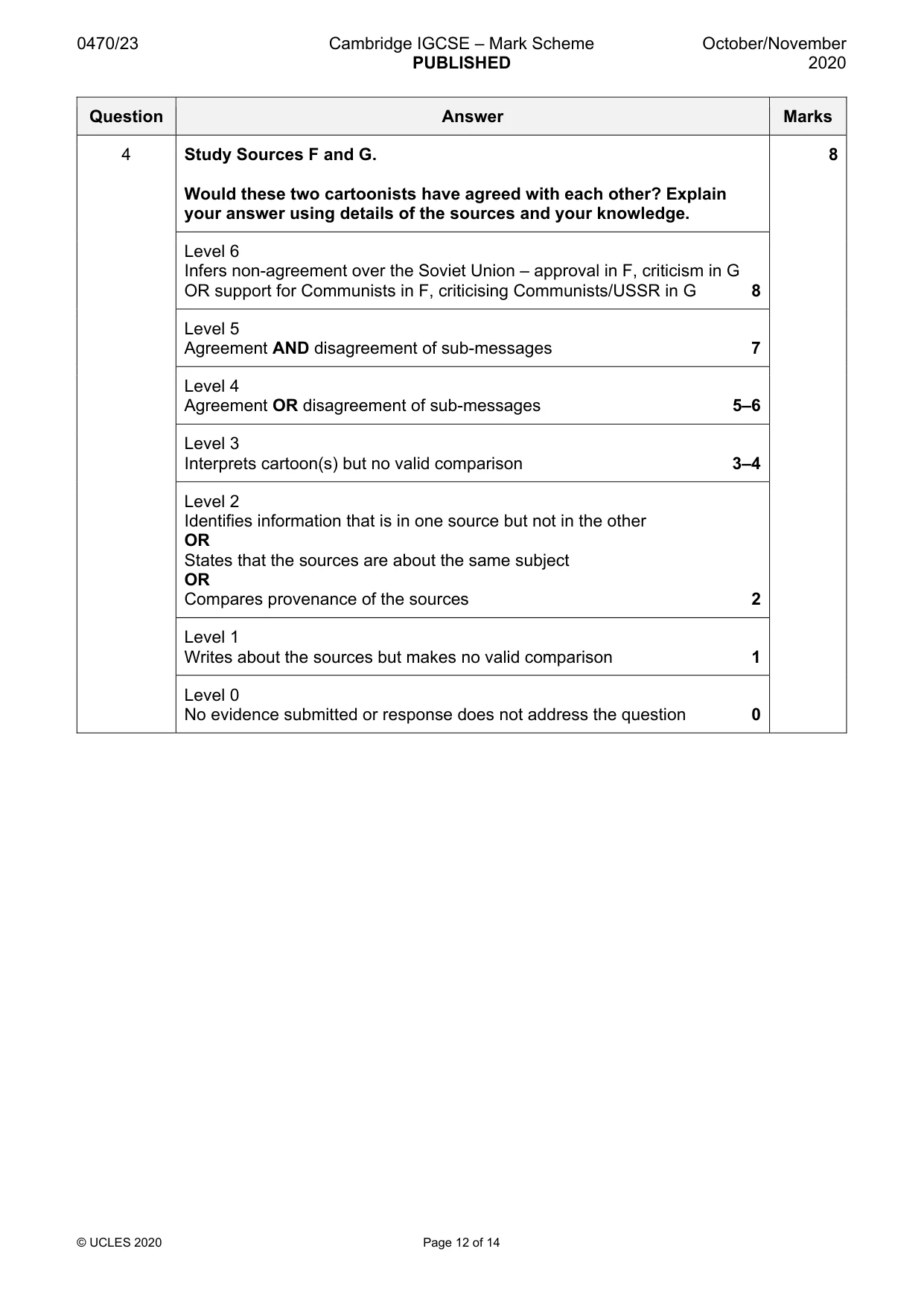
0470/23 Cambridge IGCSE – Mark Scheme PUBLISHED October/November 2020 © UCLES 2020 Page 12 of 14 Question Answer Marks 4 Study Sources F and G. Would these two cartoonists have agreed with each other? Explain your answer using details of the sources and your knowledge. 8 Level 6 Infers non-agreement over the Soviet Union – approval in F, criticism in G OR support for Communists in F, criticising Communists/USSR in G 8 Level 5 Agreement AND disagreement of sub-messages 7 Level 4 Agreement OR disagreement of sub-messages 5–6 Level 3 Interprets cartoon(s) but no valid comparison 3–4 Level 2 Identifies information that is in one source but not in the other OR States that the sources are about the same subject OR Compares provenance of the sources 2 Level 1 Writes about the sources but makes no valid comparison 1 Level 0 No evidence submitted or response does not address the question 0
Mark scheme, page 13
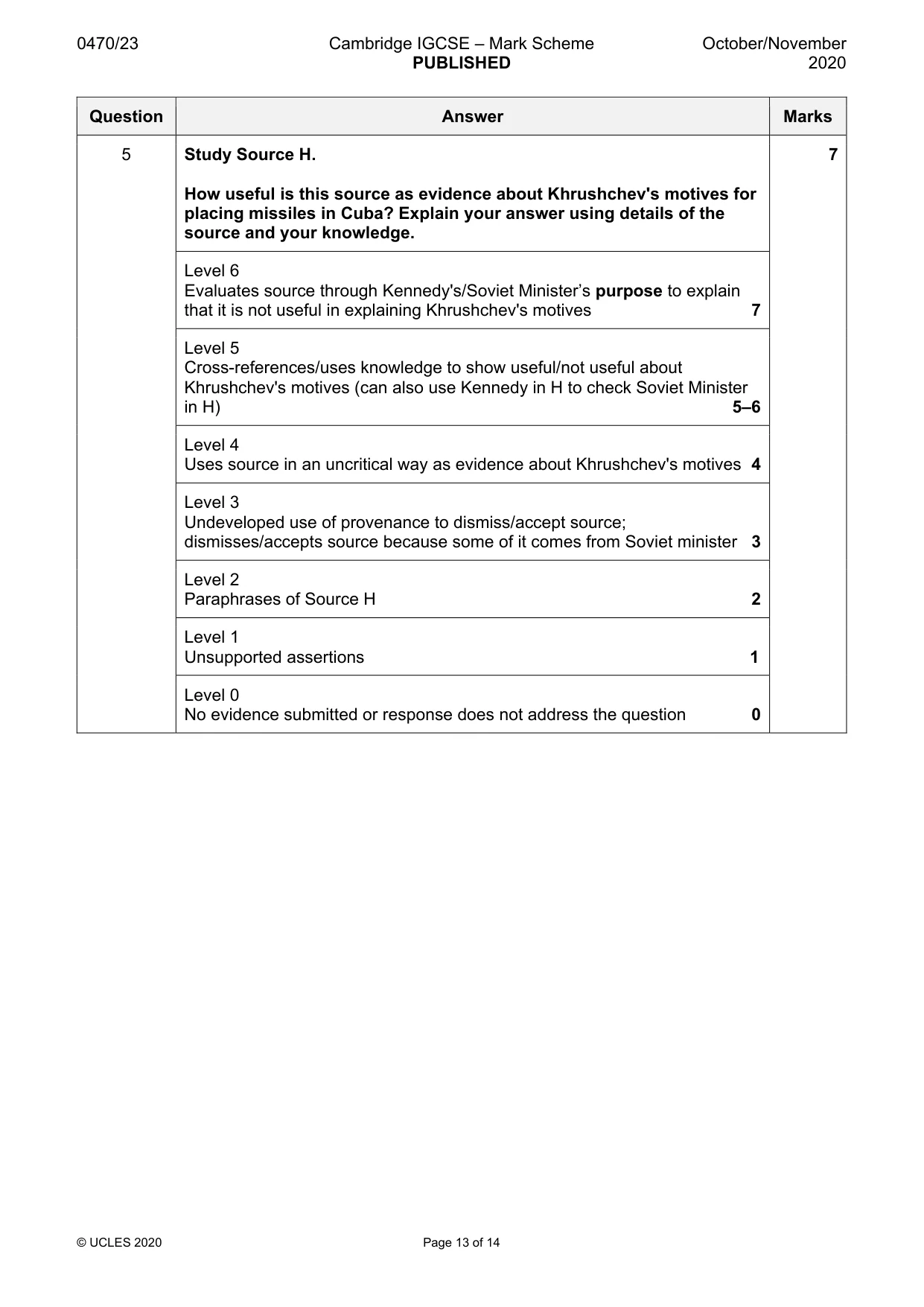
0470/23 Cambridge IGCSE – Mark Scheme PUBLISHED October/November 2020 © UCLES 2020 Page 13 of 14 Question Answer Marks 5 Study Source H. How useful is this source as evidence about Khrushchev's motives for placing missiles in Cuba? Explain your answer using details of the source and your knowledge. 7 Level 6 Evaluates source through Kennedy's/Soviet Minister’s purpose to explain that it is not useful in explaining Khrushchev's motives 7 Level 5 Cross-references/uses knowledge to show useful/not useful about Khrushchev's motives (can also use Kennedy in H to check Soviet Minister in H) 5–6 Level 4 Uses source in an uncritical way as evidence about Khrushchev's motives 4 Level 3 Undeveloped use of provenance to dismiss/accept source; dismisses/accepts source because some of it comes from Soviet minister 3 Level 2 Paraphrases of Source H 2 Level 1 Unsupported assertions 1 Level 0 No evidence submitted or response does not address the question 0
Mark scheme, page 14
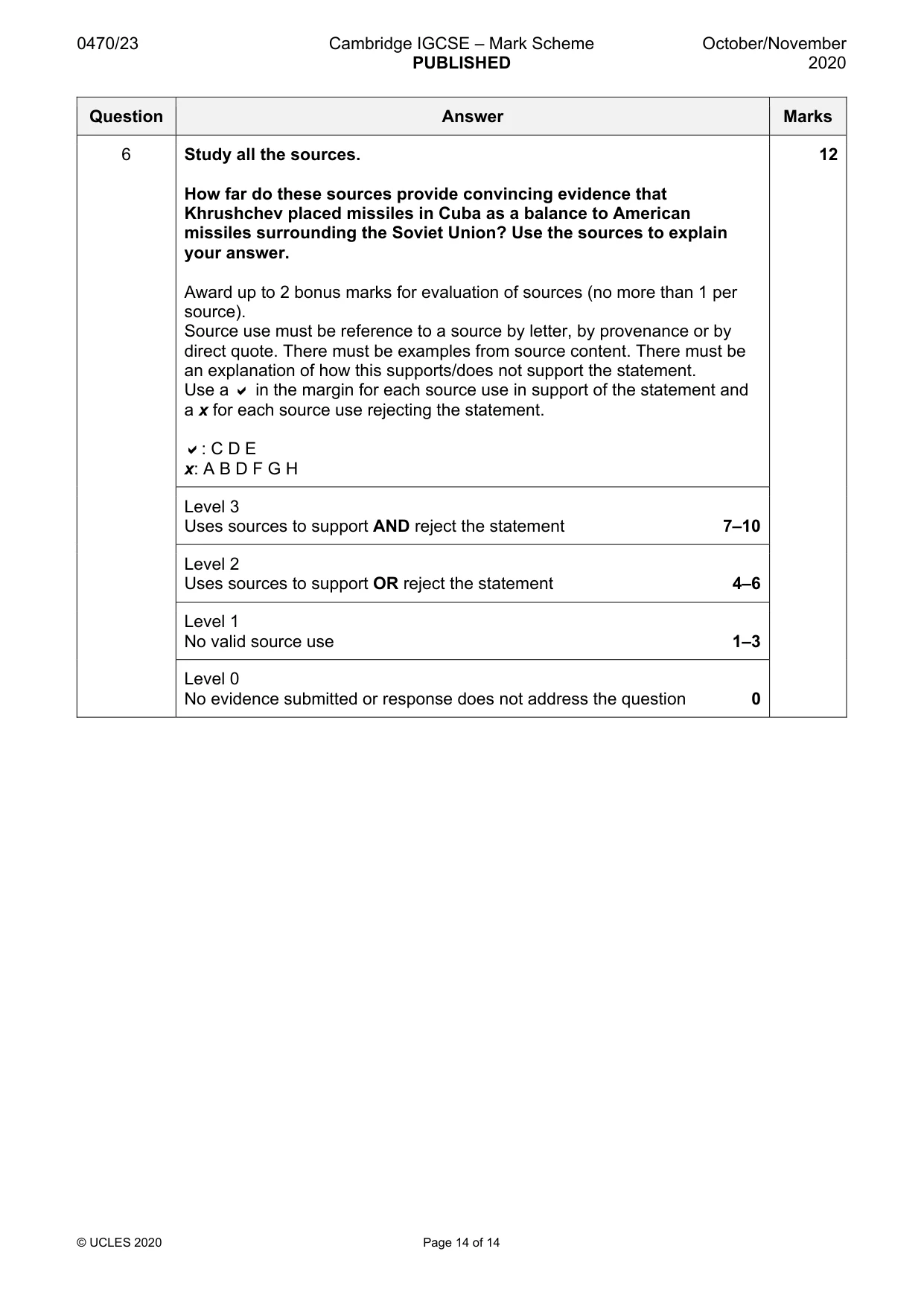
0470/23 Cambridge IGCSE – Mark Scheme PUBLISHED October/November 2020 © UCLES 2020 Page 14 of 14 Question Answer Marks 6 Study all the sources. How far do these sources provide convincing evidence that Khrushchev placed missiles in Cuba as a balance to American missiles surrounding the Soviet Union? Use the sources to explain your answer. Award up to 2 bonus marks for evaluation of sources (no more than 1 per source). Source use must be reference to a source by letter, by provenance or by direct quote. There must be examples from source content. There must be an explanation of how this supports/does not support the statement. Use a in the margin for each source use in support of the statement and a x for each source use rejecting the statement. : C D E x: A B D F G H 12 Level 3 Uses sources to support AND reject the statement 7–10 Level 2 Uses sources to support OR reject the statement 4–6 Level 1 No valid source use 1–3 Level 0 No evidence submitted or response does not address the question 0
What you needed in this session
Cambridge’s own grade thresholds for 2020 Oct/Nov, Paper 2 · Variant 3. A higher threshold means an easier paper — the bar moves with how the cohort did.