Cambridge IGCSE History 0470 — 2020 Oct/Nov Paper 2 · Variant 2
0470/22/O/N/20 · 50 marks · ≈56 min
The question paper and its mark scheme, free to read here and free to download. This is Cambridge’s own paper, exactly as it was sat.
Question paper16 pages


Mark scheme14 pages
Answers below. Sit the paper first if you are practising.
Paper as text
Question paper, page 1
This document has 16 pages. Blank pages are indicated. DC (TC/CGW) 189976/3 © UCLES 2020 [Turn over * 2 8 4 2 7 5 3 7 8 7 * Cambridge IGCSE™ HISTORY 0470/22 Paper 2 October/November 2020 2 hours You must answer on the enclosed answer booklet. You will need: Answer booklet (enclosed) INSTRUCTIONS ● Answer all the questions on one option only. Option A: Nineteenth century topic Option B: Twentieth century topic ● Follow the instructions on the front cover of the answer booklet. If you need additional answer paper, ask the invigilator for a continuation booklet. INFORMATION ● The total mark for this paper is 50. ● The number of marks for each question or part question is shown in brackets [ ].
Question paper, page 2
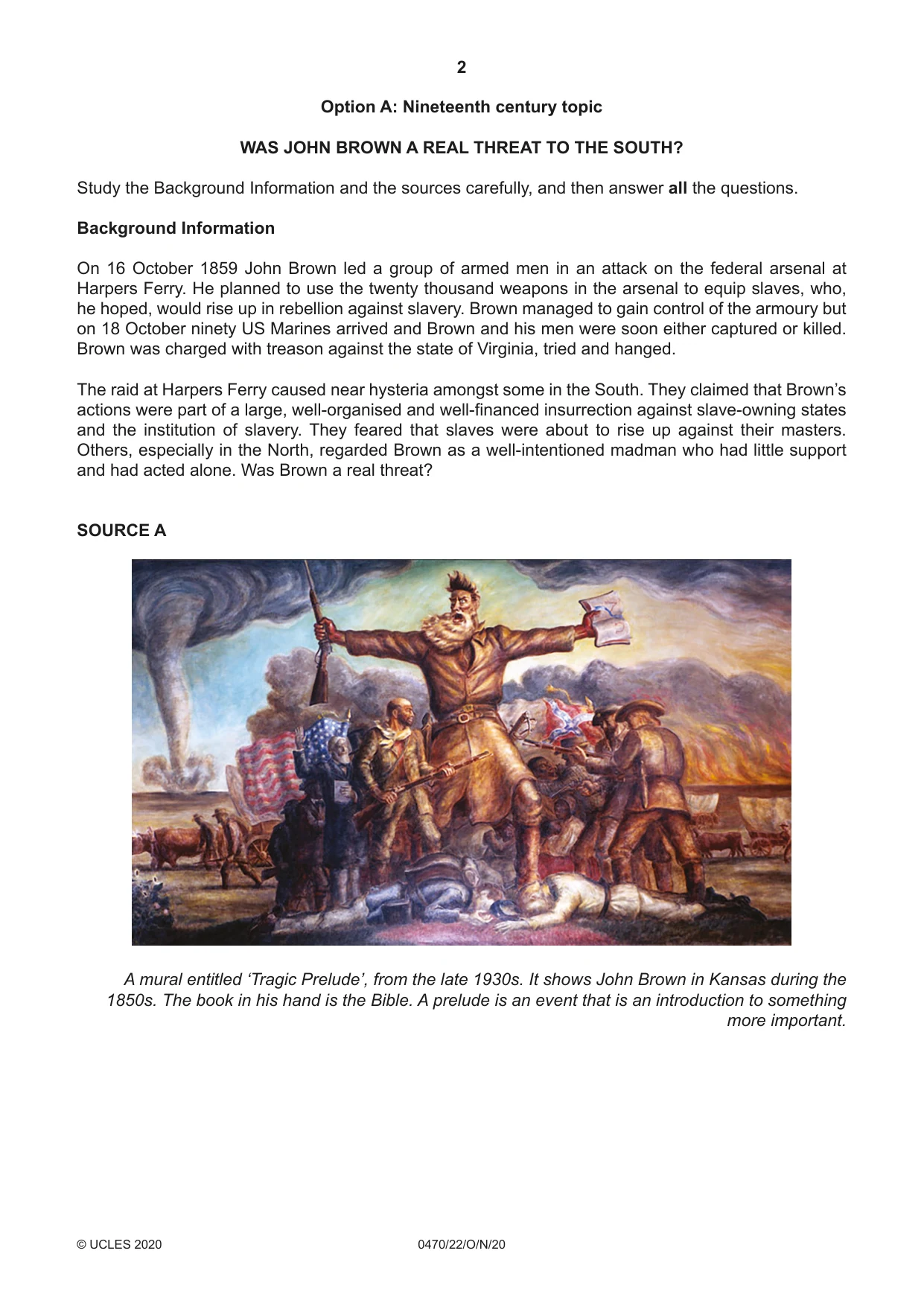
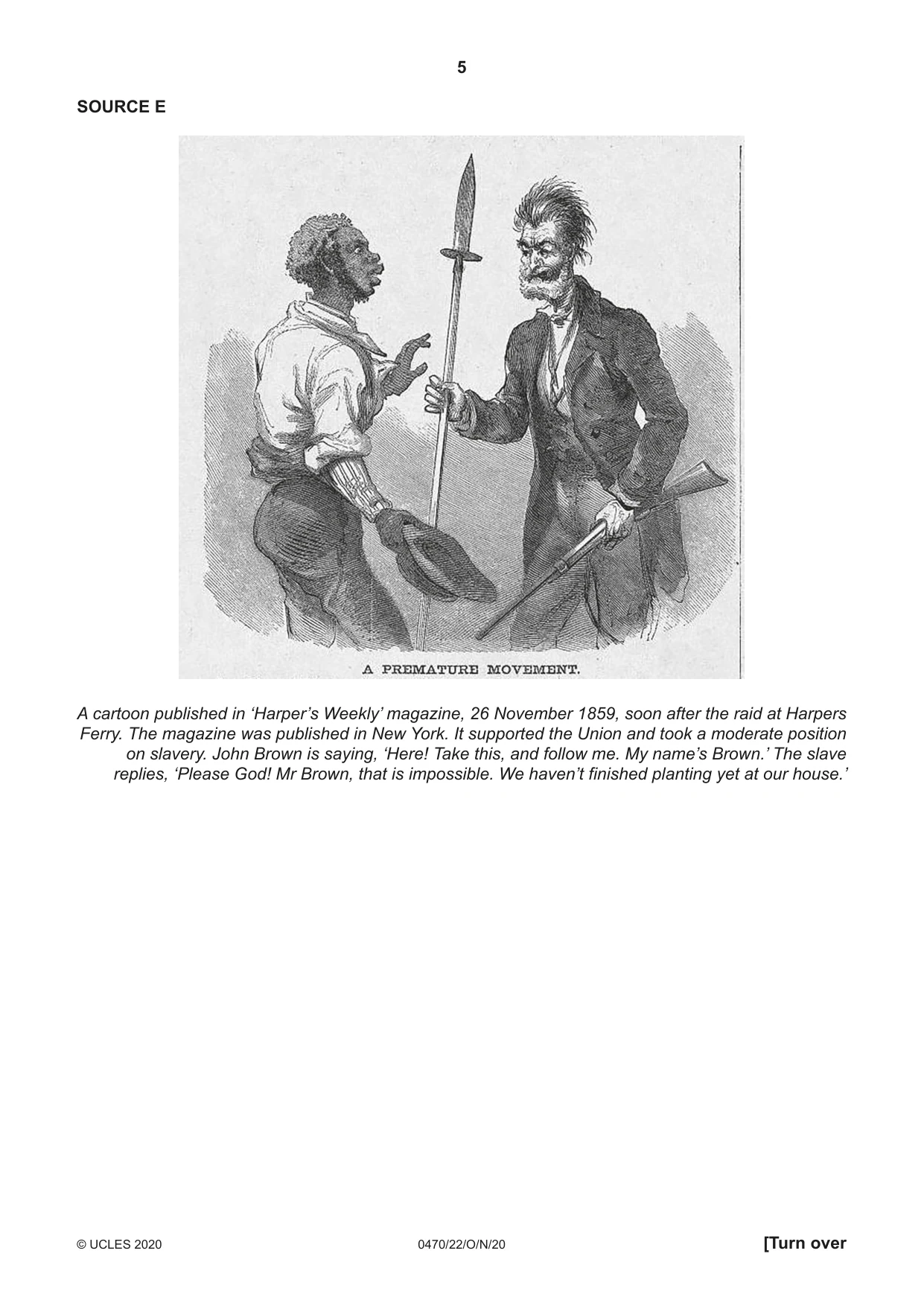
2 0470/22/O/N/20 © UCLES 2020 Option A: Nineteenth century topic WAS JOHN BROWN A REAL THREAT TO THE SOUTH? Study the Background Information and the sources carefully, and then answer all the questions. Background Information On 16 October 1859 John Brown led a group of armed men in an attack on the federal arsenal at Harpers Ferry. He planned to use the twenty thousand weapons in the arsenal to equip slaves, who, he hoped, would rise up in rebellion against slavery. Brown managed to gain control of the armoury but on 18 October ninety US Marines arrived and Brown and his men were soon either captured or killed. Brown was charged with treason against the state of Virginia, tried and hanged. The raid at Harpers Ferry caused near hysteria amongst some in the South. They claimed that Brown’s actions were part of a large, well-organised and well-financed insurrection against slave-owning states and the institution of slavery. They feared that slaves were about to rise up against their masters. Others, especially in the North, regarded Brown as a well-intentioned madman who had little support and had acted alone. Was Brown a real threat? SOURCE A A mural entitled ‘Tragic Prelude’, from the late 1930s. It shows John Brown in Kansas during the 1850s. The book in his hand is the Bible. A prelude is an event that is an introduction to something more important.
Question paper, page 3
3 0470/22/O/N/20 © UCLES 2020 [Turn over SOURCE B It would be difficult to find anything more absurd than John Brown assuming the character of Commander-in-Chief of a Provisional Government and expecting, at the head of an army of seventeen white men and three negroes, to start a great revolution, and by the bold strike of seizing the arsenal at Harpers Ferry, to bring about the abolition of slavery. However, in spite of his delusions and the absurdity of his enterprises, he deserves our respect for his display of the noblest qualities of human nature. John Brown seems to have infected the people of Virginia with delusion. Despite Brown and his cooperators being killed or in prison, Virginia remains strongly impressed with the idea of a grand army of slave liberators dispersed along her borders, while still another grand army of desperate Abolitionists is expected from the North to storm the jail at Charlestown, to liberate Brown and place him at their head. The burning of two or three barns has been accepted as proof of the approach of this liberating army. From a New York newspaper, 19 November 1859. SOURCE C On Friday last, one of the most evil schemes was brought to light. A large body of whites and blacks took possession of the US arsenal at Harpers Ferry, murdering and imprisoning the citizens at will. It turned out to be an Abolition movement, led by the notorious John Brown, who told his fanatical followers that the negroes would join them by their thousands, and that Maryland and Virginia would become free States. The rebellion has been put down and the ringleaders shot. The party originally consisted of 32 persons of whom fifteen are killed. The originator of this insurrection was Captain John Brown, whose connection with the scenes of violence in the warfare of Kansas made his name notorious to the whole country. In the coat of one of the men killed was found a Captain’s commission signed by ‘John Brown, Commander-in-Chief of the Army of the Provisional Government of the United States’. This insurrection is the result of the preachings of the vile families in the North. It is the first step toward carrying out Seward’s idea of the ‘irrepressible conflict which is sooner or later to ensue between the slave and free States’. This damnable plot should awaken the conservative people of the North to the inevitable results of listening to the vile shrieks of the fanatics of the free States. We rejoice that the bloody scheme has been foiled. May all such movements be crushed just as quickly. From a Northern newspaper, 22 October 1859.
Question paper, page 4
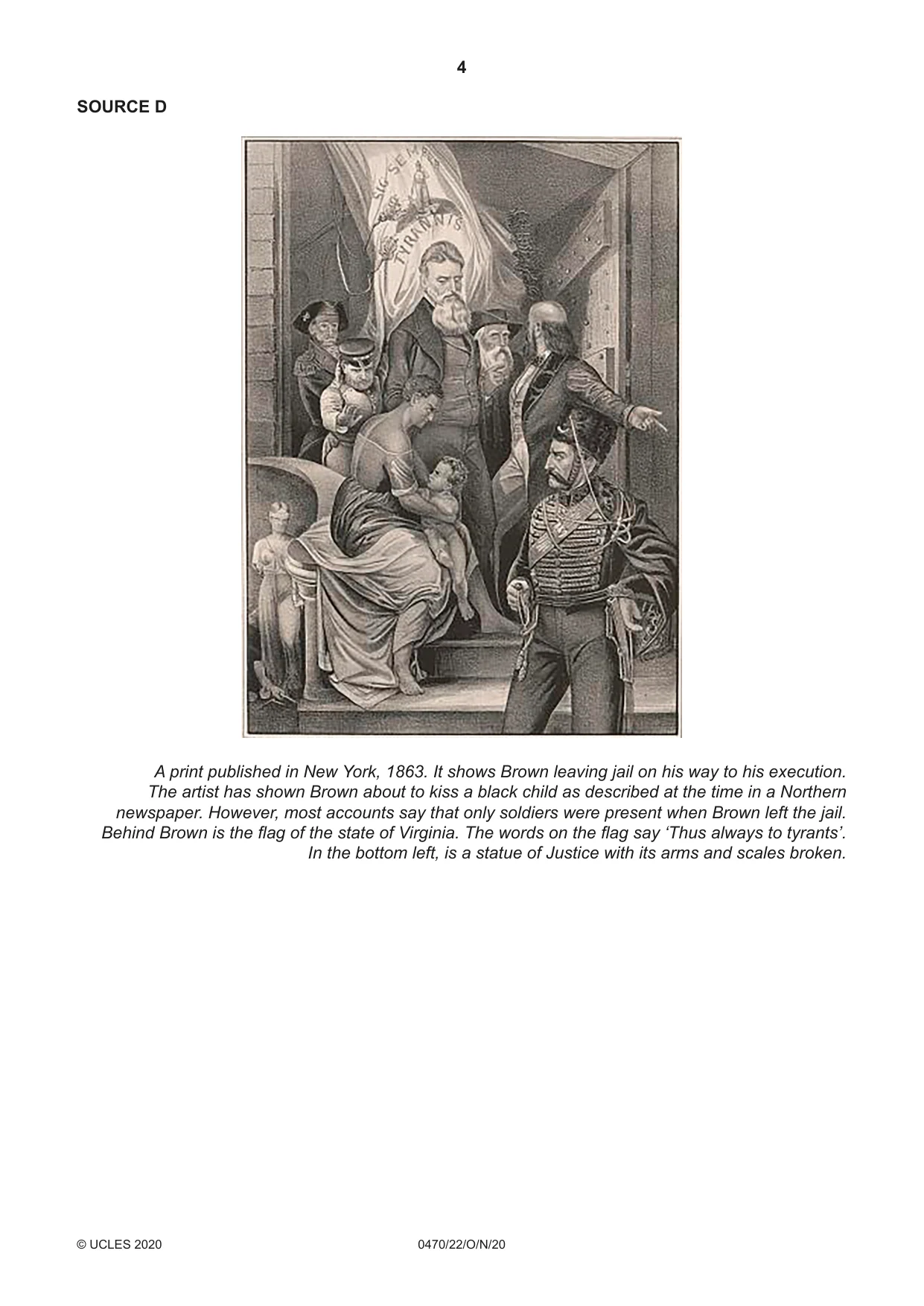
4 0470/22/O/N/20 © UCLES 2020 SOURCE D A print published in New York, 1863. It shows Brown leaving jail on his way to his execution. The artist has shown Brown about to kiss a black child as described at the time in a Northern newspaper. However, most accounts say that only soldiers were present when Brown left the jail. Behind Brown is the flag of the state of Virginia. The words on the flag say ‘Thus always to tyrants’. In the bottom left, is a statue of Justice with its arms and scales broken.
Question paper, page 5
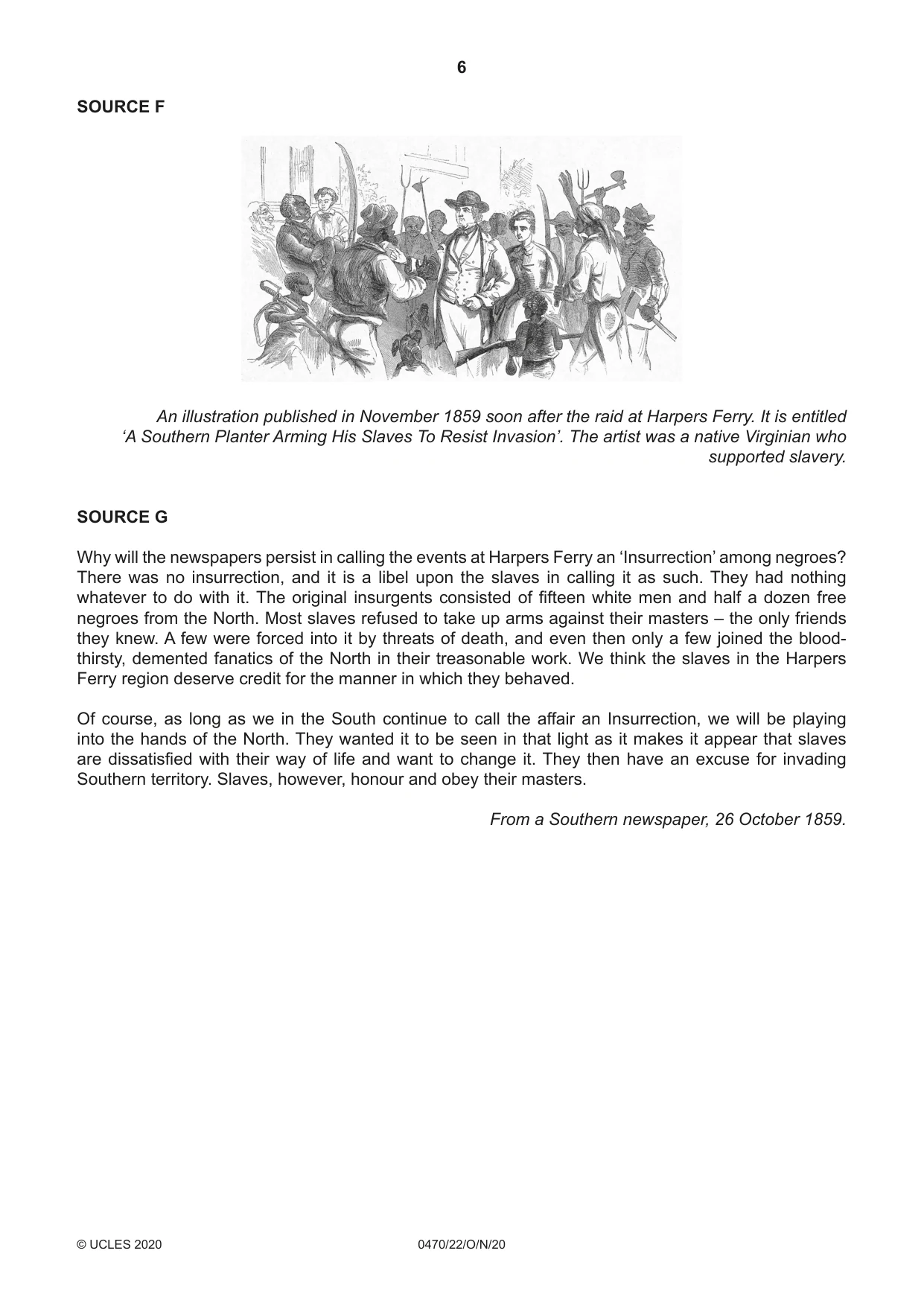
5 0470/22/O/N/20 © UCLES 2020 [Turn over SOURCE E A cartoon published in ‘Harper’s Weekly’ magazine, 26 November 1859, soon after the raid at Harpers Ferry. The magazine was published in New York. It supported the Union and took a moderate position on slavery. John Brown is saying, ‘Here! Take this, and follow me. My name’s Brown.’ The slave replies, ‘Please God! Mr Brown, that is impossible. We haven’t finished planting yet at our house.’
Question paper, page 6
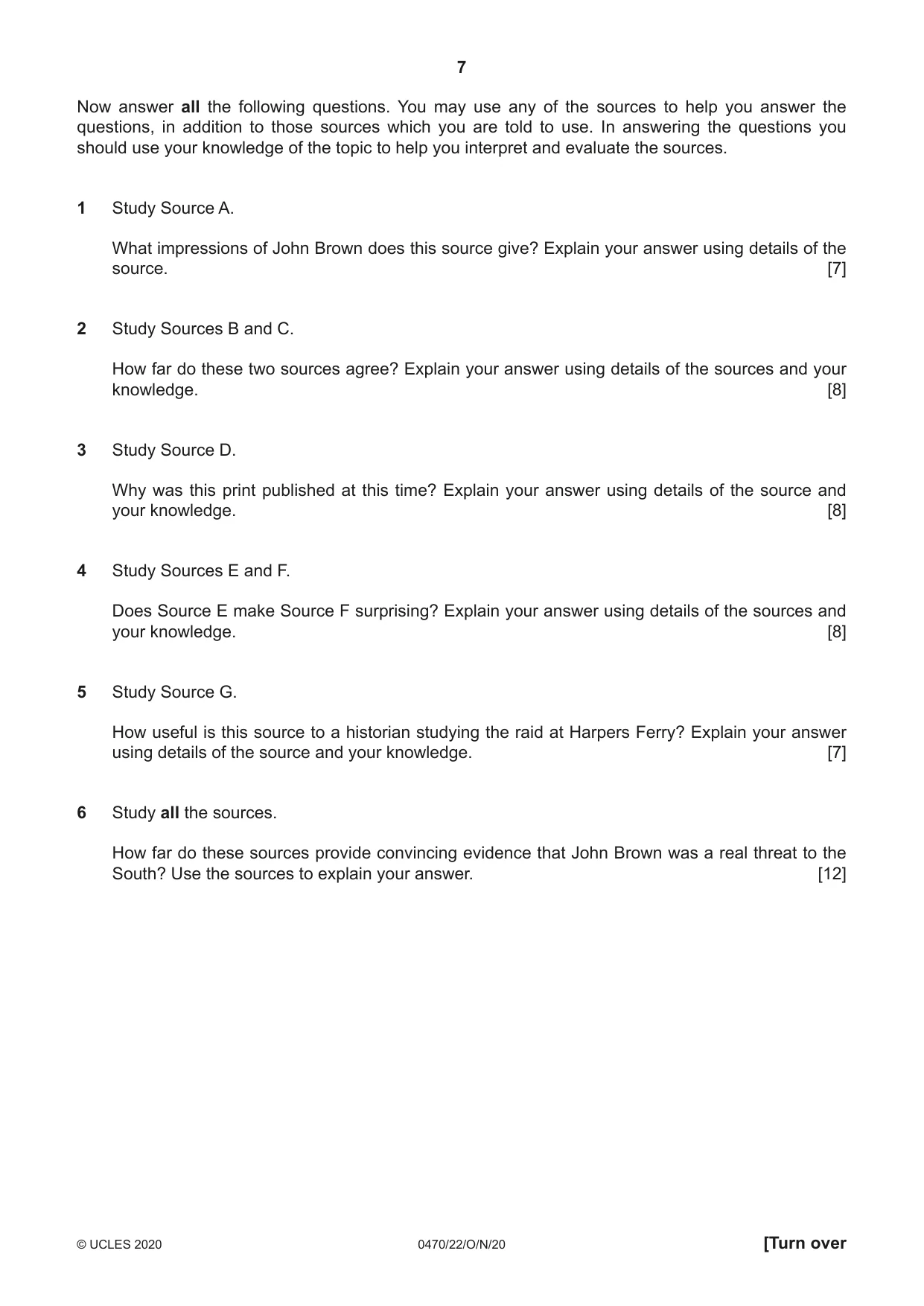
6 0470/22/O/N/20 © UCLES 2020 SOURCE F An illustration published in November 1859 soon after the raid at Harpers Ferry. It is entitled ‘A Southern Planter Arming His Slaves To Resist Invasion’. The artist was a native Virginian who supported slavery. SOURCE G Why will the newspapers persist in calling the events at Harpers Ferry an ‘Insurrection’ among negroes? There was no insurrection, and it is a libel upon the slaves in calling it as such. They had nothing whatever to do with it. The original insurgents consisted of fifteen white men and half a dozen free negroes from the North. Most slaves refused to take up arms against their masters – the only friends they knew. A few were forced into it by threats of death, and even then only a few joined the blood- thirsty, demented fanatics of the North in their treasonable work. We think the slaves in the Harpers Ferry region deserve credit for the manner in which they behaved. Of course, as long as we in the South continue to call the affair an Insurrection, we will be playing into the hands of the North. They wanted it to be seen in that light as it makes it appear that slaves are dissatisfied with their way of life and want to change it. They then have an excuse for invading Southern territory. Slaves, however, honour and obey their masters. From a Southern newspaper, 26 October 1859.
Question paper, page 7
7 0470/22/O/N/20 © UCLES 2020 [Turn over Now answer all the following questions. You may use any of the sources to help you answer the questions, in addition to those sources which you are told to use. In answering the questions you should use your knowledge of the topic to help you interpret and evaluate the sources. 1 Study Source A. What impressions of John Brown does this source give? Explain your answer using details of the source. [7] 2 Study Sources B and C. How far do these two sources agree? Explain your answer using details of the sources and your knowledge. [8] 3 Study Source D. Why was this print published at this time? Explain your answer using details of the source and your knowledge. [8] 4 Study Sources E and F. Does Source E make Source F surprising? Explain your answer using details of the sources and your knowledge. [8] 5 Study Source G. How useful is this source to a historian studying the raid at Harpers Ferry? Explain your answer using details of the source and your knowledge. [7] 6 Study all the sources. How far do these sources provide convincing evidence that John Brown was a real threat to the South? Use the sources to explain your answer. [12]
Question paper, page 8
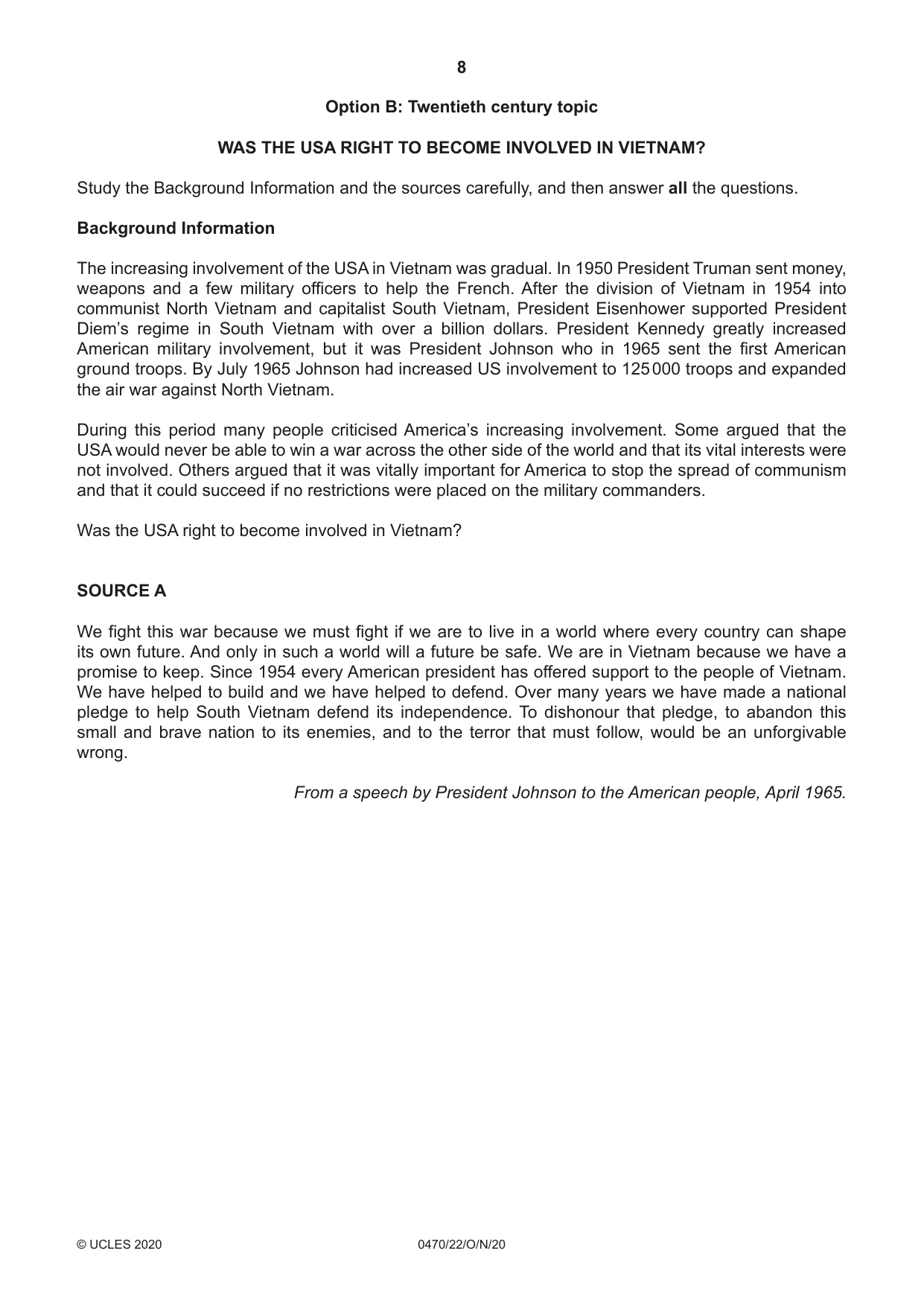
8 0470/22/O/N/20 © UCLES 2020 Option B: Twentieth century topic WAS THE USA RIGHT TO BECOME INVOLVED IN VIETNAM? Study the Background Information and the sources carefully, and then answer all the questions. Background Information The increasing involvement of the USA in Vietnam was gradual. In 1950 President Truman sent money, weapons and a few military officers to help the French. After the division of Vietnam in 1954 into communist North Vietnam and capitalist South Vietnam, President Eisenhower supported President Diem’s regime in South Vietnam with over a billion dollars. President Kennedy greatly increased American military involvement, but it was President Johnson who in 1965 sent the first American ground troops. By July 1965 Johnson had increased US involvement to 125 000 troops and expanded the air war against North Vietnam. During this period many people criticised America’s increasing involvement. Some argued that the USA would never be able to win a war across the other side of the world and that its vital interests were not involved. Others argued that it was vitally important for America to stop the spread of communism and that it could succeed if no restrictions were placed on the military commanders. Was the USA right to become involved in Vietnam? SOURCE A We fight this war because we must fight if we are to live in a world where every country can shape its own future. And only in such a world will a future be safe. We are in Vietnam because we have a promise to keep. Since 1954 every American president has offered support to the people of Vietnam. We have helped to build and we have helped to defend. Over many years we have made a national pledge to help South Vietnam defend its independence. To dishonour that pledge, to abandon this small and brave nation to its enemies, and to the terror that must follow, would be an unforgivable wrong. From a speech by President Johnson to the American people, April 1965.
Question paper, page 9
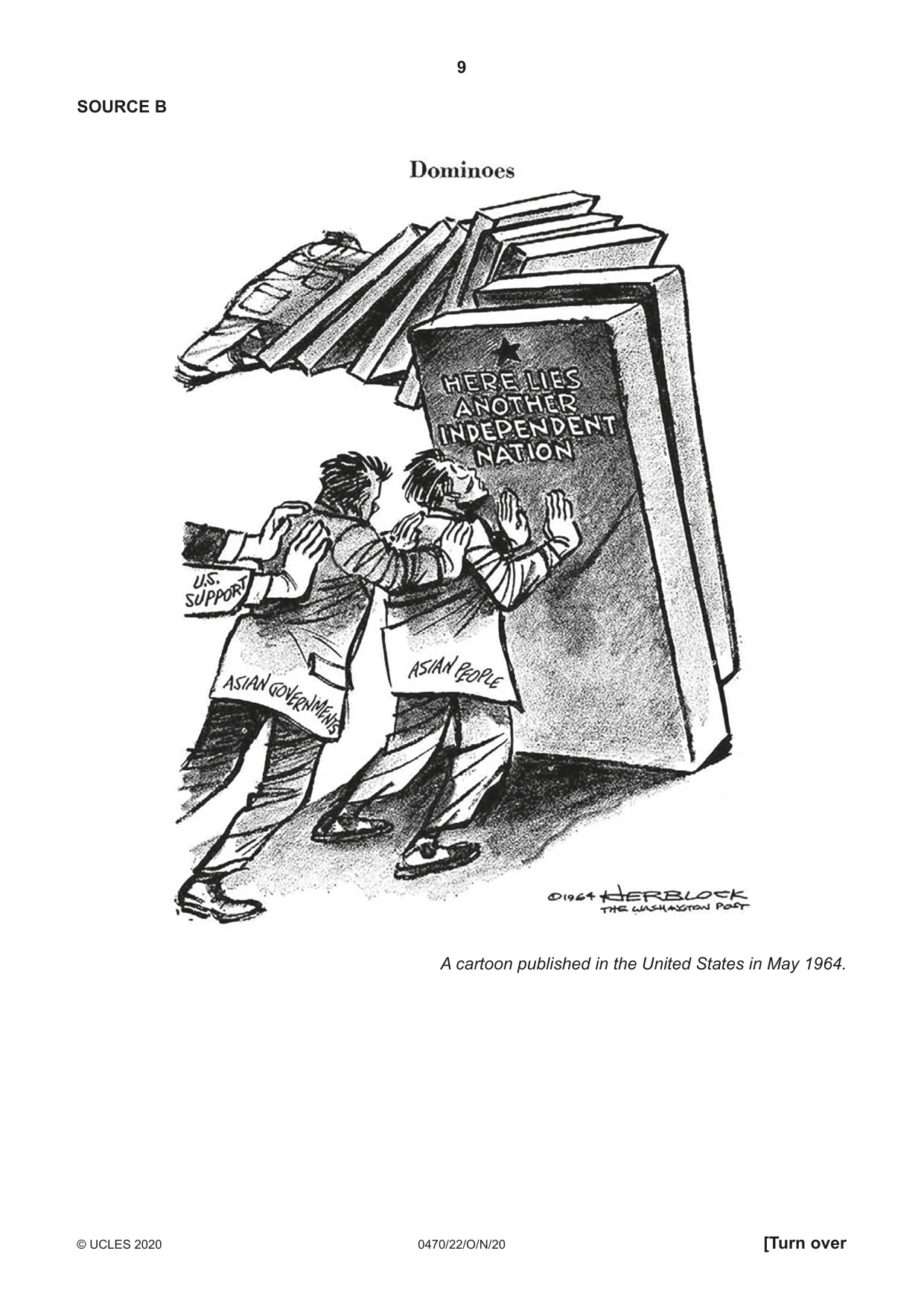
9 0470/22/O/N/20 © UCLES 2020 [Turn over SOURCE B A cartoon published in the United States in May 1964.
Question paper, page 10
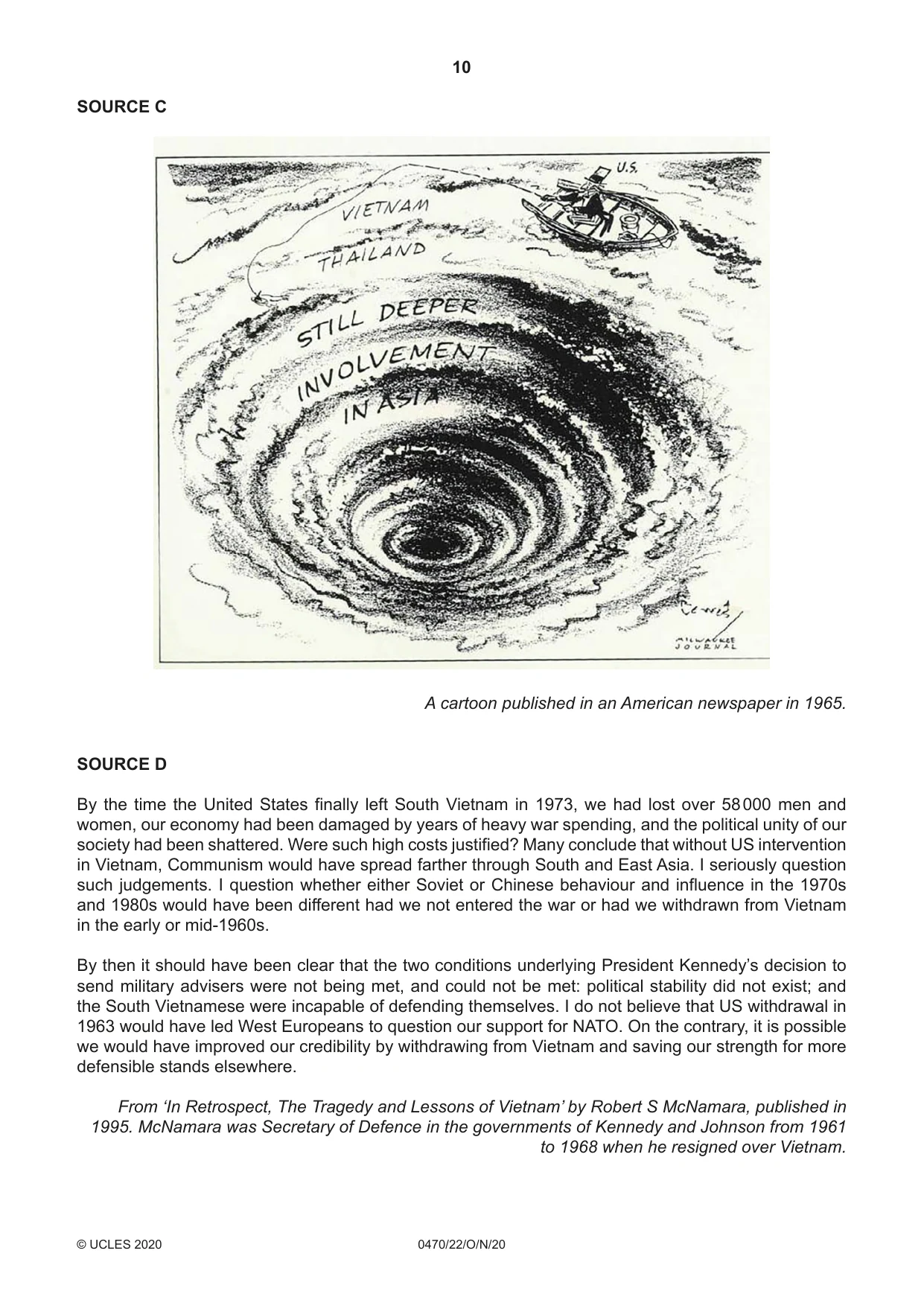
10 0470/22/O/N/20 © UCLES 2020 SOURCE C A cartoon published in an American newspaper in 1965. SOURCE D By the time the United States finally left South Vietnam in 1973, we had lost over 58 000 men and women, our economy had been damaged by years of heavy war spending, and the political unity of our society had been shattered. Were such high costs justified? Many conclude that without US intervention in Vietnam, Communism would have spread farther through South and East Asia. I seriously question such judgements. I question whether either Soviet or Chinese behaviour and influence in the 1970s and 1980s would have been different had we not entered the war or had we withdrawn from Vietnam in the early or mid-1960s. By then it should have been clear that the two conditions underlying President Kennedy’s decision to send military advisers were not being met, and could not be met: political stability did not exist; and the South Vietnamese were incapable of defending themselves. I do not believe that US withdrawal in 1963 would have led West Europeans to question our support for NATO. On the contrary, it is possible we would have improved our credibility by withdrawing from Vietnam and saving our strength for more defensible stands elsewhere. From ‘In Retrospect, The Tragedy and Lessons of Vietnam’ by Robert S McNamara, published in 1995. McNamara was Secretary of Defence in the governments of Kennedy and Johnson from 1961 to 1968 when he resigned over Vietnam.
Question paper, page 11
11 0470/22/O/N/20 © UCLES 2020 [Turn over SOURCE E A cartoon published in an American newspaper, May 1970. The soldier on the right is saying ‘You see, the reason we are in Vietnam is to protect us boys in Vietnam.’ Content removed due to copyright restrictions.
Question paper, page 12
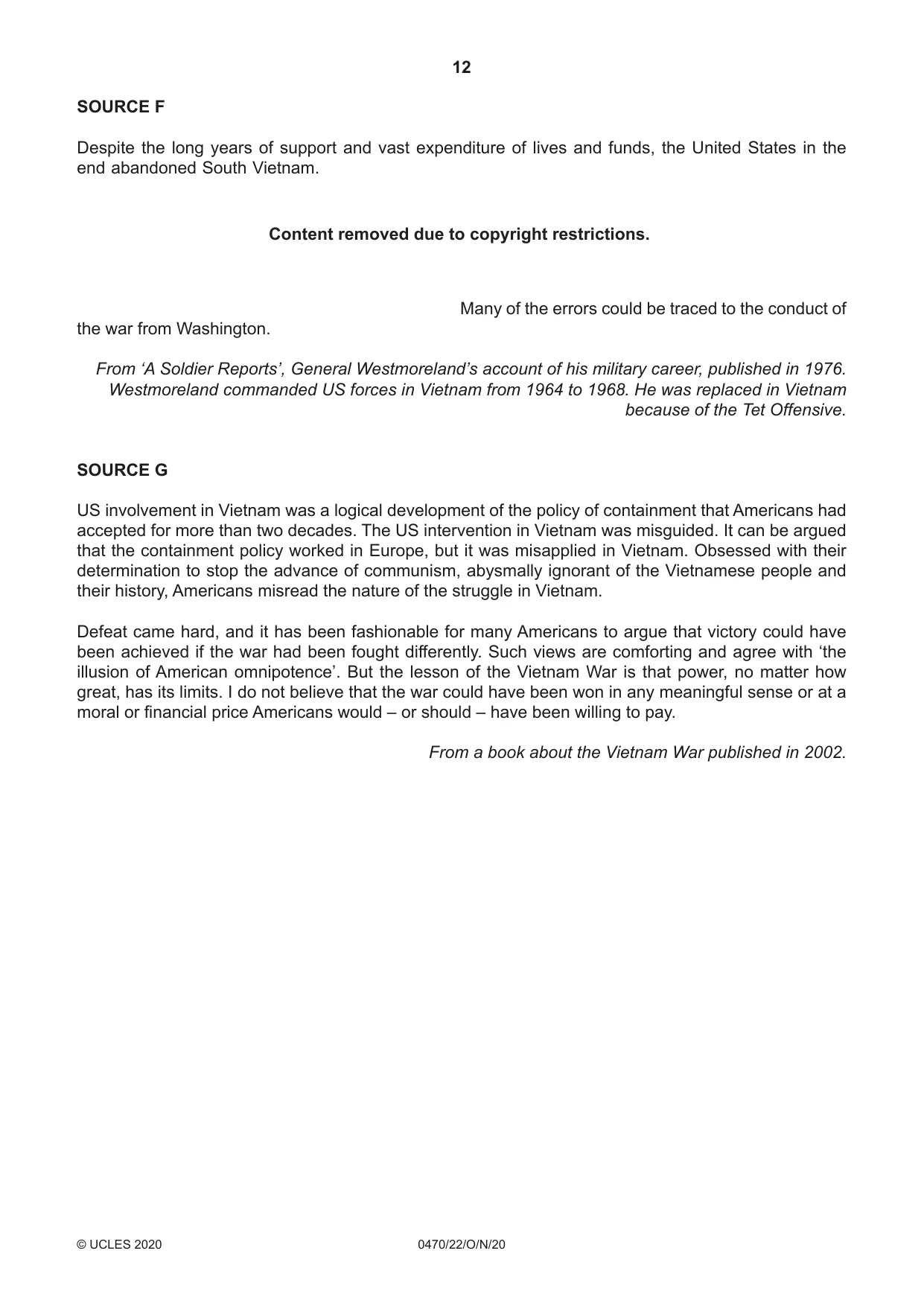
12 0470/22/O/N/20 © UCLES 2020 SOURCE F Despite the long years of support and vast expenditure of lives and funds, the United States in the end abandoned South Vietnam. Many of the errors could be traced to the conduct of the war from Washington. From ‘A Soldier Reports’, General Westmoreland’s account of his military career, published in 1976. Westmoreland commanded US forces in Vietnam from 1964 to 1968. He was replaced in Vietnam because of the Tet Offensive. SOURCE G US involvement in Vietnam was a logical development of the policy of containment that Americans had accepted for more than two decades. The US intervention in Vietnam was misguided. It can be argued that the containment policy worked in Europe, but it was misapplied in Vietnam. Obsessed with their determination to stop the advance of communism, abysmally ignorant of the Vietnamese people and their history, Americans misread the nature of the struggle in Vietnam. Defeat came hard, and it has been fashionable for many Americans to argue that victory could have been achieved if the war had been fought differently. Such views are comforting and agree with ‘the illusion of American omnipotence’. But the lesson of the Vietnam War is that power, no matter how great, has its limits. I do not believe that the war could have been won in any meaningful sense or at a moral or financial price Americans would – or should – have been willing to pay. From a book about the Vietnam War published in 2002. Content removed due to copyright restrictions.
Question paper, page 13
13 0470/22/O/N/20 © UCLES 2020 Now answer all the following questions. You may use any of the sources to help you answer the questions, in addition to those sources which you are told to use. In answering the questions you should use your knowledge of the topic to help you interpret and evaluate the sources. 1 Study Source A. How far are you surprised by Source A? Explain your answer using details of the source and your knowledge. [8] 2 Study Sources B and C. How far do these two cartoonists agree? Explain your answer using details of the sources and your knowledge. [7] 3 Study Source D. How useful is this source as evidence about American involvement in Vietnam? Explain your answer using details of the source and your knowledge. [7] 4 Study Source E. Why was this cartoon published in May 1970? Explain your answer using details of the source and your knowledge. [8] 5 Study Sources F and G. Does Source F prove Source G to be wrong? Explain your answer using details of the sources and your knowledge. [8] 6 Study all the sources. How far do these sources provide convincing evidence that the USA was right to get involved in Vietnam? Use the sources to explain your answer. [12]
Question paper, page 14
14 0470/22/O/N/20 © UCLES 2020 BLANK PAGE
Question paper, page 15
15 0470/22/O/N/20 © UCLES 2020 BLANK PAGE
Question paper, page 16
16 0470/22/O/N/20 © UCLES 2020 Permission to reproduce items where third-party owned material protected by copyright is included has been sought and cleared where possible. Every reasonable effort has been made by the publisher (UCLES) to trace copyright holders, but if any items requiring clearance have unwittingly been included, the publisher will be pleased to make amends at the earliest possible opportunity. To avoid the issue of disclosure of answer-related information to candidates, all copyright acknowledgements are reproduced online in the Cambridge Assessment International Education Copyright Acknowledgements Booklet. This is produced for each series of examinations and is freely available to download at www.cambridgeinternational.org after the live examination series. Cambridge Assessment International Education is part of the Cambridge Assessment Group. Cambridge Assessment is the brand name of the University of Cambridge Local Examinations Syndicate (UCLES), which itself is a department of the University of Cambridge. BLANK PAGE
Mark scheme, page 1
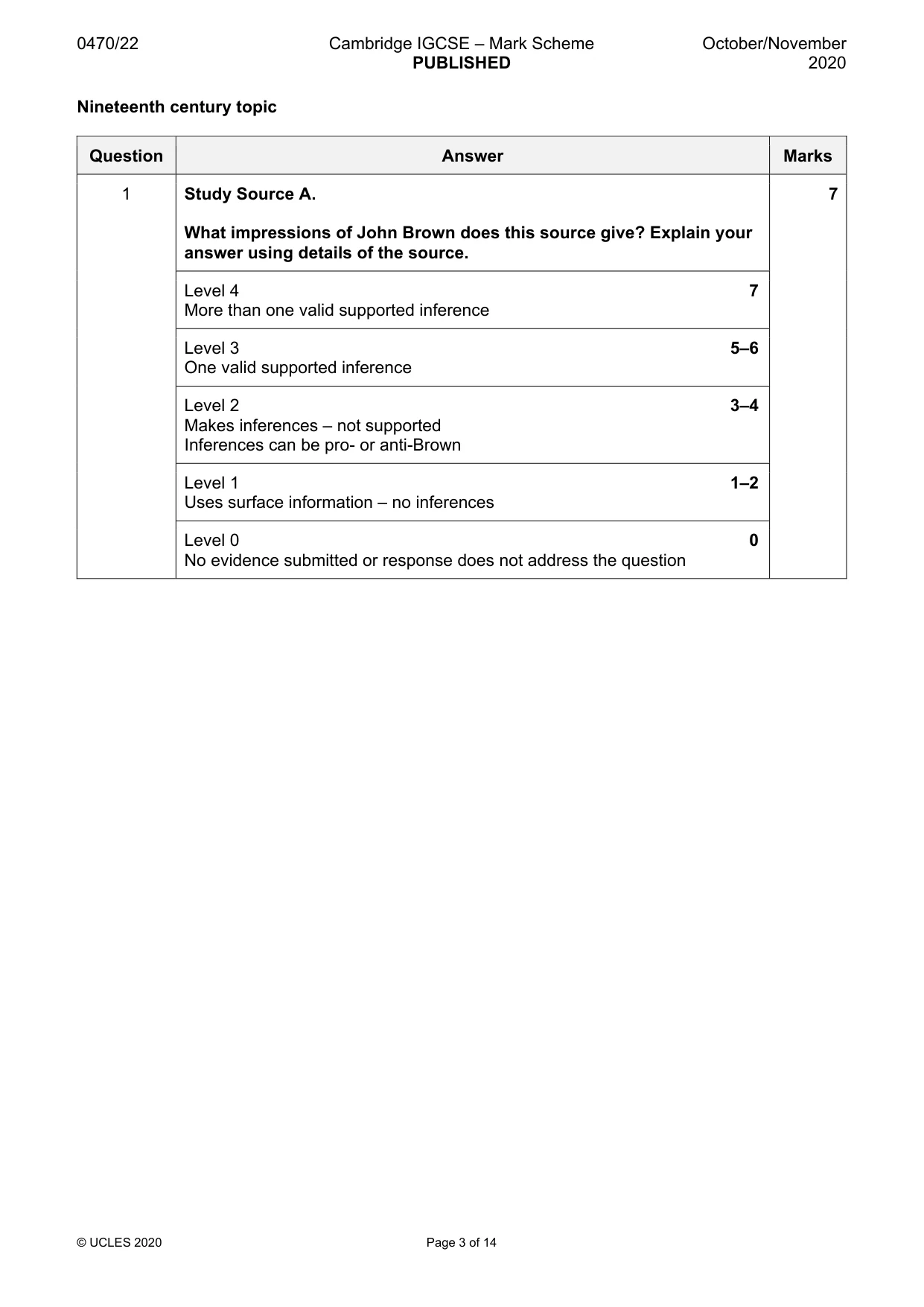
This document consists of 14 printed pages. © UCLES 2020 [Turn over Cambridge IGCSE™ HISTORY 0470/22 Paper 2 October/November 2020 MARK SCHEME Maximum Mark: 50 Published This mark scheme is published as an aid to teachers and candidates, to indicate the requirements of the examination. It shows the basis on which Examiners were instructed to award marks. It does not indicate the details of the discussions that took place at an Examiners’ meeting before marking began, which would have considered the acceptability of alternative answers. Mark schemes should be read in conjunction with the question paper and the Principal Examiner Report for Teachers. Cambridge International will not enter into discussions about these mark schemes. Cambridge International is publishing the mark schemes for the October/November 2020 series for most Cambridge IGCSE™, Cambridge International A and AS Level and Cambridge Pre-U components, and some Cambridge O Level components.
Mark scheme, page 2
0470/22 Cambridge IGCSE – Mark Scheme PUBLISHED October/November 2020 © UCLES 2020 Page 2 of 14 Generic Marking Principles These general marking principles must be applied by all examiners when marking candidate answers. They should be applied alongside the specific content of the mark scheme or generic level descriptors for a question. Each question paper and mark scheme will also comply with these marking principles. GENERIC MARKING PRINCIPLE 1: Marks must be awarded in line with: • the specific content of the mark scheme or the generic level descriptors for the question • the specific skills defined in the mark scheme or in the generic level descriptors for the question • the standard of response required by a candidate as exemplified by the standardisation scripts. GENERIC MARKING PRINCIPLE 2: Marks awarded are always whole marks (not half marks, or other fractions). GENERIC MARKING PRINCIPLE 3: Marks must be awarded positively: • marks are awarded for correct/valid answers, as defined in the mark scheme. However, credit is given for valid answers which go beyond the scope of the syllabus and mark scheme, referring to your Team Leader as appropriate • marks are awarded when candidates clearly demonstrate what they know and can do • marks are not deducted for errors • marks are not deducted for omissions • answers should only be judged on the quality of spelling, punctuation and grammar when these features are specifically assessed by the question as indicated by the mark scheme. The meaning, however, should be unambiguous. GENERIC MARKING PRINCIPLE 4: Rules must be applied consistently, e.g. in situations where candidates have not followed instructions or in the application of generic level descriptors. GENERIC MARKING PRINCIPLE 5: Marks should be awarded using the full range of marks defined in the mark scheme for the question (however; the use of the full mark range may be limited according to the quality of the candidate responses seen). GENERIC MARKING PRINCIPLE 6: Marks awarded are based solely on the requirements as defined in the mark scheme. Marks should not be awarded with grade thresholds or grade descriptors in mind.
Mark scheme, page 3
0470/22 Cambridge IGCSE – Mark Scheme PUBLISHED October/November 2020 © UCLES 2020 Page 3 of 14 Nineteenth century topic Question Answer Marks 1 Study Source A. What impressions of John Brown does this source give? Explain your answer using details of the source. 7 Level 4 7 More than one valid supported inference Level 3 5–6 One valid supported inference Level 2 3–4 Makes inferences – not supported Inferences can be pro- or anti-Brown Level 1 1–2 Uses surface information – no inferences Level 0 0 No evidence submitted or response does not address the question
Mark scheme, page 4
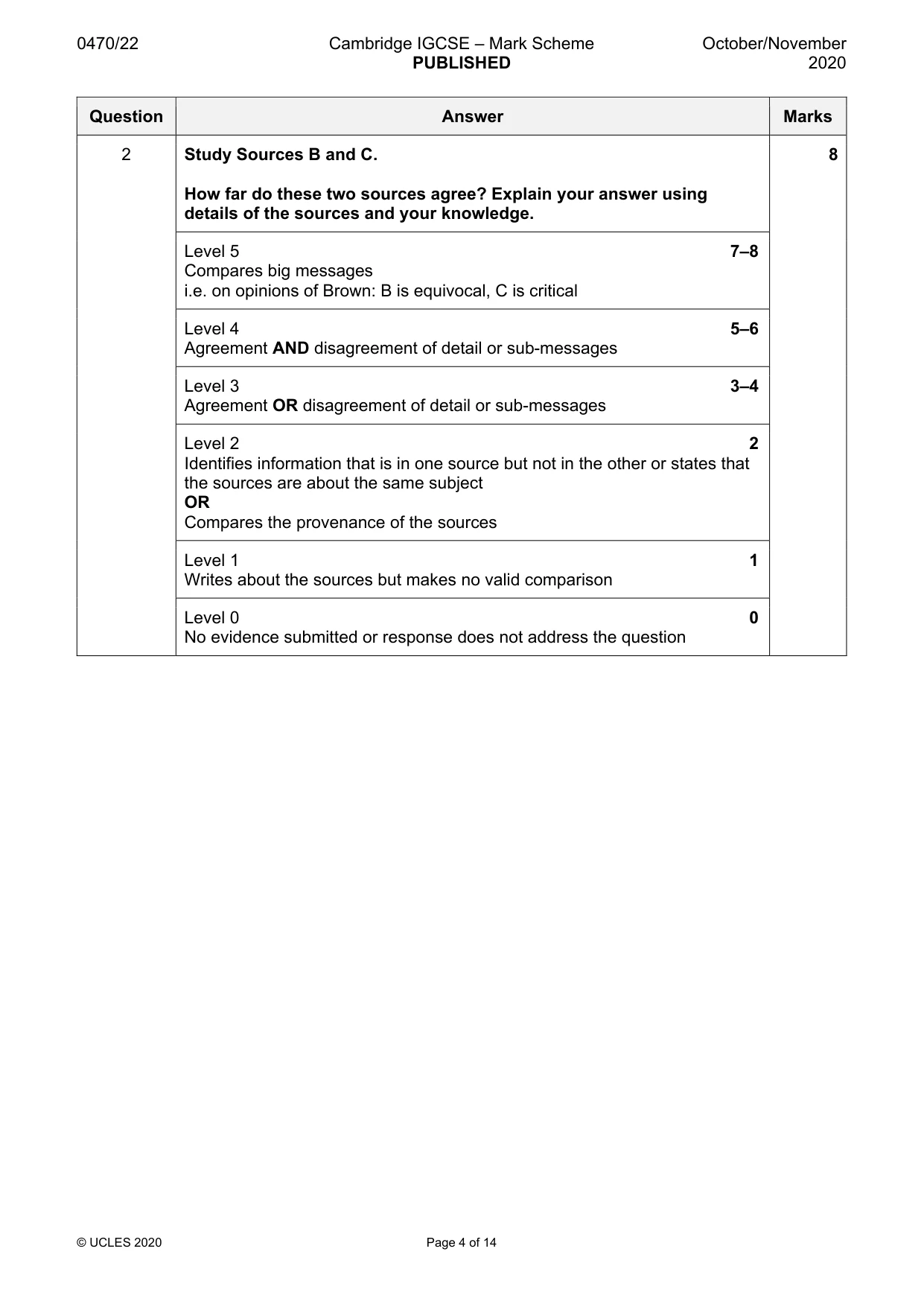
0470/22 Cambridge IGCSE – Mark Scheme PUBLISHED October/November 2020 © UCLES 2020 Page 4 of 14 Question Answer Marks 2 Study Sources B and C. How far do these two sources agree? Explain your answer using details of the sources and your knowledge. 8 Level 5 7–8 Compares big messages i.e. on opinions of Brown: B is equivocal, C is critical Level 4 5–6 Agreement AND disagreement of detail or sub-messages Level 3 3–4 Agreement OR disagreement of detail or sub-messages Level 2 2 Identifies information that is in one source but not in the other or states that the sources are about the same subject OR Compares the provenance of the sources Level 1 1 Writes about the sources but makes no valid comparison Level 0 0 No evidence submitted or response does not address the question
Mark scheme, page 5
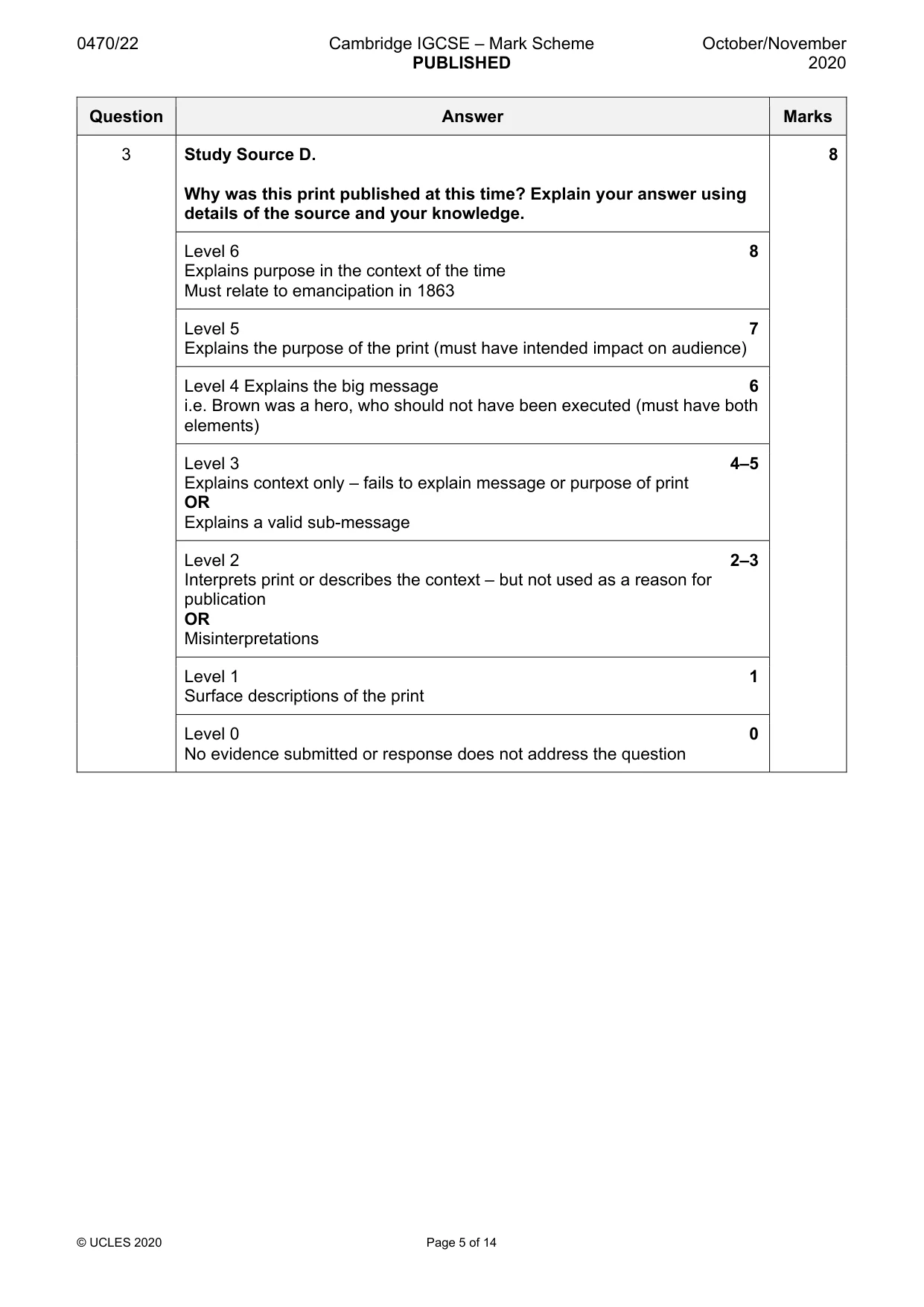
0470/22 Cambridge IGCSE – Mark Scheme PUBLISHED October/November 2020 © UCLES 2020 Page 5 of 14 Question Answer Marks 3 Study Source D. Why was this print published at this time? Explain your answer using details of the source and your knowledge. 8 Level 6 8 Explains purpose in the context of the time Must relate to emancipation in 1863 Level 5 7 Explains the purpose of the print (must have intended impact on audience) Level 4 Explains the big message 6 i.e. Brown was a hero, who should not have been executed (must have both elements) Level 3 4–5 Explains context only – fails to explain message or purpose of print OR Explains a valid sub-message Level 2 2–3 Interprets print or describes the context – but not used as a reason for publication OR Misinterpretations Level 1 1 Surface descriptions of the print Level 0 0 No evidence submitted or response does not address the question
Mark scheme, page 6
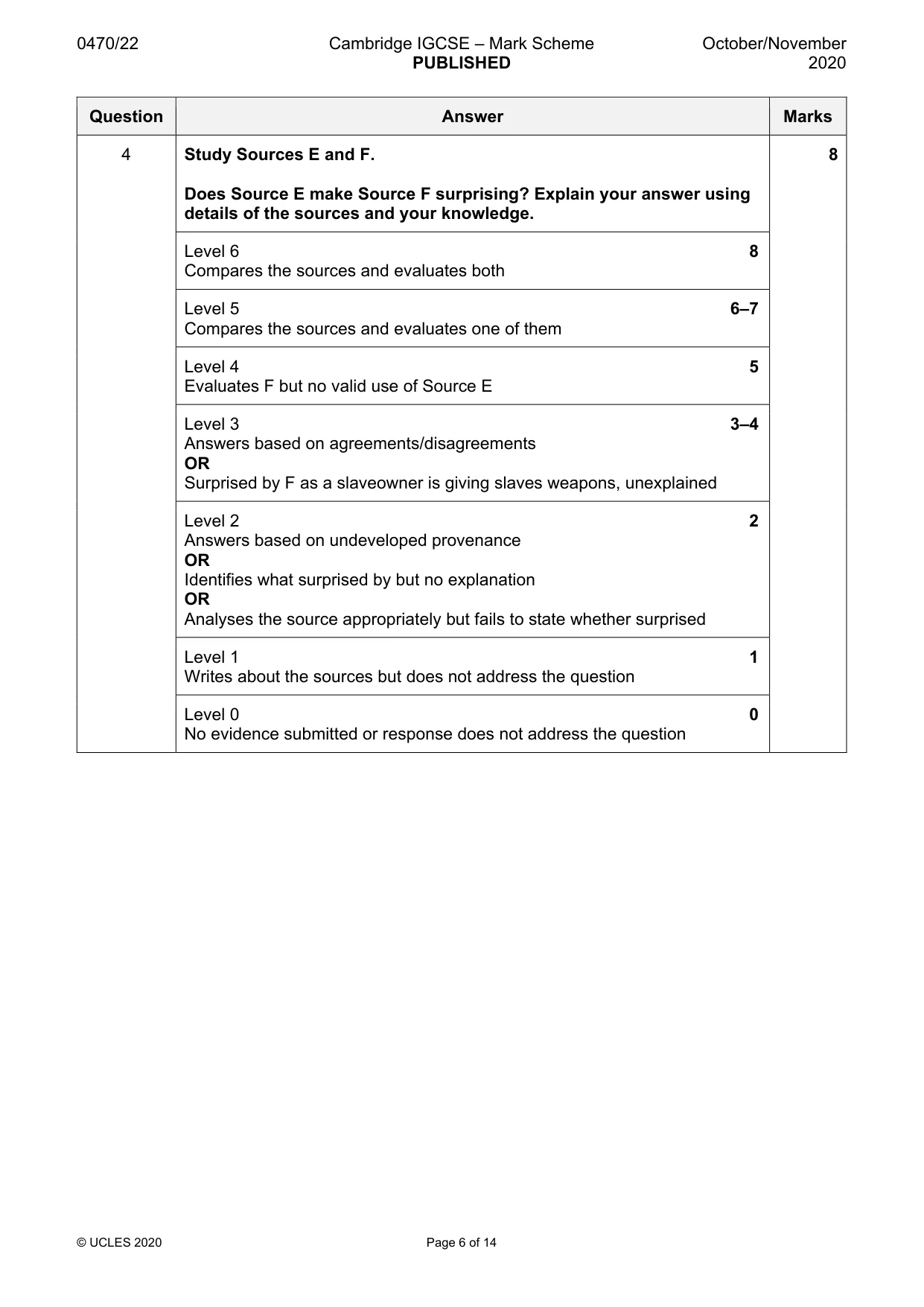
0470/22 Cambridge IGCSE – Mark Scheme PUBLISHED October/November 2020 © UCLES 2020 Page 6 of 14 Question Answer Marks 4 Study Sources E and F. Does Source E make Source F surprising? Explain your answer using details of the sources and your knowledge. 8 Level 6 8 Compares the sources and evaluates both Level 5 6–7 Compares the sources and evaluates one of them Level 4 5 Evaluates F but no valid use of Source E Level 3 3–4 Answers based on agreements/disagreements OR Surprised by F as a slaveowner is giving slaves weapons, unexplained Level 2 2 Answers based on undeveloped provenance OR Identifies what surprised by but no explanation OR Analyses the source appropriately but fails to state whether surprised Level 1 1 Writes about the sources but does not address the question Level 0 0 No evidence submitted or response does not address the question
Mark scheme, page 7
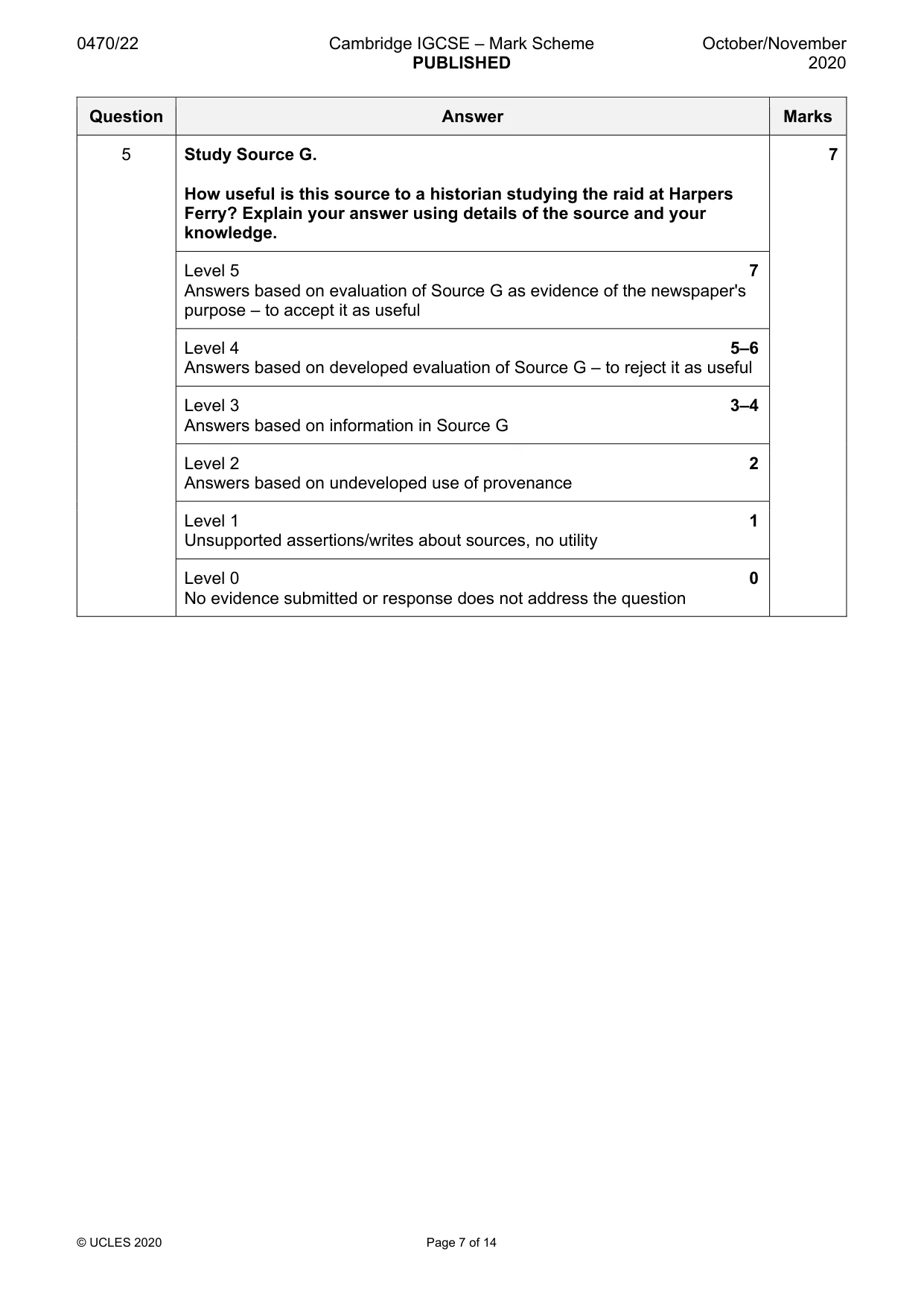
0470/22 Cambridge IGCSE – Mark Scheme PUBLISHED October/November 2020 © UCLES 2020 Page 7 of 14 Question Answer Marks 5 Study Source G. How useful is this source to a historian studying the raid at Harpers Ferry? Explain your answer using details of the source and your knowledge. 7 Level 5 7 Answers based on evaluation of Source G as evidence of the newspaper's purpose – to accept it as useful Level 4 5–6 Answers based on developed evaluation of Source G – to reject it as useful Level 3 3–4 Answers based on information in Source G Level 2 2 Answers based on undeveloped use of provenance Level 1 1 Unsupported assertions/writes about sources, no utility Level 0 0 No evidence submitted or response does not address the question
Mark scheme, page 8
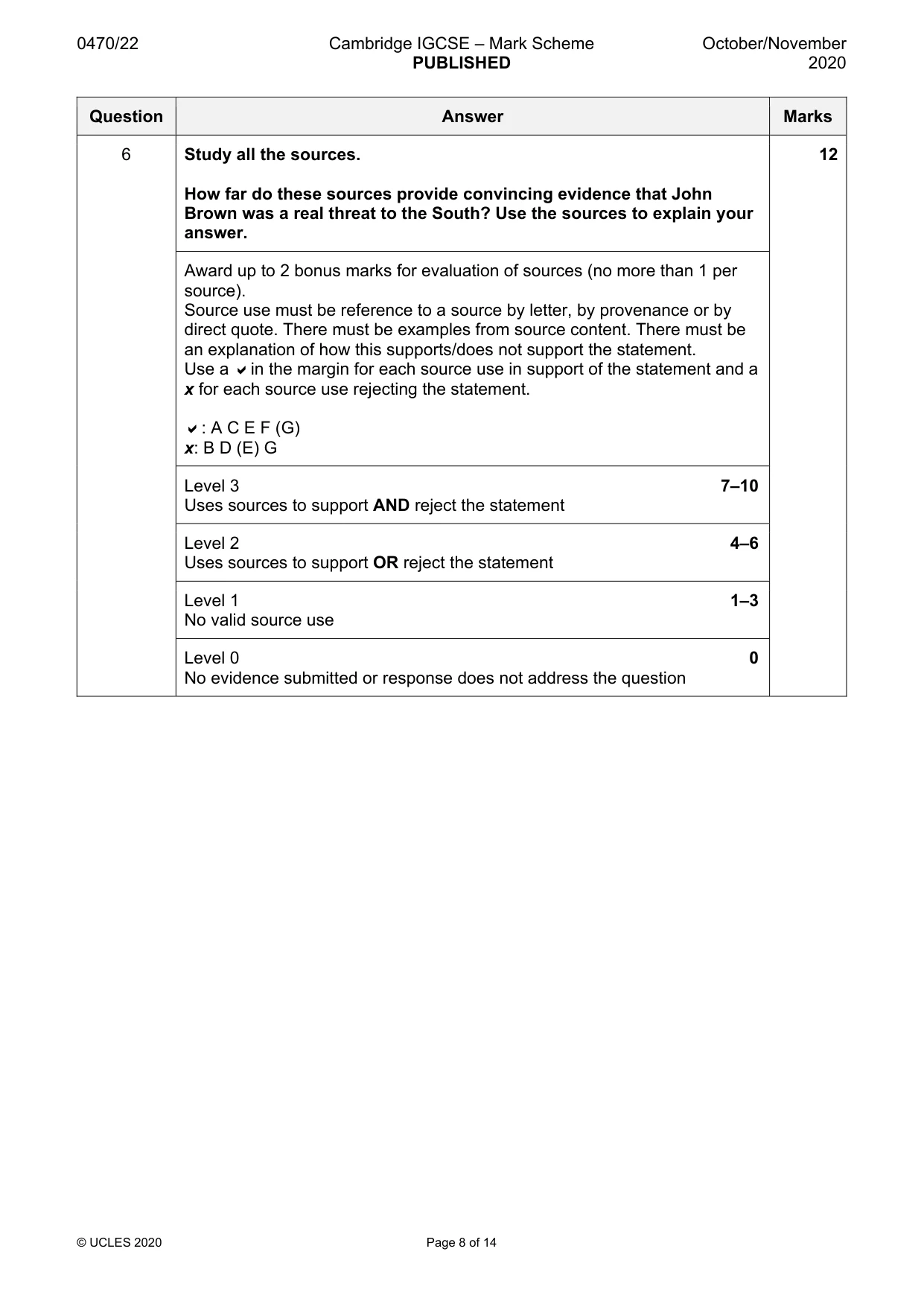
0470/22 Cambridge IGCSE – Mark Scheme PUBLISHED October/November 2020 © UCLES 2020 Page 8 of 14 Question Answer Marks 6 Study all the sources. How far do these sources provide convincing evidence that John Brown was a real threat to the South? Use the sources to explain your answer. 12 Award up to 2 bonus marks for evaluation of sources (no more than 1 per source). Source use must be reference to a source by letter, by provenance or by direct quote. There must be examples from source content. There must be an explanation of how this supports/does not support the statement. Use a in the margin for each source use in support of the statement and a x for each source use rejecting the statement. : A C E F (G) x: B D (E) G Level 3 7–10 Uses sources to support AND reject the statement Level 2 4–6 Uses sources to support OR reject the statement Level 1 1–3 No valid source use Level 0 0 No evidence submitted or response does not address the question
Mark scheme, page 9
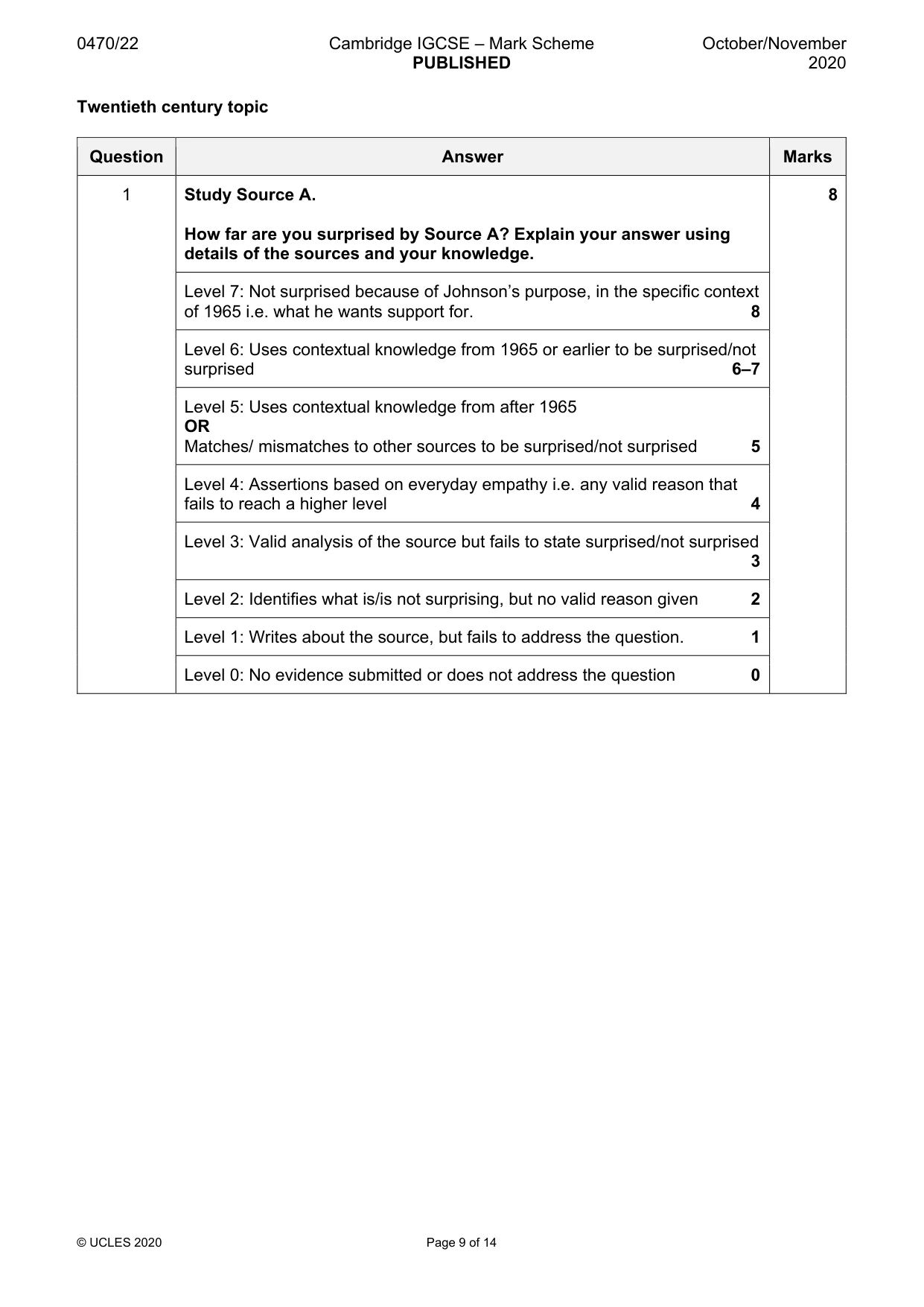
0470/22 Cambridge IGCSE – Mark Scheme PUBLISHED October/November 2020 © UCLES 2020 Page 9 of 14 Twentieth century topic Question Answer Marks 1 Study Source A. How far are you surprised by Source A? Explain your answer using details of the sources and your knowledge. 8 Level 7: Not surprised because of Johnson’s purpose, in the specific context of 1965 i.e. what he wants support for. 8 Level 6: Uses contextual knowledge from 1965 or earlier to be surprised/not surprised 6–7 Level 5: Uses contextual knowledge from after 1965 OR Matches/ mismatches to other sources to be surprised/not surprised 5 Level 4: Assertions based on everyday empathy i.e. any valid reason that fails to reach a higher level 4 Level 3: Valid analysis of the source but fails to state surprised/not surprised 3 Level 2: Identifies what is/is not surprising, but no valid reason given 2 Level 1: Writes about the source, but fails to address the question. 1 Level 0: No evidence submitted or does not address the question 0
Mark scheme, page 10
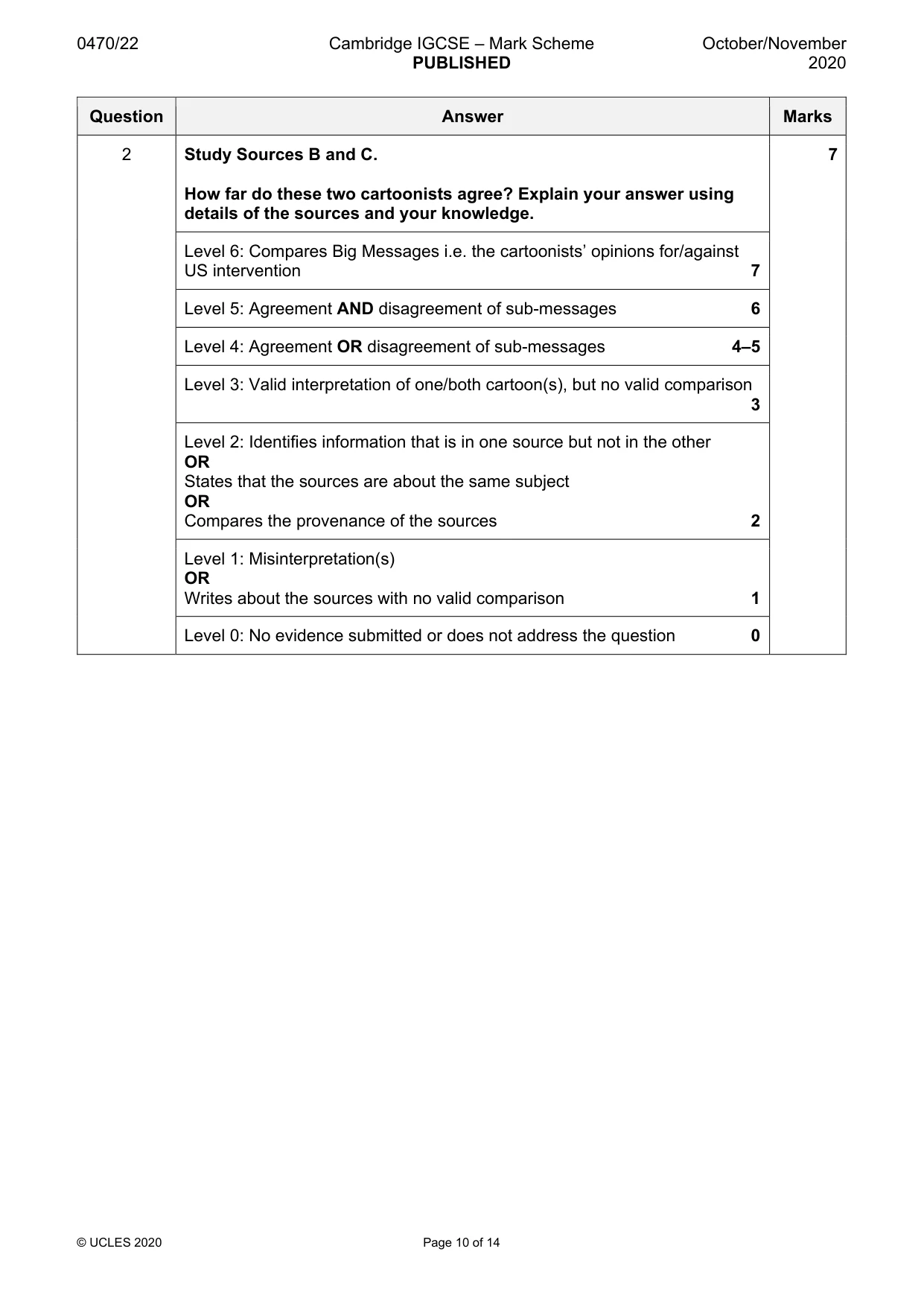
0470/22 Cambridge IGCSE – Mark Scheme PUBLISHED October/November 2020 © UCLES 2020 Page 10 of 14 Question Answer Marks 2 Study Sources B and C. How far do these two cartoonists agree? Explain your answer using details of the sources and your knowledge. 7 Level 6: Compares Big Messages i.e. the cartoonists’ opinions for/against US intervention 7 Level 5: Agreement AND disagreement of sub-messages 6 Level 4: Agreement OR disagreement of sub-messages 4–5 Level 3: Valid interpretation of one/both cartoon(s), but no valid comparison 3 Level 2: Identifies information that is in one source but not in the other OR States that the sources are about the same subject OR Compares the provenance of the sources 2 Level 1: Misinterpretation(s) OR Writes about the sources with no valid comparison 1 Level 0: No evidence submitted or does not address the question 0
Mark scheme, page 11
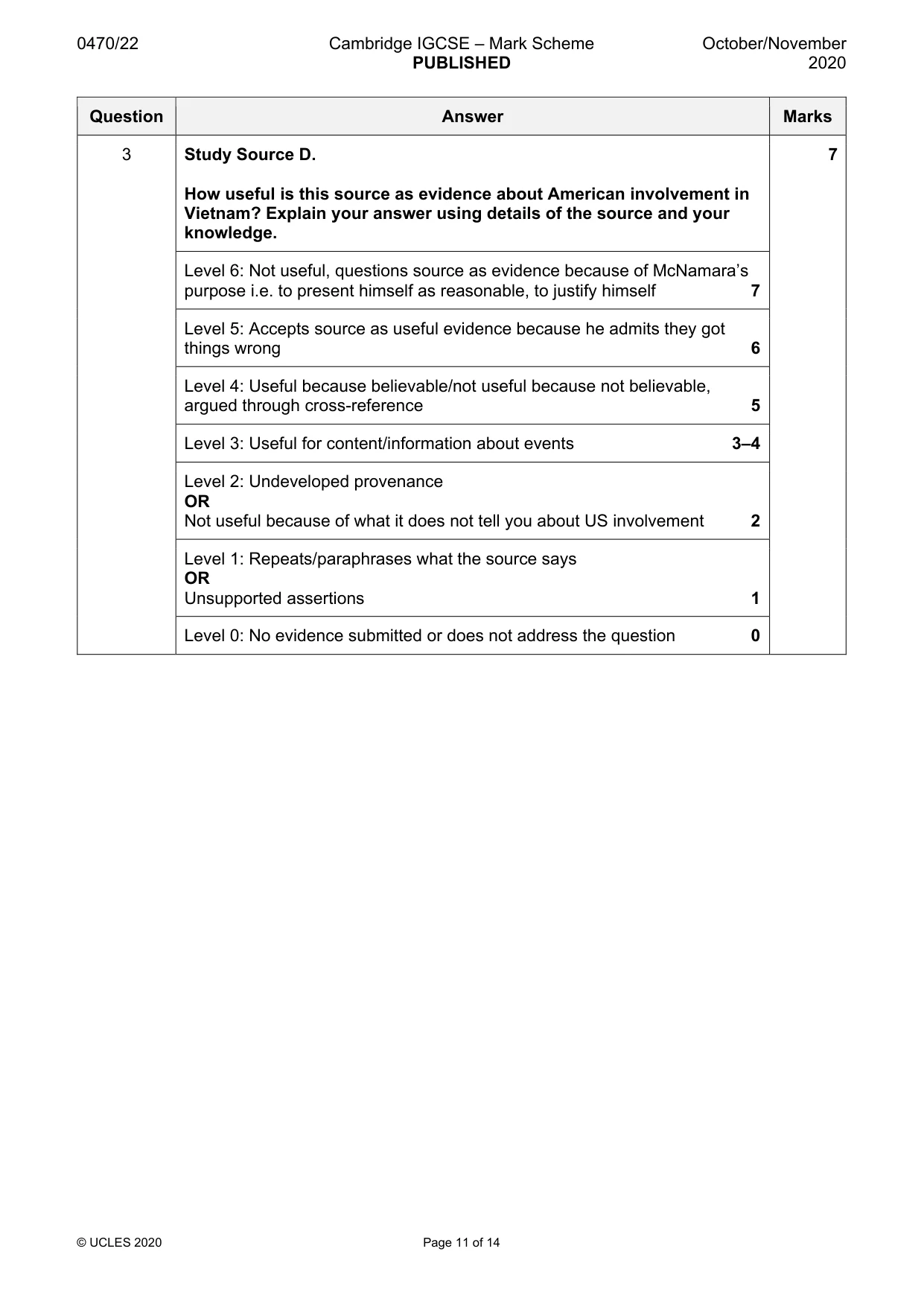
0470/22 Cambridge IGCSE – Mark Scheme PUBLISHED October/November 2020 © UCLES 2020 Page 11 of 14 Question Answer Marks 3 Study Source D. How useful is this source as evidence about American involvement in Vietnam? Explain your answer using details of the source and your knowledge. 7 Level 6: Not useful, questions source as evidence because of McNamara’s purpose i.e. to present himself as reasonable, to justify himself 7 Level 5: Accepts source as useful evidence because he admits they got things wrong 6 Level 4: Useful because believable/not useful because not believable, argued through cross-reference 5 Level 3: Useful for content/information about events 3–4 Level 2: Undeveloped provenance OR Not useful because of what it does not tell you about US involvement 2 Level 1: Repeats/paraphrases what the source says OR Unsupported assertions 1 Level 0: No evidence submitted or does not address the question 0
Mark scheme, page 12
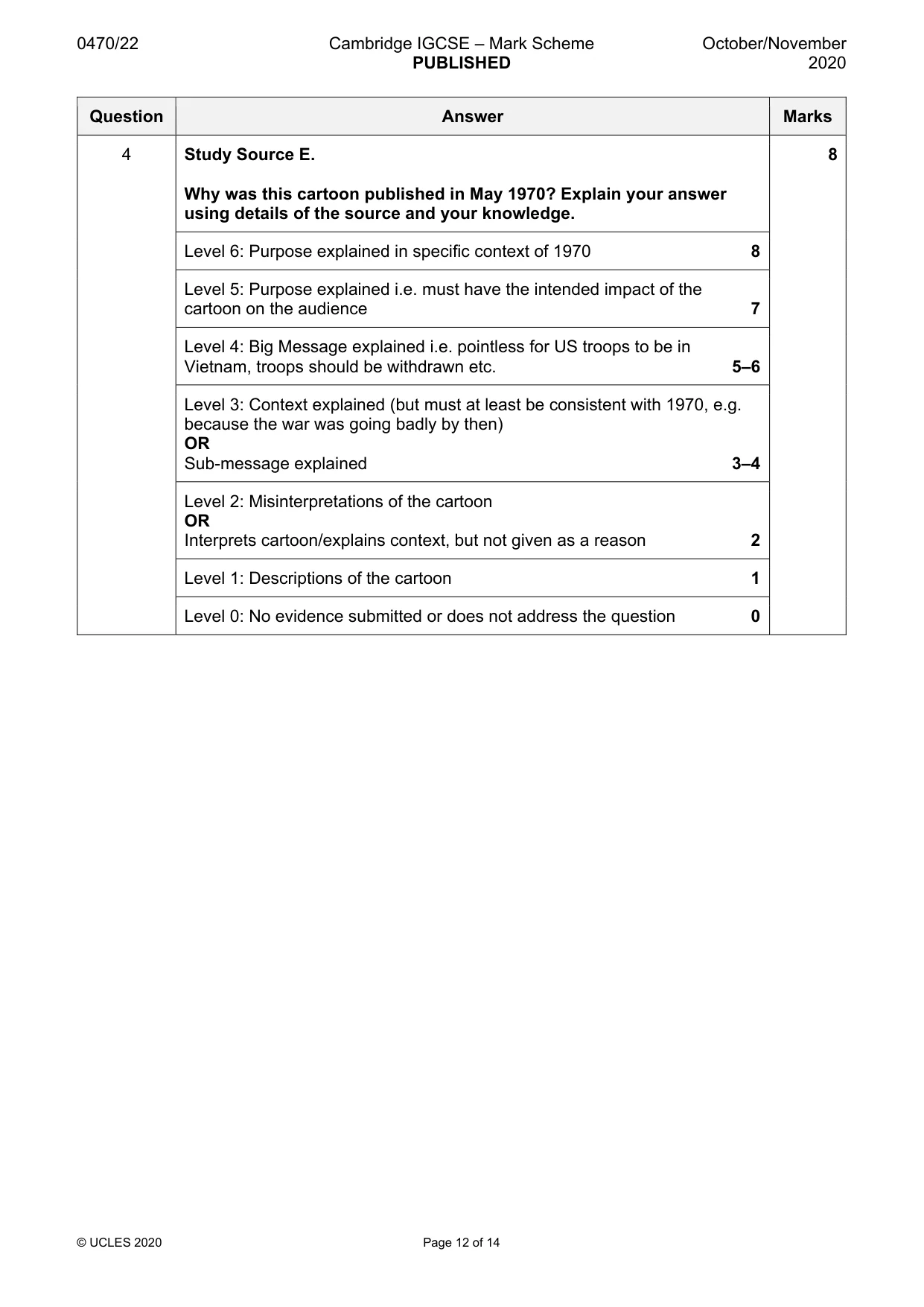
0470/22 Cambridge IGCSE – Mark Scheme PUBLISHED October/November 2020 © UCLES 2020 Page 12 of 14 Question Answer Marks 4 Study Source E. Why was this cartoon published in May 1970? Explain your answer using details of the source and your knowledge. 8 Level 6: Purpose explained in specific context of 1970 8 Level 5: Purpose explained i.e. must have the intended impact of the cartoon on the audience 7 Level 4: Big Message explained i.e. pointless for US troops to be in Vietnam, troops should be withdrawn etc. 5–6 Level 3: Context explained (but must at least be consistent with 1970, e.g. because the war was going badly by then) OR Sub-message explained 3–4 Level 2: Misinterpretations of the cartoon OR Interprets cartoon/explains context, but not given as a reason 2 Level 1: Descriptions of the cartoon 1 Level 0: No evidence submitted or does not address the question 0
Mark scheme, page 13
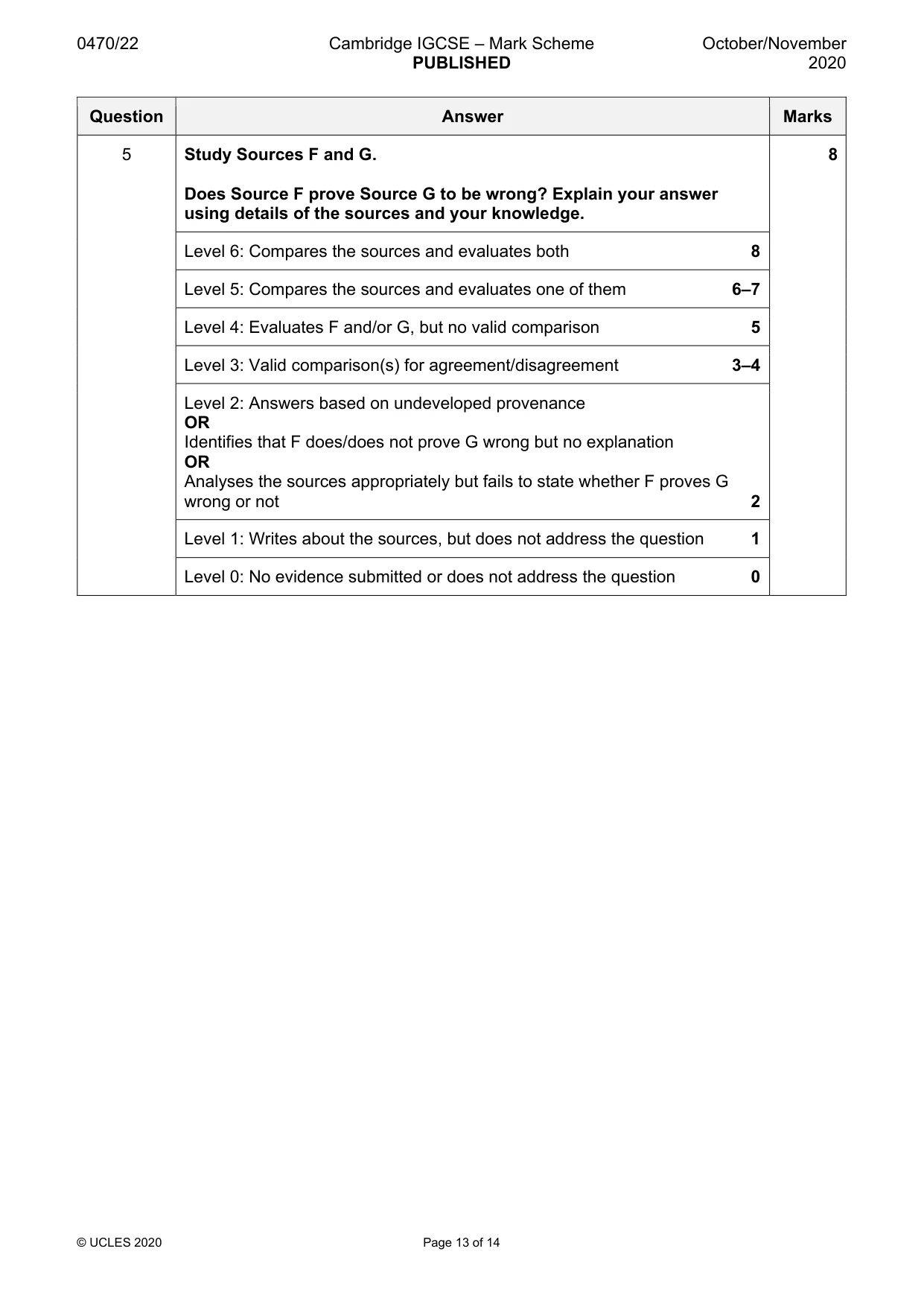
0470/22 Cambridge IGCSE – Mark Scheme PUBLISHED October/November 2020 © UCLES 2020 Page 13 of 14 Question Answer Marks 5 Study Sources F and G. Does Source F prove Source G to be wrong? Explain your answer using details of the sources and your knowledge. 8 Level 6: Compares the sources and evaluates both 8 Level 5: Compares the sources and evaluates one of them 6–7 Level 4: Evaluates F and/or G, but no valid comparison 5 Level 3: Valid comparison(s) for agreement/disagreement 3–4 Level 2: Answers based on undeveloped provenance OR Identifies that F does/does not prove G wrong but no explanation OR Analyses the sources appropriately but fails to state whether F proves G wrong or not 2 Level 1: Writes about the sources, but does not address the question 1 Level 0: No evidence submitted or does not address the question 0
Mark scheme, page 14
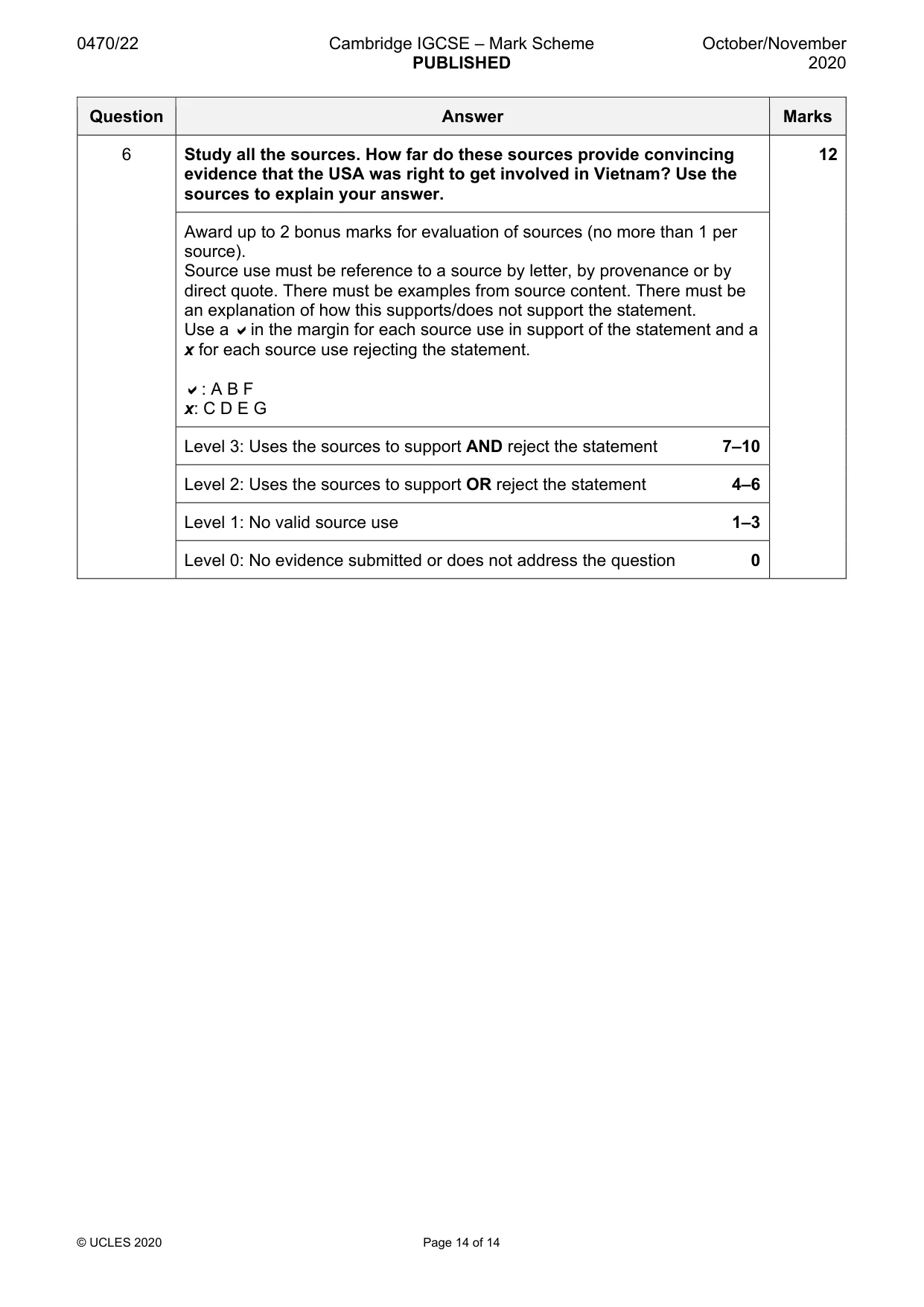
0470/22 Cambridge IGCSE – Mark Scheme PUBLISHED October/November 2020 © UCLES 2020 Page 14 of 14 Question Answer Marks 6 Study all the sources. How far do these sources provide convincing evidence that the USA was right to get involved in Vietnam? Use the sources to explain your answer. 12 Award up to 2 bonus marks for evaluation of sources (no more than 1 per source). Source use must be reference to a source by letter, by provenance or by direct quote. There must be examples from source content. There must be an explanation of how this supports/does not support the statement. Use a in the margin for each source use in support of the statement and a x for each source use rejecting the statement. : A B F x: C D E G Level 3: Uses the sources to support AND reject the statement 7–10 Level 2: Uses the sources to support OR reject the statement 4–6 Level 1: No valid source use 1–3 Level 0: No evidence submitted or does not address the question 0
What you needed in this session
Cambridge’s own grade thresholds for 2020 Oct/Nov, Paper 2 · Variant 2. A higher threshold means an easier paper — the bar moves with how the cohort did.