Cambridge IGCSE History 0470 — 2020 May/June Paper 4 · Variant 3
0470/43/M/J/20
The question paper and its mark scheme, free to read here and free to download. This is Cambridge’s own paper, exactly as it was sat.
Question paper4 pages

Mark scheme19 pages
Answers below. Sit the paper first if you are practising.
Paper as text
Question paper, page 1
Cambridge IGCSE™ 0470/43 May/June 2020 1 hour HISTORY Paper 4 Alternative to Coursework You must answer on the enclosed answer booklet. You will need: Answer booklet (enclosed) INSTRUCTIONS • Answer one question from your chosen Depth Study. • Follow the instructions on the front cover of the answer booklet. If you need additional answer paper, ask the invigilator for a continuation booklet. INFORMATION • The total mark for this paper is 40. • The number of marks for each question or part question is shown in brackets [ ]. This document has 4 pages. Blank pages are indicated. [Turn over 06_0470_43_2020_1.8 © UCLES 2020 *8945147217*
Question paper, page 2
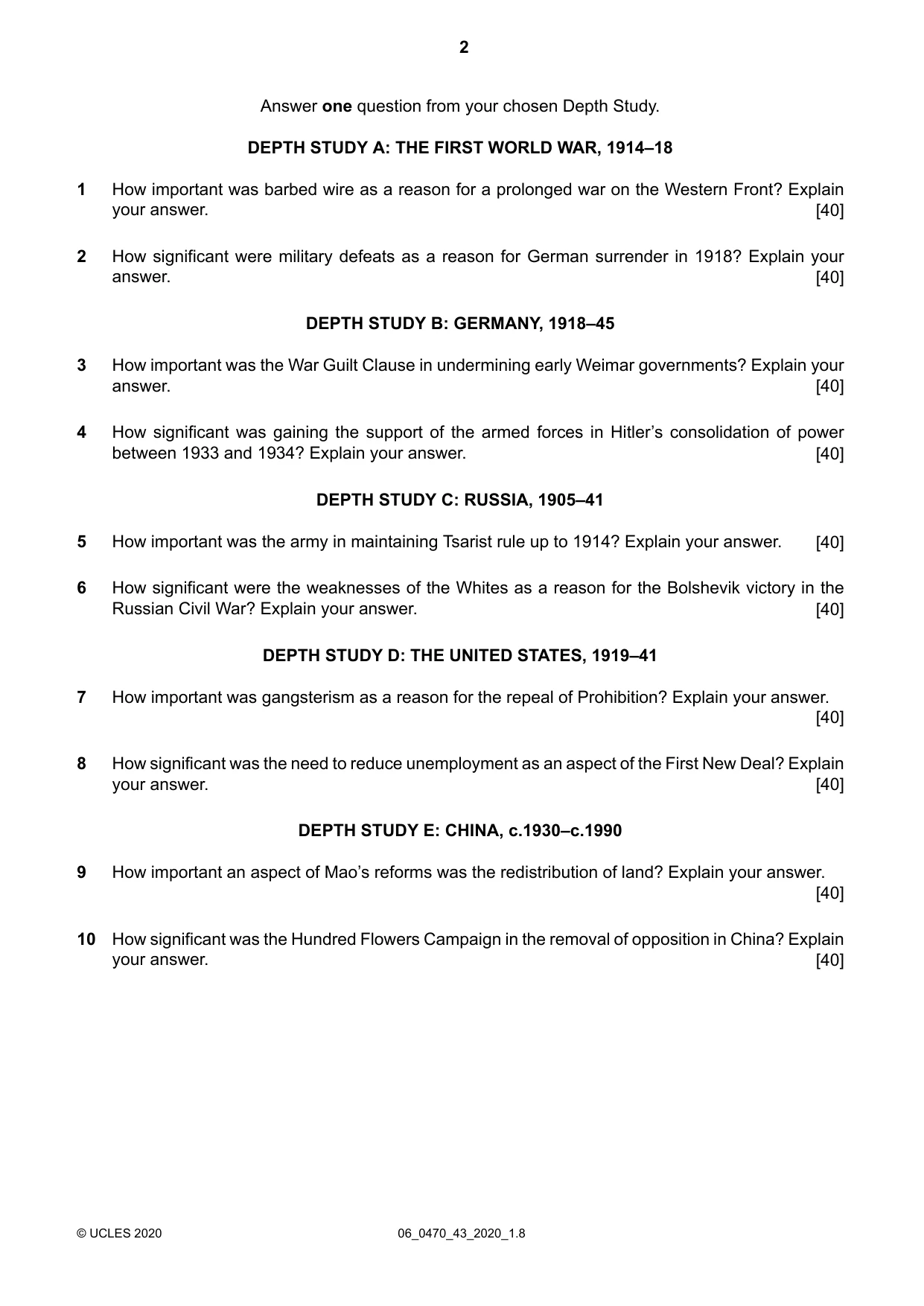
Answer one question from your chosen Depth Study. DEPTH STUDY A: THE FIRST WORLD WAR, 1914–18 How important was barbed wire as a reason for a prolonged war on the Western Front? Explain your answer. [40] 1 How significant were military defeats as a reason for German surrender in 1918? Explain your answer. [40] 2 DEPTH STUDY B: GERMANY, 1918–45 How important was the War Guilt Clause in undermining early Weimar governments? Explain your answer. [40] 3 How significant was gaining the support of the armed forces in Hitler’s consolidation of power between 1933 and 1934? Explain your answer. [40] 4 DEPTH STUDY C: RUSSIA, 1905–41 How important was the army in maintaining Tsarist rule up to 1914? Explain your answer. [40] 5 How significant were the weaknesses of the Whites as a reason for the Bolshevik victory in the Russian Civil War? Explain your answer. [40] 6 DEPTH STUDY D: THE UNITED STATES, 1919–41 How important was gangsterism as a reason for the repeal of Prohibition? Explain your answer. [40] 7 How significant was the need to reduce unemployment as an aspect of the First New Deal? Explain your answer. [40] 8 DEPTH STUDY E: CHINA, c.1930–c.1990 How important an aspect of Mao’s reforms was the redistribution of land? Explain your answer. [40] 9 How significant was the Hundred Flowers Campaign in the removal of opposition in China? Explain your answer. [40] 10 06_0470_43_2020_1.8 © UCLES 2020 2
Question paper, page 3
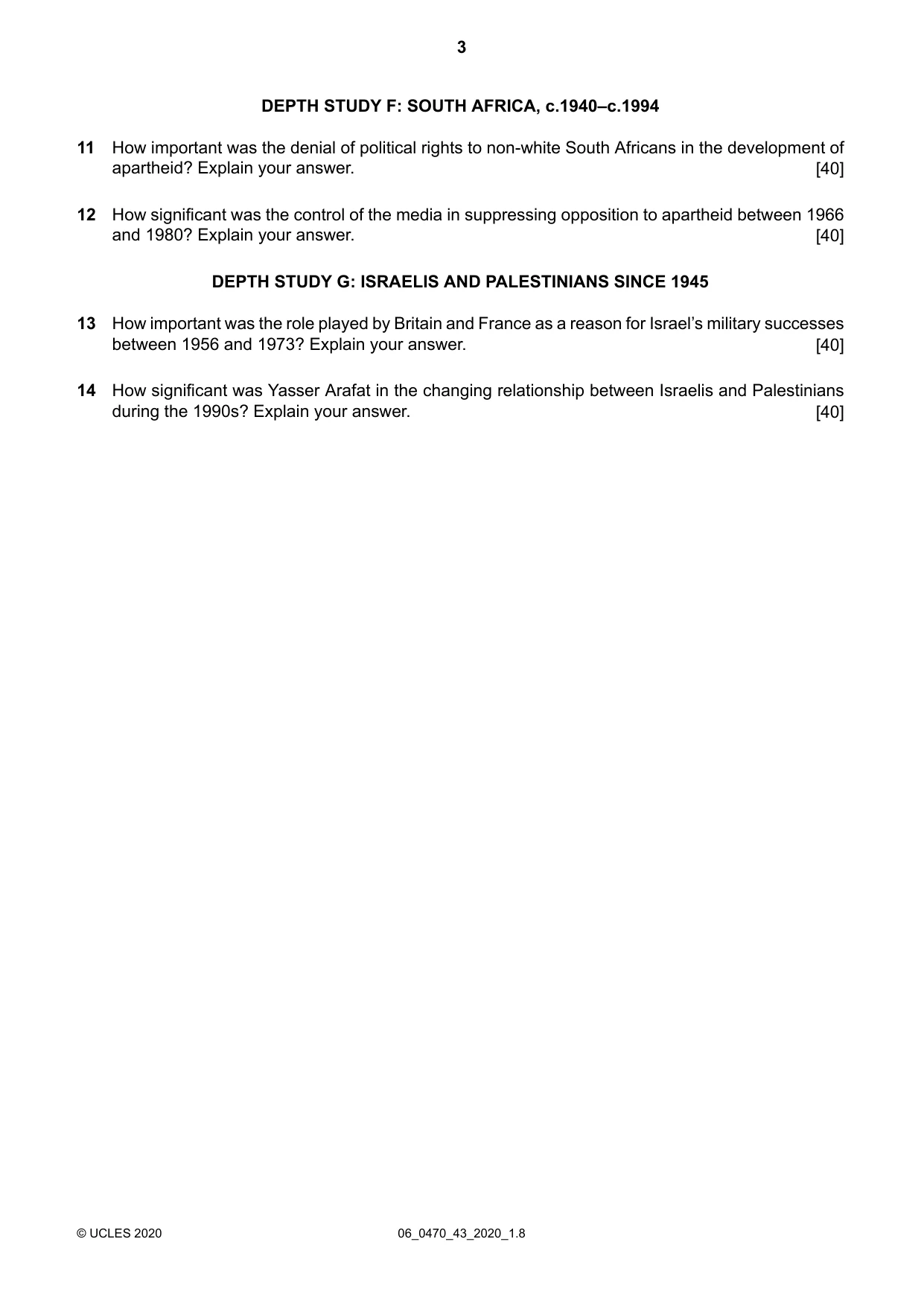
DEPTH STUDY F: SOUTH AFRICA, c.1940–c.1994 How important was the denial of political rights to non-white South Africans in the development of apartheid? Explain your answer. [40] 11 How significant was the control of the media in suppressing opposition to apartheid between 1966 and 1980? Explain your answer. [40] 12 DEPTH STUDY G: ISRAELIS AND PALESTINIANS SINCE 1945 How important was the role played by Britain and France as a reason for Israel’s military successes between 1956 and 1973? Explain your answer. [40] 13 How significant was Yasser Arafat in the changing relationship between Israelis and Palestinians during the 1990s? Explain your answer. [40] 14 06_0470_43_2020_1.8 © UCLES 2020 3
Question paper, page 4
BLANK PAGE Permission to reproduce items where third-party owned material protected by copyright is included has been sought and cleared where possible. Every reasonable effort has been made by the publisher (UCLES) to trace copyright holders, but if any items requiring clearance have unwittingly been included, the publisher will be pleased to make amends at the earliest possible opportunity. To avoid the issue of disclosure of answer-related information to candidates, all copyright acknowledgements are reproduced online in the Cambridge Assessment International Education Copyright Acknowledgements Booklet. This is produced for each series of examinations and is freely available to download at www.cambridgeinternational.org after the live examination series. Cambridge Assessment International Education is part of the Cambridge Assessment Group. Cambridge Assessment is the brand name of the University of Cambridge Local Examinations Syndicate (UCLES), which itself is a department of the University of Cambridge. 06_0470_43_2020_1.8 © UCLES 2020 4
Mark scheme, page 1
This document consists of 19 printed pages. © UCLES 2020 [Turn over Cambridge IGCSE™ HISTORY 0470/43 Paper 4 Alternative to Coursework May/June 2020 MARK SCHEME Maximum Mark: 40 Published Students did not sit exam papers in the June 2020 series due to the Covid-19 global pandemic. This mark scheme is published to support teachers and students and should be read together with the question paper. It shows the requirements of the exam. The answer column of the mark scheme shows the proposed basis on which Examiners would award marks for this exam. Where appropriate, this column also provides the most likely acceptable alternative responses expected from students. Examiners usually review the mark scheme after they have seen student responses and update the mark scheme if appropriate. In the June series, Examiners were unable to consider the acceptability of alternative responses, as there were no student responses to consider. Mark schemes should usually be read together with the Principal Examiner Report for Teachers. However, because students did not sit exam papers, there is no Principal Examiner Report for Teachers for the June 2020 series. Cambridge International will not enter into discussions about these mark schemes. Cambridge International is publishing the mark schemes for the June 2020 series for most Cambridge IGCSE™ and Cambridge International A & AS Level components, and some Cambridge O Level components.
Mark scheme, page 2
0470/43 Cambridge IGCSE – Mark Scheme PUBLISHED May/June 2020 © UCLES 2020 Page 2 of 19 Generic Marking Principles These general marking principles must be applied by all examiners when marking candidate answers. They should be applied alongside the specific content of the mark scheme or generic level descriptors for a question. Each question paper and mark scheme will also comply with these marking principles. GENERIC MARKING PRINCIPLE 1: Marks must be awarded in line with: • the specific content of the mark scheme or the generic level descriptors for the question • the specific skills defined in the mark scheme or in the generic level descriptors for the question • the standard of response required by a candidate as exemplified by the standardisation scripts. GENERIC MARKING PRINCIPLE 2: Marks awarded are always whole marks (not half marks, or other fractions). GENERIC MARKING PRINCIPLE 3: Marks must be awarded positively: • marks are awarded for correct/valid answers, as defined in the mark scheme. However, credit is given for valid answers which go beyond the scope of the syllabus and mark scheme, referring to your Team Leader as appropriate • marks are awarded when candidates clearly demonstrate what they know and can do • marks are not deducted for errors • marks are not deducted for omissions • answers should only be judged on the quality of spelling, punctuation and grammar when these features are specifically assessed by the question as indicated by the mark scheme. The meaning, however, should be unambiguous. GENERIC MARKING PRINCIPLE 4: Rules must be applied consistently e.g. in situations where candidates have not followed instructions or in the application of generic level descriptors.
Mark scheme, page 3
0470/43 Cambridge IGCSE – Mark Scheme PUBLISHED May/June 2020 © UCLES 2020 Page 3 of 19 GENERIC MARKING PRINCIPLE 5: Marks should be awarded using the full range of marks defined in the mark scheme for the question (however; the use of the full mark range may be limited according to the quality of the candidate responses seen). GENERIC MARKING PRINCIPLE 6: Marks awarded are based solely on the requirements as defined in the mark scheme. Marks should not be awarded with grade thresholds or grade descriptors in mind.
Mark scheme, page 4
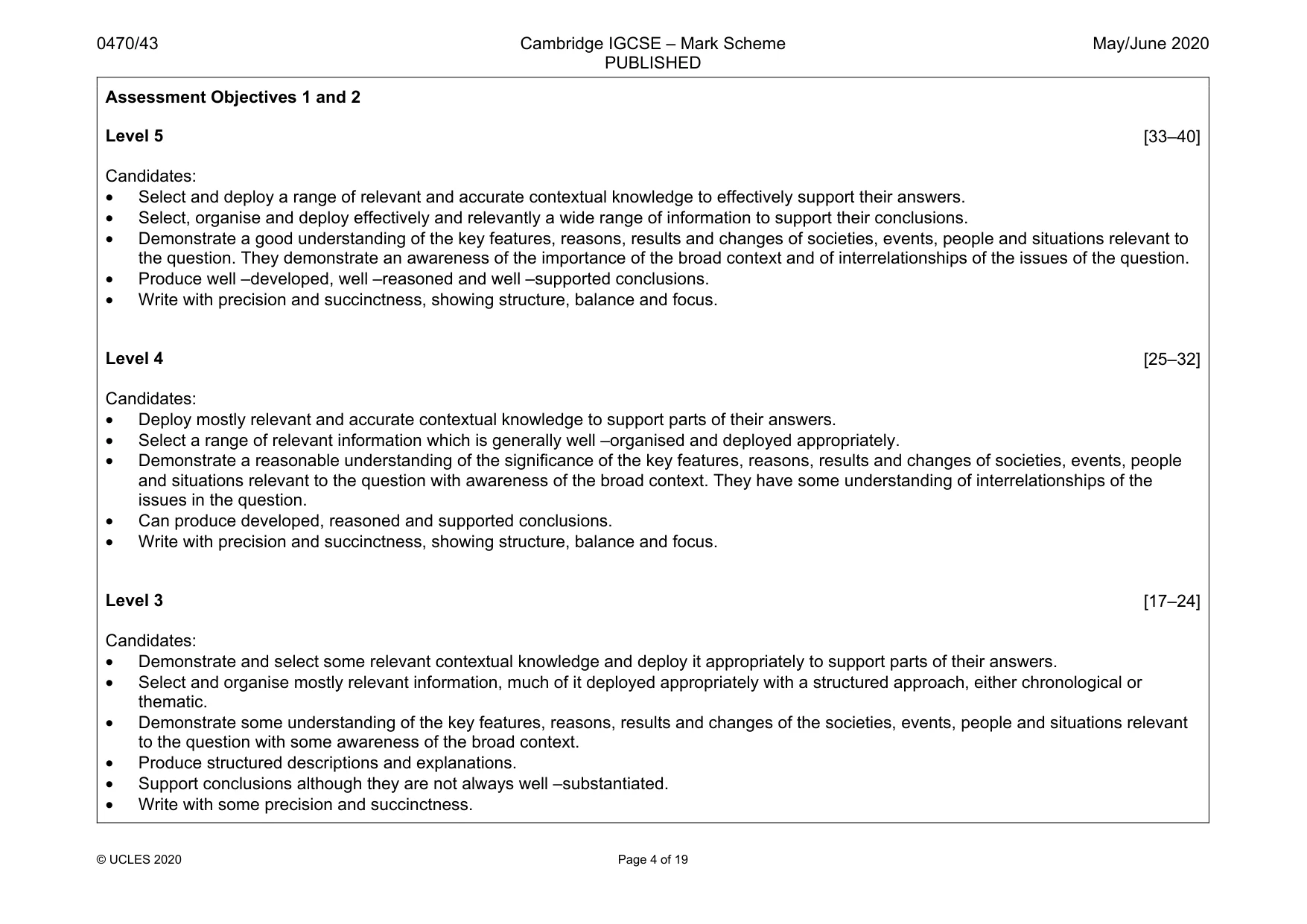
0470/43 Cambridge IGCSE – Mark Scheme PUBLISHED May/June 2020 © UCLES 2020 Page 4 of 19 Assessment Objectives 1 and 2 Level 5 [33–40] Candidates: • Select and deploy a range of relevant and accurate contextual knowledge to effectively support their answers. • Select, organise and deploy effectively and relevantly a wide range of information to support their conclusions. • Demonstrate a good understanding of the key features, reasons, results and changes of societies, events, people and situations relevant to the question. They demonstrate an awareness of the importance of the broad context and of interrelationships of the issues of the question. • Produce well –developed, well –reasoned and well –supported conclusions. • Write with precision and succinctness, showing structure, balance and focus. Level 4 [25–32] Candidates: • Deploy mostly relevant and accurate contextual knowledge to support parts of their answers. • Select a range of relevant information which is generally well –organised and deployed appropriately. • Demonstrate a reasonable understanding of the significance of the key features, reasons, results and changes of societies, events, people and situations relevant to the question with awareness of the broad context. They have some understanding of interrelationships of the issues in the question. • Can produce developed, reasoned and supported conclusions. • Write with precision and succinctness, showing structure, balance and focus. Level 3 [17–24] Candidates: • Demonstrate and select some relevant contextual knowledge and deploy it appropriately to support parts of their answers. • Select and organise mostly relevant information, much of it deployed appropriately with a structured approach, either chronological or thematic. • Demonstrate some understanding of the key features, reasons, results and changes of the societies, events, people and situations relevant to the question with some awareness of the broad context. • Produce structured descriptions and explanations. • Support conclusions although they are not always well –substantiated. • Write with some precision and succinctness.
Mark scheme, page 5
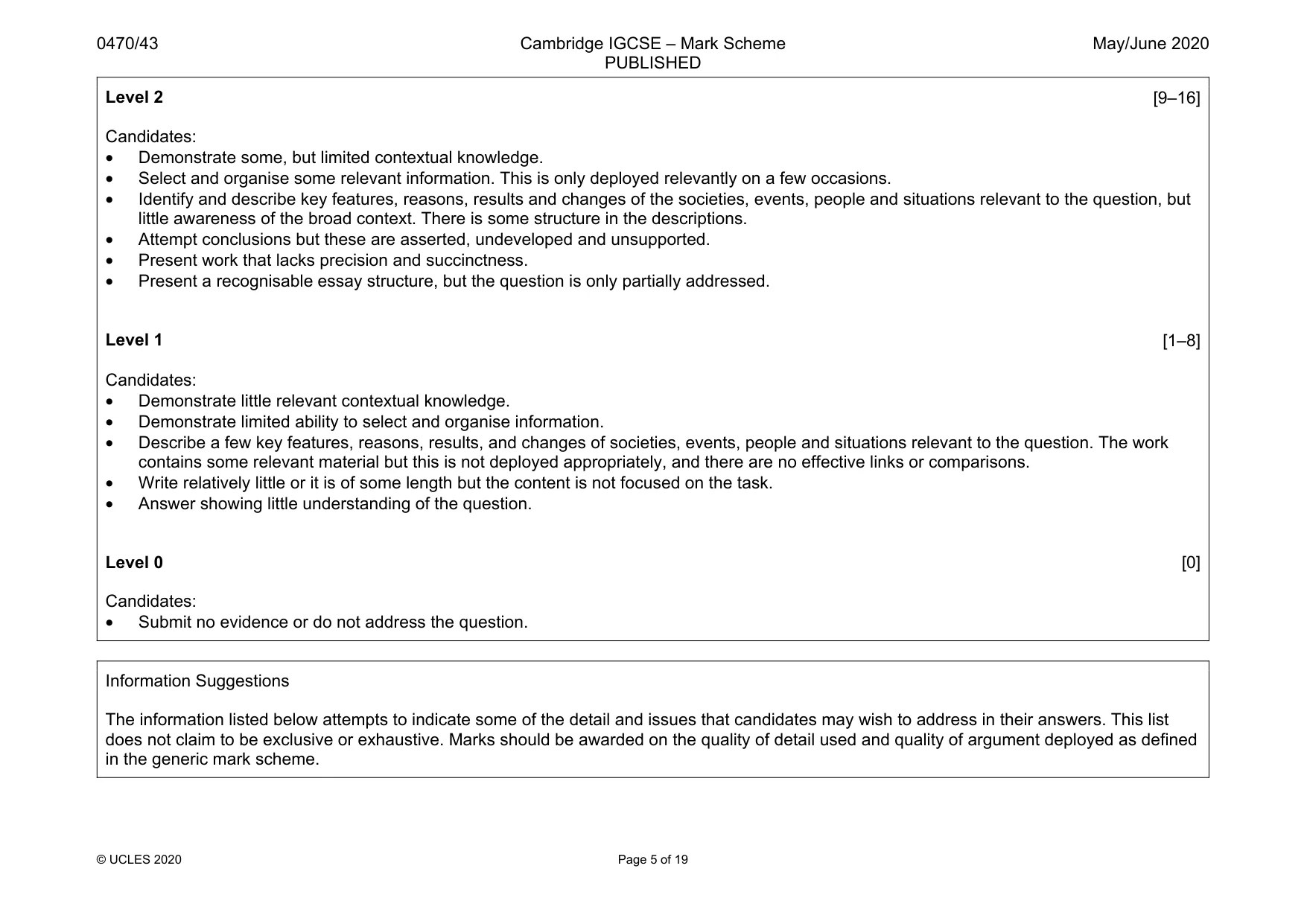
0470/43 Cambridge IGCSE – Mark Scheme PUBLISHED May/June 2020 © UCLES 2020 Page 5 of 19 Level 2 [9–16] Candidates: • Demonstrate some, but limited contextual knowledge. • Select and organise some relevant information. This is only deployed relevantly on a few occasions. • Identify and describe key features, reasons, results and changes of the societies, events, people and situations relevant to the question, but little awareness of the broad context. There is some structure in the descriptions. • Attempt conclusions but these are asserted, undeveloped and unsupported. • Present work that lacks precision and succinctness. • Present a recognisable essay structure, but the question is only partially addressed. Level 1 [1–8] Candidates: • Demonstrate little relevant contextual knowledge. • Demonstrate limited ability to select and organise information. • Describe a few key features, reasons, results, and changes of societies, events, people and situations relevant to the question. The work contains some relevant material but this is not deployed appropriately, and there are no effective links or comparisons. • Write relatively little or it is of some length but the content is not focused on the task. • Answer showing little understanding of the question. Level 0 [0] Candidates: • Submit no evidence or do not address the question. Information Suggestions The information listed below attempts to indicate some of the detail and issues that candidates may wish to address in their answers. This list does not claim to be exclusive or exhaustive. Marks should be awarded on the quality of detail used and quality of argument deployed as defined in the generic mark scheme.
Mark scheme, page 6
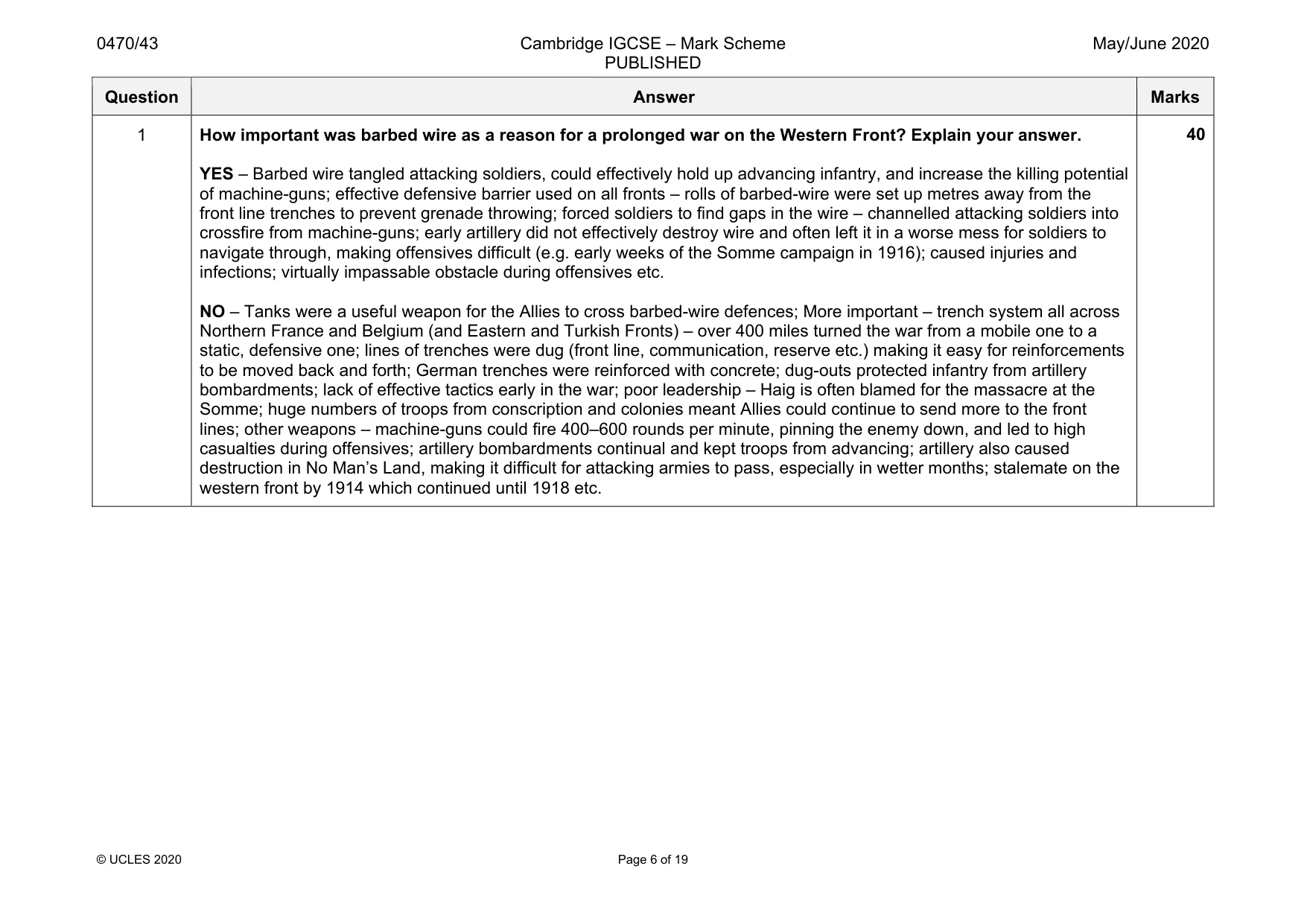
0470/43 Cambridge IGCSE – Mark Scheme PUBLISHED May/June 2020 © UCLES 2020 Page 6 of 19 Question Answer Marks 1 How important was barbed wire as a reason for a prolonged war on the Western Front? Explain your answer. YES – Barbed wire tangled attacking soldiers, could effectively hold up advancing infantry, and increase the killing potential of machine-guns; effective defensive barrier used on all fronts – rolls of barbed-wire were set up metres away from the front line trenches to prevent grenade throwing; forced soldiers to find gaps in the wire – channelled attacking soldiers into crossfire from machine-guns; early artillery did not effectively destroy wire and often left it in a worse mess for soldiers to navigate through, making offensives difficult (e.g. early weeks of the Somme campaign in 1916); caused injuries and infections; virtually impassable obstacle during offensives etc. NO – Tanks were a useful weapon for the Allies to cross barbed-wire defences; More important – trench system all across Northern France and Belgium (and Eastern and Turkish Fronts) – over 400 miles turned the war from a mobile one to a static, defensive one; lines of trenches were dug (front line, communication, reserve etc.) making it easy for reinforcements to be moved back and forth; German trenches were reinforced with concrete; dug-outs protected infantry from artillery bombardments; lack of effective tactics early in the war; poor leadership – Haig is often blamed for the massacre at the Somme; huge numbers of troops from conscription and colonies meant Allies could continue to send more to the front lines; other weapons – machine-guns could fire 400–600 rounds per minute, pinning the enemy down, and led to high casualties during offensives; artillery bombardments continual and kept troops from advancing; artillery also caused destruction in No Man’s Land, making it difficult for attacking armies to pass, especially in wetter months; stalemate on the western front by 1914 which continued until 1918 etc. 40
Mark scheme, page 7
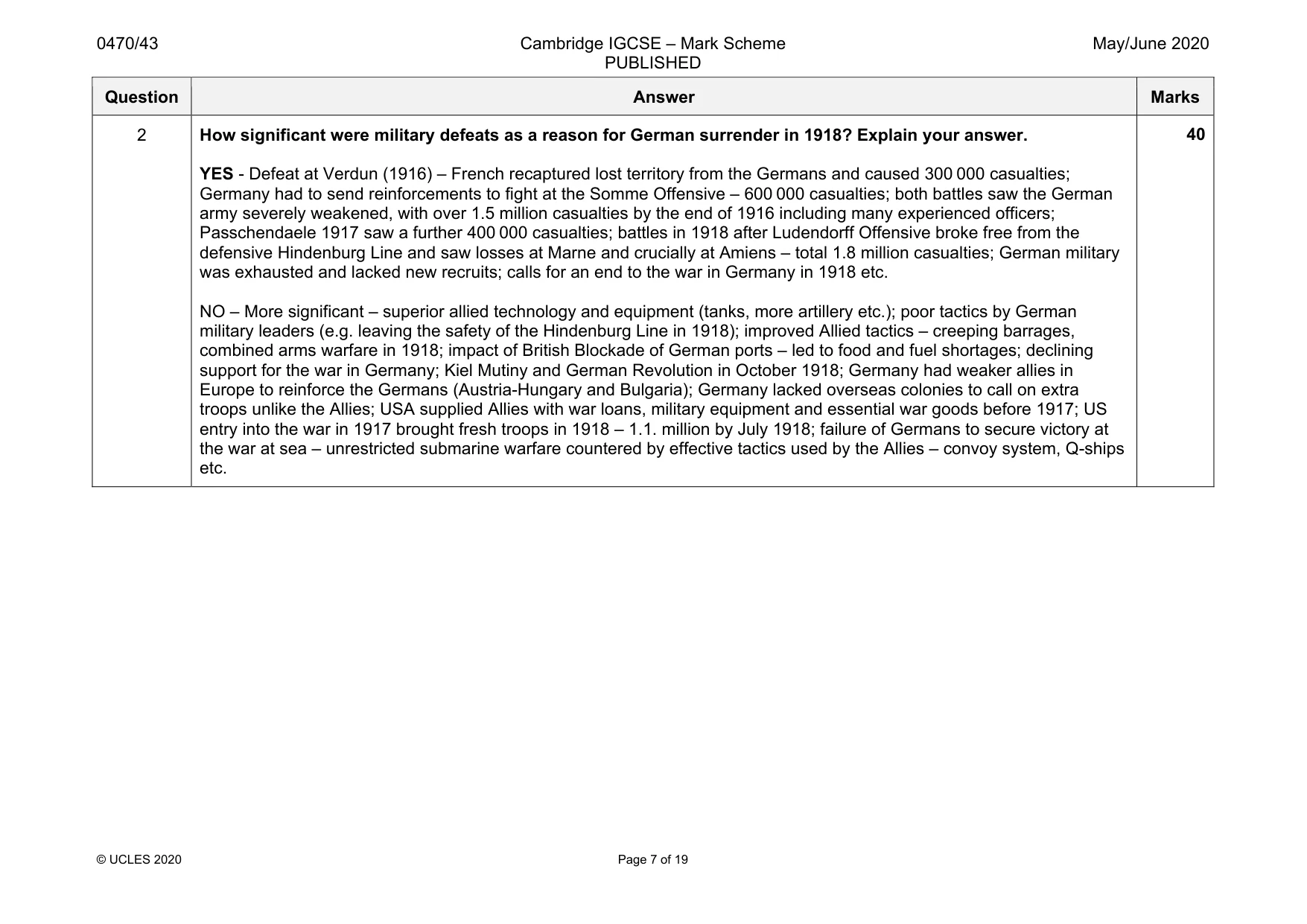
0470/43 Cambridge IGCSE – Mark Scheme PUBLISHED May/June 2020 © UCLES 2020 Page 7 of 19 Question Answer Marks 2 How significant were military defeats as a reason for German surrender in 1918? Explain your answer. YES - Defeat at Verdun (1916) – French recaptured lost territory from the Germans and caused 300 000 casualties; Germany had to send reinforcements to fight at the Somme Offensive – 600 000 casualties; both battles saw the German army severely weakened, with over 1.5 million casualties by the end of 1916 including many experienced officers; Passchendaele 1917 saw a further 400 000 casualties; battles in 1918 after Ludendorff Offensive broke free from the defensive Hindenburg Line and saw losses at Marne and crucially at Amiens – total 1.8 million casualties; German military was exhausted and lacked new recruits; calls for an end to the war in Germany in 1918 etc. NO – More significant – superior allied technology and equipment (tanks, more artillery etc.); poor tactics by German military leaders (e.g. leaving the safety of the Hindenburg Line in 1918); improved Allied tactics – creeping barrages, combined arms warfare in 1918; impact of British Blockade of German ports – led to food and fuel shortages; declining support for the war in Germany; Kiel Mutiny and German Revolution in October 1918; Germany had weaker allies in Europe to reinforce the Germans (Austria-Hungary and Bulgaria); Germany lacked overseas colonies to call on extra troops unlike the Allies; USA supplied Allies with war loans, military equipment and essential war goods before 1917; US entry into the war in 1917 brought fresh troops in 1918 – 1.1. million by July 1918; failure of Germans to secure victory at the war at sea – unrestricted submarine warfare countered by effective tactics used by the Allies – convoy system, Q-ships etc. 40
Mark scheme, page 8
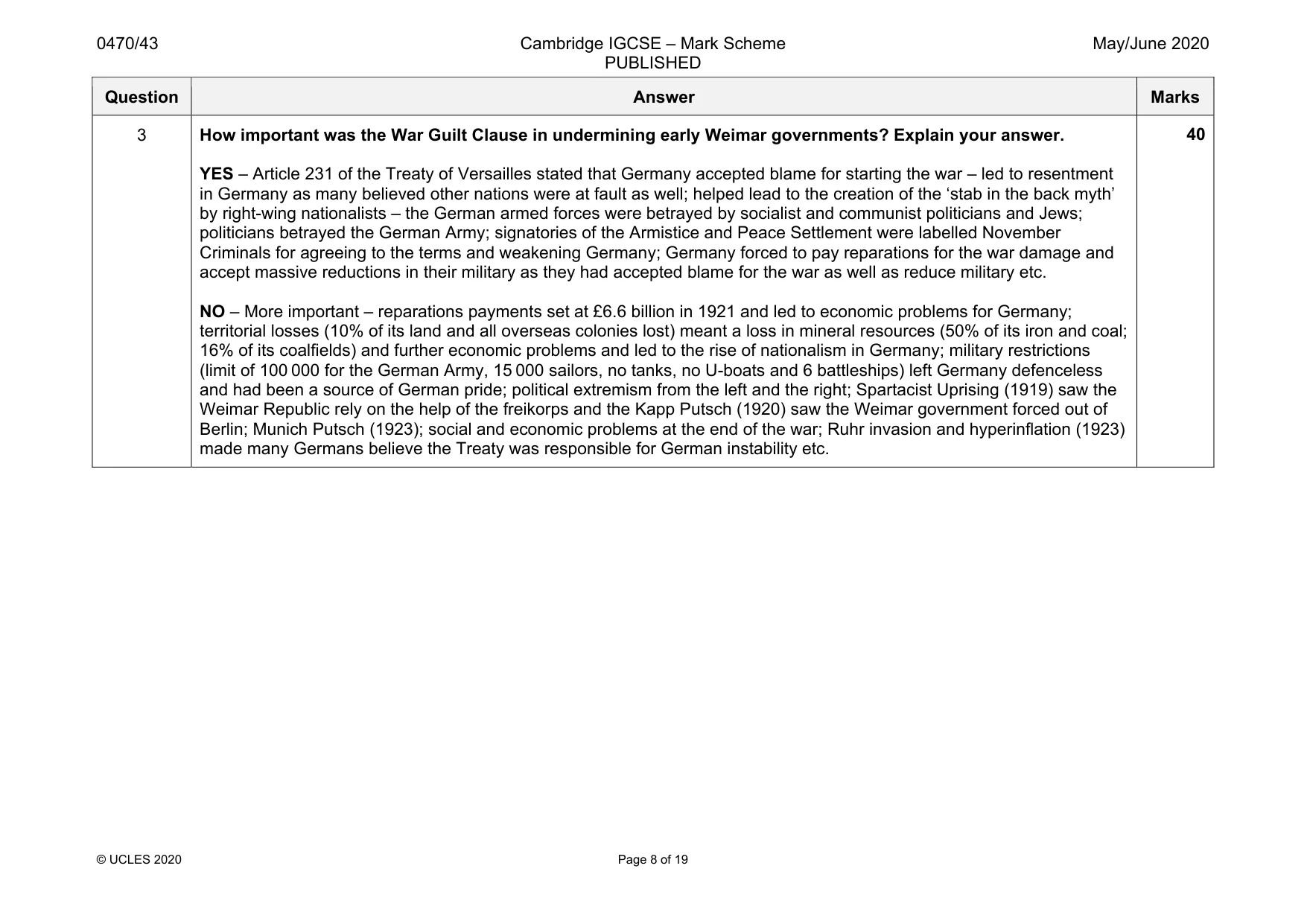
0470/43 Cambridge IGCSE – Mark Scheme PUBLISHED May/June 2020 © UCLES 2020 Page 8 of 19 Question Answer Marks 3 How important was the War Guilt Clause in undermining early Weimar governments? Explain your answer. YES – Article 231 of the Treaty of Versailles stated that Germany accepted blame for starting the war – led to resentment in Germany as many believed other nations were at fault as well; helped lead to the creation of the ‘stab in the back myth’ by right-wing nationalists – the German armed forces were betrayed by socialist and communist politicians and Jews; politicians betrayed the German Army; signatories of the Armistice and Peace Settlement were labelled November Criminals for agreeing to the terms and weakening Germany; Germany forced to pay reparations for the war damage and accept massive reductions in their military as they had accepted blame for the war as well as reduce military etc. NO – More important – reparations payments set at £6.6 billion in 1921 and led to economic problems for Germany; territorial losses (10% of its land and all overseas colonies lost) meant a loss in mineral resources (50% of its iron and coal; 16% of its coalfields) and further economic problems and led to the rise of nationalism in Germany; military restrictions (limit of 100 000 for the German Army, 15 000 sailors, no tanks, no U-boats and 6 battleships) left Germany defenceless and had been a source of German pride; political extremism from the left and the right; Spartacist Uprising (1919) saw the Weimar Republic rely on the help of the freikorps and the Kapp Putsch (1920) saw the Weimar government forced out of Berlin; Munich Putsch (1923); social and economic problems at the end of the war; Ruhr invasion and hyperinflation (1923) made many Germans believe the Treaty was responsible for German instability etc. 40
Mark scheme, page 9
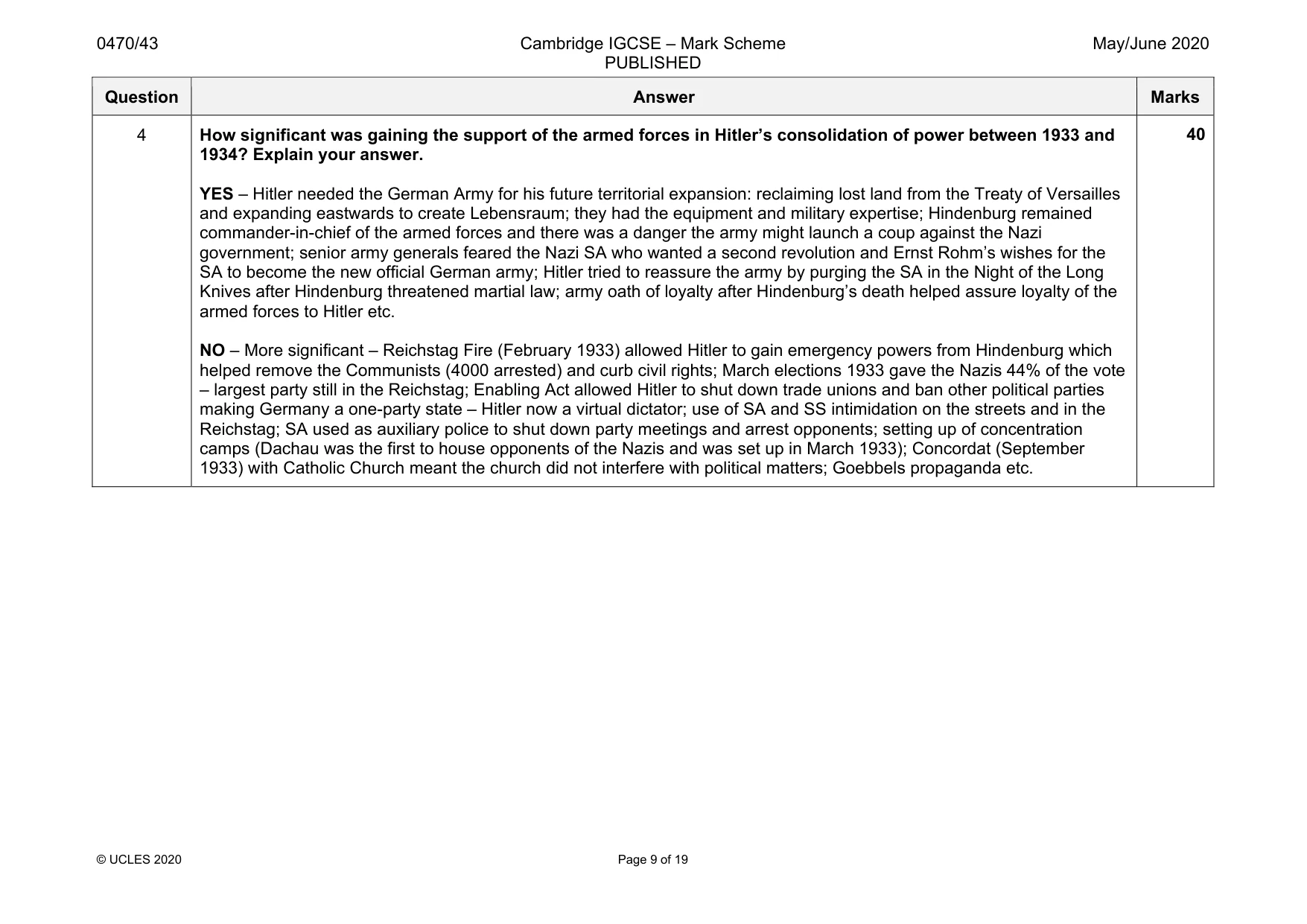
0470/43 Cambridge IGCSE – Mark Scheme PUBLISHED May/June 2020 © UCLES 2020 Page 9 of 19 Question Answer Marks 4 How significant was gaining the support of the armed forces in Hitler’s consolidation of power between 1933 and 1934? Explain your answer. YES – Hitler needed the German Army for his future territorial expansion: reclaiming lost land from the Treaty of Versailles and expanding eastwards to create Lebensraum; they had the equipment and military expertise; Hindenburg remained commander-in-chief of the armed forces and there was a danger the army might launch a coup against the Nazi government; senior army generals feared the Nazi SA who wanted a second revolution and Ernst Rohm’s wishes for the SA to become the new official German army; Hitler tried to reassure the army by purging the SA in the Night of the Long Knives after Hindenburg threatened martial law; army oath of loyalty after Hindenburg’s death helped assure loyalty of the armed forces to Hitler etc. NO – More significant – Reichstag Fire (February 1933) allowed Hitler to gain emergency powers from Hindenburg which helped remove the Communists (4000 arrested) and curb civil rights; March elections 1933 gave the Nazis 44% of the vote – largest party still in the Reichstag; Enabling Act allowed Hitler to shut down trade unions and ban other political parties making Germany a one-party state – Hitler now a virtual dictator; use of SA and SS intimidation on the streets and in the Reichstag; SA used as auxiliary police to shut down party meetings and arrest opponents; setting up of concentration camps (Dachau was the first to house opponents of the Nazis and was set up in March 1933); Concordat (September 1933) with Catholic Church meant the church did not interfere with political matters; Goebbels propaganda etc. 40
Mark scheme, page 10
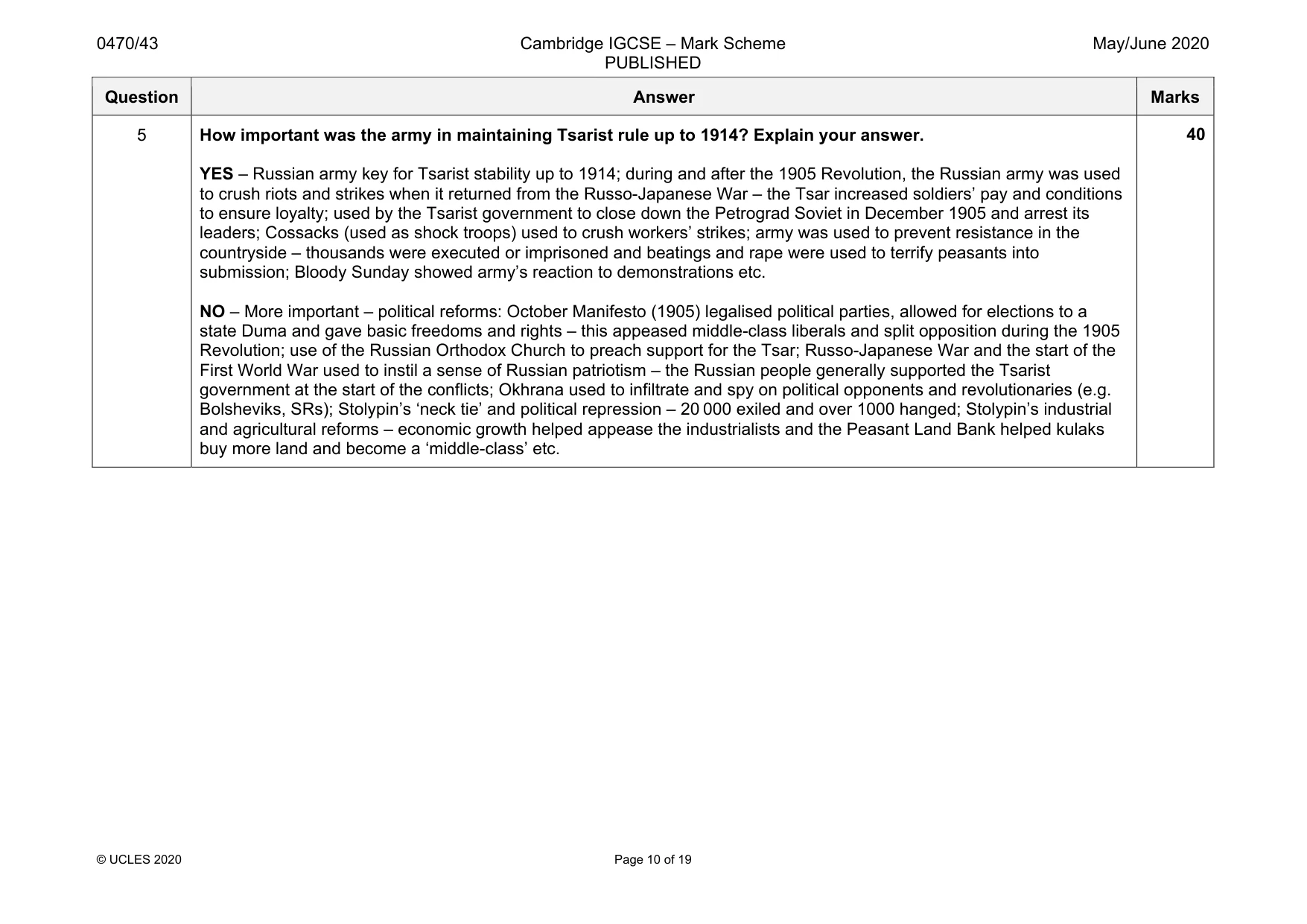
0470/43 Cambridge IGCSE – Mark Scheme PUBLISHED May/June 2020 © UCLES 2020 Page 10 of 19 Question Answer Marks 5 How important was the army in maintaining Tsarist rule up to 1914? Explain your answer. YES – Russian army key for Tsarist stability up to 1914; during and after the 1905 Revolution, the Russian army was used to crush riots and strikes when it returned from the Russo-Japanese War – the Tsar increased soldiers’ pay and conditions to ensure loyalty; used by the Tsarist government to close down the Petrograd Soviet in December 1905 and arrest its leaders; Cossacks (used as shock troops) used to crush workers’ strikes; army was used to prevent resistance in the countryside – thousands were executed or imprisoned and beatings and rape were used to terrify peasants into submission; Bloody Sunday showed army’s reaction to demonstrations etc. NO – More important – political reforms: October Manifesto (1905) legalised political parties, allowed for elections to a state Duma and gave basic freedoms and rights – this appeased middle-class liberals and split opposition during the 1905 Revolution; use of the Russian Orthodox Church to preach support for the Tsar; Russo-Japanese War and the start of the First World War used to instil a sense of Russian patriotism – the Russian people generally supported the Tsarist government at the start of the conflicts; Okhrana used to infiltrate and spy on political opponents and revolutionaries (e.g. Bolsheviks, SRs); Stolypin’s ‘neck tie’ and political repression – 20 000 exiled and over 1000 hanged; Stolypin’s industrial and agricultural reforms – economic growth helped appease the industrialists and the Peasant Land Bank helped kulaks buy more land and become a ‘middle-class’ etc. 40
Mark scheme, page 11
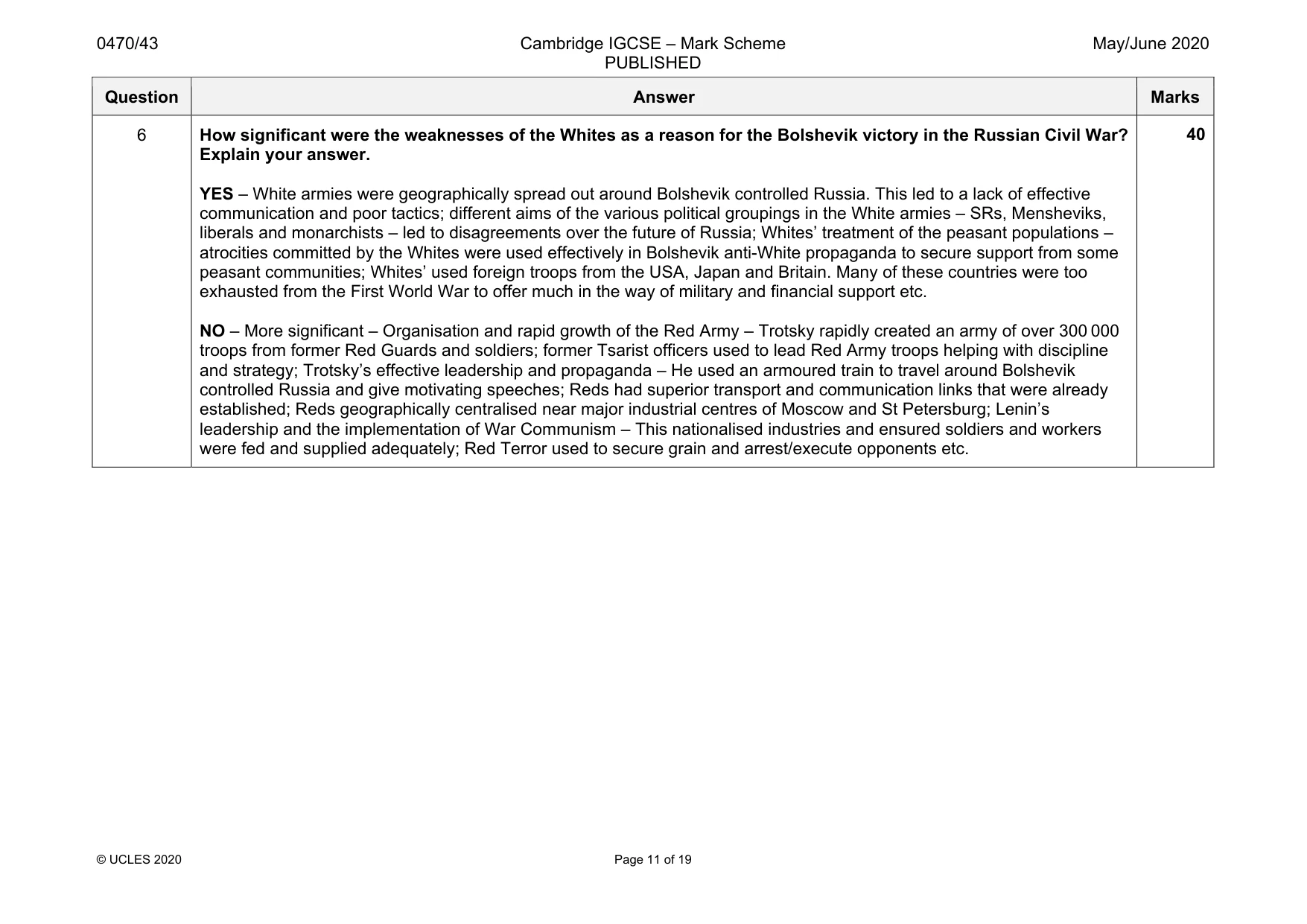
0470/43 Cambridge IGCSE – Mark Scheme PUBLISHED May/June 2020 © UCLES 2020 Page 11 of 19 Question Answer Marks 6 How significant were the weaknesses of the Whites as a reason for the Bolshevik victory in the Russian Civil War? Explain your answer. YES – White armies were geographically spread out around Bolshevik controlled Russia. This led to a lack of effective communication and poor tactics; different aims of the various political groupings in the White armies – SRs, Mensheviks, liberals and monarchists – led to disagreements over the future of Russia; Whites’ treatment of the peasant populations – atrocities committed by the Whites were used effectively in Bolshevik anti-White propaganda to secure support from some peasant communities; Whites’ used foreign troops from the USA, Japan and Britain. Many of these countries were too exhausted from the First World War to offer much in the way of military and financial support etc. NO – More significant – Organisation and rapid growth of the Red Army – Trotsky rapidly created an army of over 300 000 troops from former Red Guards and soldiers; former Tsarist officers used to lead Red Army troops helping with discipline and strategy; Trotsky’s effective leadership and propaganda – He used an armoured train to travel around Bolshevik controlled Russia and give motivating speeches; Reds had superior transport and communication links that were already established; Reds geographically centralised near major industrial centres of Moscow and St Petersburg; Lenin’s leadership and the implementation of War Communism – This nationalised industries and ensured soldiers and workers were fed and supplied adequately; Red Terror used to secure grain and arrest/execute opponents etc. 40
Mark scheme, page 12
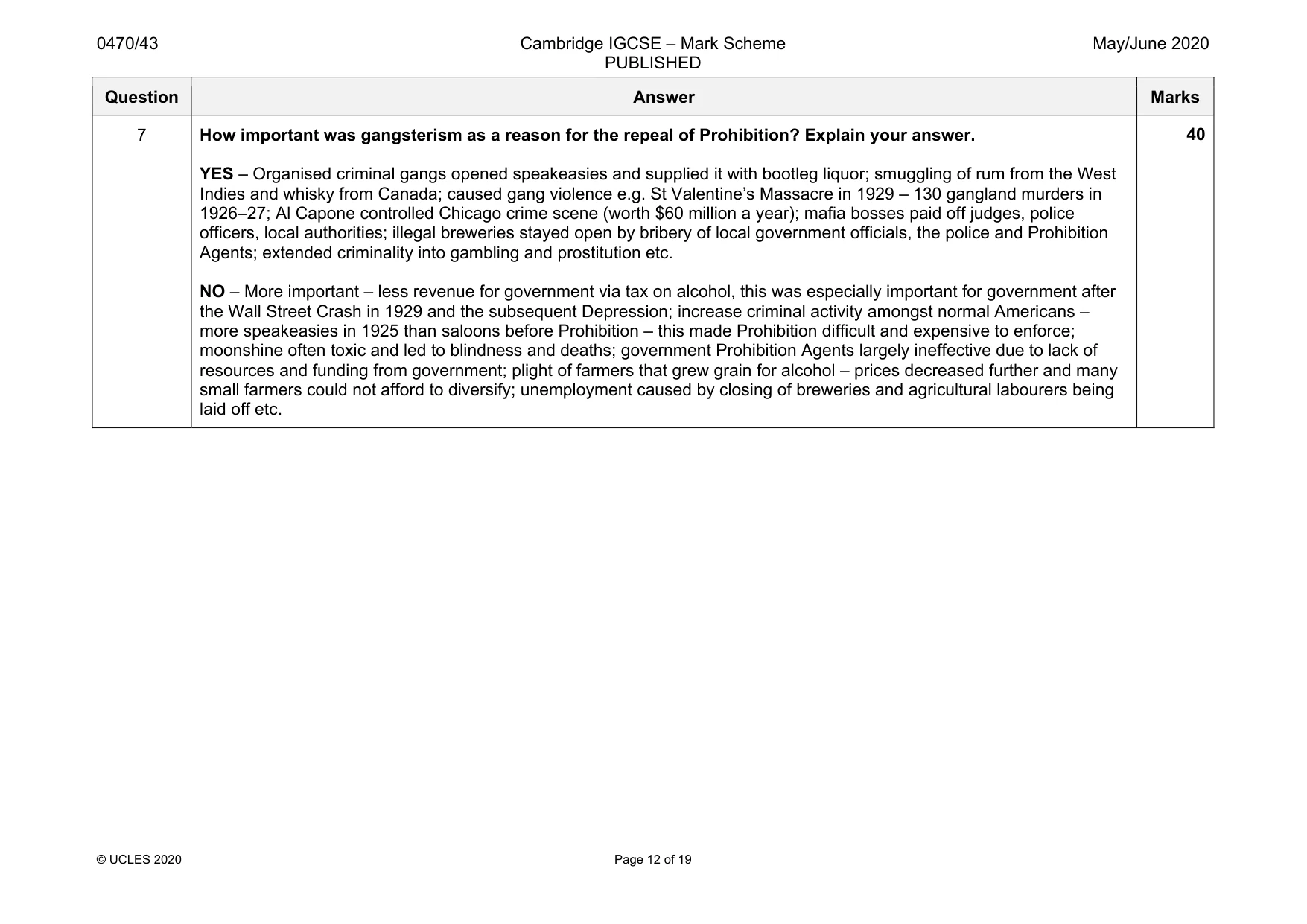
0470/43 Cambridge IGCSE – Mark Scheme PUBLISHED May/June 2020 © UCLES 2020 Page 12 of 19 Question Answer Marks 7 How important was gangsterism as a reason for the repeal of Prohibition? Explain your answer. YES – Organised criminal gangs opened speakeasies and supplied it with bootleg liquor; smuggling of rum from the West Indies and whisky from Canada; caused gang violence e.g. St Valentine’s Massacre in 1929 – 130 gangland murders in 1926–27; Al Capone controlled Chicago crime scene (worth $60 million a year); mafia bosses paid off judges, police officers, local authorities; illegal breweries stayed open by bribery of local government officials, the police and Prohibition Agents; extended criminality into gambling and prostitution etc. NO – More important – less revenue for government via tax on alcohol, this was especially important for government after the Wall Street Crash in 1929 and the subsequent Depression; increase criminal activity amongst normal Americans – more speakeasies in 1925 than saloons before Prohibition – this made Prohibition difficult and expensive to enforce; moonshine often toxic and led to blindness and deaths; government Prohibition Agents largely ineffective due to lack of resources and funding from government; plight of farmers that grew grain for alcohol – prices decreased further and many small farmers could not afford to diversify; unemployment caused by closing of breweries and agricultural labourers being laid off etc. 40
Mark scheme, page 13
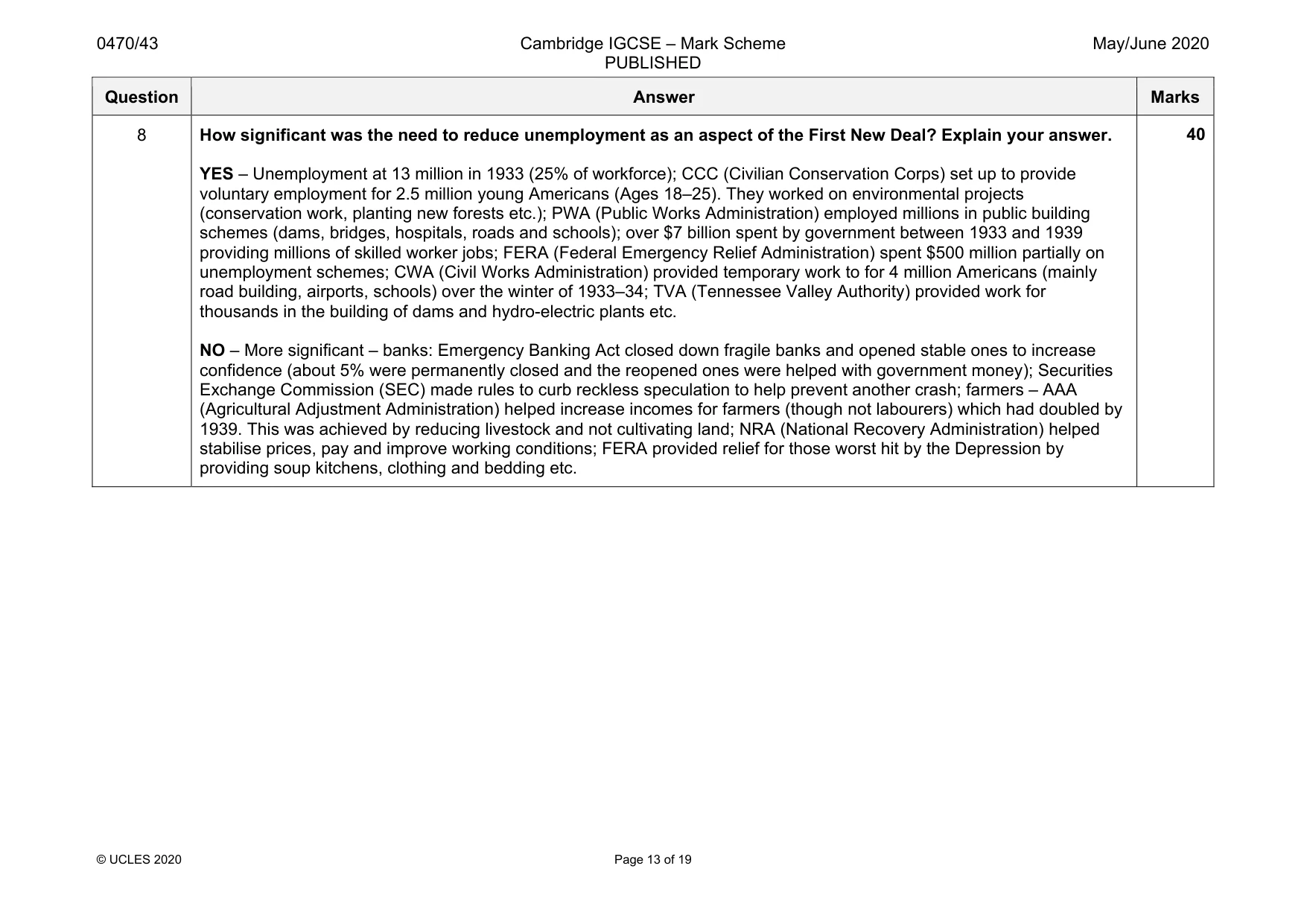
0470/43 Cambridge IGCSE – Mark Scheme PUBLISHED May/June 2020 © UCLES 2020 Page 13 of 19 Question Answer Marks 8 How significant was the need to reduce unemployment as an aspect of the First New Deal? Explain your answer. YES – Unemployment at 13 million in 1933 (25% of workforce); CCC (Civilian Conservation Corps) set up to provide voluntary employment for 2.5 million young Americans (Ages 18–25). They worked on environmental projects (conservation work, planting new forests etc.); PWA (Public Works Administration) employed millions in public building schemes (dams, bridges, hospitals, roads and schools); over $7 billion spent by government between 1933 and 1939 providing millions of skilled worker jobs; FERA (Federal Emergency Relief Administration) spent $500 million partially on unemployment schemes; CWA (Civil Works Administration) provided temporary work to for 4 million Americans (mainly road building, airports, schools) over the winter of 1933–34; TVA (Tennessee Valley Authority) provided work for thousands in the building of dams and hydro-electric plants etc. NO – More significant – banks: Emergency Banking Act closed down fragile banks and opened stable ones to increase confidence (about 5% were permanently closed and the reopened ones were helped with government money); Securities Exchange Commission (SEC) made rules to curb reckless speculation to help prevent another crash; farmers – AAA (Agricultural Adjustment Administration) helped increase incomes for farmers (though not labourers) which had doubled by 1939. This was achieved by reducing livestock and not cultivating land; NRA (National Recovery Administration) helped stabilise prices, pay and improve working conditions; FERA provided relief for those worst hit by the Depression by providing soup kitchens, clothing and bedding etc. 40
Mark scheme, page 14
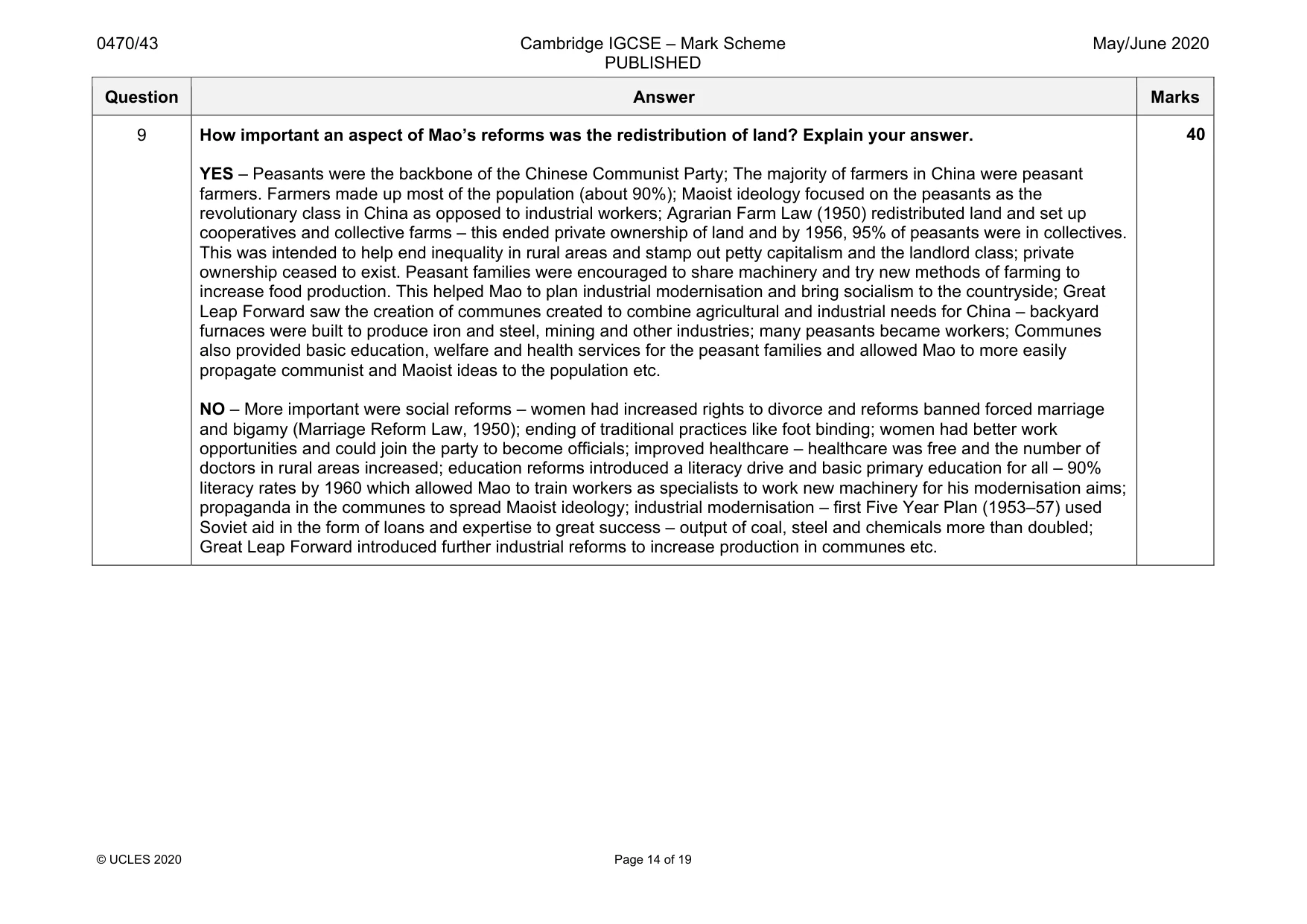
0470/43 Cambridge IGCSE – Mark Scheme PUBLISHED May/June 2020 © UCLES 2020 Page 14 of 19 Question Answer Marks 9 How important an aspect of Mao’s reforms was the redistribution of land? Explain your answer. YES – Peasants were the backbone of the Chinese Communist Party; The majority of farmers in China were peasant farmers. Farmers made up most of the population (about 90%); Maoist ideology focused on the peasants as the revolutionary class in China as opposed to industrial workers; Agrarian Farm Law (1950) redistributed land and set up cooperatives and collective farms – this ended private ownership of land and by 1956, 95% of peasants were in collectives. This was intended to help end inequality in rural areas and stamp out petty capitalism and the landlord class; private ownership ceased to exist. Peasant families were encouraged to share machinery and try new methods of farming to increase food production. This helped Mao to plan industrial modernisation and bring socialism to the countryside; Great Leap Forward saw the creation of communes created to combine agricultural and industrial needs for China – backyard furnaces were built to produce iron and steel, mining and other industries; many peasants became workers; Communes also provided basic education, welfare and health services for the peasant families and allowed Mao to more easily propagate communist and Maoist ideas to the population etc. NO – More important were social reforms – women had increased rights to divorce and reforms banned forced marriage and bigamy (Marriage Reform Law, 1950); ending of traditional practices like foot binding; women had better work opportunities and could join the party to become officials; improved healthcare – healthcare was free and the number of doctors in rural areas increased; education reforms introduced a literacy drive and basic primary education for all – 90% literacy rates by 1960 which allowed Mao to train workers as specialists to work new machinery for his modernisation aims; propaganda in the communes to spread Maoist ideology; industrial modernisation – first Five Year Plan (1953–57) used Soviet aid in the form of loans and expertise to great success – output of coal, steel and chemicals more than doubled; Great Leap Forward introduced further industrial reforms to increase production in communes etc. 40
Mark scheme, page 15
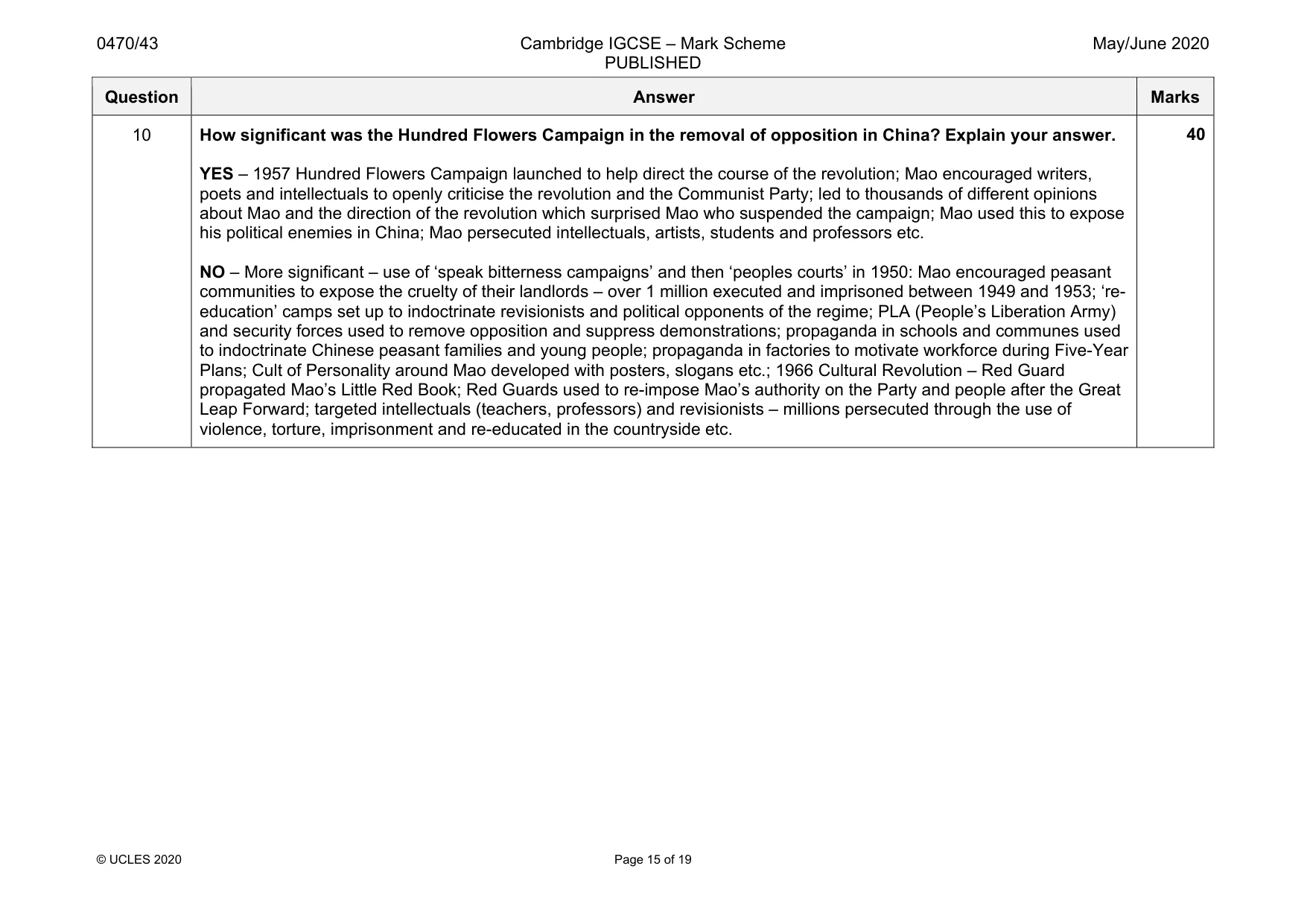
0470/43 Cambridge IGCSE – Mark Scheme PUBLISHED May/June 2020 © UCLES 2020 Page 15 of 19 Question Answer Marks 10 How significant was the Hundred Flowers Campaign in the removal of opposition in China? Explain your answer. YES – 1957 Hundred Flowers Campaign launched to help direct the course of the revolution; Mao encouraged writers, poets and intellectuals to openly criticise the revolution and the Communist Party; led to thousands of different opinions about Mao and the direction of the revolution which surprised Mao who suspended the campaign; Mao used this to expose his political enemies in China; Mao persecuted intellectuals, artists, students and professors etc. NO – More significant – use of ‘speak bitterness campaigns’ and then ‘peoples courts’ in 1950: Mao encouraged peasant communities to expose the cruelty of their landlords – over 1 million executed and imprisoned between 1949 and 1953; ‘re- education’ camps set up to indoctrinate revisionists and political opponents of the regime; PLA (People’s Liberation Army) and security forces used to remove opposition and suppress demonstrations; propaganda in schools and communes used to indoctrinate Chinese peasant families and young people; propaganda in factories to motivate workforce during Five-Year Plans; Cult of Personality around Mao developed with posters, slogans etc.; 1966 Cultural Revolution – Red Guard propagated Mao’s Little Red Book; Red Guards used to re-impose Mao’s authority on the Party and people after the Great Leap Forward; targeted intellectuals (teachers, professors) and revisionists – millions persecuted through the use of violence, torture, imprisonment and re-educated in the countryside etc. 40
Mark scheme, page 16
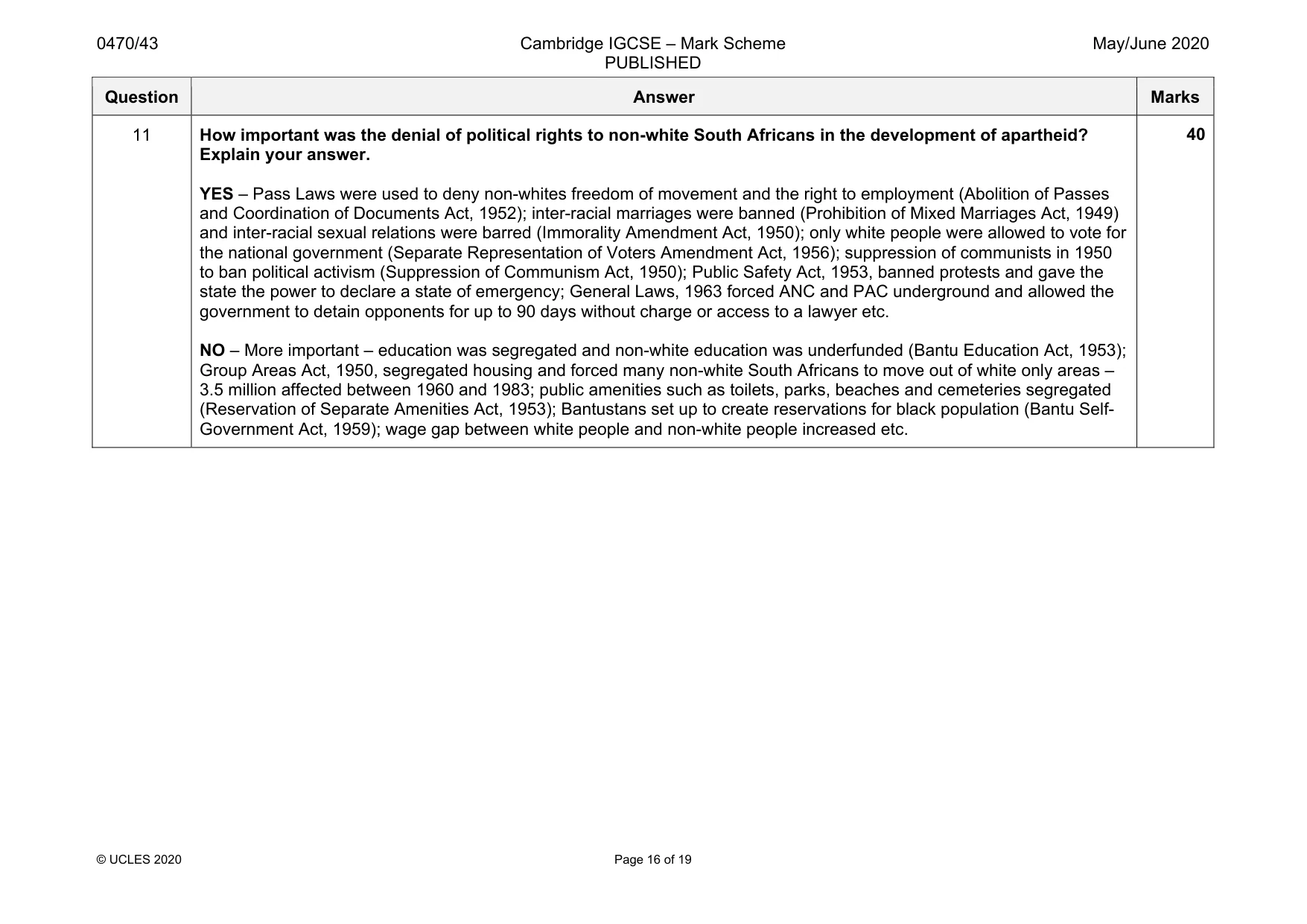
0470/43 Cambridge IGCSE – Mark Scheme PUBLISHED May/June 2020 © UCLES 2020 Page 16 of 19 Question Answer Marks 11 How important was the denial of political rights to non-white South Africans in the development of apartheid? Explain your answer. YES – Pass Laws were used to deny non-whites freedom of movement and the right to employment (Abolition of Passes and Coordination of Documents Act, 1952); inter-racial marriages were banned (Prohibition of Mixed Marriages Act, 1949) and inter-racial sexual relations were barred (Immorality Amendment Act, 1950); only white people were allowed to vote for the national government (Separate Representation of Voters Amendment Act, 1956); suppression of communists in 1950 to ban political activism (Suppression of Communism Act, 1950); Public Safety Act, 1953, banned protests and gave the state the power to declare a state of emergency; General Laws, 1963 forced ANC and PAC underground and allowed the government to detain opponents for up to 90 days without charge or access to a lawyer etc. NO – More important – education was segregated and non-white education was underfunded (Bantu Education Act, 1953); Group Areas Act, 1950, segregated housing and forced many non-white South Africans to move out of white only areas – 3.5 million affected between 1960 and 1983; public amenities such as toilets, parks, beaches and cemeteries segregated (Reservation of Separate Amenities Act, 1953); Bantustans set up to create reservations for black population (Bantu Self- Government Act, 1959); wage gap between white people and non-white people increased etc. 40
Mark scheme, page 17
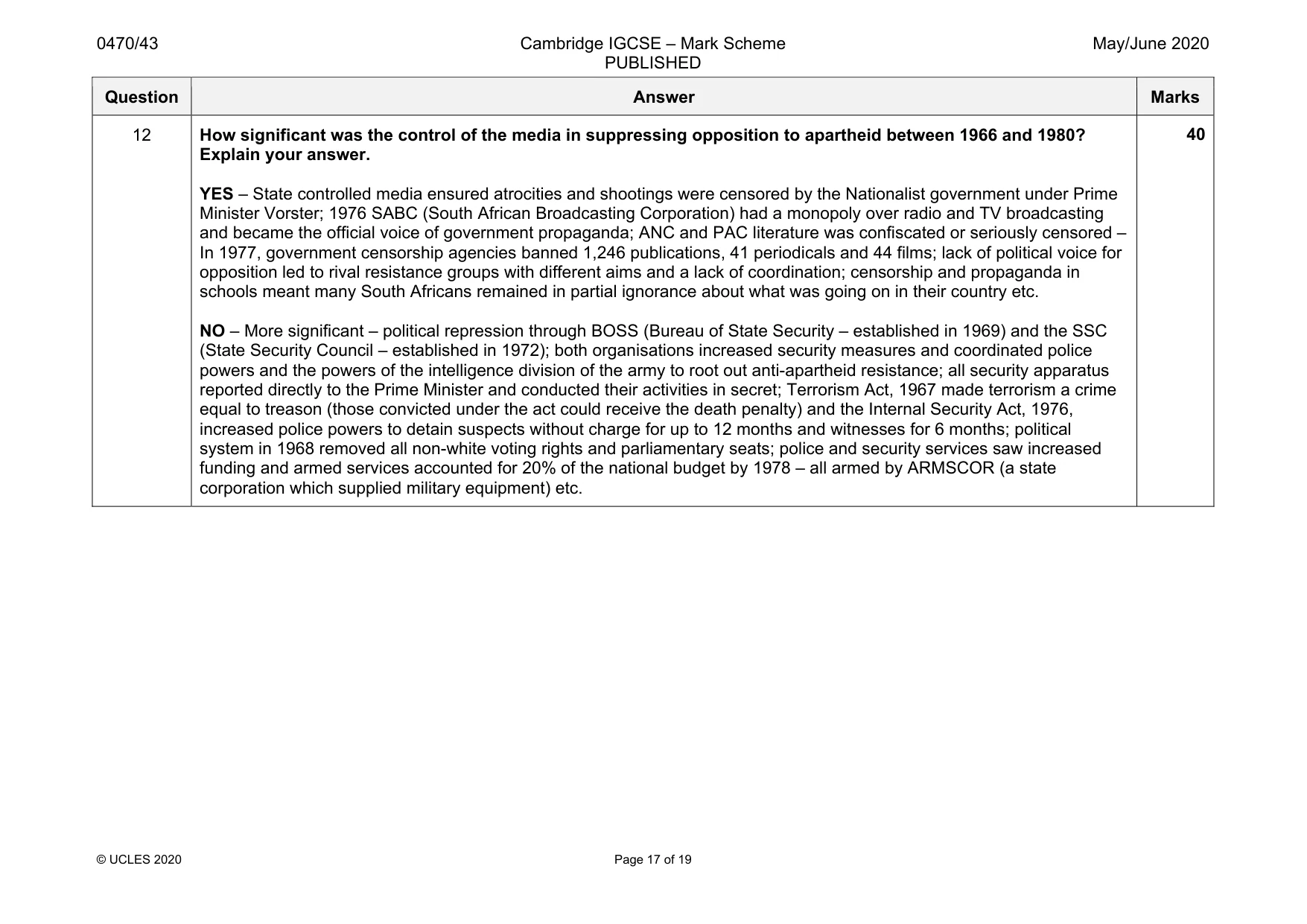
0470/43 Cambridge IGCSE – Mark Scheme PUBLISHED May/June 2020 © UCLES 2020 Page 17 of 19 Question Answer Marks 12 How significant was the control of the media in suppressing opposition to apartheid between 1966 and 1980? Explain your answer. YES – State controlled media ensured atrocities and shootings were censored by the Nationalist government under Prime Minister Vorster; 1976 SABC (South African Broadcasting Corporation) had a monopoly over radio and TV broadcasting and became the official voice of government propaganda; ANC and PAC literature was confiscated or seriously censored – In 1977, government censorship agencies banned 1,246 publications, 41 periodicals and 44 films; lack of political voice for opposition led to rival resistance groups with different aims and a lack of coordination; censorship and propaganda in schools meant many South Africans remained in partial ignorance about what was going on in their country etc. NO – More significant – political repression through BOSS (Bureau of State Security – established in 1969) and the SSC (State Security Council – established in 1972); both organisations increased security measures and coordinated police powers and the powers of the intelligence division of the army to root out anti-apartheid resistance; all security apparatus reported directly to the Prime Minister and conducted their activities in secret; Terrorism Act, 1967 made terrorism a crime equal to treason (those convicted under the act could receive the death penalty) and the Internal Security Act, 1976, increased police powers to detain suspects without charge for up to 12 months and witnesses for 6 months; political system in 1968 removed all non-white voting rights and parliamentary seats; police and security services saw increased funding and armed services accounted for 20% of the national budget by 1978 – all armed by ARMSCOR (a state corporation which supplied military equipment) etc. 40
Mark scheme, page 18
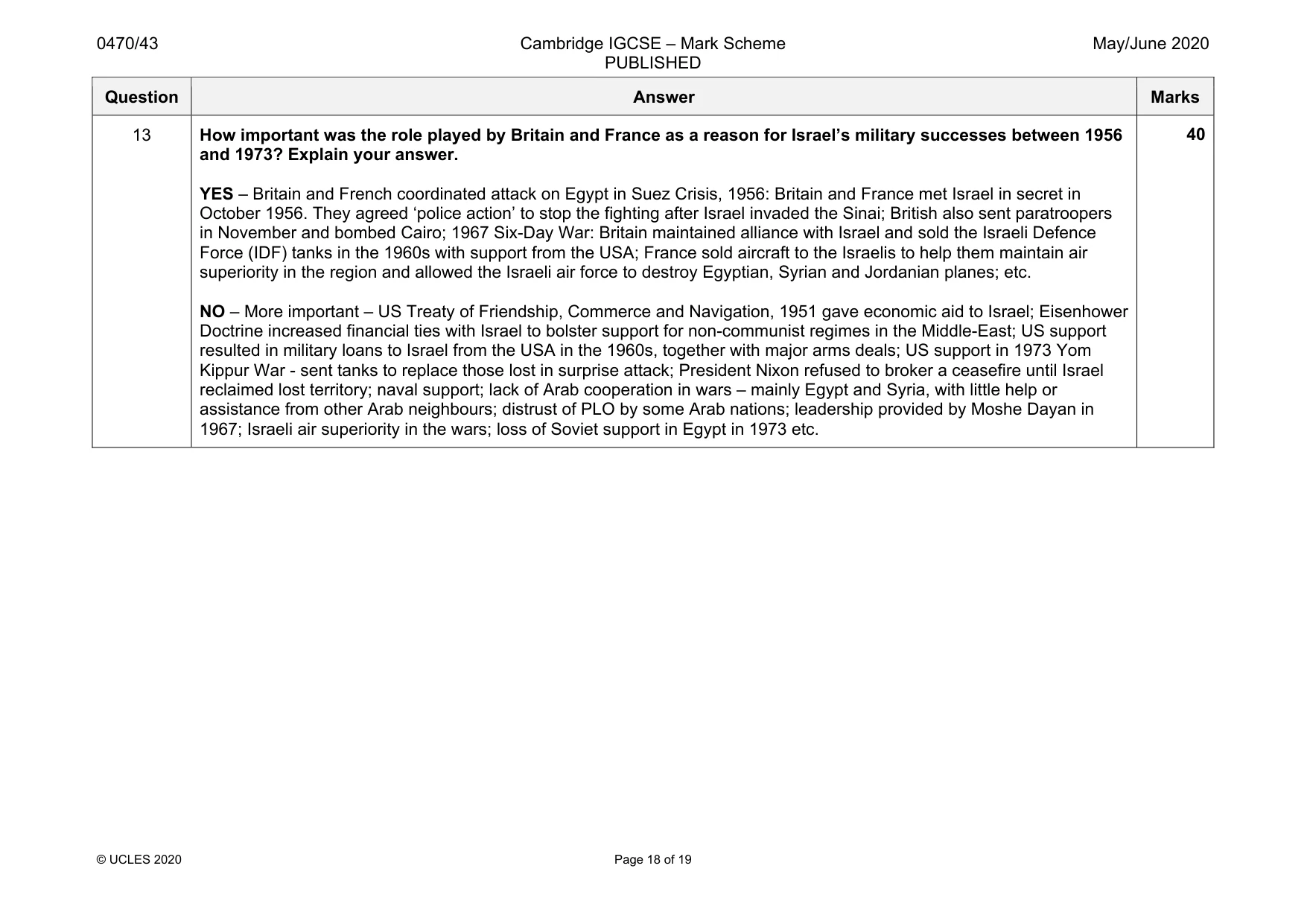
0470/43 Cambridge IGCSE – Mark Scheme PUBLISHED May/June 2020 © UCLES 2020 Page 18 of 19 Question Answer Marks 13 How important was the role played by Britain and France as a reason for Israel’s military successes between 1956 and 1973? Explain your answer. YES – Britain and French coordinated attack on Egypt in Suez Crisis, 1956: Britain and France met Israel in secret in October 1956. They agreed ‘police action’ to stop the fighting after Israel invaded the Sinai; British also sent paratroopers in November and bombed Cairo; 1967 Six-Day War: Britain maintained alliance with Israel and sold the Israeli Defence Force (IDF) tanks in the 1960s with support from the USA; France sold aircraft to the Israelis to help them maintain air superiority in the region and allowed the Israeli air force to destroy Egyptian, Syrian and Jordanian planes; etc. NO – More important – US Treaty of Friendship, Commerce and Navigation, 1951 gave economic aid to Israel; Eisenhower Doctrine increased financial ties with Israel to bolster support for non-communist regimes in the Middle-East; US support resulted in military loans to Israel from the USA in the 1960s, together with major arms deals; US support in 1973 Yom Kippur War - sent tanks to replace those lost in surprise attack; President Nixon refused to broker a ceasefire until Israel reclaimed lost territory; naval support; lack of Arab cooperation in wars – mainly Egypt and Syria, with little help or assistance from other Arab neighbours; distrust of PLO by some Arab nations; leadership provided by Moshe Dayan in 1967; Israeli air superiority in the wars; loss of Soviet support in Egypt in 1973 etc. 40
Mark scheme, page 19
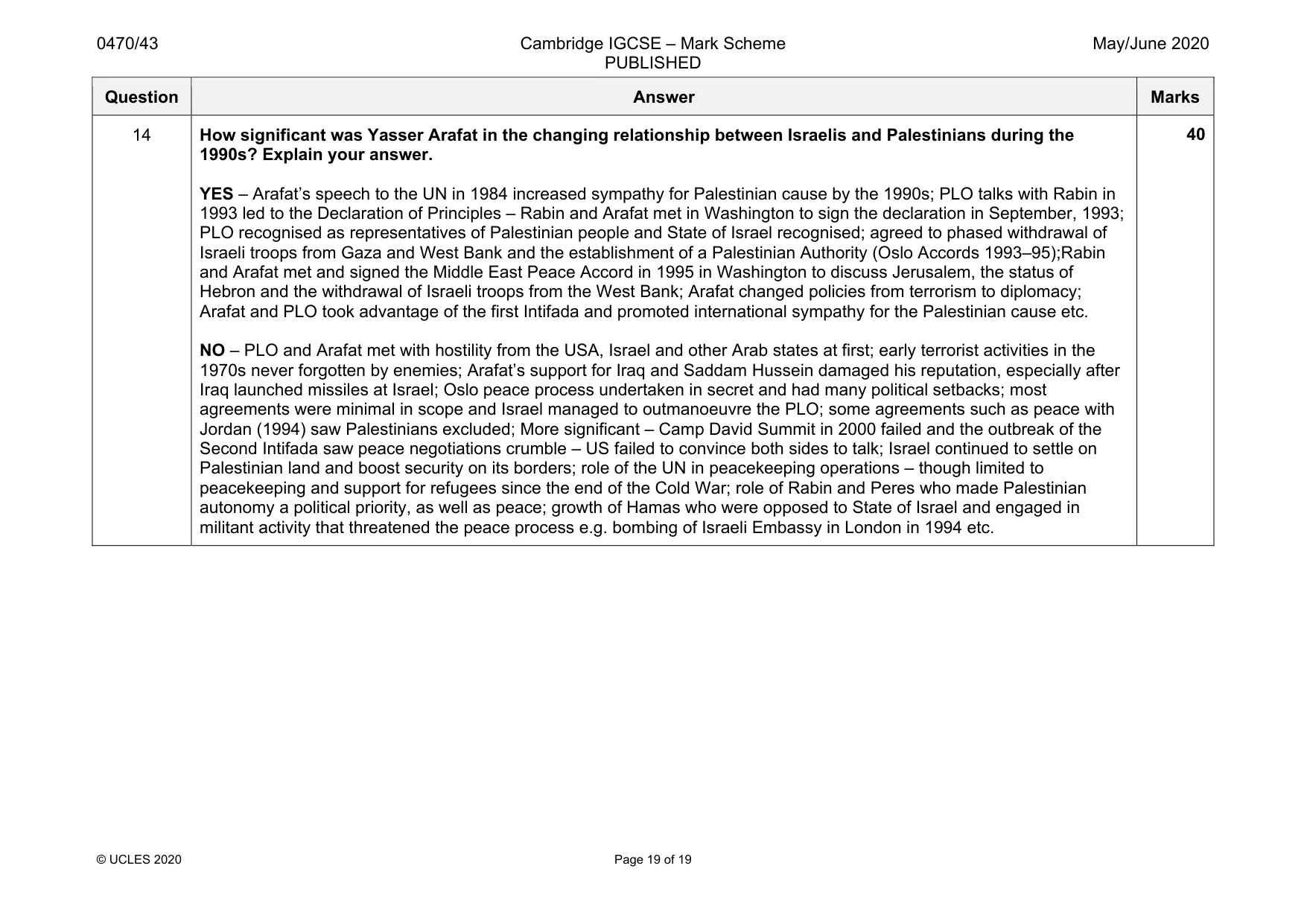
0470/43 Cambridge IGCSE – Mark Scheme PUBLISHED May/June 2020 © UCLES 2020 Page 19 of 19 Question Answer Marks 14 How significant was Yasser Arafat in the changing relationship between Israelis and Palestinians during the 1990s? Explain your answer. YES – Arafat’s speech to the UN in 1984 increased sympathy for Palestinian cause by the 1990s; PLO talks with Rabin in 1993 led to the Declaration of Principles – Rabin and Arafat met in Washington to sign the declaration in September, 1993; PLO recognised as representatives of Palestinian people and State of Israel recognised; agreed to phased withdrawal of Israeli troops from Gaza and West Bank and the establishment of a Palestinian Authority (Oslo Accords 1993–95);Rabin and Arafat met and signed the Middle East Peace Accord in 1995 in Washington to discuss Jerusalem, the status of Hebron and the withdrawal of Israeli troops from the West Bank; Arafat changed policies from terrorism to diplomacy; Arafat and PLO took advantage of the first Intifada and promoted international sympathy for the Palestinian cause etc. NO – PLO and Arafat met with hostility from the USA, Israel and other Arab states at first; early terrorist activities in the 1970s never forgotten by enemies; Arafat’s support for Iraq and Saddam Hussein damaged his reputation, especially after Iraq launched missiles at Israel; Oslo peace process undertaken in secret and had many political setbacks; most agreements were minimal in scope and Israel managed to outmanoeuvre the PLO; some agreements such as peace with Jordan (1994) saw Palestinians excluded; More significant – Camp David Summit in 2000 failed and the outbreak of the Second Intifada saw peace negotiations crumble – US failed to convince both sides to talk; Israel continued to settle on Palestinian land and boost security on its borders; role of the UN in peacekeeping operations – though limited to peacekeeping and support for refugees since the end of the Cold War; role of Rabin and Peres who made Palestinian autonomy a political priority, as well as peace; growth of Hamas who were opposed to State of Israel and engaged in militant activity that threatened the peace process e.g. bombing of Israeli Embassy in London in 1994 etc. 40