Cambridge IGCSE History 0470 — 2020 May/June Paper 4 · Variant 1
0470/41/M/J/20
The question paper and its mark scheme, free to read here and free to download. This is Cambridge’s own paper, exactly as it was sat.
Question paper4 pages
Mark scheme12 pages
Answers below. Sit the paper first if you are practising.
Paper as text
Question paper, page 1
Cambridge IGCSE™ 0470/41 May/June 2020 1 hour HISTORY Paper 4 Alternative to Coursework You must answer on the enclosed answer booklet. You will need: Answer booklet (enclosed) INSTRUCTIONS • Answer one question from your chosen Depth Study. • Follow the instructions on the front cover of the answer booklet. If you need additional answer paper, ask the invigilator for a continuation booklet. INFORMATION • The total mark for this paper is 40. • The number of marks for each question or part question is shown in brackets [ ]. This document has 4 pages. Blank pages are indicated. [Turn over 06_0470_41_2020_1.10 © UCLES 2020 *5765165474*
Question paper, page 2
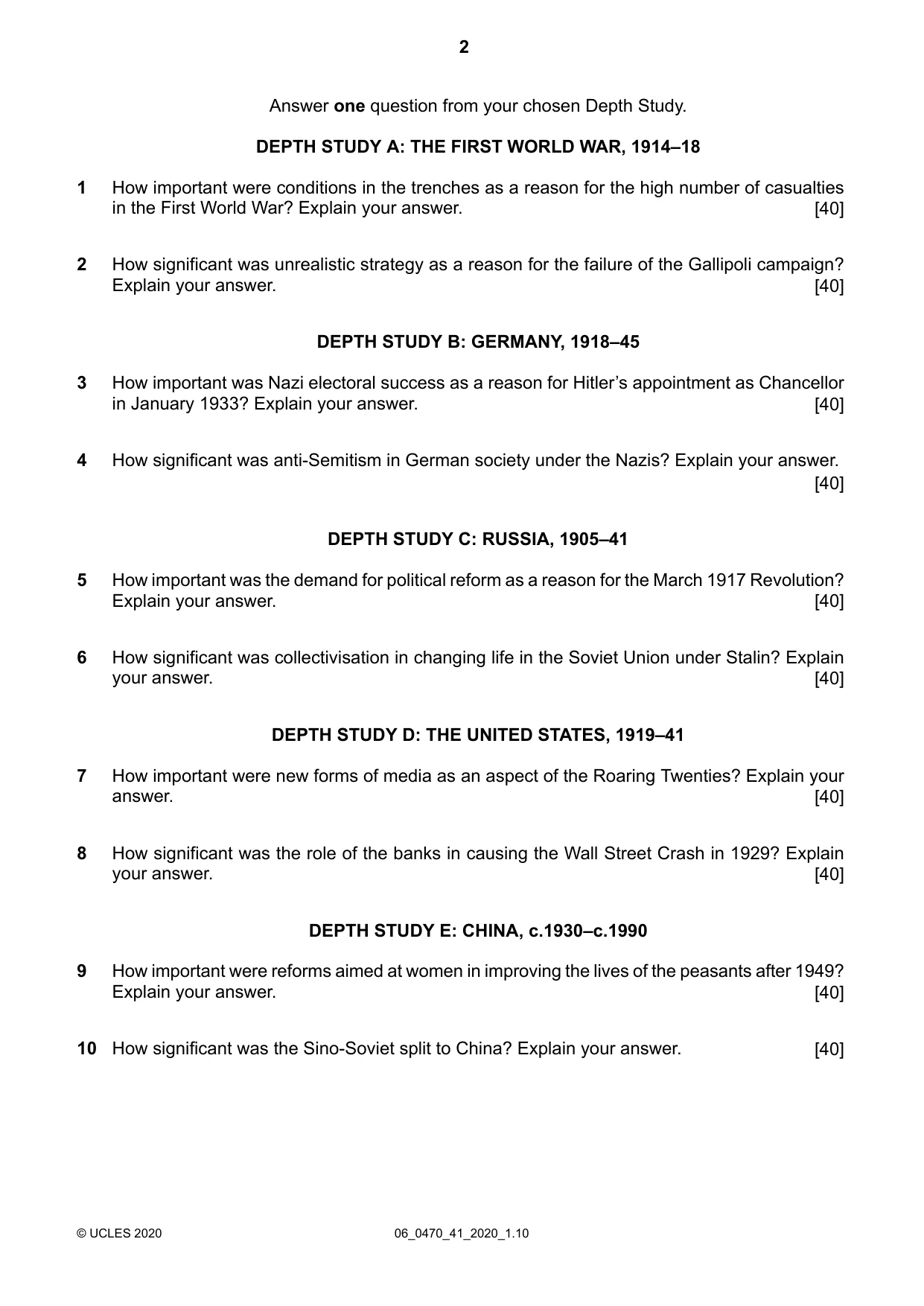
Answer one question from your chosen Depth Study. DEPTH STUDY A: THE FIRST WORLD WAR, 1914–18 How important were conditions in the trenches as a reason for the high number of casualties in the First World War? Explain your answer. [40] 1 How significant was unrealistic strategy as a reason for the failure of the Gallipoli campaign? Explain your answer. [40] 2 DEPTH STUDY B: GERMANY, 1918–45 How important was Nazi electoral success as a reason for Hitler’s appointment as Chancellor in January 1933? Explain your answer. [40] 3 How significant was anti-Semitism in German society under the Nazis? Explain your answer. [40] 4 DEPTH STUDY C: RUSSIA, 1905–41 How important was the demand for political reform as a reason for the March 1917 Revolution? Explain your answer. [40] 5 How significant was collectivisation in changing life in the Soviet Union under Stalin? Explain your answer. [40] 6 DEPTH STUDY D: THE UNITED STATES, 1919–41 How important were new forms of media as an aspect of the Roaring Twenties? Explain your answer. [40] 7 How significant was the role of the banks in causing the Wall Street Crash in 1929? Explain your answer. [40] 8 DEPTH STUDY E: CHINA, c.1930–c.1990 How important were reforms aimed at women in improving the lives of the peasants after 1949? Explain your answer. [40] 9 How significant was the Sino-Soviet split to China? Explain your answer. [40] 10 06_0470_41_2020_1.10 © UCLES 2020 2
Question paper, page 3
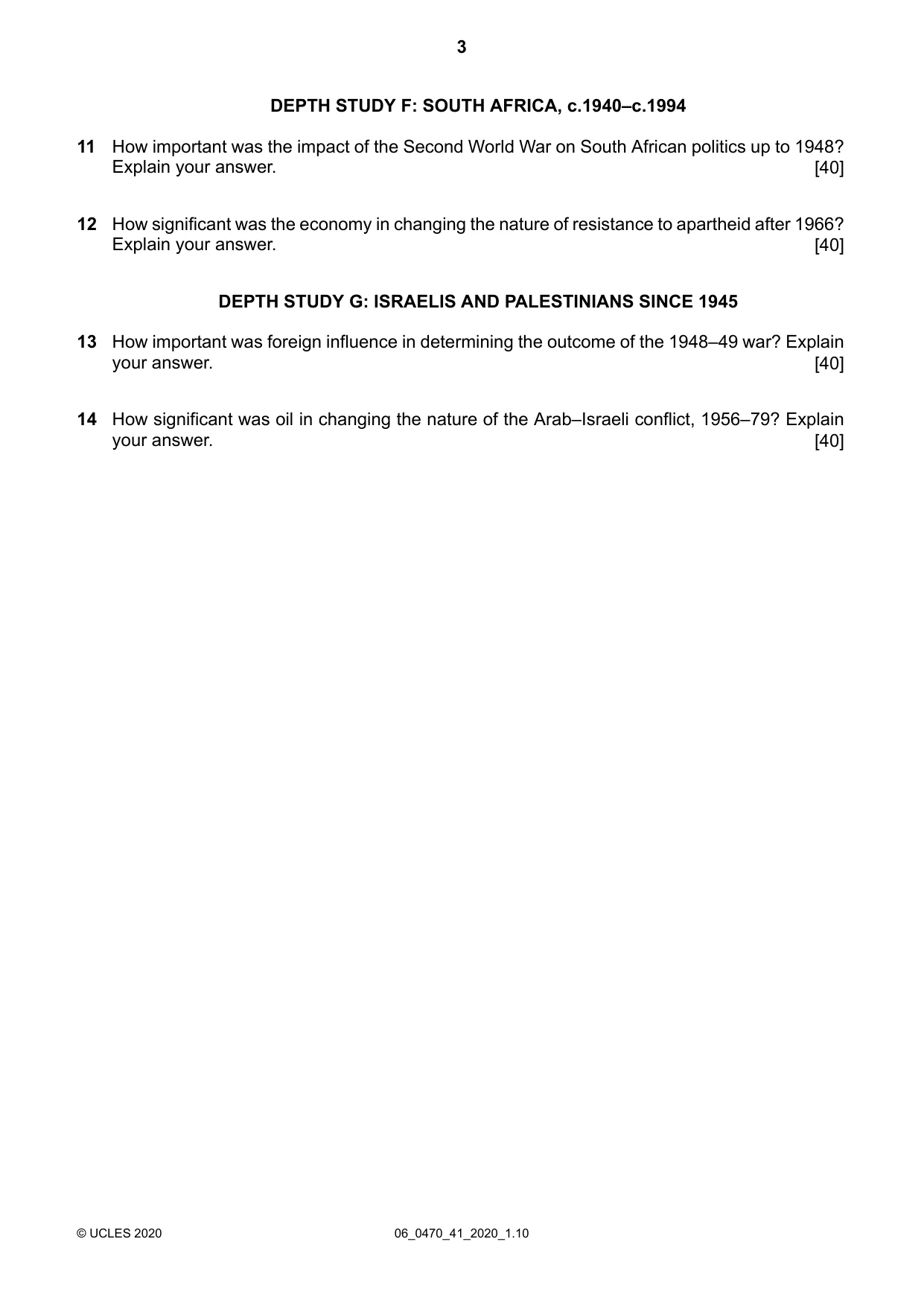
DEPTH STUDY F: SOUTH AFRICA, c.1940–c.1994 How important was the impact of the Second World War on South African politics up to 1948? Explain your answer. [40] 11 How significant was the economy in changing the nature of resistance to apartheid after 1966? Explain your answer. [40] 12 DEPTH STUDY G: ISRAELIS AND PALESTINIANS SINCE 1945 How important was foreign influence in determining the outcome of the 1948–49 war? Explain your answer. [40] 13 How significant was oil in changing the nature of the Arab–Israeli conflict, 1956–79? Explain your answer. [40] 14 06_0470_41_2020_1.10 © UCLES 2020 3
Question paper, page 4
BLANK PAGE Permission to reproduce items where third-party owned material protected by copyright is included has been sought and cleared where possible. Every reasonable effort has been made by the publisher (UCLES) to trace copyright holders, but if any items requiring clearance have unwittingly been included, the publisher will be pleased to make amends at the earliest possible opportunity. To avoid the issue of disclosure of answer-related information to candidates, all copyright acknowledgements are reproduced online in the Cambridge Assessment International Education Copyright Acknowledgements Booklet. This is produced for each series of examinations and is freely available to download at www.cambridgeinternational.org after the live examination series. Cambridge Assessment International Education is part of the Cambridge Assessment Group. Cambridge Assessment is the brand name of the University of Cambridge Local Examinations Syndicate (UCLES), which itself is a department of the University of Cambridge. 06_0470_41_2020_1.10 © UCLES 2020 4
Mark scheme, page 1
This document consists of 12 printed pages. © UCLES 2020 [Turn over Cambridge IGCSE™ HISTORY 0470/41 Paper 4 Alternative to Coursework May/June 2020 MARK SCHEME Maximum Mark: 40 Published Students did not sit exam papers in the June 2020 series due to the Covid-19 global pandemic. This mark scheme is published to support teachers and students and should be read together with the question paper. It shows the requirements of the exam. The answer column of the mark scheme shows the proposed basis on which Examiners would award marks for this exam. Where appropriate, this column also provides the most likely acceptable alternative responses expected from students. Examiners usually review the mark scheme after they have seen student responses and update the mark scheme if appropriate. In the June series, Examiners were unable to consider the acceptability of alternative responses, as there were no student responses to consider. Mark schemes should usually be read together with the Principal Examiner Report for Teachers. However, because students did not sit exam papers, there is no Principal Examiner Report for Teachers for the June 2020 series. Cambridge International will not enter into discussions about these mark schemes. Cambridge International is publishing the mark schemes for the June 2020 series for most Cambridge IGCSE™ and Cambridge International A & AS Level components, and some Cambridge O Level components.
Mark scheme, page 2
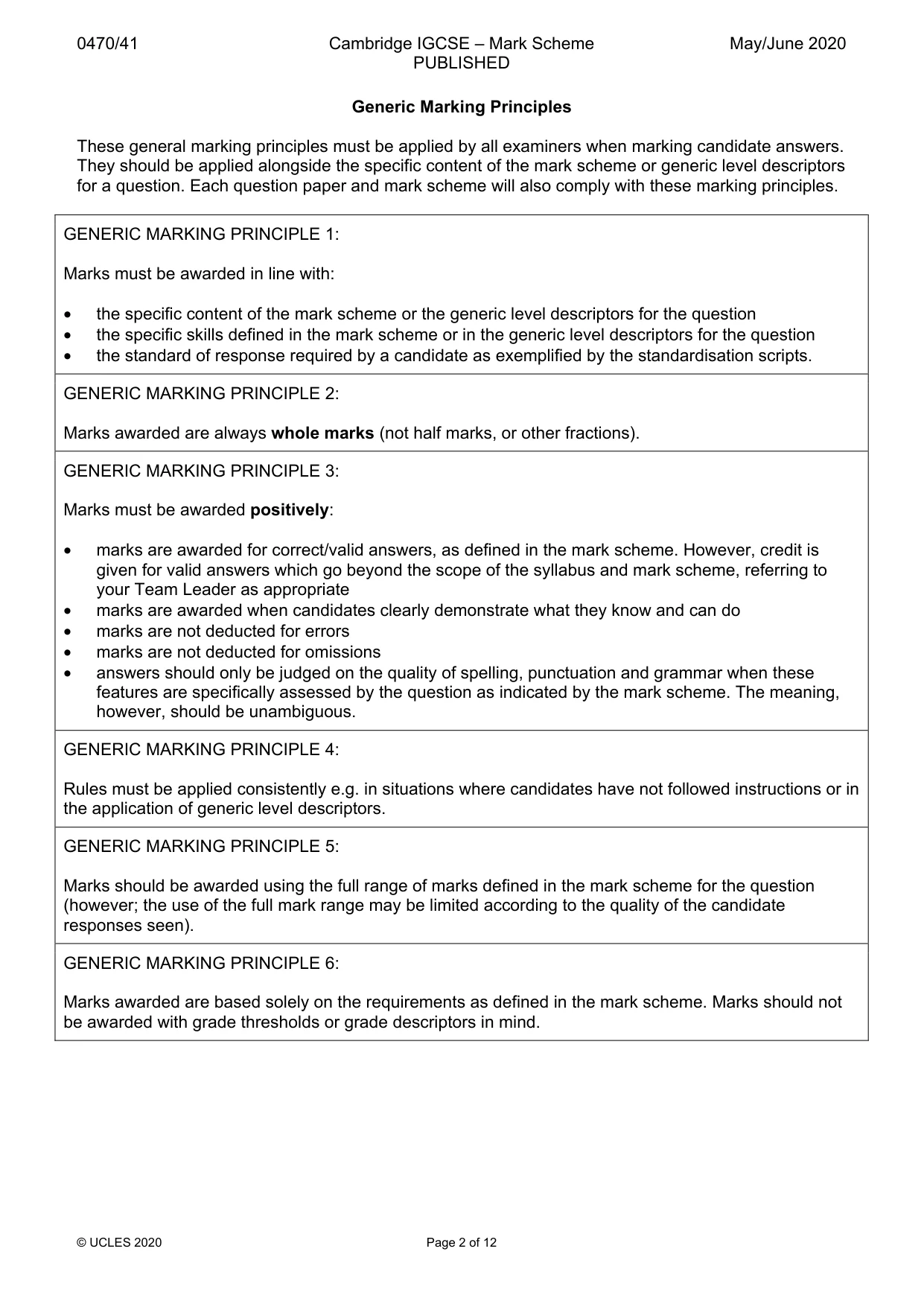
0470/41 Cambridge IGCSE – Mark Scheme PUBLISHED May/June 2020 © UCLES 2020 Page 2 of 12 Generic Marking Principles These general marking principles must be applied by all examiners when marking candidate answers. They should be applied alongside the specific content of the mark scheme or generic level descriptors for a question. Each question paper and mark scheme will also comply with these marking principles. GENERIC MARKING PRINCIPLE 1: Marks must be awarded in line with: • the specific content of the mark scheme or the generic level descriptors for the question • the specific skills defined in the mark scheme or in the generic level descriptors for the question • the standard of response required by a candidate as exemplified by the standardisation scripts. GENERIC MARKING PRINCIPLE 2: Marks awarded are always whole marks (not half marks, or other fractions). GENERIC MARKING PRINCIPLE 3: Marks must be awarded positively: • marks are awarded for correct/valid answers, as defined in the mark scheme. However, credit is given for valid answers which go beyond the scope of the syllabus and mark scheme, referring to your Team Leader as appropriate • marks are awarded when candidates clearly demonstrate what they know and can do • marks are not deducted for errors • marks are not deducted for omissions • answers should only be judged on the quality of spelling, punctuation and grammar when these features are specifically assessed by the question as indicated by the mark scheme. The meaning, however, should be unambiguous. GENERIC MARKING PRINCIPLE 4: Rules must be applied consistently e.g. in situations where candidates have not followed instructions or in the application of generic level descriptors. GENERIC MARKING PRINCIPLE 5: Marks should be awarded using the full range of marks defined in the mark scheme for the question (however; the use of the full mark range may be limited according to the quality of the candidate responses seen). GENERIC MARKING PRINCIPLE 6: Marks awarded are based solely on the requirements as defined in the mark scheme. Marks should not be awarded with grade thresholds or grade descriptors in mind.
Mark scheme, page 3
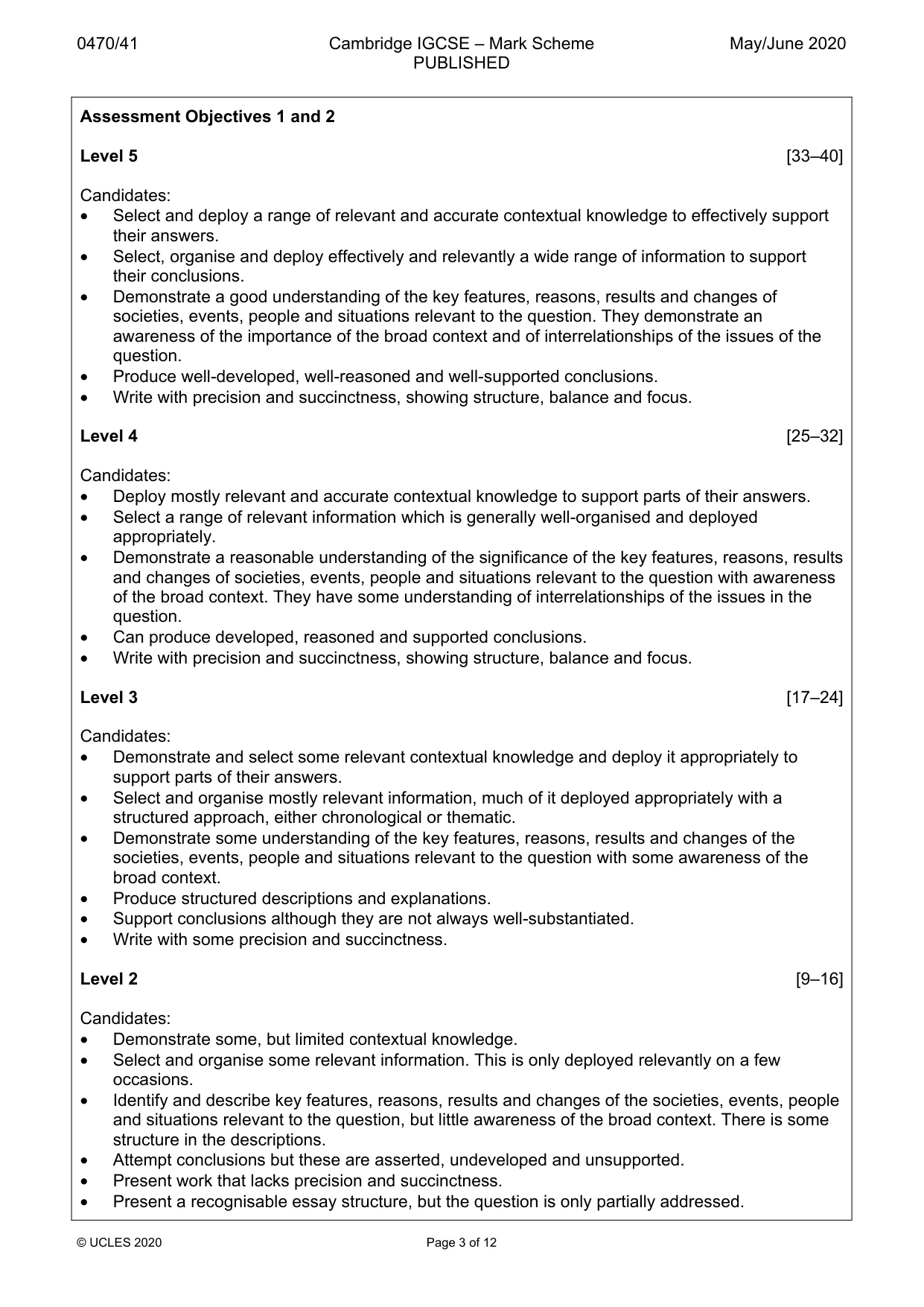
0470/41 Cambridge IGCSE – Mark Scheme PUBLISHED May/June 2020 © UCLES 2020 Page 3 of 12 Assessment Objectives 1 and 2 Level 5 [33–40] Candidates: • Select and deploy a range of relevant and accurate contextual knowledge to effectively support their answers. • Select, organise and deploy effectively and relevantly a wide range of information to support their conclusions. • Demonstrate a good understanding of the key features, reasons, results and changes of societies, events, people and situations relevant to the question. They demonstrate an awareness of the importance of the broad context and of interrelationships of the issues of the question. • Produce well-developed, well-reasoned and well-supported conclusions. • Write with precision and succinctness, showing structure, balance and focus. Level 4 [25–32] Candidates: • Deploy mostly relevant and accurate contextual knowledge to support parts of their answers. • Select a range of relevant information which is generally well-organised and deployed appropriately. • Demonstrate a reasonable understanding of the significance of the key features, reasons, results and changes of societies, events, people and situations relevant to the question with awareness of the broad context. They have some understanding of interrelationships of the issues in the question. • Can produce developed, reasoned and supported conclusions. • Write with precision and succinctness, showing structure, balance and focus. Level 3 [17–24] Candidates: • Demonstrate and select some relevant contextual knowledge and deploy it appropriately to support parts of their answers. • Select and organise mostly relevant information, much of it deployed appropriately with a structured approach, either chronological or thematic. • Demonstrate some understanding of the key features, reasons, results and changes of the societies, events, people and situations relevant to the question with some awareness of the broad context. • Produce structured descriptions and explanations. • Support conclusions although they are not always well-substantiated. • Write with some precision and succinctness. Level 2 [9–16] Candidates: • Demonstrate some, but limited contextual knowledge. • Select and organise some relevant information. This is only deployed relevantly on a few occasions. • Identify and describe key features, reasons, results and changes of the societies, events, people and situations relevant to the question, but little awareness of the broad context. There is some structure in the descriptions. • Attempt conclusions but these are asserted, undeveloped and unsupported. • Present work that lacks precision and succinctness. • Present a recognisable essay structure, but the question is only partially addressed.
Mark scheme, page 4
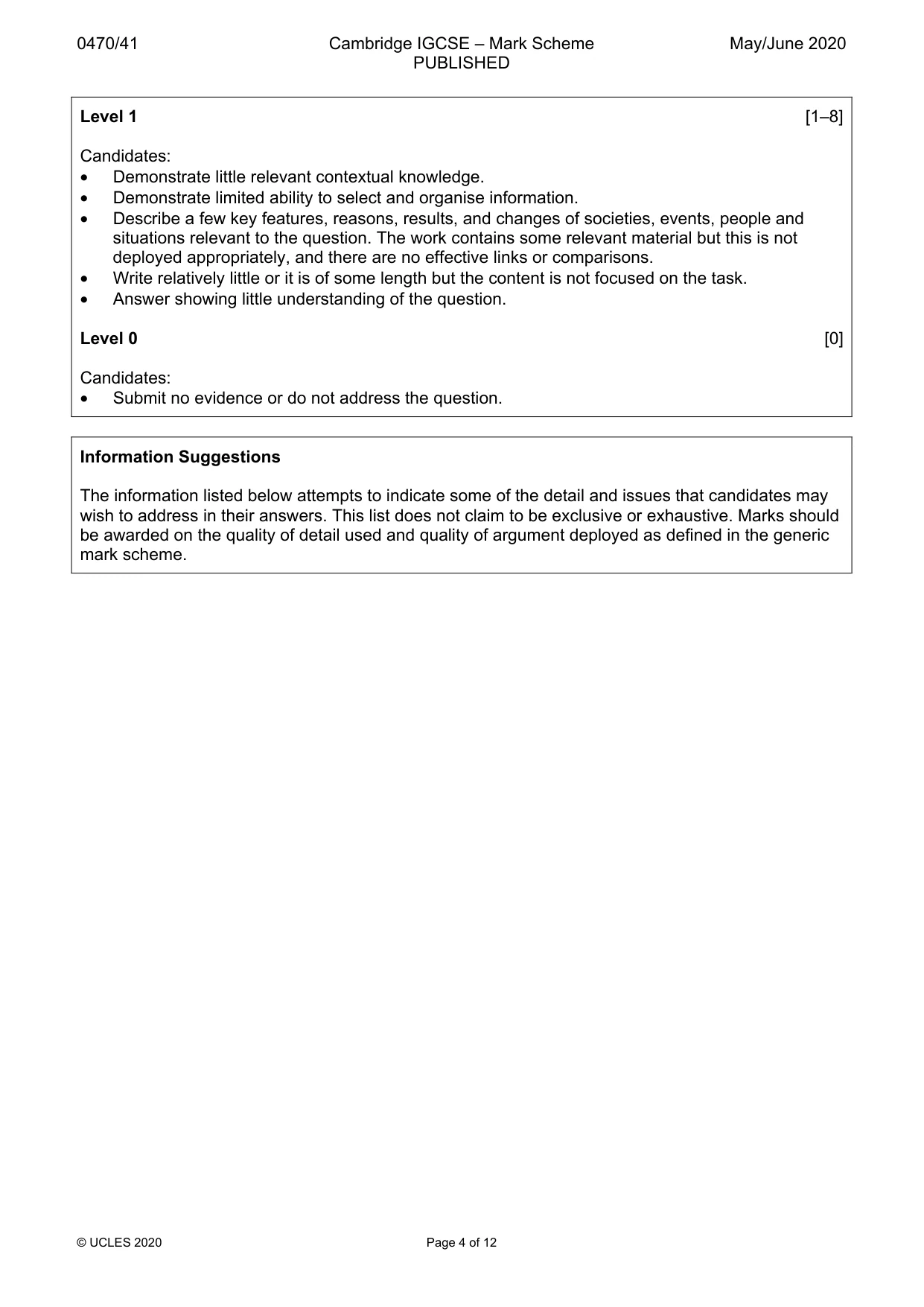
0470/41 Cambridge IGCSE – Mark Scheme PUBLISHED May/June 2020 © UCLES 2020 Page 4 of 12 Level 1 [1–8] Candidates: • Demonstrate little relevant contextual knowledge. • Demonstrate limited ability to select and organise information. • Describe a few key features, reasons, results, and changes of societies, events, people and situations relevant to the question. The work contains some relevant material but this is not deployed appropriately, and there are no effective links or comparisons. • Write relatively little or it is of some length but the content is not focused on the task. • Answer showing little understanding of the question. Level 0 [0] Candidates: • Submit no evidence or do not address the question. Information Suggestions The information listed below attempts to indicate some of the detail and issues that candidates may wish to address in their answers. This list does not claim to be exclusive or exhaustive. Marks should be awarded on the quality of detail used and quality of argument deployed as defined in the generic mark scheme.
Mark scheme, page 5
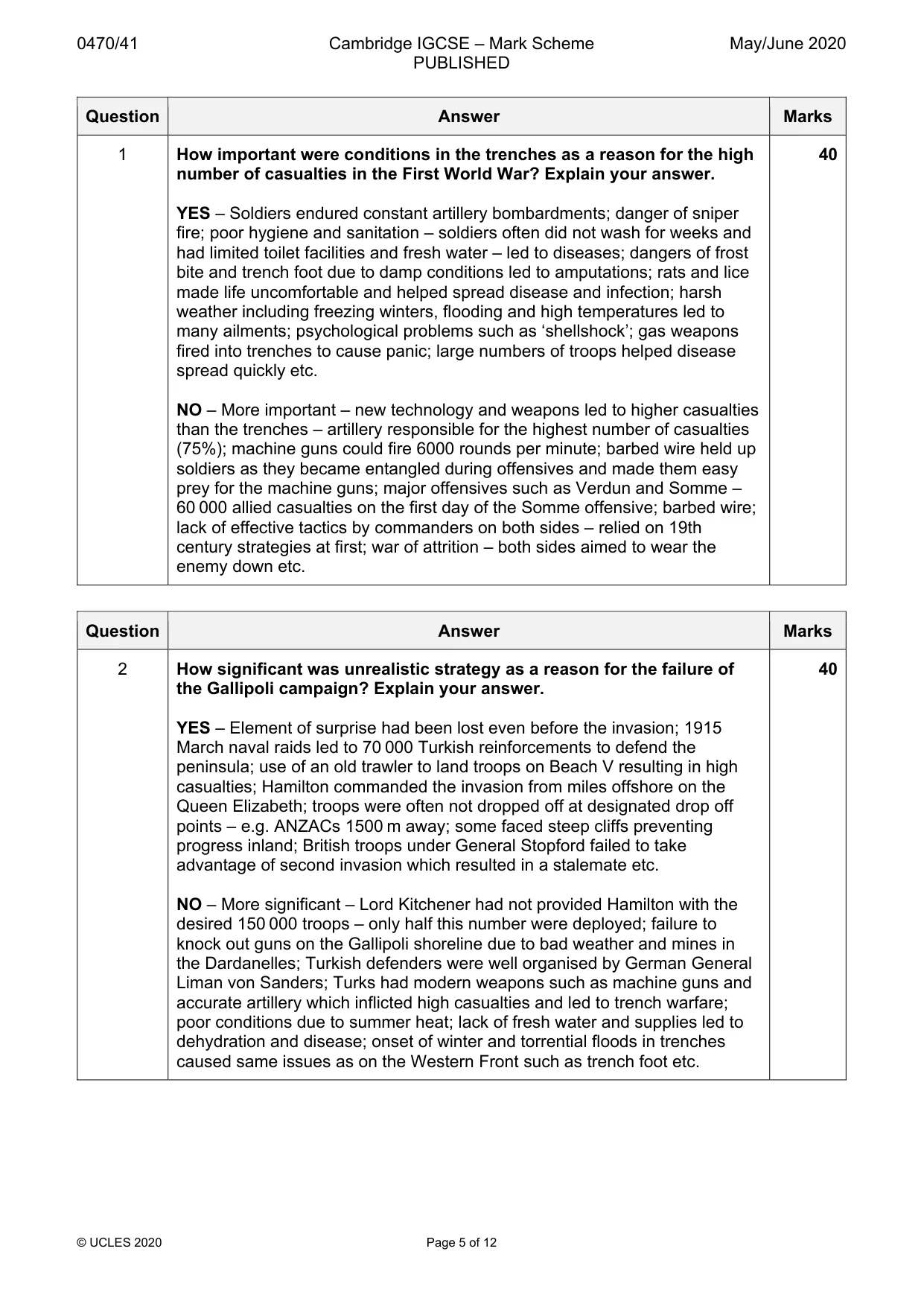
0470/41 Cambridge IGCSE – Mark Scheme PUBLISHED May/June 2020 © UCLES 2020 Page 5 of 12 Question Answer Marks 1 How important were conditions in the trenches as a reason for the high number of casualties in the First World War? Explain your answer. YES – Soldiers endured constant artillery bombardments; danger of sniper fire; poor hygiene and sanitation – soldiers often did not wash for weeks and had limited toilet facilities and fresh water – led to diseases; dangers of frost bite and trench foot due to damp conditions led to amputations; rats and lice made life uncomfortable and helped spread disease and infection; harsh weather including freezing winters, flooding and high temperatures led to many ailments; psychological problems such as ‘shellshock’; gas weapons fired into trenches to cause panic; large numbers of troops helped disease spread quickly etc. NO – More important – new technology and weapons led to higher casualties than the trenches – artillery responsible for the highest number of casualties (75%); machine guns could fire 6000 rounds per minute; barbed wire held up soldiers as they became entangled during offensives and made them easy prey for the machine guns; major offensives such as Verdun and Somme – 60 000 allied casualties on the first day of the Somme offensive; barbed wire; lack of effective tactics by commanders on both sides – relied on 19th century strategies at first; war of attrition – both sides aimed to wear the enemy down etc. 40 Question Answer Marks 2 How significant was unrealistic strategy as a reason for the failure of the Gallipoli campaign? Explain your answer. YES – Element of surprise had been lost even before the invasion; 1915 March naval raids led to 70 000 Turkish reinforcements to defend the peninsula; use of an old trawler to land troops on Beach V resulting in high casualties; Hamilton commanded the invasion from miles offshore on the Queen Elizabeth; troops were often not dropped off at designated drop off points – e.g. ANZACs 1500 m away; some faced steep cliffs preventing progress inland; British troops under General Stopford failed to take advantage of second invasion which resulted in a stalemate etc. NO – More significant – Lord Kitchener had not provided Hamilton with the desired 150 000 troops – only half this number were deployed; failure to knock out guns on the Gallipoli shoreline due to bad weather and mines in the Dardanelles; Turkish defenders were well organised by German General Liman von Sanders; Turks had modern weapons such as machine guns and accurate artillery which inflicted high casualties and led to trench warfare; poor conditions due to summer heat; lack of fresh water and supplies led to dehydration and disease; onset of winter and torrential floods in trenches caused same issues as on the Western Front such as trench foot etc. 40
Mark scheme, page 6
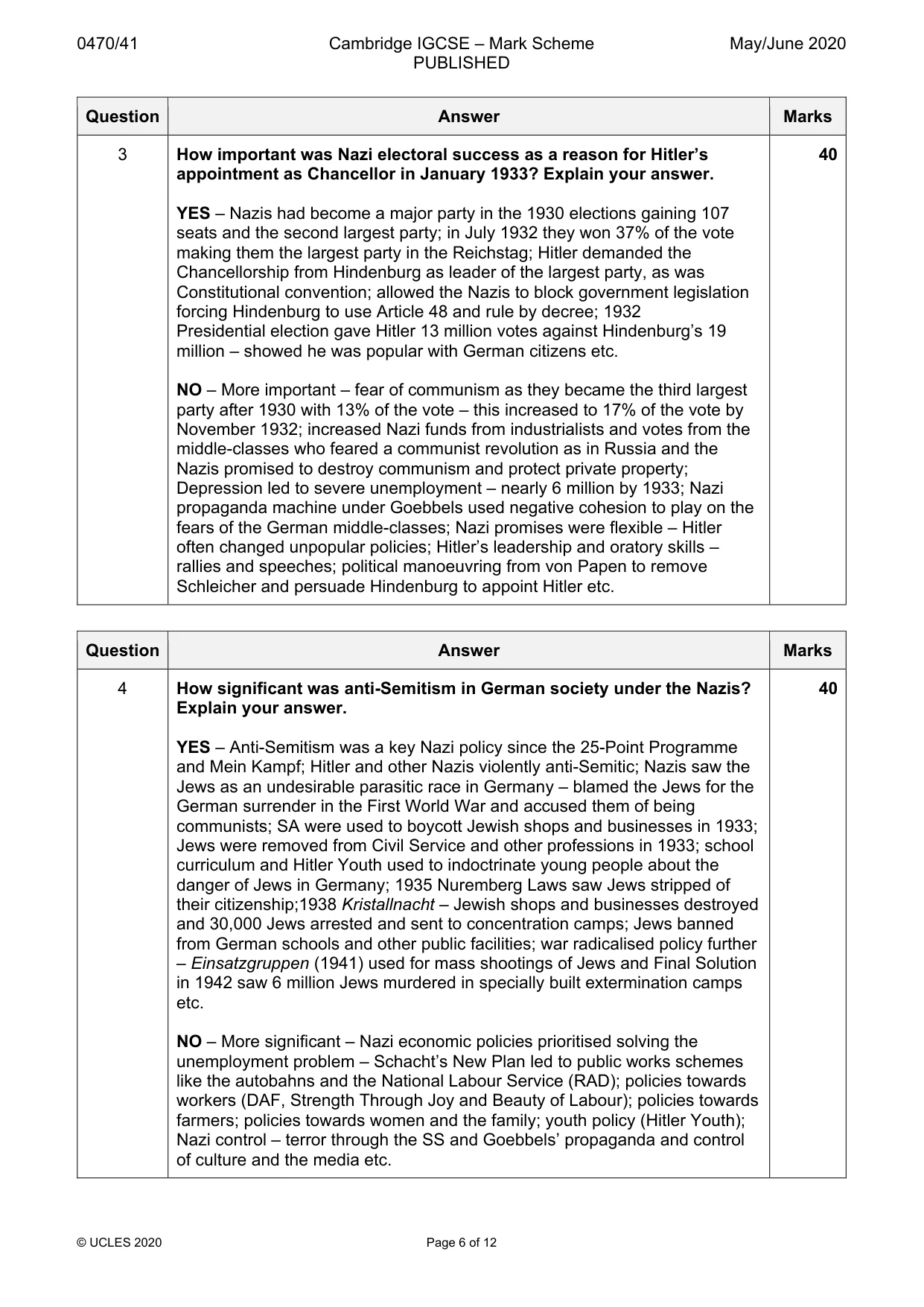
0470/41 Cambridge IGCSE – Mark Scheme PUBLISHED May/June 2020 © UCLES 2020 Page 6 of 12 Question Answer Marks 3 How important was Nazi electoral success as a reason for Hitler’s appointment as Chancellor in January 1933? Explain your answer. YES – Nazis had become a major party in the 1930 elections gaining 107 seats and the second largest party; in July 1932 they won 37% of the vote making them the largest party in the Reichstag; Hitler demanded the Chancellorship from Hindenburg as leader of the largest party, as was Constitutional convention; allowed the Nazis to block government legislation forcing Hindenburg to use Article 48 and rule by decree; 1932 Presidential election gave Hitler 13 million votes against Hindenburg’s 19 million – showed he was popular with German citizens etc. NO – More important – fear of communism as they became the third largest party after 1930 with 13% of the vote – this increased to 17% of the vote by November 1932; increased Nazi funds from industrialists and votes from the middle-classes who feared a communist revolution as in Russia and the Nazis promised to destroy communism and protect private property; Depression led to severe unemployment – nearly 6 million by 1933; Nazi propaganda machine under Goebbels used negative cohesion to play on the fears of the German middle-classes; Nazi promises were flexible – Hitler often changed unpopular policies; Hitler’s leadership and oratory skills – rallies and speeches; political manoeuvring from von Papen to remove Schleicher and persuade Hindenburg to appoint Hitler etc. 40 Question Answer Marks 4 How significant was anti-Semitism in German society under the Nazis? Explain your answer. YES – Anti-Semitism was a key Nazi policy since the 25-Point Programme and Mein Kampf; Hitler and other Nazis violently anti-Semitic; Nazis saw the Jews as an undesirable parasitic race in Germany – blamed the Jews for the German surrender in the First World War and accused them of being communists; SA were used to boycott Jewish shops and businesses in 1933; Jews were removed from Civil Service and other professions in 1933; school curriculum and Hitler Youth used to indoctrinate young people about the danger of Jews in Germany; 1935 Nuremberg Laws saw Jews stripped of their citizenship;1938 Kristallnacht – Jewish shops and businesses destroyed and 30,000 Jews arrested and sent to concentration camps; Jews banned from German schools and other public facilities; war radicalised policy further – Einsatzgruppen (1941) used for mass shootings of Jews and Final Solution in 1942 saw 6 million Jews murdered in specially built extermination camps etc. NO – More significant – Nazi economic policies prioritised solving the unemployment problem – Schacht’s New Plan led to public works schemes like the autobahns and the National Labour Service (RAD); policies towards workers (DAF, Strength Through Joy and Beauty of Labour); policies towards farmers; policies towards women and the family; youth policy (Hitler Youth); Nazi control – terror through the SS and Goebbels’ propaganda and control of culture and the media etc. 40
Mark scheme, page 7
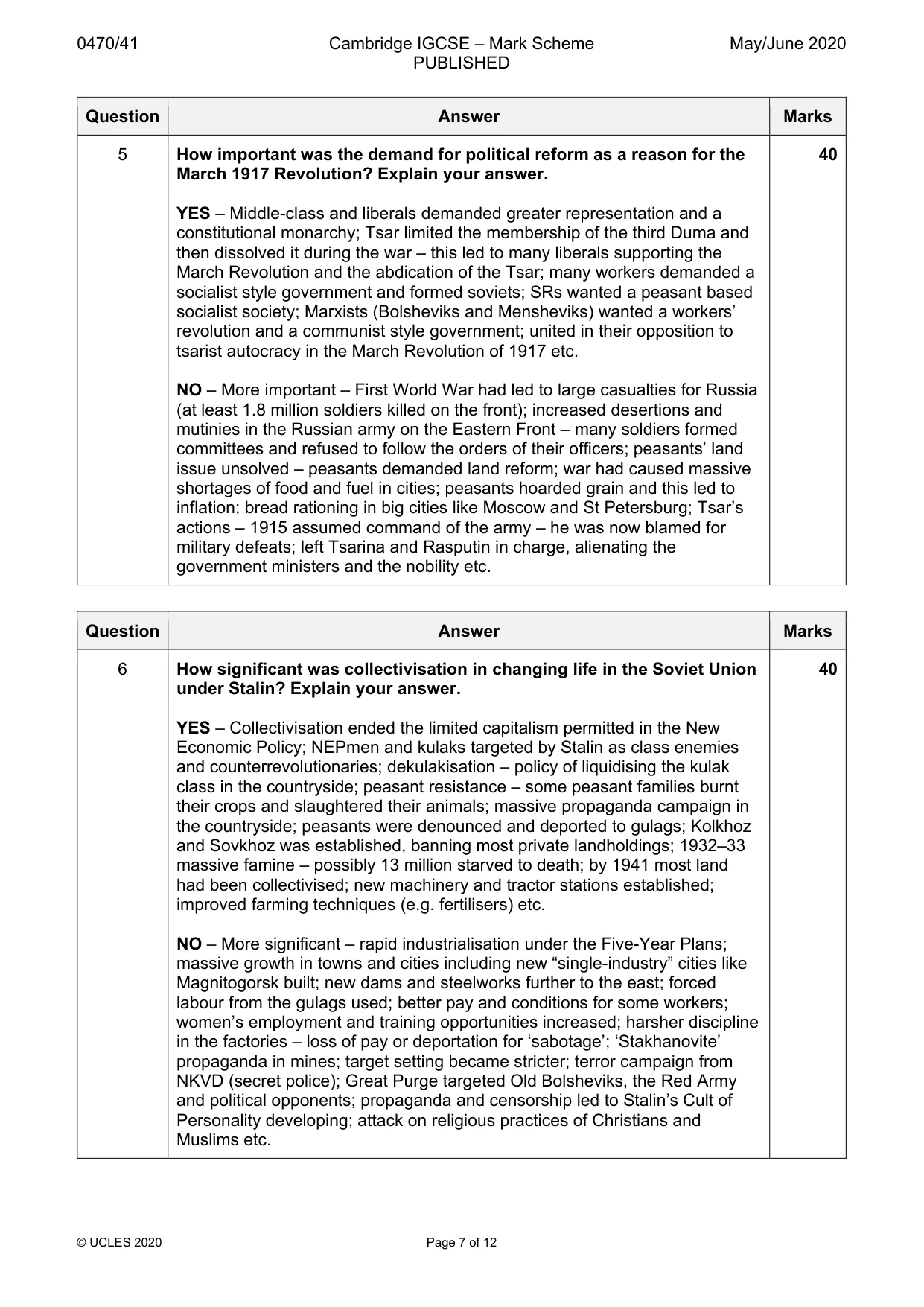
0470/41 Cambridge IGCSE – Mark Scheme PUBLISHED May/June 2020 © UCLES 2020 Page 7 of 12 Question Answer Marks 5 How important was the demand for political reform as a reason for the March 1917 Revolution? Explain your answer. YES – Middle-class and liberals demanded greater representation and a constitutional monarchy; Tsar limited the membership of the third Duma and then dissolved it during the war – this led to many liberals supporting the March Revolution and the abdication of the Tsar; many workers demanded a socialist style government and formed soviets; SRs wanted a peasant based socialist society; Marxists (Bolsheviks and Mensheviks) wanted a workers’ revolution and a communist style government; united in their opposition to tsarist autocracy in the March Revolution of 1917 etc. NO – More important – First World War had led to large casualties for Russia (at least 1.8 million soldiers killed on the front); increased desertions and mutinies in the Russian army on the Eastern Front – many soldiers formed committees and refused to follow the orders of their officers; peasants’ land issue unsolved – peasants demanded land reform; war had caused massive shortages of food and fuel in cities; peasants hoarded grain and this led to inflation; bread rationing in big cities like Moscow and St Petersburg; Tsar’s actions – 1915 assumed command of the army – he was now blamed for military defeats; left Tsarina and Rasputin in charge, alienating the government ministers and the nobility etc. 40 Question Answer Marks 6 How significant was collectivisation in changing life in the Soviet Union under Stalin? Explain your answer. YES – Collectivisation ended the limited capitalism permitted in the New Economic Policy; NEPmen and kulaks targeted by Stalin as class enemies and counterrevolutionaries; dekulakisation – policy of liquidising the kulak class in the countryside; peasant resistance – some peasant families burnt their crops and slaughtered their animals; massive propaganda campaign in the countryside; peasants were denounced and deported to gulags; Kolkhoz and Sovkhoz was established, banning most private landholdings; 1932–33 massive famine – possibly 13 million starved to death; by 1941 most land had been collectivised; new machinery and tractor stations established; improved farming techniques (e.g. fertilisers) etc. NO – More significant – rapid industrialisation under the Five-Year Plans; massive growth in towns and cities including new “single-industry” cities like Magnitogorsk built; new dams and steelworks further to the east; forced labour from the gulags used; better pay and conditions for some workers; women’s employment and training opportunities increased; harsher discipline in the factories – loss of pay or deportation for ‘sabotage’; ‘Stakhanovite’ propaganda in mines; target setting became stricter; terror campaign from NKVD (secret police); Great Purge targeted Old Bolsheviks, the Red Army and political opponents; propaganda and censorship led to Stalin’s Cult of Personality developing; attack on religious practices of Christians and Muslims etc. 40
Mark scheme, page 8
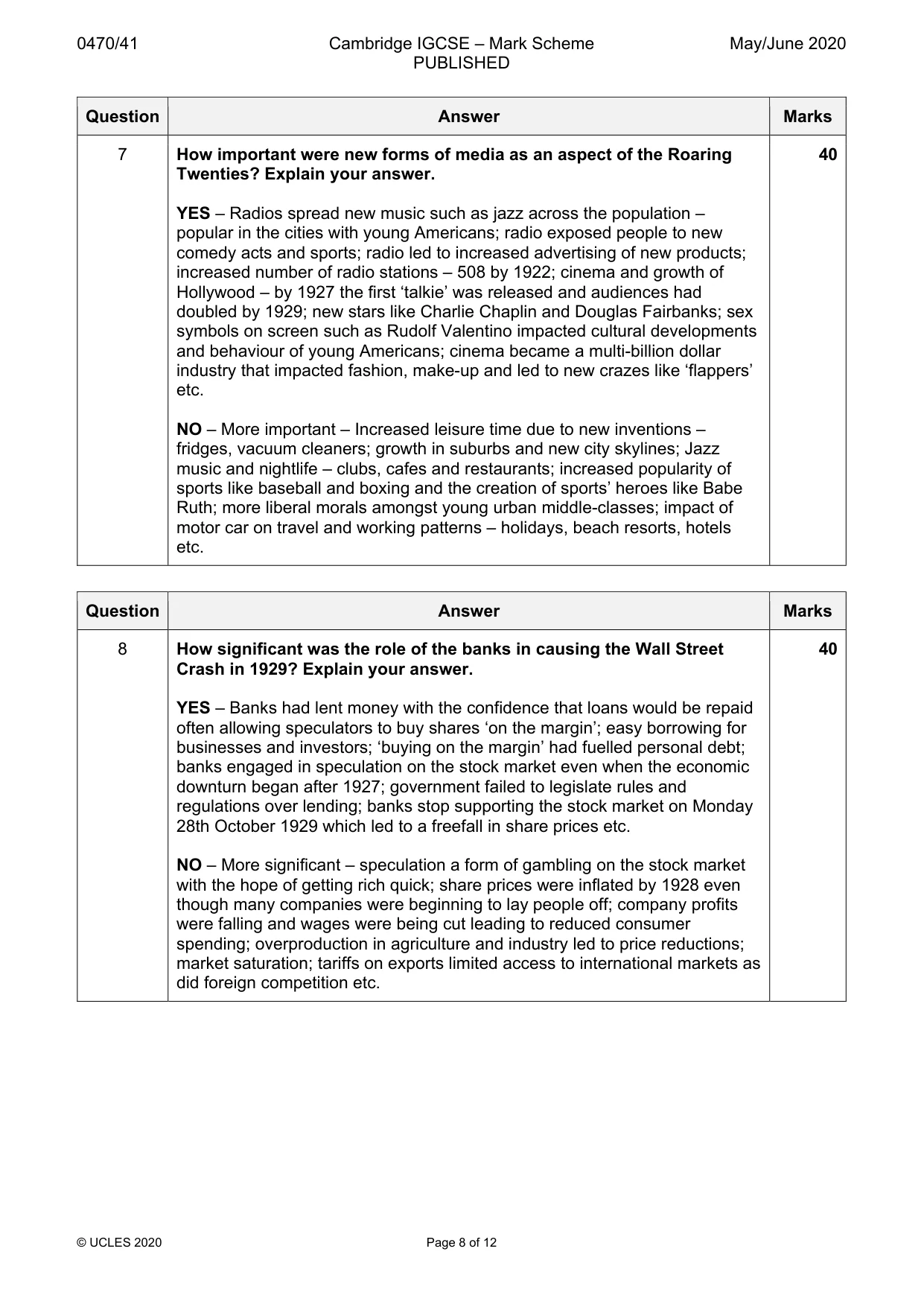
0470/41 Cambridge IGCSE – Mark Scheme PUBLISHED May/June 2020 © UCLES 2020 Page 8 of 12 Question Answer Marks 7 How important were new forms of media as an aspect of the Roaring Twenties? Explain your answer. YES – Radios spread new music such as jazz across the population – popular in the cities with young Americans; radio exposed people to new comedy acts and sports; radio led to increased advertising of new products; increased number of radio stations – 508 by 1922; cinema and growth of Hollywood – by 1927 the first ‘talkie’ was released and audiences had doubled by 1929; new stars like Charlie Chaplin and Douglas Fairbanks; sex symbols on screen such as Rudolf Valentino impacted cultural developments and behaviour of young Americans; cinema became a multi-billion dollar industry that impacted fashion, make-up and led to new crazes like ‘flappers’ etc. NO – More important – Increased leisure time due to new inventions – fridges, vacuum cleaners; growth in suburbs and new city skylines; Jazz music and nightlife – clubs, cafes and restaurants; increased popularity of sports like baseball and boxing and the creation of sports’ heroes like Babe Ruth; more liberal morals amongst young urban middle-classes; impact of motor car on travel and working patterns – holidays, beach resorts, hotels etc. 40 Question Answer Marks 8 How significant was the role of the banks in causing the Wall Street Crash in 1929? Explain your answer. YES – Banks had lent money with the confidence that loans would be repaid often allowing speculators to buy shares ‘on the margin’; easy borrowing for businesses and investors; ‘buying on the margin’ had fuelled personal debt; banks engaged in speculation on the stock market even when the economic downturn began after 1927; government failed to legislate rules and regulations over lending; banks stop supporting the stock market on Monday 28th October 1929 which led to a freefall in share prices etc. NO – More significant – speculation a form of gambling on the stock market with the hope of getting rich quick; share prices were inflated by 1928 even though many companies were beginning to lay people off; company profits were falling and wages were being cut leading to reduced consumer spending; overproduction in agriculture and industry led to price reductions; market saturation; tariffs on exports limited access to international markets as did foreign competition etc. 40
Mark scheme, page 9
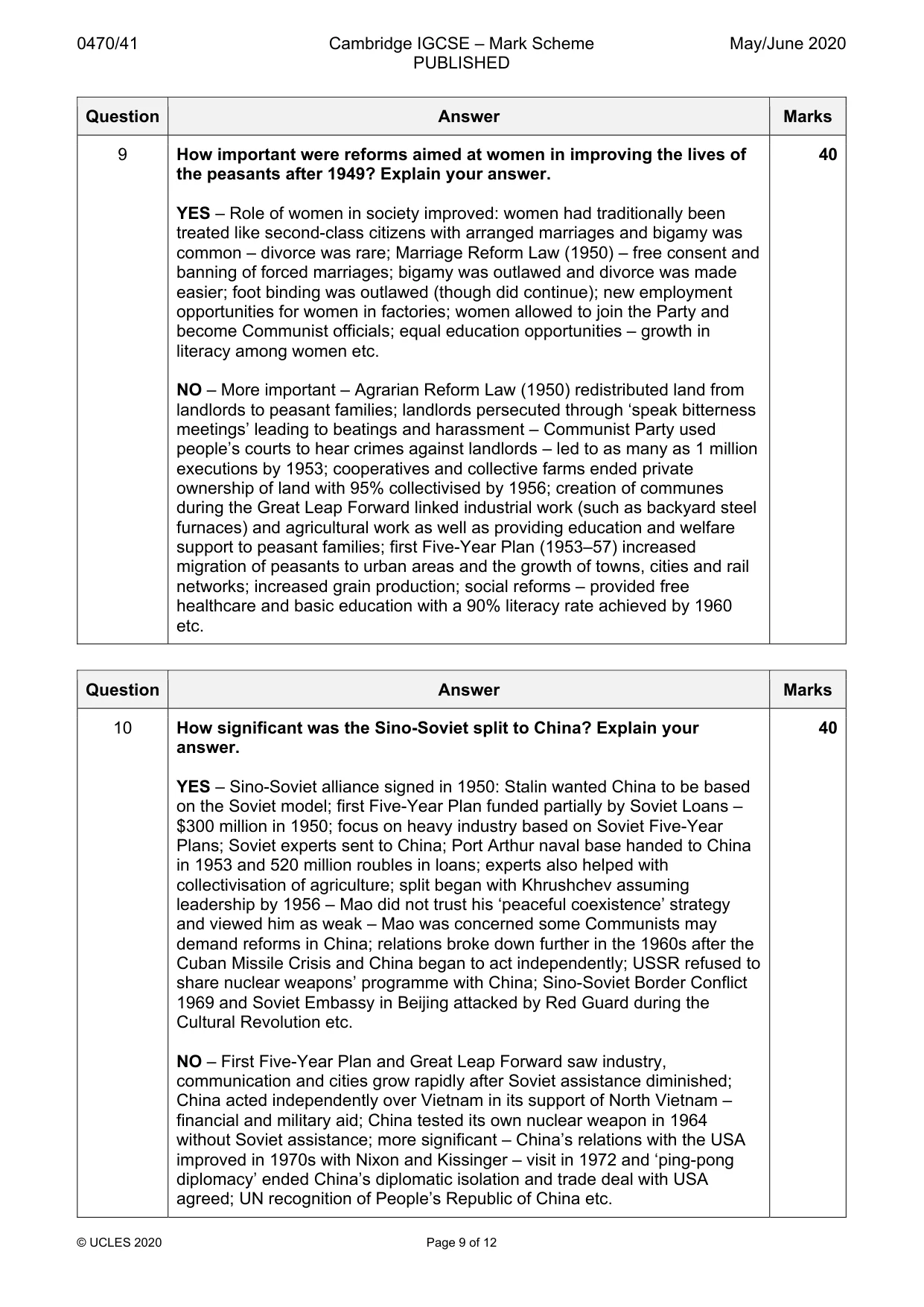
0470/41 Cambridge IGCSE – Mark Scheme PUBLISHED May/June 2020 © UCLES 2020 Page 9 of 12 Question Answer Marks 9 How important were reforms aimed at women in improving the lives of the peasants after 1949? Explain your answer. YES – Role of women in society improved: women had traditionally been treated like second-class citizens with arranged marriages and bigamy was common – divorce was rare; Marriage Reform Law (1950) – free consent and banning of forced marriages; bigamy was outlawed and divorce was made easier; foot binding was outlawed (though did continue); new employment opportunities for women in factories; women allowed to join the Party and become Communist officials; equal education opportunities – growth in literacy among women etc. NO – More important – Agrarian Reform Law (1950) redistributed land from landlords to peasant families; landlords persecuted through ‘speak bitterness meetings’ leading to beatings and harassment – Communist Party used people’s courts to hear crimes against landlords – led to as many as 1 million executions by 1953; cooperatives and collective farms ended private ownership of land with 95% collectivised by 1956; creation of communes during the Great Leap Forward linked industrial work (such as backyard steel furnaces) and agricultural work as well as providing education and welfare support to peasant families; first Five-Year Plan (1953–57) increased migration of peasants to urban areas and the growth of towns, cities and rail networks; increased grain production; social reforms – provided free healthcare and basic education with a 90% literacy rate achieved by 1960 etc. 40 Question Answer Marks 10 How significant was the Sino-Soviet split to China? Explain your answer. YES – Sino-Soviet alliance signed in 1950: Stalin wanted China to be based on the Soviet model; first Five-Year Plan funded partially by Soviet Loans – $300 million in 1950; focus on heavy industry based on Soviet Five-Year Plans; Soviet experts sent to China; Port Arthur naval base handed to China in 1953 and 520 million roubles in loans; experts also helped with collectivisation of agriculture; split began with Khrushchev assuming leadership by 1956 – Mao did not trust his ‘peaceful coexistence’ strategy and viewed him as weak – Mao was concerned some Communists may demand reforms in China; relations broke down further in the 1960s after the Cuban Missile Crisis and China began to act independently; USSR refused to share nuclear weapons’ programme with China; Sino-Soviet Border Conflict 1969 and Soviet Embassy in Beijing attacked by Red Guard during the Cultural Revolution etc. NO – First Five-Year Plan and Great Leap Forward saw industry, communication and cities grow rapidly after Soviet assistance diminished; China acted independently over Vietnam in its support of North Vietnam – financial and military aid; China tested its own nuclear weapon in 1964 without Soviet assistance; more significant – China’s relations with the USA improved in 1970s with Nixon and Kissinger – visit in 1972 and ‘ping-pong diplomacy’ ended China’s diplomatic isolation and trade deal with USA agreed; UN recognition of People’s Republic of China etc. 40
Mark scheme, page 10
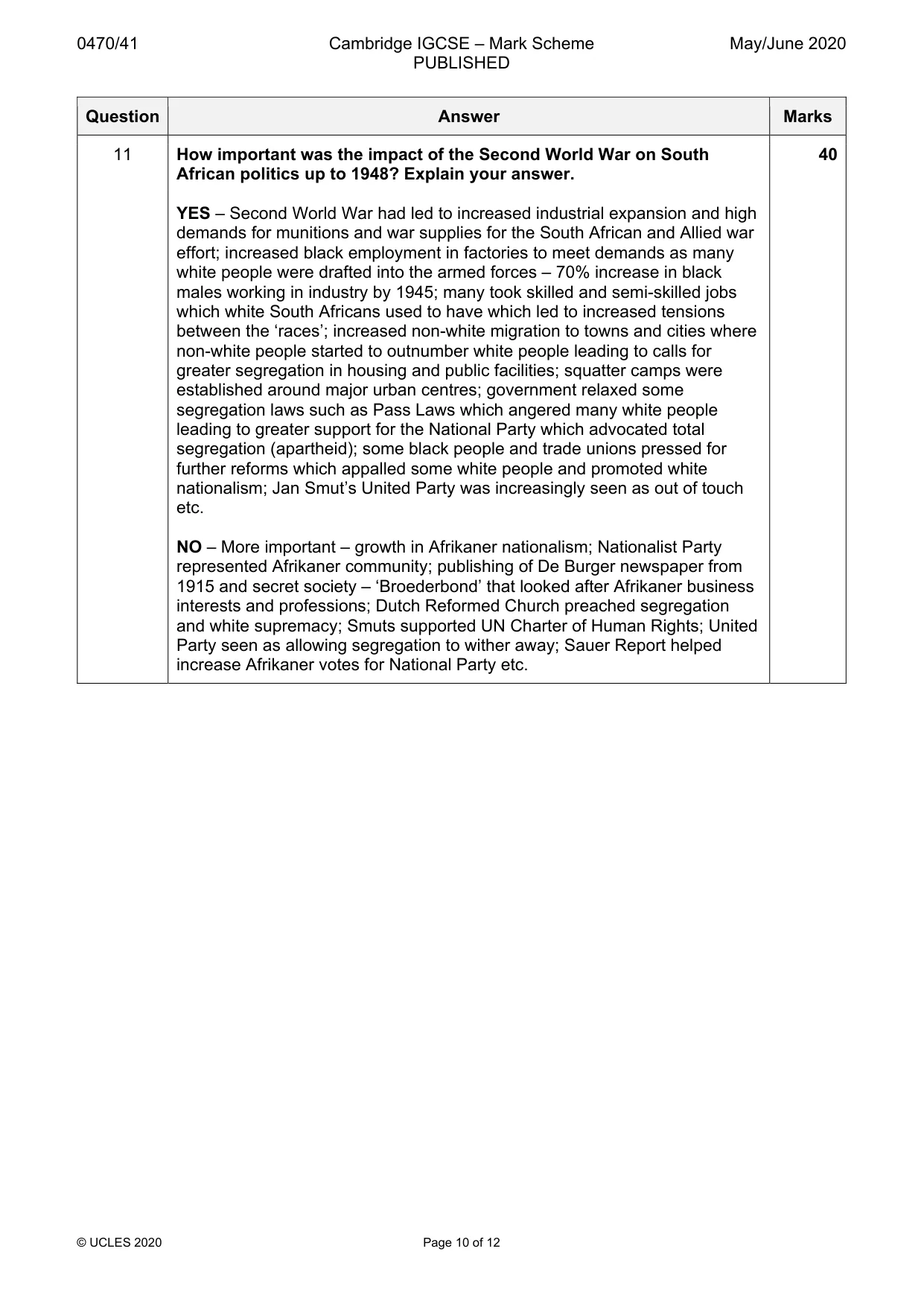
0470/41 Cambridge IGCSE – Mark Scheme PUBLISHED May/June 2020 © UCLES 2020 Page 10 of 12 Question Answer Marks 11 How important was the impact of the Second World War on South African politics up to 1948? Explain your answer. YES – Second World War had led to increased industrial expansion and high demands for munitions and war supplies for the South African and Allied war effort; increased black employment in factories to meet demands as many white people were drafted into the armed forces – 70% increase in black males working in industry by 1945; many took skilled and semi-skilled jobs which white South Africans used to have which led to increased tensions between the ‘races’; increased non-white migration to towns and cities where non-white people started to outnumber white people leading to calls for greater segregation in housing and public facilities; squatter camps were established around major urban centres; government relaxed some segregation laws such as Pass Laws which angered many white people leading to greater support for the National Party which advocated total segregation (apartheid); some black people and trade unions pressed for further reforms which appalled some white people and promoted white nationalism; Jan Smut’s United Party was increasingly seen as out of touch etc. NO – More important – growth in Afrikaner nationalism; Nationalist Party represented Afrikaner community; publishing of De Burger newspaper from 1915 and secret society – ‘Broederbond’ that looked after Afrikaner business interests and professions; Dutch Reformed Church preached segregation and white supremacy; Smuts supported UN Charter of Human Rights; United Party seen as allowing segregation to wither away; Sauer Report helped increase Afrikaner votes for National Party etc. 40
Mark scheme, page 11
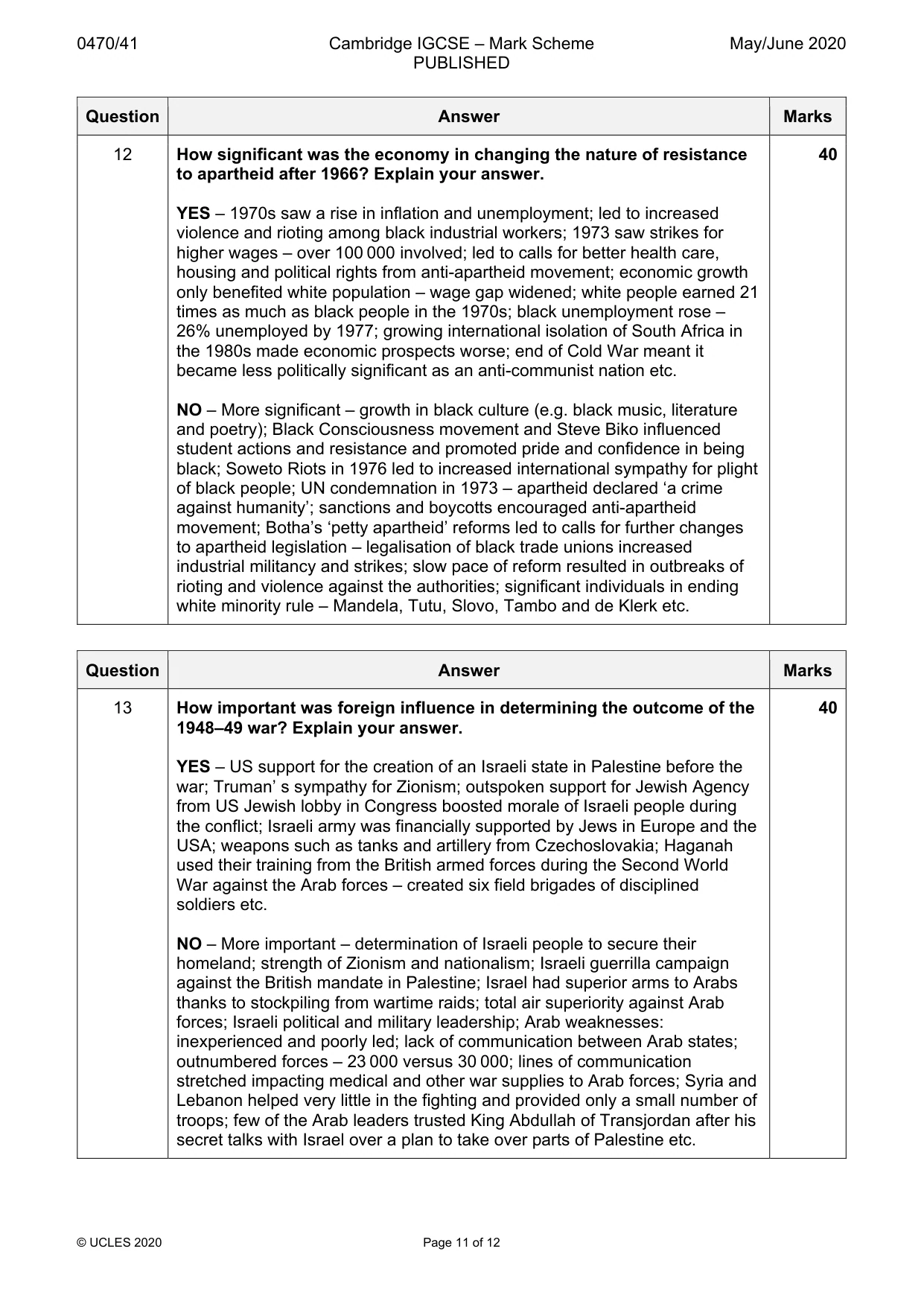
0470/41 Cambridge IGCSE – Mark Scheme PUBLISHED May/June 2020 © UCLES 2020 Page 11 of 12 Question Answer Marks 12 How significant was the economy in changing the nature of resistance to apartheid after 1966? Explain your answer. YES – 1970s saw a rise in inflation and unemployment; led to increased violence and rioting among black industrial workers; 1973 saw strikes for higher wages – over 100 000 involved; led to calls for better health care, housing and political rights from anti-apartheid movement; economic growth only benefited white population – wage gap widened; white people earned 21 times as much as black people in the 1970s; black unemployment rose – 26% unemployed by 1977; growing international isolation of South Africa in the 1980s made economic prospects worse; end of Cold War meant it became less politically significant as an anti-communist nation etc. NO – More significant – growth in black culture (e.g. black music, literature and poetry); Black Consciousness movement and Steve Biko influenced student actions and resistance and promoted pride and confidence in being black; Soweto Riots in 1976 led to increased international sympathy for plight of black people; UN condemnation in 1973 – apartheid declared ‘a crime against humanity’; sanctions and boycotts encouraged anti-apartheid movement; Botha’s ‘petty apartheid’ reforms led to calls for further changes to apartheid legislation – legalisation of black trade unions increased industrial militancy and strikes; slow pace of reform resulted in outbreaks of rioting and violence against the authorities; significant individuals in ending white minority rule – Mandela, Tutu, Slovo, Tambo and de Klerk etc. 40 Question Answer Marks 13 How important was foreign influence in determining the outcome of the 1948–49 war? Explain your answer. YES – US support for the creation of an Israeli state in Palestine before the war; Truman’ s sympathy for Zionism; outspoken support for Jewish Agency from US Jewish lobby in Congress boosted morale of Israeli people during the conflict; Israeli army was financially supported by Jews in Europe and the USA; weapons such as tanks and artillery from Czechoslovakia; Haganah used their training from the British armed forces during the Second World War against the Arab forces – created six field brigades of disciplined soldiers etc. NO – More important – determination of Israeli people to secure their homeland; strength of Zionism and nationalism; Israeli guerrilla campaign against the British mandate in Palestine; Israel had superior arms to Arabs thanks to stockpiling from wartime raids; total air superiority against Arab forces; Israeli political and military leadership; Arab weaknesses: inexperienced and poorly led; lack of communication between Arab states; outnumbered forces – 23 000 versus 30 000; lines of communication stretched impacting medical and other war supplies to Arab forces; Syria and Lebanon helped very little in the fighting and provided only a small number of troops; few of the Arab leaders trusted King Abdullah of Transjordan after his secret talks with Israel over a plan to take over parts of Palestine etc. 40
Mark scheme, page 12
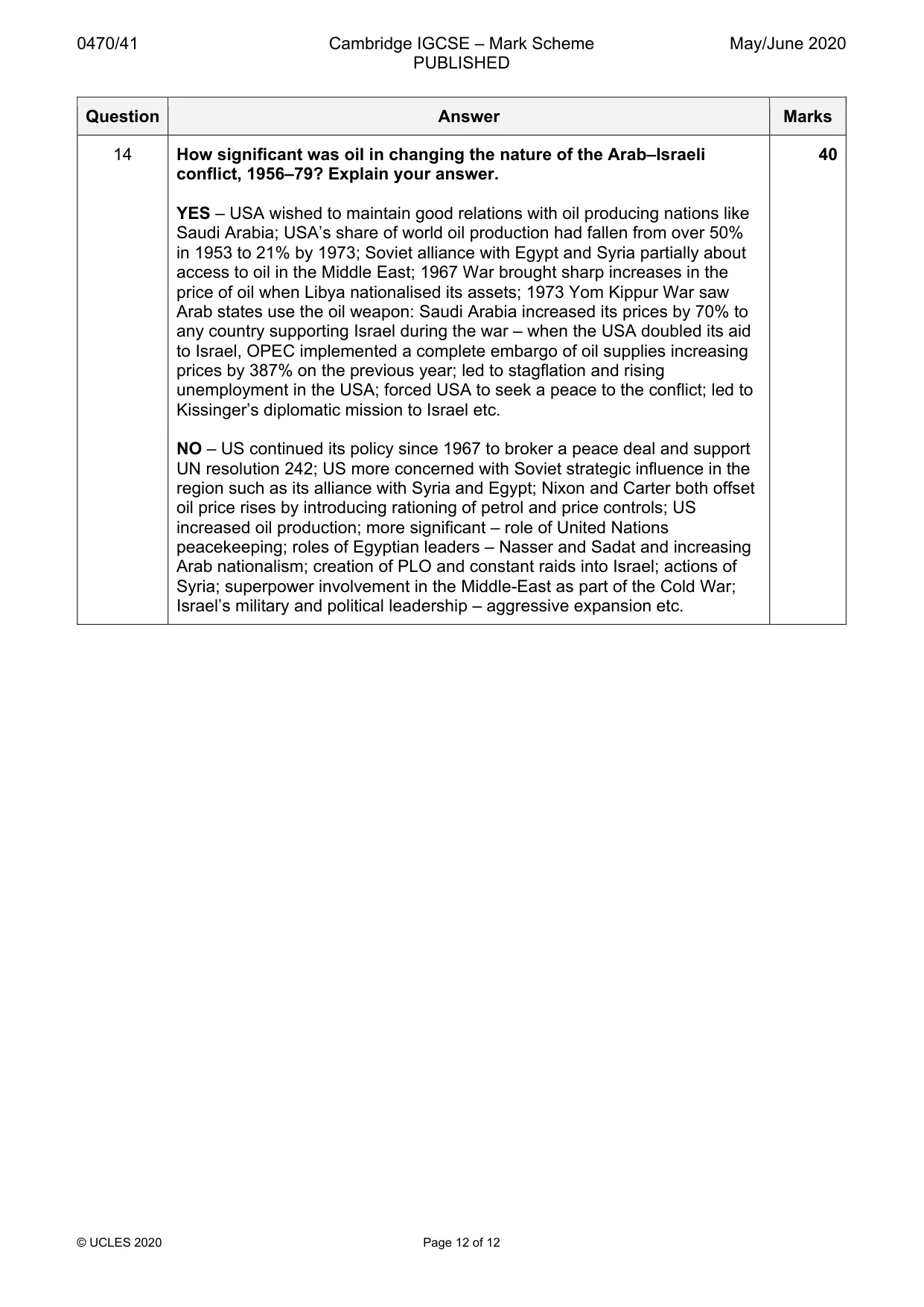
0470/41 Cambridge IGCSE – Mark Scheme PUBLISHED May/June 2020 © UCLES 2020 Page 12 of 12 Question Answer Marks 14 How significant was oil in changing the nature of the Arab–Israeli conflict, 1956–79? Explain your answer. YES – USA wished to maintain good relations with oil producing nations like Saudi Arabia; USA’s share of world oil production had fallen from over 50% in 1953 to 21% by 1973; Soviet alliance with Egypt and Syria partially about access to oil in the Middle East; 1967 War brought sharp increases in the price of oil when Libya nationalised its assets; 1973 Yom Kippur War saw Arab states use the oil weapon: Saudi Arabia increased its prices by 70% to any country supporting Israel during the war – when the USA doubled its aid to Israel, OPEC implemented a complete embargo of oil supplies increasing prices by 387% on the previous year; led to stagflation and rising unemployment in the USA; forced USA to seek a peace to the conflict; led to Kissinger’s diplomatic mission to Israel etc. NO – US continued its policy since 1967 to broker a peace deal and support UN resolution 242; US more concerned with Soviet strategic influence in the region such as its alliance with Syria and Egypt; Nixon and Carter both offset oil price rises by introducing rationing of petrol and price controls; US increased oil production; more significant – role of United Nations peacekeeping; roles of Egyptian leaders – Nasser and Sadat and increasing Arab nationalism; creation of PLO and constant raids into Israel; actions of Syria; superpower involvement in the Middle-East as part of the Cold War; Israel’s military and political leadership – aggressive expansion etc. 40