Cambridge IGCSE History 0470 — 2019 May/June Paper 4 · Variant 3
0470/43/M/J/19 · 40 marks · ≈45 min
The question paper and its mark scheme, free to read here and free to download. This is Cambridge’s own paper, exactly as it was sat.
Question paper4 pages

Mark scheme9 pages
Answers below. Sit the paper first if you are practising.
Paper as text
Question paper, page 1
Cambridge Assessment International Education Cambridge International General Certificate of Secondary Education 0470/43 May/June 2019 1 hour HISTORY Paper 4 Alternative to Coursework Additional Materials: Answer Booklet/Paper READ THESE INSTRUCTIONS FIRST An answer booklet is provided inside this question paper. You should follow the instructions on the front cover of the answer booklet. If you need additional answer paper ask the invigilator for a continuation booklet. Answer one question from your chosen Depth Study. The number of marks is given in brackets [ ] at the end of each question or part question. This syllabus is regulated for use in England, Wales and Northern Ireland as a Cambridge International Level 1/Level 2 Certificate. This document consists of 3 printed pages and 1 blank page. [Turn over 06_0470_43_2019_1.8 © UCLES 2019 *5421893155*
Question paper, page 2
Answer one question from your chosen Depth Study. DEPTH STUDY A: THE FIRST WORLD WAR, 1914–1918 How important was the introduction of tanks to the fighting on the Western Front? Explain your answer. [40] 1 How significant were Russia’s military campaigns to the outcome of the war? Explain your answer. [40] 2 DEPTH STUDY B: GERMANY, 1918–1945 How important was political extremism in causing Germany’s weakness, 1919-23? Explain your answer. [40] 3 How significant were policies towards businessmen and industrialists in winning support for the Nazi regime, 1933-39? Explain your answer. [40] 4 DEPTH STUDY C:RUSSIA, 1905–1941 How important was Bloody Sunday as a cause of the 1905 Revolution? Explain your answer. [40] 5 How significant were the actions of Kerensky in the downfall of the Provisional Government? Explain your answer. [40] 6 DEPTH STUDY D: THE USA, 1919–1941 How important was mass entertainment to the lives of Americans in the 1920s? Explain your answer. [40] 7 How significant were President Hoover’s attempts to deal with the effects of the Depression? Explain your answer. [40] 8 DEPTH STUDY E: CHINA, c.1930–c.1990 How important was improving the lives of the peasants to the consolidation of Communist rule by 1960? Explain your answer. [40] 9 How significant an issue was Taiwan in Communist China’s foreign relations after 1949? Explain your answer. [40] 10 06_0470_43_2019_1.8 © UCLES 2019 2
Question paper, page 3
DEPTH STUDY F: SOUTH AFRICA, c.1940–c.1994 How important was the maintenance of white supremacy to the development of South Africa before 1948? Explain your answer. [40] 11 How significant was Nelson Mandela in bringing about an end to white minority rule? Explain your answer. [40] 12 DEPTH STUDY G: ISRAELIS AND PALESTINIANS SINCE 1945 How important was the British withdrawal from Palestine as a cause of the war of 1948-49? Explain your answer. [40] 13 How significant were the actions of Israel in the Palestinian refugee issue after 1948? Explain your answer. [40] 14 06_0470_43_2019_1.8 © UCLES 2019 3
Question paper, page 4
BLANK PAGE Permission to reproduce items where third-party owned material protected by copyright is included has been sought and cleared where possible. Every reasonable effort has been made by the publisher (UCLES) to trace copyright holders, but if any items requiring clearance have unwittingly been included, the publisher will be pleased to make amends at the earliest possible opportunity. To avoid the issue of disclosure of answer-related information to candidates, all copyright acknowledgements are reproduced online in the Cambridge Assessment International Education Copyright Acknowledgements Booklet. This is produced for each series of examinations and is freely available to download at www.cambridgeinternational.org after the live examination series. Cambridge Assessment International Education is part of the Cambridge Assessment Group. Cambridge Assessment is the brand name of the University of Cambridge Local Examinations Syndicate (UCLES), which itself is a department of the University of Cambridge. 06_0470_43_2019_1.8 © UCLES 2019 4
Mark scheme, page 1
This syllabus is regulated for use in England, Wales and Northern Ireland as a Cambridge International Level 1/Level 2 Certificate. This document consists of 9 printed pages. © UCLES 2019 [Turn over Cambridge Assessment International Education Cambridge International General Certificate of Secondary Education HISTORY 0470/43 Paper 4 Alternative to Coursework May/June 2019 MARK SCHEME Maximum Mark: 40 Published This mark scheme is published as an aid to teachers and candidates, to indicate the requirements of the examination. It shows the basis on which Examiners were instructed to award marks. It does not indicate the details of the discussions that took place at an Examiners’ meeting before marking began, which would have considered the acceptability of alternative answers. Mark schemes should be read in conjunction with the question paper and the Principal Examiner Report for Teachers. Cambridge International will not enter into discussions about these mark schemes. Cambridge International is publishing the mark schemes for the May/June 2019 series for most Cambridge IGCSE™, Cambridge International A and AS Level and Cambridge Pre-U components, and some Cambridge O Level components.
Mark scheme, page 2
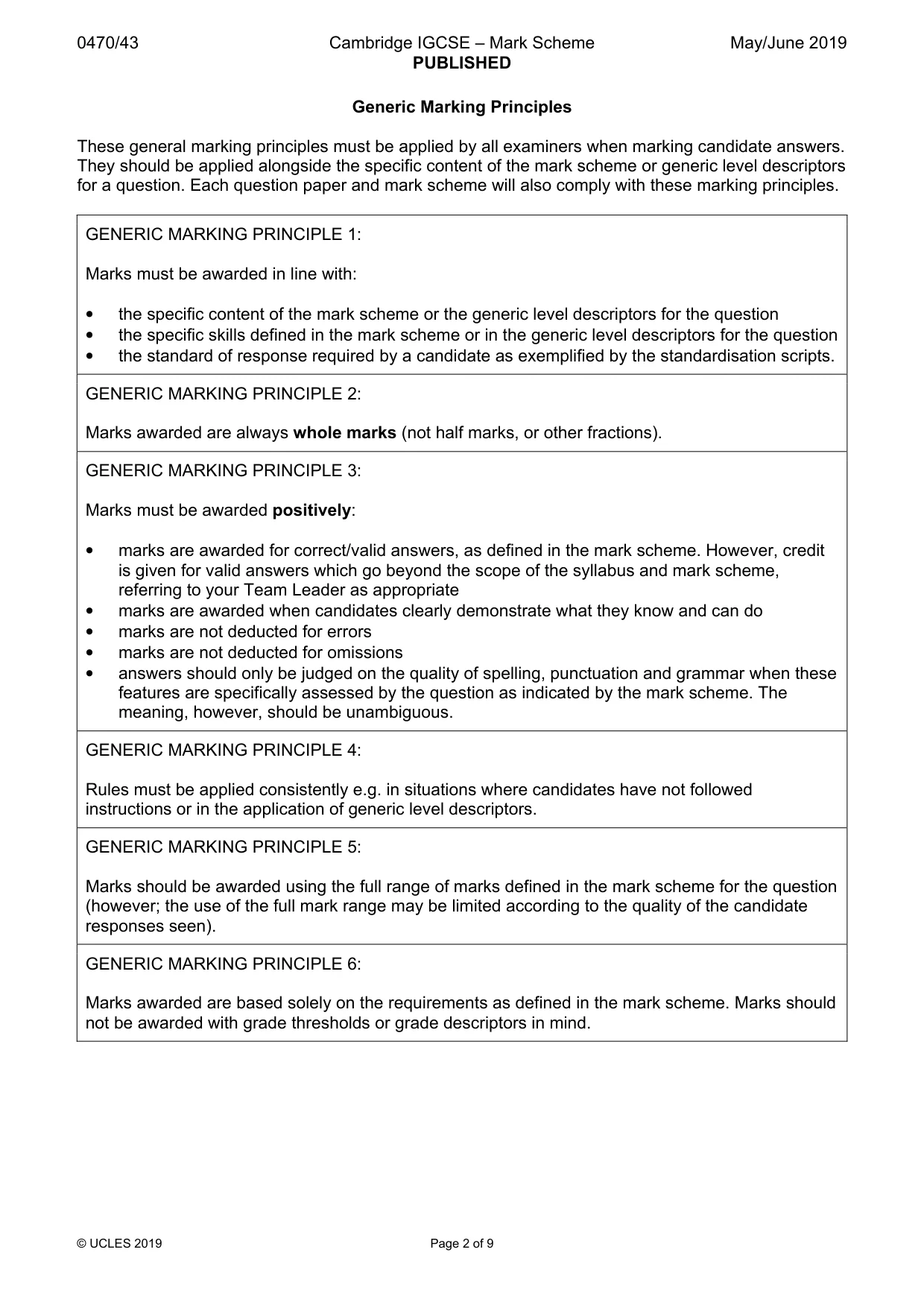
0470/43 Cambridge IGCSE – Mark Scheme PUBLISHED May/June 2019 © UCLES 2019 Page 2 of 9 Generic Marking Principles These general marking principles must be applied by all examiners when marking candidate answers. They should be applied alongside the specific content of the mark scheme or generic level descriptors for a question. Each question paper and mark scheme will also comply with these marking principles. GENERIC MARKING PRINCIPLE 1: Marks must be awarded in line with: • the specific content of the mark scheme or the generic level descriptors for the question • the specific skills defined in the mark scheme or in the generic level descriptors for the question • the standard of response required by a candidate as exemplified by the standardisation scripts. GENERIC MARKING PRINCIPLE 2: Marks awarded are always whole marks (not half marks, or other fractions). GENERIC MARKING PRINCIPLE 3: Marks must be awarded positively: • marks are awarded for correct/valid answers, as defined in the mark scheme. However, credit is given for valid answers which go beyond the scope of the syllabus and mark scheme, referring to your Team Leader as appropriate • marks are awarded when candidates clearly demonstrate what they know and can do • marks are not deducted for errors • marks are not deducted for omissions • answers should only be judged on the quality of spelling, punctuation and grammar when these features are specifically assessed by the question as indicated by the mark scheme. The meaning, however, should be unambiguous. GENERIC MARKING PRINCIPLE 4: Rules must be applied consistently e.g. in situations where candidates have not followed instructions or in the application of generic level descriptors. GENERIC MARKING PRINCIPLE 5: Marks should be awarded using the full range of marks defined in the mark scheme for the question (however; the use of the full mark range may be limited according to the quality of the candidate responses seen). GENERIC MARKING PRINCIPLE 6: Marks awarded are based solely on the requirements as defined in the mark scheme. Marks should not be awarded with grade thresholds or grade descriptors in mind.
Mark scheme, page 3
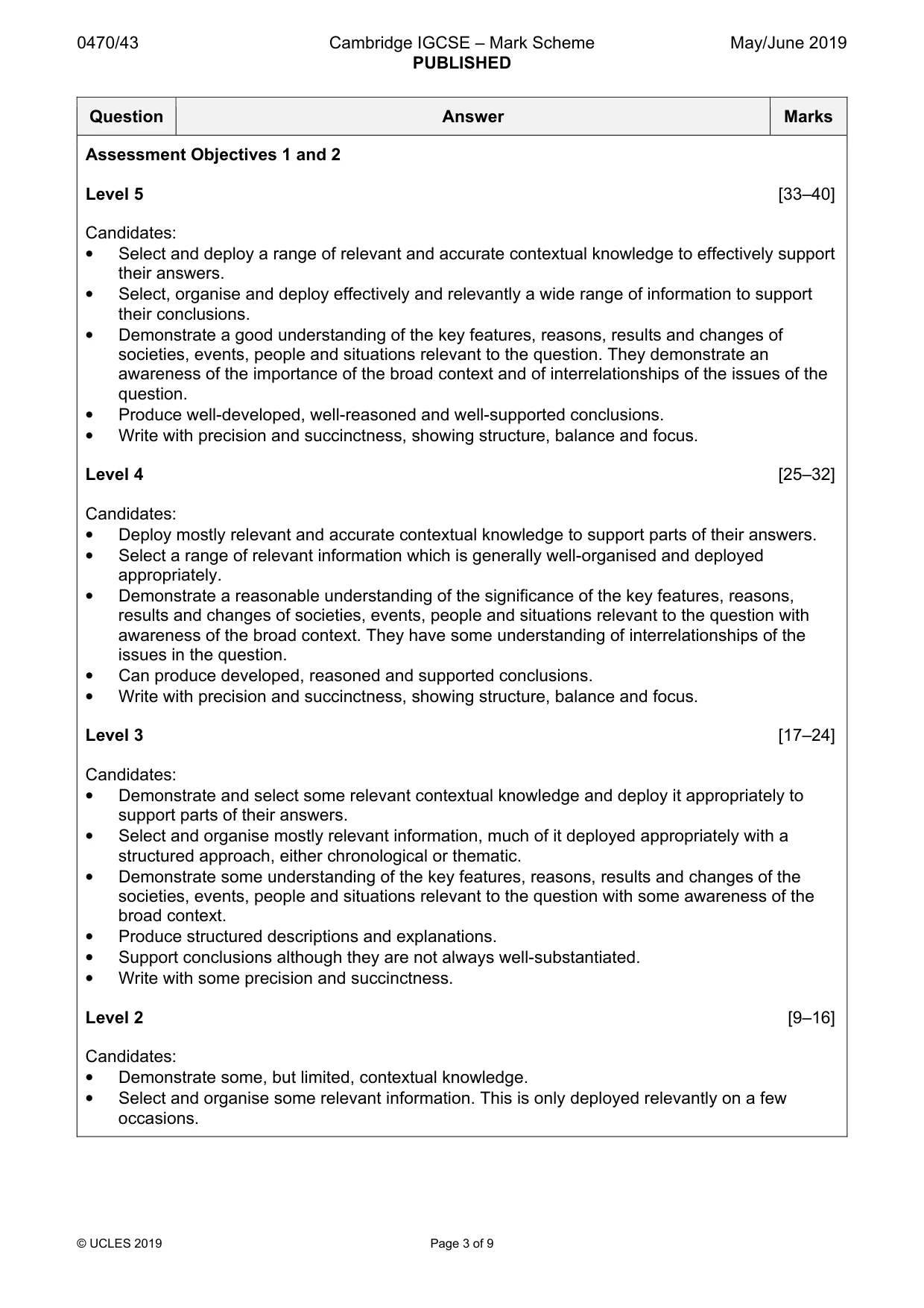
0470/43 Cambridge IGCSE – Mark Scheme PUBLISHED May/June 2019 © UCLES 2019 Page 3 of 9 Question Answer Marks Assessment Objectives 1 and 2 Level 5 [33–40] Candidates: • Select and deploy a range of relevant and accurate contextual knowledge to effectively support their answers. • Select, organise and deploy effectively and relevantly a wide range of information to support their conclusions. • Demonstrate a good understanding of the key features, reasons, results and changes of societies, events, people and situations relevant to the question. They demonstrate an awareness of the importance of the broad context and of interrelationships of the issues of the question. • Produce well-developed, well-reasoned and well-supported conclusions. • Write with precision and succinctness, showing structure, balance and focus. Level 4 [25–32] Candidates: • Deploy mostly relevant and accurate contextual knowledge to support parts of their answers. • Select a range of relevant information which is generally well-organised and deployed appropriately. • Demonstrate a reasonable understanding of the significance of the key features, reasons, results and changes of societies, events, people and situations relevant to the question with awareness of the broad context. They have some understanding of interrelationships of the issues in the question. • Can produce developed, reasoned and supported conclusions. • Write with precision and succinctness, showing structure, balance and focus. Level 3 [17–24] Candidates: • Demonstrate and select some relevant contextual knowledge and deploy it appropriately to support parts of their answers. • Select and organise mostly relevant information, much of it deployed appropriately with a structured approach, either chronological or thematic. • Demonstrate some understanding of the key features, reasons, results and changes of the societies, events, people and situations relevant to the question with some awareness of the broad context. • Produce structured descriptions and explanations. • Support conclusions although they are not always well-substantiated. • Write with some precision and succinctness. Level 2 [9–16] Candidates: • Demonstrate some, but limited, contextual knowledge. • Select and organise some relevant information. This is only deployed relevantly on a few occasions.
Mark scheme, page 4
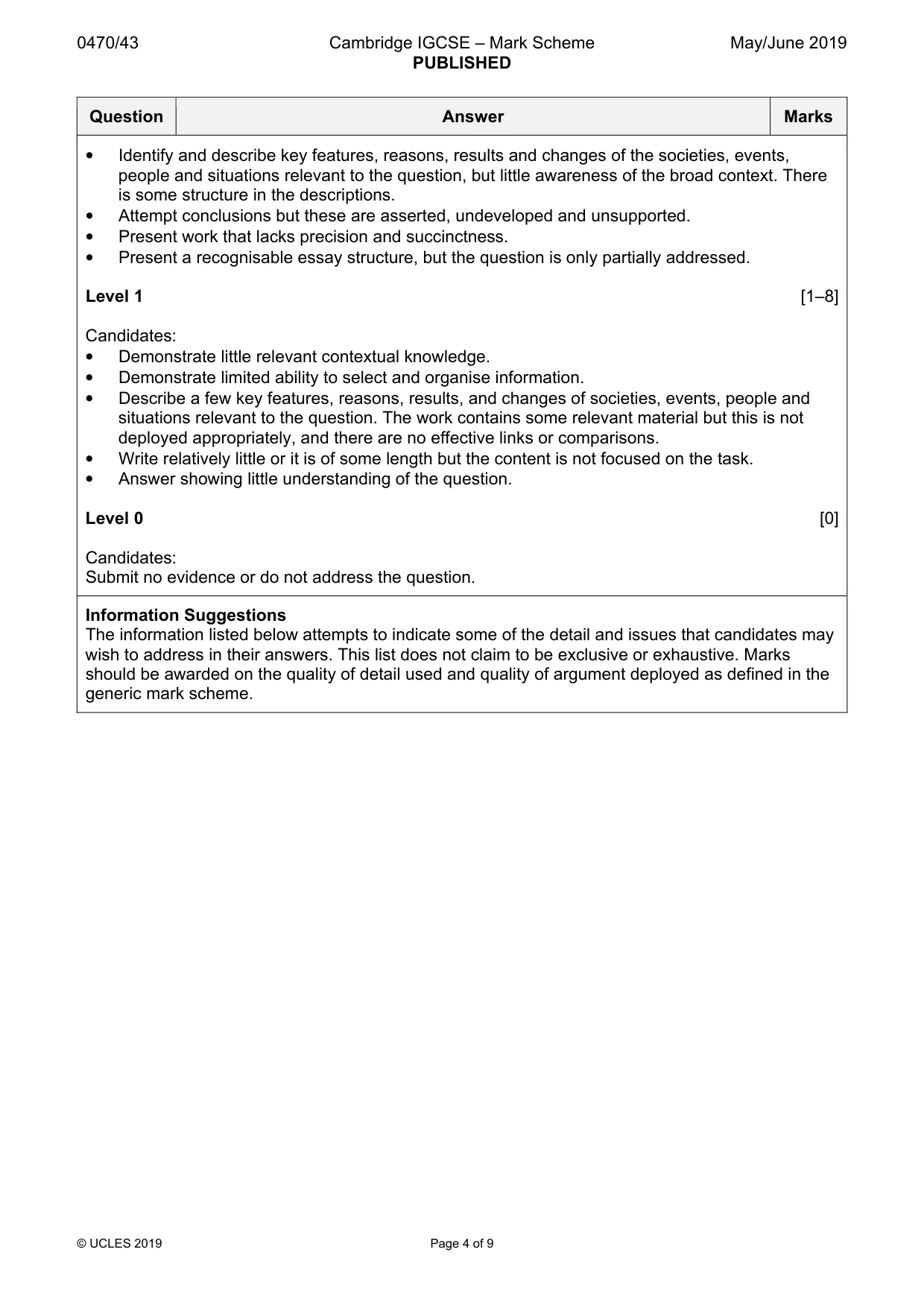
0470/43 Cambridge IGCSE – Mark Scheme PUBLISHED May/June 2019 © UCLES 2019 Page 4 of 9 Question Answer Marks • Identify and describe key features, reasons, results and changes of the societies, events, people and situations relevant to the question, but little awareness of the broad context. There is some structure in the descriptions. • Attempt conclusions but these are asserted, undeveloped and unsupported. • Present work that lacks precision and succinctness. • Present a recognisable essay structure, but the question is only partially addressed. Level 1 [1–8] Candidates: • Demonstrate little relevant contextual knowledge. • Demonstrate limited ability to select and organise information. • Describe a few key features, reasons, results, and changes of societies, events, people and situations relevant to the question. The work contains some relevant material but this is not deployed appropriately, and there are no effective links or comparisons. • Write relatively little or it is of some length but the content is not focused on the task. • Answer showing little understanding of the question. Level 0 [0] Candidates: Submit no evidence or do not address the question. Information Suggestions The information listed below attempts to indicate some of the detail and issues that candidates may wish to address in their answers. This list does not claim to be exclusive or exhaustive. Marks should be awarded on the quality of detail used and quality of argument deployed as defined in the generic mark scheme.
Mark scheme, page 5
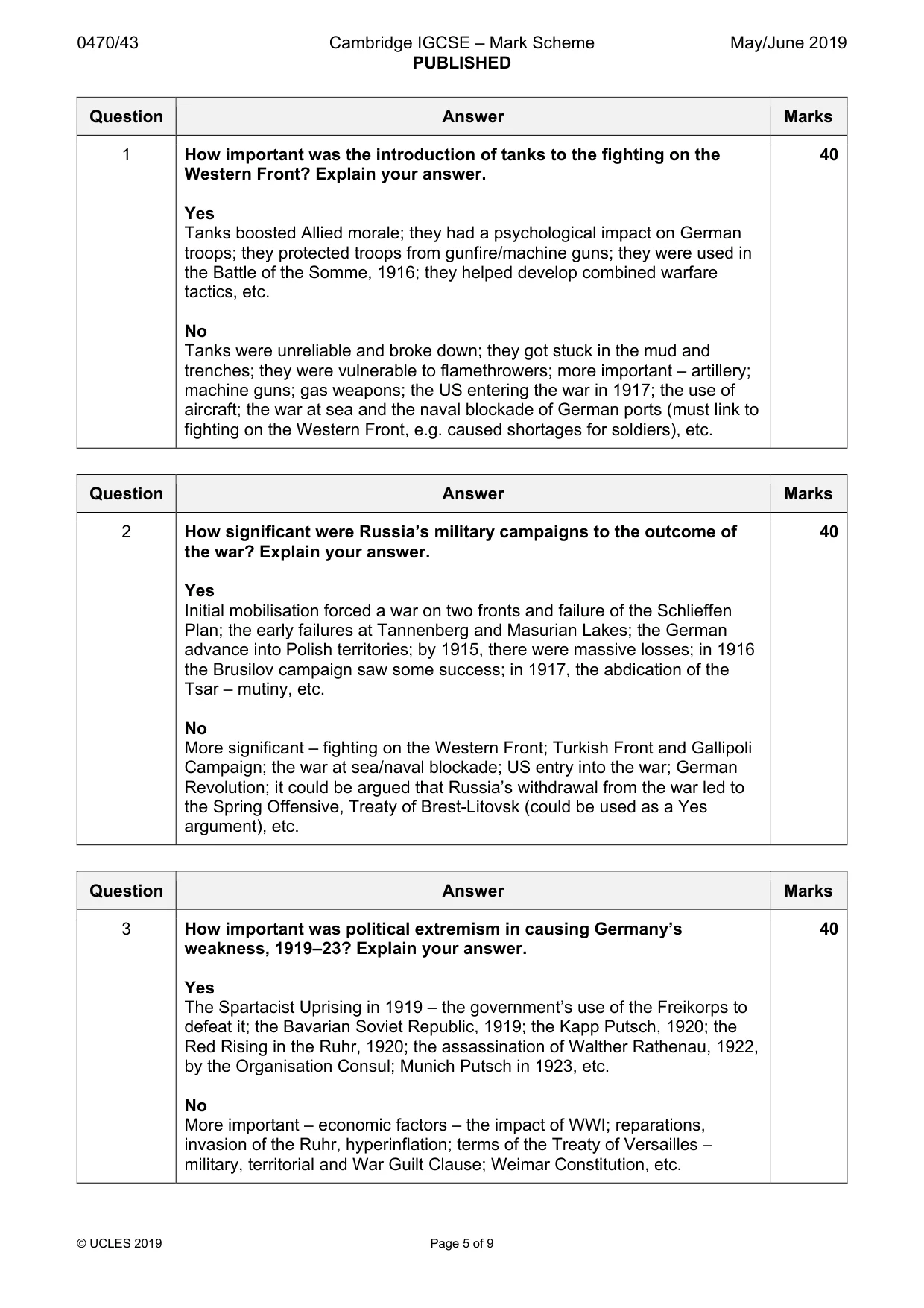
0470/43 Cambridge IGCSE – Mark Scheme PUBLISHED May/June 2019 © UCLES 2019 Page 5 of 9 Question Answer Marks 1 How important was the introduction of tanks to the fighting on the Western Front? Explain your answer. Yes Tanks boosted Allied morale; they had a psychological impact on German troops; they protected troops from gunfire/machine guns; they were used in the Battle of the Somme, 1916; they helped develop combined warfare tactics, etc. No Tanks were unreliable and broke down; they got stuck in the mud and trenches; they were vulnerable to flamethrowers; more important – artillery; machine guns; gas weapons; the US entering the war in 1917; the use of aircraft; the war at sea and the naval blockade of German ports (must link to fighting on the Western Front, e.g. caused shortages for soldiers), etc. 40 Question Answer Marks 2 How significant were Russia’s military campaigns to the outcome of the war? Explain your answer. Yes Initial mobilisation forced a war on two fronts and failure of the Schlieffen Plan; the early failures at Tannenberg and Masurian Lakes; the German advance into Polish territories; by 1915, there were massive losses; in 1916 the Brusilov campaign saw some success; in 1917, the abdication of the Tsar – mutiny, etc. No More significant – fighting on the Western Front; Turkish Front and Gallipoli Campaign; the war at sea/naval blockade; US entry into the war; German Revolution; it could be argued that Russia’s withdrawal from the war led to the Spring Offensive, Treaty of Brest-Litovsk (could be used as a Yes argument), etc. 40 Question Answer Marks 3 How important was political extremism in causing Germany’s weakness, 1919–23? Explain your answer. Yes The Spartacist Uprising in 1919 – the government’s use of the Freikorps to defeat it; the Bavarian Soviet Republic, 1919; the Kapp Putsch, 1920; the Red Rising in the Ruhr, 1920; the assassination of Walther Rathenau, 1922, by the Organisation Consul; Munich Putsch in 1923, etc. No More important – economic factors – the impact of WWI; reparations, invasion of the Ruhr, hyperinflation; terms of the Treaty of Versailles – military, territorial and War Guilt Clause; Weimar Constitution, etc. 40
Mark scheme, page 6
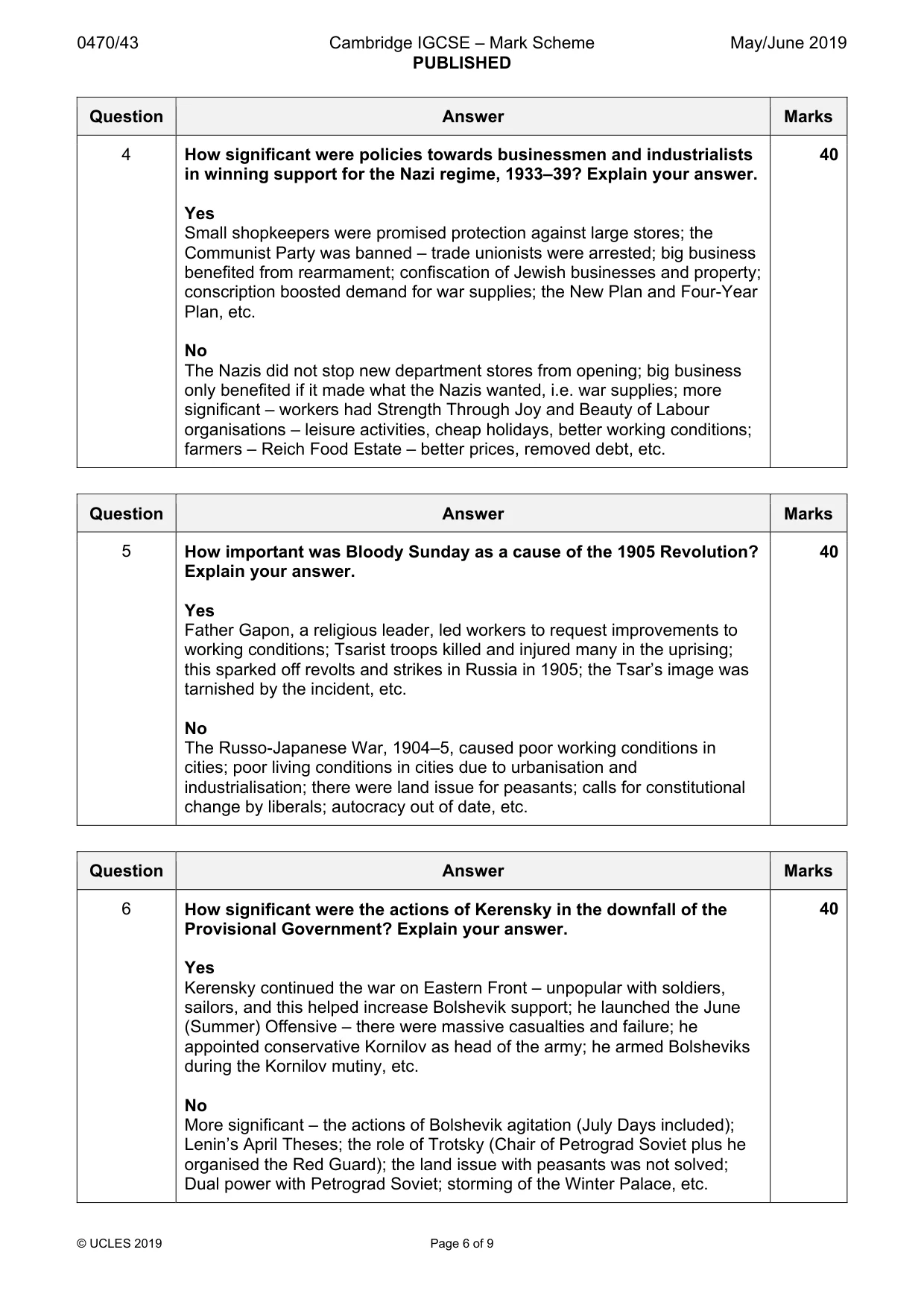
0470/43 Cambridge IGCSE – Mark Scheme PUBLISHED May/June 2019 © UCLES 2019 Page 6 of 9 Question Answer Marks 4 How significant were policies towards businessmen and industrialists in winning support for the Nazi regime, 1933–39? Explain your answer. Yes Small shopkeepers were promised protection against large stores; the Communist Party was banned – trade unionists were arrested; big business benefited from rearmament; confiscation of Jewish businesses and property; conscription boosted demand for war supplies; the New Plan and Four-Year Plan, etc. No The Nazis did not stop new department stores from opening; big business only benefited if it made what the Nazis wanted, i.e. war supplies; more significant – workers had Strength Through Joy and Beauty of Labour organisations – leisure activities, cheap holidays, better working conditions; farmers – Reich Food Estate – better prices, removed debt, etc. 40 Question Answer Marks 5 How important was Bloody Sunday as a cause of the 1905 Revolution? Explain your answer. Yes Father Gapon, a religious leader, led workers to request improvements to working conditions; Tsarist troops killed and injured many in the uprising; this sparked off revolts and strikes in Russia in 1905; the Tsar’s image was tarnished by the incident, etc. No The Russo-Japanese War, 1904–5, caused poor working conditions in cities; poor living conditions in cities due to urbanisation and industrialisation; there were land issue for peasants; calls for constitutional change by liberals; autocracy out of date, etc. 40 Question Answer Marks 6 How significant were the actions of Kerensky in the downfall of the Provisional Government? Explain your answer. Yes Kerensky continued the war on Eastern Front – unpopular with soldiers, sailors, and this helped increase Bolshevik support; he launched the June (Summer) Offensive – there were massive casualties and failure; he appointed conservative Kornilov as head of the army; he armed Bolsheviks during the Kornilov mutiny, etc. No More significant – the actions of Bolshevik agitation (July Days included); Lenin’s April Theses; the role of Trotsky (Chair of Petrograd Soviet plus he organised the Red Guard); the land issue with peasants was not solved; Dual power with Petrograd Soviet; storming of the Winter Palace, etc. 40
Mark scheme, page 7
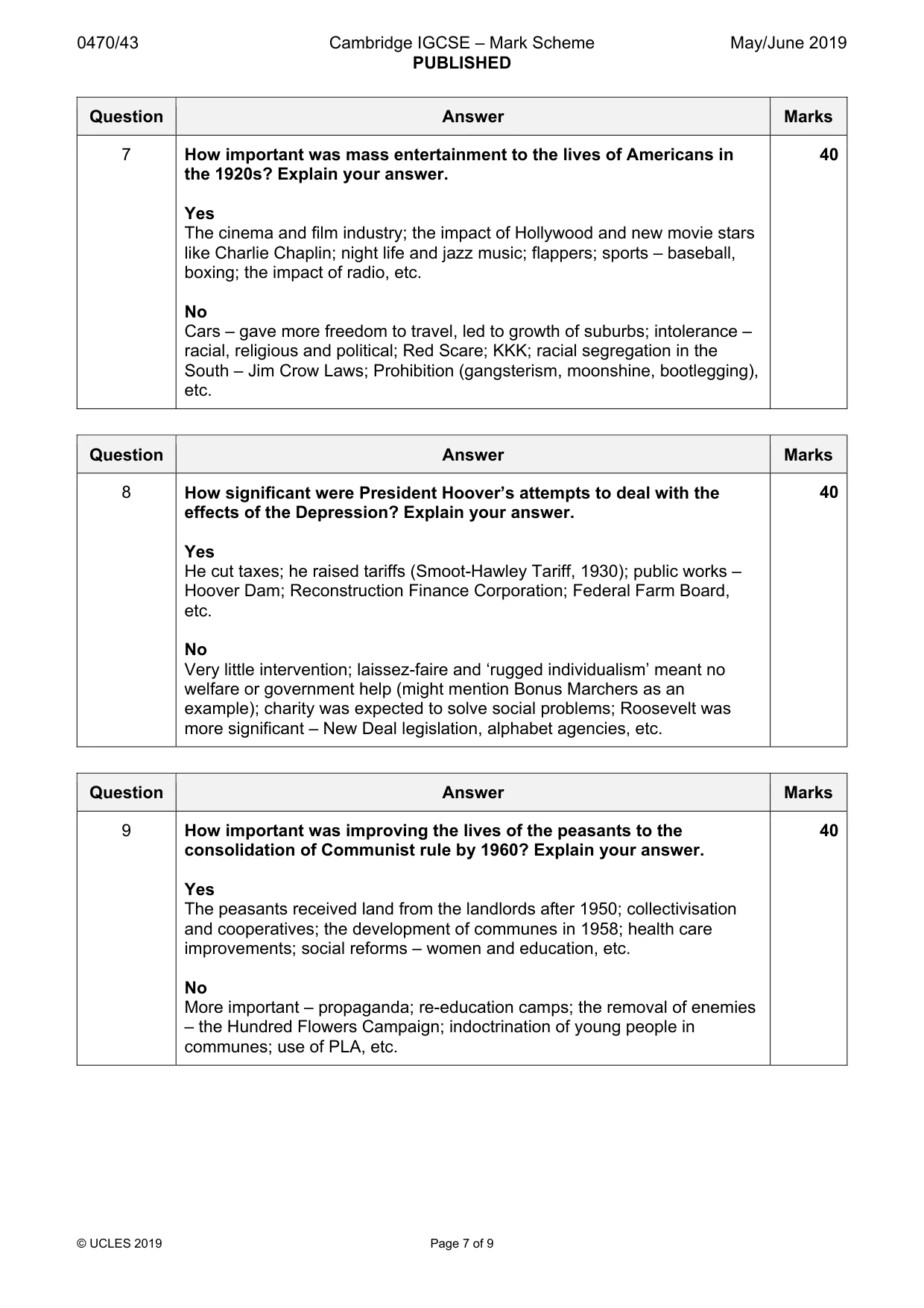
0470/43 Cambridge IGCSE – Mark Scheme PUBLISHED May/June 2019 © UCLES 2019 Page 7 of 9 Question Answer Marks 7 How important was mass entertainment to the lives of Americans in the 1920s? Explain your answer. Yes The cinema and film industry; the impact of Hollywood and new movie stars like Charlie Chaplin; night life and jazz music; flappers; sports – baseball, boxing; the impact of radio, etc. No Cars – gave more freedom to travel, led to growth of suburbs; intolerance – racial, religious and political; Red Scare; KKK; racial segregation in the South – Jim Crow Laws; Prohibition (gangsterism, moonshine, bootlegging), etc. 40 Question Answer Marks 8 How significant were President Hoover’s attempts to deal with the effects of the Depression? Explain your answer. Yes He cut taxes; he raised tariffs (Smoot-Hawley Tariff, 1930); public works – Hoover Dam; Reconstruction Finance Corporation; Federal Farm Board, etc. No Very little intervention; laissez-faire and ‘rugged individualism’ meant no welfare or government help (might mention Bonus Marchers as an example); charity was expected to solve social problems; Roosevelt was more significant – New Deal legislation, alphabet agencies, etc. 40 Question Answer Marks 9 How important was improving the lives of the peasants to the consolidation of Communist rule by 1960? Explain your answer. Yes The peasants received land from the landlords after 1950; collectivisation and cooperatives; the development of communes in 1958; health care improvements; social reforms – women and education, etc. No More important – propaganda; re-education camps; the removal of enemies – the Hundred Flowers Campaign; indoctrination of young people in communes; use of PLA, etc. 40
Mark scheme, page 8
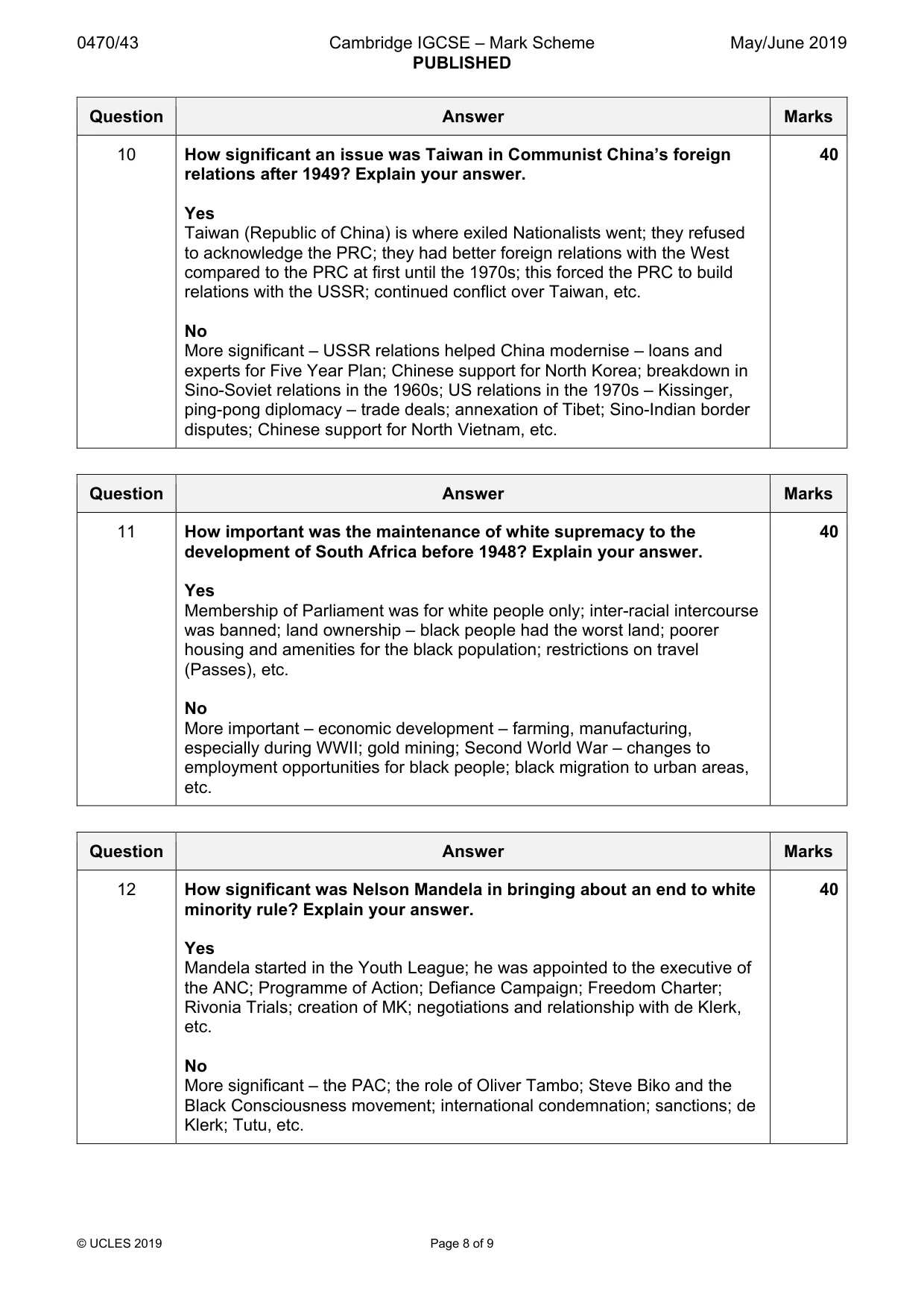
0470/43 Cambridge IGCSE – Mark Scheme PUBLISHED May/June 2019 © UCLES 2019 Page 8 of 9 Question Answer Marks 10 How significant an issue was Taiwan in Communist China’s foreign relations after 1949? Explain your answer. Yes Taiwan (Republic of China) is where exiled Nationalists went; they refused to acknowledge the PRC; they had better foreign relations with the West compared to the PRC at first until the 1970s; this forced the PRC to build relations with the USSR; continued conflict over Taiwan, etc. No More significant – USSR relations helped China modernise – loans and experts for Five Year Plan; Chinese support for North Korea; breakdown in Sino-Soviet relations in the 1960s; US relations in the 1970s – Kissinger, ping-pong diplomacy – trade deals; annexation of Tibet; Sino-Indian border disputes; Chinese support for North Vietnam, etc. 40 Question Answer Marks 11 How important was the maintenance of white supremacy to the development of South Africa before 1948? Explain your answer. Yes Membership of Parliament was for white people only; inter-racial intercourse was banned; land ownership – black people had the worst land; poorer housing and amenities for the black population; restrictions on travel (Passes), etc. No More important – economic development – farming, manufacturing, especially during WWII; gold mining; Second World War – changes to employment opportunities for black people; black migration to urban areas, etc. 40 Question Answer Marks 12 How significant was Nelson Mandela in bringing about an end to white minority rule? Explain your answer. Yes Mandela started in the Youth League; he was appointed to the executive of the ANC; Programme of Action; Defiance Campaign; Freedom Charter; Rivonia Trials; creation of MK; negotiations and relationship with de Klerk, etc. No More significant – the PAC; the role of Oliver Tambo; Steve Biko and the Black Consciousness movement; international condemnation; sanctions; de Klerk; Tutu, etc. 40
Mark scheme, page 9
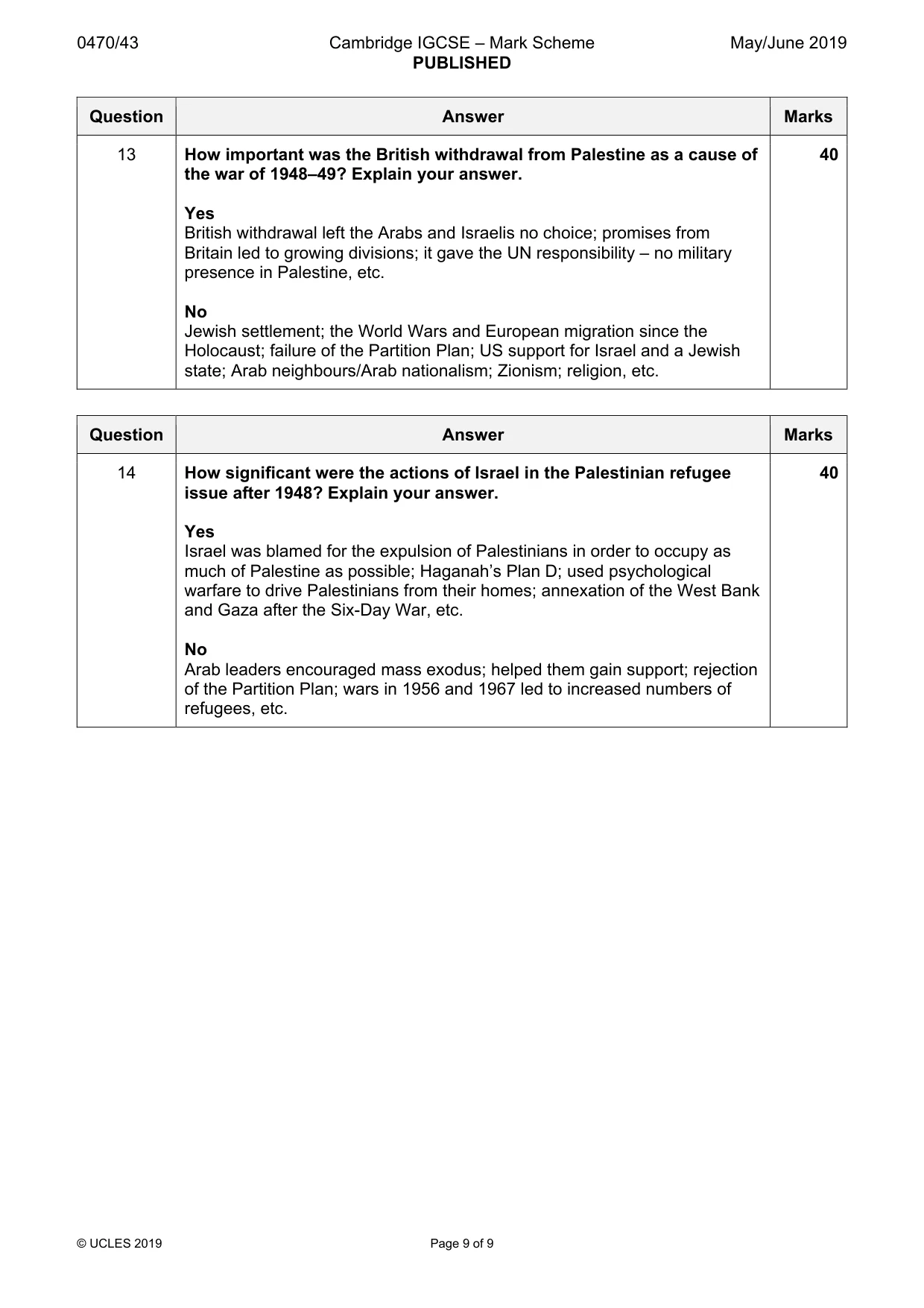
0470/43 Cambridge IGCSE – Mark Scheme PUBLISHED May/June 2019 © UCLES 2019 Page 9 of 9 Question Answer Marks 13 How important was the British withdrawal from Palestine as a cause of the war of 1948–49? Explain your answer. Yes British withdrawal left the Arabs and Israelis no choice; promises from Britain led to growing divisions; it gave the UN responsibility – no military presence in Palestine, etc. No Jewish settlement; the World Wars and European migration since the Holocaust; failure of the Partition Plan; US support for Israel and a Jewish state; Arab neighbours/Arab nationalism; Zionism; religion, etc. 40 Question Answer Marks 14 How significant were the actions of Israel in the Palestinian refugee issue after 1948? Explain your answer. Yes Israel was blamed for the expulsion of Palestinians in order to occupy as much of Palestine as possible; Haganah’s Plan D; used psychological warfare to drive Palestinians from their homes; annexation of the West Bank and Gaza after the Six-Day War, etc. No Arab leaders encouraged mass exodus; helped them gain support; rejection of the Partition Plan; wars in 1956 and 1967 led to increased numbers of refugees, etc. 40
What you needed in this session
Cambridge’s own grade thresholds for 2019 May/June, Paper 4 · Variant 3. A higher threshold means an easier paper — the bar moves with how the cohort did.