Cambridge IGCSE History 0470 — 2019 May/June Paper 4 · Variant 2
0470/42/M/J/19 · 40 marks · ≈45 min
The question paper and its mark scheme, free to read here and free to download. This is Cambridge’s own paper, exactly as it was sat.
Question paper4 pages

Mark scheme9 pages
Answers below. Sit the paper first if you are practising.
Paper as text
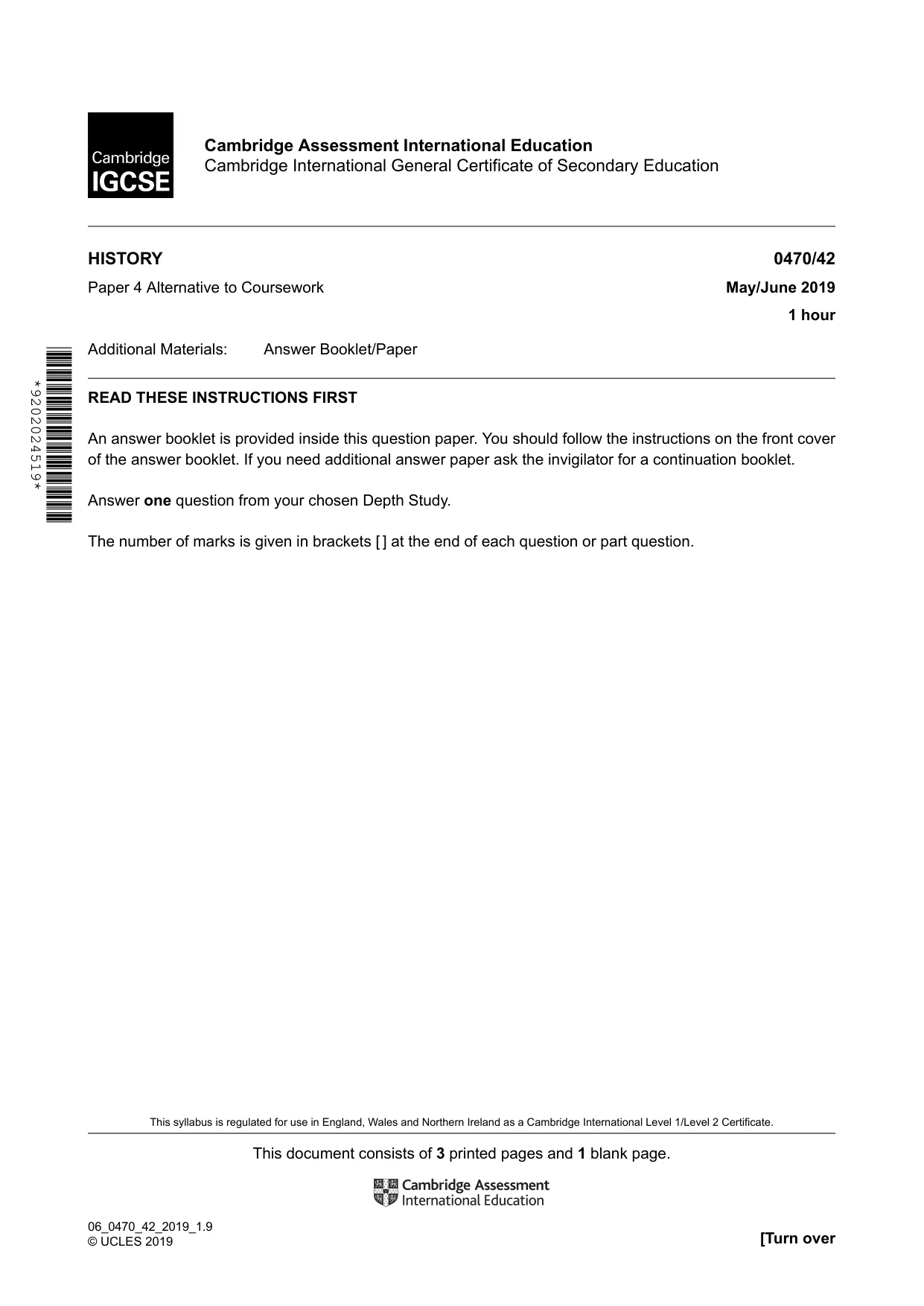
Question paper, page 1
Cambridge Assessment International Education Cambridge International General Certificate of Secondary Education 0470/42 May/June 2019 1 hour HISTORY Paper 4 Alternative to Coursework Additional Materials: Answer Booklet/Paper READ THESE INSTRUCTIONS FIRST An answer booklet is provided inside this question paper. You should follow the instructions on the front cover of the answer booklet. If you need additional answer paper ask the invigilator for a continuation booklet. Answer one question from your chosen Depth Study. The number of marks is given in brackets [ ] at the end of each question or part question. This syllabus is regulated for use in England, Wales and Northern Ireland as a Cambridge International Level 1/Level 2 Certificate. This document consists of 3 printed pages and 1 blank page. [Turn over 06_0470_42_2019_1.9 © UCLES 2019 *9202024519*
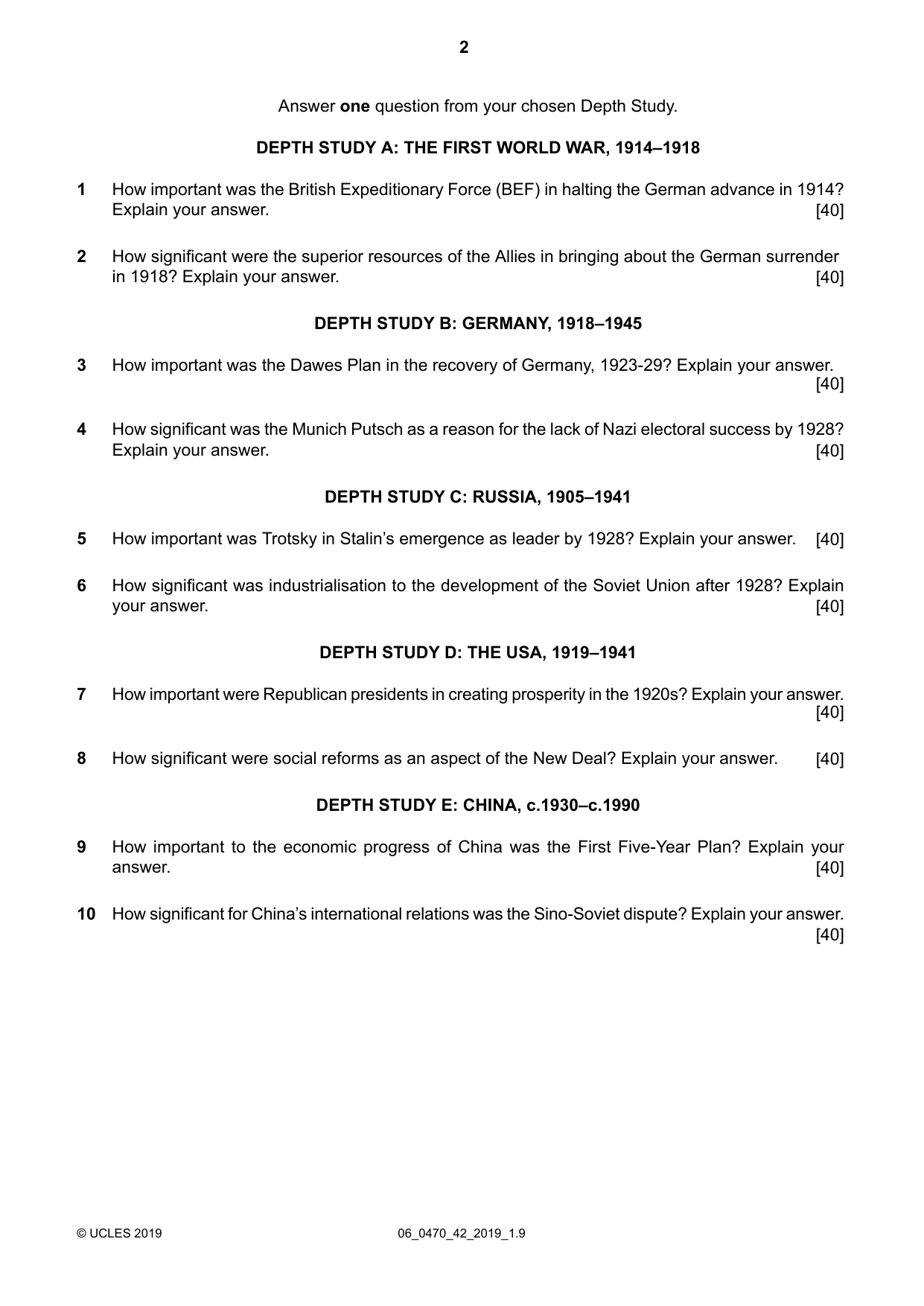
Question paper, page 2
Answer one question from your chosen Depth Study. DEPTH STUDY A: THE FIRST WORLD WAR, 1914–1918 How important was the British Expeditionary Force (BEF) in halting the German advance in 1914? Explain your answer. [40] 1 How significant were the superior resources of the Allies in bringing about the German surrender in 1918? Explain your answer. [40] 2 DEPTH STUDY B: GERMANY, 1918–1945 How important was the Dawes Plan in the recovery of Germany, 1923-29? Explain your answer. [40] 3 How significant was the Munich Putsch as a reason for the lack of Nazi electoral success by 1928? Explain your answer. [40] 4 DEPTH STUDY C: RUSSIA, 1905–1941 How important was Trotsky in Stalin’s emergence as leader by 1928? Explain your answer. [40] 5 How significant was industrialisation to the development of the Soviet Union after 1928? Explain your answer. [40] 6 DEPTH STUDY D: THE USA, 1919–1941 How important were Republican presidents in creating prosperity in the 1920s? Explain your answer. [40] 7 How significant were social reforms as an aspect of the New Deal? Explain your answer. [40] 8 DEPTH STUDY E: CHINA, c.1930–c.1990 How important to the economic progress of China was the First Five-Year Plan? Explain your answer. [40] 9 How significant for China’s international relations was the Sino-Soviet dispute? Explain your answer. [40] 10 06_0470_42_2019_1.9 © UCLES 2019 2
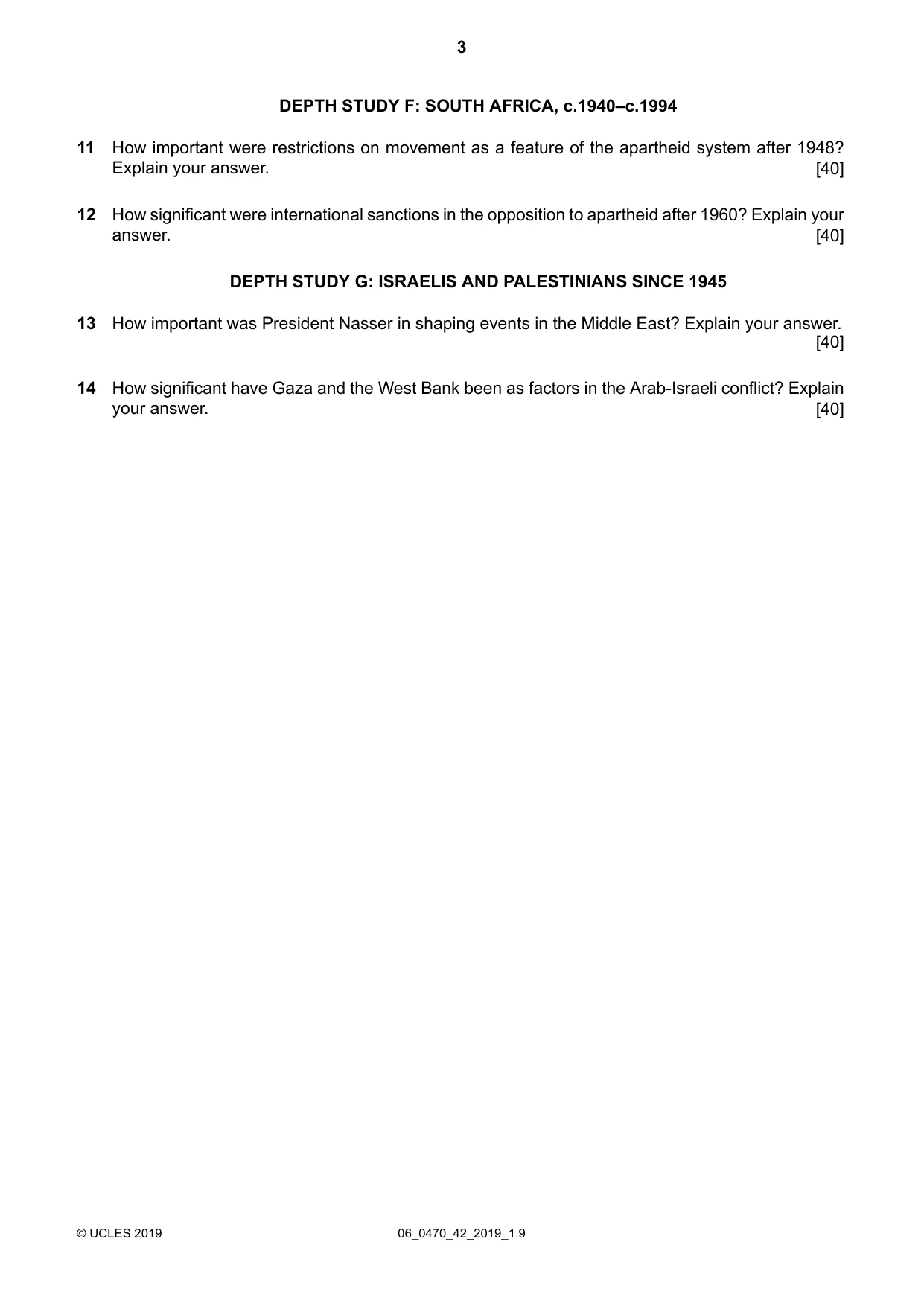
Question paper, page 3
DEPTH STUDY F: SOUTH AFRICA, c.1940–c.1994 How important were restrictions on movement as a feature of the apartheid system after 1948? Explain your answer. [40] 11 How significant were international sanctions in the opposition to apartheid after 1960? Explain your answer. [40] 12 DEPTH STUDY G: ISRAELIS AND PALESTINIANS SINCE 1945 How important was President Nasser in shaping events in the Middle East? Explain your answer. [40] 13 How significant have Gaza and the West Bank been as factors in the Arab-Israeli conflict? Explain your answer. [40] 14 06_0470_42_2019_1.9 © UCLES 2019 3
Question paper, page 4
BLANK PAGE Permission to reproduce items where third-party owned material protected by copyright is included has been sought and cleared where possible. Every reasonable effort has been made by the publisher (UCLES) to trace copyright holders, but if any items requiring clearance have unwittingly been included, the publisher will be pleased to make amends at the earliest possible opportunity. To avoid the issue of disclosure of answer-related information to candidates, all copyright acknowledgements are reproduced online in the Cambridge Assessment International Education Copyright Acknowledgements Booklet. This is produced for each series of examinations and is freely available to download at www.cambridgeinternational.org after the live examination series. Cambridge Assessment International Education is part of the Cambridge Assessment Group. Cambridge Assessment is the brand name of the University of Cambridge Local Examinations Syndicate (UCLES), which itself is a department of the University of Cambridge. 06_0470_42_2019_1.9 © UCLES 2019 4
Mark scheme, page 1
This syllabus is regulated for use in England, Wales and Northern Ireland as a Cambridge International Level 1/Level 2 Certificate. This document consists of 9 printed pages. © UCLES 2019 [Turn over Cambridge Assessment International Education Cambridge International General Certificate of Secondary Education HISTORY 0470/42 Paper 4 Alternative to Coursework May/June 2019 MARK SCHEME Maximum Mark: 40 Published This mark scheme is published as an aid to teachers and candidates, to indicate the requirements of the examination. It shows the basis on which Examiners were instructed to award marks. It does not indicate the details of the discussions that took place at an Examiners’ meeting before marking began, which would have considered the acceptability of alternative answers. Mark schemes should be read in conjunction with the question paper and the Principal Examiner Report for Teachers. Cambridge International will not enter into discussions about these mark schemes. Cambridge International is publishing the mark schemes for the May/June 2019 series for most Cambridge IGCSE™, Cambridge International A and AS Level and Cambridge Pre-U components, and some Cambridge O Level components.
Mark scheme, page 2
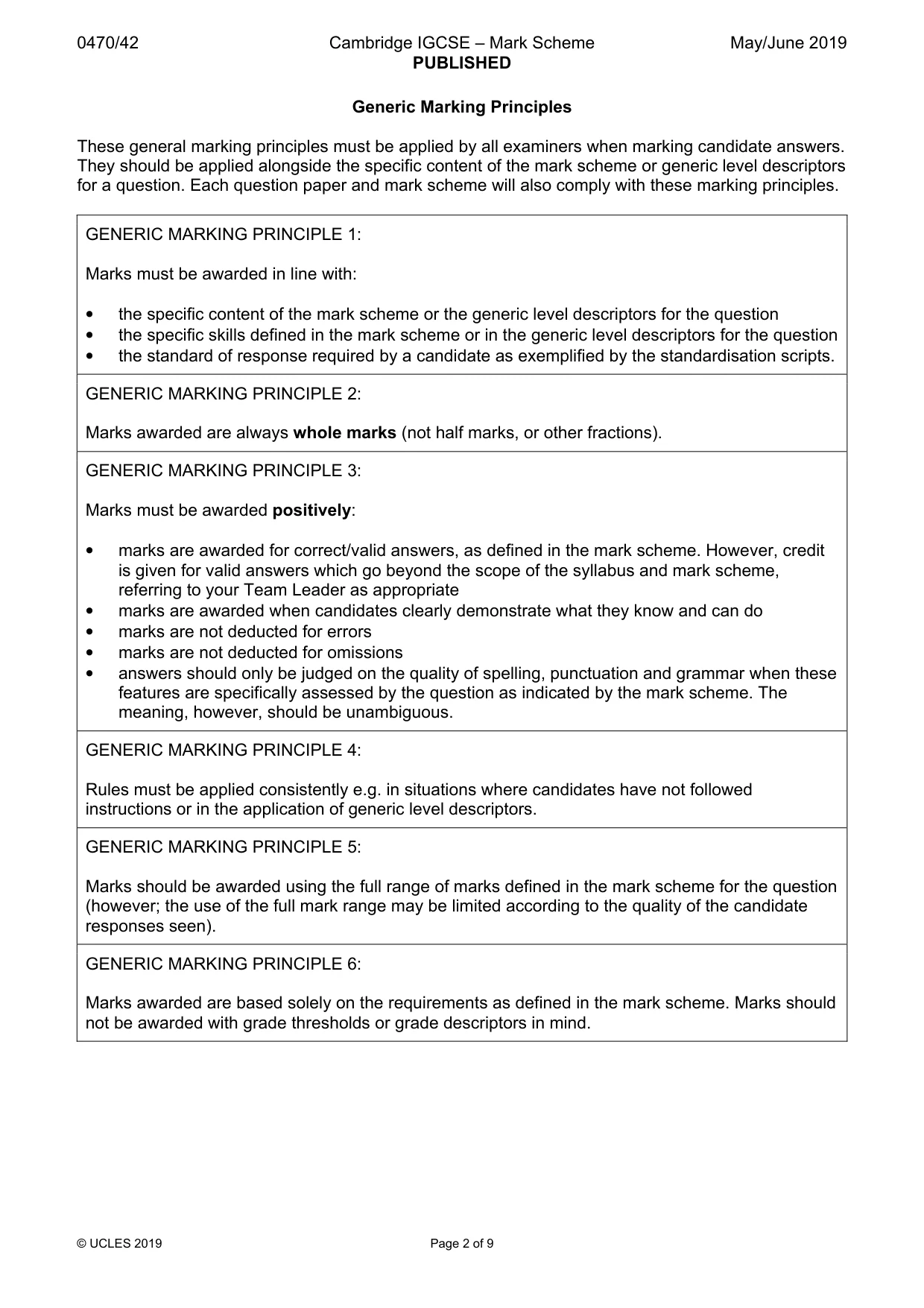
0470/42 Cambridge IGCSE – Mark Scheme PUBLISHED May/June 2019 © UCLES 2019 Page 2 of 9 Generic Marking Principles These general marking principles must be applied by all examiners when marking candidate answers. They should be applied alongside the specific content of the mark scheme or generic level descriptors for a question. Each question paper and mark scheme will also comply with these marking principles. GENERIC MARKING PRINCIPLE 1: Marks must be awarded in line with: • the specific content of the mark scheme or the generic level descriptors for the question • the specific skills defined in the mark scheme or in the generic level descriptors for the question • the standard of response required by a candidate as exemplified by the standardisation scripts. GENERIC MARKING PRINCIPLE 2: Marks awarded are always whole marks (not half marks, or other fractions). GENERIC MARKING PRINCIPLE 3: Marks must be awarded positively: • marks are awarded for correct/valid answers, as defined in the mark scheme. However, credit is given for valid answers which go beyond the scope of the syllabus and mark scheme, referring to your Team Leader as appropriate • marks are awarded when candidates clearly demonstrate what they know and can do • marks are not deducted for errors • marks are not deducted for omissions • answers should only be judged on the quality of spelling, punctuation and grammar when these features are specifically assessed by the question as indicated by the mark scheme. The meaning, however, should be unambiguous. GENERIC MARKING PRINCIPLE 4: Rules must be applied consistently e.g. in situations where candidates have not followed instructions or in the application of generic level descriptors. GENERIC MARKING PRINCIPLE 5: Marks should be awarded using the full range of marks defined in the mark scheme for the question (however; the use of the full mark range may be limited according to the quality of the candidate responses seen). GENERIC MARKING PRINCIPLE 6: Marks awarded are based solely on the requirements as defined in the mark scheme. Marks should not be awarded with grade thresholds or grade descriptors in mind.
Mark scheme, page 3
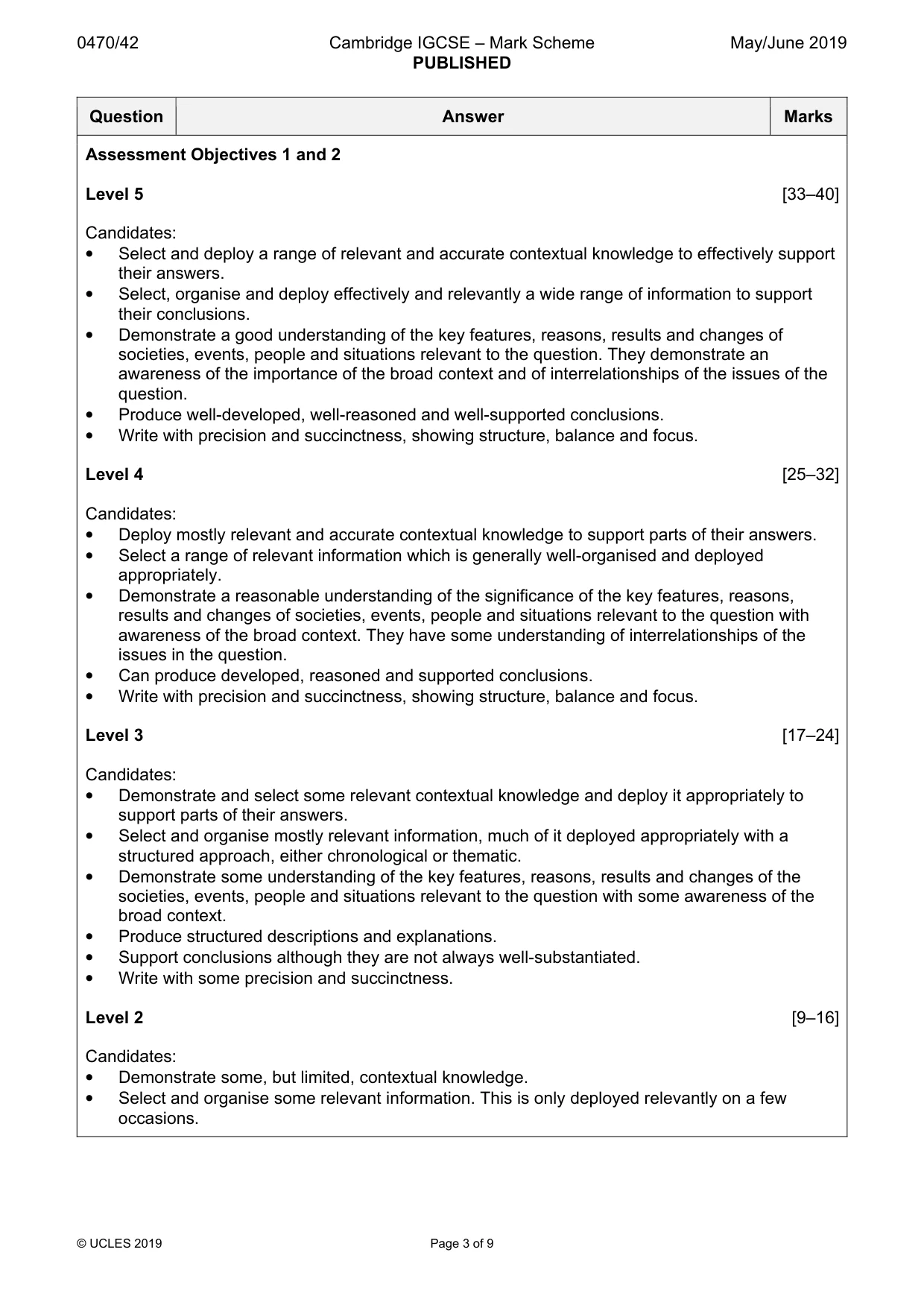
0470/42 Cambridge IGCSE – Mark Scheme PUBLISHED May/June 2019 © UCLES 2019 Page 3 of 9 Question Answer Marks Assessment Objectives 1 and 2 Level 5 [33–40] Candidates: • Select and deploy a range of relevant and accurate contextual knowledge to effectively support their answers. • Select, organise and deploy effectively and relevantly a wide range of information to support their conclusions. • Demonstrate a good understanding of the key features, reasons, results and changes of societies, events, people and situations relevant to the question. They demonstrate an awareness of the importance of the broad context and of interrelationships of the issues of the question. • Produce well-developed, well-reasoned and well-supported conclusions. • Write with precision and succinctness, showing structure, balance and focus. Level 4 [25–32] Candidates: • Deploy mostly relevant and accurate contextual knowledge to support parts of their answers. • Select a range of relevant information which is generally well-organised and deployed appropriately. • Demonstrate a reasonable understanding of the significance of the key features, reasons, results and changes of societies, events, people and situations relevant to the question with awareness of the broad context. They have some understanding of interrelationships of the issues in the question. • Can produce developed, reasoned and supported conclusions. • Write with precision and succinctness, showing structure, balance and focus. Level 3 [17–24] Candidates: • Demonstrate and select some relevant contextual knowledge and deploy it appropriately to support parts of their answers. • Select and organise mostly relevant information, much of it deployed appropriately with a structured approach, either chronological or thematic. • Demonstrate some understanding of the key features, reasons, results and changes of the societies, events, people and situations relevant to the question with some awareness of the broad context. • Produce structured descriptions and explanations. • Support conclusions although they are not always well-substantiated. • Write with some precision and succinctness. Level 2 [9–16] Candidates: • Demonstrate some, but limited, contextual knowledge. • Select and organise some relevant information. This is only deployed relevantly on a few occasions.
Mark scheme, page 4
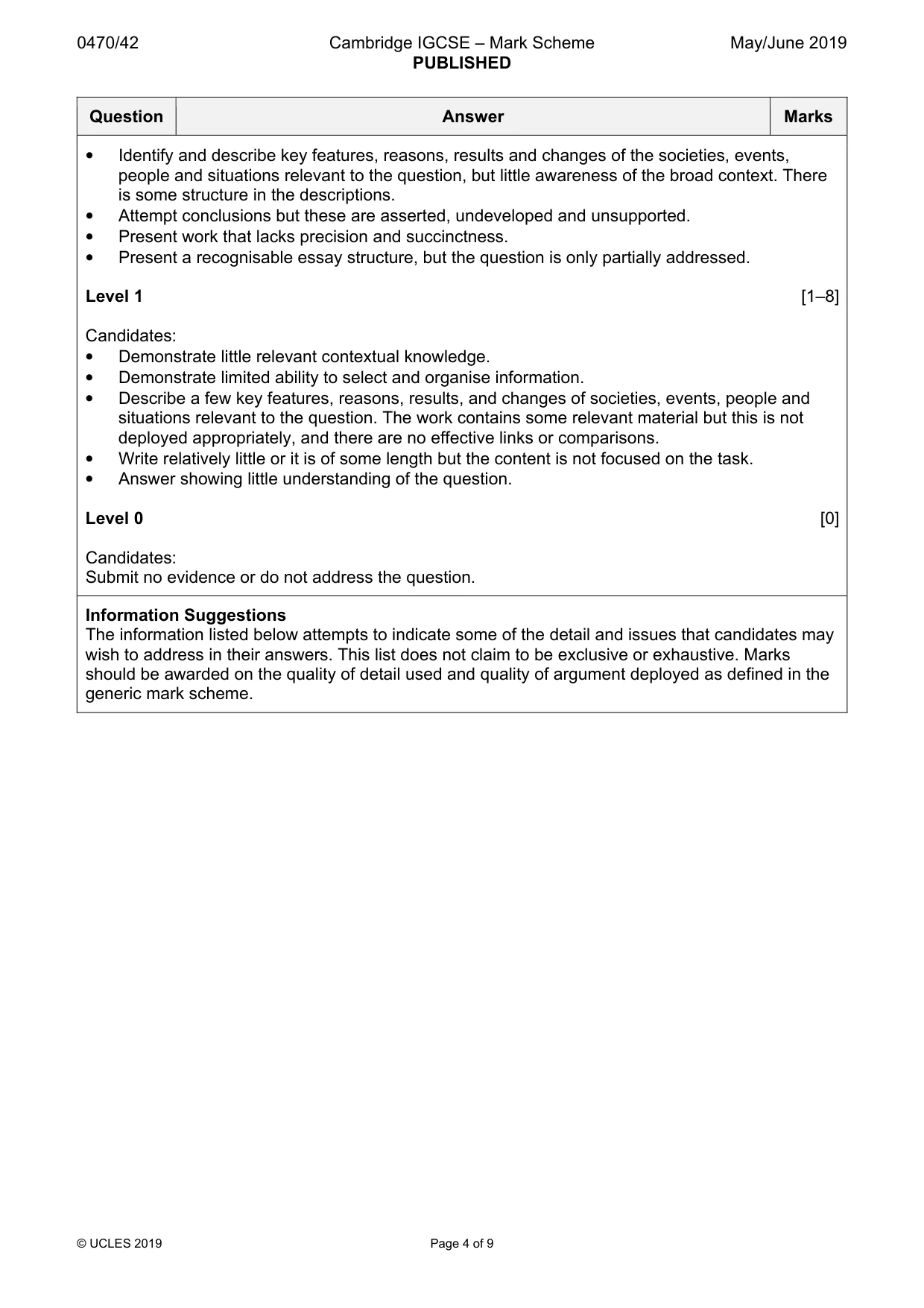
0470/42 Cambridge IGCSE – Mark Scheme PUBLISHED May/June 2019 © UCLES 2019 Page 4 of 9 Question Answer Marks • Identify and describe key features, reasons, results and changes of the societies, events, people and situations relevant to the question, but little awareness of the broad context. There is some structure in the descriptions. • Attempt conclusions but these are asserted, undeveloped and unsupported. • Present work that lacks precision and succinctness. • Present a recognisable essay structure, but the question is only partially addressed. Level 1 [1–8] Candidates: • Demonstrate little relevant contextual knowledge. • Demonstrate limited ability to select and organise information. • Describe a few key features, reasons, results, and changes of societies, events, people and situations relevant to the question. The work contains some relevant material but this is not deployed appropriately, and there are no effective links or comparisons. • Write relatively little or it is of some length but the content is not focused on the task. • Answer showing little understanding of the question. Level 0 [0] Candidates: Submit no evidence or do not address the question. Information Suggestions The information listed below attempts to indicate some of the detail and issues that candidates may wish to address in their answers. This list does not claim to be exclusive or exhaustive. Marks should be awarded on the quality of detail used and quality of argument deployed as defined in the generic mark scheme.
Mark scheme, page 5
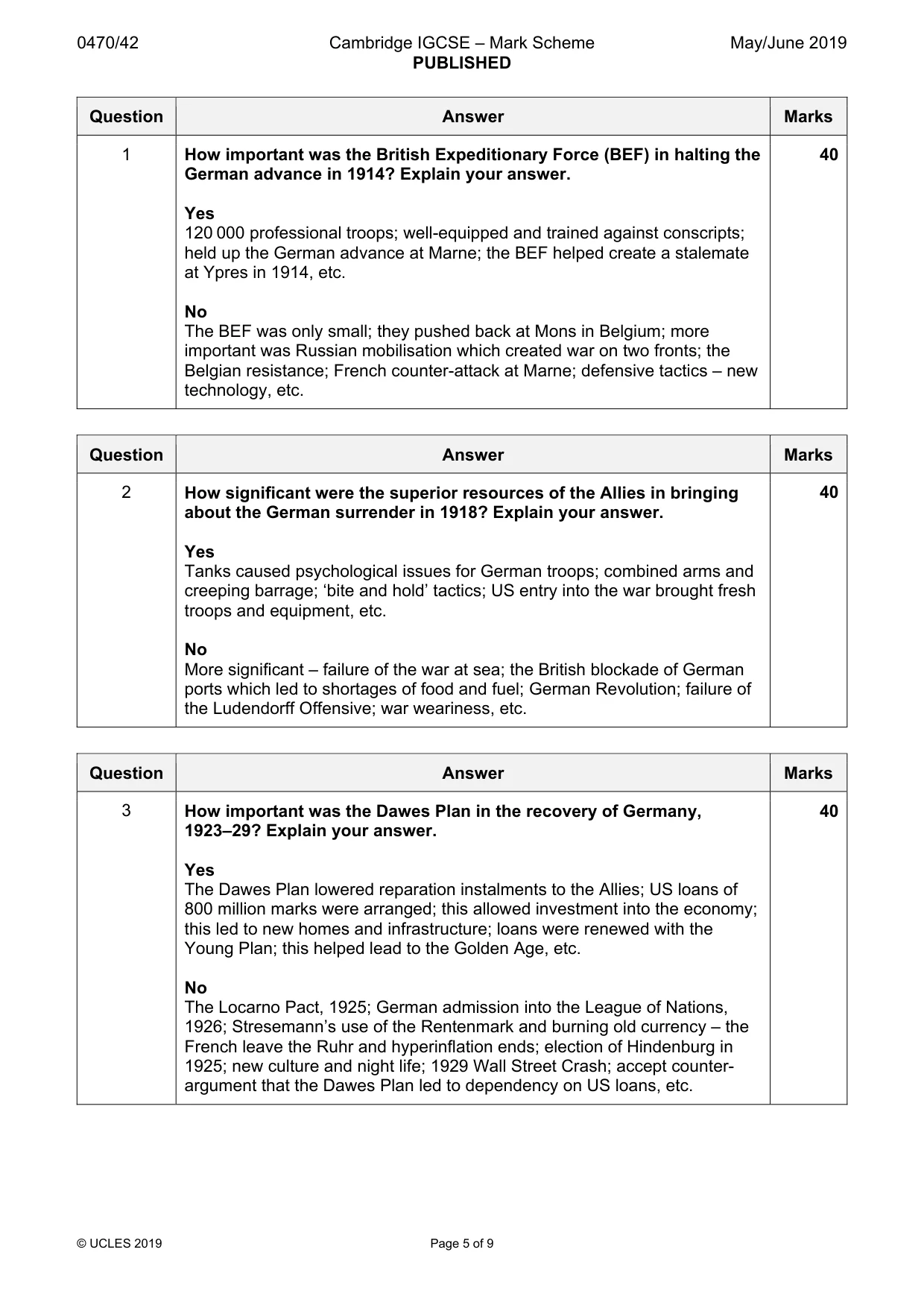
0470/42 Cambridge IGCSE – Mark Scheme PUBLISHED May/June 2019 © UCLES 2019 Page 5 of 9 Question Answer Marks 1 How important was the British Expeditionary Force (BEF) in halting the German advance in 1914? Explain your answer. Yes 120 000 professional troops; well-equipped and trained against conscripts; held up the German advance at Marne; the BEF helped create a stalemate at Ypres in 1914, etc. No The BEF was only small; they pushed back at Mons in Belgium; more important was Russian mobilisation which created war on two fronts; the Belgian resistance; French counter-attack at Marne; defensive tactics – new technology, etc. 40 Question Answer Marks 2 How significant were the superior resources of the Allies in bringing about the German surrender in 1918? Explain your answer. Yes Tanks caused psychological issues for German troops; combined arms and creeping barrage; ‘bite and hold’ tactics; US entry into the war brought fresh troops and equipment, etc. No More significant – failure of the war at sea; the British blockade of German ports which led to shortages of food and fuel; German Revolution; failure of the Ludendorff Offensive; war weariness, etc. 40 Question Answer Marks 3 How important was the Dawes Plan in the recovery of Germany, 1923–29? Explain your answer. Yes The Dawes Plan lowered reparation instalments to the Allies; US loans of 800 million marks were arranged; this allowed investment into the economy; this led to new homes and infrastructure; loans were renewed with the Young Plan; this helped lead to the Golden Age, etc. No The Locarno Pact, 1925; German admission into the League of Nations, 1926; Stresemann’s use of the Rentenmark and burning old currency – the French leave the Ruhr and hyperinflation ends; election of Hindenburg in 1925; new culture and night life; 1929 Wall Street Crash; accept counter- argument that the Dawes Plan led to dependency on US loans, etc. 40
Mark scheme, page 6
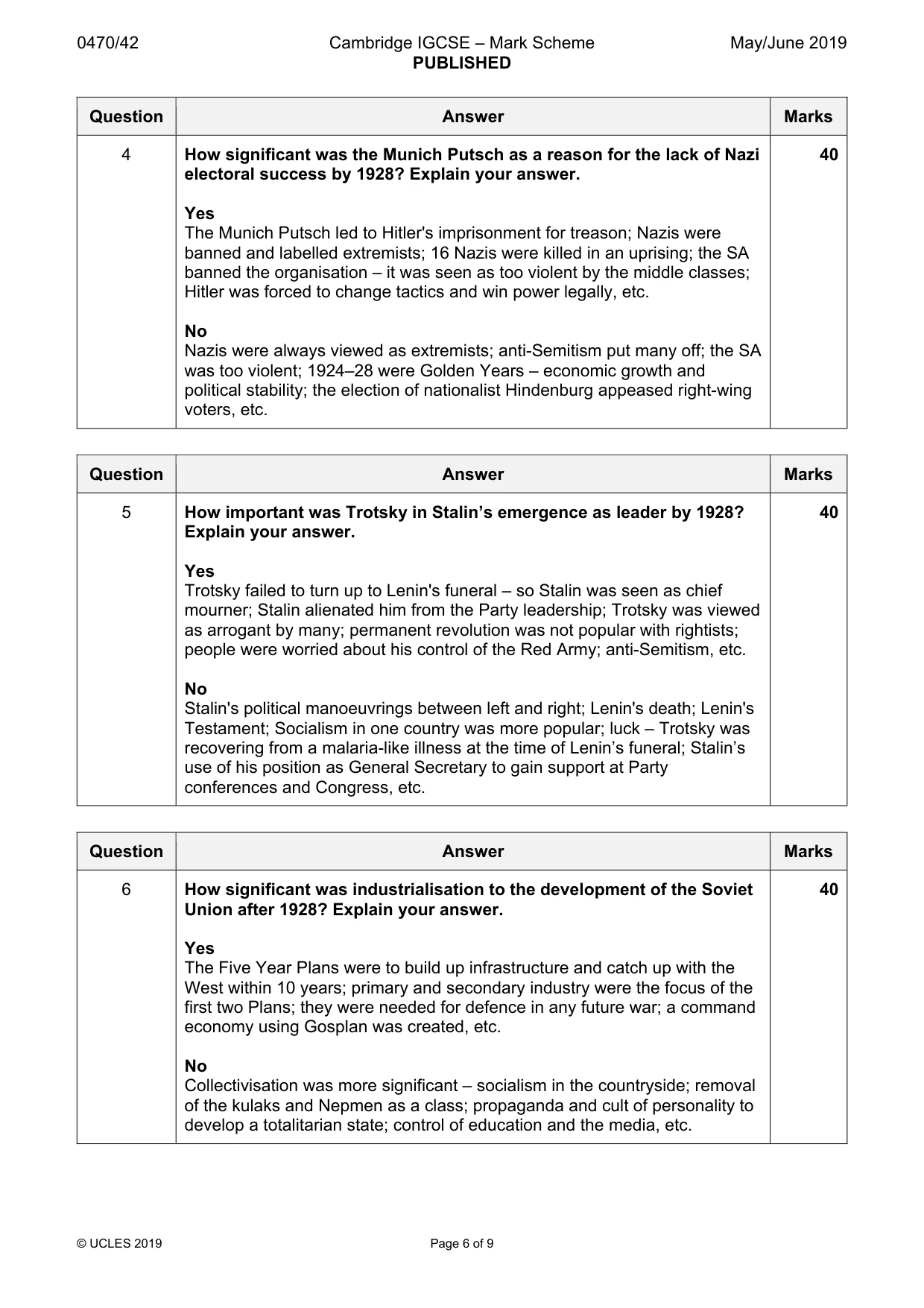
0470/42 Cambridge IGCSE – Mark Scheme PUBLISHED May/June 2019 © UCLES 2019 Page 6 of 9 Question Answer Marks 4 How significant was the Munich Putsch as a reason for the lack of Nazi electoral success by 1928? Explain your answer. Yes The Munich Putsch led to Hitler's imprisonment for treason; Nazis were banned and labelled extremists; 16 Nazis were killed in an uprising; the SA banned the organisation – it was seen as too violent by the middle classes; Hitler was forced to change tactics and win power legally, etc. No Nazis were always viewed as extremists; anti-Semitism put many off; the SA was too violent; 1924–28 were Golden Years – economic growth and political stability; the election of nationalist Hindenburg appeased right-wing voters, etc. 40 Question Answer Marks 5 How important was Trotsky in Stalin’s emergence as leader by 1928? Explain your answer. Yes Trotsky failed to turn up to Lenin's funeral – so Stalin was seen as chief mourner; Stalin alienated him from the Party leadership; Trotsky was viewed as arrogant by many; permanent revolution was not popular with rightists; people were worried about his control of the Red Army; anti-Semitism, etc. No Stalin's political manoeuvrings between left and right; Lenin's death; Lenin's Testament; Socialism in one country was more popular; luck – Trotsky was recovering from a malaria-like illness at the time of Lenin’s funeral; Stalin’s use of his position as General Secretary to gain support at Party conferences and Congress, etc. 40 Question Answer Marks 6 How significant was industrialisation to the development of the Soviet Union after 1928? Explain your answer. Yes The Five Year Plans were to build up infrastructure and catch up with the West within 10 years; primary and secondary industry were the focus of the first two Plans; they were needed for defence in any future war; a command economy using Gosplan was created, etc. No Collectivisation was more significant – socialism in the countryside; removal of the kulaks and Nepmen as a class; propaganda and cult of personality to develop a totalitarian state; control of education and the media, etc. 40
Mark scheme, page 7
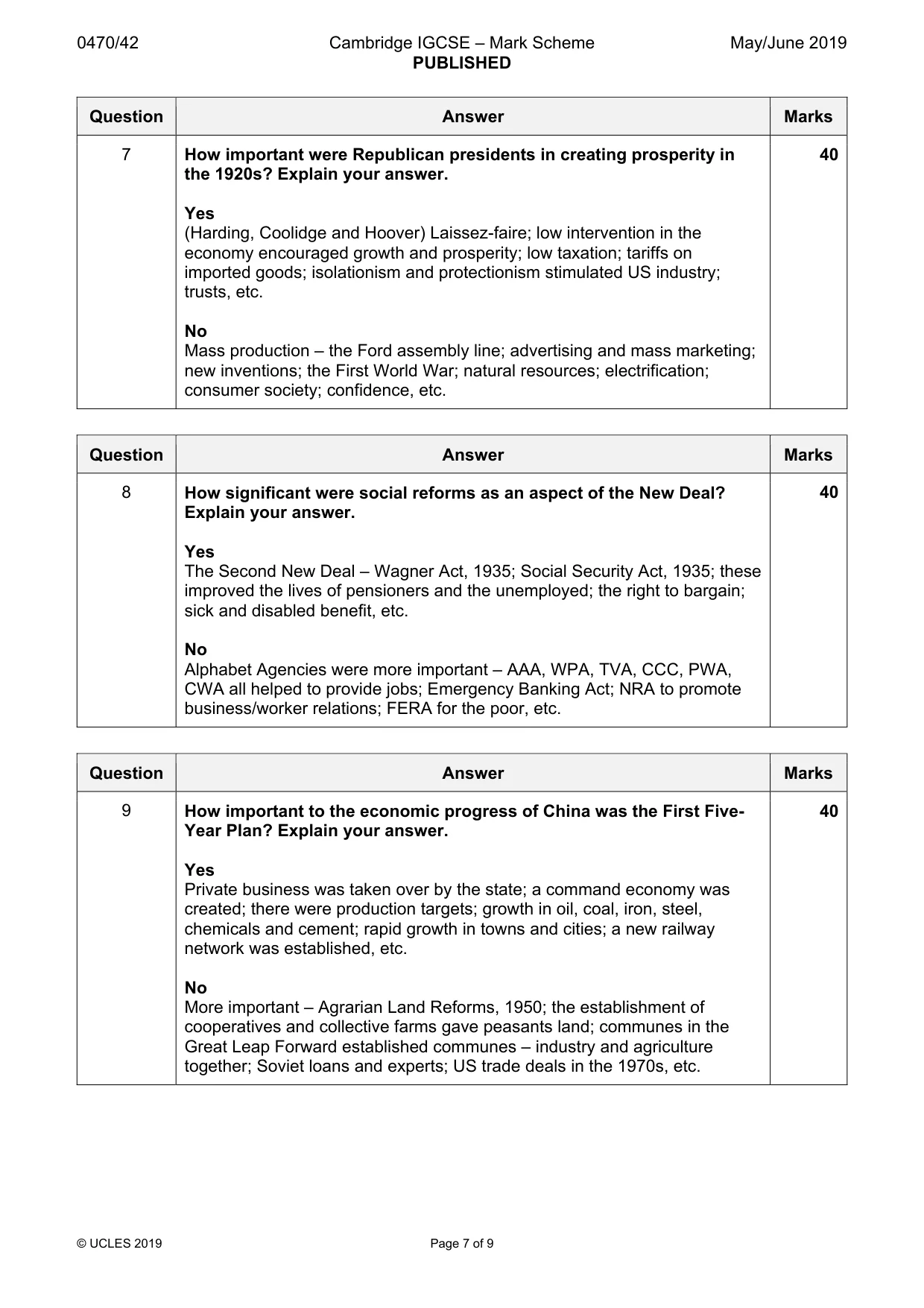
0470/42 Cambridge IGCSE – Mark Scheme PUBLISHED May/June 2019 © UCLES 2019 Page 7 of 9 Question Answer Marks 7 How important were Republican presidents in creating prosperity in the 1920s? Explain your answer. Yes (Harding, Coolidge and Hoover) Laissez-faire; low intervention in the economy encouraged growth and prosperity; low taxation; tariffs on imported goods; isolationism and protectionism stimulated US industry; trusts, etc. No Mass production – the Ford assembly line; advertising and mass marketing; new inventions; the First World War; natural resources; electrification; consumer society; confidence, etc. 40 Question Answer Marks 8 How significant were social reforms as an aspect of the New Deal? Explain your answer. Yes The Second New Deal – Wagner Act, 1935; Social Security Act, 1935; these improved the lives of pensioners and the unemployed; the right to bargain; sick and disabled benefit, etc. No Alphabet Agencies were more important – AAA, WPA, TVA, CCC, PWA, CWA all helped to provide jobs; Emergency Banking Act; NRA to promote business/worker relations; FERA for the poor, etc. 40 Question Answer Marks 9 How important to the economic progress of China was the First Five- Year Plan? Explain your answer. Yes Private business was taken over by the state; a command economy was created; there were production targets; growth in oil, coal, iron, steel, chemicals and cement; rapid growth in towns and cities; a new railway network was established, etc. No More important – Agrarian Land Reforms, 1950; the establishment of cooperatives and collective farms gave peasants land; communes in the Great Leap Forward established communes – industry and agriculture together; Soviet loans and experts; US trade deals in the 1970s, etc. 40
Mark scheme, page 8
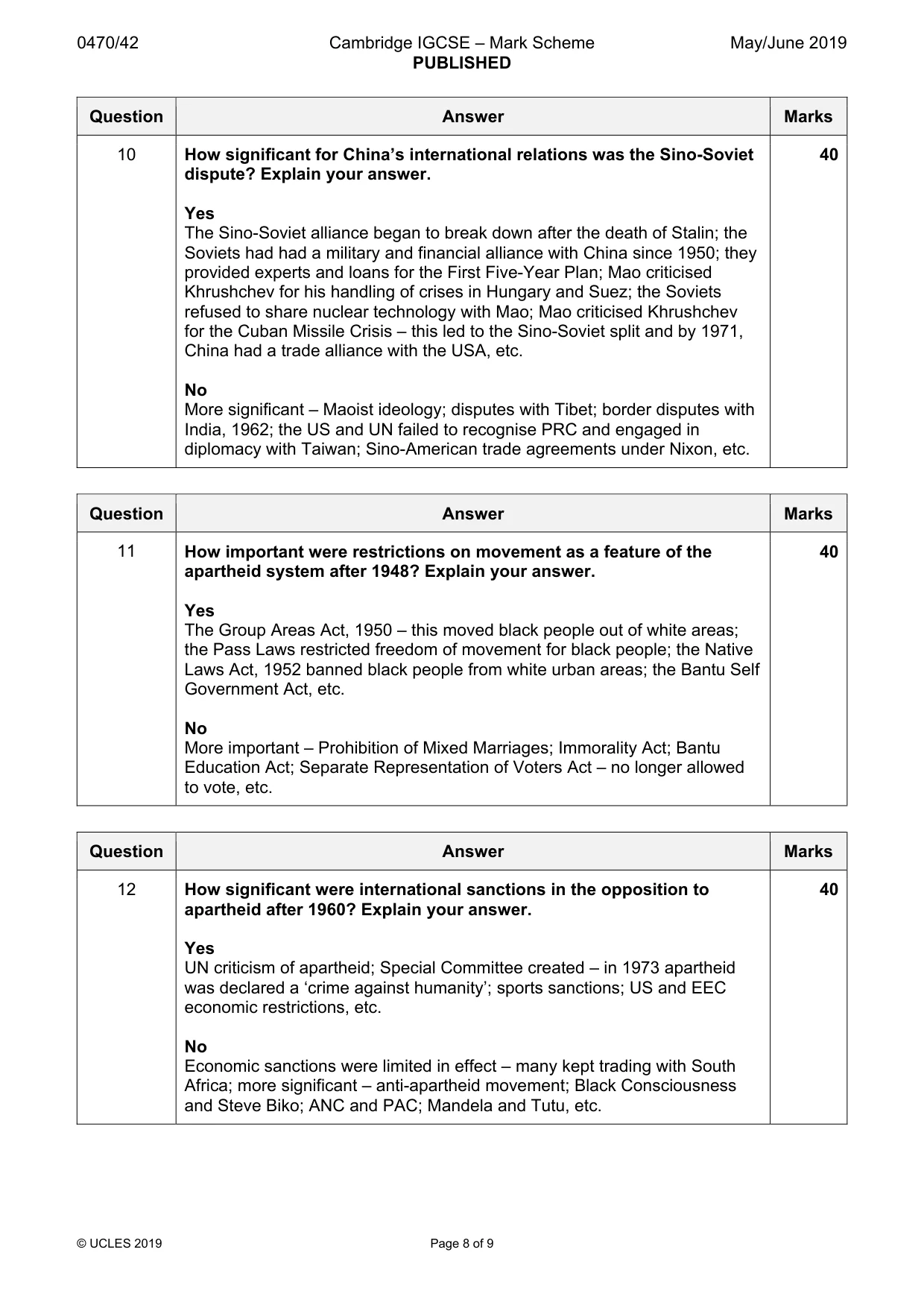
0470/42 Cambridge IGCSE – Mark Scheme PUBLISHED May/June 2019 © UCLES 2019 Page 8 of 9 Question Answer Marks 10 How significant for China’s international relations was the Sino-Soviet dispute? Explain your answer. Yes The Sino-Soviet alliance began to break down after the death of Stalin; the Soviets had had a military and financial alliance with China since 1950; they provided experts and loans for the First Five-Year Plan; Mao criticised Khrushchev for his handling of crises in Hungary and Suez; the Soviets refused to share nuclear technology with Mao; Mao criticised Khrushchev for the Cuban Missile Crisis – this led to the Sino-Soviet split and by 1971, China had a trade alliance with the USA, etc. No More significant – Maoist ideology; disputes with Tibet; border disputes with India, 1962; the US and UN failed to recognise PRC and engaged in diplomacy with Taiwan; Sino-American trade agreements under Nixon, etc. 40 Question Answer Marks 11 How important were restrictions on movement as a feature of the apartheid system after 1948? Explain your answer. Yes The Group Areas Act, 1950 – this moved black people out of white areas; the Pass Laws restricted freedom of movement for black people; the Native Laws Act, 1952 banned black people from white urban areas; the Bantu Self Government Act, etc. No More important – Prohibition of Mixed Marriages; Immorality Act; Bantu Education Act; Separate Representation of Voters Act – no longer allowed to vote, etc. 40 Question Answer Marks 12 How significant were international sanctions in the opposition to apartheid after 1960? Explain your answer. Yes UN criticism of apartheid; Special Committee created – in 1973 apartheid was declared a ‘crime against humanity’; sports sanctions; US and EEC economic restrictions, etc. No Economic sanctions were limited in effect – many kept trading with South Africa; more significant – anti-apartheid movement; Black Consciousness and Steve Biko; ANC and PAC; Mandela and Tutu, etc. 40
Mark scheme, page 9
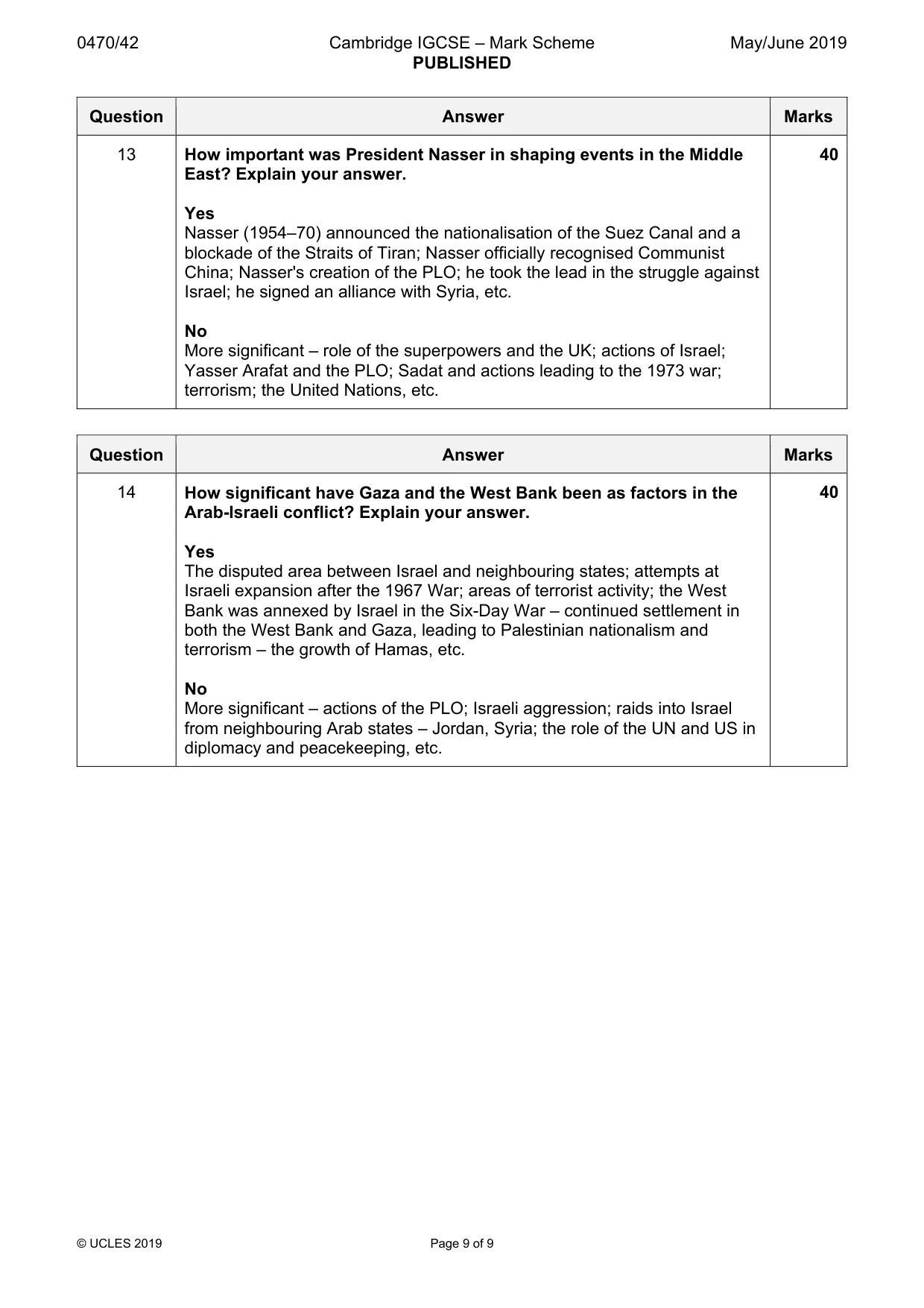
0470/42 Cambridge IGCSE – Mark Scheme PUBLISHED May/June 2019 © UCLES 2019 Page 9 of 9 Question Answer Marks 13 How important was President Nasser in shaping events in the Middle East? Explain your answer. Yes Nasser (1954–70) announced the nationalisation of the Suez Canal and a blockade of the Straits of Tiran; Nasser officially recognised Communist China; Nasser's creation of the PLO; he took the lead in the struggle against Israel; he signed an alliance with Syria, etc. No More significant – role of the superpowers and the UK; actions of Israel; Yasser Arafat and the PLO; Sadat and actions leading to the 1973 war; terrorism; the United Nations, etc. 40 Question Answer Marks 14 How significant have Gaza and the West Bank been as factors in the Arab-Israeli conflict? Explain your answer. Yes The disputed area between Israel and neighbouring states; attempts at Israeli expansion after the 1967 War; areas of terrorist activity; the West Bank was annexed by Israel in the Six-Day War – continued settlement in both the West Bank and Gaza, leading to Palestinian nationalism and terrorism – the growth of Hamas, etc. No More significant – actions of the PLO; Israeli aggression; raids into Israel from neighbouring Arab states – Jordan, Syria; the role of the UN and US in diplomacy and peacekeeping, etc. 40
What you needed in this session
Cambridge’s own grade thresholds for 2019 May/June, Paper 4 · Variant 2. A higher threshold means an easier paper — the bar moves with how the cohort did.