Cambridge IGCSE History 0470 — 2018 Oct/Nov Paper 2 · Variant 3
0470/23/O/N/18 · 50 marks · ≈56 min
The question paper and its mark scheme, free to read here and free to download. This is Cambridge’s own paper, exactly as it was sat.
Question paper16 pages
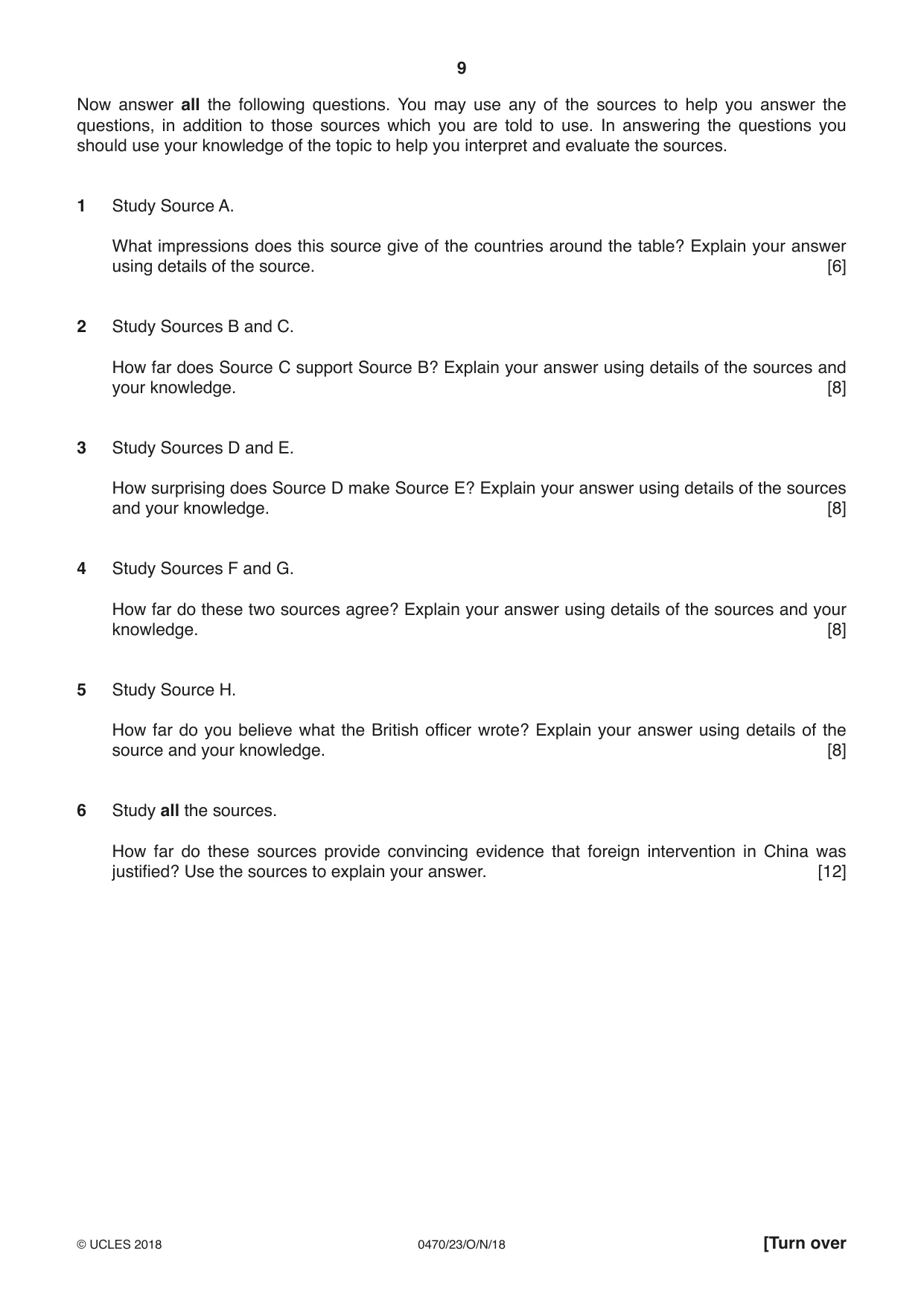
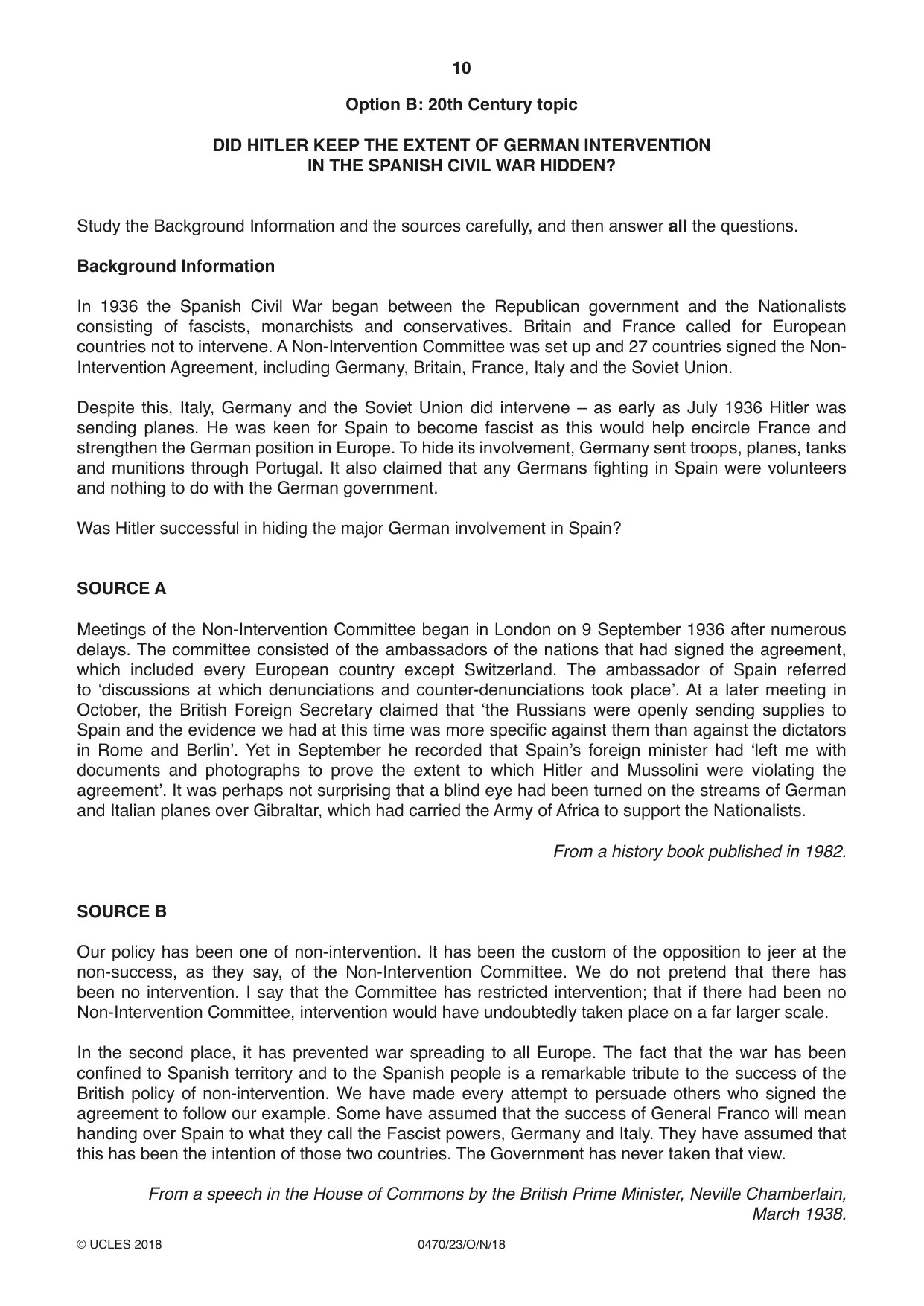

Mark scheme15 pages
Answers below. Sit the paper first if you are practising.
Paper as text
Question paper, page 1
* 9 3 9 2 5 7 6 1 3 0 * This document consists of 14 printed pages, 2 blank pages and 1 Insert. DC (ST/FC) 147942/3 © UCLES 2018 [Turn over Cambridge International Examinations Cambridge International General Certificate of Secondary Education HISTORY 0470/23 Paper 2 October/November 2018 2 hours No Additional Materials are required. READ THESE INSTRUCTIONS FIRST An answer booklet is provided inside this question paper. You should follow the instructions on the front cover of the answer booklet. If you need additional answer paper ask the invigilator for a continuation booklet. This paper has two options. Choose one option, and answer all of the questions on that topic. Option A: 19th Century topic [p2–p9] Option B: 20th Century topic [p10–p14] The number of marks is given in brackets [ ] at the end of each question or part question. This syllabus is approved for use in England, Wales and Northern Ireland as a Cambridge International Level 1/Level 2 Certificate.
Question paper, page 2
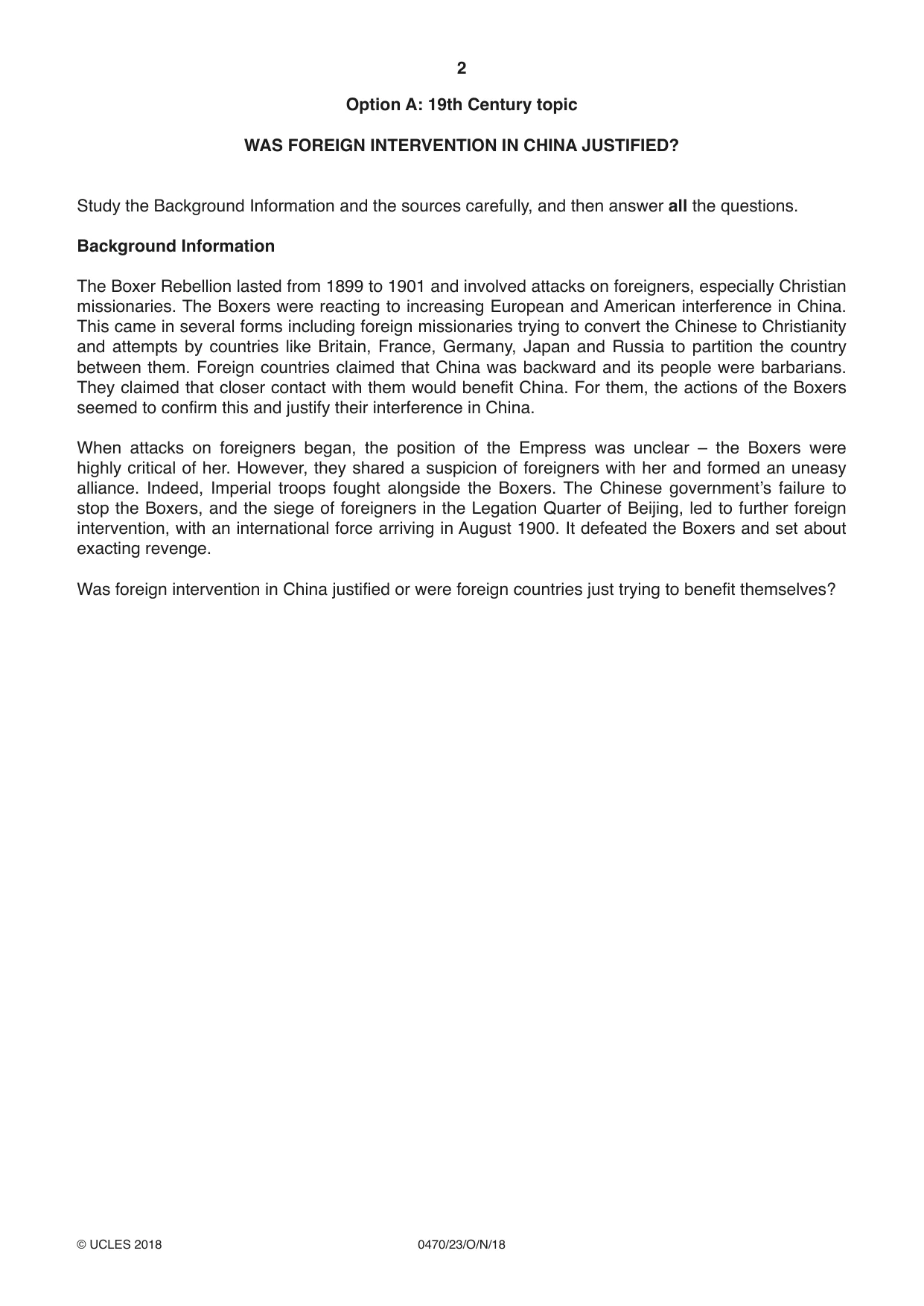
2 0470/23/O/N/18 © UCLES 2018 Option A: 19th Century topic WAS FOREIGN INTERVENTION IN CHINA JUSTIFIED? Study the Background Information and the sources carefully, and then answer all the questions. Background Information The Boxer Rebellion lasted from 1899 to 1901 and involved attacks on foreigners, especially Christian missionaries. The Boxers were reacting to increasing European and American interference in China. This came in several forms including foreign missionaries trying to convert the Chinese to Christianity and attempts by countries like Britain, France, Germany, Japan and Russia to partition the country between them. Foreign countries claimed that China was backward and its people were barbarians. They claimed that closer contact with them would benefit China. For them, the actions of the Boxers seemed to confirm this and justify their interference in China. When attacks on foreigners began, the position of the Empress was unclear – the Boxers were highly critical of her. However, they shared a suspicion of foreigners with her and formed an uneasy alliance. Indeed, Imperial troops fought alongside the Boxers. The Chinese government’s failure to stop the Boxers, and the siege of foreigners in the Legation Quarter of Beijing, led to further foreign intervention, with an international force arriving in August 1900. It defeated the Boxers and set about exacting revenge. Was foreign intervention in China justified or were foreign countries just trying to benefit themselves?
Question paper, page 3
3 0470/23/O/N/18 © UCLES 2018 [Turn over SOURCE A A cartoon published in a French magazine, 1898. The caption reads ‘China – the cake of kings and of emperors’. The countries around the table are, from left to right, Britain, Germany, Russia, France and Japan.
Question paper, page 4
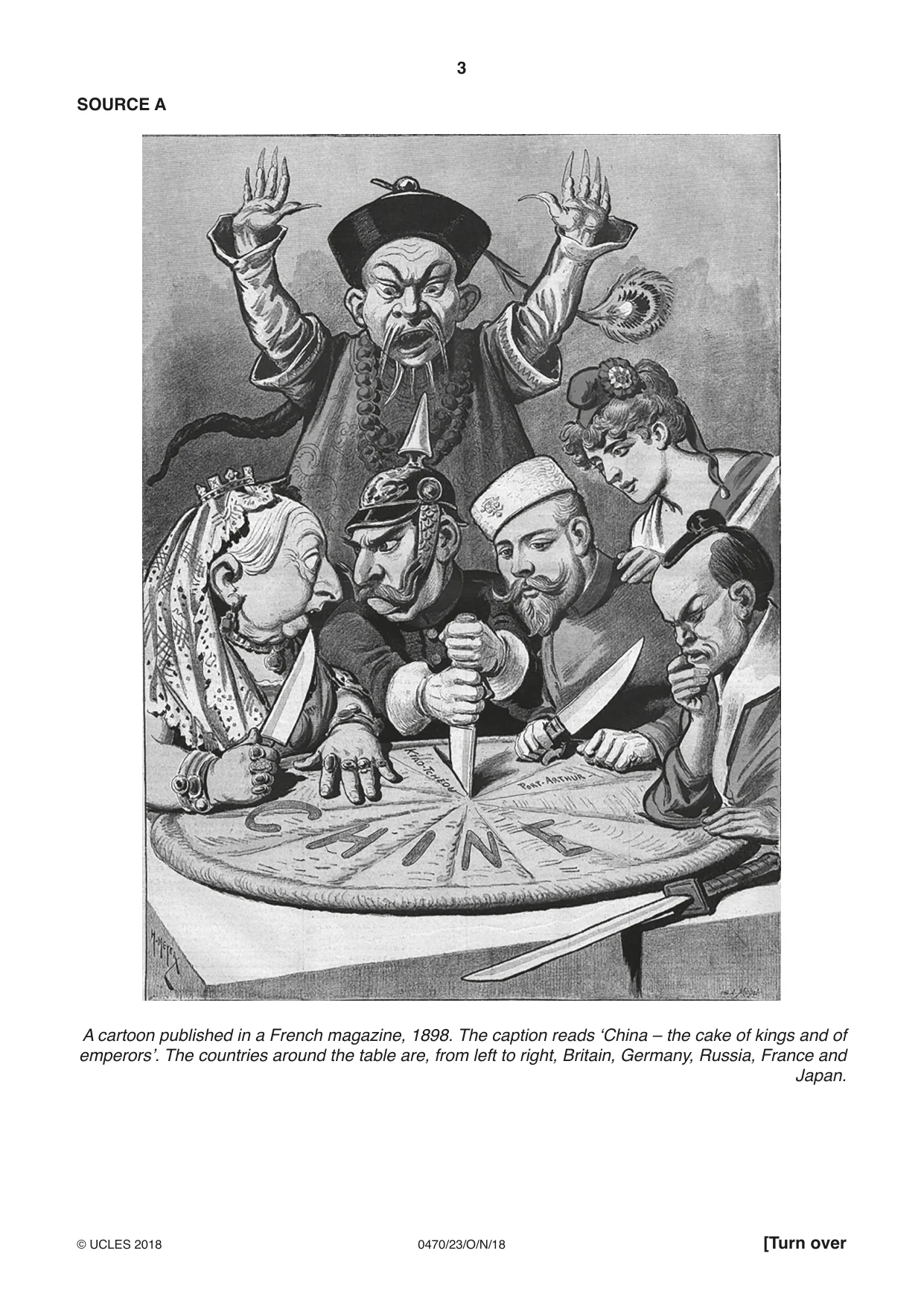
4 0470/23/O/N/18 © UCLES 2018 SOURCE B We are not a Christian nation. We show ourselves anything but Christian in the Far East. In America, we think of the Boxer uprising as a movement of the ‘heathen’ against the Christian missionaries. In spite of the fact that Christian missionaries were tortured and killed, the Boxer uprising was nothing of the sort. It was a patriotic movement to expel what the Chinese call ‘foreign devils’ – the so-called Christian nations are little less. Suppose the great nations of Europe put their fleets together, came over here and took possession of our great city ports, drove our people into the hinterland, built great warehouses and factories, brought in a body of corrupt agents, and calmly notified our people that they would manage the commerce of the country. Would we not have a Boxer movement to drive those foreign European Christian devils out of our country? The cases are the same. From a speech in the USA by Dr George F Pentecost, 1912. Pentecost was a Christian leader in the USA and had travelled in China. SOURCE C Attention: all people in markets and villages of all provinces in China. Owing to the fact that Catholics and Protestants have mocked our gods, have deceived our emperors, and oppressed the Chinese people, both our gods and our people are angry with them, yet we have to keep silent. This forces us to practise the magic boxing to protect our country, expel the foreign bandits and kill Christian converts. If there are Christian converts in your village, you ought to get rid of them. Their churches should be burned down. Everyone who conceals Christian converts will be burned to death. We especially do not want to punish anyone by death without warning him first. Do not disobey this special notice! Spread this message far and wide. If you gain no supporters for us, you will be decapitated. A Boxer notice circulated around China in 1900. SOURCE D Recently bandits have become more common. Most critics point to revolutionary societies as the cause. But societies are of different kinds. When worthless bandits create disturbances, the law can show them no leniency. On the other hand, there are the Boxers, peaceful and law-abiding people practising their skills for the preservation of themselves and their families, or combining village communities for the mutual protection of the rural population. This is in agreement with the public-spirited principle of ‘keeping watch and giving mutual help’. Some local authorities do not observe this distinction, but regard all as revolutionary societies. This means not that all the people are disorderly, but that these local officials are wrong. An edict issued by the Imperial Court to local officials who had been trying to suppress the Boxers, January 1900. An American missionary called it a charter for the Boxers.
Question paper, page 5
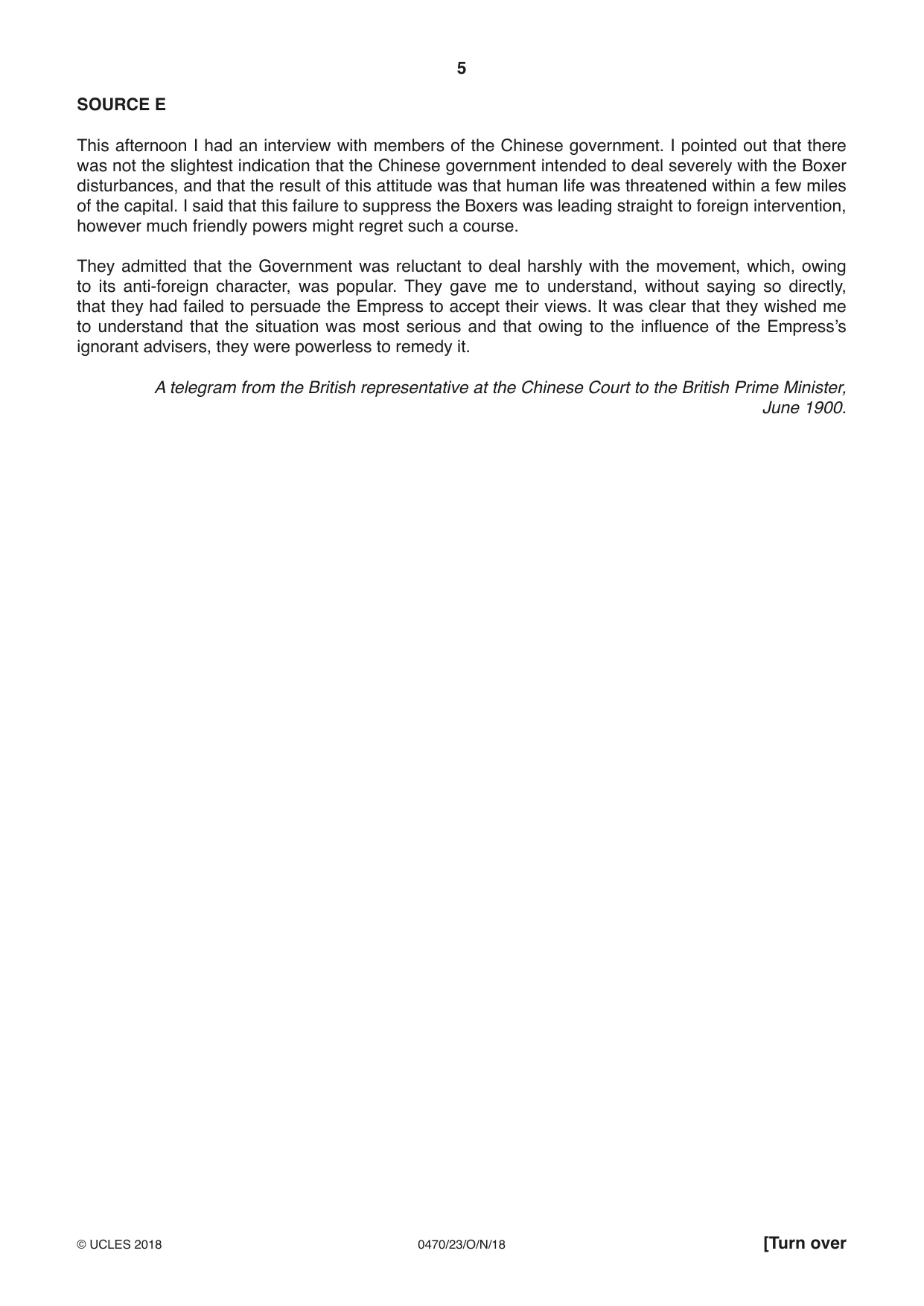
5 0470/23/O/N/18 © UCLES 2018 [Turn over SOURCE E This afternoon I had an interview with members of the Chinese government. I pointed out that there was not the slightest indication that the Chinese government intended to deal severely with the Boxer disturbances, and that the result of this attitude was that human life was threatened within a few miles of the capital. I said that this failure to suppress the Boxers was leading straight to foreign intervention, however much friendly powers might regret such a course. They admitted that the Government was reluctant to deal harshly with the movement, which, owing to its anti-foreign character, was popular. They gave me to understand, without saying so directly, that they had failed to persuade the Empress to accept their views. It was clear that they wished me to understand that the situation was most serious and that owing to the influence of the Empress’s ignorant advisers, they were powerless to remedy it. A telegram from the British representative at the Chinese Court to the British Prime Minister, June 1900.
Question paper, page 6
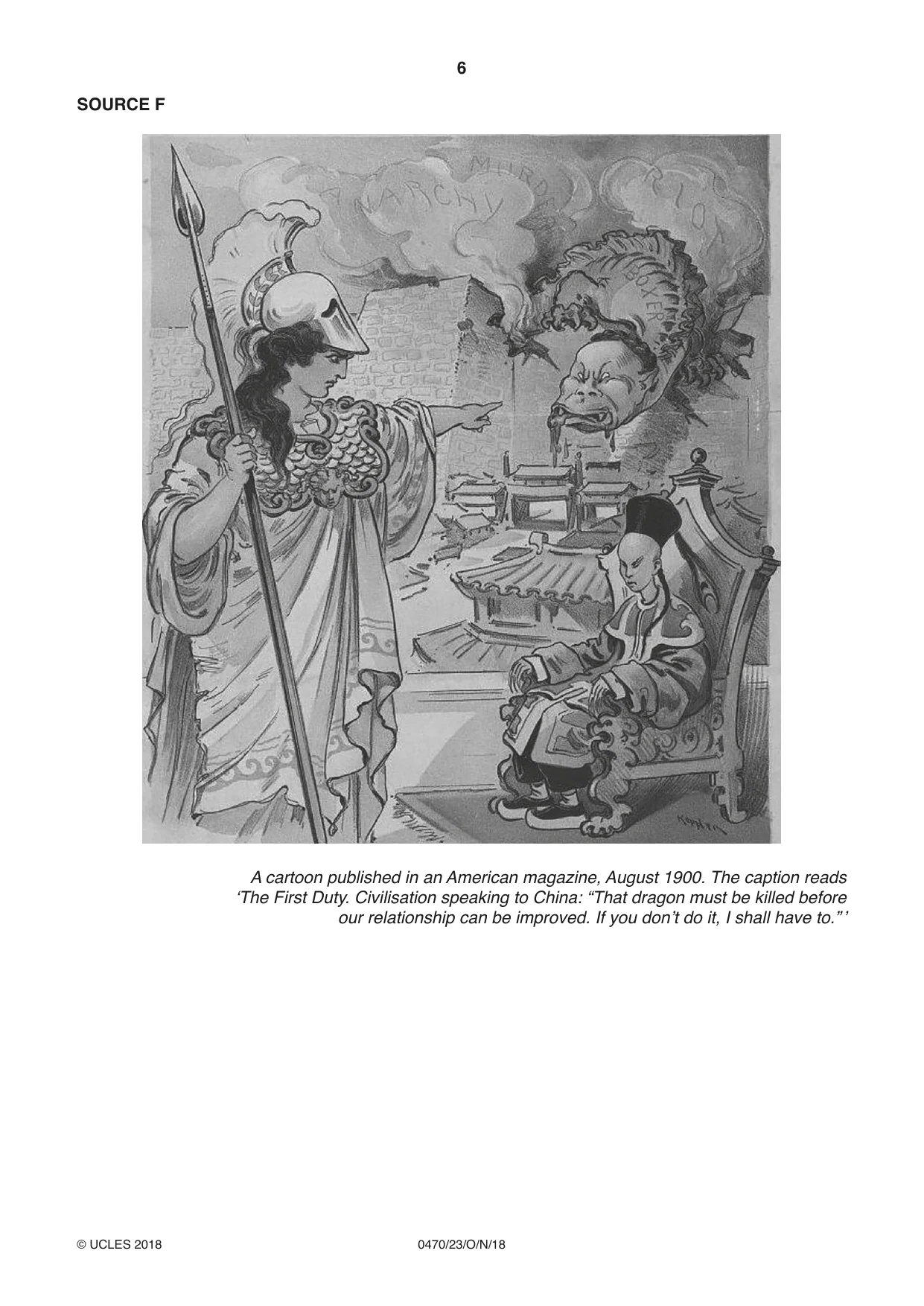
6 0470/23/O/N/18 © UCLES 2018 SOURCE F A cartoon published in an American magazine, August 1900. The caption reads ‘The First Duty. Civilisation speaking to China: “That dragon must be killed before our relationship can be improved. If you don’t do it, I shall have to.” ’
Question paper, page 7
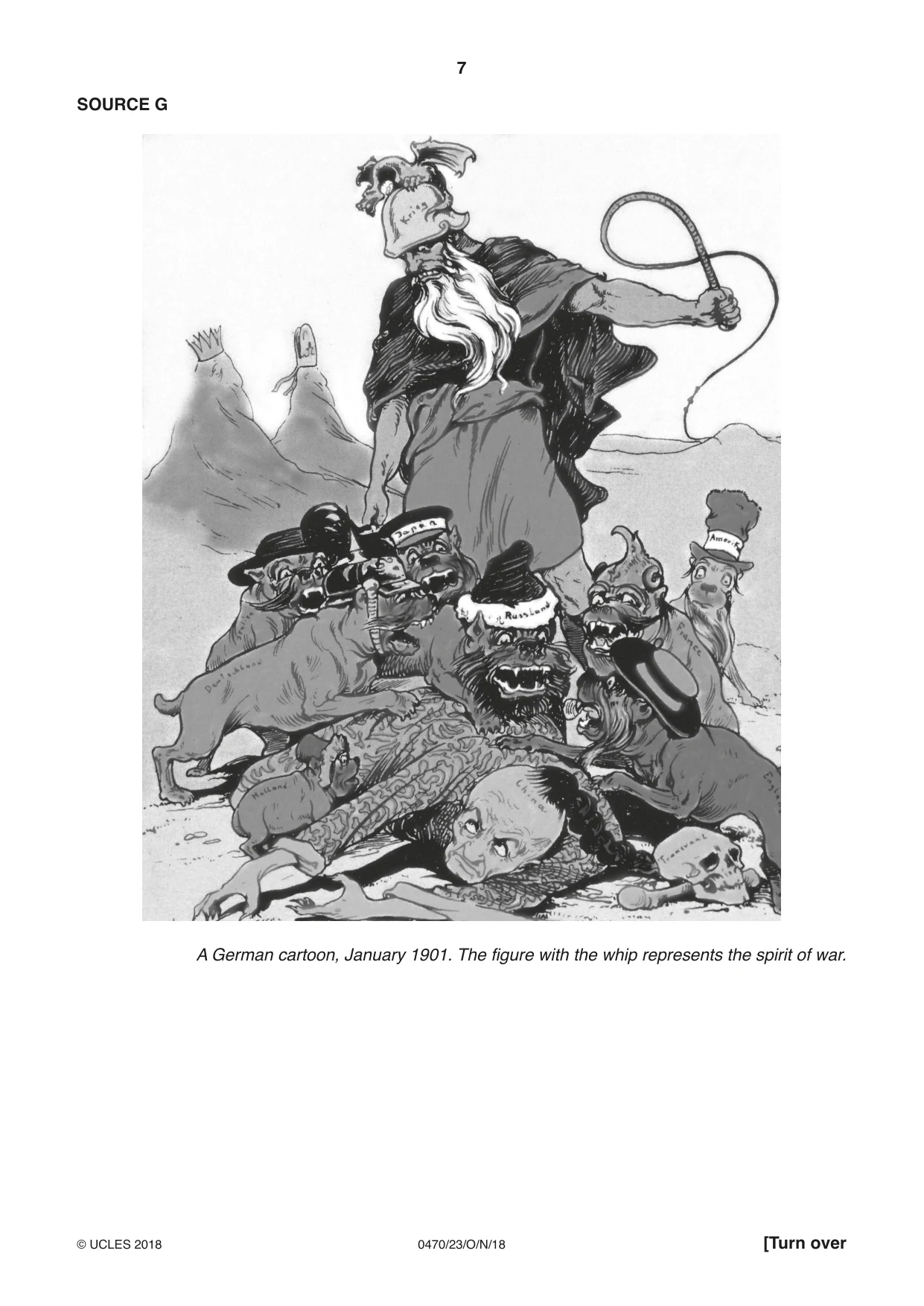
7 0470/23/O/N/18 © UCLES 2018 [Turn over SOURCE G A German cartoon, January 1901. The figure with the whip represents the spirit of war.
Question paper, page 8
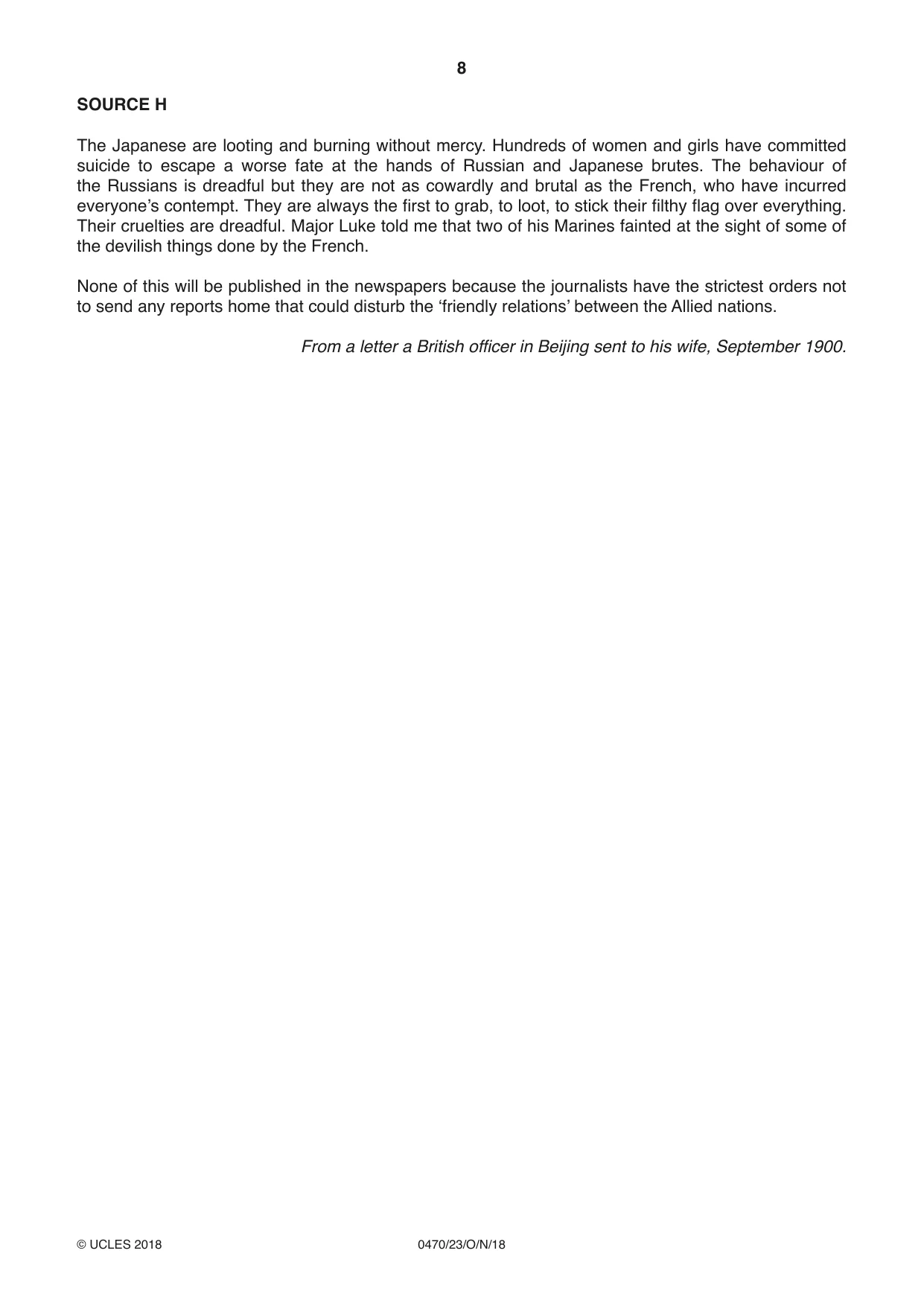
8 0470/23/O/N/18 © UCLES 2018 SOURCE H The Japanese are looting and burning without mercy. Hundreds of women and girls have committed suicide to escape a worse fate at the hands of Russian and Japanese brutes. The behaviour of the Russians is dreadful but they are not as cowardly and brutal as the French, who have incurred everyone’s contempt. They are always the first to grab, to loot, to stick their filthy flag over everything. Their cruelties are dreadful. Major Luke told me that two of his Marines fainted at the sight of some of the devilish things done by the French. None of this will be published in the newspapers because the journalists have the strictest orders not to send any reports home that could disturb the ‘friendly relations’ between the Allied nations. From a letter a British officer in Beijing sent to his wife, September 1900.
Question paper, page 9
9 0470/23/O/N/18 © UCLES 2018 [Turn over Now answer all the following questions. You may use any of the sources to help you answer the questions, in addition to those sources which you are told to use. In answering the questions you should use your knowledge of the topic to help you interpret and evaluate the sources. 1 Study Source A. What impressions does this source give of the countries around the table? Explain your answer using details of the source. [6] 2 Study Sources B and C. How far does Source C support Source B? Explain your answer using details of the sources and your knowledge. [8] 3 Study Sources D and E. How surprising does Source D make Source E? Explain your answer using details of the sources and your knowledge. [8] 4 Study Sources F and G. How far do these two sources agree? Explain your answer using details of the sources and your knowledge. [8] 5 Study Source H. How far do you believe what the British officer wrote? Explain your answer using details of the source and your knowledge. [8] 6 Study all the sources. How far do these sources provide convincing evidence that foreign intervention in China was justified? Use the sources to explain your answer. [12]
Question paper, page 10
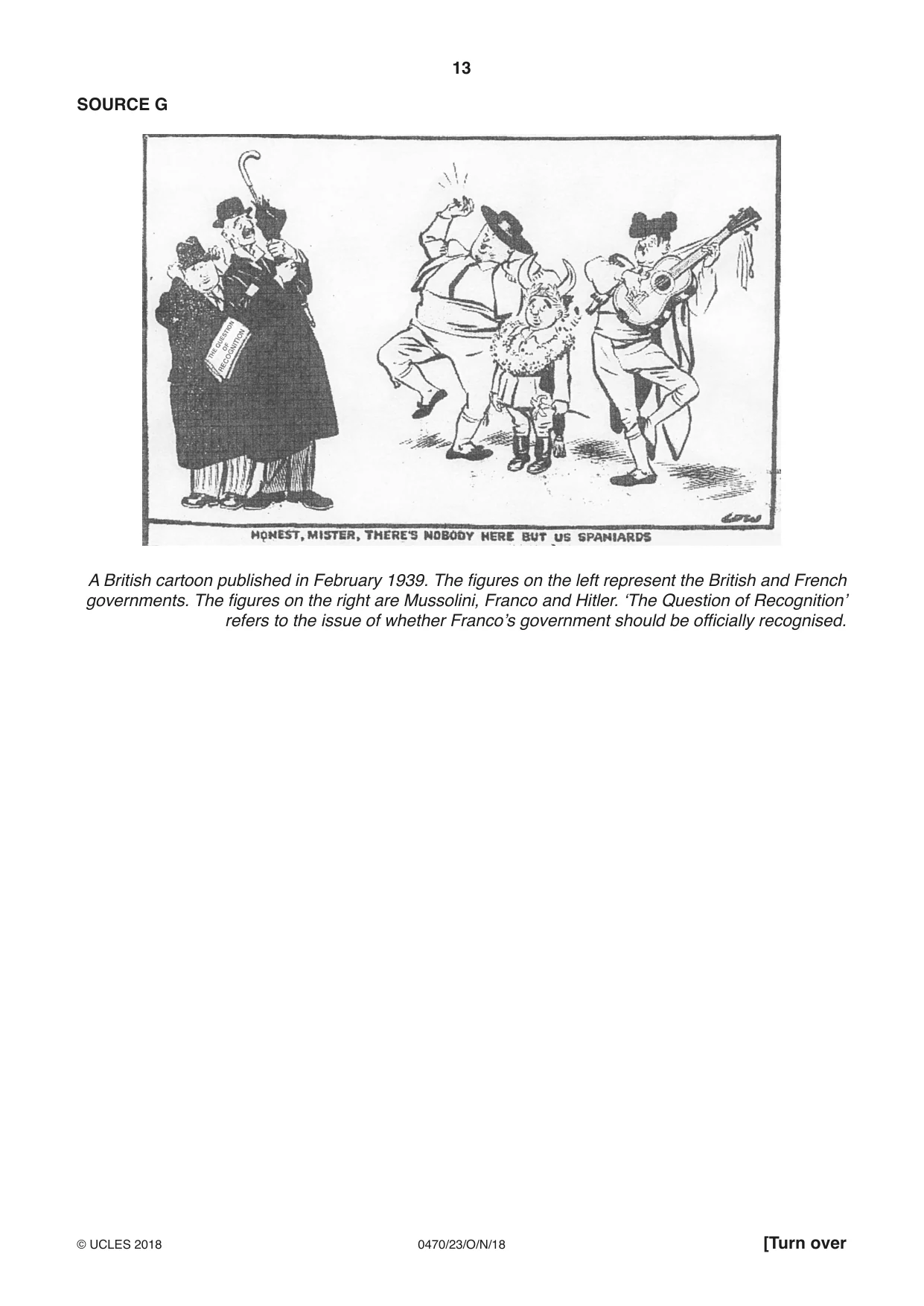
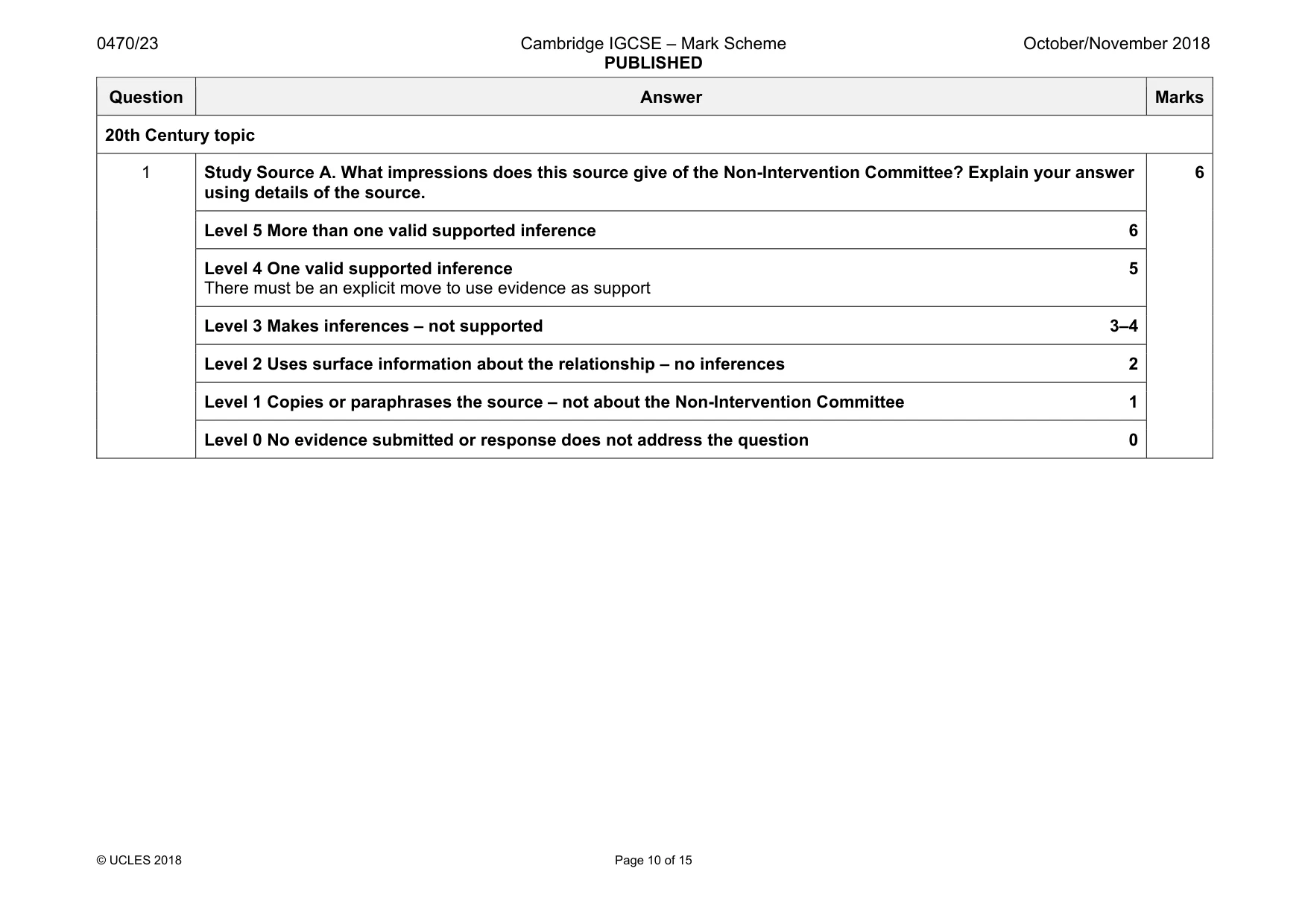
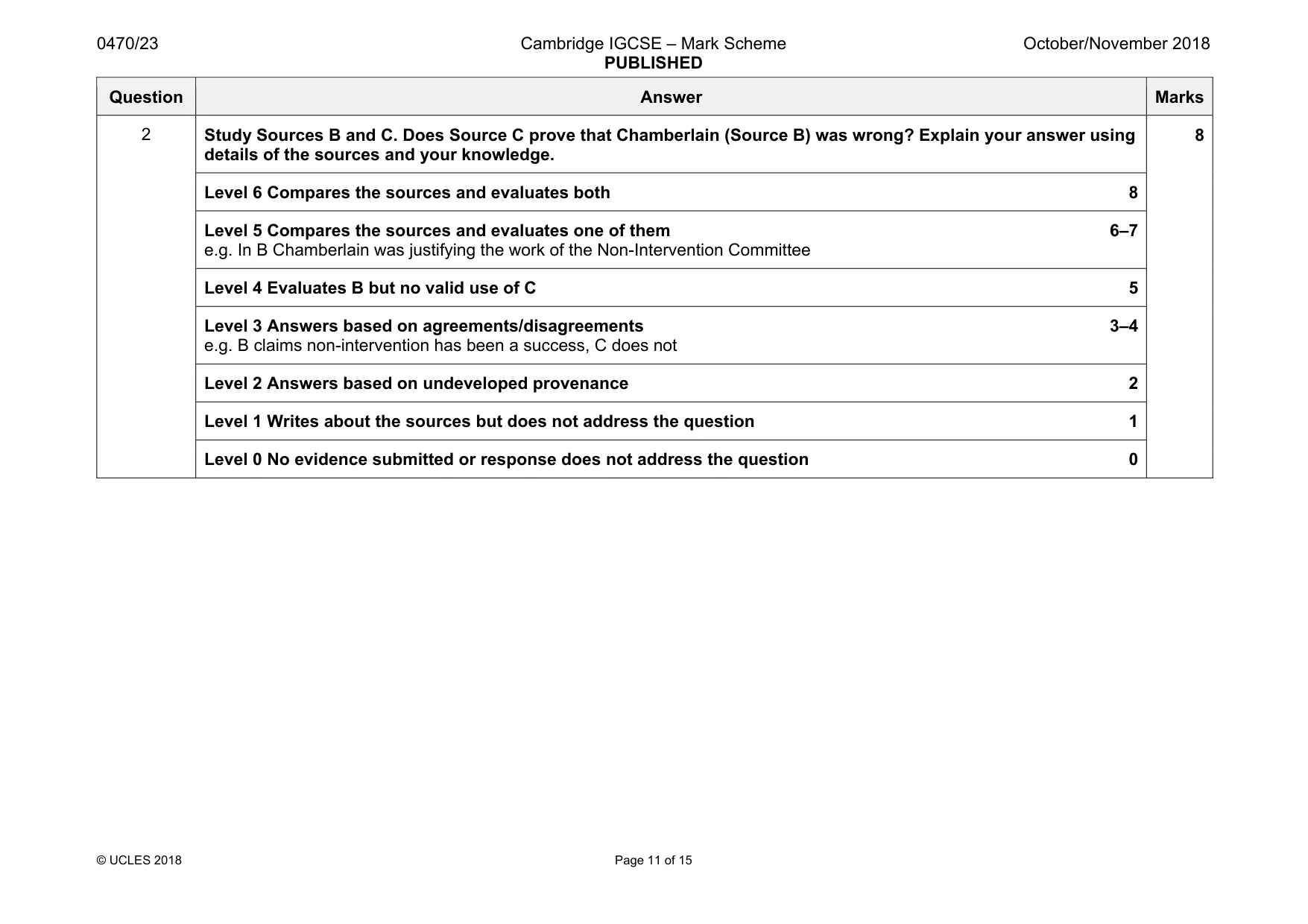
10 0470/23/O/N/18 © UCLES 2018 Option B: 20th Century topic DID HITLER KEEP THE EXTENT OF GERMAN INTERVENTION IN THE SPANISH CIVIL WAR HIDDEN? Study the Background Information and the sources carefully, and then answer all the questions. Background Information In 1936 the Spanish Civil War began between the Republican government and the Nationalists consisting of fascists, monarchists and conservatives. Britain and France called for European countries not to intervene. A Non-Intervention Committee was set up and 27 countries signed the Non- Intervention Agreement, including Germany, Britain, France, Italy and the Soviet Union. Despite this, Italy, Germany and the Soviet Union did intervene – as early as July 1936 Hitler was sending planes. He was keen for Spain to become fascist as this would help encircle France and strengthen the German position in Europe. To hide its involvement, Germany sent troops, planes, tanks and munitions through Portugal. It also claimed that any Germans fighting in Spain were volunteers and nothing to do with the German government. Was Hitler successful in hiding the major German involvement in Spain? SOURCE A Meetings of the Non-Intervention Committee began in London on 9 September 1936 after numerous delays. The committee consisted of the ambassadors of the nations that had signed the agreement, which included every European country except Switzerland. The ambassador of Spain referred to ‘discussions at which denunciations and counter-denunciations took place’. At a later meeting in October, the British Foreign Secretary claimed that ‘the Russians were openly sending supplies to Spain and the evidence we had at this time was more specific against them than against the dictators in Rome and Berlin’. Yet in September he recorded that Spain’s foreign minister had ‘left me with documents and photographs to prove the extent to which Hitler and Mussolini were violating the agreement’. It was perhaps not surprising that a blind eye had been turned on the streams of German and Italian planes over Gibraltar, which had carried the Army of Africa to support the Nationalists. From a history book published in 1982. SOURCE B Our policy has been one of non-intervention. It has been the custom of the opposition to jeer at the non-success, as they say, of the Non-Intervention Committee. We do not pretend that there has been no intervention. I say that the Committee has restricted intervention; that if there had been no Non-Intervention Committee, intervention would have undoubtedly taken place on a far larger scale. In the second place, it has prevented war spreading to all Europe. The fact that the war has been confined to Spanish territory and to the Spanish people is a remarkable tribute to the success of the British policy of non-intervention. We have made every attempt to persuade others who signed the agreement to follow our example. Some have assumed that the success of General Franco will mean handing over Spain to what they call the Fascist powers, Germany and Italy. They have assumed that this has been the intention of those two countries. The Government has never taken that view. From a speech in the House of Commons by the British Prime Minister, Neville Chamberlain, March 1938.
Question paper, page 11
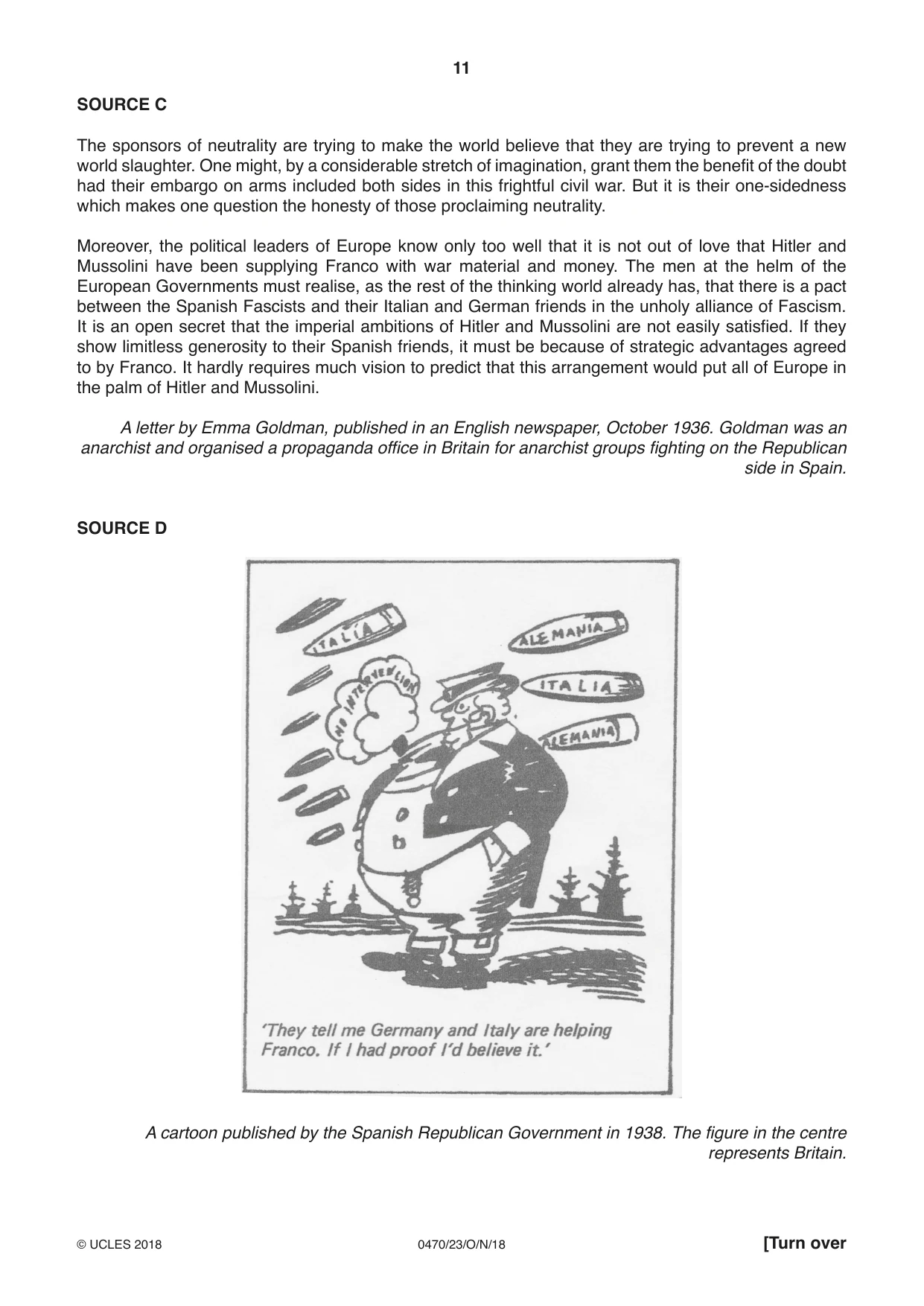
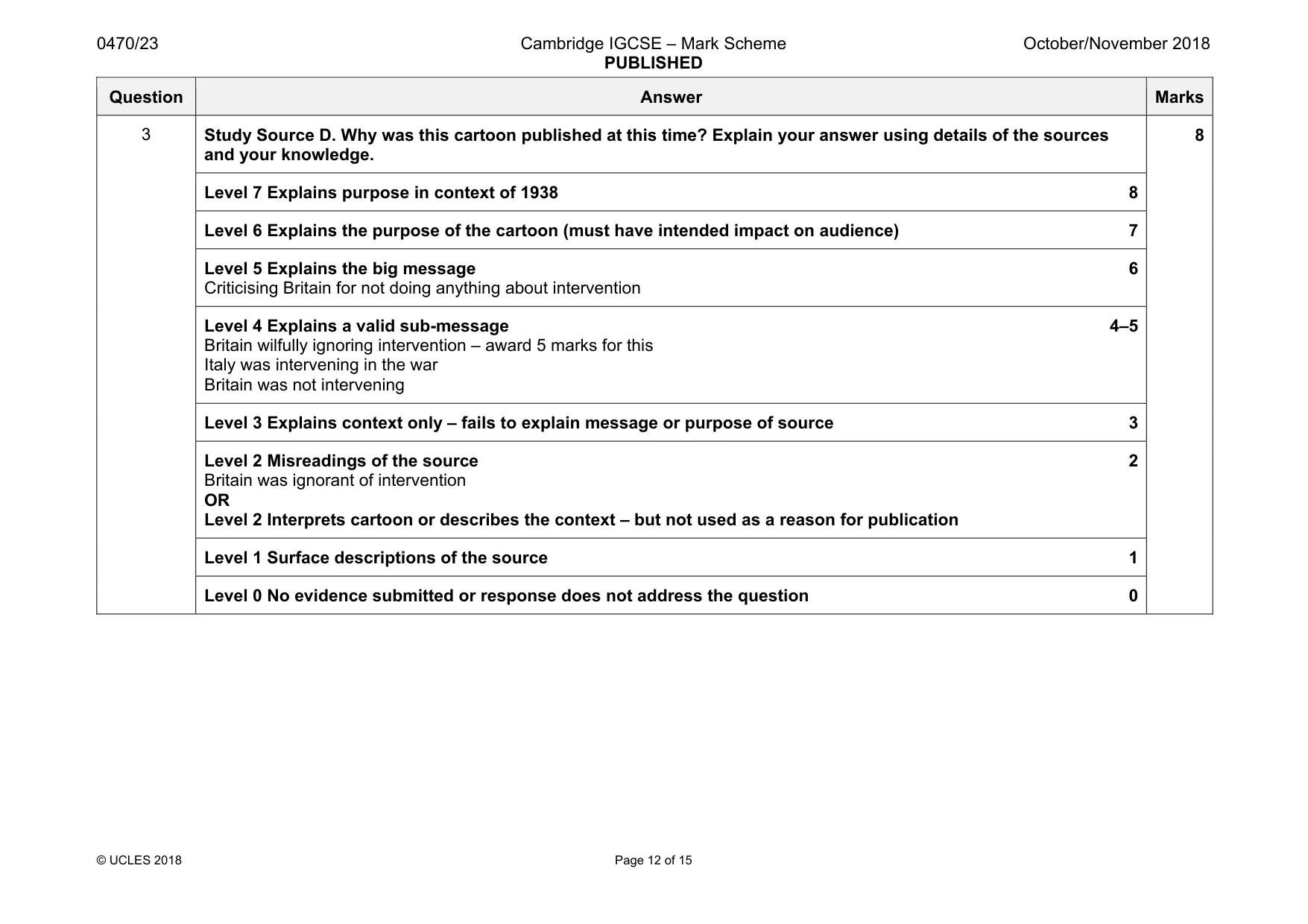
11 0470/23/O/N/18 © UCLES 2018 [Turn over SOURCE C The sponsors of neutrality are trying to make the world believe that they are trying to prevent a new world slaughter. One might, by a considerable stretch of imagination, grant them the benefit of the doubt had their embargo on arms included both sides in this frightful civil war. But it is their one-sidedness which makes one question the honesty of those proclaiming neutrality. Moreover, the political leaders of Europe know only too well that it is not out of love that Hitler and Mussolini have been supplying Franco with war material and money. The men at the helm of the European Governments must realise, as the rest of the thinking world already has, that there is a pact between the Spanish Fascists and their Italian and German friends in the unholy alliance of Fascism. It is an open secret that the imperial ambitions of Hitler and Mussolini are not easily satisfied. If they show limitless generosity to their Spanish friends, it must be because of strategic advantages agreed to by Franco. It hardly requires much vision to predict that this arrangement would put all of Europe in the palm of Hitler and Mussolini. A letter by Emma Goldman, published in an English newspaper, October 1936. Goldman was an anarchist and organised a propaganda office in Britain for anarchist groups fighting on the Republican side in Spain. SOURCE D A cartoon published by the Spanish Republican Government in 1938. The figure in the centre represents Britain.
Question paper, page 12
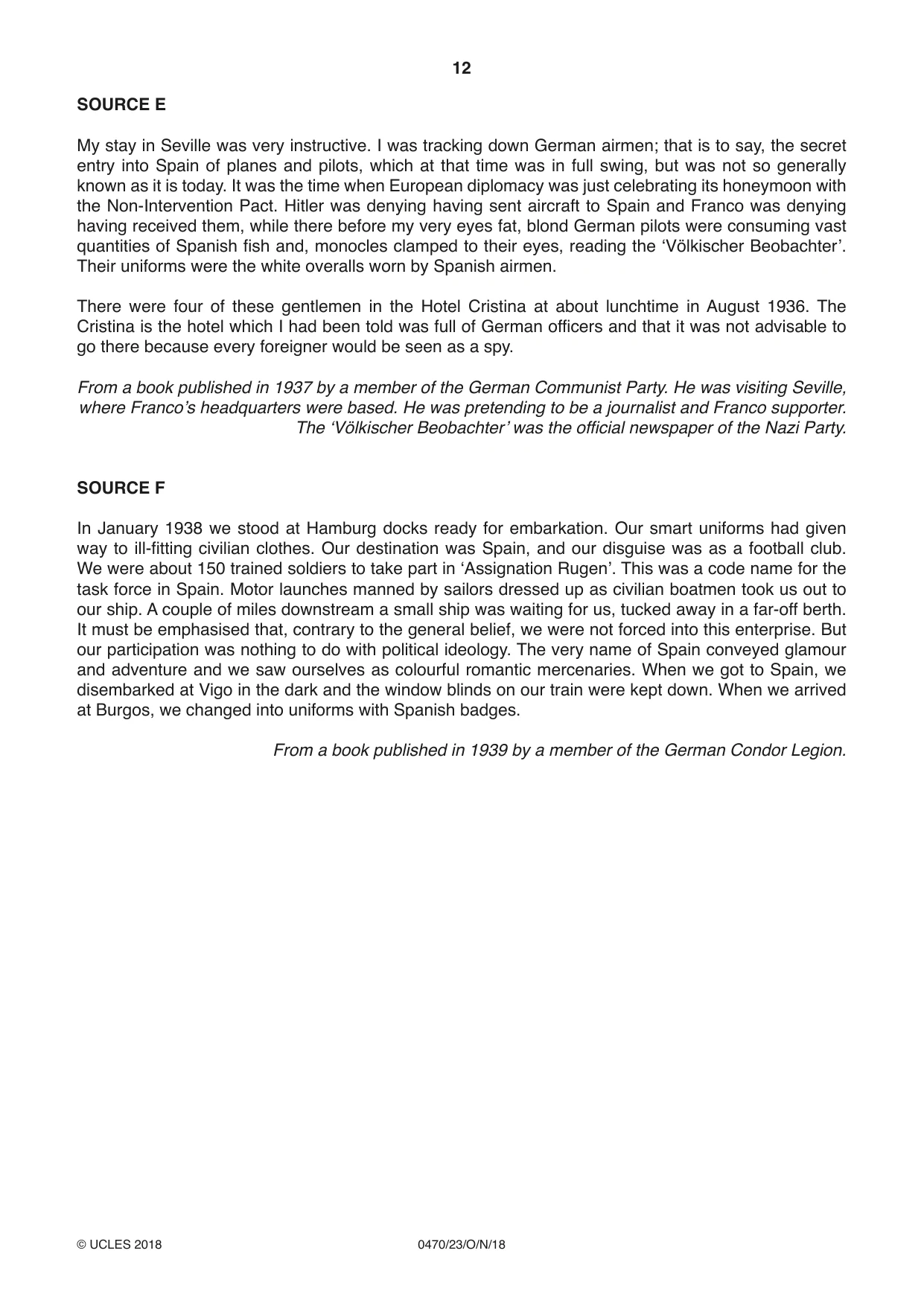
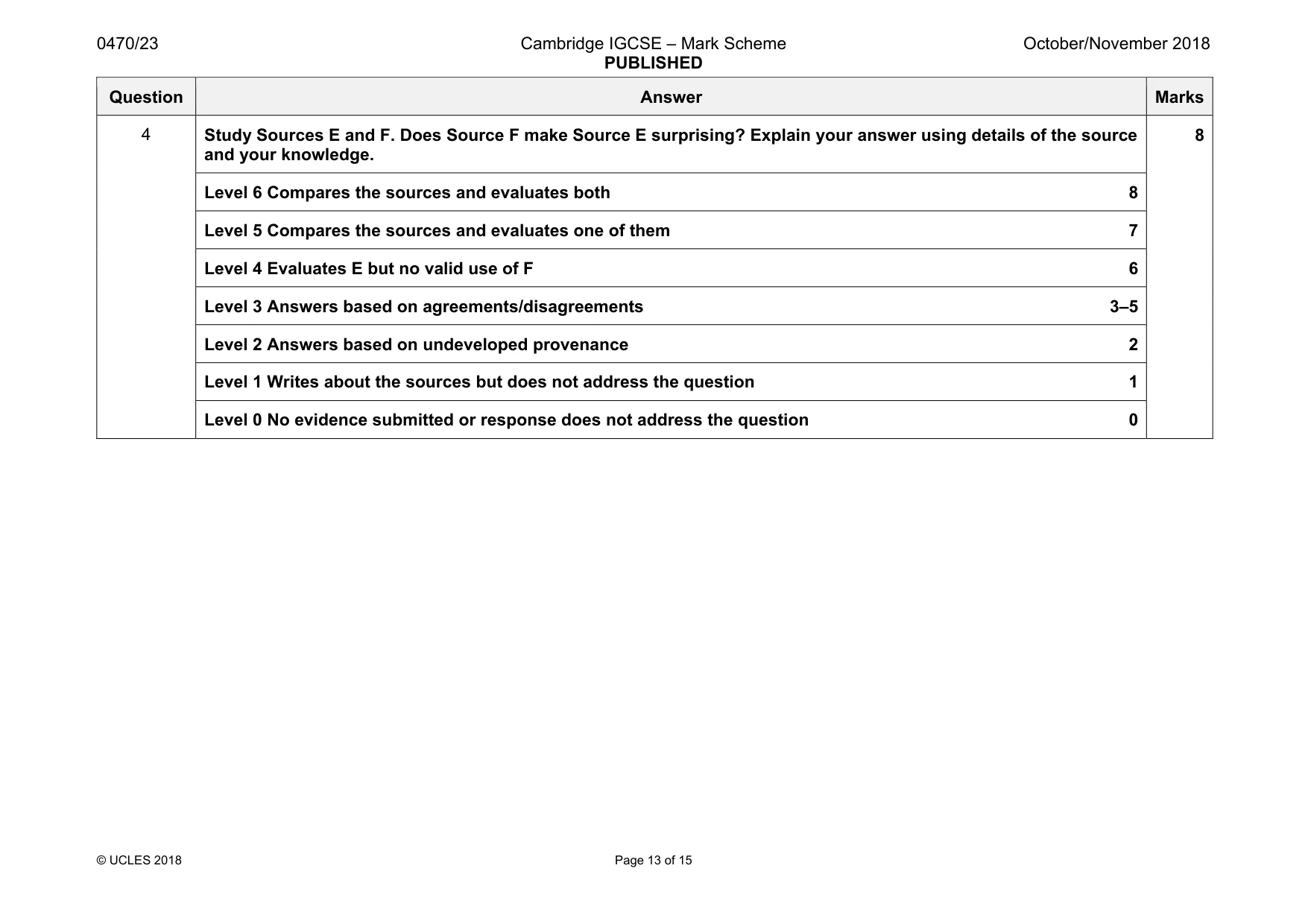
12 0470/23/O/N/18 © UCLES 2018 SOURCE E My stay in Seville was very instructive. I was tracking down German airmen; that is to say, the secret entry into Spain of planes and pilots, which at that time was in full swing, but was not so generally known as it is today. It was the time when European diplomacy was just celebrating its honeymoon with the Non-Intervention Pact. Hitler was denying having sent aircraft to Spain and Franco was denying having received them, while there before my very eyes fat, blond German pilots were consuming vast quantities of Spanish fish and, monocles clamped to their eyes, reading the ‘Völkischer Beobachter’. Their uniforms were the white overalls worn by Spanish airmen. There were four of these gentlemen in the Hotel Cristina at about lunchtime in August 1936. The Cristina is the hotel which I had been told was full of German officers and that it was not advisable to go there because every foreigner would be seen as a spy. From a book published in 1937 by a member of the German Communist Party. He was visiting Seville, where Franco’s headquarters were based. He was pretending to be a journalist and Franco supporter. The ‘Völkischer Beobachter’ was the official newspaper of the Nazi Party. SOURCE F In January 1938 we stood at Hamburg docks ready for embarkation. Our smart uniforms had given way to ill-fitting civilian clothes. Our destination was Spain, and our disguise was as a football club. We were about 150 trained soldiers to take part in ‘Assignation Rugen’. This was a code name for the task force in Spain. Motor launches manned by sailors dressed up as civilian boatmen took us out to our ship. A couple of miles downstream a small ship was waiting for us, tucked away in a far-off berth. It must be emphasised that, contrary to the general belief, we were not forced into this enterprise. But our participation was nothing to do with political ideology. The very name of Spain conveyed glamour and adventure and we saw ourselves as colourful romantic mercenaries. When we got to Spain, we disembarked at Vigo in the dark and the window blinds on our train were kept down. When we arrived at Burgos, we changed into uniforms with Spanish badges. From a book published in 1939 by a member of the German Condor Legion.
Question paper, page 13
13 0470/23/O/N/18 © UCLES 2018 [Turn over SOURCE G A British cartoon published in February 1939. The figures on the left represent the British and French governments. The figures on the right are Mussolini, Franco and Hitler. ‘The Question of Recognition’ refers to the issue of whether Franco’s government should be officially recognised.
Question paper, page 14
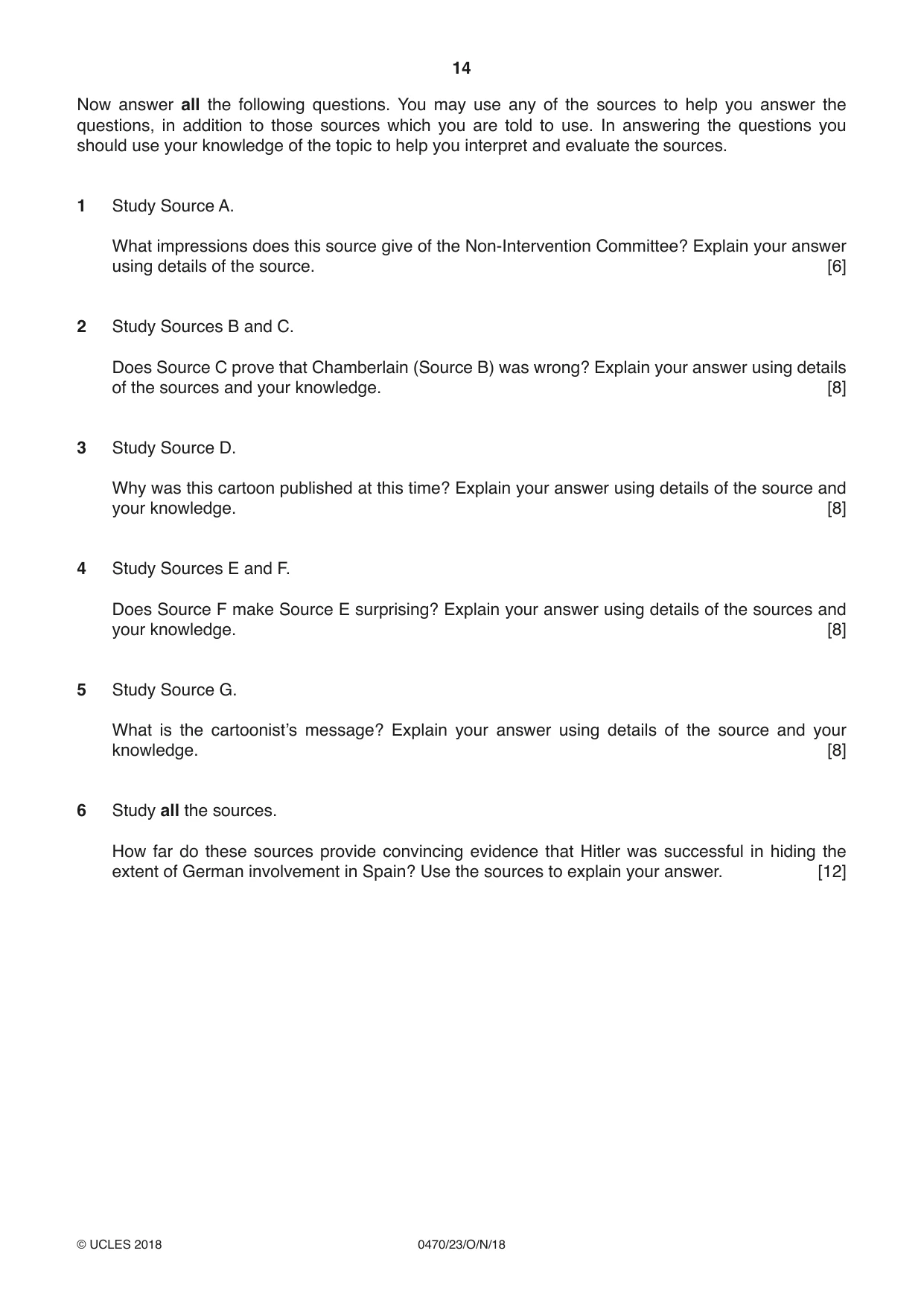
14 0470/23/O/N/18 © UCLES 2018 Now answer all the following questions. You may use any of the sources to help you answer the questions, in addition to those sources which you are told to use. In answering the questions you should use your knowledge of the topic to help you interpret and evaluate the sources. 1 Study Source A. What impressions does this source give of the Non-Intervention Committee? Explain your answer using details of the source. [6] 2 Study Sources B and C. Does Source C prove that Chamberlain (Source B) was wrong? Explain your answer using details of the sources and your knowledge. [8] 3 Study Source D. Why was this cartoon published at this time? Explain your answer using details of the source and your knowledge. [8] 4 Study Sources E and F. Does Source F make Source E surprising? Explain your answer using details of the sources and your knowledge. [8] 5 Study Source G. What is the cartoonist’s message? Explain your answer using details of the source and your knowledge. [8] 6 Study all the sources. How far do these sources provide convincing evidence that Hitler was successful in hiding the extent of German involvement in Spain? Use the sources to explain your answer. [12]
Question paper, page 15
15 0470/23/O/N/18 © UCLES 2018 BLANK PAGE
Question paper, page 16
16 0470/23/O/N/18 © UCLES 2018 Permission to reproduce items where third-party owned material protected by copyright is included has been sought and cleared where possible. Every reasonable effort has been made by the publisher (UCLES) to trace copyright holders, but if any items requiring clearance have unwittingly been included, the publisher will be pleased to make amends at the earliest possible opportunity. To avoid the issue of disclosure of answer-related information to candidates, all copyright acknowledgements are reproduced online in the Cambridge International Examinations Copyright Acknowledgements Booklet. This is produced for each series of examinations and is freely available to download at www.cie.org.uk after the live examination series. Cambridge International Examinations is part of the Cambridge Assessment Group. Cambridge Assessment is the brand name of University of Cambridge Local Examinations Syndicate (UCLES), which is itself a department of the University of Cambridge. BLANK PAGE
Mark scheme, page 1
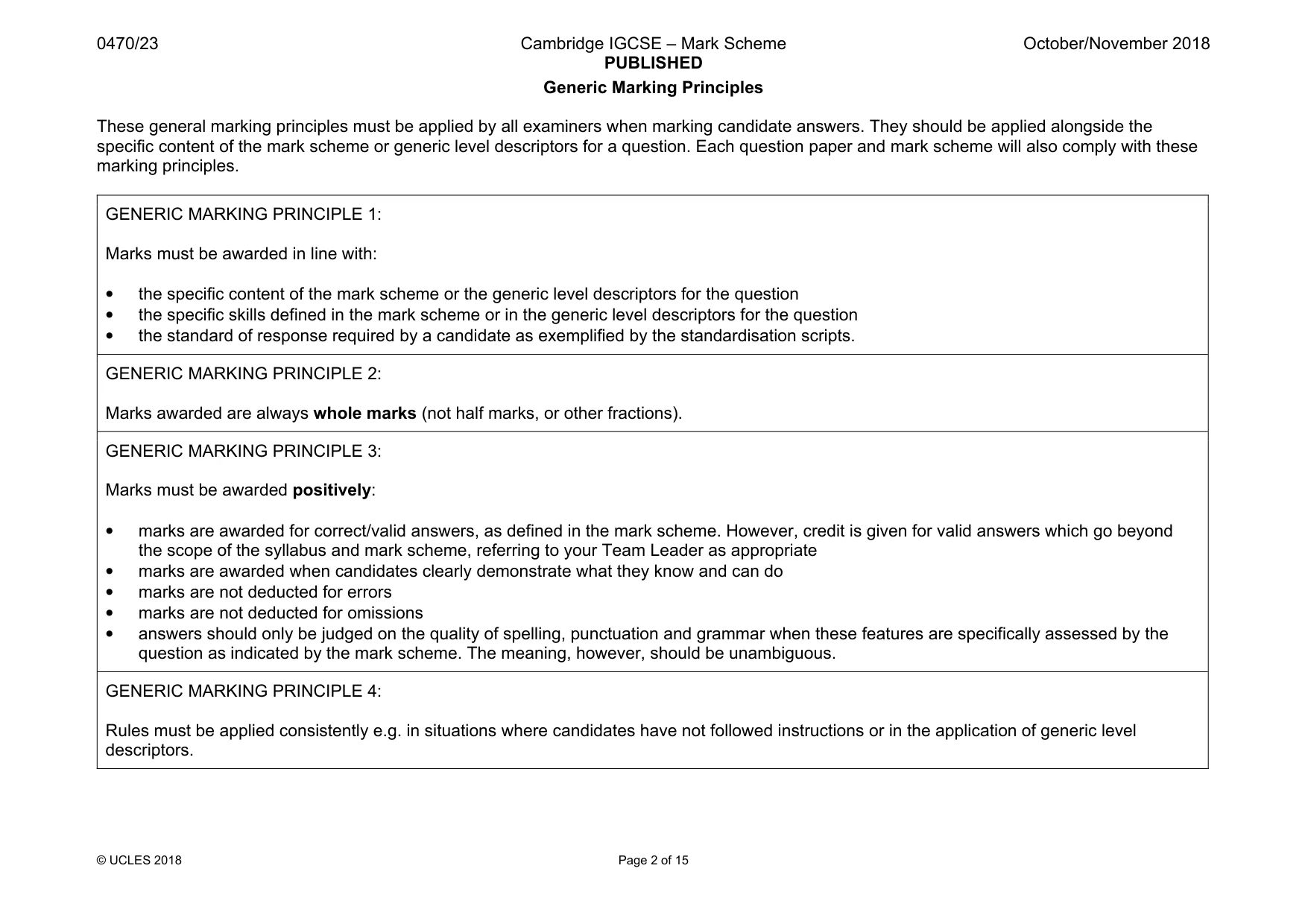
This syllabus is approved for use in England, Wales and Northern Ireland as a Cambridge International Level 1/Level 2 Certificate. This document consists of 15 printed pages. © UCLES 2018 [Turn over Cambridge Assessment International Education Cambridge International General Certificate of Secondary Education HISTORY 0470/23 Paper 2 October/November 2018 MARK SCHEME Maximum Mark: 50 Published This mark scheme is published as an aid to teachers and candidates, to indicate the requirements of the examination. It shows the basis on which Examiners were instructed to award marks. It does not indicate the details of the discussions that took place at an Examiners’ meeting before marking began, which would have considered the acceptability of alternative answers. Mark schemes should be read in conjunction with the question paper and the Principal Examiner Report for Teachers. Cambridge International will not enter into discussions about these mark schemes. Cambridge International is publishing the mark schemes for the October/November 2018 series for most Cambridge IGCSE™, Cambridge International A and AS Level components and some Cambridge O Level components.
Mark scheme, page 2
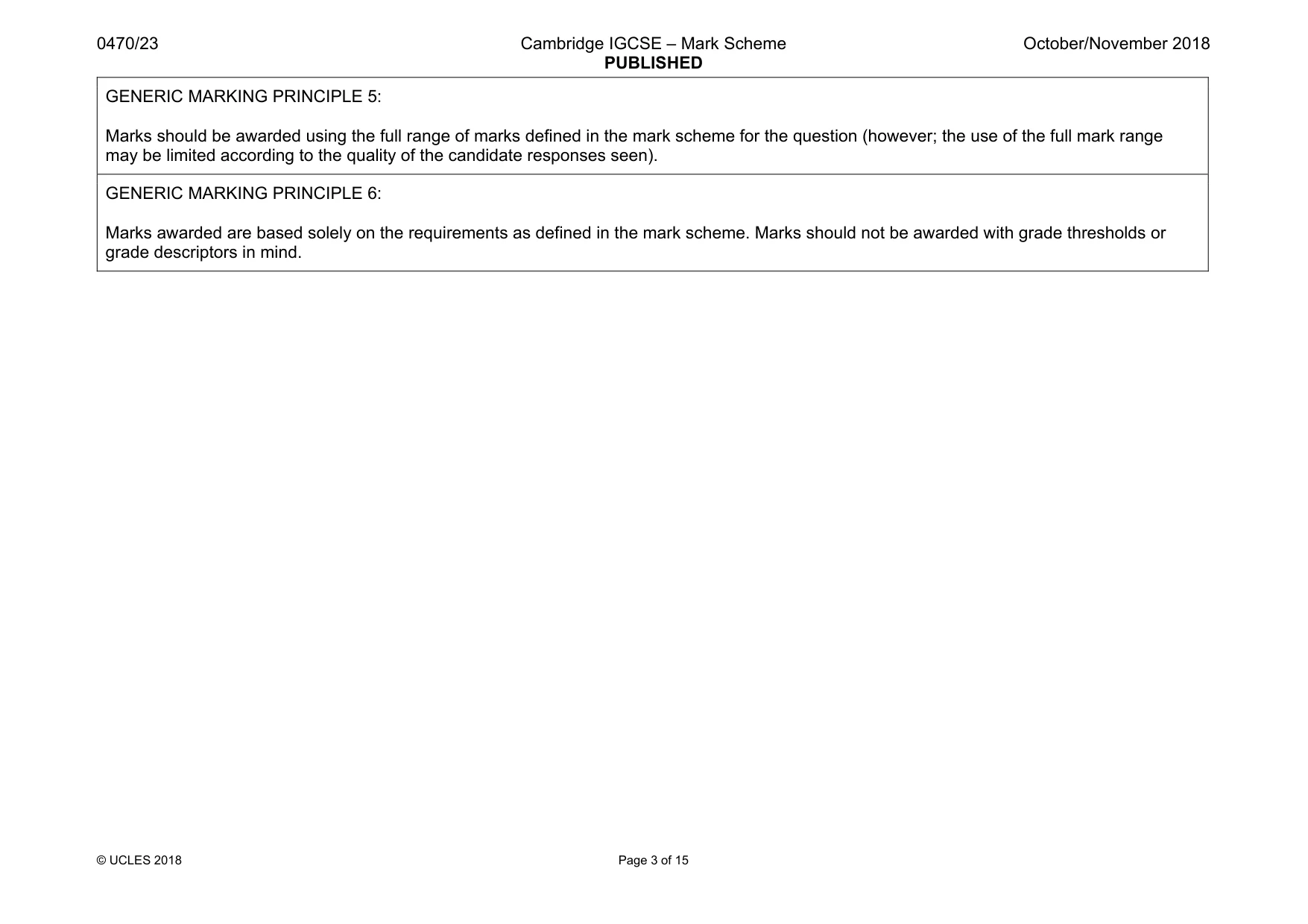
0470/23 Cambridge IGCSE – Mark Scheme PUBLISHED October/November 2018 © UCLES 2018 Page 2 of 15 Generic Marking Principles These general marking principles must be applied by all examiners when marking candidate answers. They should be applied alongside the specific content of the mark scheme or generic level descriptors for a question. Each question paper and mark scheme will also comply with these marking principles. GENERIC MARKING PRINCIPLE 1: Marks must be awarded in line with: • the specific content of the mark scheme or the generic level descriptors for the question • the specific skills defined in the mark scheme or in the generic level descriptors for the question • the standard of response required by a candidate as exemplified by the standardisation scripts. GENERIC MARKING PRINCIPLE 2: Marks awarded are always whole marks (not half marks, or other fractions). GENERIC MARKING PRINCIPLE 3: Marks must be awarded positively: • marks are awarded for correct/valid answers, as defined in the mark scheme. However, credit is given for valid answers which go beyond the scope of the syllabus and mark scheme, referring to your Team Leader as appropriate • marks are awarded when candidates clearly demonstrate what they know and can do • marks are not deducted for errors • marks are not deducted for omissions • answers should only be judged on the quality of spelling, punctuation and grammar when these features are specifically assessed by the question as indicated by the mark scheme. The meaning, however, should be unambiguous. GENERIC MARKING PRINCIPLE 4: Rules must be applied consistently e.g. in situations where candidates have not followed instructions or in the application of generic level descriptors.
Mark scheme, page 3
0470/23 Cambridge IGCSE – Mark Scheme PUBLISHED October/November 2018 © UCLES 2018 Page 3 of 15 GENERIC MARKING PRINCIPLE 5: Marks should be awarded using the full range of marks defined in the mark scheme for the question (however; the use of the full mark range may be limited according to the quality of the candidate responses seen). GENERIC MARKING PRINCIPLE 6: Marks awarded are based solely on the requirements as defined in the mark scheme. Marks should not be awarded with grade thresholds or grade descriptors in mind.
Mark scheme, page 4
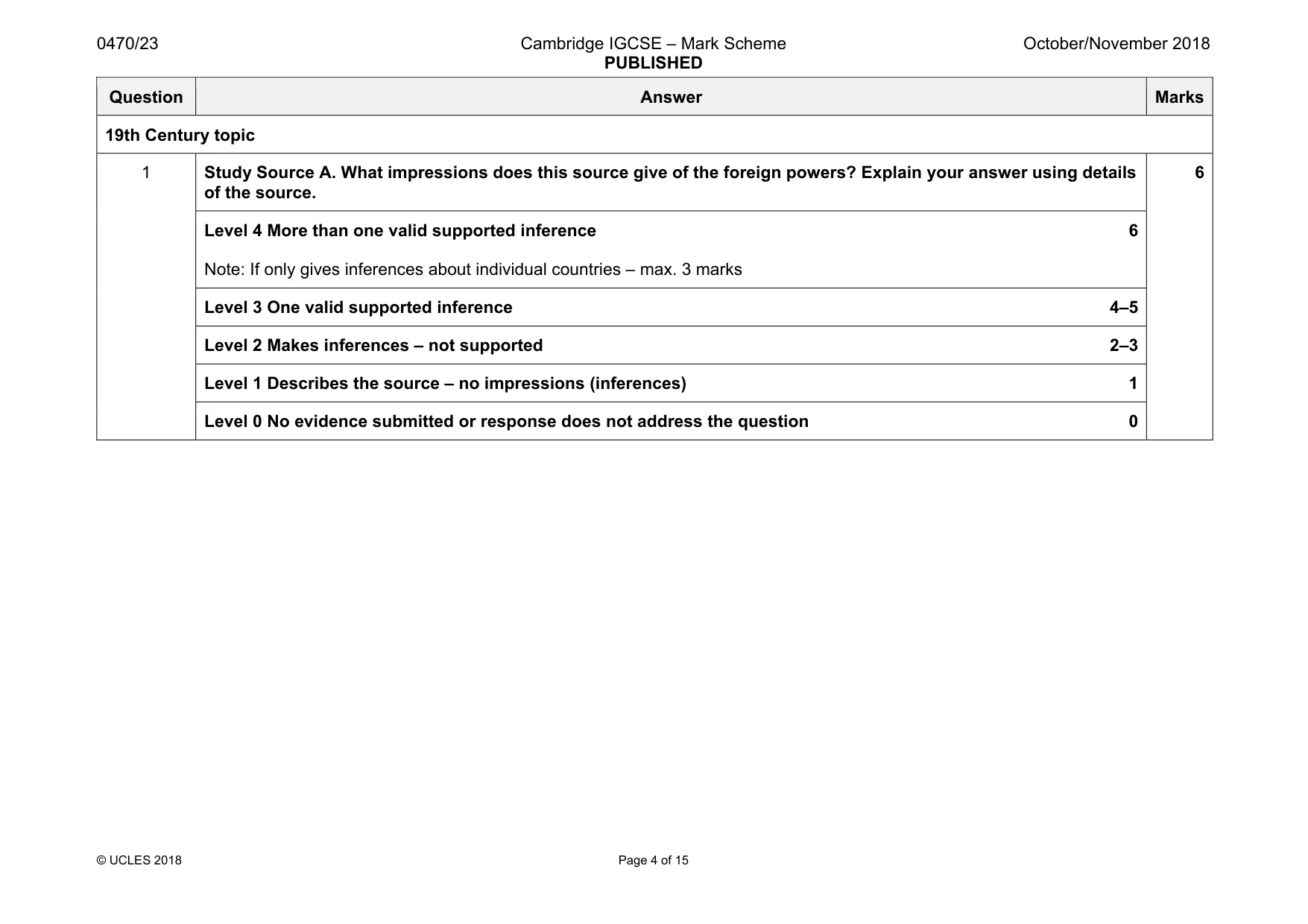
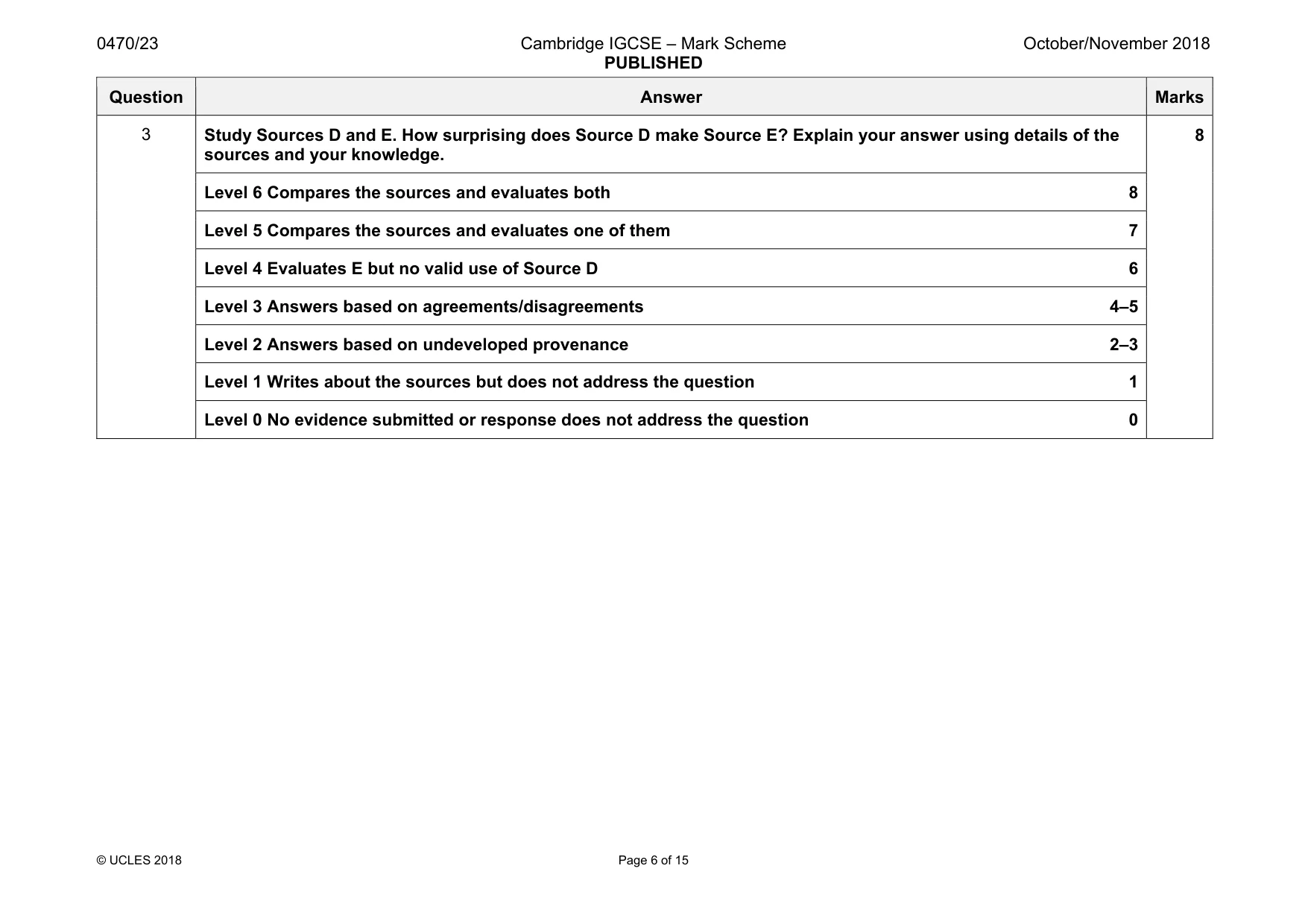
0470/23 Cambridge IGCSE – Mark Scheme PUBLISHED October/November 2018 © UCLES 2018 Page 4 of 15 Question Answer Marks 19th Century topic 1 Study Source A. What impressions does this source give of the foreign powers? Explain your answer using details of the source. 6 Level 4 More than one valid supported inference 6 Note: If only gives inferences about individual countries – max. 3 marks Level 3 One valid supported inference 4–5 Level 2 Makes inferences – not supported 2–3 Level 1 Describes the source – no impressions (inferences) 1 Level 0 No evidence submitted or response does not address the question 0
Mark scheme, page 5
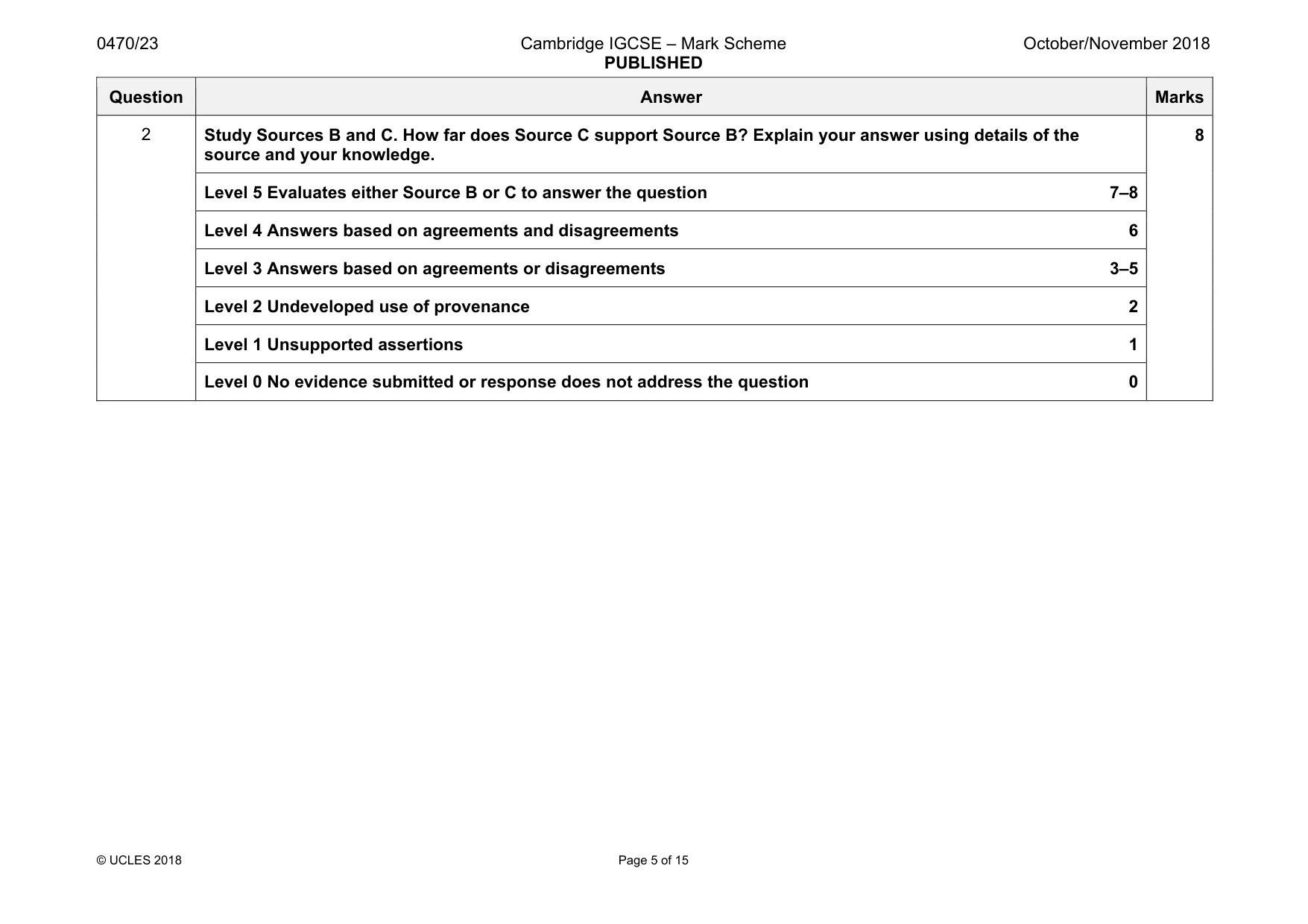
0470/23 Cambridge IGCSE – Mark Scheme PUBLISHED October/November 2018 © UCLES 2018 Page 5 of 15 Question Answer Marks 2 Study Sources B and C. How far does Source C support Source B? Explain your answer using details of the source and your knowledge. 8 Level 5 Evaluates either Source B or C to answer the question 7–8 Level 4 Answers based on agreements and disagreements 6 Level 3 Answers based on agreements or disagreements 3–5 Level 2 Undeveloped use of provenance 2 Level 1 Unsupported assertions 1 Level 0 No evidence submitted or response does not address the question 0
Mark scheme, page 6
0470/23 Cambridge IGCSE – Mark Scheme PUBLISHED October/November 2018 © UCLES 2018 Page 6 of 15 Question Answer Marks 3 Study Sources D and E. How surprising does Source D make Source E? Explain your answer using details of the sources and your knowledge. 8 Level 6 Compares the sources and evaluates both 8 Level 5 Compares the sources and evaluates one of them 7 Level 4 Evaluates E but no valid use of Source D 6 Level 3 Answers based on agreements/disagreements 4–5 Level 2 Answers based on undeveloped provenance 2–3 Level 1 Writes about the sources but does not address the question 1 Level 0 No evidence submitted or response does not address the question 0
Mark scheme, page 7
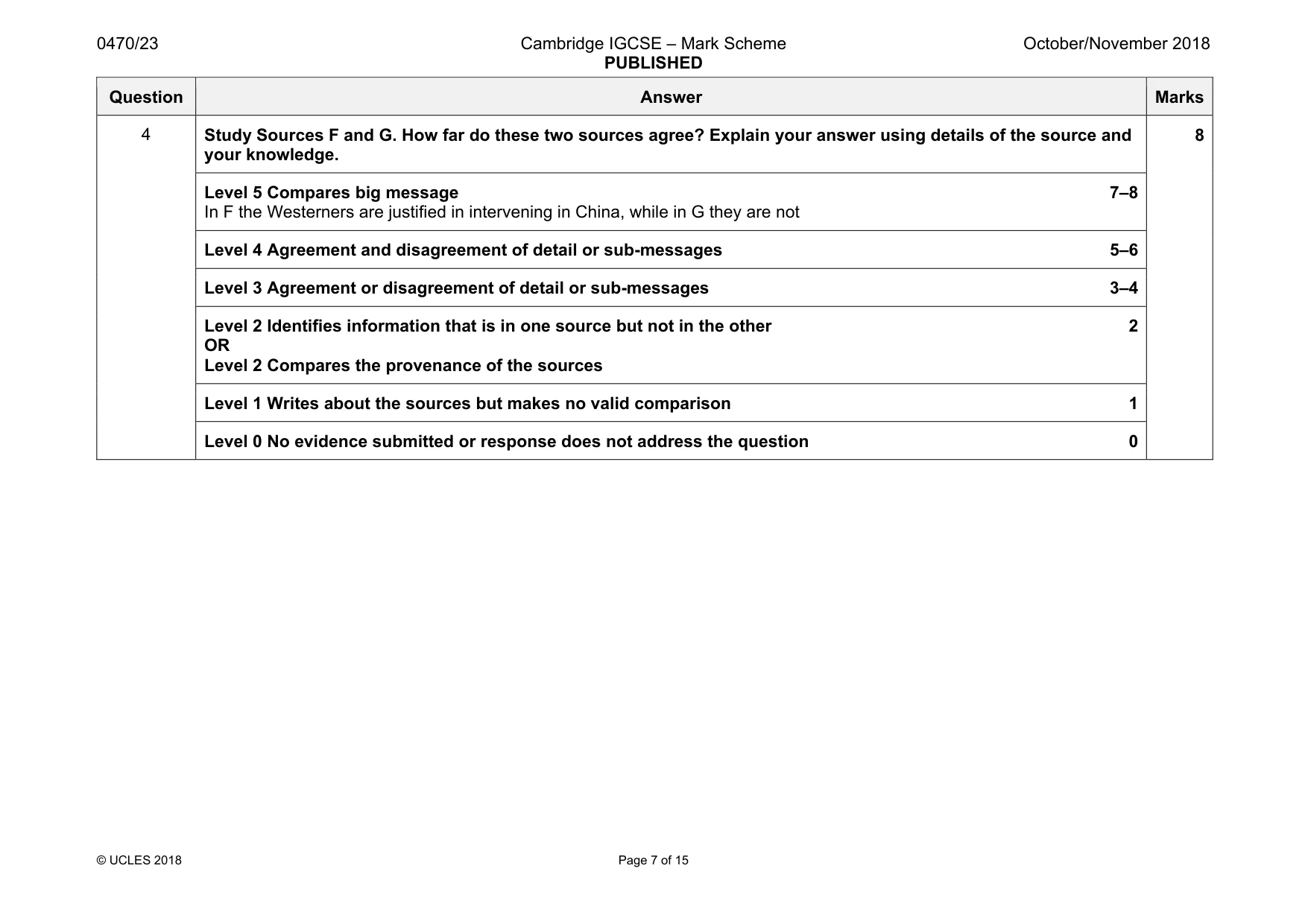
0470/23 Cambridge IGCSE – Mark Scheme PUBLISHED October/November 2018 © UCLES 2018 Page 7 of 15 Question Answer Marks 4 Study Sources F and G. How far do these two sources agree? Explain your answer using details of the source and your knowledge. 8 Level 5 Compares big message 7–8 In F the Westerners are justified in intervening in China, while in G they are not Level 4 Agreement and disagreement of detail or sub-messages 5–6 Level 3 Agreement or disagreement of detail or sub-messages 3–4 Level 2 Identifies information that is in one source but not in the other 2 OR Level 2 Compares the provenance of the sources Level 1 Writes about the sources but makes no valid comparison 1 Level 0 No evidence submitted or response does not address the question 0
Mark scheme, page 8
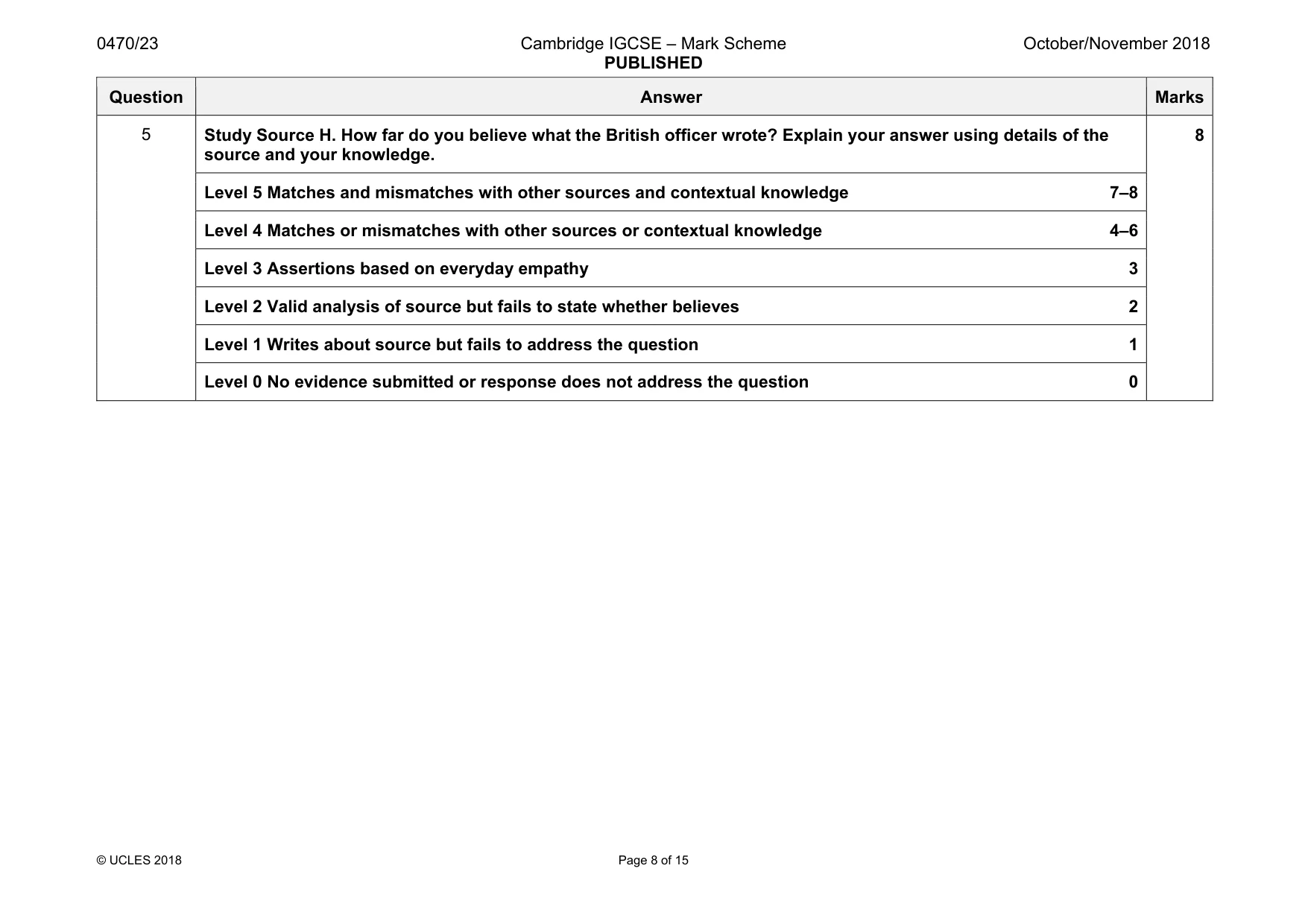
0470/23 Cambridge IGCSE – Mark Scheme PUBLISHED October/November 2018 © UCLES 2018 Page 8 of 15 Question Answer Marks 5 Study Source H. How far do you believe what the British officer wrote? Explain your answer using details of the source and your knowledge. 8 Level 5 Matches and mismatches with other sources and contextual knowledge 7–8 Level 4 Matches or mismatches with other sources or contextual knowledge 4–6 Level 3 Assertions based on everyday empathy 3 Level 2 Valid analysis of source but fails to state whether believes 2 Level 1 Writes about source but fails to address the question 1 Level 0 No evidence submitted or response does not address the question 0
Mark scheme, page 9
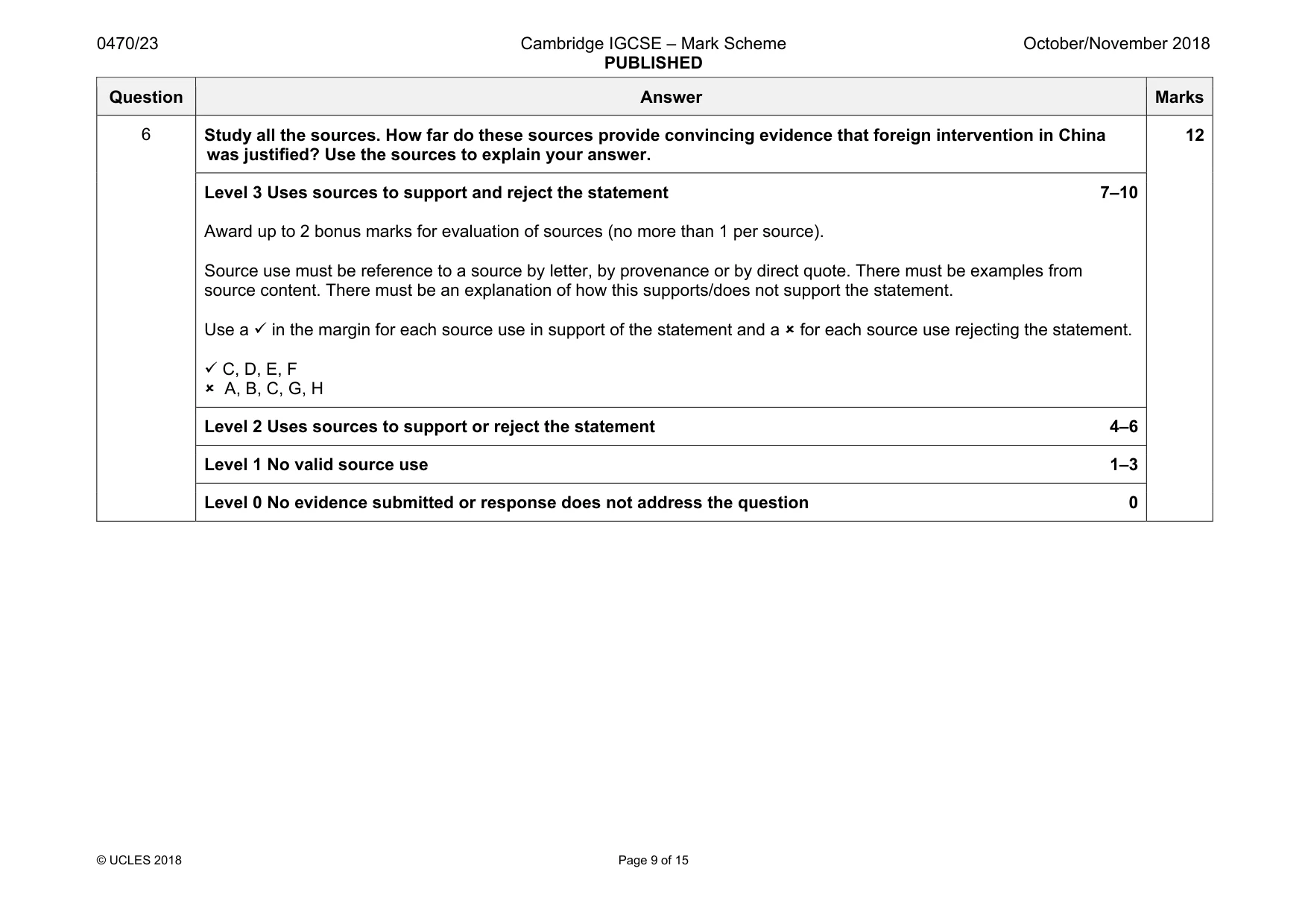
0470/23 Cambridge IGCSE – Mark Scheme PUBLISHED October/November 2018 © UCLES 2018 Page 9 of 15 Question Answer Marks 6 Study all the sources. How far do these sources provide convincing evidence that foreign intervention in China was justified? Use the sources to explain your answer. 12 Level 3 Uses sources to support and reject the statement 7–10 Award up to 2 bonus marks for evaluation of sources (no more than 1 per source). Source use must be reference to a source by letter, by provenance or by direct quote. There must be examples from source content. There must be an explanation of how this supports/does not support the statement. Use a 9 in the margin for each source use in support of the statement and a 8 for each source use rejecting the statement. 9 C, D, E, F 8 A, B, C, G, H Level 2 Uses sources to support or reject the statement 4–6 Level 1 No valid source use 1–3 Level 0 No evidence submitted or response does not address the question 0
Mark scheme, page 10
0470/23 Cambridge IGCSE – Mark Scheme PUBLISHED October/November 2018 © UCLES 2018 Page 10 of 15 Question Answer Marks 20th Century topic 1 Study Source A. What impressions does this source give of the Non-Intervention Committee? Explain your answer using details of the source. 6 Level 5 More than one valid supported inference 6 Level 4 One valid supported inference 5 There must be an explicit move to use evidence as support Level 3 Makes inferences – not supported 3–4 Level 2 Uses surface information about the relationship – no inferences 2 Level 1 Copies or paraphrases the source – not about the Non-Intervention Committee 1 Level 0 No evidence submitted or response does not address the question 0
Mark scheme, page 11
0470/23 Cambridge IGCSE – Mark Scheme PUBLISHED October/November 2018 © UCLES 2018 Page 11 of 15 Question Answer Marks 2 Study Sources B and C. Does Source C prove that Chamberlain (Source B) was wrong? Explain your answer using details of the sources and your knowledge. 8 Level 6 Compares the sources and evaluates both 8 Level 5 Compares the sources and evaluates one of them 6–7 e.g. In B Chamberlain was justifying the work of the Non-Intervention Committee Level 4 Evaluates B but no valid use of C 5 Level 3 Answers based on agreements/disagreements 3–4 e.g. B claims non-intervention has been a success, C does not Level 2 Answers based on undeveloped provenance 2 Level 1 Writes about the sources but does not address the question 1 Level 0 No evidence submitted or response does not address the question 0
Mark scheme, page 12
0470/23 Cambridge IGCSE – Mark Scheme PUBLISHED October/November 2018 © UCLES 2018 Page 12 of 15 Question Answer Marks 3 Study Source D. Why was this cartoon published at this time? Explain your answer using details of the sources and your knowledge. 8 Level 7 Explains purpose in context of 1938 8 Level 6 Explains the purpose of the cartoon (must have intended impact on audience) 7 Level 5 Explains the big message 6 Criticising Britain for not doing anything about intervention Level 4 Explains a valid sub-message 4–5 Britain wilfully ignoring intervention – award 5 marks for this Italy was intervening in the war Britain was not intervening Level 3 Explains context only – fails to explain message or purpose of source 3 Level 2 Misreadings of the source 2 Britain was ignorant of intervention OR Level 2 Interprets cartoon or describes the context – but not used as a reason for publication Level 1 Surface descriptions of the source 1 Level 0 No evidence submitted or response does not address the question 0
Mark scheme, page 13
0470/23 Cambridge IGCSE – Mark Scheme PUBLISHED October/November 2018 © UCLES 2018 Page 13 of 15 Question Answer Marks 4 Study Sources E and F. Does Source F make Source E surprising? Explain your answer using details of the source and your knowledge. 8 Level 6 Compares the sources and evaluates both 8 Level 5 Compares the sources and evaluates one of them 7 Level 4 Evaluates E but no valid use of F 6 Level 3 Answers based on agreements/disagreements 3–5 Level 2 Answers based on undeveloped provenance 2 Level 1 Writes about the sources but does not address the question 1 Level 0 No evidence submitted or response does not address the question 0
Mark scheme, page 14
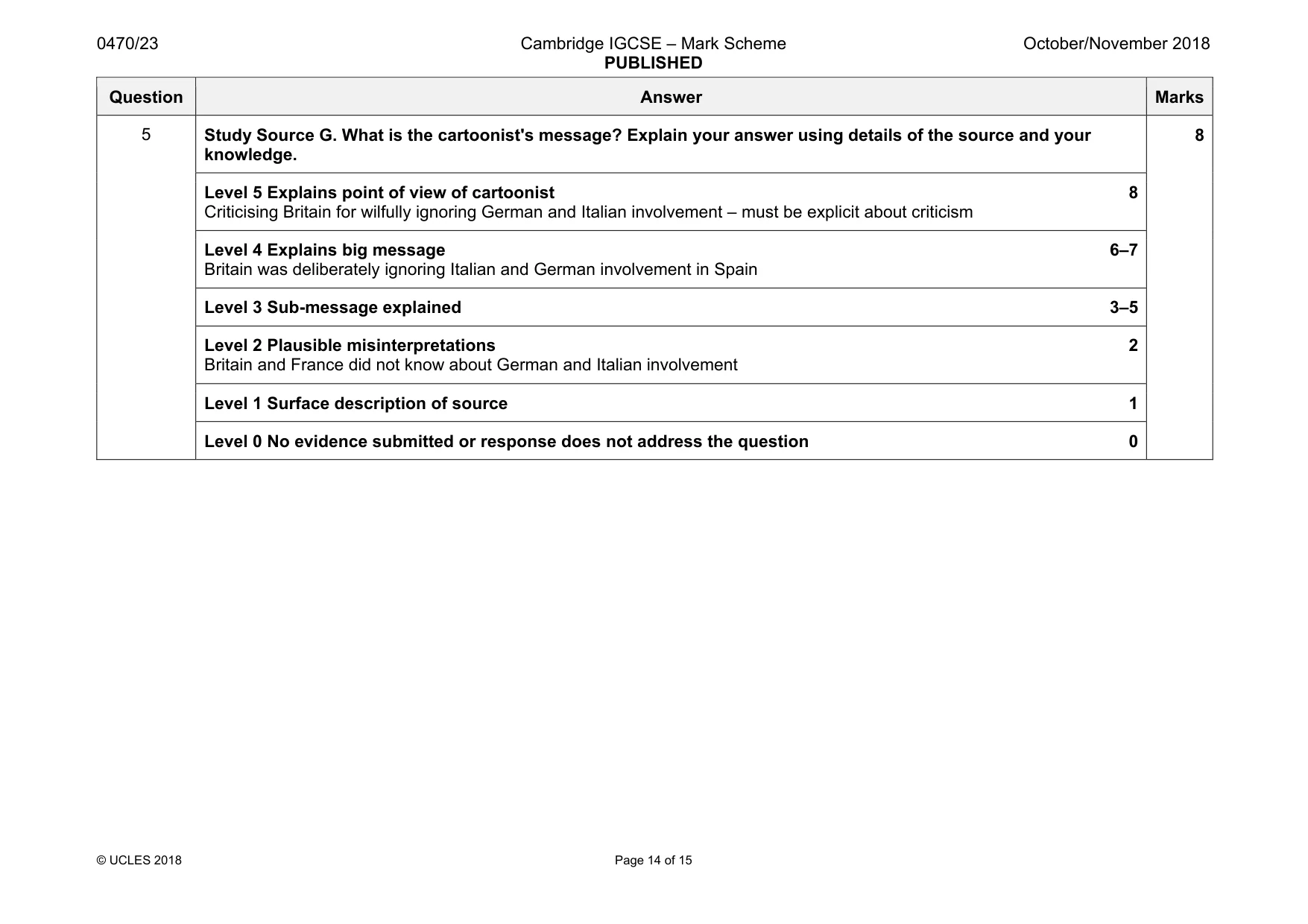
0470/23 Cambridge IGCSE – Mark Scheme PUBLISHED October/November 2018 © UCLES 2018 Page 14 of 15 Question Answer Marks 5 Study Source G. What is the cartoonist's message? Explain your answer using details of the source and your knowledge. 8 Level 5 Explains point of view of cartoonist 8 Criticising Britain for wilfully ignoring German and Italian involvement – must be explicit about criticism Level 4 Explains big message 6–7 Britain was deliberately ignoring Italian and German involvement in Spain Level 3 Sub-message explained 3–5 Level 2 Plausible misinterpretations 2 Britain and France did not know about German and Italian involvement Level 1 Surface description of source 1 Level 0 No evidence submitted or response does not address the question 0
Mark scheme, page 15
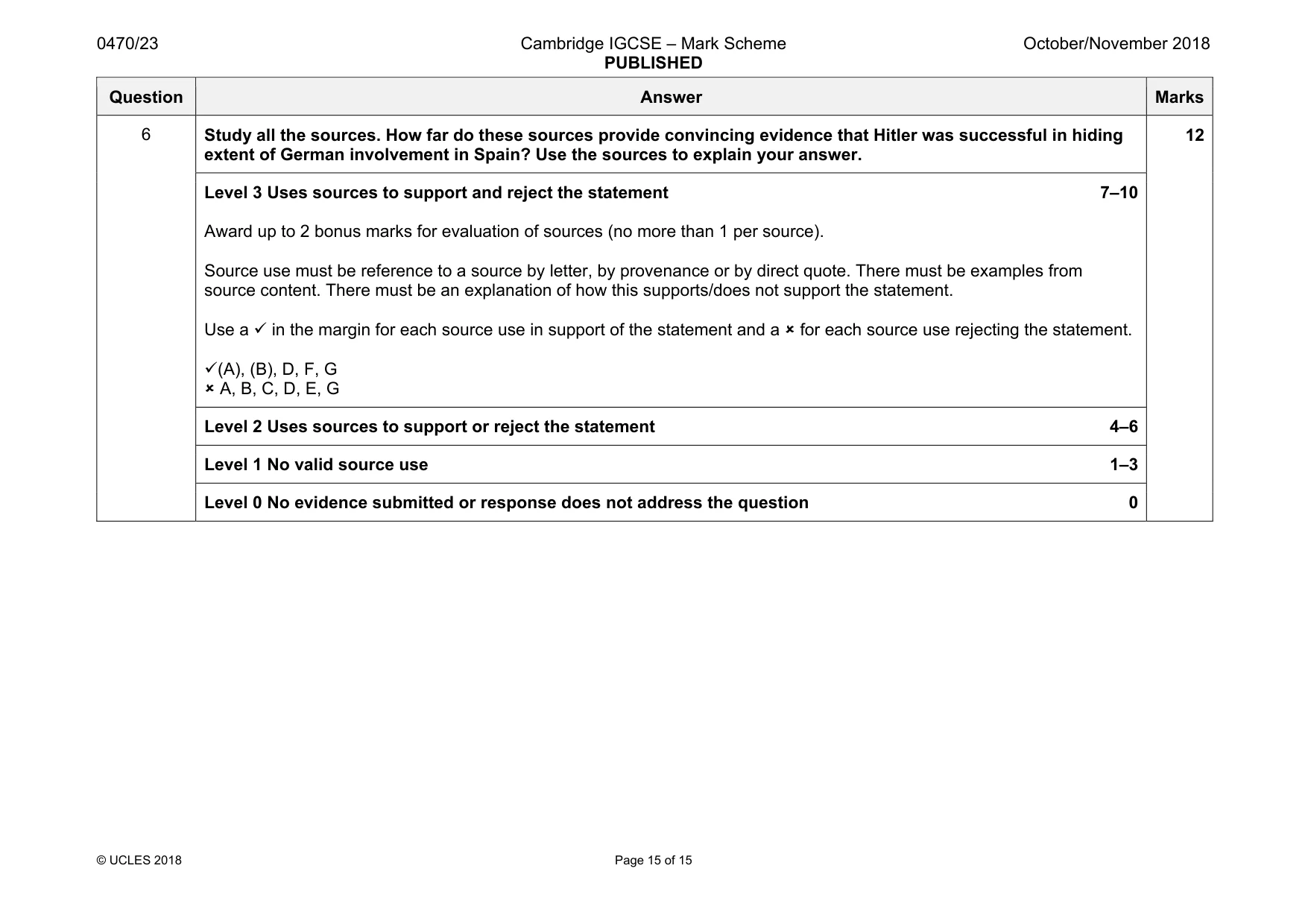
0470/23 Cambridge IGCSE – Mark Scheme PUBLISHED October/November 2018 © UCLES 2018 Page 15 of 15 Question Answer Marks 6 Study all the sources. How far do these sources provide convincing evidence that Hitler was successful in hiding extent of German involvement in Spain? Use the sources to explain your answer. 12 Level 3 Uses sources to support and reject the statement 7–10 Award up to 2 bonus marks for evaluation of sources (no more than 1 per source). Source use must be reference to a source by letter, by provenance or by direct quote. There must be examples from source content. There must be an explanation of how this supports/does not support the statement. Use a 9 in the margin for each source use in support of the statement and a 8 for each source use rejecting the statement. 9(A), (B), D, F, G 8 A, B, C, D, E, G Level 2 Uses sources to support or reject the statement 4–6 Level 1 No valid source use 1–3 Level 0 No evidence submitted or response does not address the question 0
What you needed in this session
Cambridge’s own grade thresholds for 2018 Oct/Nov, Paper 2 · Variant 3. A higher threshold means an easier paper — the bar moves with how the cohort did.