Cambridge IGCSE History 0470 — 2018 Oct/Nov Paper 2 · Variant 2
0470/22/O/N/18 · 50 marks · ≈56 min
The question paper and its mark scheme, free to read here and free to download. This is Cambridge’s own paper, exactly as it was sat.
Question paper12 pages

Mark scheme15 pages
Answers below. Sit the paper first if you are practising.
Paper as text
Question paper, page 1
* 9 4 7 0 3 4 8 1 4 2 * This document consists of 11 printed pages, 1 blank page and 1 Insert. DC (ST/FC) 147943/4 © UCLES 2018 [Turn over Cambridge International Examinations Cambridge International General Certificate of Secondary Education HISTORY 0470/22 Paper 2 October/November 2018 2 hours No Additional Materials are required. READ THESE INSTRUCTIONS FIRST An answer booklet is provided inside this question paper. You should follow the instructions on the front cover of the answer booklet. If you need additional answer paper ask the invigilator for a continuation booklet. This paper has two options. Choose one option, and answer all of the questions on that topic. Option A: 19th Century topic [p2–p6] Option B: 20th Century topic [p8–p12] The number of marks is given in brackets [ ] at the end of each question or part question. This syllabus is approved for use in England, Wales and Northern Ireland as a Cambridge International Level 1/Level 2 Certificate.
Question paper, page 2
2 0470/22/O/N/18 © UCLES 2018 Option A: 19th Century topic WERE THE BOXERS BARBARIANS OR PATRIOTIC HEROES? Study the Background Information and the sources carefully, and then answer all the questions. Background Information The Boxer Rebellion lasted from 1899 to 1901. The Boxers were reacting to increasing European and American interference in China. They attacked foreigners, missionaries, Chinese converts to Christianity, Christian churches and symbols of western modernisation like railways. At first the Boxers also criticised the royal family, but later the Empress threw her support behind them. By June 1900 foreigners and Chinese Christians were under siege in the Diplomatic Quarter of Beijing. An international force, including troops from Japan, Britain, Germany, France and the USA, marched on Beijing and rescued them. The international army then defeated the royal army and the Boxers. Were the Boxers barbarians trying to hold back progress or heroic nationalists standing up for the independence of their country? SOURCE A The year 1899 saw the outbreak of the anti-imperialist patriotic movement of the Boxers. It was caused by intensified foreign aggression and was part of a successful struggle against the imperialist partition of China. It was also the culmination of decades of popular upheavals against the aggressive behaviour of missionaries and churches. The movement began in Shandong, where the Boxers destroyed churches and drove away missionaries. Its struggle against aggression won the support of the whole country and people joined up with great enthusiasm. Anti-imperialistic upheavals swept the country. In June 1900, in Beijing, the foreign officials and troops in the Diplomatic Quarter provoked the Boxers and shot Chinese inhabitants on sight. This roused the anger of the Chinese civilians. They laid siege and broke through the enemy lines, killing and wounding enormous numbers of enemy troops. They set fire to churches in Beijing, attacked the foreign aggressors and held continuous demonstrations in the streets. The momentous Boxers failed because of the force of the imperialist powers and their servant, the royal court. Nevertheless, their struggle frustrated the foreign powers in their attempt to partition China and demonstrated the potential strength of the Chinese people. From a history of China, published in China in 1982.
Question paper, page 3
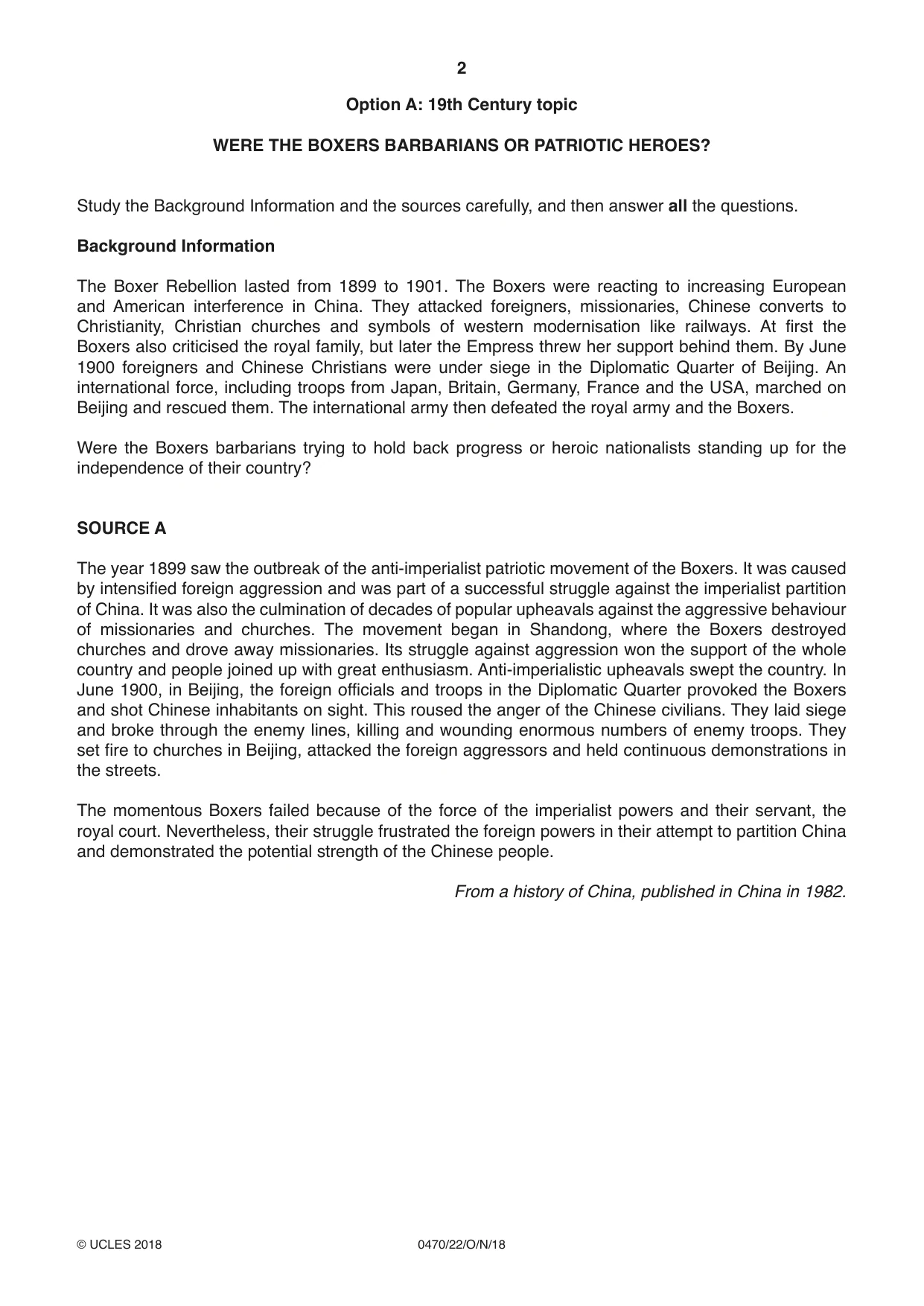
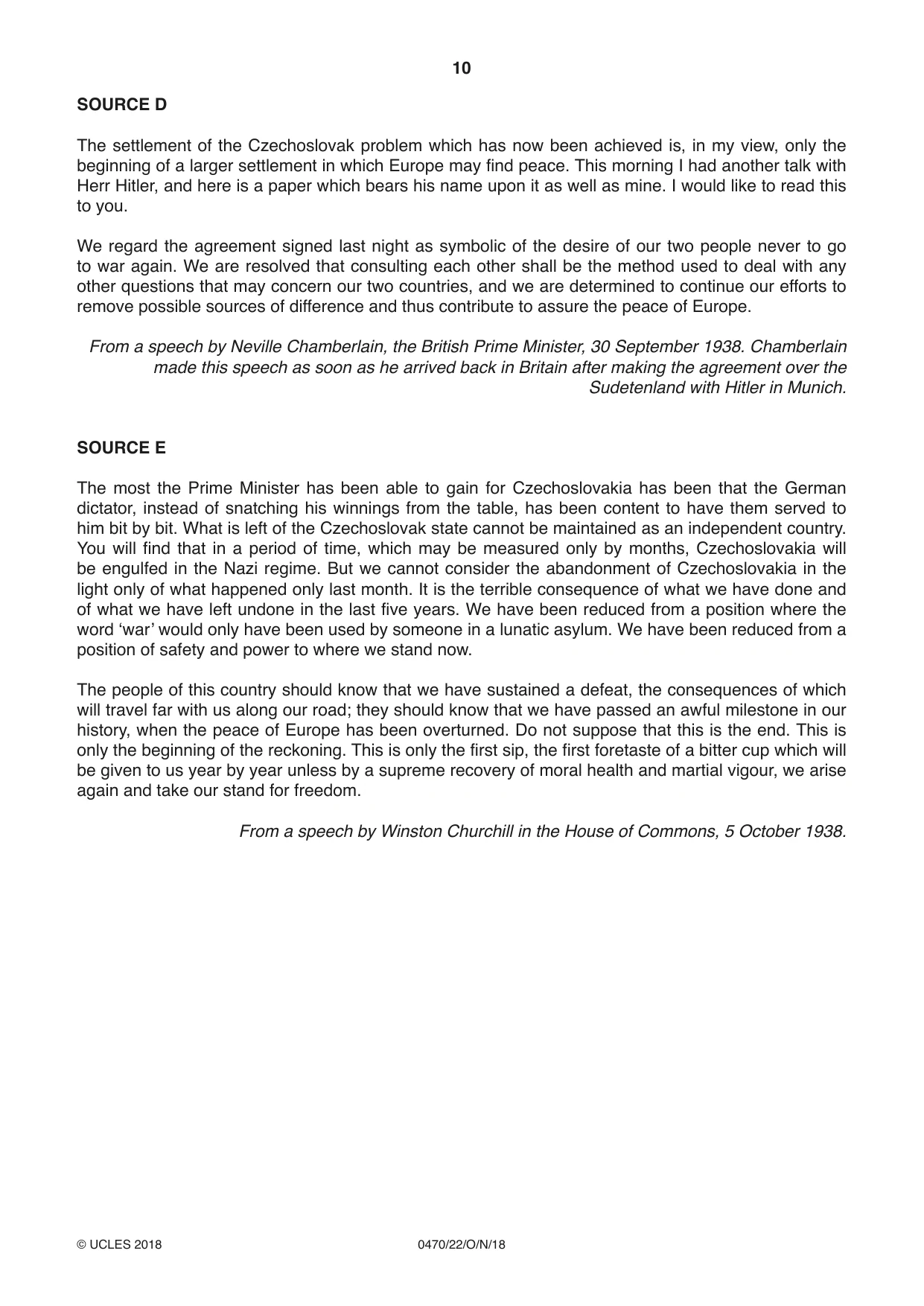
3 0470/22/O/N/18 © UCLES 2018 [Turn over SOURCE B The Boxers were hostile to modern civilisation and they blindly rejected foreigners and their civilisations through extremely ignorant ways. The Boxers cut down telegraph lines, they destroyed schools, they demolished railway tracks, they murdered foreigners and all Chinese who had a connection with foreign culture. The Boxers killed the innocent and committed barbaric crimes in burning and looting. They were bandits and hooligans. In Beijing, during June and July 1900, 231 foreigners were killed of whom 53 were children. As for the Chinese Christians who were killed, there is no known number. The Boxers were the inheritors of the most backward and barbaric elements of traditional culture. At first, the disagreements between the Boxers, and the preachers and converts, drew some sympathy. But what the Boxers did later went well beyond what was justified and the general opinion of the Chinese people was that they were bandits. For many years, the popular view that the Boxers prevented the partitioning of China has been used to defend the Boxers. This has been shown to be wrong. Partitioning did not end: the Russians entered northeastern China; the English invaded Tibet; the Germans sent their gunboats into the Dongting Lake. From an article published in China in 2006. SOURCE C From a French newspaper, August 1900. It shows Boxer rebels in a Christian church.
Question paper, page 4
4 0470/22/O/N/18 © UCLES 2018 SOURCE D The Catholics have conspired with foreigners, have caused China trouble, wasted our national revenue, broken up our monasteries, destroyed Buddhist images and deceived our emperors, officials and ministers. These acts of evil should be bitterly resented. They have affected people’s trees and plants so as to make them suffer from locusts and drought. All the spirits have descended from Heaven to set up an altar in order to teach our young men their magic boxing so they can extinguish the foreigners. When we exert our energy for the nation to bring peace to the land, this is the sign that prosperity is coming. We are afraid that some ignorant people may rely on the foreigners’ power and cling to the strong in order to oppress the weak. They should be reported to the headman of the village. Our people should take the right principles of kindness and politeness to make the countryside peaceful and harmonious. A notice displayed in a village near Beijing in 1900. Notices like this were displayed in many villages. SOURCE E Some of your ministers rightly warned you that the Boxers were not patriotic, that they cannot be relied upon to resist our enemies and that we should not carelessly challenge all foreign countries without reason. When the Boxers began they merely summoned the masses to mob violence. The Boxer bandits drifted into folly. How did they dare insult officials and burn houses, plunder and kill the people? When some officials at the royal court praised them as patriotic, the power of the Boxer bandits increased. When we trace the origin of these rascals, these breeders of mischief, we find reactionary and stupid officials are to blame. From a statement by two ministers in the imperial government just before they were executed in July 1900. They were accused of being pro-foreign traitors. SOURCE F I thought what a happy thing it will be for Russians when they bring home the thirty thousand Russian troops now in Manchuria, to live in peaceful pursuits. I thought this was what Germany should do also without delay, and that France and all the other nations in China should follow suit. Why should not China be free from the foreigners, who are only making trouble on her soil? If they would only all go home, what a pleasant place China would be for the Chinese! We do not allow Chinamen to come here, and I say in all seriousness that it would be a graceful thing to let China decide who shall go there. China never wanted foreigners any more than foreigners wanted Chinamen, and on this question I am with the Boxers every time. The Boxer is a patriot. He loves his country better than he does the countries of other people. I wish him success. The Boxer believes in driving us out of his country. I am a Boxer too, for I believe in driving him out of our country. From a speech in New York by the American author Mark Twain on 23 November 1900.
Question paper, page 5
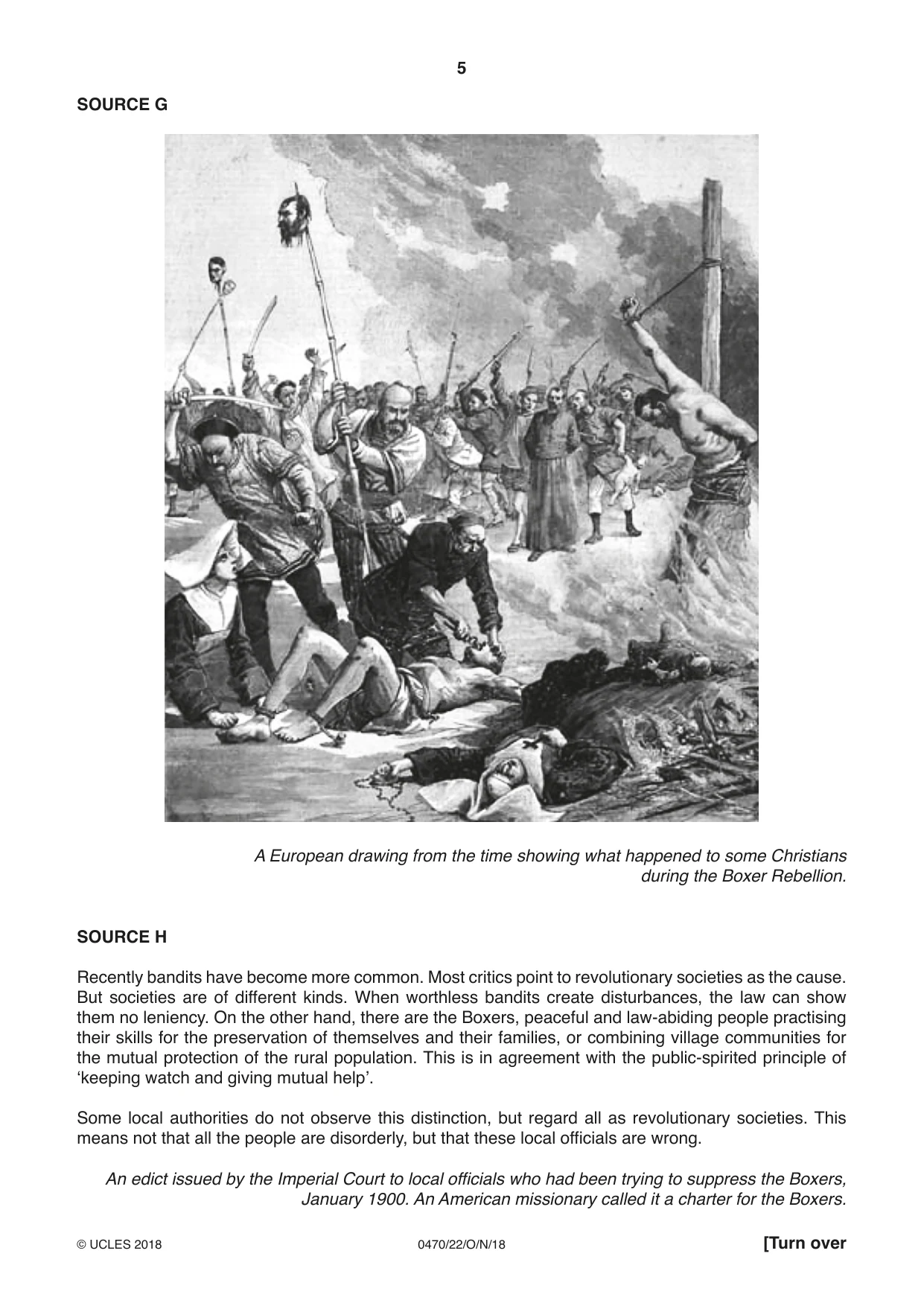
5 0470/22/O/N/18 © UCLES 2018 [Turn over SOURCE G A European drawing from the time showing what happened to some Christians during the Boxer Rebellion. SOURCE H Recently bandits have become more common. Most critics point to revolutionary societies as the cause. But societies are of different kinds. When worthless bandits create disturbances, the law can show them no leniency. On the other hand, there are the Boxers, peaceful and law-abiding people practising their skills for the preservation of themselves and their families, or combining village communities for the mutual protection of the rural population. This is in agreement with the public-spirited principle of ‘keeping watch and giving mutual help’. Some local authorities do not observe this distinction, but regard all as revolutionary societies. This means not that all the people are disorderly, but that these local officials are wrong. An edict issued by the Imperial Court to local officials who had been trying to suppress the Boxers, January 1900. An American missionary called it a charter for the Boxers.
Question paper, page 6
6 0470/22/O/N/18 © UCLES 2018 Now answer all the following questions. You may use any of the sources to help you answer the questions, in addition to those sources which you are told to use. In answering the questions you should use your knowledge of the topic to help you interpret and evaluate the sources. 1 Study Sources A and B. How far do these two sources agree? Explain your answer using details of the sources. [7] 2 Study Source C. Why was this source published in a French newspaper in August 1900? Explain your answer using details of the source and your knowledge. [8] 3 Study Sources D and E. Does Source D prove that Source E cannot be trusted? Explain your answer using details of the sources and your knowledge. [8] 4 Study Source F. Are you surprised by this source? Explain your answer using details of the source and your knowledge. [7] 5 Study Sources G and H. Does Source G show that the Imperial Court (Source H) misunderstood what the Boxers were really like? Explain your answer using details of the sources and your knowledge. [8] 6 Study all the sources. How far do these sources provide convincing evidence that the Boxers were no more than barbarians? Use the sources to explain your answer. [12]
Question paper, page 7
7 0470/22/O/N/18 © UCLES 2018 [Turn over BLANK PAGE
Question paper, page 8
8 0470/22/O/N/18 © UCLES 2018 Option B: 20th Century topic WAS THE SECOND WORLD WAR AVOIDABLE? Study the Background Information and the sources carefully, and then answer all the questions. Background Information Historians disagree about Hitler’s foreign policy – did he have it all planned from the beginning or did he take advantage of opportunities that events offered him? This debate has a bearing on another question – was the Second World War inevitable or could it have been avoided? As Hitler remilitarised the Rhineland, and took Austria and Czechoslovakia, could countries like Britain and France have stopped him by standing up to him more? Would he have changed his policies? Did he plan war or did he hope to get what he wanted without a war? Could the Second World War have been avoided? SOURCE A In November 1937 the Hossbach Conference showed how Hitler’s policy was changing from one centred on diplomatic initiatives to one where military force was to play a much greater part. The Czech crisis brought Europe very close to war. Hitler wrote at this time, ‘It is my unalterable decision to smash Czechoslovakia by military action.’ The effects of the Munich Agreement had profound implications for European diplomacy and the balance of power, since with hindsight it is clear that Hitler was now prepared to pursue a policy of war, although he wanted to fight any conflict on his terms. His ultimate objective was still the creation of Lebensraum at the expense of the USSR, but hopefully this could be achieved by Britain’s appeasement policy developing into a more general acceptance of Germany’s dominant position in central and eastern Europe. In March 1939 Germany had secured the self- dissolution of the Czech state. Some historians have pointed to the various military orders Hitler gave at this time for the establishment of long-range bomber squadrons and the construction of a large navy as evidence that he was willing to take on Britain. This may well have been his long-term intention, but in the short term Hitler most definitely did not want a war with Britain and France. How could he avoid such a conflict while pursuing his claims against Poland? It was the hope of neutralising Britain and France which drove Hitler into the arms of Stalin. After the Nazi-Soviet Non-Aggression Pact was signed, Hitler was confident that western military involvement would not follow a German invasion of Poland. But by 3 September Germany was at war with Britain and France. How did Germany find itself in this position? The cause was Hitler’s desire for continental hegemony and Lebensraum which could only be achieved (as he well knew) by military force. From a history book published in 1992.
Question paper, page 9
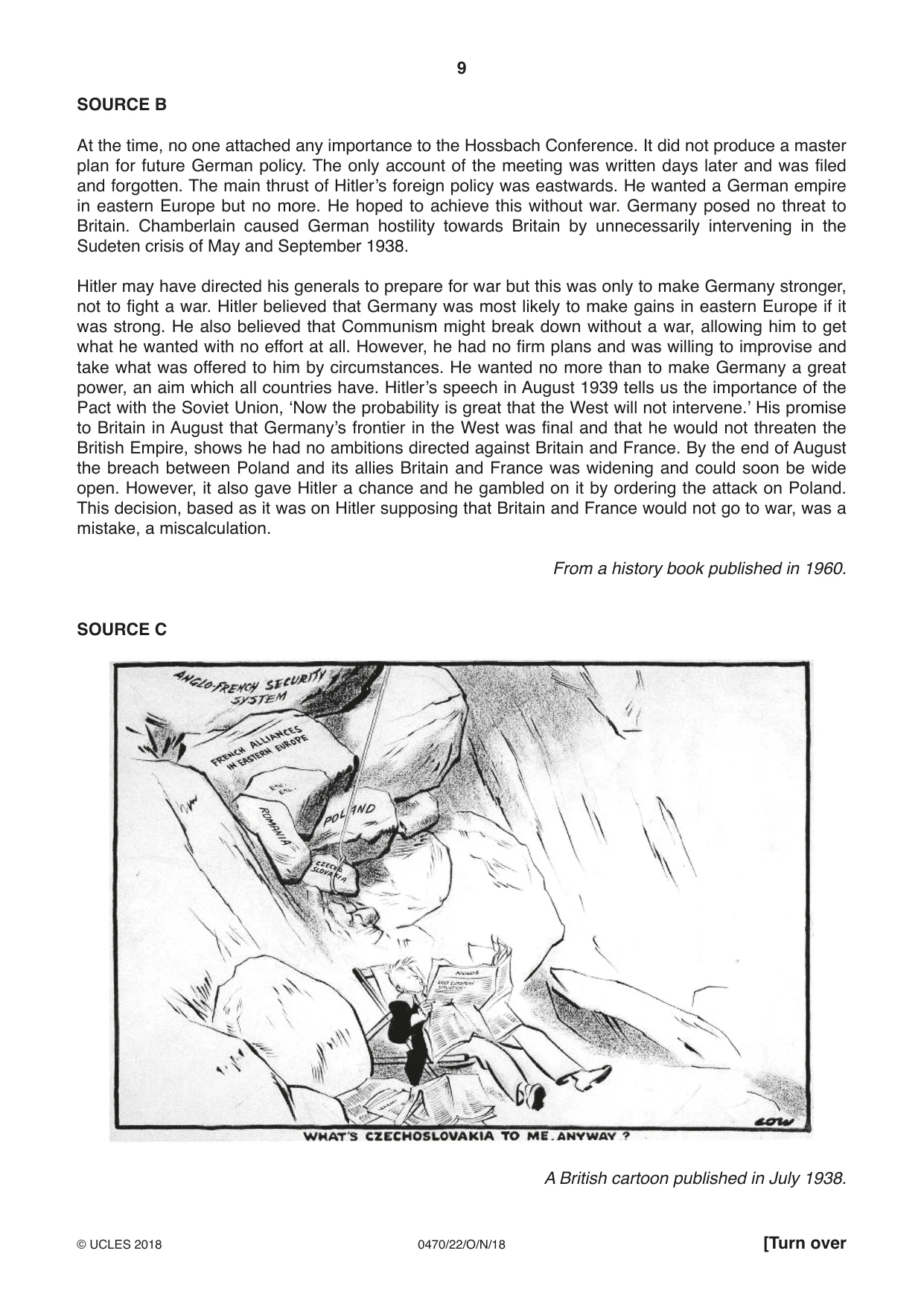
9 0470/22/O/N/18 © UCLES 2018 [Turn over SOURCE B At the time, no one attached any importance to the Hossbach Conference. It did not produce a master plan for future German policy. The only account of the meeting was written days later and was filed and forgotten. The main thrust of Hitler’s foreign policy was eastwards. He wanted a German empire in eastern Europe but no more. He hoped to achieve this without war. Germany posed no threat to Britain. Chamberlain caused German hostility towards Britain by unnecessarily intervening in the Sudeten crisis of May and September 1938. Hitler may have directed his generals to prepare for war but this was only to make Germany stronger, not to fight a war. Hitler believed that Germany was most likely to make gains in eastern Europe if it was strong. He also believed that Communism might break down without a war, allowing him to get what he wanted with no effort at all. However, he had no firm plans and was willing to improvise and take what was offered to him by circumstances. He wanted no more than to make Germany a great power, an aim which all countries have. Hitler’s speech in August 1939 tells us the importance of the Pact with the Soviet Union, ‘Now the probability is great that the West will not intervene.’ His promise to Britain in August that Germany’s frontier in the West was final and that he would not threaten the British Empire, shows he had no ambitions directed against Britain and France. By the end of August the breach between Poland and its allies Britain and France was widening and could soon be wide open. However, it also gave Hitler a chance and he gambled on it by ordering the attack on Poland. This decision, based as it was on Hitler supposing that Britain and France would not go to war, was a mistake, a miscalculation. From a history book published in 1960. SOURCE C A British cartoon published in July 1938.
Question paper, page 10
10 0470/22/O/N/18 © UCLES 2018 SOURCE D The settlement of the Czechoslovak problem which has now been achieved is, in my view, only the beginning of a larger settlement in which Europe may find peace. This morning I had another talk with Herr Hitler, and here is a paper which bears his name upon it as well as mine. I would like to read this to you. We regard the agreement signed last night as symbolic of the desire of our two people never to go to war again. We are resolved that consulting each other shall be the method used to deal with any other questions that may concern our two countries, and we are determined to continue our efforts to remove possible sources of difference and thus contribute to assure the peace of Europe. From a speech by Neville Chamberlain, the British Prime Minister, 30 September 1938. Chamberlain made this speech as soon as he arrived back in Britain after making the agreement over the Sudetenland with Hitler in Munich. SOURCE E The most the Prime Minister has been able to gain for Czechoslovakia has been that the German dictator, instead of snatching his winnings from the table, has been content to have them served to him bit by bit. What is left of the Czechoslovak state cannot be maintained as an independent country. You will find that in a period of time, which may be measured only by months, Czechoslovakia will be engulfed in the Nazi regime. But we cannot consider the abandonment of Czechoslovakia in the light only of what happened only last month. It is the terrible consequence of what we have done and of what we have left undone in the last five years. We have been reduced from a position where the word ‘war’ would only have been used by someone in a lunatic asylum. We have been reduced from a position of safety and power to where we stand now. The people of this country should know that we have sustained a defeat, the consequences of which will travel far with us along our road; they should know that we have passed an awful milestone in our history, when the peace of Europe has been overturned. Do not suppose that this is the end. This is only the beginning of the reckoning. This is only the first sip, the first foretaste of a bitter cup which will be given to us year by year unless by a supreme recovery of moral health and martial vigour, we arise again and take our stand for freedom. From a speech by Winston Churchill in the House of Commons, 5 October 1938.
Question paper, page 11
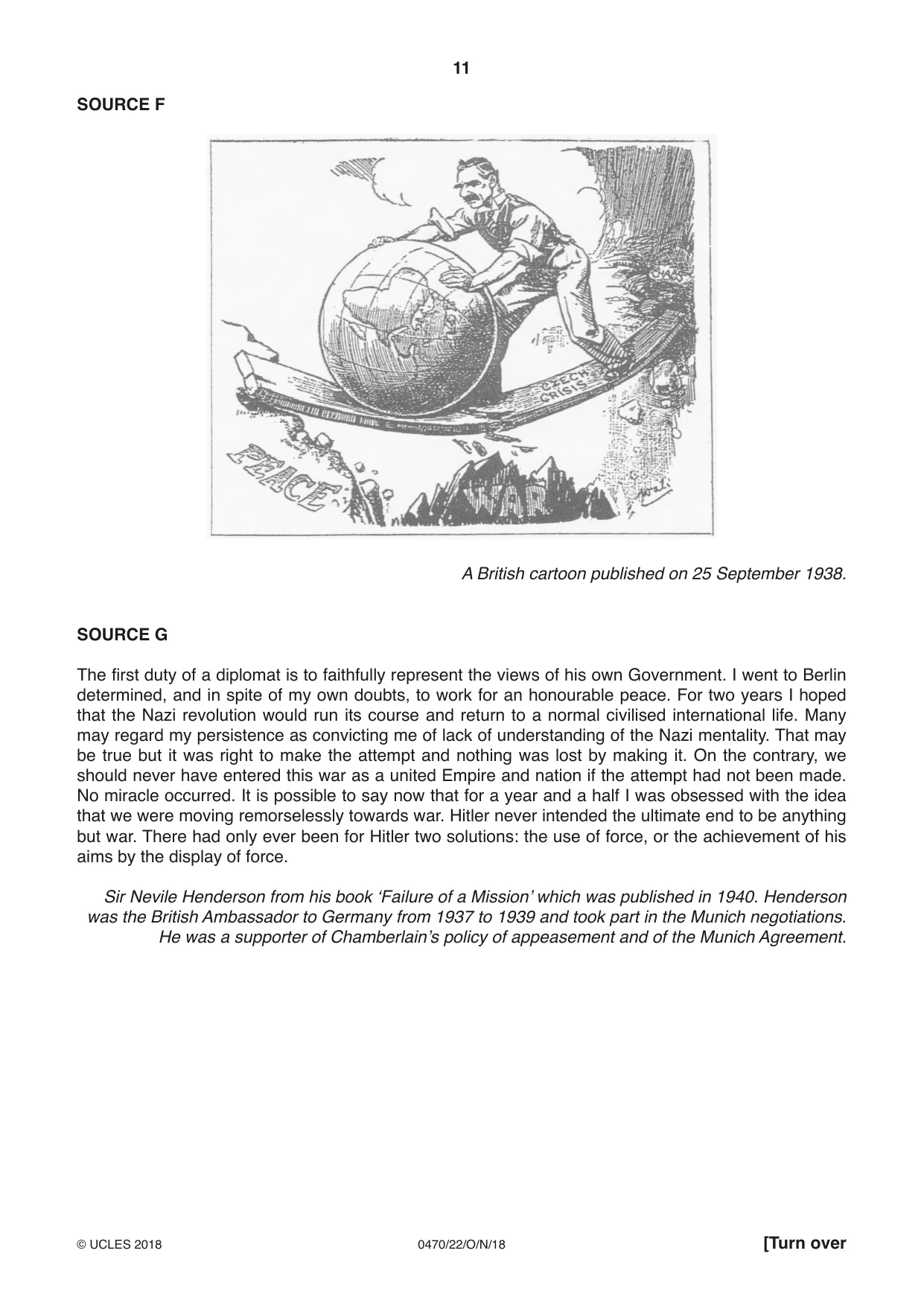
11 0470/22/O/N/18 © UCLES 2018 [Turn over SOURCE F A British cartoon published on 25 September 1938. SOURCE G The first duty of a diplomat is to faithfully represent the views of his own Government. I went to Berlin determined, and in spite of my own doubts, to work for an honourable peace. For two years I hoped that the Nazi revolution would run its course and return to a normal civilised international life. Many may regard my persistence as convicting me of lack of understanding of the Nazi mentality. That may be true but it was right to make the attempt and nothing was lost by making it. On the contrary, we should never have entered this war as a united Empire and nation if the attempt had not been made. No miracle occurred. It is possible to say now that for a year and a half I was obsessed with the idea that we were moving remorselessly towards war. Hitler never intended the ultimate end to be anything but war. There had only ever been for Hitler two solutions: the use of force, or the achievement of his aims by the display of force. Sir Nevile Henderson from his book ‘Failure of a Mission’ which was published in 1940. Henderson was the British Ambassador to Germany from 1937 to 1939 and took part in the Munich negotiations. He was a supporter of Chamberlain’s policy of appeasement and of the Munich Agreement.
Question paper, page 12
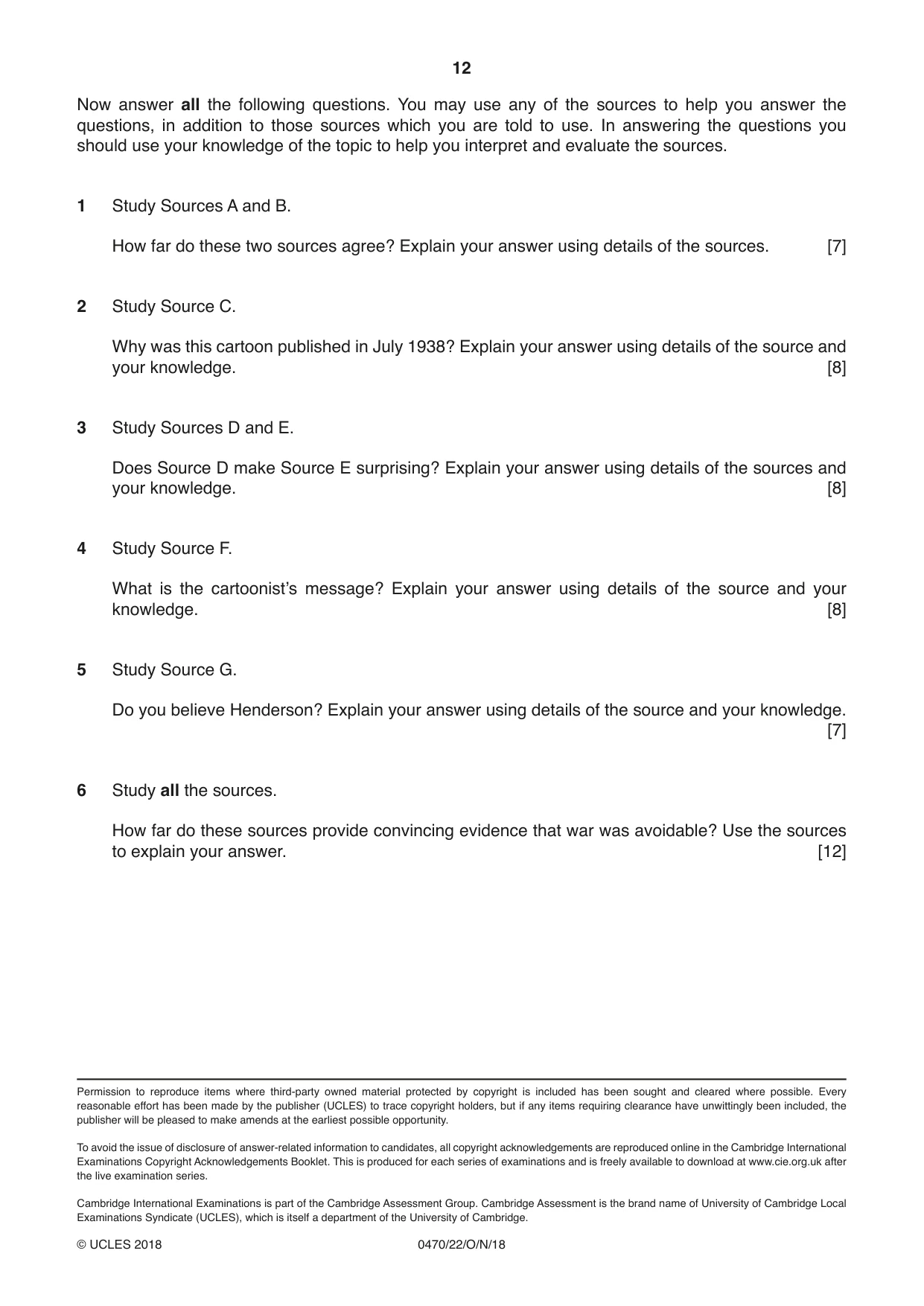
12 0470/22/O/N/18 © UCLES 2018 Permission to reproduce items where third-party owned material protected by copyright is included has been sought and cleared where possible. Every reasonable effort has been made by the publisher (UCLES) to trace copyright holders, but if any items requiring clearance have unwittingly been included, the publisher will be pleased to make amends at the earliest possible opportunity. To avoid the issue of disclosure of answer-related information to candidates, all copyright acknowledgements are reproduced online in the Cambridge International Examinations Copyright Acknowledgements Booklet. This is produced for each series of examinations and is freely available to download at www.cie.org.uk after the live examination series. Cambridge International Examinations is part of the Cambridge Assessment Group. Cambridge Assessment is the brand name of University of Cambridge Local Examinations Syndicate (UCLES), which is itself a department of the University of Cambridge. Now answer all the following questions. You may use any of the sources to help you answer the questions, in addition to those sources which you are told to use. In answering the questions you should use your knowledge of the topic to help you interpret and evaluate the sources. 1 Study Sources A and B. How far do these two sources agree? Explain your answer using details of the sources. [7] 2 Study Source C. Why was this cartoon published in July 1938? Explain your answer using details of the source and your knowledge. [8] 3 Study Sources D and E. Does Source D make Source E surprising? Explain your answer using details of the sources and your knowledge. [8] 4 Study Source F. What is the cartoonist’s message? Explain your answer using details of the source and your knowledge. [8] 5 Study Source G. Do you believe Henderson? Explain your answer using details of the source and your knowledge. [7] 6 Study all the sources. How far do these sources provide convincing evidence that war was avoidable? Use the sources to explain your answer. [12]
Mark scheme, page 1
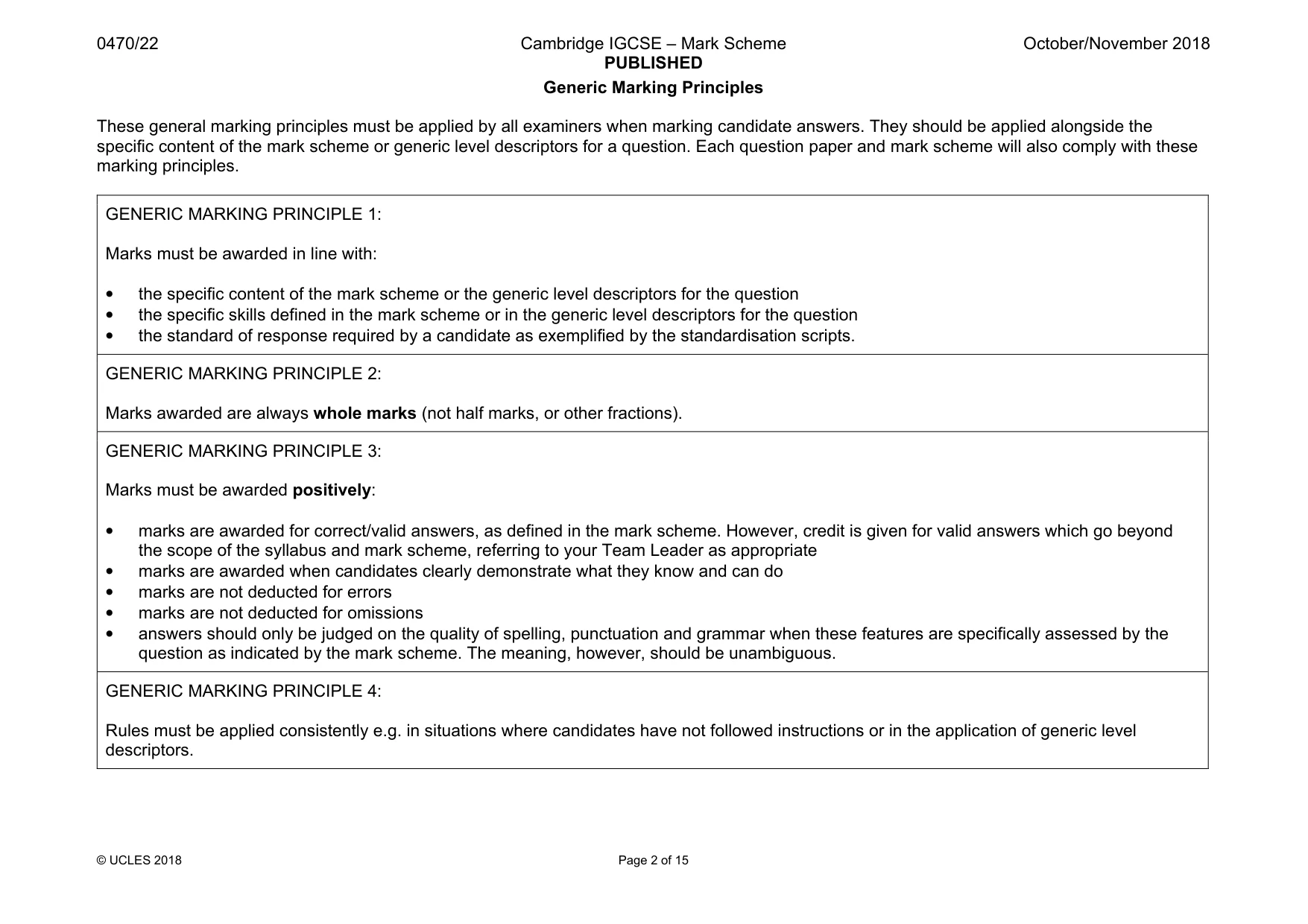
This syllabus is approved for use in England, Wales and Northern Ireland as a Cambridge International Level 1/Level 2 Certificate. This document consists of 15 printed pages. © UCLES 2018 [Turn over Cambridge Assessment International Education Cambridge International General Certificate of Secondary Education HISTORY 0470/22 Paper 2 October/November 2018 MARK SCHEME Maximum Mark: 50 Published This mark scheme is published as an aid to teachers and candidates, to indicate the requirements of the examination. It shows the basis on which Examiners were instructed to award marks. It does not indicate the details of the discussions that took place at an Examiners’ meeting before marking began, which would have considered the acceptability of alternative answers. Mark schemes should be read in conjunction with the question paper and the Principal Examiner Report for Teachers. Cambridge International will not enter into discussions about these mark schemes. Cambridge International is publishing the mark schemes for the October/November 2018 series for most Cambridge IGCSE™, Cambridge International A and AS Level components and some Cambridge O Level components.
Mark scheme, page 2
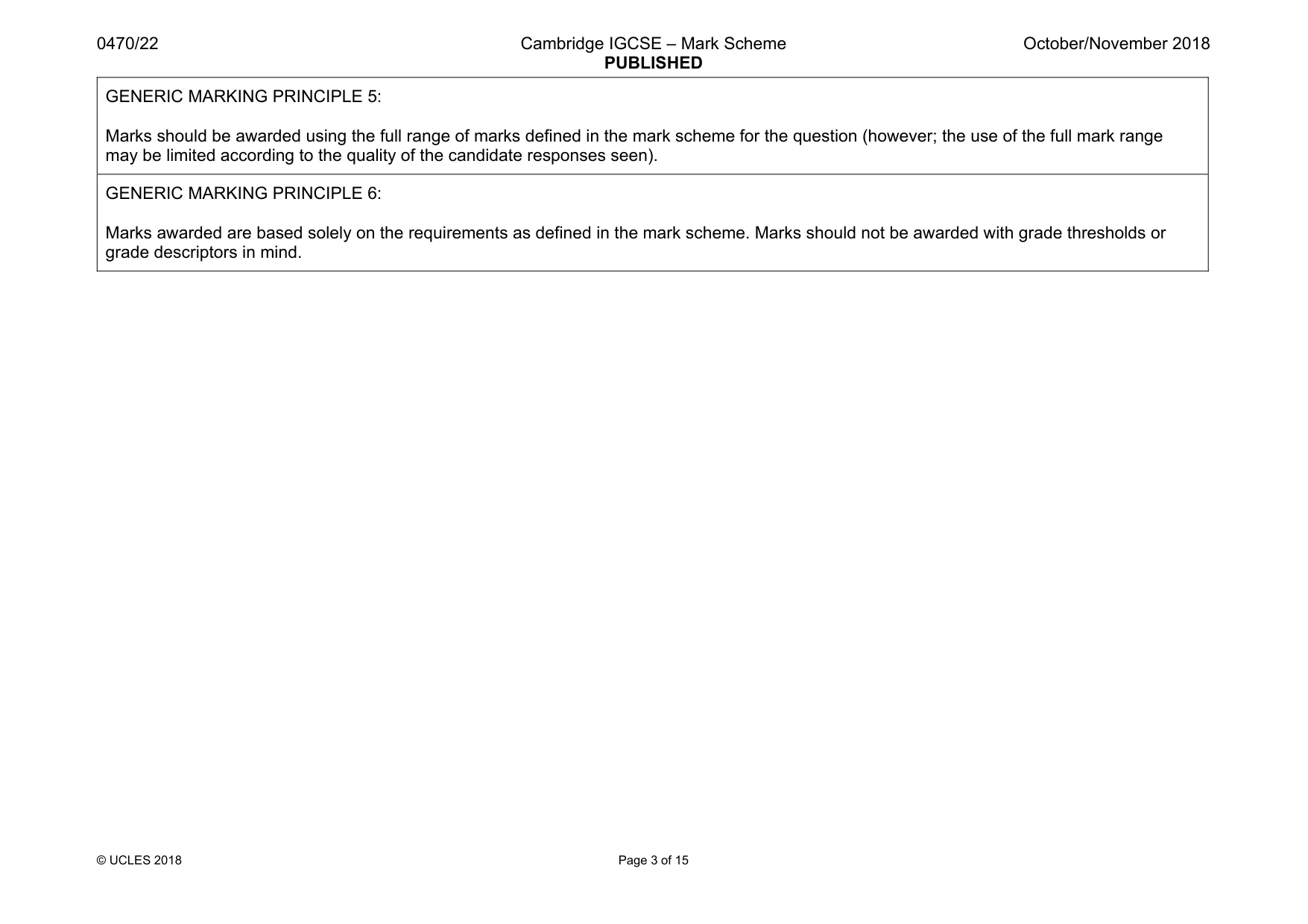
0470/22 Cambridge IGCSE – Mark Scheme PUBLISHED October/November 2018 © UCLES 2018 Page 2 of 15 Generic Marking Principles These general marking principles must be applied by all examiners when marking candidate answers. They should be applied alongside the specific content of the mark scheme or generic level descriptors for a question. Each question paper and mark scheme will also comply with these marking principles. GENERIC MARKING PRINCIPLE 1: Marks must be awarded in line with: • the specific content of the mark scheme or the generic level descriptors for the question • the specific skills defined in the mark scheme or in the generic level descriptors for the question • the standard of response required by a candidate as exemplified by the standardisation scripts. GENERIC MARKING PRINCIPLE 2: Marks awarded are always whole marks (not half marks, or other fractions). GENERIC MARKING PRINCIPLE 3: Marks must be awarded positively: • marks are awarded for correct/valid answers, as defined in the mark scheme. However, credit is given for valid answers which go beyond the scope of the syllabus and mark scheme, referring to your Team Leader as appropriate • marks are awarded when candidates clearly demonstrate what they know and can do • marks are not deducted for errors • marks are not deducted for omissions • answers should only be judged on the quality of spelling, punctuation and grammar when these features are specifically assessed by the question as indicated by the mark scheme. The meaning, however, should be unambiguous. GENERIC MARKING PRINCIPLE 4: Rules must be applied consistently e.g. in situations where candidates have not followed instructions or in the application of generic level descriptors.
Mark scheme, page 3
0470/22 Cambridge IGCSE – Mark Scheme PUBLISHED October/November 2018 © UCLES 2018 Page 3 of 15 GENERIC MARKING PRINCIPLE 5: Marks should be awarded using the full range of marks defined in the mark scheme for the question (however; the use of the full mark range may be limited according to the quality of the candidate responses seen). GENERIC MARKING PRINCIPLE 6: Marks awarded are based solely on the requirements as defined in the mark scheme. Marks should not be awarded with grade thresholds or grade descriptors in mind.
Mark scheme, page 4
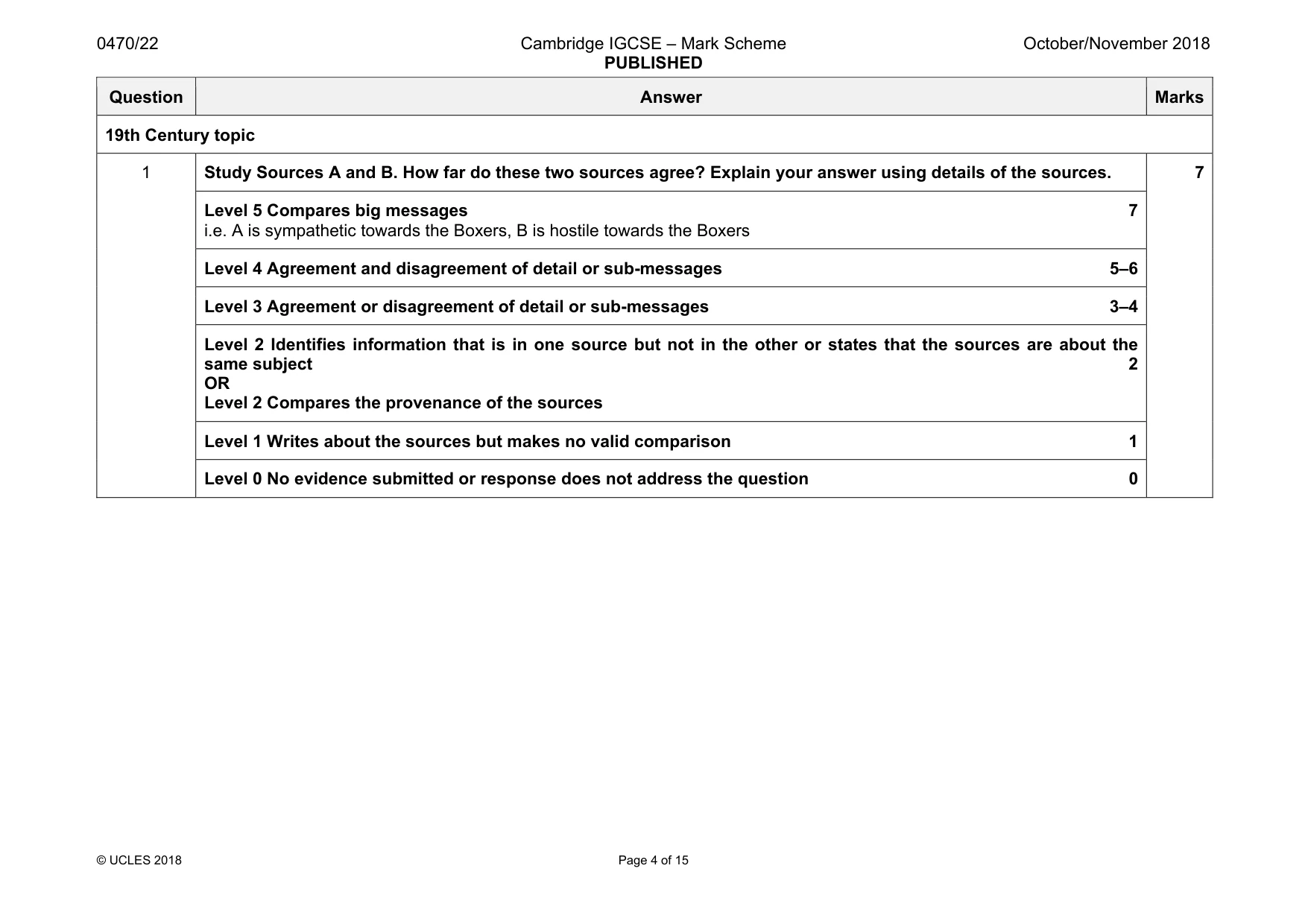
0470/22 Cambridge IGCSE – Mark Scheme PUBLISHED October/November 2018 © UCLES 2018 Page 4 of 15 Question Answer Marks 19th Century topic 1 Study Sources A and B. How far do these two sources agree? Explain your answer using details of the sources. 7 Level 5 Compares big messages 7 i.e. A is sympathetic towards the Boxers, B is hostile towards the Boxers Level 4 Agreement and disagreement of detail or sub-messages 5–6 Level 3 Agreement or disagreement of detail or sub-messages 3–4 Level 2 Identifies information that is in one source but not in the other or states that the sources are about the same subject 2 OR Level 2 Compares the provenance of the sources Level 1 Writes about the sources but makes no valid comparison 1 Level 0 No evidence submitted or response does not address the question 0
Mark scheme, page 5
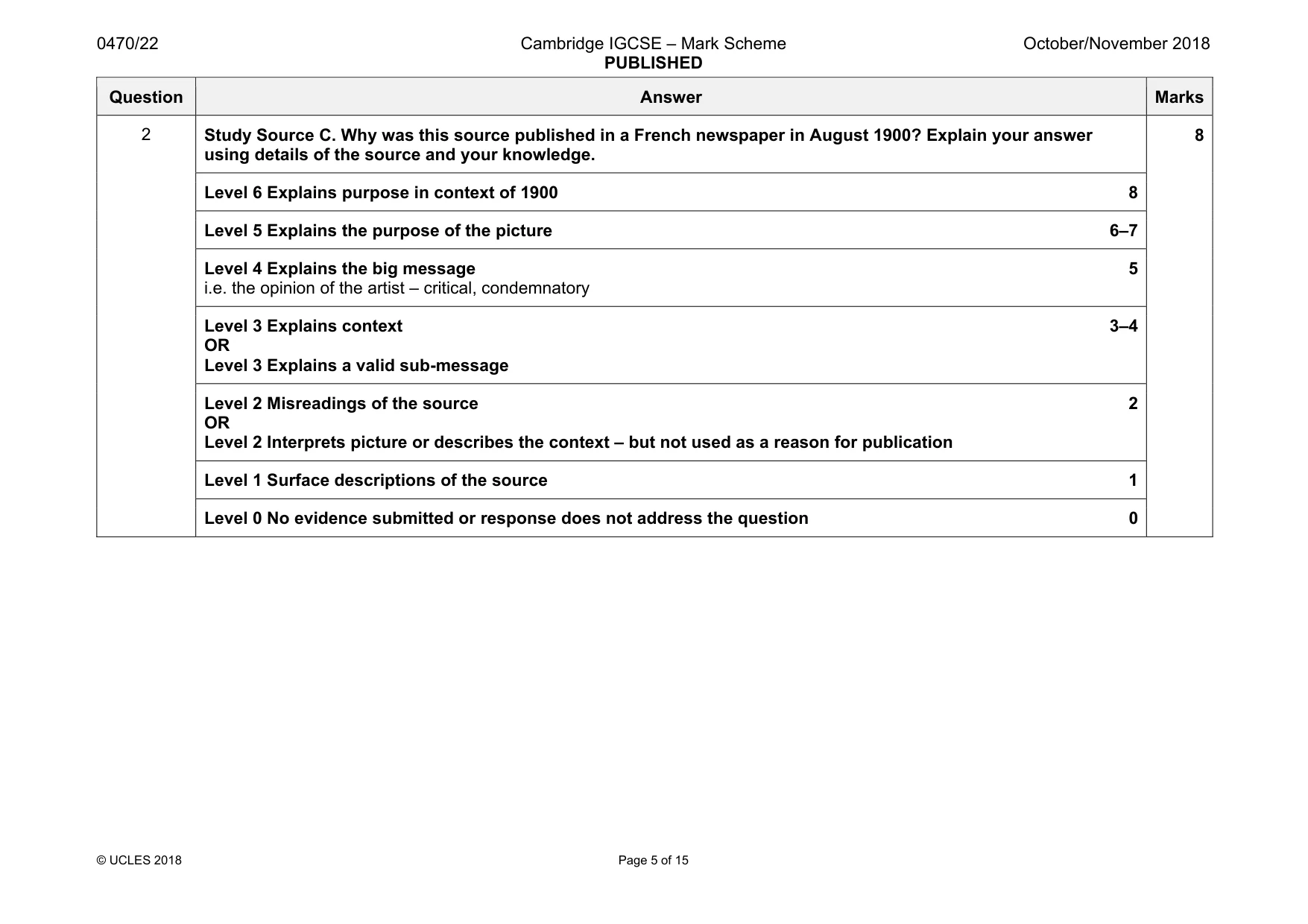
0470/22 Cambridge IGCSE – Mark Scheme PUBLISHED October/November 2018 © UCLES 2018 Page 5 of 15 Question Answer Marks 2 Study Source C. Why was this source published in a French newspaper in August 1900? Explain your answer using details of the source and your knowledge. 8 Level 6 Explains purpose in context of 1900 8 Level 5 Explains the purpose of the picture 6–7 Level 4 Explains the big message 5 i.e. the opinion of the artist – critical, condemnatory Level 3 Explains context 3–4 OR Level 3 Explains a valid sub-message Level 2 Misreadings of the source 2 OR Level 2 Interprets picture or describes the context – but not used as a reason for publication Level 1 Surface descriptions of the source 1 Level 0 No evidence submitted or response does not address the question 0
Mark scheme, page 6
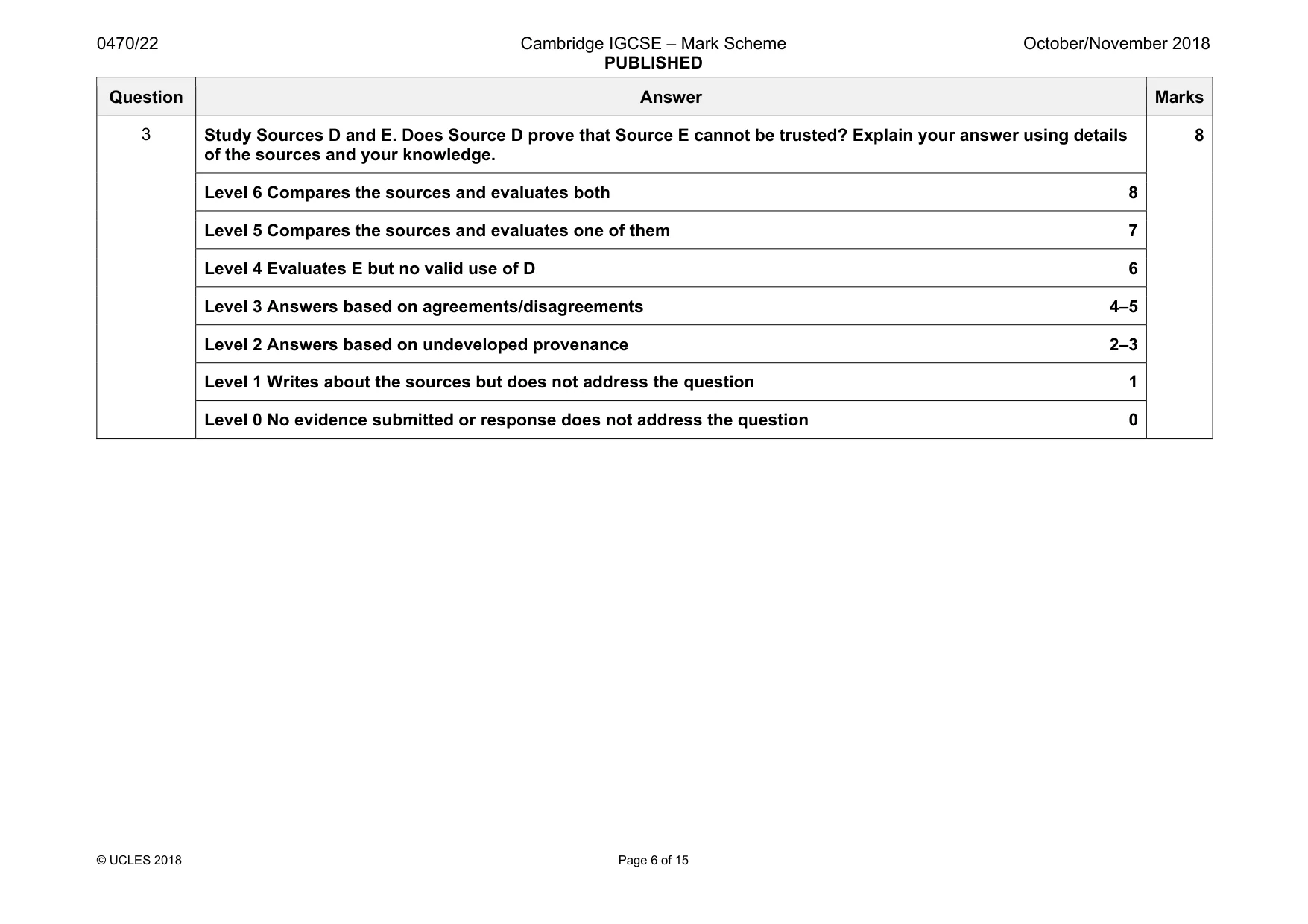
0470/22 Cambridge IGCSE – Mark Scheme PUBLISHED October/November 2018 © UCLES 2018 Page 6 of 15 Question Answer Marks 3 Study Sources D and E. Does Source D prove that Source E cannot be trusted? Explain your answer using details of the sources and your knowledge. 8 Level 6 Compares the sources and evaluates both 8 Level 5 Compares the sources and evaluates one of them 7 Level 4 Evaluates E but no valid use of D 6 Level 3 Answers based on agreements/disagreements 4–5 Level 2 Answers based on undeveloped provenance 2–3 Level 1 Writes about the sources but does not address the question 1 Level 0 No evidence submitted or response does not address the question 0
Mark scheme, page 7
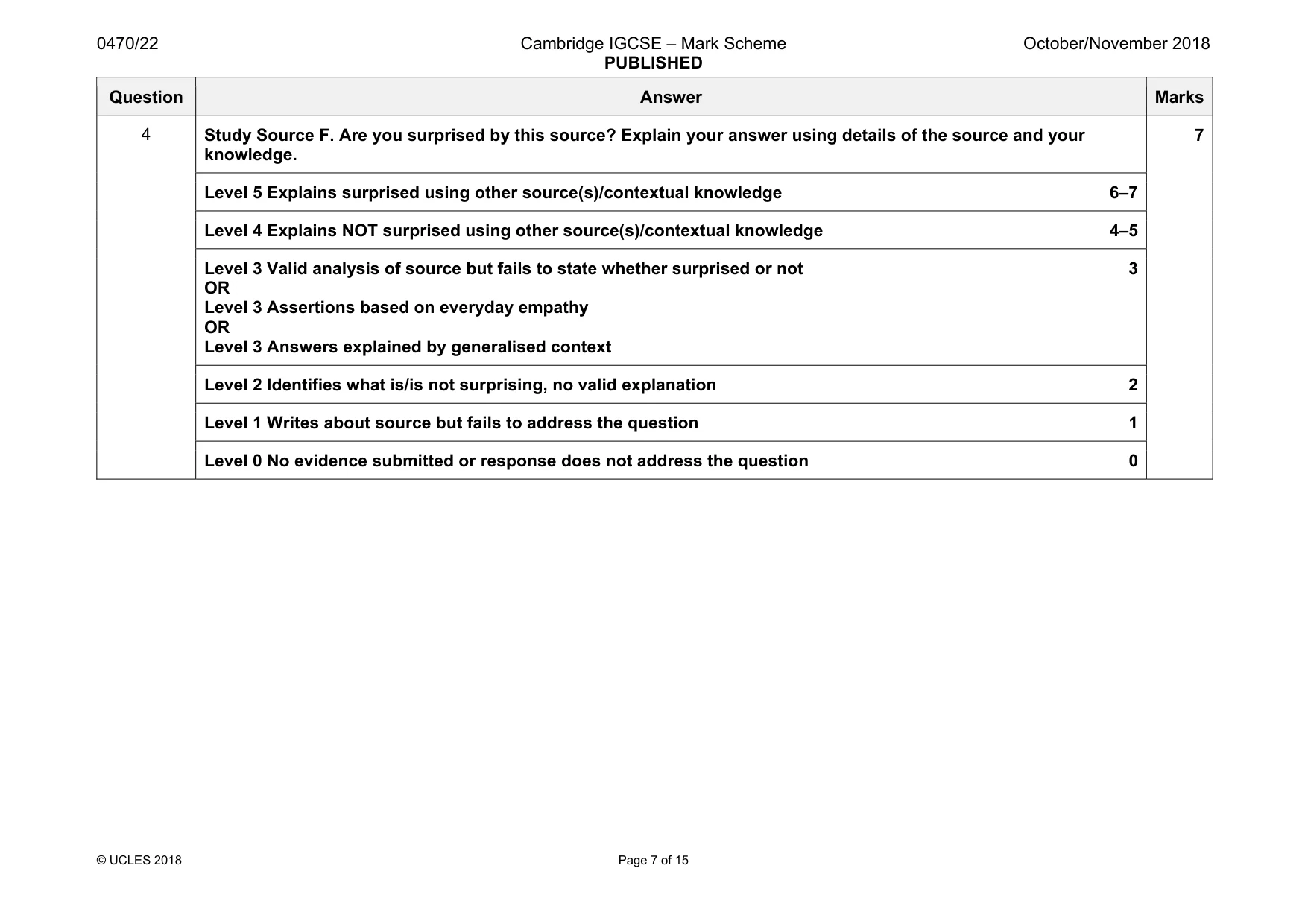
0470/22 Cambridge IGCSE – Mark Scheme PUBLISHED October/November 2018 © UCLES 2018 Page 7 of 15 Question Answer Marks 4 Study Source F. Are you surprised by this source? Explain your answer using details of the source and your knowledge. 7 Level 5 Explains surprised using other source(s)/contextual knowledge 6–7 Level 4 Explains NOT surprised using other source(s)/contextual knowledge 4–5 Level 3 Valid analysis of source but fails to state whether surprised or not 3 OR Level 3 Assertions based on everyday empathy OR Level 3 Answers explained by generalised context Level 2 Identifies what is/is not surprising, no valid explanation 2 Level 1 Writes about source but fails to address the question 1 Level 0 No evidence submitted or response does not address the question 0
Mark scheme, page 8
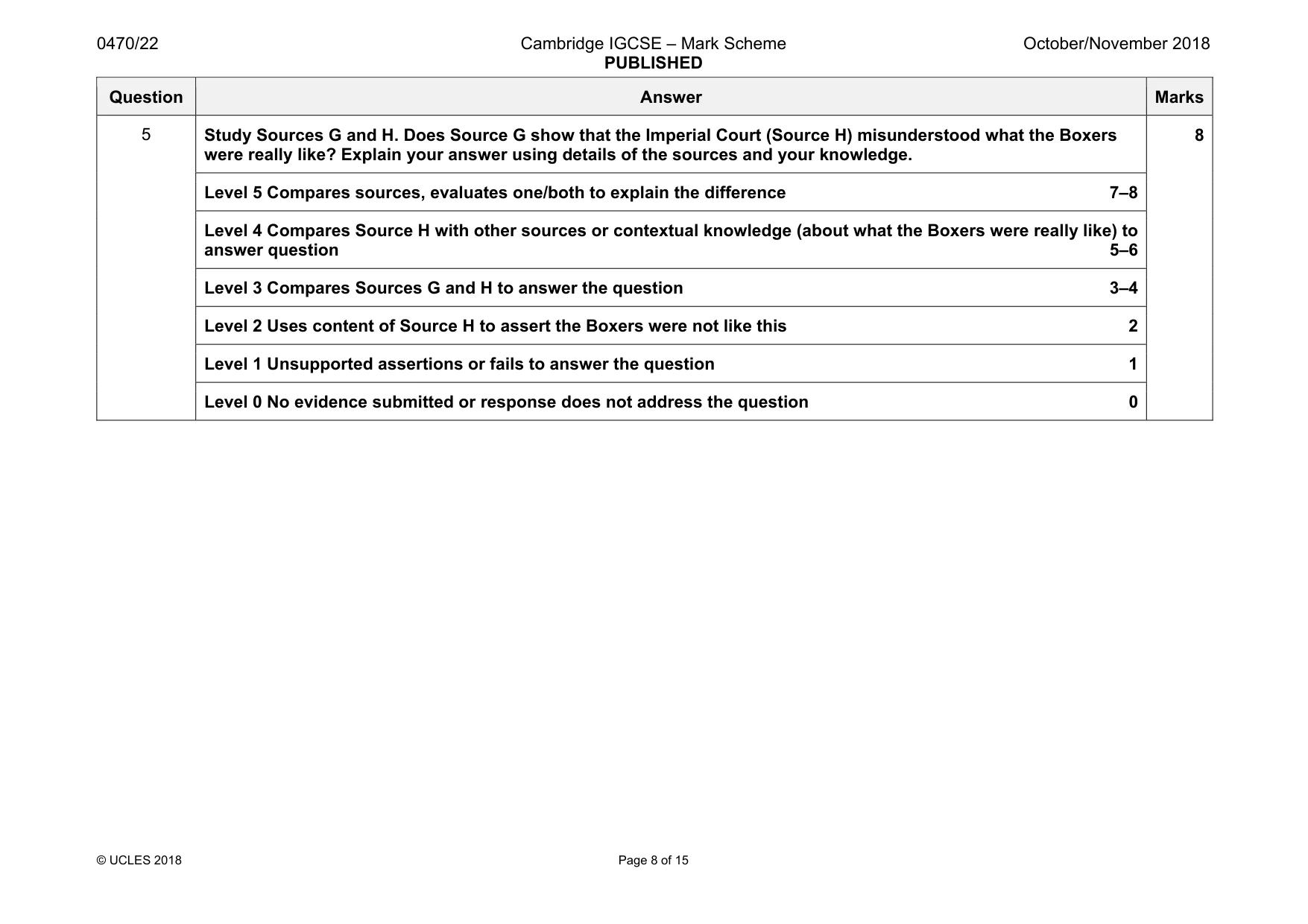
0470/22 Cambridge IGCSE – Mark Scheme PUBLISHED October/November 2018 © UCLES 2018 Page 8 of 15 Question Answer Marks 5 Study Sources G and H. Does Source G show that the Imperial Court (Source H) misunderstood what the Boxers were really like? Explain your answer using details of the sources and your knowledge. 8 Level 5 Compares sources, evaluates one/both to explain the difference 7–8 Level 4 Compares Source H with other sources or contextual knowledge (about what the Boxers were really like) to answer question 5–6 Level 3 Compares Sources G and H to answer the question 3–4 Level 2 Uses content of Source H to assert the Boxers were not like this 2 Level 1 Unsupported assertions or fails to answer the question 1 Level 0 No evidence submitted or response does not address the question 0
Mark scheme, page 9
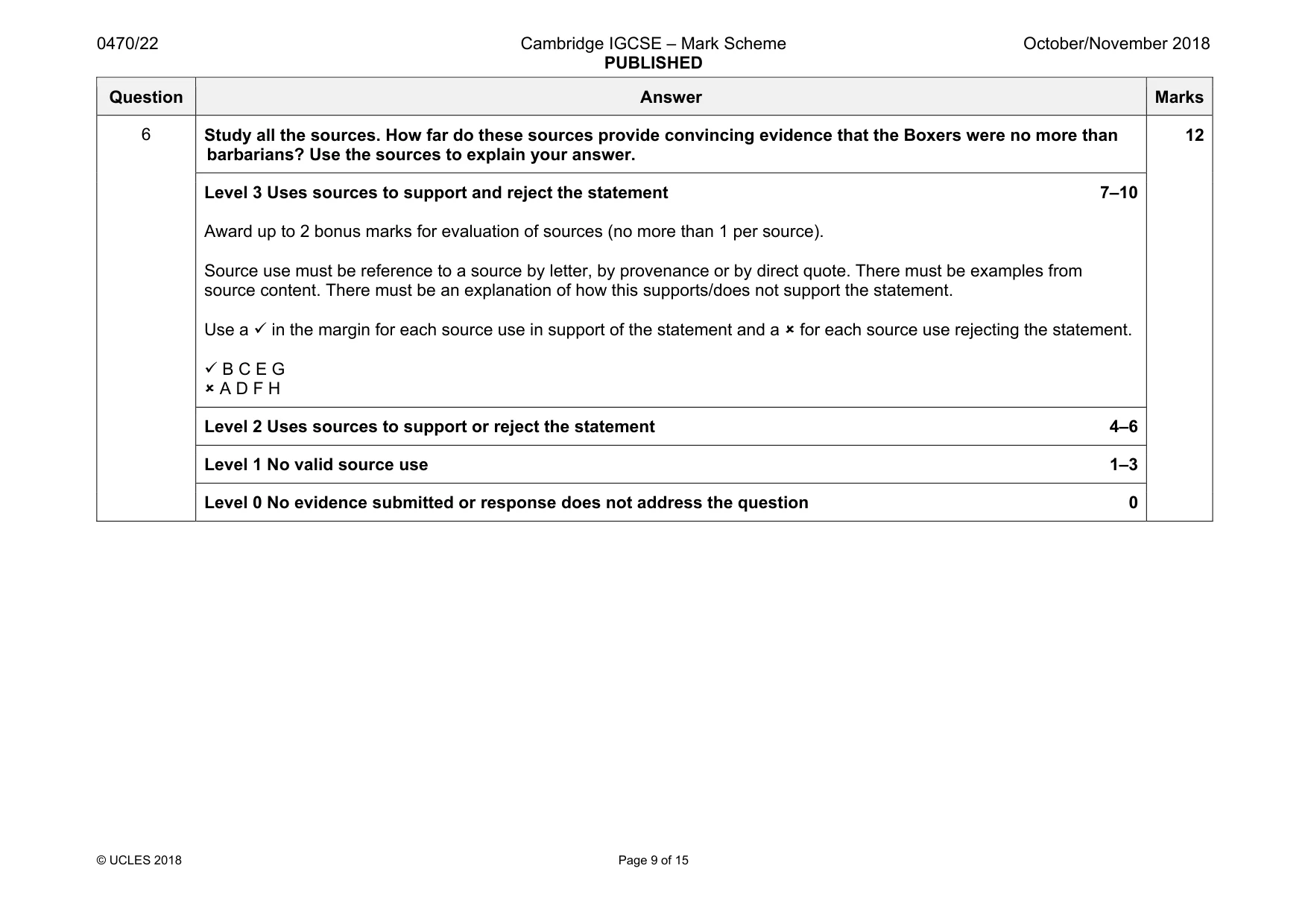
0470/22 Cambridge IGCSE – Mark Scheme PUBLISHED October/November 2018 © UCLES 2018 Page 9 of 15 Question Answer Marks 6 Study all the sources. How far do these sources provide convincing evidence that the Boxers were no more than barbarians? Use the sources to explain your answer. 12 Level 3 Uses sources to support and reject the statement 7–10 Award up to 2 bonus marks for evaluation of sources (no more than 1 per source). Source use must be reference to a source by letter, by provenance or by direct quote. There must be examples from source content. There must be an explanation of how this supports/does not support the statement. Use a 9 in the margin for each source use in support of the statement and a 8 for each source use rejecting the statement. 9 B C E G 8 A D F H Level 2 Uses sources to support or reject the statement 4–6 Level 1 No valid source use 1–3 Level 0 No evidence submitted or response does not address the question 0
Mark scheme, page 10
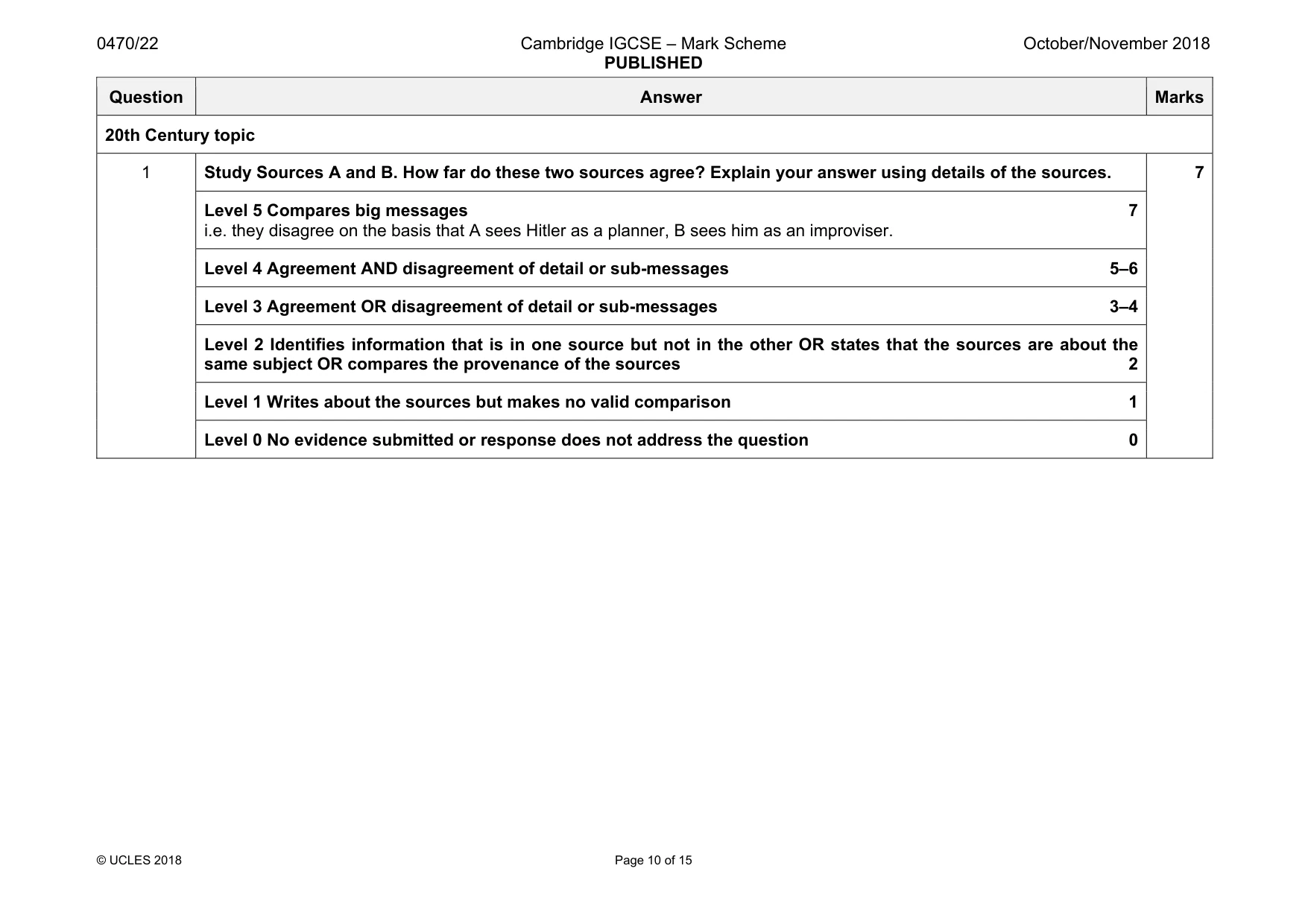
0470/22 Cambridge IGCSE – Mark Scheme PUBLISHED October/November 2018 © UCLES 2018 Page 10 of 15 Question Answer Marks 20th Century topic 1 Study Sources A and B. How far do these two sources agree? Explain your answer using details of the sources. 7 Level 5 Compares big messages 7 i.e. they disagree on the basis that A sees Hitler as a planner, B sees him as an improviser. Level 4 Agreement AND disagreement of detail or sub-messages 5–6 Level 3 Agreement OR disagreement of detail or sub-messages 3–4 Level 2 Identifies information that is in one source but not in the other OR states that the sources are about the same subject OR compares the provenance of the sources 2 Level 1 Writes about the sources but makes no valid comparison 1 Level 0 No evidence submitted or response does not address the question 0
Mark scheme, page 11
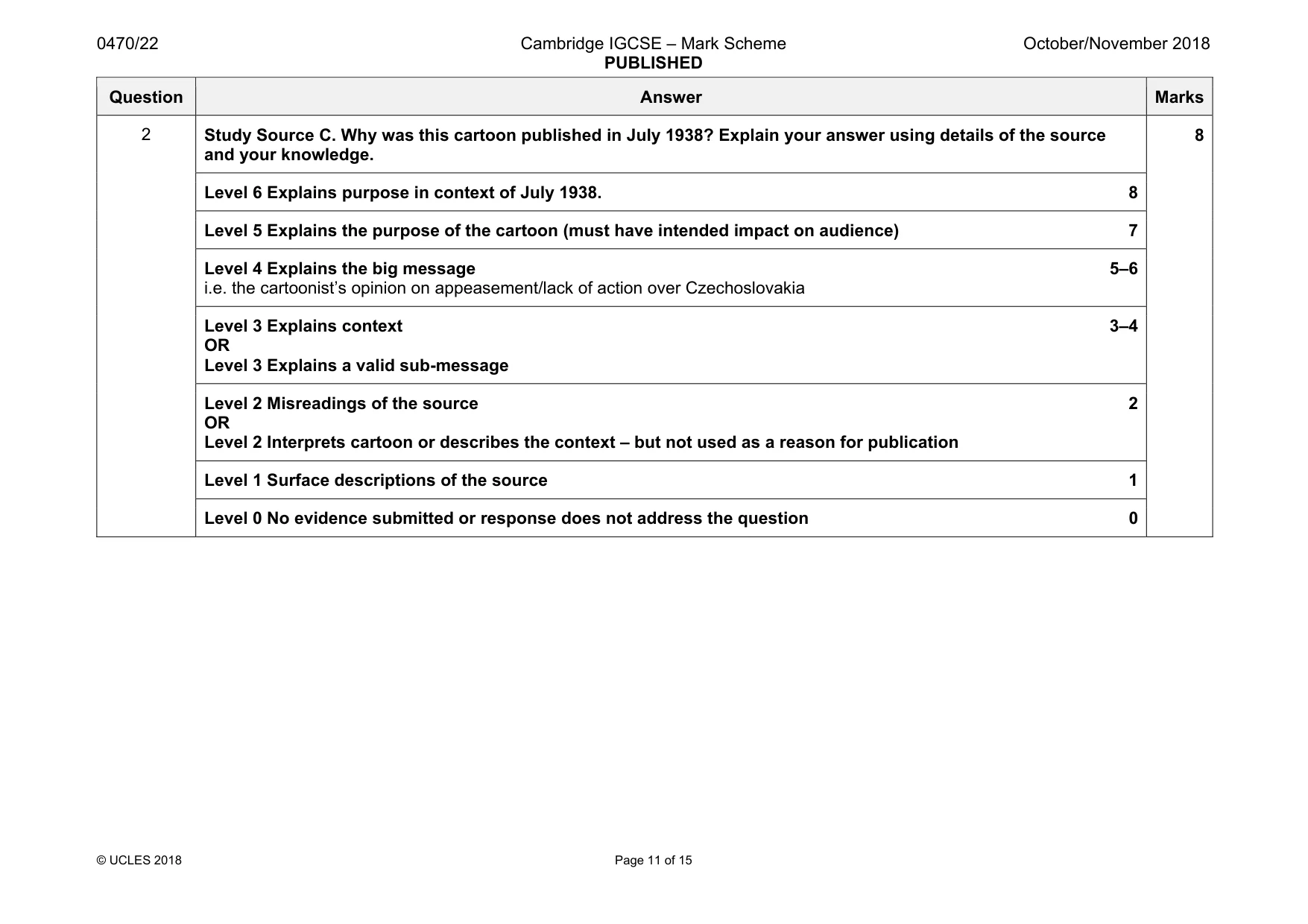
0470/22 Cambridge IGCSE – Mark Scheme PUBLISHED October/November 2018 © UCLES 2018 Page 11 of 15 Question Answer Marks 2 Study Source C. Why was this cartoon published in July 1938? Explain your answer using details of the source and your knowledge. 8 Level 6 Explains purpose in context of July 1938. 8 Level 5 Explains the purpose of the cartoon (must have intended impact on audience) 7 Level 4 Explains the big message 5–6 i.e. the cartoonist’s opinion on appeasement/lack of action over Czechoslovakia Level 3 Explains context 3–4 OR Level 3 Explains a valid sub-message Level 2 Misreadings of the source 2 OR Level 2 Interprets cartoon or describes the context – but not used as a reason for publication Level 1 Surface descriptions of the source 1 Level 0 No evidence submitted or response does not address the question 0
Mark scheme, page 12
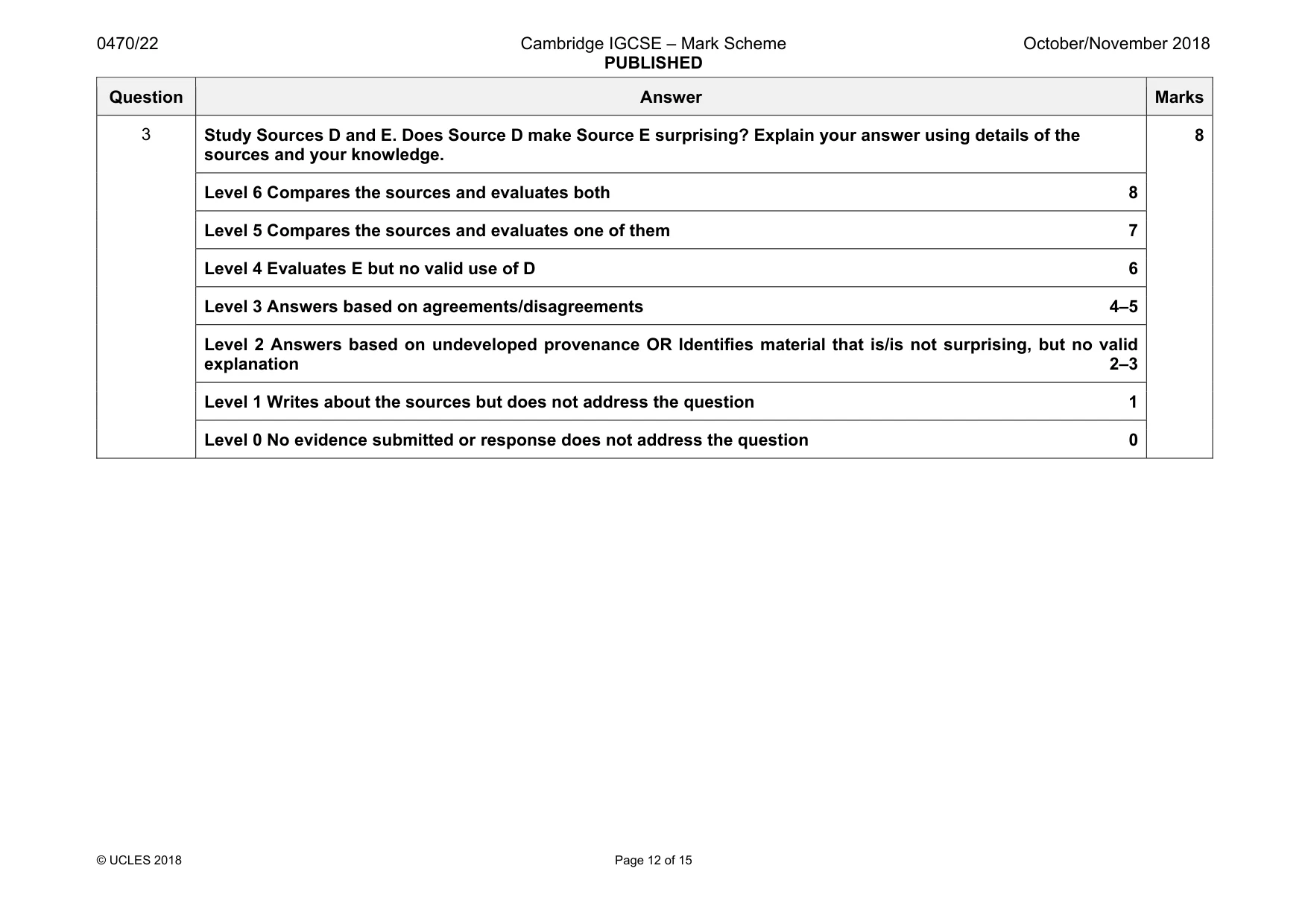
0470/22 Cambridge IGCSE – Mark Scheme PUBLISHED October/November 2018 © UCLES 2018 Page 12 of 15 Question Answer Marks 3 Study Sources D and E. Does Source D make Source E surprising? Explain your answer using details of the sources and your knowledge. 8 Level 6 Compares the sources and evaluates both 8 Level 5 Compares the sources and evaluates one of them 7 Level 4 Evaluates E but no valid use of D 6 Level 3 Answers based on agreements/disagreements 4–5 Level 2 Answers based on undeveloped provenance OR Identifies material that is/is not surprising, but no valid explanation 2–3 Level 1 Writes about the sources but does not address the question 1 Level 0 No evidence submitted or response does not address the question 0
Mark scheme, page 13
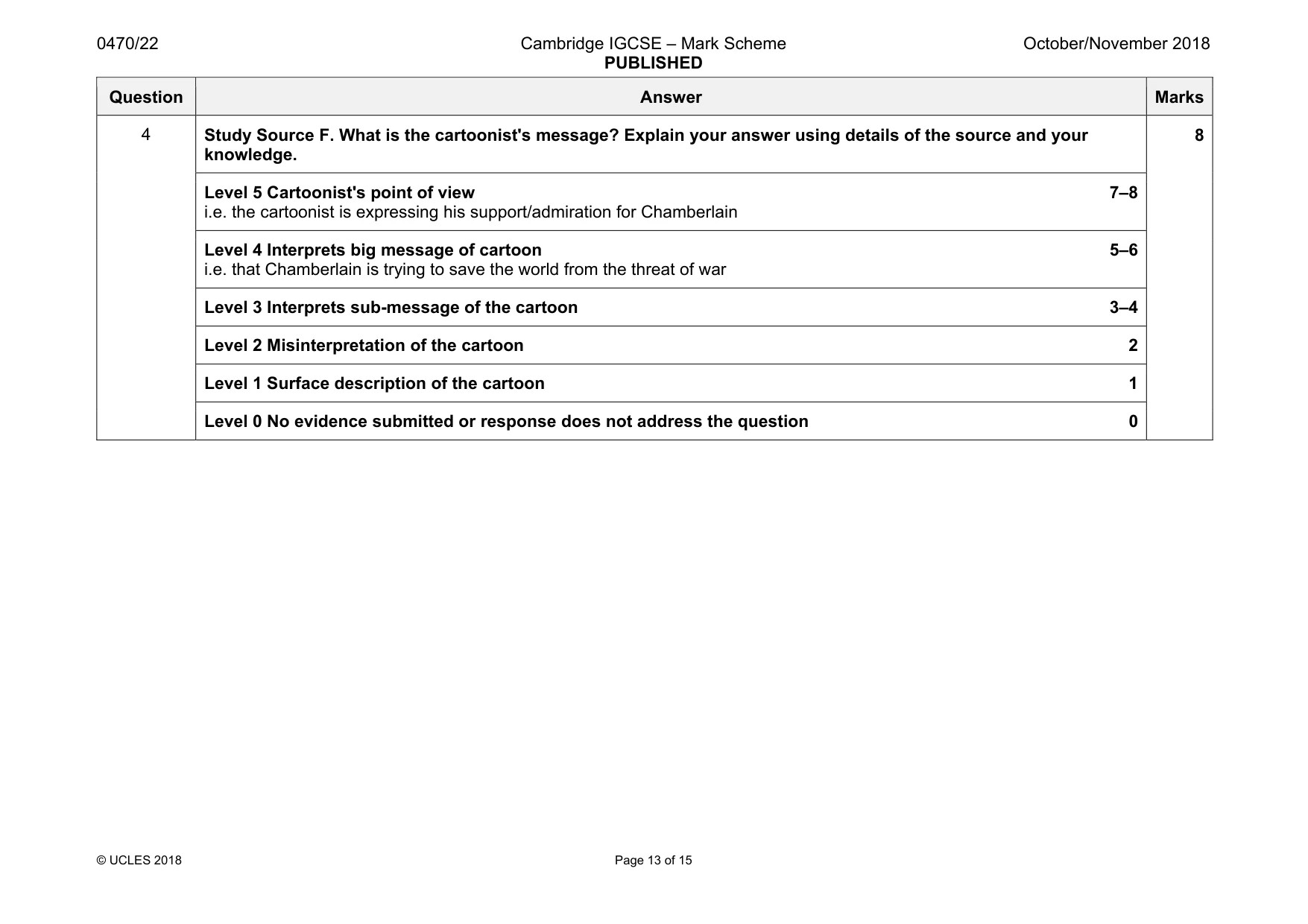
0470/22 Cambridge IGCSE – Mark Scheme PUBLISHED October/November 2018 © UCLES 2018 Page 13 of 15 Question Answer Marks 4 Study Source F. What is the cartoonist's message? Explain your answer using details of the source and your knowledge. 8 Level 5 Cartoonist's point of view 7–8 i.e. the cartoonist is expressing his support/admiration for Chamberlain Level 4 Interprets big message of cartoon 5–6 i.e. that Chamberlain is trying to save the world from the threat of war Level 3 Interprets sub-message of the cartoon 3–4 Level 2 Misinterpretation of the cartoon 2 Level 1 Surface description of the cartoon 1 Level 0 No evidence submitted or response does not address the question 0
Mark scheme, page 14
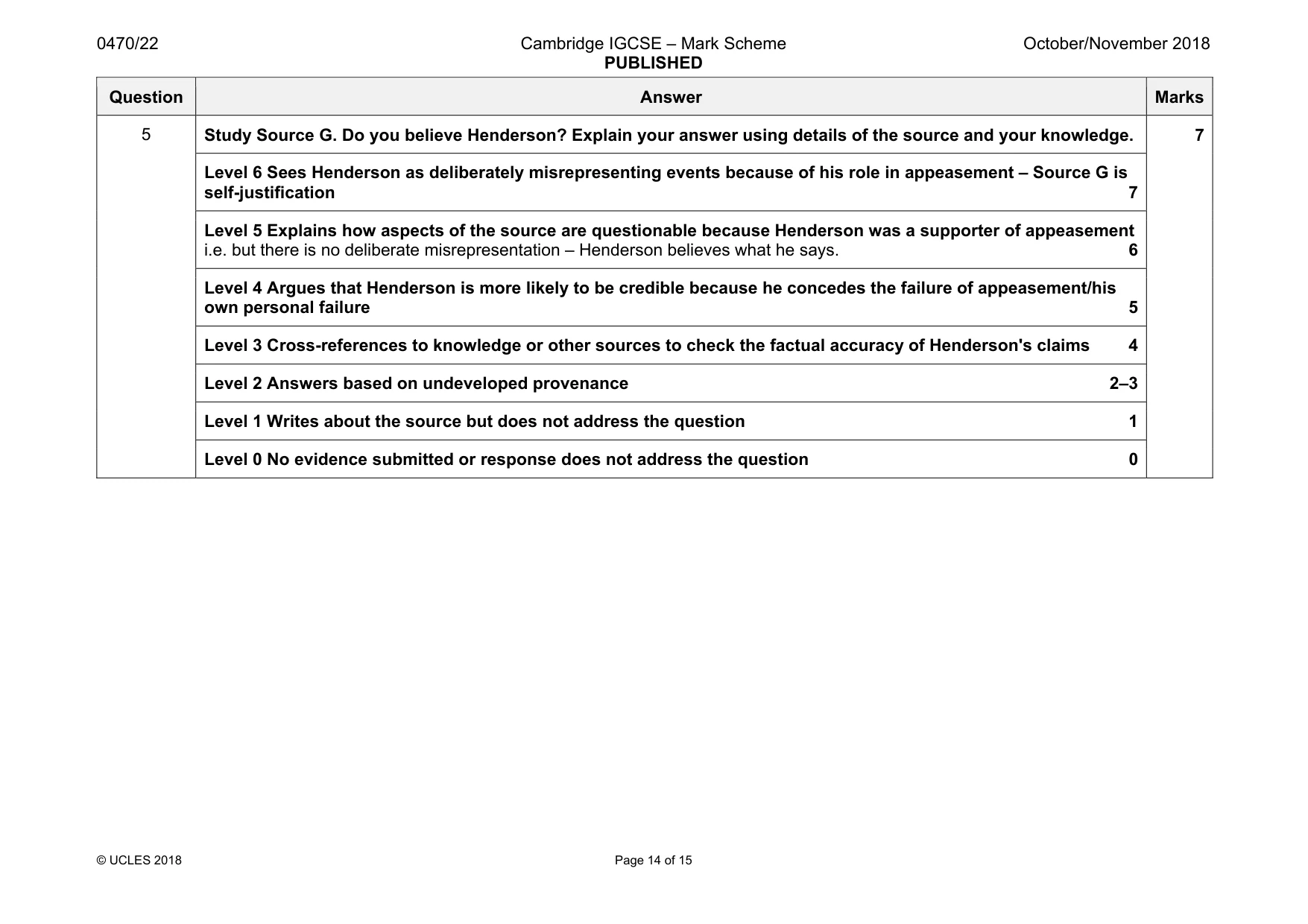
0470/22 Cambridge IGCSE – Mark Scheme PUBLISHED October/November 2018 © UCLES 2018 Page 14 of 15 Question Answer Marks 5 Study Source G. Do you believe Henderson? Explain your answer using details of the source and your knowledge. 7 Level 6 Sees Henderson as deliberately misrepresenting events because of his role in appeasement – Source G is self-justification 7 Level 5 Explains how aspects of the source are questionable because Henderson was a supporter of appeasement i.e. but there is no deliberate misrepresentation – Henderson believes what he says. 6 Level 4 Argues that Henderson is more likely to be credible because he concedes the failure of appeasement/his own personal failure 5 Level 3 Cross-references to knowledge or other sources to check the factual accuracy of Henderson's claims 4 Level 2 Answers based on undeveloped provenance 2–3 Level 1 Writes about the source but does not address the question 1 Level 0 No evidence submitted or response does not address the question 0
Mark scheme, page 15
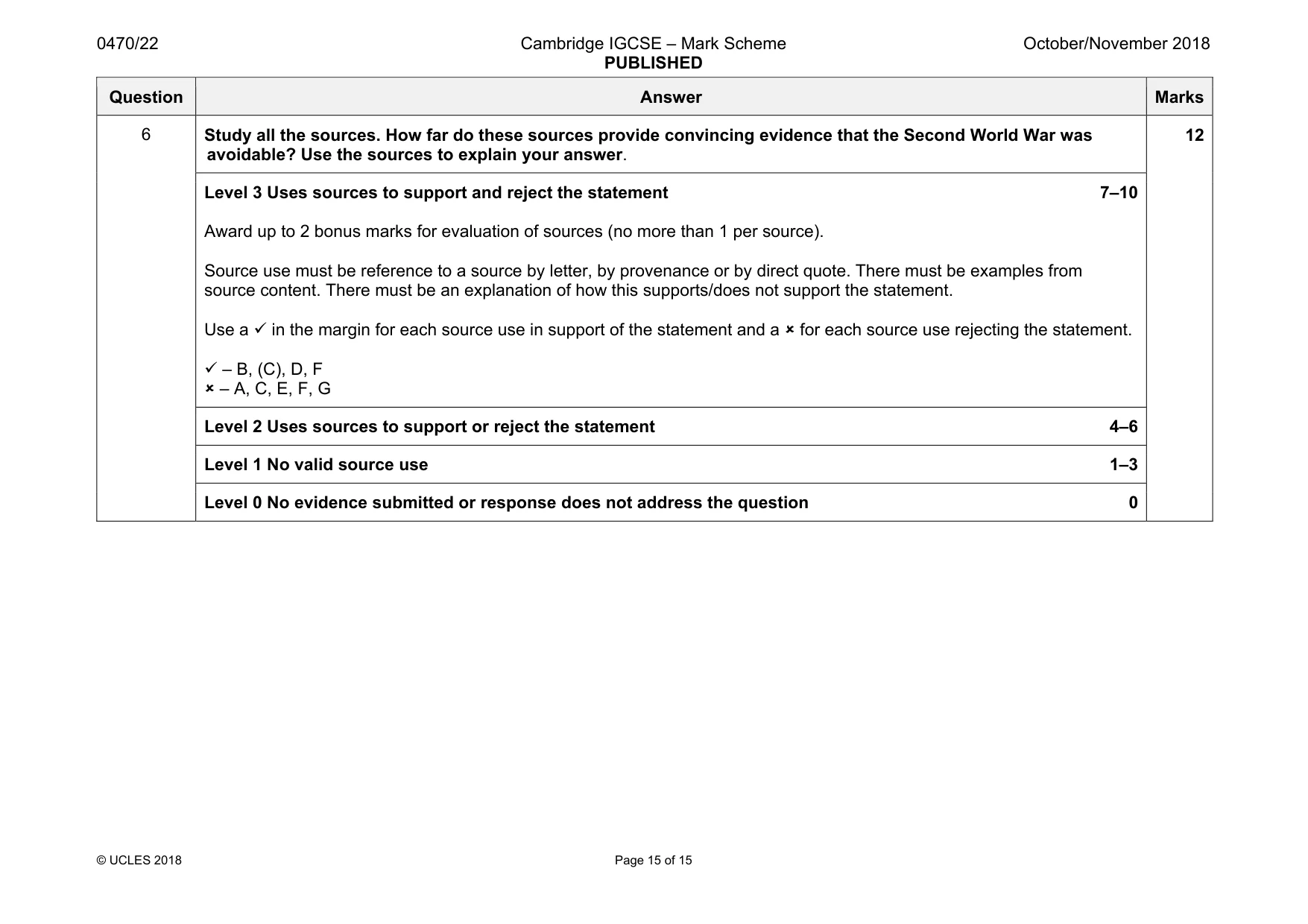
0470/22 Cambridge IGCSE – Mark Scheme PUBLISHED October/November 2018 © UCLES 2018 Page 15 of 15 Question Answer Marks 6 Study all the sources. How far do these sources provide convincing evidence that the Second World War was avoidable? Use the sources to explain your answer. 12 Level 3 Uses sources to support and reject the statement 7–10 Award up to 2 bonus marks for evaluation of sources (no more than 1 per source). Source use must be reference to a source by letter, by provenance or by direct quote. There must be examples from source content. There must be an explanation of how this supports/does not support the statement. Use a 9 in the margin for each source use in support of the statement and a 8 for each source use rejecting the statement. 9 – B, (C), D, F 8 – A, C, E, F, G Level 2 Uses sources to support or reject the statement 4–6 Level 1 No valid source use 1–3 Level 0 No evidence submitted or response does not address the question 0
What you needed in this session
Cambridge’s own grade thresholds for 2018 Oct/Nov, Paper 2 · Variant 2. A higher threshold means an easier paper — the bar moves with how the cohort did.