Cambridge IGCSE History 0470 — 2018 May/June Paper 4 · Variant 3
0470/43/M/J/18 · 40 marks · ≈45 min
The question paper and its mark scheme, free to read here and free to download. This is Cambridge’s own paper, exactly as it was sat.
Question paper4 pages

Mark scheme12 pages
Answers below. Sit the paper first if you are practising.

Paper as text
Question paper, page 1
Cambridge International Examinations Cambridge International General Certificate of Secondary Education 0470/43 May/June 2018 1 hour HISTORY Paper 4 Alternative to Coursework Additional Materials: Answer Booklet/Paper READ THESE INSTRUCTIONS FIRST An answer booklet is provided inside this question paper. You should follow the instructions on the front cover of the answer booklet. If you need additional answer paper ask the invigilator for a continuation booklet. Answer one question from your chosen Depth Study. The number of marks is given in brackets [ ] at the end of each question or part question. This syllabus is approved for use in England, Wales and Northern Ireland as a Cambridge International Level 1/Level 2 Certificate. This document consists of 3 printed pages and 1 blank page. [Turn over 06_0470_43_2018_1.15 © UCLES 2018 *1776721532*
Question paper, page 2
Answer one question from your chosen Depth Study. DEPTH STUDY A: THE FIRST WORLD WAR, 1914–1918 How important was the failure of the Schlieffen Plan as a reason for the start of trench warfare in 1914? Explain your answer. [40] 1 How significant were food shortages in the impact of the war on the British Home Front? Explain your answer. [40] 2 DEPTH STUDY B: GERMANY, 1918–1945 How important was proportional representation as a reason for the weakness of the Weimar Republic? Explain your answer. [40] 3 How significant were schools in bringing about the type of society the Nazis wanted? Explain your answer. [40] 4 DEPTH STUDY C: RUSSIA, 1905–1941 How important was the New Economic Policy (NEP) in consolidating Bolshevik control of Russia after 1917? Explain your answer. [40] 5 How significant were Stalin’s ideas about Communism in the Soviet Union as a reason for his emergence as leader? Explain your answer. [40] 6 DEPTH STUDY D: THE USA, 1919–1941 How important were the social consequences of the Wall Street Crash in US political developments up to 1933? Explain your answer. [40] 7 How significant was the Second New Deal in improving life for American people up to 1941? Explain your answer. [40] 8 DEPTH STUDY E: CHINA, c.1930–c.1990 How important was industrial reform in achieving Mao’s goals after 1949? Explain your answer. [40] 9 How significant were the Red Guards in Mao establishing his dominance over Communist China? Explain your answer. [40] 10 06_0470_43_2018_1.15 © UCLES 2018 2
Question paper, page 3
DEPTH STUDY F: SOUTH AFRICA, c.1940–c.1994 How important was black migration to towns as a reason for the National Party’s victory in 1948? Explain your answer. [40] 11 How significant was the Rivonia Trial, 1963–1964, in suppressing opposition to apartheid? Explain your answer. [40] 12 DEPTH STUDY G: ISRAELIS AND PALESTINIANS SINCE 1945 How important was the role of Egypt in causing the wars with Israel, 1956–1973? Explain your answer. [40] 13 How significant have Palestinian groups been in limiting progress towards peace in the Middle East? Explain your answer. [40] 14 06_0470_43_2018_1.15 © UCLES 2018 3
Question paper, page 4
BLANK PAGE Permission to reproduce items where third-party owned material protected by copyright is included has been sought and cleared where possible. Every reasonable effort has been made by the publisher (UCLES) to trace copyright holders, but if any items requiring clearance have unwittingly been included, the publisher will be pleased to make amends at the earliest possible opportunity. To avoid the issue of disclosure of answer-related information to candidates, all copyright acknowledgements are reproduced online in the Cambridge International Examinations Copyright Acknowledgements Booklet. This is produced for each series of examinations and is freely available to download at www.cie.org.uk after the live examination series. Cambridge International Examinations is part of the Cambridge Assessment Group. Cambridge Assessment is the brand name of University of Cambridge Local Examinations Syndicate (UCLES), which is itself a department of the University of Cambridge. 06_0470_43_2018_1.15 © UCLES 2018 4
Mark scheme, page 1
IGCSE™ is a registered trademark. This syllabus is approved for use in England, Wales and Northern Ireland as a Cambridge International Level 1/Level 2 Certificate. This document consists of 12 printed pages. © UCLES 2018 [Turn over Cambridge Assessment International Education Cambridge International General Certificate of Secondary Education HISTORY 0470/43 Paper 4 Alternative to Coursework May/June 2018 MARK SCHEME Maximum Mark: 40 Published This mark scheme is published as an aid to teachers and candidates, to indicate the requirements of the examination. It shows the basis on which Examiners were instructed to award marks. It does not indicate the details of the discussions that took place at an Examiners’ meeting before marking began, which would have considered the acceptability of alternative answers. Mark schemes should be read in conjunction with the question paper and the Principal Examiner Report for Teachers. Cambridge International will not enter into discussions about these mark schemes. Cambridge International is publishing the mark schemes for the May/June 2018 series for most Cambridge IGCSE™, Cambridge International A and AS Level and Cambridge Pre-U components, and some Cambridge O Level components.
Mark scheme, page 2
0470/43 Cambridge IGCSE – Mark Scheme PUBLISHED May/June 2018 © UCLES 2018 Page 2 of 12 Generic Marking Principles These general marking principles must be applied by all examiners when marking candidate answers. They should be applied alongside the specific content of the mark scheme or generic level descriptors for a question. Each question paper and mark scheme will also comply with these marking principles. GENERIC MARKING PRINCIPLE 1: Marks must be awarded in line with: • the specific content of the mark scheme or the generic level descriptors for the question • the specific skills defined in the mark scheme or in the generic level descriptors for the question • the standard of response required by a candidate as exemplified by the standardisation scripts. GENERIC MARKING PRINCIPLE 2: Marks awarded are always whole marks (not half marks, or other fractions). GENERIC MARKING PRINCIPLE 3: Marks must be awarded positively: • marks are awarded for correct/valid answers, as defined in the mark scheme. However, credit is given for valid answers which go beyond the scope of the syllabus and mark scheme, referring to your Team Leader as appropriate • marks are awarded when candidates clearly demonstrate what they know and can do • marks are not deducted for errors • marks are not deducted for omissions • answers should only be judged on the quality of spelling, punctuation and grammar when these features are specifically assessed by the question as indicated by the mark scheme. The meaning, however, should be unambiguous. GENERIC MARKING PRINCIPLE 4: Rules must be applied consistently, e.g. in situations where candidates have not followed instructions or in the application of generic level descriptors. GENERIC MARKING PRINCIPLE 5: Marks should be awarded using the full range of marks defined in the mark scheme for the question (however, the use of the full mark range may be limited according to the quality of the candidate responses seen). GENERIC MARKING PRINCIPLE 6: Marks awarded are based solely on the requirements as defined in the mark scheme. Marks should not be awarded with grade thresholds or grade descriptors in mind.
Mark scheme, page 3
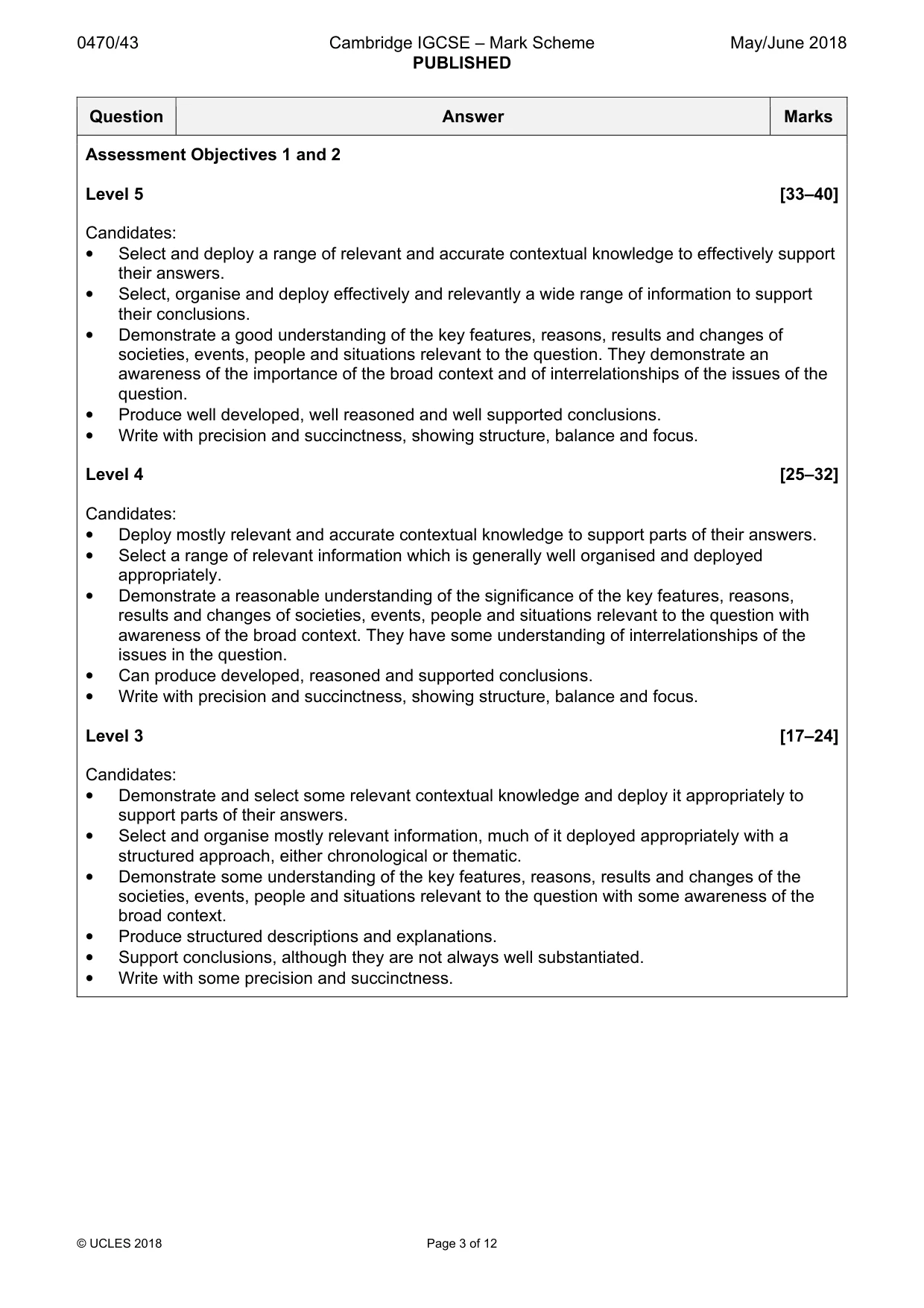
0470/43 Cambridge IGCSE – Mark Scheme PUBLISHED May/June 2018 © UCLES 2018 Page 3 of 12 Question Answer Marks Assessment Objectives 1 and 2 Level 5 [33–40] Candidates: • Select and deploy a range of relevant and accurate contextual knowledge to effectively support their answers. • Select, organise and deploy effectively and relevantly a wide range of information to support their conclusions. • Demonstrate a good understanding of the key features, reasons, results and changes of societies, events, people and situations relevant to the question. They demonstrate an awareness of the importance of the broad context and of interrelationships of the issues of the question. • Produce well developed, well reasoned and well supported conclusions. • Write with precision and succinctness, showing structure, balance and focus. Level 4 [25–32] Candidates: • Deploy mostly relevant and accurate contextual knowledge to support parts of their answers. • Select a range of relevant information which is generally well organised and deployed appropriately. • Demonstrate a reasonable understanding of the significance of the key features, reasons, results and changes of societies, events, people and situations relevant to the question with awareness of the broad context. They have some understanding of interrelationships of the issues in the question. • Can produce developed, reasoned and supported conclusions. • Write with precision and succinctness, showing structure, balance and focus. Level 3 [17–24] Candidates: • Demonstrate and select some relevant contextual knowledge and deploy it appropriately to support parts of their answers. • Select and organise mostly relevant information, much of it deployed appropriately with a structured approach, either chronological or thematic. • Demonstrate some understanding of the key features, reasons, results and changes of the societies, events, people and situations relevant to the question with some awareness of the broad context. • Produce structured descriptions and explanations. • Support conclusions, although they are not always well substantiated. • Write with some precision and succinctness.
Mark scheme, page 4
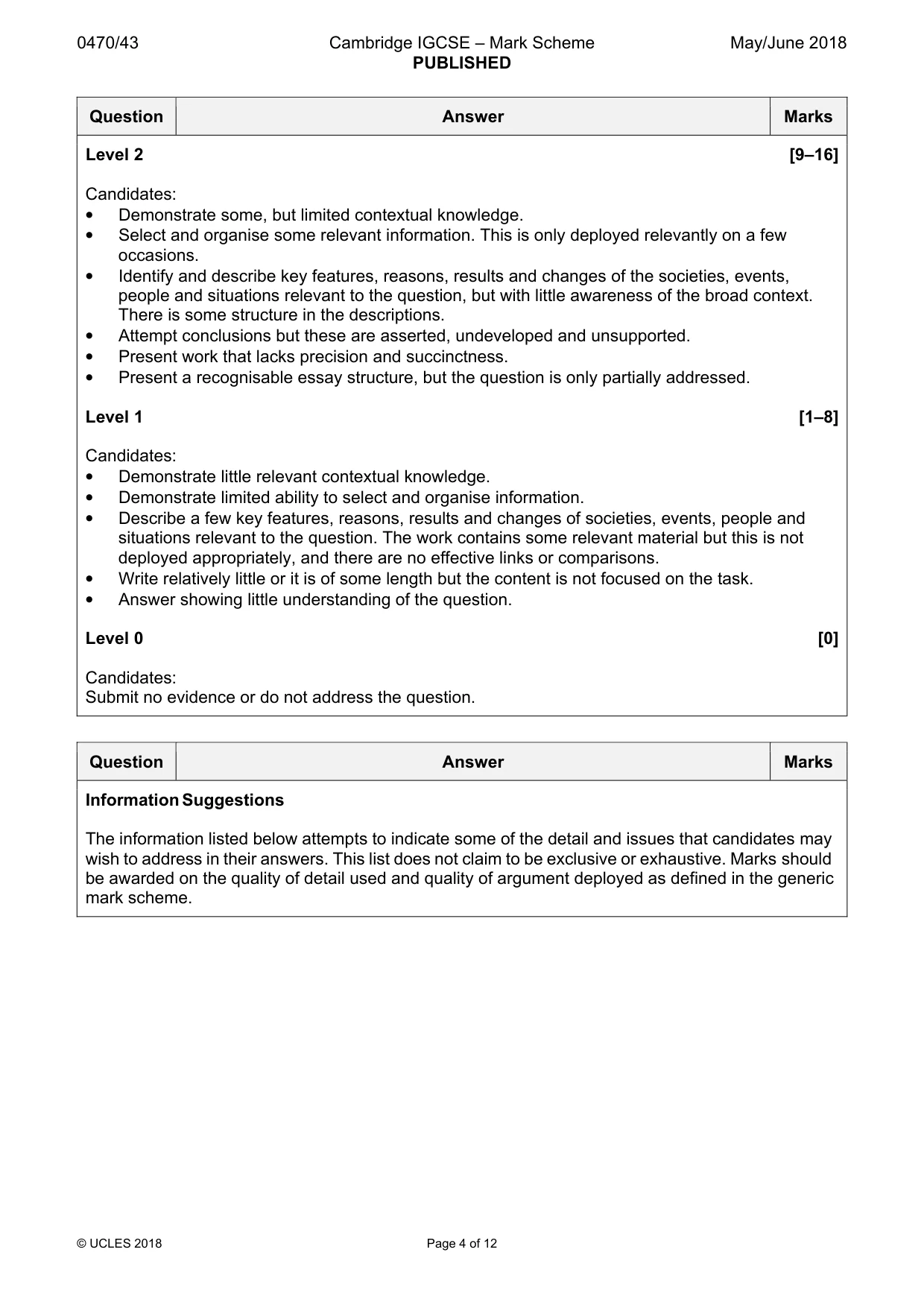
0470/43 Cambridge IGCSE – Mark Scheme PUBLISHED May/June 2018 © UCLES 2018 Page 4 of 12 Question Answer Marks Level 2 [9–16] Candidates: • Demonstrate some, but limited contextual knowledge. • Select and organise some relevant information. This is only deployed relevantly on a few occasions. • Identify and describe key features, reasons, results and changes of the societies, events, people and situations relevant to the question, but with little awareness of the broad context. There is some structure in the descriptions. • Attempt conclusions but these are asserted, undeveloped and unsupported. • Present work that lacks precision and succinctness. • Present a recognisable essay structure, but the question is only partially addressed. Level 1 [1–8] Candidates: • Demonstrate little relevant contextual knowledge. • Demonstrate limited ability to select and organise information. • Describe a few key features, reasons, results and changes of societies, events, people and situations relevant to the question. The work contains some relevant material but this is not deployed appropriately, and there are no effective links or comparisons. • Write relatively little or it is of some length but the content is not focused on the task. • Answer showing little understanding of the question. Level 0 [0] Candidates: Submit no evidence or do not address the question. Question Answer Marks Information Suggestions The information listed below attempts to indicate some of the detail and issues that candidates may wish to address in their answers. This list does not claim to be exclusive or exhaustive. Marks should be awarded on the quality of detail used and quality of argument deployed as defined in the generic mark scheme.
Mark scheme, page 5
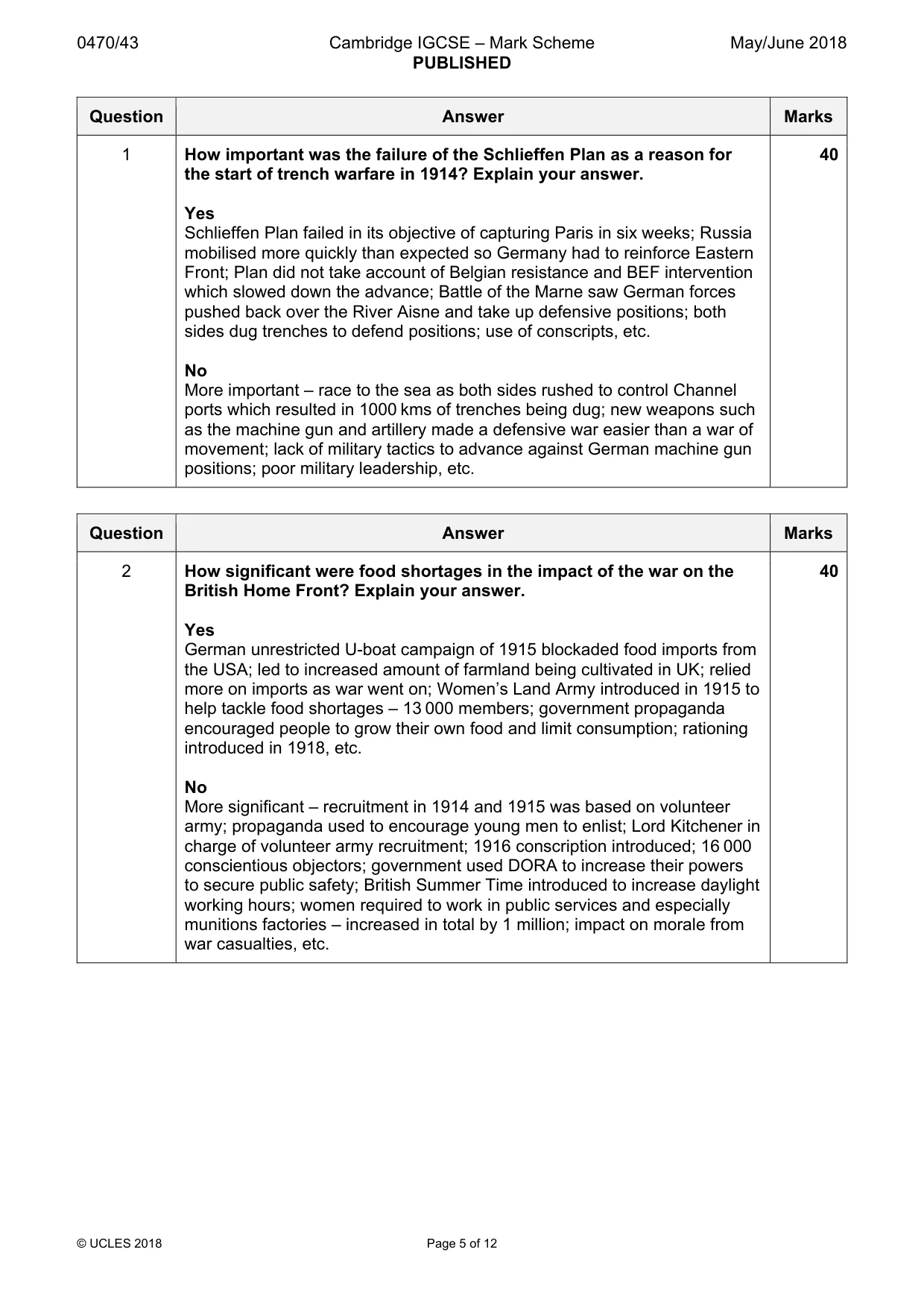
0470/43 Cambridge IGCSE – Mark Scheme PUBLISHED May/June 2018 © UCLES 2018 Page 5 of 12 Question Answer Marks 1 How important was the failure of the Schlieffen Plan as a reason for the start of trench warfare in 1914? Explain your answer. Yes Schlieffen Plan failed in its objective of capturing Paris in six weeks; Russia mobilised more quickly than expected so Germany had to reinforce Eastern Front; Plan did not take account of Belgian resistance and BEF intervention which slowed down the advance; Battle of the Marne saw German forces pushed back over the River Aisne and take up defensive positions; both sides dug trenches to defend positions; use of conscripts, etc. No More important – race to the sea as both sides rushed to control Channel ports which resulted in 1000 kms of trenches being dug; new weapons such as the machine gun and artillery made a defensive war easier than a war of movement; lack of military tactics to advance against German machine gun positions; poor military leadership, etc. 40 Question Answer Marks 2 How significant were food shortages in the impact of the war on the British Home Front? Explain your answer. Yes German unrestricted U-boat campaign of 1915 blockaded food imports from the USA; led to increased amount of farmland being cultivated in UK; relied more on imports as war went on; Women’s Land Army introduced in 1915 to help tackle food shortages – 13 000 members; government propaganda encouraged people to grow their own food and limit consumption; rationing introduced in 1918, etc. No More significant – recruitment in 1914 and 1915 was based on volunteer army; propaganda used to encourage young men to enlist; Lord Kitchener in charge of volunteer army recruitment; 1916 conscription introduced; 16 000 conscientious objectors; government used DORA to increase their powers to secure public safety; British Summer Time introduced to increase daylight working hours; women required to work in public services and especially munitions factories – increased in total by 1 million; impact on morale from war casualties, etc. 40
Mark scheme, page 6
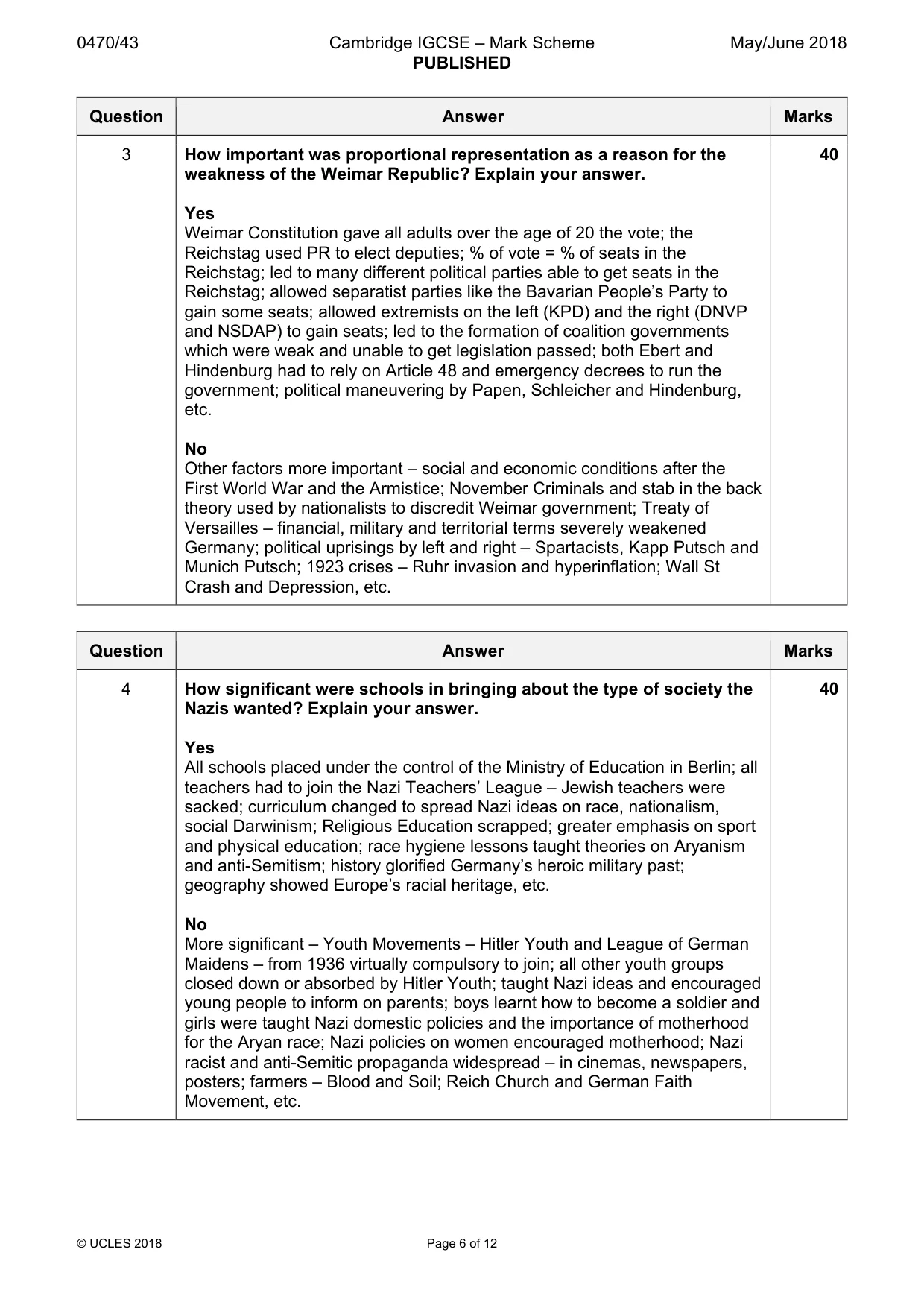
0470/43 Cambridge IGCSE – Mark Scheme PUBLISHED May/June 2018 © UCLES 2018 Page 6 of 12 Question Answer Marks 3 How important was proportional representation as a reason for the weakness of the Weimar Republic? Explain your answer. Yes Weimar Constitution gave all adults over the age of 20 the vote; the Reichstag used PR to elect deputies; % of vote = % of seats in the Reichstag; led to many different political parties able to get seats in the Reichstag; allowed separatist parties like the Bavarian People’s Party to gain some seats; allowed extremists on the left (KPD) and the right (DNVP and NSDAP) to gain seats; led to the formation of coalition governments which were weak and unable to get legislation passed; both Ebert and Hindenburg had to rely on Article 48 and emergency decrees to run the government; political maneuvering by Papen, Schleicher and Hindenburg, etc. No Other factors more important – social and economic conditions after the First World War and the Armistice; November Criminals and stab in the back theory used by nationalists to discredit Weimar government; Treaty of Versailles – financial, military and territorial terms severely weakened Germany; political uprisings by left and right – Spartacists, Kapp Putsch and Munich Putsch; 1923 crises – Ruhr invasion and hyperinflation; Wall St Crash and Depression, etc. 40 Question Answer Marks 4 How significant were schools in bringing about the type of society the Nazis wanted? Explain your answer. Yes All schools placed under the control of the Ministry of Education in Berlin; all teachers had to join the Nazi Teachers’ League – Jewish teachers were sacked; curriculum changed to spread Nazi ideas on race, nationalism, social Darwinism; Religious Education scrapped; greater emphasis on sport and physical education; race hygiene lessons taught theories on Aryanism and anti-Semitism; history glorified Germany’s heroic military past; geography showed Europe’s racial heritage, etc. No More significant – Youth Movements – Hitler Youth and League of German Maidens – from 1936 virtually compulsory to join; all other youth groups closed down or absorbed by Hitler Youth; taught Nazi ideas and encouraged young people to inform on parents; boys learnt how to become a soldier and girls were taught Nazi domestic policies and the importance of motherhood for the Aryan race; Nazi policies on women encouraged motherhood; Nazi racist and anti-Semitic propaganda widespread – in cinemas, newspapers, posters; farmers – Blood and Soil; Reich Church and German Faith Movement, etc. 40
Mark scheme, page 7
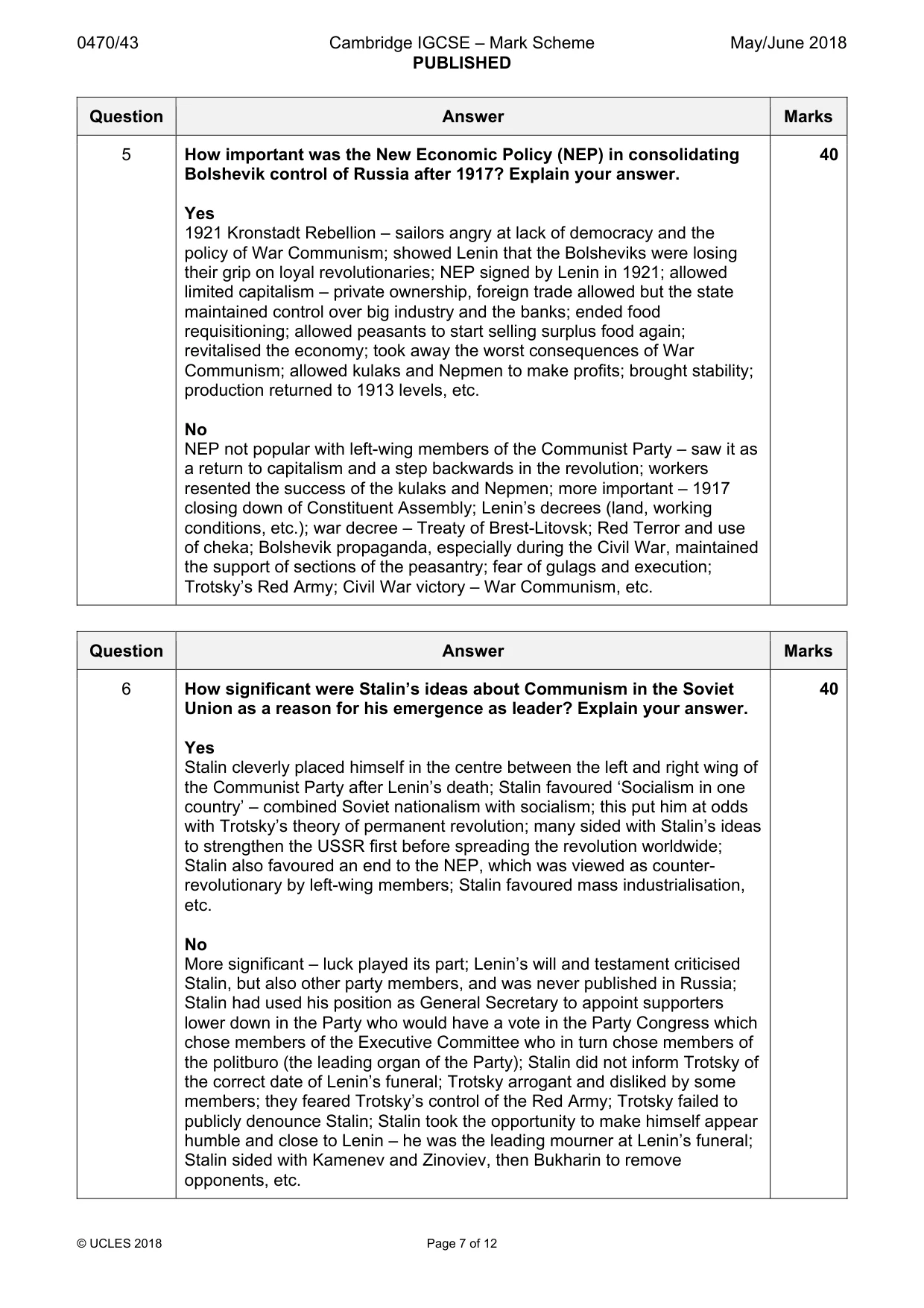
0470/43 Cambridge IGCSE – Mark Scheme PUBLISHED May/June 2018 © UCLES 2018 Page 7 of 12 Question Answer Marks 5 How important was the New Economic Policy (NEP) in consolidating Bolshevik control of Russia after 1917? Explain your answer. Yes 1921 Kronstadt Rebellion – sailors angry at lack of democracy and the policy of War Communism; showed Lenin that the Bolsheviks were losing their grip on loyal revolutionaries; NEP signed by Lenin in 1921; allowed limited capitalism – private ownership, foreign trade allowed but the state maintained control over big industry and the banks; ended food requisitioning; allowed peasants to start selling surplus food again; revitalised the economy; took away the worst consequences of War Communism; allowed kulaks and Nepmen to make profits; brought stability; production returned to 1913 levels, etc. No NEP not popular with left-wing members of the Communist Party – saw it as a return to capitalism and a step backwards in the revolution; workers resented the success of the kulaks and Nepmen; more important – 1917 closing down of Constituent Assembly; Lenin’s decrees (land, working conditions, etc.); war decree – Treaty of Brest-Litovsk; Red Terror and use of cheka; Bolshevik propaganda, especially during the Civil War, maintained the support of sections of the peasantry; fear of gulags and execution; Trotsky’s Red Army; Civil War victory – War Communism, etc. 40 Question Answer Marks 6 How significant were Stalin’s ideas about Communism in the Soviet Union as a reason for his emergence as leader? Explain your answer. Yes Stalin cleverly placed himself in the centre between the left and right wing of the Communist Party after Lenin’s death; Stalin favoured ‘Socialism in one country’ – combined Soviet nationalism with socialism; this put him at odds with Trotsky’s theory of permanent revolution; many sided with Stalin’s ideas to strengthen the USSR first before spreading the revolution worldwide; Stalin also favoured an end to the NEP, which was viewed as counter- revolutionary by left-wing members; Stalin favoured mass industrialisation, etc. No More significant – luck played its part; Lenin’s will and testament criticised Stalin, but also other party members, and was never published in Russia; Stalin had used his position as General Secretary to appoint supporters lower down in the Party who would have a vote in the Party Congress which chose members of the Executive Committee who in turn chose members of the politburo (the leading organ of the Party); Stalin did not inform Trotsky of the correct date of Lenin’s funeral; Trotsky arrogant and disliked by some members; they feared Trotsky’s control of the Red Army; Trotsky failed to publicly denounce Stalin; Stalin took the opportunity to make himself appear humble and close to Lenin – he was the leading mourner at Lenin’s funeral; Stalin sided with Kamenev and Zinoviev, then Bukharin to remove opponents, etc. 40
Mark scheme, page 8
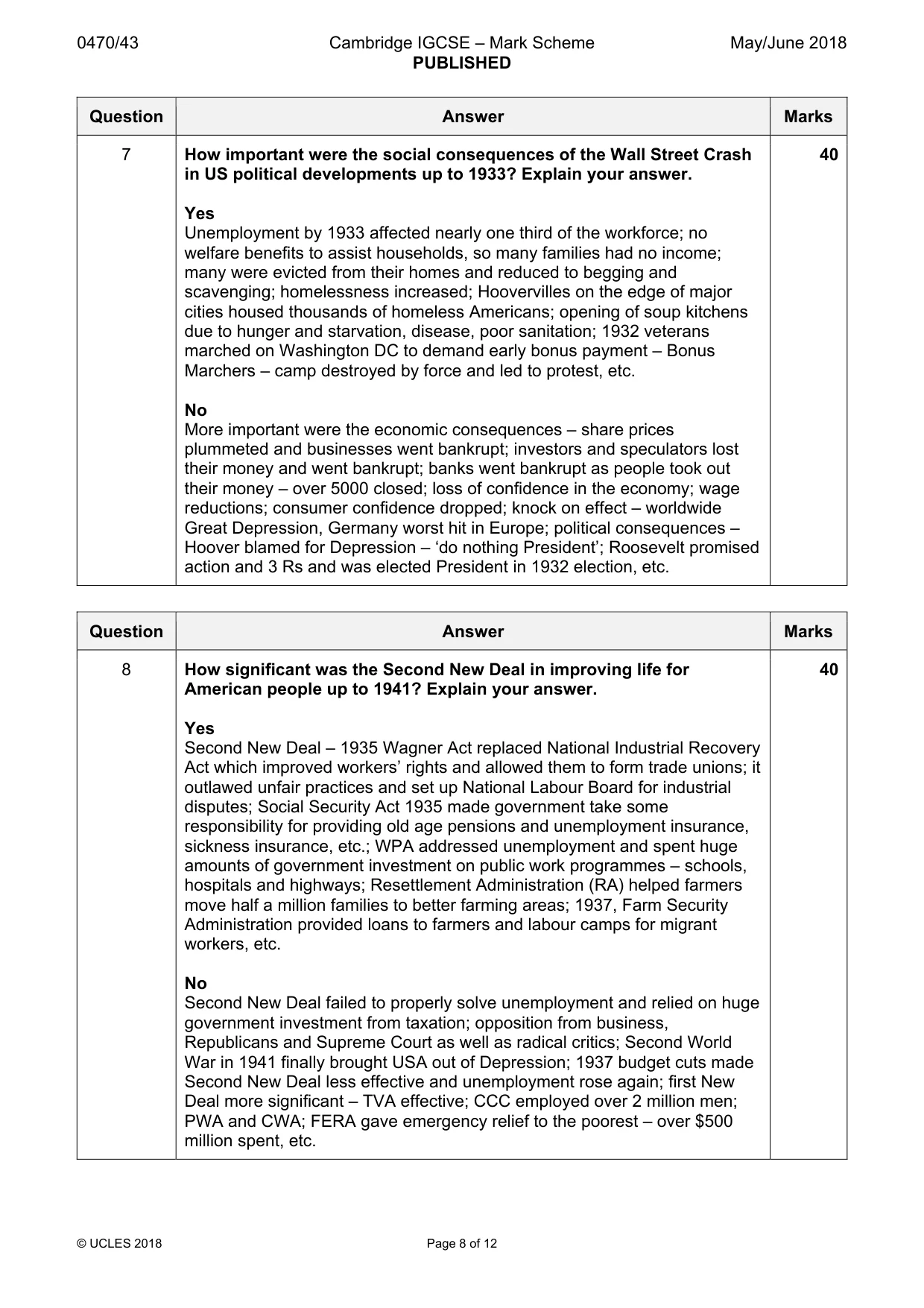
0470/43 Cambridge IGCSE – Mark Scheme PUBLISHED May/June 2018 © UCLES 2018 Page 8 of 12 Question Answer Marks 7 How important were the social consequences of the Wall Street Crash in US political developments up to 1933? Explain your answer. Yes Unemployment by 1933 affected nearly one third of the workforce; no welfare benefits to assist households, so many families had no income; many were evicted from their homes and reduced to begging and scavenging; homelessness increased; Hoovervilles on the edge of major cities housed thousands of homeless Americans; opening of soup kitchens due to hunger and starvation, disease, poor sanitation; 1932 veterans marched on Washington DC to demand early bonus payment – Bonus Marchers – camp destroyed by force and led to protest, etc. No More important were the economic consequences – share prices plummeted and businesses went bankrupt; investors and speculators lost their money and went bankrupt; banks went bankrupt as people took out their money – over 5000 closed; loss of confidence in the economy; wage reductions; consumer confidence dropped; knock on effect – worldwide Great Depression, Germany worst hit in Europe; political consequences – Hoover blamed for Depression – ‘do nothing President’; Roosevelt promised action and 3 Rs and was elected President in 1932 election, etc. 40 Question Answer Marks 8 How significant was the Second New Deal in improving life for American people up to 1941? Explain your answer. Yes Second New Deal – 1935 Wagner Act replaced National Industrial Recovery Act which improved workers’ rights and allowed them to form trade unions; it outlawed unfair practices and set up National Labour Board for industrial disputes; Social Security Act 1935 made government take some responsibility for providing old age pensions and unemployment insurance, sickness insurance, etc.; WPA addressed unemployment and spent huge amounts of government investment on public work programmes – schools, hospitals and highways; Resettlement Administration (RA) helped farmers move half a million families to better farming areas; 1937, Farm Security Administration provided loans to farmers and labour camps for migrant workers, etc. No Second New Deal failed to properly solve unemployment and relied on huge government investment from taxation; opposition from business, Republicans and Supreme Court as well as radical critics; Second World War in 1941 finally brought USA out of Depression; 1937 budget cuts made Second New Deal less effective and unemployment rose again; first New Deal more significant – TVA effective; CCC employed over 2 million men; PWA and CWA; FERA gave emergency relief to the poorest – over $500 million spent, etc. 40
Mark scheme, page 9
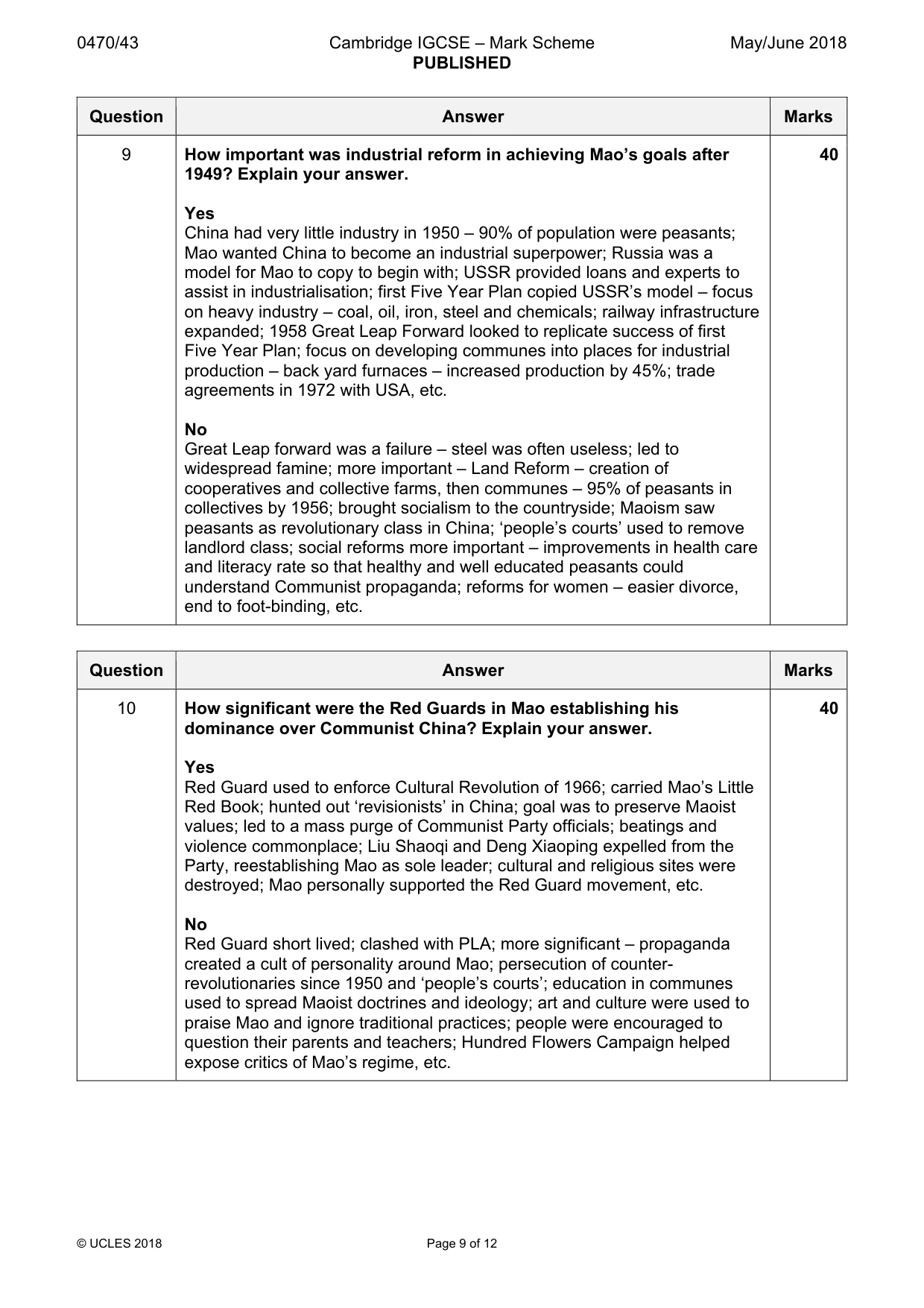
0470/43 Cambridge IGCSE – Mark Scheme PUBLISHED May/June 2018 © UCLES 2018 Page 9 of 12 Question Answer Marks 9 How important was industrial reform in achieving Mao’s goals after 1949? Explain your answer. Yes China had very little industry in 1950 – 90% of population were peasants; Mao wanted China to become an industrial superpower; Russia was a model for Mao to copy to begin with; USSR provided loans and experts to assist in industrialisation; first Five Year Plan copied USSR’s model – focus on heavy industry – coal, oil, iron, steel and chemicals; railway infrastructure expanded; 1958 Great Leap Forward looked to replicate success of first Five Year Plan; focus on developing communes into places for industrial production – back yard furnaces – increased production by 45%; trade agreements in 1972 with USA, etc. No Great Leap forward was a failure – steel was often useless; led to widespread famine; more important – Land Reform – creation of cooperatives and collective farms, then communes – 95% of peasants in collectives by 1956; brought socialism to the countryside; Maoism saw peasants as revolutionary class in China; ‘people’s courts’ used to remove landlord class; social reforms more important – improvements in health care and literacy rate so that healthy and well educated peasants could understand Communist propaganda; reforms for women – easier divorce, end to foot-binding, etc. 40 Question Answer Marks 10 How significant were the Red Guards in Mao establishing his dominance over Communist China? Explain your answer. Yes Red Guard used to enforce Cultural Revolution of 1966; carried Mao’s Little Red Book; hunted out ‘revisionists’ in China; goal was to preserve Maoist values; led to a mass purge of Communist Party officials; beatings and violence commonplace; Liu Shaoqi and Deng Xiaoping expelled from the Party, reestablishing Mao as sole leader; cultural and religious sites were destroyed; Mao personally supported the Red Guard movement, etc. No Red Guard short lived; clashed with PLA; more significant – propaganda created a cult of personality around Mao; persecution of counter- revolutionaries since 1950 and ‘people’s courts’; education in communes used to spread Maoist doctrines and ideology; art and culture were used to praise Mao and ignore traditional practices; people were encouraged to question their parents and teachers; Hundred Flowers Campaign helped expose critics of Mao’s regime, etc. 40
Mark scheme, page 10
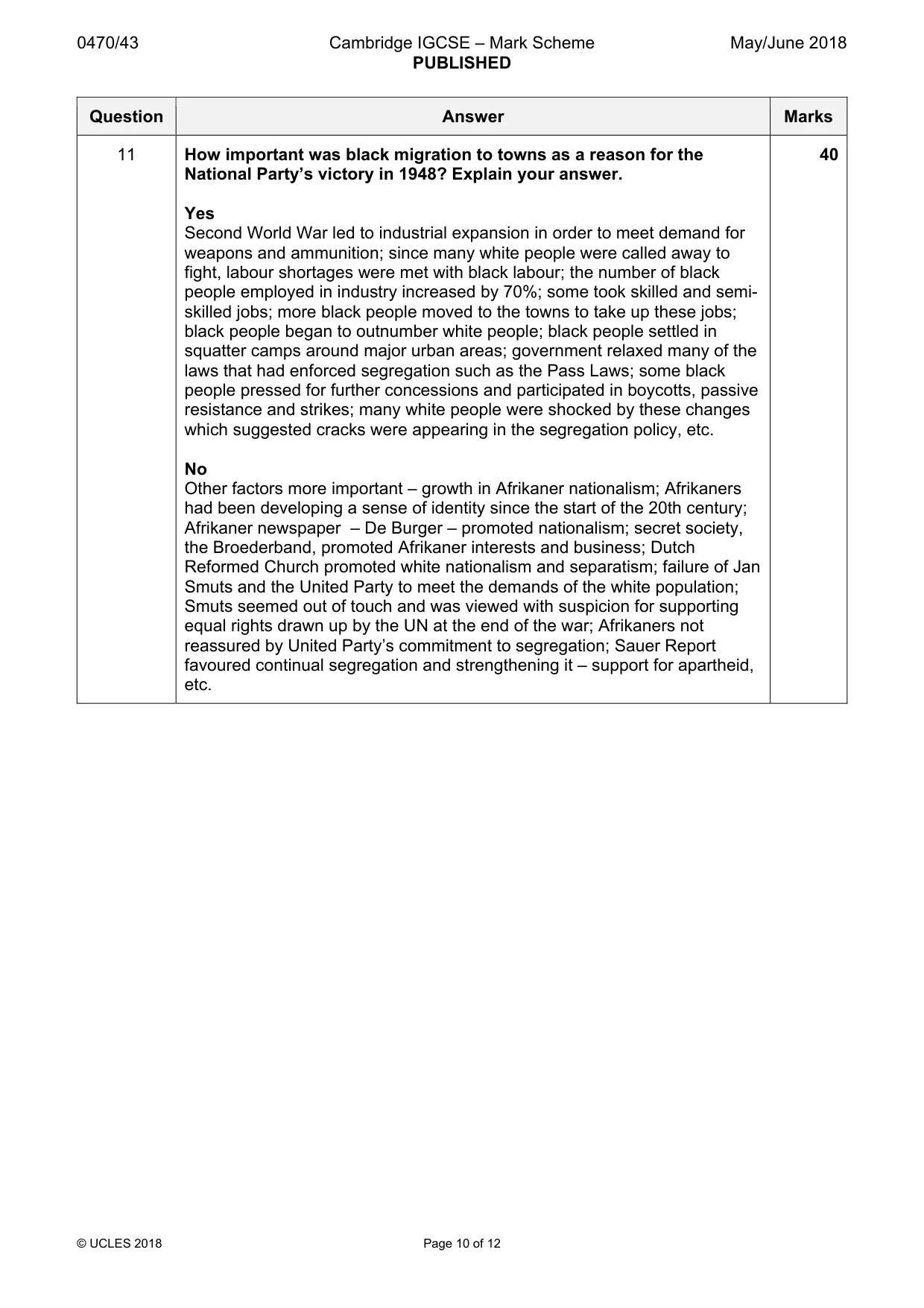
0470/43 Cambridge IGCSE – Mark Scheme PUBLISHED May/June 2018 © UCLES 2018 Page 10 of 12 Question Answer Marks 11 How important was black migration to towns as a reason for the National Party’s victory in 1948? Explain your answer. Yes Second World War led to industrial expansion in order to meet demand for weapons and ammunition; since many white people were called away to fight, labour shortages were met with black labour; the number of black people employed in industry increased by 70%; some took skilled and semi- skilled jobs; more black people moved to the towns to take up these jobs; black people began to outnumber white people; black people settled in squatter camps around major urban areas; government relaxed many of the laws that had enforced segregation such as the Pass Laws; some black people pressed for further concessions and participated in boycotts, passive resistance and strikes; many white people were shocked by these changes which suggested cracks were appearing in the segregation policy, etc. No Other factors more important – growth in Afrikaner nationalism; Afrikaners had been developing a sense of identity since the start of the 20th century; Afrikaner newspaper – De Burger – promoted nationalism; secret society, the Broederband, promoted Afrikaner interests and business; Dutch Reformed Church promoted white nationalism and separatism; failure of Jan Smuts and the United Party to meet the demands of the white population; Smuts seemed out of touch and was viewed with suspicion for supporting equal rights drawn up by the UN at the end of the war; Afrikaners not reassured by United Party’s commitment to segregation; Sauer Report favoured continual segregation and strengthening it – support for apartheid, etc. 40
Mark scheme, page 11
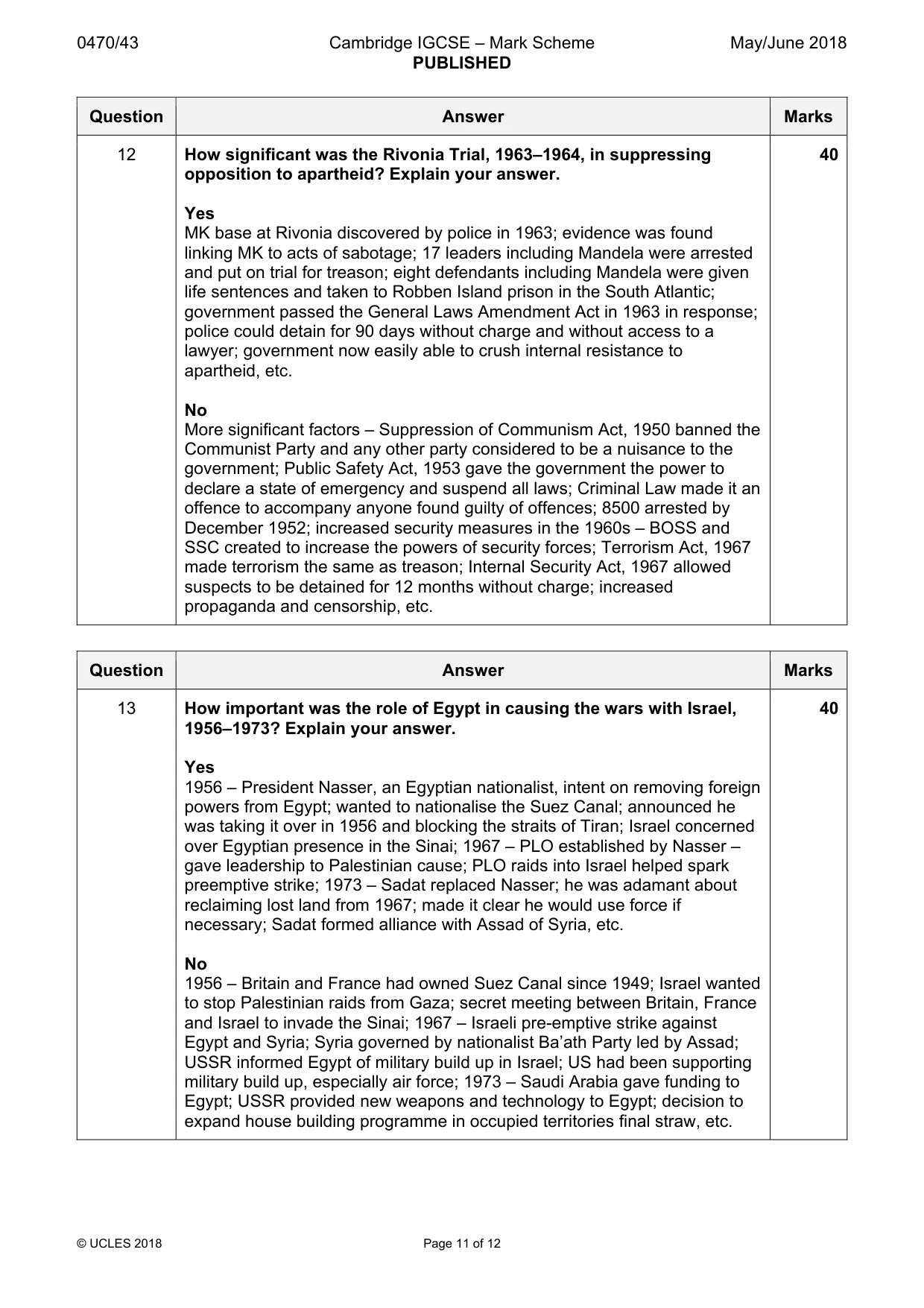
0470/43 Cambridge IGCSE – Mark Scheme PUBLISHED May/June 2018 © UCLES 2018 Page 11 of 12 Question Answer Marks 12 How significant was the Rivonia Trial, 1963–1964, in suppressing opposition to apartheid? Explain your answer. Yes MK base at Rivonia discovered by police in 1963; evidence was found linking MK to acts of sabotage; 17 leaders including Mandela were arrested and put on trial for treason; eight defendants including Mandela were given life sentences and taken to Robben Island prison in the South Atlantic; government passed the General Laws Amendment Act in 1963 in response; police could detain for 90 days without charge and without access to a lawyer; government now easily able to crush internal resistance to apartheid, etc. No More significant factors – Suppression of Communism Act, 1950 banned the Communist Party and any other party considered to be a nuisance to the government; Public Safety Act, 1953 gave the government the power to declare a state of emergency and suspend all laws; Criminal Law made it an offence to accompany anyone found guilty of offences; 8500 arrested by December 1952; increased security measures in the 1960s – BOSS and SSC created to increase the powers of security forces; Terrorism Act, 1967 made terrorism the same as treason; Internal Security Act, 1967 allowed suspects to be detained for 12 months without charge; increased propaganda and censorship, etc. 40 Question Answer Marks 13 How important was the role of Egypt in causing the wars with Israel, 1956–1973? Explain your answer. Yes 1956 – President Nasser, an Egyptian nationalist, intent on removing foreign powers from Egypt; wanted to nationalise the Suez Canal; announced he was taking it over in 1956 and blocking the straits of Tiran; Israel concerned over Egyptian presence in the Sinai; 1967 – PLO established by Nasser – gave leadership to Palestinian cause; PLO raids into Israel helped spark preemptive strike; 1973 – Sadat replaced Nasser; he was adamant about reclaiming lost land from 1967; made it clear he would use force if necessary; Sadat formed alliance with Assad of Syria, etc. No 1956 – Britain and France had owned Suez Canal since 1949; Israel wanted to stop Palestinian raids from Gaza; secret meeting between Britain, France and Israel to invade the Sinai; 1967 – Israeli pre-emptive strike against Egypt and Syria; Syria governed by nationalist Ba’ath Party led by Assad; USSR informed Egypt of military build up in Israel; US had been supporting military build up, especially air force; 1973 – Saudi Arabia gave funding to Egypt; USSR provided new weapons and technology to Egypt; decision to expand house building programme in occupied territories final straw, etc. 40
Mark scheme, page 12
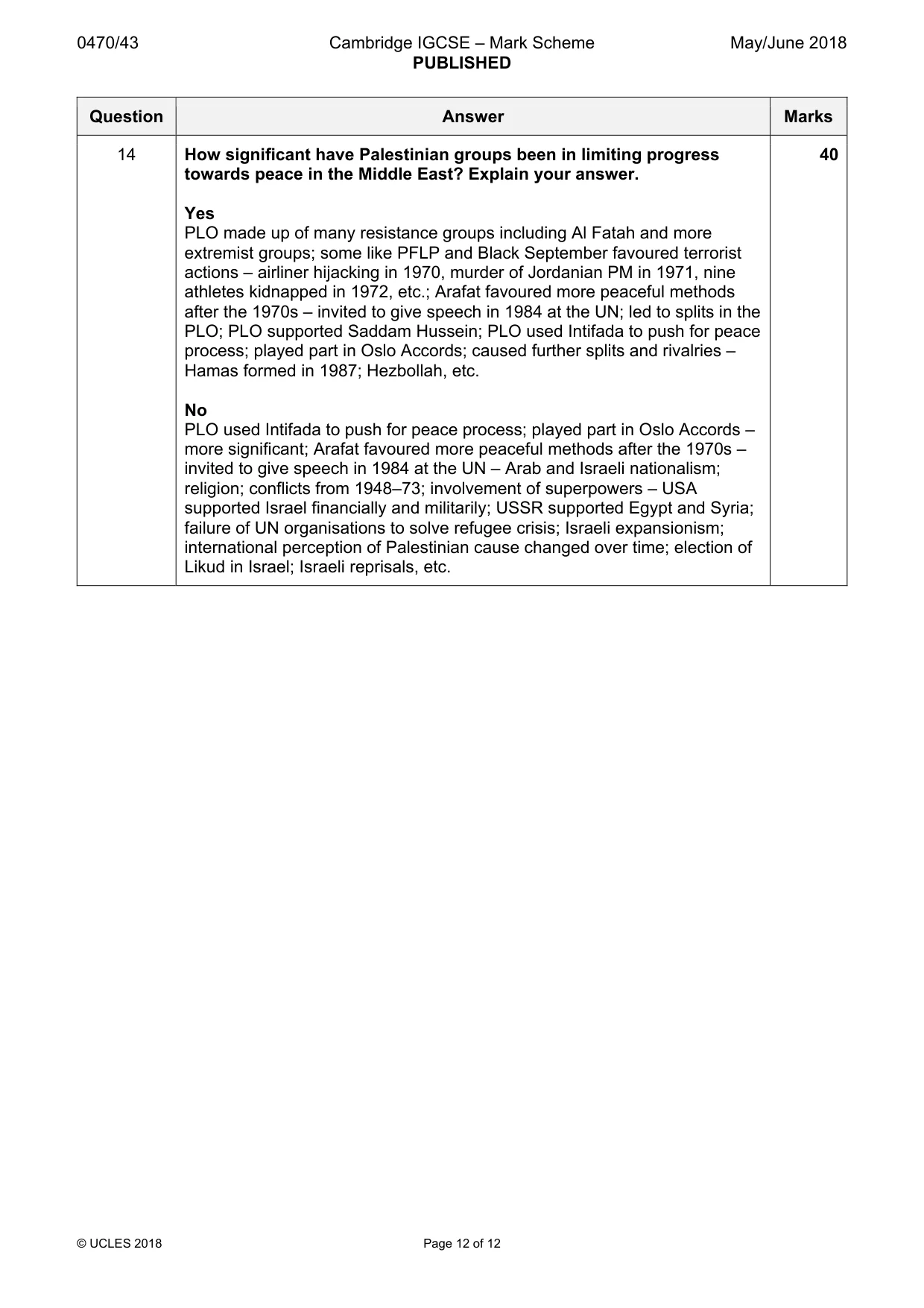
0470/43 Cambridge IGCSE – Mark Scheme PUBLISHED May/June 2018 © UCLES 2018 Page 12 of 12 Question Answer Marks 14 How significant have Palestinian groups been in limiting progress towards peace in the Middle East? Explain your answer. Yes PLO made up of many resistance groups including Al Fatah and more extremist groups; some like PFLP and Black September favoured terrorist actions – airliner hijacking in 1970, murder of Jordanian PM in 1971, nine athletes kidnapped in 1972, etc.; Arafat favoured more peaceful methods after the 1970s – invited to give speech in 1984 at the UN; led to splits in the PLO; PLO supported Saddam Hussein; PLO used Intifada to push for peace process; played part in Oslo Accords; caused further splits and rivalries – Hamas formed in 1987; Hezbollah, etc. No PLO used Intifada to push for peace process; played part in Oslo Accords – more significant; Arafat favoured more peaceful methods after the 1970s – invited to give speech in 1984 at the UN – Arab and Israeli nationalism; religion; conflicts from 1948–73; involvement of superpowers – USA supported Israel financially and militarily; USSR supported Egypt and Syria; failure of UN organisations to solve refugee crisis; Israeli expansionism; international perception of Palestinian cause changed over time; election of Likud in Israel; Israeli reprisals, etc. 40
What you needed in this session
Cambridge’s own grade thresholds for 2018 May/June, Paper 4 · Variant 3. A higher threshold means an easier paper — the bar moves with how the cohort did.