Cambridge IGCSE History 0470 — 2018 May/June Paper 4 · Variant 2
0470/42/M/J/18 · 40 marks · ≈45 min
The question paper and its mark scheme, free to read here and free to download. This is Cambridge’s own paper, exactly as it was sat.
Question paper4 pages

Mark scheme11 pages
Answers below. Sit the paper first if you are practising.
Paper as text
Question paper, page 1
Cambridge International Examinations Cambridge International General Certificate of Secondary Education 0470/42 May/June 2018 1 hour HISTORY Paper 4 Alternative to Coursework Additional Materials: Answer Booklet/Paper READ THESE INSTRUCTIONS FIRST An answer booklet is provided inside this question paper. You should follow the instructions on the front cover of the answer booklet. If you need additional answer paper ask the invigilator for a continuation booklet. Answer one question from your chosen Depth Study. The number of marks is given in brackets [ ] at the end of each question or part question. This syllabus is approved for use in England, Wales and Northern Ireland as a Cambridge International Level 1/Level 2 Certificate. This document consists of 3 printed pages and 1 blank page. [Turn over 06_0470_42_2018_1.13 © UCLES 2018 *8460075611*
Question paper, page 2
Answer one question from your chosen Depth Study. DEPTH STUDY A: THE FIRST WORLD WAR, 1914–1918 How important was the use of artillery in the development of stalemate on the Western Front? Explain your answer. [40] 1 How significant was the impact of the German U-boat campaign on civilian life in Britain? Explain your answer. [40] 2 DEPTH STUDY B: GERMANY, 1918–1945 How important were weaknesses in the Weimar Constitution in causing Germany’s problems, 1919–1933? Explain your answer. [40] 3 How significant was Mein Kampf (published 1925–1926) in helping Hitler win support during the 1920s? Explain your answer. [40] 4 DEPTH STUDY C: RUSSIA, 1905–1941 How important were the July Days in the downfall of the Provisional Government? Explain your answer. [40] 5 How significant were the Five-Year Plans in maintaining Stalin’s dictatorship? Explain your answer. [40] 6 DEPTH STUDY D: THE USA, 1919–1941 How important were new industries in causing growth in the US economy in the 1920s? Explain your answer. [40] 7 How significant was racial intolerance in changing the nature of US society in the 1920s? Explain your answer. [40] 8 DEPTH STUDY E: CHINA, c.1930–c.1990 How important was the Long March in increasing Communist support in the period to 1945? Explain your answer. [40] 9 How significant was Communist China’s relationship with the Soviet Union in its economic development during the 1950s? Explain your answer. [40] 10 06_0470_42_2018_1.13 © UCLES 2018 2
Question paper, page 3
DEPTH STUDY F: SOUTH AFRICA, c.1940–c.1994 How important was government legislation in white minority control of South Africa between 1966 and 1980? Explain your answer. [40] 11 How significant were political reforms in ending the apartheid regime? Explain your answer. [40] 12 DEPTH STUDY G: ISRAELIS AND PALESTINIANS SINCE 1945 How important was external support for Israel in determining the outcome of the 1948–1949 war? Explain your answer. [40] 13 How significant was the refugee crisis in causing the hostility between Israel and its neighbours? Explain your answer. [40] 14 06_0470_42_2018_1.13 © UCLES 2018 3
Question paper, page 4
BLANK PAGE Permission to reproduce items where third-party owned material protected by copyright is included has been sought and cleared where possible. Every reasonable effort has been made by the publisher (UCLES) to trace copyright holders, but if any items requiring clearance have unwittingly been included, the publisher will be pleased to make amends at the earliest possible opportunity. To avoid the issue of disclosure of answer-related information to candidates, all copyright acknowledgements are reproduced online in the Cambridge International Examinations Copyright Acknowledgements Booklet. This is produced for each series of examinations and is freely available to download at www.cie.org.uk after the live examination series. Cambridge International Examinations is part of the Cambridge Assessment Group. Cambridge Assessment is the brand name of University of Cambridge Local Examinations Syndicate (UCLES), which is itself a department of the University of Cambridge. 06_0470_42_2018_1.13 © UCLES 2018 4
Mark scheme, page 1
IGCSE™ is a registered trademark. This syllabus is approved for use in England, Wales and Northern Ireland as a Cambridge International Level 1/Level 2 Certificate. This document consists of 11 printed pages. © UCLES 2018 [Turn over Cambridge Assessment International Education Cambridge International General Certificate of Secondary Education HISTORY 0470/42 Paper 4 Alternative to Coursework May/June 2018 MARK SCHEME Maximum Mark: 40 Published This mark scheme is published as an aid to teachers and candidates, to indicate the requirements of the examination. It shows the basis on which Examiners were instructed to award marks. It does not indicate the details of the discussions that took place at an Examiners’ meeting before marking began, which would have considered the acceptability of alternative answers. Mark schemes should be read in conjunction with the question paper and the Principal Examiner Report for Teachers. Cambridge International will not enter into discussions about these mark schemes. Cambridge International is publishing the mark schemes for the May/June 2018 series for most Cambridge IGCSE™, Cambridge International A and AS Level and Cambridge Pre-U components, and some Cambridge O Level components.
Mark scheme, page 2
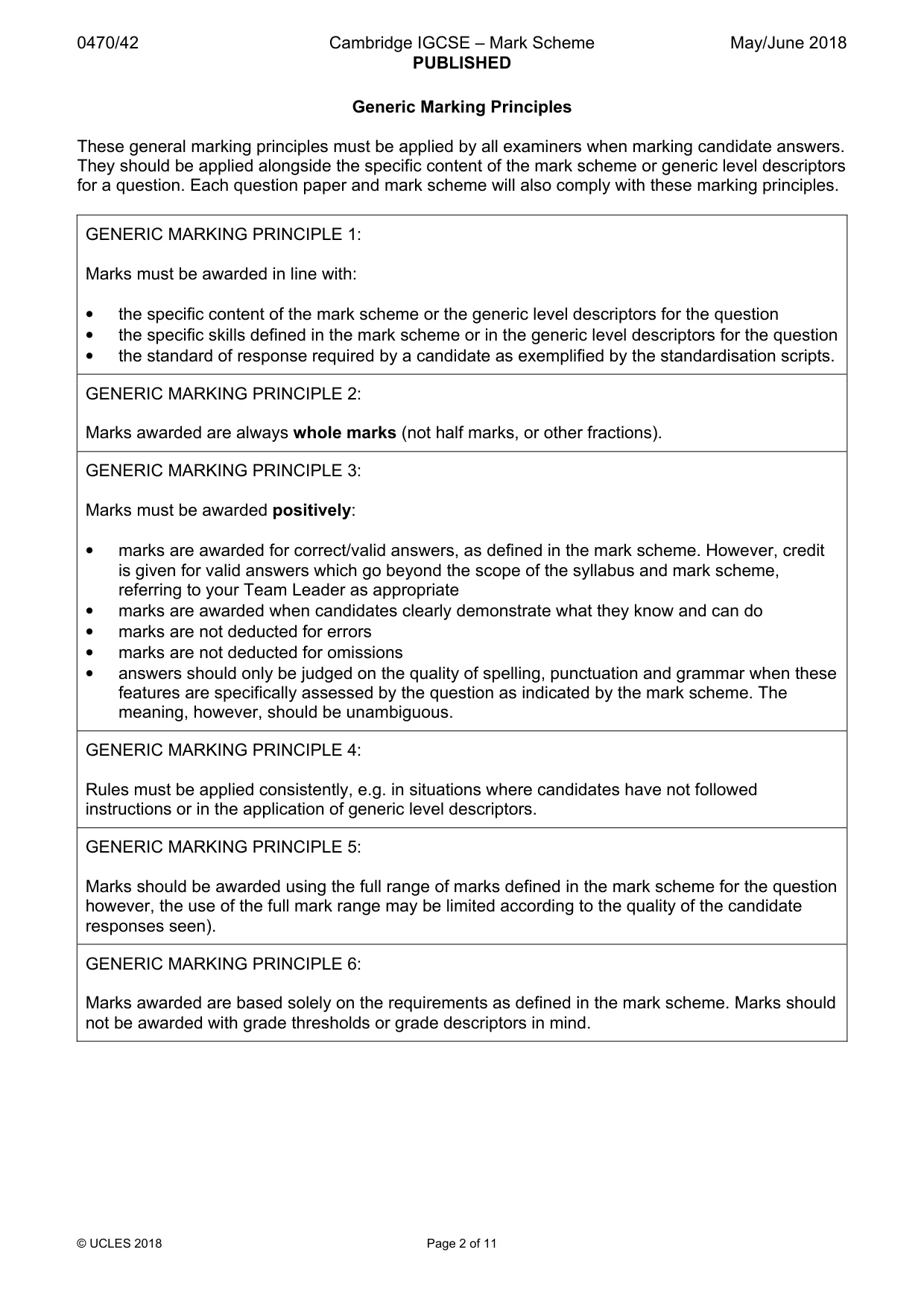
0470/42 Cambridge IGCSE – Mark Scheme PUBLISHED May/June 2018 © UCLES 2018 Page 2 of 11 Generic Marking Principles These general marking principles must be applied by all examiners when marking candidate answers. They should be applied alongside the specific content of the mark scheme or generic level descriptors for a question. Each question paper and mark scheme will also comply with these marking principles. GENERIC MARKING PRINCIPLE 1: Marks must be awarded in line with: • the specific content of the mark scheme or the generic level descriptors for the question • the specific skills defined in the mark scheme or in the generic level descriptors for the question • the standard of response required by a candidate as exemplified by the standardisation scripts. GENERIC MARKING PRINCIPLE 2: Marks awarded are always whole marks (not half marks, or other fractions). GENERIC MARKING PRINCIPLE 3: Marks must be awarded positively: • marks are awarded for correct/valid answers, as defined in the mark scheme. However, credit is given for valid answers which go beyond the scope of the syllabus and mark scheme, referring to your Team Leader as appropriate • marks are awarded when candidates clearly demonstrate what they know and can do • marks are not deducted for errors • marks are not deducted for omissions • answers should only be judged on the quality of spelling, punctuation and grammar when these features are specifically assessed by the question as indicated by the mark scheme. The meaning, however, should be unambiguous. GENERIC MARKING PRINCIPLE 4: Rules must be applied consistently, e.g. in situations where candidates have not followed instructions or in the application of generic level descriptors. GENERIC MARKING PRINCIPLE 5: Marks should be awarded using the full range of marks defined in the mark scheme for the question however, the use of the full mark range may be limited according to the quality of the candidate responses seen). GENERIC MARKING PRINCIPLE 6: Marks awarded are based solely on the requirements as defined in the mark scheme. Marks should not be awarded with grade thresholds or grade descriptors in mind.
Mark scheme, page 3
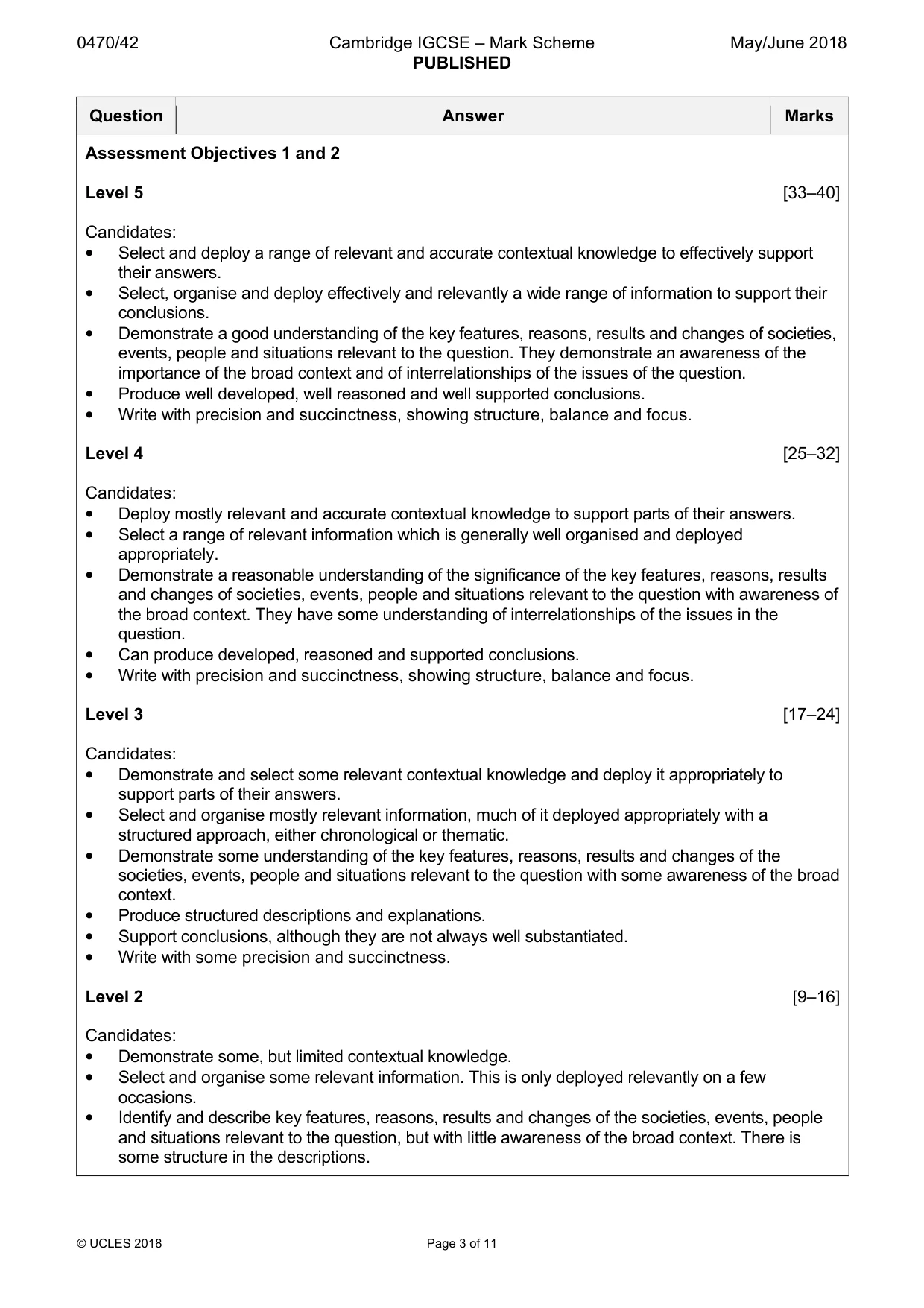
0470/42 Cambridge IGCSE – Mark Scheme PUBLISHED May/June 2018 © UCLES 2018 Page 3 of 11 Question Answer Marks Assessment Objectives 1 and 2 Level 5 [33–40] Candidates: • Select and deploy a range of relevant and accurate contextual knowledge to effectively support their answers. • Select, organise and deploy effectively and relevantly a wide range of information to support their conclusions. • Demonstrate a good understanding of the key features, reasons, results and changes of societies, events, people and situations relevant to the question. They demonstrate an awareness of the importance of the broad context and of interrelationships of the issues of the question. • Produce well developed, well reasoned and well supported conclusions. • Write with precision and succinctness, showing structure, balance and focus. Level 4 [25–32] Candidates: • Deploy mostly relevant and accurate contextual knowledge to support parts of their answers. • Select a range of relevant information which is generally well organised and deployed appropriately. • Demonstrate a reasonable understanding of the significance of the key features, reasons, results and changes of societies, events, people and situations relevant to the question with awareness of the broad context. They have some understanding of interrelationships of the issues in the question. • Can produce developed, reasoned and supported conclusions. • Write with precision and succinctness, showing structure, balance and focus. Level 3 [17–24] Candidates: • Demonstrate and select some relevant contextual knowledge and deploy it appropriately to support parts of their answers. • Select and organise mostly relevant information, much of it deployed appropriately with a structured approach, either chronological or thematic. • Demonstrate some understanding of the key features, reasons, results and changes of the societies, events, people and situations relevant to the question with some awareness of the broad context. • Produce structured descriptions and explanations. • Support conclusions, although they are not always well substantiated. • Write with some precision and succinctness. Level 2 [9–16] Candidates: • Demonstrate some, but limited contextual knowledge. • Select and organise some relevant information. This is only deployed relevantly on a few occasions. • Identify and describe key features, reasons, results and changes of the societies, events, people and situations relevant to the question, but with little awareness of the broad context. There is some structure in the descriptions.
Mark scheme, page 4
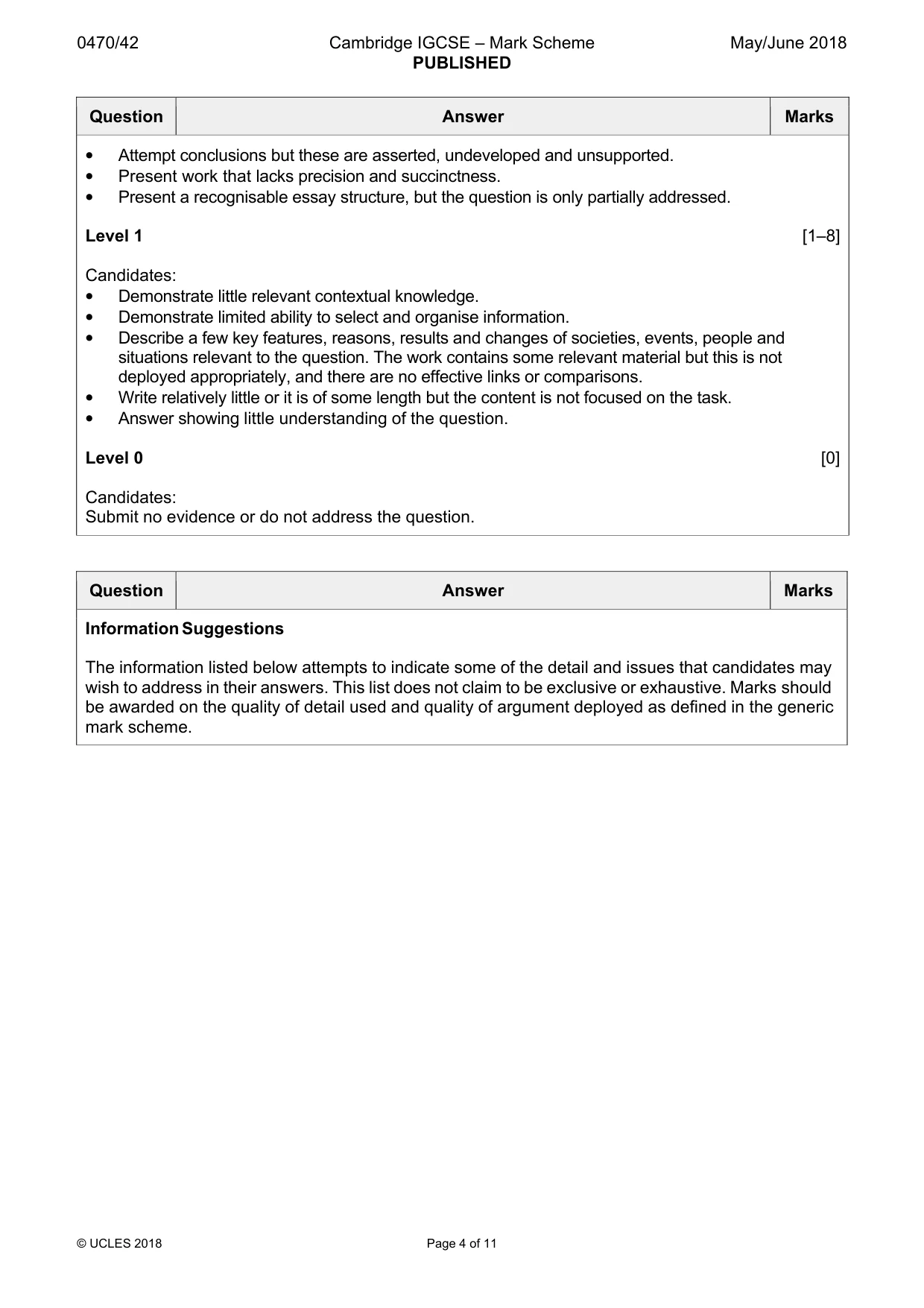
0470/42 Cambridge IGCSE – Mark Scheme PUBLISHED May/June 2018 © UCLES 2018 Page 4 of 11 Question Answer Marks • Attempt conclusions but these are asserted, undeveloped and unsupported. • Present work that lacks precision and succinctness. • Present a recognisable essay structure, but the question is only partially addressed. Level 1 [1–8] Candidates: • Demonstrate little relevant contextual knowledge. • Demonstrate limited ability to select and organise information. • Describe a few key features, reasons, results and changes of societies, events, people and situations relevant to the question. The work contains some relevant material but this is not deployed appropriately, and there are no effective links or comparisons. • Write relatively little or it is of some length but the content is not focused on the task. • Answer showing little understanding of the question. Level 0 [0] Candidates: Submit no evidence or do not address the question. Question Answer Marks Information Suggestions The information listed below attempts to indicate some of the detail and issues that candidates may wish to address in their answers. This list does not claim to be exclusive or exhaustive. Marks should be awarded on the quality of detail used and quality of argument deployed as defined in the generic mark scheme.
Mark scheme, page 5
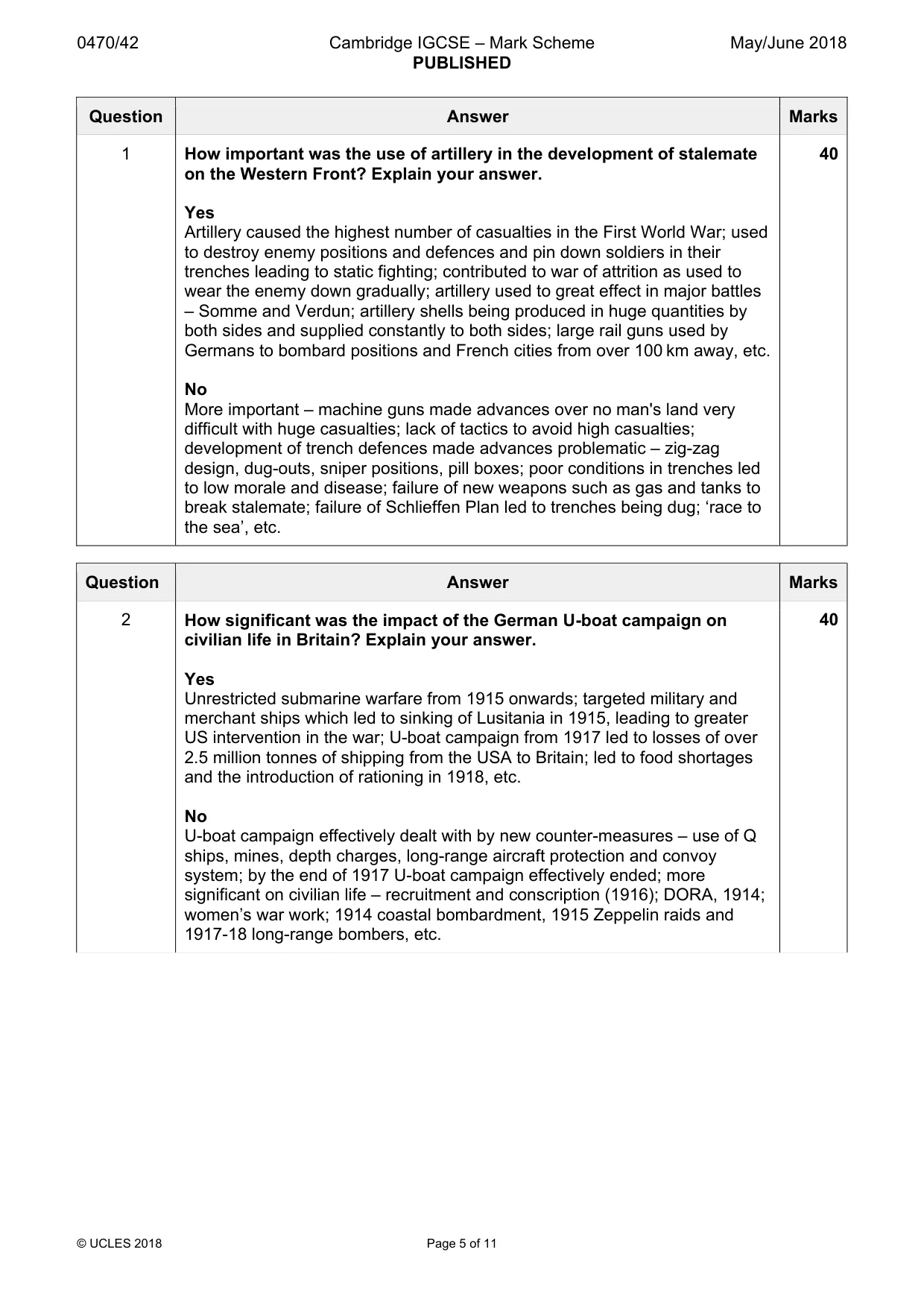
0470/42 Cambridge IGCSE – Mark Scheme PUBLISHED May/June 2018 © UCLES 2018 Page 5 of 11 Question Answer Marks 1 How important was the use of artillery in the development of stalemate on the Western Front? Explain your answer. Yes Artillery caused the highest number of casualties in the First World War; used to destroy enemy positions and defences and pin down soldiers in their trenches leading to static fighting; contributed to war of attrition as used to wear the enemy down gradually; artillery used to great effect in major battles – Somme and Verdun; artillery shells being produced in huge quantities by both sides and supplied constantly to both sides; large rail guns used by Germans to bombard positions and French cities from over 100 km away, etc. No More important – machine guns made advances over no man's land very difficult with huge casualties; lack of tactics to avoid high casualties; development of trench defences made advances problematic – zig-zag design, dug-outs, sniper positions, pill boxes; poor conditions in trenches led to low morale and disease; failure of new weapons such as gas and tanks to break stalemate; failure of Schlieffen Plan led to trenches being dug; ‘race to the sea’, etc. 40 Question Answer Marks 2 How significant was the impact of the German U-boat campaign on civilian life in Britain? Explain your answer. Yes Unrestricted submarine warfare from 1915 onwards; targeted military and merchant ships which led to sinking of Lusitania in 1915, leading to greater US intervention in the war; U-boat campaign from 1917 led to losses of over 2.5 million tonnes of shipping from the USA to Britain; led to food shortages and the introduction of rationing in 1918, etc. No U-boat campaign effectively dealt with by new counter-measures – use of Q ships, mines, depth charges, long-range aircraft protection and convoy system; by the end of 1917 U-boat campaign effectively ended; more significant on civilian life – recruitment and conscription (1916); DORA, 1914; women’s war work; 1914 coastal bombardment, 1915 Zeppelin raids and 1917-18 long-range bombers, etc. 40
Mark scheme, page 6
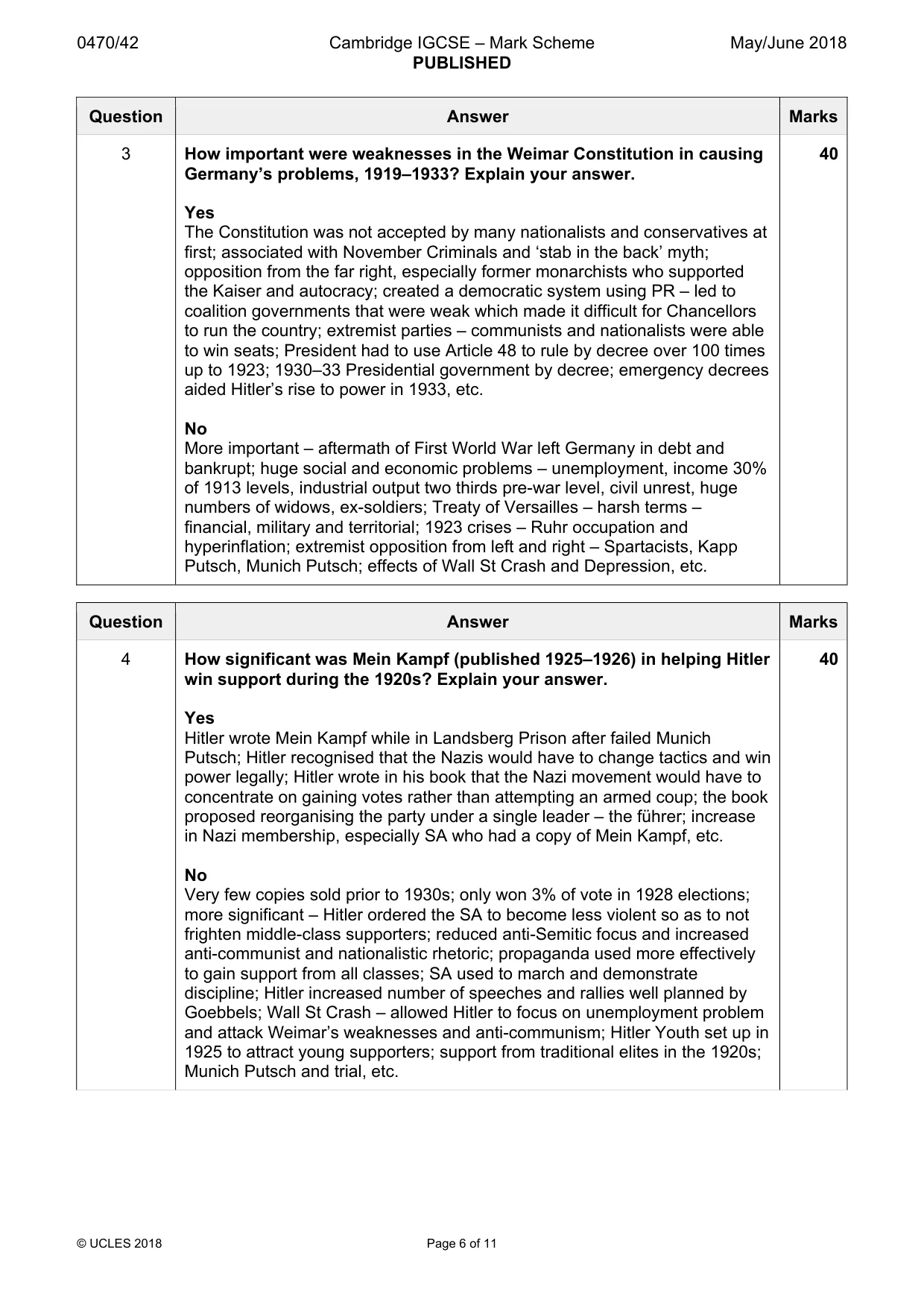
0470/42 Cambridge IGCSE – Mark Scheme PUBLISHED May/June 2018 © UCLES 2018 Page 6 of 11 Question Answer Marks 3 How important were weaknesses in the Weimar Constitution in causing Germany’s problems, 1919–1933? Explain your answer. Yes The Constitution was not accepted by many nationalists and conservatives at first; associated with November Criminals and ‘stab in the back’ myth; opposition from the far right, especially former monarchists who supported the Kaiser and autocracy; created a democratic system using PR – led to coalition governments that were weak which made it difficult for Chancellors to run the country; extremist parties – communists and nationalists were able to win seats; President had to use Article 48 to rule by decree over 100 times up to 1923; 1930–33 Presidential government by decree; emergency decrees aided Hitler’s rise to power in 1933, etc. No More important – aftermath of First World War left Germany in debt and bankrupt; huge social and economic problems – unemployment, income 30% of 1913 levels, industrial output two thirds pre-war level, civil unrest, huge numbers of widows, ex-soldiers; Treaty of Versailles – harsh terms – financial, military and territorial; 1923 crises – Ruhr occupation and hyperinflation; extremist opposition from left and right – Spartacists, Kapp Putsch, Munich Putsch; effects of Wall St Crash and Depression, etc. 40 Question Answer Marks 4 How significant was Mein Kampf (published 1925–1926) in helping Hitler win support during the 1920s? Explain your answer. Yes Hitler wrote Mein Kampf while in Landsberg Prison after failed Munich Putsch; Hitler recognised that the Nazis would have to change tactics and win power legally; Hitler wrote in his book that the Nazi movement would have to concentrate on gaining votes rather than attempting an armed coup; the book proposed reorganising the party under a single leader – the führer; increase in Nazi membership, especially SA who had a copy of Mein Kampf, etc. No Very few copies sold prior to 1930s; only won 3% of vote in 1928 elections; more significant – Hitler ordered the SA to become less violent so as to not frighten middle-class supporters; reduced anti-Semitic focus and increased anti-communist and nationalistic rhetoric; propaganda used more effectively to gain support from all classes; SA used to march and demonstrate discipline; Hitler increased number of speeches and rallies well planned by Goebbels; Wall St Crash – allowed Hitler to focus on unemployment problem and attack Weimar’s weaknesses and anti-communism; Hitler Youth set up in 1925 to attract young supporters; support from traditional elites in the 1920s; Munich Putsch and trial, etc. 40
Mark scheme, page 7
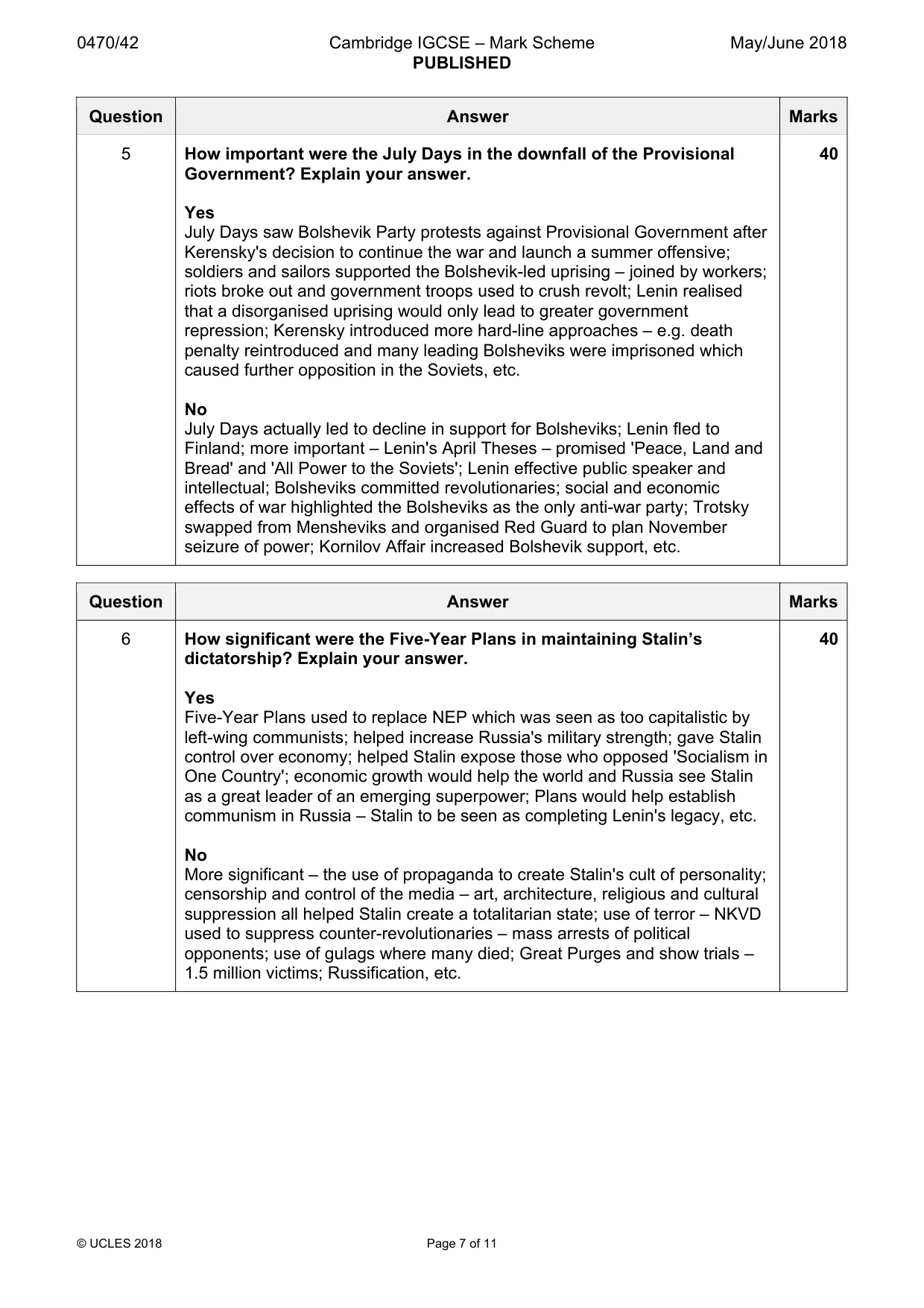
0470/42 Cambridge IGCSE – Mark Scheme PUBLISHED May/June 2018 © UCLES 2018 Page 7 of 11 Question Answer Marks 5 How important were the July Days in the downfall of the Provisional Government? Explain your answer. Yes July Days saw Bolshevik Party protests against Provisional Government after Kerensky's decision to continue the war and launch a summer offensive; soldiers and sailors supported the Bolshevik-led uprising – joined by workers; riots broke out and government troops used to crush revolt; Lenin realised that a disorganised uprising would only lead to greater government repression; Kerensky introduced more hard-line approaches – e.g. death penalty reintroduced and many leading Bolsheviks were imprisoned which caused further opposition in the Soviets, etc. No July Days actually led to decline in support for Bolsheviks; Lenin fled to Finland; more important – Lenin's April Theses – promised 'Peace, Land and Bread' and 'All Power to the Soviets'; Lenin effective public speaker and intellectual; Bolsheviks committed revolutionaries; social and economic effects of war highlighted the Bolsheviks as the only anti-war party; Trotsky swapped from Mensheviks and organised Red Guard to plan November seizure of power; Kornilov Affair increased Bolshevik support, etc. 40 Question Answer Marks 6 How significant were the Five-Year Plans in maintaining Stalin’s dictatorship? Explain your answer. Yes Five-Year Plans used to replace NEP which was seen as too capitalistic by left-wing communists; helped increase Russia's military strength; gave Stalin control over economy; helped Stalin expose those who opposed 'Socialism in One Country'; economic growth would help the world and Russia see Stalin as a great leader of an emerging superpower; Plans would help establish communism in Russia – Stalin to be seen as completing Lenin's legacy, etc. No More significant – the use of propaganda to create Stalin's cult of personality; censorship and control of the media – art, architecture, religious and cultural suppression all helped Stalin create a totalitarian state; use of terror – NKVD used to suppress counter-revolutionaries – mass arrests of political opponents; use of gulags where many died; Great Purges and show trials – 1.5 million victims; Russification, etc. 40
Mark scheme, page 8
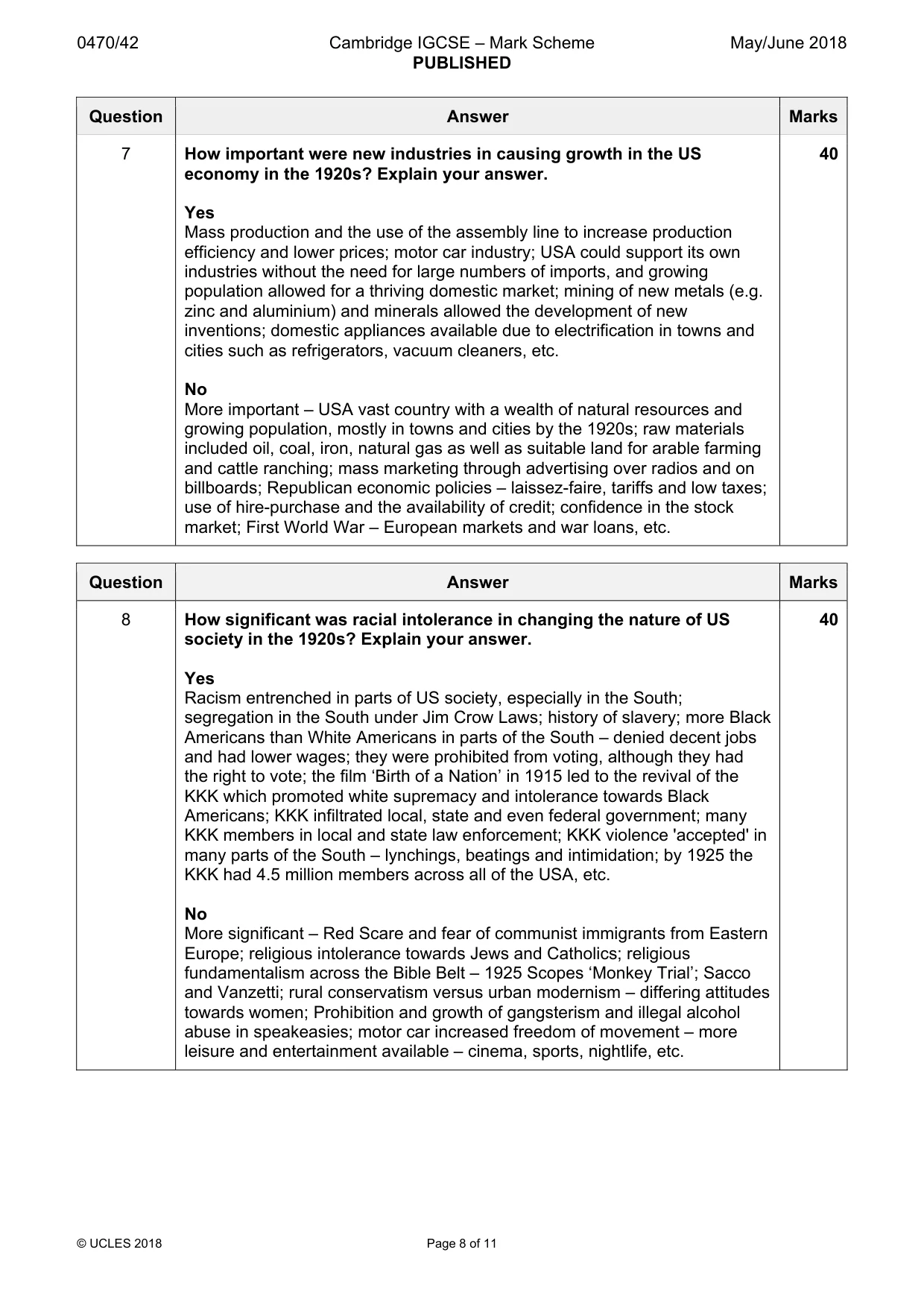
0470/42 Cambridge IGCSE – Mark Scheme PUBLISHED May/June 2018 © UCLES 2018 Page 8 of 11 Question Answer Marks 7 How important were new industries in causing growth in the US economy in the 1920s? Explain your answer. Yes Mass production and the use of the assembly line to increase production efficiency and lower prices; motor car industry; USA could support its own industries without the need for large numbers of imports, and growing population allowed for a thriving domestic market; mining of new metals (e.g. zinc and aluminium) and minerals allowed the development of new inventions; domestic appliances available due to electrification in towns and cities such as refrigerators, vacuum cleaners, etc. No More important – USA vast country with a wealth of natural resources and growing population, mostly in towns and cities by the 1920s; raw materials included oil, coal, iron, natural gas as well as suitable land for arable farming and cattle ranching; mass marketing through advertising over radios and on billboards; Republican economic policies – laissez-faire, tariffs and low taxes; use of hire-purchase and the availability of credit; confidence in the stock market; First World War – European markets and war loans, etc. 40 Question Answer Marks 8 How significant was racial intolerance in changing the nature of US society in the 1920s? Explain your answer. Yes Racism entrenched in parts of US society, especially in the South; segregation in the South under Jim Crow Laws; history of slavery; more Black Americans than White Americans in parts of the South – denied decent jobs and had lower wages; they were prohibited from voting, although they had the right to vote; the film ‘Birth of a Nation’ in 1915 led to the revival of the KKK which promoted white supremacy and intolerance towards Black Americans; KKK infiltrated local, state and even federal government; many KKK members in local and state law enforcement; KKK violence 'accepted' in many parts of the South – lynchings, beatings and intimidation; by 1925 the KKK had 4.5 million members across all of the USA, etc. No More significant – Red Scare and fear of communist immigrants from Eastern Europe; religious intolerance towards Jews and Catholics; religious fundamentalism across the Bible Belt – 1925 Scopes ‘Monkey Trial’; Sacco and Vanzetti; rural conservatism versus urban modernism – differing attitudes towards women; Prohibition and growth of gangsterism and illegal alcohol abuse in speakeasies; motor car increased freedom of movement – more leisure and entertainment available – cinema, sports, nightlife, etc. 40
Mark scheme, page 9
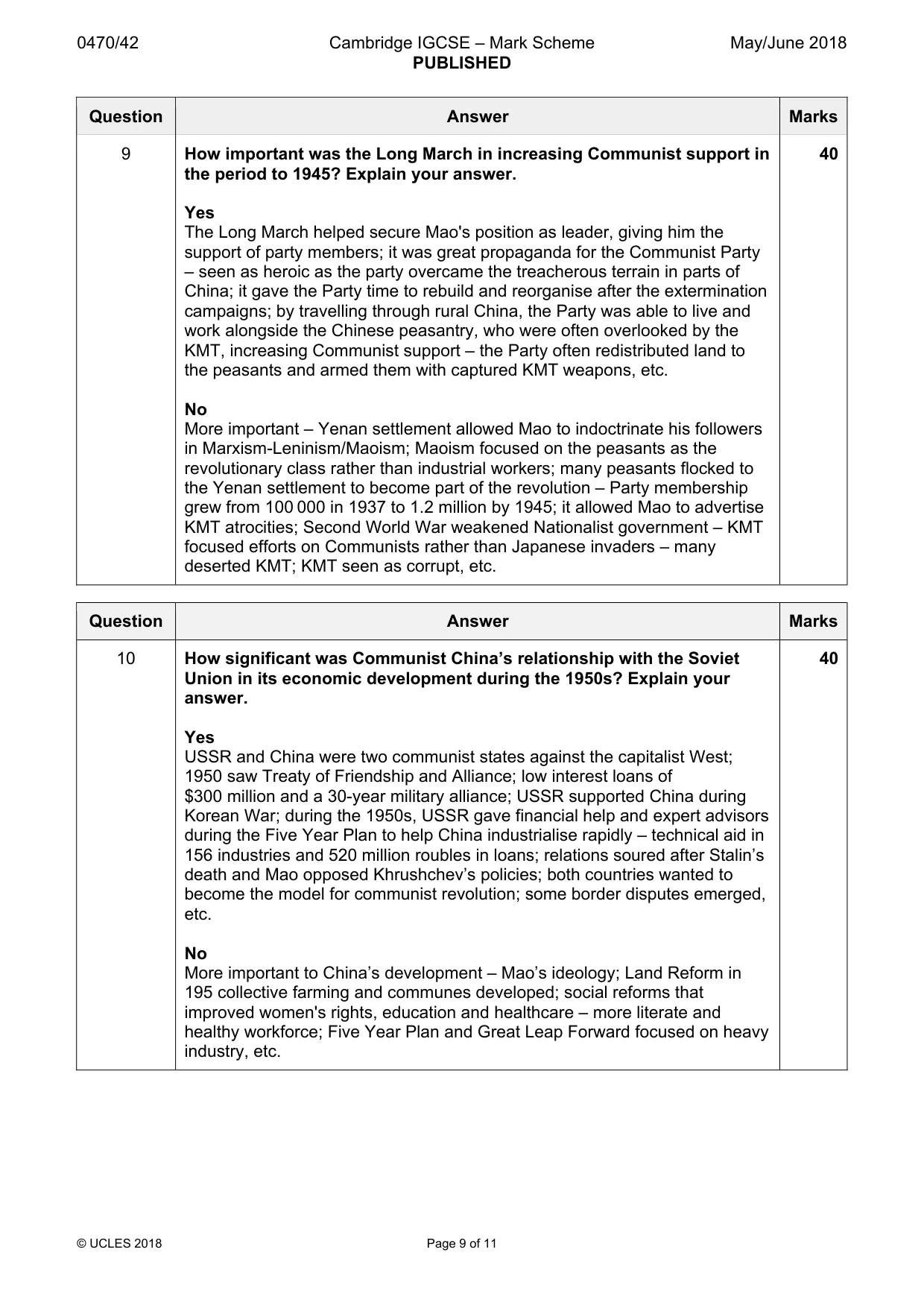
0470/42 Cambridge IGCSE – Mark Scheme PUBLISHED May/June 2018 © UCLES 2018 Page 9 of 11 Question Answer Marks 9 How important was the Long March in increasing Communist support in the period to 1945? Explain your answer. Yes The Long March helped secure Mao's position as leader, giving him the support of party members; it was great propaganda for the Communist Party – seen as heroic as the party overcame the treacherous terrain in parts of China; it gave the Party time to rebuild and reorganise after the extermination campaigns; by travelling through rural China, the Party was able to live and work alongside the Chinese peasantry, who were often overlooked by the KMT, increasing Communist support – the Party often redistributed land to the peasants and armed them with captured KMT weapons, etc. No More important – Yenan settlement allowed Mao to indoctrinate his followers in Marxism-Leninism/Maoism; Maoism focused on the peasants as the revolutionary class rather than industrial workers; many peasants flocked to the Yenan settlement to become part of the revolution – Party membership grew from 100 000 in 1937 to 1.2 million by 1945; it allowed Mao to advertise KMT atrocities; Second World War weakened Nationalist government – KMT focused efforts on Communists rather than Japanese invaders – many deserted KMT; KMT seen as corrupt, etc. 40 Question Answer Marks 10 How significant was Communist China’s relationship with the Soviet Union in its economic development during the 1950s? Explain your answer. Yes USSR and China were two communist states against the capitalist West; 1950 saw Treaty of Friendship and Alliance; low interest loans of $300 million and a 30-year military alliance; USSR supported China during Korean War; during the 1950s, USSR gave financial help and expert advisors during the Five Year Plan to help China industrialise rapidly – technical aid in 156 industries and 520 million roubles in loans; relations soured after Stalin’s death and Mao opposed Khrushchev’s policies; both countries wanted to become the model for communist revolution; some border disputes emerged, etc. No More important to China’s development – Mao’s ideology; Land Reform in 195 collective farming and communes developed; social reforms that improved women's rights, education and healthcare – more literate and healthy workforce; Five Year Plan and Great Leap Forward focused on heavy industry, etc. 40
Mark scheme, page 10
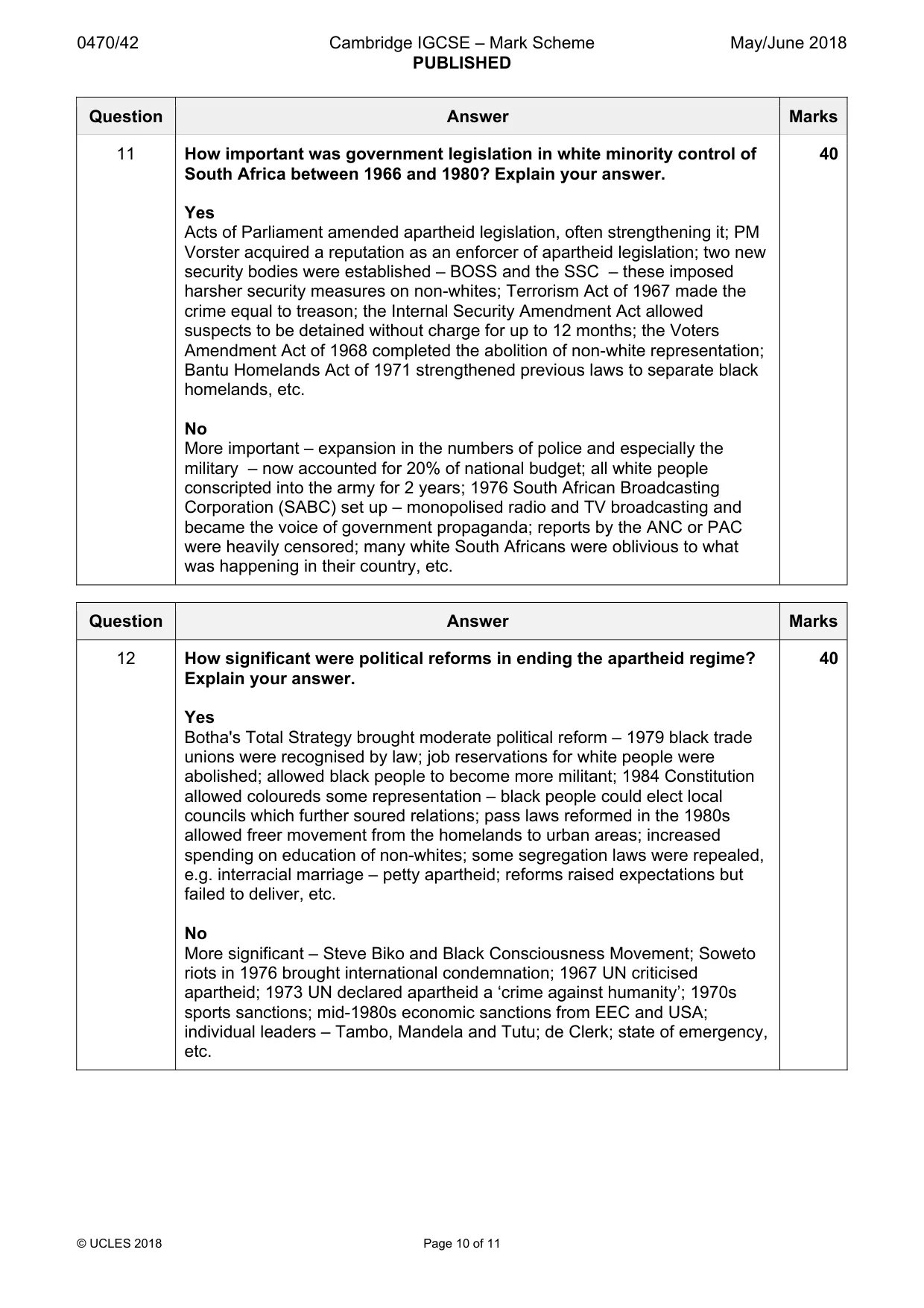
0470/42 Cambridge IGCSE – Mark Scheme PUBLISHED May/June 2018 © UCLES 2018 Page 10 of 11 Question Answer Marks 11 How important was government legislation in white minority control of South Africa between 1966 and 1980? Explain your answer. Yes Acts of Parliament amended apartheid legislation, often strengthening it; PM Vorster acquired a reputation as an enforcer of apartheid legislation; two new security bodies were established – BOSS and the SSC – these imposed harsher security measures on non-whites; Terrorism Act of 1967 made the crime equal to treason; the Internal Security Amendment Act allowed suspects to be detained without charge for up to 12 months; the Voters Amendment Act of 1968 completed the abolition of non-white representation; Bantu Homelands Act of 1971 strengthened previous laws to separate black homelands, etc. No More important – expansion in the numbers of police and especially the military – now accounted for 20% of national budget; all white people conscripted into the army for 2 years; 1976 South African Broadcasting Corporation (SABC) set up – monopolised radio and TV broadcasting and became the voice of government propaganda; reports by the ANC or PAC were heavily censored; many white South Africans were oblivious to what was happening in their country, etc. 40 Question Answer Marks 12 How significant were political reforms in ending the apartheid regime? Explain your answer. Yes Botha's Total Strategy brought moderate political reform – 1979 black trade unions were recognised by law; job reservations for white people were abolished; allowed black people to become more militant; 1984 Constitution allowed coloureds some representation – black people could elect local councils which further soured relations; pass laws reformed in the 1980s allowed freer movement from the homelands to urban areas; increased spending on education of non-whites; some segregation laws were repealed, e.g. interracial marriage – petty apartheid; reforms raised expectations but failed to deliver, etc. No More significant – Steve Biko and Black Consciousness Movement; Soweto riots in 1976 brought international condemnation; 1967 UN criticised apartheid; 1973 UN declared apartheid a ‘crime against humanity’; 1970s sports sanctions; mid-1980s economic sanctions from EEC and USA; individual leaders – Tambo, Mandela and Tutu; de Clerk; state of emergency, etc. 40
Mark scheme, page 11
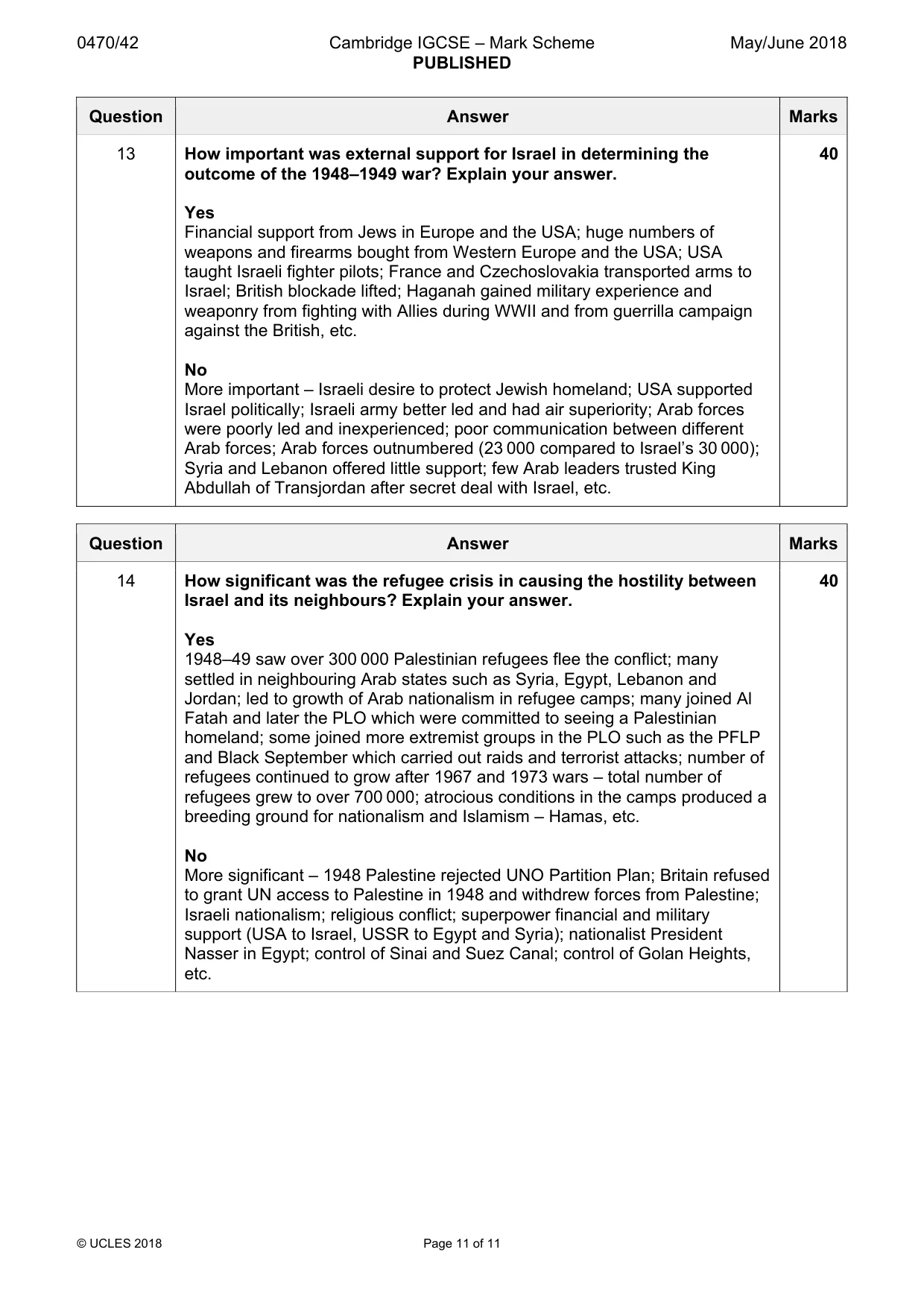
0470/42 Cambridge IGCSE – Mark Scheme PUBLISHED May/June 2018 © UCLES 2018 Page 11 of 11 Question Answer Marks 13 How important was external support for Israel in determining the outcome of the 1948–1949 war? Explain your answer. Yes Financial support from Jews in Europe and the USA; huge numbers of weapons and firearms bought from Western Europe and the USA; USA taught Israeli fighter pilots; France and Czechoslovakia transported arms to Israel; British blockade lifted; Haganah gained military experience and weaponry from fighting with Allies during WWII and from guerrilla campaign against the British, etc. No More important – Israeli desire to protect Jewish homeland; USA supported Israel politically; Israeli army better led and had air superiority; Arab forces were poorly led and inexperienced; poor communication between different Arab forces; Arab forces outnumbered (23 000 compared to Israel’s 30 000); Syria and Lebanon offered little support; few Arab leaders trusted King Abdullah of Transjordan after secret deal with Israel, etc. 40 Question Answer Marks 14 How significant was the refugee crisis in causing the hostility between Israel and its neighbours? Explain your answer. Yes 1948–49 saw over 300 000 Palestinian refugees flee the conflict; many settled in neighbouring Arab states such as Syria, Egypt, Lebanon and Jordan; led to growth of Arab nationalism in refugee camps; many joined Al Fatah and later the PLO which were committed to seeing a Palestinian homeland; some joined more extremist groups in the PLO such as the PFLP and Black September which carried out raids and terrorist attacks; number of refugees continued to grow after 1967 and 1973 wars – total number of refugees grew to over 700 000; atrocious conditions in the camps produced a breeding ground for nationalism and Islamism – Hamas, etc. No More significant – 1948 Palestine rejected UNO Partition Plan; Britain refused to grant UN access to Palestine in 1948 and withdrew forces from Palestine; Israeli nationalism; religious conflict; superpower financial and military support (USA to Israel, USSR to Egypt and Syria); nationalist President Nasser in Egypt; control of Sinai and Suez Canal; control of Golan Heights, etc. 40
What you needed in this session
Cambridge’s own grade thresholds for 2018 May/June, Paper 4 · Variant 2. A higher threshold means an easier paper — the bar moves with how the cohort did.