Cambridge IGCSE History 0470 — 2017 Oct/Nov Paper 2 · Variant 2
0470/22/O/N/17 · 50 marks · ≈56 min
The question paper and its mark scheme, free to read here and free to download. This is Cambridge’s own paper, exactly as it was sat.
Question paper16 pages
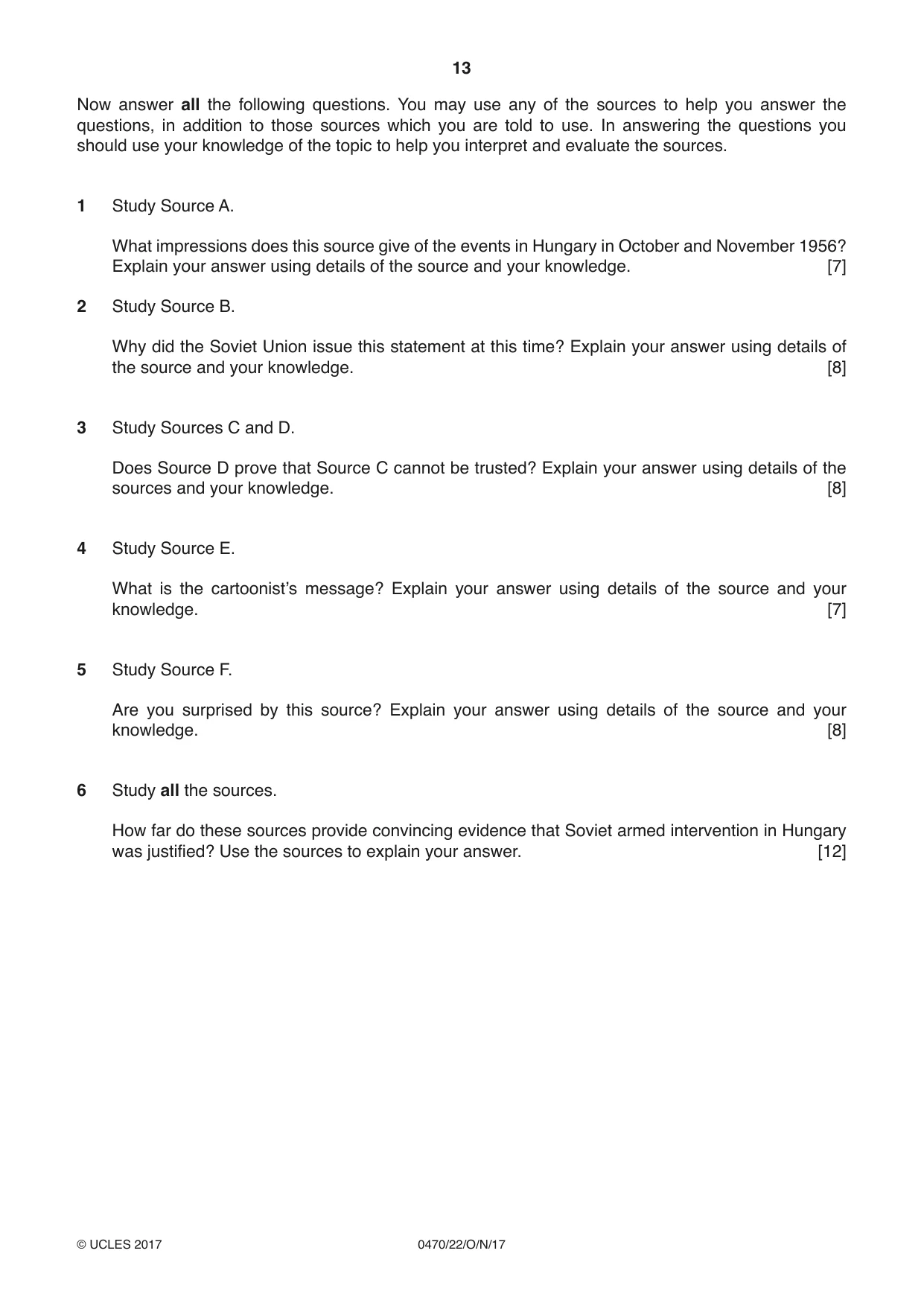


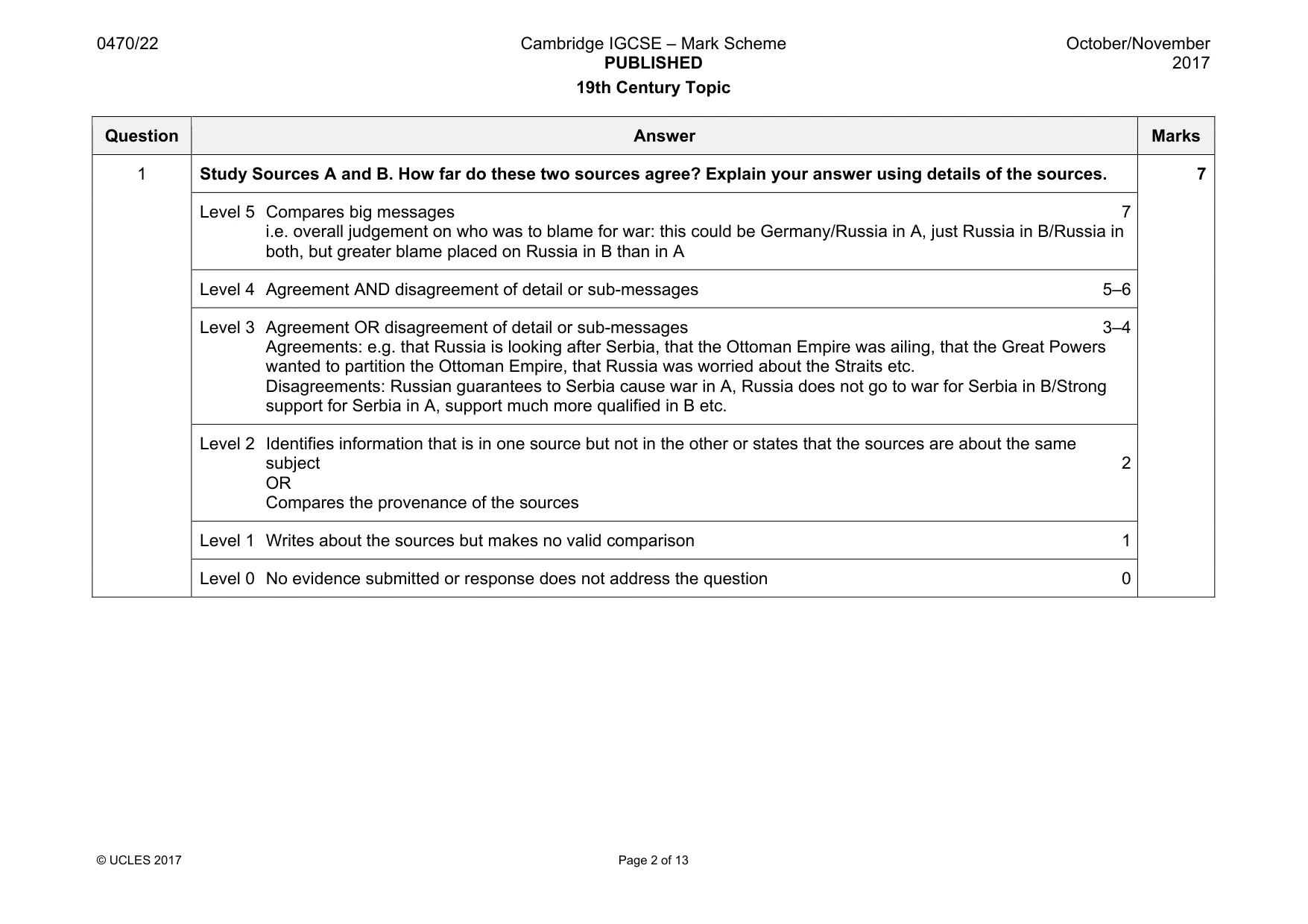
Mark scheme13 pages
Answers below. Sit the paper first if you are practising.
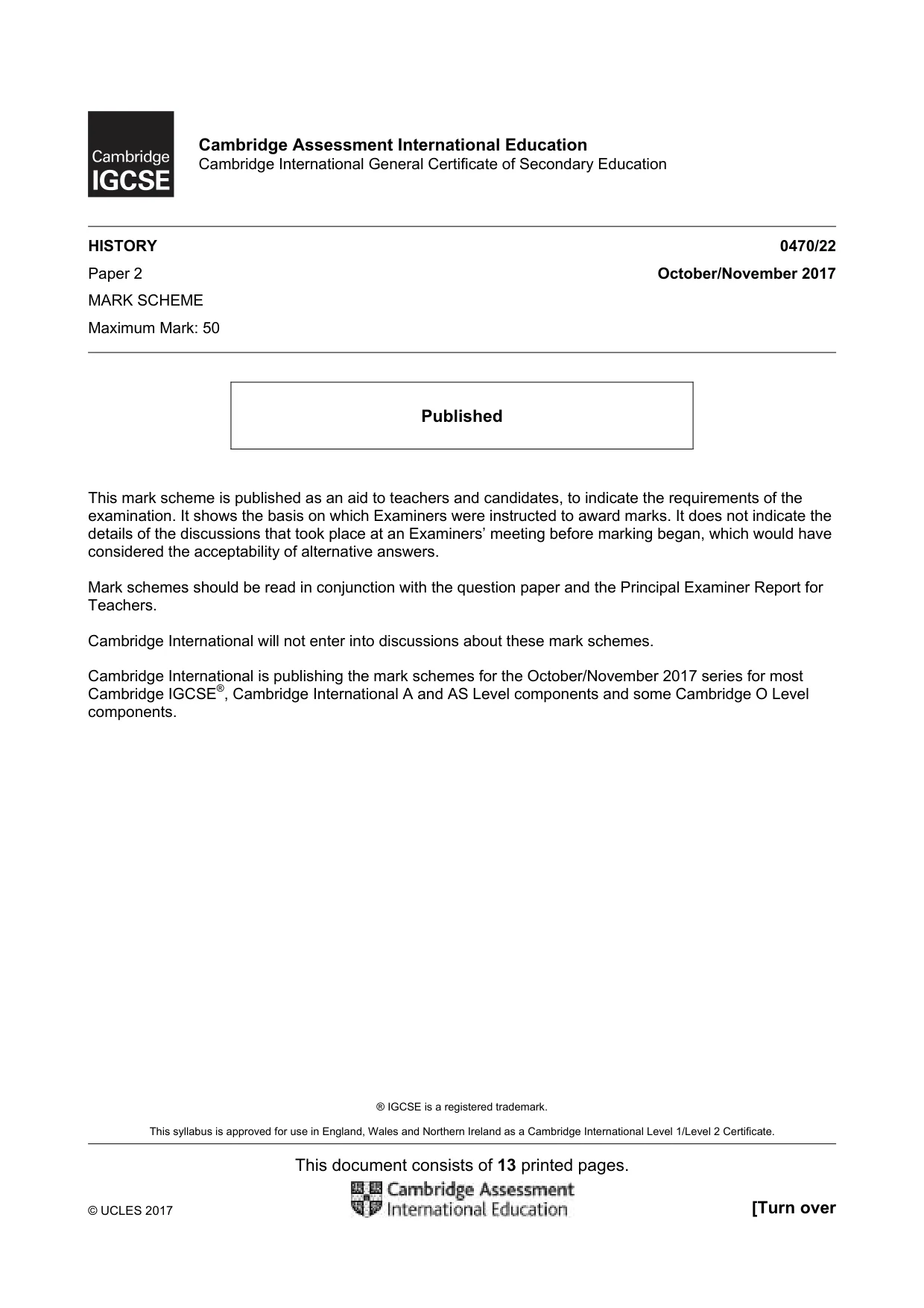
Paper as text
Question paper, page 1
* 7 0 1 7 0 0 0 7 1 7 * This document consists of 13 printed pages, 3 blank pages and 1 Insert. DC (LK/SW) 135329/3 © UCLES 2017 [Turn over Cambridge International Examinations Cambridge International General Certificate of Secondary Education HISTORY 0470/22 Paper 2 October/November 2017 2 hours No Additional Materials are required. READ THESE INSTRUCTIONS FIRST An answer booklet is provided inside this question paper. You should follow the instructions on the front cover of the answer booklet. If you need additional answer paper ask the invigilator for a continuation booklet. This paper has two options. Choose one option, and answer all of the questions on that topic. Option A: 19th Century topic [p2–p7] Option B: 20th Century topic [p8–p13] The number of marks is given in brackets [ ] at the end of each question or part question. The syllabus is approved for use in England, Wales and Northern Ireland as a Cambridge International Level 1/Level 2 Certificate.
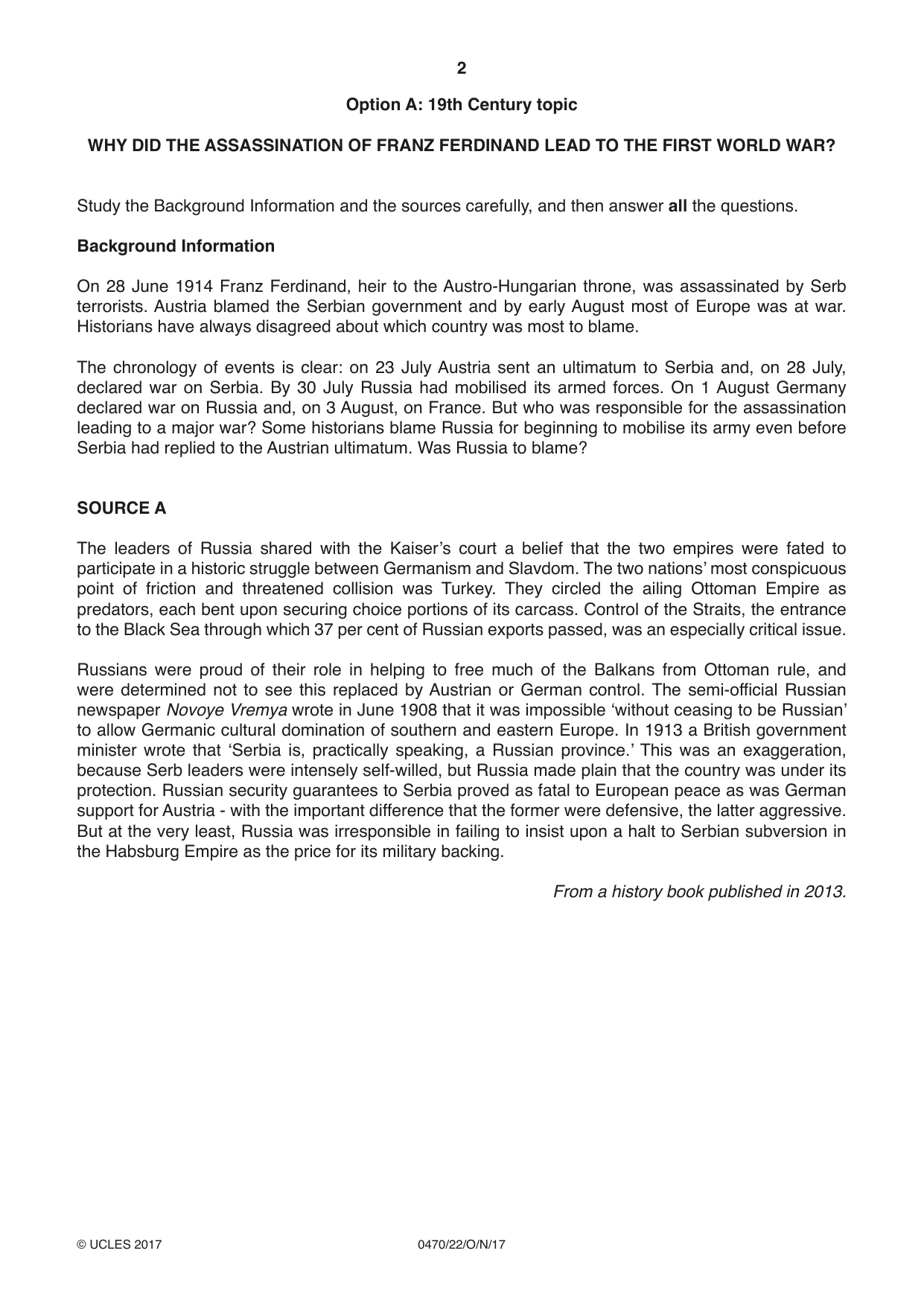
Question paper, page 2
2 0470/22/O/N/17 © UCLES 2017 Option A: 19th Century topic WHY DID THE ASSASSINATION OF FRANZ FERDINAND LEAD TO THE FIRST WORLD WAR? Study the Background Information and the sources carefully, and then answer all the questions. Background Information On 28 June 1914 Franz Ferdinand, heir to the Austro-Hungarian throne, was assassinated by Serb terrorists. Austria blamed the Serbian government and by early August most of Europe was at war. Historians have always disagreed about which country was most to blame. The chronology of events is clear: on 23 July Austria sent an ultimatum to Serbia and, on 28 July, declared war on Serbia. By 30 July Russia had mobilised its armed forces. On 1 August Germany declared war on Russia and, on 3 August, on France. But who was responsible for the assassination leading to a major war? Some historians blame Russia for beginning to mobilise its army even before Serbia had replied to the Austrian ultimatum. Was Russia to blame? SOURCE A The leaders of Russia shared with the Kaiser’s court a belief that the two empires were fated to participate in a historic struggle between Germanism and Slavdom. The two nations’ most conspicuous point of friction and threatened collision was Turkey. They circled the ailing Ottoman Empire as predators, each bent upon securing choice portions of its carcass. Control of the Straits, the entrance to the Black Sea through which 37 per cent of Russian exports passed, was an especially critical issue. Russians were proud of their role in helping to free much of the Balkans from Ottoman rule, and were determined not to see this replaced by Austrian or German control. The semi-official Russian newspaper Novoye Vremya wrote in June 1908 that it was impossible ‘without ceasing to be Russian’ to allow Germanic cultural domination of southern and eastern Europe. In 1913 a British government minister wrote that ‘Serbia is, practically speaking, a Russian province.’ This was an exaggeration, because Serb leaders were intensely self-willed, but Russia made plain that the country was under its protection. Russian security guarantees to Serbia proved as fatal to European peace as was German support for Austria - with the important difference that the former were defensive, the latter aggressive. But at the very least, Russia was irresponsible in failing to insist upon a halt to Serbian subversion in the Habsburg Empire as the price for its military backing. From a history book published in 2013.
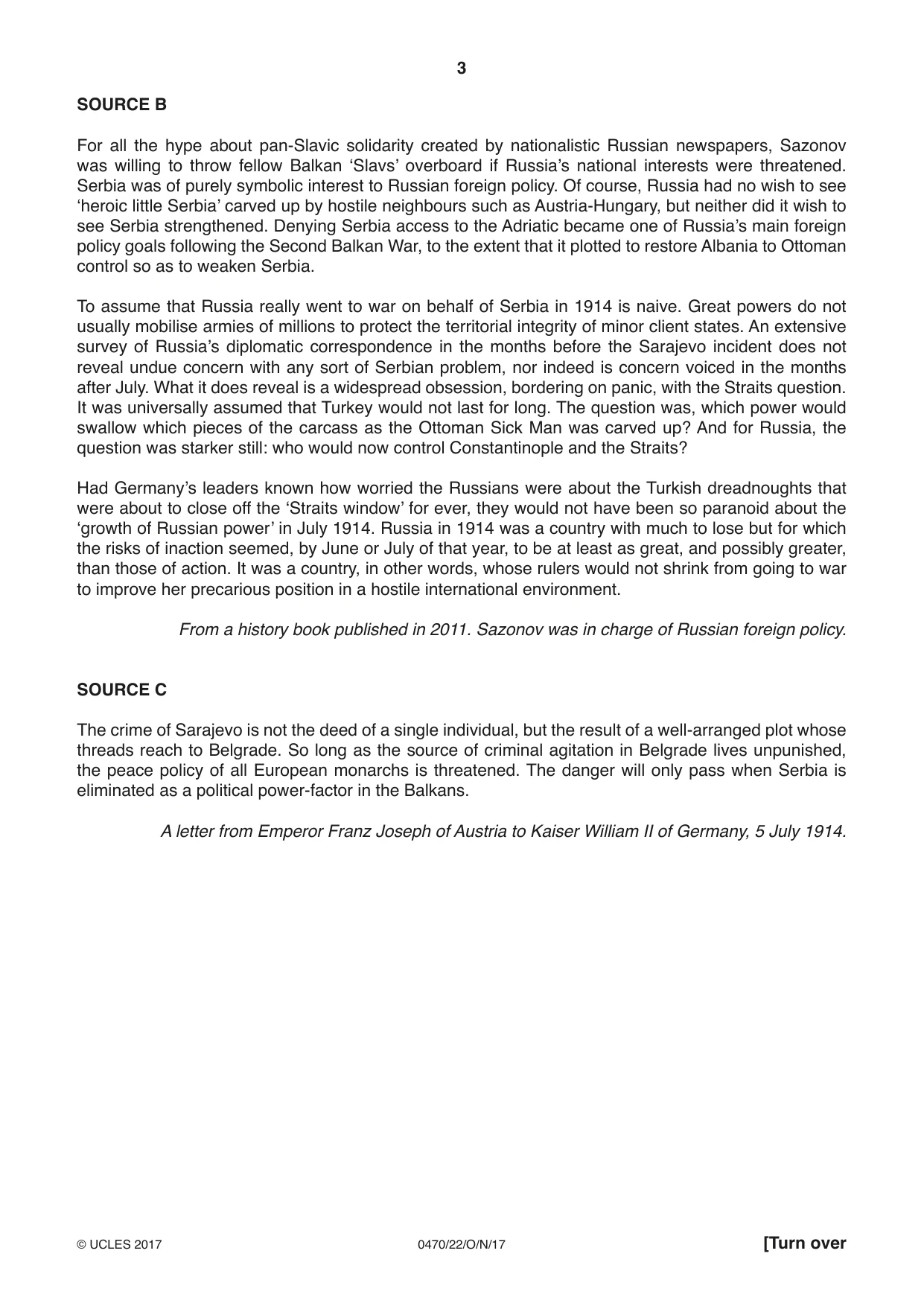
Question paper, page 3
3 0470/22/O/N/17 © UCLES 2017 [Turn over SOURCE B For all the hype about pan-Slavic solidarity created by nationalistic Russian newspapers, Sazonov was willing to throw fellow Balkan ‘Slavs’ overboard if Russia’s national interests were threatened. Serbia was of purely symbolic interest to Russian foreign policy. Of course, Russia had no wish to see ‘heroic little Serbia’ carved up by hostile neighbours such as Austria-Hungary, but neither did it wish to see Serbia strengthened. Denying Serbia access to the Adriatic became one of Russia’s main foreign policy goals following the Second Balkan War, to the extent that it plotted to restore Albania to Ottoman control so as to weaken Serbia. To assume that Russia really went to war on behalf of Serbia in 1914 is naive. Great powers do not usually mobilise armies of millions to protect the territorial integrity of minor client states. An extensive survey of Russia’s diplomatic correspondence in the months before the Sarajevo incident does not reveal undue concern with any sort of Serbian problem, nor indeed is concern voiced in the months after July. What it does reveal is a widespread obsession, bordering on panic, with the Straits question. It was universally assumed that Turkey would not last for long. The question was, which power would swallow which pieces of the carcass as the Ottoman Sick Man was carved up? And for Russia, the question was starker still: who would now control Constantinople and the Straits? Had Germany’s leaders known how worried the Russians were about the Turkish dreadnoughts that were about to close off the ‘Straits window’ for ever, they would not have been so paranoid about the ‘growth of Russian power’ in July 1914. Russia in 1914 was a country with much to lose but for which the risks of inaction seemed, by June or July of that year, to be at least as great, and possibly greater, than those of action. It was a country, in other words, whose rulers would not shrink from going to war to improve her precarious position in a hostile international environment. From a history book published in 2011. Sazonov was in charge of Russian foreign policy. SOURCE C The crime of Sarajevo is not the deed of a single individual, but the result of a well-arranged plot whose threads reach to Belgrade. So long as the source of criminal agitation in Belgrade lives unpunished, the peace policy of all European monarchs is threatened. The danger will only pass when Serbia is eliminated as a political power-factor in the Balkans. A letter from Emperor Franz Joseph of Austria to Kaiser William II of Germany, 5 July 1914.
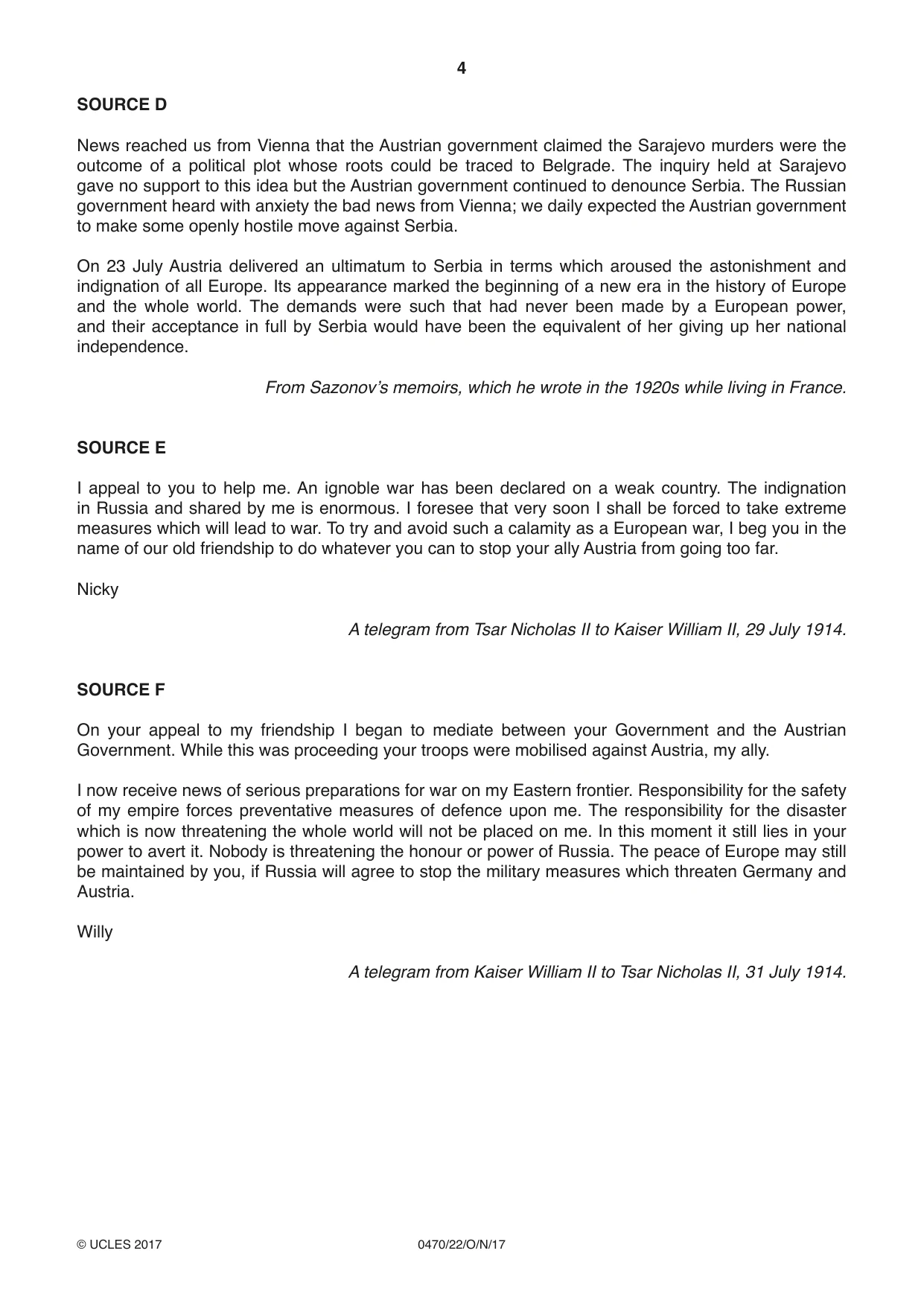
Question paper, page 4
4 0470/22/O/N/17 © UCLES 2017 SOURCE D News reached us from Vienna that the Austrian government claimed the Sarajevo murders were the outcome of a political plot whose roots could be traced to Belgrade. The inquiry held at Sarajevo gave no support to this idea but the Austrian government continued to denounce Serbia. The Russian government heard with anxiety the bad news from Vienna; we daily expected the Austrian government to make some openly hostile move against Serbia. On 23 July Austria delivered an ultimatum to Serbia in terms which aroused the astonishment and indignation of all Europe. Its appearance marked the beginning of a new era in the history of Europe and the whole world. The demands were such that had never been made by a European power, and their acceptance in full by Serbia would have been the equivalent of her giving up her national independence. From Sazonov’s memoirs, which he wrote in the 1920s while living in France. SOURCE E I appeal to you to help me. An ignoble war has been declared on a weak country. The indignation in Russia and shared by me is enormous. I foresee that very soon I shall be forced to take extreme measures which will lead to war. To try and avoid such a calamity as a European war, I beg you in the name of our old friendship to do whatever you can to stop your ally Austria from going too far. Nicky A telegram from Tsar Nicholas II to Kaiser William II, 29 July 1914. SOURCE F On your appeal to my friendship I began to mediate between your Government and the Austrian Government. While this was proceeding your troops were mobilised against Austria, my ally. I now receive news of serious preparations for war on my Eastern frontier. Responsibility for the safety of my empire forces preventative measures of defence upon me. The responsibility for the disaster which is now threatening the whole world will not be placed on me. In this moment it still lies in your power to avert it. Nobody is threatening the honour or power of Russia. The peace of Europe may still be maintained by you, if Russia will agree to stop the military measures which threaten Germany and Austria. Willy A telegram from Kaiser William II to Tsar Nicholas II, 31 July 1914.
Question paper, page 5
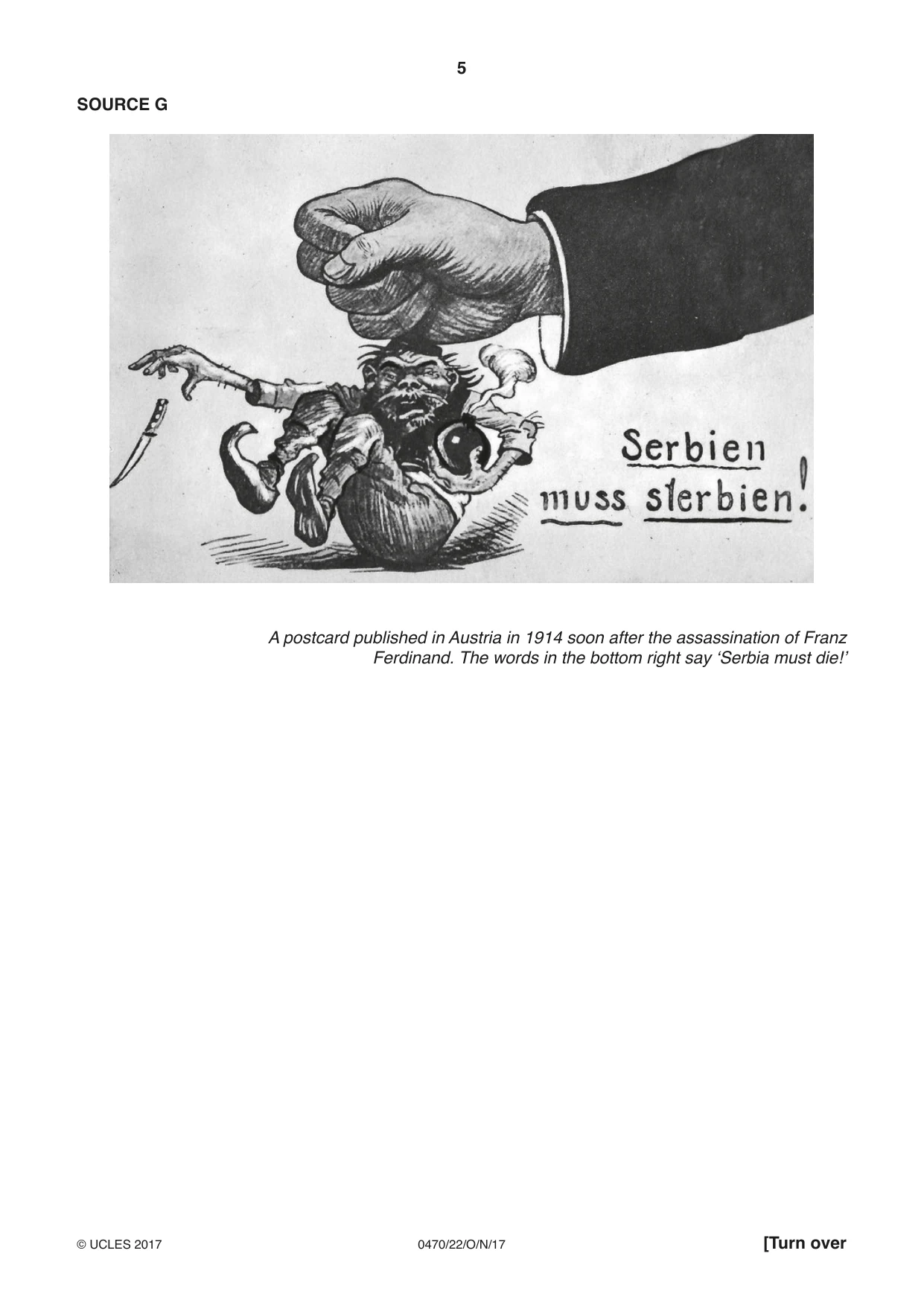
5 0470/22/O/N/17 © UCLES 2017 [Turn over SOURCE G A postcard published in Austria in 1914 soon after the assassination of Franz Ferdinand. The words in the bottom right say ‘Serbia must die!’
Question paper, page 6
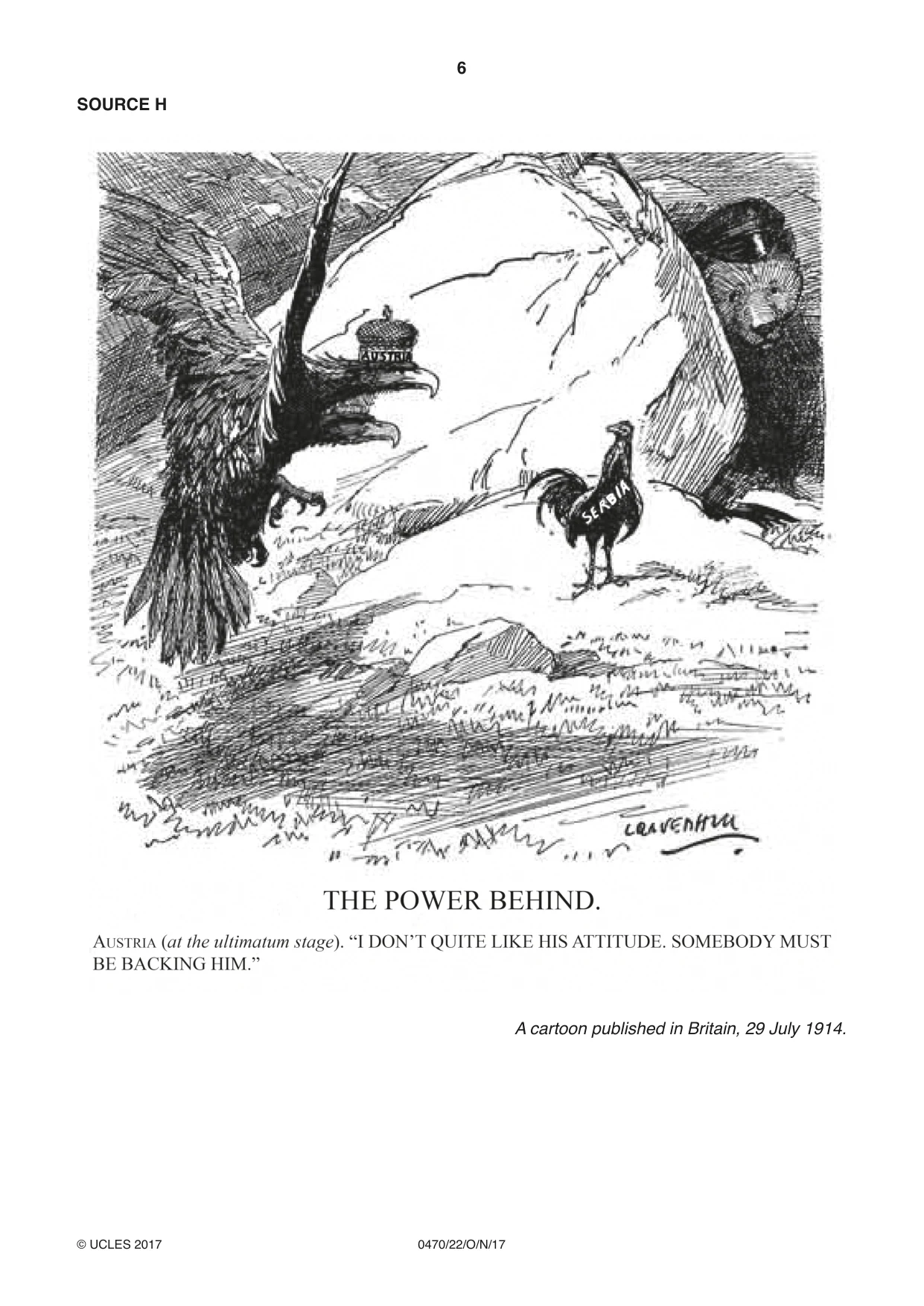
6 0470/22/O/N/17 © UCLES 2017 SOURCE H A cartoon published in Britain, 29 July 1914.
Question paper, page 7
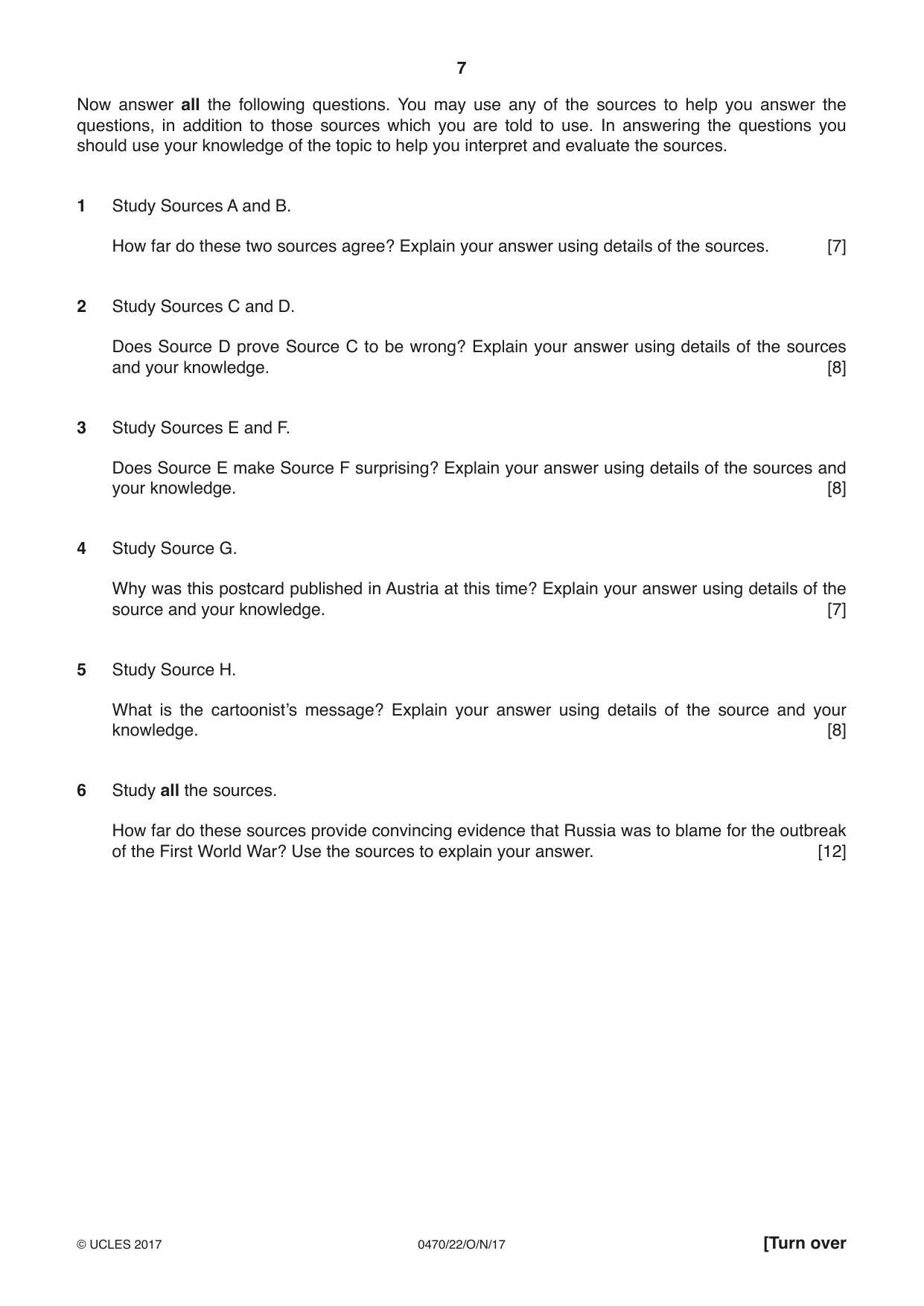
7 0470/22/O/N/17 © UCLES 2017 [Turn over Now answer all the following questions. You may use any of the sources to help you answer the questions, in addition to those sources which you are told to use. In answering the questions you should use your knowledge of the topic to help you interpret and evaluate the sources. 1 Study Sources A and B. How far do these two sources agree? Explain your answer using details of the sources. [7] 2 Study Sources C and D. Does Source D prove Source C to be wrong? Explain your answer using details of the sources and your knowledge. [8] 3 Study Sources E and F. Does Source E make Source F surprising? Explain your answer using details of the sources and your knowledge. [8] 4 Study Source G. Why was this postcard published in Austria at this time? Explain your answer using details of the source and your knowledge. [7] 5 Study Source H. What is the cartoonist’s message? Explain your answer using details of the source and your knowledge. [8] 6 Study all the sources. How far do these sources provide convincing evidence that Russia was to blame for the outbreak of the First World War? Use the sources to explain your answer. [12]
Question paper, page 8
8 0470/22/O/N/17 © UCLES 2017 Option B: 20th Century topic WAS THE SOVIET UNION JUSTIFIED IN INTERVENING IN HUNGARY IN 1956? Study the Background Information and the sources carefully, and then answer all the questions. Background Information On 23 October 1956 demonstrations against Soviet occupation and the government of Ernő Gerő began in Budapest. Russian troops were sent into the city to stop the protests. At the same time the Soviets decided to grant concessions. Imre Nagy was appointed Prime Minister and on 28 October Russian troops pulled out of Budapest. When Nagy’s government started to introduce reforms and announced that Hungary would leave the Warsaw Pact, Russian tanks and troops moved back into Budapest. Despite fierce fighting by the Hungarians, the uprising was soon defeated. Was the Soviet Union justified in intervening?
Question paper, page 9
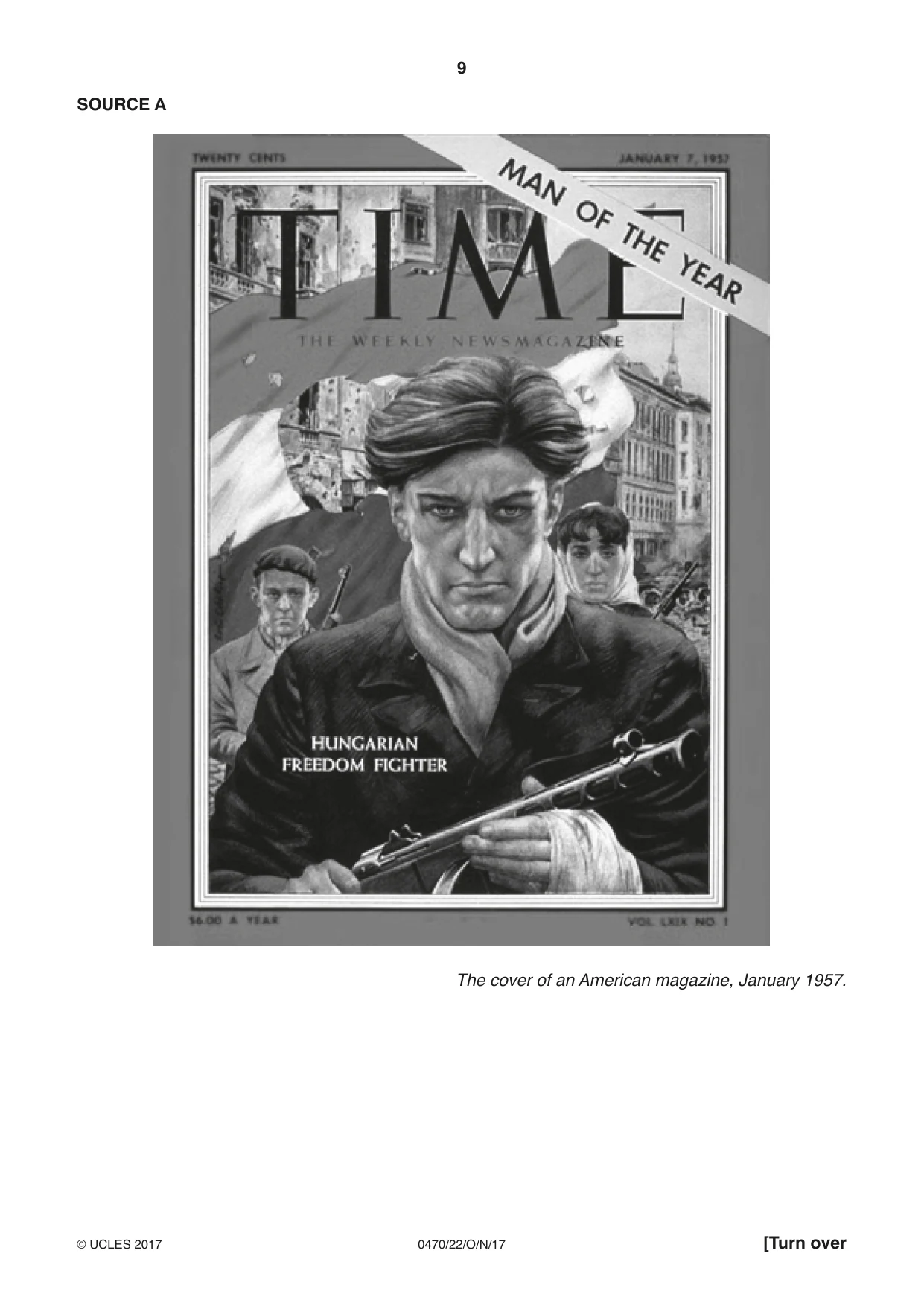
9 0470/22/O/N/17 © UCLES 2017 [Turn over SOURCE A The cover of an American magazine, January 1957.
Question paper, page 10
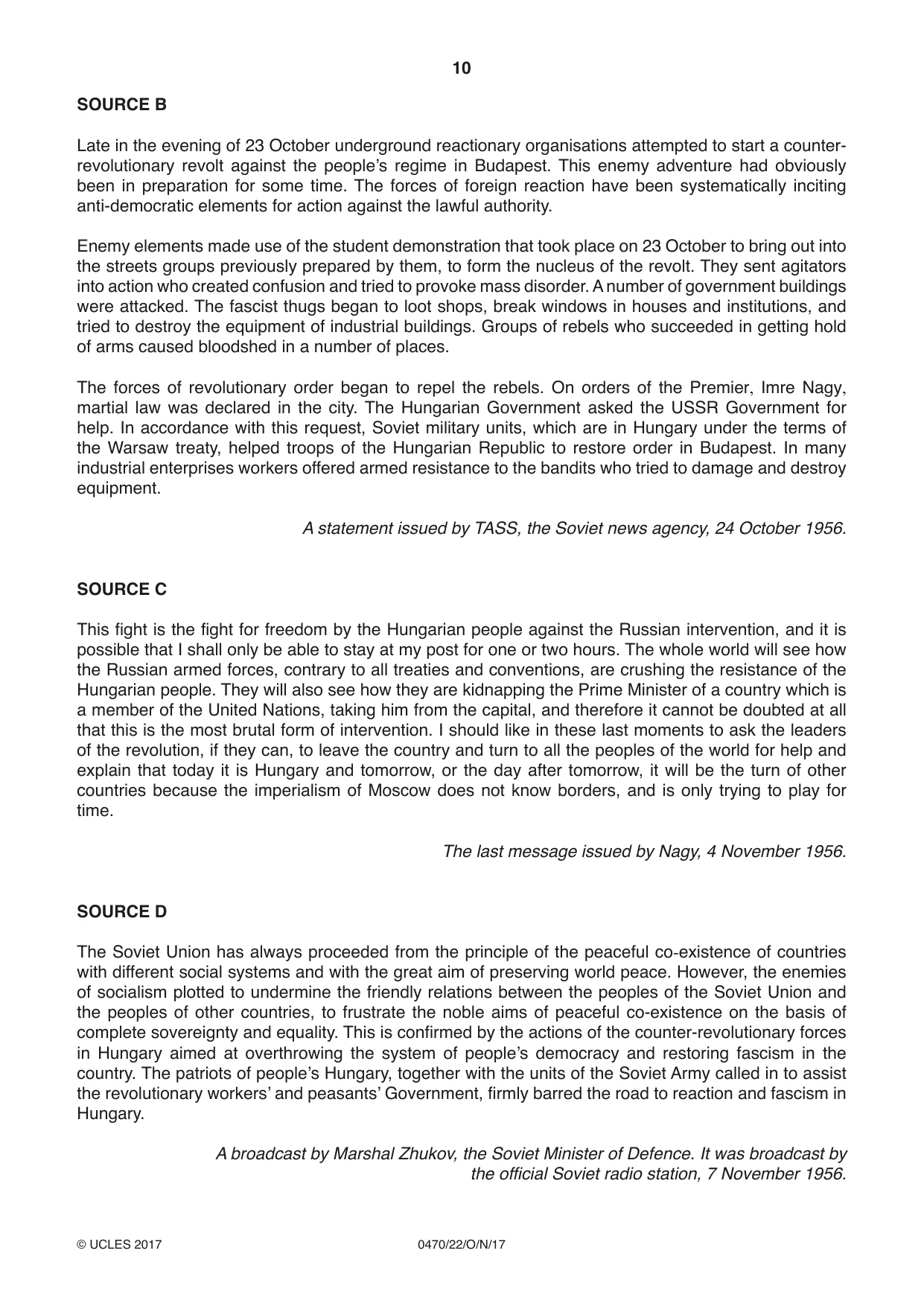
10 0470/22/O/N/17 © UCLES 2017 SOURCE B Late in the evening of 23 October underground reactionary organisations attempted to start a counter- revolutionary revolt against the people’s regime in Budapest. This enemy adventure had obviously been in preparation for some time. The forces of foreign reaction have been systematically inciting anti-democratic elements for action against the lawful authority. Enemy elements made use of the student demonstration that took place on 23 October to bring out into the streets groups previously prepared by them, to form the nucleus of the revolt. They sent agitators into action who created confusion and tried to provoke mass disorder. A number of government buildings were attacked. The fascist thugs began to loot shops, break windows in houses and institutions, and tried to destroy the equipment of industrial buildings. Groups of rebels who succeeded in getting hold of arms caused bloodshed in a number of places. The forces of revolutionary order began to repel the rebels. On orders of the Premier, Imre Nagy, martial law was declared in the city. The Hungarian Government asked the USSR Government for help. In accordance with this request, Soviet military units, which are in Hungary under the terms of the Warsaw treaty, helped troops of the Hungarian Republic to restore order in Budapest. In many industrial enterprises workers offered armed resistance to the bandits who tried to damage and destroy equipment. A statement issued by TASS, the Soviet news agency, 24 October 1956. SOURCE C This fight is the fight for freedom by the Hungarian people against the Russian intervention, and it is possible that I shall only be able to stay at my post for one or two hours. The whole world will see how the Russian armed forces, contrary to all treaties and conventions, are crushing the resistance of the Hungarian people. They will also see how they are kidnapping the Prime Minister of a country which is a member of the United Nations, taking him from the capital, and therefore it cannot be doubted at all that this is the most brutal form of intervention. I should like in these last moments to ask the leaders of the revolution, if they can, to leave the country and turn to all the peoples of the world for help and explain that today it is Hungary and tomorrow, or the day after tomorrow, it will be the turn of other countries because the imperialism of Moscow does not know borders, and is only trying to play for time. The last message issued by Nagy, 4 November 1956. SOURCE D The Soviet Union has always proceeded from the principle of the peaceful co-existence of countries with different social systems and with the great aim of preserving world peace. However, the enemies of socialism plotted to undermine the friendly relations between the peoples of the Soviet Union and the peoples of other countries, to frustrate the noble aims of peaceful co-existence on the basis of complete sovereignty and equality. This is confirmed by the actions of the counter-revolutionary forces in Hungary aimed at overthrowing the system of people’s democracy and restoring fascism in the country. The patriots of people’s Hungary, together with the units of the Soviet Army called in to assist the revolutionary workers’ and peasants’ Government, firmly barred the road to reaction and fascism in Hungary. A broadcast by Marshal Zhukov, the Soviet Minister of Defence. It was broadcast by the official Soviet radio station, 7 November 1956.
Question paper, page 11
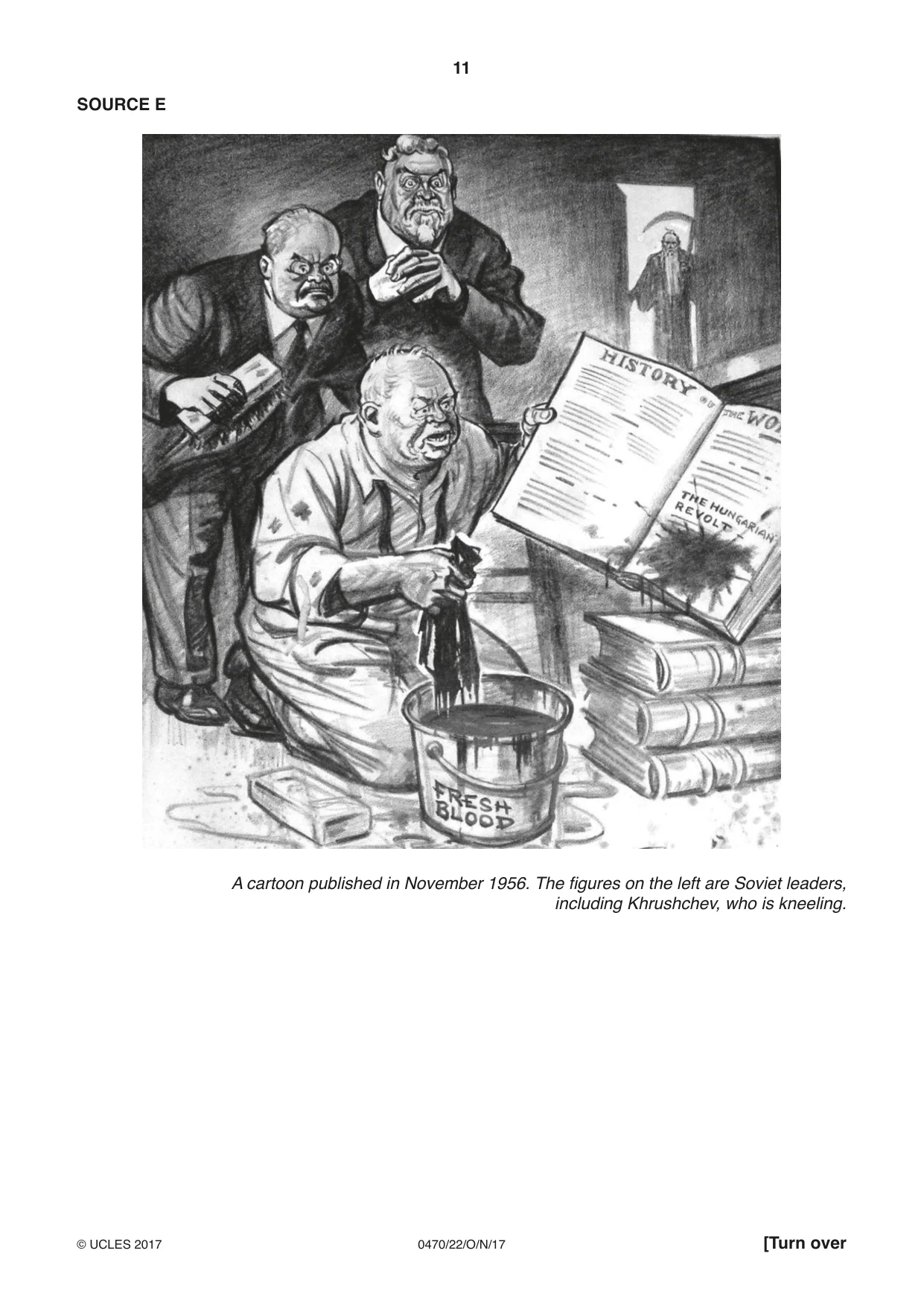
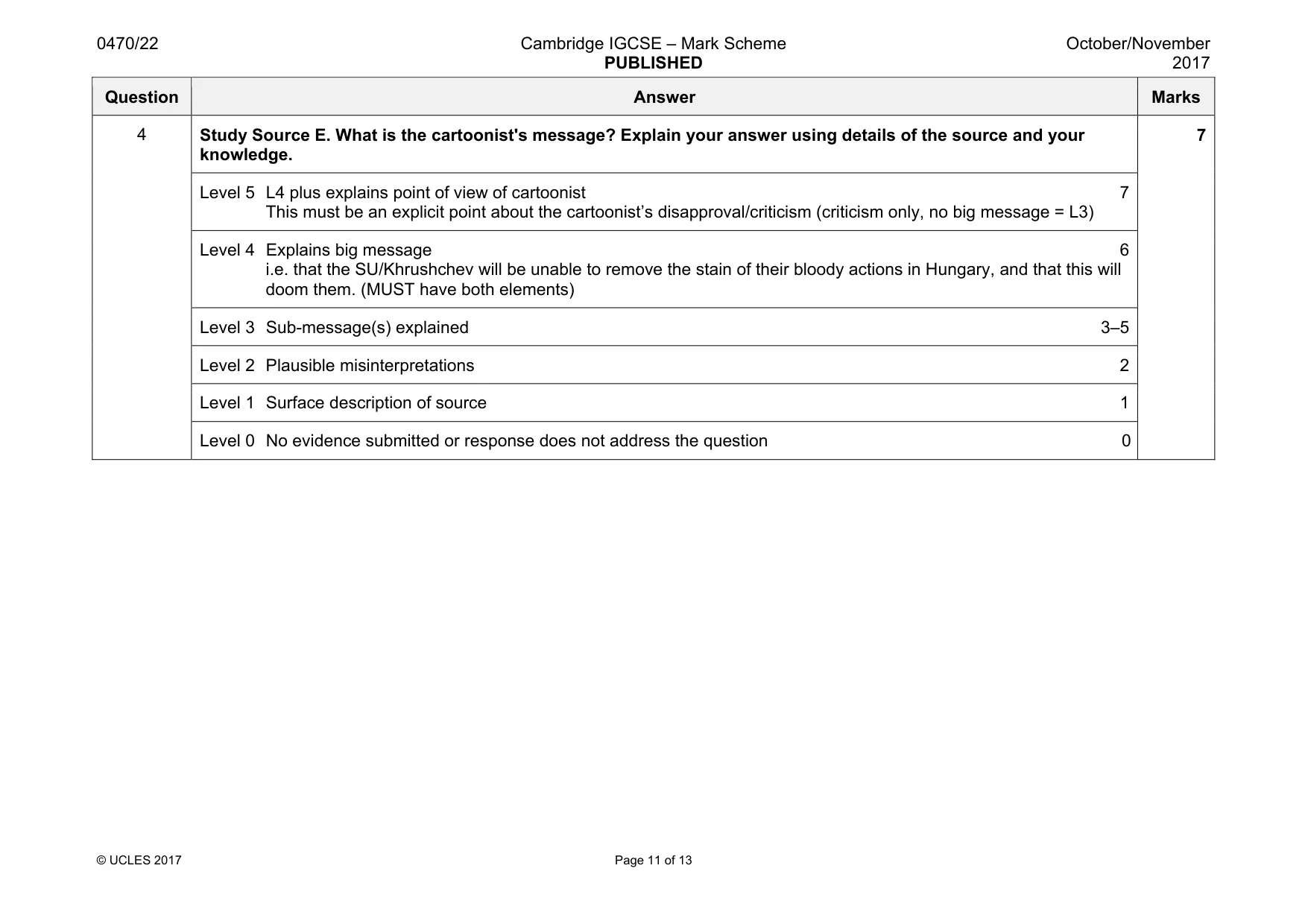
11 0470/22/O/N/17 © UCLES 2017 [Turn over SOURCE E A cartoon published in November 1956. The figures on the left are Soviet leaders, including Khrushchev, who is kneeling.
Question paper, page 12
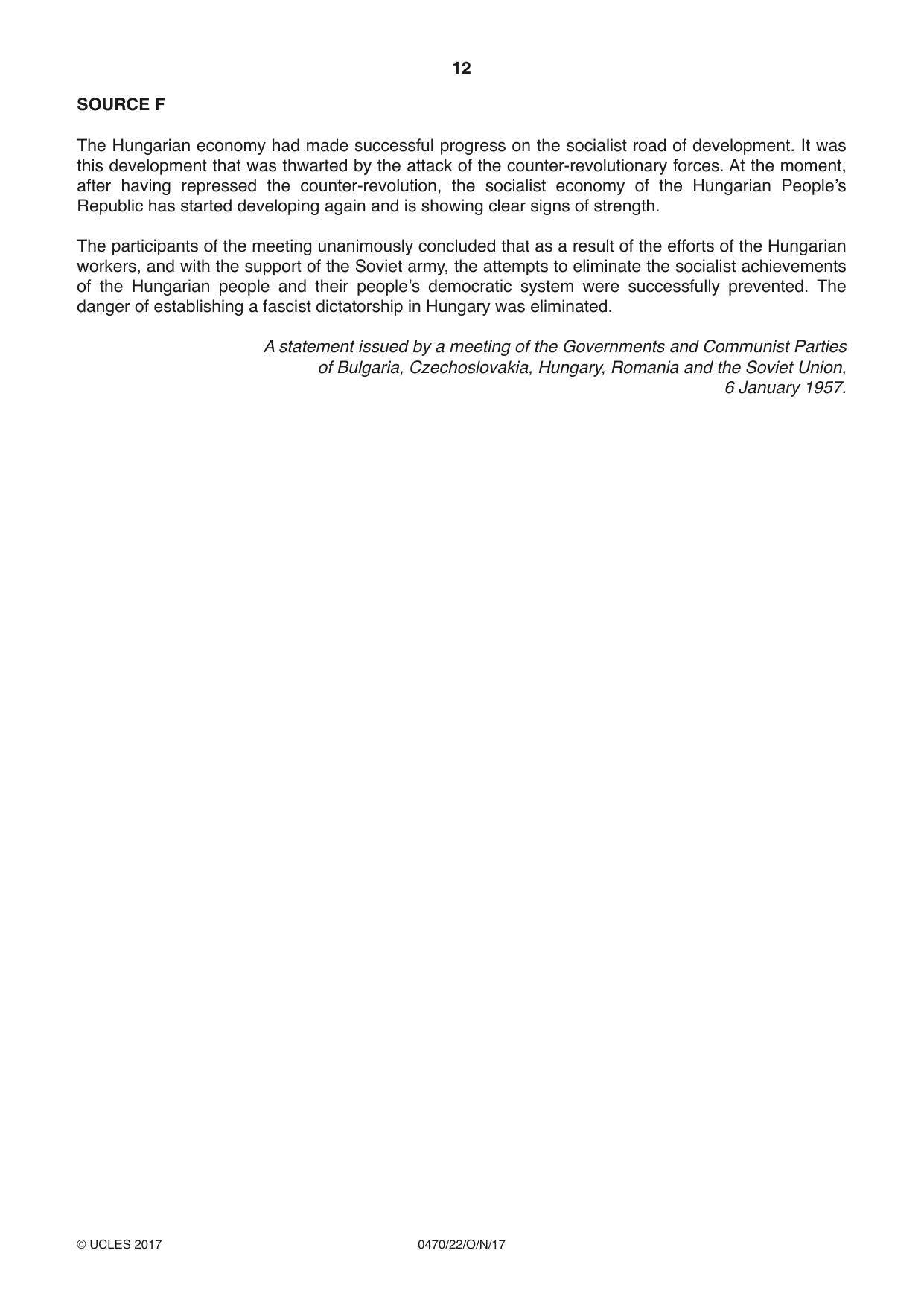
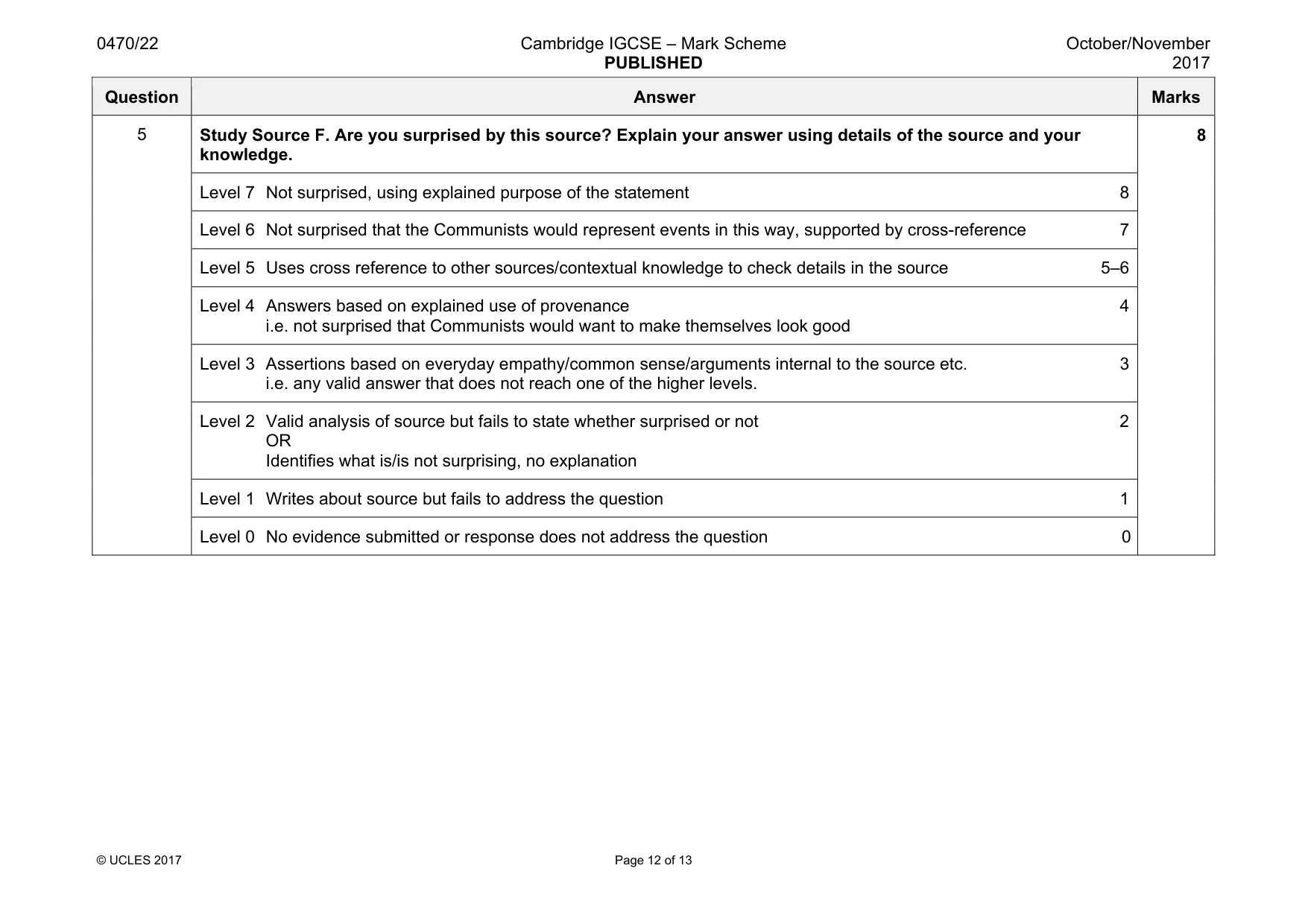
12 0470/22/O/N/17 © UCLES 2017 SOURCE F The Hungarian economy had made successful progress on the socialist road of development. It was this development that was thwarted by the attack of the counter-revolutionary forces. At the moment, after having repressed the counter-revolution, the socialist economy of the Hungarian People’s Republic has started developing again and is showing clear signs of strength. The participants of the meeting unanimously concluded that as a result of the efforts of the Hungarian workers, and with the support of the Soviet army, the attempts to eliminate the socialist achievements of the Hungarian people and their people’s democratic system were successfully prevented. The danger of establishing a fascist dictatorship in Hungary was eliminated. A statement issued by a meeting of the Governments and Communist Parties of Bulgaria, Czechoslovakia, Hungary, Romania and the Soviet Union, 6 January 1957.
Question paper, page 13
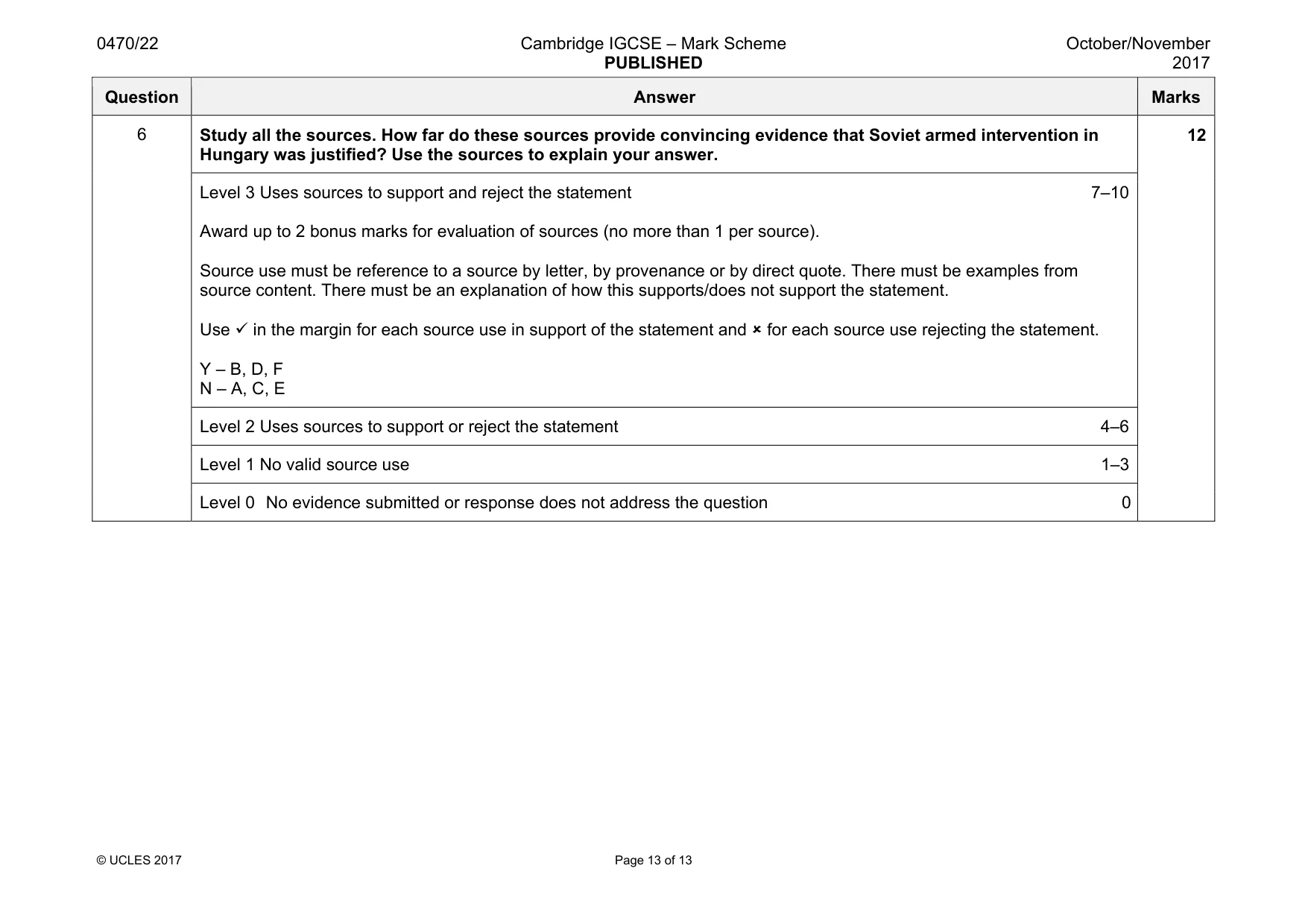
13 0470/22/O/N/17 © UCLES 2017 Now answer all the following questions. You may use any of the sources to help you answer the questions, in addition to those sources which you are told to use. In answering the questions you should use your knowledge of the topic to help you interpret and evaluate the sources. 1 Study Source A. What impressions does this source give of the events in Hungary in October and November 1956? Explain your answer using details of the source and your knowledge. [7] 2 Study Source B. Why did the Soviet Union issue this statement at this time? Explain your answer using details of the source and your knowledge. [8] 3 Study Sources C and D. Does Source D prove that Source C cannot be trusted? Explain your answer using details of the sources and your knowledge. [8] 4 Study Source E. What is the cartoonist’s message? Explain your answer using details of the source and your knowledge. [7] 5 Study Source F. Are you surprised by this source? Explain your answer using details of the source and your knowledge. [8] 6 Study all the sources. How far do these sources provide convincing evidence that Soviet armed intervention in Hungary was justified? Use the sources to explain your answer. [12]
Question paper, page 14
14 0470/22/O/N/17 © UCLES 2017 BLANK PAGE
Question paper, page 15
15 0470/22/O/N/17 © UCLES 2017 BLANK PAGE
Question paper, page 16
16 0470/22/O/N/17 © UCLES 2017 Permission to reproduce items where third-party owned material protected by copyright is included has been sought and cleared where possible. Every reasonable effort has been made by the publisher (UCLES) to trace copyright holders, but if any items requiring clearance have unwittingly been included, the publisher will be pleased to make amends at the earliest possible opportunity. To avoid the issue of disclosure of answer-related information to candidates, all copyright acknowledgements are reproduced online in the Cambridge International Examinations Copyright Acknowledgements Booklet. This is produced for each series of examinations and is freely available to download at www.cie.org.uk after the live examination series. Cambridge International Examinations is part of the Cambridge Assessment Group. Cambridge Assessment is the brand name of University of Cambridge Local Examinations Syndicate (UCLES), which is itself a department of the University of Cambridge. BLANK PAGE
Mark scheme, page 1
® IGCSE is a registered trademark. This syllabus is approved for use in England, Wales and Northern Ireland as a Cambridge International Level 1/Level 2 Certificate. This document consists of 13 printed pages. © UCLES 2017 [Turn over Cambridge Assessment International Education Cambridge International General Certificate of Secondary Education HISTORY 0470/22 Paper 2 October/November 2017 MARK SCHEME Maximum Mark: 50 Published This mark scheme is published as an aid to teachers and candidates, to indicate the requirements of the examination. It shows the basis on which Examiners were instructed to award marks. It does not indicate the details of the discussions that took place at an Examiners’ meeting before marking began, which would have considered the acceptability of alternative answers. Mark schemes should be read in conjunction with the question paper and the Principal Examiner Report for Teachers. Cambridge International will not enter into discussions about these mark schemes. Cambridge International is publishing the mark schemes for the October/November 2017 series for most Cambridge IGCSE®, Cambridge International A and AS Level components and some Cambridge O Level components.
Mark scheme, page 2
0470/22 Cambridge IGCSE – Mark Scheme PUBLISHED October/November 2017 © UCLES 2017 Page 2 of 13 19th Century Topic Question Answer Marks 1 Study Sources A and B. How far do these two sources agree? Explain your answer using details of the sources. 7 Level 5 Compares big messages 7 i.e. overall judgement on who was to blame for war: this could be Germany/Russia in A, just Russia in B/Russia in both, but greater blame placed on Russia in B than in A Level 4 Agreement AND disagreement of detail or sub-messages 5–6 Level 3 Agreement OR disagreement of detail or sub-messages 3–4 Agreements: e.g. that Russia is looking after Serbia, that the Ottoman Empire was ailing, that the Great Powers wanted to partition the Ottoman Empire, that Russia was worried about the Straits etc. Disagreements: Russian guarantees to Serbia cause war in A, Russia does not go to war for Serbia in B/Strong support for Serbia in A, support much more qualified in B etc. Level 2 Identifies information that is in one source but not in the other or states that the sources are about the same subject 2 OR Compares the provenance of the sources Level 1 Writes about the sources but makes no valid comparison 1 Level 0 No evidence submitted or response does not address the question 0
Mark scheme, page 3
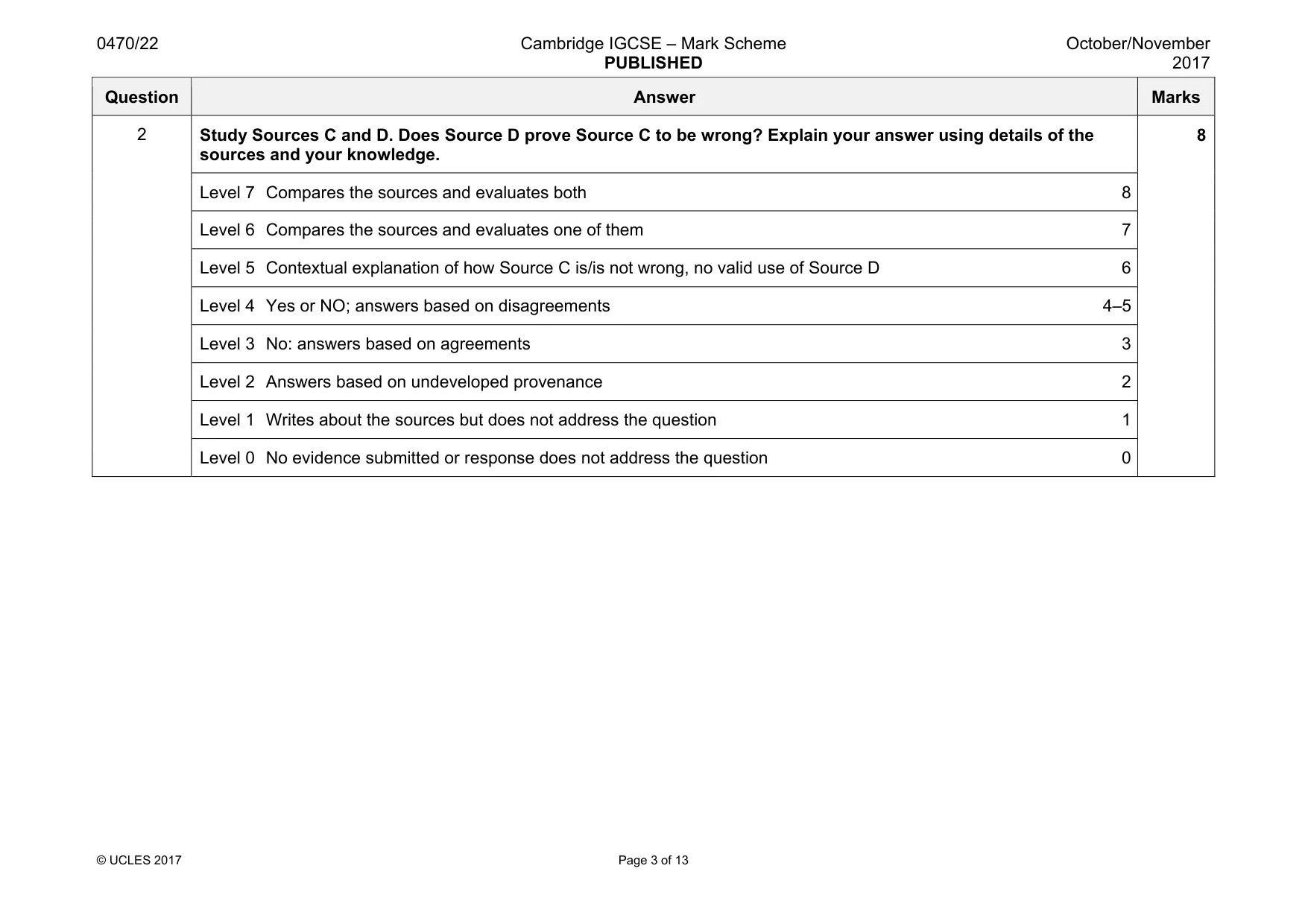
0470/22 Cambridge IGCSE – Mark Scheme PUBLISHED October/November 2017 © UCLES 2017 Page 3 of 13 Question Answer Marks 2 Study Sources C and D. Does Source D prove Source C to be wrong? Explain your answer using details of the sources and your knowledge. 8 Level 7 Compares the sources and evaluates both 8 Level 6 Compares the sources and evaluates one of them 7 Level 5 Contextual explanation of how Source C is/is not wrong, no valid use of Source D 6 Level 4 Yes or NO; answers based on disagreements 4–5 Level 3 No: answers based on agreements 3 Level 2 Answers based on undeveloped provenance 2 Level 1 Writes about the sources but does not address the question 1 Level 0 No evidence submitted or response does not address the question 0
Mark scheme, page 4
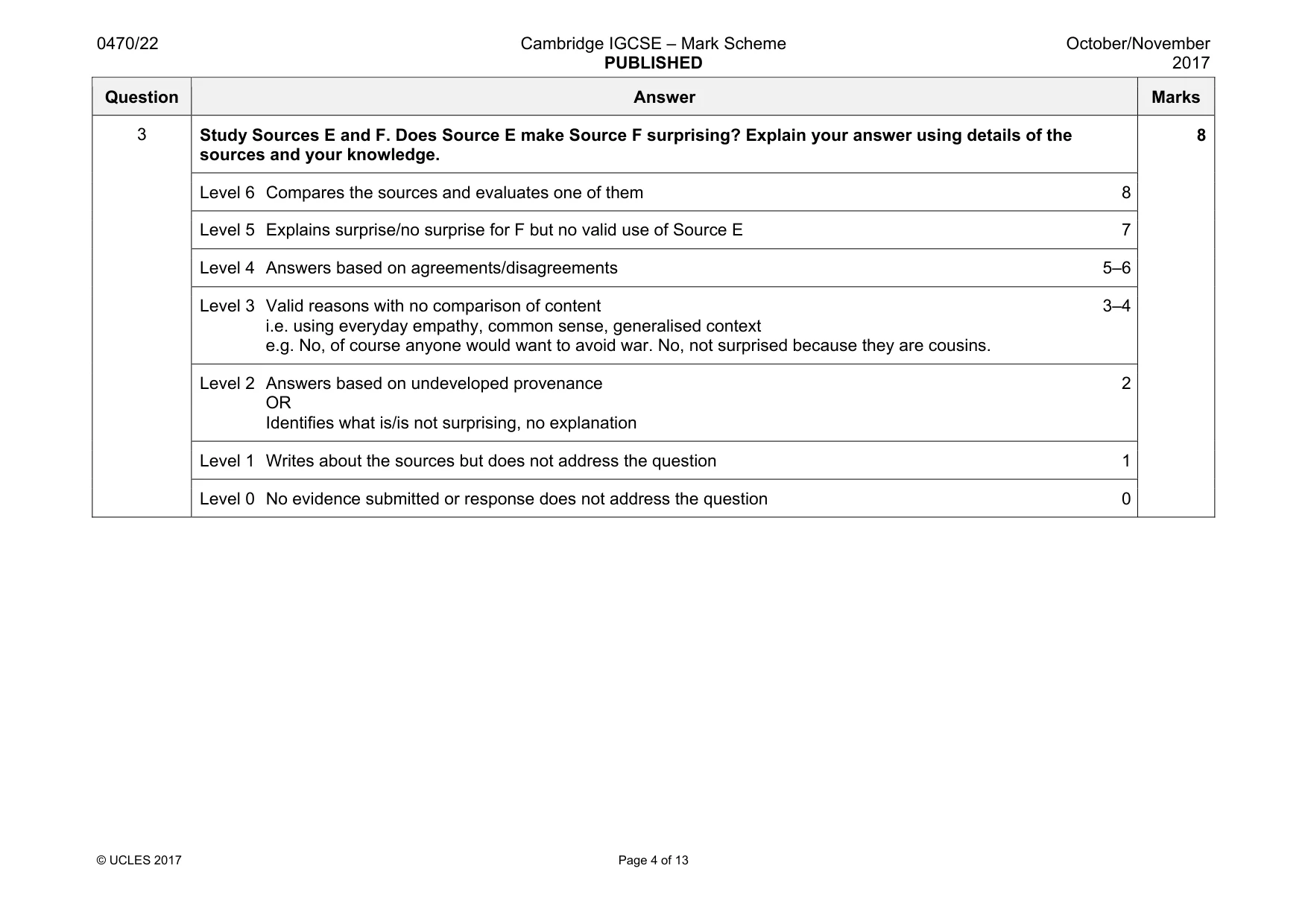
0470/22 Cambridge IGCSE – Mark Scheme PUBLISHED October/November 2017 © UCLES 2017 Page 4 of 13 Question Answer Marks 3 Study Sources E and F. Does Source E make Source F surprising? Explain your answer using details of the sources and your knowledge. 8 Level 6 Compares the sources and evaluates one of them 8 Level 5 Explains surprise/no surprise for F but no valid use of Source E 7 Level 4 Answers based on agreements/disagreements 5–6 Level 3 Valid reasons with no comparison of content 3–4 i.e. using everyday empathy, common sense, generalised context e.g. No, of course anyone would want to avoid war. No, not surprised because they are cousins. Level 2 Answers based on undeveloped provenance 2 OR Identifies what is/is not surprising, no explanation Level 1 Writes about the sources but does not address the question 1 Level 0 No evidence submitted or response does not address the question 0
Mark scheme, page 5
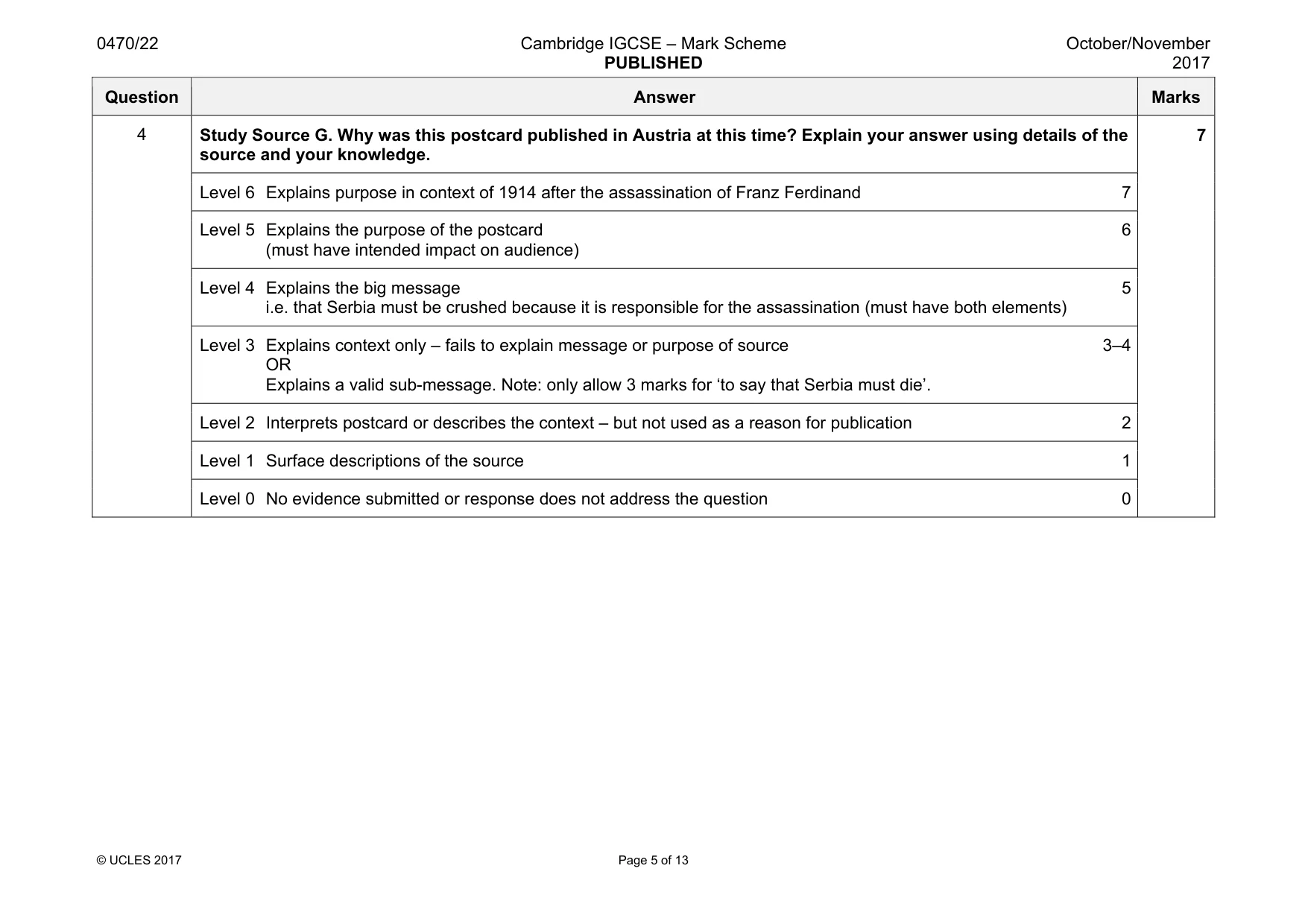
0470/22 Cambridge IGCSE – Mark Scheme PUBLISHED October/November 2017 © UCLES 2017 Page 5 of 13 Question Answer Marks 4 Study Source G. Why was this postcard published in Austria at this time? Explain your answer using details of the source and your knowledge. 7 Level 6 Explains purpose in context of 1914 after the assassination of Franz Ferdinand 7 Level 5 Explains the purpose of the postcard 6 (must have intended impact on audience) Level 4 Explains the big message 5 i.e. that Serbia must be crushed because it is responsible for the assassination (must have both elements) Level 3 Explains context only – fails to explain message or purpose of source 3–4 OR Explains a valid sub-message. Note: only allow 3 marks for ‘to say that Serbia must die’. Level 2 Interprets postcard or describes the context – but not used as a reason for publication 2 Level 1 Surface descriptions of the source 1 Level 0 No evidence submitted or response does not address the question 0
Mark scheme, page 6
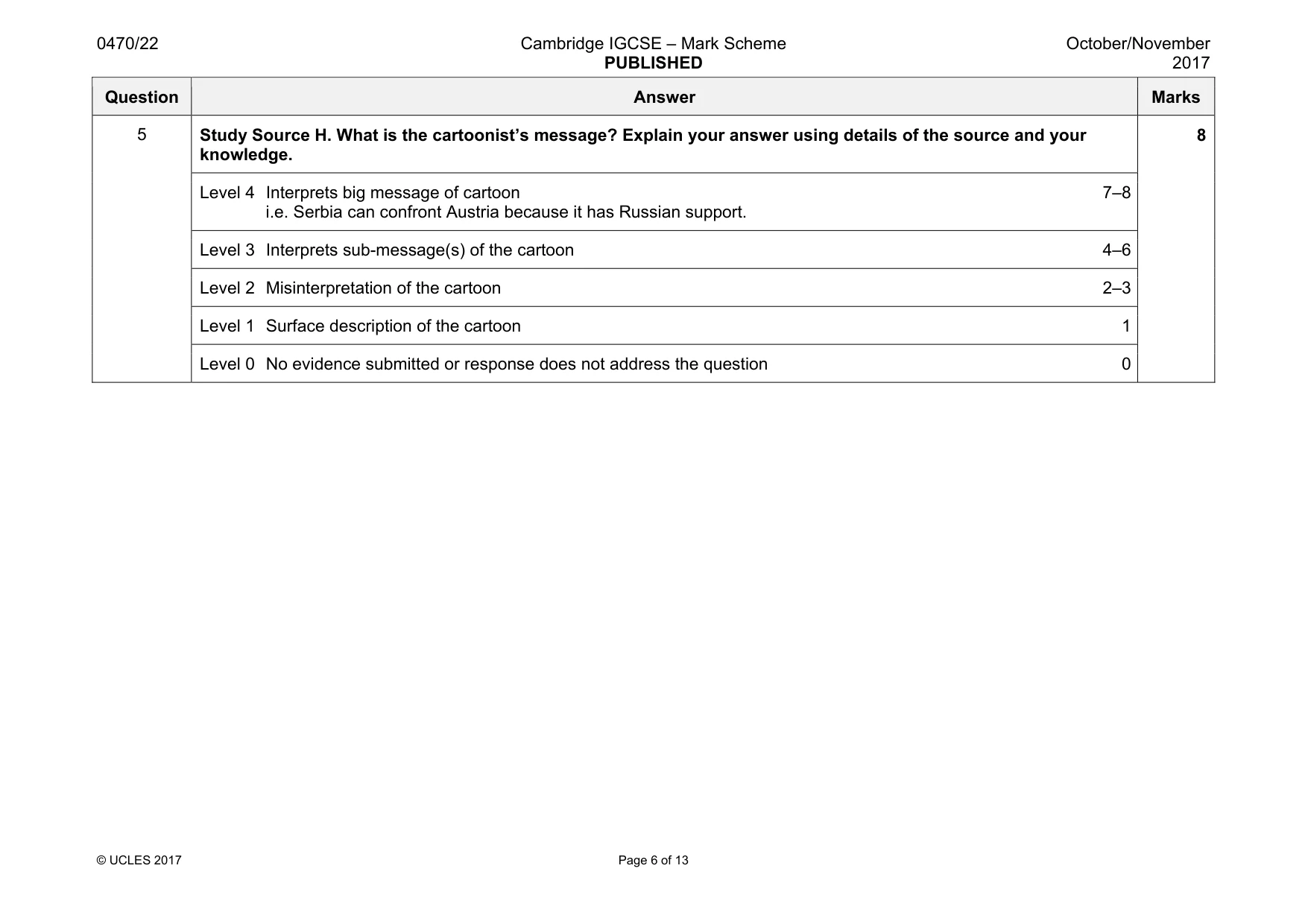
0470/22 Cambridge IGCSE – Mark Scheme PUBLISHED October/November 2017 © UCLES 2017 Page 6 of 13 Question Answer Marks 5 Study Source H. What is the cartoonist’s message? Explain your answer using details of the source and your knowledge. 8 Level 4 Interprets big message of cartoon 7–8 i.e. Serbia can confront Austria because it has Russian support. Level 3 Interprets sub-message(s) of the cartoon 4–6 Level 2 Misinterpretation of the cartoon 2–3 Level 1 Surface description of the cartoon 1 Level 0 No evidence submitted or response does not address the question 0
Mark scheme, page 7
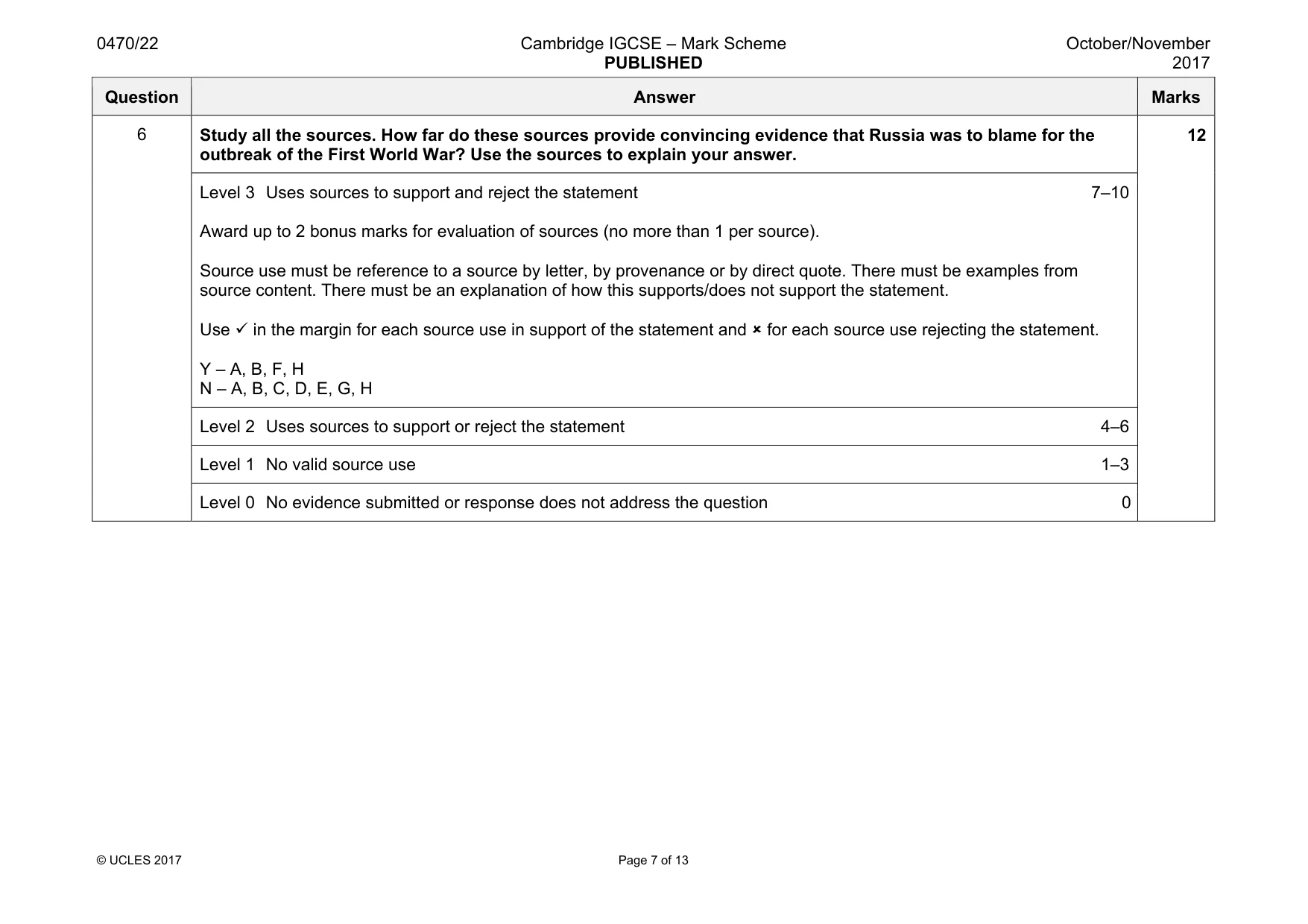
0470/22 Cambridge IGCSE – Mark Scheme PUBLISHED October/November 2017 © UCLES 2017 Page 7 of 13 Question Answer Marks 6 Study all the sources. How far do these sources provide convincing evidence that Russia was to blame for the outbreak of the First World War? Use the sources to explain your answer. 12 Level 3 Uses sources to support and reject the statement 7–10 Award up to 2 bonus marks for evaluation of sources (no more than 1 per source). Source use must be reference to a source by letter, by provenance or by direct quote. There must be examples from source content. There must be an explanation of how this supports/does not support the statement. Use 9 in the margin for each source use in support of the statement and 8 for each source use rejecting the statement. Y – A, B, F, H N – A, B, C, D, E, G, H Level 2 Uses sources to support or reject the statement 4–6 Level 1 No valid source use 1–3 Level 0 No evidence submitted or response does not address the question 0
Mark scheme, page 8
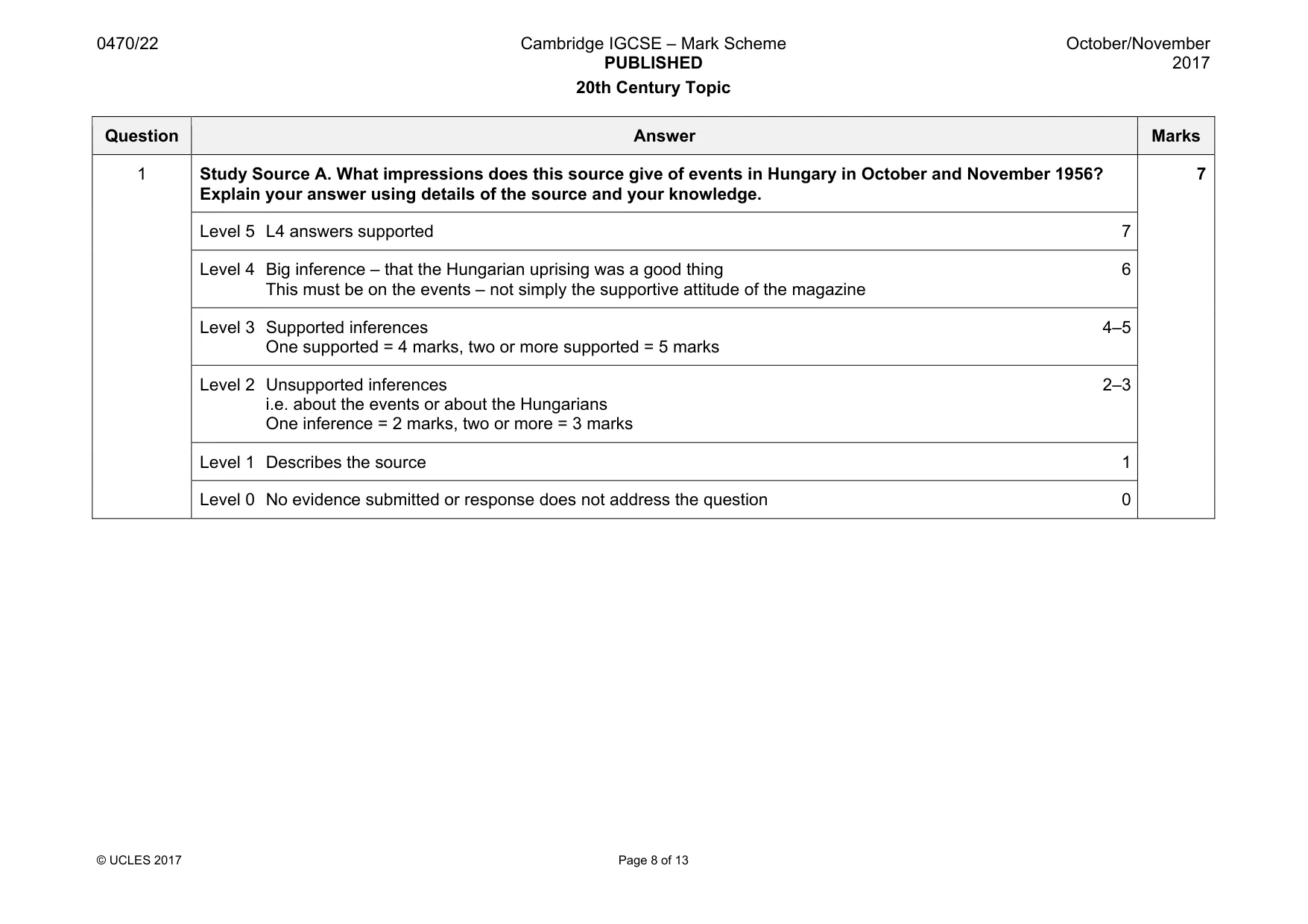
0470/22 Cambridge IGCSE – Mark Scheme PUBLISHED October/November 2017 © UCLES 2017 Page 8 of 13 20th Century Topic Question Answer Marks 1 Study Source A. What impressions does this source give of events in Hungary in October and November 1956? Explain your answer using details of the source and your knowledge. 7 Level 5 L4 answers supported 7 Level 4 Big inference – that the Hungarian uprising was a good thing 6 This must be on the events – not simply the supportive attitude of the magazine Level 3 Supported inferences 4–5 One supported = 4 marks, two or more supported = 5 marks Level 2 Unsupported inferences 2–3 i.e. about the events or about the Hungarians One inference = 2 marks, two or more = 3 marks Level 1 Describes the source 1 Level 0 No evidence submitted or response does not address the question 0
Mark scheme, page 9
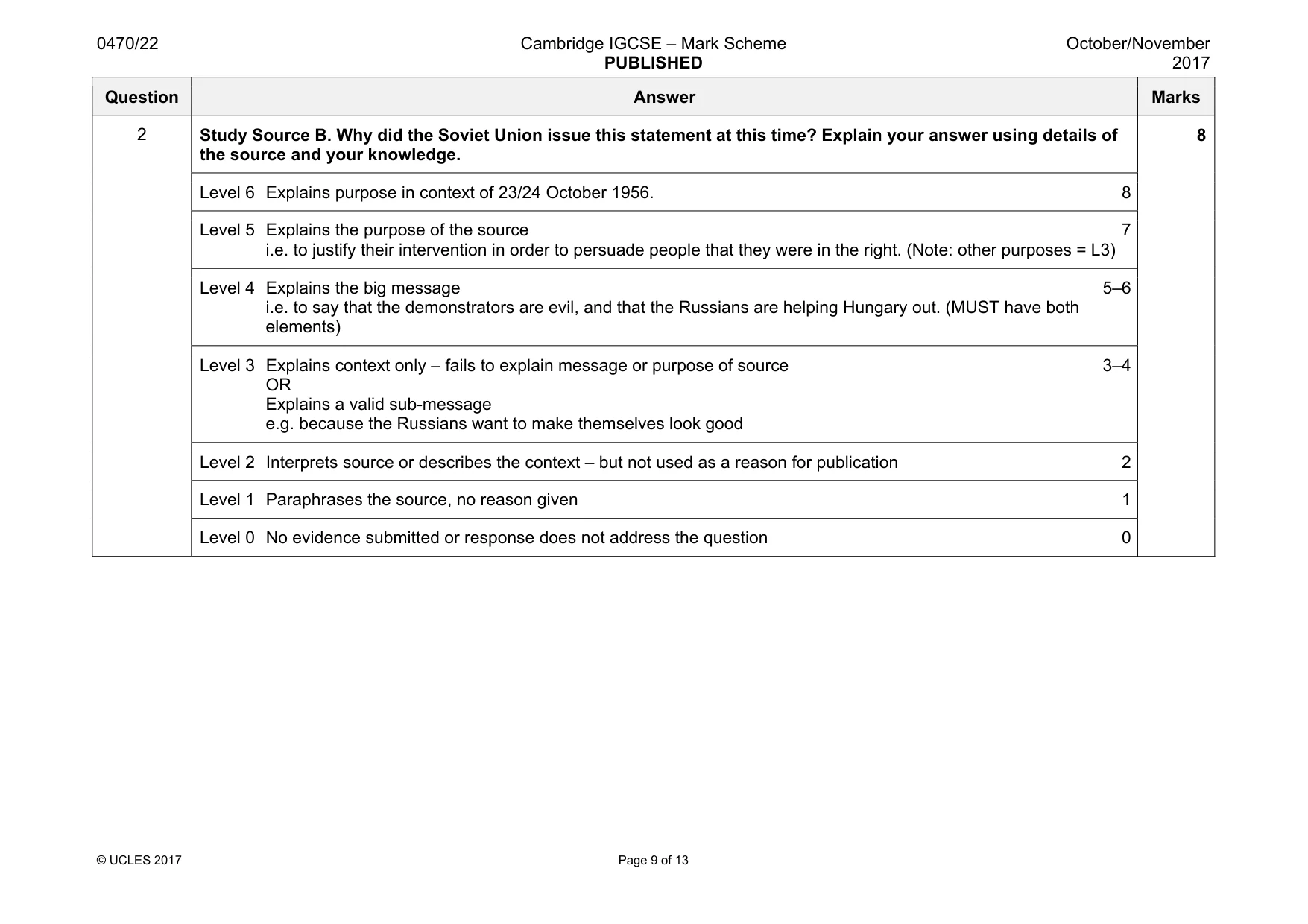
0470/22 Cambridge IGCSE – Mark Scheme PUBLISHED October/November 2017 © UCLES 2017 Page 9 of 13 Question Answer Marks 2 Study Source B. Why did the Soviet Union issue this statement at this time? Explain your answer using details of the source and your knowledge. 8 Level 6 Explains purpose in context of 23/24 October 1956. 8 Level 5 Explains the purpose of the source 7 i.e. to justify their intervention in order to persuade people that they were in the right. (Note: other purposes = L3) Level 4 Explains the big message 5–6 i.e. to say that the demonstrators are evil, and that the Russians are helping Hungary out. (MUST have both elements) Level 3 Explains context only – fails to explain message or purpose of source 3–4 OR Explains a valid sub-message e.g. because the Russians want to make themselves look good Level 2 Interprets source or describes the context – but not used as a reason for publication 2 Level 1 Paraphrases the source, no reason given 1 Level 0 No evidence submitted or response does not address the question 0
Mark scheme, page 10
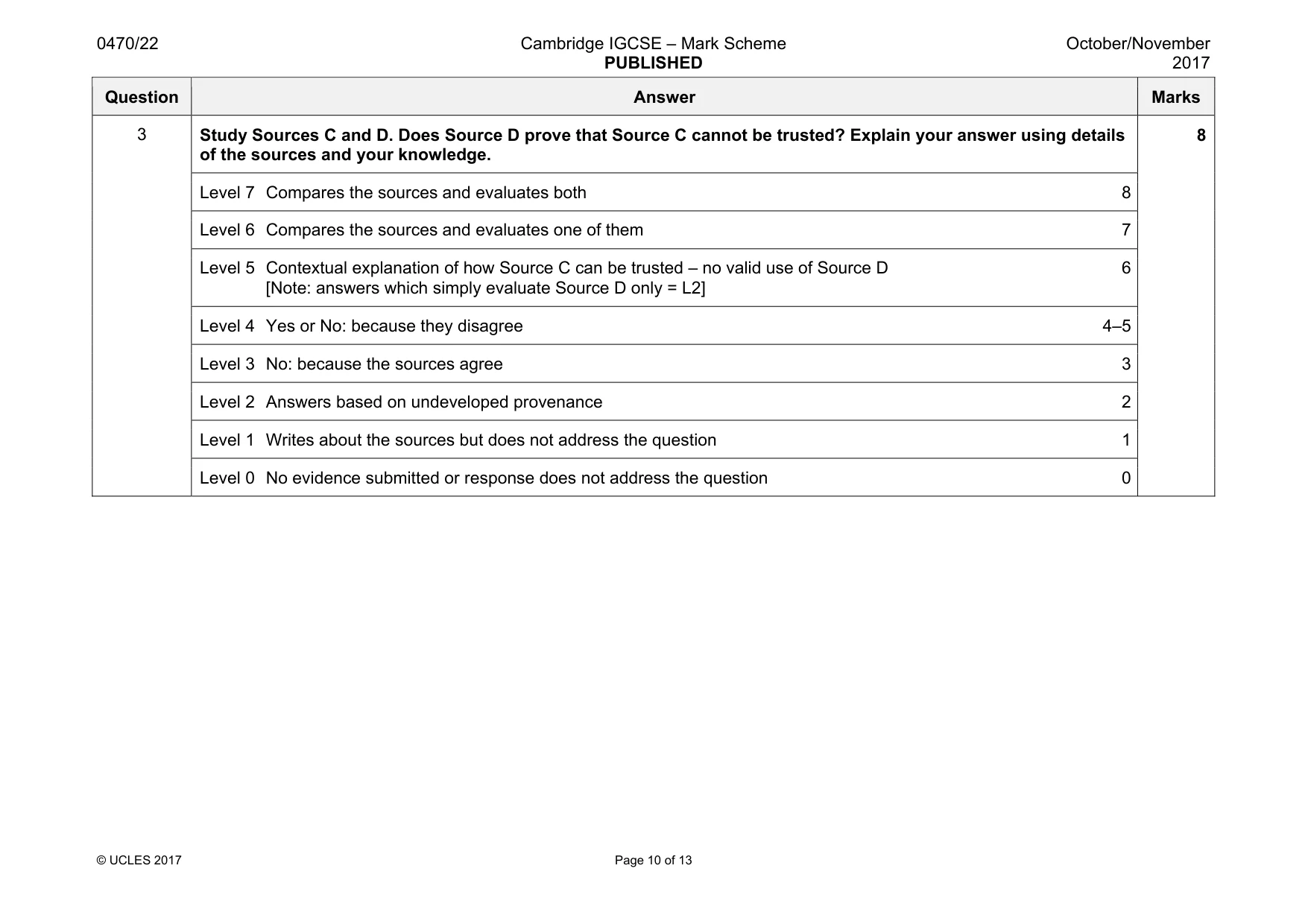
0470/22 Cambridge IGCSE – Mark Scheme PUBLISHED October/November 2017 © UCLES 2017 Page 10 of 13 Question Answer Marks 3 Study Sources C and D. Does Source D prove that Source C cannot be trusted? Explain your answer using details of the sources and your knowledge. 8 Level 7 Compares the sources and evaluates both 8 Level 6 Compares the sources and evaluates one of them 7 Level 5 Contextual explanation of how Source C can be trusted – no valid use of Source D 6 [Note: answers which simply evaluate Source D only = L2] Level 4 Yes or No: because they disagree 4–5 Level 3 No: because the sources agree 3 Level 2 Answers based on undeveloped provenance 2 Level 1 Writes about the sources but does not address the question 1 Level 0 No evidence submitted or response does not address the question 0
Mark scheme, page 11
0470/22 Cambridge IGCSE – Mark Scheme PUBLISHED October/November 2017 © UCLES 2017 Page 11 of 13 Question Answer Marks 4 Study Source E. What is the cartoonist's message? Explain your answer using details of the source and your knowledge. 7 Level 5 L4 plus explains point of view of cartoonist 7 This must be an explicit point about the cartoonist’s disapproval/criticism (criticism only, no big message = L3) Level 4 Explains big message 6 i.e. that the SU/Khrushchev will be unable to remove the stain of their bloody actions in Hungary, and that this will doom them. (MUST have both elements) Level 3 Sub-message(s) explained 3–5 Level 2 Plausible misinterpretations 2 Level 1 Surface description of source 1 Level 0 No evidence submitted or response does not address the question 0
Mark scheme, page 12
0470/22 Cambridge IGCSE – Mark Scheme PUBLISHED October/November 2017 © UCLES 2017 Page 12 of 13 Question Answer Marks 5 Study Source F. Are you surprised by this source? Explain your answer using details of the source and your knowledge. 8 Level 7 Not surprised, using explained purpose of the statement 8 Level 6 Not surprised that the Communists would represent events in this way, supported by cross-reference 7 Level 5 Uses cross reference to other sources/contextual knowledge to check details in the source 5–6 Level 4 Answers based on explained use of provenance 4 i.e. not surprised that Communists would want to make themselves look good Level 3 Assertions based on everyday empathy/common sense/arguments internal to the source etc. 3 i.e. any valid answer that does not reach one of the higher levels. Level 2 Valid analysis of source but fails to state whether surprised or not 2 OR Identifies what is/is not surprising, no explanation Level 1 Writes about source but fails to address the question 1 Level 0 No evidence submitted or response does not address the question 0
Mark scheme, page 13
0470/22 Cambridge IGCSE – Mark Scheme PUBLISHED October/November 2017 © UCLES 2017 Page 13 of 13 Question Answer Marks 6 Study all the sources. How far do these sources provide convincing evidence that Soviet armed intervention in Hungary was justified? Use the sources to explain your answer. 12 Level 3 Uses sources to support and reject the statement 7–10 Award up to 2 bonus marks for evaluation of sources (no more than 1 per source). Source use must be reference to a source by letter, by provenance or by direct quote. There must be examples from source content. There must be an explanation of how this supports/does not support the statement. Use 9 in the margin for each source use in support of the statement and 8 for each source use rejecting the statement. Y – B, D, F N – A, C, E Level 2 Uses sources to support or reject the statement 4–6 Level 1 No valid source use 1–3 Level 0 No evidence submitted or response does not address the question 0
What you needed in this session
Cambridge’s own grade thresholds for 2017 Oct/Nov, Paper 2 · Variant 2. A higher threshold means an easier paper — the bar moves with how the cohort did.