Cambridge IGCSE History 0470 — 2017 Oct/Nov Paper 2 · Variant 1
0470/21/O/N/17 · 50 marks · ≈56 min
The question paper and its mark scheme, free to read here and free to download. This is Cambridge’s own paper, exactly as it was sat.
Question paper16 pages

Mark scheme11 pages
Answers below. Sit the paper first if you are practising.
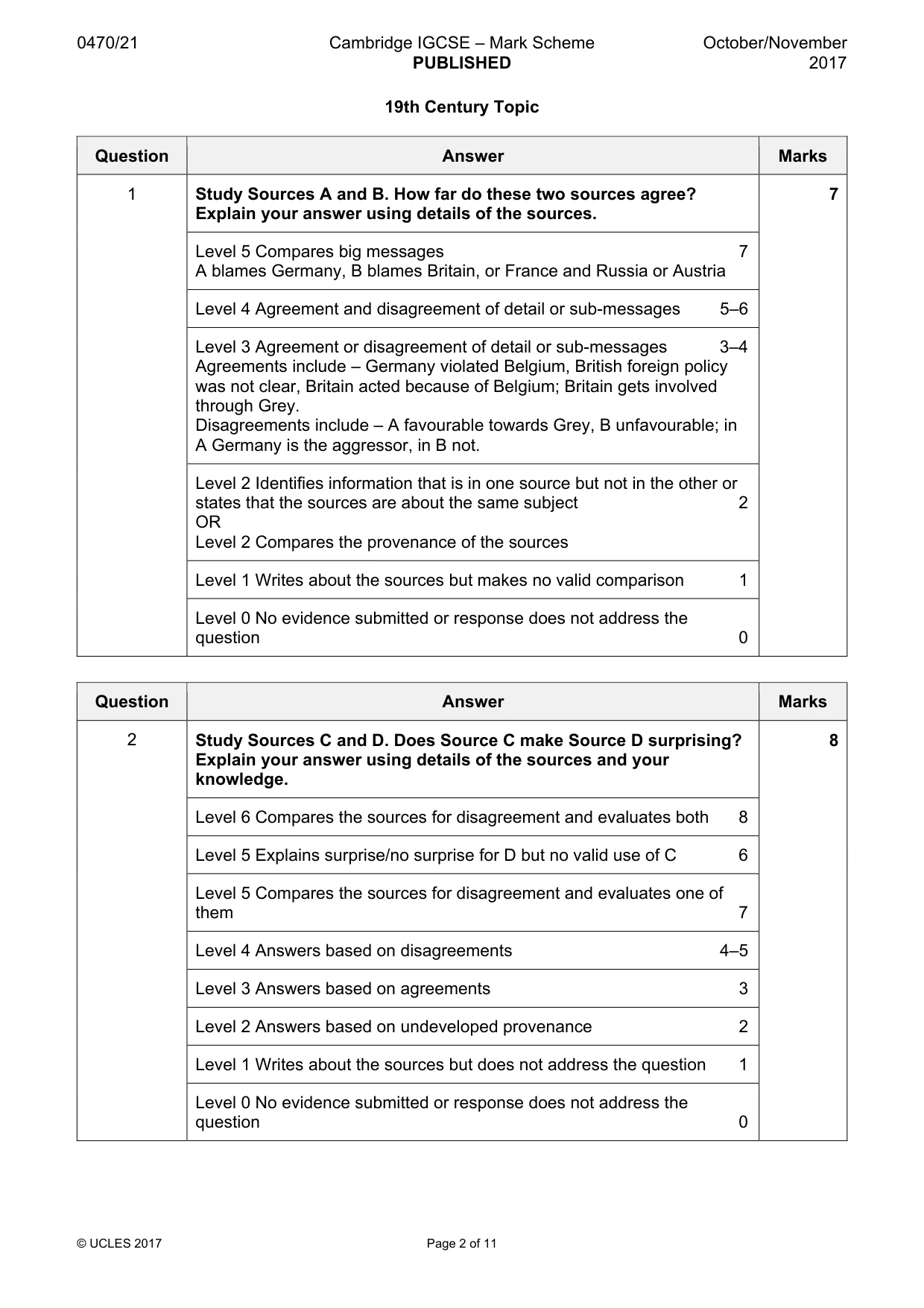
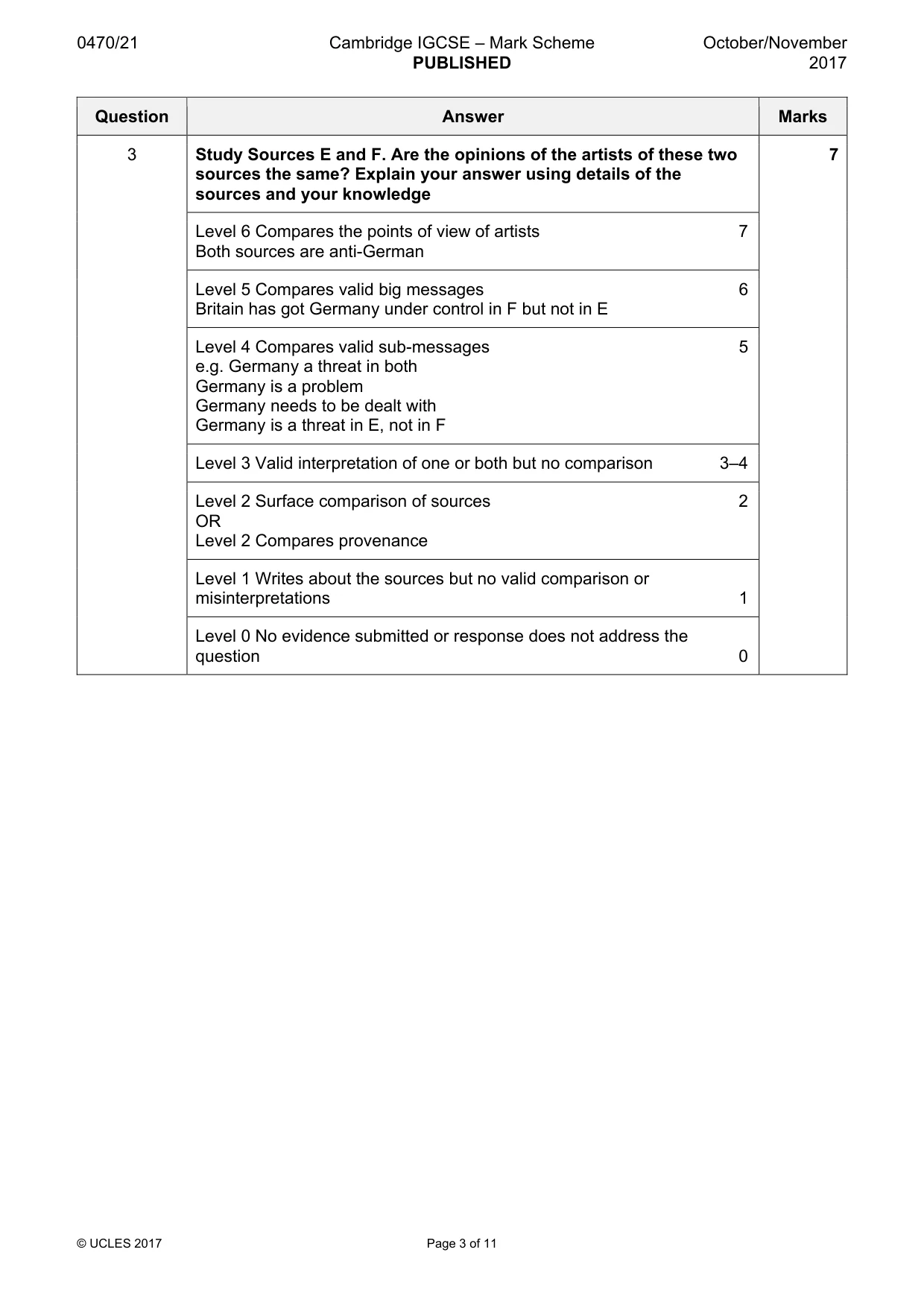
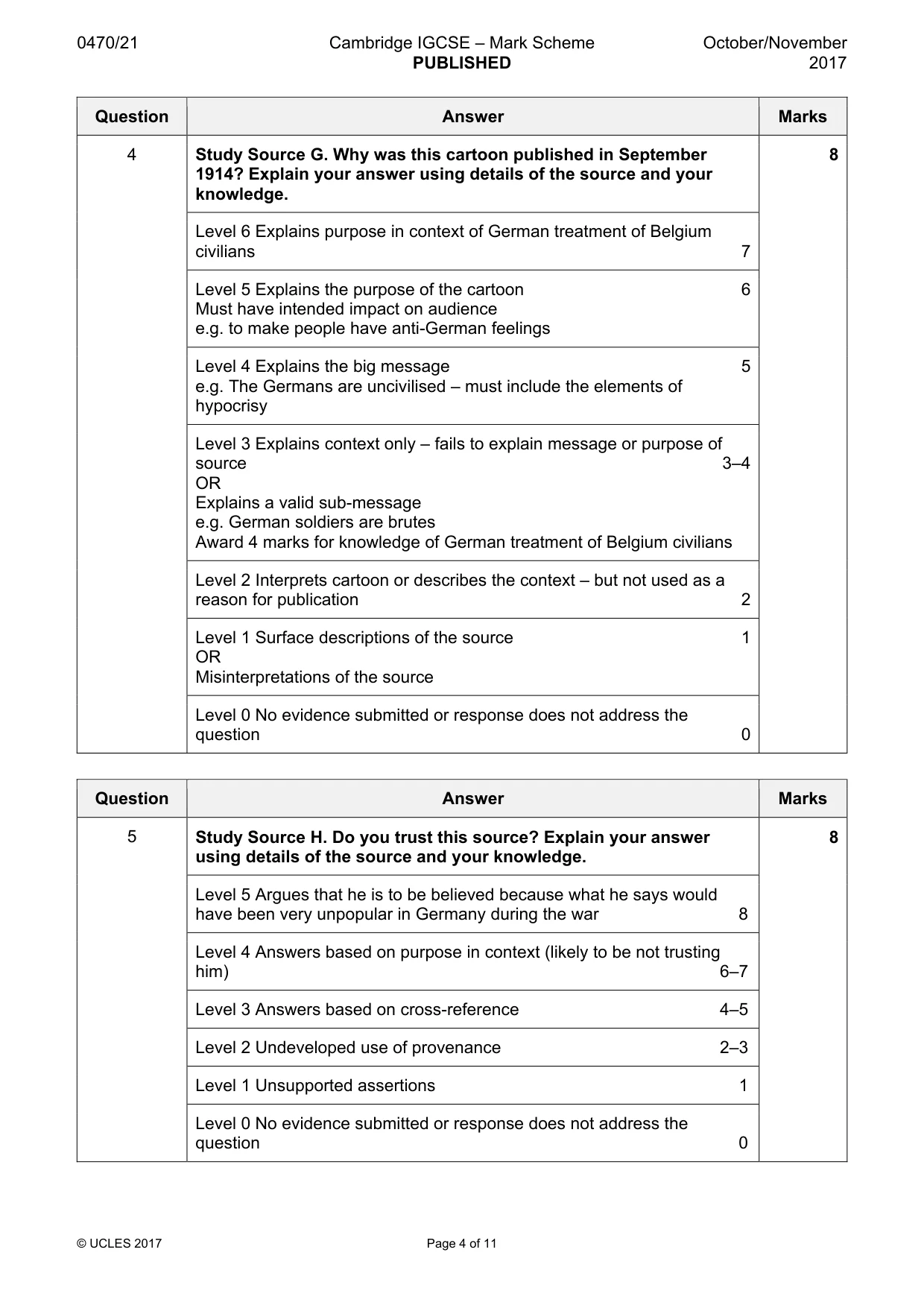
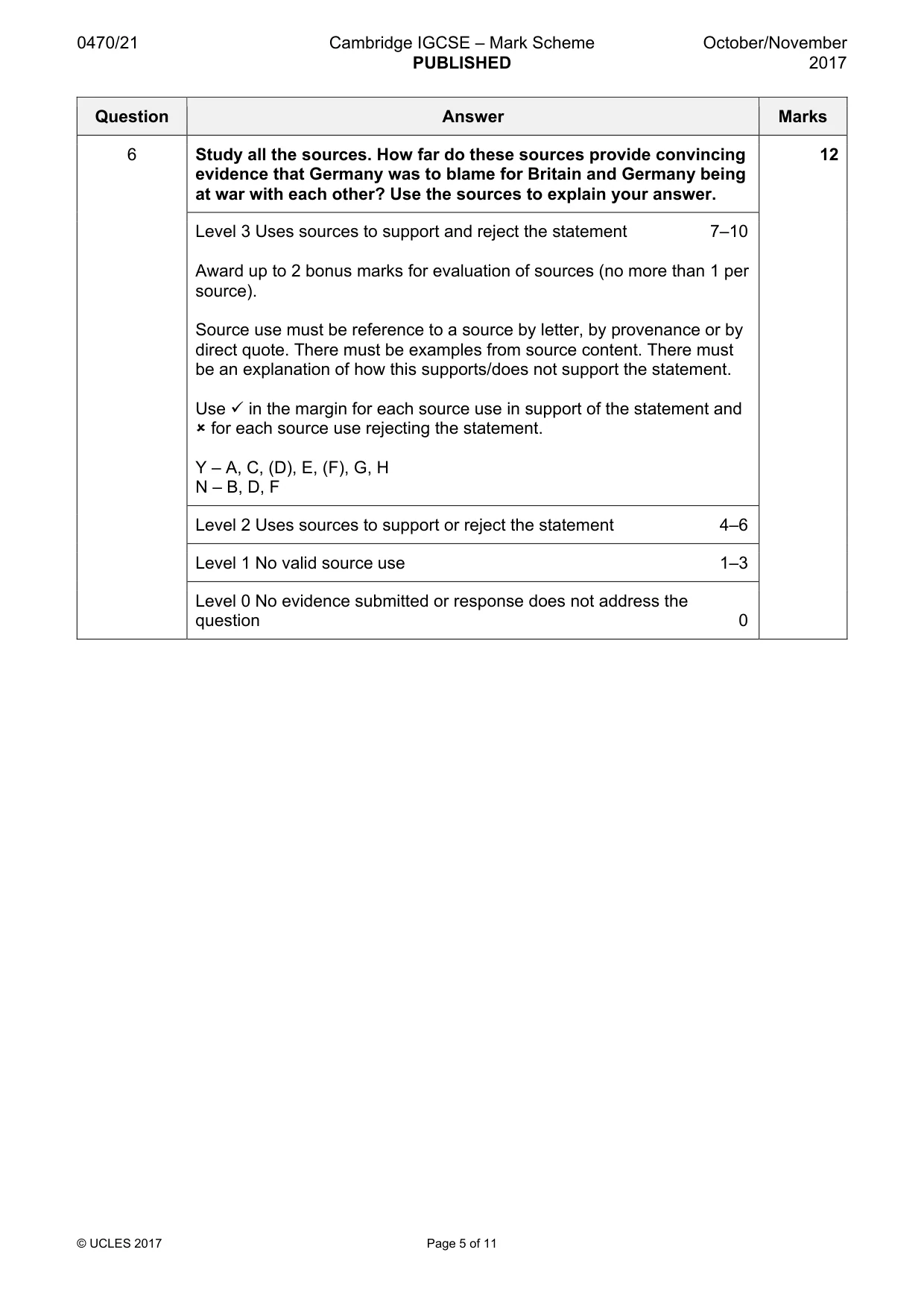
Paper as text
Question paper, page 1
* 8 9 5 8 4 9 3 8 5 6 * This document consists of 14 printed pages, 2 blank pages and 1 Insert. DC (LK/SW) 135334/4 © UCLES 2017 [Turn over Cambridge International Examinations Cambridge International General Certificate of Secondary Education HISTORY 0470/21 Paper 2 October/November 2017 2 hours No Additional Materials are required. READ THESE INSTRUCTIONS FIRST An answer booklet is provided inside this question paper. You should follow the instructions on the front cover of the answer booklet. If you need additional answer paper ask the invigilator for a continuation booklet. This paper has two options. Choose one option, and answer all of the questions on that topic. Option A: 19th Century topic [p2–p8] Option B: 20th Century topic [p10–p15] The number of marks is given in brackets [ ] at the end of each question or part question. The syllabus is approved for use in England, Wales and Northern Ireland as a Cambridge International Level 1/Level 2 Certificate.
Question paper, page 2
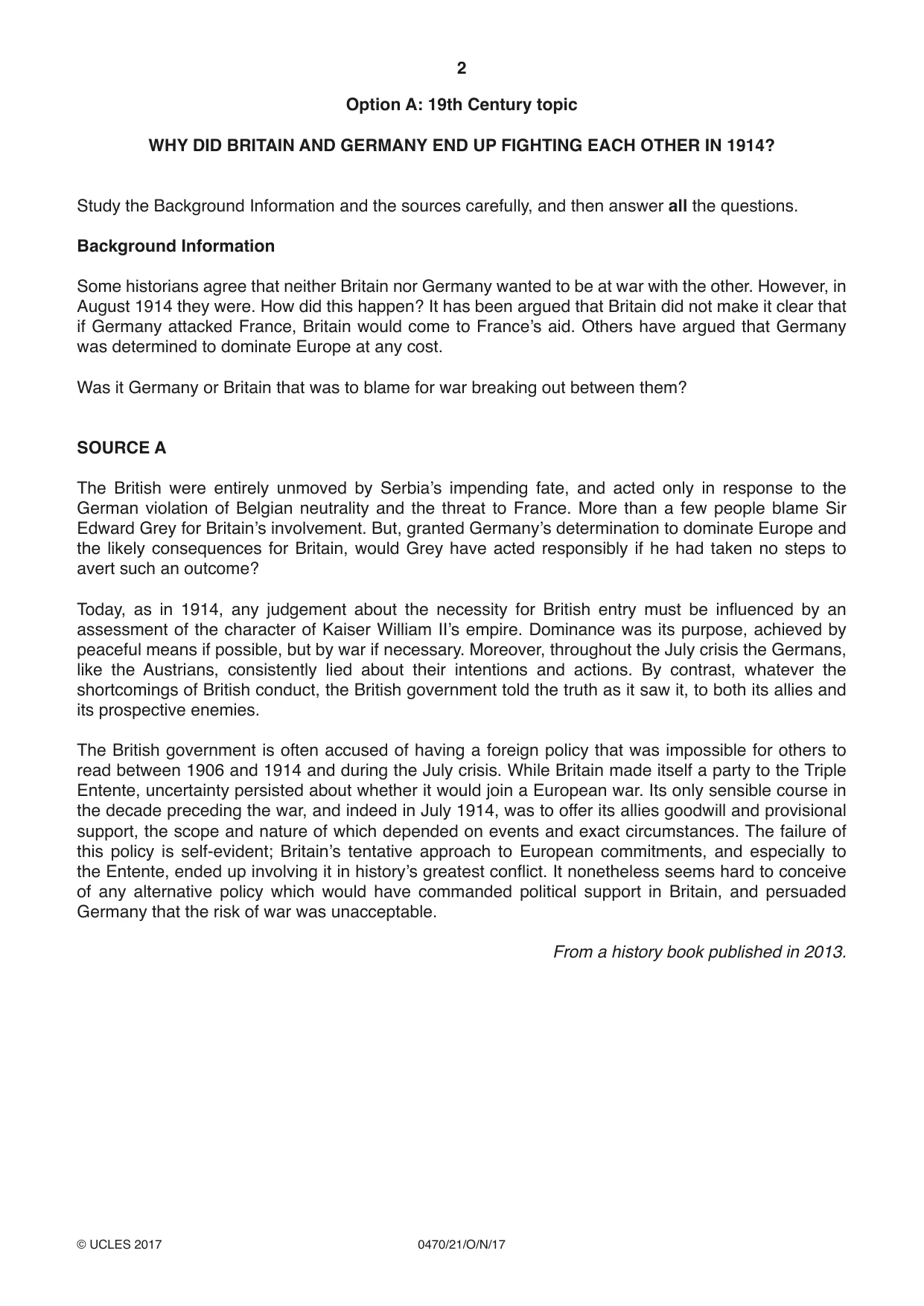
2 0470/21/O/N/17 © UCLES 2017 Option A: 19th Century topic WHY DID BRITAIN AND GERMANY END UP FIGHTING EACH OTHER IN 1914? Study the Background Information and the sources carefully, and then answer all the questions. Background Information Some historians agree that neither Britain nor Germany wanted to be at war with the other. However, in August 1914 they were. How did this happen? It has been argued that Britain did not make it clear that if Germany attacked France, Britain would come to France’s aid. Others have argued that Germany was determined to dominate Europe at any cost. Was it Germany or Britain that was to blame for war breaking out between them? SOURCE A The British were entirely unmoved by Serbia’s impending fate, and acted only in response to the German violation of Belgian neutrality and the threat to France. More than a few people blame Sir Edward Grey for Britain’s involvement. But, granted Germany’s determination to dominate Europe and the likely consequences for Britain, would Grey have acted responsibly if he had taken no steps to avert such an outcome? Today, as in 1914, any judgement about the necessity for British entry must be influenced by an assessment of the character of Kaiser William II’s empire. Dominance was its purpose, achieved by peaceful means if possible, but by war if necessary. Moreover, throughout the July crisis the Germans, like the Austrians, consistently lied about their intentions and actions. By contrast, whatever the shortcomings of British conduct, the British government told the truth as it saw it, to both its allies and its prospective enemies. The British government is often accused of having a foreign policy that was impossible for others to read between 1906 and 1914 and during the July crisis. While Britain made itself a party to the Triple Entente, uncertainty persisted about whether it would join a European war. Its only sensible course in the decade preceding the war, and indeed in July 1914, was to offer its allies goodwill and provisional support, the scope and nature of which depended on events and exact circumstances. The failure of this policy is self-evident; Britain’s tentative approach to European commitments, and especially to the Entente, ended up involving it in history’s greatest conflict. It nonetheless seems hard to conceive of any alternative policy which would have commanded political support in Britain, and persuaded Germany that the risk of war was unacceptable. From a history book published in 2013.
Question paper, page 3
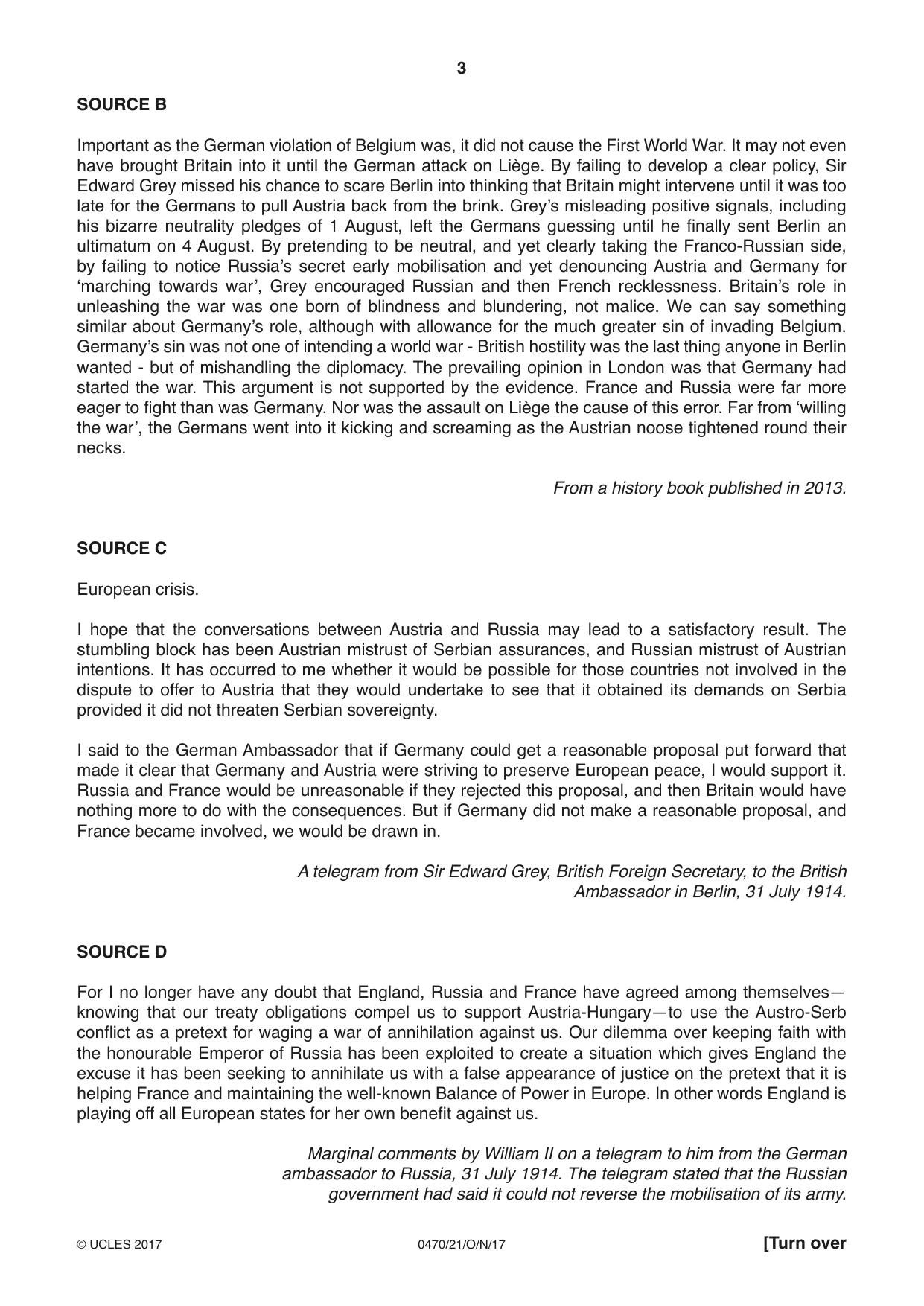
3 0470/21/O/N/17 © UCLES 2017 [Turn over SOURCE B Important as the German violation of Belgium was, it did not cause the First World War. It may not even have brought Britain into it until the German attack on Liège. By failing to develop a clear policy, Sir Edward Grey missed his chance to scare Berlin into thinking that Britain might intervene until it was too late for the Germans to pull Austria back from the brink. Grey’s misleading positive signals, including his bizarre neutrality pledges of 1 August, left the Germans guessing until he finally sent Berlin an ultimatum on 4 August. By pretending to be neutral, and yet clearly taking the Franco-Russian side, by failing to notice Russia’s secret early mobilisation and yet denouncing Austria and Germany for ‘marching towards war’, Grey encouraged Russian and then French recklessness. Britain’s role in unleashing the war was one born of blindness and blundering, not malice. We can say something similar about Germany’s role, although with allowance for the much greater sin of invading Belgium. Germany’s sin was not one of intending a world war - British hostility was the last thing anyone in Berlin wanted - but of mishandling the diplomacy. The prevailing opinion in London was that Germany had started the war. This argument is not supported by the evidence. France and Russia were far more eager to fight than was Germany. Nor was the assault on Liège the cause of this error. Far from ‘willing the war’, the Germans went into it kicking and screaming as the Austrian noose tightened round their necks. From a history book published in 2013. SOURCE C European crisis. I hope that the conversations between Austria and Russia may lead to a satisfactory result. The stumbling block has been Austrian mistrust of Serbian assurances, and Russian mistrust of Austrian intentions. It has occurred to me whether it would be possible for those countries not involved in the dispute to offer to Austria that they would undertake to see that it obtained its demands on Serbia provided it did not threaten Serbian sovereignty. I said to the German Ambassador that if Germany could get a reasonable proposal put forward that made it clear that Germany and Austria were striving to preserve European peace, I would support it. Russia and France would be unreasonable if they rejected this proposal, and then Britain would have nothing more to do with the consequences. But if Germany did not make a reasonable proposal, and France became involved, we would be drawn in. A telegram from Sir Edward Grey, British Foreign Secretary, to the British Ambassador in Berlin, 31 July 1914. SOURCE D For I no longer have any doubt that England, Russia and France have agreed among themselves— knowing that our treaty obligations compel us to support Austria-Hungary—to use the Austro-Serb conflict as a pretext for waging a war of annihilation against us. Our dilemma over keeping faith with the honourable Emperor of Russia has been exploited to create a situation which gives England the excuse it has been seeking to annihilate us with a false appearance of justice on the pretext that it is helping France and maintaining the well-known Balance of Power in Europe. In other words England is playing off all European states for her own benefit against us. Marginal comments by William II on a telegram to him from the German ambassador to Russia, 31 July 1914. The telegram stated that the Russian government had said it could not reverse the mobilisation of its army.
Question paper, page 4
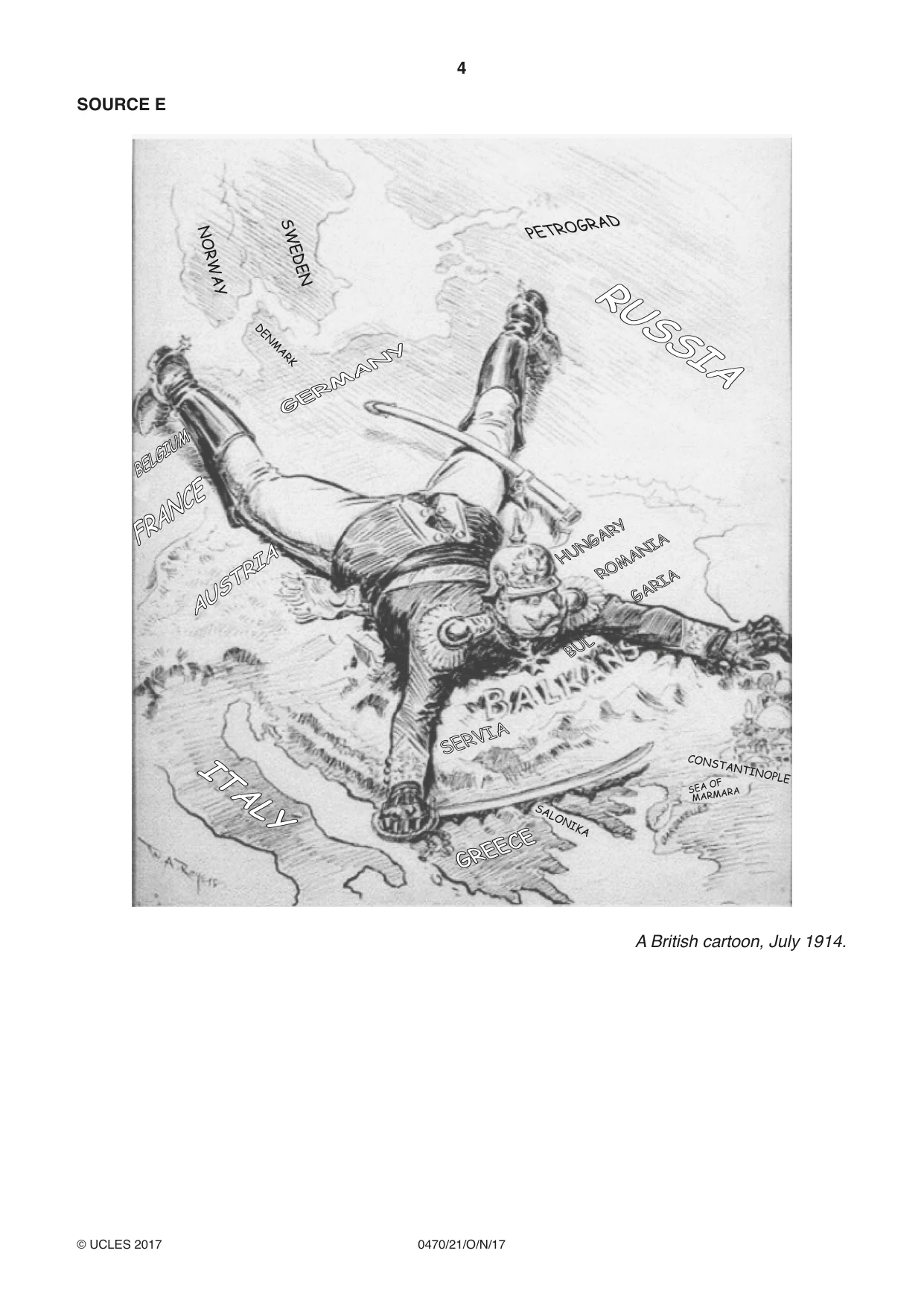
4 0470/21/O/N/17 © UCLES 2017 SOURCE E SEA OF MARMARA CONSTANTINOPLE SALONIKA DENMARK NORWAY SWEDEN PETROGRAD HUNGARY GERMANY ROMANIA BUL SERVIA GREECE GARIA RUSSIA AUSTRIA ITALY FRANCE BELGIUM A British cartoon, July 1914.
Question paper, page 5
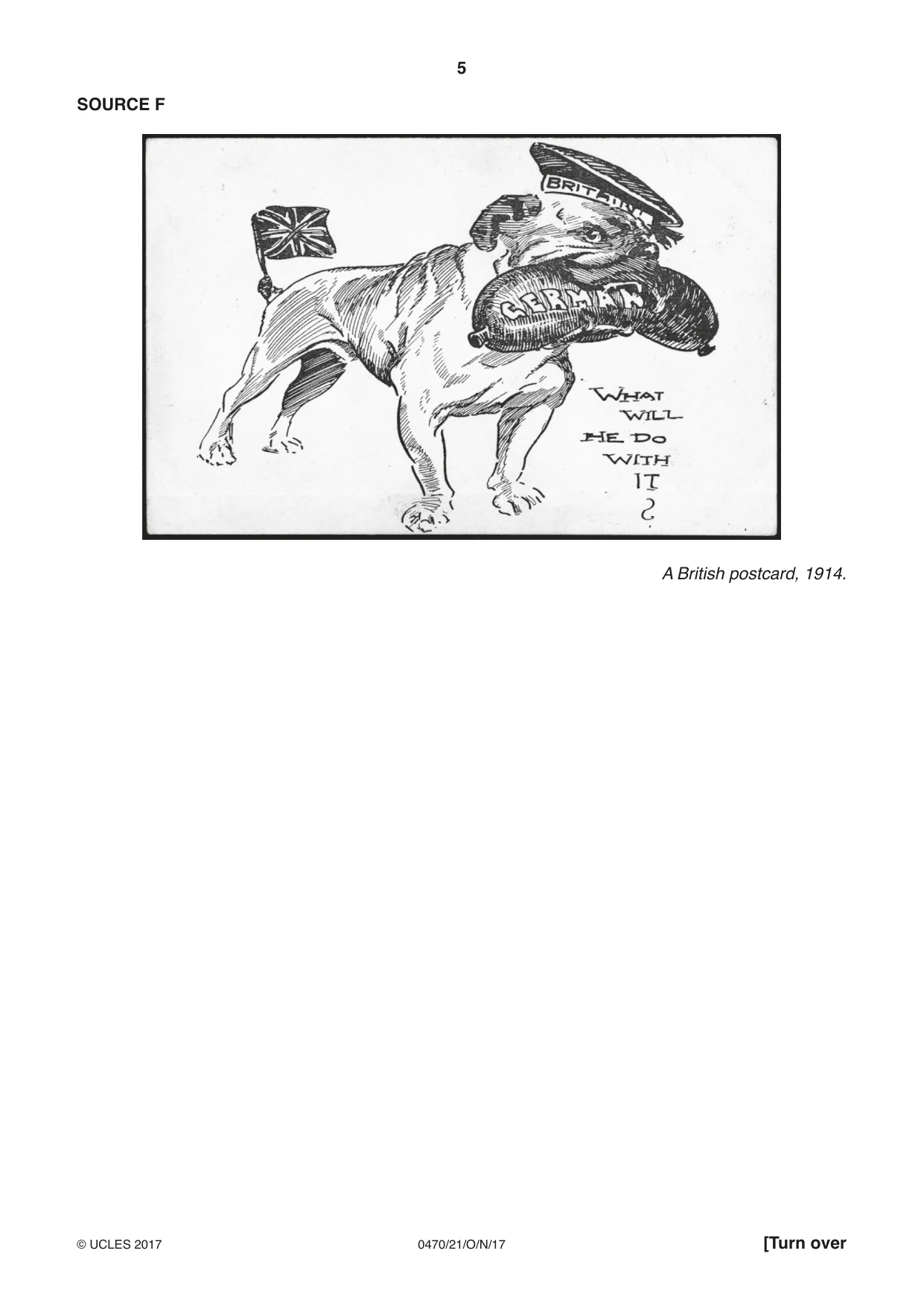
5 0470/21/O/N/17 © UCLES 2017 [Turn over SOURCE F A British postcard, 1914.
Question paper, page 6
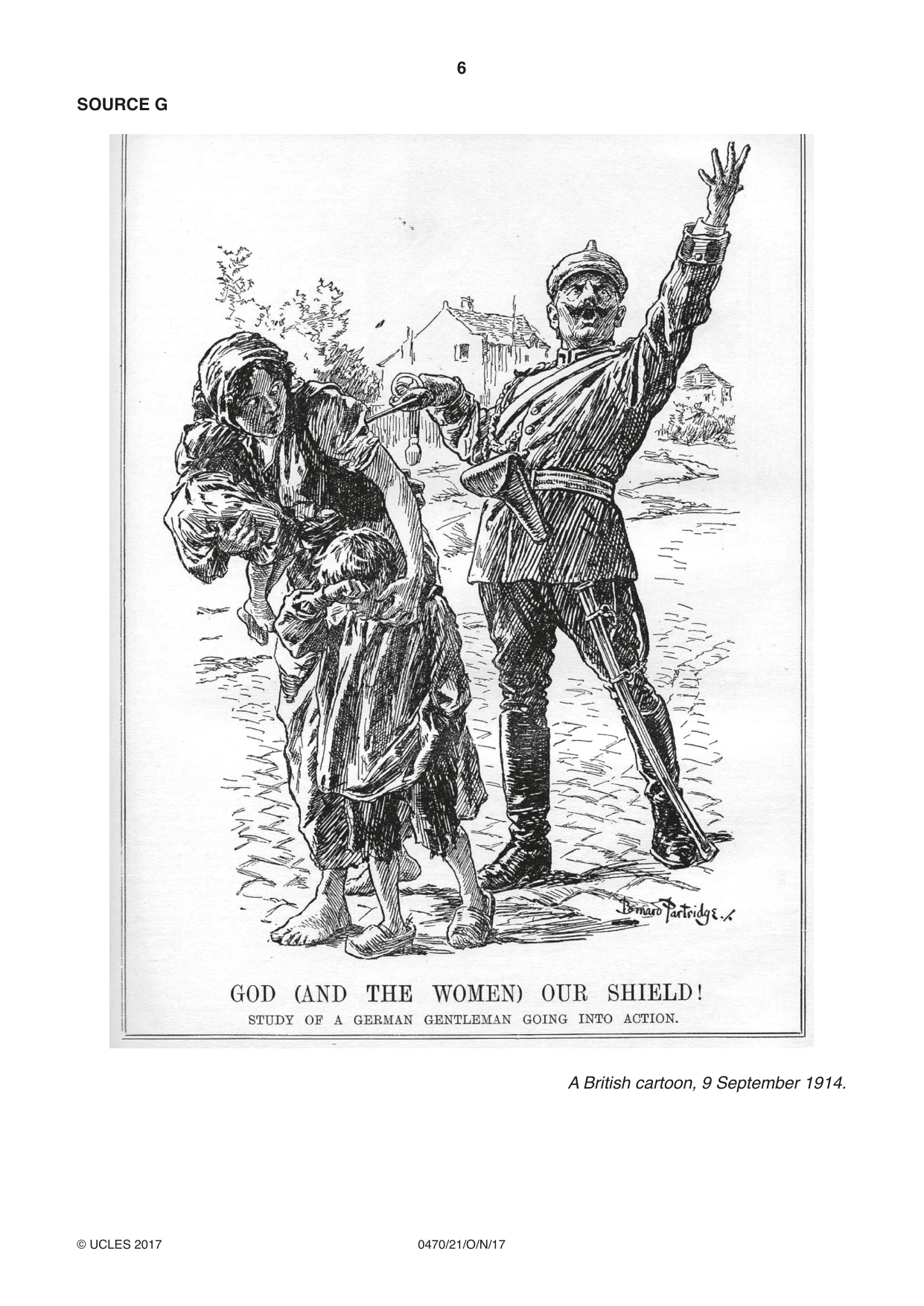
6 0470/21/O/N/17 © UCLES 2017 SOURCE G A British cartoon, 9 September 1914.
Question paper, page 7
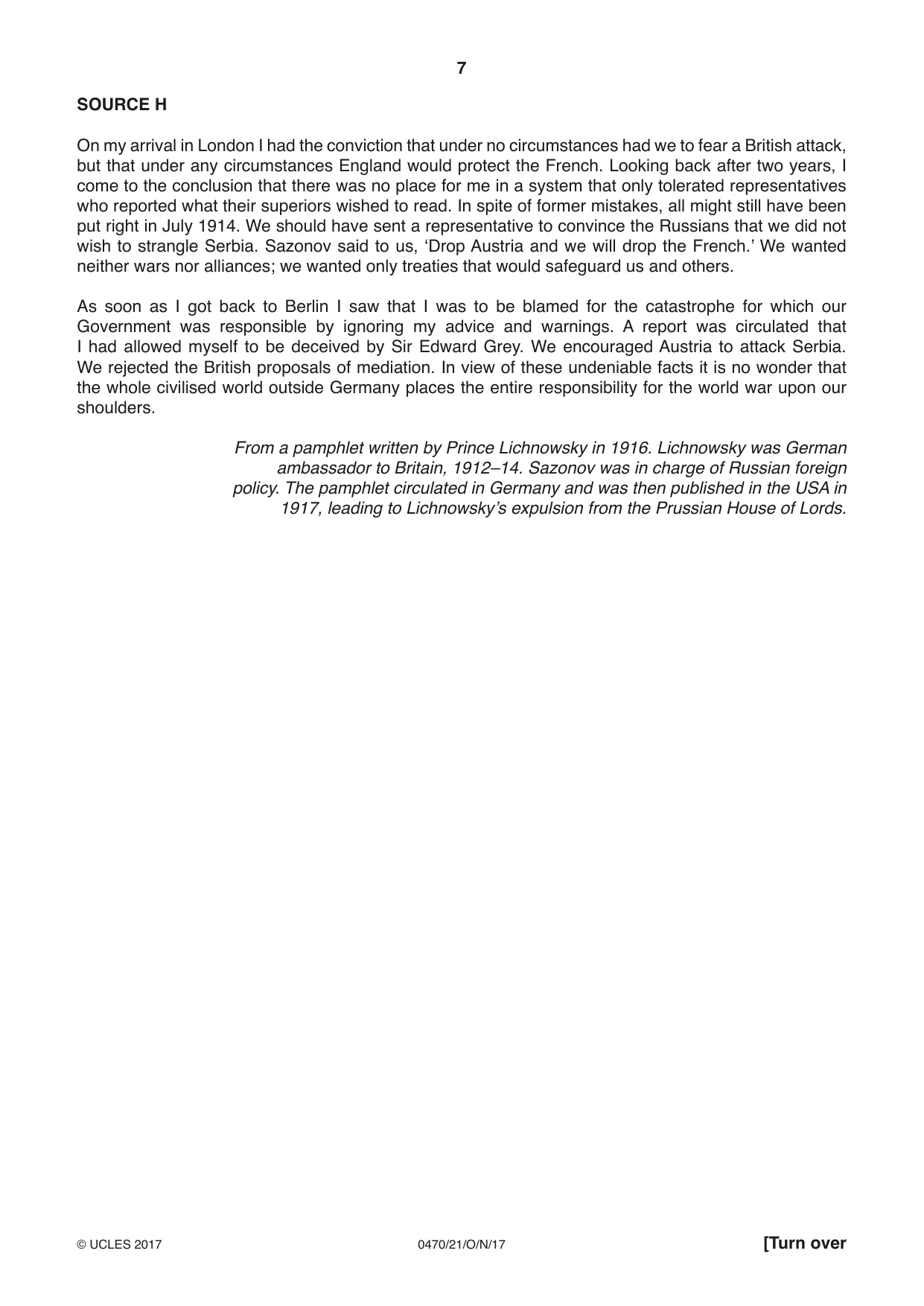
7 0470/21/O/N/17 © UCLES 2017 [Turn over SOURCE H On my arrival in London I had the conviction that under no circumstances had we to fear a British attack, but that under any circumstances England would protect the French. Looking back after two years, I come to the conclusion that there was no place for me in a system that only tolerated representatives who reported what their superiors wished to read. In spite of former mistakes, all might still have been put right in July 1914. We should have sent a representative to convince the Russians that we did not wish to strangle Serbia. Sazonov said to us, ‘Drop Austria and we will drop the French.’ We wanted neither wars nor alliances; we wanted only treaties that would safeguard us and others. As soon as I got back to Berlin I saw that I was to be blamed for the catastrophe for which our Government was responsible by ignoring my advice and warnings. A report was circulated that I had allowed myself to be deceived by Sir Edward Grey. We encouraged Austria to attack Serbia. We rejected the British proposals of mediation. In view of these undeniable facts it is no wonder that the whole civilised world outside Germany places the entire responsibility for the world war upon our shoulders. From a pamphlet written by Prince Lichnowsky in 1916. Lichnowsky was German ambassador to Britain, 1912–14. Sazonov was in charge of Russian foreign policy. The pamphlet circulated in Germany and was then published in the USA in 1917, leading to Lichnowsky’s expulsion from the Prussian House of Lords.
Question paper, page 8
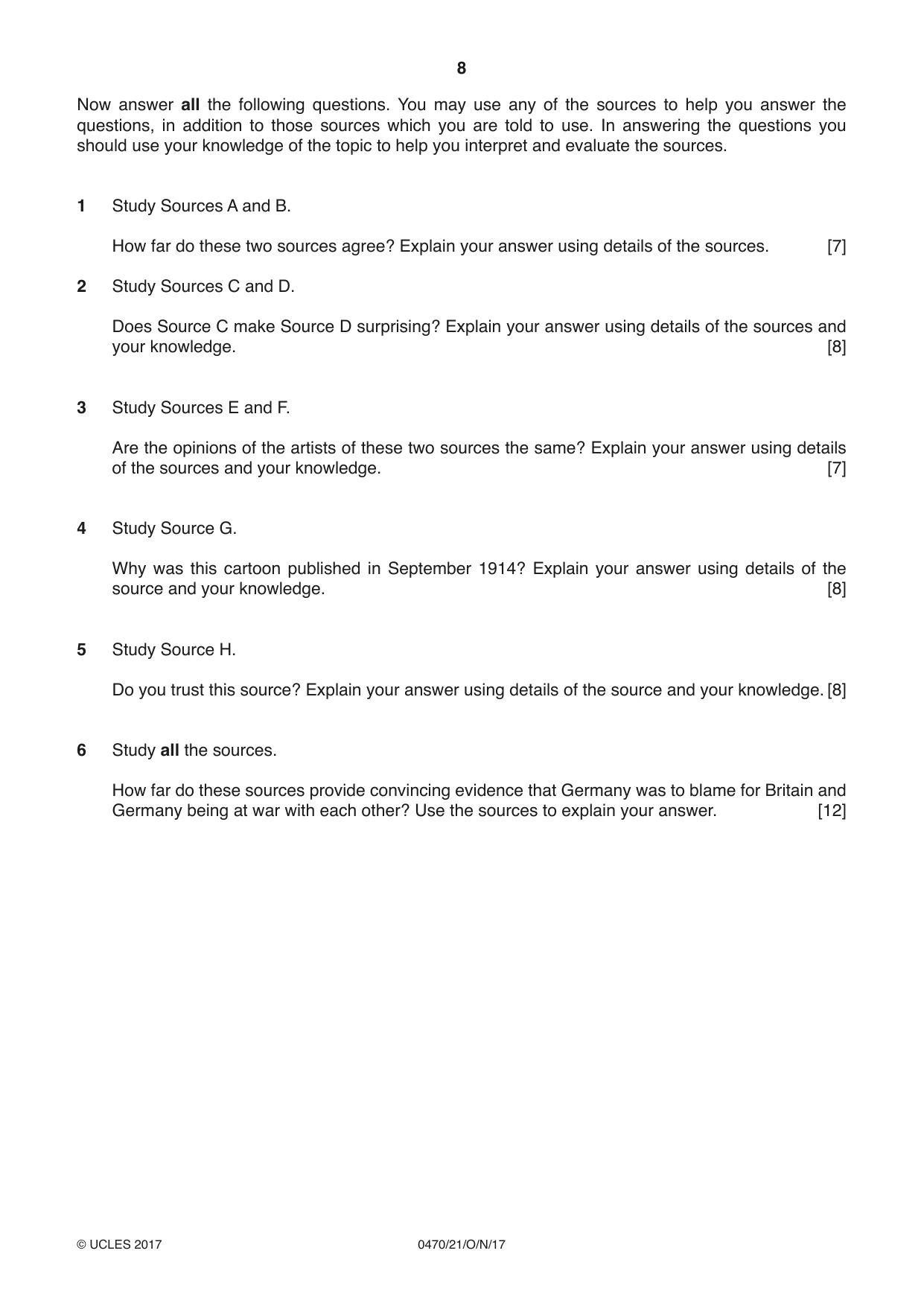
8 0470/21/O/N/17 © UCLES 2017 Now answer all the following questions. You may use any of the sources to help you answer the questions, in addition to those sources which you are told to use. In answering the questions you should use your knowledge of the topic to help you interpret and evaluate the sources. 1 Study Sources A and B. How far do these two sources agree? Explain your answer using details of the sources. [7] 2 Study Sources C and D. Does Source C make Source D surprising? Explain your answer using details of the sources and your knowledge. [8] 3 Study Sources E and F. Are the opinions of the artists of these two sources the same? Explain your answer using details of the sources and your knowledge. [7] 4 Study Source G. Why was this cartoon published in September 1914? Explain your answer using details of the source and your knowledge. [8] 5 Study Source H. Do you trust this source? Explain your answer using details of the source and your knowledge. [8] 6 Study all the sources. How far do these sources provide convincing evidence that Germany was to blame for Britain and Germany being at war with each other? Use the sources to explain your answer. [12]
Question paper, page 9
9 0470/21/O/N/17 © UCLES 2017 [Turn over BLANK PAGE
Question paper, page 10
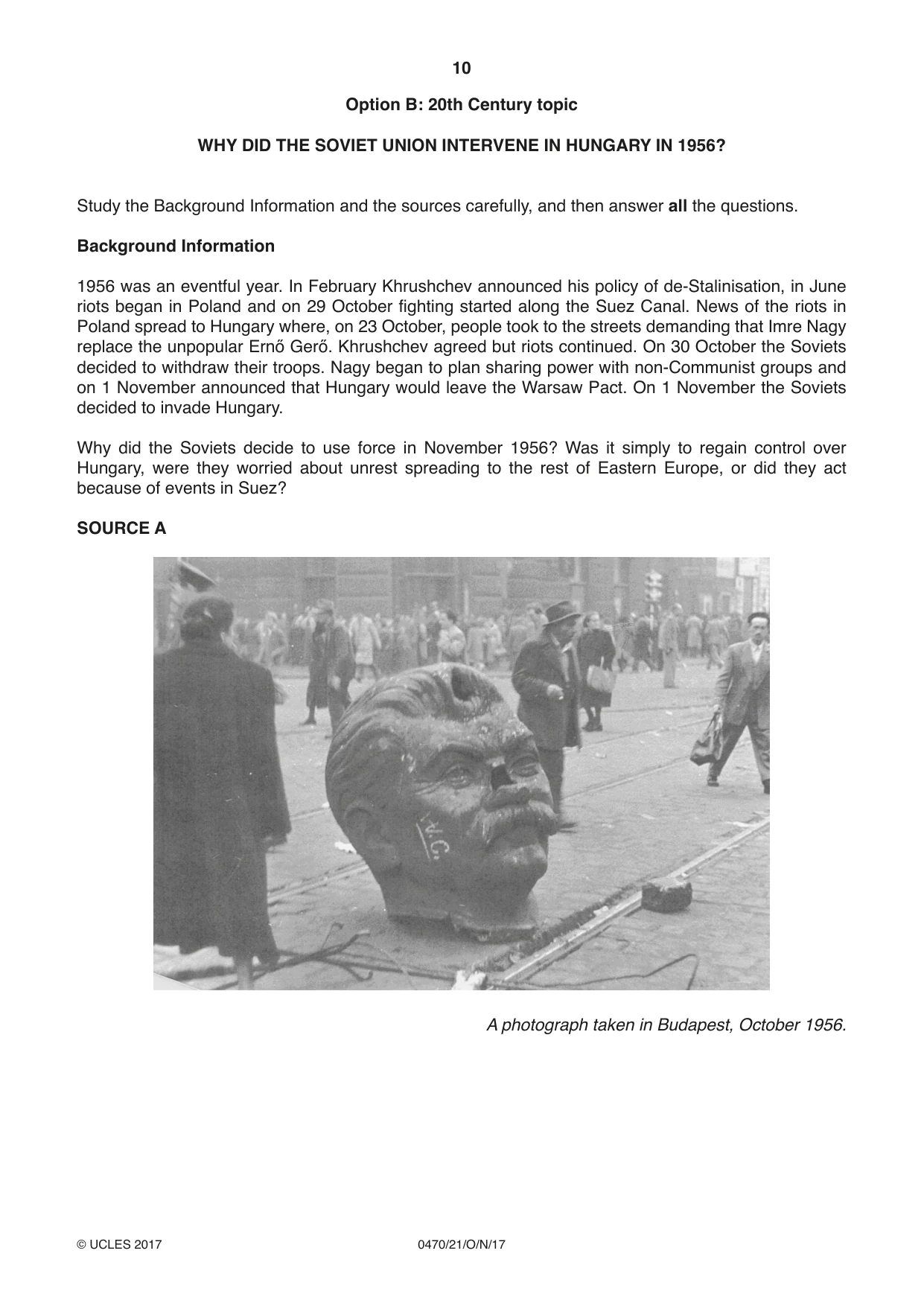
10 0470/21/O/N/17 © UCLES 2017 Option B: 20th Century topic WHY DID THE SOVIET UNION INTERVENE IN HUNGARY IN 1956? Study the Background Information and the sources carefully, and then answer all the questions. Background Information 1956 was an eventful year. In February Khrushchev announced his policy of de-Stalinisation, in June riots began in Poland and on 29 October fighting started along the Suez Canal. News of the riots in Poland spread to Hungary where, on 23 October, people took to the streets demanding that Imre Nagy replace the unpopular Ernő Gerő. Khrushchev agreed but riots continued. On 30 October the Soviets decided to withdraw their troops. Nagy began to plan sharing power with non-Communist groups and on 1 November announced that Hungary would leave the Warsaw Pact. On 1 November the Soviets decided to invade Hungary. Why did the Soviets decide to use force in November 1956? Was it simply to regain control over Hungary, were they worried about unrest spreading to the rest of Eastern Europe, or did they act because of events in Suez? SOURCE A A photograph taken in Budapest, October 1956.
Question paper, page 11
11 0470/21/O/N/17 © UCLES 2017 [Turn over SOURCE B The course of the events has shown that the working people of Hungary correctly raise the question of the necessity of eliminating serious shortcomings in the field of economic building, the further raising of the living standards of the population, and the struggle against bureaucratic excesses in the state apparatus. However, this just and progressive movement of the working people was soon joined by forces of reaction and counter-revolution, which are trying to take advantage of the discontent of part of the working people to undermine the foundations of the people’s democratic order in Hungary and to restore the old landlord and capitalist order. The Soviet Government and all the Soviet people deeply regret that the development of events in Hungary has led to bloodshed. Originally, on the request of the Hungarian People’s Government, the Soviet Government consented to the entry into Budapest of the Soviet Army units to assist the Hungarian People’s Army and the Hungarian authorities to establish order in the city. Believing that the further presence of Soviet Army units in Hungary can serve as a cause for even greater deterioration of the situation, the Soviet Government has now given instructions to its military command to withdraw the Soviet Army units from Budapest. A public statement by the Soviet Government, 30 October 1956. SOURCE C The army should not be withdrawn from Hungary, and we must start an initiative to bring order to that country. Our party would not understand it if we gave Hungary, as well as Egypt, to the imperialists. If we leave Hungary it will encourage the American, English and French imperialists. They will see this as weakness on our part and go onto the offensive. We have no other choice. We want to meet the Hungarians halfway but now there is no government. Now we should set up a Provisional Revolutionary Government, headed by Kadar. Khrushchev speaking at a meeting of Soviet leaders, 31 October 1956.
Question paper, page 12
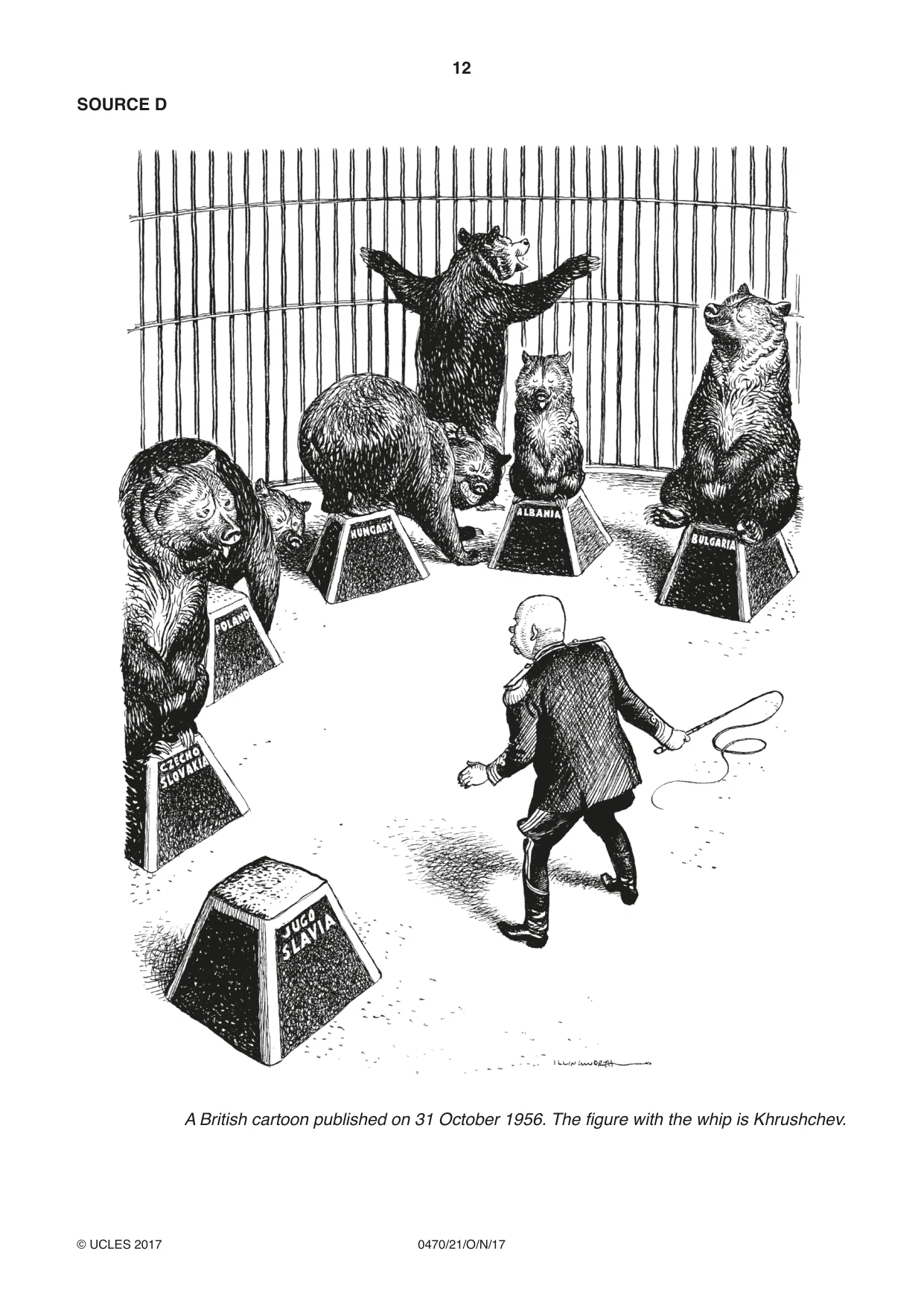
12 0470/21/O/N/17 © UCLES 2017 SOURCE D A British cartoon published on 31 October 1956. The figure with the whip is Khrushchev.
Question paper, page 13
13 0470/21/O/N/17 © UCLES 2017 [Turn over SOURCE E The Soviet Union has always proceeded from the principle of the peaceful co-existence of countries with different social systems and with the great aim of preserving world peace. However, the enemies of socialism proceed with their actions to undermine the friendly relations between the peoples of the Soviet Union and the peoples of other countries and to frustrate the noble aims of peaceful co-existence on the basis of complete sovereignty and equality. This is confirmed by the actions of the counter-revolutionary forces in Hungary aimed at overthrowing the system of people’s democracy and restoring fascism in the country. The patriots of people’s Hungary, together with the units of the Soviet Army called in to assist the revolutionary workers’ and peasants’ Government, firmly barred the road to reaction and fascism in Hungary. A broadcast by Marshal Zhukov, the Soviet Minister of Defence. It was broadcast by the official Soviet radio station, 7 November 1956. SOURCE F People in Hungary were absolutely against the Stalinist elements still in power; they asked for their removal and a turn to the road of democratisation. When the Hungarian delegation headed by Gerő returned to their country, Gerő found himself in a difficult position. He called those hundreds of thousands of demonstrators, who at that time were still demonstrating, a gang, and insulted almost the whole nation. Imagine how blind he was, what kind of a leader he was! At such a critical moment, when everything boils and when the whole nation is discontented, he dares to call that nation a gang, among whom a great number, and perhaps a majority, were communists and young people. This was enough to blow up the powder keg. Conflicts took place. Gerő called in the Soviet army. It was a fatal mistake to call Soviet troops at the time when demonstrations were still going on. To call upon troops of another country to give lessons to the people of one’s own country is a great mistake. This made the people even more furious and this is how a spontaneous uprising came about. From a speech by President Tito of Yugoslavia, 16 November 1956.
Question paper, page 14
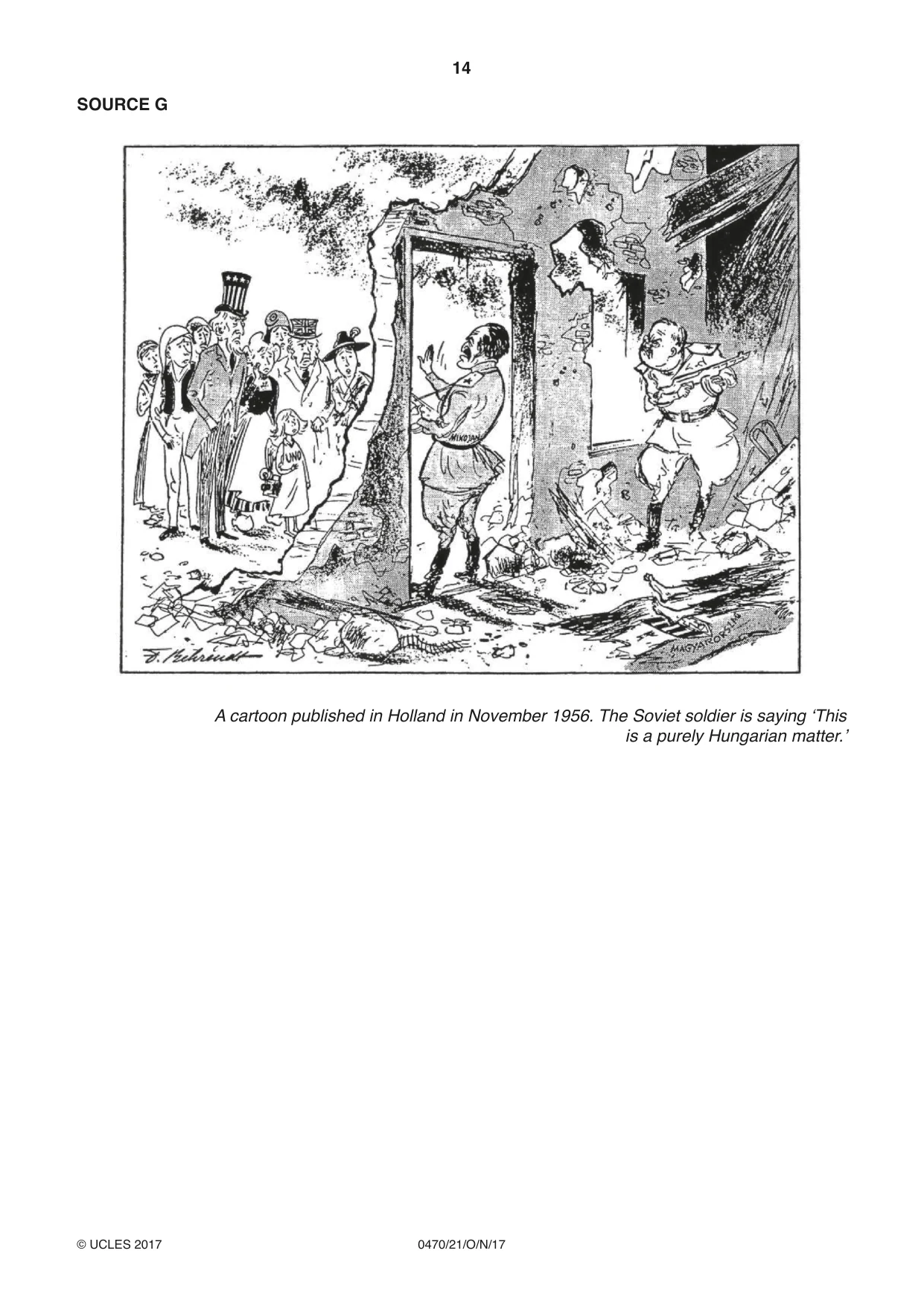
14 0470/21/O/N/17 © UCLES 2017 SOURCE G A cartoon published in Holland in November 1956. The Soviet soldier is saying ‘This is a purely Hungarian matter.’
Question paper, page 15
15 0470/21/O/N/17 © UCLES 2017 Now answer all the following questions. You may use any of the sources to help you answer the questions, in addition to those sources which you are told to use. In answering the questions you should use your knowledge of the topic to help you interpret and evaluate the sources. 1 Study Source A. What impressions does this source give of the Hungarian uprising? Explain your answer using details of the source. [6] 2 Study Sources B and C. Does Source B make Source C surprising? Explain your answer using details of the sources and your knowledge. [8] 3 Study Source D. Why was this cartoon published at this time? Explain your answer using details of the source and your knowledge. [8] 4 Study Sources E and F. Does Source F prove that Marshal Zhukov was lying in Source E? Explain your answer using details of the sources and your knowledge. [8] 5 Study Source G. What is the cartoonist’s message? Explain your answer using details of the source and your knowledge. [8] 6 Study all the sources. How far do these sources provide convincing evidence that the Soviet decision to use force in Hungary was influenced only by factors within Hungary? Use the sources to explain your answer. [12]
Question paper, page 16
16 0470/21/O/N/17 © UCLES 2017 Permission to reproduce items where third-party owned material protected by copyright is included has been sought and cleared where possible. Every reasonable effort has been made by the publisher (UCLES) to trace copyright holders, but if any items requiring clearance have unwittingly been included, the publisher will be pleased to make amends at the earliest possible opportunity. To avoid the issue of disclosure of answer-related information to candidates, all copyright acknowledgements are reproduced online in the Cambridge International Examinations Copyright Acknowledgements Booklet. This is produced for each series of examinations and is freely available to download at www.cie.org.uk after the live examination series. Cambridge International Examinations is part of the Cambridge Assessment Group. Cambridge Assessment is the brand name of University of Cambridge Local Examinations Syndicate (UCLES), which is itself a department of the University of Cambridge. BLANK PAGE
Mark scheme, page 1
® IGCSE is a registered trademark. This syllabus is approved for use in England, Wales and Northern Ireland as a Cambridge International Level 1/Level 2 Certificate. This document consists of 11 printed pages. © UCLES 2017 [Turn over Cambridge Assessment International Education Cambridge International General Certificate of Secondary Education HISTORY 0470/21 Paper 2 October/November 2017 MARK SCHEME Maximum Mark: 50 Published This mark scheme is published as an aid to teachers and candidates, to indicate the requirements of the examination. It shows the basis on which Examiners were instructed to award marks. It does not indicate the details of the discussions that took place at an Examiners’ meeting before marking began, which would have considered the acceptability of alternative answers. Mark schemes should be read in conjunction with the question paper and the Principal Examiner Report for Teachers. Cambridge International will not enter into discussions about these mark schemes. Cambridge International is publishing the mark schemes for the October/November 2017 series for most Cambridge IGCSE®, Cambridge International A and AS Level components and some Cambridge O Level components.
Mark scheme, page 2
0470/21 Cambridge IGCSE – Mark Scheme PUBLISHED October/November 2017 © UCLES 2017 Page 2 of 11 19th Century Topic Question Answer Marks 1 Study Sources A and B. How far do these two sources agree? Explain your answer using details of the sources. 7 Level 5 Compares big messages 7 A blames Germany, B blames Britain, or France and Russia or Austria Level 4 Agreement and disagreement of detail or sub-messages 5–6 Level 3 Agreement or disagreement of detail or sub-messages 3–4 Agreements include – Germany violated Belgium, British foreign policy was not clear, Britain acted because of Belgium; Britain gets involved through Grey. Disagreements include – A favourable towards Grey, B unfavourable; in A Germany is the aggressor, in B not. Level 2 Identifies information that is in one source but not in the other or states that the sources are about the same subject 2 OR Level 2 Compares the provenance of the sources Level 1 Writes about the sources but makes no valid comparison 1 Level 0 No evidence submitted or response does not address the question 0 Question Answer Marks 2 Study Sources C and D. Does Source C make Source D surprising? Explain your answer using details of the sources and your knowledge. 8 Level 6 Compares the sources for disagreement and evaluates both 8 Level 5 Explains surprise/no surprise for D but no valid use of C 6 Level 5 Compares the sources for disagreement and evaluates one of them 7 Level 4 Answers based on disagreements 4–5 Level 3 Answers based on agreements 3 Level 2 Answers based on undeveloped provenance 2 Level 1 Writes about the sources but does not address the question 1 Level 0 No evidence submitted or response does not address the question 0
Mark scheme, page 3
0470/21 Cambridge IGCSE – Mark Scheme PUBLISHED October/November 2017 © UCLES 2017 Page 3 of 11 Question Answer Marks 3 Study Sources E and F. Are the opinions of the artists of these two sources the same? Explain your answer using details of the sources and your knowledge 7 Level 6 Compares the points of view of artists 7 Both sources are anti-German Level 5 Compares valid big messages 6 Britain has got Germany under control in F but not in E Level 4 Compares valid sub-messages 5 e.g. Germany a threat in both Germany is a problem Germany needs to be dealt with Germany is a threat in E, not in F Level 3 Valid interpretation of one or both but no comparison 3–4 Level 2 Surface comparison of sources 2 OR Level 2 Compares provenance Level 1 Writes about the sources but no valid comparison or misinterpretations 1 Level 0 No evidence submitted or response does not address the question 0
Mark scheme, page 4
0470/21 Cambridge IGCSE – Mark Scheme PUBLISHED October/November 2017 © UCLES 2017 Page 4 of 11 Question Answer Marks 4 Study Source G. Why was this cartoon published in September 1914? Explain your answer using details of the source and your knowledge. 8 Level 6 Explains purpose in context of German treatment of Belgium civilians 7 Level 5 Explains the purpose of the cartoon 6 Must have intended impact on audience e.g. to make people have anti-German feelings Level 4 Explains the big message 5 e.g. The Germans are uncivilised – must include the elements of hypocrisy Level 3 Explains context only – fails to explain message or purpose of source 3–4 OR Explains a valid sub-message e.g. German soldiers are brutes Award 4 marks for knowledge of German treatment of Belgium civilians Level 2 Interprets cartoon or describes the context – but not used as a reason for publication 2 Level 1 Surface descriptions of the source 1 OR Misinterpretations of the source Level 0 No evidence submitted or response does not address the question 0 Question Answer Marks 5 Study Source H. Do you trust this source? Explain your answer using details of the source and your knowledge. 8 Level 5 Argues that he is to be believed because what he says would have been very unpopular in Germany during the war 8 Level 4 Answers based on purpose in context (likely to be not trusting him) 6–7 Level 3 Answers based on cross-reference 4–5 Level 2 Undeveloped use of provenance 2–3 Level 1 Unsupported assertions 1 Level 0 No evidence submitted or response does not address the question 0
Mark scheme, page 5
0470/21 Cambridge IGCSE – Mark Scheme PUBLISHED October/November 2017 © UCLES 2017 Page 5 of 11 Question Answer Marks 6 Study all the sources. How far do these sources provide convincing evidence that Germany was to blame for Britain and Germany being at war with each other? Use the sources to explain your answer. 12 Level 3 Uses sources to support and reject the statement 7–10 Award up to 2 bonus marks for evaluation of sources (no more than 1 per source). Source use must be reference to a source by letter, by provenance or by direct quote. There must be examples from source content. There must be an explanation of how this supports/does not support the statement. Use 9 in the margin for each source use in support of the statement and 8 for each source use rejecting the statement. Y – A, C, (D), E, (F), G, H N – B, D, F Level 2 Uses sources to support or reject the statement 4–6 Level 1 No valid source use 1–3 Level 0 No evidence submitted or response does not address the question 0
Mark scheme, page 6
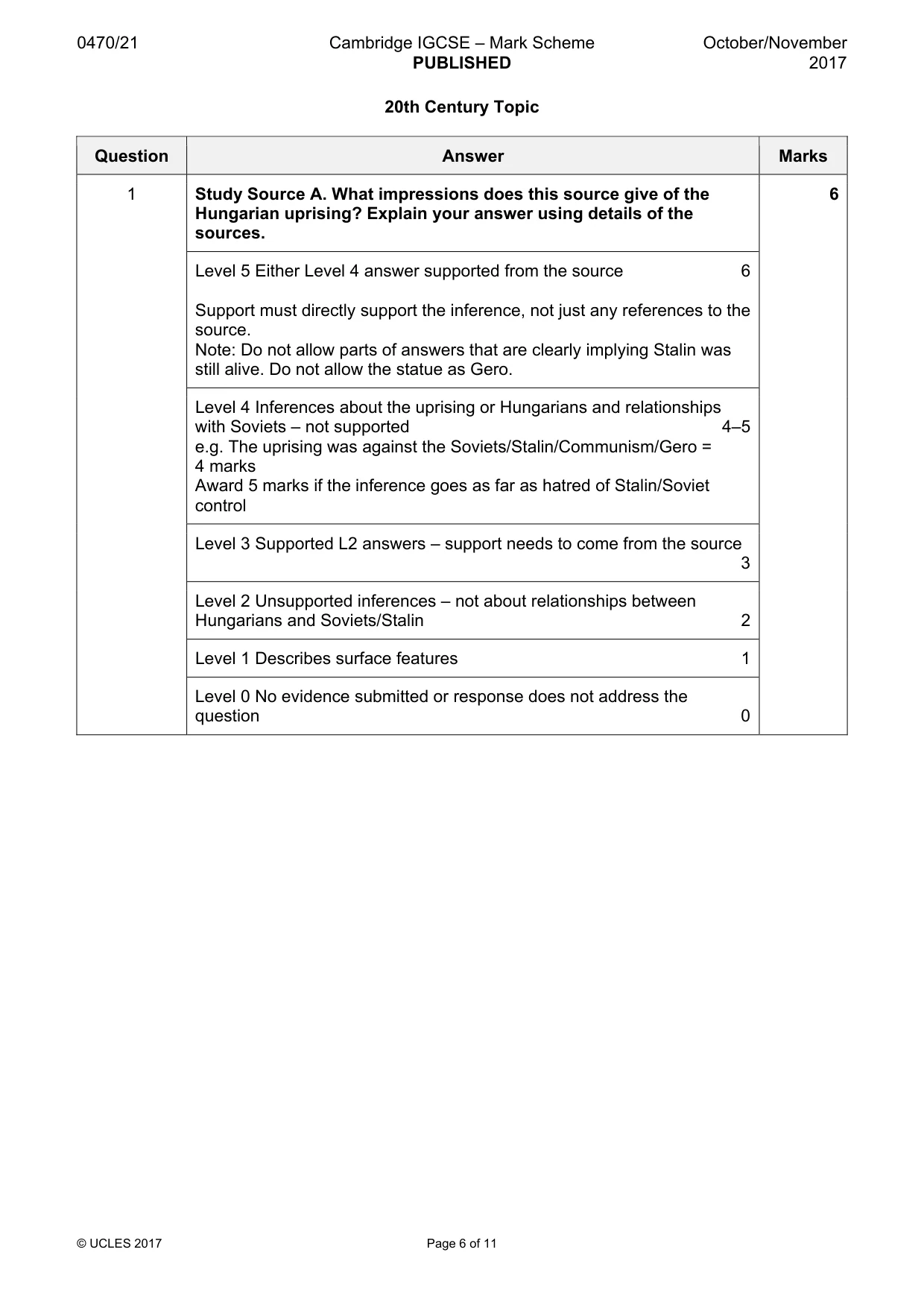
0470/21 Cambridge IGCSE – Mark Scheme PUBLISHED October/November 2017 © UCLES 2017 Page 6 of 11 20th Century Topic Question Answer Marks 1 Study Source A. What impressions does this source give of the Hungarian uprising? Explain your answer using details of the sources. 6 Level 5 Either Level 4 answer supported from the source 6 Support must directly support the inference, not just any references to the source. Note: Do not allow parts of answers that are clearly implying Stalin was still alive. Do not allow the statue as Gero. Level 4 Inferences about the uprising or Hungarians and relationships with Soviets – not supported 4–5 e.g. The uprising was against the Soviets/Stalin/Communism/Gero = 4 marks Award 5 marks if the inference goes as far as hatred of Stalin/Soviet control Level 3 Supported L2 answers – support needs to come from the source 3 Level 2 Unsupported inferences – not about relationships between Hungarians and Soviets/Stalin 2 Level 1 Describes surface features 1 Level 0 No evidence submitted or response does not address the question 0
Mark scheme, page 7
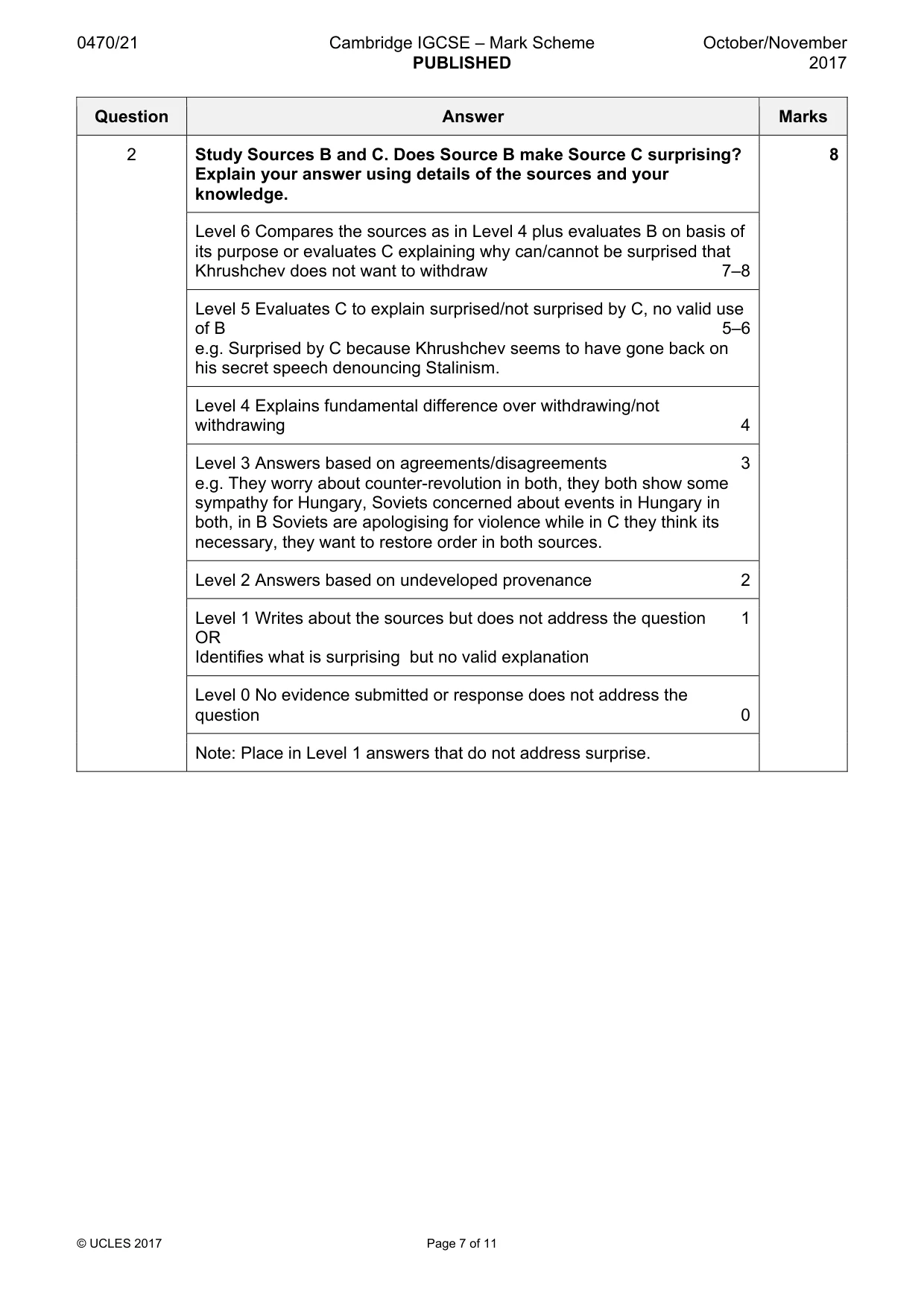
0470/21 Cambridge IGCSE – Mark Scheme PUBLISHED October/November 2017 © UCLES 2017 Page 7 of 11 Question Answer Marks 2 Study Sources B and C. Does Source B make Source C surprising? Explain your answer using details of the sources and your knowledge. 8 Level 6 Compares the sources as in Level 4 plus evaluates B on basis of its purpose or evaluates C explaining why can/cannot be surprised that Khrushchev does not want to withdraw 7–8 Level 5 Evaluates C to explain surprised/not surprised by C, no valid use of B 5–6 e.g. Surprised by C because Khrushchev seems to have gone back on his secret speech denouncing Stalinism. Level 4 Explains fundamental difference over withdrawing/not withdrawing 4 Level 3 Answers based on agreements/disagreements 3 e.g. They worry about counter-revolution in both, they both show some sympathy for Hungary, Soviets concerned about events in Hungary in both, in B Soviets are apologising for violence while in C they think its necessary, they want to restore order in both sources. Level 2 Answers based on undeveloped provenance 2 Level 1 Writes about the sources but does not address the question 1 OR Identifies what is surprising but no valid explanation Level 0 No evidence submitted or response does not address the question 0 Note: Place in Level 1 answers that do not address surprise.
Mark scheme, page 8
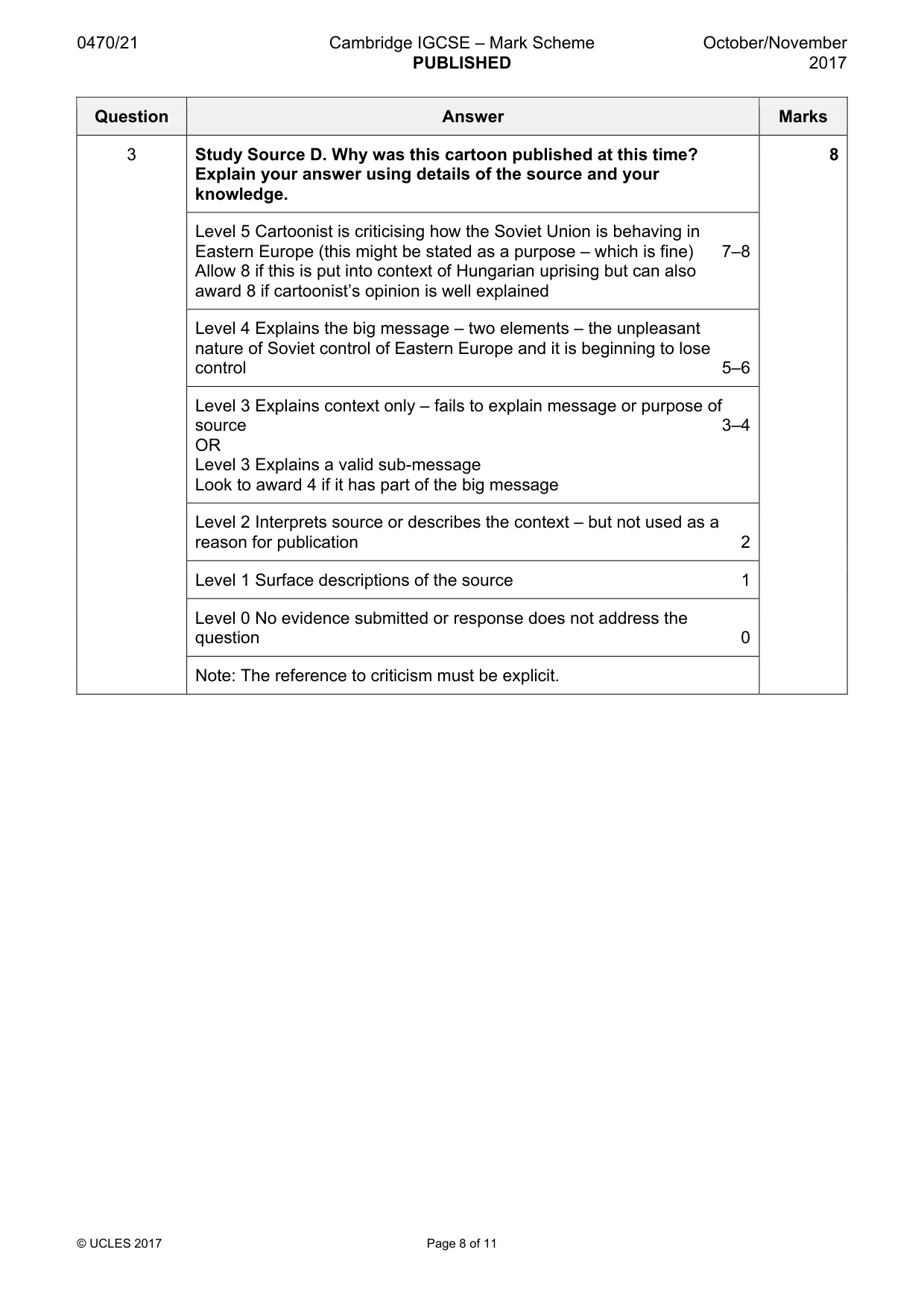
0470/21 Cambridge IGCSE – Mark Scheme PUBLISHED October/November 2017 © UCLES 2017 Page 8 of 11 Question Answer Marks 3 Study Source D. Why was this cartoon published at this time? Explain your answer using details of the source and your knowledge. 8 Level 5 Cartoonist is criticising how the Soviet Union is behaving in Eastern Europe (this might be stated as a purpose – which is fine) 7–8 Allow 8 if this is put into context of Hungarian uprising but can also award 8 if cartoonist’s opinion is well explained Level 4 Explains the big message – two elements – the unpleasant nature of Soviet control of Eastern Europe and it is beginning to lose control 5–6 Level 3 Explains context only – fails to explain message or purpose of source 3–4 OR Level 3 Explains a valid sub-message Look to award 4 if it has part of the big message Level 2 Interprets source or describes the context – but not used as a reason for publication 2 Level 1 Surface descriptions of the source 1 Level 0 No evidence submitted or response does not address the question 0 Note: The reference to criticism must be explicit.
Mark scheme, page 9
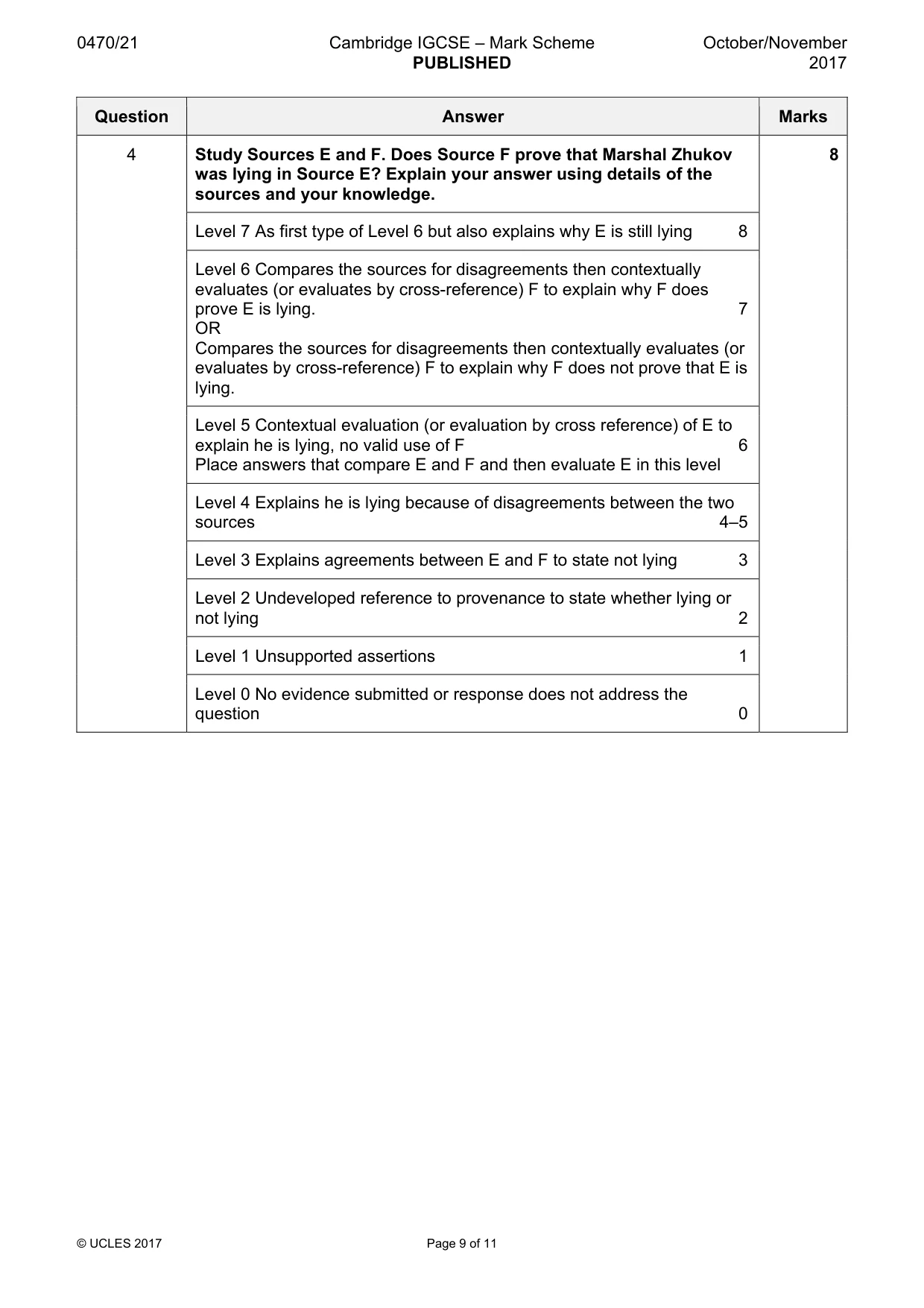
0470/21 Cambridge IGCSE – Mark Scheme PUBLISHED October/November 2017 © UCLES 2017 Page 9 of 11 Question Answer Marks 4 Study Sources E and F. Does Source F prove that Marshal Zhukov was lying in Source E? Explain your answer using details of the sources and your knowledge. 8 Level 7 As first type of Level 6 but also explains why E is still lying 8 Level 6 Compares the sources for disagreements then contextually evaluates (or evaluates by cross-reference) F to explain why F does prove E is lying. 7 OR Compares the sources for disagreements then contextually evaluates (or evaluates by cross-reference) F to explain why F does not prove that E is lying. Level 5 Contextual evaluation (or evaluation by cross reference) of E to explain he is lying, no valid use of F 6 Place answers that compare E and F and then evaluate E in this level Level 4 Explains he is lying because of disagreements between the two sources 4–5 Level 3 Explains agreements between E and F to state not lying 3 Level 2 Undeveloped reference to provenance to state whether lying or not lying 2 Level 1 Unsupported assertions 1 Level 0 No evidence submitted or response does not address the question 0
Mark scheme, page 10
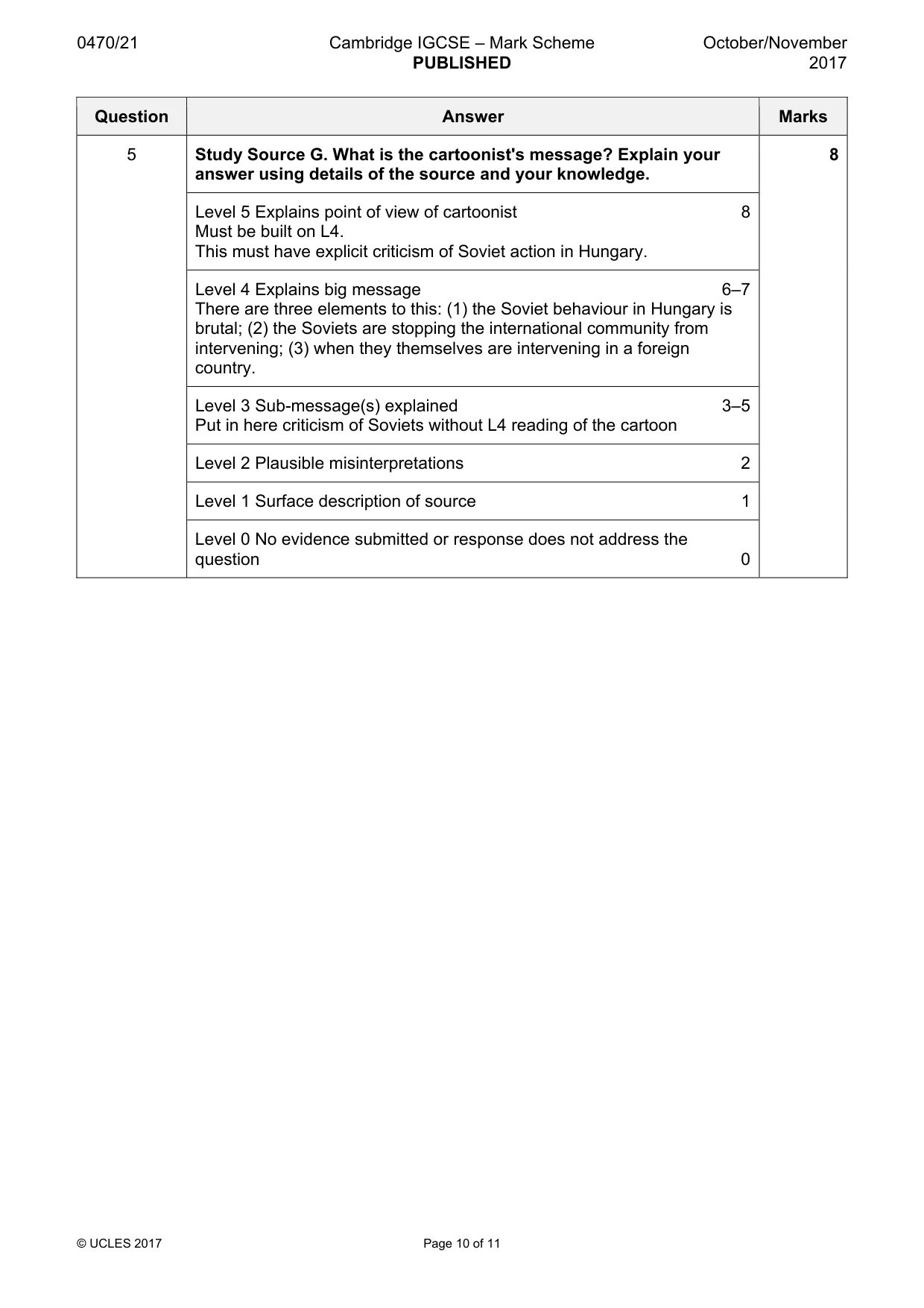
0470/21 Cambridge IGCSE – Mark Scheme PUBLISHED October/November 2017 © UCLES 2017 Page 10 of 11 Question Answer Marks 5 Study Source G. What is the cartoonist's message? Explain your answer using details of the source and your knowledge. 8 Level 5 Explains point of view of cartoonist 8 Must be built on L4. This must have explicit criticism of Soviet action in Hungary. Level 4 Explains big message 6–7 There are three elements to this: (1) the Soviet behaviour in Hungary is brutal; (2) the Soviets are stopping the international community from intervening; (3) when they themselves are intervening in a foreign country. Level 3 Sub-message(s) explained 3–5 Put in here criticism of Soviets without L4 reading of the cartoon Level 2 Plausible misinterpretations 2 Level 1 Surface description of source 1 Level 0 No evidence submitted or response does not address the question 0
Mark scheme, page 11
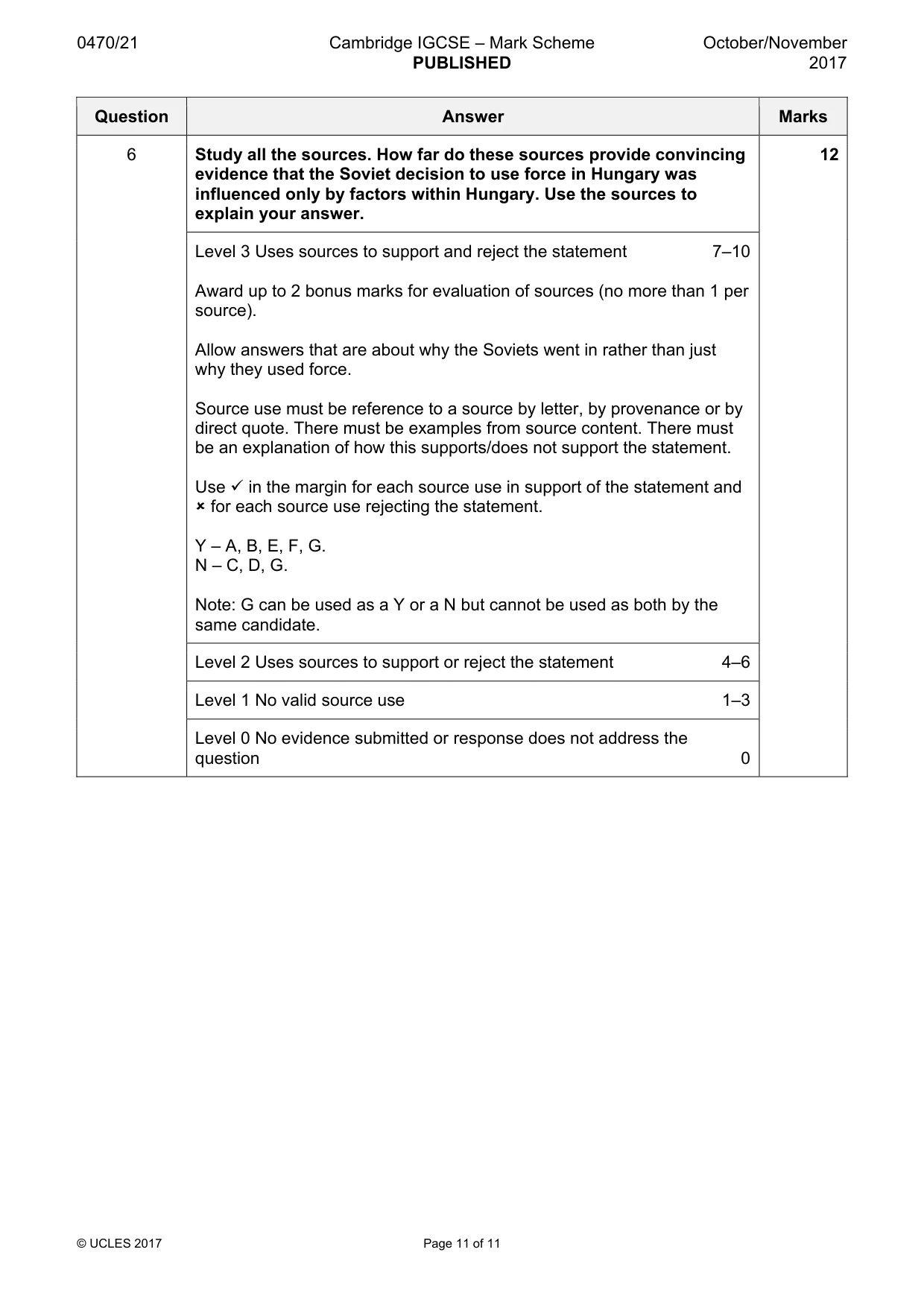
0470/21 Cambridge IGCSE – Mark Scheme PUBLISHED October/November 2017 © UCLES 2017 Page 11 of 11 Question Answer Marks 6 Study all the sources. How far do these sources provide convincing evidence that the Soviet decision to use force in Hungary was influenced only by factors within Hungary. Use the sources to explain your answer. 12 Level 3 Uses sources to support and reject the statement 7–10 Award up to 2 bonus marks for evaluation of sources (no more than 1 per source). Allow answers that are about why the Soviets went in rather than just why they used force. Source use must be reference to a source by letter, by provenance or by direct quote. There must be examples from source content. There must be an explanation of how this supports/does not support the statement. Use 9 in the margin for each source use in support of the statement and 8 for each source use rejecting the statement. Y – A, B, E, F, G. N – C, D, G. Note: G can be used as a Y or a N but cannot be used as both by the same candidate. Level 2 Uses sources to support or reject the statement 4–6 Level 1 No valid source use 1–3 Level 0 No evidence submitted or response does not address the question 0
What you needed in this session
Cambridge’s own grade thresholds for 2017 Oct/Nov, Paper 2 · Variant 1. A higher threshold means an easier paper — the bar moves with how the cohort did.