Cambridge IGCSE History 0470 — 2017 May/June Paper 4 · Variant 3
0470/43/M/J/17 · 40 marks · ≈45 min
The question paper and its mark scheme, free to read here and free to download. This is Cambridge’s own paper, exactly as it was sat.
Question paper4 pages

Mark scheme17 pages
Answers below. Sit the paper first if you are practising.
Paper as text
Question paper, page 1
Cambridge International Examinations Cambridge International General Certificate of Secondary Education 0470/43 May/June 2017 1 hour HISTORY Paper 4 Alternative to Coursework Additional Materials: Answer Booklet/Paper READ THESE INSTRUCTIONS FIRST An answer booklet is provided inside this question paper. You should follow the instructions on the front cover of the answer booklet. If you need additional answer paper ask the invigilator for a continuation booklet. Answer one question from your chosen Depth Study. The number of marks is given in brackets [ ] at the end of each question or part question. The syllabus is approved for use in England, Wales and Northern Ireland as a Cambridge International Level 1/Level 2 Certificate. This document consists of 3 printed pages and 1 blank page. [Turn over 06_0470_43_2017_1.1 © UCLES 2017 *0796817772*
Question paper, page 2
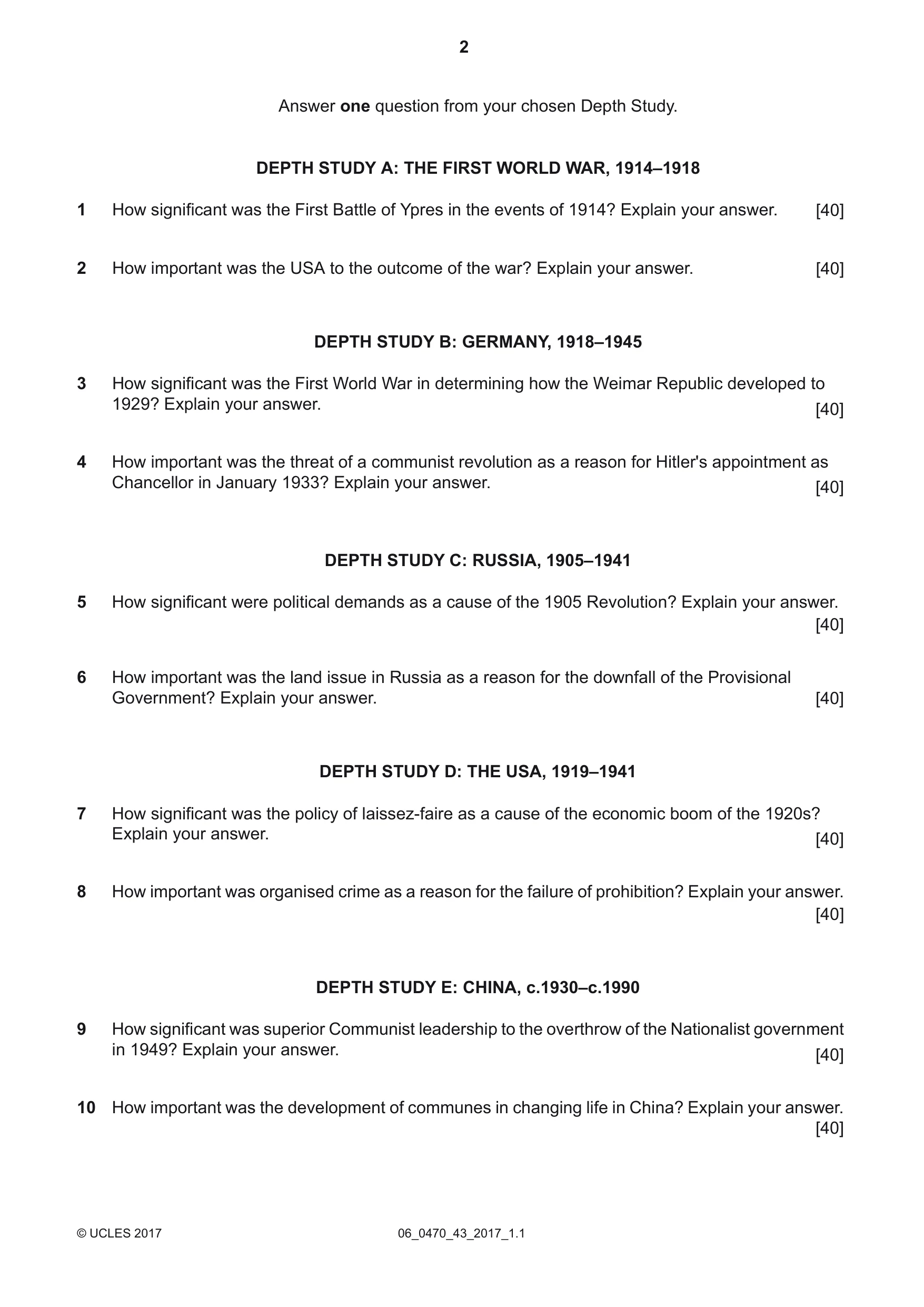
Answer one question from your chosen Depth Study. DEPTH STUDY A: THE FIRST WORLD WAR, 1914–1918 How significant was the First Battle of Ypres in the events of 1914? Explain your answer. [40] 1 How important was the USA to the outcome of the war? Explain your answer. [40] 2 DEPTH STUDY B: GERMANY, 1918–1945 How significant was the First World War in determining how the Weimar Republic developed to 1929? Explain your answer. [40] 3 How important was the threat of a communist revolution as a reason for Hitler's appointment as Chancellor in January 1933? Explain your answer. [40] 4 DEPTH STUDY C: RUSSIA, 1905–1941 How significant were political demands as a cause of the 1905 Revolution? Explain your answer. [40] 5 How important was the land issue in Russia as a reason for the downfall of the Provisional Government? Explain your answer. [40] 6 DEPTH STUDY D: THE USA, 1919–1941 How significant was the policy of laissez-faire as a cause of the economic boom of the 1920s? Explain your answer. [40] 7 How important was organised crime as a reason for the failure of prohibition? Explain your answer. [40] 8 DEPTH STUDY E: CHINA, c.1930–c.1990 How significant was superior Communist leadership to the overthrow of the Nationalist government in 1949? Explain your answer. [40] 9 How important was the development of communes in changing life in China? Explain your answer. [40] 10 06_0470_43_2017_1.1 © UCLES 2017 2
Question paper, page 3
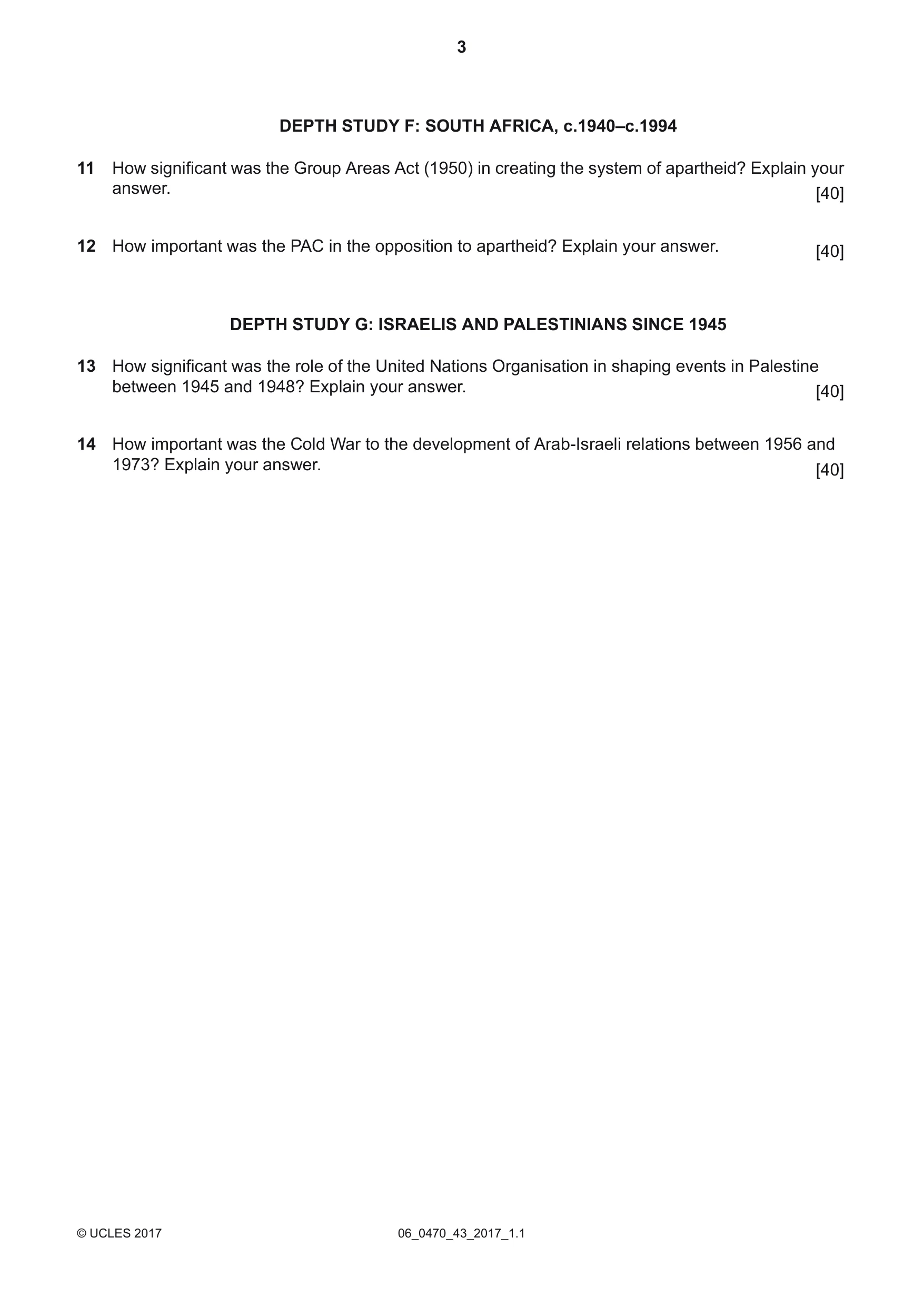
DEPTH STUDY F: SOUTH AFRICA, c.1940–c.1994 How significant was the Group Areas Act (1950) in creating the system of apartheid? Explain your answer. [40] 11 How important was the PAC in the opposition to apartheid? Explain your answer. [40] 12 DEPTH STUDY G: ISRAELIS AND PALESTINIANS SINCE 1945 How significant was the role of the United Nations Organisation in shaping events in Palestine between 1945 and 1948? Explain your answer. [40] 13 How important was the Cold War to the development of Arab-Israeli relations between 1956 and 1973? Explain your answer. [40] 14 06_0470_43_2017_1.1 © UCLES 2017 3
Question paper, page 4
BLANK PAGE Permission to reproduce items where third-party owned material protected by copyright is included has been sought and cleared where possible. Every reasonable effort has been made by the publisher (UCLES) to trace copyright holders, but if any items requiring clearance have unwittingly been included, the publisher will be pleased to make amends at the earliest possible opportunity. To avoid the issue of disclosure of answer-related information to candidates, all copyright acknowledgements are reproduced online in the Cambridge International Examinations Copyright Acknowledgements Booklet. This is produced for each series of examinations and is freely available to download at www.cie.org.uk after the live examination series. Cambridge International Examinations is part of the Cambridge Assessment Group. Cambridge Assessment is the brand name of University of Cambridge Local Examinations Syndicate (UCLES), which is itself a department of the University of Cambridge. 06_0470_43_2017_1.1 © UCLES 2017 4
Mark scheme, page 1
® IGCSE is a registered trademark. This syllabus is approved for use in England, Wales and Northern Ireland as a Cambridge International Level 1/Level 2 Certificate. This document consists of 17 printed pages. © UCLES 2017 [Turn over Cambridge International Examinations Cambridge International General Certificate of Secondary Education HISTORY 0470/43 Paper 4 Alternative to Coursework May/June 2017 MARK SCHEME Maximum Mark: 40 Published This mark scheme is published as an aid to teachers and candidates, to indicate the requirements of the examination. It shows the basis on which Examiners were instructed to award marks. It does not indicate the details of the discussions that took place at an Examiners’ meeting before marking began, which would have considered the acceptability of alternative answers. Mark schemes should be read in conjunction with the question paper and the Principal Examiner Report for Teachers. Cambridge will not enter into discussions about these mark schemes. Cambridge is publishing the mark schemes for the May/June 2017 series for most Cambridge IGCSE®, Cambridge International A and AS Level and Cambridge Pre-U components, and some Cambridge O Level components.
Mark scheme, page 2
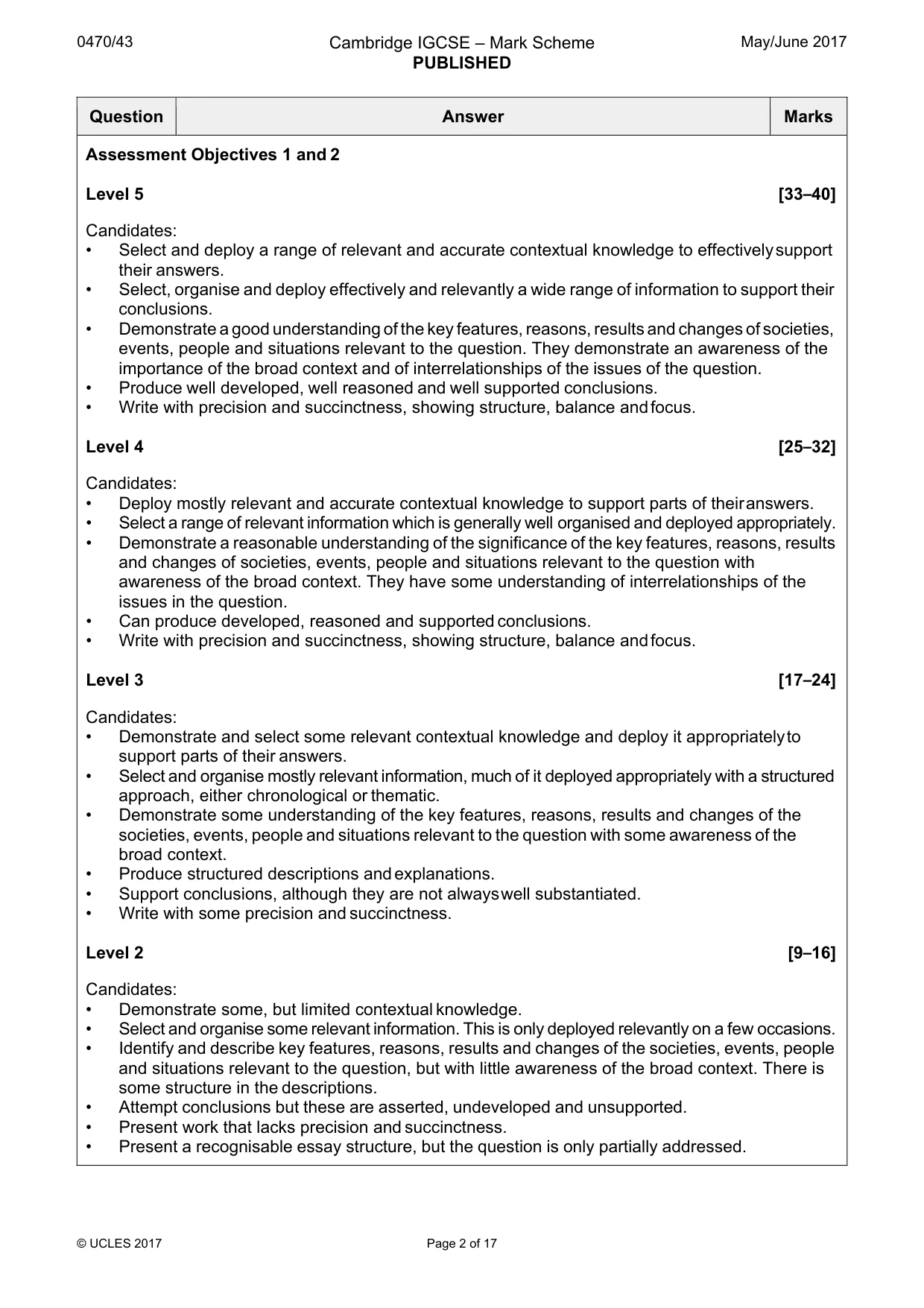
0470/43 Cambridge IGCSE – Mark Scheme PUBLISHED May/June 2017 © UCLES 2017 Page 2 of 17 Question Answer Marks Assessment Objectives 1 and 2 Level 5 [33–40] Candidates: • Select and deploy a range of relevant and accurate contextual knowledge to effectively support their answers. • Select, organise and deploy effectively and relevantly a wide range of information to support their conclusions. • Demonstrate a good understanding of the key features, reasons, results and changes of societies, events, people and situations relevant to the question. They demonstrate an awareness of the importance of the broad context and of interrelationships of the issues of the question. • Produce well developed, well reasoned and well supported conclusions. • Write with precision and succinctness, showing structure, balance and focus. Level 4 [25–32] Candidates: • Deploy mostly relevant and accurate contextual knowledge to support parts of their answers. • Select a range of relevant information which is generally well organised and deployed appropriately. • Demonstrate a reasonable understanding of the significance of the key features, reasons, results and changes of societies, events, people and situations relevant to the question with awareness of the broad context. They have some understanding of interrelationships of the issues in the question. • Can produce developed, reasoned and supported conclusions. • Write with precision and succinctness, showing structure, balance and focus. Level 3 [17–24] Candidates: • Demonstrate and select some relevant contextual knowledge and deploy it appropriately to support parts of their answers. • Select and organise mostly relevant information, much of it deployed appropriately with a structured approach, either chronological or thematic. • Demonstrate some understanding of the key features, reasons, results and changes of the societies, events, people and situations relevant to the question with some awareness of the broad context. • Produce structured descriptions and explanations. • Support conclusions, although they are not always well substantiated. • Write with some precision and succinctness. Level 2 [9–16] Candidates: • Demonstrate some, but limited contextual knowledge. • Select and organise some relevant information. This is only deployed relevantly on a few occasions. • Identify and describe key features, reasons, results and changes of the societies, events, people and situations relevant to the question, but with little awareness of the broad context. There is some structure in the descriptions. • Attempt conclusions but these are asserted, undeveloped and unsupported. • Present work that lacks precision and succinctness. • Present a recognisable essay structure, but the question is only partially addressed.
Mark scheme, page 3
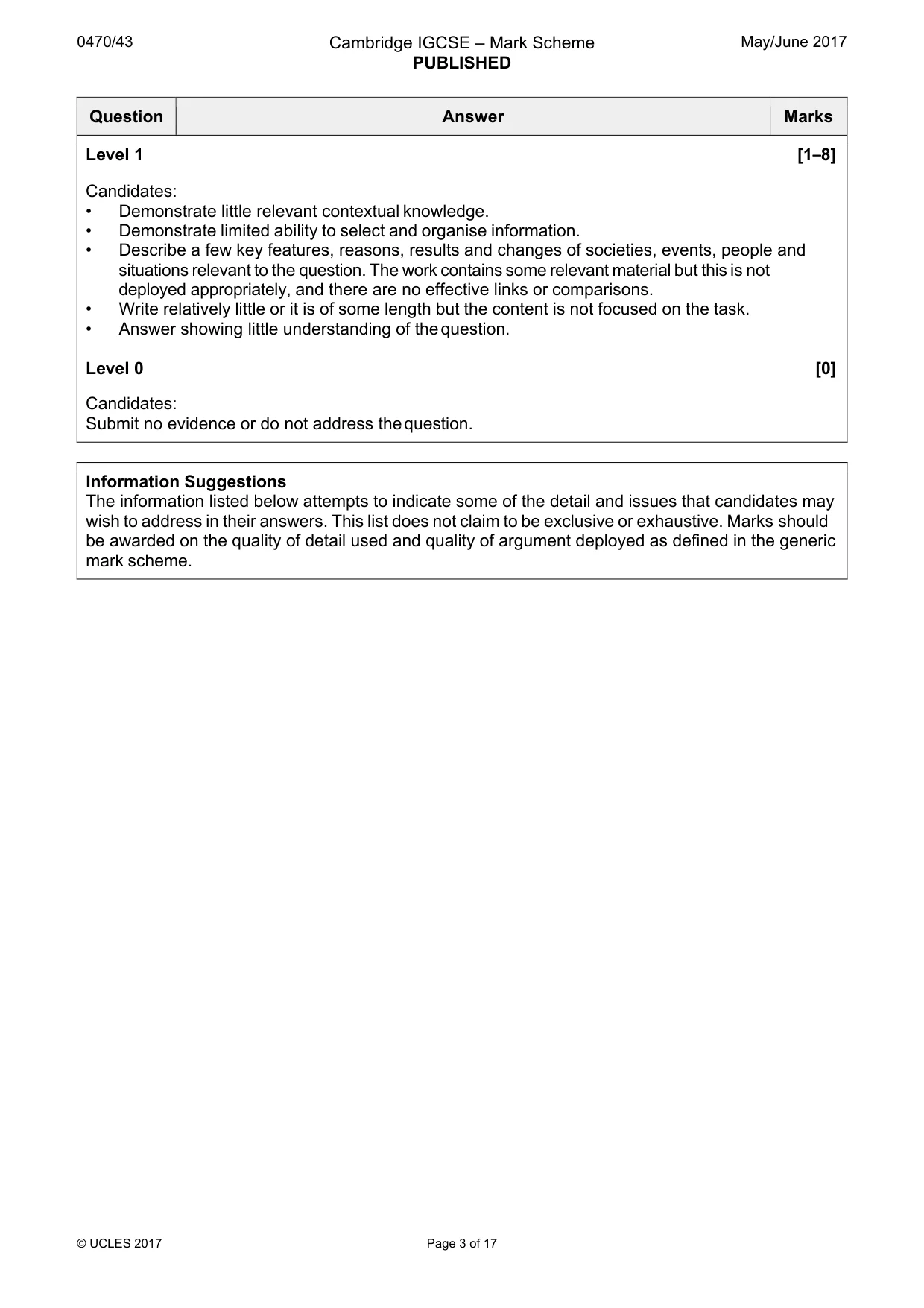
0470/43 Cambridge IGCSE – Mark Scheme PUBLISHED May/June 2017 © UCLES 2017 Page 3 of 17 Question Answer Marks Level 1 [1–8] Candidates: • Demonstrate little relevant contextual knowledge. • Demonstrate limited ability to select and organise information. • Describe a few key features, reasons, results and changes of societies, events, people and situations relevant to the question. The work contains some relevant material but this is not deployed appropriately, and there are no effective links or comparisons. • Write relatively little or it is of some length but the content is not focused on the task. • Answer showing little understanding of the question. Level 0 [0] Candidates: Submit no evidence or do not address the question. Information Suggestions The information listed below attempts to indicate some of the detail and issues that candidates may wish to address in their answers. This list does not claim to be exclusive or exhaustive. Marks should be awarded on the quality of detail used and quality of argument deployed as defined in the generic mark scheme.
Mark scheme, page 4
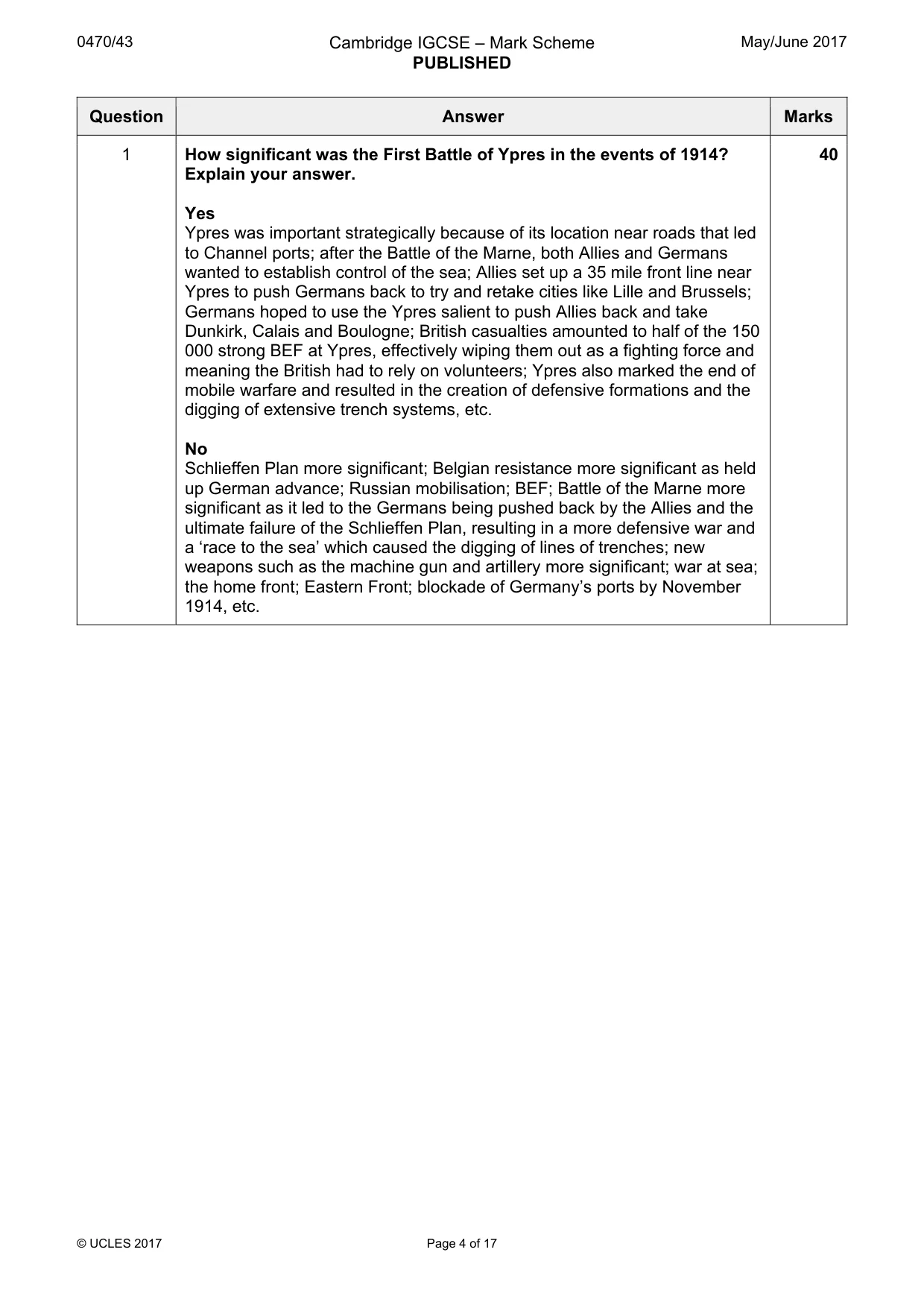
0470/43 Cambridge IGCSE – Mark Scheme PUBLISHED May/June 2017 © UCLES 2017 Page 4 of 17 Question Answer Marks 1 How significant was the First Battle of Ypres in the events of 1914? Explain your answer. Yes Ypres was important strategically because of its location near roads that led to Channel ports; after the Battle of the Marne, both Allies and Germans wanted to establish control of the sea; Allies set up a 35 mile front line near Ypres to push Germans back to try and retake cities like Lille and Brussels; Germans hoped to use the Ypres salient to push Allies back and take Dunkirk, Calais and Boulogne; British casualties amounted to half of the 150 000 strong BEF at Ypres, effectively wiping them out as a fighting force and meaning the British had to rely on volunteers; Ypres also marked the end of mobile warfare and resulted in the creation of defensive formations and the digging of extensive trench systems, etc. No Schlieffen Plan more significant; Belgian resistance more significant as held up German advance; Russian mobilisation; BEF; Battle of the Marne more significant as it led to the Germans being pushed back by the Allies and the ultimate failure of the Schlieffen Plan, resulting in a more defensive war and a ‘race to the sea’ which caused the digging of lines of trenches; new weapons such as the machine gun and artillery more significant; war at sea; the home front; Eastern Front; blockade of Germany’s ports by November 1914, etc. 40
Mark scheme, page 5
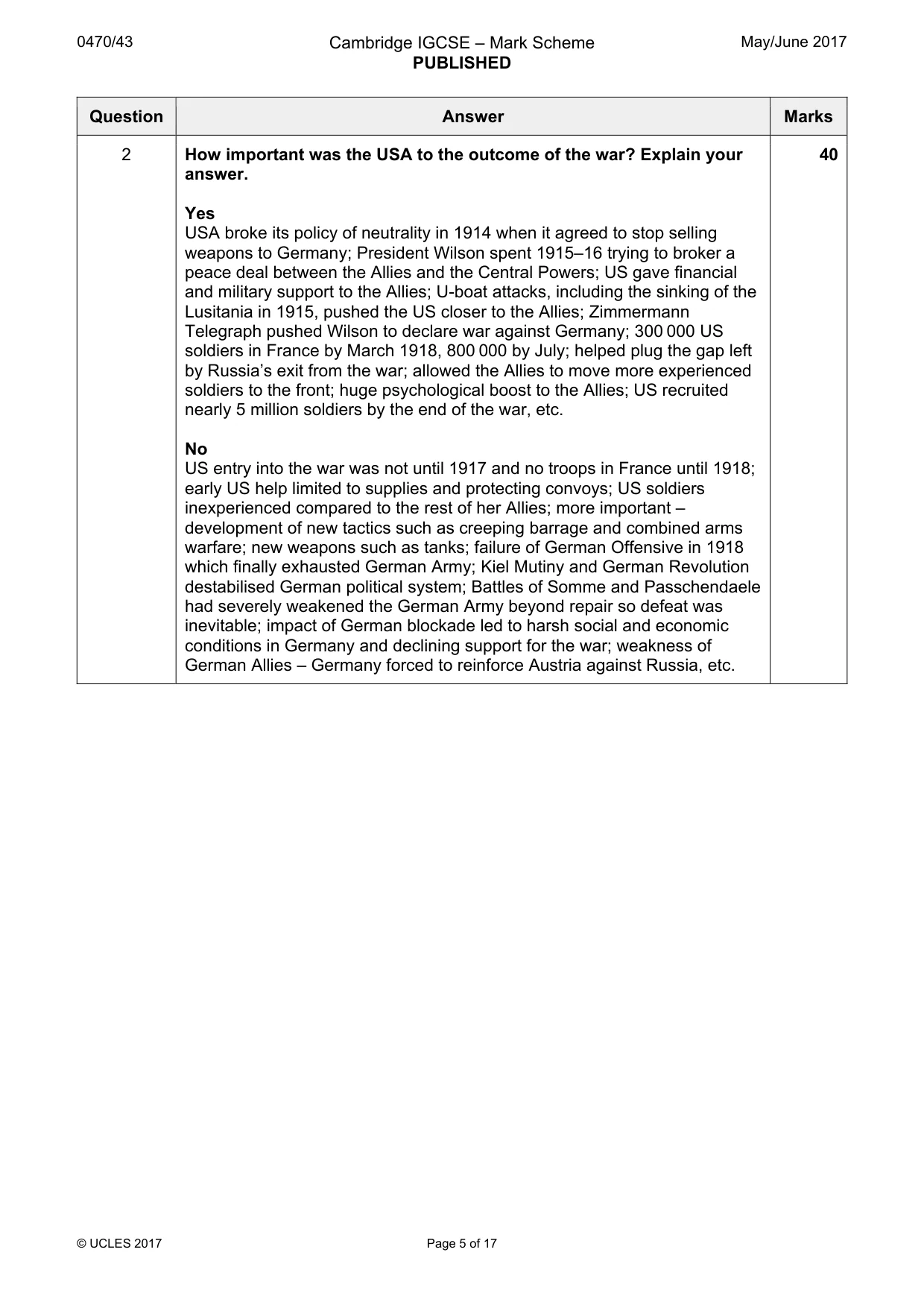
0470/43 Cambridge IGCSE – Mark Scheme PUBLISHED May/June 2017 © UCLES 2017 Page 5 of 17 Question Answer Marks 2 How important was the USA to the outcome of the war? Explain your answer. Yes USA broke its policy of neutrality in 1914 when it agreed to stop selling weapons to Germany; President Wilson spent 1915–16 trying to broker a peace deal between the Allies and the Central Powers; US gave financial and military support to the Allies; U-boat attacks, including the sinking of the Lusitania in 1915, pushed the US closer to the Allies; Zimmermann Telegraph pushed Wilson to declare war against Germany; 300 000 US soldiers in France by March 1918, 800 000 by July; helped plug the gap left by Russia’s exit from the war; allowed the Allies to move more experienced soldiers to the front; huge psychological boost to the Allies; US recruited nearly 5 million soldiers by the end of the war, etc. No US entry into the war was not until 1917 and no troops in France until 1918; early US help limited to supplies and protecting convoys; US soldiers inexperienced compared to the rest of her Allies; more important – development of new tactics such as creeping barrage and combined arms warfare; new weapons such as tanks; failure of German Offensive in 1918 which finally exhausted German Army; Kiel Mutiny and German Revolution destabilised German political system; Battles of Somme and Passchendaele had severely weakened the German Army beyond repair so defeat was inevitable; impact of German blockade led to harsh social and economic conditions in Germany and declining support for the war; weakness of German Allies – Germany forced to reinforce Austria against Russia, etc. 40
Mark scheme, page 6
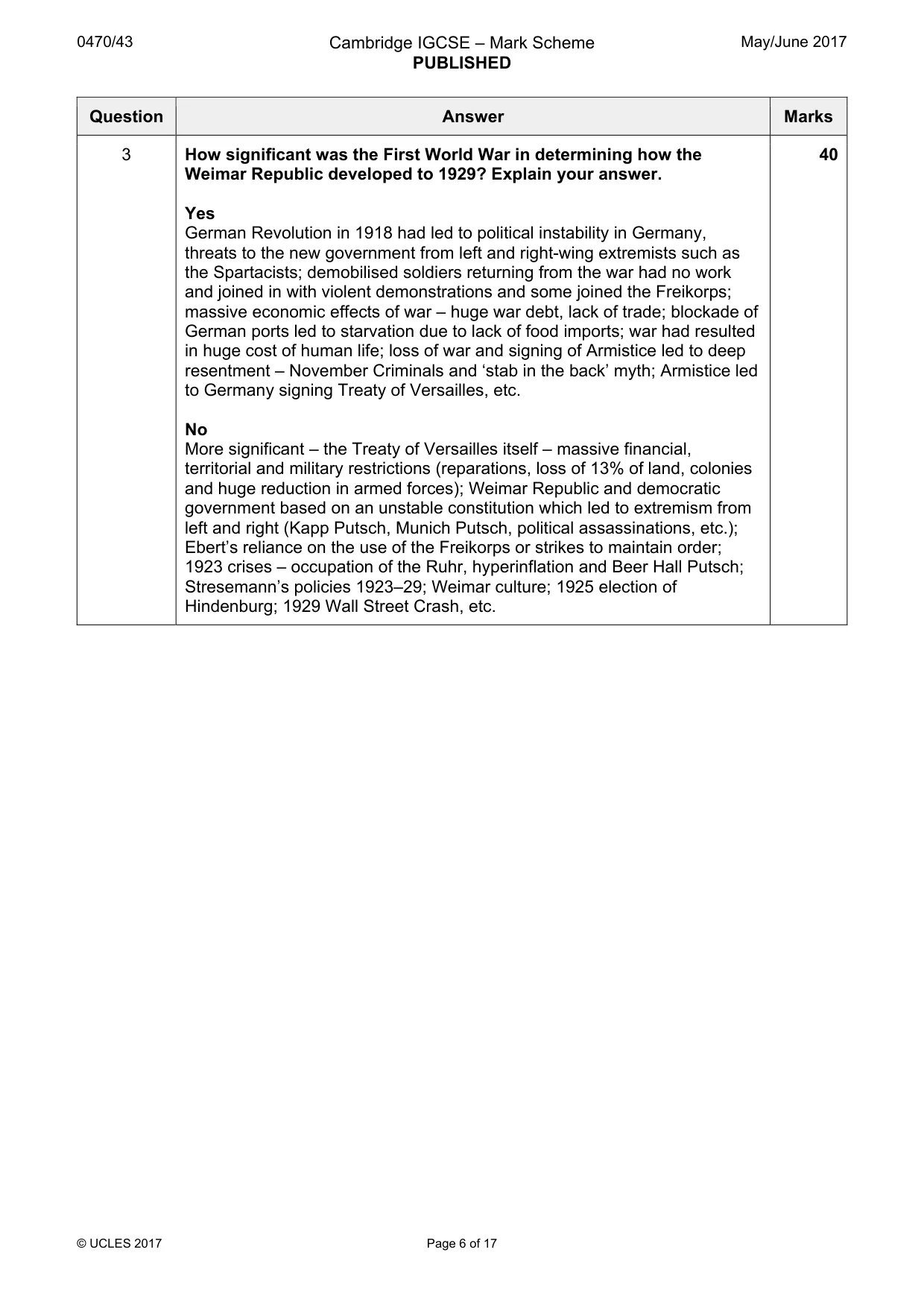
0470/43 Cambridge IGCSE – Mark Scheme PUBLISHED May/June 2017 © UCLES 2017 Page 6 of 17 Question Answer Marks 3 How significant was the First World War in determining how the Weimar Republic developed to 1929? Explain your answer. Yes German Revolution in 1918 had led to political instability in Germany, threats to the new government from left and right-wing extremists such as the Spartacists; demobilised soldiers returning from the war had no work and joined in with violent demonstrations and some joined the Freikorps; massive economic effects of war – huge war debt, lack of trade; blockade of German ports led to starvation due to lack of food imports; war had resulted in huge cost of human life; loss of war and signing of Armistice led to deep resentment – November Criminals and ‘stab in the back’ myth; Armistice led to Germany signing Treaty of Versailles, etc. No More significant – the Treaty of Versailles itself – massive financial, territorial and military restrictions (reparations, loss of 13% of land, colonies and huge reduction in armed forces); Weimar Republic and democratic government based on an unstable constitution which led to extremism from left and right (Kapp Putsch, Munich Putsch, political assassinations, etc.); Ebert’s reliance on the use of the Freikorps or strikes to maintain order; 1923 crises – occupation of the Ruhr, hyperinflation and Beer Hall Putsch; Stresemann’s policies 1923–29; Weimar culture; 1925 election of Hindenburg; 1929 Wall Street Crash, etc. 40
Mark scheme, page 7
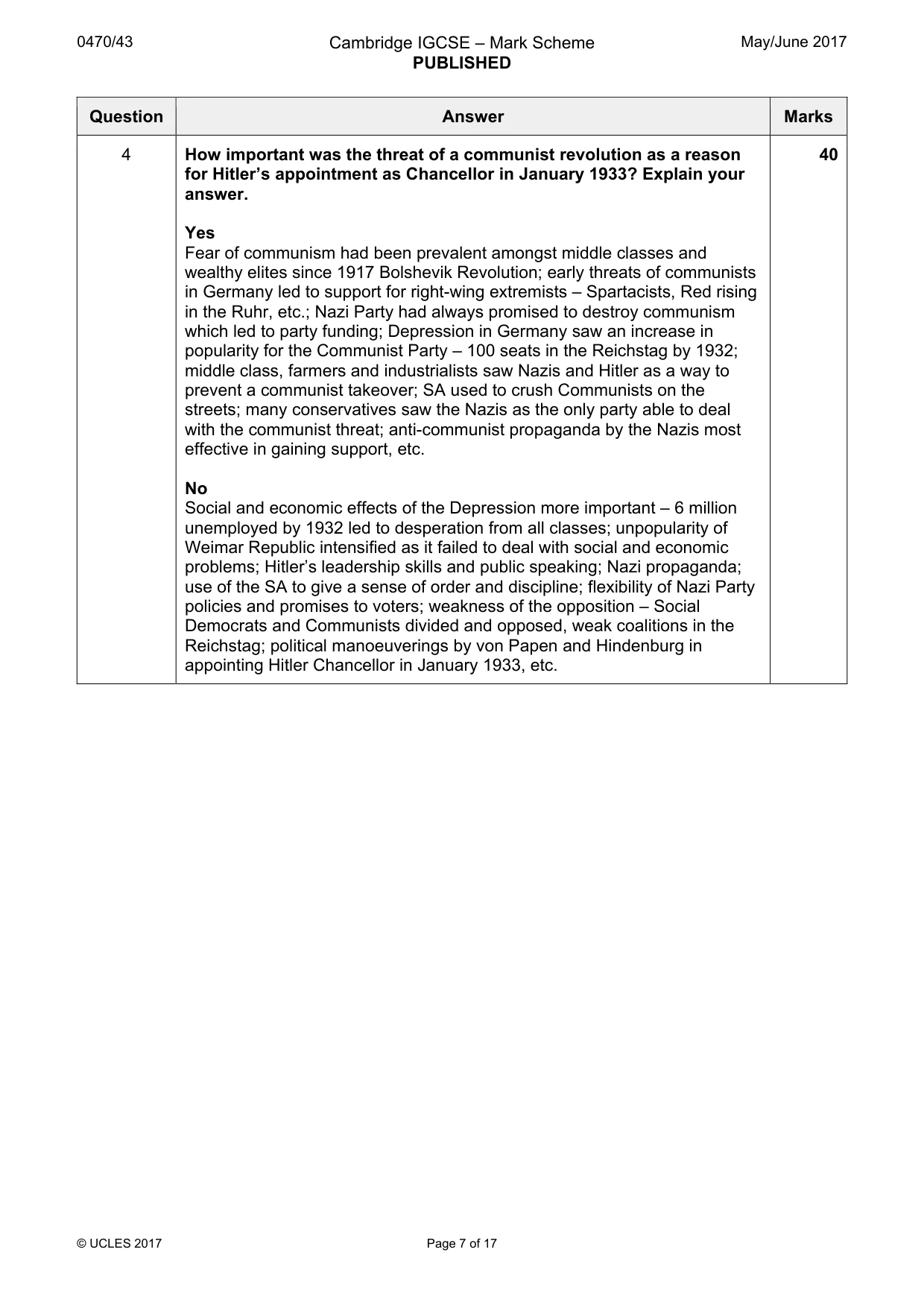
0470/43 Cambridge IGCSE – Mark Scheme PUBLISHED May/June 2017 © UCLES 2017 Page 7 of 17 Question Answer Marks 4 How important was the threat of a communist revolution as a reason for Hitler’s appointment as Chancellor in January 1933? Explain your answer. Yes Fear of communism had been prevalent amongst middle classes and wealthy elites since 1917 Bolshevik Revolution; early threats of communists in Germany led to support for right-wing extremists – Spartacists, Red rising in the Ruhr, etc.; Nazi Party had always promised to destroy communism which led to party funding; Depression in Germany saw an increase in popularity for the Communist Party – 100 seats in the Reichstag by 1932; middle class, farmers and industrialists saw Nazis and Hitler as a way to prevent a communist takeover; SA used to crush Communists on the streets; many conservatives saw the Nazis as the only party able to deal with the communist threat; anti-communist propaganda by the Nazis most effective in gaining support, etc. No Social and economic effects of the Depression more important – 6 million unemployed by 1932 led to desperation from all classes; unpopularity of Weimar Republic intensified as it failed to deal with social and economic problems; Hitler’s leadership skills and public speaking; Nazi propaganda; use of the SA to give a sense of order and discipline; flexibility of Nazi Party policies and promises to voters; weakness of the opposition – Social Democrats and Communists divided and opposed, weak coalitions in the Reichstag; political manoeuverings by von Papen and Hindenburg in appointing Hitler Chancellor in January 1933, etc. 40
Mark scheme, page 8
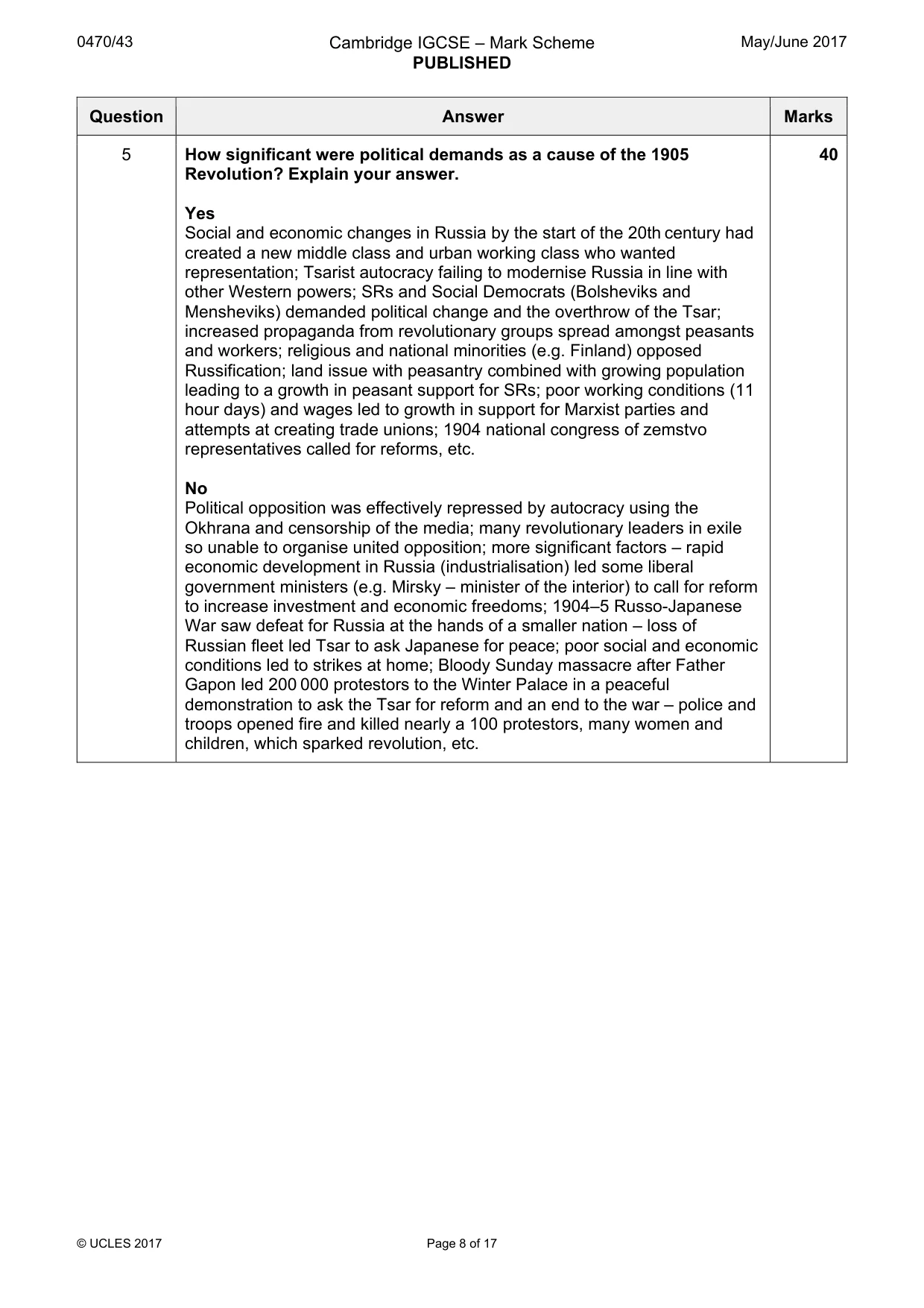
0470/43 Cambridge IGCSE – Mark Scheme PUBLISHED May/June 2017 © UCLES 2017 Page 8 of 17 Question Answer Marks 5 How significant were political demands as a cause of the 1905 Revolution? Explain your answer. Yes Social and economic changes in Russia by the start of the 20th century had created a new middle class and urban working class who wanted representation; Tsarist autocracy failing to modernise Russia in line with other Western powers; SRs and Social Democrats (Bolsheviks and Mensheviks) demanded political change and the overthrow of the Tsar; increased propaganda from revolutionary groups spread amongst peasants and workers; religious and national minorities (e.g. Finland) opposed Russification; land issue with peasantry combined with growing population leading to a growth in peasant support for SRs; poor working conditions (11 hour days) and wages led to growth in support for Marxist parties and attempts at creating trade unions; 1904 national congress of zemstvo representatives called for reforms, etc. No Political opposition was effectively repressed by autocracy using the Okhrana and censorship of the media; many revolutionary leaders in exile so unable to organise united opposition; more significant factors – rapid economic development in Russia (industrialisation) led some liberal government ministers (e.g. Mirsky – minister of the interior) to call for reform to increase investment and economic freedoms; 1904–5 Russo-Japanese War saw defeat for Russia at the hands of a smaller nation – loss of Russian fleet led Tsar to ask Japanese for peace; poor social and economic conditions led to strikes at home; Bloody Sunday massacre after Father Gapon led 200 000 protestors to the Winter Palace in a peaceful demonstration to ask the Tsar for reform and an end to the war – police and troops opened fire and killed nearly a 100 protestors, many women and children, which sparked revolution, etc. 40
Mark scheme, page 9
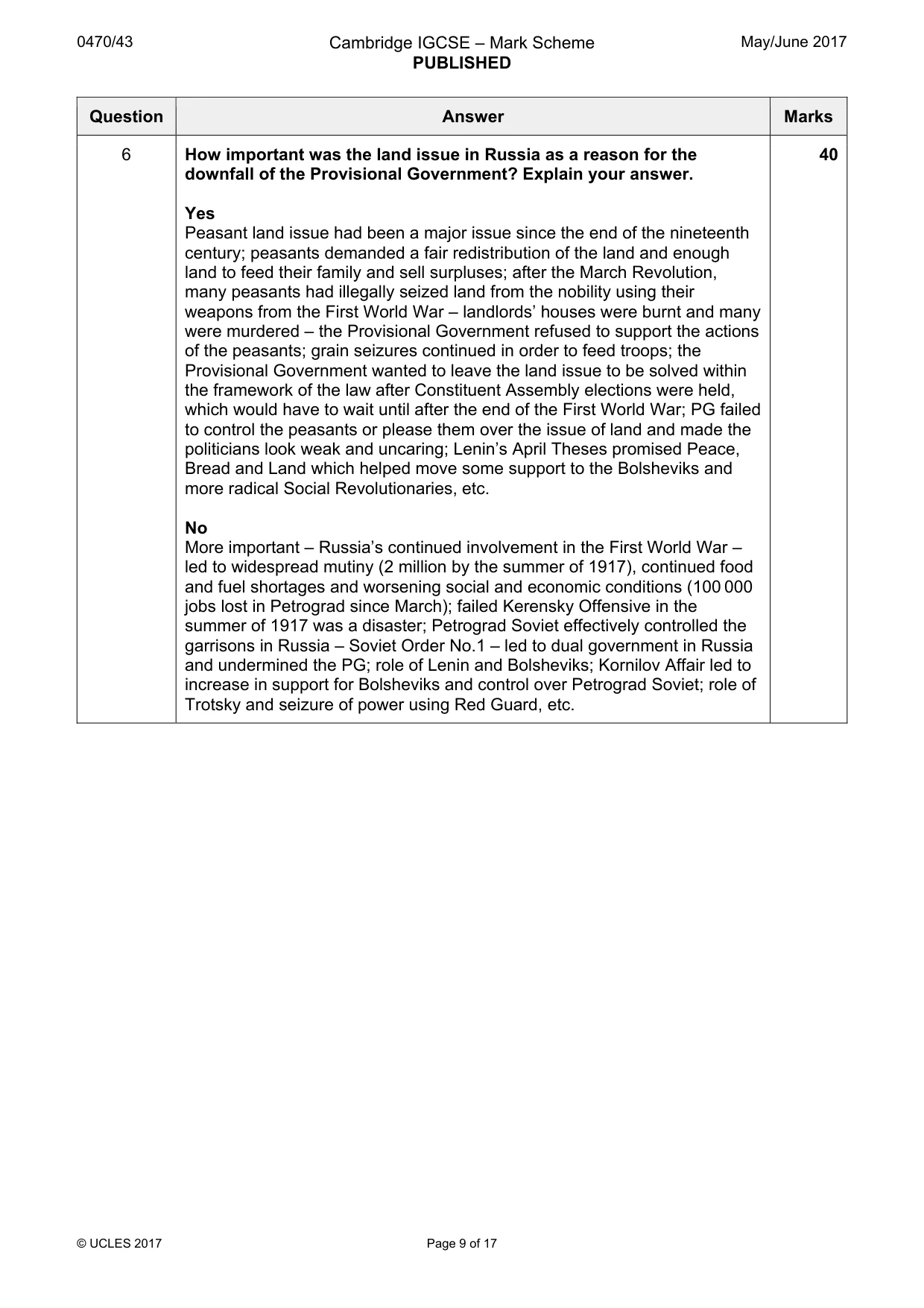
0470/43 Cambridge IGCSE – Mark Scheme PUBLISHED May/June 2017 © UCLES 2017 Page 9 of 17 Question Answer Marks 6 How important was the land issue in Russia as a reason for the downfall of the Provisional Government? Explain your answer. Yes Peasant land issue had been a major issue since the end of the nineteenth century; peasants demanded a fair redistribution of the land and enough land to feed their family and sell surpluses; after the March Revolution, many peasants had illegally seized land from the nobility using their weapons from the First World War – landlords’ houses were burnt and many were murdered – the Provisional Government refused to support the actions of the peasants; grain seizures continued in order to feed troops; the Provisional Government wanted to leave the land issue to be solved within the framework of the law after Constituent Assembly elections were held, which would have to wait until after the end of the First World War; PG failed to control the peasants or please them over the issue of land and made the politicians look weak and uncaring; Lenin’s April Theses promised Peace, Bread and Land which helped move some support to the Bolsheviks and more radical Social Revolutionaries, etc. No More important – Russia’s continued involvement in the First World War – led to widespread mutiny (2 million by the summer of 1917), continued food and fuel shortages and worsening social and economic conditions (100 000 jobs lost in Petrograd since March); failed Kerensky Offensive in the summer of 1917 was a disaster; Petrograd Soviet effectively controlled the garrisons in Russia – Soviet Order No.1 – led to dual government in Russia and undermined the PG; role of Lenin and Bolsheviks; Kornilov Affair led to increase in support for Bolsheviks and control over Petrograd Soviet; role of Trotsky and seizure of power using Red Guard, etc. 40
Mark scheme, page 10
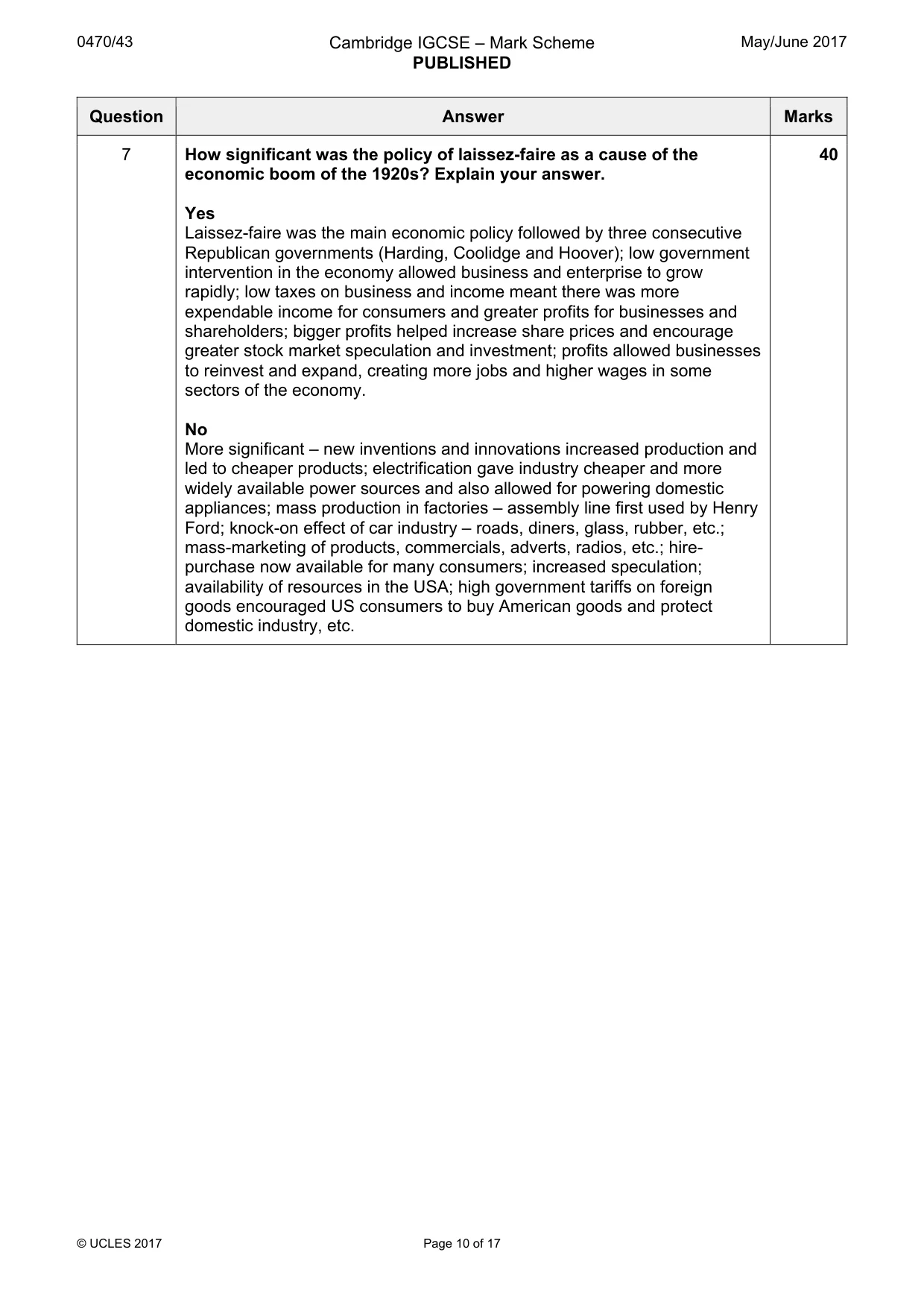
0470/43 Cambridge IGCSE – Mark Scheme PUBLISHED May/June 2017 © UCLES 2017 Page 10 of 17 Question Answer Marks 7 How significant was the policy of laissez-faire as a cause of the economic boom of the 1920s? Explain your answer. Yes Laissez-faire was the main economic policy followed by three consecutive Republican governments (Harding, Coolidge and Hoover); low government intervention in the economy allowed business and enterprise to grow rapidly; low taxes on business and income meant there was more expendable income for consumers and greater profits for businesses and shareholders; bigger profits helped increase share prices and encourage greater stock market speculation and investment; profits allowed businesses to reinvest and expand, creating more jobs and higher wages in some sectors of the economy. No More significant – new inventions and innovations increased production and led to cheaper products; electrification gave industry cheaper and more widely available power sources and also allowed for powering domestic appliances; mass production in factories – assembly line first used by Henry Ford; knock-on effect of car industry – roads, diners, glass, rubber, etc.; mass-marketing of products, commercials, adverts, radios, etc.; hire- purchase now available for many consumers; increased speculation; availability of resources in the USA; high government tariffs on foreign goods encouraged US consumers to buy American goods and protect domestic industry, etc. 40
Mark scheme, page 11
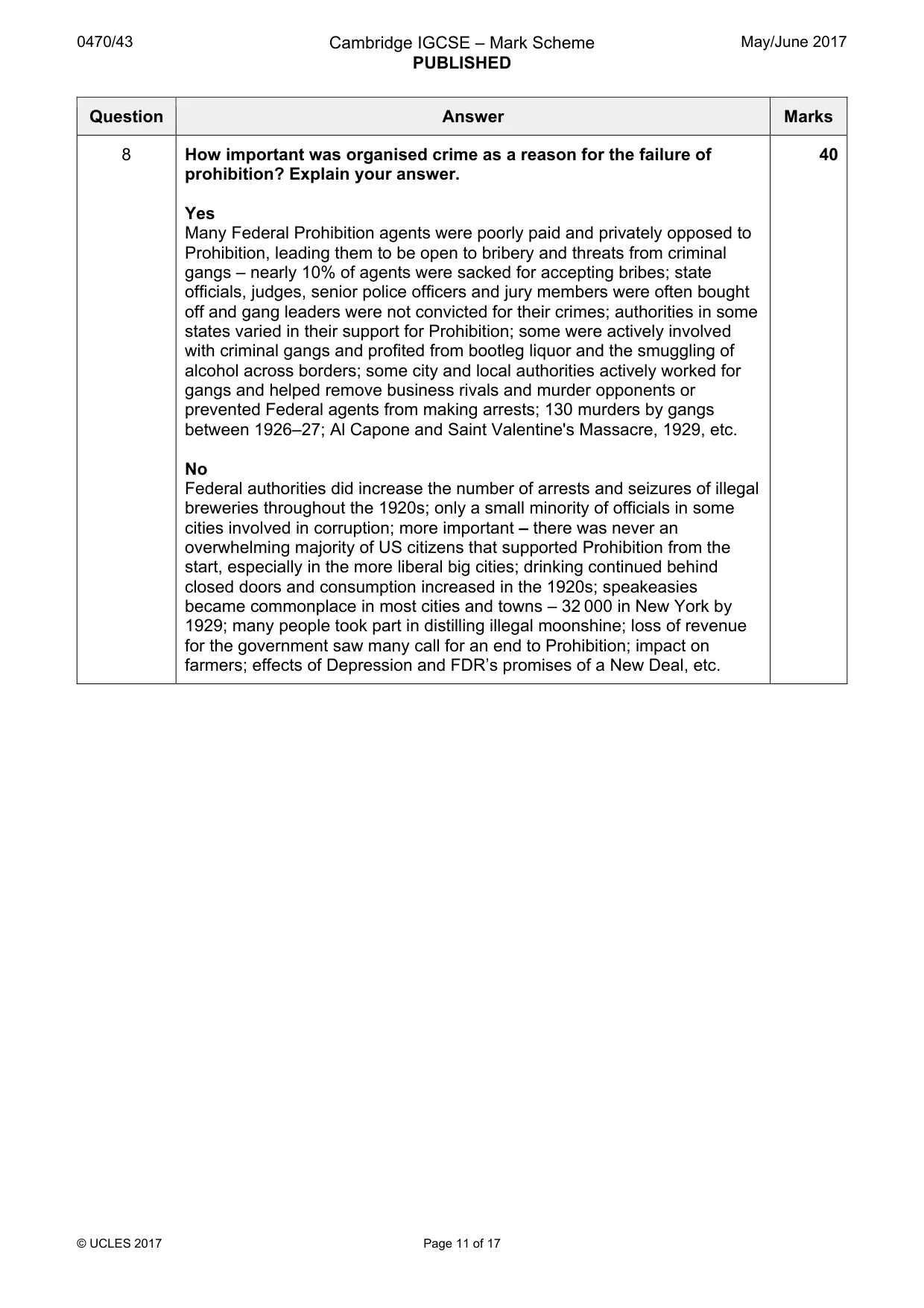
0470/43 Cambridge IGCSE – Mark Scheme PUBLISHED May/June 2017 © UCLES 2017 Page 11 of 17 Question Answer Marks 8 How important was organised crime as a reason for the failure of prohibition? Explain your answer. Yes Many Federal Prohibition agents were poorly paid and privately opposed to Prohibition, leading them to be open to bribery and threats from criminal gangs – nearly 10% of agents were sacked for accepting bribes; state officials, judges, senior police officers and jury members were often bought off and gang leaders were not convicted for their crimes; authorities in some states varied in their support for Prohibition; some were actively involved with criminal gangs and profited from bootleg liquor and the smuggling of alcohol across borders; some city and local authorities actively worked for gangs and helped remove business rivals and murder opponents or prevented Federal agents from making arrests; 130 murders by gangs between 1926–27; Al Capone and Saint Valentine's Massacre, 1929, etc. No Federal authorities did increase the number of arrests and seizures of illegal breweries throughout the 1920s; only a small minority of officials in some cities involved in corruption; more important – there was never an overwhelming majority of US citizens that supported Prohibition from the start, especially in the more liberal big cities; drinking continued behind closed doors and consumption increased in the 1920s; speakeasies became commonplace in most cities and towns – 32 000 in New York by 1929; many people took part in distilling illegal moonshine; loss of revenue for the government saw many call for an end to Prohibition; impact on farmers; effects of Depression and FDR’s promises of a New Deal, etc. 40
Mark scheme, page 12
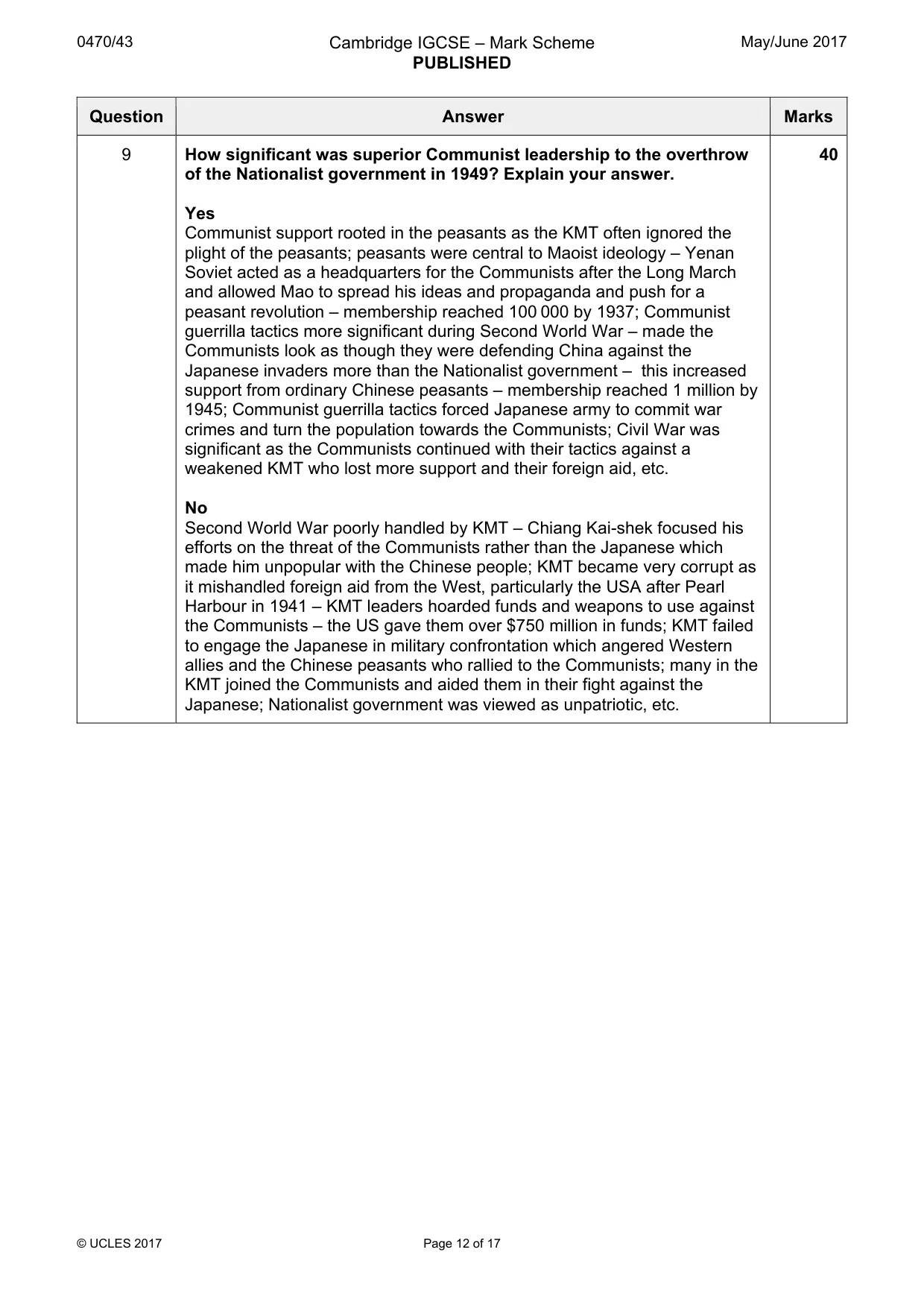
0470/43 Cambridge IGCSE – Mark Scheme PUBLISHED May/June 2017 © UCLES 2017 Page 12 of 17 Question Answer Marks 9 How significant was superior Communist leadership to the overthrow of the Nationalist government in 1949? Explain your answer. Yes Communist support rooted in the peasants as the KMT often ignored the plight of the peasants; peasants were central to Maoist ideology – Yenan Soviet acted as a headquarters for the Communists after the Long March and allowed Mao to spread his ideas and propaganda and push for a peasant revolution – membership reached 100 000 by 1937; Communist guerrilla tactics more significant during Second World War – made the Communists look as though they were defending China against the Japanese invaders more than the Nationalist government – this increased support from ordinary Chinese peasants – membership reached 1 million by 1945; Communist guerrilla tactics forced Japanese army to commit war crimes and turn the population towards the Communists; Civil War was significant as the Communists continued with their tactics against a weakened KMT who lost more support and their foreign aid, etc. No Second World War poorly handled by KMT – Chiang Kai-shek focused his efforts on the threat of the Communists rather than the Japanese which made him unpopular with the Chinese people; KMT became very corrupt as it mishandled foreign aid from the West, particularly the USA after Pearl Harbour in 1941 – KMT leaders hoarded funds and weapons to use against the Communists – the US gave them over $750 million in funds; KMT failed to engage the Japanese in military confrontation which angered Western allies and the Chinese peasants who rallied to the Communists; many in the KMT joined the Communists and aided them in their fight against the Japanese; Nationalist government was viewed as unpatriotic, etc. 40
Mark scheme, page 13
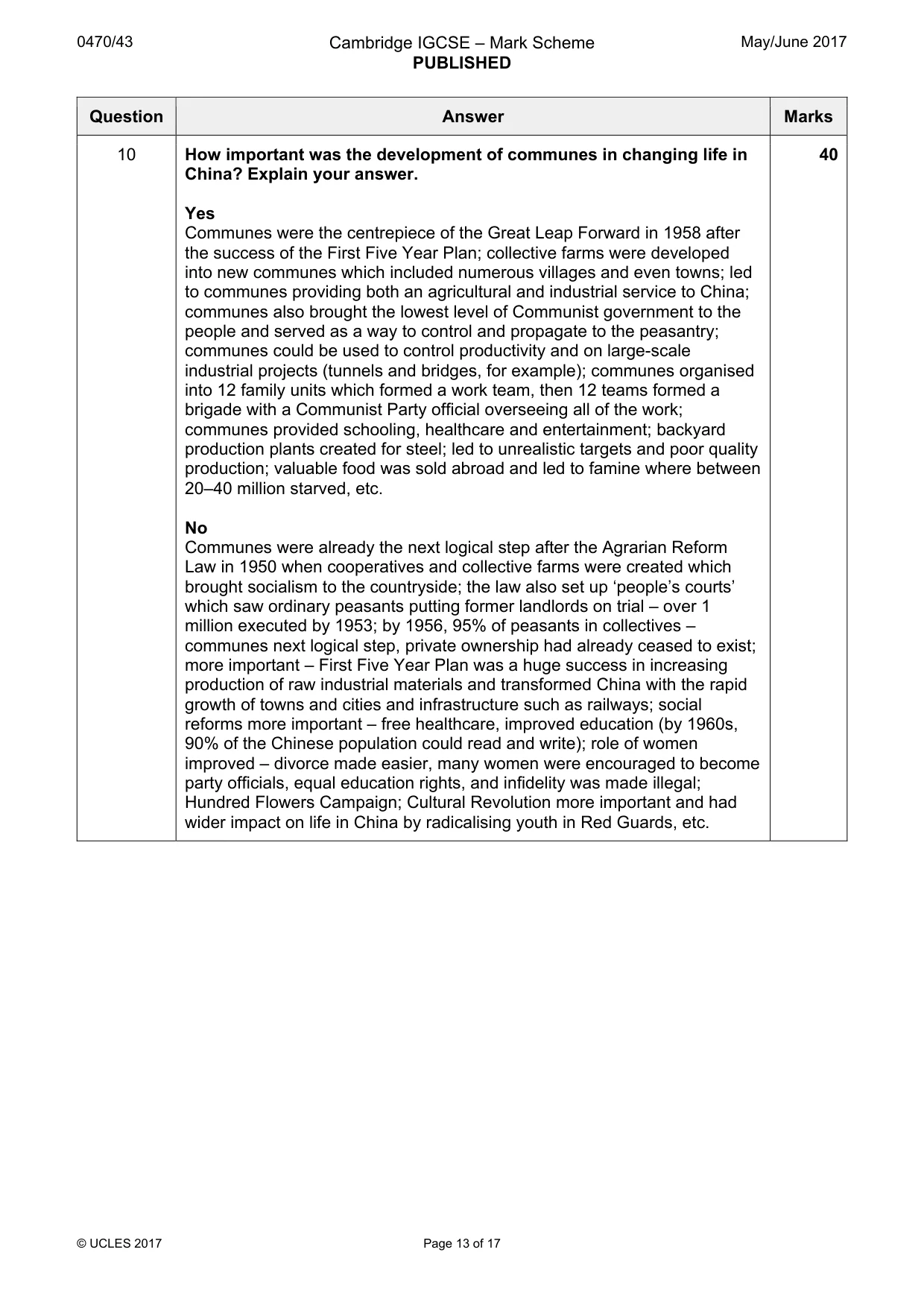
0470/43 Cambridge IGCSE – Mark Scheme PUBLISHED May/June 2017 © UCLES 2017 Page 13 of 17 Question Answer Marks 10 How important was the development of communes in changing life in China? Explain your answer. Yes Communes were the centrepiece of the Great Leap Forward in 1958 after the success of the First Five Year Plan; collective farms were developed into new communes which included numerous villages and even towns; led to communes providing both an agricultural and industrial service to China; communes also brought the lowest level of Communist government to the people and served as a way to control and propagate to the peasantry; communes could be used to control productivity and on large-scale industrial projects (tunnels and bridges, for example); communes organised into 12 family units which formed a work team, then 12 teams formed a brigade with a Communist Party official overseeing all of the work; communes provided schooling, healthcare and entertainment; backyard production plants created for steel; led to unrealistic targets and poor quality production; valuable food was sold abroad and led to famine where between 20–40 million starved, etc. No Communes were already the next logical step after the Agrarian Reform Law in 1950 when cooperatives and collective farms were created which brought socialism to the countryside; the law also set up ‘people’s courts’ which saw ordinary peasants putting former landlords on trial – over 1 million executed by 1953; by 1956, 95% of peasants in collectives – communes next logical step, private ownership had already ceased to exist; more important – First Five Year Plan was a huge success in increasing production of raw industrial materials and transformed China with the rapid growth of towns and cities and infrastructure such as railways; social reforms more important – free healthcare, improved education (by 1960s, 90% of the Chinese population could read and write); role of women improved – divorce made easier, many women were encouraged to become party officials, equal education rights, and infidelity was made illegal; Hundred Flowers Campaign; Cultural Revolution more important and had wider impact on life in China by radicalising youth in Red Guards, etc. 40
Mark scheme, page 14
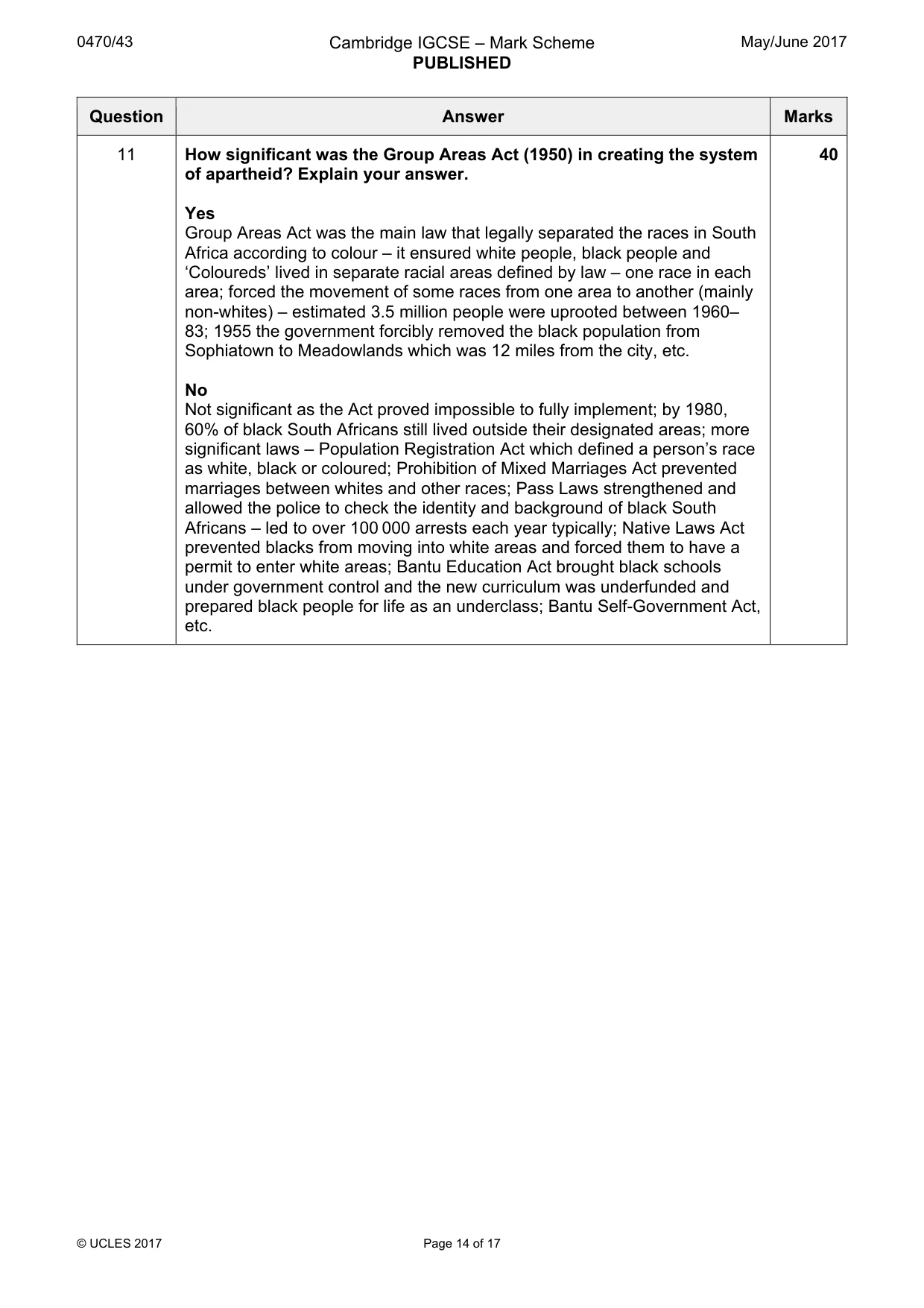
0470/43 Cambridge IGCSE – Mark Scheme PUBLISHED May/June 2017 © UCLES 2017 Page 14 of 17 Question Answer Marks 11 How significant was the Group Areas Act (1950) in creating the system of apartheid? Explain your answer. Yes Group Areas Act was the main law that legally separated the races in South Africa according to colour – it ensured white people, black people and ‘Coloureds’ lived in separate racial areas defined by law – one race in each area; forced the movement of some races from one area to another (mainly non-whites) – estimated 3.5 million people were uprooted between 1960– 83; 1955 the government forcibly removed the black population from Sophiatown to Meadowlands which was 12 miles from the city, etc. No Not significant as the Act proved impossible to fully implement; by 1980, 60% of black South Africans still lived outside their designated areas; more significant laws – Population Registration Act which defined a person’s race as white, black or coloured; Prohibition of Mixed Marriages Act prevented marriages between whites and other races; Pass Laws strengthened and allowed the police to check the identity and background of black South Africans – led to over 100 000 arrests each year typically; Native Laws Act prevented blacks from moving into white areas and forced them to have a permit to enter white areas; Bantu Education Act brought black schools under government control and the new curriculum was underfunded and prepared black people for life as an underclass; Bantu Self-Government Act, etc. 40
Mark scheme, page 15
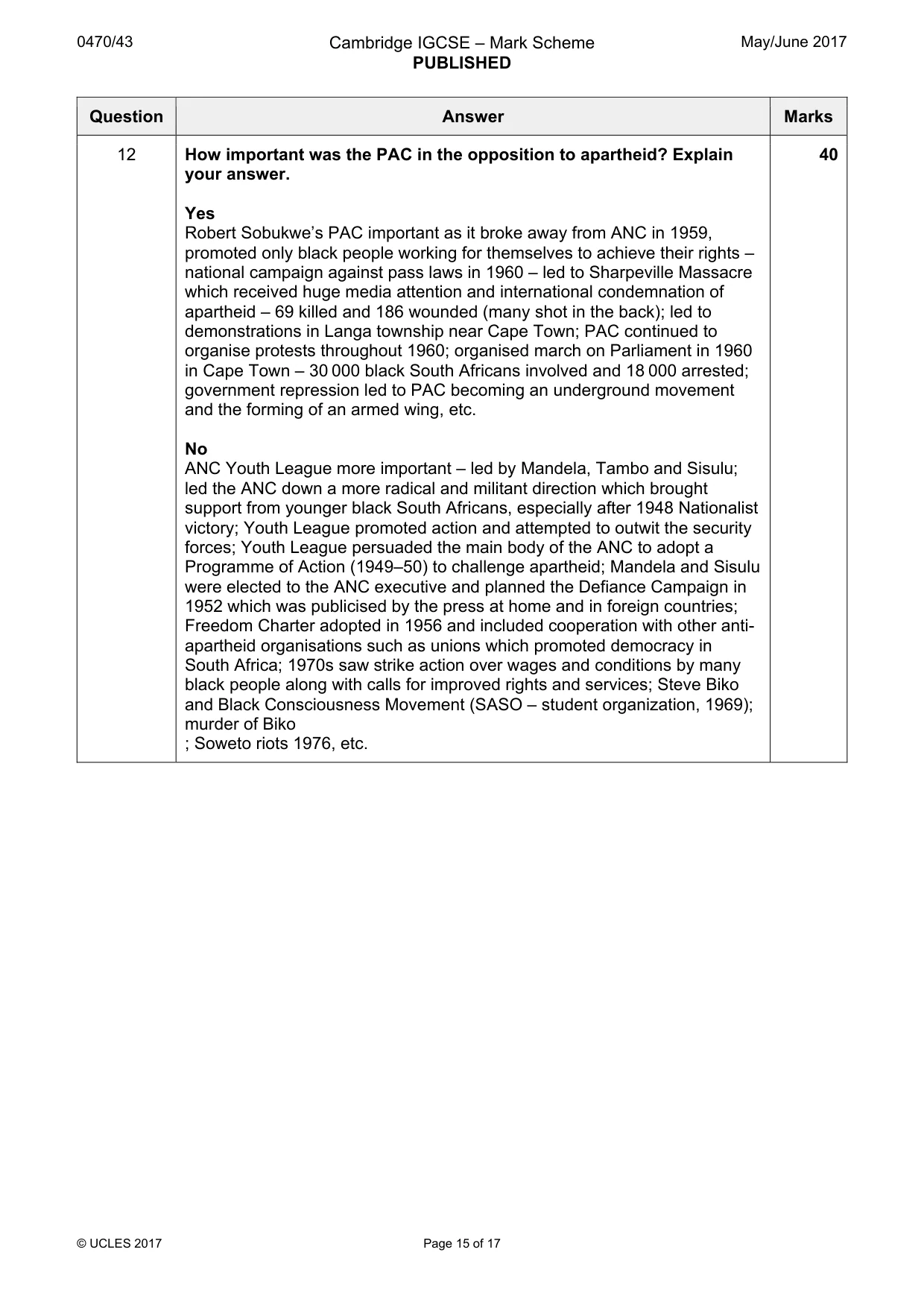
0470/43 Cambridge IGCSE – Mark Scheme PUBLISHED May/June 2017 © UCLES 2017 Page 15 of 17 Question Answer Marks 12 How important was the PAC in the opposition to apartheid? Explain your answer. Yes Robert Sobukwe’s PAC important as it broke away from ANC in 1959, promoted only black people working for themselves to achieve their rights – national campaign against pass laws in 1960 – led to Sharpeville Massacre which received huge media attention and international condemnation of apartheid – 69 killed and 186 wounded (many shot in the back); led to demonstrations in Langa township near Cape Town; PAC continued to organise protests throughout 1960; organised march on Parliament in 1960 in Cape Town – 30 000 black South Africans involved and 18 000 arrested; government repression led to PAC becoming an underground movement and the forming of an armed wing, etc. No ANC Youth League more important – led by Mandela, Tambo and Sisulu; led the ANC down a more radical and militant direction which brought support from younger black South Africans, especially after 1948 Nationalist victory; Youth League promoted action and attempted to outwit the security forces; Youth League persuaded the main body of the ANC to adopt a Programme of Action (1949–50) to challenge apartheid; Mandela and Sisulu were elected to the ANC executive and planned the Defiance Campaign in 1952 which was publicised by the press at home and in foreign countries; Freedom Charter adopted in 1956 and included cooperation with other anti- apartheid organisations such as unions which promoted democracy in South Africa; 1970s saw strike action over wages and conditions by many black people along with calls for improved rights and services; Steve Biko and Black Consciousness Movement (SASO – student organization, 1969); murder of Biko ; Soweto riots 1976, etc. 40
Mark scheme, page 16
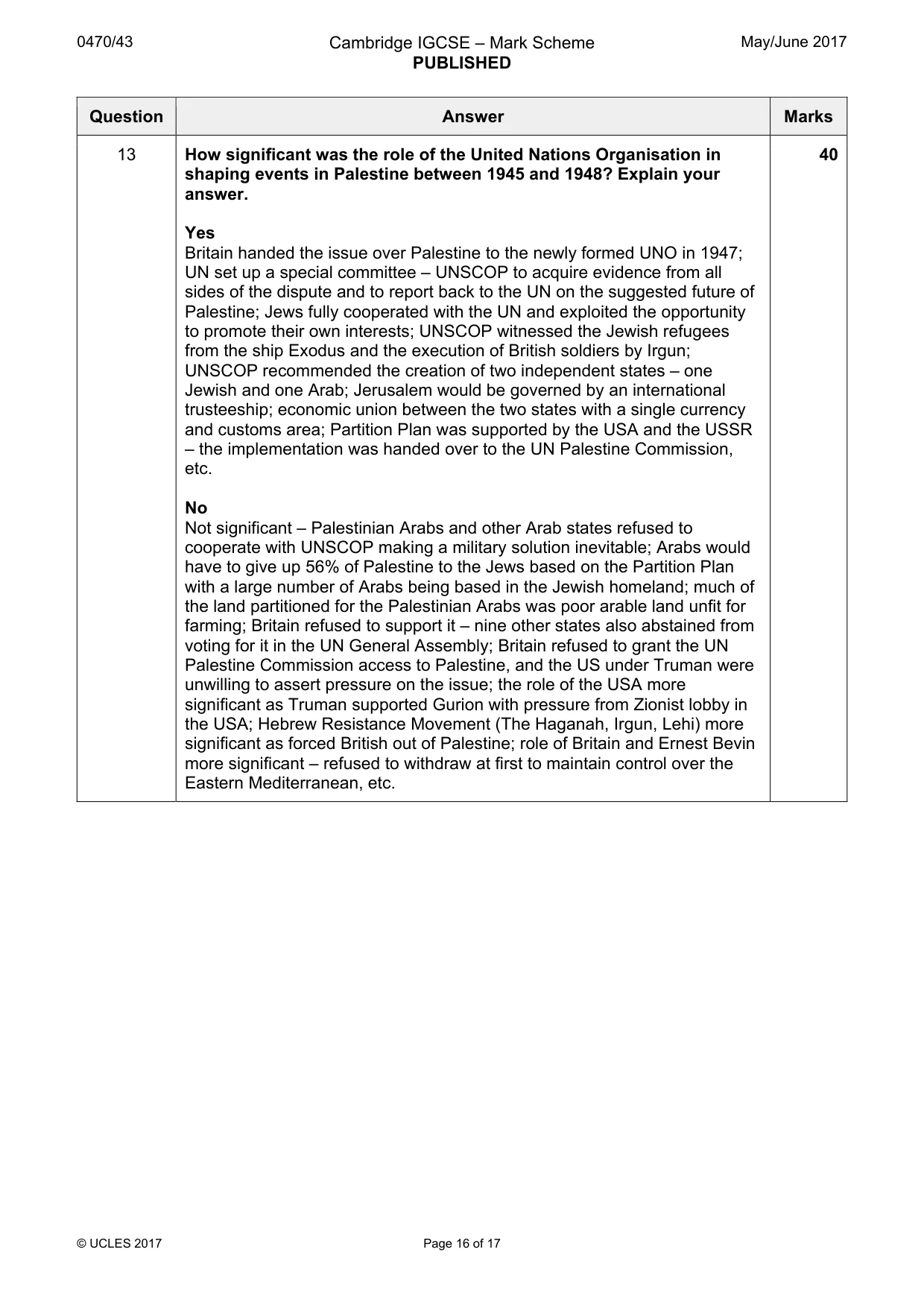
0470/43 Cambridge IGCSE – Mark Scheme PUBLISHED May/June 2017 © UCLES 2017 Page 16 of 17 Question Answer Marks 13 How significant was the role of the United Nations Organisation in shaping events in Palestine between 1945 and 1948? Explain your answer. Yes Britain handed the issue over Palestine to the newly formed UNO in 1947; UN set up a special committee – UNSCOP to acquire evidence from all sides of the dispute and to report back to the UN on the suggested future of Palestine; Jews fully cooperated with the UN and exploited the opportunity to promote their own interests; UNSCOP witnessed the Jewish refugees from the ship Exodus and the execution of British soldiers by Irgun; UNSCOP recommended the creation of two independent states – one Jewish and one Arab; Jerusalem would be governed by an international trusteeship; economic union between the two states with a single currency and customs area; Partition Plan was supported by the USA and the USSR – the implementation was handed over to the UN Palestine Commission, etc. No Not significant – Palestinian Arabs and other Arab states refused to cooperate with UNSCOP making a military solution inevitable; Arabs would have to give up 56% of Palestine to the Jews based on the Partition Plan with a large number of Arabs being based in the Jewish homeland; much of the land partitioned for the Palestinian Arabs was poor arable land unfit for farming; Britain refused to support it – nine other states also abstained from voting for it in the UN General Assembly; Britain refused to grant the UN Palestine Commission access to Palestine, and the US under Truman were unwilling to assert pressure on the issue; the role of the USA more significant as Truman supported Gurion with pressure from Zionist lobby in the USA; Hebrew Resistance Movement (The Haganah, Irgun, Lehi) more significant as forced British out of Palestine; role of Britain and Ernest Bevin more significant – refused to withdraw at first to maintain control over the Eastern Mediterranean, etc. 40
Mark scheme, page 17
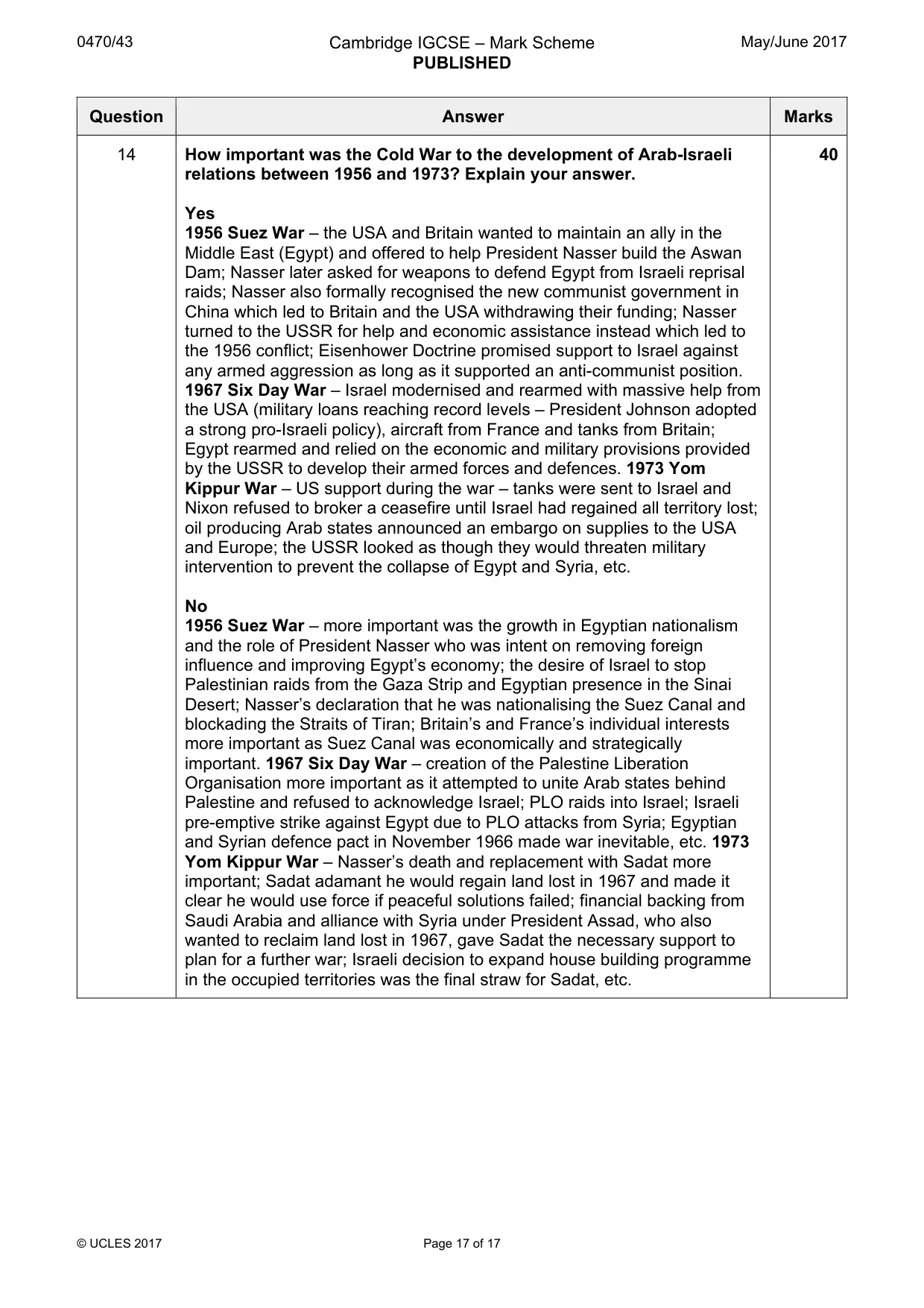
0470/43 Cambridge IGCSE – Mark Scheme PUBLISHED May/June 2017 © UCLES 2017 Page 17 of 17 Question Answer Marks 14 How important was the Cold War to the development of Arab-Israeli relations between 1956 and 1973? Explain your answer. Yes 1956 Suez War – the USA and Britain wanted to maintain an ally in the Middle East (Egypt) and offered to help President Nasser build the Aswan Dam; Nasser later asked for weapons to defend Egypt from Israeli reprisal raids; Nasser also formally recognised the new communist government in China which led to Britain and the USA withdrawing their funding; Nasser turned to the USSR for help and economic assistance instead which led to the 1956 conflict; Eisenhower Doctrine promised support to Israel against any armed aggression as long as it supported an anti-communist position. 1967 Six Day War – Israel modernised and rearmed with massive help from the USA (military loans reaching record levels – President Johnson adopted a strong pro-Israeli policy), aircraft from France and tanks from Britain; Egypt rearmed and relied on the economic and military provisions provided by the USSR to develop their armed forces and defences. 1973 Yom Kippur War – US support during the war – tanks were sent to Israel and Nixon refused to broker a ceasefire until Israel had regained all territory lost; oil producing Arab states announced an embargo on supplies to the USA and Europe; the USSR looked as though they would threaten military intervention to prevent the collapse of Egypt and Syria, etc. No 1956 Suez War – more important was the growth in Egyptian nationalism and the role of President Nasser who was intent on removing foreign influence and improving Egypt’s economy; the desire of Israel to stop Palestinian raids from the Gaza Strip and Egyptian presence in the Sinai Desert; Nasser’s declaration that he was nationalising the Suez Canal and blockading the Straits of Tiran; Britain’s and France’s individual interests more important as Suez Canal was economically and strategically important. 1967 Six Day War – creation of the Palestine Liberation Organisation more important as it attempted to unite Arab states behind Palestine and refused to acknowledge Israel; PLO raids into Israel; Israeli pre-emptive strike against Egypt due to PLO attacks from Syria; Egyptian and Syrian defence pact in November 1966 made war inevitable, etc. 1973 Yom Kippur War – Nasser’s death and replacement with Sadat more important; Sadat adamant he would regain land lost in 1967 and made it clear he would use force if peaceful solutions failed; financial backing from Saudi Arabia and alliance with Syria under President Assad, who also wanted to reclaim land lost in 1967, gave Sadat the necessary support to plan for a further war; Israeli decision to expand house building programme in the occupied territories was the final straw for Sadat, etc. 40
What you needed in this session
Cambridge’s own grade thresholds for 2017 May/June, Paper 4 · Variant 3. A higher threshold means an easier paper — the bar moves with how the cohort did.