Cambridge IGCSE History 0470 — 2017 May/June Paper 4 · Variant 2
0470/42/M/J/17 · 40 marks · ≈45 min
The question paper and its mark scheme, free to read here and free to download. This is Cambridge’s own paper, exactly as it was sat.
Question paper4 pages

Mark scheme11 pages
Answers below. Sit the paper first if you are practising.
Paper as text
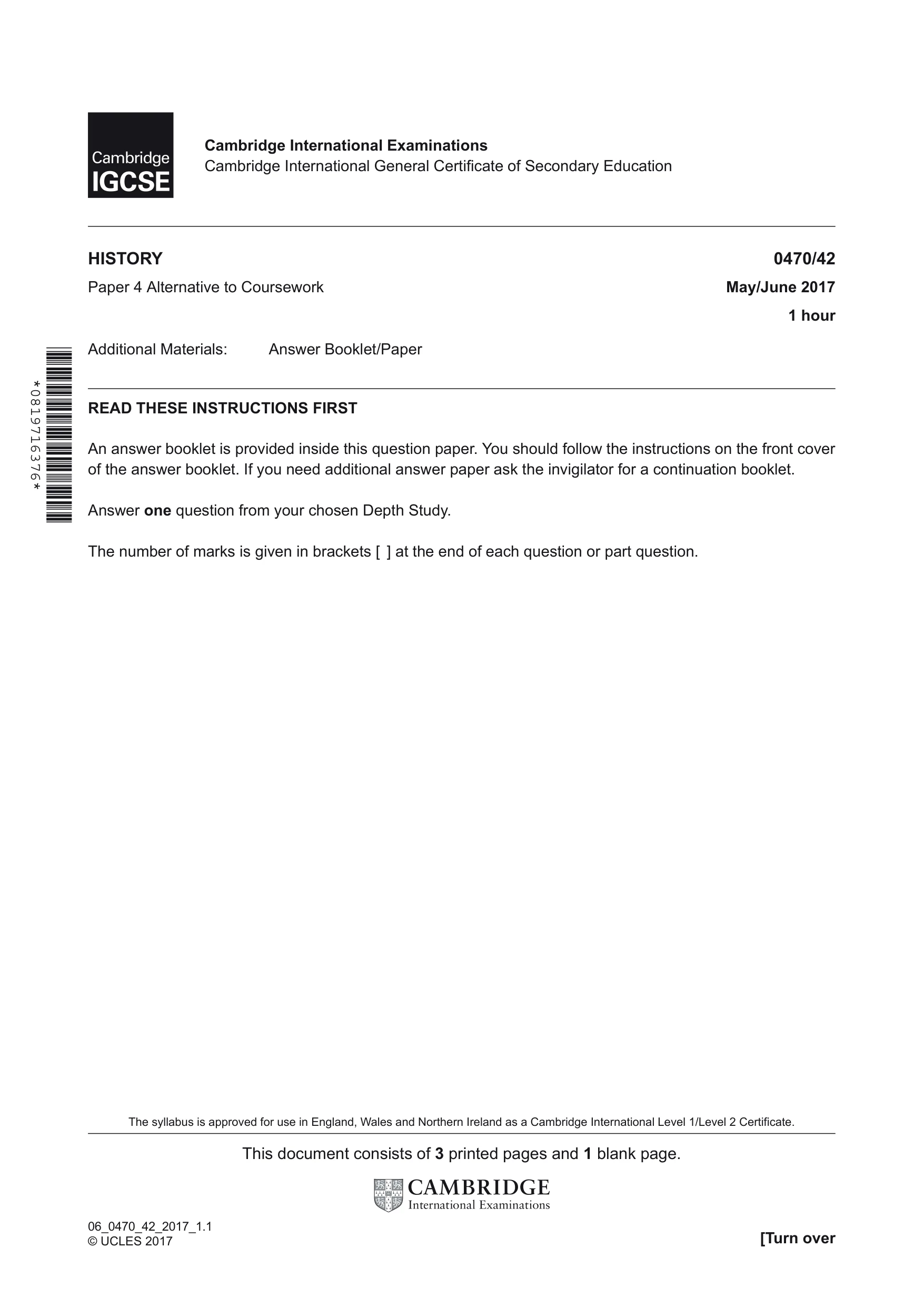
Question paper, page 1
Cambridge International Examinations Cambridge International General Certificate of Secondary Education 0470/42 May/June 2017 1 hour HISTORY Paper 4 Alternative to Coursework Additional Materials: Answer Booklet/Paper READ THESE INSTRUCTIONS FIRST An answer booklet is provided inside this question paper. You should follow the instructions on the front cover of the answer booklet. If you need additional answer paper ask the invigilator for a continuation booklet. Answer one question from your chosen Depth Study. The number of marks is given in brackets [ ] at the end of each question or part question. The syllabus is approved for use in England, Wales and Northern Ireland as a Cambridge International Level 1/Level 2 Certificate. This document consists of 3 printed pages and 1 blank page. [Turn over 06_0470_42_2017_1.1 © UCLES 2017 *0819716376*
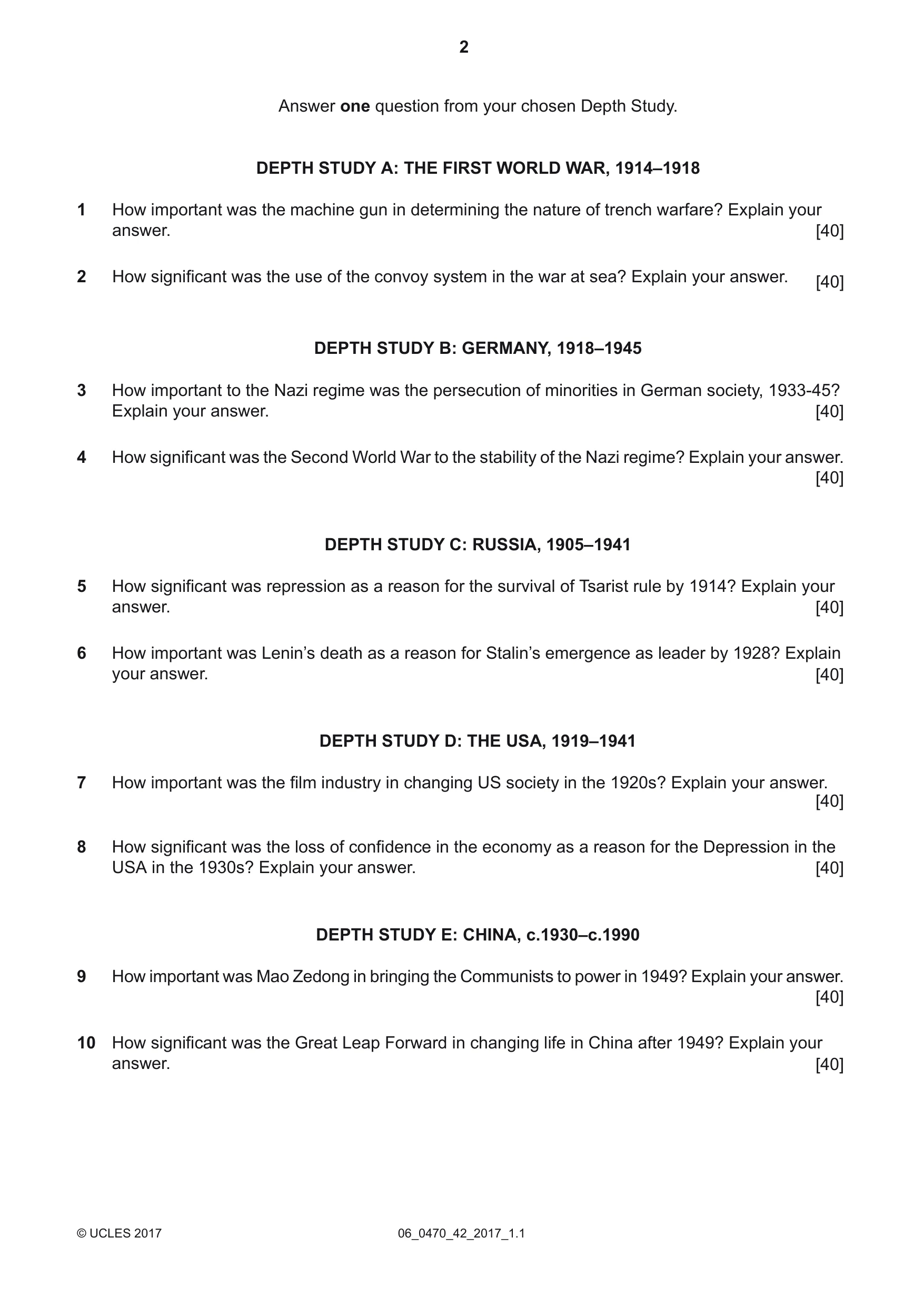
Question paper, page 2
Answer one question from your chosen Depth Study. DEPTH STUDY A: THE FIRST WORLD WAR, 1914–1918 How important was the machine gun in determining the nature of trench warfare? Explain your answer. [40] 1 How significant was the use of the convoy system in the war at sea? Explain your answer. [40] 2 DEPTH STUDY B: GERMANY, 1918–1945 How important to the Nazi regime was the persecution of minorities in German society, 1933-45? Explain your answer. [40] 3 How significant was the Second World War to the stability of the Nazi regime? Explain your answer. [40] 4 DEPTH STUDY C: RUSSIA, 1905–1941 How significant was repression as a reason for the survival of Tsarist rule by 1914? Explain your answer. [40] 5 How important was Lenin’s death as a reason for Stalin’s emergence as leader by 1928? Explain your answer. [40] 6 DEPTH STUDY D: THE USA, 1919–1941 How important was the film industry in changing US society in the 1920s? Explain your answer. [40] 7 How significant was the loss of confidence in the economy as a reason for the Depression in the USA in the 1930s? Explain your answer. [40] 8 DEPTH STUDY E: CHINA, c.1930–c.1990 How important was Mao Zedong in bringing the Communists to power in 1949? Explain your answer. [40] 9 How significant was the Great Leap Forward in changing life in China after 1949? Explain your answer. [40] 10 06_0470_42_2017_1.1 © UCLES 2017 2
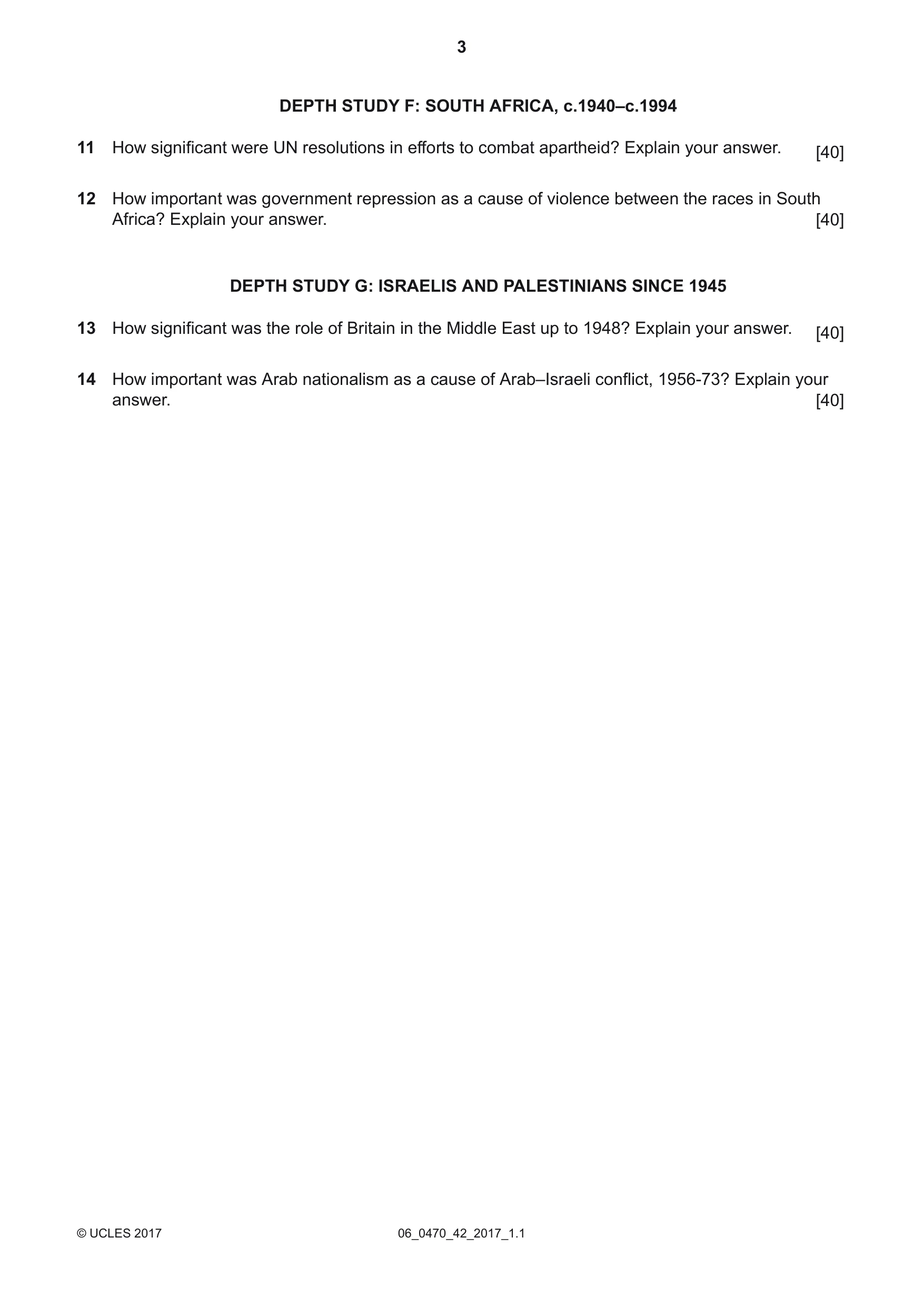
Question paper, page 3
DEPTH STUDY F: SOUTH AFRICA, c.1940–c.1994 How significant were UN resolutions in efforts to combat apartheid? Explain your answer. [40] 11 How important was government repression as a cause of violence between the races in South Africa? Explain your answer. [40] 12 DEPTH STUDY G: ISRAELIS AND PALESTINIANS SINCE 1945 How significant was the role of Britain in the Middle East up to 1948? Explain your answer. [40] 13 How important was Arab nationalism as a cause of Arab–Israeli conflict, 1956-73? Explain your answer. [40] 14 06_0470_42_2017_1.1 © UCLES 2017 3
Question paper, page 4
BLANK PAGE Permission to reproduce items where third-party owned material protected by copyright is included has been sought and cleared where possible. Every reasonable effort has been made by the publisher (UCLES) to trace copyright holders, but if any items requiring clearance have unwittingly been included, the publisher will be pleased to make amends at the earliest possible opportunity. To avoid the issue of disclosure of answer-related information to candidates, all copyright acknowledgements are reproduced online in the Cambridge International Examinations Copyright Acknowledgements Booklet. This is produced for each series of examinations and is freely available to download at www.cie.org.uk after the live examination series. Cambridge International Examinations is part of the Cambridge Assessment Group. Cambridge Assessment is the brand name of University of Cambridge Local Examinations Syndicate (UCLES), which is itself a department of the University of Cambridge. 06_0470_42_2017_1.1 © UCLES 2017 4
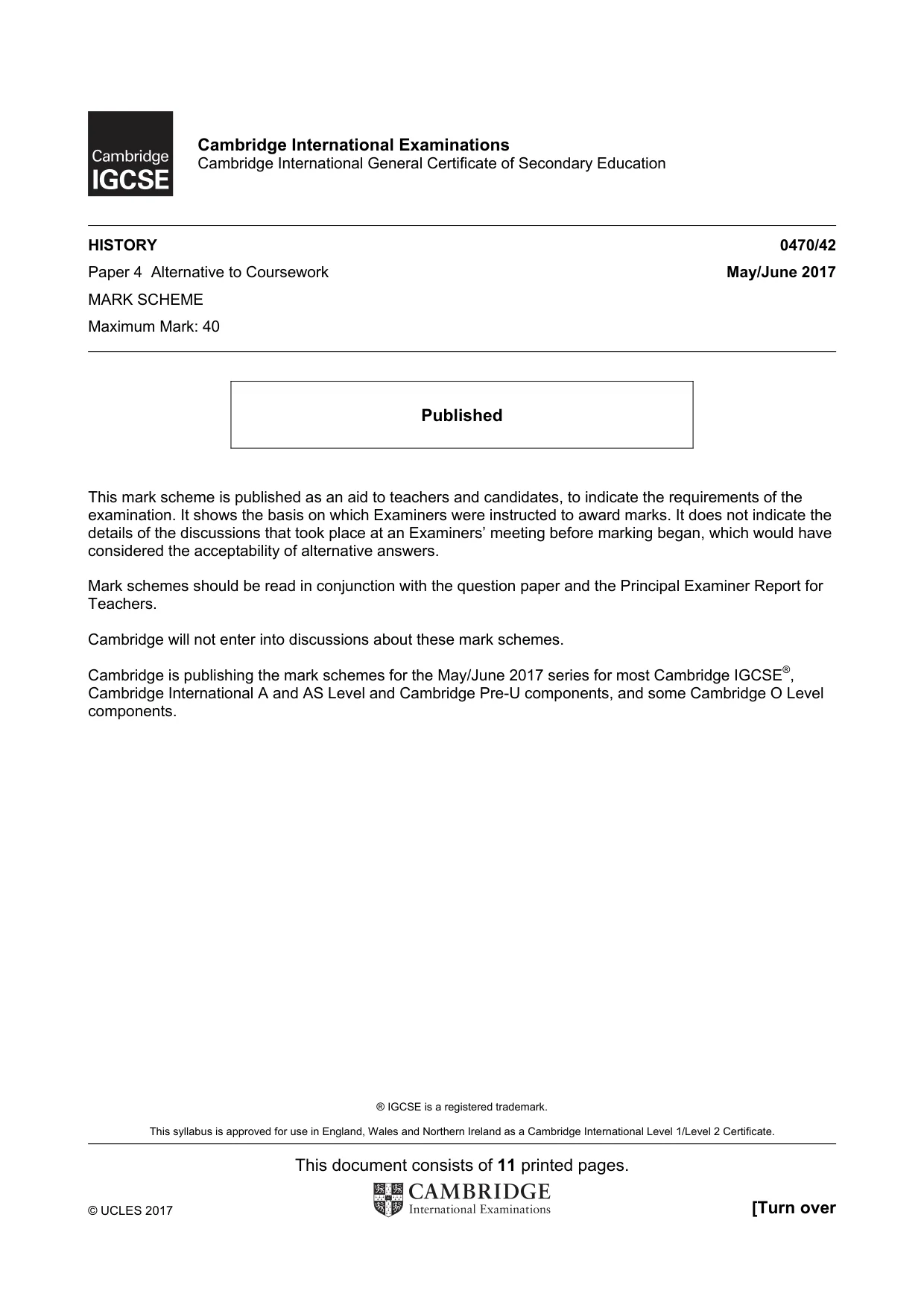
Mark scheme, page 1
® IGCSE is a registered trademark. This syllabus is approved for use in England, Wales and Northern Ireland as a Cambridge International Level 1/Level 2 Certificate. This document consists of 11 printed pages. © UCLES 2017 [Turn over Cambridge International Examinations Cambridge International General Certificate of Secondary Education HISTORY 0470/42 Paper 4 Alternative to Coursework May/June 2017 MARK SCHEME Maximum Mark: 40 Published This mark scheme is published as an aid to teachers and candidates, to indicate the requirements of the examination. It shows the basis on which Examiners were instructed to award marks. It does not indicate the details of the discussions that took place at an Examiners’ meeting before marking began, which would have considered the acceptability of alternative answers. Mark schemes should be read in conjunction with the question paper and the Principal Examiner Report for Teachers. Cambridge will not enter into discussions about these mark schemes. Cambridge is publishing the mark schemes for the May/June 2017 series for most Cambridge IGCSE®, Cambridge International A and AS Level and Cambridge Pre-U components, and some Cambridge O Level components.
Mark scheme, page 2
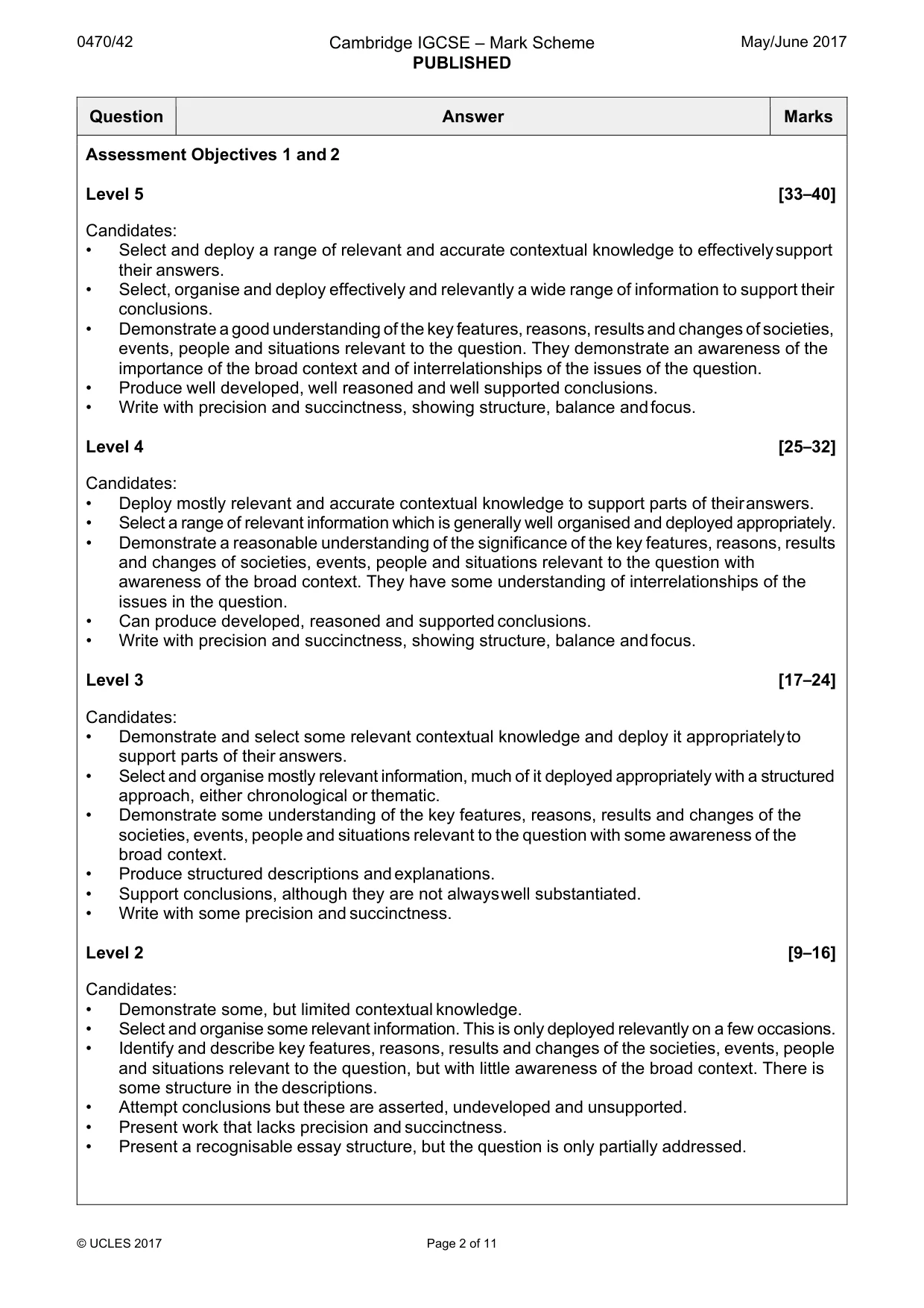
0470/42 Cambridge IGCSE – Mark Scheme PUBLISHED May/June 2017 © UCLES 2017 Page 2 of 11 Question Answer Marks Assessment Objectives 1 and 2 Level 5 [33–40] Candidates: • Select and deploy a range of relevant and accurate contextual knowledge to effectively support their answers. • Select, organise and deploy effectively and relevantly a wide range of information to support their conclusions. • Demonstrate a good understanding of the key features, reasons, results and changes of societies, events, people and situations relevant to the question. They demonstrate an awareness of the importance of the broad context and of interrelationships of the issues of the question. • Produce well developed, well reasoned and well supported conclusions. • Write with precision and succinctness, showing structure, balance and focus. Level 4 [25–32] Candidates: • Deploy mostly relevant and accurate contextual knowledge to support parts of their answers. • Select a range of relevant information which is generally well organised and deployed appropriately. • Demonstrate a reasonable understanding of the significance of the key features, reasons, results and changes of societies, events, people and situations relevant to the question with awareness of the broad context. They have some understanding of interrelationships of the issues in the question. • Can produce developed, reasoned and supported conclusions. • Write with precision and succinctness, showing structure, balance and focus. Level 3 [17–24] Candidates: • Demonstrate and select some relevant contextual knowledge and deploy it appropriately to support parts of their answers. • Select and organise mostly relevant information, much of it deployed appropriately with a structured approach, either chronological or thematic. • Demonstrate some understanding of the key features, reasons, results and changes of the societies, events, people and situations relevant to the question with some awareness of the broad context. • Produce structured descriptions and explanations. • Support conclusions, although they are not always well substantiated. • Write with some precision and succinctness. Level 2 [9–16] Candidates: • Demonstrate some, but limited contextual knowledge. • Select and organise some relevant information. This is only deployed relevantly on a few occasions. • Identify and describe key features, reasons, results and changes of the societies, events, people and situations relevant to the question, but with little awareness of the broad context. There is some structure in the descriptions. • Attempt conclusions but these are asserted, undeveloped and unsupported. • Present work that lacks precision and succinctness. • Present a recognisable essay structure, but the question is only partially addressed.
Mark scheme, page 3
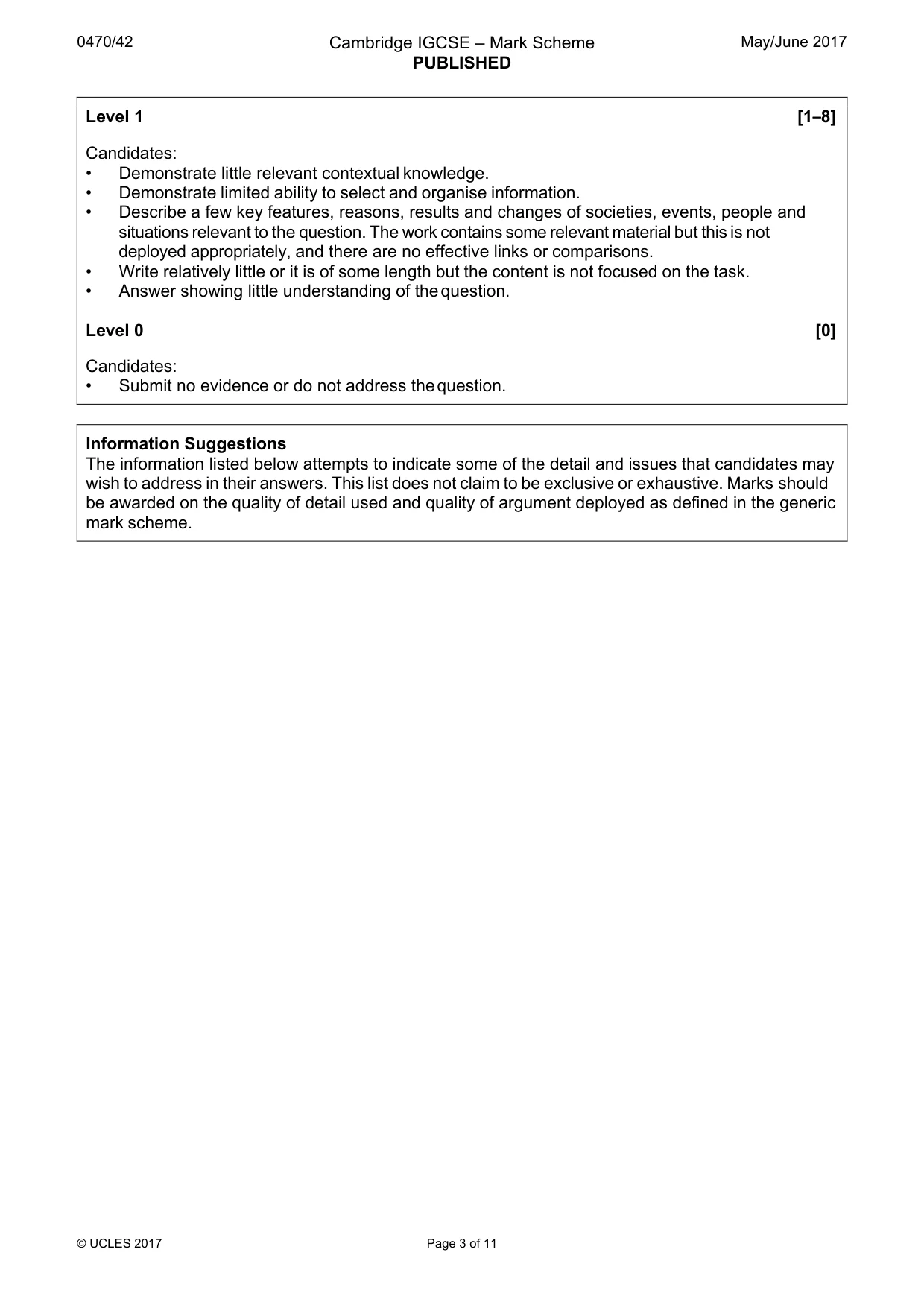
0470/42 Cambridge IGCSE – Mark Scheme PUBLISHED May/June 2017 © UCLES 2017 Page 3 of 11 Level 1 [1–8] Candidates: • Demonstrate little relevant contextual knowledge. • Demonstrate limited ability to select and organise information. • Describe a few key features, reasons, results and changes of societies, events, people and situations relevant to the question. The work contains some relevant material but this is not deployed appropriately, and there are no effective links or comparisons. • Write relatively little or it is of some length but the content is not focused on the task. • Answer showing little understanding of the question. Level 0 [0] Candidates: • Submit no evidence or do not address the question. Information Suggestions The information listed below attempts to indicate some of the detail and issues that candidates may wish to address in their answers. This list does not claim to be exclusive or exhaustive. Marks should be awarded on the quality of detail used and quality of argument deployed as defined in the generic mark scheme.
Mark scheme, page 4
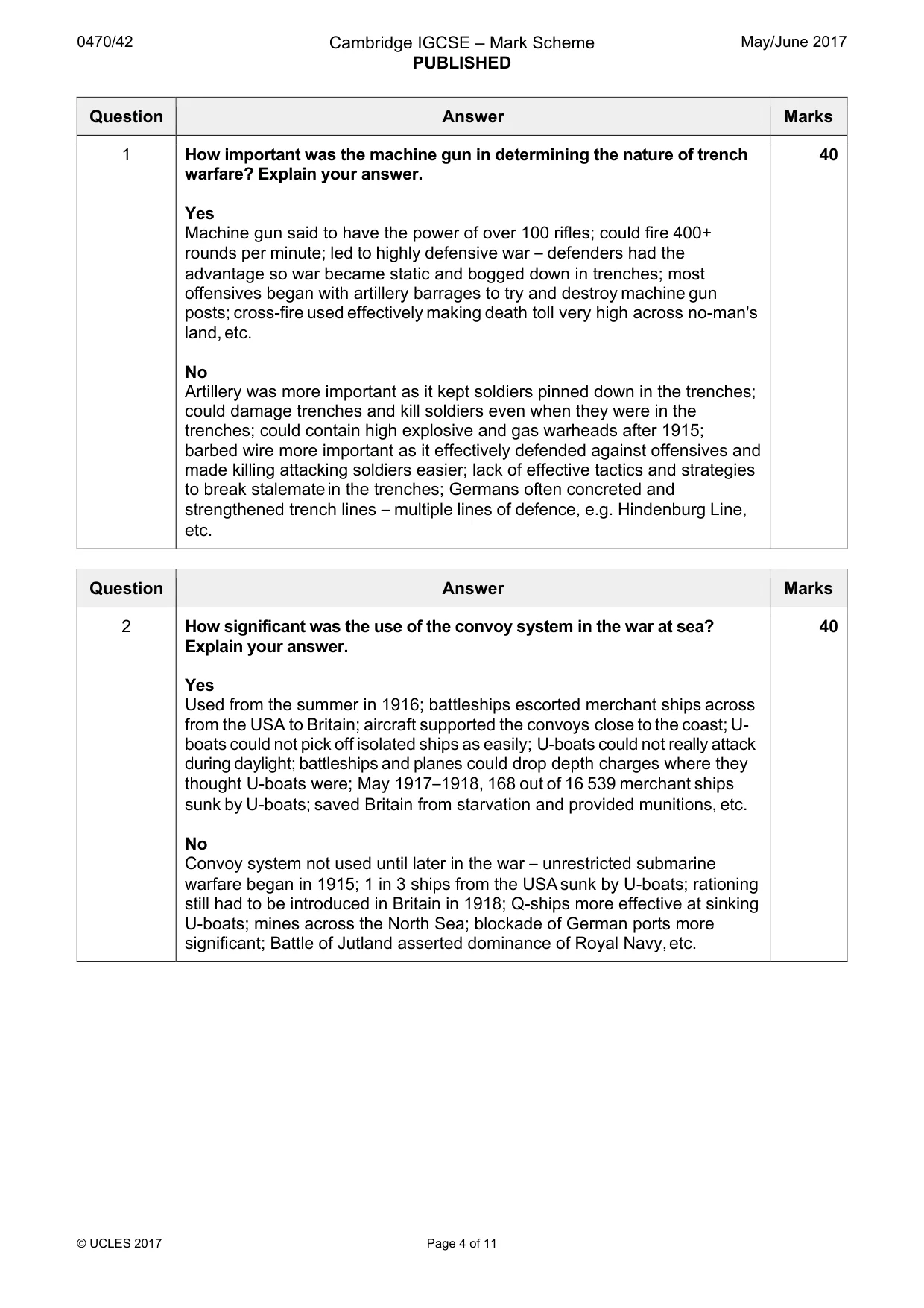
0470/42 Cambridge IGCSE – Mark Scheme PUBLISHED May/June 2017 © UCLES 2017 Page 4 of 11 Question Answer Marks 1 How important was the machine gun in determining the nature of trench warfare? Explain your answer. Yes Machine gun said to have the power of over 100 rifles; could fire 400+ rounds per minute; led to highly defensive war – defenders had the advantage so war became static and bogged down in trenches; most offensives began with artillery barrages to try and destroy machine gun posts; cross-fire used effectively making death toll very high across no-man's land, etc. No Artillery was more important as it kept soldiers pinned down in the trenches; could damage trenches and kill soldiers even when they were in the trenches; could contain high explosive and gas warheads after 1915; barbed wire more important as it effectively defended against offensives and made killing attacking soldiers easier; lack of effective tactics and strategies to break stalemate in the trenches; Germans often concreted and strengthened trench lines – multiple lines of defence, e.g. Hindenburg Line, etc. 40 Question Answer Marks 2 How significant was the use of the convoy system in the war at sea? Explain your answer. Yes Used from the summer in 1916; battleships escorted merchant ships across from the USA to Britain; aircraft supported the convoys close to the coast; U- boats could not pick off isolated ships as easily; U-boats could not really attack during daylight; battleships and planes could drop depth charges where they thought U-boats were; May 1917–1918, 168 out of 16 539 merchant ships sunk by U-boats; saved Britain from starvation and provided munitions, etc. No Convoy system not used until later in the war – unrestricted submarine warfare began in 1915; 1 in 3 ships from the USA sunk by U-boats; rationing still had to be introduced in Britain in 1918; Q-ships more effective at sinking U-boats; mines across the North Sea; blockade of German ports more significant; Battle of Jutland asserted dominance of Royal Navy, etc. 40
Mark scheme, page 5
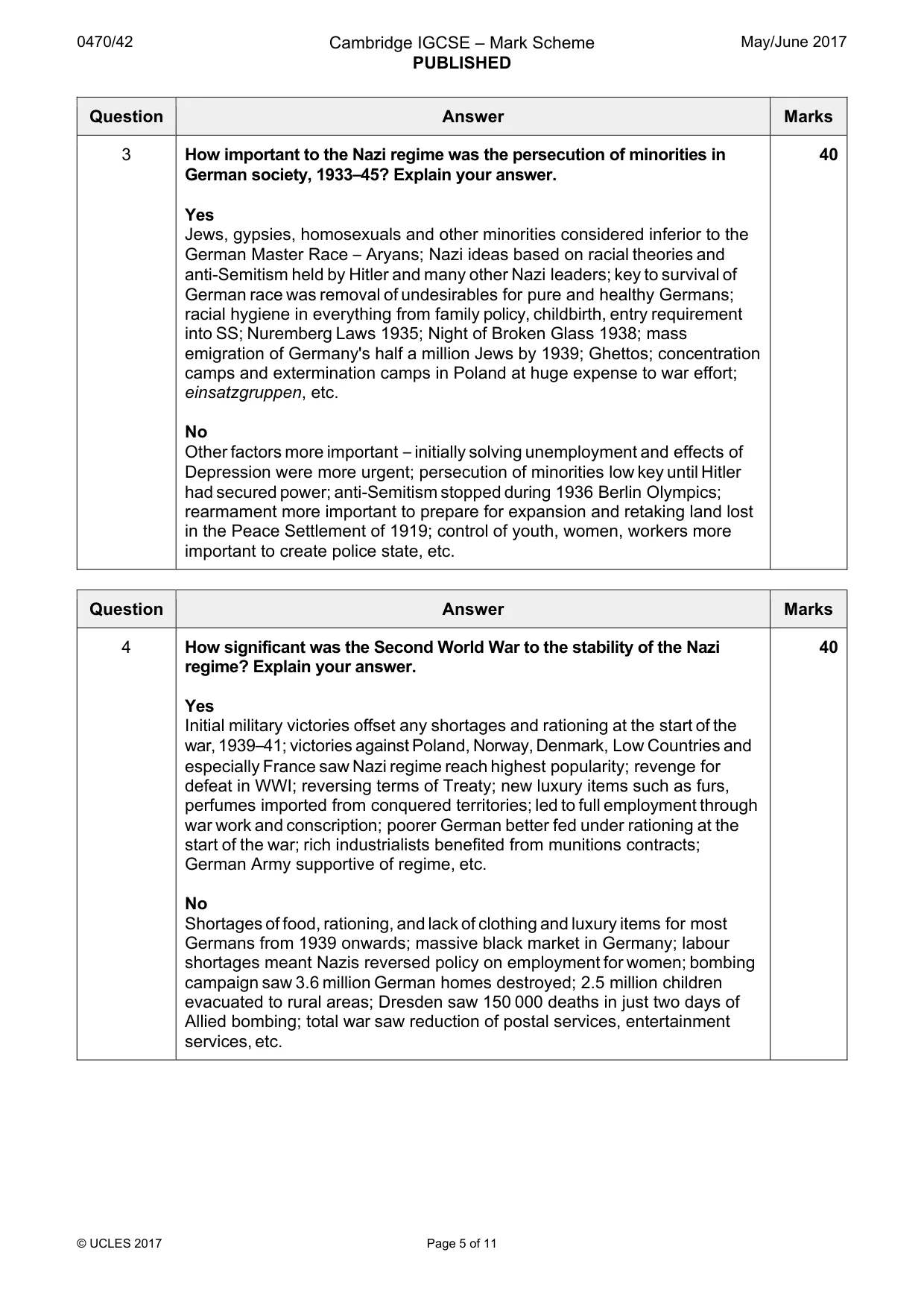
0470/42 Cambridge IGCSE – Mark Scheme PUBLISHED May/June 2017 © UCLES 2017 Page 5 of 11 Question Answer Marks 3 How important to the Nazi regime was the persecution of minorities in German society, 1933–45? Explain your answer. Yes Jews, gypsies, homosexuals and other minorities considered inferior to the German Master Race – Aryans; Nazi ideas based on racial theories and anti-Semitism held by Hitler and many other Nazi leaders; key to survival of German race was removal of undesirables for pure and healthy Germans; racial hygiene in everything from family policy, childbirth, entry requirement into SS; Nuremberg Laws 1935; Night of Broken Glass 1938; mass emigration of Germany's half a million Jews by 1939; Ghettos; concentration camps and extermination camps in Poland at huge expense to war effort; einsatzgruppen, etc. No Other factors more important – initially solving unemployment and effects of Depression were more urgent; persecution of minorities low key until Hitler had secured power; anti-Semitism stopped during 1936 Berlin Olympics; rearmament more important to prepare for expansion and retaking land lost in the Peace Settlement of 1919; control of youth, women, workers more important to create police state, etc. 40 Question Answer Marks 4 How significant was the Second World War to the stability of the Nazi regime? Explain your answer. Yes Initial military victories offset any shortages and rationing at the start of the war, 1939–41; victories against Poland, Norway, Denmark, Low Countries and especially France saw Nazi regime reach highest popularity; revenge for defeat in WWI; reversing terms of Treaty; new luxury items such as furs, perfumes imported from conquered territories; led to full employment through war work and conscription; poorer German better fed under rationing at the start of the war; rich industrialists benefited from munitions contracts; German Army supportive of regime, etc. No Shortages of food, rationing, and lack of clothing and luxury items for most Germans from 1939 onwards; massive black market in Germany; labour shortages meant Nazis reversed policy on employment for women; bombing campaign saw 3.6 million German homes destroyed; 2.5 million children evacuated to rural areas; Dresden saw 150 000 deaths in just two days of Allied bombing; total war saw reduction of postal services, entertainment services, etc. 40
Mark scheme, page 6
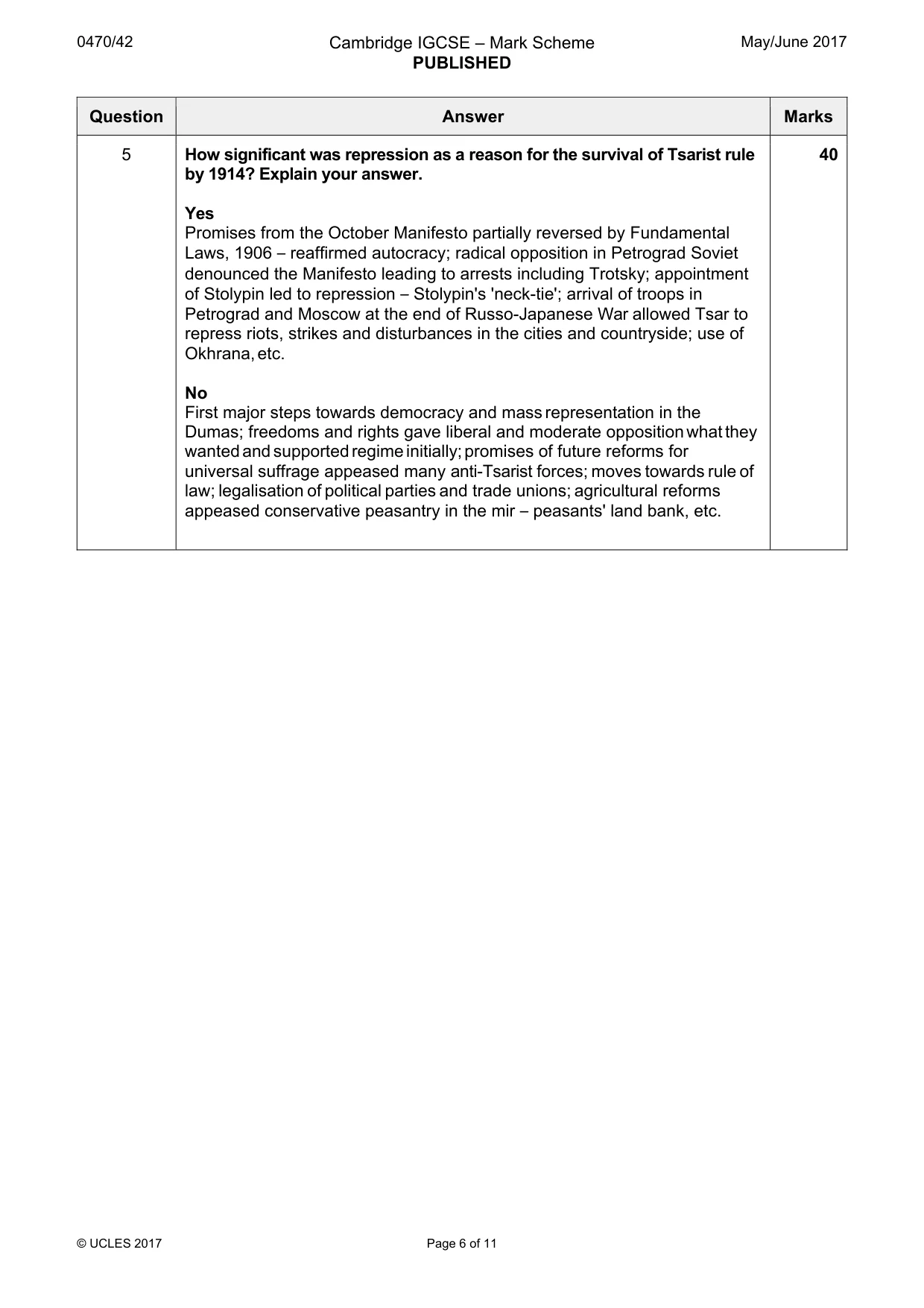
0470/42 Cambridge IGCSE – Mark Scheme PUBLISHED May/June 2017 © UCLES 2017 Page 6 of 11 Question Answer Marks 5 How significant was repression as a reason for the survival of Tsarist rule by 1914? Explain your answer. Yes Promises from the October Manifesto partially reversed by Fundamental Laws, 1906 – reaffirmed autocracy; radical opposition in Petrograd Soviet denounced the Manifesto leading to arrests including Trotsky; appointment of Stolypin led to repression – Stolypin's 'neck-tie'; arrival of troops in Petrograd and Moscow at the end of Russo-Japanese War allowed Tsar to repress riots, strikes and disturbances in the cities and countryside; use of Okhrana, etc. No First major steps towards democracy and mass representation in the Dumas; freedoms and rights gave liberal and moderate opposition what they wanted and supported regime initially; promises of future reforms for universal suffrage appeased many anti-Tsarist forces; moves towards rule of law; legalisation of political parties and trade unions; agricultural reforms appeased conservative peasantry in the mir – peasants' land bank, etc. 40
Mark scheme, page 7
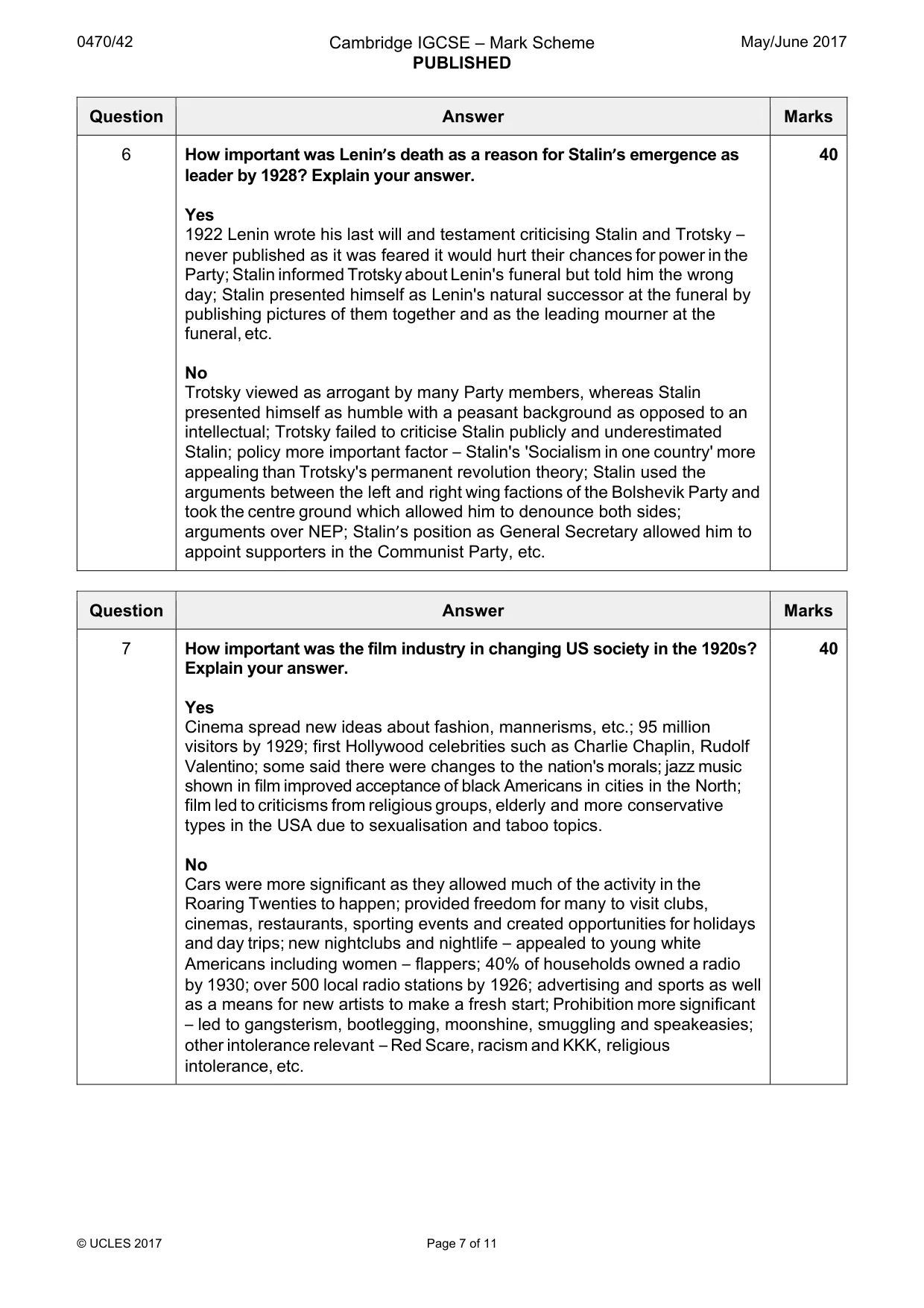
0470/42 Cambridge IGCSE – Mark Scheme PUBLISHED May/June 2017 © UCLES 2017 Page 7 of 11 Question Answer Marks 6 How important was Lenin’s death as a reason for Stalin’s emergence as leader by 1928? Explain your answer. Yes 1922 Lenin wrote his last will and testament criticising Stalin and Trotsky – never published as it was feared it would hurt their chances for power in the Party; Stalin informed Trotsky about Lenin's funeral but told him the wrong day; Stalin presented himself as Lenin's natural successor at the funeral by publishing pictures of them together and as the leading mourner at the funeral, etc. No Trotsky viewed as arrogant by many Party members, whereas Stalin presented himself as humble with a peasant background as opposed to an intellectual; Trotsky failed to criticise Stalin publicly and underestimated Stalin; policy more important factor – Stalin's 'Socialism in one country' more appealing than Trotsky's permanent revolution theory; Stalin used the arguments between the left and right wing factions of the Bolshevik Party and took the centre ground which allowed him to denounce both sides; arguments over NEP; Stalin’s position as General Secretary allowed him to appoint supporters in the Communist Party, etc. 40 Question Answer Marks 7 How important was the film industry in changing US society in the 1920s? Explain your answer. Yes Cinema spread new ideas about fashion, mannerisms, etc.; 95 million visitors by 1929; first Hollywood celebrities such as Charlie Chaplin, Rudolf Valentino; some said there were changes to the nation's morals; jazz music shown in film improved acceptance of black Americans in cities in the North; film led to criticisms from religious groups, elderly and more conservative types in the USA due to sexualisation and taboo topics. No Cars were more significant as they allowed much of the activity in the Roaring Twenties to happen; provided freedom for many to visit clubs, cinemas, restaurants, sporting events and created opportunities for holidays and day trips; new nightclubs and nightlife – appealed to young white Americans including women – flappers; 40% of households owned a radio by 1930; over 500 local radio stations by 1926; advertising and sports as well as a means for new artists to make a fresh start; Prohibition more significant – led to gangsterism, bootlegging, moonshine, smuggling and speakeasies; other intolerance relevant – Red Scare, racism and KKK, religious intolerance, etc. 40
Mark scheme, page 8
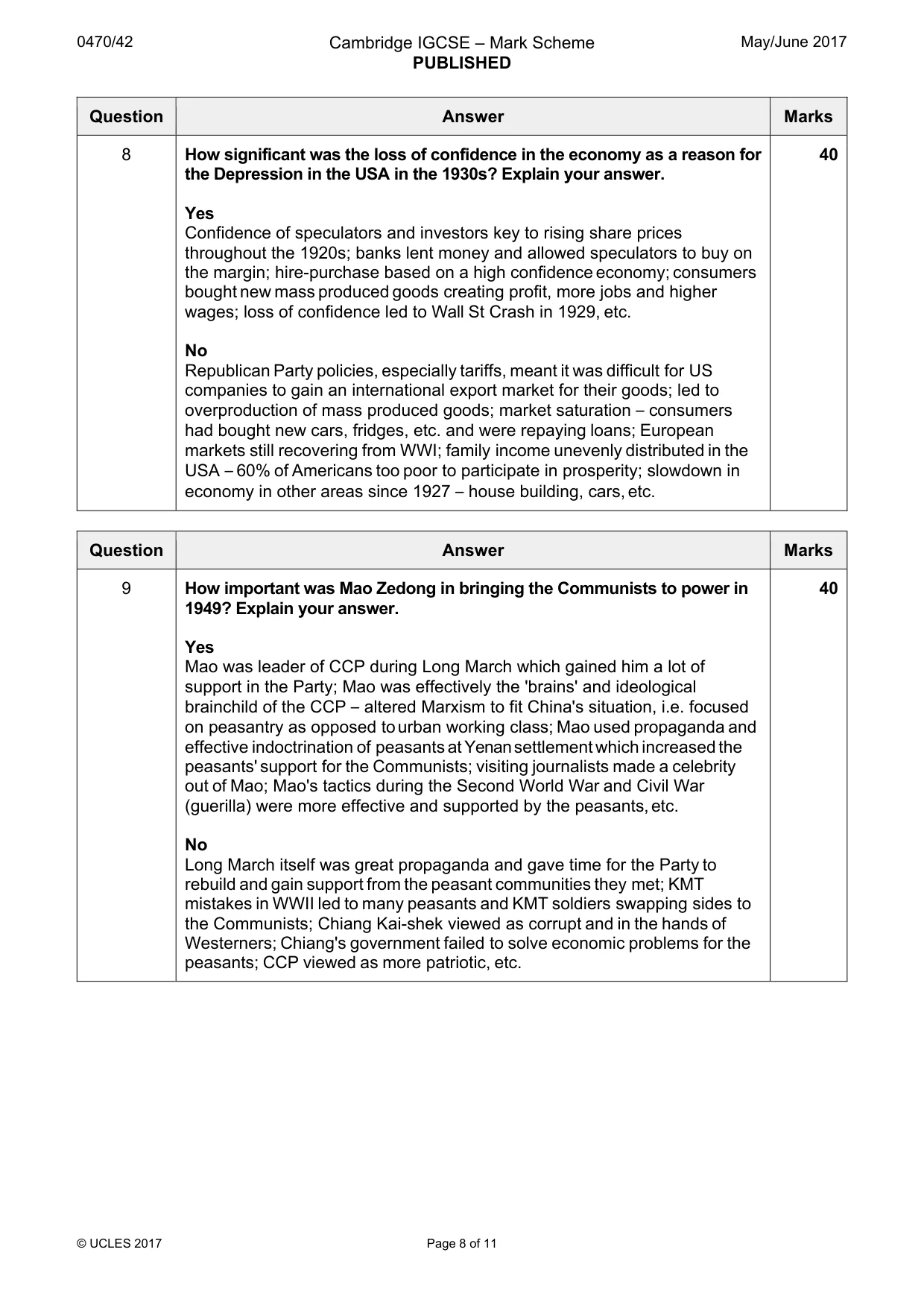
0470/42 Cambridge IGCSE – Mark Scheme PUBLISHED May/June 2017 © UCLES 2017 Page 8 of 11 Question Answer Marks 8 How significant was the loss of confidence in the economy as a reason for the Depression in the USA in the 1930s? Explain your answer. Yes Confidence of speculators and investors key to rising share prices throughout the 1920s; banks lent money and allowed speculators to buy on the margin; hire-purchase based on a high confidence economy; consumers bought new mass produced goods creating profit, more jobs and higher wages; loss of confidence led to Wall St Crash in 1929, etc. No Republican Party policies, especially tariffs, meant it was difficult for US companies to gain an international export market for their goods; led to overproduction of mass produced goods; market saturation – consumers had bought new cars, fridges, etc. and were repaying loans; European markets still recovering from WWI; family income unevenly distributed in the USA – 60% of Americans too poor to participate in prosperity; slowdown in economy in other areas since 1927 – house building, cars, etc. 40 Question Answer Marks 9 How important was Mao Zedong in bringing the Communists to power in 1949? Explain your answer. Yes Mao was leader of CCP during Long March which gained him a lot of support in the Party; Mao was effectively the 'brains' and ideological brainchild of the CCP – altered Marxism to fit China's situation, i.e. focused on peasantry as opposed to urban working class; Mao used propaganda and effective indoctrination of peasants at Yenan settlement which increased the peasants' support for the Communists; visiting journalists made a celebrity out of Mao; Mao's tactics during the Second World War and Civil War (guerilla) were more effective and supported by the peasants, etc. No Long March itself was great propaganda and gave time for the Party to rebuild and gain support from the peasant communities they met; KMT mistakes in WWII led to many peasants and KMT soldiers swapping sides to the Communists; Chiang Kai-shek viewed as corrupt and in the hands of Westerners; Chiang's government failed to solve economic problems for the peasants; CCP viewed as more patriotic, etc. 40
Mark scheme, page 9
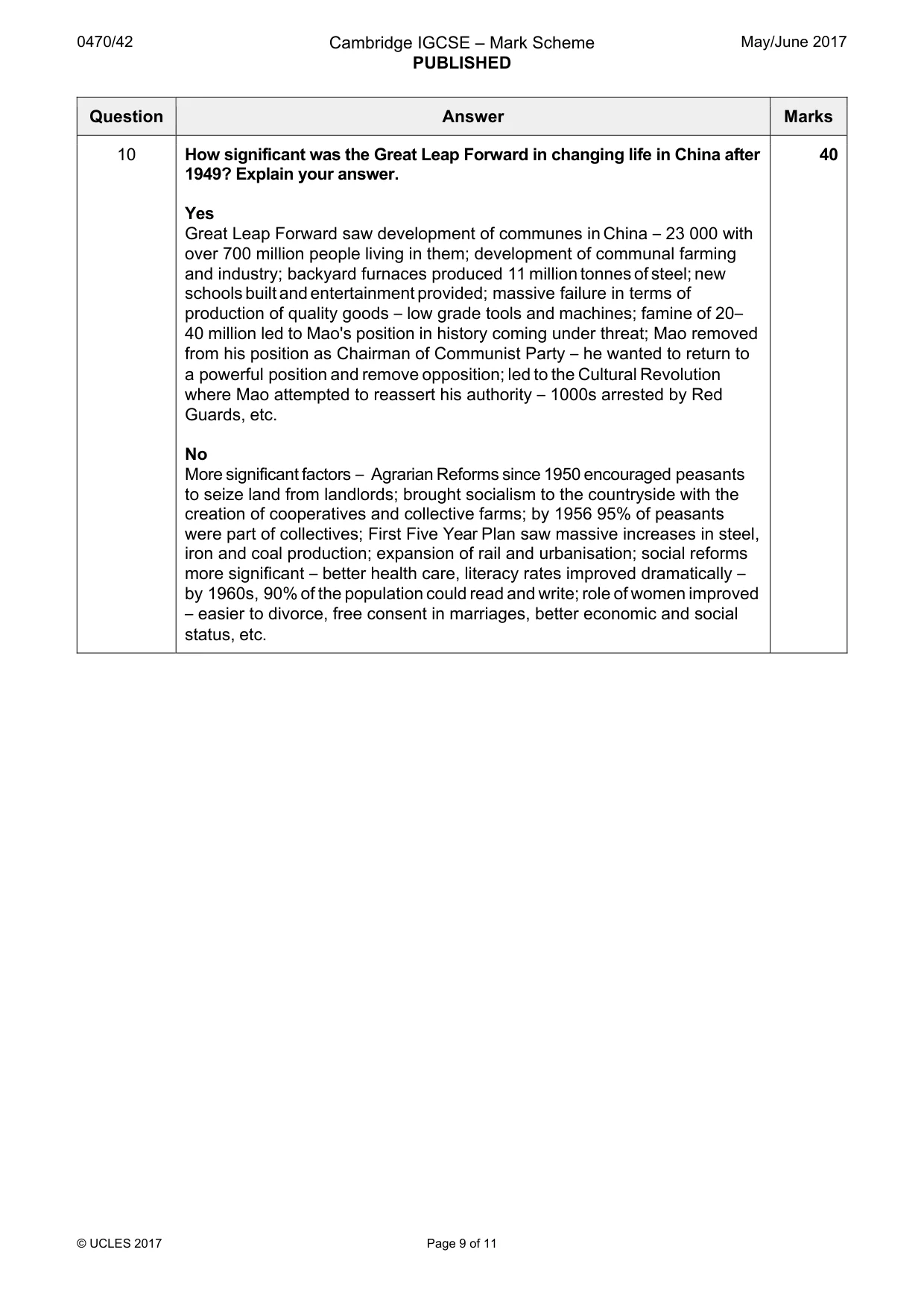
0470/42 Cambridge IGCSE – Mark Scheme PUBLISHED May/June 2017 © UCLES 2017 Page 9 of 11 Question Answer Marks 10 How significant was the Great Leap Forward in changing life in China after 1949? Explain your answer. Yes Great Leap Forward saw development of communes in China – 23 000 with over 700 million people living in them; development of communal farming and industry; backyard furnaces produced 11 million tonnes of steel; new schools built and entertainment provided; massive failure in terms of production of quality goods – low grade tools and machines; famine of 20– 40 million led to Mao's position in history coming under threat; Mao removed from his position as Chairman of Communist Party – he wanted to return to a powerful position and remove opposition; led to the Cultural Revolution where Mao attempted to reassert his authority – 1000s arrested by Red Guards, etc. No More significant factors – Agrarian Reforms since 1950 encouraged peasants to seize land from landlords; brought socialism to the countryside with the creation of cooperatives and collective farms; by 1956 95% of peasants were part of collectives; First Five Year Plan saw massive increases in steel, iron and coal production; expansion of rail and urbanisation; social reforms more significant – better health care, literacy rates improved dramatically – by 1960s, 90% of the population could read and write; role of women improved – easier to divorce, free consent in marriages, better economic and social status, etc. 40
Mark scheme, page 10
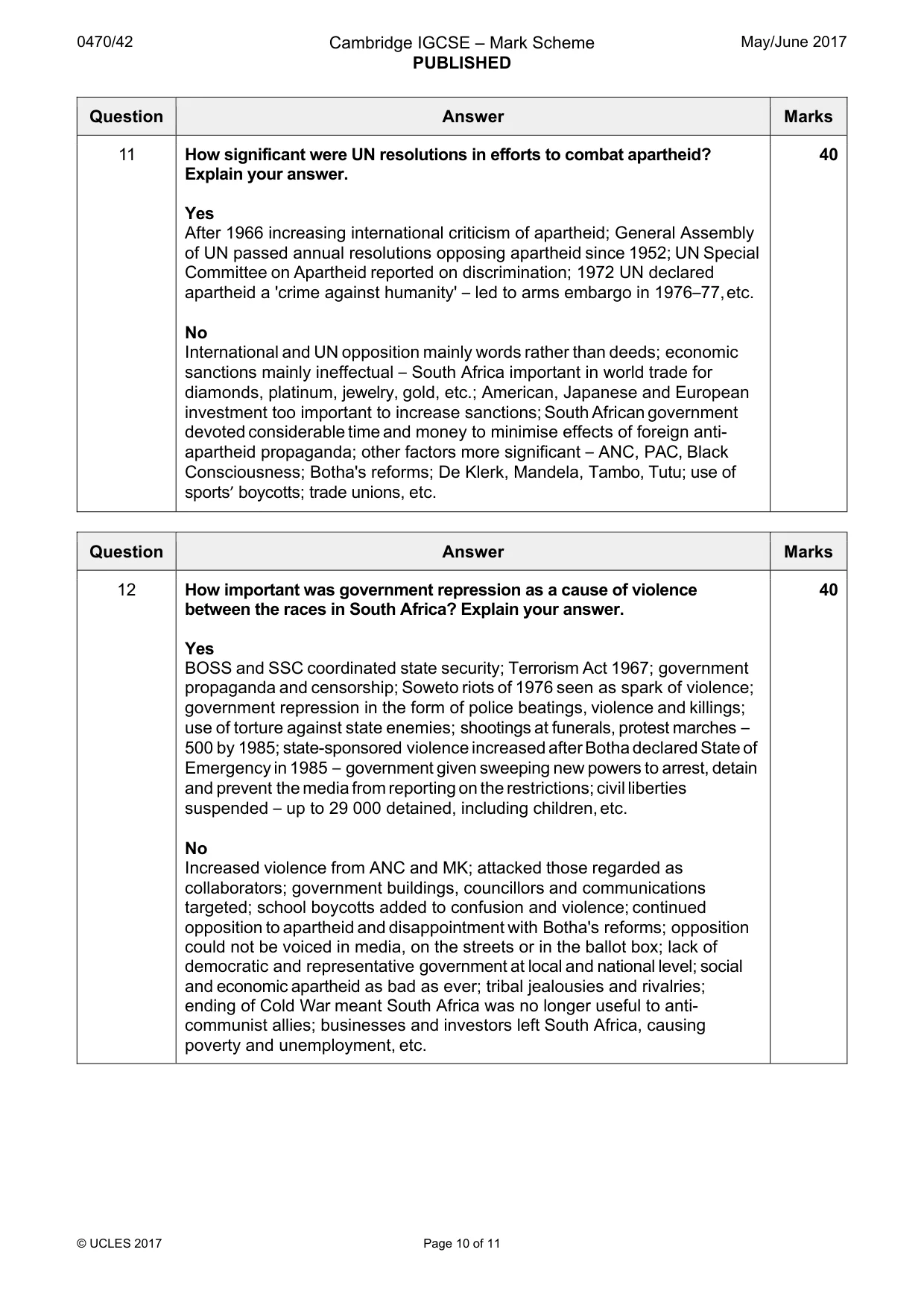
0470/42 Cambridge IGCSE – Mark Scheme PUBLISHED May/June 2017 © UCLES 2017 Page 10 of 11 Question Answer Marks 11 How significant were UN resolutions in efforts to combat apartheid? Explain your answer. Yes After 1966 increasing international criticism of apartheid; General Assembly of UN passed annual resolutions opposing apartheid since 1952; UN Special Committee on Apartheid reported on discrimination; 1972 UN declared apartheid a 'crime against humanity' – led to arms embargo in 1976–77, etc. No International and UN opposition mainly words rather than deeds; economic sanctions mainly ineffectual – South Africa important in world trade for diamonds, platinum, jewelry, gold, etc.; American, Japanese and European investment too important to increase sanctions; South African government devoted considerable time and money to minimise effects of foreign anti- apartheid propaganda; other factors more significant – ANC, PAC, Black Consciousness; Botha's reforms; De Klerk, Mandela, Tambo, Tutu; use of sports’ boycotts; trade unions, etc. 40 Question Answer Marks 12 How important was government repression as a cause of violence between the races in South Africa? Explain your answer. Yes BOSS and SSC coordinated state security; Terrorism Act 1967; government propaganda and censorship; Soweto riots of 1976 seen as spark of violence; government repression in the form of police beatings, violence and killings; use of torture against state enemies; shootings at funerals, protest marches – 500 by 1985; state-sponsored violence increased after Botha declared State of Emergency in 1985 – government given sweeping new powers to arrest, detain and prevent the media from reporting on the restrictions; civil liberties suspended – up to 29 000 detained, including children, etc. No Increased violence from ANC and MK; attacked those regarded as collaborators; government buildings, councillors and communications targeted; school boycotts added to confusion and violence; continued opposition to apartheid and disappointment with Botha's reforms; opposition could not be voiced in media, on the streets or in the ballot box; lack of democratic and representative government at local and national level; social and economic apartheid as bad as ever; tribal jealousies and rivalries; ending of Cold War meant South Africa was no longer useful to anti- communist allies; businesses and investors left South Africa, causing poverty and unemployment, etc. 40
Mark scheme, page 11
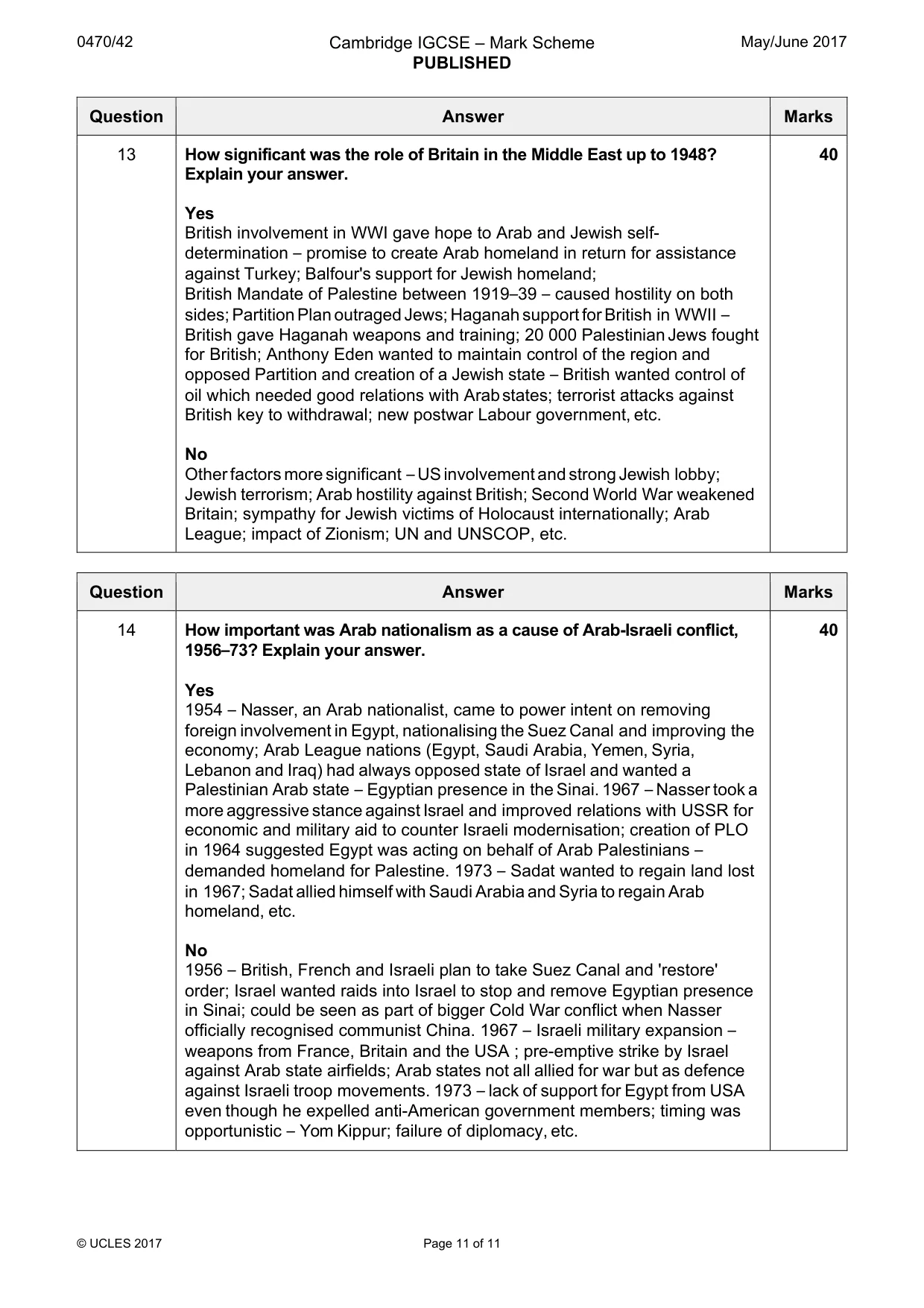
0470/42 Cambridge IGCSE – Mark Scheme PUBLISHED May/June 2017 © UCLES 2017 Page 11 of 11 Question Answer Marks 13 How significant was the role of Britain in the Middle East up to 1948? Explain your answer. Yes British involvement in WWI gave hope to Arab and Jewish self- determination – promise to create Arab homeland in return for assistance against Turkey; Balfour's support for Jewish homeland; British Mandate of Palestine between 1919–39 – caused hostility on both sides; Partition Plan outraged Jews; Haganah support for British in WWII – British gave Haganah weapons and training; 20 000 Palestinian Jews fought for British; Anthony Eden wanted to maintain control of the region and opposed Partition and creation of a Jewish state – British wanted control of oil which needed good relations with Arab states; terrorist attacks against British key to withdrawal; new postwar Labour government, etc. No Other factors more significant – US involvement and strong Jewish lobby; Jewish terrorism; Arab hostility against British; Second World War weakened Britain; sympathy for Jewish victims of Holocaust internationally; Arab League; impact of Zionism; UN and UNSCOP, etc. 40 Question Answer Marks 14 How important was Arab nationalism as a cause of Arab-Israeli conflict, 1956–73? Explain your answer. Yes 1954 – Nasser, an Arab nationalist, came to power intent on removing foreign involvement in Egypt, nationalising the Suez Canal and improving the economy; Arab League nations (Egypt, Saudi Arabia, Yemen, Syria, Lebanon and Iraq) had always opposed state of Israel and wanted a Palestinian Arab state – Egyptian presence in the Sinai. 1967 – Nasser took a more aggressive stance against Israel and improved relations with USSR for economic and military aid to counter Israeli modernisation; creation of PLO in 1964 suggested Egypt was acting on behalf of Arab Palestinians – demanded homeland for Palestine. 1973 – Sadat wanted to regain land lost in 1967; Sadat allied himself with Saudi Arabia and Syria to regain Arab homeland, etc. No 1956 – British, French and Israeli plan to take Suez Canal and 'restore' order; Israel wanted raids into Israel to stop and remove Egyptian presence in Sinai; could be seen as part of bigger Cold War conflict when Nasser officially recognised communist China. 1967 – Israeli military expansion – weapons from France, Britain and the USA ; pre-emptive strike by Israel against Arab state airfields; Arab states not all allied for war but as defence against Israeli troop movements. 1973 – lack of support for Egypt from USA even though he expelled anti-American government members; timing was opportunistic – Yom Kippur; failure of diplomacy, etc. 40
What you needed in this session
Cambridge’s own grade thresholds for 2017 May/June, Paper 4 · Variant 2. A higher threshold means an easier paper — the bar moves with how the cohort did.