Cambridge IGCSE History 0470 — 2017 May/June Paper 2 · Variant 3
0470/23/M/J/17 · 50 marks · ≈56 min
The question paper and its mark scheme, free to read here and free to download. This is Cambridge’s own paper, exactly as it was sat.
Question paper16 pages
Mark scheme10 pages
Answers below. Sit the paper first if you are practising.
Paper as text
Question paper, page 1
This document consists of 13 printed pages, 3 blank pages and 1 Insert. DC (ST/CGW) 129027/2 © UCLES 2017 [Turn over Cambridge International Examinations Cambridge International General Certificate of Secondary Education * 3 3 2 4 2 5 4 2 8 1 * HISTORY 0470/23 Paper 2 May/June 2017 2 hours No Additional Materials are required. READ THESE INSTRUCTIONS FIRST An answer booklet is provided inside this question paper. You should follow the instructions on the front cover of the answer booklet. If you need additional answer paper ask the invigilator for a continuation booklet. This paper has two options. Choose one option, and then answer all of the questions on that topic. Option A: 19th Century topic [p2–p6] Option B: 20th Century topic [p8–p14] The number of marks is given in brackets [ ] at the end of each question or part question. The syllabus is approved for use in England, Wales and Northern Ireland as a Cambridge International Level 1/Level 2 Certificate.
Question paper, page 2
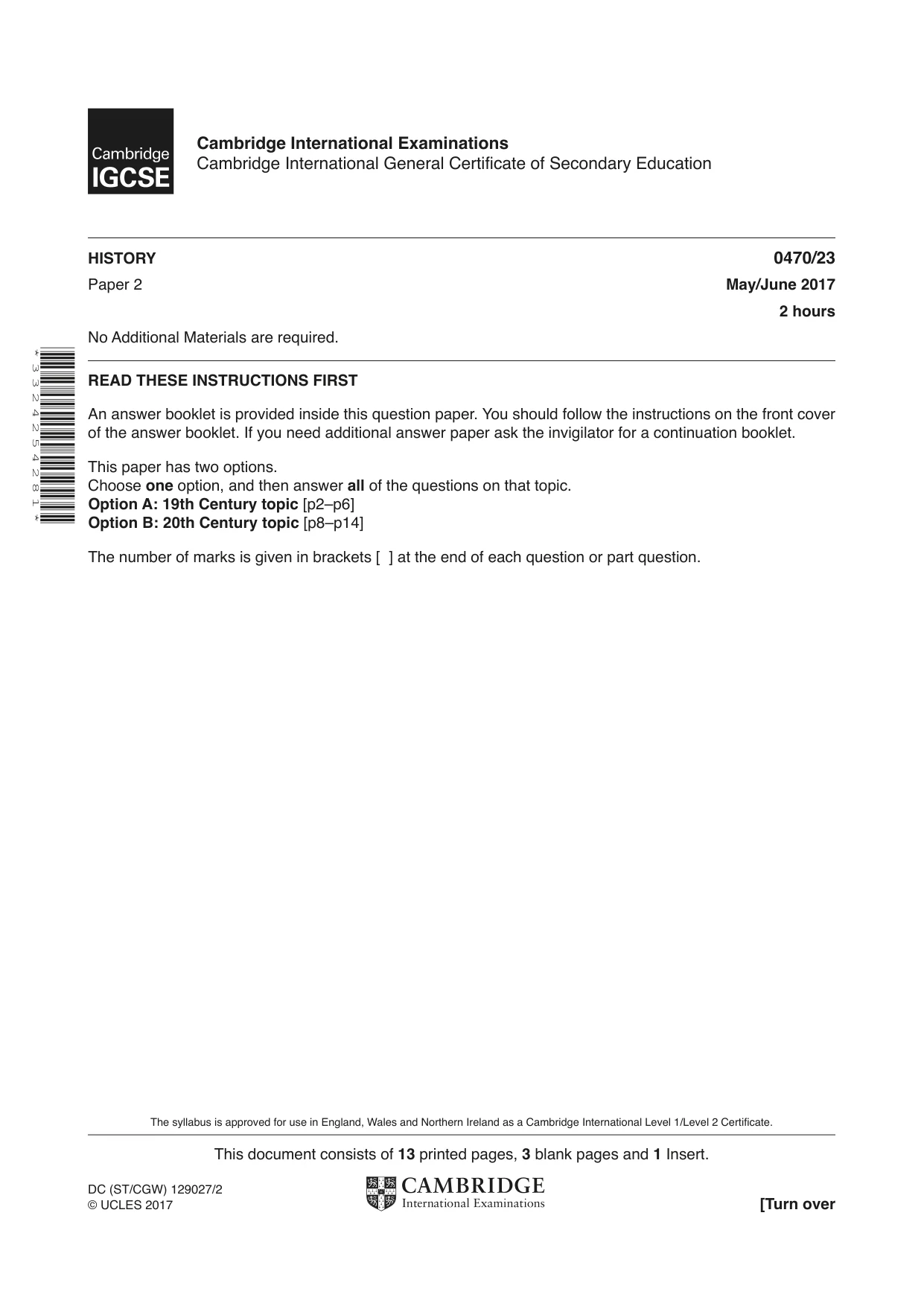
2 0470/23/M/J/17 © UCLES 2017 Option A: 19th Century topic HOW RADICAL WAS THE FEBRUARY REVOLUTION? Study the Background Information and the sources carefully, and then answer all the questions. Background Information In 1847 middle class reformers began to hold banquets in Paris. In February 1848 the government banned the banquets. This resulted, on 22 February, in crowds protesting in the streets. Fighting broke out between the crowds and soldiers, and on 23 February, Prime Minister Guizot resigned. Soon there were barricades all over Paris and crowds gathered around the royal palace. On 24 February King Louis Philippe abdicated. On 26 February a provisional government called the Second Republic was established. Conservative forces were horrified by what had happened, but how real a threat to the social order was the February Revolution? SOURCE A A drawing from the time of the throne room in the Tuileries, Louis Philippe’s palace, 24 February 1848.
Question paper, page 3
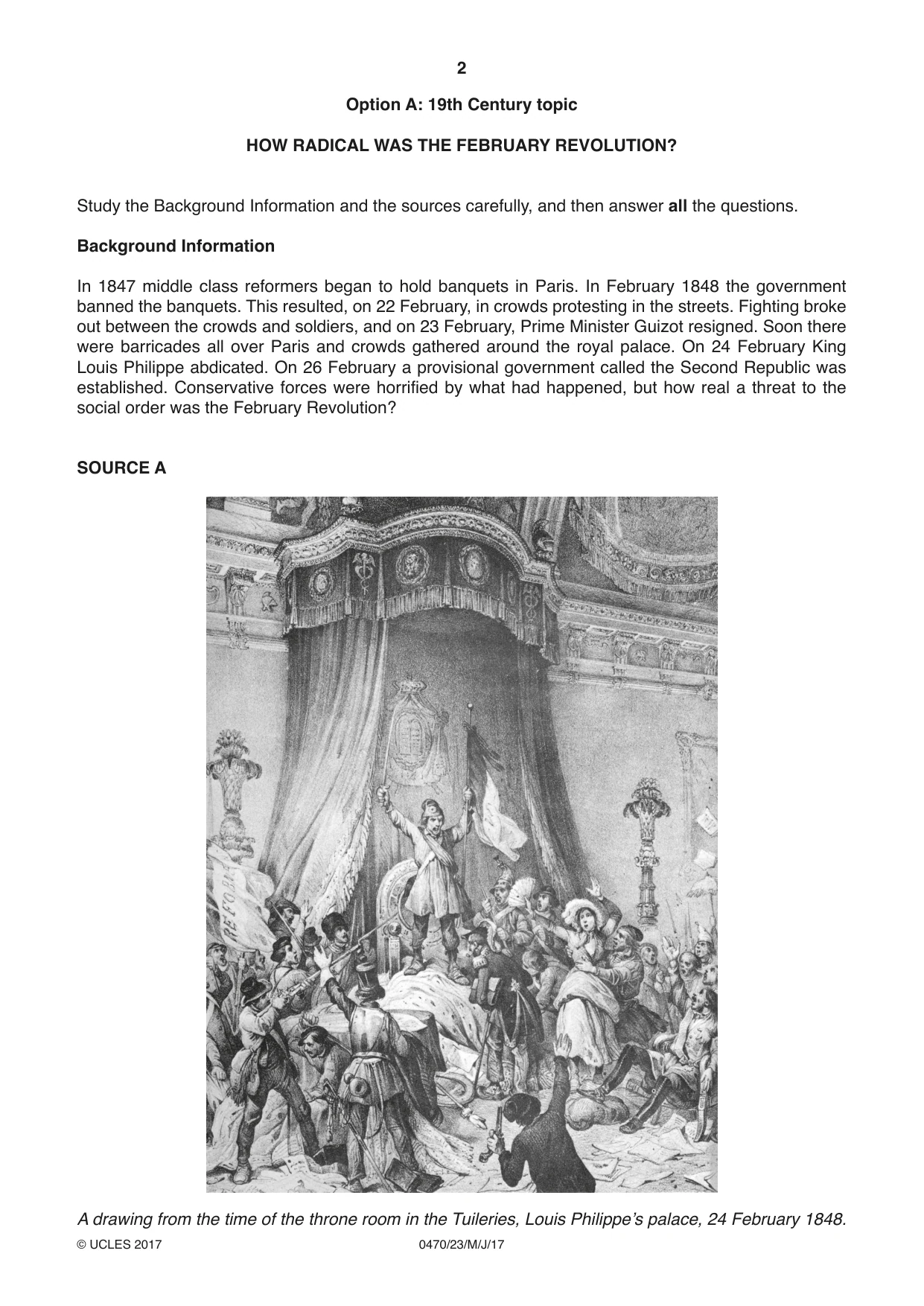
3 0470/23/M/J/17 © UCLES 2017 [Turn over SOURCE B A drawing from the time of protestors on 24 February 1848, rescuing a crucifix from the Tuileries and taking it to the church of Saint-Roch. SOURCE C They crowded the corridors, and rushed with their cries of mortal combat into the spectators’ galleries. Their clothes torn, their shirts open, their arms bare, their fists clenched, their hair wildly dishevelled and singed by cartridges, their faces maddened with the madness of revolution. Everything about them revealed them as desperadoes, who had come to make the last assault on the last refuge of royalty. A description, by Alphonse de Lamartine, of the crowd invading the Chamber of Deputies on 24 February 1848. Lamartine was a politician, writer and a member of the Chamber of Deputies. He became the leader of the provisional government established on 26 February 1848.
Question paper, page 4
4 0470/23/M/J/17 © UCLES 2017 SOURCE D On 25 February I spent the whole afternoon walking about Paris. Two things in particular struck me: the first was the popular character of the revolution that had just taken place. The second was the absence of hatred by the lower orders who had suddenly become masters of Paris. Throughout this day, I did not see a single one of the former agents of the public authority: not a soldier, not a gendarme, the National Guard had disappeared. The people alone carried arms and guarded the public buildings. It was an extraordinary thing to see this immense town in the hands of those who possessed nothing. The fright of all other classes was extreme but I did not share these fears. I never feared the rich would be attacked or robbed. I knew the men of Paris too well not to know that their finest moments in times of revolution are usually generous. For the first time in sixty years, the priests, the old aristocracy and the people met in a common sentiment—a feeling of revenge, it is true, and not of affection; but a community of hatred is almost always the foundation of friendship. The only vanquished were the middle class but even they had little to fear. They were despised rather than hated. From Recollections, a private journal kept by Alexis de Tocqueville. It was published after his death in 1859, although he had never intended that it would be published. SOURCE E The provisional government has great duties in today’s circumstances. On the one hand, it must arouse interest in the maintenance of good order among that considerable number of citizens who have been deprived of social rights and do not yet know how their proper desires will be satisfied. The Republican government will make every reform and every improvement easy and speedy. These reforms might be put in danger by haste and impatience. Quiet confidence ought to make it possible to introduce reforms in the shortest possible time. On the other hand, the provisional government should take steps to keep the good will that it has won from those citizens who did not desire so radical a change, but who loyally accept the changed situation. The provisional government should openly offer them reassurances. From the newspaper Le National, 27 February 1848. Many in the provisional government were closely associated with this newspaper. SOURCE F The Republic had no opposition to overcome. Never has any government been in so strong a position as the February government. It could set up the Republic on broad, firm foundations without any danger of resistance. Energetic measures and radical reforms were expected: the people wanted them, the privileged classes were resigned to them. But instead of relying on the People’s support, the men in power behaved as if astonished by their new power and seemed to have only one concern – the desire to make themselves acceptable to the middle classes. From a book by Louis-Nicolas Ménard, published in 1849. Ménard was a socialist republican who was sentenced to imprisonment in 1849 for publishing the book.
Question paper, page 5
5 0470/23/M/J/17 © UCLES 2017 [Turn over SOURCE G The question of the day is purely a social one. It cannot be discussed freely when you are faced with the mob. It is no longer a matter of theory but of brute force, which is testing its strength in the streets of Paris and which allows no opposition. The power of the mob grows larger day by day. They strut about the streets to take part in all manner of demonstrations which are always, of course, directed against law and order. Everything must be razed to the ground, nothing must remain upright. That’s what they want, these thousands upon thousands of tyrants who reign over us. From the journal of Rodolphe Apponyi. He was Austrian and worked at the time for the Austro-Hungarian ambassador in Paris.
Question paper, page 6
6 0470/23/M/J/17 © UCLES 2017 Now answer all the following questions. You may use any of the sources to help you answer the questions, in addition to those sources which you are told to use. In answering the questions you should use your knowledge of the topic to help you interpret and evaluate the sources. 1 Study Sources A and B. How far do these two artists agree about events in Paris on 24 February 1848? Explain your answer using details of the sources. [8] 2 Study Source C. Are you surprised by this source? Explain your answer using details of the source and your knowledge. [7] 3 Study Source D. What impression does this source give of the February Revolution? Explain your answer using details of the source and your knowledge. [7] 4 Study Sources E and F. How similar are these two sources as evidence about the Provisional Government? Explain your answer using details of the sources and your knowledge. [8] 5 Study Source G. How useful is this source as evidence about the February Revolution? Explain your answer using details of the source and your knowledge. [8] 6 Study all the sources. How far do these sources provide convincing evidence that the February Revolution was a real threat to the social order? Use the sources to explain your answer. [12]
Question paper, page 7
7 0470/23/M/J/17 © UCLES 2017 [Turn over BLANK PAGE
Question paper, page 8
8 0470/23/M/J/17 © UCLES 2017 Option B: 20th Century topic HOW FAR WAS GERMANY TREATED UNFAIRLY IN THE YEARS 1919–1923? Study the Background Information and the sources carefully, and then answer all the questions. Background Information In the years following the Versailles Settlement, Germany suffered a series of crises including strikes and attempted communist risings. There were also attempted risings by those on the opposite end of the political spectrum. Soon after the end of the war the Weimar Government tried to deal with the country’s economic problems by printing money. This led to inflation, which, after the passive resistance to the French and Belgian occupation of the Ruhr in 1923, turned into hyperinflation. Germans blamed all their problems on the terms of the Treaty of Versailles, especially reparations. But how far was Germany treated unfairly in the years 1919–1923? SOURCE A There may well have been aspects of the Treaty that were unfair on Germany, but it is difficult to envisage any treaty concluded on the idea of German defeat that the Germans would have accepted as fair. In that sense Weimar’s politicians were self-deluding in expecting the Allies to treat them as entirely lacking in responsibility for the policies of Imperial Germany. It is also one of the paradoxes of the settlement, that although some of the participants assumed Germany would be deprived of resources and its neighbours strengthened, the reality was that, although its immediate circumstances were unpromising, a recovered Germany would be in a potentially stronger position than in 1914. Germany now had frontiers with Poland, Czechoslovakia, Lithuania and Austria. Only France remained of the pre-war great power neighbours. In general the British tended to accept Germany’s pleas that it could not fulfil certain terms of the Treaty, whereas the French judged that it was more a matter of will than capability. France’s President Poincaré demanded prompt payment of reparations, fixed at the sum of 132 billion gold marks; and when the Germans defaulted in January 1923 French troops marched into the Rhineland, proposing to dig out the Ruhr’s coal. When German workers went on strike and the German government printed money to support them, hyperinflation took hold. However, Germany was already suffering from inflation and it now seems clear that German governments were themselves, at least in part, responsible. As the entrepreneur Hugo Stinnes said, they had to spend beyond their means in order to find work for returning soldiers. Otherwise ‘Bolshevism would have seized Germany’. However, reparations, although much less onerous than the Germans claimed and with the repayments perfectly manageable, did contribute to inflation. They undermined confidence in German stability and led to a budget deficit which governments found themselves unwilling or unable to make up through taxation. From a history book published in 2010.
Question paper, page 9
9 0470/23/M/J/17 © UCLES 2017 [Turn over SOURCE B The Germans would have accepted a fair peace settlement based on President Wilson’s ‘Fourteen Points’ but the Treaty of Versailles gave the final blow to the cause of democracy in Germany. The main injustice of Versailles was the separation of Polish territory from the Reich. The Treaty ensured that all parties in Germany would want to overthrow it, reflecting as it did, Germany’s military weakness. The Treaty also stated that Germany was to pay compensation not merely for the war damage that it had directly caused, but also for the costs of war as a whole. The resulting assessments for reparations were so colossal as to defy imagination, and they were far in excess of anything that past financial experience could cope with. In 1921 the figure of 269 billion gold marks was fixed on. This figure was later in the year reduced to 132 billion, but the amount still seemed incredible. The vast size of these sums, not surprisingly, aroused the indignation of the Germans, who felt that a generation yet unborn would be forced to grow up in ‘debt slavery’. The need to pay reparations restricted the flexibility of the German economy and bred fierce resistance on the German side, for obvious psychological reasons. In January 1923, French and Belgian troops occupied the Ruhr in an attempt either to force Germany to pay reparations or extract goods of comparable value. It was Germany’s policy of passive resistance and printing money that led to massive inflation and the collapse of the currency but none of this would have been necessary were it not for the Treaty of Versailles. From a history book published in 1987.
Question paper, page 10
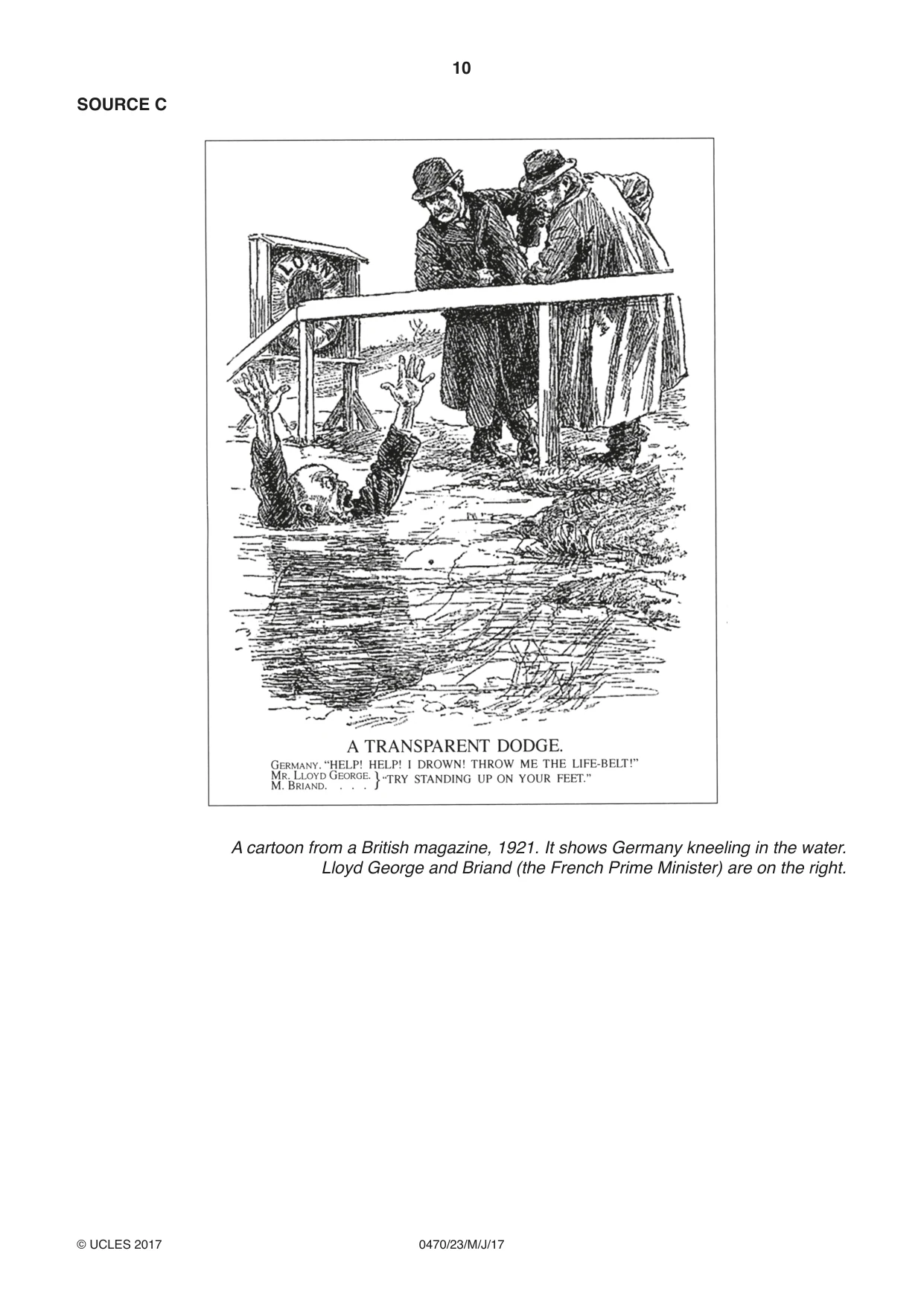
10 0470/23/M/J/17 © UCLES 2017 SOURCE C A cartoon from a British magazine, 1921. It shows Germany kneeling in the water. Lloyd George and Briand (the French Prime Minister) are on the right.
Question paper, page 11
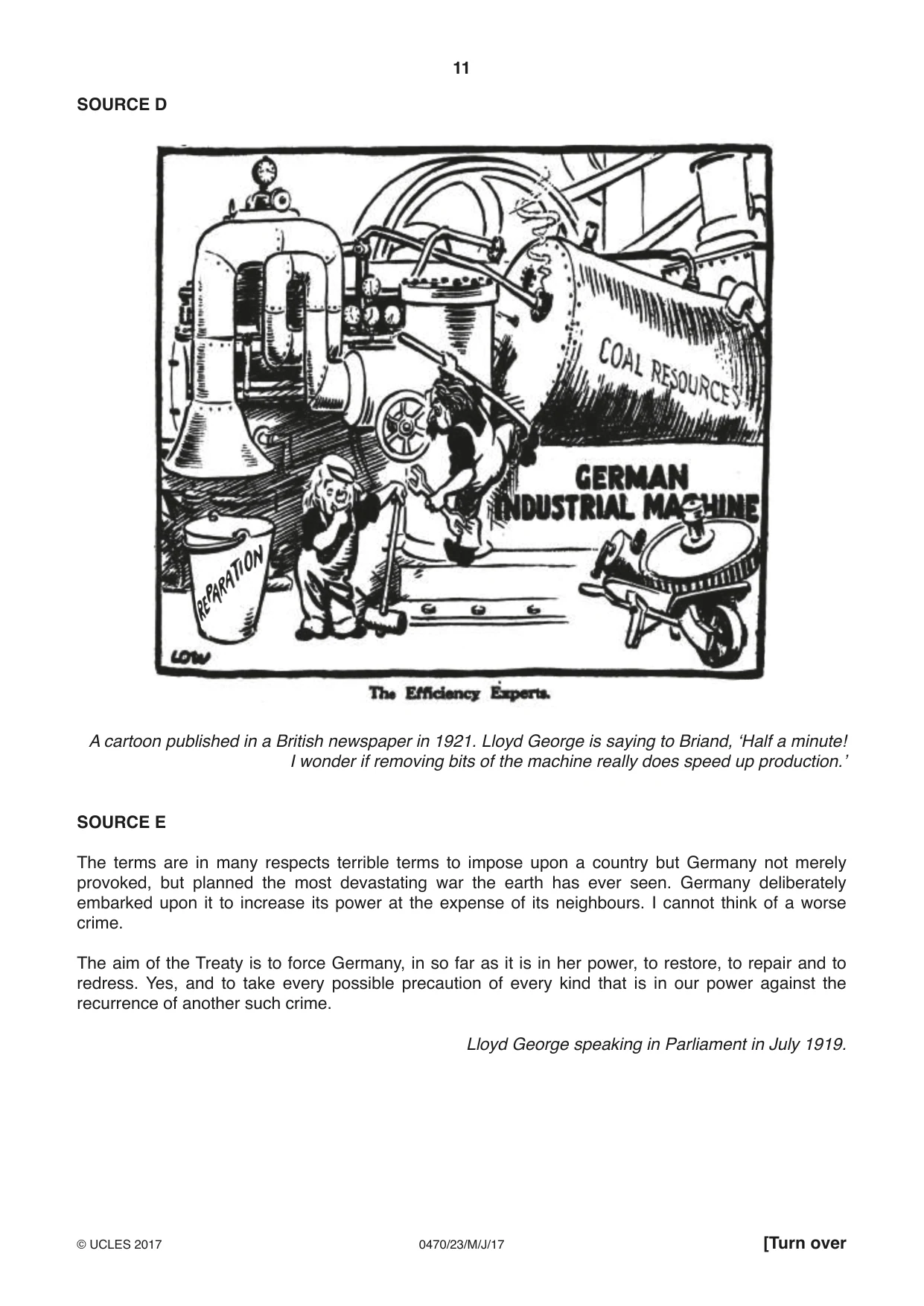
11 0470/23/M/J/17 © UCLES 2017 [Turn over SOURCE D A cartoon published in a British newspaper in 1921. Lloyd George is saying to Briand, ‘Half a minute! I wonder if removing bits of the machine really does speed up production.’ SOURCE E The terms are in many respects terrible terms to impose upon a country but Germany not merely provoked, but planned the most devastating war the earth has ever seen. Germany deliberately embarked upon it to increase its power at the expense of its neighbours. I cannot think of a worse crime. The aim of the Treaty is to force Germany, in so far as it is in her power, to restore, to repair and to redress. Yes, and to take every possible precaution of every kind that is in our power against the recurrence of another such crime. Lloyd George speaking in Parliament in July 1919.
Question paper, page 12
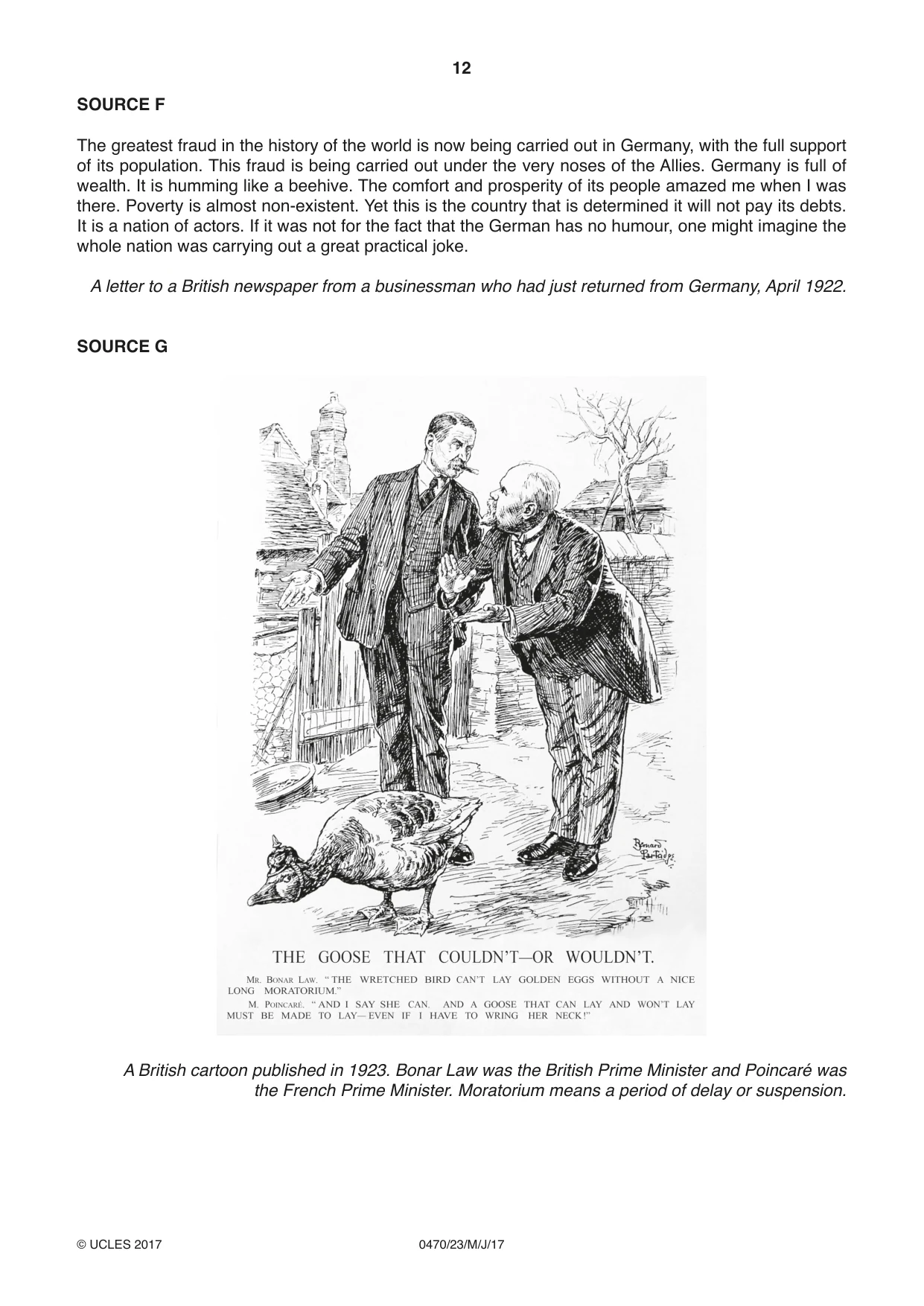
12 0470/23/M/J/17 © UCLES 2017 SOURCE F The greatest fraud in the history of the world is now being carried out in Germany, with the full support of its population. This fraud is being carried out under the very noses of the Allies. Germany is full of wealth. It is humming like a beehive. The comfort and prosperity of its people amazed me when I was there. Poverty is almost non-existent. Yet this is the country that is determined it will not pay its debts. It is a nation of actors. If it was not for the fact that the German has no humour, one might imagine the whole nation was carrying out a great practical joke. A letter to a British newspaper from a businessman who had just returned from Germany, April 1922. SOURCE G A British cartoon published in 1923. Bonar Law was the British Prime Minister and Poincaré was the French Prime Minister. Moratorium means a period of delay or suspension.
Question paper, page 13
13 0470/23/M/J/17 © UCLES 2017 [Turn over SOURCE H The German Republic was born out of terrible defeat. This cast a dark shadow on the new political order. But at first there was a belief that the new order was necessary for the rebirth of Germany. This is why the Weimar constitution met with little opposition. For everyone expected a peace settlement in accordance with Wilson’s Fourteen Points which all countries had accepted as the basis for the peace. The criminal madness of the Versailles Diktat was a shameless blow to hopes of political and economic recovery. That the Republic did not collapse immediately is proof of the genuine vitality of its basic principles. How far is it true that the Treaty wrecked Germany’s democracy, that reparations ruined the German economy and that its security was undermined? Economically speaking there is no truth in these allegations. Much more serious was the disillusion which prevented moderate men from supporting the Republic. The peace settlement poisoned the political atmosphere for many years. Hugo Preuss, the politician and lawyer chiefly responsible for producing the Weimar constitution, writing in 1923.
Question paper, page 14
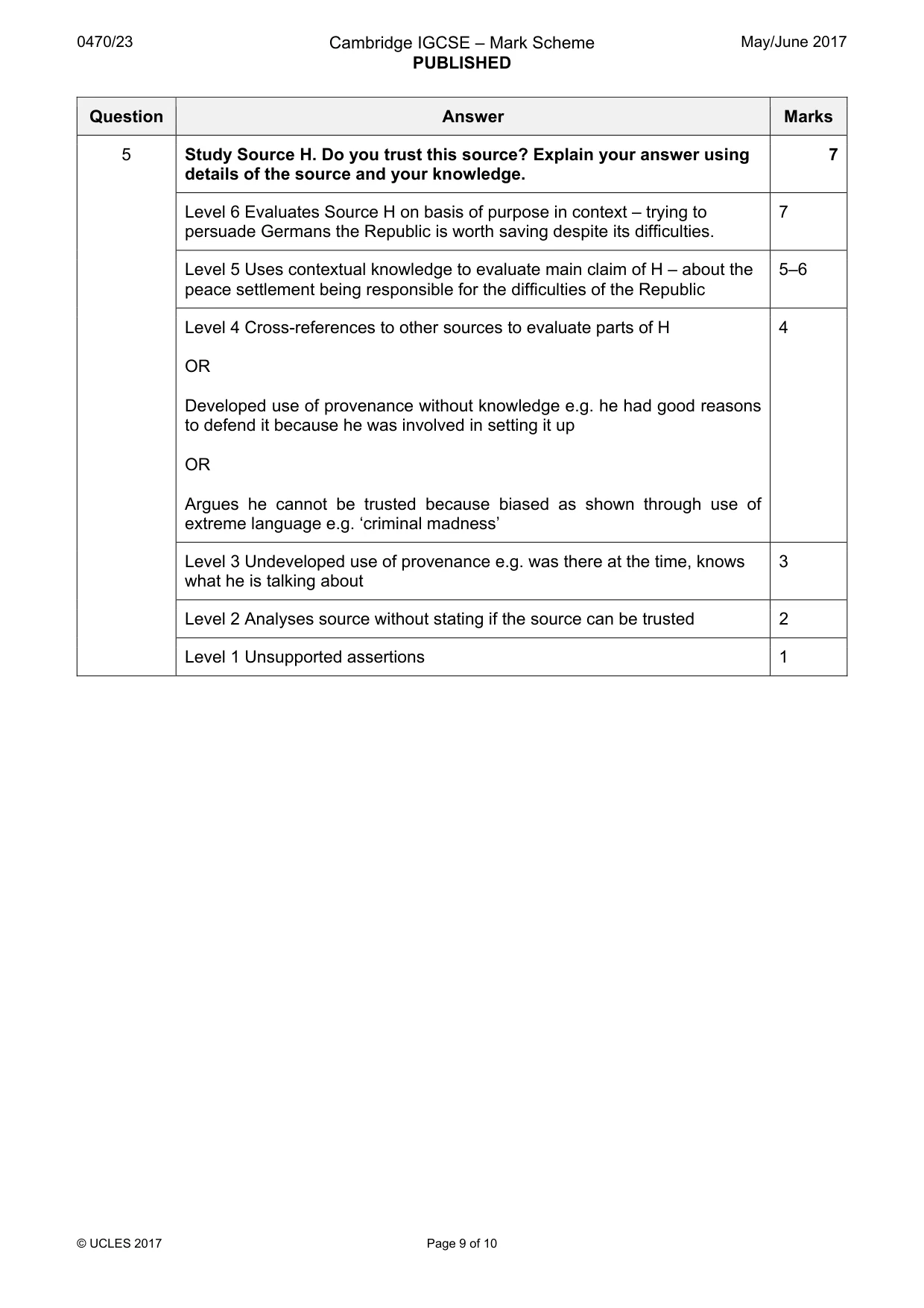
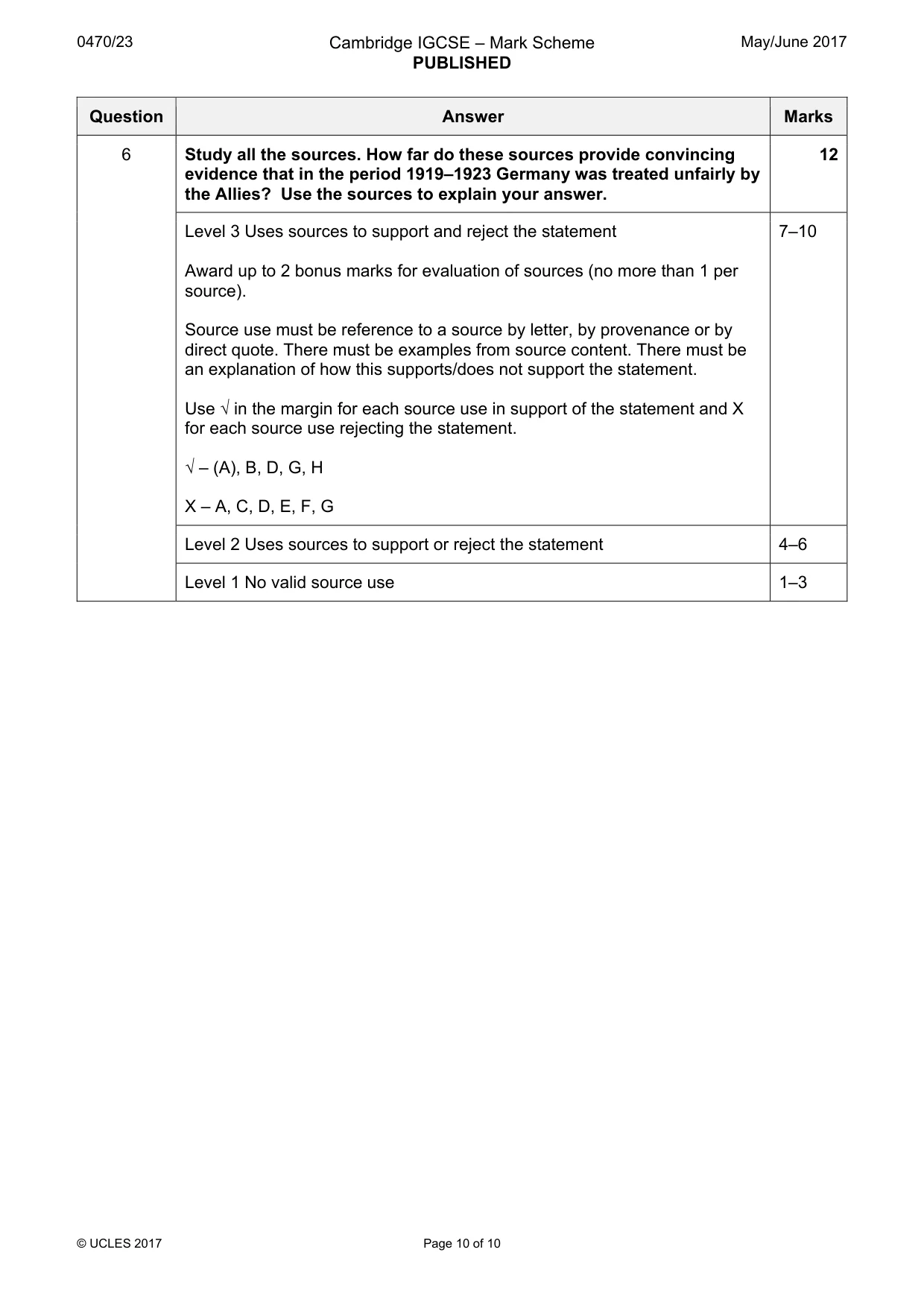
14 0470/23/M/J/17 © UCLES 2017 Now answer all the following questions. You may use any of the sources to help you answer the questions, in addition to those sources which you are told to use. In answering the questions you should use your knowledge of the topic to help you interpret and evaluate the sources. 1 Study Sources A and B. How far do these two sources agree? Explain your answer using details of the sources. [7] 2 Study Sources C and D. Does Source C make Source D surprising? Explain your answer using details of the sources and your knowledge. [8] 3 Study Sources E and F. Does Source F prove that Lloyd George was lying in Source E? Explain your answer using details of the sources and your knowledge. [8] 4 Study Source G. Why was this source published in 1923? Explain your answer using details of the source and your knowledge. [8] 5 Study Source H. Do you trust this source? Explain your answer using details of the source and your knowledge. [7] 6 Study all the sources. How far do these sources provide convincing evidence that, in the period 1919–1923, Germany was treated unfairly by the Allies? Use the sources to explain your answer. [12]
Question paper, page 15
15 0470/23/M/J/17 © UCLES 2017 BLANK PAGE
Question paper, page 16
16 0470/23/M/J/17 © UCLES 2017 Permission to reproduce items where third-party owned material protected by copyright is included has been sought and cleared where possible. Every reasonable effort has been made by the publisher (UCLES) to trace copyright holders, but if any items requiring clearance have unwittingly been included, the publisher will be pleased to make amends at the earliest possible opportunity. To avoid the issue of disclosure of answer-related information to candidates, all copyright acknowledgements are reproduced online in the Cambridge International Examinations Copyright Acknowledgements Booklet. This is produced for each series of examinations and is freely available to download at www.cie.org.uk after the live examination series. Cambridge International Examinations is part of the Cambridge Assessment Group. Cambridge Assessment is the brand name of University of Cambridge Local Examinations Syndicate (UCLES), which is itself a department of the University of Cambridge. BLANK PAGE
Mark scheme, page 1
® IGCSE is a registered trademark. This syllabus is approved for use in England, Wales and Northern Ireland as a Cambridge International Level 1/Level 2 Certificate. This document consists of 10 printed pages. © UCLES 2017 [Turn over Cambridge International Examinations Cambridge International General Certificate of Secondary Education HISTORY 0470/23 Paper 2 May/June 2017 MARK SCHEME Maximum Mark: 50 Published This mark scheme is published as an aid to teachers and candidates, to indicate the requirements of the examination. It shows the basis on which Examiners were instructed to award marks. It does not indicate the details of the discussions that took place at an Examiners’ meeting before marking began, which would have considered the acceptability of alternative answers. Mark schemes should be read in conjunction with the question paper and the Principal Examiner Report for Teachers. Cambridge will not enter into discussions about these mark schemes. Cambridge is publishing the mark schemes for the May/June 2017 series for most Cambridge IGCSE®, Cambridge International A and AS Level and Cambridge Pre-U components, and some Cambridge O Level components.
Mark scheme, page 2
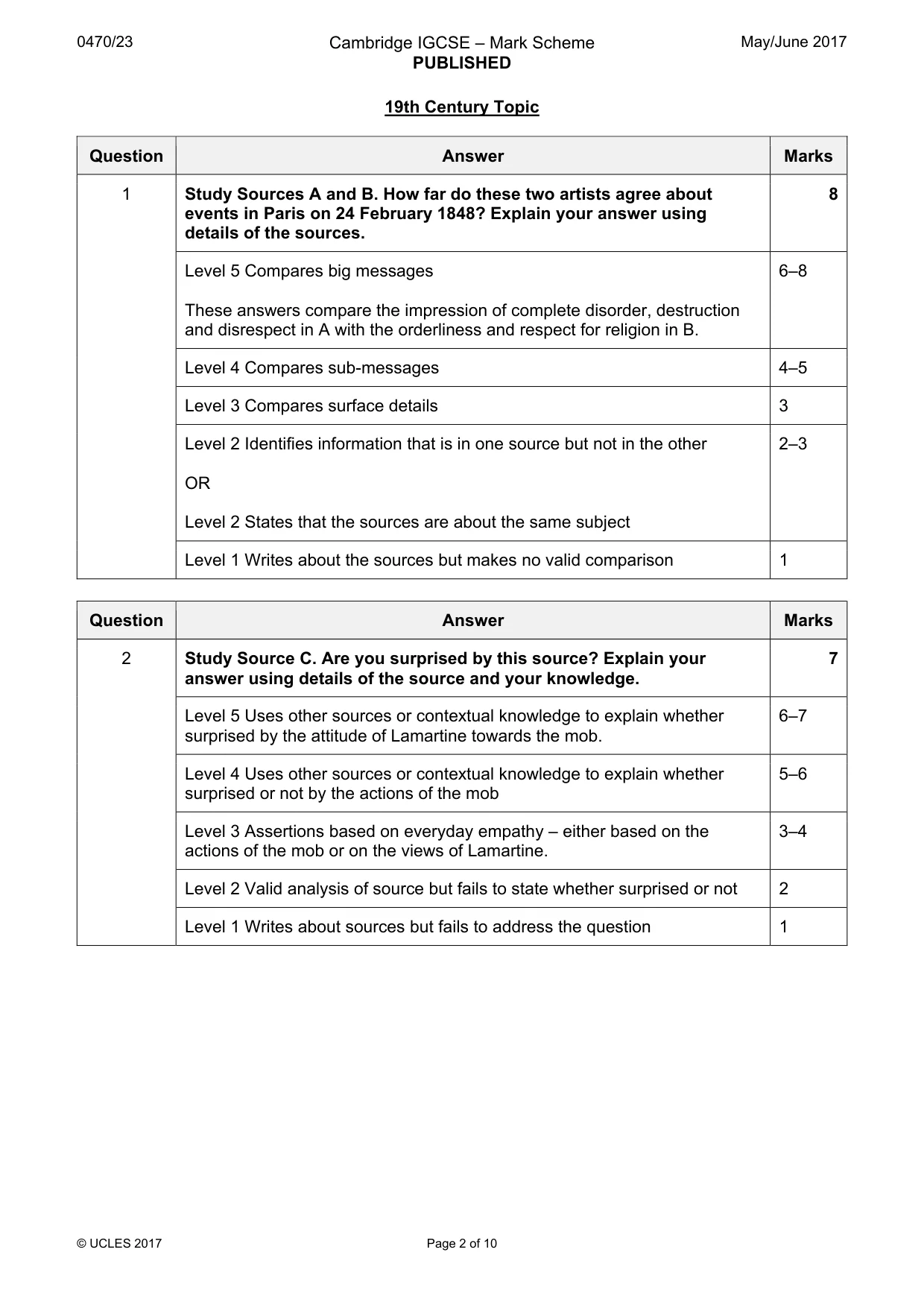
0470/23 Cambridge IGCSE – Mark Scheme PUBLISHED May/June 2017 © UCLES 2017 Page 2 of 10 19th Century Topic Question Answer Marks 1 Study Sources A and B. How far do these two artists agree about events in Paris on 24 February 1848? Explain your answer using details of the sources. 8 Level 5 Compares big messages These answers compare the impression of complete disorder, destruction and disrespect in A with the orderliness and respect for religion in B. 6–8 Level 4 Compares sub-messages 4–5 Level 3 Compares surface details 3 Level 2 Identifies information that is in one source but not in the other OR Level 2 States that the sources are about the same subject 2–3 Level 1 Writes about the sources but makes no valid comparison 1 Question Answer Marks 2 Study Source C. Are you surprised by this source? Explain your answer using details of the source and your knowledge. 7 Level 5 Uses other sources or contextual knowledge to explain whether surprised by the attitude of Lamartine towards the mob. 6–7 Level 4 Uses other sources or contextual knowledge to explain whether surprised or not by the actions of the mob 5–6 Level 3 Assertions based on everyday empathy – either based on the actions of the mob or on the views of Lamartine. 3–4 Level 2 Valid analysis of source but fails to state whether surprised or not 2 Level 1 Writes about sources but fails to address the question 1
Mark scheme, page 3
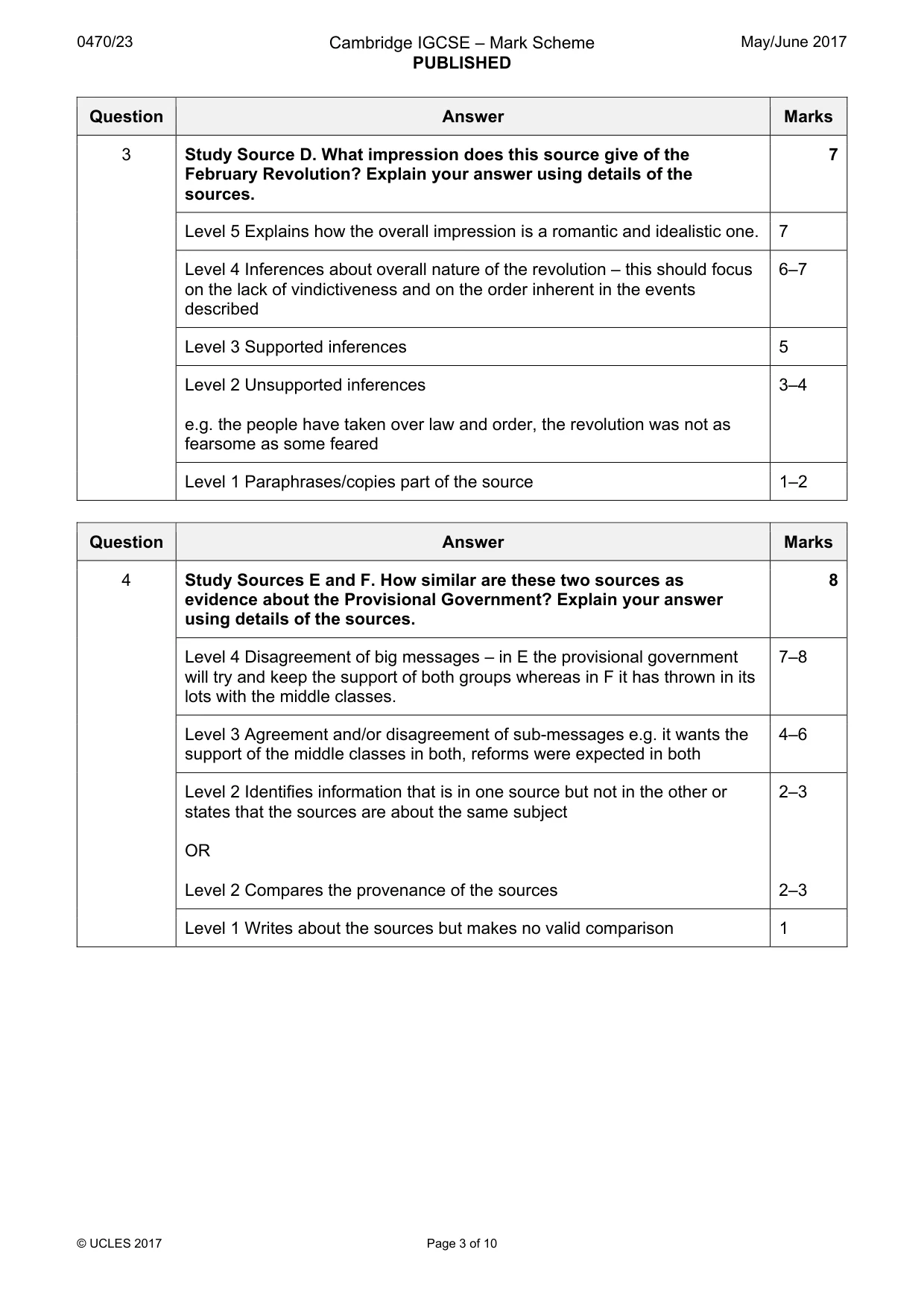
0470/23 Cambridge IGCSE – Mark Scheme PUBLISHED May/June 2017 © UCLES 2017 Page 3 of 10 Question Answer Marks 3 Study Source D. What impression does this source give of the February Revolution? Explain your answer using details of the sources. 7 Level 5 Explains how the overall impression is a romantic and idealistic one. 7 Level 4 Inferences about overall nature of the revolution – this should focus on the lack of vindictiveness and on the order inherent in the events described 6–7 Level 3 Supported inferences 5 Level 2 Unsupported inferences e.g. the people have taken over law and order, the revolution was not as fearsome as some feared 3–4 Level 1 Paraphrases/copies part of the source 1–2 Question Answer Marks 4 Study Sources E and F. How similar are these two sources as evidence about the Provisional Government? Explain your answer using details of the sources. 8 Level 4 Disagreement of big messages – in E the provisional government will try and keep the support of both groups whereas in F it has thrown in its lots with the middle classes. 7–8 Level 3 Agreement and/or disagreement of sub-messages e.g. it wants the support of the middle classes in both, reforms were expected in both 4–6 Level 2 Identifies information that is in one source but not in the other or states that the sources are about the same subject OR Level 2 Compares the provenance of the sources 2–3 2–3 Level 1 Writes about the sources but makes no valid comparison 1
Mark scheme, page 4
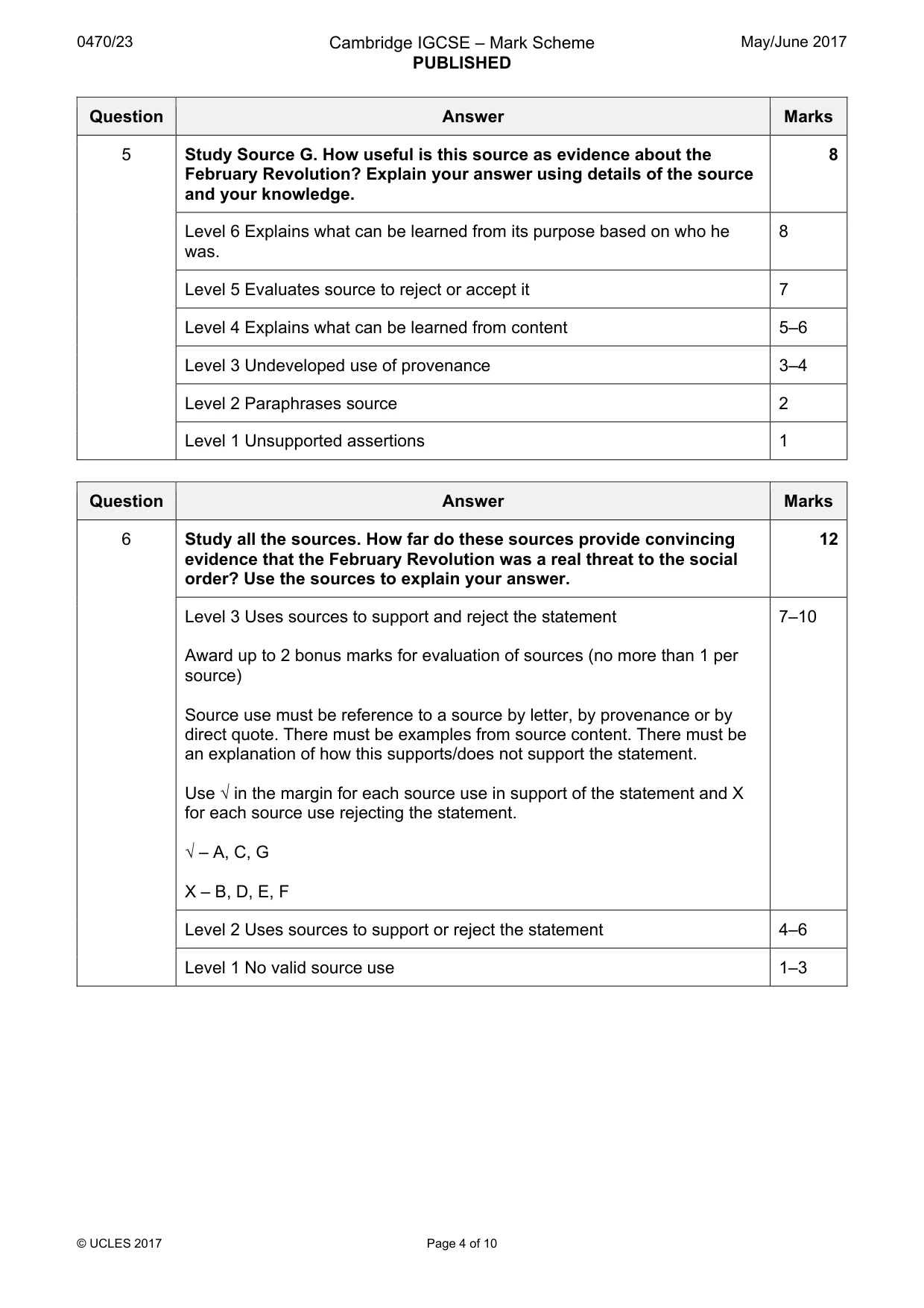
0470/23 Cambridge IGCSE – Mark Scheme PUBLISHED May/June 2017 © UCLES 2017 Page 4 of 10 Question Answer Marks 5 Study Source G. How useful is this source as evidence about the February Revolution? Explain your answer using details of the source and your knowledge. 8 Level 6 Explains what can be learned from its purpose based on who he was. 8 Level 5 Evaluates source to reject or accept it 7 Level 4 Explains what can be learned from content 5–6 Level 3 Undeveloped use of provenance 3–4 Level 2 Paraphrases source 2 Level 1 Unsupported assertions 1 Question Answer Marks 6 Study all the sources. How far do these sources provide convincing evidence that the February Revolution was a real threat to the social order? Use the sources to explain your answer. 12 Level 3 Uses sources to support and reject the statement Award up to 2 bonus marks for evaluation of sources (no more than 1 per source) Source use must be reference to a source by letter, by provenance or by direct quote. There must be examples from source content. There must be an explanation of how this supports/does not support the statement. Use √ in the margin for each source use in support of the statement and X for each source use rejecting the statement. √ – A, C, G X – B, D, E, F 7–10 Level 2 Uses sources to support or reject the statement 4–6 Level 1 No valid source use 1–3
Mark scheme, page 5
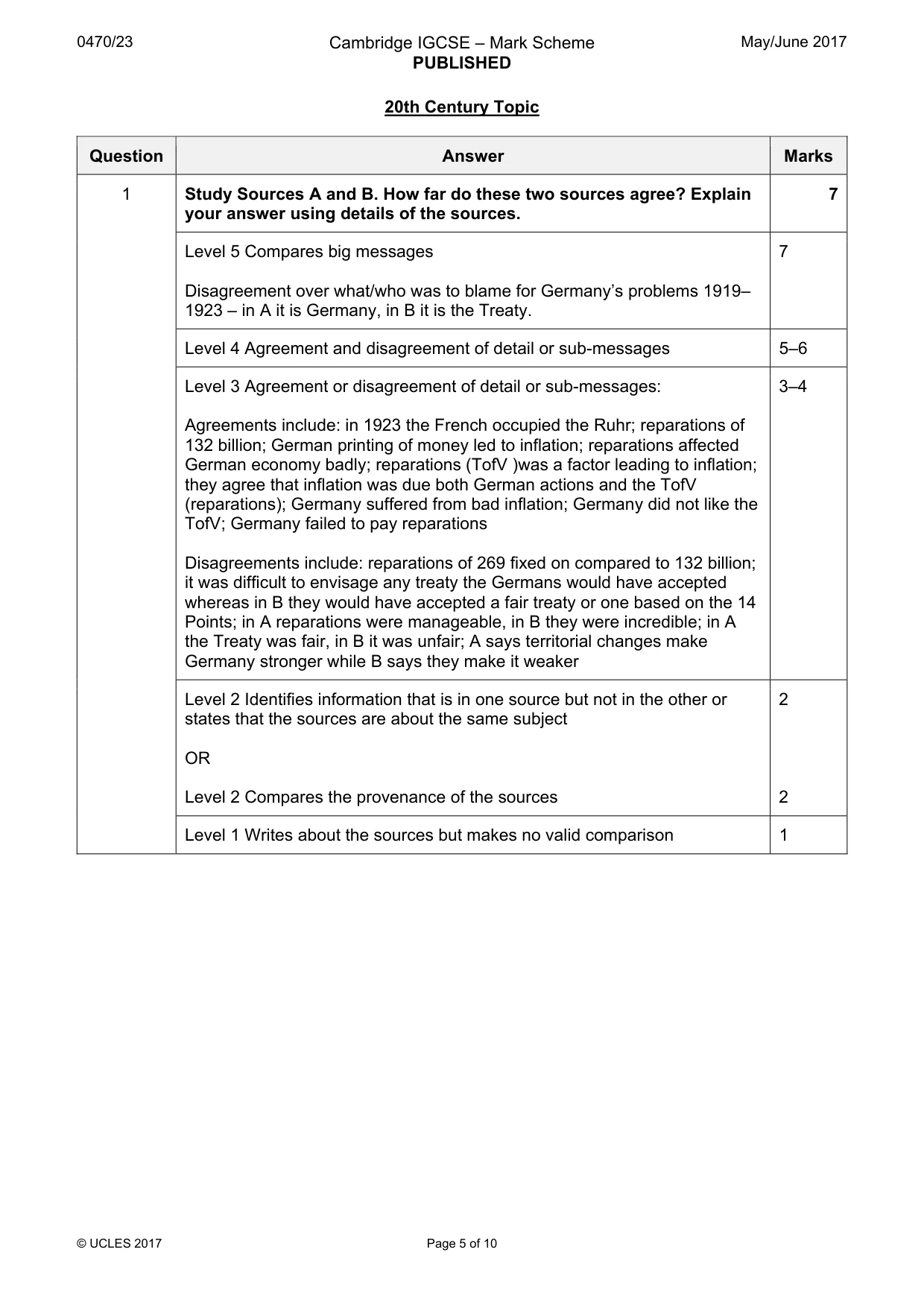
0470/23 Cambridge IGCSE – Mark Scheme PUBLISHED May/June 2017 © UCLES 2017 Page 5 of 10 20th Century Topic Question Answer Marks 1 Study Sources A and B. How far do these two sources agree? Explain your answer using details of the sources. 7 Level 5 Compares big messages Disagreement over what/who was to blame for Germany’s problems 1919– 1923 – in A it is Germany, in B it is the Treaty. 7 Level 4 Agreement and disagreement of detail or sub-messages 5–6 Level 3 Agreement or disagreement of detail or sub-messages: Agreements include: in 1923 the French occupied the Ruhr; reparations of 132 billion; German printing of money led to inflation; reparations affected German economy badly; reparations (TofV )was a factor leading to inflation; they agree that inflation was due both German actions and the TofV (reparations); Germany suffered from bad inflation; Germany did not like the TofV; Germany failed to pay reparations Disagreements include: reparations of 269 fixed on compared to 132 billion; it was difficult to envisage any treaty the Germans would have accepted whereas in B they would have accepted a fair treaty or one based on the 14 Points; in A reparations were manageable, in B they were incredible; in A the Treaty was fair, in B it was unfair; A says territorial changes make Germany stronger while B says they make it weaker 3–4 Level 2 Identifies information that is in one source but not in the other or states that the sources are about the same subject OR Level 2 Compares the provenance of the sources 2 2 Level 1 Writes about the sources but makes no valid comparison 1
Mark scheme, page 6
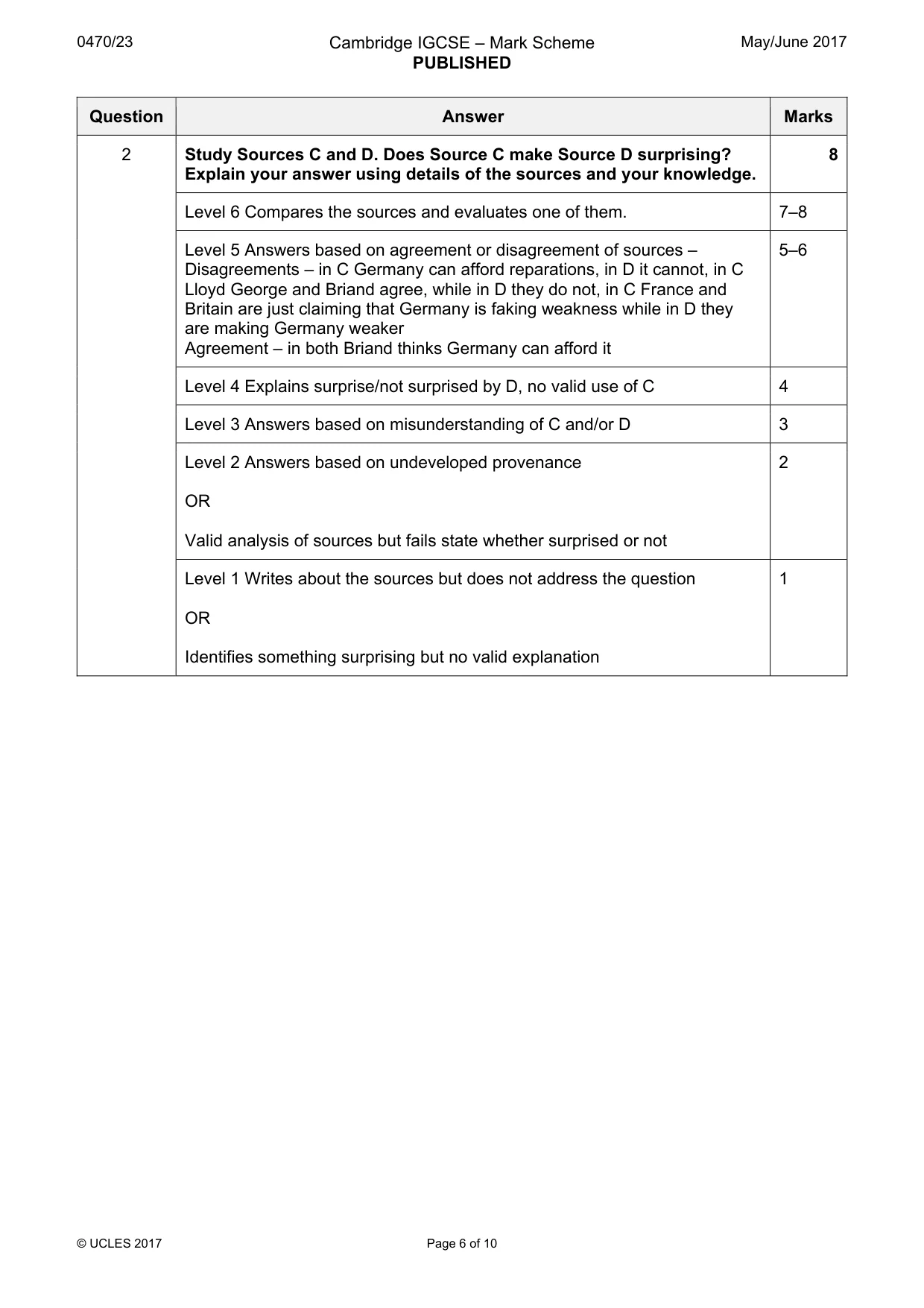
0470/23 Cambridge IGCSE – Mark Scheme PUBLISHED May/June 2017 © UCLES 2017 Page 6 of 10 Question Answer Marks 2 Study Sources C and D. Does Source C make Source D surprising? Explain your answer using details of the sources and your knowledge. 8 Level 6 Compares the sources and evaluates one of them. 7–8 Level 5 Answers based on agreement or disagreement of sources – Disagreements – in C Germany can afford reparations, in D it cannot, in C Lloyd George and Briand agree, while in D they do not, in C France and Britain are just claiming that Germany is faking weakness while in D they are making Germany weaker Agreement – in both Briand thinks Germany can afford it 5–6 Level 4 Explains surprise/not surprised by D, no valid use of C 4 Level 3 Answers based on misunderstanding of C and/or D 3 Level 2 Answers based on undeveloped provenance OR Valid analysis of sources but fails state whether surprised or not 2 Level 1 Writes about the sources but does not address the question OR Identifies something surprising but no valid explanation 1
Mark scheme, page 7
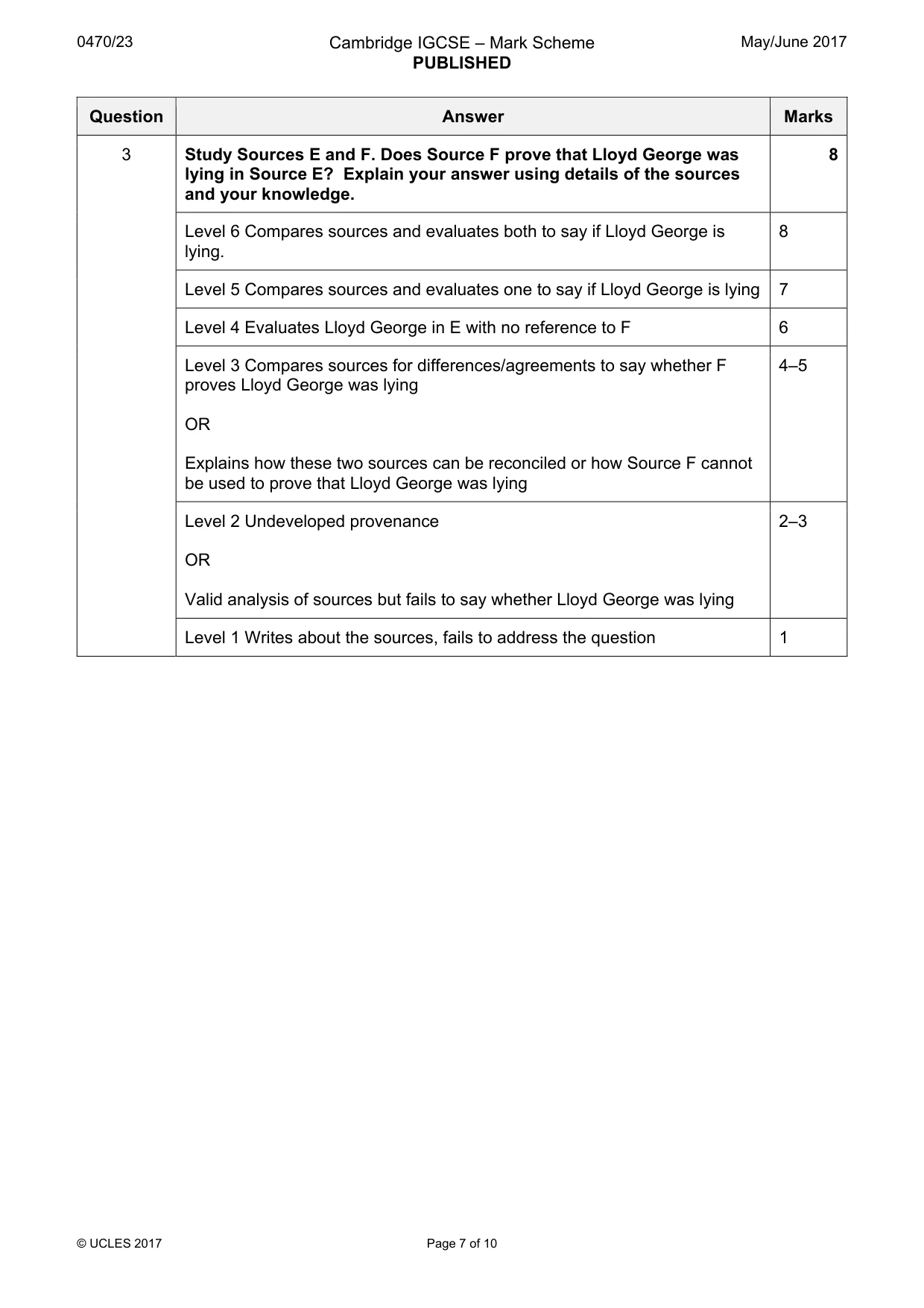
0470/23 Cambridge IGCSE – Mark Scheme PUBLISHED May/June 2017 © UCLES 2017 Page 7 of 10 Question Answer Marks 3 Study Sources E and F. Does Source F prove that Lloyd George was lying in Source E? Explain your answer using details of the sources and your knowledge. 8 Level 6 Compares sources and evaluates both to say if Lloyd George is lying. 8 Level 5 Compares sources and evaluates one to say if Lloyd George is lying 7 Level 4 Evaluates Lloyd George in E with no reference to F 6 Level 3 Compares sources for differences/agreements to say whether F proves Lloyd George was lying OR Explains how these two sources can be reconciled or how Source F cannot be used to prove that Lloyd George was lying 4–5 Level 2 Undeveloped provenance OR Valid analysis of sources but fails to say whether Lloyd George was lying 2–3 Level 1 Writes about the sources, fails to address the question 1
Mark scheme, page 8
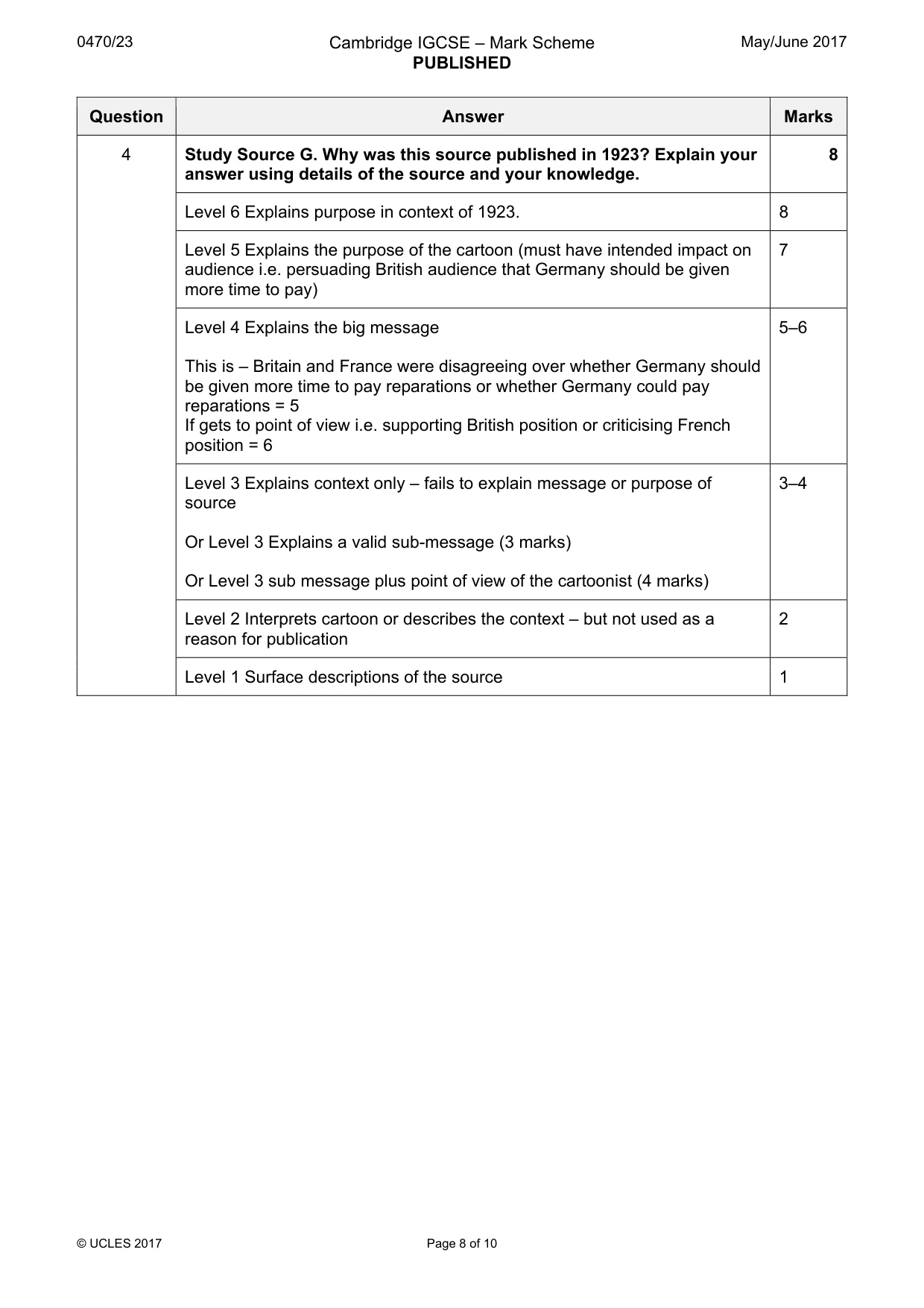
0470/23 Cambridge IGCSE – Mark Scheme PUBLISHED May/June 2017 © UCLES 2017 Page 8 of 10 Question Answer Marks 4 Study Source G. Why was this source published in 1923? Explain your answer using details of the source and your knowledge. 8 Level 6 Explains purpose in context of 1923. 8 Level 5 Explains the purpose of the cartoon (must have intended impact on audience i.e. persuading British audience that Germany should be given more time to pay) 7 Level 4 Explains the big message This is – Britain and France were disagreeing over whether Germany should be given more time to pay reparations or whether Germany could pay reparations = 5 If gets to point of view i.e. supporting British position or criticising French position = 6 5–6 Level 3 Explains context only – fails to explain message or purpose of source Or Level 3 Explains a valid sub-message (3 marks) Or Level 3 sub message plus point of view of the cartoonist (4 marks) 3–4 Level 2 Interprets cartoon or describes the context – but not used as a reason for publication 2 Level 1 Surface descriptions of the source 1
Mark scheme, page 9
0470/23 Cambridge IGCSE – Mark Scheme PUBLISHED May/June 2017 © UCLES 2017 Page 9 of 10 Question Answer Marks 5 Study Source H. Do you trust this source? Explain your answer using details of the source and your knowledge. 7 Level 6 Evaluates Source H on basis of purpose in context – trying to persuade Germans the Republic is worth saving despite its difficulties. 7 Level 5 Uses contextual knowledge to evaluate main claim of H – about the peace settlement being responsible for the difficulties of the Republic 5–6 Level 4 Cross-references to other sources to evaluate parts of H OR Developed use of provenance without knowledge e.g. he had good reasons to defend it because he was involved in setting it up OR Argues he cannot be trusted because biased as shown through use of extreme language e.g. ‘criminal madness’ 4 Level 3 Undeveloped use of provenance e.g. was there at the time, knows what he is talking about 3 Level 2 Analyses source without stating if the source can be trusted 2 Level 1 Unsupported assertions 1
Mark scheme, page 10
0470/23 Cambridge IGCSE – Mark Scheme PUBLISHED May/June 2017 © UCLES 2017 Page 10 of 10 Question Answer Marks 6 Study all the sources. How far do these sources provide convincing evidence that in the period 1919–1923 Germany was treated unfairly by the Allies? Use the sources to explain your answer. 12 Level 3 Uses sources to support and reject the statement Award up to 2 bonus marks for evaluation of sources (no more than 1 per source). Source use must be reference to a source by letter, by provenance or by direct quote. There must be examples from source content. There must be an explanation of how this supports/does not support the statement. Use √ in the margin for each source use in support of the statement and X for each source use rejecting the statement. √ – (A), B, D, G, H X – A, C, D, E, F, G 7–10 Level 2 Uses sources to support or reject the statement 4–6 Level 1 No valid source use 1–3
What you needed in this session
Cambridge’s own grade thresholds for 2017 May/June, Paper 2 · Variant 3. A higher threshold means an easier paper — the bar moves with how the cohort did.