Cambridge IGCSE History 0470 — 2017 May/June Paper 2 · Variant 2
0470/22/M/J/17 · 50 marks · ≈56 min
The question paper and its mark scheme, free to read here and free to download. This is Cambridge’s own paper, exactly as it was sat.
Question paper12 pages
Mark scheme13 pages
Answers below. Sit the paper first if you are practising.
Paper as text
Question paper, page 1
This document consists of 12 printed pages and 1 Insert. DC (ST/CGW) 129026/3 © UCLES 2017 [Turn over Cambridge International Examinations Cambridge International General Certificate of Secondary Education * 4 2 3 6 5 6 4 0 2 0 * HISTORY 0470/22 Paper 2 May/June 2017 2 hours No Additional Materials are required. READ THESE INSTRUCTIONS FIRST An answer booklet is provided inside this question paper. You should follow the instructions on the front cover of the answer booklet. If you need additional answer paper ask the invigilator for a continuation booklet. This paper has two options. Choose one option, and then answer all of the questions on that topic. Option A: 19th Century topic [p2–p7] Option B: 20th Century topic [p8–p12] The number of marks is given in brackets [ ] at the end of each question or part question. The syllabus is approved for use in England, Wales and Northern Ireland as a Cambridge International Level 1/Level 2 Certificate.
Question paper, page 2
2 0470/22/M/J/17 © UCLES 2017 Option A: 19th Century topic HOW IMPORTANT WAS POPULAR SUPPORT TO THE 1848–49 REVOLUTIONS IN ITALY? Study the Background Information and the sources carefully, and then answer all the questions. Background Information In 1848 there were revolutions of different kinds in many parts of Italy. The success of these revolutions depended on a number of factors, including popular support, nationalist beliefs, a desire for constitutional change, republicanism, the support of states like Piedmont and Tuscany and a desire for a unified Italy. Some historians have argued that popular support was the crucial factor. How important was popular support if the revolutions were to be successful? SOURCE A The great majority of Italians had placed local and partial aims of liberation before the more generalised ideal of patriotism. Neapolitan liberals had used force against the revolution in Sicily, some liberals from Messina had taken arms against the rival city of Palermo, and even some liberals from Palermo had given their support to Ferdinand when the revolution threatened personal property. Those who volunteered to fight against Austria had usually fought bravely, but volunteers had been few. Social and regional divisions had proved far stronger than any sense of national identity; thus the wealthier Tuscan liberals discovered that they were much closer to the grand duke than they were to the socialist left who had formed the spearhead of the revolution; and when starving Venice appealed for help, it received from the rest of Italy only one day’s supply of food. Without doubt the revolution had helped to establish a sense of Italian identity, but sometimes it had done the opposite. Cavour spoke of the defenders of Rome in terms of jeering contempt. The main problem was a lack of leadership. Charles Albert was a weak character who suffered from indecisiveness and double-dealing. He had made no serious preparations for an offensive war against the Austrians and his policy of Italy going it alone with her own unsupported forces was clearly absurd. The making of Italy would have to wait upon the active interest of some other European state which could provide the resources and determination which Italians lacked. As one nationalist wrote, ‘Italy cannot possibly free herself without outside help.’ Some put their faith in republican France. From a history book published in 1971.
Question paper, page 3
3 0470/22/M/J/17 © UCLES 2017 [Turn over SOURCE B Widespread protests against Austrian rule in 1848 and the impending collapse of Austrian power encouraged Charles Albert, the Pope, the King of Naples and the Grand Duke of Tuscany to commit troops to expel the Austrians. However, the largely working class crowds which had actually defeated the Austrian army soon became, according to Cavour, a ‘mortal menace’. The campaign by the Italian states was a fiasco. The mutual suspicions of their leaders were soon apparent. As early as April, Pius IX was condemning the war, worried by the threat it posed to social order. In May, Ferdinand of Naples, confident enough to ignore liberal critics, recalled his troops for use in internal repression. The main military effort against the Austrians came from Piedmont but Charles Albert’s hesitancy allowed the Austrians to recover the initiative. It also became clear that support for the nationalist cause – as opposed to anti-Austrian feeling – was limited and conditional. The unwillingness of the revolutionary governments in Milan and Venice, dominated as they were by property owners, to grant major agrarian reforms, alienated much of the rural population. For most middle class republicans, the social protest reinforced their social conservatism. From a history book published in 1988. SOURCE C The destinies of Italy are maturing, and a happier future is opening up for those of us who bravely stand up for their rights against the oppressor. We, out of love for our common race, understanding as we do what is now happening, and supported by public opinion, hasten to associate ourselves with the unanimous admiration which Italy bestows on you. People of Lombardy and Venetia, our arms which were concentrating on your frontier when you liberated your glorious Milan, are now coming to offer you the help which a brother expects from a brother, and a friend from a friend. In order to show more openly our feelings of Italian brotherhood, we have ordered our troops as they move into Lombardy and Venice to carry the cross of Savoy imposed on the tricolour of Italy. A proclamation by Charles Albert, King of Piedmont, 23 March 1848.
Question paper, page 4
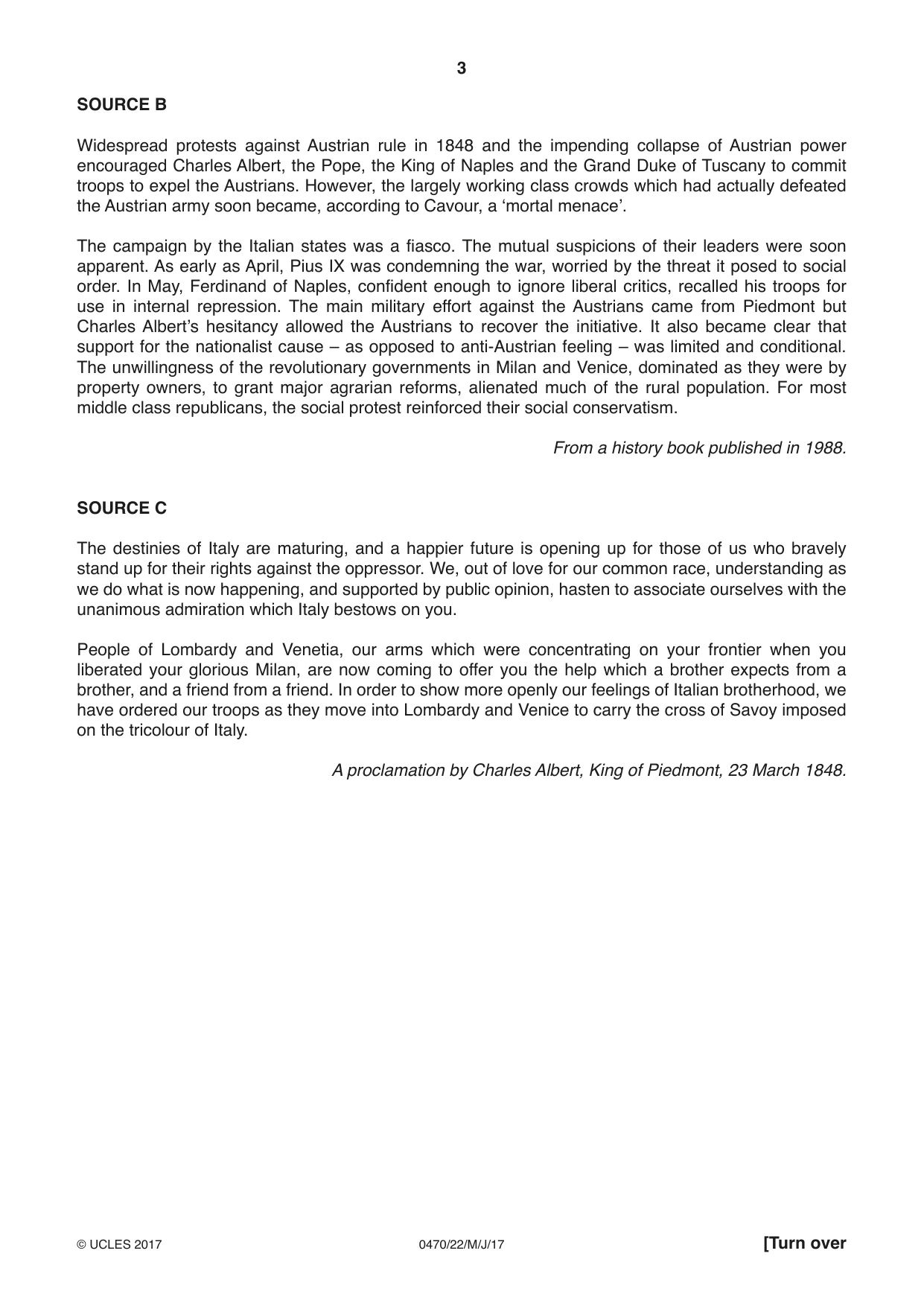
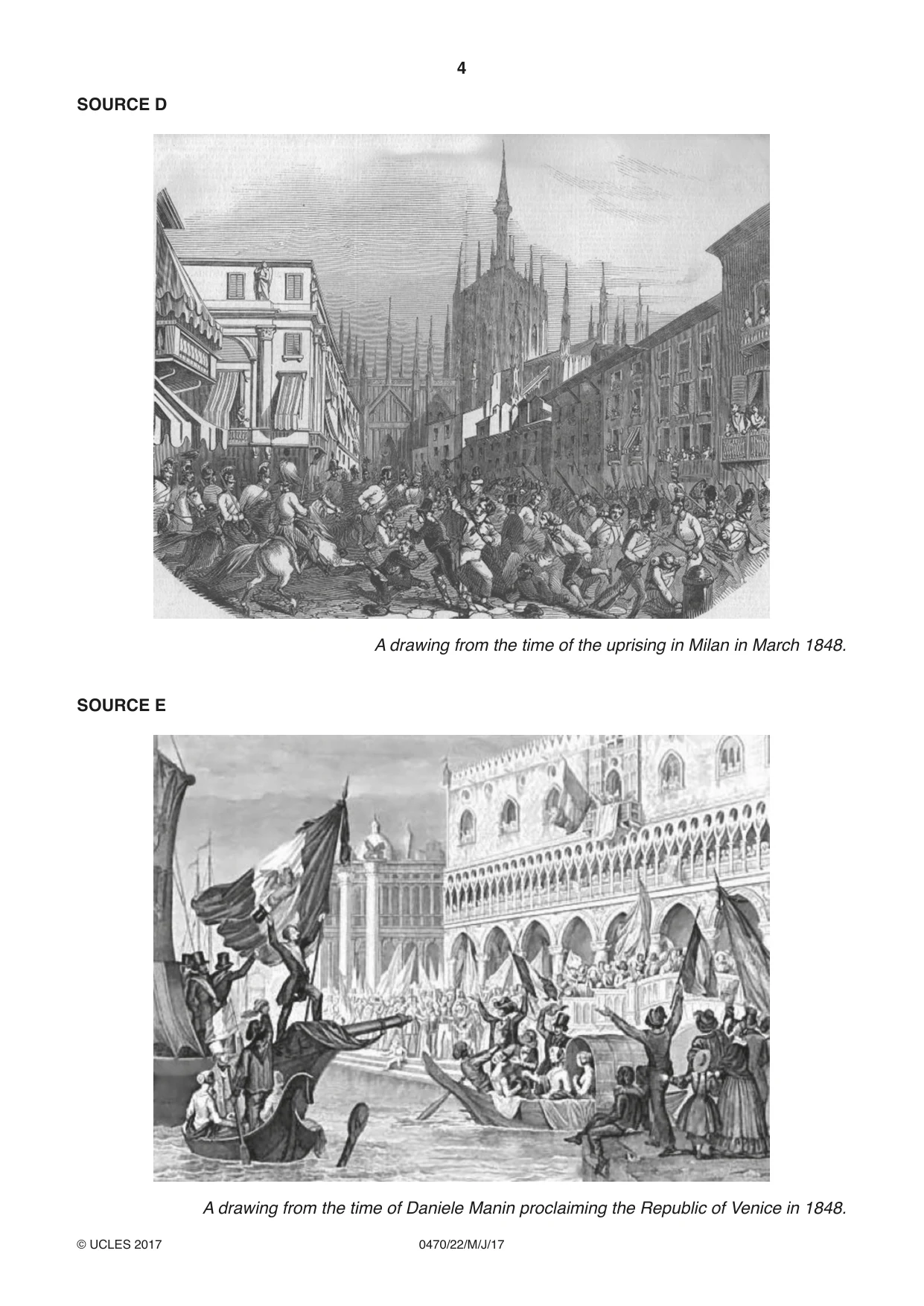
4 0470/22/M/J/17 © UCLES 2017 SOURCE D A drawing from the time of the uprising in Milan in March 1848. SOURCE E A drawing from the time of Daniele Manin proclaiming the Republic of Venice in 1848.
Question paper, page 5
5 0470/22/M/J/17 © UCLES 2017 [Turn over SOURCE F Not only the people of Rome but those of all Italy are looking to us to choose a new form of government, and I therefore propose that we should not leave this hall before we have reached agreement. It is nothing less than the destinies of the entire Italian nation which are at issue. To delay one minute would be a crime so long as a third of the Italian nation lies in slavery. Can you not hear the groan of despair which comes from a million Italian throats? Now that the papal system of government is at an end, what we need in Rome is a republic. Garibaldi speaking to the Constituent Assembly of Rome, 5 February 1849. SOURCE G In the opinion of radicals the task will not be completed until the entire peninsula is comprised in the absolute unity of a single state, and the monarchical system replaced by the republic. They wish us to carry this out now. We have not yet expelled the Austrians, and they wish to overturn our Princes. We have not yet acquired full control over constitutional liberty, and they wish to give us republics. Who does not see that to unify Italy completely would mean the violation of all the rights of our Princes, the destruction of all the present governments and defiance of the whole of Europe, to whom an Italian republic would give many reasons for jealousy and distrust? We have been unable to agree to support the new Constituent Assemblies in Tuscany and the Papal States because our idea for Italy is a federation. Our idea preserves the autonomy of the various states. Their idea changes and even overthrows them. Our idea, therefore, is incompatible with that of Rome and Florence. From a speech by Vincenzo Gioberti to the Piedmont Parliament, February 1849. Gioberti was Prime Minister of Piedmont from December 1848 to February 1849. Parliament forced him to resign soon after making this speech. SOURCE H The idea of nationality was enough to bring about the uprising but it was not enough to bring victory. The ordinary people, who wanted to drive out the foreigner, were prepared to accept the leadership of Charles Albert. But when other Italian rulers saw that the war was designed to increase his power they began to desert the cause. When the driving force and the principle of expelling the Austrians failed, the ordinary people were left leaderless. They had no reason to continue to fight. Whether ruled by a King, President or Triumvirate, the people’s slavery does not cease until the social system can be changed. From a book by Carlo Pisacane published in 1850. Pisacane was a soldier and fought against the Austrians in Lombardy. He was also involved in defending the Republic of Rome in 1849.
Question paper, page 6
6 0470/22/M/J/17 © UCLES 2017 SOURCE I As an Italian, I seek Italian forces for an Italian war, and a popular rising would not be enough for the purpose. We have seen this already; a popular rising can only win temporary victories. To defeat cannons and soldiers, you need cannons and soldiers of your own. You need arms, not Mazzinian chatter. Piedmont has got guns and cannons; therefore I am a Piedmontese. Piedmont is a monarchy; therefore I am not a republican. First independence, then liberty. A national war can only be fought with national weapons. Italy possesses two strengths: Italian sentiment, and the Piedmontese army. Each of these forces is powerless to act on its own; but put the two together and we will soon have the armed Italy that must necessarily precede a free Italy. A letter from Giorgio Pallavicino to General Pepe, November 1851. Pallavicino was involved in the 1848 risings against the Austrians and in setting up the National Society in 1857. In 1848 Pepe disobeyed King Ferdinand II and led Neapolitan volunteers against the Austrians.
Question paper, page 7
7 0470/22/M/J/17 © UCLES 2017 [Turn over Now answer all the following questions. You may use any of the sources to help you answer the questions, in addition to those sources which you are told to use. In answering the questions you should use your knowledge of the topic to help you interpret and evaluate the sources. 1 Study Sources A and B. How far do these two sources agree? Explain your answer using details of the sources. [8] 2 Study Source C. Are you surprised by this source? Explain your answer using details of the source and your knowledge. [8] 3 Study Sources D and E. How far do these two sources give similar impressions of the revolutions in Italy in 1848? Explain your answer using details of the sources and your knowledge. [6] 4 Study Sources F and G. Does Source G mean that Garibaldi (Source F) was wrong? Explain your answer using details of the sources and your knowledge. [8] 5 Study Sources H and I. How similar were the aims of Pisacane (Source H) and Pallavicino (Source I)? Explain your answer using details of the sources and your knowledge. [8] 6 Study all the sources. How far do these sources provide convincing evidence that popular support was important in the 1848–49 revolutions in Italy? Use the sources to explain your answer. [12]
Question paper, page 8
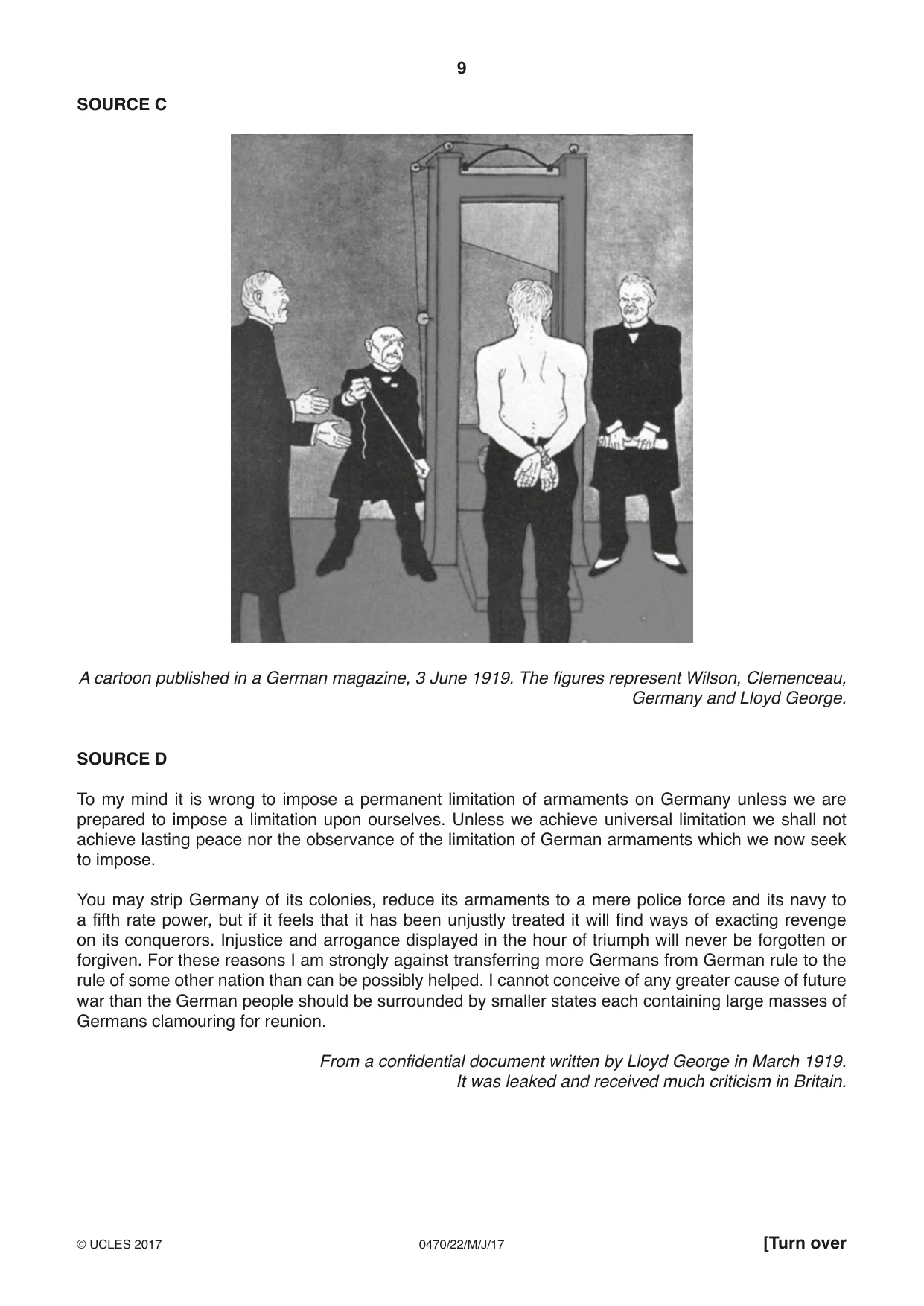
8 0470/22/M/J/17 © UCLES 2017 Option B: 20th Century topic WAS GERMAN ANGER AT THE TERMS OF THE TREATY OF VERSAILLES JUSTIFIED? Study the Background Information and the sources carefully, and then answer all the questions. Background Information The Paris Peace Conference opened on 18 January 1919. The negotiations were dominated by Prime Minister Clemenceau of France, Prime Minister Lloyd George of Britain and President Wilson of the USA. They each had their own ideas about what should be done and the meetings went on until May 1919 when the terms of the Treaty of Versailles were presented to the Germans, who were shocked and outraged by them. However, they had no choice but to accept them, and signed the Treaty in June. Many in Britain and France thought that the Treaty was fair. However, there were others who were worried that it was too harsh. Was the treatment of Germany justified? SOURCE A It is difficult to consider the events between the armistice and the signing of the Treaty of Versailles as anything but a record of terrible failure. The bright hopes for a new Europe and the secure establishment of German democracy all failed to materialise. As early as November 1923 there was an attempted coup by Hitler. Less than eleven years later, Hitler had become Chancellor and soon after, the Treaty was in tatters. Germany was too powerful to be suppressed for long. To think that the Treaty’s most objectionable features could be enforced against the largest and most industrious nation in Europe was to defy common sense. As this gradually became apparent, many of its provisions were modified or allowed to go unenforced. To the fury of the French, the British gradually lost interest in the matter of reparations. The main problem with the Treaty was that to the vast majority of Germans it was the most vicious document in the history of mankind. They blamed their every misfortune on the fact that there was a Polish Corridor and a demilitarised Rhineland. They believed they would be encircled by aggressive nations and were angry that Germans had been cut off from the Fatherland. If any further proof was needed regarding the diabolical character of the Treaty, the Germans had only to consult the work of the brilliant British economist, John Maynard Keynes. From a history book published in 1968. SOURCE B The picture of a Germany crushed by a vindictive peace cannot be supported. Germany did lose territory; that was an inevitable consequence of losing the war. If it had won, it should be remembered, it would certainly have taken Belgium, Luxembourg, parts of the north of France and much of the Netherlands. Even with its losses Germany remained the largest country in Europe. Its strategic position was significantly better than it had been before 1914. With the re-emergence of Poland there was now a barrier in front of the Russian menace. In place of Austria-Hungary, Germany had only a series of weaker and quarrelling states on its eastern frontier. The separation of East Prussia from the rest of Germany was an irritation, but such separations were nothing new in the history of Prussia. In the west, France was gravely weakened by the war. With different leadership in the western democracies the story might have turned out differently. The Treaty of Versailles was not to blame. It was never consistently enforced, or only enough to irritate Germany without limiting its power to disrupt the peace of Europe. From a history book published in 2001.
Question paper, page 9
9 0470/22/M/J/17 © UCLES 2017 [Turn over SOURCE C A cartoon published in a German magazine, 3 June 1919. The figures represent Wilson, Clemenceau, Germany and Lloyd George. SOURCE D To my mind it is wrong to impose a permanent limitation of armaments on Germany unless we are prepared to impose a limitation upon ourselves. Unless we achieve universal limitation we shall not achieve lasting peace nor the observance of the limitation of German armaments which we now seek to impose. You may strip Germany of its colonies, reduce its armaments to a mere police force and its navy to a fifth rate power, but if it feels that it has been unjustly treated it will find ways of exacting revenge on its conquerors. Injustice and arrogance displayed in the hour of triumph will never be forgotten or forgiven. For these reasons I am strongly against transferring more Germans from German rule to the rule of some other nation than can be possibly helped. I cannot conceive of any greater cause of future war than the German people should be surrounded by smaller states each containing large masses of Germans clamouring for reunion. From a confidential document written by Lloyd George in March 1919. It was leaked and received much criticism in Britain.
Question paper, page 10
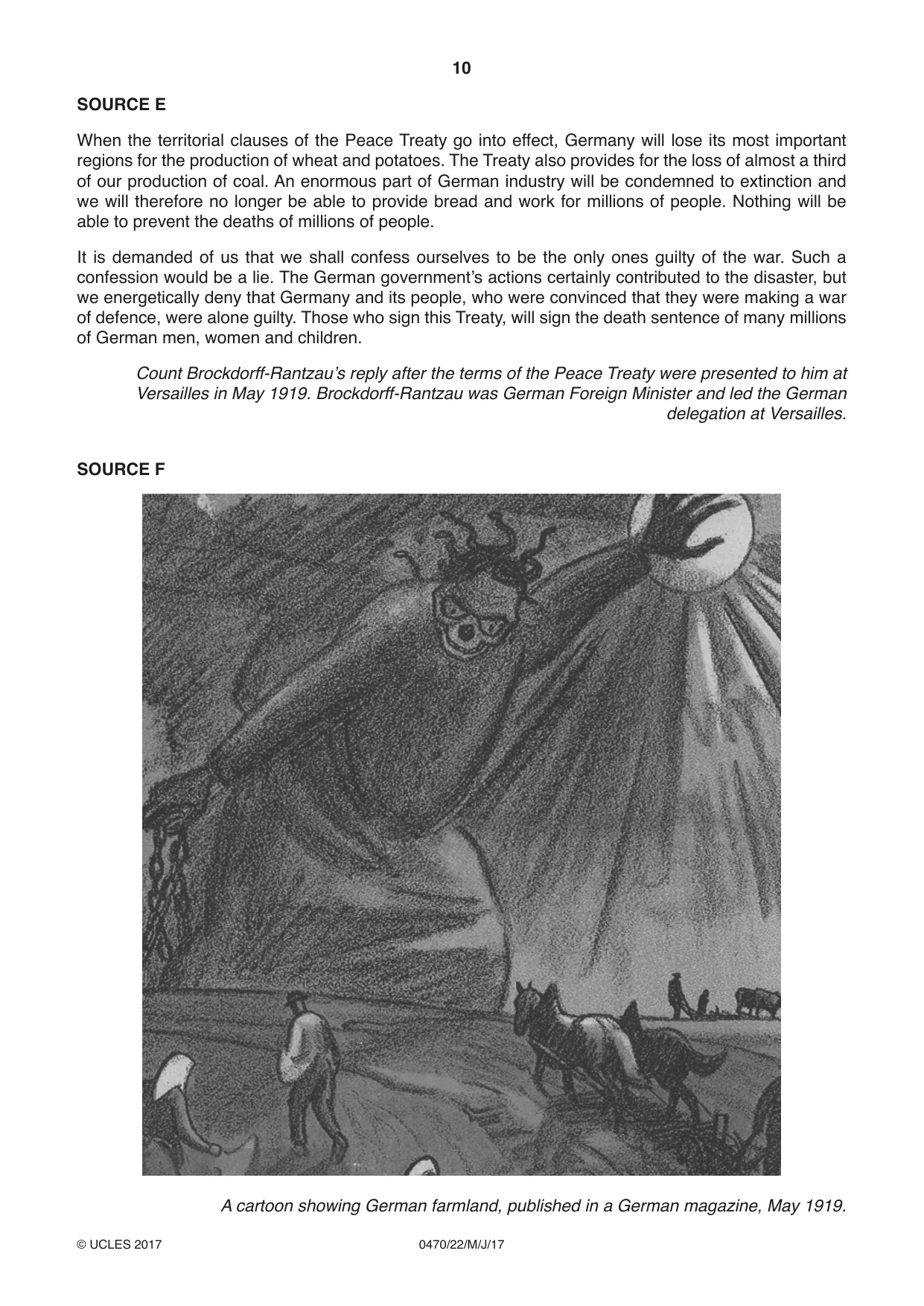
10 0470/22/M/J/17 © UCLES 2017 SOURCE E When the territorial clauses of the Peace Treaty go into effect, Germany will lose its most important regions for the production of wheat and potatoes. The Treaty also provides for the loss of almost a third of our production of coal. An enormous part of German industry will be condemned to extinction and we will therefore no longer be able to provide bread and work for millions of people. Nothing will be able to prevent the deaths of millions of people. It is demanded of us that we shall confess ourselves to be the only ones guilty of the war. Such a confession would be a lie. The German government’s actions certainly contributed to the disaster, but we energetically deny that Germany and its people, who were convinced that they were making a war of defence, were alone guilty. Those who sign this Treaty, will sign the death sentence of many millions of German men, women and children. Count Brockdorff-Rantzau’s reply after the terms of the Peace Treaty were presented to him at Versailles in May 1919. Brockdorff-Rantzau was German Foreign Minister and led the German delegation at Versailles. SOURCE F A cartoon showing German farmland, published in a German magazine, May 1919.
Question paper, page 11
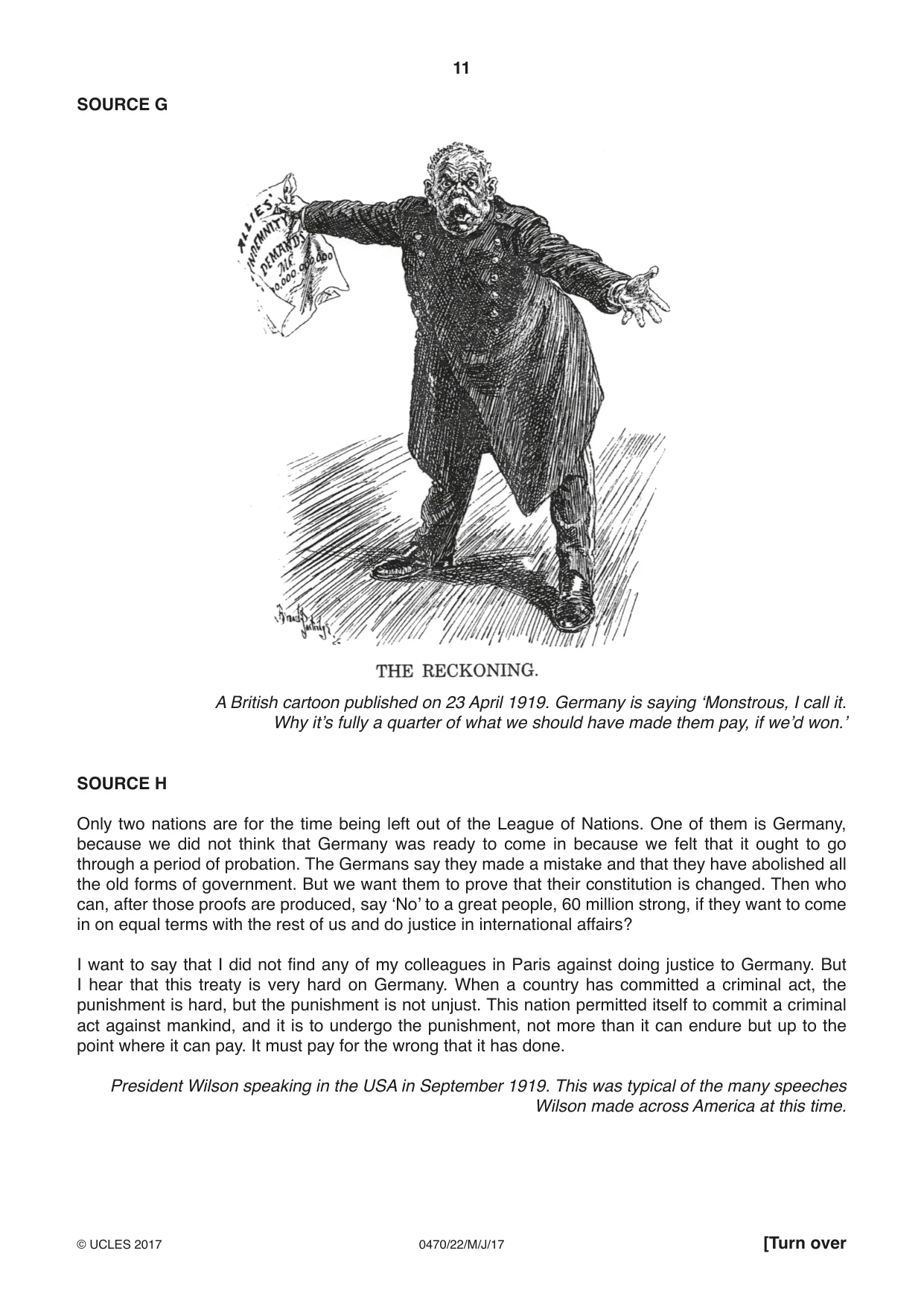
11 0470/22/M/J/17 © UCLES 2017 [Turn over SOURCE G A British cartoon published on 23 April 1919. Germany is saying ‘Monstrous, I call it. Why it’s fully a quarter of what we should have made them pay, if we’d won.’ SOURCE H Only two nations are for the time being left out of the League of Nations. One of them is Germany, because we did not think that Germany was ready to come in because we felt that it ought to go through a period of probation. The Germans say they made a mistake and that they have abolished all the old forms of government. But we want them to prove that their constitution is changed. Then who can, after those proofs are produced, say ‘No’ to a great people, 60 million strong, if they want to come in on equal terms with the rest of us and do justice in international affairs? I want to say that I did not find any of my colleagues in Paris against doing justice to Germany. But I hear that this treaty is very hard on Germany. When a country has committed a criminal act, the punishment is hard, but the punishment is not unjust. This nation permitted itself to commit a criminal act against mankind, and it is to undergo the punishment, not more than it can endure but up to the point where it can pay. It must pay for the wrong that it has done. President Wilson speaking in the USA in September 1919. This was typical of the many speeches Wilson made across America at this time.
Question paper, page 12
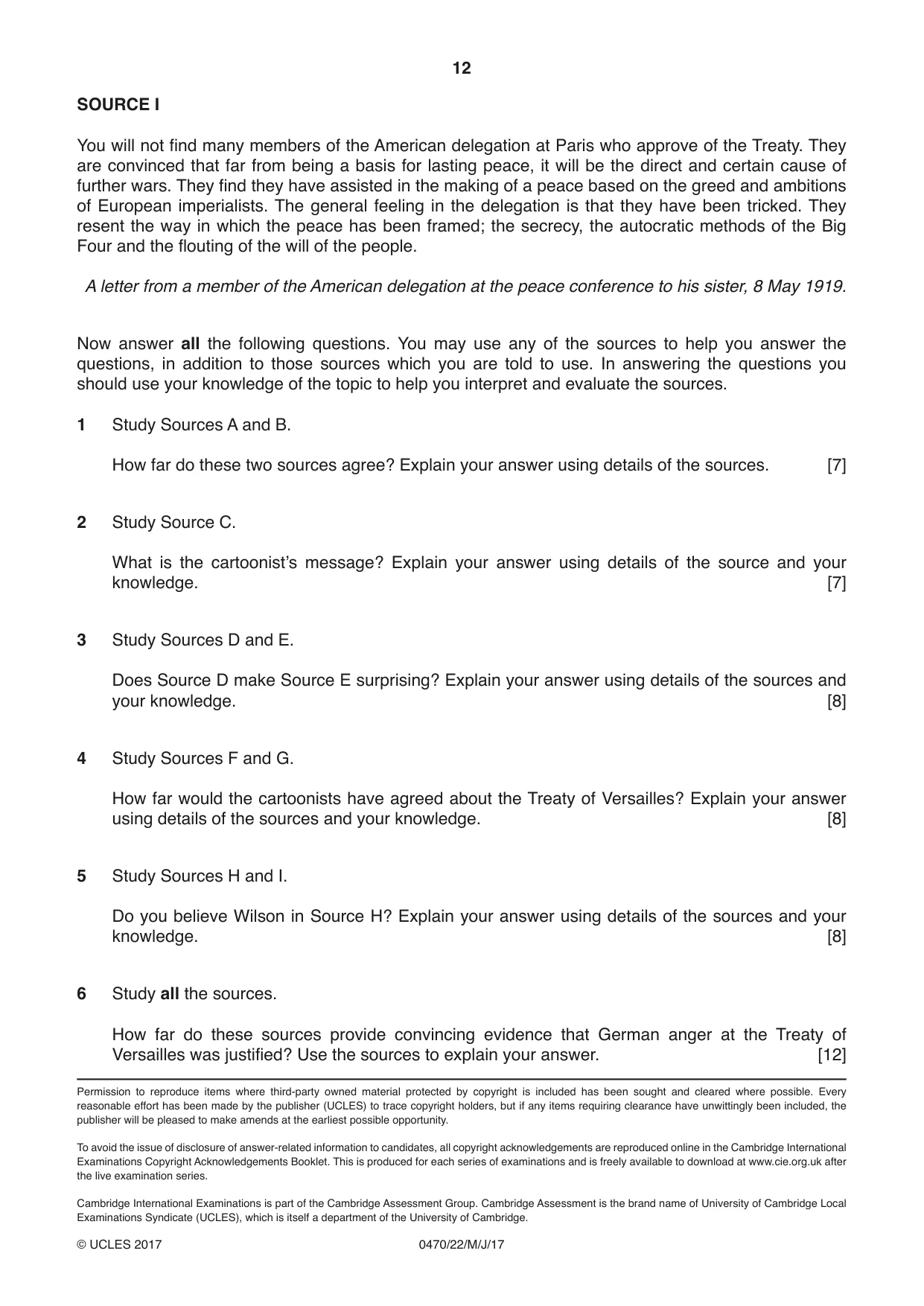
12 0470/22/M/J/17 © UCLES 2017 SOURCE I You will not find many members of the American delegation at Paris who approve of the Treaty. They are convinced that far from being a basis for lasting peace, it will be the direct and certain cause of further wars. They find they have assisted in the making of a peace based on the greed and ambitions of European imperialists. The general feeling in the delegation is that they have been tricked. They resent the way in which the peace has been framed; the secrecy, the autocratic methods of the Big Four and the flouting of the will of the people. A letter from a member of the American delegation at the peace conference to his sister, 8 May 1919. Now answer all the following questions. You may use any of the sources to help you answer the questions, in addition to those sources which you are told to use. In answering the questions you should use your knowledge of the topic to help you interpret and evaluate the sources. 1 Study Sources A and B. How far do these two sources agree? Explain your answer using details of the sources. [7] 2 Study Source C. What is the cartoonist’s message? Explain your answer using details of the source and your knowledge. [7] 3 Study Sources D and E. Does Source D make Source E surprising? Explain your answer using details of the sources and your knowledge. [8] 4 Study Sources F and G. How far would the cartoonists have agreed about the Treaty of Versailles? Explain your answer using details of the sources and your knowledge. [8] 5 Study Sources H and I. Do you believe Wilson in Source H? Explain your answer using details of the sources and your knowledge. [8] 6 Study all the sources. How far do these sources provide convincing evidence that German anger at the Treaty of Versailles was justified? Use the sources to explain your answer. [12] Permission to reproduce items where third-party owned material protected by copyright is included has been sought and cleared where possible. Every reasonable effort has been made by the publisher (UCLES) to trace copyright holders, but if any items requiring clearance have unwittingly been included, the publisher will be pleased to make amends at the earliest possible opportunity. To avoid the issue of disclosure of answer-related information to candidates, all copyright acknowledgements are reproduced online in the Cambridge International Examinations Copyright Acknowledgements Booklet. This is produced for each series of examinations and is freely available to download at www.cie.org.uk after the live examination series. Cambridge International Examinations is part of the Cambridge Assessment Group. Cambridge Assessment is the brand name of University of Cambridge Local Examinations Syndicate (UCLES), which is itself a department of the University of Cambridge.
Mark scheme, page 1
® IGCSE is a registered trademark. This syllabus is approved for use in England, Wales and Northern Ireland as a Cambridge International Level 1/Level 2 Certificate. This document consists of 13 printed pages. © UCLES 2017 [Turn over Cambridge International Examinations Cambridge International General Certificate of Secondary Education HISTORY 0470/22 Paper 2 May/June 2017 MARK SCHEME Maximum Mark: 50 Published This mark scheme is published as an aid to teachers and candidates, to indicate the requirements of the examination. It shows the basis on which Examiners were instructed to award marks. It does not indicate the details of the discussions that took place at an Examiners’ meeting before marking began, which would have considered the acceptability of alternative answers. Mark schemes should be read in conjunction with the question paper and the Principal Examiner Report for Teachers. Cambridge will not enter into discussions about these mark schemes. Cambridge is publishing the mark schemes for the May/June 2017 series for most Cambridge IGCSE®, Cambridge International A and AS Level and Cambridge Pre-U components, and some Cambridge O Level components.
Mark scheme, page 2
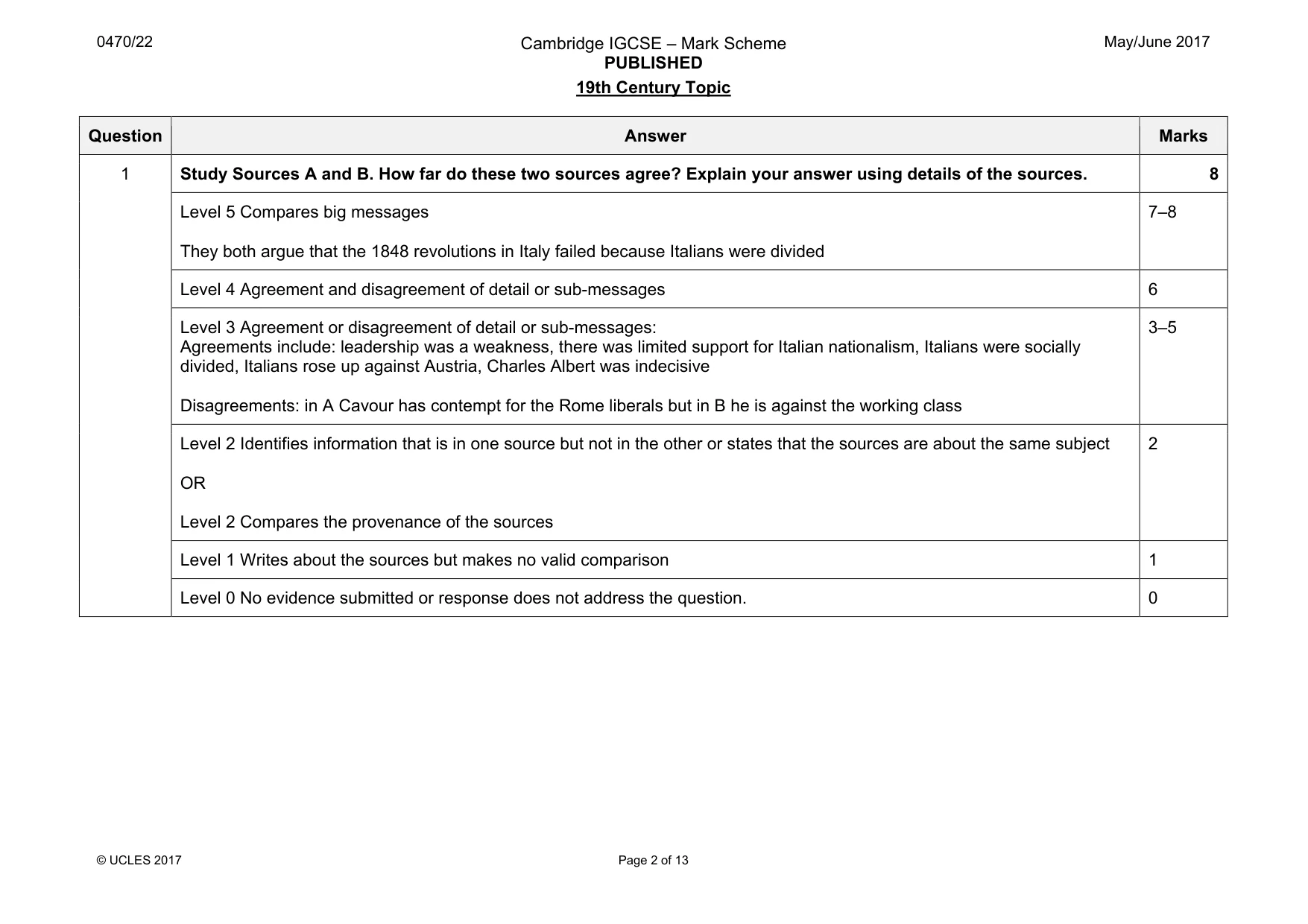
0470/22 Cambridge IGCSE – Mark Scheme PUBLISHED May/June 2017 © UCLES 2017 Page 2 of 13 19th Century Topic Question Answer Marks 1 Study Sources A and B. How far do these two sources agree? Explain your answer using details of the sources. 8 Level 5 Compares big messages They both argue that the 1848 revolutions in Italy failed because Italians were divided 7–8 Level 4 Agreement and disagreement of detail or sub-messages 6 Level 3 Agreement or disagreement of detail or sub-messages: Agreements include: leadership was a weakness, there was limited support for Italian nationalism, Italians were socially divided, Italians rose up against Austria, Charles Albert was indecisive Disagreements: in A Cavour has contempt for the Rome liberals but in B he is against the working class 3–5 Level 2 Identifies information that is in one source but not in the other or states that the sources are about the same subject OR Level 2 Compares the provenance of the sources 2 Level 1 Writes about the sources but makes no valid comparison 1 Level 0 No evidence submitted or response does not address the question. 0
Mark scheme, page 3
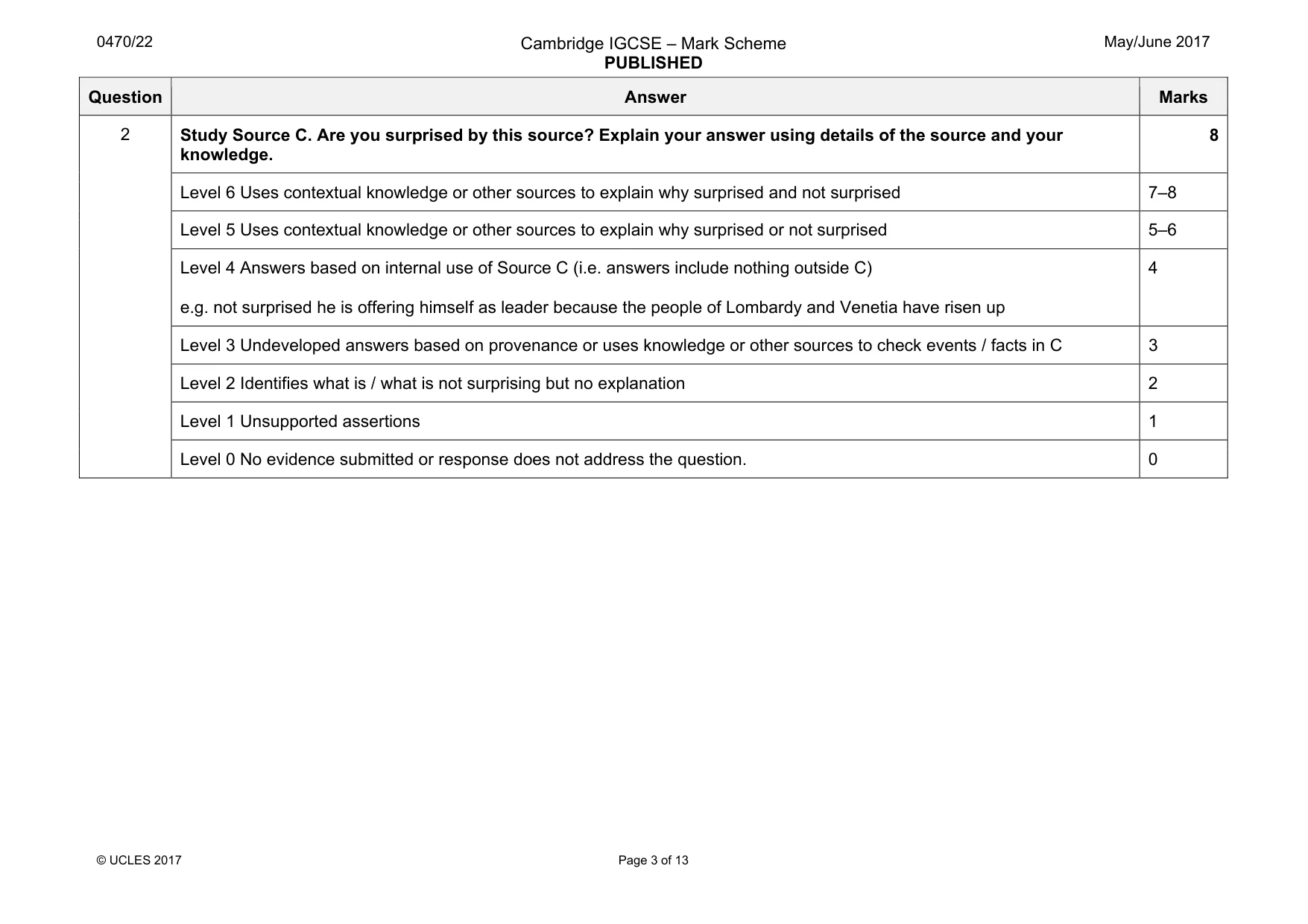
0470/22 Cambridge IGCSE – Mark Scheme PUBLISHED May/June 2017 © UCLES 2017 Page 3 of 13 Question Answer Marks 2 Study Source C. Are you surprised by this source? Explain your answer using details of the source and your knowledge. 8 Level 6 Uses contextual knowledge or other sources to explain why surprised and not surprised 7–8 Level 5 Uses contextual knowledge or other sources to explain why surprised or not surprised 5–6 Level 4 Answers based on internal use of Source C (i.e. answers include nothing outside C) e.g. not surprised he is offering himself as leader because the people of Lombardy and Venetia have risen up 4 Level 3 Undeveloped answers based on provenance or uses knowledge or other sources to check events / facts in C 3 Level 2 Identifies what is / what is not surprising but no explanation 2 Level 1 Unsupported assertions 1 Level 0 No evidence submitted or response does not address the question. 0
Mark scheme, page 4
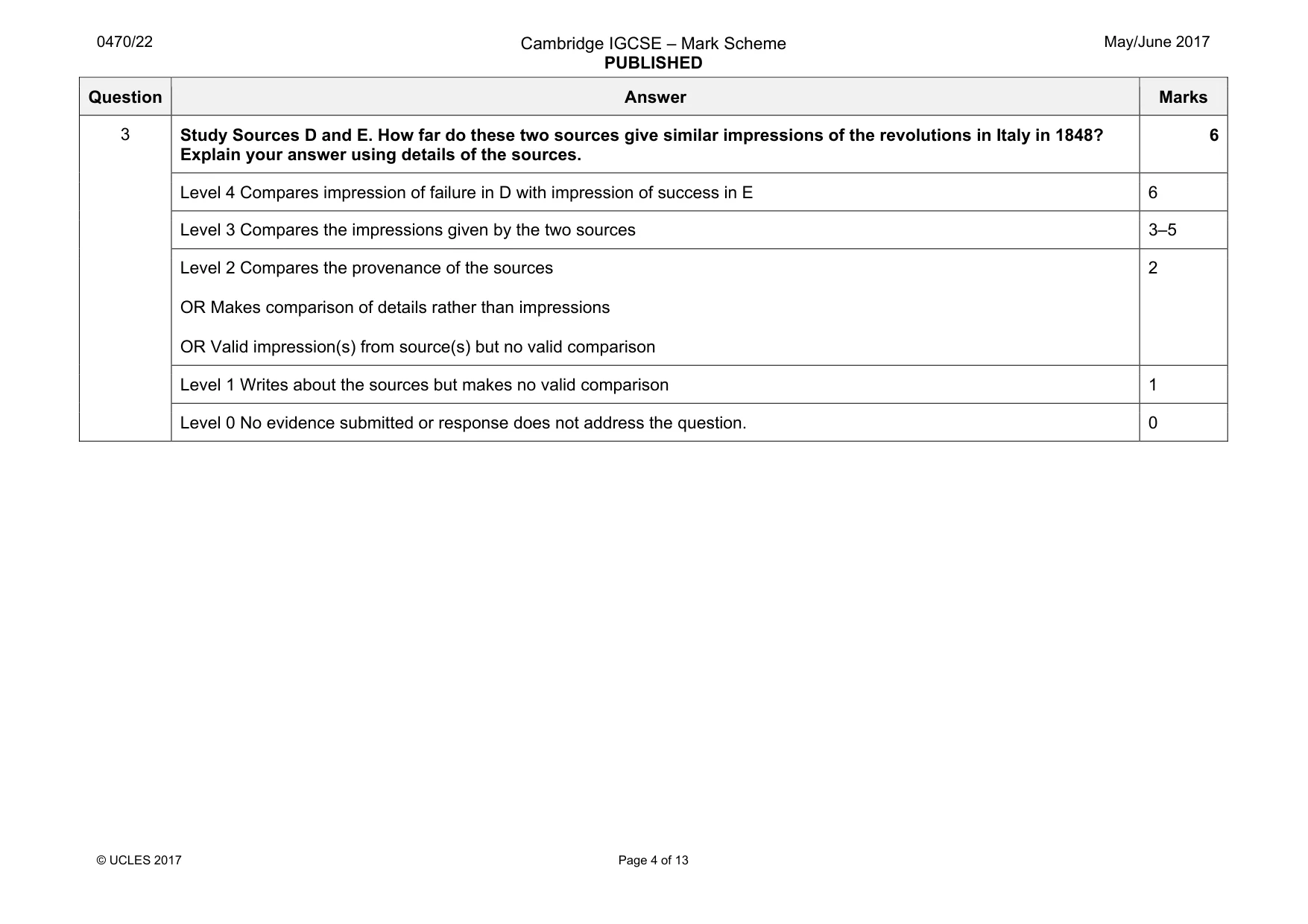
0470/22 Cambridge IGCSE – Mark Scheme PUBLISHED May/June 2017 © UCLES 2017 Page 4 of 13 Question Answer Marks 3 Study Sources D and E. How far do these two sources give similar impressions of the revolutions in Italy in 1848? Explain your answer using details of the sources. 6 Level 4 Compares impression of failure in D with impression of success in E 6 Level 3 Compares the impressions given by the two sources 3–5 Level 2 Compares the provenance of the sources OR Makes comparison of details rather than impressions OR Valid impression(s) from source(s) but no valid comparison 2 Level 1 Writes about the sources but makes no valid comparison 1 Level 0 No evidence submitted or response does not address the question. 0
Mark scheme, page 5
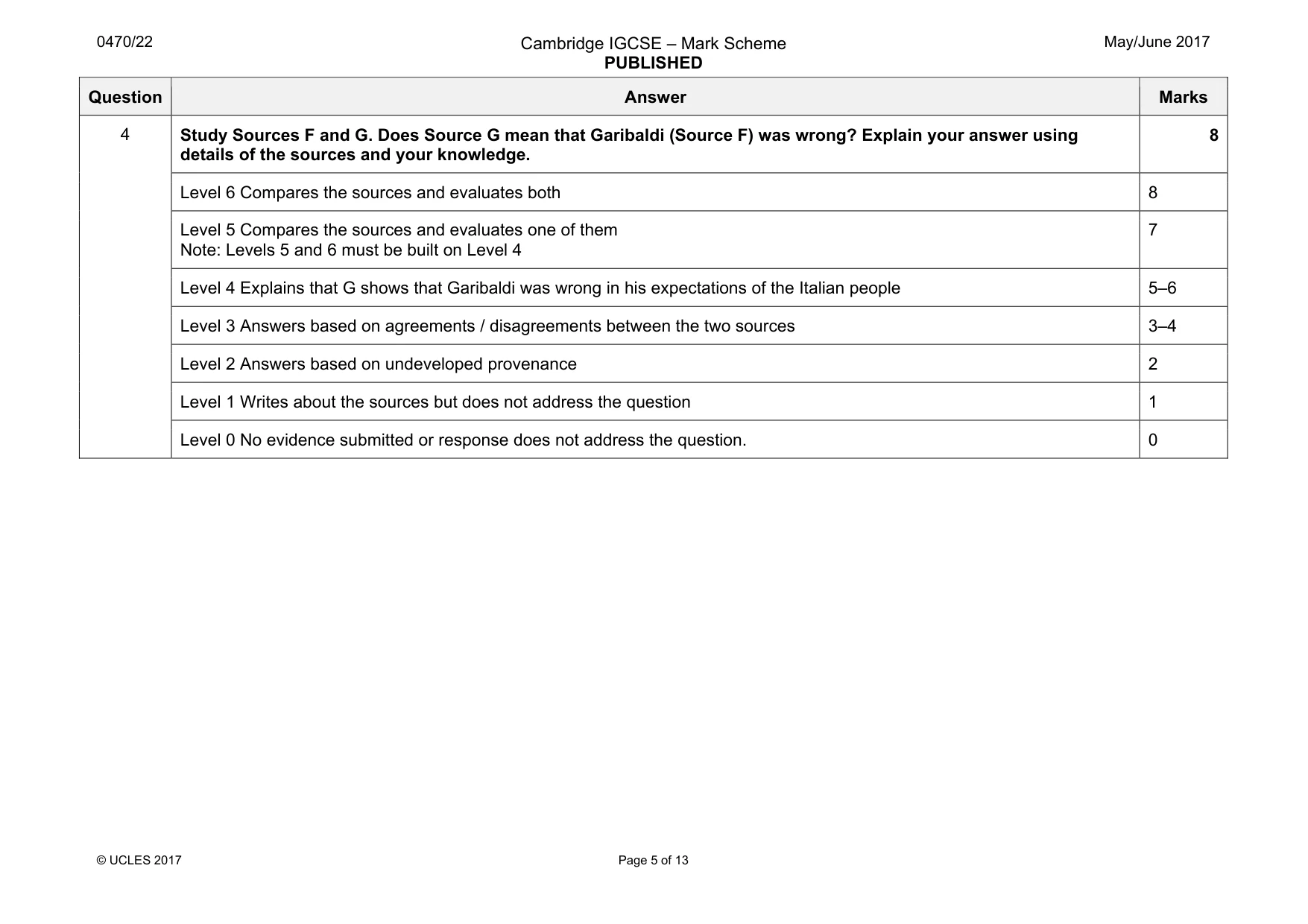
0470/22 Cambridge IGCSE – Mark Scheme PUBLISHED May/June 2017 © UCLES 2017 Page 5 of 13 Question Answer Marks 4 Study Sources F and G. Does Source G mean that Garibaldi (Source F) was wrong? Explain your answer using details of the sources and your knowledge. 8 Level 6 Compares the sources and evaluates both 8 Level 5 Compares the sources and evaluates one of them Note: Levels 5 and 6 must be built on Level 4 7 Level 4 Explains that G shows that Garibaldi was wrong in his expectations of the Italian people 5–6 Level 3 Answers based on agreements / disagreements between the two sources 3–4 Level 2 Answers based on undeveloped provenance 2 Level 1 Writes about the sources but does not address the question 1 Level 0 No evidence submitted or response does not address the question. 0
Mark scheme, page 6
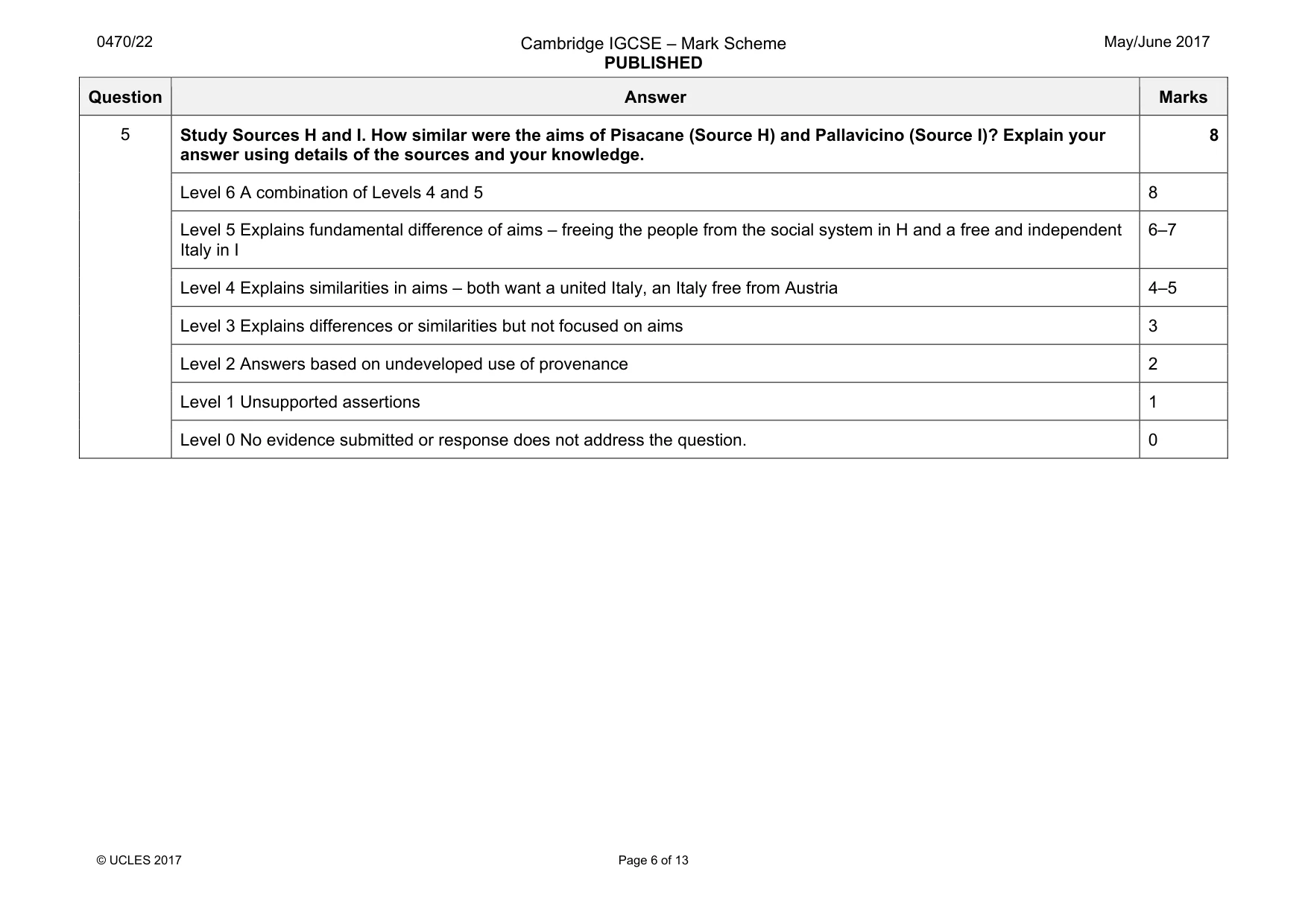
0470/22 Cambridge IGCSE – Mark Scheme PUBLISHED May/June 2017 © UCLES 2017 Page 6 of 13 Question Answer Marks 5 Study Sources H and I. How similar were the aims of Pisacane (Source H) and Pallavicino (Source I)? Explain your answer using details of the sources and your knowledge. 8 Level 6 A combination of Levels 4 and 5 8 Level 5 Explains fundamental difference of aims – freeing the people from the social system in H and a free and independent Italy in I 6–7 Level 4 Explains similarities in aims – both want a united Italy, an Italy free from Austria 4–5 Level 3 Explains differences or similarities but not focused on aims 3 Level 2 Answers based on undeveloped use of provenance 2 Level 1 Unsupported assertions 1 Level 0 No evidence submitted or response does not address the question. 0
Mark scheme, page 7
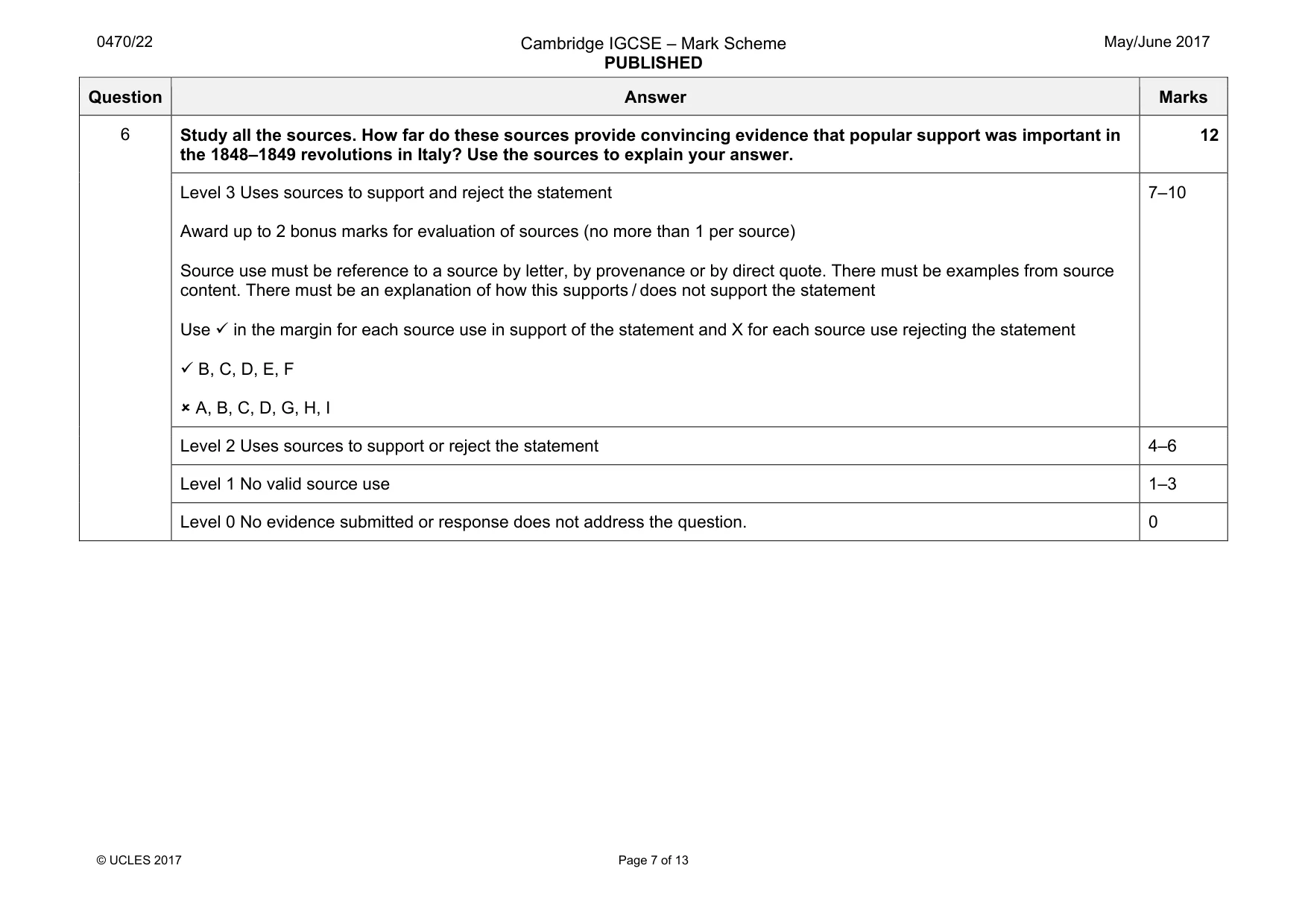
0470/22 Cambridge IGCSE – Mark Scheme PUBLISHED May/June 2017 © UCLES 2017 Page 7 of 13 Question Answer Marks 6 Study all the sources. How far do these sources provide convincing evidence that popular support was important in the 1848–1849 revolutions in Italy? Use the sources to explain your answer. 12 Level 3 Uses sources to support and reject the statement Award up to 2 bonus marks for evaluation of sources (no more than 1 per source) Source use must be reference to a source by letter, by provenance or by direct quote. There must be examples from source content. There must be an explanation of how this supports / does not support the statement Use 9 in the margin for each source use in support of the statement and X for each source use rejecting the statement 9 B, C, D, E, F 8 A, B, C, D, G, H, I 7–10 Level 2 Uses sources to support or reject the statement 4–6 Level 1 No valid source use 1–3 Level 0 No evidence submitted or response does not address the question. 0
Mark scheme, page 8
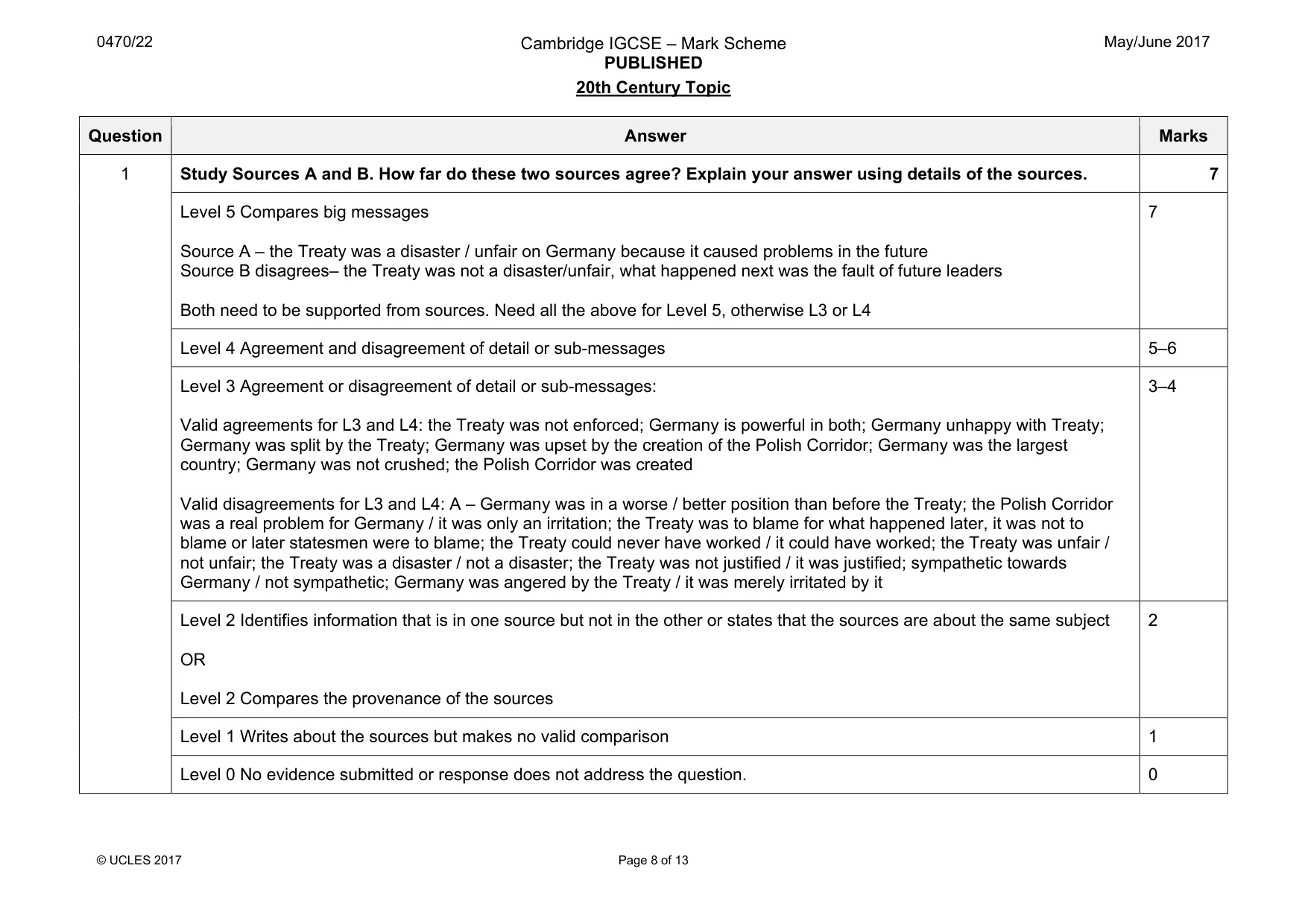
0470/22 Cambridge IGCSE – Mark Scheme PUBLISHED May/June 2017 © UCLES 2017 Page 8 of 13 20th Century Topic Question Answer Marks 1 Study Sources A and B. How far do these two sources agree? Explain your answer using details of the sources. 7 Level 5 Compares big messages Source A – the Treaty was a disaster / unfair on Germany because it caused problems in the future Source B disagrees– the Treaty was not a disaster/unfair, what happened next was the fault of future leaders Both need to be supported from sources. Need all the above for Level 5, otherwise L3 or L4 7 Level 4 Agreement and disagreement of detail or sub-messages 5–6 Level 3 Agreement or disagreement of detail or sub-messages: Valid agreements for L3 and L4: the Treaty was not enforced; Germany is powerful in both; Germany unhappy with Treaty; Germany was split by the Treaty; Germany was upset by the creation of the Polish Corridor; Germany was the largest country; Germany was not crushed; the Polish Corridor was created Valid disagreements for L3 and L4: A – Germany was in a worse / better position than before the Treaty; the Polish Corridor was a real problem for Germany / it was only an irritation; the Treaty was to blame for what happened later, it was not to blame or later statesmen were to blame; the Treaty could never have worked / it could have worked; the Treaty was unfair / not unfair; the Treaty was a disaster / not a disaster; the Treaty was not justified / it was justified; sympathetic towards Germany / not sympathetic; Germany was angered by the Treaty / it was merely irritated by it 3–4 Level 2 Identifies information that is in one source but not in the other or states that the sources are about the same subject OR Level 2 Compares the provenance of the sources 2 Level 1 Writes about the sources but makes no valid comparison 1 Level 0 No evidence submitted or response does not address the question. 0
Mark scheme, page 9
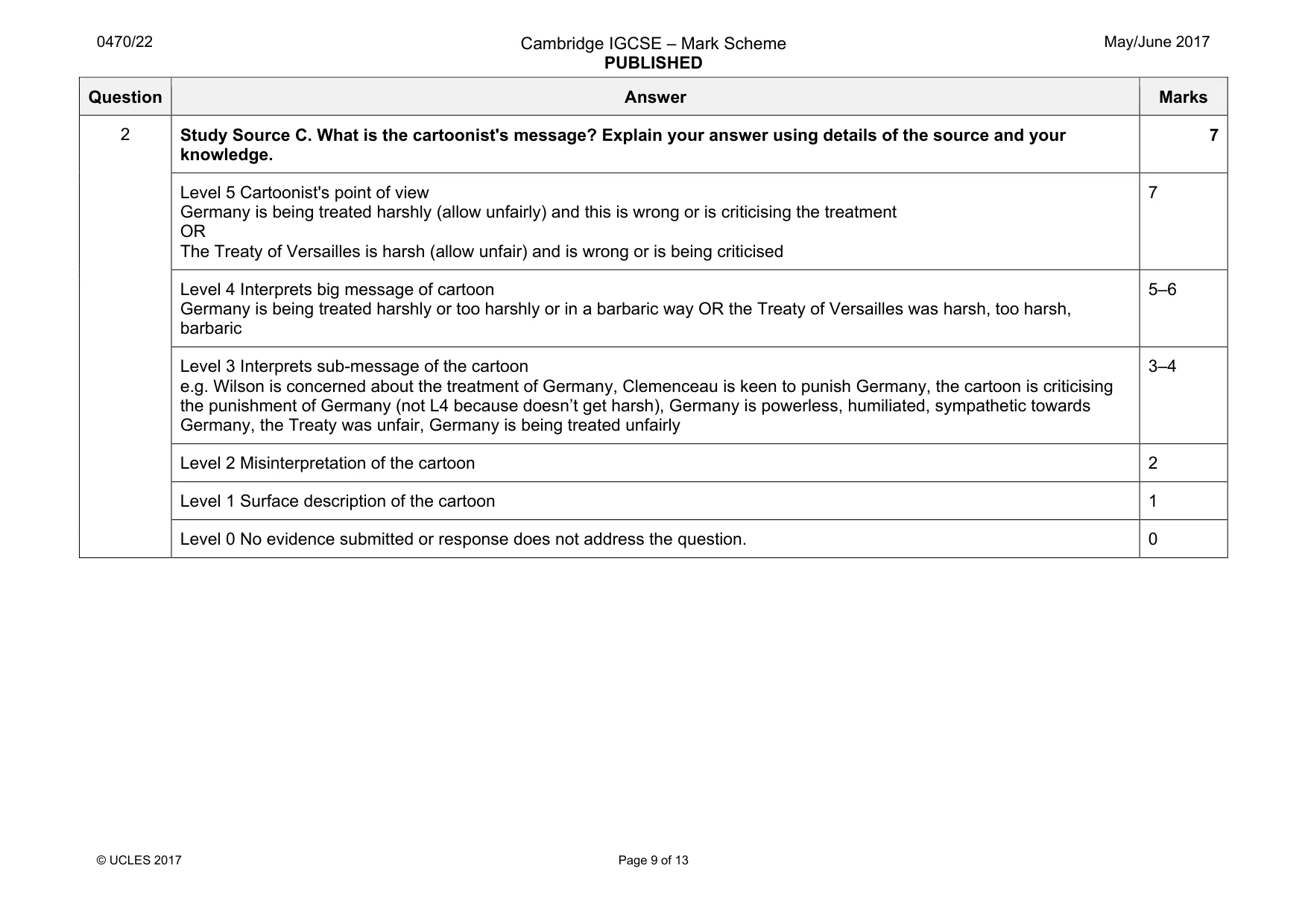
0470/22 Cambridge IGCSE – Mark Scheme PUBLISHED May/June 2017 © UCLES 2017 Page 9 of 13 Question Answer Marks 2 Study Source C. What is the cartoonist's message? Explain your answer using details of the source and your knowledge. 7 Level 5 Cartoonist's point of view Germany is being treated harshly (allow unfairly) and this is wrong or is criticising the treatment OR The Treaty of Versailles is harsh (allow unfair) and is wrong or is being criticised 7 Level 4 Interprets big message of cartoon Germany is being treated harshly or too harshly or in a barbaric way OR the Treaty of Versailles was harsh, too harsh, barbaric 5–6 Level 3 Interprets sub-message of the cartoon e.g. Wilson is concerned about the treatment of Germany, Clemenceau is keen to punish Germany, the cartoon is criticising the punishment of Germany (not L4 because doesn’t get harsh), Germany is powerless, humiliated, sympathetic towards Germany, the Treaty was unfair, Germany is being treated unfairly 3–4 Level 2 Misinterpretation of the cartoon 2 Level 1 Surface description of the cartoon 1 Level 0 No evidence submitted or response does not address the question. 0
Mark scheme, page 10
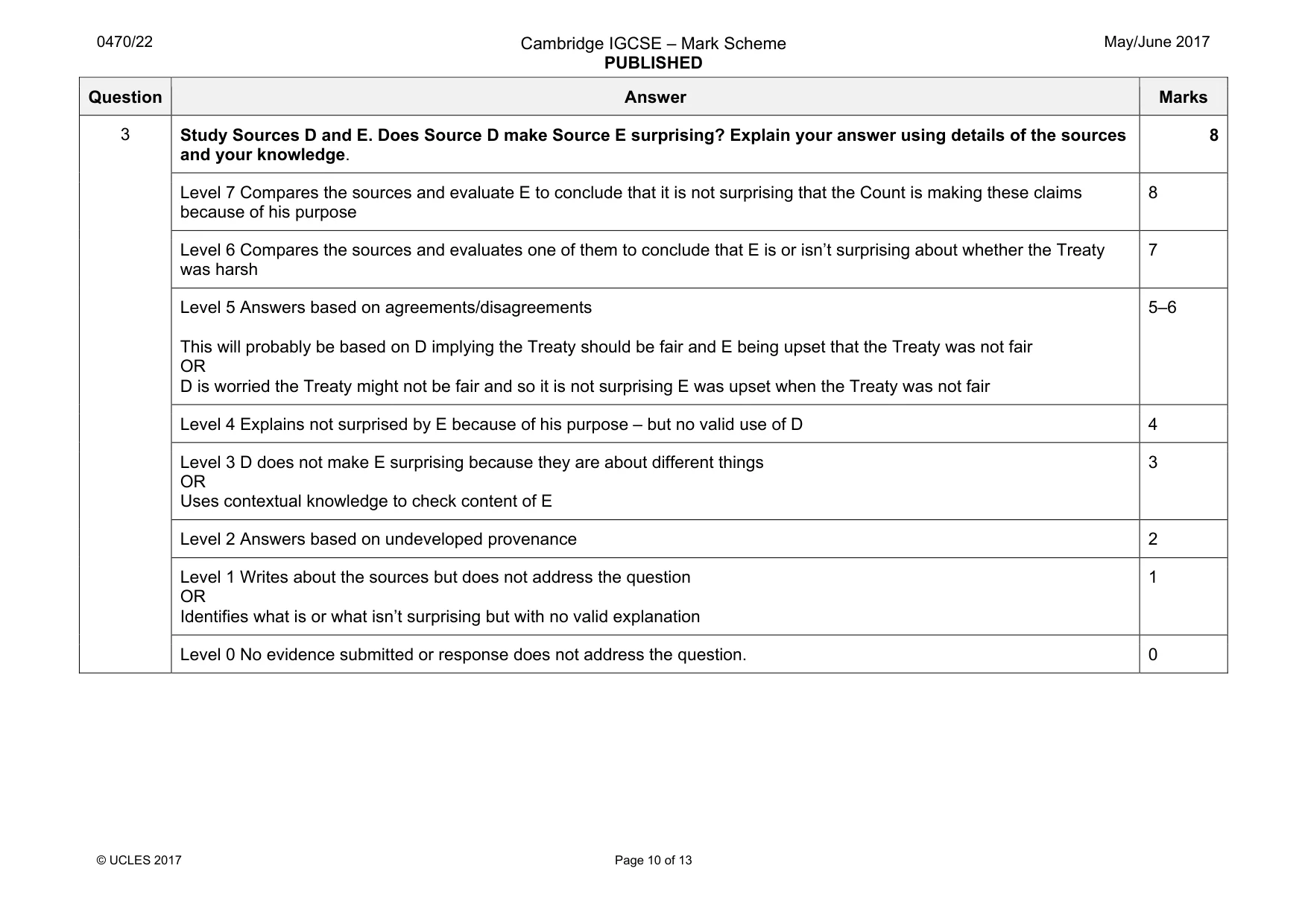
0470/22 Cambridge IGCSE – Mark Scheme PUBLISHED May/June 2017 © UCLES 2017 Page 10 of 13 Question Answer Marks 3 Study Sources D and E. Does Source D make Source E surprising? Explain your answer using details of the sources and your knowledge. 8 Level 7 Compares the sources and evaluate E to conclude that it is not surprising that the Count is making these claims because of his purpose 8 Level 6 Compares the sources and evaluates one of them to conclude that E is or isn’t surprising about whether the Treaty was harsh 7 Level 5 Answers based on agreements/disagreements This will probably be based on D implying the Treaty should be fair and E being upset that the Treaty was not fair OR D is worried the Treaty might not be fair and so it is not surprising E was upset when the Treaty was not fair 5–6 Level 4 Explains not surprised by E because of his purpose – but no valid use of D 4 Level 3 D does not make E surprising because they are about different things OR Uses contextual knowledge to check content of E 3 Level 2 Answers based on undeveloped provenance 2 Level 1 Writes about the sources but does not address the question OR Identifies what is or what isn’t surprising but with no valid explanation 1 Level 0 No evidence submitted or response does not address the question. 0
Mark scheme, page 11
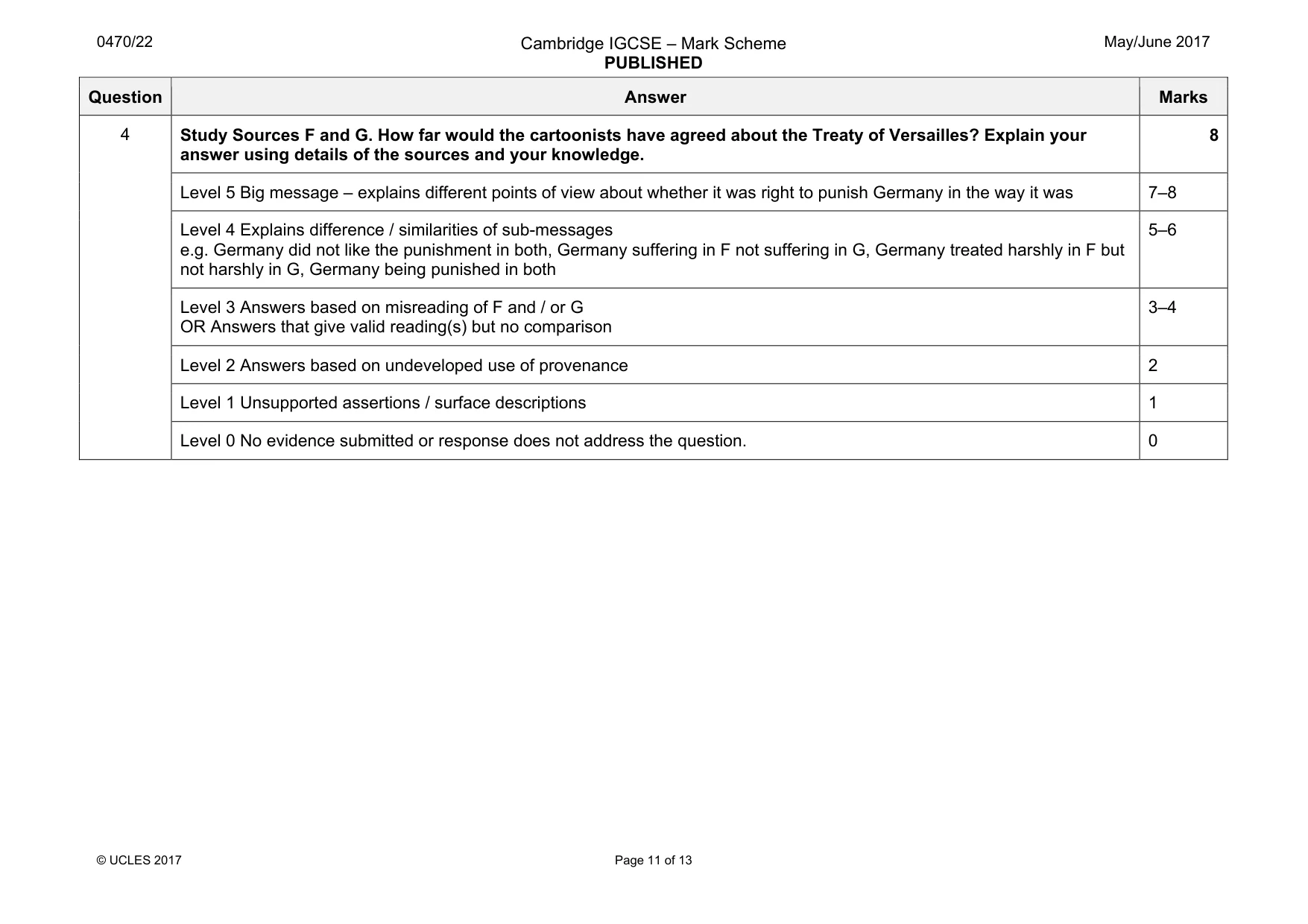
0470/22 Cambridge IGCSE – Mark Scheme PUBLISHED May/June 2017 © UCLES 2017 Page 11 of 13 Question Answer Marks 4 Study Sources F and G. How far would the cartoonists have agreed about the Treaty of Versailles? Explain your answer using details of the sources and your knowledge. 8 Level 5 Big message – explains different points of view about whether it was right to punish Germany in the way it was 7–8 Level 4 Explains difference / similarities of sub-messages e.g. Germany did not like the punishment in both, Germany suffering in F not suffering in G, Germany treated harshly in F but not harshly in G, Germany being punished in both 5–6 Level 3 Answers based on misreading of F and / or G OR Answers that give valid reading(s) but no comparison 3–4 Level 2 Answers based on undeveloped use of provenance 2 Level 1 Unsupported assertions / surface descriptions 1 Level 0 No evidence submitted or response does not address the question. 0
Mark scheme, page 12
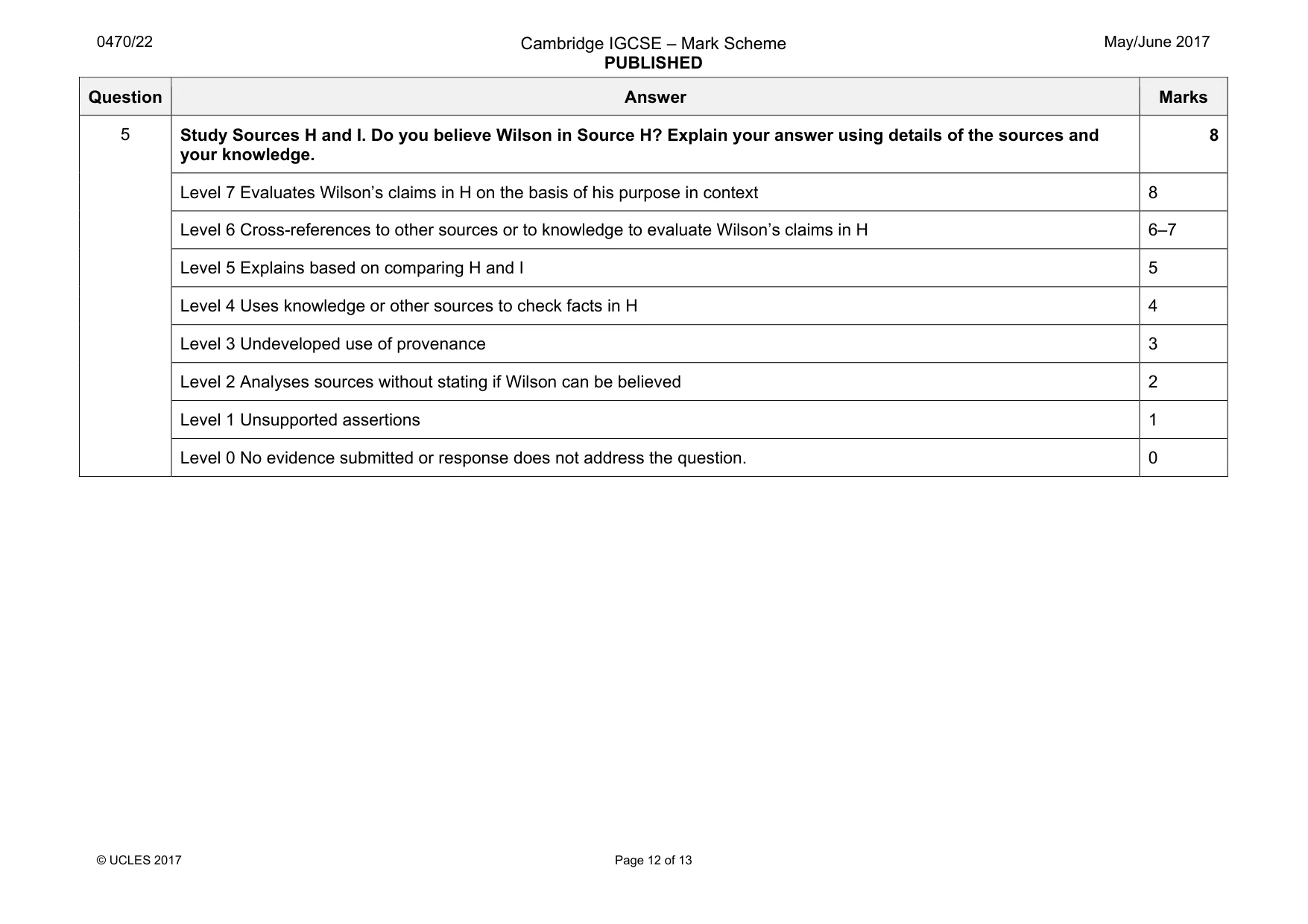
0470/22 Cambridge IGCSE – Mark Scheme PUBLISHED May/June 2017 © UCLES 2017 Page 12 of 13 Question Answer Marks 5 Study Sources H and I. Do you believe Wilson in Source H? Explain your answer using details of the sources and your knowledge. 8 Level 7 Evaluates Wilson’s claims in H on the basis of his purpose in context 8 Level 6 Cross-references to other sources or to knowledge to evaluate Wilson’s claims in H 6–7 Level 5 Explains based on comparing H and I 5 Level 4 Uses knowledge or other sources to check facts in H 4 Level 3 Undeveloped use of provenance 3 Level 2 Analyses sources without stating if Wilson can be believed 2 Level 1 Unsupported assertions 1 Level 0 No evidence submitted or response does not address the question. 0
Mark scheme, page 13
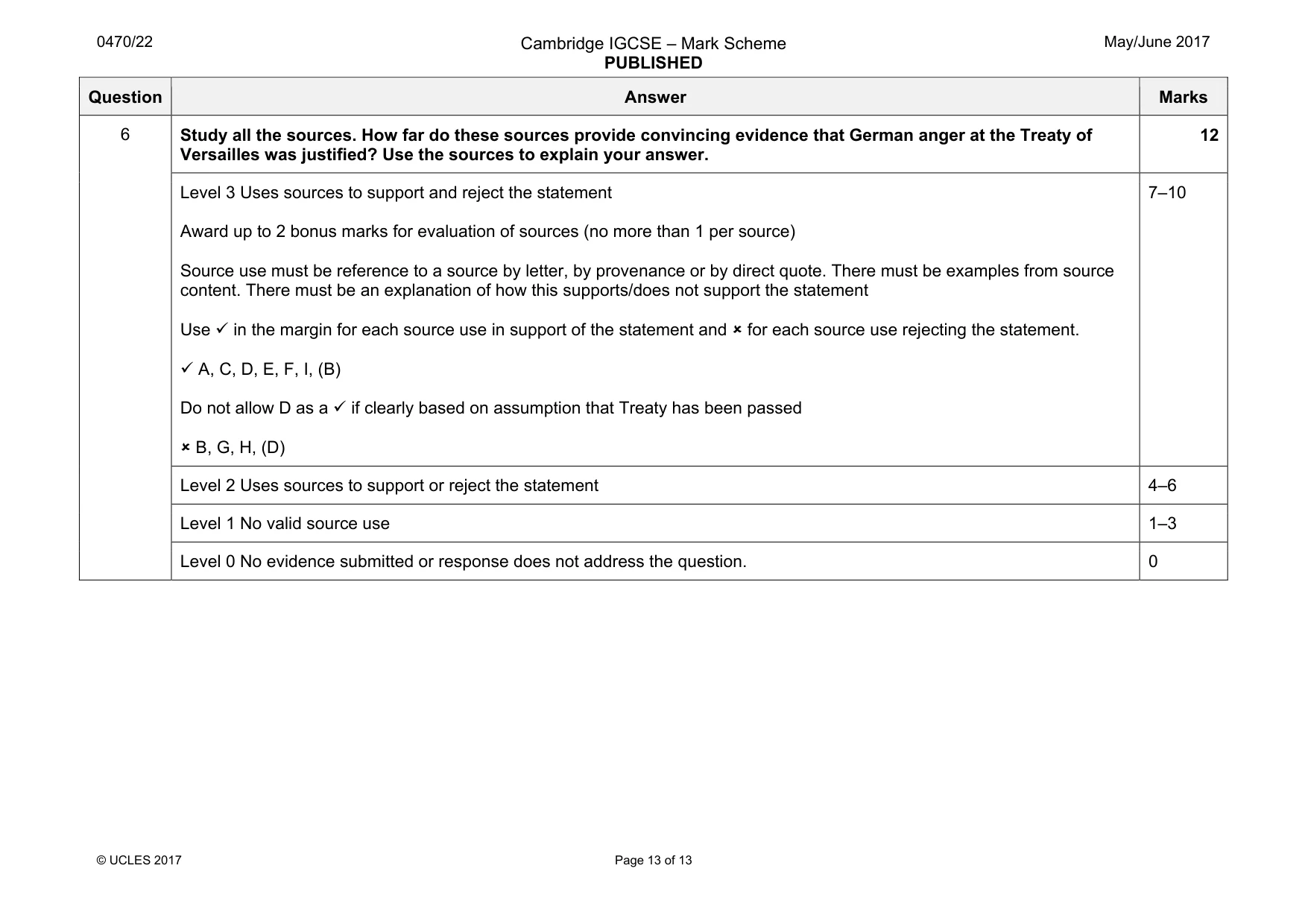
0470/22 Cambridge IGCSE – Mark Scheme PUBLISHED May/June 2017 © UCLES 2017 Page 13 of 13 Question Answer Marks 6 Study all the sources. How far do these sources provide convincing evidence that German anger at the Treaty of Versailles was justified? Use the sources to explain your answer. 12 Level 3 Uses sources to support and reject the statement Award up to 2 bonus marks for evaluation of sources (no more than 1 per source) Source use must be reference to a source by letter, by provenance or by direct quote. There must be examples from source content. There must be an explanation of how this supports/does not support the statement Use 9 in the margin for each source use in support of the statement and 8 for each source use rejecting the statement. 9 A, C, D, E, F, I, (B) Do not allow D as a 9 if clearly based on assumption that Treaty has been passed 8 B, G, H, (D) 7–10 Level 2 Uses sources to support or reject the statement 4–6 Level 1 No valid source use 1–3 Level 0 No evidence submitted or response does not address the question. 0
What you needed in this session
Cambridge’s own grade thresholds for 2017 May/June, Paper 2 · Variant 2. A higher threshold means an easier paper — the bar moves with how the cohort did.