Cambridge IGCSE History 0470 — 2016 Oct/Nov Paper 2 · Variant 2
0470/22/O/N/16 · 50 marks · ≈56 min
The question paper and its mark scheme, free to read here and free to download. This is Cambridge’s own paper, exactly as it was sat.
Question paper12 pages


Mark scheme7 pages
Answers below. Sit the paper first if you are practising.
Paper as text
Question paper, page 1
This document consists of 10 printed pages, 2 blank pages and 1 insert. DC (NF/FD) 118152/3 © UCLES 2016 [Turn over Cambridge International Examinations Cambridge International General Certificate of Secondary Education * 5 9 0 5 8 6 9 3 0 6 * HISTORY 0470/22 Paper 2 October/November 2016 2 hours No Additional Materials are required. READ THESE INSTRUCTIONS FIRST An answer booklet is provided inside this question paper. You should follow the instructions on the front cover of the answer booklet. If you need additional answer paper ask the invigilator for a continuation booklet. This paper has two options. Choose one option, and answer all of the questions on that topic. Option A: 19th Century topic [p2–p5] Option B: 20th Century topic [p6–p10] The number of marks is given in brackets [ ] at the end of each question or part question. The syllabus is approved for use in England, Wales and Northern Ireland as a Cambridge International Level 1/Level 2 Certificate.
Question paper, page 2
2 0470/22/O/N/16 © UCLES 2016 Option A: 19th Century topic WAS THE PAPACY THE MAIN HOPE FOR CHANGE IN ITALY IN THE 1840s? Study the Background Information and the sources carefully, and then answer all the questions. Background Information The 1840s saw the movement for the rebirth of Italy, the Risorgimento, gradually grow. However, those involved disagreed about the future direction for Italy. Some wanted a federation, some a unified state. Some wanted a monarchy, while others were republicans. There were also differences over who or what would lead the Risorgimento. Some looked to the Papacy, while others looked to the revolutionary Mazzini or to Charles Albert, the King of Piedmont. How far was the Papacy the main hope for change in Italy? SOURCE A Within Italy, the only government of importance was that of Piedmont. Charles Albert was notoriously reactionary and he began his reign by refusing an amnesty to political prisoners. However, as a devout Catholic he was probably influenced by the reforms introduced by Pope Pius IX and in 1848 he granted a constitution. In 1848 and 1849 he fought wars against Austria as a leader of a national independence movement. One explanation of the change is that he was always a secret revolutionary, another is that he could not make up his mind and dithered. Mazzini was the first person to put forward an Italian revolutionary programme but it is difficult to assess his influence. His support of Italian nationalism was important. It was known to reformist and revolutionary circles and gave new life to their movements. His actions were also important and for a time he helped govern the short-lived Roman Republic. However, he greatly exaggerated the number of people in Young Italy and his plots were ludicrously unpractical. The date of real significance is the election of Pius IX as Pope in 1846. His predecessor, Gregory XVI, had been a conservative and had crushed any signs of reform. Pius at once freed many political prisoners and reformed the government of the Papal States. These actions made people all over Italy believe that the Pope was implementing the programme laid down for him by Gioberti with which he did have some sympathy. Once one ruler began to reform, the rulers of other states, such as Piedmont, had to follow. From a history book published in 1971.
Question paper, page 3
3 0470/22/O/N/16 © UCLES 2016 [Turn over SOURCE B Mazzini did not know Italy well. He often paid little respect to practical realities and his real importance was in his ideas rather than his actions. He spent his life organising one insurrection after another, only to find that others in the end had captured and perverted the revolution which he had done so much to make a success. At the other end of the scale was Charles Albert, who for most of his reign remained a king on the old pattern. Religious and civil censorship continued to exist. But if there was little sign in Charles Albert of much affection toward liberty or Italy, he soon came to resent Austrian power and in 1848 he did go to war against Austria. In 1846 a new Pope, Pius IX, was elected and like most newly elected Popes he began by freeing most of the political prisoners in papal prisons. This amnesty was accompanied by conditions and even threats; yet this innocent action had unintended results which made it a decisive fact in the building of Italy. Pius IX was a Pope of real goodness, the kind of man about whom myths appear which acquire a life of their own. The almost hysterical enthusiasm which greeted his proclamation of amnesty touched a weak point in his character, and soon he was so eager for popularity that he allowed laymen more influence in his government and soon other reforms were slipping through. Charles Albert was disturbed at this liberal trend in Rome, but feeling ran so high that he too had to allow some moderate reforms. From a history book published in 1968. SOURCE C I intend to prove that, mainly because of religion, Italy possesses within itself all the necessary conditions for her national and political rebirth, and that to achieve this it has no need of revolutions or foreign invasions. That the Papacy is naturally at the head of Italy is a truth proven by the nature of things. Italy would gain much from a political confederation under the moderating authority of the Papacy: it would increase the authority of the princes without damaging their independence, remove the causes of wars and revolutions at home and reduce the differences in currencies, language and systems of government that divide the various provinces. From a book by Vincenzo Gioberti published in 1843. Gioberti, a philosopher and politician, was sent into exile by Charles Albert in 1833 and did not return until 1848. SOURCE D No nation has been less frequently united in a single body than the Italian. Confederation is the type of constitution most suited to Italy and the only obstacle to an Italian confederation is foreign rule. What would be the Pope’s position in a kingdom of Italy? That of king? This is impossible, nobody even dreams of it. A democratic system may be possible but it is unlikely in the foreseeable future. The worthy House of Savoy has upheld Italian virtue for the last century and a half. In the course of that time the land controlled by the monarchy of Savoy has almost doubled. All states that have come under its control have been in favour of the monarchy of Savoy and have been acquired at the expense of Austria, usually by fighting for them. From a book by Cesare Balbo published in 1844. Balbo was a member of a noble Piedmontese family and was the first Prime Minister of Piedmont appointed under the new constitution in 1848.
Question paper, page 4
4 0470/22/O/N/16 © UCLES 2016 SOURCE E Each day the Pope shows himself more lacking in any practical sense. Born and brought up in a liberal family, he has been formed under bad influences; a good priest, he has never turned his mind towards matters of government. Warm of heart and weak of intellect, he has allowed himself to be taken and trapped in a net from which he no longer knows how to free himself, and if matters follow their course he will be driven out of Rome. A liberal Pope is not a possibility. From a letter by Metternich to Austrian agents in Milan, December 1847. Metternich was the Austrian Chancellor. SOURCE F Soldiers! We are blessed by the right hand of a great Pope who has had to recognise that Italy is condemned by the government of Austria to the cruelty of a savage army, pillage, rape, arson, murder and total devastation. The Holy Father has blessed your swords which, united now with those of Charles Albert, must move in concord to annihilate the enemies of God, the enemies of Italy, and those that have insulted Pius IX and assassinated our Lombard brothers. Such a war of civilisation against barbarism is accordingly not just a national war but also a supremely Christian one. Let our battle cry be: GOD WILLS IT! A declaration released to the press in April 1848 by Giovanni Durando. Durando was in charge of the Papal Army sent by the Pope to defend the Papal States against a possible Austrian attack. He later fought in the Piedmontese army. SOURCE G A cartoon published in Rome in a radical newspaper, 1849. It shows the Roman Republic ringing a bell in the shape of a cap of liberty. On the right are Pope Pius IX and King Charles Albert.
Question paper, page 5
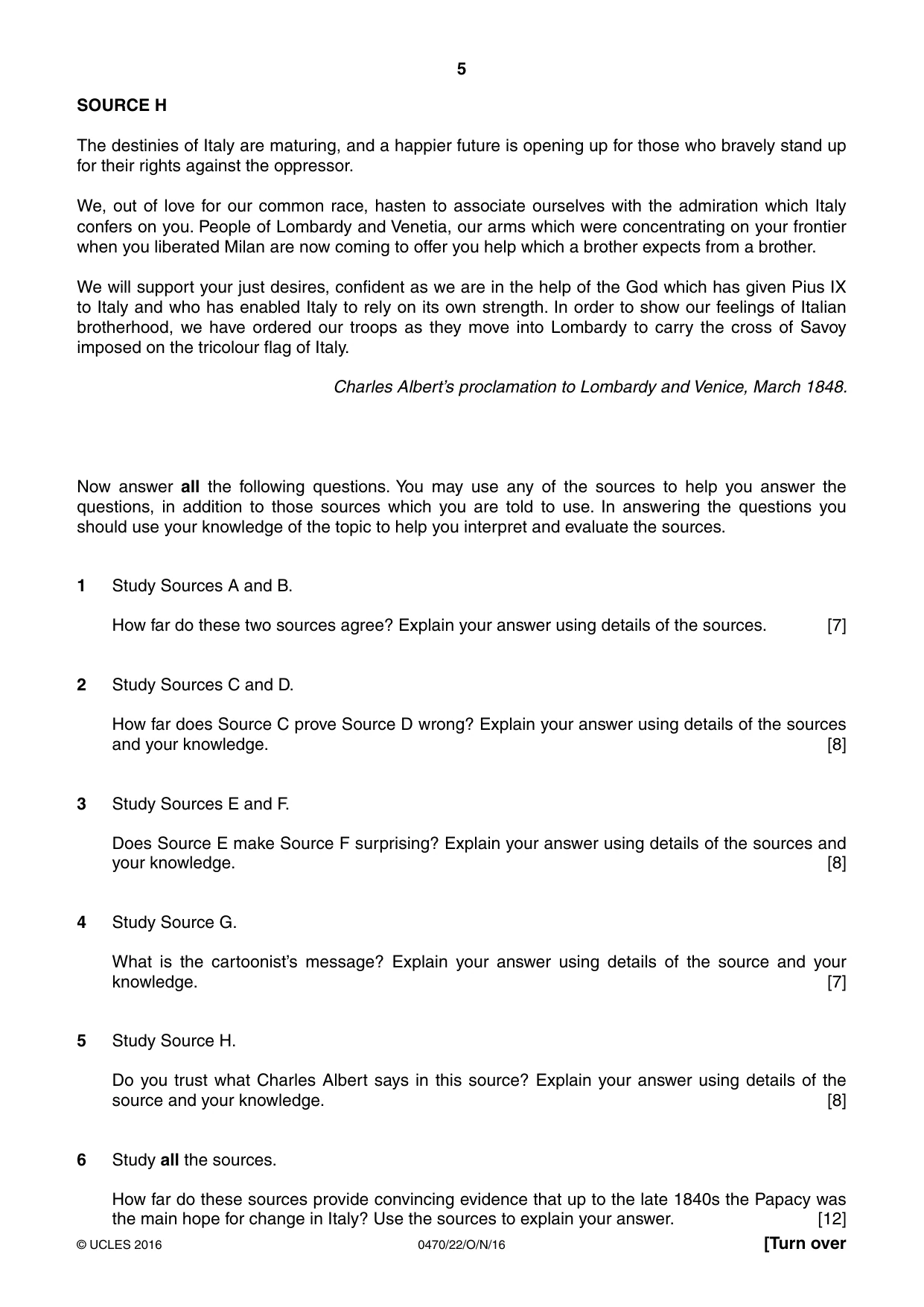
5 0470/22/O/N/16 © UCLES 2016 [Turn over SOURCE H The destinies of Italy are maturing, and a happier future is opening up for those who bravely stand up for their rights against the oppressor. We, out of love for our common race, hasten to associate ourselves with the admiration which Italy confers on you. People of Lombardy and Venetia, our arms which were concentrating on your frontier when you liberated Milan are now coming to offer you help which a brother expects from a brother. We will support your just desires, confident as we are in the help of the God which has given Pius IX to Italy and who has enabled Italy to rely on its own strength. In order to show our feelings of Italian brotherhood, we have ordered our troops as they move into Lombardy to carry the cross of Savoy imposed on the tricolour flag of Italy. Charles Albert’s proclamation to Lombardy and Venice, March 1848. Now answer all the following questions. You may use any of the sources to help you answer the questions, in addition to those sources which you are told to use. In answering the questions you should use your knowledge of the topic to help you interpret and evaluate the sources. 1 Study Sources A and B. How far do these two sources agree? Explain your answer using details of the sources. [7] 2 Study Sources C and D. How far does Source C prove Source D wrong? Explain your answer using details of the sources and your knowledge. [8] 3 Study Sources E and F. Does Source E make Source F surprising? Explain your answer using details of the sources and your knowledge. [8] 4 Study Source G. What is the cartoonist’s message? Explain your answer using details of the source and your knowledge. [7] 5 Study Source H. Do you trust what Charles Albert says in this source? Explain your answer using details of the source and your knowledge. [8] 6 Study all the sources. How far do these sources provide convincing evidence that up to the late 1840s the Papacy was the main hope for change in Italy? Use the sources to explain your answer. [12]
Question paper, page 6
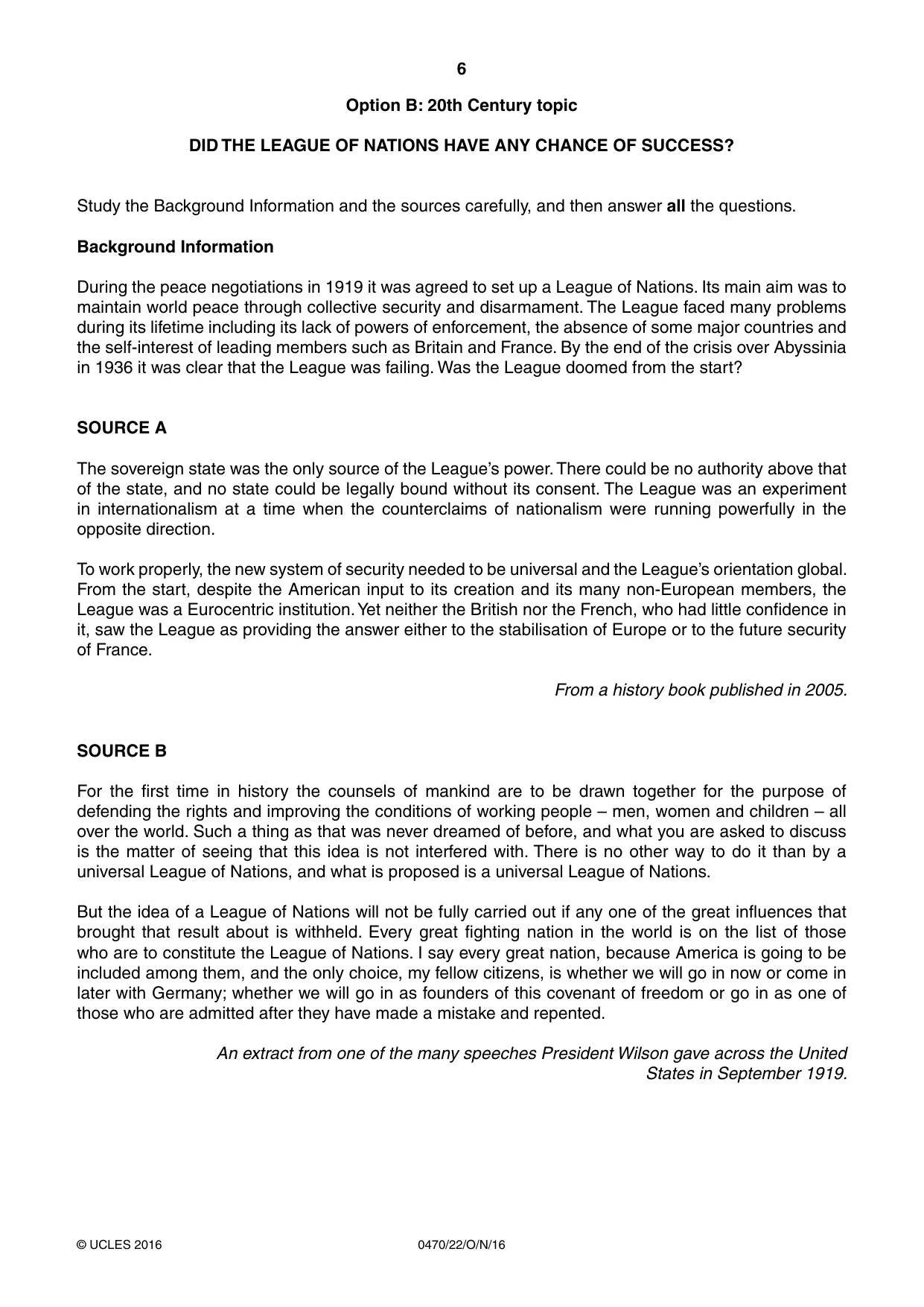
6 0470/22/O/N/16 © UCLES 2016 Option B: 20th Century topic DID THE LEAGUE OF NATIONS HAVE ANY CHANCE OF SUCCESS? Study the Background Information and the sources carefully, and then answer all the questions. Background Information During the peace negotiations in 1919 it was agreed to set up a League of Nations. Its main aim was to maintain world peace through collective security and disarmament. The League faced many problems during its lifetime including its lack of powers of enforcement, the absence of some major countries and the self-interest of leading members such as Britain and France. By the end of the crisis over Abyssinia in 1936 it was clear that the League was failing. Was the League doomed from the start? SOURCE A The sovereign state was the only source of the League’s power. There could be no authority above that of the state, and no state could be legally bound without its consent. The League was an experiment in internationalism at a time when the counterclaims of nationalism were running powerfully in the opposite direction. To work properly, the new system of security needed to be universal and the League’s orientation global. From the start, despite the American input to its creation and its many non-European members, the League was a Eurocentric institution. Yet neither the British nor the French, who had little confidence in it, saw the League as providing the answer either to the stabilisation of Europe or to the future security of France. From a history book published in 2005. SOURCE B For the first time in history the counsels of mankind are to be drawn together for the purpose of defending the rights and improving the conditions of working people – men, women and children – all over the world. Such a thing as that was never dreamed of before, and what you are asked to discuss is the matter of seeing that this idea is not interfered with. There is no other way to do it than by a universal League of Nations, and what is proposed is a universal League of Nations. But the idea of a League of Nations will not be fully carried out if any one of the great influences that brought that result about is withheld. Every great fighting nation in the world is on the list of those who are to constitute the League of Nations. I say every great nation, because America is going to be included among them, and the only choice, my fellow citizens, is whether we will go in now or come in later with Germany; whether we will go in as founders of this covenant of freedom or go in as one of those who are admitted after they have made a mistake and repented. An extract from one of the many speeches President Wilson gave across the United States in September 1919.
Question paper, page 7
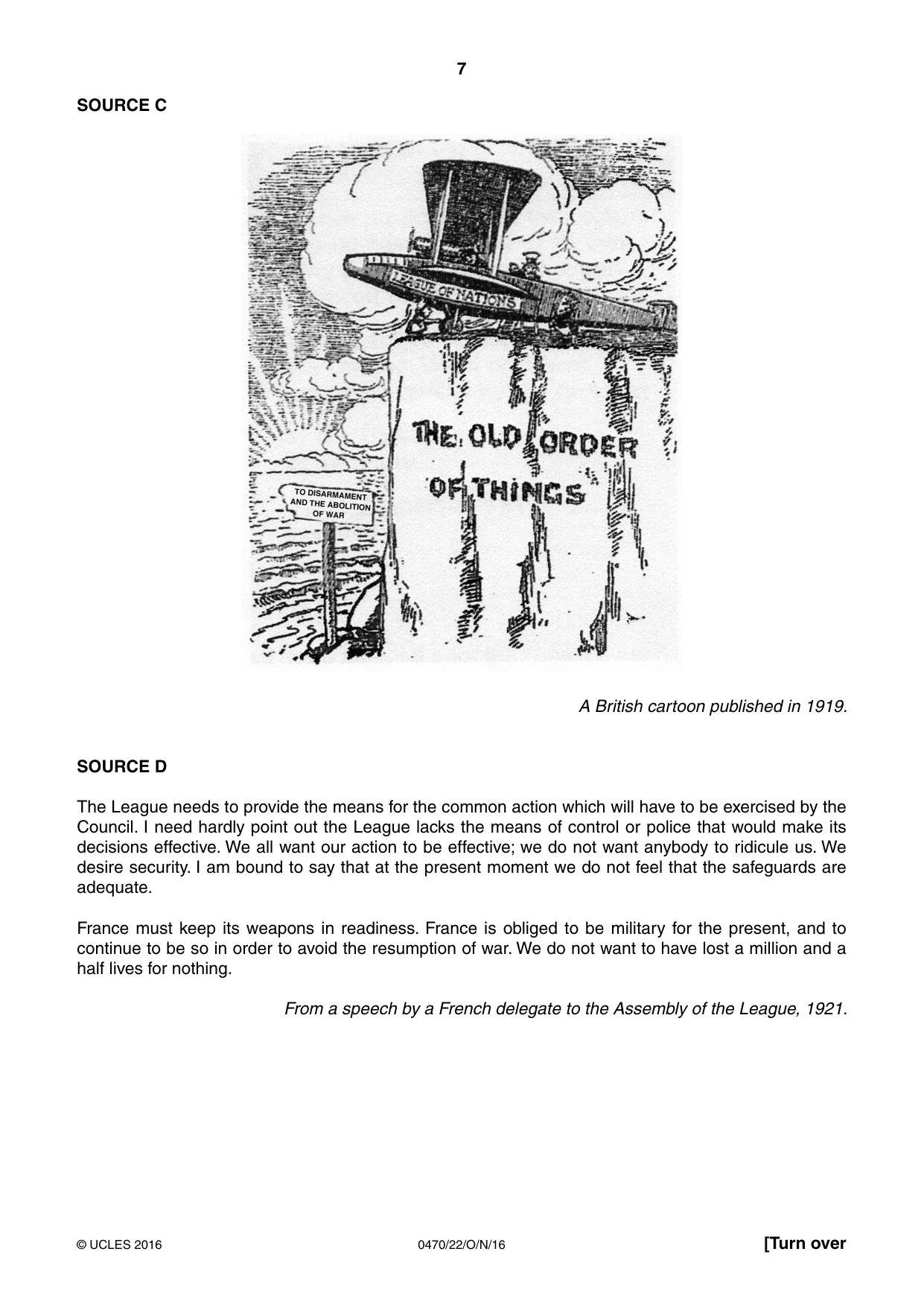
7 0470/22/O/N/16 © UCLES 2016 [Turn over SOURCE C A British cartoon published in 1919. SOURCE D The League needs to provide the means for the common action which will have to be exercised by the Council. I need hardly point out the League lacks the means of control or police that would make its decisions effective. We all want our action to be effective; we do not want anybody to ridicule us. We desire security. I am bound to say that at the present moment we do not feel that the safeguards are adequate. France must keep its weapons in readiness. France is obliged to be military for the present, and to continue to be so in order to avoid the resumption of war. We do not want to have lost a million and a half lives for nothing. From a speech by a French delegate to the Assembly of the League, 1921.
Question paper, page 8
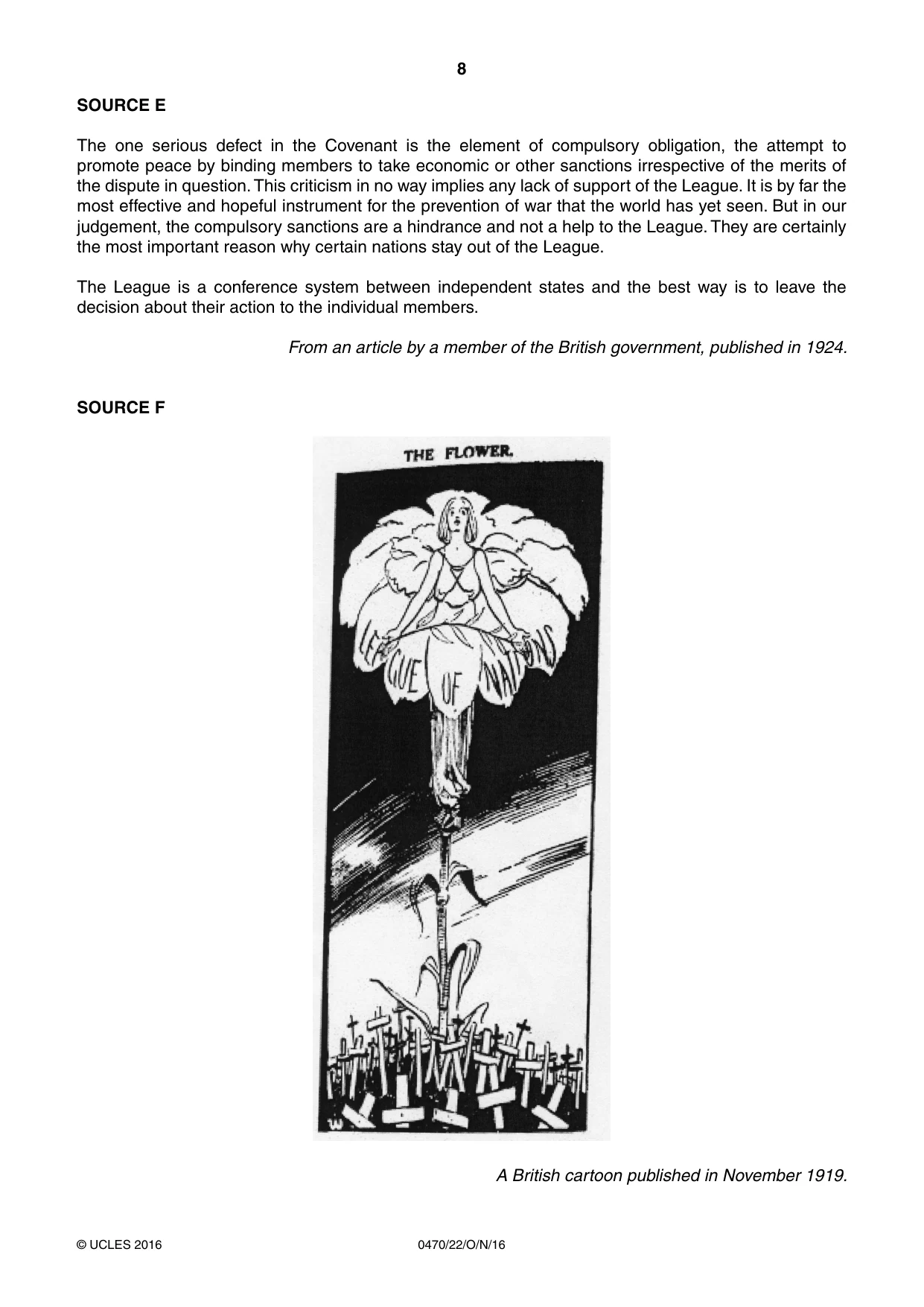
8 0470/22/O/N/16 © UCLES 2016 SOURCE E The one serious defect in the Covenant is the element of compulsory obligation, the attempt to promote peace by binding members to take economic or other sanctions irrespective of the merits of the dispute in question. This criticism in no way implies any lack of support of the League. It is by far the most effective and hopeful instrument for the prevention of war that the world has yet seen. But in our judgement, the compulsory sanctions are a hindrance and not a help to the League. They are certainly the most important reason why certain nations stay out of the League. The League is a conference system between independent states and the best way is to leave the decision about their action to the individual members. From an article by a member of the British government, published in 1924. SOURCE F A British cartoon published in November 1919.
Question paper, page 9
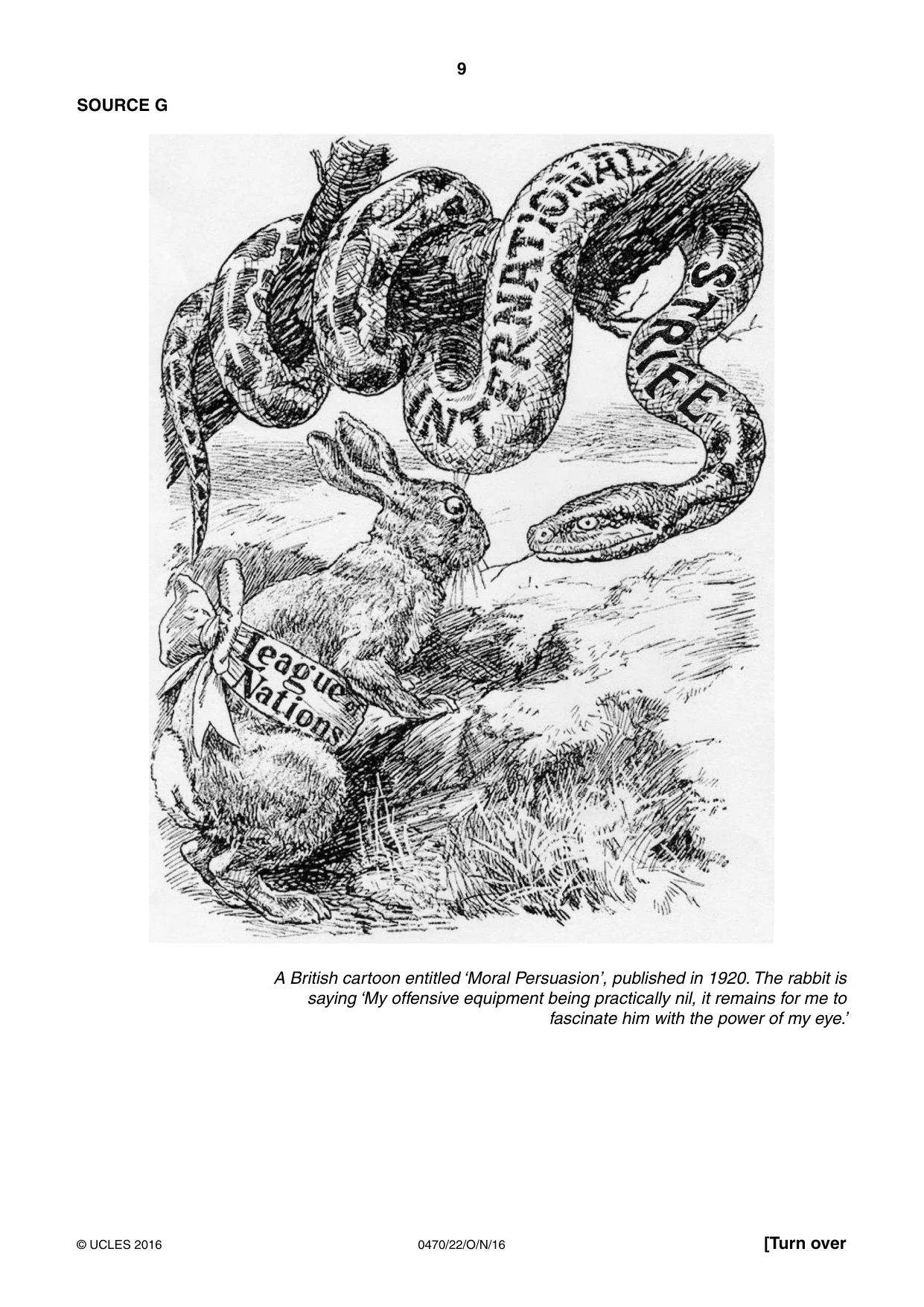
9 0470/22/O/N/16 © UCLES 2016 [Turn over SOURCE G A British cartoon entitled ‘Moral Persuasion’, published in 1920. The rabbit is saying ‘My offensive equipment being practically nil, it remains for me to fascinate him with the power of my eye.’
Question paper, page 10
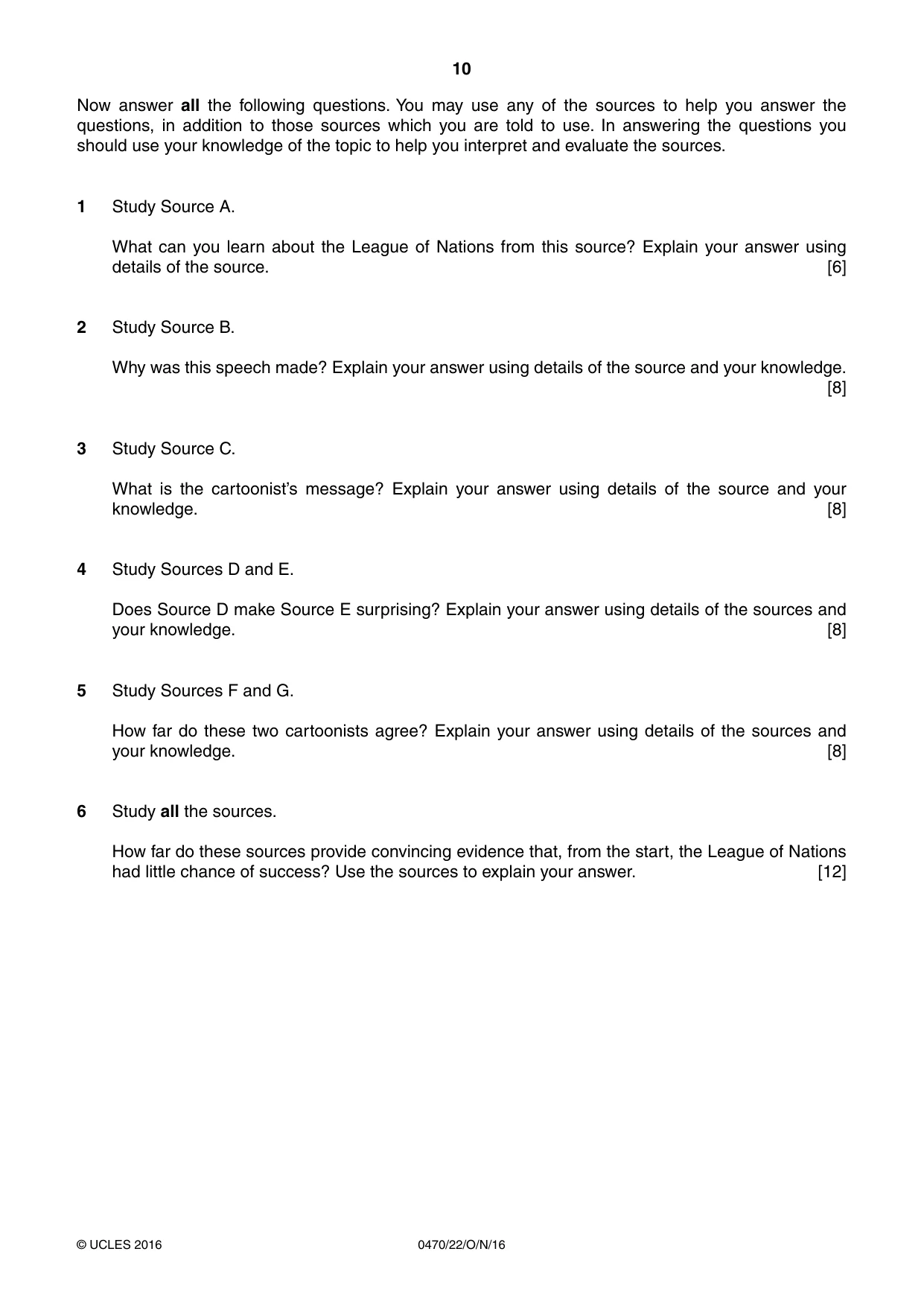
10 0470/22/O/N/16 © UCLES 2016 Now answer all the following questions. You may use any of the sources to help you answer the questions, in addition to those sources which you are told to use. In answering the questions you should use your knowledge of the topic to help you interpret and evaluate the sources. 1 Study Source A. What can you learn about the League of Nations from this source? Explain your answer using details of the source. [6] 2 Study Source B. Why was this speech made? Explain your answer using details of the source and your knowledge. [8] 3 Study Source C. What is the cartoonist’s message? Explain your answer using details of the source and your knowledge. [8] 4 Study Sources D and E. Does Source D make Source E surprising? Explain your answer using details of the sources and your knowledge. [8] 5 Study Sources F and G. How far do these two cartoonists agree? Explain your answer using details of the sources and your knowledge. [8] 6 Study all the sources. How far do these sources provide convincing evidence that, from the start, the League of Nations had little chance of success? Use the sources to explain your answer. [12]
Question paper, page 11
11 0470/22/O/N/16 © UCLES 2016 BLANK PAGE
Question paper, page 12
12 0470/22/O/N/16 © UCLES 2016 BLANK PAGE Permission to reproduce items where third-party owned material protected by copyright is included has been sought and cleared where possible. Every reasonable effort has been made by the publisher (UCLES) to trace copyright holders, but if any items requiring clearance have unwittingly been included, the publisher will be pleased to make amends at the earliest possible opportunity. To avoid the issue of disclosure of answer-related information to candidates, all copyright acknowledgements are reproduced online in the Cambridge International Examinations Copyright Acknowledgements Booklet. This is produced for each series of examinations and is freely available to download at www.cie.org.uk after the live examination series. Cambridge International Examinations is part of the Cambridge Assessment Group. Cambridge Assessment is the brand name of University of Cambridge Local Examinations Syndicate (UCLES), which is itself a department of the University of Cambridge.
Mark scheme, page 1
® IGCSE is the registered trademark of Cambridge International Examinations. This syllabus is approved for use in England, Wales and Northern Ireland as a Cambridge International Level 1/Level 2 Certificate. This document consists of 7 printed pages. © UCLES 2016 [Turn over Cambridge International Examinations Cambridge International General Certificate of Secondary Education HISTORY 0470/22 Paper 2 October/November 2016 MARK SCHEME Maximum Mark: 50 Published This mark scheme is published as an aid to teachers and candidates, to indicate the requirements of the examination. It shows the basis on which Examiners were instructed to award marks. It does not indicate the details of the discussions that took place at an Examiners’ meeting before marking began, which would have considered the acceptability of alternative answers. Mark schemes should be read in conjunction with the question paper and the Principal Examiner Report for Teachers. Cambridge will not enter into discussions about these mark schemes. Cambridge is publishing the mark schemes for the October/November 2016 series for most Cambridge IGCSE®, Cambridge International A and AS Level components and some Cambridge O Level components.
Mark scheme, page 2
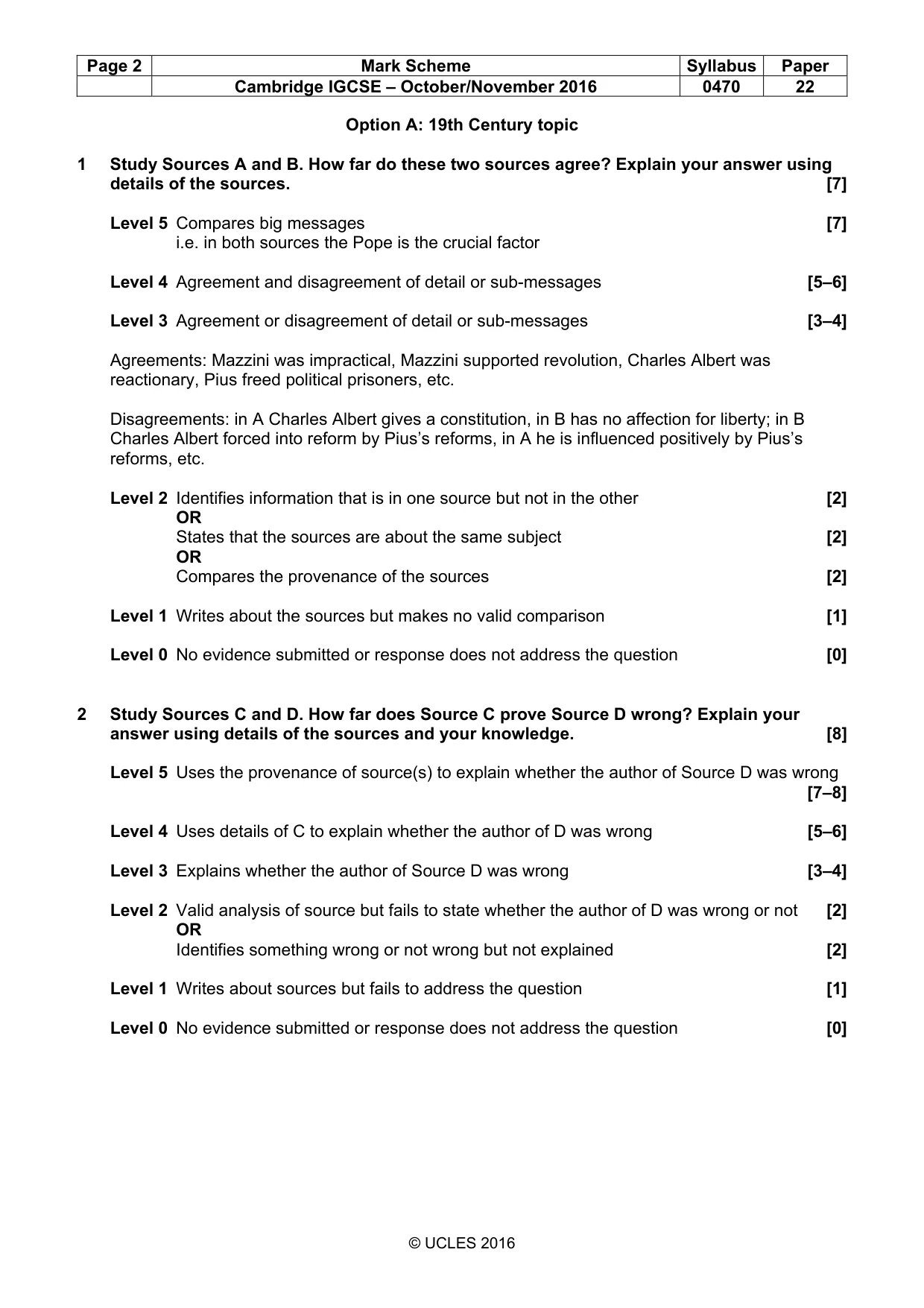
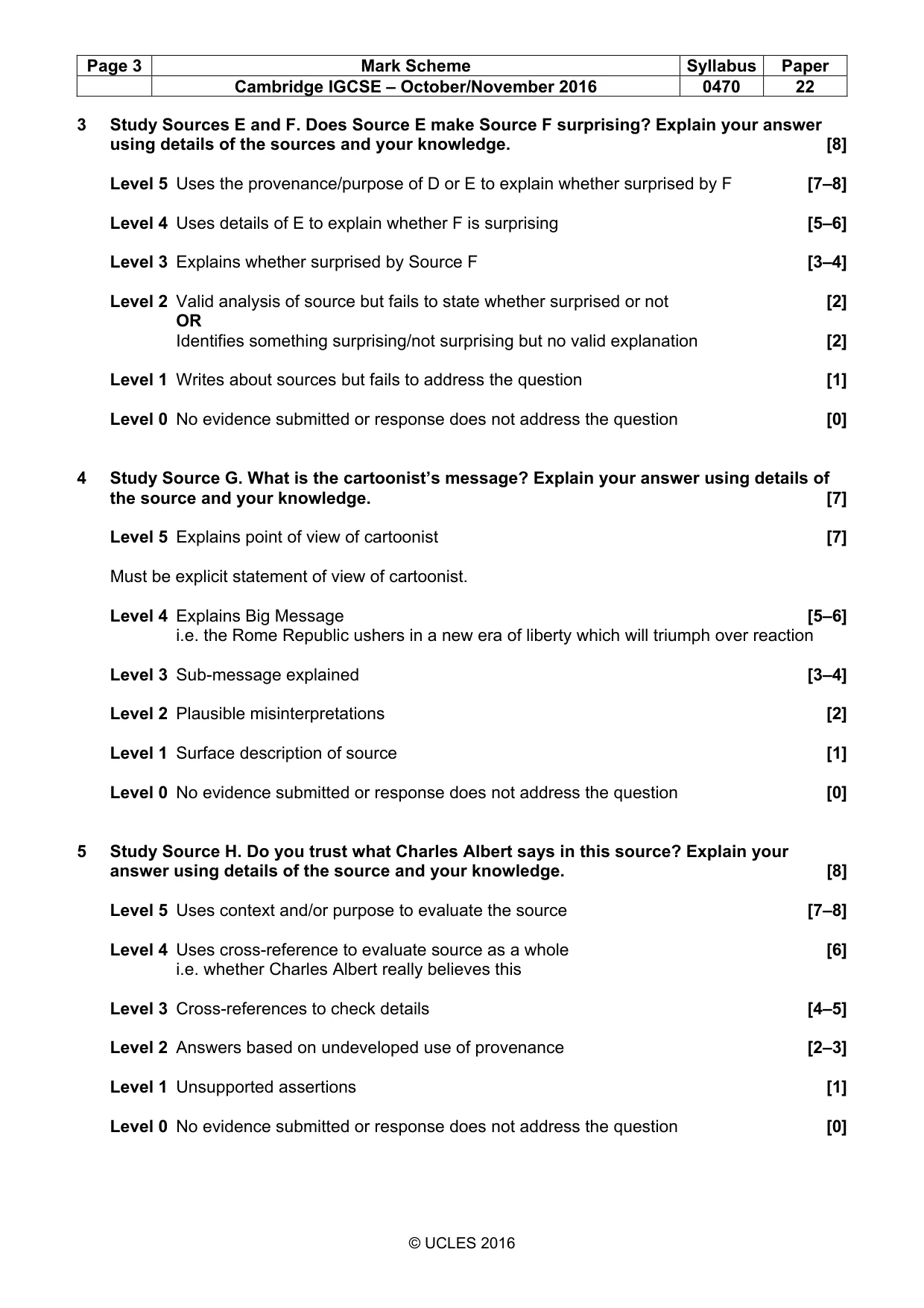
Page 2 Mark Scheme Syllabus Paper Cambridge IGCSE – October/November 2016 0470 22 © UCLES 2016 Option A: 19th Century topic 1 Study Sources A and B. How far do these two sources agree? Explain your answer using details of the sources. [7] Level 5 Compares big messages [7] i.e. in both sources the Pope is the crucial factor Level 4 Agreement and disagreement of detail or sub-messages [5–6] Level 3 Agreement or disagreement of detail or sub-messages [3–4] Agreements: Mazzini was impractical, Mazzini supported revolution, Charles Albert was reactionary, Pius freed political prisoners, etc. Disagreements: in A Charles Albert gives a constitution, in B has no affection for liberty; in B Charles Albert forced into reform by Pius’s reforms, in A he is influenced positively by Pius’s reforms, etc. Level 2 Identifies information that is in one source but not in the other [2] OR States that the sources are about the same subject [2] OR Compares the provenance of the sources [2] Level 1 Writes about the sources but makes no valid comparison [1] Level 0 No evidence submitted or response does not address the question [0] 2 Study Sources C and D. How far does Source C prove Source D wrong? Explain your answer using details of the sources and your knowledge. [8] Level 5 Uses the provenance of source(s) to explain whether the author of Source D was wrong [7–8] Level 4 Uses details of C to explain whether the author of D was wrong [5–6] Level 3 Explains whether the author of Source D was wrong [3–4] Level 2 Valid analysis of source but fails to state whether the author of D was wrong or not [2] OR Identifies something wrong or not wrong but not explained [2] Level 1 Writes about sources but fails to address the question [1] Level 0 No evidence submitted or response does not address the question [0]
Mark scheme, page 3
Page 3 Mark Scheme Syllabus Paper Cambridge IGCSE – October/November 2016 0470 22 © UCLES 2016 3 Study Sources E and F. Does Source E make Source F surprising? Explain your answer using details of the sources and your knowledge. [8] Level 5 Uses the provenance/purpose of D or E to explain whether surprised by F [7–8] Level 4 Uses details of E to explain whether F is surprising [5–6] Level 3 Explains whether surprised by Source F [3–4] Level 2 Valid analysis of source but fails to state whether surprised or not [2] OR Identifies something surprising/not surprising but no valid explanation [2] Level 1 Writes about sources but fails to address the question [1] Level 0 No evidence submitted or response does not address the question [0] 4 Study Source G. What is the cartoonist’s message? Explain your answer using details of the source and your knowledge. [7] Level 5 Explains point of view of cartoonist [7] Must be explicit statement of view of cartoonist. Level 4 Explains Big Message [5–6] i.e. the Rome Republic ushers in a new era of liberty which will triumph over reaction Level 3 Sub-message explained [3–4] Level 2 Plausible misinterpretations [2] Level 1 Surface description of source [1] Level 0 No evidence submitted or response does not address the question [0] 5 Study Source H. Do you trust what Charles Albert says in this source? Explain your answer using details of the source and your knowledge. [8] Level 5 Uses context and/or purpose to evaluate the source [7–8] Level 4 Uses cross-reference to evaluate source as a whole [6] i.e. whether Charles Albert really believes this Level 3 Cross-references to check details [4–5] Level 2 Answers based on undeveloped use of provenance [2–3] Level 1 Unsupported assertions [1] Level 0 No evidence submitted or response does not address the question [0]
Mark scheme, page 4
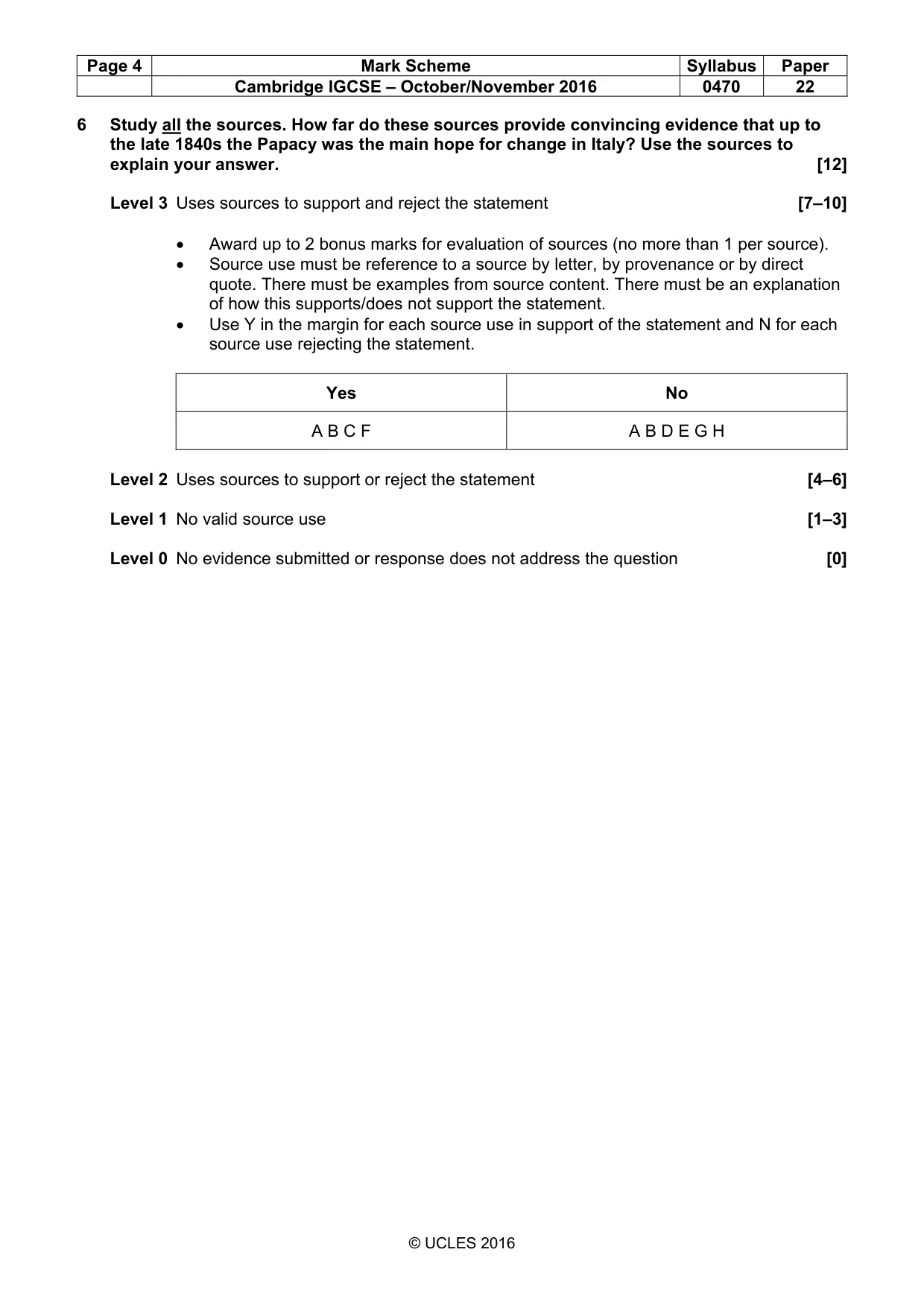
Page 4 Mark Scheme Syllabus Paper Cambridge IGCSE – October/November 2016 0470 22 © UCLES 2016 6 Study all the sources. How far do these sources provide convincing evidence that up to the late 1840s the Papacy was the main hope for change in Italy? Use the sources to explain your answer. [12] Level 3 Uses sources to support and reject the statement [7–10] • Award up to 2 bonus marks for evaluation of sources (no more than 1 per source). • Source use must be reference to a source by letter, by provenance or by direct quote. There must be examples from source content. There must be an explanation of how this supports/does not support the statement. • Use Y in the margin for each source use in support of the statement and N for each source use rejecting the statement. Yes No A B C F A B D E G H Level 2 Uses sources to support or reject the statement [4–6] Level 1 No valid source use [1–3] Level 0 No evidence submitted or response does not address the question [0]
Mark scheme, page 5
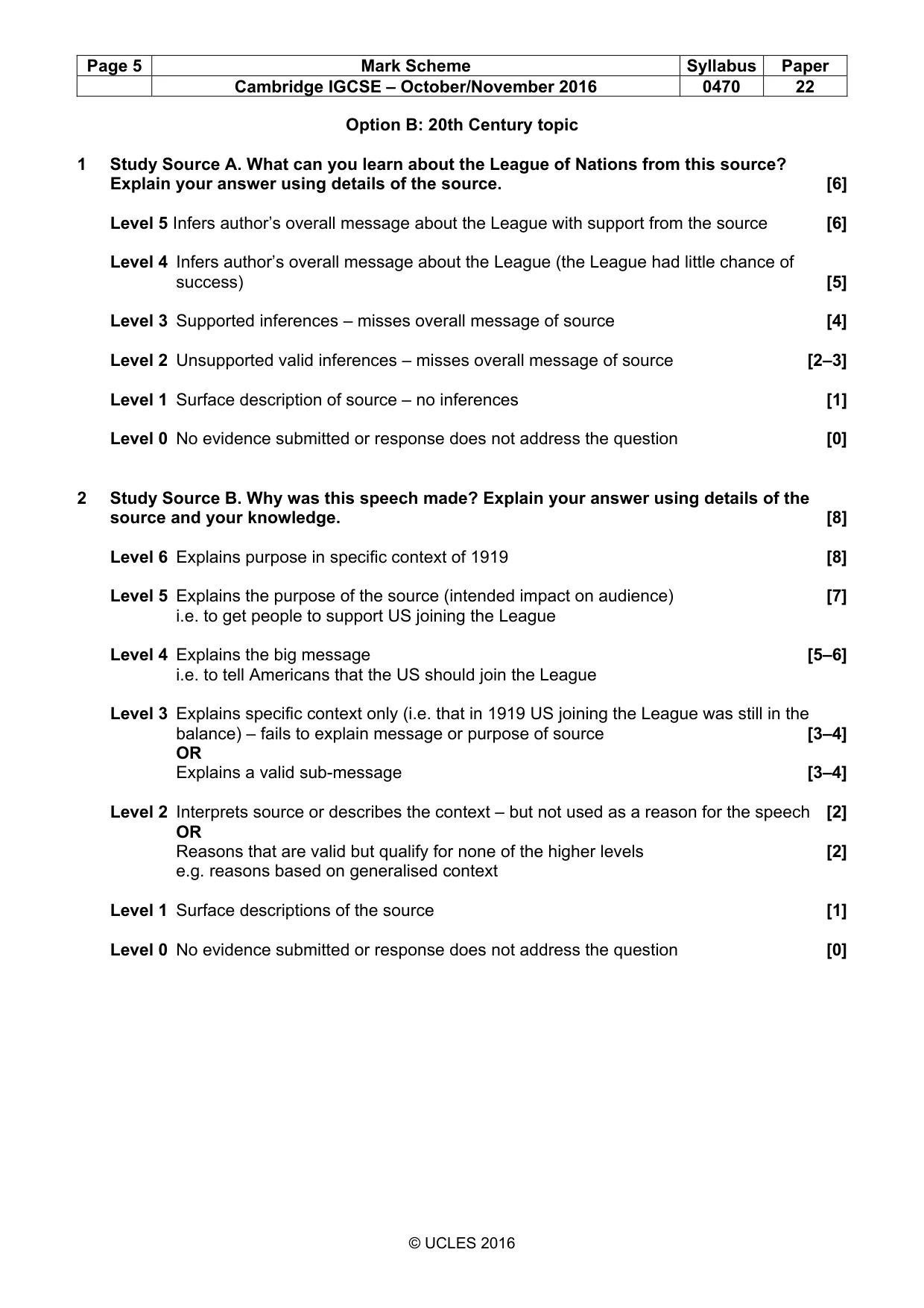
Page 5 Mark Scheme Syllabus Paper Cambridge IGCSE – October/November 2016 0470 22 © UCLES 2016 Option B: 20th Century topic 1 Study Source A. What can you learn about the League of Nations from this source? Explain your answer using details of the source. [6] Level 5 Infers author’s overall message about the League with support from the source [6] Level 4 Infers author’s overall message about the League (the League had little chance of success) [5] Level 3 Supported inferences – misses overall message of source [4] Level 2 Unsupported valid inferences – misses overall message of source [2–3] Level 1 Surface description of source – no inferences [1] Level 0 No evidence submitted or response does not address the question [0] 2 Study Source B. Why was this speech made? Explain your answer using details of the source and your knowledge. [8] Level 6 Explains purpose in specific context of 1919 [8] Level 5 Explains the purpose of the source (intended impact on audience) [7] i.e. to get people to support US joining the League Level 4 Explains the big message [5–6] i.e. to tell Americans that the US should join the League Level 3 Explains specific context only (i.e. that in 1919 US joining the League was still in the balance) – fails to explain message or purpose of source [3–4] OR Explains a valid sub-message [3–4] Level 2 Interprets source or describes the context – but not used as a reason for the speech [2] OR Reasons that are valid but qualify for none of the higher levels [2] e.g. reasons based on generalised context Level 1 Surface descriptions of the source [1] Level 0 No evidence submitted or response does not address the question [0]
Mark scheme, page 6
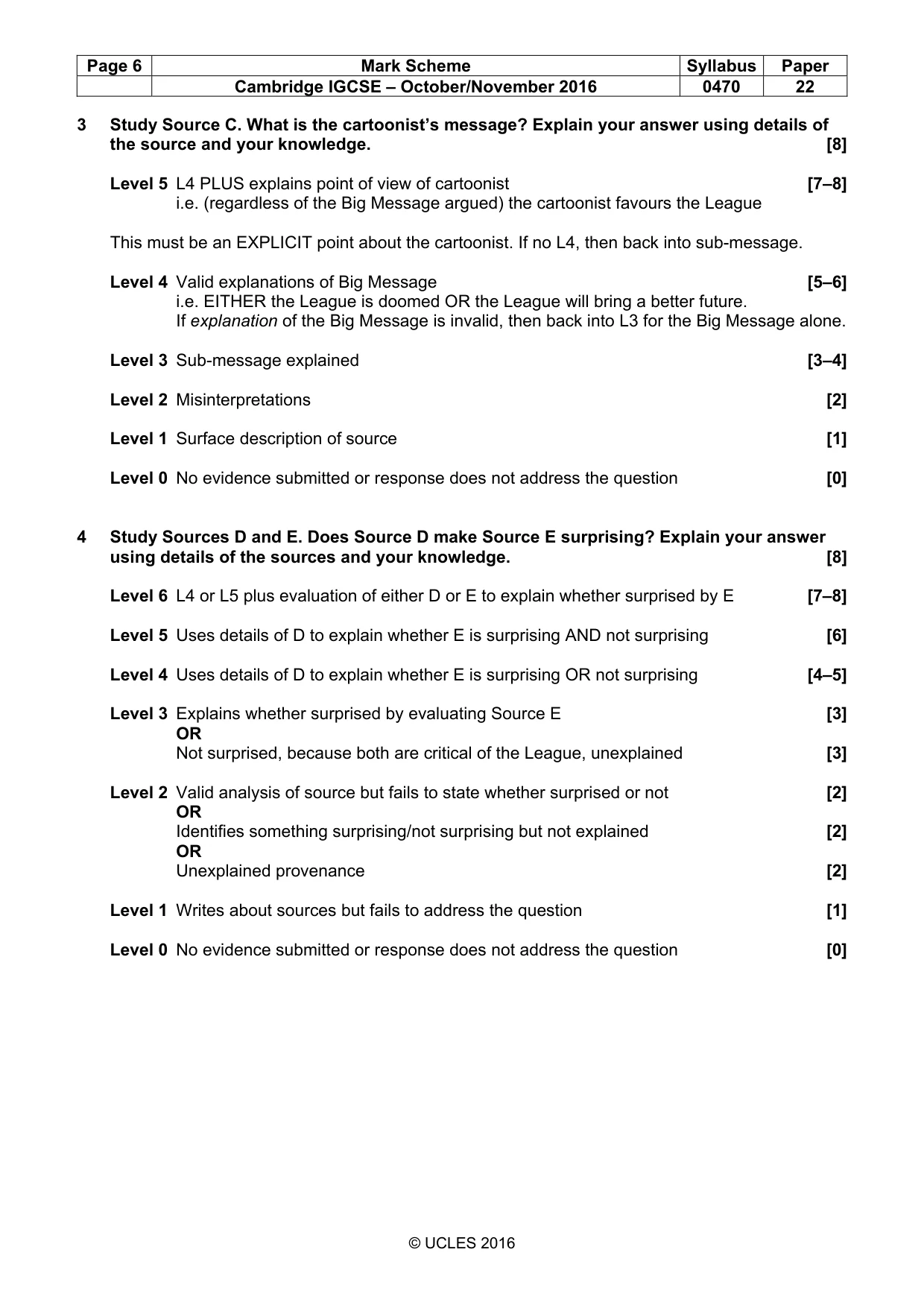
Page 6 Mark Scheme Syllabus Paper Cambridge IGCSE – October/November 2016 0470 22 © UCLES 2016 3 Study Source C. What is the cartoonist’s message? Explain your answer using details of the source and your knowledge. [8] Level 5 L4 PLUS explains point of view of cartoonist [7–8] i.e. (regardless of the Big Message argued) the cartoonist favours the League This must be an EXPLICIT point about the cartoonist. If no L4, then back into sub-message. Level 4 Valid explanations of Big Message [5–6] i.e. EITHER the League is doomed OR the League will bring a better future. If explanation of the Big Message is invalid, then back into L3 for the Big Message alone. Level 3 Sub-message explained [3–4] Level 2 Misinterpretations [2] Level 1 Surface description of source [1] Level 0 No evidence submitted or response does not address the question [0] 4 Study Sources D and E. Does Source D make Source E surprising? Explain your answer using details of the sources and your knowledge. [8] Level 6 L4 or L5 plus evaluation of either D or E to explain whether surprised by E [7–8] Level 5 Uses details of D to explain whether E is surprising AND not surprising [6] Level 4 Uses details of D to explain whether E is surprising OR not surprising [4–5] Level 3 Explains whether surprised by evaluating Source E [3] OR Not surprised, because both are critical of the League, unexplained [3] Level 2 Valid analysis of source but fails to state whether surprised or not [2] OR Identifies something surprising/not surprising but not explained [2] OR Unexplained provenance [2] Level 1 Writes about sources but fails to address the question [1] Level 0 No evidence submitted or response does not address the question [0]
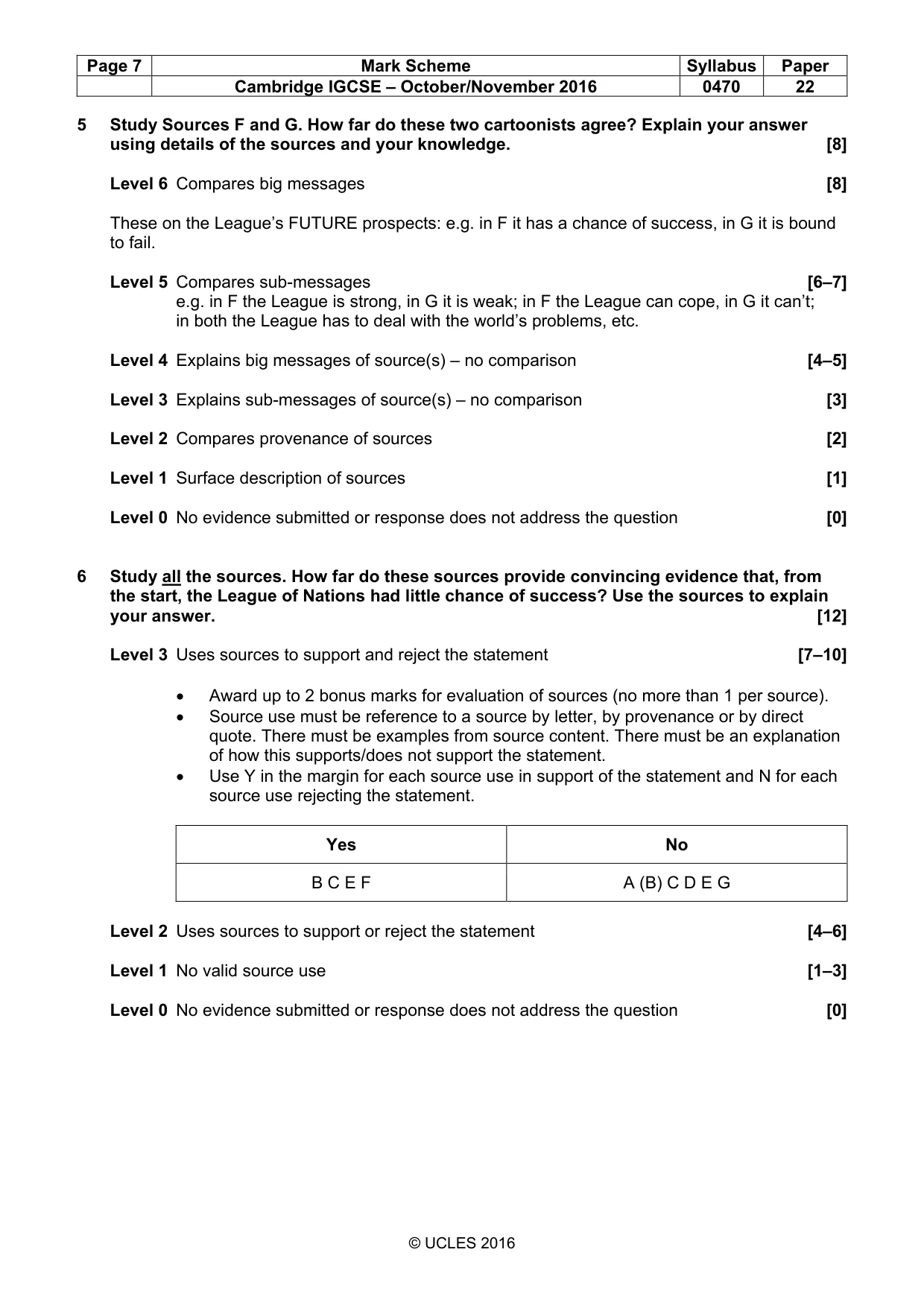
Mark scheme, page 7
Page 7 Mark Scheme Syllabus Paper Cambridge IGCSE – October/November 2016 0470 22 © UCLES 2016 5 Study Sources F and G. How far do these two cartoonists agree? Explain your answer using details of the sources and your knowledge. [8] Level 6 Compares big messages [8] These on the League’s FUTURE prospects: e.g. in F it has a chance of success, in G it is bound to fail. Level 5 Compares sub-messages [6–7] e.g. in F the League is strong, in G it is weak; in F the League can cope, in G it can’t; in both the League has to deal with the world’s problems, etc. Level 4 Explains big messages of source(s) – no comparison [4–5] Level 3 Explains sub-messages of source(s) – no comparison [3] Level 2 Compares provenance of sources [2] Level 1 Surface description of sources [1] Level 0 No evidence submitted or response does not address the question [0] 6 Study all the sources. How far do these sources provide convincing evidence that, from the start, the League of Nations had little chance of success? Use the sources to explain your answer. [12] Level 3 Uses sources to support and reject the statement [7–10] • Award up to 2 bonus marks for evaluation of sources (no more than 1 per source). • Source use must be reference to a source by letter, by provenance or by direct quote. There must be examples from source content. There must be an explanation of how this supports/does not support the statement. • Use Y in the margin for each source use in support of the statement and N for each source use rejecting the statement. Yes No B C E F A (B) C D E G Level 2 Uses sources to support or reject the statement [4–6] Level 1 No valid source use [1–3] Level 0 No evidence submitted or response does not address the question [0]
What you needed in this session
Cambridge’s own grade thresholds for 2016 Oct/Nov, Paper 2 · Variant 2. A higher threshold means an easier paper — the bar moves with how the cohort did.